Questions as text
Q1 · Sulfuric acid is manufactured by the Contact process 0973/21 May/June 2019
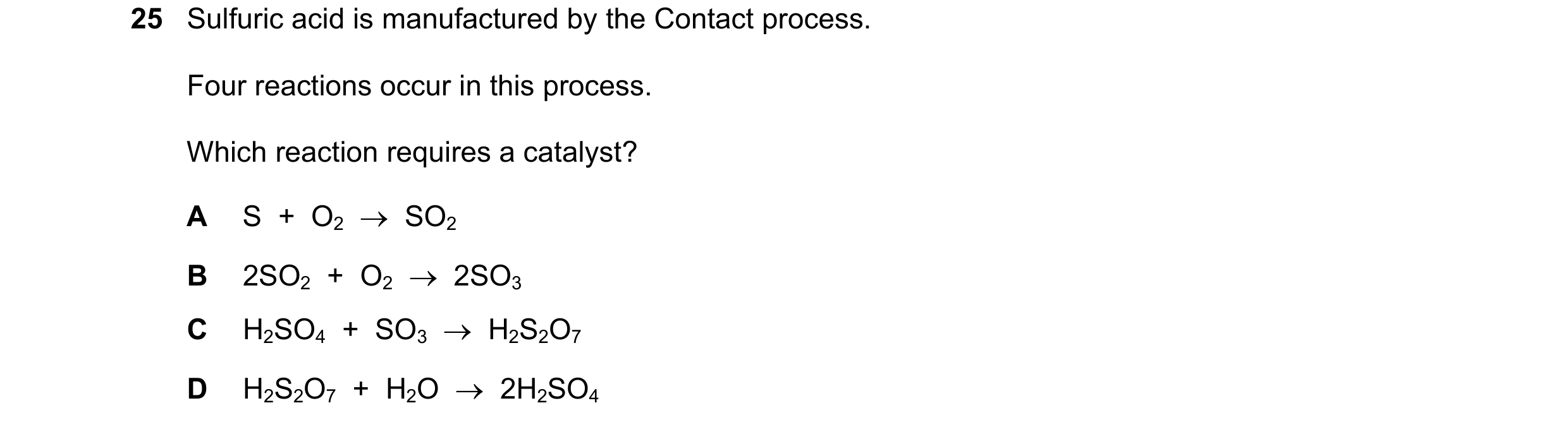
25 Sulfuric acid is manufactured by the Contact process. Four reactions occur in this process. Which reaction requires a catalyst? A S + O2 → SO2 B 2SO2 + O2 → 2SO3 C H2SO4 + SO3 → H2S2O7 D H2S2O7 + H2O → 2H2SO4
1 marks
Answer: B
This question in 0973/21 May/June 2019
Q2 · Which statement explains why increasing the concentration of a reactant increases the… 0973/22 May/June 2019
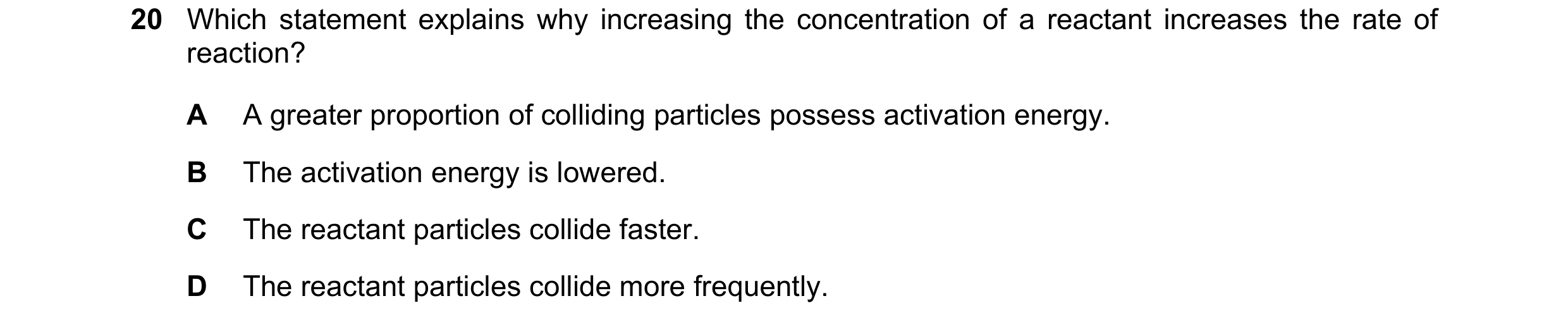
20 Which statement explains why increasing the concentration of a reactant increases the rate of reaction? A A greater proportion of colliding particles possess activation energy. B The activation energy is lowered. C The reactant particles collide faster. D The reactant particles collide more frequently.
1 marks
Answer: D
This question in 0973/22 May/June 2019
Q3 · An acid reacts with solid lumps of calcium carbonate to produce a salt, water and carbon… 0973/21 May/June 2020
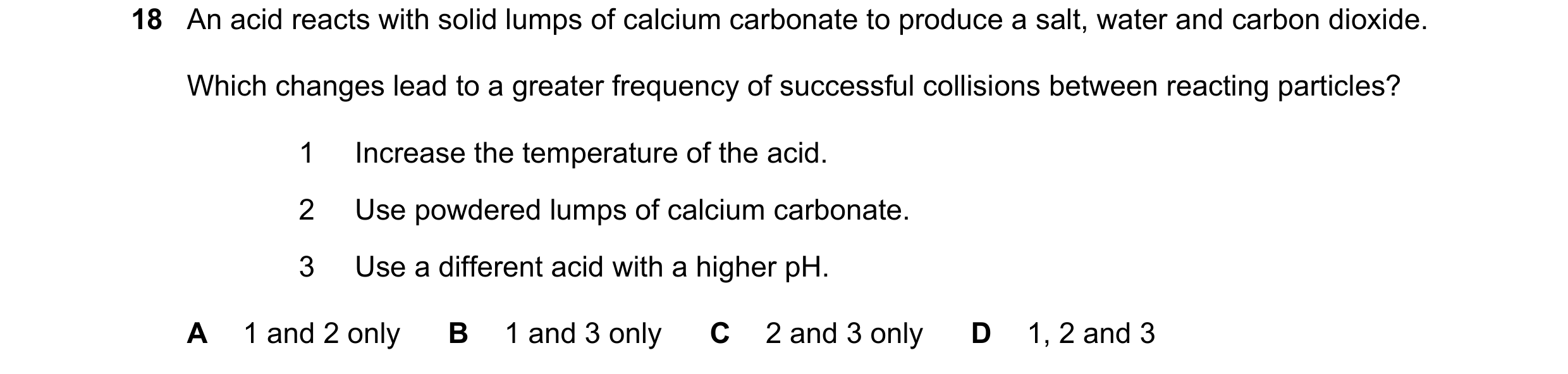
18 An acid reacts with solid lumps of calcium carbonate to produce a salt, water and carbon dioxide. Which changes lead to a greater frequency of successful collisions between reacting particles? 1 Increase the temperature of the acid. 2 Use powdered lumps of calcium carbonate. 3 Use a different acid with a higher pH. A 1 and 2 only B 1 and 3 only C 2 and 3 only D 1, 2 and 3
1 marks
Answer: A
This question in 0973/21 May/June 2020
Q4 · Which row describes how the number of effective collisions and the rate of reaction are… 0973/21 Oct/Nov 2020
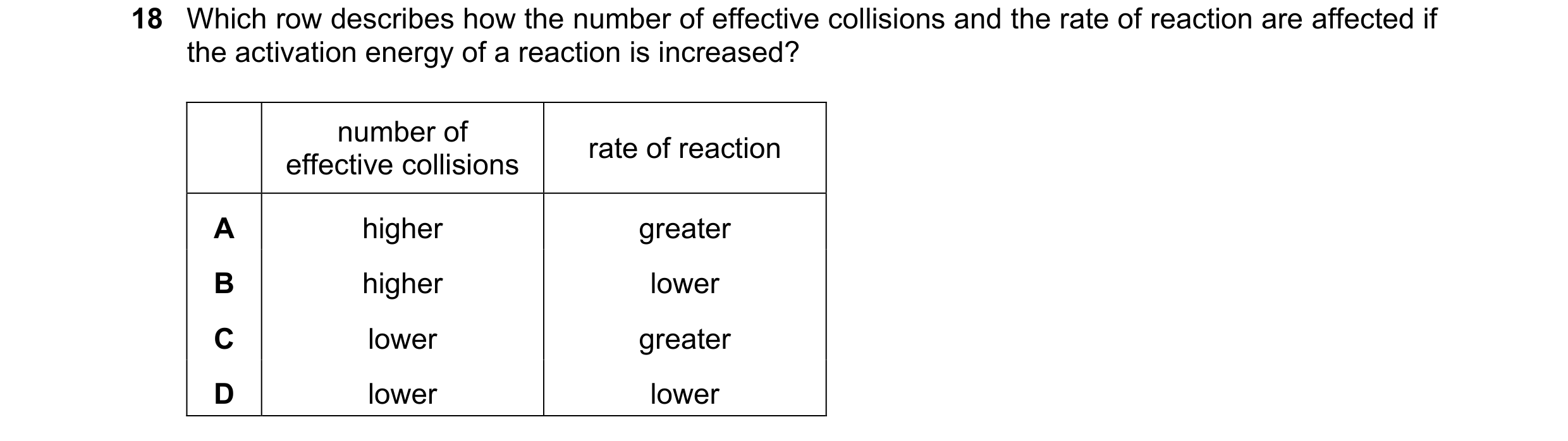
18 Which row describes how the number of effective collisions and the rate of reaction are affected if the activation energy of a reaction is increased? number of rate of reaction effective collisions A higher greater B higher lower C lower greater D lower lower
1 marks
Answer: D
This question in 0973/21 Oct/Nov 2020
Q5 · Which row about the Contact process is correct? 0973/21 May/June 2021
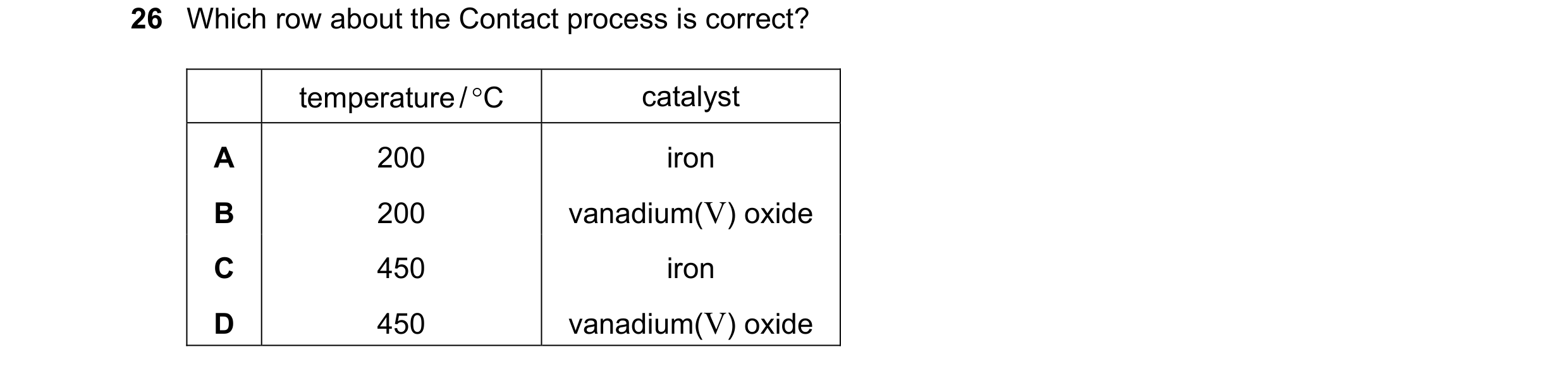
26 Which row about the Contact process is correct? temperature / C catalyst A 200 iron B 200 vanadium(V) oxide C 450 iron D 450 vanadium(V) oxide
1 marks
Answer: D
This question in 0973/21 May/June 2021
Q6 · Excess magnesium reacts with 25 cm3 of 0.1 mol / dm3 hydrochloric acid 0973/21 Oct/Nov 2021
17 Excess magnesium reacts with 25 cm3 of 0.1 mol / dm3 hydrochloric acid. The dashed line shows the volume of gas made over time. The experiment is repeated using excess magnesium and 25 cm3 of 0.05 mol / dm3 hydrochloric acid. Which line shows the results for this experiment? A B C volume of original experiment gas / cm3 D 0 0 time / s
1 marks
Answer: D
This question in 0973/21 Oct/Nov 2021
Q7 · The Contact process is used to manufacture sulfuric acid 0973/21 Oct/Nov 2021
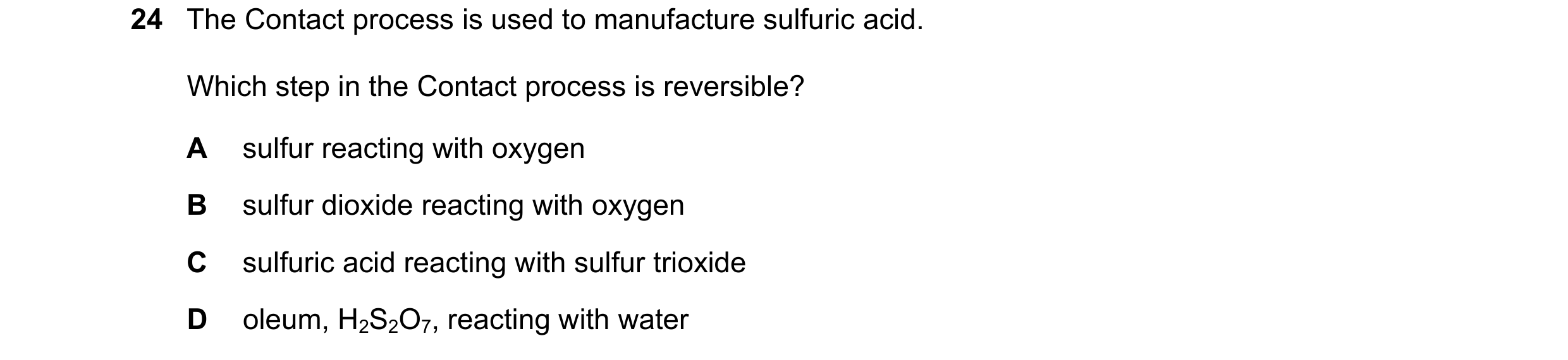
24 The Contact process is used to manufacture sulfuric acid. Which step in the Contact process is reversible? A sulfur reacting with oxygen B sulfur dioxide reacting with oxygen C sulfuric acid reacting with sulfur trioxide D oleum, H2S2O7, reacting with water
1 marks
Answer: B
This question in 0973/21 Oct/Nov 2021
Q8 · Sulfuric acid is produced in the Contact process 0973/21 May/June 2022
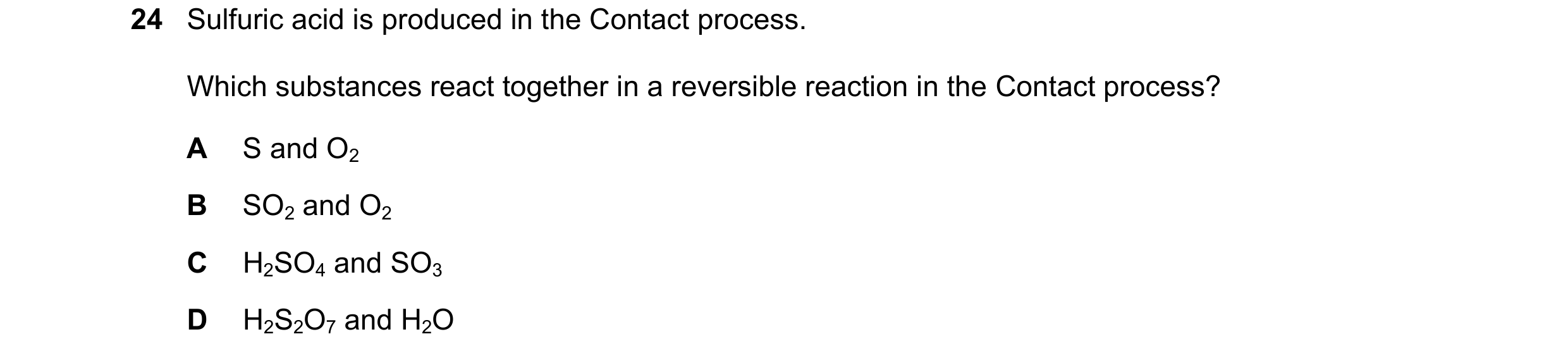
24 Sulfuric acid is produced in the Contact process. Which substances react together in a reversible reaction in the Contact process? A S and O2 B SO2 and O2 C H2SO4 and SO3 D H2S2O7 and H2O
1 marks
Answer: B
This question in 0973/21 May/June 2022
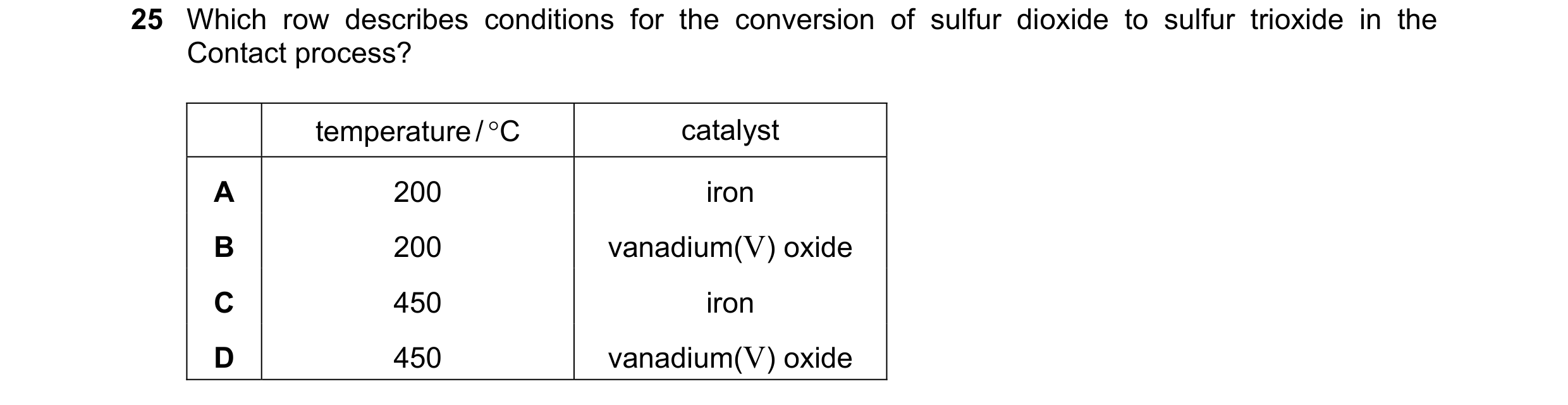
Q9 · Which row describes conditions for the conversion of sulfur dioxide to sulfur trioxide in… 0973/21 Oct/Nov 2022
25 Which row describes conditions for the conversion of sulfur dioxide to sulfur trioxide in the Contact process? temperature / C catalyst A 200 iron B 200 vanadium(V) oxide C 450 iron D 450 vanadium(V) oxide
1 marks
Answer: D
This question in 0973/21 Oct/Nov 2022
Q10 · Which row explains why increasing the concentration of a reactant increases the rate of… 0973/21 May/June 2023
19 Which row explains why increasing the concentration of a reactant increases the rate of reaction? proportion of particles collision frequency with the minimum between reacting energy to react particles A increases increases B increases stays the same C stays the same increases D stays the same stays the same
1 marks
Answer: C
This question in 0973/21 May/June 2023
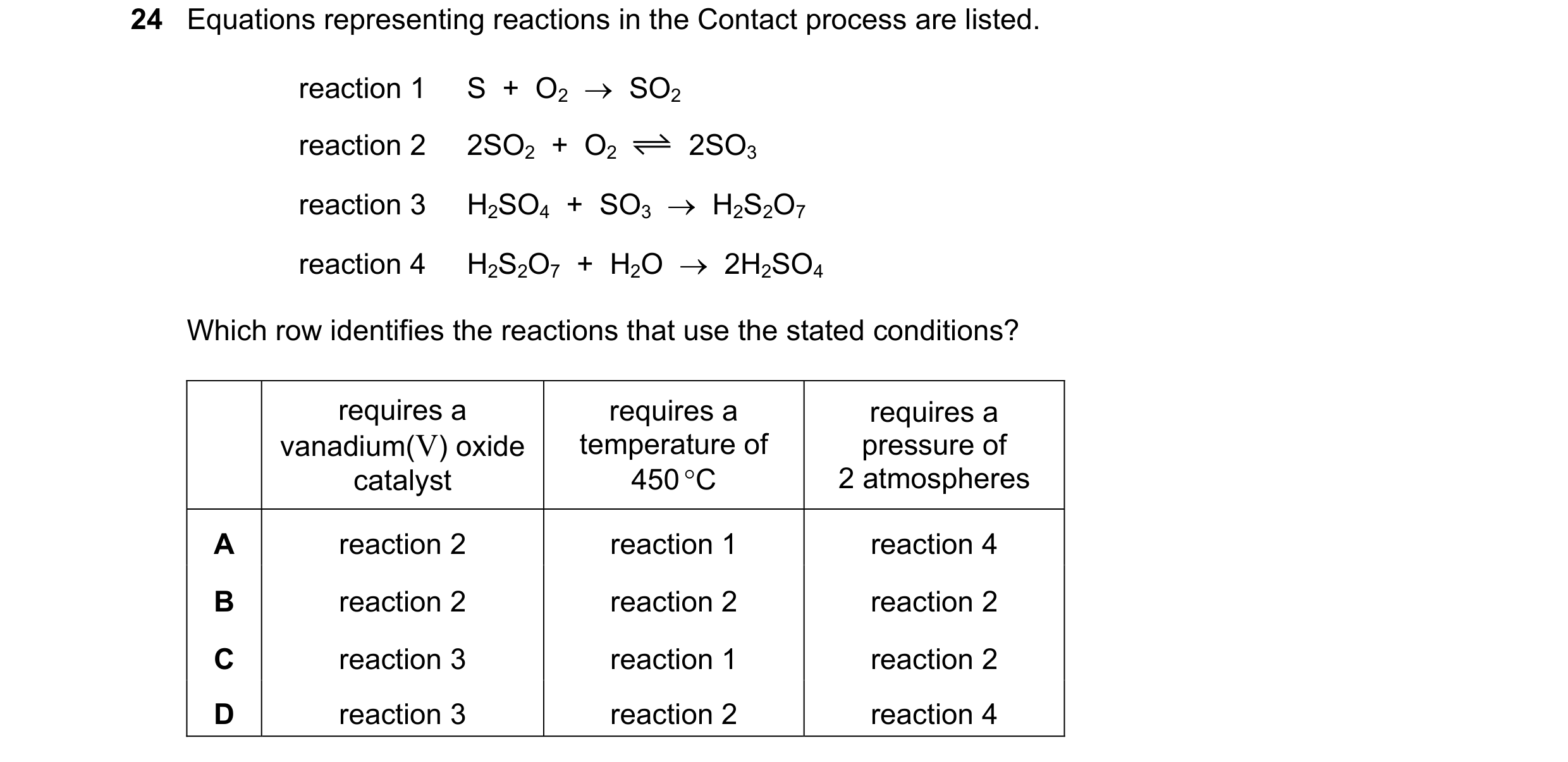
Q11 · Equations representing reactions in the Contact process are listed 0973/21 May/June 2023
24 Equations representing reactions in the Contact process are listed. reaction 1 S + O2 → SO2 reaction 2 2SO2 + O2 2SO3 reaction 3 H2SO4 + SO3 → H2S2O7 reaction 4 H2S2O7 + H2O → 2H2SO4 Which row identifies the reactions that use the stated conditions? requires a requires a requires a vanadium(V) oxide temperature of pressure of catalyst 450 °C 2 atmospheres A reaction 2 reaction 1 reaction 4 B reaction 2 reaction 2 reaction 2 C reaction 3 reaction 1 reaction 2 D reaction 3 reaction 2 reaction 4
1 marks
Answer: B
This question in 0973/21 May/June 2023
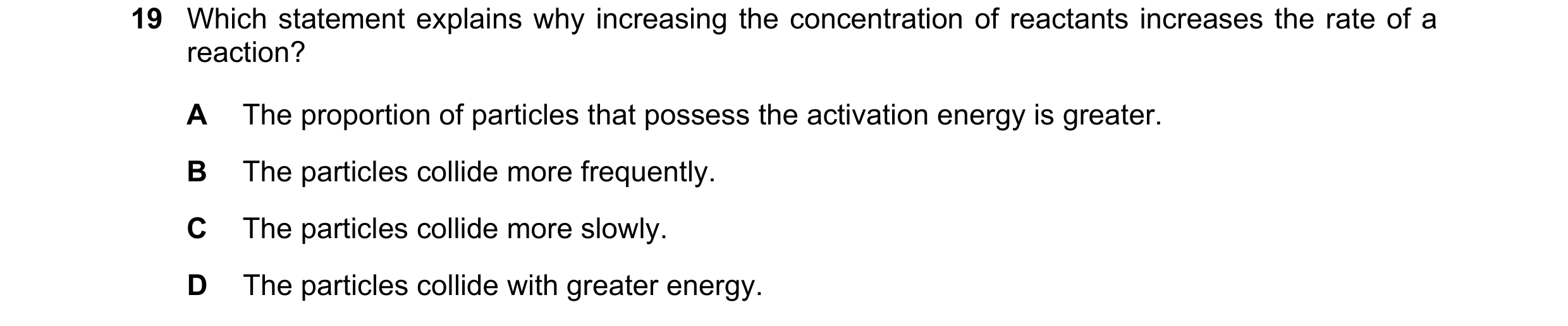
Q12 · Which statement explains why increasing the concentration of reactants increases the rate… 0973/22 May/June 2023
19 Which statement explains why increasing the concentration of reactants increases the rate of a reaction? A The proportion of particles that possess the activation energy is greater. B The particles collide more frequently. C The particles collide more slowly. D The particles collide with greater energy.
1 marks
Answer: B
This question in 0973/22 May/June 2023
Q13 · The rate of reaction between calcium carbonate and dilute hydrochloric acid is determined… 0973/21 Oct/Nov 2023
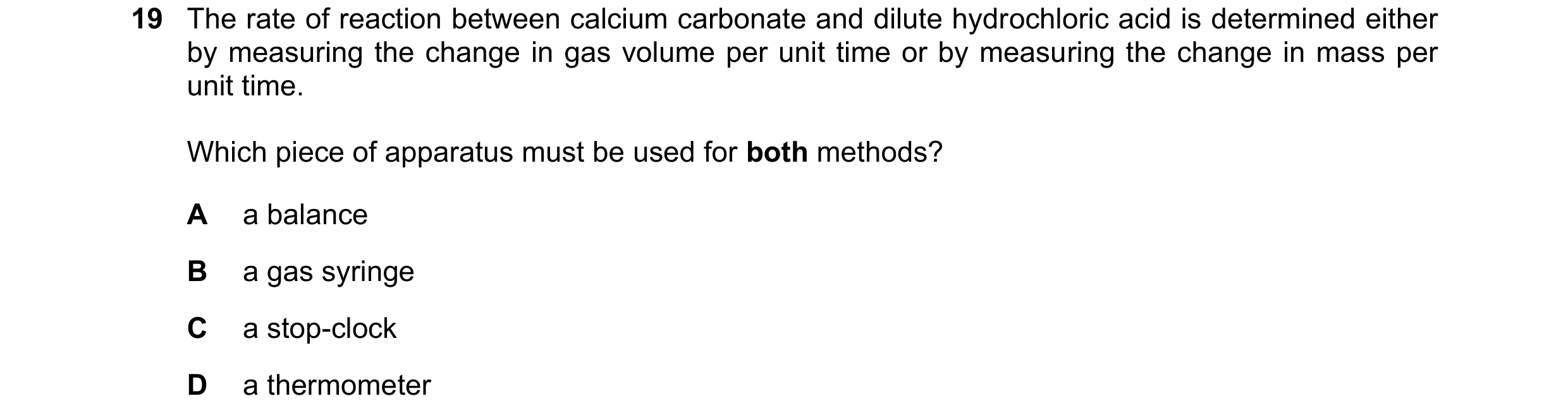
19 The rate of reaction between calcium carbonate and dilute hydrochloric acid is determined either by measuring the change in gas volume per unit time or by measuring the change in mass per unit time. Which piece of apparatus must be used for both methods? A a balance B a gas syringe C a stop-clock D a thermometer
1 marks
Answer: C
This question in 0973/21 Oct/Nov 2023
Q14 · Sulfuric acid is manufactured by the Contact process 0973/21 Oct/Nov 2023
26 Sulfuric acid is manufactured by the Contact process. One of the reactions in this process converts sulfur dioxide to sulfur trioxide. Which statements about the conditions for this reaction are correct? 1 A nickel catalyst is used. 2 A pressure of about 1–2 atmospheres is used. 3 A temperature of about 450 C is used. A 1, 2 and 3 B 1 and 2 only C 1 and 3 only D 2 and 3 only
1 marks
Answer: D
This question in 0973/21 Oct/Nov 2023
Q15 · Magnesium ribbon is reacted with 50 cm3 of dilute hydrochloric acid 0973/21 May/June 2024
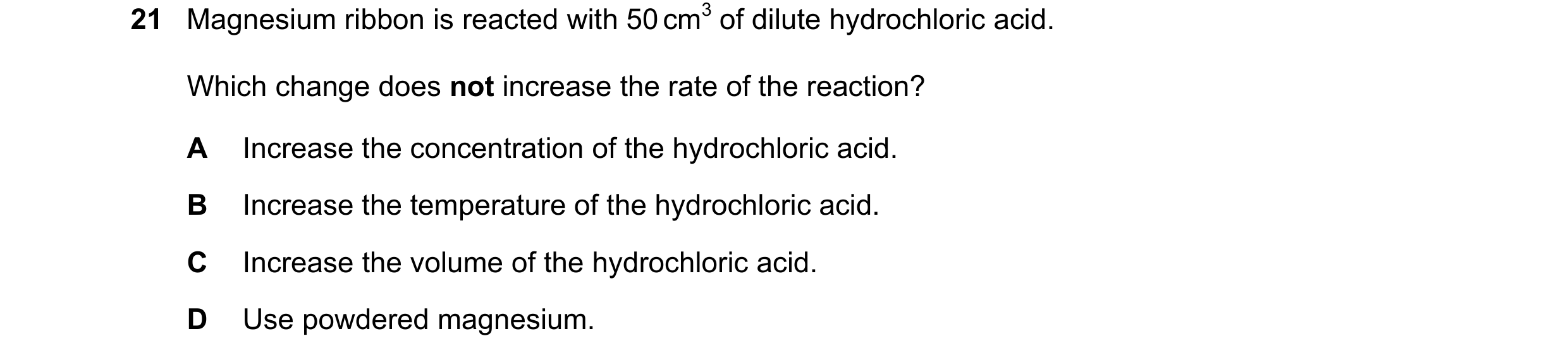
21 Magnesium ribbon is reacted with 50 cm3 of dilute hydrochloric acid. Which change does not increase the rate of the reaction? A Increase the concentration of the hydrochloric acid. B Increase the temperature of the hydrochloric acid. C Increase the volume of the hydrochloric acid. D Use powdered magnesium.
1 marks
Answer: C
This question in 0973/21 May/June 2024
Q16 · An experiment is assembled to measure the rate of reaction between limestone and… 0973/21 Oct/Nov 2024
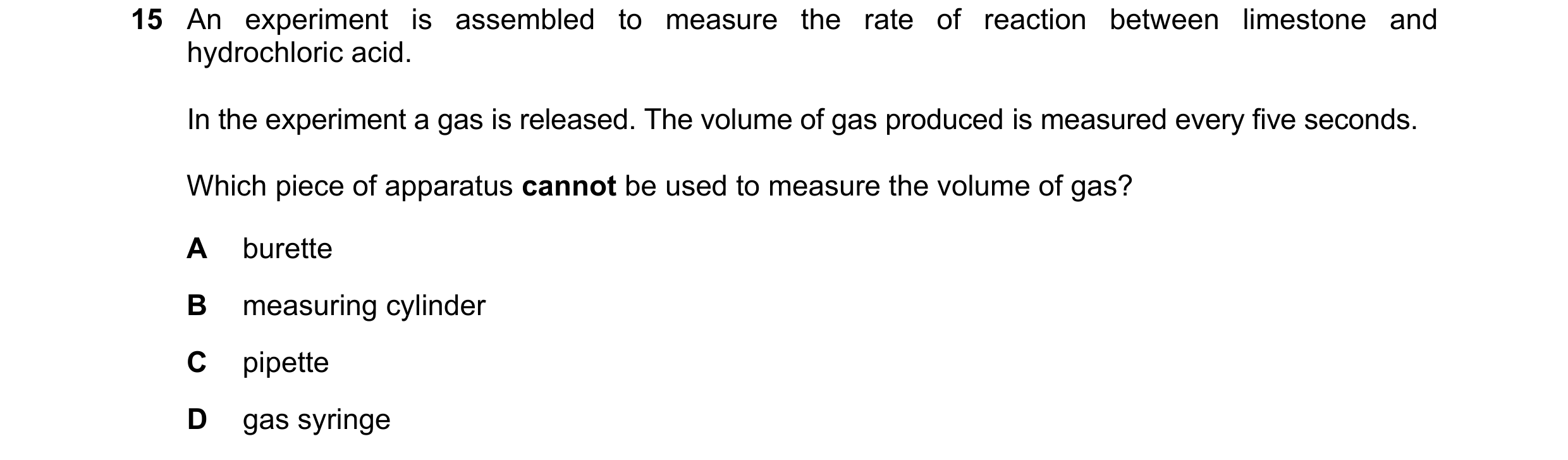
15 An experiment is assembled to measure the rate of reaction between limestone and hydrochloric acid. In the experiment a gas is released. The volume of gas produced is measured every five seconds. Which piece of apparatus cannot be used to measure the volume of gas? A burette B measuring cylinder C pipette D gas syringe
1 marks
Answer: C
This question in 0973/21 Oct/Nov 2024
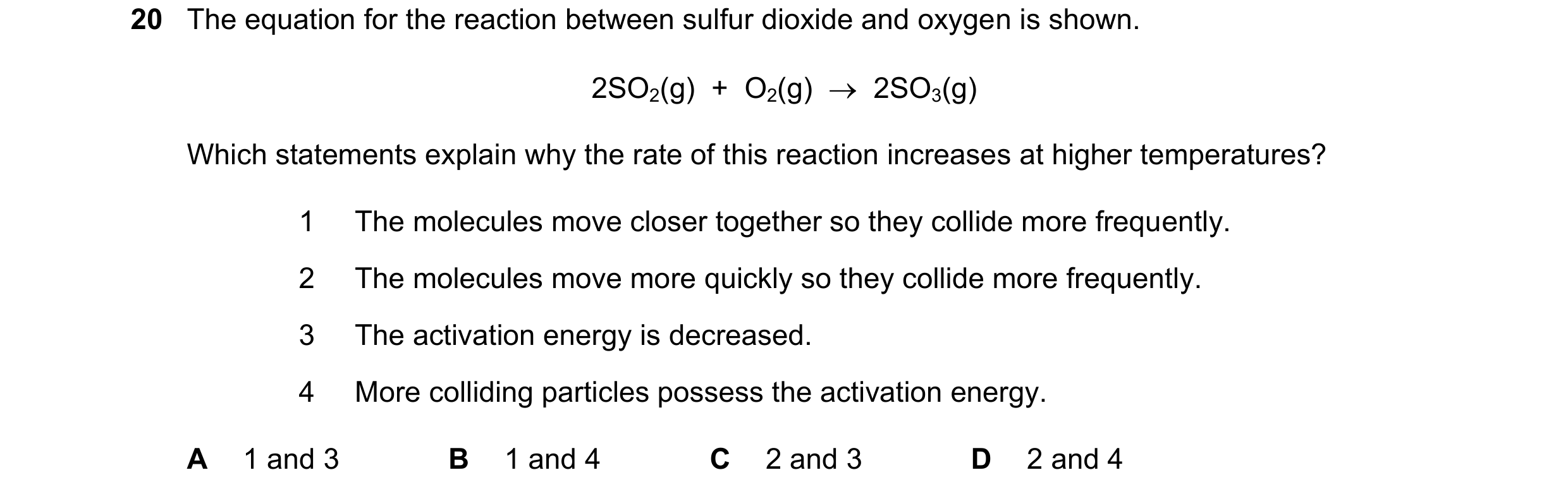
Q17 · The equation for the reaction between sulfur dioxide and oxygen is shown 0973/21 Oct/Nov 2024
20 The equation for the reaction between sulfur dioxide and oxygen is shown. 2SO2(g) + O2(g) 2SO3(g) Which statements explain why the rate of this reaction increases at higher temperatures? 1 The molecules move closer together so they collide more frequently. 2 The molecules move more quickly so they collide more frequently. 3 The activation energy is decreased. 4 More colliding particles possess the activation energy. A 1 and 3 B 1 and 4 C 2 and 3 D 2 and 4
1 marks
Answer: D
This question in 0973/21 Oct/Nov 2024
Q18 · Equal masses of limestone pieces are reacted with acid in two experiments 0973/22 May/June 2025
18 Equal masses of limestone pieces are reacted with acid in two experiments. Only one change to the conditions is made between experiment 1 and experiment 2. The volume of gas produced is measured over time. The results are shown. experiment 1 volume of gas experiment 2 / cm3 time / s Which statement about the experiments is correct? A The concentration of acid used in experiment 2 is higher than in experiment 1. B The temperature used in experiment 2 is lower than in experiment 1. C The limestone pieces used in experiment 1 are larger than in experiment 2. D The volume of acid used in experiment 1 is greater than in experiment 2.
1 marks
Answer: D
This question in 0973/22 May/June 2025
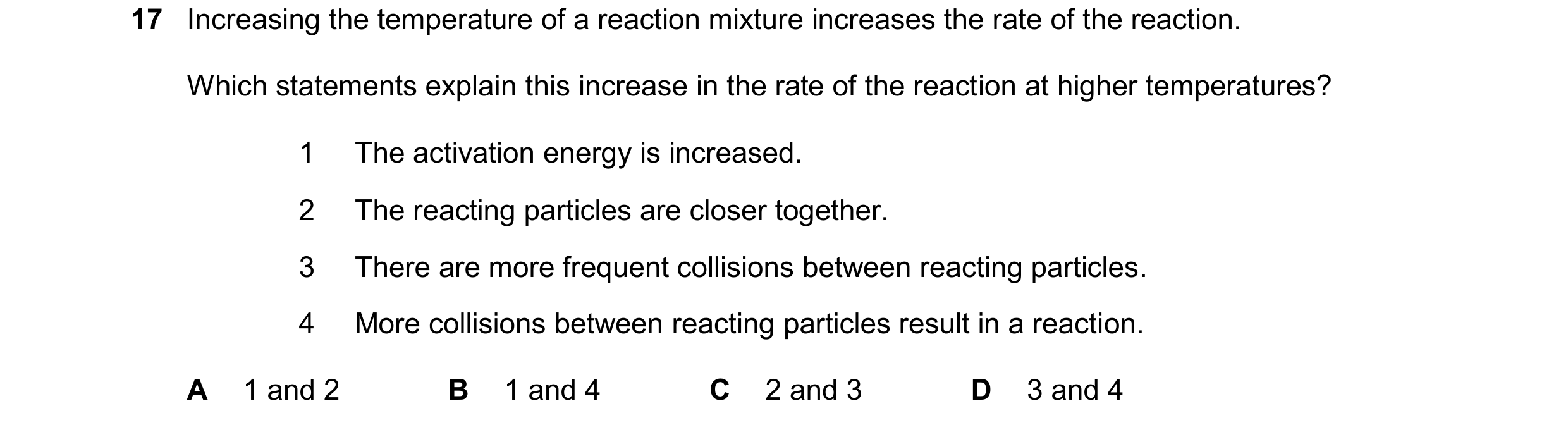
Q19 · Increasing the temperature of a reaction mixture increases the rate of the reaction 0973/21 Oct/Nov 2025
17 Increasing the temperature of a reaction mixture increases the rate of the reaction. Which statements explain this increase in the rate of the reaction at higher temperatures? 1 The activation energy is increased. 2 The reacting particles are closer together. 3 There are more frequent collisions between reacting particles. 4 More collisions between reacting particles result in a reaction. A 1 and 2 B 1 and 4 C 2 and 3 D 3 and 4
1 marks
Answer: D
This question in 0973/21 Oct/Nov 2025
 1 / 5
1 / 5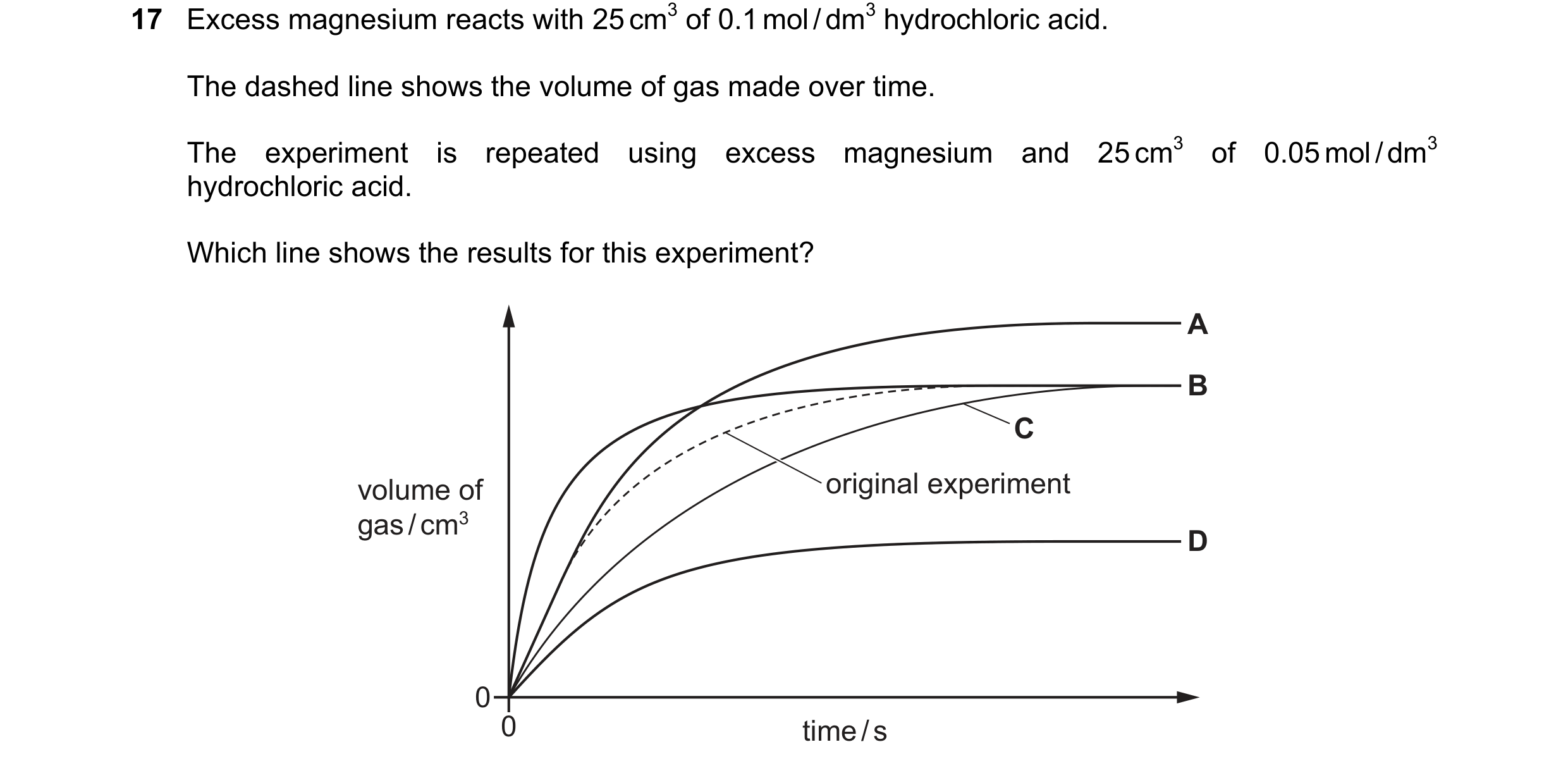
 2 / 5
2 / 5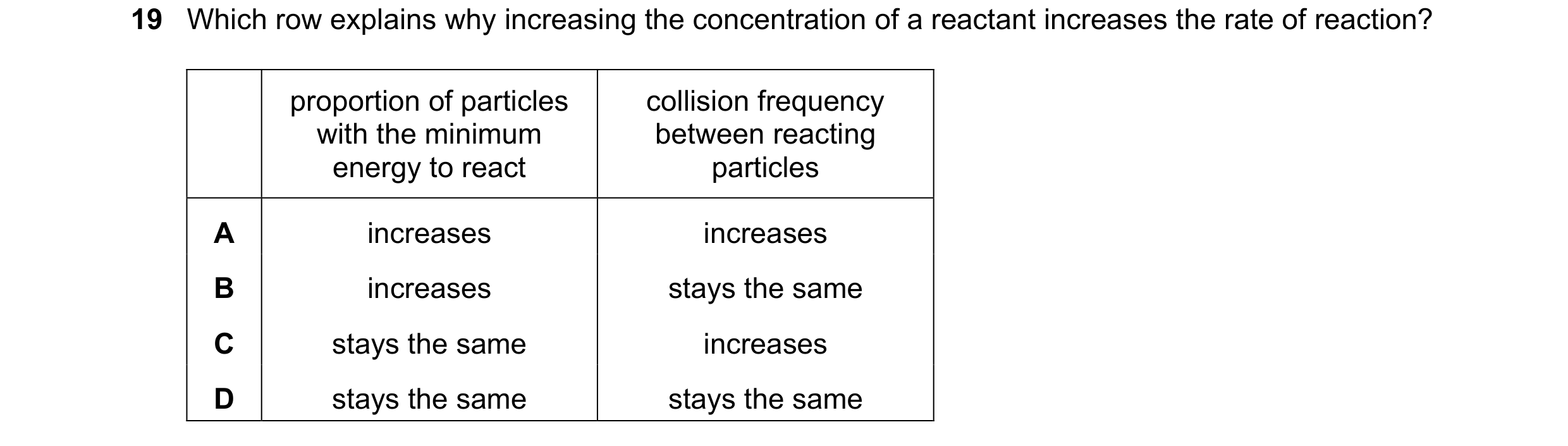
 3 / 5
3 / 5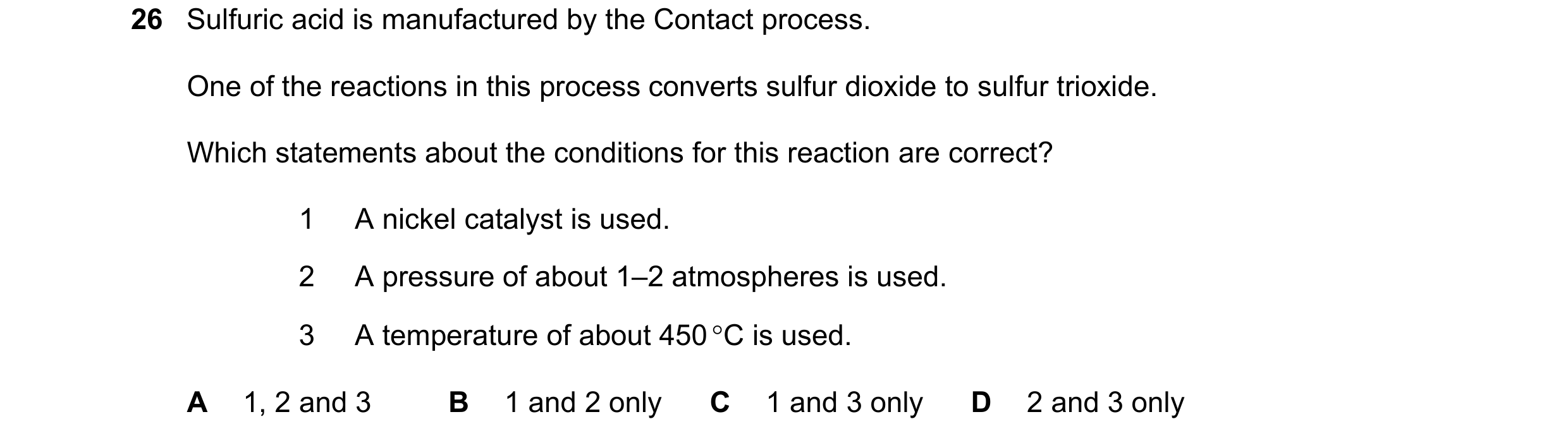
 4 / 5
4 / 5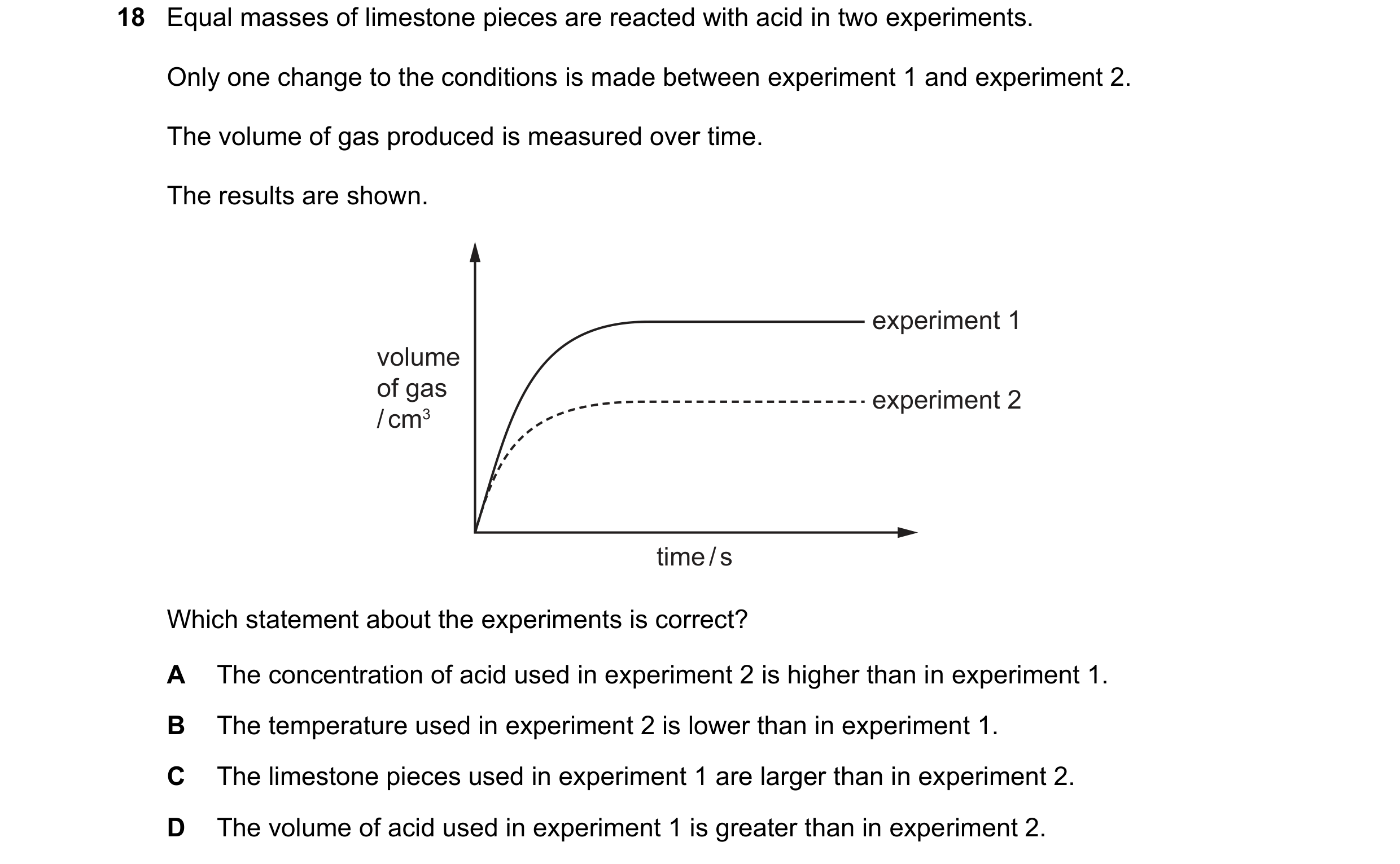
 5 / 5
5 / 5