Questions as text
Q1 · Iron increases the rate of a reaction 0973/11 May/June 2019
18 Iron increases the rate of a reaction. What is the role of iron in this reaction? A catalyst B electrolyte C element D isotope
1 marks
Answer: A
This question in 0973/11 May/June 2019
Q2 · Aqueous hydrogen peroxide decomposes slowly and produces water and oxygen gas 0973/11 Oct/Nov 2021
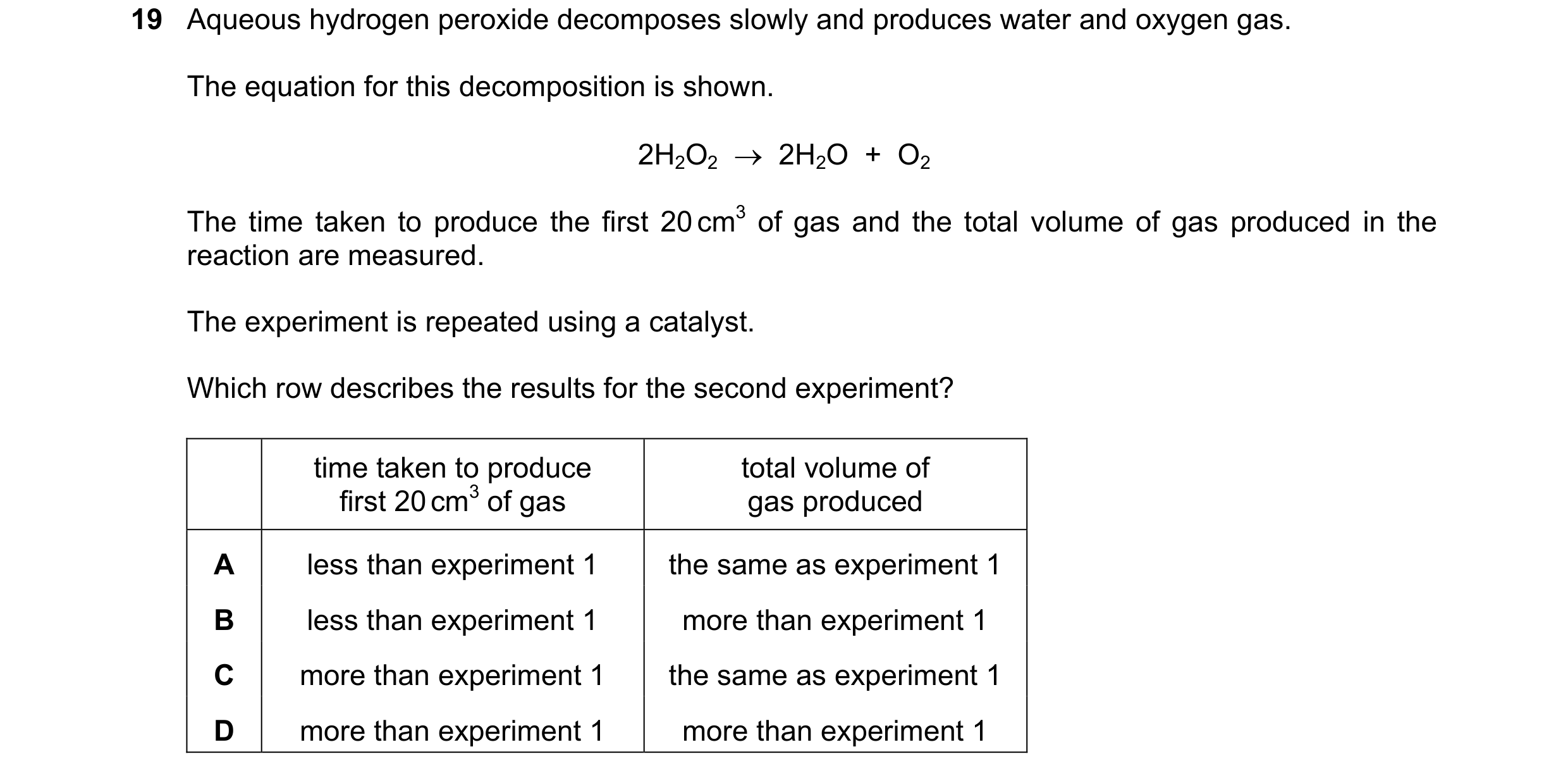
19 Aqueous hydrogen peroxide decomposes slowly and produces water and oxygen gas. The equation for this decomposition is shown. 2H2O2 2H2O + O2 The time taken to produce the first 20 cm3 of gas and the total volume of gas produced in the reaction are measured. The experiment is repeated using a catalyst. Which row describes the results for the second experiment? time taken to produce total volume of first 20 cm3 of gas gas produced A less than experiment 1 the same as experiment 1 B less than experiment 1 more than experiment 1 C more than experiment 1 the same as experiment 1 D more than experiment 1 more than experiment 1
1 marks
Answer: A
This question in 0973/11 Oct/Nov 2021
Q3 · A fixed mass of a solid is reacted with a liquid 0973/11 May/June 2022
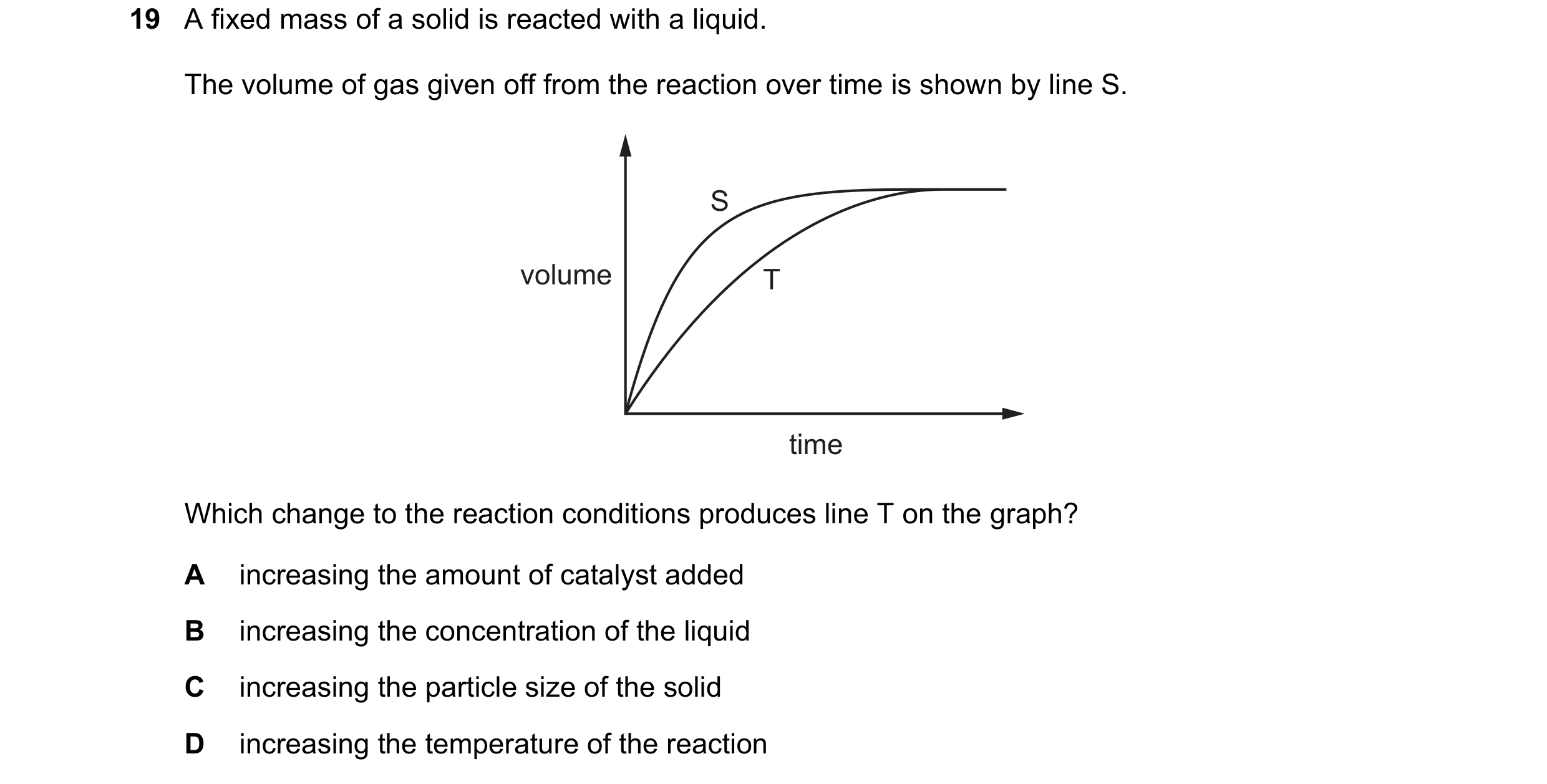
19 A fixed mass of a solid is reacted with a liquid. The volume of gas given off from the reaction over time is shown by line S. S volume T time Which change to the reaction conditions produces line T on the graph? A increasing the amount of catalyst added B increasing the concentration of the liquid C increasing the particle size of the solid D increasing the temperature of the reaction
1 marks
Answer: C
This question in 0973/11 May/June 2022
Q4 · When solid pieces of calcium carbonate are added to dilute hydrochloric acid in a flask… 0973/12 May/June 2022
19 When solid pieces of calcium carbonate are added to dilute hydrochloric acid in a flask, carbon dioxide gas is given off. The mass of the flask and its contents are measured over time. cotton wool flask calcium carbonate balance 124.25 g Two different experiments are carried out. In both experiments the acid is in excess. The results of these two experiments are shown. mass of flask and contents experiment 2 experiment 1 time Which statement explains the different shapes of the curves? A Experiment 2 uses a catalyst. B Experiment 2 uses acid at a higher temperature. C Experiment 2 uses acid that is more dilute. D Experiment 2 uses powdered calcium carbonate.
1 marks
Answer: C
This question in 0973/12 May/June 2022
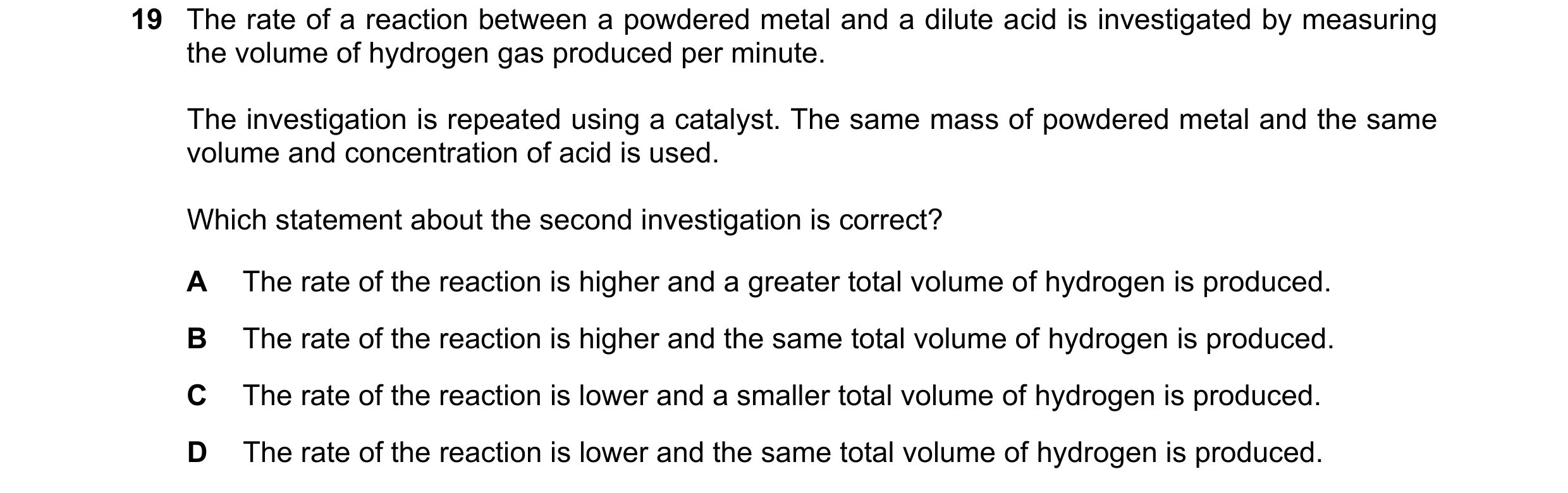
Q5 · The rate of a reaction between a powdered metal and a dilute acid is investigated by… 0973/11 Oct/Nov 2022
19 The rate of a reaction between a powdered metal and a dilute acid is investigated by measuring the volume of hydrogen gas produced per minute. The investigation is repeated using a catalyst. The same mass of powdered metal and the same volume and concentration of acid is used. Which statement about the second investigation is correct? A The rate of the reaction is higher and a greater total volume of hydrogen is produced. B The rate of the reaction is higher and the same total volume of hydrogen is produced. C The rate of the reaction is lower and a smaller total volume of hydrogen is produced. D The rate of the reaction is lower and the same total volume of hydrogen is produced.
1 marks
Answer: B
This question in 0973/11 Oct/Nov 2022
Q6 · Dilute hydrochloric acid reacts with calcium carbonate 0973/11 May/June 2024
20 Dilute hydrochloric acid reacts with calcium carbonate. The equation for the reaction is shown. CaCO3 + 2HCl CaCl 2 + CO2 + H2O Which change increases the rate of the reaction? A decreasing the temperature of the hydrochloric acid B increasing the concentration of the hydrochloric acid C increasing the size of the calcium carbonate particles D increasing the volume of the hydrochloric acid
1 marks
Answer: B
This question in 0973/11 May/June 2024
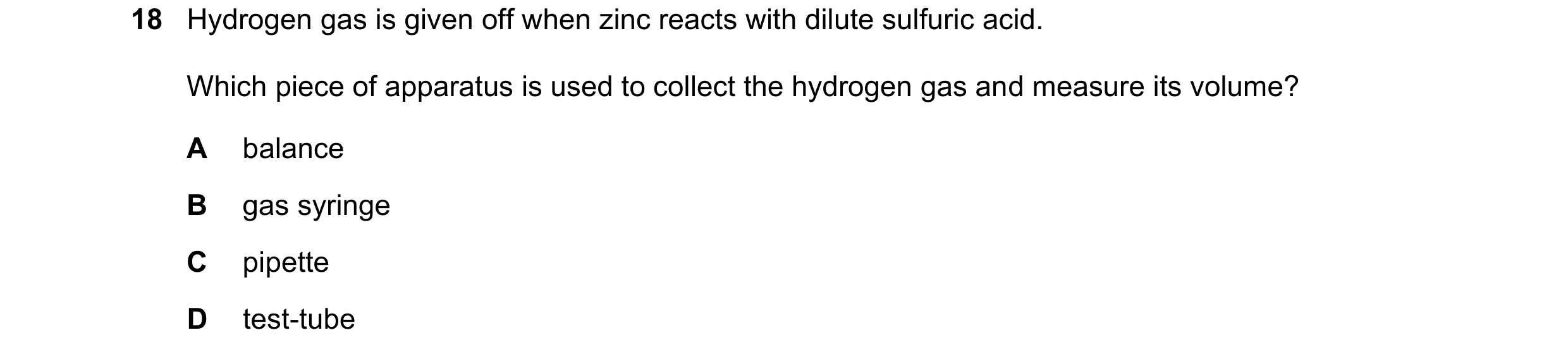
Q7 · Hydrogen gas is given off when zinc reacts with dilute sulfuric acid 0973/12 May/June 2024
18 Hydrogen gas is given off when zinc reacts with dilute sulfuric acid. Which piece of apparatus is used to collect the hydrogen gas and measure its volume? A balance B gas syringe C pipette D test-tube
1 marks
Answer: B
This question in 0973/12 May/June 2024
Q8 · Astudent adds 5g of magnesium ribbon to 20 cm? 0973/11 Oct/Nov 2024
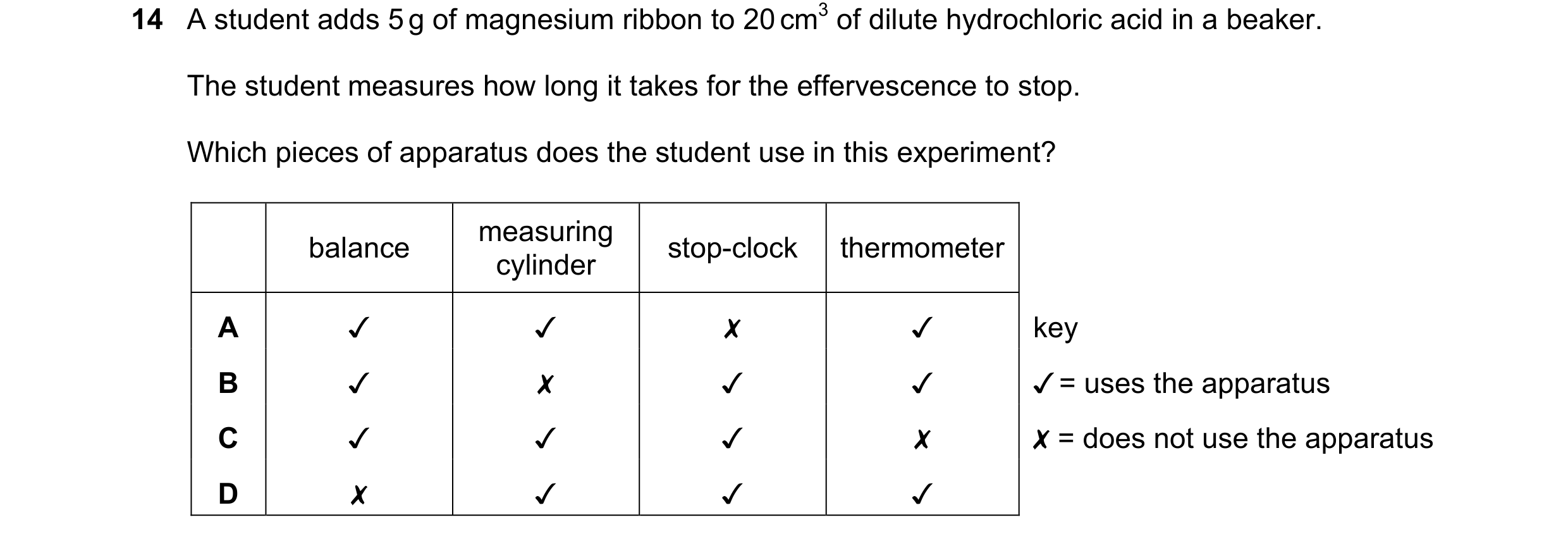
14 Astudent adds 5g of magnesium ribbon to 20 cm? of dilute hydrochloric acid in a beaker.
The student measures how long it takes for the effervescence to stop.
Which pieces of apparatus does the student use in this experiment?
balance vevlinder stop-clock | thermometer
A Jv Jv x Jv
B Jv x J Jv
Cc Jv Jv J x
D x Jv J Jv
key
/ = uses the apparatus
X = does not use the apparatus
1 marks
Answer: C
This question in 0973/11 Oct/Nov 2024
Q9 · Dilute hydrochloric acid reacts with solid calcium carbonate 0973/11 Oct/Nov 2024
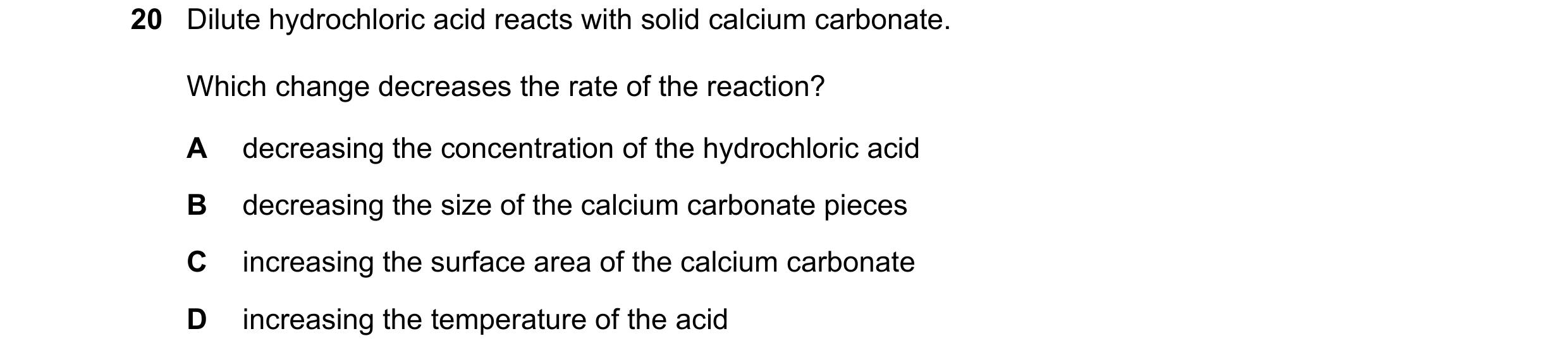
20 Dilute hydrochloric acid reacts with solid calcium carbonate. Which change decreases the rate of the reaction? A decreasing the concentration of the hydrochloric acid B decreasing the size of the calcium carbonate pieces C increasing the surface area of the calcium carbonate D increasing the temperature of the acid
1 marks
Answer: A
This question in 0973/11 Oct/Nov 2024
Q10 · Solid zinc carbonate reacts with excess dilute hydrochloric acid 0973/11 May/June 2025
21 Solid zinc carbonate reacts with excess dilute hydrochloric acid. Which changes in the conditions increase the rate of this reaction? 1 Increase the concentration of hydrochloric acid. 2 Increase the temperature of the reaction mixture. 3 Increase the volume of hydrochloric acid. 4 Use larger pieces of zinc carbonate. A 1 and 2 B 1 and 3 C 2 and 4 D 3 and 4
1 marks
Answer: A
This question in 0973/11 May/June 2025
 1 / 4
1 / 4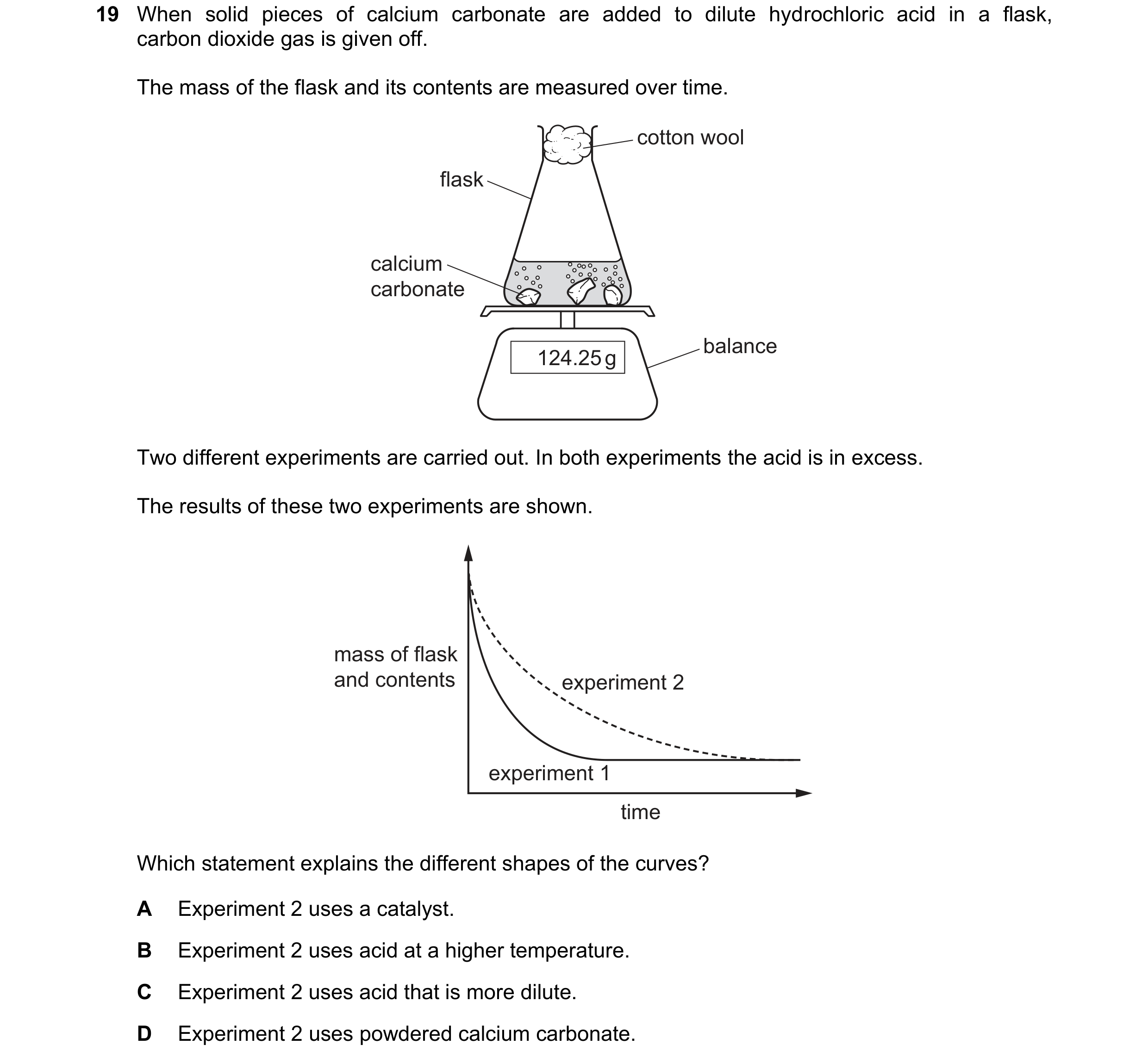
 2 / 4
2 / 4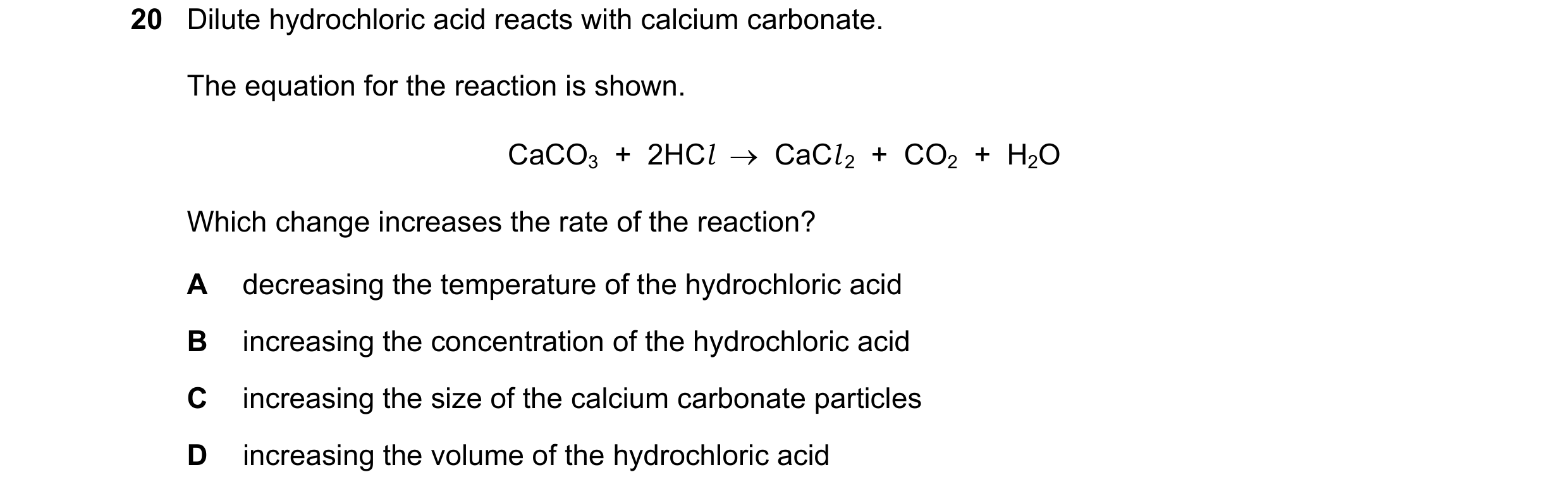
 3 / 4
3 / 4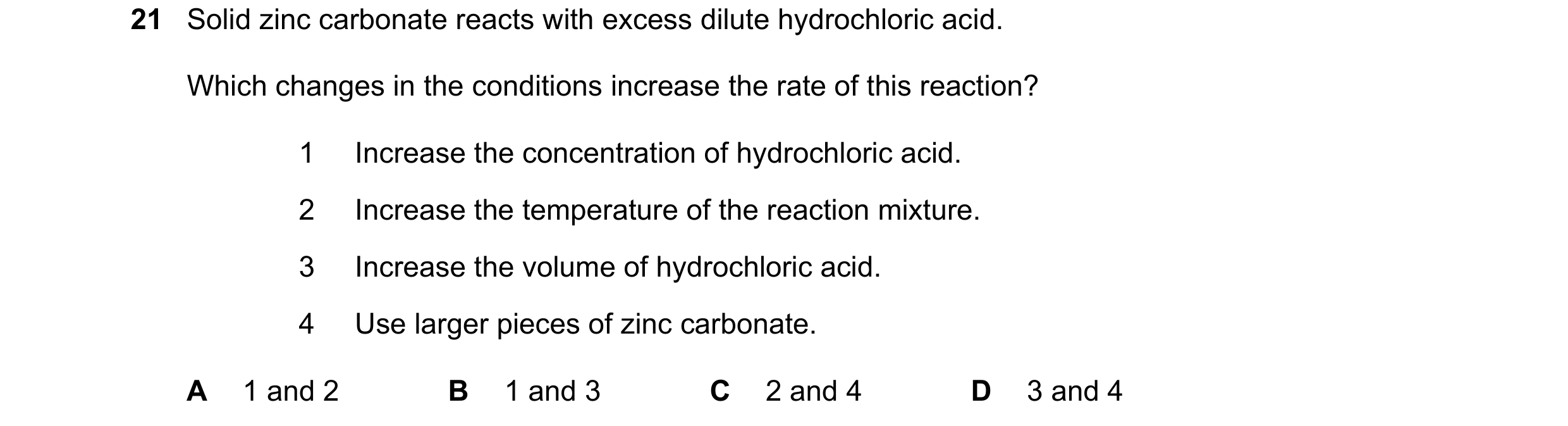 4 / 4
4 / 4