Cambridge IGCSE Science - Combined 0653 — 2019 Oct/Nov Paper 6 · Variant 3
0653/63/O/N/19 · 4 questions · 40 marks · ≈45 min
The question paper and its mark scheme, free to read here and free to download. This is Cambridge’s own paper, exactly as it was sat.
Question paper16 pages




Mark scheme7 pages
Answers below. Sit the paper first if you are practising.
Questions as text
Q1 · A student investigates the movement of water in potato cylinders
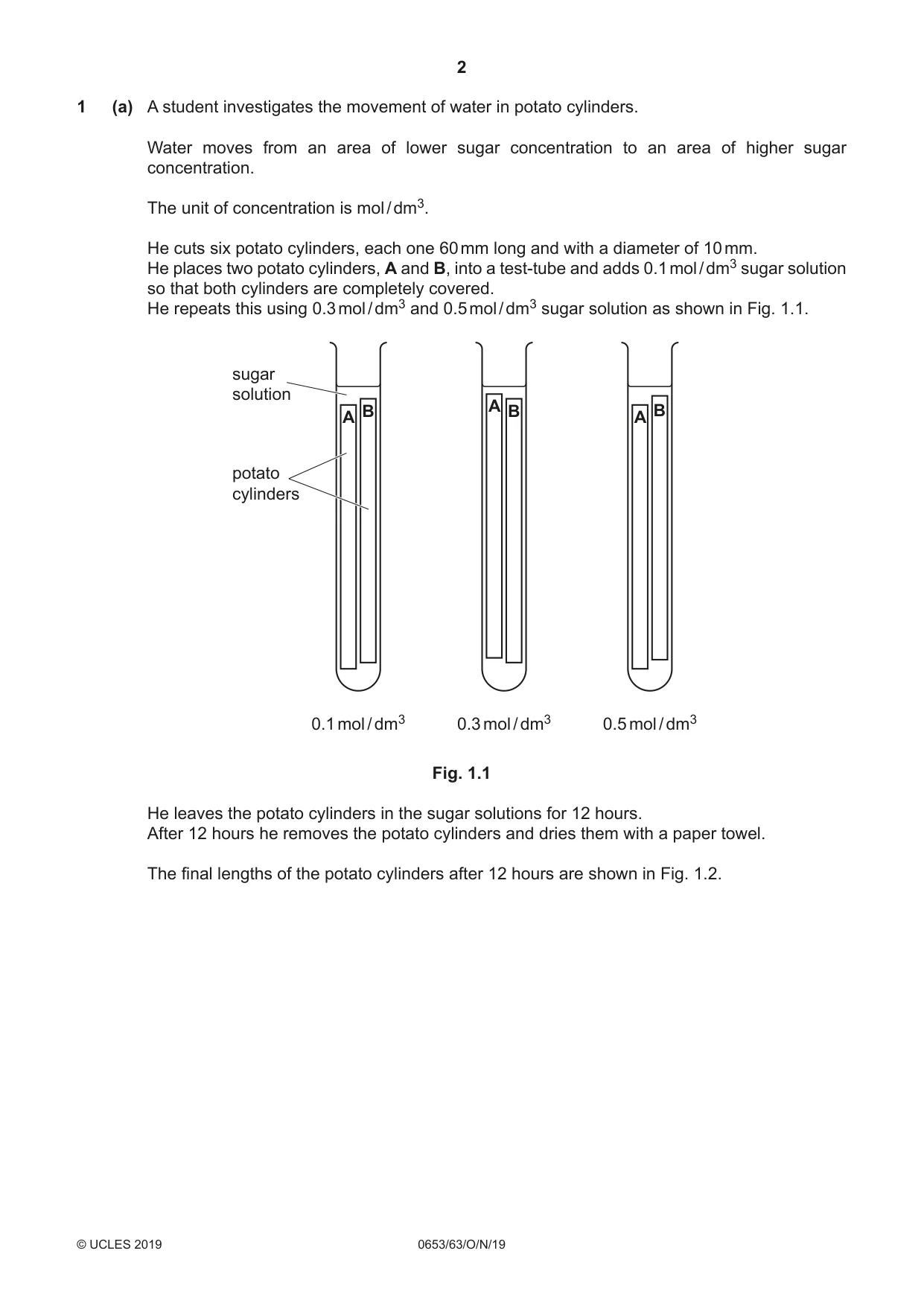
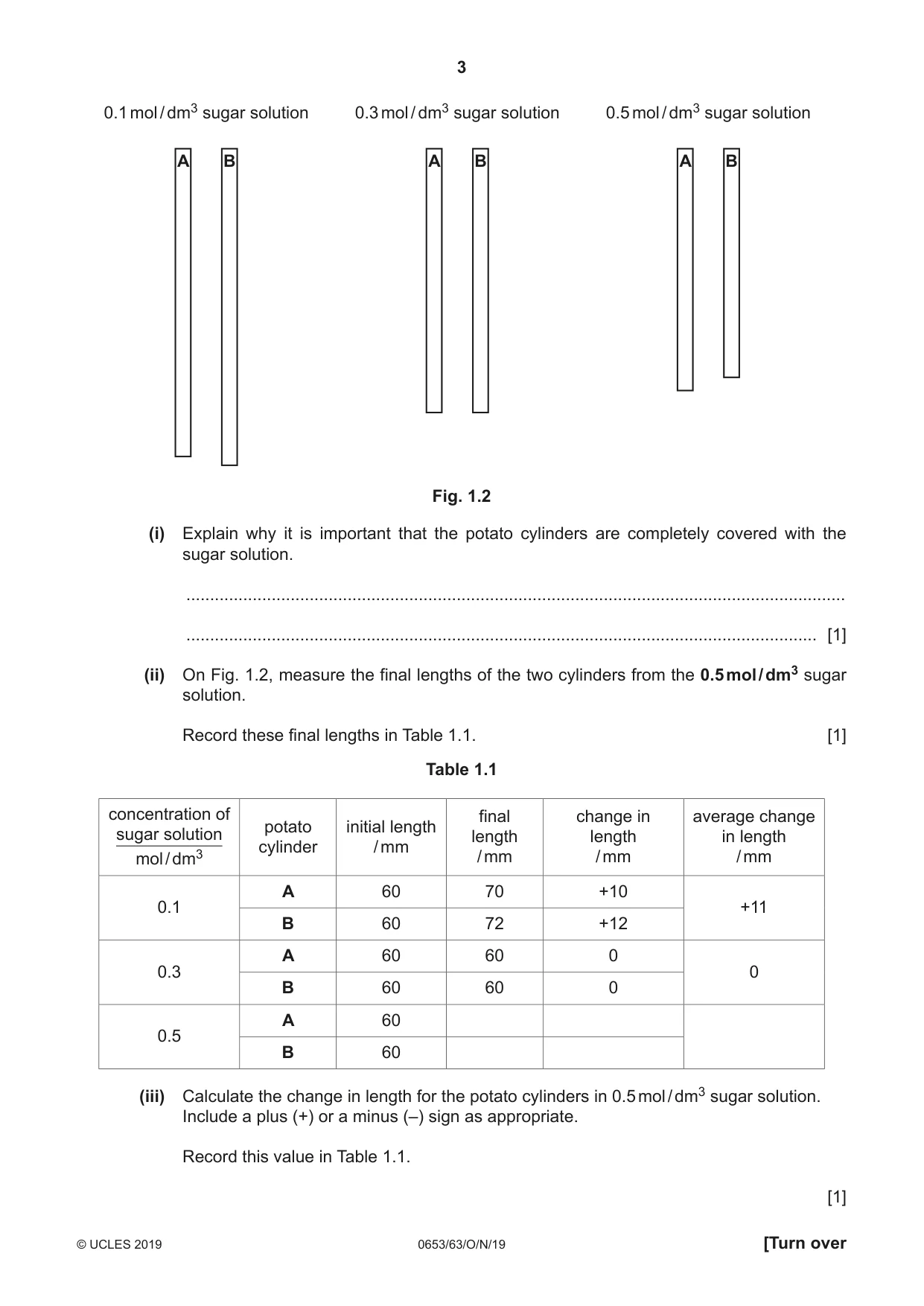
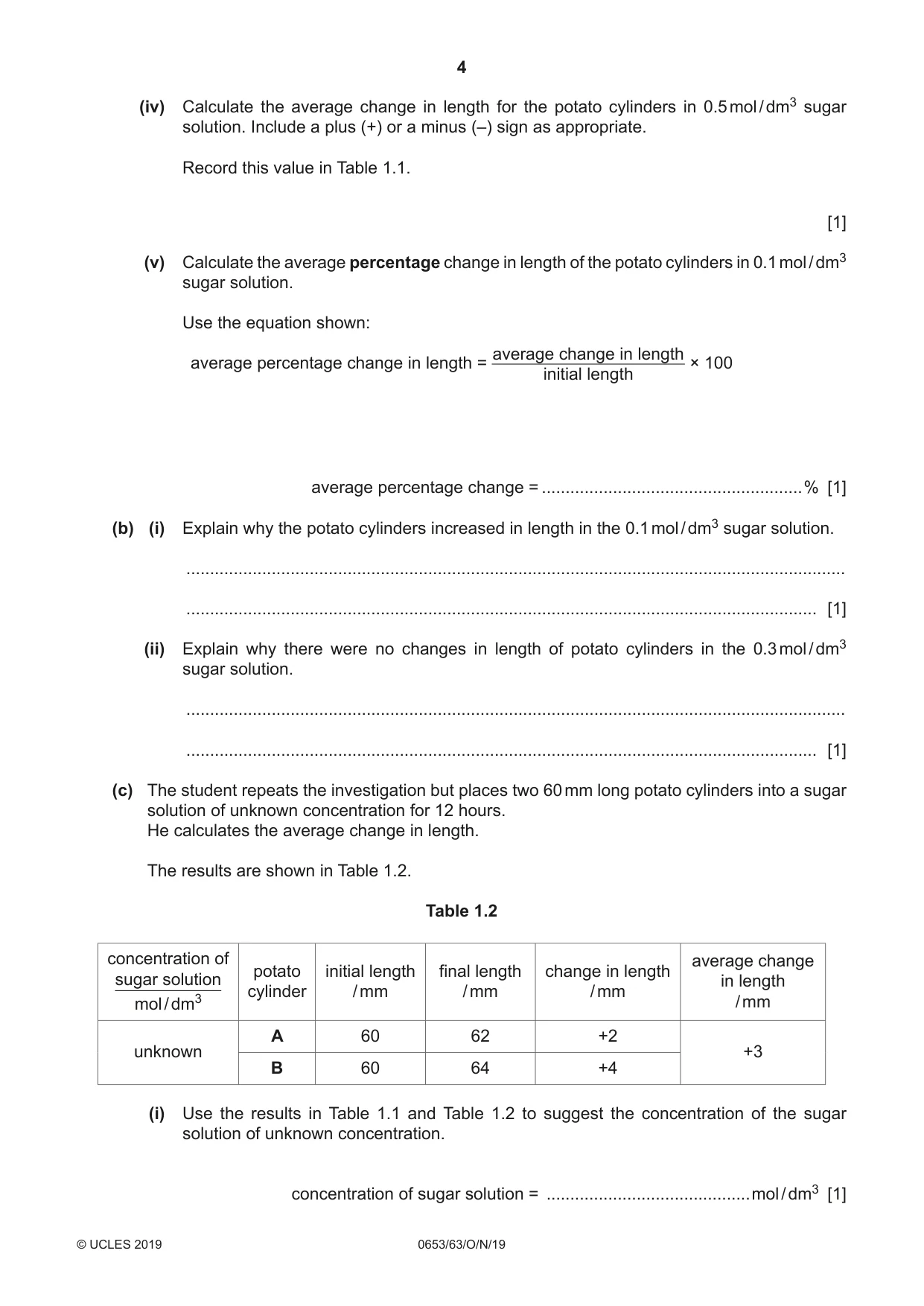
1 (a) A student investigates the movement of water in potato cylinders. Water moves from an area of lower sugar concentration to an area of higher sugar concentration. The unit of concentration is mol / dm3. He cuts six potato cylinders, each one 60 mm long and with a diameter of 10 mm. He places two potato cylinders, A and B, into a test-tube and adds 0.1 mol / dm3 sugar solution so that both cylinders are completely covered. He repeats this using 0.3 mol / dm3 and 0.5 mol / dm3 sugar solution as shown in Fig. 1.1. sugar solution A B B B A A potato cylinders 0.1 mol / dm3 0.3 mol / dm3 0.5 mol / dm3 Fig. 1.1 He leaves the potato cylinders in the sugar solutions for 12 hours. After 12 hours he removes the potato cylinders and dries them with a paper towel. The final lengths of the potato cylinders after 12 hours are shown in Fig. 1.2. 0.1 mol / dm3 sugar solution 0.3 mol / dm3 sugar solution 0.5 mol / dm3 sugar solution A B A B A B Fig. 1.2 (i) Explain why it is important that the potato cylinders are completely covered with the sugar solution. ........................................................................................................................................... ..................................................................................................................................... [1] (ii) On Fig. 1.2, measure the final lengths of the two cylinders from the 0.5 mol / dm3 sugar solution. Record these final lengths in Table 1.1. [1] Table 1.1 concentration of final change in average change potato initial length sugar solution length length in length cylinder / mm mol / dm3 / mm / mm / mm A 60 70 +10 0.1 +11 B 60 72 +12 A 60 60 0 0.3 0 B 60 60 0 A 60 0.5 B 60 (iii) Calculate the change in length for the potato cylinders in 0.5 mol / dm3 sugar solution. Include a plus (+) or a minus (–) sign as appropriate. Record this value in Table 1.1. [1] (iv) Calculate the average change in length for the potato cylinders in 0.5 mol / dm3 sugar solution. Include a plus (+) or a minus (–) sign as appropriate. Record this value in Table 1.1. [1] (v) Calculate the average percentage change in length of the potato cylinders in 0.1 mol / dm3 sugar solution. Use the equation shown: average change in length average percentage change in length = × 100 initial length average percentage change = .......................................................% [1] (b) (i) Explain why the potato cylinders increased in length in the 0.1 mol / dm3 sugar solution. ........................................................................................................................................... ..................................................................................................................................... [1] (ii) Explain why there were no changes in length of potato cylinders in the 0.3 mol / dm3 sugar solution. ........................................................................................................................................... ..................................................................................................................................... [1] (c) The student repeats the investigation but places two 60 mm long potato cylinders into a sugar solution of unknown concentration for 12 hours. He calculates the average change in length. The results are shown in Table 1.2. Table 1.2 concentration of average change potato initial length final length change in length sugar solution in length cylinder / mm / mm / mm mol / dm3 / mm A 60 62 +2 unknown +3 B 60 64 +4 (i) Use the results in Table 1.1 and Table 1.2 to suggest the concentration of the sugar solution of unknown concentration. concentration of sugar solution = ...........................................mol / dm3 [1] (ii) The student states that to be able to predict the unknown concentration of the sugar solution, all other factors should be kept the same when the investigation is repeated. Suggest three factors that should be kept the same. 1. ....................................................................................................................................... ........................................................................................................................................... 2. ....................................................................................................................................... ........................................................................................................................................... 3. ....................................................................................................................................... ........................................................................................................................................... [3] (d) Describe how the potato cylinder can be tested for the presence of starch. Include the result for a positive test and the result for a negative test. test ............................................................................................................................................ ................................................................................................................................................... positive result ............................................................................................................................ negative result .......................................................................................................................... [2] [Total: 13]
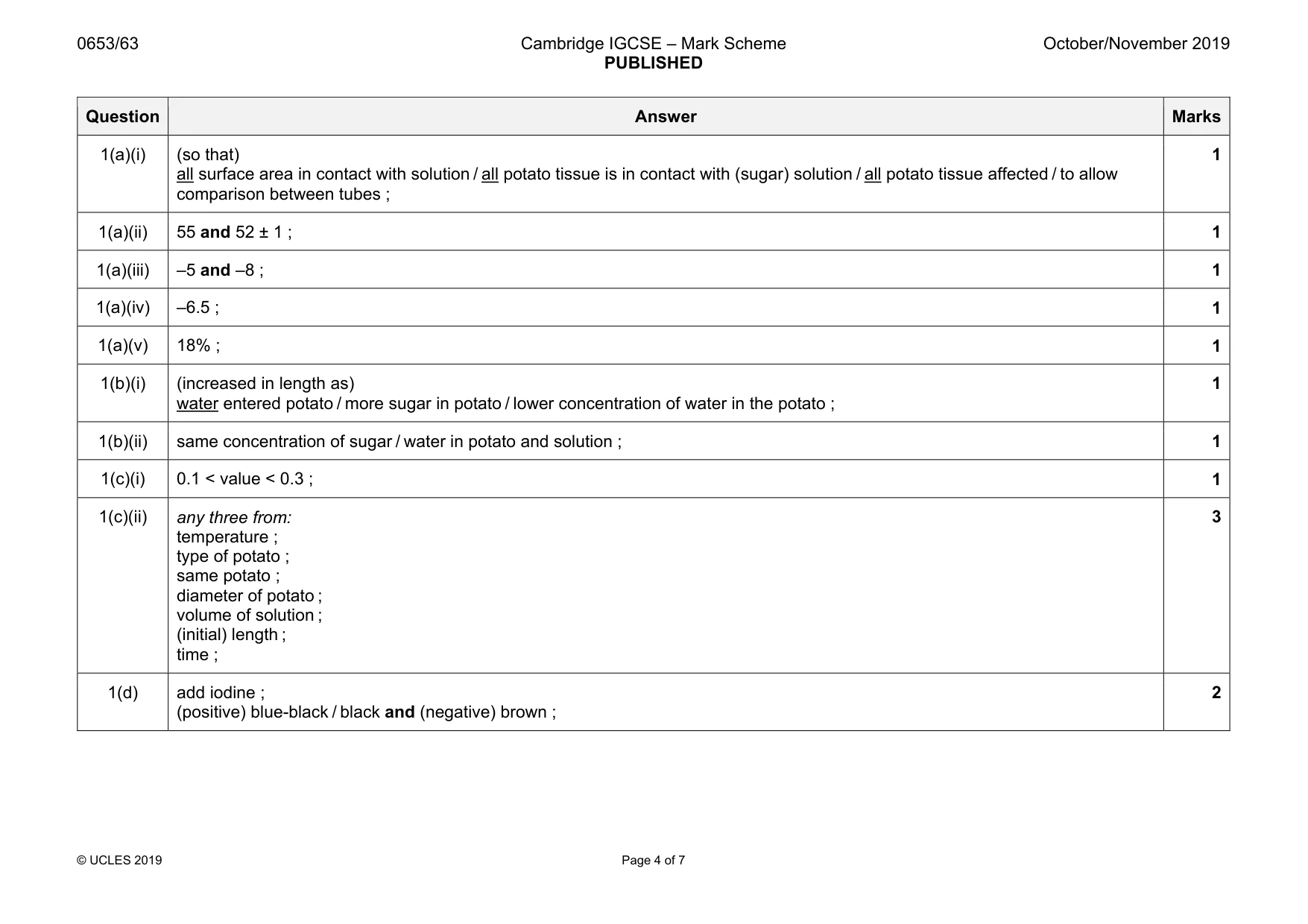
Mark scheme: 1(a)(i) (so that) all surface area in contact with solution / all potato tissue is in contact with (sugar) solution / all potato tissue affected / to allow comparison between tubes ; 1 1(a)(ii) 55 and 52 ± 1 ; 1 1(a)(iii) –5 and –8 ; 1 1(a)(iv) –6.5 ; 1 1(a)(v) 18% ; 1 1(b)(i) (increased in length as) water entered potato / more sugar in potato / lower concentration of water in the potato ; 1 1(b)(ii) same concentration of sugar / water in potato and solution ; 1 1(c)(i) 0.1 < value < 0.3 ; 1 1(c)(ii) any three from: temperature ; type of potato ; same potato ; diameter of potato ; volume of solution ; (initial) length ; time ; 3 1(d) add iodine ; (positive) blue-black / black and (negative) brown ; 2
Q2 · A student has samples of two grey solids E and F
2 A student has samples of two grey solids E and F. Solid E is covered in oil and kept in a bottle with the top screwed on. Solid F is in a bottle with the label ‘Do not touch with bare hands’. (a) The student adds a small piece of E to cold water in a large beaker. The solid skates around the surface of the water, fizzes violently and forms solution G. She tests the gas and concludes that it is hydrogen. (i) Describe the test which confirms the gas is hydrogen and give the result for a positive test. test .................................................................................................................................... positive result .................................................................................................................... [1] (ii) She puts some of solution G into a test-tube and adds aqueous iron(II) nitrate. A green precipitate is formed. Suggest the identity of solution G and solid E. G is .................................................................................................................................... E is .................................................................................................................................... [1] (iii) Suggest an alternative reagent to iron(II) nitrate for identifying solution G in (a)(ii). ........................................................................................................................................... ..................................................................................................................................... [1] (b) She adds a small piece of solid F to cold water in a large beaker. The solid moves up and down in the water, fizzes vigorously and forms solution H. The gas given off is hydrogen. She puts some of solution H into a test-tube. She places marble chips in a separate test-tube, adds hydrochloric acid and bubbles the gas formed into solution H. Solution H goes milky. (i) Draw a diagram of the assembled apparatus used to bubble the gas formed into solution H. Label the apparatus and the chemicals. [2] (ii) Suggest the identity of solution H. ..................................................................................................................................... [1] (iii) Suggest the identity of solid F. ..................................................................................................................................... [1] [Total: 7]
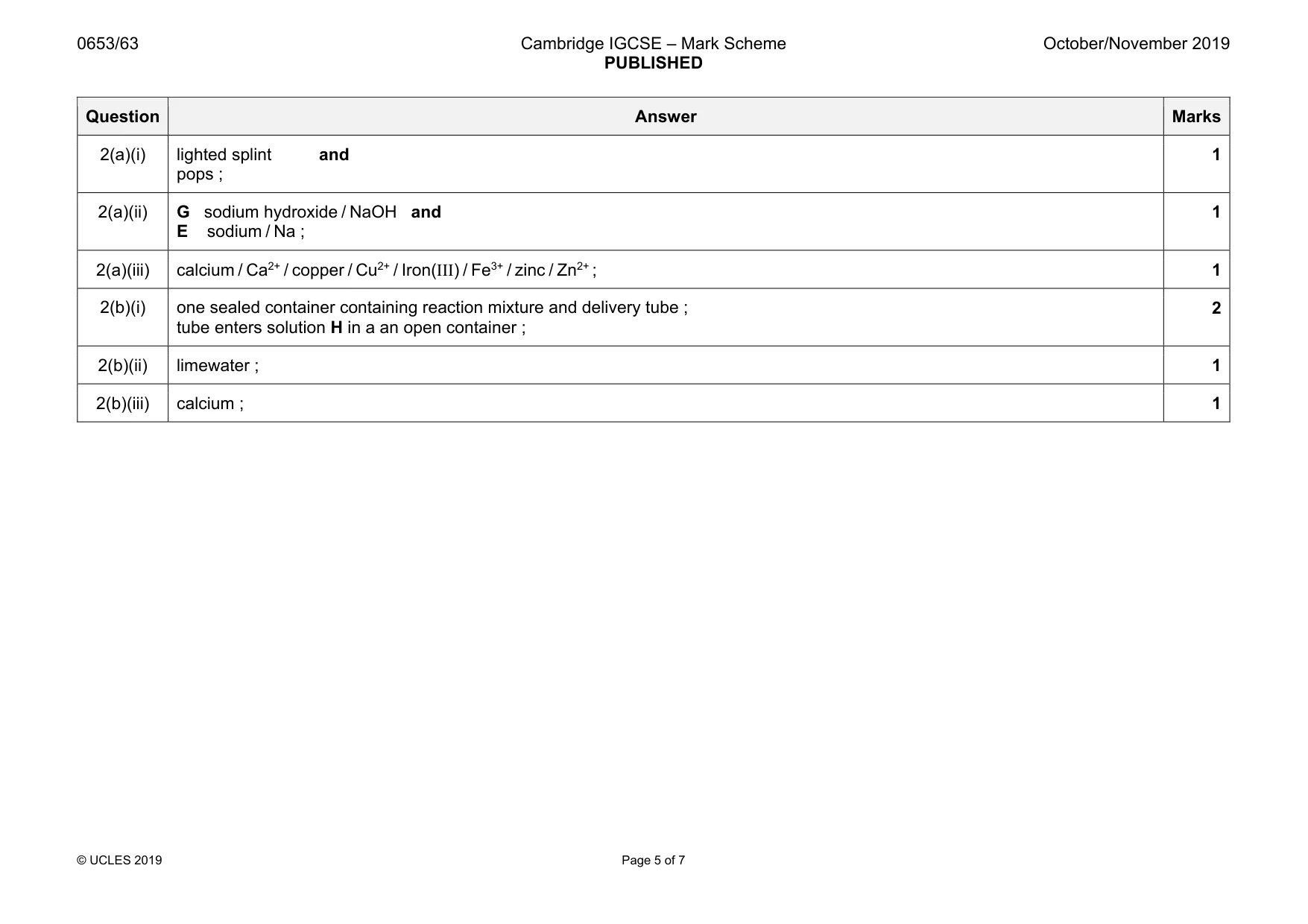
Mark scheme: 2(a)(i) lighted splint and pops ; 1 2(a)(ii) G sodium hydroxide / NaOH and E sodium / Na ; 1 2(a)(iii) calcium / Ca2+ / copper / Cu2+ / Iron(III) / Fe3+ / zinc / Zn2+ ; 1 2(b)(i) one sealed container containing reaction mixture and delivery tube ; tube enters solution H in a an open container ; 2 2(b)(ii) limewater ; 1 2(b)(iii) calcium ; 1
Q3 · Hydrogen peroxide is used to bleach hair
3 Hydrogen peroxide is used to bleach hair. Hydrogen peroxide slowly decomposes giving off oxygen gas. When a catalyst is added to hydrogen peroxide, oxygen gas is given off more quickly. Plan an experiment to find out which one of the three solid oxides, manganese dioxide, copper oxide and zinc oxide, is the best catalyst for this reaction. You may use any common laboratory apparatus and samples of hydrogen peroxide, manganese dioxide, copper oxide and zinc oxide. Include in your answer: • the apparatus needed, including a labelled diagram if you wish • a brief description of the method, including any safety precautions and why these are needed • the measurements you will make • what you will control • how you will process your results • how you will use your results to draw a conclusion. .......................................................................................................................................................... .......................................................................................................................................................... .......................................................................................................................................................... .......................................................................................................................................................... .......................................................................................................................................................... .......................................................................................................................................................... .......................................................................................................................................................... .......................................................................................................................................................... .......................................................................................................................................................... .......................................................................................................................................................... .......................................................................................................................................................... .......................................................................................................................................................... .......................................................................................................................................................... .......................................................................................................................................................... .......................................................................................................................................................... .......................................................................................................................................................... .......................................................................................................................................................... .......................................................................................................................................................... .......................................................................................................................................................... .......................................................................................................................................................... .................................................................................................................................................... [7]
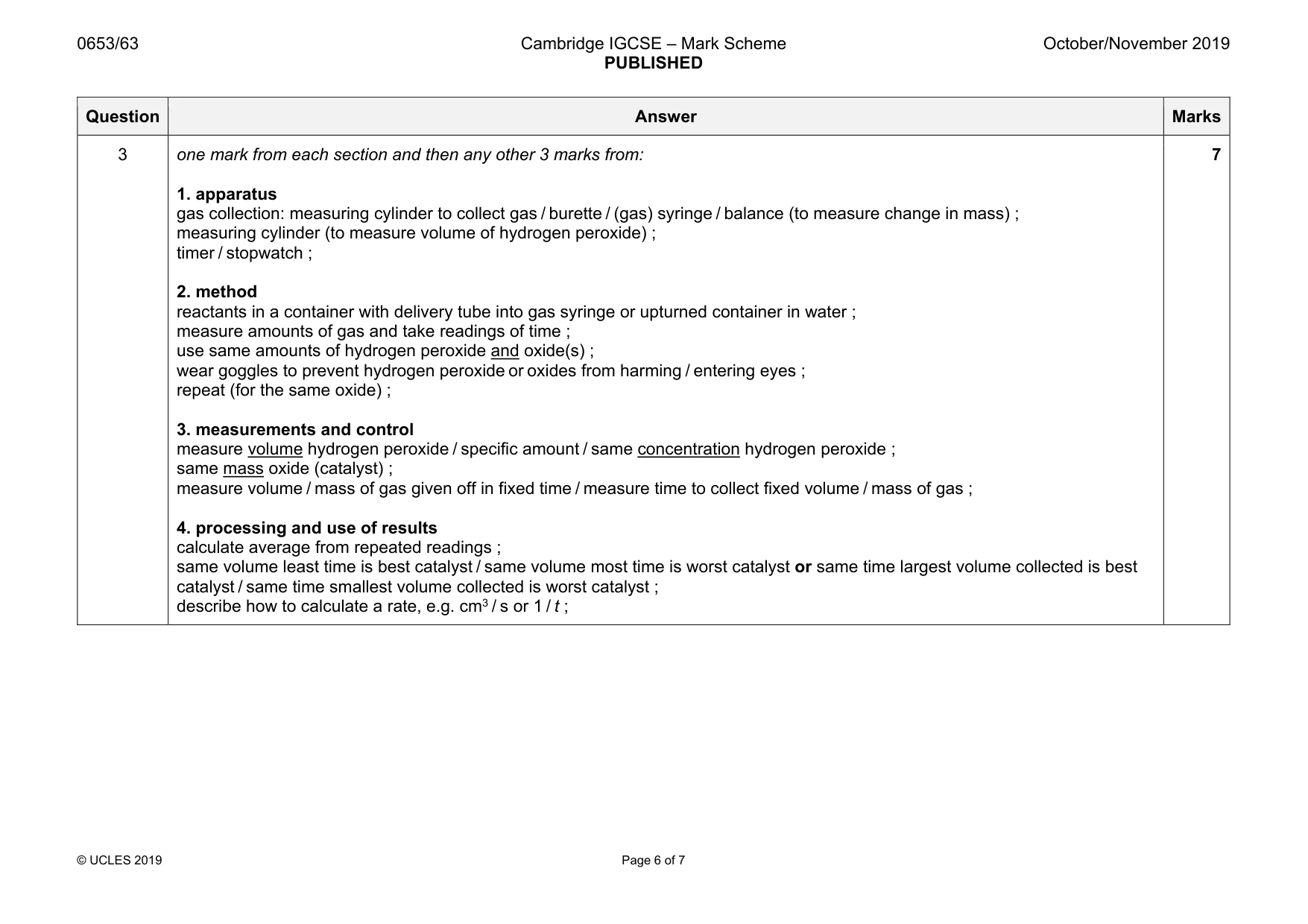
Mark scheme: 3 one mark from each section and then any other 3 marks from: 1. apparatus gas collection: measuring cylinder to collect gas / burette / (gas) syringe / balance (to measure change in mass) ; measuring cylinder (to measure volume of hydrogen peroxide) ; timer / stopwatch ; 2. method reactants in a container with delivery tube into gas syringe or upturned container in water ; measure amounts of gas and take readings of time ; use same amounts of hydrogen peroxide and oxide(s) ; wear goggles to prevent hydrogen peroxide or oxides from harming / entering eyes ; repeat (for the same oxide) ; 3. measurements and control measure volume hydrogen peroxide / specific amount / same concentration hydrogen peroxide ; same mass oxide (catalyst) ; measure volume / mass of gas given off in fixed time / measure time to collect fixed volume / mass of gas ; 4. processing and use of results calculate average from repeated readings ; same volume least time is best catalyst / same volume most time is worst catalyst or same time largest volume collected is best catalyst / same time smallest volume collected is worst catalyst ; describe how to calculate a rate, e.g. cm3 / s or 1 / t ; 7
Q4 · A student investigates how the size of the average force needed to move a door varies…
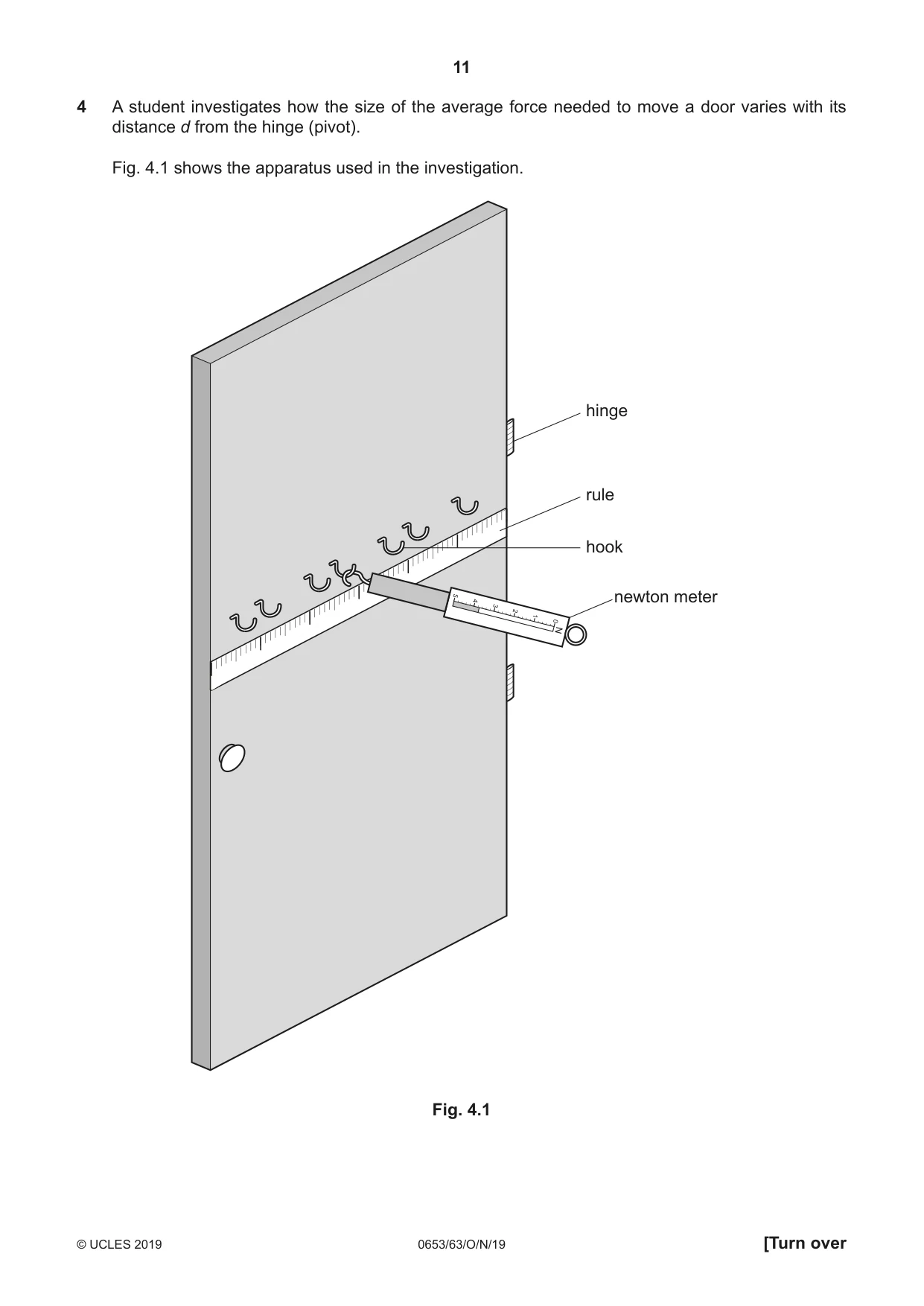
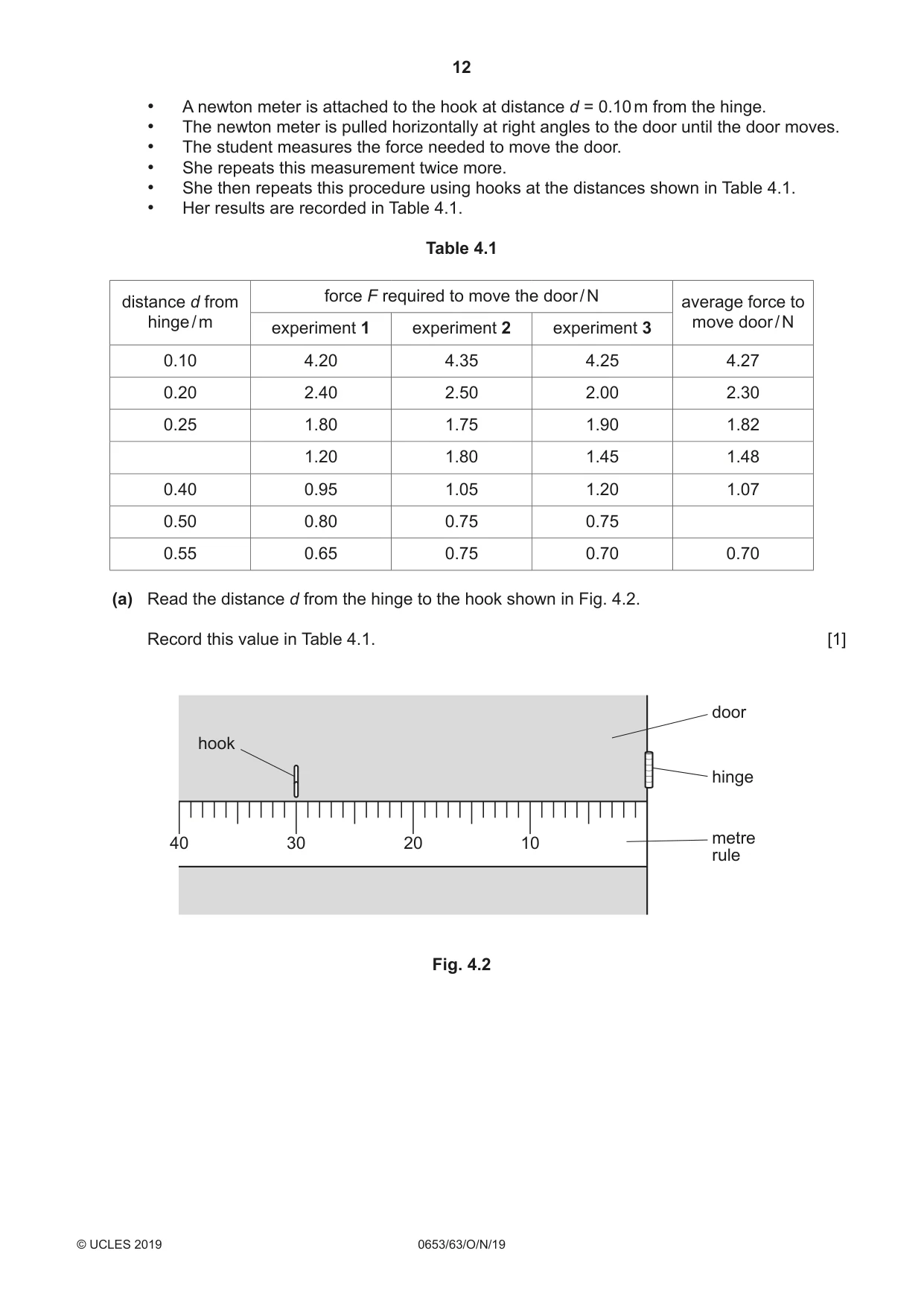
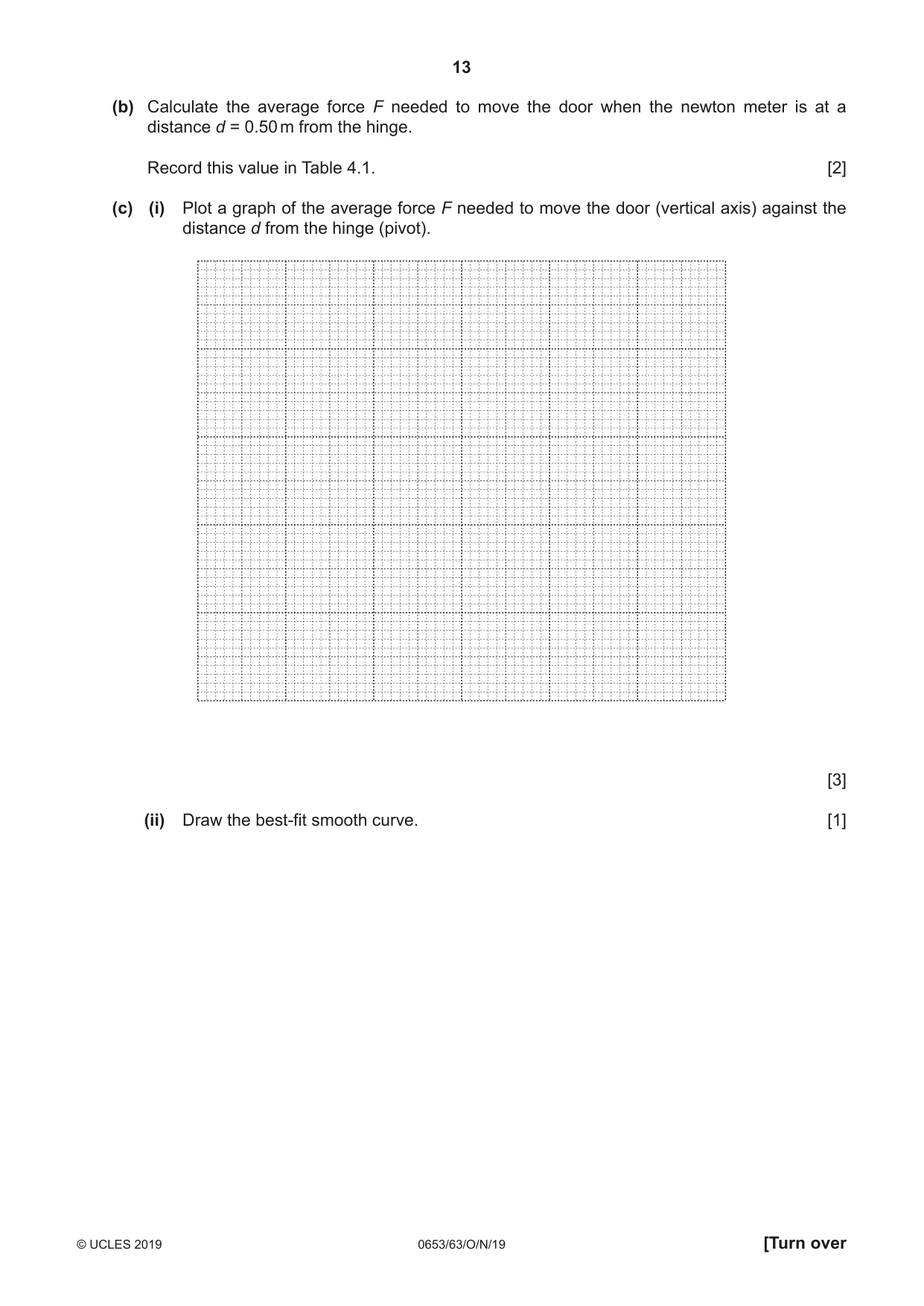
4 A student investigates how the size of the average force needed to move a door varies with its distance d from the hinge (pivot). Fig. 4.1 shows the apparatus used in the investigation. hinge rule hook newton meter Fig. 4.1 • A newton meter is attached to the hook at distance d = 0.10 m from the hinge. • The newton meter is pulled horizontally at right angles to the door until the door moves. • The student measures the force needed to move the door. • She repeats this measurement twice more. • She then repeats this procedure using hooks at the distances shown in Table 4.1. • Her results are recorded in Table 4.1. Table 4.1 force F required to move the door / N distance d from average force to hinge / m move door / N experiment 1 experiment 2 experiment 3 0.10 4.20 4.35 4.25 4.27 0.20 2.40 2.50 2.00 2.30 0.25 1.80 1.75 1.90 1.82 1.20 1.80 1.45 1.48 0.40 0.95 1.05 1.20 1.07 0.50 0.80 0.75 0.75 0.55 0.65 0.75 0.70 0.70 (a) Read the distance d from the hinge to the hook shown in Fig. 4.2. Record this value in Table 4.1. [1] door hook hinge metre 40 30 20 10 rule Fig. 4.2 (b) Calculate the average force F needed to move the door when the newton meter is at a distance d = 0.50 m from the hinge. Record this value in Table 4.1. [2] (c) (i) Plot a graph of the average force F needed to move the door (vertical axis) against the distance d from the hinge (pivot). [3] (ii) Draw the best-fit smooth curve. [1]
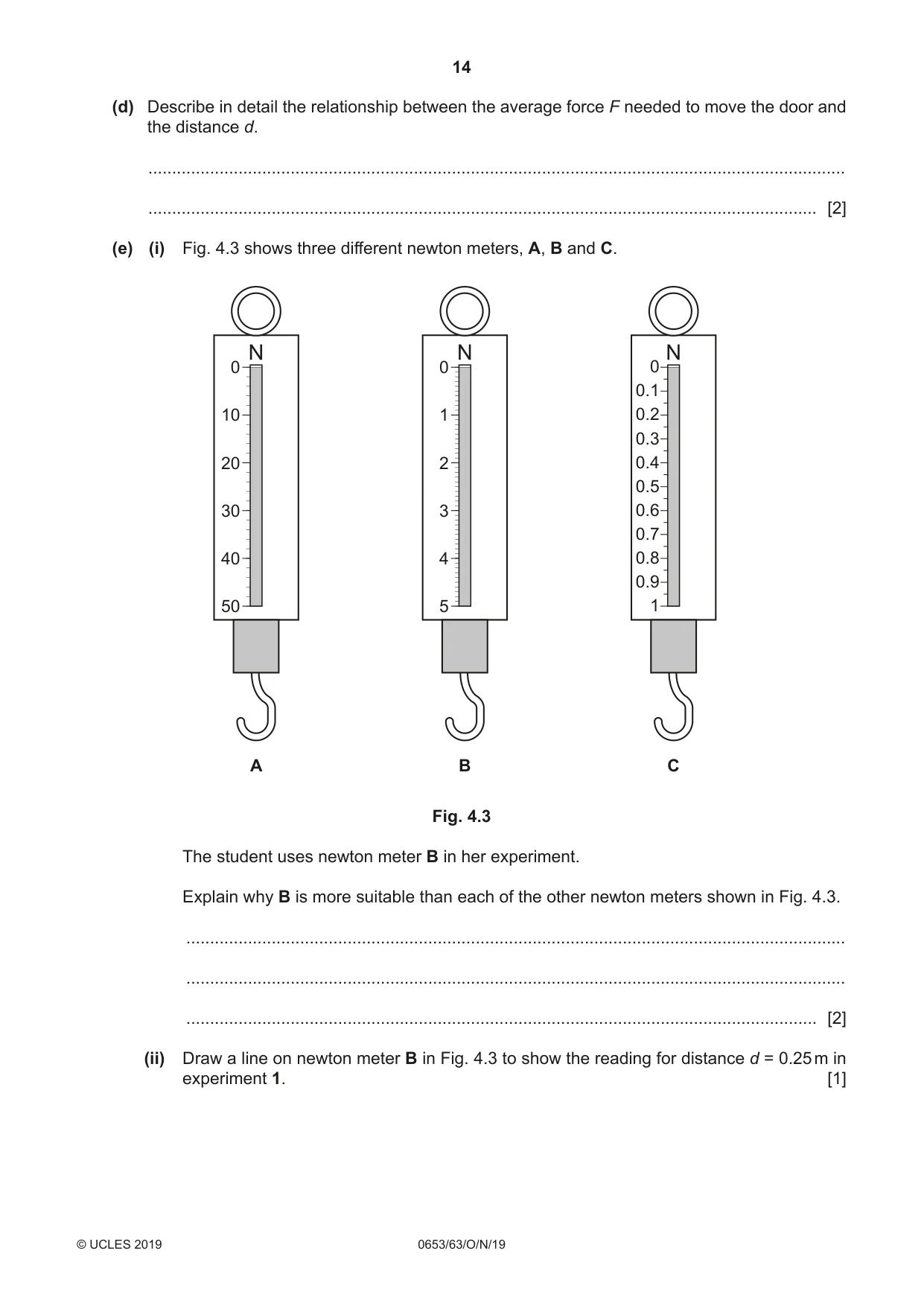
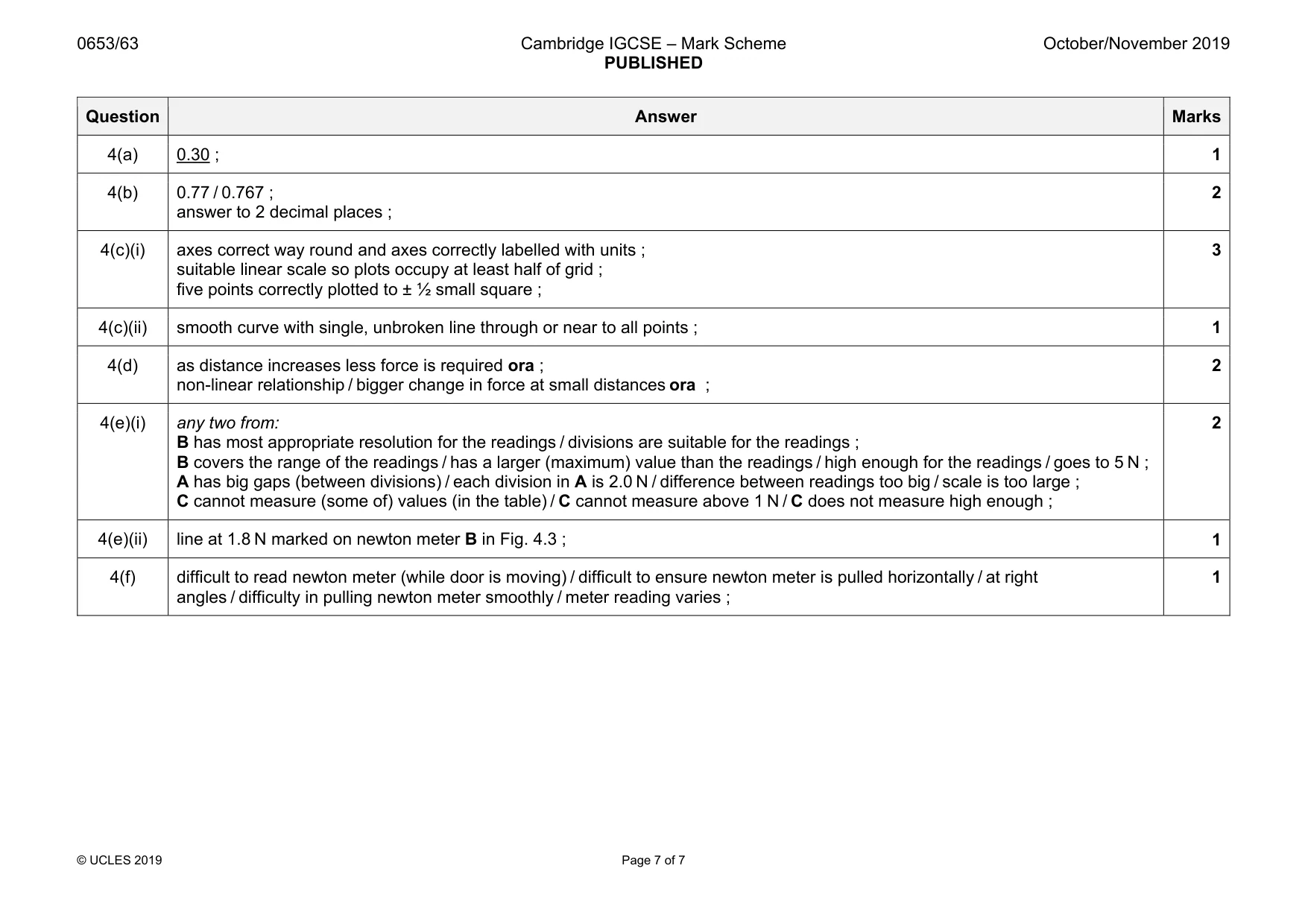
Mark scheme: 4(a) 0.30 ; 1 4(b) 0.77 / 0.767 ; answer to 2 decimal places ; 2 4(c)(i) axes correct way round and axes correctly labelled with units ; suitable linear scale so plots occupy at least half of grid ; five points correctly plotted to ± ½ small square ; 3 4(c)(ii) smooth curve with single, unbroken line through or near to all points ; 1 4(d) as distance increases less force is required ora ; non-linear relationship / bigger change in force at small distances ora ; 2 4(e)(i) any two from: B has most appropriate resolution for the readings / divisions are suitable for the readings ; B covers the range of the readings / has a larger (maximum) value than the readings / high enough for the readings / goes to 5 N ; A has big gaps (between divisions) / each division in A is 2.0 N / difference between readings too big / scale is too large ; C cannot measure (some of) values (in the table) / C cannot measure above 1 N / C does not measure high enough ; 2 4(e)(ii) line at 1.8 N marked on newton meter B in Fig. 4.3 ; 1 4(f) difficult to read newton meter (while door is moving) / difficult to ensure newton meter is pulled horizontally / at right angles / difficulty in pulling newton meter smoothly / meter reading varies ; 1
What was in this paper
The subtopics covered by these 4 questions, and how many questions each got. Open one in a new tab to see every Cambridge question on it.
What you needed in this session
Cambridge’s own grade thresholds for 2019 Oct/Nov, Paper 6 · Variant 3. A higher threshold means an easier paper — the bar moves with how the cohort did.