Cambridge IGCSE Science - Combined 0653 — 2019 Oct/Nov Paper 6 · Variant 1
0653/61/O/N/19 · 4 questions · 40 marks · ≈45 min
The question paper and its mark scheme, free to read here and free to download. This is Cambridge’s own paper, exactly as it was sat.
Question paper12 pages


Mark scheme7 pages
Answers below. Sit the paper first if you are practising.
Questions as text
Q1 · A student investigates the effect of the concentration of a salt solution on the activity…
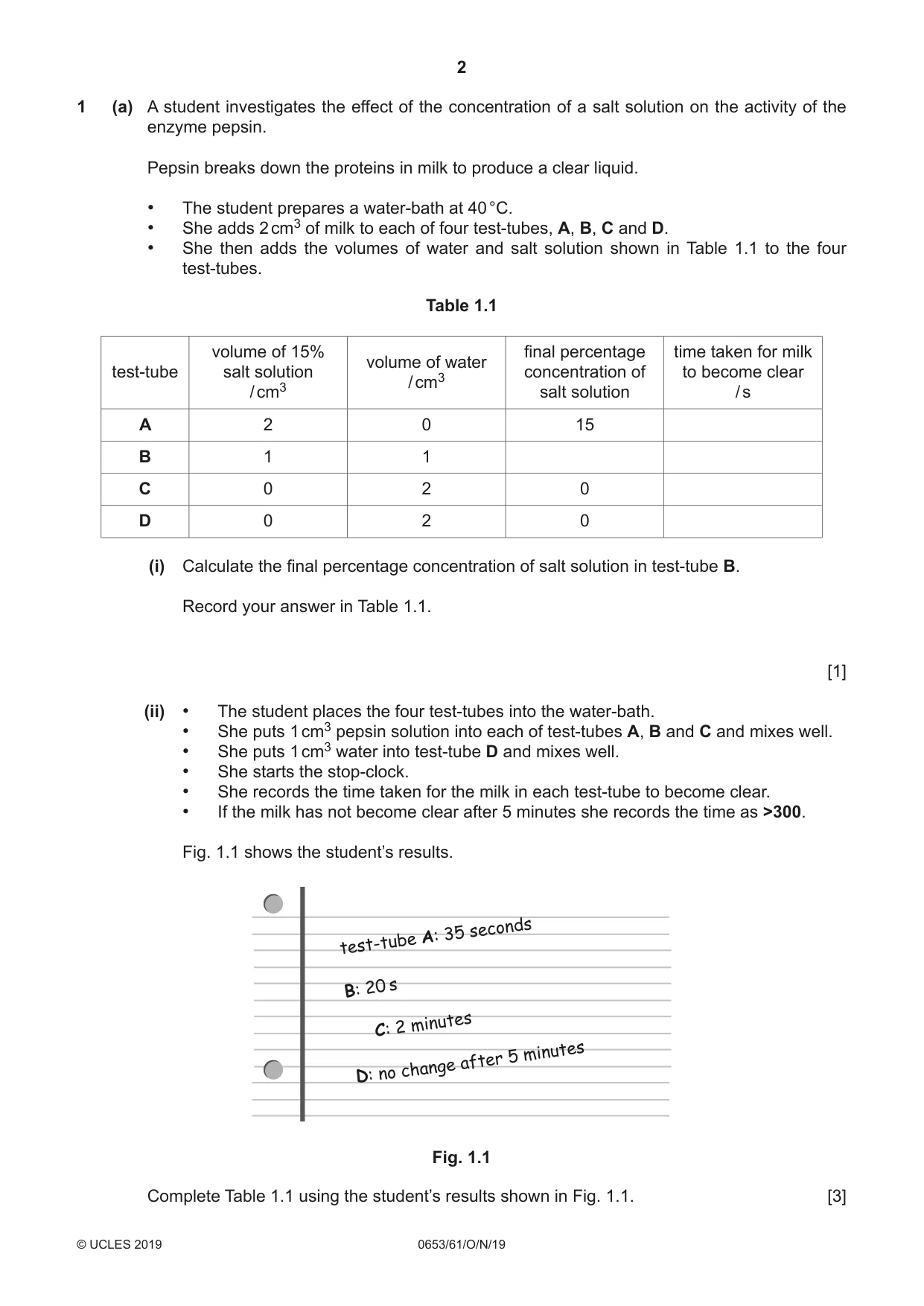
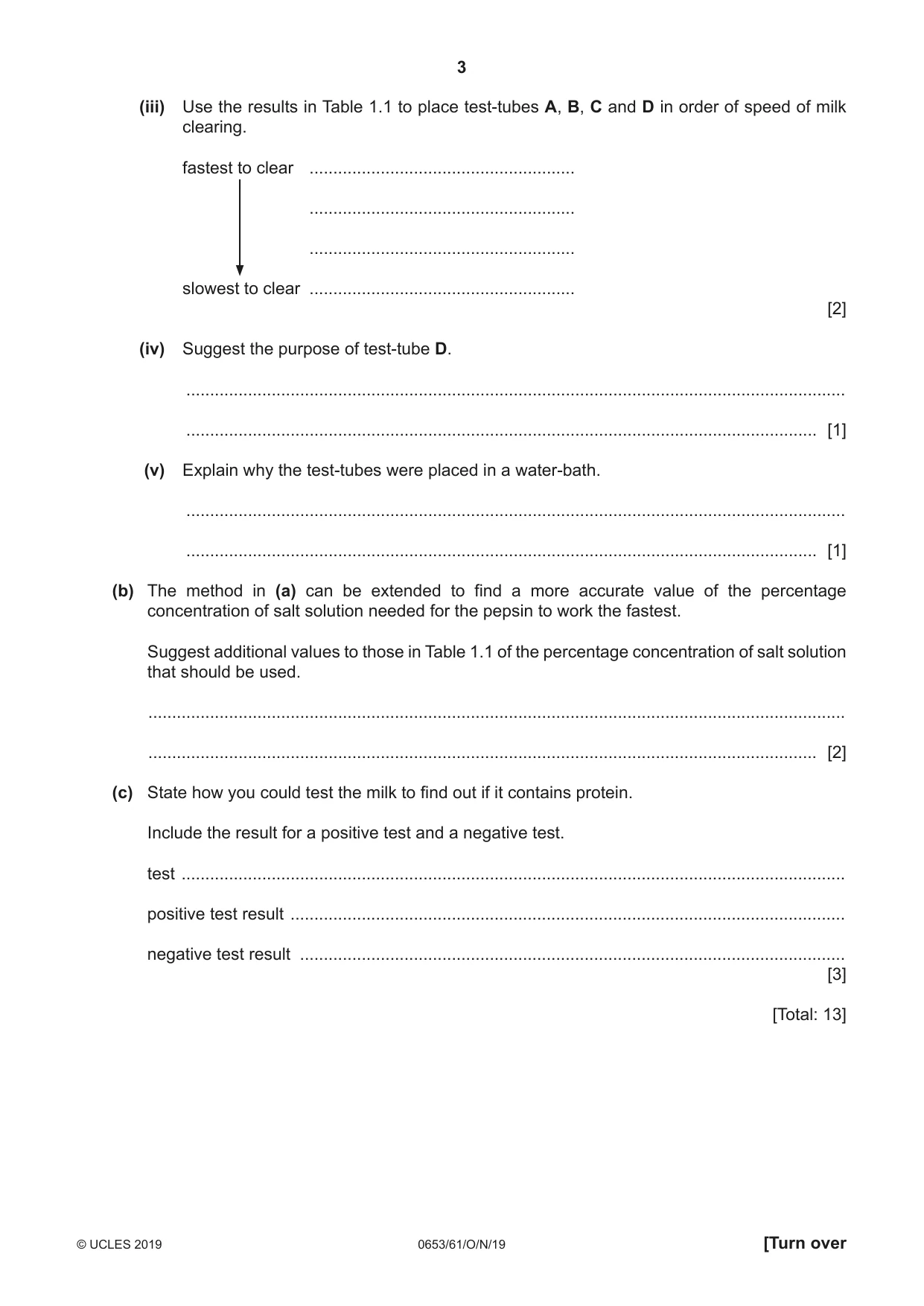
1 (a) A student investigates the effect of the concentration of a salt solution on the activity of the enzyme pepsin. Pepsin breaks down the proteins in milk to produce a clear liquid. • The student prepares a water-bath at 40 °C. • She adds 2 cm3 of milk to each of four test-tubes, A, B, C and D. • She then adds the volumes of water and salt solution shown in Table 1.1 to the four test-tubes. Table 1.1 volume of 15% final percentage time taken for milk volume of water test-tube salt solution concentration of to become clear / cm3 / cm3 salt solution / s A 2 0 15 B 1 1 C 0 2 0 D 0 2 0 (i) Calculate the final percentage concentration of salt solution in test-tube B. Record your answer in Table 1.1. [1] (ii) • The student places the four test-tubes into the water-bath. • She puts 1 cm3 pepsin solution into each of test-tubes A, B and C and mixes well. • She puts 1 cm3 water into test-tube D and mixes well. • She starts the stop-clock. • She records the time taken for the milk in each test-tube to become clear. • If the milk has not become clear after 5 minutes she records the time as >300. Fig. 1.1 shows the student’s results. seconds A: 35 test-tube B: 20s C: 2 minutes 5 minutes after change D: no Fig. 1.1 Complete Table 1.1 using the student’s results shown in Fig. 1.1. [3] (iii) Use the results in Table 1.1 to place test-tubes A, B, C and D in order of speed of milk clearing. fastest to clear ........................................................ ........................................................ ........................................................ slowest to clear ........................................................ [2] (iv) Suggest the purpose of test-tube D. ........................................................................................................................................... ..................................................................................................................................... [1] (v) Explain why the test-tubes were placed in a water-bath. ........................................................................................................................................... ..................................................................................................................................... [1] (b) The method in (a) can be extended to find a more accurate value of the percentage concentration of salt solution needed for the pepsin to work the fastest. Suggest additional values to those in Table 1.1 of the percentage concentration of salt solution that should be used. ................................................................................................................................................... ............................................................................................................................................. [2] (c) State how you could test the milk to find out if it contains protein. Include the result for a positive test and a negative test. test ............................................................................................................................................ positive test result ..................................................................................................................... negative test result ................................................................................................................... [3] [Total: 13]
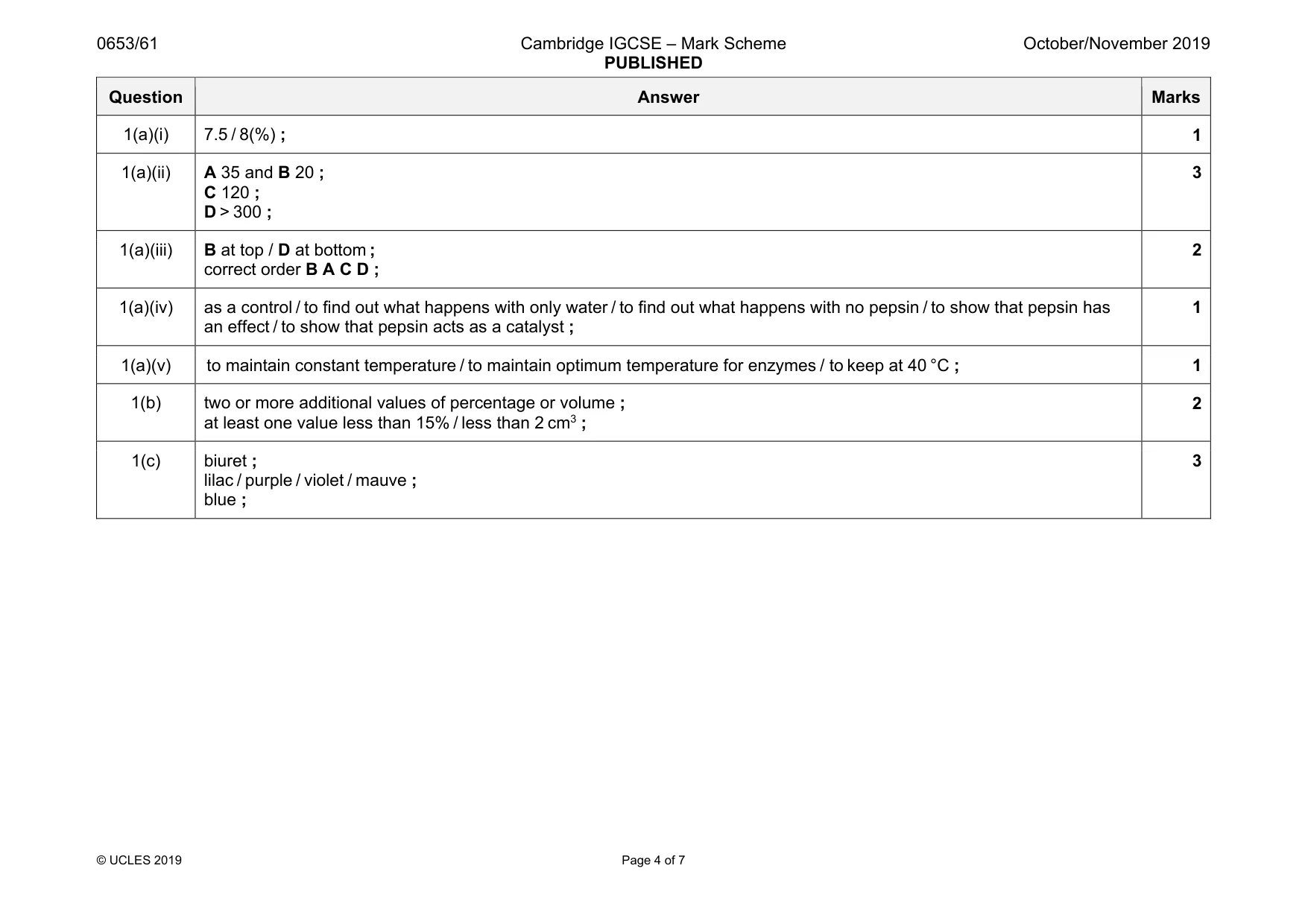
Mark scheme: 1(a)(i) 7.5 / 8(%) ; 1 1(a)(ii) A 35 and B 20 ; C 120 ; D > 300 ; 3 1(a)(iii) B at top / D at bottom ; correct order B A C D ; 2 1(a)(iv) as a control / to find out what happens with only water / to find out what happens with no pepsin / to show that pepsin has an effect / to show that pepsin acts as a catalyst ; 1 1(a)(v) to maintain constant temperature / to maintain optimum temperature for enzymes / to keep at 40 °C ; 1 1(b) two or more additional values of percentage or volume ; at least one value less than 15% / less than 2 cm3 ; 2 1(c) biuret ; lilac / purple / violet / mauve ; blue ; 3
Q2 · A student has samples of two different colourless aqueous solutions, E and F
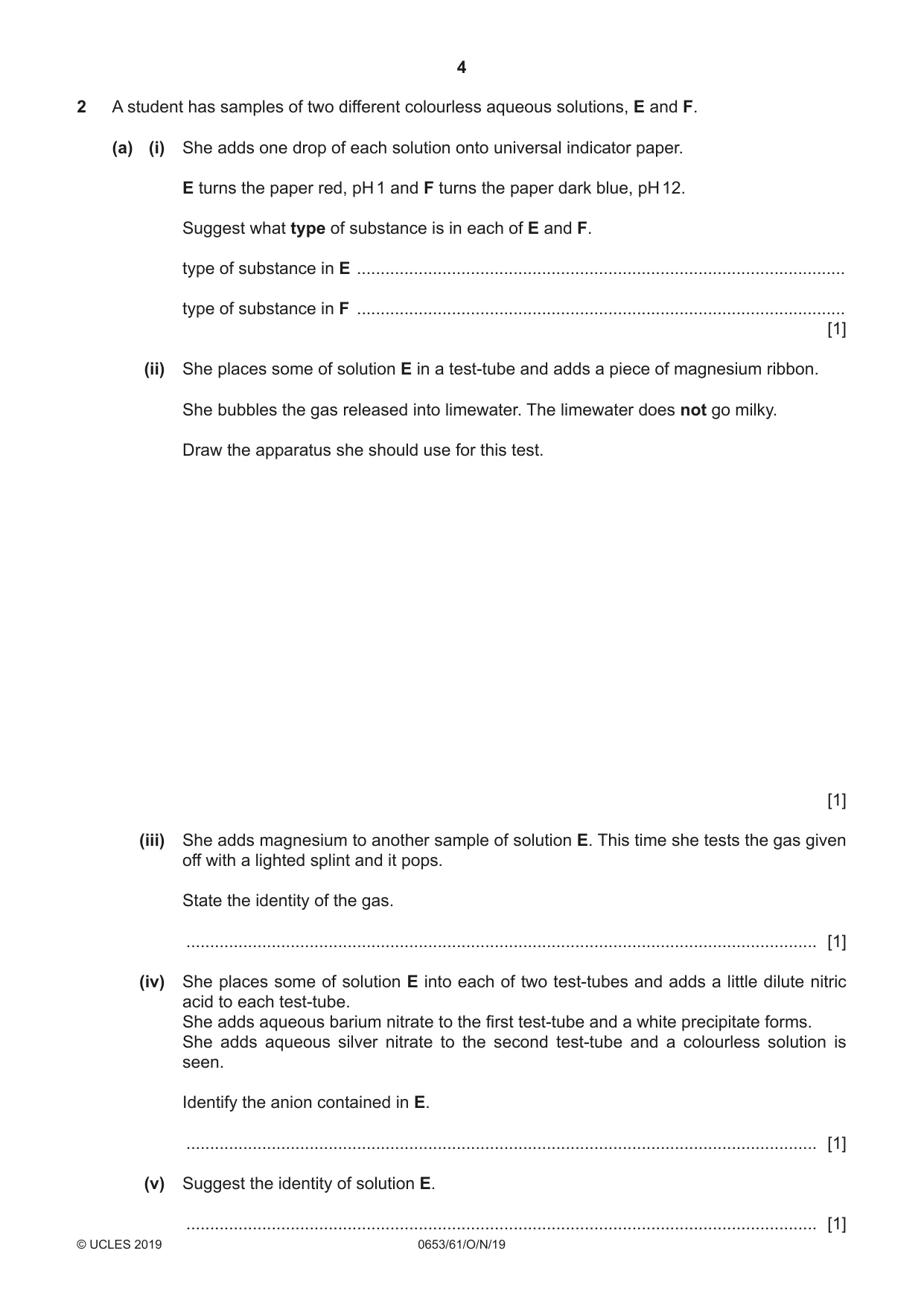
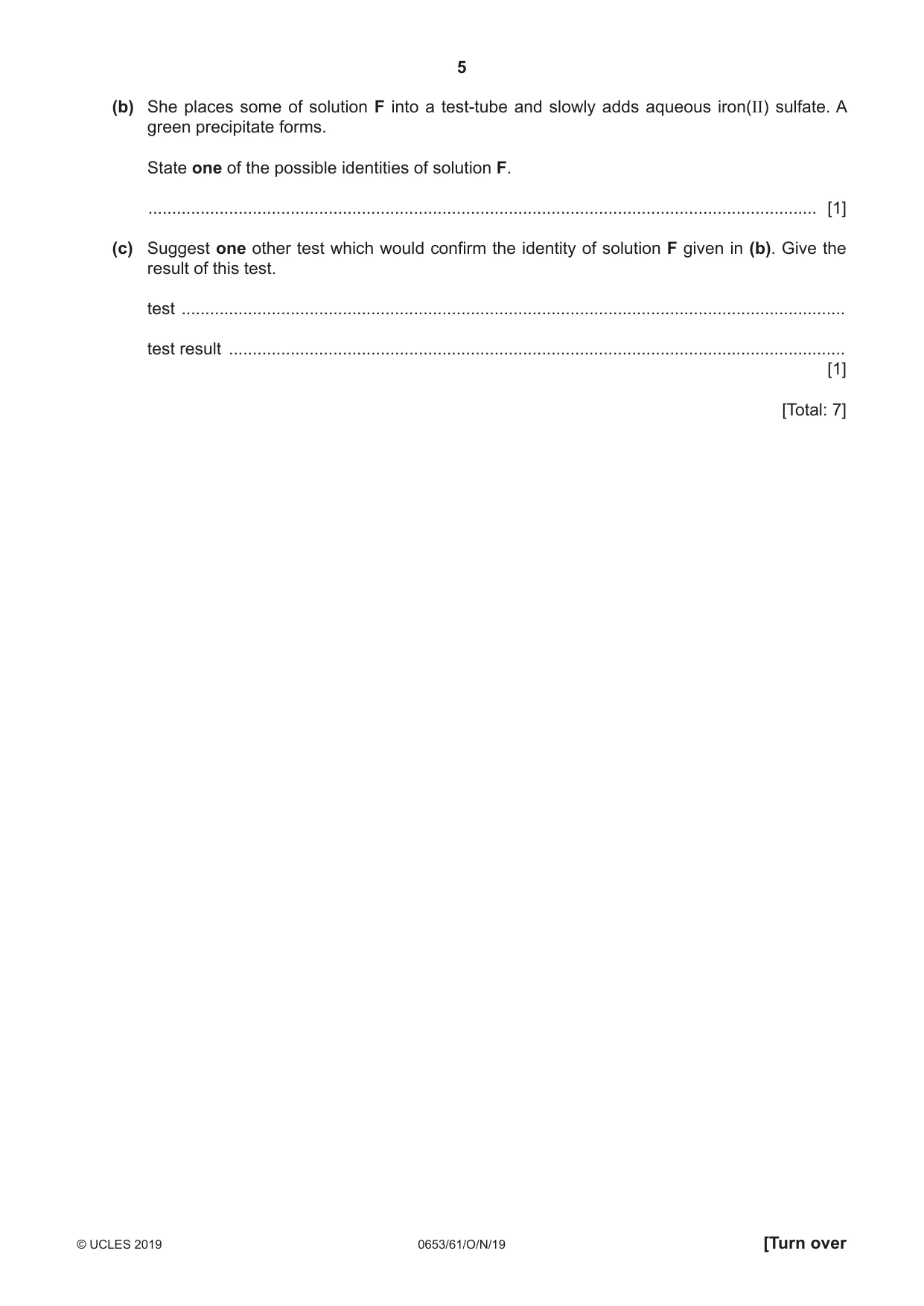
2 A student has samples of two different colourless aqueous solutions, E and F. (a) (i) She adds one drop of each solution onto universal indicator paper. E turns the paper red, pH 1 and F turns the paper dark blue, pH 12. Suggest what type of substance is in each of E and F. type of substance in E ....................................................................................................... type of substance in F ....................................................................................................... [1] (ii) She places some of solution E in a test-tube and adds a piece of magnesium ribbon. She bubbles the gas released into limewater. The limewater does not go milky. Draw the apparatus she should use for this test. [1] (iii) She adds magnesium to another sample of solution E. This time she tests the gas given off with a lighted splint and it pops. State the identity of the gas. ..................................................................................................................................... [1] (iv) She places some of solution E into each of two test-tubes and adds a little dilute nitric acid to each test-tube. She adds aqueous barium nitrate to the first test-tube and a white precipitate forms. She adds aqueous silver nitrate to the second test-tube and a colourless solution is seen. Identify the anion contained in E. ..................................................................................................................................... [1] (v) Suggest the identity of solution E. ..................................................................................................................................... [1] (b) She places some of solution F into a test-tube and slowly adds aqueous iron(II) sulfate. A green precipitate forms. State one of the possible identities of solution F. ............................................................................................................................................. [1] (c) Suggest one other test which would confirm the identity of solution F given in (b). Give the result of this test. test ............................................................................................................................................ test result .................................................................................................................................. [1] [Total: 7]
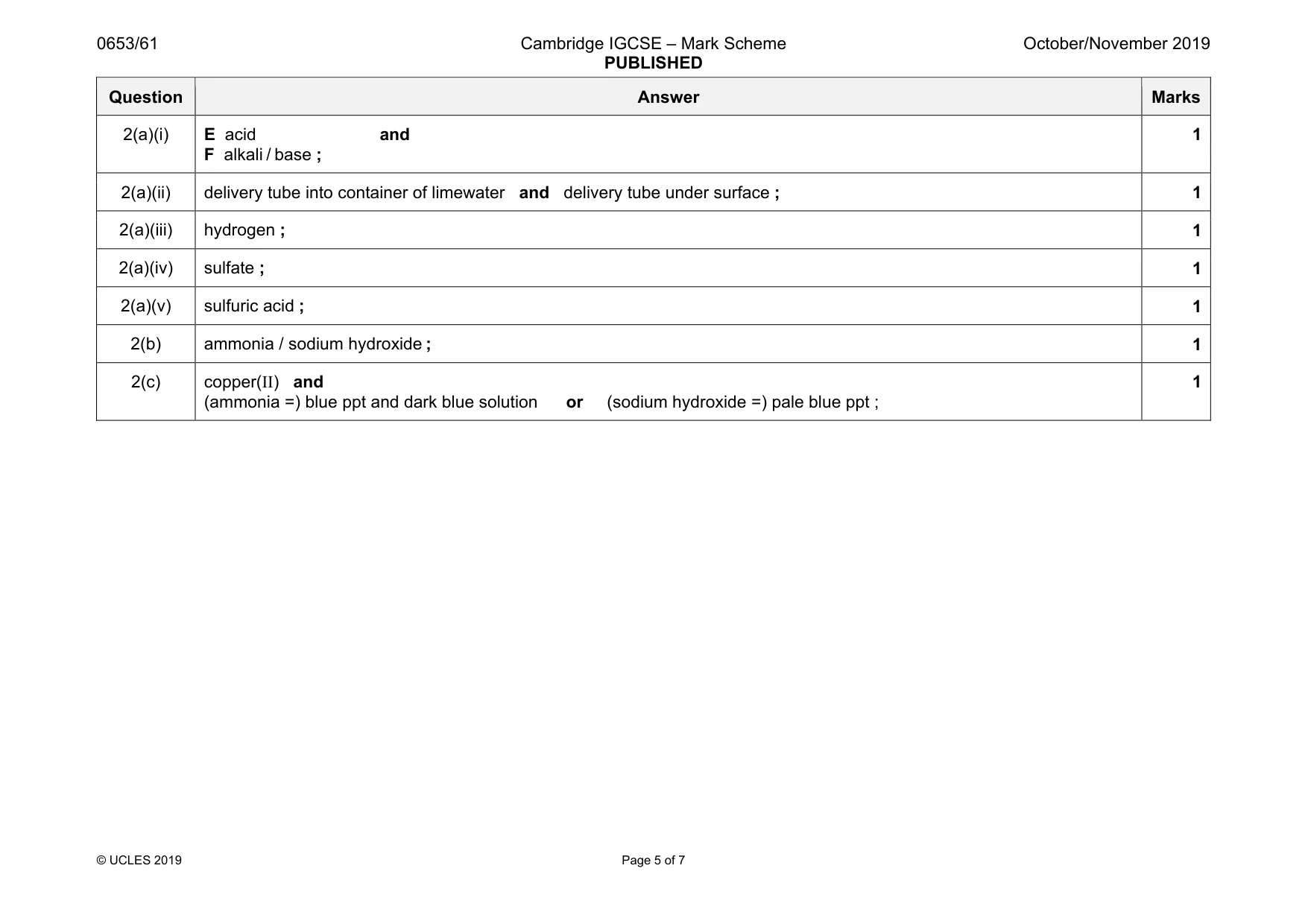
Mark scheme: 2(a)(i) E acid and F alkali / base ; 1 2(a)(ii) delivery tube into container of limewater and delivery tube under surface ; 1 2(a)(iii) hydrogen ; 1 2(a)(iv) sulfate ; 1 2(a)(v) sulfuric acid ; 1 2(b) ammonia / sodium hydroxide ; 1 2(c) copper(II) and (ammonia =) blue ppt and dark blue solution or (sodium hydroxide =) pale blue ppt ; 1
More questions on The characteristic properties of acids and bases
Q3 · Sea water contains a number of dissolved salts such as sodium chloride
3 Sea water contains a number of dissolved salts such as sodium chloride. The water may also contain small insoluble particles suspended in the water. Plan an experiment to compare the amount of dissolved salts in samples of water from the Dead Sea and from the Baltic Sea. You may use any common laboratory apparatus and samples of water from the Dead Sea and from the Baltic Sea. Include in your answer: • the apparatus needed, including a labelled diagram if you wish • a brief description of the method, including any safety precautions and why these are needed • the measurements you will make • what you will control • how you will process your results • how you will use your results to draw a conclusion. .......................................................................................................................................................... .......................................................................................................................................................... .......................................................................................................................................................... .......................................................................................................................................................... .......................................................................................................................................................... .......................................................................................................................................................... .......................................................................................................................................................... .......................................................................................................................................................... .......................................................................................................................................................... .......................................................................................................................................................... .......................................................................................................................................................... .......................................................................................................................................................... .......................................................................................................................................................... .......................................................................................................................................................... .......................................................................................................................................................... .......................................................................................................................................................... .......................................................................................................................................................... .......................................................................................................................................................... .......................................................................................................................................................... .......................................................................................................................................................... .................................................................................................................................................... [7]
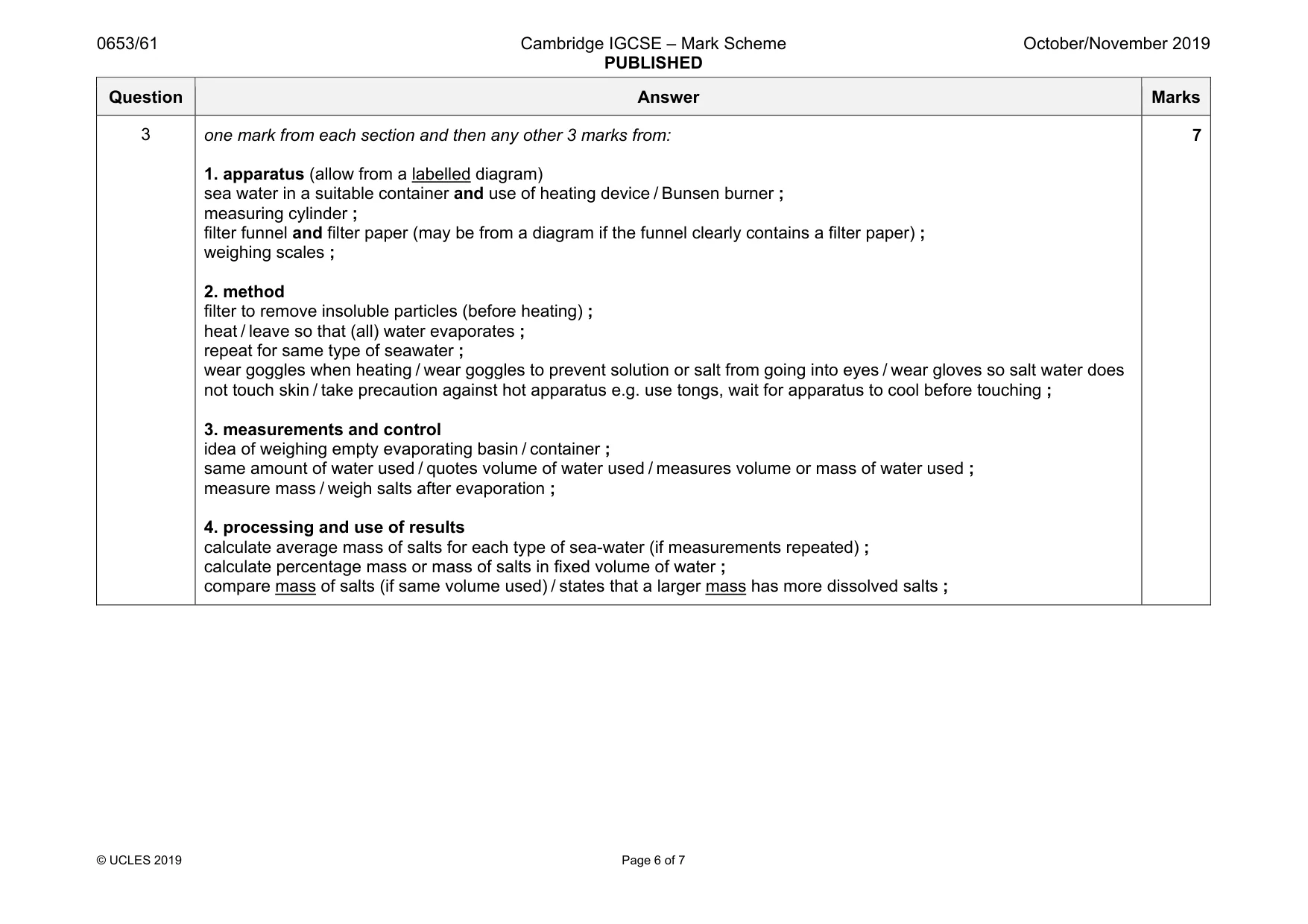
Mark scheme: 3 one mark from each section and then any other 3 marks from: 1. apparatus (allow from a labelled diagram) sea water in a suitable container and use of heating device / Bunsen burner ; measuring cylinder ; filter funnel and filter paper (may be from a diagram if the funnel clearly contains a filter paper) ; weighing scales ; 2. method filter to remove insoluble particles (before heating) ; heat / leave so that (all) water evaporates ; repeat for same type of seawater ; wear goggles when heating / wear goggles to prevent solution or salt from going into eyes / wear gloves so salt water does not touch skin / take precaution against hot apparatus e.g. use tongs, wait for apparatus to cool before touching ; 3. measurements and control idea of weighing empty evaporating basin / container ; same amount of water used / quotes volume of water used / measures volume or mass of water used ; measure mass / weigh salts after evaporation ; 4. processing and use of results calculate average mass of salts for each type of sea-water (if measurements repeated) ; calculate percentage mass or mass of salts in fixed volume of water ; compare mass of salts (if same volume used) / states that a larger mass has more dissolved salts ; 7
Q4 · A student investigates the cooling of water in a drinks cup
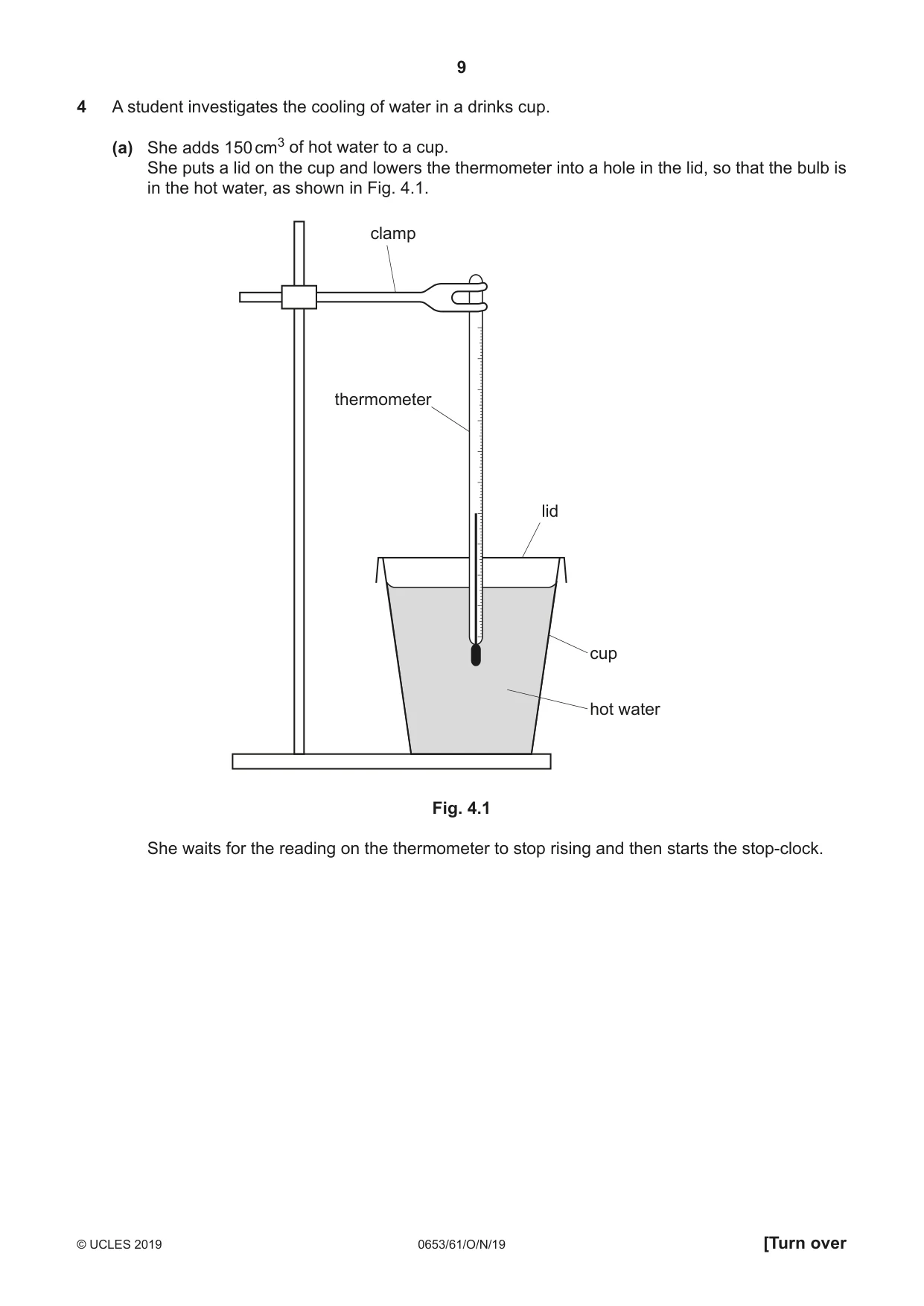
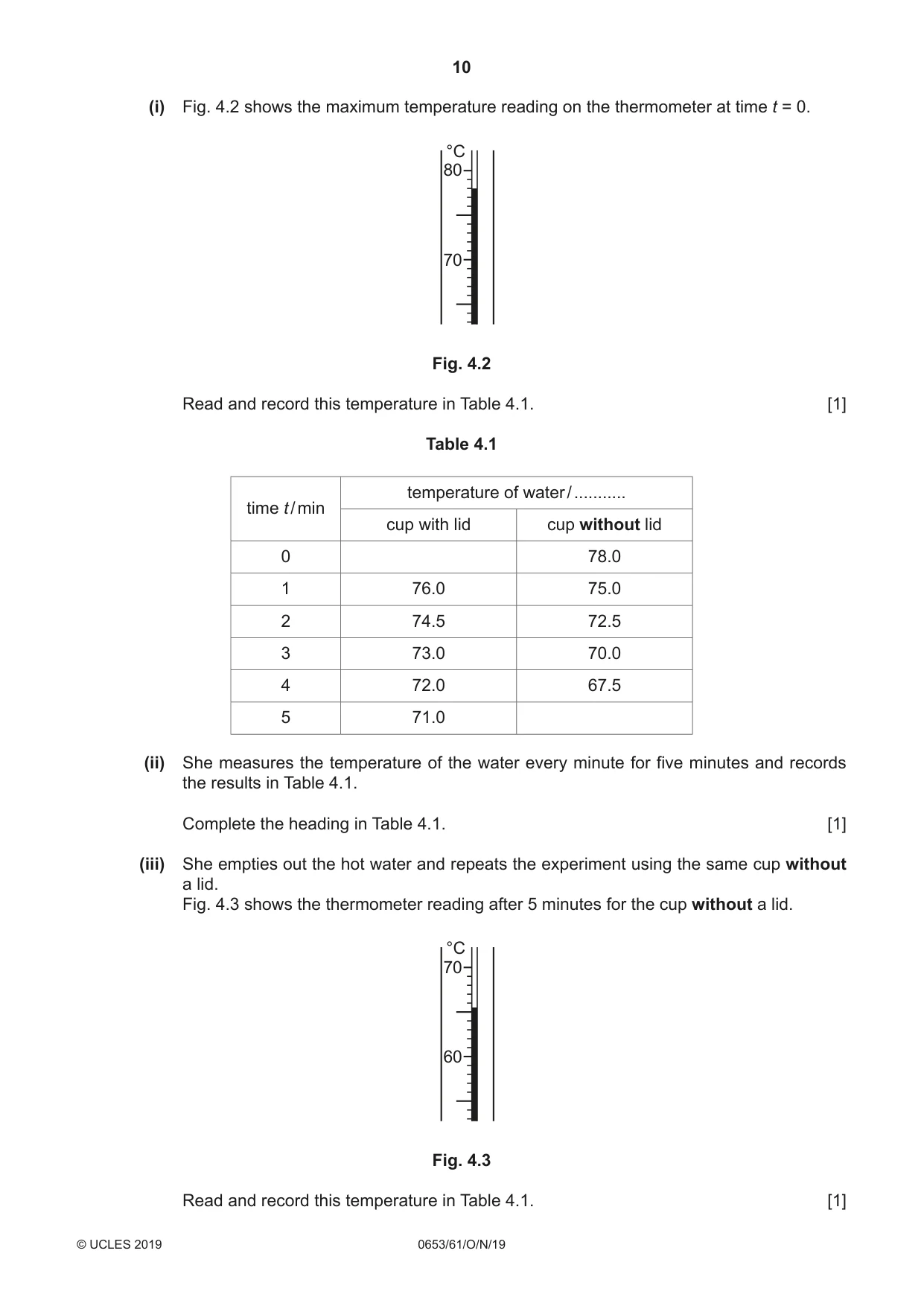
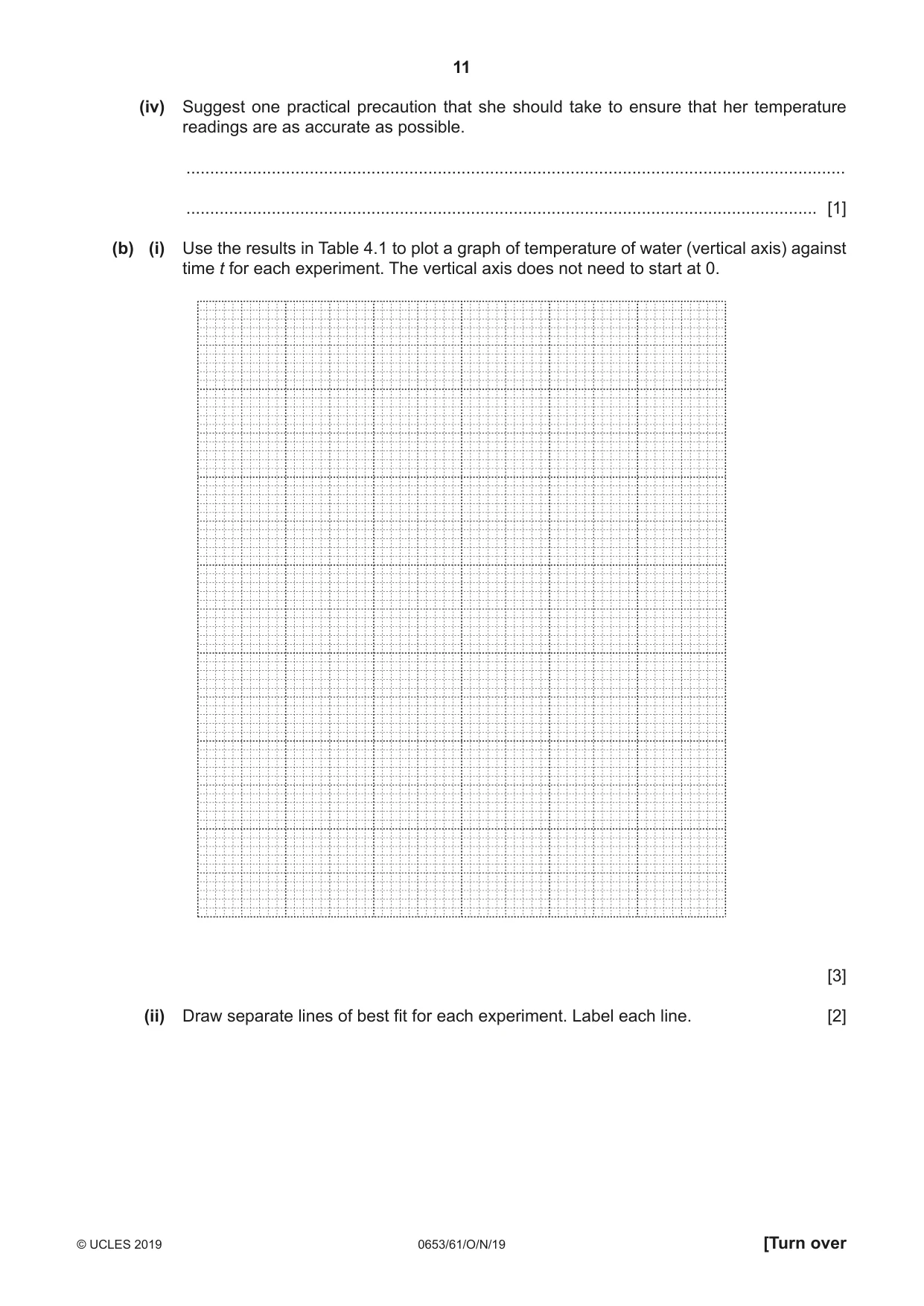
4 A student investigates the cooling of water in a drinks cup. (a) She adds 150 cm3 of hot water to a cup. She puts a lid on the cup and lowers the thermometer into a hole in the lid, so that the bulb is in the hot water, as shown in Fig. 4.1. clamp thermometer lid cup hot water Fig. 4.1 She waits for the reading on the thermometer to stop rising and then starts the stop-clock. (i) Fig. 4.2 shows the maximum temperature reading on the thermometer at time t = 0. °C 80 70 Fig. 4.2 Read and record this temperature in Table 4.1. [1] Table 4.1 temperature of water / ........... time t / min cup with lid cup without lid 0 78.0 1 76.0 75.0 2 74.5 72.5 3 73.0 70.0 4 72.0 67.5 5 71.0 (ii) She measures the temperature of the water every minute for five minutes and records the results in Table 4.1. Complete the heading in Table 4.1. [1] (iii) She empties out the hot water and repeats the experiment using the same cup without a lid. Fig. 4.3 shows the thermometer reading after 5 minutes for the cup without a lid. °C 70 60 Fig. 4.3 Read and record this temperature in Table 4.1. [1] (iv) Suggest one practical precaution that she should take to ensure that her temperature readings are as accurate as possible. ........................................................................................................................................... ..................................................................................................................................... [1] (b) (i) Use the results in Table 4.1 to plot a graph of temperature of water (vertical axis) against time t for each experiment. The vertical axis does not need to start at 0. [3] (ii) Draw separate lines of best fit for each experiment. Label each line. [2]
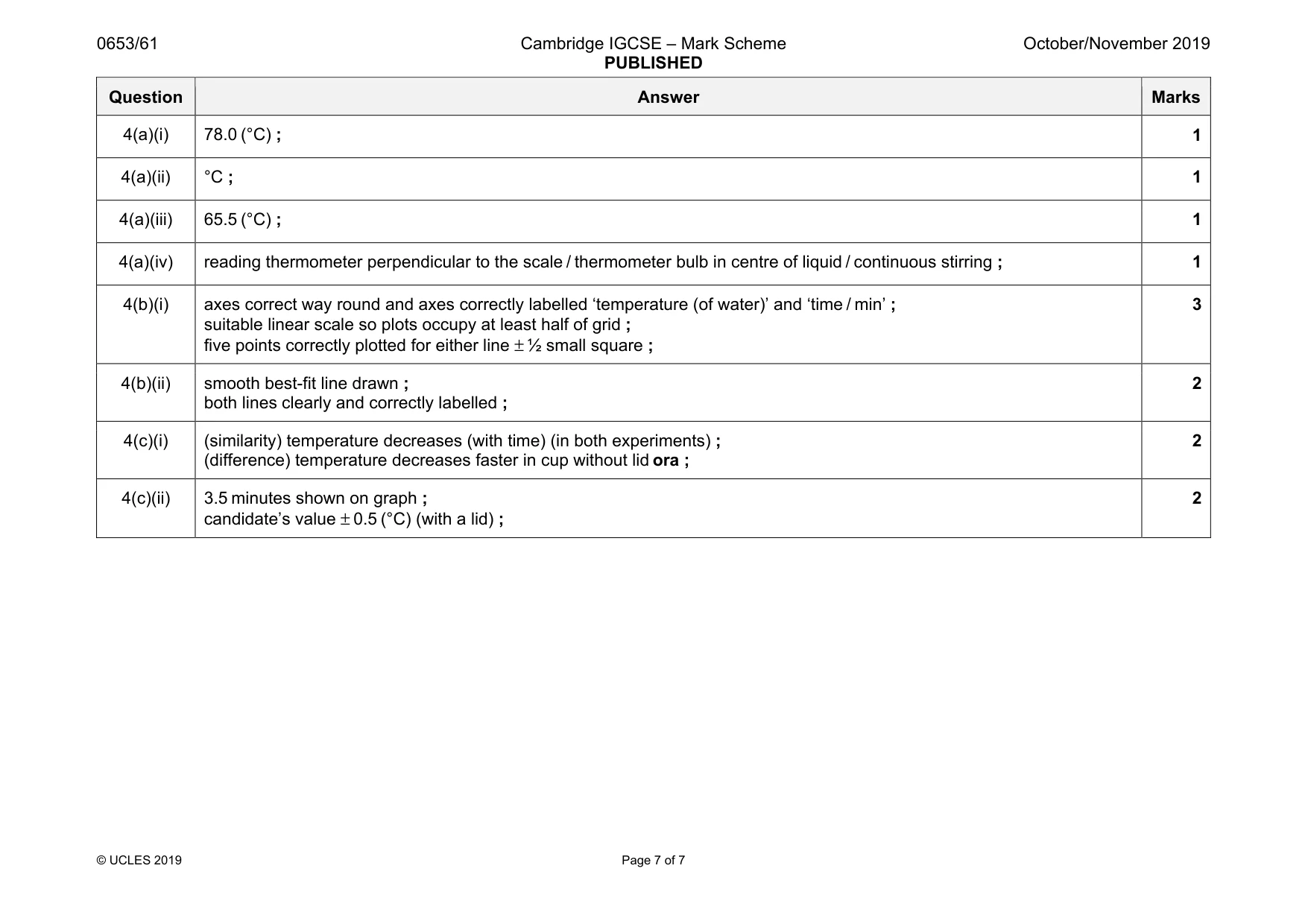
Mark scheme: 4(a)(i) 78.0 (°C) ; 1 4(a)(ii) °C ; 1 4(a)(iii) 65.5 (°C) ; 1 4(a)(iv) reading thermometer perpendicular to the scale / thermometer bulb in centre of liquid / continuous stirring ; 1 4(b)(i) axes correct way round and axes correctly labelled ‘temperature (of water)’ and ‘time / min’ ; suitable linear scale so plots occupy at least half of grid ; five points correctly plotted for either line ± ½ small square ; 3 4(b)(ii) smooth best-fit line drawn ; both lines clearly and correctly labelled ; 2 4(c)(i) (similarity) temperature decreases (with time) (in both experiments) ; (difference) temperature decreases faster in cup without lid ora ; 2 4(c)(ii) 3.5 minutes shown on graph ; candidate’s value ± 0.5 (°C) (with a lid) ; 2
What was in this paper
The subtopics covered by these 4 questions, and how many questions each got. Open one in a new tab to see every Cambridge question on it.
What you needed in this session
Cambridge’s own grade thresholds for 2019 Oct/Nov, Paper 6 · Variant 1. A higher threshold means an easier paper — the bar moves with how the cohort did.