Cambridge IGCSE Science - Combined 0653 — 2011 May/June Paper 2 · Variant 1
0653/21/M/J/11 · 80 marks · ≈90 min
The question paper and its mark scheme, free to read here and free to download. This is Cambridge’s own paper, exactly as it was sat.
Question paper24 pages



Mark scheme5 pages
Answers below. Sit the paper first if you are practising.
Paper as text
Question paper, page 1
This document consists of 21 printed pages and 3 blank pages. IB11 06_0653_21/5RP © UCLES 2011 [Turn over *6738300848* For Examiner's Use 1 2 3 4 5 6 7 8 9 10 Total UNIVERSITY OF CAMBRIDGE INTERNATIONAL EXAMINATIONS International General Certificate of Secondary Education COMBINED SCIENCE 0653/21 Paper 2 (Core) May/June 2011 1 hour 15 minutes Candidates answer on the Question Paper. No Additional Materials are required. READ THESE INSTRUCTIONS FIRST Write your Centre number, candidate number and name on all the work you hand in. Write in dark blue or black pen. You may use a soft pencil for any diagrams, graphs, tables or rough working. Do not use staples, paper clips, highlighters, glue or correction fluid. DO NOT WRITE IN ANY BARCODES. Answer all questions. A copy of the Periodic Table is printed on page 24. At the end of the examination, fasten all your work securely together. The number of marks is given in brackets [ ] at the end of each question or part question. www.XtremePapers.com
Question paper, page 2
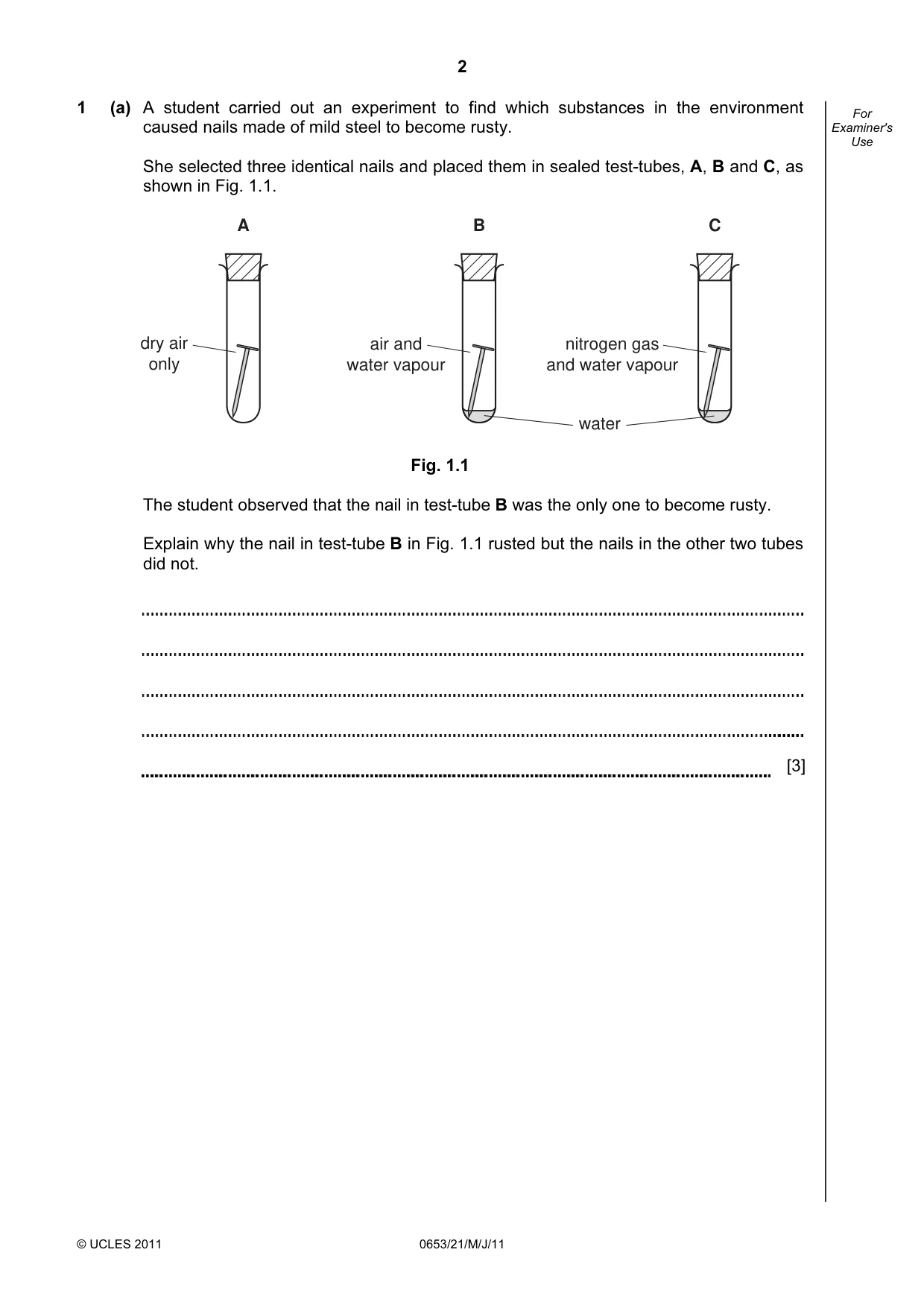
2 © UCLES 2011 0653/21/M/J/11 For Examiner's Use 1 (a) A student carried out an experiment to find which substances in the environment caused nails made of mild steel to become rusty. She selected three identical nails and placed them in sealed test-tubes, A, B and C, as shown in Fig. 1.1. dry air only A air and water vapour B nitrogen gas and water vapour C water Fig. 1.1 The student observed that the nail in test-tube B was the only one to become rusty. Explain why the nail in test-tube B in Fig. 1.1 rusted but the nails in the other two tubes did not. [3]
Question paper, page 3
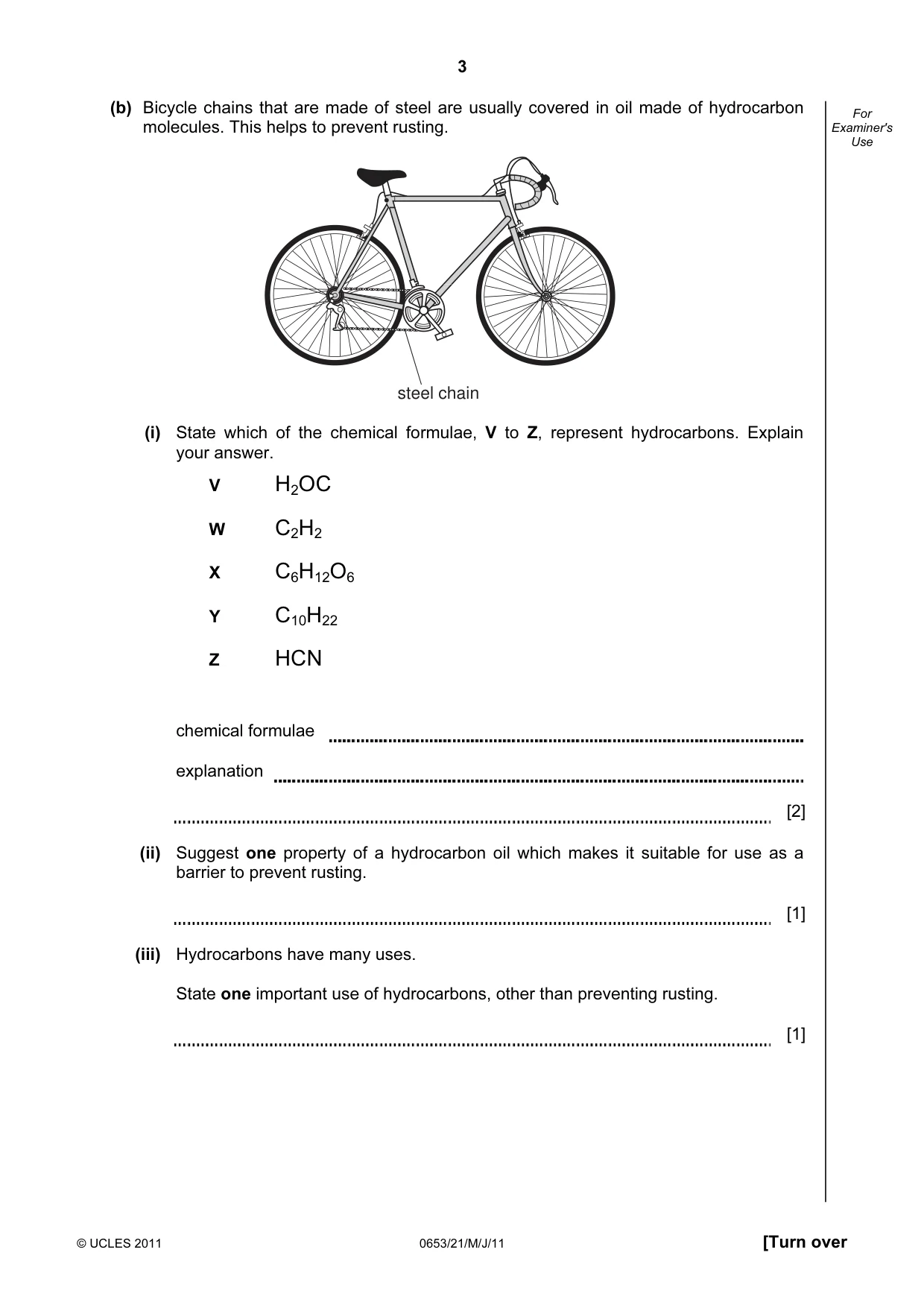
3 © UCLES 2011 0653/21/M/J/11 [Turn over For Examiner's Use (b) Bicycle chains that are made of steel are usually covered in oil made of hydrocarbon molecules. This helps to prevent rusting. steel chain (i) State which of the chemical formulae, V to Z, represent hydrocarbons. Explain your answer. V H2OC W C2H2 X C6H12O6 Y C10H22 Z HCN chemical formulae explanation [2] (ii) Suggest one property of a hydrocarbon oil which makes it suitable for use as a barrier to prevent rusting. [1] (iii) Hydrocarbons have many uses. State one important use of hydrocarbons, other than preventing rusting. [1]
Question paper, page 4
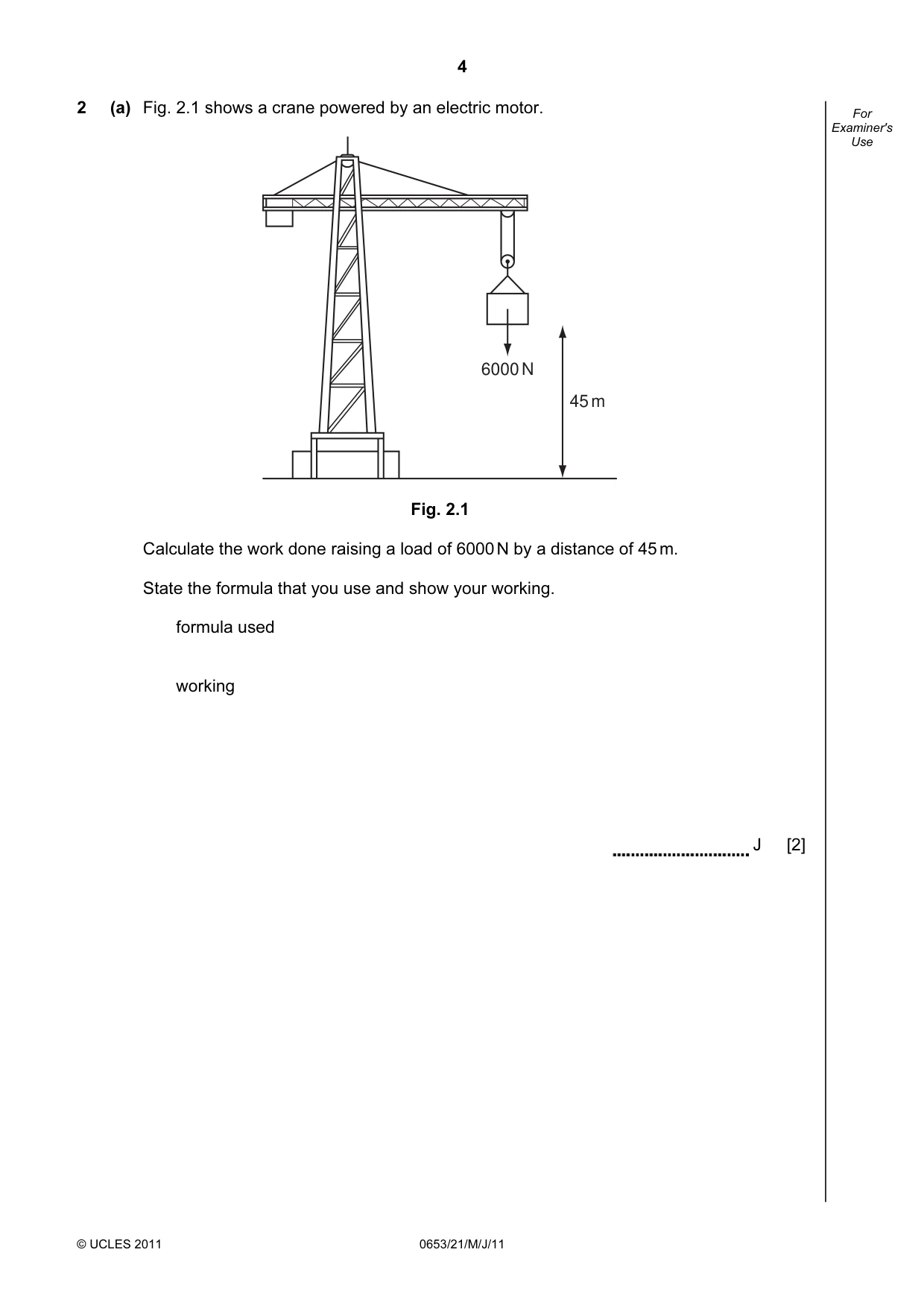
4 © UCLES 2011 0653/21/M/J/11 For Examiner's Use 2 (a) Fig. 2.1 shows a crane powered by an electric motor. 6000 N 45 m Fig. 2.1 Calculate the work done raising a load of 6000 N by a distance of 45 m. State the formula that you use and show your working. formula used working J [2]
Question paper, page 5
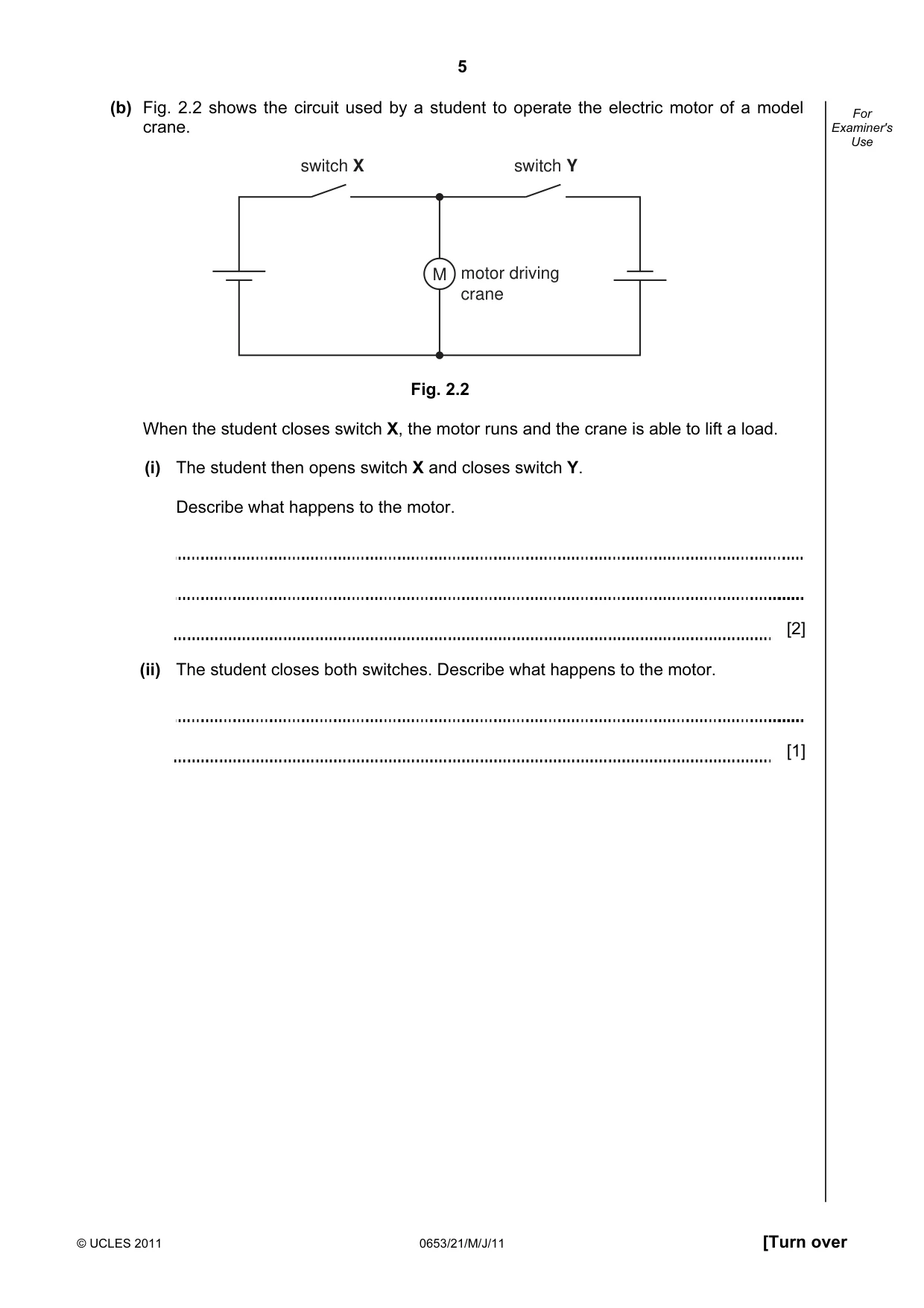
5 © UCLES 2011 0653/21/M/J/11 [Turn over For Examiner's Use (b) Fig. 2.2 shows the circuit used by a student to operate the electric motor of a model crane. M motor driving crane switch X switch Y Fig. 2.2 When the student closes switch X, the motor runs and the crane is able to lift a load. (i) The student then opens switch X and closes switch Y. Describe what happens to the motor. [2] (ii) The student closes both switches. Describe what happens to the motor. [1]
Question paper, page 6
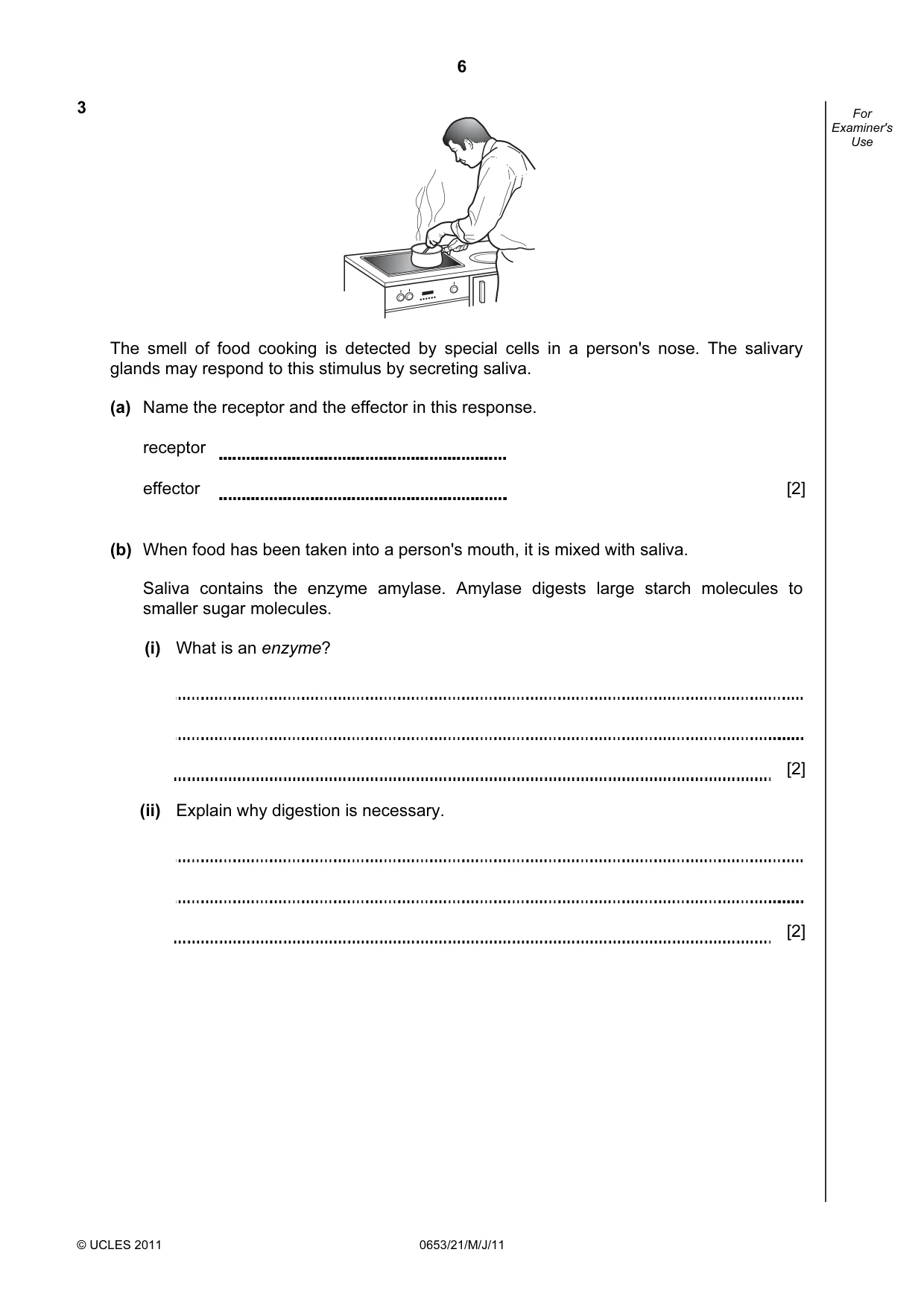
6 © UCLES 2011 0653/21/M/J/11 For Examiner's Use 3 The smell of food cooking is detected by special cells in a person's nose. The salivary glands may respond to this stimulus by secreting saliva. (a) Name the receptor and the effector in this response. receptor effector [2] (b) When food has been taken into a person's mouth, it is mixed with saliva. Saliva contains the enzyme amylase. Amylase digests large starch molecules to smaller sugar molecules. (i) What is an enzyme? [2] (ii) Explain why digestion is necessary. [2]
Question paper, page 7
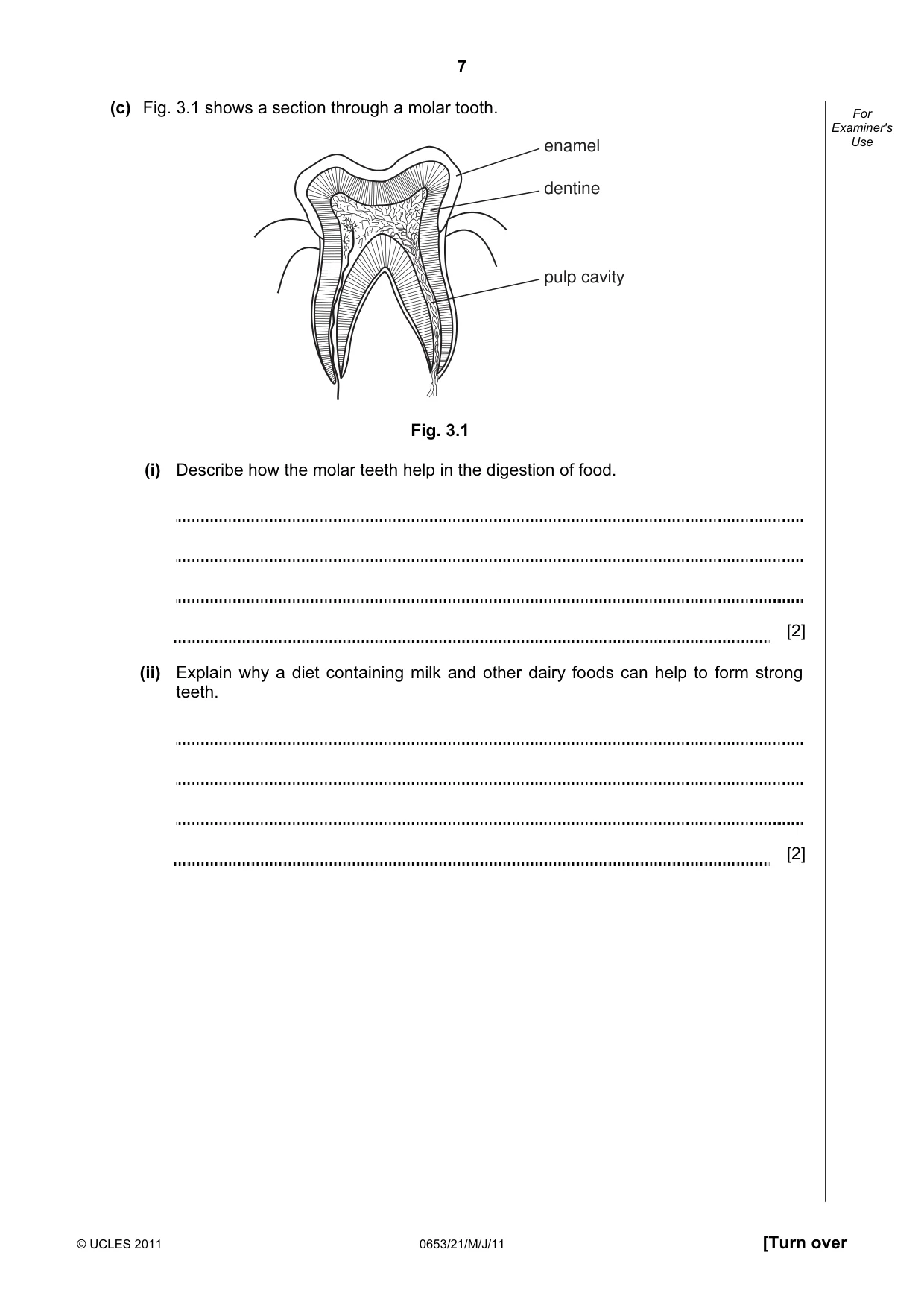
7 © UCLES 2011 0653/21/M/J/11 [Turn over For Examiner's Use (c) Fig. 3.1 shows a section through a molar tooth. enamel dentine pulp cavity Fig. 3.1 (i) Describe how the molar teeth help in the digestion of food. [2] (ii) Explain why a diet containing milk and other dairy foods can help to form strong teeth. [2]
Question paper, page 8
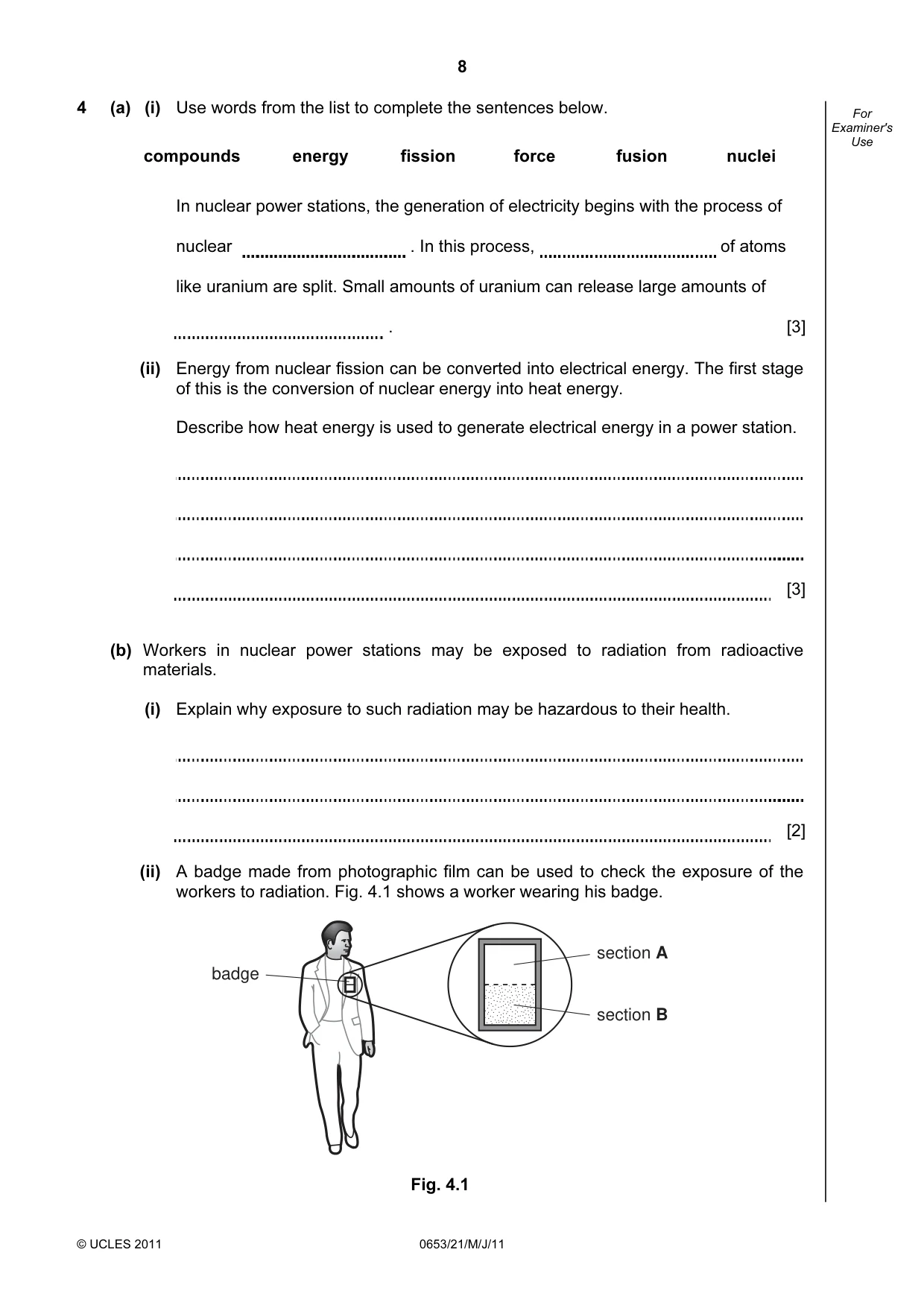
8 © UCLES 2011 0653/21/M/J/11 For Examiner's Use 4 (a) (i) Use words from the list to complete the sentences below. compounds energy fission force fusion nuclei In nuclear power stations, the generation of electricity begins with the process of nuclear . In this process, of atoms like uranium are split. Small amounts of uranium can release large amounts of . [3] (ii) Energy from nuclear fission can be converted into electrical energy. The first stage of this is the conversion of nuclear energy into heat energy. Describe how heat energy is used to generate electrical energy in a power station. [3] (b) Workers in nuclear power stations may be exposed to radiation from radioactive materials. (i) Explain why exposure to such radiation may be hazardous to their health. [2] (ii) A badge made from photographic film can be used to check the exposure of the workers to radiation. Fig. 4.1 shows a worker wearing his badge. section A section B badge Fig. 4.1
Question paper, page 9
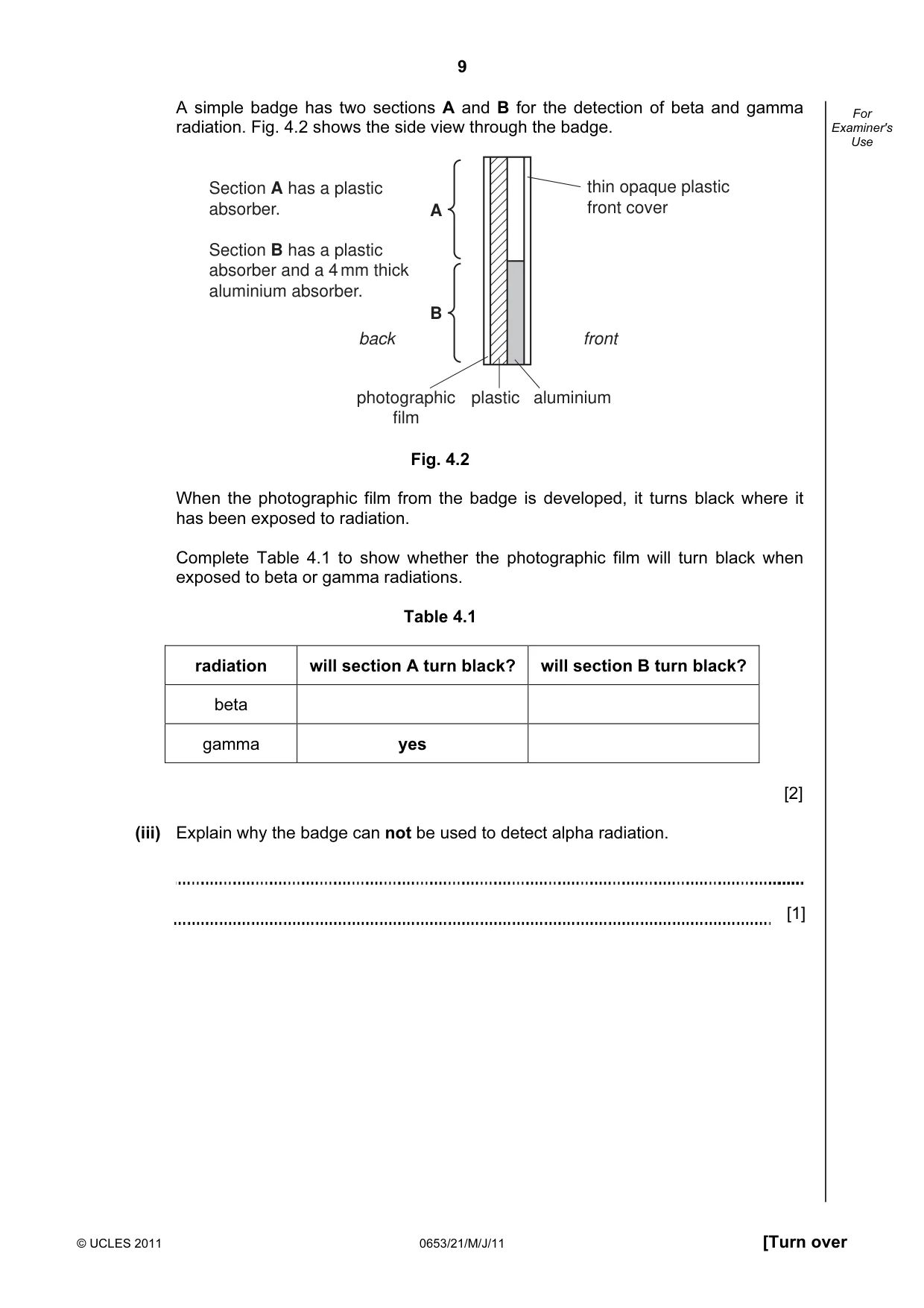
9 © UCLES 2011 0653/21/M/J/11 [Turn over For Examiner's Use A simple badge has two sections A and B for the detection of beta and gamma radiation. Fig. 4.2 shows the side view through the badge. plastic photographic film aluminium A B thin opaque plastic front cover front back Section A has a plastic absorber. Section B has a plastic absorber and a 4 mm thick aluminium absorber. Fig. 4.2 When the photographic film from the badge is developed, it turns black where it has been exposed to radiation. Complete Table 4.1 to show whether the photographic film will turn black when exposed to beta or gamma radiations. Table 4.1 radiation will section A turn black? will section B turn black? beta gamma yes [2] (iii) Explain why the badge can not be used to detect alpha radiation. [1]
Question paper, page 10
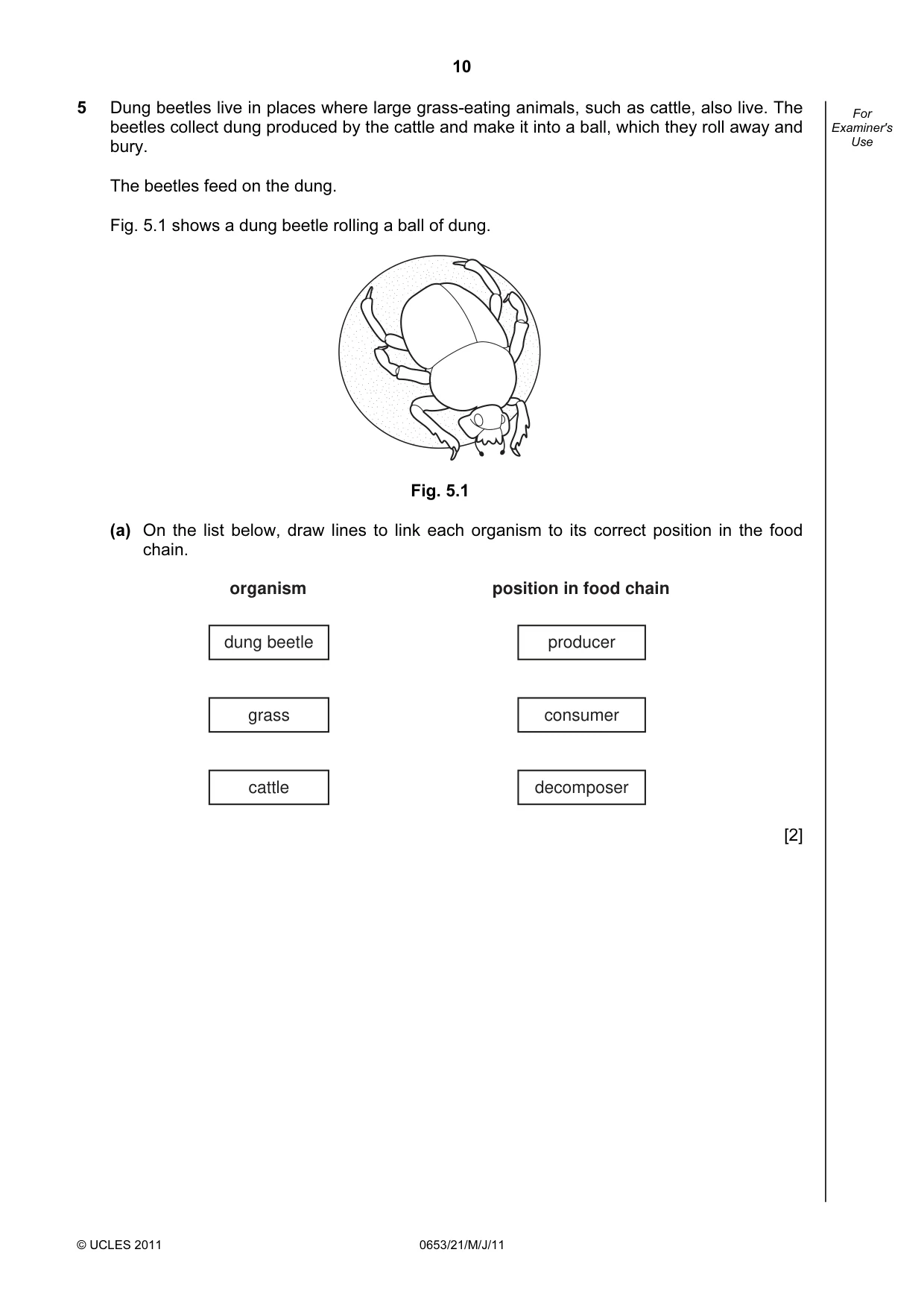
10 © UCLES 2011 0653/21/M/J/11 For Examiner's Use 5 Dung beetles live in places where large grass-eating animals, such as cattle, also live. The beetles collect dung produced by the cattle and make it into a ball, which they roll away and bury. The beetles feed on the dung. Fig. 5.1 shows a dung beetle rolling a ball of dung. Fig. 5.1 (a) On the list below, draw lines to link each organism to its correct position in the food chain. organism dung beetle grass cattle position in food chain producer consumer decomposer [2]
Question paper, page 11
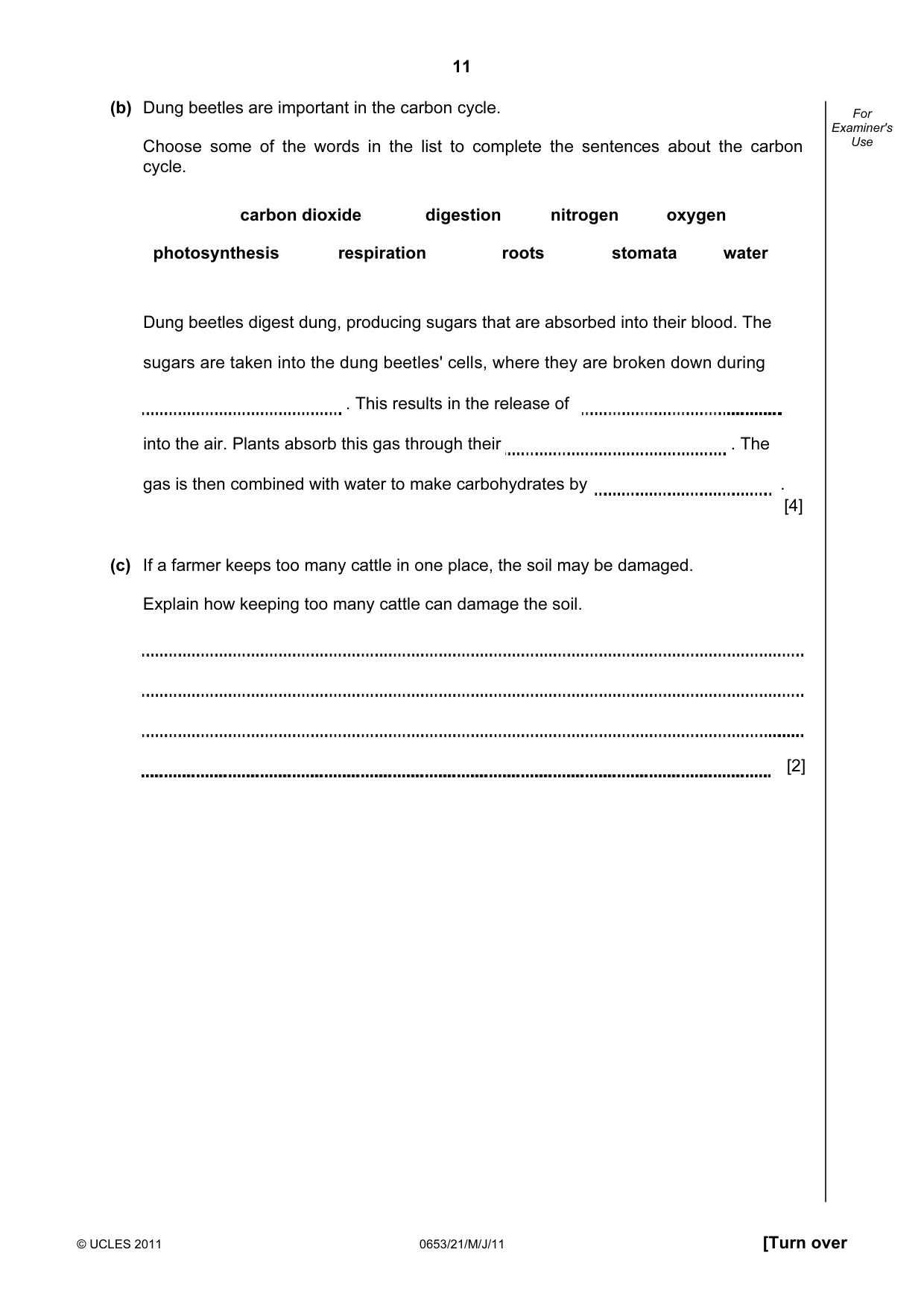
11 © UCLES 2011 0653/21/M/J/11 [Turn over For Examiner's Use (b) Dung beetles are important in the carbon cycle. Choose some of the words in the list to complete the sentences about the carbon cycle. carbon dioxide digestion nitrogen oxygen photosynthesis respiration roots stomata water Dung beetles digest dung, producing sugars that are absorbed into their blood. The sugars are taken into the dung beetles' cells, where they are broken down during . This results in the release of into the air. Plants absorb this gas through their . The gas is then combined with water to make carbohydrates by . [4] (c) If a farmer keeps too many cattle in one place, the soil may be damaged. Explain how keeping too many cattle can damage the soil. [2]
Question paper, page 12
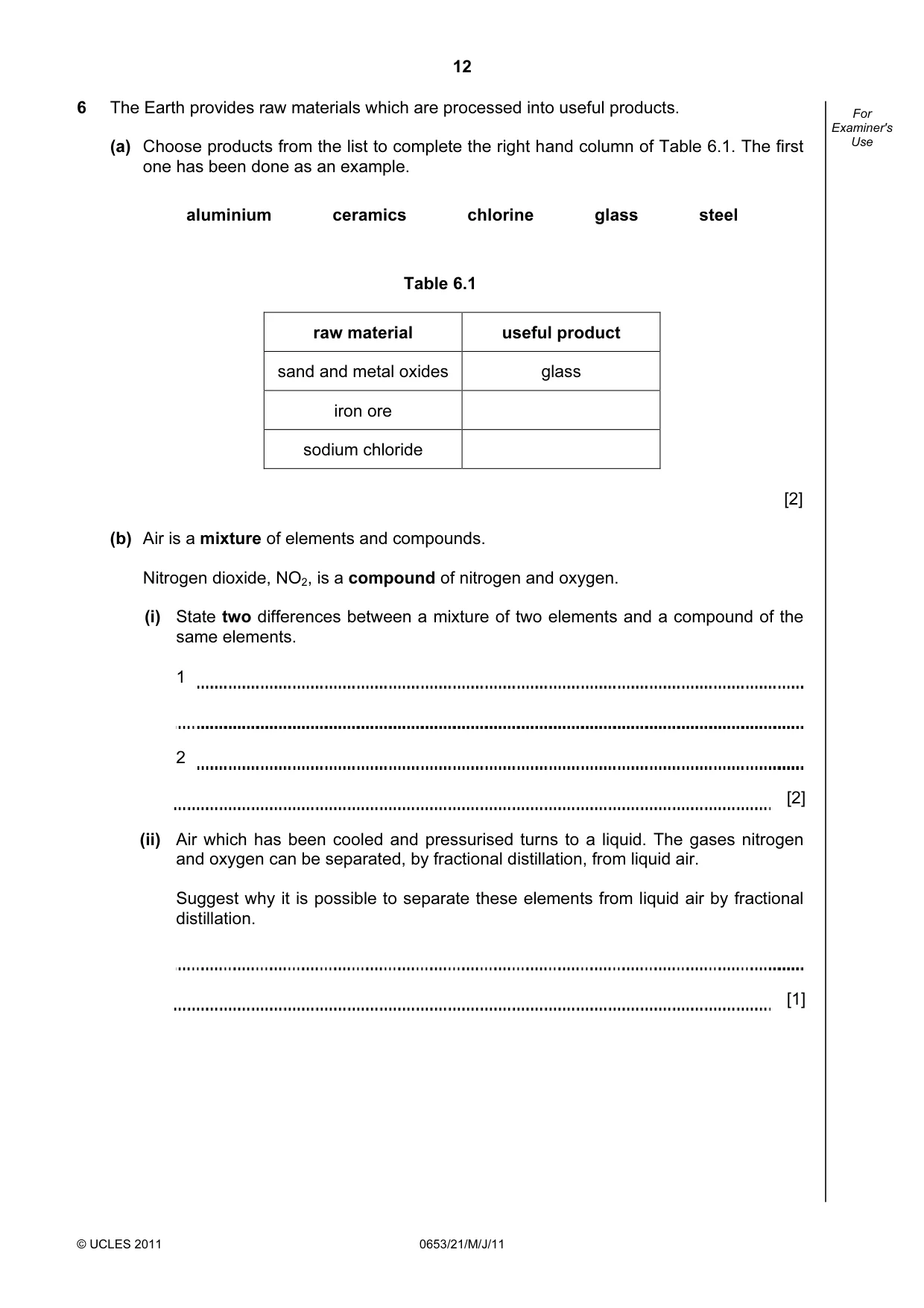
12 © UCLES 2011 0653/21/M/J/11 For Examiner's Use 6 The Earth provides raw materials which are processed into useful products. (a) Choose products from the list to complete the right hand column of Table 6.1. The first one has been done as an example. aluminium ceramics chlorine glass steel Table 6.1 raw material useful product sand and metal oxides glass iron ore sodium chloride [2] (b) Air is a mixture of elements and compounds. Nitrogen dioxide, NO2, is a compound of nitrogen and oxygen. (i) State two differences between a mixture of two elements and a compound of the same elements. 1 2 [2] (ii) Air which has been cooled and pressurised turns to a liquid. The gases nitrogen and oxygen can be separated, by fractional distillation, from liquid air. Suggest why it is possible to separate these elements from liquid air by fractional distillation. [1]
Question paper, page 13
13 © UCLES 2011 0653/21/M/J/11 [Turn over For Examiner's Use (c) Nitrogen and hydrogen can be made to react together to form ammonia, NH3. This reaction requires a catalyst and a high temperature. (i) Describe the advantages of using a catalyst in a chemical reaction. [2] (ii) State the effect of a high temperature on the rate of the reaction. [1] (iii) Ammonia is used to make the salts ammonium nitrate and ammonium phosphate, which are used as fertilisers. State the type of substance which reacts with ammonia to make salts, and name the type of chemical reaction which occurs. type of substance type of reaction [2]
Question paper, page 14
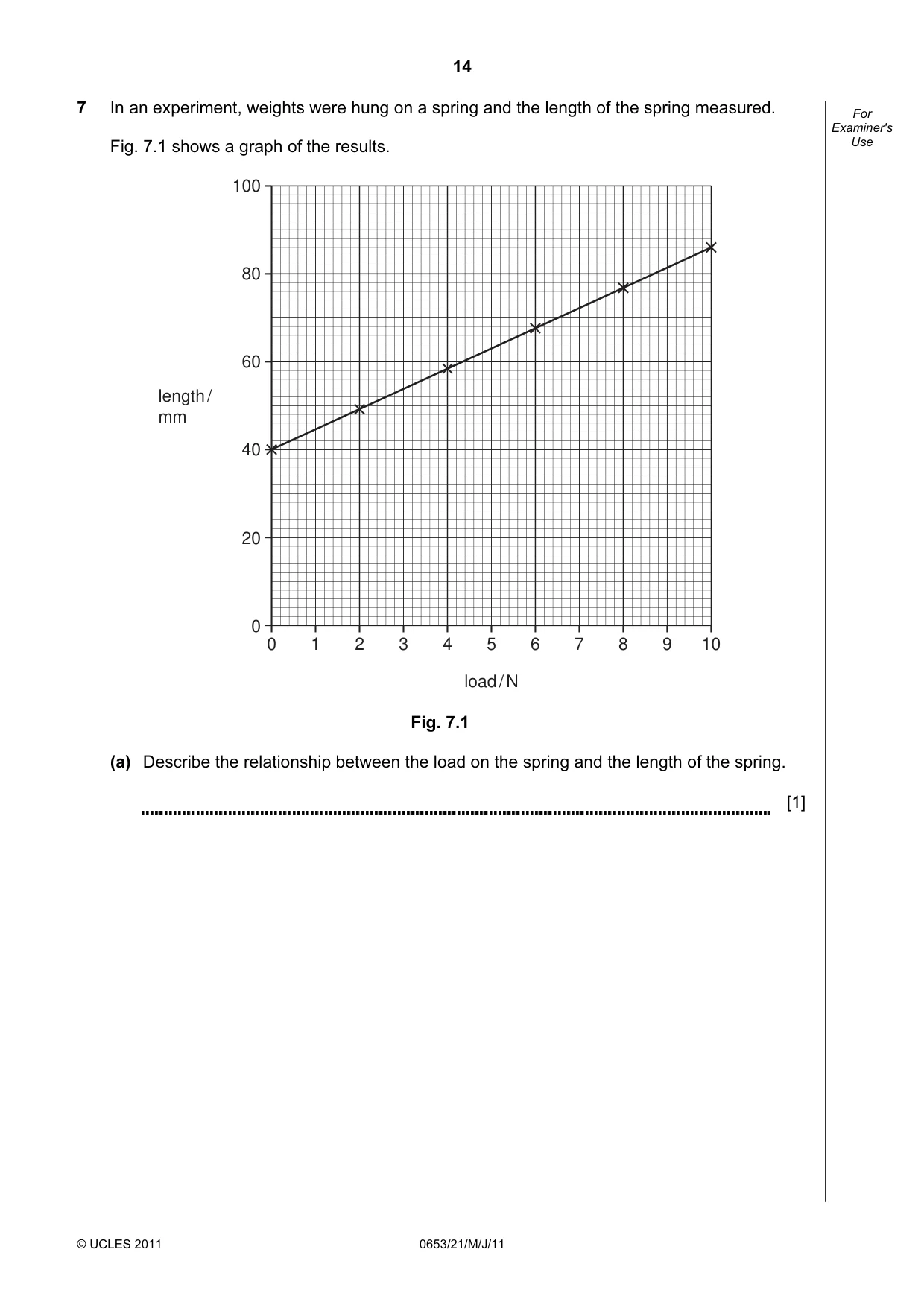
14 © UCLES 2011 0653/21/M/J/11 For Examiner's Use 7 In an experiment, weights were hung on a spring and the length of the spring measured. Fig. 7.1 shows a graph of the results. 100 80 60 40 20 0 0 1 2 3 4 5 load / N 6 7 8 9 10 length / mm Fig. 7.1 (a) Describe the relationship between the load on the spring and the length of the spring. [1]
Question paper, page 15
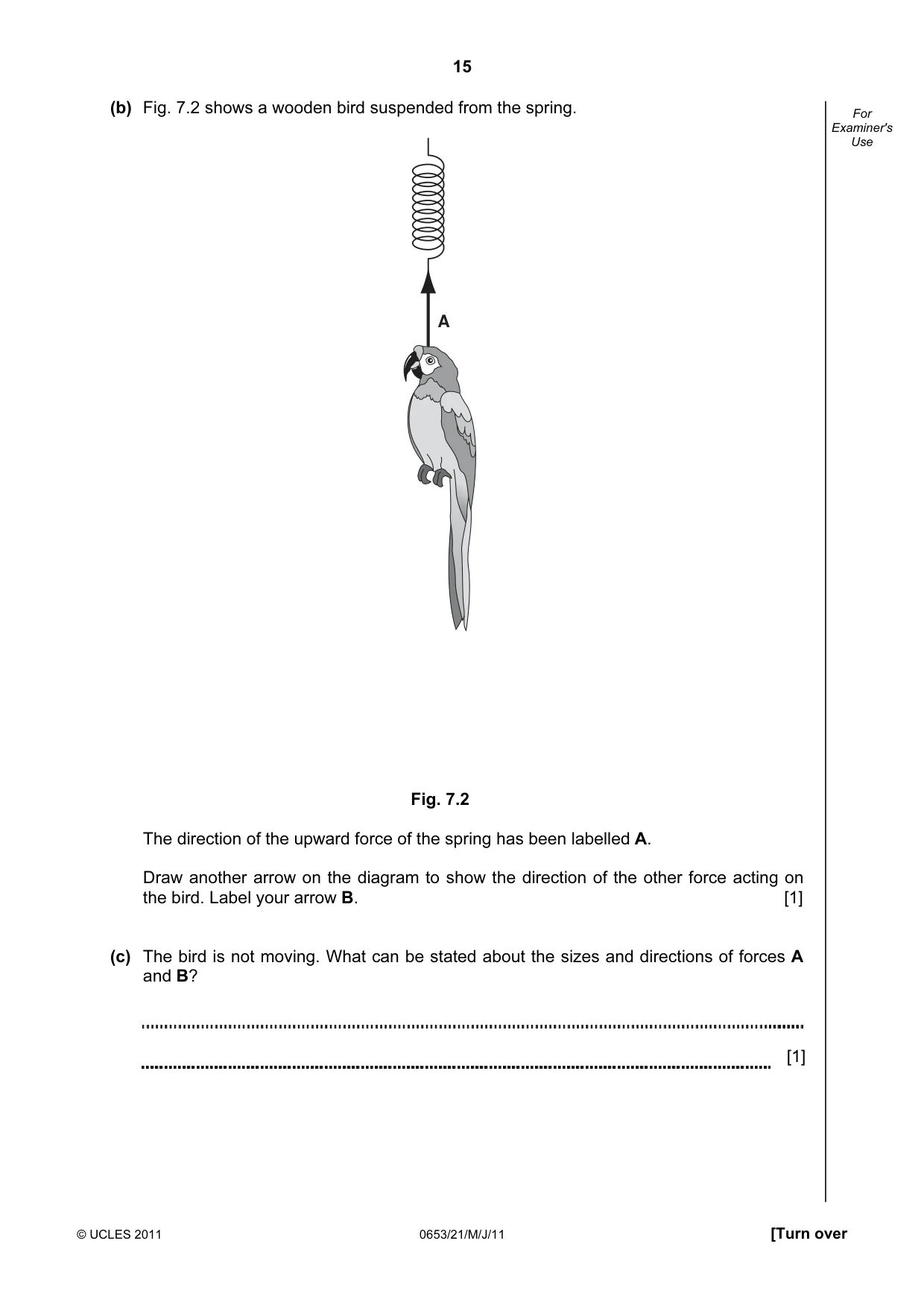
15 © UCLES 2011 0653/21/M/J/11 [Turn over For Examiner's Use (b) Fig. 7.2 shows a wooden bird suspended from the spring. A Fig. 7.2 The direction of the upward force of the spring has been labelled A. Draw another arrow on the diagram to show the direction of the other force acting on the bird. Label your arrow B. [1] (c) The bird is not moving. What can be stated about the sizes and directions of forces A and B? [1]
Question paper, page 16
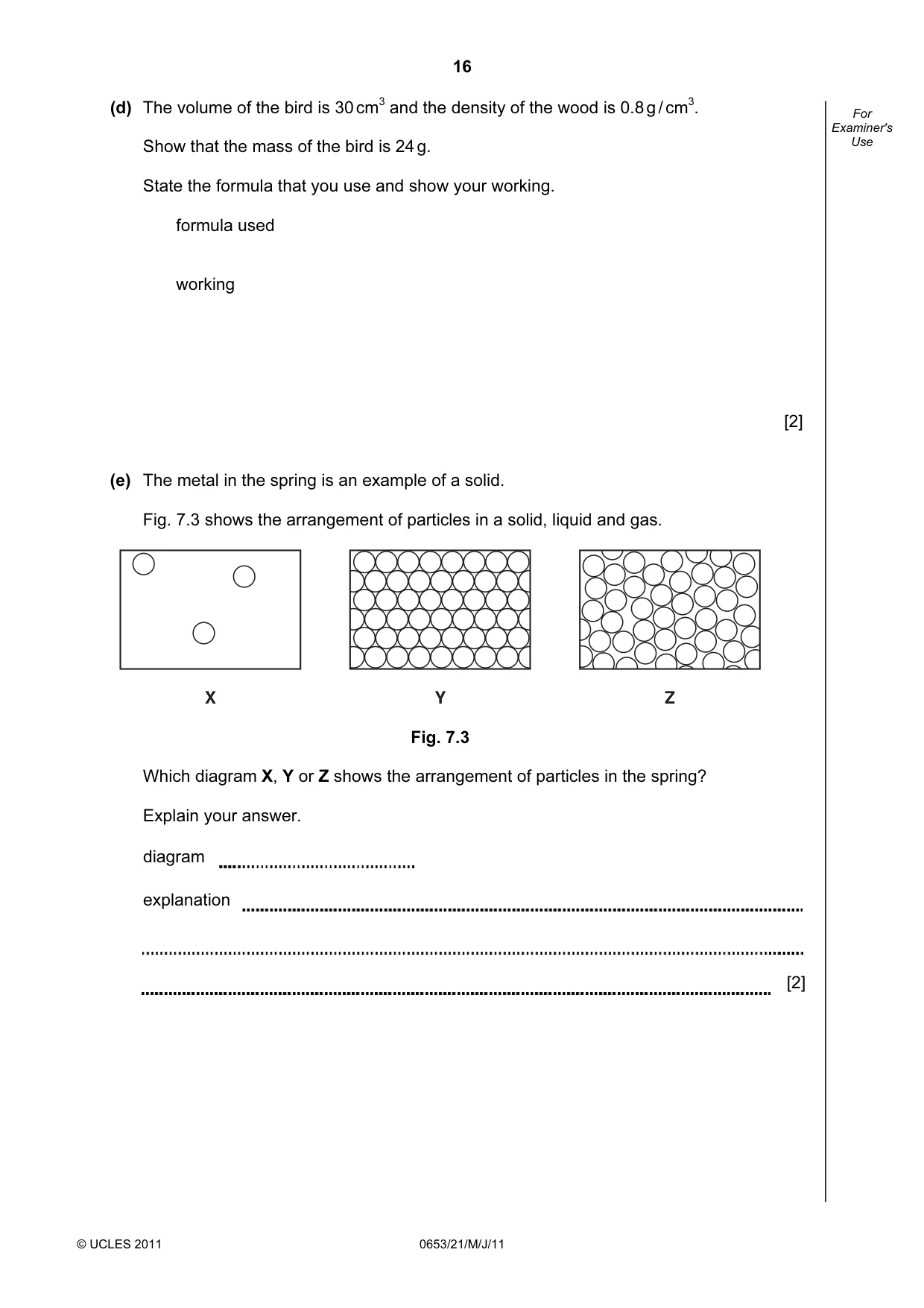
16 © UCLES 2011 0653/21/M/J/11 For Examiner's Use (d) The volume of the bird is 30 cm3 and the density of the wood is 0.8 g / cm3. Show that the mass of the bird is 24 g. State the formula that you use and show your working. formula used working [2] (e) The metal in the spring is an example of a solid. Fig. 7.3 shows the arrangement of particles in a solid, liquid and gas. X Y Z Fig. 7.3 Which diagram X, Y or Z shows the arrangement of particles in the spring? Explain your answer. diagram explanation [2]
Question paper, page 17
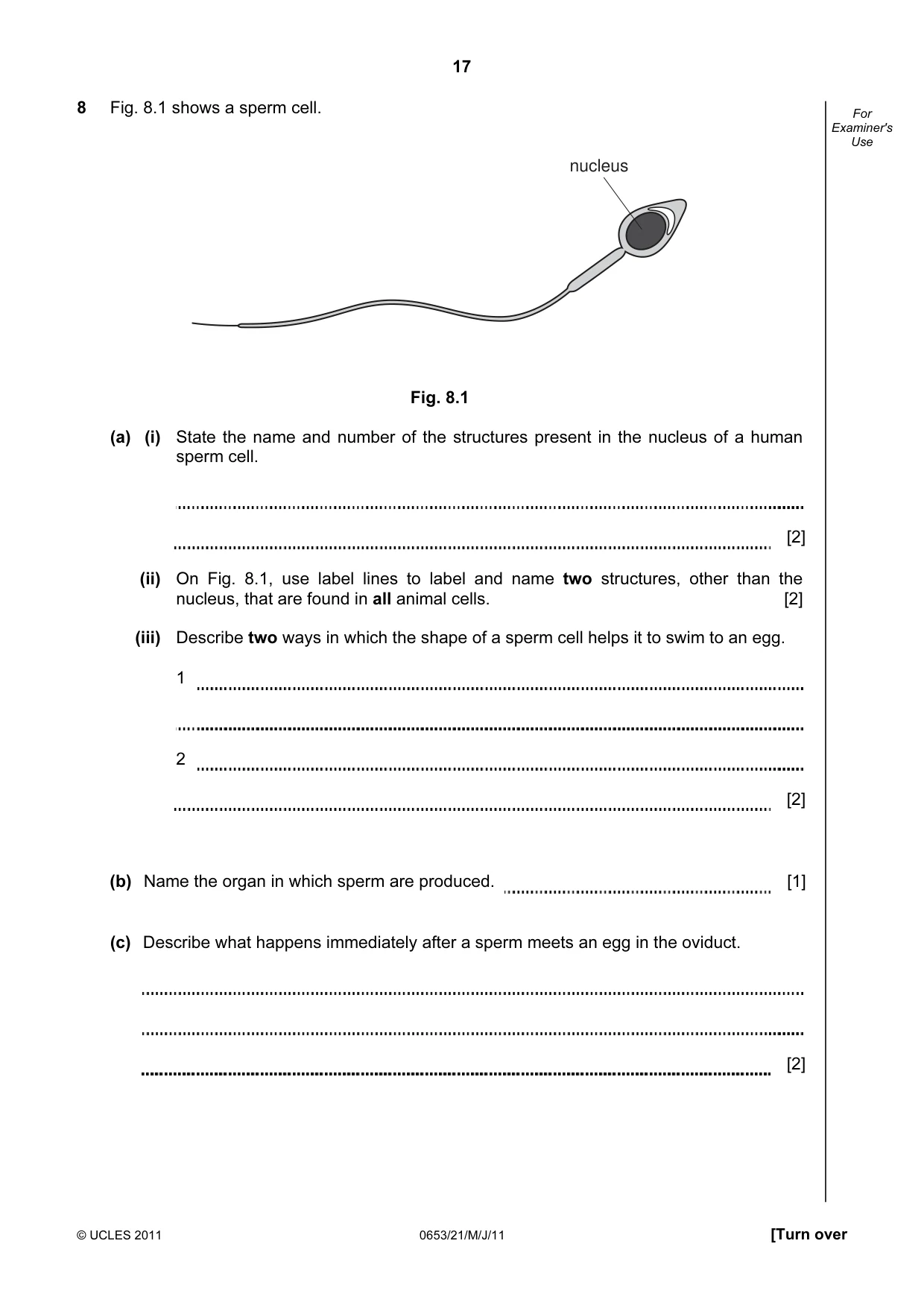
17 © UCLES 2011 0653/21/M/J/11 [Turn over For Examiner's Use 8 Fig. 8.1 shows a sperm cell. nucleus Fig. 8.1 (a) (i) State the name and number of the structures present in the nucleus of a human sperm cell. [2] (ii) On Fig. 8.1, use label lines to label and name two structures, other than the nucleus, that are found in all animal cells. [2] (iii) Describe two ways in which the shape of a sperm cell helps it to swim to an egg. 1 2 [2] (b) Name the organ in which sperm are produced. [1] (c) Describe what happens immediately after a sperm meets an egg in the oviduct. [2]
Question paper, page 18
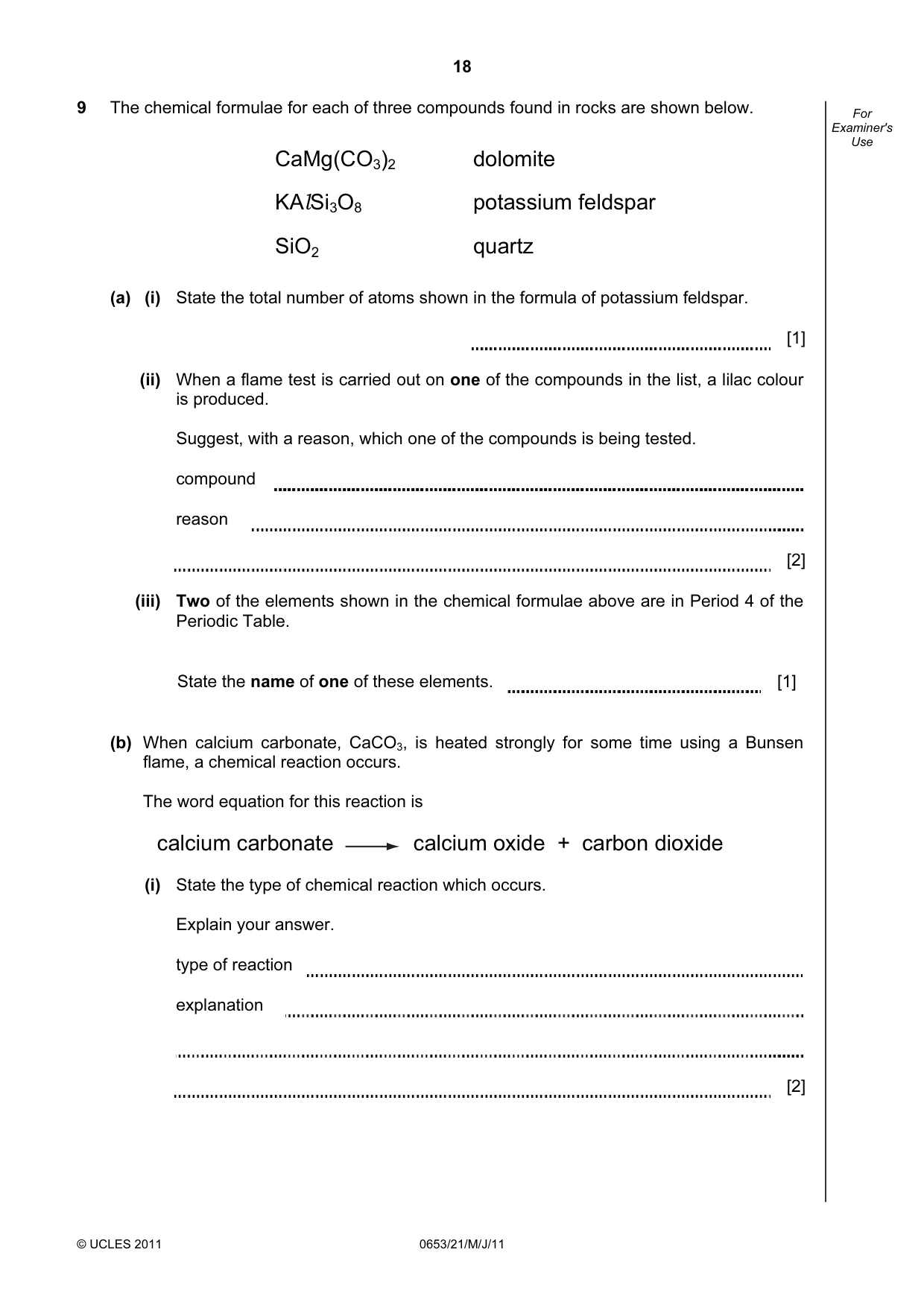
18 © UCLES 2011 0653/21/M/J/11 For Examiner's Use 9 The chemical formulae for each of three compounds found in rocks are shown below. CaMg(CO3)2 dolomite KAlSi3O8 potassium feldspar SiO2 quartz (a) (i) State the total number of atoms shown in the formula of potassium feldspar. [1] (ii) When a flame test is carried out on one of the compounds in the list, a lilac colour is produced. Suggest, with a reason, which one of the compounds is being tested. compound reason [2] (iii) Two of the elements shown in the chemical formulae above are in Period 4 of the Periodic Table. State the name of one of these elements. [1] (b) When calcium carbonate, CaCO3, is heated strongly for some time using a Bunsen flame, a chemical reaction occurs. The word equation for this reaction is calcium carbonate calcium oxide + carbon dioxide (i) State the type of chemical reaction which occurs. Explain your answer. type of reaction explanation [2]
Question paper, page 19
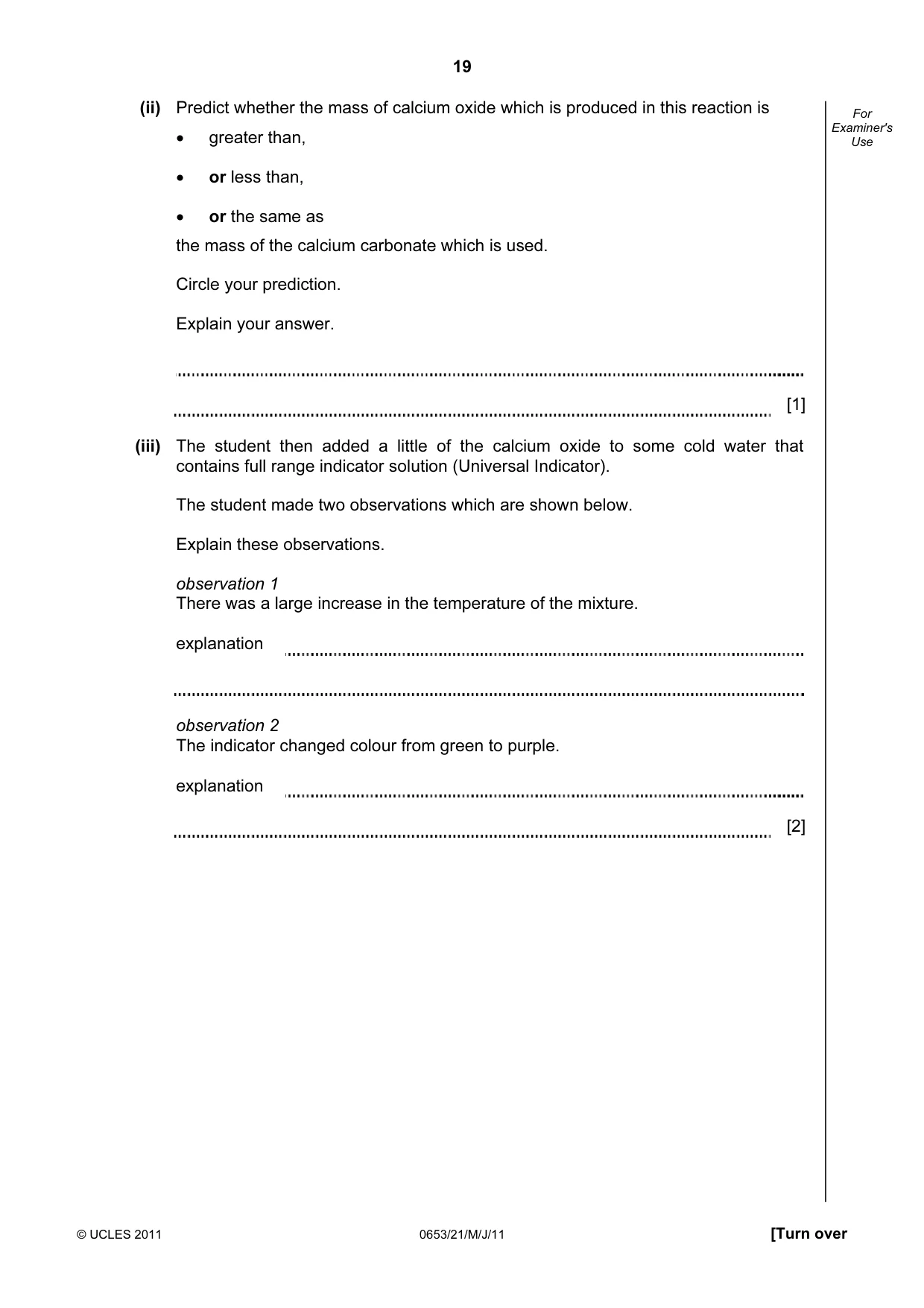
19 © UCLES 2011 0653/21/M/J/11 [Turn over For Examiner's Use (ii) Predict whether the mass of calcium oxide which is produced in this reaction is • greater than, • or less than, • or the same as the mass of the calcium carbonate which is used. Circle your prediction. Explain your answer. [1] (iii) The student then added a little of the calcium oxide to some cold water that contains full range indicator solution (Universal Indicator). The student made two observations which are shown below. Explain these observations. observation 1 There was a large increase in the temperature of the mixture. explanation observation 2 The indicator changed colour from green to purple. explanation [2]
Question paper, page 20
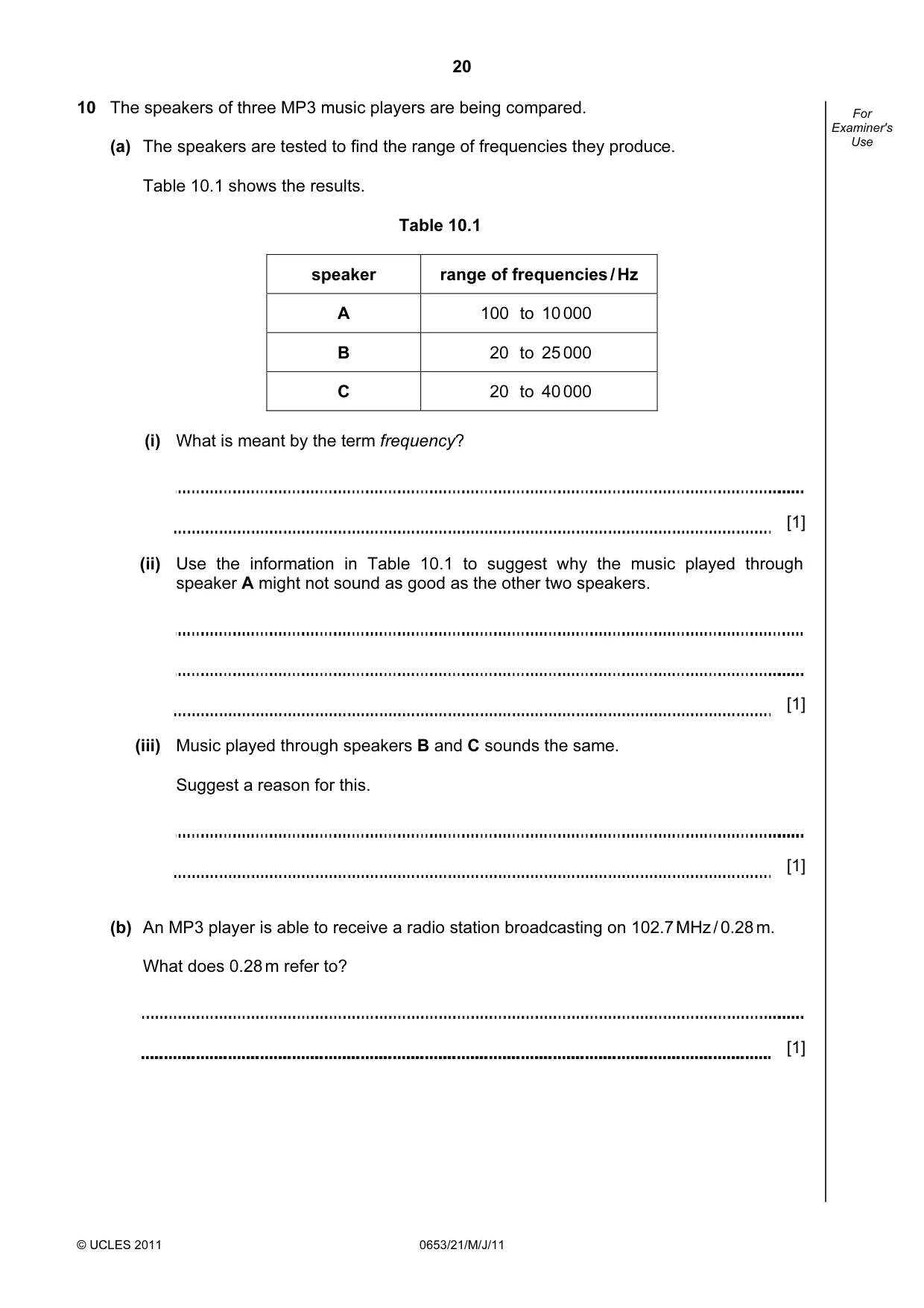
20 © UCLES 2011 0653/21/M/J/11 For Examiner's Use 10 The speakers of three MP3 music players are being compared. (a) The speakers are tested to find the range of frequencies they produce. Table 10.1 shows the results. Table 10.1 speaker range of frequencies / Hz A 100 to 10 000 B 20 to 25 000 C 20 to 40 000 (i) What is meant by the term frequency? [1] (ii) Use the information in Table 10.1 to suggest why the music played through speaker A might not sound as good as the other two speakers. [1] (iii) Music played through speakers B and C sounds the same. Suggest a reason for this. [1] (b) An MP3 player is able to receive a radio station broadcasting on 102.7 MHz / 0.28 m. What does 0.28 m refer to? [1]
Question paper, page 21
21 © UCLES 2011 0653/21/M/J/11 BLANK PAGE
Question paper, page 22
22 © UCLES 2011 0653/21/M/J/11 BLANK PAGE
Question paper, page 23
23 © UCLES 2011 0653/21/M/J/11 BLANK PAGE
Question paper, page 24
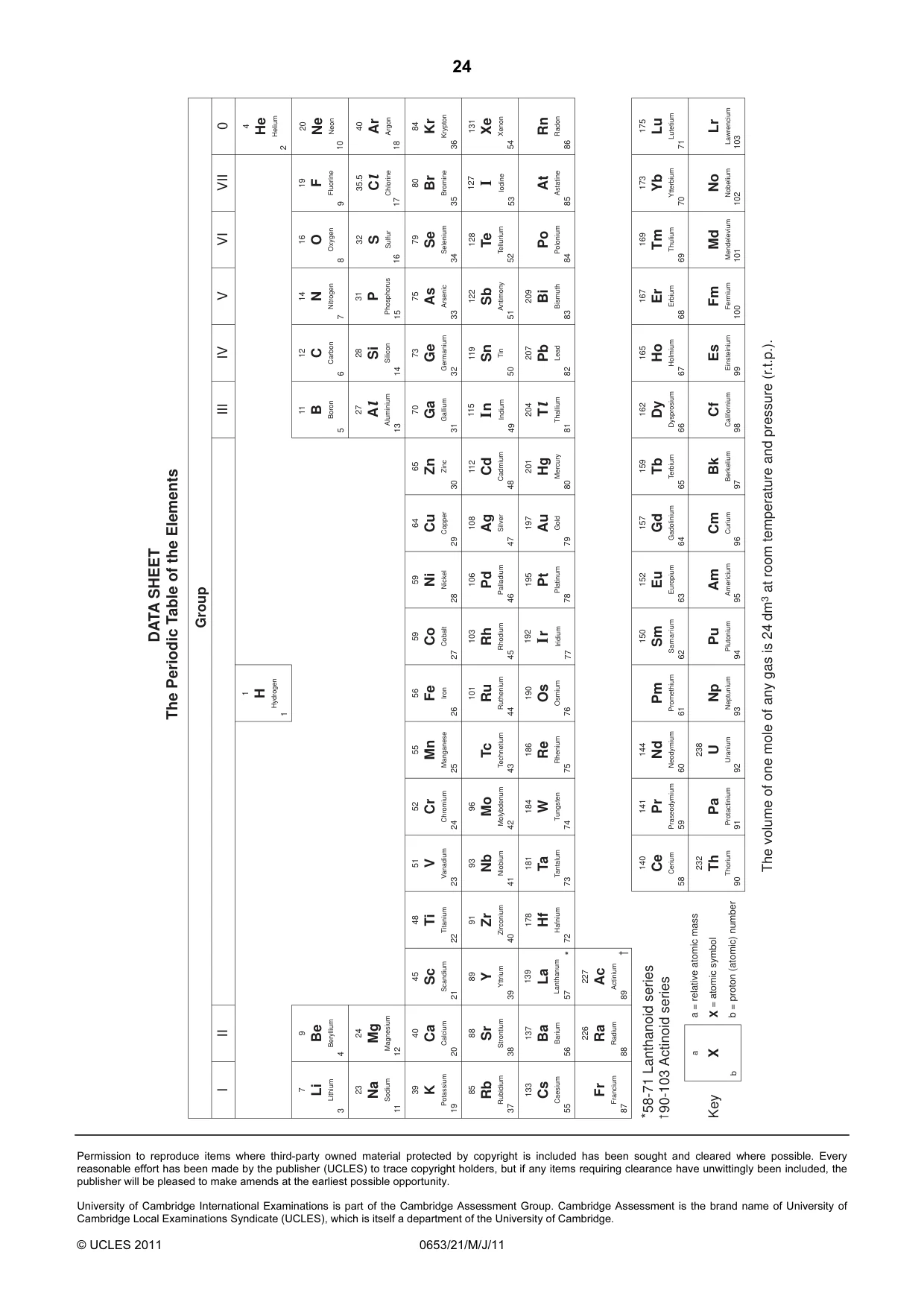
24 Permission to reproduce items where third-party owned material protected by copyright is included has been sought and cleared where possible. Every reasonable effort has been made by the publisher (UCLES) to trace copyright holders, but if any items requiring clearance have unwittingly been included, the publisher will be pleased to make amends at the earliest possible opportunity. University of Cambridge International Examinations is part of the Cambridge Assessment Group. Cambridge Assessment is the brand name of University of Cambridge Local Examinations Syndicate (UCLES), which is itself a department of the University of Cambridge. © UCLES 2011 0653/21/M/J/11 Group 140 Ce Cerium 58 141 Pr Praseodymium 59 144 Nd Neodymium 60 Pm Promethium 61 150 Sm Samarium 62 152 Eu Europium 63 157 Gd Gadolinium 64 159 Tb Terbium 65 162 Dy Dysprosium 66 165 Ho Holmium 67 167 Er Erbium 68 169 Tm Thulium 69 173 Yb Ytterbium 70 175 Lu Lutetium 71 232 Th Thorium 90 Pa Protactinium 91 238 U Uranium 92 Np Neptunium 93 Pu Plutonium 94 Am Americium 95 Cm Curium 96 Bk Berkelium 97 Cf Californium 98 Es Einsteinium 99 Fm Fermium 100 Md Mendelevium 101 No Nobelium 102 Lr Lawrencium 103 1 H Hydrogen 1 7 Li Lithium 3 23 Na Sodium 11 24 Mg Magnesium 12 40 Ca Calcium 20 45 Sc Scandium 21 48 Ti Titanium 22 51 V Vanadium 23 52 Cr Chromium 24 55 Mn Manganese 25 56 Fe Iron 26 59 Co Cobalt 27 59 Ni Nickel 28 64 Cu Copper 29 65 Zn Zinc 30 70 Ga Gallium 31 27 Al Aluminium 13 11 B Boron 5 12 C Carbon 6 14 N Nitrogen 7 16 O Oxygen 8 19 F Fluorine 9 28 Si Silicon 14 31 P Phosphorus 15 32 S Sulfur 16 35.5 Cl Chlorine 17 40 Ar Argon 18 20 Ne Neon 10 4 He Helium 2 73 Ge Germanium 32 75 As Arsenic 33 79 Se Selenium 34 80 Br Bromine 35 84 Kr Krypton 36 39 K Potassium 19 88 Sr Strontium 38 89 Y Yttrium 39 91 Zr Zirconium 40 93 Nb Niobium 41 96 Mo Molybdenum 42 Tc Technetium 43 101 Ru Ruthenium 44 103 Rh Rhodium 45 106 Pd Palladium 46 108 Ag Silver 47 112 Cd Cadmium 48 115 In Indium 49 119 Sn Tin 50 122 Sb Antimony 51 128 Te Tellurium 52 127 I Iodine 53 131 Xe Xenon 54 137 Ba Barium 56 139 La Lanthanum 57 * 178 Hf Hafnium 72 181 Ta Tantalum 73 184 W Tungsten 74 186 Re Rhenium 75 190 Os Osmium 76 192 Ir Iridium 77 195 Pt Platinum 78 197 Au Gold 79 201 Hg Mercury 80 204 Tl Thallium 81 207 Pb Lead 82 209 Bi Bismuth 83 Po Polonium 84 At Astatine 85 Rn Radon 86 Fr Francium 87 227 Ac Actinium 89 9 Be Beryllium 4 I II III IV V VI VII 0 85 Rb Rubidium 37 133 Cs Caesium 55 226 Ra Radium 88 The volume of one mole of any gas is 24 dm3 at room temperature and pressure (r.t.p.). a X b a = relative atomic mass X = atomic symbol b = proton (atomic) number Key *58-71 Lanthanoid series 90-103 Actinoid series DATA SHEET The Periodic Table of the Elements
Mark scheme, page 1
UNIVERSITY OF CAMBRIDGE INTERNATIONAL EXAMINATIONS International General Certificate of Secondary Education MARK SCHEME for the May/June 2011 question paper for the guidance of teachers 0653 COMBINED SCIENCE 0653/21 Paper 2 (Core Theory), maximum raw mark 80 This mark scheme is published as an aid to teachers and candidates, to indicate the requirements of the examination. It shows the basis on which Examiners were instructed to award marks. It does not indicate the details of the discussions that took place at an Examiners’ meeting before marking began, which would have considered the acceptability of alternative answers. Mark schemes must be read in conjunction with the question papers and the report on the examination. • Cambridge will not enter into discussions or correspondence in connection with these mark schemes. Cambridge is publishing the mark schemes for the May/June 2011 question papers for most IGCSE, GCE Advanced Level and Advanced Subsidiary Level syllabuses and some Ordinary Level syllabuses. www.XtremePapers.com
Mark scheme, page 2
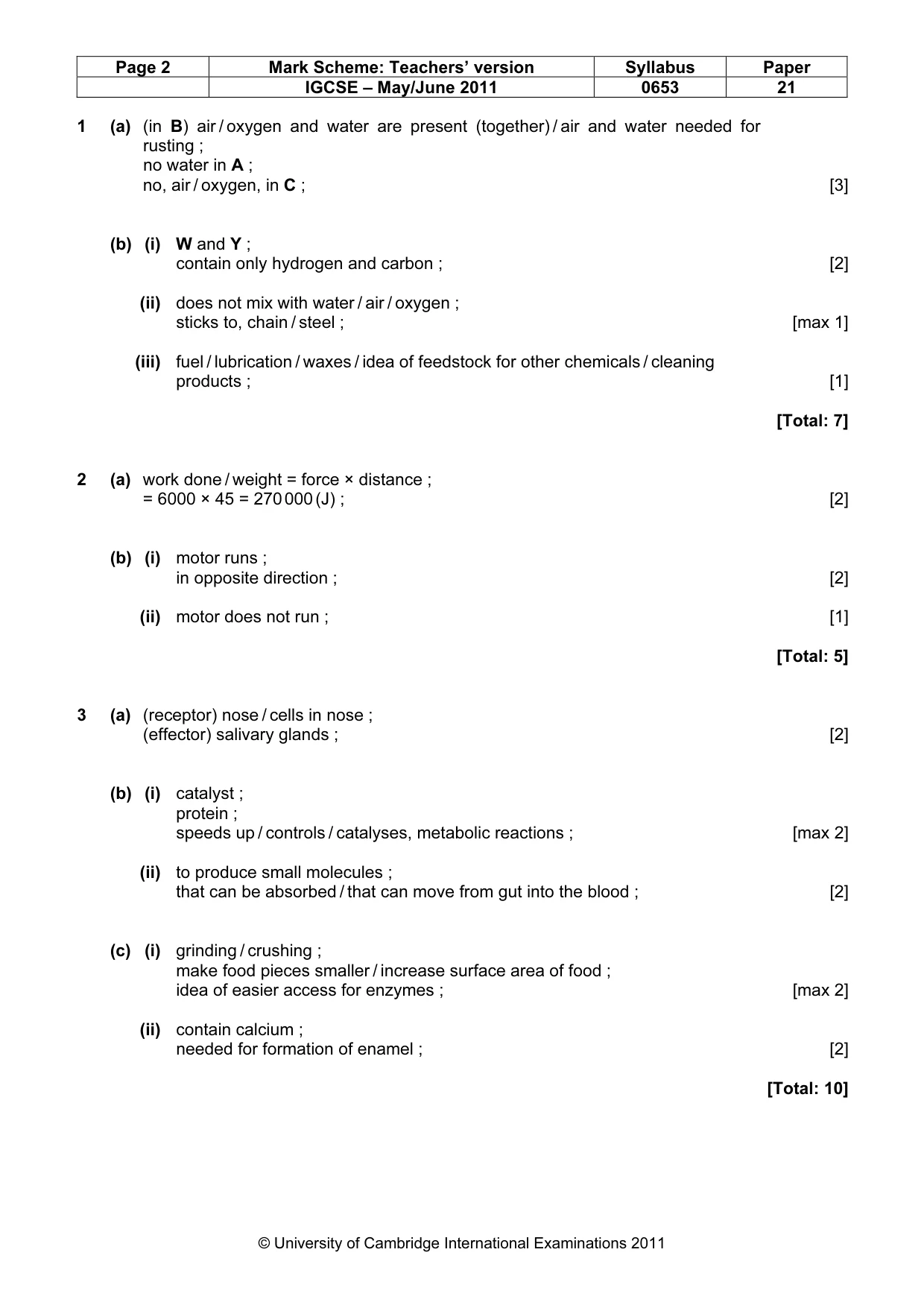
Page 2 Mark Scheme: Teachers’ version Syllabus Paper IGCSE – May/June 2011 0653 21 © University of Cambridge International Examinations 2011 1 (a) (in B) air / oxygen and water are present (together) / air and water needed for rusting ; no water in A ; no, air / oxygen, in C ; [3] (b) (i) W and Y ; contain only hydrogen and carbon ; [2] (ii) does not mix with water / air / oxygen ; sticks to, chain / steel ; [max 1] (iii) fuel / lubrication / waxes / idea of feedstock for other chemicals / cleaning products ; [1] [Total: 7] 2 (a) work done / weight = force × distance ; = 6000 × 45 = 270 000 (J) ; [2] (b) (i) motor runs ; in opposite direction ; [2] (ii) motor does not run ; [1] [Total: 5] 3 (a) (receptor) nose / cells in nose ; (effector) salivary glands ; [2] (b) (i) catalyst ; protein ; speeds up / controls / catalyses, metabolic reactions ; [max 2] (ii) to produce small molecules ; that can be absorbed / that can move from gut into the blood ; [2] (c) (i) grinding / crushing ; make food pieces smaller / increase surface area of food ; idea of easier access for enzymes ; [max 2] (ii) contain calcium ; needed for formation of enamel ; [2] [Total: 10]
Mark scheme, page 3
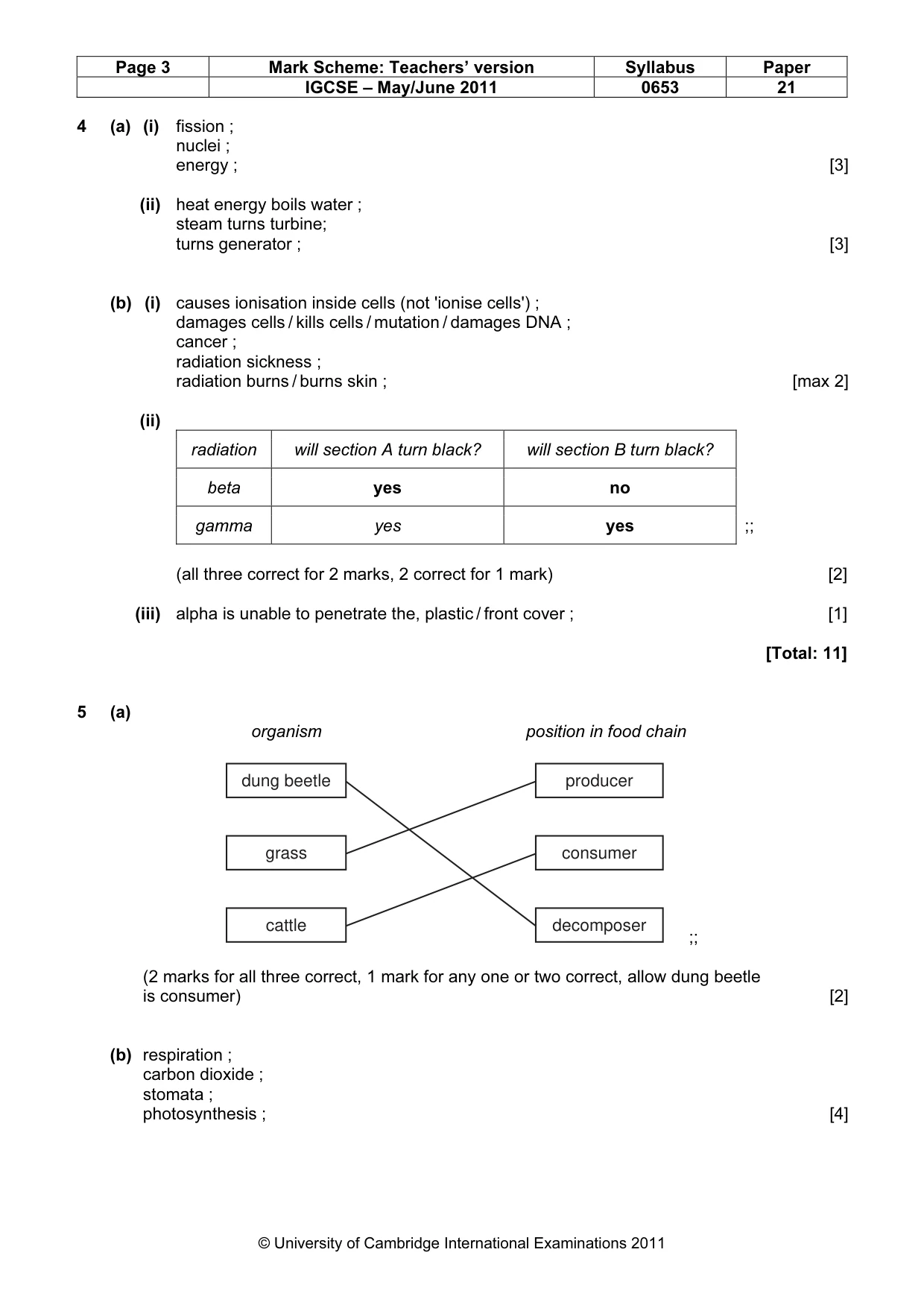
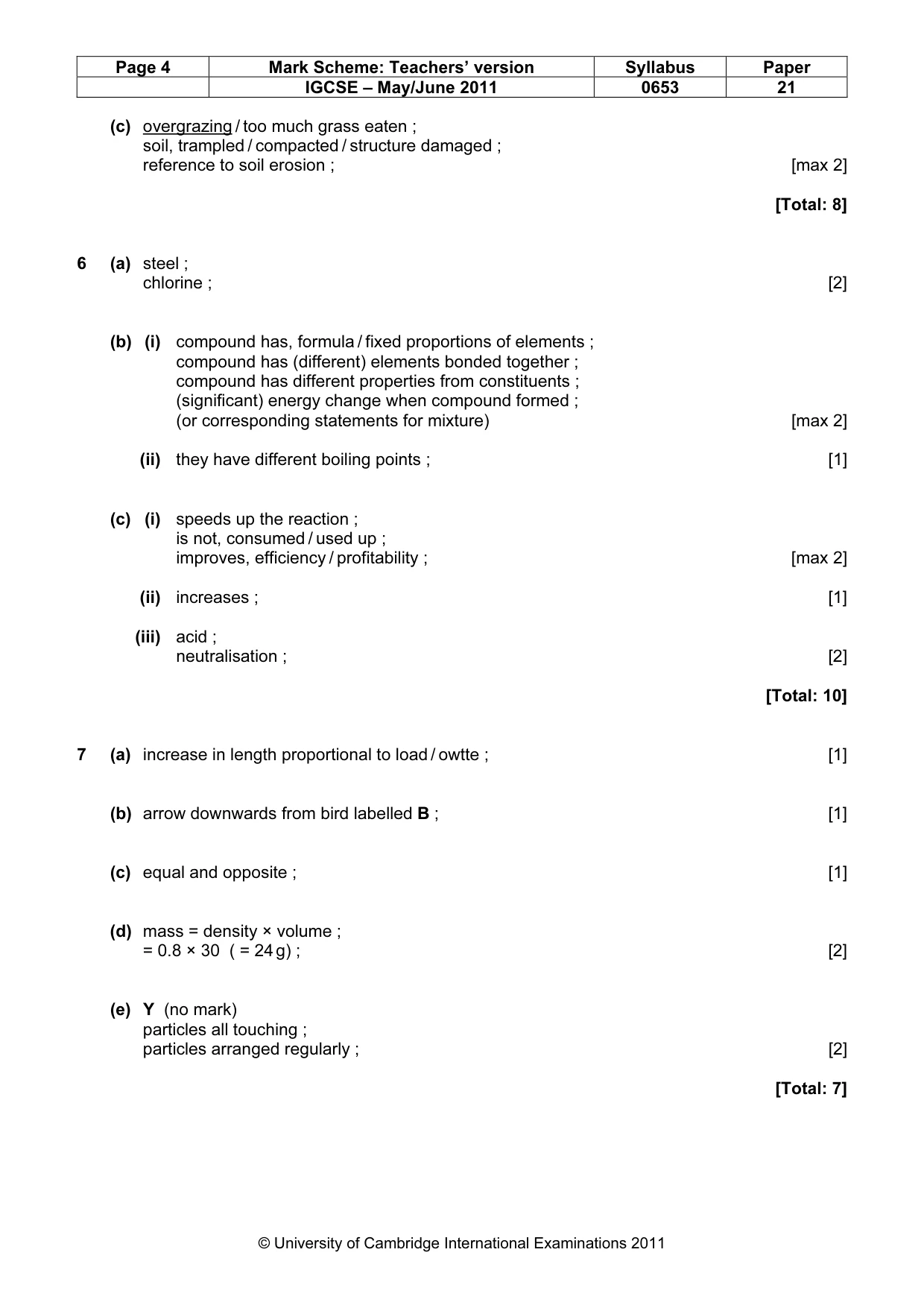
Page 3 Mark Scheme: Teachers’ version Syllabus Paper IGCSE – May/June 2011 0653 21 © University of Cambridge International Examinations 2011 4 (a) (i) fission ; nuclei ; energy ; [3] (ii) heat energy boils water ; steam turns turbine; turns generator ; [3] (b) (i) causes ionisation inside cells (not 'ionise cells') ; damages cells / kills cells / mutation / damages DNA ; cancer ; radiation sickness ; radiation burns / burns skin ; [max 2] (ii) radiation will section A turn black? will section B turn black? beta yes no gamma yes yes ;; (all three correct for 2 marks, 2 correct for 1 mark) [2] (iii) alpha is unable to penetrate the, plastic / front cover ; [1] [Total: 11] 5 (a) organism position in food chain dung beetle grass cattle producer consumer decomposer ;; (2 marks for all three correct, 1 mark for any one or two correct, allow dung beetle is consumer) [2] (b) respiration ; carbon dioxide ; stomata ; photosynthesis ; [4]
Mark scheme, page 4
Page 4 Mark Scheme: Teachers’ version Syllabus Paper IGCSE – May/June 2011 0653 21 © University of Cambridge International Examinations 2011 (c) overgrazing / too much grass eaten ; soil, trampled / compacted / structure damaged ; reference to soil erosion ; [max 2] [Total: 8] 6 (a) steel ; chlorine ; [2] (b) (i) compound has, formula / fixed proportions of elements ; compound has (different) elements bonded together ; compound has different properties from constituents ; (significant) energy change when compound formed ; (or corresponding statements for mixture) [max 2] (ii) they have different boiling points ; [1] (c) (i) speeds up the reaction ; is not, consumed / used up ; improves, efficiency / profitability ; [max 2] (ii) increases ; [1] (iii) acid ; neutralisation ; [2] [Total: 10] 7 (a) increase in length proportional to load / owtte ; [1] (b) arrow downwards from bird labelled B ; [1] (c) equal and opposite ; [1] (d) mass = density × volume ; = 0.8 × 30 ( = 24 g) ; [2] (e) Y (no mark) particles all touching ; particles arranged regularly ; [2] [Total: 7]
Mark scheme, page 5
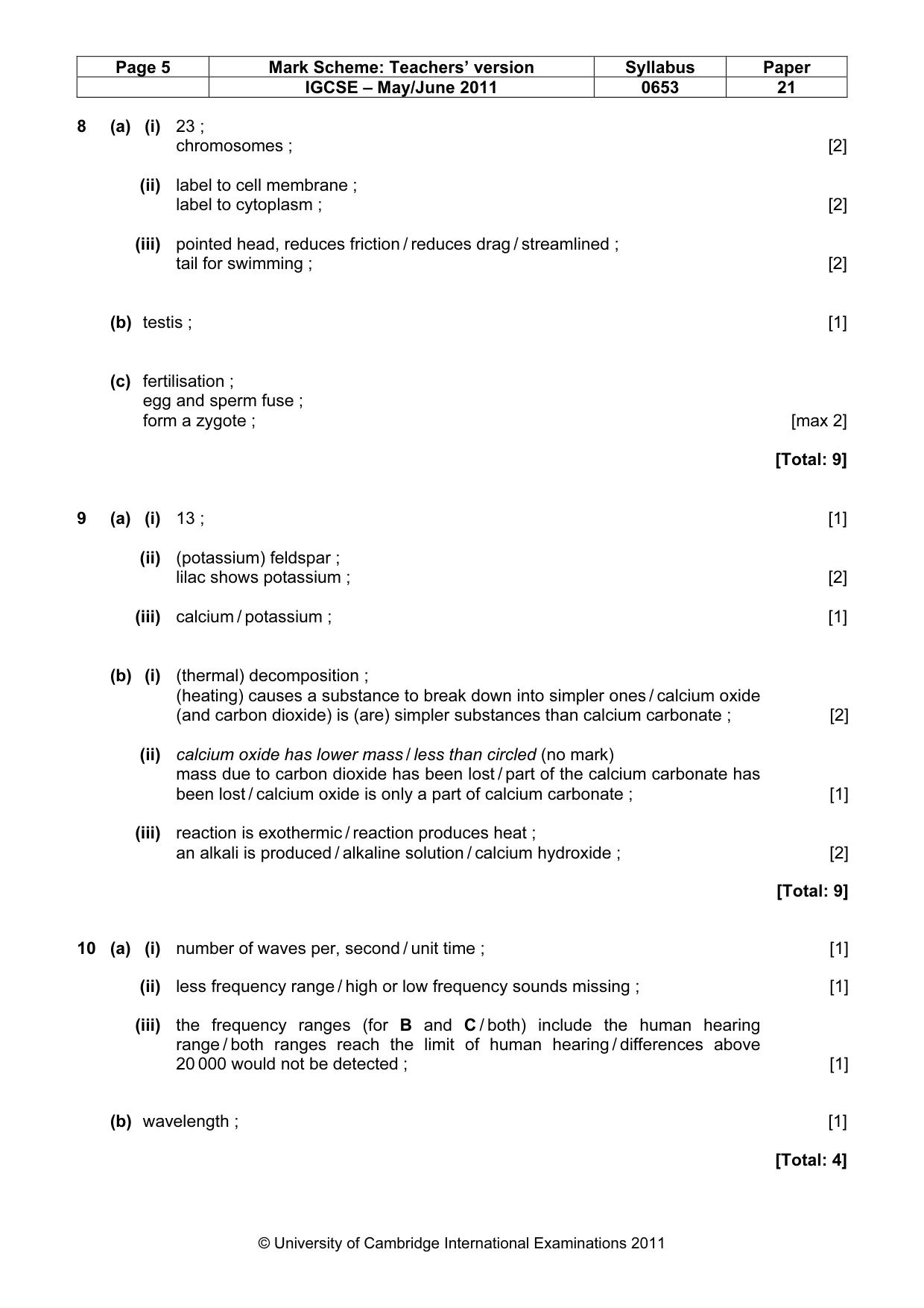
Page 5 Mark Scheme: Teachers’ version Syllabus Paper IGCSE – May/June 2011 0653 21 © University of Cambridge International Examinations 2011 8 (a) (i) 23 ; chromosomes ; [2] (ii) label to cell membrane ; label to cytoplasm ; [2] (iii) pointed head, reduces friction / reduces drag / streamlined ; tail for swimming ; [2] (b) testis ; [1] (c) fertilisation ; egg and sperm fuse ; form a zygote ; [max 2] [Total: 9] 9 (a) (i) 13 ; [1] (ii) (potassium) feldspar ; lilac shows potassium ; [2] (iii) calcium / potassium ; [1] (b) (i) (thermal) decomposition ; (heating) causes a substance to break down into simpler ones / calcium oxide (and carbon dioxide) is (are) simpler substances than calcium carbonate ; [2] (ii) calcium oxide has lower mass / less than circled (no mark) mass due to carbon dioxide has been lost / part of the calcium carbonate has been lost / calcium oxide is only a part of calcium carbonate ; [1] (iii) reaction is exothermic / reaction produces heat ; an alkali is produced / alkaline solution / calcium hydroxide ; [2] [Total: 9] 10 (a) (i) number of waves per, second / unit time ; [1] (ii) less frequency range / high or low frequency sounds missing ; [1] (iii) the frequency ranges (for B and C / both) include the human hearing range / both ranges reach the limit of human hearing / differences above 20 000 would not be detected ; [1] (b) wavelength ; [1] [Total: 4]
What you needed in this session
Cambridge’s own grade thresholds for 2011 May/June, Paper 2 · Variant 1. A higher threshold means an easier paper — the bar moves with how the cohort did.