Cambridge IGCSE Religious Studies 0490 — 2025 Oct/Nov Paper 2 · Variant 3
0490/23/O/N/25 · 9 questions · 80 marks · 105 min
The question paper and its mark scheme, free to read here and free to download. This is Cambridge’s own paper, exactly as it was sat.
Question paper8 pages
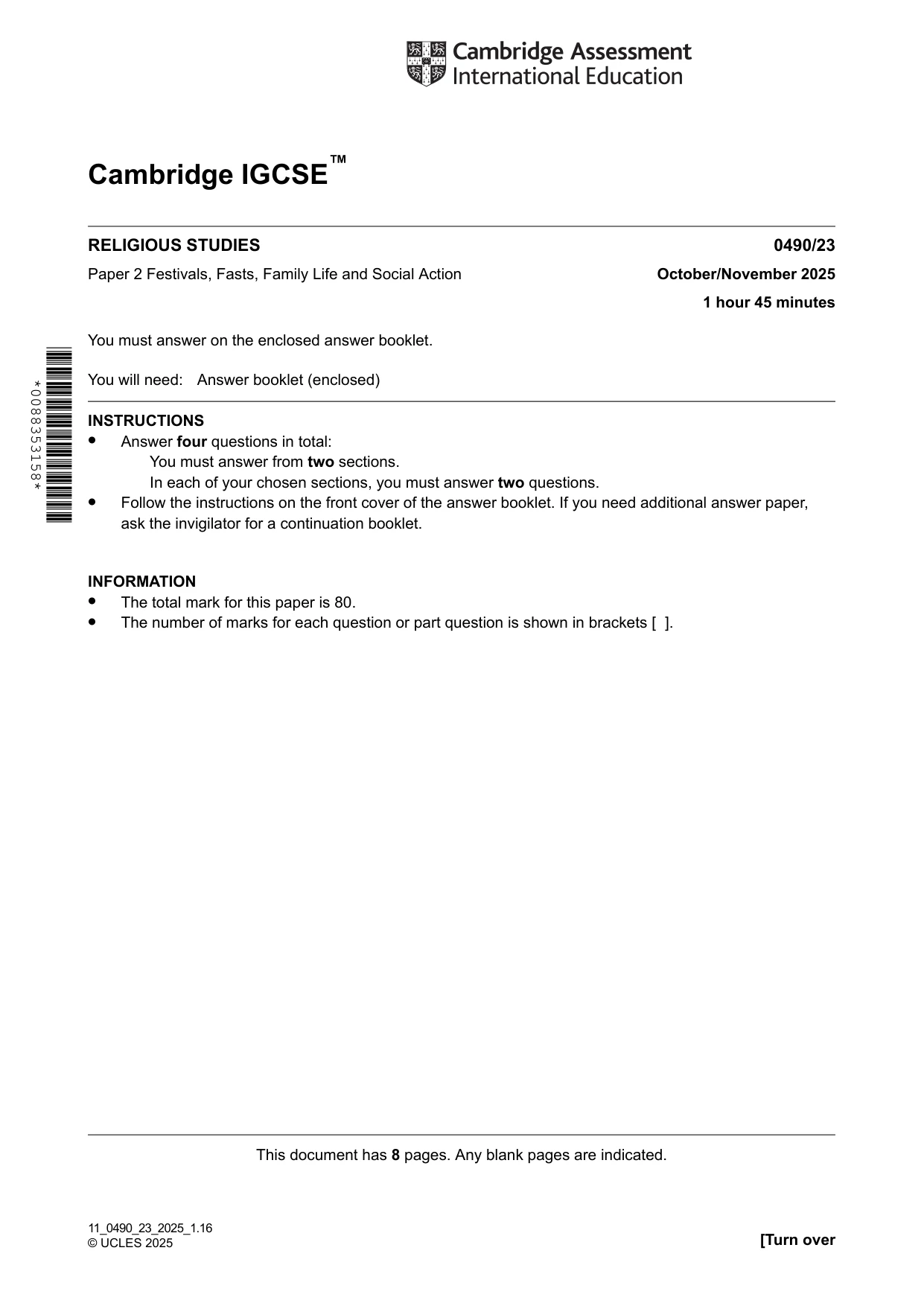
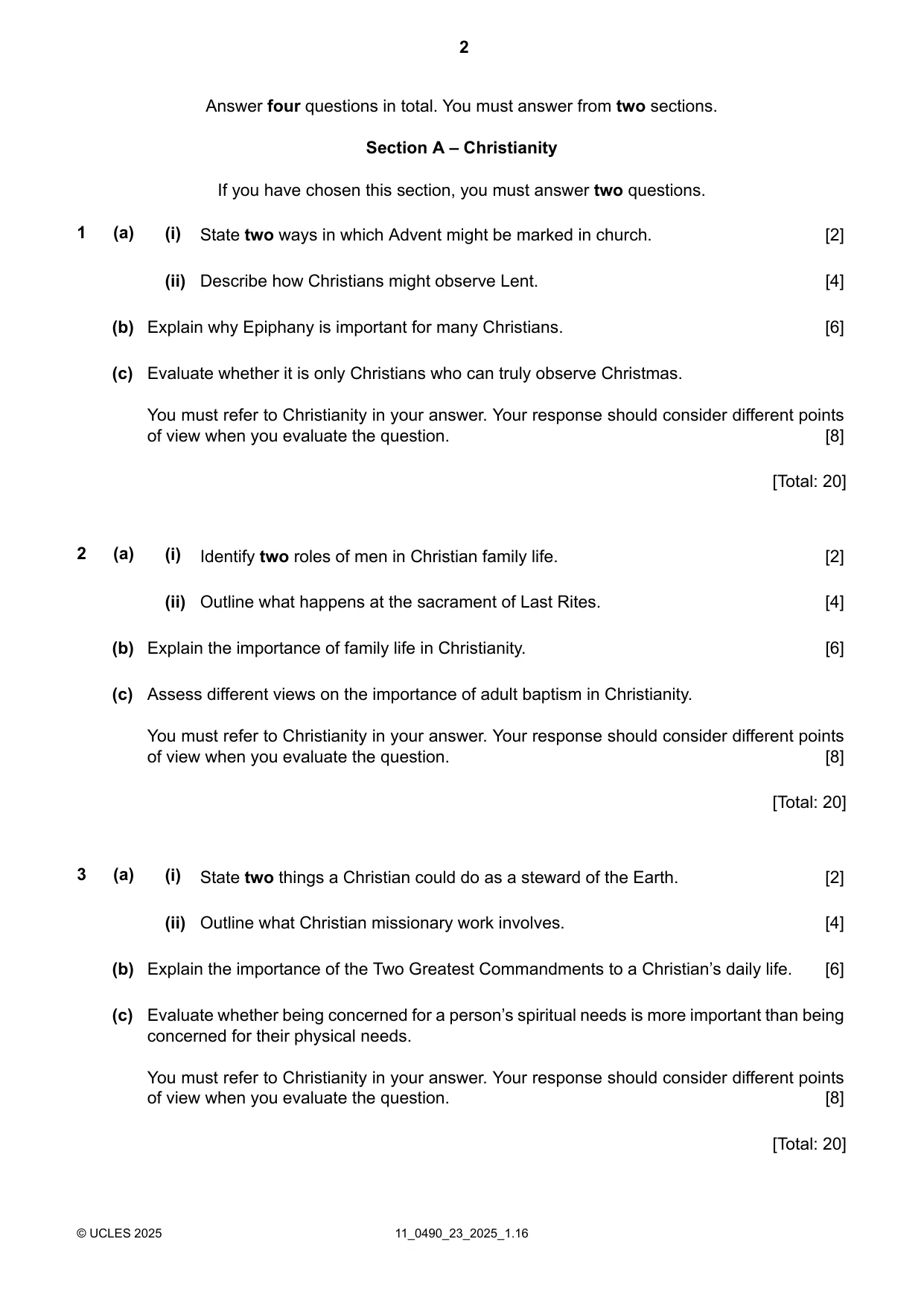
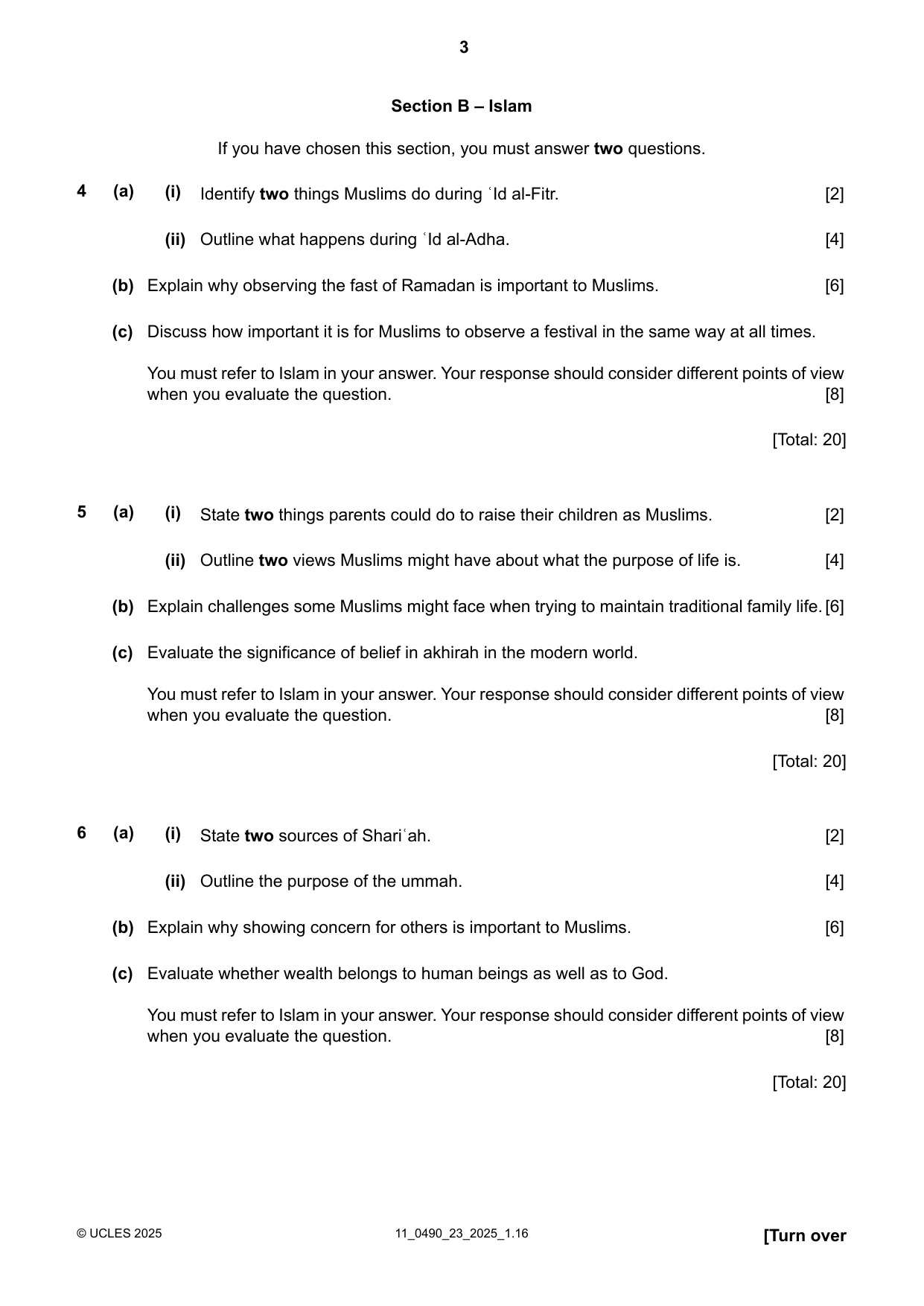
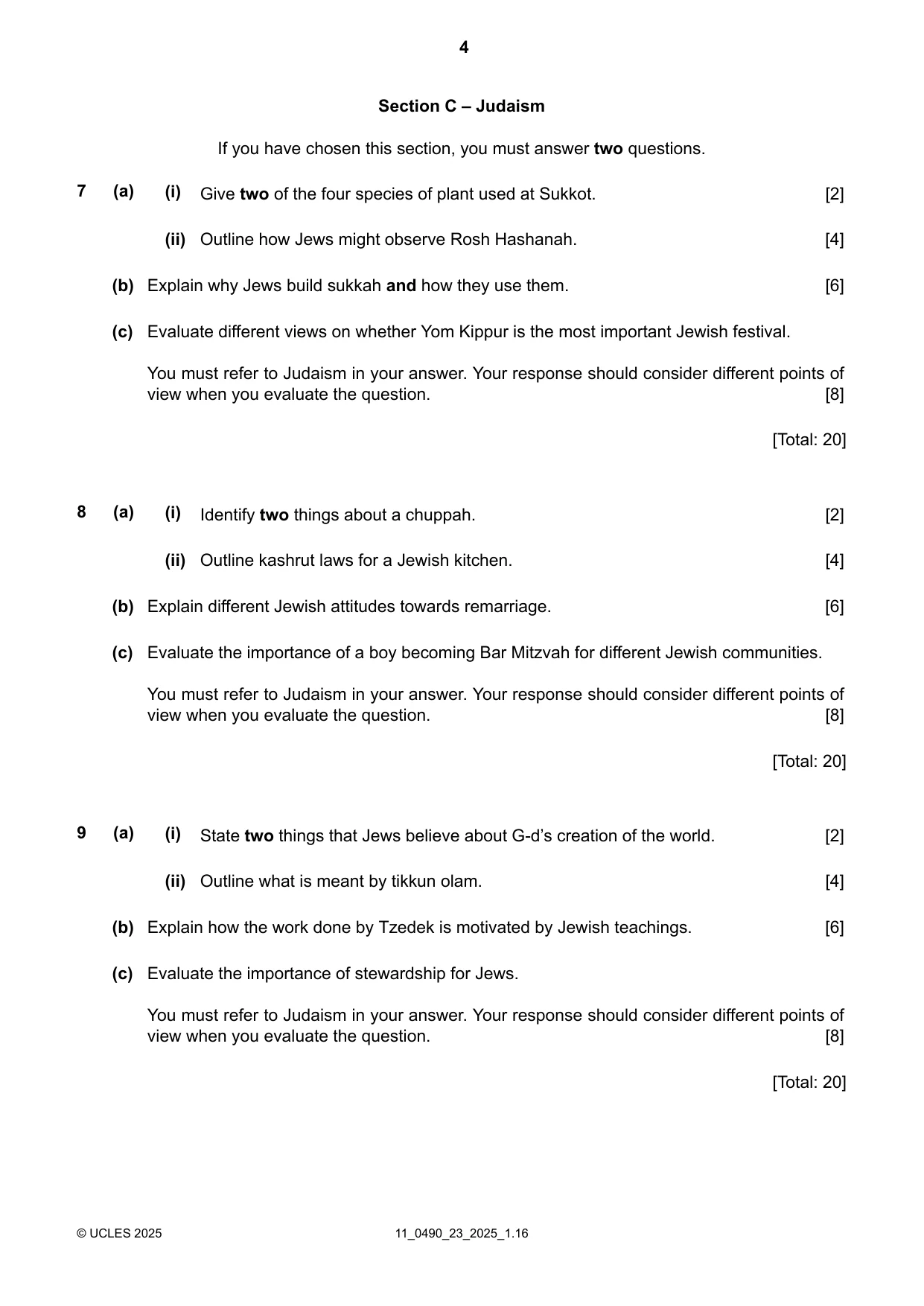




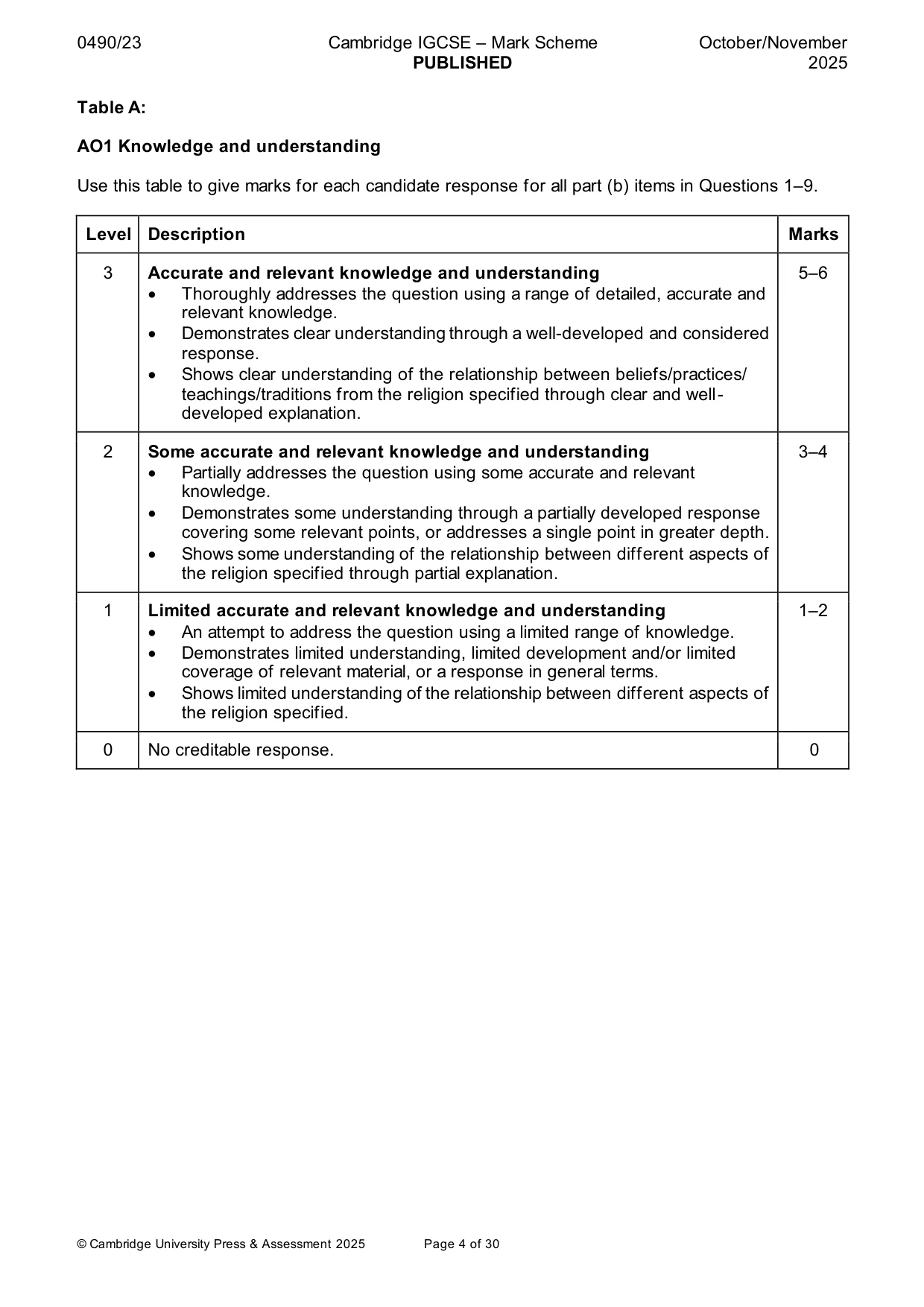
Mark scheme30 pages
Answers below. Sit the paper first if you are practising.
Questions as text
Q1 · State two ways in which Advent might be marked in church
1 (a) (i) State two ways in which Advent might be marked in church. [2] (ii) Describe how Christians might observe Lent. [4] (b) Explain why Epiphany is important for many Christians. [6] (c) Evaluate whether it is only Christians who can truly observe Christmas. You must refer to Christianity in your answer. Your response should consider different points of view when you evaluate the question. [8] [Total: 20]
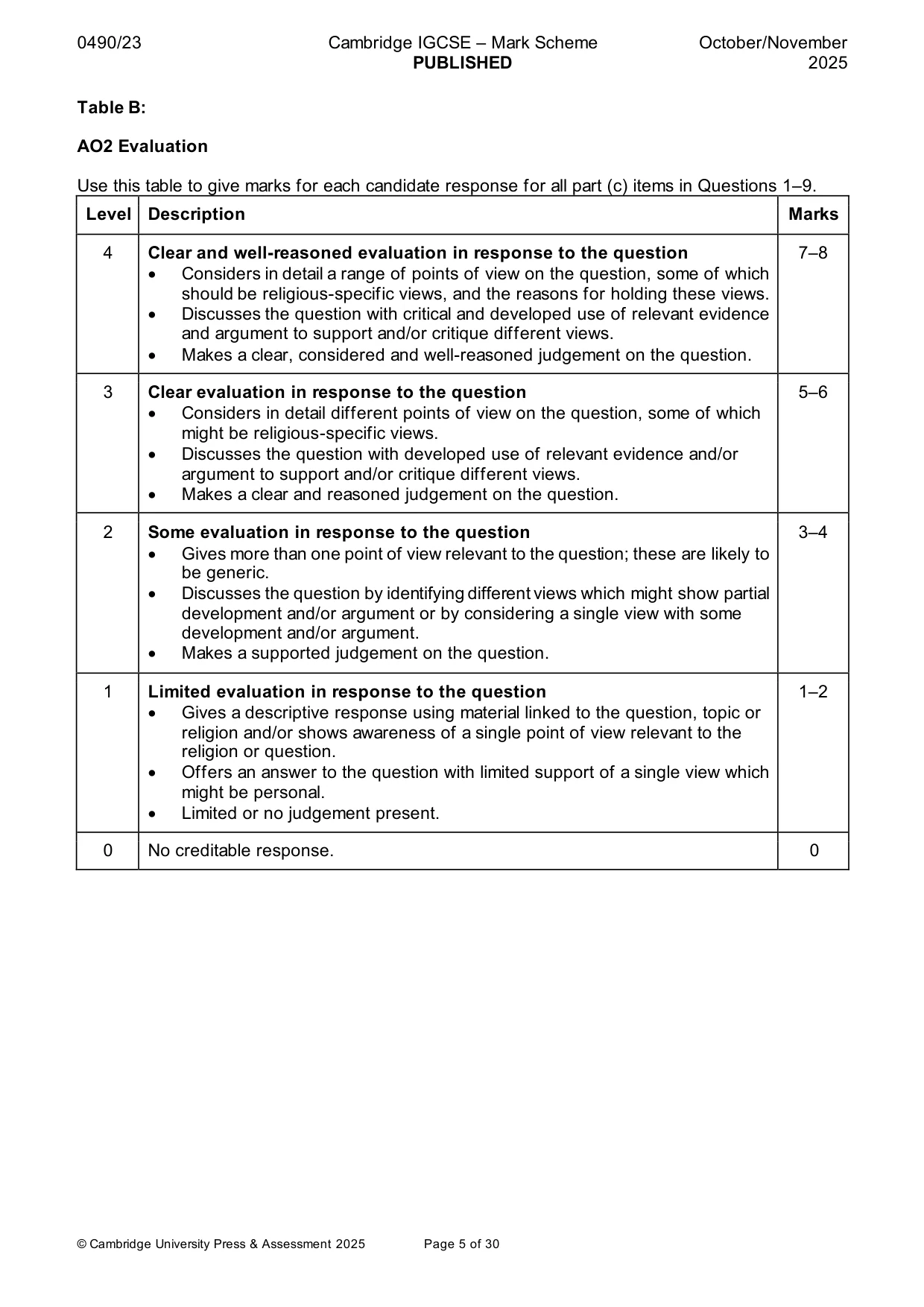
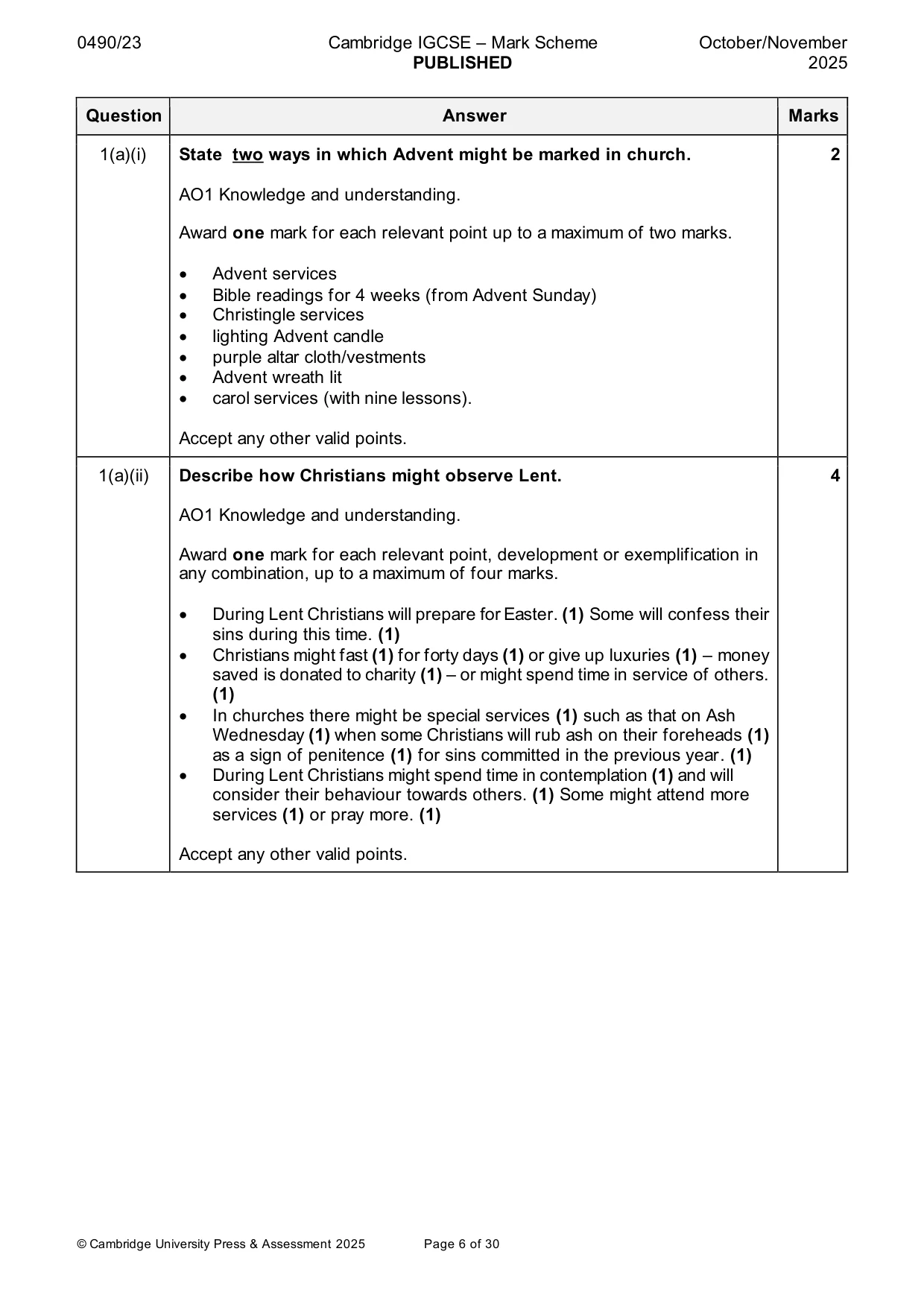
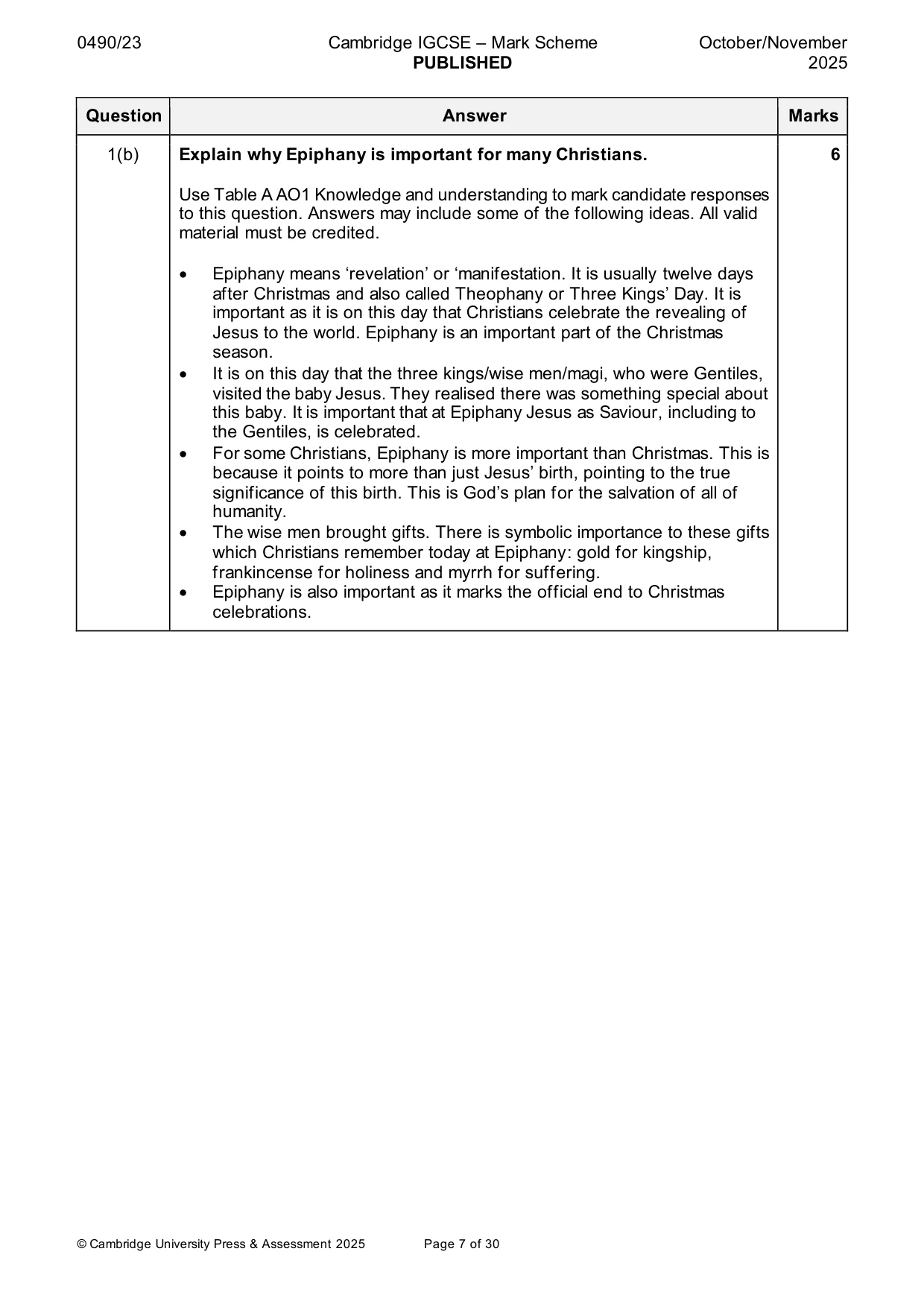
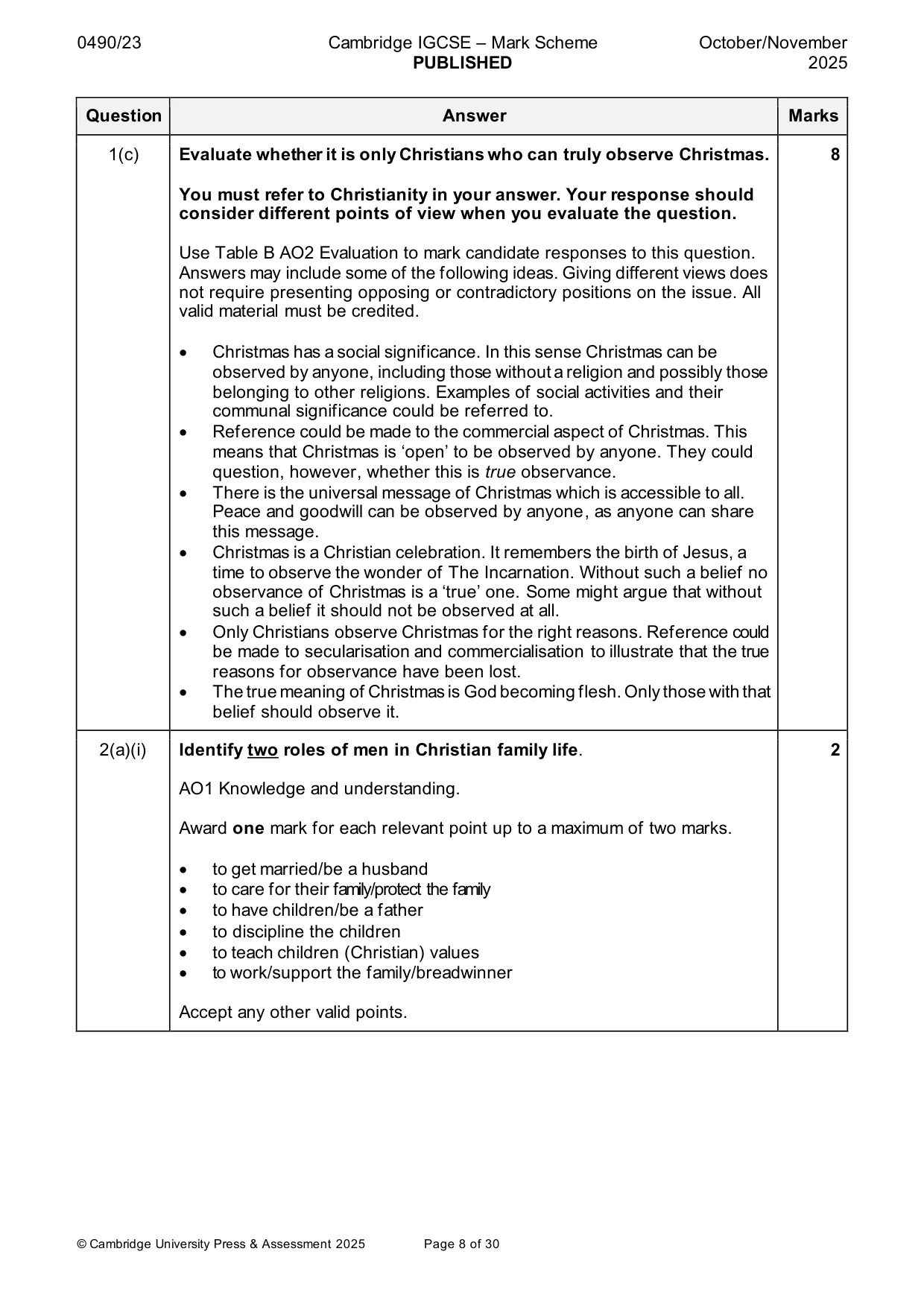
Mark scheme: Question Answer Marks 1(a)(i) State two ways in which Advent might be marked in church. 2 AO1 Knowledge and understanding. Award one mark for each relevant point up to a maximum of two marks. • Advent services • Bible readings for 4 weeks (from Advent Sunday) • Christingle services • lighting Advent candle • purple altar cloth/vestments • Advent wreath lit • carol services (with nine lessons). Accept any other valid points. 1(a)(ii) Describe how Christians might observe Lent. 4 AO1 Knowledge and understanding. Award one mark for each relevant point, development or exemplification in any combination, up to a maximum of four marks. • During Lent Christians will prepare for Easter. (1) Some will confess their sins during this time. (1) • Christians might fast (1) for forty days (1) or give up luxuries (1) – money saved is donated to charity (1) – or might spend time in service of others. (1) • In churches there might be special services (1) such as that on Ash Wednesday (1) when some Christians will rub ash on their foreheads (1) as a sign of penitence (1) for sins committed in the previous year. (1) • During Lent Christians might spend time in contemplation (1) and will consider their behaviour towards others. (1) Some might attend more services (1) or pray more. (1) Accept any other valid points. 1(b) Explain why Epiphany is important for many Christians. 6 Use Table A AO1 Knowledge and understanding to mark candidate responses to this question. Answers may include some of the following ideas. All valid material must be credited. • Epiphany means ‘revelation’ or ‘manifestation. It is usually twelve days after Christmas and also called Theophany or Three Kings’ Day. It is important as it is on this day that Christians celebrate the revealing of Jesus to the world. Epiphany is an important part of the Christmas season. • It is on this day that the three kings/wise men/magi, who were Gentiles, visited the baby Jesus. They realised there was something special about this baby. It is important that at Epiphany Jesus as Saviour, including to the Gentiles, is celebrated. • For some Christians, Epiphany is more important than Christmas. This is because it points to more than just Jesus’ birth, pointing to the true significance of this birth. This is God’s plan for the salvation of all of humanity. • The wise men brought gifts. There is symbolic importance to these gifts which Christians remember today at Epiphany: gold for kingship, frankincense for holiness and myrrh for suffering. • Epiphany is also important as it marks the official end to Christmas celebrations. 1(c) Evaluate whether it is only Christians who can truly observe Christmas. 8 You must refer to Christianity in your answer. Your response should consider different points of view when you evaluate the question. Use Table B AO2 Evaluation to mark candidate responses to this question. Answers may include some of the following ideas. Giving different views does not require presenting opposing or contradictory positions on the issue. All valid material must be credited. • Christmas has a social significance. In this sense Christmas can be observed by anyone, including those without a religion and possibly those belonging to other religions. Examples of social activities and their communal significance could be referred to. • Reference could be made to the commercial aspect of Christmas. This means that Christmas is ‘open’ to be observed by anyone. They could question, however, whether this is true observance. • There is the universal message of Christmas which is accessible to all. Peace and goodwill can be observed by anyone, as anyone can share this message. • Christmas is a Christian celebration. It remembers the birth of Jesus, a time to observe the wonder of The Incarnation. Without such a belief no observance of Christmas is a ‘true’ one. Some might argue that without such a belief it should not be observed at all. • Only Christians observe Christmas for the right reasons. Reference could be made to secularisation and commercialisation to illustrate that the true reasons for observance have been lost. • The true meaning of Christmas is God becoming flesh. Only those with that belief should observe it.
Q2 · Identify two roles of men in Christian family life
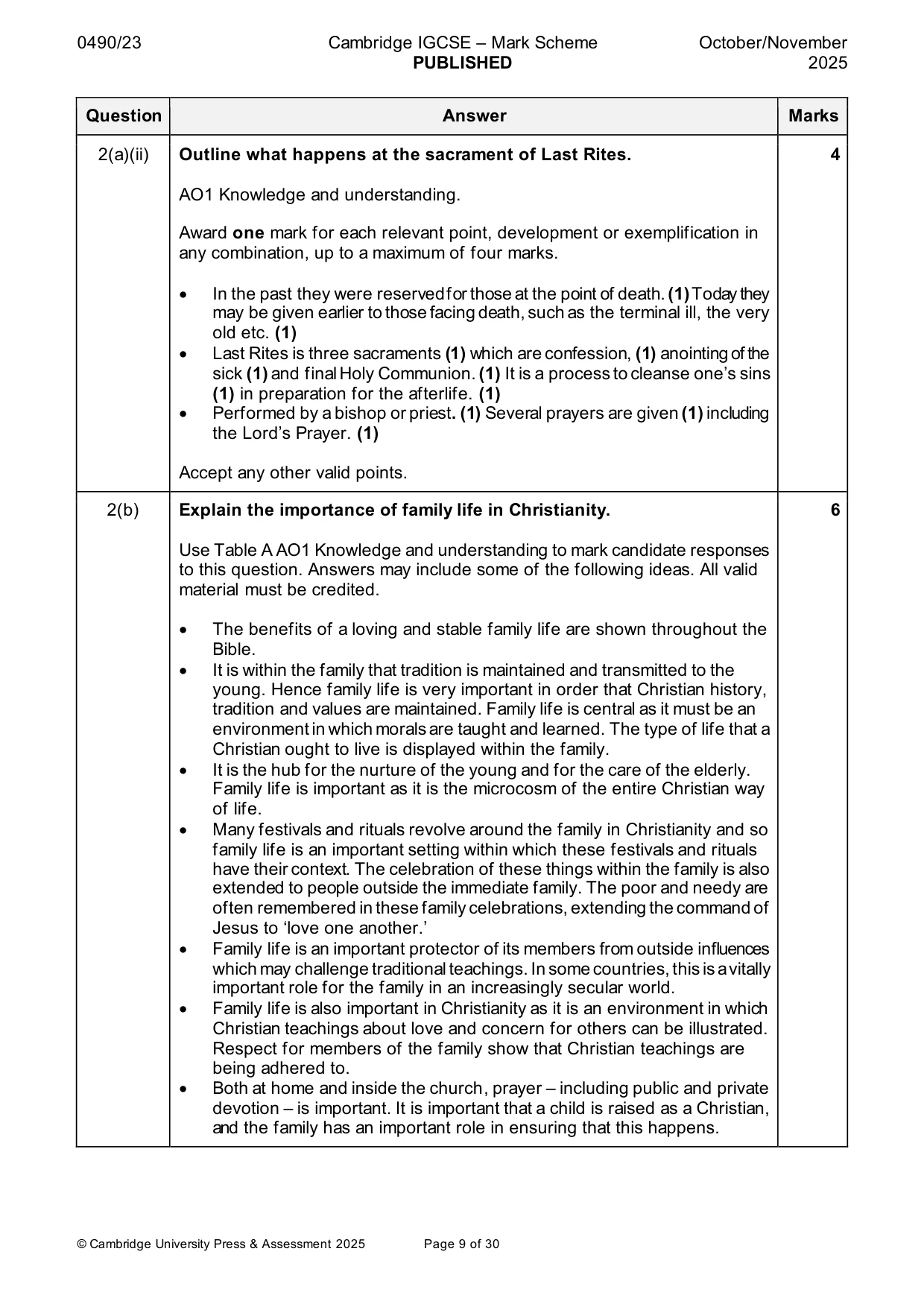
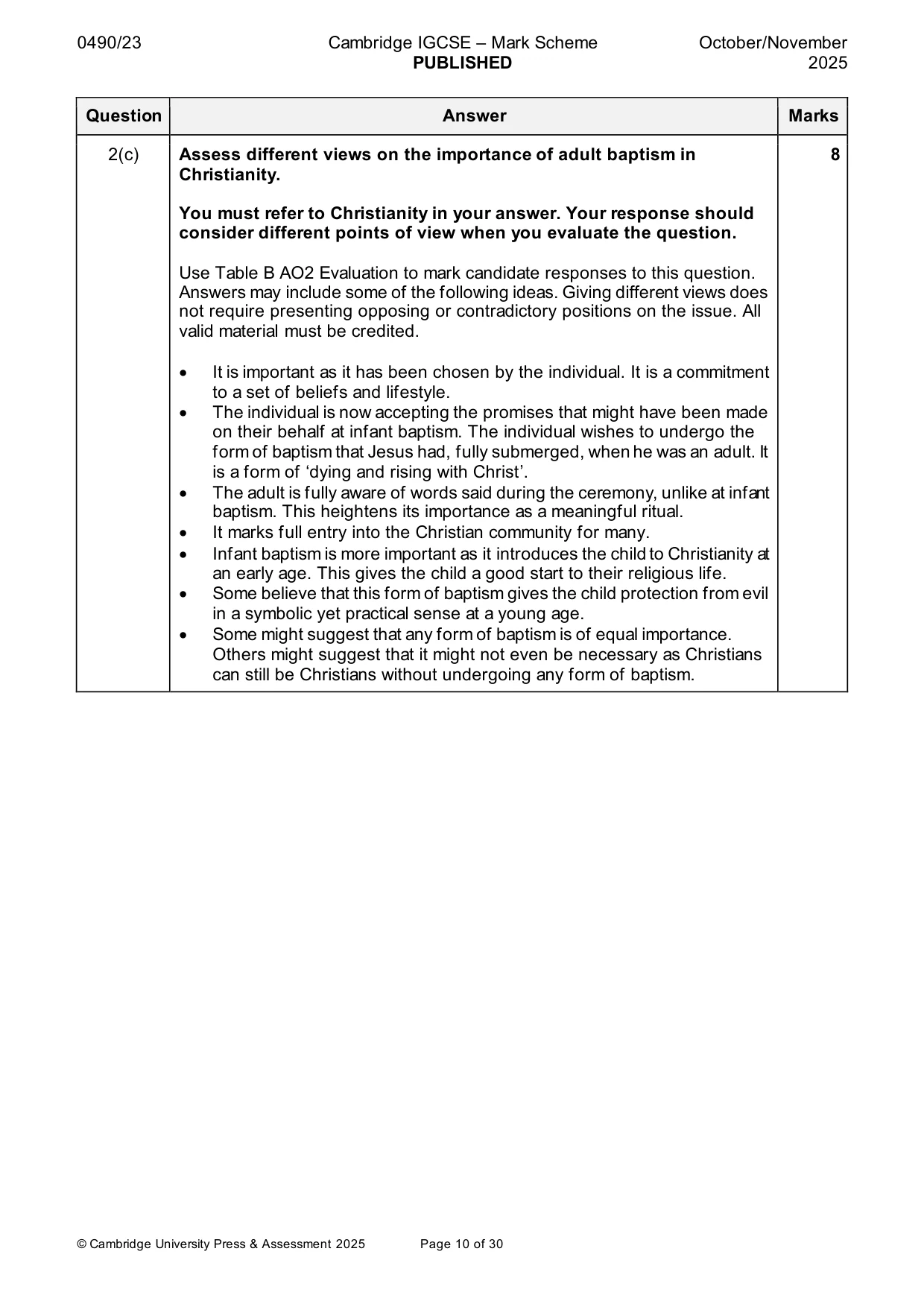
2 (a) (i) Identify two roles of men in Christian family life. [2] (ii) Outline what happens at the sacrament of Last Rites. [4] (b) Explain the importance of family life in Christianity. [6] (c) Assess different views on the importance of adult baptism in Christianity. You must refer to Christianity in your answer. Your response should consider different points of view when you evaluate the question. [8] [Total: 20]
Mark scheme: 2(a)(i) Identify two roles of men in Christian family life. 2 AO1 Knowledge and understanding. Award one mark for each relevant point up to a maximum of two marks. • to get married/be a husband • to care for their family/protect the family • to have children/be a father • to discipline the children • to teach children (Christian) values • to work/support the family/breadwinner Accept any other valid points. 2(a)(ii) Outline what happens at the sacrament of Last Rites. 4 AO1 Knowledge and understanding. Award one mark for each relevant point, development or exemplification in any combination, up to a maximum of four marks. • In the past they were reserved for those at the point of death. (1) Today they may be given earlier to those facing death, such as the terminal ill, the very old etc. (1) • Last Rites is three sacraments (1) which are confession, (1) anointing of the sick (1) and final Holy Communion. (1) It is a process to cleanse one’s sins (1) in preparation for the afterlife. (1) • Performed by a bishop or priest. (1) Several prayers are given (1) including the Lord’s Prayer. (1) Accept any other valid points. 2(b) Explain the importance of family life in Christianity. 6 Use Table A AO1 Knowledge and understanding to mark candidate responses to this question. Answers may include some of the following ideas. All valid material must be credited. • The benefits of a loving and stable family life are shown throughout the Bible. • It is within the family that tradition is maintained and transmitted to the young. Hence family life is very important in order that Christian history, tradition and values are maintained. Family life is central as it must be an environment in which morals are taught and learned. The type of life that a Christian ought to live is displayed within the family. • It is the hub for the nurture of the young and for the care of the elderly. Family life is important as it is the microcosm of the entire Christian way of life. • Many festivals and rituals revolve around the family in Christianity and so family life is an important setting within which these festivals and rituals have their context. The celebration of these things within the family is also extended to people outside the immediate family. The poor and needy are often remembered in these family celebrations, extending the command of Jesus to ‘love one another.’ • Family life is an important protector of its members from outside influences which may challenge traditional teachings. In some countries, this is a vitally important role for the family in an increasingly secular world. • Family life is also important in Christianity as it is an environment in which Christian teachings about love and concern for others can be illustrated. Respect for members of the family show that Christian teachings are being adhered to. • Both at home and inside the church, prayer – including public and private devotion – is important. It is important that a child is raised as a Christian, and the family has an important role in ensuring that this happens. 2(c) Assess different views on the importance of adult baptism in 8 Christianity. You must refer to Christianity in your answer. Your response should consider different points of view when you evaluate the question. Use Table B AO2 Evaluation to mark candidate responses to this question. Answers may include some of the following ideas. Giving different views does not require presenting opposing or contradictory positions on the issue. All valid material must be credited. • It is important as it has been chosen by the individual. It is a commitment to a set of beliefs and lifestyle. • The individual is now accepting the promises that might have been made on their behalf at infant baptism. The individual wishes to undergo the form of baptism that Jesus had, fully submerged, when he was an adult. It is a form of ‘dying and rising with Christ’. • The adult is fully aware of words said during the ceremony, unlike at infant baptism. This heightens its importance as a meaningful ritual. • It marks full entry into the Christian community for many. • Infant baptism is more important as it introduces the child to Christianity at an early age. This gives the child a good start to their religious life. • Some believe that this form of baptism gives the child protection from evil in a symbolic yet practical sense at a young age. • Some might suggest that any form of baptism is of equal importance. Others might suggest that it might not even be necessary as Christians can still be Christians without undergoing any form of baptism.
Q3 · State two things a Christian could do as a steward of the Earth
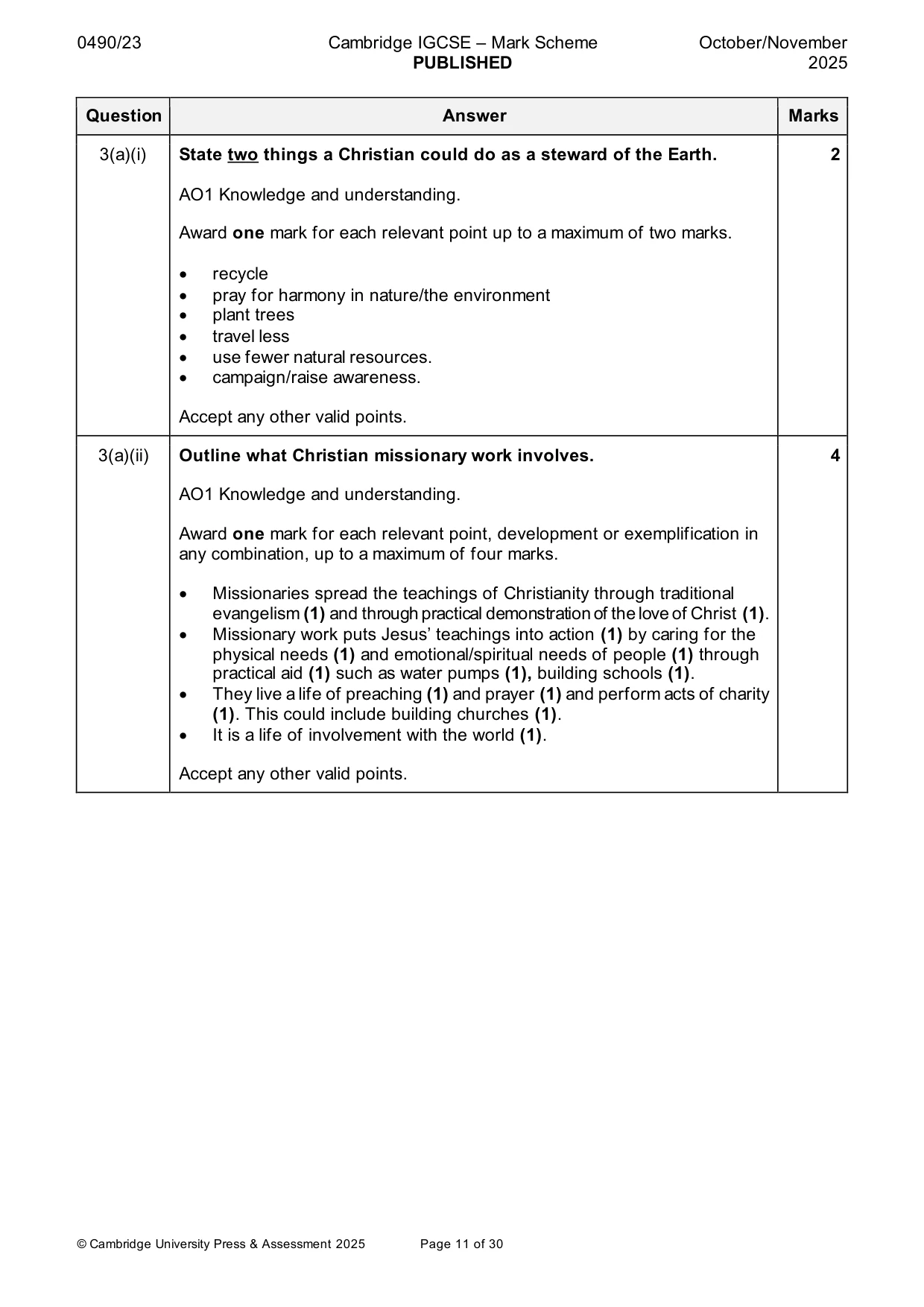
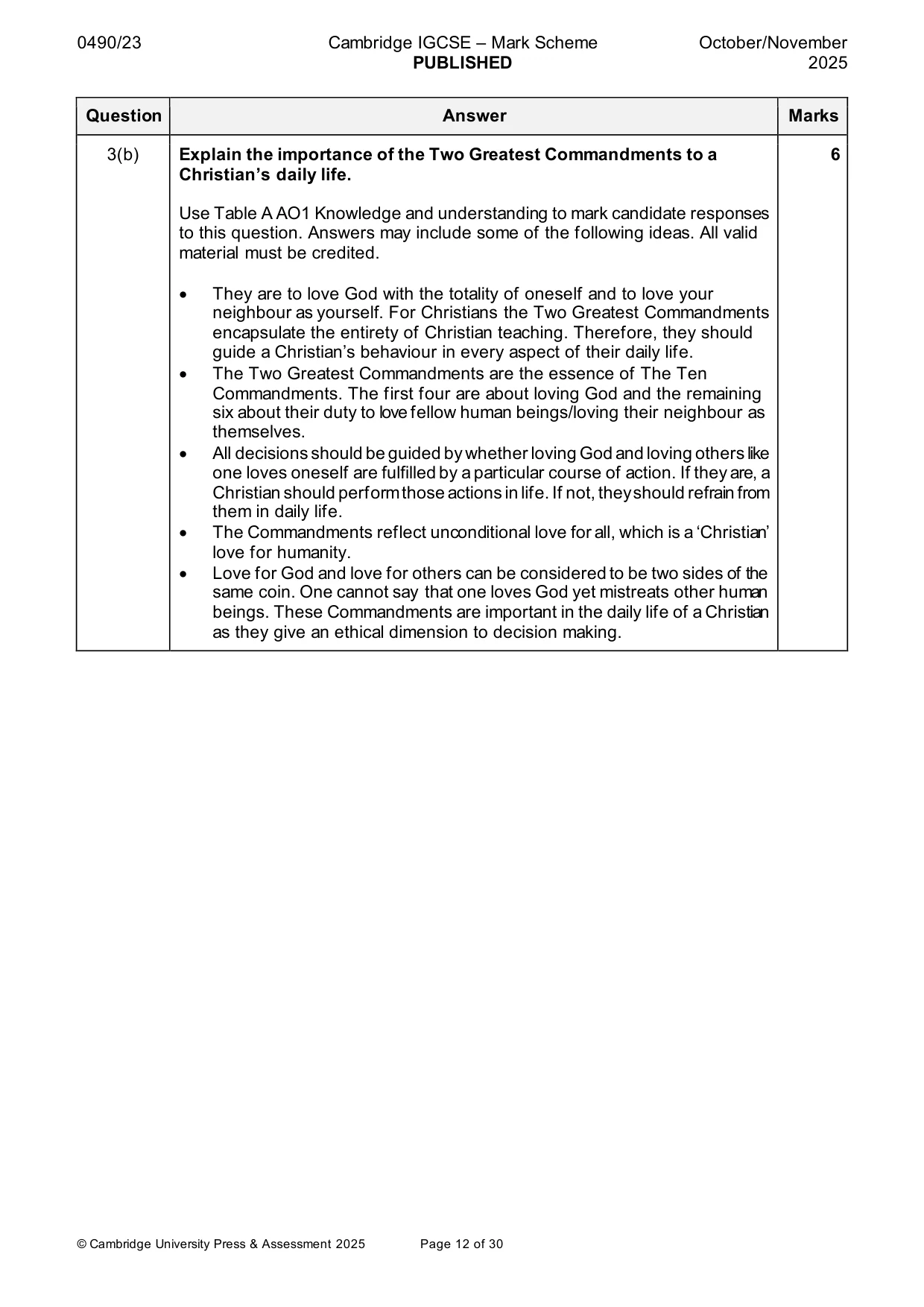
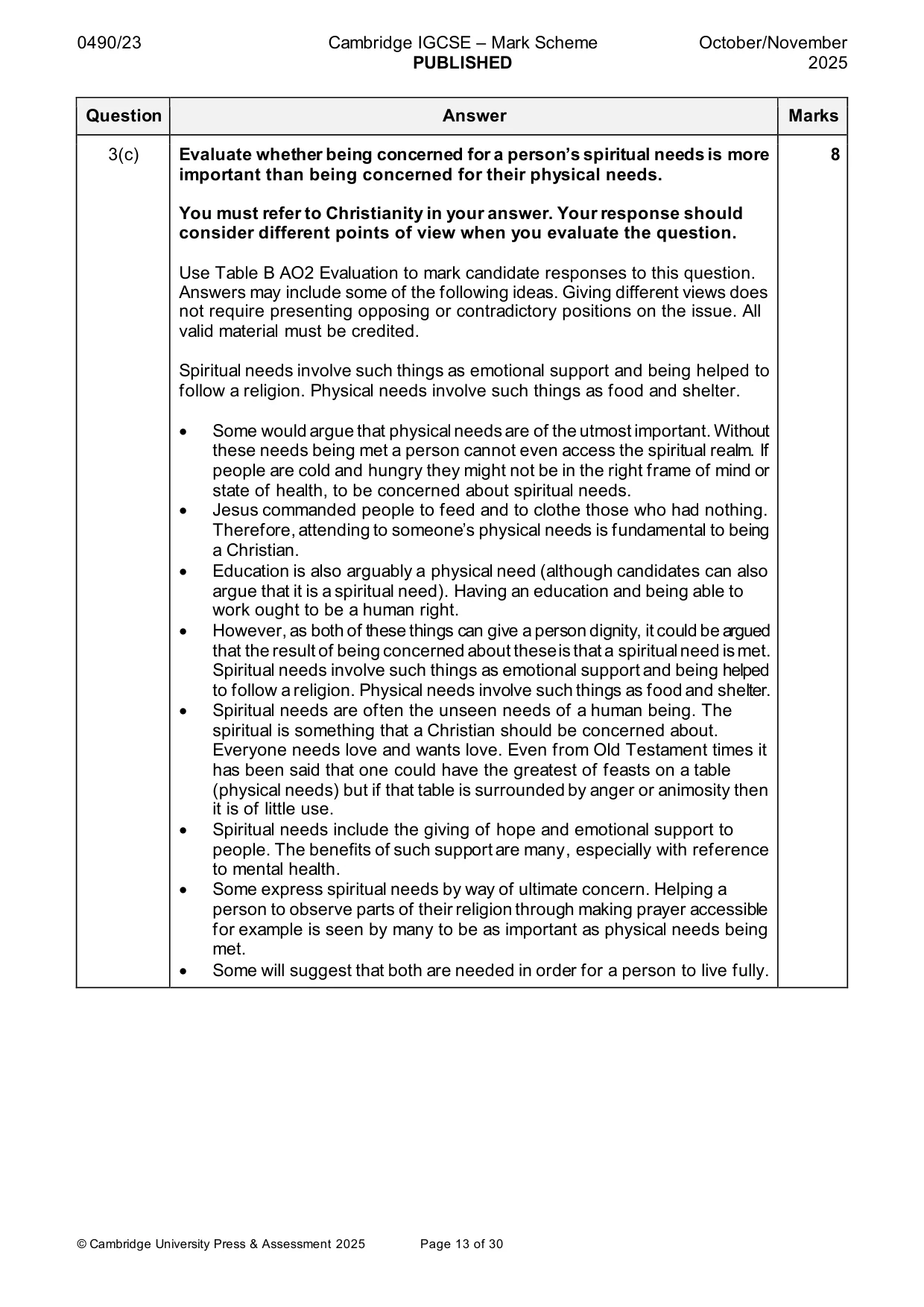
3 (a) (i) State two things a Christian could do as a steward of the Earth. [2] (ii) Outline what Christian missionary work involves. [4] (b) Explain the importance of the Two Greatest Commandments to a Christian’s daily life. [6] (c) Evaluate whether being concerned for a person’s spiritual needs is more important than being concerned for their physical needs. You must refer to Christianity in your answer. Your response should consider different points of view when you evaluate the question. [8] [Total: 20]
Mark scheme: 3(a)(i) State two things a Christian could do as a steward of the Earth. 2 AO1 Knowledge and understanding. Award one mark for each relevant point up to a maximum of two marks. • recycle • pray for harmony in nature/the environment • plant trees • travel less • use fewer natural resources. • campaign/raise awareness. Accept any other valid points. 3(a)(ii) Outline what Christian missionary work involves. 4 AO1 Knowledge and understanding. Award one mark for each relevant point, development or exemplification in any combination, up to a maximum of four marks. • Missionaries spread the teachings of Christianity through traditional evangelism (1) and through practical demonstration of the love of Christ (1). • Missionary work puts Jesus’ teachings into action (1) by caring for the physical needs (1) and emotional/spiritual needs of people (1) through practical aid (1) such as water pumps (1), building schools (1). • They live a life of preaching (1) and prayer (1) and perform acts of charity (1). This could include building churches (1). • It is a life of involvement with the world (1). Accept any other valid points. 3(b) Explain the importance of the Two Greatest Commandments to a 6 Christian’s daily life. Use Table A AO1 Knowledge and understanding to mark candidate responses to this question. Answers may include some of the following ideas. All valid material must be credited. • They are to love God with the totality of oneself and to love your neighbour as yourself. For Christians the Two Greatest Commandments encapsulate the entirety of Christian teaching. Therefore, they should guide a Christian’s behaviour in every aspect of their daily life. • The Two Greatest Commandments are the essence of The Ten Commandments. The first four are about loving God and the remaining six about their duty to love fellow human beings/loving their neighbour as themselves. • All decisions should be guided by whether loving God and loving others like one loves oneself are fulfilled by a particular course of action. If they are, a Christian should perform those actions in life. If not, they should refrain from them in daily life. • The Commandments reflect unconditional love for all, which is a ‘Christian’ love for humanity. • Love for God and love for others can be considered to be two sides of the same coin. One cannot say that one loves God yet mistreats other human beings. These Commandments are important in the daily life of a Christian as they give an ethical dimension to decision making. 3(c) Evaluate whether being concerned for a person’s spiritual needs is more 8 important than being concerned for their physical needs. You must refer to Christianity in your answer. Your response should consider different points of view when you evaluate the question. Use Table B AO2 Evaluation to mark candidate responses to this question. Answers may include some of the following ideas. Giving different views does not require presenting opposing or contradictory positions on the issue. All valid material must be credited. Spiritual needs involve such things as emotional support and being helped to follow a religion. Physical needs involve such things as food and shelter. • Some would argue that physical needs are of the utmost important. Without these needs being met a person cannot even access the spiritual realm. If people are cold and hungry they might not be in the right frame of mind or state of health, to be concerned about spiritual needs. • Jesus commanded people to feed and to clothe those who had nothing. Therefore, attending to someone’s physical needs is fundamental to being a Christian. • Education is also arguably a physical need (although candidates can also argue that it is a spiritual need). Having an education and being able to work ought to be a human right. • However, as both of these things can give a person dignity, it could be argued that the result of being concerned about these is that a spiritual need is met. Spiritual needs involve such things as emotional support and being helped to follow a religion. Physical needs involve such things as food and shelter. • Spiritual needs are often the unseen needs of a human being. The spiritual is something that a Christian should be concerned about. Everyone needs love and wants love. Even from Old Testament times it has been said that one could have the greatest of feasts on a table (physical needs) but if that table is surrounded by anger or animosity then it is of little use. • Spiritual needs include the giving of hope and emotional support to people. The benefits of such support are many, especially with reference to mental health. • Some express spiritual needs by way of ultimate concern. Helping a person to observe parts of their religion through making prayer accessible for example is seen by many to be as important as physical needs being met. • Some will suggest that both are needed in order for a person to live fully.
Q4 · Identify two things Muslims do during ʿId al-Fitr
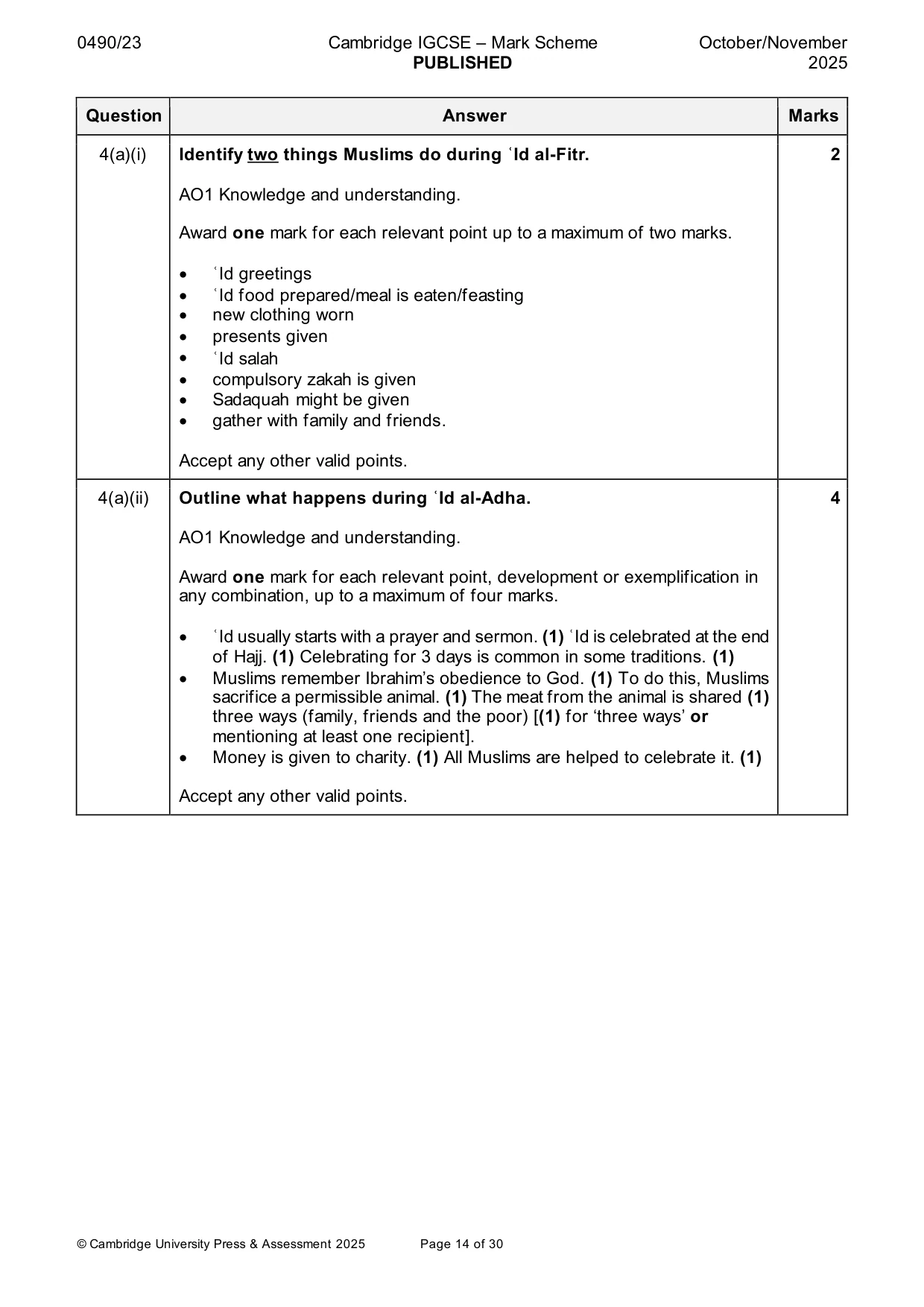
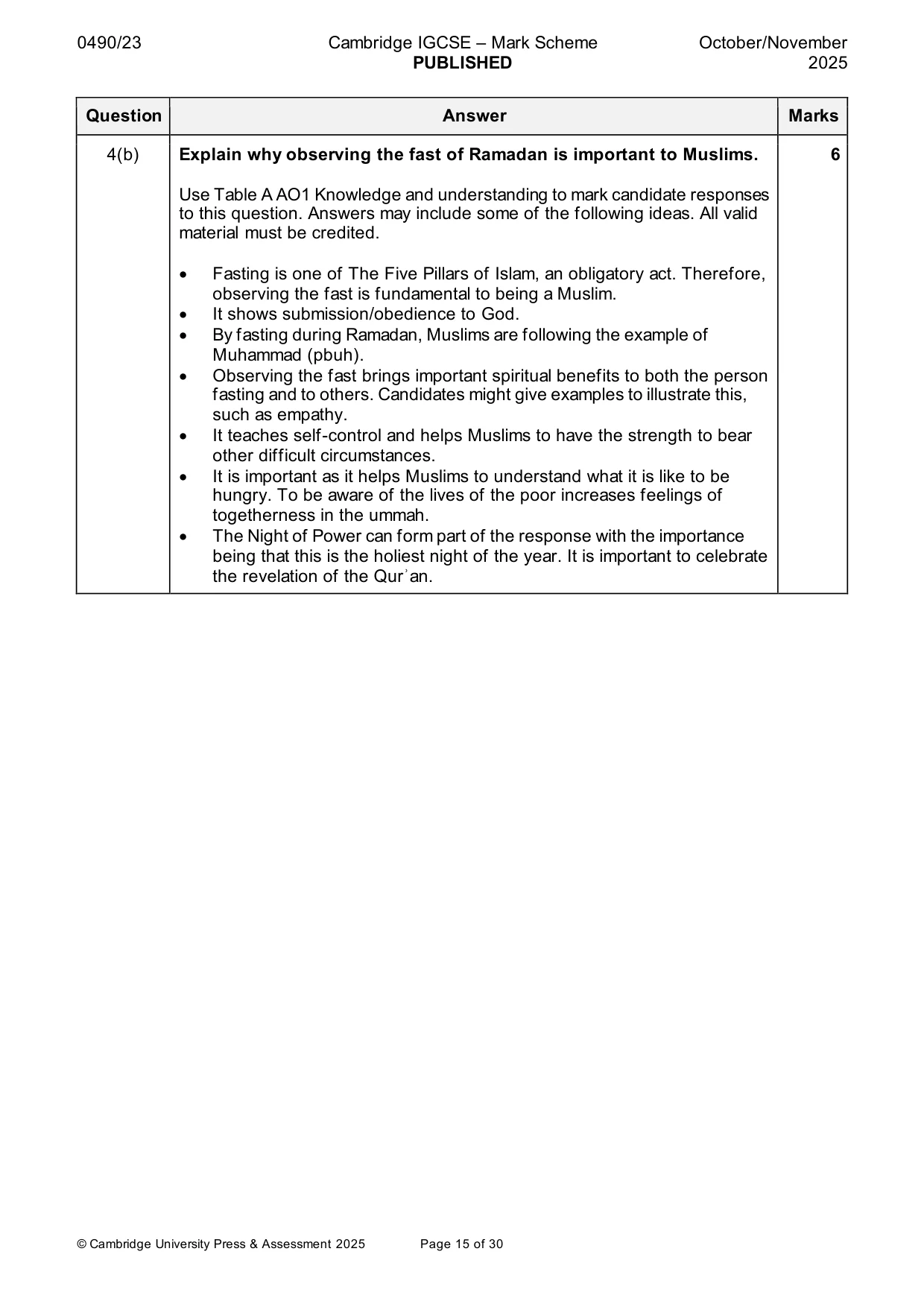
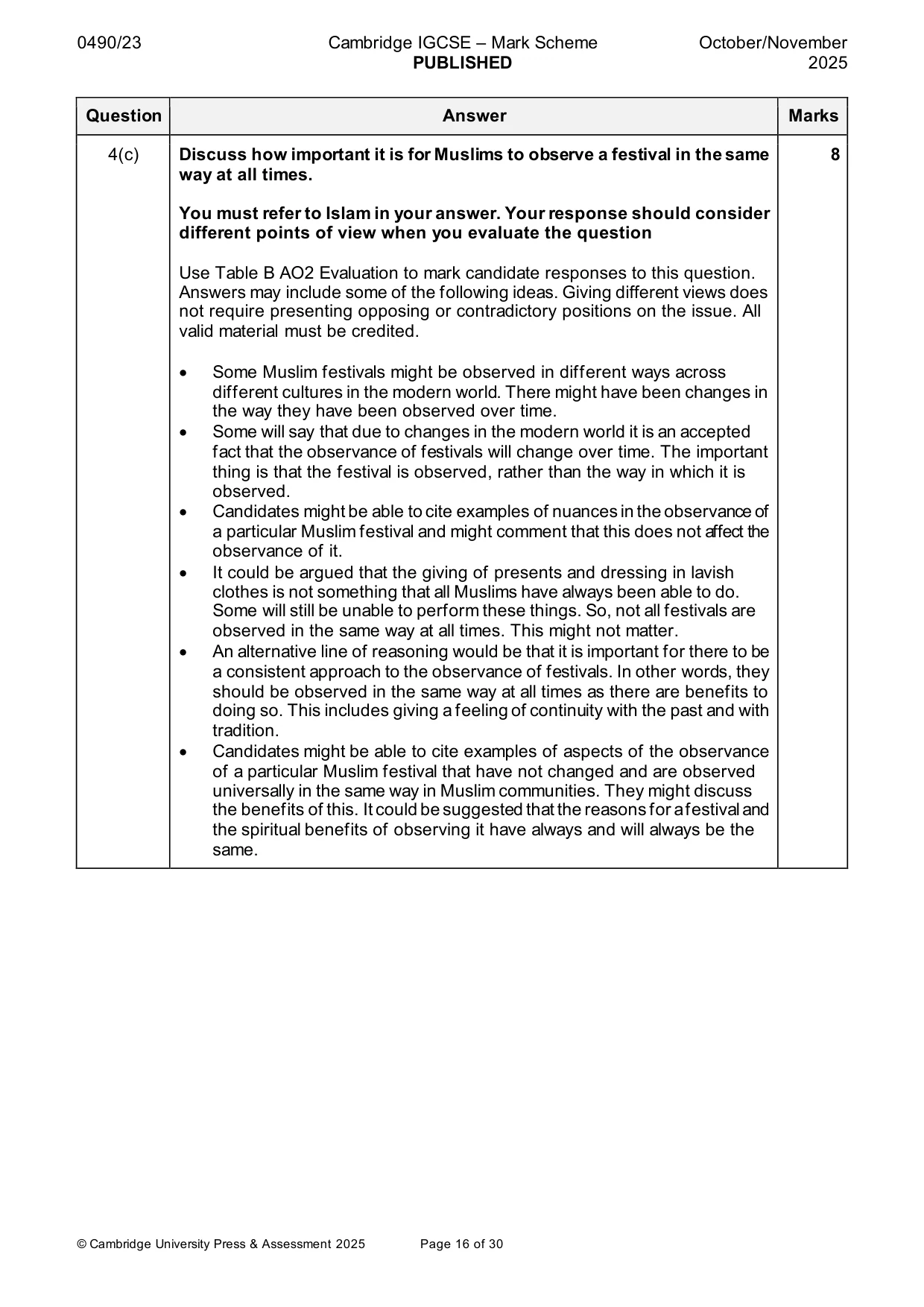
4 (a) (i) Identify two things Muslims do during ʿId al-Fitr. [2] (ii) Outline what happens during ʿId al-Adha. [4] (b) Explain why observing the fast of Ramadan is important to Muslims. [6] (c) Discuss how important it is for Muslims to observe a festival in the same way at all times. You must refer to Islam in your answer. Your response should consider different points of view when you evaluate the question. [8] [Total: 20]
Mark scheme: 4(a)(i) Identify two things Muslims do during ʿId al-Fitr. 2 AO1 Knowledge and understanding. Award one mark for each relevant point up to a maximum of two marks. • ʿId greetings • ʿId food prepared/meal is eaten/feasting • new clothing worn • presents given • ʿId salah • compulsory zakah is given • Sadaquah might be given • gather with family and friends. Accept any other valid points. 4(a)(ii) Outline what happens during ʿId al-Adha. 4 AO1 Knowledge and understanding. Award one mark for each relevant point, development or exemplification in any combination, up to a maximum of four marks. • ʿId usually starts with a prayer and sermon. (1) ʿId is celebrated at the end of Hajj. (1) Celebrating for 3 days is common in some traditions. (1) • Muslims remember Ibrahim’s obedience to God. (1) To do this, Muslims sacrifice a permissible animal. (1) The meat from the animal is shared (1) three ways (family, friends and the poor) [(1) for ‘three ways’ or mentioning at least one recipient]. • Money is given to charity. (1) All Muslims are helped to celebrate it. (1) Accept any other valid points. 4(b) Explain why observing the fast of Ramadan is important to Muslims. 6 Use Table A AO1 Knowledge and understanding to mark candidate responses to this question. Answers may include some of the following ideas. All valid material must be credited. • Fasting is one of The Five Pillars of Islam, an obligatory act. Therefore, observing the fast is fundamental to being a Muslim. • It shows submission/obedience to God. • By fasting during Ramadan, Muslims are following the example of Muhammad (pbuh). • Observing the fast brings important spiritual benefits to both the person fasting and to others. Candidates might give examples to illustrate this, such as empathy. • It teaches self-control and helps Muslims to have the strength to bear other difficult circumstances. • It is important as it helps Muslims to understand what it is like to be hungry. To be aware of the lives of the poor increases feelings of togetherness in the ummah. • The Night of Power can form part of the response with the importance being that this is the holiest night of the year. It is important to celebrate the revelation of the Qurʾan. 4(c) Discuss how important it is for Muslims to observe a festival in the same 8 way at all times. You must refer to Islam in your answer. Your response should consider different points of view when you evaluate the question Use Table B AO2 Evaluation to mark candidate responses to this question. Answers may include some of the following ideas. Giving different views does not require presenting opposing or contradictory positions on the issue. All valid material must be credited. • Some Muslim festivals might be observed in different ways across different cultures in the modern world. There might have been changes in the way they have been observed over time. • Some will say that due to changes in the modern world it is an accepted fact that the observance of festivals will change over time. The important thing is that the festival is observed, rather than the way in which it is observed. • Candidates might be able to cite examples of nuances in the observance of a particular Muslim festival and might comment that this does not affect the observance of it. • It could be argued that the giving of presents and dressing in lavish clothes is not something that all Muslims have always been able to do. Some will still be unable to perform these things. So, not all festivals are observed in the same way at all times. This might not matter. • An alternative line of reasoning would be that it is important for there to be a consistent approach to the observance of festivals. In other words, they should be observed in the same way at all times as there are benefits to doing so. This includes giving a feeling of continuity with the past and with tradition. • Candidates might be able to cite examples of aspects of the observance of a particular Muslim festival that have not changed and are observed universally in the same way in Muslim communities. They might discuss the benefits of this. It could be suggested that the reasons for a festival and the spiritual benefits of observing it have always and will always be the same.
Q5 · State two things parents could do to raise their children as Muslims
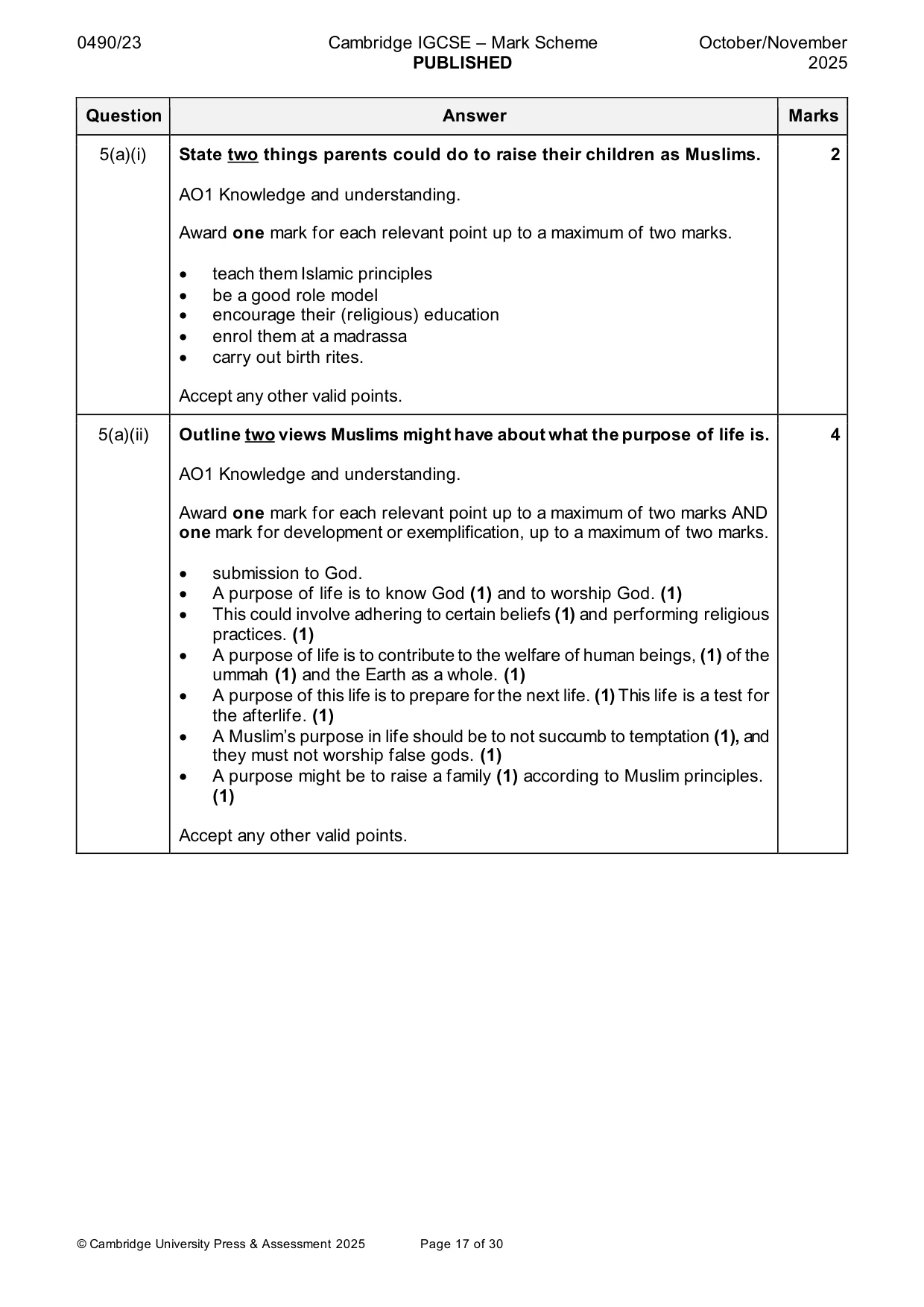
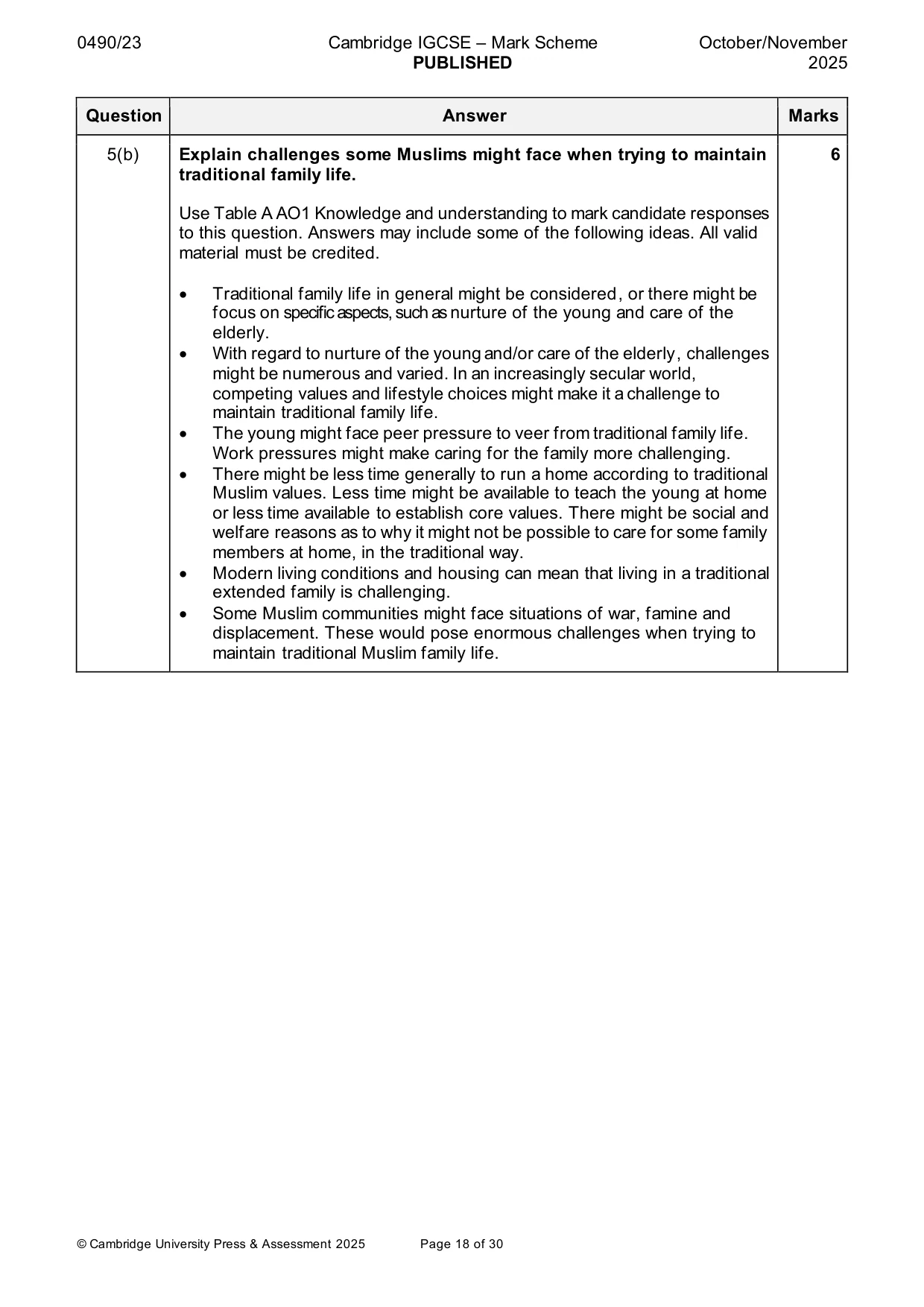
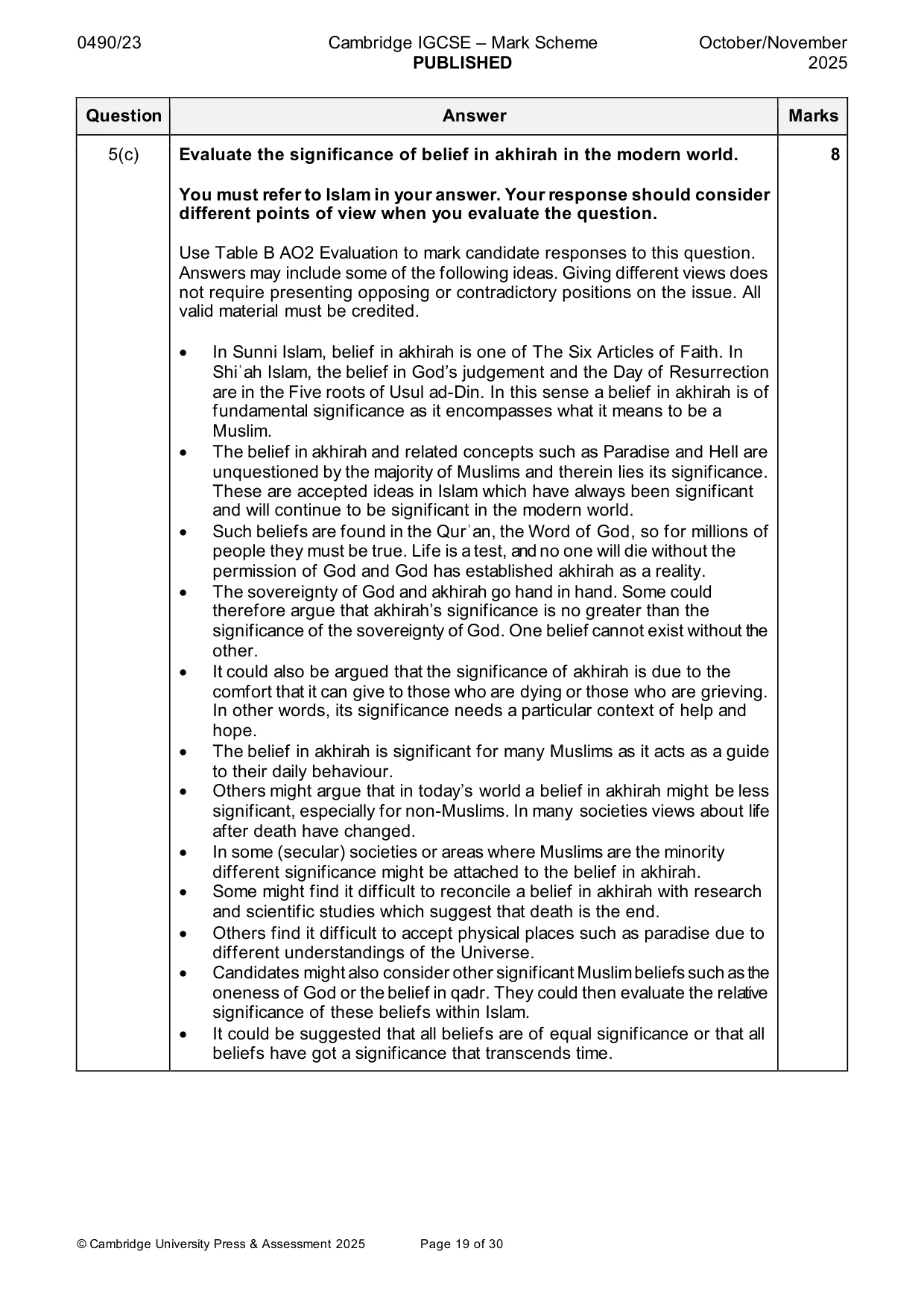
5 (a) (i) State two things parents could do to raise their children as Muslims. [2] (ii) Outline two views Muslims might have about what the purpose of life is. [4] (b) Explain challenges some Muslims might face when trying to maintain traditional family life.[6] (c) Evaluate the significance of belief in akhirah in the modern world. You must refer to Islam in your answer. Your response should consider different points of view when you evaluate the question. [8] [Total: 20]
Mark scheme: 5(a)(i) State two things parents could do to raise their children as Muslims. 2 AO1 Knowledge and understanding. Award one mark for each relevant point up to a maximum of two marks. • teach them Islamic principles • be a good role model • encourage their (religious) education • enrol them at a madrassa • carry out birth rites. Accept any other valid points. 5(a)(ii) Outline two views Muslims might have about what the purpose of life is. 4 AO1 Knowledge and understanding. Award one mark for each relevant point up to a maximum of two marks AND one mark for development or exemplification, up to a maximum of two marks. • submission to God. • A purpose of life is to know God (1) and to worship God. (1) • This could involve adhering to certain beliefs (1) and performing religious practices. (1) • A purpose of life is to contribute to the welfare of human beings, (1) of the ummah (1) and the Earth as a whole. (1) • A purpose of this life is to prepare for the next life. (1) This life is a test for the afterlife. (1) • A Muslim’s purpose in life should be to not succumb to temptation (1), and they must not worship false gods. (1) • A purpose might be to raise a family (1) according to Muslim principles. (1) Accept any other valid points. 5(b) Explain challenges some Muslims might face when trying to maintain 6 traditional family life. Use Table A AO1 Knowledge and understanding to mark candidate responses to this question. Answers may include some of the following ideas. All valid material must be credited. • Traditional family life in general might be considered, or there might be focus on specific aspects, such as nurture of the young and care of the elderly. • With regard to nurture of the young and/or care of the elderly, challenges might be numerous and varied. In an increasingly secular world, competing values and lifestyle choices might make it a challenge to maintain traditional family life. • The young might face peer pressure to veer from traditional family life. Work pressures might make caring for the family more challenging. • There might be less time generally to run a home according to traditional Muslim values. Less time might be available to teach the young at home or less time available to establish core values. There might be social and welfare reasons as to why it might not be possible to care for some family members at home, in the traditional way. • Modern living conditions and housing can mean that living in a traditional extended family is challenging. • Some Muslim communities might face situations of war, famine and displacement. These would pose enormous challenges when trying to maintain traditional Muslim family life. 5(c) Evaluate the significance of belief in akhirah in the modern world. 8 You must refer to Islam in your answer. Your response should consider different points of view when you evaluate the question. Use Table B AO2 Evaluation to mark candidate responses to this question. Answers may include some of the following ideas. Giving different views does not require presenting opposing or contradictory positions on the issue. All valid material must be credited. • In Sunni Islam, belief in akhirah is one of The Six Articles of Faith. In Shiʿah Islam, the belief in God’s judgement and the Day of Resurrection are in the Five roots of Usul ad-Din. In this sense a belief in akhirah is of fundamental significance as it encompasses what it means to be a Muslim. • The belief in akhirah and related concepts such as Paradise and Hell are unquestioned by the majority of Muslims and therein lies its significance. These are accepted ideas in Islam which have always been significant and will continue to be significant in the modern world. • Such beliefs are found in the Qurʾan, the Word of God, so for millions of people they must be true. Life is a test, and no one will die without the permission of God and God has established akhirah as a reality. • The sovereignty of God and akhirah go hand in hand. Some could therefore argue that akhirah’s significance is no greater than the significance of the sovereignty of God. One belief cannot exist without the other. • It could also be argued that the significance of akhirah is due to the comfort that it can give to those who are dying or those who are grieving. In other words, its significance needs a particular context of help and hope. • The belief in akhirah is significant for many Muslims as it acts as a guide to their daily behaviour. • Others might argue that in today’s world a belief in akhirah might be less significant, especially for non-Muslims. In many societies views about life after death have changed. • In some (secular) societies or areas where Muslims are the minority different significance might be attached to the belief in akhirah. • Some might find it difficult to reconcile a belief in akhirah with research and scientific studies which suggest that death is the end. • Others find it difficult to accept physical places such as paradise due to different understandings of the Universe. • Candidates might also consider other significant Muslim beliefs such as the oneness of God or the belief in qadr. They could then evaluate the relative significance of these beliefs within Islam. • It could be suggested that all beliefs are of equal significance or that all beliefs have got a significance that transcends time.
Q6 · State two sources of Shariʿah
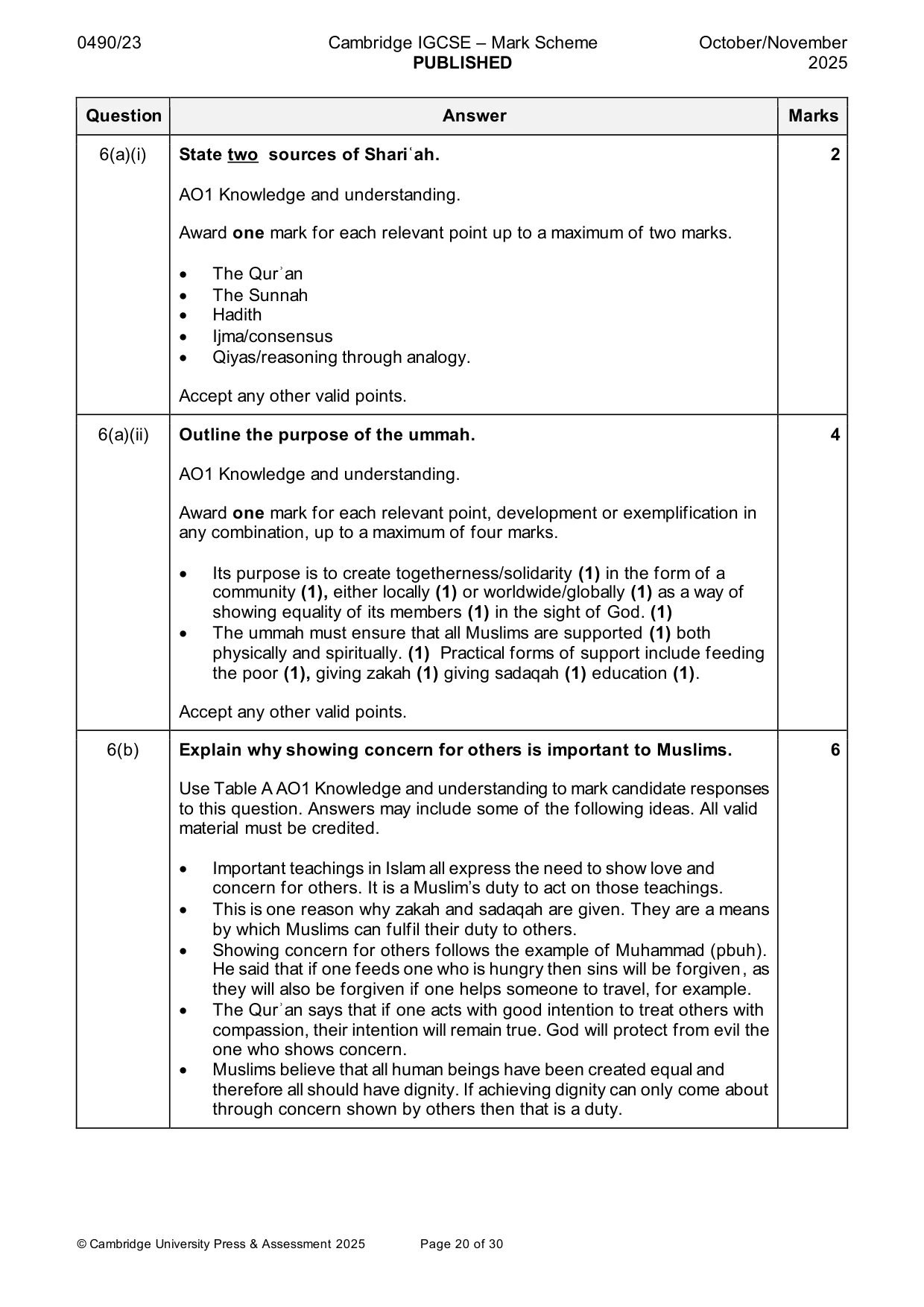
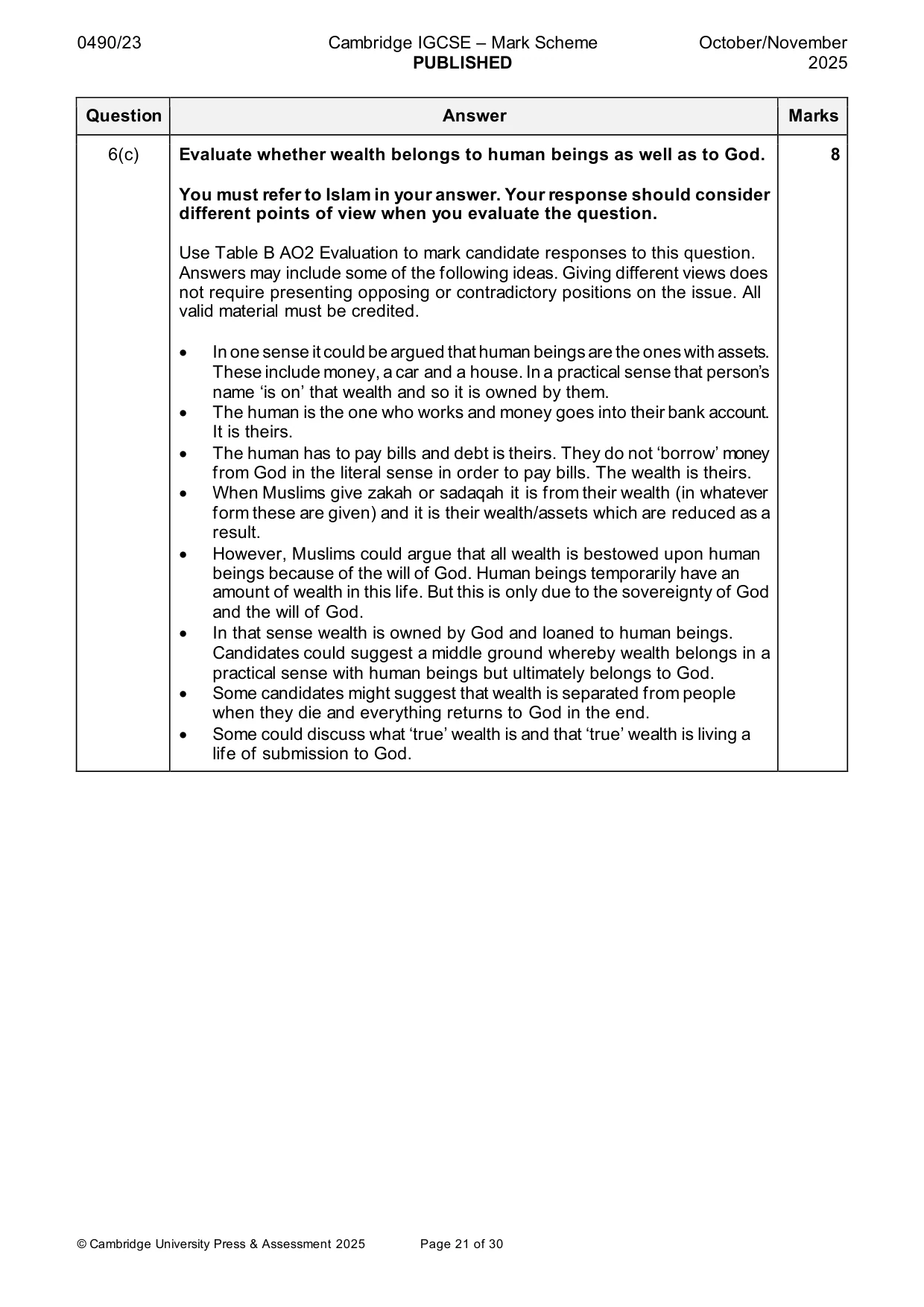
6 (a) (i) State two sources of Shariʿah. [2] (ii) Outline the purpose of the ummah. [4] (b) Explain why showing concern for others is important to Muslims. [6] (c) Evaluate whether wealth belongs to human beings as well as to God. You must refer to Islam in your answer. Your response should consider different points of view when you evaluate the question. [8] [Total: 20] Section C – Judaism If you have chosen this section, you must answer two questions.
Mark scheme: 6(a)(i) State two sources of Shariʿah. 2 AO1 Knowledge and understanding. Award one mark for each relevant point up to a maximum of two marks. • The Qurʾan • The Sunnah • Hadith • Ijma/consensus • Qiyas/reasoning through analogy. Accept any other valid points. 6(a)(ii) Outline the purpose of the ummah. 4 AO1 Knowledge and understanding. Award one mark for each relevant point, development or exemplification in any combination, up to a maximum of four marks. • Its purpose is to create togetherness/solidarity (1) in the form of a community (1), either locally (1) or worldwide/globally (1) as a way of showing equality of its members (1) in the sight of God. (1) • The ummah must ensure that all Muslims are supported (1) both physically and spiritually. (1) Practical forms of support include feeding the poor (1), giving zakah (1) giving sadaqah (1) education (1). Accept any other valid points. 6(b) Explain why showing concern for others is important to Muslims. 6 Use Table A AO1 Knowledge and understanding to mark candidate responses to this question. Answers may include some of the following ideas. All valid material must be credited. • Important teachings in Islam all express the need to show love and concern for others. It is a Muslim’s duty to act on those teachings. • This is one reason why zakah and sadaqah are given. They are a means by which Muslims can fulfil their duty to others. • Showing concern for others follows the example of Muhammad (pbuh). He said that if one feeds one who is hungry then sins will be forgiven, as they will also be forgiven if one helps someone to travel, for example. • The Qurʾan says that if one acts with good intention to treat others with compassion, their intention will remain true. God will protect from evil the one who shows concern. • Muslims believe that all human beings have been created equal and therefore all should have dignity. If achieving dignity can only come about through concern shown by others then that is a duty. 6(c) Evaluate whether wealth belongs to human beings as well as to God. 8 You must refer to Islam in your answer. Your response should consider different points of view when you evaluate the question. Use Table B AO2 Evaluation to mark candidate responses to this question. Answers may include some of the following ideas. Giving different views does not require presenting opposing or contradictory positions on the issue. All valid material must be credited. • In one sense it could be argued that human beings are the ones with assets. These include money, a car and a house. In a practical sense that person’s name ‘is on’ that wealth and so it is owned by them. • The human is the one who works and money goes into their bank account. It is theirs. • The human has to pay bills and debt is theirs. They do not ‘borrow’ money from God in the literal sense in order to pay bills. The wealth is theirs. • When Muslims give zakah or sadaqah it is from their wealth (in whatever form these are given) and it is their wealth/assets which are reduced as a result. • However, Muslims could argue that all wealth is bestowed upon human beings because of the will of God. Human beings temporarily have an amount of wealth in this life. But this is only due to the sovereignty of God and the will of God. • In that sense wealth is owned by God and loaned to human beings. Candidates could suggest a middle ground whereby wealth belongs in a practical sense with human beings but ultimately belongs to God. • Some candidates might suggest that wealth is separated from people when they die and everything returns to God in the end. • Some could discuss what ‘true’ wealth is and that ‘true’ wealth is living a life of submission to God.
Q7 · Give two of the four species of plant used at Sukkot
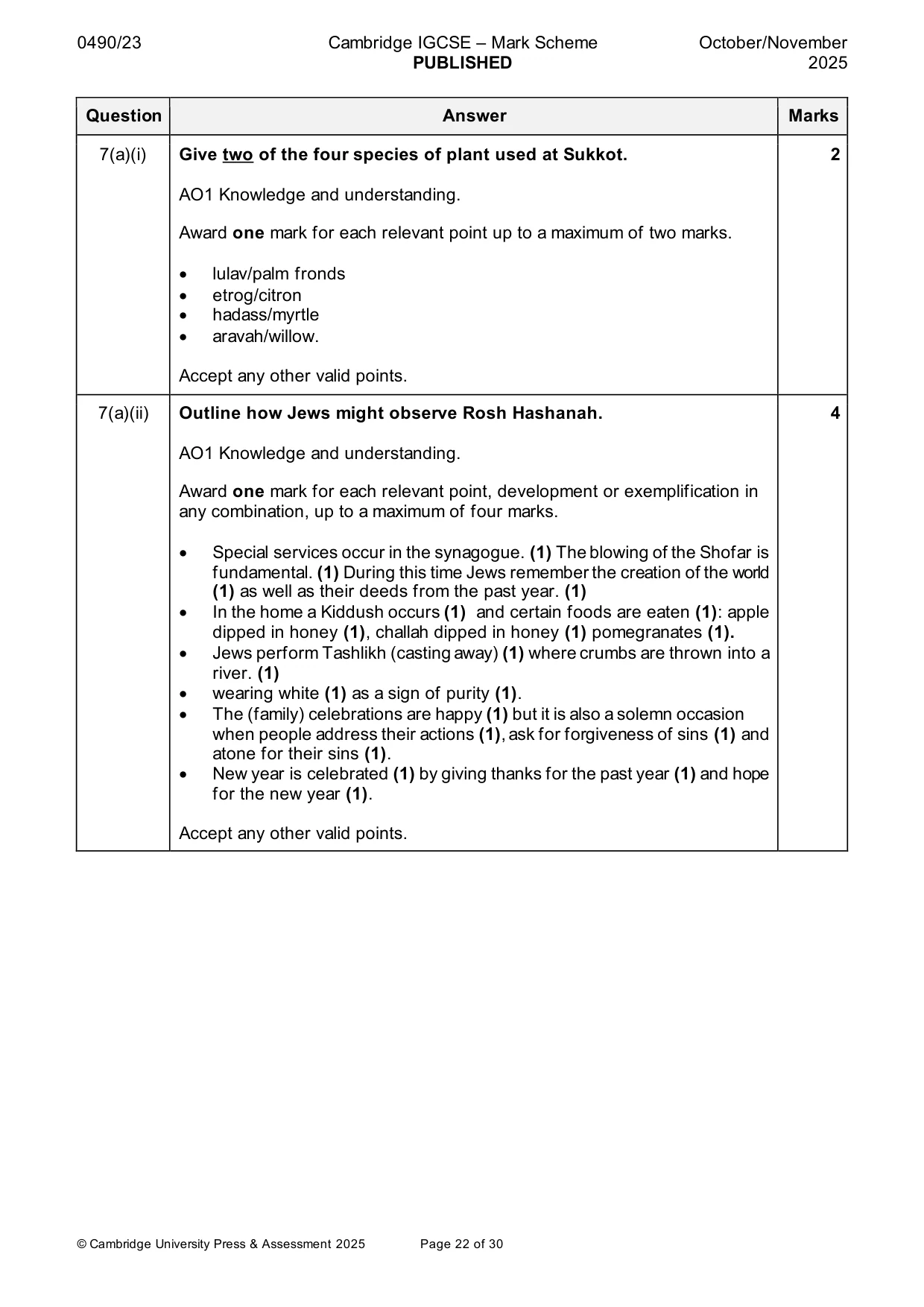
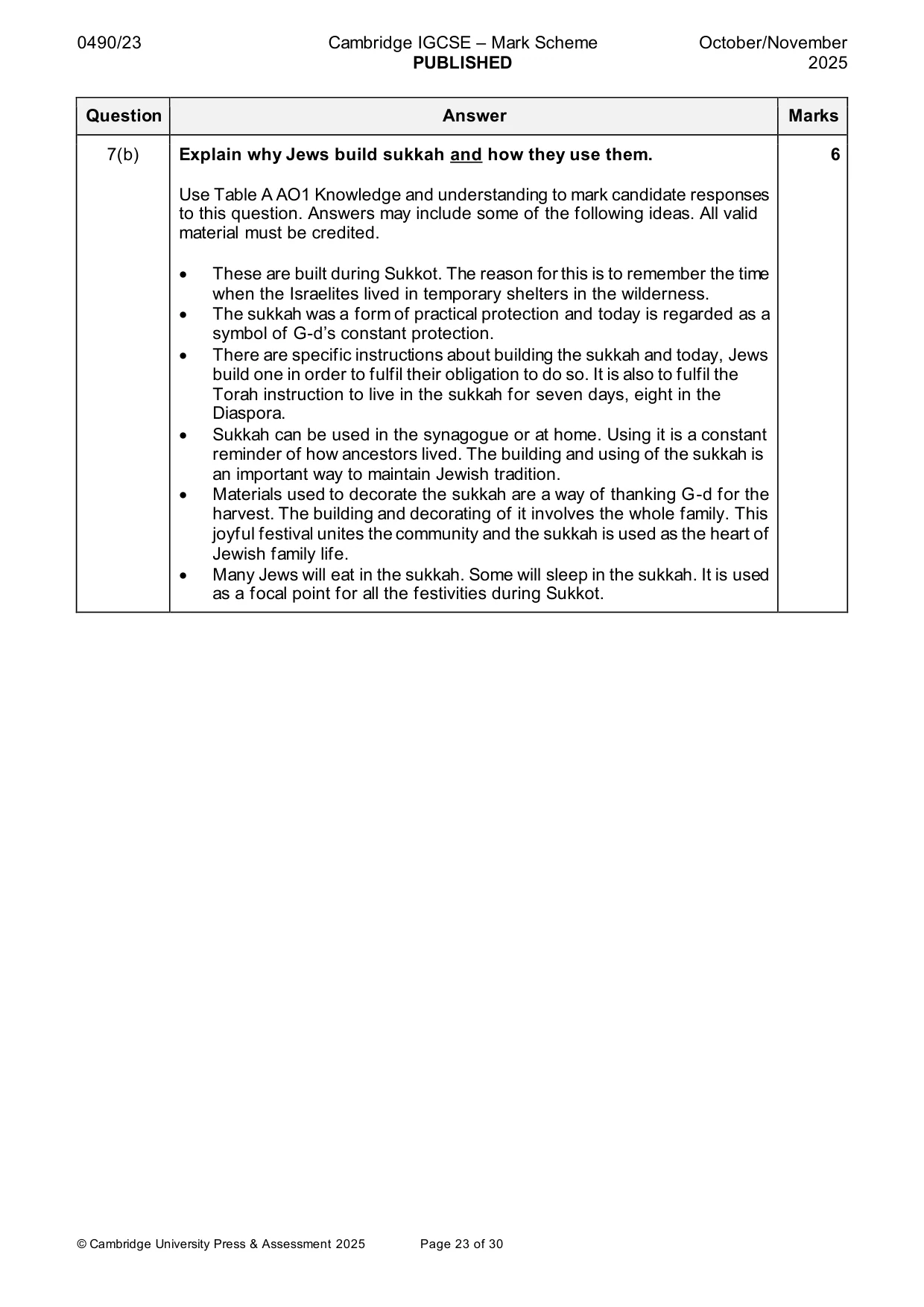
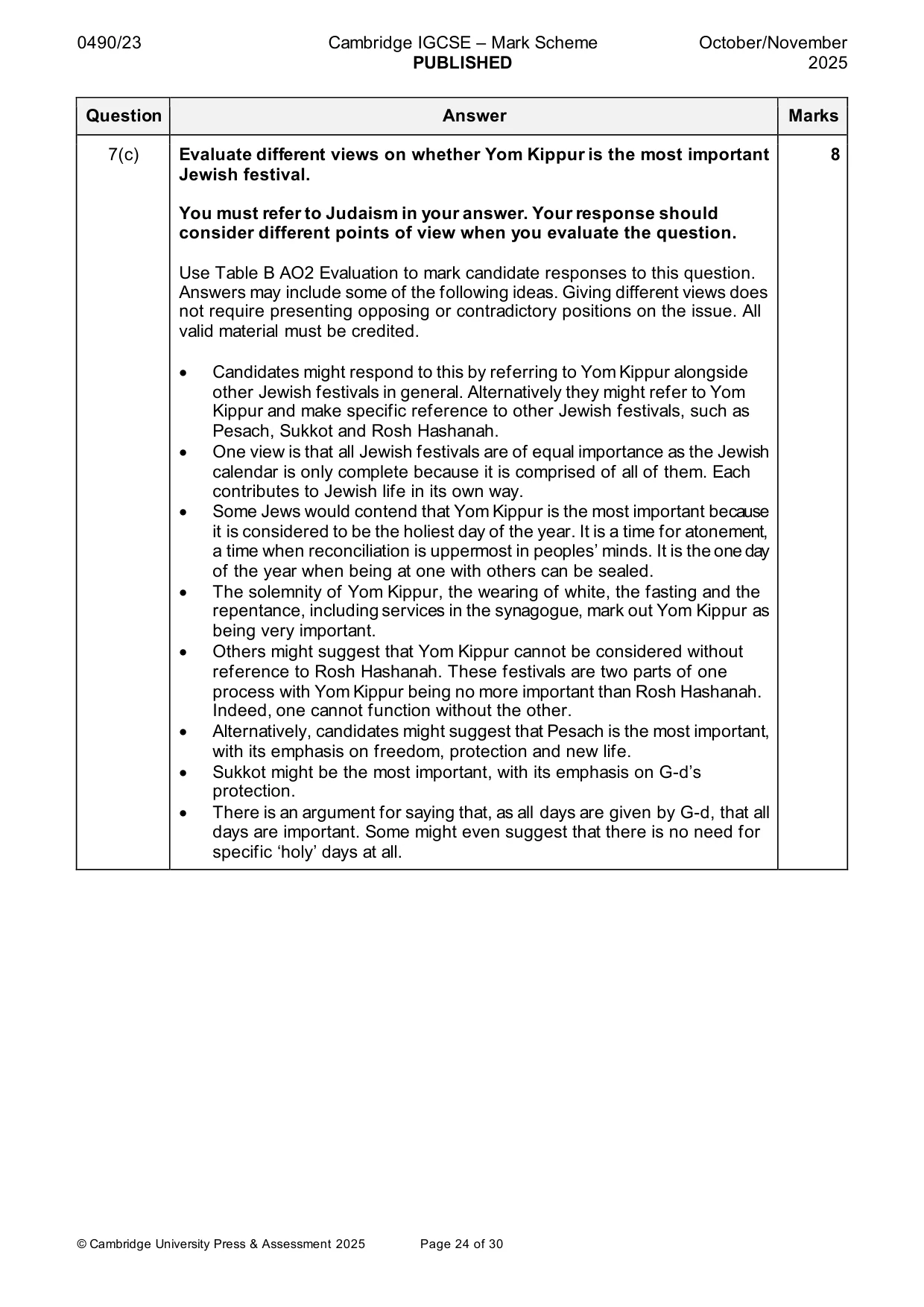
7 (a) (i) Give two of the four species of plant used at Sukkot. [2] (ii) Outline how Jews might observe Rosh Hashanah. [4] (b) Explain why Jews build sukkah and how they use them. [6] (c) Evaluate different views on whether Yom Kippur is the most important Jewish festival. You must refer to Judaism in your answer. Your response should consider different points of view when you evaluate the question. [8] [Total: 20]
Mark scheme: 7(a)(i) Give two of the four species of plant used at Sukkot. 2 AO1 Knowledge and understanding. Award one mark for each relevant point up to a maximum of two marks. • lulav/palm fronds • etrog/citron • hadass/myrtle • aravah/willow. Accept any other valid points. 7(a)(ii) Outline how Jews might observe Rosh Hashanah. 4 AO1 Knowledge and understanding. Award one mark for each relevant point, development or exemplification in any combination, up to a maximum of four marks. • Special services occur in the synagogue. (1) The blowing of the Shofar is fundamental. (1) During this time Jews remember the creation of the world (1) as well as their deeds from the past year. (1) • In the home a Kiddush occurs (1) and certain foods are eaten (1): apple dipped in honey (1), challah dipped in honey (1) pomegranates (1). • Jews perform Tashlikh (casting away) (1) where crumbs are thrown into a river. (1) • wearing white (1) as a sign of purity (1). • The (family) celebrations are happy (1) but it is also a solemn occasion when people address their actions (1), ask for forgiveness of sins (1) and atone for their sins (1). • New year is celebrated (1) by giving thanks for the past year (1) and hope for the new year (1). Accept any other valid points. 7(b) Explain why Jews build sukkah and how they use them. 6 Use Table A AO1 Knowledge and understanding to mark candidate responses to this question. Answers may include some of the following ideas. All valid material must be credited. • These are built during Sukkot. The reason for this is to remember the time when the Israelites lived in temporary shelters in the wilderness. • The sukkah was a form of practical protection and today is regarded as a symbol of G-d’s constant protection. • There are specific instructions about building the sukkah and today, Jews build one in order to fulfil their obligation to do so. It is also to fulfil the Torah instruction to live in the sukkah for seven days, eight in the Diaspora. • Sukkah can be used in the synagogue or at home. Using it is a constant reminder of how ancestors lived. The building and using of the sukkah is an important way to maintain Jewish tradition. • Materials used to decorate the sukkah are a way of thanking G-d for the harvest. The building and decorating of it involves the whole family. This joyful festival unites the community and the sukkah is used as the heart of Jewish family life. • Many Jews will eat in the sukkah. Some will sleep in the sukkah. It is used as a focal point for all the festivities during Sukkot. 7(c) Evaluate different views on whether Yom Kippur is the most important 8 Jewish festival. You must refer to Judaism in your answer. Your response should consider different points of view when you evaluate the question. Use Table B AO2 Evaluation to mark candidate responses to this question. Answers may include some of the following ideas. Giving different views does not require presenting opposing or contradictory positions on the issue. All valid material must be credited. • Candidates might respond to this by referring to Yom Kippur alongside other Jewish festivals in general. Alternatively they might refer to Yom Kippur and make specific reference to other Jewish festivals, such as Pesach, Sukkot and Rosh Hashanah. • One view is that all Jewish festivals are of equal importance as the Jewish calendar is only complete because it is comprised of all of them. Each contributes to Jewish life in its own way. • Some Jews would contend that Yom Kippur is the most important because it is considered to be the holiest day of the year. It is a time for atonement, a time when reconciliation is uppermost in peoples’ minds. It is the one day of the year when being at one with others can be sealed. • The solemnity of Yom Kippur, the wearing of white, the fasting and the repentance, including services in the synagogue, mark out Yom Kippur as being very important. • Others might suggest that Yom Kippur cannot be considered without reference to Rosh Hashanah. These festivals are two parts of one process with Yom Kippur being no more important than Rosh Hashanah. Indeed, one cannot function without the other. • Alternatively, candidates might suggest that Pesach is the most important, with its emphasis on freedom, protection and new life. • Sukkot might be the most important, with its emphasis on G-d’s protection. • There is an argument for saying that, as all days are given by G-d, that all days are important. Some might even suggest that there is no need for specific ‘holy’ days at all.
Q8 · Identify two things about a chuppah
8 (a) (i) Identify two things about a chuppah. [2] (ii) Outline kashrut laws for a Jewish kitchen. [4] (b) Explain different Jewish attitudes towards remarriage. [6] (c) Evaluate the importance of a boy becoming Bar Mitzvah for different Jewish communities. You must refer to Judaism in your answer. Your response should consider different points of view when you evaluate the question. [8] [Total: 20]
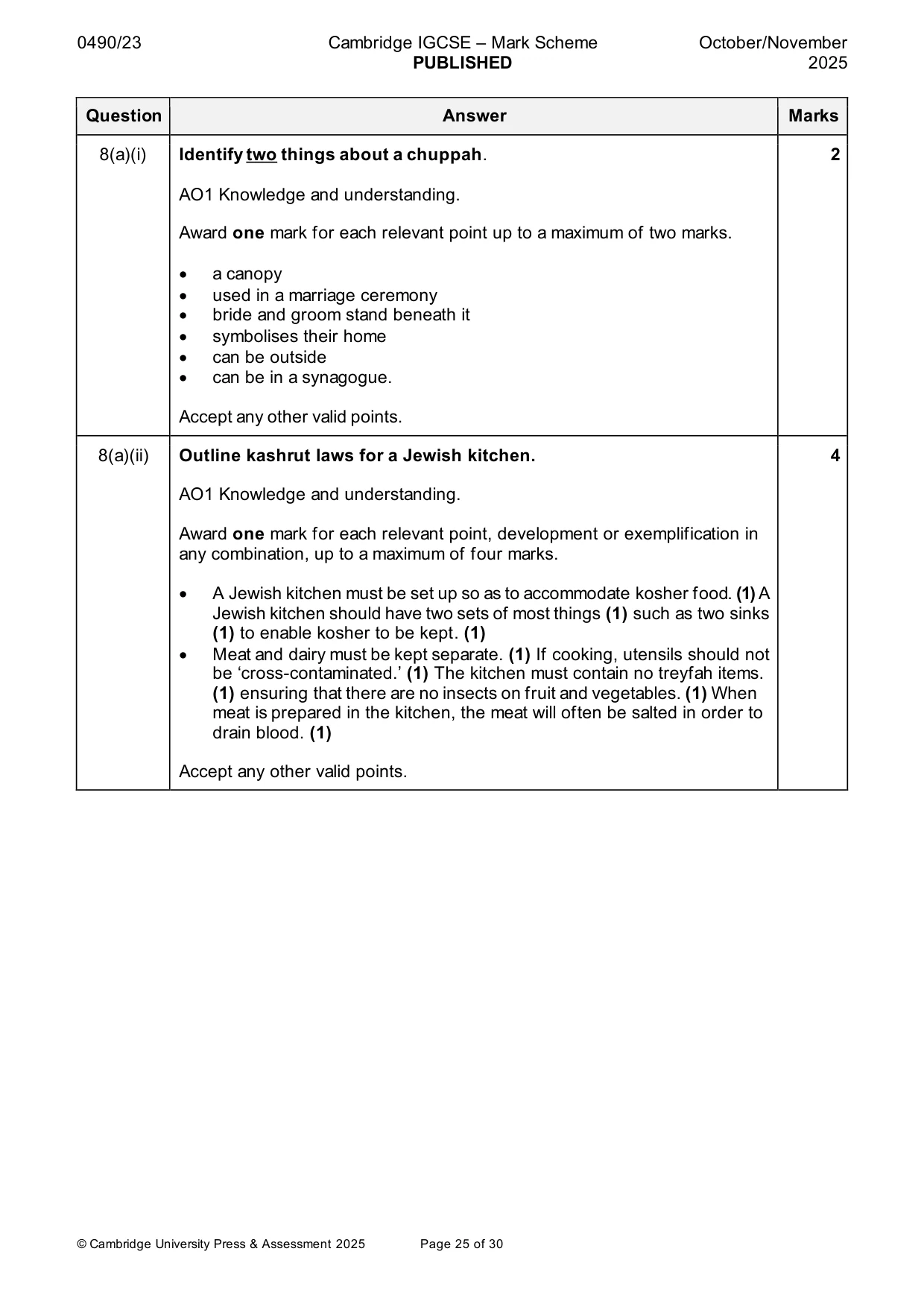
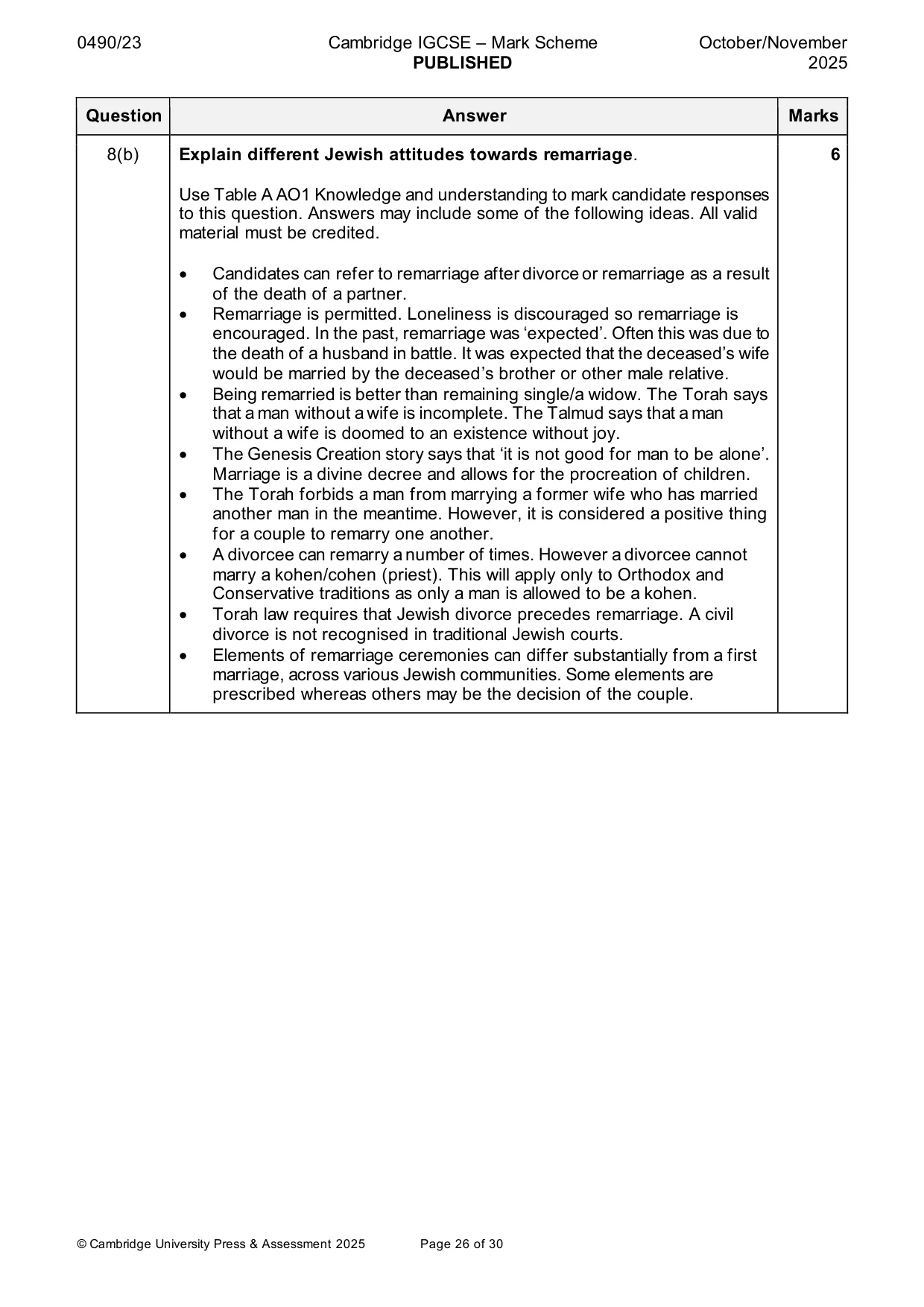
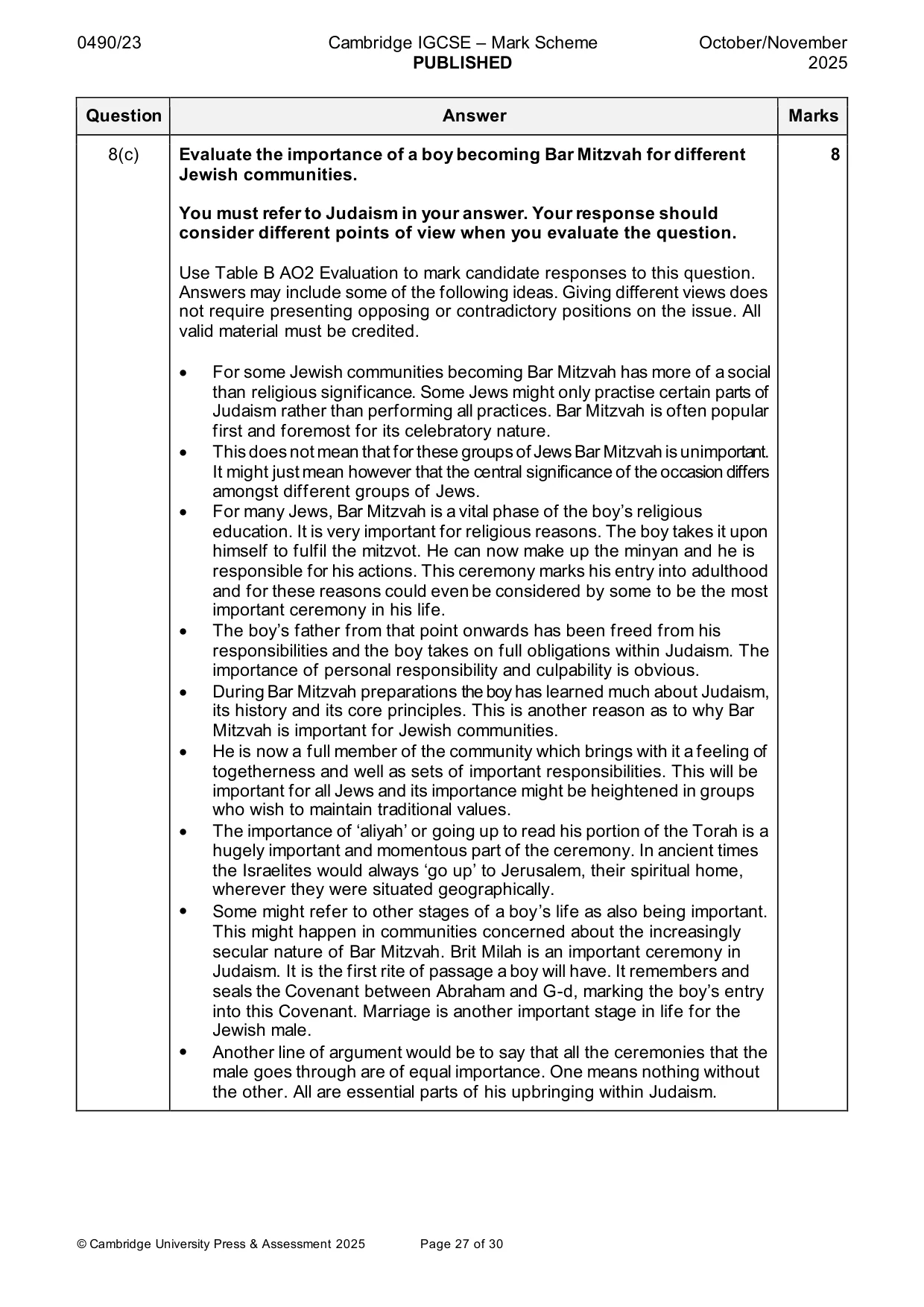
Mark scheme: 8(a)(i) Identify two things about a chuppah. 2 AO1 Knowledge and understanding. Award one mark for each relevant point up to a maximum of two marks. • a canopy • used in a marriage ceremony • bride and groom stand beneath it • symbolises their home • can be outside • can be in a synagogue. Accept any other valid points. 8(a)(ii) Outline kashrut laws for a Jewish kitchen. 4 AO1 Knowledge and understanding. Award one mark for each relevant point, development or exemplification in any combination, up to a maximum of four marks. • A Jewish kitchen must be set up so as to accommodate kosher food. (1) A Jewish kitchen should have two sets of most things (1) such as two sinks (1) to enable kosher to be kept. (1) • Meat and dairy must be kept separate. (1) If cooking, utensils should not be ‘cross-contaminated.’ (1) The kitchen must contain no treyfah items. (1) ensuring that there are no insects on fruit and vegetables. (1) When meat is prepared in the kitchen, the meat will often be salted in order to drain blood. (1) Accept any other valid points. 8(b) Explain different Jewish attitudes towards remarriage. 6 Use Table A AO1 Knowledge and understanding to mark candidate responses to this question. Answers may include some of the following ideas. All valid material must be credited. • Candidates can refer to remarriage after divorce or remarriage as a result of the death of a partner. • Remarriage is permitted. Loneliness is discouraged so remarriage is encouraged. In the past, remarriage was ‘expected’. Often this was due to the death of a husband in battle. It was expected that the deceased’s wife would be married by the deceased’s brother or other male relative. • Being remarried is better than remaining single/a widow. The Torah says that a man without a wife is incomplete. The Talmud says that a man without a wife is doomed to an existence without joy. • The Genesis Creation story says that ‘it is not good for man to be alone’. Marriage is a divine decree and allows for the procreation of children. • The Torah forbids a man from marrying a former wife who has married another man in the meantime. However, it is considered a positive thing for a couple to remarry one another. • A divorcee can remarry a number of times. However a divorcee cannot marry a kohen/cohen (priest). This will apply only to Orthodox and Conservative traditions as only a man is allowed to be a kohen. • Torah law requires that Jewish divorce precedes remarriage. A civil divorce is not recognised in traditional Jewish courts. • Elements of remarriage ceremonies can differ substantially from a first marriage, across various Jewish communities. Some elements are prescribed whereas others may be the decision of the couple. 8(c) Evaluate the importance of a boy becoming Bar Mitzvah for different 8 Jewish communities. You must refer to Judaism in your answer. Your response should consider different points of view when you evaluate the question. Use Table B AO2 Evaluation to mark candidate responses to this question. Answers may include some of the following ideas. Giving different views does not require presenting opposing or contradictory positions on the issue. All valid material must be credited. • For some Jewish communities becoming Bar Mitzvah has more of a social than religious significance. Some Jews might only practise certain parts of Judaism rather than performing all practices. Bar Mitzvah is often popular first and foremost for its celebratory nature. • This does not mean that for these groups of Jews Bar Mitzvah is unimportant. It might just mean however that the central significance of the occasion differs amongst different groups of Jews. • For many Jews, Bar Mitzvah is a vital phase of the boy’s religious education. It is very important for religious reasons. The boy takes it upon himself to fulfil the mitzvot. He can now make up the minyan and he is responsible for his actions. This ceremony marks his entry into adulthood and for these reasons could even be considered by some to be the most important ceremony in his life. • The boy’s father from that point onwards has been freed from his responsibilities and the boy takes on full obligations within Judaism. The importance of personal responsibility and culpability is obvious. • During Bar Mitzvah preparations the boy has learned much about Judaism, its history and its core principles. This is another reason as to why Bar Mitzvah is important for Jewish communities. • He is now a full member of the community which brings with it a feeling of togetherness and well as sets of important responsibilities. This will be important for all Jews and its importance might be heightened in groups who wish to maintain traditional values. • The importance of ‘aliyah’ or going up to read his portion of the Torah is a hugely important and momentous part of the ceremony. In ancient times the Israelites would always ‘go up’ to Jerusalem, their spiritual home, wherever they were situated geographically. • Some might refer to other stages of a boy’s life as also being important. This might happen in communities concerned about the increasingly secular nature of Bar Mitzvah. Brit Milah is an important ceremony in Judaism. It is the first rite of passage a boy will have. It remembers and seals the Covenant between Abraham and G-d, marking the boy’s entry into this Covenant. Marriage is another important stage in life for the Jewish male. • Another line of argument would be to say that all the ceremonies that the male goes through are of equal importance. One means nothing without the other. All are essential parts of his upbringing within Judaism.
Q9 · State two things that Jews believe about G-d’s creation of the world
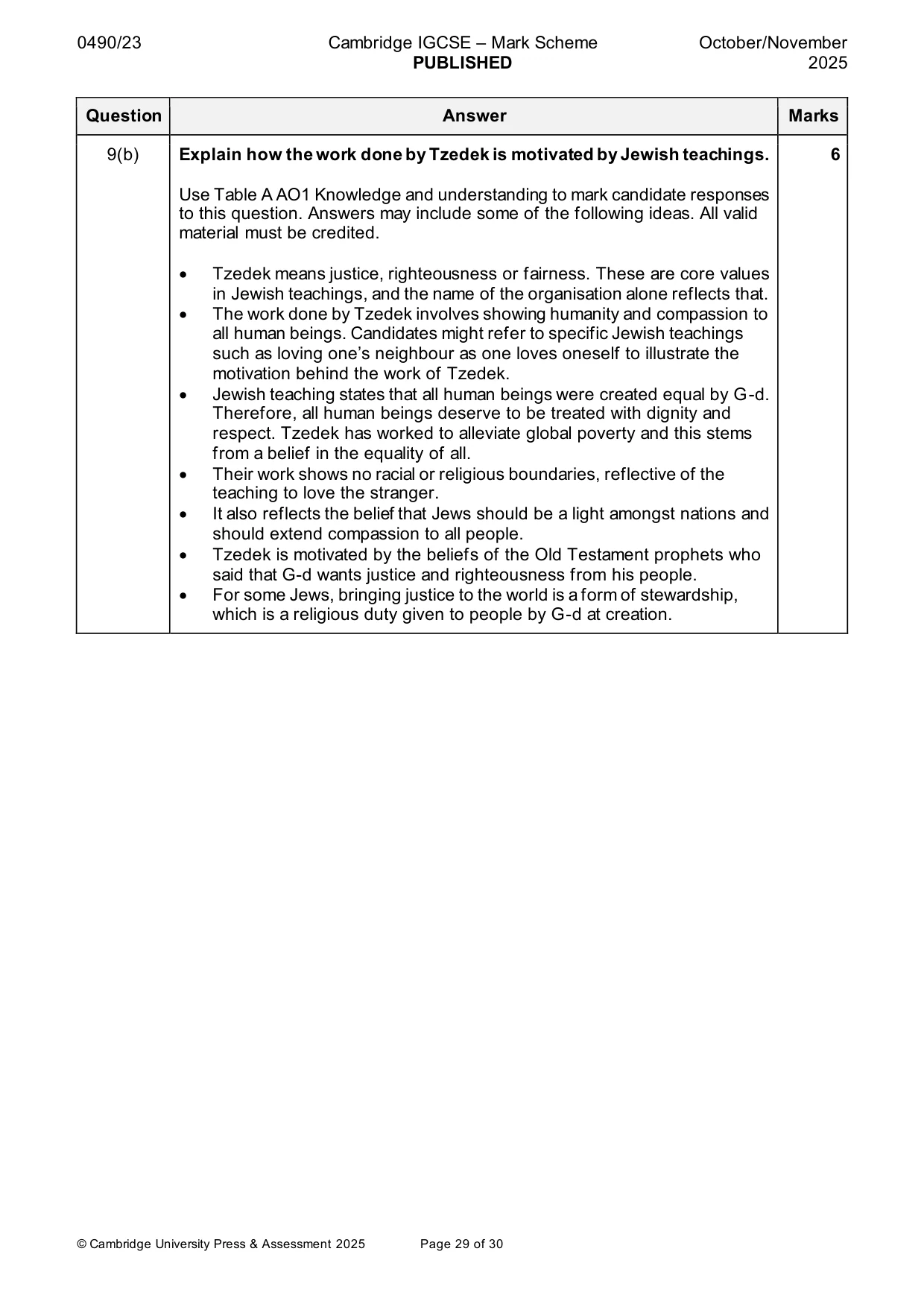
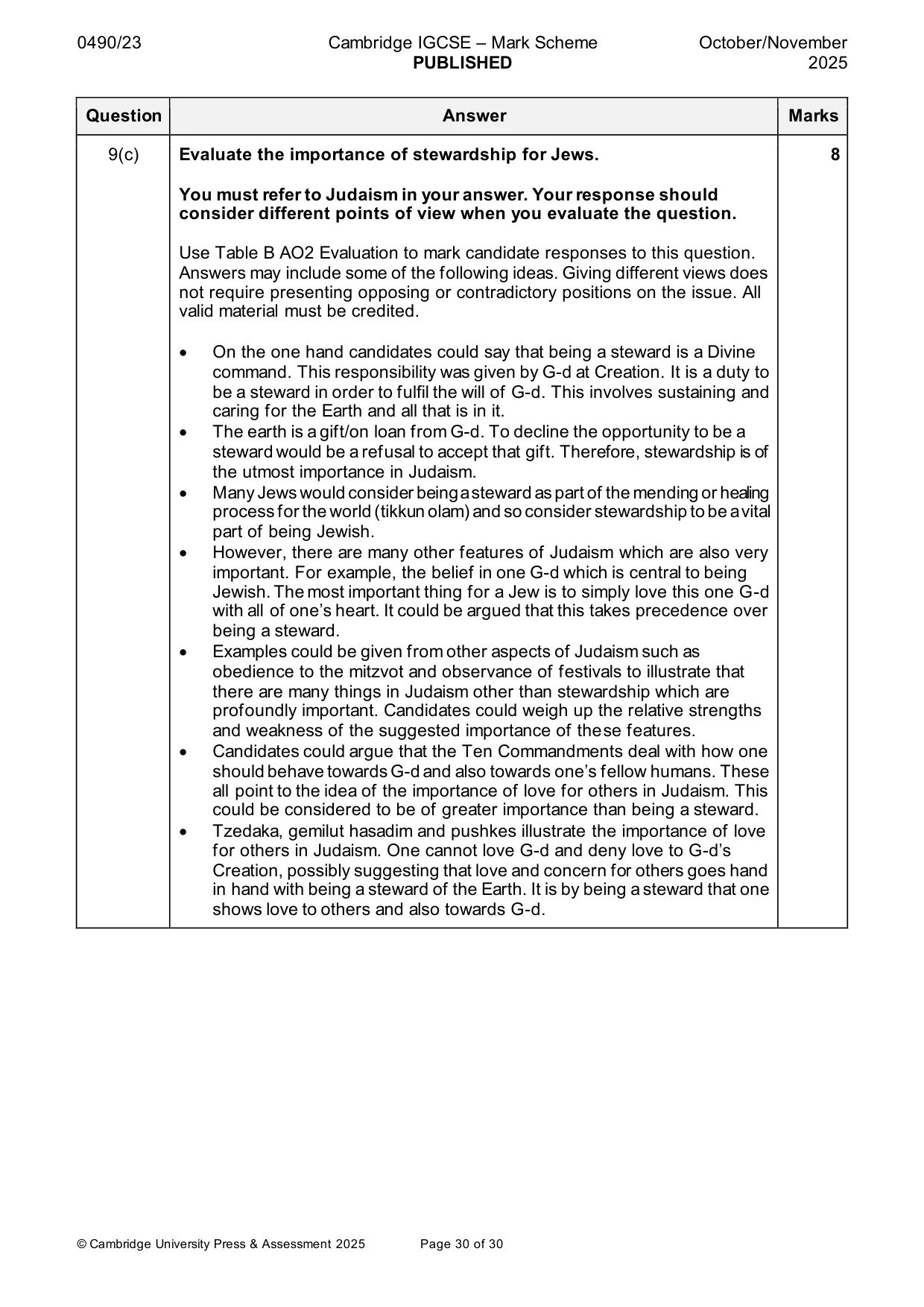
9 (a) (i) State two things that Jews believe about G-d’s creation of the world. [2] (ii) Outline what is meant by tikkun olam. [4] (b) Explain how the work done by Tzedek is motivated by Jewish teachings. [6] (c) Evaluate the importance of stewardship for Jews. You must refer to Judaism in your answer. Your response should consider different points of view when you evaluate the question. [8] [Total: 20]
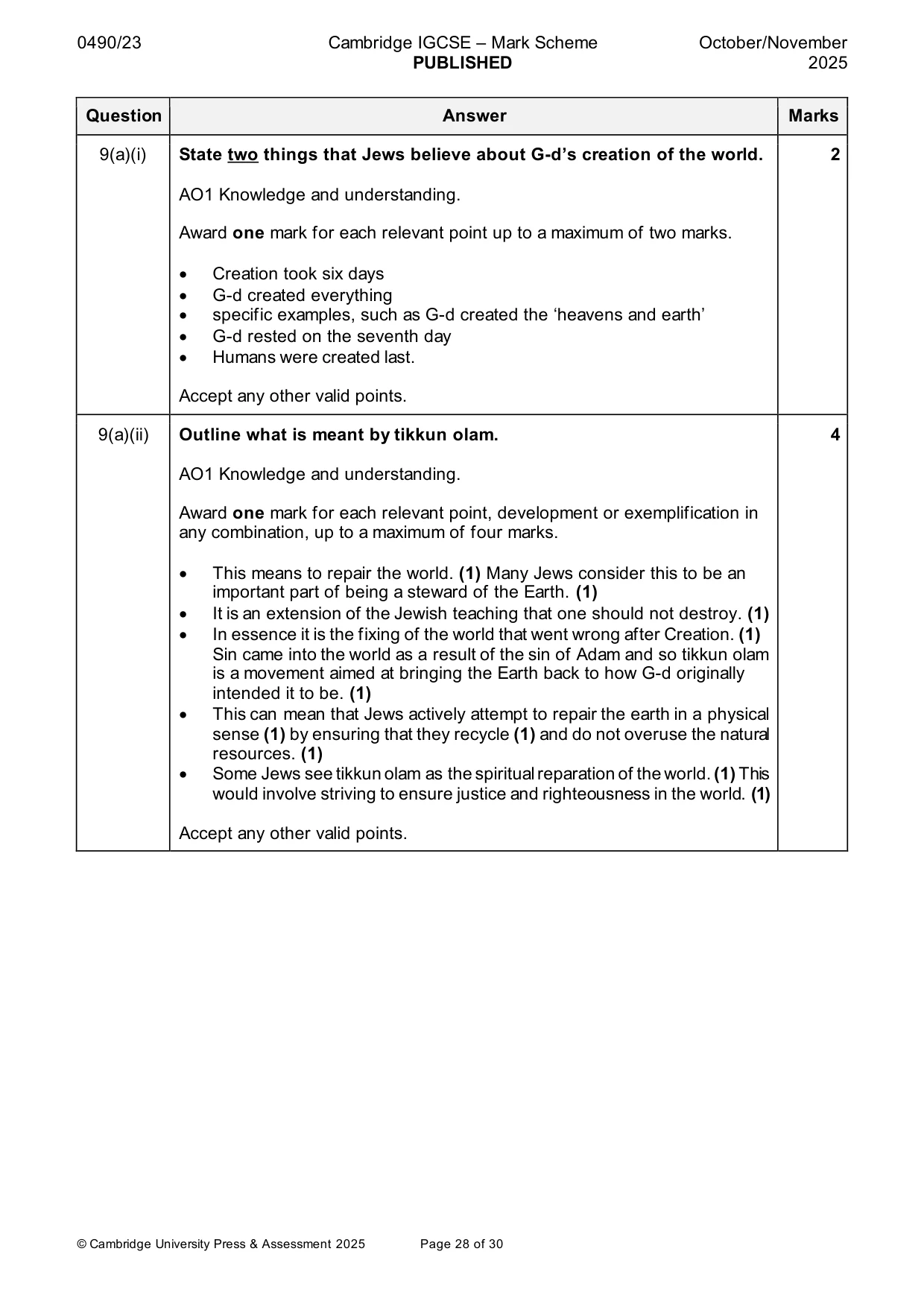
Mark scheme: 9(a)(i) State two things that Jews believe about G-d’s creation of the world. 2 AO1 Knowledge and understanding. Award one mark for each relevant point up to a maximum of two marks. • Creation took six days • G-d created everything • specific examples, such as G-d created the ‘heavens and earth’ • G-d rested on the seventh day • Humans were created last. Accept any other valid points. 9(a)(ii) Outline what is meant by tikkun olam. 4 AO1 Knowledge and understanding. Award one mark for each relevant point, development or exemplification in any combination, up to a maximum of four marks. • This means to repair the world. (1) Many Jews consider this to be an important part of being a steward of the Earth. (1) • It is an extension of the Jewish teaching that one should not destroy. (1) • In essence it is the fixing of the world that went wrong after Creation. (1) Sin came into the world as a result of the sin of Adam and so tikkun olam is a movement aimed at bringing the Earth back to how G-d originally intended it to be. (1) • This can mean that Jews actively attempt to repair the earth in a physical sense (1) by ensuring that they recycle (1) and do not overuse the natural resources. (1) • Some Jews see tikkun olam as the spiritual reparation of the world. (1) This would involve striving to ensure justice and righteousness in the world. (1) Accept any other valid points. 9(b) Explain how the work done by Tzedek is motivated by Jewish teachings. 6 Use Table A AO1 Knowledge and understanding to mark candidate responses to this question. Answers may include some of the following ideas. All valid material must be credited. • Tzedek means justice, righteousness or fairness. These are core values in Jewish teachings, and the name of the organisation alone reflects that. • The work done by Tzedek involves showing humanity and compassion to all human beings. Candidates might refer to specific Jewish teachings such as loving one’s neighbour as one loves oneself to illustrate the motivation behind the work of Tzedek. • Jewish teaching states that all human beings were created equal by G-d. Therefore, all human beings deserve to be treated with dignity and respect. Tzedek has worked to alleviate global poverty and this stems from a belief in the equality of all. • Their work shows no racial or religious boundaries, reflective of the teaching to love the stranger. • It also reflects the belief that Jews should be a light amongst nations and should extend compassion to all people. • Tzedek is motivated by the beliefs of the Old Testament prophets who said that G-d wants justice and righteousness from his people. • For some Jews, bringing justice to the world is a form of stewardship, which is a religious duty given to people by G-d at creation. 9(c) Evaluate the importance of stewardship for Jews. 8 You must refer to Judaism in your answer. Your response should consider different points of view when you evaluate the question. Use Table B AO2 Evaluation to mark candidate responses to this question. Answers may include some of the following ideas. Giving different views does not require presenting opposing or contradictory positions on the issue. All valid material must be credited. • On the one hand candidates could say that being a steward is a Divine command. This responsibility was given by G-d at Creation. It is a duty to be a steward in order to fulfil the will of G-d. This involves sustaining and caring for the Earth and all that is in it. • The earth is a gift/on loan from G-d. To decline the opportunity to be a steward would be a refusal to accept that gift. Therefore, stewardship is of the utmost importance in Judaism. • Many Jews would consider being a steward as part of the mending or healing process for the world (tikkun olam) and so consider stewardship to be a vital part of being Jewish. • However, there are many other features of Judaism which are also very important. For example, the belief in one G-d which is central to being Jewish. The most important thing for a Jew is to simply love this one G-d with all of one’s heart. It could be argued that this takes precedence over being a steward. • Examples could be given from other aspects of Judaism such as obedience to the mitzvot and observance of festivals to illustrate that there are many things in Judaism other than stewardship which are profoundly important. Candidates could weigh up the relative strengths and weakness of the suggested importance of these features. • Candidates could argue that the Ten Commandments deal with how one should behave towards G-d and also towards one’s fellow humans. These all point to the idea of the importance of love for others in Judaism. This could be considered to be of greater importance than being a steward. • Tzedaka, gemilut hasadim and pushkes illustrate the importance of love for others in Judaism. One cannot love G-d and deny love to G-d’s Creation, possibly suggesting that love and concern for others goes hand in hand with being a steward of the Earth. It is by being a steward that one shows love to others and also towards G-d.
What was in this paper
The subtopics covered by these 9 questions, and how many questions each got. Open one in a new tab to see every Cambridge question on it.
1Christian beliefs about family life in different Christian communities1Christian stewardship of the environment1Jewish beliefs about G-d’s nature1Marriage ceremonies: the key features and importance of marriage ceremonies in Judaism1Muslim beliefs about family life in different Muslim communities1Sukkot (Booths/Tabernacles)1The Qurʾan; different ways in which Muslims understand and interpret it1ʿId al-Fitr (the end of Ramadan)1What you needed in this session
Cambridge’s own grade thresholds for 2025 Oct/Nov, Paper 2 · Variant 3. A higher threshold means an easier paper — the bar moves with how the cohort did.