Cambridge IGCSE Religious Studies 0490 — 2022 Oct/Nov Paper 2 · Variant 3
0490/23/O/N/22 · 80 marks · ≈90 min
The question paper and its mark scheme, free to read here and free to download. This is Cambridge’s own paper, exactly as it was sat.
Question paper4 pages
Mark scheme27 pages
Answers below. Sit the paper first if you are practising.
Paper as text
Question paper, page 1
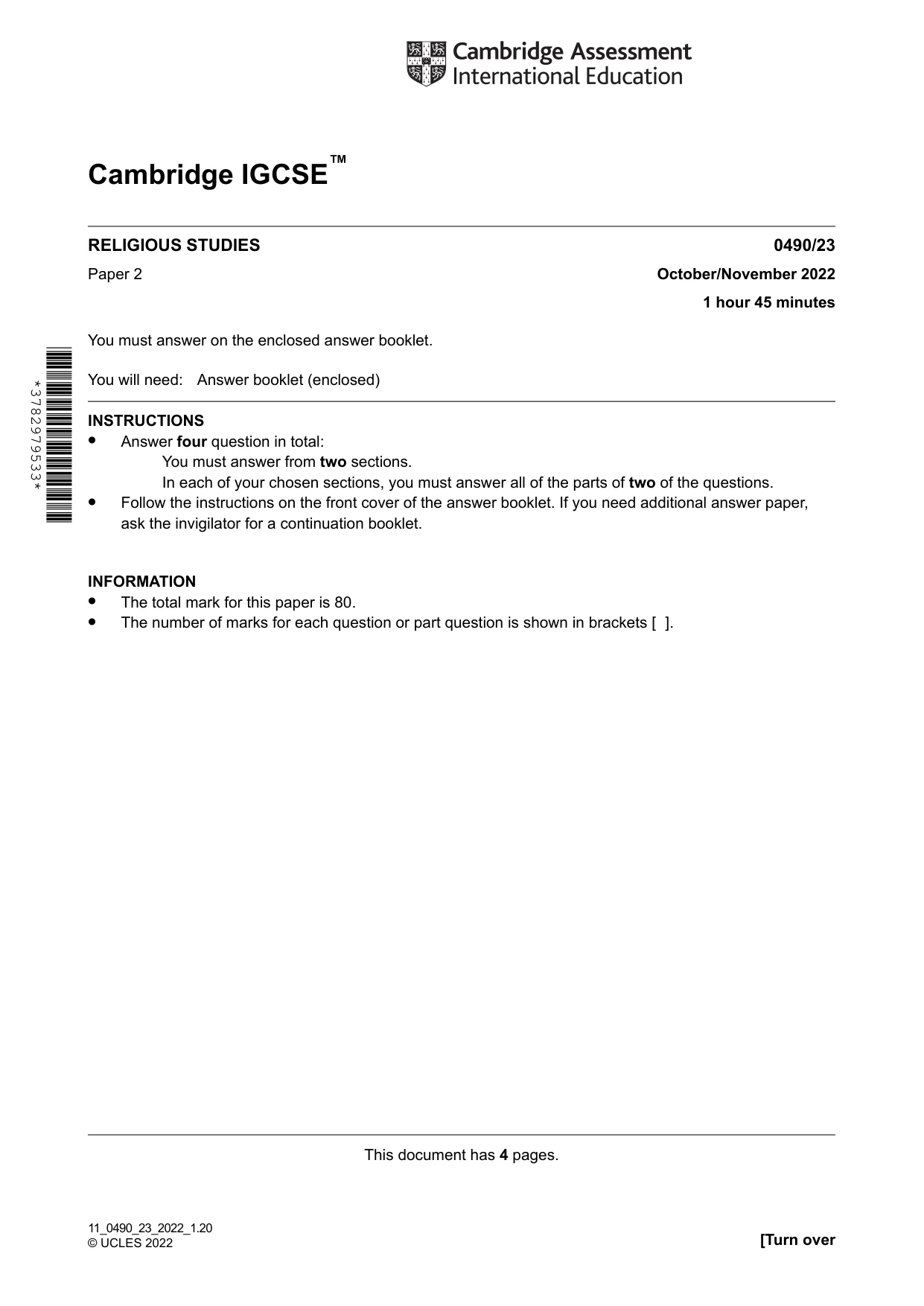
Cambridge IGCSE™ 0490/23 October/November 2022 1 hour 45 minutes RELIGIOUS STUDIES Paper 2 You must answer on the enclosed answer booklet. You will need: Answer booklet (enclosed) INSTRUCTIONS • Answer four question in total: You must answer from two sections. In each of your chosen sections, you must answer all of the parts of two of the questions. • Follow the instructions on the front cover of the answer booklet. If you need additional answer paper, ask the invigilator for a continuation booklet. INFORMATION • The total mark for this paper is 80. • The number of marks for each question or part question is shown in brackets [ ]. This document has 4 pages. [Turn over 11_0490_23_2022_1.20 © UCLES 2022 *3782979533*
Question paper, page 2
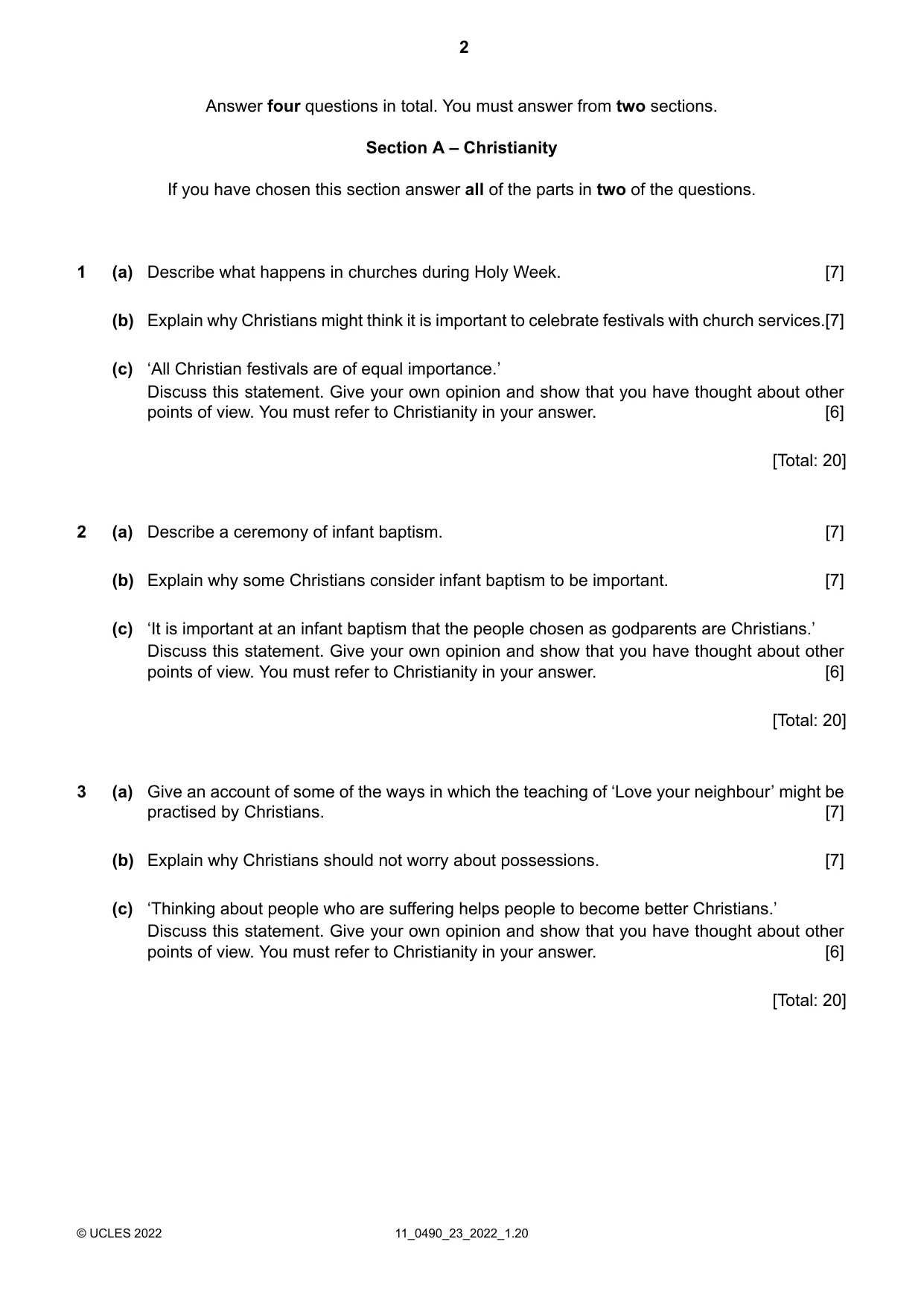
Answer four questions in total. You must answer from two sections. Section A – Christianity If you have chosen this section answer all of the parts in two of the questions. Describe what happens in churches during Holy Week. [7] (a) 1 Explain why Christians might think it is important to celebrate festivals with church services.[7] (b) ‘All Christian festivals are of equal importance.’ Discuss this statement. Give your own opinion and show that you have thought about other points of view. You must refer to Christianity in your answer. [6] (c) [Total: 20] Describe a ceremony of infant baptism. [7] (a) 2 Explain why some Christians consider infant baptism to be important. [7] (b) ‘It is important at an infant baptism that the people chosen as godparents are Christians.’ Discuss this statement. Give your own opinion and show that you have thought about other points of view. You must refer to Christianity in your answer. [6] (c) [Total: 20] Give an account of some of the ways in which the teaching of ‘Love your neighbour’ might be practised by Christians. [7] (a) 3 Explain why Christians should not worry about possessions. [7] (b) ‘Thinking about people who are suffering helps people to become better Christians.’ Discuss this statement. Give your own opinion and show that you have thought about other points of view. You must refer to Christianity in your answer. [6] (c) [Total: 20] 11_0490_23_2022_1.20 © UCLES 2022 2
Question paper, page 3
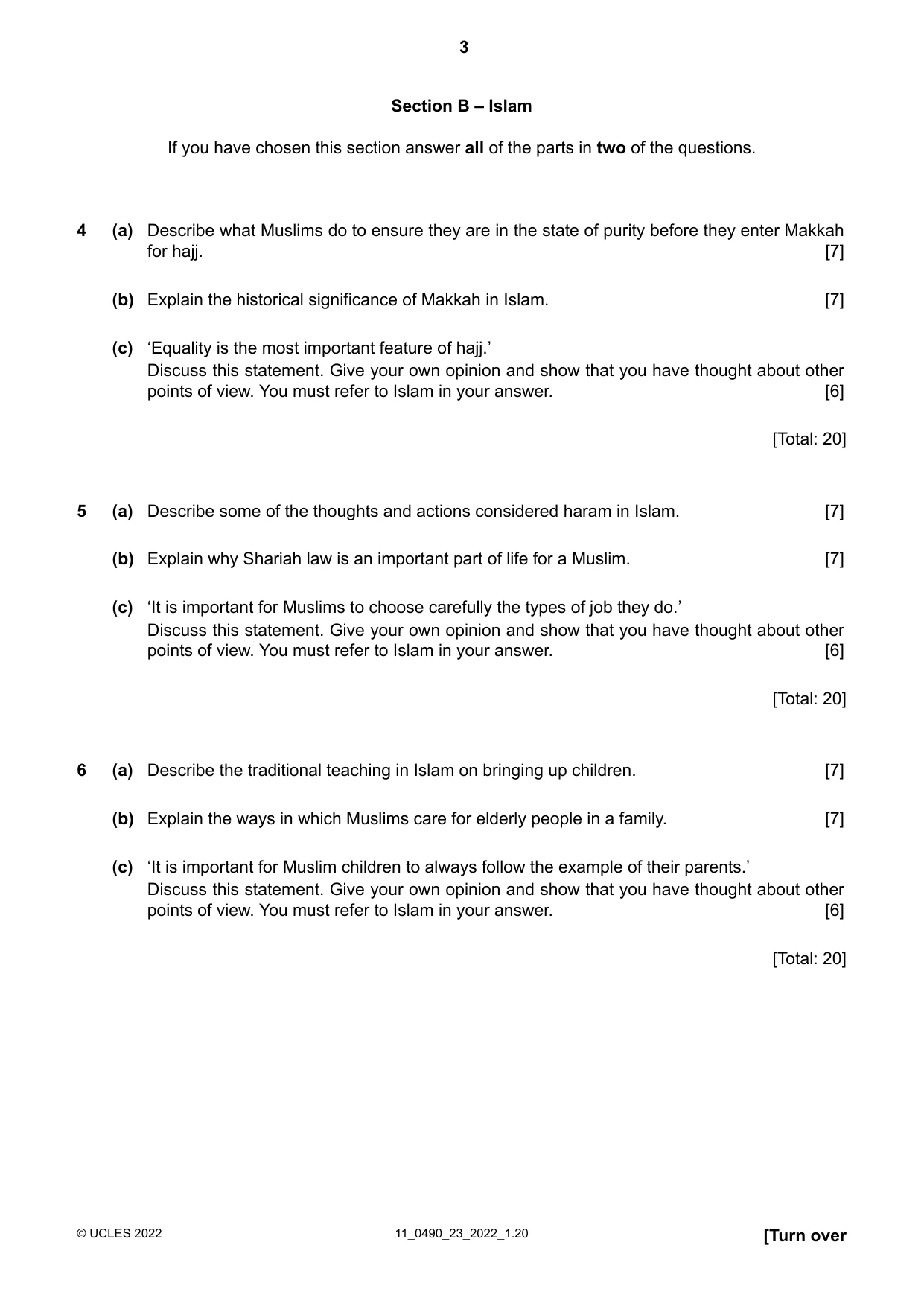
Section B – Islam If you have chosen this section answer all of the parts in two of the questions. Describe what Muslims do to ensure they are in the state of purity before they enter Makkah for hajj. [7] (a) 4 Explain the historical significance of Makkah in Islam. [7] (b) ‘Equality is the most important feature of hajj.’ Discuss this statement. Give your own opinion and show that you have thought about other points of view. You must refer to Islam in your answer. [6] (c) [Total: 20] Describe some of the thoughts and actions considered haram in Islam. [7] (a) 5 Explain why Shariah law is an important part of life for a Muslim. [7] (b) ‘It is important for Muslims to choose carefully the types of job they do.’ Discuss this statement. Give your own opinion and show that you have thought about other points of view. You must refer to Islam in your answer. [6] (c) [Total: 20] Describe the traditional teaching in Islam on bringing up children. [7] (a) 6 Explain the ways in which Muslims care for elderly people in a family. [7] (b) ‘It is important for Muslim children to always follow the example of their parents.’ Discuss this statement. Give your own opinion and show that you have thought about other points of view. You must refer to Islam in your answer. [6] (c) [Total: 20] [Turn over 11_0490_23_2022_1.20 © UCLES 2022 3
Question paper, page 4
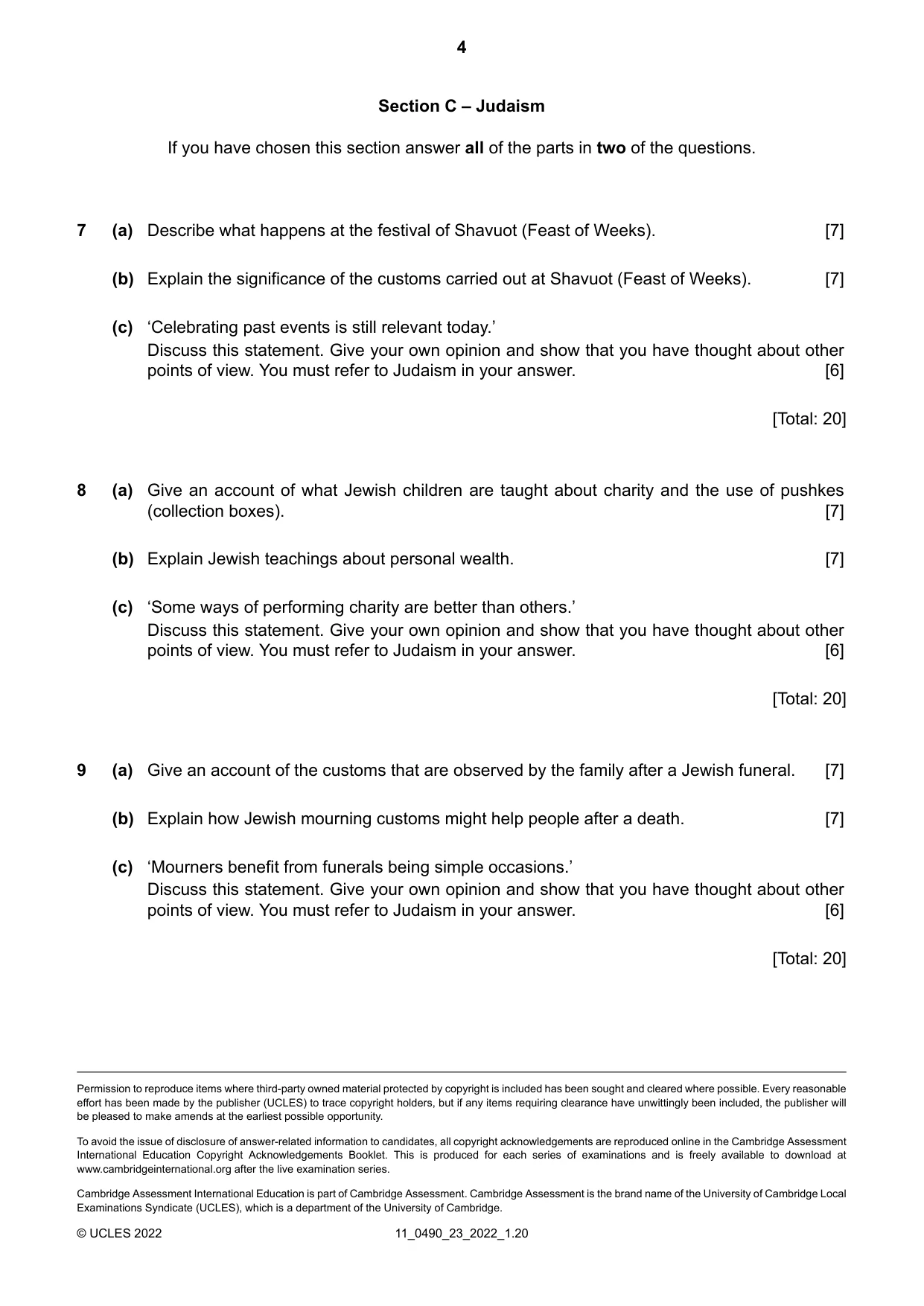
Section C – Judaism If you have chosen this section answer all of the parts in two of the questions. Describe what happens at the festival of Shavuot (Feast of Weeks). [7] (a) 7 Explain the significance of the customs carried out at Shavuot (Feast of Weeks). [7] (b) ‘Celebrating past events is still relevant today.’ Discuss this statement. Give your own opinion and show that you have thought about other points of view. You must refer to Judaism in your answer. [6] (c) [Total: 20] Give an account of what Jewish children are taught about charity and the use of pushkes (collection boxes). [7] (a) 8 Explain Jewish teachings about personal wealth. [7] (b) ‘Some ways of performing charity are better than others.’ Discuss this statement. Give your own opinion and show that you have thought about other points of view. You must refer to Judaism in your answer. [6] (c) [Total: 20] Give an account of the customs that are observed by the family after a Jewish funeral. [7] (a) 9 Explain how Jewish mourning customs might help people after a death. [7] (b) ‘Mourners benefit from funerals being simple occasions.’ Discuss this statement. Give your own opinion and show that you have thought about other points of view. You must refer to Judaism in your answer. [6] (c) [Total: 20] Permission to reproduce items where third-party owned material protected by copyright is included has been sought and cleared where possible. Every reasonable effort has been made by the publisher (UCLES) to trace copyright holders, but if any items requiring clearance have unwittingly been included, the publisher will be pleased to make amends at the earliest possible opportunity. To avoid the issue of disclosure of answer-related information to candidates, all copyright acknowledgements are reproduced online in the Cambridge Assessment International Education Copyright Acknowledgements Booklet. This is produced for each series of examinations and is freely available to download at www.cambridgeinternational.org after the live examination series. Cambridge Assessment International Education is part of Cambridge Assessment. Cambridge Assessment is the brand name of the University of Cambridge Local Examinations Syndicate (UCLES), which is a department of the University of Cambridge. 11_0490_23_2022_1.20 © UCLES 2022 4
Mark scheme, page 1
This document consists of 27 printed pages. © UCLES 2022 [Turn over Cambridge IGCSE™ RELIGIOUS STUDIES 0490/23 Paper 2 October/November 2022 MARK SCHEME Maximum Mark: 80 Published This mark scheme is published as an aid to teachers and candidates, to indicate the requirements of the examination. It shows the basis on which Examiners were instructed to award marks. It does not indicate the details of the discussions that took place at an Examiners’ meeting before marking began, which would have considered the acceptability of alternative answers. Mark schemes should be read in conjunction with the question paper and the Principal Examiner Report for Teachers. Cambridge International will not enter into discussions about these mark schemes. Cambridge International is publishing the mark schemes for the October/November 2022 series for most Cambridge IGCSE™, Cambridge International A and AS Level components and some Cambridge O Level components.
Mark scheme, page 2
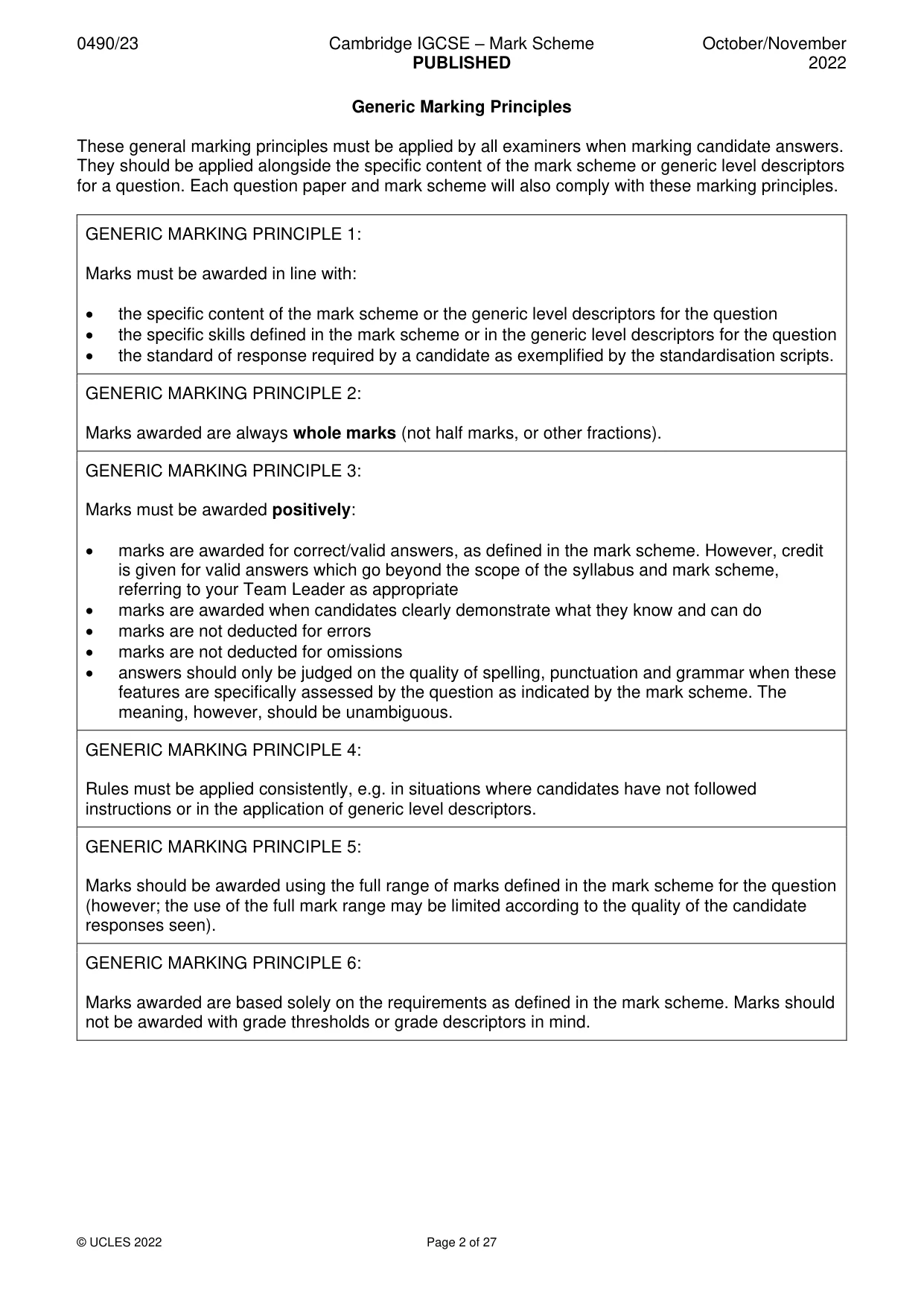
0490/23 Cambridge IGCSE – Mark Scheme PUBLISHED October/November 2022 © UCLES 2022 Page 2 of 27 Generic Marking Principles These general marking principles must be applied by all examiners when marking candidate answers. They should be applied alongside the specific content of the mark scheme or generic level descriptors for a question. Each question paper and mark scheme will also comply with these marking principles. GENERIC MARKING PRINCIPLE 1: Marks must be awarded in line with: • the specific content of the mark scheme or the generic level descriptors for the question • the specific skills defined in the mark scheme or in the generic level descriptors for the question • the standard of response required by a candidate as exemplified by the standardisation scripts. GENERIC MARKING PRINCIPLE 2: Marks awarded are always whole marks (not half marks, or other fractions). GENERIC MARKING PRINCIPLE 3: Marks must be awarded positively: • marks are awarded for correct/valid answers, as defined in the mark scheme. However, credit is given for valid answers which go beyond the scope of the syllabus and mark scheme, referring to your Team Leader as appropriate • marks are awarded when candidates clearly demonstrate what they know and can do • marks are not deducted for errors • marks are not deducted for omissions • answers should only be judged on the quality of spelling, punctuation and grammar when these features are specifically assessed by the question as indicated by the mark scheme. The meaning, however, should be unambiguous. GENERIC MARKING PRINCIPLE 4: Rules must be applied consistently, e.g. in situations where candidates have not followed instructions or in the application of generic level descriptors. GENERIC MARKING PRINCIPLE 5: Marks should be awarded using the full range of marks defined in the mark scheme for the question (however; the use of the full mark range may be limited according to the quality of the candidate responses seen). GENERIC MARKING PRINCIPLE 6: Marks awarded are based solely on the requirements as defined in the mark scheme. Marks should not be awarded with grade thresholds or grade descriptors in mind.
Mark scheme, page 3
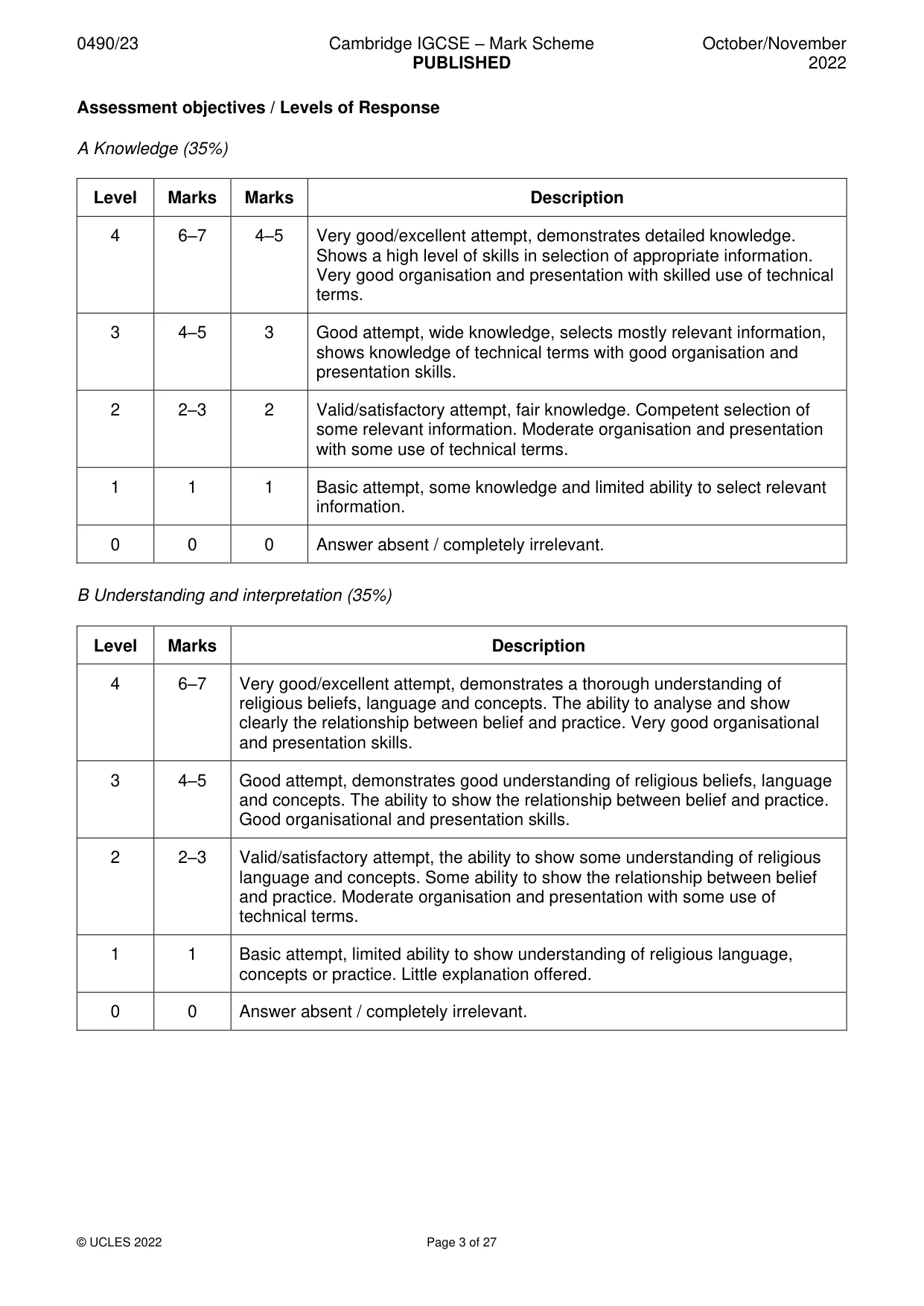
0490/23 Cambridge IGCSE – Mark Scheme PUBLISHED October/November 2022 © UCLES 2022 Page 3 of 27 Assessment objectives / Levels of Response A Knowledge (35%) Level Marks Marks Description 4 6–7 4–5 Very good/excellent attempt, demonstrates detailed knowledge. Shows a high level of skills in selection of appropriate information. Very good organisation and presentation with skilled use of technical terms. 3 4–5 3 Good attempt, wide knowledge, selects mostly relevant information, shows knowledge of technical terms with good organisation and presentation skills. 2 2–3 2 Valid/satisfactory attempt, fair knowledge. Competent selection of some relevant information. Moderate organisation and presentation with some use of technical terms. 1 1 1 Basic attempt, some knowledge and limited ability to select relevant information. 0 0 0 Answer absent / completely irrelevant. B Understanding and interpretation (35%) Level Marks Description 4 6–7 Very good/excellent attempt, demonstrates a thorough understanding of religious beliefs, language and concepts. The ability to analyse and show clearly the relationship between belief and practice. Very good organisational and presentation skills. 3 4–5 Good attempt, demonstrates good understanding of religious beliefs, language and concepts. The ability to show the relationship between belief and practice. Good organisational and presentation skills. 2 2–3 Valid/satisfactory attempt, the ability to show some understanding of religious language and concepts. Some ability to show the relationship between belief and practice. Moderate organisation and presentation with some use of technical terms. 1 1 Basic attempt, limited ability to show understanding of religious language, concepts or practice. Little explanation offered. 0 0 Answer absent / completely irrelevant.
Mark scheme, page 4
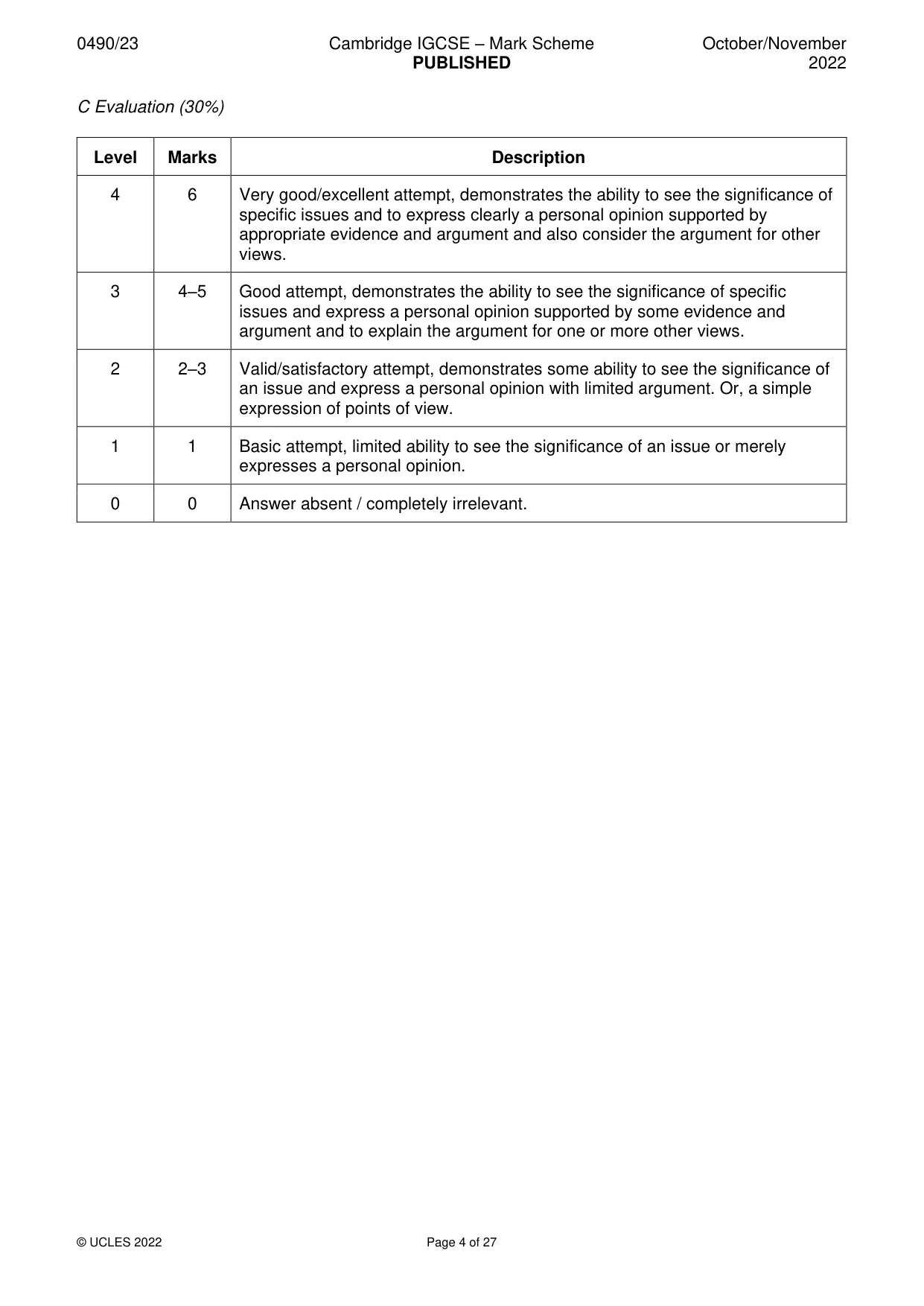
0490/23 Cambridge IGCSE – Mark Scheme PUBLISHED October/November 2022 © UCLES 2022 Page 4 of 27 C Evaluation (30%) Level Marks Description 4 6 Very good/excellent attempt, demonstrates the ability to see the significance of specific issues and to express clearly a personal opinion supported by appropriate evidence and argument and also consider the argument for other views. 3 4–5 Good attempt, demonstrates the ability to see the significance of specific issues and express a personal opinion supported by some evidence and argument and to explain the argument for one or more other views. 2 2–3 Valid/satisfactory attempt, demonstrates some ability to see the significance of an issue and express a personal opinion with limited argument. Or, a simple expression of points of view. 1 1 Basic attempt, limited ability to see the significance of an issue or merely expresses a personal opinion. 0 0 Answer absent / completely irrelevant.
Mark scheme, page 5
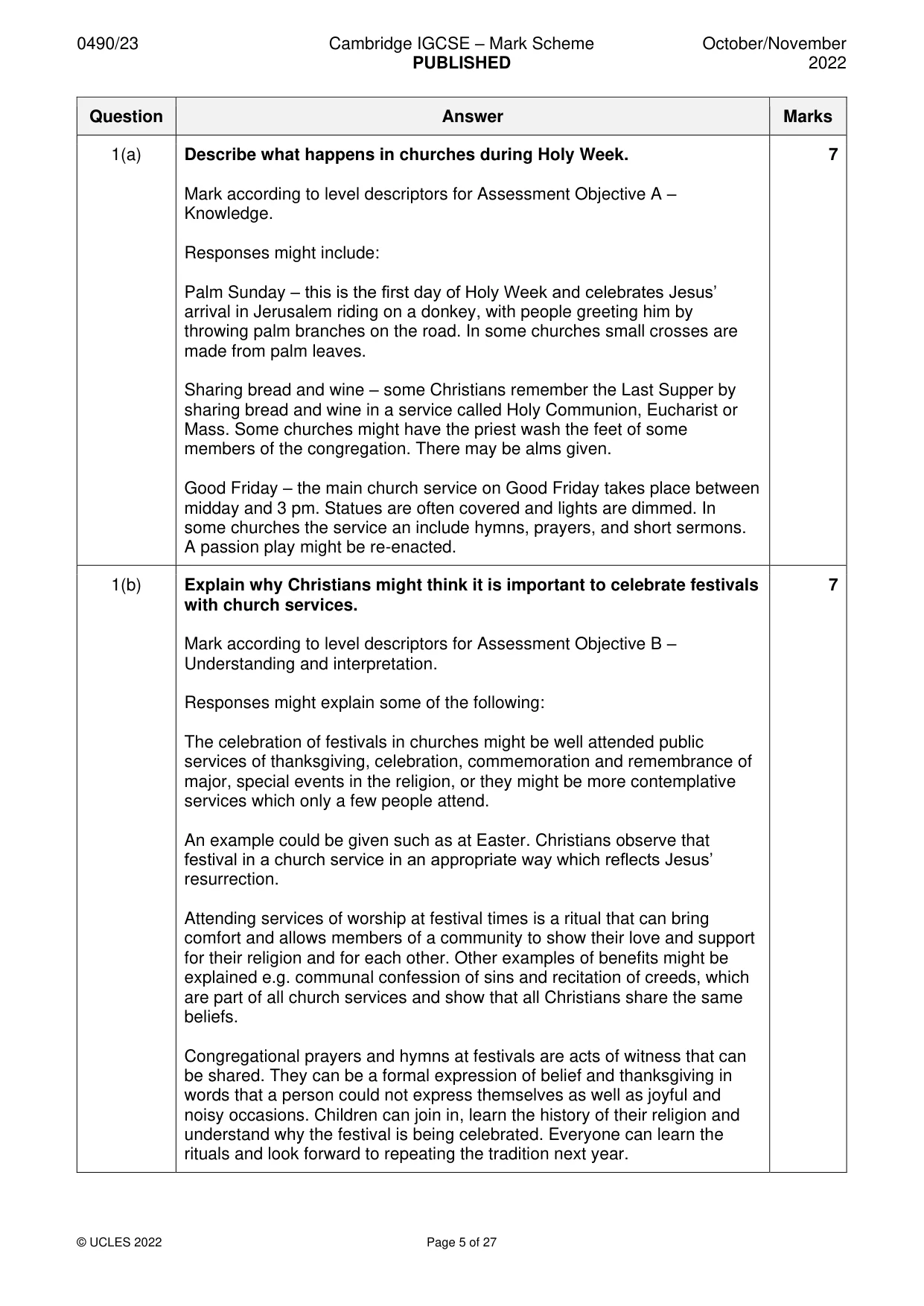
0490/23 Cambridge IGCSE – Mark Scheme PUBLISHED October/November 2022 © UCLES 2022 Page 5 of 27 Question Answer Marks 1(a) Describe what happens in churches during Holy Week. Mark according to level descriptors for Assessment Objective A – Knowledge. Responses might include: Palm Sunday – this is the first day of Holy Week and celebrates Jesus’ arrival in Jerusalem riding on a donkey, with people greeting him by throwing palm branches on the road. In some churches small crosses are made from palm leaves. Sharing bread and wine – some Christians remember the Last Supper by sharing bread and wine in a service called Holy Communion, Eucharist or Mass. Some churches might have the priest wash the feet of some members of the congregation. There may be alms given. Good Friday – the main church service on Good Friday takes place between midday and 3 pm. Statues are often covered and lights are dimmed. In some churches the service an include hymns, prayers, and short sermons. A passion play might be re-enacted. 7 1(b) Explain why Christians might think it is important to celebrate festivals with church services. Mark according to level descriptors for Assessment Objective B – Understanding and interpretation. Responses might explain some of the following: The celebration of festivals in churches might be well attended public services of thanksgiving, celebration, commemoration and remembrance of major, special events in the religion, or they might be more contemplative services which only a few people attend. An example could be given such as at Easter. Christians observe that festival in a church service in an appropriate way which reflects Jesus’ resurrection. Attending services of worship at festival times is a ritual that can bring comfort and allows members of a community to show their love and support for their religion and for each other. Other examples of benefits might be explained e.g. communal confession of sins and recitation of creeds, which are part of all church services and show that all Christians share the same beliefs. Congregational prayers and hymns at festivals are acts of witness that can be shared. They can be a formal expression of belief and thanksgiving in words that a person could not express themselves as well as joyful and noisy occasions. Children can join in, learn the history of their religion and understand why the festival is being celebrated. Everyone can learn the rituals and look forward to repeating the tradition next year. 7
Mark scheme, page 6
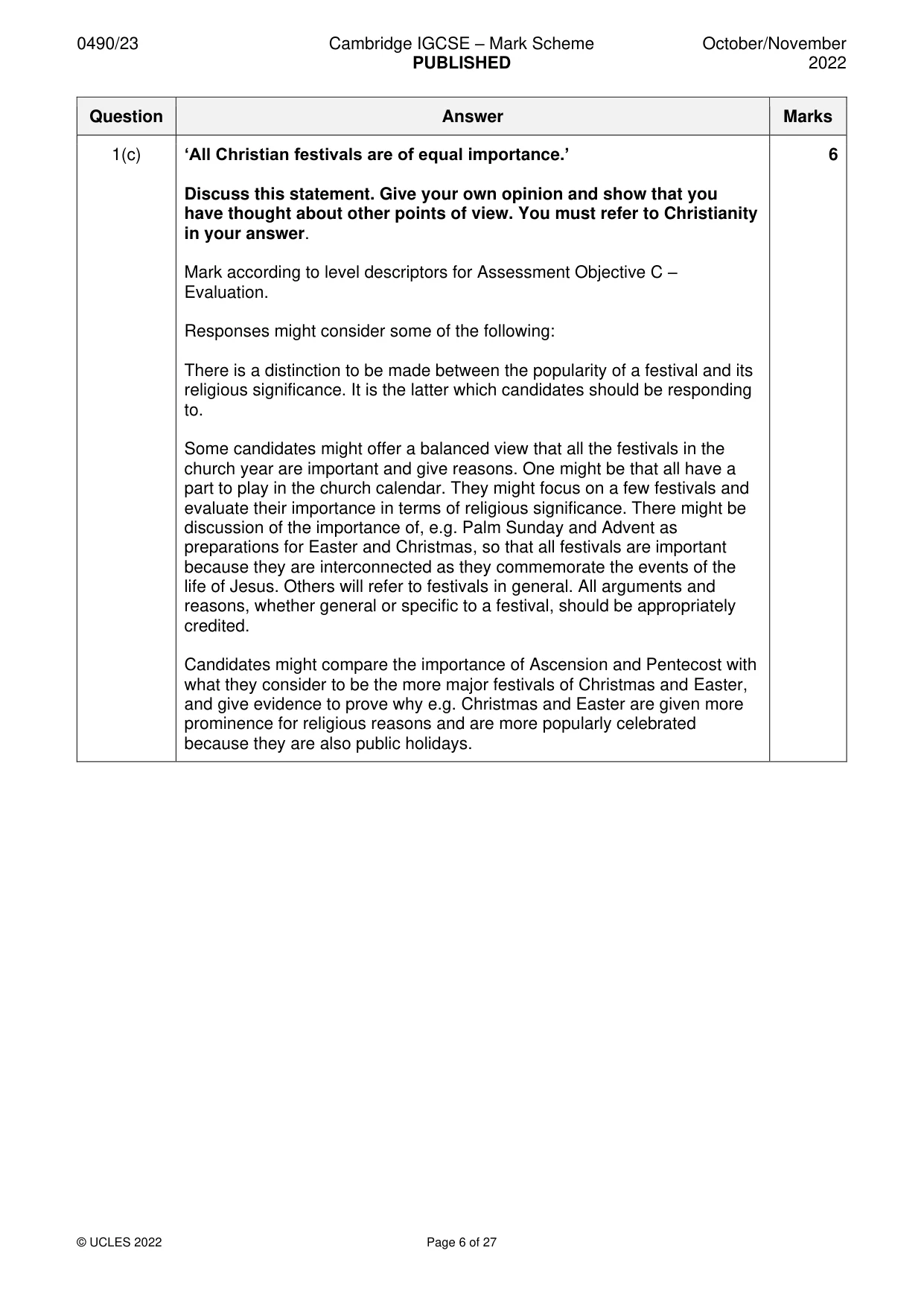
0490/23 Cambridge IGCSE – Mark Scheme PUBLISHED October/November 2022 © UCLES 2022 Page 6 of 27 Question Answer Marks 1(c) ‘All Christian festivals are of equal importance.’ Discuss this statement. Give your own opinion and show that you have thought about other points of view. You must refer to Christianity in your answer. Mark according to level descriptors for Assessment Objective C – Evaluation. Responses might consider some of the following: There is a distinction to be made between the popularity of a festival and its religious significance. It is the latter which candidates should be responding to. Some candidates might offer a balanced view that all the festivals in the church year are important and give reasons. One might be that all have a part to play in the church calendar. They might focus on a few festivals and evaluate their importance in terms of religious significance. There might be discussion of the importance of, e.g. Palm Sunday and Advent as preparations for Easter and Christmas, so that all festivals are important because they are interconnected as they commemorate the events of the life of Jesus. Others will refer to festivals in general. All arguments and reasons, whether general or specific to a festival, should be appropriately credited. Candidates might compare the importance of Ascension and Pentecost with what they consider to be the more major festivals of Christmas and Easter, and give evidence to prove why e.g. Christmas and Easter are given more prominence for religious reasons and are more popularly celebrated because they are also public holidays. 6
Mark scheme, page 7
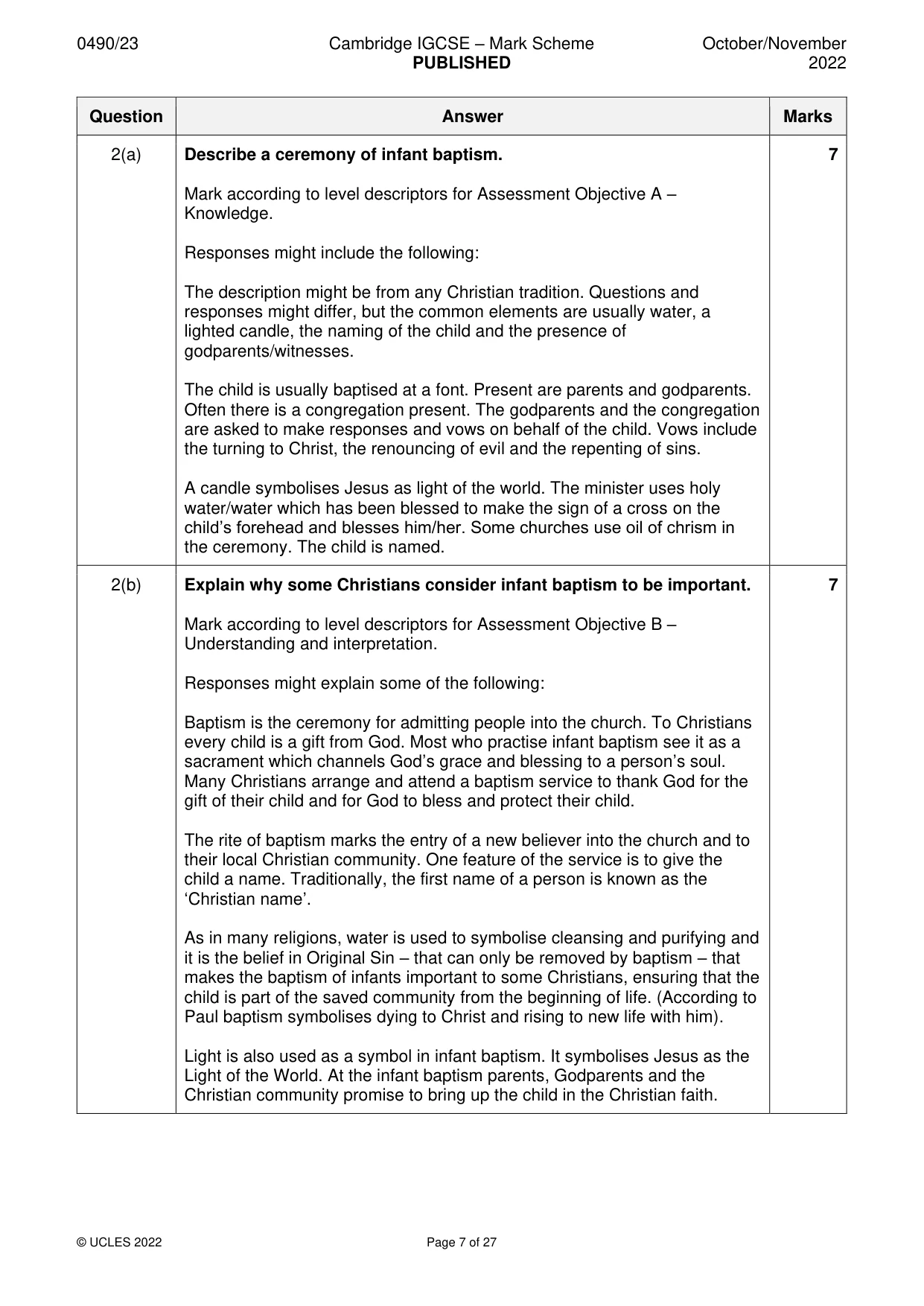
0490/23 Cambridge IGCSE – Mark Scheme PUBLISHED October/November 2022 © UCLES 2022 Page 7 of 27 Question Answer Marks 2(a) Describe a ceremony of infant baptism. Mark according to level descriptors for Assessment Objective A – Knowledge. Responses might include the following: The description might be from any Christian tradition. Questions and responses might differ, but the common elements are usually water, a lighted candle, the naming of the child and the presence of godparents/witnesses. The child is usually baptised at a font. Present are parents and godparents. Often there is a congregation present. The godparents and the congregation are asked to make responses and vows on behalf of the child. Vows include the turning to Christ, the renouncing of evil and the repenting of sins. A candle symbolises Jesus as light of the world. The minister uses holy water/water which has been blessed to make the sign of a cross on the child’s forehead and blesses him/her. Some churches use oil of chrism in the ceremony. The child is named. 7 2(b) Explain why some Christians consider infant baptism to be important. Mark according to level descriptors for Assessment Objective B – Understanding and interpretation. Responses might explain some of the following: Baptism is the ceremony for admitting people into the church. To Christians every child is a gift from God. Most who practise infant baptism see it as a sacrament which channels God’s grace and blessing to a person’s soul. Many Christians arrange and attend a baptism service to thank God for the gift of their child and for God to bless and protect their child. The rite of baptism marks the entry of a new believer into the church and to their local Christian community. One feature of the service is to give the child a name. Traditionally, the first name of a person is known as the ‘Christian name’. As in many religions, water is used to symbolise cleansing and purifying and it is the belief in Original Sin – that can only be removed by baptism – that makes the baptism of infants important to some Christians, ensuring that the child is part of the saved community from the beginning of life. (According to Paul baptism symbolises dying to Christ and rising to new life with him). Light is also used as a symbol in infant baptism. It symbolises Jesus as the Light of the World. At the infant baptism parents, Godparents and the Christian community promise to bring up the child in the Christian faith. 7
Mark scheme, page 8
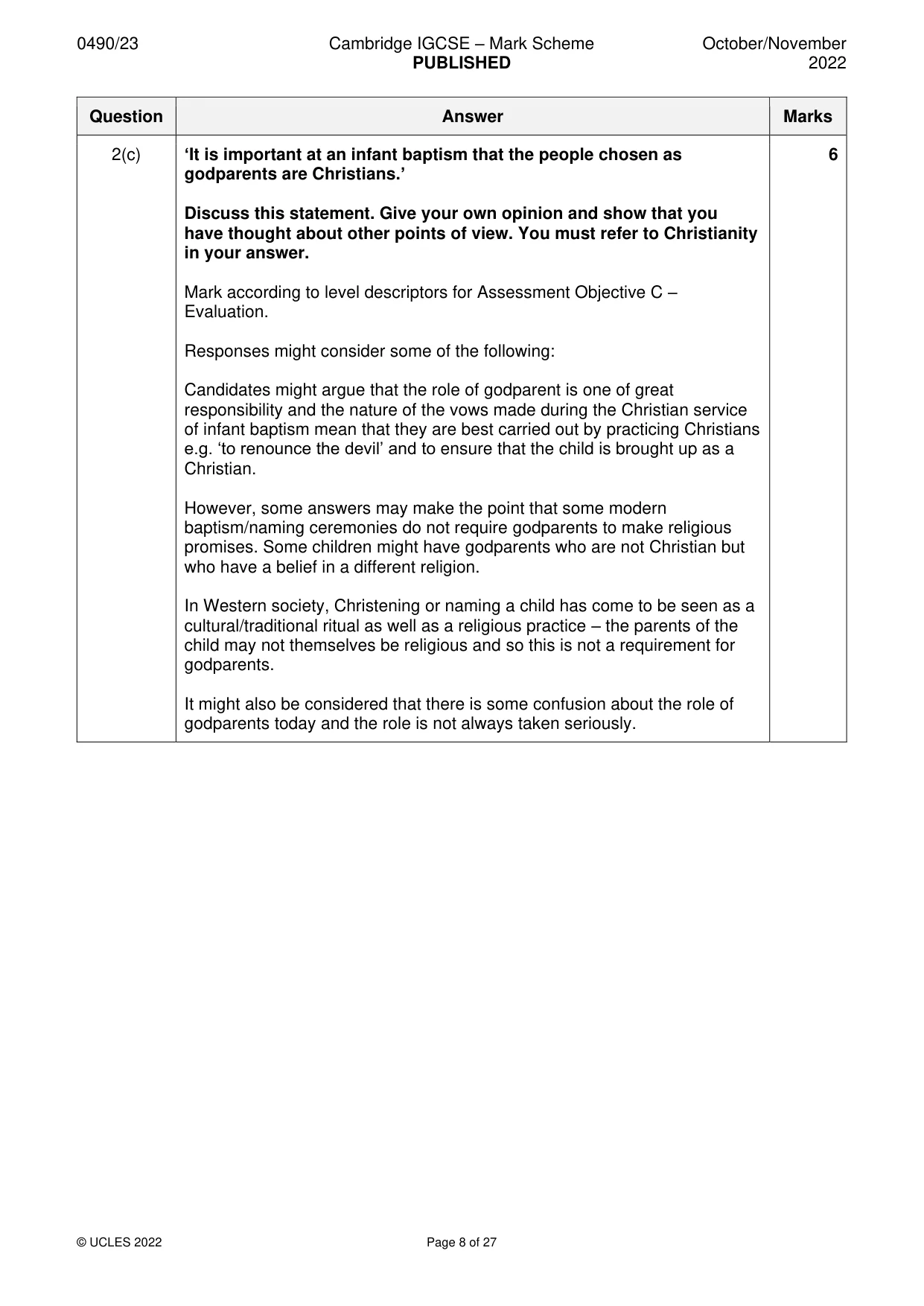
0490/23 Cambridge IGCSE – Mark Scheme PUBLISHED October/November 2022 © UCLES 2022 Page 8 of 27 Question Answer Marks 2(c) ‘It is important at an infant baptism that the people chosen as godparents are Christians.’ Discuss this statement. Give your own opinion and show that you have thought about other points of view. You must refer to Christianity in your answer. Mark according to level descriptors for Assessment Objective C – Evaluation. Responses might consider some of the following: Candidates might argue that the role of godparent is one of great responsibility and the nature of the vows made during the Christian service of infant baptism mean that they are best carried out by practicing Christians e.g. ‘to renounce the devil’ and to ensure that the child is brought up as a Christian. However, some answers may make the point that some modern baptism/naming ceremonies do not require godparents to make religious promises. Some children might have godparents who are not Christian but who have a belief in a different religion. In Western society, Christening or naming a child has come to be seen as a cultural/traditional ritual as well as a religious practice – the parents of the child may not themselves be religious and so this is not a requirement for godparents. It might also be considered that there is some confusion about the role of godparents today and the role is not always taken seriously. 6
Mark scheme, page 9
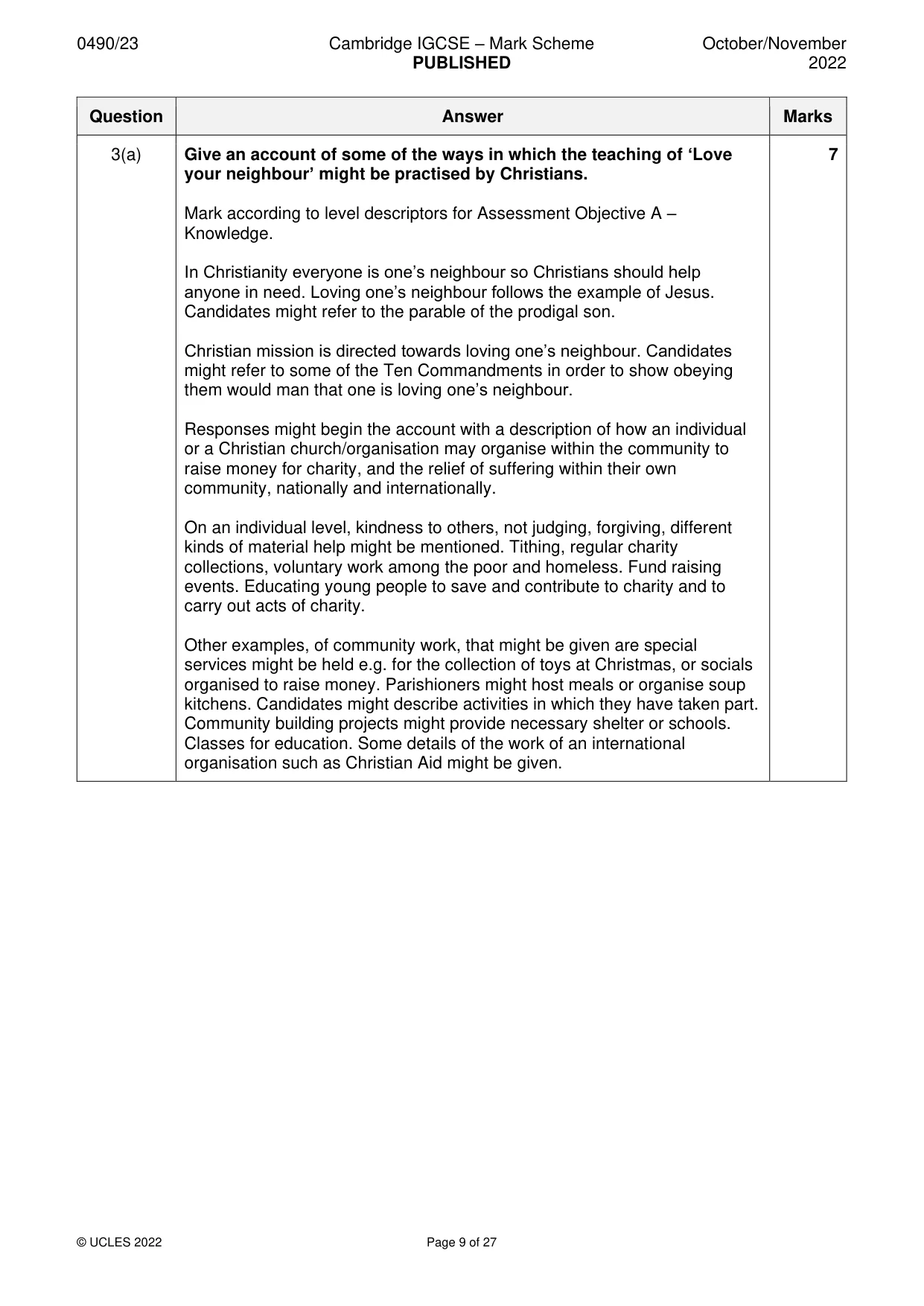
0490/23 Cambridge IGCSE – Mark Scheme PUBLISHED October/November 2022 © UCLES 2022 Page 9 of 27 Question Answer Marks 3(a) Give an account of some of the ways in which the teaching of ‘Love your neighbour’ might be practised by Christians. Mark according to level descriptors for Assessment Objective A – Knowledge. In Christianity everyone is one’s neighbour so Christians should help anyone in need. Loving one’s neighbour follows the example of Jesus. Candidates might refer to the parable of the prodigal son. Christian mission is directed towards loving one’s neighbour. Candidates might refer to some of the Ten Commandments in order to show obeying them would man that one is loving one’s neighbour. Responses might begin the account with a description of how an individual or a Christian church/organisation may organise within the community to raise money for charity, and the relief of suffering within their own community, nationally and internationally. On an individual level, kindness to others, not judging, forgiving, different kinds of material help might be mentioned. Tithing, regular charity collections, voluntary work among the poor and homeless. Fund raising events. Educating young people to save and contribute to charity and to carry out acts of charity. Other examples, of community work, that might be given are special services might be held e.g. for the collection of toys at Christmas, or socials organised to raise money. Parishioners might host meals or organise soup kitchens. Candidates might describe activities in which they have taken part. Community building projects might provide necessary shelter or schools. Classes for education. Some details of the work of an international organisation such as Christian Aid might be given. 7
Mark scheme, page 10
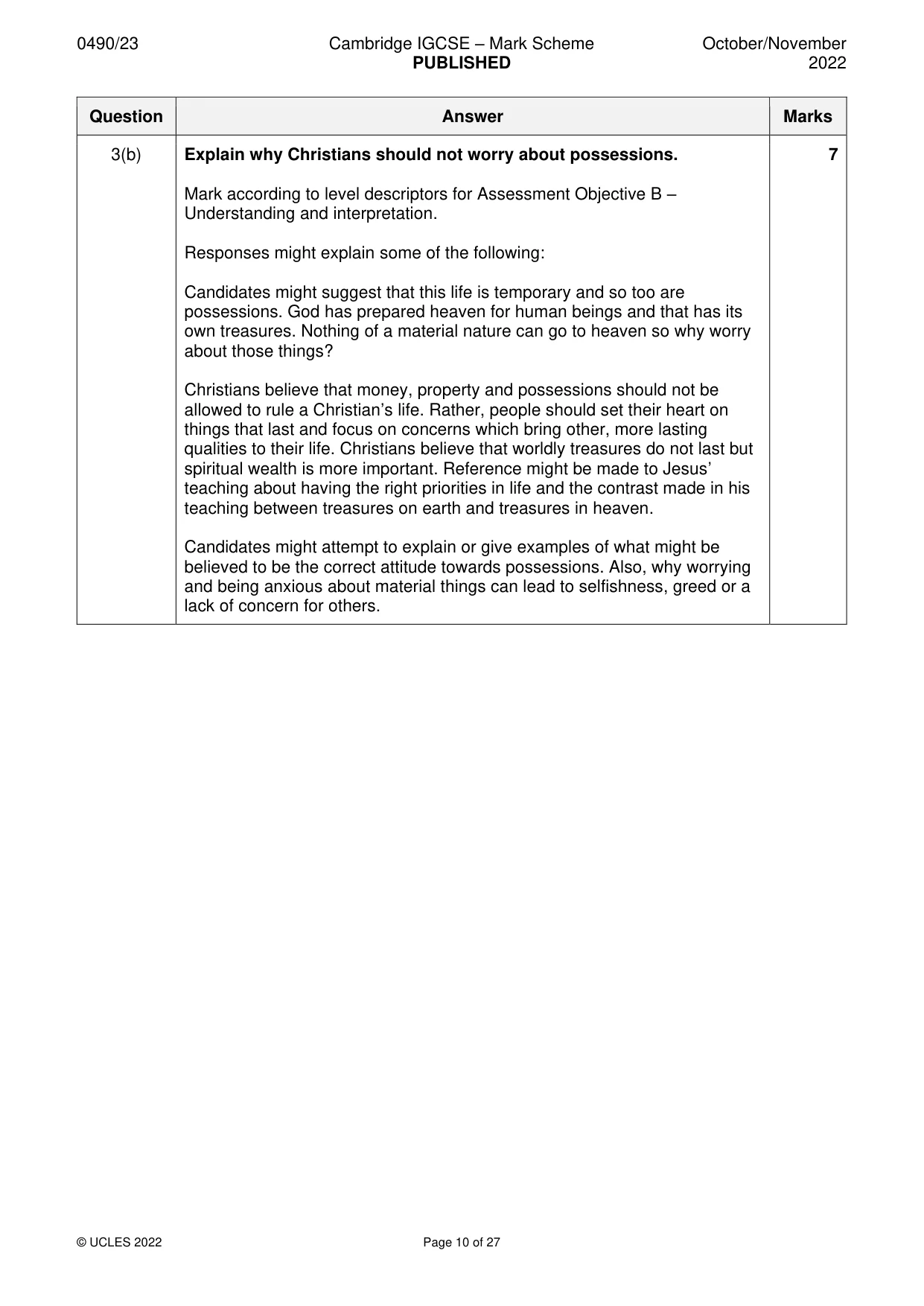
0490/23 Cambridge IGCSE – Mark Scheme PUBLISHED October/November 2022 © UCLES 2022 Page 10 of 27 Question Answer Marks 3(b) Explain why Christians should not worry about possessions. Mark according to level descriptors for Assessment Objective B – Understanding and interpretation. Responses might explain some of the following: Candidates might suggest that this life is temporary and so too are possessions. God has prepared heaven for human beings and that has its own treasures. Nothing of a material nature can go to heaven so why worry about those things? Christians believe that money, property and possessions should not be allowed to rule a Christian’s life. Rather, people should set their heart on things that last and focus on concerns which bring other, more lasting qualities to their life. Christians believe that worldly treasures do not last but spiritual wealth is more important. Reference might be made to Jesus’ teaching about having the right priorities in life and the contrast made in his teaching between treasures on earth and treasures in heaven. Candidates might attempt to explain or give examples of what might be believed to be the correct attitude towards possessions. Also, why worrying and being anxious about material things can lead to selfishness, greed or a lack of concern for others. 7
Mark scheme, page 11
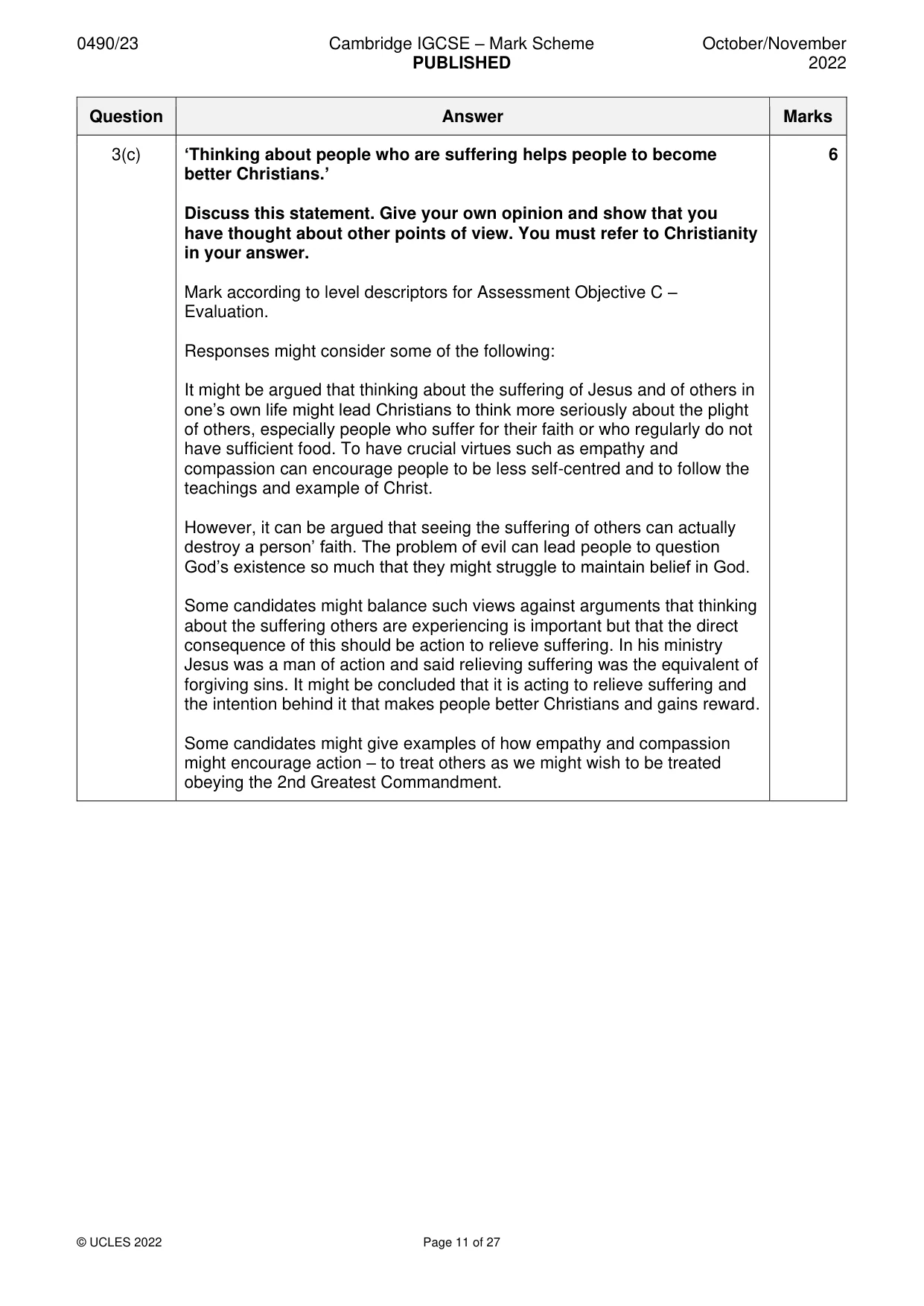
0490/23 Cambridge IGCSE – Mark Scheme PUBLISHED October/November 2022 © UCLES 2022 Page 11 of 27 Question Answer Marks 3(c) ‘Thinking about people who are suffering helps people to become better Christians.’ Discuss this statement. Give your own opinion and show that you have thought about other points of view. You must refer to Christianity in your answer. Mark according to level descriptors for Assessment Objective C – Evaluation. Responses might consider some of the following: It might be argued that thinking about the suffering of Jesus and of others in one’s own life might lead Christians to think more seriously about the plight of others, especially people who suffer for their faith or who regularly do not have sufficient food. To have crucial virtues such as empathy and compassion can encourage people to be less self-centred and to follow the teachings and example of Christ. However, it can be argued that seeing the suffering of others can actually destroy a person’ faith. The problem of evil can lead people to question God’s existence so much that they might struggle to maintain belief in God. Some candidates might balance such views against arguments that thinking about the suffering others are experiencing is important but that the direct consequence of this should be action to relieve suffering. In his ministry Jesus was a man of action and said relieving suffering was the equivalent of forgiving sins. It might be concluded that it is acting to relieve suffering and the intention behind it that makes people better Christians and gains reward. Some candidates might give examples of how empathy and compassion might encourage action – to treat others as we might wish to be treated obeying the 2nd Greatest Commandment. 6
Mark scheme, page 12
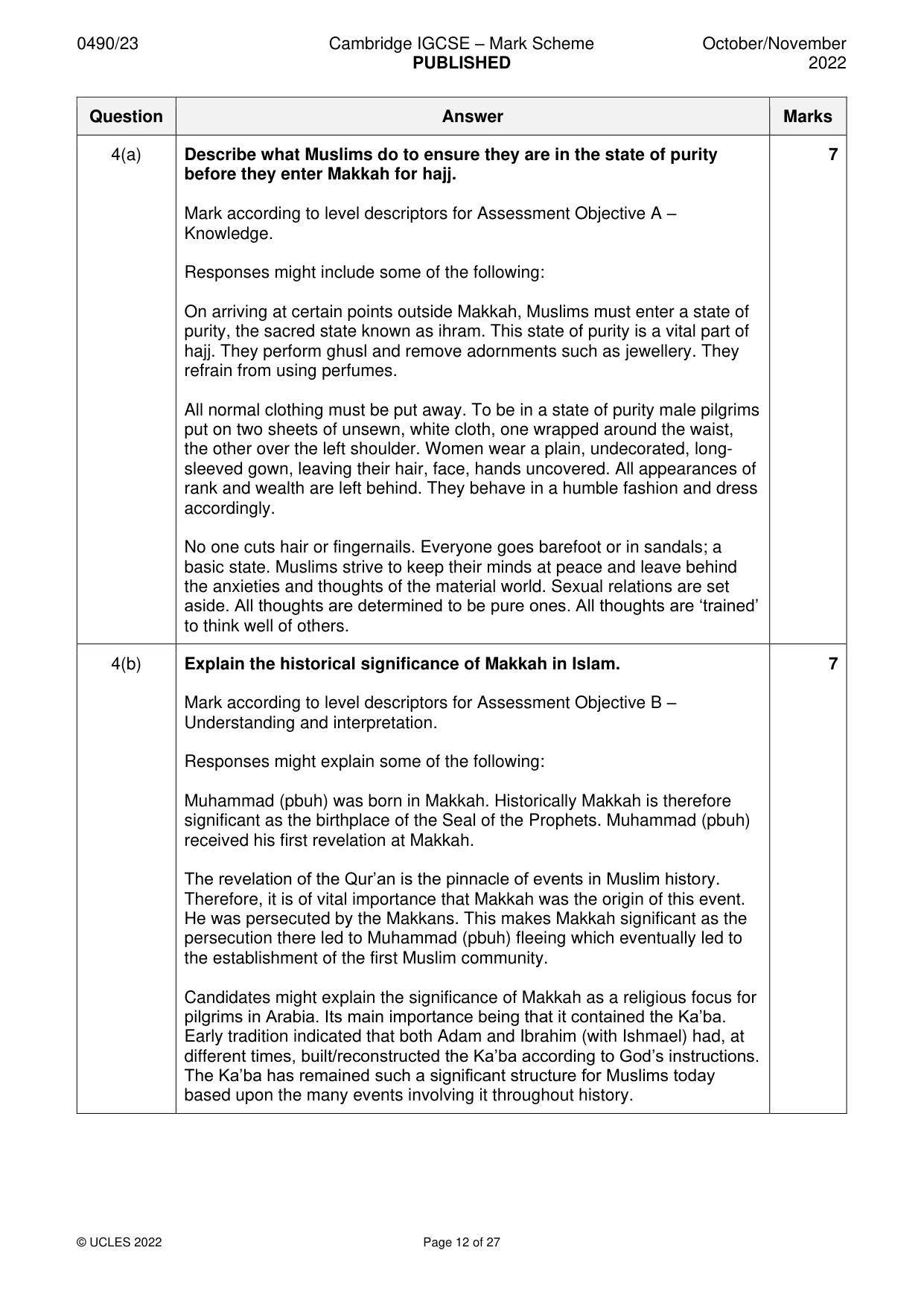
0490/23 Cambridge IGCSE – Mark Scheme PUBLISHED October/November 2022 © UCLES 2022 Page 12 of 27 Question Answer Marks 4(a) Describe what Muslims do to ensure they are in the state of purity before they enter Makkah for hajj. Mark according to level descriptors for Assessment Objective A – Knowledge. Responses might include some of the following: On arriving at certain points outside Makkah, Muslims must enter a state of purity, the sacred state known as ihram. This state of purity is a vital part of hajj. They perform ghusl and remove adornments such as jewellery. They refrain from using perfumes. All normal clothing must be put away. To be in a state of purity male pilgrims put on two sheets of unsewn, white cloth, one wrapped around the waist, the other over the left shoulder. Women wear a plain, undecorated, long- sleeved gown, leaving their hair, face, hands uncovered. All appearances of rank and wealth are left behind. They behave in a humble fashion and dress accordingly. No one cuts hair or fingernails. Everyone goes barefoot or in sandals; a basic state. Muslims strive to keep their minds at peace and leave behind the anxieties and thoughts of the material world. Sexual relations are set aside. All thoughts are determined to be pure ones. All thoughts are ‘trained’ to think well of others. 7 4(b) Explain the historical significance of Makkah in Islam. Mark according to level descriptors for Assessment Objective B – Understanding and interpretation. Responses might explain some of the following: Muhammad (pbuh) was born in Makkah. Historically Makkah is therefore significant as the birthplace of the Seal of the Prophets. Muhammad (pbuh) received his first revelation at Makkah. The revelation of the Qur’an is the pinnacle of events in Muslim history. Therefore, it is of vital importance that Makkah was the origin of this event. He was persecuted by the Makkans. This makes Makkah significant as the persecution there led to Muhammad (pbuh) fleeing which eventually led to the establishment of the first Muslim community. Candidates might explain the significance of Makkah as a religious focus for pilgrims in Arabia. Its main importance being that it contained the Ka’ba. Early tradition indicated that both Adam and Ibrahim (with Ishmael) had, at different times, built/reconstructed the Ka’ba according to God’s instructions. The Ka’ba has remained such a significant structure for Muslims today based upon the many events involving it throughout history. 7
Mark scheme, page 13
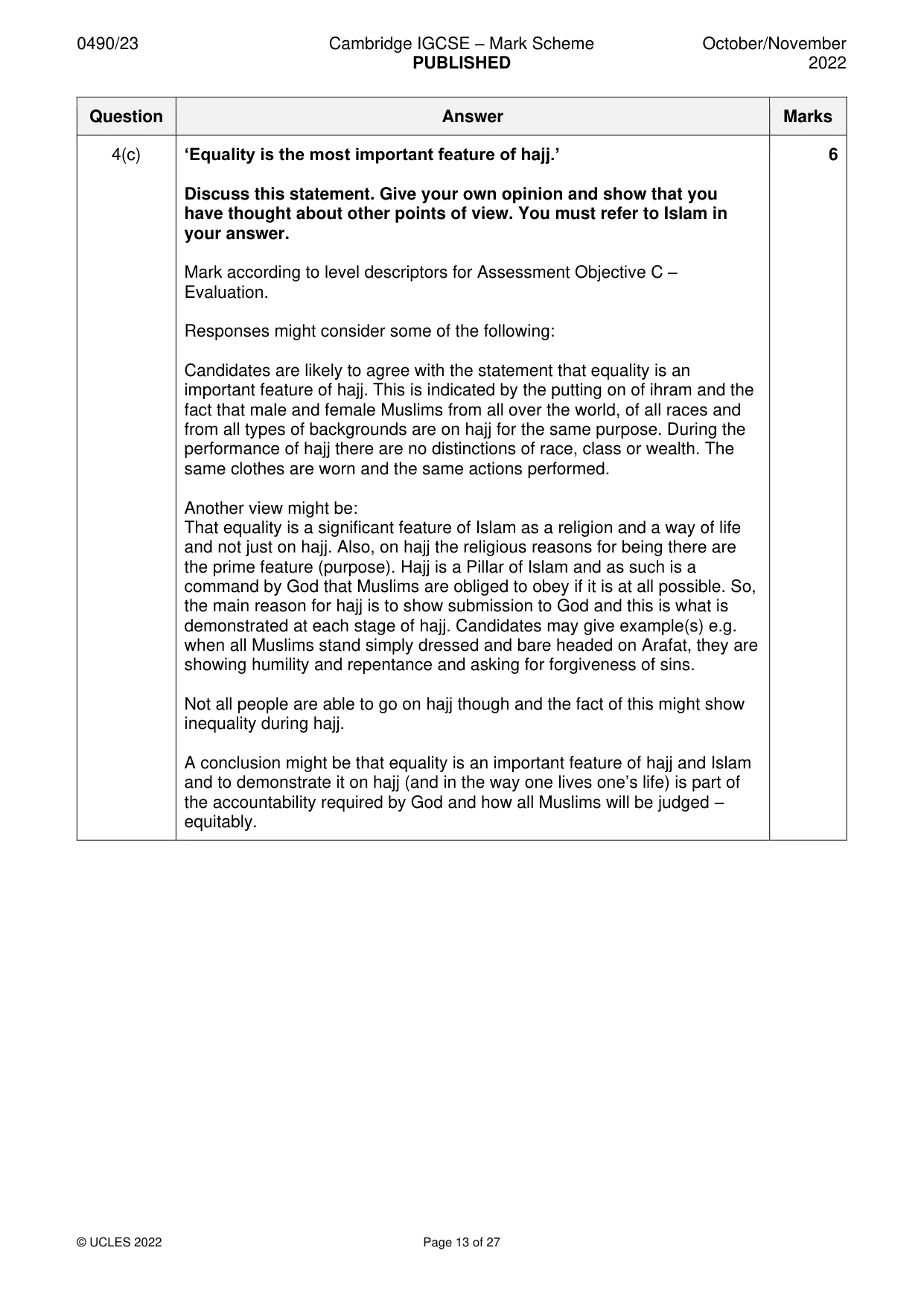
0490/23 Cambridge IGCSE – Mark Scheme PUBLISHED October/November 2022 © UCLES 2022 Page 13 of 27 Question Answer Marks 4(c) ‘Equality is the most important feature of hajj.’ Discuss this statement. Give your own opinion and show that you have thought about other points of view. You must refer to Islam in your answer. Mark according to level descriptors for Assessment Objective C – Evaluation. Responses might consider some of the following: Candidates are likely to agree with the statement that equality is an important feature of hajj. This is indicated by the putting on of ihram and the fact that male and female Muslims from all over the world, of all races and from all types of backgrounds are on hajj for the same purpose. During the performance of hajj there are no distinctions of race, class or wealth. The same clothes are worn and the same actions performed. Another view might be: That equality is a significant feature of Islam as a religion and a way of life and not just on hajj. Also, on hajj the religious reasons for being there are the prime feature (purpose). Hajj is a Pillar of Islam and as such is a command by God that Muslims are obliged to obey if it is at all possible. So, the main reason for hajj is to show submission to God and this is what is demonstrated at each stage of hajj. Candidates may give example(s) e.g. when all Muslims stand simply dressed and bare headed on Arafat, they are showing humility and repentance and asking for forgiveness of sins. Not all people are able to go on hajj though and the fact of this might show inequality during hajj. A conclusion might be that equality is an important feature of hajj and Islam and to demonstrate it on hajj (and in the way one lives one’s life) is part of the accountability required by God and how all Muslims will be judged – equitably. 6
Mark scheme, page 14
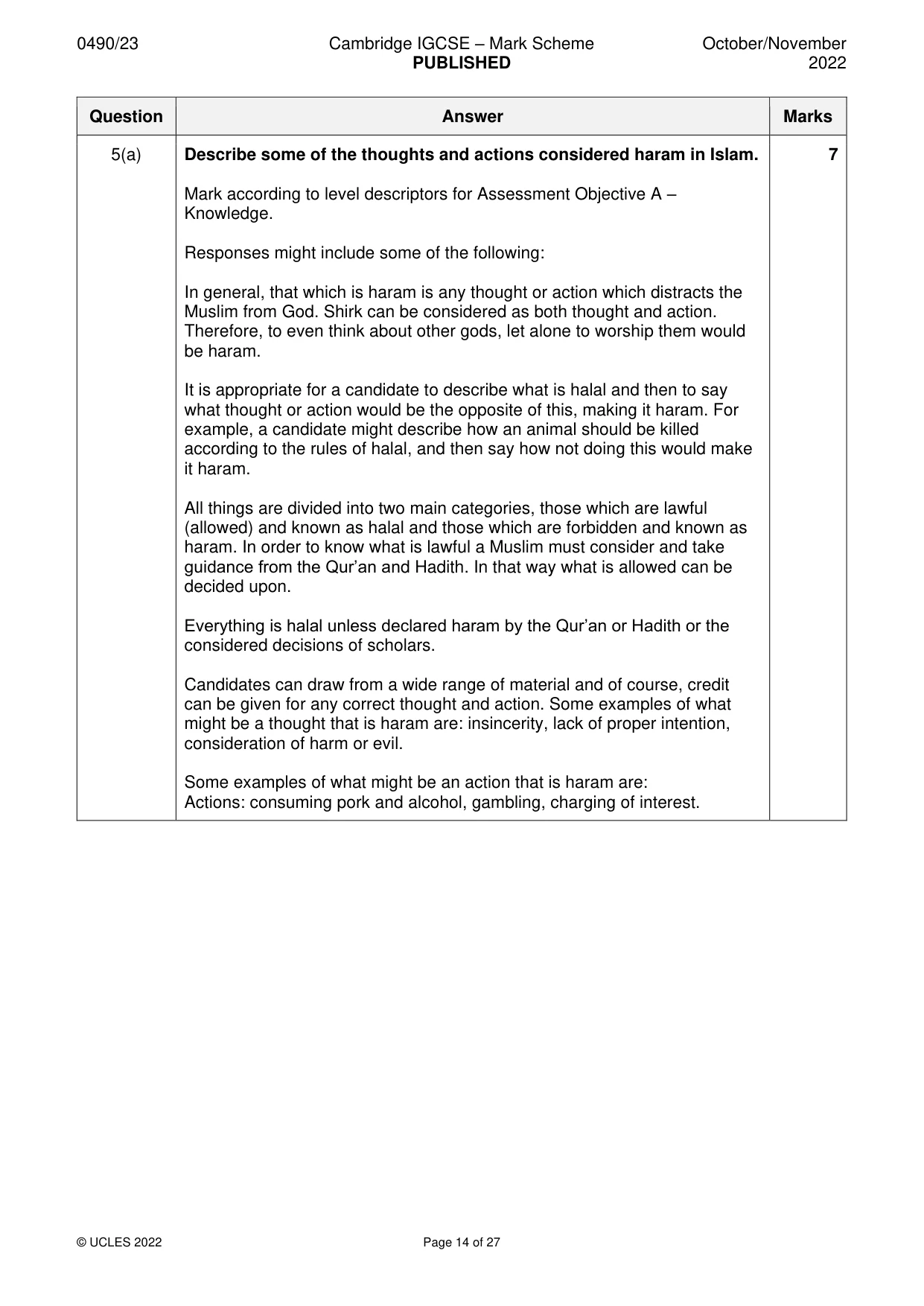
0490/23 Cambridge IGCSE – Mark Scheme PUBLISHED October/November 2022 © UCLES 2022 Page 14 of 27 Question Answer Marks 5(a) Describe some of the thoughts and actions considered haram in Islam. Mark according to level descriptors for Assessment Objective A – Knowledge. Responses might include some of the following: In general, that which is haram is any thought or action which distracts the Muslim from God. Shirk can be considered as both thought and action. Therefore, to even think about other gods, let alone to worship them would be haram. It is appropriate for a candidate to describe what is halal and then to say what thought or action would be the opposite of this, making it haram. For example, a candidate might describe how an animal should be killed according to the rules of halal, and then say how not doing this would make it haram. All things are divided into two main categories, those which are lawful (allowed) and known as halal and those which are forbidden and known as haram. In order to know what is lawful a Muslim must consider and take guidance from the Qur’an and Hadith. In that way what is allowed can be decided upon. Everything is halal unless declared haram by the Qur’an or Hadith or the considered decisions of scholars. Candidates can draw from a wide range of material and of course, credit can be given for any correct thought and action. Some examples of what might be a thought that is haram are: insincerity, lack of proper intention, consideration of harm or evil. Some examples of what might be an action that is haram are: Actions: consuming pork and alcohol, gambling, charging of interest. 7
Mark scheme, page 15
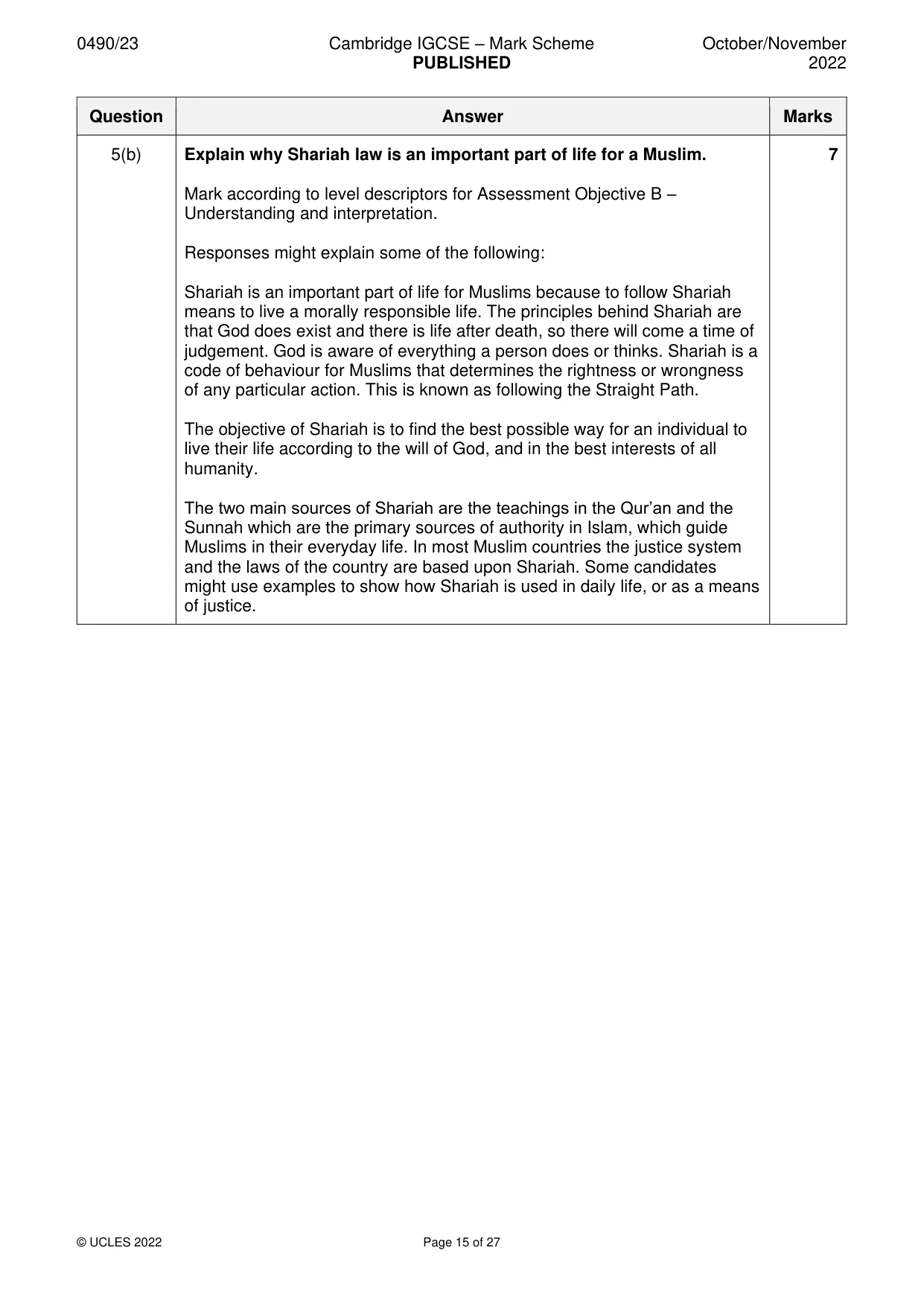
0490/23 Cambridge IGCSE – Mark Scheme PUBLISHED October/November 2022 © UCLES 2022 Page 15 of 27 Question Answer Marks 5(b) Explain why Shariah law is an important part of life for a Muslim. Mark according to level descriptors for Assessment Objective B – Understanding and interpretation. Responses might explain some of the following: Shariah is an important part of life for Muslims because to follow Shariah means to live a morally responsible life. The principles behind Shariah are that God does exist and there is life after death, so there will come a time of judgement. God is aware of everything a person does or thinks. Shariah is a code of behaviour for Muslims that determines the rightness or wrongness of any particular action. This is known as following the Straight Path. The objective of Shariah is to find the best possible way for an individual to live their life according to the will of God, and in the best interests of all humanity. The two main sources of Shariah are the teachings in the Qur’an and the Sunnah which are the primary sources of authority in Islam, which guide Muslims in their everyday life. In most Muslim countries the justice system and the laws of the country are based upon Shariah. Some candidates might use examples to show how Shariah is used in daily life, or as a means of justice. 7
Mark scheme, page 16
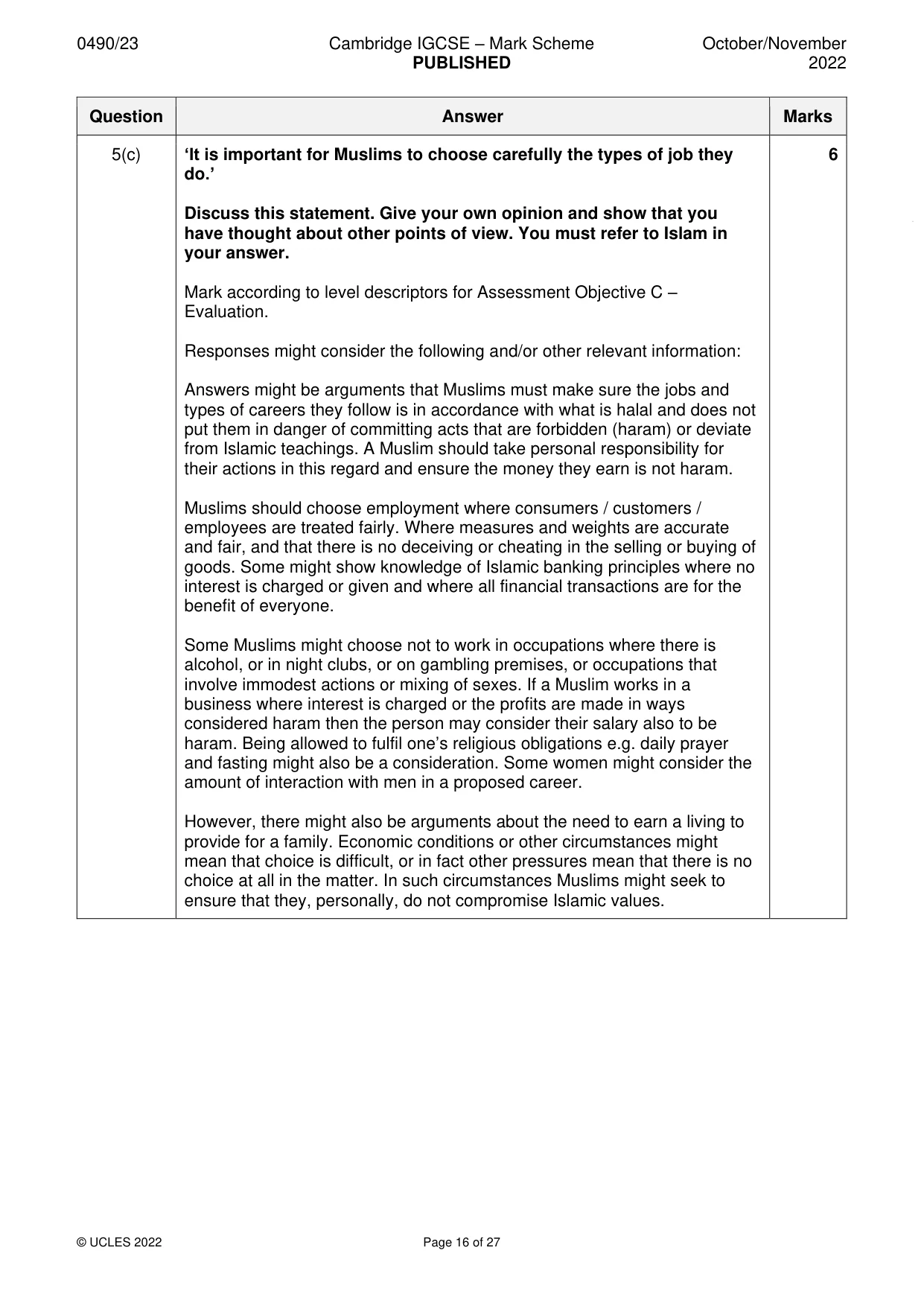
0490/23 Cambridge IGCSE – Mark Scheme PUBLISHED October/November 2022 © UCLES 2022 Page 16 of 27 Question Answer Marks 5(c) ‘It is important for Muslims to choose carefully the types of job they do.’ Discuss this statement. Give your own opinion and show that you have thought about other points of view. You must refer to Islam in your answer. Mark according to level descriptors for Assessment Objective C – Evaluation. Responses might consider the following and/or other relevant information: Answers might be arguments that Muslims must make sure the jobs and types of careers they follow is in accordance with what is halal and does not put them in danger of committing acts that are forbidden (haram) or deviate from Islamic teachings. A Muslim should take personal responsibility for their actions in this regard and ensure the money they earn is not haram. Muslims should choose employment where consumers / customers / employees are treated fairly. Where measures and weights are accurate and fair, and that there is no deceiving or cheating in the selling or buying of goods. Some might show knowledge of Islamic banking principles where no interest is charged or given and where all financial transactions are for the benefit of everyone. Some Muslims might choose not to work in occupations where there is alcohol, or in night clubs, or on gambling premises, or occupations that involve immodest actions or mixing of sexes. If a Muslim works in a business where interest is charged or the profits are made in ways considered haram then the person may consider their salary also to be haram. Being allowed to fulfil one’s religious obligations e.g. daily prayer and fasting might also be a consideration. Some women might consider the amount of interaction with men in a proposed career. However, there might also be arguments about the need to earn a living to provide for a family. Economic conditions or other circumstances might mean that choice is difficult, or in fact other pressures mean that there is no choice at all in the matter. In such circumstances Muslims might seek to ensure that they, personally, do not compromise Islamic values. 6
Mark scheme, page 17
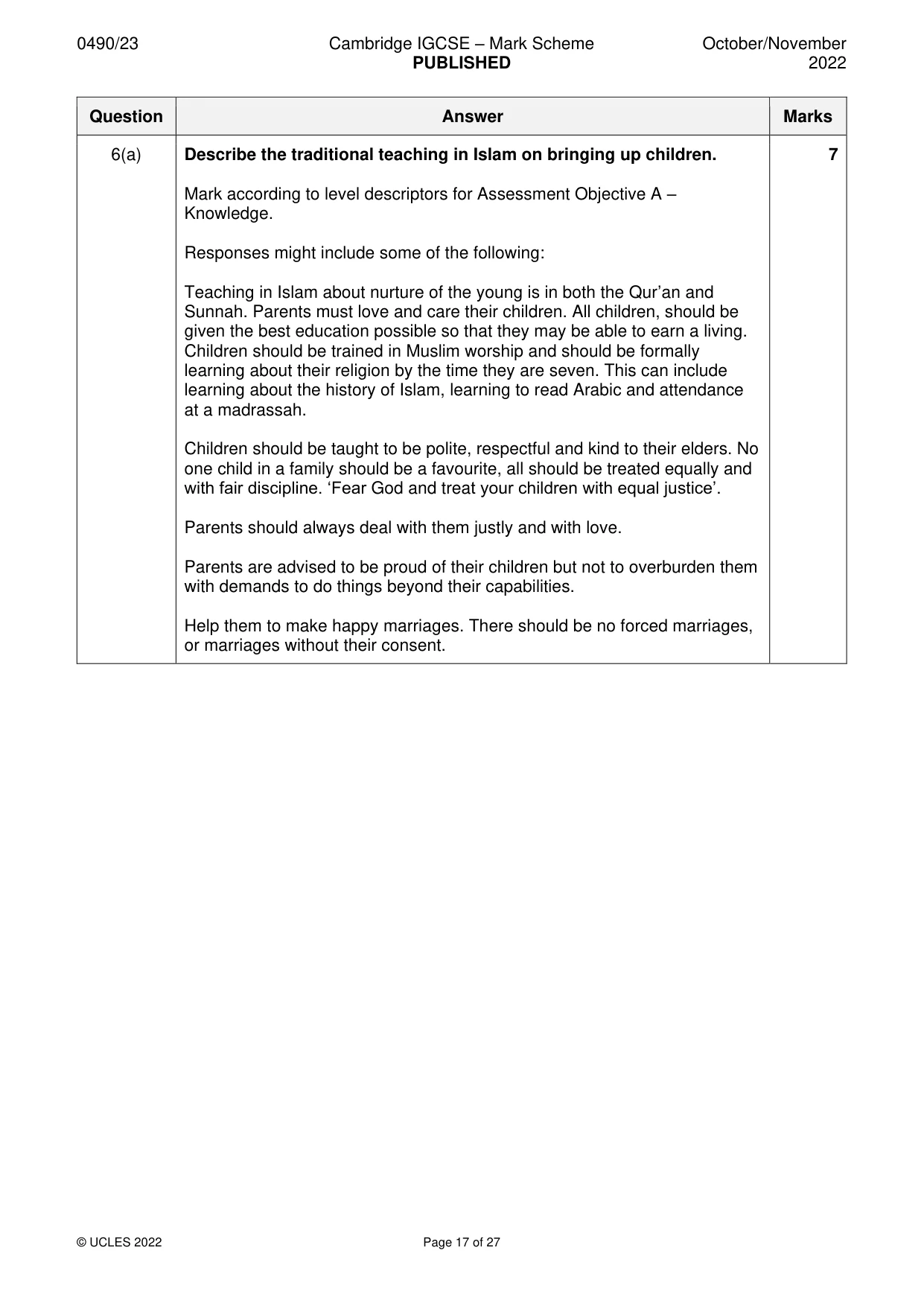
0490/23 Cambridge IGCSE – Mark Scheme PUBLISHED October/November 2022 © UCLES 2022 Page 17 of 27 Question Answer Marks 6(a) Describe the traditional teaching in Islam on bringing up children. Mark according to level descriptors for Assessment Objective A – Knowledge. Responses might include some of the following: Teaching in Islam about nurture of the young is in both the Qur’an and Sunnah. Parents must love and care their children. All children, should be given the best education possible so that they may be able to earn a living. Children should be trained in Muslim worship and should be formally learning about their religion by the time they are seven. This can include learning about the history of Islam, learning to read Arabic and attendance at a madrassah. Children should be taught to be polite, respectful and kind to their elders. No one child in a family should be a favourite, all should be treated equally and with fair discipline. ‘Fear God and treat your children with equal justice’. Parents should always deal with them justly and with love. Parents are advised to be proud of their children but not to overburden them with demands to do things beyond their capabilities. Help them to make happy marriages. There should be no forced marriages, or marriages without their consent. 7
Mark scheme, page 18
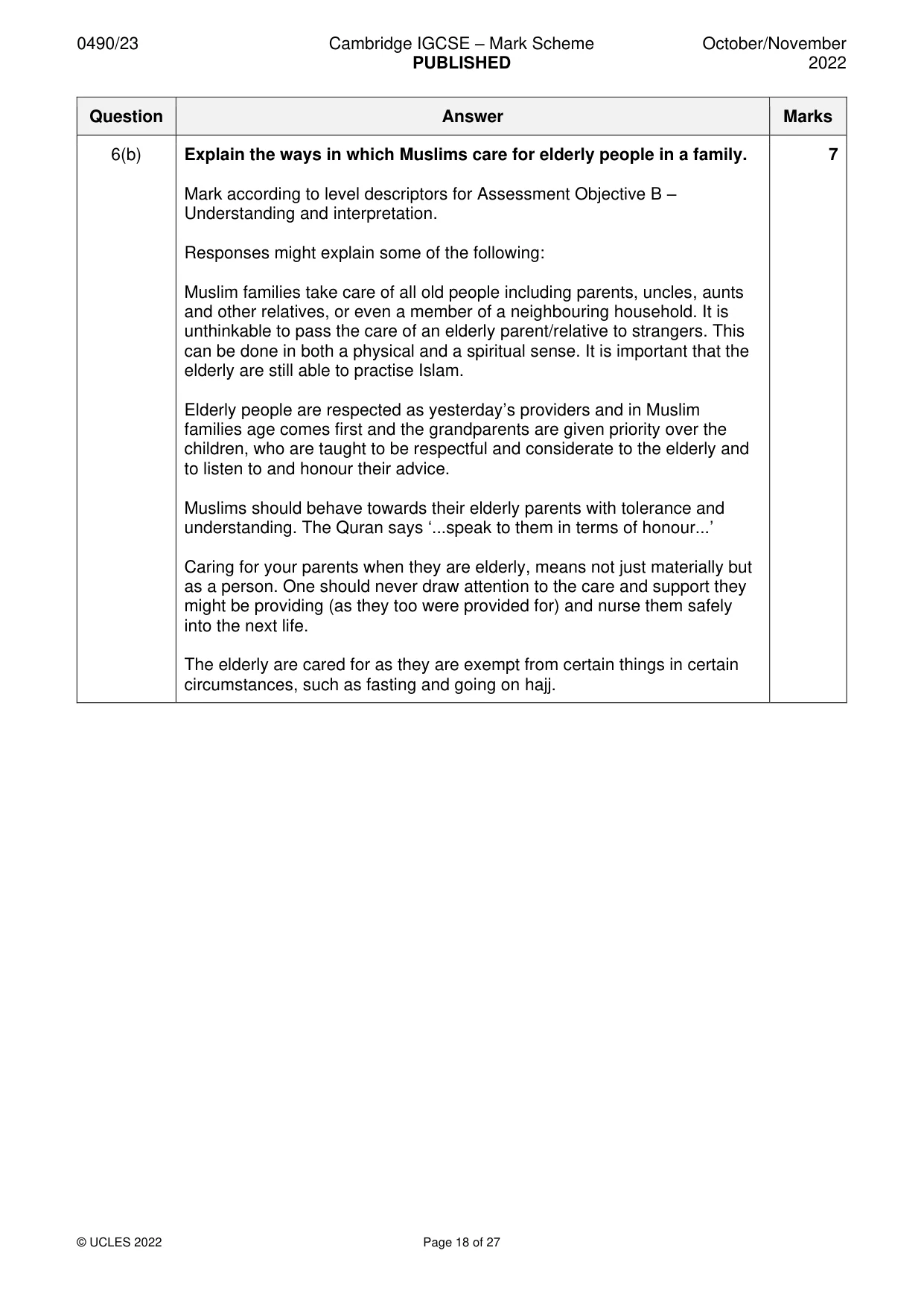
0490/23 Cambridge IGCSE – Mark Scheme PUBLISHED October/November 2022 © UCLES 2022 Page 18 of 27 Question Answer Marks 6(b) Explain the ways in which Muslims care for elderly people in a family. Mark according to level descriptors for Assessment Objective B – Understanding and interpretation. Responses might explain some of the following: Muslim families take care of all old people including parents, uncles, aunts and other relatives, or even a member of a neighbouring household. It is unthinkable to pass the care of an elderly parent/relative to strangers. This can be done in both a physical and a spiritual sense. It is important that the elderly are still able to practise Islam. Elderly people are respected as yesterday’s providers and in Muslim families age comes first and the grandparents are given priority over the children, who are taught to be respectful and considerate to the elderly and to listen to and honour their advice. Muslims should behave towards their elderly parents with tolerance and understanding. The Quran says ‘...speak to them in terms of honour...’ Caring for your parents when they are elderly, means not just materially but as a person. One should never draw attention to the care and support they might be providing (as they too were provided for) and nurse them safely into the next life. The elderly are cared for as they are exempt from certain things in certain circumstances, such as fasting and going on hajj. 7
Mark scheme, page 19
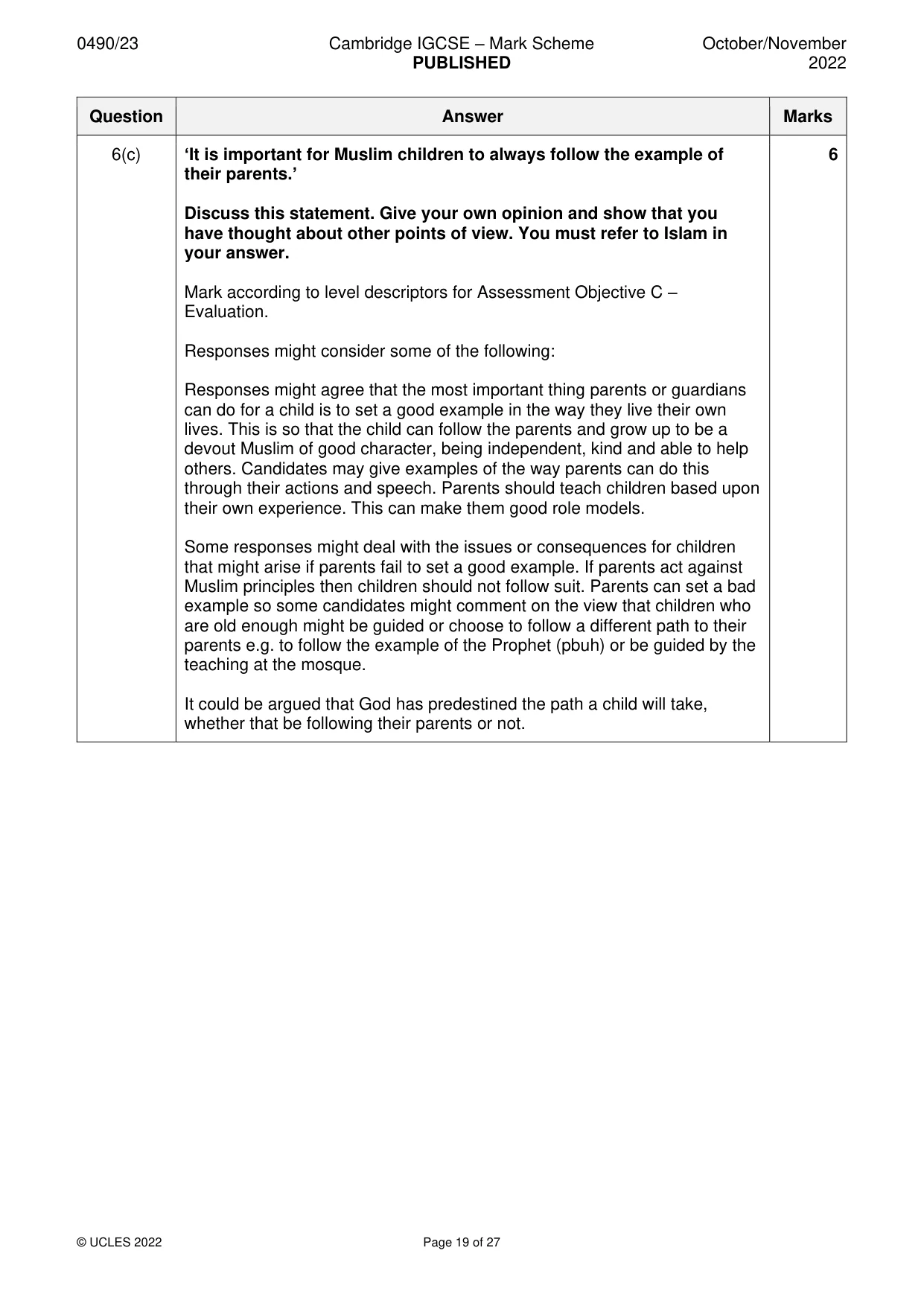
0490/23 Cambridge IGCSE – Mark Scheme PUBLISHED October/November 2022 © UCLES 2022 Page 19 of 27 Question Answer Marks 6(c) ‘It is important for Muslim children to always follow the example of their parents.’ Discuss this statement. Give your own opinion and show that you have thought about other points of view. You must refer to Islam in your answer. Mark according to level descriptors for Assessment Objective C – Evaluation. Responses might consider some of the following: Responses might agree that the most important thing parents or guardians can do for a child is to set a good example in the way they live their own lives. This is so that the child can follow the parents and grow up to be a devout Muslim of good character, being independent, kind and able to help others. Candidates may give examples of the way parents can do this through their actions and speech. Parents should teach children based upon their own experience. This can make them good role models. Some responses might deal with the issues or consequences for children that might arise if parents fail to set a good example. If parents act against Muslim principles then children should not follow suit. Parents can set a bad example so some candidates might comment on the view that children who are old enough might be guided or choose to follow a different path to their parents e.g. to follow the example of the Prophet (pbuh) or be guided by the teaching at the mosque. It could be argued that God has predestined the path a child will take, whether that be following their parents or not. 6
Mark scheme, page 20
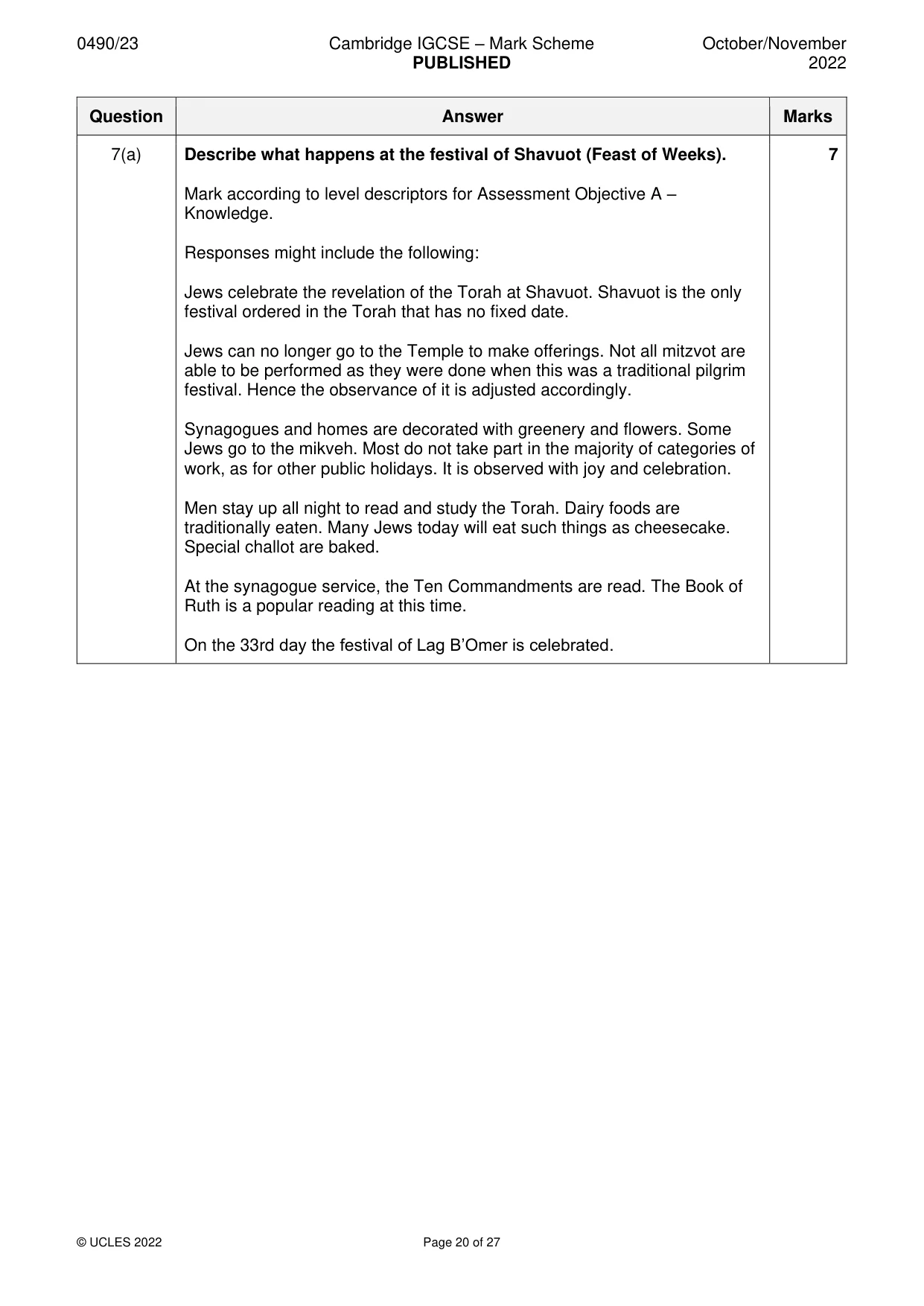
0490/23 Cambridge IGCSE – Mark Scheme PUBLISHED October/November 2022 © UCLES 2022 Page 20 of 27 Question Answer Marks 7(a) Describe what happens at the festival of Shavuot (Feast of Weeks). Mark according to level descriptors for Assessment Objective A – Knowledge. Responses might include the following: Jews celebrate the revelation of the Torah at Shavuot. Shavuot is the only festival ordered in the Torah that has no fixed date. Jews can no longer go to the Temple to make offerings. Not all mitzvot are able to be performed as they were done when this was a traditional pilgrim festival. Hence the observance of it is adjusted accordingly. Synagogues and homes are decorated with greenery and flowers. Some Jews go to the mikveh. Most do not take part in the majority of categories of work, as for other public holidays. It is observed with joy and celebration. Men stay up all night to read and study the Torah. Dairy foods are traditionally eaten. Many Jews today will eat such things as cheesecake. Special challot are baked. At the synagogue service, the Ten Commandments are read. The Book of Ruth is a popular reading at this time. On the 33rd day the festival of Lag B’Omer is celebrated. 7
Mark scheme, page 21
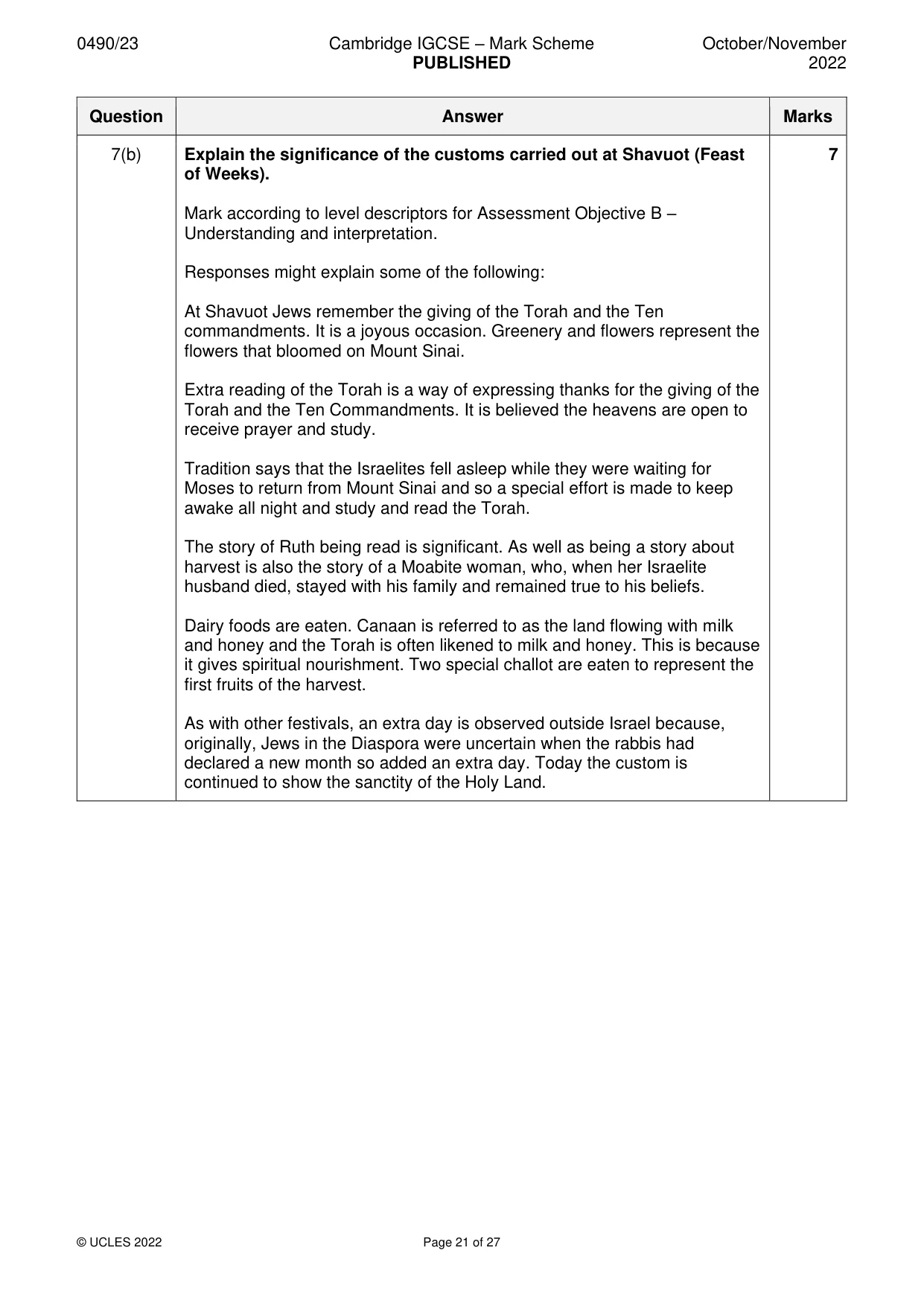
0490/23 Cambridge IGCSE – Mark Scheme PUBLISHED October/November 2022 © UCLES 2022 Page 21 of 27 Question Answer Marks 7(b) Explain the significance of the customs carried out at Shavuot (Feast of Weeks). Mark according to level descriptors for Assessment Objective B – Understanding and interpretation. Responses might explain some of the following: At Shavuot Jews remember the giving of the Torah and the Ten commandments. It is a joyous occasion. Greenery and flowers represent the flowers that bloomed on Mount Sinai. Extra reading of the Torah is a way of expressing thanks for the giving of the Torah and the Ten Commandments. It is believed the heavens are open to receive prayer and study. Tradition says that the Israelites fell asleep while they were waiting for Moses to return from Mount Sinai and so a special effort is made to keep awake all night and study and read the Torah. The story of Ruth being read is significant. As well as being a story about harvest is also the story of a Moabite woman, who, when her Israelite husband died, stayed with his family and remained true to his beliefs. Dairy foods are eaten. Canaan is referred to as the land flowing with milk and honey and the Torah is often likened to milk and honey. This is because it gives spiritual nourishment. Two special challot are eaten to represent the first fruits of the harvest. As with other festivals, an extra day is observed outside Israel because, originally, Jews in the Diaspora were uncertain when the rabbis had declared a new month so added an extra day. Today the custom is continued to show the sanctity of the Holy Land. 7
Mark scheme, page 22
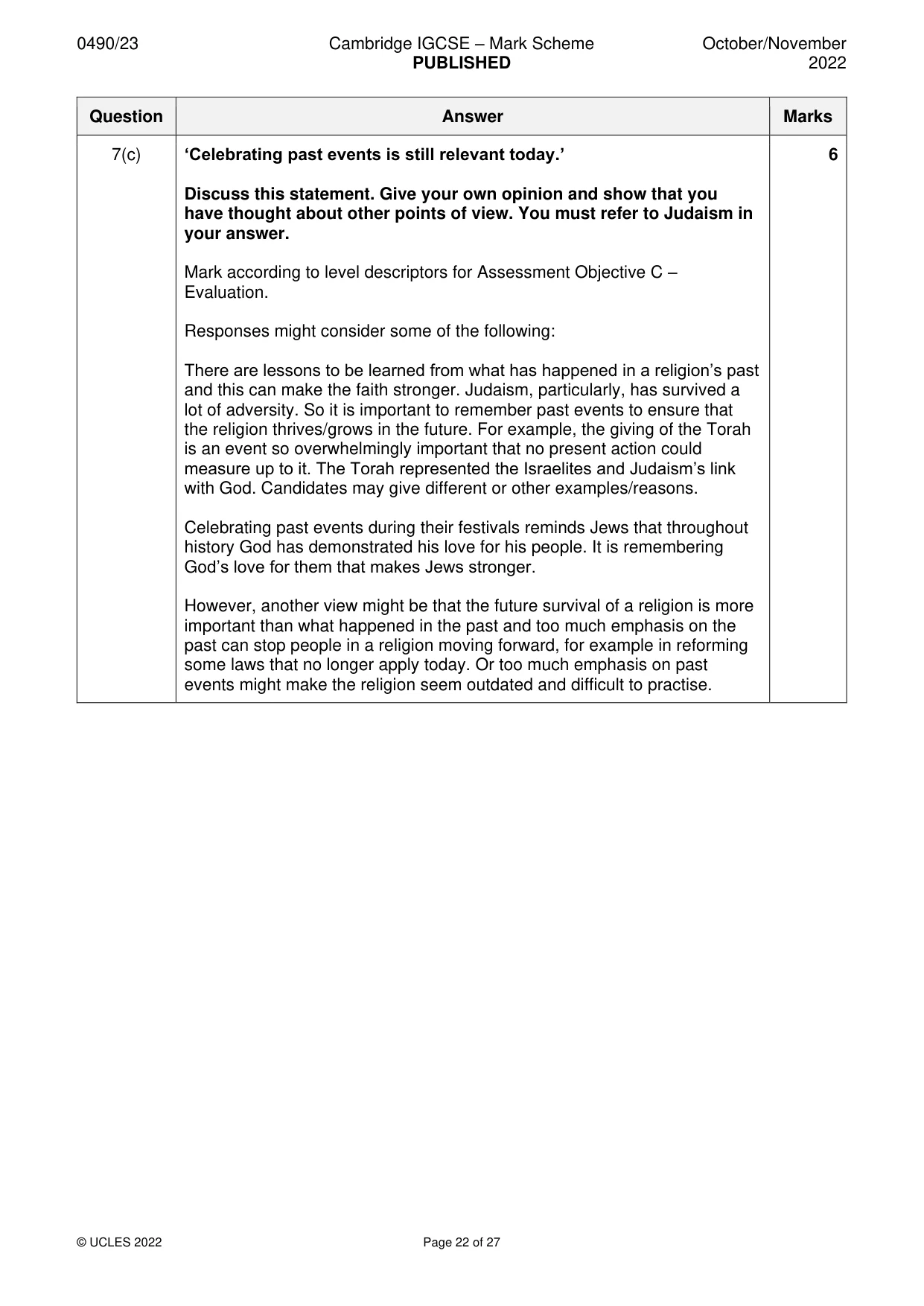
0490/23 Cambridge IGCSE – Mark Scheme PUBLISHED October/November 2022 © UCLES 2022 Page 22 of 27 Question Answer Marks 7(c) ‘Celebrating past events is still relevant today.’ Discuss this statement. Give your own opinion and show that you have thought about other points of view. You must refer to Judaism in your answer. Mark according to level descriptors for Assessment Objective C – Evaluation. Responses might consider some of the following: There are lessons to be learned from what has happened in a religion’s past and this can make the faith stronger. Judaism, particularly, has survived a lot of adversity. So it is important to remember past events to ensure that the religion thrives/grows in the future. For example, the giving of the Torah is an event so overwhelmingly important that no present action could measure up to it. The Torah represented the Israelites and Judaism’s link with God. Candidates may give different or other examples/reasons. Celebrating past events during their festivals reminds Jews that throughout history God has demonstrated his love for his people. It is remembering God’s love for them that makes Jews stronger. However, another view might be that the future survival of a religion is more important than what happened in the past and too much emphasis on the past can stop people in a religion moving forward, for example in reforming some laws that no longer apply today. Or too much emphasis on past events might make the religion seem outdated and difficult to practise. 6
Mark scheme, page 23
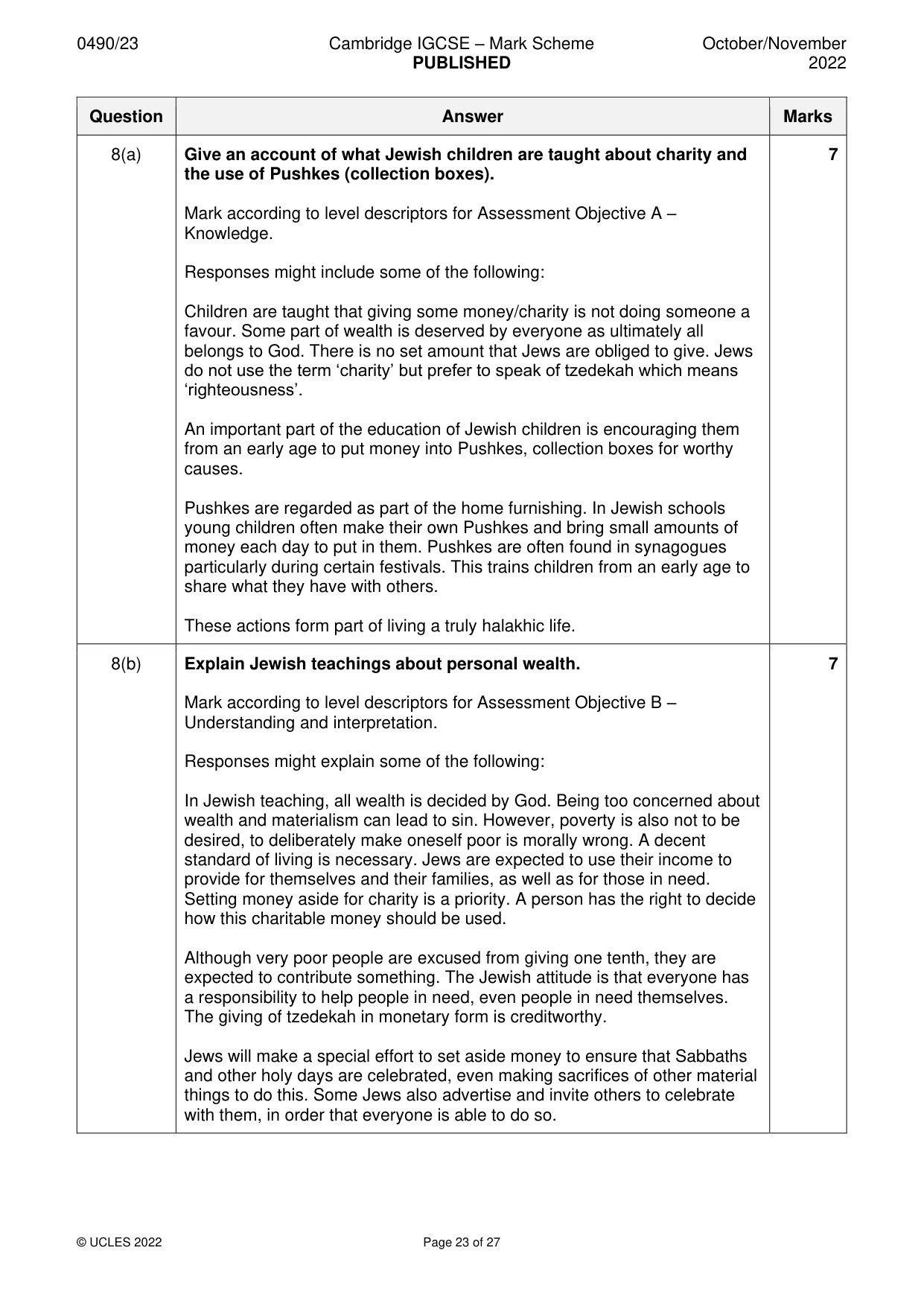
0490/23 Cambridge IGCSE – Mark Scheme PUBLISHED October/November 2022 © UCLES 2022 Page 23 of 27 Question Answer Marks 8(a) Give an account of what Jewish children are taught about charity and the use of Pushkes (collection boxes). Mark according to level descriptors for Assessment Objective A – Knowledge. Responses might include some of the following: Children are taught that giving some money/charity is not doing someone a favour. Some part of wealth is deserved by everyone as ultimately all belongs to God. There is no set amount that Jews are obliged to give. Jews do not use the term ‘charity’ but prefer to speak of tzedekah which means ‘righteousness’. An important part of the education of Jewish children is encouraging them from an early age to put money into Pushkes, collection boxes for worthy causes. Pushkes are regarded as part of the home furnishing. In Jewish schools young children often make their own Pushkes and bring small amounts of money each day to put in them. Pushkes are often found in synagogues particularly during certain festivals. This trains children from an early age to share what they have with others. These actions form part of living a truly halakhic life. 7 8(b) Explain Jewish teachings about personal wealth. Mark according to level descriptors for Assessment Objective B – Understanding and interpretation. Responses might explain some of the following: In Jewish teaching, all wealth is decided by God. Being too concerned about wealth and materialism can lead to sin. However, poverty is also not to be desired, to deliberately make oneself poor is morally wrong. A decent standard of living is necessary. Jews are expected to use their income to provide for themselves and their families, as well as for those in need. Setting money aside for charity is a priority. A person has the right to decide how this charitable money should be used. Although very poor people are excused from giving one tenth, they are expected to contribute something. The Jewish attitude is that everyone has a responsibility to help people in need, even people in need themselves. The giving of tzedekah in monetary form is creditworthy. Jews will make a special effort to set aside money to ensure that Sabbaths and other holy days are celebrated, even making sacrifices of other material things to do this. Some Jews also advertise and invite others to celebrate with them, in order that everyone is able to do so. 7
Mark scheme, page 24
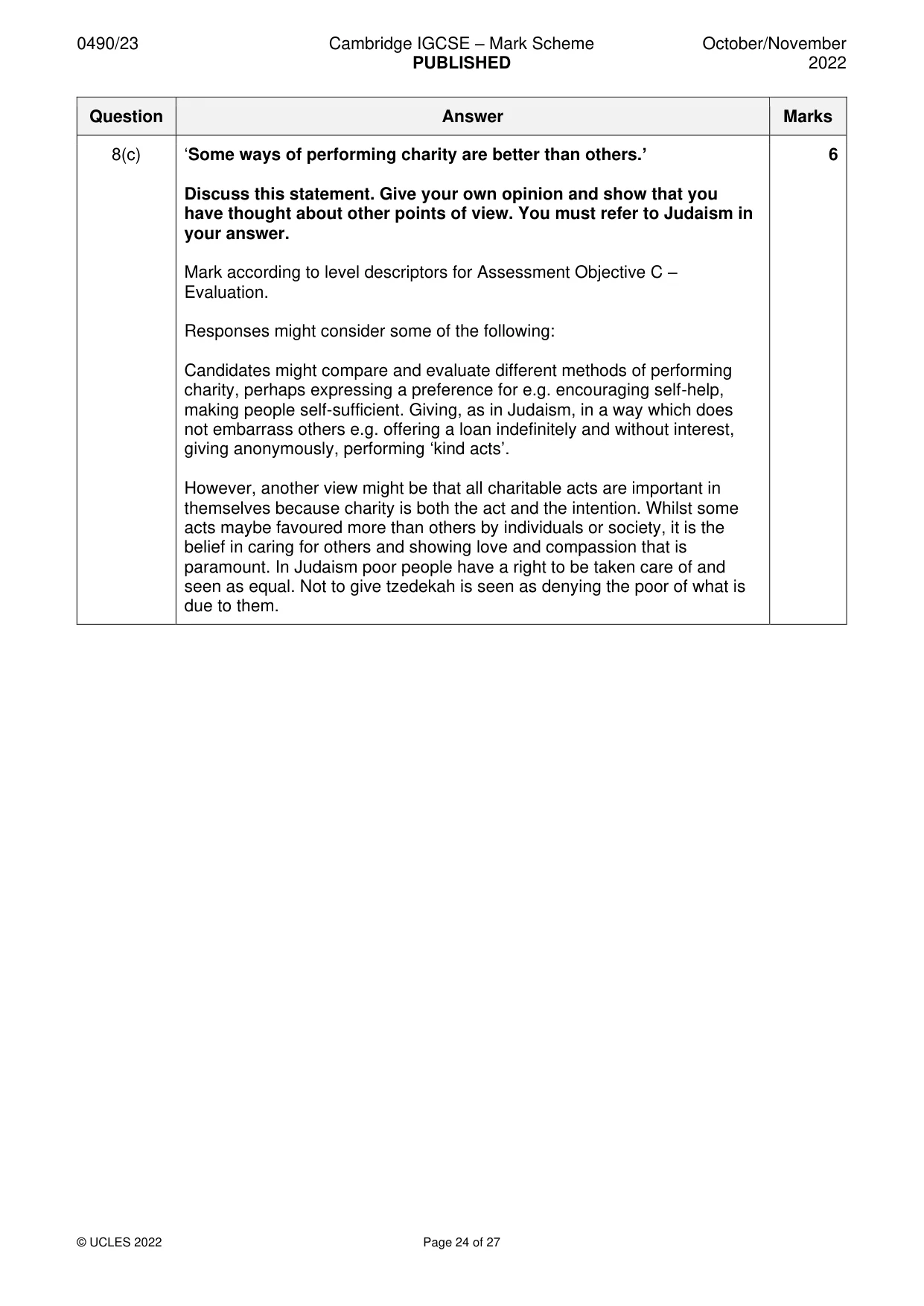
0490/23 Cambridge IGCSE – Mark Scheme PUBLISHED October/November 2022 © UCLES 2022 Page 24 of 27 Question Answer Marks 8(c) ‘Some ways of performing charity are better than others.’ Discuss this statement. Give your own opinion and show that you have thought about other points of view. You must refer to Judaism in your answer. Mark according to level descriptors for Assessment Objective C – Evaluation. Responses might consider some of the following: Candidates might compare and evaluate different methods of performing charity, perhaps expressing a preference for e.g. encouraging self-help, making people self-sufficient. Giving, as in Judaism, in a way which does not embarrass others e.g. offering a loan indefinitely and without interest, giving anonymously, performing ‘kind acts’. However, another view might be that all charitable acts are important in themselves because charity is both the act and the intention. Whilst some acts maybe favoured more than others by individuals or society, it is the belief in caring for others and showing love and compassion that is paramount. In Judaism poor people have a right to be taken care of and seen as equal. Not to give tzedekah is seen as denying the poor of what is due to them. 6
Mark scheme, page 25
0490/23 Cambridge IGCSE – Mark Scheme PUBLISHED October/November 2022 © UCLES 2022 Page 25 of 27 Question Answer Marks 9(a) Give an account of the customs that are observed by the family after a Jewish funeral. Mark according to level descriptors for Assessment Objective A – Knowledge. Responses might include some of the following: Shiva – is a period of mourning for seven days. Jews are said to ‘sit shiva’. During this period mourners gather in their home and do not leave it unless absolutely necessary. Mourners sit on low stools, mirrors are covered, so that people are discouraged from attending to their appearance, there is no music and sexual relations are forbidden. Tearing of a garment can occur during shiva as well as straight after the death. It can be customary to stay in this garment for shiva and beyond, through to sheloshim. Mourners do not leave the house except on Shabbat or shave or cut hair or wear leather shoes. Three times each day friends and fellow synagogue members will come to pray with the mourners. Kaddish is said three times a day. It is a prayer about God’s greatness. Neighbours and people in the community help the bereaved by bringing food. A candle is kept burning day and night. Once Shiva has ended male mourners go to the synagogue and recite kaddish each day for the rest of the first month of mourning (30 days). A headstone may be set up. On the anniversary of a death a candle is lit and kaddish is said. 7
Mark scheme, page 26
0490/23 Cambridge IGCSE – Mark Scheme PUBLISHED October/November 2022 © UCLES 2022 Page 26 of 27 Question Answer Marks 9(b) Explain how Jewish mourning customs might help people after a death. Mark according to level descriptors for Assessment Objective B – Understanding and interpretation. Responses might explain some of the following: Judaism regards excessive or prolonged mourning as undesirable. However, mourning is necessary, accepted and helpful. Shiva is intended to help the bereaved. Mourners are allowed to express their grief in this way for an intense period in the first week. The process should be a gradual one. One does not resume normal life straight away. The 30 days of mourning also illustrates this at a different level. Appearances and comfort are not important so need not be worried about. The chevra kaddisha, neighbours, people in the community help the bereaved by providing companionship and praying with the mourners during Shiva. The emphasis is on practical help. The community concentrates on supporting and helping the living. Candidates might explain the importance and the comfort for mourners in well-practised rituals. However, for as long as the immediate relatives live they are comforted as they know they will remember the dead person each year at the yarzheit (anniversary) by praying for them, lighting a candle, and keeping it burning day and night. 7
Mark scheme, page 27
0490/23 Cambridge IGCSE – Mark Scheme PUBLISHED October/November 2022 © UCLES 2022 Page 27 of 27 Question Answer Marks 9(c) ‘Mourners benefit from funerals being simple occasions.’ Discuss this statement. Give your own opinion and show that you have thought about other points of view. You must refer to Judaism in your answer. Mark according to level descriptors for Assessment Objective C – Evaluation. Responses might consider some of the following: In Judaism the funeral can be a simple affair. There may be psalms, prayers and a short address by a Rabbi but no excessive displays of grief as this is considered disrespectful (to God). No elaborate coffins or adornments are allowed. Some might say that this involves no distractions and helps mourners to grieve. Others could say that elaborate funerals are ‘fitting’ however others will say organising them will be a burden. It can be argued that no-one can tell anyone else what sort of funeral should be organised. It might be argued that funerals should be respectful, religious occasions but there are some customs that should be observed to make sure the rituals are carried out properly. The Chevra Kaddisha have to prepare the body, wash it and if possible even immerse it in a mikveh. Men are buried wearing the tallit in which they prayed during life. Until the burial, a light is kept burning and the corpse is not left alone. 6
What you needed in this session
Cambridge’s own grade thresholds for 2022 Oct/Nov, Paper 2 · Variant 3. A higher threshold means an easier paper — the bar moves with how the cohort did.