Cambridge IGCSE Religious Studies 0490 — 2019 Oct/Nov Paper 2 · Variant 3
0490/23/O/N/19 · 80 marks · ≈90 min
The question paper and its mark scheme, free to read here and free to download. This is Cambridge’s own paper, exactly as it was sat.
Question paper4 pages
Mark scheme24 pages
Answers below. Sit the paper first if you are practising.
Paper as text
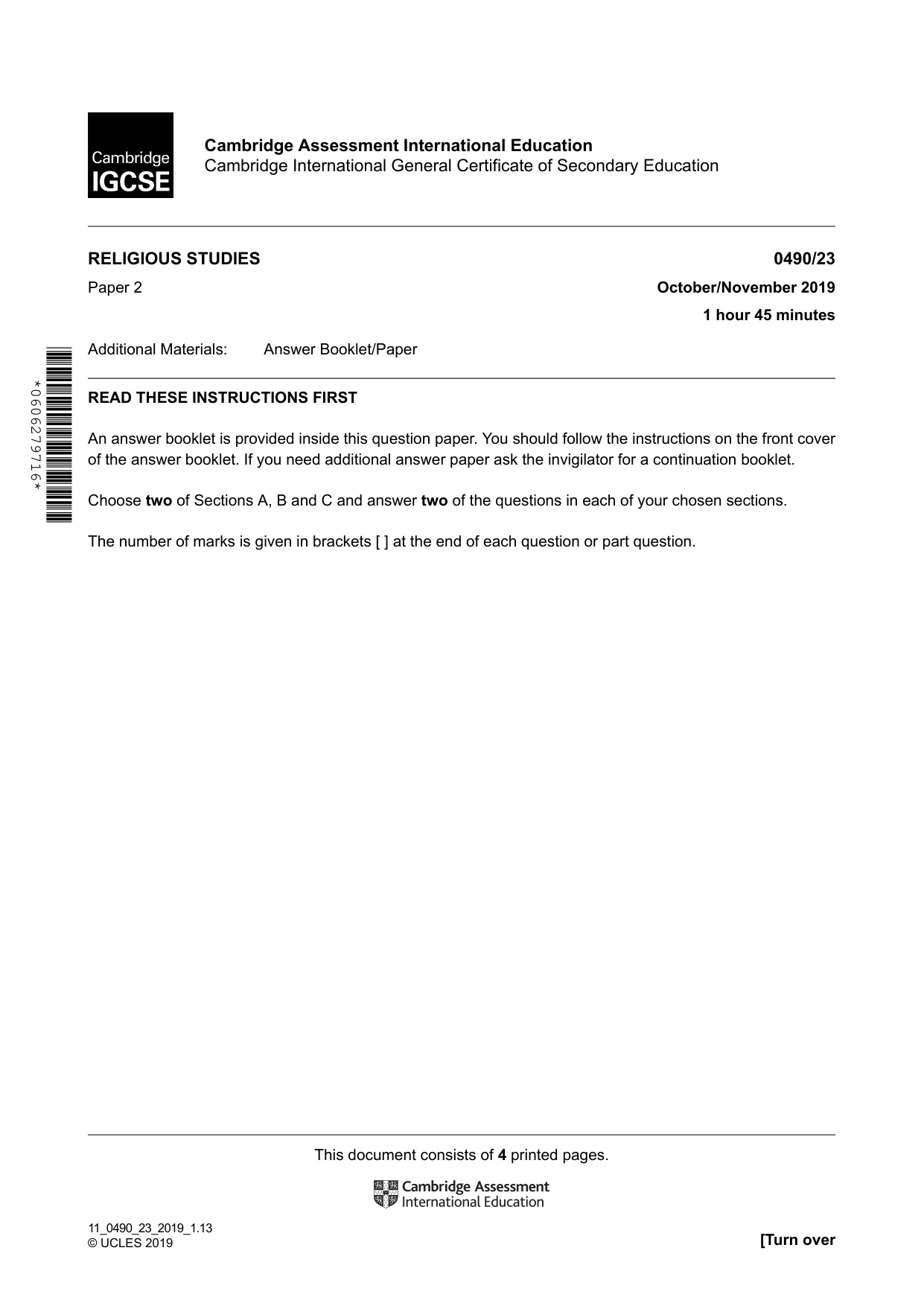
Question paper, page 1
Cambridge Assessment International Education Cambridge International General Certificate of Secondary Education 0490/23 RELIGIOUS STUDIES October/November 2019 Paper 2 1 hour 45 minutes Additional Materials: Answer Booklet/Paper READ THESE INSTRUCTIONS FIRST An answer booklet is provided inside this question paper. You should follow the instructions on the front cover of the answer booklet. If you need additional answer paper ask the invigilator for a continuation booklet. Choose two of Sections A, B and C and answer two of the questions in each of your chosen sections. The number of marks is given in brackets [ ] at the end of each question or part question. This document consists of 4 printed pages. [Turn over 11_0490_23_2019_1.13 © UCLES 2019 *0606279716*
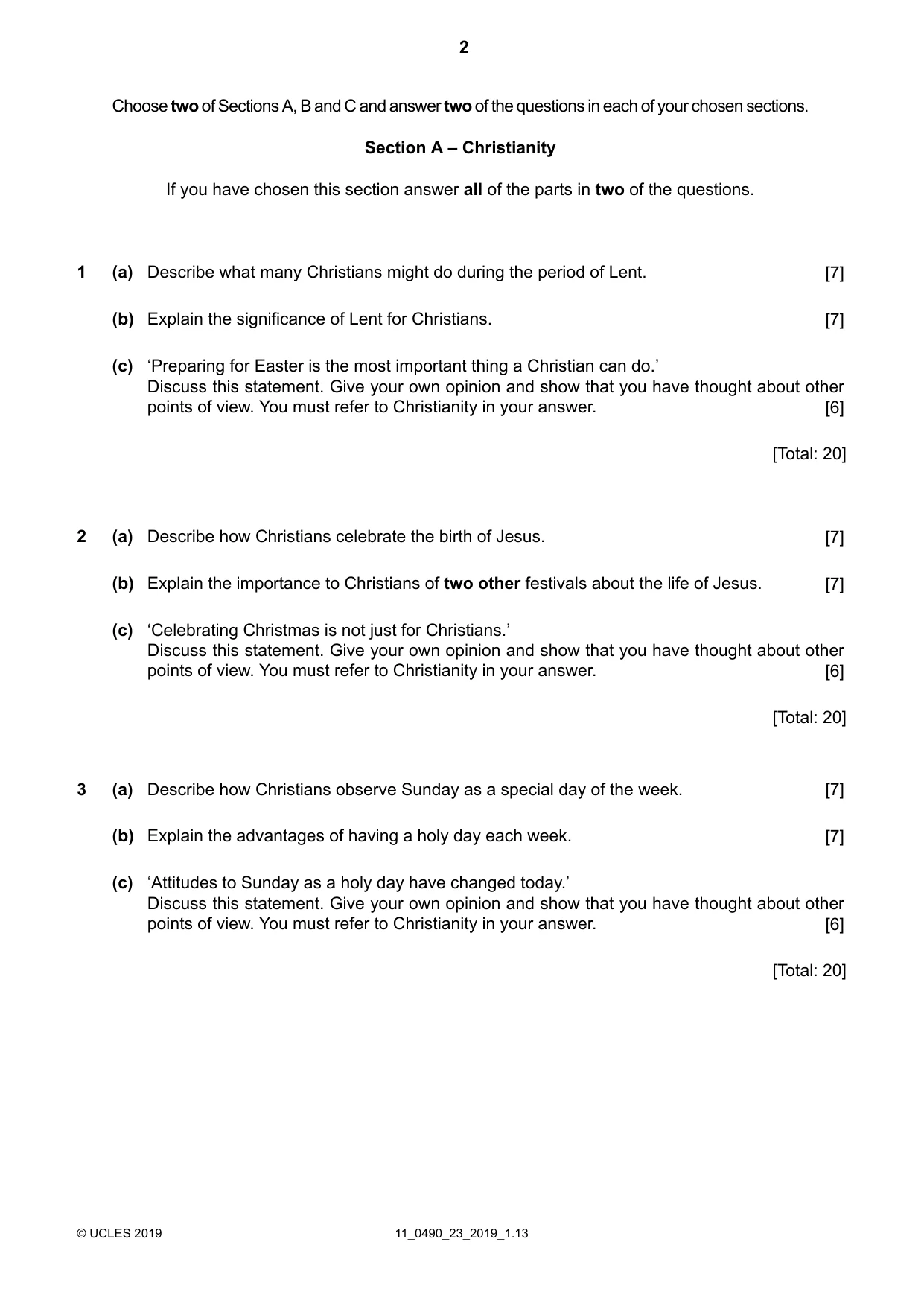
Question paper, page 2
Choose two of Sections A, B and C and answer two of the questions in each of your chosen sections. Section A – Christianity If you have chosen this section answer all of the parts in two of the questions. Describe what many Christians might do during the period of Lent. (a) 1 [7] Explain the significance of Lent for Christians. (b) [7] ‘Preparing for Easter is the most important thing a Christian can do.’ Discuss this statement. Give your own opinion and show that you have thought about other points of view. You must refer to Christianity in your answer. (c) [6] [Total: 20] Describe how Christians celebrate the birth of Jesus. (a) 2 [7] Explain the importance to Christians of two other festivals about the life of Jesus. (b) [7] ‘Celebrating Christmas is not just for Christians.’ Discuss this statement. Give your own opinion and show that you have thought about other points of view. You must refer to Christianity in your answer. (c) [6] [Total: 20] Describe how Christians observe Sunday as a special day of the week. (a) 3 [7] Explain the advantages of having a holy day each week. (b) [7] ‘Attitudes to Sunday as a holy day have changed today.’ Discuss this statement. Give your own opinion and show that you have thought about other points of view. You must refer to Christianity in your answer. (c) [6] [Total: 20] 11_0490_23_2019_1.13 © UCLES 2019 2
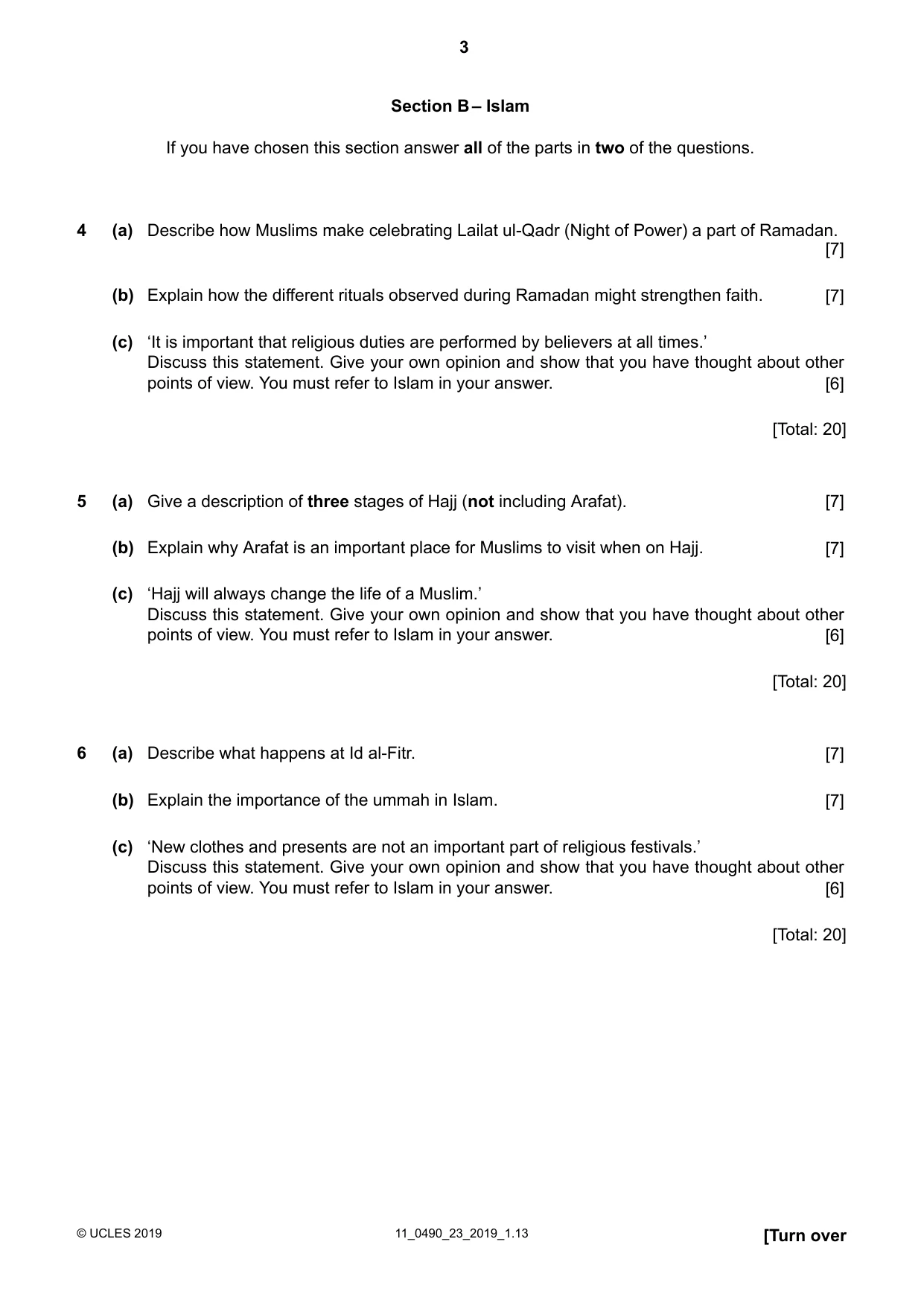
Question paper, page 3
Section B– Islam If you have chosen this section answer all of the parts in two of the questions. Describe how Muslims make celebrating Lailat ul-Qadr (Night of Power) a part of Ramadan. (a) 4 [7] Explain how the different rituals observed during Ramadan might strengthen faith. (b) [7] ‘It is important that religious duties are performed by believers at all times.’ Discuss this statement. Give your own opinion and show that you have thought about other points of view. You must refer to Islam in your answer. (c) [6] [Total: 20] Give a description of three stages of Hajj (not including Arafat). [7] (a) 5 Explain why Arafat is an important place for Muslims to visit when on Hajj. (b) [7] ‘Hajj will always change the life of a Muslim.’ Discuss this statement. Give your own opinion and show that you have thought about other points of view. You must refer to Islam in your answer. (c) [6] [Total: 20] Describe what happens at Id al-Fitr. (a) 6 [7] Explain the importance of the ummah in Islam. (b) [7] ‘New clothes and presents are not an important part of religious festivals.’ Discuss this statement. Give your own opinion and show that you have thought about other points of view. You must refer to Islam in your answer. (c) [6] [Total: 20] [Turn over 11_0490_23_2019_1.13 © UCLES 2019 3
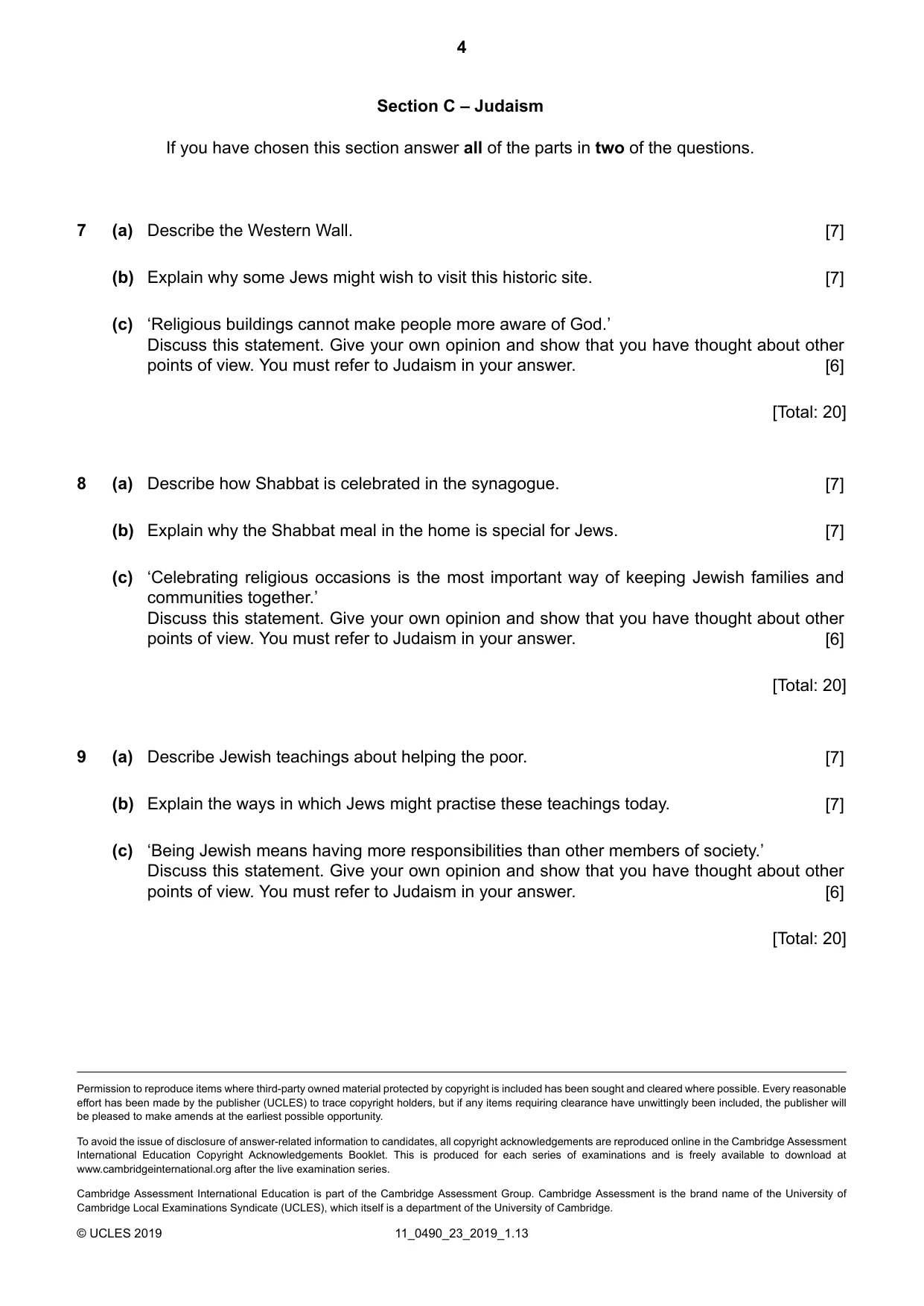
Question paper, page 4
Section C – Judaism If you have chosen this section answer all of the parts in two of the questions. Describe the Western Wall. (a) 7 [7] Explain why some Jews might wish to visit this historic site. (b) [7] ‘Religious buildings cannot make people more aware of God.’ Discuss this statement. Give your own opinion and show that you have thought about other points of view. You must refer to Judaism in your answer. (c) [6] [Total: 20] Describe how Shabbat is celebrated in the synagogue. (a) 8 [7] Explain why the Shabbat meal in the home is special for Jews. (b) [7] ‘Celebrating religious occasions is the most important way of keeping Jewish families and communities together.’ Discuss this statement. Give your own opinion and show that you have thought about other points of view. You must refer to Judaism in your answer. (c) [6] [Total: 20] Describe Jewish teachings about helping the poor. (a) 9 [7] Explain the ways in which Jews might practise these teachings today. (b) [7] ‘Being Jewish means having more responsibilities than other members of society.’ Discuss this statement. Give your own opinion and show that you have thought about other points of view. You must refer to Judaism in your answer. (c) [6] [Total: 20] Permission to reproduce items where third-party owned material protected by copyright is included has been sought and cleared where possible. Every reasonable effort has been made by the publisher (UCLES) to trace copyright holders, but if any items requiring clearance have unwittingly been included, the publisher will be pleased to make amends at the earliest possible opportunity. To avoid the issue of disclosure of answer-related information to candidates, all copyright acknowledgements are reproduced online in the Cambridge Assessment International Education Copyright Acknowledgements Booklet. This is produced for each series of examinations and is freely available to download at www.cambridgeinternational.org after the live examination series. Cambridge Assessment International Education is part of the Cambridge Assessment Group. Cambridge Assessment is the brand name of the University of Cambridge Local Examinations Syndicate (UCLES), which itself is a department of the University of Cambridge. 11_0490_23_2019_1.13 © UCLES 2019 4
Mark scheme, page 1
This document consists of 24 printed pages. © UCLES 2019 [Turn over Cambridge Assessment International Education Cambridge International General Certificate of Secondary Education RELIGIOUS STUDIES 0490/23 Paper 2 October/November 2019 MARK SCHEME Maximum Mark: 80 Published This mark scheme is published as an aid to teachers and candidates, to indicate the requirements of the examination. It shows the basis on which Examiners were instructed to award marks. It does not indicate the details of the discussions that took place at an Examiners’ meeting before marking began, which would have considered the acceptability of alternative answers. Mark schemes should be read in conjunction with the question paper and the Principal Examiner Report for Teachers. Cambridge International will not enter into discussions about these mark schemes. Cambridge International is publishing the mark schemes for the October/November 2019 series for most Cambridge IGCSE™, Cambridge International A and AS Level components and some Cambridge O Level components.
Mark scheme, page 2
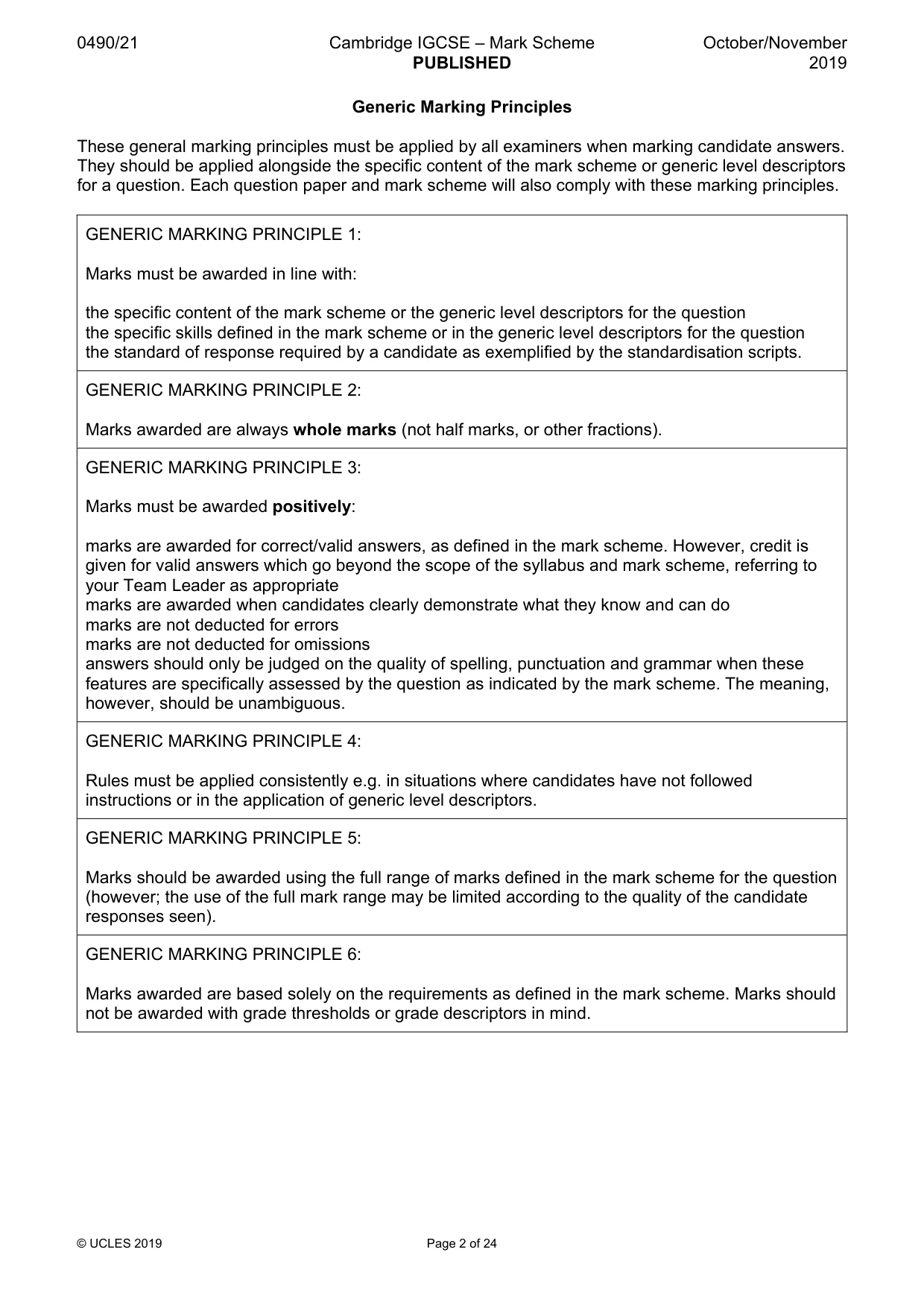
0490/21 Cambridge IGCSE – Mark Scheme PUBLISHED October/November 2019 © UCLES 2019 Page 2 of 24 Generic Marking Principles These general marking principles must be applied by all examiners when marking candidate answers. They should be applied alongside the specific content of the mark scheme or generic level descriptors for a question. Each question paper and mark scheme will also comply with these marking principles. GENERIC MARKING PRINCIPLE 1: Marks must be awarded in line with: the specific content of the mark scheme or the generic level descriptors for the question the specific skills defined in the mark scheme or in the generic level descriptors for the question the standard of response required by a candidate as exemplified by the standardisation scripts. GENERIC MARKING PRINCIPLE 2: Marks awarded are always whole marks (not half marks, or other fractions). GENERIC MARKING PRINCIPLE 3: Marks must be awarded positively: marks are awarded for correct/valid answers, as defined in the mark scheme. However, credit is given for valid answers which go beyond the scope of the syllabus and mark scheme, referring to your Team Leader as appropriate marks are awarded when candidates clearly demonstrate what they know and can do marks are not deducted for errors marks are not deducted for omissions answers should only be judged on the quality of spelling, punctuation and grammar when these features are specifically assessed by the question as indicated by the mark scheme. The meaning, however, should be unambiguous. GENERIC MARKING PRINCIPLE 4: Rules must be applied consistently e.g. in situations where candidates have not followed instructions or in the application of generic level descriptors. GENERIC MARKING PRINCIPLE 5: Marks should be awarded using the full range of marks defined in the mark scheme for the question (however; the use of the full mark range may be limited according to the quality of the candidate responses seen). GENERIC MARKING PRINCIPLE 6: Marks awarded are based solely on the requirements as defined in the mark scheme. Marks should not be awarded with grade thresholds or grade descriptors in mind.
Mark scheme, page 3
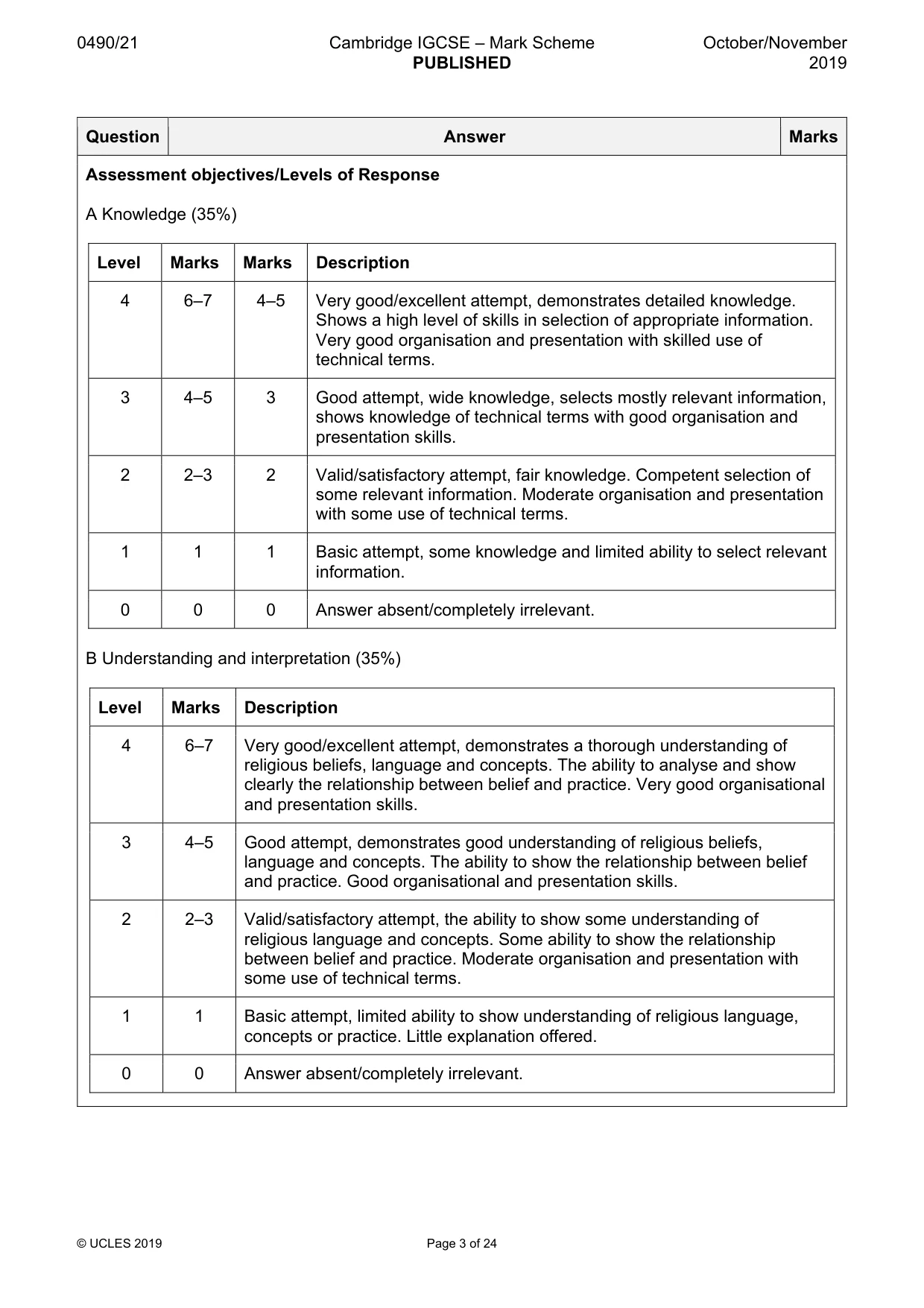
0490/21 Cambridge IGCSE – Mark Scheme PUBLISHED October/November 2019 © UCLES 2019 Page 3 of 24 Question Answer Marks Assessment objectives/Levels of Response A Knowledge (35%) Level Marks Marks Description 4 6–7 4–5 Very good/excellent attempt, demonstrates detailed knowledge. Shows a high level of skills in selection of appropriate information. Very good organisation and presentation with skilled use of technical terms. 3 4–5 3 Good attempt, wide knowledge, selects mostly relevant information, shows knowledge of technical terms with good organisation and presentation skills. 2 2–3 2 Valid/satisfactory attempt, fair knowledge. Competent selection of some relevant information. Moderate organisation and presentation with some use of technical terms. 1 1 1 Basic attempt, some knowledge and limited ability to select relevant information. 0 0 0 Answer absent/completely irrelevant. B Understanding and interpretation (35%) Level Marks Description 4 6–7 Very good/excellent attempt, demonstrates a thorough understanding of religious beliefs, language and concepts. The ability to analyse and show clearly the relationship between belief and practice. Very good organisational and presentation skills. 3 4–5 Good attempt, demonstrates good understanding of religious beliefs, language and concepts. The ability to show the relationship between belief and practice. Good organisational and presentation skills. 2 2–3 Valid/satisfactory attempt, the ability to show some understanding of religious language and concepts. Some ability to show the relationship between belief and practice. Moderate organisation and presentation with some use of technical terms. 1 1 Basic attempt, limited ability to show understanding of religious language, concepts or practice. Little explanation offered. 0 0 Answer absent/completely irrelevant.
Mark scheme, page 4
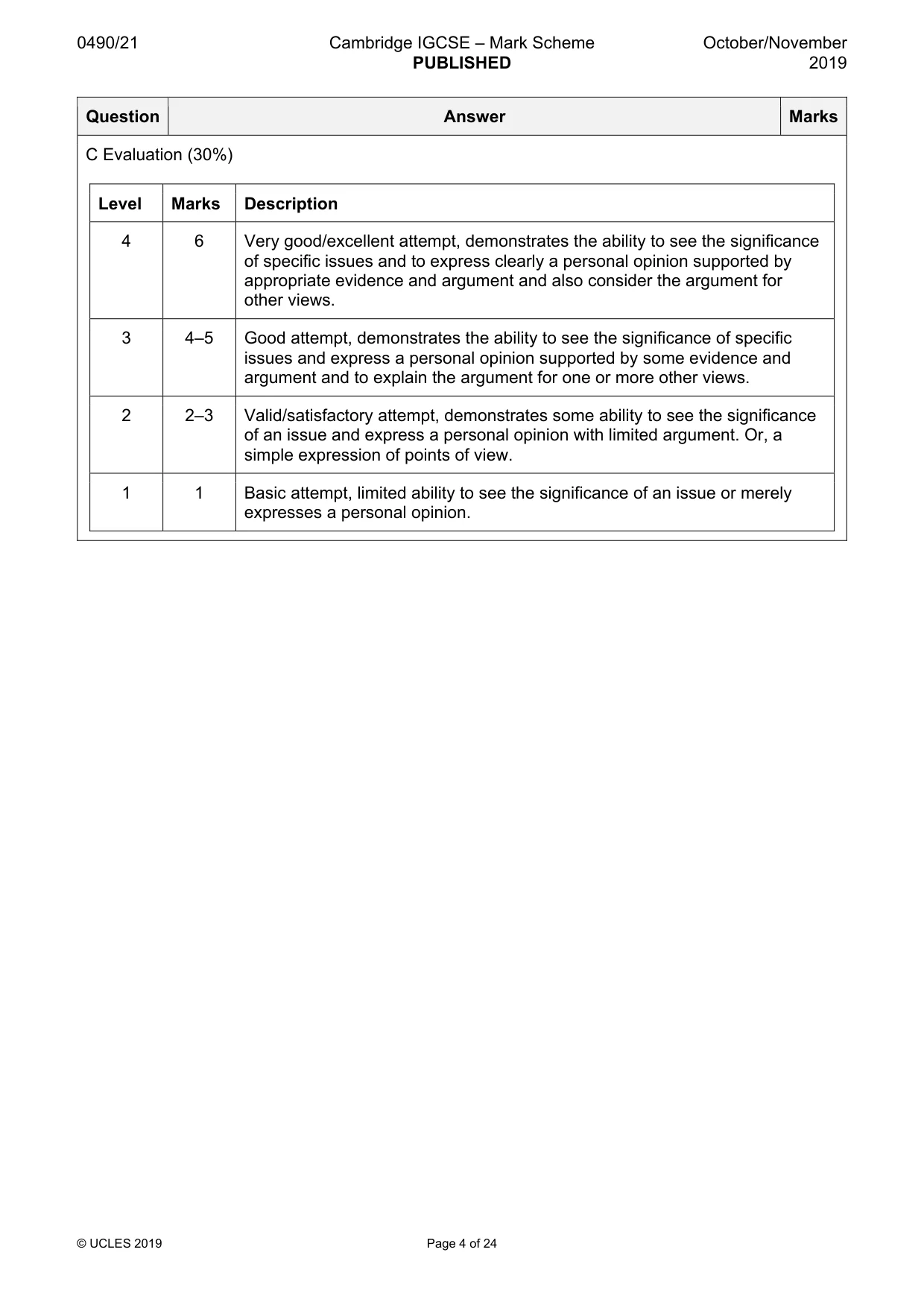
0490/21 Cambridge IGCSE – Mark Scheme PUBLISHED October/November 2019 © UCLES 2019 Page 4 of 24 Question Answer Marks C Evaluation (30%) Level Marks Description 4 6 Very good/excellent attempt, demonstrates the ability to see the significance of specific issues and to express clearly a personal opinion supported by appropriate evidence and argument and also consider the argument for other views. 3 4–5 Good attempt, demonstrates the ability to see the significance of specific issues and express a personal opinion supported by some evidence and argument and to explain the argument for one or more other views. 2 2–3 Valid/satisfactory attempt, demonstrates some ability to see the significance of an issue and express a personal opinion with limited argument. Or, a simple expression of points of view. 1 1 Basic attempt, limited ability to see the significance of an issue or merely expresses a personal opinion.
Mark scheme, page 5
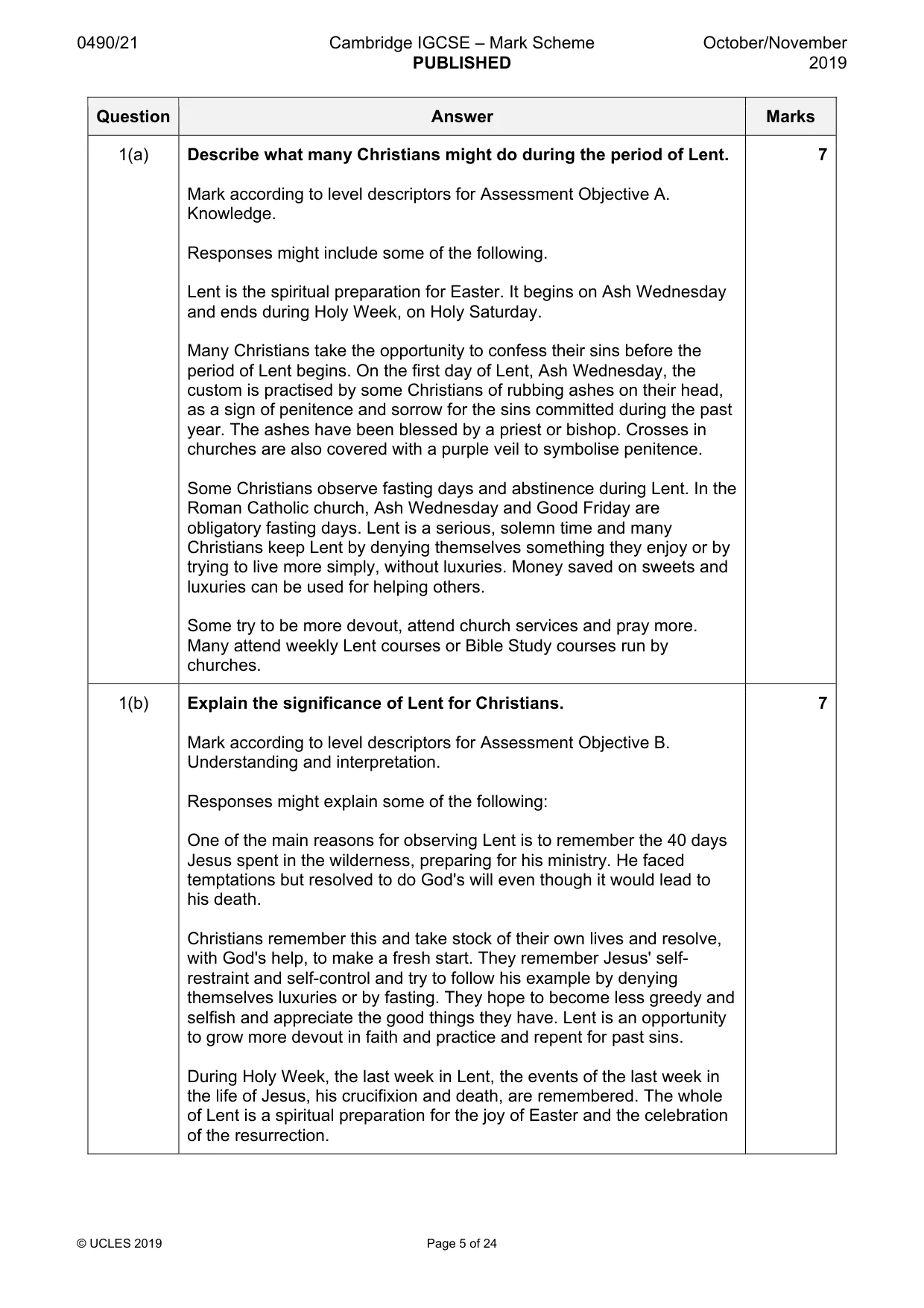
0490/21 Cambridge IGCSE – Mark Scheme PUBLISHED October/November 2019 © UCLES 2019 Page 5 of 24 Question Answer Marks 1(a) Describe what many Christians might do during the period of Lent. Mark according to level descriptors for Assessment Objective A. Knowledge. Responses might include some of the following. Lent is the spiritual preparation for Easter. It begins on Ash Wednesday and ends during Holy Week, on Holy Saturday. Many Christians take the opportunity to confess their sins before the period of Lent begins. On the first day of Lent, Ash Wednesday, the custom is practised by some Christians of rubbing ashes on their head, as a sign of penitence and sorrow for the sins committed during the past year. The ashes have been blessed by a priest or bishop. Crosses in churches are also covered with a purple veil to symbolise penitence. Some Christians observe fasting days and abstinence during Lent. In the Roman Catholic church, Ash Wednesday and Good Friday are obligatory fasting days. Lent is a serious, solemn time and many Christians keep Lent by denying themselves something they enjoy or by trying to live more simply, without luxuries. Money saved on sweets and luxuries can be used for helping others. Some try to be more devout, attend church services and pray more. Many attend weekly Lent courses or Bible Study courses run by churches. 7 1(b) Explain the significance of Lent for Christians. Mark according to level descriptors for Assessment Objective B. Understanding and interpretation. Responses might explain some of the following: One of the main reasons for observing Lent is to remember the 40 days Jesus spent in the wilderness, preparing for his ministry. He faced temptations but resolved to do God's will even though it would lead to his death. Christians remember this and take stock of their own lives and resolve, with God's help, to make a fresh start. They remember Jesus' self- restraint and self-control and try to follow his example by denying themselves luxuries or by fasting. They hope to become less greedy and selfish and appreciate the good things they have. Lent is an opportunity to grow more devout in faith and practice and repent for past sins. During Holy Week, the last week in Lent, the events of the last week in the life of Jesus, his crucifixion and death, are remembered. The whole of Lent is a spiritual preparation for the joy of Easter and the celebration of the resurrection. 7
Mark scheme, page 6
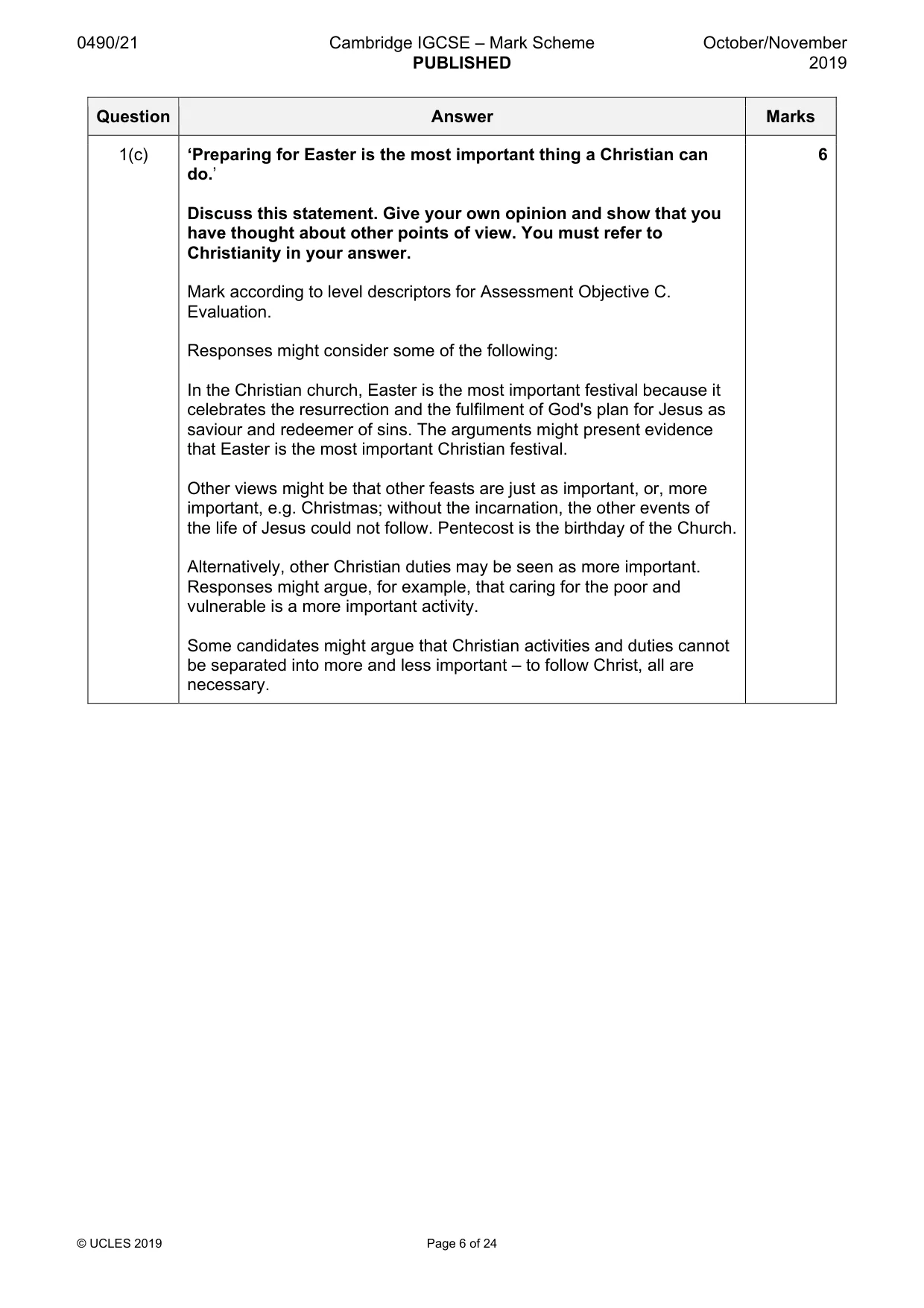
0490/21 Cambridge IGCSE – Mark Scheme PUBLISHED October/November 2019 © UCLES 2019 Page 6 of 24 Question Answer Marks 1(c) ‘Preparing for Easter is the most important thing a Christian can do.’ Discuss this statement. Give your own opinion and show that you have thought about other points of view. You must refer to Christianity in your answer. Mark according to level descriptors for Assessment Objective C. Evaluation. Responses might consider some of the following: In the Christian church, Easter is the most important festival because it celebrates the resurrection and the fulfilment of God's plan for Jesus as saviour and redeemer of sins. The arguments might present evidence that Easter is the most important Christian festival. Other views might be that other feasts are just as important, or, more important, e.g. Christmas; without the incarnation, the other events of the life of Jesus could not follow. Pentecost is the birthday of the Church. Alternatively, other Christian duties may be seen as more important. Responses might argue, for example, that caring for the poor and vulnerable is a more important activity. Some candidates might argue that Christian activities and duties cannot be separated into more and less important – to follow Christ, all are necessary. 6
Mark scheme, page 7
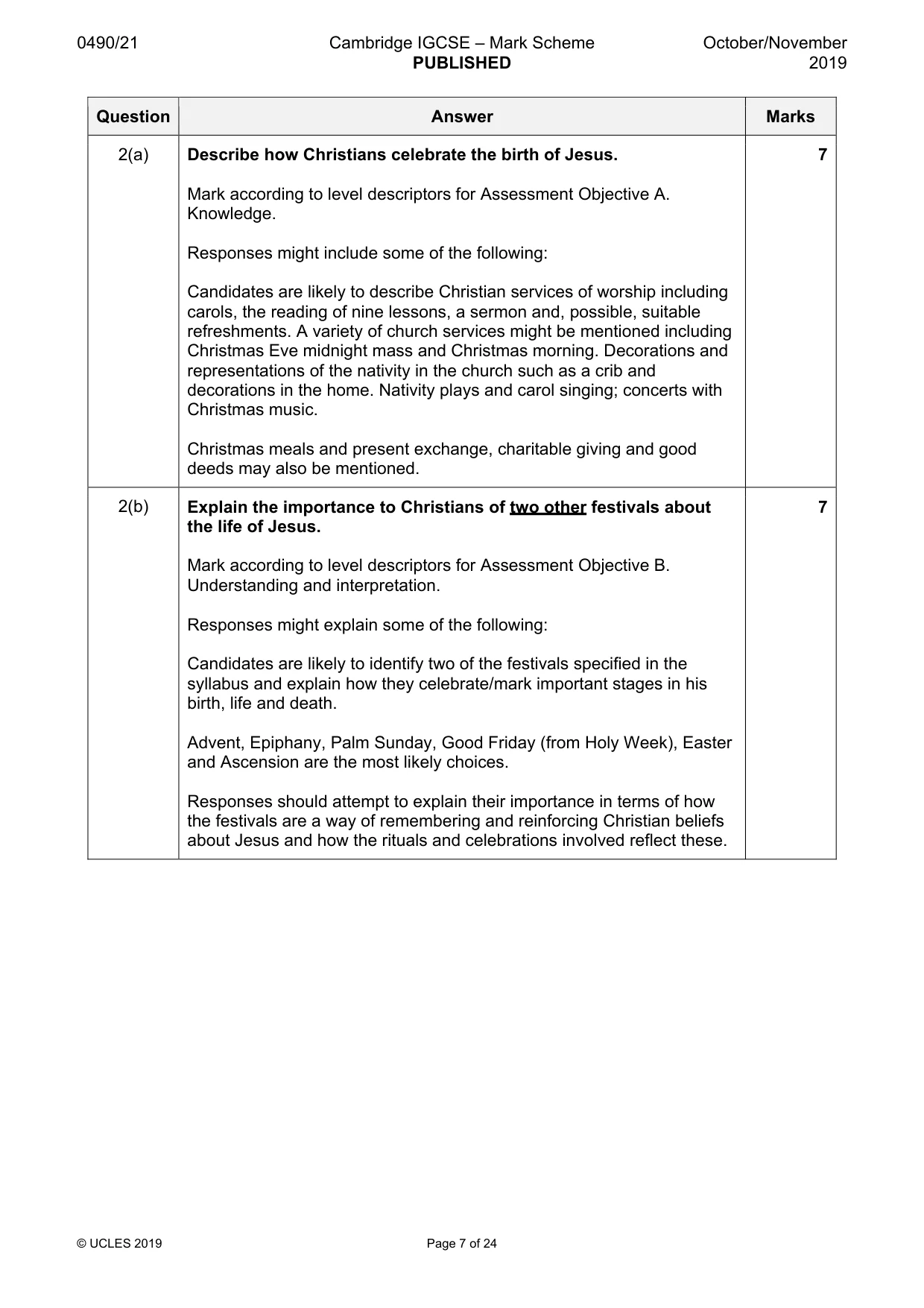
0490/21 Cambridge IGCSE – Mark Scheme PUBLISHED October/November 2019 © UCLES 2019 Page 7 of 24 Question Answer Marks 2(a) Describe how Christians celebrate the birth of Jesus. Mark according to level descriptors for Assessment Objective A. Knowledge. Responses might include some of the following: Candidates are likely to describe Christian services of worship including carols, the reading of nine lessons, a sermon and, possible, suitable refreshments. A variety of church services might be mentioned including Christmas Eve midnight mass and Christmas morning. Decorations and representations of the nativity in the church such as a crib and decorations in the home. Nativity plays and carol singing; concerts with Christmas music. Christmas meals and present exchange, charitable giving and good deeds may also be mentioned. 7 2(b) Explain the importance to Christians of two other festivals about the life of Jesus. Mark according to level descriptors for Assessment Objective B. Understanding and interpretation. Responses might explain some of the following: Candidates are likely to identify two of the festivals specified in the syllabus and explain how they celebrate/mark important stages in his birth, life and death. Advent, Epiphany, Palm Sunday, Good Friday (from Holy Week), Easter and Ascension are the most likely choices. Responses should attempt to explain their importance in terms of how the festivals are a way of remembering and reinforcing Christian beliefs about Jesus and how the rituals and celebrations involved reflect these. 7
Mark scheme, page 8
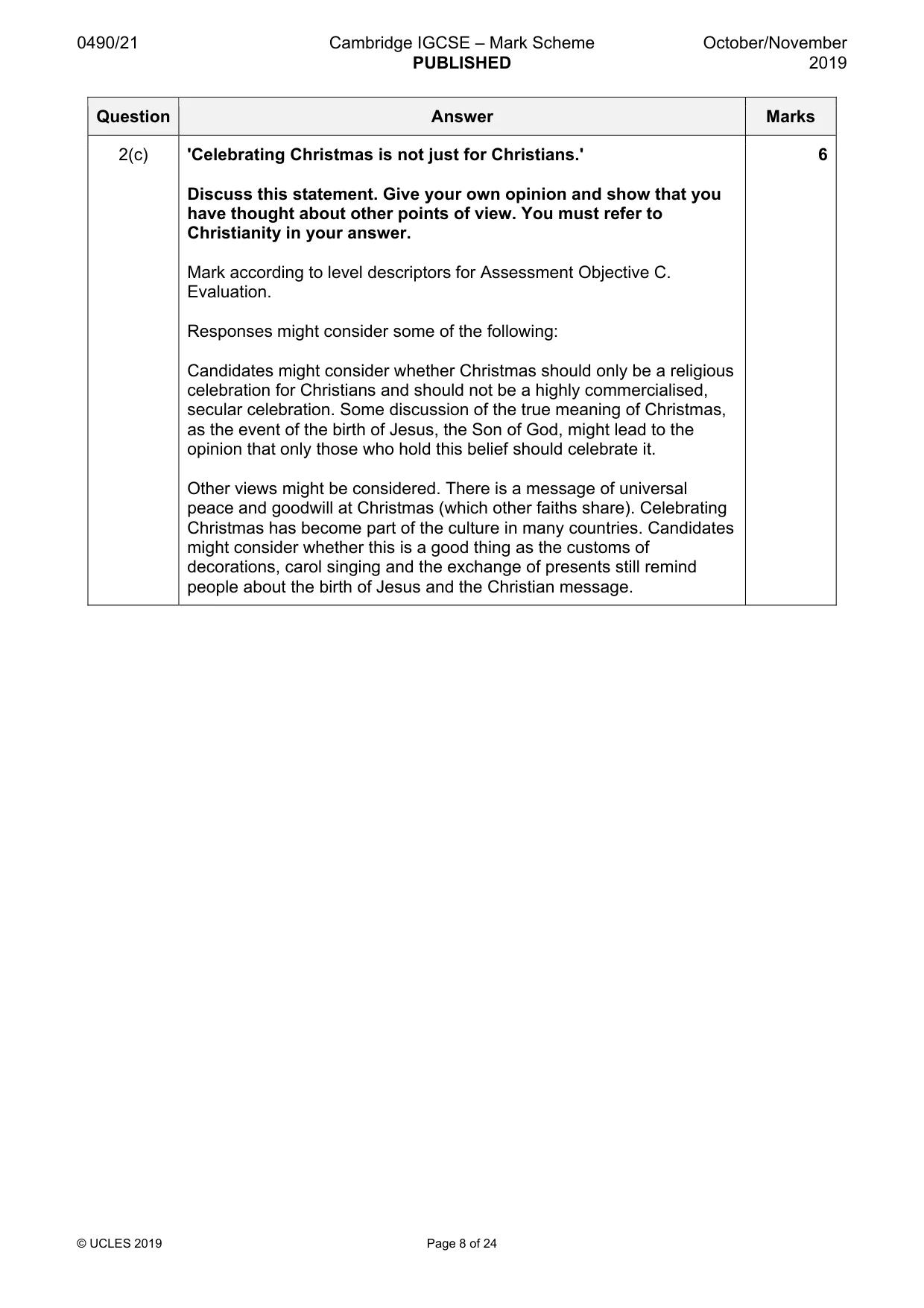
0490/21 Cambridge IGCSE – Mark Scheme PUBLISHED October/November 2019 © UCLES 2019 Page 8 of 24 Question Answer Marks 2(c) 'Celebrating Christmas is not just for Christians.' Discuss this statement. Give your own opinion and show that you have thought about other points of view. You must refer to Christianity in your answer. Mark according to level descriptors for Assessment Objective C. Evaluation. Responses might consider some of the following: Candidates might consider whether Christmas should only be a religious celebration for Christians and should not be a highly commercialised, secular celebration. Some discussion of the true meaning of Christmas, as the event of the birth of Jesus, the Son of God, might lead to the opinion that only those who hold this belief should celebrate it. Other views might be considered. There is a message of universal peace and goodwill at Christmas (which other faiths share). Celebrating Christmas has become part of the culture in many countries. Candidates might consider whether this is a good thing as the customs of decorations, carol singing and the exchange of presents still remind people about the birth of Jesus and the Christian message. 6
Mark scheme, page 9
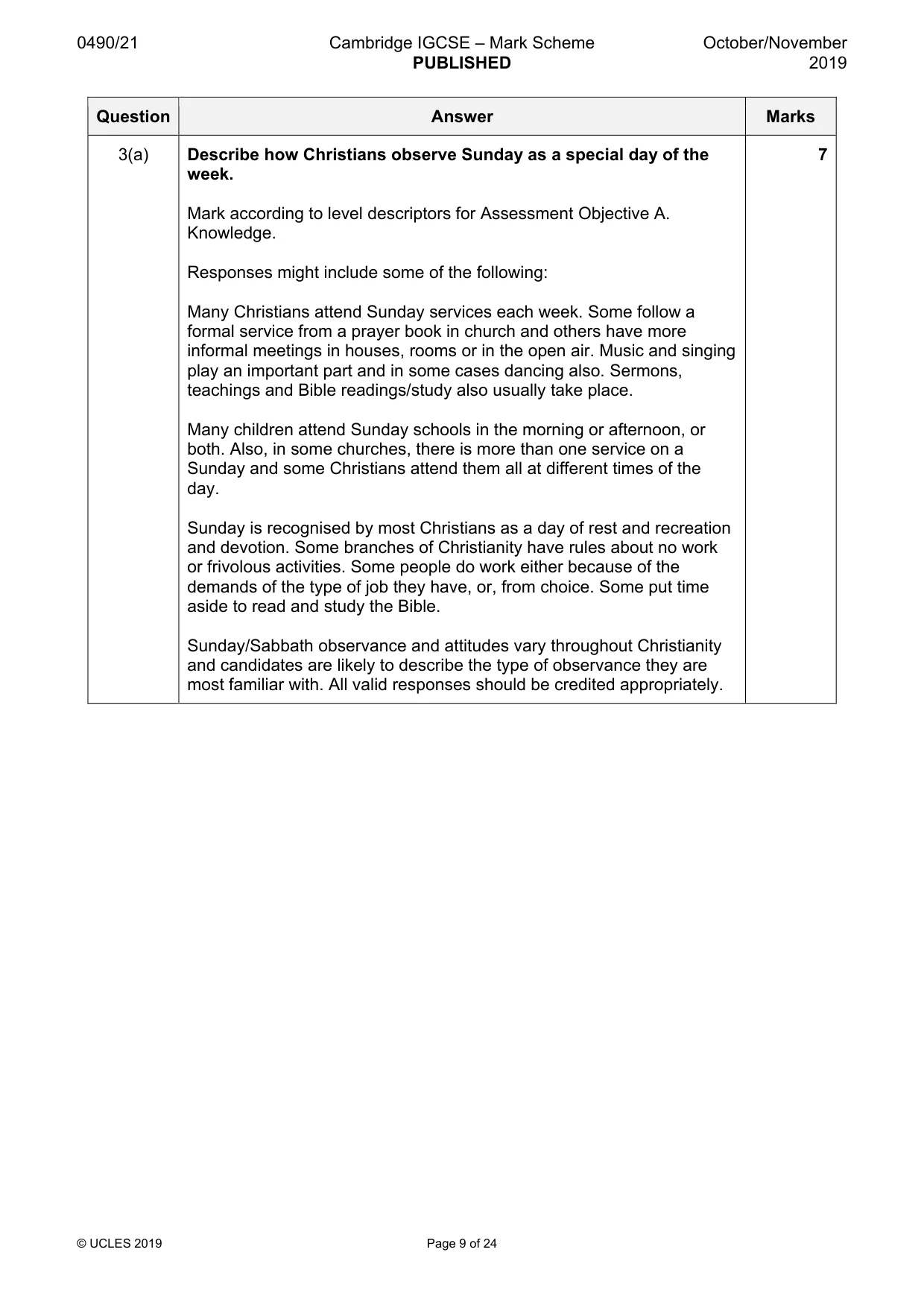
0490/21 Cambridge IGCSE – Mark Scheme PUBLISHED October/November 2019 © UCLES 2019 Page 9 of 24 Question Answer Marks 3(a) Describe how Christians observe Sunday as a special day of the week. Mark according to level descriptors for Assessment Objective A. Knowledge. Responses might include some of the following: Many Christians attend Sunday services each week. Some follow a formal service from a prayer book in church and others have more informal meetings in houses, rooms or in the open air. Music and singing play an important part and in some cases dancing also. Sermons, teachings and Bible readings/study also usually take place. Many children attend Sunday schools in the morning or afternoon, or both. Also, in some churches, there is more than one service on a Sunday and some Christians attend them all at different times of the day. Sunday is recognised by most Christians as a day of rest and recreation and devotion. Some branches of Christianity have rules about no work or frivolous activities. Some people do work either because of the demands of the type of job they have, or, from choice. Some put time aside to read and study the Bible. Sunday/Sabbath observance and attitudes vary throughout Christianity and candidates are likely to describe the type of observance they are most familiar with. All valid responses should be credited appropriately. 7
Mark scheme, page 10
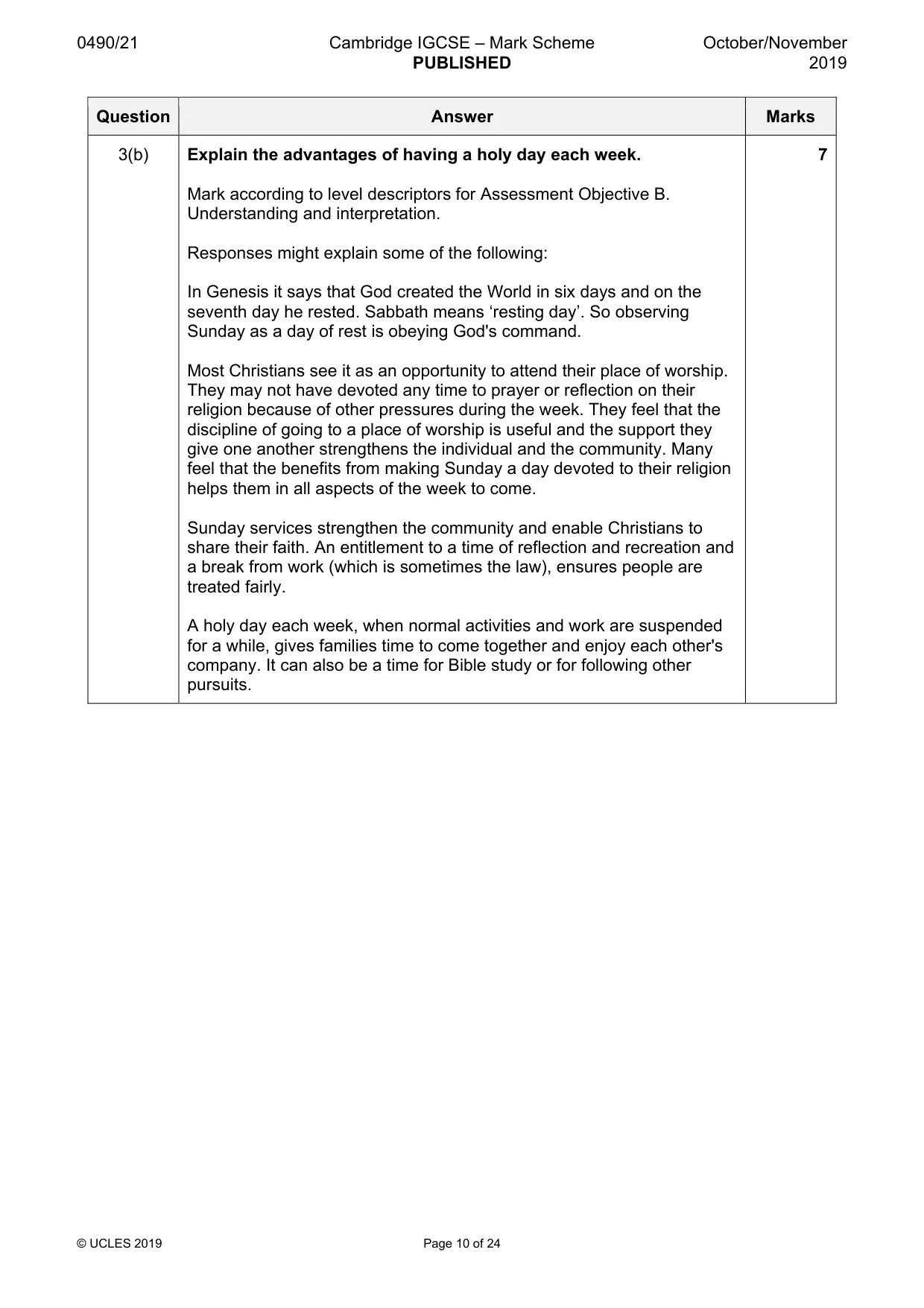
0490/21 Cambridge IGCSE – Mark Scheme PUBLISHED October/November 2019 © UCLES 2019 Page 10 of 24 Question Answer Marks 3(b) Explain the advantages of having a holy day each week. Mark according to level descriptors for Assessment Objective B. Understanding and interpretation. Responses might explain some of the following: In Genesis it says that God created the World in six days and on the seventh day he rested. Sabbath means ‘resting day’. So observing Sunday as a day of rest is obeying God's command. Most Christians see it as an opportunity to attend their place of worship. They may not have devoted any time to prayer or reflection on their religion because of other pressures during the week. They feel that the discipline of going to a place of worship is useful and the support they give one another strengthens the individual and the community. Many feel that the benefits from making Sunday a day devoted to their religion helps them in all aspects of the week to come. Sunday services strengthen the community and enable Christians to share their faith. An entitlement to a time of reflection and recreation and a break from work (which is sometimes the law), ensures people are treated fairly. A holy day each week, when normal activities and work are suspended for a while, gives families time to come together and enjoy each other's company. It can also be a time for Bible study or for following other pursuits. 7
Mark scheme, page 11
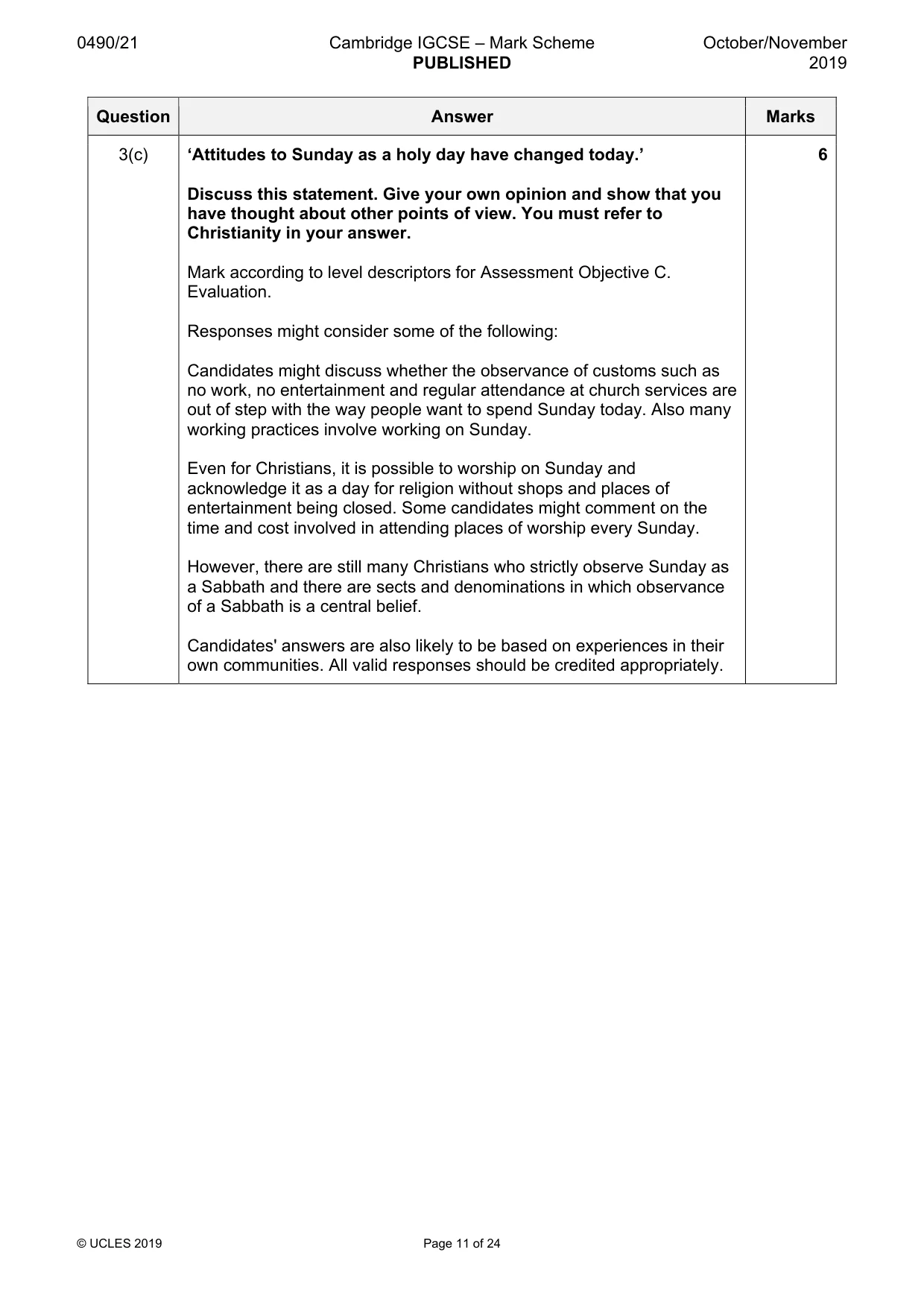
0490/21 Cambridge IGCSE – Mark Scheme PUBLISHED October/November 2019 © UCLES 2019 Page 11 of 24 Question Answer Marks 3(c) ‘Attitudes to Sunday as a holy day have changed today.’ Discuss this statement. Give your own opinion and show that you have thought about other points of view. You must refer to Christianity in your answer. Mark according to level descriptors for Assessment Objective C. Evaluation. Responses might consider some of the following: Candidates might discuss whether the observance of customs such as no work, no entertainment and regular attendance at church services are out of step with the way people want to spend Sunday today. Also many working practices involve working on Sunday. Even for Christians, it is possible to worship on Sunday and acknowledge it as a day for religion without shops and places of entertainment being closed. Some candidates might comment on the time and cost involved in attending places of worship every Sunday. However, there are still many Christians who strictly observe Sunday as a Sabbath and there are sects and denominations in which observance of a Sabbath is a central belief. Candidates' answers are also likely to be based on experiences in their own communities. All valid responses should be credited appropriately. 6
Mark scheme, page 12
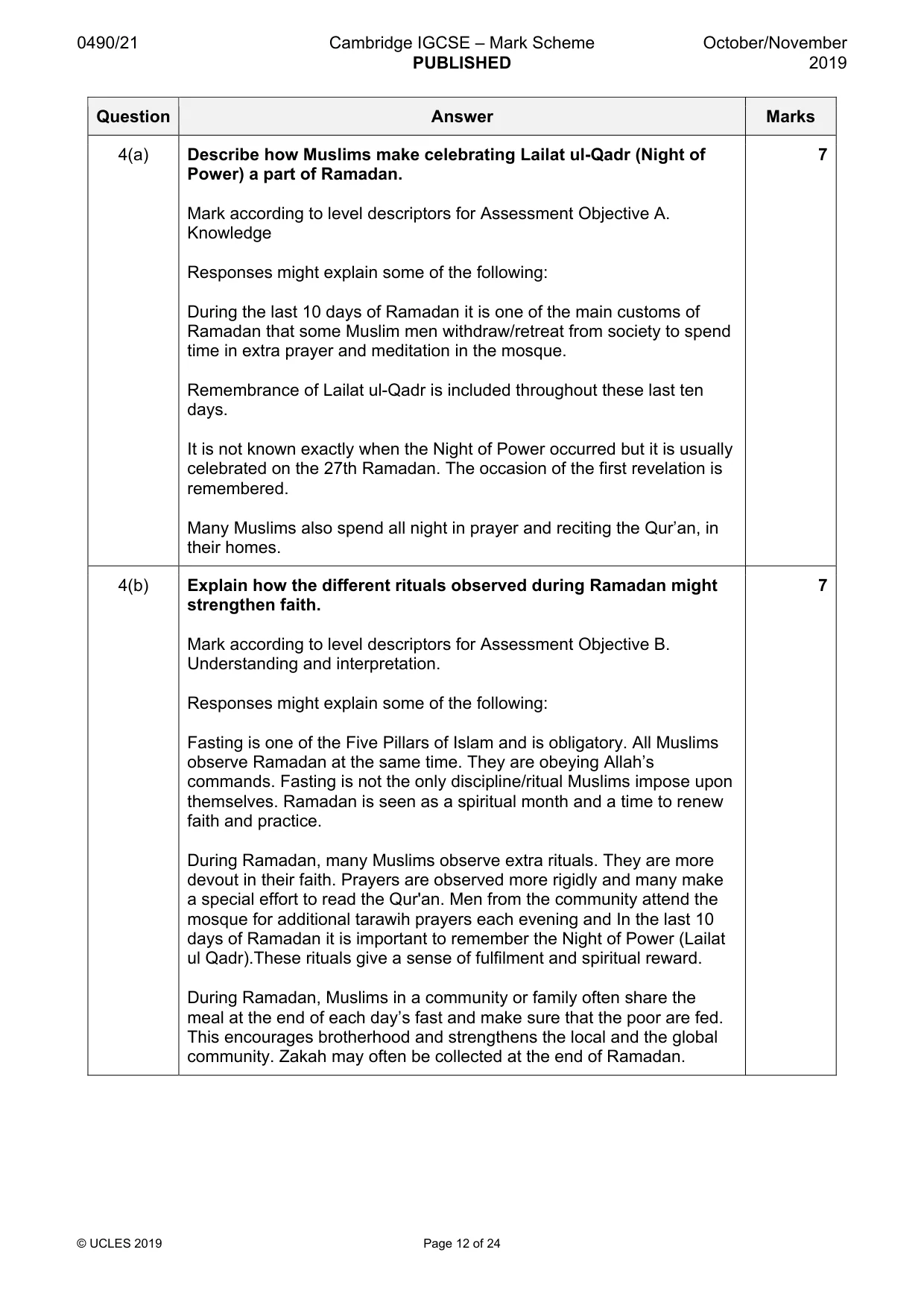
0490/21 Cambridge IGCSE – Mark Scheme PUBLISHED October/November 2019 © UCLES 2019 Page 12 of 24 Question Answer Marks 4(a) Describe how Muslims make celebrating Lailat ul-Qadr (Night of Power) a part of Ramadan. Mark according to level descriptors for Assessment Objective A. Knowledge Responses might explain some of the following: During the last 10 days of Ramadan it is one of the main customs of Ramadan that some Muslim men withdraw/retreat from society to spend time in extra prayer and meditation in the mosque. Remembrance of Lailat ul-Qadr is included throughout these last ten days. It is not known exactly when the Night of Power occurred but it is usually celebrated on the 27th Ramadan. The occasion of the first revelation is remembered. Many Muslims also spend all night in prayer and reciting the Qur’an, in their homes. 7 4(b) Explain how the different rituals observed during Ramadan might strengthen faith. Mark according to level descriptors for Assessment Objective B. Understanding and interpretation. Responses might explain some of the following: Fasting is one of the Five Pillars of Islam and is obligatory. All Muslims observe Ramadan at the same time. They are obeying Allah’s commands. Fasting is not the only discipline/ritual Muslims impose upon themselves. Ramadan is seen as a spiritual month and a time to renew faith and practice. During Ramadan, many Muslims observe extra rituals. They are more devout in their faith. Prayers are observed more rigidly and many make a special effort to read the Qur'an. Men from the community attend the mosque for additional tarawih prayers each evening and In the last 10 days of Ramadan it is important to remember the Night of Power (Lailat ul Qadr).These rituals give a sense of fulfilment and spiritual reward. During Ramadan, Muslims in a community or family often share the meal at the end of each day’s fast and make sure that the poor are fed. This encourages brotherhood and strengthens the local and the global community. Zakah may often be collected at the end of Ramadan. 7
Mark scheme, page 13
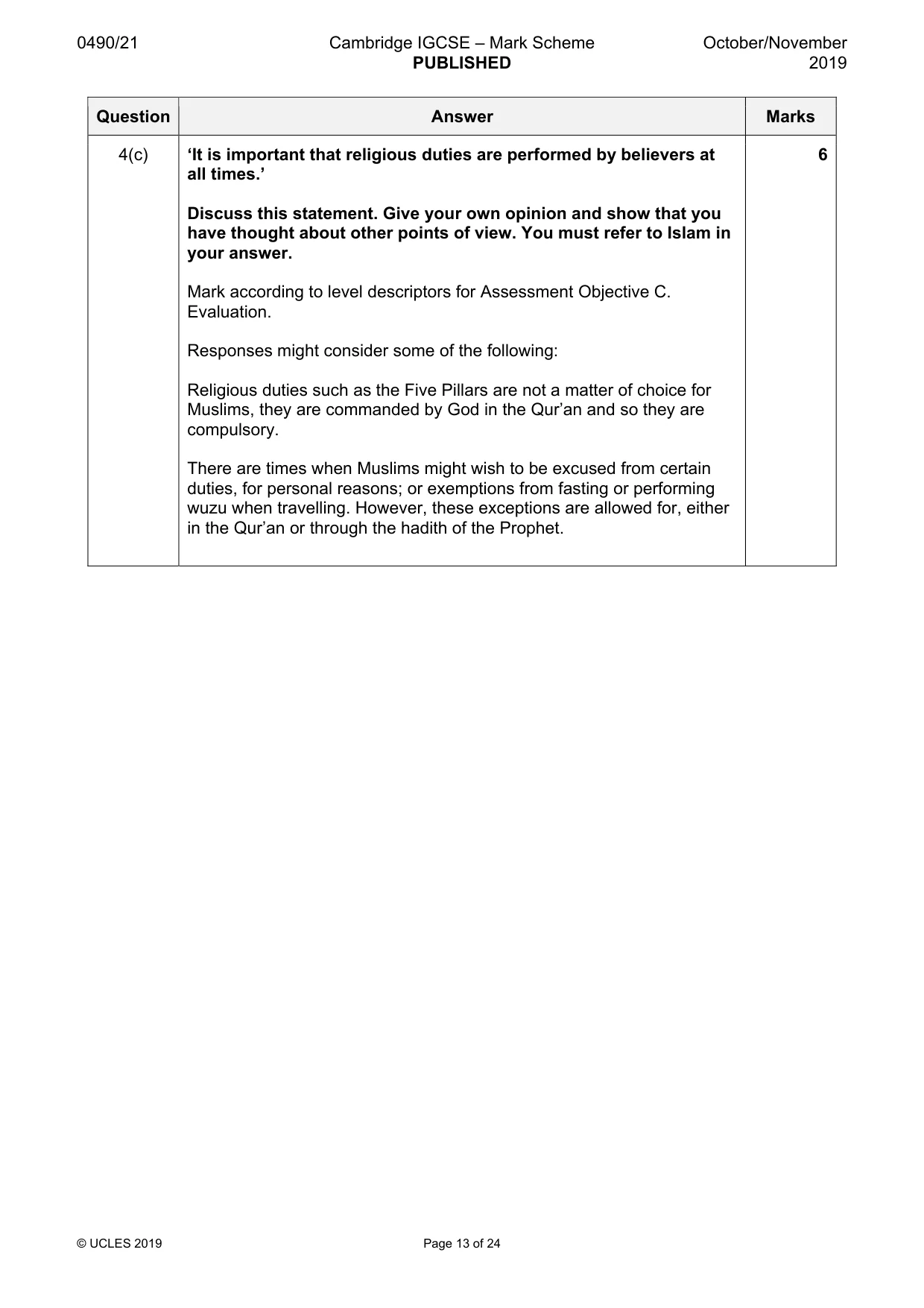
0490/21 Cambridge IGCSE – Mark Scheme PUBLISHED October/November 2019 © UCLES 2019 Page 13 of 24 Question Answer Marks 4(c) ‘It is important that religious duties are performed by believers at all times.’ Discuss this statement. Give your own opinion and show that you have thought about other points of view. You must refer to Islam in your answer. Mark according to level descriptors for Assessment Objective C. Evaluation. Responses might consider some of the following: Religious duties such as the Five Pillars are not a matter of choice for Muslims, they are commanded by God in the Qur’an and so they are compulsory. There are times when Muslims might wish to be excused from certain duties, for personal reasons; or exemptions from fasting or performing wuzu when travelling. However, these exceptions are allowed for, either in the Qur’an or through the hadith of the Prophet. 6
Mark scheme, page 14
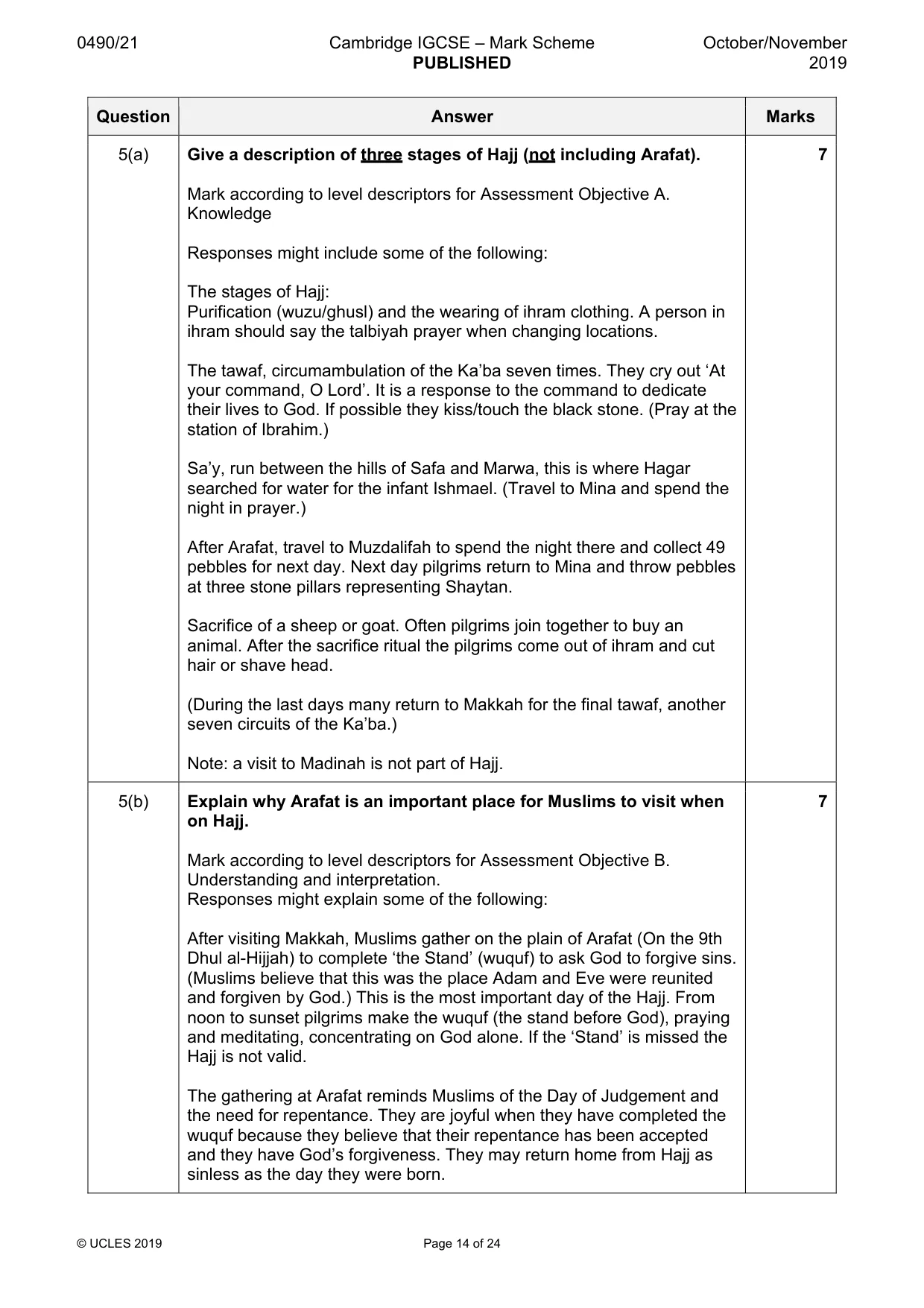
0490/21 Cambridge IGCSE – Mark Scheme PUBLISHED October/November 2019 © UCLES 2019 Page 14 of 24 Question Answer Marks 5(a) Give a description of three stages of Hajj (not including Arafat). Mark according to level descriptors for Assessment Objective A. Knowledge Responses might include some of the following: The stages of Hajj: Purification (wuzu/ghusl) and the wearing of ihram clothing. A person in ihram should say the talbiyah prayer when changing locations. The tawaf, circumambulation of the Ka’ba seven times. They cry out ‘At your command, O Lord’. It is a response to the command to dedicate their lives to God. If possible they kiss/touch the black stone. (Pray at the station of Ibrahim.) Sa’y, run between the hills of Safa and Marwa, this is where Hagar searched for water for the infant Ishmael. (Travel to Mina and spend the night in prayer.) After Arafat, travel to Muzdalifah to spend the night there and collect 49 pebbles for next day. Next day pilgrims return to Mina and throw pebbles at three stone pillars representing Shaytan. Sacrifice of a sheep or goat. Often pilgrims join together to buy an animal. After the sacrifice ritual the pilgrims come out of ihram and cut hair or shave head. (During the last days many return to Makkah for the final tawaf, another seven circuits of the Ka’ba.) Note: a visit to Madinah is not part of Hajj. 7 5(b) Explain why Arafat is an important place for Muslims to visit when on Hajj. Mark according to level descriptors for Assessment Objective B. Understanding and interpretation. Responses might explain some of the following: After visiting Makkah, Muslims gather on the plain of Arafat (On the 9th Dhul al-Hijjah) to complete ‘the Stand’ (wuquf) to ask God to forgive sins. (Muslims believe that this was the place Adam and Eve were reunited and forgiven by God.) This is the most important day of the Hajj. From noon to sunset pilgrims make the wuquf (the stand before God), praying and meditating, concentrating on God alone. If the ‘Stand’ is missed the Hajj is not valid. The gathering at Arafat reminds Muslims of the Day of Judgement and the need for repentance. They are joyful when they have completed the wuquf because they believe that their repentance has been accepted and they have God’s forgiveness. They may return home from Hajj as sinless as the day they were born. 7
Mark scheme, page 15
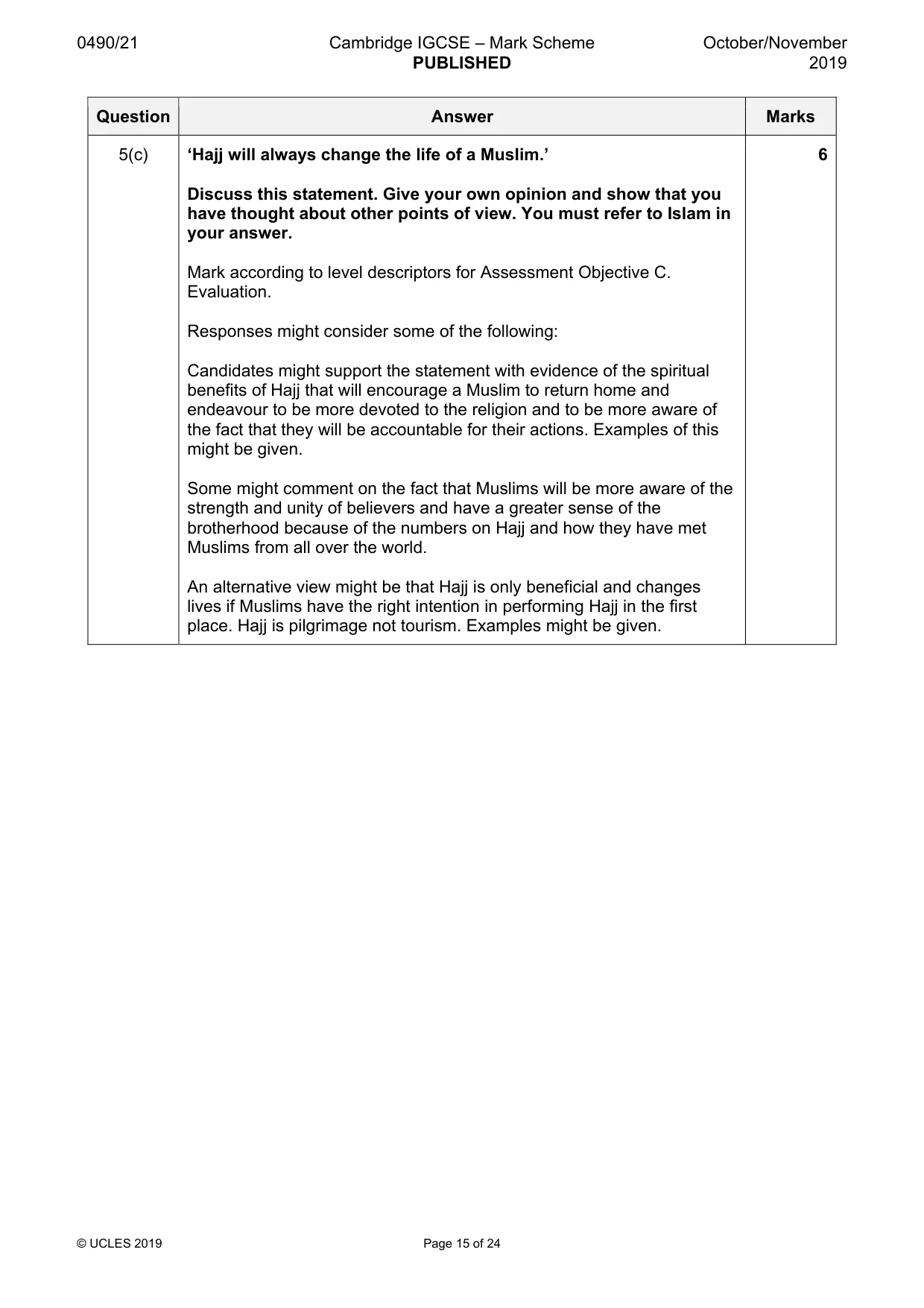
0490/21 Cambridge IGCSE – Mark Scheme PUBLISHED October/November 2019 © UCLES 2019 Page 15 of 24 Question Answer Marks 5(c) ‘Hajj will always change the life of a Muslim.’ Discuss this statement. Give your own opinion and show that you have thought about other points of view. You must refer to Islam in your answer. Mark according to level descriptors for Assessment Objective C. Evaluation. Responses might consider some of the following: Candidates might support the statement with evidence of the spiritual benefits of Hajj that will encourage a Muslim to return home and endeavour to be more devoted to the religion and to be more aware of the fact that they will be accountable for their actions. Examples of this might be given. Some might comment on the fact that Muslims will be more aware of the strength and unity of believers and have a greater sense of the brotherhood because of the numbers on Hajj and how they have met Muslims from all over the world. An alternative view might be that Hajj is only beneficial and changes lives if Muslims have the right intention in performing Hajj in the first place. Hajj is pilgrimage not tourism. Examples might be given. 6
Mark scheme, page 16
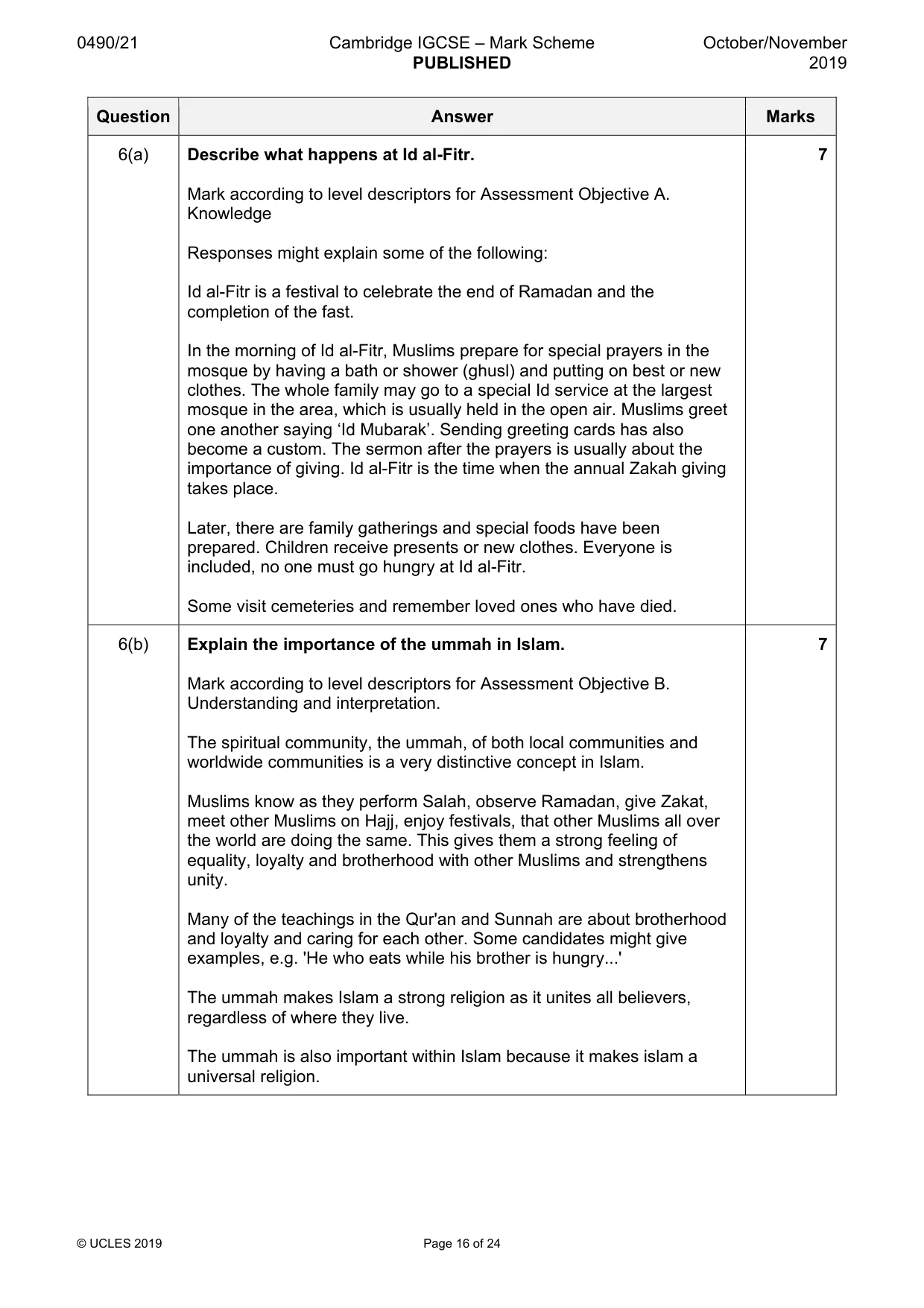
0490/21 Cambridge IGCSE – Mark Scheme PUBLISHED October/November 2019 © UCLES 2019 Page 16 of 24 Question Answer Marks 6(a) Describe what happens at Id al-Fitr. Mark according to level descriptors for Assessment Objective A. Knowledge Responses might explain some of the following: Id al-Fitr is a festival to celebrate the end of Ramadan and the completion of the fast. In the morning of Id al-Fitr, Muslims prepare for special prayers in the mosque by having a bath or shower (ghusl) and putting on best or new clothes. The whole family may go to a special Id service at the largest mosque in the area, which is usually held in the open air. Muslims greet one another saying ‘Id Mubarak’. Sending greeting cards has also become a custom. The sermon after the prayers is usually about the importance of giving. Id al-Fitr is the time when the annual Zakah giving takes place. Later, there are family gatherings and special foods have been prepared. Children receive presents or new clothes. Everyone is included, no one must go hungry at Id al-Fitr. Some visit cemeteries and remember loved ones who have died. 7 6(b) Explain the importance of the ummah in Islam. Mark according to level descriptors for Assessment Objective B. Understanding and interpretation. The spiritual community, the ummah, of both local communities and worldwide communities is a very distinctive concept in Islam. Muslims know as they perform Salah, observe Ramadan, give Zakat, meet other Muslims on Hajj, enjoy festivals, that other Muslims all over the world are doing the same. This gives them a strong feeling of equality, loyalty and brotherhood with other Muslims and strengthens unity. Many of the teachings in the Qur'an and Sunnah are about brotherhood and loyalty and caring for each other. Some candidates might give examples, e.g. 'He who eats while his brother is hungry...' The ummah makes Islam a strong religion as it unites all believers, regardless of where they live. The ummah is also important within Islam because it makes islam a universal religion. 7
Mark scheme, page 17
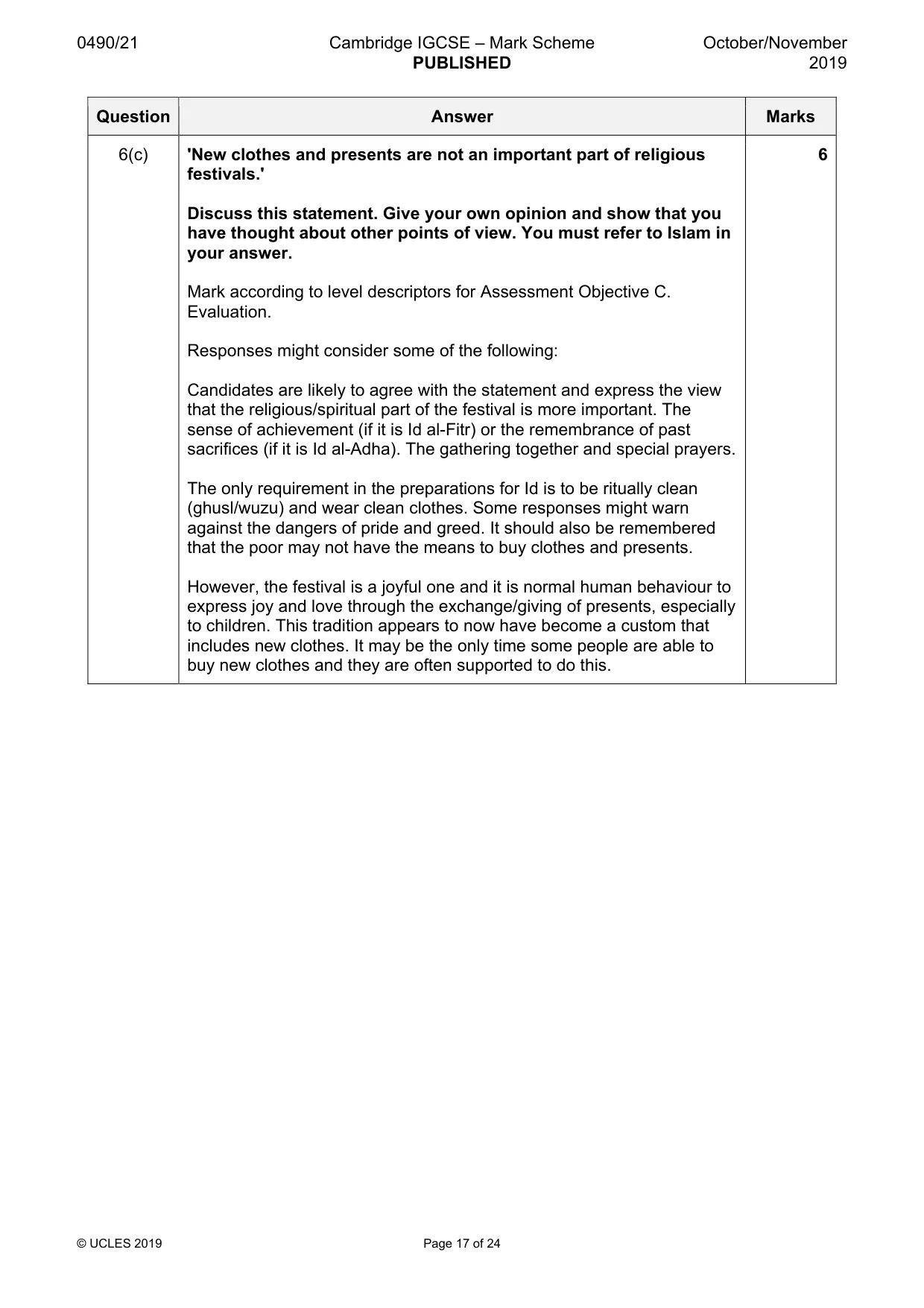
0490/21 Cambridge IGCSE – Mark Scheme PUBLISHED October/November 2019 © UCLES 2019 Page 17 of 24 Question Answer Marks 6(c) 'New clothes and presents are not an important part of religious festivals.' Discuss this statement. Give your own opinion and show that you have thought about other points of view. You must refer to Islam in your answer. Mark according to level descriptors for Assessment Objective C. Evaluation. Responses might consider some of the following: Candidates are likely to agree with the statement and express the view that the religious/spiritual part of the festival is more important. The sense of achievement (if it is Id al-Fitr) or the remembrance of past sacrifices (if it is Id al-Adha). The gathering together and special prayers. The only requirement in the preparations for Id is to be ritually clean (ghusl/wuzu) and wear clean clothes. Some responses might warn against the dangers of pride and greed. It should also be remembered that the poor may not have the means to buy clothes and presents. However, the festival is a joyful one and it is normal human behaviour to express joy and love through the exchange/giving of presents, especially to children. This tradition appears to now have become a custom that includes new clothes. It may be the only time some people are able to buy new clothes and they are often supported to do this. 6
Mark scheme, page 18
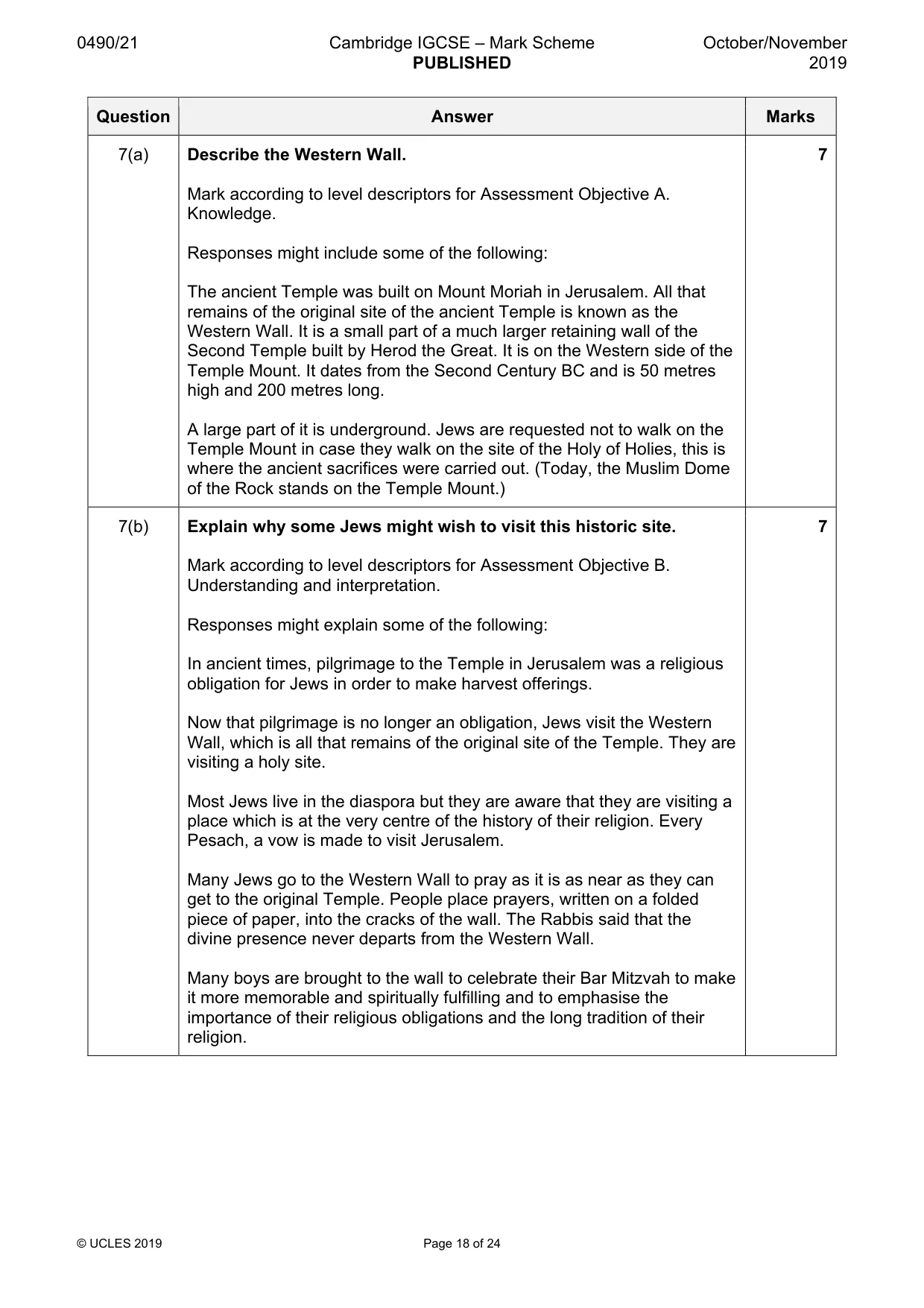
0490/21 Cambridge IGCSE – Mark Scheme PUBLISHED October/November 2019 © UCLES 2019 Page 18 of 24 Question Answer Marks 7(a) Describe the Western Wall. Mark according to level descriptors for Assessment Objective A. Knowledge. Responses might include some of the following: The ancient Temple was built on Mount Moriah in Jerusalem. All that remains of the original site of the ancient Temple is known as the Western Wall. It is a small part of a much larger retaining wall of the Second Temple built by Herod the Great. It is on the Western side of the Temple Mount. It dates from the Second Century BC and is 50 metres high and 200 metres long. A large part of it is underground. Jews are requested not to walk on the Temple Mount in case they walk on the site of the Holy of Holies, this is where the ancient sacrifices were carried out. (Today, the Muslim Dome of the Rock stands on the Temple Mount.) 7 7(b) Explain why some Jews might wish to visit this historic site. Mark according to level descriptors for Assessment Objective B. Understanding and interpretation. Responses might explain some of the following: In ancient times, pilgrimage to the Temple in Jerusalem was a religious obligation for Jews in order to make harvest offerings. Now that pilgrimage is no longer an obligation, Jews visit the Western Wall, which is all that remains of the original site of the Temple. They are visiting a holy site. Most Jews live in the diaspora but they are aware that they are visiting a place which is at the very centre of the history of their religion. Every Pesach, a vow is made to visit Jerusalem. Many Jews go to the Western Wall to pray as it is as near as they can get to the original Temple. People place prayers, written on a folded piece of paper, into the cracks of the wall. The Rabbis said that the divine presence never departs from the Western Wall. Many boys are brought to the wall to celebrate their Bar Mitzvah to make it more memorable and spiritually fulfilling and to emphasise the importance of their religious obligations and the long tradition of their religion. 7
Mark scheme, page 19
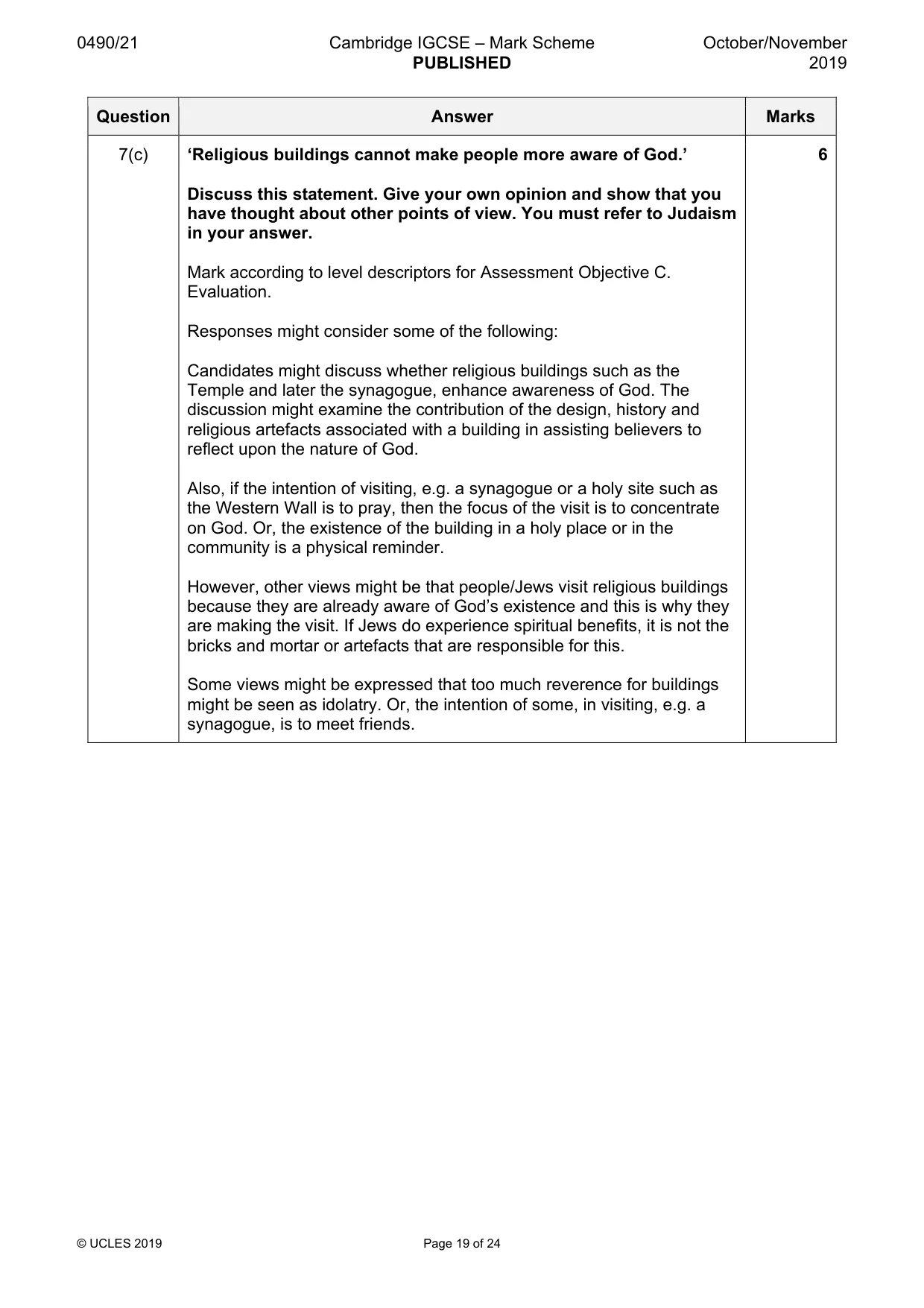
0490/21 Cambridge IGCSE – Mark Scheme PUBLISHED October/November 2019 © UCLES 2019 Page 19 of 24 Question Answer Marks 7(c) ‘Religious buildings cannot make people more aware of God.’ Discuss this statement. Give your own opinion and show that you have thought about other points of view. You must refer to Judaism in your answer. Mark according to level descriptors for Assessment Objective C. Evaluation. Responses might consider some of the following: Candidates might discuss whether religious buildings such as the Temple and later the synagogue, enhance awareness of God. The discussion might examine the contribution of the design, history and religious artefacts associated with a building in assisting believers to reflect upon the nature of God. Also, if the intention of visiting, e.g. a synagogue or a holy site such as the Western Wall is to pray, then the focus of the visit is to concentrate on God. Or, the existence of the building in a holy place or in the community is a physical reminder. However, other views might be that people/Jews visit religious buildings because they are already aware of God’s existence and this is why they are making the visit. If Jews do experience spiritual benefits, it is not the bricks and mortar or artefacts that are responsible for this. Some views might be expressed that too much reverence for buildings might be seen as idolatry. Or, the intention of some, in visiting, e.g. a synagogue, is to meet friends. 6
Mark scheme, page 20
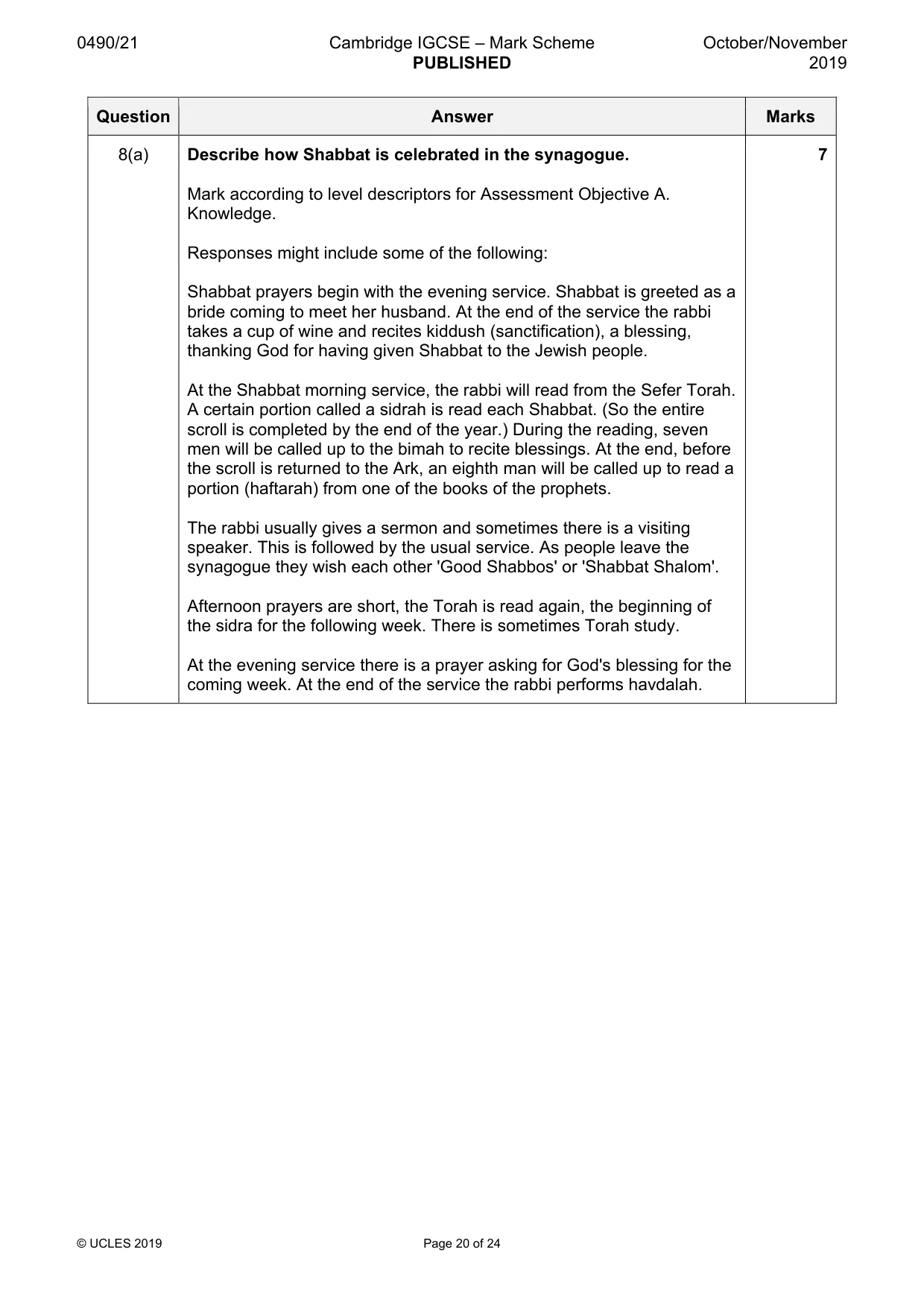
0490/21 Cambridge IGCSE – Mark Scheme PUBLISHED October/November 2019 © UCLES 2019 Page 20 of 24 Question Answer Marks 8(a) Describe how Shabbat is celebrated in the synagogue. Mark according to level descriptors for Assessment Objective A. Knowledge. Responses might include some of the following: Shabbat prayers begin with the evening service. Shabbat is greeted as a bride coming to meet her husband. At the end of the service the rabbi takes a cup of wine and recites kiddush (sanctification), a blessing, thanking God for having given Shabbat to the Jewish people. At the Shabbat morning service, the rabbi will read from the Sefer Torah. A certain portion called a sidrah is read each Shabbat. (So the entire scroll is completed by the end of the year.) During the reading, seven men will be called up to the bimah to recite blessings. At the end, before the scroll is returned to the Ark, an eighth man will be called up to read a portion (haftarah) from one of the books of the prophets. The rabbi usually gives a sermon and sometimes there is a visiting speaker. This is followed by the usual service. As people leave the synagogue they wish each other 'Good Shabbos' or 'Shabbat Shalom'. Afternoon prayers are short, the Torah is read again, the beginning of the sidra for the following week. There is sometimes Torah study. At the evening service there is a prayer asking for God's blessing for the coming week. At the end of the service the rabbi performs havdalah. 7
Mark scheme, page 21
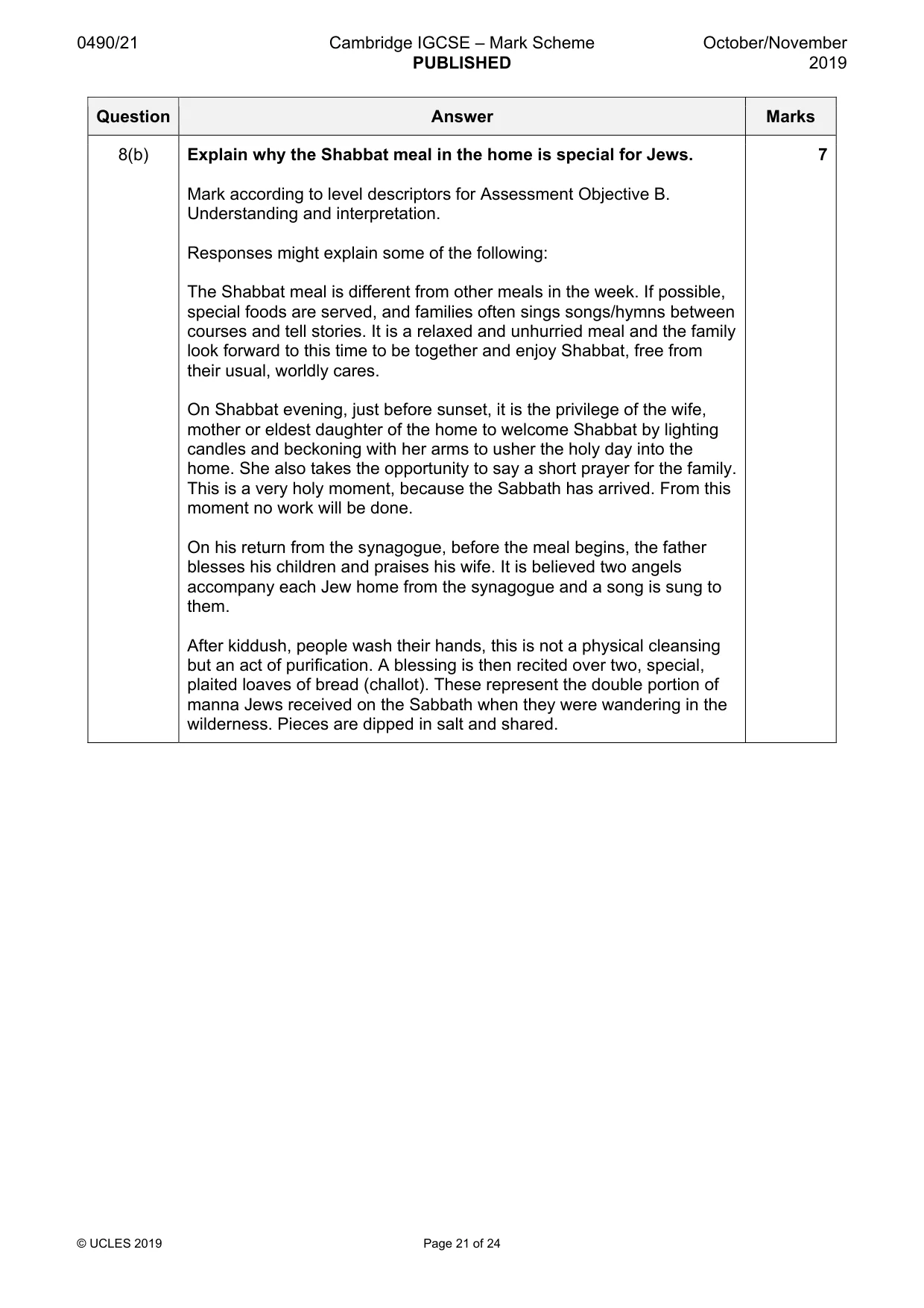
0490/21 Cambridge IGCSE – Mark Scheme PUBLISHED October/November 2019 © UCLES 2019 Page 21 of 24 Question Answer Marks 8(b) Explain why the Shabbat meal in the home is special for Jews. Mark according to level descriptors for Assessment Objective B. Understanding and interpretation. Responses might explain some of the following: The Shabbat meal is different from other meals in the week. If possible, special foods are served, and families often sings songs/hymns between courses and tell stories. It is a relaxed and unhurried meal and the family look forward to this time to be together and enjoy Shabbat, free from their usual, worldly cares. On Shabbat evening, just before sunset, it is the privilege of the wife, mother or eldest daughter of the home to welcome Shabbat by lighting candles and beckoning with her arms to usher the holy day into the home. She also takes the opportunity to say a short prayer for the family. This is a very holy moment, because the Sabbath has arrived. From this moment no work will be done. On his return from the synagogue, before the meal begins, the father blesses his children and praises his wife. It is believed two angels accompany each Jew home from the synagogue and a song is sung to them. After kiddush, people wash their hands, this is not a physical cleansing but an act of purification. A blessing is then recited over two, special, plaited loaves of bread (challot). These represent the double portion of manna Jews received on the Sabbath when they were wandering in the wilderness. Pieces are dipped in salt and shared. 7
Mark scheme, page 22
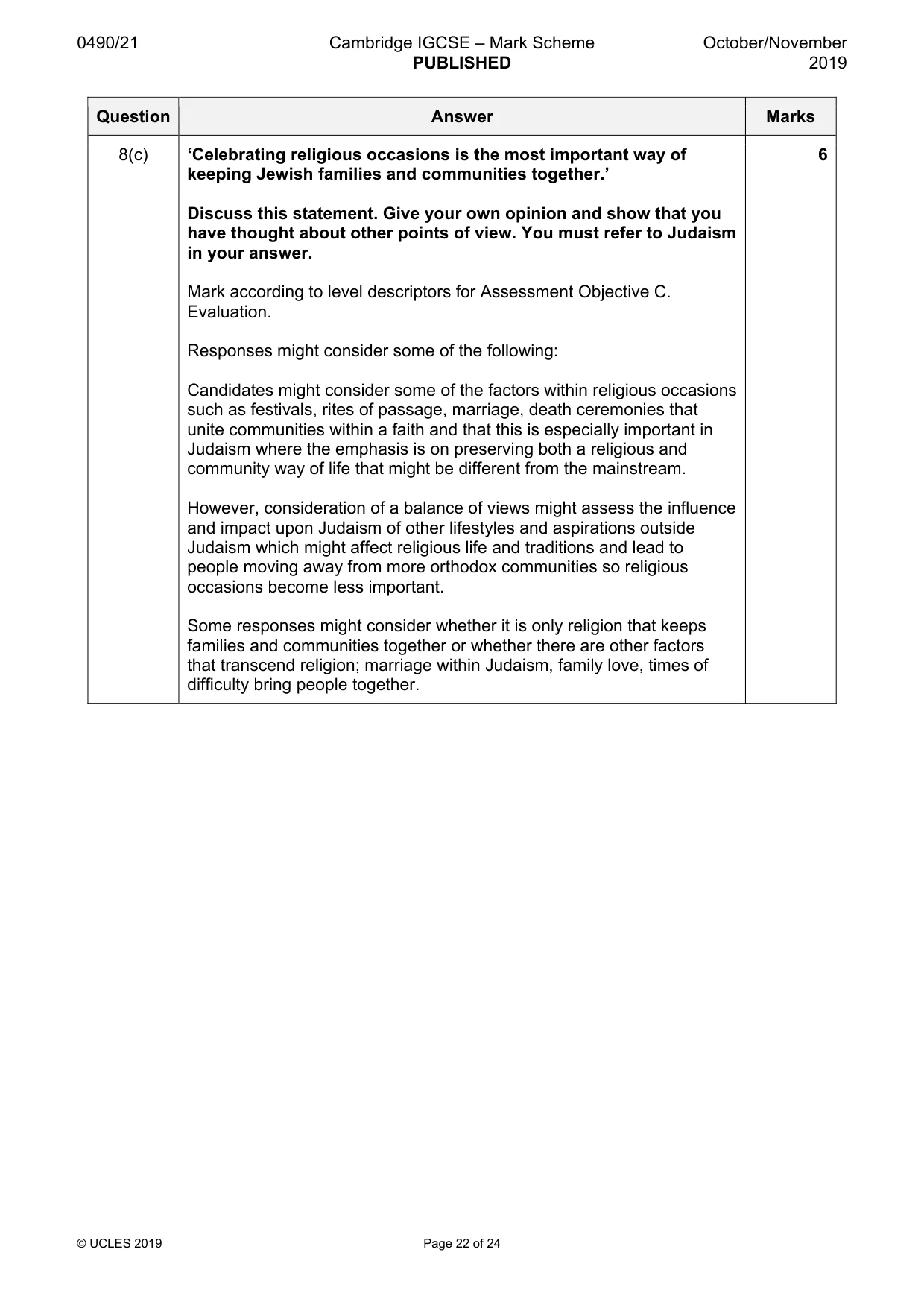
0490/21 Cambridge IGCSE – Mark Scheme PUBLISHED October/November 2019 © UCLES 2019 Page 22 of 24 Question Answer Marks 8(c) ‘Celebrating religious occasions is the most important way of keeping Jewish families and communities together.’ Discuss this statement. Give your own opinion and show that you have thought about other points of view. You must refer to Judaism in your answer. Mark according to level descriptors for Assessment Objective C. Evaluation. Responses might consider some of the following: Candidates might consider some of the factors within religious occasions such as festivals, rites of passage, marriage, death ceremonies that unite communities within a faith and that this is especially important in Judaism where the emphasis is on preserving both a religious and community way of life that might be different from the mainstream. However, consideration of a balance of views might assess the influence and impact upon Judaism of other lifestyles and aspirations outside Judaism which might affect religious life and traditions and lead to people moving away from more orthodox communities so religious occasions become less important. Some responses might consider whether it is only religion that keeps families and communities together or whether there are other factors that transcend religion; marriage within Judaism, family love, times of difficulty bring people together. 6
Mark scheme, page 23
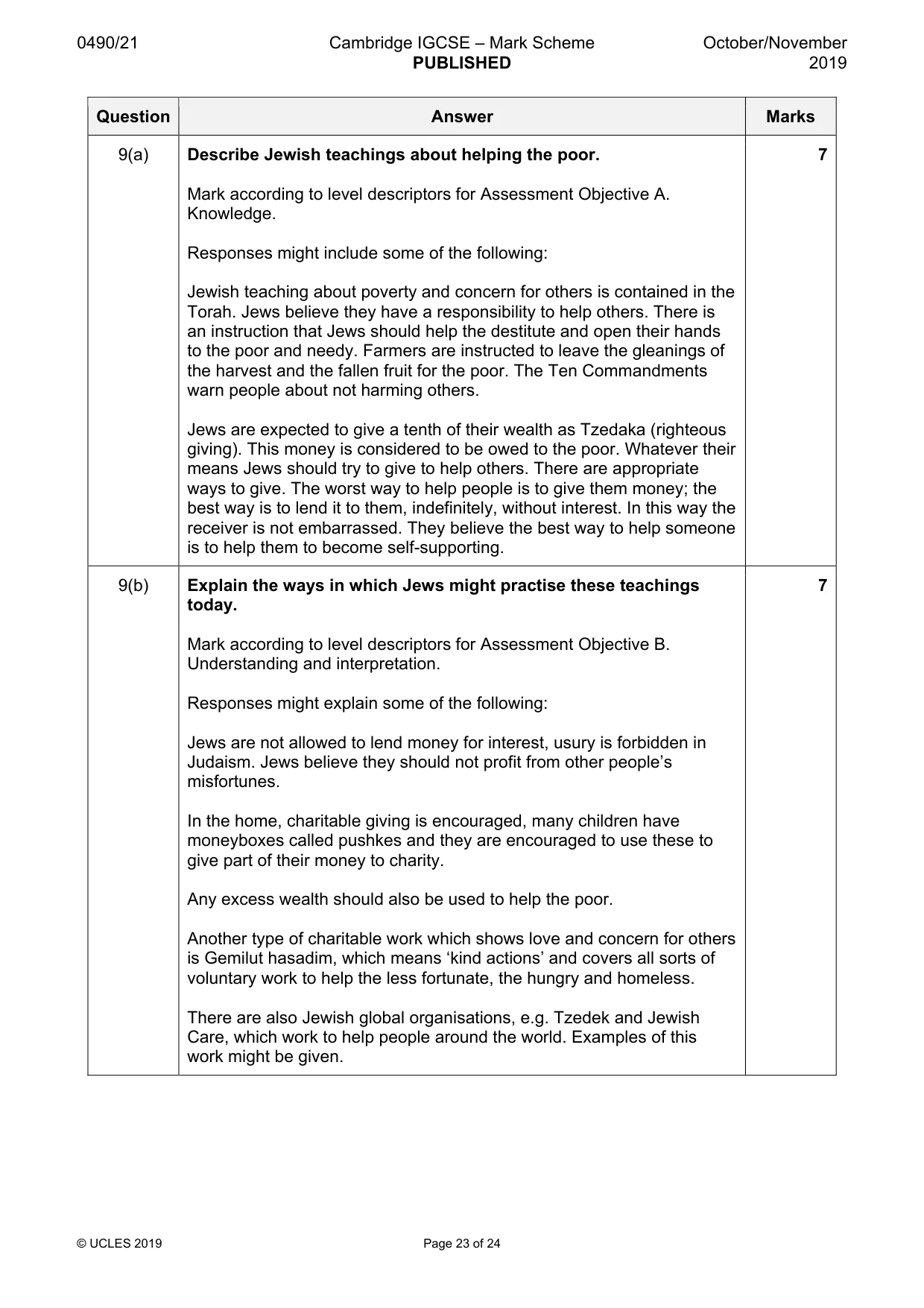
0490/21 Cambridge IGCSE – Mark Scheme PUBLISHED October/November 2019 © UCLES 2019 Page 23 of 24 Question Answer Marks 9(a) Describe Jewish teachings about helping the poor. Mark according to level descriptors for Assessment Objective A. Knowledge. Responses might include some of the following: Jewish teaching about poverty and concern for others is contained in the Torah. Jews believe they have a responsibility to help others. There is an instruction that Jews should help the destitute and open their hands to the poor and needy. Farmers are instructed to leave the gleanings of the harvest and the fallen fruit for the poor. The Ten Commandments warn people about not harming others. Jews are expected to give a tenth of their wealth as Tzedaka (righteous giving). This money is considered to be owed to the poor. Whatever their means Jews should try to give to help others. There are appropriate ways to give. The worst way to help people is to give them money; the best way is to lend it to them, indefinitely, without interest. In this way the receiver is not embarrassed. They believe the best way to help someone is to help them to become self-supporting. 7 9(b) Explain the ways in which Jews might practise these teachings today. Mark according to level descriptors for Assessment Objective B. Understanding and interpretation. Responses might explain some of the following: Jews are not allowed to lend money for interest, usury is forbidden in Judaism. Jews believe they should not profit from other people’s misfortunes. In the home, charitable giving is encouraged, many children have moneyboxes called pushkes and they are encouraged to use these to give part of their money to charity. Any excess wealth should also be used to help the poor. Another type of charitable work which shows love and concern for others is Gemilut hasadim, which means ‘kind actions’ and covers all sorts of voluntary work to help the less fortunate, the hungry and homeless. There are also Jewish global organisations, e.g. Tzedek and Jewish Care, which work to help people around the world. Examples of this work might be given. 7
Mark scheme, page 24
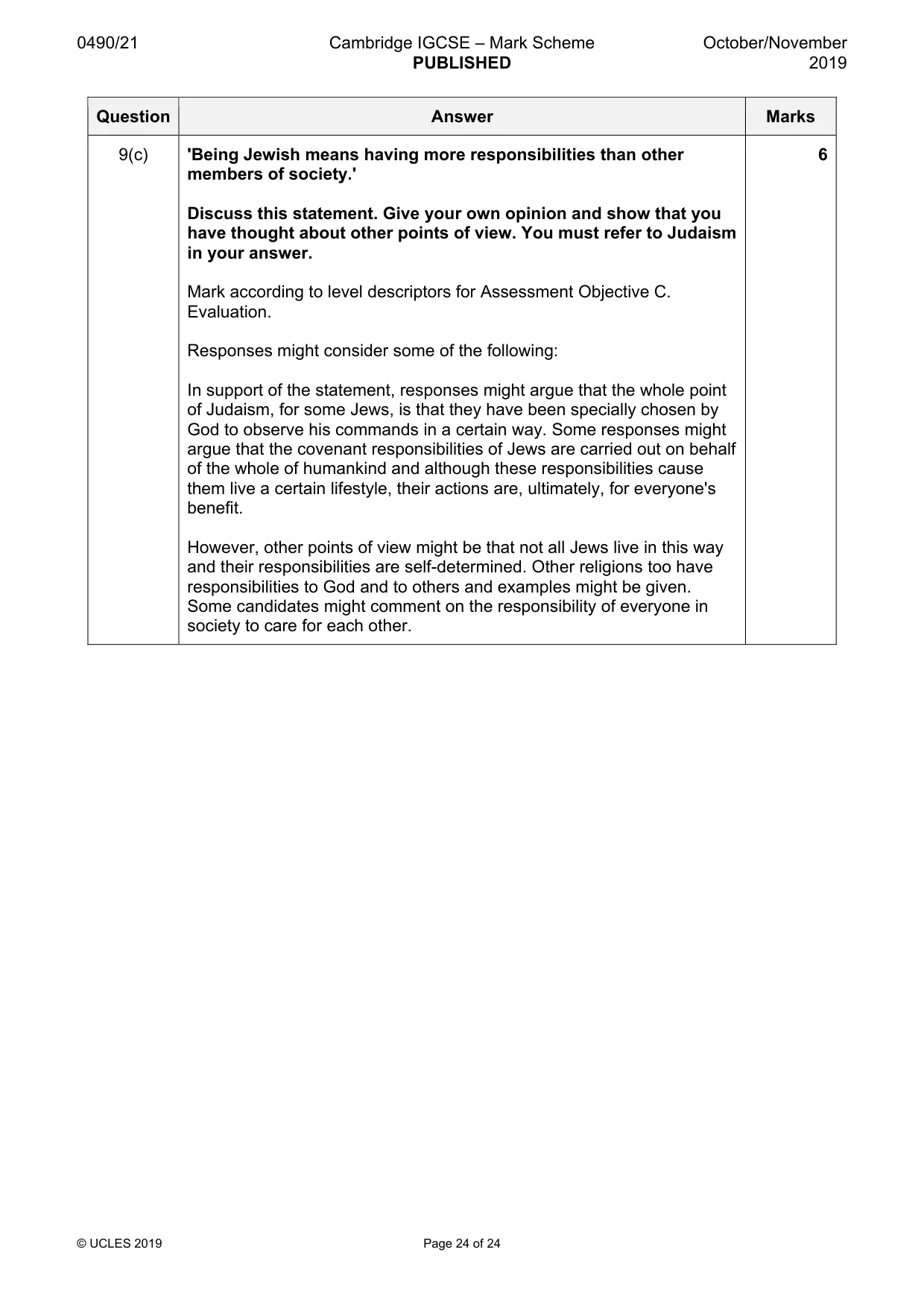
0490/21 Cambridge IGCSE – Mark Scheme PUBLISHED October/November 2019 © UCLES 2019 Page 24 of 24 Question Answer Marks 9(c) 'Being Jewish means having more responsibilities than other members of society.' Discuss this statement. Give your own opinion and show that you have thought about other points of view. You must refer to Judaism in your answer. Mark according to level descriptors for Assessment Objective C. Evaluation. Responses might consider some of the following: In support of the statement, responses might argue that the whole point of Judaism, for some Jews, is that they have been specially chosen by God to observe his commands in a certain way. Some responses might argue that the covenant responsibilities of Jews are carried out on behalf of the whole of humankind and although these responsibilities cause them live a certain lifestyle, their actions are, ultimately, for everyone's benefit. However, other points of view might be that not all Jews live in this way and their responsibilities are self-determined. Other religions too have responsibilities to God and to others and examples might be given. Some candidates might comment on the responsibility of everyone in society to care for each other. 6
What you needed in this session
Cambridge’s own grade thresholds for 2019 Oct/Nov, Paper 2 · Variant 3. A higher threshold means an easier paper — the bar moves with how the cohort did.