Cambridge IGCSE Religious Studies 0490 — 2025 Oct/Nov Paper 2 · Variant 2
0490/22/O/N/25 · 9 questions · 80 marks · 105 min
The question paper and its mark scheme, free to read here and free to download. This is Cambridge’s own paper, exactly as it was sat.
Question paper8 pages
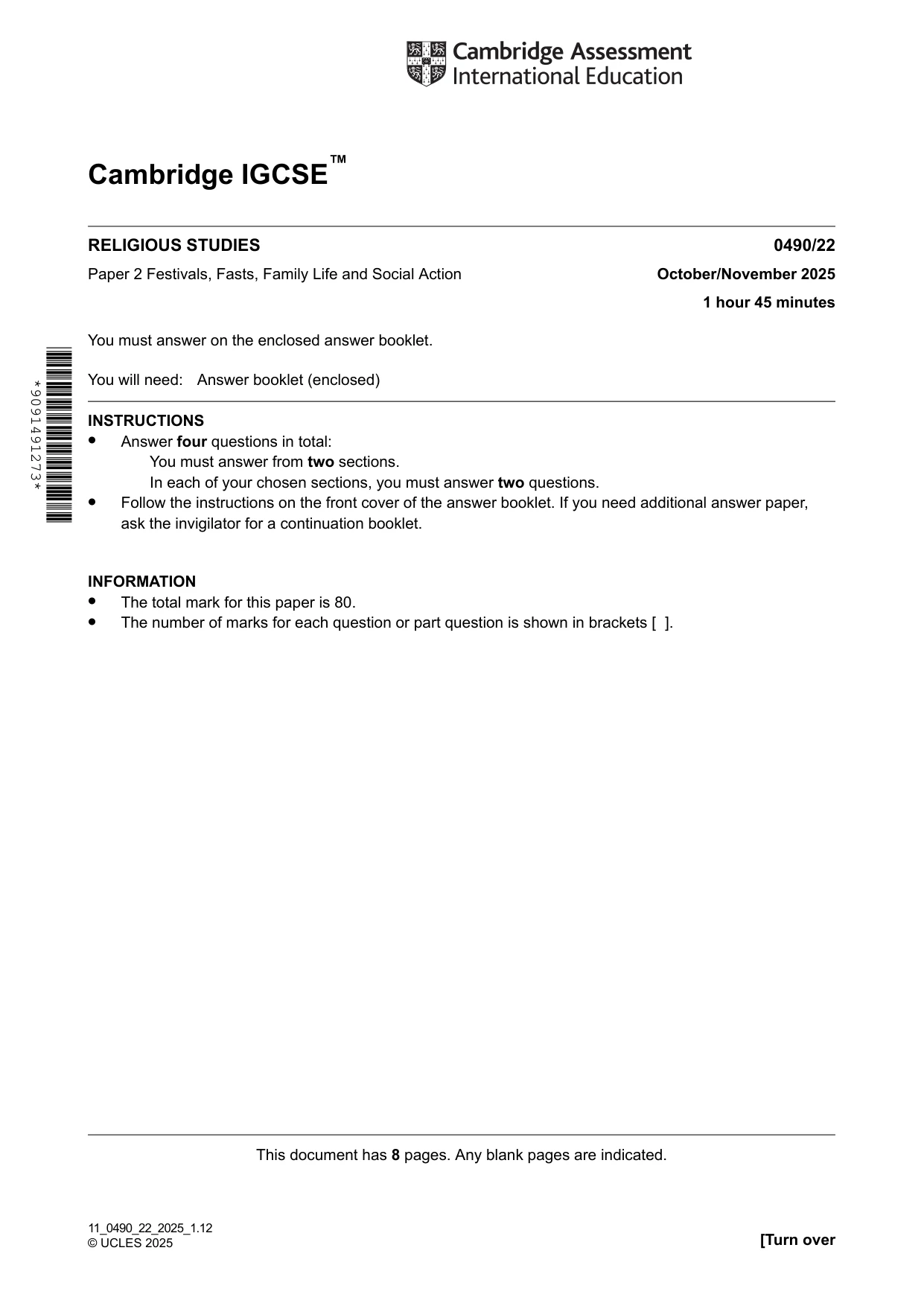
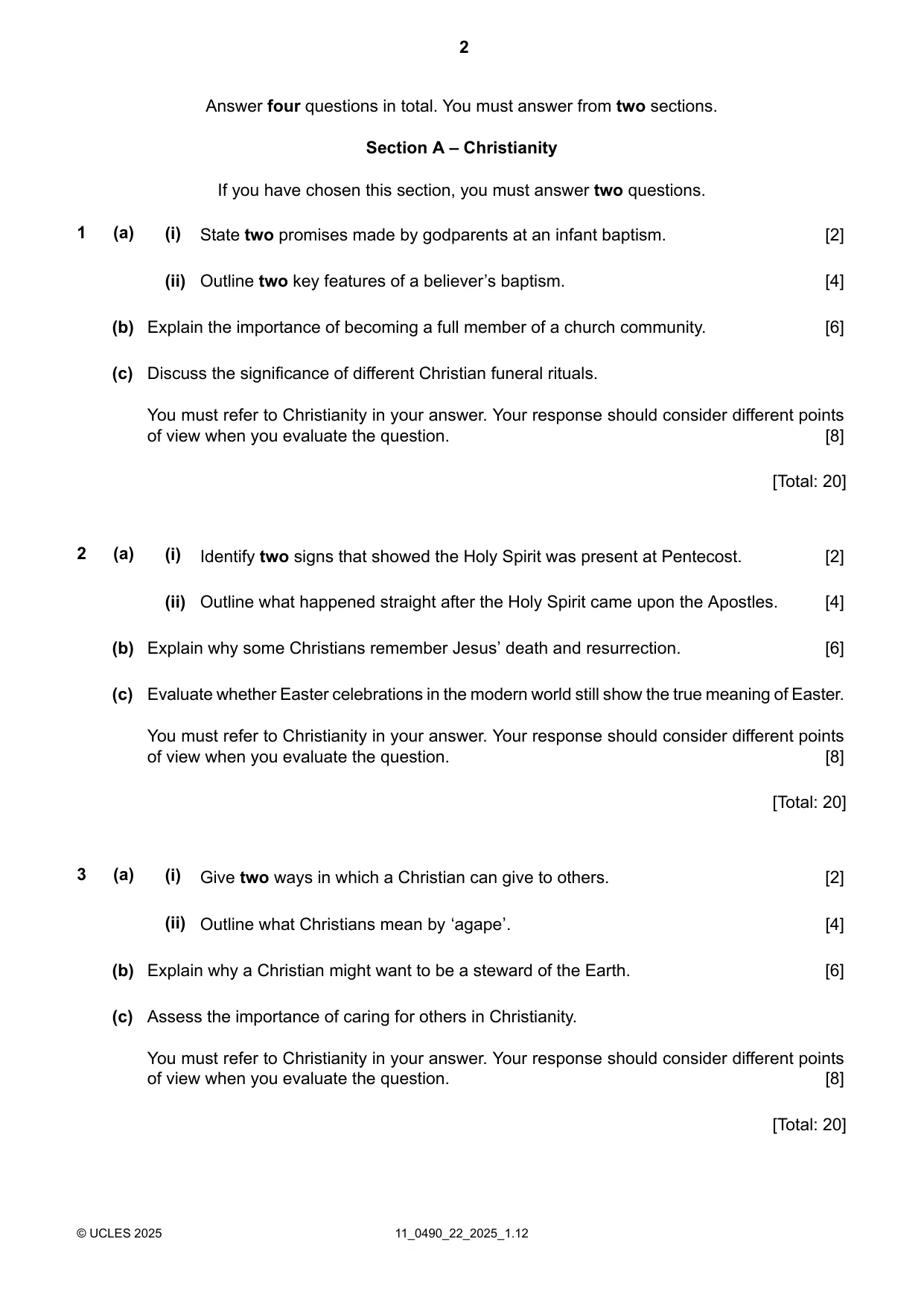
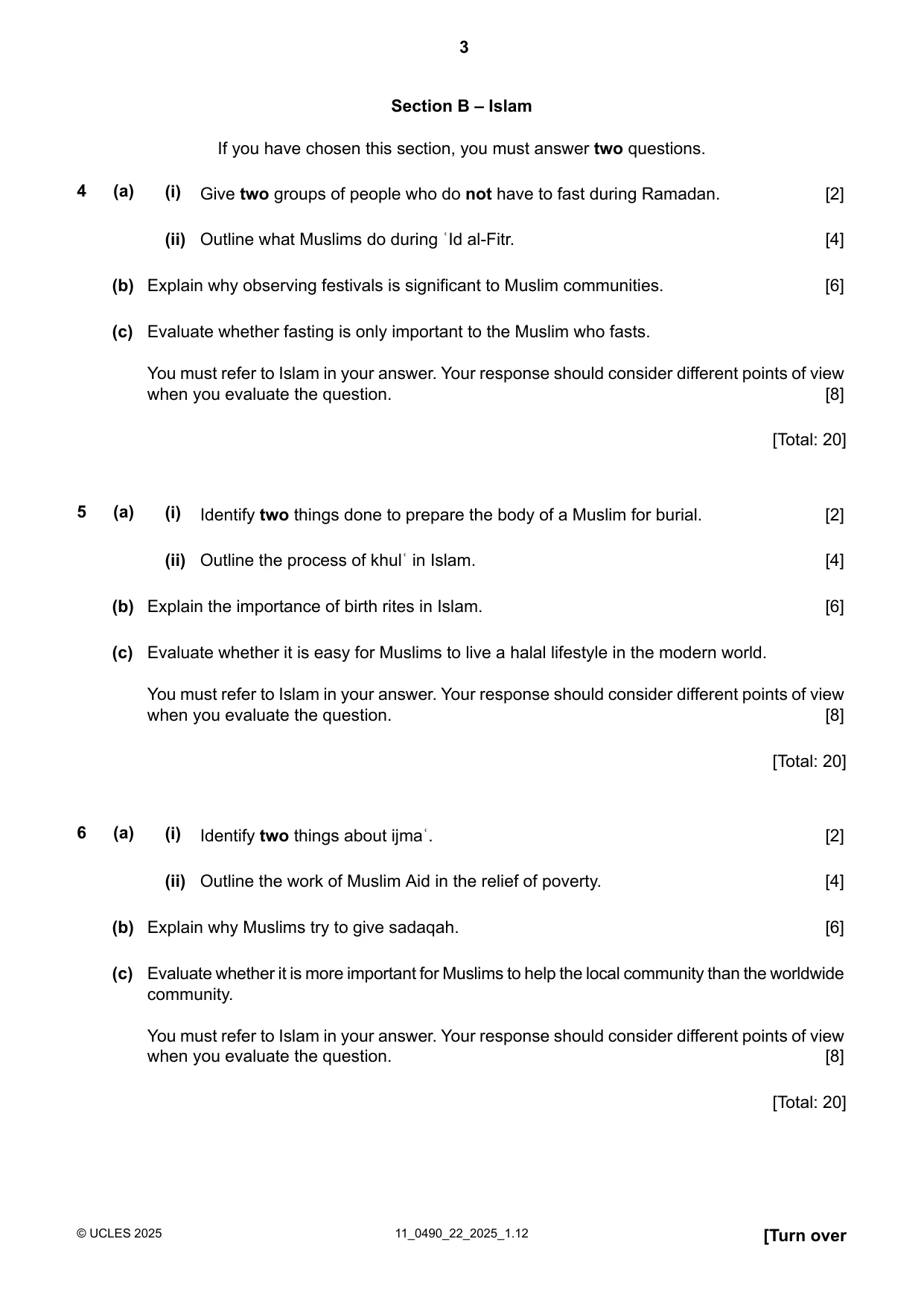
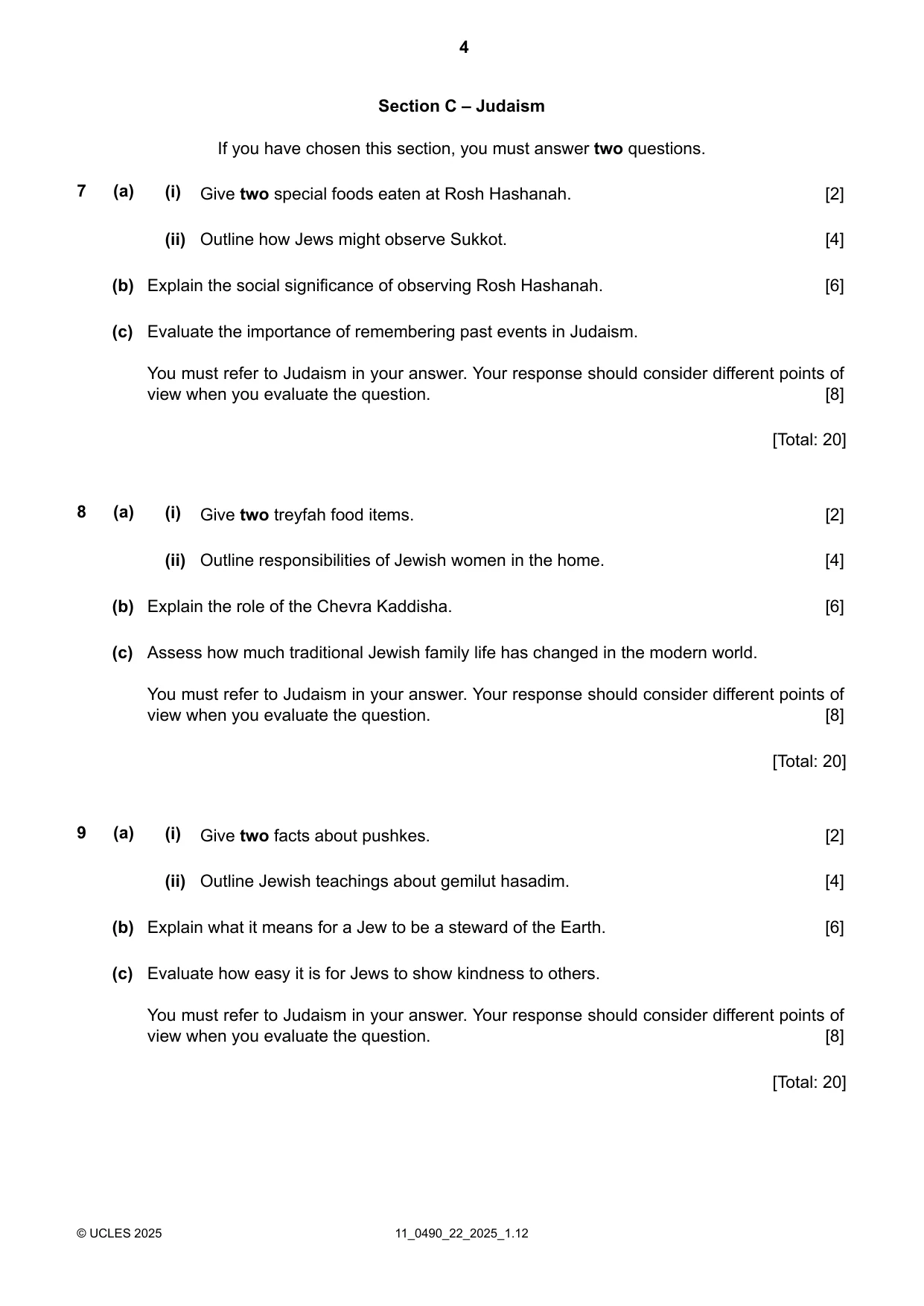




Mark scheme30 pages
Answers below. Sit the paper first if you are practising.

Questions as text
Q1 · State two promises made by godparents at an infant baptism
1 (a) (i) State two promises made by godparents at an infant baptism. [2] (ii) Outline two key features of a believer’s baptism. [4] (b) Explain the importance of becoming a full member of a church community. [6] (c) Discuss the significance of different Christian funeral rituals. You must refer to Christianity in your answer. Your response should consider different points of view when you evaluate the question. [8] [Total: 20]
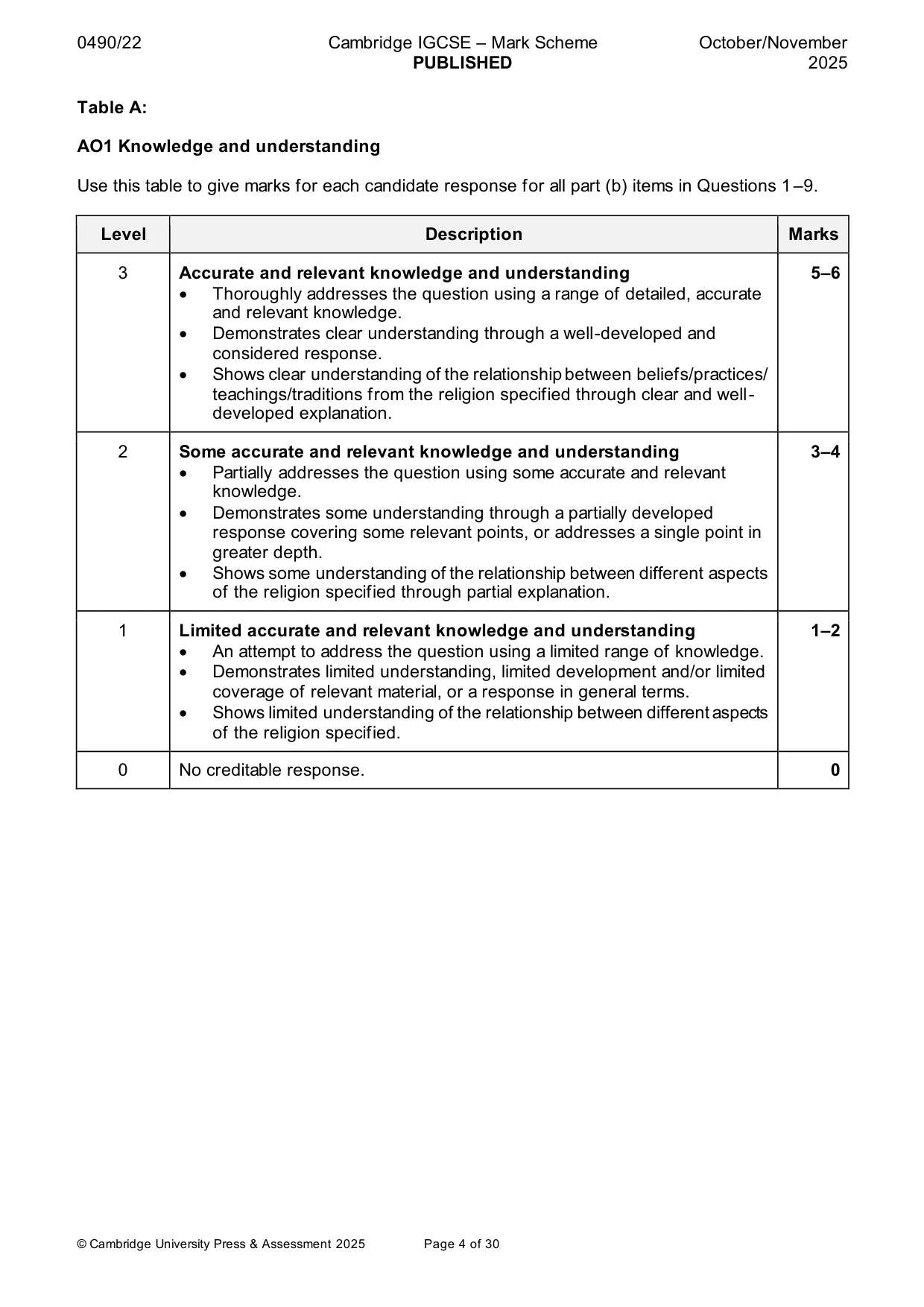
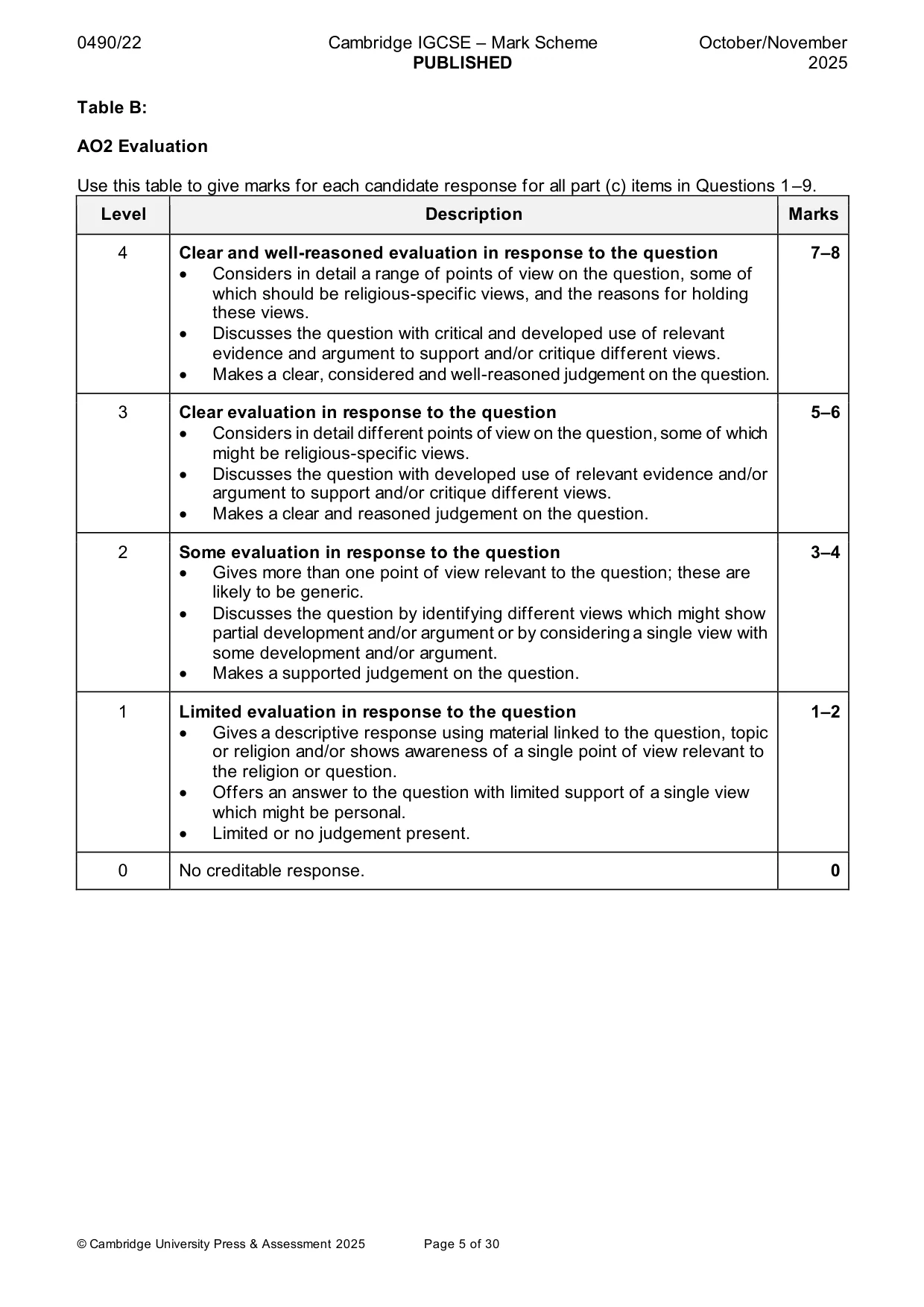
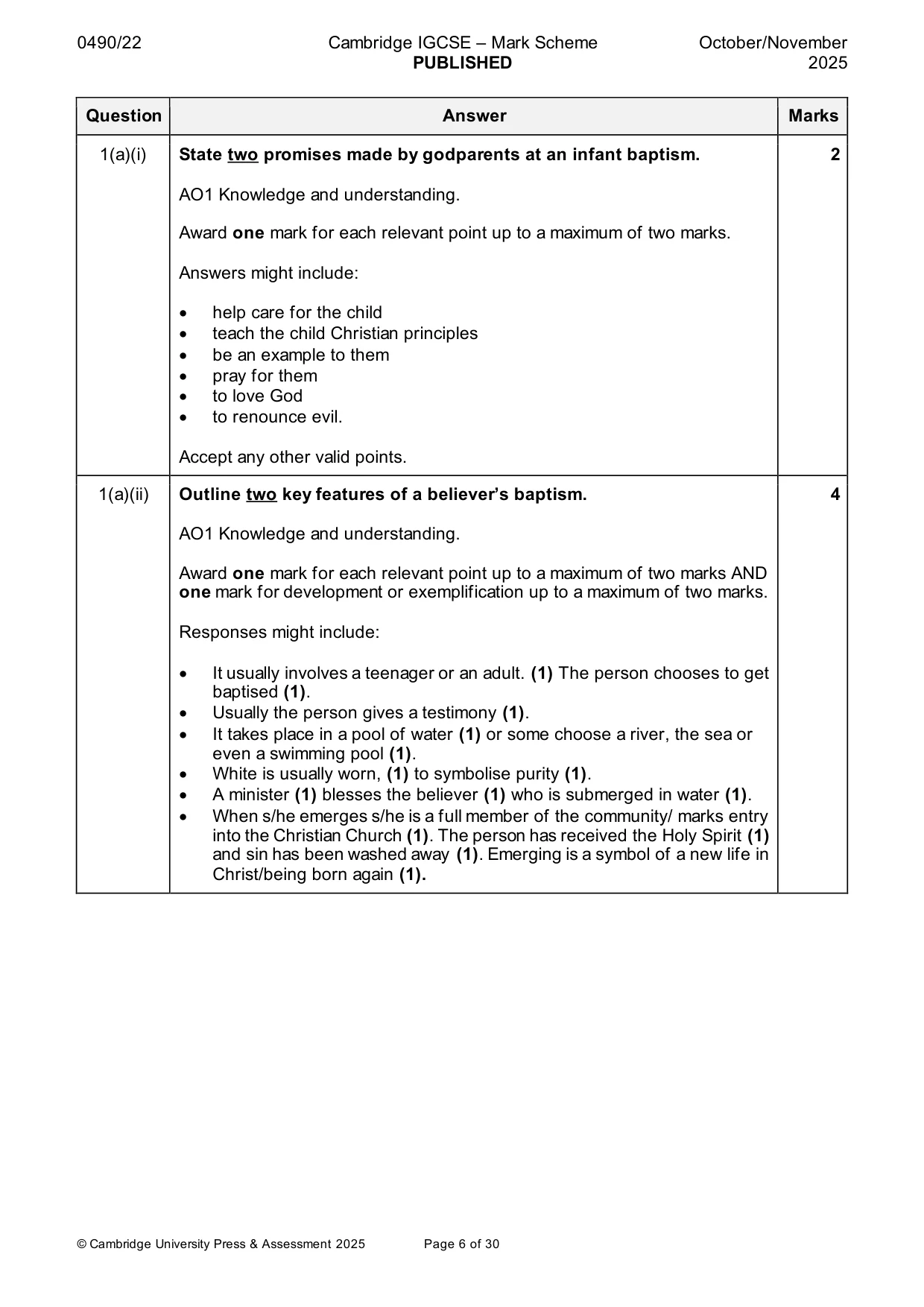
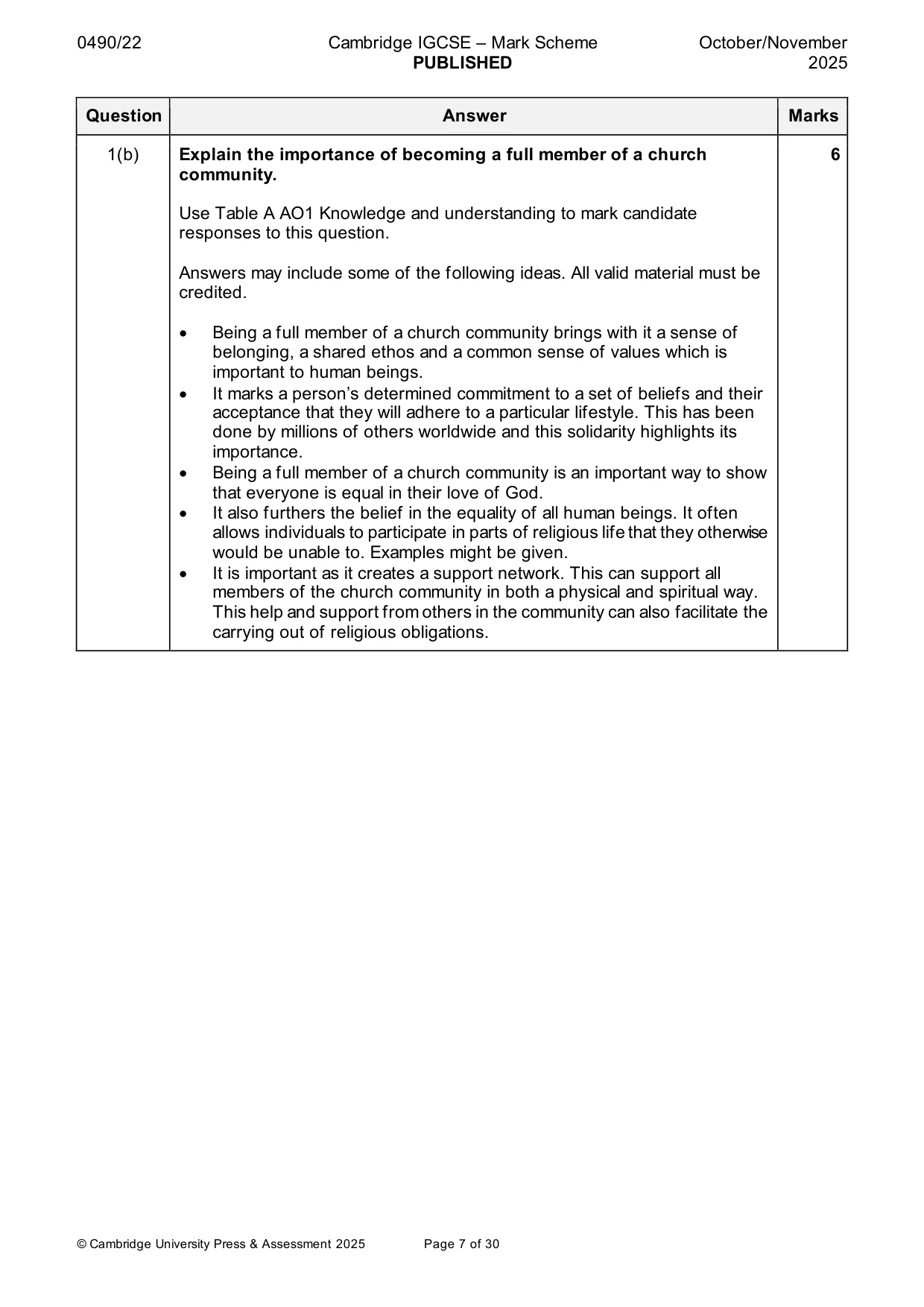
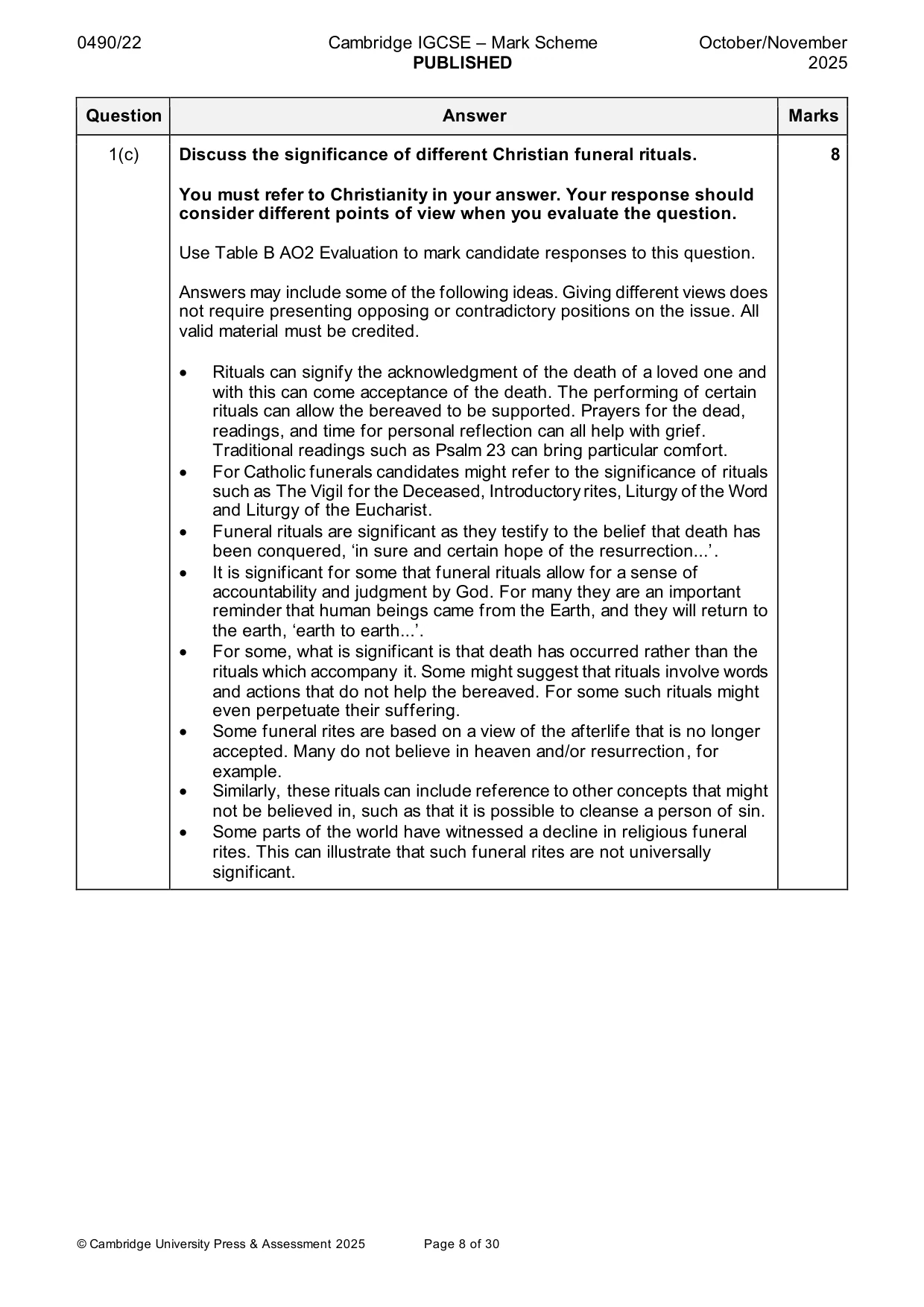
Mark scheme: Question Answer Marks 1(a)(i) State two promises made by godparents at an infant baptism. 2 AO1 Knowledge and understanding. Award one mark for each relevant point up to a maximum of two marks. Answers might include: • help care for the child • teach the child Christian principles • be an example to them • pray for them • to love God • to renounce evil. Accept any other valid points. 1(a)(ii) Outline two key features of a believer’s baptism. 4 AO1 Knowledge and understanding. Award one mark for each relevant point up to a maximum of two marks AND one mark for development or exemplification up to a maximum of two marks. Responses might include: • It usually involves a teenager or an adult. (1) The person chooses to get baptised (1). • Usually the person gives a testimony (1). • It takes place in a pool of water (1) or some choose a river, the sea or even a swimming pool (1). • White is usually worn, (1) to symbolise purity (1). • A minister (1) blesses the believer (1) who is submerged in water (1). • When s/he emerges s/he is a full member of the community/ marks entry into the Christian Church (1). The person has received the Holy Spirit (1) and sin has been washed away (1). Emerging is a symbol of a new life in Christ/being born again (1). 1(b) Explain the importance of becoming a full member of a church 6 community. Use Table A AO1 Knowledge and understanding to mark candidate responses to this question. Answers may include some of the following ideas. All valid material must be credited. • Being a full member of a church community brings with it a sense of belonging, a shared ethos and a common sense of values which is important to human beings. • It marks a person’s determined commitment to a set of beliefs and their acceptance that they will adhere to a particular lifestyle. This has been done by millions of others worldwide and this solidarity highlights its importance. • Being a full member of a church community is an important way to show that everyone is equal in their love of God. • It also furthers the belief in the equality of all human beings. It often allows individuals to participate in parts of religious life that they otherwise would be unable to. Examples might be given. • It is important as it creates a support network. This can support all members of the church community in both a physical and spiritual way. This help and support from others in the community can also facilitate the carrying out of religious obligations. 1(c) Discuss the significance of different Christian funeral rituals. 8 You must refer to Christianity in your answer. Your response should consider different points of view when you evaluate the question. Use Table B AO2 Evaluation to mark candidate responses to this question. Answers may include some of the following ideas. Giving different views does not require presenting opposing or contradictory positions on the issue. All valid material must be credited. • Rituals can signify the acknowledgment of the death of a loved one and with this can come acceptance of the death. The performing of certain rituals can allow the bereaved to be supported. Prayers for the dead, readings, and time for personal reflection can all help with grief. Traditional readings such as Psalm 23 can bring particular comfort. • For Catholic funerals candidates might refer to the significance of rituals such as The Vigil for the Deceased, Introductory rites, Liturgy of the Word and Liturgy of the Eucharist. • Funeral rituals are significant as they testify to the belief that death has been conquered, ‘in sure and certain hope of the resurrection...’. • It is significant for some that funeral rituals allow for a sense of accountability and judgment by God. For many they are an important reminder that human beings came from the Earth, and they will return to the earth, ‘earth to earth...’. • For some, what is significant is that death has occurred rather than the rituals which accompany it. Some might suggest that rituals involve words and actions that do not help the bereaved. For some such rituals might even perpetuate their suffering. • Some funeral rites are based on a view of the afterlife that is no longer accepted. Many do not believe in heaven and/or resurrection, for example. • Similarly, these rituals can include reference to other concepts that might not be believed in, such as that it is possible to cleanse a person of sin. • Some parts of the world have witnessed a decline in religious funeral rites. This can illustrate that such funeral rites are not universally significant.
Q2 · Identify two signs that showed the Holy Spirit was present at Pentecost
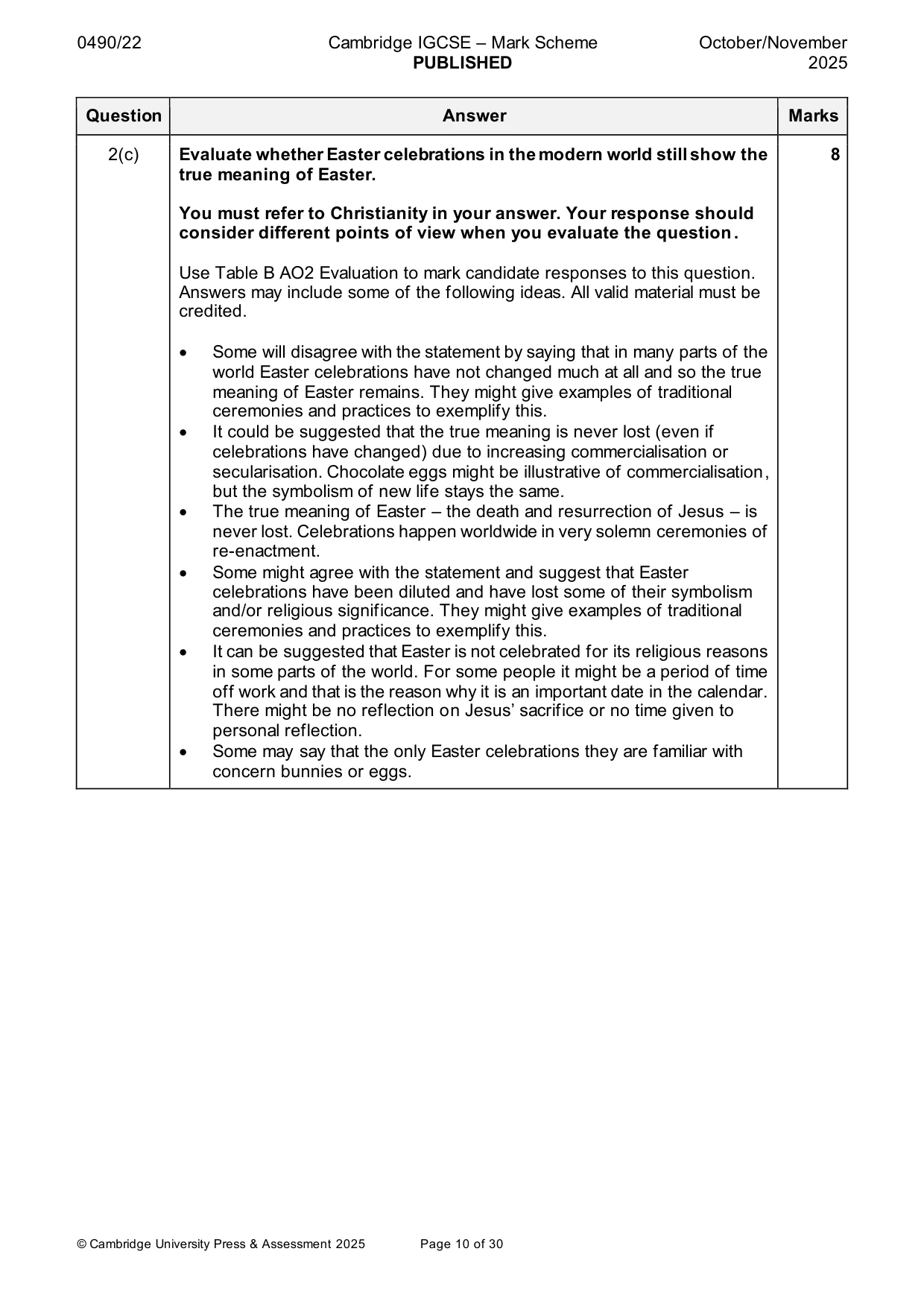
2 (a) (i) Identify two signs that showed the Holy Spirit was present at Pentecost. [2] (ii) Outline what happened straight after the Holy Spirit came upon the Apostles. [4] (b) Explain why some Christians remember Jesus’ death and resurrection. [6] (c) Evaluate whether Easter celebrations in the modern world still show the true meaning of Easter. You must refer to Christianity in your answer. Your response should consider different points of view when you evaluate the question. [8] [Total: 20]
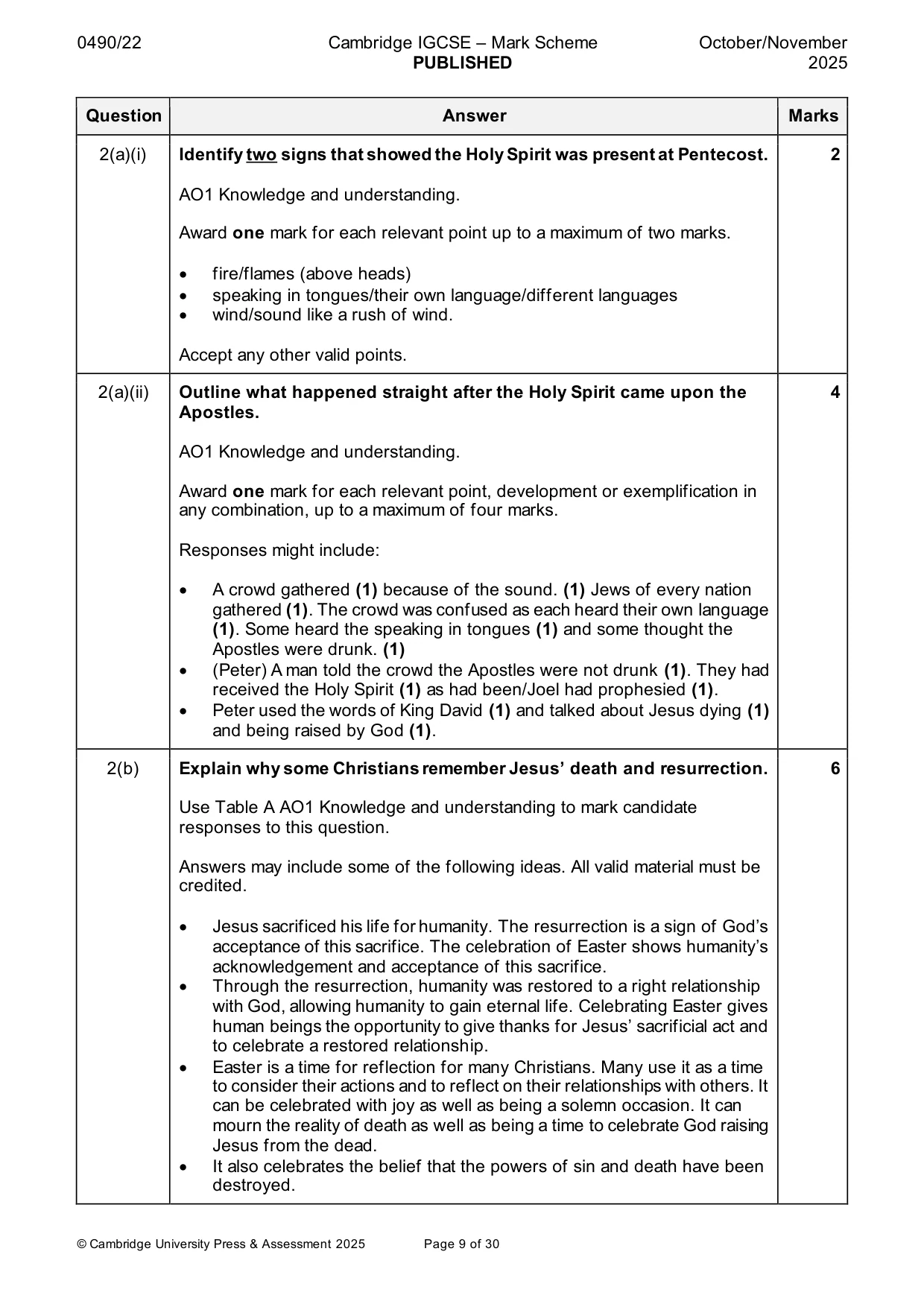
Mark scheme: 2(a)(i) Identify two signs that showed the Holy Spirit was present at Pentecost. 2 AO1 Knowledge and understanding. Award one mark for each relevant point up to a maximum of two marks. • fire/flames (above heads) • speaking in tongues/their own language/different languages • wind/sound like a rush of wind. Accept any other valid points. 2(a)(ii) Outline what happened straight after the Holy Spirit came upon the 4 Apostles. AO1 Knowledge and understanding. Award one mark for each relevant point, development or exemplification in any combination, up to a maximum of four marks. Responses might include: • A crowd gathered (1) because of the sound. (1) Jews of every nation gathered (1). The crowd was confused as each heard their own language (1). Some heard the speaking in tongues (1) and some thought the Apostles were drunk. (1) • (Peter) A man told the crowd the Apostles were not drunk (1). They had received the Holy Spirit (1) as had been/Joel had prophesied (1). • Peter used the words of King David (1) and talked about Jesus dying (1) and being raised by God (1). 2(b) Explain why some Christians remember Jesus’ death and resurrection. 6 Use Table A AO1 Knowledge and understanding to mark candidate responses to this question. Answers may include some of the following ideas. All valid material must be credited. • Jesus sacrificed his life for humanity. The resurrection is a sign of God’s acceptance of this sacrifice. The celebration of Easter shows humanity’s acknowledgement and acceptance of this sacrifice. • Through the resurrection, humanity was restored to a right relationship with God, allowing humanity to gain eternal life. Celebrating Easter gives human beings the opportunity to give thanks for Jesus’ sacrificial act and to celebrate a restored relationship. • Easter is a time for reflection for many Christians. Many use it as a time to consider their actions and to reflect on their relationships with others. It can be celebrated with joy as well as being a solemn occasion. It can mourn the reality of death as well as being a time to celebrate God raising Jesus from the dead. • It also celebrates the belief that the powers of sin and death have been destroyed. 2(c) Evaluate whether Easter celebrations in the modern world still show the 8 true meaning of Easter. You must refer to Christianity in your answer. Your response should consider different points of view when you evaluate the question. Use Table B AO2 Evaluation to mark candidate responses to this question. Answers may include some of the following ideas. All valid material must be credited. • Some will disagree with the statement by saying that in many parts of the world Easter celebrations have not changed much at all and so the true meaning of Easter remains. They might give examples of traditional ceremonies and practices to exemplify this. • It could be suggested that the true meaning is never lost (even if celebrations have changed) due to increasing commercialisation or secularisation. Chocolate eggs might be illustrative of commercialisation, but the symbolism of new life stays the same. • The true meaning of Easter – the death and resurrection of Jesus – is never lost. Celebrations happen worldwide in very solemn ceremonies of re-enactment. • Some might agree with the statement and suggest that Easter celebrations have been diluted and have lost some of their symbolism and/or religious significance. They might give examples of traditional ceremonies and practices to exemplify this. • It can be suggested that Easter is not celebrated for its religious reasons in some parts of the world. For some people it might be a period of time off work and that is the reason why it is an important date in the calendar. There might be no reflection on Jesus’ sacrifice or no time given to personal reflection. • Some may say that the only Easter celebrations they are familiar with concern bunnies or eggs.
Q3 · Give two ways in which a Christian can give to others
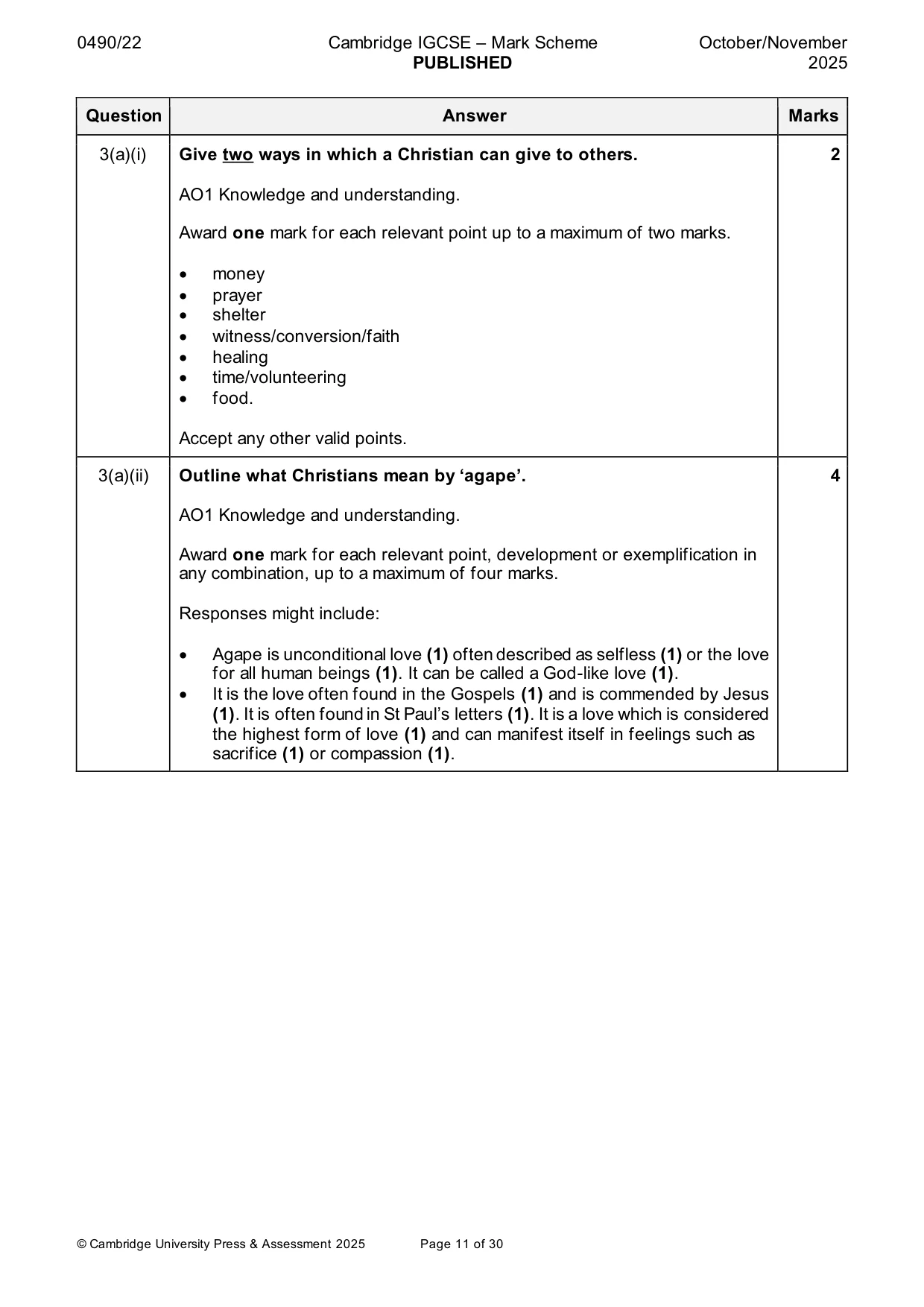
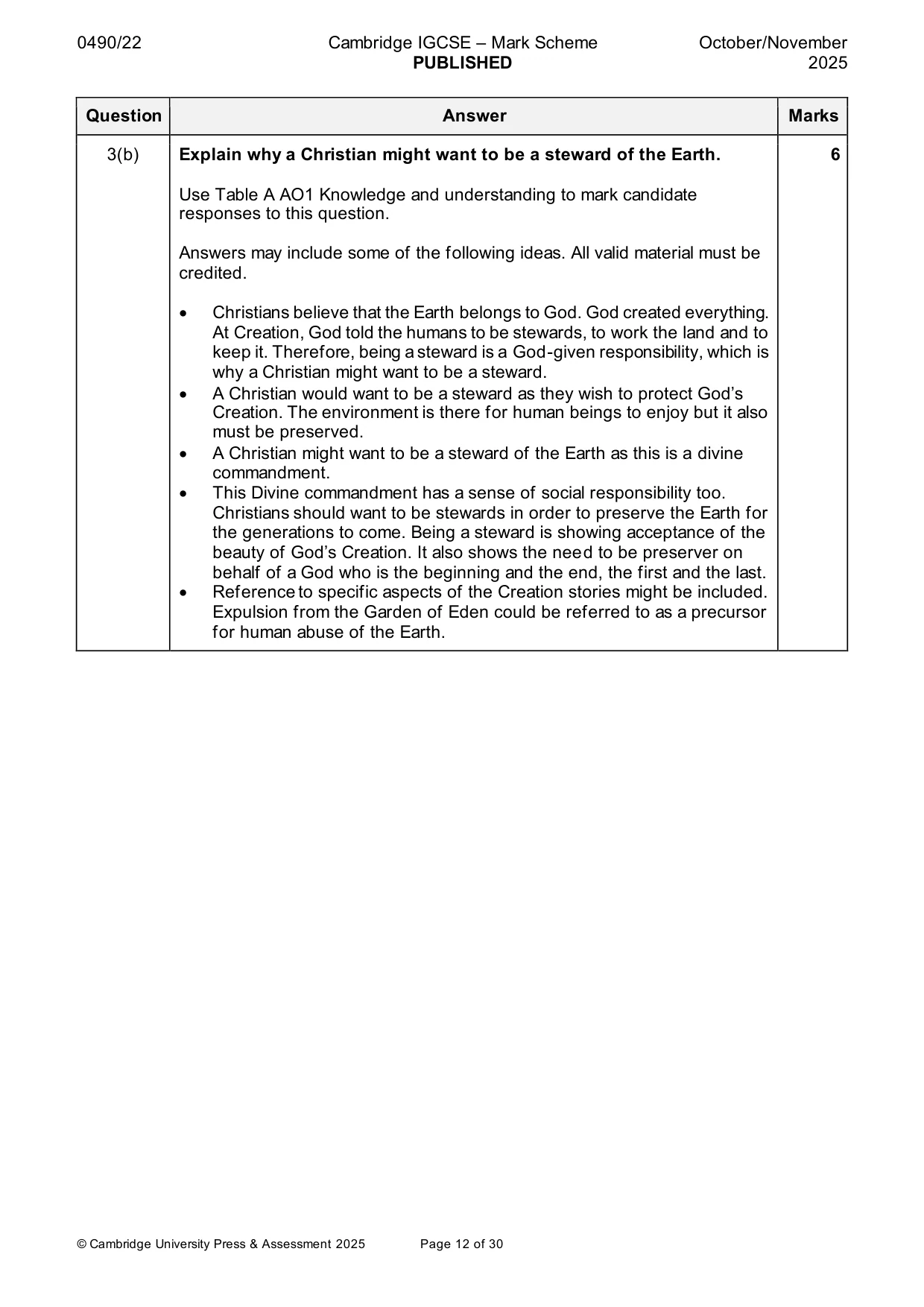
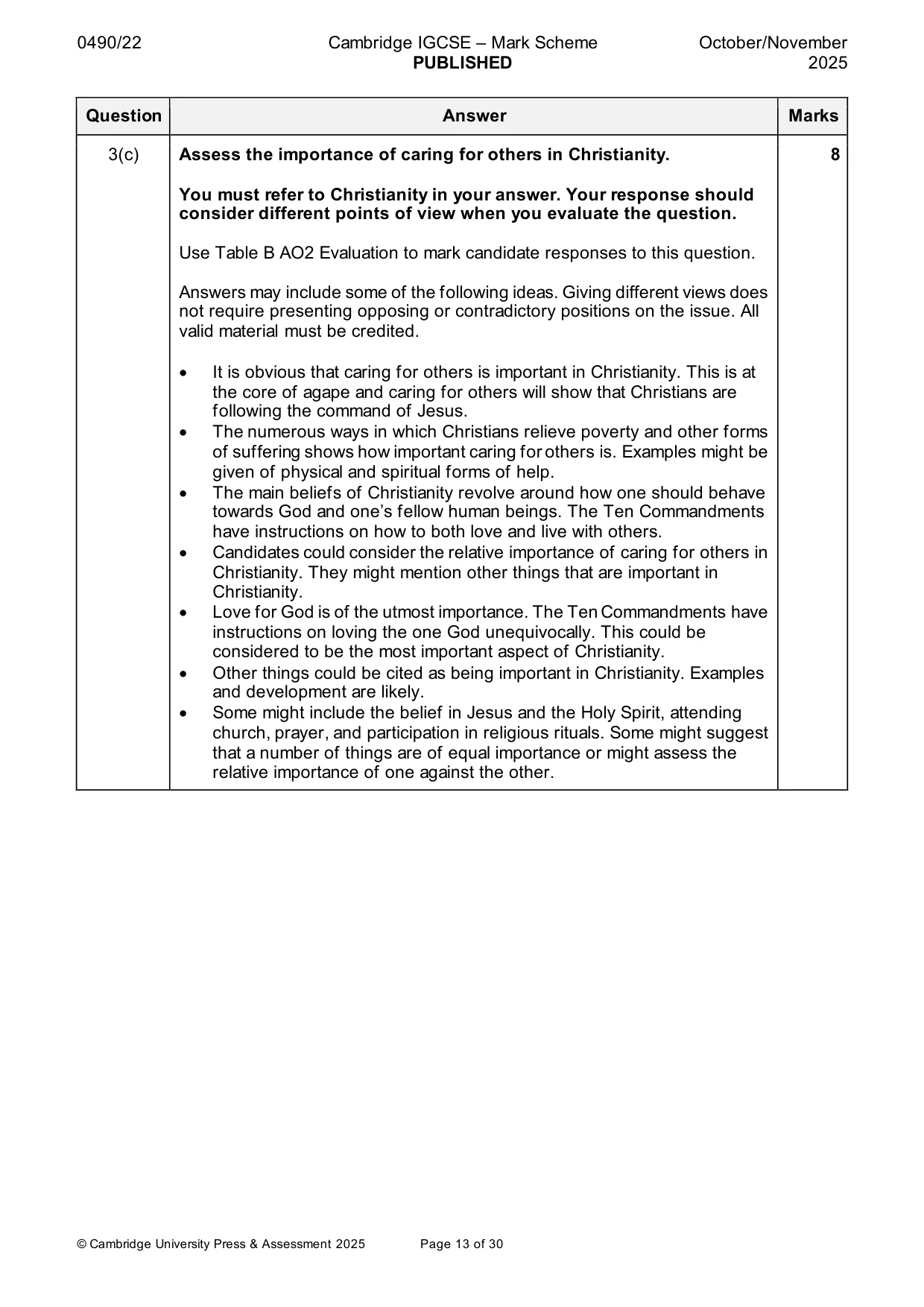
3 (a) (i) Give two ways in which a Christian can give to others. [2] (ii) Outline what Christians mean by ‘agape’. [4] (b) Explain why a Christian might want to be a steward of the Earth. [6] (c) Assess the importance of caring for others in Christianity. You must refer to Christianity in your answer. Your response should consider different points of view when you evaluate the question. [8] [Total: 20]
Mark scheme: 3(a)(i) Give two ways in which a Christian can give to others. 2 AO1 Knowledge and understanding. Award one mark for each relevant point up to a maximum of two marks. • money • prayer • shelter • witness/conversion/faith • healing • time/volunteering • food. Accept any other valid points. 3(a)(ii) Outline what Christians mean by ‘agape’. 4 AO1 Knowledge and understanding. Award one mark for each relevant point, development or exemplification in any combination, up to a maximum of four marks. Responses might include: • Agape is unconditional love (1) often described as selfless (1) or the love for all human beings (1). It can be called a God-like love (1). • It is the love often found in the Gospels (1) and is commended by Jesus (1). It is often found in St Paul’s letters (1). It is a love which is considered the highest form of love (1) and can manifest itself in feelings such as sacrifice (1) or compassion (1). 3(b) Explain why a Christian might want to be a steward of the Earth. 6 Use Table A AO1 Knowledge and understanding to mark candidate responses to this question. Answers may include some of the following ideas. All valid material must be credited. • Christians believe that the Earth belongs to God. God created everything. At Creation, God told the humans to be stewards, to work the land and to keep it. Therefore, being a steward is a God-given responsibility, which is why a Christian might want to be a steward. • A Christian would want to be a steward as they wish to protect God’s Creation. The environment is there for human beings to enjoy but it also must be preserved. • A Christian might want to be a steward of the Earth as this is a divine commandment. • This Divine commandment has a sense of social responsibility too. Christians should want to be stewards in order to preserve the Earth for the generations to come. Being a steward is showing acceptance of the beauty of God’s Creation. It also shows the need to be preserver on behalf of a God who is the beginning and the end, the first and the last. • Reference to specific aspects of the Creation stories might be included. Expulsion from the Garden of Eden could be referred to as a precursor for human abuse of the Earth. 3(c) Assess the importance of caring for others in Christianity. 8 You must refer to Christianity in your answer. Your response should consider different points of view when you evaluate the question. Use Table B AO2 Evaluation to mark candidate responses to this question. Answers may include some of the following ideas. Giving different views does not require presenting opposing or contradictory positions on the issue. All valid material must be credited. • It is obvious that caring for others is important in Christianity. This is at the core of agape and caring for others will show that Christians are following the command of Jesus. • The numerous ways in which Christians relieve poverty and other forms of suffering shows how important caring for others is. Examples might be given of physical and spiritual forms of help. • The main beliefs of Christianity revolve around how one should behave towards God and one’s fellow human beings. The Ten Commandments have instructions on how to both love and live with others. • Candidates could consider the relative importance of caring for others in Christianity. They might mention other things that are important in Christianity. • Love for God is of the utmost importance. The Ten Commandments have instructions on loving the one God unequivocally. This could be considered to be the most important aspect of Christianity. • Other things could be cited as being important in Christianity. Examples and development are likely. • Some might include the belief in Jesus and the Holy Spirit, attending church, prayer, and participation in religious rituals. Some might suggest that a number of things are of equal importance or might assess the relative importance of one against the other.
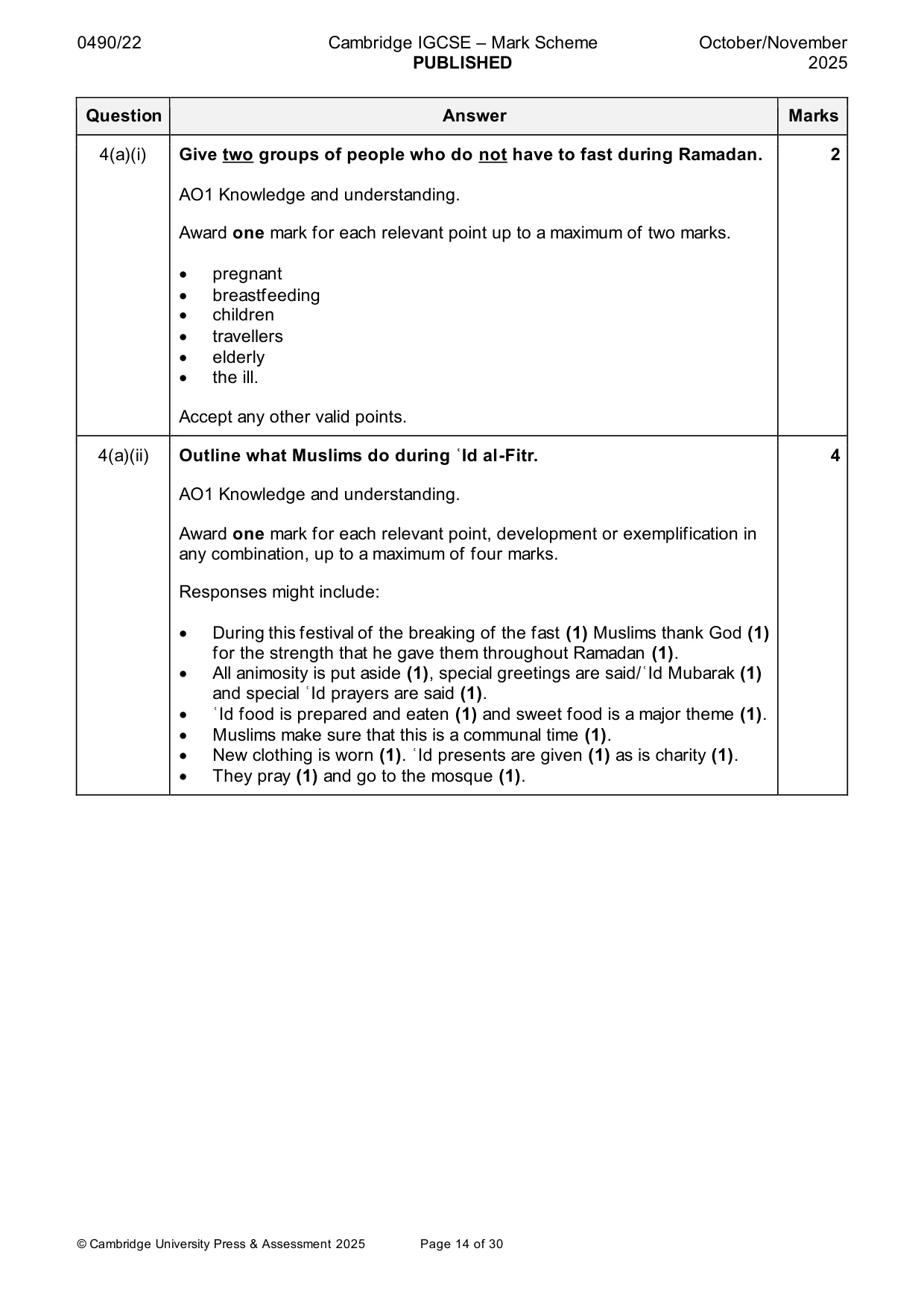
Q4 · Give two groups of people who do not have to fast during Ramadan
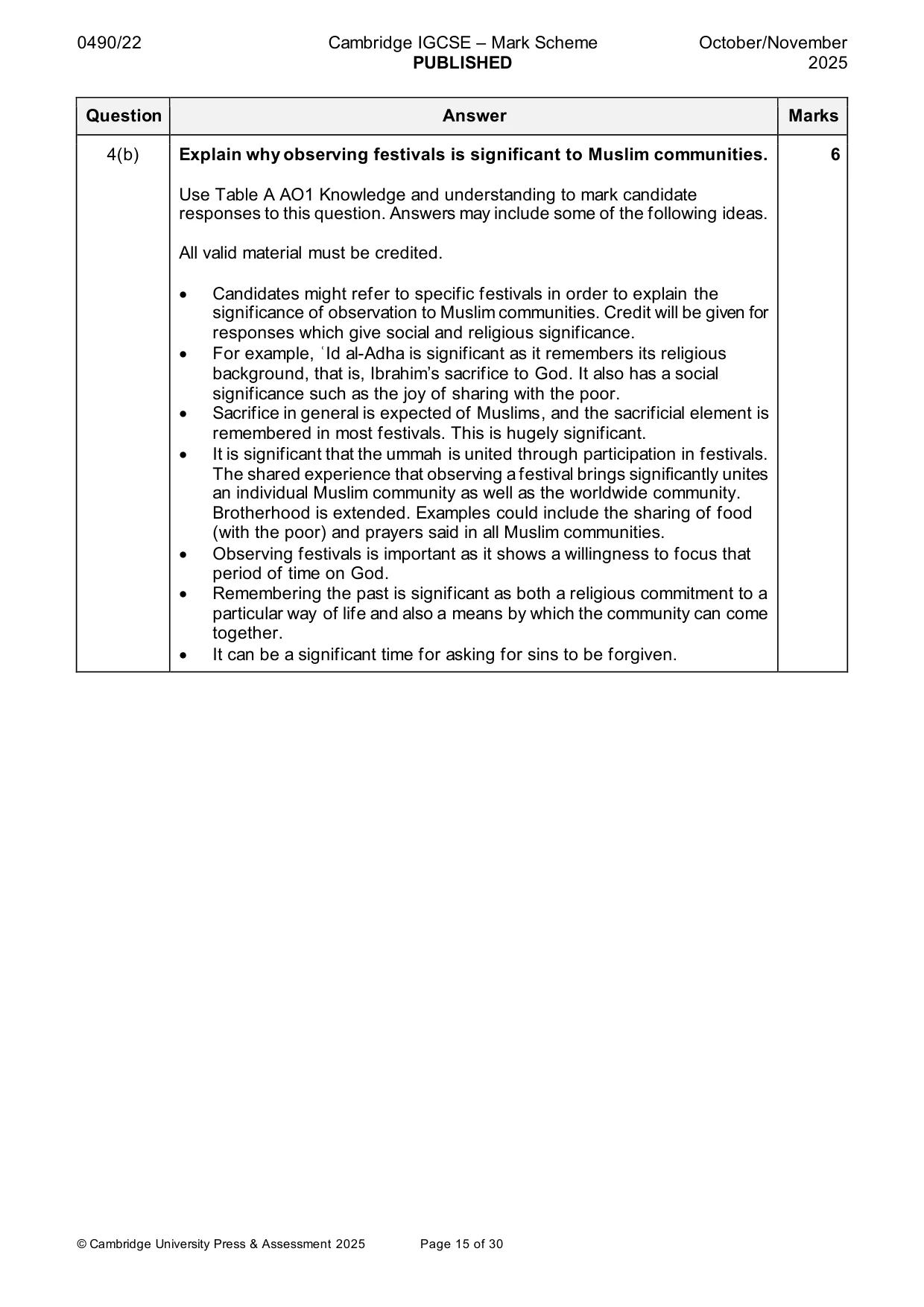
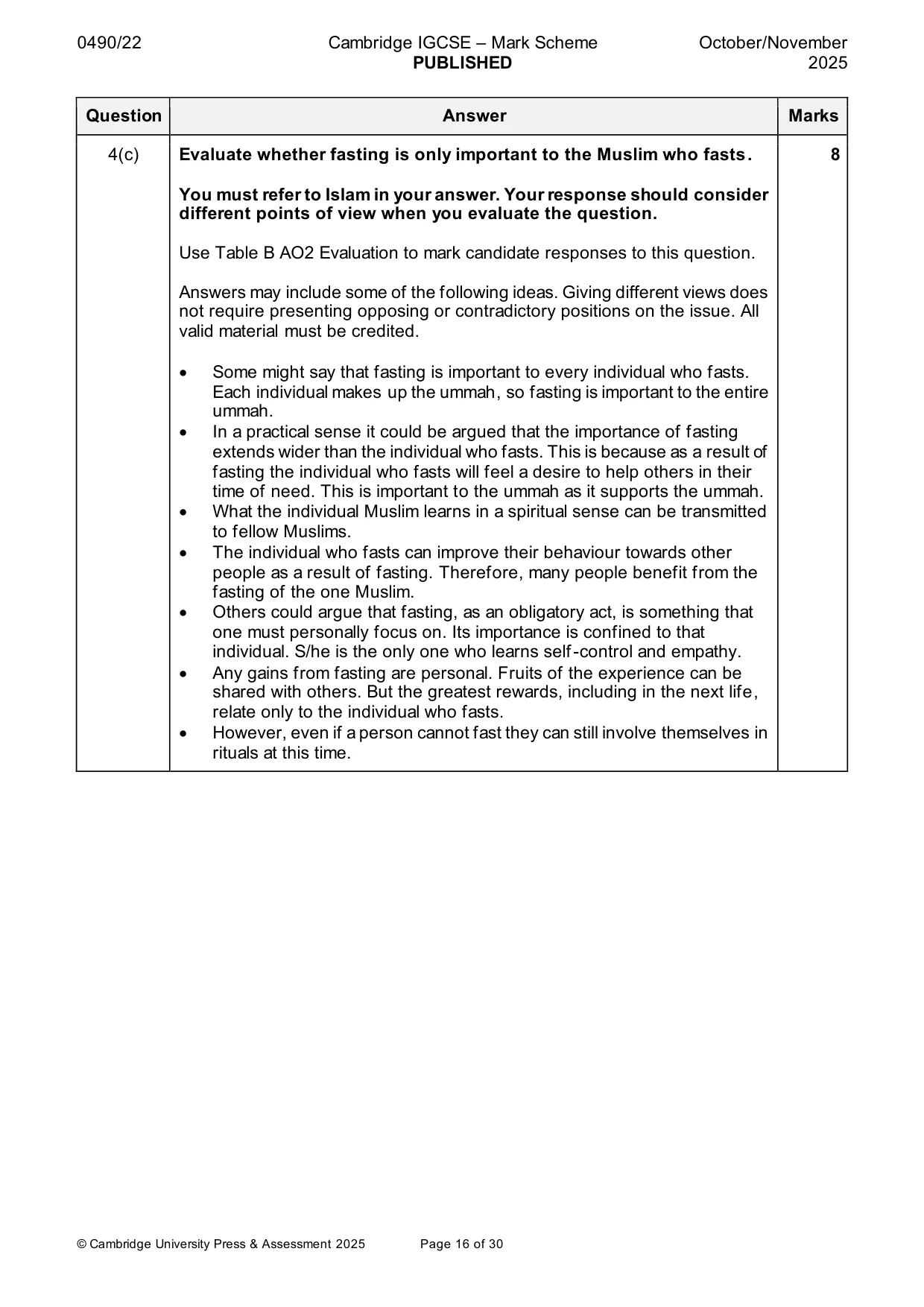
4 (a) (i) Give two groups of people who do not have to fast during Ramadan. [2] (ii) Outline what Muslims do during ʿId al-Fitr. [4] (b) Explain why observing festivals is significant to Muslim communities. [6] (c) Evaluate whether fasting is only important to the Muslim who fasts. You must refer to Islam in your answer. Your response should consider different points of view when you evaluate the question. [8] [Total: 20]
Mark scheme: 4(a)(i) Give two groups of people who do not have to fast during Ramadan. 2 AO1 Knowledge and understanding. Award one mark for each relevant point up to a maximum of two marks. • pregnant • breastfeeding • children • travellers • elderly • the ill. Accept any other valid points. 4(a)(ii) Outline what Muslims do during ʿId al-Fitr. 4 AO1 Knowledge and understanding. Award one mark for each relevant point, development or exemplification in any combination, up to a maximum of four marks. Responses might include: • During this festival of the breaking of the fast (1) Muslims thank God (1) for the strength that he gave them throughout Ramadan (1). • All animosity is put aside (1), special greetings are said/ʿId Mubarak (1) and special ʿId prayers are said (1). • ʿId food is prepared and eaten (1) and sweet food is a major theme (1). • Muslims make sure that this is a communal time (1). • New clothing is worn (1). ʿId presents are given (1) as is charity (1). • They pray (1) and go to the mosque (1). 4(b) Explain why observing festivals is significant to Muslim communities. 6 Use Table A AO1 Knowledge and understanding to mark candidate responses to this question. Answers may include some of the following ideas. All valid material must be credited. • Candidates might refer to specific festivals in order to explain the significance of observation to Muslim communities. Credit will be given for responses which give social and religious significance. • For example, ʿId al-Adha is significant as it remembers its religious background, that is, Ibrahim’s sacrifice to God. It also has a social significance such as the joy of sharing with the poor. • Sacrifice in general is expected of Muslims, and the sacrificial element is remembered in most festivals. This is hugely significant. • It is significant that the ummah is united through participation in festivals. The shared experience that observing a festival brings significantly unites an individual Muslim community as well as the worldwide community. Brotherhood is extended. Examples could include the sharing of food (with the poor) and prayers said in all Muslim communities. • Observing festivals is important as it shows a willingness to focus that period of time on God. • Remembering the past is significant as both a religious commitment to a particular way of life and also a means by which the community can come together. • It can be a significant time for asking for sins to be forgiven. 4(c) Evaluate whether fasting is only important to the Muslim who fasts. 8 You must refer to Islam in your answer. Your response should consider different points of view when you evaluate the question. Use Table B AO2 Evaluation to mark candidate responses to this question. Answers may include some of the following ideas. Giving different views does not require presenting opposing or contradictory positions on the issue. All valid material must be credited. • Some might say that fasting is important to every individual who fasts. Each individual makes up the ummah, so fasting is important to the entire ummah. • In a practical sense it could be argued that the importance of fasting extends wider than the individual who fasts. This is because as a result of fasting the individual who fasts will feel a desire to help others in their time of need. This is important to the ummah as it supports the ummah. • What the individual Muslim learns in a spiritual sense can be transmitted to fellow Muslims. • The individual who fasts can improve their behaviour towards other people as a result of fasting. Therefore, many people benefit from the fasting of the one Muslim. • Others could argue that fasting, as an obligatory act, is something that one must personally focus on. Its importance is confined to that individual. S/he is the only one who learns self-control and empathy. • Any gains from fasting are personal. Fruits of the experience can be shared with others. But the greatest rewards, including in the next life, relate only to the individual who fasts. • However, even if a person cannot fast they can still involve themselves in rituals at this time.
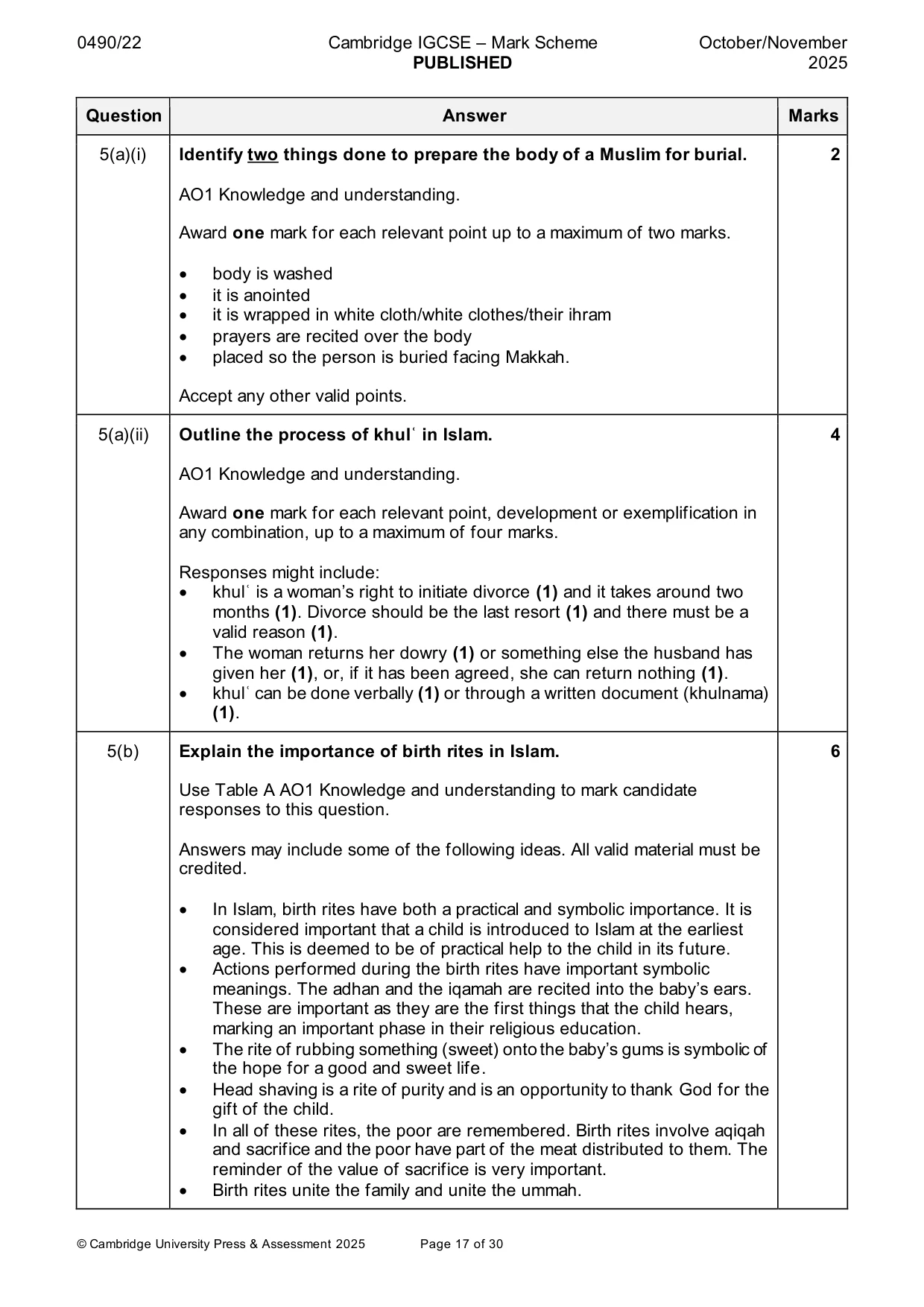
Q5 · Identify two things done to prepare the body of a Muslim for burial
5 (a) (i) Identify two things done to prepare the body of a Muslim for burial. [2] (ii) Outline the process of khulʿ in Islam. [4] (b) Explain the importance of birth rites in Islam. [6] (c) Evaluate whether it is easy for Muslims to live a halal lifestyle in the modern world. You must refer to Islam in your answer. Your response should consider different points of view when you evaluate the question. [8] [Total: 20]
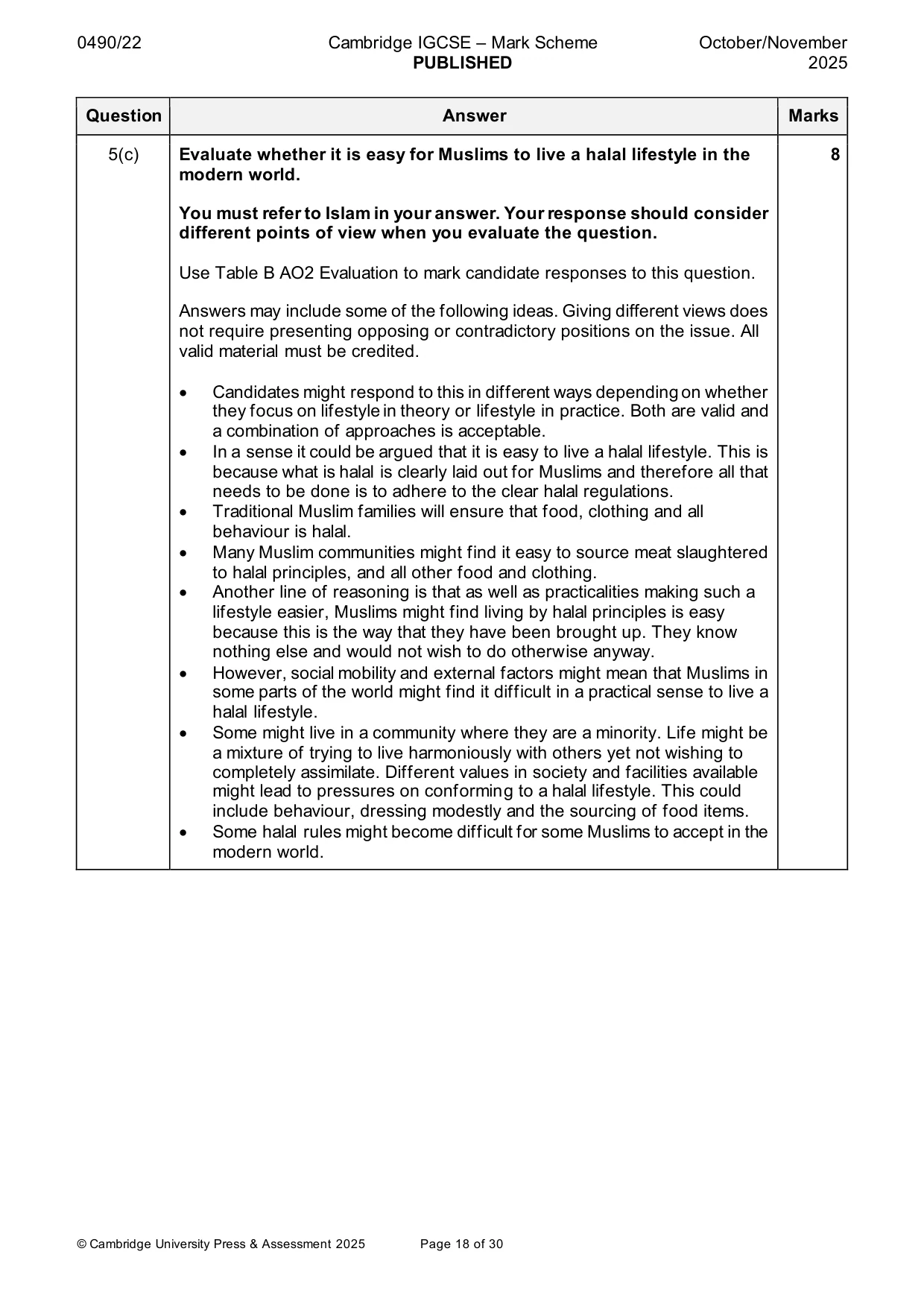
Mark scheme: 5(a)(i) Identify two things done to prepare the body of a Muslim for burial. 2 AO1 Knowledge and understanding. Award one mark for each relevant point up to a maximum of two marks. • body is washed • it is anointed • it is wrapped in white cloth/white clothes/their ihram • prayers are recited over the body • placed so the person is buried facing Makkah. Accept any other valid points. 5(a)(ii) Outline the process of khulʿ in Islam. 4 AO1 Knowledge and understanding. Award one mark for each relevant point, development or exemplification in any combination, up to a maximum of four marks. Responses might include: • khulʿ is a woman’s right to initiate divorce (1) and it takes around two months (1). Divorce should be the last resort (1) and there must be a valid reason (1). • The woman returns her dowry (1) or something else the husband has given her (1), or, if it has been agreed, she can return nothing (1). • khulʿ can be done verbally (1) or through a written document (khulnama) (1). 5(b) Explain the importance of birth rites in Islam. 6 Use Table A AO1 Knowledge and understanding to mark candidate responses to this question. Answers may include some of the following ideas. All valid material must be credited. • In Islam, birth rites have both a practical and symbolic importance. It is considered important that a child is introduced to Islam at the earliest age. This is deemed to be of practical help to the child in its future. • Actions performed during the birth rites have important symbolic meanings. The adhan and the iqamah are recited into the baby’s ears. These are important as they are the first things that the child hears, marking an important phase in their religious education. • The rite of rubbing something (sweet) onto the baby’s gums is symbolic of the hope for a good and sweet life. • Head shaving is a rite of purity and is an opportunity to thank God for the gift of the child. • In all of these rites, the poor are remembered. Birth rites involve aqiqah and sacrifice and the poor have part of the meat distributed to them. The reminder of the value of sacrifice is very important. • Birth rites unite the family and unite the ummah. 5(c) Evaluate whether it is easy for Muslims to live a halal lifestyle in the 8 modern world. You must refer to Islam in your answer. Your response should consider different points of view when you evaluate the question. Use Table B AO2 Evaluation to mark candidate responses to this question. Answers may include some of the following ideas. Giving different views does not require presenting opposing or contradictory positions on the issue. All valid material must be credited. • Candidates might respond to this in different ways depending on whether they focus on lifestyle in theory or lifestyle in practice. Both are valid and a combination of approaches is acceptable. • In a sense it could be argued that it is easy to live a halal lifestyle. This is because what is halal is clearly laid out for Muslims and therefore all that needs to be done is to adhere to the clear halal regulations. • Traditional Muslim families will ensure that food, clothing and all behaviour is halal. • Many Muslim communities might find it easy to source meat slaughtered to halal principles, and all other food and clothing. • Another line of reasoning is that as well as practicalities making such a lifestyle easier, Muslims might find living by halal principles is easy because this is the way that they have been brought up. They know nothing else and would not wish to do otherwise anyway. • However, social mobility and external factors might mean that Muslims in some parts of the world might find it difficult in a practical sense to live a halal lifestyle. • Some might live in a community where they are a minority. Life might be a mixture of trying to live harmoniously with others yet not wishing to completely assimilate. Different values in society and facilities available might lead to pressures on conforming to a halal lifestyle. This could include behaviour, dressing modestly and the sourcing of food items. • Some halal rules might become difficult for some Muslims to accept in the modern world.
Q6 · Identify two things about ijmaʿ
6 (a) (i) Identify two things about ijmaʿ. [2] (ii) Outline the work of Muslim Aid in the relief of poverty. [4] (b) Explain why Muslims try to give sadaqah. [6] (c) Evaluate whether it is more important for Muslims to help the local community than the worldwide community. You must refer to Islam in your answer. Your response should consider different points of view when you evaluate the question. [8] [Total: 20] Section C – Judaism If you have chosen this section, you must answer two questions.
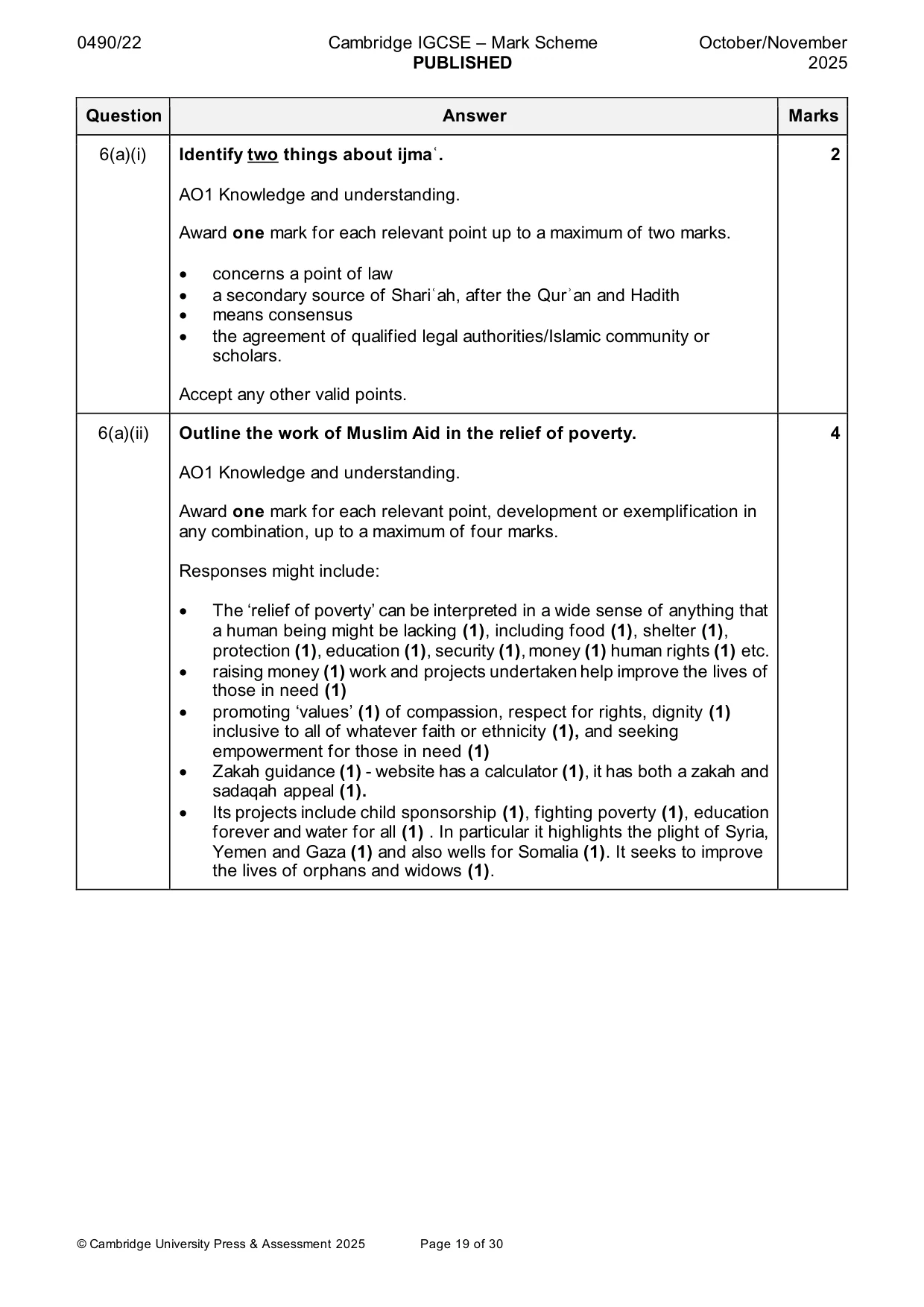
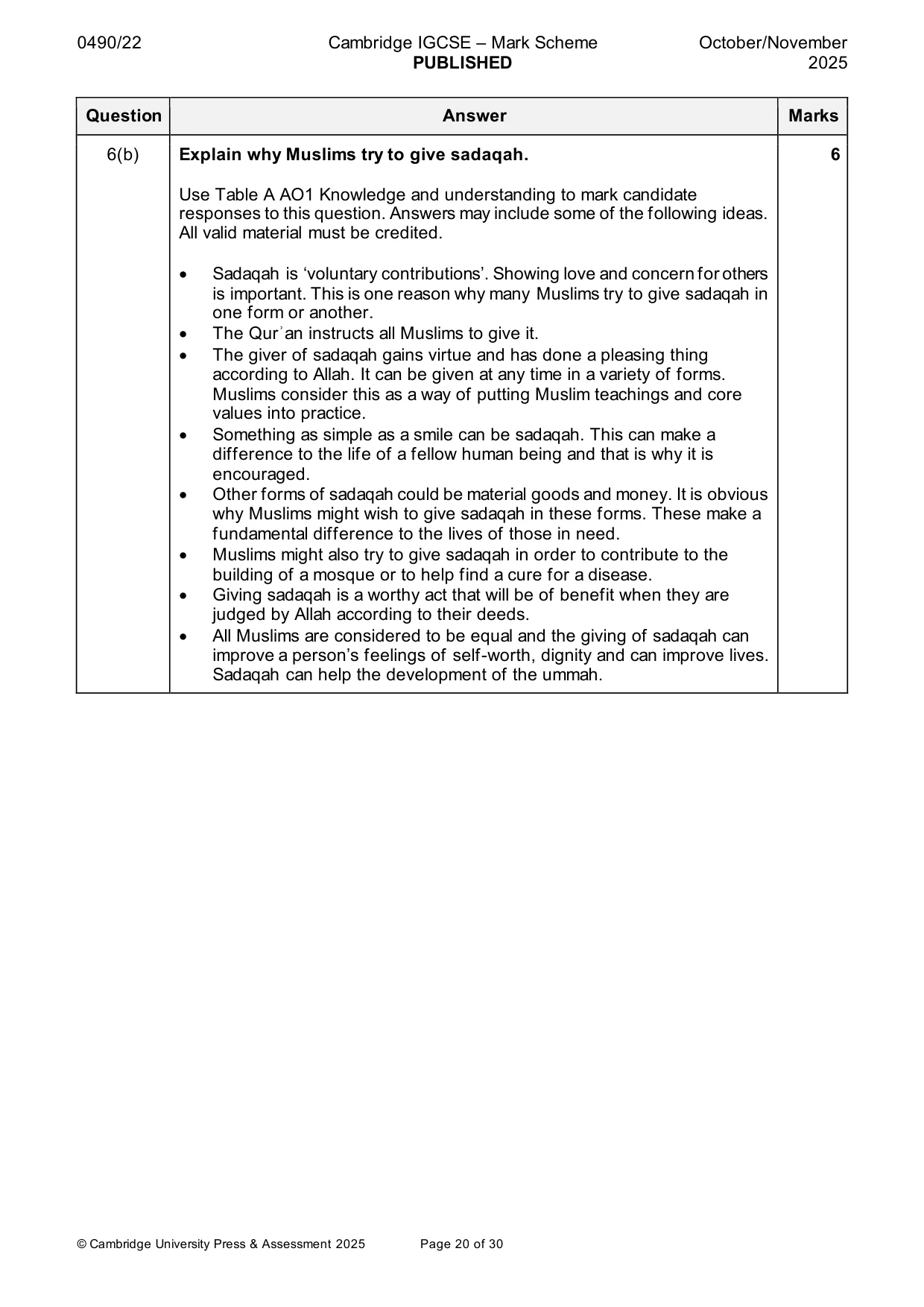
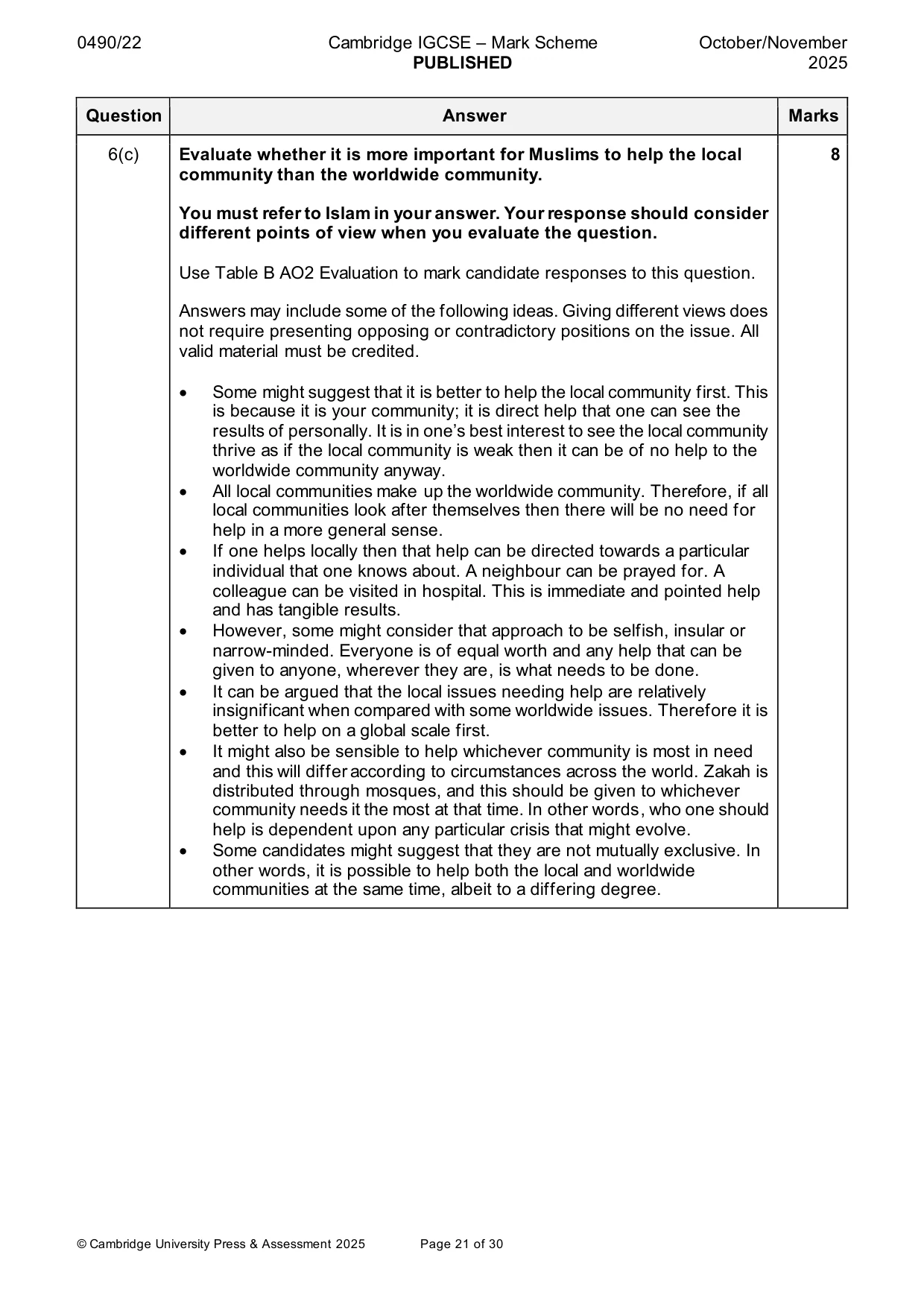
Mark scheme: 6(a)(i) Identify two things about ijmaʿ. 2 AO1 Knowledge and understanding. Award one mark for each relevant point up to a maximum of two marks. • concerns a point of law • a secondary source of Shariʿah, after the Qurʾan and Hadith • means consensus • the agreement of qualified legal authorities/Islamic community or scholars. Accept any other valid points. 6(a)(ii) Outline the work of Muslim Aid in the relief of poverty. 4 AO1 Knowledge and understanding. Award one mark for each relevant point, development or exemplification in any combination, up to a maximum of four marks. Responses might include: • The ‘relief of poverty’ can be interpreted in a wide sense of anything that a human being might be lacking (1), including food (1), shelter (1), protection (1), education (1), security (1), money (1) human rights (1) etc. • raising money (1) work and projects undertaken help improve the lives of those in need (1) • promoting ‘values’ (1) of compassion, respect for rights, dignity (1) inclusive to all of whatever faith or ethnicity (1), and seeking empowerment for those in need (1) • Zakah guidance (1) - website has a calculator (1), it has both a zakah and sadaqah appeal (1). • Its projects include child sponsorship (1), fighting poverty (1), education forever and water for all (1) . In particular it highlights the plight of Syria, Yemen and Gaza (1) and also wells for Somalia (1). It seeks to improve the lives of orphans and widows (1). 6(b) Explain why Muslims try to give sadaqah. 6 Use Table A AO1 Knowledge and understanding to mark candidate responses to this question. Answers may include some of the following ideas. All valid material must be credited. • Sadaqah is ‘voluntary contributions’. Showing love and concern for others is important. This is one reason why many Muslims try to give sadaqah in one form or another. • The Qurʾan instructs all Muslims to give it. • The giver of sadaqah gains virtue and has done a pleasing thing according to Allah. It can be given at any time in a variety of forms. Muslims consider this as a way of putting Muslim teachings and core values into practice. • Something as simple as a smile can be sadaqah. This can make a difference to the life of a fellow human being and that is why it is encouraged. • Other forms of sadaqah could be material goods and money. It is obvious why Muslims might wish to give sadaqah in these forms. These make a fundamental difference to the lives of those in need. • Muslims might also try to give sadaqah in order to contribute to the building of a mosque or to help find a cure for a disease. • Giving sadaqah is a worthy act that will be of benefit when they are judged by Allah according to their deeds. • All Muslims are considered to be equal and the giving of sadaqah can improve a person’s feelings of self-worth, dignity and can improve lives. Sadaqah can help the development of the ummah. 6(c) Evaluate whether it is more important for Muslims to help the local 8 community than the worldwide community. You must refer to Islam in your answer. Your response should consider different points of view when you evaluate the question. Use Table B AO2 Evaluation to mark candidate responses to this question. Answers may include some of the following ideas. Giving different views does not require presenting opposing or contradictory positions on the issue. All valid material must be credited. • Some might suggest that it is better to help the local community first. This is because it is your community; it is direct help that one can see the results of personally. It is in one’s best interest to see the local community thrive as if the local community is weak then it can be of no help to the worldwide community anyway. • All local communities make up the worldwide community. Therefore, if all local communities look after themselves then there will be no need for help in a more general sense. • If one helps locally then that help can be directed towards a particular individual that one knows about. A neighbour can be prayed for. A colleague can be visited in hospital. This is immediate and pointed help and has tangible results. • However, some might consider that approach to be selfish, insular or narrow-minded. Everyone is of equal worth and any help that can be given to anyone, wherever they are, is what needs to be done. • It can be argued that the local issues needing help are relatively insignificant when compared with some worldwide issues. Therefore it is better to help on a global scale first. • It might also be sensible to help whichever community is most in need and this will differ according to circumstances across the world. Zakah is distributed through mosques, and this should be given to whichever community needs it the most at that time. In other words, who one should help is dependent upon any particular crisis that might evolve. • Some candidates might suggest that they are not mutually exclusive. In other words, it is possible to help both the local and worldwide communities at the same time, albeit to a differing degree.
Q7 · Give two special foods eaten at Rosh Hashanah
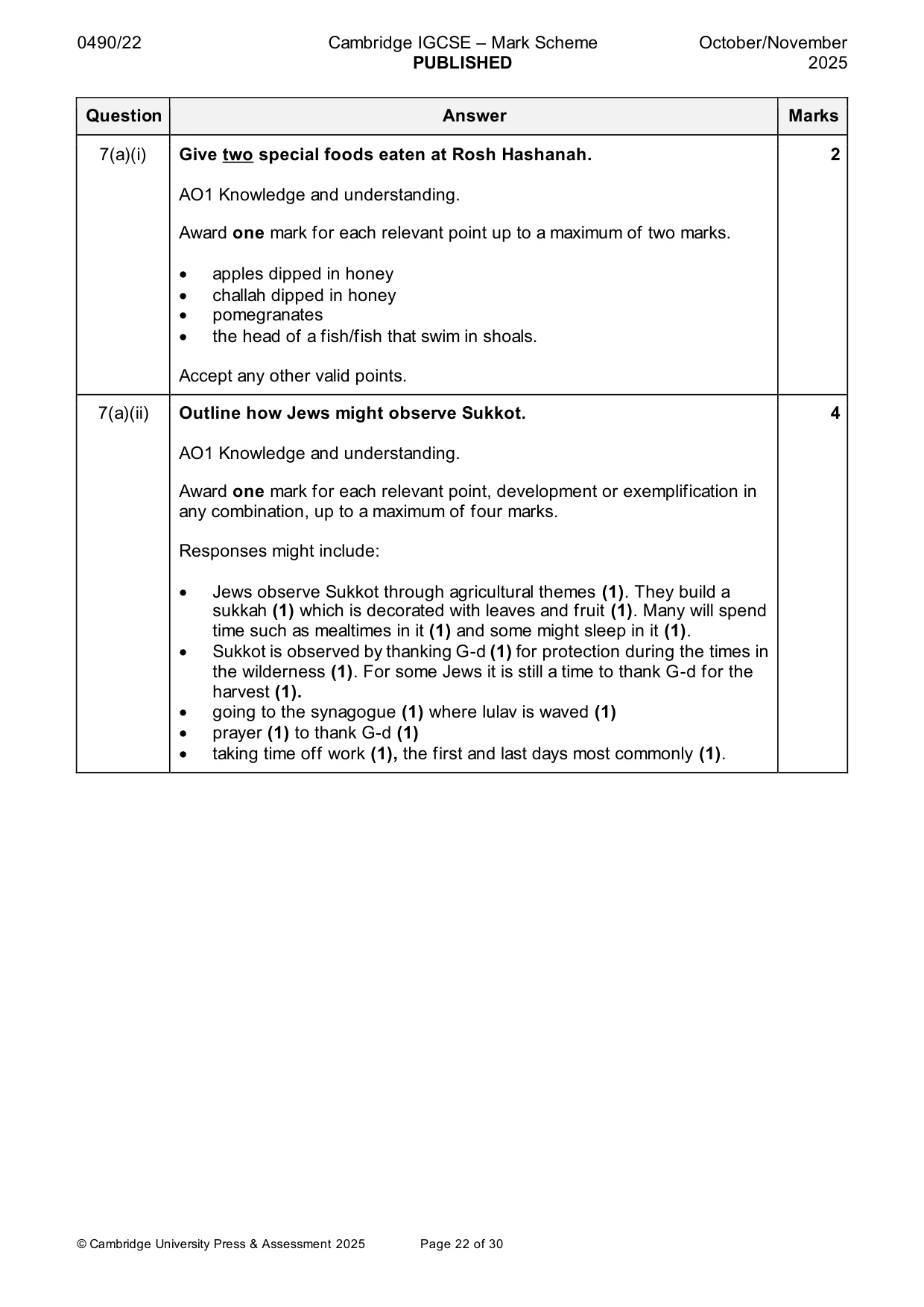
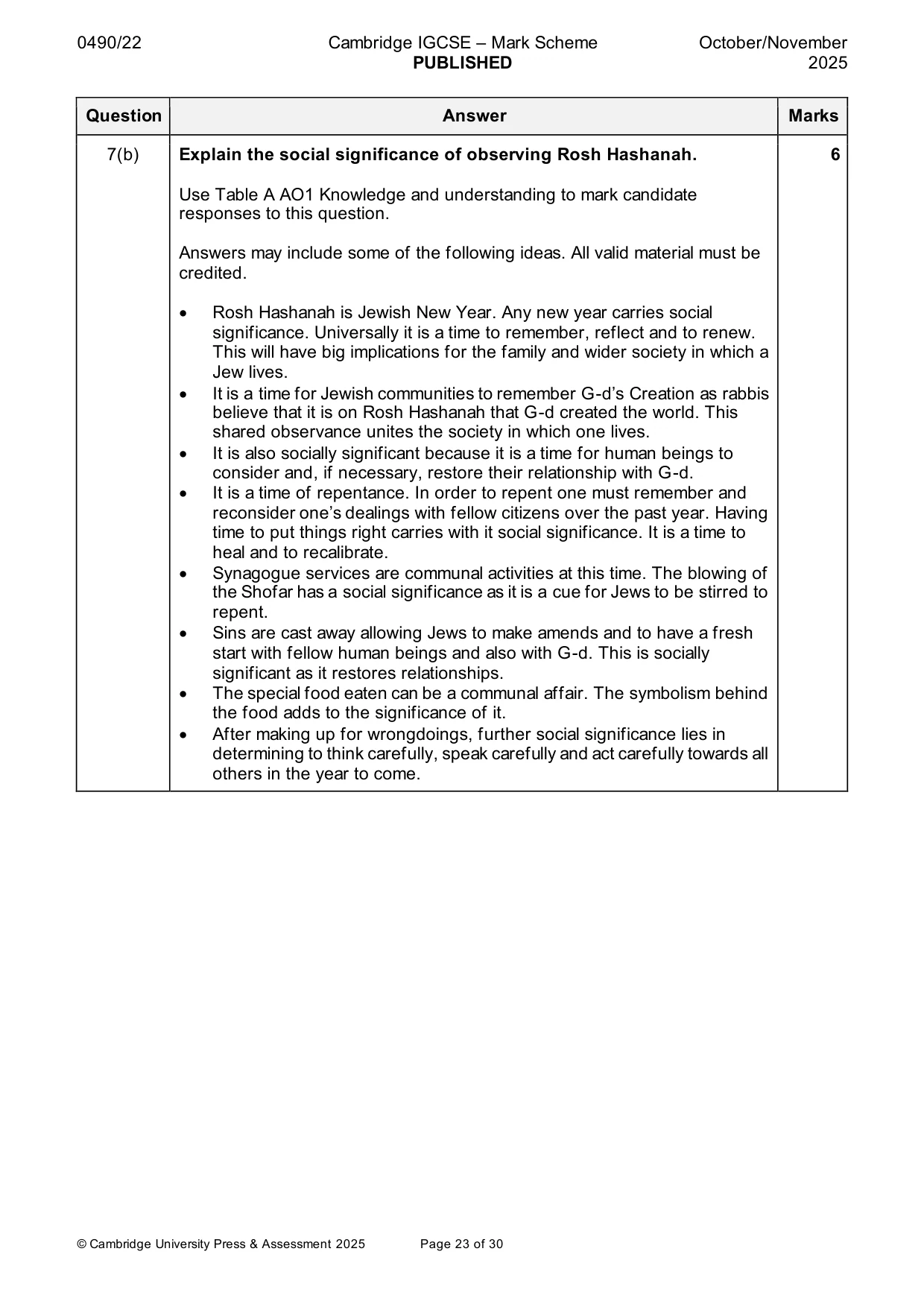
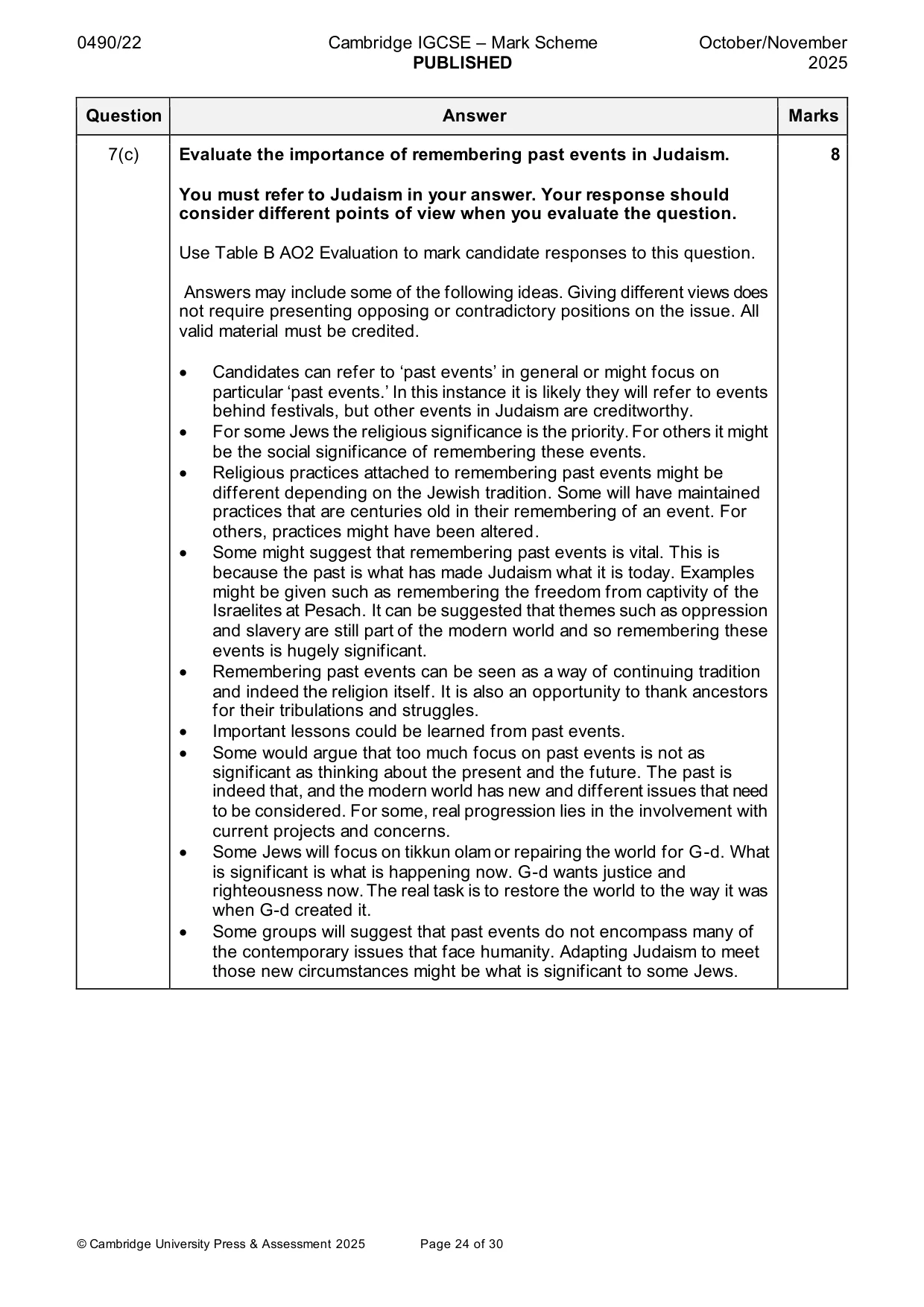
7 (a) (i) Give two special foods eaten at Rosh Hashanah. [2] (ii) Outline how Jews might observe Sukkot. [4] (b) Explain the social significance of observing Rosh Hashanah. [6] (c) Evaluate the importance of remembering past events in Judaism. You must refer to Judaism in your answer. Your response should consider different points of view when you evaluate the question. [8] [Total: 20]
Mark scheme: 7(a)(i) Give two special foods eaten at Rosh Hashanah. 2 AO1 Knowledge and understanding. Award one mark for each relevant point up to a maximum of two marks. • apples dipped in honey • challah dipped in honey • pomegranates • the head of a fish/fish that swim in shoals. Accept any other valid points. 7(a)(ii) Outline how Jews might observe Sukkot. 4 AO1 Knowledge and understanding. Award one mark for each relevant point, development or exemplification in any combination, up to a maximum of four marks. Responses might include: • Jews observe Sukkot through agricultural themes (1). They build a sukkah (1) which is decorated with leaves and fruit (1). Many will spend time such as mealtimes in it (1) and some might sleep in it (1). • Sukkot is observed by thanking G-d (1) for protection during the times in the wilderness (1). For some Jews it is still a time to thank G-d for the harvest (1). • going to the synagogue (1) where lulav is waved (1) • prayer (1) to thank G-d (1) • taking time off work (1), the first and last days most commonly (1). 7(b) Explain the social significance of observing Rosh Hashanah. 6 Use Table A AO1 Knowledge and understanding to mark candidate responses to this question. Answers may include some of the following ideas. All valid material must be credited. • Rosh Hashanah is Jewish New Year. Any new year carries social significance. Universally it is a time to remember, reflect and to renew. This will have big implications for the family and wider society in which a Jew lives. • It is a time for Jewish communities to remember G-d’s Creation as rabbis believe that it is on Rosh Hashanah that G-d created the world. This shared observance unites the society in which one lives. • It is also socially significant because it is a time for human beings to consider and, if necessary, restore their relationship with G-d. • It is a time of repentance. In order to repent one must remember and reconsider one’s dealings with fellow citizens over the past year. Having time to put things right carries with it social significance. It is a time to heal and to recalibrate. • Synagogue services are communal activities at this time. The blowing of the Shofar has a social significance as it is a cue for Jews to be stirred to repent. • Sins are cast away allowing Jews to make amends and to have a fresh start with fellow human beings and also with G-d. This is socially significant as it restores relationships. • The special food eaten can be a communal affair. The symbolism behind the food adds to the significance of it. • After making up for wrongdoings, further social significance lies in determining to think carefully, speak carefully and act carefully towards all others in the year to come. 7(c) Evaluate the importance of remembering past events in Judaism. 8 You must refer to Judaism in your answer. Your response should consider different points of view when you evaluate the question. Use Table B AO2 Evaluation to mark candidate responses to this question. Answers may include some of the following ideas. Giving different views does not require presenting opposing or contradictory positions on the issue. All valid material must be credited. • Candidates can refer to ‘past events’ in general or might focus on particular ‘past events.’ In this instance it is likely they will refer to events behind festivals, but other events in Judaism are creditworthy. • For some Jews the religious significance is the priority. For others it might be the social significance of remembering these events. • Religious practices attached to remembering past events might be different depending on the Jewish tradition. Some will have maintained practices that are centuries old in their remembering of an event. For others, practices might have been altered. • Some might suggest that remembering past events is vital. This is because the past is what has made Judaism what it is today. Examples might be given such as remembering the freedom from captivity of the Israelites at Pesach. It can be suggested that themes such as oppression and slavery are still part of the modern world and so remembering these events is hugely significant. • Remembering past events can be seen as a way of continuing tradition and indeed the religion itself. It is also an opportunity to thank ancestors for their tribulations and struggles. • Important lessons could be learned from past events. • Some would argue that too much focus on past events is not as significant as thinking about the present and the future. The past is indeed that, and the modern world has new and different issues that need to be considered. For some, real progression lies in the involvement with current projects and concerns. • Some Jews will focus on tikkun olam or repairing the world for G-d. What is significant is what is happening now. G-d wants justice and righteousness now. The real task is to restore the world to the way it was when G-d created it. • Some groups will suggest that past events do not encompass many of the contemporary issues that face humanity. Adapting Judaism to meet those new circumstances might be what is significant to some Jews.
Q8 · Give two treyfah food items
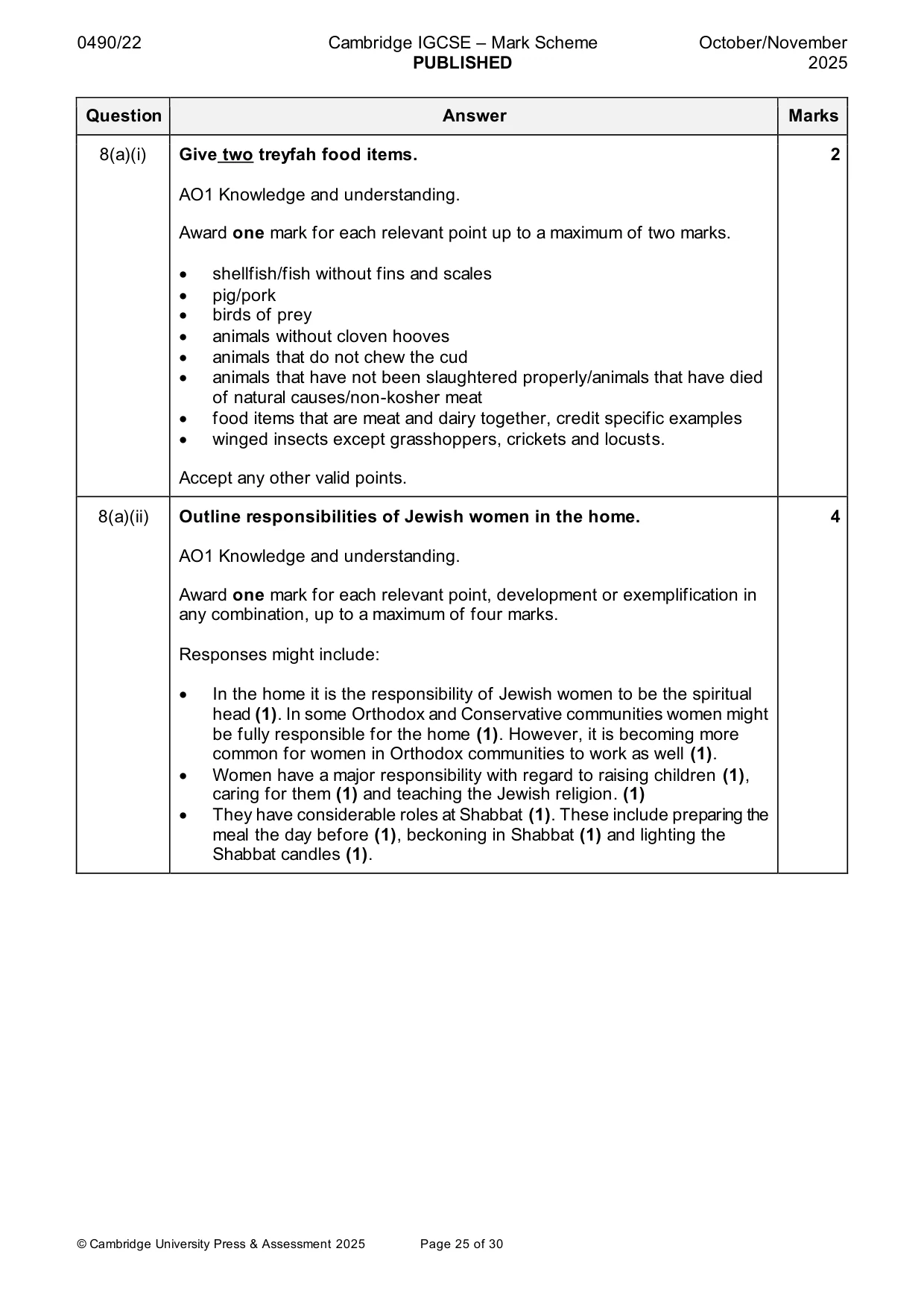
8 (a) (i) Give two treyfah food items. [2] (ii) Outline responsibilities of Jewish women in the home. [4] (b) Explain the role of the Chevra Kaddisha. [6] (c) Assess how much traditional Jewish family life has changed in the modern world. You must refer to Judaism in your answer. Your response should consider different points of view when you evaluate the question. [8] [Total: 20]
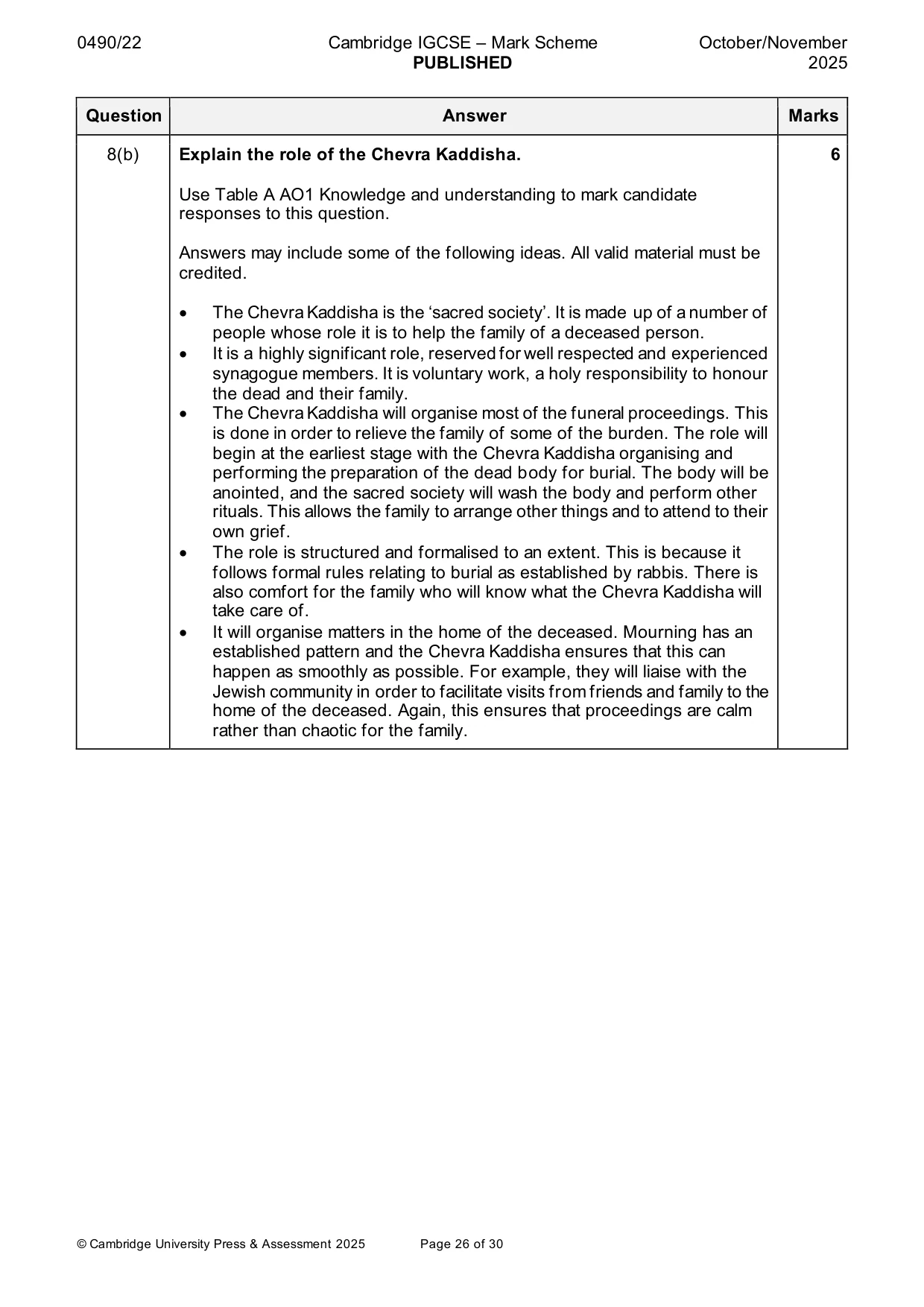
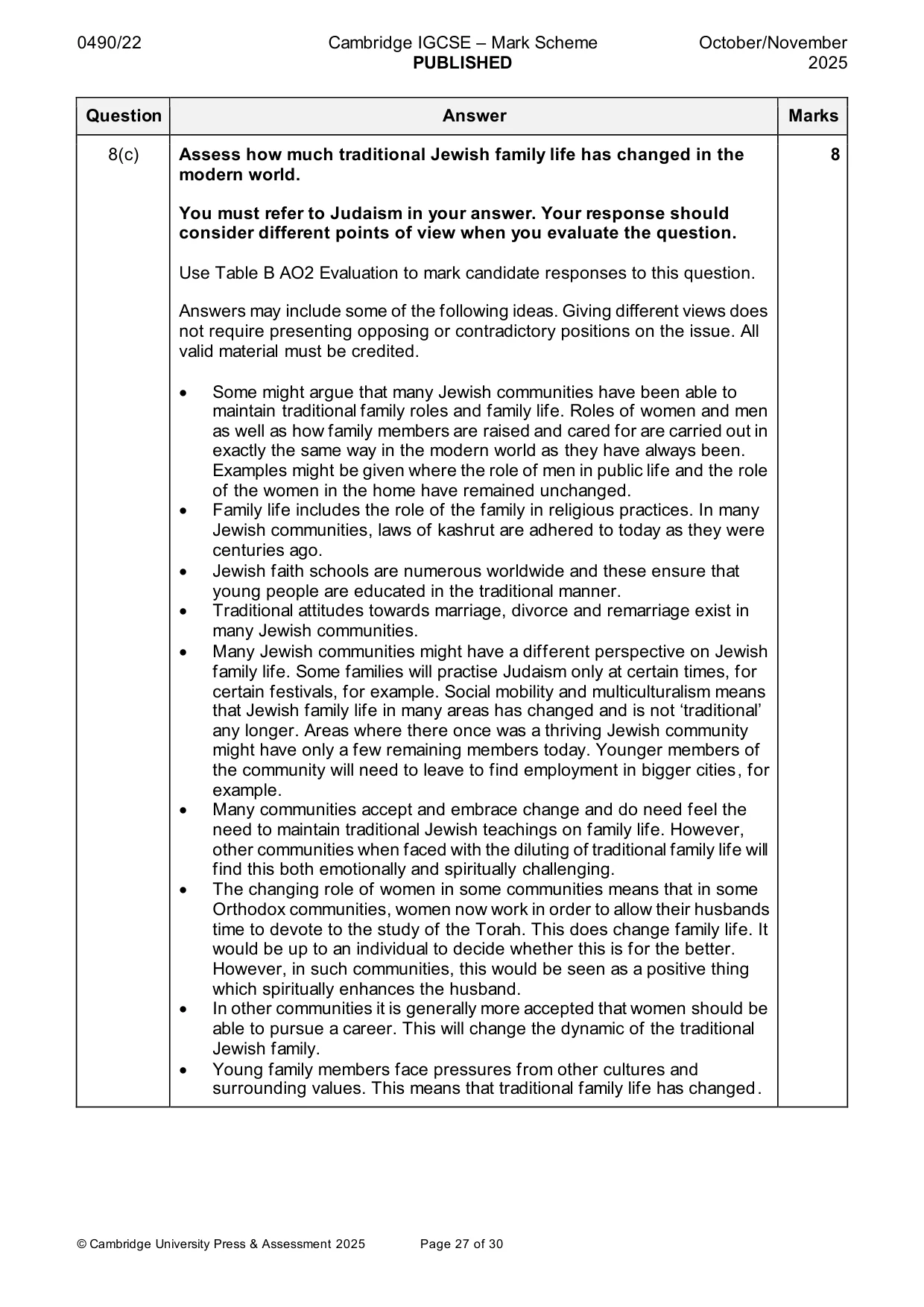
Mark scheme: 8(a)(i) Give two treyfah food items. 2 AO1 Knowledge and understanding. Award one mark for each relevant point up to a maximum of two marks. • shellfish/fish without fins and scales • pig/pork • birds of prey • animals without cloven hooves • animals that do not chew the cud • animals that have not been slaughtered properly/animals that have died of natural causes/non-kosher meat • food items that are meat and dairy together, credit specific examples • winged insects except grasshoppers, crickets and locusts. Accept any other valid points. 8(a)(ii) Outline responsibilities of Jewish women in the home. 4 AO1 Knowledge and understanding. Award one mark for each relevant point, development or exemplification in any combination, up to a maximum of four marks. Responses might include: • In the home it is the responsibility of Jewish women to be the spiritual head (1). In some Orthodox and Conservative communities women might be fully responsible for the home (1). However, it is becoming more common for women in Orthodox communities to work as well (1). • Women have a major responsibility with regard to raising children (1), caring for them (1) and teaching the Jewish religion. (1) • They have considerable roles at Shabbat (1). These include preparing the meal the day before (1), beckoning in Shabbat (1) and lighting the Shabbat candles (1). 8(b) Explain the role of the Chevra Kaddisha. 6 Use Table A AO1 Knowledge and understanding to mark candidate responses to this question. Answers may include some of the following ideas. All valid material must be credited. • The Chevra Kaddisha is the ‘sacred society’. It is made up of a number of people whose role it is to help the family of a deceased person. • It is a highly significant role, reserved for well respected and experienced synagogue members. It is voluntary work, a holy responsibility to honour the dead and their family. • The Chevra Kaddisha will organise most of the funeral proceedings. This is done in order to relieve the family of some of the burden. The role will begin at the earliest stage with the Chevra Kaddisha organising and performing the preparation of the dead body for burial. The body will be anointed, and the sacred society will wash the body and perform other rituals. This allows the family to arrange other things and to attend to their own grief. • The role is structured and formalised to an extent. This is because it follows formal rules relating to burial as established by rabbis. There is also comfort for the family who will know what the Chevra Kaddisha will take care of. • It will organise matters in the home of the deceased. Mourning has an established pattern and the Chevra Kaddisha ensures that this can happen as smoothly as possible. For example, they will liaise with the Jewish community in order to facilitate visits from friends and family to the home of the deceased. Again, this ensures that proceedings are calm rather than chaotic for the family. 8(c) Assess how much traditional Jewish family life has changed in the 8 modern world. You must refer to Judaism in your answer. Your response should consider different points of view when you evaluate the question. Use Table B AO2 Evaluation to mark candidate responses to this question. Answers may include some of the following ideas. Giving different views does not require presenting opposing or contradictory positions on the issue. All valid material must be credited. • Some might argue that many Jewish communities have been able to maintain traditional family roles and family life. Roles of women and men as well as how family members are raised and cared for are carried out in exactly the same way in the modern world as they have always been. Examples might be given where the role of men in public life and the role of the women in the home have remained unchanged. • Family life includes the role of the family in religious practices. In many Jewish communities, laws of kashrut are adhered to today as they were centuries ago. • Jewish faith schools are numerous worldwide and these ensure that young people are educated in the traditional manner. • Traditional attitudes towards marriage, divorce and remarriage exist in many Jewish communities. • Many Jewish communities might have a different perspective on Jewish family life. Some families will practise Judaism only at certain times, for certain festivals, for example. Social mobility and multiculturalism means that Jewish family life in many areas has changed and is not ‘traditional’ any longer. Areas where there once was a thriving Jewish community might have only a few remaining members today. Younger members of the community will need to leave to find employment in bigger cities, for example. • Many communities accept and embrace change and do need feel the need to maintain traditional Jewish teachings on family life. However, other communities when faced with the diluting of traditional family life will find this both emotionally and spiritually challenging. • The changing role of women in some communities means that in some Orthodox communities, women now work in order to allow their husbands time to devote to the study of the Torah. This does change family life. It would be up to an individual to decide whether this is for the better. However, in such communities, this would be seen as a positive thing which spiritually enhances the husband. • In other communities it is generally more accepted that women should be able to pursue a career. This will change the dynamic of the traditional Jewish family. • Young family members face pressures from other cultures and surrounding values. This means that traditional family life has changed.
Q9 · Give two facts about pushkes
9 (a) (i) Give two facts about pushkes. [2] (ii) Outline Jewish teachings about gemilut hasadim. [4] (b) Explain what it means for a Jew to be a steward of the Earth. [6] (c) Evaluate how easy it is for Jews to show kindness to others. You must refer to Judaism in your answer. Your response should consider different points of view when you evaluate the question. [8] [Total: 20]
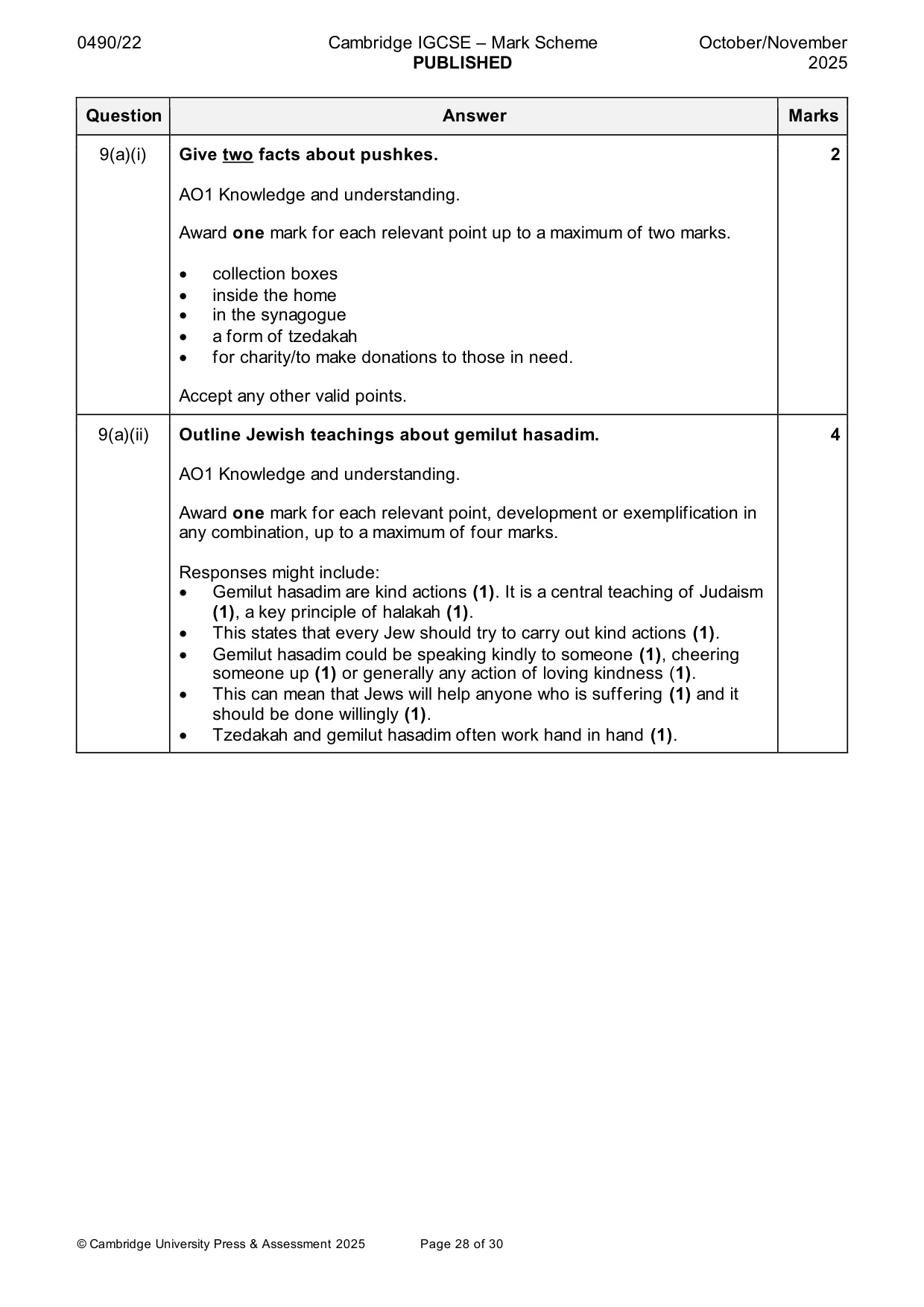
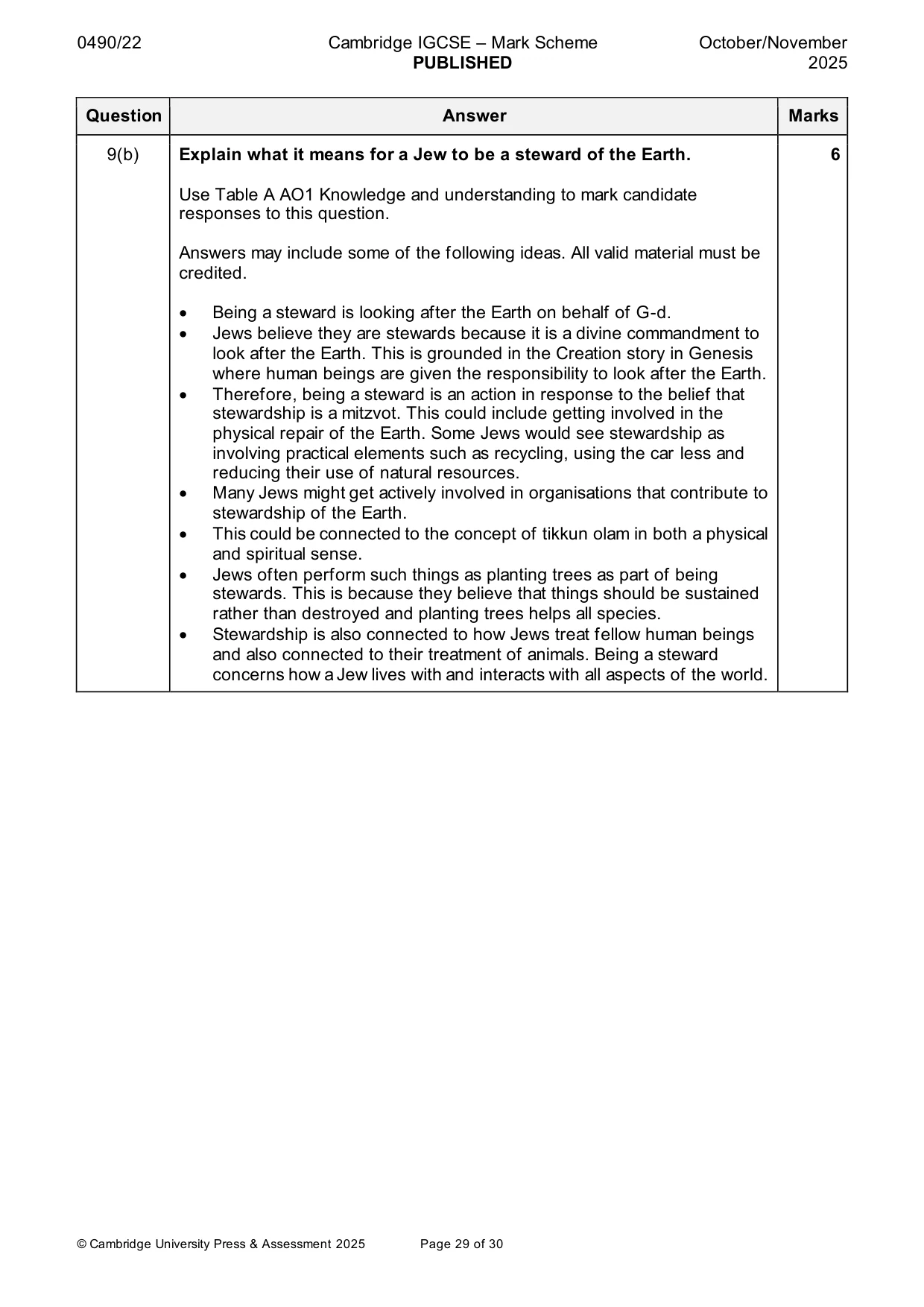
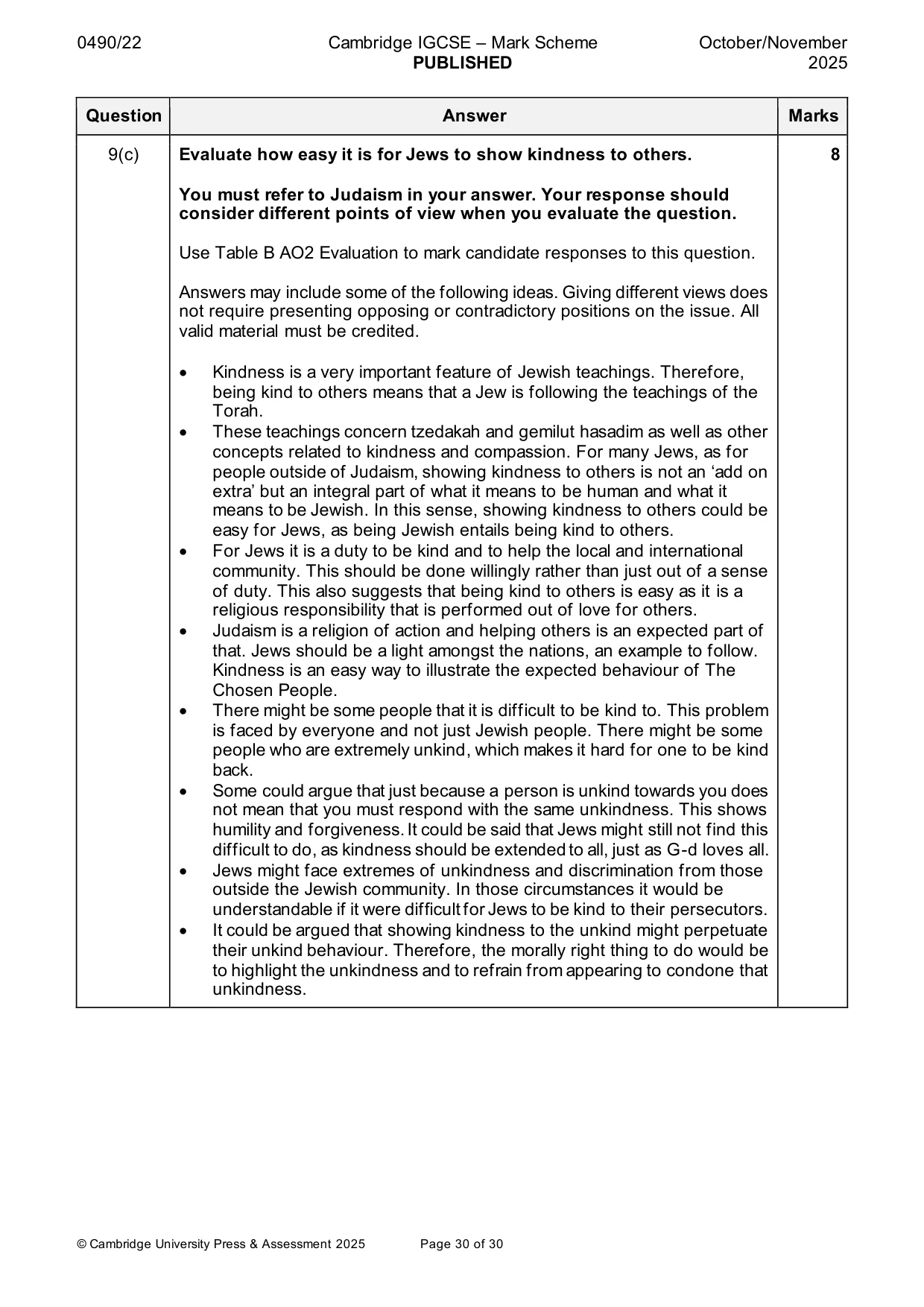
Mark scheme: 9(a)(i) Give two facts about pushkes. 2 AO1 Knowledge and understanding. Award one mark for each relevant point up to a maximum of two marks. • collection boxes • inside the home • in the synagogue • a form of tzedakah • for charity/to make donations to those in need. Accept any other valid points. 9(a)(ii) Outline Jewish teachings about gemilut hasadim. 4 AO1 Knowledge and understanding. Award one mark for each relevant point, development or exemplification in any combination, up to a maximum of four marks. Responses might include: • Gemilut hasadim are kind actions (1). It is a central teaching of Judaism (1), a key principle of halakah (1). • This states that every Jew should try to carry out kind actions (1). • Gemilut hasadim could be speaking kindly to someone (1), cheering someone up (1) or generally any action of loving kindness (1). • This can mean that Jews will help anyone who is suffering (1) and it should be done willingly (1). • Tzedakah and gemilut hasadim often work hand in hand (1). 9(b) Explain what it means for a Jew to be a steward of the Earth. 6 Use Table A AO1 Knowledge and understanding to mark candidate responses to this question. Answers may include some of the following ideas. All valid material must be credited. • Being a steward is looking after the Earth on behalf of G-d. • Jews believe they are stewards because it is a divine commandment to look after the Earth. This is grounded in the Creation story in Genesis where human beings are given the responsibility to look after the Earth. • Therefore, being a steward is an action in response to the belief that stewardship is a mitzvot. This could include getting involved in the physical repair of the Earth. Some Jews would see stewardship as involving practical elements such as recycling, using the car less and reducing their use of natural resources. • Many Jews might get actively involved in organisations that contribute to stewardship of the Earth. • This could be connected to the concept of tikkun olam in both a physical and spiritual sense. • Jews often perform such things as planting trees as part of being stewards. This is because they believe that things should be sustained rather than destroyed and planting trees helps all species. • Stewardship is also connected to how Jews treat fellow human beings and also connected to their treatment of animals. Being a steward concerns how a Jew lives with and interacts with all aspects of the world. 9(c) Evaluate how easy it is for Jews to show kindness to others. 8 You must refer to Judaism in your answer. Your response should consider different points of view when you evaluate the question. Use Table B AO2 Evaluation to mark candidate responses to this question. Answers may include some of the following ideas. Giving different views does not require presenting opposing or contradictory positions on the issue. All valid material must be credited. • Kindness is a very important feature of Jewish teachings. Therefore, being kind to others means that a Jew is following the teachings of the Torah. • These teachings concern tzedakah and gemilut hasadim as well as other concepts related to kindness and compassion. For many Jews, as for people outside of Judaism, showing kindness to others is not an ‘add on extra’ but an integral part of what it means to be human and what it means to be Jewish. In this sense, showing kindness to others could be easy for Jews, as being Jewish entails being kind to others. • For Jews it is a duty to be kind and to help the local and international community. This should be done willingly rather than just out of a sense of duty. This also suggests that being kind to others is easy as it is a religious responsibility that is performed out of love for others. • Judaism is a religion of action and helping others is an expected part of that. Jews should be a light amongst the nations, an example to follow. Kindness is an easy way to illustrate the expected behaviour of The Chosen People. • There might be some people that it is difficult to be kind to. This problem is faced by everyone and not just Jewish people. There might be some people who are extremely unkind, which makes it hard for one to be kind back. • Some could argue that just because a person is unkind towards you does not mean that you must respond with the same unkindness. This shows humility and forgiveness. It could be said that Jews might still not find this difficult to do, as kindness should be extended to all, just as G-d loves all. • Jews might face extremes of unkindness and discrimination from those outside the Jewish community. In those circumstances it would be understandable if it were difficult for Jews to be kind to their persecutors. • It could be argued that showing kindness to the unkind might perpetuate their unkind behaviour. Therefore, the morally right thing to do would be to highlight the unkindness and to refrain from appearing to condone that unkindness.
What was in this paper
The subtopics covered by these 9 questions, and how many questions each got. Open one in a new tab to see every Cambridge question on it.
1Funeral rites: the key features and importance of funeral rites in Islam1Jewish organisations that relieve poverty1Kashrut (the laws of kosher/‘fit’) and treyfah (‘forbidden’)1Pentecost1Rosh Hashanah (‘Head of’/New Year)1The observance of the fast of Ramadan1The Qurʾan; different ways in which Muslims understand and interpret it1Worship in the church1What you needed in this session
Cambridge’s own grade thresholds for 2025 Oct/Nov, Paper 2 · Variant 2. A higher threshold means an easier paper — the bar moves with how the cohort did.