Cambridge IGCSE Religious Studies 0490 — 2021 Oct/Nov Paper 2 · Variant 3
0490/23/O/N/21 · 80 marks · ≈90 min
The question paper and its mark scheme, free to read here and free to download. This is Cambridge’s own paper, exactly as it was sat.
Question paper4 pages
Mark scheme22 pages
Answers below. Sit the paper first if you are practising.
Paper as text
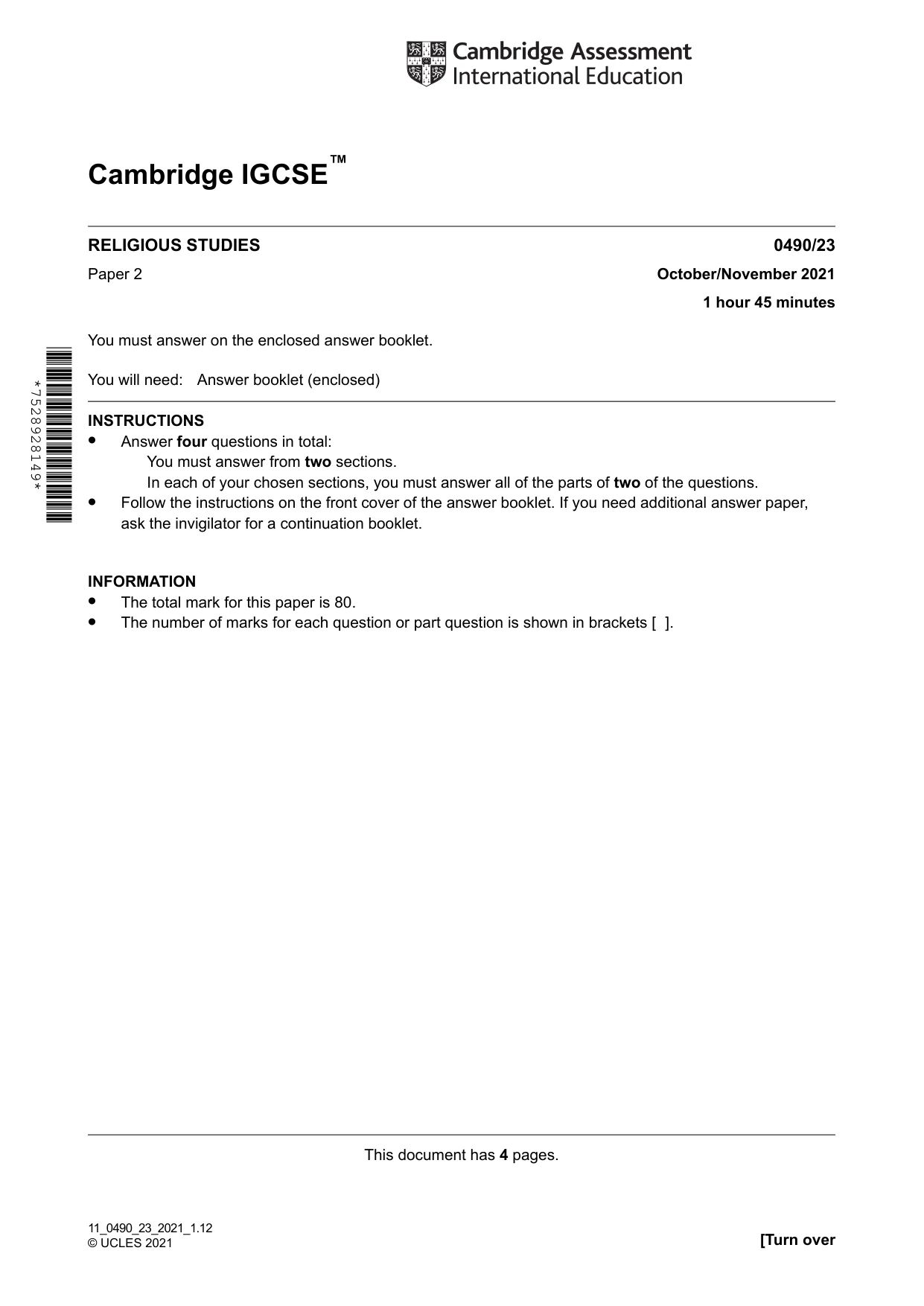
Question paper, page 1
Cambridge IGCSE™ 0490/23 October/November 2021 1 hour 45 minutes RELIGIOUS STUDIES Paper 2 You must answer on the enclosed answer booklet. You will need: Answer booklet (enclosed) INSTRUCTIONS • Answer four questions in total: You must answer from two sections. In each of your chosen sections, you must answer all of the parts of two of the questions. • Follow the instructions on the front cover of the answer booklet. If you need additional answer paper, ask the invigilator for a continuation booklet. INFORMATION • The total mark for this paper is 80. • The number of marks for each question or part question is shown in brackets [ ]. This document has 4 pages. [Turn over 11_0490_23_2021_1.12 © UCLES 2021 *7528928149*
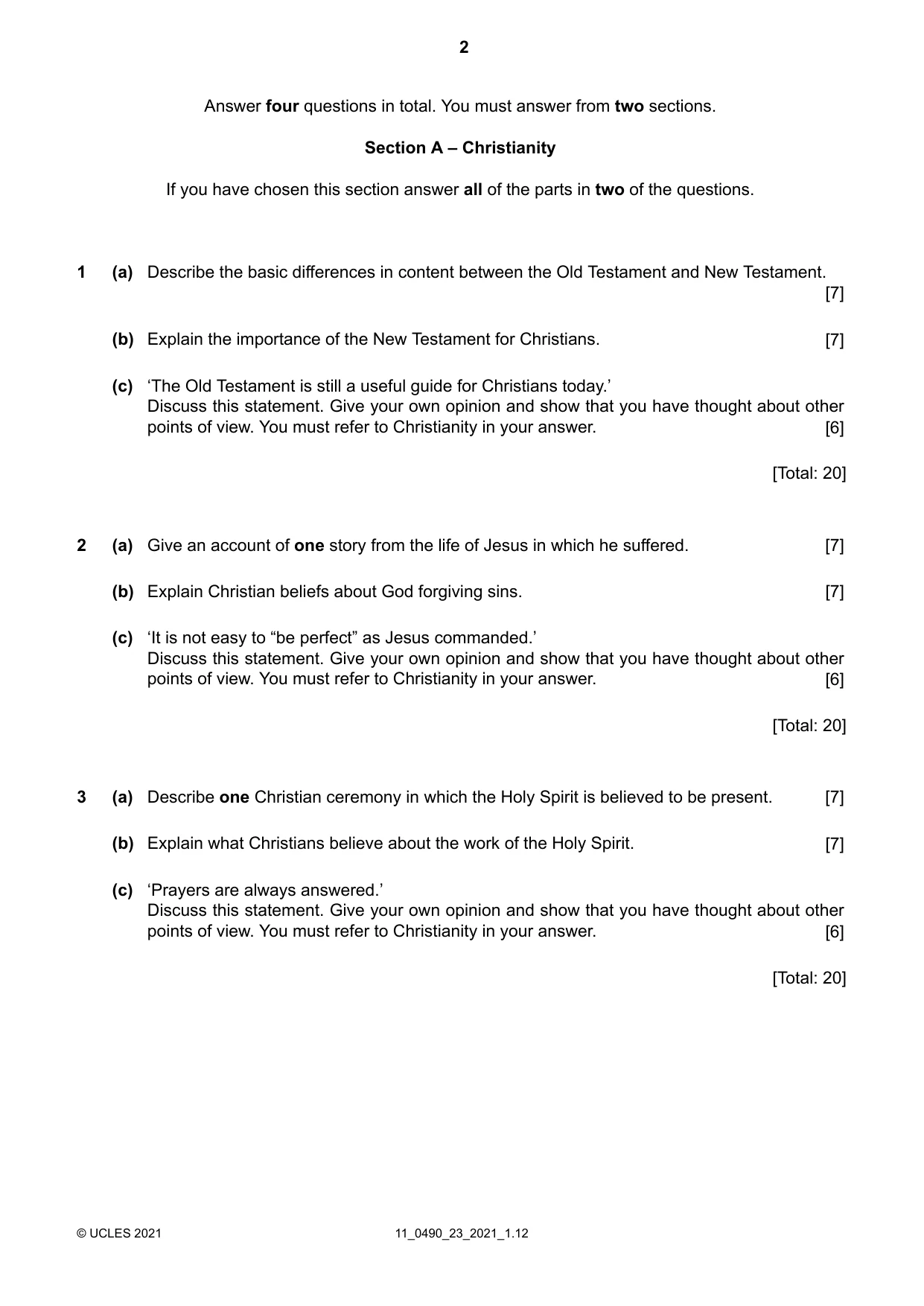
Question paper, page 2
Answer four questions in total. You must answer from two sections. Section A – Christianity If you have chosen this section answer all of the parts in two of the questions. Describe the basic differences in content between the Old Testament and New Testament. [7] (a) 1 Explain the importance of the New Testament for Christians. [7] (b) ‘The Old Testament is still a useful guide for Christians today.’ Discuss this statement. Give your own opinion and show that you have thought about other points of view. You must refer to Christianity in your answer. [6] (c) [Total: 20] Give an account of one story from the life of Jesus in which he suffered. [7] (a) 2 Explain Christian beliefs about God forgiving sins. [7] (b) ‘It is not easy to “be perfect” as Jesus commanded.’ Discuss this statement. Give your own opinion and show that you have thought about other points of view. You must refer to Christianity in your answer. [6] (c) [Total: 20] Describe one Christian ceremony in which the Holy Spirit is believed to be present. [7] (a) 3 Explain what Christians believe about the work of the Holy Spirit. [7] (b) ‘Prayers are always answered.’ Discuss this statement. Give your own opinion and show that you have thought about other points of view. You must refer to Christianity in your answer. [6] (c) [Total: 20] 11_0490_23_2021_1.12 © UCLES 2021 2
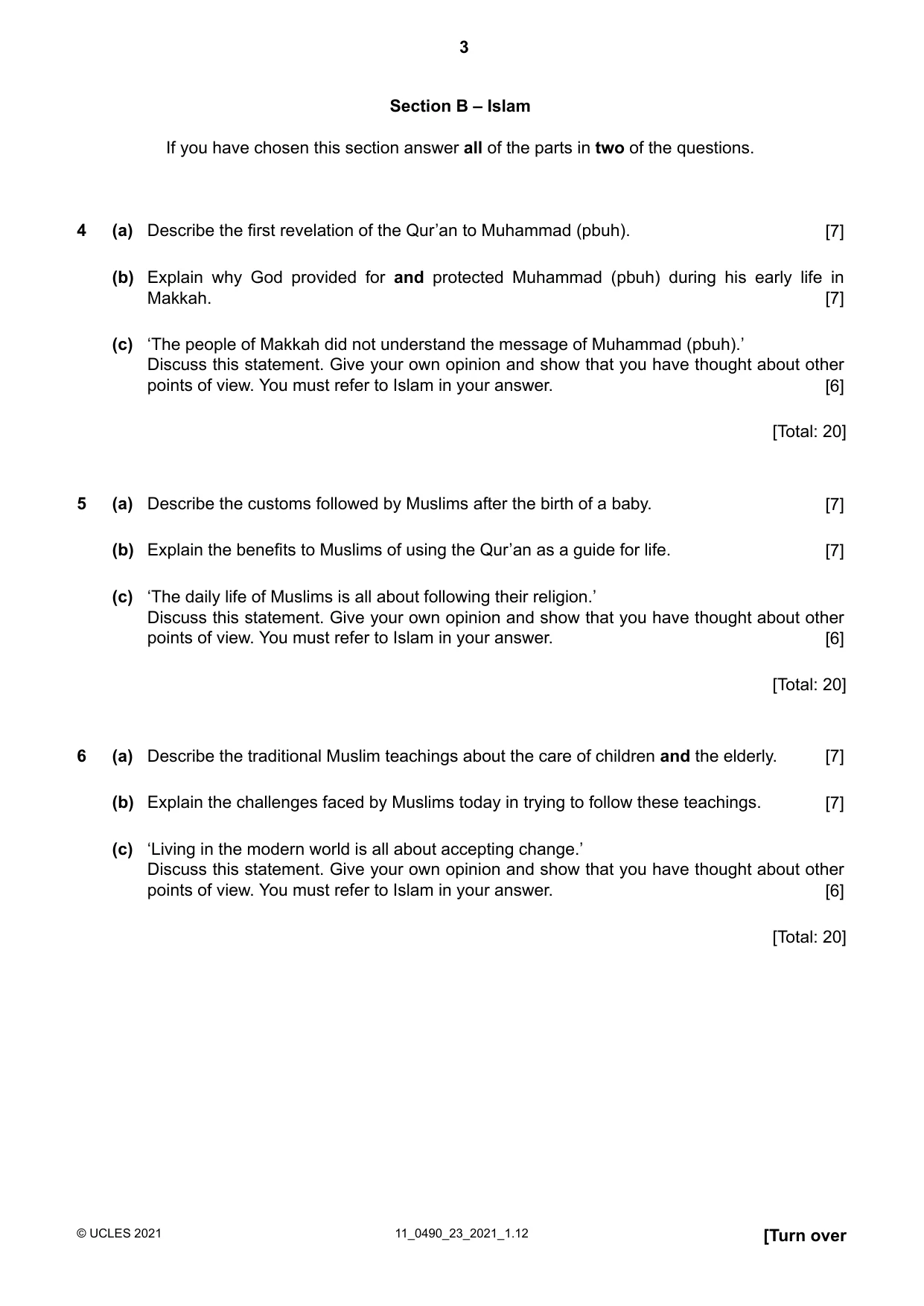
Question paper, page 3
Section B – Islam If you have chosen this section answer all of the parts in two of the questions. Describe the first revelation of the Qur’an to Muhammad (pbuh). [7] (a) 4 Explain why God provided for and protected Muhammad (pbuh) during his early life in Makkah. [7] (b) ‘The people of Makkah did not understand the message of Muhammad (pbuh).’ Discuss this statement. Give your own opinion and show that you have thought about other points of view. You must refer to Islam in your answer. [6] (c) [Total: 20] Describe the customs followed by Muslims after the birth of a baby. [7] (a) 5 Explain the benefits to Muslims of using the Qur’an as a guide for life. [7] (b) ‘The daily life of Muslims is all about following their religion.’ Discuss this statement. Give your own opinion and show that you have thought about other points of view. You must refer to Islam in your answer. [6] (c) [Total: 20] Describe the traditional Muslim teachings about the care of children and the elderly. [7] (a) 6 Explain the challenges faced by Muslims today in trying to follow these teachings. [7] (b) ‘Living in the modern world is all about accepting change.’ Discuss this statement. Give your own opinion and show that you have thought about other points of view. You must refer to Islam in your answer. [6] (c) [Total: 20] [Turn over 11_0490_23_2021_1.12 © UCLES 2021 3
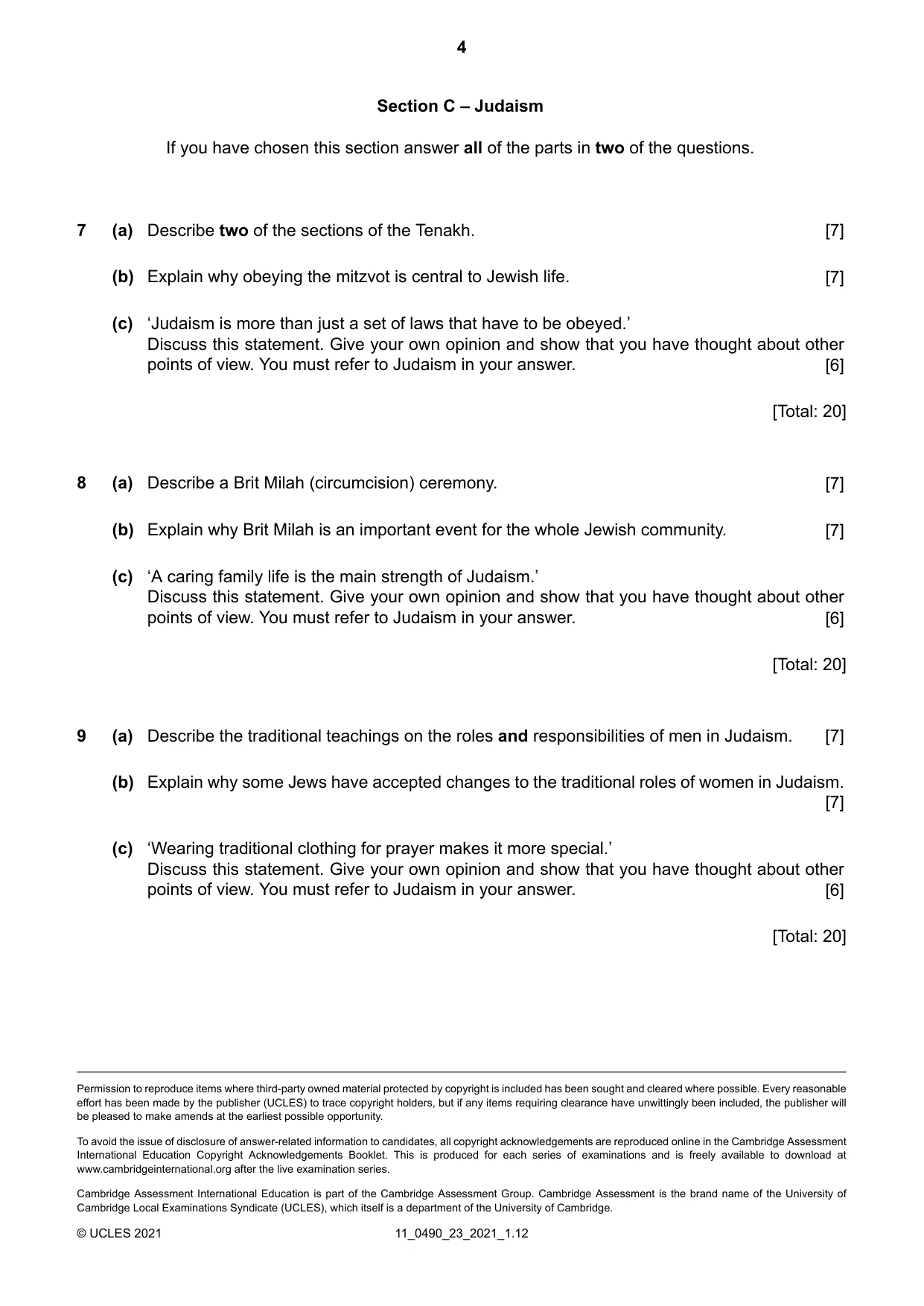
Question paper, page 4
Section C – Judaism If you have chosen this section answer all of the parts in two of the questions. Describe two of the sections of the Tenakh. [7] (a) 7 Explain why obeying the mitzvot is central to Jewish life. [7] (b) ‘Judaism is more than just a set of laws that have to be obeyed.’ Discuss this statement. Give your own opinion and show that you have thought about other points of view. You must refer to Judaism in your answer. [6] (c) [Total: 20] Describe a Brit Milah (circumcision) ceremony. [7] (a) 8 Explain why Brit Milah is an important event for the whole Jewish community. [7] (b) ‘A caring family life is the main strength of Judaism.’ Discuss this statement. Give your own opinion and show that you have thought about other points of view. You must refer to Judaism in your answer. [6] (c) [Total: 20] Describe the traditional teachings on the roles and responsibilities of men in Judaism. [7] (a) 9 Explain why some Jews have accepted changes to the traditional roles of women in Judaism. [7] (b) ‘Wearing traditional clothing for prayer makes it more special.’ Discuss this statement. Give your own opinion and show that you have thought about other points of view. You must refer to Judaism in your answer. [6] (c) [Total: 20] Permission to reproduce items where third-party owned material protected by copyright is included has been sought and cleared where possible. Every reasonable effort has been made by the publisher (UCLES) to trace copyright holders, but if any items requiring clearance have unwittingly been included, the publisher will be pleased to make amends at the earliest possible opportunity. To avoid the issue of disclosure of answer-related information to candidates, all copyright acknowledgements are reproduced online in the Cambridge Assessment International Education Copyright Acknowledgements Booklet. This is produced for each series of examinations and is freely available to download at www.cambridgeinternational.org after the live examination series. Cambridge Assessment International Education is part of the Cambridge Assessment Group. Cambridge Assessment is the brand name of the University of Cambridge Local Examinations Syndicate (UCLES), which itself is a department of the University of Cambridge. 11_0490_23_2021_1.12 © UCLES 2021 4
Mark scheme, page 1
This document consists of 22 printed pages. © UCLES 2021 [Turn over Cambridge IGCSE™ RELIGIOUS STUDIES 0490/23 Paper 2 October/November 2021 MARK SCHEME Maximum Mark: 80 Published This mark scheme is published as an aid to teachers and candidates, to indicate the requirements of the examination. It shows the basis on which Examiners were instructed to award marks. It does not indicate the details of the discussions that took place at an Examiners’ meeting before marking began, which would have considered the acceptability of alternative answers. Mark schemes should be read in conjunction with the question paper and the Principal Examiner Report for Teachers. Cambridge International will not enter into discussions about these mark schemes. Cambridge International is publishing the mark schemes for the October/November 2021 series for most Cambridge IGCSE™, Cambridge International A and AS Level components and some Cambridge O Level components.
Mark scheme, page 2
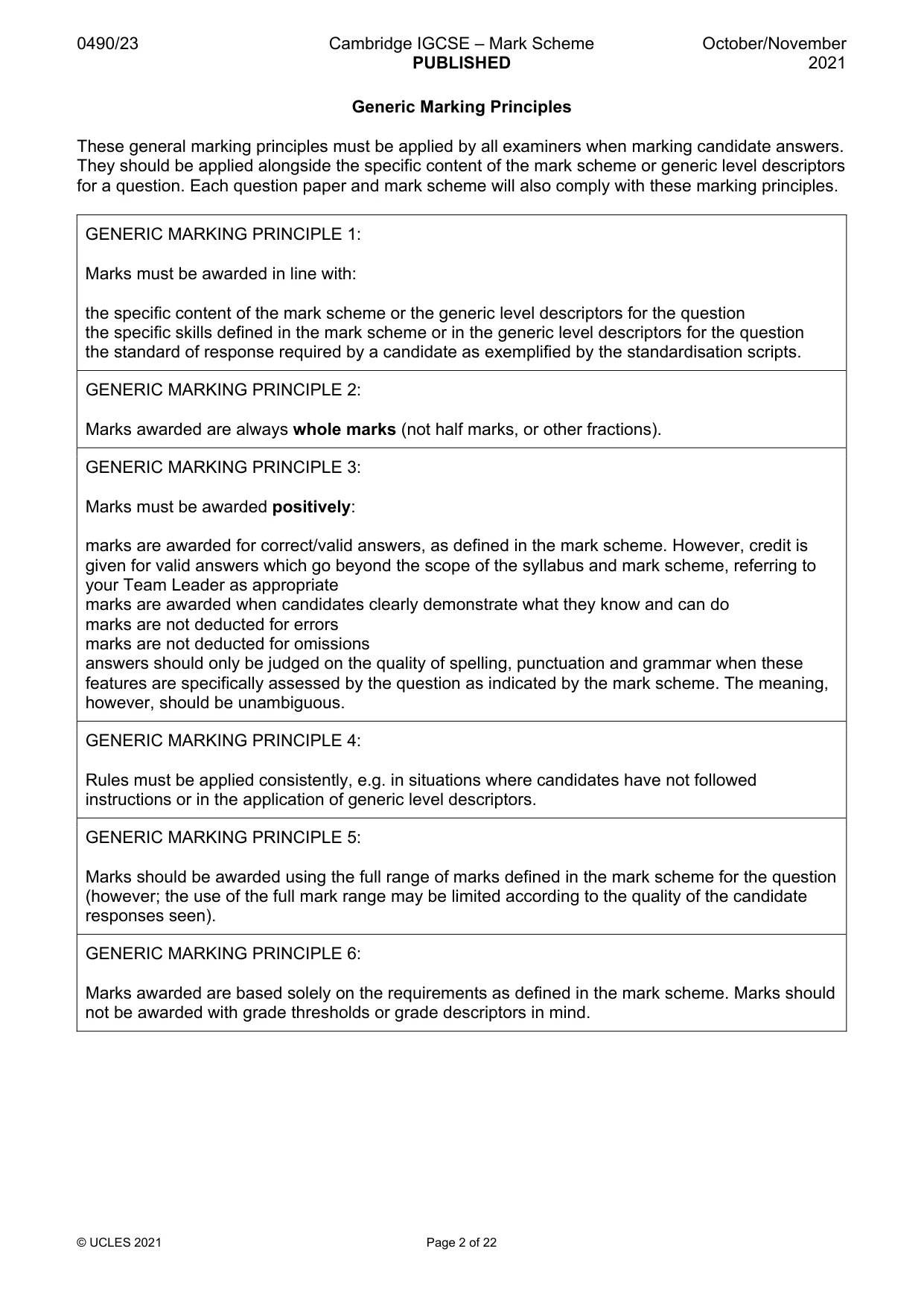
0490/23 Cambridge IGCSE – Mark Scheme PUBLISHED October/November 2021 © UCLES 2021 Page 2 of 22 Generic Marking Principles These general marking principles must be applied by all examiners when marking candidate answers. They should be applied alongside the specific content of the mark scheme or generic level descriptors for a question. Each question paper and mark scheme will also comply with these marking principles. GENERIC MARKING PRINCIPLE 1: Marks must be awarded in line with: the specific content of the mark scheme or the generic level descriptors for the question the specific skills defined in the mark scheme or in the generic level descriptors for the question the standard of response required by a candidate as exemplified by the standardisation scripts. GENERIC MARKING PRINCIPLE 2: Marks awarded are always whole marks (not half marks, or other fractions). GENERIC MARKING PRINCIPLE 3: Marks must be awarded positively: marks are awarded for correct/valid answers, as defined in the mark scheme. However, credit is given for valid answers which go beyond the scope of the syllabus and mark scheme, referring to your Team Leader as appropriate marks are awarded when candidates clearly demonstrate what they know and can do marks are not deducted for errors marks are not deducted for omissions answers should only be judged on the quality of spelling, punctuation and grammar when these features are specifically assessed by the question as indicated by the mark scheme. The meaning, however, should be unambiguous. GENERIC MARKING PRINCIPLE 4: Rules must be applied consistently, e.g. in situations where candidates have not followed instructions or in the application of generic level descriptors. GENERIC MARKING PRINCIPLE 5: Marks should be awarded using the full range of marks defined in the mark scheme for the question (however; the use of the full mark range may be limited according to the quality of the candidate responses seen). GENERIC MARKING PRINCIPLE 6: Marks awarded are based solely on the requirements as defined in the mark scheme. Marks should not be awarded with grade thresholds or grade descriptors in mind.
Mark scheme, page 3
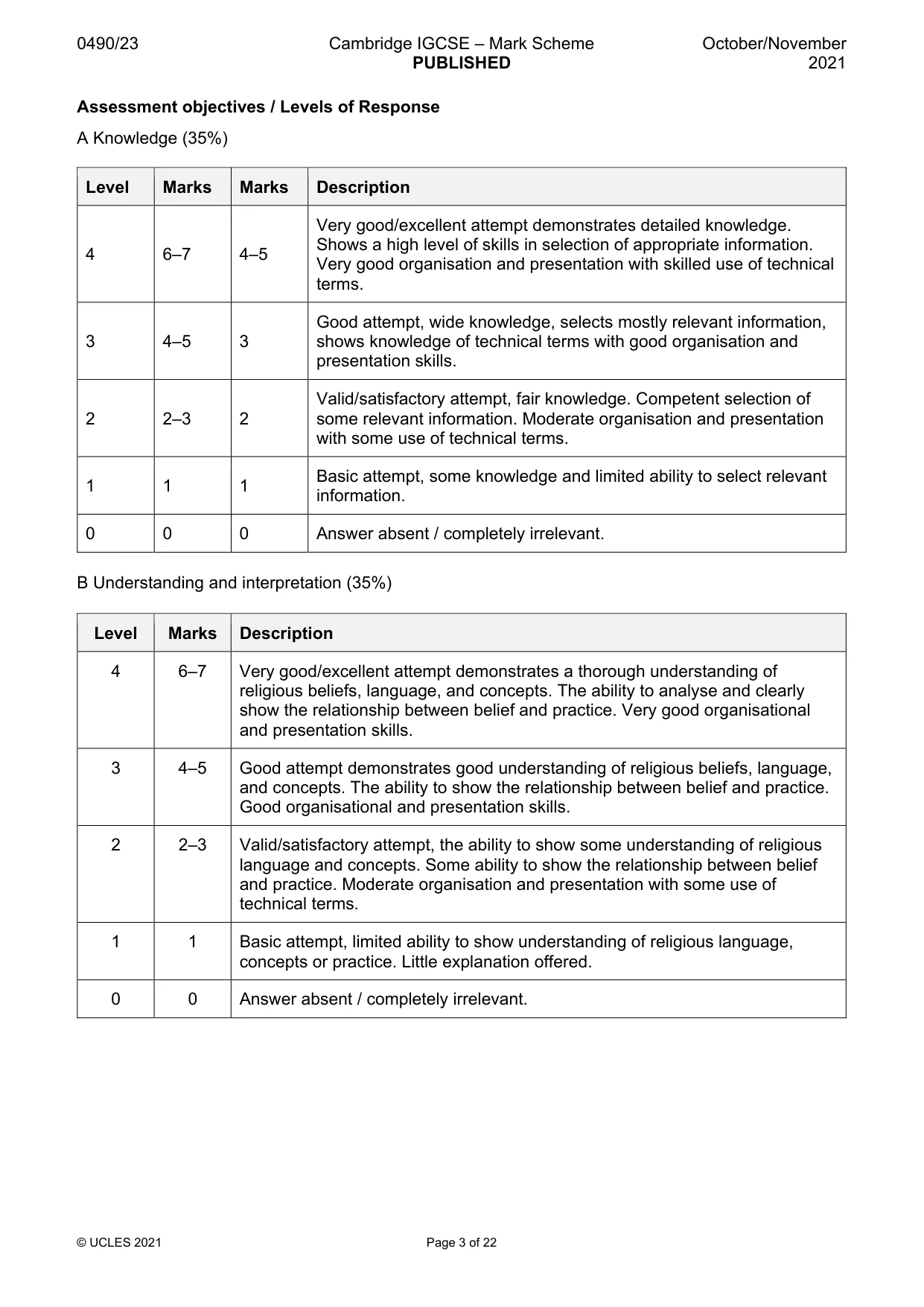
0490/23 Cambridge IGCSE – Mark Scheme PUBLISHED October/November 2021 © UCLES 2021 Page 3 of 22 Assessment objectives / Levels of Response A Knowledge (35%) Level Marks Marks Description 4 6–7 4–5 Very good/excellent attempt demonstrates detailed knowledge. Shows a high level of skills in selection of appropriate information. Very good organisation and presentation with skilled use of technical terms. 3 4–5 3 Good attempt, wide knowledge, selects mostly relevant information, shows knowledge of technical terms with good organisation and presentation skills. 2 2–3 2 Valid/satisfactory attempt, fair knowledge. Competent selection of some relevant information. Moderate organisation and presentation with some use of technical terms. 1 1 1 Basic attempt, some knowledge and limited ability to select relevant information. 0 0 0 Answer absent / completely irrelevant. B Understanding and interpretation (35%) Level Marks Description 4 6–7 Very good/excellent attempt demonstrates a thorough understanding of religious beliefs, language, and concepts. The ability to analyse and clearly show the relationship between belief and practice. Very good organisational and presentation skills. 3 4–5 Good attempt demonstrates good understanding of religious beliefs, language, and concepts. The ability to show the relationship between belief and practice. Good organisational and presentation skills. 2 2–3 Valid/satisfactory attempt, the ability to show some understanding of religious language and concepts. Some ability to show the relationship between belief and practice. Moderate organisation and presentation with some use of technical terms. 1 1 Basic attempt, limited ability to show understanding of religious language, concepts or practice. Little explanation offered. 0 0 Answer absent / completely irrelevant.
Mark scheme, page 4
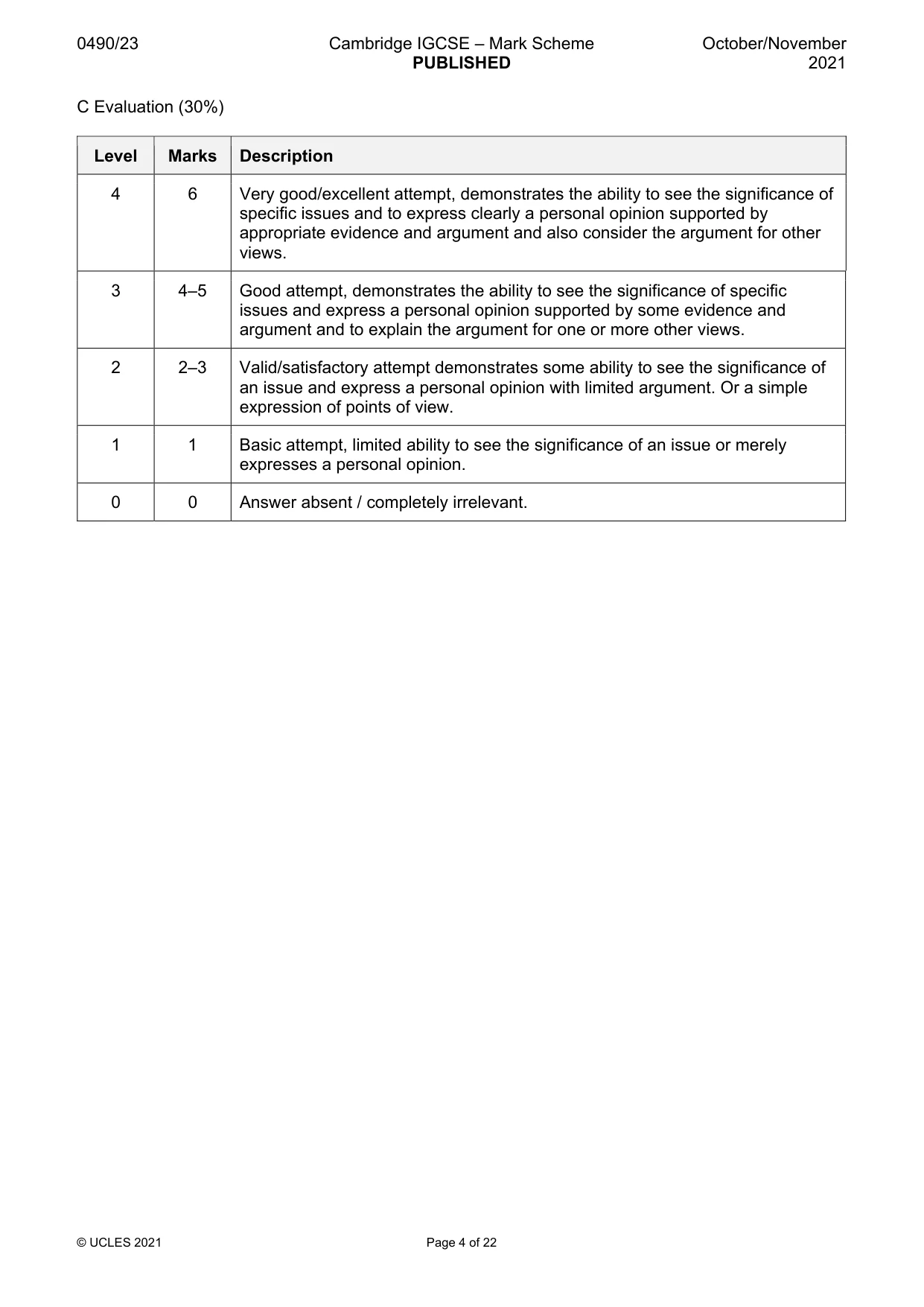
0490/23 Cambridge IGCSE – Mark Scheme PUBLISHED October/November 2021 © UCLES 2021 Page 4 of 22 C Evaluation (30%) Level Marks Description 4 6 Very good/excellent attempt, demonstrates the ability to see the significance of specific issues and to express clearly a personal opinion supported by appropriate evidence and argument and also consider the argument for other views. 3 4–5 Good attempt, demonstrates the ability to see the significance of specific issues and express a personal opinion supported by some evidence and argument and to explain the argument for one or more other views. 2 2–3 Valid/satisfactory attempt demonstrates some ability to see the significance of an issue and express a personal opinion with limited argument. Or a simple expression of points of view. 1 1 Basic attempt, limited ability to see the significance of an issue or merely expresses a personal opinion. 0 0 Answer absent / completely irrelevant.
Mark scheme, page 5
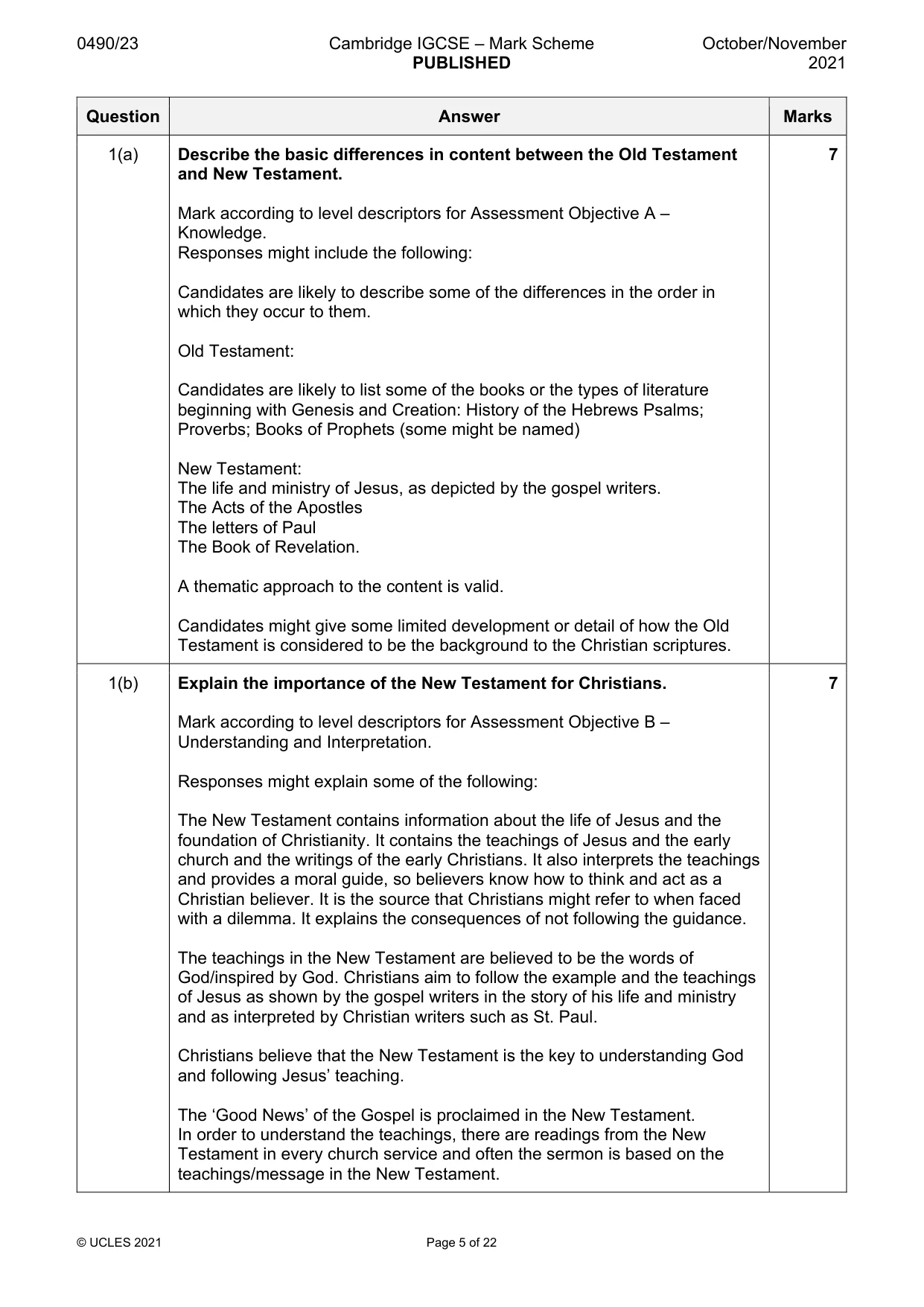
0490/23 Cambridge IGCSE – Mark Scheme PUBLISHED October/November 2021 © UCLES 2021 Page 5 of 22 Question Answer Marks 1(a) Describe the basic differences in content between the Old Testament and New Testament. Mark according to level descriptors for Assessment Objective A – Knowledge. Responses might include the following: Candidates are likely to describe some of the differences in the order in which they occur to them. Old Testament: Candidates are likely to list some of the books or the types of literature beginning with Genesis and Creation: History of the Hebrews Psalms; Proverbs; Books of Prophets (some might be named) New Testament: The life and ministry of Jesus, as depicted by the gospel writers. The Acts of the Apostles The letters of Paul The Book of Revelation. A thematic approach to the content is valid. Candidates might give some limited development or detail of how the Old Testament is considered to be the background to the Christian scriptures. 7 1(b) Explain the importance of the New Testament for Christians. Mark according to level descriptors for Assessment Objective B – Understanding and Interpretation. Responses might explain some of the following: The New Testament contains information about the life of Jesus and the foundation of Christianity. It contains the teachings of Jesus and the early church and the writings of the early Christians. It also interprets the teachings and provides a moral guide, so believers know how to think and act as a Christian believer. It is the source that Christians might refer to when faced with a dilemma. It explains the consequences of not following the guidance. The teachings in the New Testament are believed to be the words of God/inspired by God. Christians aim to follow the example and the teachings of Jesus as shown by the gospel writers in the story of his life and ministry and as interpreted by Christian writers such as St. Paul. Christians believe that the New Testament is the key to understanding God and following Jesus’ teaching. The ‘Good News’ of the Gospel is proclaimed in the New Testament. In order to understand the teachings, there are readings from the New Testament in every church service and often the sermon is based on the teachings/message in the New Testament. 7
Mark scheme, page 6
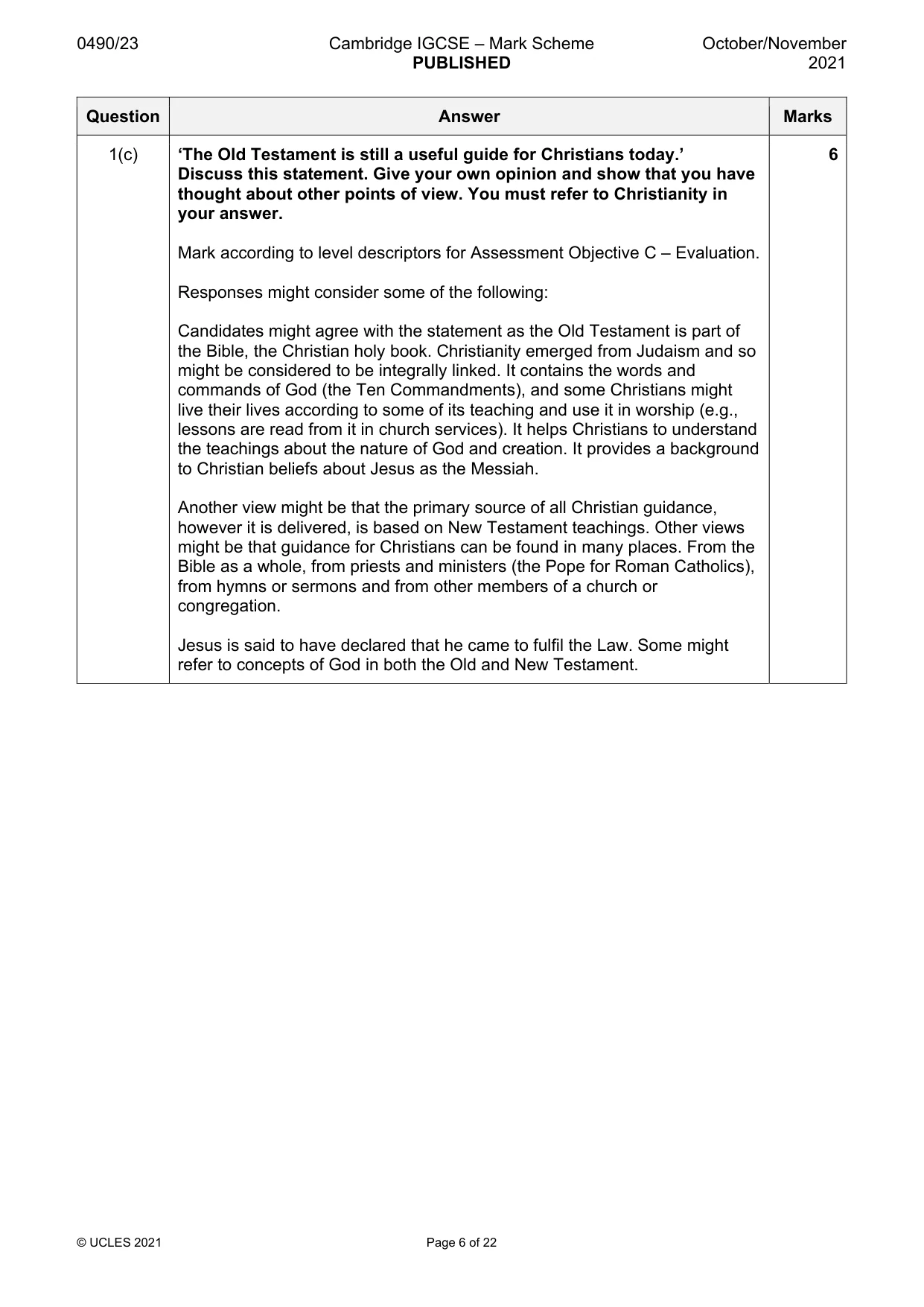
0490/23 Cambridge IGCSE – Mark Scheme PUBLISHED October/November 2021 © UCLES 2021 Page 6 of 22 Question Answer Marks 1(c) ‘The Old Testament is still a useful guide for Christians today.’ Discuss this statement. Give your own opinion and show that you have thought about other points of view. You must refer to Christianity in your answer. Mark according to level descriptors for Assessment Objective C – Evaluation. Responses might consider some of the following: Candidates might agree with the statement as the Old Testament is part of the Bible, the Christian holy book. Christianity emerged from Judaism and so might be considered to be integrally linked. It contains the words and commands of God (the Ten Commandments), and some Christians might live their lives according to some of its teaching and use it in worship (e.g., lessons are read from it in church services). It helps Christians to understand the teachings about the nature of God and creation. It provides a background to Christian beliefs about Jesus as the Messiah. Another view might be that the primary source of all Christian guidance, however it is delivered, is based on New Testament teachings. Other views might be that guidance for Christians can be found in many places. From the Bible as a whole, from priests and ministers (the Pope for Roman Catholics), from hymns or sermons and from other members of a church or congregation. Jesus is said to have declared that he came to fulfil the Law. Some might refer to concepts of God in both the Old and New Testament. 6
Mark scheme, page 7
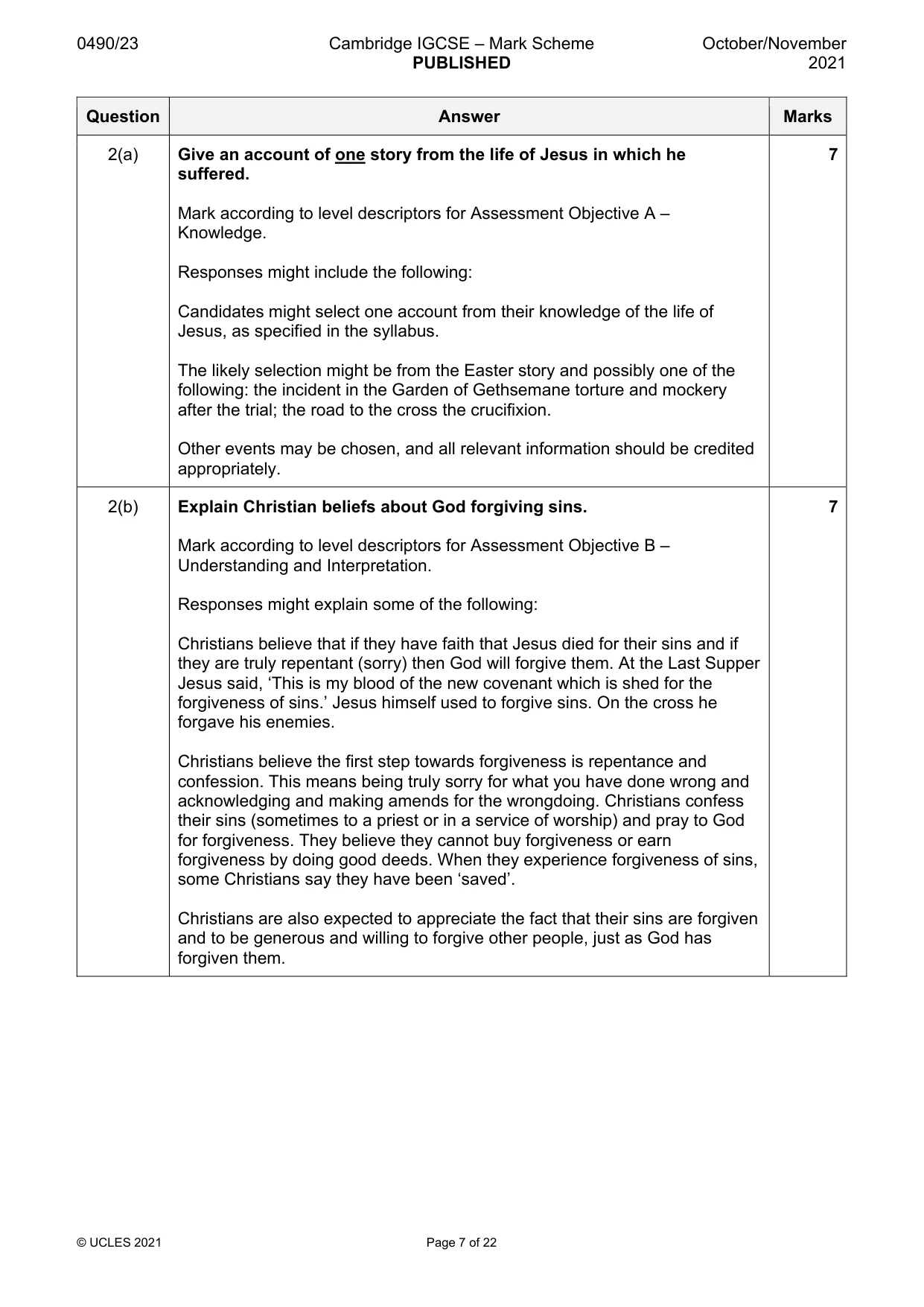
0490/23 Cambridge IGCSE – Mark Scheme PUBLISHED October/November 2021 © UCLES 2021 Page 7 of 22 Question Answer Marks 2(a) Give an account of one story from the life of Jesus in which he suffered. Mark according to level descriptors for Assessment Objective A – Knowledge. Responses might include the following: Candidates might select one account from their knowledge of the life of Jesus, as specified in the syllabus. The likely selection might be from the Easter story and possibly one of the following: the incident in the Garden of Gethsemane torture and mockery after the trial; the road to the cross the crucifixion. Other events may be chosen, and all relevant information should be credited appropriately. 7 2(b) Explain Christian beliefs about God forgiving sins. Mark according to level descriptors for Assessment Objective B – Understanding and Interpretation. Responses might explain some of the following: Christians believe that if they have faith that Jesus died for their sins and if they are truly repentant (sorry) then God will forgive them. At the Last Supper Jesus said, ‘This is my blood of the new covenant which is shed for the forgiveness of sins.’ Jesus himself used to forgive sins. On the cross he forgave his enemies. Christians believe the first step towards forgiveness is repentance and confession. This means being truly sorry for what you have done wrong and acknowledging and making amends for the wrongdoing. Christians confess their sins (sometimes to a priest or in a service of worship) and pray to God for forgiveness. They believe they cannot buy forgiveness or earn forgiveness by doing good deeds. When they experience forgiveness of sins, some Christians say they have been ‘saved’. Christians are also expected to appreciate the fact that their sins are forgiven and to be generous and willing to forgive other people, just as God has forgiven them. 7
Mark scheme, page 8
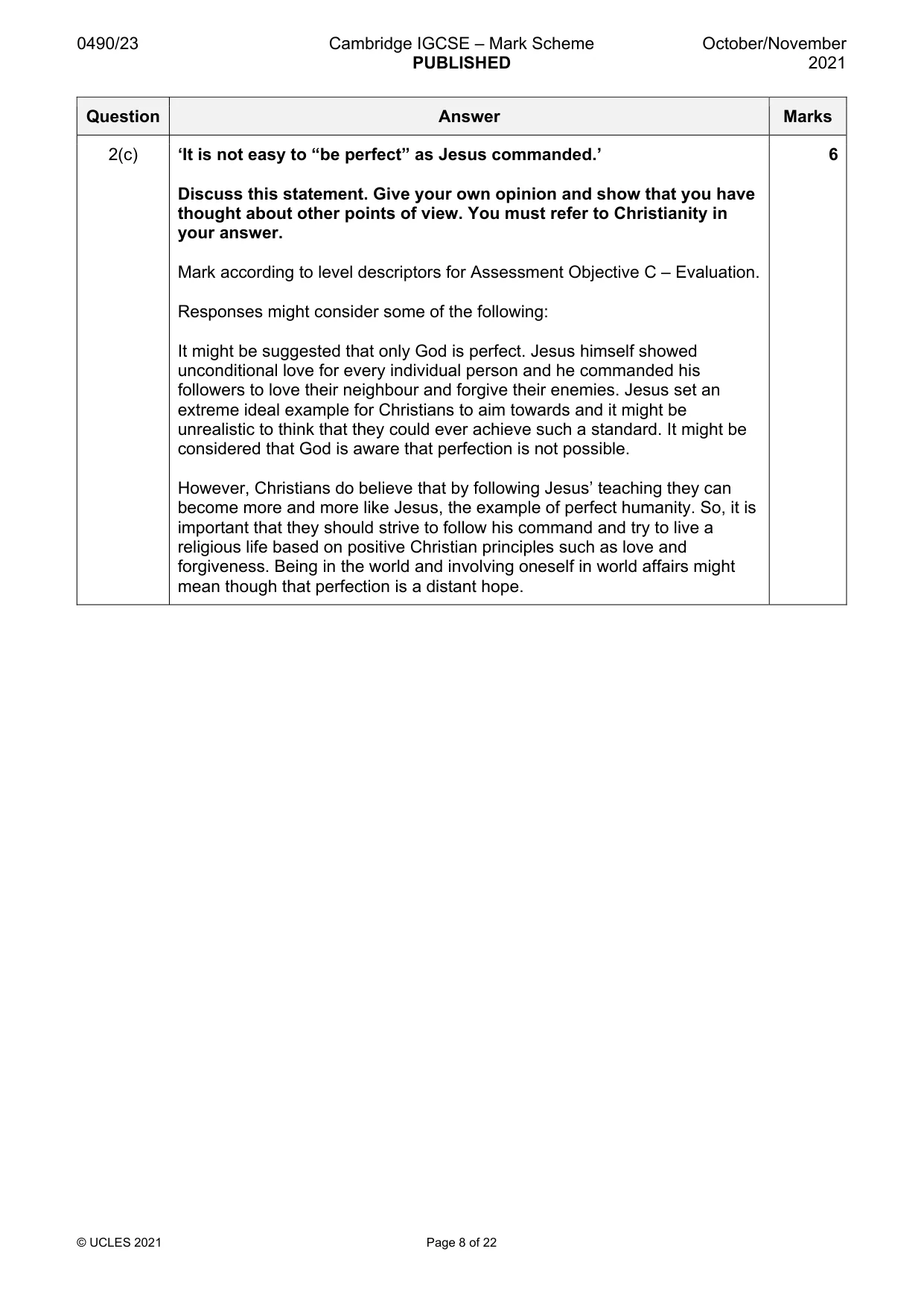
0490/23 Cambridge IGCSE – Mark Scheme PUBLISHED October/November 2021 © UCLES 2021 Page 8 of 22 Question Answer Marks 2(c) ‘It is not easy to “be perfect” as Jesus commanded.’ Discuss this statement. Give your own opinion and show that you have thought about other points of view. You must refer to Christianity in your answer. Mark according to level descriptors for Assessment Objective C – Evaluation. Responses might consider some of the following: It might be suggested that only God is perfect. Jesus himself showed unconditional love for every individual person and he commanded his followers to love their neighbour and forgive their enemies. Jesus set an extreme ideal example for Christians to aim towards and it might be unrealistic to think that they could ever achieve such a standard. It might be considered that God is aware that perfection is not possible. However, Christians do believe that by following Jesus’ teaching they can become more and more like Jesus, the example of perfect humanity. So, it is important that they should strive to follow his command and try to live a religious life based on positive Christian principles such as love and forgiveness. Being in the world and involving oneself in world affairs might mean though that perfection is a distant hope. 6
Mark scheme, page 9
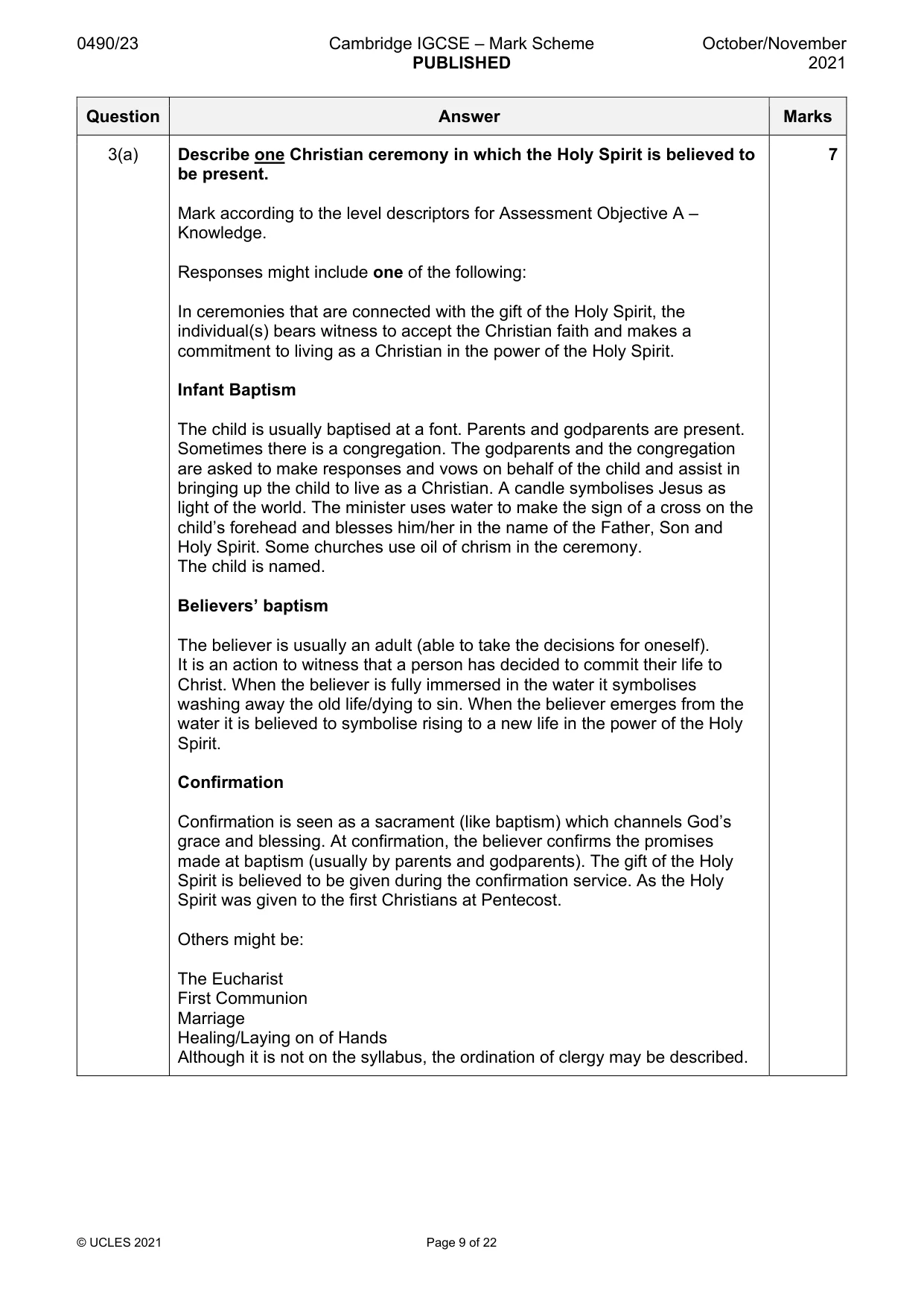
0490/23 Cambridge IGCSE – Mark Scheme PUBLISHED October/November 2021 © UCLES 2021 Page 9 of 22 Question Answer Marks 3(a) Describe one Christian ceremony in which the Holy Spirit is believed to be present. Mark according to the level descriptors for Assessment Objective A – Knowledge. Responses might include one of the following: In ceremonies that are connected with the gift of the Holy Spirit, the individual(s) bears witness to accept the Christian faith and makes a commitment to living as a Christian in the power of the Holy Spirit. Infant Baptism The child is usually baptised at a font. Parents and godparents are present. Sometimes there is a congregation. The godparents and the congregation are asked to make responses and vows on behalf of the child and assist in bringing up the child to live as a Christian. A candle symbolises Jesus as light of the world. The minister uses water to make the sign of a cross on the child’s forehead and blesses him/her in the name of the Father, Son and Holy Spirit. Some churches use oil of chrism in the ceremony. The child is named. Believers’ baptism The believer is usually an adult (able to take the decisions for oneself). It is an action to witness that a person has decided to commit their life to Christ. When the believer is fully immersed in the water it symbolises washing away the old life/dying to sin. When the believer emerges from the water it is believed to symbolise rising to a new life in the power of the Holy Spirit. Confirmation Confirmation is seen as a sacrament (like baptism) which channels God’s grace and blessing. At confirmation, the believer confirms the promises made at baptism (usually by parents and godparents). The gift of the Holy Spirit is believed to be given during the confirmation service. As the Holy Spirit was given to the first Christians at Pentecost. Others might be: The Eucharist First Communion Marriage Healing/Laying on of Hands Although it is not on the syllabus, the ordination of clergy may be described. 7
Mark scheme, page 10
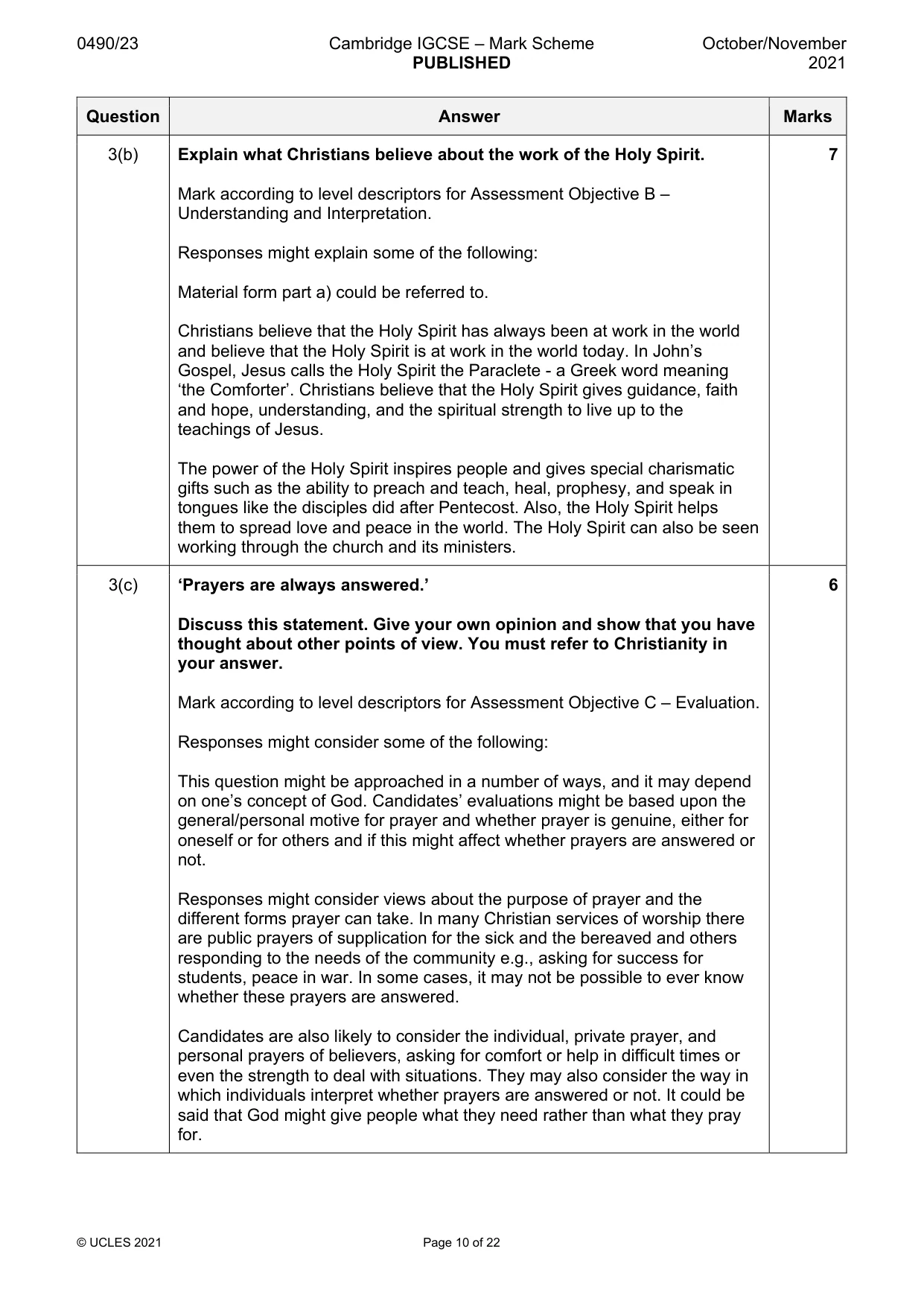
0490/23 Cambridge IGCSE – Mark Scheme PUBLISHED October/November 2021 © UCLES 2021 Page 10 of 22 Question Answer Marks 3(b) Explain what Christians believe about the work of the Holy Spirit. Mark according to level descriptors for Assessment Objective B – Understanding and Interpretation. Responses might explain some of the following: Material form part a) could be referred to. Christians believe that the Holy Spirit has always been at work in the world and believe that the Holy Spirit is at work in the world today. In John’s Gospel, Jesus calls the Holy Spirit the Paraclete - a Greek word meaning ‘the Comforter’. Christians believe that the Holy Spirit gives guidance, faith and hope, understanding, and the spiritual strength to live up to the teachings of Jesus. The power of the Holy Spirit inspires people and gives special charismatic gifts such as the ability to preach and teach, heal, prophesy, and speak in tongues like the disciples did after Pentecost. Also, the Holy Spirit helps them to spread love and peace in the world. The Holy Spirit can also be seen working through the church and its ministers. 7 3(c) ‘Prayers are always answered.’ Discuss this statement. Give your own opinion and show that you have thought about other points of view. You must refer to Christianity in your answer. Mark according to level descriptors for Assessment Objective C – Evaluation. Responses might consider some of the following: This question might be approached in a number of ways, and it may depend on one’s concept of God. Candidates’ evaluations might be based upon the general/personal motive for prayer and whether prayer is genuine, either for oneself or for others and if this might affect whether prayers are answered or not. Responses might consider views about the purpose of prayer and the different forms prayer can take. In many Christian services of worship there are public prayers of supplication for the sick and the bereaved and others responding to the needs of the community e.g., asking for success for students, peace in war. In some cases, it may not be possible to ever know whether these prayers are answered. Candidates are also likely to consider the individual, private prayer, and personal prayers of believers, asking for comfort or help in difficult times or even the strength to deal with situations. They may also consider the way in which individuals interpret whether prayers are answered or not. It could be said that God might give people what they need rather than what they pray for. 6
Mark scheme, page 11
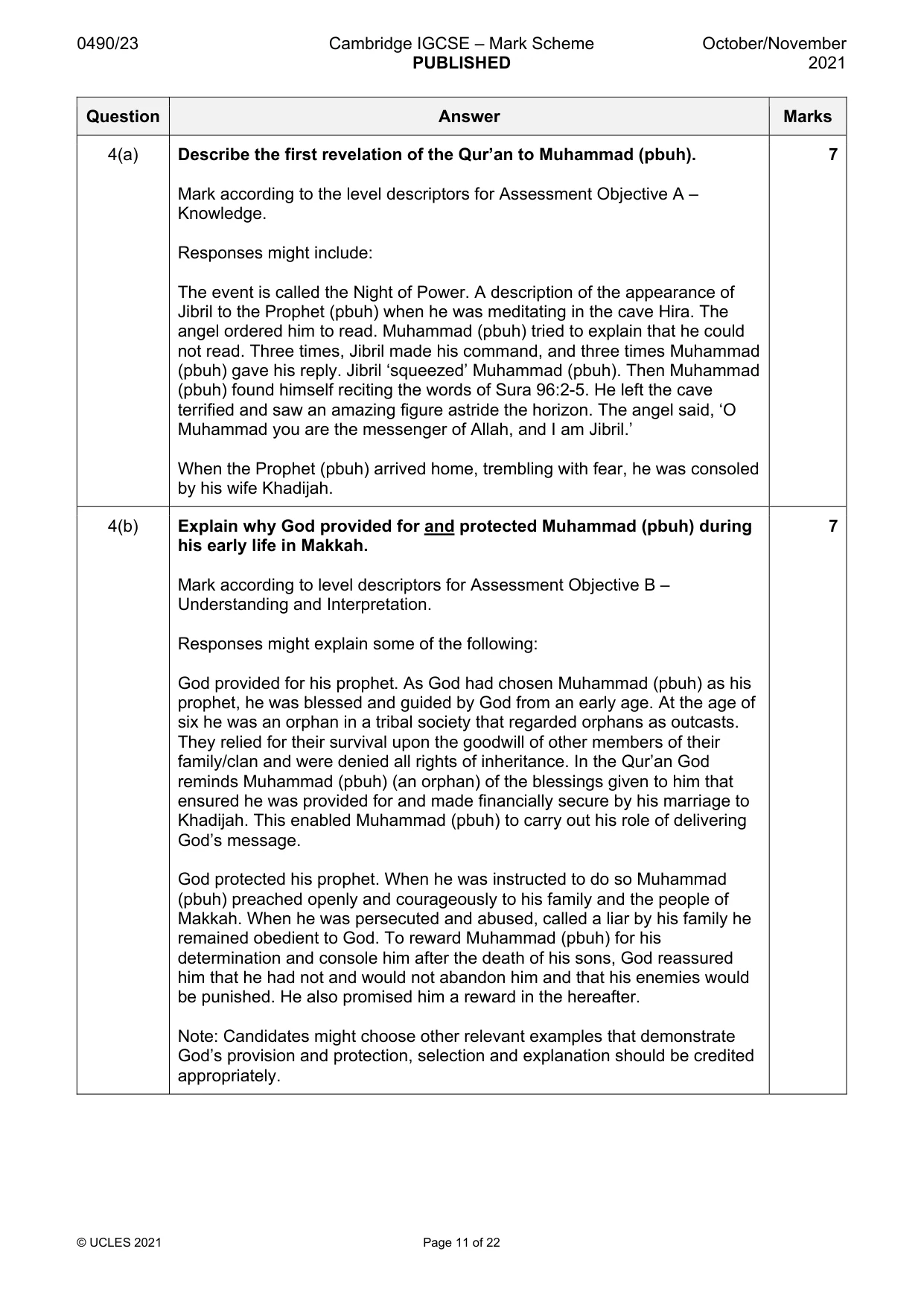
0490/23 Cambridge IGCSE – Mark Scheme PUBLISHED October/November 2021 © UCLES 2021 Page 11 of 22 Question Answer Marks 4(a) Describe the first revelation of the Qur’an to Muhammad (pbuh). Mark according to the level descriptors for Assessment Objective A – Knowledge. Responses might include: The event is called the Night of Power. A description of the appearance of Jibril to the Prophet (pbuh) when he was meditating in the cave Hira. The angel ordered him to read. Muhammad (pbuh) tried to explain that he could not read. Three times, Jibril made his command, and three times Muhammad (pbuh) gave his reply. Jibril ‘squeezed’ Muhammad (pbuh). Then Muhammad (pbuh) found himself reciting the words of Sura 96:2-5. He left the cave terrified and saw an amazing figure astride the horizon. The angel said, ‘O Muhammad you are the messenger of Allah, and I am Jibril.’ When the Prophet (pbuh) arrived home, trembling with fear, he was consoled by his wife Khadijah. 7 4(b) Explain why God provided for and protected Muhammad (pbuh) during his early life in Makkah. Mark according to level descriptors for Assessment Objective B – Understanding and Interpretation. Responses might explain some of the following: God provided for his prophet. As God had chosen Muhammad (pbuh) as his prophet, he was blessed and guided by God from an early age. At the age of six he was an orphan in a tribal society that regarded orphans as outcasts. They relied for their survival upon the goodwill of other members of their family/clan and were denied all rights of inheritance. In the Qur’an God reminds Muhammad (pbuh) (an orphan) of the blessings given to him that ensured he was provided for and made financially secure by his marriage to Khadijah. This enabled Muhammad (pbuh) to carry out his role of delivering God’s message. God protected his prophet. When he was instructed to do so Muhammad (pbuh) preached openly and courageously to his family and the people of Makkah. When he was persecuted and abused, called a liar by his family he remained obedient to God. To reward Muhammad (pbuh) for his determination and console him after the death of his sons, God reassured him that he had not and would not abandon him and that his enemies would be punished. He also promised him a reward in the hereafter. Note: Candidates might choose other relevant examples that demonstrate God’s provision and protection, selection and explanation should be credited appropriately. 7
Mark scheme, page 12
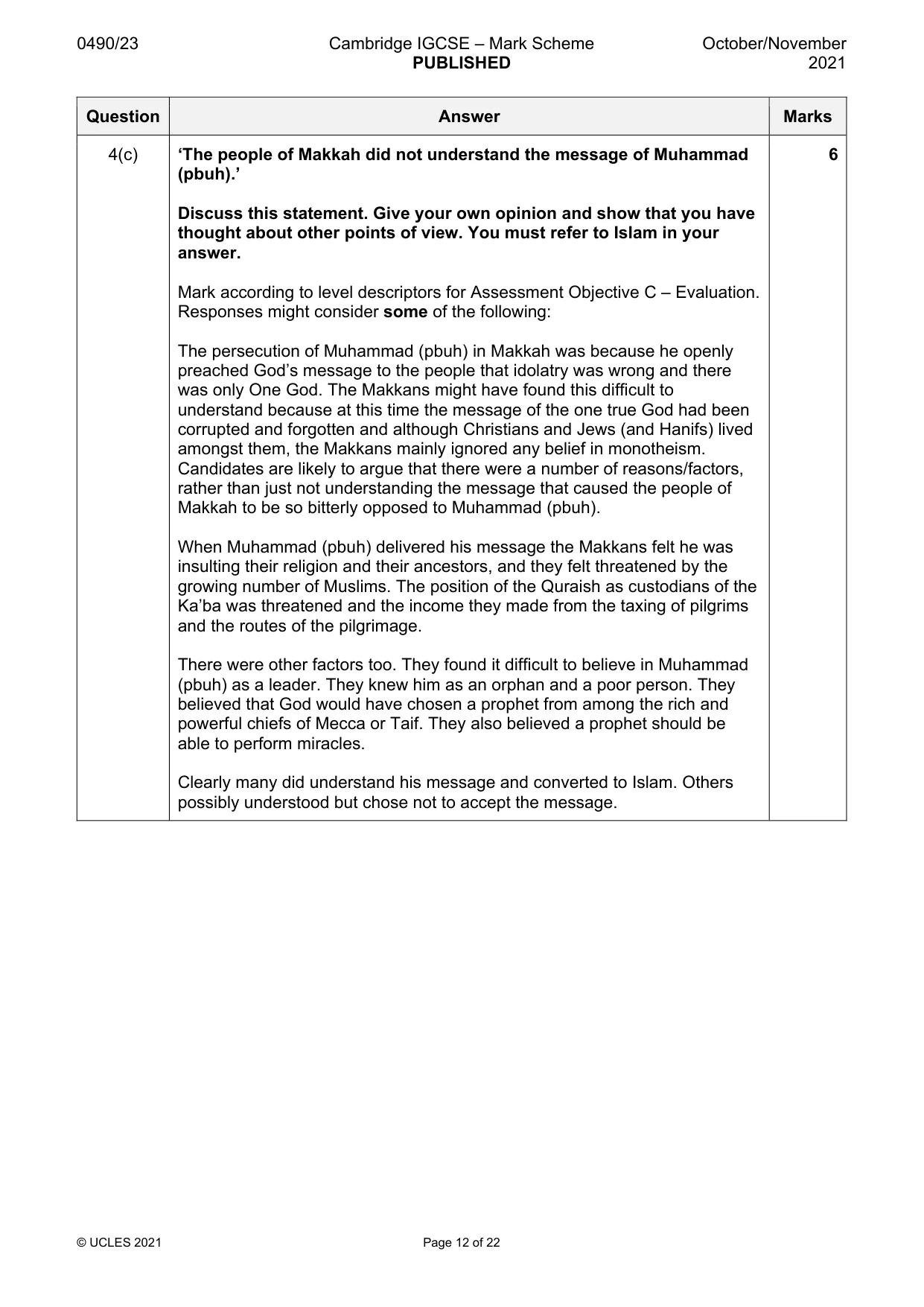
0490/23 Cambridge IGCSE – Mark Scheme PUBLISHED October/November 2021 © UCLES 2021 Page 12 of 22 Question Answer Marks 4(c) ‘The people of Makkah did not understand the message of Muhammad (pbuh).’ Discuss this statement. Give your own opinion and show that you have thought about other points of view. You must refer to Islam in your answer. Mark according to level descriptors for Assessment Objective C – Evaluation. Responses might consider some of the following: The persecution of Muhammad (pbuh) in Makkah was because he openly preached God’s message to the people that idolatry was wrong and there was only One God. The Makkans might have found this difficult to understand because at this time the message of the one true God had been corrupted and forgotten and although Christians and Jews (and Hanifs) lived amongst them, the Makkans mainly ignored any belief in monotheism. Candidates are likely to argue that there were a number of reasons/factors, rather than just not understanding the message that caused the people of Makkah to be so bitterly opposed to Muhammad (pbuh). When Muhammad (pbuh) delivered his message the Makkans felt he was insulting their religion and their ancestors, and they felt threatened by the growing number of Muslims. The position of the Quraish as custodians of the Ka’ba was threatened and the income they made from the taxing of pilgrims and the routes of the pilgrimage. There were other factors too. They found it difficult to believe in Muhammad (pbuh) as a leader. They knew him as an orphan and a poor person. They believed that God would have chosen a prophet from among the rich and powerful chiefs of Mecca or Taif. They also believed a prophet should be able to perform miracles. Clearly many did understand his message and converted to Islam. Others possibly understood but chose not to accept the message. 6
Mark scheme, page 13
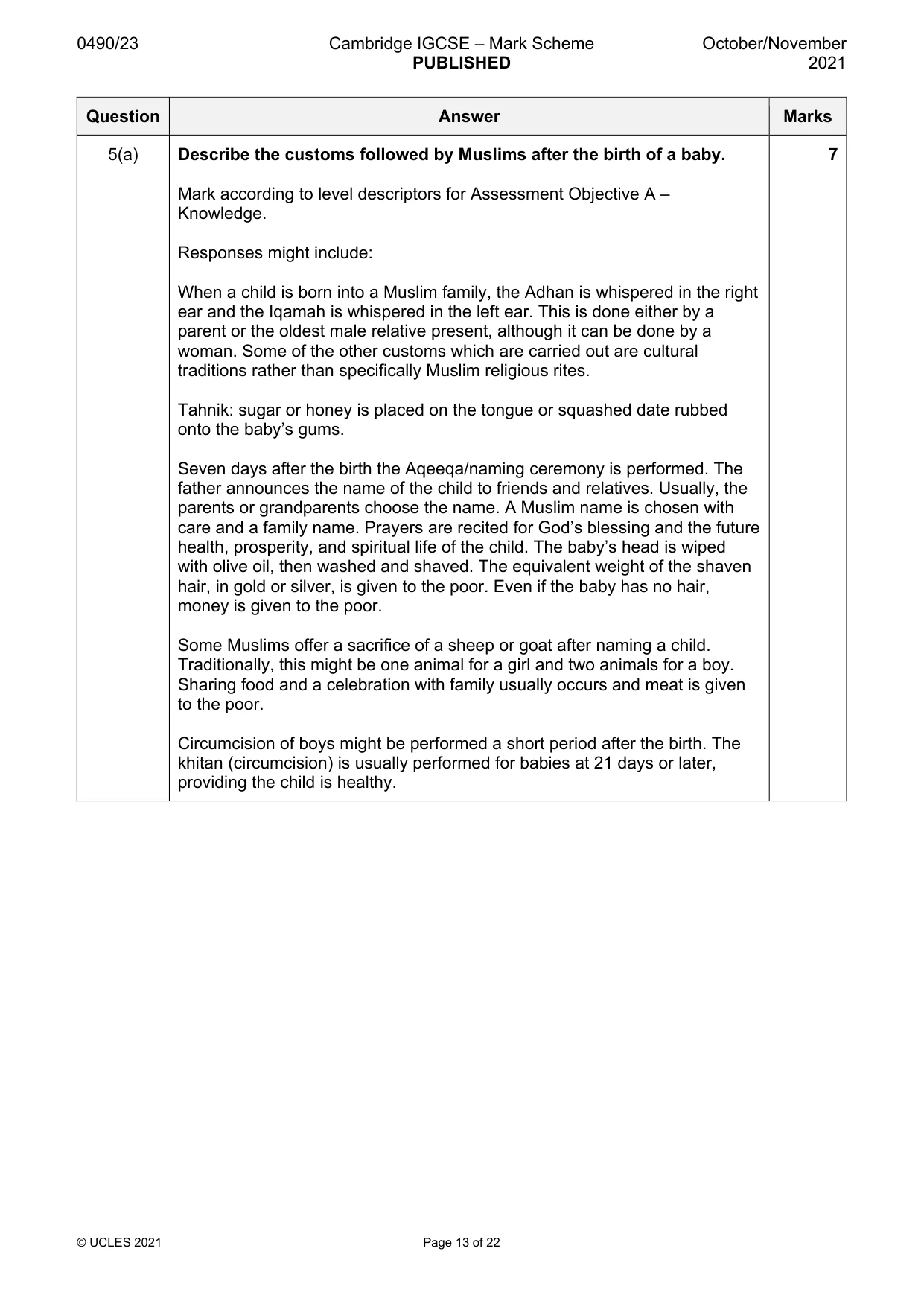
0490/23 Cambridge IGCSE – Mark Scheme PUBLISHED October/November 2021 © UCLES 2021 Page 13 of 22 Question Answer Marks 5(a) Describe the customs followed by Muslims after the birth of a baby. Mark according to level descriptors for Assessment Objective A – Knowledge. Responses might include: When a child is born into a Muslim family, the Adhan is whispered in the right ear and the Iqamah is whispered in the left ear. This is done either by a parent or the oldest male relative present, although it can be done by a woman. Some of the other customs which are carried out are cultural traditions rather than specifically Muslim religious rites. Tahnik: sugar or honey is placed on the tongue or squashed date rubbed onto the baby’s gums. Seven days after the birth the Aqeeqa/naming ceremony is performed. The father announces the name of the child to friends and relatives. Usually, the parents or grandparents choose the name. A Muslim name is chosen with care and a family name. Prayers are recited for God’s blessing and the future health, prosperity, and spiritual life of the child. The baby’s head is wiped with olive oil, then washed and shaved. The equivalent weight of the shaven hair, in gold or silver, is given to the poor. Even if the baby has no hair, money is given to the poor. Some Muslims offer a sacrifice of a sheep or goat after naming a child. Traditionally, this might be one animal for a girl and two animals for a boy. Sharing food and a celebration with family usually occurs and meat is given to the poor. Circumcision of boys might be performed a short period after the birth. The khitan (circumcision) is usually performed for babies at 21 days or later, providing the child is healthy. 7
Mark scheme, page 14
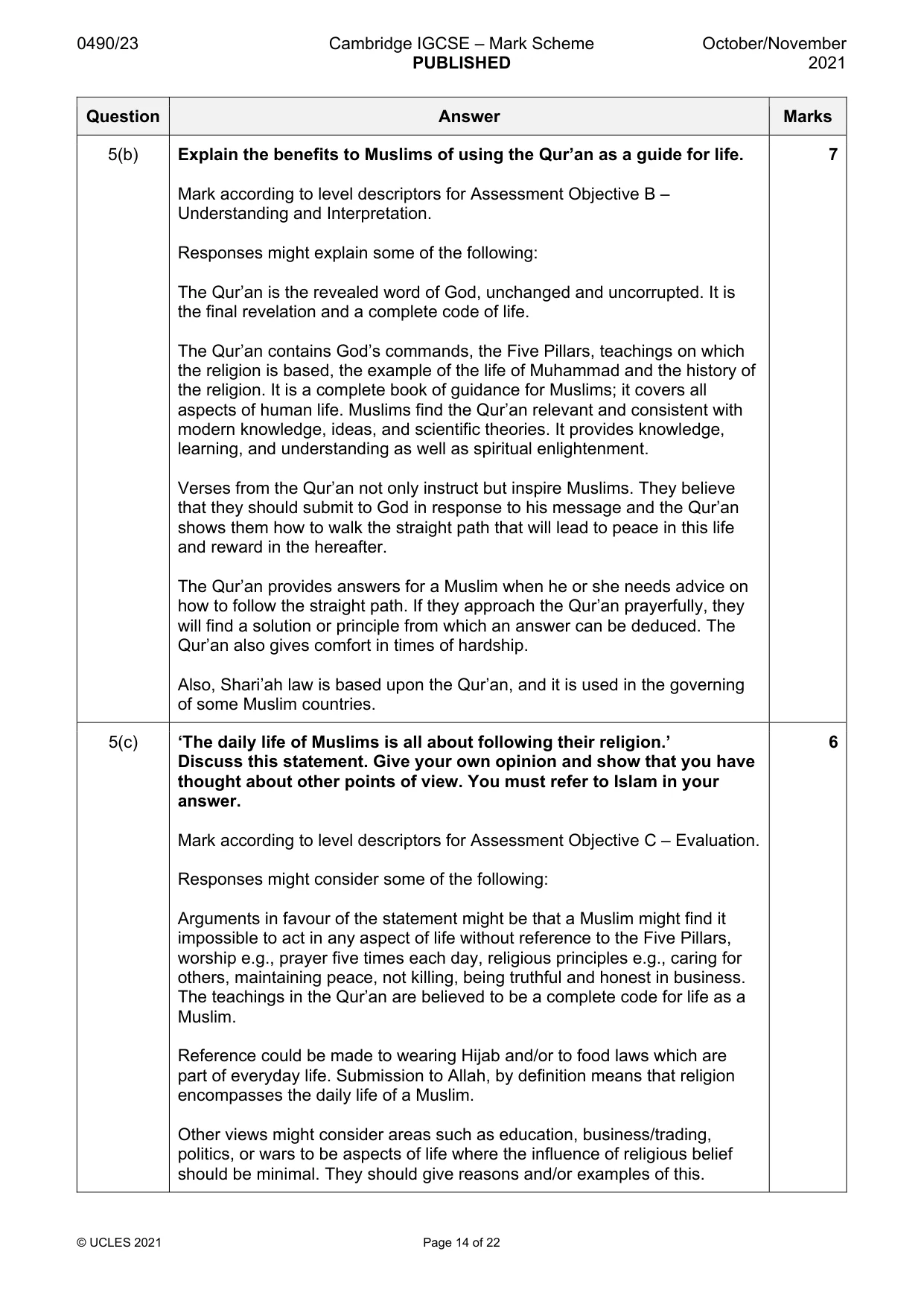
0490/23 Cambridge IGCSE – Mark Scheme PUBLISHED October/November 2021 © UCLES 2021 Page 14 of 22 Question Answer Marks 5(b) Explain the benefits to Muslims of using the Qur’an as a guide for life. Mark according to level descriptors for Assessment Objective B – Understanding and Interpretation. Responses might explain some of the following: The Qur’an is the revealed word of God, unchanged and uncorrupted. It is the final revelation and a complete code of life. The Qur’an contains God’s commands, the Five Pillars, teachings on which the religion is based, the example of the life of Muhammad and the history of the religion. It is a complete book of guidance for Muslims; it covers all aspects of human life. Muslims find the Qur’an relevant and consistent with modern knowledge, ideas, and scientific theories. It provides knowledge, learning, and understanding as well as spiritual enlightenment. Verses from the Qur’an not only instruct but inspire Muslims. They believe that they should submit to God in response to his message and the Qur’an shows them how to walk the straight path that will lead to peace in this life and reward in the hereafter. The Qur’an provides answers for a Muslim when he or she needs advice on how to follow the straight path. If they approach the Qur’an prayerfully, they will find a solution or principle from which an answer can be deduced. The Qur’an also gives comfort in times of hardship. Also, Shari’ah law is based upon the Qur’an, and it is used in the governing of some Muslim countries. 7 5(c) ‘The daily life of Muslims is all about following their religion.’ Discuss this statement. Give your own opinion and show that you have thought about other points of view. You must refer to Islam in your answer. Mark according to level descriptors for Assessment Objective C – Evaluation. Responses might consider some of the following: Arguments in favour of the statement might be that a Muslim might find it impossible to act in any aspect of life without reference to the Five Pillars, worship e.g., prayer five times each day, religious principles e.g., caring for others, maintaining peace, not killing, being truthful and honest in business. The teachings in the Qur’an are believed to be a complete code for life as a Muslim. Reference could be made to wearing Hijab and/or to food laws which are part of everyday life. Submission to Allah, by definition means that religion encompasses the daily life of a Muslim. Other views might consider areas such as education, business/trading, politics, or wars to be aspects of life where the influence of religious belief should be minimal. They should give reasons and/or examples of this. 6
Mark scheme, page 15
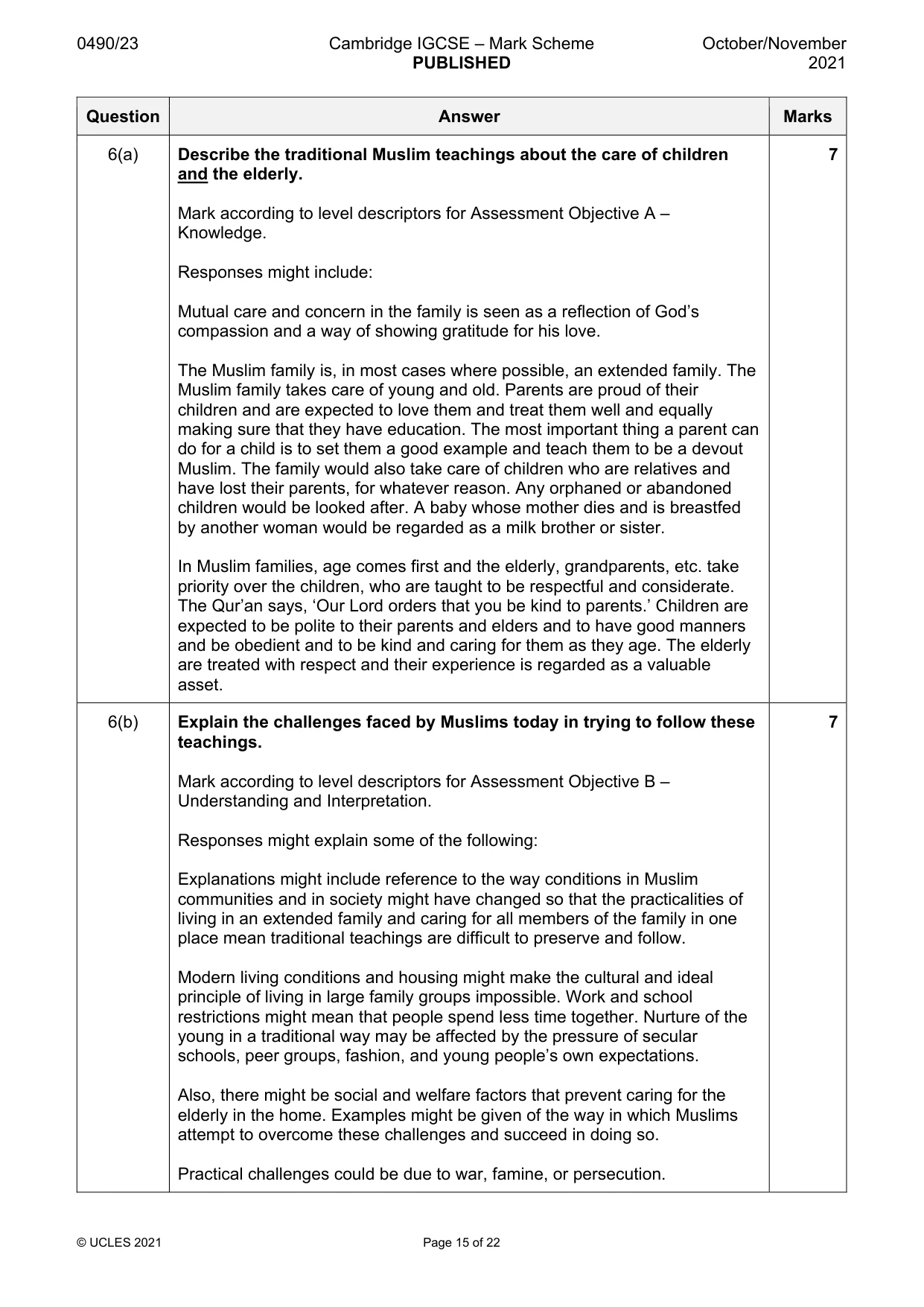
0490/23 Cambridge IGCSE – Mark Scheme PUBLISHED October/November 2021 © UCLES 2021 Page 15 of 22 Question Answer Marks 6(a) Describe the traditional Muslim teachings about the care of children and the elderly. Mark according to level descriptors for Assessment Objective A – Knowledge. Responses might include: Mutual care and concern in the family is seen as a reflection of God’s compassion and a way of showing gratitude for his love. The Muslim family is, in most cases where possible, an extended family. The Muslim family takes care of young and old. Parents are proud of their children and are expected to love them and treat them well and equally making sure that they have education. The most important thing a parent can do for a child is to set them a good example and teach them to be a devout Muslim. The family would also take care of children who are relatives and have lost their parents, for whatever reason. Any orphaned or abandoned children would be looked after. A baby whose mother dies and is breastfed by another woman would be regarded as a milk brother or sister. In Muslim families, age comes first and the elderly, grandparents, etc. take priority over the children, who are taught to be respectful and considerate. The Qur’an says, ‘Our Lord orders that you be kind to parents.’ Children are expected to be polite to their parents and elders and to have good manners and be obedient and to be kind and caring for them as they age. The elderly are treated with respect and their experience is regarded as a valuable asset. 7 6(b) Explain the challenges faced by Muslims today in trying to follow these teachings. Mark according to level descriptors for Assessment Objective B – Understanding and Interpretation. Responses might explain some of the following: Explanations might include reference to the way conditions in Muslim communities and in society might have changed so that the practicalities of living in an extended family and caring for all members of the family in one place mean traditional teachings are difficult to preserve and follow. Modern living conditions and housing might make the cultural and ideal principle of living in large family groups impossible. Work and school restrictions might mean that people spend less time together. Nurture of the young in a traditional way may be affected by the pressure of secular schools, peer groups, fashion, and young people’s own expectations. Also, there might be social and welfare factors that prevent caring for the elderly in the home. Examples might be given of the way in which Muslims attempt to overcome these challenges and succeed in doing so. Practical challenges could be due to war, famine, or persecution. 7
Mark scheme, page 16
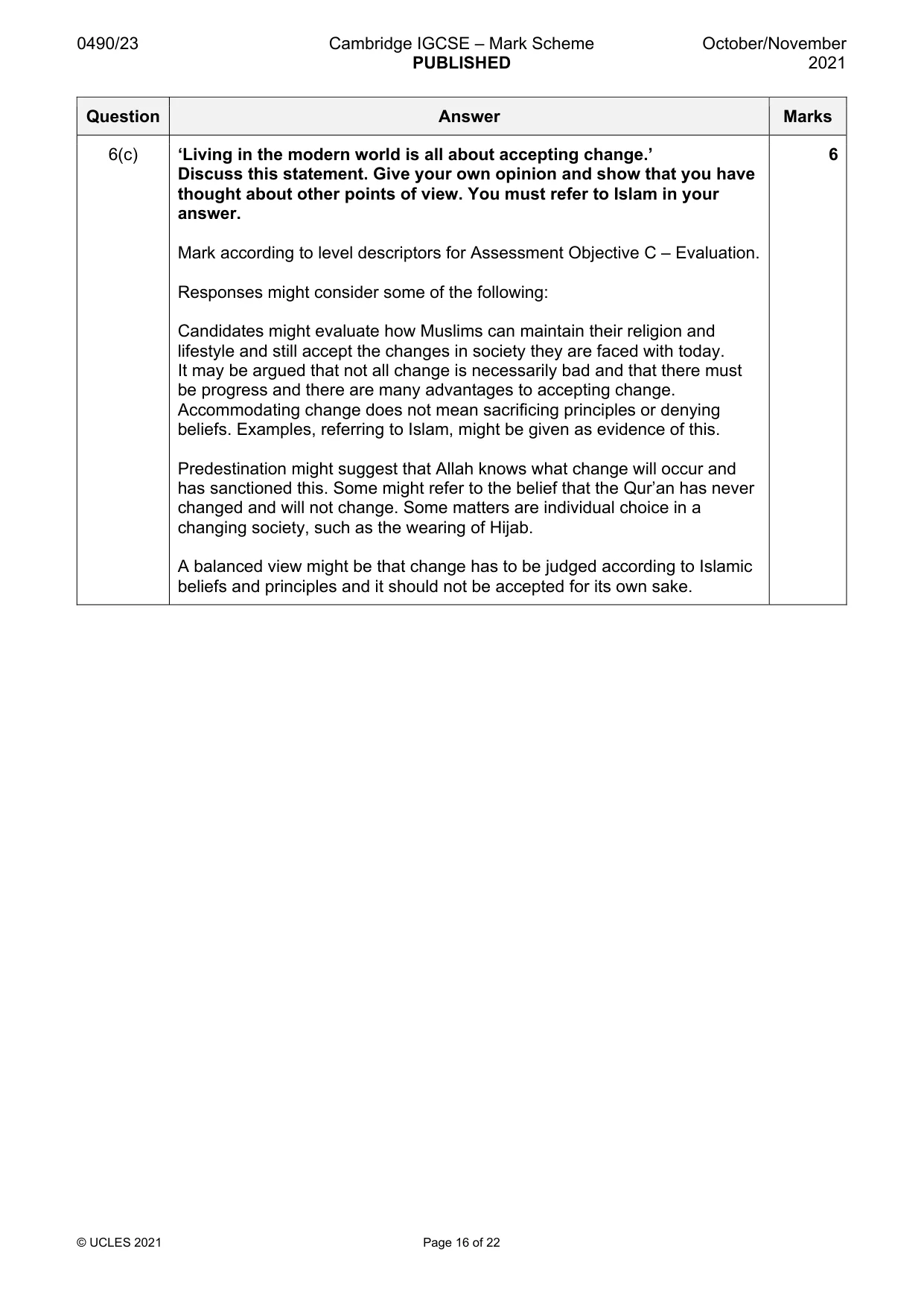
0490/23 Cambridge IGCSE – Mark Scheme PUBLISHED October/November 2021 © UCLES 2021 Page 16 of 22 Question Answer Marks 6(c) ‘Living in the modern world is all about accepting change.’ Discuss this statement. Give your own opinion and show that you have thought about other points of view. You must refer to Islam in your answer. Mark according to level descriptors for Assessment Objective C – Evaluation. Responses might consider some of the following: Candidates might evaluate how Muslims can maintain their religion and lifestyle and still accept the changes in society they are faced with today. It may be argued that not all change is necessarily bad and that there must be progress and there are many advantages to accepting change. Accommodating change does not mean sacrificing principles or denying beliefs. Examples, referring to Islam, might be given as evidence of this. Predestination might suggest that Allah knows what change will occur and has sanctioned this. Some might refer to the belief that the Qur’an has never changed and will not change. Some matters are individual choice in a changing society, such as the wearing of Hijab. A balanced view might be that change has to be judged according to Islamic beliefs and principles and it should not be accepted for its own sake. 6
Mark scheme, page 17
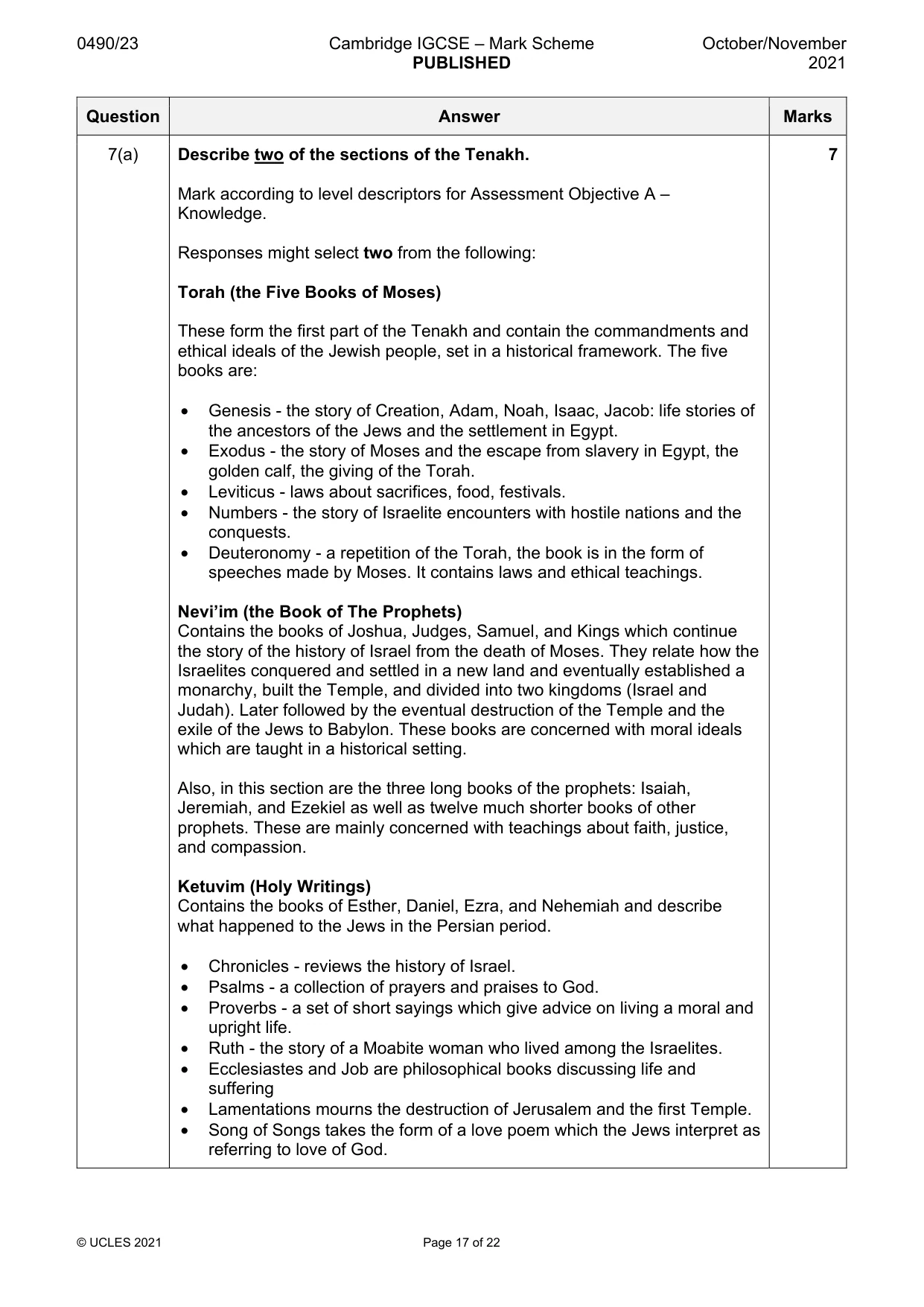
0490/23 Cambridge IGCSE – Mark Scheme PUBLISHED October/November 2021 © UCLES 2021 Page 17 of 22 Question Answer Marks 7(a) Describe two of the sections of the Tenakh. Mark according to level descriptors for Assessment Objective A – Knowledge. Responses might select two from the following: Torah (the Five Books of Moses) These form the first part of the Tenakh and contain the commandments and ethical ideals of the Jewish people, set in a historical framework. The five books are: • Genesis - the story of Creation, Adam, Noah, Isaac, Jacob: life stories of the ancestors of the Jews and the settlement in Egypt. • Exodus - the story of Moses and the escape from slavery in Egypt, the golden calf, the giving of the Torah. • Leviticus - laws about sacrifices, food, festivals. • Numbers - the story of Israelite encounters with hostile nations and the conquests. • Deuteronomy - a repetition of the Torah, the book is in the form of speeches made by Moses. It contains laws and ethical teachings. Nevi’im (the Book of The Prophets) Contains the books of Joshua, Judges, Samuel, and Kings which continue the story of the history of Israel from the death of Moses. They relate how the Israelites conquered and settled in a new land and eventually established a monarchy, built the Temple, and divided into two kingdoms (Israel and Judah). Later followed by the eventual destruction of the Temple and the exile of the Jews to Babylon. These books are concerned with moral ideals which are taught in a historical setting. Also, in this section are the three long books of the prophets: Isaiah, Jeremiah, and Ezekiel as well as twelve much shorter books of other prophets. These are mainly concerned with teachings about faith, justice, and compassion. Ketuvim (Holy Writings) Contains the books of Esther, Daniel, Ezra, and Nehemiah and describe what happened to the Jews in the Persian period. • Chronicles - reviews the history of Israel. • Psalms - a collection of prayers and praises to God. • Proverbs - a set of short sayings which give advice on living a moral and upright life. • Ruth - the story of a Moabite woman who lived among the Israelites. • Ecclesiastes and Job are philosophical books discussing life and suffering • Lamentations mourns the destruction of Jerusalem and the first Temple. • Song of Songs takes the form of a love poem which the Jews interpret as referring to love of God. 7
Mark scheme, page 18
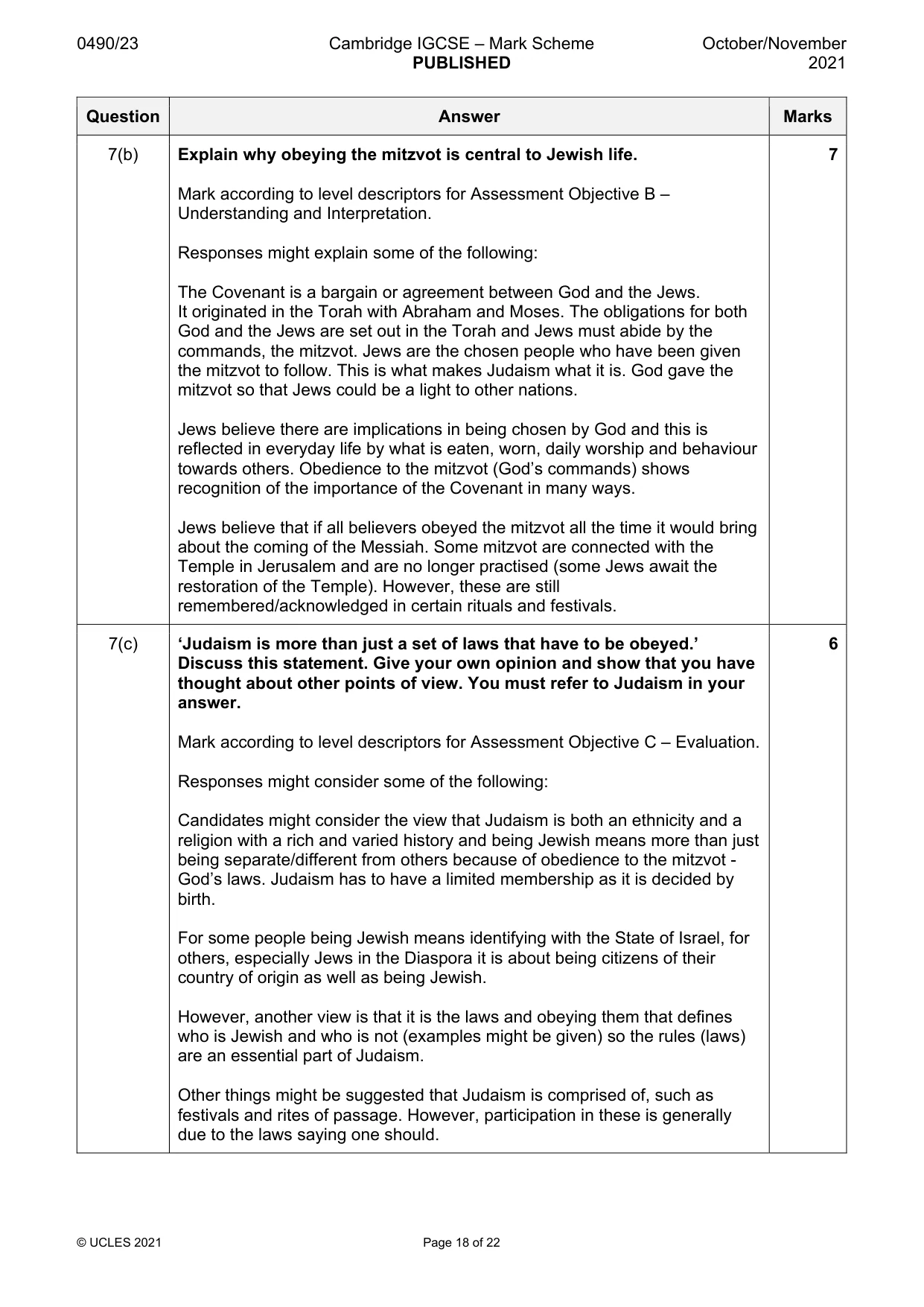
0490/23 Cambridge IGCSE – Mark Scheme PUBLISHED October/November 2021 © UCLES 2021 Page 18 of 22 Question Answer Marks 7(b) Explain why obeying the mitzvot is central to Jewish life. Mark according to level descriptors for Assessment Objective B – Understanding and Interpretation. Responses might explain some of the following: The Covenant is a bargain or agreement between God and the Jews. It originated in the Torah with Abraham and Moses. The obligations for both God and the Jews are set out in the Torah and Jews must abide by the commands, the mitzvot. Jews are the chosen people who have been given the mitzvot to follow. This is what makes Judaism what it is. God gave the mitzvot so that Jews could be a light to other nations. Jews believe there are implications in being chosen by God and this is reflected in everyday life by what is eaten, worn, daily worship and behaviour towards others. Obedience to the mitzvot (God’s commands) shows recognition of the importance of the Covenant in many ways. Jews believe that if all believers obeyed the mitzvot all the time it would bring about the coming of the Messiah. Some mitzvot are connected with the Temple in Jerusalem and are no longer practised (some Jews await the restoration of the Temple). However, these are still remembered/acknowledged in certain rituals and festivals. 7 7(c) ‘Judaism is more than just a set of laws that have to be obeyed.’ Discuss this statement. Give your own opinion and show that you have thought about other points of view. You must refer to Judaism in your answer. Mark according to level descriptors for Assessment Objective C – Evaluation. Responses might consider some of the following: Candidates might consider the view that Judaism is both an ethnicity and a religion with a rich and varied history and being Jewish means more than just being separate/different from others because of obedience to the mitzvot - God’s laws. Judaism has to have a limited membership as it is decided by birth. For some people being Jewish means identifying with the State of Israel, for others, especially Jews in the Diaspora it is about being citizens of their country of origin as well as being Jewish. However, another view is that it is the laws and obeying them that defines who is Jewish and who is not (examples might be given) so the rules (laws) are an essential part of Judaism. Other things might be suggested that Judaism is comprised of, such as festivals and rites of passage. However, participation in these is generally due to the laws saying one should. 6
Mark scheme, page 19
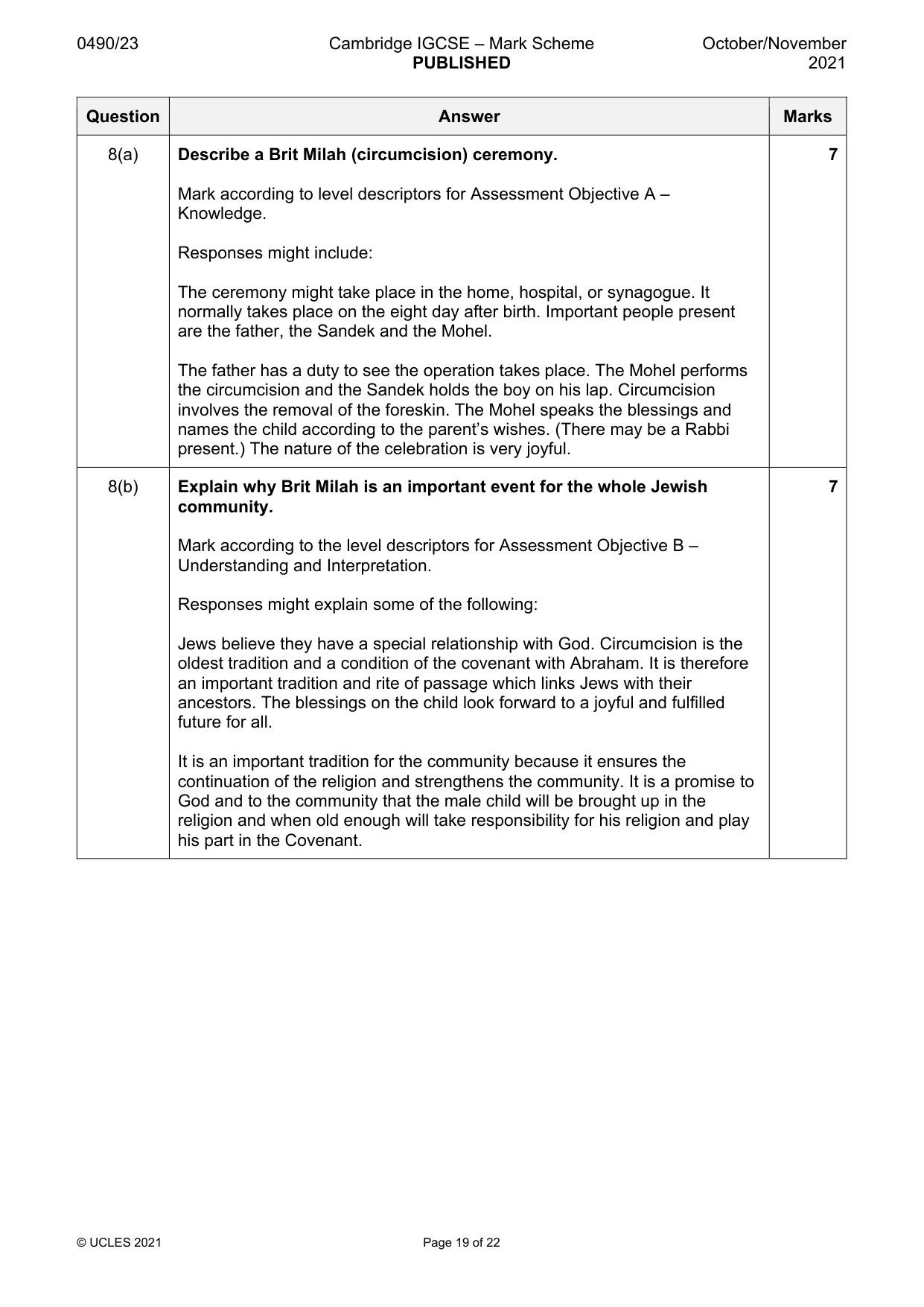
0490/23 Cambridge IGCSE – Mark Scheme PUBLISHED October/November 2021 © UCLES 2021 Page 19 of 22 Question Answer Marks 8(a) Describe a Brit Milah (circumcision) ceremony. Mark according to level descriptors for Assessment Objective A – Knowledge. Responses might include: The ceremony might take place in the home, hospital, or synagogue. It normally takes place on the eight day after birth. Important people present are the father, the Sandek and the Mohel. The father has a duty to see the operation takes place. The Mohel performs the circumcision and the Sandek holds the boy on his lap. Circumcision involves the removal of the foreskin. The Mohel speaks the blessings and names the child according to the parent’s wishes. (There may be a Rabbi present.) The nature of the celebration is very joyful. 7 8(b) Explain why Brit Milah is an important event for the whole Jewish community. Mark according to the level descriptors for Assessment Objective B – Understanding and Interpretation. Responses might explain some of the following: Jews believe they have a special relationship with God. Circumcision is the oldest tradition and a condition of the covenant with Abraham. It is therefore an important tradition and rite of passage which links Jews with their ancestors. The blessings on the child look forward to a joyful and fulfilled future for all. It is an important tradition for the community because it ensures the continuation of the religion and strengthens the community. It is a promise to God and to the community that the male child will be brought up in the religion and when old enough will take responsibility for his religion and play his part in the Covenant. 7
Mark scheme, page 20
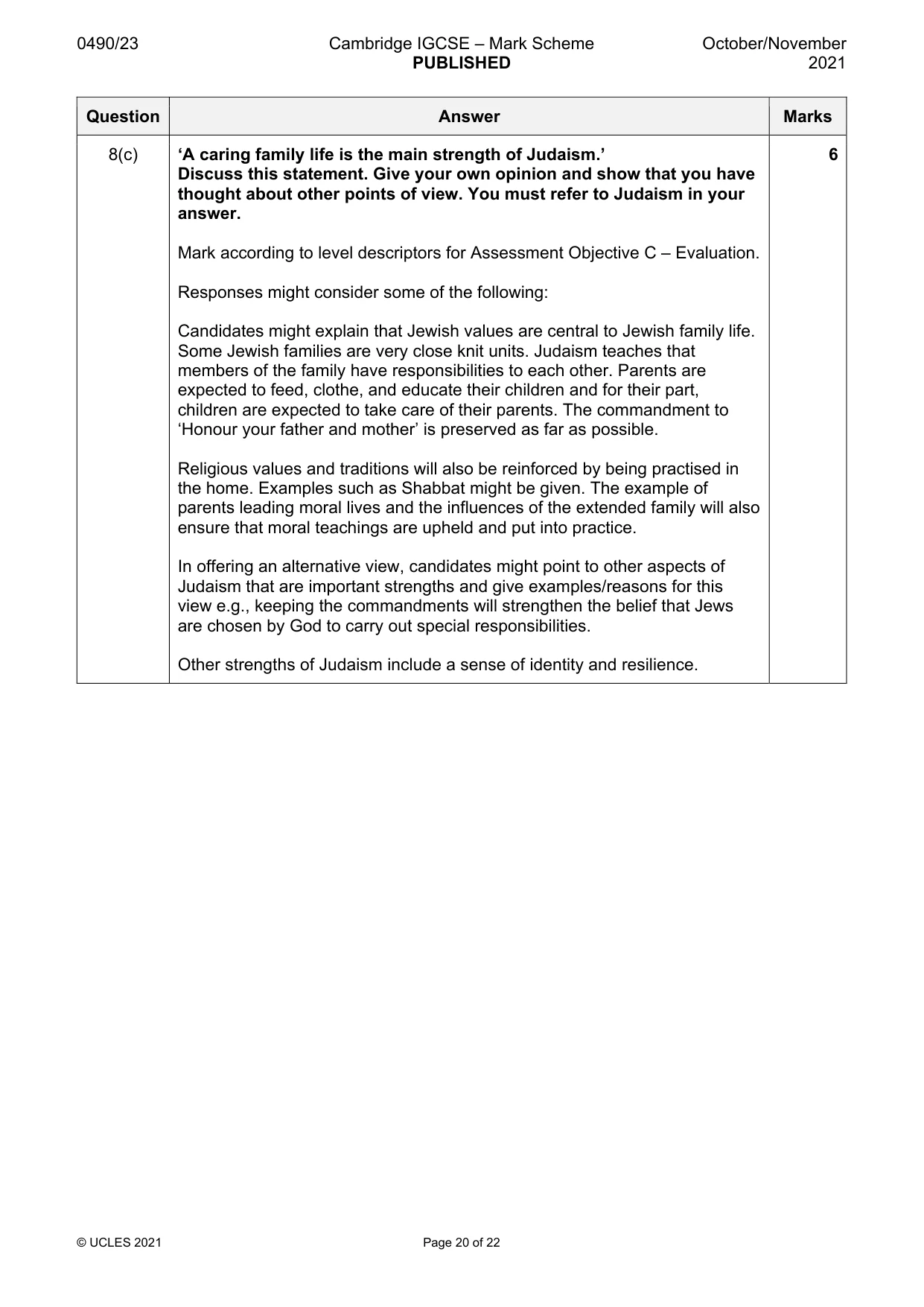
0490/23 Cambridge IGCSE – Mark Scheme PUBLISHED October/November 2021 © UCLES 2021 Page 20 of 22 Question Answer Marks 8(c) ‘A caring family life is the main strength of Judaism.’ Discuss this statement. Give your own opinion and show that you have thought about other points of view. You must refer to Judaism in your answer. Mark according to level descriptors for Assessment Objective C – Evaluation. Responses might consider some of the following: Candidates might explain that Jewish values are central to Jewish family life. Some Jewish families are very close knit units. Judaism teaches that members of the family have responsibilities to each other. Parents are expected to feed, clothe, and educate their children and for their part, children are expected to take care of their parents. The commandment to ‘Honour your father and mother’ is preserved as far as possible. Religious values and traditions will also be reinforced by being practised in the home. Examples such as Shabbat might be given. The example of parents leading moral lives and the influences of the extended family will also ensure that moral teachings are upheld and put into practice. In offering an alternative view, candidates might point to other aspects of Judaism that are important strengths and give examples/reasons for this view e.g., keeping the commandments will strengthen the belief that Jews are chosen by God to carry out special responsibilities. Other strengths of Judaism include a sense of identity and resilience. 6
Mark scheme, page 21
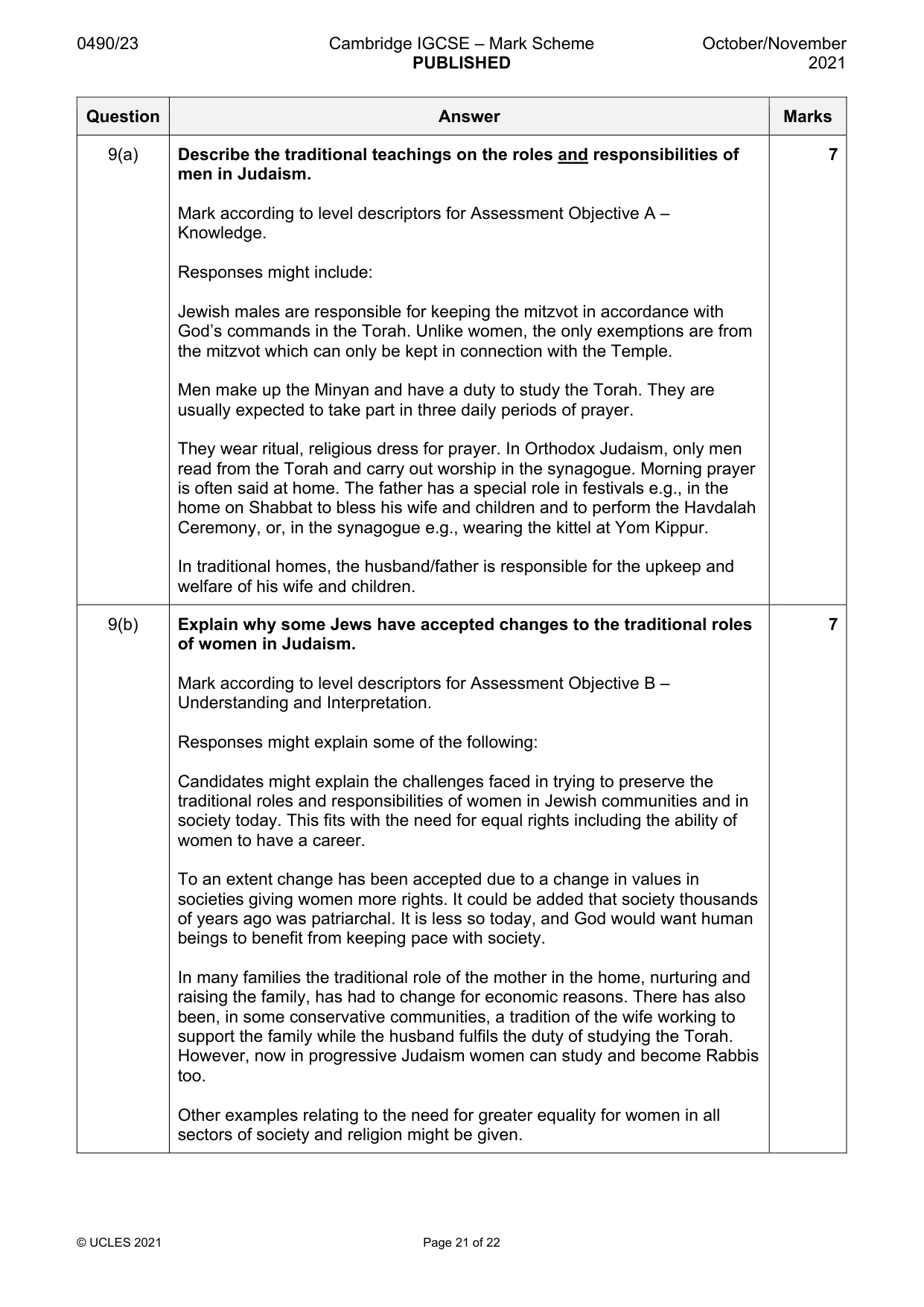
0490/23 Cambridge IGCSE – Mark Scheme PUBLISHED October/November 2021 © UCLES 2021 Page 21 of 22 Question Answer Marks 9(a) Describe the traditional teachings on the roles and responsibilities of men in Judaism. Mark according to level descriptors for Assessment Objective A – Knowledge. Responses might include: Jewish males are responsible for keeping the mitzvot in accordance with God’s commands in the Torah. Unlike women, the only exemptions are from the mitzvot which can only be kept in connection with the Temple. Men make up the Minyan and have a duty to study the Torah. They are usually expected to take part in three daily periods of prayer. They wear ritual, religious dress for prayer. In Orthodox Judaism, only men read from the Torah and carry out worship in the synagogue. Morning prayer is often said at home. The father has a special role in festivals e.g., in the home on Shabbat to bless his wife and children and to perform the Havdalah Ceremony, or, in the synagogue e.g., wearing the kittel at Yom Kippur. In traditional homes, the husband/father is responsible for the upkeep and welfare of his wife and children. 7 9(b) Explain why some Jews have accepted changes to the traditional roles of women in Judaism. Mark according to level descriptors for Assessment Objective B – Understanding and Interpretation. Responses might explain some of the following: Candidates might explain the challenges faced in trying to preserve the traditional roles and responsibilities of women in Jewish communities and in society today. This fits with the need for equal rights including the ability of women to have a career. To an extent change has been accepted due to a change in values in societies giving women more rights. It could be added that society thousands of years ago was patriarchal. It is less so today, and God would want human beings to benefit from keeping pace with society. In many families the traditional role of the mother in the home, nurturing and raising the family, has had to change for economic reasons. There has also been, in some conservative communities, a tradition of the wife working to support the family while the husband fulfils the duty of studying the Torah. However, now in progressive Judaism women can study and become Rabbis too. Other examples relating to the need for greater equality for women in all sectors of society and religion might be given. 7
Mark scheme, page 22
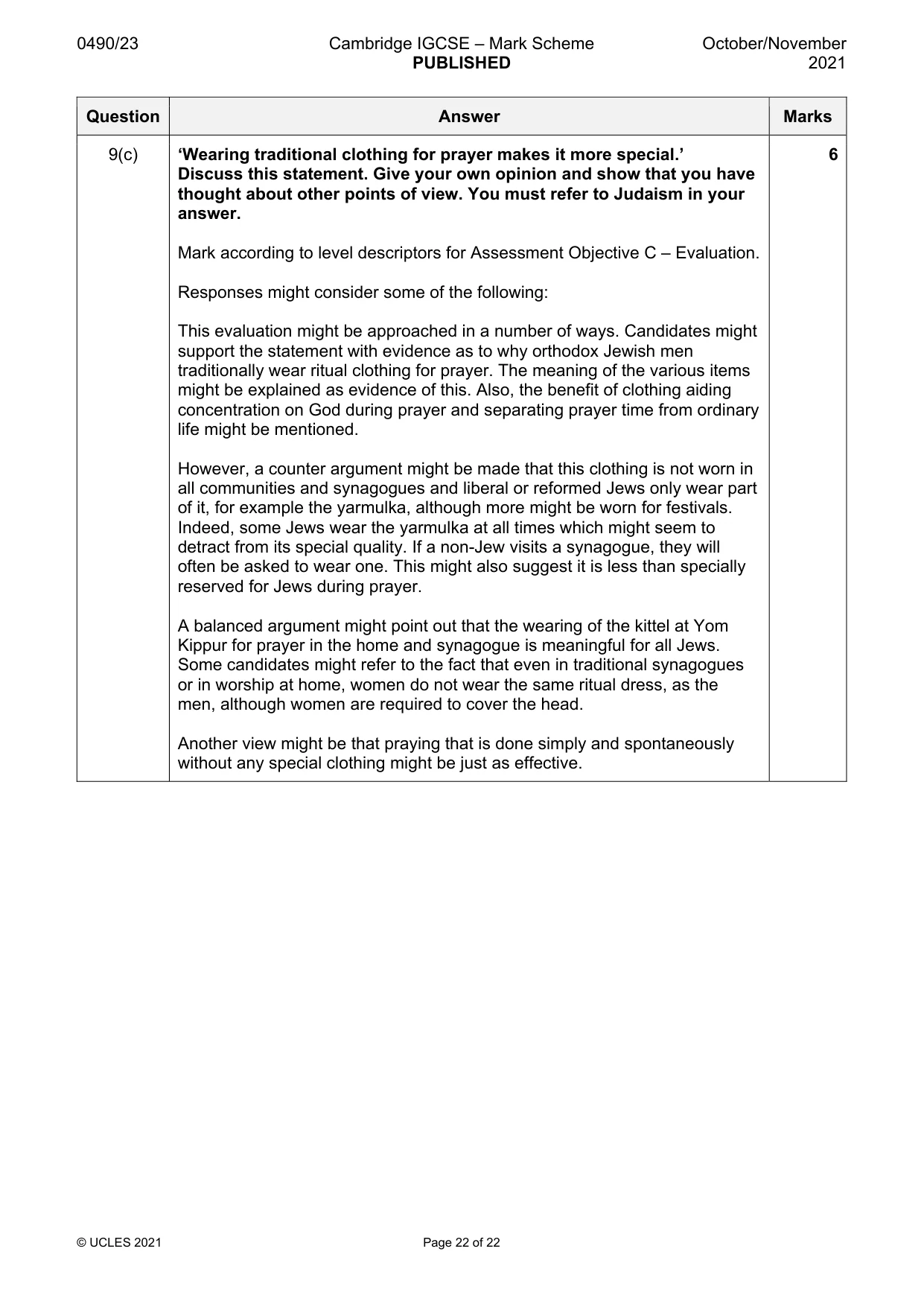
0490/23 Cambridge IGCSE – Mark Scheme PUBLISHED October/November 2021 © UCLES 2021 Page 22 of 22 Question Answer Marks 9(c) ‘Wearing traditional clothing for prayer makes it more special.’ Discuss this statement. Give your own opinion and show that you have thought about other points of view. You must refer to Judaism in your answer. Mark according to level descriptors for Assessment Objective C – Evaluation. Responses might consider some of the following: This evaluation might be approached in a number of ways. Candidates might support the statement with evidence as to why orthodox Jewish men traditionally wear ritual clothing for prayer. The meaning of the various items might be explained as evidence of this. Also, the benefit of clothing aiding concentration on God during prayer and separating prayer time from ordinary life might be mentioned. However, a counter argument might be made that this clothing is not worn in all communities and synagogues and liberal or reformed Jews only wear part of it, for example the yarmulka, although more might be worn for festivals. Indeed, some Jews wear the yarmulka at all times which might seem to detract from its special quality. If a non-Jew visits a synagogue, they will often be asked to wear one. This might also suggest it is less than specially reserved for Jews during prayer. A balanced argument might point out that the wearing of the kittel at Yom Kippur for prayer in the home and synagogue is meaningful for all Jews. Some candidates might refer to the fact that even in traditional synagogues or in worship at home, women do not wear the same ritual dress, as the men, although women are required to cover the head. Another view might be that praying that is done simply and spontaneously without any special clothing might be just as effective. 6
What you needed in this session
Cambridge’s own grade thresholds for 2021 Oct/Nov, Paper 2 · Variant 3. A higher threshold means an easier paper — the bar moves with how the cohort did.