Cambridge IGCSE Religious Studies 0490 — 2020 Oct/Nov Paper 2 · Variant 3
0490/23/O/N/20 · 80 marks · ≈90 min
The question paper and its mark scheme, free to read here and free to download. This is Cambridge’s own paper, exactly as it was sat.
Question paper4 pages
Mark scheme25 pages
Answers below. Sit the paper first if you are practising.
Paper as text
Question paper, page 1
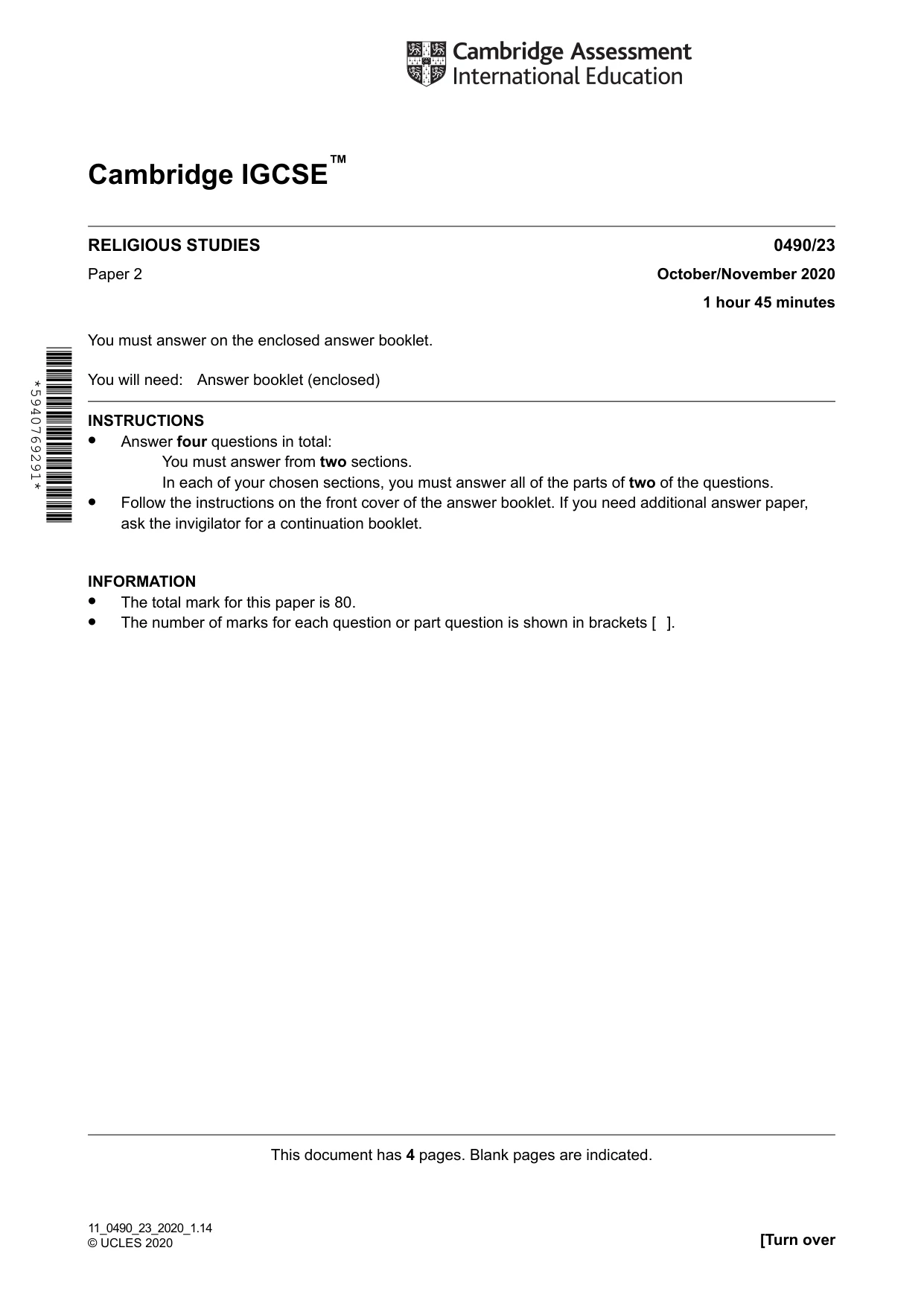
Cambridge IGCSE™ 0490/23 October/November 2020 1 hour 45 minutes RELIGIOUS STUDIES Paper 2 You must answer on the enclosed answer booklet. You will need: Answer booklet (enclosed) INSTRUCTIONS • Answer four questions in total: You must answer from two sections. In each of your chosen sections, you must answer all of the parts of two of the questions. • Follow the instructions on the front cover of the answer booklet. If you need additional answer paper, ask the invigilator for a continuation booklet. INFORMATION • The total mark for this paper is 80. • The number of marks for each question or part question is shown in brackets [ ]. This document has 4 pages. Blank pages are indicated. [Turn over 11_0490_23_2020_1.14 © UCLES 2020 *5940769291*
Question paper, page 2
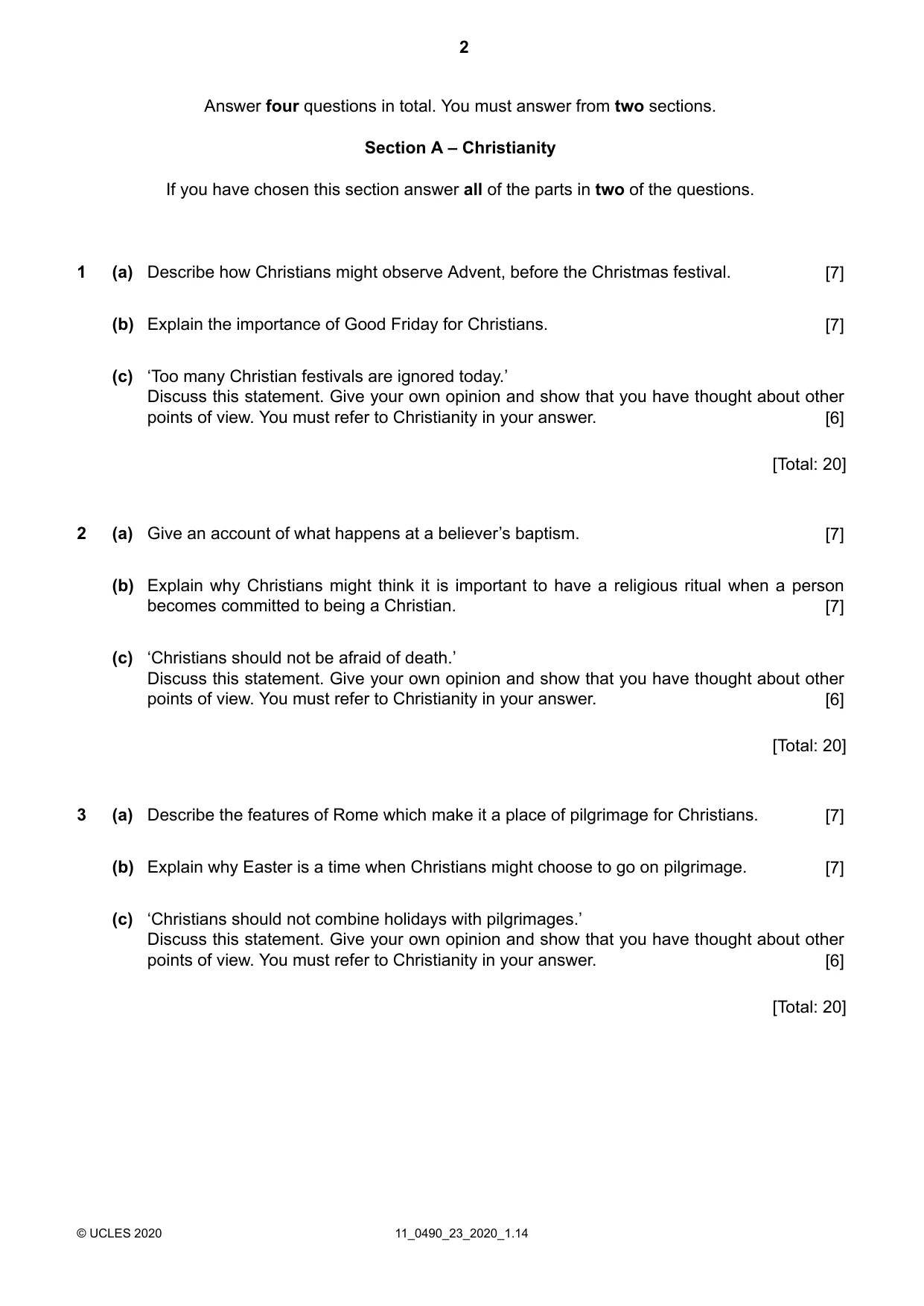
Answer four questions in total. You must answer from two sections. Section A – Christianity If you have chosen this section answer all of the parts in two of the questions. Describe how Christians might observe Advent, before the Christmas festival. [7] (a) 1 Explain the importance of Good Friday for Christians. [7] (b) ‘Too many Christian festivals are ignored today.’ Discuss this statement. Give your own opinion and show that you have thought about other points of view. You must refer to Christianity in your answer. [6] (c) [Total: 20] Give an account of what happens at a believer’s baptism. [7] (a) 2 Explain why Christians might think it is important to have a religious ritual when a person becomes committed to being a Christian. [7] (b) ‘Christians should not be afraid of death.’ Discuss this statement. Give your own opinion and show that you have thought about other points of view. You must refer to Christianity in your answer. [6] (c) [Total: 20] Describe the features of Rome which make it a place of pilgrimage for Christians. [7] (a) 3 Explain why Easter is a time when Christians might choose to go on pilgrimage. [7] (b) ‘Christians should not combine holidays with pilgrimages.’ Discuss this statement. Give your own opinion and show that you have thought about other points of view. You must refer to Christianity in your answer. [6] (c) [Total: 20] 11_0490_23_2020_1.14 © UCLES 2020 2
Question paper, page 3
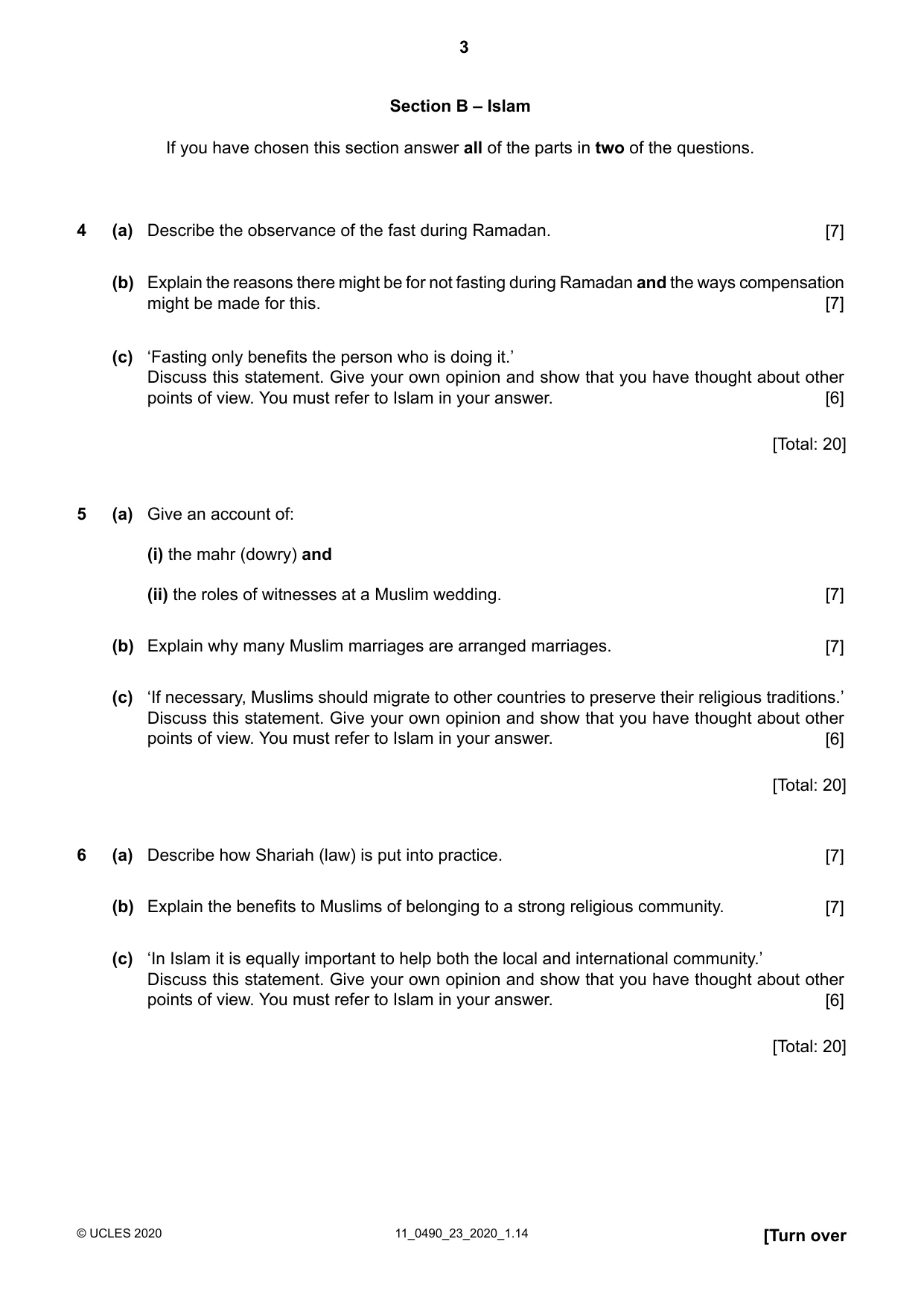
Section B – Islam If you have chosen this section answer all of the parts in two of the questions. Describe the observance of the fast during Ramadan. [7] (a) 4 Explain the reasons there might be for not fasting during Ramadan and the ways compensation might be made for this. [7] (b) ‘Fasting only benefits the person who is doing it.’ Discuss this statement. Give your own opinion and show that you have thought about other points of view. You must refer to Islam in your answer. [6] (c) [Total: 20] Give an account of: (i) the mahr (dowry) and (ii) the roles of witnesses at a Muslim wedding. [7] (a) 5 Explain why many Muslim marriages are arranged marriages. [7] (b) ‘If necessary, Muslims should migrate to other countries to preserve their religious traditions.’ Discuss this statement. Give your own opinion and show that you have thought about other points of view. You must refer to Islam in your answer. [6] (c) [Total: 20] Describe how Shariah (law) is put into practice. [7] (a) 6 Explain the benefits to Muslims of belonging to a strong religious community. [7] (b) ‘In Islam it is equally important to help both the local and international community.’ Discuss this statement. Give your own opinion and show that you have thought about other points of view. You must refer to Islam in your answer. [6] (c) [Total: 20] [Turn over 11_0490_23_2020_1.14 © UCLES 2020 3
Question paper, page 4
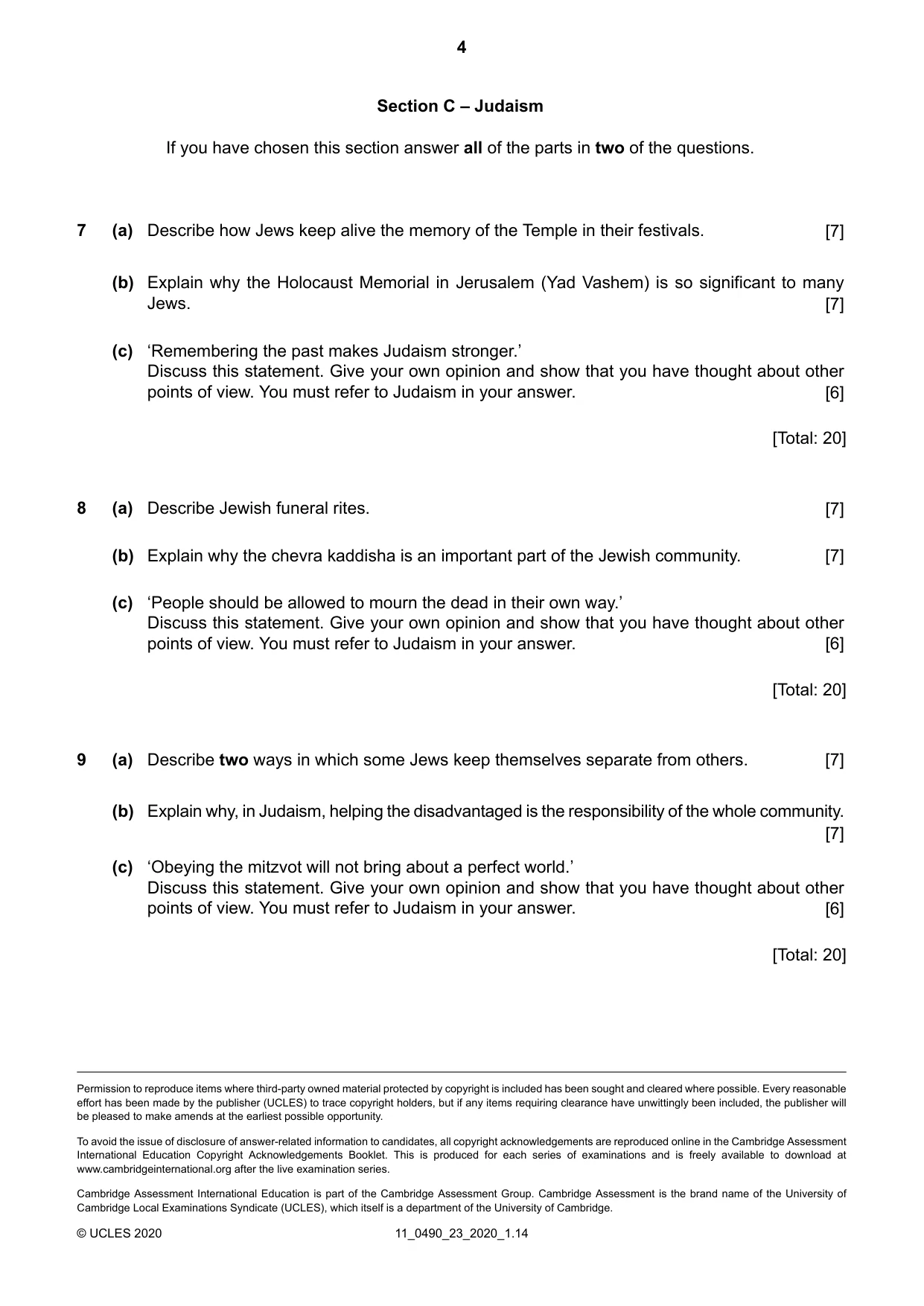
Section C – Judaism If you have chosen this section answer all of the parts in two of the questions. Describe how Jews keep alive the memory of the Temple in their festivals. [7] (a) 7 Explain why the Holocaust Memorial in Jerusalem (Yad Vashem) is so significant to many Jews. [7] (b) ‘Remembering the past makes Judaism stronger.’ Discuss this statement. Give your own opinion and show that you have thought about other points of view. You must refer to Judaism in your answer. [6] (c) [Total: 20] Describe Jewish funeral rites. [7] (a) 8 Explain why the chevra kaddisha is an important part of the Jewish community. [7] (b) ‘People should be allowed to mourn the dead in their own way.’ Discuss this statement. Give your own opinion and show that you have thought about other points of view. You must refer to Judaism in your answer. [6] (c) [Total: 20] Describe two ways in which some Jews keep themselves separate from others. [7] (a) 9 Explain why, in Judaism, helping the disadvantaged is the responsibility of the whole community. [7] (b) ‘Obeying the mitzvot will not bring about a perfect world.’ Discuss this statement. Give your own opinion and show that you have thought about other points of view. You must refer to Judaism in your answer. [6] (c) [Total: 20] Permission to reproduce items where third-party owned material protected by copyright is included has been sought and cleared where possible. Every reasonable effort has been made by the publisher (UCLES) to trace copyright holders, but if any items requiring clearance have unwittingly been included, the publisher will be pleased to make amends at the earliest possible opportunity. To avoid the issue of disclosure of answer-related information to candidates, all copyright acknowledgements are reproduced online in the Cambridge Assessment International Education Copyright Acknowledgements Booklet. This is produced for each series of examinations and is freely available to download at www.cambridgeinternational.org after the live examination series. Cambridge Assessment International Education is part of the Cambridge Assessment Group. Cambridge Assessment is the brand name of the University of Cambridge Local Examinations Syndicate (UCLES), which itself is a department of the University of Cambridge. 11_0490_23_2020_1.14 © UCLES 2020 4
Mark scheme, page 1
This document consists of 25 printed pages. © UCLES 2020 [Turn over Cambridge IGCSE™ RELIGIOUS STUDIES 0490/23 Paper 2 October/November 2020 MARK SCHEME Maximum Mark: 80 Published This mark scheme is published as an aid to teachers and candidates, to indicate the requirements of the examination. It shows the basis on which Examiners were instructed to award marks. It does not indicate the details of the discussions that took place at an Examiners’ meeting before marking began, which would have considered the acceptability of alternative answers. Mark schemes should be read in conjunction with the question paper and the Principal Examiner Report for Teachers. Cambridge International will not enter into discussions about these mark schemes. Cambridge International is publishing the mark schemes for the October/November 2020 series for most Cambridge IGCSE™, Cambridge International A and AS Level and Cambridge Pre-U components, and some Cambridge O Level components.
Mark scheme, page 2
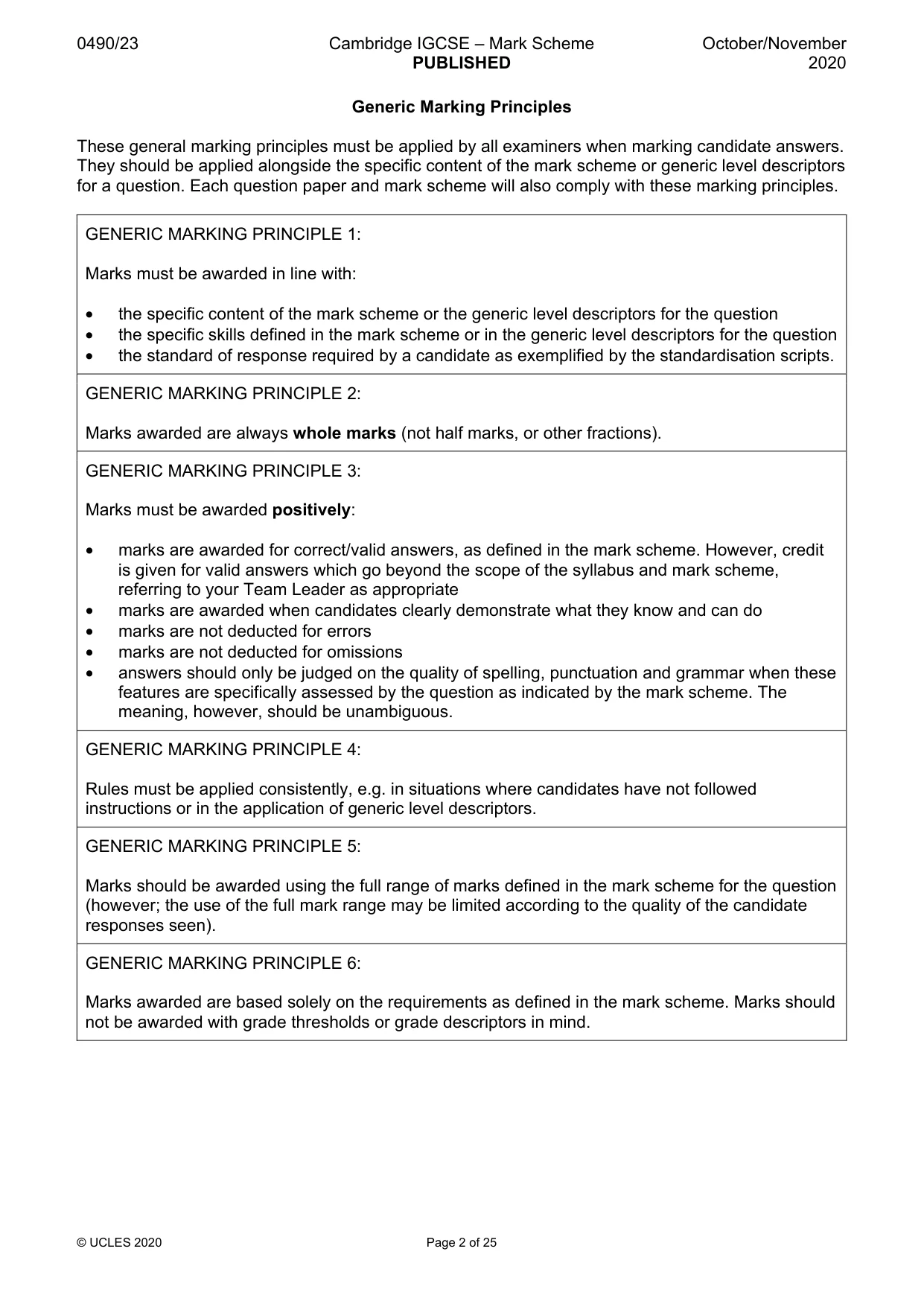
0490/23 Cambridge IGCSE – Mark Scheme PUBLISHED October/November 2020 © UCLES 2020 Page 2 of 25 Generic Marking Principles These general marking principles must be applied by all examiners when marking candidate answers. They should be applied alongside the specific content of the mark scheme or generic level descriptors for a question. Each question paper and mark scheme will also comply with these marking principles. GENERIC MARKING PRINCIPLE 1: Marks must be awarded in line with: • the specific content of the mark scheme or the generic level descriptors for the question • the specific skills defined in the mark scheme or in the generic level descriptors for the question • the standard of response required by a candidate as exemplified by the standardisation scripts. GENERIC MARKING PRINCIPLE 2: Marks awarded are always whole marks (not half marks, or other fractions). GENERIC MARKING PRINCIPLE 3: Marks must be awarded positively: • marks are awarded for correct/valid answers, as defined in the mark scheme. However, credit is given for valid answers which go beyond the scope of the syllabus and mark scheme, referring to your Team Leader as appropriate • marks are awarded when candidates clearly demonstrate what they know and can do • marks are not deducted for errors • marks are not deducted for omissions • answers should only be judged on the quality of spelling, punctuation and grammar when these features are specifically assessed by the question as indicated by the mark scheme. The meaning, however, should be unambiguous. GENERIC MARKING PRINCIPLE 4: Rules must be applied consistently, e.g. in situations where candidates have not followed instructions or in the application of generic level descriptors. GENERIC MARKING PRINCIPLE 5: Marks should be awarded using the full range of marks defined in the mark scheme for the question (however; the use of the full mark range may be limited according to the quality of the candidate responses seen). GENERIC MARKING PRINCIPLE 6: Marks awarded are based solely on the requirements as defined in the mark scheme. Marks should not be awarded with grade thresholds or grade descriptors in mind.
Mark scheme, page 3
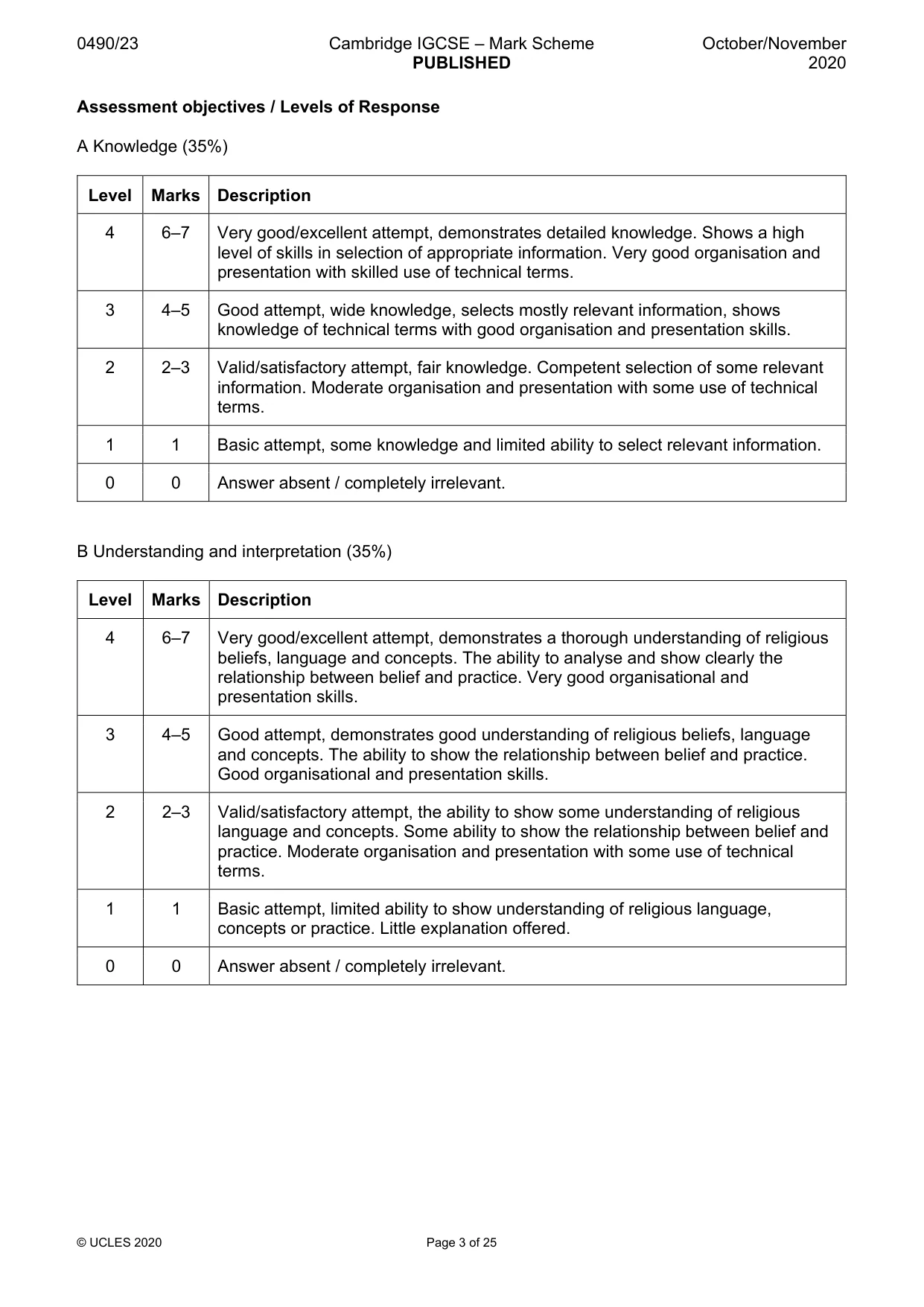
0490/23 Cambridge IGCSE – Mark Scheme PUBLISHED October/November 2020 © UCLES 2020 Page 3 of 25 Assessment objectives / Levels of Response A Knowledge (35%) Level Marks Description 4 6–7 Very good/excellent attempt, demonstrates detailed knowledge. Shows a high level of skills in selection of appropriate information. Very good organisation and presentation with skilled use of technical terms. 3 4–5 Good attempt, wide knowledge, selects mostly relevant information, shows knowledge of technical terms with good organisation and presentation skills. 2 2–3 Valid/satisfactory attempt, fair knowledge. Competent selection of some relevant information. Moderate organisation and presentation with some use of technical terms. 1 1 Basic attempt, some knowledge and limited ability to select relevant information. 0 0 Answer absent / completely irrelevant. B Understanding and interpretation (35%) Level Marks Description 4 6–7 Very good/excellent attempt, demonstrates a thorough understanding of religious beliefs, language and concepts. The ability to analyse and show clearly the relationship between belief and practice. Very good organisational and presentation skills. 3 4–5 Good attempt, demonstrates good understanding of religious beliefs, language and concepts. The ability to show the relationship between belief and practice. Good organisational and presentation skills. 2 2–3 Valid/satisfactory attempt, the ability to show some understanding of religious language and concepts. Some ability to show the relationship between belief and practice. Moderate organisation and presentation with some use of technical terms. 1 1 Basic attempt, limited ability to show understanding of religious language, concepts or practice. Little explanation offered. 0 0 Answer absent / completely irrelevant.
Mark scheme, page 4
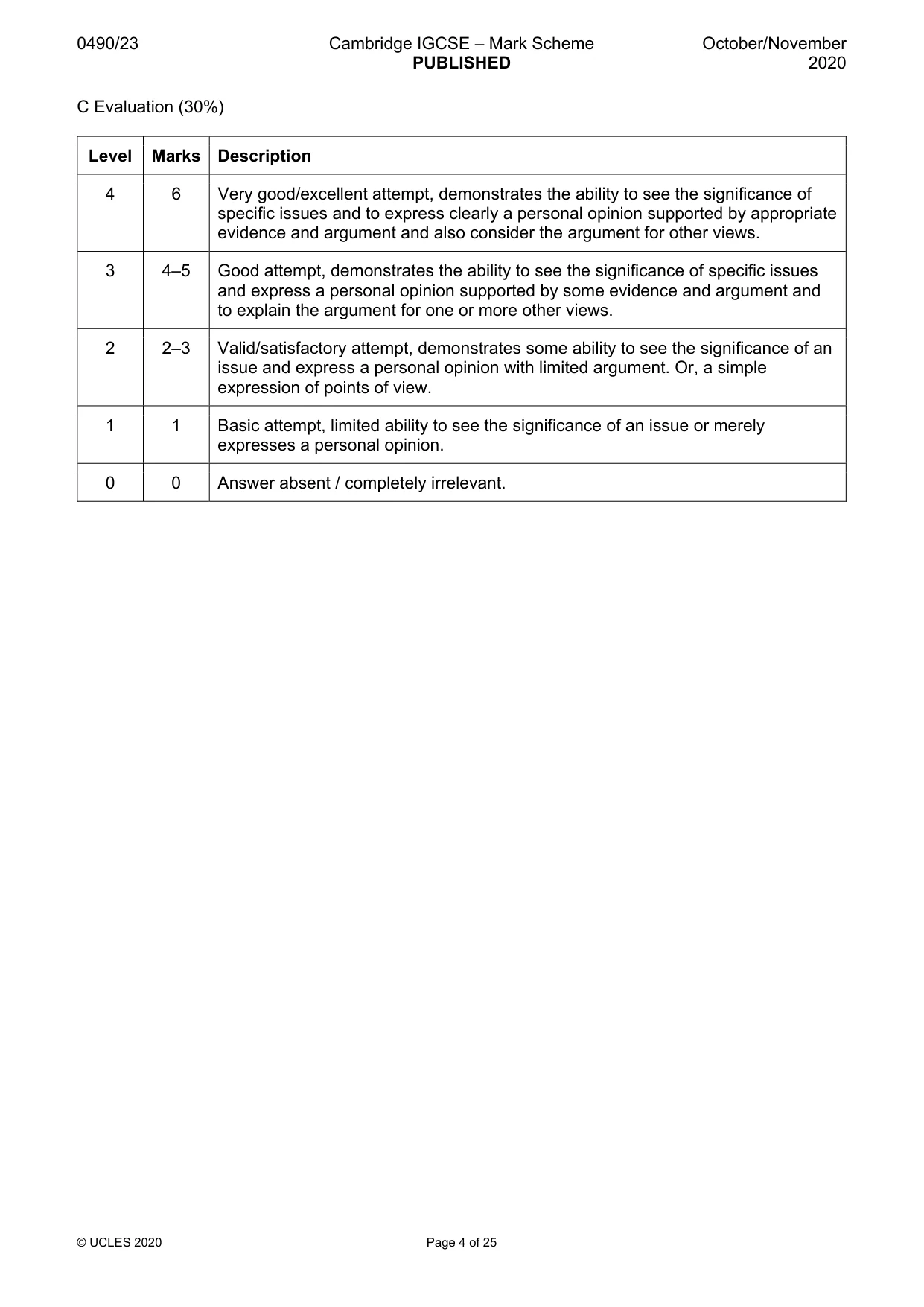
0490/23 Cambridge IGCSE – Mark Scheme PUBLISHED October/November 2020 © UCLES 2020 Page 4 of 25 C Evaluation (30%) Level Marks Description 4 6 Very good/excellent attempt, demonstrates the ability to see the significance of specific issues and to express clearly a personal opinion supported by appropriate evidence and argument and also consider the argument for other views. 3 4–5 Good attempt, demonstrates the ability to see the significance of specific issues and express a personal opinion supported by some evidence and argument and to explain the argument for one or more other views. 2 2–3 Valid/satisfactory attempt, demonstrates some ability to see the significance of an issue and express a personal opinion with limited argument. Or, a simple expression of points of view. 1 1 Basic attempt, limited ability to see the significance of an issue or merely expresses a personal opinion. 0 0 Answer absent / completely irrelevant.
Mark scheme, page 5
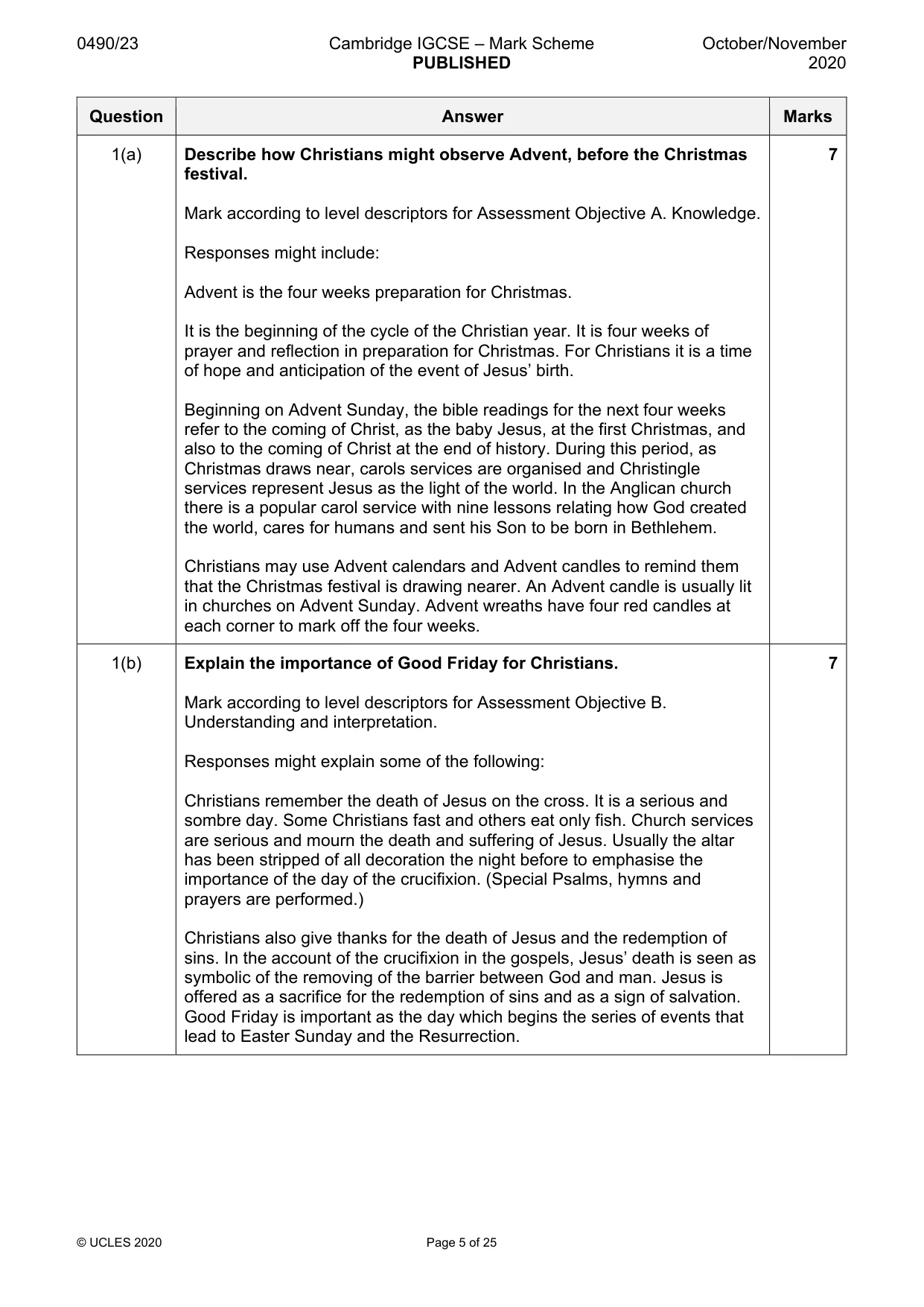
0490/23 Cambridge IGCSE – Mark Scheme PUBLISHED October/November 2020 © UCLES 2020 Page 5 of 25 Question Answer Marks 1(a) Describe how Christians might observe Advent, before the Christmas festival. Mark according to level descriptors for Assessment Objective A. Knowledge. Responses might include: Advent is the four weeks preparation for Christmas. It is the beginning of the cycle of the Christian year. It is four weeks of prayer and reflection in preparation for Christmas. For Christians it is a time of hope and anticipation of the event of Jesus’ birth. Beginning on Advent Sunday, the bible readings for the next four weeks refer to the coming of Christ, as the baby Jesus, at the first Christmas, and also to the coming of Christ at the end of history. During this period, as Christmas draws near, carols services are organised and Christingle services represent Jesus as the light of the world. In the Anglican church there is a popular carol service with nine lessons relating how God created the world, cares for humans and sent his Son to be born in Bethlehem. Christians may use Advent calendars and Advent candles to remind them that the Christmas festival is drawing nearer. An Advent candle is usually lit in churches on Advent Sunday. Advent wreaths have four red candles at each corner to mark off the four weeks. 7 1(b) Explain the importance of Good Friday for Christians. Mark according to level descriptors for Assessment Objective B. Understanding and interpretation. Responses might explain some of the following: Christians remember the death of Jesus on the cross. It is a serious and sombre day. Some Christians fast and others eat only fish. Church services are serious and mourn the death and suffering of Jesus. Usually the altar has been stripped of all decoration the night before to emphasise the importance of the day of the crucifixion. (Special Psalms, hymns and prayers are performed.) Christians also give thanks for the death of Jesus and the redemption of sins. In the account of the crucifixion in the gospels, Jesus’ death is seen as symbolic of the removing of the barrier between God and man. Jesus is offered as a sacrifice for the redemption of sins and as a sign of salvation. Good Friday is important as the day which begins the series of events that lead to Easter Sunday and the Resurrection. 7
Mark scheme, page 6
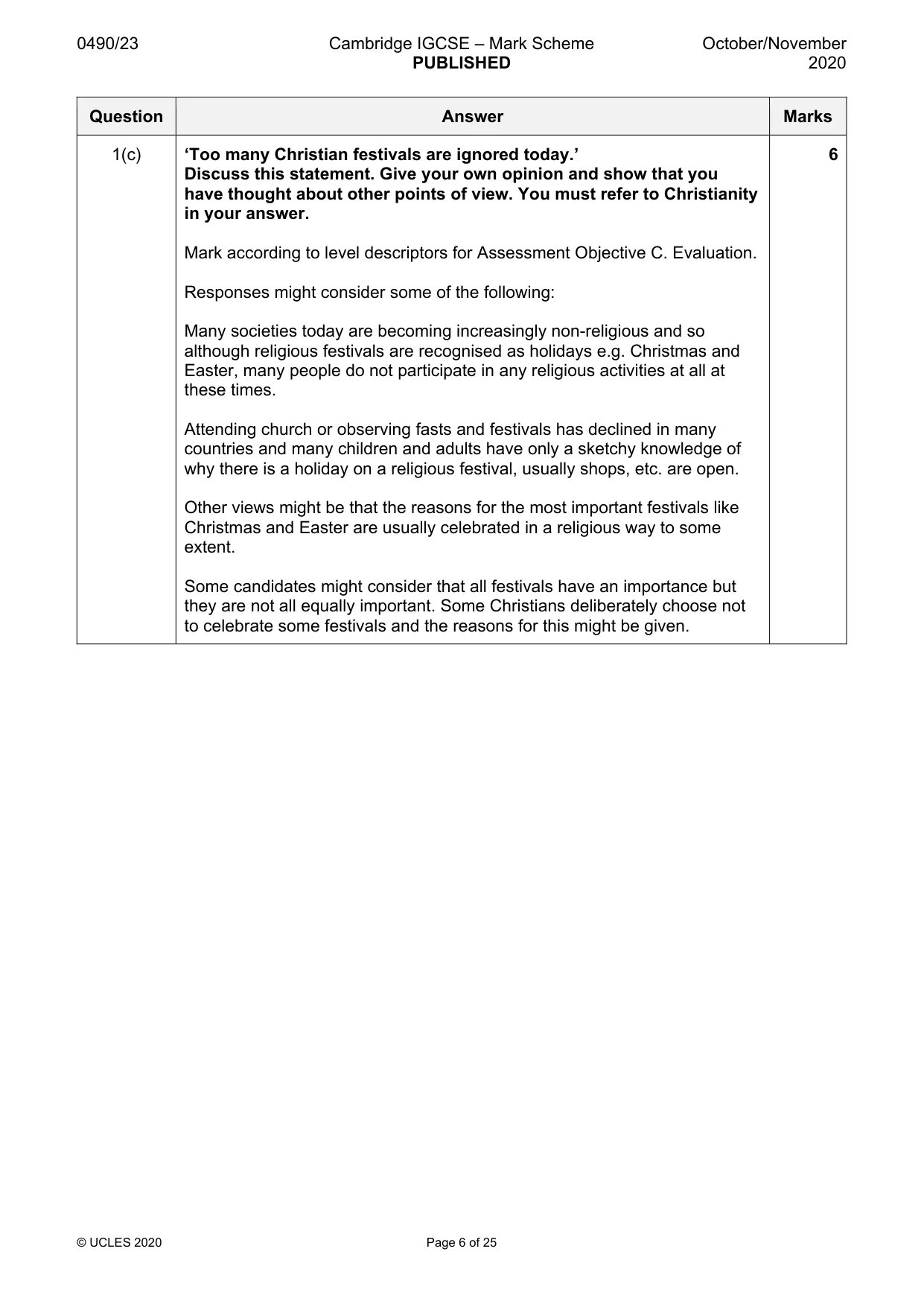
0490/23 Cambridge IGCSE – Mark Scheme PUBLISHED October/November 2020 © UCLES 2020 Page 6 of 25 Question Answer Marks 1(c) ‘Too many Christian festivals are ignored today.’ Discuss this statement. Give your own opinion and show that you have thought about other points of view. You must refer to Christianity in your answer. Mark according to level descriptors for Assessment Objective C. Evaluation. Responses might consider some of the following: Many societies today are becoming increasingly non-religious and so although religious festivals are recognised as holidays e.g. Christmas and Easter, many people do not participate in any religious activities at all at these times. Attending church or observing fasts and festivals has declined in many countries and many children and adults have only a sketchy knowledge of why there is a holiday on a religious festival, usually shops, etc. are open. Other views might be that the reasons for the most important festivals like Christmas and Easter are usually celebrated in a religious way to some extent. Some candidates might consider that all festivals have an importance but they are not all equally important. Some Christians deliberately choose not to celebrate some festivals and the reasons for this might be given. 6
Mark scheme, page 7
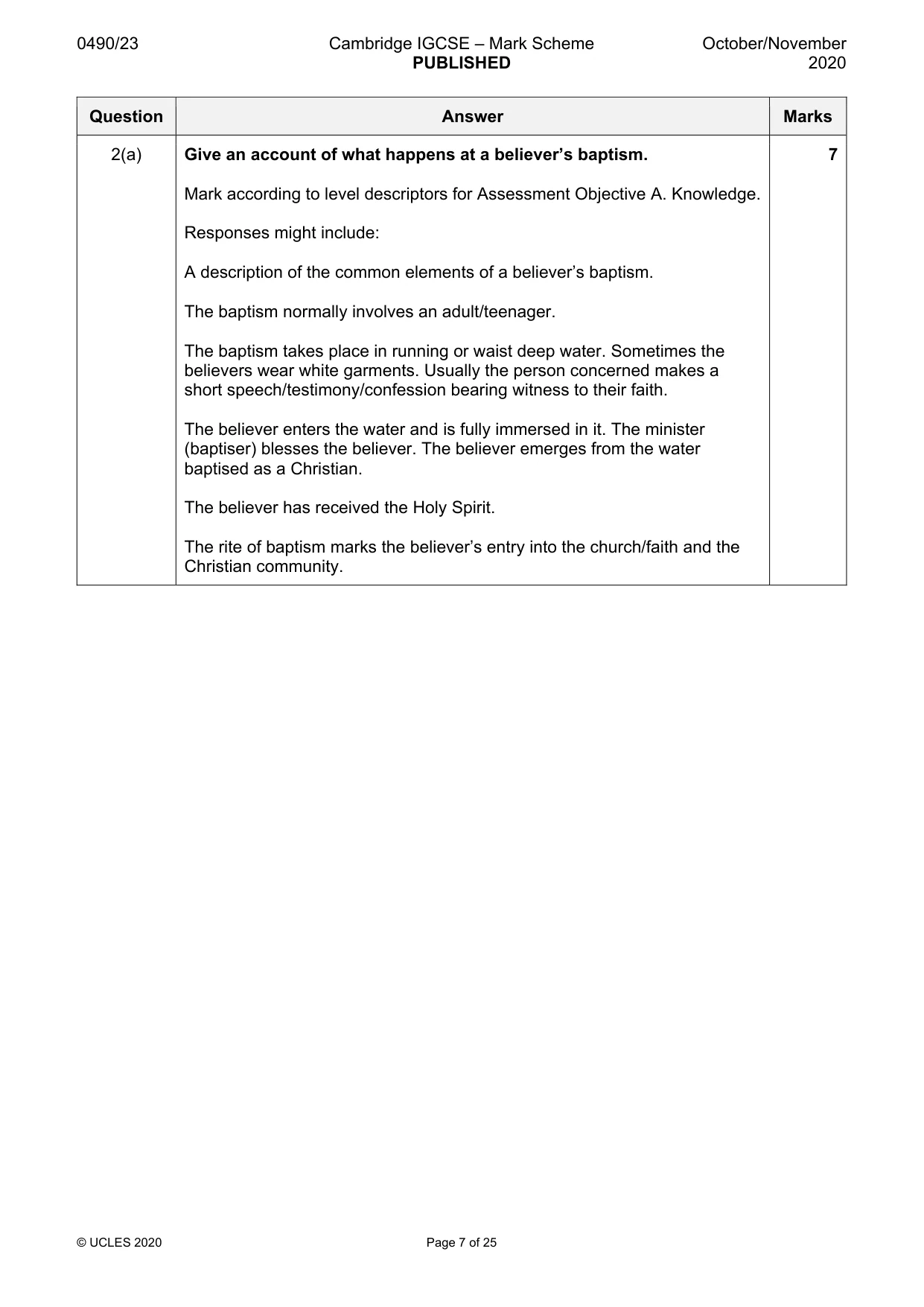
0490/23 Cambridge IGCSE – Mark Scheme PUBLISHED October/November 2020 © UCLES 2020 Page 7 of 25 Question Answer Marks 2(a) Give an account of what happens at a believer’s baptism. Mark according to level descriptors for Assessment Objective A. Knowledge. Responses might include: A description of the common elements of a believer’s baptism. The baptism normally involves an adult/teenager. The baptism takes place in running or waist deep water. Sometimes the believers wear white garments. Usually the person concerned makes a short speech/testimony/confession bearing witness to their faith. The believer enters the water and is fully immersed in it. The minister (baptiser) blesses the believer. The believer emerges from the water baptised as a Christian. The believer has received the Holy Spirit. The rite of baptism marks the believer’s entry into the church/faith and the Christian community. 7
Mark scheme, page 8
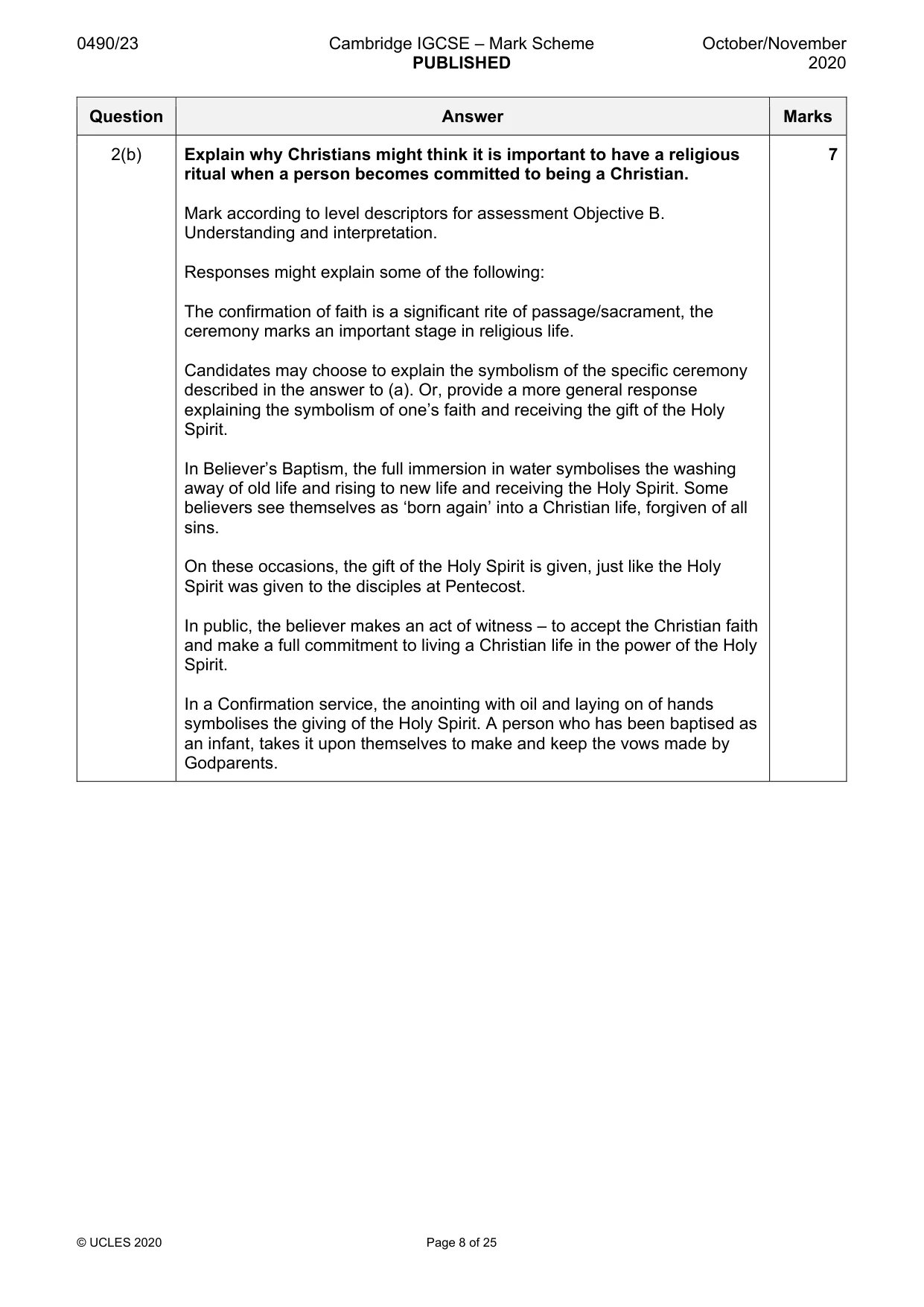
0490/23 Cambridge IGCSE – Mark Scheme PUBLISHED October/November 2020 © UCLES 2020 Page 8 of 25 Question Answer Marks 2(b) Explain why Christians might think it is important to have a religious ritual when a person becomes committed to being a Christian. Mark according to level descriptors for assessment Objective B. Understanding and interpretation. Responses might explain some of the following: The confirmation of faith is a significant rite of passage/sacrament, the ceremony marks an important stage in religious life. Candidates may choose to explain the symbolism of the specific ceremony described in the answer to (a). Or, provide a more general response explaining the symbolism of one’s faith and receiving the gift of the Holy Spirit. In Believer’s Baptism, the full immersion in water symbolises the washing away of old life and rising to new life and receiving the Holy Spirit. Some believers see themselves as ‘born again’ into a Christian life, forgiven of all sins. On these occasions, the gift of the Holy Spirit is given, just like the Holy Spirit was given to the disciples at Pentecost. In public, the believer makes an act of witness – to accept the Christian faith and make a full commitment to living a Christian life in the power of the Holy Spirit. In a Confirmation service, the anointing with oil and laying on of hands symbolises the giving of the Holy Spirit. A person who has been baptised as an infant, takes it upon themselves to make and keep the vows made by Godparents. 7
Mark scheme, page 9
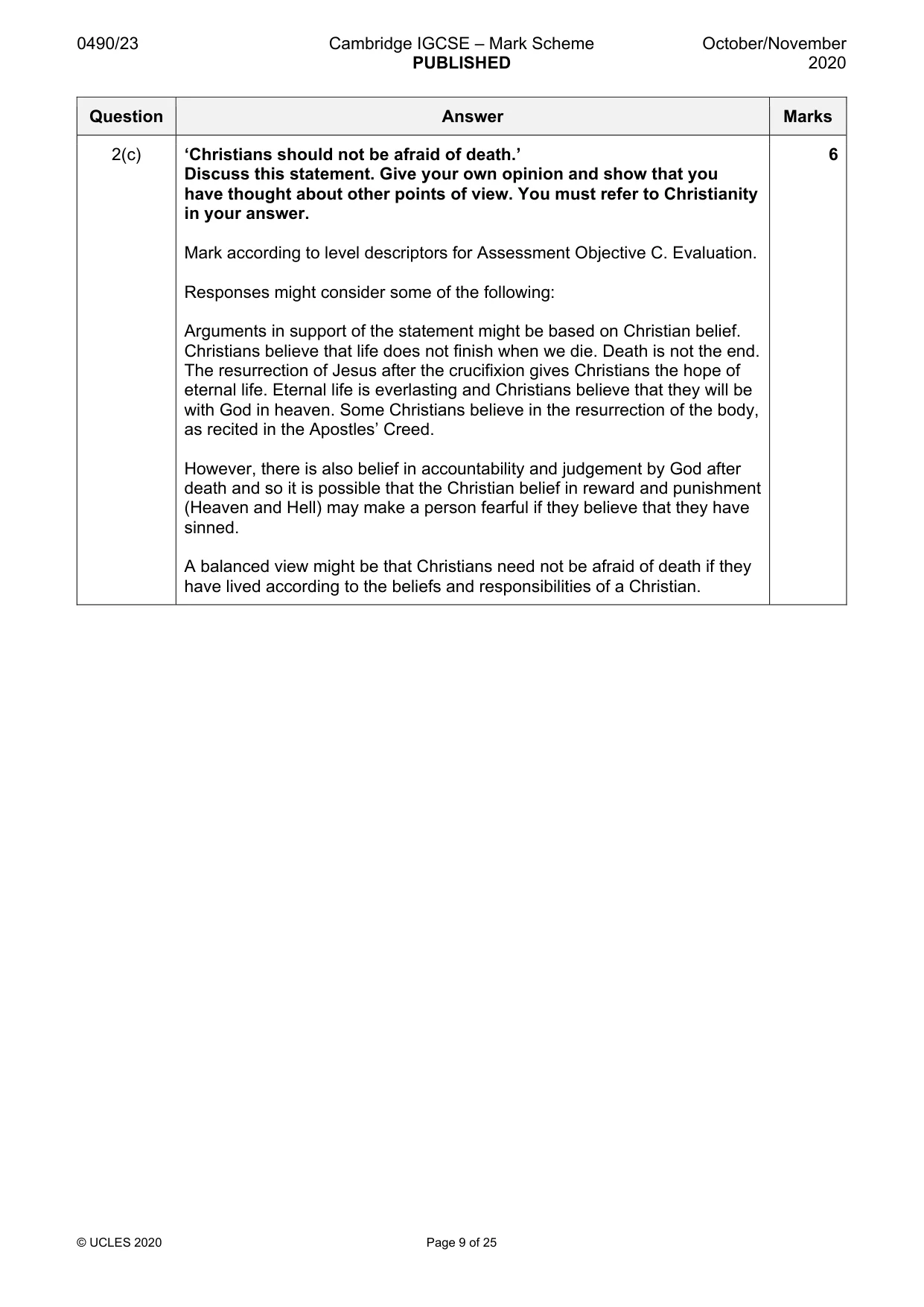
0490/23 Cambridge IGCSE – Mark Scheme PUBLISHED October/November 2020 © UCLES 2020 Page 9 of 25 Question Answer Marks 2(c) ‘Christians should not be afraid of death.’ Discuss this statement. Give your own opinion and show that you have thought about other points of view. You must refer to Christianity in your answer. Mark according to level descriptors for Assessment Objective C. Evaluation. Responses might consider some of the following: Arguments in support of the statement might be based on Christian belief. Christians believe that life does not finish when we die. Death is not the end. The resurrection of Jesus after the crucifixion gives Christians the hope of eternal life. Eternal life is everlasting and Christians believe that they will be with God in heaven. Some Christians believe in the resurrection of the body, as recited in the Apostles’ Creed. However, there is also belief in accountability and judgement by God after death and so it is possible that the Christian belief in reward and punishment (Heaven and Hell) may make a person fearful if they believe that they have sinned. A balanced view might be that Christians need not be afraid of death if they have lived according to the beliefs and responsibilities of a Christian. 6
Mark scheme, page 10
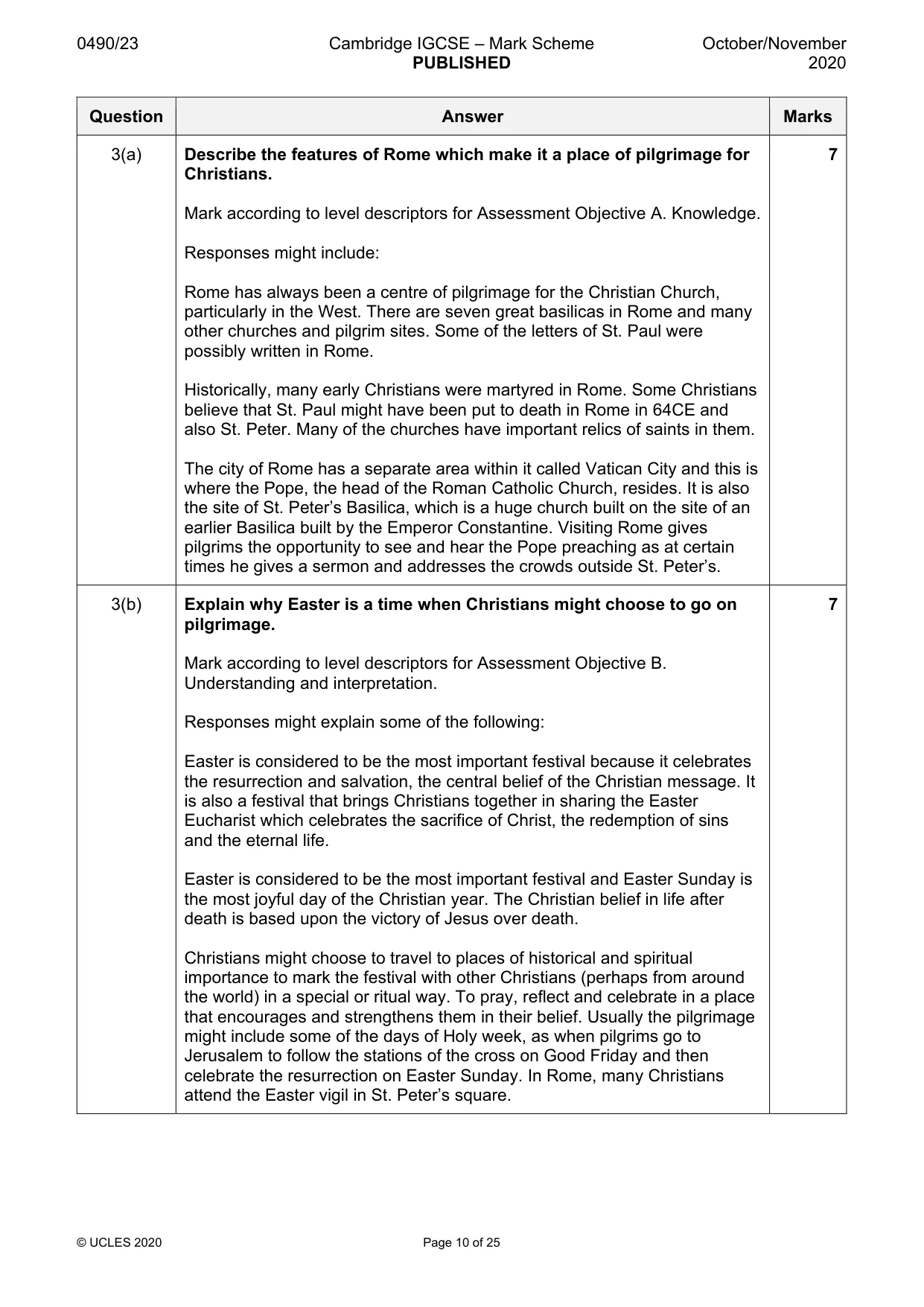
0490/23 Cambridge IGCSE – Mark Scheme PUBLISHED October/November 2020 © UCLES 2020 Page 10 of 25 Question Answer Marks 3(a) Describe the features of Rome which make it a place of pilgrimage for Christians. Mark according to level descriptors for Assessment Objective A. Knowledge. Responses might include: Rome has always been a centre of pilgrimage for the Christian Church, particularly in the West. There are seven great basilicas in Rome and many other churches and pilgrim sites. Some of the letters of St. Paul were possibly written in Rome. Historically, many early Christians were martyred in Rome. Some Christians believe that St. Paul might have been put to death in Rome in 64CE and also St. Peter. Many of the churches have important relics of saints in them. The city of Rome has a separate area within it called Vatican City and this is where the Pope, the head of the Roman Catholic Church, resides. It is also the site of St. Peter’s Basilica, which is a huge church built on the site of an earlier Basilica built by the Emperor Constantine. Visiting Rome gives pilgrims the opportunity to see and hear the Pope preaching as at certain times he gives a sermon and addresses the crowds outside St. Peter’s. 7 3(b) Explain why Easter is a time when Christians might choose to go on pilgrimage. Mark according to level descriptors for Assessment Objective B. Understanding and interpretation. Responses might explain some of the following: Easter is considered to be the most important festival because it celebrates the resurrection and salvation, the central belief of the Christian message. It is also a festival that brings Christians together in sharing the Easter Eucharist which celebrates the sacrifice of Christ, the redemption of sins and the eternal life. Easter is considered to be the most important festival and Easter Sunday is the most joyful day of the Christian year. The Christian belief in life after death is based upon the victory of Jesus over death. Christians might choose to travel to places of historical and spiritual importance to mark the festival with other Christians (perhaps from around the world) in a special or ritual way. To pray, reflect and celebrate in a place that encourages and strengthens them in their belief. Usually the pilgrimage might include some of the days of Holy week, as when pilgrims go to Jerusalem to follow the stations of the cross on Good Friday and then celebrate the resurrection on Easter Sunday. In Rome, many Christians attend the Easter vigil in St. Peter’s square. 7
Mark scheme, page 11
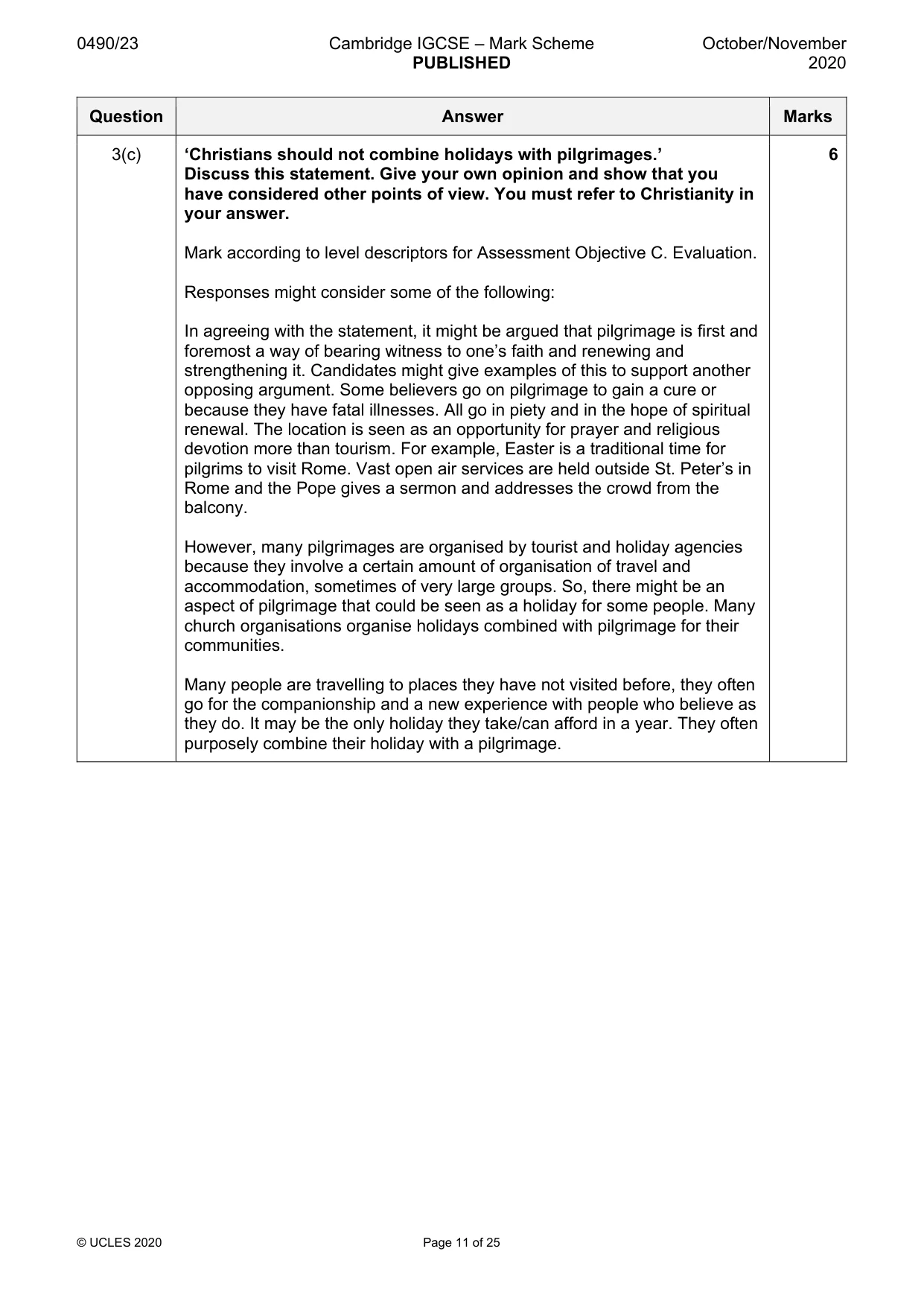
0490/23 Cambridge IGCSE – Mark Scheme PUBLISHED October/November 2020 © UCLES 2020 Page 11 of 25 Question Answer Marks 3(c) ‘Christians should not combine holidays with pilgrimages.’ Discuss this statement. Give your own opinion and show that you have considered other points of view. You must refer to Christianity in your answer. Mark according to level descriptors for Assessment Objective C. Evaluation. Responses might consider some of the following: In agreeing with the statement, it might be argued that pilgrimage is first and foremost a way of bearing witness to one’s faith and renewing and strengthening it. Candidates might give examples of this to support another opposing argument. Some believers go on pilgrimage to gain a cure or because they have fatal illnesses. All go in piety and in the hope of spiritual renewal. The location is seen as an opportunity for prayer and religious devotion more than tourism. For example, Easter is a traditional time for pilgrims to visit Rome. Vast open air services are held outside St. Peter’s in Rome and the Pope gives a sermon and addresses the crowd from the balcony. However, many pilgrimages are organised by tourist and holiday agencies because they involve a certain amount of organisation of travel and accommodation, sometimes of very large groups. So, there might be an aspect of pilgrimage that could be seen as a holiday for some people. Many church organisations organise holidays combined with pilgrimage for their communities. Many people are travelling to places they have not visited before, they often go for the companionship and a new experience with people who believe as they do. It may be the only holiday they take/can afford in a year. They often purposely combine their holiday with a pilgrimage. 6
Mark scheme, page 12
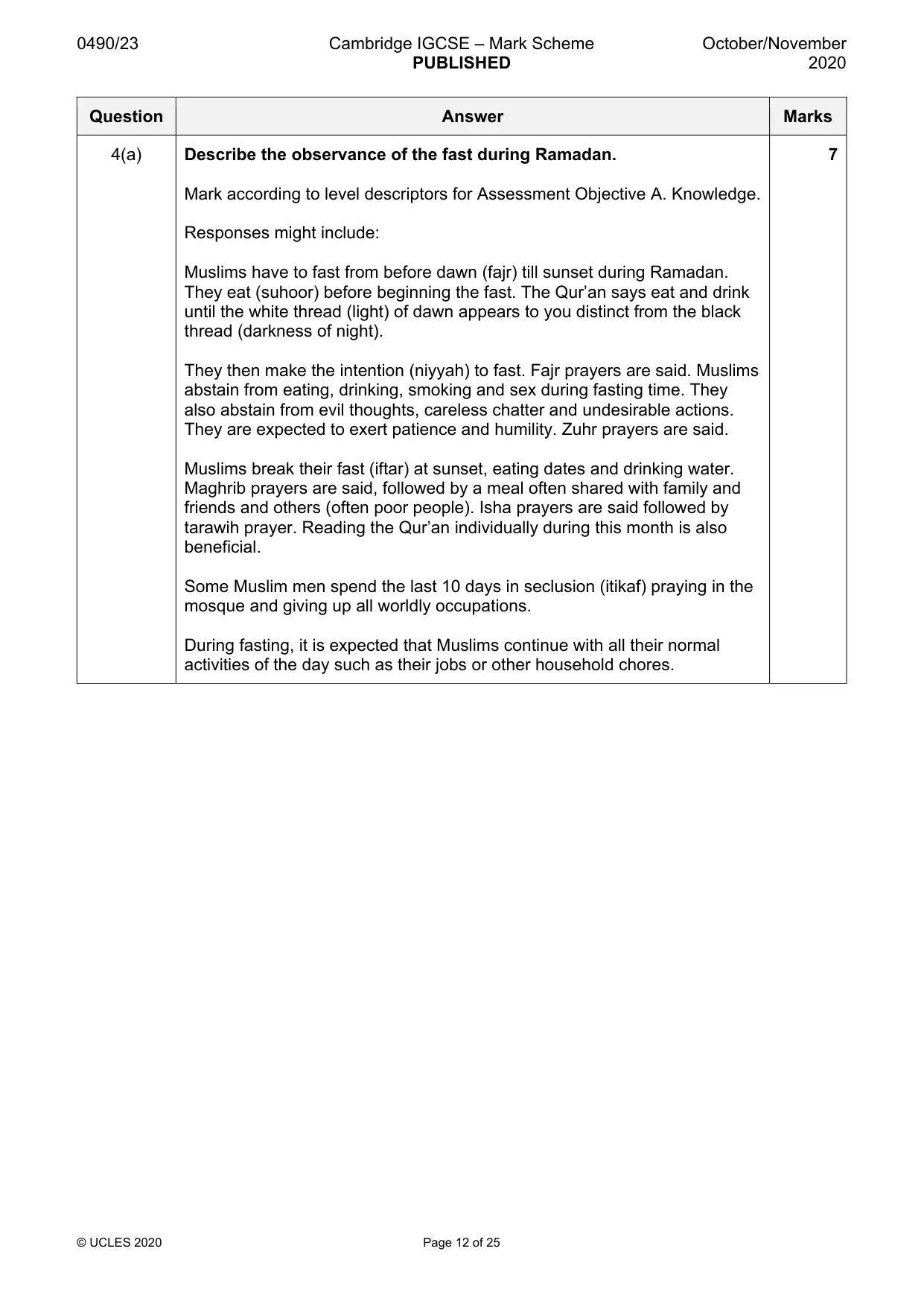
0490/23 Cambridge IGCSE – Mark Scheme PUBLISHED October/November 2020 © UCLES 2020 Page 12 of 25 Question Answer Marks 4(a) Describe the observance of the fast during Ramadan. Mark according to level descriptors for Assessment Objective A. Knowledge. Responses might include: Muslims have to fast from before dawn (fajr) till sunset during Ramadan. They eat (suhoor) before beginning the fast. The Qur’an says eat and drink until the white thread (light) of dawn appears to you distinct from the black thread (darkness of night). They then make the intention (niyyah) to fast. Fajr prayers are said. Muslims abstain from eating, drinking, smoking and sex during fasting time. They also abstain from evil thoughts, careless chatter and undesirable actions. They are expected to exert patience and humility. Zuhr prayers are said. Muslims break their fast (iftar) at sunset, eating dates and drinking water. Maghrib prayers are said, followed by a meal often shared with family and friends and others (often poor people). Isha prayers are said followed by tarawih prayer. Reading the Qur’an individually during this month is also beneficial. Some Muslim men spend the last 10 days in seclusion (itikaf) praying in the mosque and giving up all worldly occupations. During fasting, it is expected that Muslims continue with all their normal activities of the day such as their jobs or other household chores. 7
Mark scheme, page 13
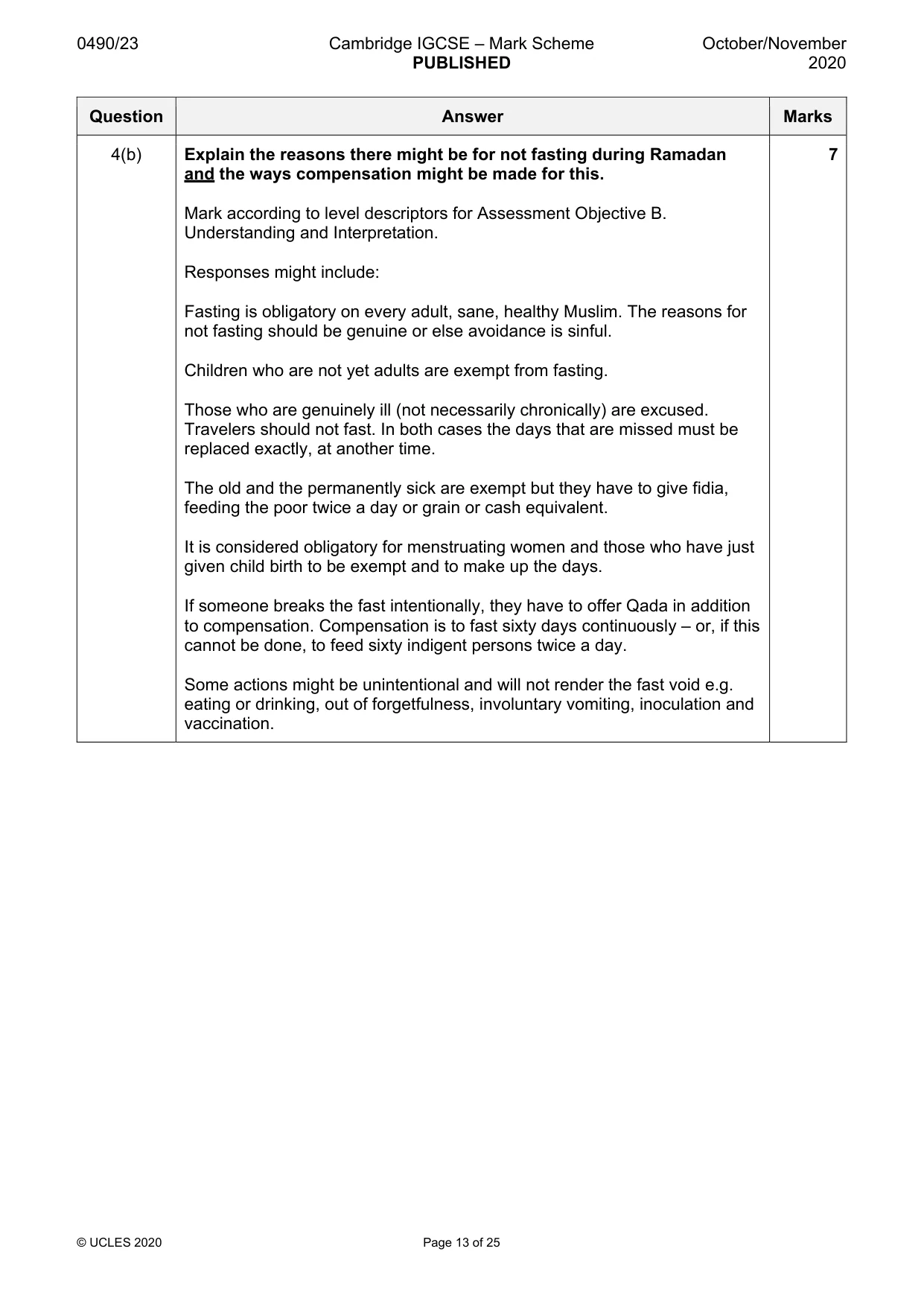
0490/23 Cambridge IGCSE – Mark Scheme PUBLISHED October/November 2020 © UCLES 2020 Page 13 of 25 Question Answer Marks 4(b) Explain the reasons there might be for not fasting during Ramadan and the ways compensation might be made for this. Mark according to level descriptors for Assessment Objective B. Understanding and Interpretation. Responses might include: Fasting is obligatory on every adult, sane, healthy Muslim. The reasons for not fasting should be genuine or else avoidance is sinful. Children who are not yet adults are exempt from fasting. Those who are genuinely ill (not necessarily chronically) are excused. Travelers should not fast. In both cases the days that are missed must be replaced exactly, at another time. The old and the permanently sick are exempt but they have to give fidia, feeding the poor twice a day or grain or cash equivalent. It is considered obligatory for menstruating women and those who have just given child birth to be exempt and to make up the days. If someone breaks the fast intentionally, they have to offer Qada in addition to compensation. Compensation is to fast sixty days continuously – or, if this cannot be done, to feed sixty indigent persons twice a day. Some actions might be unintentional and will not render the fast void e.g. eating or drinking, out of forgetfulness, involuntary vomiting, inoculation and vaccination. 7
Mark scheme, page 14
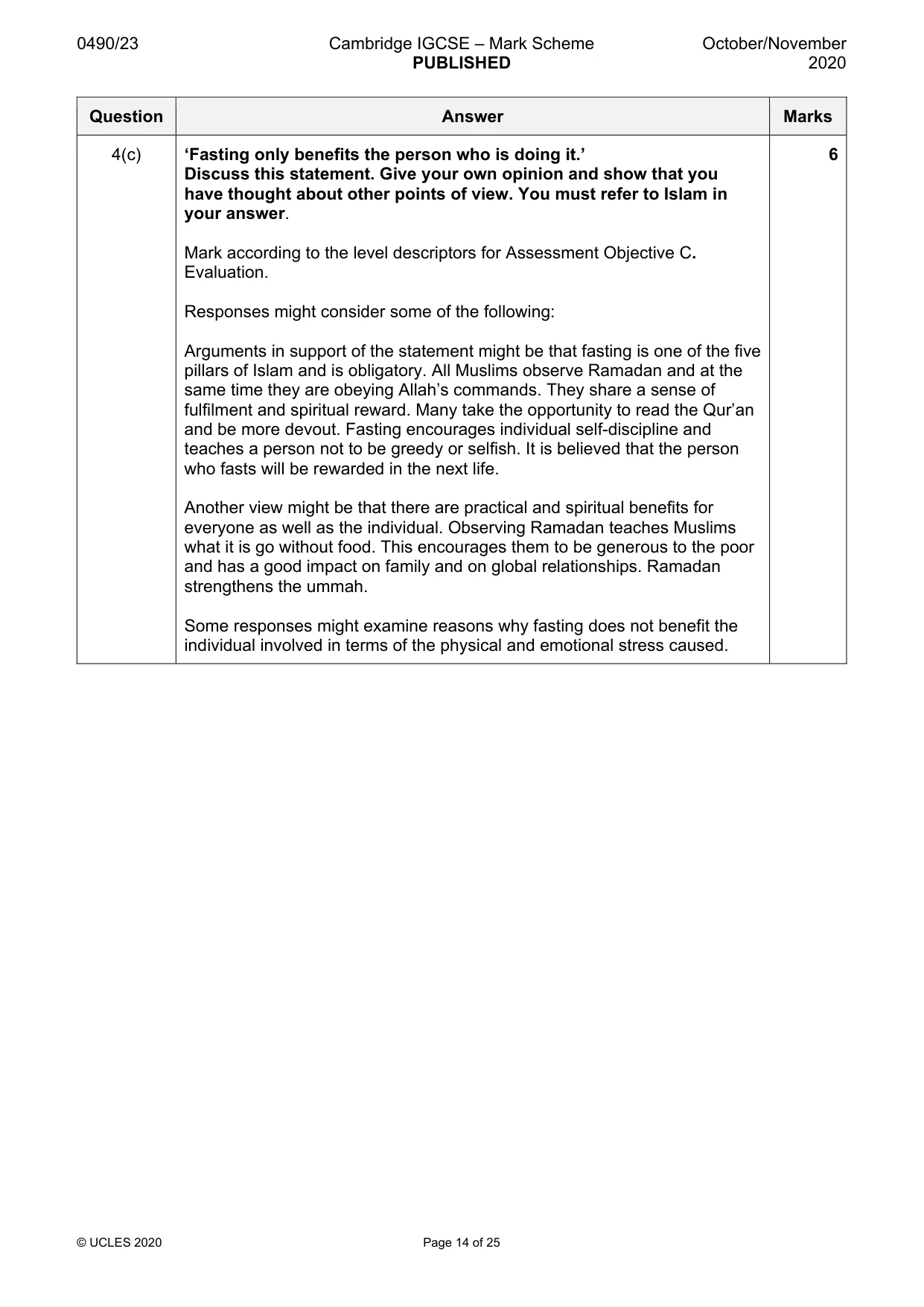
0490/23 Cambridge IGCSE – Mark Scheme PUBLISHED October/November 2020 © UCLES 2020 Page 14 of 25 Question Answer Marks 4(c) ‘Fasting only benefits the person who is doing it.’ Discuss this statement. Give your own opinion and show that you have thought about other points of view. You must refer to Islam in your answer. Mark according to the level descriptors for Assessment Objective C. Evaluation. Responses might consider some of the following: Arguments in support of the statement might be that fasting is one of the five pillars of Islam and is obligatory. All Muslims observe Ramadan and at the same time they are obeying Allah’s commands. They share a sense of fulfilment and spiritual reward. Many take the opportunity to read the Qur’an and be more devout. Fasting encourages individual self-discipline and teaches a person not to be greedy or selfish. It is believed that the person who fasts will be rewarded in the next life. Another view might be that there are practical and spiritual benefits for everyone as well as the individual. Observing Ramadan teaches Muslims what it is go without food. This encourages them to be generous to the poor and has a good impact on family and on global relationships. Ramadan strengthens the ummah. Some responses might examine reasons why fasting does not benefit the individual involved in terms of the physical and emotional stress caused. 6
Mark scheme, page 15
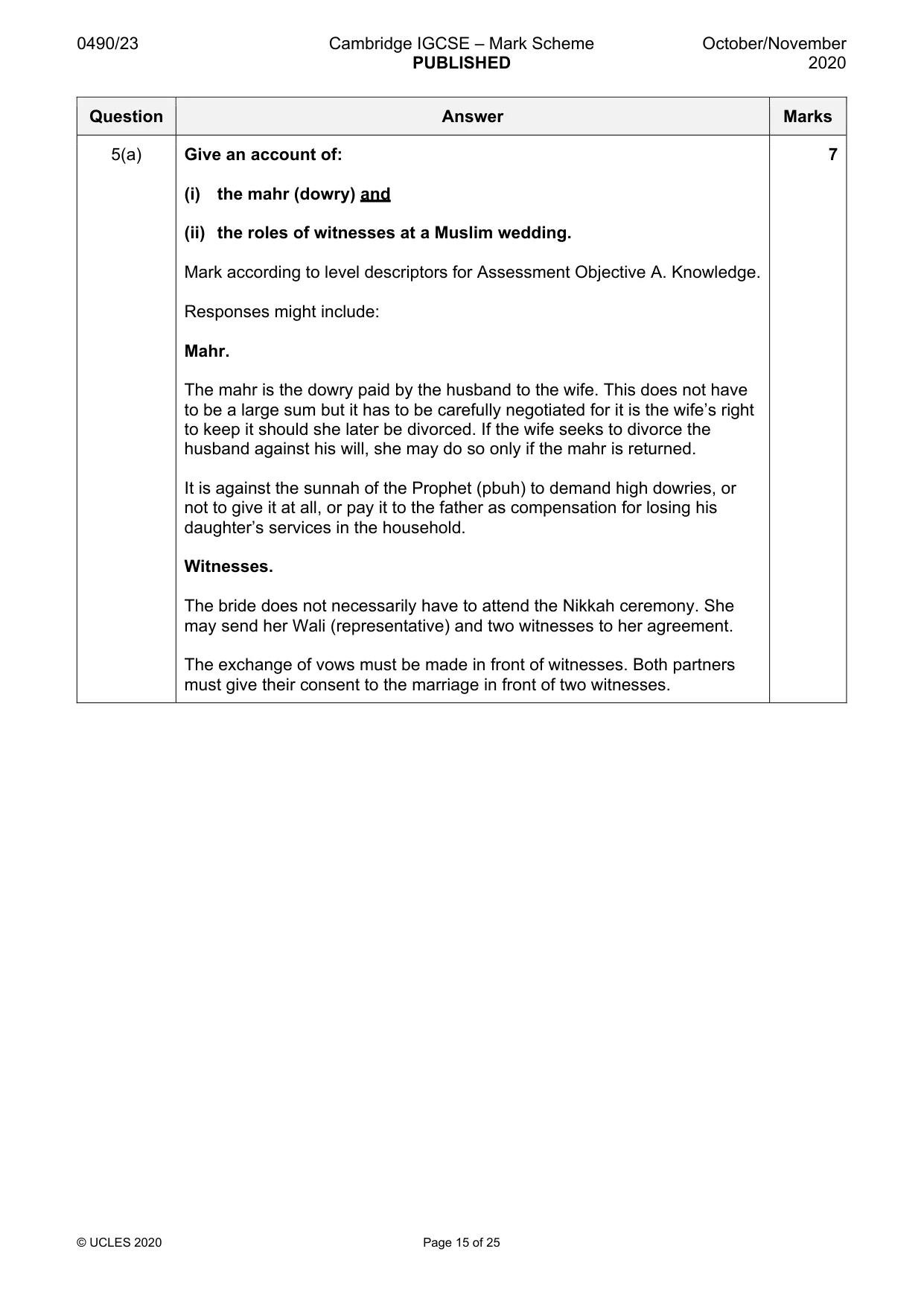
0490/23 Cambridge IGCSE – Mark Scheme PUBLISHED October/November 2020 © UCLES 2020 Page 15 of 25 Question Answer Marks 5(a) Give an account of: (i) the mahr (dowry) and (ii) the roles of witnesses at a Muslim wedding. Mark according to level descriptors for Assessment Objective A. Knowledge. Responses might include: Mahr. The mahr is the dowry paid by the husband to the wife. This does not have to be a large sum but it has to be carefully negotiated for it is the wife’s right to keep it should she later be divorced. If the wife seeks to divorce the husband against his will, she may do so only if the mahr is returned. It is against the sunnah of the Prophet (pbuh) to demand high dowries, or not to give it at all, or pay it to the father as compensation for losing his daughter’s services in the household. Witnesses. The bride does not necessarily have to attend the Nikkah ceremony. She may send her Wali (representative) and two witnesses to her agreement. The exchange of vows must be made in front of witnesses. Both partners must give their consent to the marriage in front of two witnesses. 7
Mark scheme, page 16
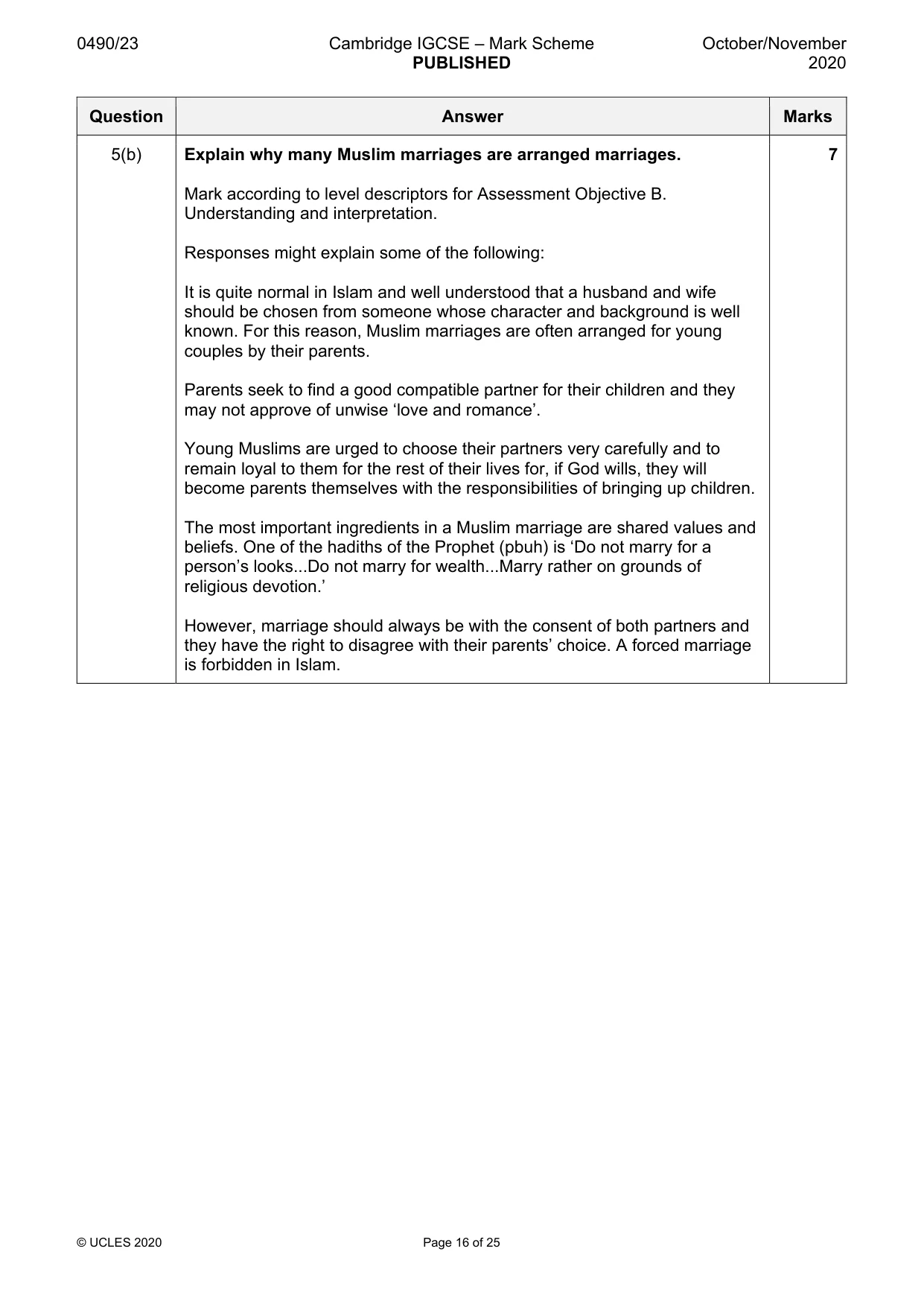
0490/23 Cambridge IGCSE – Mark Scheme PUBLISHED October/November 2020 © UCLES 2020 Page 16 of 25 Question Answer Marks 5(b) Explain why many Muslim marriages are arranged marriages. Mark according to level descriptors for Assessment Objective B. Understanding and interpretation. Responses might explain some of the following: It is quite normal in Islam and well understood that a husband and wife should be chosen from someone whose character and background is well known. For this reason, Muslim marriages are often arranged for young couples by their parents. Parents seek to find a good compatible partner for their children and they may not approve of unwise ‘love and romance’. Young Muslims are urged to choose their partners very carefully and to remain loyal to them for the rest of their lives for, if God wills, they will become parents themselves with the responsibilities of bringing up children. The most important ingredients in a Muslim marriage are shared values and beliefs. One of the hadiths of the Prophet (pbuh) is ‘Do not marry for a person’s looks...Do not marry for wealth...Marry rather on grounds of religious devotion.’ However, marriage should always be with the consent of both partners and they have the right to disagree with their parents’ choice. A forced marriage is forbidden in Islam. 7
Mark scheme, page 17
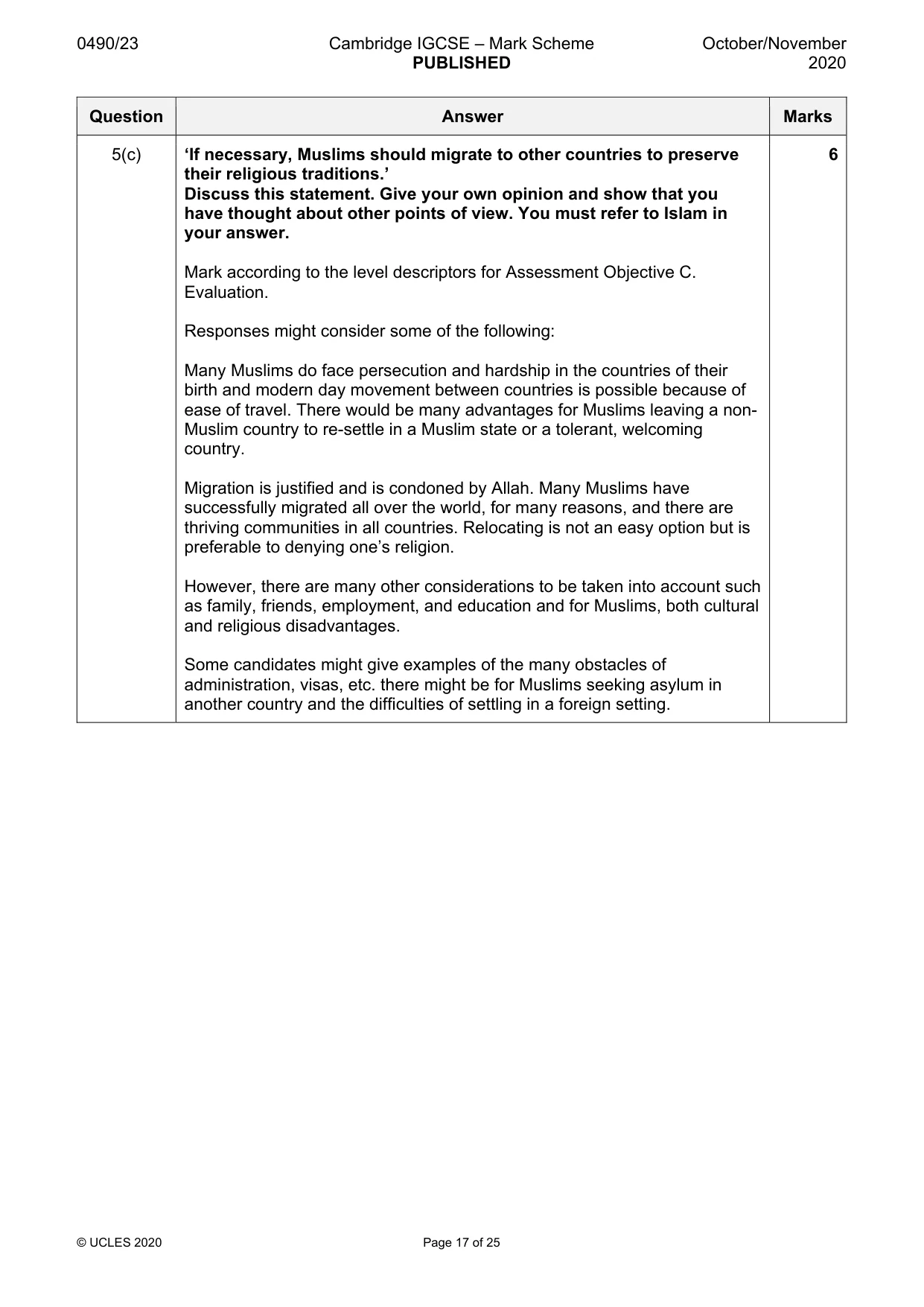
0490/23 Cambridge IGCSE – Mark Scheme PUBLISHED October/November 2020 © UCLES 2020 Page 17 of 25 Question Answer Marks 5(c) ‘If necessary, Muslims should migrate to other countries to preserve their religious traditions.’ Discuss this statement. Give your own opinion and show that you have thought about other points of view. You must refer to Islam in your answer. Mark according to the level descriptors for Assessment Objective C. Evaluation. Responses might consider some of the following: Many Muslims do face persecution and hardship in the countries of their birth and modern day movement between countries is possible because of ease of travel. There would be many advantages for Muslims leaving a non- Muslim country to re-settle in a Muslim state or a tolerant, welcoming country. Migration is justified and is condoned by Allah. Many Muslims have successfully migrated all over the world, for many reasons, and there are thriving communities in all countries. Relocating is not an easy option but is preferable to denying one’s religion. However, there are many other considerations to be taken into account such as family, friends, employment, and education and for Muslims, both cultural and religious disadvantages. Some candidates might give examples of the many obstacles of administration, visas, etc. there might be for Muslims seeking asylum in another country and the difficulties of settling in a foreign setting. 6
Mark scheme, page 18
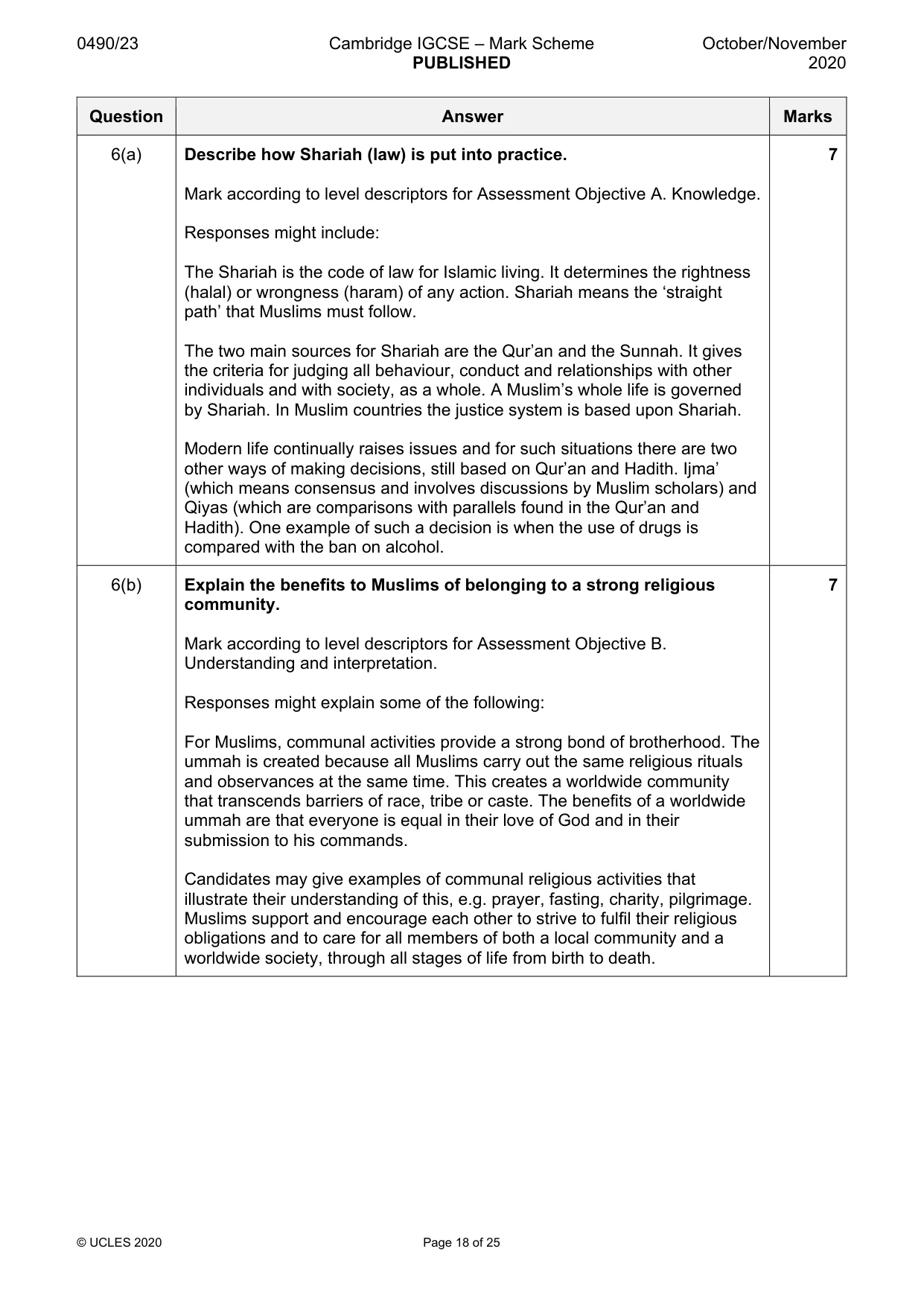
0490/23 Cambridge IGCSE – Mark Scheme PUBLISHED October/November 2020 © UCLES 2020 Page 18 of 25 Question Answer Marks 6(a) Describe how Shariah (law) is put into practice. Mark according to level descriptors for Assessment Objective A. Knowledge. Responses might include: The Shariah is the code of law for Islamic living. It determines the rightness (halal) or wrongness (haram) of any action. Shariah means the ‘straight path’ that Muslims must follow. The two main sources for Shariah are the Qur’an and the Sunnah. It gives the criteria for judging all behaviour, conduct and relationships with other individuals and with society, as a whole. A Muslim’s whole life is governed by Shariah. In Muslim countries the justice system is based upon Shariah. Modern life continually raises issues and for such situations there are two other ways of making decisions, still based on Qur’an and Hadith. Ijma’ (which means consensus and involves discussions by Muslim scholars) and Qiyas (which are comparisons with parallels found in the Qur’an and Hadith). One example of such a decision is when the use of drugs is compared with the ban on alcohol. 7 6(b) Explain the benefits to Muslims of belonging to a strong religious community. Mark according to level descriptors for Assessment Objective B. Understanding and interpretation. Responses might explain some of the following: For Muslims, communal activities provide a strong bond of brotherhood. The ummah is created because all Muslims carry out the same religious rituals and observances at the same time. This creates a worldwide community that transcends barriers of race, tribe or caste. The benefits of a worldwide ummah are that everyone is equal in their love of God and in their submission to his commands. Candidates may give examples of communal religious activities that illustrate their understanding of this, e.g. prayer, fasting, charity, pilgrimage. Muslims support and encourage each other to strive to fulfil their religious obligations and to care for all members of both a local community and a worldwide society, through all stages of life from birth to death. 7
Mark scheme, page 19
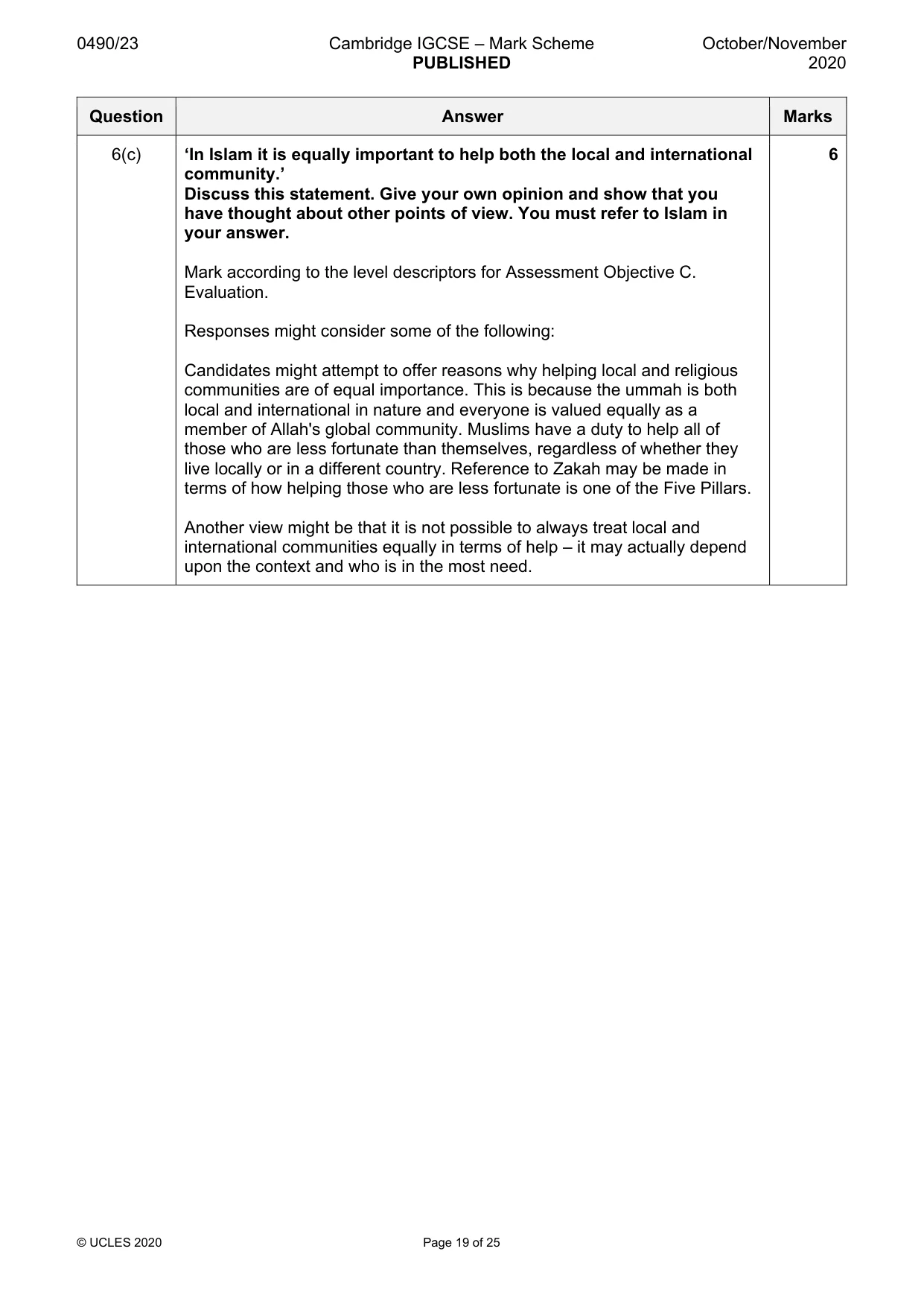
0490/23 Cambridge IGCSE – Mark Scheme PUBLISHED October/November 2020 © UCLES 2020 Page 19 of 25 Question Answer Marks 6(c) ‘In Islam it is equally important to help both the local and international community.’ Discuss this statement. Give your own opinion and show that you have thought about other points of view. You must refer to Islam in your answer. Mark according to the level descriptors for Assessment Objective C. Evaluation. Responses might consider some of the following: Candidates might attempt to offer reasons why helping local and religious communities are of equal importance. This is because the ummah is both local and international in nature and everyone is valued equally as a member of Allah's global community. Muslims have a duty to help all of those who are less fortunate than themselves, regardless of whether they live locally or in a different country. Reference to Zakah may be made in terms of how helping those who are less fortunate is one of the Five Pillars. Another view might be that it is not possible to always treat local and international communities equally in terms of help – it may actually depend upon the context and who is in the most need. 6
Mark scheme, page 20
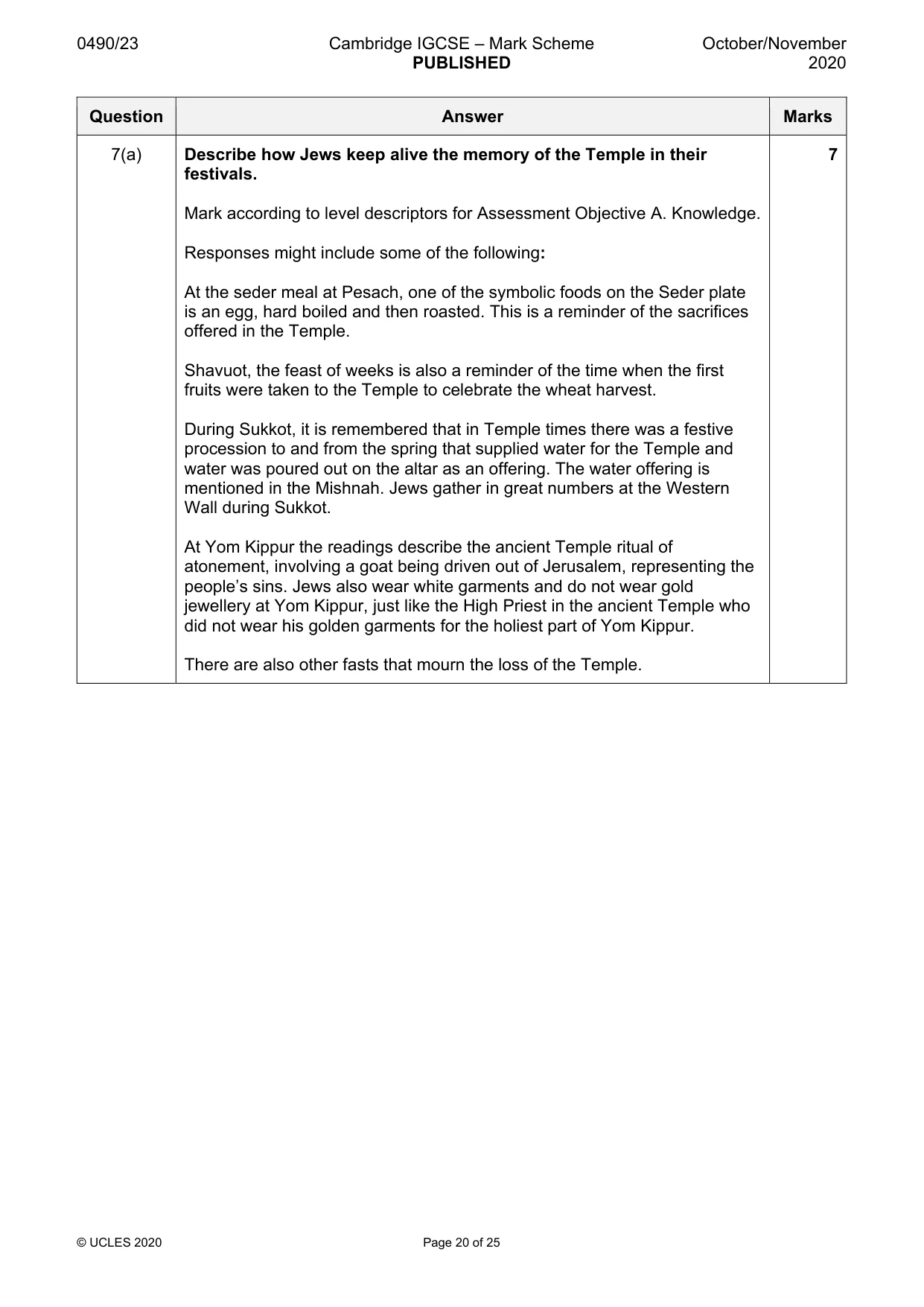
0490/23 Cambridge IGCSE – Mark Scheme PUBLISHED October/November 2020 © UCLES 2020 Page 20 of 25 Question Answer Marks 7(a) Describe how Jews keep alive the memory of the Temple in their festivals. Mark according to level descriptors for Assessment Objective A. Knowledge. Responses might include some of the following: At the seder meal at Pesach, one of the symbolic foods on the Seder plate is an egg, hard boiled and then roasted. This is a reminder of the sacrifices offered in the Temple. Shavuot, the feast of weeks is also a reminder of the time when the first fruits were taken to the Temple to celebrate the wheat harvest. During Sukkot, it is remembered that in Temple times there was a festive procession to and from the spring that supplied water for the Temple and water was poured out on the altar as an offering. The water offering is mentioned in the Mishnah. Jews gather in great numbers at the Western Wall during Sukkot. At Yom Kippur the readings describe the ancient Temple ritual of atonement, involving a goat being driven out of Jerusalem, representing the people’s sins. Jews also wear white garments and do not wear gold jewellery at Yom Kippur, just like the High Priest in the ancient Temple who did not wear his golden garments for the holiest part of Yom Kippur. There are also other fasts that mourn the loss of the Temple. 7
Mark scheme, page 21
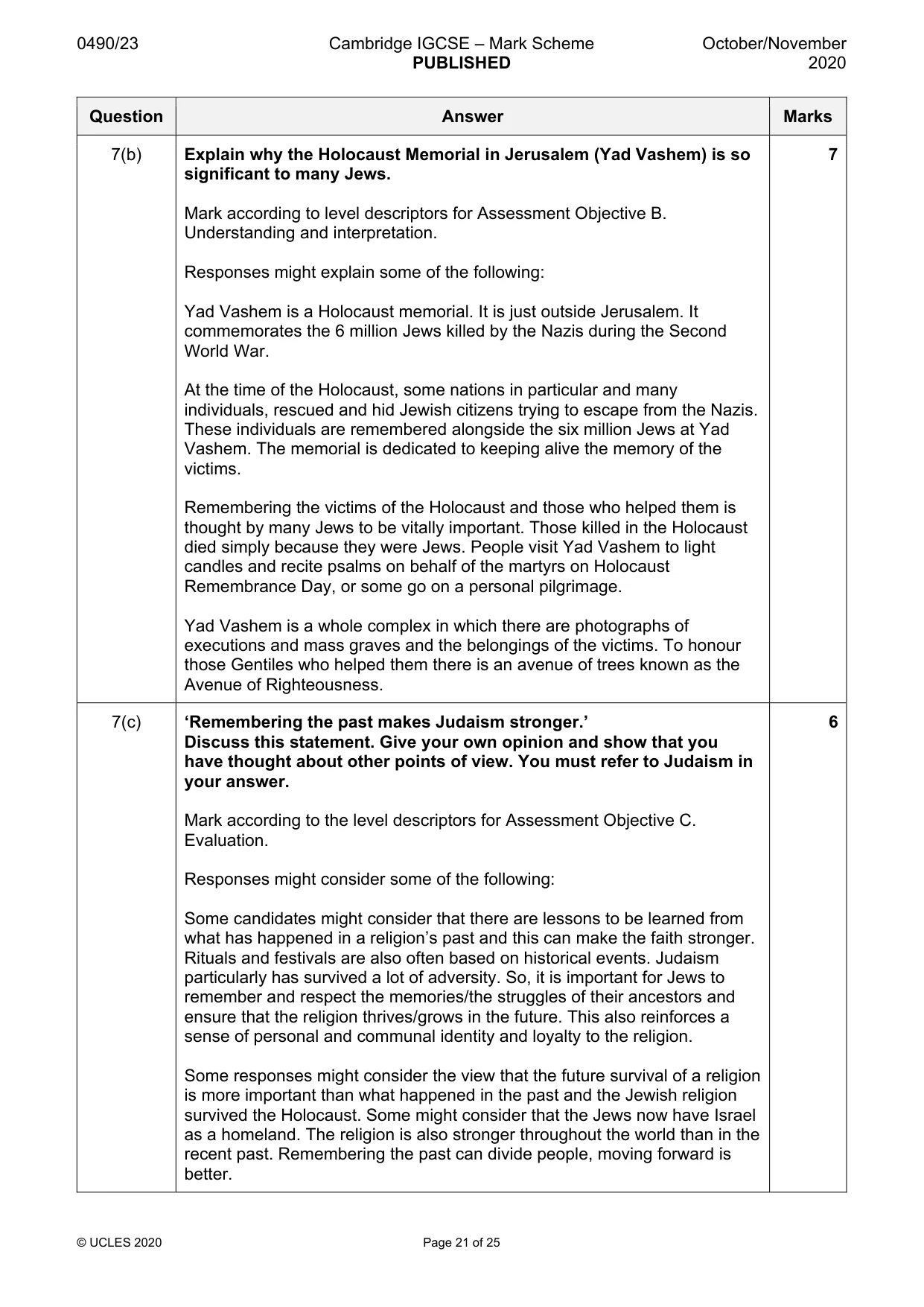
0490/23 Cambridge IGCSE – Mark Scheme PUBLISHED October/November 2020 © UCLES 2020 Page 21 of 25 Question Answer Marks 7(b) Explain why the Holocaust Memorial in Jerusalem (Yad Vashem) is so significant to many Jews. Mark according to level descriptors for Assessment Objective B. Understanding and interpretation. Responses might explain some of the following: Yad Vashem is a Holocaust memorial. It is just outside Jerusalem. It commemorates the 6 million Jews killed by the Nazis during the Second World War. At the time of the Holocaust, some nations in particular and many individuals, rescued and hid Jewish citizens trying to escape from the Nazis. These individuals are remembered alongside the six million Jews at Yad Vashem. The memorial is dedicated to keeping alive the memory of the victims. Remembering the victims of the Holocaust and those who helped them is thought by many Jews to be vitally important. Those killed in the Holocaust died simply because they were Jews. People visit Yad Vashem to light candles and recite psalms on behalf of the martyrs on Holocaust Remembrance Day, or some go on a personal pilgrimage. Yad Vashem is a whole complex in which there are photographs of executions and mass graves and the belongings of the victims. To honour those Gentiles who helped them there is an avenue of trees known as the Avenue of Righteousness. 7 7(c) ‘Remembering the past makes Judaism stronger.’ Discuss this statement. Give your own opinion and show that you have thought about other points of view. You must refer to Judaism in your answer. Mark according to the level descriptors for Assessment Objective C. Evaluation. Responses might consider some of the following: Some candidates might consider that there are lessons to be learned from what has happened in a religion’s past and this can make the faith stronger. Rituals and festivals are also often based on historical events. Judaism particularly has survived a lot of adversity. So, it is important for Jews to remember and respect the memories/the struggles of their ancestors and ensure that the religion thrives/grows in the future. This also reinforces a sense of personal and communal identity and loyalty to the religion. Some responses might consider the view that the future survival of a religion is more important than what happened in the past and the Jewish religion survived the Holocaust. Some might consider that the Jews now have Israel as a homeland. The religion is also stronger throughout the world than in the recent past. Remembering the past can divide people, moving forward is better. 6
Mark scheme, page 22
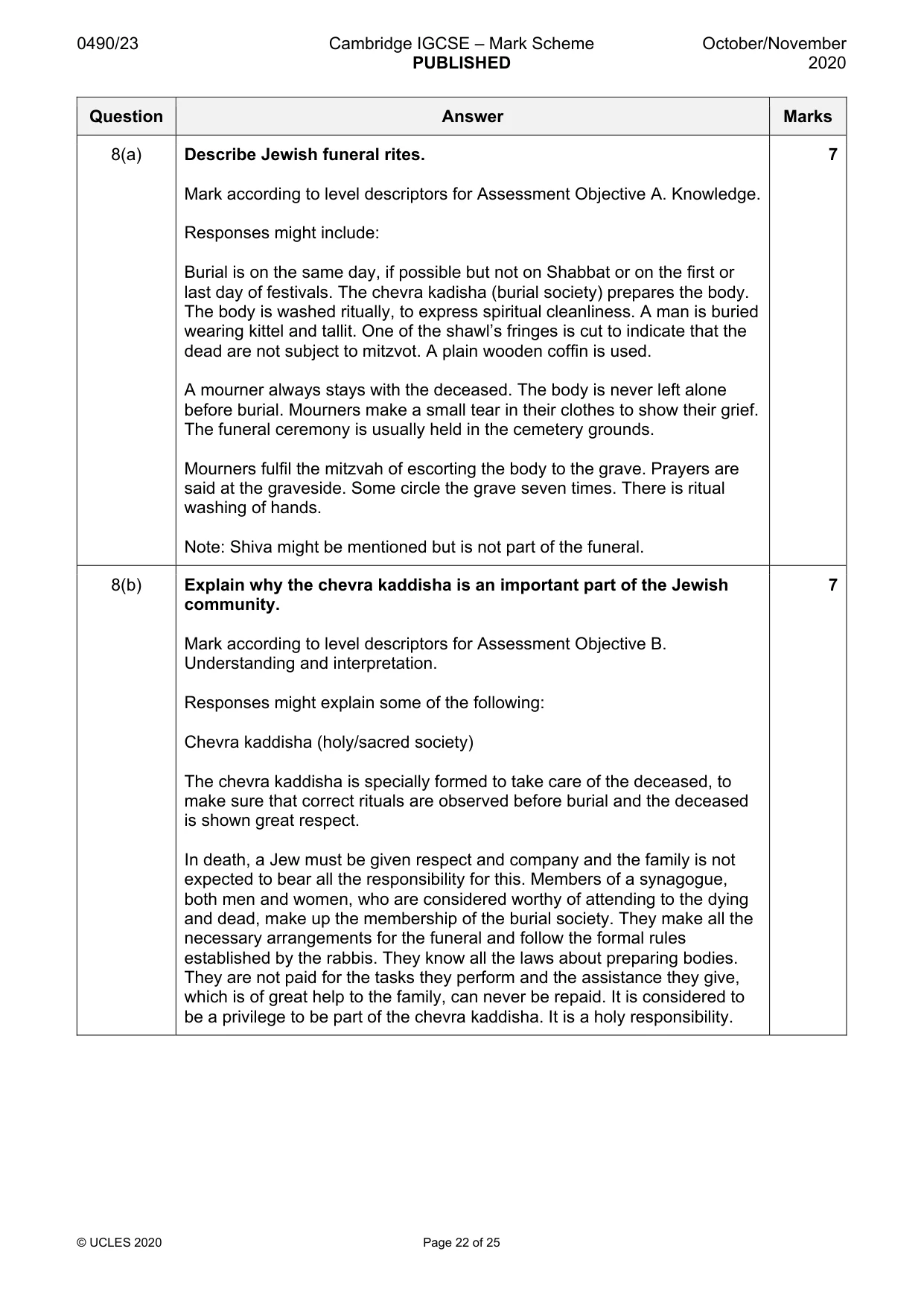
0490/23 Cambridge IGCSE – Mark Scheme PUBLISHED October/November 2020 © UCLES 2020 Page 22 of 25 Question Answer Marks 8(a) Describe Jewish funeral rites. Mark according to level descriptors for Assessment Objective A. Knowledge. Responses might include: Burial is on the same day, if possible but not on Shabbat or on the first or last day of festivals. The chevra kadisha (burial society) prepares the body. The body is washed ritually, to express spiritual cleanliness. A man is buried wearing kittel and tallit. One of the shawl’s fringes is cut to indicate that the dead are not subject to mitzvot. A plain wooden coffin is used. A mourner always stays with the deceased. The body is never left alone before burial. Mourners make a small tear in their clothes to show their grief. The funeral ceremony is usually held in the cemetery grounds. Mourners fulfil the mitzvah of escorting the body to the grave. Prayers are said at the graveside. Some circle the grave seven times. There is ritual washing of hands. Note: Shiva might be mentioned but is not part of the funeral. 7 8(b) Explain why the chevra kaddisha is an important part of the Jewish community. Mark according to level descriptors for Assessment Objective B. Understanding and interpretation. Responses might explain some of the following: Chevra kaddisha (holy/sacred society) The chevra kaddisha is specially formed to take care of the deceased, to make sure that correct rituals are observed before burial and the deceased is shown great respect. In death, a Jew must be given respect and company and the family is not expected to bear all the responsibility for this. Members of a synagogue, both men and women, who are considered worthy of attending to the dying and dead, make up the membership of the burial society. They make all the necessary arrangements for the funeral and follow the formal rules established by the rabbis. They know all the laws about preparing bodies. They are not paid for the tasks they perform and the assistance they give, which is of great help to the family, can never be repaid. It is considered to be a privilege to be part of the chevra kaddisha. It is a holy responsibility. 7
Mark scheme, page 23
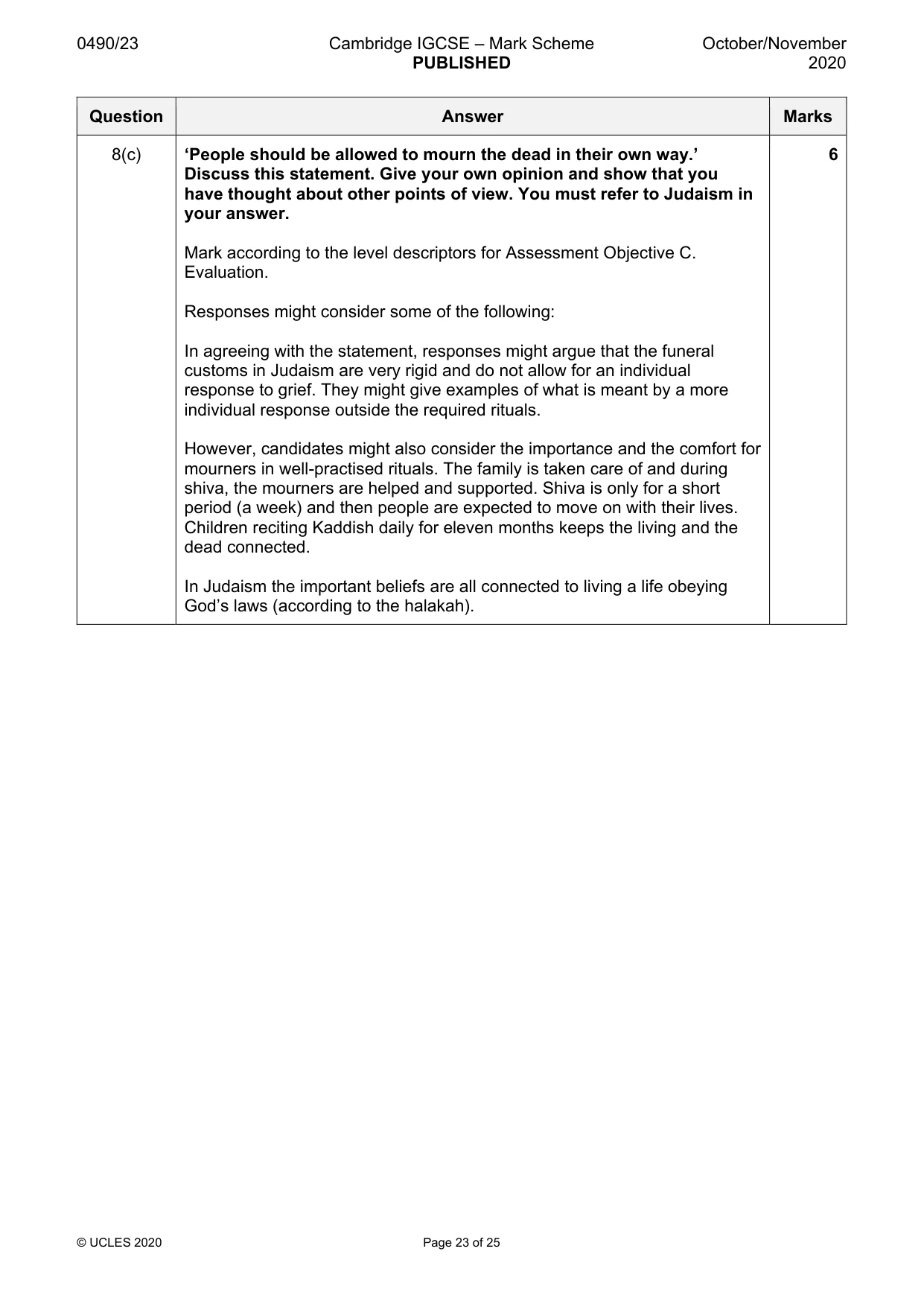
0490/23 Cambridge IGCSE – Mark Scheme PUBLISHED October/November 2020 © UCLES 2020 Page 23 of 25 Question Answer Marks 8(c) ‘People should be allowed to mourn the dead in their own way.’ Discuss this statement. Give your own opinion and show that you have thought about other points of view. You must refer to Judaism in your answer. Mark according to the level descriptors for Assessment Objective C. Evaluation. Responses might consider some of the following: In agreeing with the statement, responses might argue that the funeral customs in Judaism are very rigid and do not allow for an individual response to grief. They might give examples of what is meant by a more individual response outside the required rituals. However, candidates might also consider the importance and the comfort for mourners in well-practised rituals. The family is taken care of and during shiva, the mourners are helped and supported. Shiva is only for a short period (a week) and then people are expected to move on with their lives. Children reciting Kaddish daily for eleven months keeps the living and the dead connected. In Judaism the important beliefs are all connected to living a life obeying God’s laws (according to the halakah). 6
Mark scheme, page 24
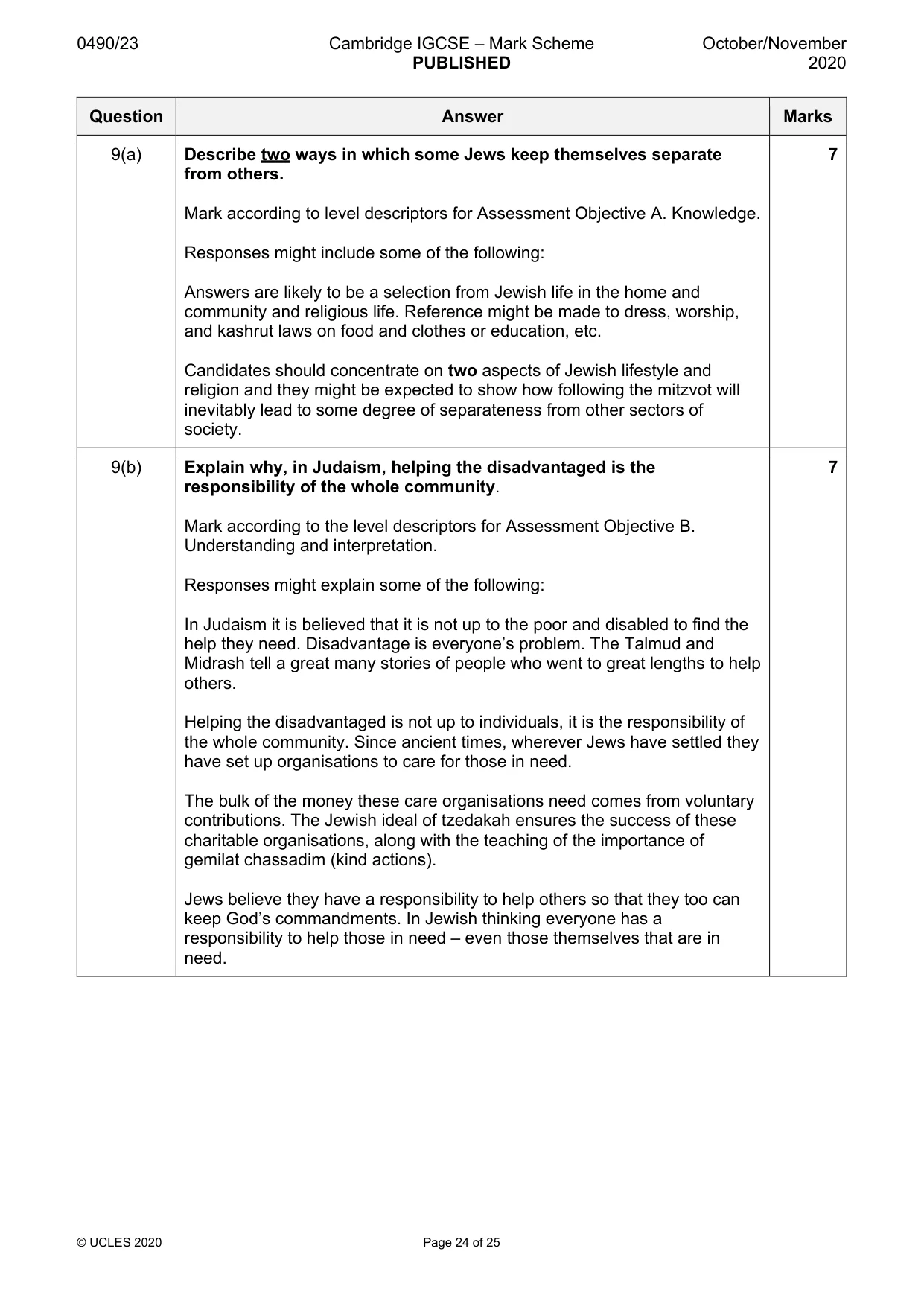
0490/23 Cambridge IGCSE – Mark Scheme PUBLISHED October/November 2020 © UCLES 2020 Page 24 of 25 Question Answer Marks 9(a) Describe two ways in which some Jews keep themselves separate from others. Mark according to level descriptors for Assessment Objective A. Knowledge. Responses might include some of the following: Answers are likely to be a selection from Jewish life in the home and community and religious life. Reference might be made to dress, worship, and kashrut laws on food and clothes or education, etc. Candidates should concentrate on two aspects of Jewish lifestyle and religion and they might be expected to show how following the mitzvot will inevitably lead to some degree of separateness from other sectors of society. 7 9(b) Explain why, in Judaism, helping the disadvantaged is the responsibility of the whole community. Mark according to the level descriptors for Assessment Objective B. Understanding and interpretation. Responses might explain some of the following: In Judaism it is believed that it is not up to the poor and disabled to find the help they need. Disadvantage is everyone’s problem. The Talmud and Midrash tell a great many stories of people who went to great lengths to help others. Helping the disadvantaged is not up to individuals, it is the responsibility of the whole community. Since ancient times, wherever Jews have settled they have set up organisations to care for those in need. The bulk of the money these care organisations need comes from voluntary contributions. The Jewish ideal of tzedakah ensures the success of these charitable organisations, along with the teaching of the importance of gemilat chassadim (kind actions). Jews believe they have a responsibility to help others so that they too can keep God’s commandments. In Jewish thinking everyone has a responsibility to help those in need – even those themselves that are in need. 7
Mark scheme, page 25
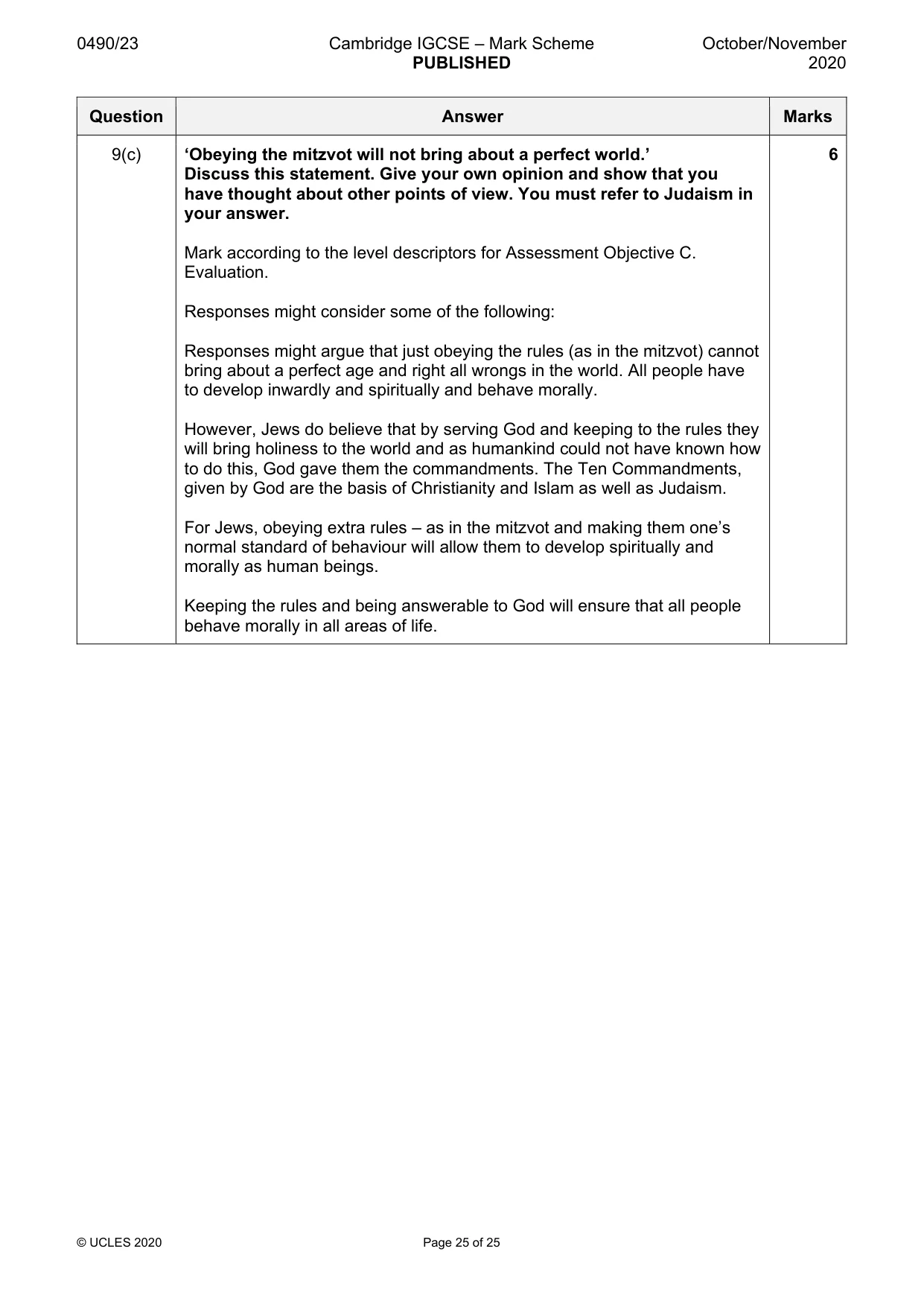
0490/23 Cambridge IGCSE – Mark Scheme PUBLISHED October/November 2020 © UCLES 2020 Page 25 of 25 Question Answer Marks 9(c) ‘Obeying the mitzvot will not bring about a perfect world.’ Discuss this statement. Give your own opinion and show that you have thought about other points of view. You must refer to Judaism in your answer. Mark according to the level descriptors for Assessment Objective C. Evaluation. Responses might consider some of the following: Responses might argue that just obeying the rules (as in the mitzvot) cannot bring about a perfect age and right all wrongs in the world. All people have to develop inwardly and spiritually and behave morally. However, Jews do believe that by serving God and keeping to the rules they will bring holiness to the world and as humankind could not have known how to do this, God gave them the commandments. The Ten Commandments, given by God are the basis of Christianity and Islam as well as Judaism. For Jews, obeying extra rules – as in the mitzvot and making them one’s normal standard of behaviour will allow them to develop spiritually and morally as human beings. Keeping the rules and being answerable to God will ensure that all people behave morally in all areas of life. 6
What you needed in this session
Cambridge’s own grade thresholds for 2020 Oct/Nov, Paper 2 · Variant 3. A higher threshold means an easier paper — the bar moves with how the cohort did.