Cambridge IGCSE Religious Studies 0490 — 2024 Oct/Nov Paper 2 · Variant 3
0490/23/O/N/24 · 80 marks · ≈90 min
The question paper and its mark scheme, free to read here and free to download. This is Cambridge’s own paper, exactly as it was sat.
Question paper4 pages
Mark scheme31 pages
Answers below. Sit the paper first if you are practising.
Paper as text
Question paper, page 1
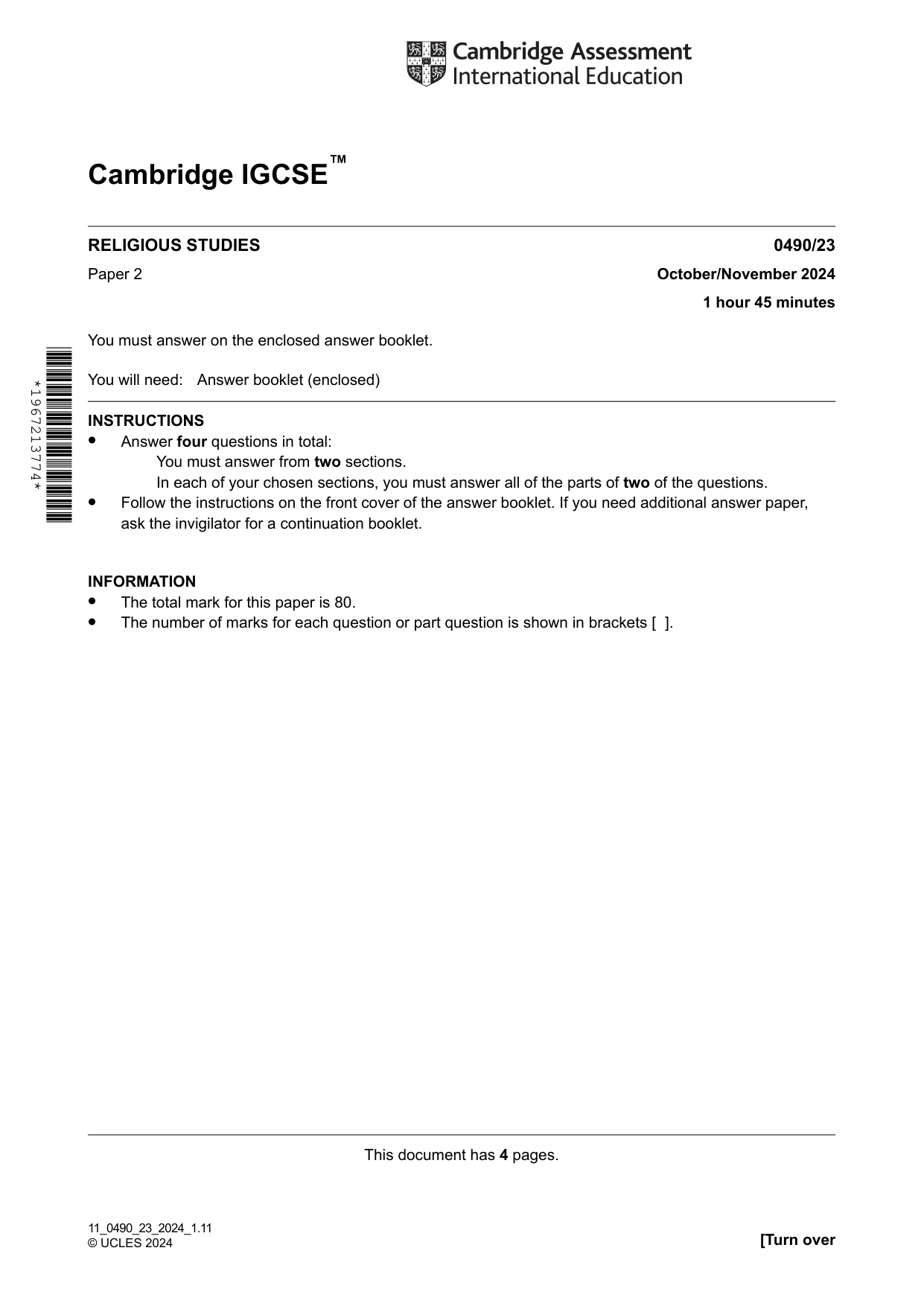
Cambridge IGCSE™ 0490/23 October/November 2024 1 hour 45 minutes RELIGIOUS STUDIES Paper 2 You must answer on the enclosed answer booklet. You will need: Answer booklet (enclosed) INSTRUCTIONS • Answer four questions in total: You must answer from two sections. In each of your chosen sections, you must answer all of the parts of two of the questions. • Follow the instructions on the front cover of the answer booklet. If you need additional answer paper, ask the invigilator for a continuation booklet. INFORMATION • The total mark for this paper is 80. • The number of marks for each question or part question is shown in brackets [ ]. This document has 4 pages. [Turn over 11_0490_23_2024_1.11 © UCLES 2024 *1967213774*
Question paper, page 2
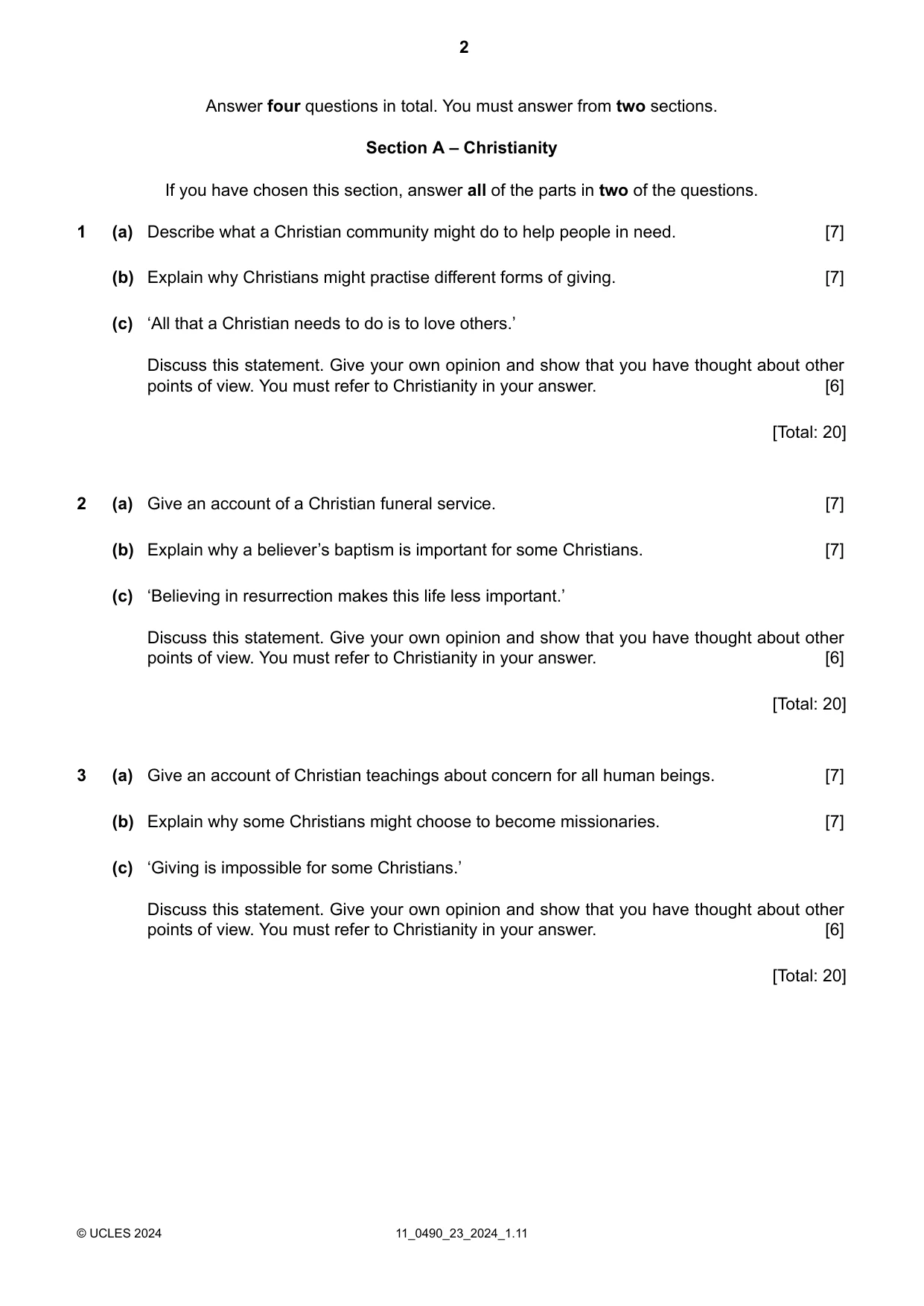
Answer four questions in total. You must answer from two sections. Section A – Christianity If you have chosen this section, answer all of the parts in two of the questions. Describe what a Christian community might do to help people in need. [7] (a) 1 Explain why Christians might practise different forms of giving. [7] (b) ‘All that a Christian needs to do is to love others.’ Discuss this statement. Give your own opinion and show that you have thought about other points of view. You must refer to Christianity in your answer. [6] (c) [Total: 20] Give an account of a Christian funeral service. [7] (a) 2 Explain why a believer’s baptism is important for some Christians. [7] (b) ‘Believing in resurrection makes this life less important.’ Discuss this statement. Give your own opinion and show that you have thought about other points of view. You must refer to Christianity in your answer. [6] (c) [Total: 20] Give an account of Christian teachings about concern for all human beings. [7] (a) 3 Explain why some Christians might choose to become missionaries. [7] (b) ‘Giving is impossible for some Christians.’ Discuss this statement. Give your own opinion and show that you have thought about other points of view. You must refer to Christianity in your answer. [6] (c) [Total: 20] 11_0490_23_2024_1.11 © UCLES 2024 2
Question paper, page 3
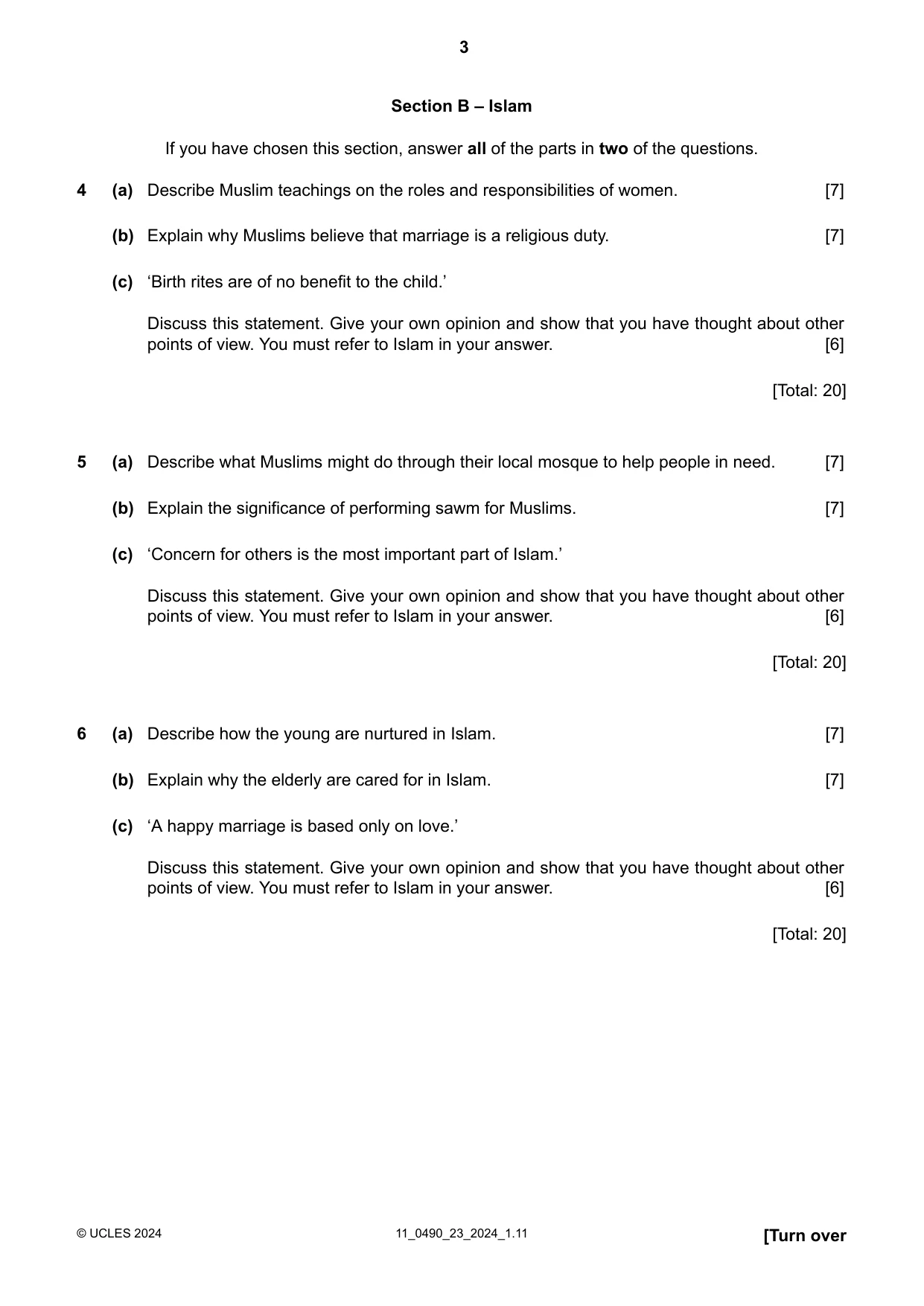
Section B – Islam If you have chosen this section, answer all of the parts in two of the questions. Describe Muslim teachings on the roles and responsibilities of women. [7] (a) 4 Explain why Muslims believe that marriage is a religious duty. [7] (b) ‘Birth rites are of no benefit to the child.’ Discuss this statement. Give your own opinion and show that you have thought about other points of view. You must refer to Islam in your answer. [6] (c) [Total: 20] Describe what Muslims might do through their local mosque to help people in need. [7] (a) 5 Explain the significance of performing sawm for Muslims. [7] (b) ‘Concern for others is the most important part of Islam.’ Discuss this statement. Give your own opinion and show that you have thought about other points of view. You must refer to Islam in your answer. [6] (c) [Total: 20] Describe how the young are nurtured in Islam. [7] (a) 6 Explain why the elderly are cared for in Islam. [7] (b) ‘A happy marriage is based only on love.’ Discuss this statement. Give your own opinion and show that you have thought about other points of view. You must refer to Islam in your answer. [6] (c) [Total: 20] [Turn over 11_0490_23_2024_1.11 © UCLES 2024 3
Question paper, page 4
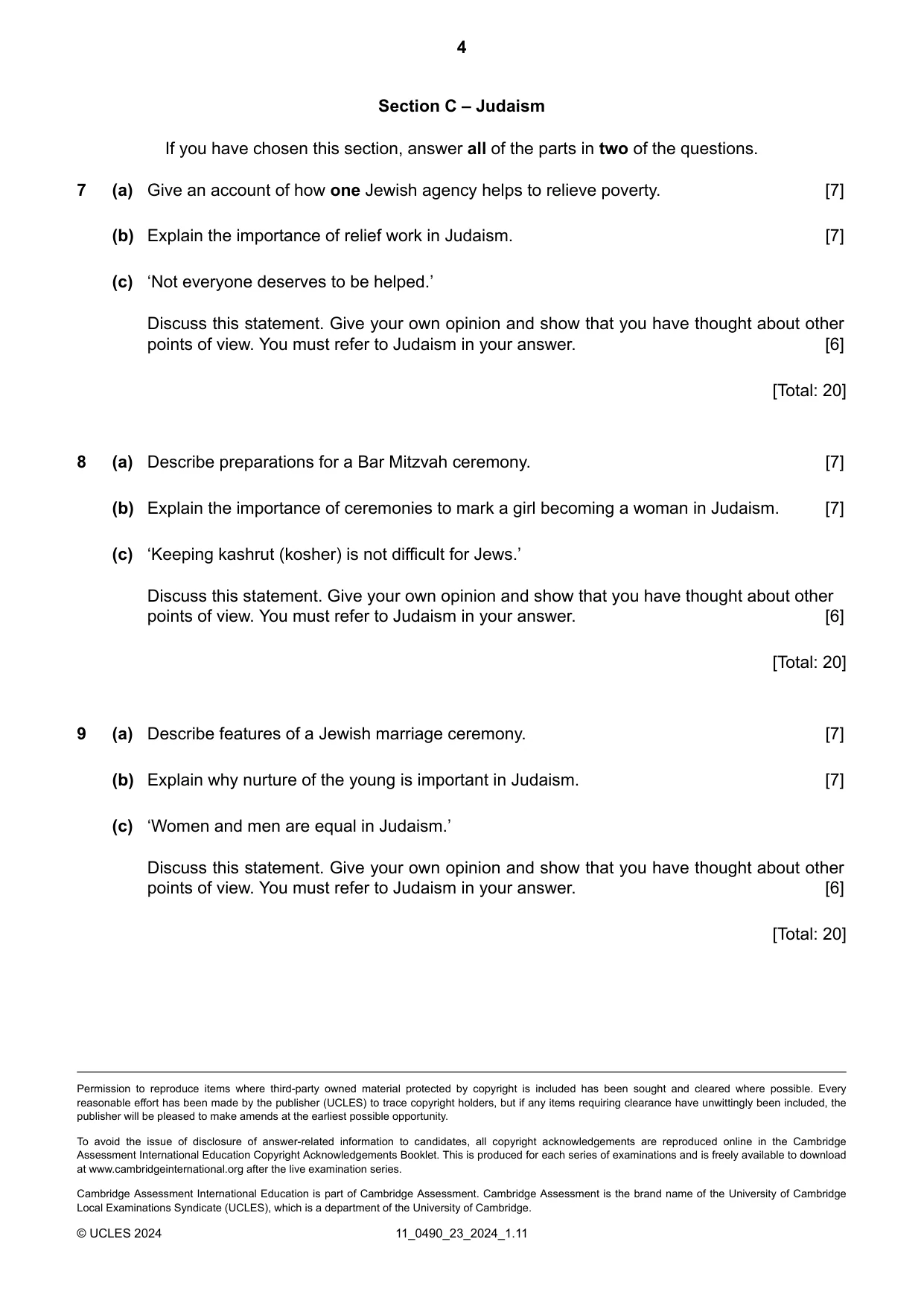
Section C – Judaism If you have chosen this section, answer all of the parts in two of the questions. Give an account of how one Jewish agency helps to relieve poverty. [7] (a) 7 Explain the importance of relief work in Judaism. [7] (b) ‘Not everyone deserves to be helped.’ Discuss this statement. Give your own opinion and show that you have thought about other points of view. You must refer to Judaism in your answer. [6] (c) [Total: 20] Describe preparations for a Bar Mitzvah ceremony. [7] (a) 8 Explain the importance of ceremonies to mark a girl becoming a woman in Judaism. [7] (b) ‘Keeping kashrut (kosher) is not difficult for Jews.’ Discuss this statement. Give your own opinion and show that you have thought about other points of view. You must refer to Judaism in your answer. [6] (c) [Total: 20] Describe features of a Jewish marriage ceremony. [7] (a) 9 Explain why nurture of the young is important in Judaism. [7] (b) ‘Women and men are equal in Judaism.’ Discuss this statement. Give your own opinion and show that you have thought about other points of view. You must refer to Judaism in your answer. [6] (c) [Total: 20] Permission to reproduce items where third-party owned material protected by copyright is included has been sought and cleared where possible. Every reasonable effort has been made by the publisher (UCLES) to trace copyright holders, but if any items requiring clearance have unwittingly been included, the publisher will be pleased to make amends at the earliest possible opportunity. To avoid the issue of disclosure of answer-related information to candidates, all copyright acknowledgements are reproduced online in the Cambridge Assessment International Education Copyright Acknowledgements Booklet. This is produced for each series of examinations and is freely available to download at www.cambridgeinternational.org after the live examination series. Cambridge Assessment International Education is part of Cambridge Assessment. Cambridge Assessment is the brand name of the University of Cambridge Local Examinations Syndicate (UCLES), which is a department of the University of Cambridge. 11_0490_23_2024_1.11 © UCLES 2024 4
Mark scheme, page 1
This document consists of 31 printed pages. © Cambridge University Press & Assessment 2024 [Turn over Cambridge IGCSE™ RELIGIOUS STUDIES 0490/23 Paper 2 October/November 2024 MARK SCHEME Maximum Mark: 80 Published This mark scheme is published as an aid to teachers and candidates, to indicate the requirements of the examination. It shows the basis on which Examiners were instructed to award marks. It does not indicate the details of the discussions that took place at an Examiners’ meeting before marking began, which would have considered the acceptability of alternative answers. Mark schemes should be read in conjunction with the question paper and the Principal Examiner Report for Teachers. Cambridge International will not enter into discussions about these mark schemes. Cambridge International is publishing the mark schemes for the October/November 2024 series for most Cambridge IGCSE, Cambridge International A and AS Level components, and some Cambridge O Level components.
Mark scheme, page 2
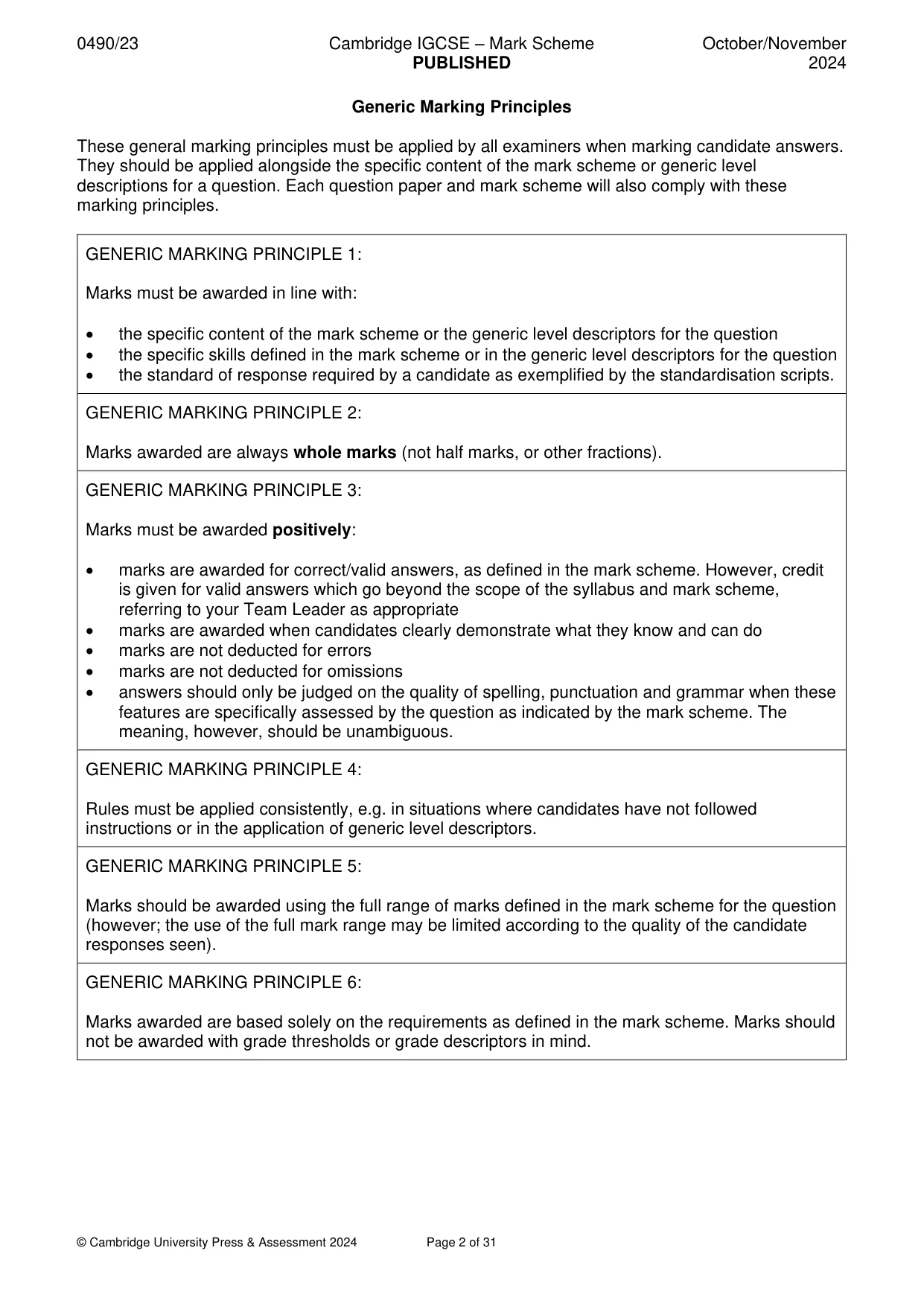
0490/23 Cambridge IGCSE – Mark Scheme PUBLISHED October/November 2024 © Cambridge University Press & Assessment 2024 Page 2 of 31 Generic Marking Principles These general marking principles must be applied by all examiners when marking candidate answers. They should be applied alongside the specific content of the mark scheme or generic level descriptions for a question. Each question paper and mark scheme will also comply with these marking principles. GENERIC MARKING PRINCIPLE 1: Marks must be awarded in line with: • the specific content of the mark scheme or the generic level descriptors for the question • the specific skills defined in the mark scheme or in the generic level descriptors for the question • the standard of response required by a candidate as exemplified by the standardisation scripts. GENERIC MARKING PRINCIPLE 2: Marks awarded are always whole marks (not half marks, or other fractions). GENERIC MARKING PRINCIPLE 3: Marks must be awarded positively: • marks are awarded for correct/valid answers, as defined in the mark scheme. However, credit is given for valid answers which go beyond the scope of the syllabus and mark scheme, referring to your Team Leader as appropriate • marks are awarded when candidates clearly demonstrate what they know and can do • marks are not deducted for errors • marks are not deducted for omissions • answers should only be judged on the quality of spelling, punctuation and grammar when these features are specifically assessed by the question as indicated by the mark scheme. The meaning, however, should be unambiguous. GENERIC MARKING PRINCIPLE 4: Rules must be applied consistently, e.g. in situations where candidates have not followed instructions or in the application of generic level descriptors. GENERIC MARKING PRINCIPLE 5: Marks should be awarded using the full range of marks defined in the mark scheme for the question (however; the use of the full mark range may be limited according to the quality of the candidate responses seen). GENERIC MARKING PRINCIPLE 6: Marks awarded are based solely on the requirements as defined in the mark scheme. Marks should not be awarded with grade thresholds or grade descriptors in mind.
Mark scheme, page 3
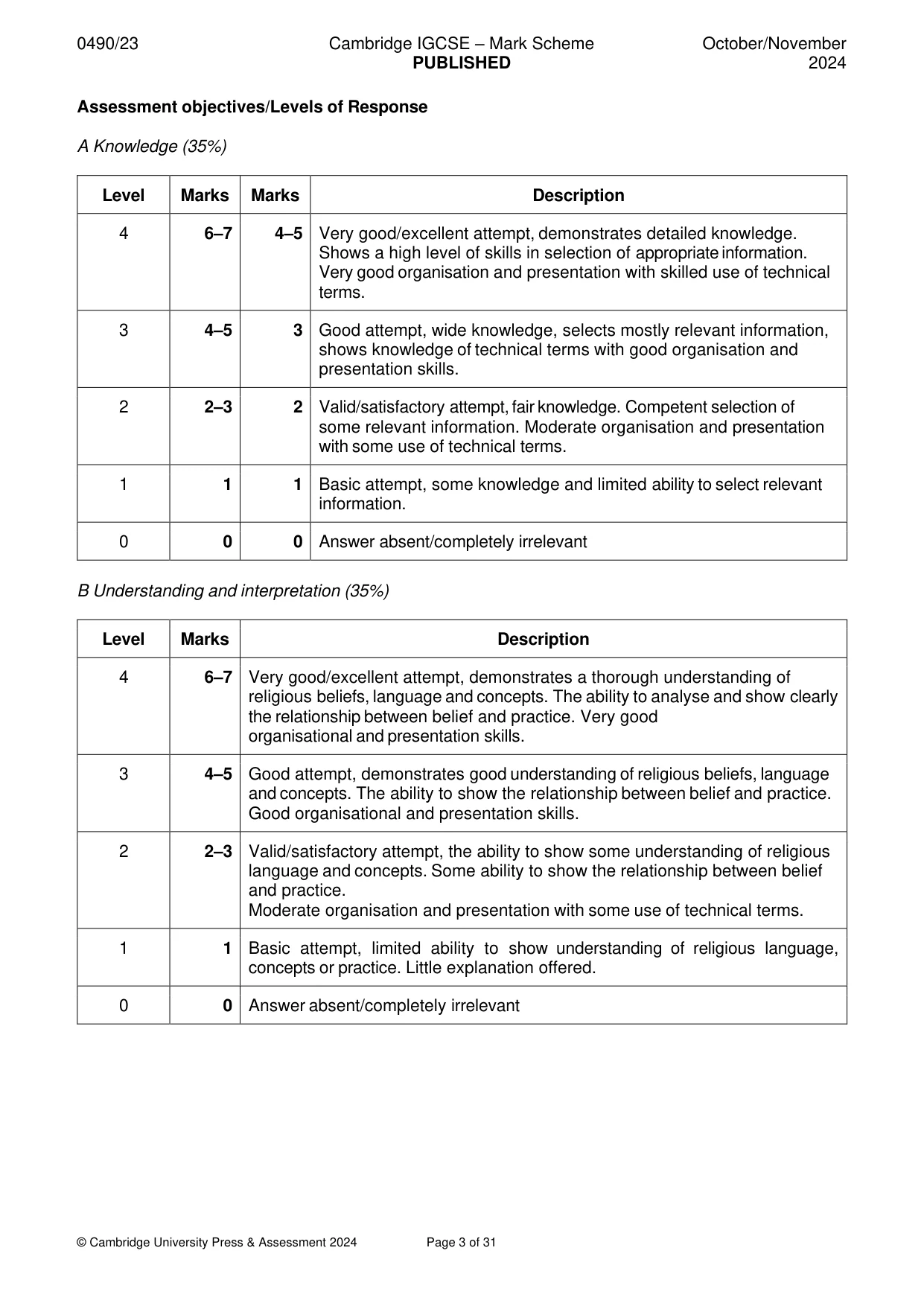
0490/23 Cambridge IGCSE – Mark Scheme PUBLISHED October/November 2024 © Cambridge University Press & Assessment 2024 Page 3 of 31 Assessment objectives/Levels of Response A Knowledge (35%) Level Marks Marks Description 4 6–7 4–5 Very good/excellent attempt, demonstrates detailed knowledge. Shows a high level of skills in selection of appropriate information. Very good organisation and presentation with skilled use of technical terms. 3 4–5 3 Good attempt, wide knowledge, selects mostly relevant information, shows knowledge of technical terms with good organisation and presentation skills. 2 2–3 2 Valid/satisfactory attempt, fair knowledge. Competent selection of some relevant information. Moderate organisation and presentation with some use of technical terms. 1 1 1 Basic attempt, some knowledge and limited ability to select relevant information. 0 0 0 Answer absent/completely irrelevant B Understanding and interpretation (35%) Level Marks Description 4 6–7 Very good/excellent attempt, demonstrates a thorough understanding of religious beliefs, language and concepts. The ability to analyse and show clearly the relationship between belief and practice. Very good organisational and presentation skills. 3 4–5 Good attempt, demonstrates good understanding of religious beliefs, language and concepts. The ability to show the relationship between belief and practice. Good organisational and presentation skills. 2 2–3 Valid/satisfactory attempt, the ability to show some understanding of religious language and concepts. Some ability to show the relationship between belief and practice. Moderate organisation and presentation with some use of technical terms. 1 1 Basic attempt, limited ability to show understanding of religious language, concepts or practice. Little explanation offered. 0 0 Answer absent/completely irrelevant
Mark scheme, page 4
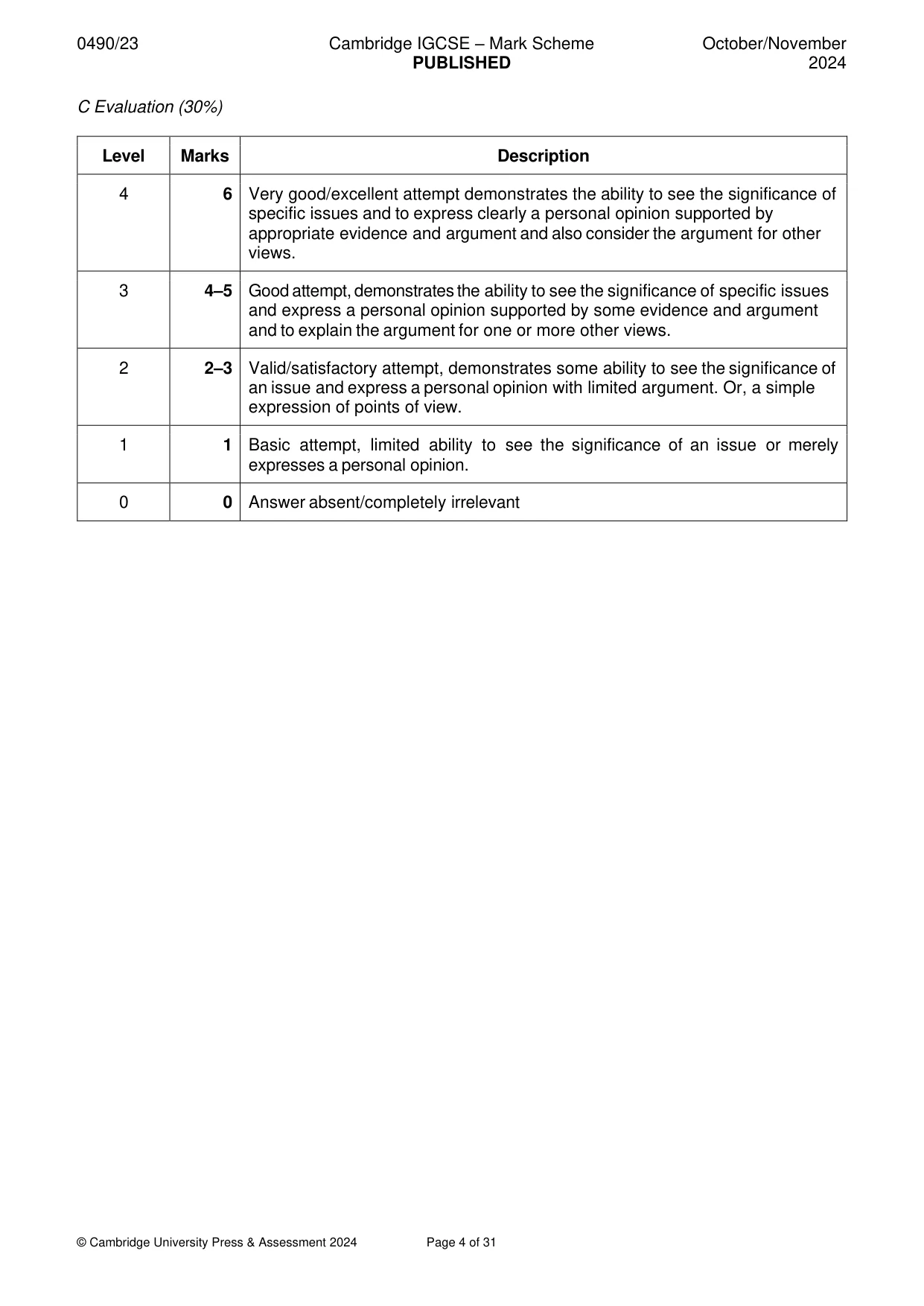
0490/23 Cambridge IGCSE – Mark Scheme PUBLISHED October/November 2024 © Cambridge University Press & Assessment 2024 Page 4 of 31 C Evaluation (30%) Level Marks Description 4 6 Very good/excellent attempt demonstrates the ability to see the significance of specific issues and to express clearly a personal opinion supported by appropriate evidence and argument and also consider the argument for other views. 3 4–5 Good attempt, demonstrates the ability to see the significance of specific issues and express a personal opinion supported by some evidence and argument and to explain the argument for one or more other views. 2 2–3 Valid/satisfactory attempt, demonstrates some ability to see the significance of an issue and express a personal opinion with limited argument. Or, a simple expression of points of view. 1 1 Basic attempt, limited ability to see the significance of an issue or merely expresses a personal opinion. 0 0 Answer absent/completely irrelevant
Mark scheme, page 5
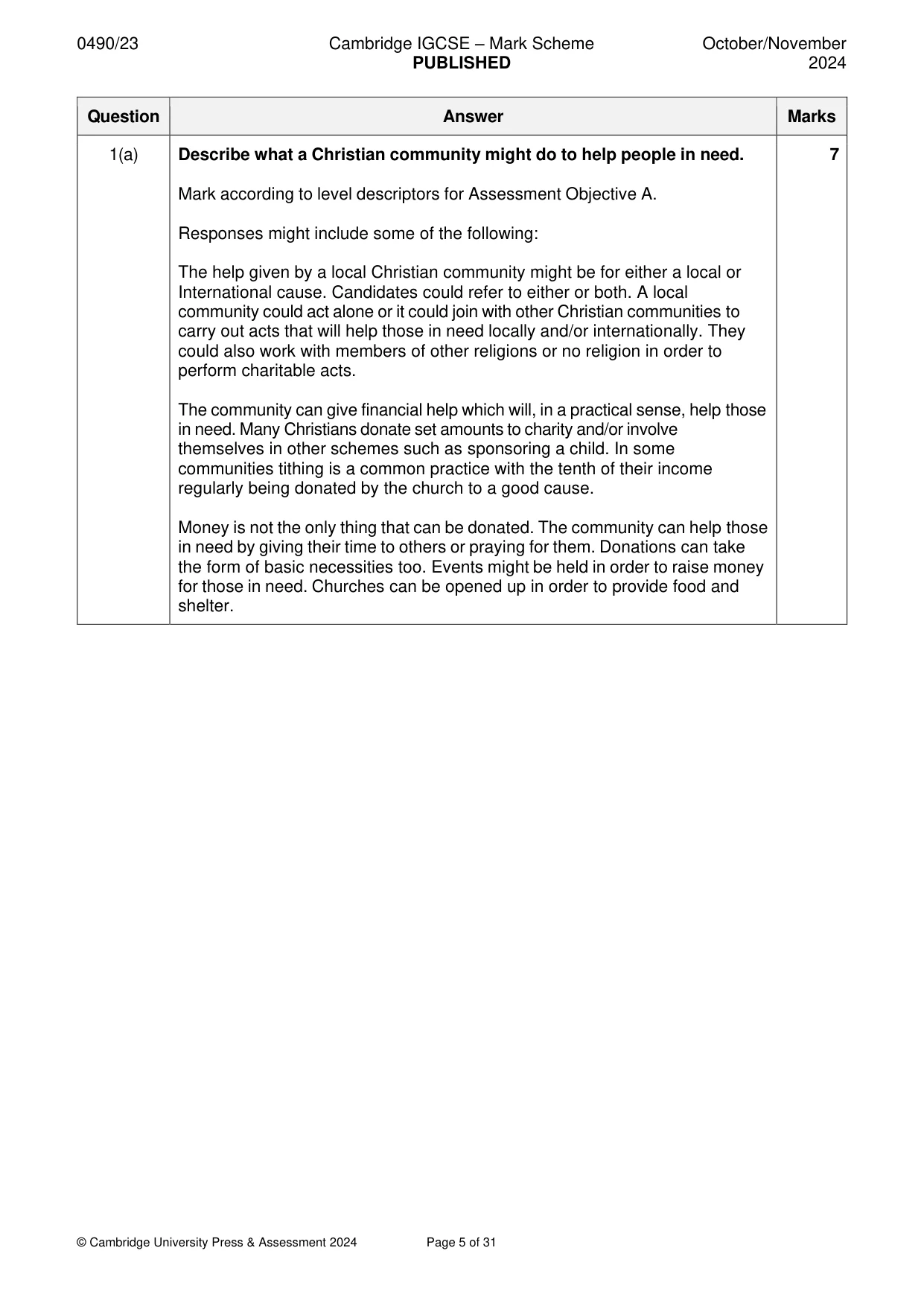
0490/23 Cambridge IGCSE – Mark Scheme PUBLISHED October/November 2024 © Cambridge University Press & Assessment 2024 Page 5 of 31 Question Answer Marks 1(a) Describe what a Christian community might do to help people in need. Mark according to level descriptors for Assessment Objective A. Responses might include some of the following: The help given by a local Christian community might be for either a local or International cause. Candidates could refer to either or both. A local community could act alone or it could join with other Christian communities to carry out acts that will help those in need locally and/or internationally. They could also work with members of other religions or no religion in order to perform charitable acts. The community can give financial help which will, in a practical sense, help those in need. Many Christians donate set amounts to charity and/or involve themselves in other schemes such as sponsoring a child. In some communities tithing is a common practice with the tenth of their income regularly being donated by the church to a good cause. Money is not the only thing that can be donated. The community can help those in need by giving their time to others or praying for them. Donations can take the form of basic necessities too. Events might be held in order to raise money for those in need. Churches can be opened up in order to provide food and shelter. 7
Mark scheme, page 6
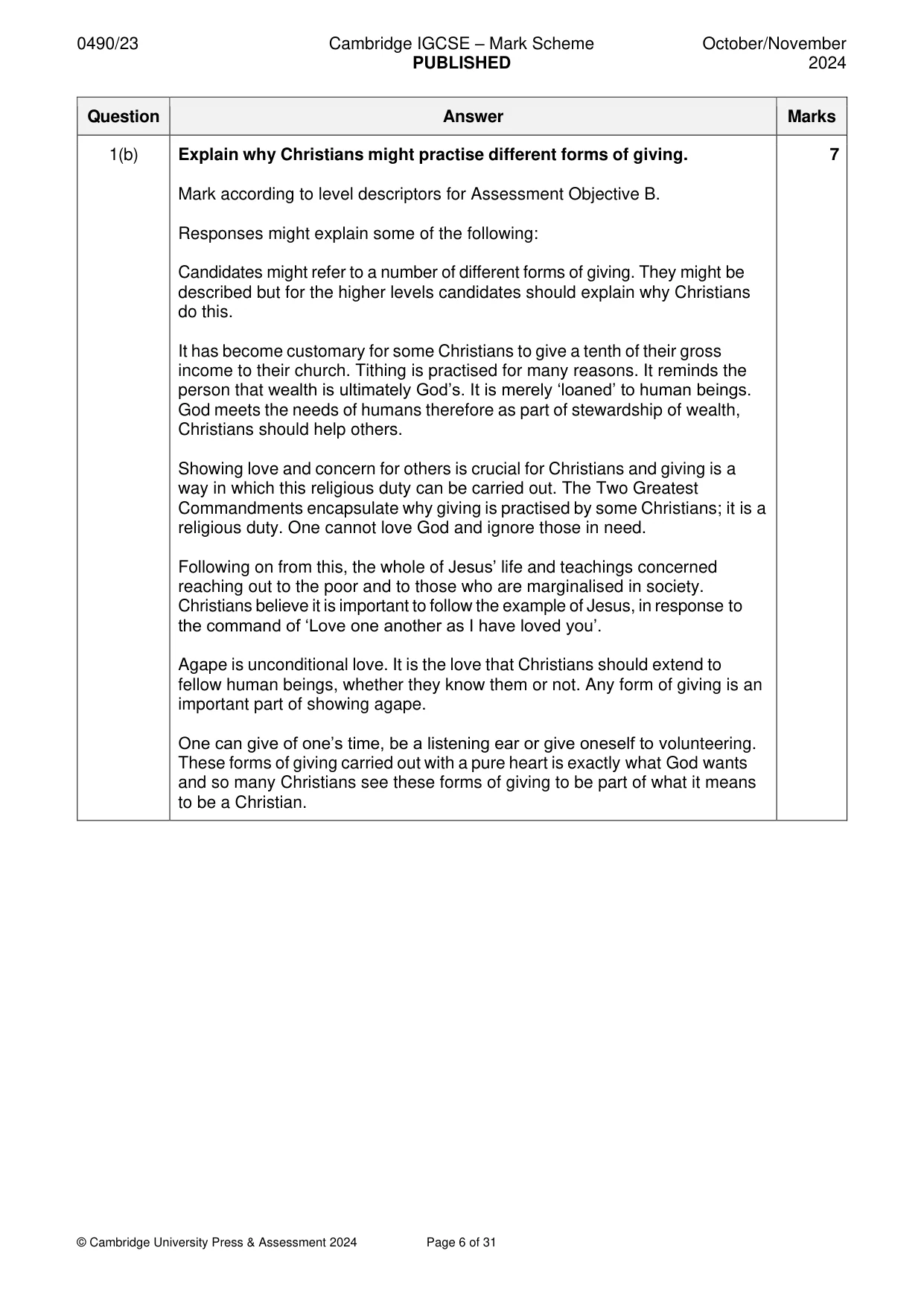
0490/23 Cambridge IGCSE – Mark Scheme PUBLISHED October/November 2024 © Cambridge University Press & Assessment 2024 Page 6 of 31 Question Answer Marks 1(b) Explain why Christians might practise different forms of giving. Mark according to level descriptors for Assessment Objective B. Responses might explain some of the following: Candidates might refer to a number of different forms of giving. They might be described but for the higher levels candidates should explain why Christians do this. It has become customary for some Christians to give a tenth of their gross income to their church. Tithing is practised for many reasons. It reminds the person that wealth is ultimately God’s. It is merely ‘loaned’ to human beings. God meets the needs of humans therefore as part of stewardship of wealth, Christians should help others. Showing love and concern for others is crucial for Christians and giving is a way in which this religious duty can be carried out. The Two Greatest Commandments encapsulate why giving is practised by some Christians; it is a religious duty. One cannot love God and ignore those in need. Following on from this, the whole of Jesus’ life and teachings concerned reaching out to the poor and to those who are marginalised in society. Christians believe it is important to follow the example of Jesus, in response to the command of ‘Love one another as I have loved you’. Agape is unconditional love. It is the love that Christians should extend to fellow human beings, whether they know them or not. Any form of giving is an important part of showing agape. One can give of one’s time, be a listening ear or give oneself to volunteering. These forms of giving carried out with a pure heart is exactly what God wants and so many Christians see these forms of giving to be part of what it means to be a Christian. 7
Mark scheme, page 7
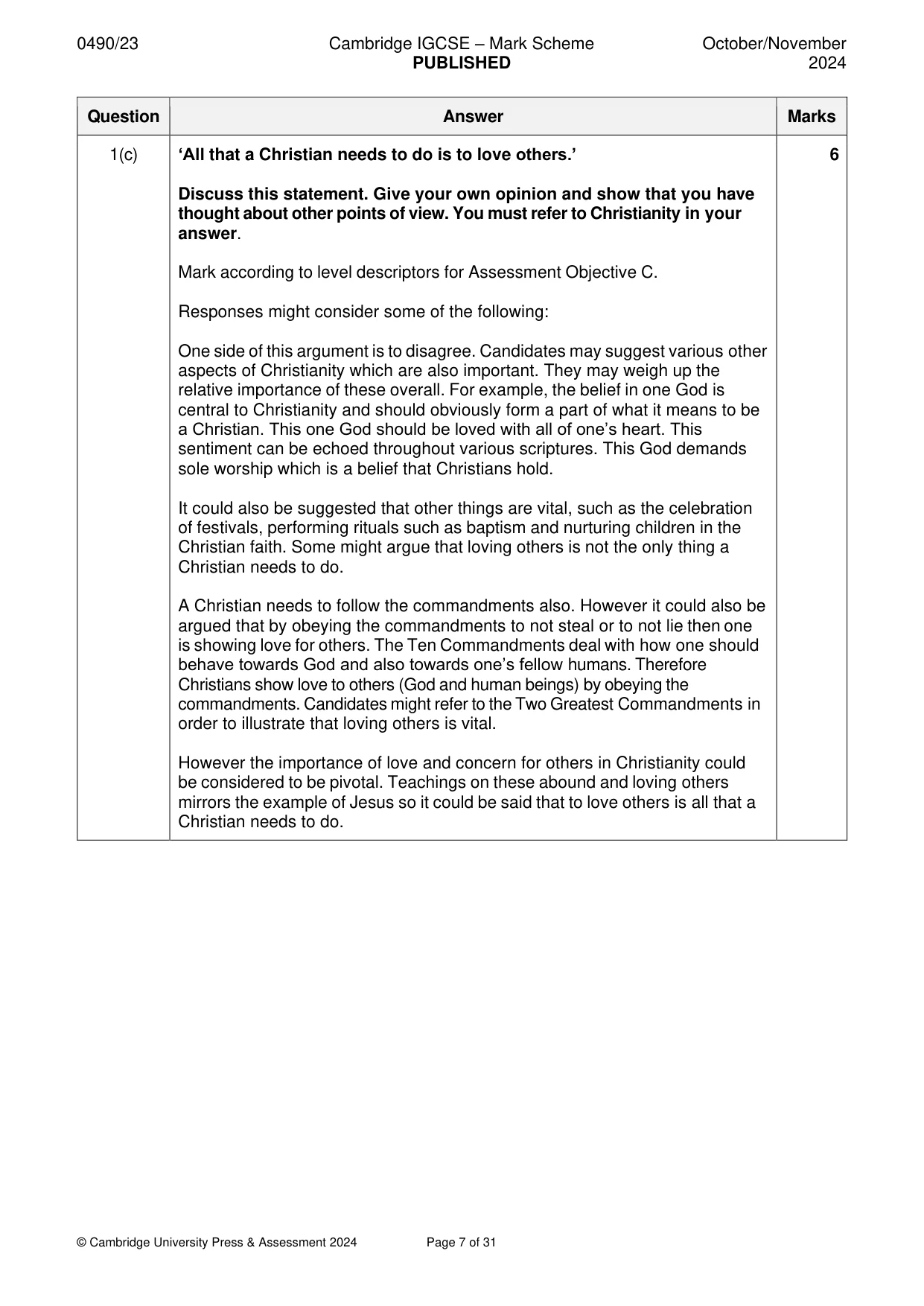
0490/23 Cambridge IGCSE – Mark Scheme PUBLISHED October/November 2024 © Cambridge University Press & Assessment 2024 Page 7 of 31 Question Answer Marks 1(c) ‘All that a Christian needs to do is to love others.’ Discuss this statement. Give your own opinion and show that you have thought about other points of view. You must refer to Christianity in your answer. Mark according to level descriptors for Assessment Objective C. Responses might consider some of the following: One side of this argument is to disagree. Candidates may suggest various other aspects of Christianity which are also important. They may weigh up the relative importance of these overall. For example, the belief in one God is central to Christianity and should obviously form a part of what it means to be a Christian. This one God should be loved with all of one’s heart. This sentiment can be echoed throughout various scriptures. This God demands sole worship which is a belief that Christians hold. It could also be suggested that other things are vital, such as the celebration of festivals, performing rituals such as baptism and nurturing children in the Christian faith. Some might argue that loving others is not the only thing a Christian needs to do. A Christian needs to follow the commandments also. However it could also be argued that by obeying the commandments to not steal or to not lie then one is showing love for others. The Ten Commandments deal with how one should behave towards God and also towards one’s fellow humans. Therefore Christians show love to others (God and human beings) by obeying the commandments. Candidates might refer to the Two Greatest Commandments in order to illustrate that loving others is vital. However the importance of love and concern for others in Christianity could be considered to be pivotal. Teachings on these abound and loving others mirrors the example of Jesus so it could be said that to love others is all that a Christian needs to do. 6
Mark scheme, page 8
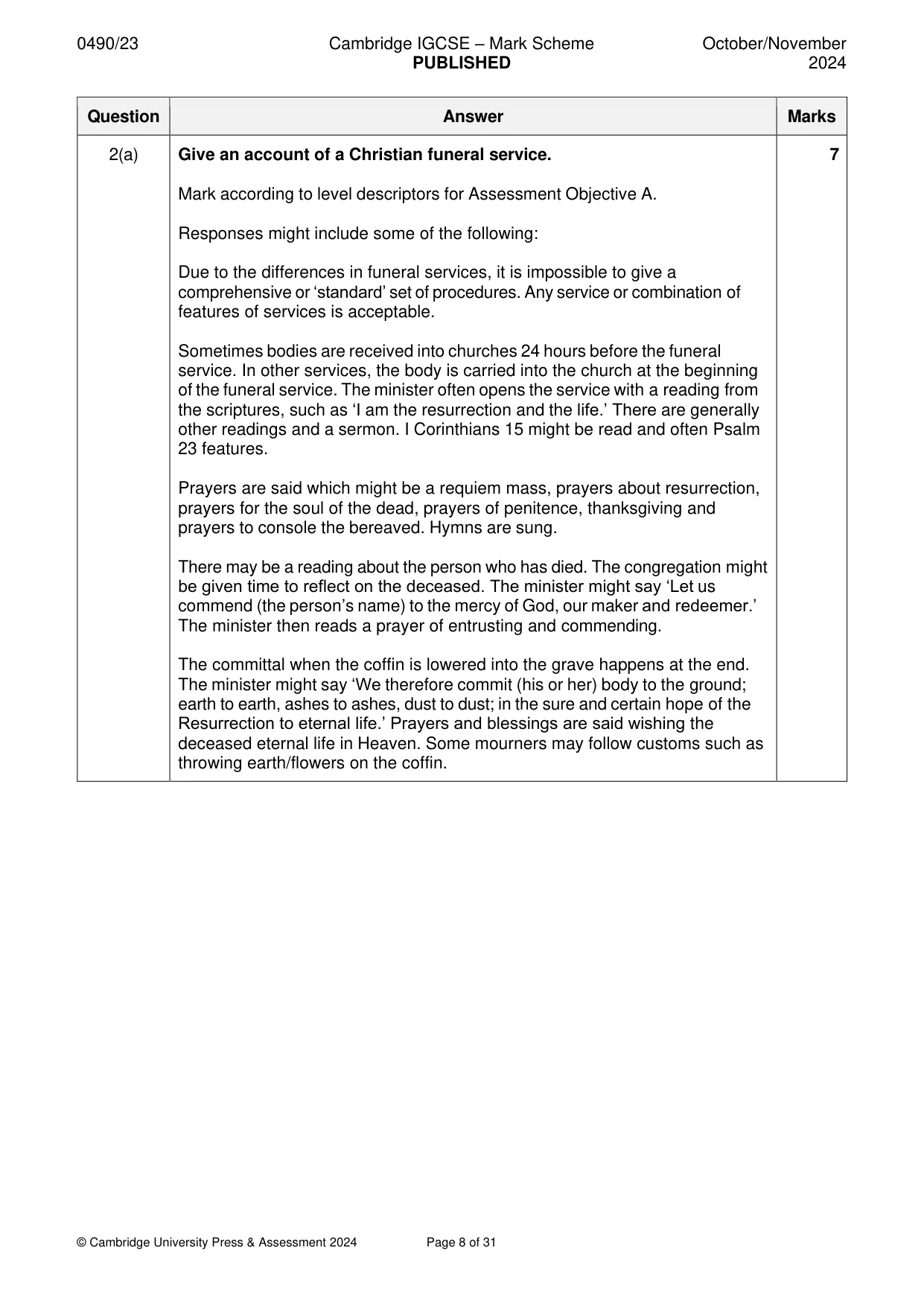
0490/23 Cambridge IGCSE – Mark Scheme PUBLISHED October/November 2024 © Cambridge University Press & Assessment 2024 Page 8 of 31 Question Answer Marks 2(a) Give an account of a Christian funeral service. Mark according to level descriptors for Assessment Objective A. Responses might include some of the following: Due to the differences in funeral services, it is impossible to give a comprehensive or ‘standard’ set of procedures. Any service or combination of features of services is acceptable. Sometimes bodies are received into churches 24 hours before the funeral service. In other services, the body is carried into the church at the beginning of the funeral service. The minister often opens the service with a reading from the scriptures, such as ‘I am the resurrection and the life.’ There are generally other readings and a sermon. I Corinthians 15 might be read and often Psalm 23 features. Prayers are said which might be a requiem mass, prayers about resurrection, prayers for the soul of the dead, prayers of penitence, thanksgiving and prayers to console the bereaved. Hymns are sung. There may be a reading about the person who has died. The congregation might be given time to reflect on the deceased. The minister might say ‘Let us commend (the person’s name) to the mercy of God, our maker and redeemer.’ The minister then reads a prayer of entrusting and commending. The committal when the coffin is lowered into the grave happens at the end. The minister might say ‘We therefore commit (his or her) body to the ground; earth to earth, ashes to ashes, dust to dust; in the sure and certain hope of the Resurrection to eternal life.’ Prayers and blessings are said wishing the deceased eternal life in Heaven. Some mourners may follow customs such as throwing earth/flowers on the coffin. 7
Mark scheme, page 9
0490/23 Cambridge IGCSE – Mark Scheme PUBLISHED October/November 2024 © Cambridge University Press & Assessment 2024 Page 9 of 31 Question Answer Marks 2(b) Explain why a believer’s baptism is important for some Christians. Mark according to level descriptors for Assessment Objective B. Responses might explain some of the following: It is important because it mirrors the baptism of Jesus. Jesus was an adult when he chose to be baptised. A believer’s baptism has symbolic elements which reflect the dying and rising of Christ. It is important for many Christians to make a public and personal commitment to becoming a Christian. Through this ceremony, the believer is initiated into the Christian community. For many this event is of huge significance. A speech is usually made by the person who has chosen to be baptised. This furthers the reason as to why the ceremony is important as the individual is personally testifying to their faith. It is believed that the Holy Spirit is given during this ceremony which heightens its importance. The Holy Spirit acts as a guide and a comfort for the individual as s/he goes through life. Full immersion is important as it symbolises the washing away of sin and one’s old life. The person rises to a new life in Christ. For some this means that they have been forgiven of sin and may describe it as being ‘born again.’ Candidates might contrast believer’s with infant baptism in order to illustrate why the former is important to some Christians. 7
Mark scheme, page 10
0490/23 Cambridge IGCSE – Mark Scheme PUBLISHED October/November 2024 © Cambridge University Press & Assessment 2024 Page 10 of 31 Question Answer Marks 2(c) ‘Believing in resurrection makes this life less important.’ Discuss this statement. Give your own opinion and show that you have thought about other points of view. You must refer to Christianity in your answer. Mark according to level descriptors for Assessment Objective C. Responses might consider some of the following: It could be suggested that believing in the resurrection does make this life less important. This life is only temporary and a mere preparation for the life to come. Jesus’ Resurrection highlights the importance of the belief in resurrection. Reference might be made to the words of a funeral service, ‘in sure and certain hope of the resurrection’. Resurrection is a given and even in times of despair that is what is important. However, others could argue that this life is still extremely important as it is believed that the way it is lived will have an effect on the life to come. Some might argue that there is just one life so the best thing to do would be to emphasise its importance. A Christian may well agree that this life should be lived well and considered important but there may be differences regarding what this might mean in practical terms. Many would say that they must strive to carry out Christian principles and ideals throughout their life to carry out their duty to God and to others. This would be a full and productive Christian life. Many would say that there must be some reference to the next life, which many believe is shaped by this one. In that sense, this life is not as important as the life to come. Some religious orders live a very restrained and frugal life. This is because the important thing is the life to come. Another view might be that humans should strive to always improve the way they live their life and the conditions in which they live it. This means that this life is very important. Some may focus on the material aspects of life and working to improve these for themselves and their families. 6
Mark scheme, page 11
0490/23 Cambridge IGCSE – Mark Scheme PUBLISHED October/November 2024 © Cambridge University Press & Assessment 2024 Page 11 of 31 Question Answer Marks 3(a) Give an account of Christian teachings about concern for all human beings. Mark according to level descriptors for Assessment Objective A. Responses might include some of the following: Candidates might consider the importance of the word ‘all’ in the question. The idea that concern should be universal is a concept that candidates might describe, regardless of race, colour or religion. Candidates could refer to the parable of the Good Samaritan. Candidates might focus much of their answer on the Two Greatest Commandments. They might say that Jesus was asked which of the commandments was the most important and also give his reply. This is the essence of Christian teachings on love and concern for others. The Ten Commandments are covered by the Two Greatest Commandments. All of these commandments are examples of Christian teachings on concern. Jesus’ life and teachings are examples to Christians of the need to show love and concern. Jesus reached out to the poor and needy, to the marginalised of society. Candidates could refer to specific teachings of Jesus to make their point, such as ‘Love one another as I have loved you.’ Christian teachings state that everyone is created equal. Recognising the equality of everyone means that one should show love and concern to everyone. Candidates could refer to specific teachings that show equality such as in the Genesis Creation story or Galatians 3:28. Agape or unconditional love is crucial to Christianity. Agape permeates Christian teachings and should be a guiding principle in moral decision making. Some candidates might refer to teachings on forgiveness, including the parable of the prodigal son. 7
Mark scheme, page 12
0490/23 Cambridge IGCSE – Mark Scheme PUBLISHED October/November 2024 © Cambridge University Press & Assessment 2024 Page 12 of 31 Question Answer Marks 3(b) Explain why some Christians might choose to become missionaries Mark according to level descriptors for Assessment Objective B. Responses might explain some of the following: A person might choose to become a missionary as this is an extension of the command to preach the Gospel. Missionaries want to make people across the world aware of the Good News about Jesus Christ. Missionaries are motivated by Christian teachings. They endeavour to live out the Christian teachings to love God and to love others in such a way as to provide both physical and spiritual support for people wherever it is needed. A person may wish to become a missionary as they see their work as an act of service to both God and to human beings. It is an obligation which follows the example of Jesus who gave help and support to those that needed it. They may be inspired to be considered in the long line of serving ‘Good Samaritans’. They want to involve themselves in the world, in Jesus’ name. Where someone in need is helped then that is an act of service to God too. Becoming a missionary allows a person to offer practical help and support. They want to share agape love with as many people as possible. For many missionaries doing just this is reason enough for becoming a missionary. Of course for others they want to become a missionary in order to convert people to Christianity. 7
Mark scheme, page 13
0490/23 Cambridge IGCSE – Mark Scheme PUBLISHED October/November 2024 © Cambridge University Press & Assessment 2024 Page 13 of 31 Question Answer Marks 3(c) ‘Giving is impossible for some Christians.’ Discuss this statement. Give your own opinion and show that you have thought about other points of view. You must refer to Christianity in your answer. Mark according to level descriptors for Assessment Objective C. Responses might consider some of the following: Charity can take many forms and responses will differ depending on which type of giving candidates refer to. The most obvious form will be the giving of money. Candidates might suggest that it is impossible for some Christians to give money to charity as they do not have enough money for themselves. Others might say that everyone can give some money, no matter how small an amount. In fact Jesus said that the widow who made a small offering had in reality given so much more than those who could afford it. It could be suggested that some cannot give money as they are the ones who should be in receipt of monetary giving. A natural disaster or other troubles may have befallen people and they literally do have nothing. They may be the impoverished ones. However giving can also take the form of giving of one’s time. Everyone has that whilst still accepting that some have more time than others. Therefore it is possible for all Christians to give of their time to charity by helping out, visiting someone or campaigning for something. Another line of argument could be that it is a religious duty to give to others in whatever form one is able to. Not to do so would be a selfish act that is contrary to traditional Christian teachings. The rich young ruler was told to sell all that he had and to give to the poor. 6
Mark scheme, page 14
0490/23 Cambridge IGCSE – Mark Scheme PUBLISHED October/November 2024 © Cambridge University Press & Assessment 2024 Page 14 of 31 Question Answer Marks 4(a) Describe Muslim teachings on the roles and responsibilities of women. Muslim women have a variety of roles and responsibilities. Women and men are different, yet equal. When instructions are given in the Qur’an the reference is to both men and women. God created all living things, creating all living animals in pairs. Of course, physical differences are acknowledged as are their different roles and responsibilities but this does not affect their overall equality. Both women and men have duties, both are judged by God according to the same criterion. Traditionally a woman’s role is to remain at home in order to fulfill the responsibility to raise and educate the children. Many will not work for this reason. They are intended to be wives and mothers. Women do not have to attend the Mosque during Friday prayer. Women should dress modestly. Women are provided for by the dowry in a marriage and both men and women have equal responsibilities in the marriage. Although the rights of women are different from those of men, they do have the right to choose who they marry, to divorce, to study, to own property, to conduct business, to take part in politics. Muhammad (pbuh) emphasised the importance of women and the respect that should be shown to them when he said ‘Paradise lies at the feet of your mother.’ This emphasises the key role that women have, particularly in the home. Where Muslim men can have up to four wives, it is the man’s responsibility to treat all of them equally. Muhammad (pbuh) in his last sermon told women and men to care for each other in marriage. 7
Mark scheme, page 15
0490/23 Cambridge IGCSE – Mark Scheme PUBLISHED October/November 2024 © Cambridge University Press & Assessment 2024 Page 15 of 31 Question Answer Marks 4(b) Explain why Muslims believe that marriage is a religious duty. Mark according to level descriptors for Assessment Objective B. Responses might explain some of the following: Marriage is a rite of passage. Rites of passage are important in religion. They are considered to be the phases that a human being will pass through, marking special milestones in their religious life. In that sense then marriage is a religious duty as it is an expectation of all Muslims that they marry. Marriage is also decreed in the Qur’an and so it is considered a religious duty to marry. Marriage follows the Sunnah of Muhammad (pbuh). There are many stories surrounding the happy marriage between Muhammad (pbuh) and Khadijah and it is the expectation that Muslims will follow his example. Marriage is a means by which the religion can be safely guarded in generations to come. Therefore that makes marriage a religious duty. Marriage is the means by which continuation of the religion is secured. Children are expected within marriage so many Muslims marry in order to be able to have children. Pre-marital sexual relationships are forbidden so marriage is expected in order for children to be produced. This furthers the idea of a religious obligation. The family is important in Islam and it is important that children are raised in a Muslim home. This ensures the continuation of Islam. Many marriages are arranged. Muslim marriage unites two families which is also an act of uniting the ummah, both locally and worldwide. This can be considered to be a religious duty. One of the Hadiths of the Prophet (pbuh) says ‘Marry on grounds of religious devotion.’ 7
Mark scheme, page 16
0490/23 Cambridge IGCSE – Mark Scheme PUBLISHED October/November 2024 © Cambridge University Press & Assessment 2024 Page 16 of 31 Question Answer Marks 4(c) ‘Birth rites are of no benefit to the child.’ Discuss this statement. Give your own opinion and show that you have thought about other points of view. You must refer to Islam in your answer. Mark according to level descriptors for Assessment Objective C. Responses might consider some of the following: Many children have no birth rites at all. Their lives may seem to not differ in the slightest from those that have a rite. Therefore the rite itself is of no benefit. Candidates might suggest that religious birth rites do not benefit the child as s/he is too young to remember. As a newly born baby the child will have absolutely no recollection of the rite. It clearly will not remember the whispering in the ear or the head shaving. There may be a circumcision which will also not be remembered. Neither the words said nor the meaning behind the event will be in any way apparent to the baby, so therefore the rite is of no benefit. Some might argue that there is no point in having religious birth rites in a secular society. They might even add that having birth rites, religious or not is a completely pointless exercise. Some could comment that a birth rite could be harmful. The reason for this is that the child has not given consent to the rite and that is an infringement upon their free will. This does not sit well with ‘modern’ ideas about free will. Some deem circumcision to be harmful as it is an unnecessary surgical procedure which can cause physical and psychological harm. However, birth rites have a profoundly symbolic element which is appreciated by the adults in the community and will become appreciated by the child when older. In general birth rites are seen as a ‘protection’ for the child from ‘evil’ and a time when the child embarks upon their religious life. It brings them into Islam thus ensuring their identity. A feeling of belonging is certainly considered to still have worth in today’s world. The birth rites, performed at home, also generate the feeling that the child is a member of that family. 6
Mark scheme, page 17
0490/23 Cambridge IGCSE – Mark Scheme PUBLISHED October/November 2024 © Cambridge University Press & Assessment 2024 Page 17 of 31 Question Answer Marks 5(a) Describe what Muslims might do through their local mosque to help people in need. Mark according to level descriptors for Assessment Objective A. Responses might include some of the following: The mosque might organise collections or events for Muslim charities such as Red Crescent or Muslim Aid and for secular organisations. Some candidates might describe the work of a mosque they attend or one in their local community. Local mosques may act individually or collectively to raise funds or offer help to people suffering within the community or throughout the world. Many Muslims see collective as well as personal action necessary and might work alongside members of other faiths to relieve suffering and poverty for people of all races and faiths. Muslims might give financial contributions directly. The mosque normally organises voluntary contributions collection. Other ways might involve the organising of different Muslim groups to give of time, talents, prayer and sympathy to those in need or who are suffering. Mosques often announce a death in a family, saving the family doing it. Organising camps/holidays or hospital and prison visiting are other examples of this. Some mosques might act as a food bank. Others provide refuge for people who need refuge for reasons such as floods and earthquakes. Feelings of belonging to the ummah might be extended to the needy by the giving of food, clothing and by the inclusion of the needy in the celebration of festivals. Mosques are generally responsible for the distribution of zakah. 7
Mark scheme, page 18
0490/23 Cambridge IGCSE – Mark Scheme PUBLISHED October/November 2024 © Cambridge University Press & Assessment 2024 Page 18 of 31 Question Answer Marks 5(b) Explain the significance of performing sawm for Muslims. Mark according to level descriptors for Assessment Objective B. Responses might explain some of the following: Sawm is the Fourth of the Five Pillars of Islam. This means that it is a compulsory act. This emphasises how significant it is. Sawm is ordained in the Qur’an and fasting follows the example of Muhammad(pbuh) As it is in the Qur’an sawm is significant as by fasting a Muslim is showing their worship of Allah. Fasting is a way by which a Muslim can get closer to the will of Allah. Sawm celebrates the giving of the Qur’an during the month of Ramadan. The significance of sawm is also shown by the fact that fasting allows one to understand the needs of the poor. It should make a person more generous as a result of their time fasting. It is also significant as sawm should generate characteristics of personal restraint and self control. It makes Muslims more appreciative of food, drink and personal relationships after the time of fasting is over. Other qualities such as patience and the breaking of habits might be a significant end result of fasting. Overall, sawm’s significance is in the improved relationships with Allah and human beings which result from the month of Ramadan. 7
Mark scheme, page 19
0490/23 Cambridge IGCSE – Mark Scheme PUBLISHED October/November 2024 © Cambridge University Press & Assessment 2024 Page 19 of 31 Question Answer Marks 5(c) ‘Concern for others is the most important part of Islam.’ Discuss this statement. Give your own opinion and show that you have thought about other points of view. You must refer to Islam in your answer. Mark according to level descriptors for Assessment Objective C. Responses might consider some of the following: It is clear that concern for others is very important in Islam. Muslim teachings about love and concern, the giving of zakah and sadaqah and the organisation of the community for the relief of poverty all illustrate this point. Responses might use one or more of these things in order to suggest the importance of concern for others in Islam. Candidates may suggest various other aspects of Islam which are also important. They may weigh up the relative importance of these overall. For example, the belief in the unity of God is central to Islam. This one God should be loved unequivocally. Responses might consider a number of the Six Articles of Faith in order to consider their importance in Islam. At the heart of Islam is the revelation of the Qur’an to Muhammad (pbuh.) One argument could be to suggest that this event is the most important part of Islam. Without this event and Muhammad’s (pbuh) subsequent acceptance as a prophet, then Islam as it is today would not exist. Other examples could include the Five Pillars and many more. However in favour of the statement, candidates could argue that the core beliefs and principles of Islam all point to how one should behave towards God and also towards one’s fellow human beings. Of prime importance is that you love others, do not murder, do not steal, do not charge interest, commit no injustices, honour your parents. These all point to the idea of the importance of concern for others in Islam. Shariah law is full of rules governing conduct. They are there in order to ensure the protection of human beings. Therefore, rules are there to be followed as a way of showing concern for others. One cannot love God and deny love to God’s Creation. 6
Mark scheme, page 20
0490/23 Cambridge IGCSE – Mark Scheme PUBLISHED October/November 2024 © Cambridge University Press & Assessment 2024 Page 20 of 31 Question Answer Marks 6(a) Describe how the young are nurtured in Islam. Mark according to level descriptors for Assessment Objective A. Responses might include some of the following: Children are nurtured from birth. In the ceremony after birth Muslim children have the adhan and the iqamah whispered into their ears. This is part of the nurturing of the child into the religion. Sacrifice is an important part of this ceremony and of Islam as a whole. The young (and old) in Islam are shown the importance of such a characteristic and it is an important part of upbringing. At school and outside of school a traditional Muslim education is given. The young are taught key Muslim principles such as modesty and respect for elders. The nurturing of Islamic principles might continue in the madrassa. In the madrassa the Arabic language is taught. Children are introduced to the Qur’an and Hadith as well as learning the general Muslim way of life. The teaching of aspects of the Qur’an is particularly important to the nurturing process. Nurturing in this way will ensure that the young are custodians of Muslim values who will transmit them to the next generation. The rejection of secular values that conflict with Muslim values will be a part of the nurturing process. Many Muslim families are extended families. It is important that such a family is harmonious. Love, companionship and brotherhood is shared with the young and forms a vital part of their nurturing. An important part of the nurturing process for the young is for parents to set a good example to the child. It is hoped that the child will emulate the behaviour of its Muslim parents. 7
Mark scheme, page 21
0490/23 Cambridge IGCSE – Mark Scheme PUBLISHED October/November 2024 © Cambridge University Press & Assessment 2024 Page 21 of 31 Question Answer Marks 6(b) Explain why the elderly are cared for in Islam. Mark according to level descriptors for Assessment Objective B. Responses might explain some of the following: Obviously all societies agree that the elderly should be cared for and there are reasons for this which permeates all societies. This will include notions such as love, compassion and respect. Stronger responses need to refer to specifically Muslim content in order to avoid a purely generic answer though it is natural that some generic elements will be in the response. In Islam all of the above applies. However, traditional Muslim teachings emphasise the duty to look after the elderly. In Islam disrespecting elders is a sin. The elderly should be treated with dignity and many regard it as a blessing from Allah to be able to care for the elderly. There is an abundance of texts that refer to the good treatment of all, with kindness, justice and compassion. This can extend particularly to the vulnerable which might include many elderly people. The elderly have already been the ones who have carried out the nurturing role and they are given the utmost respect because of this. They have made tremendous sacrifices for their children and deserve repayment for this. This experience is seen to be invaluable so the elderly are treated with care and respect because of this. Everyone is equal in Islam and it is important that the elderly are cared for in order to reflect this. The stability of the extended family relies on everyone in that family being cared for. The elderly are regarded as being a source of wisdom which can enhance the lives of those younger than them. Grandparents will often help out with child care of their grandchildren. Their experience can be used in times of uncertainty. Culturally, care for the elderly is a fundamental part of one’s duty. 7
Mark scheme, page 22
0490/23 Cambridge IGCSE – Mark Scheme PUBLISHED October/November 2024 © Cambridge University Press & Assessment 2024 Page 22 of 31 Question Answer Marks 6(c) ‘A happy marriage is based only on love.’ Discuss this statement. Give your own opinion and show that you have thought about other points of view. You must refer to Islam in your answer. Mark according to level descriptors for Assessment Objective C. Responses might consider some of the following: It might be pointed out that so called ‘love marriages’ do often end in breakdown and divorce. This is also the case with marriages based on things other than love, so in this instance it can be argued that there is no difference between the two. Some marriages work, others don’t irrespective of how those unions are formed. What matters for many is that they are compatible with their spouse by way of outlook, hopes and aspirations. This can arise in any kind of marriage. Some might argue that a marriage might not have originally been based on love but that love can develop. Once the love has developed it can result in a happy marriage. Indeed, marriages over the centuries have often been more contractual (arranged) in terms of land or power. Many such marriages will not have been based on love. Others will argue that marriage has to have a secure footing and that the only secure footing is love. That is the only way in which marriage can be happy. However, it can be argued that there are other secure footings for marriage such as financial security. If one feels secure in a marriage then that marriage can work for many. Mention might be made of Muhammad (pbuh) and Khadijah. It is undoubted that their marriage was happy and ‘worked’ well. It seems that it was happy both in terms of their lucrative caravan trade and also happy as there was reciprocal love in the relationship. Responses could argue whether one aspect had priority or whether love and business had equal weighting at the start of their relationship. 6
Mark scheme, page 23
0490/23 Cambridge IGCSE – Mark Scheme PUBLISHED October/November 2024 © Cambridge University Press & Assessment 2024 Page 23 of 31 Question Answer Marks 7(a) Give an account of how one Jewish agency helps to relieve poverty. Mark according to level descriptors for Assessment Objective A. Responses might include some of the following: The work of Tzedaka, Jewish Care or other Jewish aid agency in the relief of poverty. The agency must be one that does help to alleviate poverty, even if it performs forms of relief other than this. A description of the relief work carried out (internationally), nationally and/or locally should be given. In describing the type of work carried out candidates might address the work that volunteers do, the types of projects undertaken as well as the methods of raising aid and the distribution of it. Answers might contain details of the type of hardship or circumstances involved and the type of poverty that are addressed. The poverty could be financial, poverty of spirit or any way in which a candidate might be able to legitimately describe poverty. They might discuss the type of aid that is considered most beneficial and also whether the aid is only for Jews. 7
Mark scheme, page 24
0490/23 Cambridge IGCSE – Mark Scheme PUBLISHED October/November 2024 © Cambridge University Press & Assessment 2024 Page 24 of 31 Question Answer Marks 7(b) Explain the importance of relief work in Judaism. Mark according to level descriptors for Assessment Objective B. Responses might explain some of the following: In Judaism, everyone is equal. Relief work is important as it reflects that belief. It could be considered as a religious duty to fulfill God’s command that all should be considered to be equal and therefore treated with equality. Judaism is a religion of orthopraxy. Faith needs to be put into action. This explains the importance of relief work as a Jew might wish to become actively involved in helping to relieve poverty, suffering and injustices of any kind. This would follow the lead of the Old Testament prophets who said that what God wants is justice and righteousness and for no-one to be exploited by other human beings. Judaism has a deep sense of social responsibility as it is a commandment to look after others. Both of these teachings are at the heart of this commandment and ‘compel’ Jews to live this out in their lives. Jewish teachings such as tzedaka and gemilut hasadim also illustrate why relief work is important in Judaism. The basic idea behind both of these teachings is that because all human beings are created equal so all should be treated with dignity. Both teachings influence the lives Jews live as they recognise God’s Creation. This will mean that Jews will help to ease people out of poverty, lack of education or human rights, lack of sanitation and so on. Jews will act in order to ward against social injustices and tzedaka and gemilut hasadim can be given which can take the form of money, time or energy. Some Jews may see adherence to these teachings as a way of ensuring Tikkun Olam (mending the world) and they may feel that it is important to get involved in environmental activities as a result. It may also mean that these teachings lead Jews to join various organisations for the relief of poverty. For some, helping is one form of stewardship. Jews, as the light to nations believe it is important to help wherever they can. 7
Mark scheme, page 25
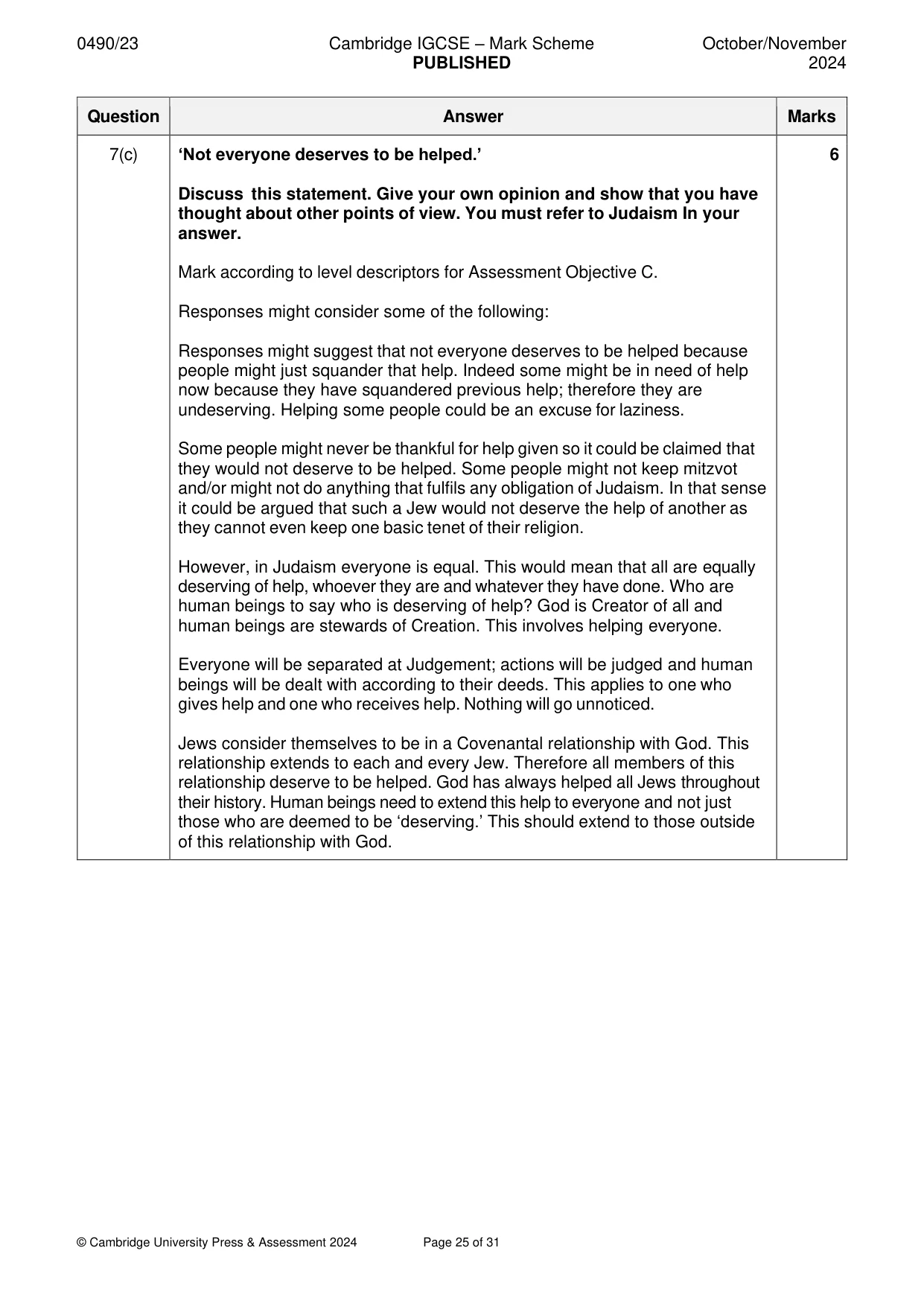
0490/23 Cambridge IGCSE – Mark Scheme PUBLISHED October/November 2024 © Cambridge University Press & Assessment 2024 Page 25 of 31 Question Answer Marks 7(c) ‘Not everyone deserves to be helped.’ Discuss this statement. Give your own opinion and show that you have thought about other points of view. You must refer to Judaism In your answer. Mark according to level descriptors for Assessment Objective C. Responses might consider some of the following: Responses might suggest that not everyone deserves to be helped because people might just squander that help. Indeed some might be in need of help now because they have squandered previous help; therefore they are undeserving. Helping some people could be an excuse for laziness. Some people might never be thankful for help given so it could be claimed that they would not deserve to be helped. Some people might not keep mitzvot and/or might not do anything that fulfils any obligation of Judaism. In that sense it could be argued that such a Jew would not deserve the help of another as they cannot even keep one basic tenet of their religion. However, in Judaism everyone is equal. This would mean that all are equally deserving of help, whoever they are and whatever they have done. Who are human beings to say who is deserving of help? God is Creator of all and human beings are stewards of Creation. This involves helping everyone. Everyone will be separated at Judgement; actions will be judged and human beings will be dealt with according to their deeds. This applies to one who gives help and one who receives help. Nothing will go unnoticed. Jews consider themselves to be in a Covenantal relationship with God. This relationship extends to each and every Jew. Therefore all members of this relationship deserve to be helped. God has always helped all Jews throughout their history. Human beings need to extend this help to everyone and not just those who are deemed to be ‘deserving.’ This should extend to those outside of this relationship with God. 6
Mark scheme, page 26
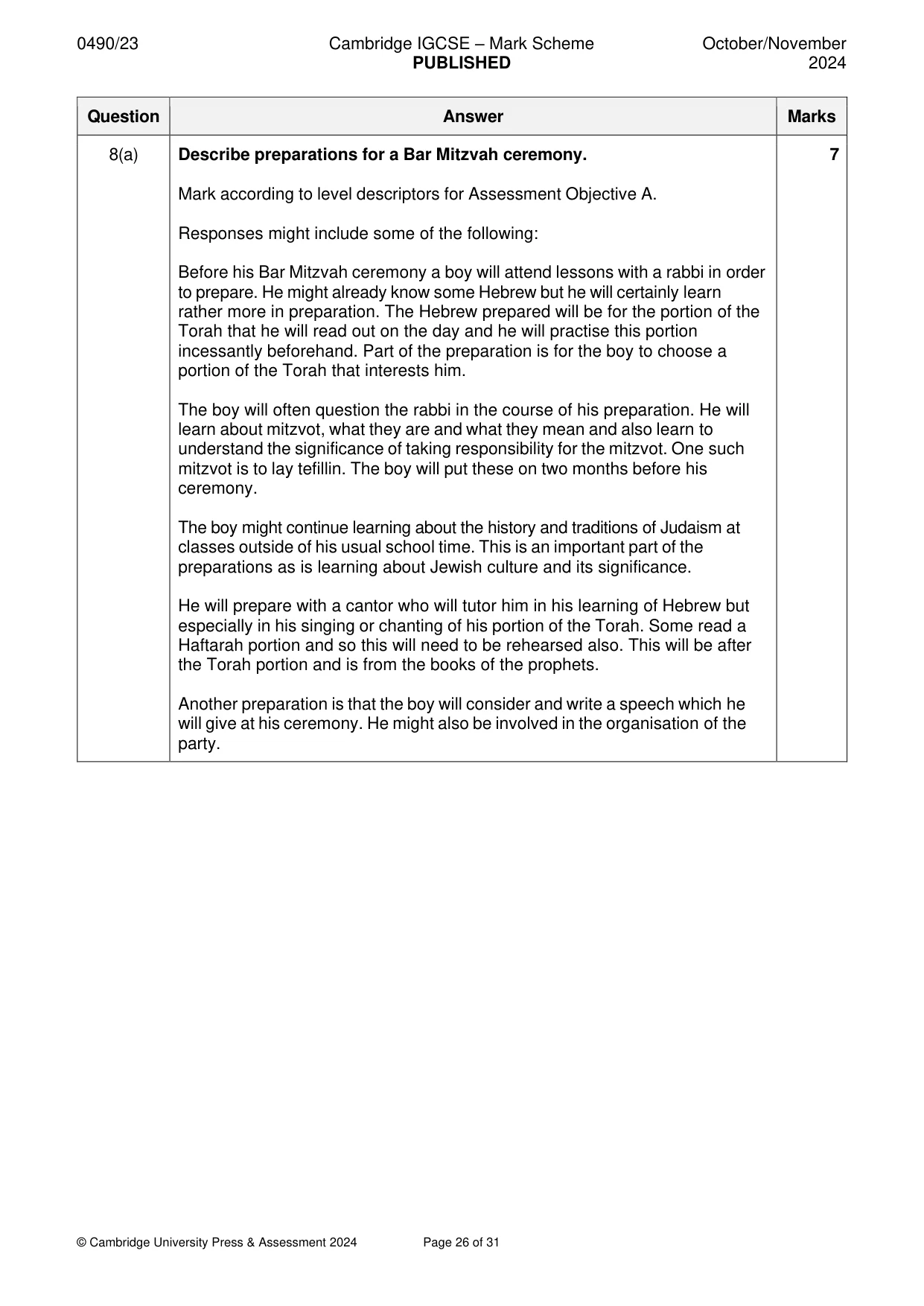
0490/23 Cambridge IGCSE – Mark Scheme PUBLISHED October/November 2024 © Cambridge University Press & Assessment 2024 Page 26 of 31 Question Answer Marks 8(a) Describe preparations for a Bar Mitzvah ceremony. Mark according to level descriptors for Assessment Objective A. Responses might include some of the following: Before his Bar Mitzvah ceremony a boy will attend lessons with a rabbi in order to prepare. He might already know some Hebrew but he will certainly learn rather more in preparation. The Hebrew prepared will be for the portion of the Torah that he will read out on the day and he will practise this portion incessantly beforehand. Part of the preparation is for the boy to choose a portion of the Torah that interests him. The boy will often question the rabbi in the course of his preparation. He will learn about mitzvot, what they are and what they mean and also learn to understand the significance of taking responsibility for the mitzvot. One such mitzvot is to lay tefillin. The boy will put these on two months before his ceremony. The boy might continue learning about the history and traditions of Judaism at classes outside of his usual school time. This is an important part of the preparations as is learning about Jewish culture and its significance. He will prepare with a cantor who will tutor him in his learning of Hebrew but especially in his singing or chanting of his portion of the Torah. Some read a Haftarah portion and so this will need to be rehearsed also. This will be after the Torah portion and is from the books of the prophets. Another preparation is that the boy will consider and write a speech which he will give at his ceremony. He might also be involved in the organisation of the party. 7
Mark scheme, page 27
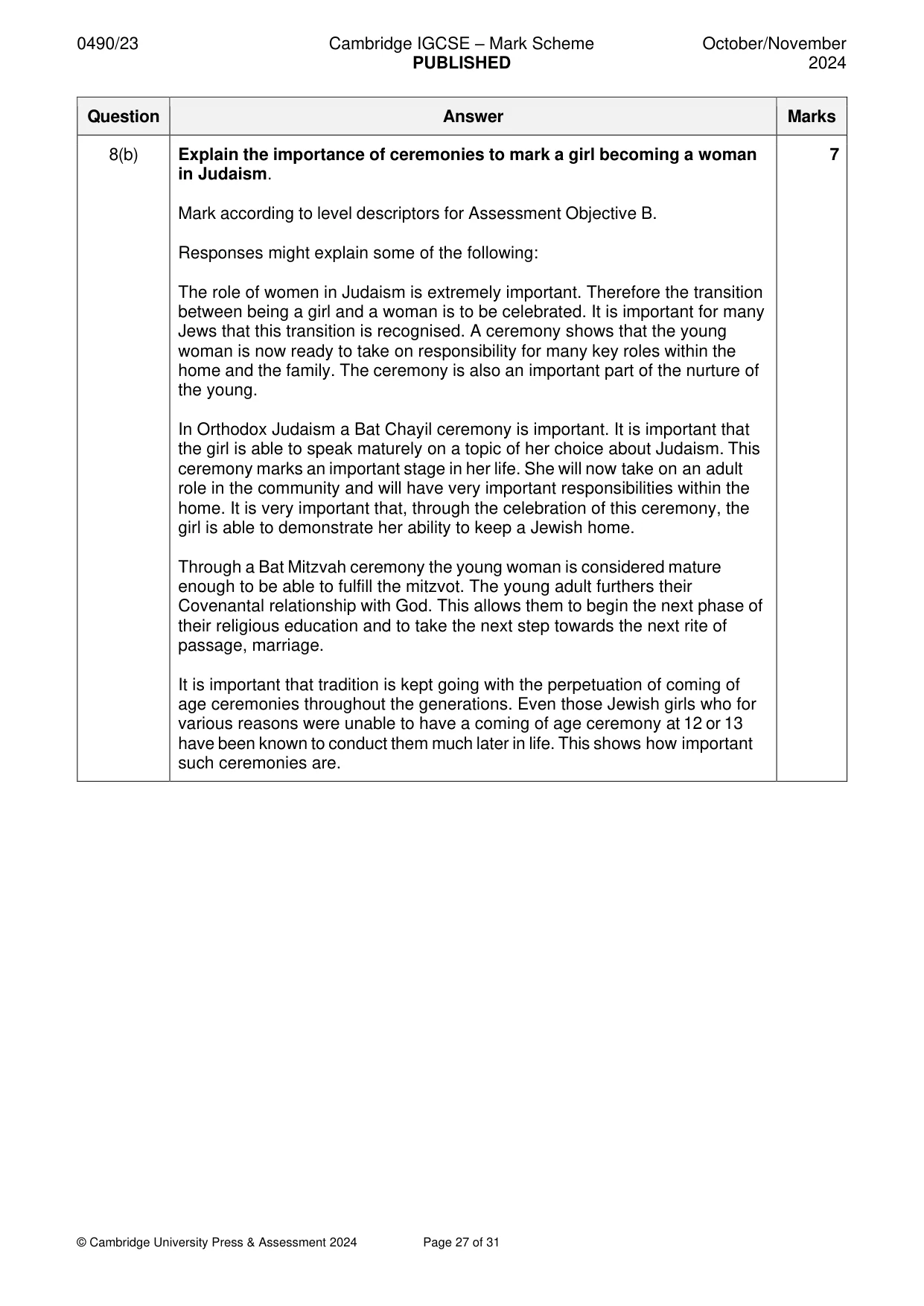
0490/23 Cambridge IGCSE – Mark Scheme PUBLISHED October/November 2024 © Cambridge University Press & Assessment 2024 Page 27 of 31 Question Answer Marks 8(b) Explain the importance of ceremonies to mark a girl becoming a woman in Judaism. Mark according to level descriptors for Assessment Objective B. Responses might explain some of the following: The role of women in Judaism is extremely important. Therefore the transition between being a girl and a woman is to be celebrated. It is important for many Jews that this transition is recognised. A ceremony shows that the young woman is now ready to take on responsibility for many key roles within the home and the family. The ceremony is also an important part of the nurture of the young. In Orthodox Judaism a Bat Chayil ceremony is important. It is important that the girl is able to speak maturely on a topic of her choice about Judaism. This ceremony marks an important stage in her life. She will now take on an adult role in the community and will have very important responsibilities within the home. It is very important that, through the celebration of this ceremony, the girl is able to demonstrate her ability to keep a Jewish home. Through a Bat Mitzvah ceremony the young woman is considered mature enough to be able to fulfill the mitzvot. The young adult furthers their Covenantal relationship with God. This allows them to begin the next phase of their religious education and to take the next step towards the next rite of passage, marriage. It is important that tradition is kept going with the perpetuation of coming of age ceremonies throughout the generations. Even those Jewish girls who for various reasons were unable to have a coming of age ceremony at 12 or 13 have been known to conduct them much later in life. This shows how important such ceremonies are. 7
Mark scheme, page 28
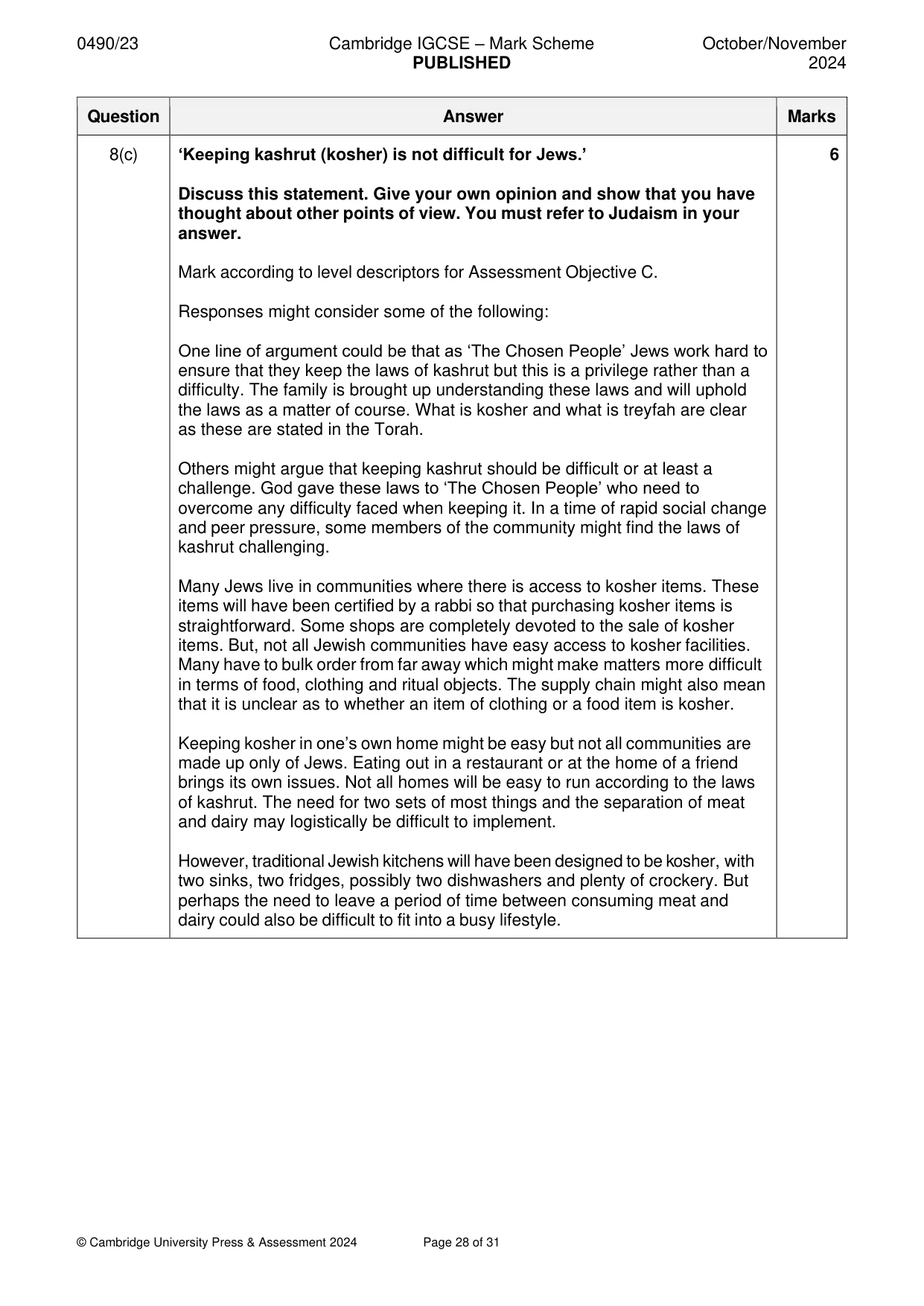
0490/23 Cambridge IGCSE – Mark Scheme PUBLISHED October/November 2024 © Cambridge University Press & Assessment 2024 Page 28 of 31 Question Answer Marks 8(c) ‘Keeping kashrut (kosher) is not difficult for Jews.’ Discuss this statement. Give your own opinion and show that you have thought about other points of view. You must refer to Judaism in your answer. Mark according to level descriptors for Assessment Objective C. Responses might consider some of the following: One line of argument could be that as ‘The Chosen People’ Jews work hard to ensure that they keep the laws of kashrut but this is a privilege rather than a difficulty. The family is brought up understanding these laws and will uphold the laws as a matter of course. What is kosher and what is treyfah are clear as these are stated in the Torah. Others might argue that keeping kashrut should be difficult or at least a challenge. God gave these laws to ‘The Chosen People’ who need to overcome any difficulty faced when keeping it. In a time of rapid social change and peer pressure, some members of the community might find the laws of kashrut challenging. Many Jews live in communities where there is access to kosher items. These items will have been certified by a rabbi so that purchasing kosher items is straightforward. Some shops are completely devoted to the sale of kosher items. But, not all Jewish communities have easy access to kosher facilities. Many have to bulk order from far away which might make matters more difficult in terms of food, clothing and ritual objects. The supply chain might also mean that it is unclear as to whether an item of clothing or a food item is kosher. Keeping kosher in one’s own home might be easy but not all communities are made up only of Jews. Eating out in a restaurant or at the home of a friend brings its own issues. Not all homes will be easy to run according to the laws of kashrut. The need for two sets of most things and the separation of meat and dairy may logistically be difficult to implement. However, traditional Jewish kitchens will have been designed to be kosher, with two sinks, two fridges, possibly two dishwashers and plenty of crockery. But perhaps the need to leave a period of time between consuming meat and dairy could also be difficult to fit into a busy lifestyle. 6
Mark scheme, page 29
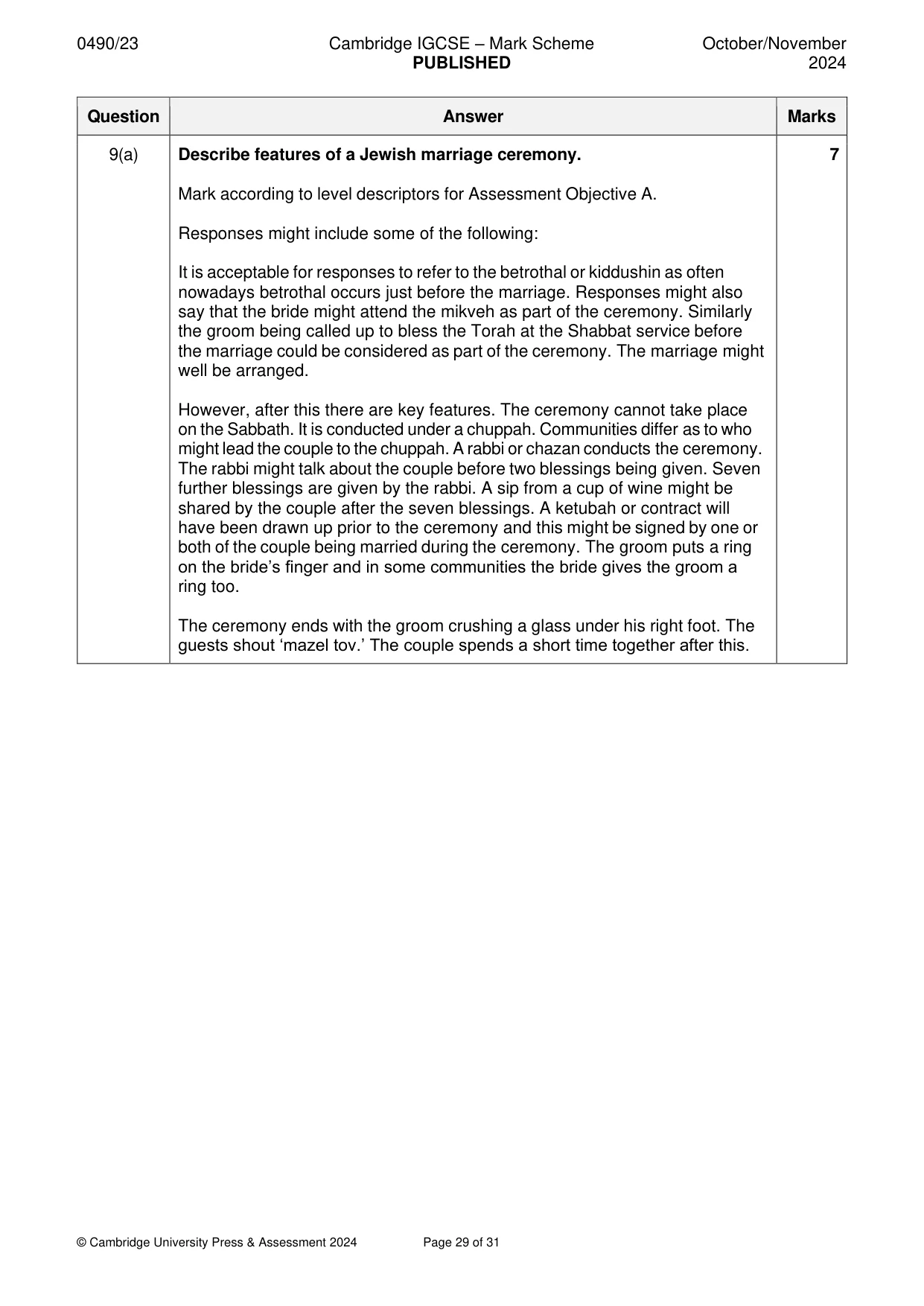
0490/23 Cambridge IGCSE – Mark Scheme PUBLISHED October/November 2024 © Cambridge University Press & Assessment 2024 Page 29 of 31 Question Answer Marks 9(a) Describe features of a Jewish marriage ceremony. Mark according to level descriptors for Assessment Objective A. Responses might include some of the following: It is acceptable for responses to refer to the betrothal or kiddushin as often nowadays betrothal occurs just before the marriage. Responses might also say that the bride might attend the mikveh as part of the ceremony. Similarly the groom being called up to bless the Torah at the Shabbat service before the marriage could be considered as part of the ceremony. The marriage might well be arranged. However, after this there are key features. The ceremony cannot take place on the Sabbath. It is conducted under a chuppah. Communities differ as to who might lead the couple to the chuppah. A rabbi or chazan conducts the ceremony. The rabbi might talk about the couple before two blessings being given. Seven further blessings are given by the rabbi. A sip from a cup of wine might be shared by the couple after the seven blessings. A ketubah or contract will have been drawn up prior to the ceremony and this might be signed by one or both of the couple being married during the ceremony. The groom puts a ring on the bride’s finger and in some communities the bride gives the groom a ring too. The ceremony ends with the groom crushing a glass under his right foot. The guests shout ‘mazel tov.’ The couple spends a short time together after this. 7
Mark scheme, page 30
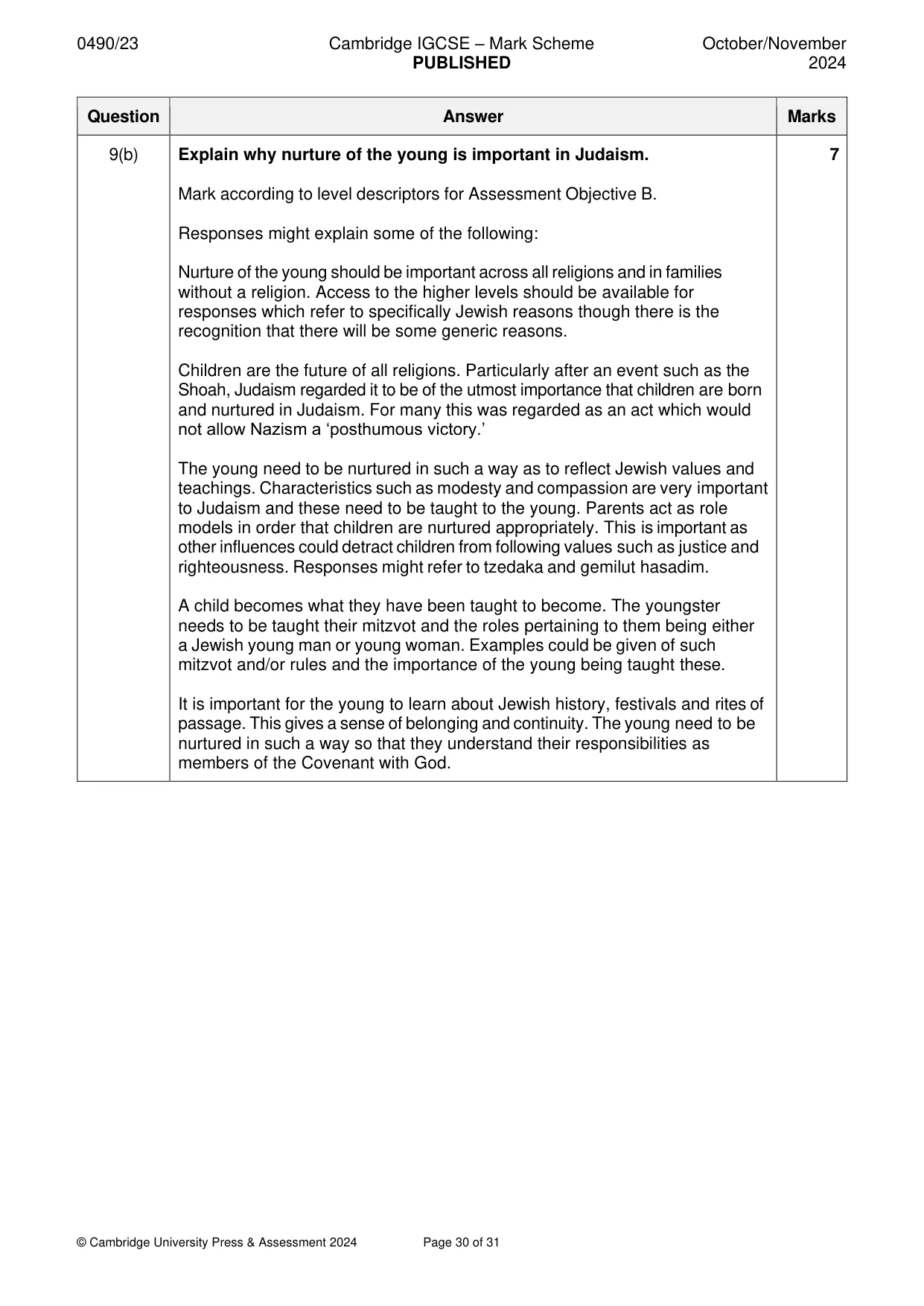
0490/23 Cambridge IGCSE – Mark Scheme PUBLISHED October/November 2024 © Cambridge University Press & Assessment 2024 Page 30 of 31 Question Answer Marks 9(b) Explain why nurture of the young is important in Judaism. Mark according to level descriptors for Assessment Objective B. Responses might explain some of the following: Nurture of the young should be important across all religions and in families without a religion. Access to the higher levels should be available for responses which refer to specifically Jewish reasons though there is the recognition that there will be some generic reasons. Children are the future of all religions. Particularly after an event such as the Shoah, Judaism regarded it to be of the utmost importance that children are born and nurtured in Judaism. For many this was regarded as an act which would not allow Nazism a ‘posthumous victory.’ The young need to be nurtured in such a way as to reflect Jewish values and teachings. Characteristics such as modesty and compassion are very important to Judaism and these need to be taught to the young. Parents act as role models in order that children are nurtured appropriately. This is important as other influences could detract children from following values such as justice and righteousness. Responses might refer to tzedaka and gemilut hasadim. A child becomes what they have been taught to become. The youngster needs to be taught their mitzvot and the roles pertaining to them being either a Jewish young man or young woman. Examples could be given of such mitzvot and/or rules and the importance of the young being taught these. It is important for the young to learn about Jewish history, festivals and rites of passage. This gives a sense of belonging and continuity. The young need to be nurtured in such a way so that they understand their responsibilities as members of the Covenant with God. 7
Mark scheme, page 31
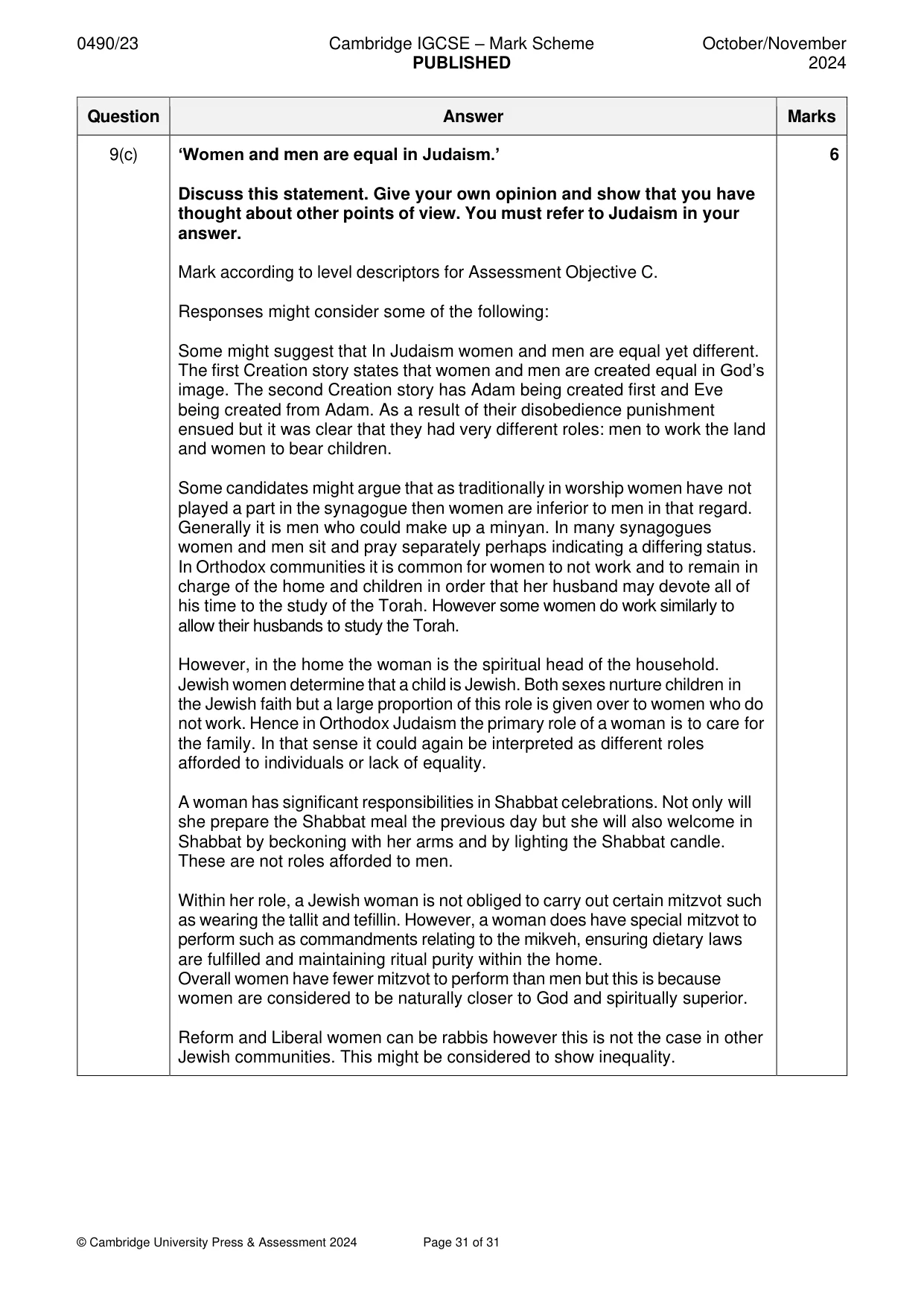
0490/23 Cambridge IGCSE – Mark Scheme PUBLISHED October/November 2024 © Cambridge University Press & Assessment 2024 Page 31 of 31 Question Answer Marks 9(c) ‘Women and men are equal in Judaism.’ Discuss this statement. Give your own opinion and show that you have thought about other points of view. You must refer to Judaism in your answer. Mark according to level descriptors for Assessment Objective C. Responses might consider some of the following: Some might suggest that In Judaism women and men are equal yet different. The first Creation story states that women and men are created equal in God’s image. The second Creation story has Adam being created first and Eve being created from Adam. As a result of their disobedience punishment ensued but it was clear that they had very different roles: men to work the land and women to bear children. Some candidates might argue that as traditionally in worship women have not played a part in the synagogue then women are inferior to men in that regard. Generally it is men who could make up a minyan. In many synagogues women and men sit and pray separately perhaps indicating a differing status. In Orthodox communities it is common for women to not work and to remain in charge of the home and children in order that her husband may devote all of his time to the study of the Torah. However some women do work similarly to allow their husbands to study the Torah. However, in the home the woman is the spiritual head of the household. Jewish women determine that a child is Jewish. Both sexes nurture children in the Jewish faith but a large proportion of this role is given over to women who do not work. Hence in Orthodox Judaism the primary role of a woman is to care for the family. In that sense it could again be interpreted as different roles afforded to individuals or lack of equality. A woman has significant responsibilities in Shabbat celebrations. Not only will she prepare the Shabbat meal the previous day but she will also welcome in Shabbat by beckoning with her arms and by lighting the Shabbat candle. These are not roles afforded to men. Within her role, a Jewish woman is not obliged to carry out certain mitzvot such as wearing the tallit and tefillin. However, a woman does have special mitzvot to perform such as commandments relating to the mikveh, ensuring dietary laws are fulfilled and maintaining ritual purity within the home. Overall women have fewer mitzvot to perform than men but this is because women are considered to be naturally closer to God and spiritually superior. Reform and Liberal women can be rabbis however this is not the case in other Jewish communities. This might be considered to show inequality. 6
What you needed in this session
Cambridge’s own grade thresholds for 2024 Oct/Nov, Paper 2 · Variant 3. A higher threshold means an easier paper — the bar moves with how the cohort did.