Cambridge IGCSE Religious Studies 0490 — 2023 Oct/Nov Paper 2 · Variant 3
0490/23/O/N/23 · 80 marks · ≈90 min
The question paper and its mark scheme, free to read here and free to download. This is Cambridge’s own paper, exactly as it was sat.
Question paper4 pages
Mark scheme31 pages
Answers below. Sit the paper first if you are practising.
Paper as text
Question paper, page 1
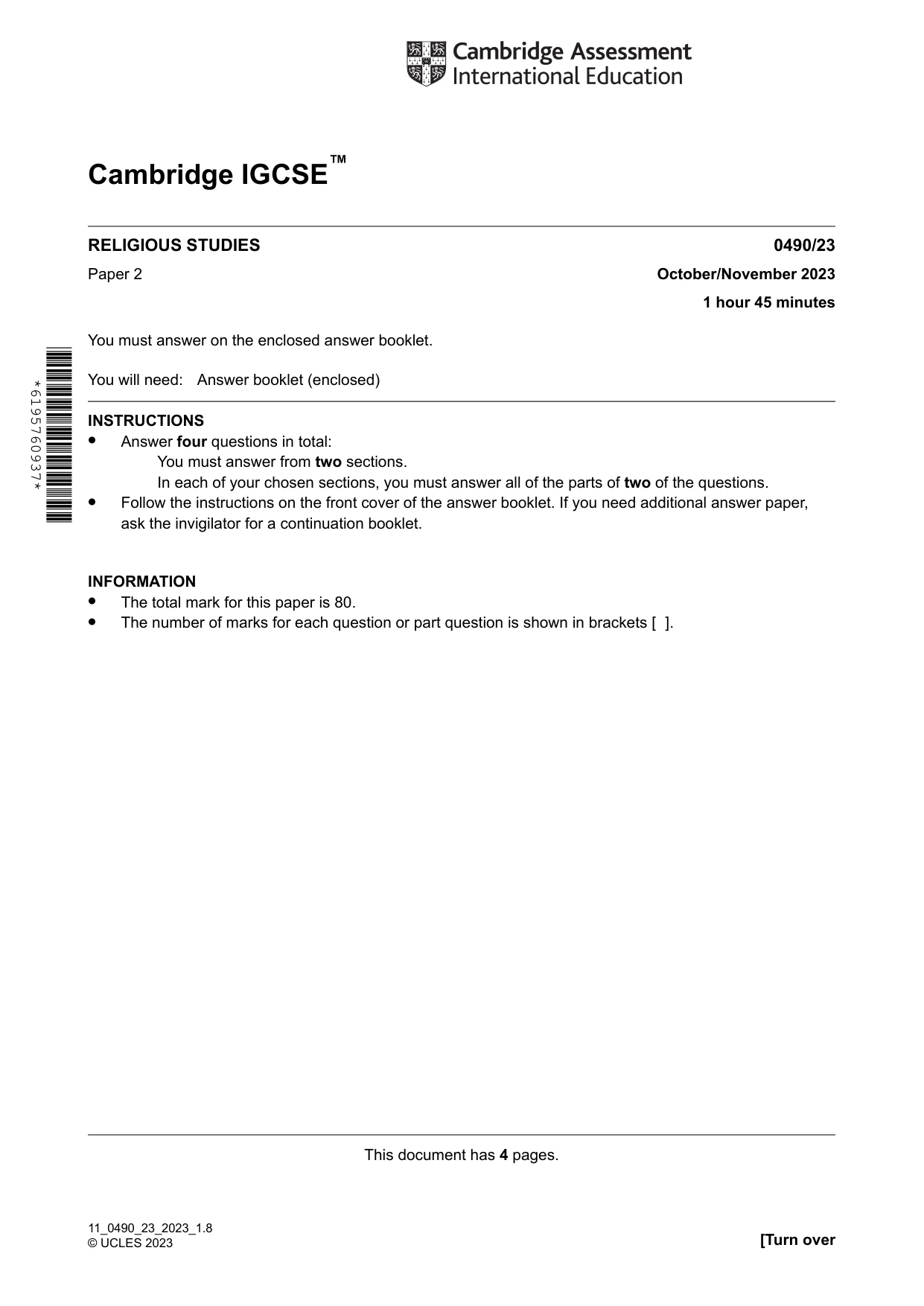
Cambridge IGCSE™ 0490/23 October/November 2023 1 hour 45 minutes RELIGIOUS STUDIES Paper 2 You must answer on the enclosed answer booklet. You will need: Answer booklet (enclosed) INSTRUCTIONS • Answer four questions in total: You must answer from two sections. In each of your chosen sections, you must answer all of the parts of two of the questions. • Follow the instructions on the front cover of the answer booklet. If you need additional answer paper, ask the invigilator for a continuation booklet. INFORMATION • The total mark for this paper is 80. • The number of marks for each question or part question is shown in brackets [ ]. This document has 4 pages. [Turn over 11_0490_23_2023_1.8 © UCLES 2023 *6195760937*
Question paper, page 2
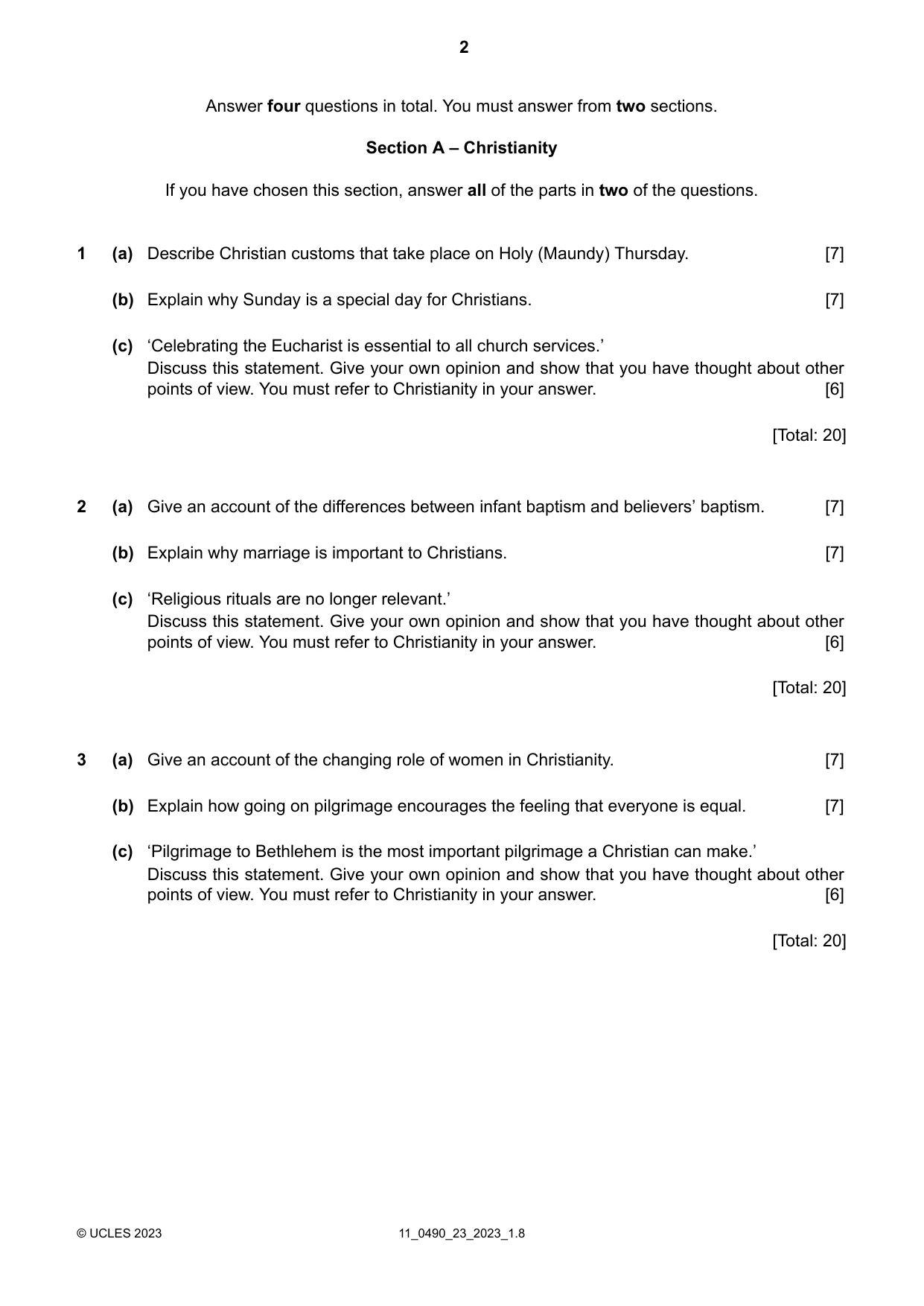
Answer four questions in total. You must answer from two sections. Section A – Christianity If you have chosen this section, answer all of the parts in two of the questions. Describe Christian customs that take place on Holy (Maundy) Thursday. [7] (a) 1 Explain why Sunday is a special day for Christians. [7] (b) ‘Celebrating the Eucharist is essential to all church services.’ Discuss this statement. Give your own opinion and show that you have thought about other points of view. You must refer to Christianity in your answer. [6] (c) [Total: 20] Give an account of the differences between infant baptism and believers’ baptism. [7] (a) 2 Explain why marriage is important to Christians. [7] (b) ‘Religious rituals are no longer relevant.’ Discuss this statement. Give your own opinion and show that you have thought about other points of view. You must refer to Christianity in your answer. [6] (c) [Total: 20] Give an account of the changing role of women in Christianity. [7] (a) 3 Explain how going on pilgrimage encourages the feeling that everyone is equal. [7] (b) ‘Pilgrimage to Bethlehem is the most important pilgrimage a Christian can make.’ Discuss this statement. Give your own opinion and show that you have thought about other points of view. You must refer to Christianity in your answer. [6] (c) [Total: 20] 11_0490_23_2023_1.8 © UCLES 2023 2
Question paper, page 3
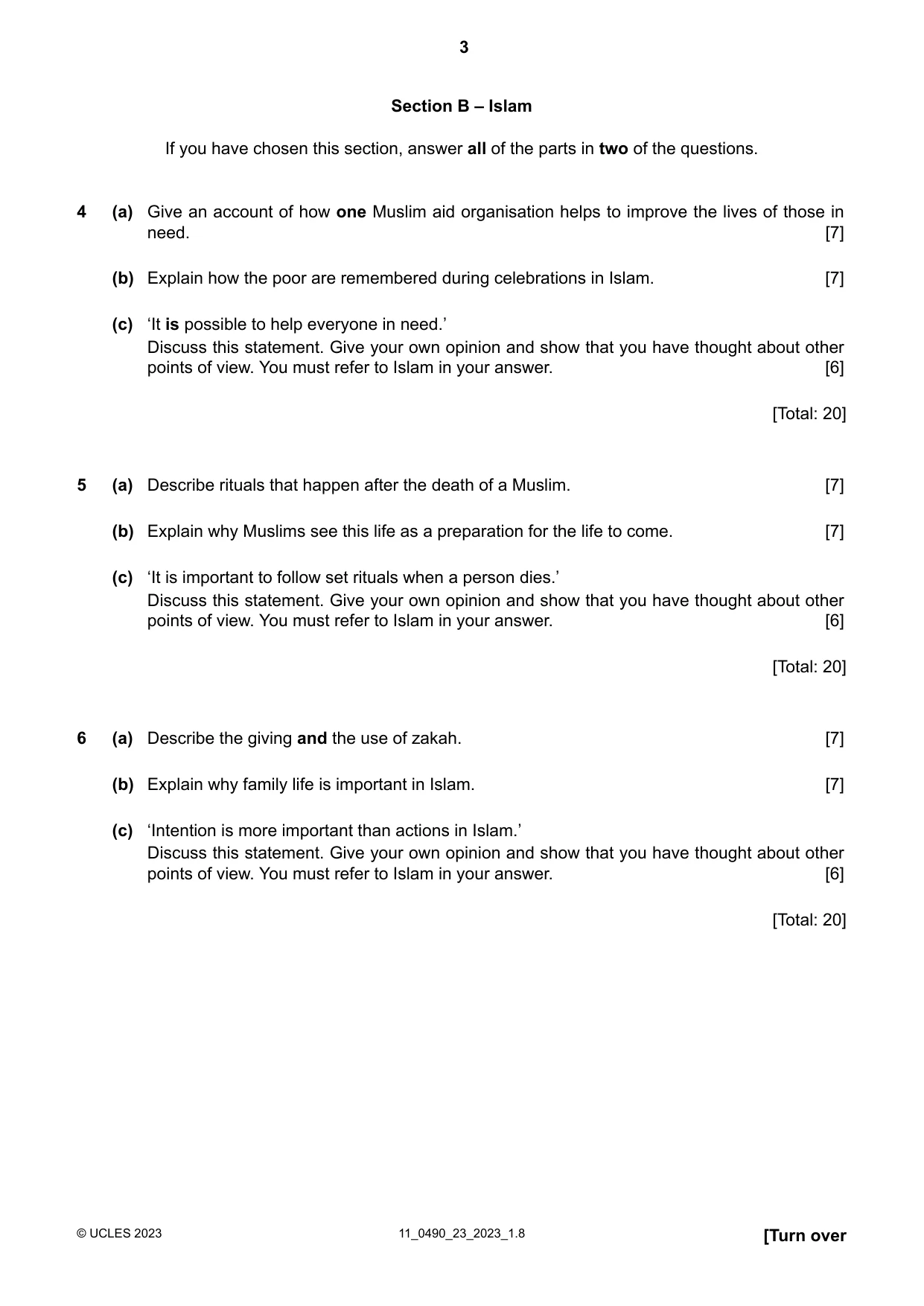
Section B – Islam If you have chosen this section, answer all of the parts in two of the questions. Give an account of how one Muslim aid organisation helps to improve the lives of those in need. [7] (a) 4 Explain how the poor are remembered during celebrations in Islam. [7] (b) ‘It is possible to help everyone in need.’ Discuss this statement. Give your own opinion and show that you have thought about other points of view. You must refer to Islam in your answer. [6] (c) [Total: 20] Describe rituals that happen after the death of a Muslim. [7] (a) 5 Explain why Muslims see this life as a preparation for the life to come. [7] (b) ‘It is important to follow set rituals when a person dies.’ Discuss this statement. Give your own opinion and show that you have thought about other points of view. You must refer to Islam in your answer. [6] (c) [Total: 20] Describe the giving and the use of zakah. [7] (a) 6 Explain why family life is important in Islam. [7] (b) ‘Intention is more important than actions in Islam.’ Discuss this statement. Give your own opinion and show that you have thought about other points of view. You must refer to Islam in your answer. [6] (c) [Total: 20] [Turn over 11_0490_23_2023_1.8 © UCLES 2023 3
Question paper, page 4
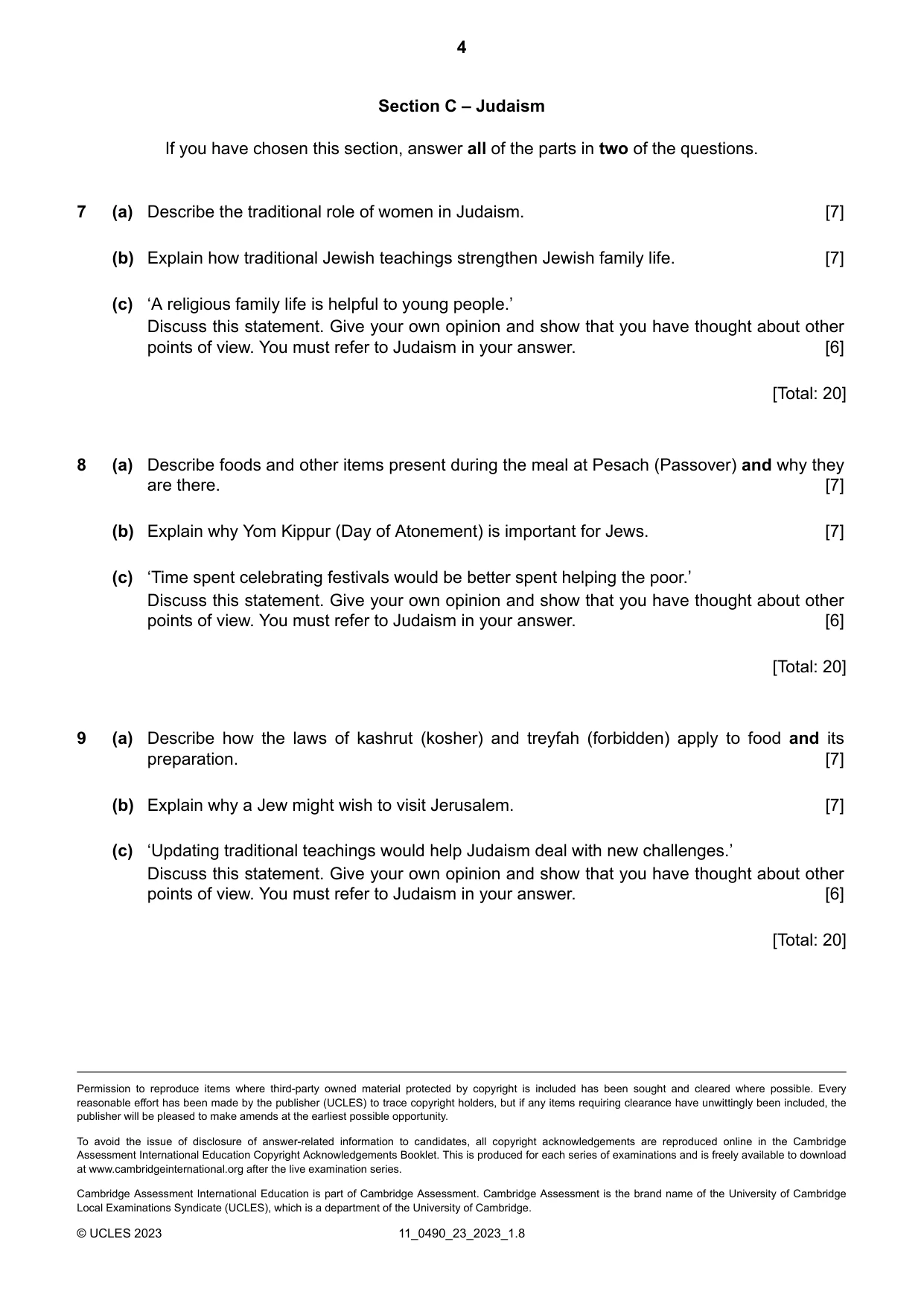
Section C – Judaism If you have chosen this section, answer all of the parts in two of the questions. Describe the traditional role of women in Judaism. [7] (a) 7 Explain how traditional Jewish teachings strengthen Jewish family life. [7] (b) ‘A religious family life is helpful to young people.’ Discuss this statement. Give your own opinion and show that you have thought about other points of view. You must refer to Judaism in your answer. [6] (c) [Total: 20] Describe foods and other items present during the meal at Pesach (Passover) and why they are there. [7] (a) 8 Explain why Yom Kippur (Day of Atonement) is important for Jews. [7] (b) ‘Time spent celebrating festivals would be better spent helping the poor.’ Discuss this statement. Give your own opinion and show that you have thought about other points of view. You must refer to Judaism in your answer. [6] (c) [Total: 20] Describe how the laws of kashrut (kosher) and treyfah (forbidden) apply to food and its preparation. [7] (a) 9 Explain why a Jew might wish to visit Jerusalem. [7] (b) ‘Updating traditional teachings would help Judaism deal with new challenges.’ Discuss this statement. Give your own opinion and show that you have thought about other points of view. You must refer to Judaism in your answer. [6] (c) [Total: 20] Permission to reproduce items where third-party owned material protected by copyright is included has been sought and cleared where possible. Every reasonable effort has been made by the publisher (UCLES) to trace copyright holders, but if any items requiring clearance have unwittingly been included, the publisher will be pleased to make amends at the earliest possible opportunity. To avoid the issue of disclosure of answer-related information to candidates, all copyright acknowledgements are reproduced online in the Cambridge Assessment International Education Copyright Acknowledgements Booklet. This is produced for each series of examinations and is freely available to download at www.cambridgeinternational.org after the live examination series. Cambridge Assessment International Education is part of Cambridge Assessment. Cambridge Assessment is the brand name of the University of Cambridge Local Examinations Syndicate (UCLES), which is a department of the University of Cambridge. 11_0490_23_2023_1.8 © UCLES 2023 4
Mark scheme, page 1
This document consists of 31 printed pages. © UCLES 2023 [Turn over Cambridge IGCSE™ RELIGIOUS STUDIES 0490/23 Paper 2 October/November 2023 MARK SCHEME Maximum Mark: 80 Published This mark scheme is published as an aid to teachers and candidates, to indicate the requirements of the examination. It shows the basis on which Examiners were instructed to award marks. It does not indicate the details of the discussions that took place at an Examiners’ meeting before marking began, which would have considered the acceptability of alternative answers. Mark schemes should be read in conjunction with the question paper and the Principal Examiner Report for Teachers. Cambridge International will not enter into discussions about these mark schemes. Cambridge International is publishing the mark schemes for the October/November 2023 series for most Cambridge IGCSE, Cambridge International A and AS Level components, and some Cambridge O Level components.
Mark scheme, page 2
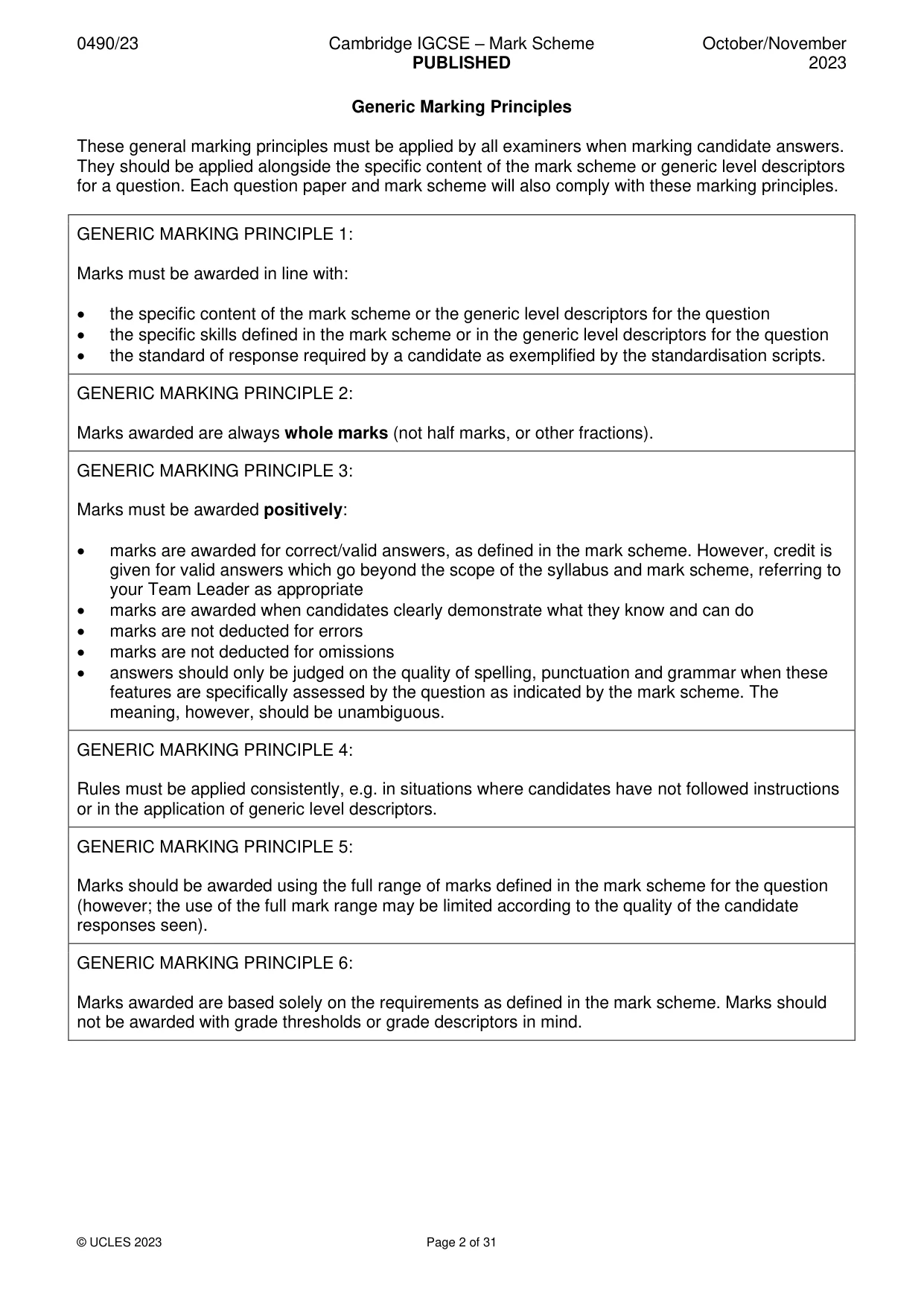
0490/23 Cambridge IGCSE – Mark Scheme PUBLISHED October/November 2023 © UCLES 2023 Page 2 of 31 Generic Marking Principles These general marking principles must be applied by all examiners when marking candidate answers. They should be applied alongside the specific content of the mark scheme or generic level descriptors for a question. Each question paper and mark scheme will also comply with these marking principles. GENERIC MARKING PRINCIPLE 1: Marks must be awarded in line with: • the specific content of the mark scheme or the generic level descriptors for the question • the specific skills defined in the mark scheme or in the generic level descriptors for the question • the standard of response required by a candidate as exemplified by the standardisation scripts. GENERIC MARKING PRINCIPLE 2: Marks awarded are always whole marks (not half marks, or other fractions). GENERIC MARKING PRINCIPLE 3: Marks must be awarded positively: • marks are awarded for correct/valid answers, as defined in the mark scheme. However, credit is given for valid answers which go beyond the scope of the syllabus and mark scheme, referring to your Team Leader as appropriate • marks are awarded when candidates clearly demonstrate what they know and can do • marks are not deducted for errors • marks are not deducted for omissions • answers should only be judged on the quality of spelling, punctuation and grammar when these features are specifically assessed by the question as indicated by the mark scheme. The meaning, however, should be unambiguous. GENERIC MARKING PRINCIPLE 4: Rules must be applied consistently, e.g. in situations where candidates have not followed instructions or in the application of generic level descriptors. GENERIC MARKING PRINCIPLE 5: Marks should be awarded using the full range of marks defined in the mark scheme for the question (however; the use of the full mark range may be limited according to the quality of the candidate responses seen). GENERIC MARKING PRINCIPLE 6: Marks awarded are based solely on the requirements as defined in the mark scheme. Marks should not be awarded with grade thresholds or grade descriptors in mind.
Mark scheme, page 3
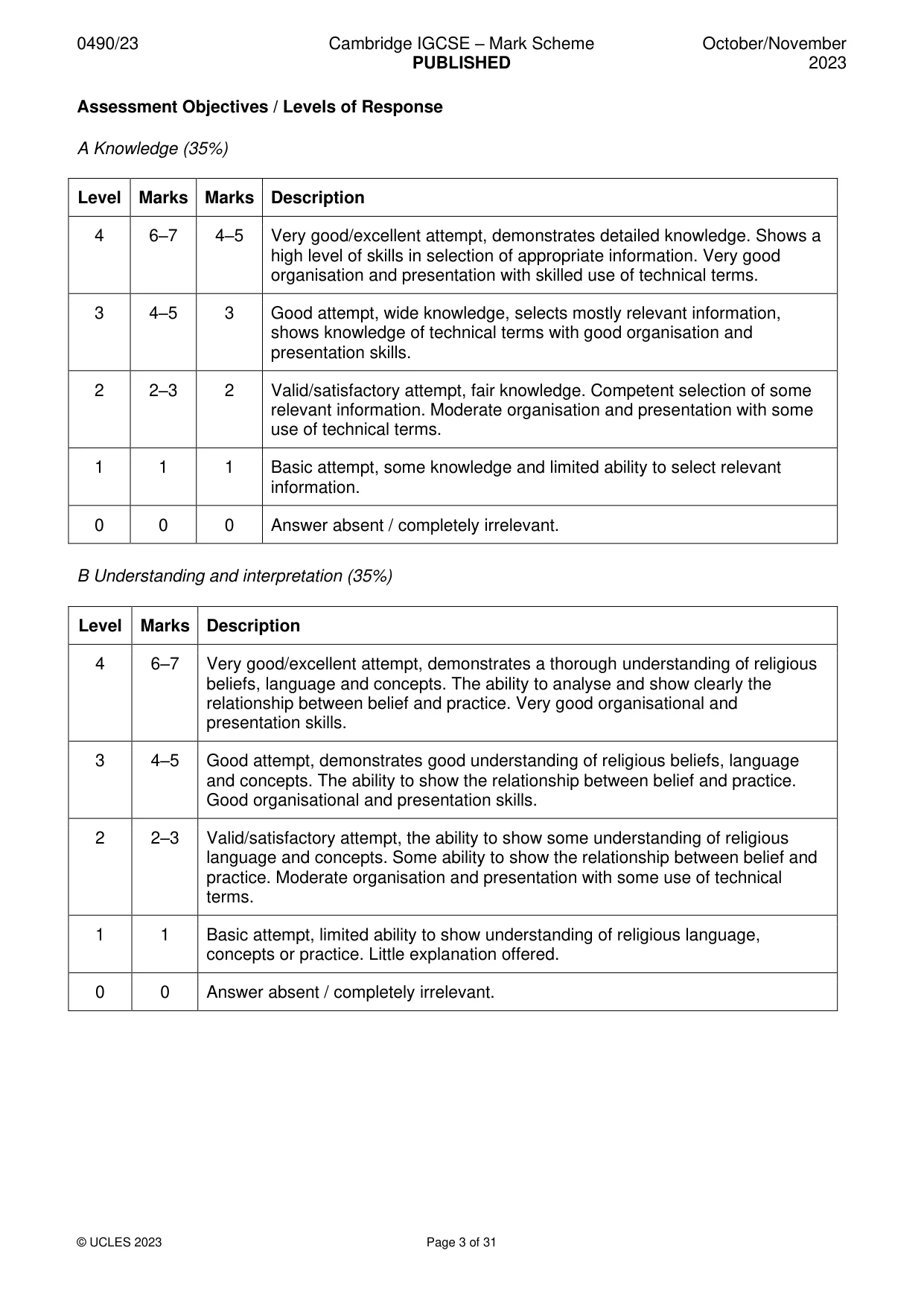
0490/23 Cambridge IGCSE – Mark Scheme PUBLISHED October/November 2023 © UCLES 2023 Page 3 of 31 Assessment Objectives / Levels of Response A Knowledge (35%) Level Marks Marks Description 4 6–7 4–5 Very good/excellent attempt, demonstrates detailed knowledge. Shows a high level of skills in selection of appropriate information. Very good organisation and presentation with skilled use of technical terms. 3 4–5 3 Good attempt, wide knowledge, selects mostly relevant information, shows knowledge of technical terms with good organisation and presentation skills. 2 2–3 2 Valid/satisfactory attempt, fair knowledge. Competent selection of some relevant information. Moderate organisation and presentation with some use of technical terms. 1 1 1 Basic attempt, some knowledge and limited ability to select relevant information. 0 0 0 Answer absent / completely irrelevant. B Understanding and interpretation (35%) Level Marks Description 4 6–7 Very good/excellent attempt, demonstrates a thorough understanding of religious beliefs, language and concepts. The ability to analyse and show clearly the relationship between belief and practice. Very good organisational and presentation skills. 3 4–5 Good attempt, demonstrates good understanding of religious beliefs, language and concepts. The ability to show the relationship between belief and practice. Good organisational and presentation skills. 2 2–3 Valid/satisfactory attempt, the ability to show some understanding of religious language and concepts. Some ability to show the relationship between belief and practice. Moderate organisation and presentation with some use of technical terms. 1 1 Basic attempt, limited ability to show understanding of religious language, concepts or practice. Little explanation offered. 0 0 Answer absent / completely irrelevant.
Mark scheme, page 4
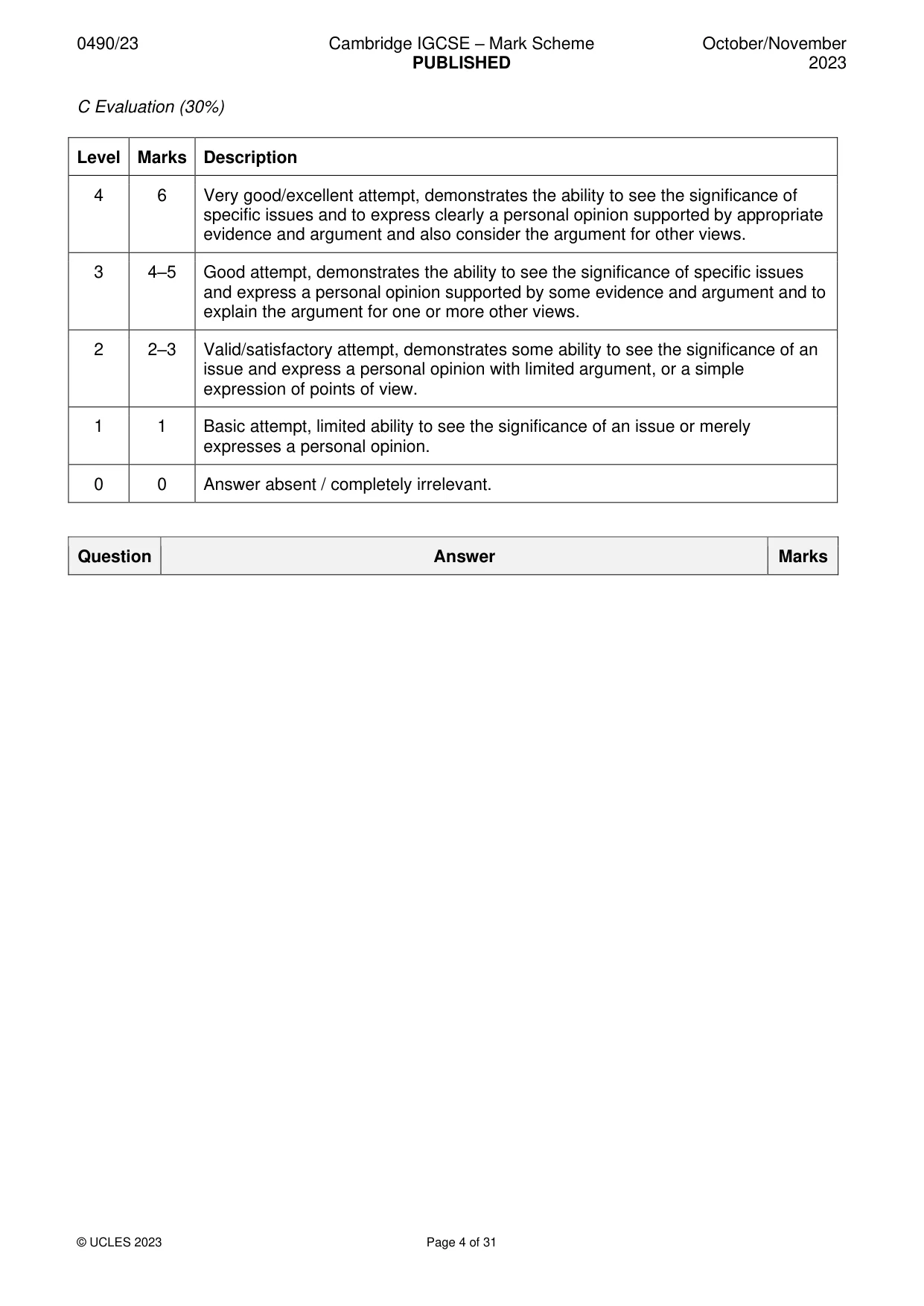
0490/23 Cambridge IGCSE – Mark Scheme PUBLISHED October/November 2023 © UCLES 2023 Page 4 of 31 C Evaluation (30%) Level Marks Description 4 6 Very good/excellent attempt, demonstrates the ability to see the significance of specific issues and to express clearly a personal opinion supported by appropriate evidence and argument and also consider the argument for other views. 3 4–5 Good attempt, demonstrates the ability to see the significance of specific issues and express a personal opinion supported by some evidence and argument and to explain the argument for one or more other views. 2 2–3 Valid/satisfactory attempt, demonstrates some ability to see the significance of an issue and express a personal opinion with limited argument, or a simple expression of points of view. 1 1 Basic attempt, limited ability to see the significance of an issue or merely expresses a personal opinion. 0 0 Answer absent / completely irrelevant. Question Answer Marks
Mark scheme, page 5
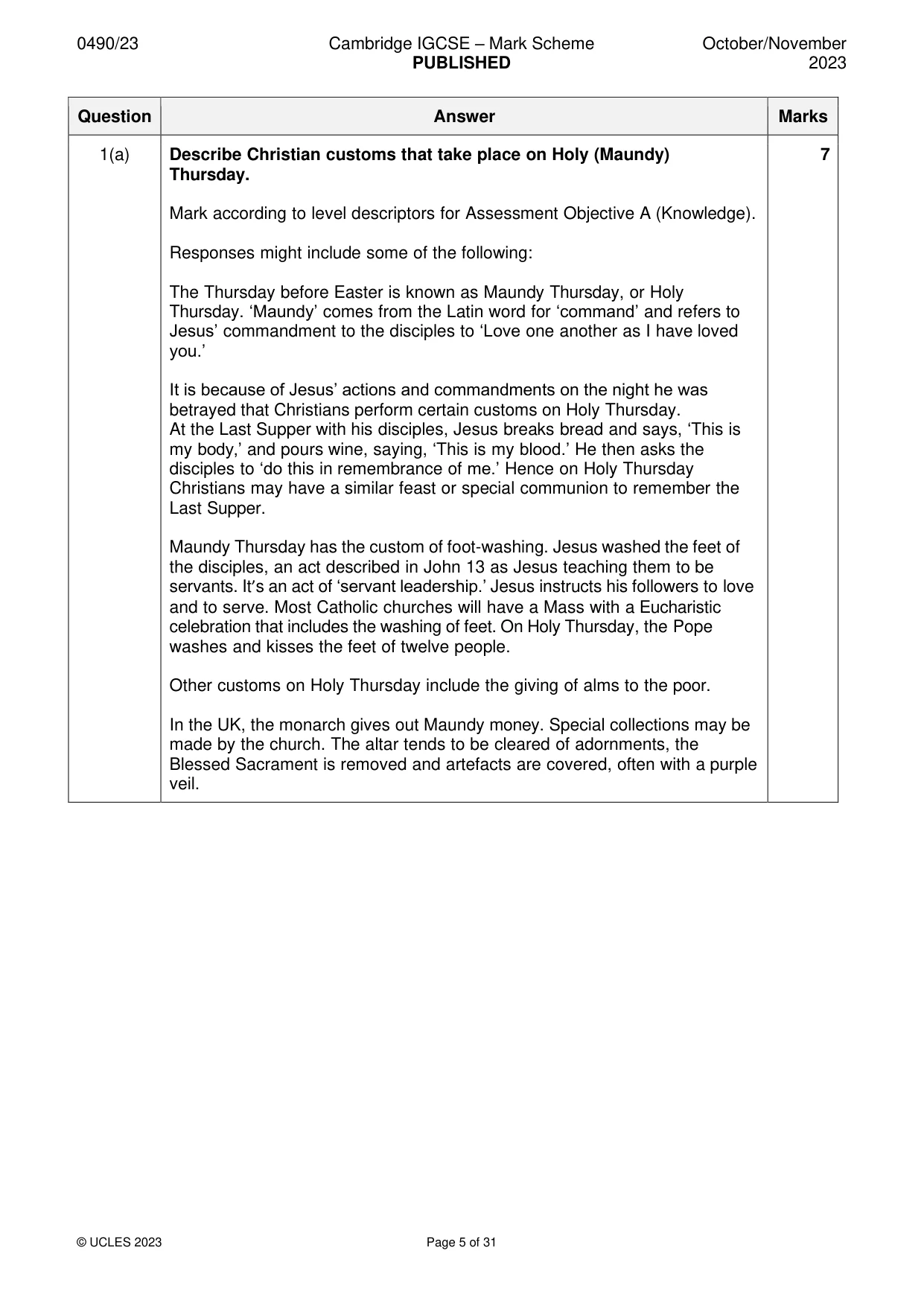
0490/23 Cambridge IGCSE – Mark Scheme PUBLISHED October/November 2023 © UCLES 2023 Page 5 of 31 Question Answer Marks 1(a) Describe Christian customs that take place on Holy (Maundy) Thursday. Mark according to level descriptors for Assessment Objective A (Knowledge). Responses might include some of the following: The Thursday before Easter is known as Maundy Thursday, or Holy Thursday. ‘Maundy’ comes from the Latin word for ‘command’ and refers to Jesus’ commandment to the disciples to ‘Love one another as I have loved you.’ It is because of Jesus’ actions and commandments on the night he was betrayed that Christians perform certain customs on Holy Thursday. At the Last Supper with his disciples, Jesus breaks bread and says, ‘This is my body,’ and pours wine, saying, ‘This is my blood.’ He then asks the disciples to ‘do this in remembrance of me.’ Hence on Holy Thursday Christians may have a similar feast or special communion to remember the Last Supper. Maundy Thursday has the custom of foot-washing. Jesus washed the feet of the disciples, an act described in John 13 as Jesus teaching them to be servants. It’s an act of ‘servant leadership.’ Jesus instructs his followers to love and to serve. Most Catholic churches will have a Mass with a Eucharistic celebration that includes the washing of feet. On Holy Thursday, the Pope washes and kisses the feet of twelve people. Other customs on Holy Thursday include the giving of alms to the poor. In the UK, the monarch gives out Maundy money. Special collections may be made by the church. The altar tends to be cleared of adornments, the Blessed Sacrament is removed and artefacts are covered, often with a purple veil. 7
Mark scheme, page 6
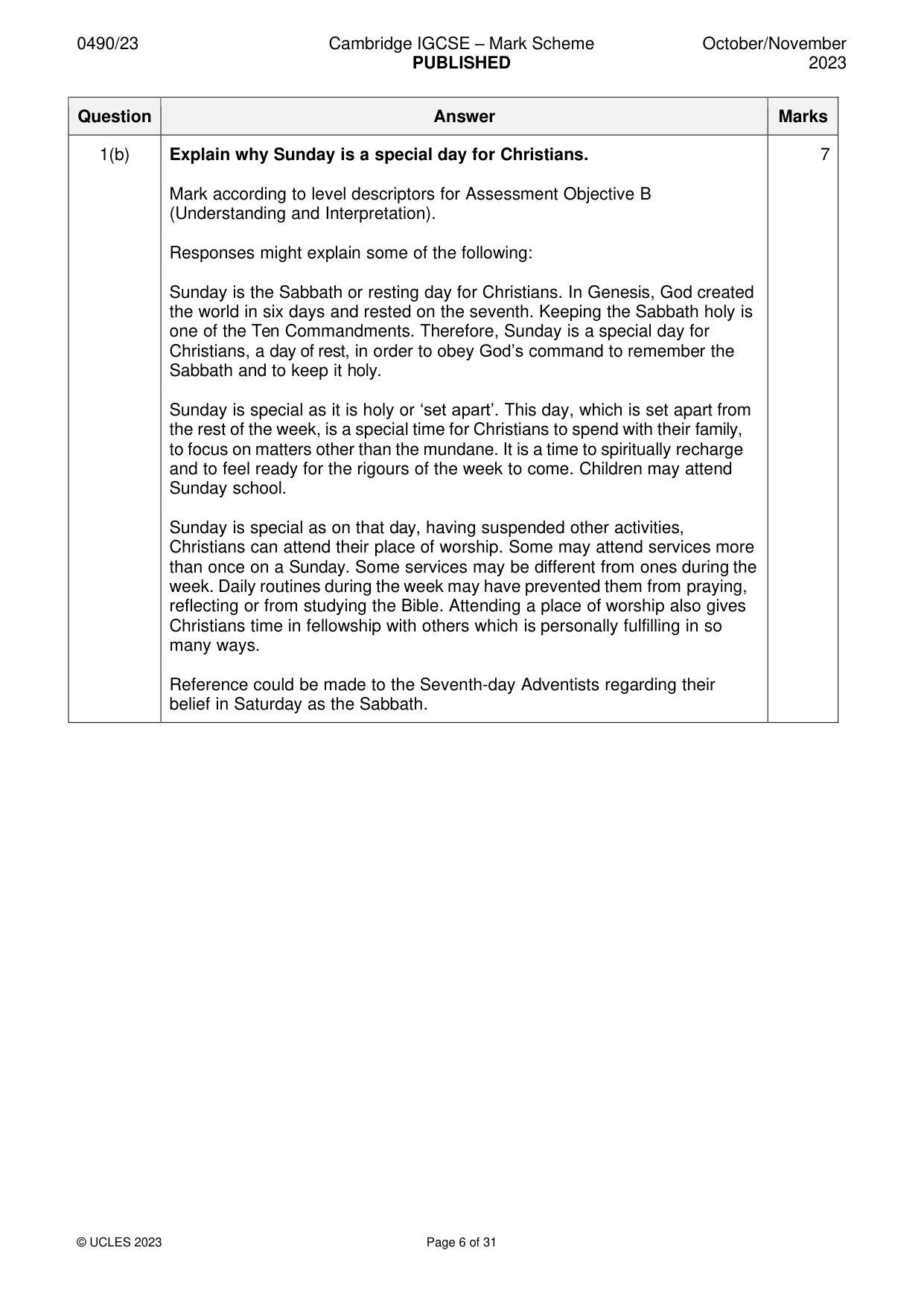
0490/23 Cambridge IGCSE – Mark Scheme PUBLISHED October/November 2023 © UCLES 2023 Page 6 of 31 Question Answer Marks 1(b) Explain why Sunday is a special day for Christians. Mark according to level descriptors for Assessment Objective B (Understanding and Interpretation). Responses might explain some of the following: Sunday is the Sabbath or resting day for Christians. In Genesis, God created the world in six days and rested on the seventh. Keeping the Sabbath holy is one of the Ten Commandments. Therefore, Sunday is a special day for Christians, a day of rest, in order to obey God’s command to remember the Sabbath and to keep it holy. Sunday is special as it is holy or ‘set apart’. This day, which is set apart from the rest of the week, is a special time for Christians to spend with their family, to focus on matters other than the mundane. It is a time to spiritually recharge and to feel ready for the rigours of the week to come. Children may attend Sunday school. Sunday is special as on that day, having suspended other activities, Christians can attend their place of worship. Some may attend services more than once on a Sunday. Some services may be different from ones during the week. Daily routines during the week may have prevented them from praying, reflecting or from studying the Bible. Attending a place of worship also gives Christians time in fellowship with others which is personally fulfilling in so many ways. Reference could be made to the Seventh-day Adventists regarding their belief in Saturday as the Sabbath. 7
Mark scheme, page 7
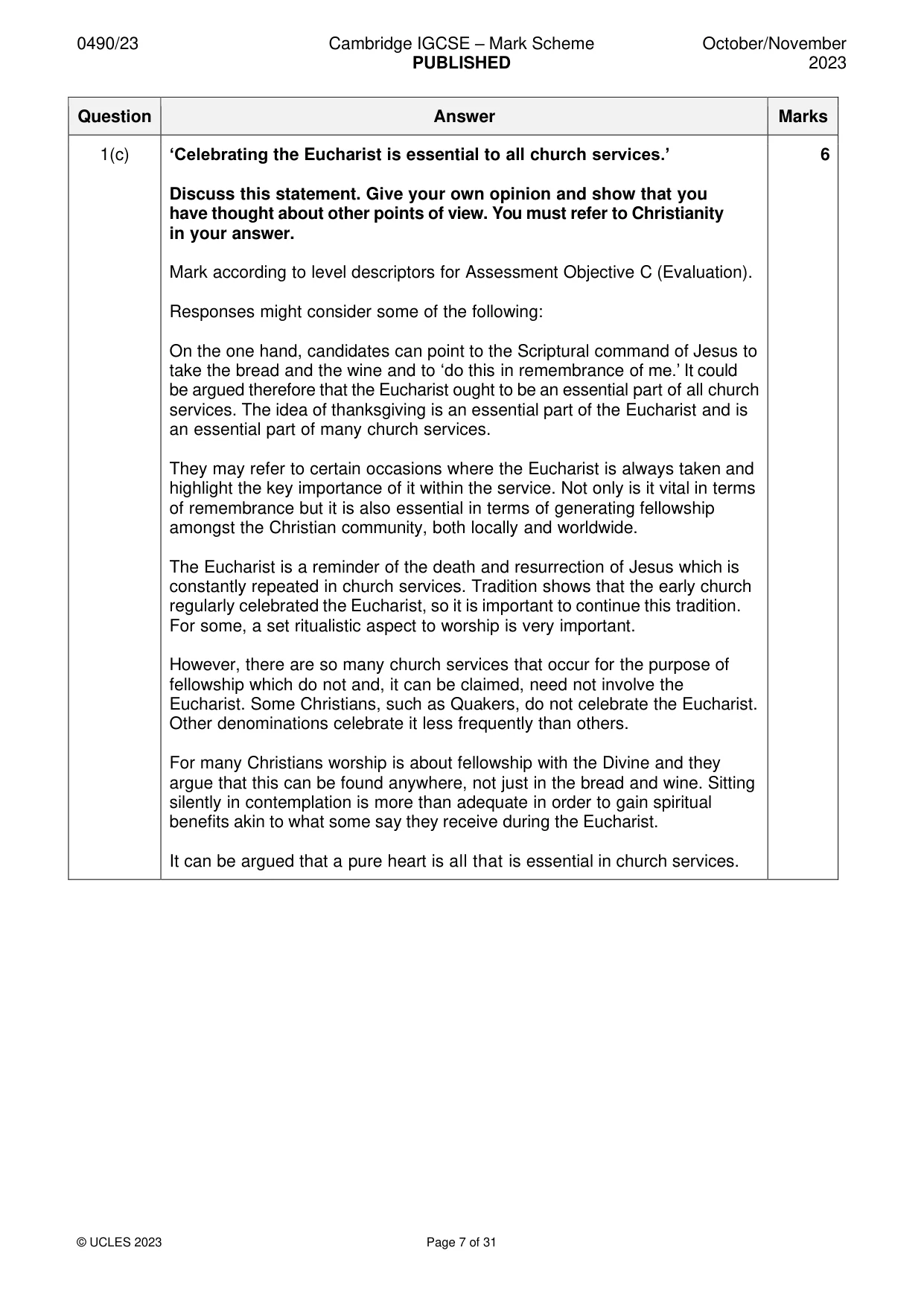
0490/23 Cambridge IGCSE – Mark Scheme PUBLISHED October/November 2023 © UCLES 2023 Page 7 of 31 Question Answer Marks 1(c) ‘Celebrating the Eucharist is essential to all church services.’ Discuss this statement. Give your own opinion and show that you have thought about other points of view. You must refer to Christianity in your answer. Mark according to level descriptors for Assessment Objective C (Evaluation). Responses might consider some of the following: On the one hand, candidates can point to the Scriptural command of Jesus to take the bread and the wine and to ‘do this in remembrance of me.’ It could be argued therefore that the Eucharist ought to be an essential part of all church services. The idea of thanksgiving is an essential part of the Eucharist and is an essential part of many church services. They may refer to certain occasions where the Eucharist is always taken and highlight the key importance of it within the service. Not only is it vital in terms of remembrance but it is also essential in terms of generating fellowship amongst the Christian community, both locally and worldwide. The Eucharist is a reminder of the death and resurrection of Jesus which is constantly repeated in church services. Tradition shows that the early church regularly celebrated the Eucharist, so it is important to continue this tradition. For some, a set ritualistic aspect to worship is very important. However, there are so many church services that occur for the purpose of fellowship which do not and, it can be claimed, need not involve the Eucharist. Some Christians, such as Quakers, do not celebrate the Eucharist. Other denominations celebrate it less frequently than others. For many Christians worship is about fellowship with the Divine and they argue that this can be found anywhere, not just in the bread and wine. Sitting silently in contemplation is more than adequate in order to gain spiritual benefits akin to what some say they receive during the Eucharist. It can be argued that a pure heart is all that is essential in church services. 6
Mark scheme, page 8
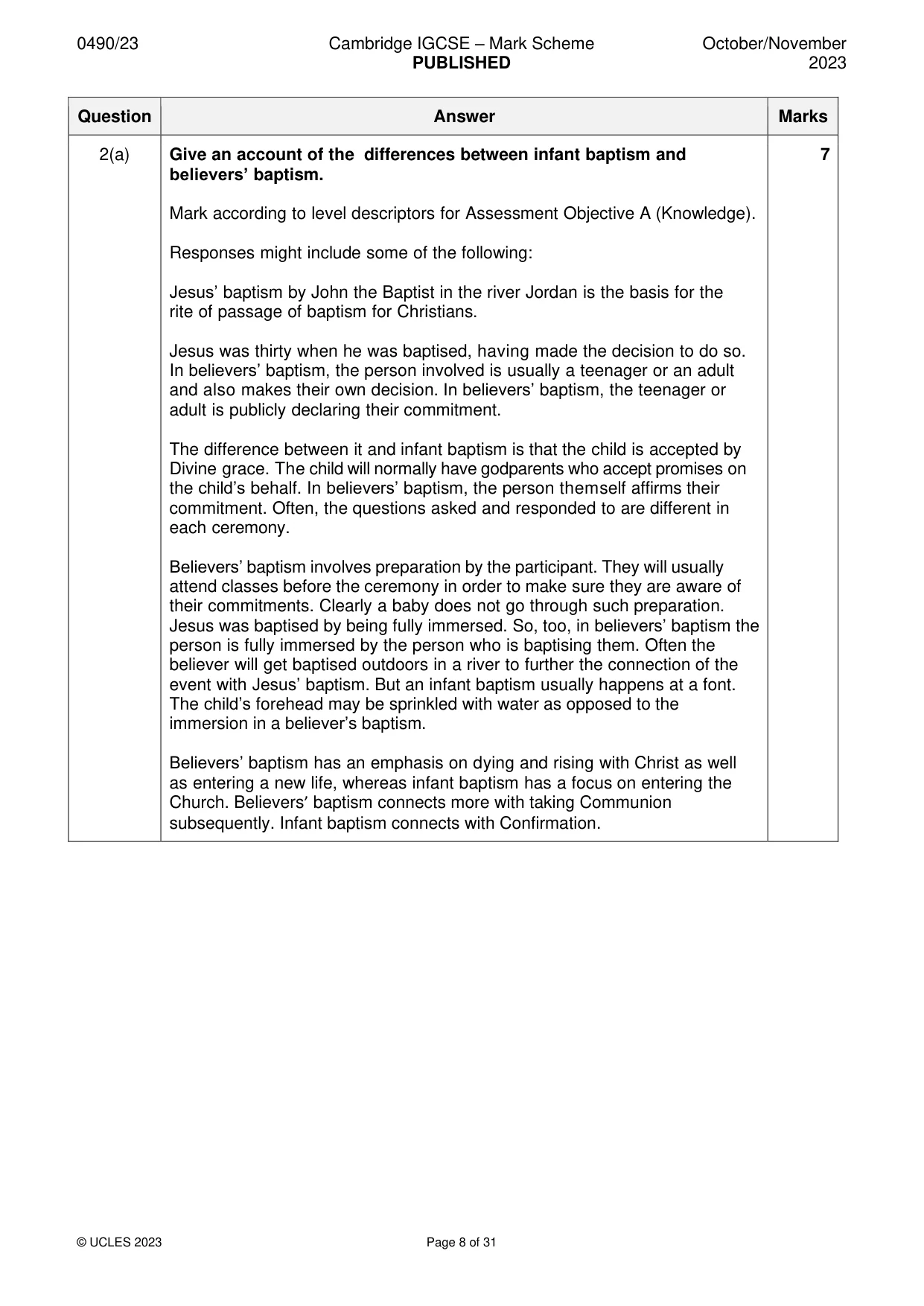
0490/23 Cambridge IGCSE – Mark Scheme PUBLISHED October/November 2023 © UCLES 2023 Page 8 of 31 Question Answer Marks 2(a) Give an account of the differences between infant baptism and believers’ baptism. Mark according to level descriptors for Assessment Objective A (Knowledge). Responses might include some of the following: Jesus’ baptism by John the Baptist in the river Jordan is the basis for the rite of passage of baptism for Christians. Jesus was thirty when he was baptised, having made the decision to do so. In believers’ baptism, the person involved is usually a teenager or an adult and also makes their own decision. In believers’ baptism, the teenager or adult is publicly declaring their commitment. The difference between it and infant baptism is that the child is accepted by Divine grace. The child will normally have godparents who accept promises on the child’s behalf. In believers’ baptism, the person themself affirms their commitment. Often, the questions asked and responded to are different in each ceremony. Believers’ baptism involves preparation by the participant. They will usually attend classes before the ceremony in order to make sure they are aware of their commitments. Clearly a baby does not go through such preparation. Jesus was baptised by being fully immersed. So, too, in believers’ baptism the person is fully immersed by the person who is baptising them. Often the believer will get baptised outdoors in a river to further the connection of the event with Jesus’ baptism. But an infant baptism usually happens at a font. The child’s forehead may be sprinkled with water as opposed to the immersion in a believer’s baptism. Believers’ baptism has an emphasis on dying and rising with Christ as well as entering a new life, whereas infant baptism has a focus on entering the Church. Believers’ baptism connects more with taking Communion subsequently. Infant baptism connects with Confirmation. 7
Mark scheme, page 9
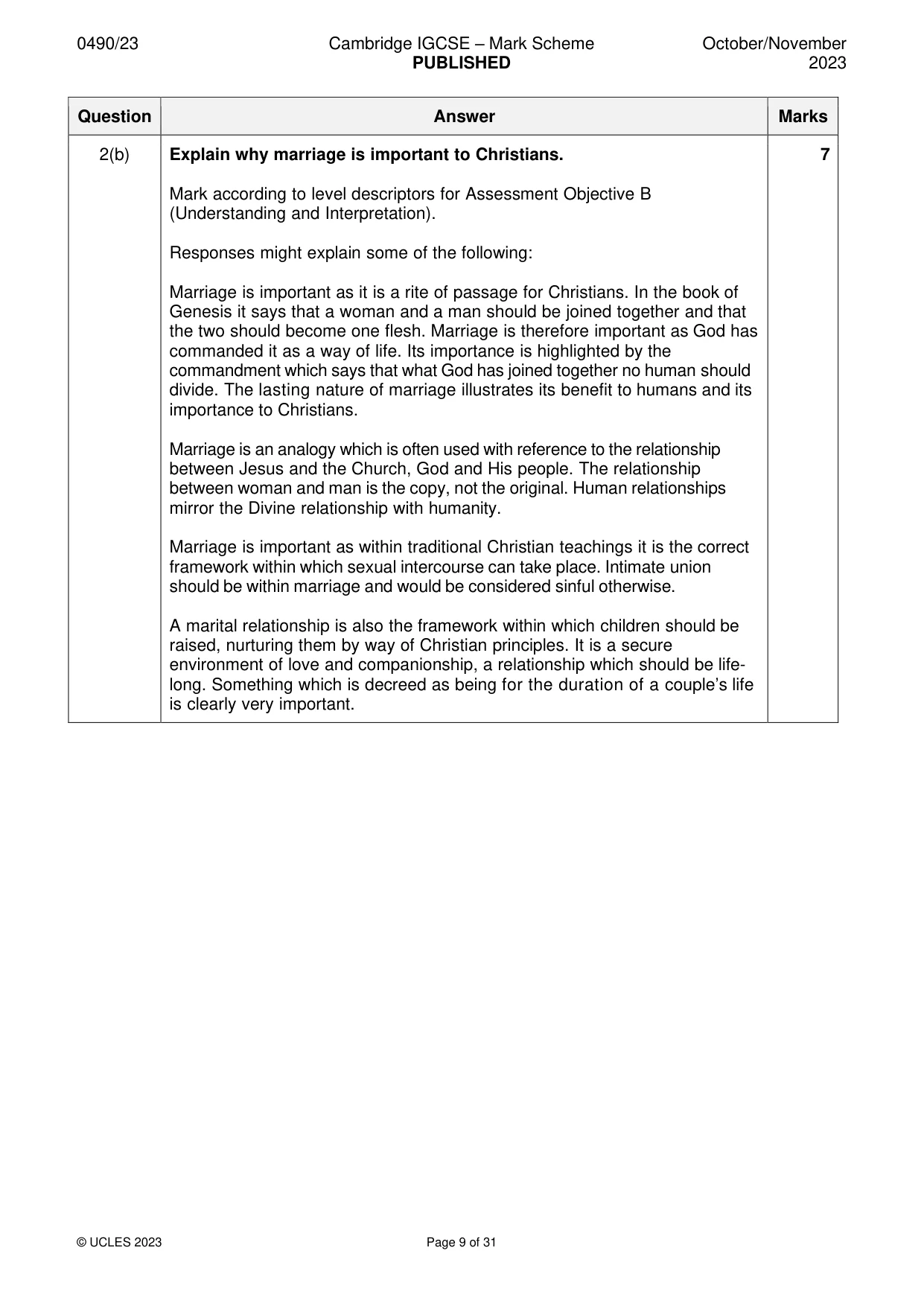
0490/23 Cambridge IGCSE – Mark Scheme PUBLISHED October/November 2023 © UCLES 2023 Page 9 of 31 Question Answer Marks 2(b) Explain why marriage is important to Christians. Mark according to level descriptors for Assessment Objective B (Understanding and Interpretation). Responses might explain some of the following: Marriage is important as it is a rite of passage for Christians. In the book of Genesis it says that a woman and a man should be joined together and that the two should become one flesh. Marriage is therefore important as God has commanded it as a way of life. Its importance is highlighted by the commandment which says that what God has joined together no human should divide. The lasting nature of marriage illustrates its benefit to humans and its importance to Christians. Marriage is an analogy which is often used with reference to the relationship between Jesus and the Church, God and His people. The relationship between woman and man is the copy, not the original. Human relationships mirror the Divine relationship with humanity. Marriage is important as within traditional Christian teachings it is the correct framework within which sexual intercourse can take place. Intimate union should be within marriage and would be considered sinful otherwise. A marital relationship is also the framework within which children should be raised, nurturing them by way of Christian principles. It is a secure environment of love and companionship, a relationship which should be life- long. Something which is decreed as being for the duration of a couple’s life is clearly very important. 7
Mark scheme, page 10
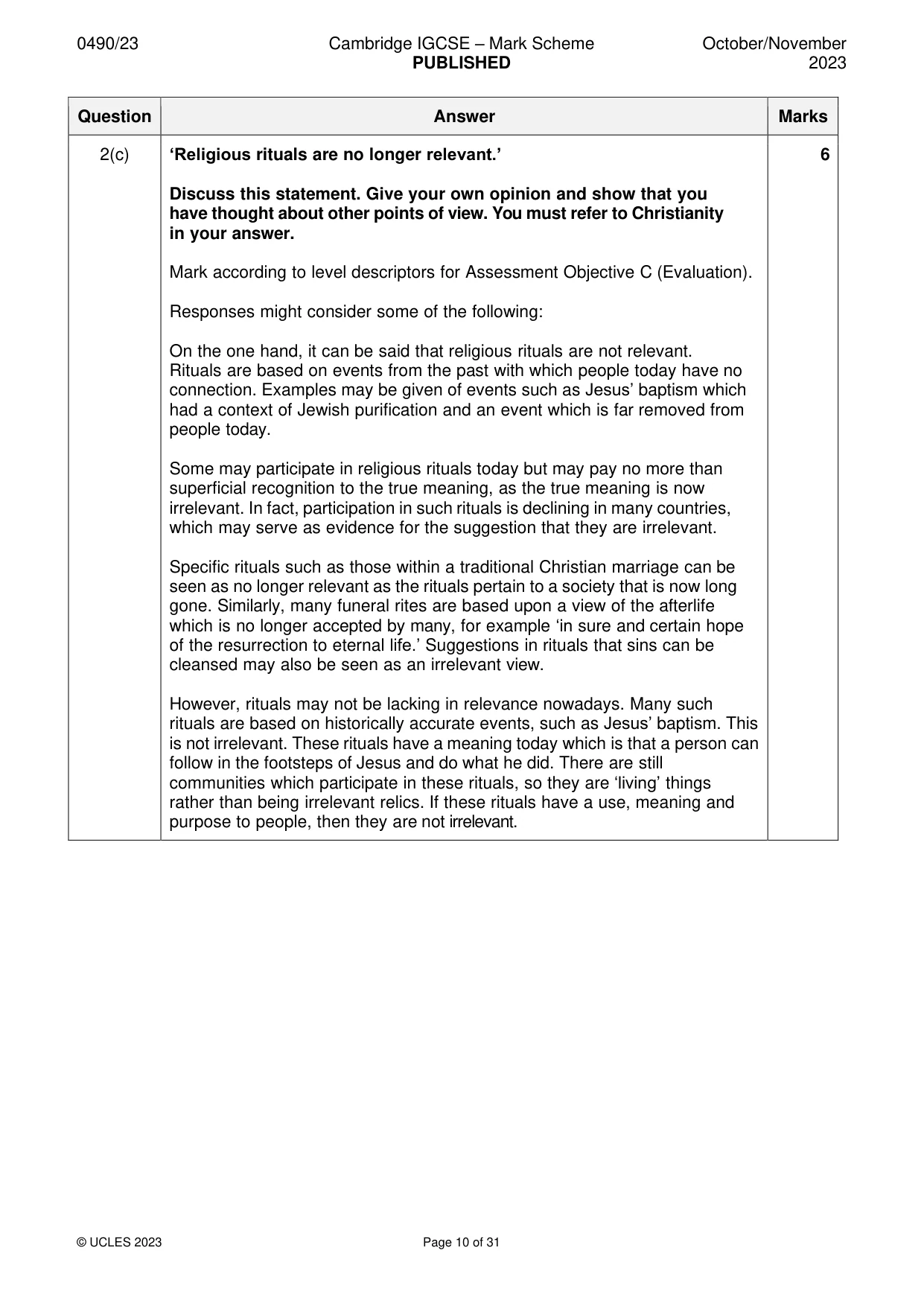
0490/23 Cambridge IGCSE – Mark Scheme PUBLISHED October/November 2023 © UCLES 2023 Page 10 of 31 Question Answer Marks 2(c) ‘Religious rituals are no longer relevant.’ Discuss this statement. Give your own opinion and show that you have thought about other points of view. You must refer to Christianity in your answer. Mark according to level descriptors for Assessment Objective C (Evaluation). Responses might consider some of the following: On the one hand, it can be said that religious rituals are not relevant. Rituals are based on events from the past with which people today have no connection. Examples may be given of events such as Jesus’ baptism which had a context of Jewish purification and an event which is far removed from people today. Some may participate in religious rituals today but may pay no more than superficial recognition to the true meaning, as the true meaning is now irrelevant. In fact, participation in such rituals is declining in many countries, which may serve as evidence for the suggestion that they are irrelevant. Specific rituals such as those within a traditional Christian marriage can be seen as no longer relevant as the rituals pertain to a society that is now long gone. Similarly, many funeral rites are based upon a view of the afterlife which is no longer accepted by many, for example ‘in sure and certain hope of the resurrection to eternal life.’ Suggestions in rituals that sins can be cleansed may also be seen as an irrelevant view. However, rituals may not be lacking in relevance nowadays. Many such rituals are based on historically accurate events, such as Jesus’ baptism. This is not irrelevant. These rituals have a meaning today which is that a person can follow in the footsteps of Jesus and do what he did. There are still communities which participate in these rituals, so they are ‘living’ things rather than being irrelevant relics. If these rituals have a use, meaning and purpose to people, then they are not irrelevant. 6
Mark scheme, page 11
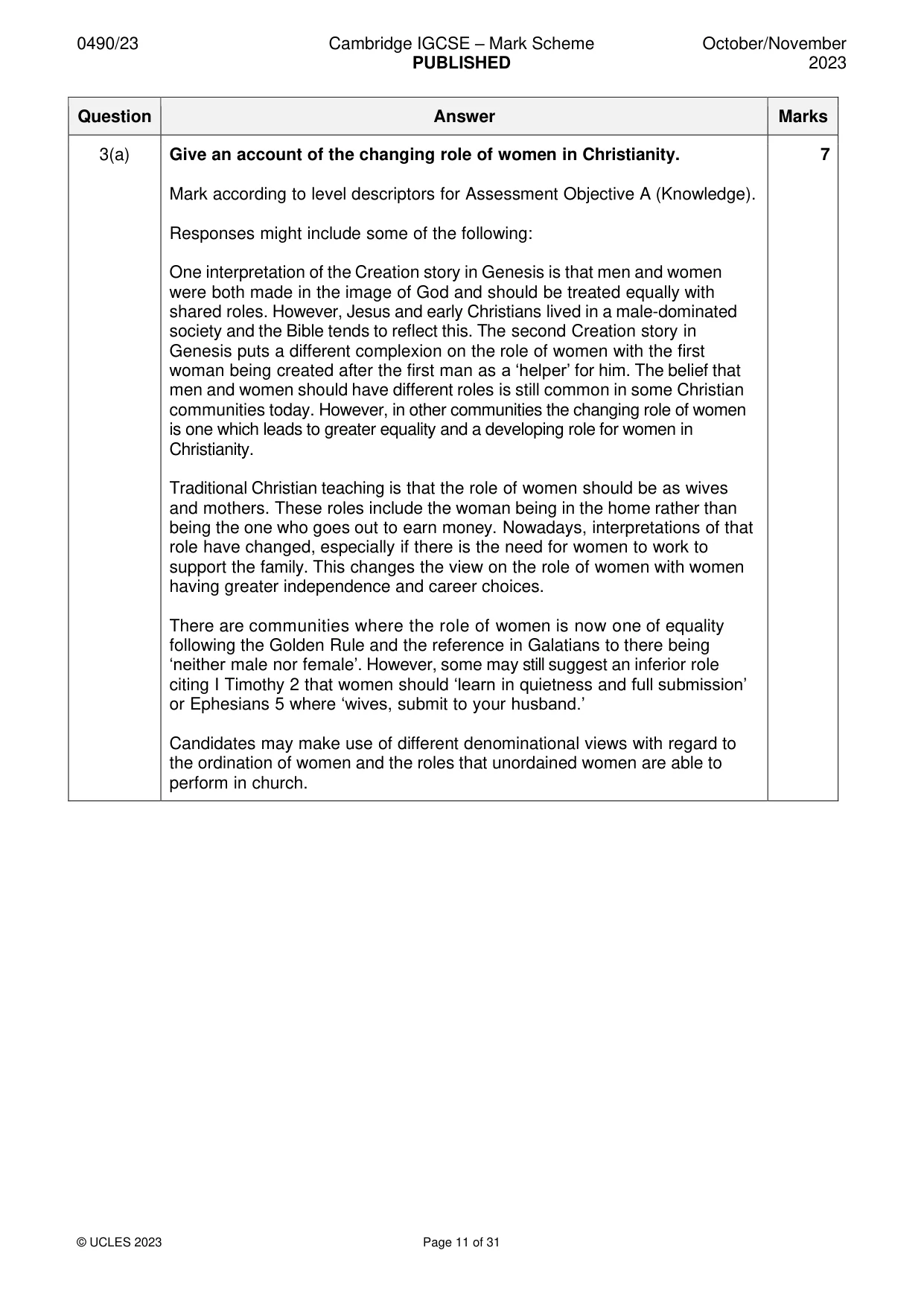
0490/23 Cambridge IGCSE – Mark Scheme PUBLISHED October/November 2023 © UCLES 2023 Page 11 of 31 Question Answer Marks 3(a) Give an account of the changing role of women in Christianity. Mark according to level descriptors for Assessment Objective A (Knowledge). Responses might include some of the following: One interpretation of the Creation story in Genesis is that men and women were both made in the image of God and should be treated equally with shared roles. However, Jesus and early Christians lived in a male-dominated society and the Bible tends to reflect this. The second Creation story in Genesis puts a different complexion on the role of women with the first woman being created after the first man as a ‘helper’ for him. The belief that men and women should have different roles is still common in some Christian communities today. However, in other communities the changing role of women is one which leads to greater equality and a developing role for women in Christianity. Traditional Christian teaching is that the role of women should be as wives and mothers. These roles include the woman being in the home rather than being the one who goes out to earn money. Nowadays, interpretations of that role have changed, especially if there is the need for women to work to support the family. This changes the view on the role of women with women having greater independence and career choices. There are communities where the role of women is now one of equality following the Golden Rule and the reference in Galatians to there being ‘neither male nor female’. However, some may still suggest an inferior role citing I Timothy 2 that women should ‘learn in quietness and full submission’ or Ephesians 5 where ‘wives, submit to your husband.’ Candidates may make use of different denominational views with regard to the ordination of women and the roles that unordained women are able to perform in church. 7
Mark scheme, page 12
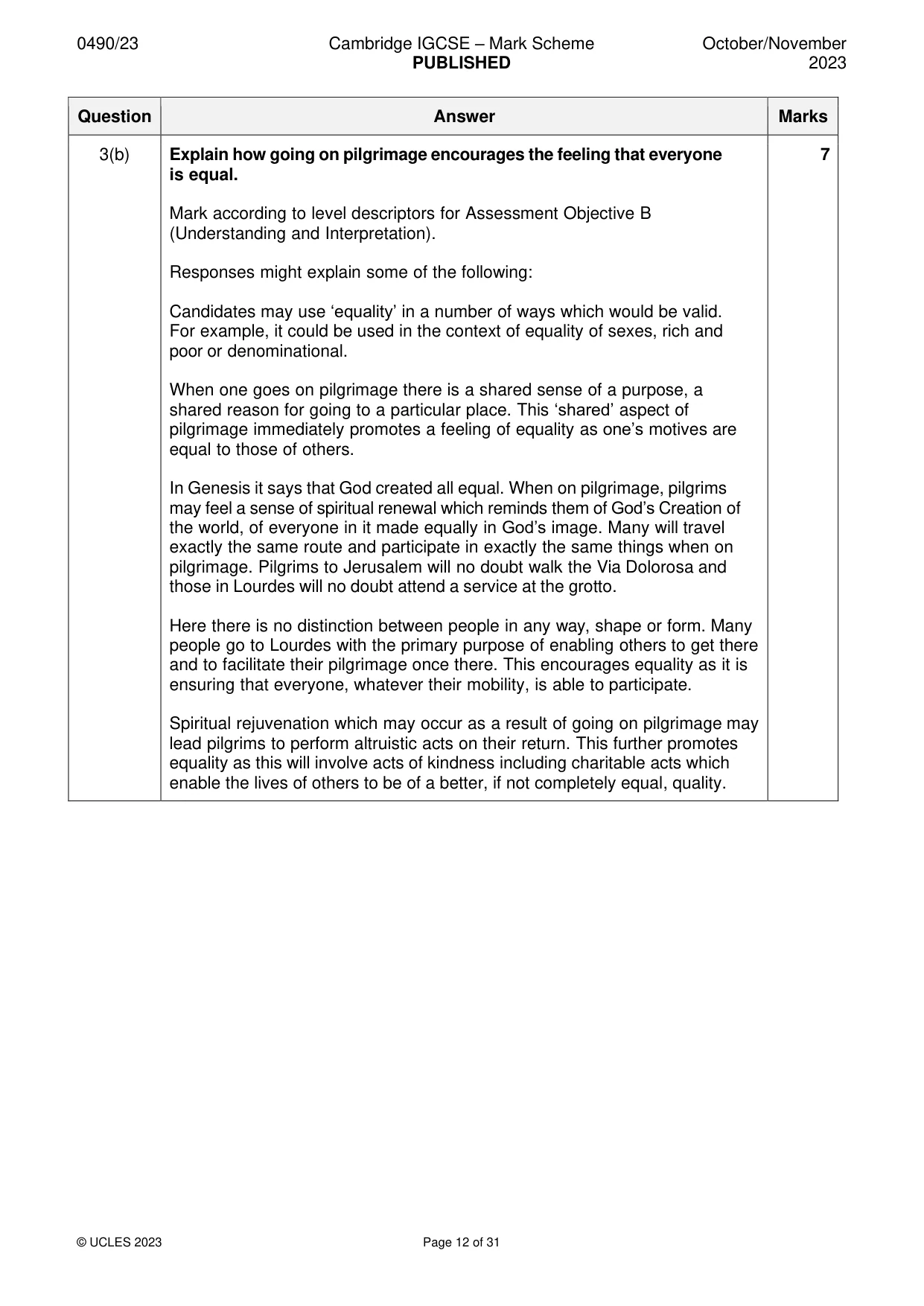
0490/23 Cambridge IGCSE – Mark Scheme PUBLISHED October/November 2023 © UCLES 2023 Page 12 of 31 Question Answer Marks 3(b) Explain how going on pilgrimage encourages the feeling that everyone is equal. Mark according to level descriptors for Assessment Objective B (Understanding and Interpretation). Responses might explain some of the following: Candidates may use ‘equality’ in a number of ways which would be valid. For example, it could be used in the context of equality of sexes, rich and poor or denominational. When one goes on pilgrimage there is a shared sense of a purpose, a shared reason for going to a particular place. This ‘shared’ aspect of pilgrimage immediately promotes a feeling of equality as one’s motives are equal to those of others. In Genesis it says that God created all equal. When on pilgrimage, pilgrims may feel a sense of spiritual renewal which reminds them of God’s Creation of the world, of everyone in it made equally in God’s image. Many will travel exactly the same route and participate in exactly the same things when on pilgrimage. Pilgrims to Jerusalem will no doubt walk the Via Dolorosa and those in Lourdes will no doubt attend a service at the grotto. Here there is no distinction between people in any way, shape or form. Many people go to Lourdes with the primary purpose of enabling others to get there and to facilitate their pilgrimage once there. This encourages equality as it is ensuring that everyone, whatever their mobility, is able to participate. Spiritual rejuvenation which may occur as a result of going on pilgrimage may lead pilgrims to perform altruistic acts on their return. This further promotes equality as this will involve acts of kindness including charitable acts which enable the lives of others to be of a better, if not completely equal, quality. 7
Mark scheme, page 13
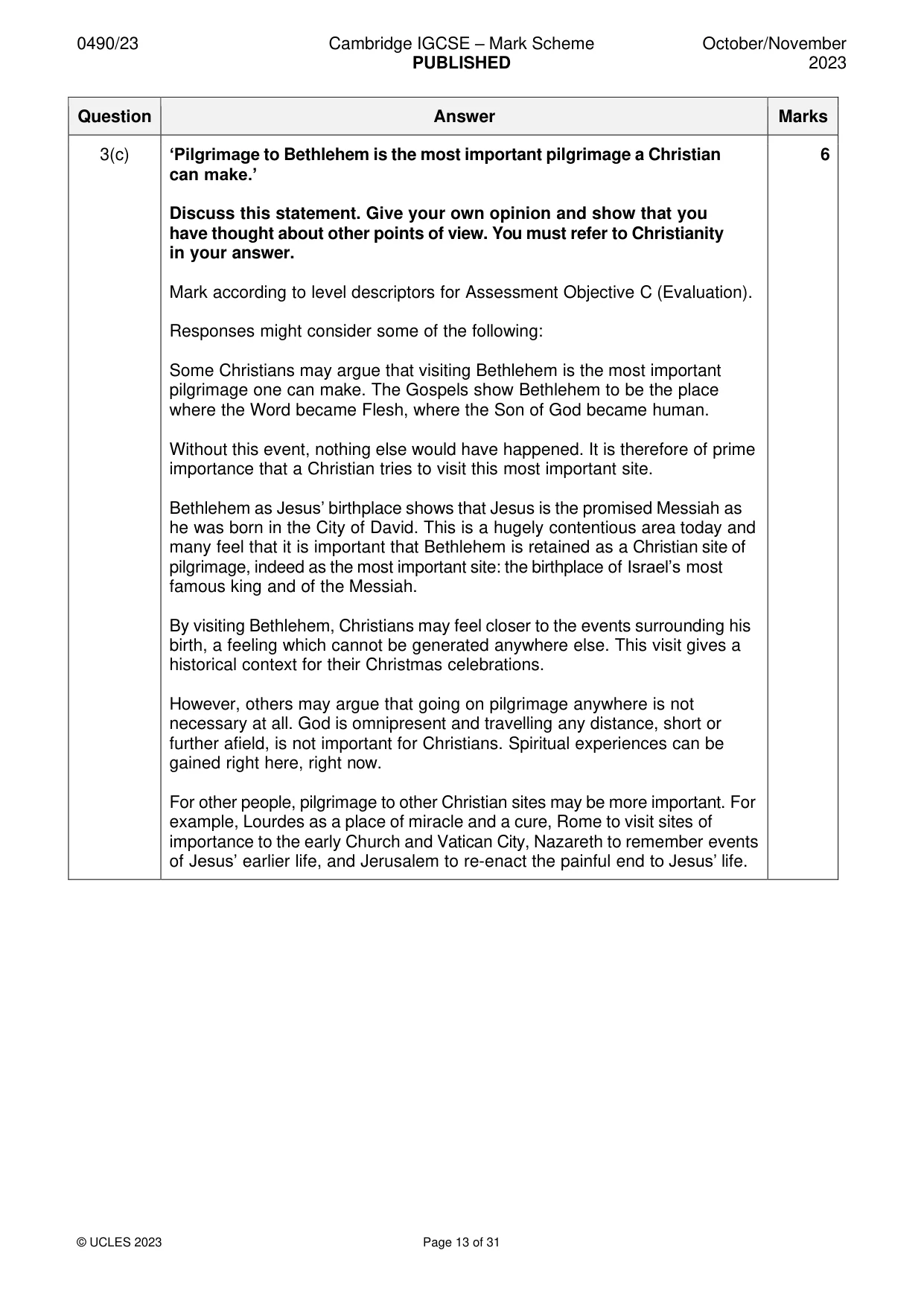
0490/23 Cambridge IGCSE – Mark Scheme PUBLISHED October/November 2023 © UCLES 2023 Page 13 of 31 Question Answer Marks 3(c) ‘Pilgrimage to Bethlehem is the most important pilgrimage a Christian can make.’ Discuss this statement. Give your own opinion and show that you have thought about other points of view. You must refer to Christianity in your answer. Mark according to level descriptors for Assessment Objective C (Evaluation). Responses might consider some of the following: Some Christians may argue that visiting Bethlehem is the most important pilgrimage one can make. The Gospels show Bethlehem to be the place where the Word became Flesh, where the Son of God became human. Without this event, nothing else would have happened. It is therefore of prime importance that a Christian tries to visit this most important site. Bethlehem as Jesus’ birthplace shows that Jesus is the promised Messiah as he was born in the City of David. This is a hugely contentious area today and many feel that it is important that Bethlehem is retained as a Christian site of pilgrimage, indeed as the most important site: the birthplace of Israel’s most famous king and of the Messiah. By visiting Bethlehem, Christians may feel closer to the events surrounding his birth, a feeling which cannot be generated anywhere else. This visit gives a historical context for their Christmas celebrations. However, others may argue that going on pilgrimage anywhere is not necessary at all. God is omnipresent and travelling any distance, short or further afield, is not important for Christians. Spiritual experiences can be gained right here, right now. For other people, pilgrimage to other Christian sites may be more important. For example, Lourdes as a place of miracle and a cure, Rome to visit sites of importance to the early Church and Vatican City, Nazareth to remember events of Jesus’ earlier life, and Jerusalem to re-enact the painful end to Jesus’ life. 6
Mark scheme, page 14
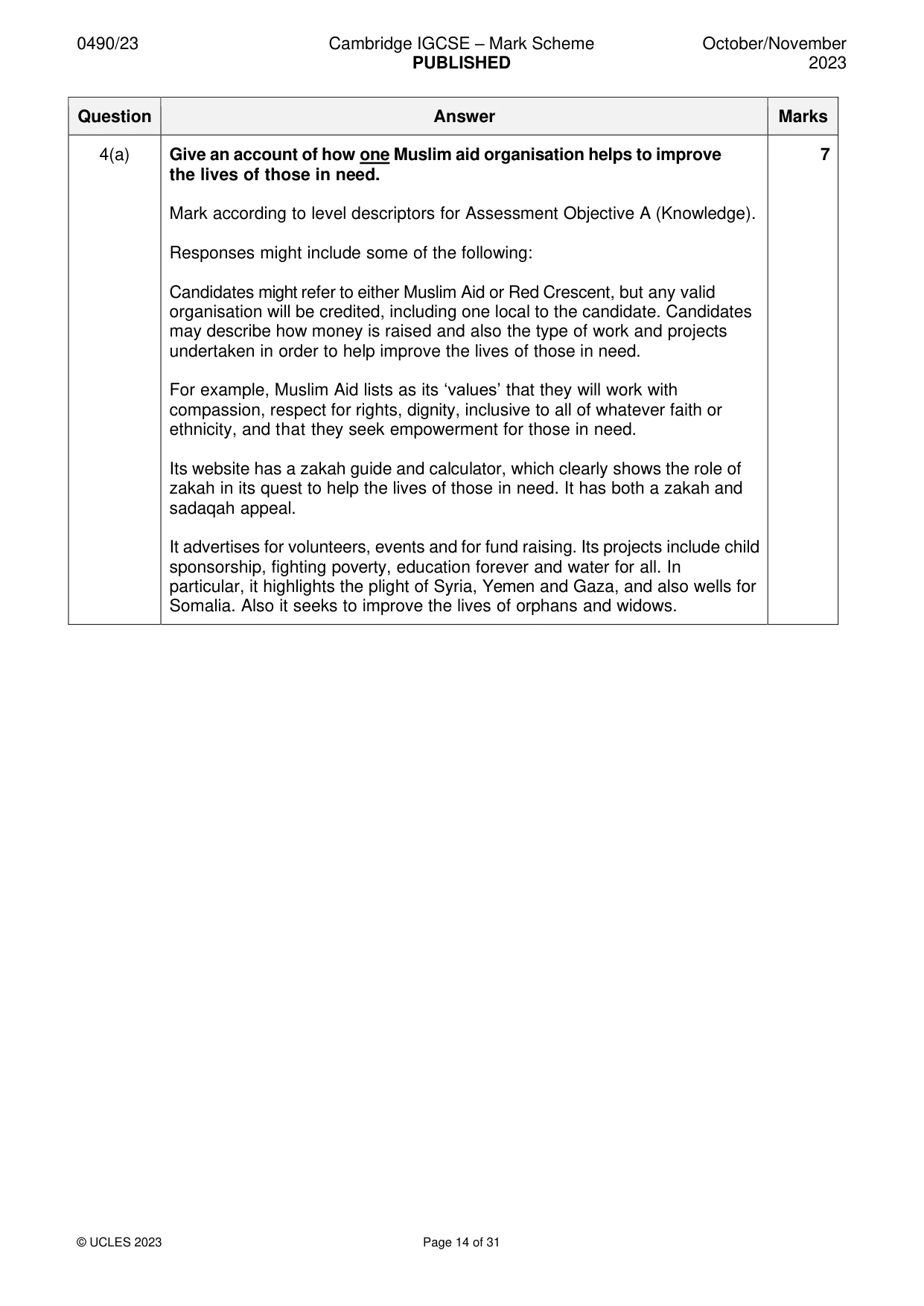
0490/23 Cambridge IGCSE – Mark Scheme PUBLISHED October/November 2023 © UCLES 2023 Page 14 of 31 Question Answer Marks 4(a) Give an account of how one Muslim aid organisation helps to improve the lives of those in need. Mark according to level descriptors for Assessment Objective A (Knowledge). Responses might include some of the following: Candidates might refer to either Muslim Aid or Red Crescent, but any valid organisation will be credited, including one local to the candidate. Candidates may describe how money is raised and also the type of work and projects undertaken in order to help improve the lives of those in need. For example, Muslim Aid lists as its ‘values’ that they will work with compassion, respect for rights, dignity, inclusive to all of whatever faith or ethnicity, and that they seek empowerment for those in need. Its website has a zakah guide and calculator, which clearly shows the role of zakah in its quest to help the lives of those in need. It has both a zakah and sadaqah appeal. It advertises for volunteers, events and for fund raising. Its projects include child sponsorship, fighting poverty, education forever and water for all. In particular, it highlights the plight of Syria, Yemen and Gaza, and also wells for Somalia. Also it seeks to improve the lives of orphans and widows. 7
Mark scheme, page 15
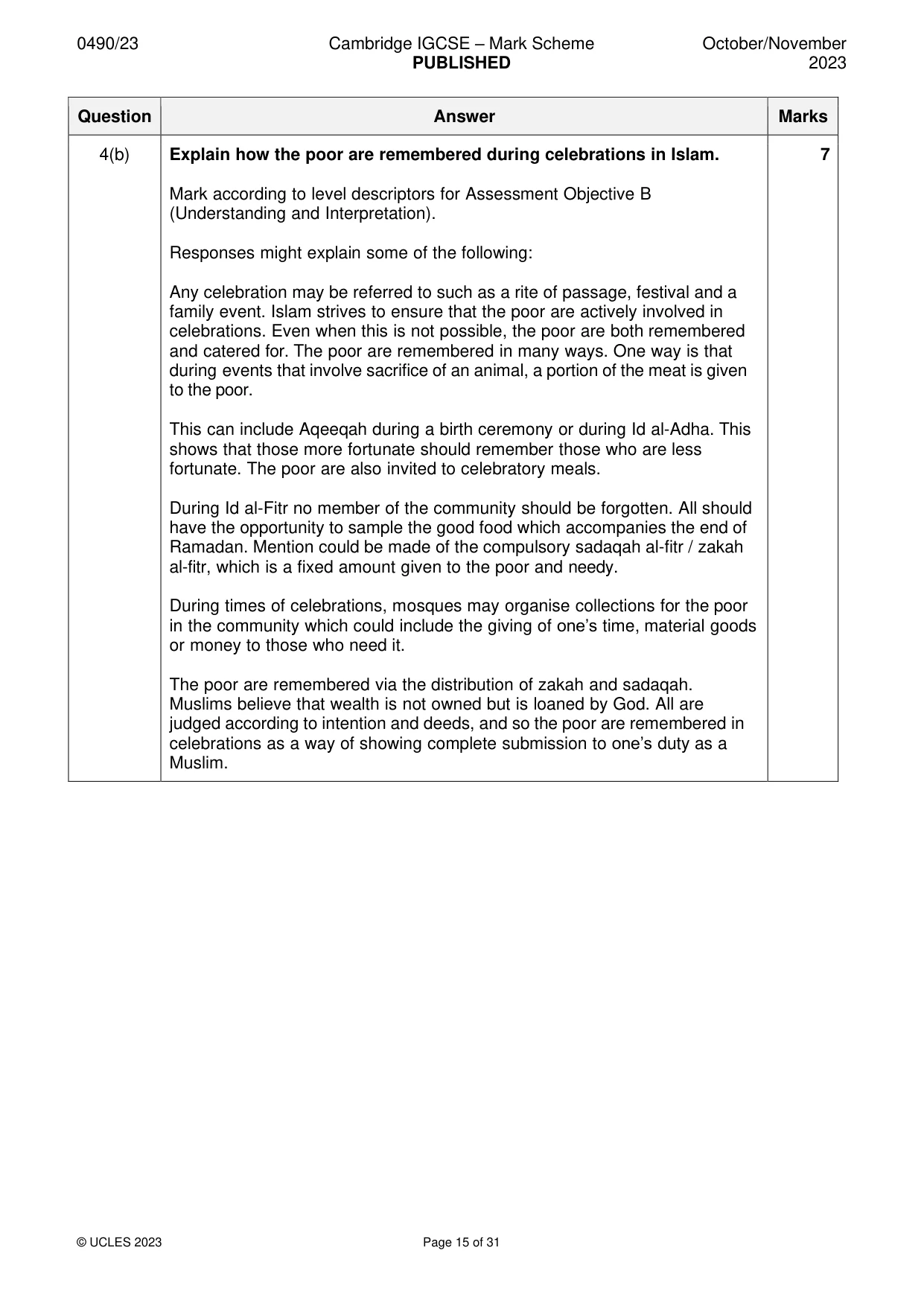
0490/23 Cambridge IGCSE – Mark Scheme PUBLISHED October/November 2023 © UCLES 2023 Page 15 of 31 Question Answer Marks 4(b) Explain how the poor are remembered during celebrations in Islam. Mark according to level descriptors for Assessment Objective B (Understanding and Interpretation). Responses might explain some of the following: Any celebration may be referred to such as a rite of passage, festival and a family event. Islam strives to ensure that the poor are actively involved in celebrations. Even when this is not possible, the poor are both remembered and catered for. The poor are remembered in many ways. One way is that during events that involve sacrifice of an animal, a portion of the meat is given to the poor. This can include Aqeeqah during a birth ceremony or during Id al-Adha. This shows that those more fortunate should remember those who are less fortunate. The poor are also invited to celebratory meals. During Id al-Fitr no member of the community should be forgotten. All should have the opportunity to sample the good food which accompanies the end of Ramadan. Mention could be made of the compulsory sadaqah al-fitr / zakah al-fitr, which is a fixed amount given to the poor and needy. During times of celebrations, mosques may organise collections for the poor in the community which could include the giving of one’s time, material goods or money to those who need it. The poor are remembered via the distribution of zakah and sadaqah. Muslims believe that wealth is not owned but is loaned by God. All are judged according to intention and deeds, and so the poor are remembered in celebrations as a way of showing complete submission to one’s duty as a Muslim. 7
Mark scheme, page 16
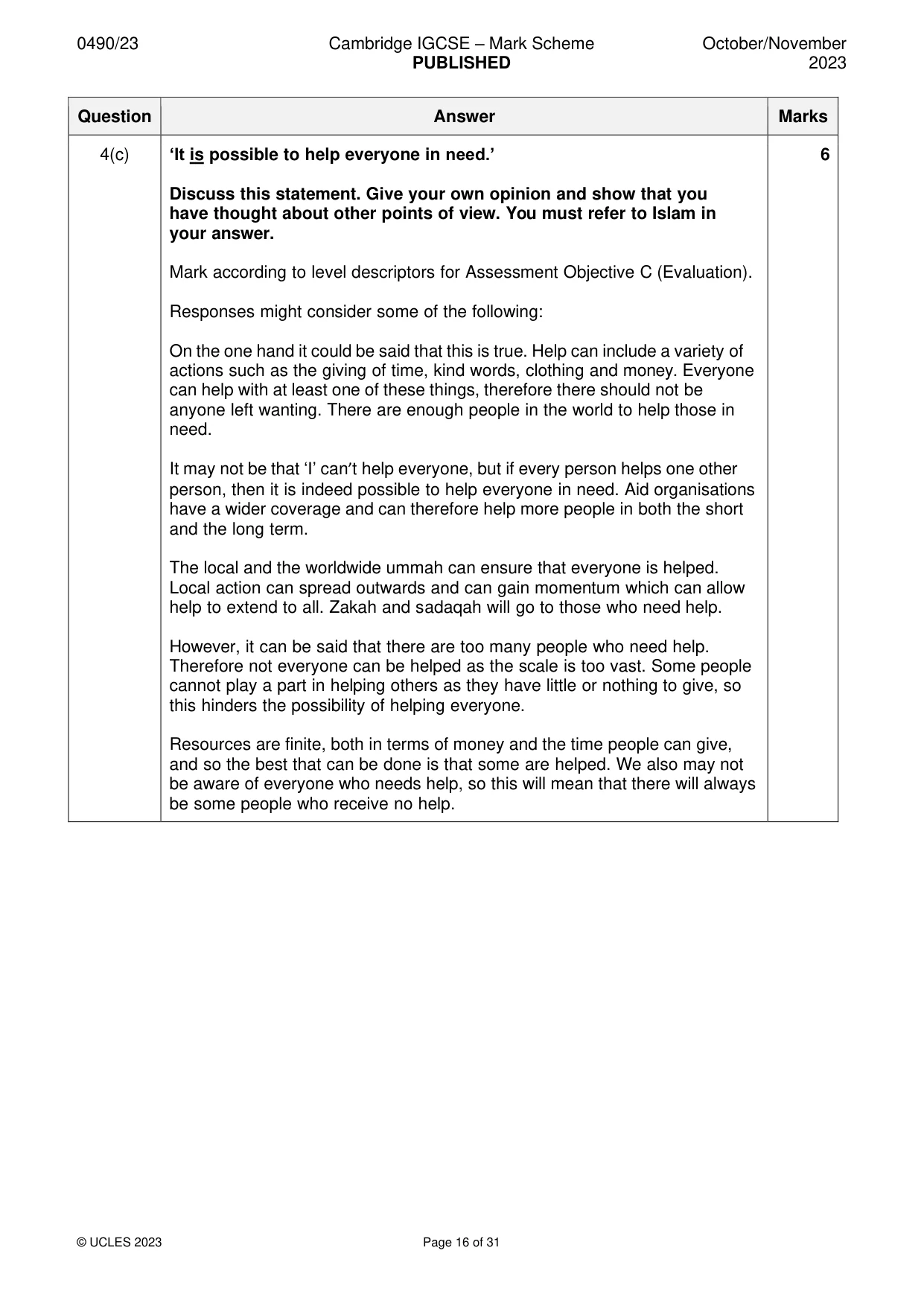
0490/23 Cambridge IGCSE – Mark Scheme PUBLISHED October/November 2023 © UCLES 2023 Page 16 of 31 Question Answer Marks 4(c) ‘It is possible to help everyone in need.’ Discuss this statement. Give your own opinion and show that you have thought about other points of view. You must refer to Islam in your answer. Mark according to level descriptors for Assessment Objective C (Evaluation). Responses might consider some of the following: On the one hand it could be said that this is true. Help can include a variety of actions such as the giving of time, kind words, clothing and money. Everyone can help with at least one of these things, therefore there should not be anyone left wanting. There are enough people in the world to help those in need. It may not be that ‘I’ can’t help everyone, but if every person helps one other person, then it is indeed possible to help everyone in need. Aid organisations have a wider coverage and can therefore help more people in both the short and the long term. The local and the worldwide ummah can ensure that everyone is helped. Local action can spread outwards and can gain momentum which can allow help to extend to all. Zakah and sadaqah will go to those who need help. However, it can be said that there are too many people who need help. Therefore not everyone can be helped as the scale is too vast. Some people cannot play a part in helping others as they have little or nothing to give, so this hinders the possibility of helping everyone. Resources are finite, both in terms of money and the time people can give, and so the best that can be done is that some are helped. We also may not be aware of everyone who needs help, so this will mean that there will always be some people who receive no help. 6
Mark scheme, page 17
0490/23 Cambridge IGCSE – Mark Scheme PUBLISHED October/November 2023 © UCLES 2023 Page 17 of 31 Question Answer Marks 5(a) Describe rituals that happen after the death of a Muslim. Mark according to level descriptors for Assessment Objective A (Knowledge). Responses might include some of the following: The body is prepared for burial soon after death as burial should occur as soon as possible. Cremation is not an option. One ritual is that the dead body is placed on a stretcher, with the head facing the Quiblah. Then comes ghusl (washing) which is performed by relatives of the same sex as the deceased. Other than for a martyr, the body is washed three times and perfumed with scents. The body is then wrapped in a single piece of unsewn cloth, often being the Ihram worn on Hajj. Sometimes the Ihram has been dipped in water from the wells of Zam Zam. The funeral takes place, preferably within 24 hours. Muslims are buried with the head turned to Makkah. All bodies should be buried in contact with the earth but laws in some countries require that a coffin is used. Another ritual is to carry the body to the cemetery by Muslim males, as a sign of respect, rather than transporting it by vehicle to the cemetery. Salat-Ul- Janaz is said as a statement of belief in God and his mercy. The men say prayers without prostration on this occasion. As the body is lowered into the ground it is committed to the earth with the words ‘In the name of God, according to the will of God’ and ‘... from the earth We did create you and into it shall We return you, and from it shall We bring you out once again’. These words show the belief in Judgement Day and life after death. Prayers, including du’a prayers, are performed in the house or mosque. Prayers for forgiveness for all the living and the dead are said as well as for mourners to be kept faithful. Excessive mourning is not encouraged. 7
Mark scheme, page 18
0490/23 Cambridge IGCSE – Mark Scheme PUBLISHED October/November 2023 © UCLES 2023 Page 18 of 31 Question Answer Marks 5(b) Explain why Muslims see this life as a preparation for the life to come. Mark according to level descriptors for Assessment Objective B (Understanding and Interpretation). Responses might explain some of the following: For Muslims, this earthly life is important but its importance lies mainly in how this life prepares one for the type of life one will have after death. This life is a trial, a test by God which prepares a person for the life to come. The belief in life after death is so fundamental to Islam that this may become a focal point for one’s earthly existence. Trials and tribulations in this life, correctly dealt with, will be forgotten when it comes to the life to come. Actions performed today will be important when it comes to the Judgement of God and so are of the utmost importance. Deeds performed now prepare for one’s afterlife. God sees all actions, so everything done now is paving the way for one’s own future. Muslims must follow Shariah as every thought, word and action will be judged by God. Shaytan can tempt in this life to see if one is deserving of Paradise. On the Last Day, there will be no chance to repent. The Muslim belief that this life is but a preparation for the next influences their day to day lives. People are free to follow or reject the teachings of Islam but they must face the consequences of their decision at the Last Judgement. If one does not fully submit to the teachings of Islam during their earthly life, then the effect will be felt in the next life. Everything in this life will be accounted for in the next, so this life is truly a preparation for the next. During this life, it is important a Muslim chooses a job carefully, so the job subscribes to that which is halal. It is important to Muslims that they resist evil and follow the Islamic way of life, to fulfil the will of God and to secure Paradise. Muslims will encourage self-restraint in their behaviour and that of others. Muslims believe they must strive to follow the straight path and obey God’s commands in this life in order to gain the reward of Paradise. 7
Mark scheme, page 19
0490/23 Cambridge IGCSE – Mark Scheme PUBLISHED October/November 2023 © UCLES 2023 Page 19 of 31 Question Answer Marks 5(c) ‘It is important to follow set rituals when a person dies.’ Discuss this statement. Give your own opinion and show that you have thought about other points of view. You must refer to Islam in your answer. Mark according to level descriptors for Assessment Objective C (Evaluation). Responses might consider some of the following: In many ways it could be argued that set rituals are important. The rituals have been ‘tried and tested’ for many generations. To follow them is a way to maintain tradition within religion. It gives stability to those who are mourning who can be safe in the knowledge of what they have to do and what will be done for them by other people during their time of grief. During the time when the deceased’s body is being prepared and the funeral being arranged, it will be clear what people’s roles are. It can be said that this will ease the pressure on the family of the deceased during this difficult time. They will know that customs and rituals carried out on behalf of the deceased will be performed in a set way that they are fully compliant with. Some will feel that this is too rigid though. Death is accepted as being according to the will of God and this understanding helps. Excessive mourning is not encouraged in Islam and this gives Muslims parameters within which to grieve. The amount of time spent in mourning is also prescribed so this makes things more clear-cut. However, some may say that set rituals either do not help or they are unimportant. Set rituals do not accommodate individual desires, choice or feelings of grief. Some may wish to have a different kind of funeral or deal with the grief in a different way. Some may wish for a longer period of time to prepare the body for the funeral or may wish to mourn in a more excessive fashion than set rituals prescribe. Death is approached differently by different people and it can be argued that the response to death should be made according to individual wishes. 6
Mark scheme, page 20
0490/23 Cambridge IGCSE – Mark Scheme PUBLISHED October/November 2023 © UCLES 2023 Page 20 of 31 Question Answer Marks 6(a) Describe the giving and the use of zakah. Mark according to level descriptors for Assessment Objective A (Knowledge). Responses might include some of the following: Zakah is one of the Five Pillars of Islam and is a compulsory act of worship. The aim of giving zakah is to purify one’s wealth and soul. To do this is an expression of devotion to God and an expression of love and concern for others. Zakah is given at set times during the year. Zakah is to be given by all adult Muslims and is an act in accordance with a Sunnah of the Prophet (pbuh) as well as the Qur’an. The Qur’an describes zakah as the means by which one can attain God’s mercy. It is also a sign of brotherhood and a distinctive feature of a faithful community. Nisab, according to Shariah (law), is the minimum amount that Muslims must have before having to give zakah. Zakah requires Muslims who own wealth at or over this certain threshold to donate a portion of their wealth to those who need it. There are no specific guidelines in the Qur’an regarding the exact percentage, though typically this is 2.5% of capital assets. The greater the assets the more zakah one pays. The importance of intention in Islam may be highlighted. Neither zakah (nor sadaqah) should be given begrudgingly nor should they be given in order to gain status amongst others. God can see motive and intention and both should be given with a willing heart. Candidates are expected to give examples of ways in which zakah can and/or cannot be used According to Surah 9 in the Qur’an. Zakah can only be used for the following: helping the poor, helping people in need, freeing prisoners, slaves or captives, or helping people out of debt. This may be broken down into individual, specific projects which zakah can be used for providing it meets the needs of eligible groups. It cannot be used to help the rich, those who could work but do not, heretics or apostates, the wife of the payer, lineal ascendants or descendants. 7
Mark scheme, page 21
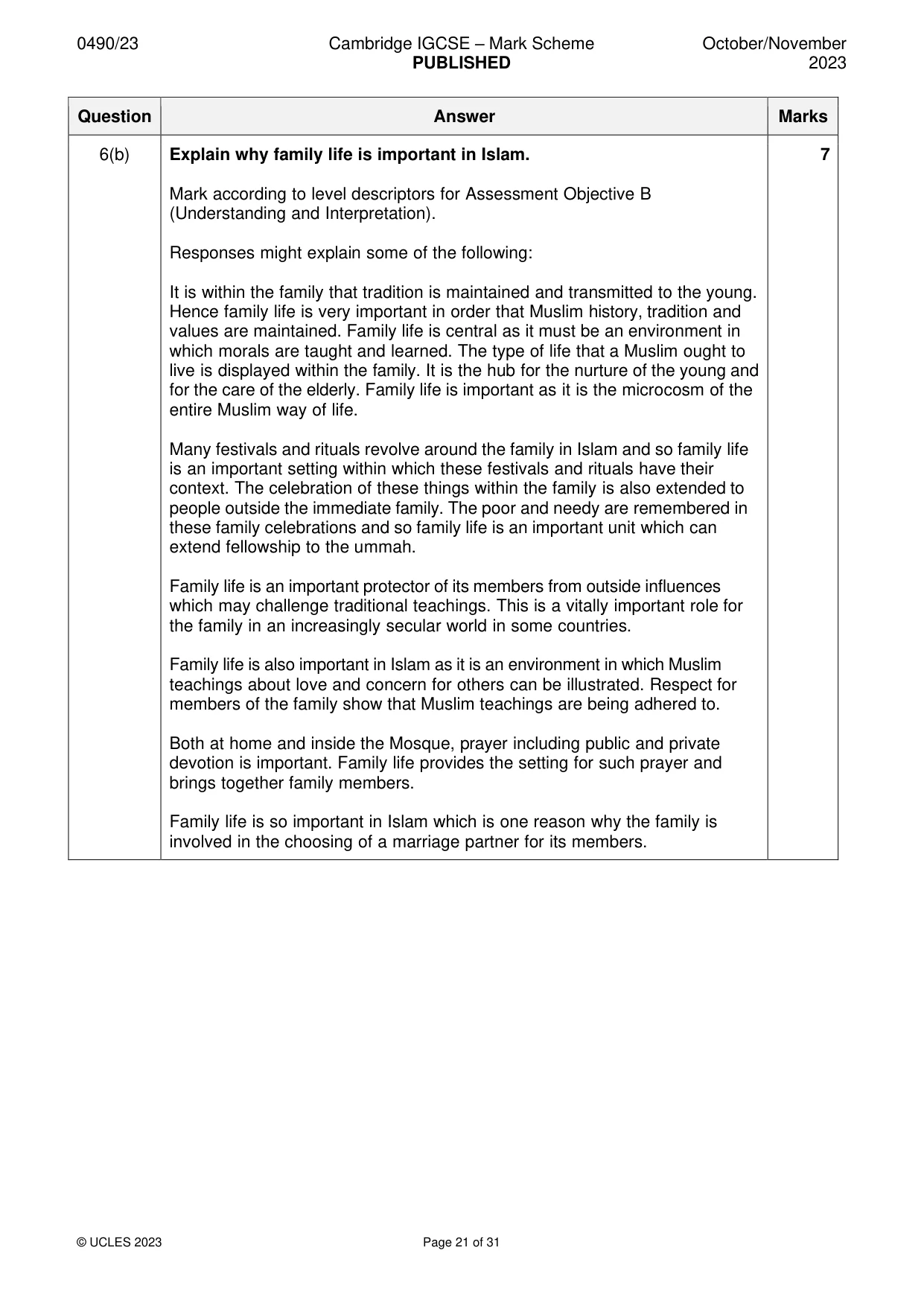
0490/23 Cambridge IGCSE – Mark Scheme PUBLISHED October/November 2023 © UCLES 2023 Page 21 of 31 Question Answer Marks 6(b) Explain why family life is important in Islam. Mark according to level descriptors for Assessment Objective B (Understanding and Interpretation). Responses might explain some of the following: It is within the family that tradition is maintained and transmitted to the young. Hence family life is very important in order that Muslim history, tradition and values are maintained. Family life is central as it must be an environment in which morals are taught and learned. The type of life that a Muslim ought to live is displayed within the family. It is the hub for the nurture of the young and for the care of the elderly. Family life is important as it is the microcosm of the entire Muslim way of life. Many festivals and rituals revolve around the family in Islam and so family life is an important setting within which these festivals and rituals have their context. The celebration of these things within the family is also extended to people outside the immediate family. The poor and needy are remembered in these family celebrations and so family life is an important unit which can extend fellowship to the ummah. Family life is an important protector of its members from outside influences which may challenge traditional teachings. This is a vitally important role for the family in an increasingly secular world in some countries. Family life is also important in Islam as it is an environment in which Muslim teachings about love and concern for others can be illustrated. Respect for members of the family show that Muslim teachings are being adhered to. Both at home and inside the Mosque, prayer including public and private devotion is important. Family life provides the setting for such prayer and brings together family members. Family life is so important in Islam which is one reason why the family is involved in the choosing of a marriage partner for its members. 7
Mark scheme, page 22
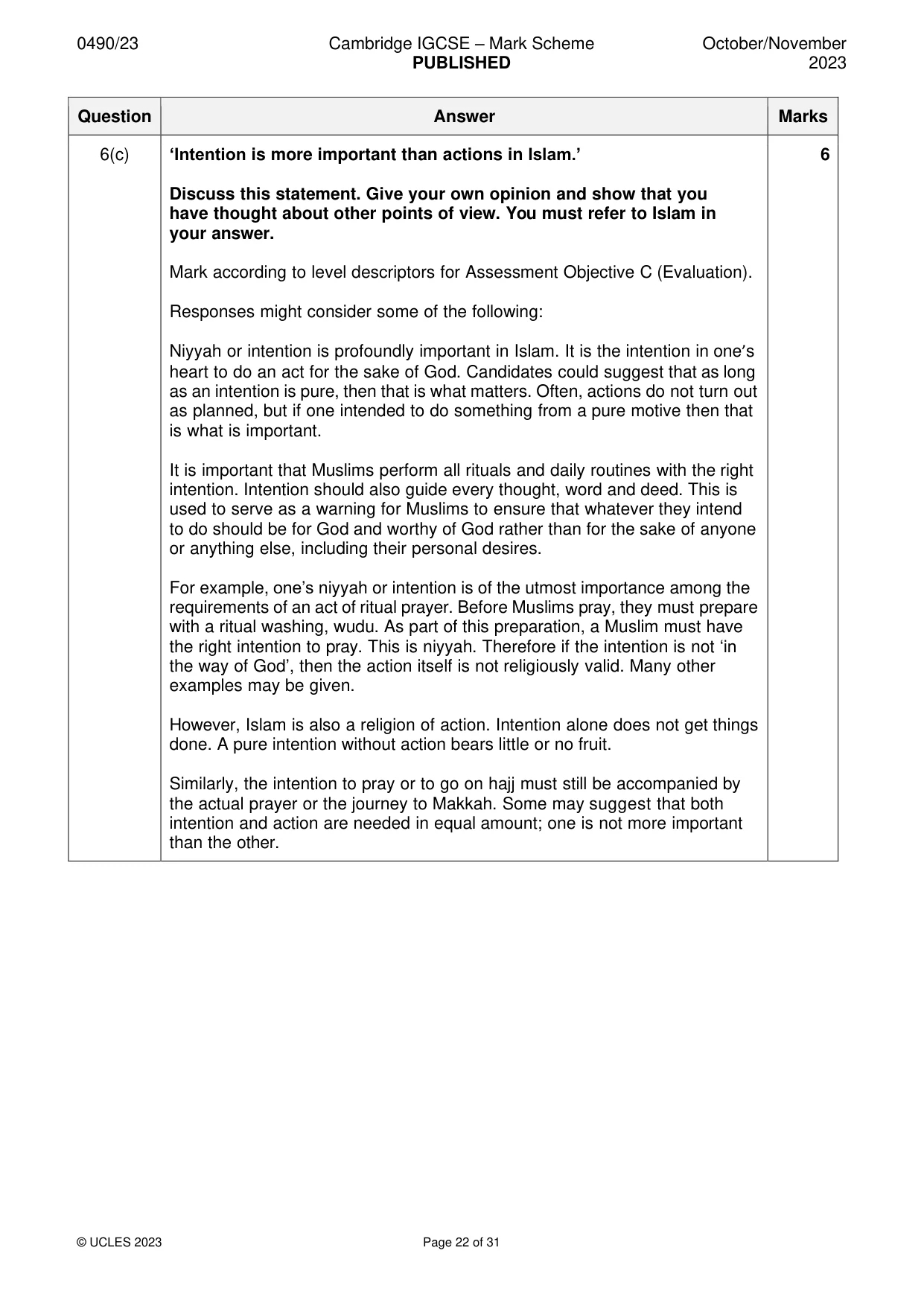
0490/23 Cambridge IGCSE – Mark Scheme PUBLISHED October/November 2023 © UCLES 2023 Page 22 of 31 Question Answer Marks 6(c) ‘Intention is more important than actions in Islam.’ Discuss this statement. Give your own opinion and show that you have thought about other points of view. You must refer to Islam in your answer. Mark according to level descriptors for Assessment Objective C (Evaluation). Responses might consider some of the following: Niyyah or intention is profoundly important in Islam. It is the intention in one’s heart to do an act for the sake of God. Candidates could suggest that as long as an intention is pure, then that is what matters. Often, actions do not turn out as planned, but if one intended to do something from a pure motive then that is what is important. It is important that Muslims perform all rituals and daily routines with the right intention. Intention should also guide every thought, word and deed. This is used to serve as a warning for Muslims to ensure that whatever they intend to do should be for God and worthy of God rather than for the sake of anyone or anything else, including their personal desires. For example, one’s niyyah or intention is of the utmost importance among the requirements of an act of ritual prayer. Before Muslims pray, they must prepare with a ritual washing, wudu. As part of this preparation, a Muslim must have the right intention to pray. This is niyyah. Therefore if the intention is not ‘in the way of God’, then the action itself is not religiously valid. Many other examples may be given. However, Islam is also a religion of action. Intention alone does not get things done. A pure intention without action bears little or no fruit. Similarly, the intention to pray or to go on hajj must still be accompanied by the actual prayer or the journey to Makkah. Some may suggest that both intention and action are needed in equal amount; one is not more important than the other. 6
Mark scheme, page 23
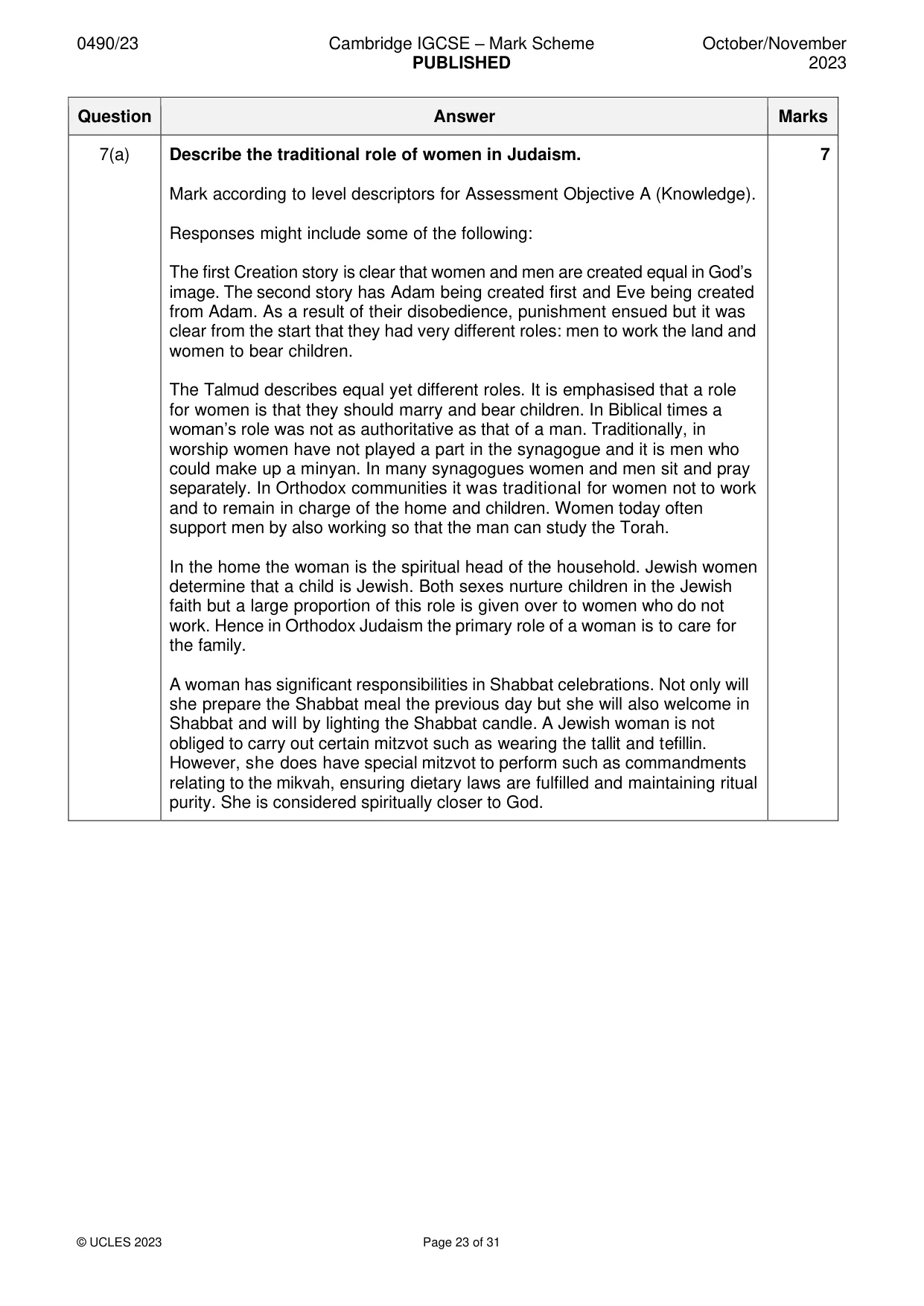
0490/23 Cambridge IGCSE – Mark Scheme PUBLISHED October/November 2023 © UCLES 2023 Page 23 of 31 Question Answer Marks 7(a) Describe the traditional role of women in Judaism. Mark according to level descriptors for Assessment Objective A (Knowledge). Responses might include some of the following: The first Creation story is clear that women and men are created equal in God’s image. The second story has Adam being created first and Eve being created from Adam. As a result of their disobedience, punishment ensued but it was clear from the start that they had very different roles: men to work the land and women to bear children. The Talmud describes equal yet different roles. It is emphasised that a role for women is that they should marry and bear children. In Biblical times a woman’s role was not as authoritative as that of a man. Traditionally, in worship women have not played a part in the synagogue and it is men who could make up a minyan. In many synagogues women and men sit and pray separately. In Orthodox communities it was traditional for women not to work and to remain in charge of the home and children. Women today often support men by also working so that the man can study the Torah. In the home the woman is the spiritual head of the household. Jewish women determine that a child is Jewish. Both sexes nurture children in the Jewish faith but a large proportion of this role is given over to women who do not work. Hence in Orthodox Judaism the primary role of a woman is to care for the family. A woman has significant responsibilities in Shabbat celebrations. Not only will she prepare the Shabbat meal the previous day but she will also welcome in Shabbat and will by lighting the Shabbat candle. A Jewish woman is not obliged to carry out certain mitzvot such as wearing the tallit and tefillin. However, she does have special mitzvot to perform such as commandments relating to the mikvah, ensuring dietary laws are fulfilled and maintaining ritual purity. She is considered spiritually closer to God. 7
Mark scheme, page 24
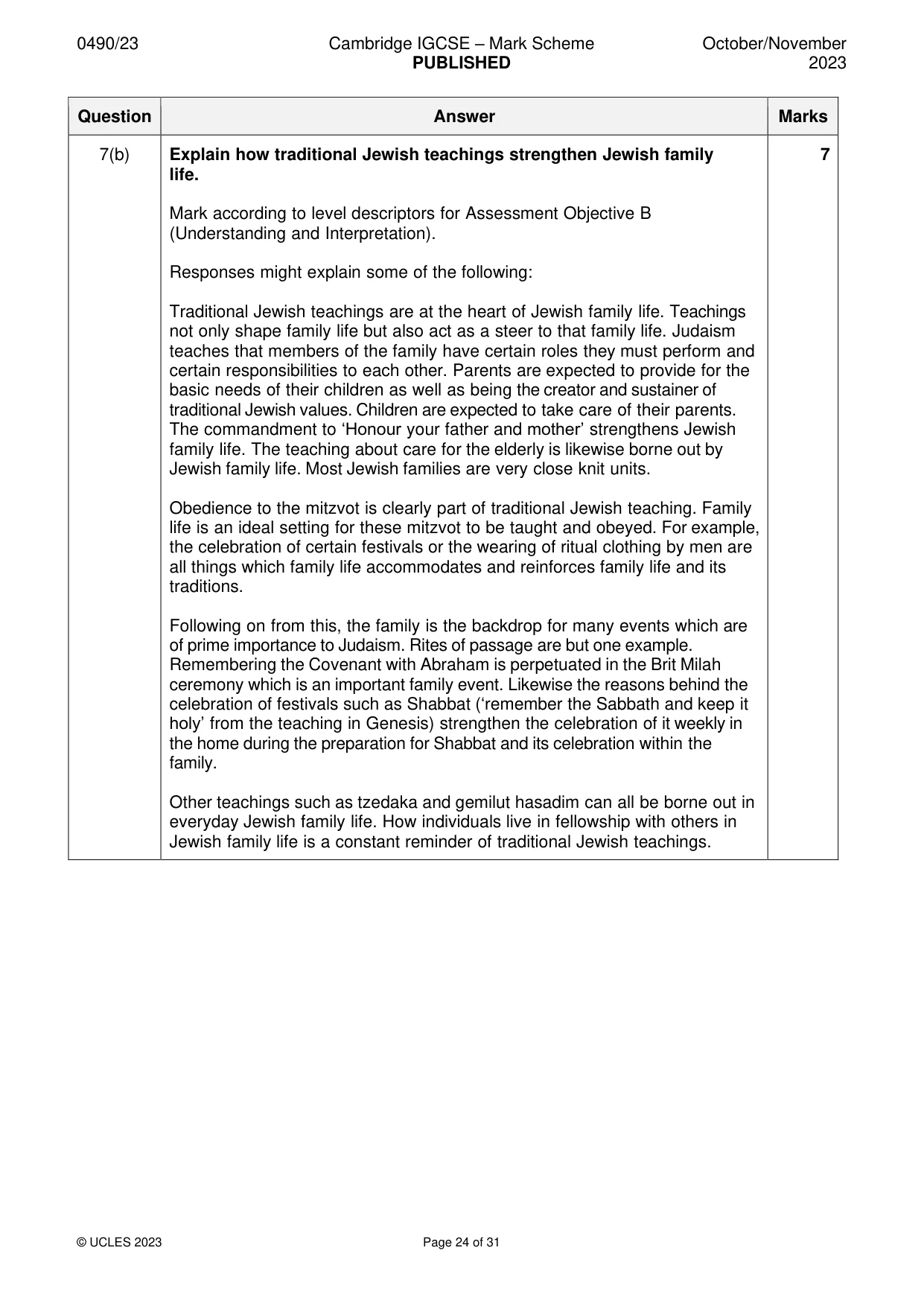
0490/23 Cambridge IGCSE – Mark Scheme PUBLISHED October/November 2023 © UCLES 2023 Page 24 of 31 Question Answer Marks 7(b) Explain how traditional Jewish teachings strengthen Jewish family life. Mark according to level descriptors for Assessment Objective B (Understanding and Interpretation). Responses might explain some of the following: Traditional Jewish teachings are at the heart of Jewish family life. Teachings not only shape family life but also act as a steer to that family life. Judaism teaches that members of the family have certain roles they must perform and certain responsibilities to each other. Parents are expected to provide for the basic needs of their children as well as being the creator and sustainer of traditional Jewish values. Children are expected to take care of their parents. The commandment to ‘Honour your father and mother’ strengthens Jewish family life. The teaching about care for the elderly is likewise borne out by Jewish family life. Most Jewish families are very close knit units. Obedience to the mitzvot is clearly part of traditional Jewish teaching. Family life is an ideal setting for these mitzvot to be taught and obeyed. For example, the celebration of certain festivals or the wearing of ritual clothing by men are all things which family life accommodates and reinforces family life and its traditions. Following on from this, the family is the backdrop for many events which are of prime importance to Judaism. Rites of passage are but one example. Remembering the Covenant with Abraham is perpetuated in the Brit Milah ceremony which is an important family event. Likewise the reasons behind the celebration of festivals such as Shabbat (‘remember the Sabbath and keep it holy’ from the teaching in Genesis) strengthen the celebration of it weekly in the home during the preparation for Shabbat and its celebration within the family. Other teachings such as tzedaka and gemilut hasadim can all be borne out in everyday Jewish family life. How individuals live in fellowship with others in Jewish family life is a constant reminder of traditional Jewish teachings. 7
Mark scheme, page 25
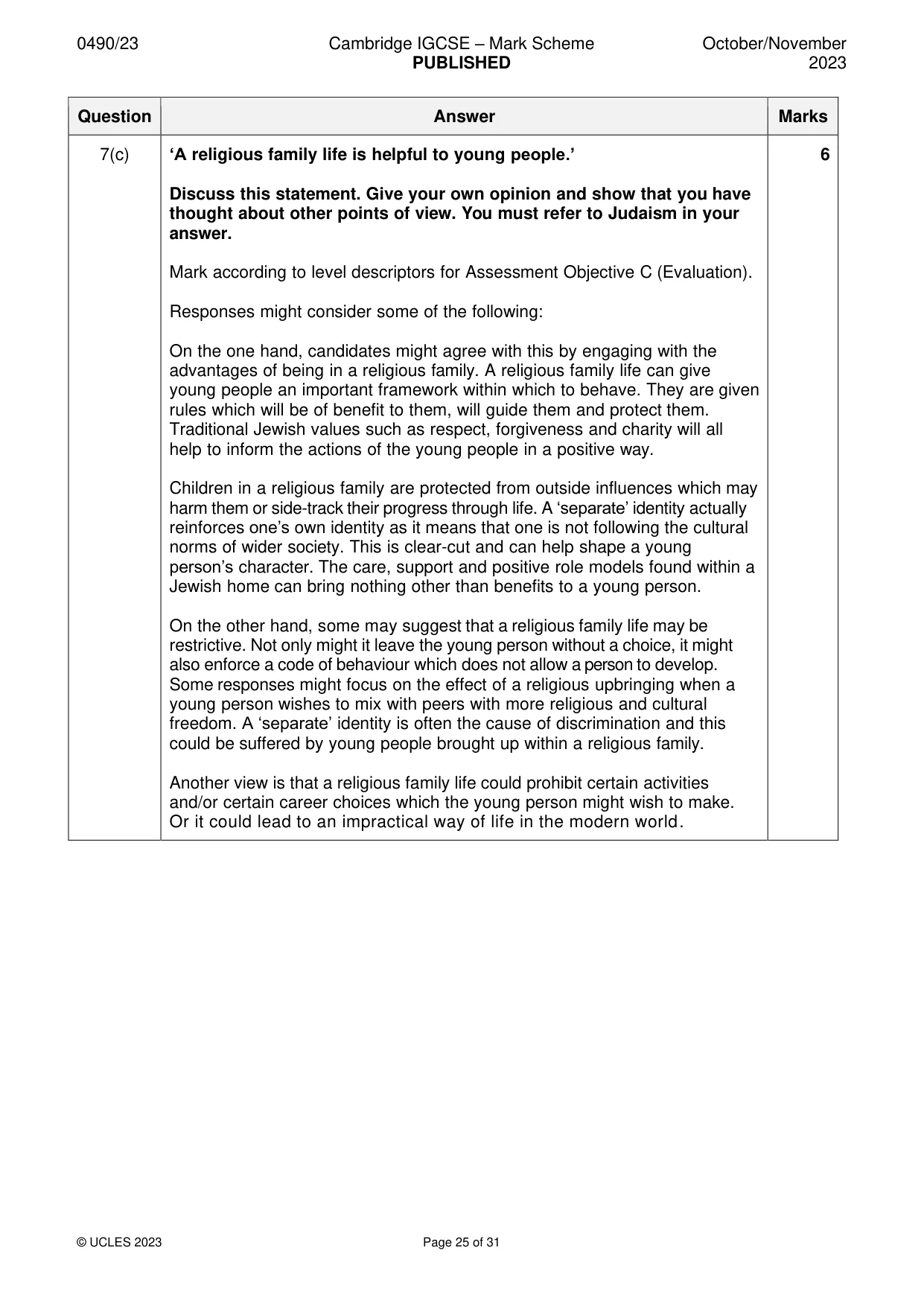
0490/23 Cambridge IGCSE – Mark Scheme PUBLISHED October/November 2023 © UCLES 2023 Page 25 of 31 Question Answer Marks 7(c) ‘A religious family life is helpful to young people.’ Discuss this statement. Give your own opinion and show that you have thought about other points of view. You must refer to Judaism in your answer. Mark according to level descriptors for Assessment Objective C (Evaluation). Responses might consider some of the following: On the one hand, candidates might agree with this by engaging with the advantages of being in a religious family. A religious family life can give young people an important framework within which to behave. They are given rules which will be of benefit to them, will guide them and protect them. Traditional Jewish values such as respect, forgiveness and charity will all help to inform the actions of the young people in a positive way. Children in a religious family are protected from outside influences which may harm them or side-track their progress through life. A ‘separate’ identity actually reinforces one’s own identity as it means that one is not following the cultural norms of wider society. This is clear-cut and can help shape a young person’s character. The care, support and positive role models found within a Jewish home can bring nothing other than benefits to a young person. On the other hand, some may suggest that a religious family life may be restrictive. Not only might it leave the young person without a choice, it might also enforce a code of behaviour which does not allow a person to develop. Some responses might focus on the effect of a religious upbringing when a young person wishes to mix with peers with more religious and cultural freedom. A ‘separate’ identity is often the cause of discrimination and this could be suffered by young people brought up within a religious family. Another view is that a religious family life could prohibit certain activities and/or certain career choices which the young person might wish to make. Or it could lead to an impractical way of life in the modern world. 6
Mark scheme, page 26
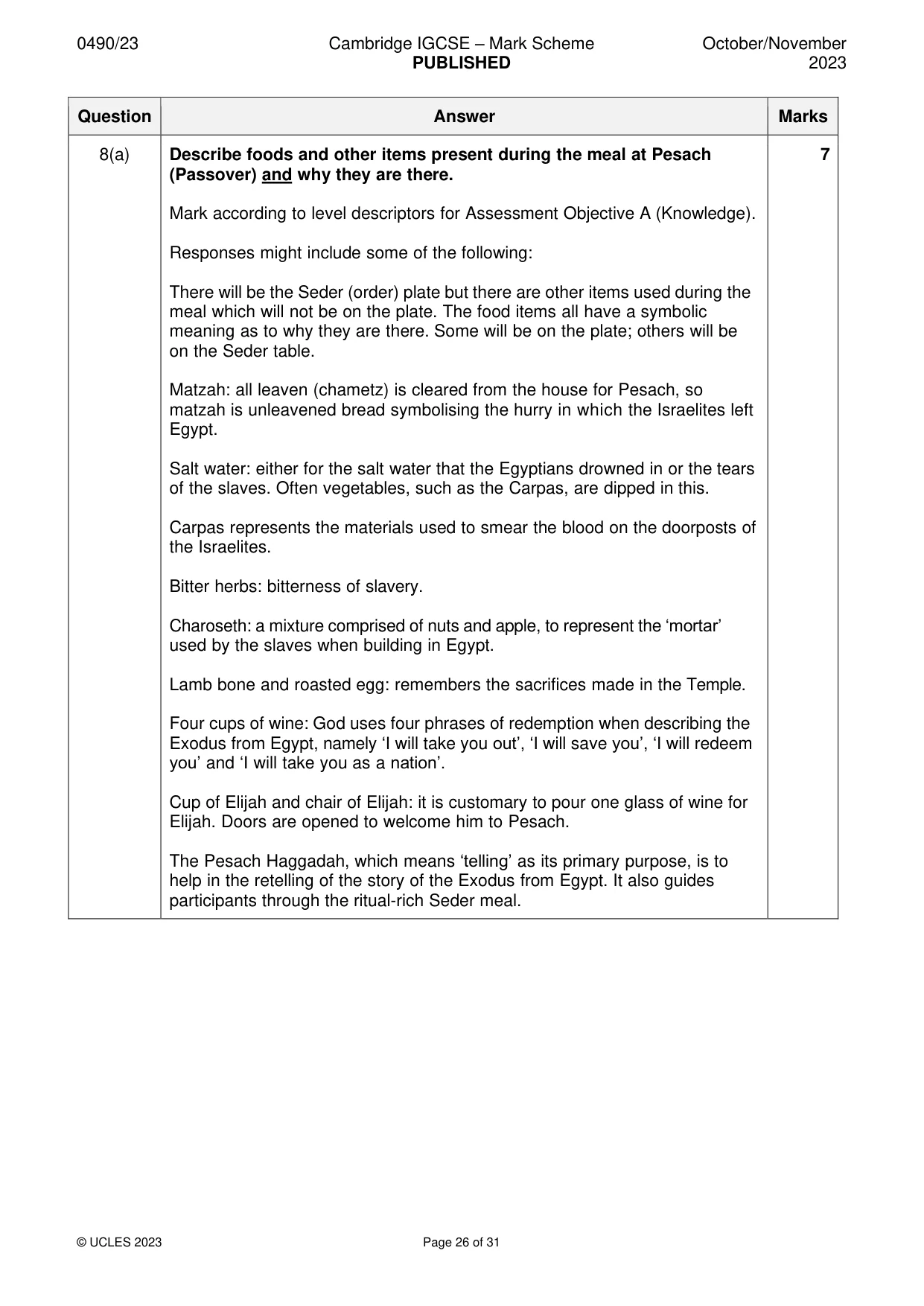
0490/23 Cambridge IGCSE – Mark Scheme PUBLISHED October/November 2023 © UCLES 2023 Page 26 of 31 Question Answer Marks 8(a) Describe foods and other items present during the meal at Pesach (Passover) and why they are there. Mark according to level descriptors for Assessment Objective A (Knowledge). Responses might include some of the following: There will be the Seder (order) plate but there are other items used during the meal which will not be on the plate. The food items all have a symbolic meaning as to why they are there. Some will be on the plate; others will be on the Seder table. Matzah: all leaven (chametz) is cleared from the house for Pesach, so matzah is unleavened bread symbolising the hurry in which the Israelites left Egypt. Salt water: either for the salt water that the Egyptians drowned in or the tears of the slaves. Often vegetables, such as the Carpas, are dipped in this. Carpas represents the materials used to smear the blood on the doorposts of the Israelites. Bitter herbs: bitterness of slavery. Charoseth: a mixture comprised of nuts and apple, to represent the ‘mortar’ used by the slaves when building in Egypt. Lamb bone and roasted egg: remembers the sacrifices made in the Temple. Four cups of wine: God uses four phrases of redemption when describing the Exodus from Egypt, namely ‘I will take you out’, ‘I will save you’, ‘I will redeem you’ and ‘I will take you as a nation’. Cup of Elijah and chair of Elijah: it is customary to pour one glass of wine for Elijah. Doors are opened to welcome him to Pesach. The Pesach Haggadah, which means ‘telling’ as its primary purpose, is to help in the retelling of the story of the Exodus from Egypt. It also guides participants through the ritual-rich Seder meal. 7
Mark scheme, page 27
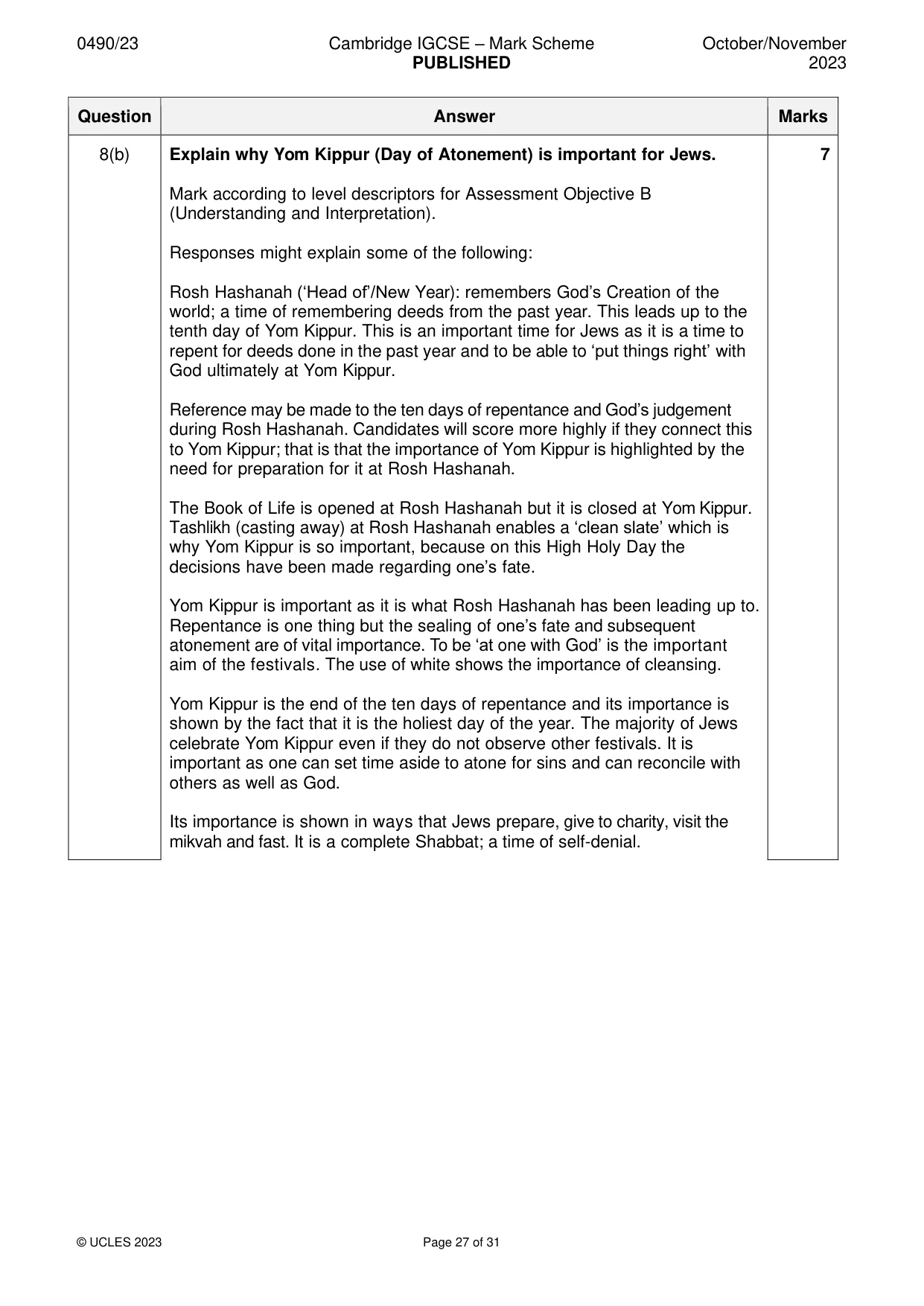
0490/23 Cambridge IGCSE – Mark Scheme PUBLISHED October/November 2023 © UCLES 2023 Page 27 of 31 Question Answer Marks 8(b) Explain why Yom Kippur (Day of Atonement) is important for Jews. Mark according to level descriptors for Assessment Objective B (Understanding and Interpretation). Responses might explain some of the following: Rosh Hashanah (‘Head of’/New Year): remembers God’s Creation of the world; a time of remembering deeds from the past year. This leads up to the tenth day of Yom Kippur. This is an important time for Jews as it is a time to repent for deeds done in the past year and to be able to ‘put things right’ with God ultimately at Yom Kippur. Reference may be made to the ten days of repentance and God’s judgement during Rosh Hashanah. Candidates will score more highly if they connect this to Yom Kippur; that is that the importance of Yom Kippur is highlighted by the need for preparation for it at Rosh Hashanah. The Book of Life is opened at Rosh Hashanah but it is closed at Yom Kippur. Tashlikh (casting away) at Rosh Hashanah enables a ‘clean slate’ which is why Yom Kippur is so important, because on this High Holy Day the decisions have been made regarding one’s fate. Yom Kippur is important as it is what Rosh Hashanah has been leading up to. Repentance is one thing but the sealing of one’s fate and subsequent atonement are of vital importance. To be ‘at one with God’ is the important aim of the festivals. The use of white shows the importance of cleansing. Yom Kippur is the end of the ten days of repentance and its importance is shown by the fact that it is the holiest day of the year. The majority of Jews celebrate Yom Kippur even if they do not observe other festivals. It is important as one can set time aside to atone for sins and can reconcile with others as well as God. Its importance is shown in ways that Jews prepare, give to charity, visit the mikvah and fast. It is a complete Shabbat; a time of self-denial. 7
Mark scheme, page 28
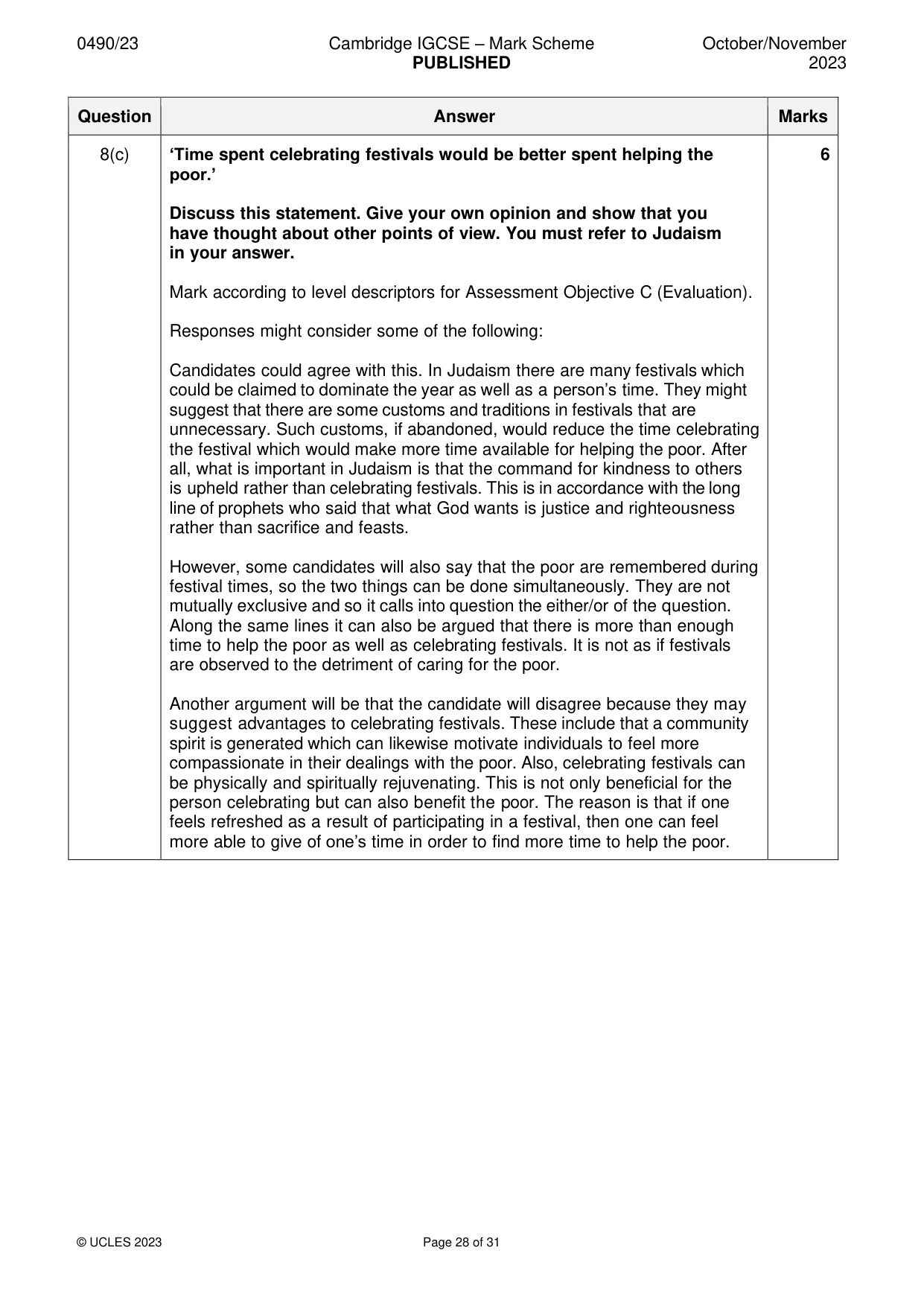
0490/23 Cambridge IGCSE – Mark Scheme PUBLISHED October/November 2023 © UCLES 2023 Page 28 of 31 Question Answer Marks 8(c) ‘Time spent celebrating festivals would be better spent helping the poor.’ Discuss this statement. Give your own opinion and show that you have thought about other points of view. You must refer to Judaism in your answer. Mark according to level descriptors for Assessment Objective C (Evaluation). Responses might consider some of the following: Candidates could agree with this. In Judaism there are many festivals which could be claimed to dominate the year as well as a person’s time. They might suggest that there are some customs and traditions in festivals that are unnecessary. Such customs, if abandoned, would reduce the time celebrating the festival which would make more time available for helping the poor. After all, what is important in Judaism is that the command for kindness to others is upheld rather than celebrating festivals. This is in accordance with the long line of prophets who said that what God wants is justice and righteousness rather than sacrifice and feasts. However, some candidates will also say that the poor are remembered during festival times, so the two things can be done simultaneously. They are not mutually exclusive and so it calls into question the either/or of the question. Along the same lines it can also be argued that there is more than enough time to help the poor as well as celebrating festivals. It is not as if festivals are observed to the detriment of caring for the poor. Another argument will be that the candidate will disagree because they may suggest advantages to celebrating festivals. These include that a community spirit is generated which can likewise motivate individuals to feel more compassionate in their dealings with the poor. Also, celebrating festivals can be physically and spiritually rejuvenating. This is not only beneficial for the person celebrating but can also benefit the poor. The reason is that if one feels refreshed as a result of participating in a festival, then one can feel more able to give of one’s time in order to find more time to help the poor. 6
Mark scheme, page 29
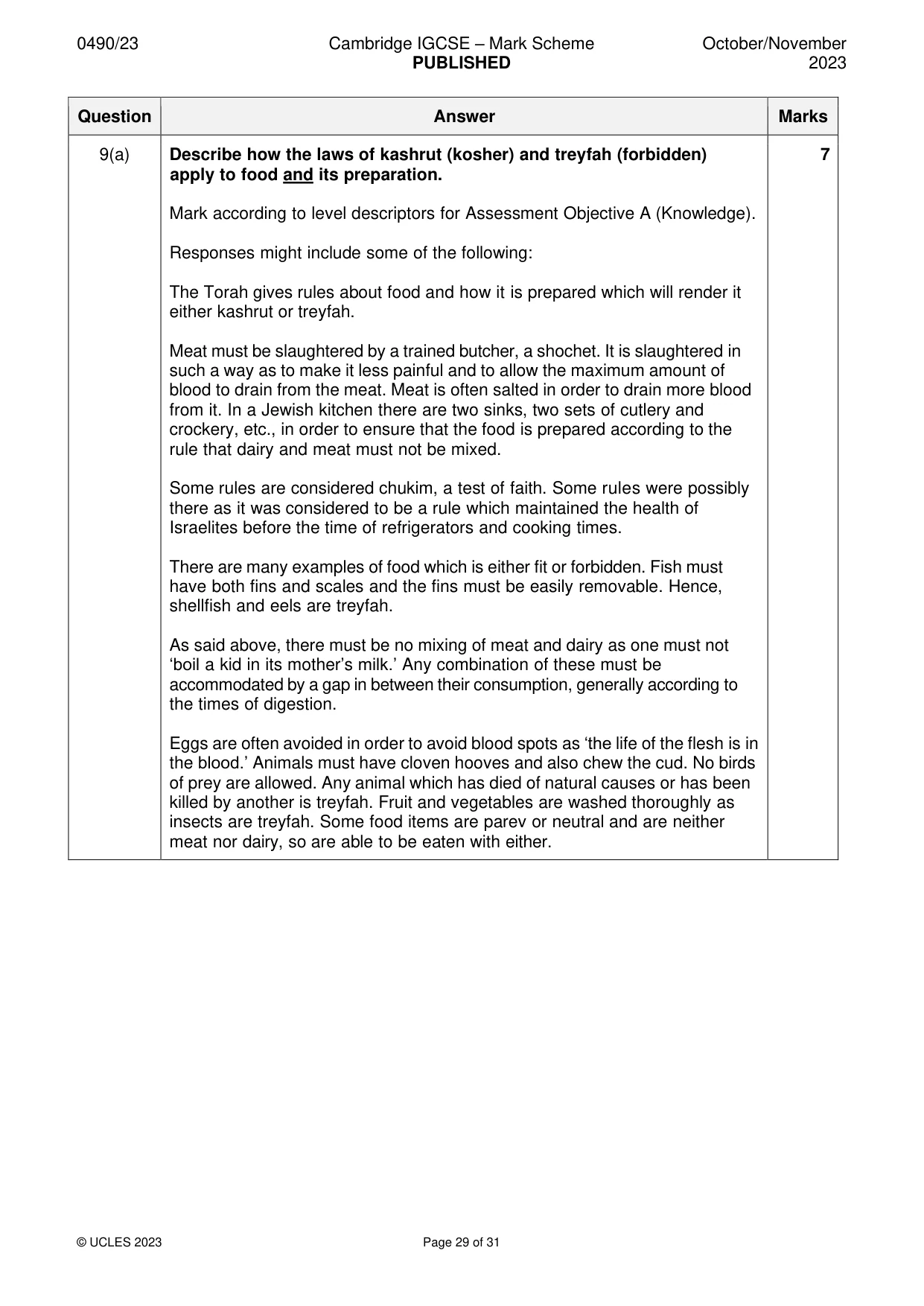
0490/23 Cambridge IGCSE – Mark Scheme PUBLISHED October/November 2023 © UCLES 2023 Page 29 of 31 Question Answer Marks 9(a) Describe how the laws of kashrut (kosher) and treyfah (forbidden) apply to food and its preparation. Mark according to level descriptors for Assessment Objective A (Knowledge). Responses might include some of the following: The Torah gives rules about food and how it is prepared which will render it either kashrut or treyfah. Meat must be slaughtered by a trained butcher, a shochet. It is slaughtered in such a way as to make it less painful and to allow the maximum amount of blood to drain from the meat. Meat is often salted in order to drain more blood from it. In a Jewish kitchen there are two sinks, two sets of cutlery and crockery, etc., in order to ensure that the food is prepared according to the rule that dairy and meat must not be mixed. Some rules are considered chukim, a test of faith. Some rules were possibly there as it was considered to be a rule which maintained the health of Israelites before the time of refrigerators and cooking times. There are many examples of food which is either fit or forbidden. Fish must have both fins and scales and the fins must be easily removable. Hence, shellfish and eels are treyfah. As said above, there must be no mixing of meat and dairy as one must not ‘boil a kid in its mother’s milk.’ Any combination of these must be accommodated by a gap in between their consumption, generally according to the times of digestion. Eggs are often avoided in order to avoid blood spots as ‘the life of the flesh is in the blood.’ Animals must have cloven hooves and also chew the cud. No birds of prey are allowed. Any animal which has died of natural causes or has been killed by another is treyfah. Fruit and vegetables are washed thoroughly as insects are treyfah. Some food items are parev or neutral and are neither meat nor dairy, so are able to be eaten with either. 7
Mark scheme, page 30
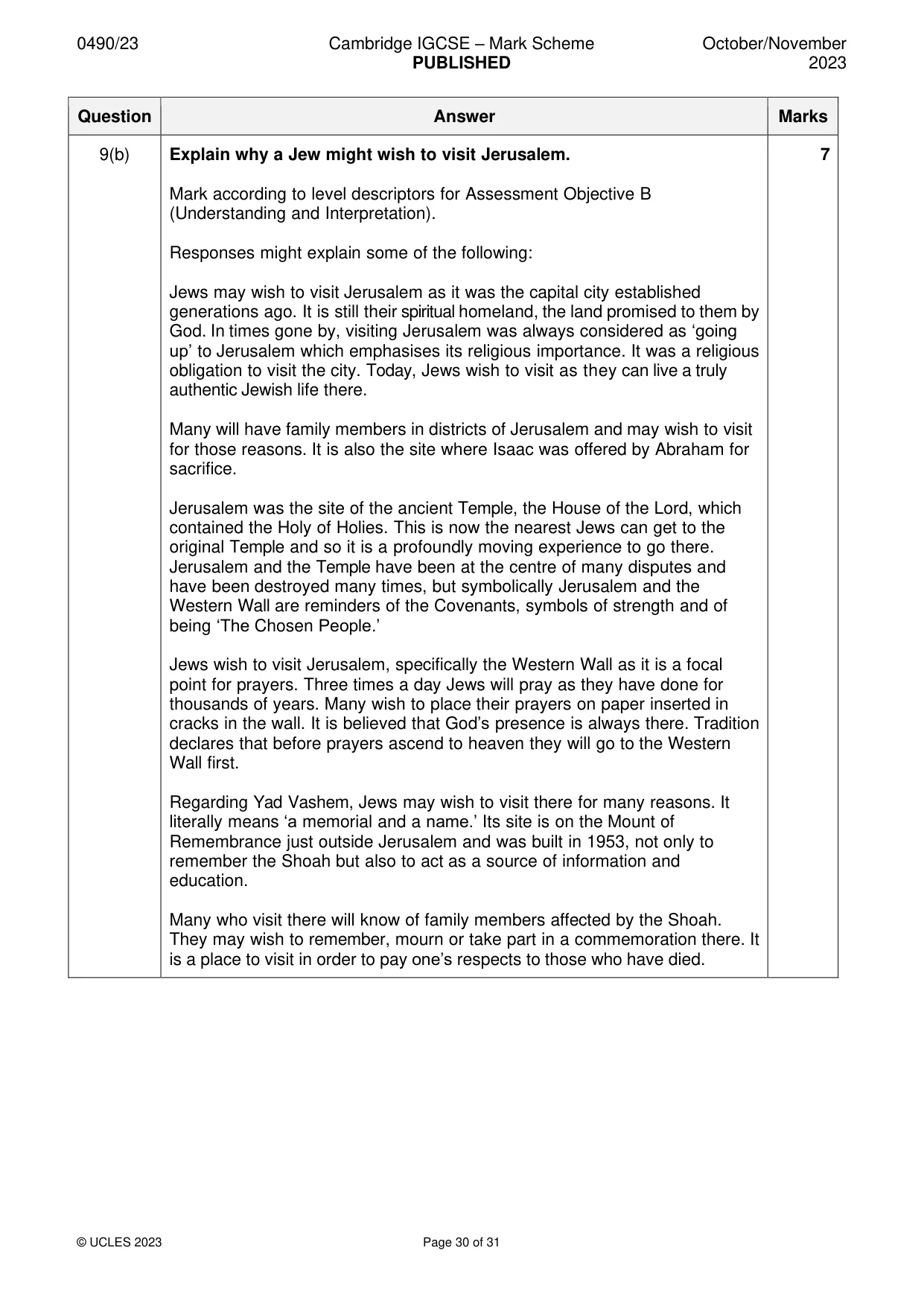
0490/23 Cambridge IGCSE – Mark Scheme PUBLISHED October/November 2023 © UCLES 2023 Page 30 of 31 Question Answer Marks 9(b) Explain why a Jew might wish to visit Jerusalem. Mark according to level descriptors for Assessment Objective B (Understanding and Interpretation). Responses might explain some of the following: Jews may wish to visit Jerusalem as it was the capital city established generations ago. It is still their spiritual homeland, the land promised to them by God. In times gone by, visiting Jerusalem was always considered as ‘going up’ to Jerusalem which emphasises its religious importance. It was a religious obligation to visit the city. Today, Jews wish to visit as they can live a truly authentic Jewish life there. Many will have family members in districts of Jerusalem and may wish to visit for those reasons. It is also the site where Isaac was offered by Abraham for sacrifice. Jerusalem was the site of the ancient Temple, the House of the Lord, which contained the Holy of Holies. This is now the nearest Jews can get to the original Temple and so it is a profoundly moving experience to go there. Jerusalem and the Temple have been at the centre of many disputes and have been destroyed many times, but symbolically Jerusalem and the Western Wall are reminders of the Covenants, symbols of strength and of being ‘The Chosen People.’ Jews wish to visit Jerusalem, specifically the Western Wall as it is a focal point for prayers. Three times a day Jews will pray as they have done for thousands of years. Many wish to place their prayers on paper inserted in cracks in the wall. It is believed that God’s presence is always there. Tradition declares that before prayers ascend to heaven they will go to the Western Wall first. Regarding Yad Vashem, Jews may wish to visit there for many reasons. It literally means ‘a memorial and a name.’ Its site is on the Mount of Remembrance just outside Jerusalem and was built in 1953, not only to remember the Shoah but also to act as a source of information and education. Many who visit there will know of family members affected by the Shoah. They may wish to remember, mourn or take part in a commemoration there. It is a place to visit in order to pay one’s respects to those who have died. 7
Mark scheme, page 31
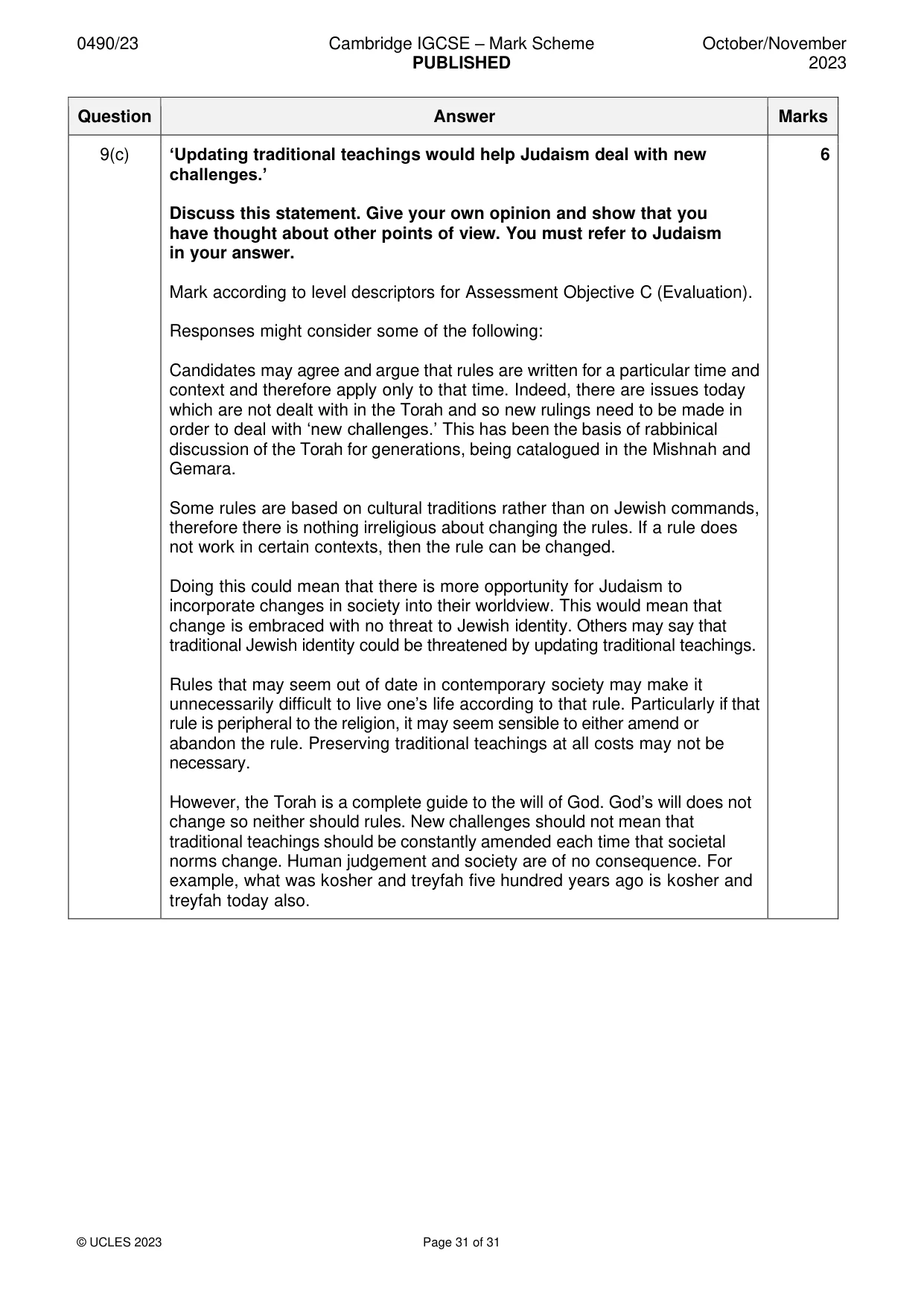
0490/23 Cambridge IGCSE – Mark Scheme PUBLISHED October/November 2023 © UCLES 2023 Page 31 of 31 Question Answer Marks 9(c) ‘Updating traditional teachings would help Judaism deal with new challenges.’ Discuss this statement. Give your own opinion and show that you have thought about other points of view. You must refer to Judaism in your answer. Mark according to level descriptors for Assessment Objective C (Evaluation). Responses might consider some of the following: Candidates may agree and argue that rules are written for a particular time and context and therefore apply only to that time. Indeed, there are issues today which are not dealt with in the Torah and so new rulings need to be made in order to deal with ‘new challenges.’ This has been the basis of rabbinical discussion of the Torah for generations, being catalogued in the Mishnah and Gemara. Some rules are based on cultural traditions rather than on Jewish commands, therefore there is nothing irreligious about changing the rules. If a rule does not work in certain contexts, then the rule can be changed. Doing this could mean that there is more opportunity for Judaism to incorporate changes in society into their worldview. This would mean that change is embraced with no threat to Jewish identity. Others may say that traditional Jewish identity could be threatened by updating traditional teachings. Rules that may seem out of date in contemporary society may make it unnecessarily difficult to live one’s life according to that rule. Particularly if that rule is peripheral to the religion, it may seem sensible to either amend or abandon the rule. Preserving traditional teachings at all costs may not be necessary. However, the Torah is a complete guide to the will of God. God’s will does not change so neither should rules. New challenges should not mean that traditional teachings should be constantly amended each time that societal norms change. Human judgement and society are of no consequence. For example, what was kosher and treyfah five hundred years ago is kosher and treyfah today also. 6
What you needed in this session
Cambridge’s own grade thresholds for 2023 Oct/Nov, Paper 2 · Variant 3. A higher threshold means an easier paper — the bar moves with how the cohort did.