Cambridge IGCSE Religious Studies 0490 — 2024 Oct/Nov Paper 2 · Variant 2
0490/22/O/N/24 · 80 marks · ≈90 min
The question paper and its mark scheme, free to read here and free to download. This is Cambridge’s own paper, exactly as it was sat.
Question paper4 pages
Mark scheme28 pages
Answers below. Sit the paper first if you are practising.
Paper as text
Question paper, page 1
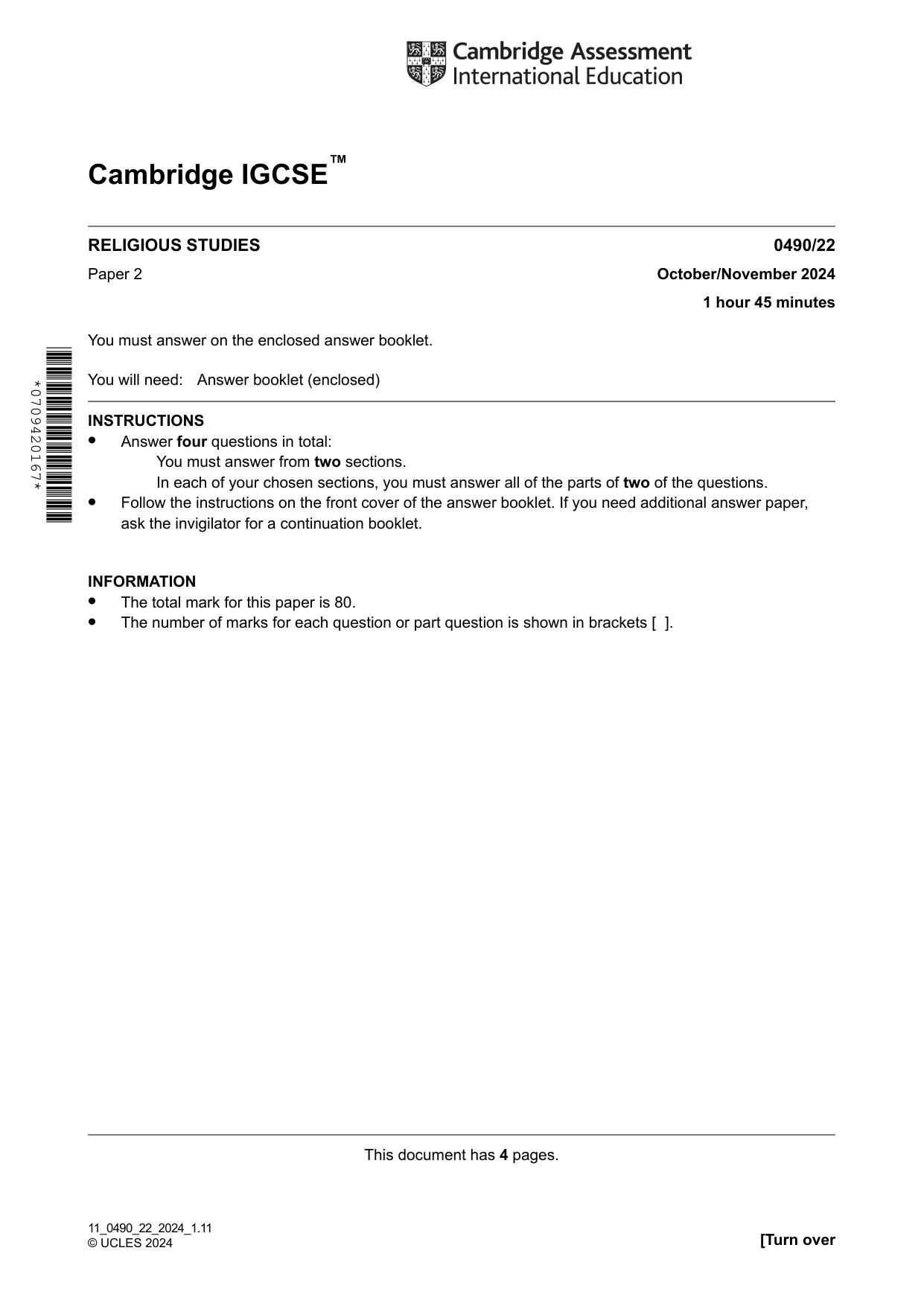
Cambridge IGCSE™ 0490/22 October/November 2024 1 hour 45 minutes RELIGIOUS STUDIES Paper 2 You must answer on the enclosed answer booklet. You will need: Answer booklet (enclosed) INSTRUCTIONS • Answer four questions in total: You must answer from two sections. In each of your chosen sections, you must answer all of the parts of two of the questions. • Follow the instructions on the front cover of the answer booklet. If you need additional answer paper, ask the invigilator for a continuation booklet. INFORMATION • The total mark for this paper is 80. • The number of marks for each question or part question is shown in brackets [ ]. This document has 4 pages. [Turn over 11_0490_22_2024_1.11 © UCLES 2024 *0709420167*
Question paper, page 2
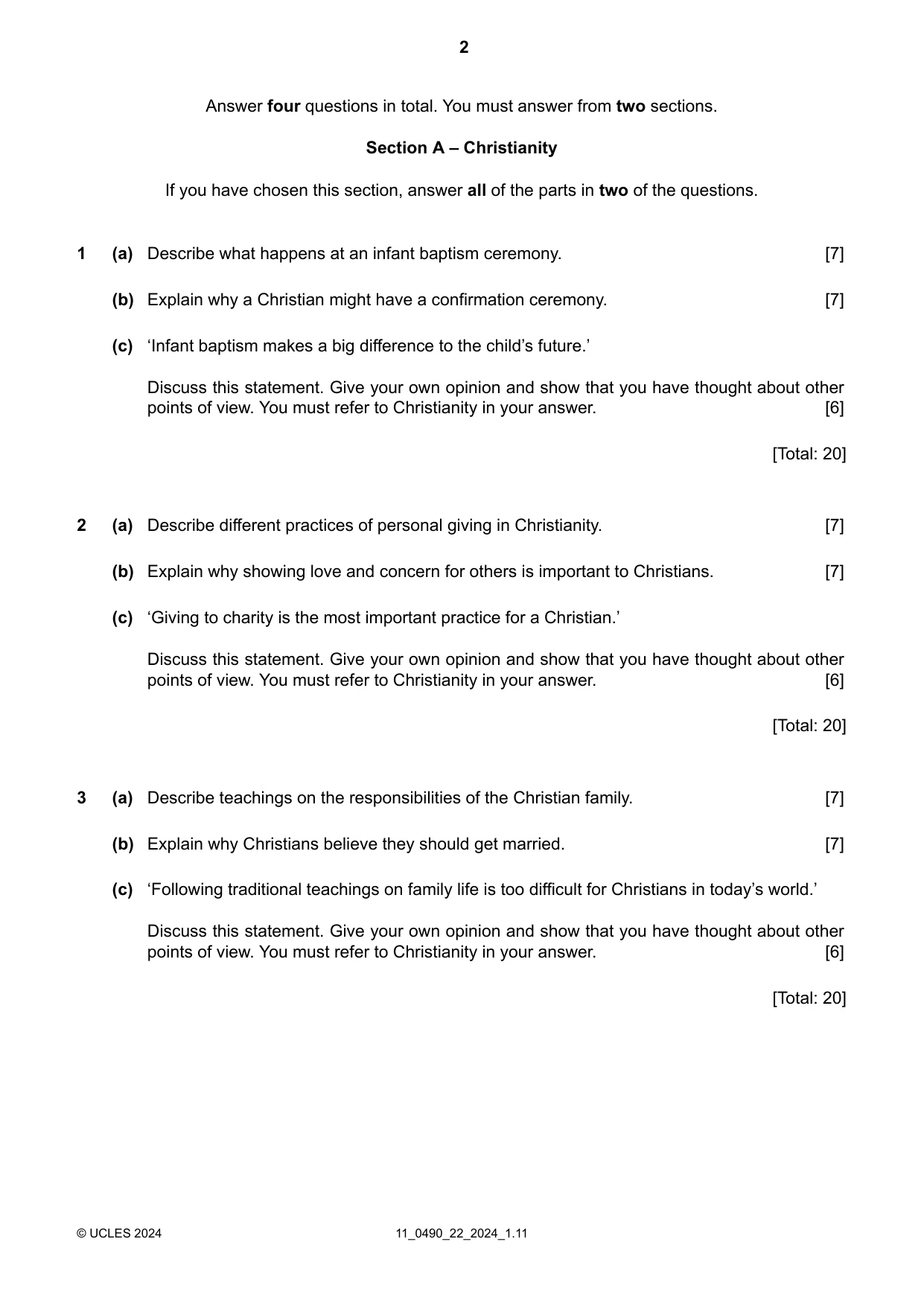
Answer four questions in total. You must answer from two sections. Section A – Christianity If you have chosen this section, answer all of the parts in two of the questions. Describe what happens at an infant baptism ceremony. [7] (a) 1 Explain why a Christian might have a confirmation ceremony. [7] (b) ‘Infant baptism makes a big difference to the child’s future.’ Discuss this statement. Give your own opinion and show that you have thought about other points of view. You must refer to Christianity in your answer. [6] (c) [Total: 20] Describe different practices of personal giving in Christianity. [7] (a) 2 Explain why showing love and concern for others is important to Christians. [7] (b) ‘Giving to charity is the most important practice for a Christian.’ Discuss this statement. Give your own opinion and show that you have thought about other points of view. You must refer to Christianity in your answer. [6] (c) [Total: 20] Describe teachings on the responsibilities of the Christian family. [7] (a) 3 Explain why Christians believe they should get married. [7] (b) ‘Following traditional teachings on family life is too difficult for Christians in today’s world.’ Discuss this statement. Give your own opinion and show that you have thought about other points of view. You must refer to Christianity in your answer. [6] (c) [Total: 20] 11_0490_22_2024_1.11 © UCLES 2024 2
Question paper, page 3
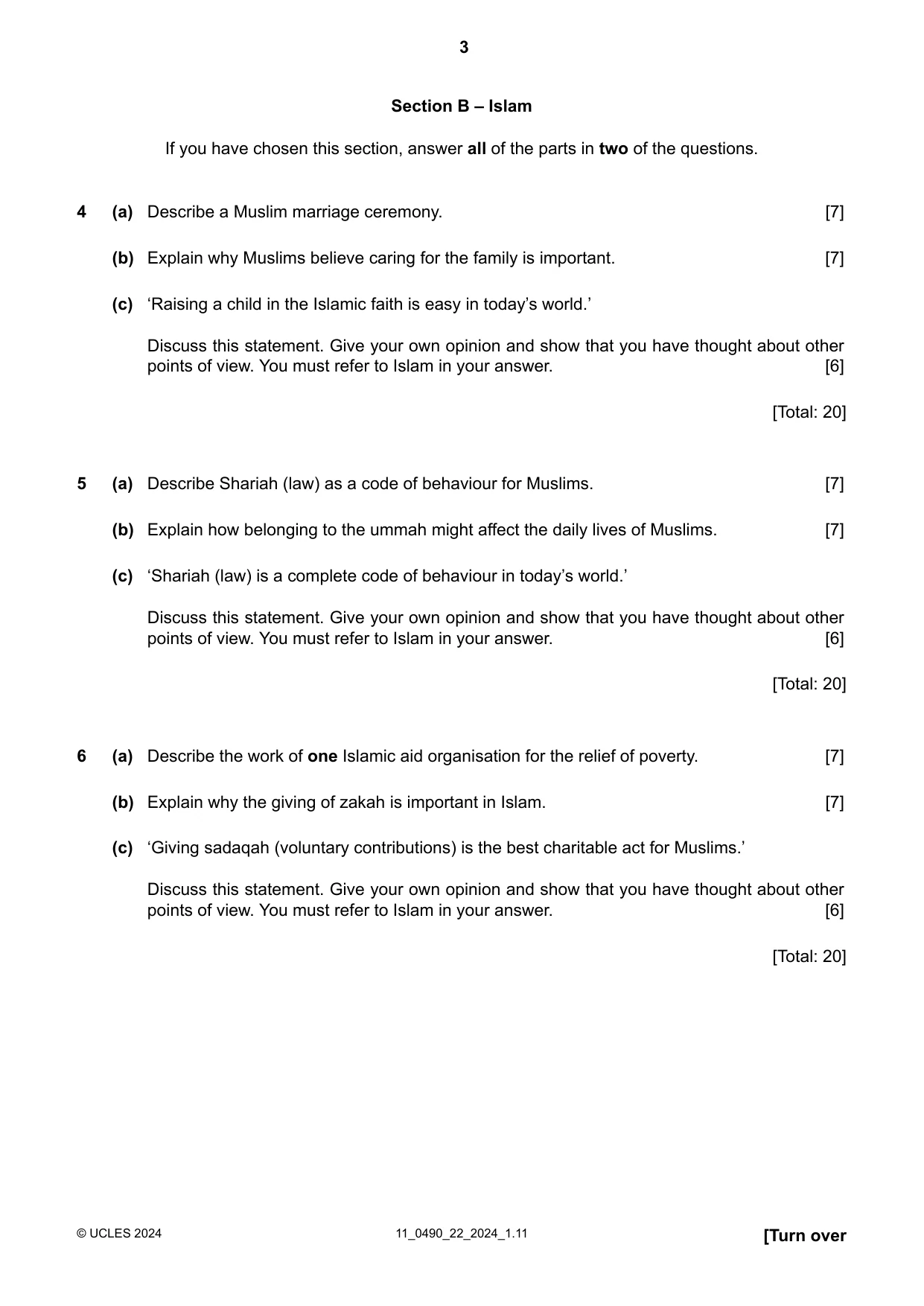
Section B – Islam If you have chosen this section, answer all of the parts in two of the questions. Describe a Muslim marriage ceremony. [7] (a) 4 Explain why Muslims believe caring for the family is important. [7] (b) ‘Raising a child in the Islamic faith is easy in today’s world.’ Discuss this statement. Give your own opinion and show that you have thought about other points of view. You must refer to Islam in your answer. [6] (c) [Total: 20] Describe Shariah (law) as a code of behaviour for Muslims. [7] (a) 5 Explain how belonging to the ummah might affect the daily lives of Muslims. [7] (b) ‘Shariah (law) is a complete code of behaviour in today’s world.’ Discuss this statement. Give your own opinion and show that you have thought about other points of view. You must refer to Islam in your answer. [6] (c) [Total: 20] Describe the work of one Islamic aid organisation for the relief of poverty. [7] (a) 6 Explain why the giving of zakah is important in Islam. [7] (b) ‘Giving sadaqah (voluntary contributions) is the best charitable act for Muslims.’ Discuss this statement. Give your own opinion and show that you have thought about other points of view. You must refer to Islam in your answer. [6] (c) [Total: 20] [Turn over 11_0490_22_2024_1.11 © UCLES 2024 3
Question paper, page 4
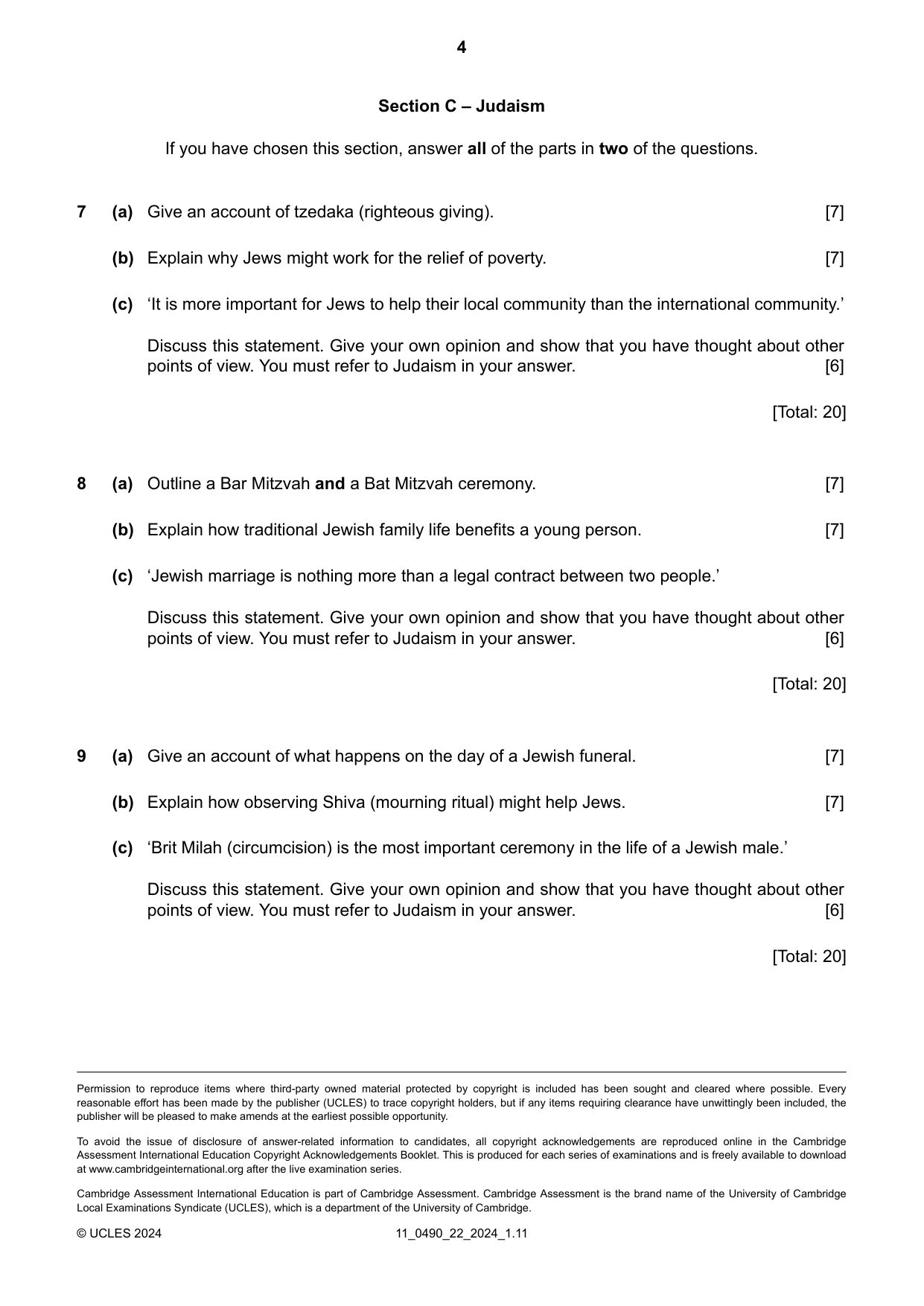
Section C – Judaism If you have chosen this section, answer all of the parts in two of the questions. Give an account of tzedaka (righteous giving). [7] (a) 7 Explain why Jews might work for the relief of poverty. [7] (b) ‘It is more important for Jews to help their local community than the international community.’ Discuss this statement. Give your own opinion and show that you have thought about other points of view. You must refer to Judaism in your answer. [6] (c) [Total: 20] Outline a Bar Mitzvah and a Bat Mitzvah ceremony. [7] (a) 8 Explain how traditional Jewish family life benefits a young person. [7] (b) ‘Jewish marriage is nothing more than a legal contract between two people.’ Discuss this statement. Give your own opinion and show that you have thought about other points of view. You must refer to Judaism in your answer. [6] (c) [Total: 20] Give an account of what happens on the day of a Jewish funeral. [7] (a) 9 Explain how observing Shiva (mourning ritual) might help Jews. [7] (b) ‘Brit Milah (circumcision) is the most important ceremony in the life of a Jewish male.’ Discuss this statement. Give your own opinion and show that you have thought about other points of view. You must refer to Judaism in your answer. [6] (c) [Total: 20] Permission to reproduce items where third-party owned material protected by copyright is included has been sought and cleared where possible. Every reasonable effort has been made by the publisher (UCLES) to trace copyright holders, but if any items requiring clearance have unwittingly been included, the publisher will be pleased to make amends at the earliest possible opportunity. To avoid the issue of disclosure of answer-related information to candidates, all copyright acknowledgements are reproduced online in the Cambridge Assessment International Education Copyright Acknowledgements Booklet. This is produced for each series of examinations and is freely available to download at www.cambridgeinternational.org after the live examination series. Cambridge Assessment International Education is part of Cambridge Assessment. Cambridge Assessment is the brand name of the University of Cambridge Local Examinations Syndicate (UCLES), which is a department of the University of Cambridge. 11_0490_22_2024_1.11 © UCLES 2024 4
Mark scheme, page 1
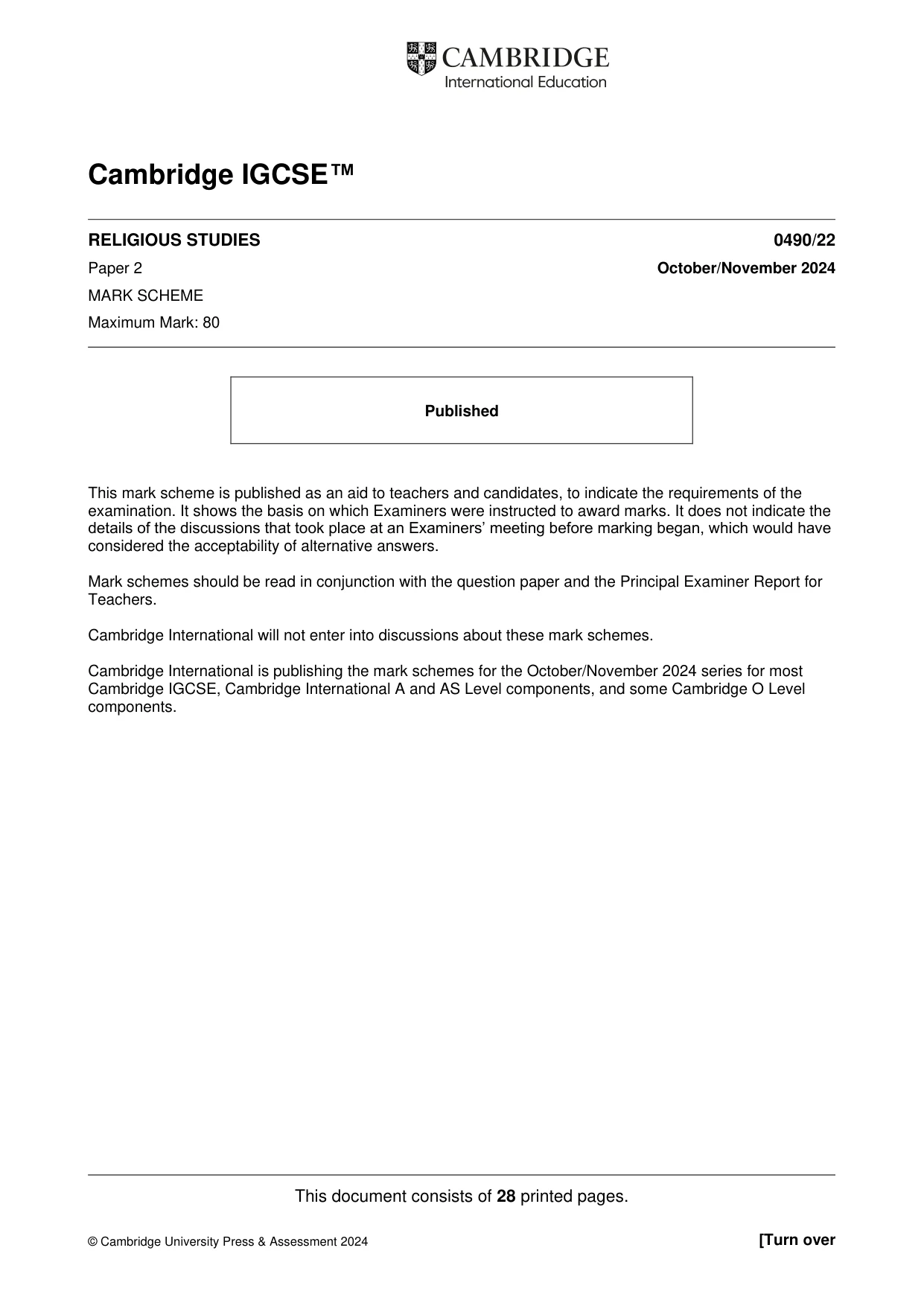
This document consists of 28 printed pages. © Cambridge University Press & Assessment 2024 [Turn over Cambridge IGCSE™ RELIGIOUS STUDIES 0490/22 Paper 2 October/November 2024 MARK SCHEME Maximum Mark: 80 Published This mark scheme is published as an aid to teachers and candidates, to indicate the requirements of the examination. It shows the basis on which Examiners were instructed to award marks. It does not indicate the details of the discussions that took place at an Examiners’ meeting before marking began, which would have considered the acceptability of alternative answers. Mark schemes should be read in conjunction with the question paper and the Principal Examiner Report for Teachers. Cambridge International will not enter into discussions about these mark schemes. Cambridge International is publishing the mark schemes for the October/November 2024 series for most Cambridge IGCSE, Cambridge International A and AS Level components, and some Cambridge O Level components.
Mark scheme, page 2
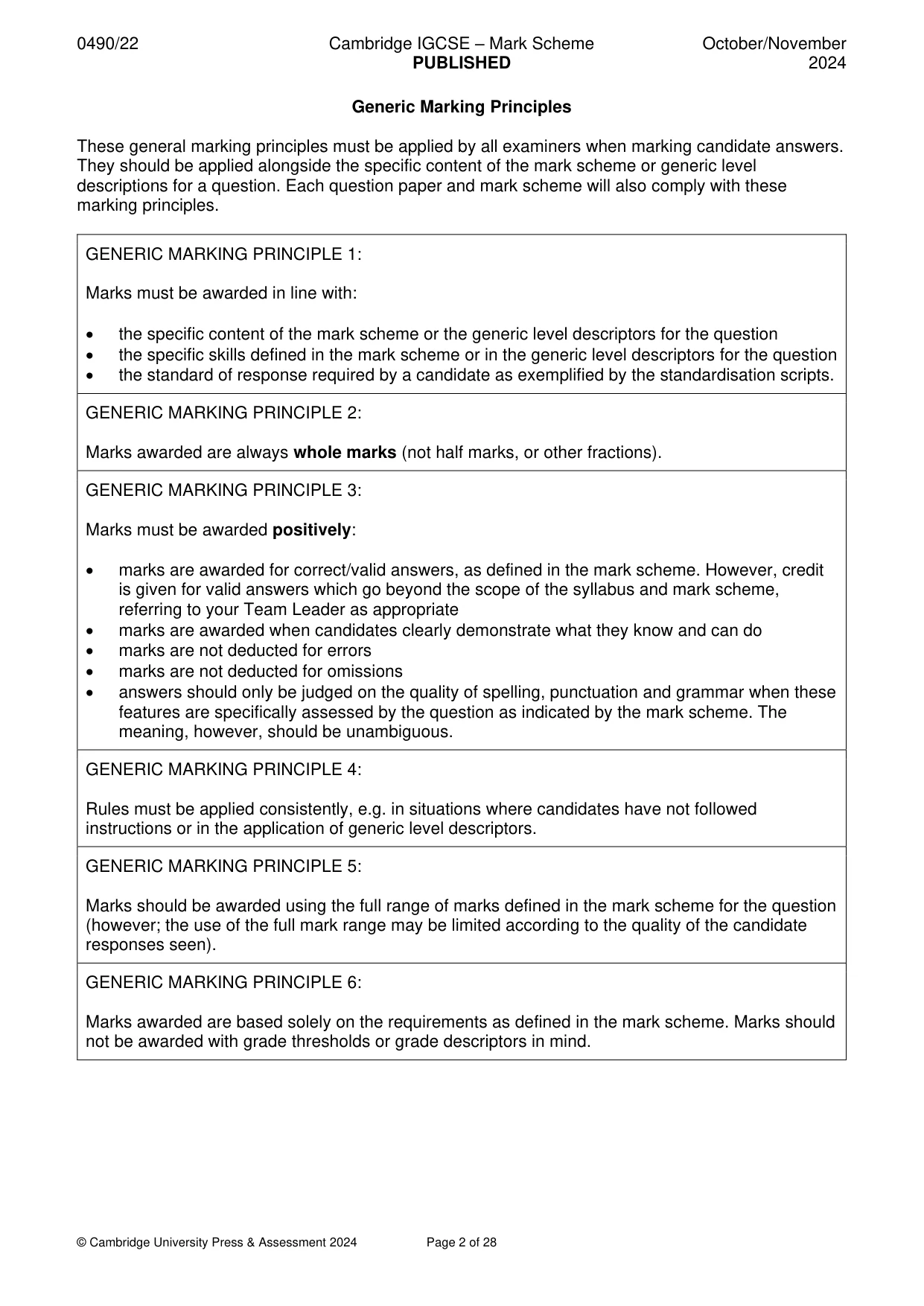
0490/22 Cambridge IGCSE – Mark Scheme PUBLISHED October/November 2024 © Cambridge University Press & Assessment 2024 Page 2 of 28 Generic Marking Principles These general marking principles must be applied by all examiners when marking candidate answers. They should be applied alongside the specific content of the mark scheme or generic level descriptions for a question. Each question paper and mark scheme will also comply with these marking principles. GENERIC MARKING PRINCIPLE 1: Marks must be awarded in line with: • the specific content of the mark scheme or the generic level descriptors for the question • the specific skills defined in the mark scheme or in the generic level descriptors for the question • the standard of response required by a candidate as exemplified by the standardisation scripts. GENERIC MARKING PRINCIPLE 2: Marks awarded are always whole marks (not half marks, or other fractions). GENERIC MARKING PRINCIPLE 3: Marks must be awarded positively: • marks are awarded for correct/valid answers, as defined in the mark scheme. However, credit is given for valid answers which go beyond the scope of the syllabus and mark scheme, referring to your Team Leader as appropriate • marks are awarded when candidates clearly demonstrate what they know and can do • marks are not deducted for errors • marks are not deducted for omissions • answers should only be judged on the quality of spelling, punctuation and grammar when these features are specifically assessed by the question as indicated by the mark scheme. The meaning, however, should be unambiguous. GENERIC MARKING PRINCIPLE 4: Rules must be applied consistently, e.g. in situations where candidates have not followed instructions or in the application of generic level descriptors. GENERIC MARKING PRINCIPLE 5: Marks should be awarded using the full range of marks defined in the mark scheme for the question (however; the use of the full mark range may be limited according to the quality of the candidate responses seen). GENERIC MARKING PRINCIPLE 6: Marks awarded are based solely on the requirements as defined in the mark scheme. Marks should not be awarded with grade thresholds or grade descriptors in mind.
Mark scheme, page 3
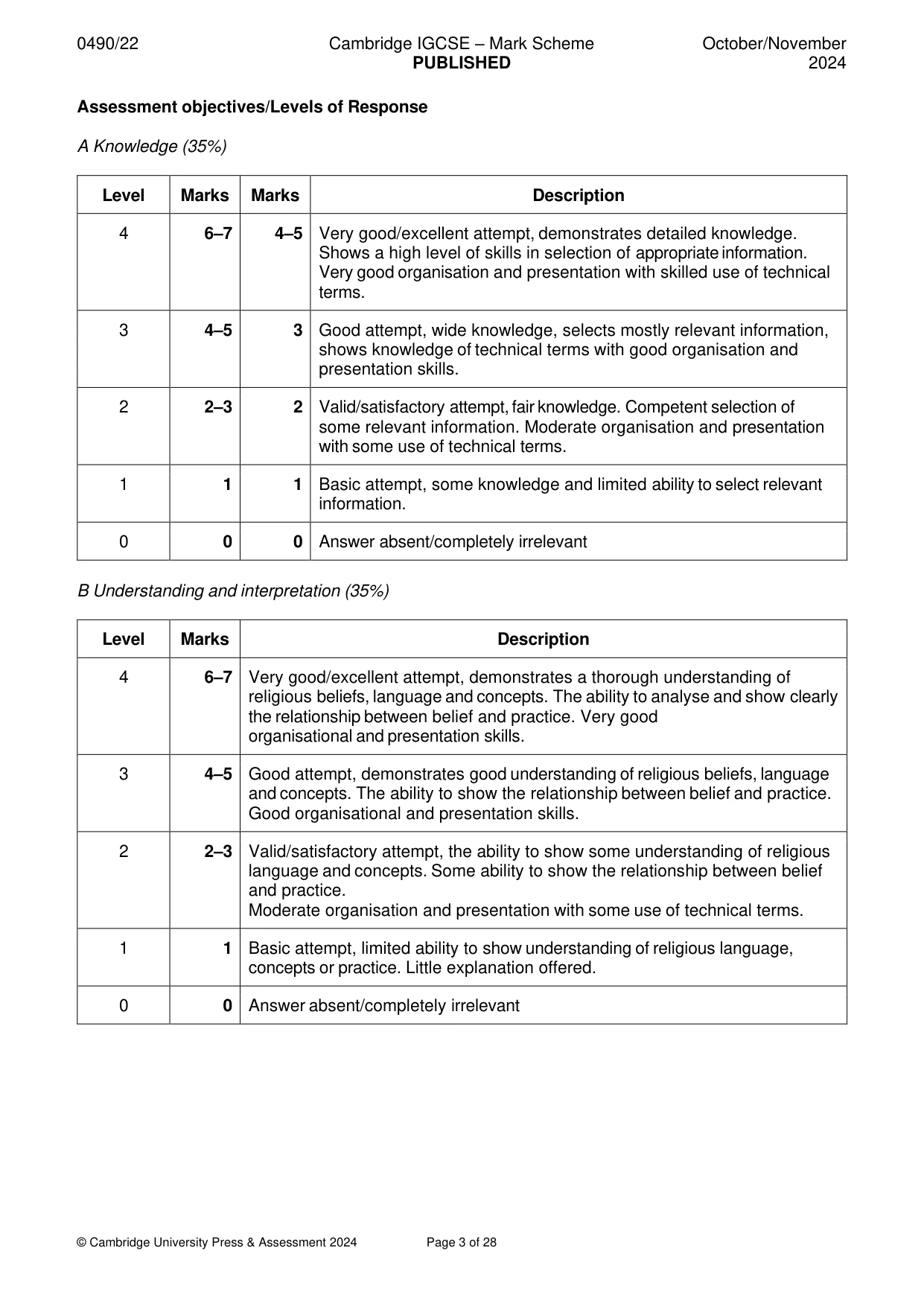
0490/22 Cambridge IGCSE – Mark Scheme PUBLISHED October/November 2024 © Cambridge University Press & Assessment 2024 Page 3 of 28 Assessment objectives/Levels of Response A Knowledge (35%) Level Marks Marks Description 4 6–7 4–5 Very good/excellent attempt, demonstrates detailed knowledge. Shows a high level of skills in selection of appropriate information. Very good organisation and presentation with skilled use of technical terms. 3 4–5 3 Good attempt, wide knowledge, selects mostly relevant information, shows knowledge of technical terms with good organisation and presentation skills. 2 2–3 2 Valid/satisfactory attempt, fair knowledge. Competent selection of some relevant information. Moderate organisation and presentation with some use of technical terms. 1 1 1 Basic attempt, some knowledge and limited ability to select relevant information. 0 0 0 Answer absent/completely irrelevant B Understanding and interpretation (35%) Level Marks Description 4 6–7 Very good/excellent attempt, demonstrates a thorough understanding of religious beliefs, language and concepts. The ability to analyse and show clearly the relationship between belief and practice. Very good organisational and presentation skills. 3 4–5 Good attempt, demonstrates good understanding of religious beliefs, language and concepts. The ability to show the relationship between belief and practice. Good organisational and presentation skills. 2 2–3 Valid/satisfactory attempt, the ability to show some understanding of religious language and concepts. Some ability to show the relationship between belief and practice. Moderate organisation and presentation with some use of technical terms. 1 1 Basic attempt, limited ability to show understanding of religious language, concepts or practice. Little explanation offered. 0 0 Answer absent/completely irrelevant
Mark scheme, page 4
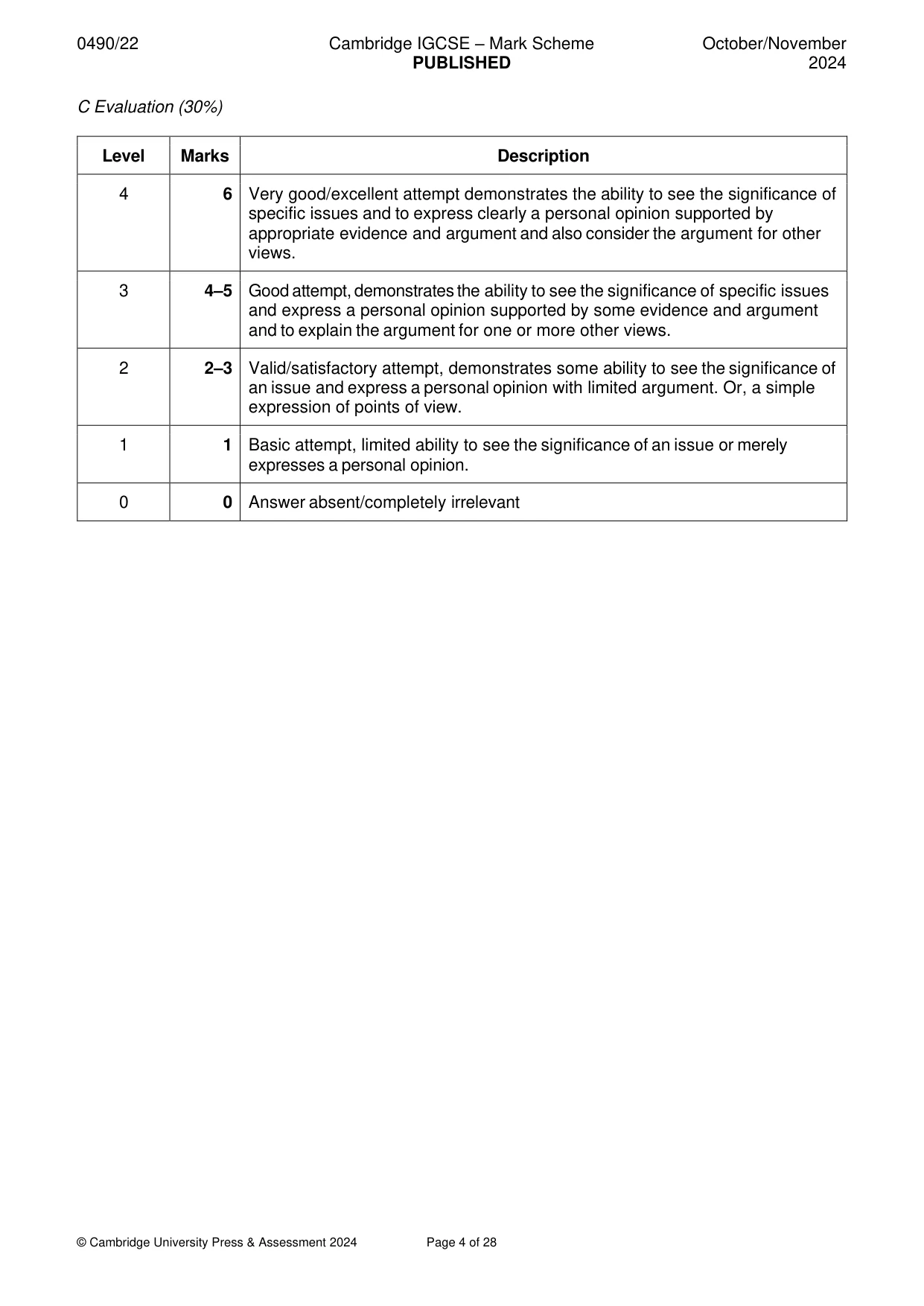
0490/22 Cambridge IGCSE – Mark Scheme PUBLISHED October/November 2024 © Cambridge University Press & Assessment 2024 Page 4 of 28 C Evaluation (30%) Level Marks Description 4 6 Very good/excellent attempt demonstrates the ability to see the significance of specific issues and to express clearly a personal opinion supported by appropriate evidence and argument and also consider the argument for other views. 3 4–5 Good attempt, demonstrates the ability to see the significance of specific issues and express a personal opinion supported by some evidence and argument and to explain the argument for one or more other views. 2 2–3 Valid/satisfactory attempt, demonstrates some ability to see the significance of an issue and express a personal opinion with limited argument. Or, a simple expression of points of view. 1 1 Basic attempt, limited ability to see the significance of an issue or merely expresses a personal opinion. 0 0 Answer absent/completely irrelevant
Mark scheme, page 5
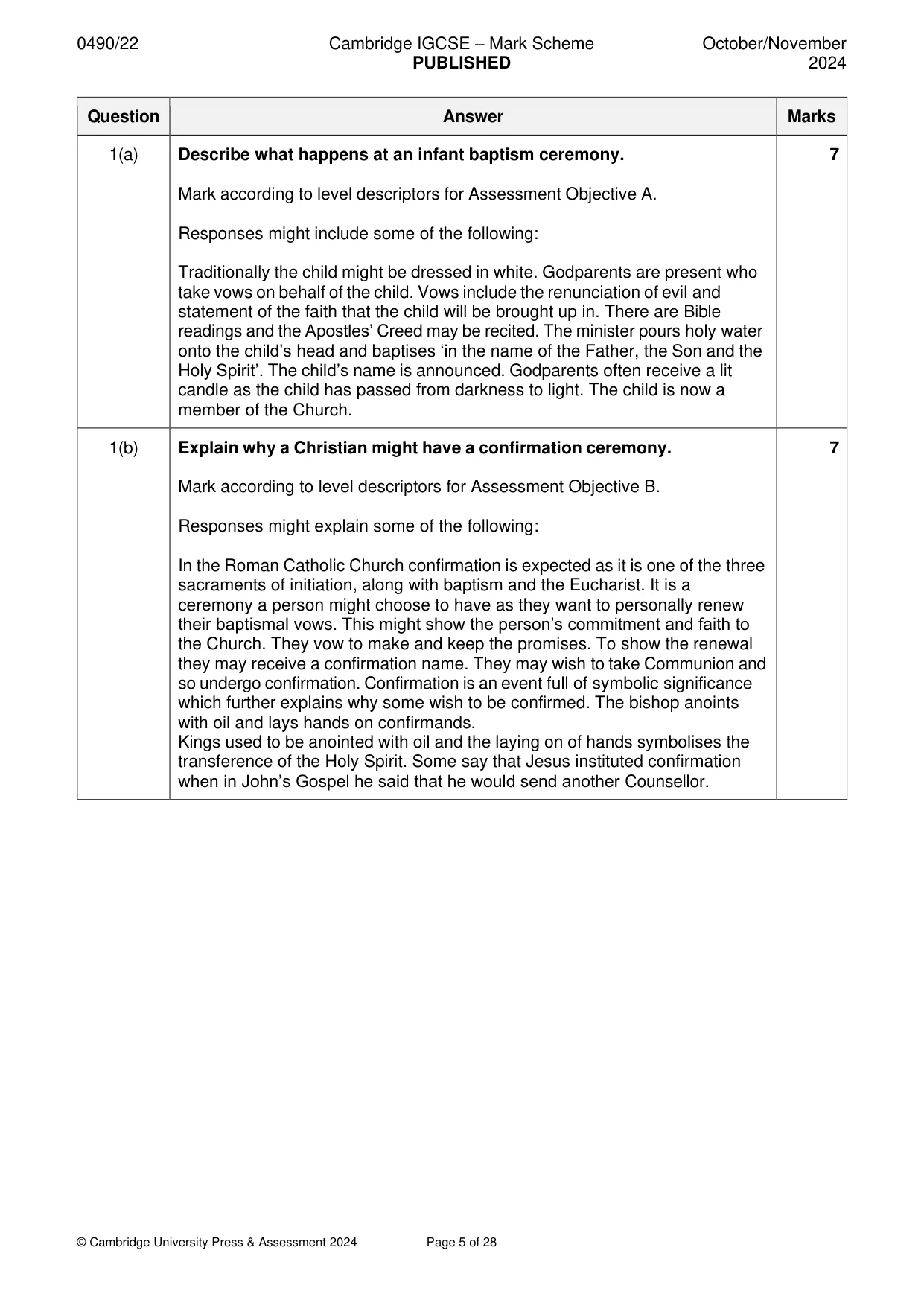
0490/22 Cambridge IGCSE – Mark Scheme PUBLISHED October/November 2024 © Cambridge University Press & Assessment 2024 Page 5 of 28 Question Answer Marks 1(a) Describe what happens at an infant baptism ceremony. Mark according to level descriptors for Assessment Objective A. Responses might include some of the following: Traditionally the child might be dressed in white. Godparents are present who take vows on behalf of the child. Vows include the renunciation of evil and statement of the faith that the child will be brought up in. There are Bible readings and the Apostles’ Creed may be recited. The minister pours holy water onto the child’s head and baptises ‘in the name of the Father, the Son and the Holy Spirit’. The child’s name is announced. Godparents often receive a lit candle as the child has passed from darkness to light. The child is now a member of the Church. 7 1(b) Explain why a Christian might have a confirmation ceremony. Mark according to level descriptors for Assessment Objective B. Responses might explain some of the following: In the Roman Catholic Church confirmation is expected as it is one of the three sacraments of initiation, along with baptism and the Eucharist. It is a ceremony a person might choose to have as they want to personally renew their baptismal vows. This might show the person’s commitment and faith to the Church. They vow to make and keep the promises. To show the renewal they may receive a confirmation name. They may wish to take Communion and so undergo confirmation. Confirmation is an event full of symbolic significance which further explains why some wish to be confirmed. The bishop anoints with oil and lays hands on confirmands. Kings used to be anointed with oil and the laying on of hands symbolises the transference of the Holy Spirit. Some say that Jesus instituted confirmation when in John’s Gospel he said that he would send another Counsellor. 7
Mark scheme, page 6
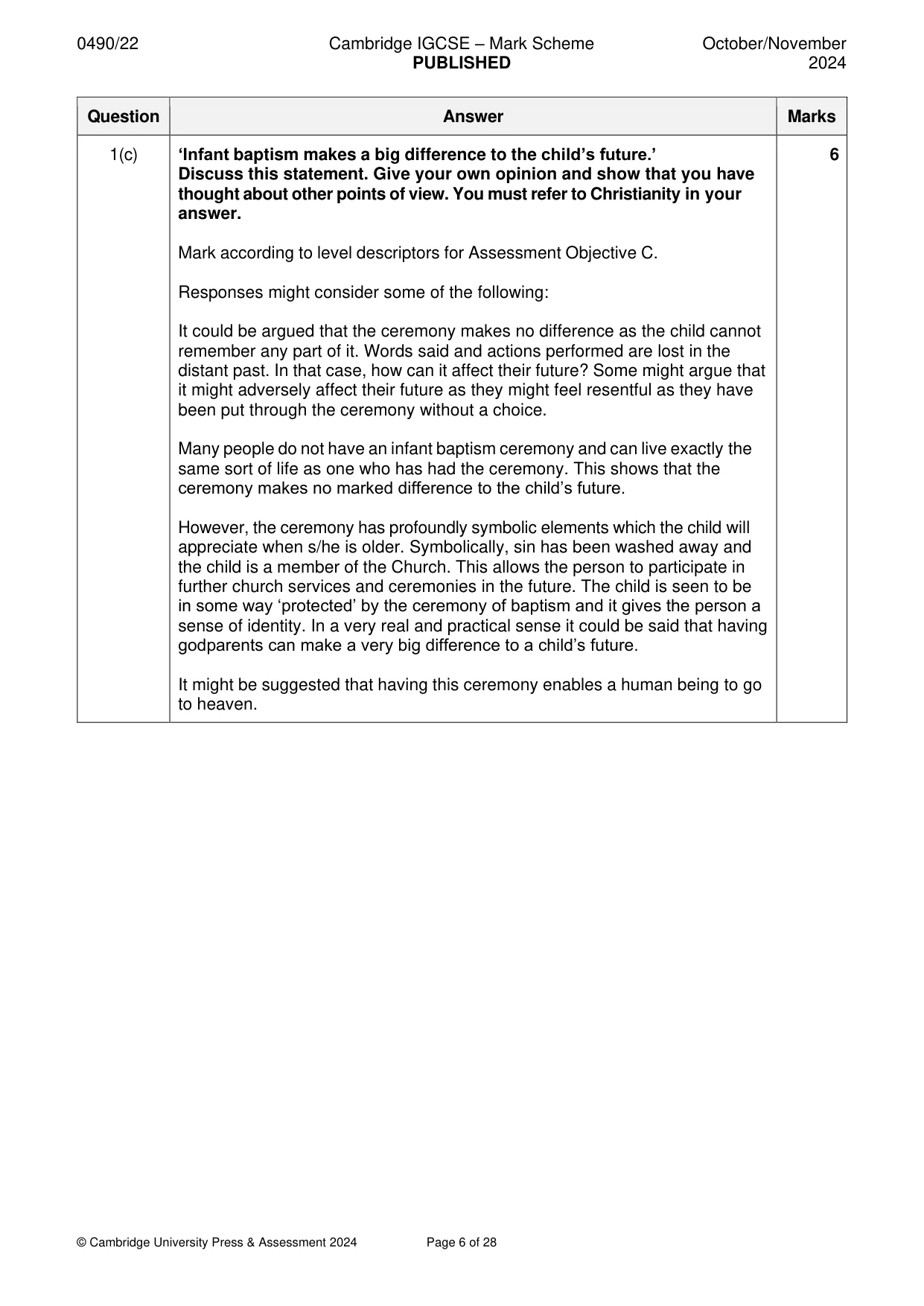
0490/22 Cambridge IGCSE – Mark Scheme PUBLISHED October/November 2024 © Cambridge University Press & Assessment 2024 Page 6 of 28 Question Answer Marks 1(c) ‘Infant baptism makes a big difference to the child’s future.’ Discuss this statement. Give your own opinion and show that you have thought about other points of view. You must refer to Christianity in your answer. Mark according to level descriptors for Assessment Objective C. Responses might consider some of the following: It could be argued that the ceremony makes no difference as the child cannot remember any part of it. Words said and actions performed are lost in the distant past. In that case, how can it affect their future? Some might argue that it might adversely affect their future as they might feel resentful as they have been put through the ceremony without a choice. Many people do not have an infant baptism ceremony and can live exactly the same sort of life as one who has had the ceremony. This shows that the ceremony makes no marked difference to the child’s future. However, the ceremony has profoundly symbolic elements which the child will appreciate when s/he is older. Symbolically, sin has been washed away and the child is a member of the Church. This allows the person to participate in further church services and ceremonies in the future. The child is seen to be in some way ‘protected’ by the ceremony of baptism and it gives the person a sense of identity. In a very real and practical sense it could be said that having godparents can make a very big difference to a child’s future. It might be suggested that having this ceremony enables a human being to go to heaven. 6
Mark scheme, page 7
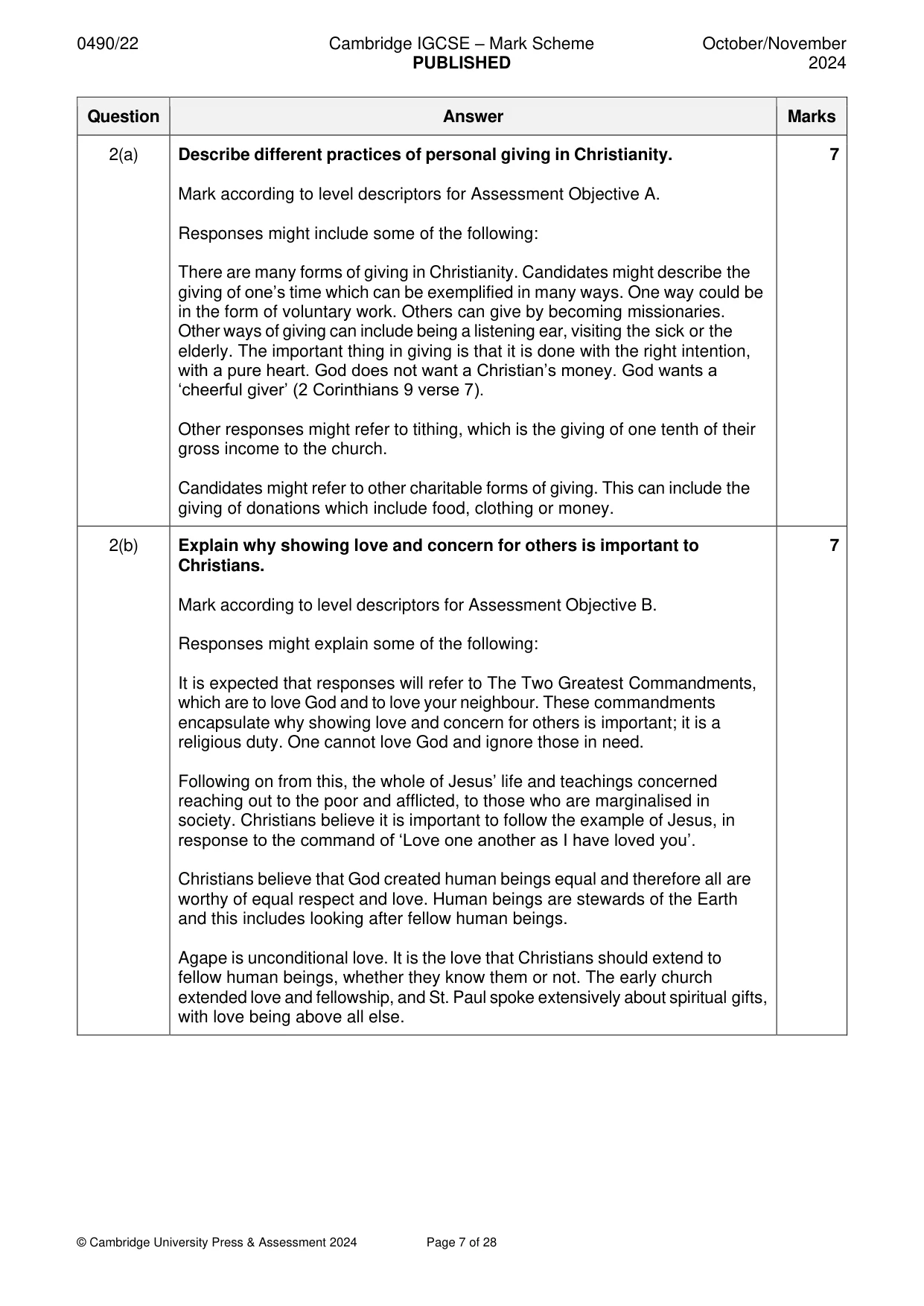
0490/22 Cambridge IGCSE – Mark Scheme PUBLISHED October/November 2024 © Cambridge University Press & Assessment 2024 Page 7 of 28 Question Answer Marks 2(a) Describe different practices of personal giving in Christianity. Mark according to level descriptors for Assessment Objective A. Responses might include some of the following: There are many forms of giving in Christianity. Candidates might describe the giving of one’s time which can be exemplified in many ways. One way could be in the form of voluntary work. Others can give by becoming missionaries. Other ways of giving can include being a listening ear, visiting the sick or the elderly. The important thing in giving is that it is done with the right intention, with a pure heart. God does not want a Christian’s money. God wants a ‘cheerful giver’ (2 Corinthians 9 verse 7). Other responses might refer to tithing, which is the giving of one tenth of their gross income to the church. Candidates might refer to other charitable forms of giving. This can include the giving of donations which include food, clothing or money. 7 2(b) Explain why showing love and concern for others is important to Christians. Mark according to level descriptors for Assessment Objective B. Responses might explain some of the following: It is expected that responses will refer to The Two Greatest Commandments, which are to love God and to love your neighbour. These commandments encapsulate why showing love and concern for others is important; it is a religious duty. One cannot love God and ignore those in need. Following on from this, the whole of Jesus’ life and teachings concerned reaching out to the poor and afflicted, to those who are marginalised in society. Christians believe it is important to follow the example of Jesus, in response to the command of ‘Love one another as I have loved you’. Christians believe that God created human beings equal and therefore all are worthy of equal respect and love. Human beings are stewards of the Earth and this includes looking after fellow human beings. Agape is unconditional love. It is the love that Christians should extend to fellow human beings, whether they know them or not. The early church extended love and fellowship, and St. Paul spoke extensively about spiritual gifts, with love being above all else. 7
Mark scheme, page 8
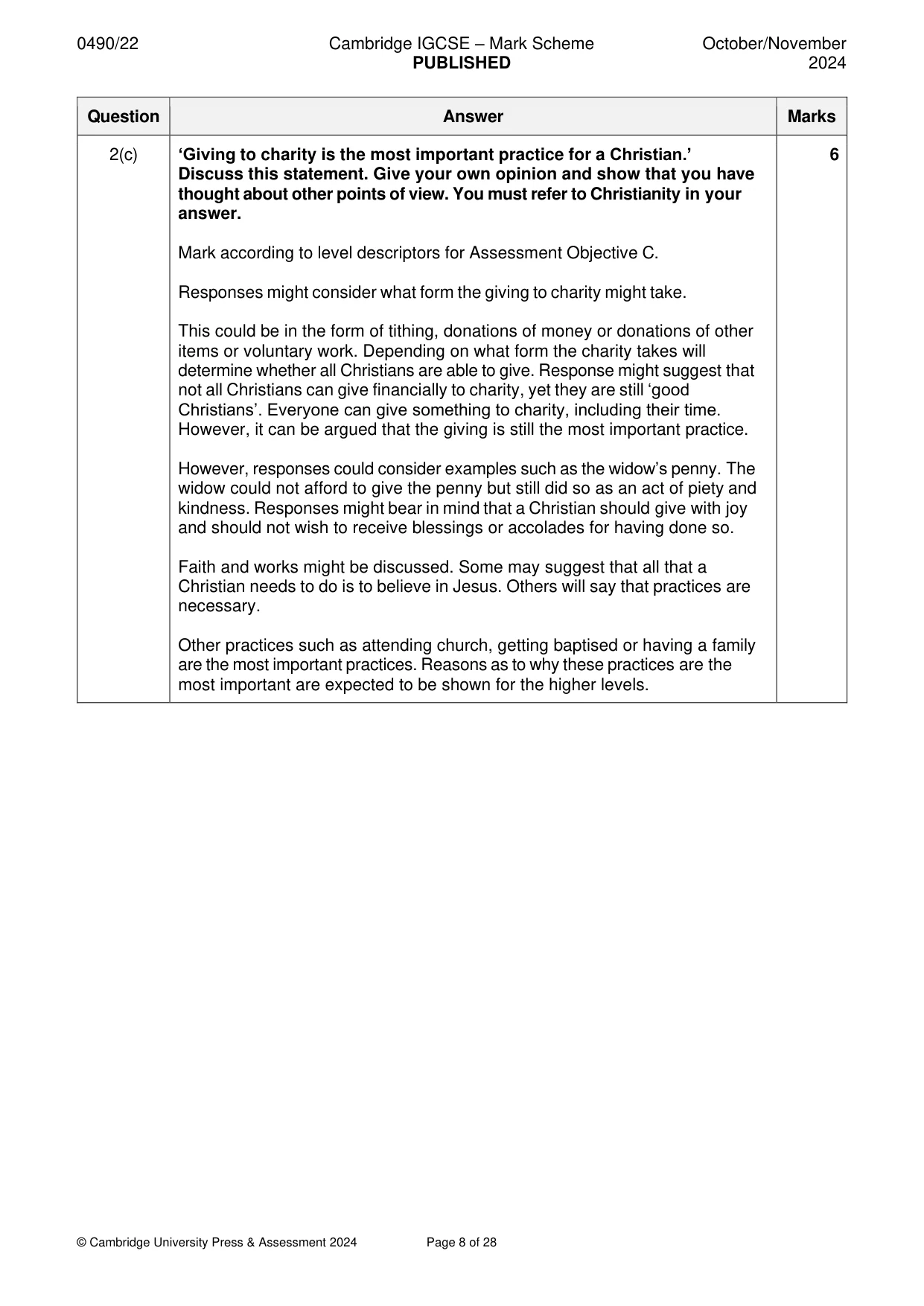
0490/22 Cambridge IGCSE – Mark Scheme PUBLISHED October/November 2024 © Cambridge University Press & Assessment 2024 Page 8 of 28 Question Answer Marks 2(c) ‘Giving to charity is the most important practice for a Christian.’ Discuss this statement. Give your own opinion and show that you have thought about other points of view. You must refer to Christianity in your answer. Mark according to level descriptors for Assessment Objective C. Responses might consider what form the giving to charity might take. This could be in the form of tithing, donations of money or donations of other items or voluntary work. Depending on what form the charity takes will determine whether all Christians are able to give. Response might suggest that not all Christians can give financially to charity, yet they are still ‘good Christians’. Everyone can give something to charity, including their time. However, it can be argued that the giving is still the most important practice. However, responses could consider examples such as the widow’s penny. The widow could not afford to give the penny but still did so as an act of piety and kindness. Responses might bear in mind that a Christian should give with joy and should not wish to receive blessings or accolades for having done so. Faith and works might be discussed. Some may suggest that all that a Christian needs to do is to believe in Jesus. Others will say that practices are necessary. Other practices such as attending church, getting baptised or having a family are the most important practices. Reasons as to why these practices are the most important are expected to be shown for the higher levels. 6
Mark scheme, page 9
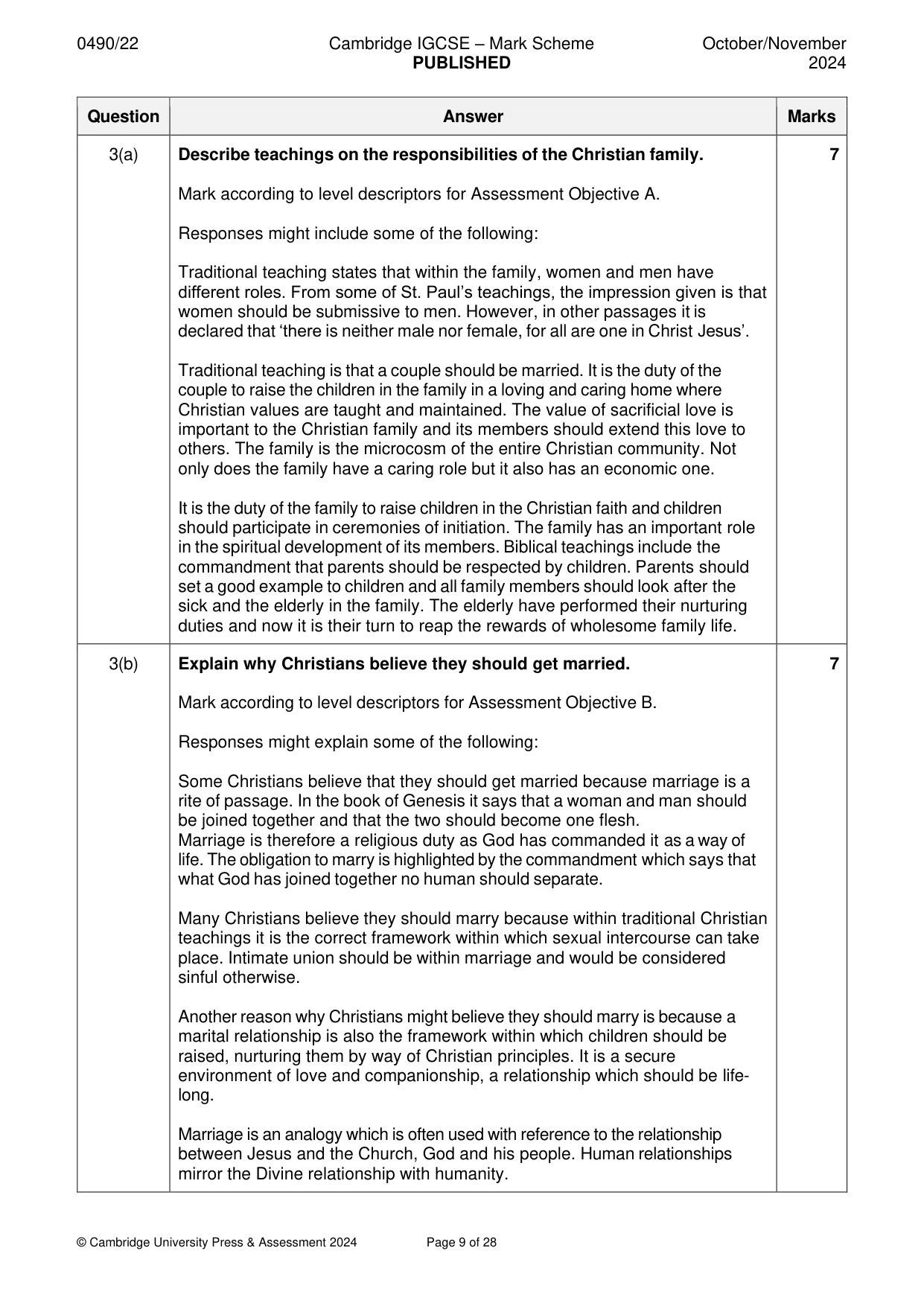
0490/22 Cambridge IGCSE – Mark Scheme PUBLISHED October/November 2024 © Cambridge University Press & Assessment 2024 Page 9 of 28 Question Answer Marks 3(a) Describe teachings on the responsibilities of the Christian family. Mark according to level descriptors for Assessment Objective A. Responses might include some of the following: Traditional teaching states that within the family, women and men have different roles. From some of St. Paul’s teachings, the impression given is that women should be submissive to men. However, in other passages it is declared that ‘there is neither male nor female, for all are one in Christ Jesus’. Traditional teaching is that a couple should be married. It is the duty of the couple to raise the children in the family in a loving and caring home where Christian values are taught and maintained. The value of sacrificial love is important to the Christian family and its members should extend this love to others. The family is the microcosm of the entire Christian community. Not only does the family have a caring role but it also has an economic one. It is the duty of the family to raise children in the Christian faith and children should participate in ceremonies of initiation. The family has an important role in the spiritual development of its members. Biblical teachings include the commandment that parents should be respected by children. Parents should set a good example to children and all family members should look after the sick and the elderly in the family. The elderly have performed their nurturing duties and now it is their turn to reap the rewards of wholesome family life. 7 3(b) Explain why Christians believe they should get married. Mark according to level descriptors for Assessment Objective B. Responses might explain some of the following: Some Christians believe that they should get married because marriage is a rite of passage. In the book of Genesis it says that a woman and man should be joined together and that the two should become one flesh. Marriage is therefore a religious duty as God has commanded it as a way of life. The obligation to marry is highlighted by the commandment which says that what God has joined together no human should separate. Many Christians believe they should marry because within traditional Christian teachings it is the correct framework within which sexual intercourse can take place. Intimate union should be within marriage and would be considered sinful otherwise. Another reason why Christians might believe they should marry is because a marital relationship is also the framework within which children should be raised, nurturing them by way of Christian principles. It is a secure environment of love and companionship, a relationship which should be life- long. Marriage is an analogy which is often used with reference to the relationship between Jesus and the Church, God and his people. Human relationships mirror the Divine relationship with humanity. 7
Mark scheme, page 10
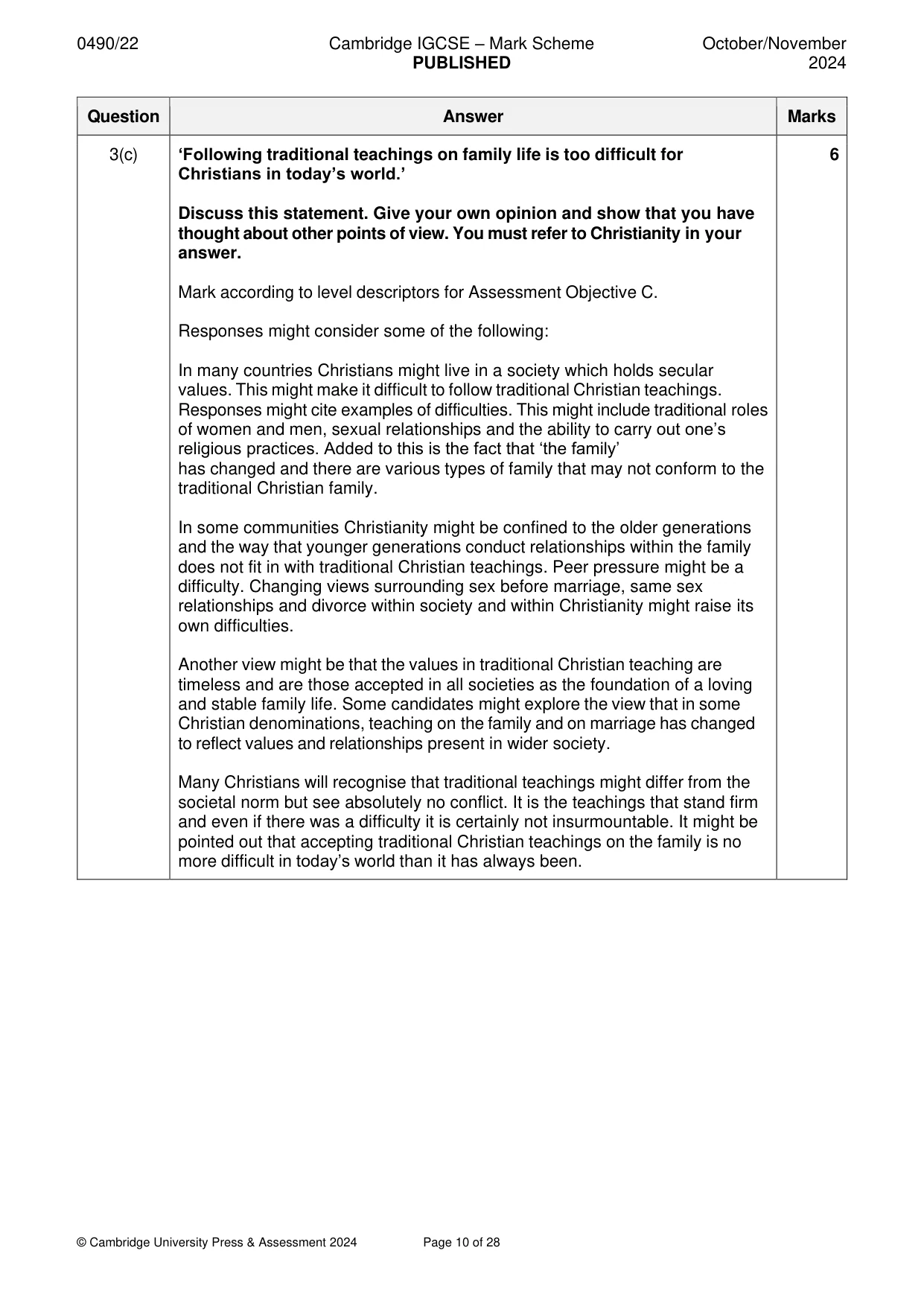
0490/22 Cambridge IGCSE – Mark Scheme PUBLISHED October/November 2024 © Cambridge University Press & Assessment 2024 Page 10 of 28 Question Answer Marks 3(c) ‘Following traditional teachings on family life is too difficult for Christians in today’s world.’ Discuss this statement. Give your own opinion and show that you have thought about other points of view. You must refer to Christianity in your answer. Mark according to level descriptors for Assessment Objective C. Responses might consider some of the following: In many countries Christians might live in a society which holds secular values. This might make it difficult to follow traditional Christian teachings. Responses might cite examples of difficulties. This might include traditional roles of women and men, sexual relationships and the ability to carry out one’s religious practices. Added to this is the fact that ‘the family’ has changed and there are various types of family that may not conform to the traditional Christian family. In some communities Christianity might be confined to the older generations and the way that younger generations conduct relationships within the family does not fit in with traditional Christian teachings. Peer pressure might be a difficulty. Changing views surrounding sex before marriage, same sex relationships and divorce within society and within Christianity might raise its own difficulties. Another view might be that the values in traditional Christian teaching are timeless and are those accepted in all societies as the foundation of a loving and stable family life. Some candidates might explore the view that in some Christian denominations, teaching on the family and on marriage has changed to reflect values and relationships present in wider society. Many Christians will recognise that traditional teachings might differ from the societal norm but see absolutely no conflict. It is the teachings that stand firm and even if there was a difficulty it is certainly not insurmountable. It might be pointed out that accepting traditional Christian teachings on the family is no more difficult in today’s world than it has always been. 6
Mark scheme, page 11
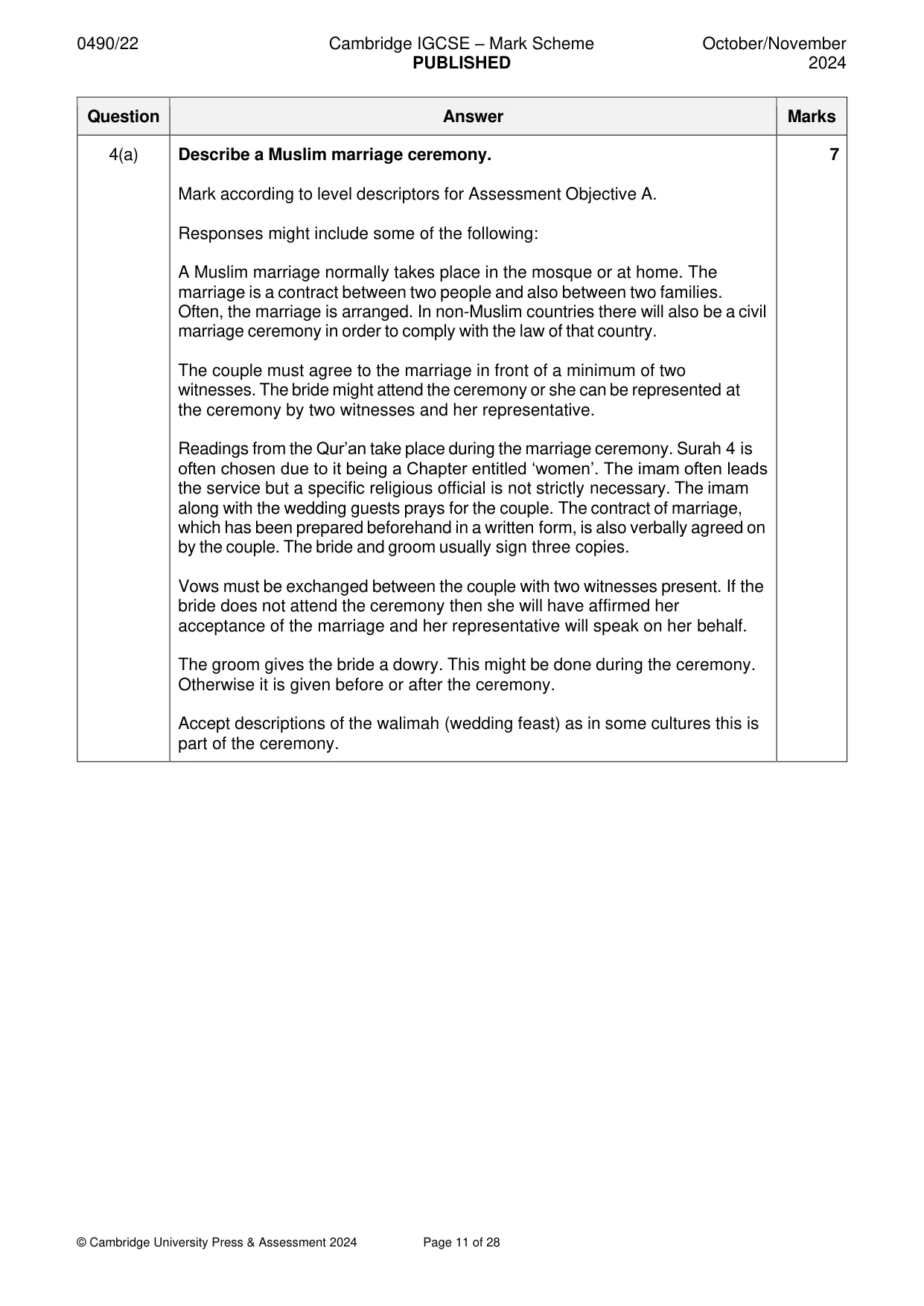
0490/22 Cambridge IGCSE – Mark Scheme PUBLISHED October/November 2024 © Cambridge University Press & Assessment 2024 Page 11 of 28 Question Answer Marks 4(a) Describe a Muslim marriage ceremony. Mark according to level descriptors for Assessment Objective A. Responses might include some of the following: A Muslim marriage normally takes place in the mosque or at home. The marriage is a contract between two people and also between two families. Often, the marriage is arranged. In non-Muslim countries there will also be a civil marriage ceremony in order to comply with the law of that country. The couple must agree to the marriage in front of a minimum of two witnesses. The bride might attend the ceremony or she can be represented at the ceremony by two witnesses and her representative. Readings from the Qur’an take place during the marriage ceremony. Surah 4 is often chosen due to it being a Chapter entitled ‘women’. The imam often leads the service but a specific religious official is not strictly necessary. The imam along with the wedding guests prays for the couple. The contract of marriage, which has been prepared beforehand in a written form, is also verbally agreed on by the couple. The bride and groom usually sign three copies. Vows must be exchanged between the couple with two witnesses present. If the bride does not attend the ceremony then she will have affirmed her acceptance of the marriage and her representative will speak on her behalf. The groom gives the bride a dowry. This might be done during the ceremony. Otherwise it is given before or after the ceremony. Accept descriptions of the walimah (wedding feast) as in some cultures this is part of the ceremony. 7
Mark scheme, page 12
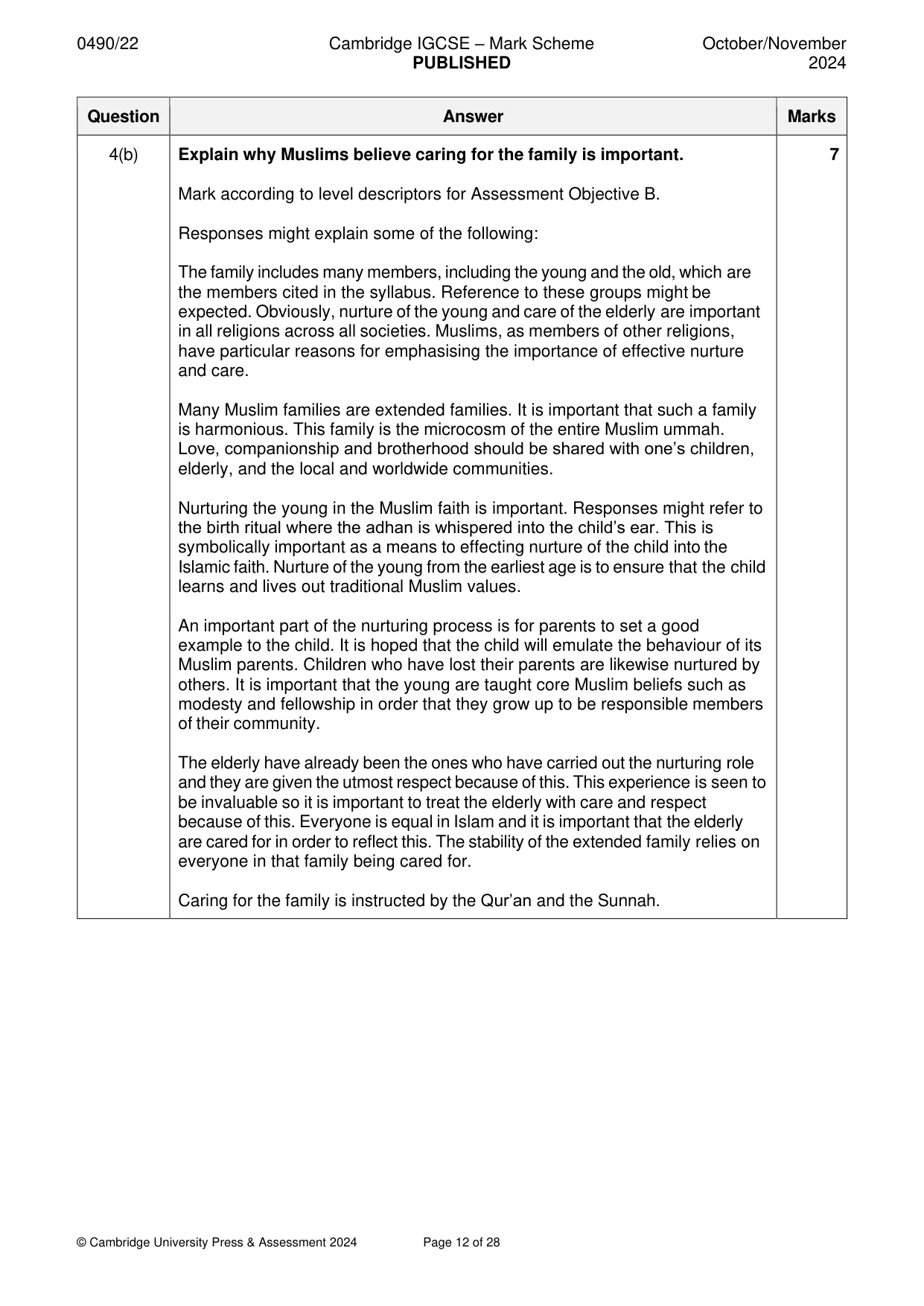
0490/22 Cambridge IGCSE – Mark Scheme PUBLISHED October/November 2024 © Cambridge University Press & Assessment 2024 Page 12 of 28 Question Answer Marks 4(b) Explain why Muslims believe caring for the family is important. Mark according to level descriptors for Assessment Objective B. Responses might explain some of the following: The family includes many members, including the young and the old, which are the members cited in the syllabus. Reference to these groups might be expected. Obviously, nurture of the young and care of the elderly are important in all religions across all societies. Muslims, as members of other religions, have particular reasons for emphasising the importance of effective nurture and care. Many Muslim families are extended families. It is important that such a family is harmonious. This family is the microcosm of the entire Muslim ummah. Love, companionship and brotherhood should be shared with one’s children, elderly, and the local and worldwide communities. Nurturing the young in the Muslim faith is important. Responses might refer to the birth ritual where the adhan is whispered into the child’s ear. This is symbolically important as a means to effecting nurture of the child into the Islamic faith. Nurture of the young from the earliest age is to ensure that the child learns and lives out traditional Muslim values. An important part of the nurturing process is for parents to set a good example to the child. It is hoped that the child will emulate the behaviour of its Muslim parents. Children who have lost their parents are likewise nurtured by others. It is important that the young are taught core Muslim beliefs such as modesty and fellowship in order that they grow up to be responsible members of their community. The elderly have already been the ones who have carried out the nurturing role and they are given the utmost respect because of this. This experience is seen to be invaluable so it is important to treat the elderly with care and respect because of this. Everyone is equal in Islam and it is important that the elderly are cared for in order to reflect this. The stability of the extended family relies on everyone in that family being cared for. Caring for the family is instructed by the Qur’an and the Sunnah. 7
Mark scheme, page 13
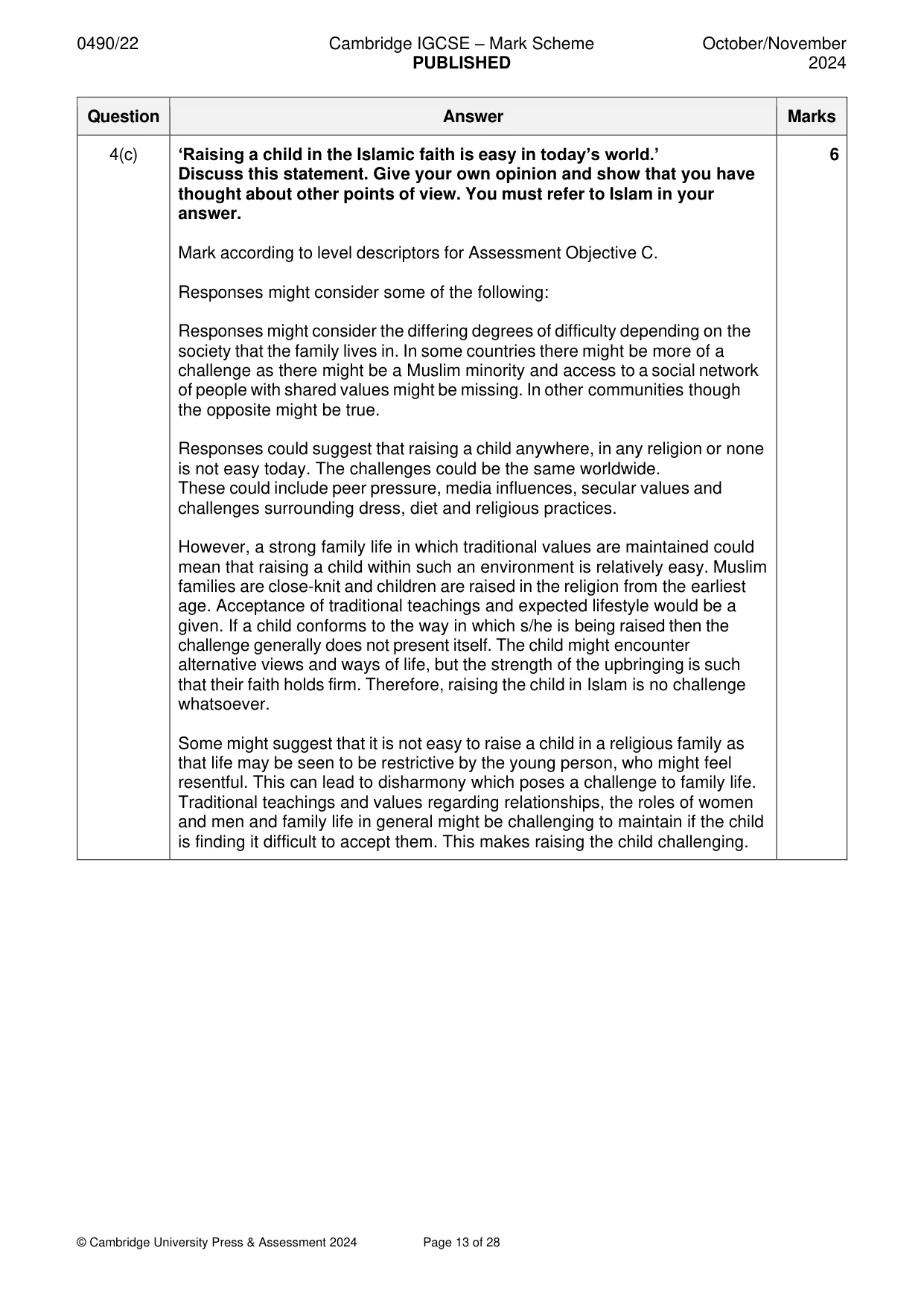
0490/22 Cambridge IGCSE – Mark Scheme PUBLISHED October/November 2024 © Cambridge University Press & Assessment 2024 Page 13 of 28 Question Answer Marks 4(c) ‘Raising a child in the Islamic faith is easy in today’s world.’ Discuss this statement. Give your own opinion and show that you have thought about other points of view. You must refer to Islam in your answer. Mark according to level descriptors for Assessment Objective C. Responses might consider some of the following: Responses might consider the differing degrees of difficulty depending on the society that the family lives in. In some countries there might be more of a challenge as there might be a Muslim minority and access to a social network of people with shared values might be missing. In other communities though the opposite might be true. Responses could suggest that raising a child anywhere, in any religion or none is not easy today. The challenges could be the same worldwide. These could include peer pressure, media influences, secular values and challenges surrounding dress, diet and religious practices. However, a strong family life in which traditional values are maintained could mean that raising a child within such an environment is relatively easy. Muslim families are close-knit and children are raised in the religion from the earliest age. Acceptance of traditional teachings and expected lifestyle would be a given. If a child conforms to the way in which s/he is being raised then the challenge generally does not present itself. The child might encounter alternative views and ways of life, but the strength of the upbringing is such that their faith holds firm. Therefore, raising the child in Islam is no challenge whatsoever. Some might suggest that it is not easy to raise a child in a religious family as that life may be seen to be restrictive by the young person, who might feel resentful. This can lead to disharmony which poses a challenge to family life. Traditional teachings and values regarding relationships, the roles of women and men and family life in general might be challenging to maintain if the child is finding it difficult to accept them. This makes raising the child challenging. 6
Mark scheme, page 14
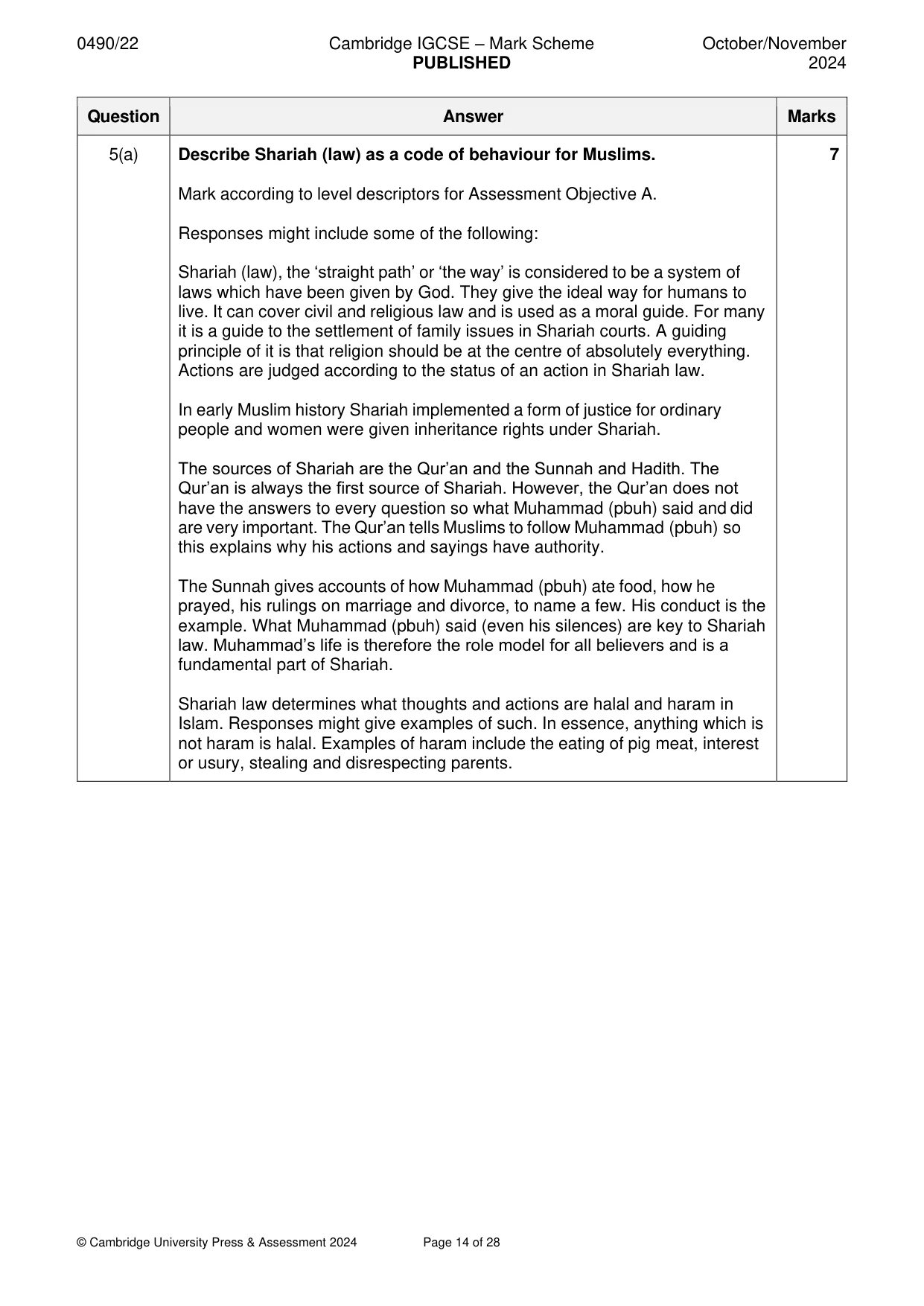
0490/22 Cambridge IGCSE – Mark Scheme PUBLISHED October/November 2024 © Cambridge University Press & Assessment 2024 Page 14 of 28 Question Answer Marks 5(a) Describe Shariah (law) as a code of behaviour for Muslims. Mark according to level descriptors for Assessment Objective A. Responses might include some of the following: Shariah (law), the ‘straight path’ or ‘the way’ is considered to be a system of laws which have been given by God. They give the ideal way for humans to live. It can cover civil and religious law and is used as a moral guide. For many it is a guide to the settlement of family issues in Shariah courts. A guiding principle of it is that religion should be at the centre of absolutely everything. Actions are judged according to the status of an action in Shariah law. In early Muslim history Shariah implemented a form of justice for ordinary people and women were given inheritance rights under Shariah. The sources of Shariah are the Qur’an and the Sunnah and Hadith. The Qur’an is always the first source of Shariah. However, the Qur’an does not have the answers to every question so what Muhammad (pbuh) said and did are very important. The Qur’an tells Muslims to follow Muhammad (pbuh) so this explains why his actions and sayings have authority. The Sunnah gives accounts of how Muhammad (pbuh) ate food, how he prayed, his rulings on marriage and divorce, to name a few. His conduct is the example. What Muhammad (pbuh) said (even his silences) are key to Shariah law. Muhammad’s life is therefore the role model for all believers and is a fundamental part of Shariah. Shariah law determines what thoughts and actions are halal and haram in Islam. Responses might give examples of such. In essence, anything which is not haram is halal. Examples of haram include the eating of pig meat, interest or usury, stealing and disrespecting parents. 7
Mark scheme, page 15
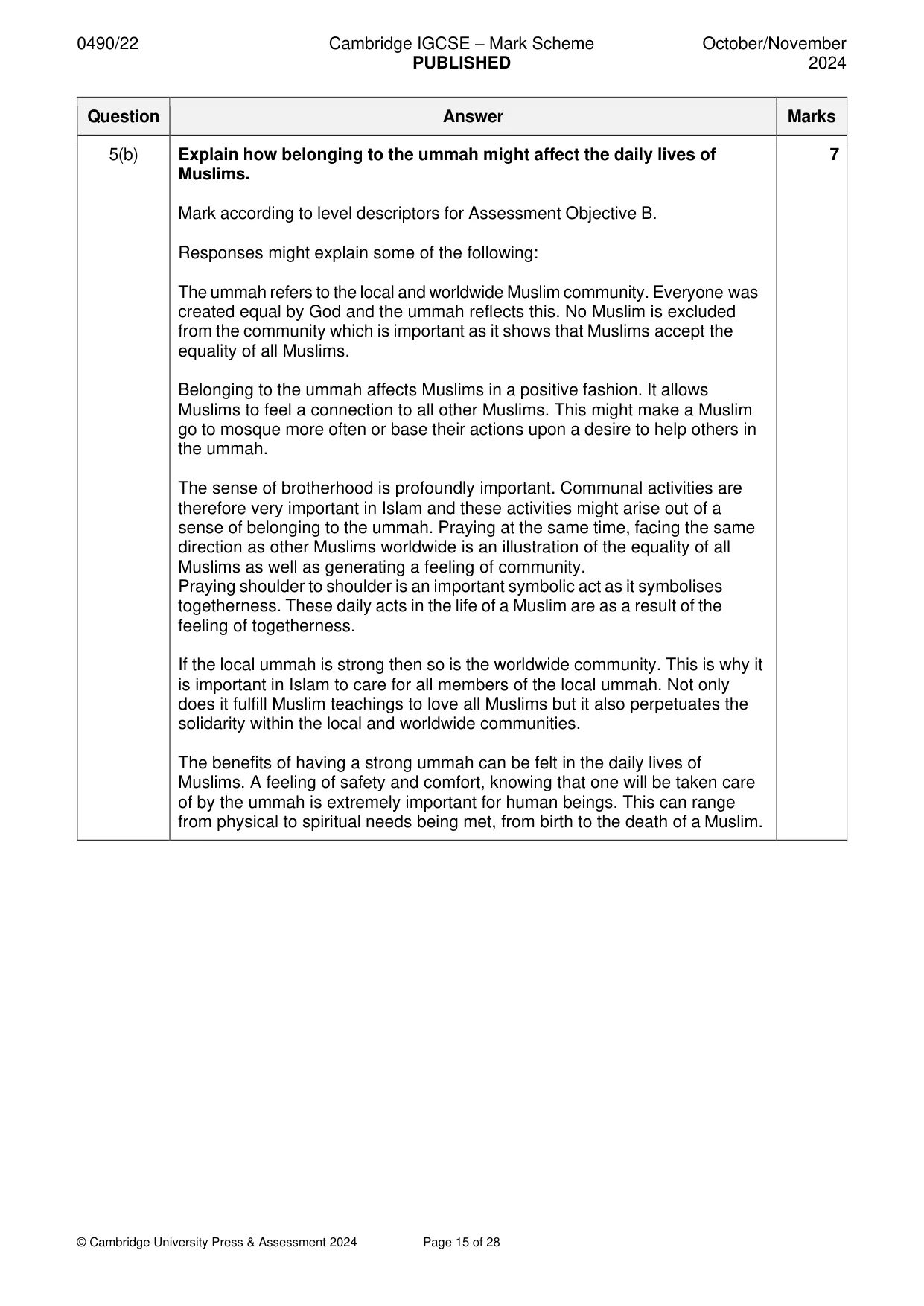
0490/22 Cambridge IGCSE – Mark Scheme PUBLISHED October/November 2024 © Cambridge University Press & Assessment 2024 Page 15 of 28 Question Answer Marks 5(b) Explain how belonging to the ummah might affect the daily lives of Muslims. Mark according to level descriptors for Assessment Objective B. Responses might explain some of the following: The ummah refers to the local and worldwide Muslim community. Everyone was created equal by God and the ummah reflects this. No Muslim is excluded from the community which is important as it shows that Muslims accept the equality of all Muslims. Belonging to the ummah affects Muslims in a positive fashion. It allows Muslims to feel a connection to all other Muslims. This might make a Muslim go to mosque more often or base their actions upon a desire to help others in the ummah. The sense of brotherhood is profoundly important. Communal activities are therefore very important in Islam and these activities might arise out of a sense of belonging to the ummah. Praying at the same time, facing the same direction as other Muslims worldwide is an illustration of the equality of all Muslims as well as generating a feeling of community. Praying shoulder to shoulder is an important symbolic act as it symbolises togetherness. These daily acts in the life of a Muslim are as a result of the feeling of togetherness. If the local ummah is strong then so is the worldwide community. This is why it is important in Islam to care for all members of the local ummah. Not only does it fulfill Muslim teachings to love all Muslims but it also perpetuates the solidarity within the local and worldwide communities. The benefits of having a strong ummah can be felt in the daily lives of Muslims. A feeling of safety and comfort, knowing that one will be taken care of by the ummah is extremely important for human beings. This can range from physical to spiritual needs being met, from birth to the death of a Muslim. 7
Mark scheme, page 16
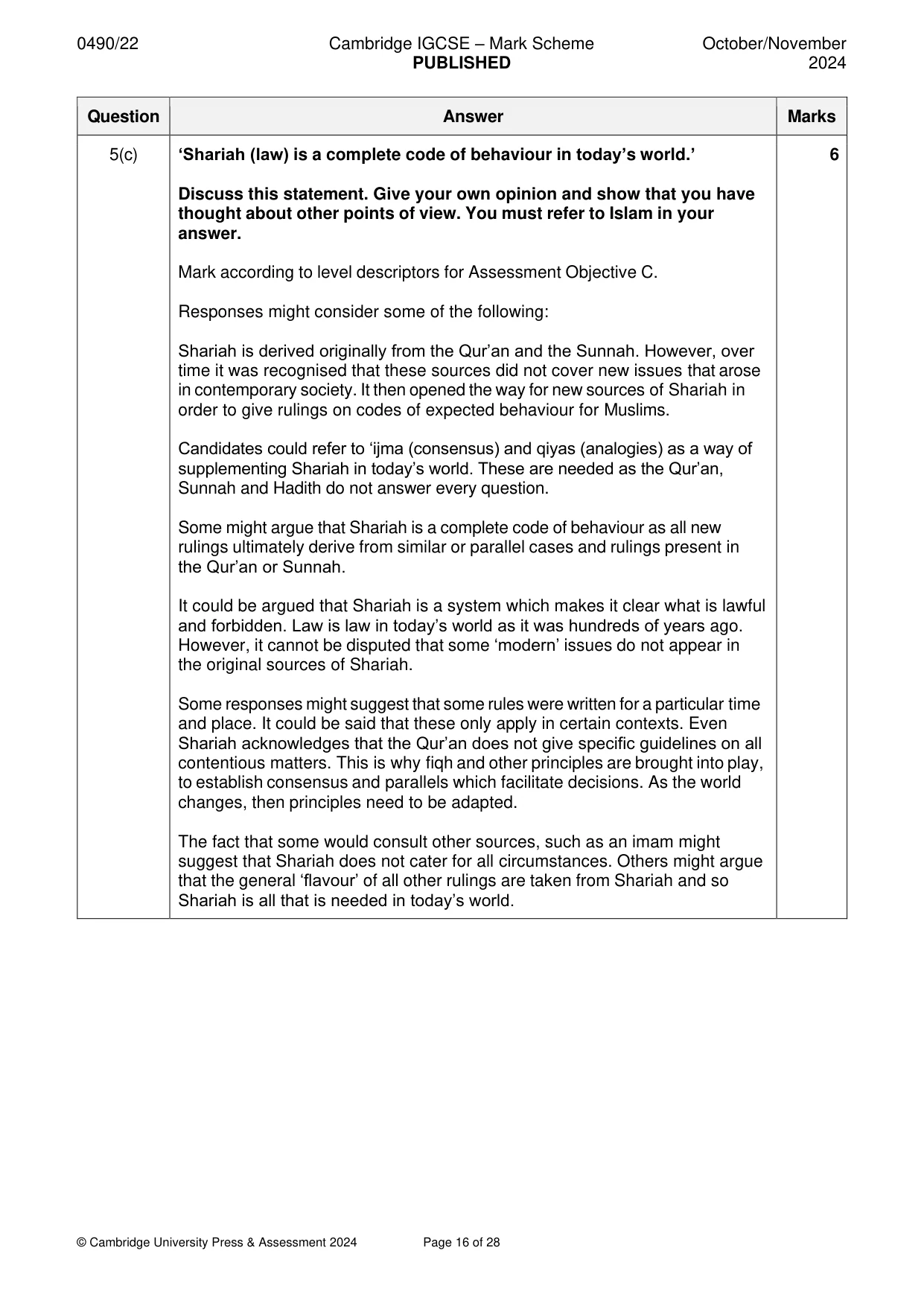
0490/22 Cambridge IGCSE – Mark Scheme PUBLISHED October/November 2024 © Cambridge University Press & Assessment 2024 Page 16 of 28 Question Answer Marks 5(c) ‘Shariah (law) is a complete code of behaviour in today’s world.’ Discuss this statement. Give your own opinion and show that you have thought about other points of view. You must refer to Islam in your answer. Mark according to level descriptors for Assessment Objective C. Responses might consider some of the following: Shariah is derived originally from the Qur’an and the Sunnah. However, over time it was recognised that these sources did not cover new issues that arose in contemporary society. It then opened the way for new sources of Shariah in order to give rulings on codes of expected behaviour for Muslims. Candidates could refer to ‘ijma (consensus) and qiyas (analogies) as a way of supplementing Shariah in today’s world. These are needed as the Qur’an, Sunnah and Hadith do not answer every question. Some might argue that Shariah is a complete code of behaviour as all new rulings ultimately derive from similar or parallel cases and rulings present in the Qur’an or Sunnah. It could be argued that Shariah is a system which makes it clear what is lawful and forbidden. Law is law in today’s world as it was hundreds of years ago. However, it cannot be disputed that some ‘modern’ issues do not appear in the original sources of Shariah. Some responses might suggest that some rules were written for a particular time and place. It could be said that these only apply in certain contexts. Even Shariah acknowledges that the Qur’an does not give specific guidelines on all contentious matters. This is why fiqh and other principles are brought into play, to establish consensus and parallels which facilitate decisions. As the world changes, then principles need to be adapted. The fact that some would consult other sources, such as an imam might suggest that Shariah does not cater for all circumstances. Others might argue that the general ‘flavour’ of all other rulings are taken from Shariah and so Shariah is all that is needed in today’s world. 6
Mark scheme, page 17
0490/22 Cambridge IGCSE – Mark Scheme PUBLISHED October/November 2024 © Cambridge University Press & Assessment 2024 Page 17 of 28 Question Answer Marks 6(a) Describe the work of one Islamic aid organisation for the relief of poverty. Mark according to level descriptors for Assessment Objective A. Responses might include some of the following: Credit any valid organisation. Most responses will possibly refer to either Muslim Aid or Red Crescent. However, aid organisations local to or known by candidates should also be credited. Responses may include some generic elements, but higher marks will be awarded to those responses which give particular details regarding the Islamic aid organisation. ‘Poverty’ should be interpreted in a wide sense to cover lack of money, food, resources and indeed anything where human beings are without a basic need. Responses may describe how money is raised by the organisation and also the type of work and projects undertaken in order to help to relieve poverty. For example, Muslim Aid lists as its ‘values’ that they will work with compassion, respect for rights, dignity, inclusive to all of whatever faith or ethnicity and they seek empowerment for those in need. Its website has a zakah guide and calculator, which clearly shows the role of zakah in its quest to relieve poverty. It has both a zakah and sadaqah appeal on its website. Appeals are updated regularly based on global circumstances. It advertises for volunteers, upcoming events and for fund raising. Its projects include child sponsorship, fighting poverty, education forever and water for all. In particular it highlights the plight of Syria, Yemen and Gaza and also wells for Somalia. Also it seeks to improve the lives of orphans and widows. 7
Mark scheme, page 18
0490/22 Cambridge IGCSE – Mark Scheme PUBLISHED October/November 2024 © Cambridge University Press & Assessment 2024 Page 18 of 28 Question Answer Marks 6(b) Explain why the giving of zakah is important in Islam. Mark according to level descriptors for Assessment Objective B. Responses might explain some of the following: Giving is profoundly important in Islam. Zakah is one of the Five Pillars of Islam and is a compulsory act of worship. It is important to purify one’s wealth and soul and the giving of zakah achieves this important aim. To do this is an expression of devotion to God and an expression of love and concern for others. Everyone is created equal and a way in which this can be shown is by the giving of zakah. It is to be given by all adult Muslims and is an act in accordance with a Sunnah of the Prophet (pbuh) as well as the Qur’an. It shows not only the equality of all givers but also the recognition of the equality of those that benefit from zakah. The Qur’an describes zakah as the means by which to attain God’s mercy. It is also a sign of brotherhood and a distinctive feature of a faithful community. Nisab, according to Shariah (law) is the minimum amount that Muslims must have before having to give zakah. Zakah requires Muslims who own wealth at, or over this certain threshold to donate a portion of their wealth, to those that need it. This is important as it is a way by which the less fortunate can be looked after, a means by which Muslims can show love for others. The greater the asset the more zakah one pays. Zakah given in the true spirit of giving is important as motive is known by God. The giving of zakah is therefore important as a way of displaying core Muslim values such as compassion and sacrifice. According to Surah 9, zakah can be used for helping the poor, helping people in need, freeing prisoners, slaves or captives or helping people out of debt. This shows the variety of people who can benefit from zakah which furthers illustrates its importance in Islam. Circulation of wealth is important. and it is right that wealth moves from the rich to the poor. It is the right of the poor to be given it. 7
Mark scheme, page 19
0490/22 Cambridge IGCSE – Mark Scheme PUBLISHED October/November 2024 © Cambridge University Press & Assessment 2024 Page 19 of 28 Question Answer Marks 6(c) ‘Giving sadaqah (voluntary contributions) is the best charitable act for Muslims.’ Discuss this statement. Give your own opinion and show that you have thought about other points of view. You must refer to Islam in your answer. Mark according to level descriptors for Assessment Objective C. Responses might consider some of the following: Some might suggest that giving sadaqah is the best charitable act because it is voluntary. It might be suggested that this aspect of giving therefore is of greater value. Anything that is not zakah is sadaqah. It could be said that anything a person can do to help others is a good charitable act and that no one form of giving is better than another. Some might suggest that everyone can give of their time, and this is the form of sadaqah that can be given by all. If a person can do this but does not, then it might be fair to say that they are denying an important religious duty. The same applies to the giving of zakah as it is compulsory. Some might refer to giving to charity as being one of the Five Pillars. It could be mentioned that the Qur’an emphasises giving as well as the belief that Muslims will be judged according to how they help. In this sense it could be argued that any form of giving is what is required rather than sadaqah being seen to be superior. Niyyah or intention is important in Islam. It is the intention in one’s heart to act for the sake of God. Responses could suggest that as long as an intention is pure then that is what matters. A Muslim who gives what they can, however small, with a pure intention could be considered to be a ‘good Muslim’. The form of giving is of no consequence. Some might say that because zakah is one of the Five Pillars of Islam then this is the best form of giving. Others might suggest that the simple act of smiling, which can be seen as sadaqah can be the best thing received on some occasions. 6
Mark scheme, page 20
0490/22 Cambridge IGCSE – Mark Scheme PUBLISHED October/November 2024 © Cambridge University Press & Assessment 2024 Page 20 of 28 Question Answer Marks 7(a) Give an account of tzedaka (righteous giving). Mark according to level descriptors for Assessment Objective A. Responses might include some of the following: Tzedaka is based on the Hebrew tzedek, meaning righteousness, fairness or justice. It is often referred to as ‘charity’ but it is so much more than the narrow use of that term. Tzedaka is a form of social justice. It often does involve donating money to the needy and other worthwhile causes. However it can also take the form of volunteering one’s time, donating food, clothing or other basic necessities. Tzedaka is a mitzvah as dictated by the Torah; therefore it is an ethical obligation on Jews. Jews will often give tzedaka before Shabbat or other festivals such as Purim or Shavuot. Money may be deposited in pushkes. By showing righteousness Jews adhere to the will of God, voiced by Old Testament prophets that what God wants is justice and righteousness above all else. The reason is that all humans are created equal so all should be treated with dignity. No-one should suffer injustice in any way. Tzedaka recognises God’s Creation and the equality of all. Jews will act in order to ward against social injustices of any kind and tzedaka and gemilut hasadim often work hand in hand. Charity, justice and kindness are all important morals found in the mitzvot. Tzedaka is a way in which a Jew can show faithfulness to God’s mitzvot. Jews ought to give, not because they have to, but because they want to. Righteous giving is a central tenet of Judaism which permeates the thoughts, words and actions of Jews. Some Jews may see adherence to these teachings as a way of ensuring Tikkun Olam (mending the world) and they may get involved in environmental activities as a result. It may also mean that these teachings lead Jews to join various organisations for the relief of poverty. 7
Mark scheme, page 21
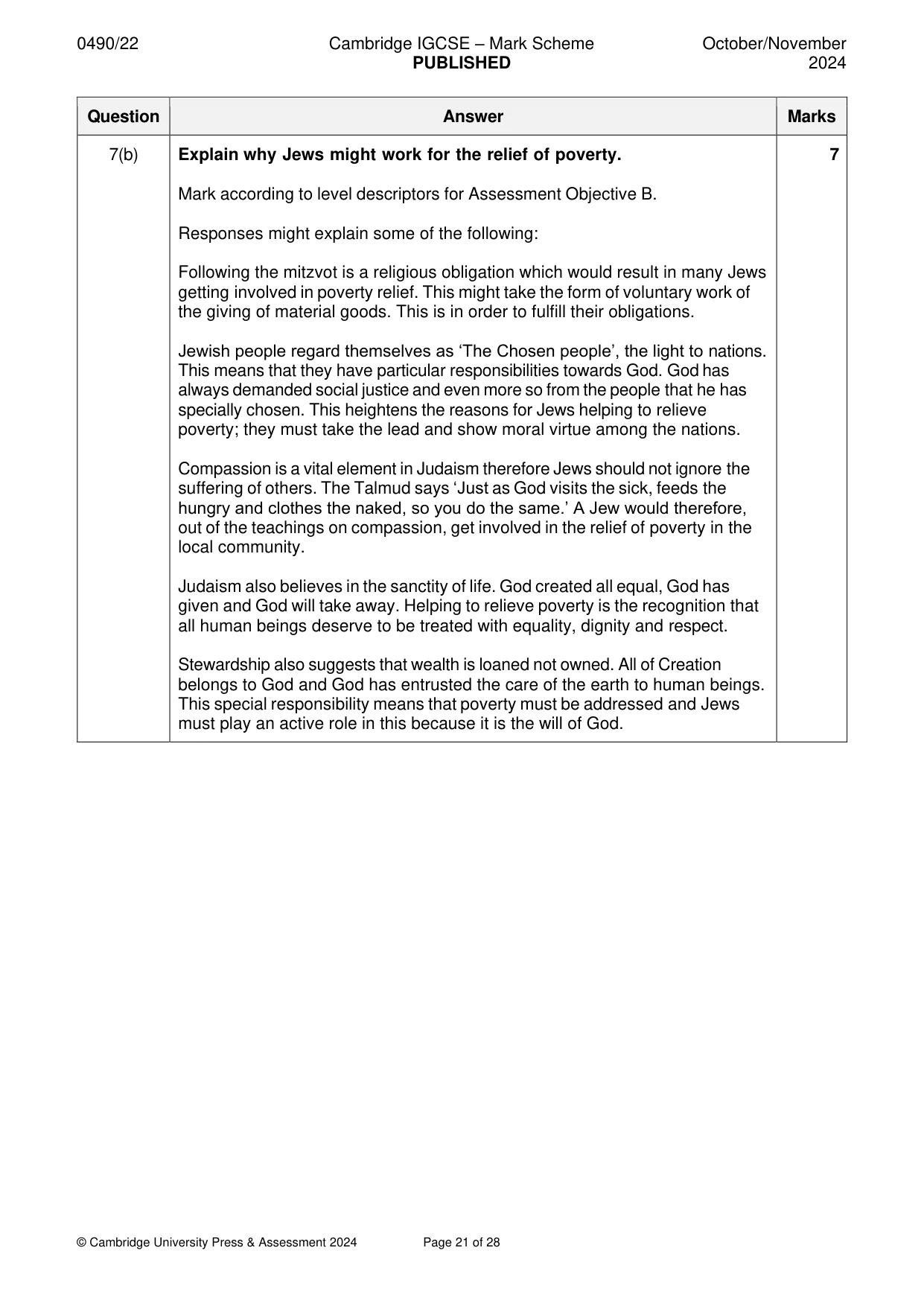
0490/22 Cambridge IGCSE – Mark Scheme PUBLISHED October/November 2024 © Cambridge University Press & Assessment 2024 Page 21 of 28 Question Answer Marks 7(b) Explain why Jews might work for the relief of poverty. Mark according to level descriptors for Assessment Objective B. Responses might explain some of the following: Following the mitzvot is a religious obligation which would result in many Jews getting involved in poverty relief. This might take the form of voluntary work of the giving of material goods. This is in order to fulfill their obligations. Jewish people regard themselves as ‘The Chosen people’, the light to nations. This means that they have particular responsibilities towards God. God has always demanded social justice and even more so from the people that he has specially chosen. This heightens the reasons for Jews helping to relieve poverty; they must take the lead and show moral virtue among the nations. Compassion is a vital element in Judaism therefore Jews should not ignore the suffering of others. The Talmud says ‘Just as God visits the sick, feeds the hungry and clothes the naked, so you do the same.’ A Jew would therefore, out of the teachings on compassion, get involved in the relief of poverty in the local community. Judaism also believes in the sanctity of life. God created all equal, God has given and God will take away. Helping to relieve poverty is the recognition that all human beings deserve to be treated with equality, dignity and respect. Stewardship also suggests that wealth is loaned not owned. All of Creation belongs to God and God has entrusted the care of the earth to human beings. This special responsibility means that poverty must be addressed and Jews must play an active role in this because it is the will of God. 7
Mark scheme, page 22
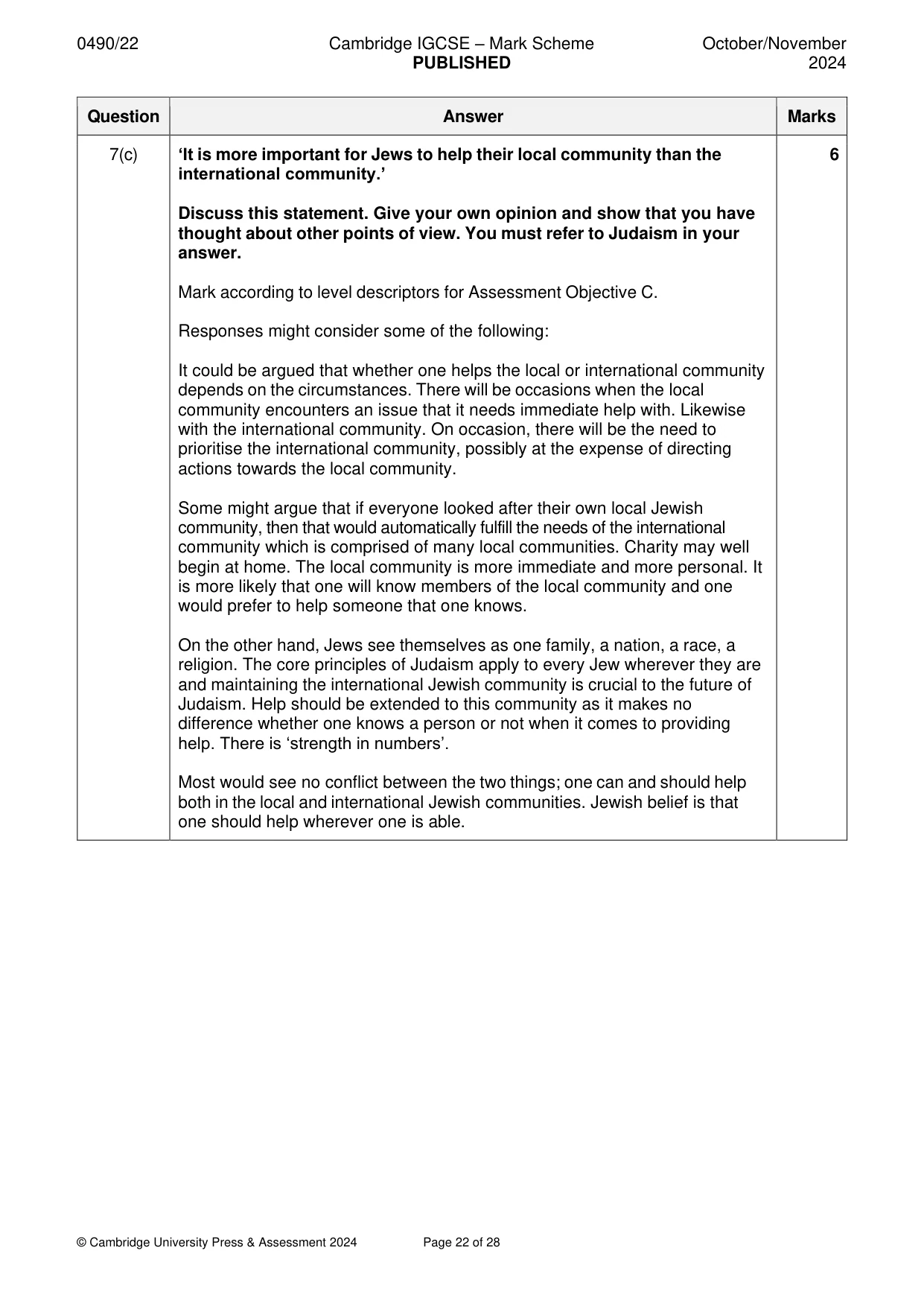
0490/22 Cambridge IGCSE – Mark Scheme PUBLISHED October/November 2024 © Cambridge University Press & Assessment 2024 Page 22 of 28 Question Answer Marks 7(c) ‘It is more important for Jews to help their local community than the international community.’ Discuss this statement. Give your own opinion and show that you have thought about other points of view. You must refer to Judaism in your answer. Mark according to level descriptors for Assessment Objective C. Responses might consider some of the following: It could be argued that whether one helps the local or international community depends on the circumstances. There will be occasions when the local community encounters an issue that it needs immediate help with. Likewise with the international community. On occasion, there will be the need to prioritise the international community, possibly at the expense of directing actions towards the local community. Some might argue that if everyone looked after their own local Jewish community, then that would automatically fulfill the needs of the international community which is comprised of many local communities. Charity may well begin at home. The local community is more immediate and more personal. It is more likely that one will know members of the local community and one would prefer to help someone that one knows. On the other hand, Jews see themselves as one family, a nation, a race, a religion. The core principles of Judaism apply to every Jew wherever they are and maintaining the international Jewish community is crucial to the future of Judaism. Help should be extended to this community as it makes no difference whether one knows a person or not when it comes to providing help. There is ‘strength in numbers’. Most would see no conflict between the two things; one can and should help both in the local and international Jewish communities. Jewish belief is that one should help wherever one is able. 6
Mark scheme, page 23
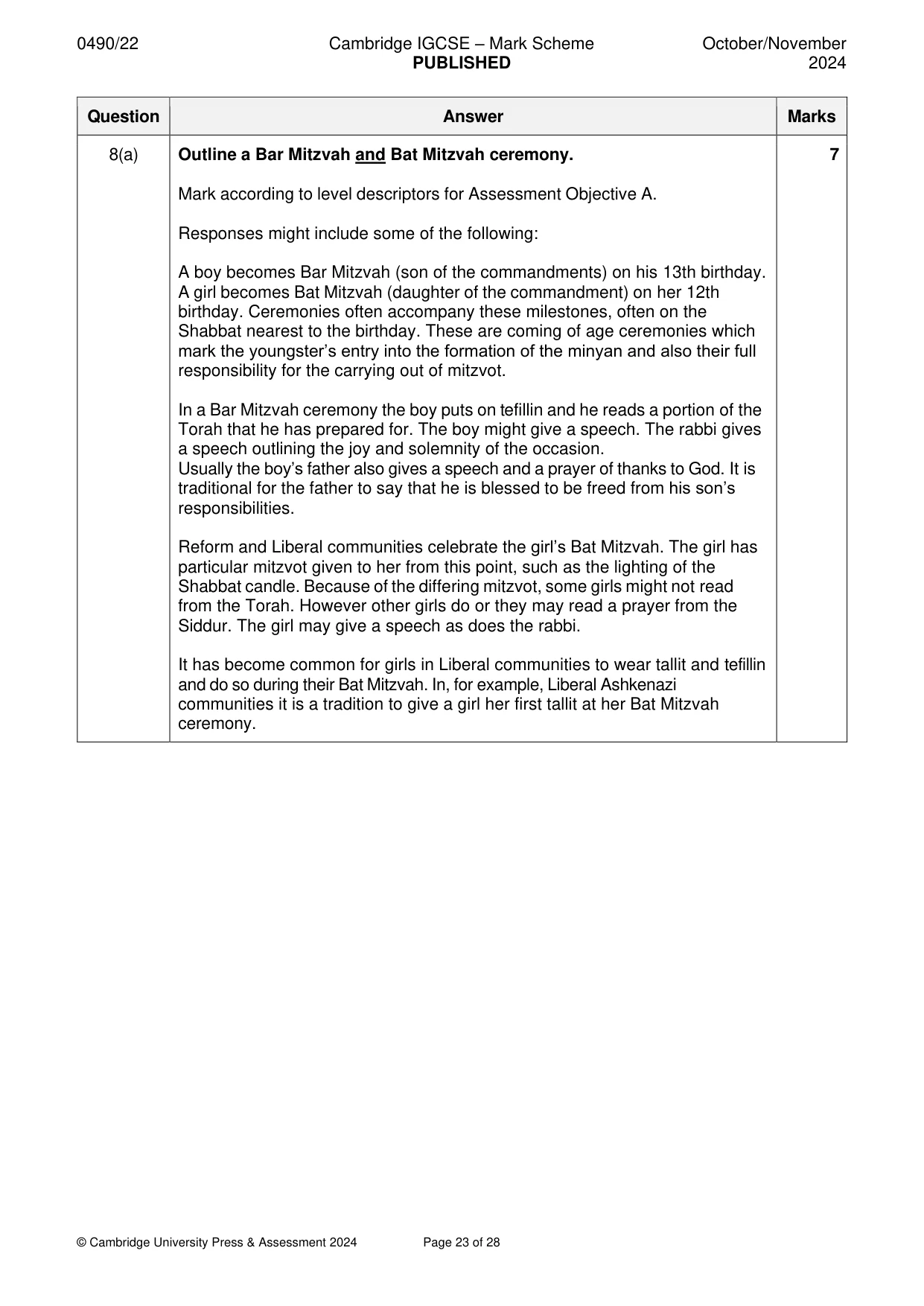
0490/22 Cambridge IGCSE – Mark Scheme PUBLISHED October/November 2024 © Cambridge University Press & Assessment 2024 Page 23 of 28 Question Answer Marks 8(a) Outline a Bar Mitzvah and Bat Mitzvah ceremony. Mark according to level descriptors for Assessment Objective A. Responses might include some of the following: A boy becomes Bar Mitzvah (son of the commandments) on his 13th birthday. A girl becomes Bat Mitzvah (daughter of the commandment) on her 12th birthday. Ceremonies often accompany these milestones, often on the Shabbat nearest to the birthday. These are coming of age ceremonies which mark the youngster’s entry into the formation of the minyan and also their full responsibility for the carrying out of mitzvot. In a Bar Mitzvah ceremony the boy puts on tefillin and he reads a portion of the Torah that he has prepared for. The boy might give a speech. The rabbi gives a speech outlining the joy and solemnity of the occasion. Usually the boy’s father also gives a speech and a prayer of thanks to God. It is traditional for the father to say that he is blessed to be freed from his son’s responsibilities. Reform and Liberal communities celebrate the girl’s Bat Mitzvah. The girl has particular mitzvot given to her from this point, such as the lighting of the Shabbat candle. Because of the differing mitzvot, some girls might not read from the Torah. However other girls do or they may read a prayer from the Siddur. The girl may give a speech as does the rabbi. It has become common for girls in Liberal communities to wear tallit and tefillin and do so during their Bat Mitzvah. In, for example, Liberal Ashkenazi communities it is a tradition to give a girl her first tallit at her Bat Mitzvah ceremony. 7
Mark scheme, page 24
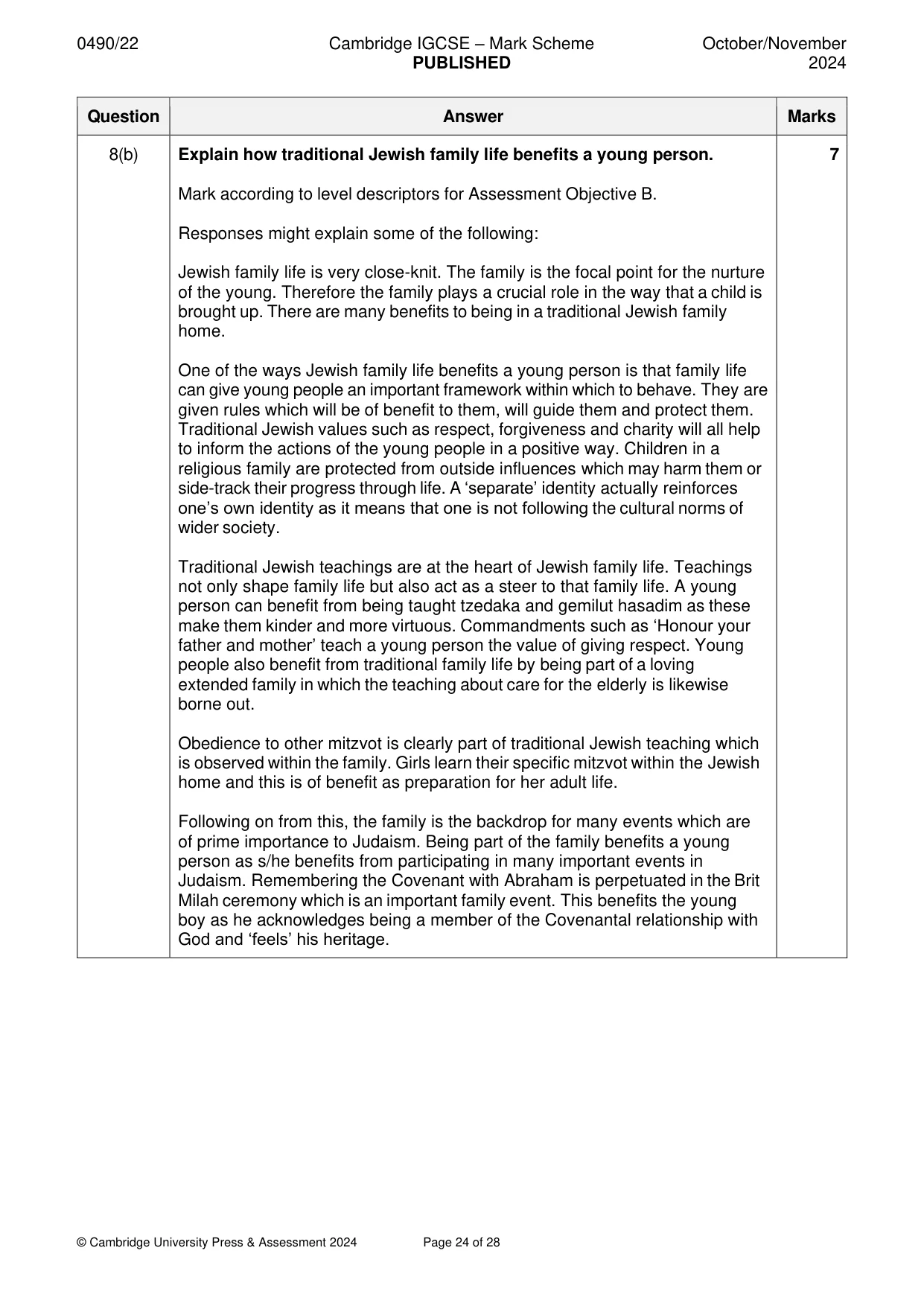
0490/22 Cambridge IGCSE – Mark Scheme PUBLISHED October/November 2024 © Cambridge University Press & Assessment 2024 Page 24 of 28 Question Answer Marks 8(b) Explain how traditional Jewish family life benefits a young person. Mark according to level descriptors for Assessment Objective B. Responses might explain some of the following: Jewish family life is very close-knit. The family is the focal point for the nurture of the young. Therefore the family plays a crucial role in the way that a child is brought up. There are many benefits to being in a traditional Jewish family home. One of the ways Jewish family life benefits a young person is that family life can give young people an important framework within which to behave. They are given rules which will be of benefit to them, will guide them and protect them. Traditional Jewish values such as respect, forgiveness and charity will all help to inform the actions of the young people in a positive way. Children in a religious family are protected from outside influences which may harm them or side-track their progress through life. A ‘separate’ identity actually reinforces one’s own identity as it means that one is not following the cultural norms of wider society. Traditional Jewish teachings are at the heart of Jewish family life. Teachings not only shape family life but also act as a steer to that family life. A young person can benefit from being taught tzedaka and gemilut hasadim as these make them kinder and more virtuous. Commandments such as ‘Honour your father and mother’ teach a young person the value of giving respect. Young people also benefit from traditional family life by being part of a loving extended family in which the teaching about care for the elderly is likewise borne out. Obedience to other mitzvot is clearly part of traditional Jewish teaching which is observed within the family. Girls learn their specific mitzvot within the Jewish home and this is of benefit as preparation for her adult life. Following on from this, the family is the backdrop for many events which are of prime importance to Judaism. Being part of the family benefits a young person as s/he benefits from participating in many important events in Judaism. Remembering the Covenant with Abraham is perpetuated in the Brit Milah ceremony which is an important family event. This benefits the young boy as he acknowledges being a member of the Covenantal relationship with God and ‘feels’ his heritage. 7
Mark scheme, page 25
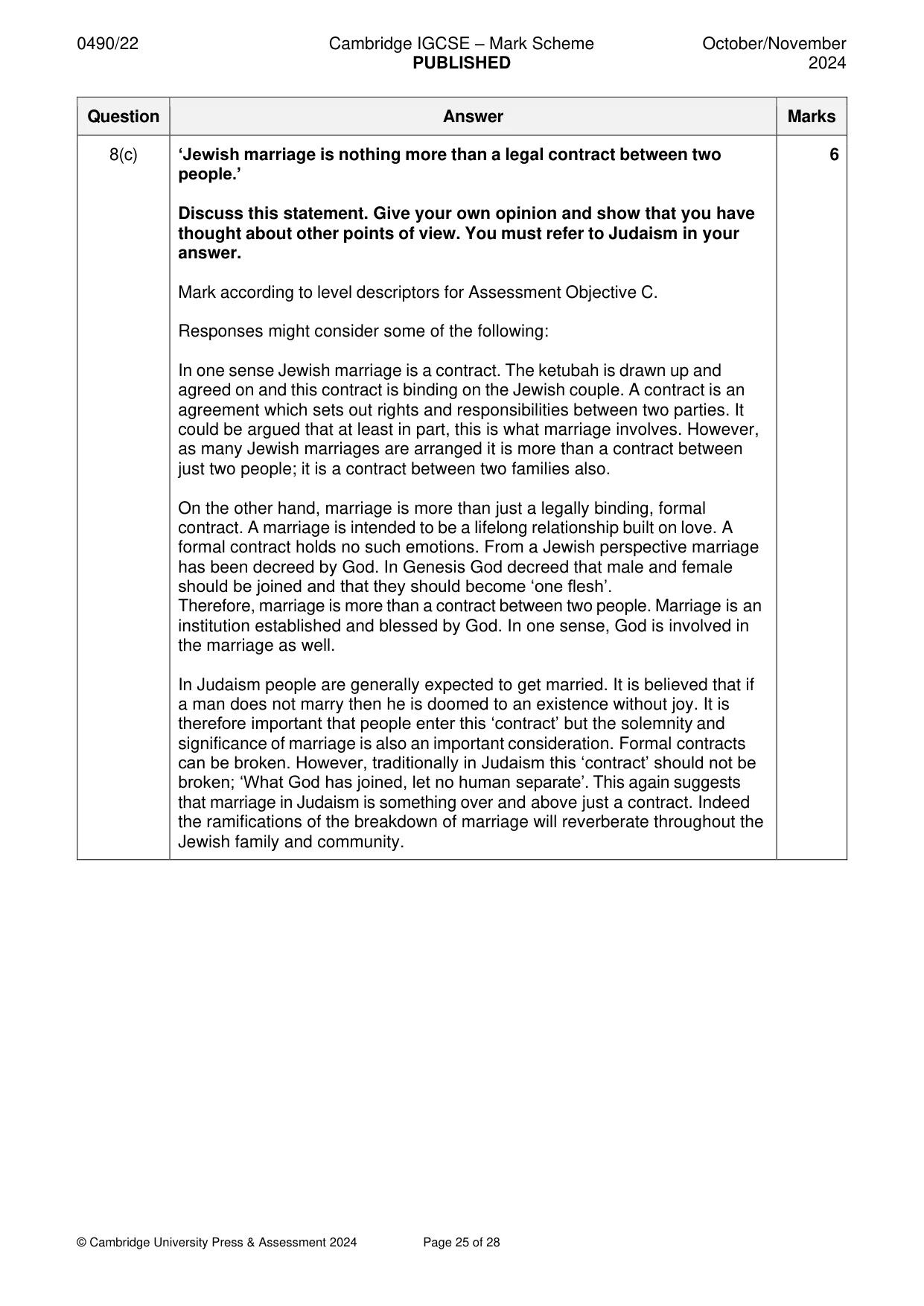
0490/22 Cambridge IGCSE – Mark Scheme PUBLISHED October/November 2024 © Cambridge University Press & Assessment 2024 Page 25 of 28 Question Answer Marks 8(c) ‘Jewish marriage is nothing more than a legal contract between two people.’ Discuss this statement. Give your own opinion and show that you have thought about other points of view. You must refer to Judaism in your answer. Mark according to level descriptors for Assessment Objective C. Responses might consider some of the following: In one sense Jewish marriage is a contract. The ketubah is drawn up and agreed on and this contract is binding on the Jewish couple. A contract is an agreement which sets out rights and responsibilities between two parties. It could be argued that at least in part, this is what marriage involves. However, as many Jewish marriages are arranged it is more than a contract between just two people; it is a contract between two families also. On the other hand, marriage is more than just a legally binding, formal contract. A marriage is intended to be a lifelong relationship built on love. A formal contract holds no such emotions. From a Jewish perspective marriage has been decreed by God. In Genesis God decreed that male and female should be joined and that they should become ‘one flesh’. Therefore, marriage is more than a contract between two people. Marriage is an institution established and blessed by God. In one sense, God is involved in the marriage as well. In Judaism people are generally expected to get married. It is believed that if a man does not marry then he is doomed to an existence without joy. It is therefore important that people enter this ‘contract’ but the solemnity and significance of marriage is also an important consideration. Formal contracts can be broken. However, traditionally in Judaism this ‘contract’ should not be broken; ‘What God has joined, let no human separate’. This again suggests that marriage in Judaism is something over and above just a contract. Indeed the ramifications of the breakdown of marriage will reverberate throughout the Jewish family and community. 6
Mark scheme, page 26
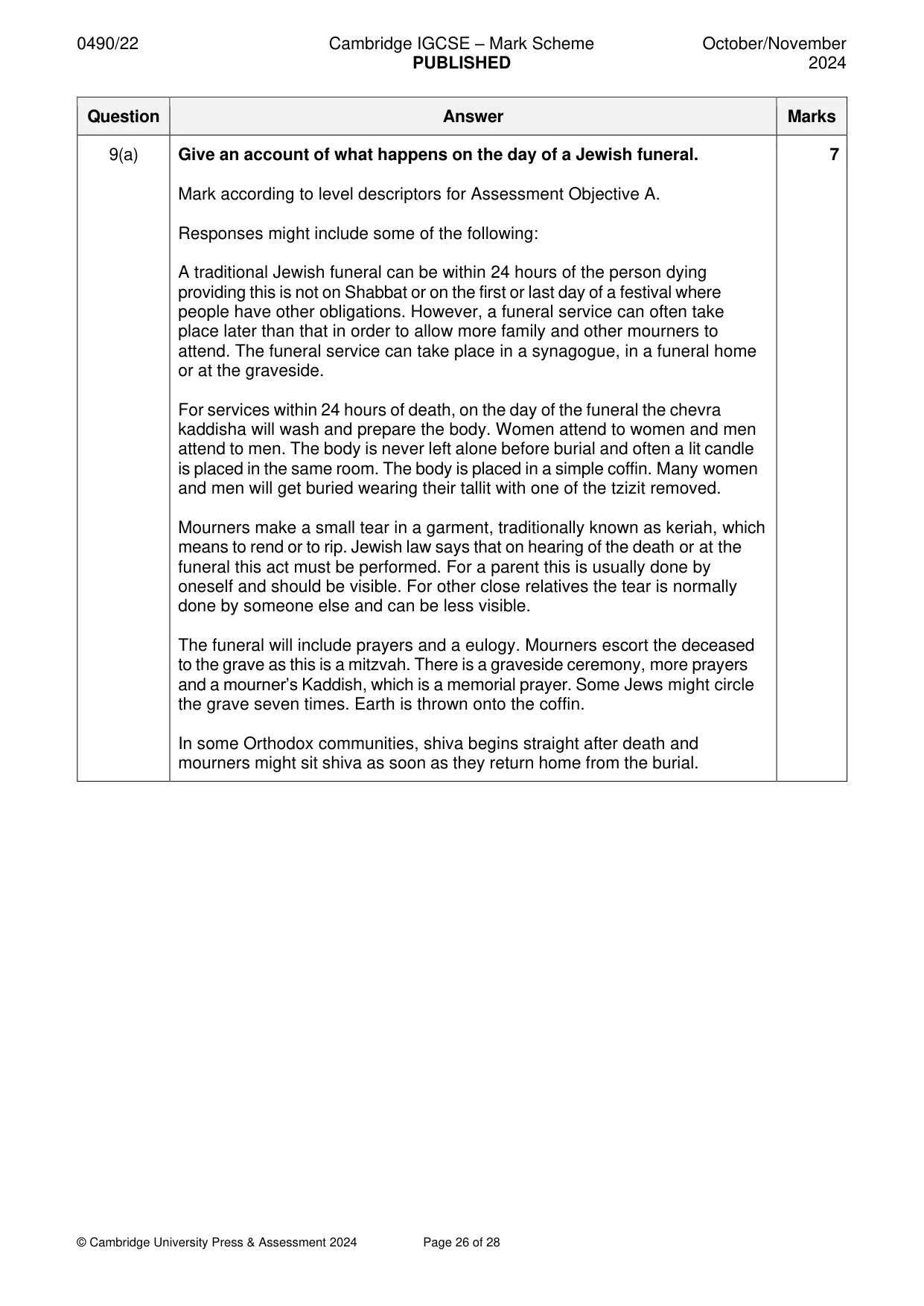
0490/22 Cambridge IGCSE – Mark Scheme PUBLISHED October/November 2024 © Cambridge University Press & Assessment 2024 Page 26 of 28 Question Answer Marks 9(a) Give an account of what happens on the day of a Jewish funeral. Mark according to level descriptors for Assessment Objective A. Responses might include some of the following: A traditional Jewish funeral can be within 24 hours of the person dying providing this is not on Shabbat or on the first or last day of a festival where people have other obligations. However, a funeral service can often take place later than that in order to allow more family and other mourners to attend. The funeral service can take place in a synagogue, in a funeral home or at the graveside. For services within 24 hours of death, on the day of the funeral the chevra kaddisha will wash and prepare the body. Women attend to women and men attend to men. The body is never left alone before burial and often a lit candle is placed in the same room. The body is placed in a simple coffin. Many women and men will get buried wearing their tallit with one of the tzizit removed. Mourners make a small tear in a garment, traditionally known as keriah, which means to rend or to rip. Jewish law says that on hearing of the death or at the funeral this act must be performed. For a parent this is usually done by oneself and should be visible. For other close relatives the tear is normally done by someone else and can be less visible. The funeral will include prayers and a eulogy. Mourners escort the deceased to the grave as this is a mitzvah. There is a graveside ceremony, more prayers and a mourner’s Kaddish, which is a memorial prayer. Some Jews might circle the grave seven times. Earth is thrown onto the coffin. In some Orthodox communities, shiva begins straight after death and mourners might sit shiva as soon as they return home from the burial. 7
Mark scheme, page 27
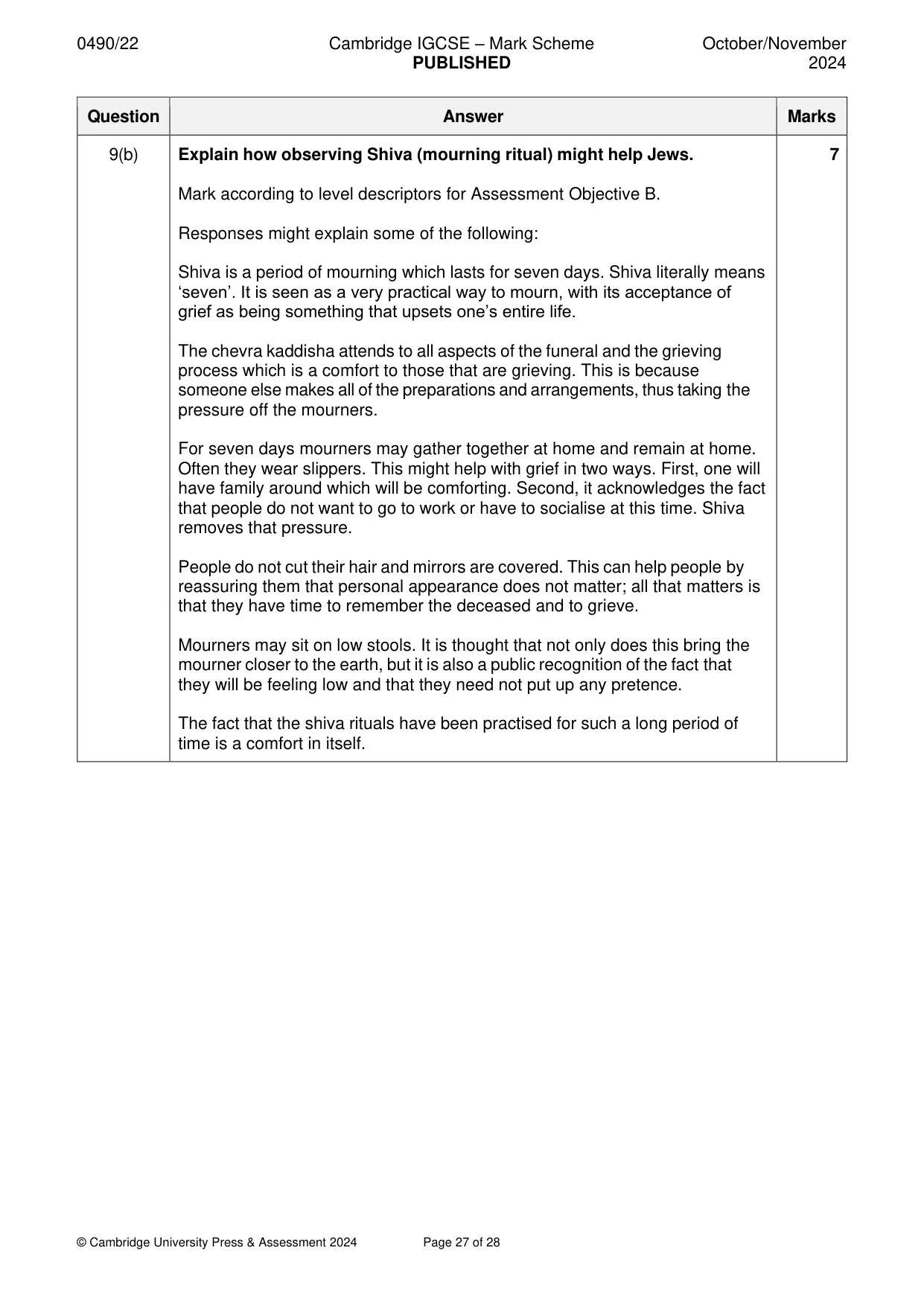
0490/22 Cambridge IGCSE – Mark Scheme PUBLISHED October/November 2024 © Cambridge University Press & Assessment 2024 Page 27 of 28 Question Answer Marks 9(b) Explain how observing Shiva (mourning ritual) might help Jews. Mark according to level descriptors for Assessment Objective B. Responses might explain some of the following: Shiva is a period of mourning which lasts for seven days. Shiva literally means ‘seven’. It is seen as a very practical way to mourn, with its acceptance of grief as being something that upsets one’s entire life. The chevra kaddisha attends to all aspects of the funeral and the grieving process which is a comfort to those that are grieving. This is because someone else makes all of the preparations and arrangements, thus taking the pressure off the mourners. For seven days mourners may gather together at home and remain at home. Often they wear slippers. This might help with grief in two ways. First, one will have family around which will be comforting. Second, it acknowledges the fact that people do not want to go to work or have to socialise at this time. Shiva removes that pressure. People do not cut their hair and mirrors are covered. This can help people by reassuring them that personal appearance does not matter; all that matters is that they have time to remember the deceased and to grieve. Mourners may sit on low stools. It is thought that not only does this bring the mourner closer to the earth, but it is also a public recognition of the fact that they will be feeling low and that they need not put up any pretence. The fact that the shiva rituals have been practised for such a long period of time is a comfort in itself. 7
Mark scheme, page 28
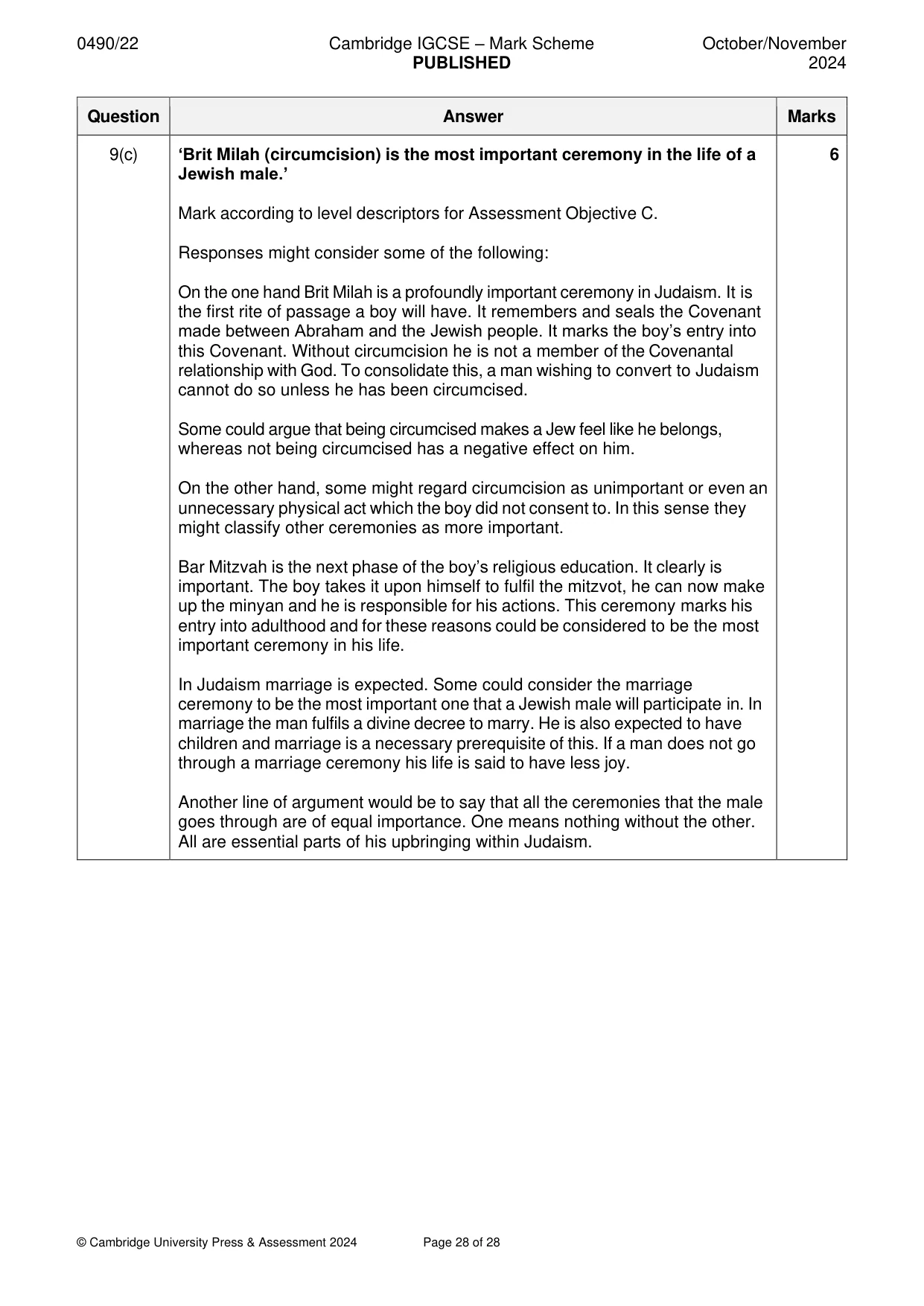
0490/22 Cambridge IGCSE – Mark Scheme PUBLISHED October/November 2024 © Cambridge University Press & Assessment 2024 Page 28 of 28 Question Answer Marks 9(c) ‘Brit Milah (circumcision) is the most important ceremony in the life of a Jewish male.’ Mark according to level descriptors for Assessment Objective C. Responses might consider some of the following: On the one hand Brit Milah is a profoundly important ceremony in Judaism. It is the first rite of passage a boy will have. It remembers and seals the Covenant made between Abraham and the Jewish people. It marks the boy’s entry into this Covenant. Without circumcision he is not a member of the Covenantal relationship with God. To consolidate this, a man wishing to convert to Judaism cannot do so unless he has been circumcised. Some could argue that being circumcised makes a Jew feel like he belongs, whereas not being circumcised has a negative effect on him. On the other hand, some might regard circumcision as unimportant or even an unnecessary physical act which the boy did not consent to. In this sense they might classify other ceremonies as more important. Bar Mitzvah is the next phase of the boy’s religious education. It clearly is important. The boy takes it upon himself to fulfil the mitzvot, he can now make up the minyan and he is responsible for his actions. This ceremony marks his entry into adulthood and for these reasons could be considered to be the most important ceremony in his life. In Judaism marriage is expected. Some could consider the marriage ceremony to be the most important one that a Jewish male will participate in. In marriage the man fulfils a divine decree to marry. He is also expected to have children and marriage is a necessary prerequisite of this. If a man does not go through a marriage ceremony his life is said to have less joy. Another line of argument would be to say that all the ceremonies that the male goes through are of equal importance. One means nothing without the other. All are essential parts of his upbringing within Judaism. 6
What you needed in this session
Cambridge’s own grade thresholds for 2024 Oct/Nov, Paper 2 · Variant 2. A higher threshold means an easier paper — the bar moves with how the cohort did.