Cambridge IGCSE Religious Studies 0490 — 2023 Oct/Nov Paper 2 · Variant 2
0490/22/O/N/23 · 80 marks · ≈90 min
The question paper and its mark scheme, free to read here and free to download. This is Cambridge’s own paper, exactly as it was sat.
Question paper4 pages
Mark scheme30 pages
Answers below. Sit the paper first if you are practising.
Paper as text
Question paper, page 1
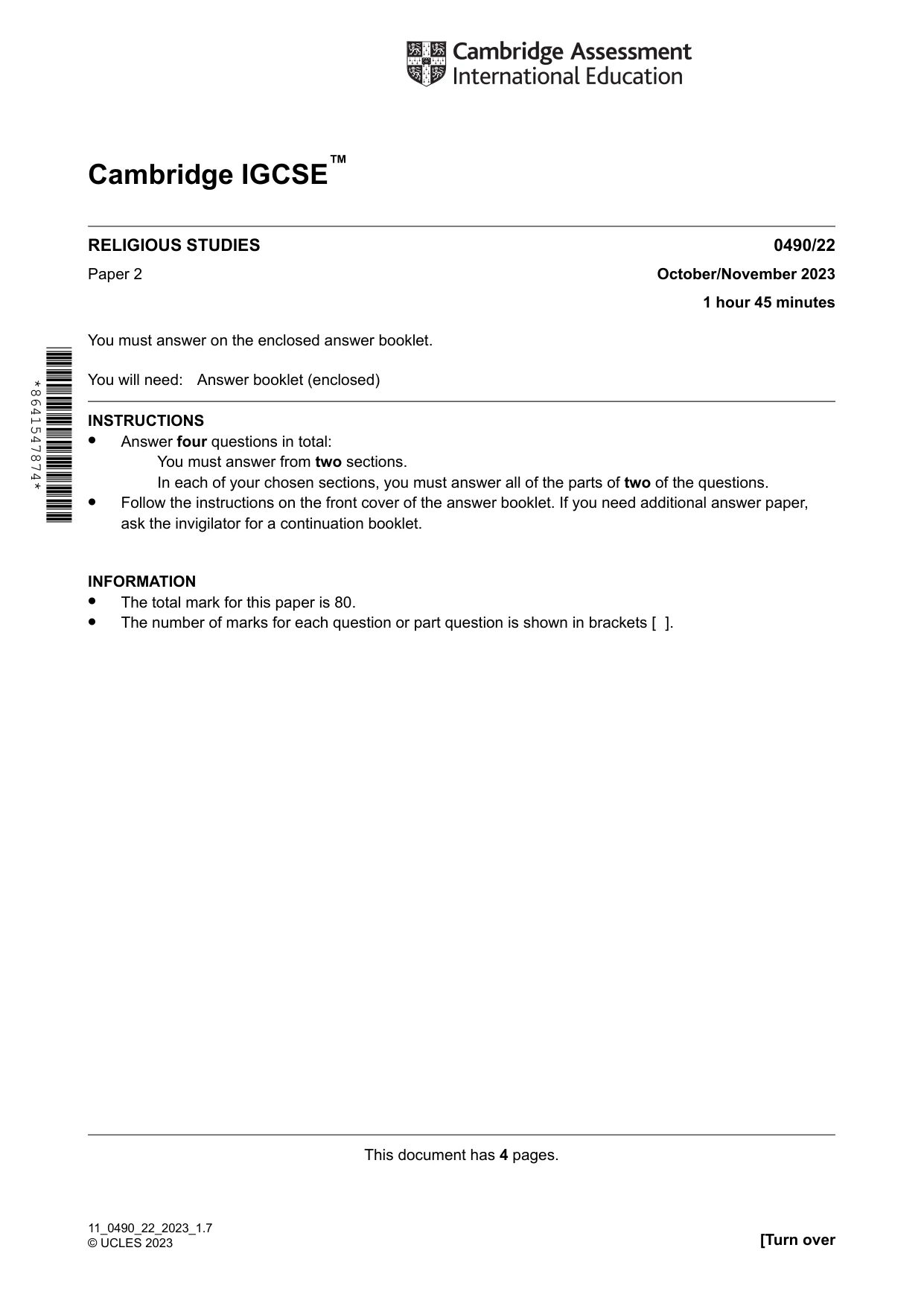
Cambridge IGCSE™ 0490/22 October/November 2023 1 hour 45 minutes RELIGIOUS STUDIES Paper 2 You must answer on the enclosed answer booklet. You will need: Answer booklet (enclosed) INSTRUCTIONS • Answer four questions in total: You must answer from two sections. In each of your chosen sections, you must answer all of the parts of two of the questions. • Follow the instructions on the front cover of the answer booklet. If you need additional answer paper, ask the invigilator for a continuation booklet. INFORMATION • The total mark for this paper is 80. • The number of marks for each question or part question is shown in brackets [ ]. This document has 4 pages. [Turn over 11_0490_22_2023_1.7 © UCLES 2023 *8641547874*
Question paper, page 2
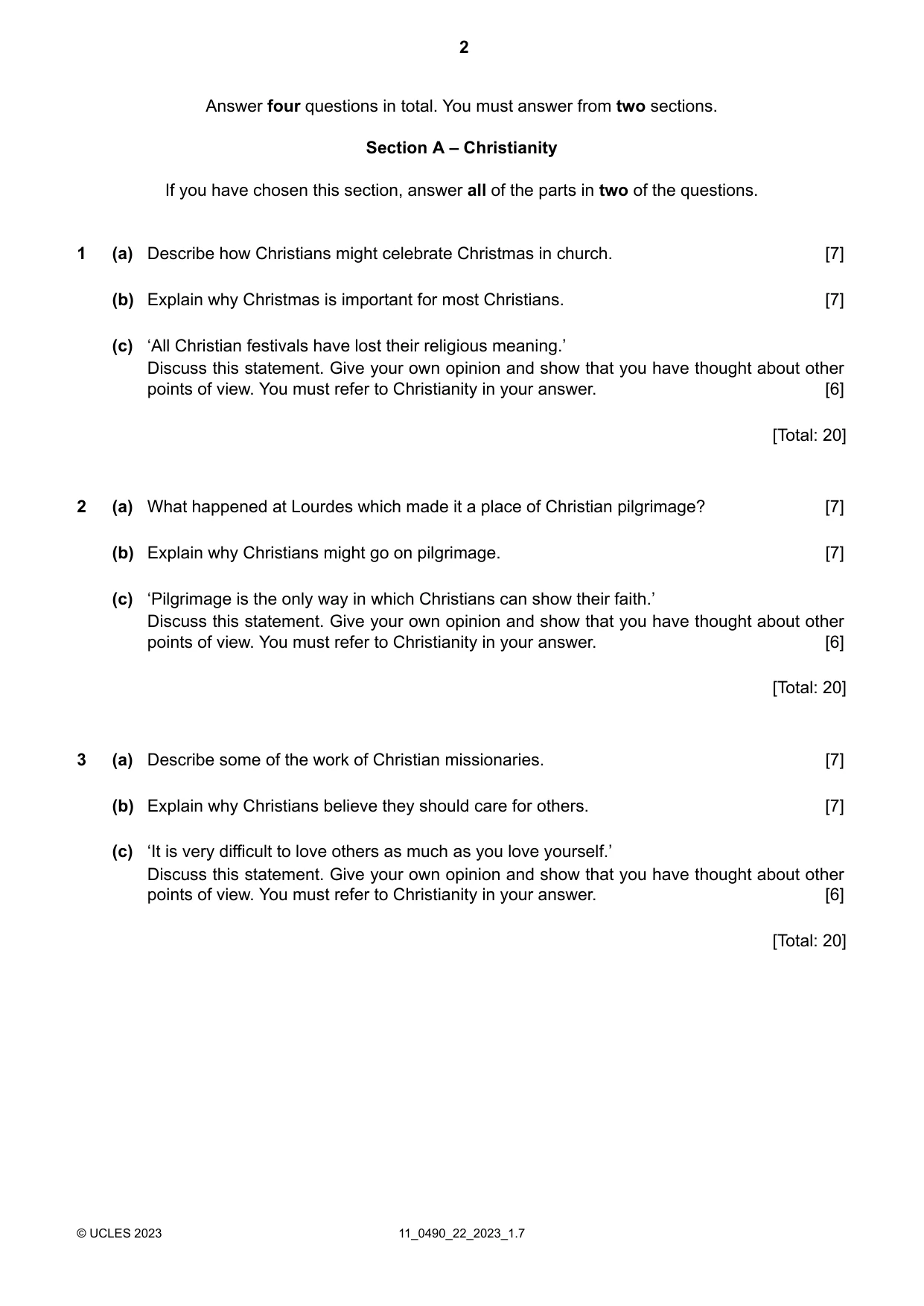
Answer four questions in total. You must answer from two sections. Section A – Christianity If you have chosen this section, answer all of the parts in two of the questions. Describe how Christians might celebrate Christmas in church. [7] (a) 1 Explain why Christmas is important for most Christians. [7] (b) ‘All Christian festivals have lost their religious meaning.’ Discuss this statement. Give your own opinion and show that you have thought about other points of view. You must refer to Christianity in your answer. [6] (c) [Total: 20] What happened at Lourdes which made it a place of Christian pilgrimage? [7] (a) 2 Explain why Christians might go on pilgrimage. [7] (b) ‘Pilgrimage is the only way in which Christians can show their faith.’ Discuss this statement. Give your own opinion and show that you have thought about other points of view. You must refer to Christianity in your answer. [6] (c) [Total: 20] Describe some of the work of Christian missionaries. [7] (a) 3 Explain why Christians believe they should care for others. [7] (b) ‘It is very difficult to love others as much as you love yourself.’ Discuss this statement. Give your own opinion and show that you have thought about other points of view. You must refer to Christianity in your answer. [6] (c) [Total: 20] 11_0490_22_2023_1.7 © UCLES 2023 2
Question paper, page 3
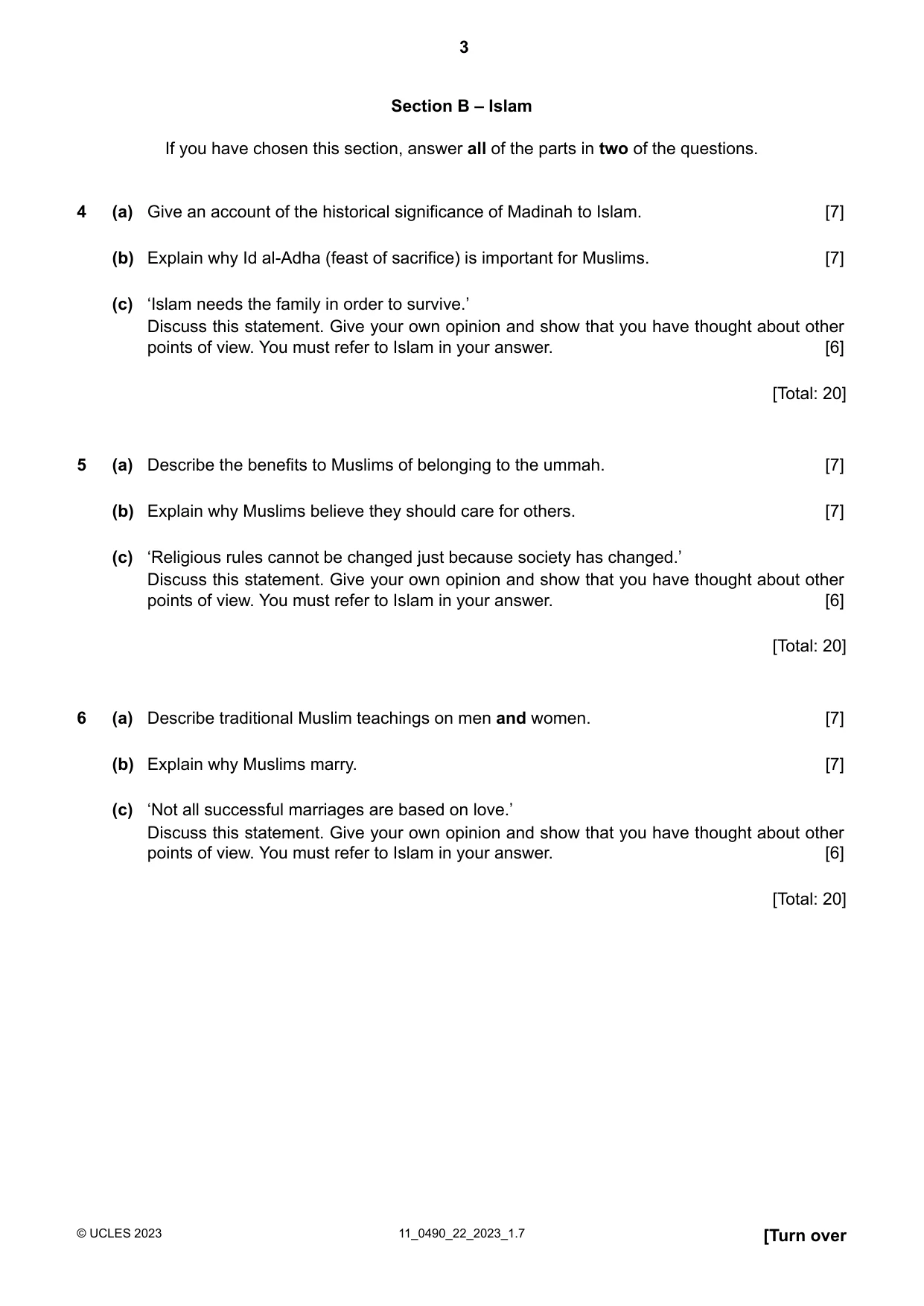
Section B – Islam If you have chosen this section, answer all of the parts in two of the questions. Give an account of the historical significance of Madinah to Islam. [7] (a) 4 Explain why Id al-Adha (feast of sacrifice) is important for Muslims. [7] (b) ‘Islam needs the family in order to survive.’ Discuss this statement. Give your own opinion and show that you have thought about other points of view. You must refer to Islam in your answer. [6] (c) [Total: 20] Describe the benefits to Muslims of belonging to the ummah. [7] (a) 5 Explain why Muslims believe they should care for others. [7] (b) ‘Religious rules cannot be changed just because society has changed.’ Discuss this statement. Give your own opinion and show that you have thought about other points of view. You must refer to Islam in your answer. [6] (c) [Total: 20] Describe traditional Muslim teachings on men and women. [7] (a) 6 Explain why Muslims marry. [7] (b) ‘Not all successful marriages are based on love.’ Discuss this statement. Give your own opinion and show that you have thought about other points of view. You must refer to Islam in your answer. [6] (c) [Total: 20] [Turn over 11_0490_22_2023_1.7 © UCLES 2023 3
Question paper, page 4
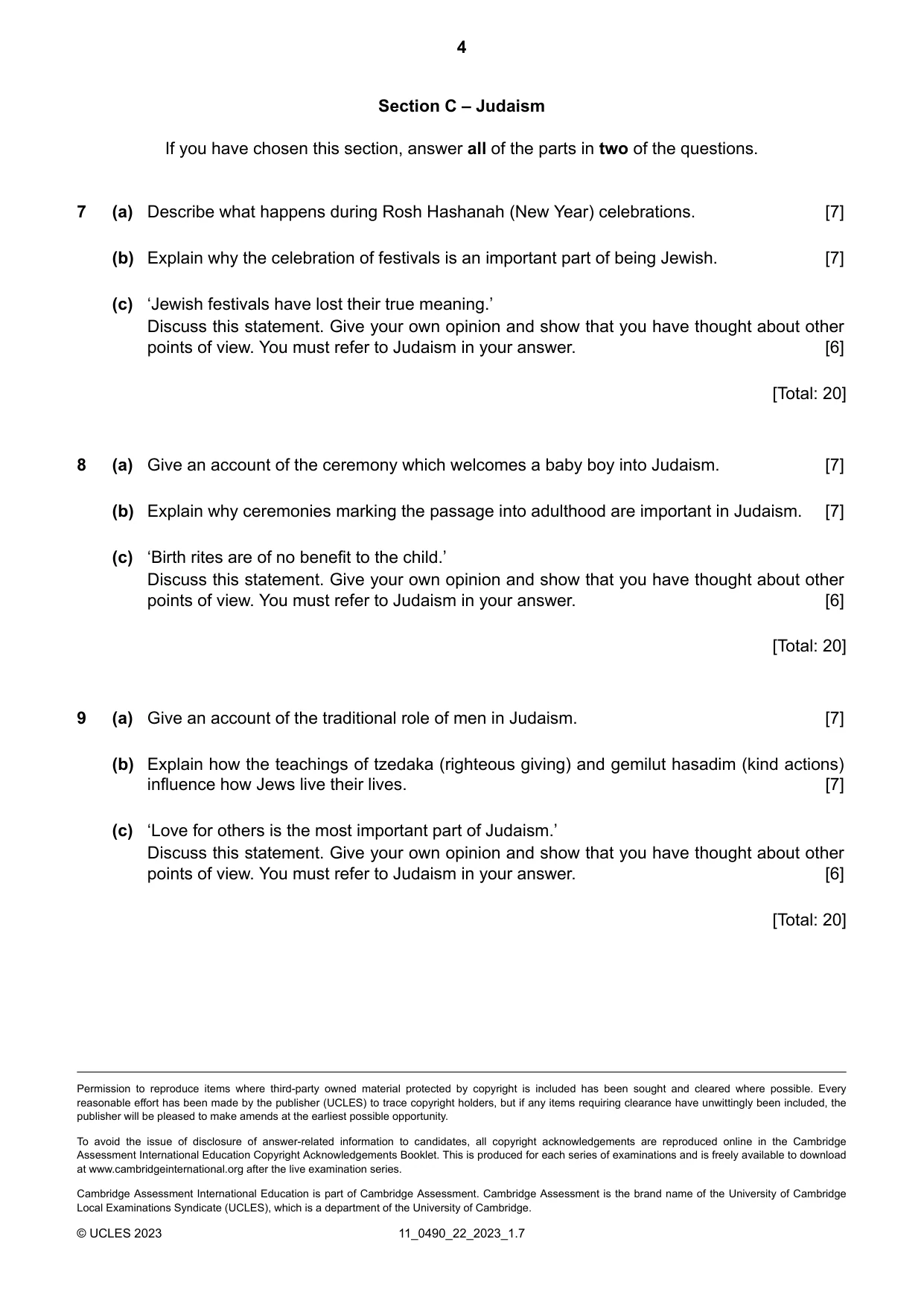
Section C – Judaism If you have chosen this section, answer all of the parts in two of the questions. Describe what happens during Rosh Hashanah (New Year) celebrations. [7] (a) 7 Explain why the celebration of festivals is an important part of being Jewish. [7] (b) ‘Jewish festivals have lost their true meaning.’ Discuss this statement. Give your own opinion and show that you have thought about other points of view. You must refer to Judaism in your answer. [6] (c) [Total: 20] Give an account of the ceremony which welcomes a baby boy into Judaism. [7] (a) 8 Explain why ceremonies marking the passage into adulthood are important in Judaism. [7] (b) ‘Birth rites are of no benefit to the child.’ Discuss this statement. Give your own opinion and show that you have thought about other points of view. You must refer to Judaism in your answer. [6] (c) [Total: 20] Give an account of the traditional role of men in Judaism. [7] (a) 9 Explain how the teachings of tzedaka (righteous giving) and gemilut hasadim (kind actions) influence how Jews live their lives. [7] (b) ‘Love for others is the most important part of Judaism.’ Discuss this statement. Give your own opinion and show that you have thought about other points of view. You must refer to Judaism in your answer. [6] (c) [Total: 20] Permission to reproduce items where third-party owned material protected by copyright is included has been sought and cleared where possible. Every reasonable effort has been made by the publisher (UCLES) to trace copyright holders, but if any items requiring clearance have unwittingly been included, the publisher will be pleased to make amends at the earliest possible opportunity. To avoid the issue of disclosure of answer-related information to candidates, all copyright acknowledgements are reproduced online in the Cambridge Assessment International Education Copyright Acknowledgements Booklet. This is produced for each series of examinations and is freely available to download at www.cambridgeinternational.org after the live examination series. Cambridge Assessment International Education is part of Cambridge Assessment. Cambridge Assessment is the brand name of the University of Cambridge Local Examinations Syndicate (UCLES), which is a department of the University of Cambridge. 11_0490_22_2023_1.7 © UCLES 2023 4
Mark scheme, page 1
This document consists of 30 printed pages. © UCLES 2023 [Turn over Cambridge IGCSE™ RELIGIOUS STUDIES 0490/22 Paper 2 October/November 2023 MARK SCHEME Maximum Mark: 80 Published This mark scheme is published as an aid to teachers and candidates, to indicate the requirements of the examination. It shows the basis on which Examiners were instructed to award marks. It does not indicate the details of the discussions that took place at an Examiners’ meeting before marking began, which would have considered the acceptability of alternative answers. Mark schemes should be read in conjunction with the question paper and the Principal Examiner Report for Teachers. Cambridge International will not enter into discussions about these mark schemes. Cambridge International is publishing the mark schemes for the October/November 2023 series for most Cambridge IGCSE, Cambridge International A and AS Level components, and some Cambridge O Level components.
Mark scheme, page 2
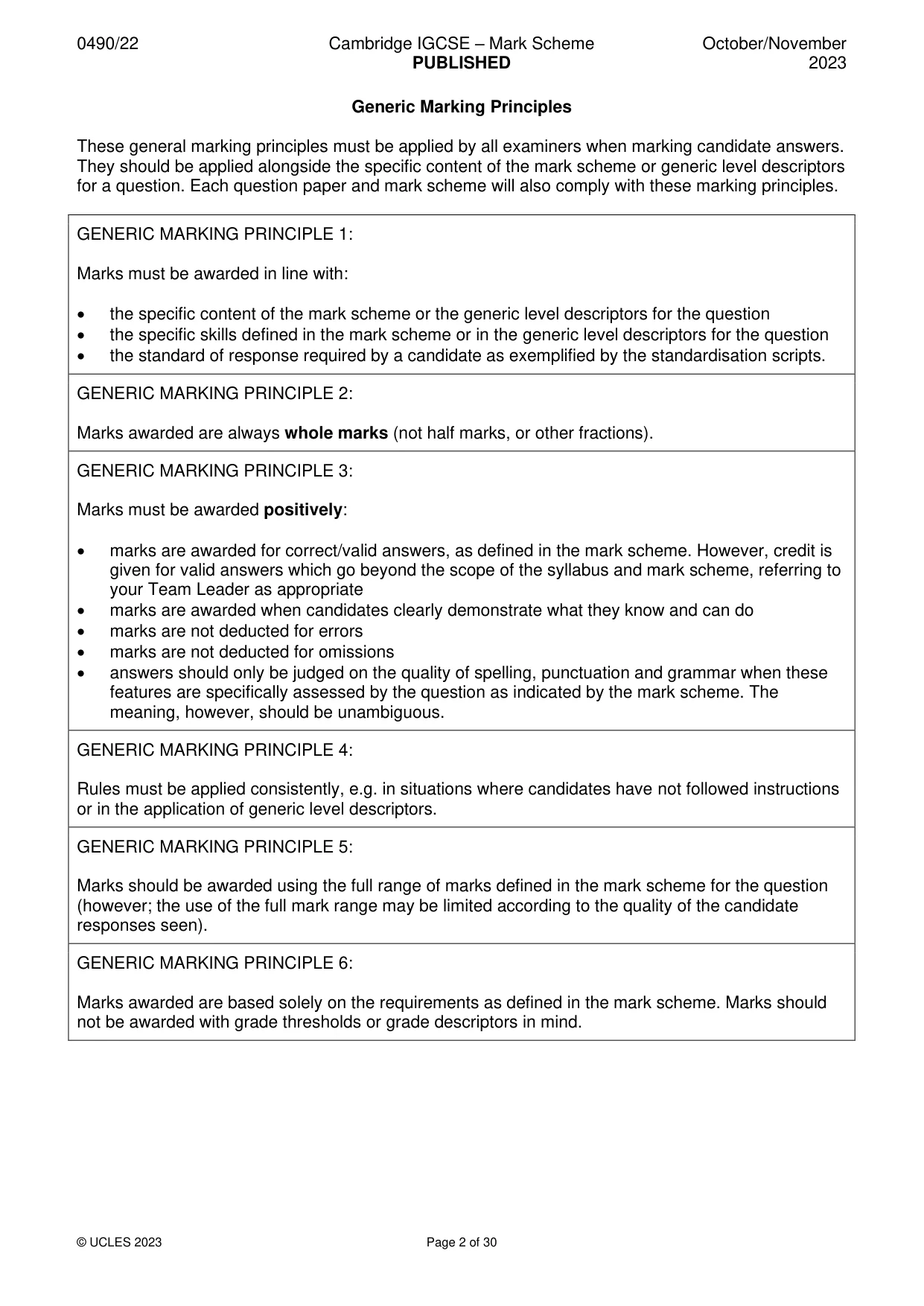
0490/22 Cambridge IGCSE – Mark Scheme PUBLISHED October/November 2023 © UCLES 2023 Page 2 of 30 Generic Marking Principles These general marking principles must be applied by all examiners when marking candidate answers. They should be applied alongside the specific content of the mark scheme or generic level descriptors for a question. Each question paper and mark scheme will also comply with these marking principles. GENERIC MARKING PRINCIPLE 1: Marks must be awarded in line with: • the specific content of the mark scheme or the generic level descriptors for the question • the specific skills defined in the mark scheme or in the generic level descriptors for the question • the standard of response required by a candidate as exemplified by the standardisation scripts. GENERIC MARKING PRINCIPLE 2: Marks awarded are always whole marks (not half marks, or other fractions). GENERIC MARKING PRINCIPLE 3: Marks must be awarded positively: • marks are awarded for correct/valid answers, as defined in the mark scheme. However, credit is given for valid answers which go beyond the scope of the syllabus and mark scheme, referring to your Team Leader as appropriate • marks are awarded when candidates clearly demonstrate what they know and can do • marks are not deducted for errors • marks are not deducted for omissions • answers should only be judged on the quality of spelling, punctuation and grammar when these features are specifically assessed by the question as indicated by the mark scheme. The meaning, however, should be unambiguous. GENERIC MARKING PRINCIPLE 4: Rules must be applied consistently, e.g. in situations where candidates have not followed instructions or in the application of generic level descriptors. GENERIC MARKING PRINCIPLE 5: Marks should be awarded using the full range of marks defined in the mark scheme for the question (however; the use of the full mark range may be limited according to the quality of the candidate responses seen). GENERIC MARKING PRINCIPLE 6: Marks awarded are based solely on the requirements as defined in the mark scheme. Marks should not be awarded with grade thresholds or grade descriptors in mind.
Mark scheme, page 3
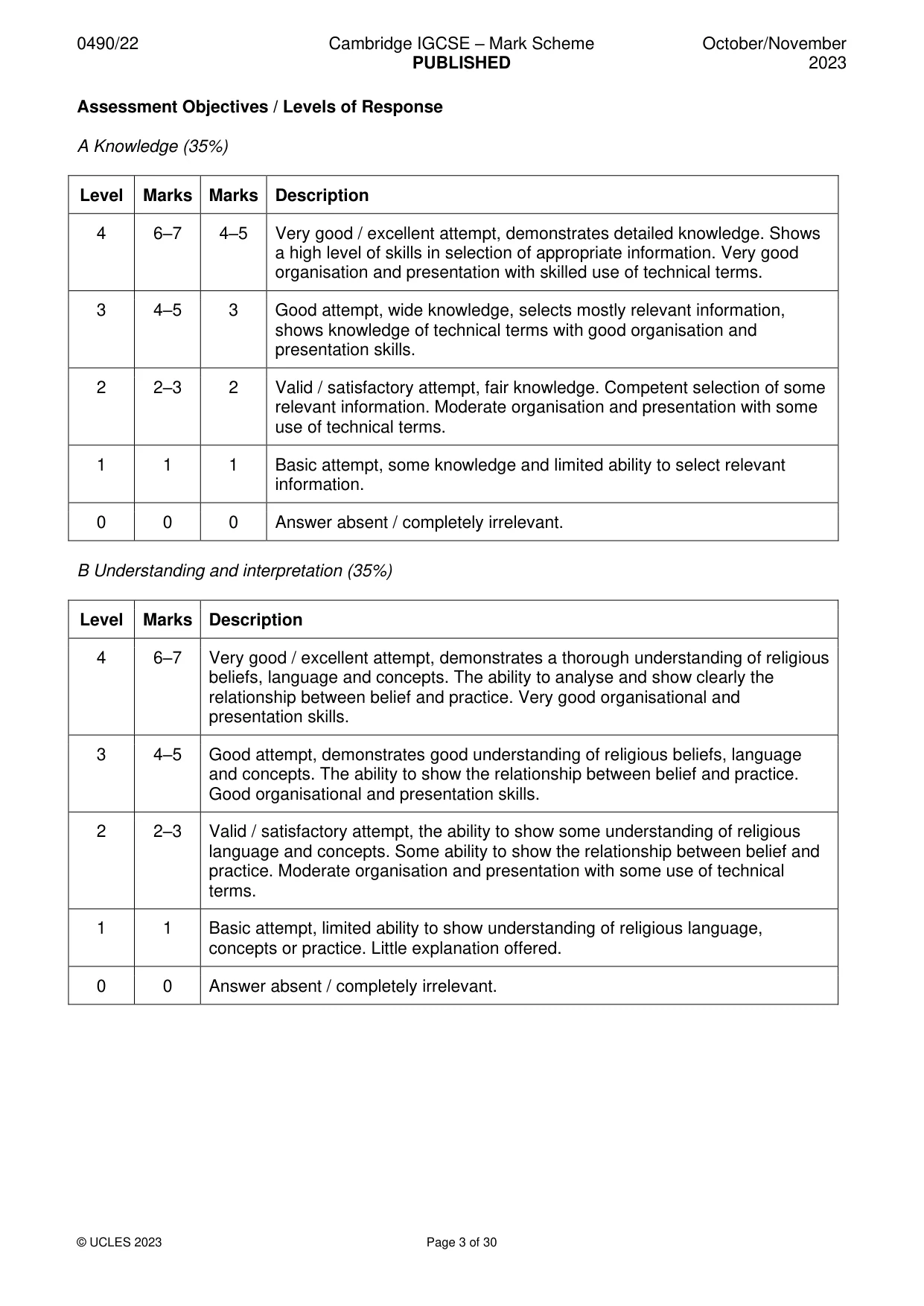
0490/22 Cambridge IGCSE – Mark Scheme PUBLISHED October/November 2023 © UCLES 2023 Page 3 of 30 Assessment Objectives / Levels of Response A Knowledge (35%) Level Marks Marks Description 4 6–7 4–5 Very good / excellent attempt, demonstrates detailed knowledge. Shows a high level of skills in selection of appropriate information. Very good organisation and presentation with skilled use of technical terms. 3 4–5 3 Good attempt, wide knowledge, selects mostly relevant information, shows knowledge of technical terms with good organisation and presentation skills. 2 2–3 2 Valid / satisfactory attempt, fair knowledge. Competent selection of some relevant information. Moderate organisation and presentation with some use of technical terms. 1 1 1 Basic attempt, some knowledge and limited ability to select relevant information. 0 0 0 Answer absent / completely irrelevant. B Understanding and interpretation (35%) Level Marks Description 4 6–7 Very good / excellent attempt, demonstrates a thorough understanding of religious beliefs, language and concepts. The ability to analyse and show clearly the relationship between belief and practice. Very good organisational and presentation skills. 3 4–5 Good attempt, demonstrates good understanding of religious beliefs, language and concepts. The ability to show the relationship between belief and practice. Good organisational and presentation skills. 2 2–3 Valid / satisfactory attempt, the ability to show some understanding of religious language and concepts. Some ability to show the relationship between belief and practice. Moderate organisation and presentation with some use of technical terms. 1 1 Basic attempt, limited ability to show understanding of religious language, concepts or practice. Little explanation offered. 0 0 Answer absent / completely irrelevant.
Mark scheme, page 4
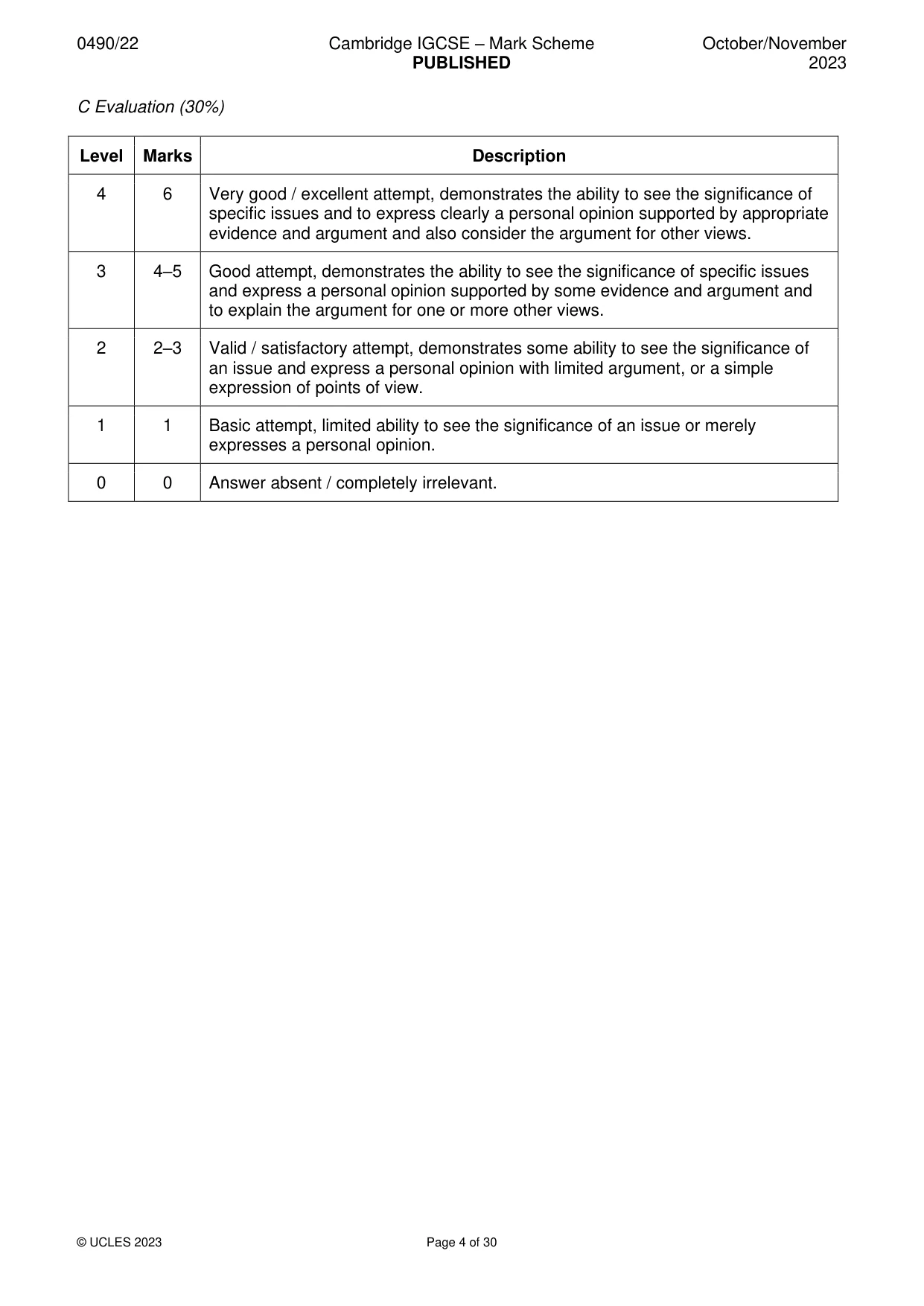
0490/22 Cambridge IGCSE – Mark Scheme PUBLISHED October/November 2023 © UCLES 2023 Page 4 of 30 C Evaluation (30%) Level Marks Description 4 6 Very good / excellent attempt, demonstrates the ability to see the significance of specific issues and to express clearly a personal opinion supported by appropriate evidence and argument and also consider the argument for other views. 3 4–5 Good attempt, demonstrates the ability to see the significance of specific issues and express a personal opinion supported by some evidence and argument and to explain the argument for one or more other views. 2 2–3 Valid / satisfactory attempt, demonstrates some ability to see the significance of an issue and express a personal opinion with limited argument, or a simple expression of points of view. 1 1 Basic attempt, limited ability to see the significance of an issue or merely expresses a personal opinion. 0 0 Answer absent / completely irrelevant.
Mark scheme, page 5
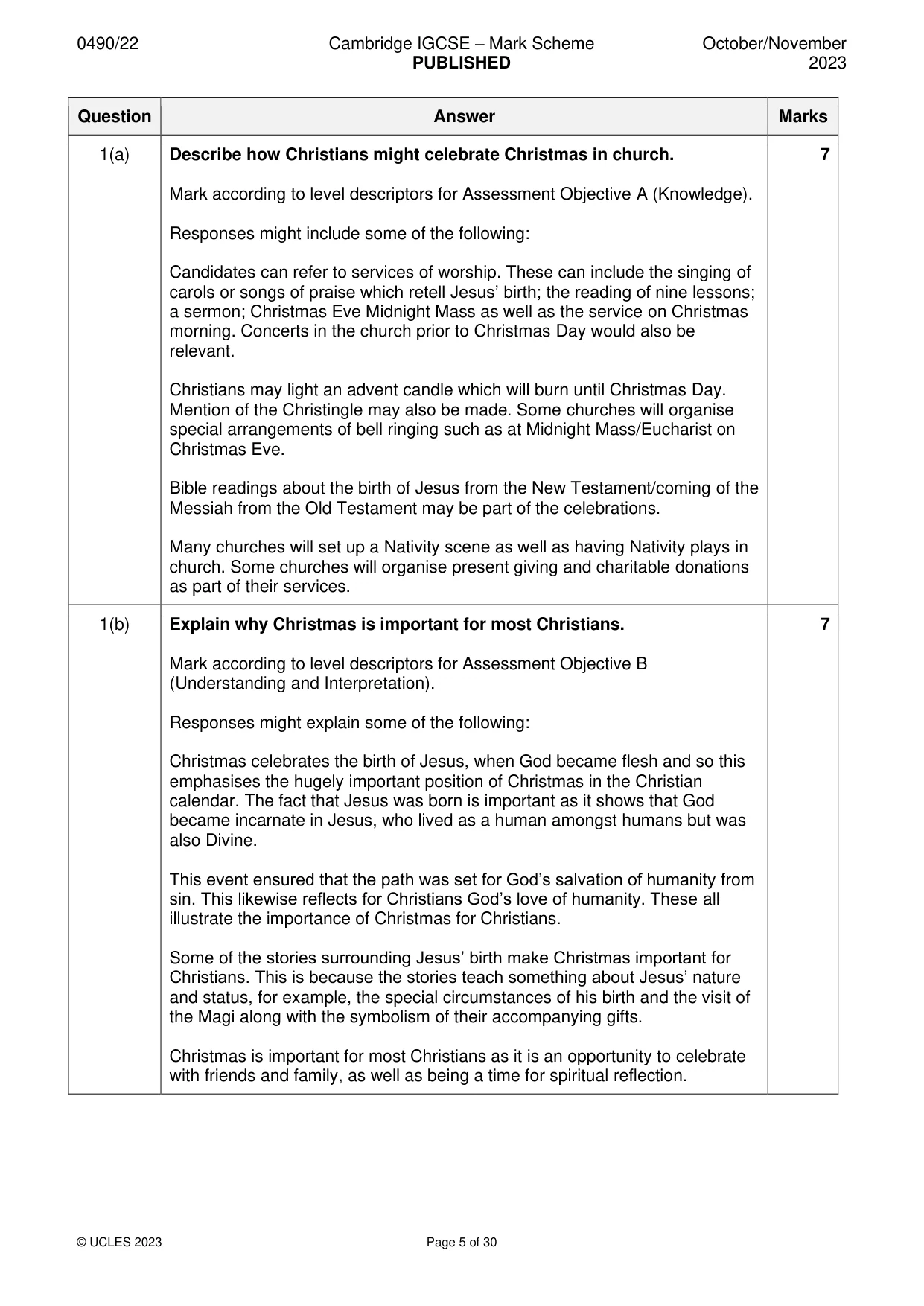
0490/22 Cambridge IGCSE – Mark Scheme PUBLISHED October/November 2023 © UCLES 2023 Page 5 of 30 Question Answer Marks 1(a) Describe how Christians might celebrate Christmas in church. Mark according to level descriptors for Assessment Objective A (Knowledge). Responses might include some of the following: Candidates can refer to services of worship. These can include the singing of carols or songs of praise which retell Jesus’ birth; the reading of nine lessons; a sermon; Christmas Eve Midnight Mass as well as the service on Christmas morning. Concerts in the church prior to Christmas Day would also be relevant. Christians may light an advent candle which will burn until Christmas Day. Mention of the Christingle may also be made. Some churches will organise special arrangements of bell ringing such as at Midnight Mass/Eucharist on Christmas Eve. Bible readings about the birth of Jesus from the New Testament/coming of the Messiah from the Old Testament may be part of the celebrations. Many churches will set up a Nativity scene as well as having Nativity plays in church. Some churches will organise present giving and charitable donations as part of their services. 7 1(b) Explain why Christmas is important for most Christians. Mark according to level descriptors for Assessment Objective B (Understanding and Interpretation). Responses might explain some of the following: Christmas celebrates the birth of Jesus, when God became flesh and so this emphasises the hugely important position of Christmas in the Christian calendar. The fact that Jesus was born is important as it shows that God became incarnate in Jesus, who lived as a human amongst humans but was also Divine. This event ensured that the path was set for God’s salvation of humanity from sin. This likewise reflects for Christians God’s love of humanity. These all illustrate the importance of Christmas for Christians. Some of the stories surrounding Jesus’ birth make Christmas important for Christians. This is because the stories teach something about Jesus’ nature and status, for example, the special circumstances of his birth and the visit of the Magi along with the symbolism of their accompanying gifts. Christmas is important for most Christians as it is an opportunity to celebrate with friends and family, as well as being a time for spiritual reflection. 7
Mark scheme, page 6
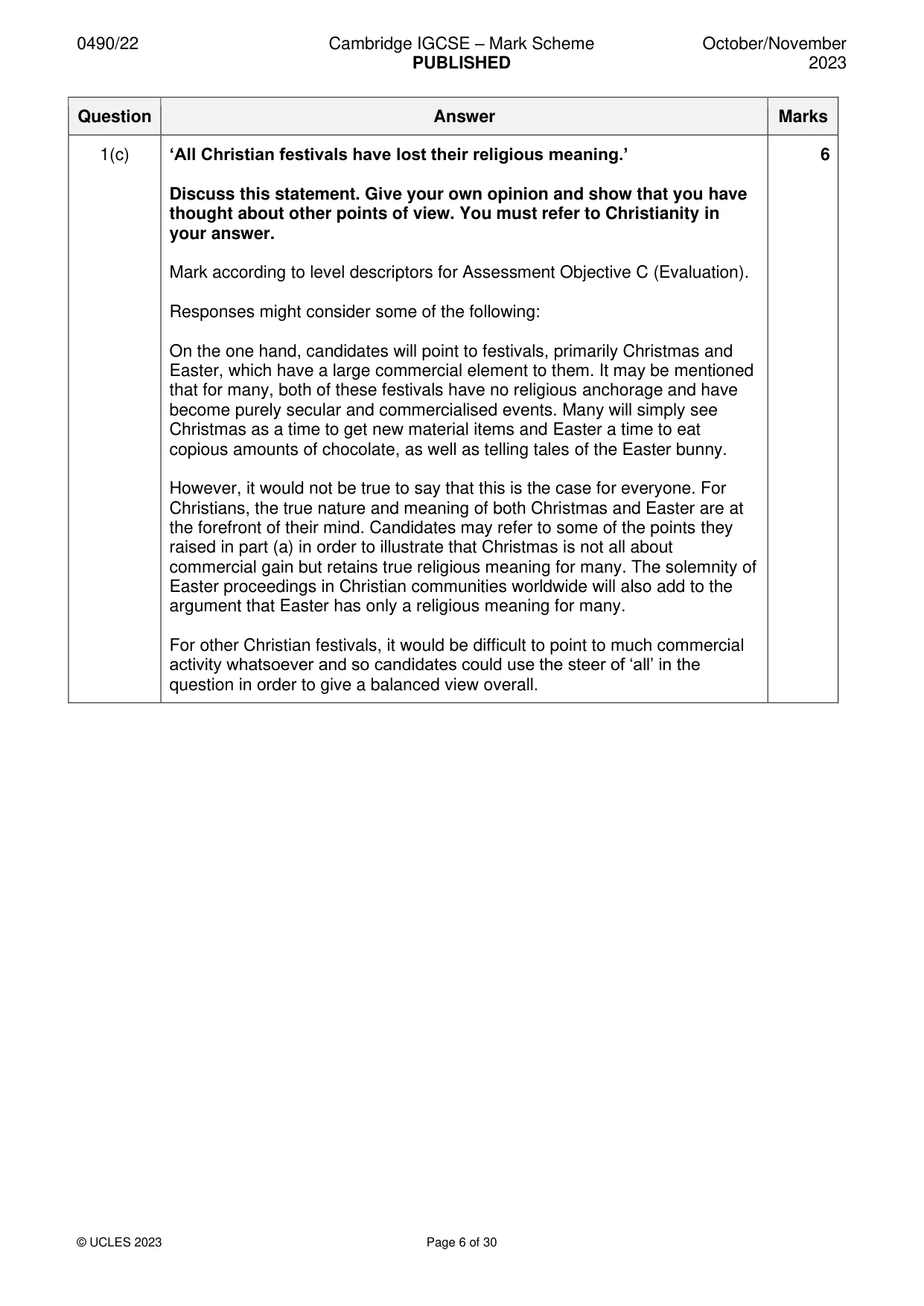
0490/22 Cambridge IGCSE – Mark Scheme PUBLISHED October/November 2023 © UCLES 2023 Page 6 of 30 Question Answer Marks 1(c) ‘All Christian festivals have lost their religious meaning.’ Discuss this statement. Give your own opinion and show that you have thought about other points of view. You must refer to Christianity in your answer. Mark according to level descriptors for Assessment Objective C (Evaluation). Responses might consider some of the following: On the one hand, candidates will point to festivals, primarily Christmas and Easter, which have a large commercial element to them. It may be mentioned that for many, both of these festivals have no religious anchorage and have become purely secular and commercialised events. Many will simply see Christmas as a time to get new material items and Easter a time to eat copious amounts of chocolate, as well as telling tales of the Easter bunny. However, it would not be true to say that this is the case for everyone. For Christians, the true nature and meaning of both Christmas and Easter are at the forefront of their mind. Candidates may refer to some of the points they raised in part (a) in order to illustrate that Christmas is not all about commercial gain but retains true religious meaning for many. The solemnity of Easter proceedings in Christian communities worldwide will also add to the argument that Easter has only a religious meaning for many. For other Christian festivals, it would be difficult to point to much commercial activity whatsoever and so candidates could use the steer of ‘all’ in the question in order to give a balanced view overall. 6
Mark scheme, page 7
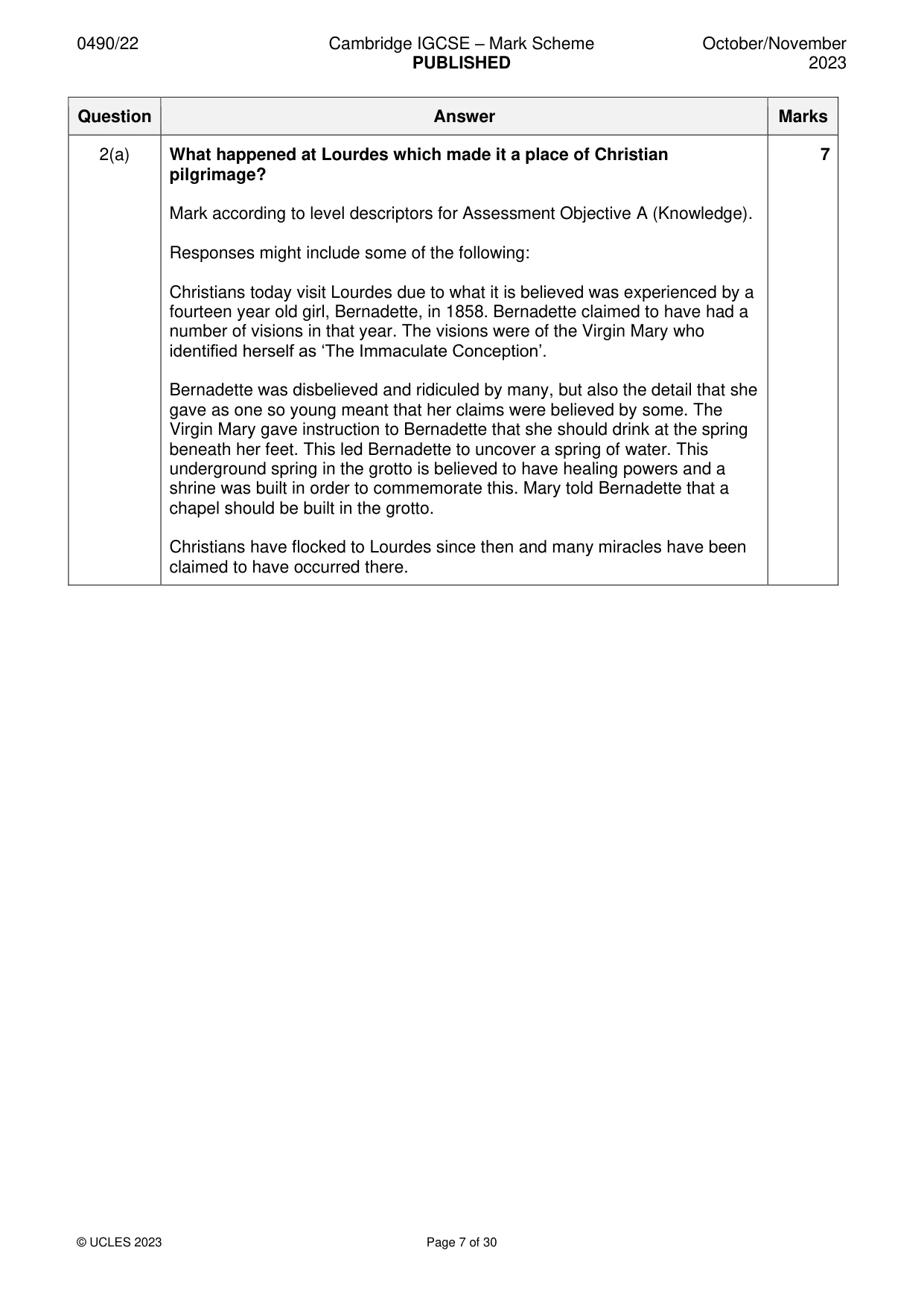
0490/22 Cambridge IGCSE – Mark Scheme PUBLISHED October/November 2023 © UCLES 2023 Page 7 of 30 Question Answer Marks 2(a) What happened at Lourdes which made it a place of Christian pilgrimage? Mark according to level descriptors for Assessment Objective A (Knowledge). Responses might include some of the following: Christians today visit Lourdes due to what it is believed was experienced by a fourteen year old girl, Bernadette, in 1858. Bernadette claimed to have had a number of visions in that year. The visions were of the Virgin Mary who identified herself as ‘The Immaculate Conception’. Bernadette was disbelieved and ridiculed by many, but also the detail that she gave as one so young meant that her claims were believed by some. The Virgin Mary gave instruction to Bernadette that she should drink at the spring beneath her feet. This led Bernadette to uncover a spring of water. This underground spring in the grotto is believed to have healing powers and a shrine was built in order to commemorate this. Mary told Bernadette that a chapel should be built in the grotto. Christians have flocked to Lourdes since then and many miracles have been claimed to have occurred there. 7
Mark scheme, page 8
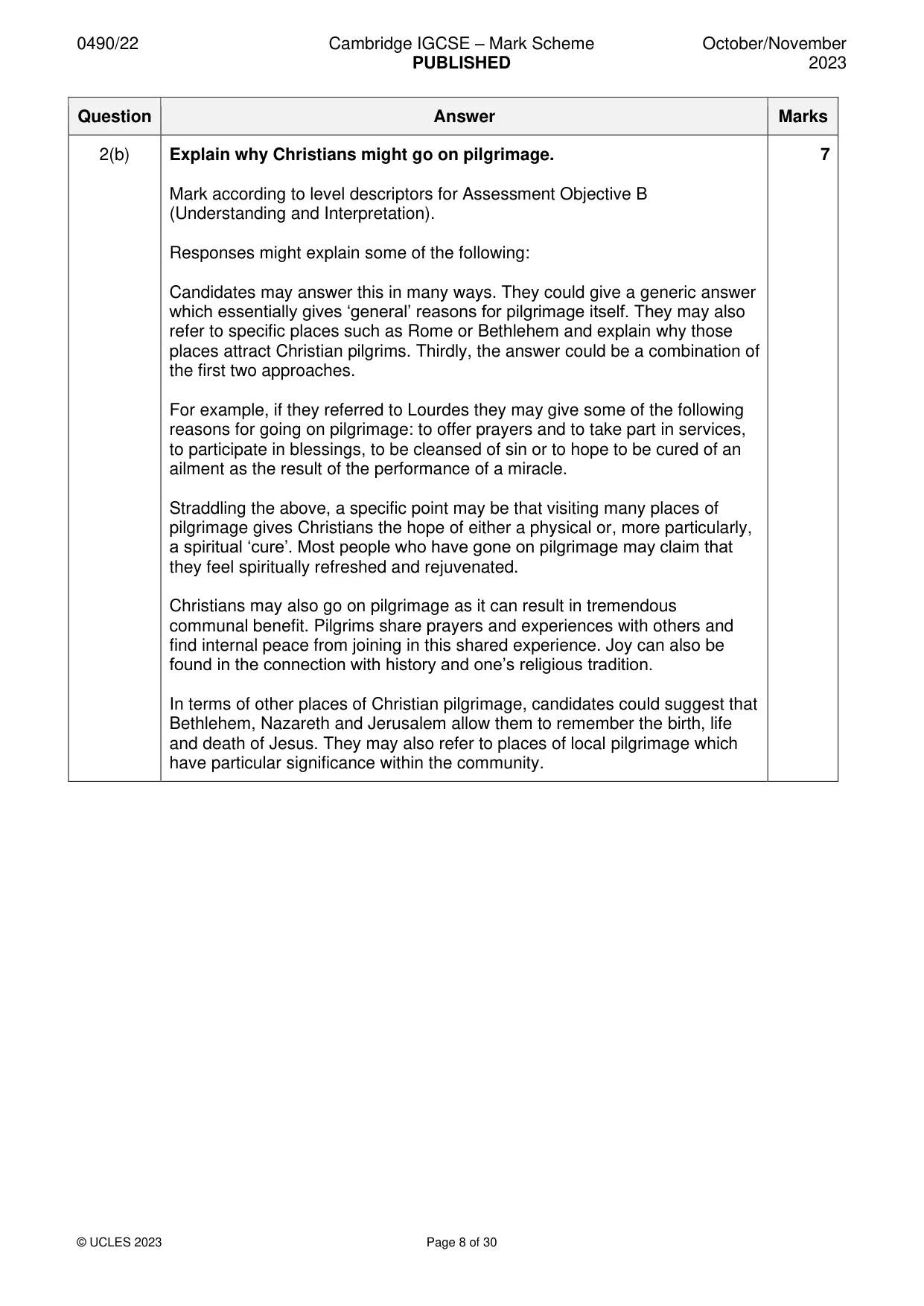
0490/22 Cambridge IGCSE – Mark Scheme PUBLISHED October/November 2023 © UCLES 2023 Page 8 of 30 Question Answer Marks 2(b) Explain why Christians might go on pilgrimage. Mark according to level descriptors for Assessment Objective B (Understanding and Interpretation). Responses might explain some of the following: Candidates may answer this in many ways. They could give a generic answer which essentially gives ‘general’ reasons for pilgrimage itself. They may also refer to specific places such as Rome or Bethlehem and explain why those places attract Christian pilgrims. Thirdly, the answer could be a combination of the first two approaches. For example, if they referred to Lourdes they may give some of the following reasons for going on pilgrimage: to offer prayers and to take part in services, to participate in blessings, to be cleansed of sin or to hope to be cured of an ailment as the result of the performance of a miracle. Straddling the above, a specific point may be that visiting many places of pilgrimage gives Christians the hope of either a physical or, more particularly, a spiritual ‘cure’. Most people who have gone on pilgrimage may claim that they feel spiritually refreshed and rejuvenated. Christians may also go on pilgrimage as it can result in tremendous communal benefit. Pilgrims share prayers and experiences with others and find internal peace from joining in this shared experience. Joy can also be found in the connection with history and one’s religious tradition. In terms of other places of Christian pilgrimage, candidates could suggest that Bethlehem, Nazareth and Jerusalem allow them to remember the birth, life and death of Jesus. They may also refer to places of local pilgrimage which have particular significance within the community. 7
Mark scheme, page 9
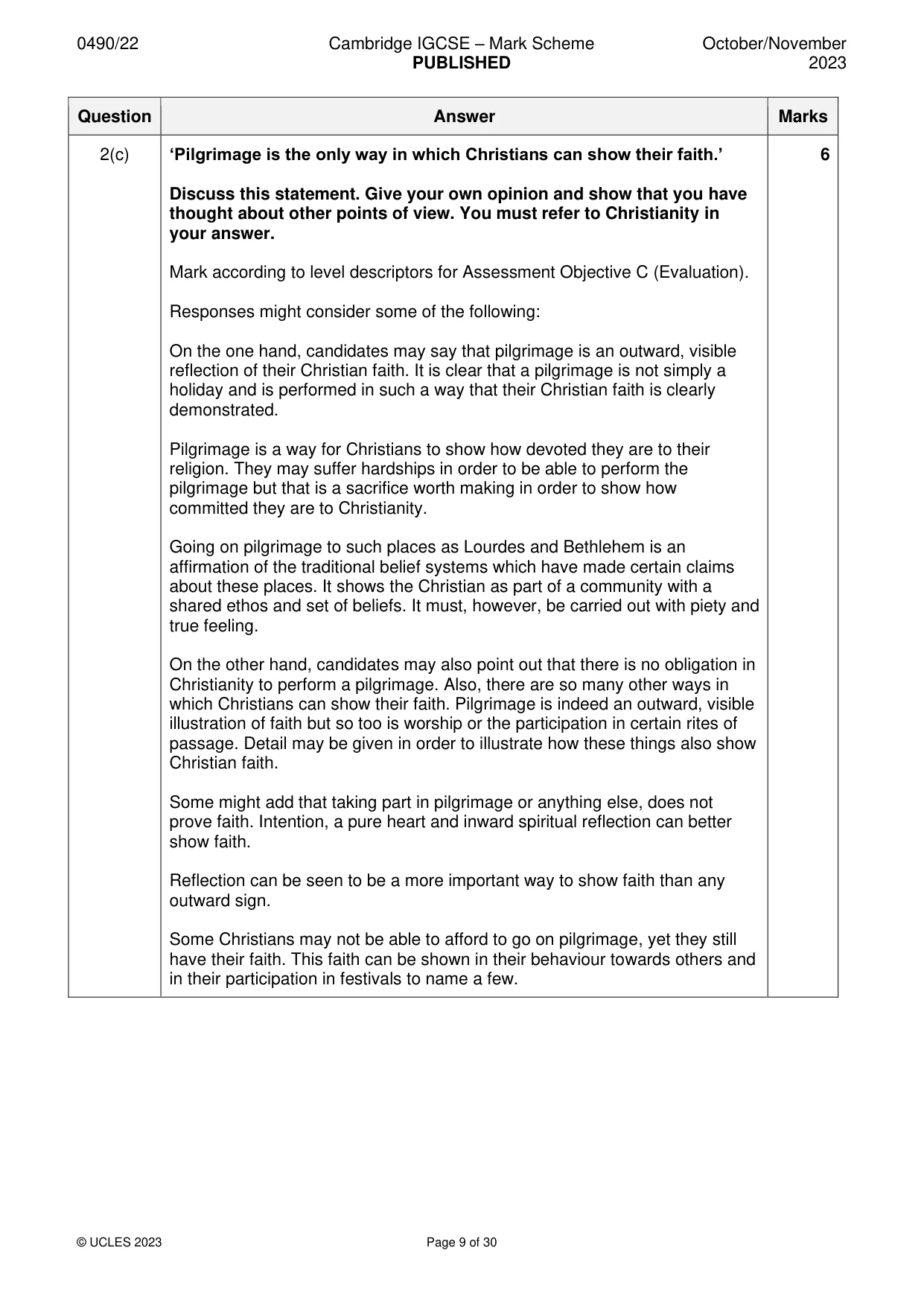
0490/22 Cambridge IGCSE – Mark Scheme PUBLISHED October/November 2023 © UCLES 2023 Page 9 of 30 Question Answer Marks 2(c) ‘Pilgrimage is the only way in which Christians can show their faith.’ Discuss this statement. Give your own opinion and show that you have thought about other points of view. You must refer to Christianity in your answer. Mark according to level descriptors for Assessment Objective C (Evaluation). Responses might consider some of the following: On the one hand, candidates may say that pilgrimage is an outward, visible reflection of their Christian faith. It is clear that a pilgrimage is not simply a holiday and is performed in such a way that their Christian faith is clearly demonstrated. Pilgrimage is a way for Christians to show how devoted they are to their religion. They may suffer hardships in order to be able to perform the pilgrimage but that is a sacrifice worth making in order to show how committed they are to Christianity. Going on pilgrimage to such places as Lourdes and Bethlehem is an affirmation of the traditional belief systems which have made certain claims about these places. It shows the Christian as part of a community with a shared ethos and set of beliefs. It must, however, be carried out with piety and true feeling. On the other hand, candidates may also point out that there is no obligation in Christianity to perform a pilgrimage. Also, there are so many other ways in which Christians can show their faith. Pilgrimage is indeed an outward, visible illustration of faith but so too is worship or the participation in certain rites of passage. Detail may be given in order to illustrate how these things also show Christian faith. Some might add that taking part in pilgrimage or anything else, does not prove faith. Intention, a pure heart and inward spiritual reflection can better show faith. Reflection can be seen to be a more important way to show faith than any outward sign. Some Christians may not be able to afford to go on pilgrimage, yet they still have their faith. This faith can be shown in their behaviour towards others and in their participation in festivals to name a few. 6
Mark scheme, page 10
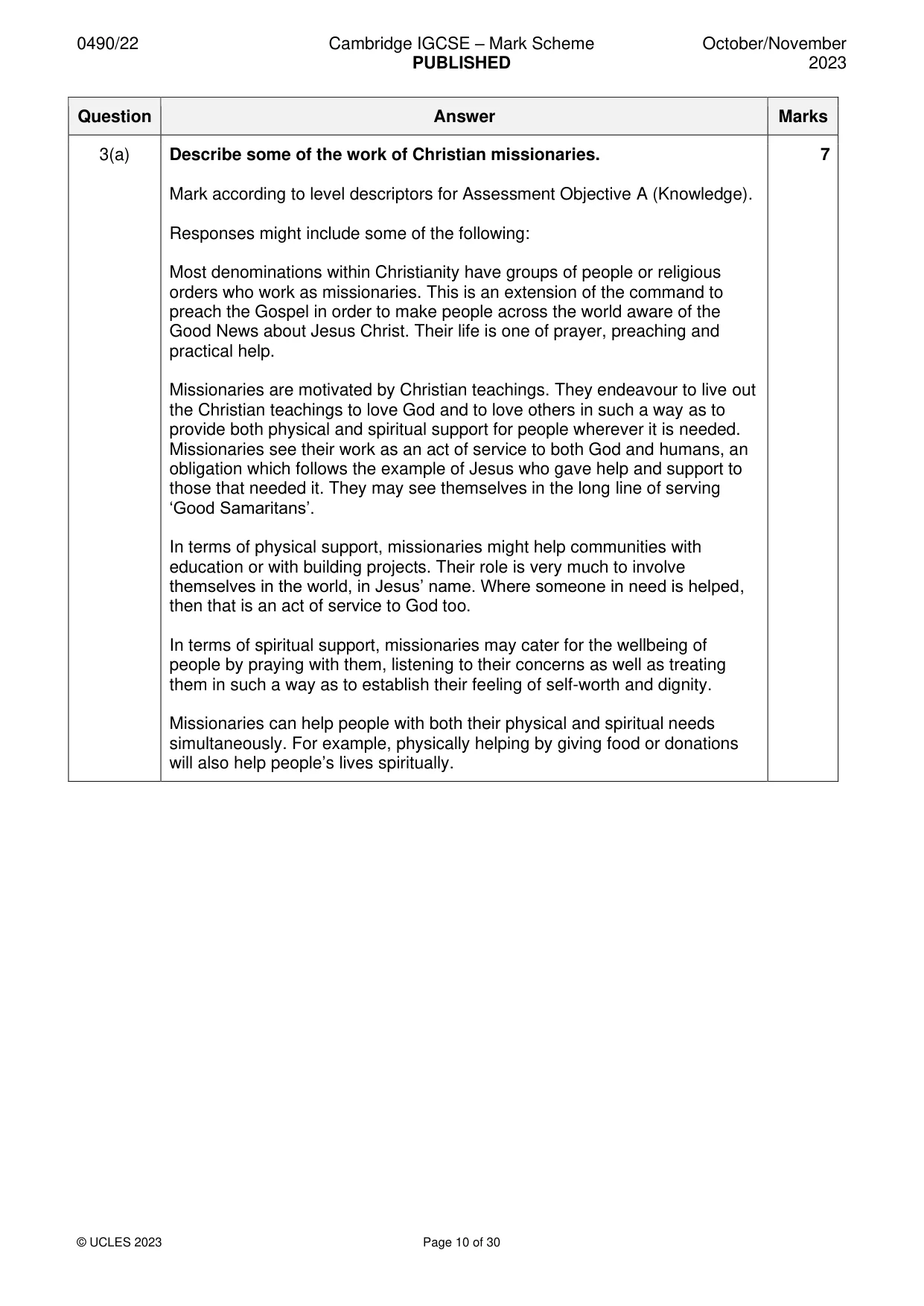
0490/22 Cambridge IGCSE – Mark Scheme PUBLISHED October/November 2023 © UCLES 2023 Page 10 of 30 Question Answer Marks 3(a) Describe some of the work of Christian missionaries. Mark according to level descriptors for Assessment Objective A (Knowledge). Responses might include some of the following: Most denominations within Christianity have groups of people or religious orders who work as missionaries. This is an extension of the command to preach the Gospel in order to make people across the world aware of the Good News about Jesus Christ. Their life is one of prayer, preaching and practical help. Missionaries are motivated by Christian teachings. They endeavour to live out the Christian teachings to love God and to love others in such a way as to provide both physical and spiritual support for people wherever it is needed. Missionaries see their work as an act of service to both God and humans, an obligation which follows the example of Jesus who gave help and support to those that needed it. They may see themselves in the long line of serving ‘Good Samaritans’. In terms of physical support, missionaries might help communities with education or with building projects. Their role is very much to involve themselves in the world, in Jesus’ name. Where someone in need is helped, then that is an act of service to God too. In terms of spiritual support, missionaries may cater for the wellbeing of people by praying with them, listening to their concerns as well as treating them in such a way as to establish their feeling of self-worth and dignity. Missionaries can help people with both their physical and spiritual needs simultaneously. For example, physically helping by giving food or donations will also help people’s lives spiritually. 7
Mark scheme, page 11
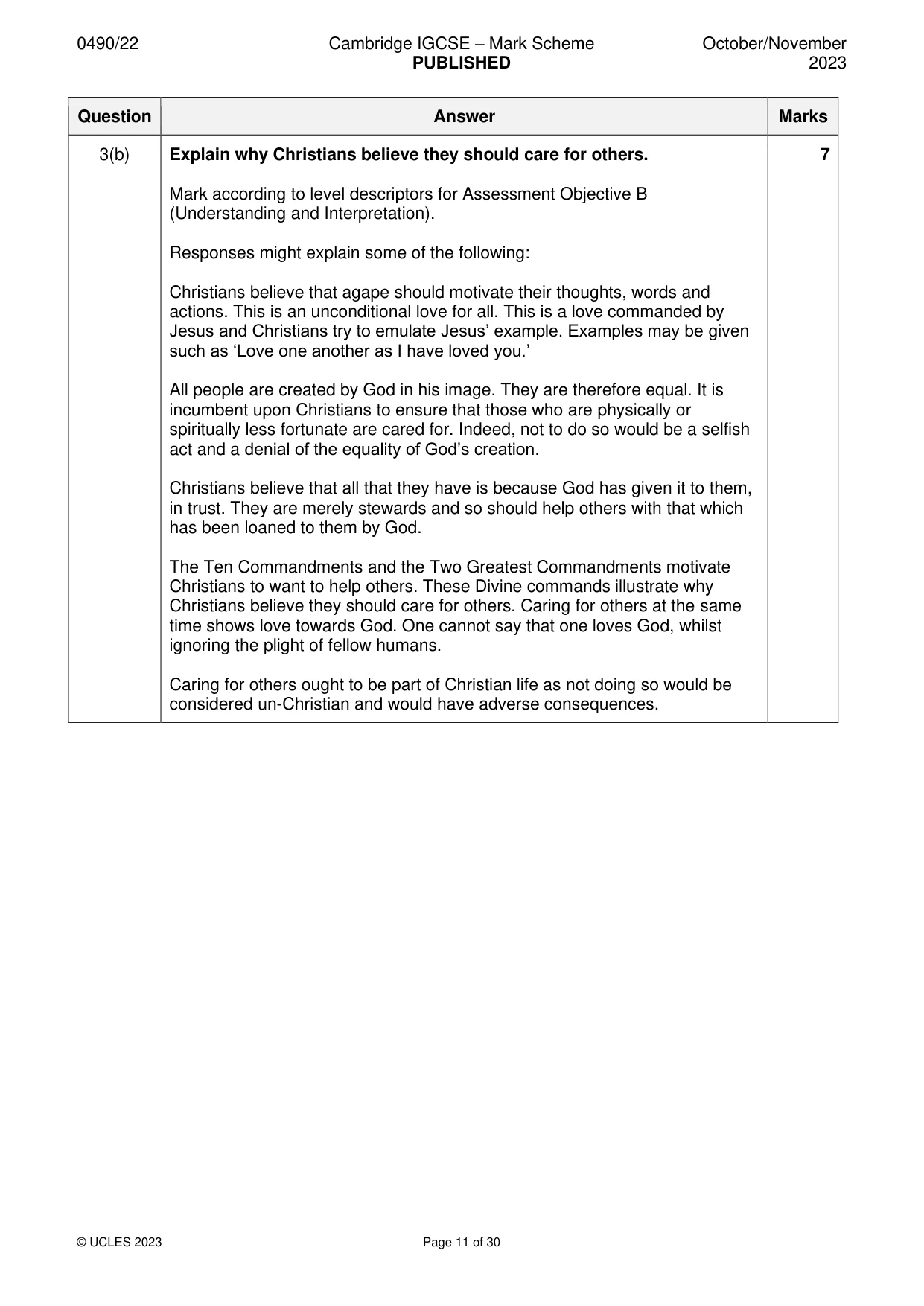
0490/22 Cambridge IGCSE – Mark Scheme PUBLISHED October/November 2023 © UCLES 2023 Page 11 of 30 Question Answer Marks 3(b) Explain why Christians believe they should care for others. Mark according to level descriptors for Assessment Objective B (Understanding and Interpretation). Responses might explain some of the following: Christians believe that agape should motivate their thoughts, words and actions. This is an unconditional love for all. This is a love commanded by Jesus and Christians try to emulate Jesus’ example. Examples may be given such as ‘Love one another as I have loved you.’ All people are created by God in his image. They are therefore equal. It is incumbent upon Christians to ensure that those who are physically or spiritually less fortunate are cared for. Indeed, not to do so would be a selfish act and a denial of the equality of God’s creation. Christians believe that all that they have is because God has given it to them, in trust. They are merely stewards and so should help others with that which has been loaned to them by God. The Ten Commandments and the Two Greatest Commandments motivate Christians to want to help others. These Divine commands illustrate why Christians believe they should care for others. Caring for others at the same time shows love towards God. One cannot say that one loves God, whilst ignoring the plight of fellow humans. Caring for others ought to be part of Christian life as not doing so would be considered un-Christian and would have adverse consequences. 7
Mark scheme, page 12
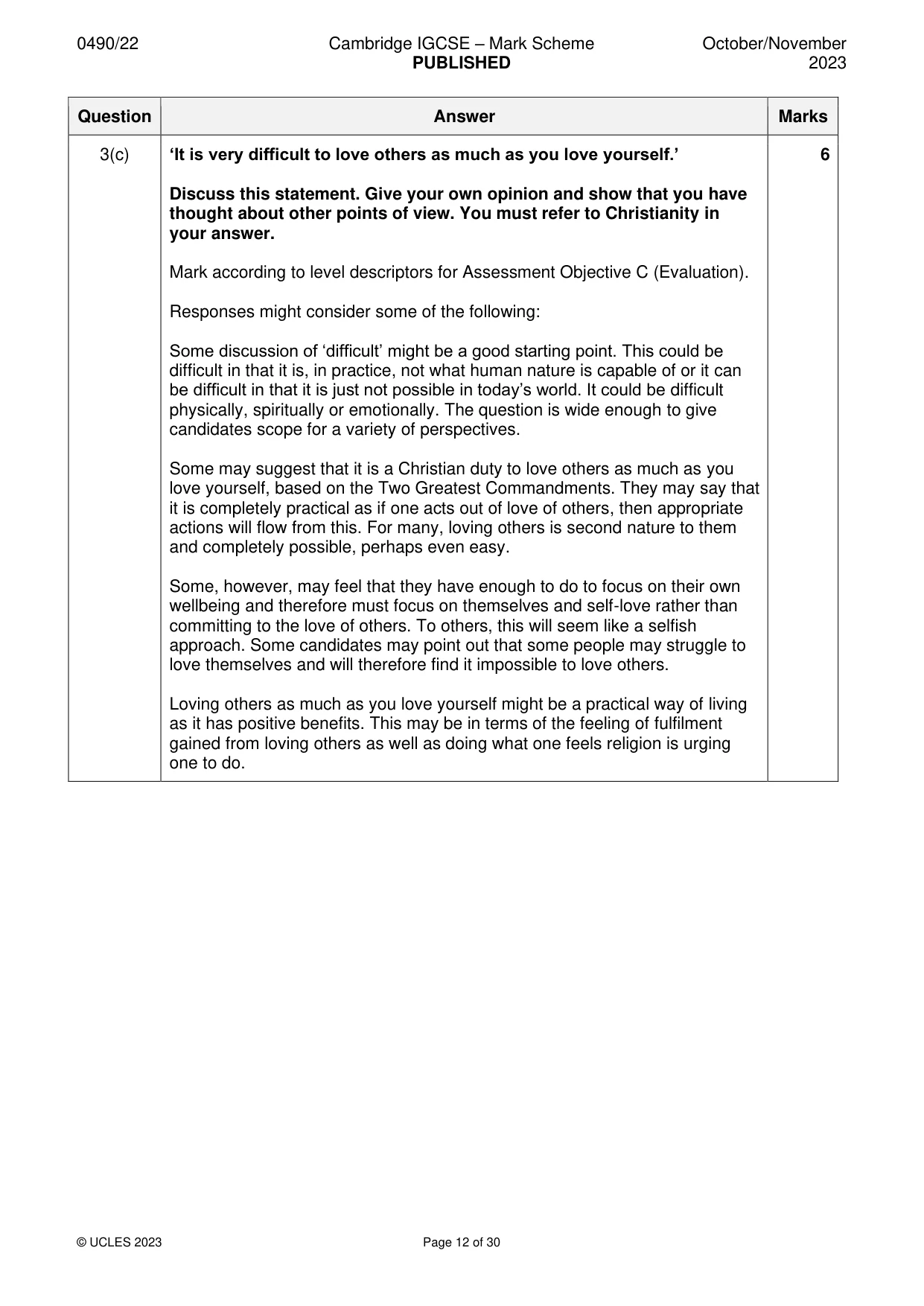
0490/22 Cambridge IGCSE – Mark Scheme PUBLISHED October/November 2023 © UCLES 2023 Page 12 of 30 Question Answer Marks 3(c) ‘It is very difficult to love others as much as you love yourself.’ Discuss this statement. Give your own opinion and show that you have thought about other points of view. You must refer to Christianity in your answer. Mark according to level descriptors for Assessment Objective C (Evaluation). Responses might consider some of the following: Some discussion of ‘difficult’ might be a good starting point. This could be difficult in that it is, in practice, not what human nature is capable of or it can be difficult in that it is just not possible in today’s world. It could be difficult physically, spiritually or emotionally. The question is wide enough to give candidates scope for a variety of perspectives. Some may suggest that it is a Christian duty to love others as much as you love yourself, based on the Two Greatest Commandments. They may say that it is completely practical as if one acts out of love of others, then appropriate actions will flow from this. For many, loving others is second nature to them and completely possible, perhaps even easy. Some, however, may feel that they have enough to do to focus on their own wellbeing and therefore must focus on themselves and self-love rather than committing to the love of others. To others, this will seem like a selfish approach. Some candidates may point out that some people may struggle to love themselves and will therefore find it impossible to love others. Loving others as much as you love yourself might be a practical way of living as it has positive benefits. This may be in terms of the feeling of fulfilment gained from loving others as well as doing what one feels religion is urging one to do. 6
Mark scheme, page 13
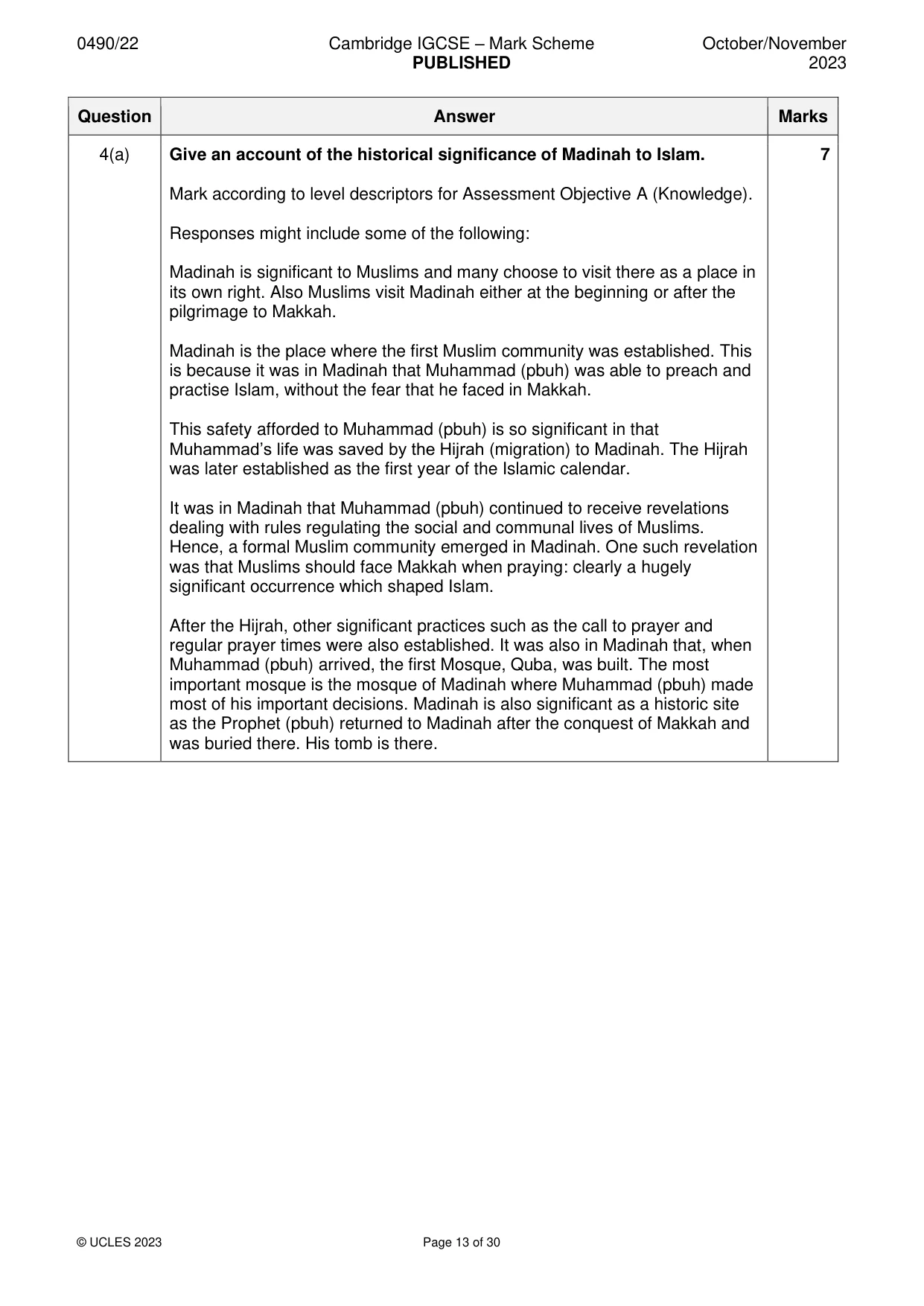
0490/22 Cambridge IGCSE – Mark Scheme PUBLISHED October/November 2023 © UCLES 2023 Page 13 of 30 Question Answer Marks 4(a) Give an account of the historical significance of Madinah to Islam. Mark according to level descriptors for Assessment Objective A (Knowledge). Responses might include some of the following: Madinah is significant to Muslims and many choose to visit there as a place in its own right. Also Muslims visit Madinah either at the beginning or after the pilgrimage to Makkah. Madinah is the place where the first Muslim community was established. This is because it was in Madinah that Muhammad (pbuh) was able to preach and practise Islam, without the fear that he faced in Makkah. This safety afforded to Muhammad (pbuh) is so significant in that Muhammad’s life was saved by the Hijrah (migration) to Madinah. The Hijrah was later established as the first year of the Islamic calendar. It was in Madinah that Muhammad (pbuh) continued to receive revelations dealing with rules regulating the social and communal lives of Muslims. Hence, a formal Muslim community emerged in Madinah. One such revelation was that Muslims should face Makkah when praying: clearly a hugely significant occurrence which shaped Islam. After the Hijrah, other significant practices such as the call to prayer and regular prayer times were also established. It was also in Madinah that, when Muhammad (pbuh) arrived, the first Mosque, Quba, was built. The most important mosque is the mosque of Madinah where Muhammad (pbuh) made most of his important decisions. Madinah is also significant as a historic site as the Prophet (pbuh) returned to Madinah after the conquest of Makkah and was buried there. His tomb is there. 7
Mark scheme, page 14
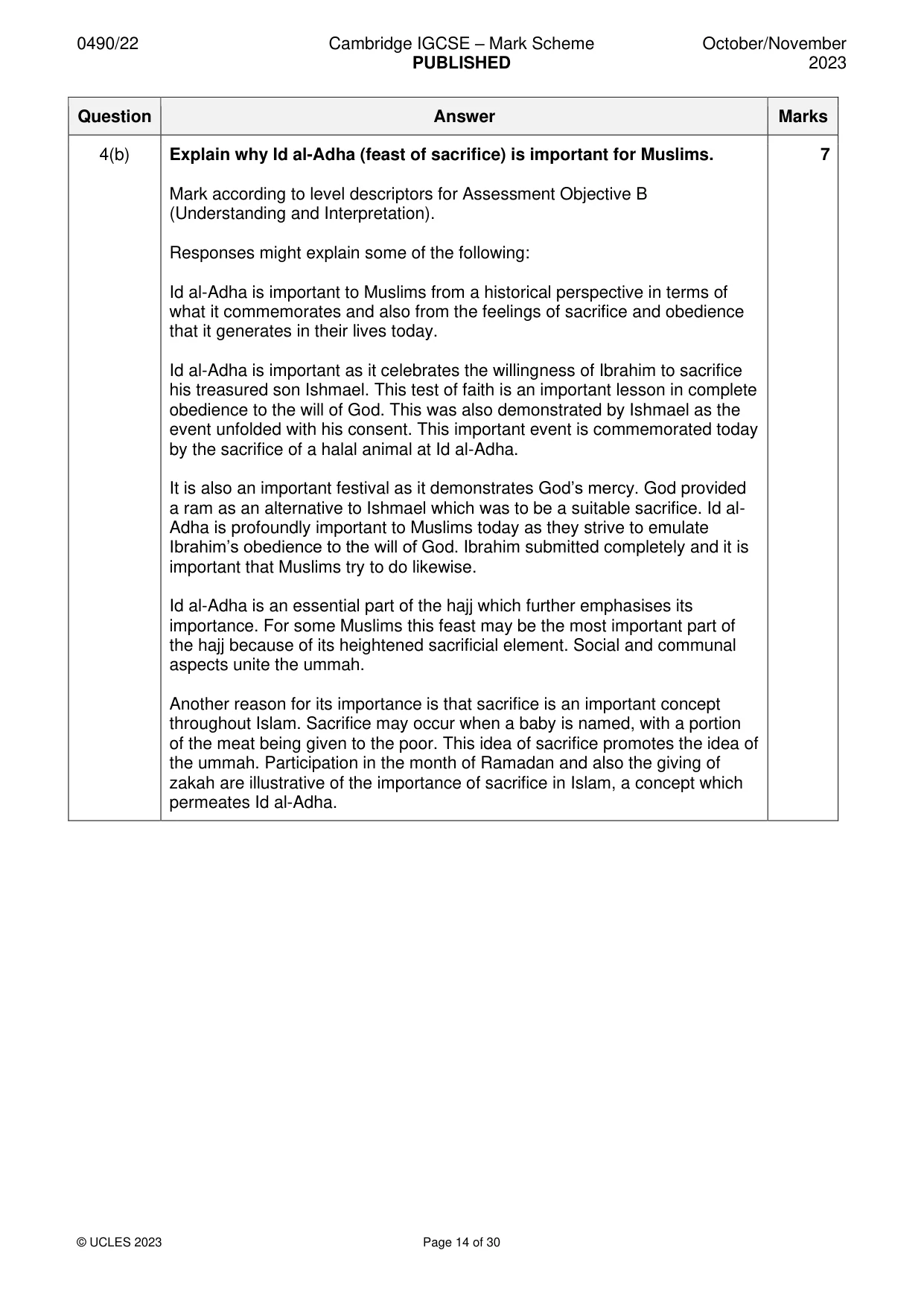
0490/22 Cambridge IGCSE – Mark Scheme PUBLISHED October/November 2023 © UCLES 2023 Page 14 of 30 Question Answer Marks 4(b) Explain why Id al-Adha (feast of sacrifice) is important for Muslims. Mark according to level descriptors for Assessment Objective B (Understanding and Interpretation). Responses might explain some of the following: Id al-Adha is important to Muslims from a historical perspective in terms of what it commemorates and also from the feelings of sacrifice and obedience that it generates in their lives today. Id al-Adha is important as it celebrates the willingness of Ibrahim to sacrifice his treasured son Ishmael. This test of faith is an important lesson in complete obedience to the will of God. This was also demonstrated by Ishmael as the event unfolded with his consent. This important event is commemorated today by the sacrifice of a halal animal at Id al-Adha. It is also an important festival as it demonstrates God’s mercy. God provided a ram as an alternative to Ishmael which was to be a suitable sacrifice. Id al- Adha is profoundly important to Muslims today as they strive to emulate Ibrahim’s obedience to the will of God. Ibrahim submitted completely and it is important that Muslims try to do likewise. Id al-Adha is an essential part of the hajj which further emphasises its importance. For some Muslims this feast may be the most important part of the hajj because of its heightened sacrificial element. Social and communal aspects unite the ummah. Another reason for its importance is that sacrifice is an important concept throughout Islam. Sacrifice may occur when a baby is named, with a portion of the meat being given to the poor. This idea of sacrifice promotes the idea of the ummah. Participation in the month of Ramadan and also the giving of zakah are illustrative of the importance of sacrifice in Islam, a concept which permeates Id al-Adha. 7
Mark scheme, page 15
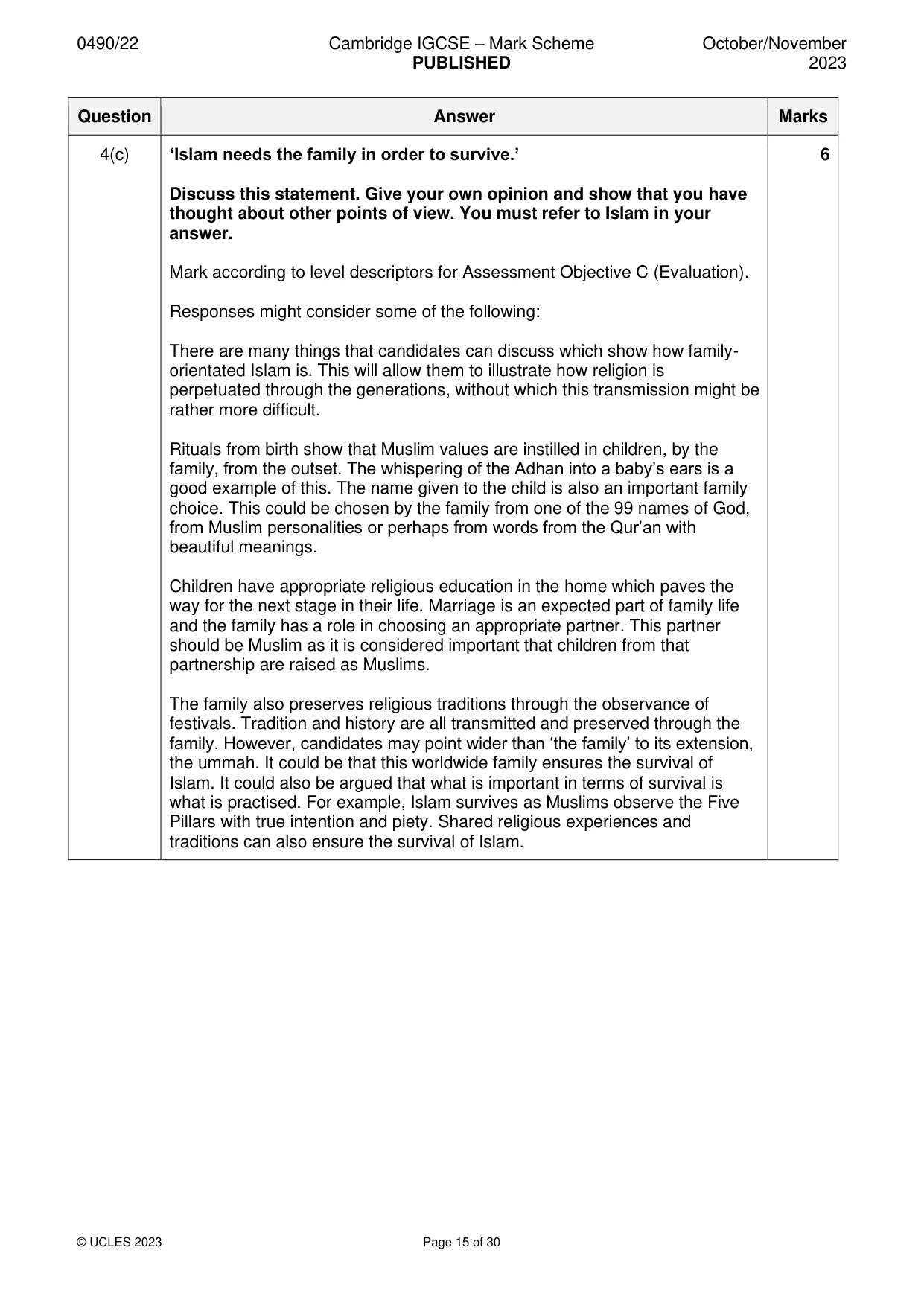
0490/22 Cambridge IGCSE – Mark Scheme PUBLISHED October/November 2023 © UCLES 2023 Page 15 of 30 Question Answer Marks 4(c) ‘Islam needs the family in order to survive.’ Discuss this statement. Give your own opinion and show that you have thought about other points of view. You must refer to Islam in your answer. Mark according to level descriptors for Assessment Objective C (Evaluation). Responses might consider some of the following: There are many things that candidates can discuss which show how family- orientated Islam is. This will allow them to illustrate how religion is perpetuated through the generations, without which this transmission might be rather more difficult. Rituals from birth show that Muslim values are instilled in children, by the family, from the outset. The whispering of the Adhan into a baby’s ears is a good example of this. The name given to the child is also an important family choice. This could be chosen by the family from one of the 99 names of God, from Muslim personalities or perhaps from words from the Qur’an with beautiful meanings. Children have appropriate religious education in the home which paves the way for the next stage in their life. Marriage is an expected part of family life and the family has a role in choosing an appropriate partner. This partner should be Muslim as it is considered important that children from that partnership are raised as Muslims. The family also preserves religious traditions through the observance of festivals. Tradition and history are all transmitted and preserved through the family. However, candidates may point wider than ‘the family’ to its extension, the ummah. It could be that this worldwide family ensures the survival of Islam. It could also be argued that what is important in terms of survival is what is practised. For example, Islam survives as Muslims observe the Five Pillars with true intention and piety. Shared religious experiences and traditions can also ensure the survival of Islam. 6
Mark scheme, page 16
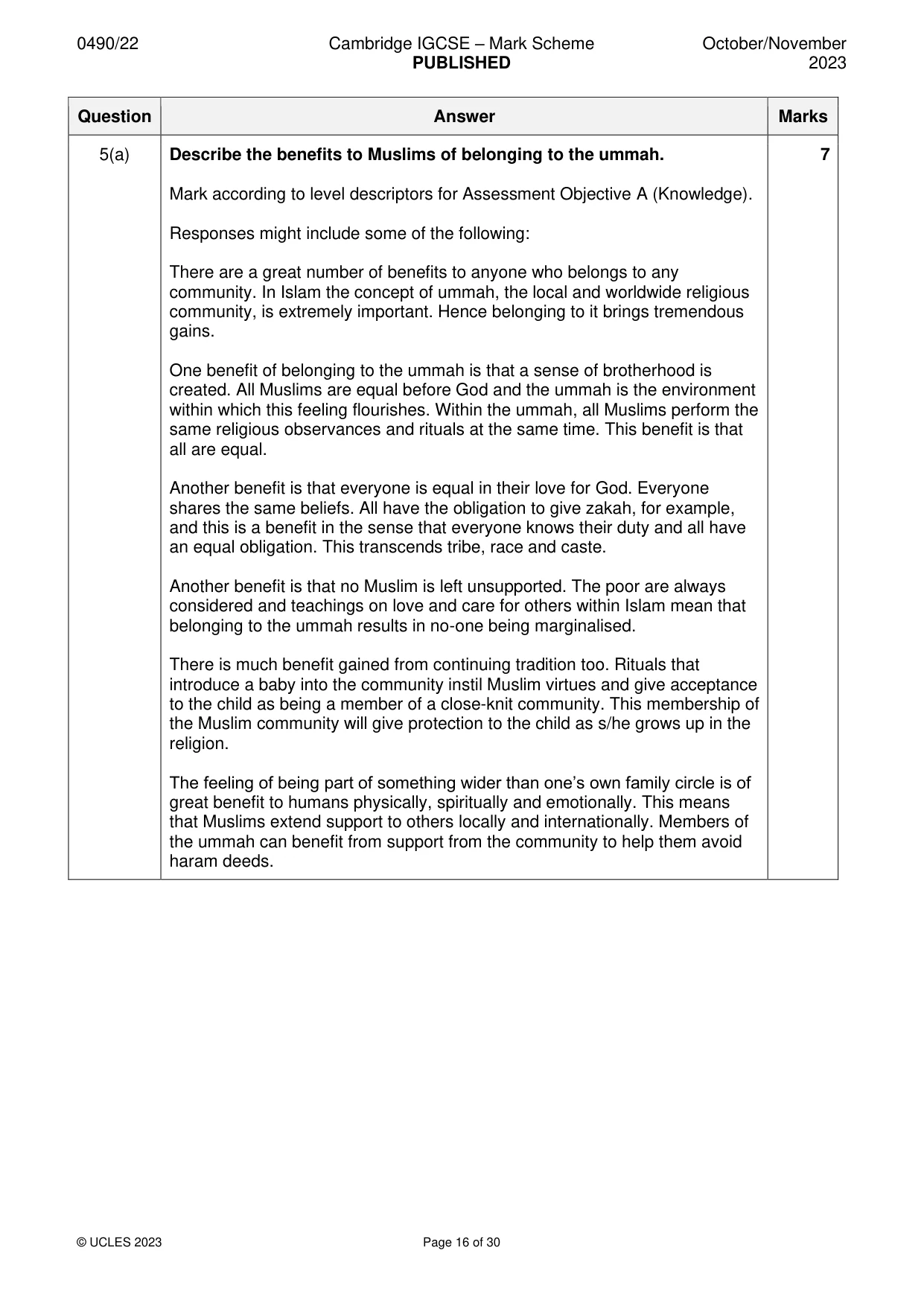
0490/22 Cambridge IGCSE – Mark Scheme PUBLISHED October/November 2023 © UCLES 2023 Page 16 of 30 Question Answer Marks 5(a) Describe the benefits to Muslims of belonging to the ummah. Mark according to level descriptors for Assessment Objective A (Knowledge). Responses might include some of the following: There are a great number of benefits to anyone who belongs to any community. In Islam the concept of ummah, the local and worldwide religious community, is extremely important. Hence belonging to it brings tremendous gains. One benefit of belonging to the ummah is that a sense of brotherhood is created. All Muslims are equal before God and the ummah is the environment within which this feeling flourishes. Within the ummah, all Muslims perform the same religious observances and rituals at the same time. This benefit is that all are equal. Another benefit is that everyone is equal in their love for God. Everyone shares the same beliefs. All have the obligation to give zakah, for example, and this is a benefit in the sense that everyone knows their duty and all have an equal obligation. This transcends tribe, race and caste. Another benefit is that no Muslim is left unsupported. The poor are always considered and teachings on love and care for others within Islam mean that belonging to the ummah results in no-one being marginalised. There is much benefit gained from continuing tradition too. Rituals that introduce a baby into the community instil Muslim virtues and give acceptance to the child as being a member of a close-knit community. This membership of the Muslim community will give protection to the child as s/he grows up in the religion. The feeling of being part of something wider than one’s own family circle is of great benefit to humans physically, spiritually and emotionally. This means that Muslims extend support to others locally and internationally. Members of the ummah can benefit from support from the community to help them avoid haram deeds. 7
Mark scheme, page 17
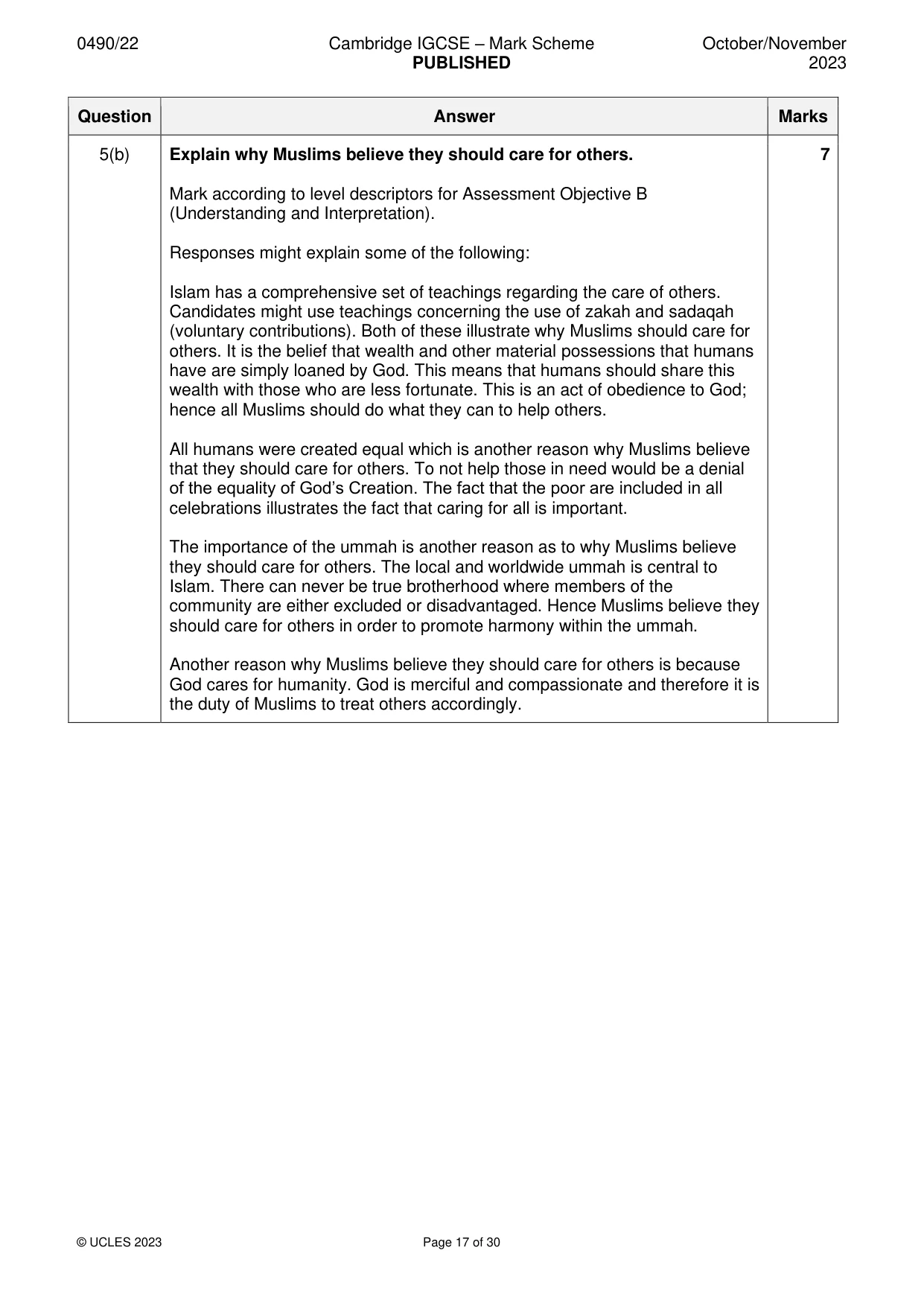
0490/22 Cambridge IGCSE – Mark Scheme PUBLISHED October/November 2023 © UCLES 2023 Page 17 of 30 Question Answer Marks 5(b) Explain why Muslims believe they should care for others. Mark according to level descriptors for Assessment Objective B (Understanding and Interpretation). Responses might explain some of the following: Islam has a comprehensive set of teachings regarding the care of others. Candidates might use teachings concerning the use of zakah and sadaqah (voluntary contributions). Both of these illustrate why Muslims should care for others. It is the belief that wealth and other material possessions that humans have are simply loaned by God. This means that humans should share this wealth with those who are less fortunate. This is an act of obedience to God; hence all Muslims should do what they can to help others. All humans were created equal which is another reason why Muslims believe that they should care for others. To not help those in need would be a denial of the equality of God’s Creation. The fact that the poor are included in all celebrations illustrates the fact that caring for all is important. The importance of the ummah is another reason as to why Muslims believe they should care for others. The local and worldwide ummah is central to Islam. There can never be true brotherhood where members of the community are either excluded or disadvantaged. Hence Muslims believe they should care for others in order to promote harmony within the ummah. Another reason why Muslims believe they should care for others is because God cares for humanity. God is merciful and compassionate and therefore it is the duty of Muslims to treat others accordingly. 7
Mark scheme, page 18
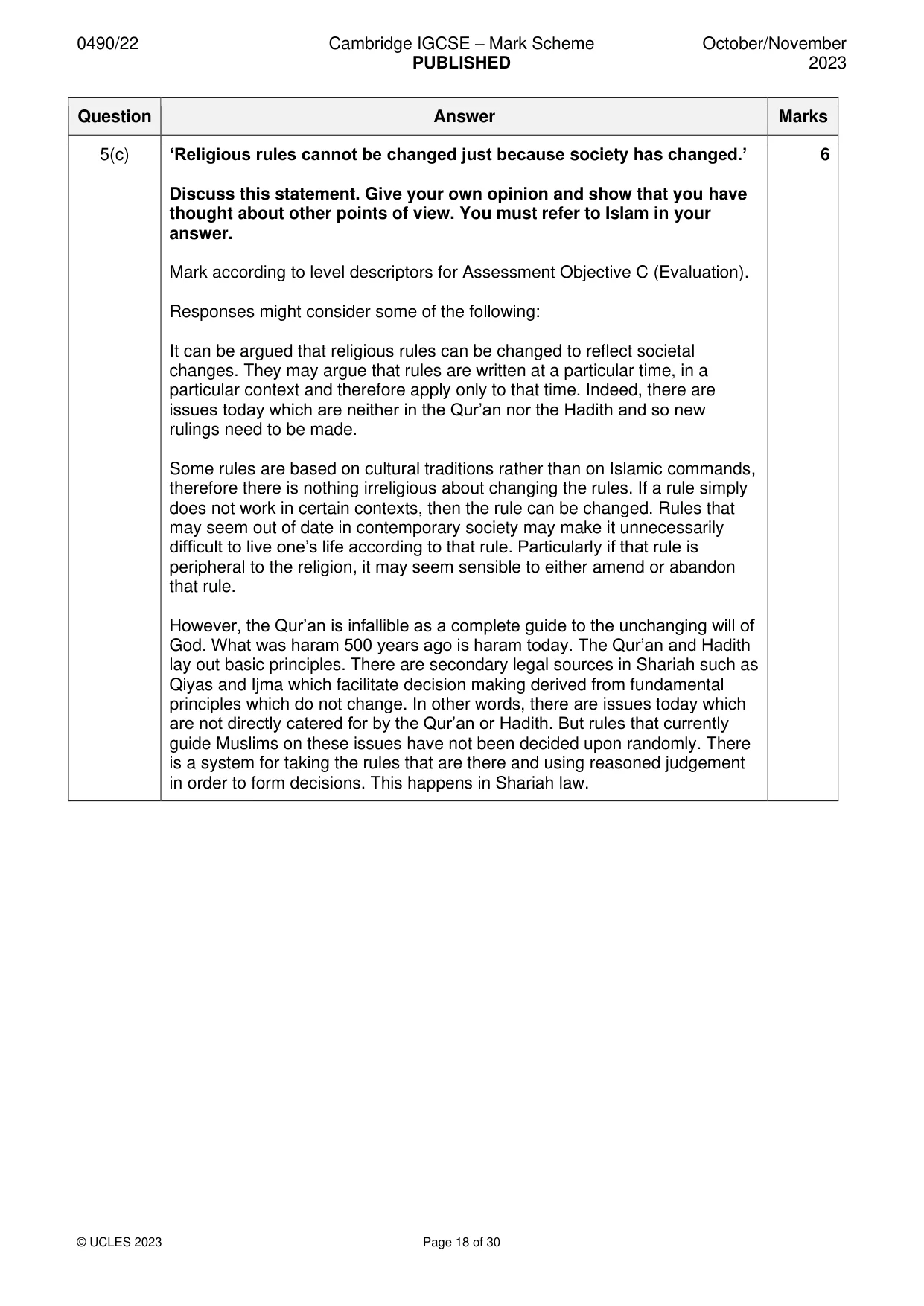
0490/22 Cambridge IGCSE – Mark Scheme PUBLISHED October/November 2023 © UCLES 2023 Page 18 of 30 Question Answer Marks 5(c) ‘Religious rules cannot be changed just because society has changed.’ Discuss this statement. Give your own opinion and show that you have thought about other points of view. You must refer to Islam in your answer. Mark according to level descriptors for Assessment Objective C (Evaluation). Responses might consider some of the following: It can be argued that religious rules can be changed to reflect societal changes. They may argue that rules are written at a particular time, in a particular context and therefore apply only to that time. Indeed, there are issues today which are neither in the Qur’an nor the Hadith and so new rulings need to be made. Some rules are based on cultural traditions rather than on Islamic commands, therefore there is nothing irreligious about changing the rules. If a rule simply does not work in certain contexts, then the rule can be changed. Rules that may seem out of date in contemporary society may make it unnecessarily difficult to live one’s life according to that rule. Particularly if that rule is peripheral to the religion, it may seem sensible to either amend or abandon that rule. However, the Qur’an is infallible as a complete guide to the unchanging will of God. What was haram 500 years ago is haram today. The Qur’an and Hadith lay out basic principles. There are secondary legal sources in Shariah such as Qiyas and Ijma which facilitate decision making derived from fundamental principles which do not change. In other words, there are issues today which are not directly catered for by the Qur’an or Hadith. But rules that currently guide Muslims on these issues have not been decided upon randomly. There is a system for taking the rules that are there and using reasoned judgement in order to form decisions. This happens in Shariah law. 6
Mark scheme, page 19
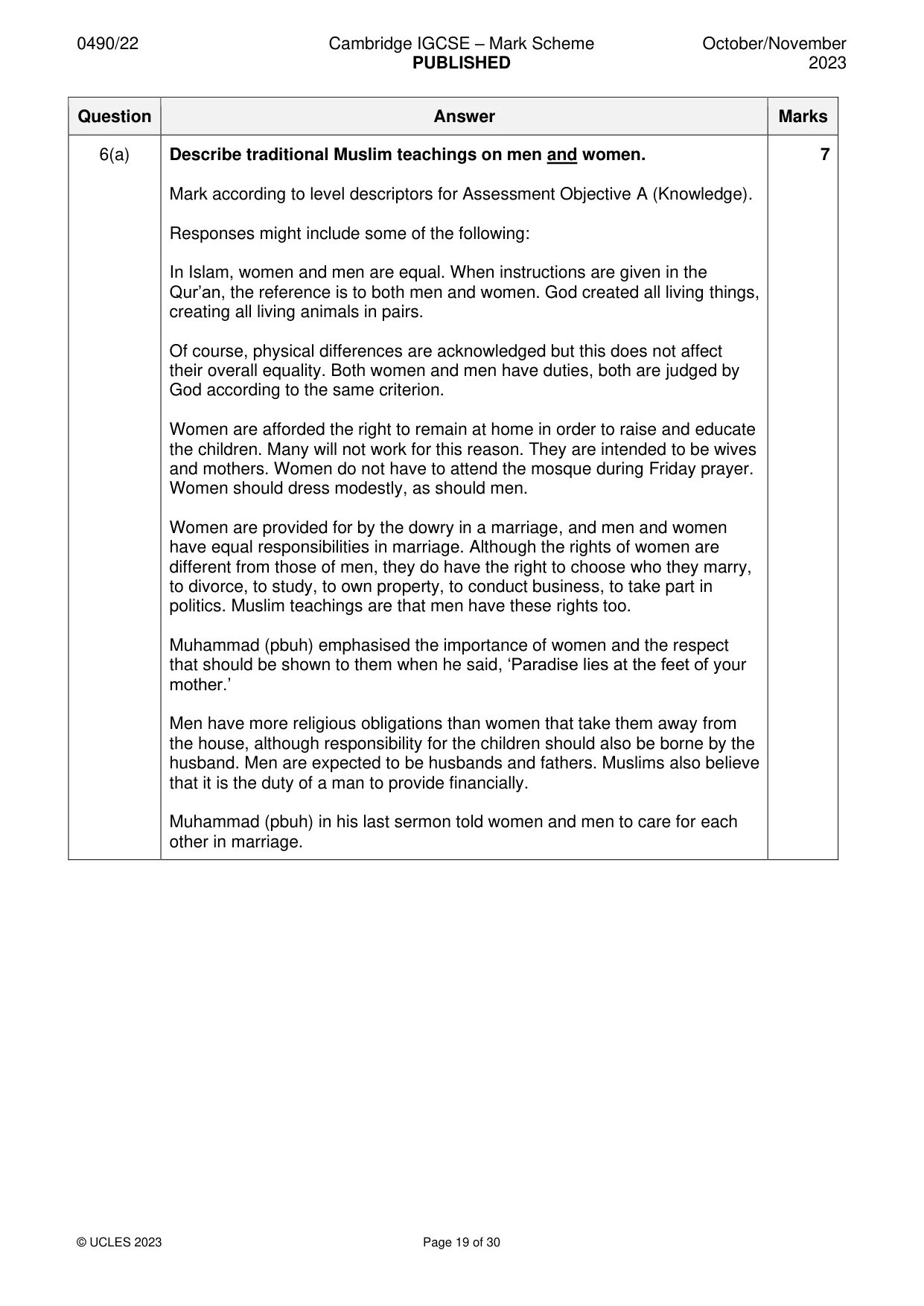
0490/22 Cambridge IGCSE – Mark Scheme PUBLISHED October/November 2023 © UCLES 2023 Page 19 of 30 Question Answer Marks 6(a) Describe traditional Muslim teachings on men and women. Mark according to level descriptors for Assessment Objective A (Knowledge). Responses might include some of the following: In Islam, women and men are equal. When instructions are given in the Qur’an, the reference is to both men and women. God created all living things, creating all living animals in pairs. Of course, physical differences are acknowledged but this does not affect their overall equality. Both women and men have duties, both are judged by God according to the same criterion. Women are afforded the right to remain at home in order to raise and educate the children. Many will not work for this reason. They are intended to be wives and mothers. Women do not have to attend the mosque during Friday prayer. Women should dress modestly, as should men. Women are provided for by the dowry in a marriage, and men and women have equal responsibilities in marriage. Although the rights of women are different from those of men, they do have the right to choose who they marry, to divorce, to study, to own property, to conduct business, to take part in politics. Muslim teachings are that men have these rights too. Muhammad (pbuh) emphasised the importance of women and the respect that should be shown to them when he said, ‘Paradise lies at the feet of your mother.’ Men have more religious obligations than women that take them away from the house, although responsibility for the children should also be borne by the husband. Men are expected to be husbands and fathers. Muslims also believe that it is the duty of a man to provide financially. Muhammad (pbuh) in his last sermon told women and men to care for each other in marriage. 7
Mark scheme, page 20
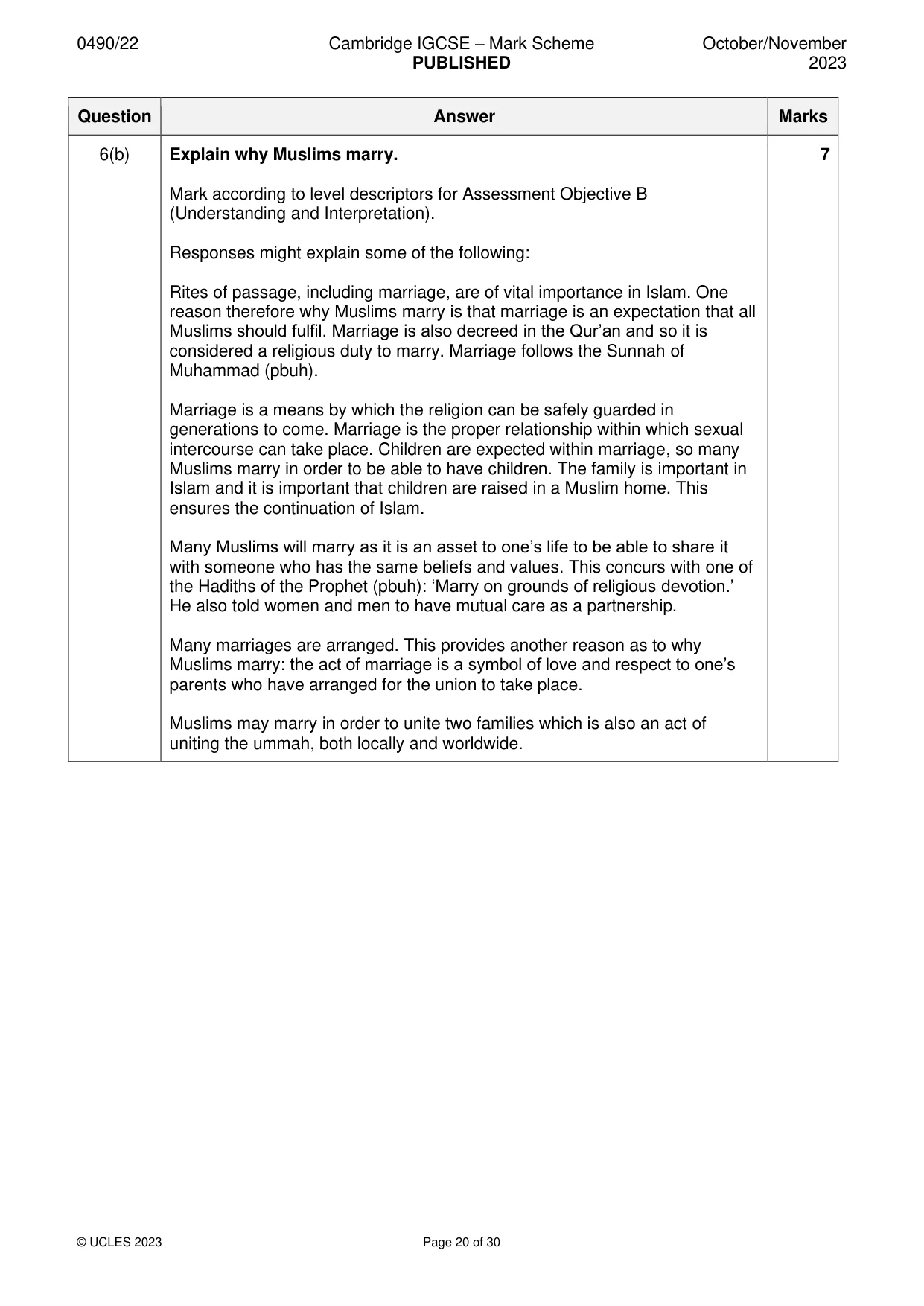
0490/22 Cambridge IGCSE – Mark Scheme PUBLISHED October/November 2023 © UCLES 2023 Page 20 of 30 Question Answer Marks 6(b) Explain why Muslims marry. Mark according to level descriptors for Assessment Objective B (Understanding and Interpretation). Responses might explain some of the following: Rites of passage, including marriage, are of vital importance in Islam. One reason therefore why Muslims marry is that marriage is an expectation that all Muslims should fulfil. Marriage is also decreed in the Qur’an and so it is considered a religious duty to marry. Marriage follows the Sunnah of Muhammad (pbuh). Marriage is a means by which the religion can be safely guarded in generations to come. Marriage is the proper relationship within which sexual intercourse can take place. Children are expected within marriage, so many Muslims marry in order to be able to have children. The family is important in Islam and it is important that children are raised in a Muslim home. This ensures the continuation of Islam. Many Muslims will marry as it is an asset to one’s life to be able to share it with someone who has the same beliefs and values. This concurs with one of the Hadiths of the Prophet (pbuh): ‘Marry on grounds of religious devotion.’ He also told women and men to have mutual care as a partnership. Many marriages are arranged. This provides another reason as to why Muslims marry: the act of marriage is a symbol of love and respect to one’s parents who have arranged for the union to take place. Muslims may marry in order to unite two families which is also an act of uniting the ummah, both locally and worldwide. 7
Mark scheme, page 21
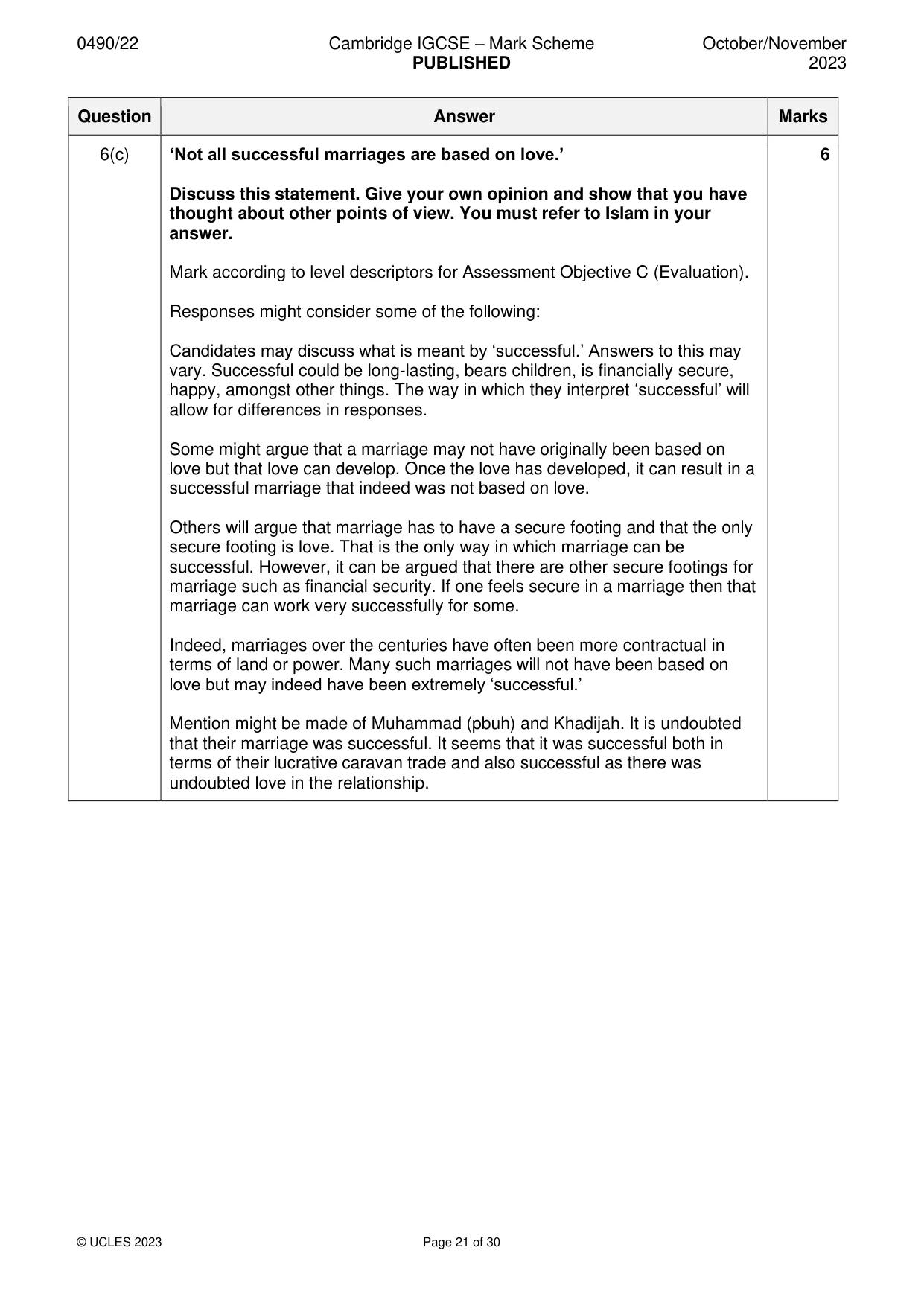
0490/22 Cambridge IGCSE – Mark Scheme PUBLISHED October/November 2023 © UCLES 2023 Page 21 of 30 Question Answer Marks 6(c) ‘Not all successful marriages are based on love.’ Discuss this statement. Give your own opinion and show that you have thought about other points of view. You must refer to Islam in your answer. Mark according to level descriptors for Assessment Objective C (Evaluation). Responses might consider some of the following: Candidates may discuss what is meant by ‘successful.’ Answers to this may vary. Successful could be long-lasting, bears children, is financially secure, happy, amongst other things. The way in which they interpret ‘successful’ will allow for differences in responses. Some might argue that a marriage may not have originally been based on love but that love can develop. Once the love has developed, it can result in a successful marriage that indeed was not based on love. Others will argue that marriage has to have a secure footing and that the only secure footing is love. That is the only way in which marriage can be successful. However, it can be argued that there are other secure footings for marriage such as financial security. If one feels secure in a marriage then that marriage can work very successfully for some. Indeed, marriages over the centuries have often been more contractual in terms of land or power. Many such marriages will not have been based on love but may indeed have been extremely ‘successful.’ Mention might be made of Muhammad (pbuh) and Khadijah. It is undoubted that their marriage was successful. It seems that it was successful both in terms of their lucrative caravan trade and also successful as there was undoubted love in the relationship. 6
Mark scheme, page 22
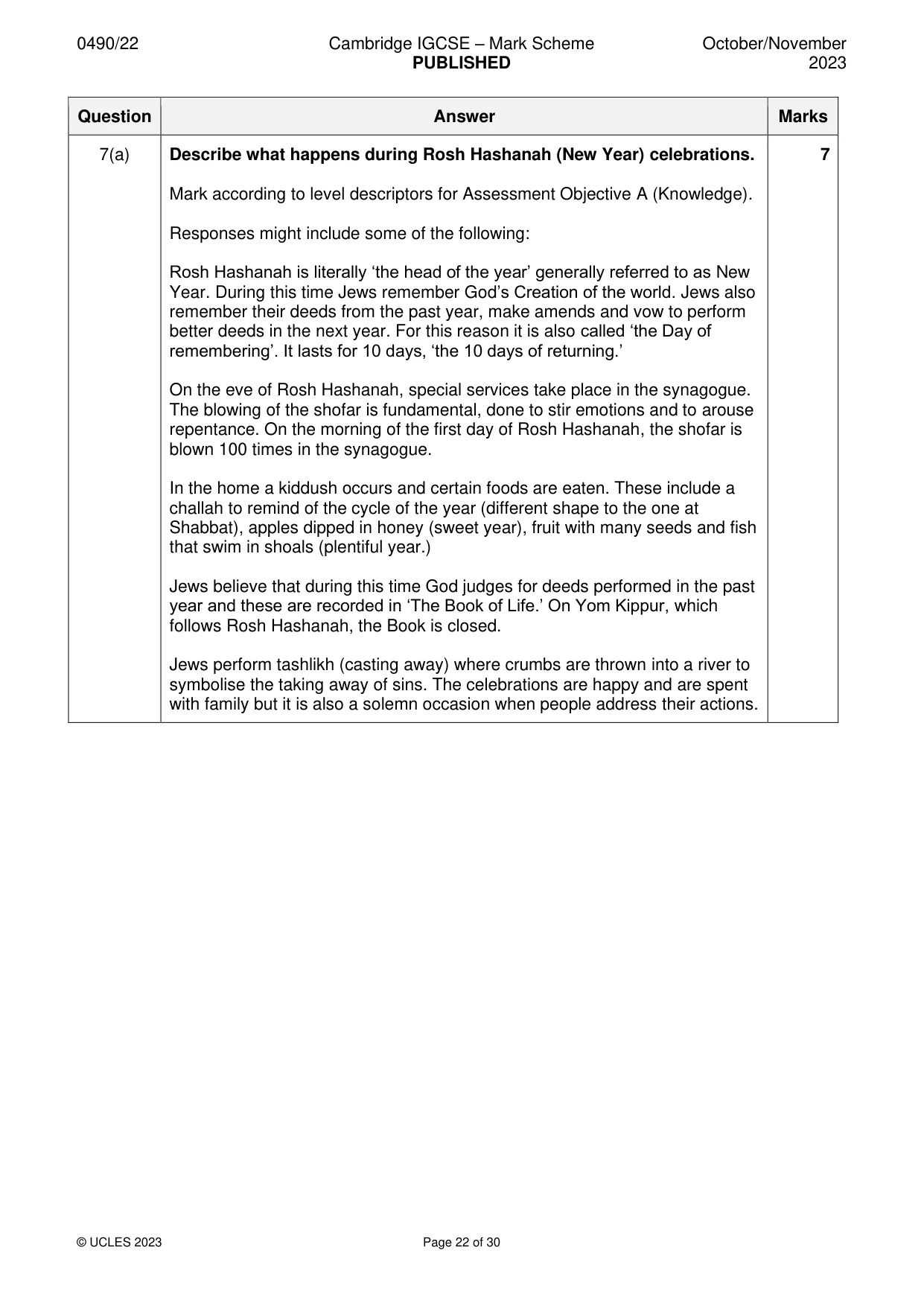
0490/22 Cambridge IGCSE – Mark Scheme PUBLISHED October/November 2023 © UCLES 2023 Page 22 of 30 Question Answer Marks 7(a) Describe what happens during Rosh Hashanah (New Year) celebrations. Mark according to level descriptors for Assessment Objective A (Knowledge). Responses might include some of the following: Rosh Hashanah is literally ‘the head of the year’ generally referred to as New Year. During this time Jews remember God’s Creation of the world. Jews also remember their deeds from the past year, make amends and vow to perform better deeds in the next year. For this reason it is also called ‘the Day of remembering’. It lasts for 10 days, ‘the 10 days of returning.’ On the eve of Rosh Hashanah, special services take place in the synagogue. The blowing of the shofar is fundamental, done to stir emotions and to arouse repentance. On the morning of the first day of Rosh Hashanah, the shofar is blown 100 times in the synagogue. In the home a kiddush occurs and certain foods are eaten. These include a challah to remind of the cycle of the year (different shape to the one at Shabbat), apples dipped in honey (sweet year), fruit with many seeds and fish that swim in shoals (plentiful year.) Jews believe that during this time God judges for deeds performed in the past year and these are recorded in ‘The Book of Life.’ On Yom Kippur, which follows Rosh Hashanah, the Book is closed. Jews perform tashlikh (casting away) where crumbs are thrown into a river to symbolise the taking away of sins. The celebrations are happy and are spent with family but it is also a solemn occasion when people address their actions. 7
Mark scheme, page 23
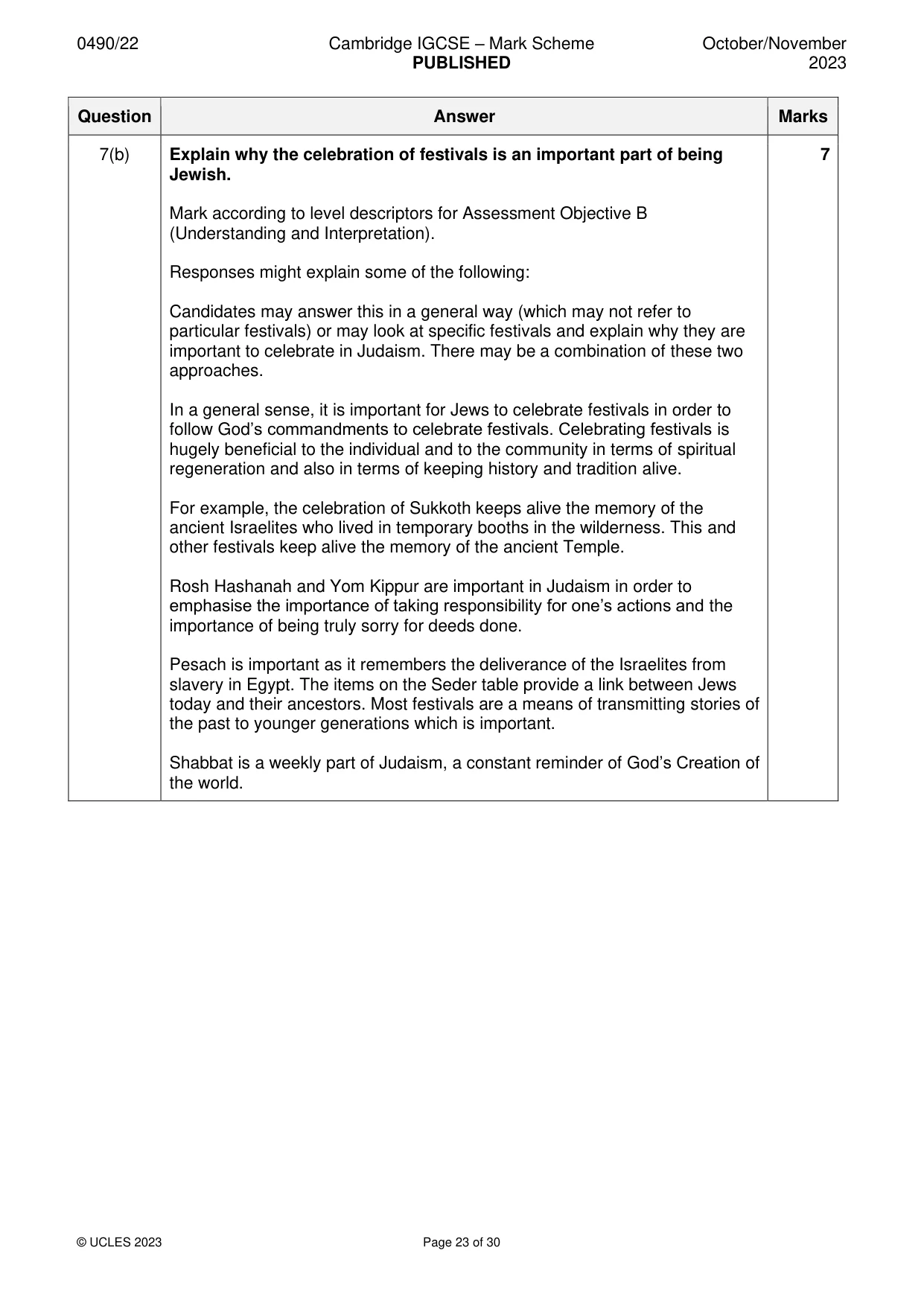
0490/22 Cambridge IGCSE – Mark Scheme PUBLISHED October/November 2023 © UCLES 2023 Page 23 of 30 Question Answer Marks 7(b) Explain why the celebration of festivals is an important part of being Jewish. Mark according to level descriptors for Assessment Objective B (Understanding and Interpretation). Responses might explain some of the following: Candidates may answer this in a general way (which may not refer to particular festivals) or may look at specific festivals and explain why they are important to celebrate in Judaism. There may be a combination of these two approaches. In a general sense, it is important for Jews to celebrate festivals in order to follow God’s commandments to celebrate festivals. Celebrating festivals is hugely beneficial to the individual and to the community in terms of spiritual regeneration and also in terms of keeping history and tradition alive. For example, the celebration of Sukkoth keeps alive the memory of the ancient Israelites who lived in temporary booths in the wilderness. This and other festivals keep alive the memory of the ancient Temple. Rosh Hashanah and Yom Kippur are important in Judaism in order to emphasise the importance of taking responsibility for one’s actions and the importance of being truly sorry for deeds done. Pesach is important as it remembers the deliverance of the Israelites from slavery in Egypt. The items on the Seder table provide a link between Jews today and their ancestors. Most festivals are a means of transmitting stories of the past to younger generations which is important. Shabbat is a weekly part of Judaism, a constant reminder of God’s Creation of the world. 7
Mark scheme, page 24
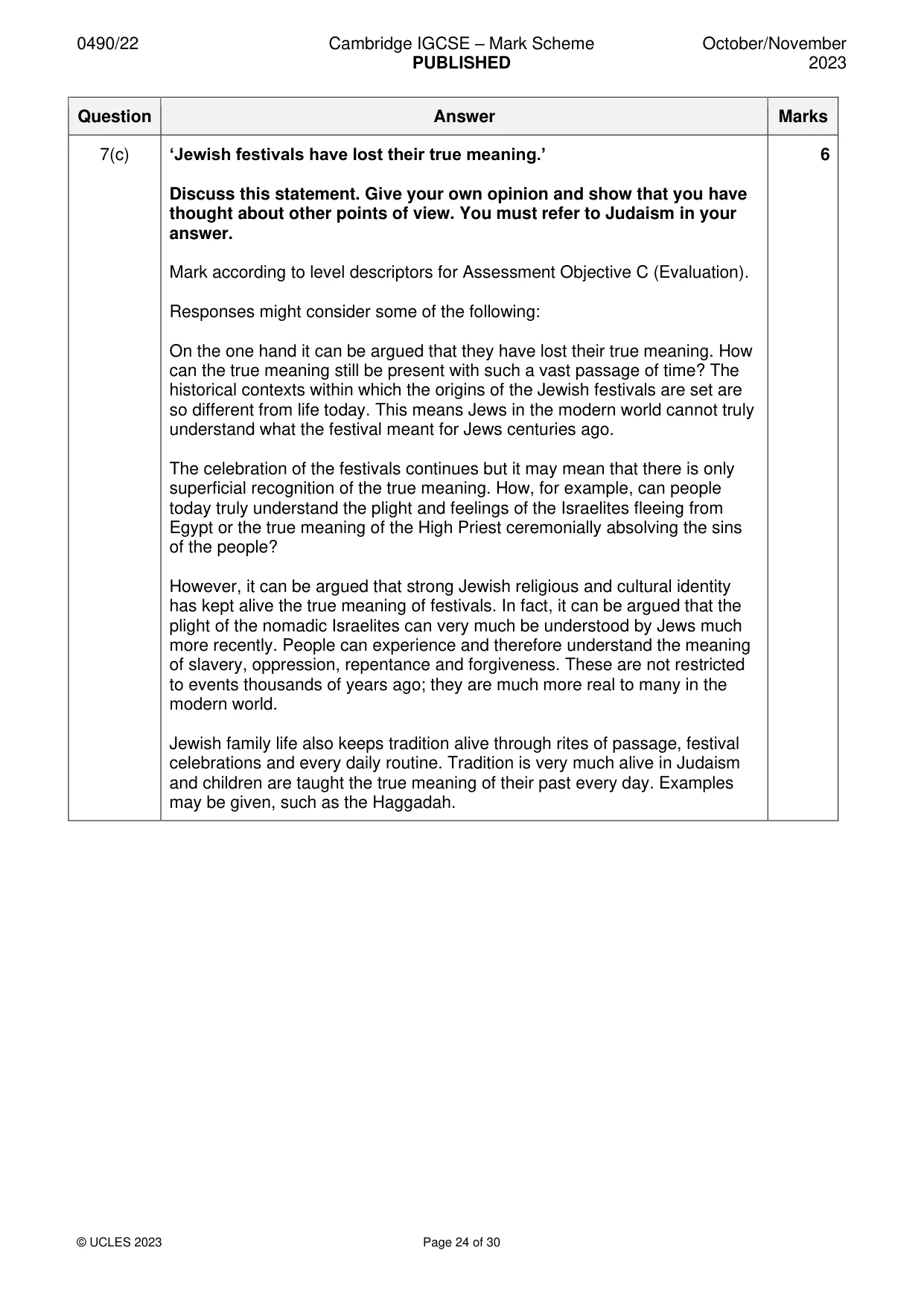
0490/22 Cambridge IGCSE – Mark Scheme PUBLISHED October/November 2023 © UCLES 2023 Page 24 of 30 Question Answer Marks 7(c) ‘Jewish festivals have lost their true meaning.’ Discuss this statement. Give your own opinion and show that you have thought about other points of view. You must refer to Judaism in your answer. Mark according to level descriptors for Assessment Objective C (Evaluation). Responses might consider some of the following: On the one hand it can be argued that they have lost their true meaning. How can the true meaning still be present with such a vast passage of time? The historical contexts within which the origins of the Jewish festivals are set are so different from life today. This means Jews in the modern world cannot truly understand what the festival meant for Jews centuries ago. The celebration of the festivals continues but it may mean that there is only superficial recognition of the true meaning. How, for example, can people today truly understand the plight and feelings of the Israelites fleeing from Egypt or the true meaning of the High Priest ceremonially absolving the sins of the people? However, it can be argued that strong Jewish religious and cultural identity has kept alive the true meaning of festivals. In fact, it can be argued that the plight of the nomadic Israelites can very much be understood by Jews much more recently. People can experience and therefore understand the meaning of slavery, oppression, repentance and forgiveness. These are not restricted to events thousands of years ago; they are much more real to many in the modern world. Jewish family life also keeps tradition alive through rites of passage, festival celebrations and every daily routine. Tradition is very much alive in Judaism and children are taught the true meaning of their past every day. Examples may be given, such as the Haggadah. 6
Mark scheme, page 25
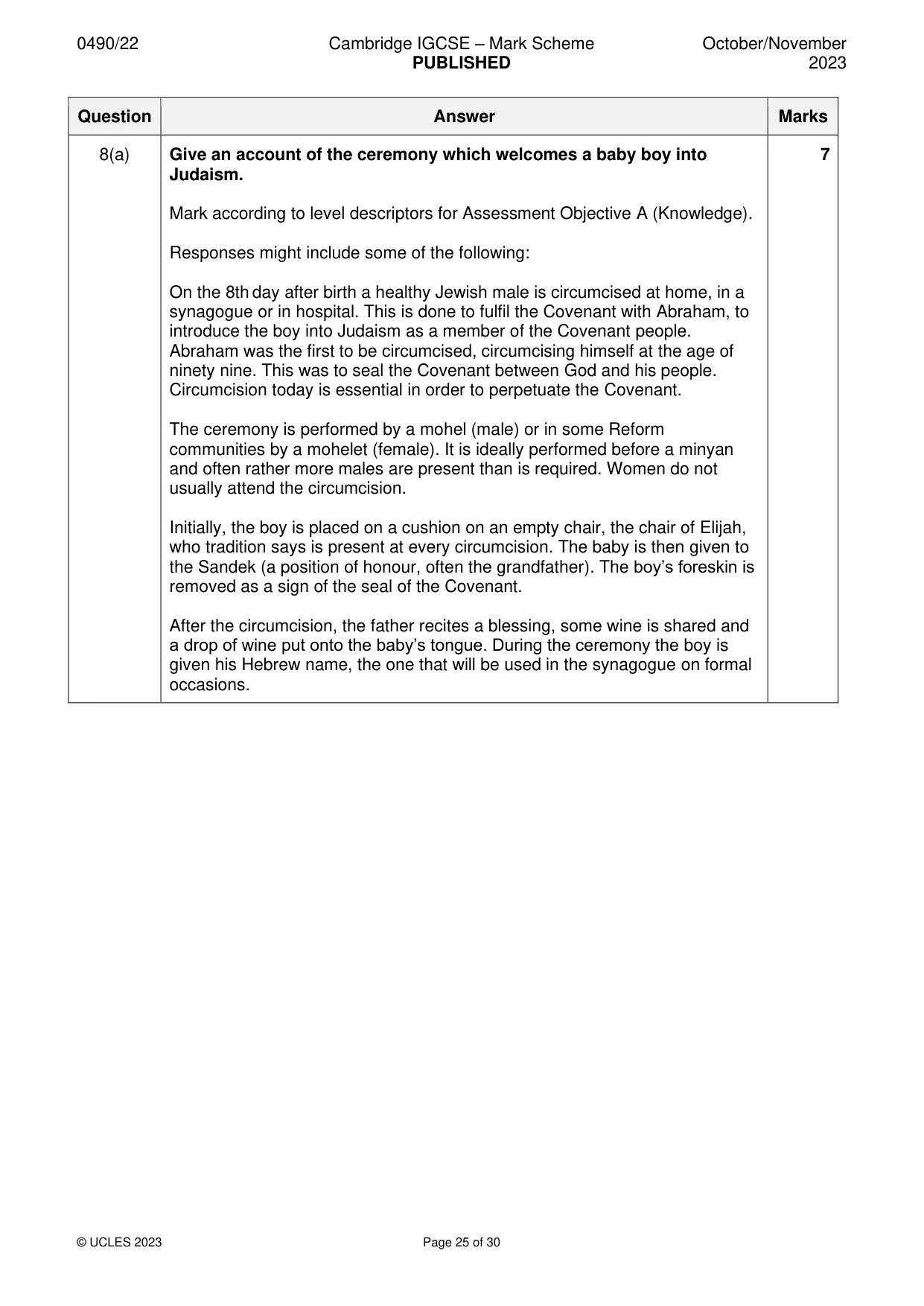
0490/22 Cambridge IGCSE – Mark Scheme PUBLISHED October/November 2023 © UCLES 2023 Page 25 of 30 Question Answer Marks 8(a) Give an account of the ceremony which welcomes a baby boy into Judaism. Mark according to level descriptors for Assessment Objective A (Knowledge). Responses might include some of the following: On the 8th day after birth a healthy Jewish male is circumcised at home, in a synagogue or in hospital. This is done to fulfil the Covenant with Abraham, to introduce the boy into Judaism as a member of the Covenant people. Abraham was the first to be circumcised, circumcising himself at the age of ninety nine. This was to seal the Covenant between God and his people. Circumcision today is essential in order to perpetuate the Covenant. The ceremony is performed by a mohel (male) or in some Reform communities by a mohelet (female). It is ideally performed before a minyan and often rather more males are present than is required. Women do not usually attend the circumcision. Initially, the boy is placed on a cushion on an empty chair, the chair of Elijah, who tradition says is present at every circumcision. The baby is then given to the Sandek (a position of honour, often the grandfather). The boy’s foreskin is removed as a sign of the seal of the Covenant. After the circumcision, the father recites a blessing, some wine is shared and a drop of wine put onto the baby’s tongue. During the ceremony the boy is given his Hebrew name, the one that will be used in the synagogue on formal occasions. 7
Mark scheme, page 26
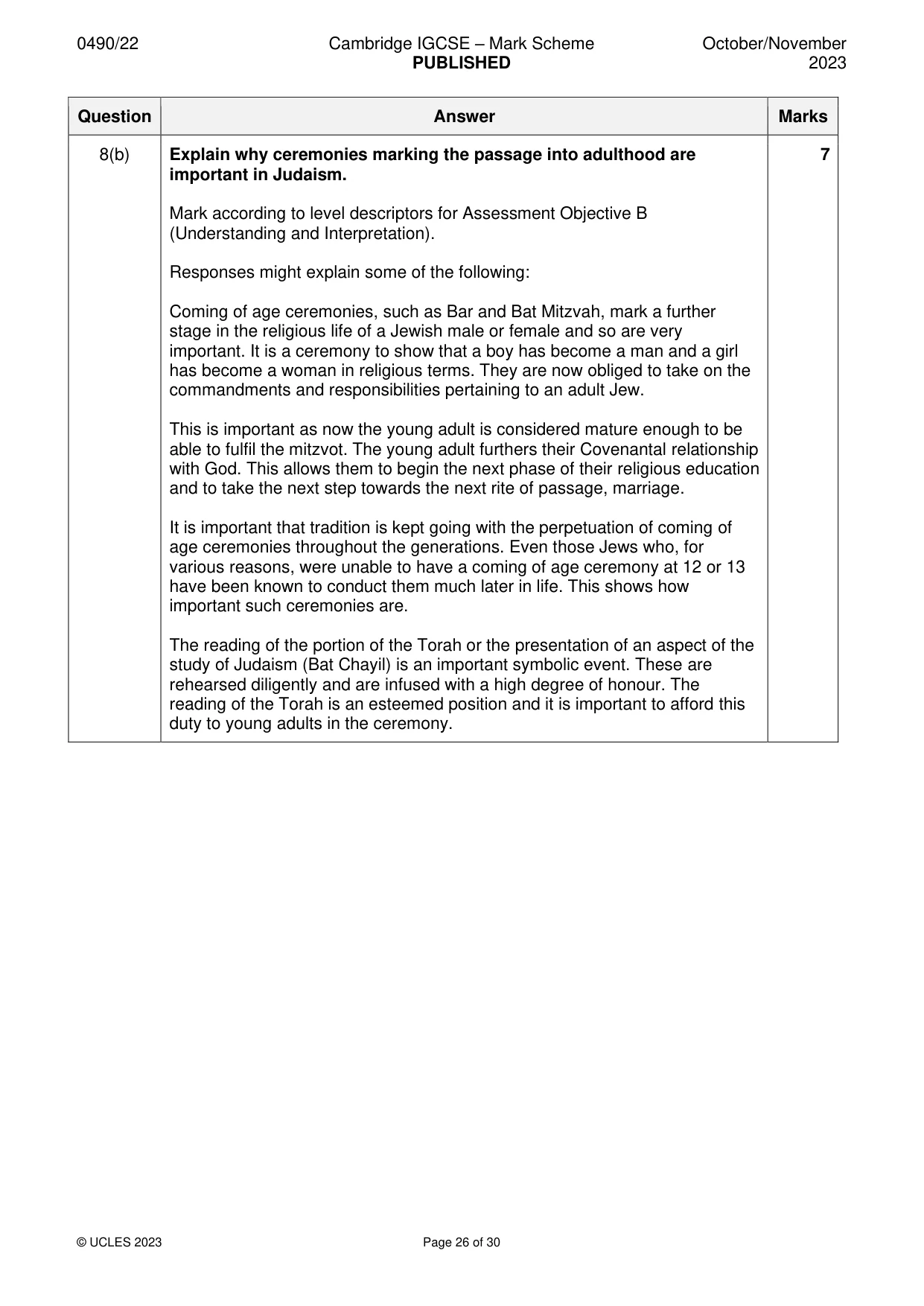
0490/22 Cambridge IGCSE – Mark Scheme PUBLISHED October/November 2023 © UCLES 2023 Page 26 of 30 Question Answer Marks 8(b) Explain why ceremonies marking the passage into adulthood are important in Judaism. Mark according to level descriptors for Assessment Objective B (Understanding and Interpretation). Responses might explain some of the following: Coming of age ceremonies, such as Bar and Bat Mitzvah, mark a further stage in the religious life of a Jewish male or female and so are very important. It is a ceremony to show that a boy has become a man and a girl has become a woman in religious terms. They are now obliged to take on the commandments and responsibilities pertaining to an adult Jew. This is important as now the young adult is considered mature enough to be able to fulfil the mitzvot. The young adult furthers their Covenantal relationship with God. This allows them to begin the next phase of their religious education and to take the next step towards the next rite of passage, marriage. It is important that tradition is kept going with the perpetuation of coming of age ceremonies throughout the generations. Even those Jews who, for various reasons, were unable to have a coming of age ceremony at 12 or 13 have been known to conduct them much later in life. This shows how important such ceremonies are. The reading of the portion of the Torah or the presentation of an aspect of the study of Judaism (Bat Chayil) is an important symbolic event. These are rehearsed diligently and are infused with a high degree of honour. The reading of the Torah is an esteemed position and it is important to afford this duty to young adults in the ceremony. 7
Mark scheme, page 27
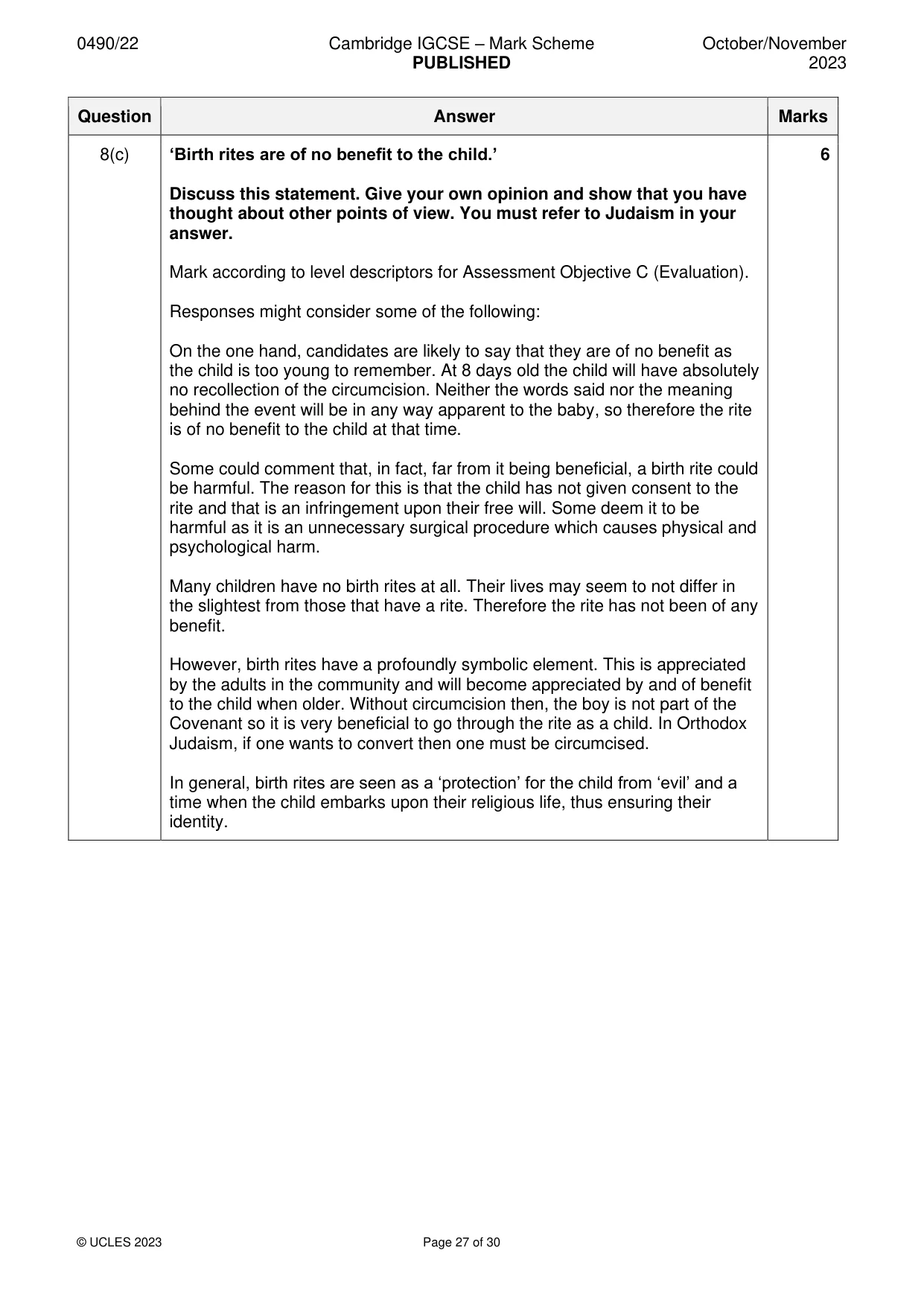
0490/22 Cambridge IGCSE – Mark Scheme PUBLISHED October/November 2023 © UCLES 2023 Page 27 of 30 Question Answer Marks 8(c) ‘Birth rites are of no benefit to the child.’ Discuss this statement. Give your own opinion and show that you have thought about other points of view. You must refer to Judaism in your answer. Mark according to level descriptors for Assessment Objective C (Evaluation). Responses might consider some of the following: On the one hand, candidates are likely to say that they are of no benefit as the child is too young to remember. At 8 days old the child will have absolutely no recollection of the circumcision. Neither the words said nor the meaning behind the event will be in any way apparent to the baby, so therefore the rite is of no benefit to the child at that time. Some could comment that, in fact, far from it being beneficial, a birth rite could be harmful. The reason for this is that the child has not given consent to the rite and that is an infringement upon their free will. Some deem it to be harmful as it is an unnecessary surgical procedure which causes physical and psychological harm. Many children have no birth rites at all. Their lives may seem to not differ in the slightest from those that have a rite. Therefore the rite has not been of any benefit. However, birth rites have a profoundly symbolic element. This is appreciated by the adults in the community and will become appreciated by and of benefit to the child when older. Without circumcision then, the boy is not part of the Covenant so it is very beneficial to go through the rite as a child. In Orthodox Judaism, if one wants to convert then one must be circumcised. In general, birth rites are seen as a ‘protection’ for the child from ‘evil’ and a time when the child embarks upon their religious life, thus ensuring their identity. 6
Mark scheme, page 28
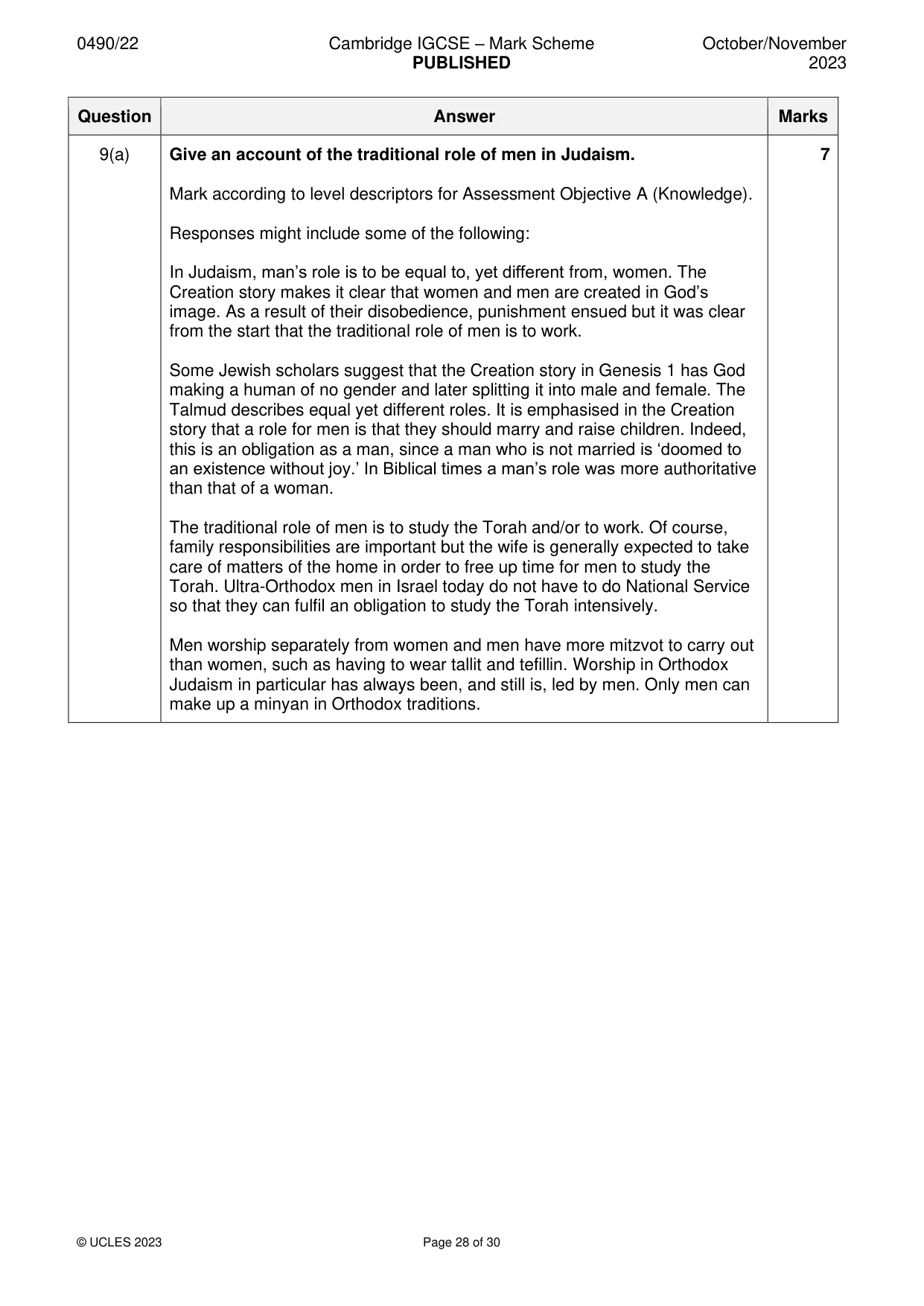
0490/22 Cambridge IGCSE – Mark Scheme PUBLISHED October/November 2023 © UCLES 2023 Page 28 of 30 Question Answer Marks 9(a) Give an account of the traditional role of men in Judaism. Mark according to level descriptors for Assessment Objective A (Knowledge). Responses might include some of the following: In Judaism, man’s role is to be equal to, yet different from, women. The Creation story makes it clear that women and men are created in God’s image. As a result of their disobedience, punishment ensued but it was clear from the start that the traditional role of men is to work. Some Jewish scholars suggest that the Creation story in Genesis 1 has God making a human of no gender and later splitting it into male and female. The Talmud describes equal yet different roles. It is emphasised in the Creation story that a role for men is that they should marry and raise children. Indeed, this is an obligation as a man, since a man who is not married is ‘doomed to an existence without joy.’ In Biblical times a man’s role was more authoritative than that of a woman. The traditional role of men is to study the Torah and/or to work. Of course, family responsibilities are important but the wife is generally expected to take care of matters of the home in order to free up time for men to study the Torah. Ultra-Orthodox men in Israel today do not have to do National Service so that they can fulfil an obligation to study the Torah intensively. Men worship separately from women and men have more mitzvot to carry out than women, such as having to wear tallit and tefillin. Worship in Orthodox Judaism in particular has always been, and still is, led by men. Only men can make up a minyan in Orthodox traditions. 7
Mark scheme, page 29
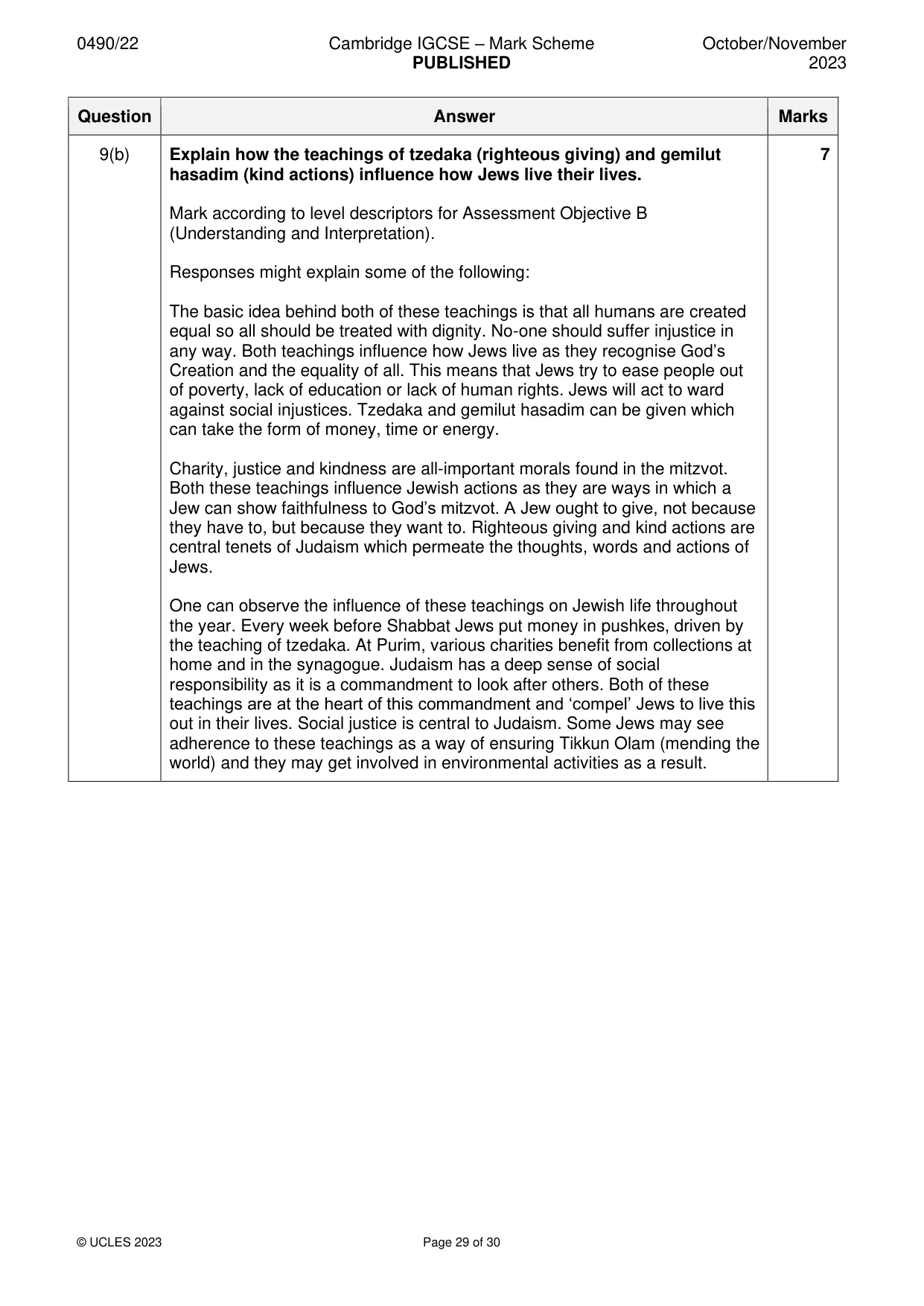
0490/22 Cambridge IGCSE – Mark Scheme PUBLISHED October/November 2023 © UCLES 2023 Page 29 of 30 Question Answer Marks 9(b) Explain how the teachings of tzedaka (righteous giving) and gemilut hasadim (kind actions) influence how Jews live their lives. Mark according to level descriptors for Assessment Objective B (Understanding and Interpretation). Responses might explain some of the following: The basic idea behind both of these teachings is that all humans are created equal so all should be treated with dignity. No-one should suffer injustice in any way. Both teachings influence how Jews live as they recognise God’s Creation and the equality of all. This means that Jews try to ease people out of poverty, lack of education or lack of human rights. Jews will act to ward against social injustices. Tzedaka and gemilut hasadim can be given which can take the form of money, time or energy. Charity, justice and kindness are all-important morals found in the mitzvot. Both these teachings influence Jewish actions as they are ways in which a Jew can show faithfulness to God’s mitzvot. A Jew ought to give, not because they have to, but because they want to. Righteous giving and kind actions are central tenets of Judaism which permeate the thoughts, words and actions of Jews. One can observe the influence of these teachings on Jewish life throughout the year. Every week before Shabbat Jews put money in pushkes, driven by the teaching of tzedaka. At Purim, various charities benefit from collections at home and in the synagogue. Judaism has a deep sense of social responsibility as it is a commandment to look after others. Both of these teachings are at the heart of this commandment and ‘compel’ Jews to live this out in their lives. Social justice is central to Judaism. Some Jews may see adherence to these teachings as a way of ensuring Tikkun Olam (mending the world) and they may get involved in environmental activities as a result. 7
Mark scheme, page 30
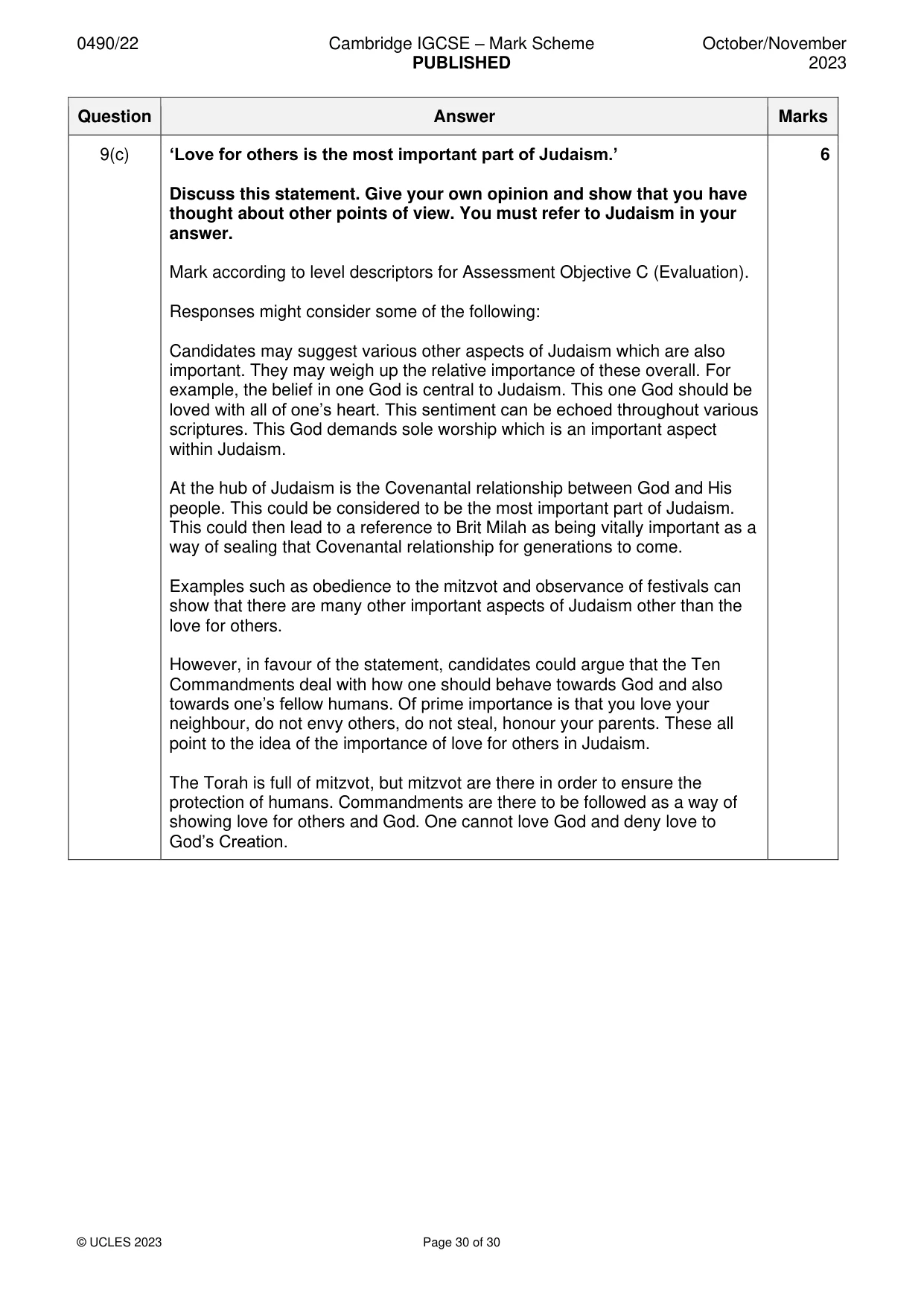
0490/22 Cambridge IGCSE – Mark Scheme PUBLISHED October/November 2023 © UCLES 2023 Page 30 of 30 Question Answer Marks 9(c) ‘Love for others is the most important part of Judaism.’ Discuss this statement. Give your own opinion and show that you have thought about other points of view. You must refer to Judaism in your answer. Mark according to level descriptors for Assessment Objective C (Evaluation). Responses might consider some of the following: Candidates may suggest various other aspects of Judaism which are also important. They may weigh up the relative importance of these overall. For example, the belief in one God is central to Judaism. This one God should be loved with all of one’s heart. This sentiment can be echoed throughout various scriptures. This God demands sole worship which is an important aspect within Judaism. At the hub of Judaism is the Covenantal relationship between God and His people. This could be considered to be the most important part of Judaism. This could then lead to a reference to Brit Milah as being vitally important as a way of sealing that Covenantal relationship for generations to come. Examples such as obedience to the mitzvot and observance of festivals can show that there are many other important aspects of Judaism other than the love for others. However, in favour of the statement, candidates could argue that the Ten Commandments deal with how one should behave towards God and also towards one’s fellow humans. Of prime importance is that you love your neighbour, do not envy others, do not steal, honour your parents. These all point to the idea of the importance of love for others in Judaism. The Torah is full of mitzvot, but mitzvot are there in order to ensure the protection of humans. Commandments are there to be followed as a way of showing love for others and God. One cannot love God and deny love to God’s Creation. 6
What you needed in this session
Cambridge’s own grade thresholds for 2023 Oct/Nov, Paper 2 · Variant 2. A higher threshold means an easier paper — the bar moves with how the cohort did.