Cambridge IGCSE Religious Studies 0490 — 2022 Oct/Nov Paper 2 · Variant 2
0490/22/O/N/22 · 80 marks · ≈90 min
The question paper and its mark scheme, free to read here and free to download. This is Cambridge’s own paper, exactly as it was sat.
Question paper4 pages
Mark scheme30 pages
Answers below. Sit the paper first if you are practising.
Paper as text
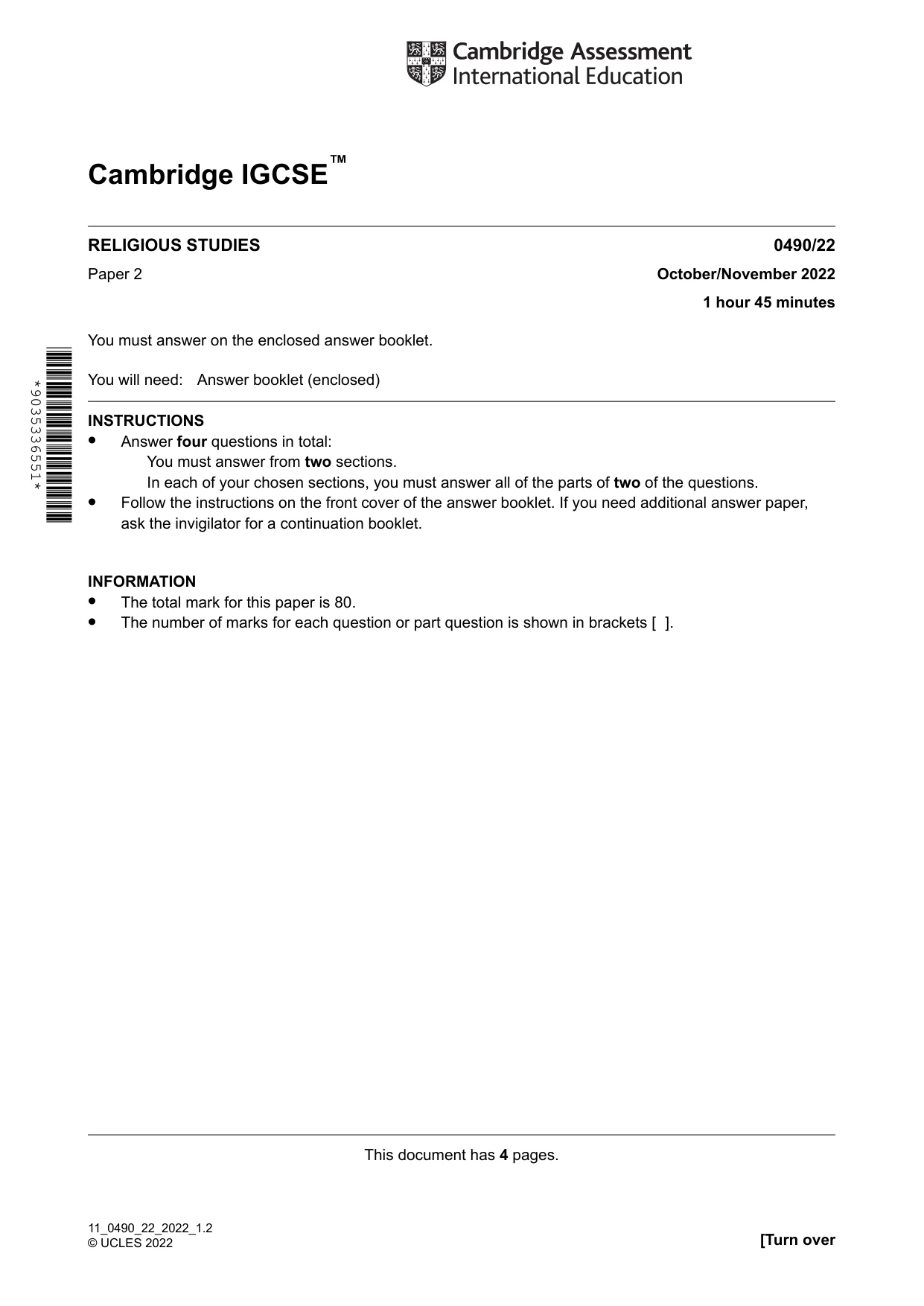
Question paper, page 1
Cambridge IGCSE™ 0490/22 October/November 2022 1 hour 45 minutes RELIGIOUS STUDIES Paper 2 You must answer on the enclosed answer booklet. You will need: Answer booklet (enclosed) INSTRUCTIONS • Answer four questions in total: You must answer from two sections. In each of your chosen sections, you must answer all of the parts of two of the questions. • Follow the instructions on the front cover of the answer booklet. If you need additional answer paper, ask the invigilator for a continuation booklet. INFORMATION • The total mark for this paper is 80. • The number of marks for each question or part question is shown in brackets [ ]. This document has 4 pages. [Turn over 11_0490_22_2022_1.2 © UCLES 2022 *9035336551*
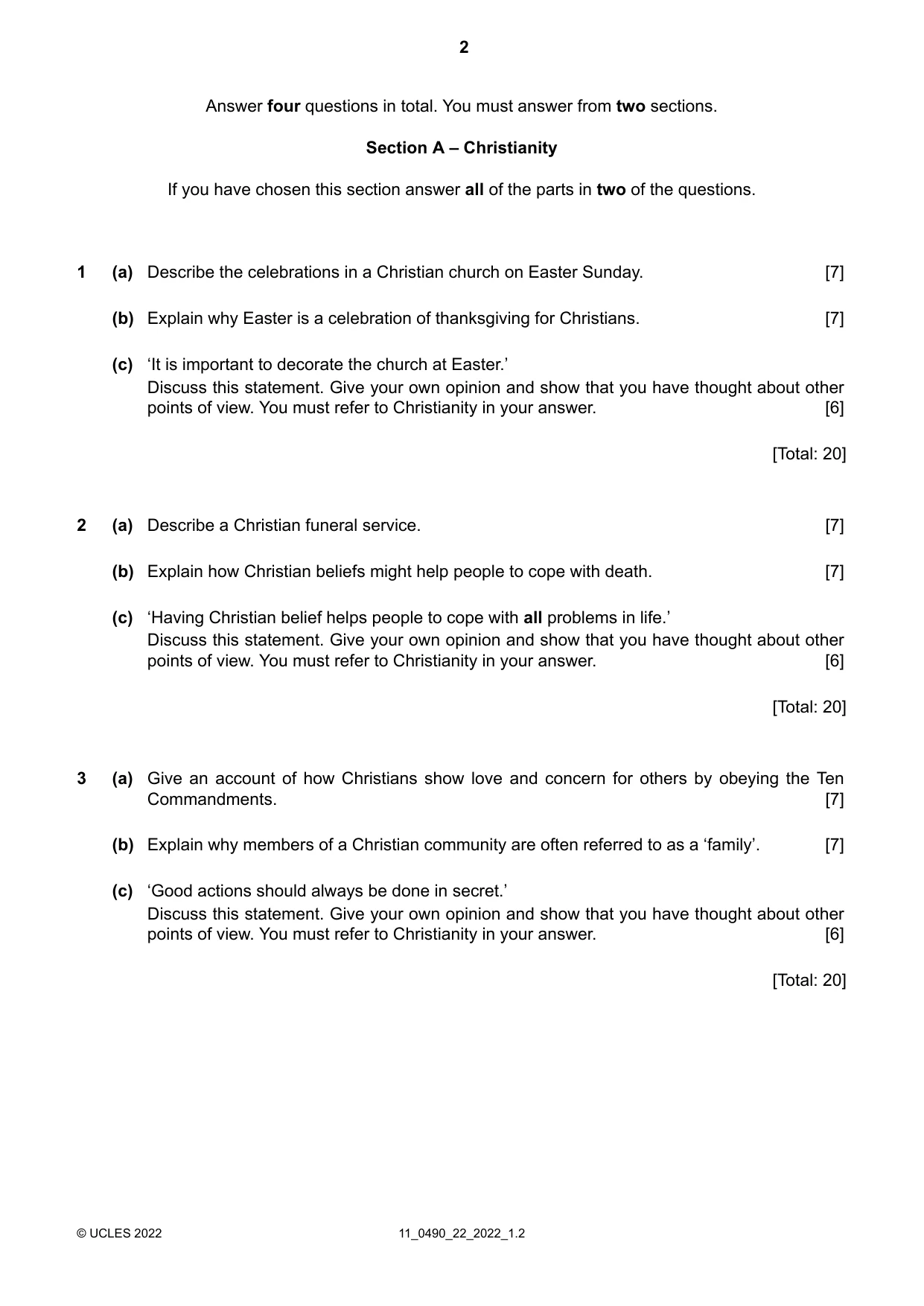
Question paper, page 2
Answer four questions in total. You must answer from two sections. Section A – Christianity If you have chosen this section answer all of the parts in two of the questions. Describe the celebrations in a Christian church on Easter Sunday. [7] (a) 1 Explain why Easter is a celebration of thanksgiving for Christians. [7] (b) ‘It is important to decorate the church at Easter.’ Discuss this statement. Give your own opinion and show that you have thought about other points of view. You must refer to Christianity in your answer. [6] (c) [Total: 20] Describe a Christian funeral service. [7] (a) 2 Explain how Christian beliefs might help people to cope with death. [7] (b) ‘Having Christian belief helps people to cope with all problems in life.’ Discuss this statement. Give your own opinion and show that you have thought about other points of view. You must refer to Christianity in your answer. [6] (c) [Total: 20] Give an account of how Christians show love and concern for others by obeying the Ten Commandments. [7] (a) 3 Explain why members of a Christian community are often referred to as a ‘family’. [7] (b) ‘Good actions should always be done in secret.’ Discuss this statement. Give your own opinion and show that you have thought about other points of view. You must refer to Christianity in your answer. [6] (c) [Total: 20] 11_0490_22_2022_1.2 © UCLES 2022 2
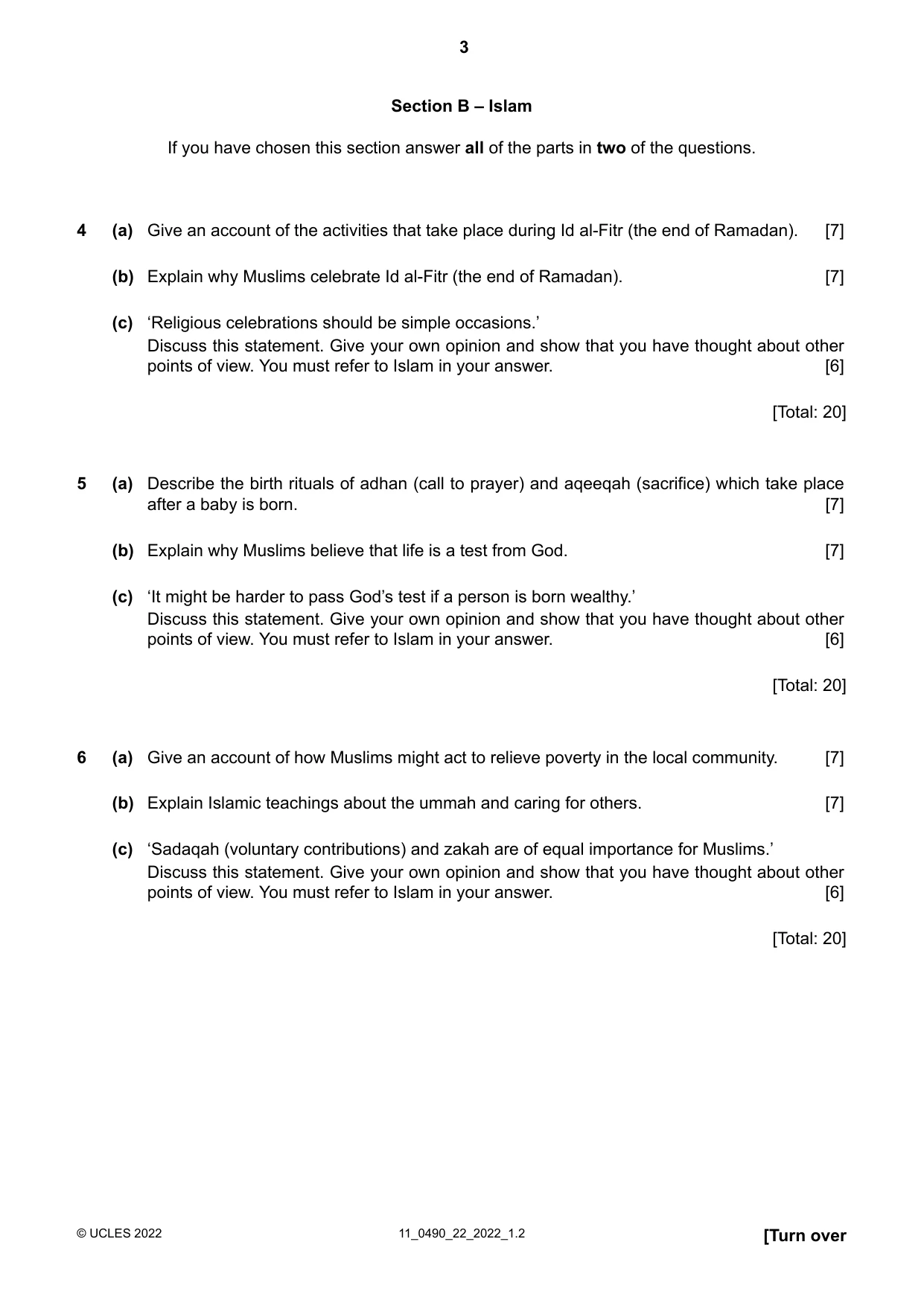
Question paper, page 3
Section B – Islam If you have chosen this section answer all of the parts in two of the questions. Give an account of the activities that take place during Id al-Fitr (the end of Ramadan). [7] (a) 4 Explain why Muslims celebrate Id al-Fitr (the end of Ramadan). [7] (b) ‘Religious celebrations should be simple occasions.’ Discuss this statement. Give your own opinion and show that you have thought about other points of view. You must refer to Islam in your answer. [6] (c) [Total: 20] Describe the birth rituals of adhan (call to prayer) and aqeeqah (sacrifice) which take place after a baby is born. [7] (a) 5 Explain why Muslims believe that life is a test from God. [7] (b) ‘It might be harder to pass God’s test if a person is born wealthy.’ Discuss this statement. Give your own opinion and show that you have thought about other points of view. You must refer to Islam in your answer. [6] (c) [Total: 20] Give an account of how Muslims might act to relieve poverty in the local community. [7] (a) 6 Explain Islamic teachings about the ummah and caring for others. [7] (b) ‘Sadaqah (voluntary contributions) and zakah are of equal importance for Muslims.’ Discuss this statement. Give your own opinion and show that you have thought about other points of view. You must refer to Islam in your answer. [6] (c) [Total: 20] [Turn over 11_0490_22_2022_1.2 © UCLES 2022 3
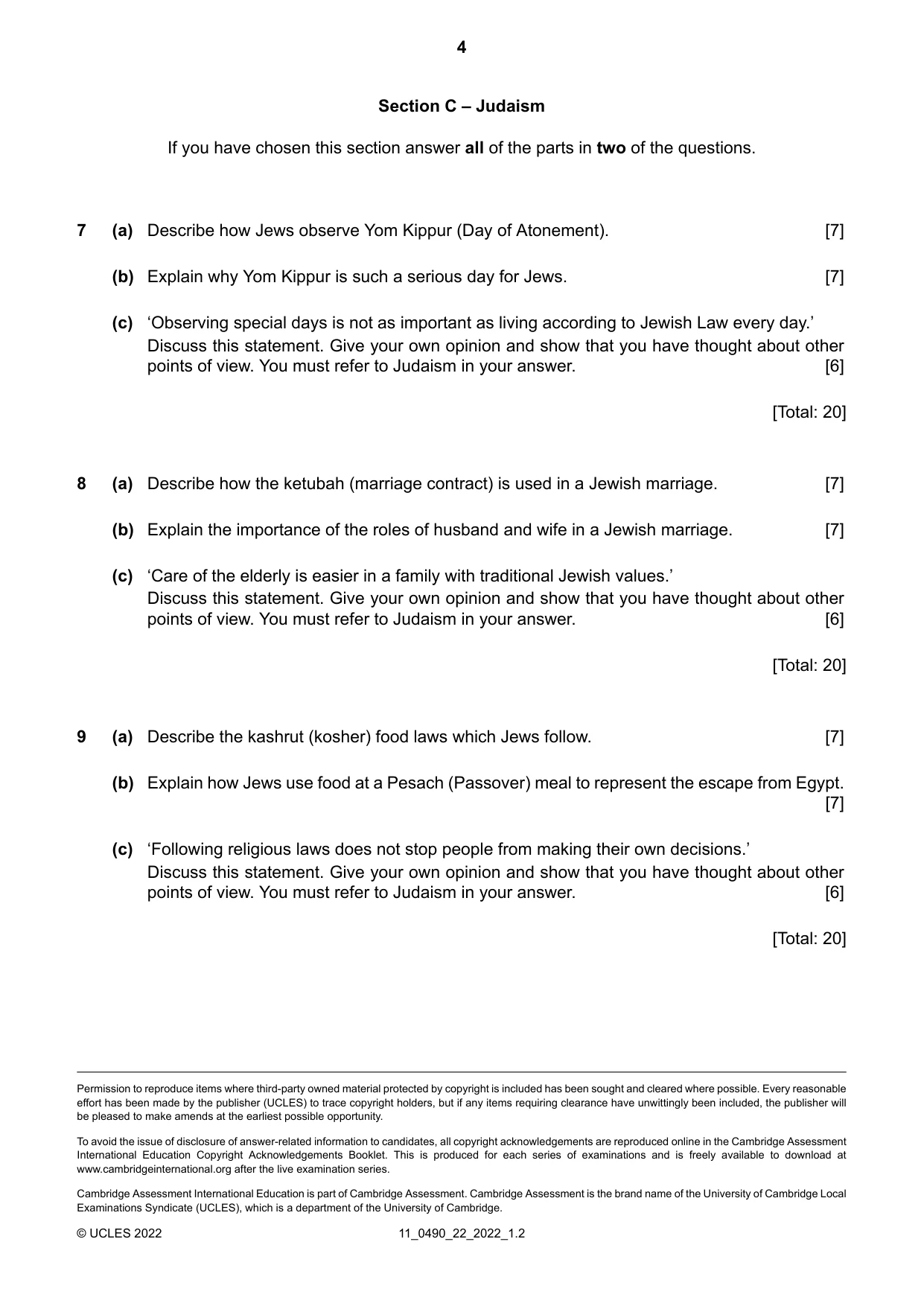
Question paper, page 4
Section C – Judaism If you have chosen this section answer all of the parts in two of the questions. Describe how Jews observe Yom Kippur (Day of Atonement). [7] (a) 7 Explain why Yom Kippur is such a serious day for Jews. [7] (b) ‘Observing special days is not as important as living according to Jewish Law every day.’ Discuss this statement. Give your own opinion and show that you have thought about other points of view. You must refer to Judaism in your answer. [6] (c) [Total: 20] Describe how the ketubah (marriage contract) is used in a Jewish marriage. [7] (a) 8 Explain the importance of the roles of husband and wife in a Jewish marriage. [7] (b) ‘Care of the elderly is easier in a family with traditional Jewish values.’ Discuss this statement. Give your own opinion and show that you have thought about other points of view. You must refer to Judaism in your answer. [6] (c) [Total: 20] Describe the kashrut (kosher) food laws which Jews follow. [7] (a) 9 Explain how Jews use food at a Pesach (Passover) meal to represent the escape from Egypt. [7] (b) ‘Following religious laws does not stop people from making their own decisions.’ Discuss this statement. Give your own opinion and show that you have thought about other points of view. You must refer to Judaism in your answer. [6] (c) [Total: 20] Permission to reproduce items where third-party owned material protected by copyright is included has been sought and cleared where possible. Every reasonable effort has been made by the publisher (UCLES) to trace copyright holders, but if any items requiring clearance have unwittingly been included, the publisher will be pleased to make amends at the earliest possible opportunity. To avoid the issue of disclosure of answer-related information to candidates, all copyright acknowledgements are reproduced online in the Cambridge Assessment International Education Copyright Acknowledgements Booklet. This is produced for each series of examinations and is freely available to download at www.cambridgeinternational.org after the live examination series. Cambridge Assessment International Education is part of Cambridge Assessment. Cambridge Assessment is the brand name of the University of Cambridge Local Examinations Syndicate (UCLES), which is a department of the University of Cambridge. 11_0490_22_2022_1.2 © UCLES 2022 4
Mark scheme, page 1
This document consists of 30 printed pages. © UCLES 2022 [Turn over Cambridge IGCSE™ RELIGIOUS STUDIES 0490/22 Paper 2 October/November 2022 MARK SCHEME Maximum Mark: 80 Published This mark scheme is published as an aid to teachers and candidates, to indicate the requirements of the examination. It shows the basis on which Examiners were instructed to award marks. It does not indicate the details of the discussions that took place at an Examiners’ meeting before marking began, which would have considered the acceptability of alternative answers. Mark schemes should be read in conjunction with the question paper and the Principal Examiner Report for Teachers. Cambridge International will not enter into discussions about these mark schemes. Cambridge International is publishing the mark schemes for the October/November 2022 series for most Cambridge IGCSE™, Cambridge International A and AS Level components and some Cambridge O Level components.
Mark scheme, page 2
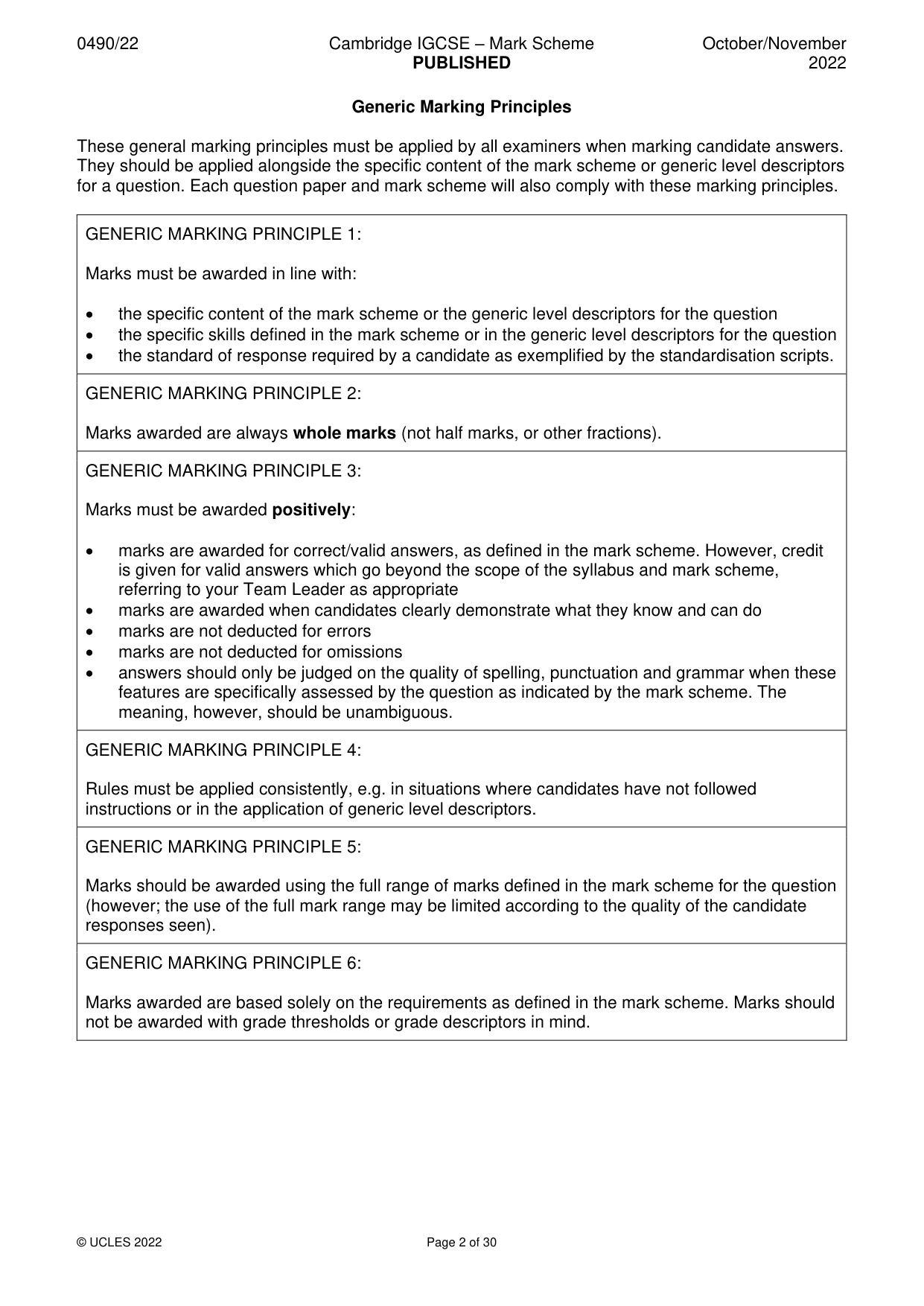
0490/22 Cambridge IGCSE – Mark Scheme PUBLISHED October/November 2022 © UCLES 2022 Page 2 of 30 Generic Marking Principles These general marking principles must be applied by all examiners when marking candidate answers. They should be applied alongside the specific content of the mark scheme or generic level descriptors for a question. Each question paper and mark scheme will also comply with these marking principles. GENERIC MARKING PRINCIPLE 1: Marks must be awarded in line with: • the specific content of the mark scheme or the generic level descriptors for the question • the specific skills defined in the mark scheme or in the generic level descriptors for the question • the standard of response required by a candidate as exemplified by the standardisation scripts. GENERIC MARKING PRINCIPLE 2: Marks awarded are always whole marks (not half marks, or other fractions). GENERIC MARKING PRINCIPLE 3: Marks must be awarded positively: • marks are awarded for correct/valid answers, as defined in the mark scheme. However, credit is given for valid answers which go beyond the scope of the syllabus and mark scheme, referring to your Team Leader as appropriate • marks are awarded when candidates clearly demonstrate what they know and can do • marks are not deducted for errors • marks are not deducted for omissions • answers should only be judged on the quality of spelling, punctuation and grammar when these features are specifically assessed by the question as indicated by the mark scheme. The meaning, however, should be unambiguous. GENERIC MARKING PRINCIPLE 4: Rules must be applied consistently, e.g. in situations where candidates have not followed instructions or in the application of generic level descriptors. GENERIC MARKING PRINCIPLE 5: Marks should be awarded using the full range of marks defined in the mark scheme for the question (however; the use of the full mark range may be limited according to the quality of the candidate responses seen). GENERIC MARKING PRINCIPLE 6: Marks awarded are based solely on the requirements as defined in the mark scheme. Marks should not be awarded with grade thresholds or grade descriptors in mind.
Mark scheme, page 3
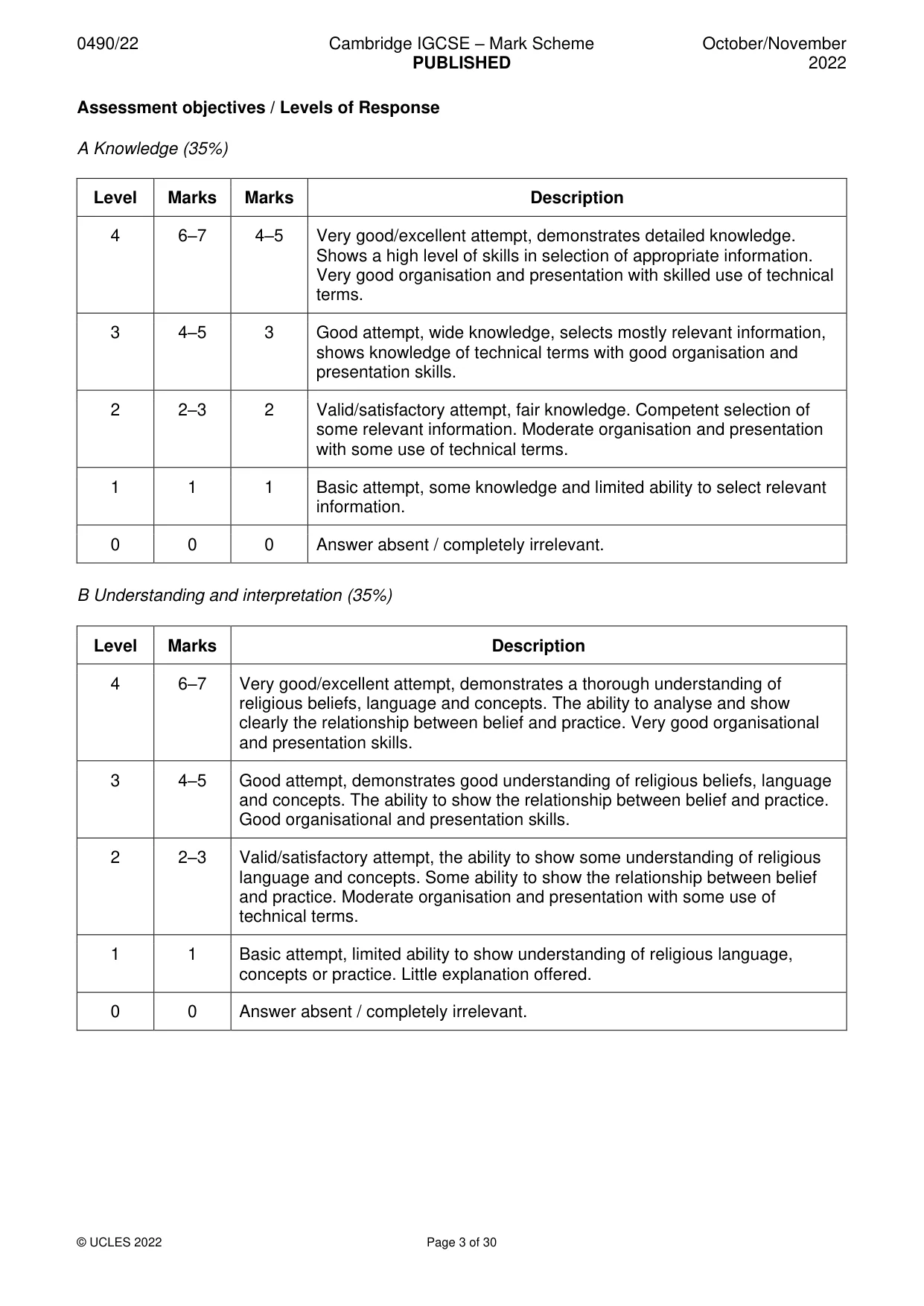
0490/22 Cambridge IGCSE – Mark Scheme PUBLISHED October/November 2022 © UCLES 2022 Page 3 of 30 Assessment objectives / Levels of Response A Knowledge (35%) Level Marks Marks Description 4 6–7 4–5 Very good/excellent attempt, demonstrates detailed knowledge. Shows a high level of skills in selection of appropriate information. Very good organisation and presentation with skilled use of technical terms. 3 4–5 3 Good attempt, wide knowledge, selects mostly relevant information, shows knowledge of technical terms with good organisation and presentation skills. 2 2–3 2 Valid/satisfactory attempt, fair knowledge. Competent selection of some relevant information. Moderate organisation and presentation with some use of technical terms. 1 1 1 Basic attempt, some knowledge and limited ability to select relevant information. 0 0 0 Answer absent / completely irrelevant. B Understanding and interpretation (35%) Level Marks Description 4 6–7 Very good/excellent attempt, demonstrates a thorough understanding of religious beliefs, language and concepts. The ability to analyse and show clearly the relationship between belief and practice. Very good organisational and presentation skills. 3 4–5 Good attempt, demonstrates good understanding of religious beliefs, language and concepts. The ability to show the relationship between belief and practice. Good organisational and presentation skills. 2 2–3 Valid/satisfactory attempt, the ability to show some understanding of religious language and concepts. Some ability to show the relationship between belief and practice. Moderate organisation and presentation with some use of technical terms. 1 1 Basic attempt, limited ability to show understanding of religious language, concepts or practice. Little explanation offered. 0 0 Answer absent / completely irrelevant.
Mark scheme, page 4
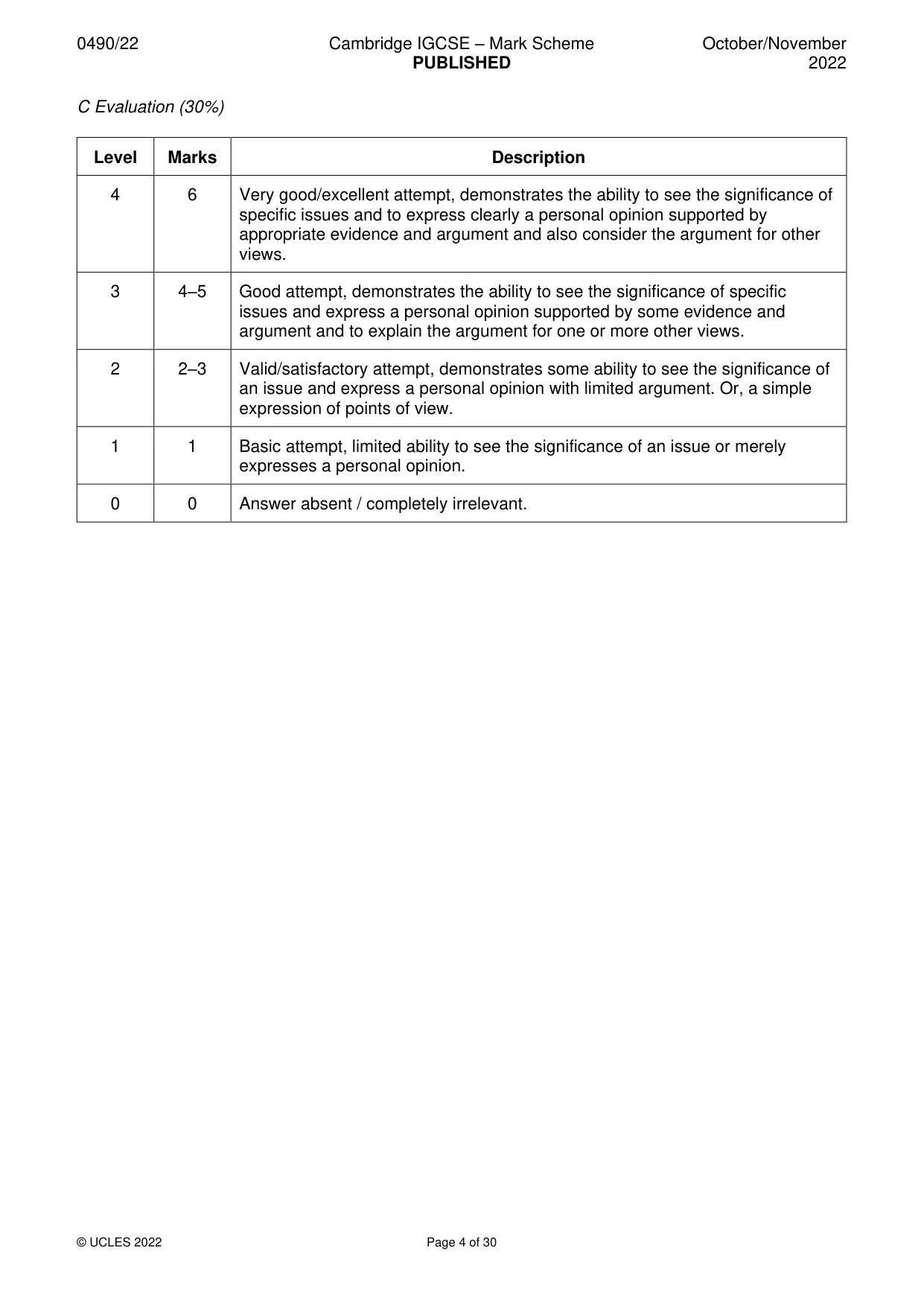
0490/22 Cambridge IGCSE – Mark Scheme PUBLISHED October/November 2022 © UCLES 2022 Page 4 of 30 C Evaluation (30%) Level Marks Description 4 6 Very good/excellent attempt, demonstrates the ability to see the significance of specific issues and to express clearly a personal opinion supported by appropriate evidence and argument and also consider the argument for other views. 3 4–5 Good attempt, demonstrates the ability to see the significance of specific issues and express a personal opinion supported by some evidence and argument and to explain the argument for one or more other views. 2 2–3 Valid/satisfactory attempt, demonstrates some ability to see the significance of an issue and express a personal opinion with limited argument. Or, a simple expression of points of view. 1 1 Basic attempt, limited ability to see the significance of an issue or merely expresses a personal opinion. 0 0 Answer absent / completely irrelevant.
Mark scheme, page 5
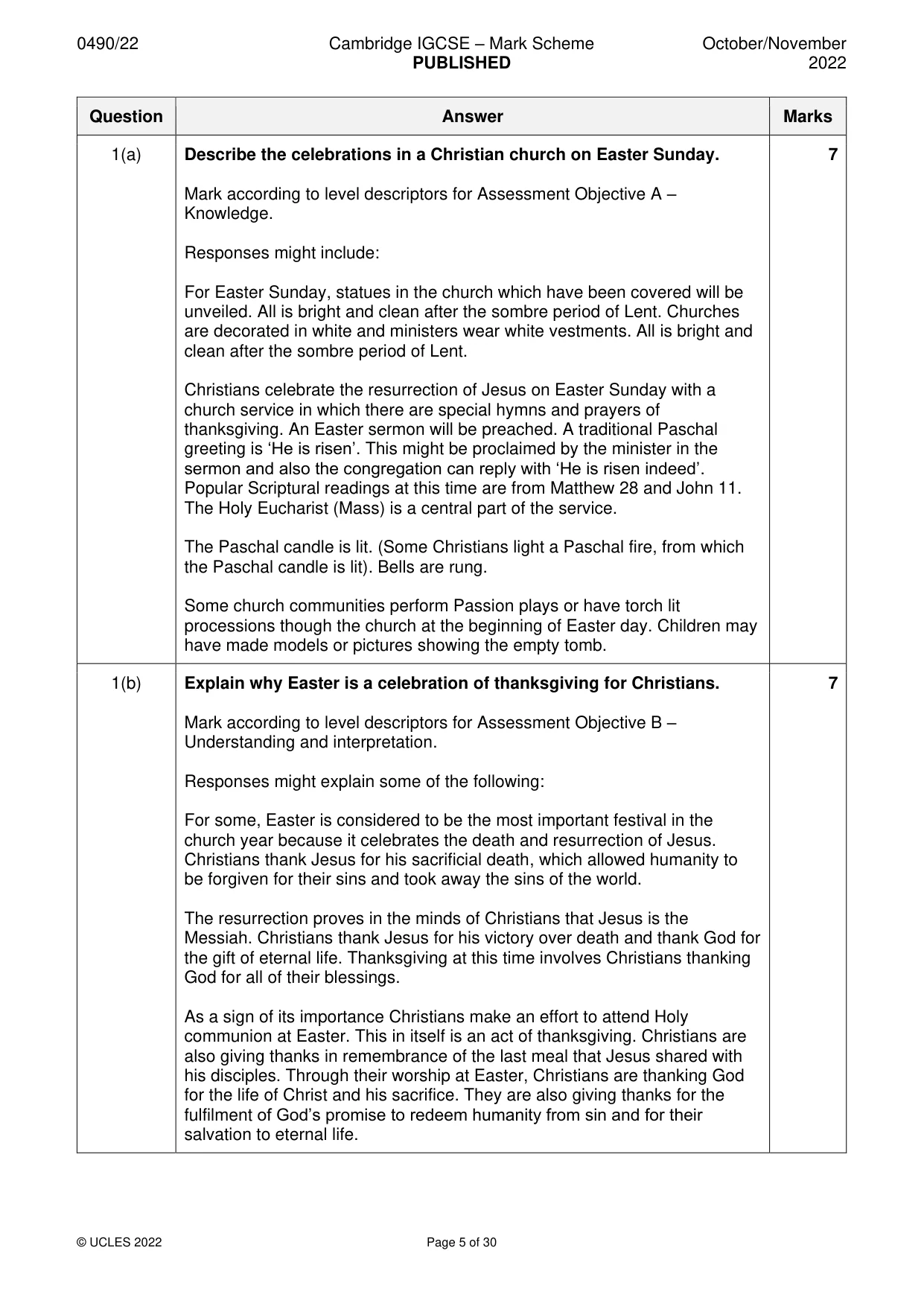
0490/22 Cambridge IGCSE – Mark Scheme PUBLISHED October/November 2022 © UCLES 2022 Page 5 of 30 Question Answer Marks 1(a) Describe the celebrations in a Christian church on Easter Sunday. Mark according to level descriptors for Assessment Objective A – Knowledge. Responses might include: For Easter Sunday, statues in the church which have been covered will be unveiled. All is bright and clean after the sombre period of Lent. Churches are decorated in white and ministers wear white vestments. All is bright and clean after the sombre period of Lent. Christians celebrate the resurrection of Jesus on Easter Sunday with a church service in which there are special hymns and prayers of thanksgiving. An Easter sermon will be preached. A traditional Paschal greeting is ‘He is risen’. This might be proclaimed by the minister in the sermon and also the congregation can reply with ‘He is risen indeed’. Popular Scriptural readings at this time are from Matthew 28 and John 11. The Holy Eucharist (Mass) is a central part of the service. The Paschal candle is lit. (Some Christians light a Paschal fire, from which the Paschal candle is lit). Bells are rung. Some church communities perform Passion plays or have torch lit processions though the church at the beginning of Easter day. Children may have made models or pictures showing the empty tomb. 7 1(b) Explain why Easter is a celebration of thanksgiving for Christians. Mark according to level descriptors for Assessment Objective B – Understanding and interpretation. Responses might explain some of the following: For some, Easter is considered to be the most important festival in the church year because it celebrates the death and resurrection of Jesus. Christians thank Jesus for his sacrificial death, which allowed humanity to be forgiven for their sins and took away the sins of the world. The resurrection proves in the minds of Christians that Jesus is the Messiah. Christians thank Jesus for his victory over death and thank God for the gift of eternal life. Thanksgiving at this time involves Christians thanking God for all of their blessings. As a sign of its importance Christians make an effort to attend Holy communion at Easter. This in itself is an act of thanksgiving. Christians are also giving thanks in remembrance of the last meal that Jesus shared with his disciples. Through their worship at Easter, Christians are thanking God for the life of Christ and his sacrifice. They are also giving thanks for the fulfilment of God’s promise to redeem humanity from sin and for their salvation to eternal life. 7
Mark scheme, page 6
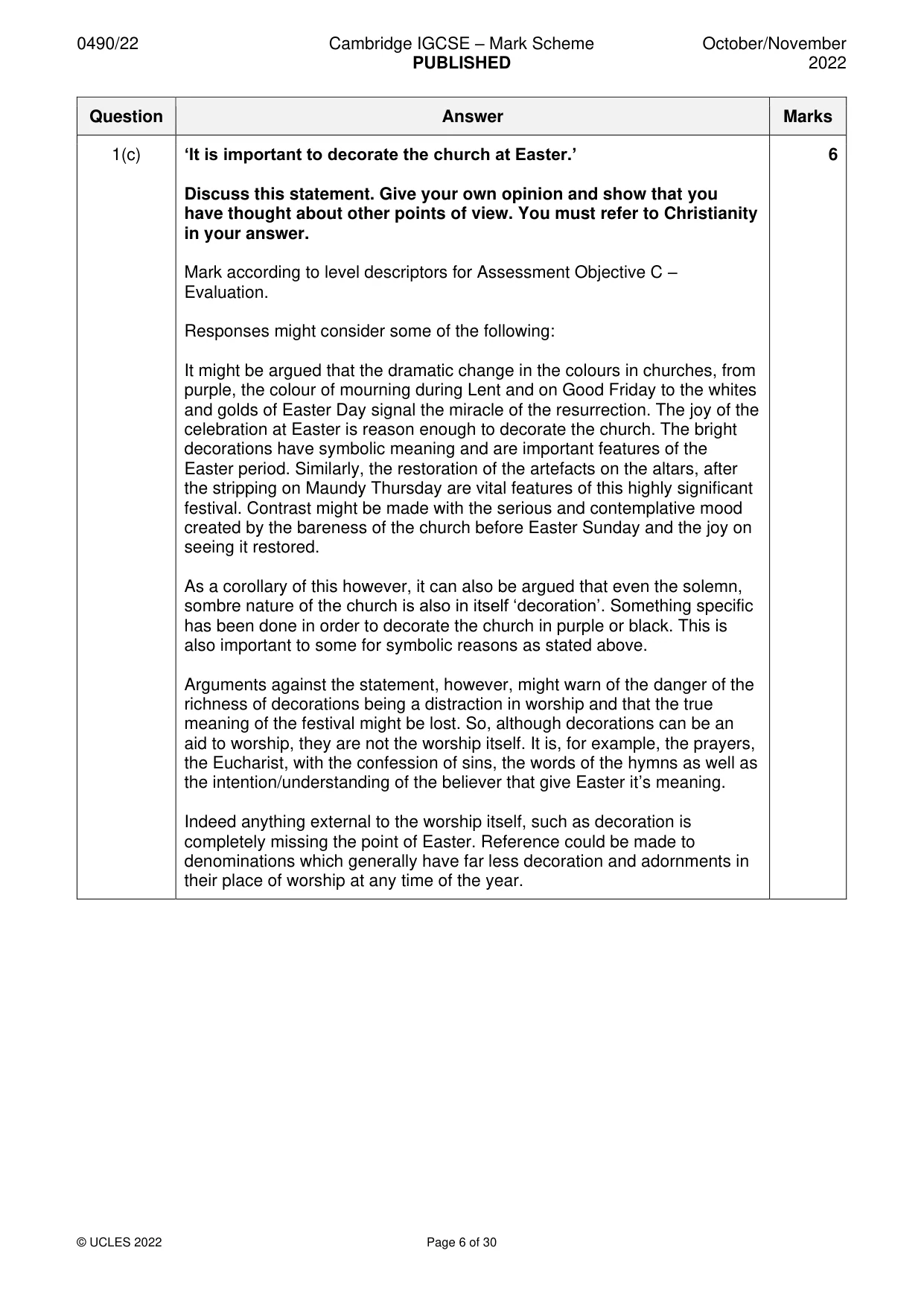
0490/22 Cambridge IGCSE – Mark Scheme PUBLISHED October/November 2022 © UCLES 2022 Page 6 of 30 Question Answer Marks 1(c) ‘It is important to decorate the church at Easter.’ Discuss this statement. Give your own opinion and show that you have thought about other points of view. You must refer to Christianity in your answer. Mark according to level descriptors for Assessment Objective C – Evaluation. Responses might consider some of the following: It might be argued that the dramatic change in the colours in churches, from purple, the colour of mourning during Lent and on Good Friday to the whites and golds of Easter Day signal the miracle of the resurrection. The joy of the celebration at Easter is reason enough to decorate the church. The bright decorations have symbolic meaning and are important features of the Easter period. Similarly, the restoration of the artefacts on the altars, after the stripping on Maundy Thursday are vital features of this highly significant festival. Contrast might be made with the serious and contemplative mood created by the bareness of the church before Easter Sunday and the joy on seeing it restored. As a corollary of this however, it can also be argued that even the solemn, sombre nature of the church is also in itself ‘decoration’. Something specific has been done in order to decorate the church in purple or black. This is also important to some for symbolic reasons as stated above. Arguments against the statement, however, might warn of the danger of the richness of decorations being a distraction in worship and that the true meaning of the festival might be lost. So, although decorations can be an aid to worship, they are not the worship itself. It is, for example, the prayers, the Eucharist, with the confession of sins, the words of the hymns as well as the intention/understanding of the believer that give Easter it’s meaning. Indeed anything external to the worship itself, such as decoration is completely missing the point of Easter. Reference could be made to denominations which generally have far less decoration and adornments in their place of worship at any time of the year. 6
Mark scheme, page 7
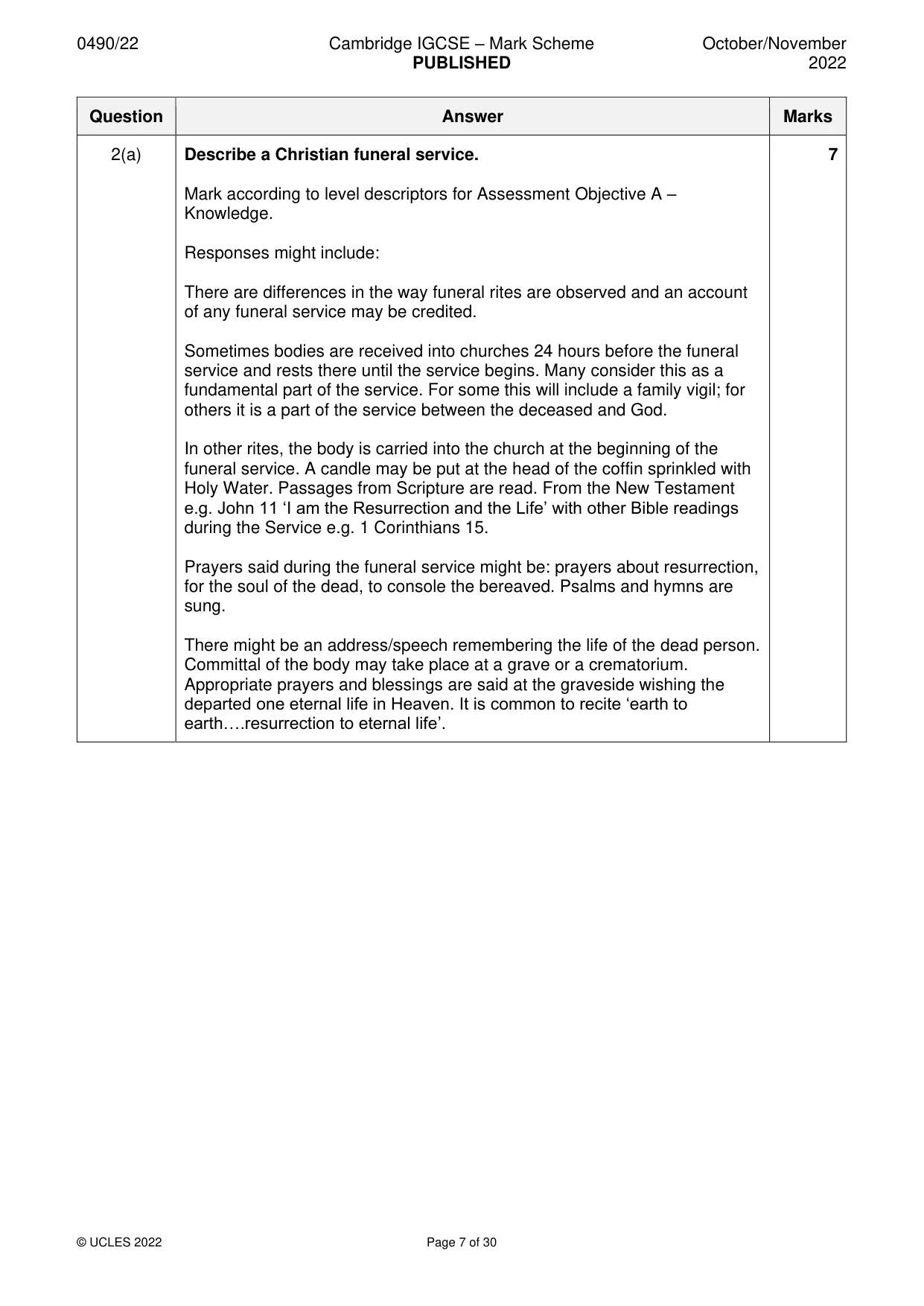
0490/22 Cambridge IGCSE – Mark Scheme PUBLISHED October/November 2022 © UCLES 2022 Page 7 of 30 Question Answer Marks 2(a) Describe a Christian funeral service. Mark according to level descriptors for Assessment Objective A – Knowledge. Responses might include: There are differences in the way funeral rites are observed and an account of any funeral service may be credited. Sometimes bodies are received into churches 24 hours before the funeral service and rests there until the service begins. Many consider this as a fundamental part of the service. For some this will include a family vigil; for others it is a part of the service between the deceased and God. In other rites, the body is carried into the church at the beginning of the funeral service. A candle may be put at the head of the coffin sprinkled with Holy Water. Passages from Scripture are read. From the New Testament e.g. John 11 ‘I am the Resurrection and the Life’ with other Bible readings during the Service e.g. 1 Corinthians 15. Prayers said during the funeral service might be: prayers about resurrection, for the soul of the dead, to console the bereaved. Psalms and hymns are sung. There might be an address/speech remembering the life of the dead person. Committal of the body may take place at a grave or a crematorium. Appropriate prayers and blessings are said at the graveside wishing the departed one eternal life in Heaven. It is common to recite ‘earth to earth….resurrection to eternal life’. 7
Mark scheme, page 8
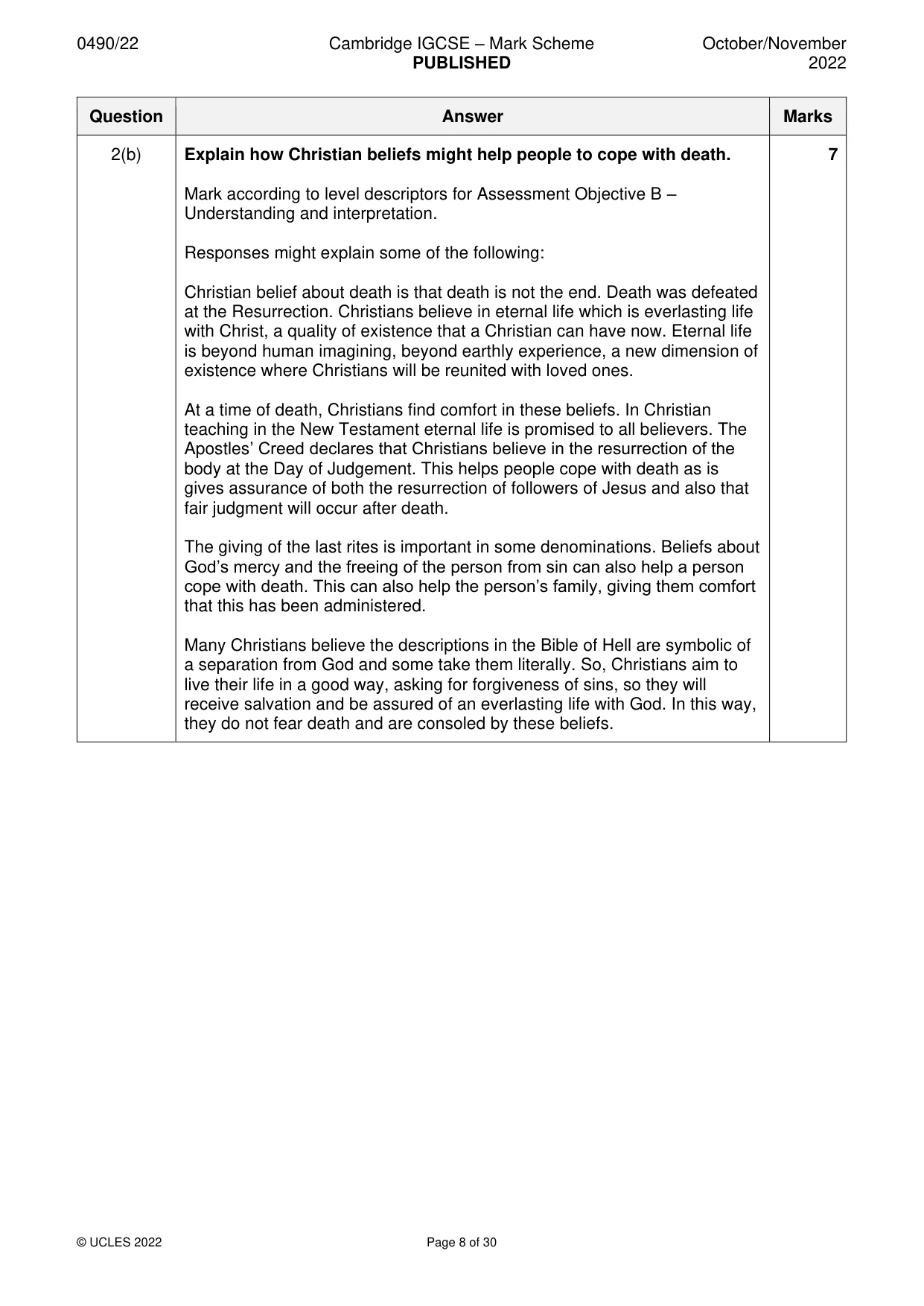
0490/22 Cambridge IGCSE – Mark Scheme PUBLISHED October/November 2022 © UCLES 2022 Page 8 of 30 Question Answer Marks 2(b) Explain how Christian beliefs might help people to cope with death. Mark according to level descriptors for Assessment Objective B – Understanding and interpretation. Responses might explain some of the following: Christian belief about death is that death is not the end. Death was defeated at the Resurrection. Christians believe in eternal life which is everlasting life with Christ, a quality of existence that a Christian can have now. Eternal life is beyond human imagining, beyond earthly experience, a new dimension of existence where Christians will be reunited with loved ones. At a time of death, Christians find comfort in these beliefs. In Christian teaching in the New Testament eternal life is promised to all believers. The Apostles’ Creed declares that Christians believe in the resurrection of the body at the Day of Judgement. This helps people cope with death as is gives assurance of both the resurrection of followers of Jesus and also that fair judgment will occur after death. The giving of the last rites is important in some denominations. Beliefs about God’s mercy and the freeing of the person from sin can also help a person cope with death. This can also help the person’s family, giving them comfort that this has been administered. Many Christians believe the descriptions in the Bible of Hell are symbolic of a separation from God and some take them literally. So, Christians aim to live their life in a good way, asking for forgiveness of sins, so they will receive salvation and be assured of an everlasting life with God. In this way, they do not fear death and are consoled by these beliefs. 7
Mark scheme, page 9
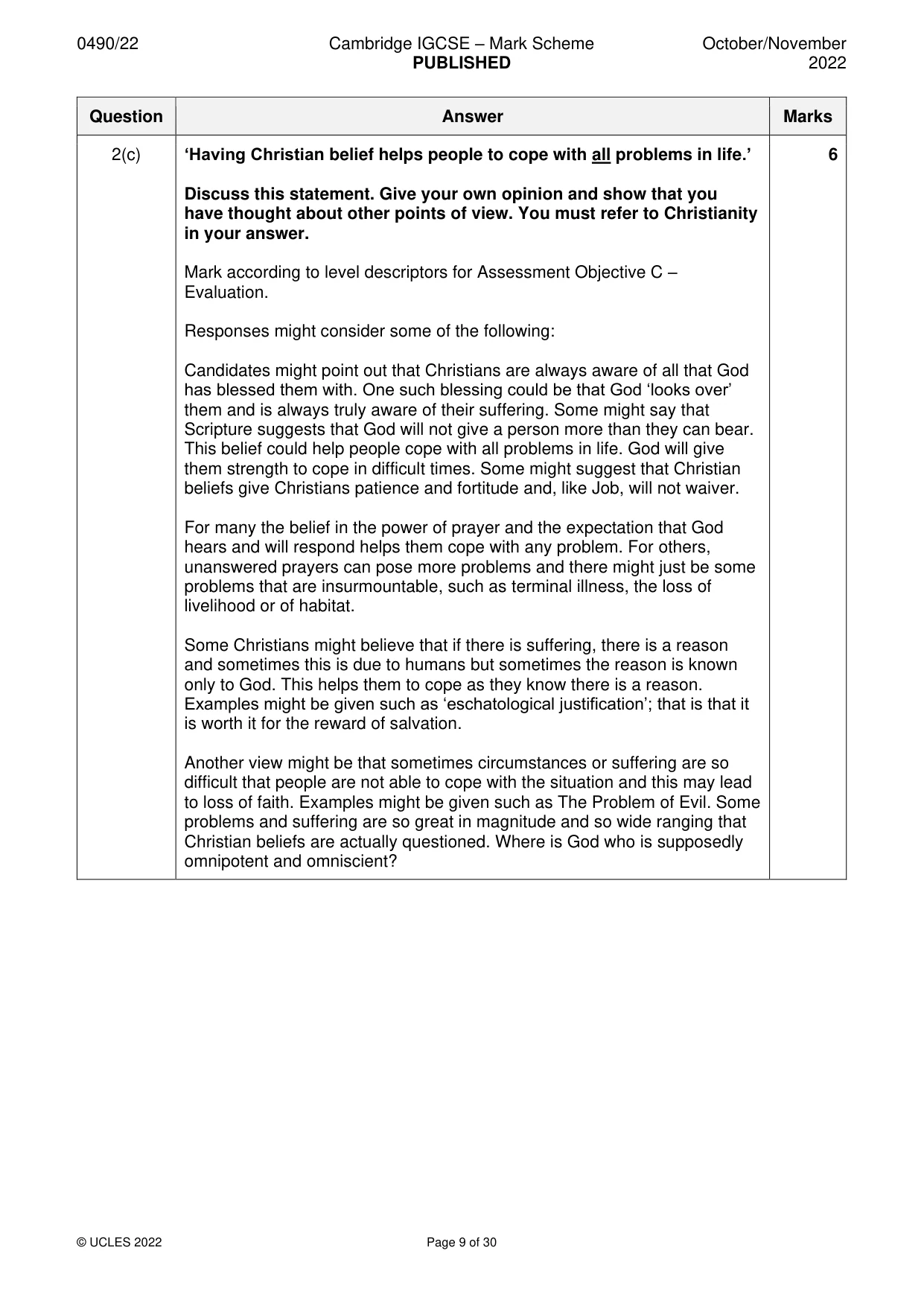
0490/22 Cambridge IGCSE – Mark Scheme PUBLISHED October/November 2022 © UCLES 2022 Page 9 of 30 Question Answer Marks 2(c) ‘Having Christian belief helps people to cope with all problems in life.’ Discuss this statement. Give your own opinion and show that you have thought about other points of view. You must refer to Christianity in your answer. Mark according to level descriptors for Assessment Objective C – Evaluation. Responses might consider some of the following: Candidates might point out that Christians are always aware of all that God has blessed them with. One such blessing could be that God ‘looks over’ them and is always truly aware of their suffering. Some might say that Scripture suggests that God will not give a person more than they can bear. This belief could help people cope with all problems in life. God will give them strength to cope in difficult times. Some might suggest that Christian beliefs give Christians patience and fortitude and, like Job, will not waiver. For many the belief in the power of prayer and the expectation that God hears and will respond helps them cope with any problem. For others, unanswered prayers can pose more problems and there might just be some problems that are insurmountable, such as terminal illness, the loss of livelihood or of habitat. Some Christians might believe that if there is suffering, there is a reason and sometimes this is due to humans but sometimes the reason is known only to God. This helps them to cope as they know there is a reason. Examples might be given such as ‘eschatological justification’; that is that it is worth it for the reward of salvation. Another view might be that sometimes circumstances or suffering are so difficult that people are not able to cope with the situation and this may lead to loss of faith. Examples might be given such as The Problem of Evil. Some problems and suffering are so great in magnitude and so wide ranging that Christian beliefs are actually questioned. Where is God who is supposedly omnipotent and omniscient? 6
Mark scheme, page 10
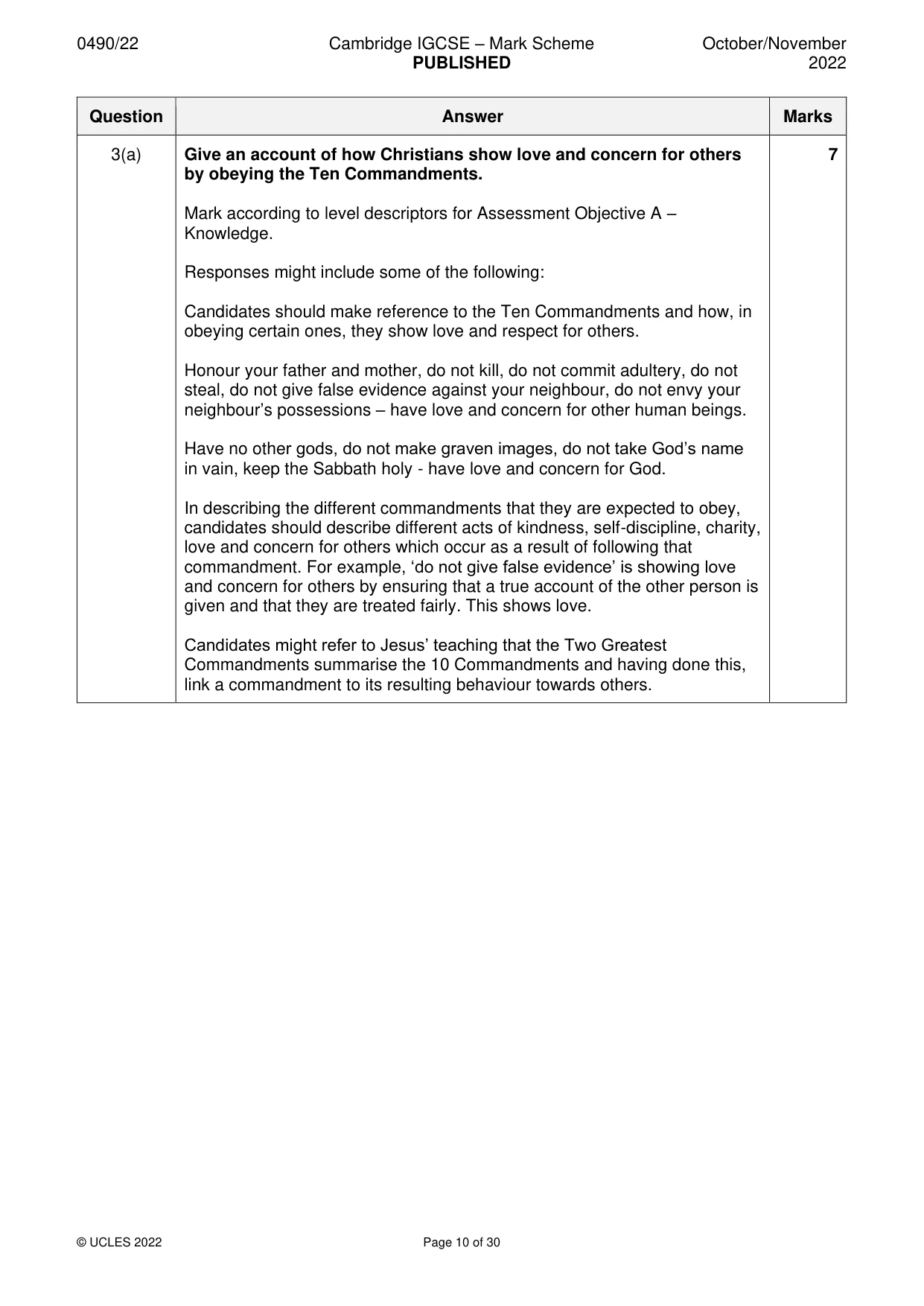
0490/22 Cambridge IGCSE – Mark Scheme PUBLISHED October/November 2022 © UCLES 2022 Page 10 of 30 Question Answer Marks 3(a) Give an account of how Christians show love and concern for others by obeying the Ten Commandments. Mark according to level descriptors for Assessment Objective A – Knowledge. Responses might include some of the following: Candidates should make reference to the Ten Commandments and how, in obeying certain ones, they show love and respect for others. Honour your father and mother, do not kill, do not commit adultery, do not steal, do not give false evidence against your neighbour, do not envy your neighbour’s possessions – have love and concern for other human beings. Have no other gods, do not make graven images, do not take God’s name in vain, keep the Sabbath holy - have love and concern for God. In describing the different commandments that they are expected to obey, candidates should describe different acts of kindness, self-discipline, charity, love and concern for others which occur as a result of following that commandment. For example, ‘do not give false evidence’ is showing love and concern for others by ensuring that a true account of the other person is given and that they are treated fairly. This shows love. Candidates might refer to Jesus’ teaching that the Two Greatest Commandments summarise the 10 Commandments and having done this, link a commandment to its resulting behaviour towards others. 7
Mark scheme, page 11
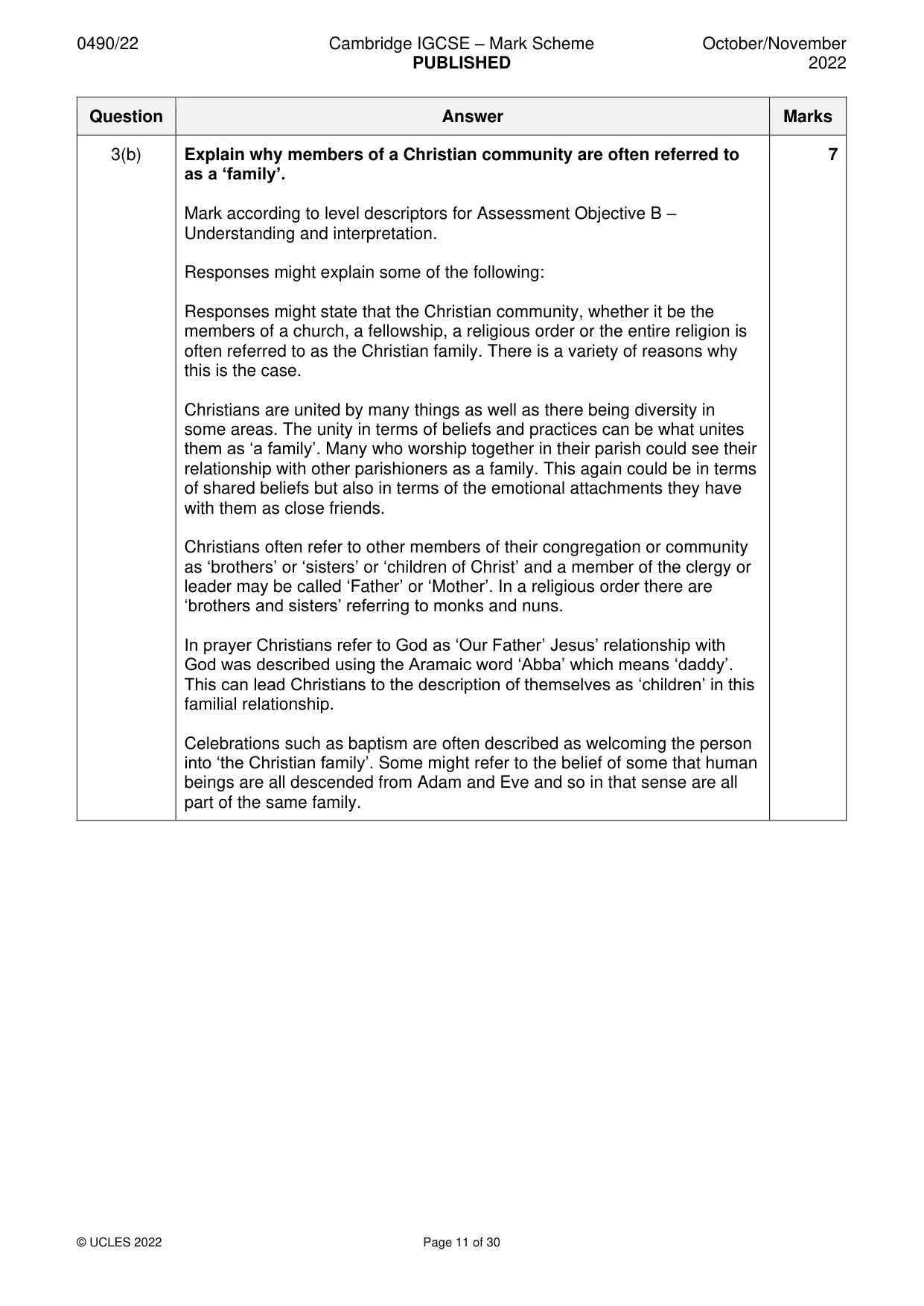
0490/22 Cambridge IGCSE – Mark Scheme PUBLISHED October/November 2022 © UCLES 2022 Page 11 of 30 Question Answer Marks 3(b) Explain why members of a Christian community are often referred to as a ‘family’. Mark according to level descriptors for Assessment Objective B – Understanding and interpretation. Responses might explain some of the following: Responses might state that the Christian community, whether it be the members of a church, a fellowship, a religious order or the entire religion is often referred to as the Christian family. There is a variety of reasons why this is the case. Christians are united by many things as well as there being diversity in some areas. The unity in terms of beliefs and practices can be what unites them as ‘a family’. Many who worship together in their parish could see their relationship with other parishioners as a family. This again could be in terms of shared beliefs but also in terms of the emotional attachments they have with them as close friends. Christians often refer to other members of their congregation or community as ‘brothers’ or ‘sisters’ or ‘children of Christ’ and a member of the clergy or leader may be called ‘Father’ or ‘Mother’. In a religious order there are ‘brothers and sisters’ referring to monks and nuns. In prayer Christians refer to God as ‘Our Father’ Jesus’ relationship with God was described using the Aramaic word ‘Abba’ which means ‘daddy’. This can lead Christians to the description of themselves as ‘children’ in this familial relationship. Celebrations such as baptism are often described as welcoming the person into ‘the Christian family’. Some might refer to the belief of some that human beings are all descended from Adam and Eve and so in that sense are all part of the same family. 7
Mark scheme, page 12
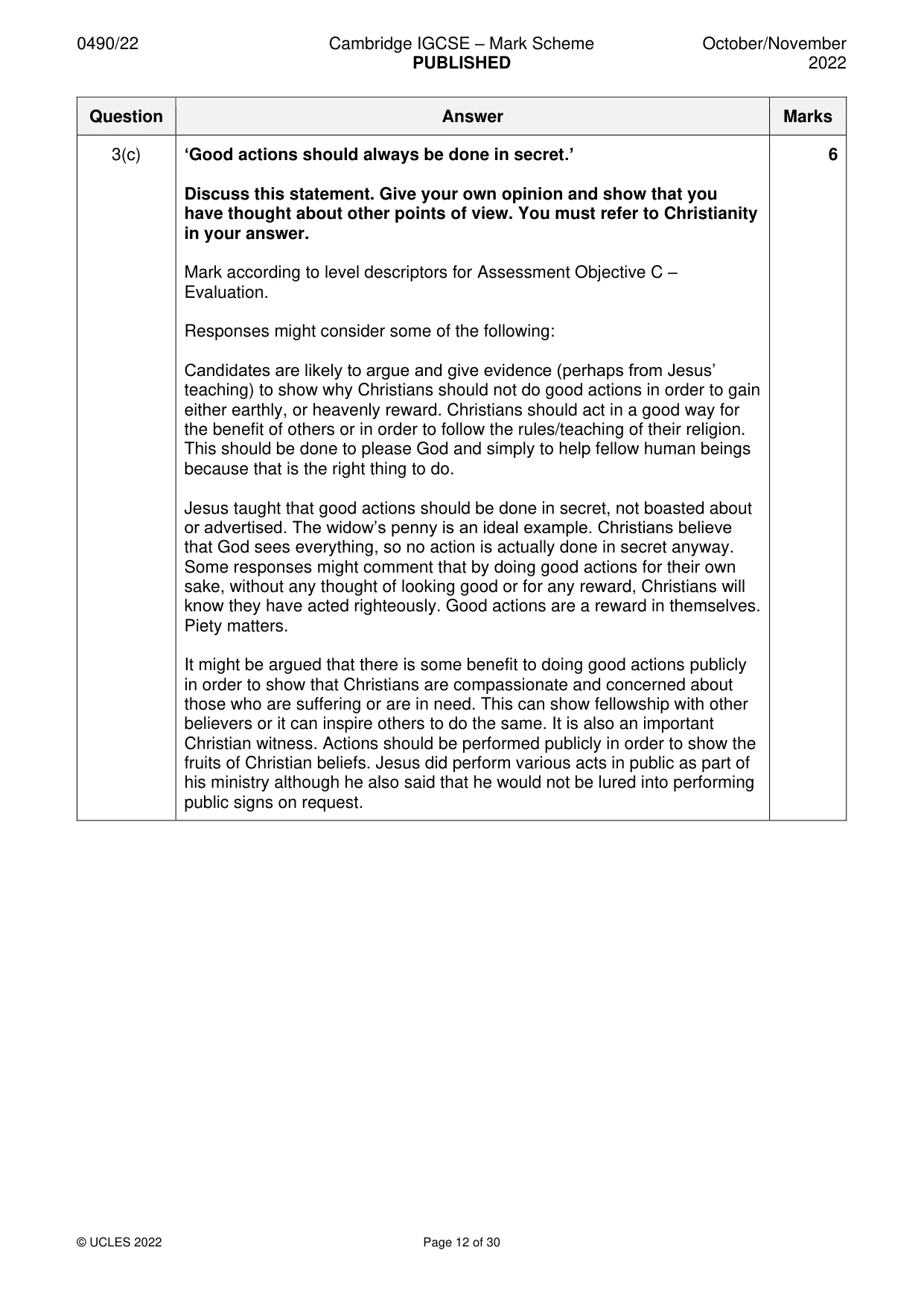
0490/22 Cambridge IGCSE – Mark Scheme PUBLISHED October/November 2022 © UCLES 2022 Page 12 of 30 Question Answer Marks 3(c) ‘Good actions should always be done in secret.’ Discuss this statement. Give your own opinion and show that you have thought about other points of view. You must refer to Christianity in your answer. Mark according to level descriptors for Assessment Objective C – Evaluation. Responses might consider some of the following: Candidates are likely to argue and give evidence (perhaps from Jesus’ teaching) to show why Christians should not do good actions in order to gain either earthly, or heavenly reward. Christians should act in a good way for the benefit of others or in order to follow the rules/teaching of their religion. This should be done to please God and simply to help fellow human beings because that is the right thing to do. Jesus taught that good actions should be done in secret, not boasted about or advertised. The widow’s penny is an ideal example. Christians believe that God sees everything, so no action is actually done in secret anyway. Some responses might comment that by doing good actions for their own sake, without any thought of looking good or for any reward, Christians will know they have acted righteously. Good actions are a reward in themselves. Piety matters. It might be argued that there is some benefit to doing good actions publicly in order to show that Christians are compassionate and concerned about those who are suffering or are in need. This can show fellowship with other believers or it can inspire others to do the same. It is also an important Christian witness. Actions should be performed publicly in order to show the fruits of Christian beliefs. Jesus did perform various acts in public as part of his ministry although he also said that he would not be lured into performing public signs on request. 6
Mark scheme, page 13
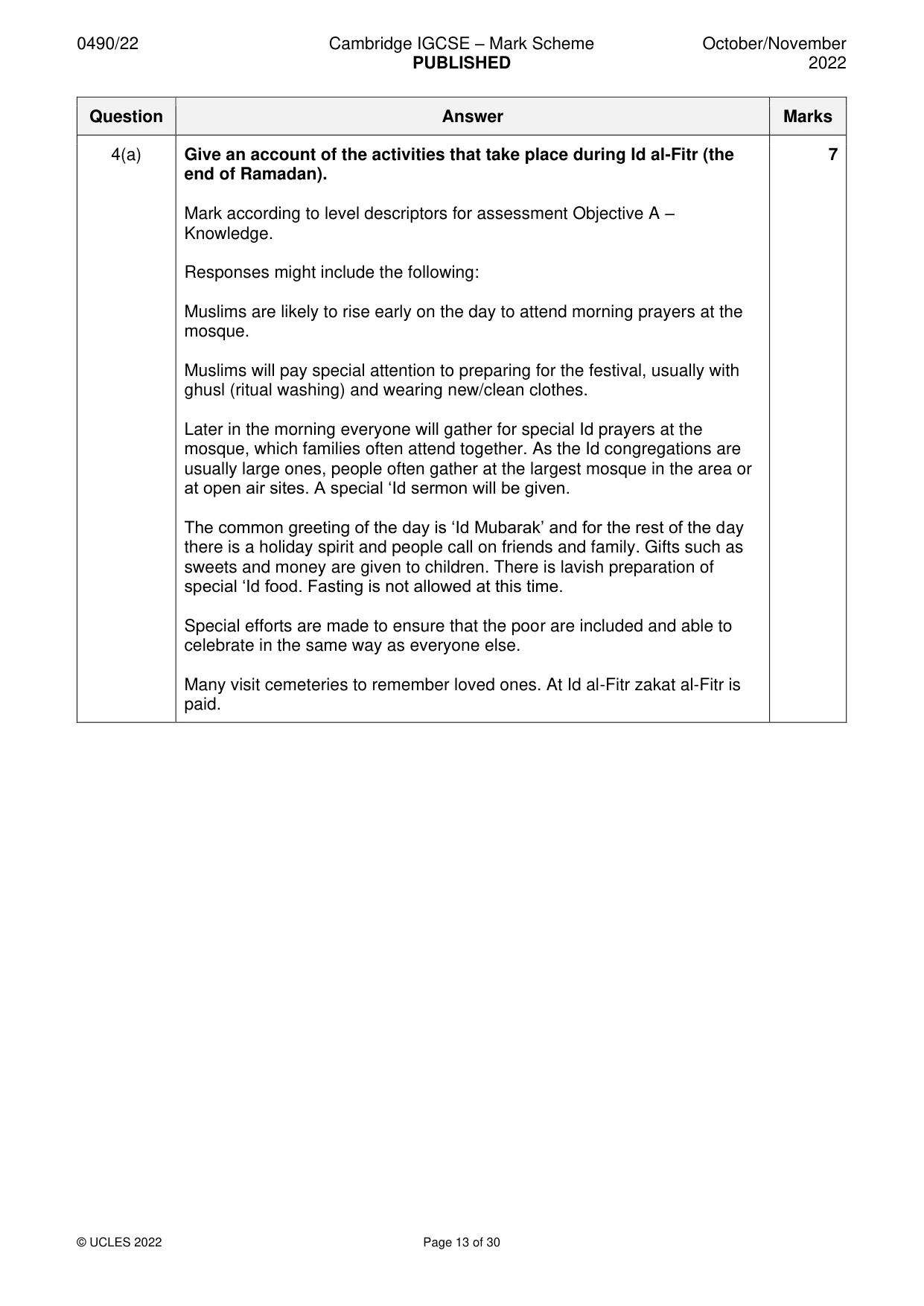
0490/22 Cambridge IGCSE – Mark Scheme PUBLISHED October/November 2022 © UCLES 2022 Page 13 of 30 Question Answer Marks 4(a) Give an account of the activities that take place during Id al-Fitr (the end of Ramadan). Mark according to level descriptors for assessment Objective A – Knowledge. Responses might include the following: Muslims are likely to rise early on the day to attend morning prayers at the mosque. Muslims will pay special attention to preparing for the festival, usually with ghusl (ritual washing) and wearing new/clean clothes. Later in the morning everyone will gather for special Id prayers at the mosque, which families often attend together. As the Id congregations are usually large ones, people often gather at the largest mosque in the area or at open air sites. A special ‘Id sermon will be given. The common greeting of the day is ‘Id Mubarak’ and for the rest of the day there is a holiday spirit and people call on friends and family. Gifts such as sweets and money are given to children. There is lavish preparation of special ‘Id food. Fasting is not allowed at this time. Special efforts are made to ensure that the poor are included and able to celebrate in the same way as everyone else. Many visit cemeteries to remember loved ones. At Id al-Fitr zakat al-Fitr is paid. 7
Mark scheme, page 14
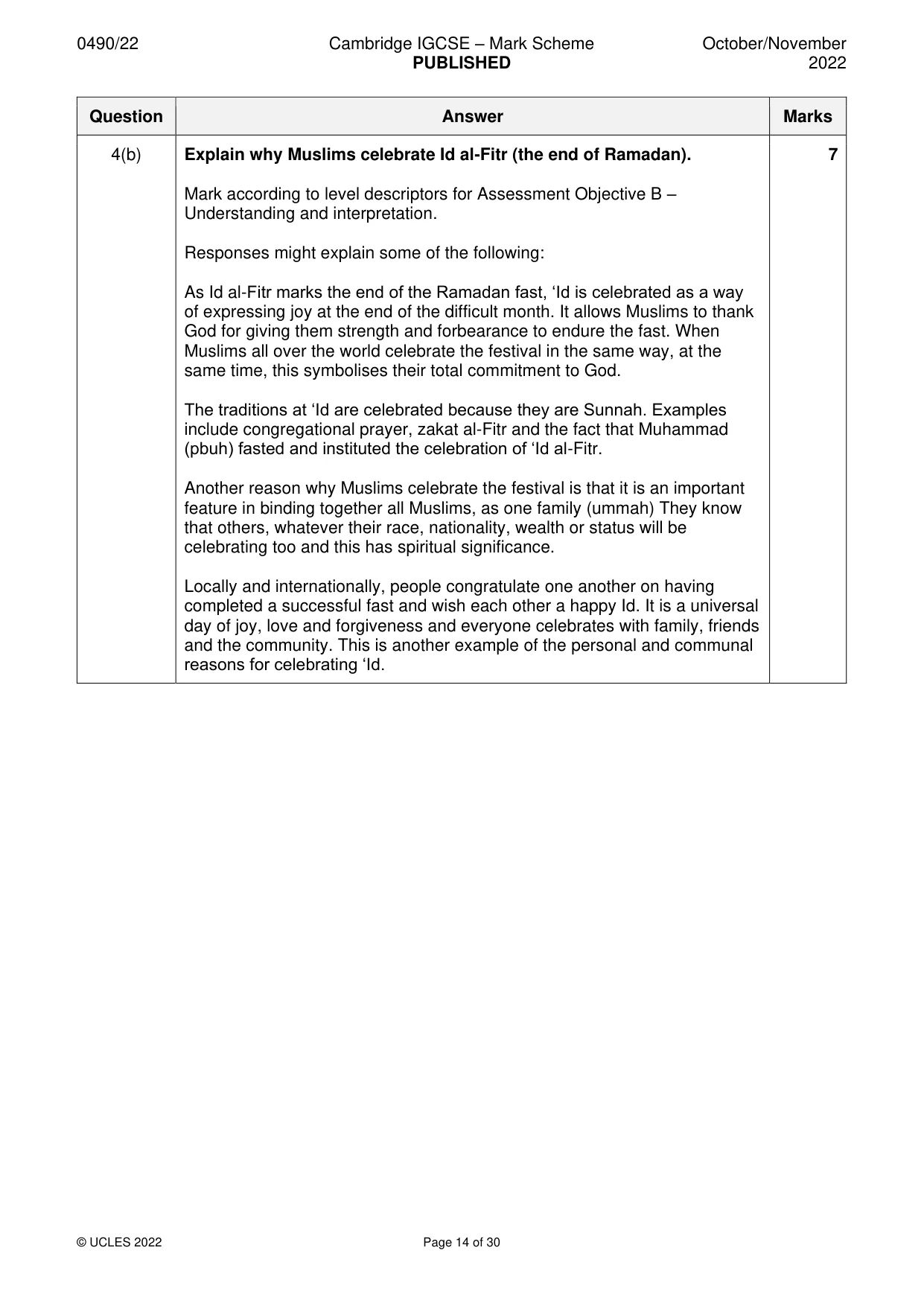
0490/22 Cambridge IGCSE – Mark Scheme PUBLISHED October/November 2022 © UCLES 2022 Page 14 of 30 Question Answer Marks 4(b) Explain why Muslims celebrate Id al-Fitr (the end of Ramadan). Mark according to level descriptors for Assessment Objective B – Understanding and interpretation. Responses might explain some of the following: As Id al-Fitr marks the end of the Ramadan fast, ‘Id is celebrated as a way of expressing joy at the end of the difficult month. It allows Muslims to thank God for giving them strength and forbearance to endure the fast. When Muslims all over the world celebrate the festival in the same way, at the same time, this symbolises their total commitment to God. The traditions at ‘Id are celebrated because they are Sunnah. Examples include congregational prayer, zakat al-Fitr and the fact that Muhammad (pbuh) fasted and instituted the celebration of ‘Id al-Fitr. Another reason why Muslims celebrate the festival is that it is an important feature in binding together all Muslims, as one family (ummah) They know that others, whatever their race, nationality, wealth or status will be celebrating too and this has spiritual significance. Locally and internationally, people congratulate one another on having completed a successful fast and wish each other a happy Id. It is a universal day of joy, love and forgiveness and everyone celebrates with family, friends and the community. This is another example of the personal and communal reasons for celebrating ‘Id. 7
Mark scheme, page 15
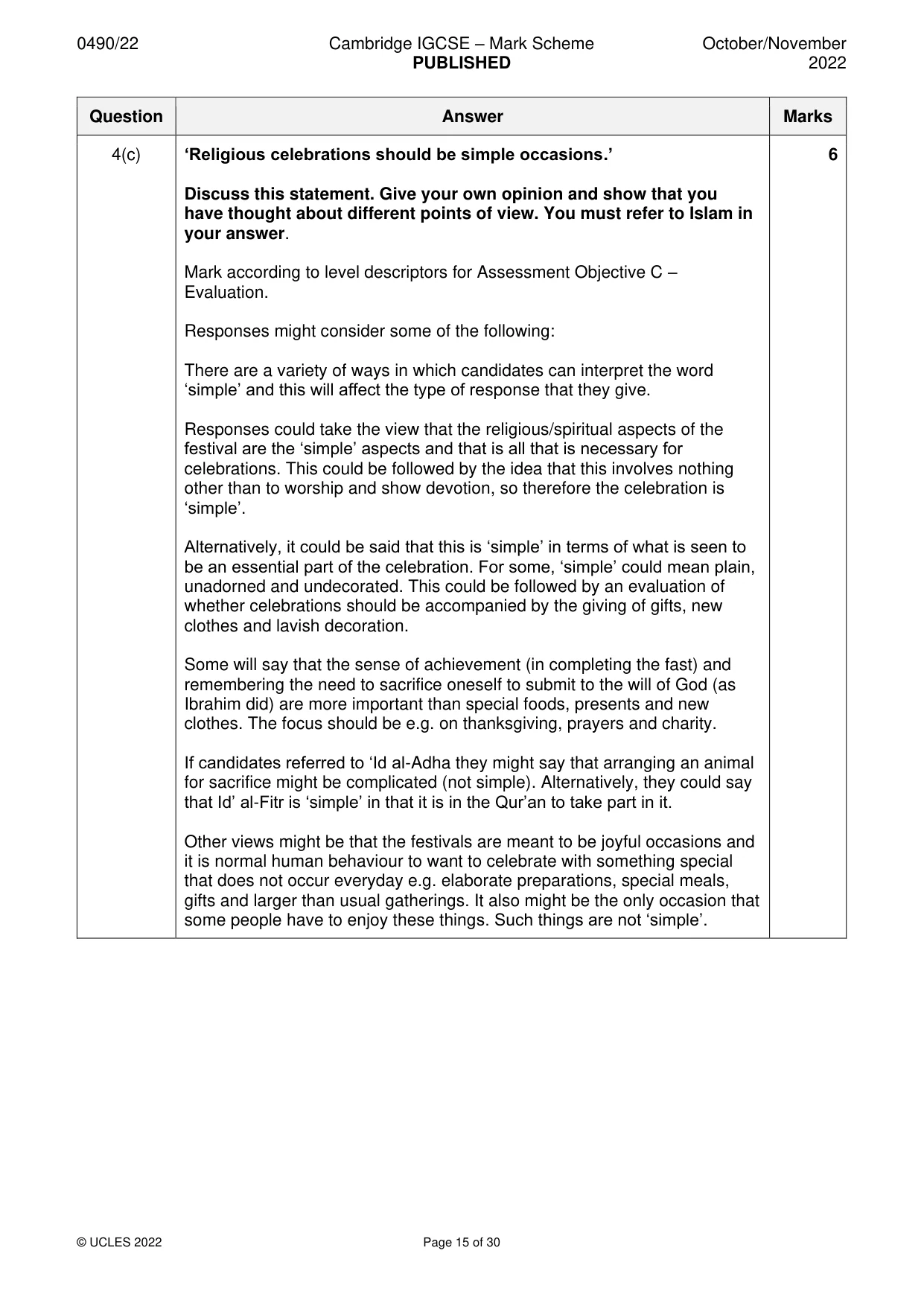
0490/22 Cambridge IGCSE – Mark Scheme PUBLISHED October/November 2022 © UCLES 2022 Page 15 of 30 Question Answer Marks 4(c) ‘Religious celebrations should be simple occasions.’ Discuss this statement. Give your own opinion and show that you have thought about different points of view. You must refer to Islam in your answer. Mark according to level descriptors for Assessment Objective C – Evaluation. Responses might consider some of the following: There are a variety of ways in which candidates can interpret the word ‘simple’ and this will affect the type of response that they give. Responses could take the view that the religious/spiritual aspects of the festival are the ‘simple’ aspects and that is all that is necessary for celebrations. This could be followed by the idea that this involves nothing other than to worship and show devotion, so therefore the celebration is ‘simple’. Alternatively, it could be said that this is ‘simple’ in terms of what is seen to be an essential part of the celebration. For some, ‘simple’ could mean plain, unadorned and undecorated. This could be followed by an evaluation of whether celebrations should be accompanied by the giving of gifts, new clothes and lavish decoration. Some will say that the sense of achievement (in completing the fast) and remembering the need to sacrifice oneself to submit to the will of God (as Ibrahim did) are more important than special foods, presents and new clothes. The focus should be e.g. on thanksgiving, prayers and charity. If candidates referred to ‘Id al-Adha they might say that arranging an animal for sacrifice might be complicated (not simple). Alternatively, they could say that Id’ al-Fitr is ‘simple’ in that it is in the Qur’an to take part in it. Other views might be that the festivals are meant to be joyful occasions and it is normal human behaviour to want to celebrate with something special that does not occur everyday e.g. elaborate preparations, special meals, gifts and larger than usual gatherings. It also might be the only occasion that some people have to enjoy these things. Such things are not ‘simple’. 6
Mark scheme, page 16
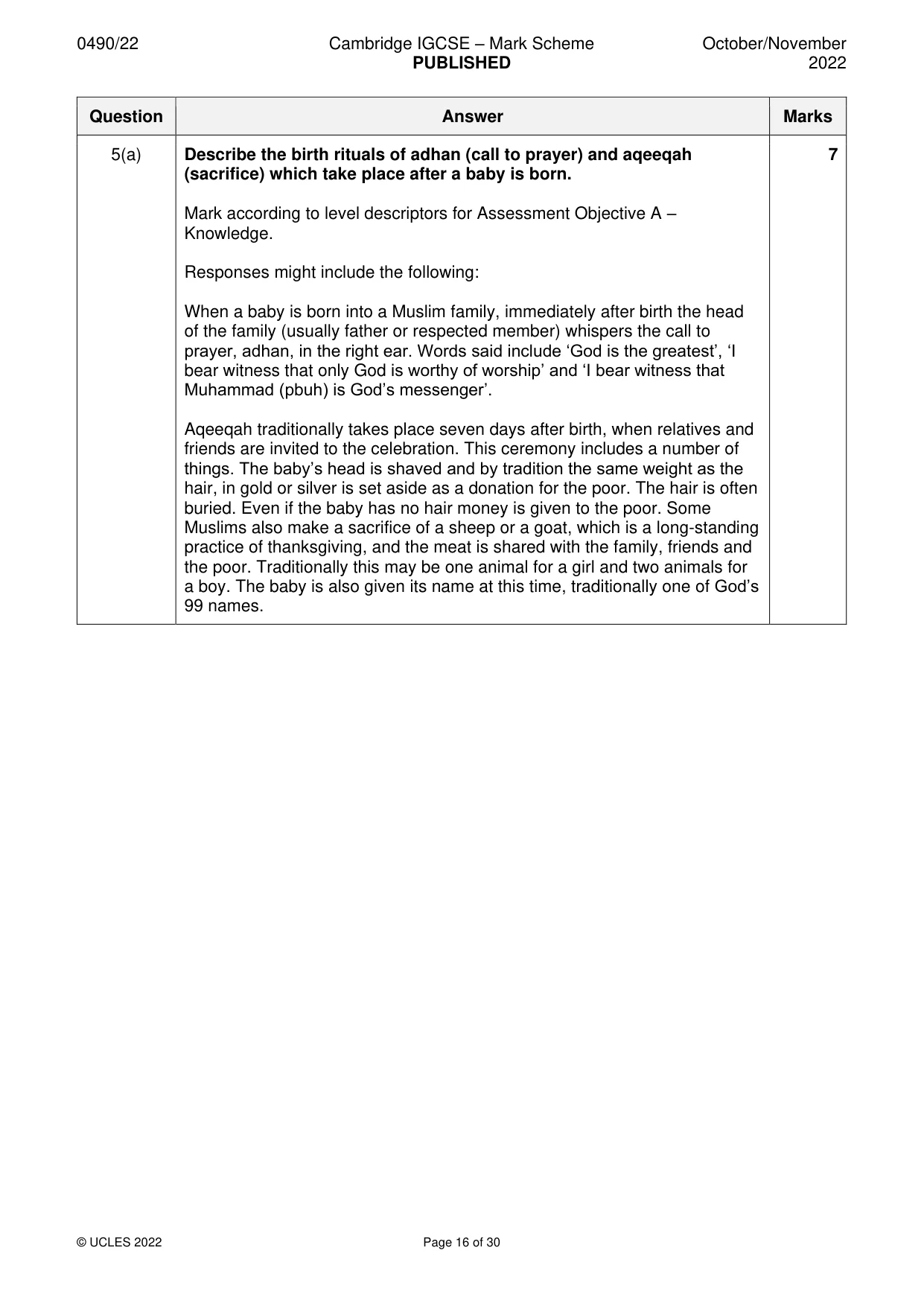
0490/22 Cambridge IGCSE – Mark Scheme PUBLISHED October/November 2022 © UCLES 2022 Page 16 of 30 Question Answer Marks 5(a) Describe the birth rituals of adhan (call to prayer) and aqeeqah (sacrifice) which take place after a baby is born. Mark according to level descriptors for Assessment Objective A – Knowledge. Responses might include the following: When a baby is born into a Muslim family, immediately after birth the head of the family (usually father or respected member) whispers the call to prayer, adhan, in the right ear. Words said include ‘God is the greatest’, ‘I bear witness that only God is worthy of worship’ and ‘I bear witness that Muhammad (pbuh) is God’s messenger’. Aqeeqah traditionally takes place seven days after birth, when relatives and friends are invited to the celebration. This ceremony includes a number of things. The baby’s head is shaved and by tradition the same weight as the hair, in gold or silver is set aside as a donation for the poor. The hair is often buried. Even if the baby has no hair money is given to the poor. Some Muslims also make a sacrifice of a sheep or a goat, which is a long-standing practice of thanksgiving, and the meat is shared with the family, friends and the poor. Traditionally this may be one animal for a girl and two animals for a boy. The baby is also given its name at this time, traditionally one of God’s 99 names. 7
Mark scheme, page 17
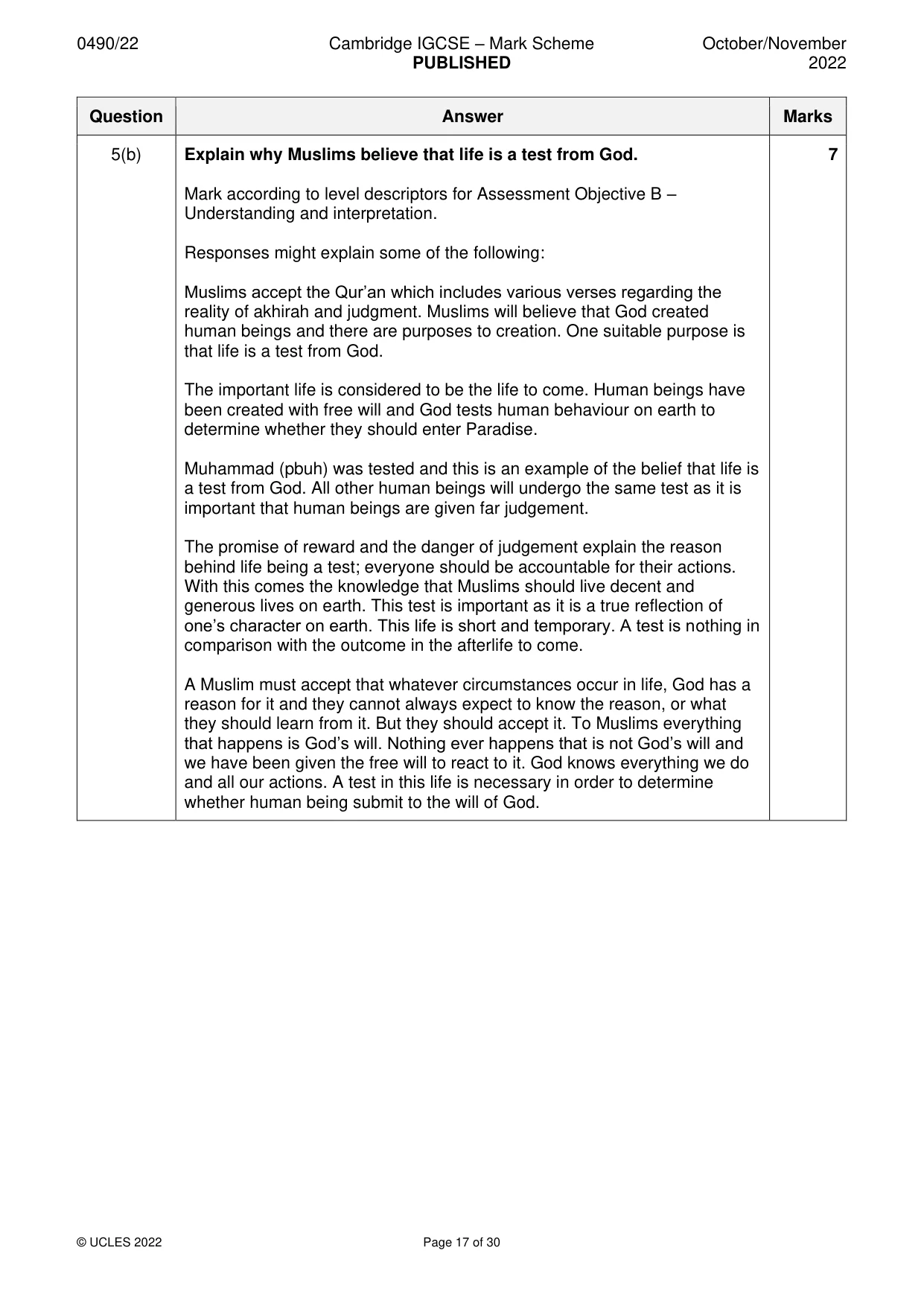
0490/22 Cambridge IGCSE – Mark Scheme PUBLISHED October/November 2022 © UCLES 2022 Page 17 of 30 Question Answer Marks 5(b) Explain why Muslims believe that life is a test from God. Mark according to level descriptors for Assessment Objective B – Understanding and interpretation. Responses might explain some of the following: Muslims accept the Qur’an which includes various verses regarding the reality of akhirah and judgment. Muslims will believe that God created human beings and there are purposes to creation. One suitable purpose is that life is a test from God. The important life is considered to be the life to come. Human beings have been created with free will and God tests human behaviour on earth to determine whether they should enter Paradise. Muhammad (pbuh) was tested and this is an example of the belief that life is a test from God. All other human beings will undergo the same test as it is important that human beings are given far judgement. The promise of reward and the danger of judgement explain the reason behind life being a test; everyone should be accountable for their actions. With this comes the knowledge that Muslims should live decent and generous lives on earth. This test is important as it is a true reflection of one’s character on earth. This life is short and temporary. A test is nothing in comparison with the outcome in the afterlife to come. A Muslim must accept that whatever circumstances occur in life, God has a reason for it and they cannot always expect to know the reason, or what they should learn from it. But they should accept it. To Muslims everything that happens is God’s will. Nothing ever happens that is not God’s will and we have been given the free will to react to it. God knows everything we do and all our actions. A test in this life is necessary in order to determine whether human being submit to the will of God. 7
Mark scheme, page 18
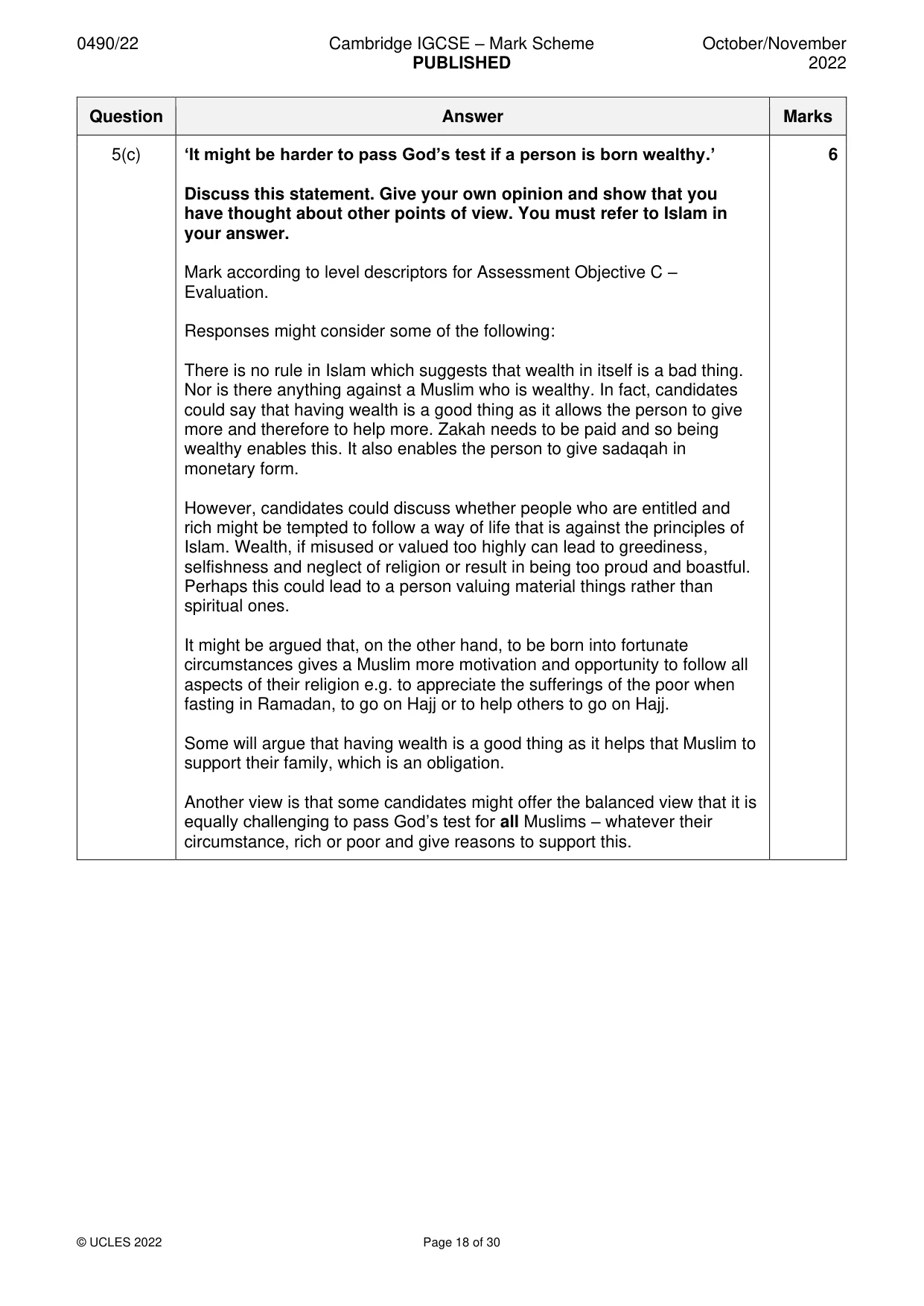
0490/22 Cambridge IGCSE – Mark Scheme PUBLISHED October/November 2022 © UCLES 2022 Page 18 of 30 Question Answer Marks 5(c) ‘It might be harder to pass God’s test if a person is born wealthy.’ Discuss this statement. Give your own opinion and show that you have thought about other points of view. You must refer to Islam in your answer. Mark according to level descriptors for Assessment Objective C – Evaluation. Responses might consider some of the following: There is no rule in Islam which suggests that wealth in itself is a bad thing. Nor is there anything against a Muslim who is wealthy. In fact, candidates could say that having wealth is a good thing as it allows the person to give more and therefore to help more. Zakah needs to be paid and so being wealthy enables this. It also enables the person to give sadaqah in monetary form. However, candidates could discuss whether people who are entitled and rich might be tempted to follow a way of life that is against the principles of Islam. Wealth, if misused or valued too highly can lead to greediness, selfishness and neglect of religion or result in being too proud and boastful. Perhaps this could lead to a person valuing material things rather than spiritual ones. It might be argued that, on the other hand, to be born into fortunate circumstances gives a Muslim more motivation and opportunity to follow all aspects of their religion e.g. to appreciate the sufferings of the poor when fasting in Ramadan, to go on Hajj or to help others to go on Hajj. Some will argue that having wealth is a good thing as it helps that Muslim to support their family, which is an obligation. Another view is that some candidates might offer the balanced view that it is equally challenging to pass God’s test for all Muslims – whatever their circumstance, rich or poor and give reasons to support this. 6
Mark scheme, page 19
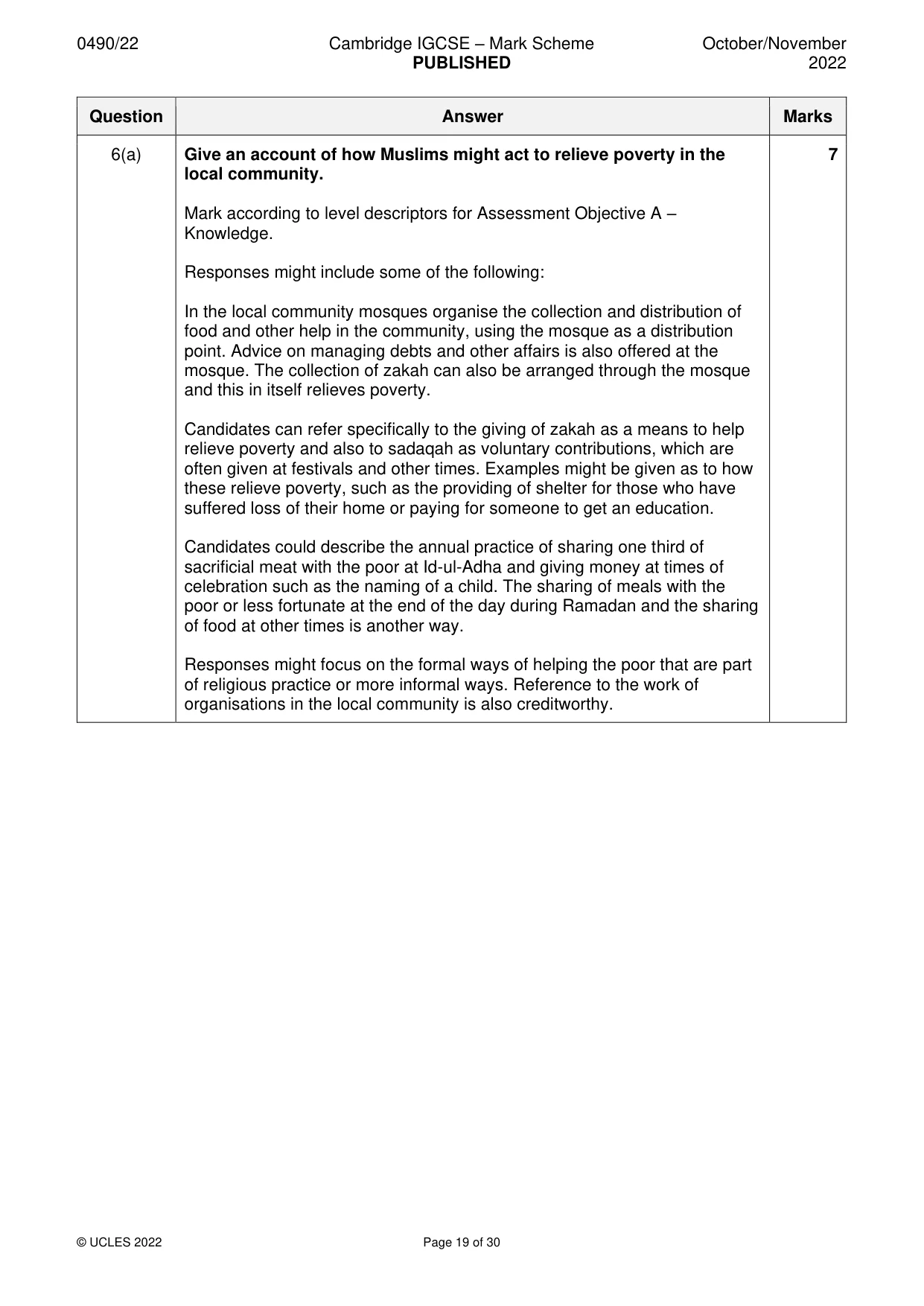
0490/22 Cambridge IGCSE – Mark Scheme PUBLISHED October/November 2022 © UCLES 2022 Page 19 of 30 Question Answer Marks 6(a) Give an account of how Muslims might act to relieve poverty in the local community. Mark according to level descriptors for Assessment Objective A – Knowledge. Responses might include some of the following: In the local community mosques organise the collection and distribution of food and other help in the community, using the mosque as a distribution point. Advice on managing debts and other affairs is also offered at the mosque. The collection of zakah can also be arranged through the mosque and this in itself relieves poverty. Candidates can refer specifically to the giving of zakah as a means to help relieve poverty and also to sadaqah as voluntary contributions, which are often given at festivals and other times. Examples might be given as to how these relieve poverty, such as the providing of shelter for those who have suffered loss of their home or paying for someone to get an education. Candidates could describe the annual practice of sharing one third of sacrificial meat with the poor at Id-ul-Adha and giving money at times of celebration such as the naming of a child. The sharing of meals with the poor or less fortunate at the end of the day during Ramadan and the sharing of food at other times is another way. Responses might focus on the formal ways of helping the poor that are part of religious practice or more informal ways. Reference to the work of organisations in the local community is also creditworthy. 7
Mark scheme, page 20
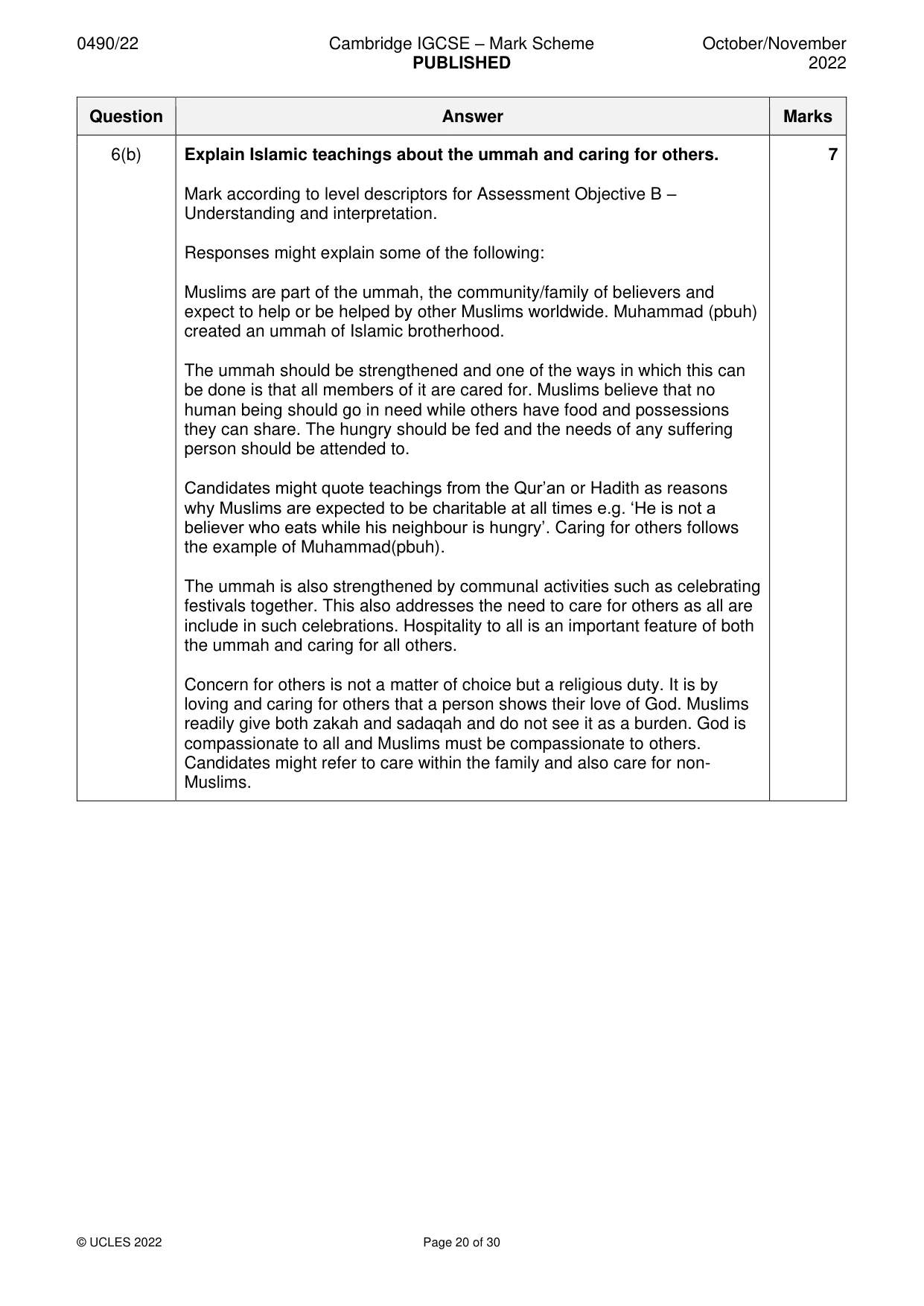
0490/22 Cambridge IGCSE – Mark Scheme PUBLISHED October/November 2022 © UCLES 2022 Page 20 of 30 Question Answer Marks 6(b) Explain Islamic teachings about the ummah and caring for others. Mark according to level descriptors for Assessment Objective B – Understanding and interpretation. Responses might explain some of the following: Muslims are part of the ummah, the community/family of believers and expect to help or be helped by other Muslims worldwide. Muhammad (pbuh) created an ummah of Islamic brotherhood. The ummah should be strengthened and one of the ways in which this can be done is that all members of it are cared for. Muslims believe that no human being should go in need while others have food and possessions they can share. The hungry should be fed and the needs of any suffering person should be attended to. Candidates might quote teachings from the Qur’an or Hadith as reasons why Muslims are expected to be charitable at all times e.g. ‘He is not a believer who eats while his neighbour is hungry’. Caring for others follows the example of Muhammad(pbuh). The ummah is also strengthened by communal activities such as celebrating festivals together. This also addresses the need to care for others as all are include in such celebrations. Hospitality to all is an important feature of both the ummah and caring for all others. Concern for others is not a matter of choice but a religious duty. It is by loving and caring for others that a person shows their love of God. Muslims readily give both zakah and sadaqah and do not see it as a burden. God is compassionate to all and Muslims must be compassionate to others. Candidates might refer to care within the family and also care for non- Muslims. 7
Mark scheme, page 21
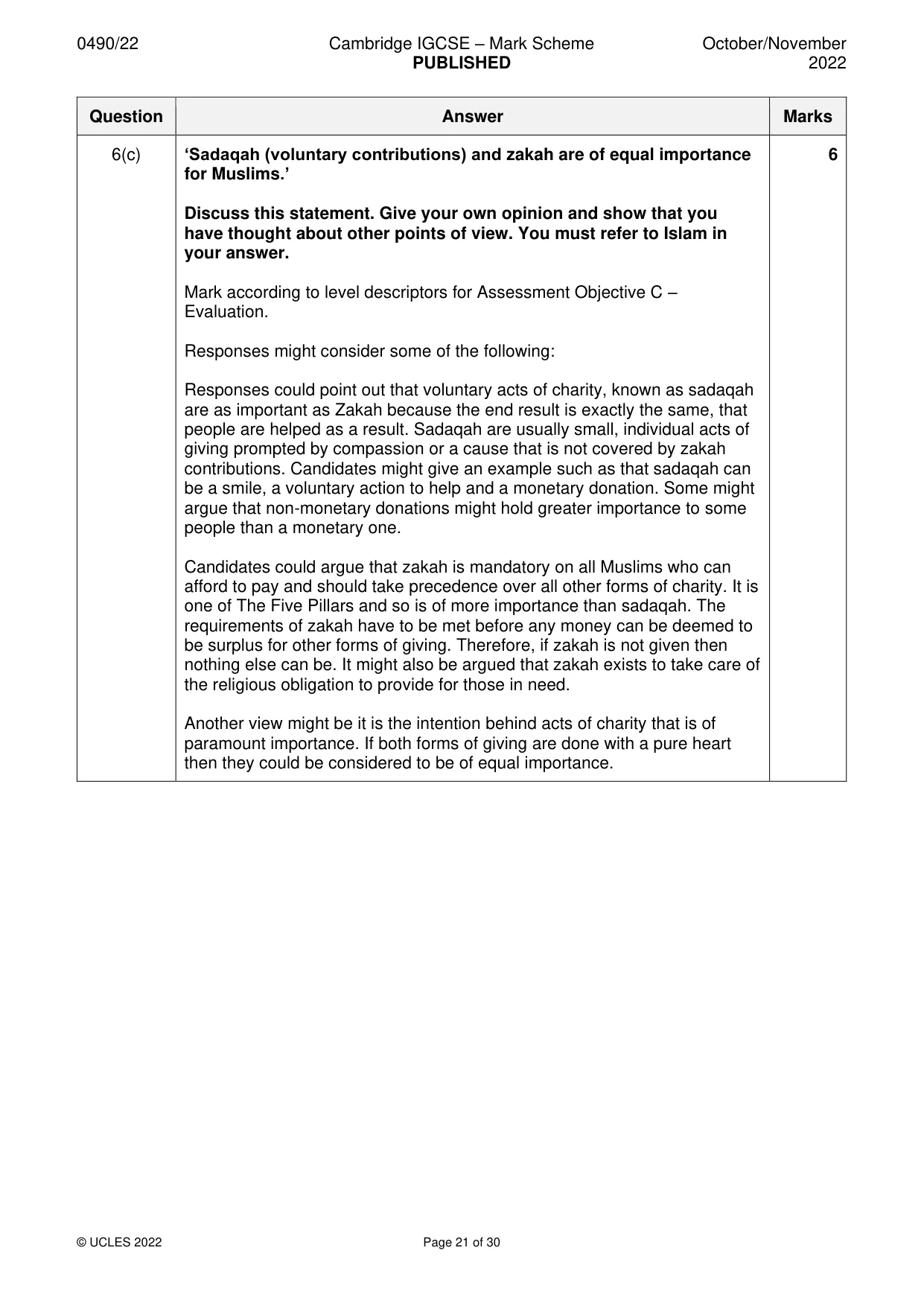
0490/22 Cambridge IGCSE – Mark Scheme PUBLISHED October/November 2022 © UCLES 2022 Page 21 of 30 Question Answer Marks 6(c) ‘Sadaqah (voluntary contributions) and zakah are of equal importance for Muslims.’ Discuss this statement. Give your own opinion and show that you have thought about other points of view. You must refer to Islam in your answer. Mark according to level descriptors for Assessment Objective C – Evaluation. Responses might consider some of the following: Responses could point out that voluntary acts of charity, known as sadaqah are as important as Zakah because the end result is exactly the same, that people are helped as a result. Sadaqah are usually small, individual acts of giving prompted by compassion or a cause that is not covered by zakah contributions. Candidates might give an example such as that sadaqah can be a smile, a voluntary action to help and a monetary donation. Some might argue that non-monetary donations might hold greater importance to some people than a monetary one. Candidates could argue that zakah is mandatory on all Muslims who can afford to pay and should take precedence over all other forms of charity. It is one of The Five Pillars and so is of more importance than sadaqah. The requirements of zakah have to be met before any money can be deemed to be surplus for other forms of giving. Therefore, if zakah is not given then nothing else can be. It might also be argued that zakah exists to take care of the religious obligation to provide for those in need. Another view might be it is the intention behind acts of charity that is of paramount importance. If both forms of giving are done with a pure heart then they could be considered to be of equal importance. 6
Mark scheme, page 22
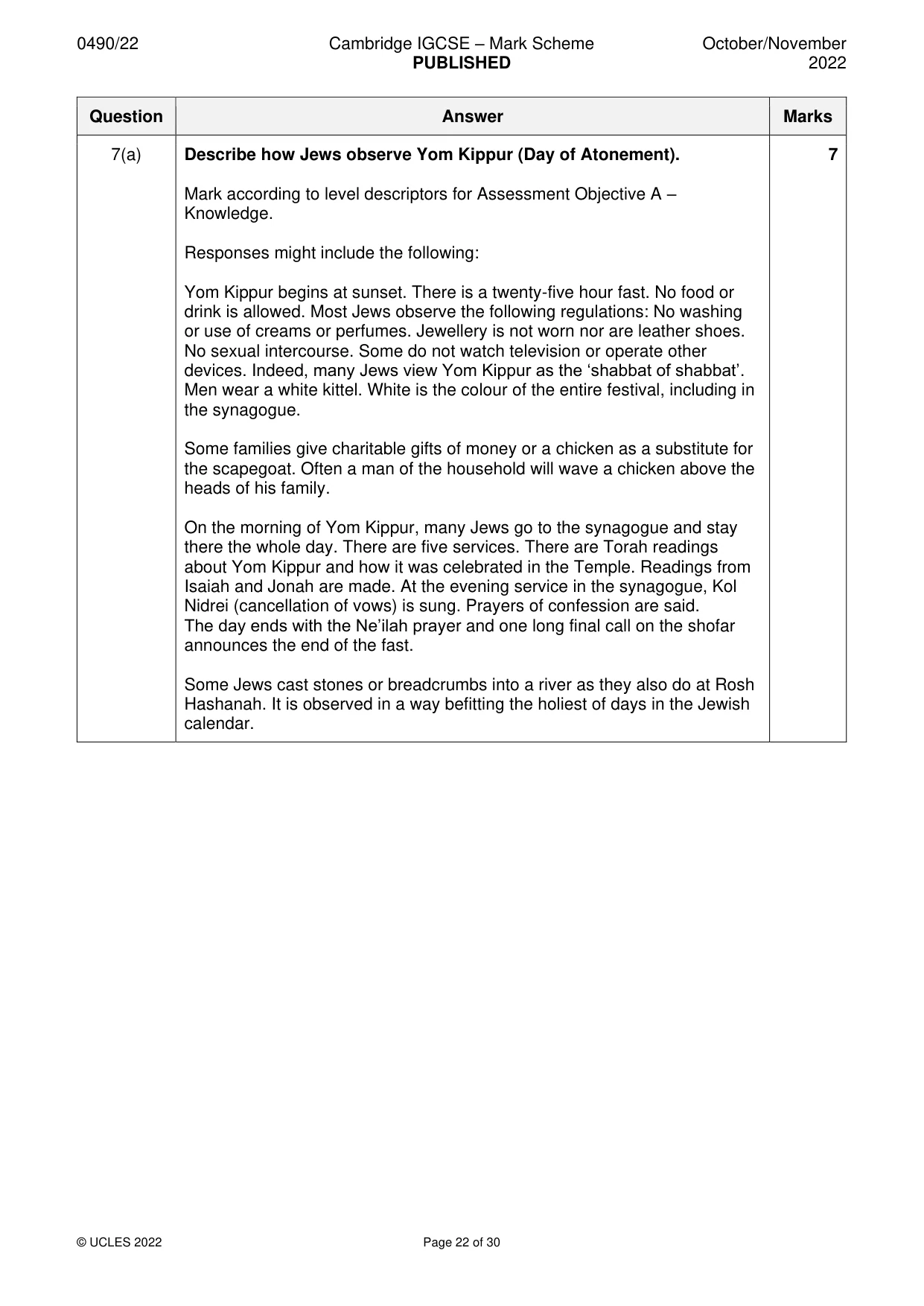
0490/22 Cambridge IGCSE – Mark Scheme PUBLISHED October/November 2022 © UCLES 2022 Page 22 of 30 Question Answer Marks 7(a) Describe how Jews observe Yom Kippur (Day of Atonement). Mark according to level descriptors for Assessment Objective A – Knowledge. Responses might include the following: Yom Kippur begins at sunset. There is a twenty-five hour fast. No food or drink is allowed. Most Jews observe the following regulations: No washing or use of creams or perfumes. Jewellery is not worn nor are leather shoes. No sexual intercourse. Some do not watch television or operate other devices. Indeed, many Jews view Yom Kippur as the ‘shabbat of shabbat’. Men wear a white kittel. White is the colour of the entire festival, including in the synagogue. Some families give charitable gifts of money or a chicken as a substitute for the scapegoat. Often a man of the household will wave a chicken above the heads of his family. On the morning of Yom Kippur, many Jews go to the synagogue and stay there the whole day. There are five services. There are Torah readings about Yom Kippur and how it was celebrated in the Temple. Readings from Isaiah and Jonah are made. At the evening service in the synagogue, Kol Nidrei (cancellation of vows) is sung. Prayers of confession are said. The day ends with the Ne’ilah prayer and one long final call on the shofar announces the end of the fast. Some Jews cast stones or breadcrumbs into a river as they also do at Rosh Hashanah. It is observed in a way befitting the holiest of days in the Jewish calendar. 7
Mark scheme, page 23
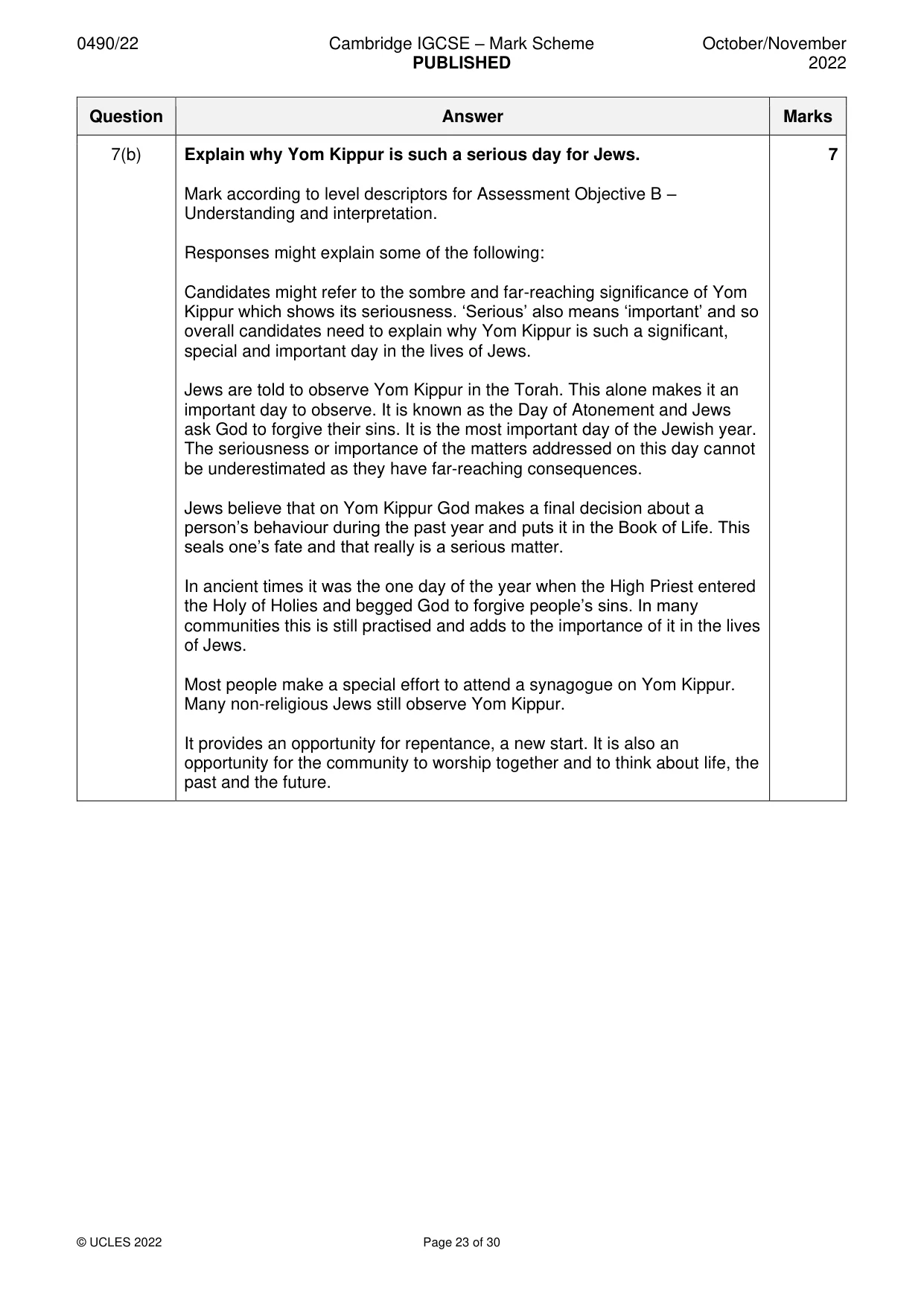
0490/22 Cambridge IGCSE – Mark Scheme PUBLISHED October/November 2022 © UCLES 2022 Page 23 of 30 Question Answer Marks 7(b) Explain why Yom Kippur is such a serious day for Jews. Mark according to level descriptors for Assessment Objective B – Understanding and interpretation. Responses might explain some of the following: Candidates might refer to the sombre and far-reaching significance of Yom Kippur which shows its seriousness. ‘Serious’ also means ‘important’ and so overall candidates need to explain why Yom Kippur is such a significant, special and important day in the lives of Jews. Jews are told to observe Yom Kippur in the Torah. This alone makes it an important day to observe. It is known as the Day of Atonement and Jews ask God to forgive their sins. It is the most important day of the Jewish year. The seriousness or importance of the matters addressed on this day cannot be underestimated as they have far-reaching consequences. Jews believe that on Yom Kippur God makes a final decision about a person’s behaviour during the past year and puts it in the Book of Life. This seals one’s fate and that really is a serious matter. In ancient times it was the one day of the year when the High Priest entered the Holy of Holies and begged God to forgive people’s sins. In many communities this is still practised and adds to the importance of it in the lives of Jews. Most people make a special effort to attend a synagogue on Yom Kippur. Many non-religious Jews still observe Yom Kippur. It provides an opportunity for repentance, a new start. It is also an opportunity for the community to worship together and to think about life, the past and the future. 7
Mark scheme, page 24
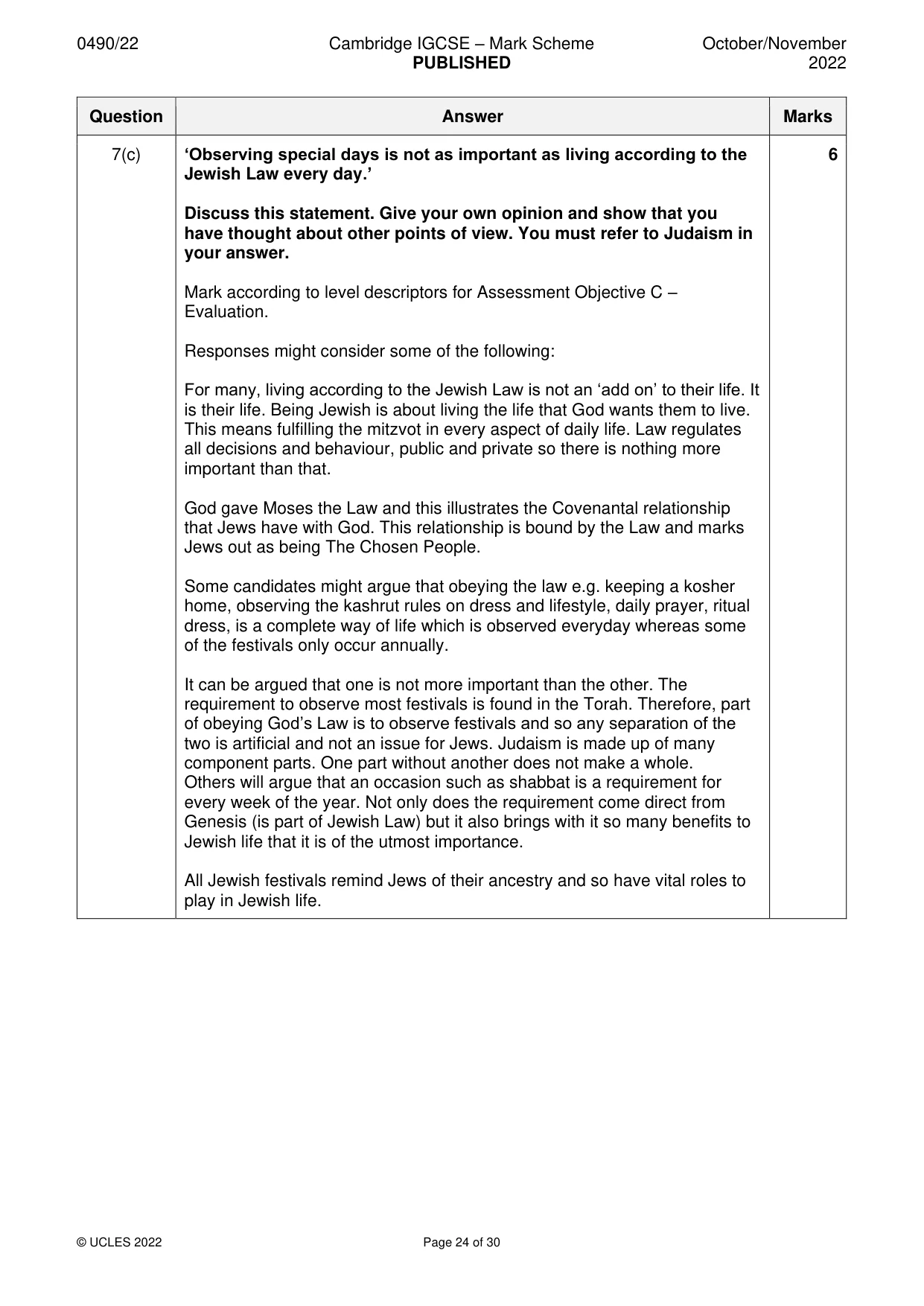
0490/22 Cambridge IGCSE – Mark Scheme PUBLISHED October/November 2022 © UCLES 2022 Page 24 of 30 Question Answer Marks 7(c) ‘Observing special days is not as important as living according to the Jewish Law every day.’ Discuss this statement. Give your own opinion and show that you have thought about other points of view. You must refer to Judaism in your answer. Mark according to level descriptors for Assessment Objective C – Evaluation. Responses might consider some of the following: For many, living according to the Jewish Law is not an ‘add on’ to their life. It is their life. Being Jewish is about living the life that God wants them to live. This means fulfilling the mitzvot in every aspect of daily life. Law regulates all decisions and behaviour, public and private so there is nothing more important than that. God gave Moses the Law and this illustrates the Covenantal relationship that Jews have with God. This relationship is bound by the Law and marks Jews out as being The Chosen People. Some candidates might argue that obeying the law e.g. keeping a kosher home, observing the kashrut rules on dress and lifestyle, daily prayer, ritual dress, is a complete way of life which is observed everyday whereas some of the festivals only occur annually. It can be argued that one is not more important than the other. The requirement to observe most festivals is found in the Torah. Therefore, part of obeying God’s Law is to observe festivals and so any separation of the two is artificial and not an issue for Jews. Judaism is made up of many component parts. One part without another does not make a whole. Others will argue that an occasion such as shabbat is a requirement for every week of the year. Not only does the requirement come direct from Genesis (is part of Jewish Law) but it also brings with it so many benefits to Jewish life that it is of the utmost importance. All Jewish festivals remind Jews of their ancestry and so have vital roles to play in Jewish life. 6
Mark scheme, page 25
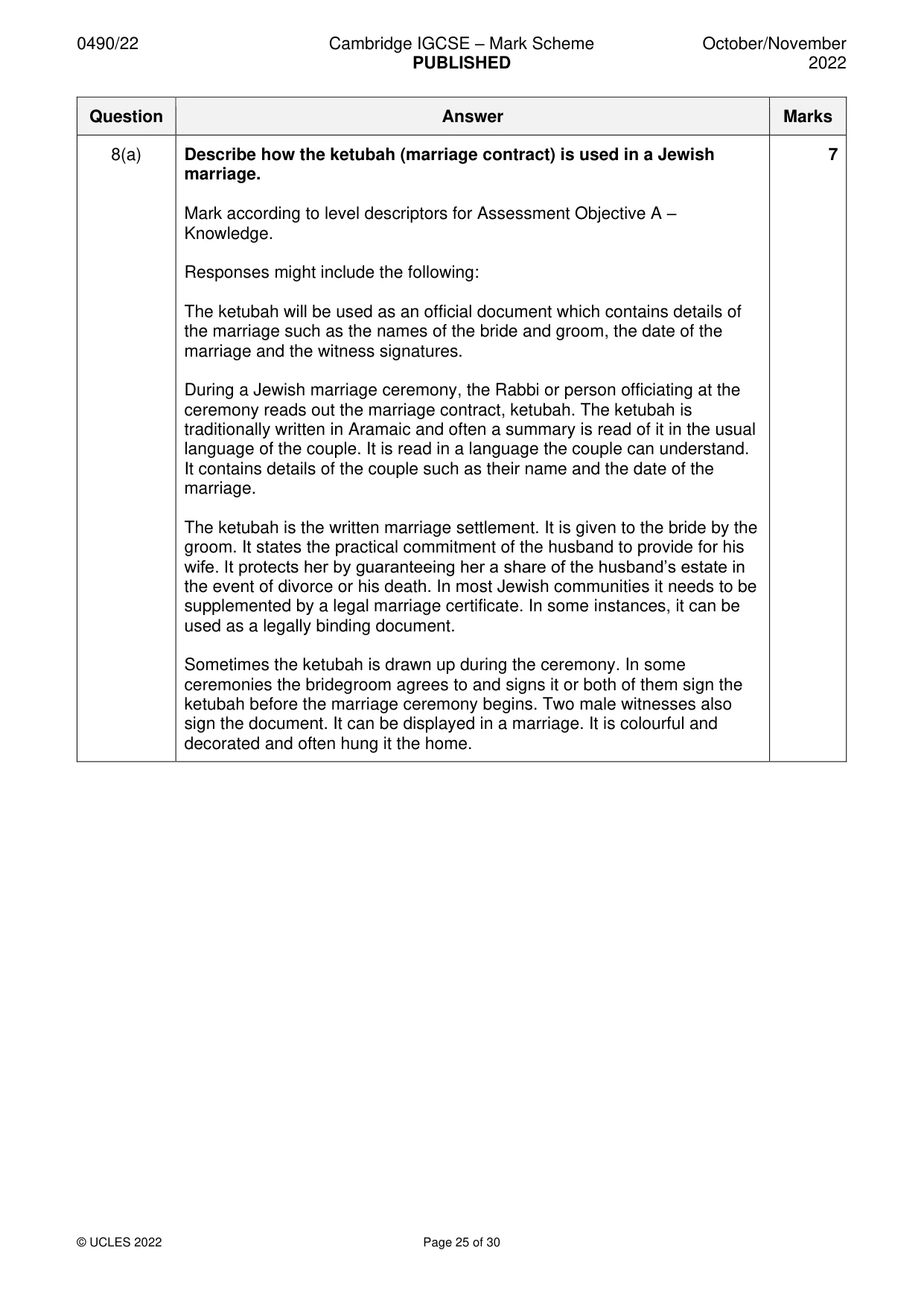
0490/22 Cambridge IGCSE – Mark Scheme PUBLISHED October/November 2022 © UCLES 2022 Page 25 of 30 Question Answer Marks 8(a) Describe how the ketubah (marriage contract) is used in a Jewish marriage. Mark according to level descriptors for Assessment Objective A – Knowledge. Responses might include the following: The ketubah will be used as an official document which contains details of the marriage such as the names of the bride and groom, the date of the marriage and the witness signatures. During a Jewish marriage ceremony, the Rabbi or person officiating at the ceremony reads out the marriage contract, ketubah. The ketubah is traditionally written in Aramaic and often a summary is read of it in the usual language of the couple. It is read in a language the couple can understand. It contains details of the couple such as their name and the date of the marriage. The ketubah is the written marriage settlement. It is given to the bride by the groom. It states the practical commitment of the husband to provide for his wife. It protects her by guaranteeing her a share of the husband’s estate in the event of divorce or his death. In most Jewish communities it needs to be supplemented by a legal marriage certificate. In some instances, it can be used as a legally binding document. Sometimes the ketubah is drawn up during the ceremony. In some ceremonies the bridegroom agrees to and signs it or both of them sign the ketubah before the marriage ceremony begins. Two male witnesses also sign the document. It can be displayed in a marriage. It is colourful and decorated and often hung it the home. 7
Mark scheme, page 26
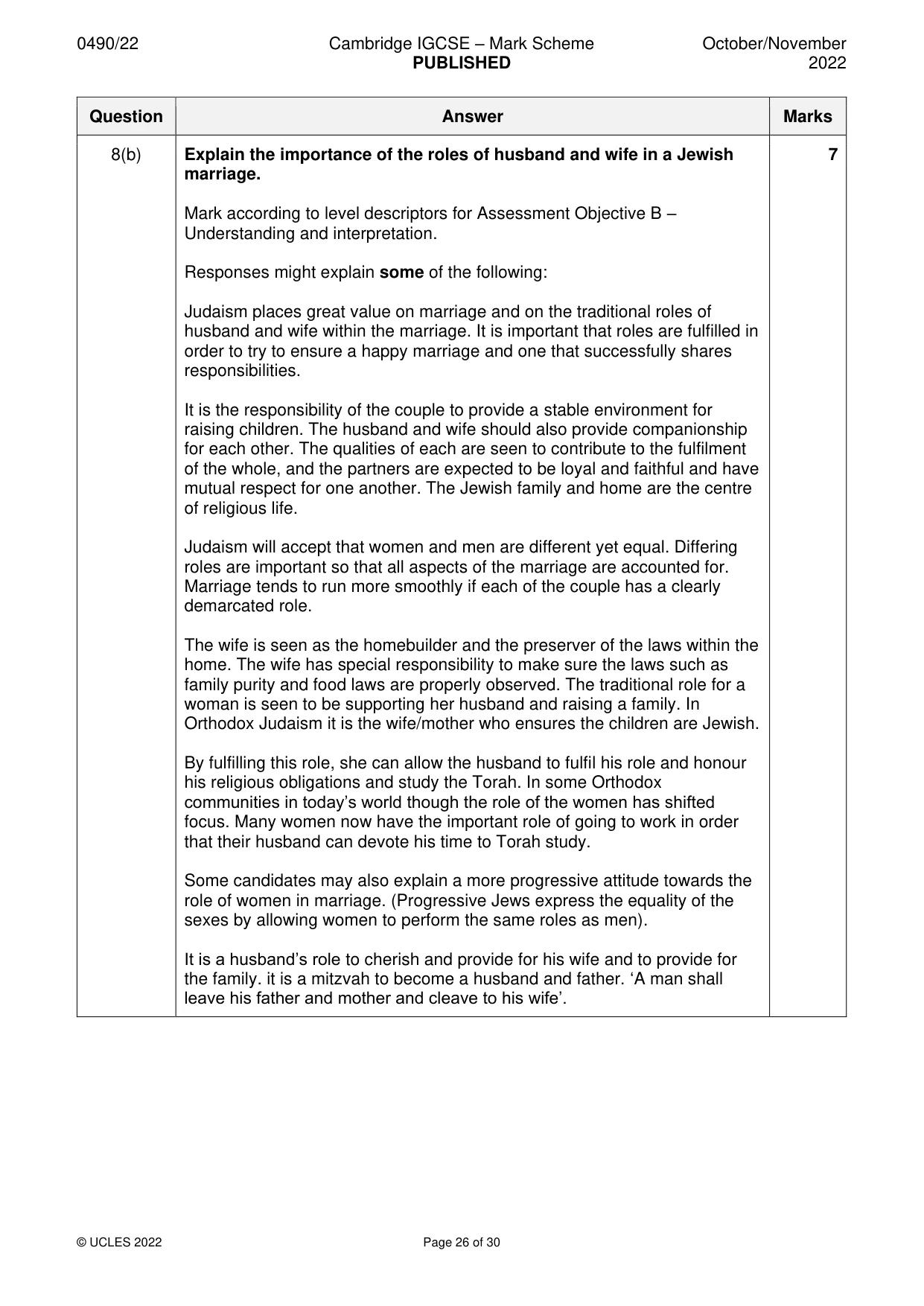
0490/22 Cambridge IGCSE – Mark Scheme PUBLISHED October/November 2022 © UCLES 2022 Page 26 of 30 Question Answer Marks 8(b) Explain the importance of the roles of husband and wife in a Jewish marriage. Mark according to level descriptors for Assessment Objective B – Understanding and interpretation. Responses might explain some of the following: Judaism places great value on marriage and on the traditional roles of husband and wife within the marriage. It is important that roles are fulfilled in order to try to ensure a happy marriage and one that successfully shares responsibilities. It is the responsibility of the couple to provide a stable environment for raising children. The husband and wife should also provide companionship for each other. The qualities of each are seen to contribute to the fulfilment of the whole, and the partners are expected to be loyal and faithful and have mutual respect for one another. The Jewish family and home are the centre of religious life. Judaism will accept that women and men are different yet equal. Differing roles are important so that all aspects of the marriage are accounted for. Marriage tends to run more smoothly if each of the couple has a clearly demarcated role. The wife is seen as the homebuilder and the preserver of the laws within the home. The wife has special responsibility to make sure the laws such as family purity and food laws are properly observed. The traditional role for a woman is seen to be supporting her husband and raising a family. In Orthodox Judaism it is the wife/mother who ensures the children are Jewish. By fulfilling this role, she can allow the husband to fulfil his role and honour his religious obligations and study the Torah. In some Orthodox communities in today’s world though the role of the women has shifted focus. Many women now have the important role of going to work in order that their husband can devote his time to Torah study. Some candidates may also explain a more progressive attitude towards the role of women in marriage. (Progressive Jews express the equality of the sexes by allowing women to perform the same roles as men). It is a husband’s role to cherish and provide for his wife and to provide for the family. it is a mitzvah to become a husband and father. ‘A man shall leave his father and mother and cleave to his wife’. 7
Mark scheme, page 27
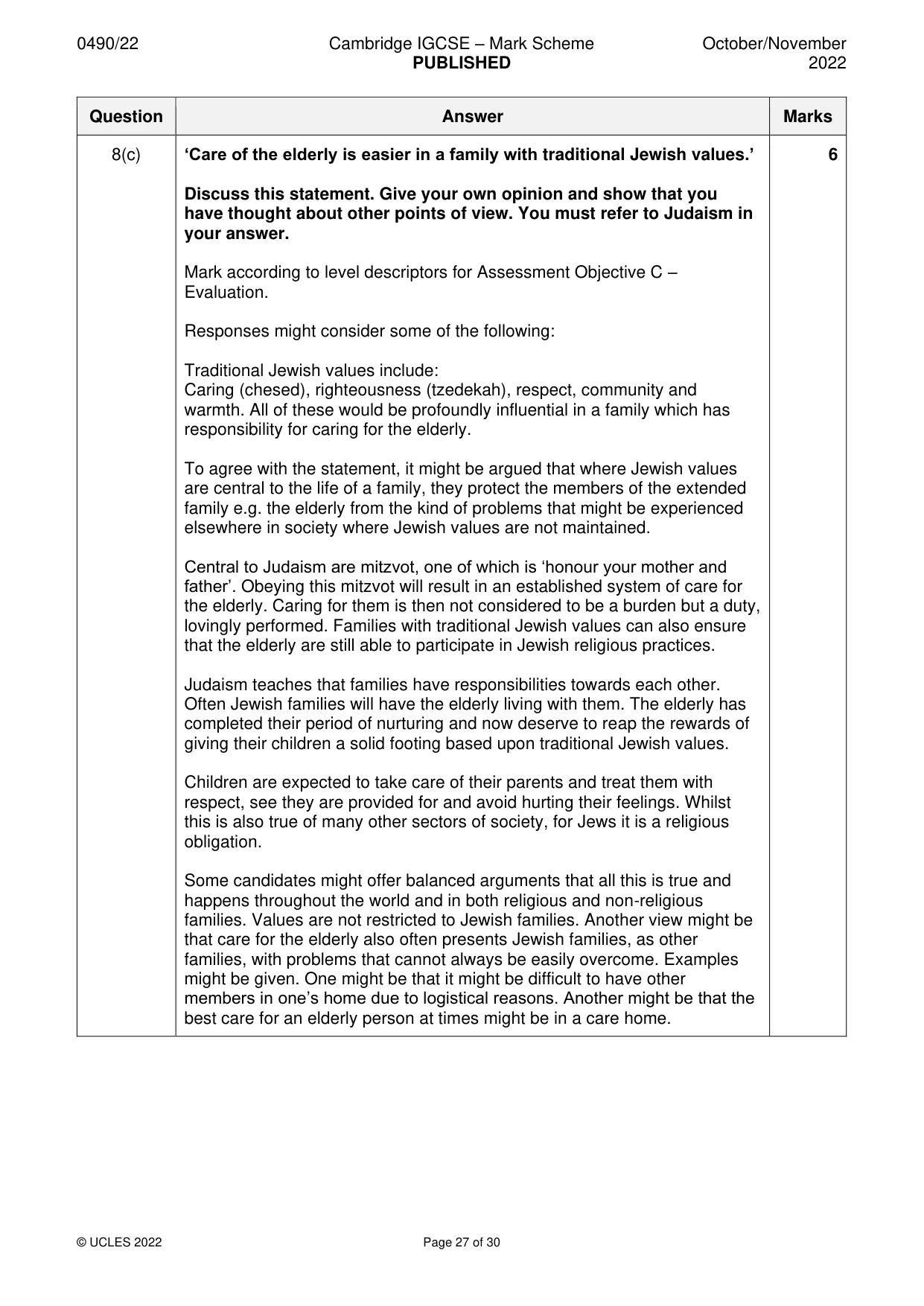
0490/22 Cambridge IGCSE – Mark Scheme PUBLISHED October/November 2022 © UCLES 2022 Page 27 of 30 Question Answer Marks 8(c) ‘Care of the elderly is easier in a family with traditional Jewish values.’ Discuss this statement. Give your own opinion and show that you have thought about other points of view. You must refer to Judaism in your answer. Mark according to level descriptors for Assessment Objective C – Evaluation. Responses might consider some of the following: Traditional Jewish values include: Caring (chesed), righteousness (tzedekah), respect, community and warmth. All of these would be profoundly influential in a family which has responsibility for caring for the elderly. To agree with the statement, it might be argued that where Jewish values are central to the life of a family, they protect the members of the extended family e.g. the elderly from the kind of problems that might be experienced elsewhere in society where Jewish values are not maintained. Central to Judaism are mitzvot, one of which is ‘honour your mother and father’. Obeying this mitzvot will result in an established system of care for the elderly. Caring for them is then not considered to be a burden but a duty, lovingly performed. Families with traditional Jewish values can also ensure that the elderly are still able to participate in Jewish religious practices. Judaism teaches that families have responsibilities towards each other. Often Jewish families will have the elderly living with them. The elderly has completed their period of nurturing and now deserve to reap the rewards of giving their children a solid footing based upon traditional Jewish values. Children are expected to take care of their parents and treat them with respect, see they are provided for and avoid hurting their feelings. Whilst this is also true of many other sectors of society, for Jews it is a religious obligation. Some candidates might offer balanced arguments that all this is true and happens throughout the world and in both religious and non-religious families. Values are not restricted to Jewish families. Another view might be that care for the elderly also often presents Jewish families, as other families, with problems that cannot always be easily overcome. Examples might be given. One might be that it might be difficult to have other members in one’s home due to logistical reasons. Another might be that the best care for an elderly person at times might be in a care home. 6
Mark scheme, page 28
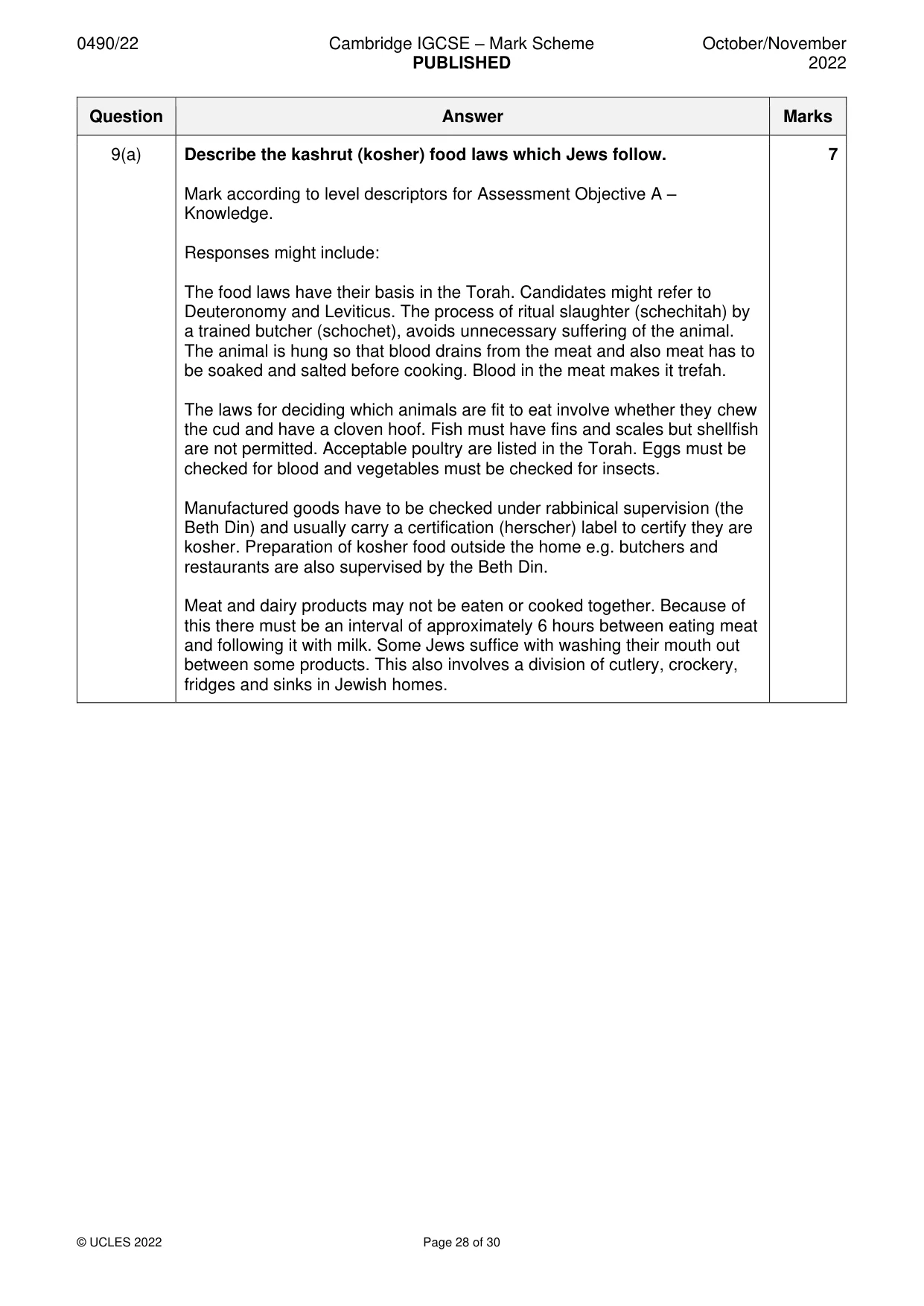
0490/22 Cambridge IGCSE – Mark Scheme PUBLISHED October/November 2022 © UCLES 2022 Page 28 of 30 Question Answer Marks 9(a) Describe the kashrut (kosher) food laws which Jews follow. Mark according to level descriptors for Assessment Objective A – Knowledge. Responses might include: The food laws have their basis in the Torah. Candidates might refer to Deuteronomy and Leviticus. The process of ritual slaughter (schechitah) by a trained butcher (schochet), avoids unnecessary suffering of the animal. The animal is hung so that blood drains from the meat and also meat has to be soaked and salted before cooking. Blood in the meat makes it trefah. The laws for deciding which animals are fit to eat involve whether they chew the cud and have a cloven hoof. Fish must have fins and scales but shellfish are not permitted. Acceptable poultry are listed in the Torah. Eggs must be checked for blood and vegetables must be checked for insects. Manufactured goods have to be checked under rabbinical supervision (the Beth Din) and usually carry a certification (herscher) label to certify they are kosher. Preparation of kosher food outside the home e.g. butchers and restaurants are also supervised by the Beth Din. Meat and dairy products may not be eaten or cooked together. Because of this there must be an interval of approximately 6 hours between eating meat and following it with milk. Some Jews suffice with washing their mouth out between some products. This also involves a division of cutlery, crockery, fridges and sinks in Jewish homes. 7
Mark scheme, page 29
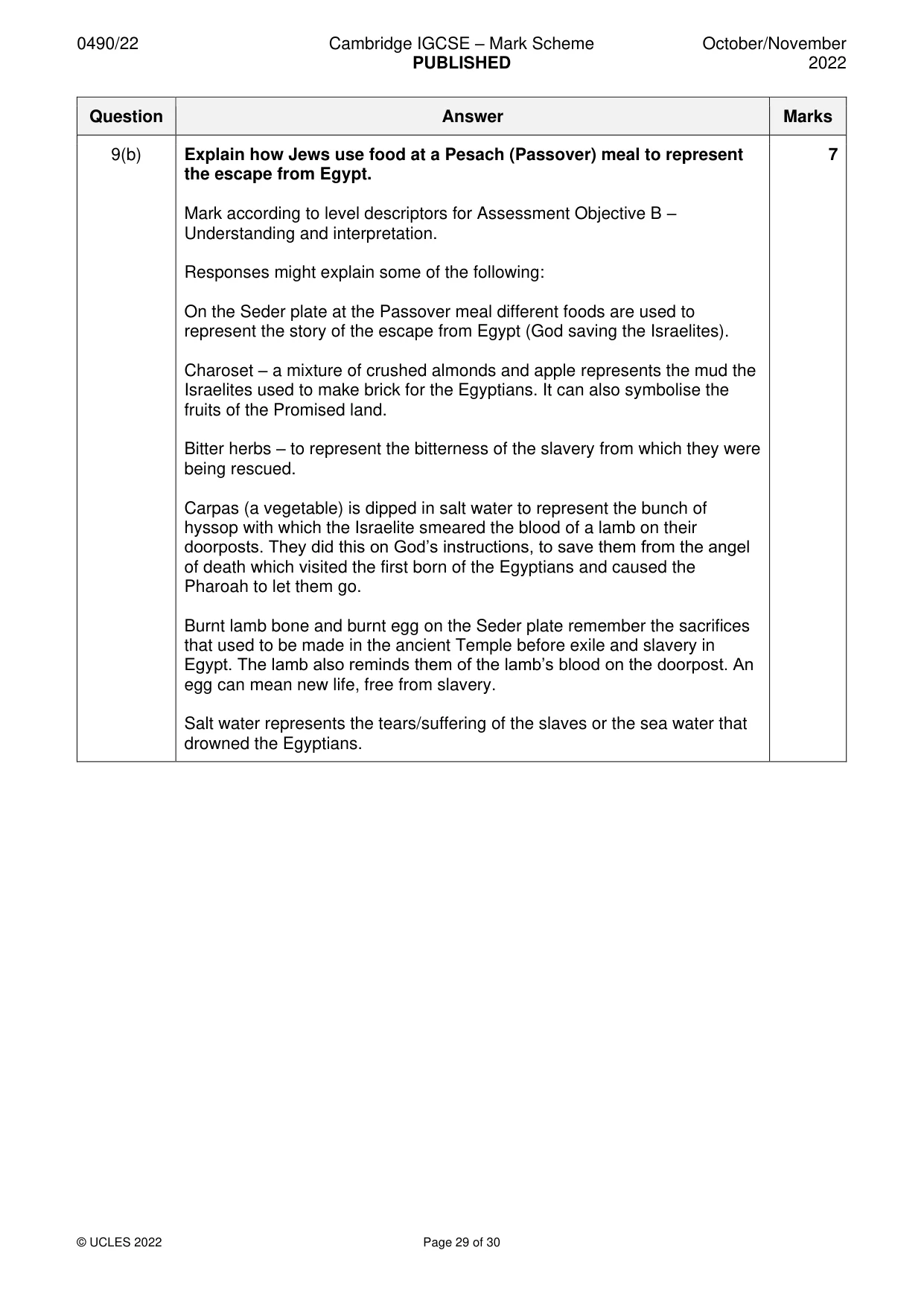
0490/22 Cambridge IGCSE – Mark Scheme PUBLISHED October/November 2022 © UCLES 2022 Page 29 of 30 Question Answer Marks 9(b) Explain how Jews use food at a Pesach (Passover) meal to represent the escape from Egypt. Mark according to level descriptors for Assessment Objective B – Understanding and interpretation. Responses might explain some of the following: On the Seder plate at the Passover meal different foods are used to represent the story of the escape from Egypt (God saving the Israelites). Charoset – a mixture of crushed almonds and apple represents the mud the Israelites used to make brick for the Egyptians. It can also symbolise the fruits of the Promised land. Bitter herbs – to represent the bitterness of the slavery from which they were being rescued. Carpas (a vegetable) is dipped in salt water to represent the bunch of hyssop with which the Israelite smeared the blood of a lamb on their doorposts. They did this on God’s instructions, to save them from the angel of death which visited the first born of the Egyptians and caused the Pharoah to let them go. Burnt lamb bone and burnt egg on the Seder plate remember the sacrifices that used to be made in the ancient Temple before exile and slavery in Egypt. The lamb also reminds them of the lamb’s blood on the doorpost. An egg can mean new life, free from slavery. Salt water represents the tears/suffering of the slaves or the sea water that drowned the Egyptians. 7
Mark scheme, page 30
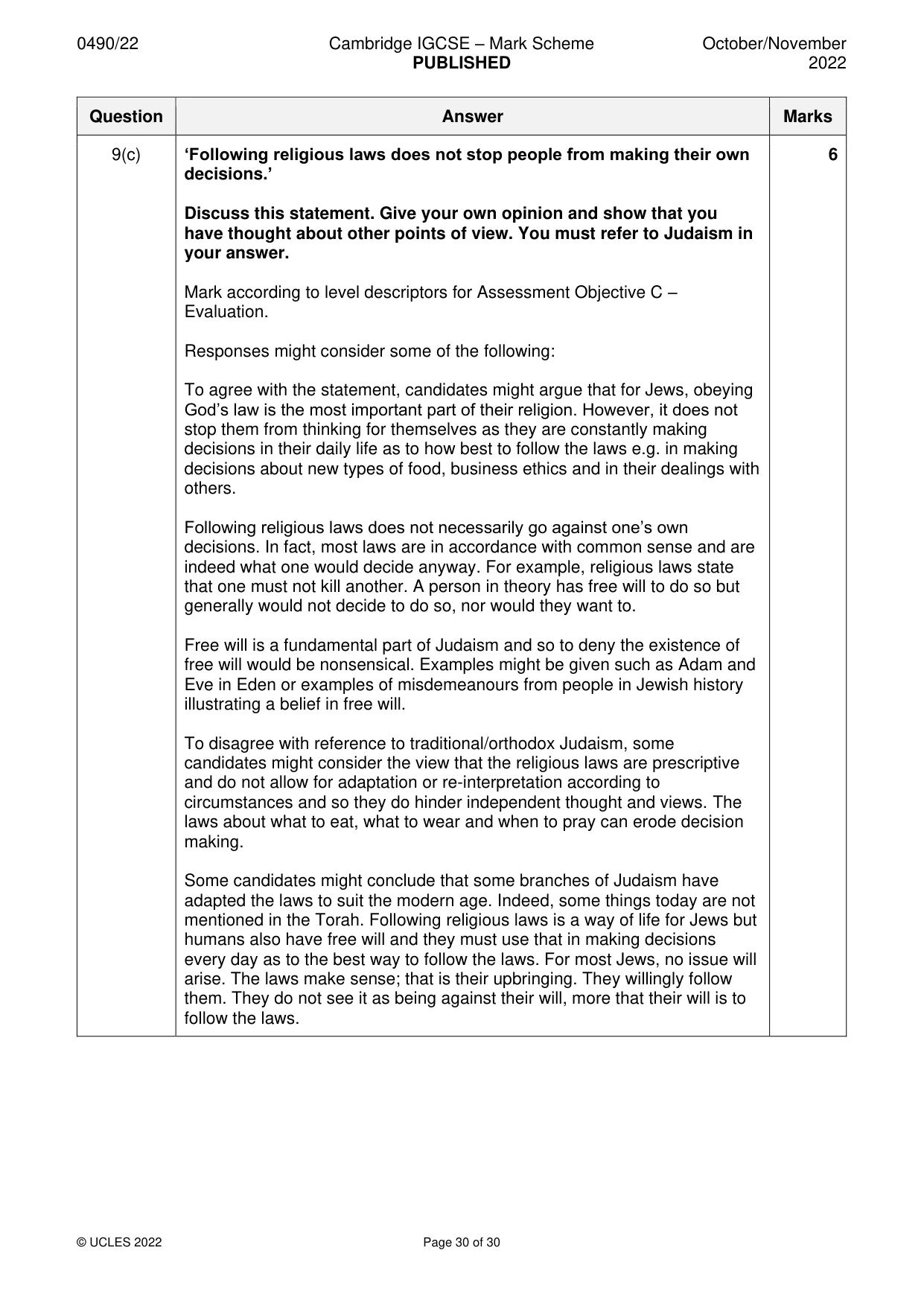
0490/22 Cambridge IGCSE – Mark Scheme PUBLISHED October/November 2022 © UCLES 2022 Page 30 of 30 Question Answer Marks 9(c) ‘Following religious laws does not stop people from making their own decisions.’ Discuss this statement. Give your own opinion and show that you have thought about other points of view. You must refer to Judaism in your answer. Mark according to level descriptors for Assessment Objective C – Evaluation. Responses might consider some of the following: To agree with the statement, candidates might argue that for Jews, obeying God’s law is the most important part of their religion. However, it does not stop them from thinking for themselves as they are constantly making decisions in their daily life as to how best to follow the laws e.g. in making decisions about new types of food, business ethics and in their dealings with others. Following religious laws does not necessarily go against one’s own decisions. In fact, most laws are in accordance with common sense and are indeed what one would decide anyway. For example, religious laws state that one must not kill another. A person in theory has free will to do so but generally would not decide to do so, nor would they want to. Free will is a fundamental part of Judaism and so to deny the existence of free will would be nonsensical. Examples might be given such as Adam and Eve in Eden or examples of misdemeanours from people in Jewish history illustrating a belief in free will. To disagree with reference to traditional/orthodox Judaism, some candidates might consider the view that the religious laws are prescriptive and do not allow for adaptation or re-interpretation according to circumstances and so they do hinder independent thought and views. The laws about what to eat, what to wear and when to pray can erode decision making. Some candidates might conclude that some branches of Judaism have adapted the laws to suit the modern age. Indeed, some things today are not mentioned in the Torah. Following religious laws is a way of life for Jews but humans also have free will and they must use that in making decisions every day as to the best way to follow the laws. For most Jews, no issue will arise. The laws make sense; that is their upbringing. They willingly follow them. They do not see it as being against their will, more that their will is to follow the laws. 6
What you needed in this session
Cambridge’s own grade thresholds for 2022 Oct/Nov, Paper 2 · Variant 2. A higher threshold means an easier paper — the bar moves with how the cohort did.