Cambridge IGCSE Religious Studies 0490 — 2021 Oct/Nov Paper 2 · Variant 2
0490/22/O/N/21 · 80 marks · ≈90 min
The question paper and its mark scheme, free to read here and free to download. This is Cambridge’s own paper, exactly as it was sat.
Question paper4 pages
Mark scheme26 pages
Answers below. Sit the paper first if you are practising.
Paper as text
Question paper, page 1
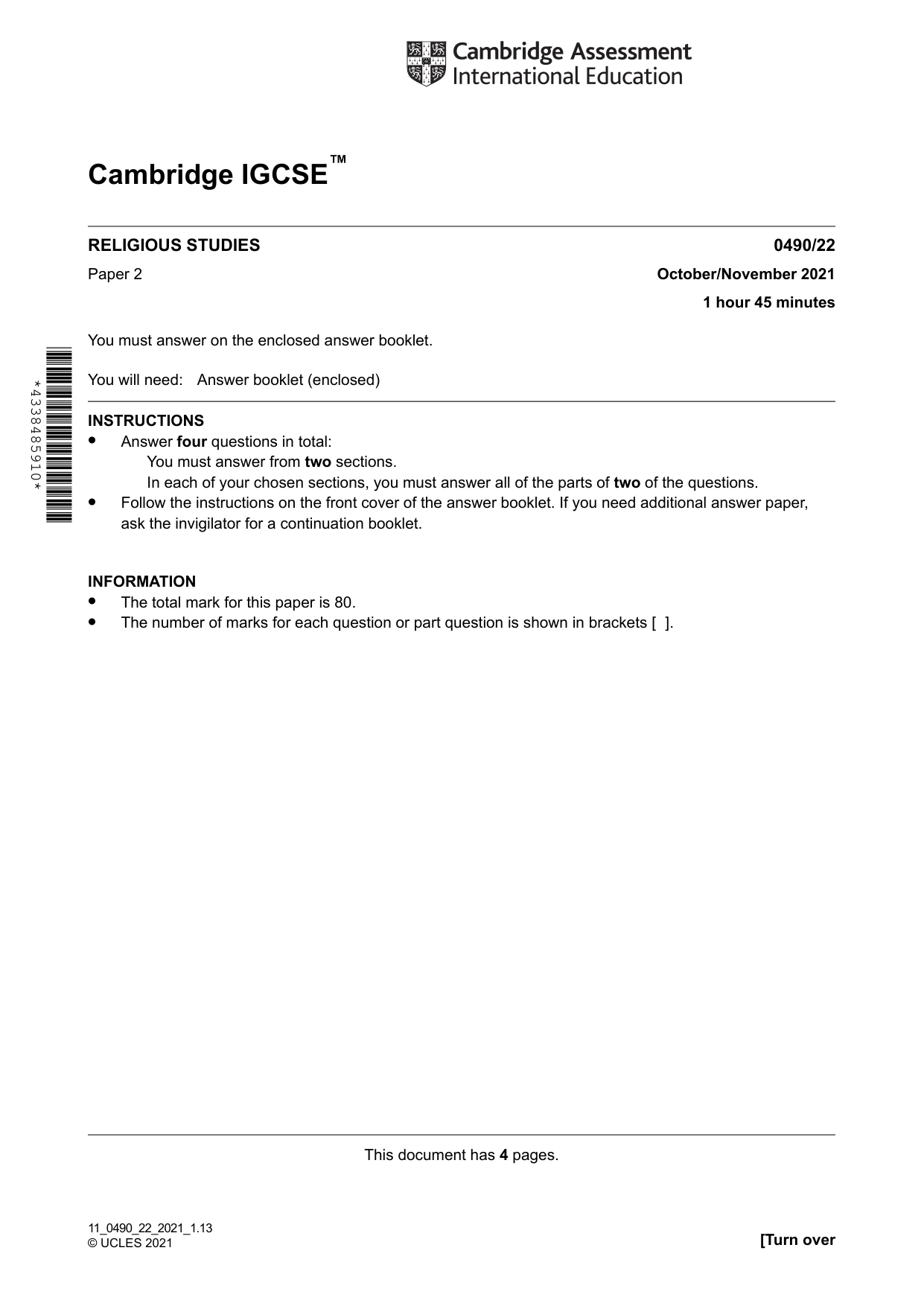
Cambridge IGCSE™ 0490/22 October/November 2021 1 hour 45 minutes RELIGIOUS STUDIES Paper 2 You must answer on the enclosed answer booklet. You will need: Answer booklet (enclosed) INSTRUCTIONS • Answer four questions in total: You must answer from two sections. In each of your chosen sections, you must answer all of the parts of two of the questions. • Follow the instructions on the front cover of the answer booklet. If you need additional answer paper, ask the invigilator for a continuation booklet. INFORMATION • The total mark for this paper is 80. • The number of marks for each question or part question is shown in brackets [ ]. This document has 4 pages. [Turn over 11_0490_22_2021_1.13 © UCLES 2021 *4338485910*
Question paper, page 2
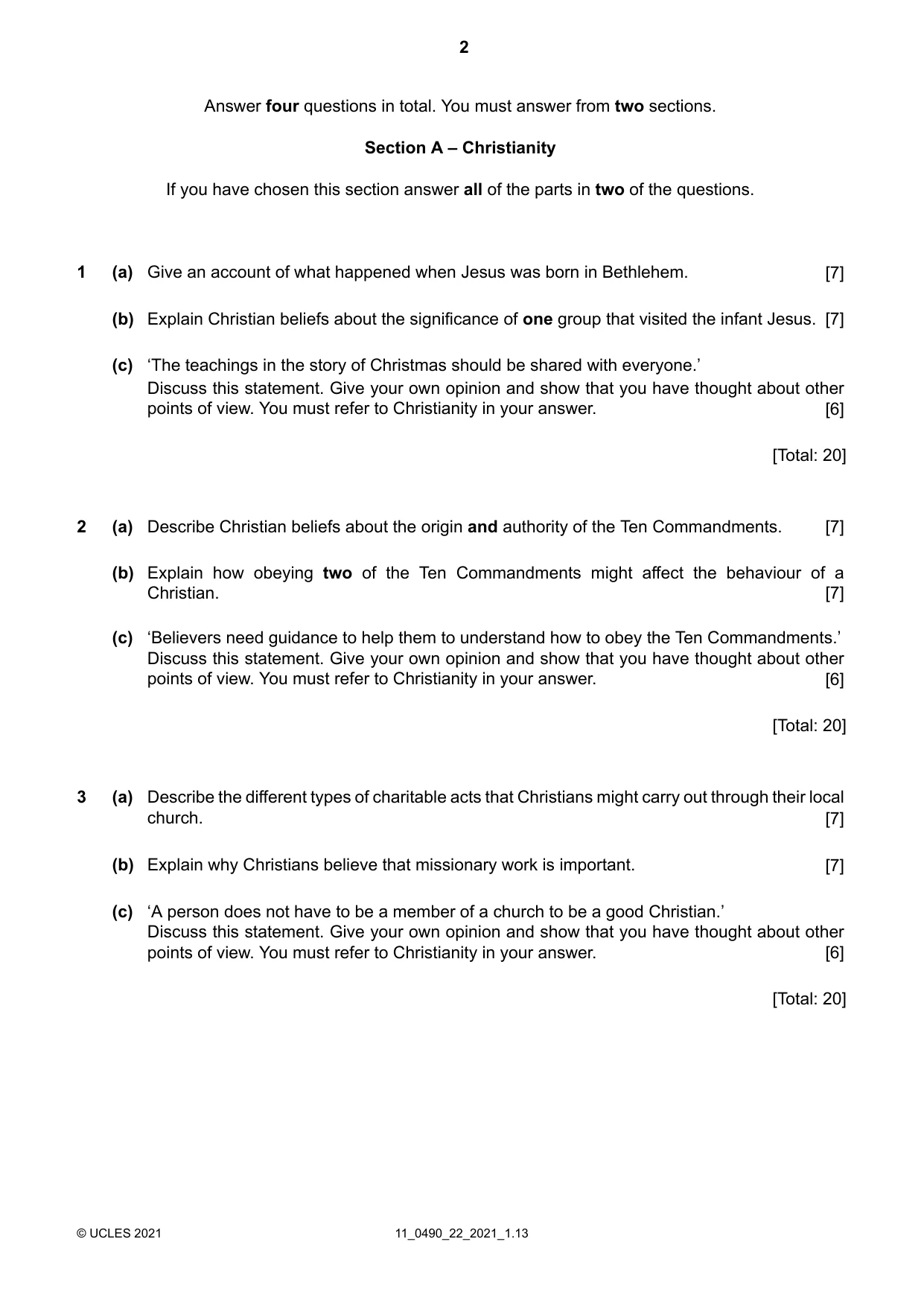
Answer four questions in total. You must answer from two sections. Section A – Christianity If you have chosen this section answer all of the parts in two of the questions. Give an account of what happened when Jesus was born in Bethlehem. [7] (a) 1 Explain Christian beliefs about the significance of one group that visited the infant Jesus. [7] (b) ‘The teachings in the story of Christmas should be shared with everyone.’ Discuss this statement. Give your own opinion and show that you have thought about other points of view. You must refer to Christianity in your answer. [6] (c) [Total: 20] Describe Christian beliefs about the origin and authority of the Ten Commandments. [7] (a) 2 Explain how obeying two of the Ten Commandments might affect the behaviour of a Christian. [7] (b) ‘Believers need guidance to help them to understand how to obey the Ten Commandments.’ Discuss this statement. Give your own opinion and show that you have thought about other points of view. You must refer to Christianity in your answer. [6] (c) [Total: 20] Describe the different types of charitable acts that Christians might carry out through their local church. [7] (a) 3 Explain why Christians believe that missionary work is important. [7] (b) ‘A person does not have to be a member of a church to be a good Christian.’ Discuss this statement. Give your own opinion and show that you have thought about other points of view. You must refer to Christianity in your answer. [6] (c) [Total: 20] 11_0490_22_2021_1.13 © UCLES 2021 2
Question paper, page 3
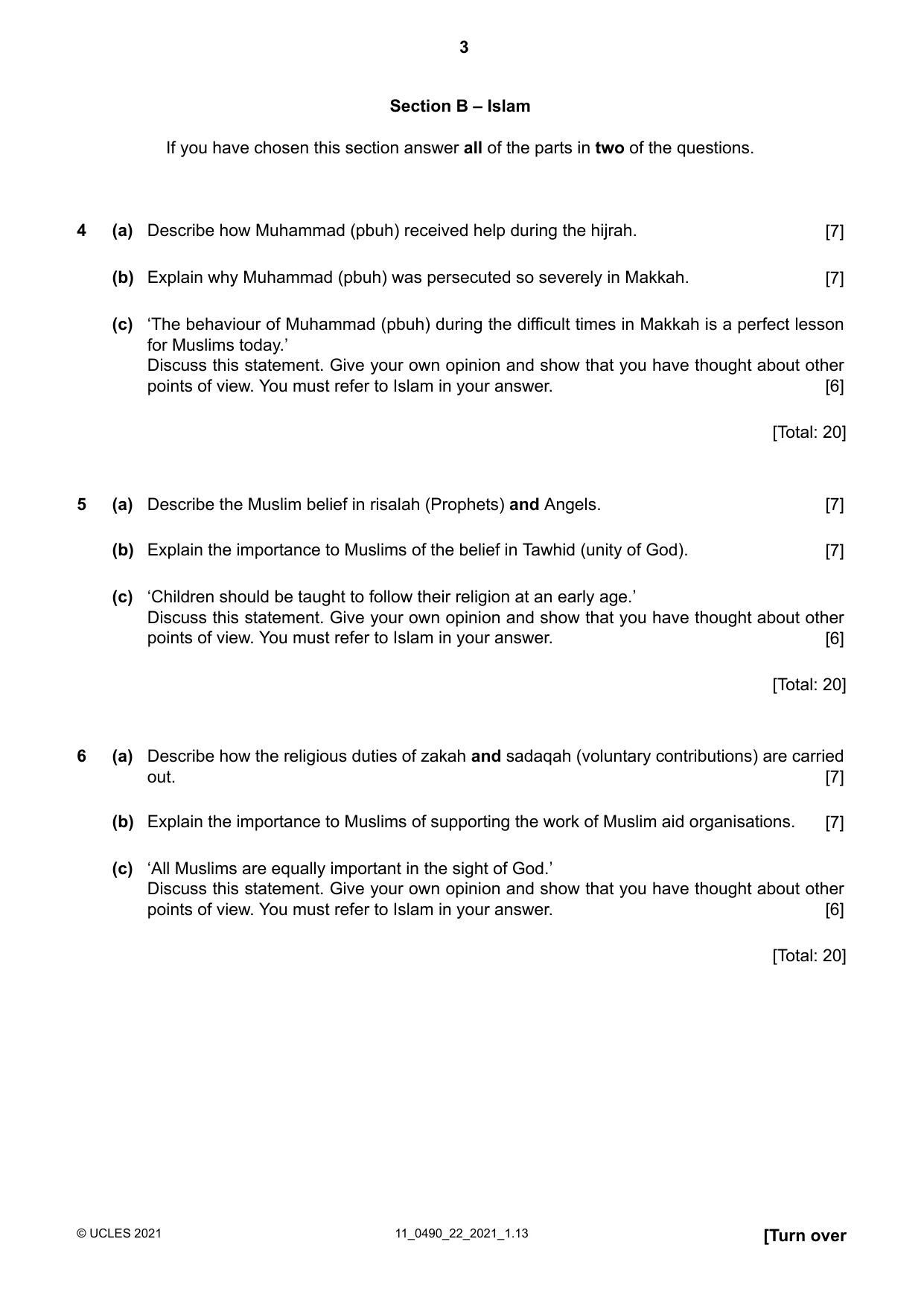
Section B – Islam If you have chosen this section answer all of the parts in two of the questions. Describe how Muhammad (pbuh) received help during the hijrah. [7] (a) 4 Explain why Muhammad (pbuh) was persecuted so severely in Makkah. [7] (b) ‘The behaviour of Muhammad (pbuh) during the difficult times in Makkah is a perfect lesson for Muslims today.’ Discuss this statement. Give your own opinion and show that you have thought about other points of view. You must refer to Islam in your answer. [6] (c) [Total: 20] Describe the Muslim belief in risalah (Prophets) and Angels. [7] (a) 5 Explain the importance to Muslims of the belief in Tawhid (unity of God). [7] (b) ‘Children should be taught to follow their religion at an early age.’ Discuss this statement. Give your own opinion and show that you have thought about other points of view. You must refer to Islam in your answer. [6] (c) [Total: 20] Describe how the religious duties of zakah and sadaqah (voluntary contributions) are carried out. [7] (a) 6 Explain the importance to Muslims of supporting the work of Muslim aid organisations. [7] (b) ‘All Muslims are equally important in the sight of God.’ Discuss this statement. Give your own opinion and show that you have thought about other points of view. You must refer to Islam in your answer. [6] (c) [Total: 20] [Turn over 11_0490_22_2021_1.13 © UCLES 2021 3
Question paper, page 4
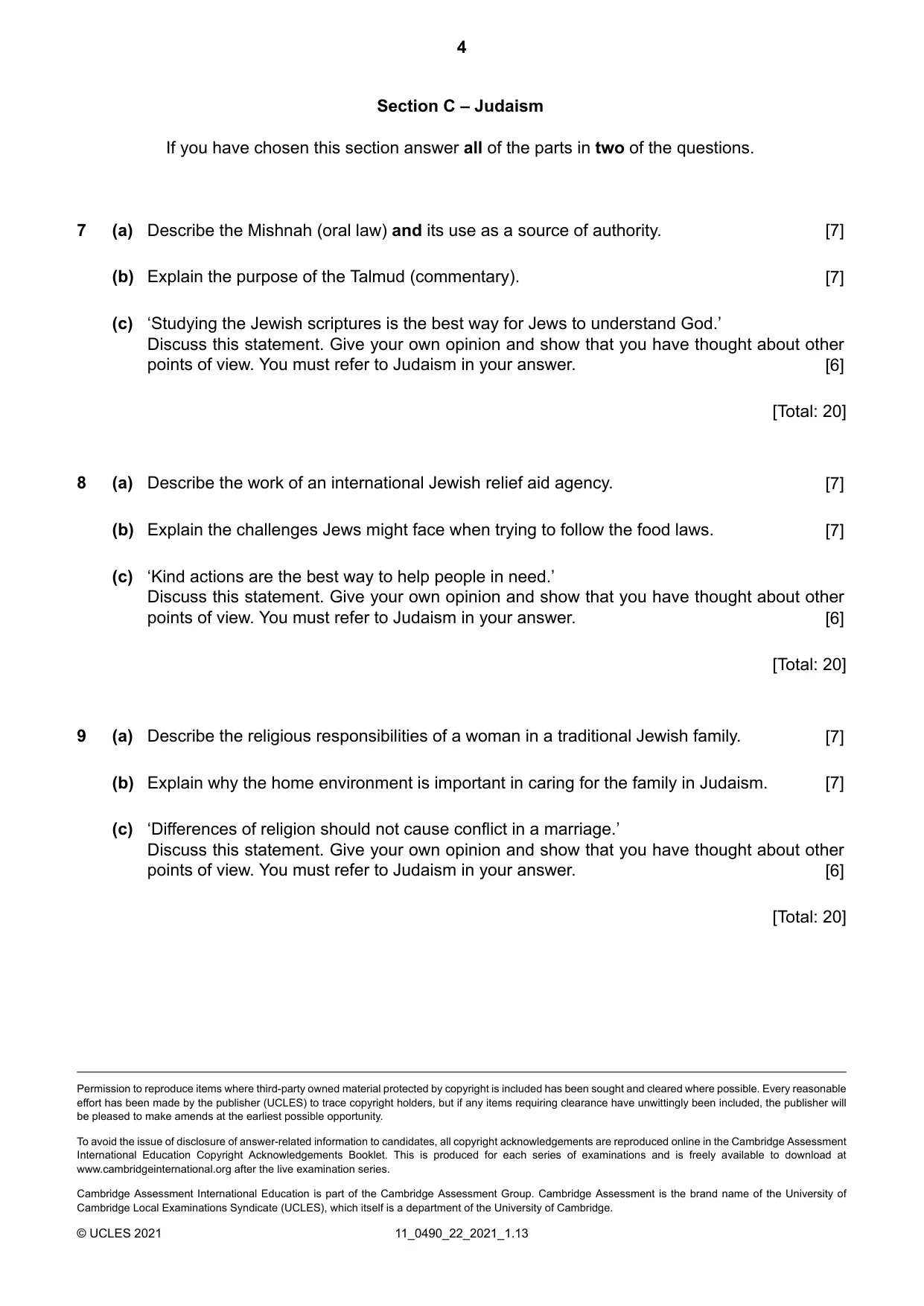
Section C – Judaism If you have chosen this section answer all of the parts in two of the questions. Describe the Mishnah (oral law) and its use as a source of authority. [7] (a) 7 Explain the purpose of the Talmud (commentary). [7] (b) ‘Studying the Jewish scriptures is the best way for Jews to understand God.’ Discuss this statement. Give your own opinion and show that you have thought about other points of view. You must refer to Judaism in your answer. [6] (c) [Total: 20] Describe the work of an international Jewish relief aid agency. [7] (a) 8 Explain the challenges Jews might face when trying to follow the food laws. [7] (b) ‘Kind actions are the best way to help people in need.’ Discuss this statement. Give your own opinion and show that you have thought about other points of view. You must refer to Judaism in your answer. [6] (c) [Total: 20] Describe the religious responsibilities of a woman in a traditional Jewish family. [7] (a) 9 Explain why the home environment is important in caring for the family in Judaism. [7] (b) ‘Differences of religion should not cause conflict in a marriage.’ Discuss this statement. Give your own opinion and show that you have thought about other points of view. You must refer to Judaism in your answer. [6] (c) [Total: 20] Permission to reproduce items where third-party owned material protected by copyright is included has been sought and cleared where possible. Every reasonable effort has been made by the publisher (UCLES) to trace copyright holders, but if any items requiring clearance have unwittingly been included, the publisher will be pleased to make amends at the earliest possible opportunity. To avoid the issue of disclosure of answer-related information to candidates, all copyright acknowledgements are reproduced online in the Cambridge Assessment International Education Copyright Acknowledgements Booklet. This is produced for each series of examinations and is freely available to download at www.cambridgeinternational.org after the live examination series. Cambridge Assessment International Education is part of the Cambridge Assessment Group. Cambridge Assessment is the brand name of the University of Cambridge Local Examinations Syndicate (UCLES), which itself is a department of the University of Cambridge. 11_0490_22_2021_1.13 © UCLES 2021 4
Mark scheme, page 1
This document consists of 26 printed pages. © UCLES 2021 [Turn over Cambridge IGCSE™ RELIGIOUS STUDIES 0490/22 Paper 2 October/November 2021 MARK SCHEME Maximum Mark: 80 Published This mark scheme is published as an aid to teachers and candidates, to indicate the requirements of the examination. It shows the basis on which Examiners were instructed to award marks. It does not indicate the details of the discussions that took place at an Examiners’ meeting before marking began, which would have considered the acceptability of alternative answers. Mark schemes should be read in conjunction with the question paper and the Principal Examiner Report for Teachers. Cambridge International will not enter into discussions about these mark schemes. Cambridge International is publishing the mark schemes for the October/November 2021 series for most Cambridge IGCSE™, Cambridge International A and AS Level components and some Cambridge O Level components.
Mark scheme, page 2
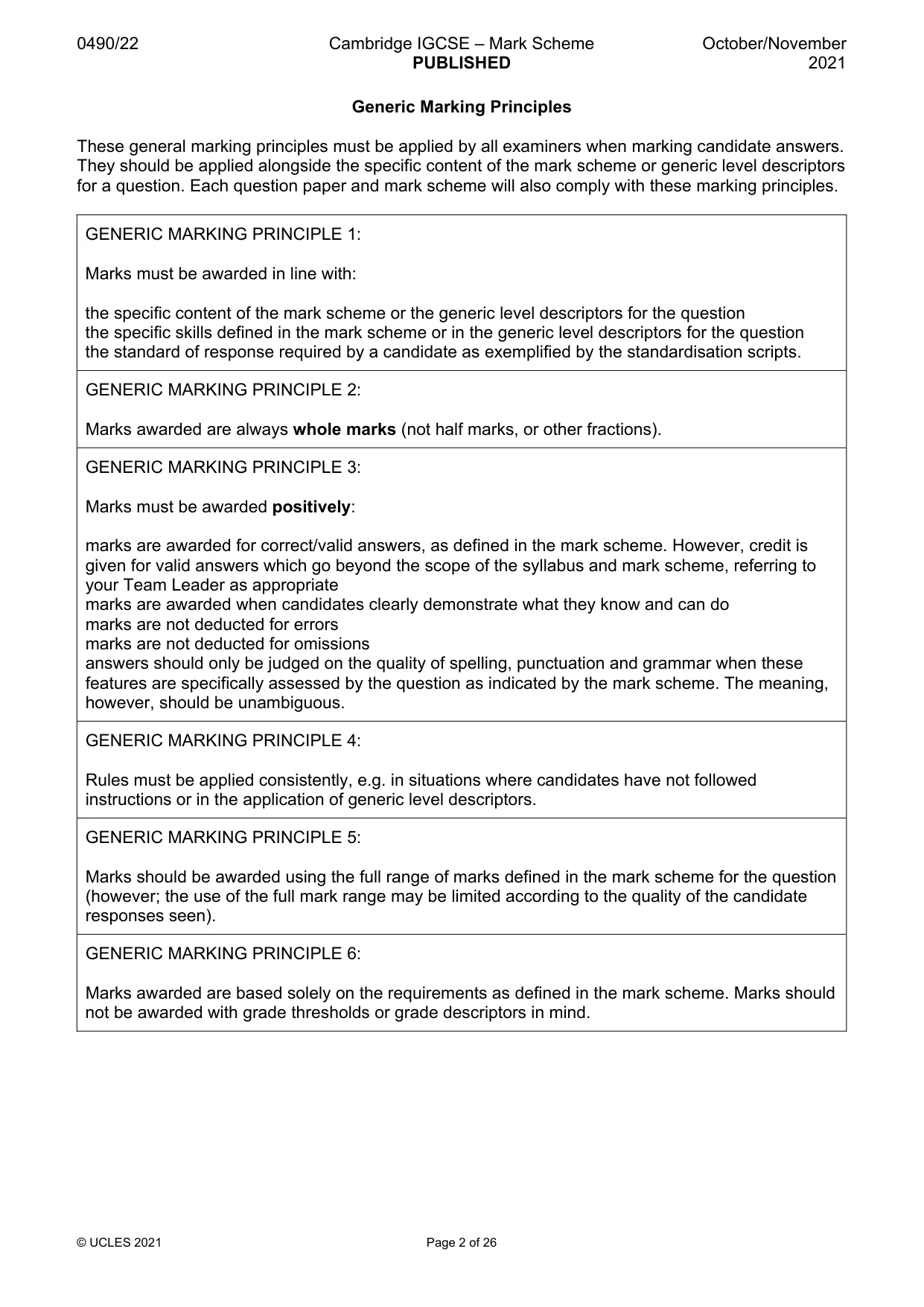
0490/22 Cambridge IGCSE – Mark Scheme PUBLISHED October/November 2021 © UCLES 2021 Page 2 of 26 Generic Marking Principles These general marking principles must be applied by all examiners when marking candidate answers. They should be applied alongside the specific content of the mark scheme or generic level descriptors for a question. Each question paper and mark scheme will also comply with these marking principles. GENERIC MARKING PRINCIPLE 1: Marks must be awarded in line with: the specific content of the mark scheme or the generic level descriptors for the question the specific skills defined in the mark scheme or in the generic level descriptors for the question the standard of response required by a candidate as exemplified by the standardisation scripts. GENERIC MARKING PRINCIPLE 2: Marks awarded are always whole marks (not half marks, or other fractions). GENERIC MARKING PRINCIPLE 3: Marks must be awarded positively: marks are awarded for correct/valid answers, as defined in the mark scheme. However, credit is given for valid answers which go beyond the scope of the syllabus and mark scheme, referring to your Team Leader as appropriate marks are awarded when candidates clearly demonstrate what they know and can do marks are not deducted for errors marks are not deducted for omissions answers should only be judged on the quality of spelling, punctuation and grammar when these features are specifically assessed by the question as indicated by the mark scheme. The meaning, however, should be unambiguous. GENERIC MARKING PRINCIPLE 4: Rules must be applied consistently, e.g. in situations where candidates have not followed instructions or in the application of generic level descriptors. GENERIC MARKING PRINCIPLE 5: Marks should be awarded using the full range of marks defined in the mark scheme for the question (however; the use of the full mark range may be limited according to the quality of the candidate responses seen). GENERIC MARKING PRINCIPLE 6: Marks awarded are based solely on the requirements as defined in the mark scheme. Marks should not be awarded with grade thresholds or grade descriptors in mind.
Mark scheme, page 3
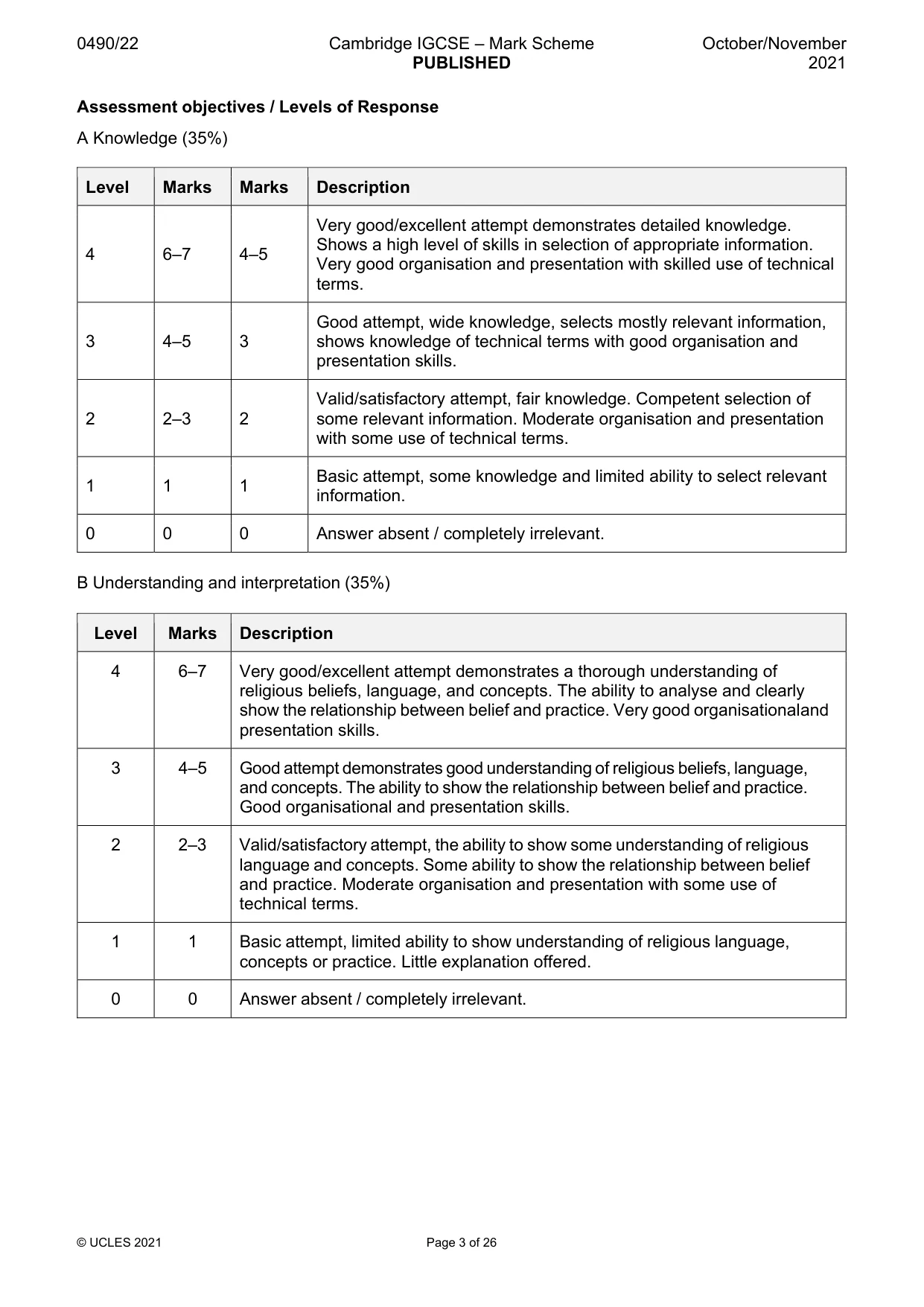
0490/22 Cambridge IGCSE – Mark Scheme PUBLISHED October/November 2021 © UCLES 2021 Page 3 of 26 Assessment objectives / Levels of Response A Knowledge (35%) Level Marks Marks Description 4 6–7 4–5 Very good/excellent attempt demonstrates detailed knowledge. Shows a high level of skills in selection of appropriate information. Very good organisation and presentation with skilled use of technical terms. 3 4–5 3 Good attempt, wide knowledge, selects mostly relevant information, shows knowledge of technical terms with good organisation and presentation skills. 2 2–3 2 Valid/satisfactory attempt, fair knowledge. Competent selection of some relevant information. Moderate organisation and presentation with some use of technical terms. 1 1 1 Basic attempt, some knowledge and limited ability to select relevant information. 0 0 0 Answer absent / completely irrelevant. B Understanding and interpretation (35%) Level Marks Description 4 6–7 Very good/excellent attempt demonstrates a thorough understanding of religious beliefs, language, and concepts. The ability to analyse and clearly show the relationship between belief and practice. Very good organisational and presentation skills. 3 4–5 Good attempt demonstrates good understanding of religious beliefs, language, and concepts. The ability to show the relationship between belief and practice. Good organisational and presentation skills. 2 2–3 Valid/satisfactory attempt, the ability to show some understanding of religious language and concepts. Some ability to show the relationship between belief and practice. Moderate organisation and presentation with some use of technical terms. 1 1 Basic attempt, limited ability to show understanding of religious language, concepts or practice. Little explanation offered. 0 0 Answer absent / completely irrelevant.
Mark scheme, page 4
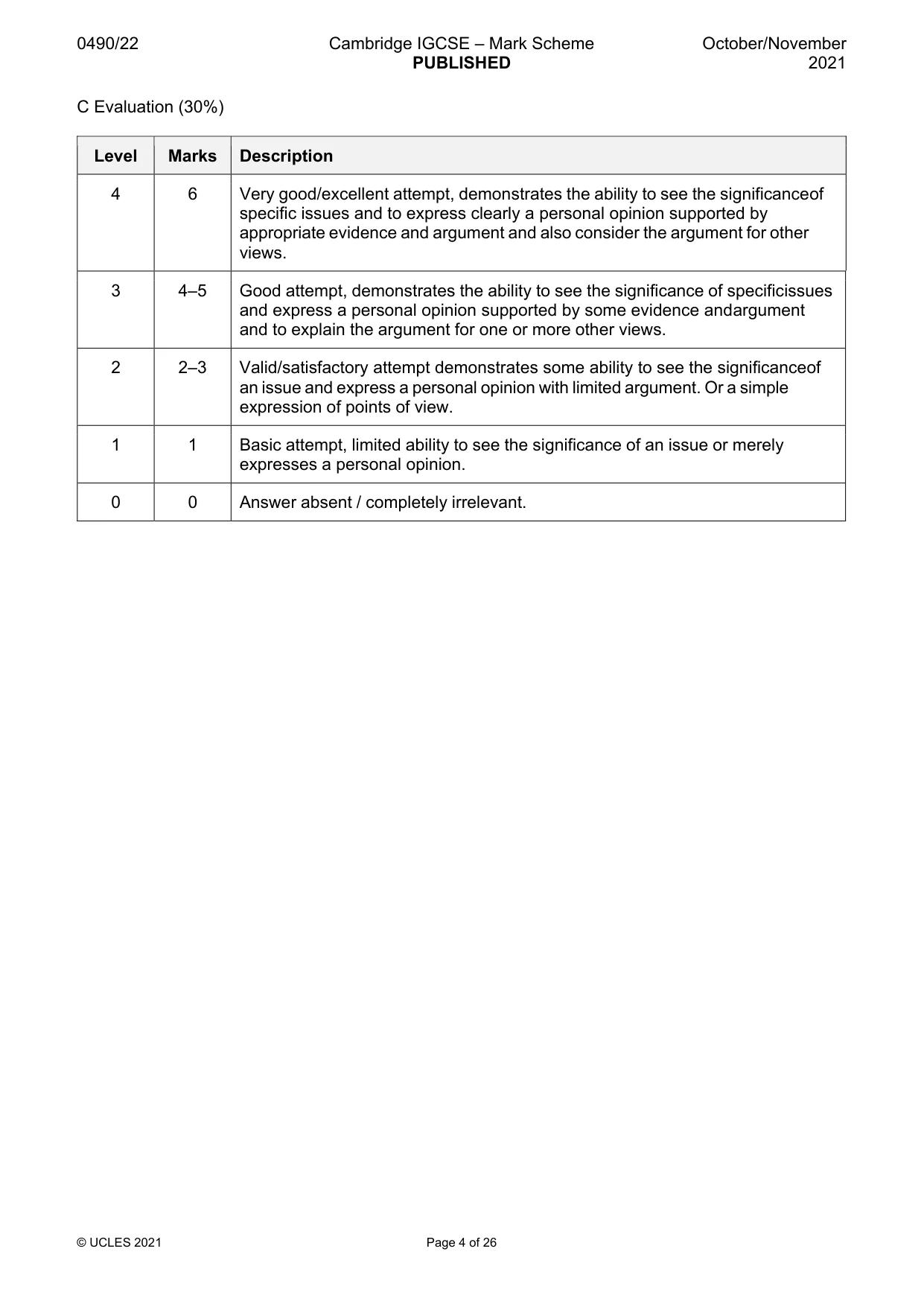
0490/22 Cambridge IGCSE – Mark Scheme PUBLISHED October/November 2021 © UCLES 2021 Page 4 of 26 C Evaluation (30%) Level Marks Description 4 6 Very good/excellent attempt, demonstrates the ability to see the significance of specific issues and to express clearly a personal opinion supported by appropriate evidence and argument and also consider the argument for other views. 3 4–5 Good attempt, demonstrates the ability to see the significance of specific issues and express a personal opinion supported by some evidence and argument and to explain the argument for one or more other views. 2 2–3 Valid/satisfactory attempt demonstrates some ability to see the significance of an issue and express a personal opinion with limited argument. Or a simple expression of points of view. 1 1 Basic attempt, limited ability to see the significance of an issue or merely expresses a personal opinion. 0 0 Answer absent / completely irrelevant.
Mark scheme, page 5
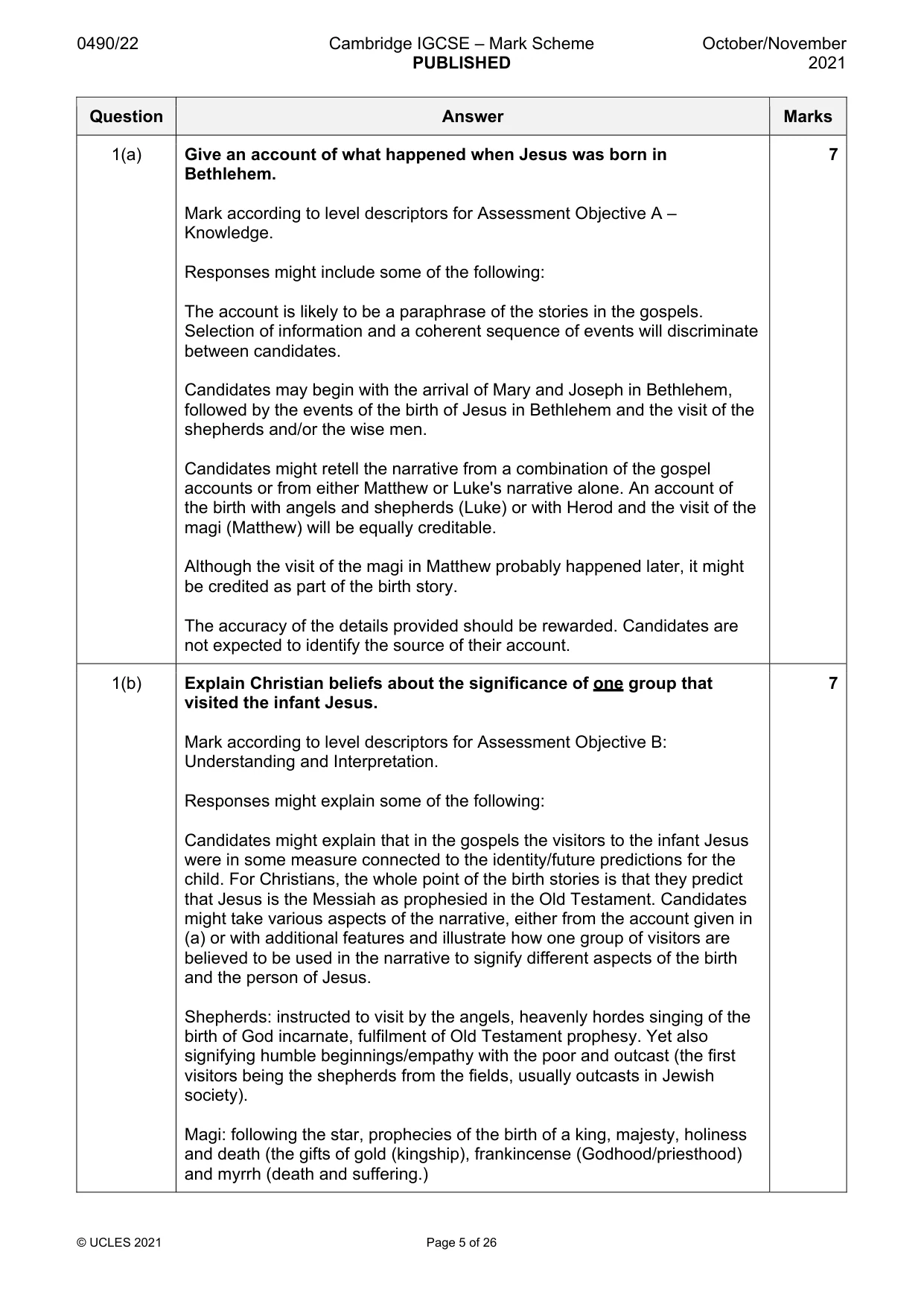
0490/22 Cambridge IGCSE – Mark Scheme PUBLISHED October/November 2021 © UCLES 2021 Page 5 of 26 Question Answer Marks 1(a) Give an account of what happened when Jesus was born in Bethlehem. Mark according to level descriptors for Assessment Objective A – Knowledge. Responses might include some of the following: The account is likely to be a paraphrase of the stories in the gospels. Selection of information and a coherent sequence of events will discriminate between candidates. Candidates may begin with the arrival of Mary and Joseph in Bethlehem, followed by the events of the birth of Jesus in Bethlehem and the visit of the shepherds and/or the wise men. Candidates might retell the narrative from a combination of the gospel accounts or from either Matthew or Luke's narrative alone. An account of the birth with angels and shepherds (Luke) or with Herod and the visit of the magi (Matthew) will be equally creditable. Although the visit of the magi in Matthew probably happened later, it might be credited as part of the birth story. The accuracy of the details provided should be rewarded. Candidates are not expected to identify the source of their account. 7 1(b) Explain Christian beliefs about the significance of one group that visited the infant Jesus. Mark according to level descriptors for Assessment Objective B: Understanding and Interpretation. Responses might explain some of the following: Candidates might explain that in the gospels the visitors to the infant Jesus were in some measure connected to the identity/future predictions for the child. For Christians, the whole point of the birth stories is that they predict that Jesus is the Messiah as prophesied in the Old Testament. Candidates might take various aspects of the narrative, either from the account given in (a) or with additional features and illustrate how one group of visitors are believed to be used in the narrative to signify different aspects of the birth and the person of Jesus. Shepherds: instructed to visit by the angels, heavenly hordes singing of the birth of God incarnate, fulfilment of Old Testament prophesy. Yet also signifying humble beginnings/empathy with the poor and outcast (the first visitors being the shepherds from the fields, usually outcasts in Jewish society). Magi: following the star, prophecies of the birth of a king, majesty, holiness and death (the gifts of gold (kingship), frankincense (Godhood/priesthood) and myrrh (death and suffering.) 7
Mark scheme, page 6
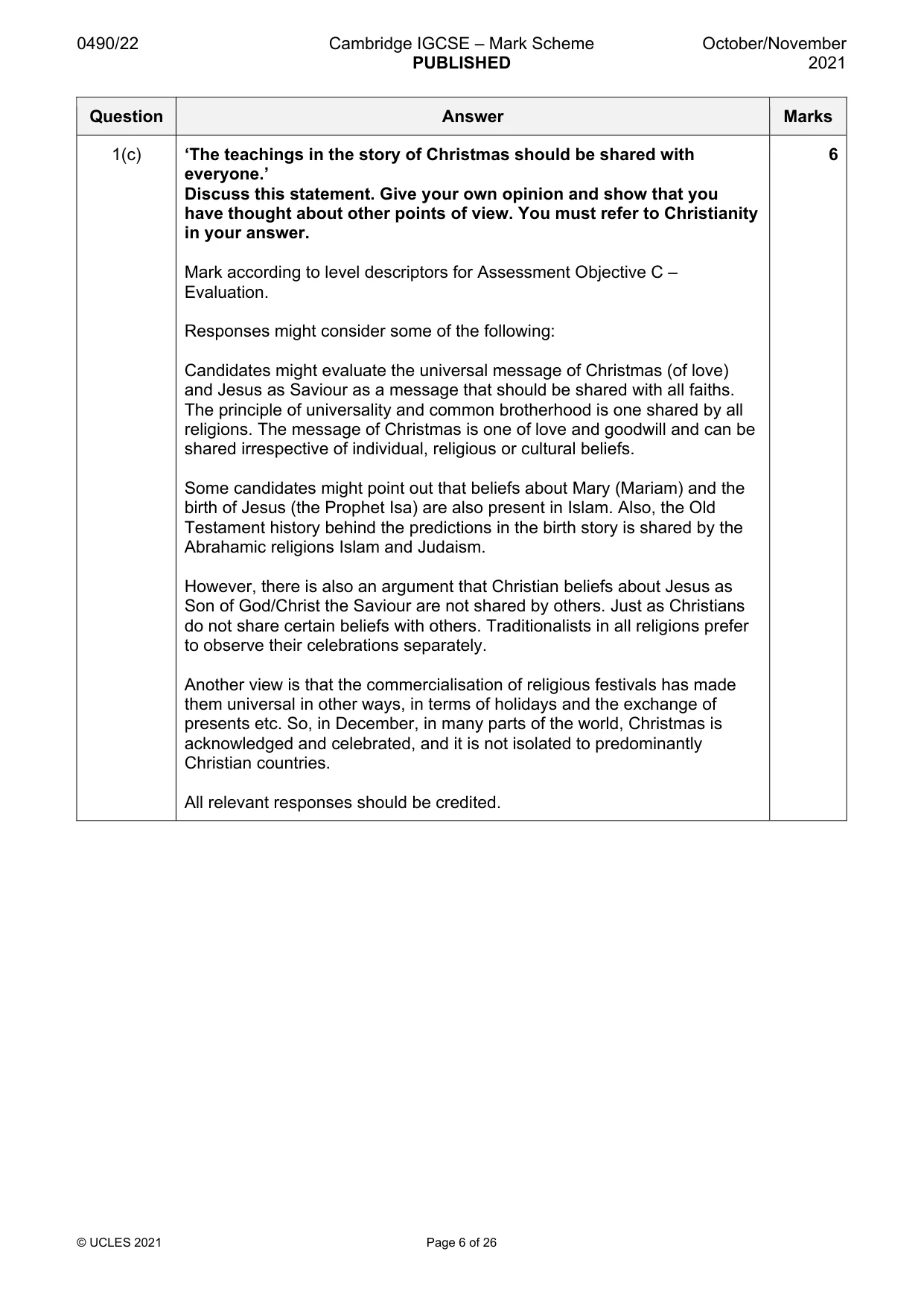
0490/22 Cambridge IGCSE – Mark Scheme PUBLISHED October/November 2021 © UCLES 2021 Page 6 of 26 Question Answer Marks 1(c) ‘The teachings in the story of Christmas should be shared with everyone.’ Discuss this statement. Give your own opinion and show that you have thought about other points of view. You must refer to Christianity in your answer. Mark according to level descriptors for Assessment Objective C – Evaluation. Responses might consider some of the following: Candidates might evaluate the universal message of Christmas (of love) and Jesus as Saviour as a message that should be shared with all faiths. The principle of universality and common brotherhood is one shared by all religions. The message of Christmas is one of love and goodwill and can be shared irrespective of individual, religious or cultural beliefs. Some candidates might point out that beliefs about Mary (Mariam) and the birth of Jesus (the Prophet Isa) are also present in Islam. Also, the Old Testament history behind the predictions in the birth story is shared by the Abrahamic religions Islam and Judaism. However, there is also an argument that Christian beliefs about Jesus as Son of God/Christ the Saviour are not shared by others. Just as Christians do not share certain beliefs with others. Traditionalists in all religions prefer to observe their celebrations separately. Another view is that the commercialisation of religious festivals has made them universal in other ways, in terms of holidays and the exchange of presents etc. So, in December, in many parts of the world, Christmas is acknowledged and celebrated, and it is not isolated to predominantly Christian countries. All relevant responses should be credited. 6
Mark scheme, page 7
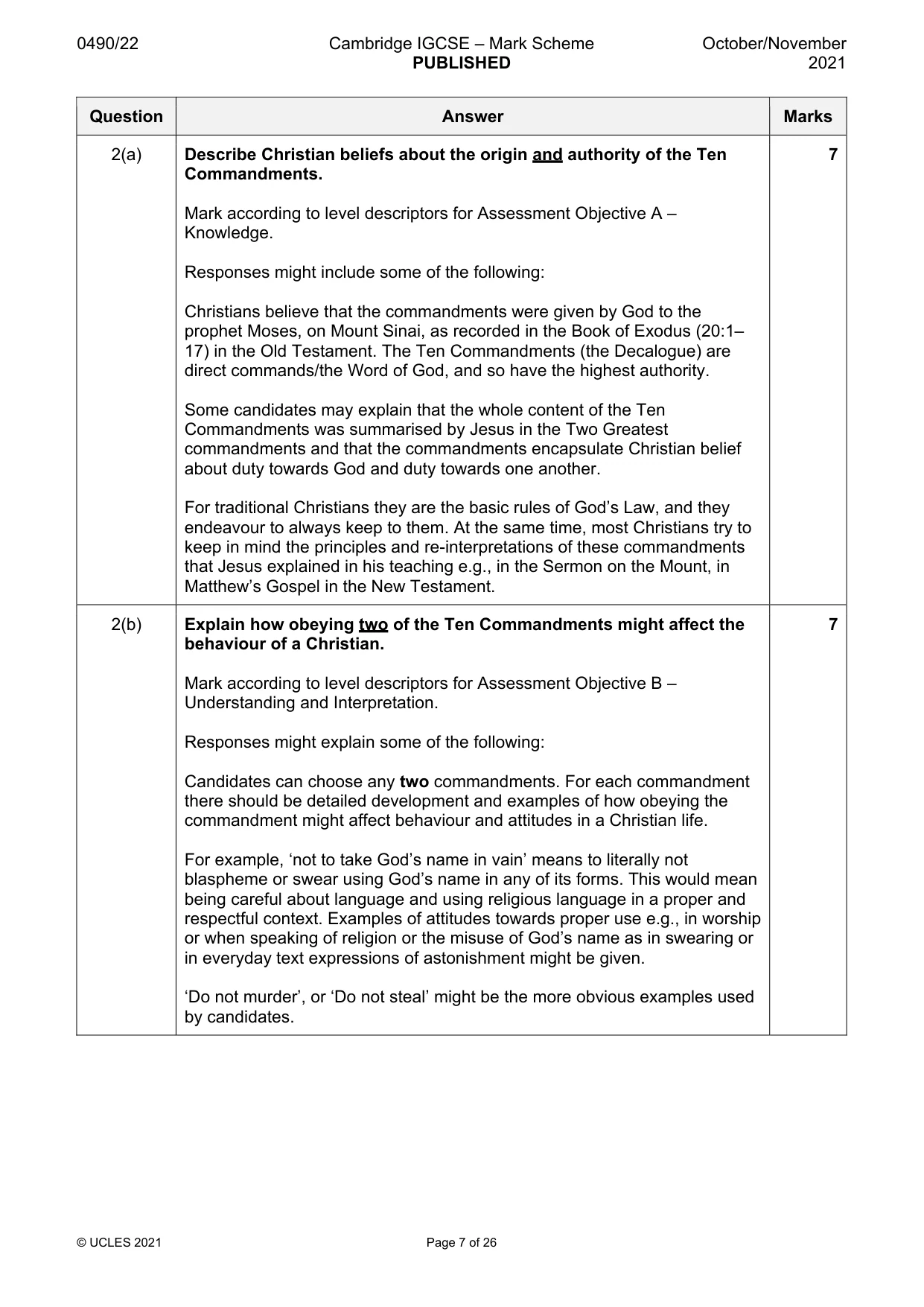
0490/22 Cambridge IGCSE – Mark Scheme PUBLISHED October/November 2021 © UCLES 2021 Page 7 of 26 Question Answer Marks 2(a) Describe Christian beliefs about the origin and authority of the Ten Commandments. Mark according to level descriptors for Assessment Objective A – Knowledge. Responses might include some of the following: Christians believe that the commandments were given by God to the prophet Moses, on Mount Sinai, as recorded in the Book of Exodus (20:1– 17) in the Old Testament. The Ten Commandments (the Decalogue) are direct commands/the Word of God, and so have the highest authority. Some candidates may explain that the whole content of the Ten Commandments was summarised by Jesus in the Two Greatest commandments and that the commandments encapsulate Christian belief about duty towards God and duty towards one another. For traditional Christians they are the basic rules of God’s Law, and they endeavour to always keep to them. At the same time, most Christians try to keep in mind the principles and re-interpretations of these commandments that Jesus explained in his teaching e.g., in the Sermon on the Mount, in Matthew’s Gospel in the New Testament. 7 2(b) Explain how obeying two of the Ten Commandments might affect the behaviour of a Christian. Mark according to level descriptors for Assessment Objective B – Understanding and Interpretation. Responses might explain some of the following: Candidates can choose any two commandments. For each commandment there should be detailed development and examples of how obeying the commandment might affect behaviour and attitudes in a Christian life. For example, ‘not to take God’s name in vain’ means to literally not blaspheme or swear using God’s name in any of its forms. This would mean being careful about language and using religious language in a proper and respectful context. Examples of attitudes towards proper use e.g., in worship or when speaking of religion or the misuse of God’s name as in swearing or in everyday text expressions of astonishment might be given. ‘Do not murder’, or ‘Do not steal’ might be the more obvious examples used by candidates. 7
Mark scheme, page 8
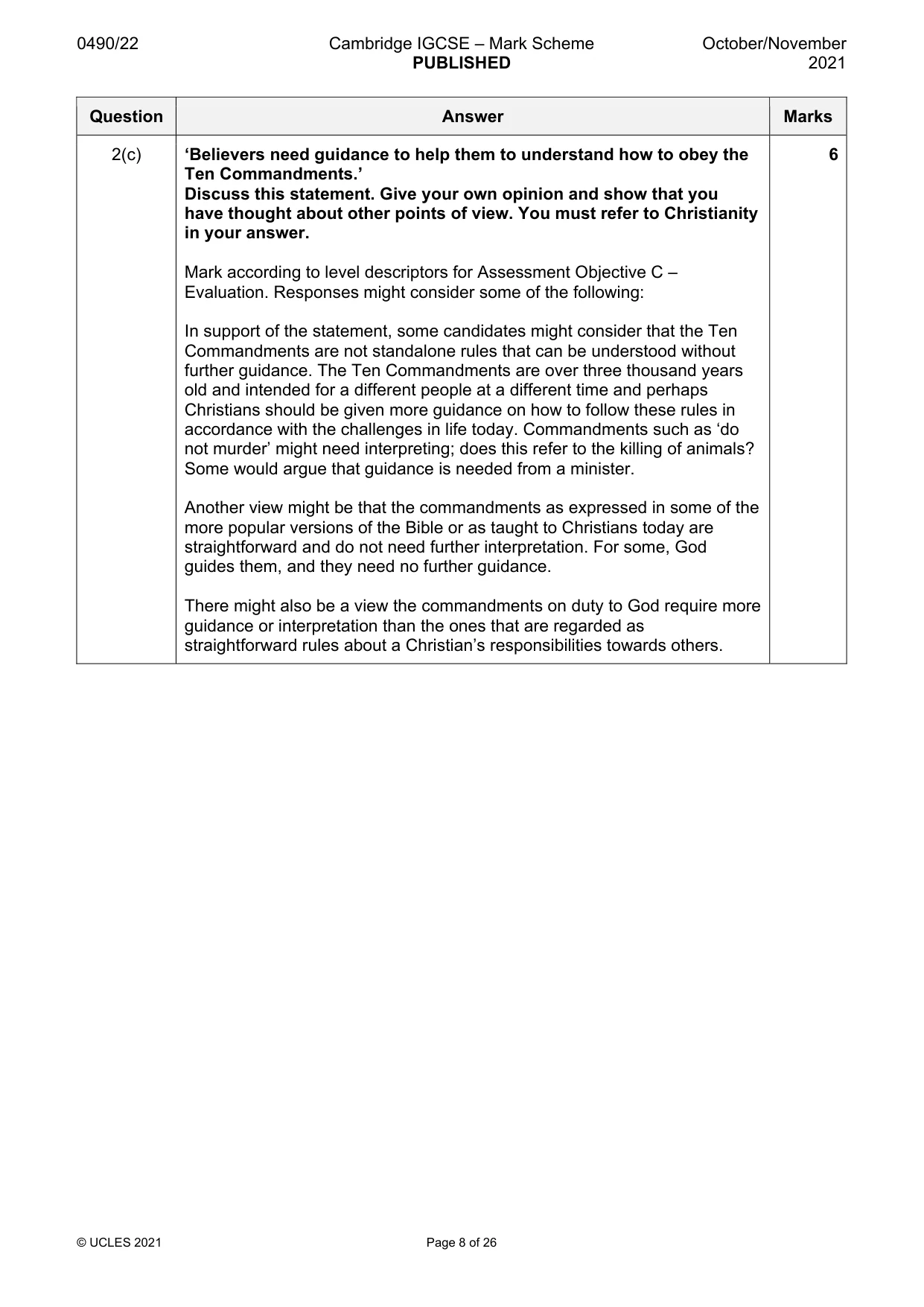
0490/22 Cambridge IGCSE – Mark Scheme PUBLISHED October/November 2021 © UCLES 2021 Page 8 of 26 Question Answer Marks 2(c) ‘Believers need guidance to help them to understand how to obey the Ten Commandments.’ Discuss this statement. Give your own opinion and show that you have thought about other points of view. You must refer to Christianity in your answer. Mark according to level descriptors for Assessment Objective C – Evaluation. Responses might consider some of the following: In support of the statement, some candidates might consider that the Ten Commandments are not standalone rules that can be understood without further guidance. The Ten Commandments are over three thousand years old and intended for a different people at a different time and perhaps Christians should be given more guidance on how to follow these rules in accordance with the challenges in life today. Commandments such as ‘do not murder’ might need interpreting; does this refer to the killing of animals? Some would argue that guidance is needed from a minister. Another view might be that the commandments as expressed in some of the more popular versions of the Bible or as taught to Christians today are straightforward and do not need further interpretation. For some, God guides them, and they need no further guidance. There might also be a view the commandments on duty to God require more guidance or interpretation than the ones that are regarded as straightforward rules about a Christian’s responsibilities towards others. 6
Mark scheme, page 9
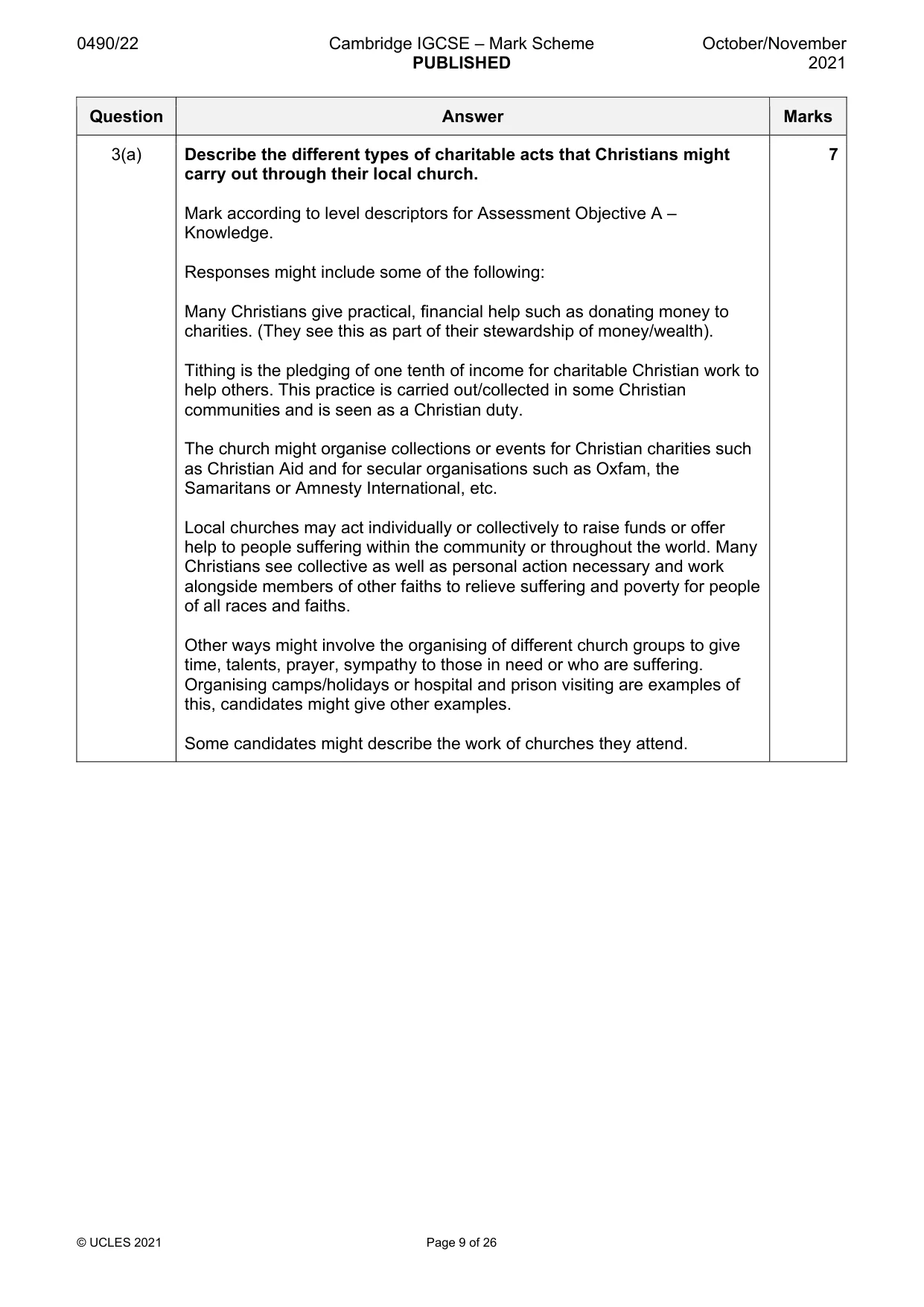
0490/22 Cambridge IGCSE – Mark Scheme PUBLISHED October/November 2021 © UCLES 2021 Page 9 of 26 Question Answer Marks 3(a) Describe the different types of charitable acts that Christians might carry out through their local church. Mark according to level descriptors for Assessment Objective A – Knowledge. Responses might include some of the following: Many Christians give practical, financial help such as donating money to charities. (They see this as part of their stewardship of money/wealth). Tithing is the pledging of one tenth of income for charitable Christian work to help others. This practice is carried out/collected in some Christian communities and is seen as a Christian duty. The church might organise collections or events for Christian charities such as Christian Aid and for secular organisations such as Oxfam, the Samaritans or Amnesty International, etc. Local churches may act individually or collectively to raise funds or offer help to people suffering within the community or throughout the world. Many Christians see collective as well as personal action necessary and work alongside members of other faiths to relieve suffering and poverty for people of all races and faiths. Other ways might involve the organising of different church groups to give time, talents, prayer, sympathy to those in need or who are suffering. Organising camps/holidays or hospital and prison visiting are examples of this, candidates might give other examples. Some candidates might describe the work of churches they attend. 7
Mark scheme, page 10
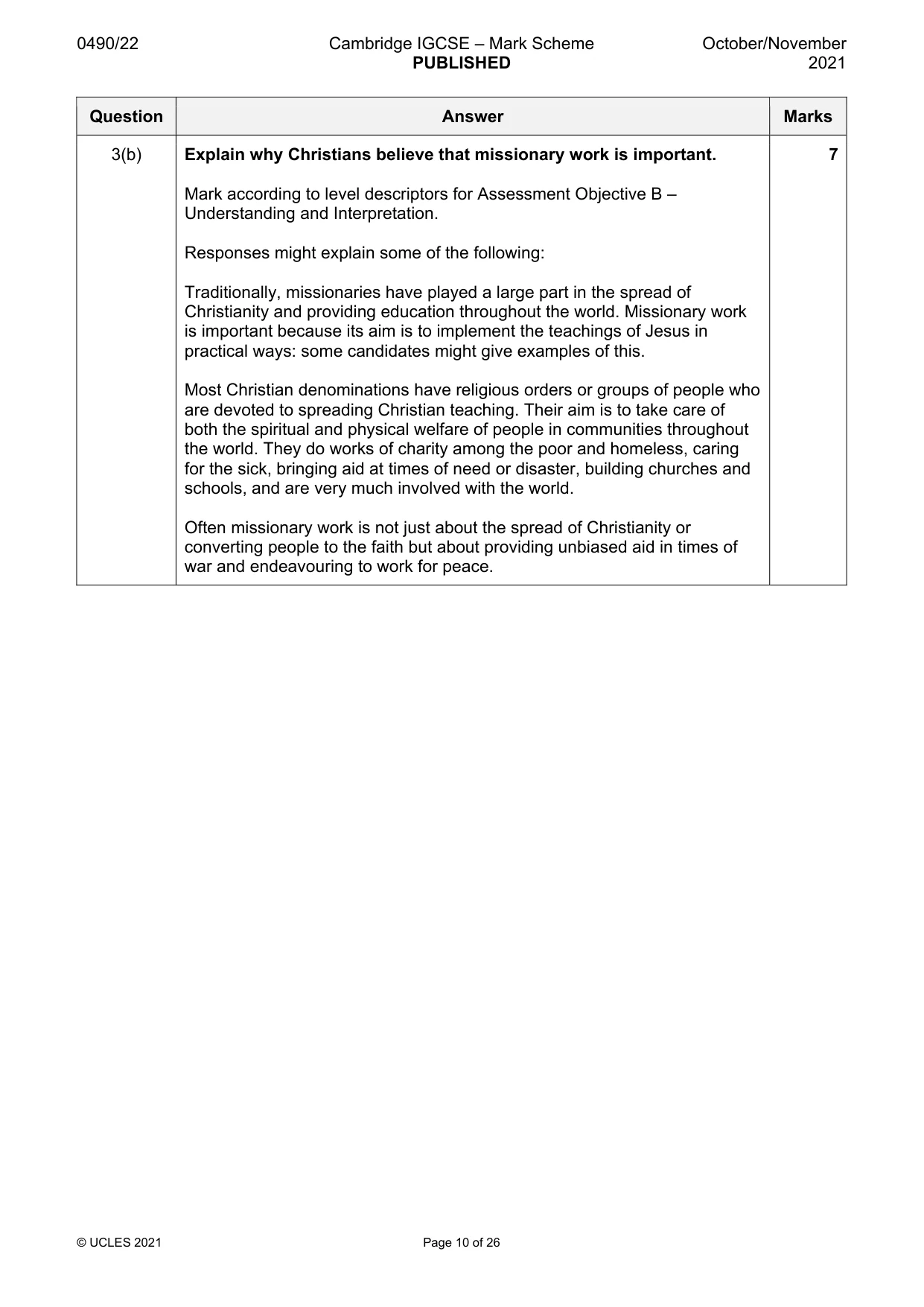
0490/22 Cambridge IGCSE – Mark Scheme PUBLISHED October/November 2021 © UCLES 2021 Page 10 of 26 Question Answer Marks 3(b) Explain why Christians believe that missionary work is important. Mark according to level descriptors for Assessment Objective B – Understanding and Interpretation. Responses might explain some of the following: Traditionally, missionaries have played a large part in the spread of Christianity and providing education throughout the world. Missionary work is important because its aim is to implement the teachings of Jesus in practical ways: some candidates might give examples of this. Most Christian denominations have religious orders or groups of people who are devoted to spreading Christian teaching. Their aim is to take care of both the spiritual and physical welfare of people in communities throughout the world. They do works of charity among the poor and homeless, caring for the sick, bringing aid at times of need or disaster, building churches and schools, and are very much involved with the world. Often missionary work is not just about the spread of Christianity or converting people to the faith but about providing unbiased aid in times of war and endeavouring to work for peace. 7
Mark scheme, page 11
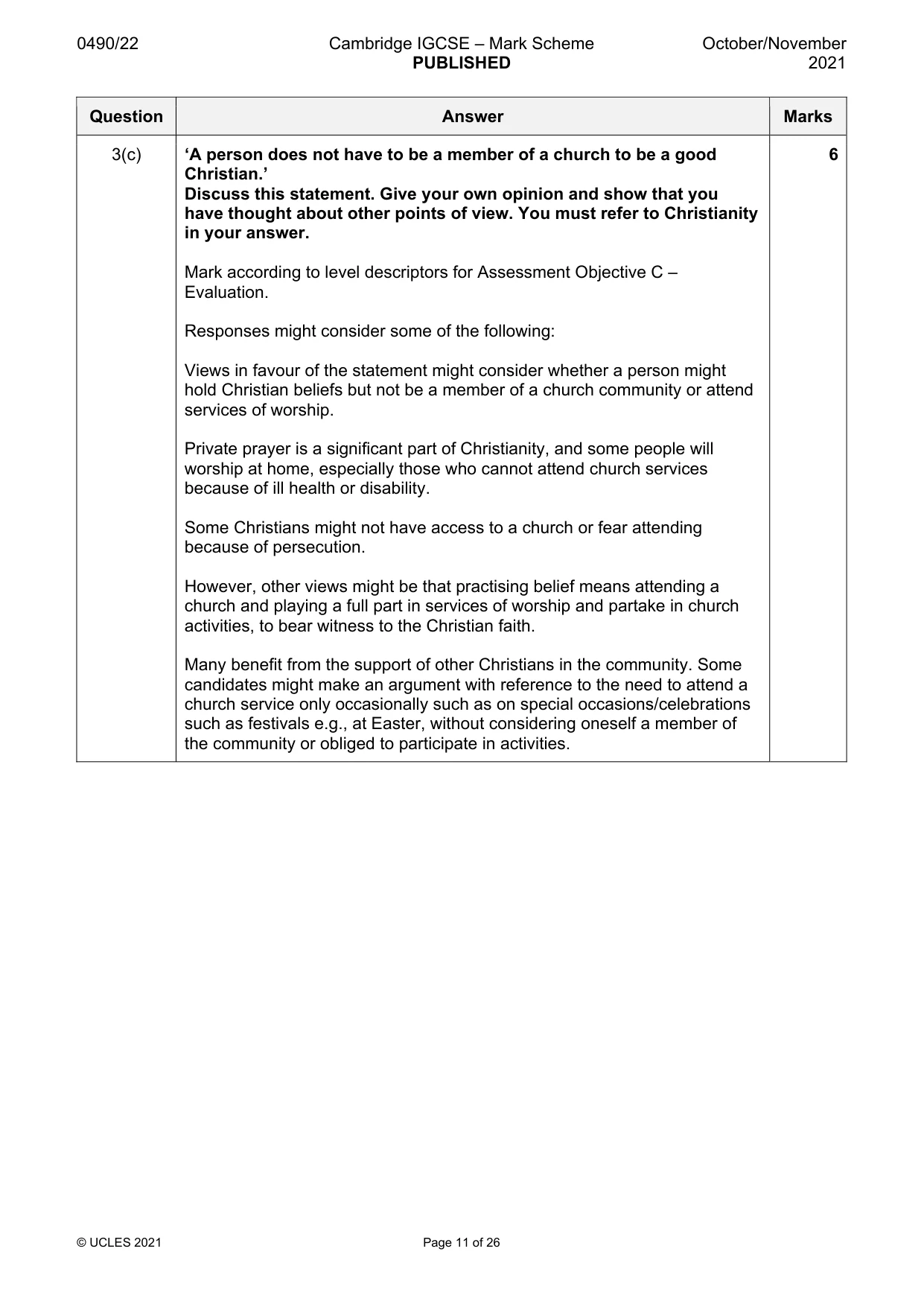
0490/22 Cambridge IGCSE – Mark Scheme PUBLISHED October/November 2021 © UCLES 2021 Page 11 of 26 Question Answer Marks 3(c) ‘A person does not have to be a member of a church to be a good Christian.’ Discuss this statement. Give your own opinion and show that you have thought about other points of view. You must refer to Christianity in your answer. Mark according to level descriptors for Assessment Objective C – Evaluation. Responses might consider some of the following: Views in favour of the statement might consider whether a person might hold Christian beliefs but not be a member of a church community or attend services of worship. Private prayer is a significant part of Christianity, and some people will worship at home, especially those who cannot attend church services because of ill health or disability. Some Christians might not have access to a church or fear attending because of persecution. However, other views might be that practising belief means attending a church and playing a full part in services of worship and partake in church activities, to bear witness to the Christian faith. Many benefit from the support of other Christians in the community. Some candidates might make an argument with reference to the need to attend a church service only occasionally such as on special occasions/celebrations such as festivals e.g., at Easter, without considering oneself a member of the community or obliged to participate in activities. 6
Mark scheme, page 12
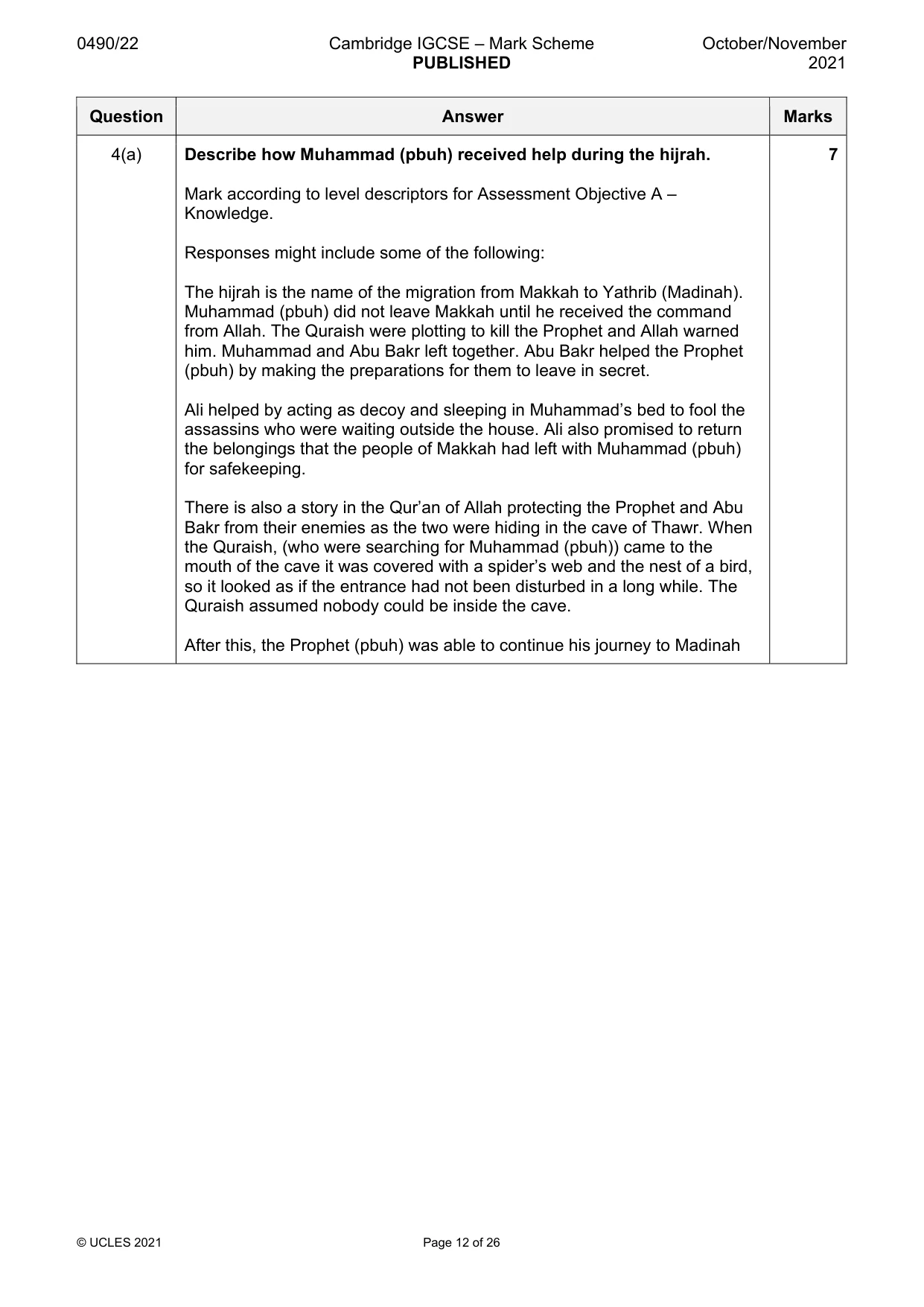
0490/22 Cambridge IGCSE – Mark Scheme PUBLISHED October/November 2021 © UCLES 2021 Page 12 of 26 Question Answer Marks 4(a) Describe how Muhammad (pbuh) received help during the hijrah. Mark according to level descriptors for Assessment Objective A – Knowledge. Responses might include some of the following: The hijrah is the name of the migration from Makkah to Yathrib (Madinah). Muhammad (pbuh) did not leave Makkah until he received the command from Allah. The Quraish were plotting to kill the Prophet and Allah warned him. Muhammad and Abu Bakr left together. Abu Bakr helped the Prophet (pbuh) by making the preparations for them to leave in secret. Ali helped by acting as decoy and sleeping in Muhammad’s bed to fool the assassins who were waiting outside the house. Ali also promised to return the belongings that the people of Makkah had left with Muhammad (pbuh) for safekeeping. There is also a story in the Qur’an of Allah protecting the Prophet and Abu Bakr from their enemies as the two were hiding in the cave of Thawr. When the Quraish, (who were searching for Muhammad (pbuh)) came to the mouth of the cave it was covered with a spider’s web and the nest of a bird, so it looked as if the entrance had not been disturbed in a long while. The Quraish assumed nobody could be inside the cave. After this, the Prophet (pbuh) was able to continue his journey to Madinah 7
Mark scheme, page 13
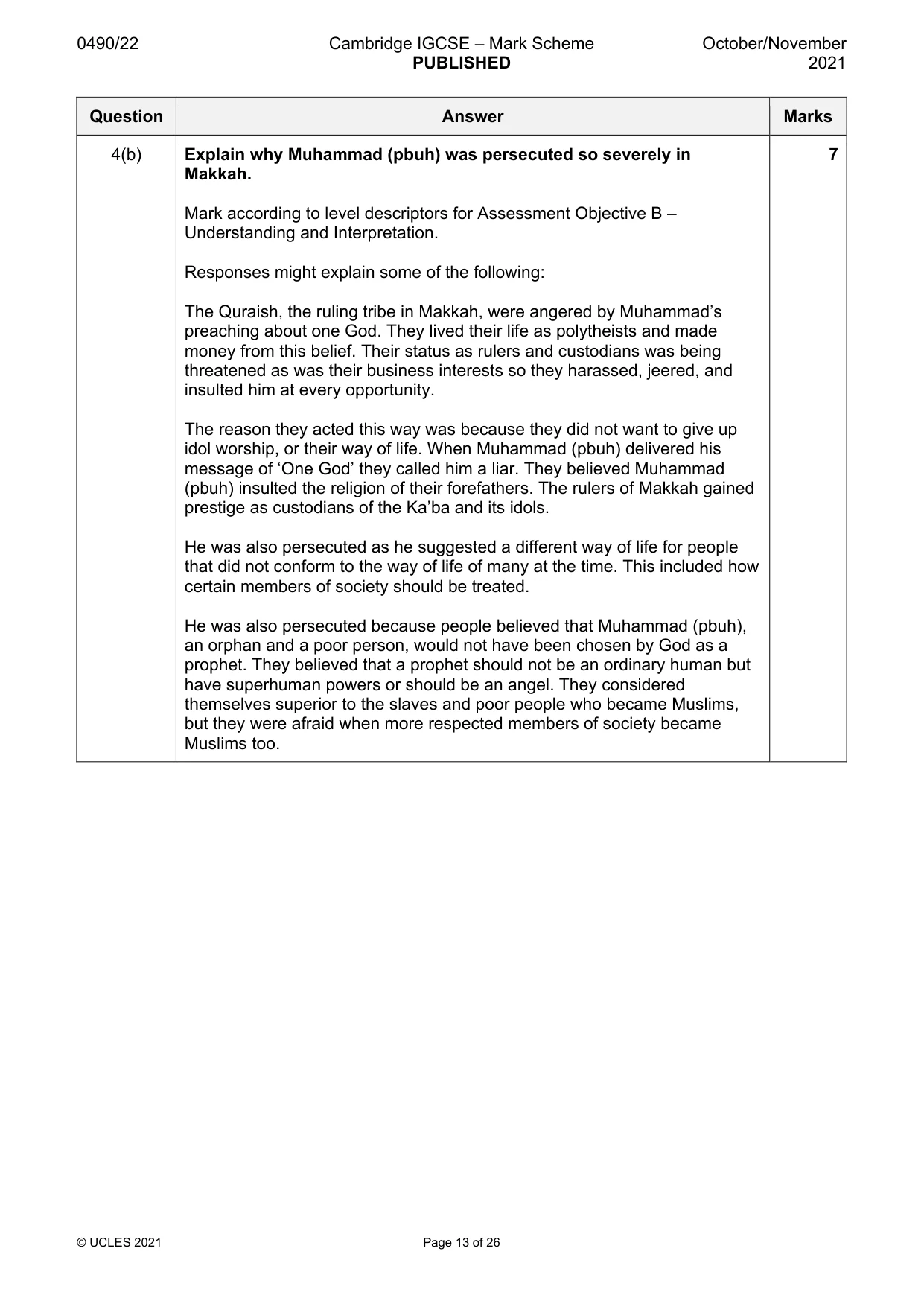
0490/22 Cambridge IGCSE – Mark Scheme PUBLISHED October/November 2021 © UCLES 2021 Page 13 of 26 Question Answer Marks 4(b) Explain why Muhammad (pbuh) was persecuted so severely in Makkah. Mark according to level descriptors for Assessment Objective B – Understanding and Interpretation. Responses might explain some of the following: The Quraish, the ruling tribe in Makkah, were angered by Muhammad’s preaching about one God. They lived their life as polytheists and made money from this belief. Their status as rulers and custodians was being threatened as was their business interests so they harassed, jeered, and insulted him at every opportunity. The reason they acted this way was because they did not want to give up idol worship, or their way of life. When Muhammad (pbuh) delivered his message of ‘One God’ they called him a liar. They believed Muhammad (pbuh) insulted the religion of their forefathers. The rulers of Makkah gained prestige as custodians of the Ka’ba and its idols. He was also persecuted as he suggested a different way of life for people that did not conform to the way of life of many at the time. This included how certain members of society should be treated. He was also persecuted because people believed that Muhammad (pbuh), an orphan and a poor person, would not have been chosen by God as a prophet. They believed that a prophet should not be an ordinary human but have superhuman powers or should be an angel. They considered themselves superior to the slaves and poor people who became Muslims, but they were afraid when more respected members of society became Muslims too. 7
Mark scheme, page 14
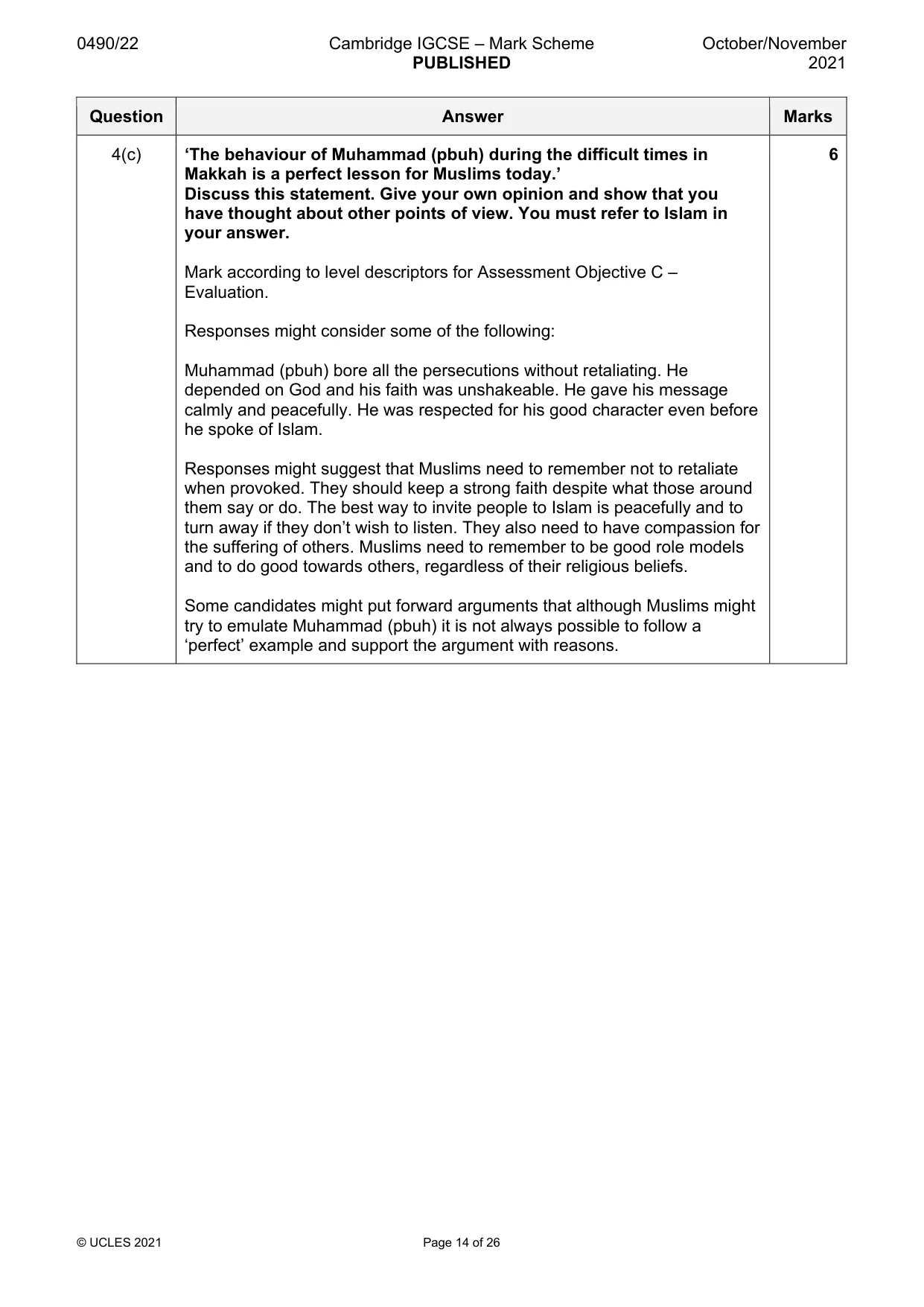
0490/22 Cambridge IGCSE – Mark Scheme PUBLISHED October/November 2021 © UCLES 2021 Page 14 of 26 Question Answer Marks 4(c) ‘The behaviour of Muhammad (pbuh) during the difficult times in Makkah is a perfect lesson for Muslims today.’ Discuss this statement. Give your own opinion and show that you have thought about other points of view. You must refer to Islam in your answer. Mark according to level descriptors for Assessment Objective C – Evaluation. Responses might consider some of the following: Muhammad (pbuh) bore all the persecutions without retaliating. He depended on God and his faith was unshakeable. He gave his message calmly and peacefully. He was respected for his good character even before he spoke of Islam. Responses might suggest that Muslims need to remember not to retaliate when provoked. They should keep a strong faith despite what those around them say or do. The best way to invite people to Islam is peacefully and to turn away if they don’t wish to listen. They also need to have compassion for the suffering of others. Muslims need to remember to be good role models and to do good towards others, regardless of their religious beliefs. Some candidates might put forward arguments that although Muslims might try to emulate Muhammad (pbuh) it is not always possible to follow a ‘perfect’ example and support the argument with reasons. 6
Mark scheme, page 15
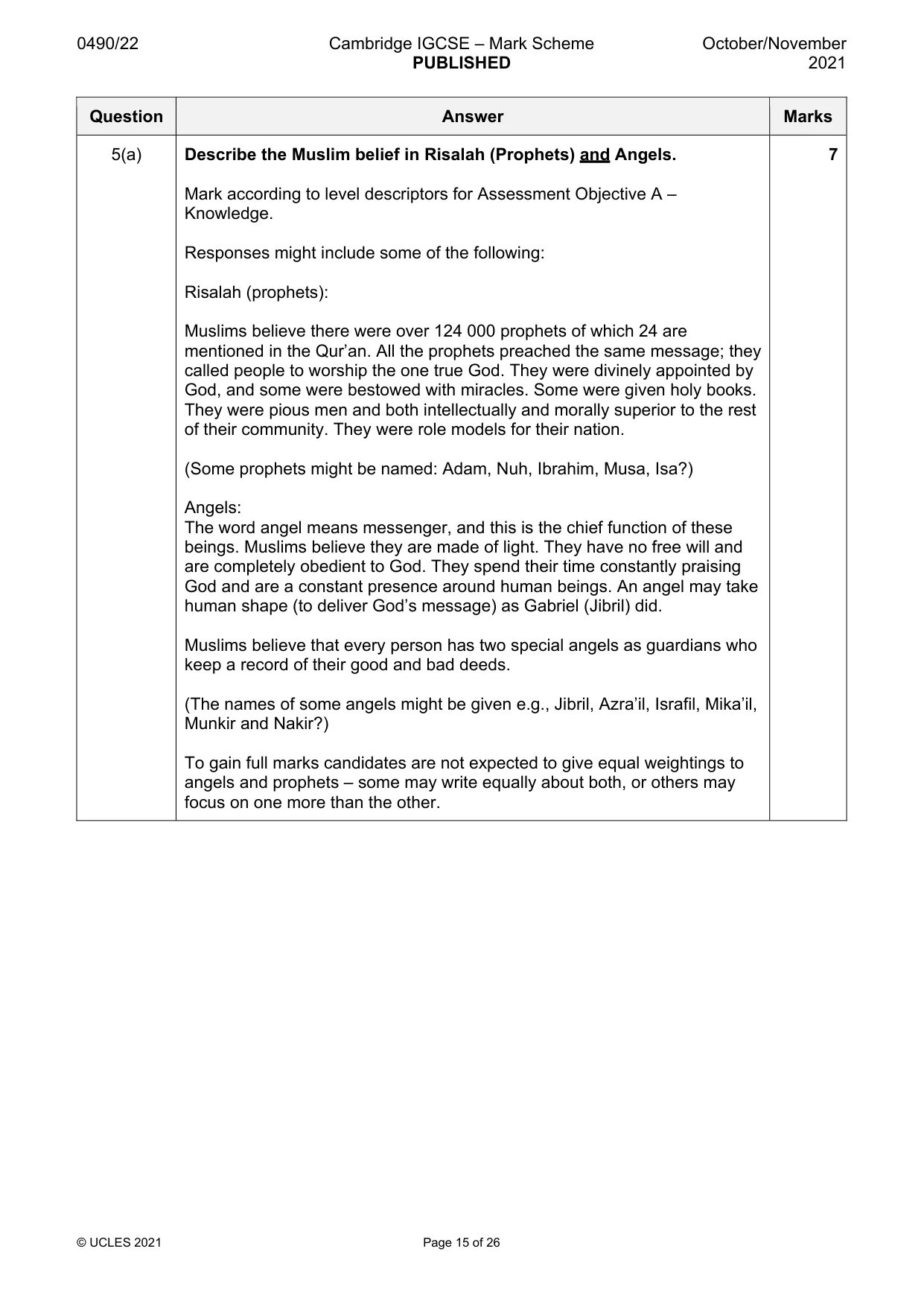
0490/22 Cambridge IGCSE – Mark Scheme PUBLISHED October/November 2021 © UCLES 2021 Page 15 of 26 Question Answer Marks 5(a) Describe the Muslim belief in Risalah (Prophets) and Angels. Mark according to level descriptors for Assessment Objective A – Knowledge. Responses might include some of the following: Risalah (prophets): Muslims believe there were over 124 000 prophets of which 24 are mentioned in the Qur’an. All the prophets preached the same message; they called people to worship the one true God. They were divinely appointed by God, and some were bestowed with miracles. Some were given holy books. They were pious men and both intellectually and morally superior to the rest of their community. They were role models for their nation. (Some prophets might be named: Adam, Nuh, Ibrahim, Musa, Isa?) Angels: The word angel means messenger, and this is the chief function of these beings. Muslims believe they are made of light. They have no free will and are completely obedient to God. They spend their time constantly praising God and are a constant presence around human beings. An angel may take human shape (to deliver God’s message) as Gabriel (Jibril) did. Muslims believe that every person has two special angels as guardians who keep a record of their good and bad deeds. (The names of some angels might be given e.g., Jibril, Azra’il, Israfil, Mika’il, Munkir and Nakir?) To gain full marks candidates are not expected to give equal weightings to angels and prophets – some may write equally about both, or others may focus on one more than the other. 7
Mark scheme, page 16
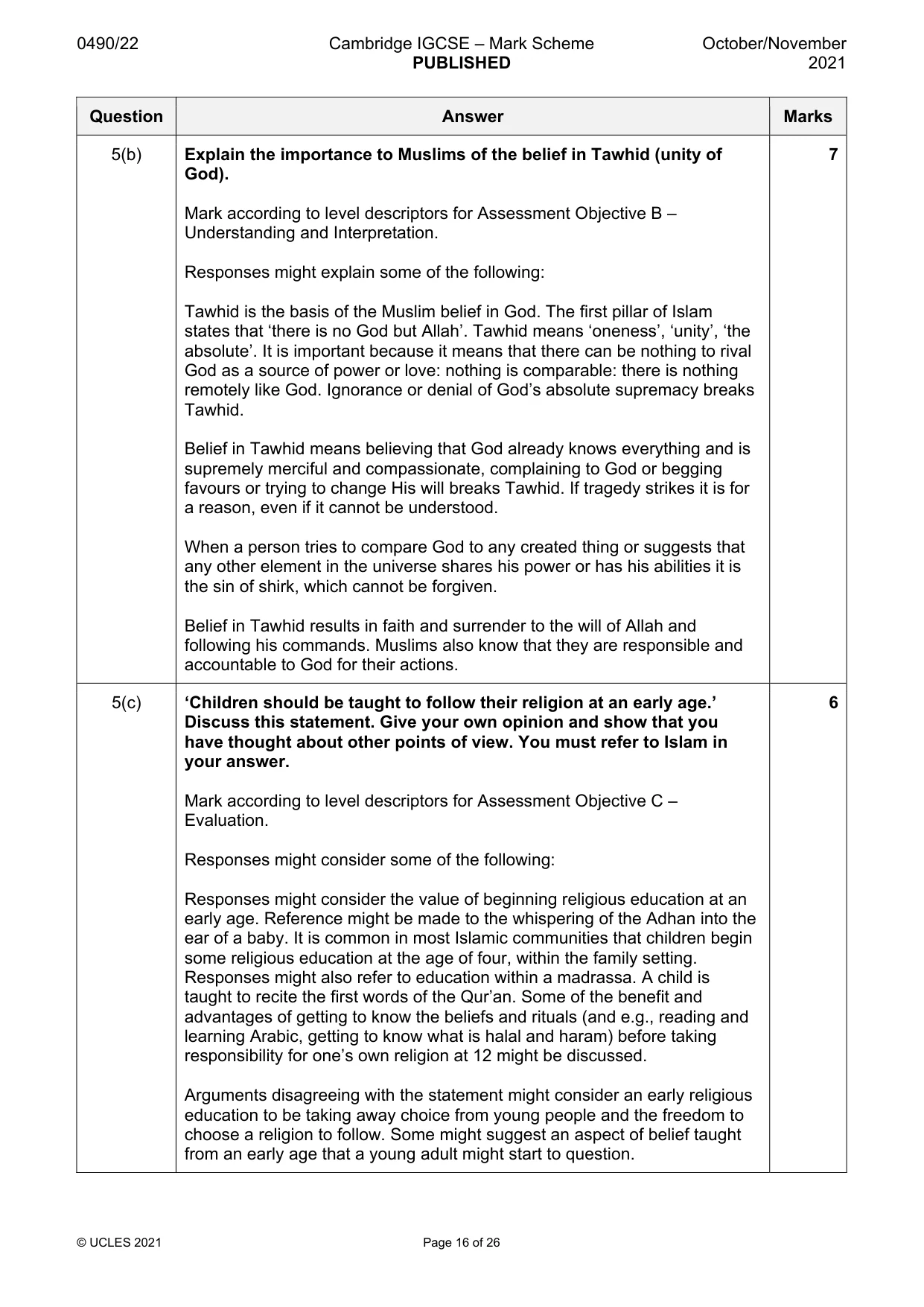
0490/22 Cambridge IGCSE – Mark Scheme PUBLISHED October/November 2021 © UCLES 2021 Page 16 of 26 Question Answer Marks 5(b) Explain the importance to Muslims of the belief in Tawhid (unity of God). Mark according to level descriptors for Assessment Objective B – Understanding and Interpretation. Responses might explain some of the following: Tawhid is the basis of the Muslim belief in God. The first pillar of Islam states that ‘there is no God but Allah’. Tawhid means ‘oneness’, ‘unity’, ‘the absolute’. It is important because it means that there can be nothing to rival God as a source of power or love: nothing is comparable: there is nothing remotely like God. Ignorance or denial of God’s absolute supremacy breaks Tawhid. Belief in Tawhid means believing that God already knows everything and is supremely merciful and compassionate, complaining to God or begging favours or trying to change His will breaks Tawhid. If tragedy strikes it is for a reason, even if it cannot be understood. When a person tries to compare God to any created thing or suggests that any other element in the universe shares his power or has his abilities it is the sin of shirk, which cannot be forgiven. Belief in Tawhid results in faith and surrender to the will of Allah and following his commands. Muslims also know that they are responsible and accountable to God for their actions. 7 5(c) ‘Children should be taught to follow their religion at an early age.’ Discuss this statement. Give your own opinion and show that you have thought about other points of view. You must refer to Islam in your answer. Mark according to level descriptors for Assessment Objective C – Evaluation. Responses might consider some of the following: Responses might consider the value of beginning religious education at an early age. Reference might be made to the whispering of the Adhan into the ear of a baby. It is common in most Islamic communities that children begin some religious education at the age of four, within the family setting. Responses might also refer to education within a madrassa. A child is taught to recite the first words of the Qur’an. Some of the benefit and advantages of getting to know the beliefs and rituals (and e.g., reading and learning Arabic, getting to know what is halal and haram) before taking responsibility for one’s own religion at 12 might be discussed. Arguments disagreeing with the statement might consider an early religious education to be taking away choice from young people and the freedom to choose a religion to follow. Some might suggest an aspect of belief taught from an early age that a young adult might start to question. 6
Mark scheme, page 17
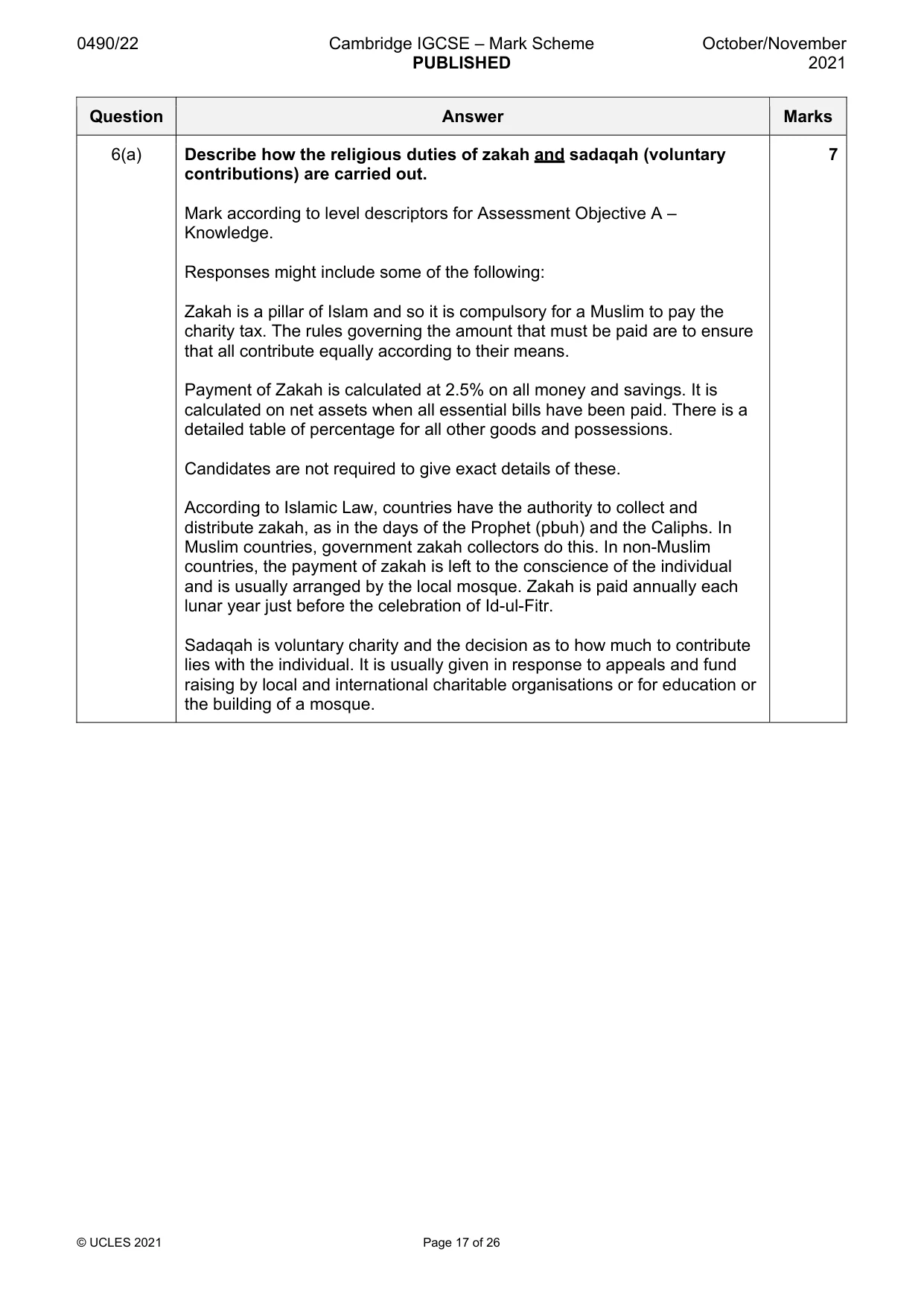
0490/22 Cambridge IGCSE – Mark Scheme PUBLISHED October/November 2021 © UCLES 2021 Page 17 of 26 Question Answer Marks 6(a) Describe how the religious duties of zakah and sadaqah (voluntary contributions) are carried out. Mark according to level descriptors for Assessment Objective A – Knowledge. Responses might include some of the following: Zakah is a pillar of Islam and so it is compulsory for a Muslim to pay the charity tax. The rules governing the amount that must be paid are to ensure that all contribute equally according to their means. Payment of Zakah is calculated at 2.5% on all money and savings. It is calculated on net assets when all essential bills have been paid. There is a detailed table of percentage for all other goods and possessions. Candidates are not required to give exact details of these. According to Islamic Law, countries have the authority to collect and distribute zakah, as in the days of the Prophet (pbuh) and the Caliphs. In Muslim countries, government zakah collectors do this. In non-Muslim countries, the payment of zakah is left to the conscience of the individual and is usually arranged by the local mosque. Zakah is paid annually each lunar year just before the celebration of Id-ul-Fitr. Sadaqah is voluntary charity and the decision as to how much to contribute lies with the individual. It is usually given in response to appeals and fund raising by local and international charitable organisations or for education or the building of a mosque. 7
Mark scheme, page 18
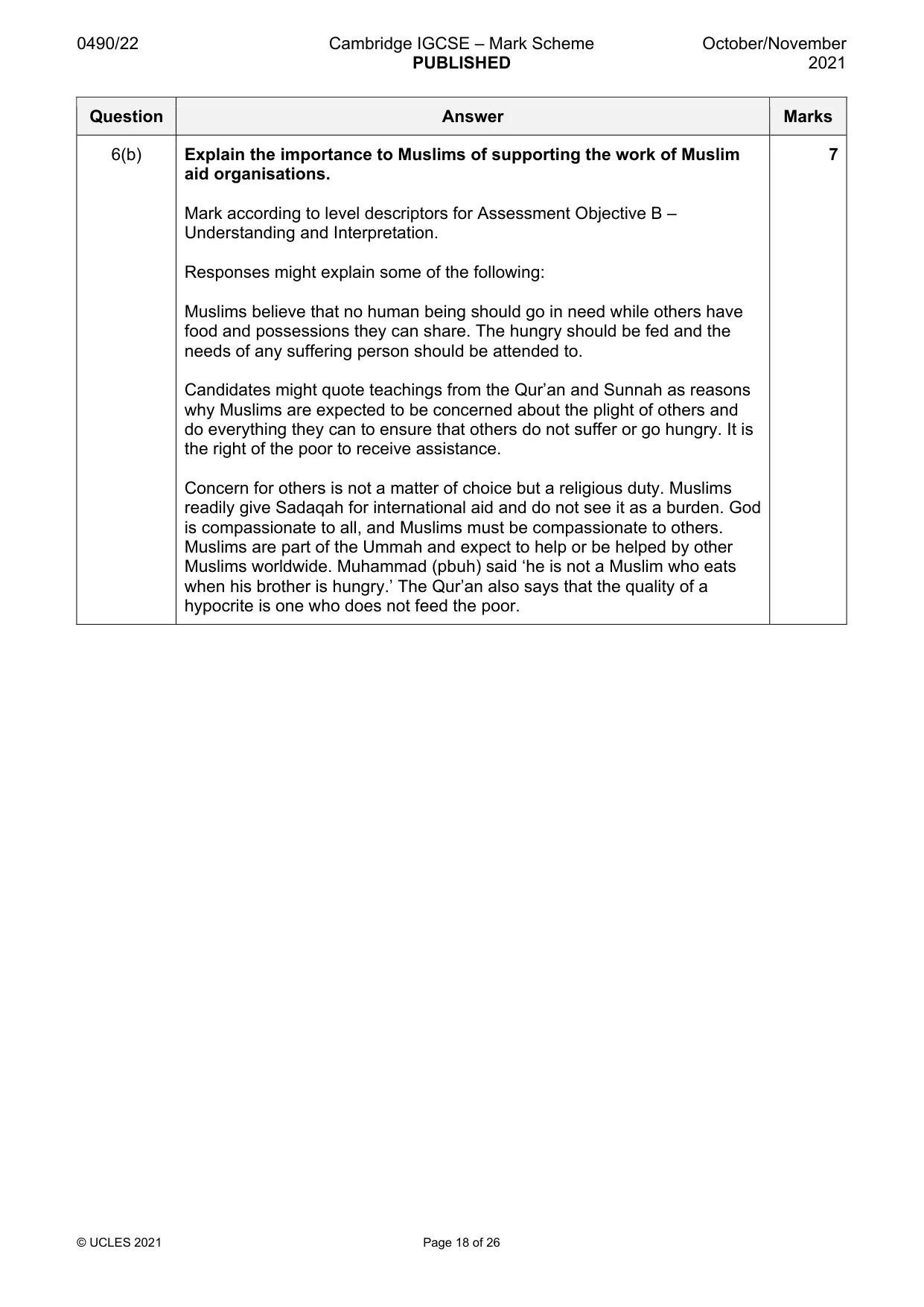
0490/22 Cambridge IGCSE – Mark Scheme PUBLISHED October/November 2021 © UCLES 2021 Page 18 of 26 Question Answer Marks 6(b) Explain the importance to Muslims of supporting the work of Muslim aid organisations. Mark according to level descriptors for Assessment Objective B – Understanding and Interpretation. Responses might explain some of the following: Muslims believe that no human being should go in need while others have food and possessions they can share. The hungry should be fed and the needs of any suffering person should be attended to. Candidates might quote teachings from the Qur’an and Sunnah as reasons why Muslims are expected to be concerned about the plight of others and do everything they can to ensure that others do not suffer or go hungry. It is the right of the poor to receive assistance. Concern for others is not a matter of choice but a religious duty. Muslims readily give Sadaqah for international aid and do not see it as a burden. God is compassionate to all, and Muslims must be compassionate to others. Muslims are part of the Ummah and expect to help or be helped by other Muslims worldwide. Muhammad (pbuh) said ‘he is not a Muslim who eats when his brother is hungry.’ The Qur’an also says that the quality of a hypocrite is one who does not feed the poor. 7
Mark scheme, page 19
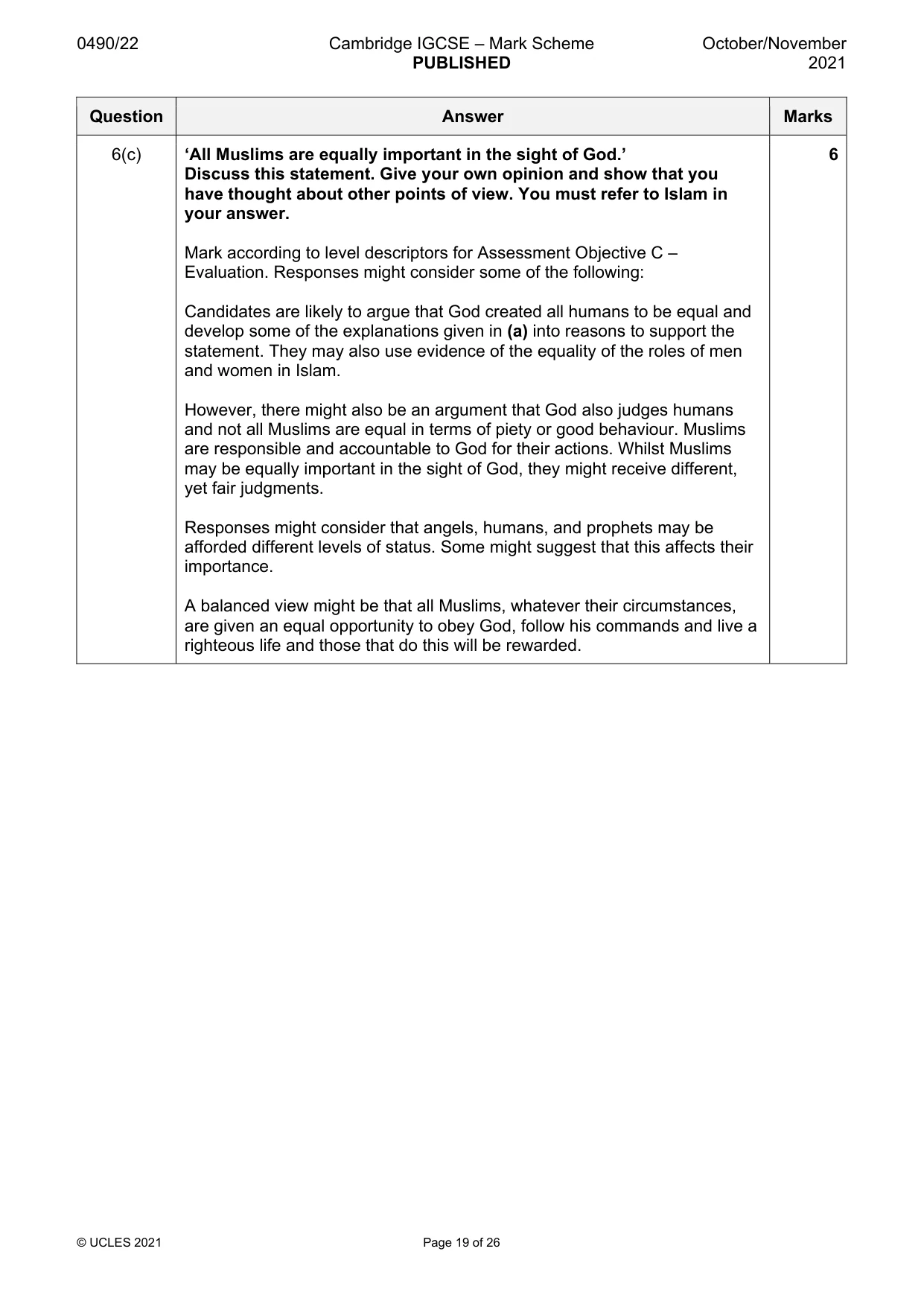
0490/22 Cambridge IGCSE – Mark Scheme PUBLISHED October/November 2021 © UCLES 2021 Page 19 of 26 Question Answer Marks 6(c) ‘All Muslims are equally important in the sight of God.’ Discuss this statement. Give your own opinion and show that you have thought about other points of view. You must refer to Islam in your answer. Mark according to level descriptors for Assessment Objective C – Evaluation. Responses might consider some of the following: Candidates are likely to argue that God created all humans to be equal and develop some of the explanations given in (a) into reasons to support the statement. They may also use evidence of the equality of the roles of men and women in Islam. However, there might also be an argument that God also judges humans and not all Muslims are equal in terms of piety or good behaviour. Muslims are responsible and accountable to God for their actions. Whilst Muslims may be equally important in the sight of God, they might receive different, yet fair judgments. Responses might consider that angels, humans, and prophets may be afforded different levels of status. Some might suggest that this affects their importance. A balanced view might be that all Muslims, whatever their circumstances, are given an equal opportunity to obey God, follow his commands and live a righteous life and those that do this will be rewarded. 6
Mark scheme, page 20
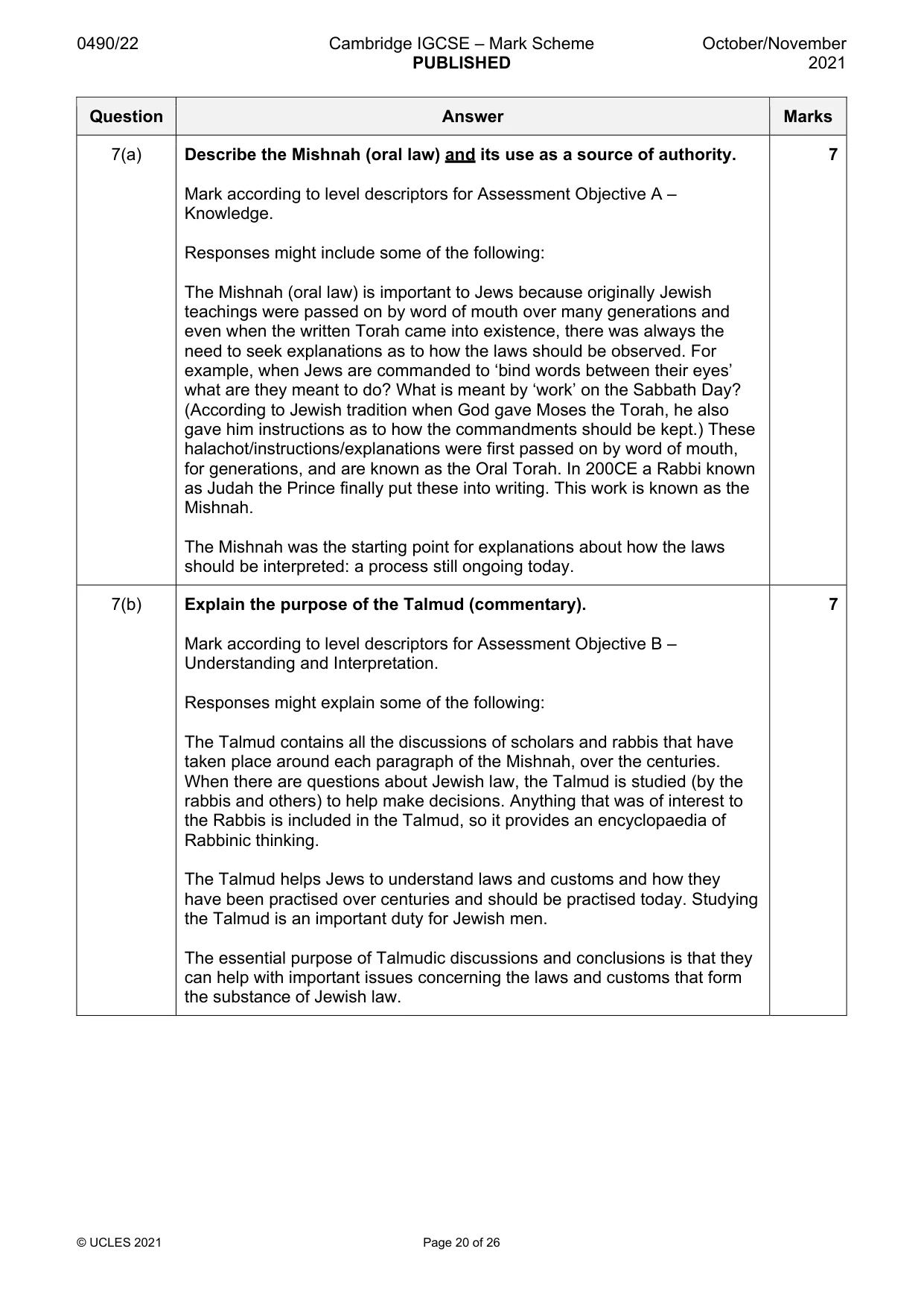
0490/22 Cambridge IGCSE – Mark Scheme PUBLISHED October/November 2021 © UCLES 2021 Page 20 of 26 Question Answer Marks 7(a) Describe the Mishnah (oral law) and its use as a source of authority. Mark according to level descriptors for Assessment Objective A – Knowledge. Responses might include some of the following: The Mishnah (oral law) is important to Jews because originally Jewish teachings were passed on by word of mouth over many generations and even when the written Torah came into existence, there was always the need to seek explanations as to how the laws should be observed. For example, when Jews are commanded to ‘bind words between their eyes’ what are they meant to do? What is meant by ‘work’ on the Sabbath Day? (According to Jewish tradition when God gave Moses the Torah, he also gave him instructions as to how the commandments should be kept.) These halachot/instructions/explanations were first passed on by word of mouth, for generations, and are known as the Oral Torah. In 200CE a Rabbi known as Judah the Prince finally put these into writing. This work is known as the Mishnah. The Mishnah was the starting point for explanations about how the laws should be interpreted: a process still ongoing today. 7 7(b) Explain the purpose of the Talmud (commentary). Mark according to level descriptors for Assessment Objective B – Understanding and Interpretation. Responses might explain some of the following: The Talmud contains all the discussions of scholars and rabbis that have taken place around each paragraph of the Mishnah, over the centuries. When there are questions about Jewish law, the Talmud is studied (by the rabbis and others) to help make decisions. Anything that was of interest to the Rabbis is included in the Talmud, so it provides an encyclopaedia of Rabbinic thinking. The Talmud helps Jews to understand laws and customs and how they have been practised over centuries and should be practised today. Studying the Talmud is an important duty for Jewish men. The essential purpose of Talmudic discussions and conclusions is that they can help with important issues concerning the laws and customs that form the substance of Jewish law. 7
Mark scheme, page 21
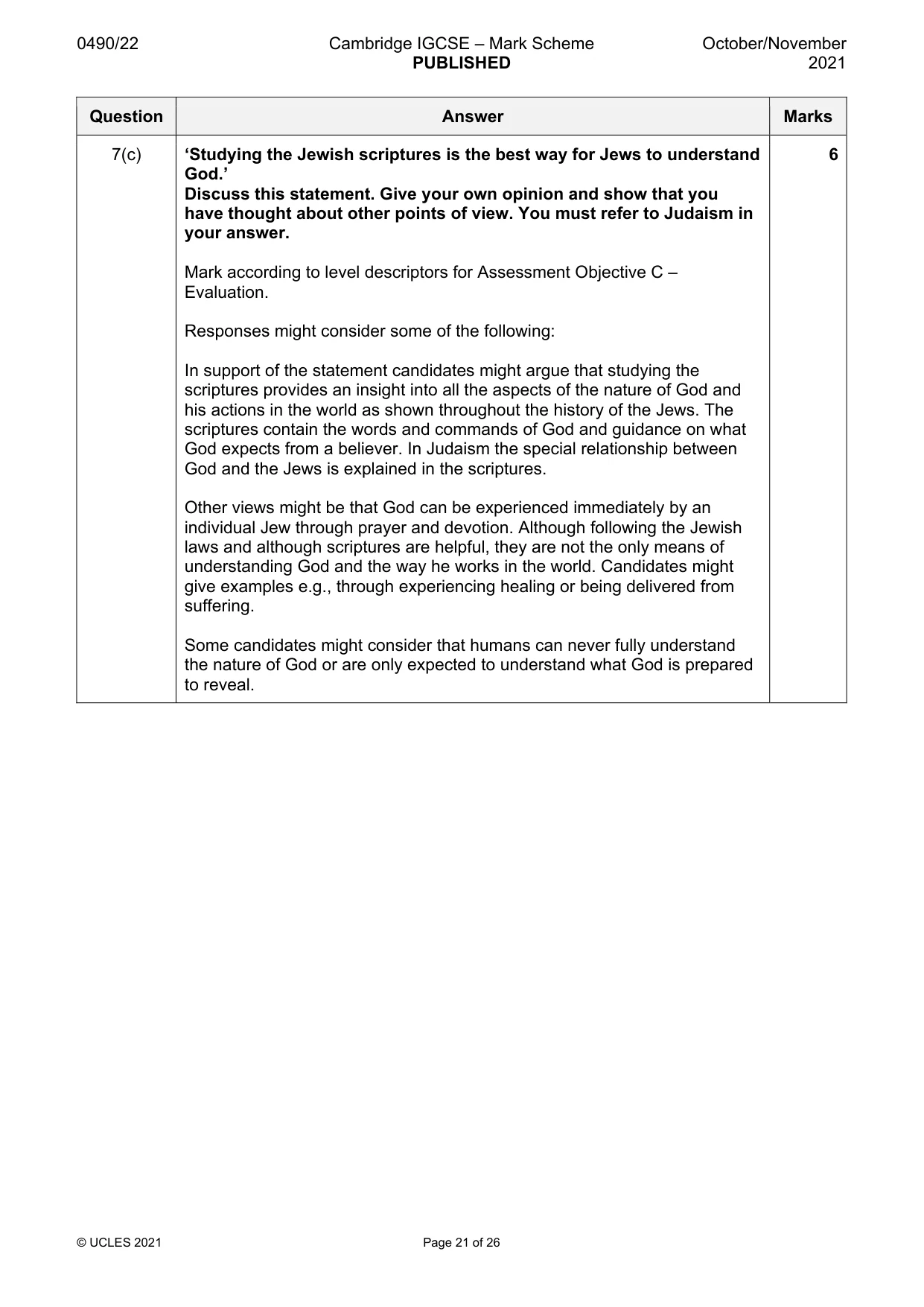
0490/22 Cambridge IGCSE – Mark Scheme PUBLISHED October/November 2021 © UCLES 2021 Page 21 of 26 Question Answer Marks 7(c) ‘Studying the Jewish scriptures is the best way for Jews to understand God.’ Discuss this statement. Give your own opinion and show that you have thought about other points of view. You must refer to Judaism in your answer. Mark according to level descriptors for Assessment Objective C – Evaluation. Responses might consider some of the following: In support of the statement candidates might argue that studying the scriptures provides an insight into all the aspects of the nature of God and his actions in the world as shown throughout the history of the Jews. The scriptures contain the words and commands of God and guidance on what God expects from a believer. In Judaism the special relationship between God and the Jews is explained in the scriptures. Other views might be that God can be experienced immediately by an individual Jew through prayer and devotion. Although following the Jewish laws and although scriptures are helpful, they are not the only means of understanding God and the way he works in the world. Candidates might give examples e.g., through experiencing healing or being delivered from suffering. Some candidates might consider that humans can never fully understand the nature of God or are only expected to understand what God is prepared to reveal. 6
Mark scheme, page 22
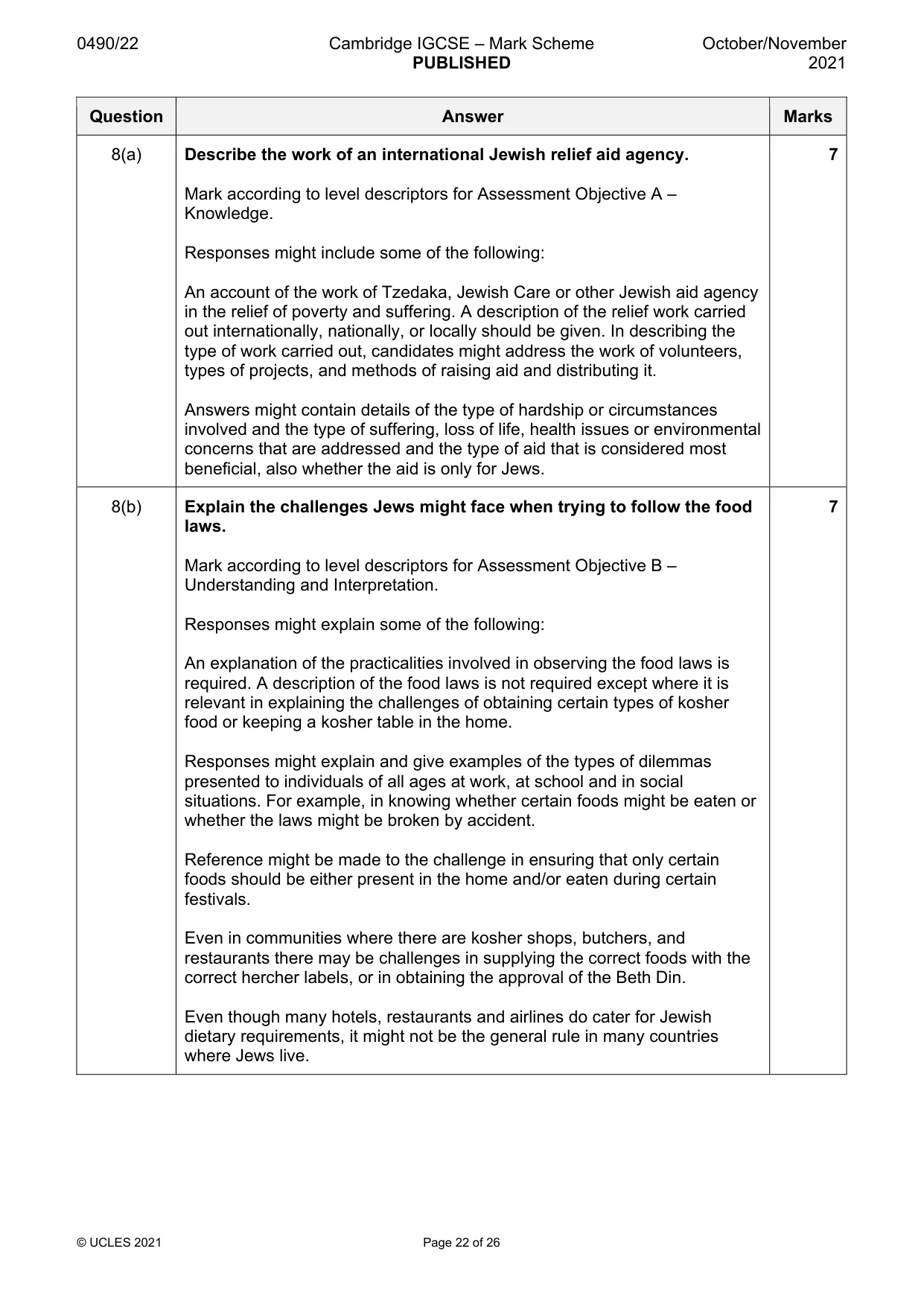
0490/22 Cambridge IGCSE – Mark Scheme PUBLISHED October/November 2021 © UCLES 2021 Page 22 of 26 Question Answer Marks 8(a) Describe the work of an international Jewish relief aid agency. Mark according to level descriptors for Assessment Objective A – Knowledge. Responses might include some of the following: An account of the work of Tzedaka, Jewish Care or other Jewish aid agency in the relief of poverty and suffering. A description of the relief work carried out internationally, nationally, or locally should be given. In describing the type of work carried out, candidates might address the work of volunteers, types of projects, and methods of raising aid and distributing it. Answers might contain details of the type of hardship or circumstances involved and the type of suffering, loss of life, health issues or environmental concerns that are addressed and the type of aid that is considered most beneficial, also whether the aid is only for Jews. 7 8(b) Explain the challenges Jews might face when trying to follow the food laws. Mark according to level descriptors for Assessment Objective B – Understanding and Interpretation. Responses might explain some of the following: An explanation of the practicalities involved in observing the food laws is required. A description of the food laws is not required except where it is relevant in explaining the challenges of obtaining certain types of kosher food or keeping a kosher table in the home. Responses might explain and give examples of the types of dilemmas presented to individuals of all ages at work, at school and in social situations. For example, in knowing whether certain foods might be eaten or whether the laws might be broken by accident. Reference might be made to the challenge in ensuring that only certain foods should be either present in the home and/or eaten during certain festivals. Even in communities where there are kosher shops, butchers, and restaurants there may be challenges in supplying the correct foods with the correct hercher labels, or in obtaining the approval of the Beth Din. Even though many hotels, restaurants and airlines do cater for Jewish dietary requirements, it might not be the general rule in many countries where Jews live. 7
Mark scheme, page 23
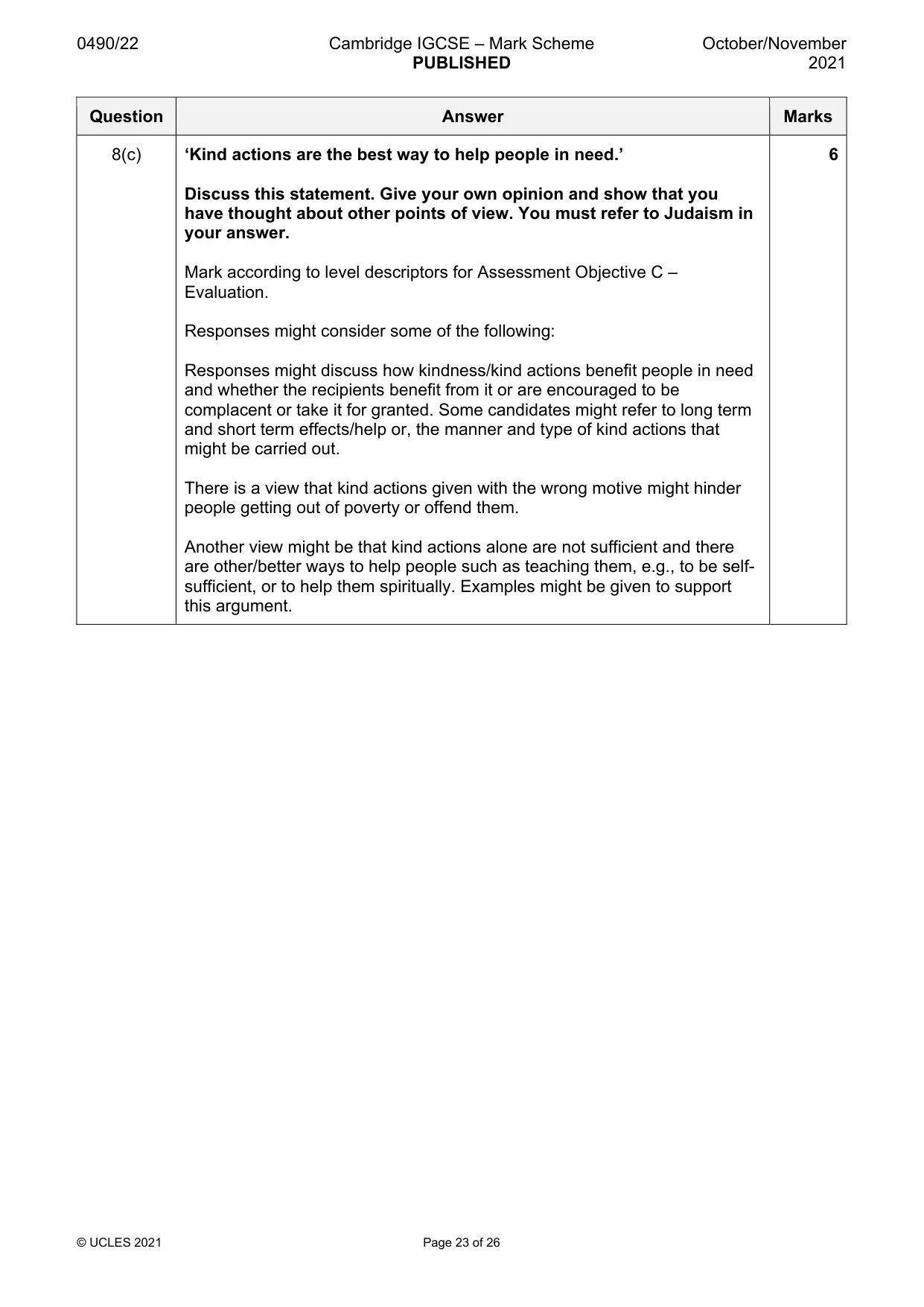
0490/22 Cambridge IGCSE – Mark Scheme PUBLISHED October/November 2021 © UCLES 2021 Page 23 of 26 Question Answer Marks 8(c) ‘Kind actions are the best way to help people in need.’ Discuss this statement. Give your own opinion and show that you have thought about other points of view. You must refer to Judaism in your answer. Mark according to level descriptors for Assessment Objective C – Evaluation. Responses might consider some of the following: Responses might discuss how kindness/kind actions benefit people in need and whether the recipients benefit from it or are encouraged to be complacent or take it for granted. Some candidates might refer to long term and short term effects/help or, the manner and type of kind actions that might be carried out. There is a view that kind actions given with the wrong motive might hinder people getting out of poverty or offend them. Another view might be that kind actions alone are not sufficient and there are other/better ways to help people such as teaching them, e.g., to be self- sufficient, or to help them spiritually. Examples might be given to support this argument. 6
Mark scheme, page 24
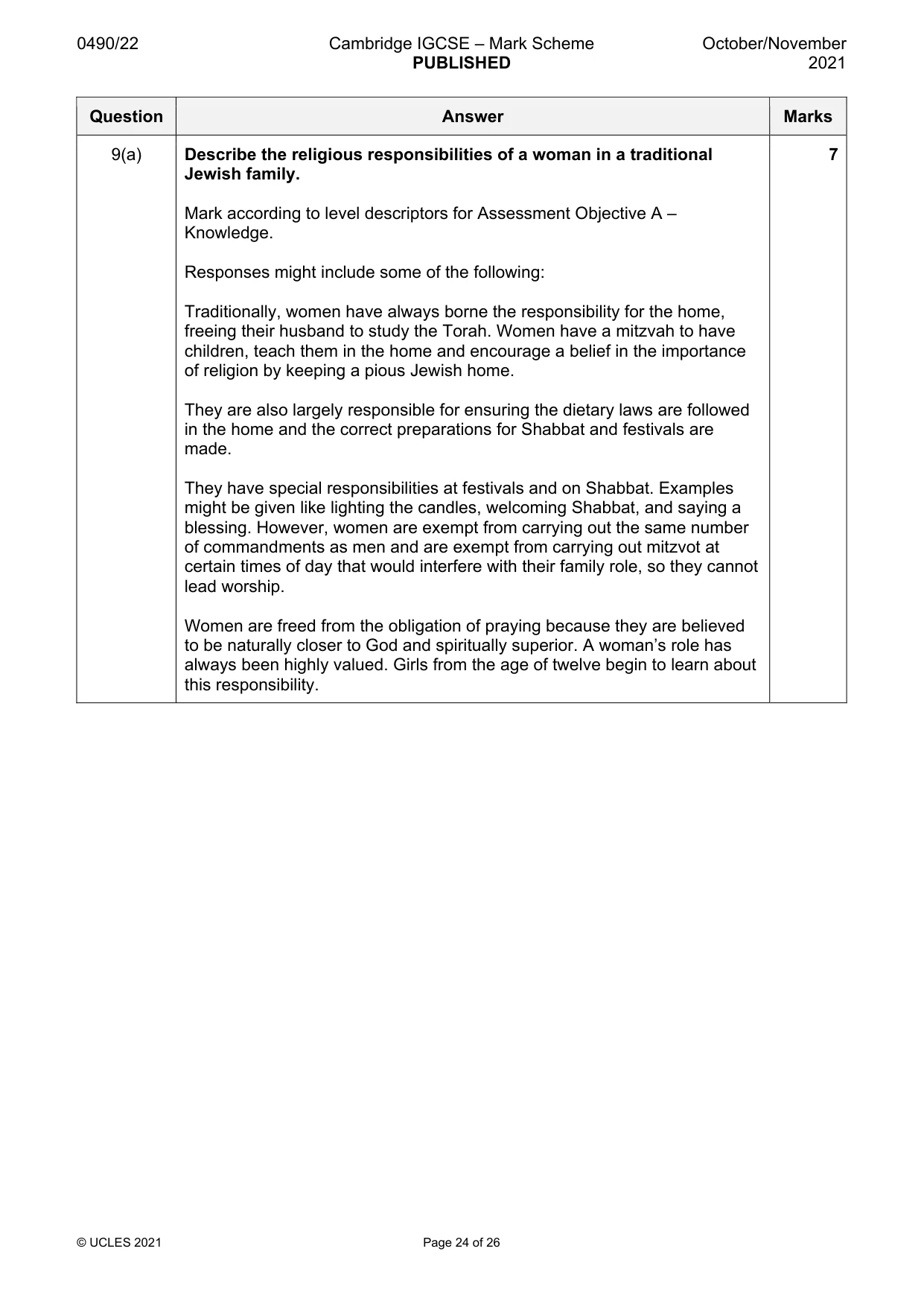
0490/22 Cambridge IGCSE – Mark Scheme PUBLISHED October/November 2021 © UCLES 2021 Page 24 of 26 Question Answer Marks 9(a) Describe the religious responsibilities of a woman in a traditional Jewish family. Mark according to level descriptors for Assessment Objective A – Knowledge. Responses might include some of the following: Traditionally, women have always borne the responsibility for the home, freeing their husband to study the Torah. Women have a mitzvah to have children, teach them in the home and encourage a belief in the importance of religion by keeping a pious Jewish home. They are also largely responsible for ensuring the dietary laws are followed in the home and the correct preparations for Shabbat and festivals are made. They have special responsibilities at festivals and on Shabbat. Examples might be given like lighting the candles, welcoming Shabbat, and saying a blessing. However, women are exempt from carrying out the same number of commandments as men and are exempt from carrying out mitzvot at certain times of day that would interfere with their family role, so they cannot lead worship. Women are freed from the obligation of praying because they are believed to be naturally closer to God and spiritually superior. A woman’s role has always been highly valued. Girls from the age of twelve begin to learn about this responsibility. 7
Mark scheme, page 25
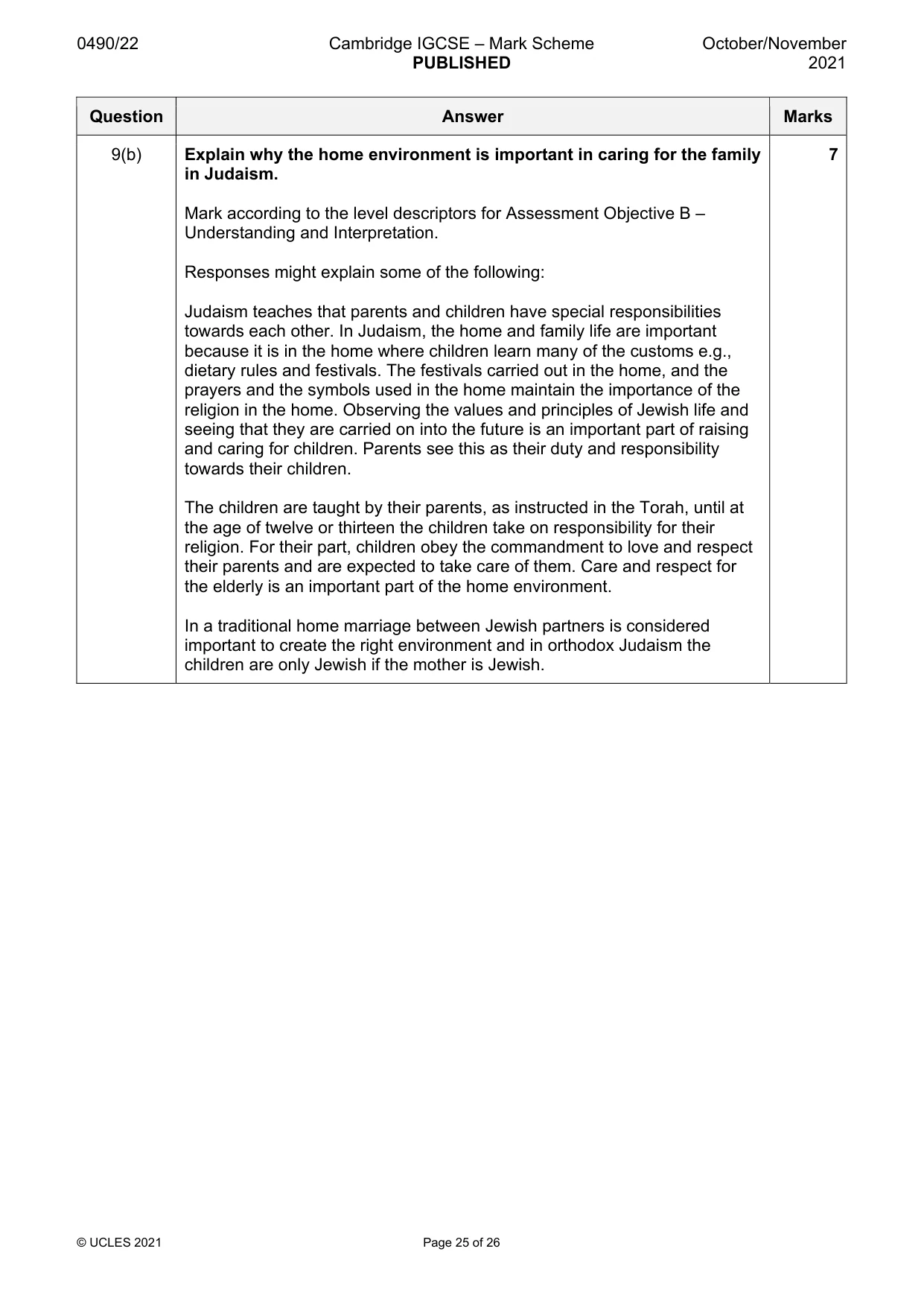
0490/22 Cambridge IGCSE – Mark Scheme PUBLISHED October/November 2021 © UCLES 2021 Page 25 of 26 Question Answer Marks 9(b) Explain why the home environment is important in caring for the family in Judaism. Mark according to the level descriptors for Assessment Objective B – Understanding and Interpretation. Responses might explain some of the following: Judaism teaches that parents and children have special responsibilities towards each other. In Judaism, the home and family life are important because it is in the home where children learn many of the customs e.g., dietary rules and festivals. The festivals carried out in the home, and the prayers and the symbols used in the home maintain the importance of the religion in the home. Observing the values and principles of Jewish life and seeing that they are carried on into the future is an important part of raising and caring for children. Parents see this as their duty and responsibility towards their children. The children are taught by their parents, as instructed in the Torah, until at the age of twelve or thirteen the children take on responsibility for their religion. For their part, children obey the commandment to love and respect their parents and are expected to take care of them. Care and respect for the elderly is an important part of the home environment. In a traditional home marriage between Jewish partners is considered important to create the right environment and in orthodox Judaism the children are only Jewish if the mother is Jewish. 7
Mark scheme, page 26
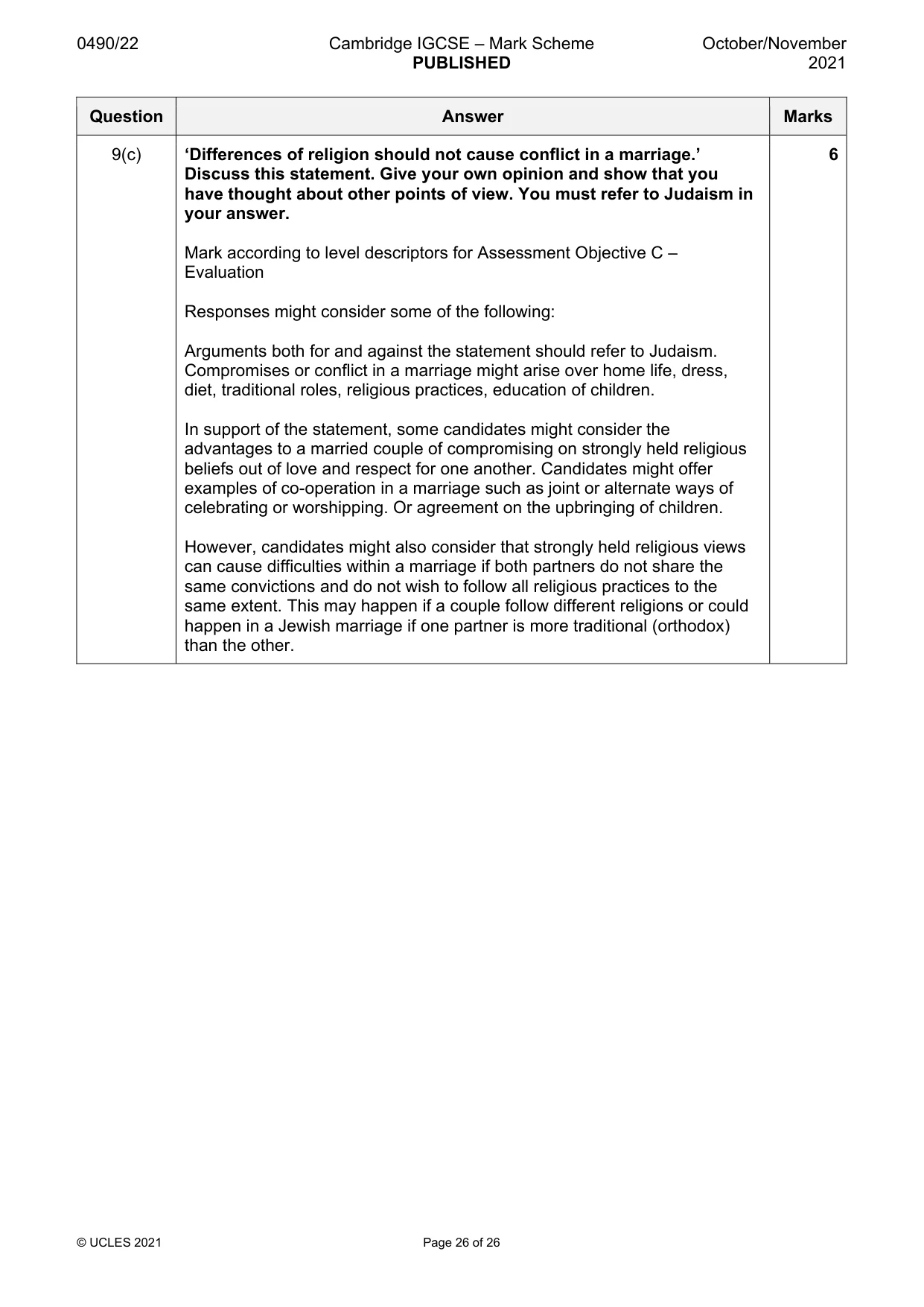
0490/22 Cambridge IGCSE – Mark Scheme PUBLISHED October/November 2021 © UCLES 2021 Page 26 of 26 Question Answer Marks 9(c) ‘Differences of religion should not cause conflict in a marriage.’ Discuss this statement. Give your own opinion and show that you have thought about other points of view. You must refer to Judaism in your answer. Mark according to level descriptors for Assessment Objective C – Evaluation Responses might consider some of the following: Arguments both for and against the statement should refer to Judaism. Compromises or conflict in a marriage might arise over home life, dress, diet, traditional roles, religious practices, education of children. In support of the statement, some candidates might consider the advantages to a married couple of compromising on strongly held religious beliefs out of love and respect for one another. Candidates might offer examples of co-operation in a marriage such as joint or alternate ways of celebrating or worshipping. Or agreement on the upbringing of children. However, candidates might also consider that strongly held religious views can cause difficulties within a marriage if both partners do not share the same convictions and do not wish to follow all religious practices to the same extent. This may happen if a couple follow different religions or could happen in a Jewish marriage if one partner is more traditional (orthodox) than the other. 6
What you needed in this session
Cambridge’s own grade thresholds for 2021 Oct/Nov, Paper 2 · Variant 2. A higher threshold means an easier paper — the bar moves with how the cohort did.