Cambridge IGCSE Religious Studies 0490 — 2020 Oct/Nov Paper 2 · Variant 2
0490/22/O/N/20 · 9 questions · 80 marks · ≈90 min
The question paper and its mark scheme, free to read here and free to download. This is Cambridge’s own paper, exactly as it was sat.
Question paper4 pages
Mark scheme22 pages
Answers below. Sit the paper first if you are practising.
Questions as text
Q1 · Describe the Christian artefacts and aids to worship used only at Christmas
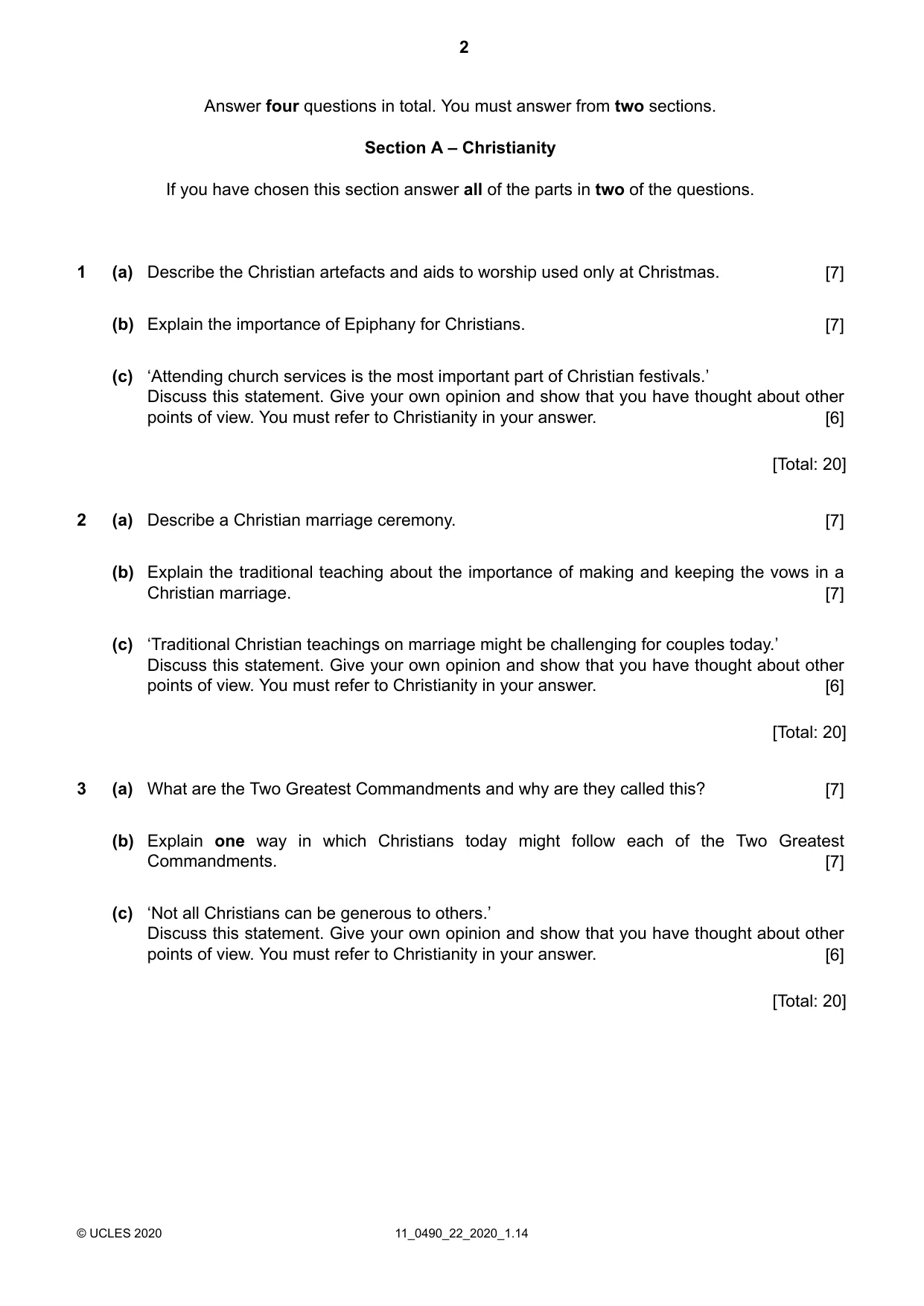
1 (a) Describe the Christian artefacts and aids to worship used only at Christmas. [7] (b) Explain the importance of Epiphany for Christians. [7] (c) ‘Attending church services is the most important part of Christian festivals.’ Discuss this statement. Give your own opinion and show that you have thought about other points of view. You must refer to Christianity in your answer. [6] [Total: 20]
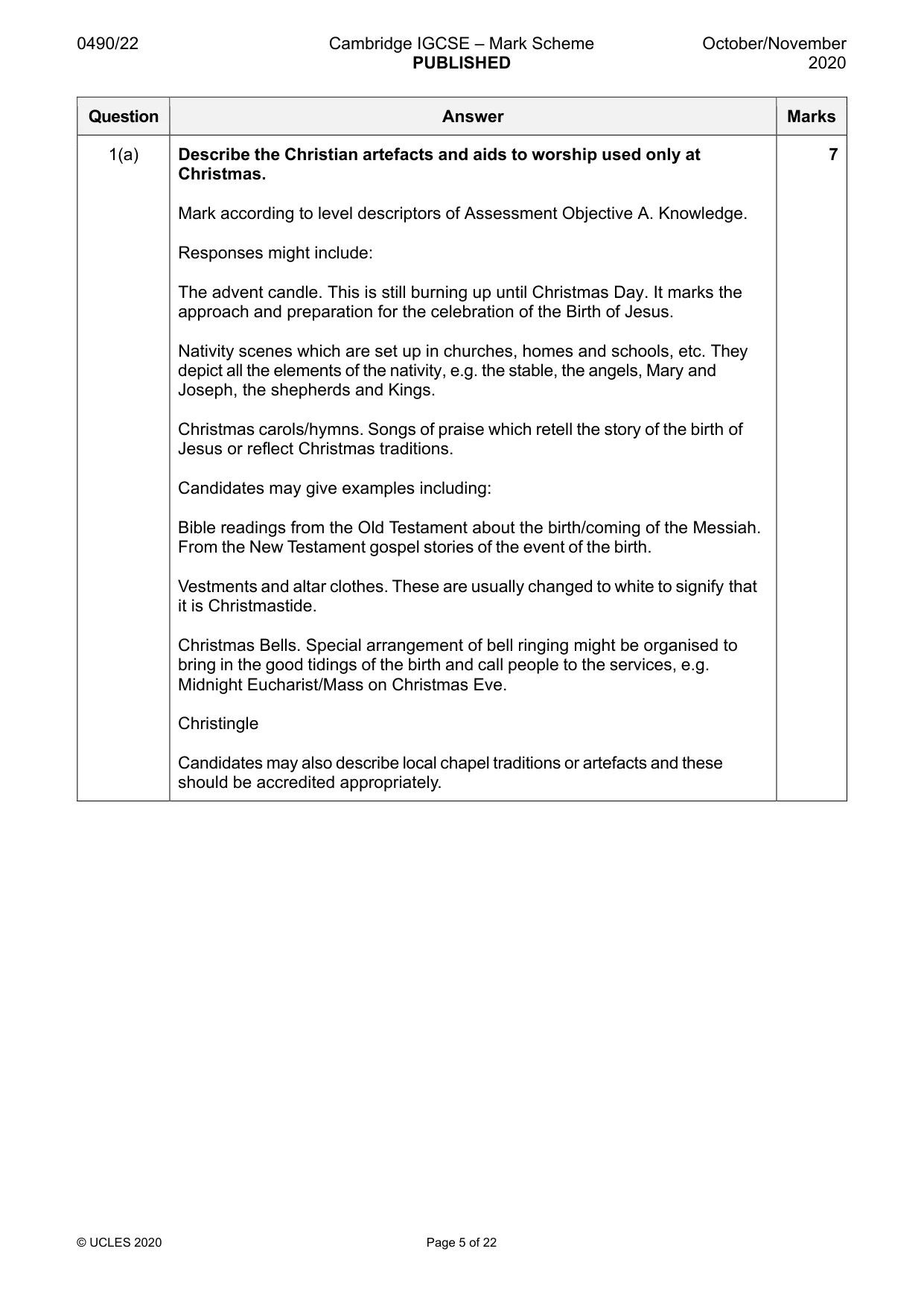
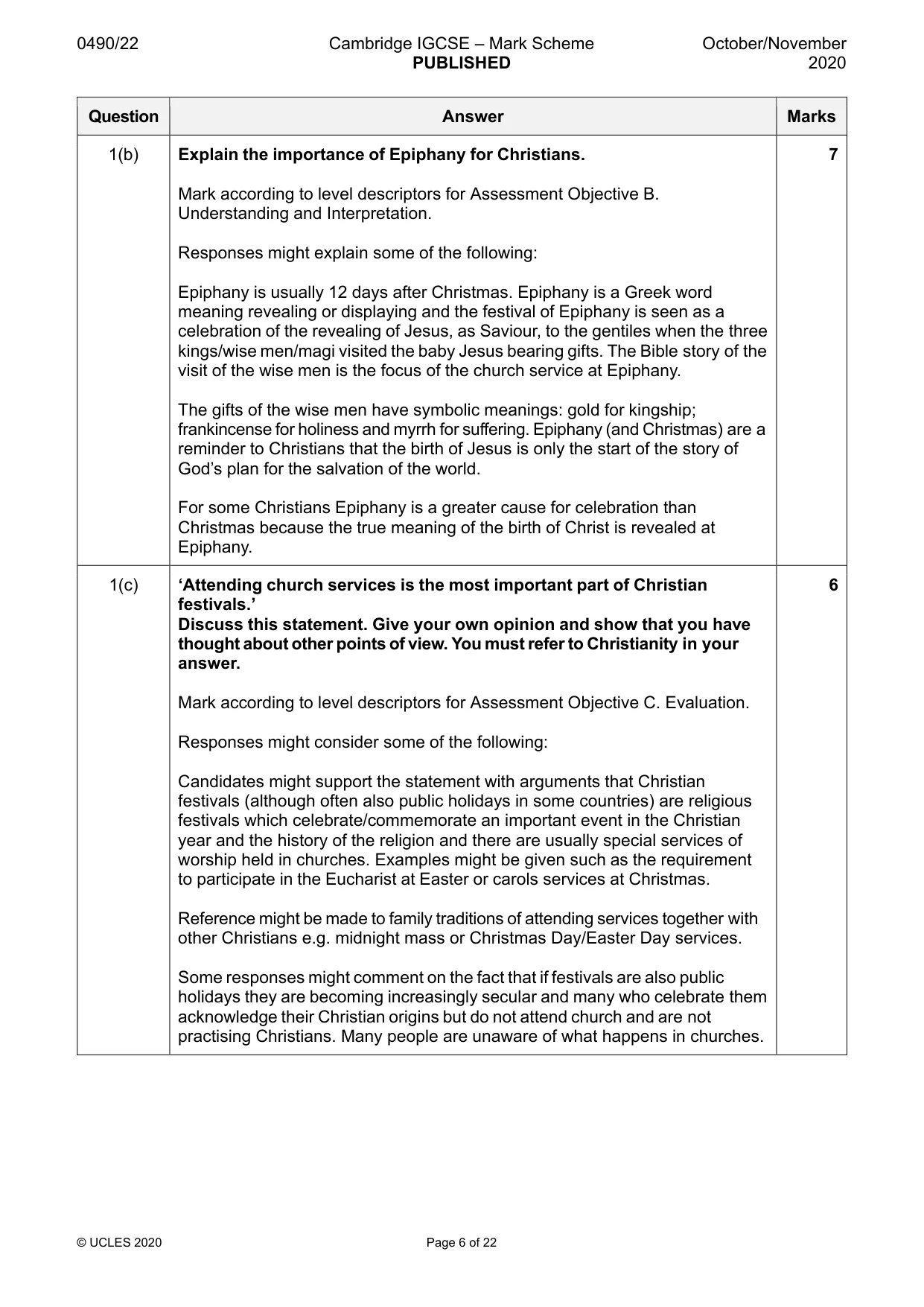
Mark scheme: Question Answer Marks 1(a) Describe the Christian artefacts and aids to worship used only at 7 Christmas. Mark according to level descriptors of Assessment Objective A. Knowledge. Responses might include: The advent candle. This is still burning up until Christmas Day. It marks the approach and preparation for the celebration of the Birth of Jesus. Nativity scenes which are set up in churches, homes and schools, etc. They depict all the elements of the nativity, e.g. the stable, the angels, Mary and Joseph, the shepherds and Kings. Christmas carols/hymns. Songs of praise which retell the story of the birth of Jesus or reflect Christmas traditions. Candidates may give examples including: Bible readings from the Old Testament about the birth/coming of the Messiah. From the New Testament gospel stories of the event of the birth. Vestments and altar clothes. These are usually changed to white to signify that it is Christmastide. Christmas Bells. Special arrangement of bell ringing might be organised to bring in the good tidings of the birth and call people to the services, e.g. Midnight Eucharist/Mass on Christmas Eve. Christingle Candidates may also describe local chapel traditions or artefacts and these should be accredited appropriately. 1(b) Explain the importance of Epiphany for Christians. 7 Mark according to level descriptors for Assessment Objective B. Understanding and Interpretation. Responses might explain some of the following: Epiphany is usually 12 days after Christmas. Epiphany is a Greek word meaning revealing or displaying and the festival of Epiphany is seen as a celebration of the revealing of Jesus, as Saviour, to the gentiles when the three kings/wise men/magi visited the baby Jesus bearing gifts. The Bible story of the visit of the wise men is the focus of the church service at Epiphany. The gifts of the wise men have symbolic meanings: gold for kingship; frankincense for holiness and myrrh for suffering. Epiphany (and Christmas) are a reminder to Christians that the birth of Jesus is only the start of the story of God’s plan for the salvation of the world. For some Christians Epiphany is a greater cause for celebration than Christmas because the true meaning of the birth of Christ is revealed at Epiphany. 1(c) ‘Attending church services is the most important part of Christian 6 festivals.’ Discuss this statement. Give your own opinion and show that you have thought about other points of view. You must refer to Christianity in your answer. Mark according to level descriptors for Assessment Objective C. Evaluation. Responses might consider some of the following: Candidates might support the statement with arguments that Christian festivals (although often also public holidays in some countries) are religious festivals which celebrate/commemorate an important event in the Christian year and the history of the religion and there are usually special services of worship held in churches. Examples might be given such as the requirement to participate in the Eucharist at Easter or carols services at Christmas. Reference might be made to family traditions of attending services together with other Christians e.g. midnight mass or Christmas Day/Easter Day services. Some responses might comment on the fact that if festivals are also public holidays they are becoming increasingly secular and many who celebrate them acknowledge their Christian origins but do not attend church and are not practising Christians. Many people are unaware of what happens in churches.
Q2 · Describe a Christian marriage ceremony
2 (a) Describe a Christian marriage ceremony. [7] (b) Explain the traditional teaching about the importance of making and keeping the vows in a Christian marriage. [7] (c) ‘Traditional Christian teachings on marriage might be challenging for couples today.’ Discuss this statement. Give your own opinion and show that you have thought about other points of view. You must refer to Christianity in your answer. [6] [Total: 20]
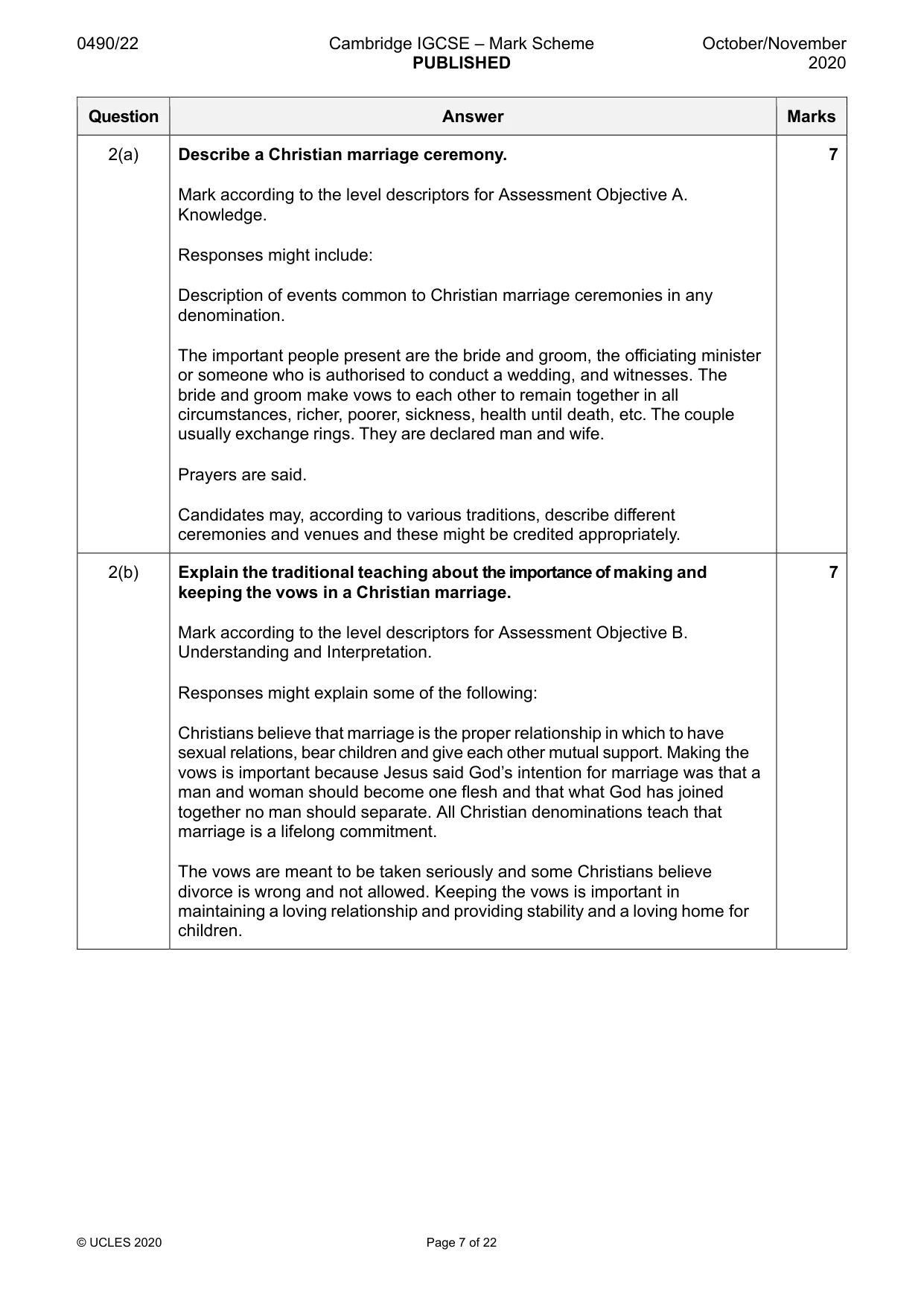
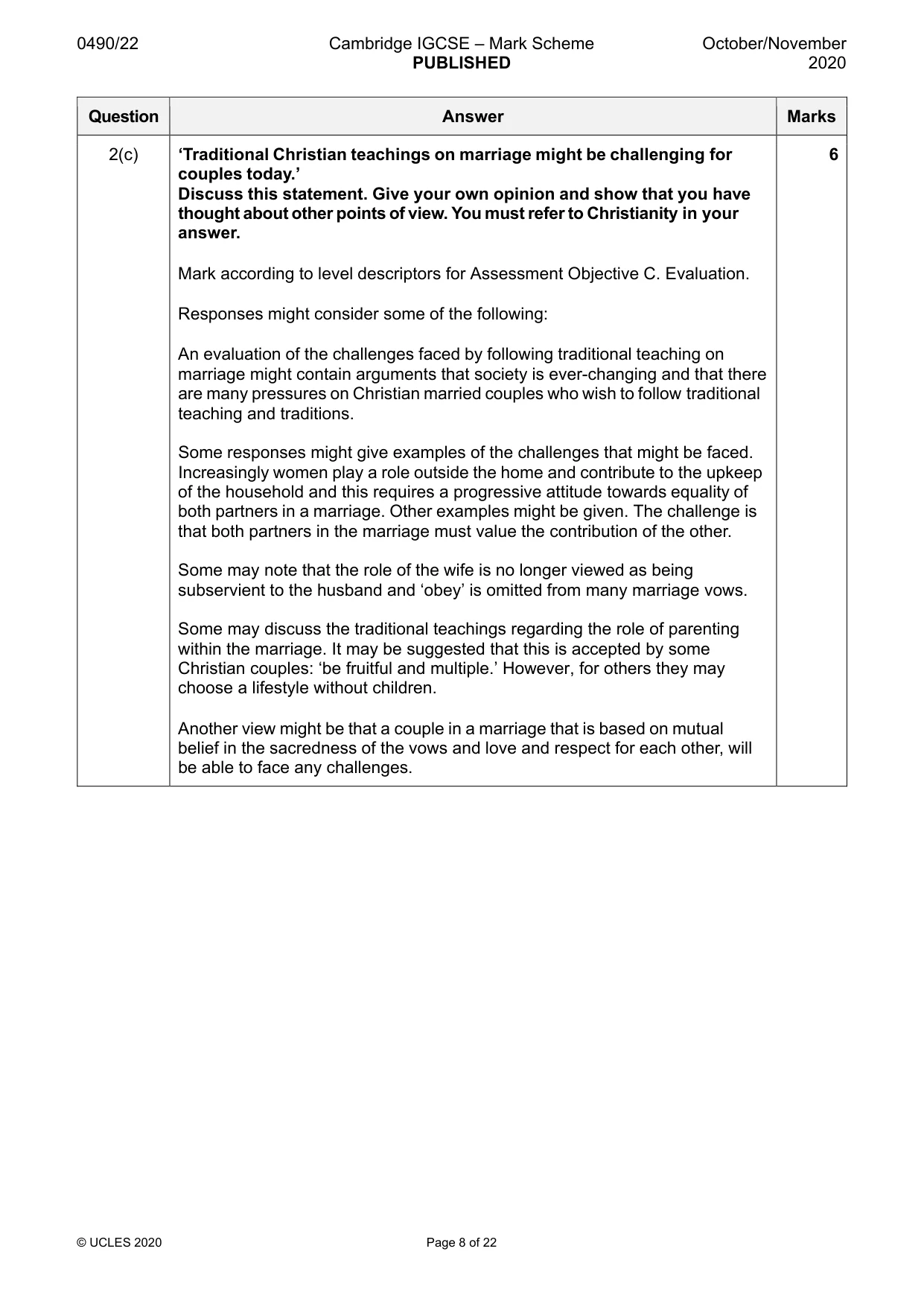
Mark scheme: 2(a) Describe a Christian marriage ceremony. 7 Mark according to the level descriptors for Assessment Objective A. Knowledge. Responses might include: Description of events common to Christian marriage ceremonies in any denomination. The important people present are the bride and groom, the officiating minister or someone who is authorised to conduct a wedding, and witnesses. The bride and groom make vows to each other to remain together in all circumstances, richer, poorer, sickness, health until death, etc. The couple usually exchange rings. They are declared man and wife. Prayers are said. Candidates may, according to various traditions, describe different ceremonies and venues and these might be credited appropriately. 2(b) Explain the traditional teaching about the importance of making and 7 keeping the vows in a Christian marriage. Mark according to the level descriptors for Assessment Objective B. Understanding and Interpretation. Responses might explain some of the following: Christians believe that marriage is the proper relationship in which to have sexual relations, bear children and give each other mutual support. Making the vows is important because Jesus said God’s intention for marriage was that a man and woman should become one flesh and that what God has joined together no man should separate. All Christian denominations teach that marriage is a lifelong commitment. The vows are meant to be taken seriously and some Christians believe divorce is wrong and not allowed. Keeping the vows is important in maintaining a loving relationship and providing stability and a loving home for children. 2(c) ‘Traditional Christian teachings on marriage might be challenging for 6 couples today.’ Discuss this statement. Give your own opinion and show that you have thought about other points of view. You must refer to Christianity in your answer. Mark according to level descriptors for Assessment Objective C. Evaluation. Responses might consider some of the following: An evaluation of the challenges faced by following traditional teaching on marriage might contain arguments that society is ever-changing and that there are many pressures on Christian married couples who wish to follow traditional teaching and traditions. Some responses might give examples of the challenges that might be faced. Increasingly women play a role outside the home and contribute to the upkeep of the household and this requires a progressive attitude towards equality of both partners in a marriage. Other examples might be given. The challenge is that both partners in the marriage must value the contribution of the other. Some may note that the role of the wife is no longer viewed as being subservient to the husband and ‘obey’ is omitted from many marriage vows. Some may discuss the traditional teachings regarding the role of parenting within the marriage. It may be suggested that this is accepted by some Christian couples: ‘be fruitful and multiple.’ However, for others they may choose a lifestyle without children. Another view might be that a couple in a marriage that is based on mutual belief in the sacredness of the vows and love and respect for each other, will be able to face any challenges.
Q3 · What are the Two Greatest Commandments and why are they called this?
3 (a) What are the Two Greatest Commandments and why are they called this? [7] (b) Explain one way in which Christians today might follow each of the Two Greatest Commandments. [7] (c) ‘Not all Christians can be generous to others.’ Discuss this statement. Give your own opinion and show that you have thought about other points of view. You must refer to Christianity in your answer. [6] [Total: 20]
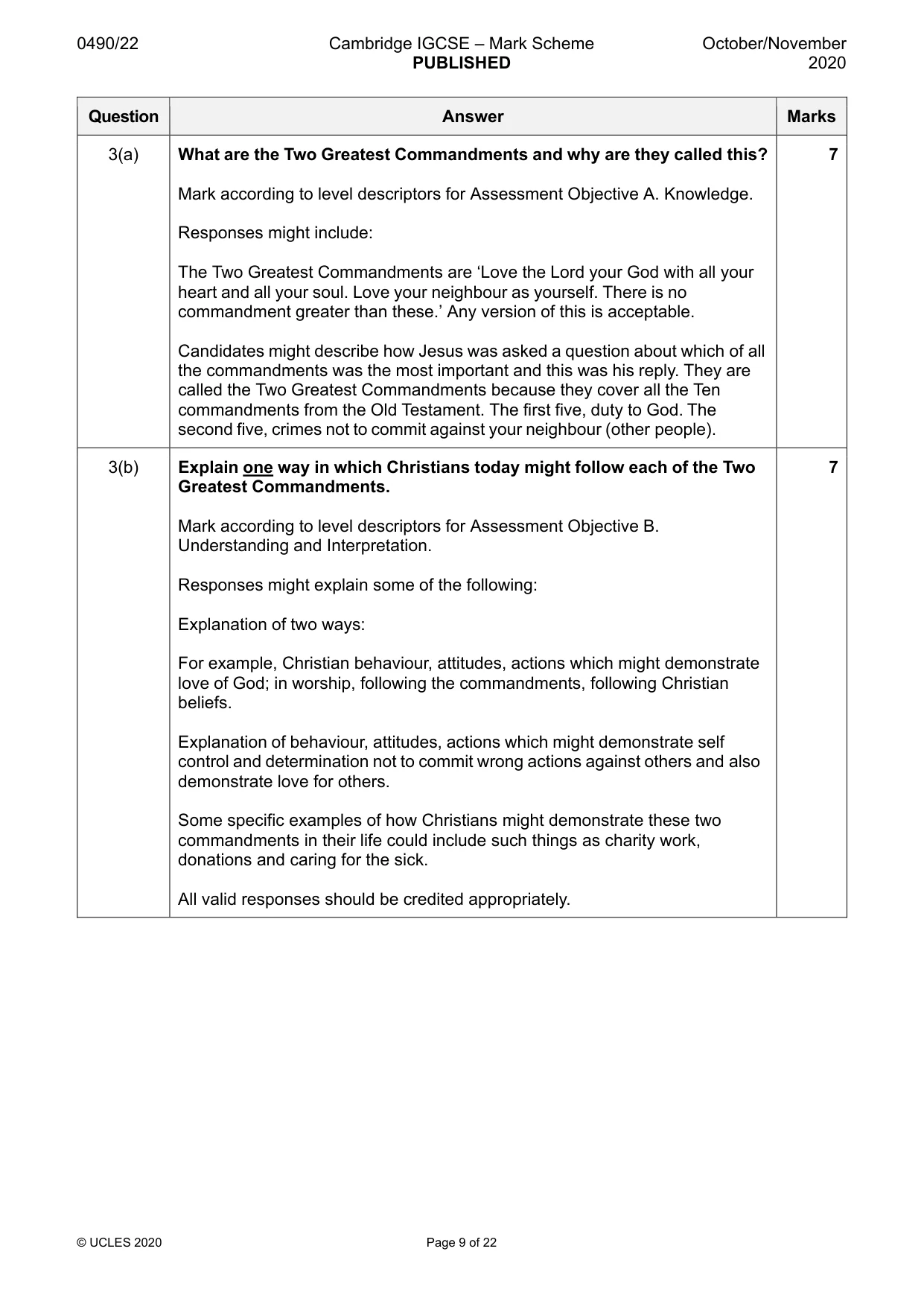
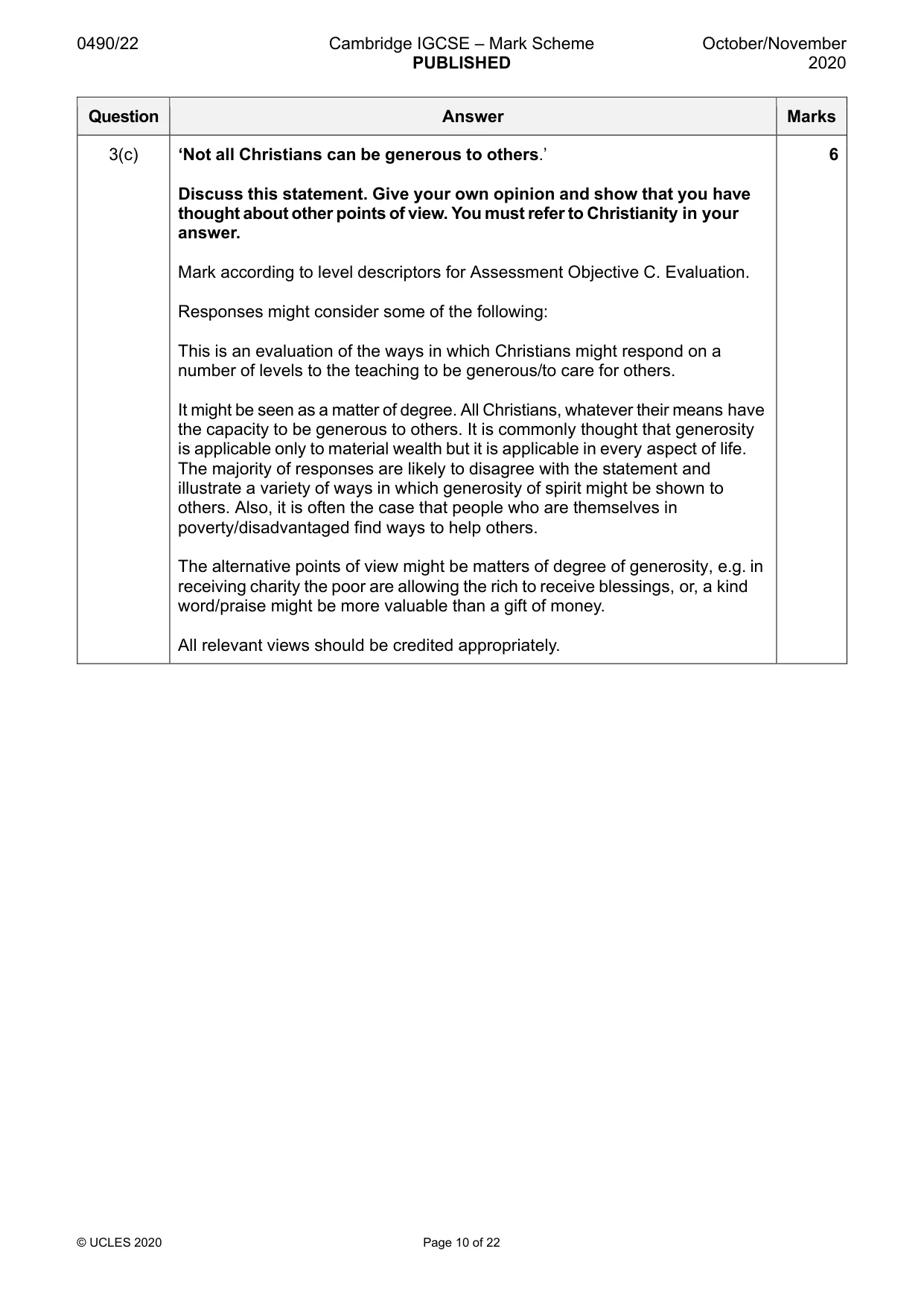
Mark scheme: 3(a) What are the Two Greatest Commandments and why are they called this? 7 Mark according to level descriptors for Assessment Objective A. Knowledge. Responses might include: The Two Greatest Commandments are ‘Love the Lord your God with all your heart and all your soul. Love your neighbour as yourself. There is no commandment greater than these.’ Any version of this is acceptable. Candidates might describe how Jesus was asked a question about which of all the commandments was the most important and this was his reply. They are called the Two Greatest Commandments because they cover all the Ten commandments from the Old Testament. The first five, duty to God. The second five, crimes not to commit against your neighbour (other people). 3(b) Explain one way in which Christians today might follow each of the Two 7 Greatest Commandments. Mark according to level descriptors for Assessment Objective B. Understanding and Interpretation. Responses might explain some of the following: Explanation of two ways: For example, Christian behaviour, attitudes, actions which might demonstrate love of God; in worship, following the commandments, following Christian beliefs. Explanation of behaviour, attitudes, actions which might demonstrate self control and determination not to commit wrong actions against others and also demonstrate love for others. Some specific examples of how Christians might demonstrate these two commandments in their life could include such things as charity work, donations and caring for the sick. All valid responses should be credited appropriately. 3(c) ‘Not all Christians can be generous to others.’ 6 Discuss this statement. Give your own opinion and show that you have thought about other points of view. You must refer to Christianity in your answer. Mark according to level descriptors for Assessment Objective C. Evaluation. Responses might consider some of the following: This is an evaluation of the ways in which Christians might respond on a number of levels to the teaching to be generous/to care for others. It might be seen as a matter of degree. All Christians, whatever their means have the capacity to be generous to others. It is commonly thought that generosity is applicable only to material wealth but it is applicable in every aspect of life. The majority of responses are likely to disagree with the statement and illustrate a variety of ways in which generosity of spirit might be shown to others. Also, it is often the case that people who are themselves in poverty/disadvantaged find ways to help others. The alternative points of view might be matters of degree of generosity, e.g. in receiving charity the poor are allowing the rich to receive blessings, or, a kind word/praise might be more valuable than a gift of money. All relevant views should be credited appropriately.
Q4 · Describe what happens on hajj at Arafat, Muzdalifah and Mina
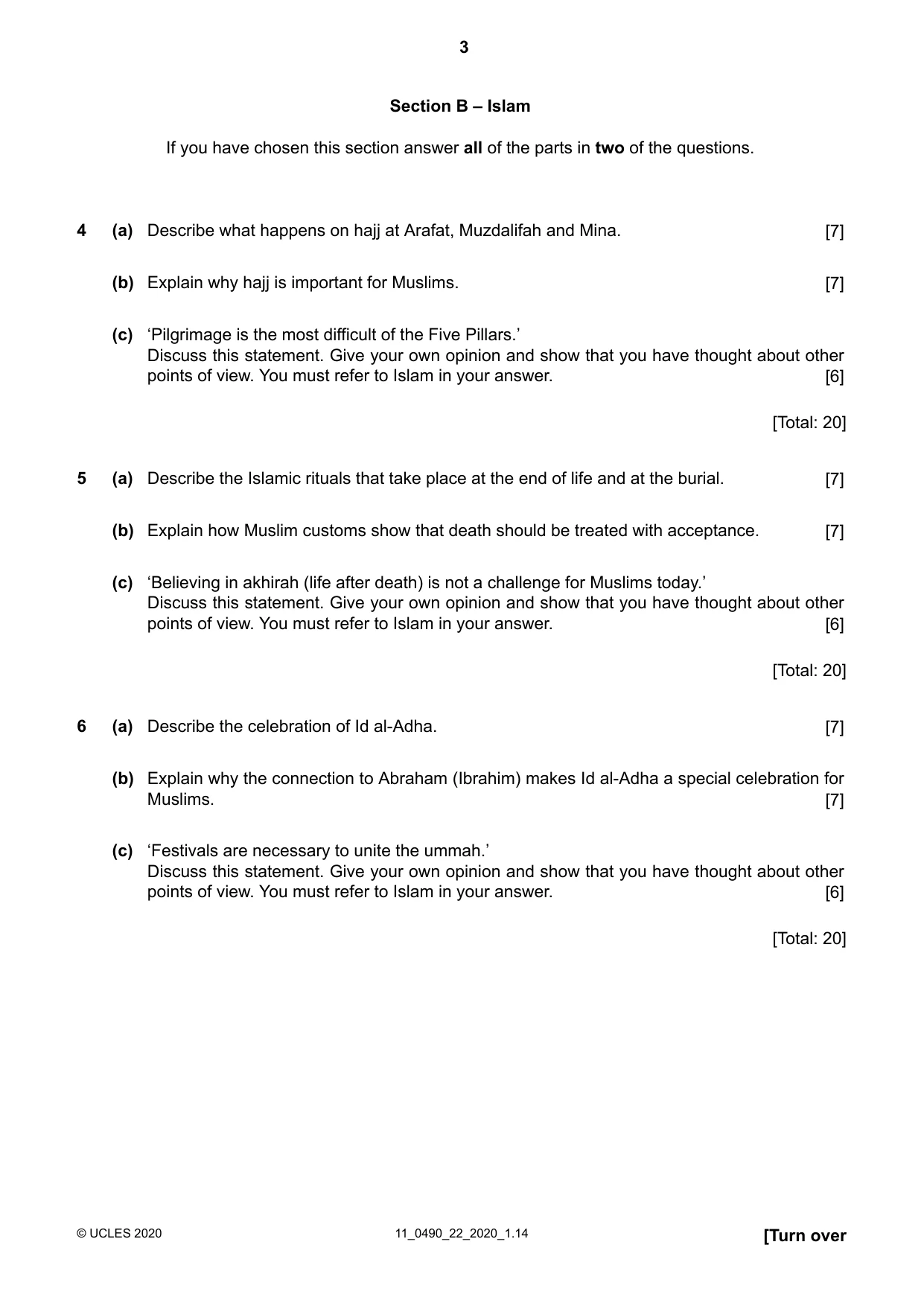
4 (a) Describe what happens on hajj at Arafat, Muzdalifah and Mina. [7] (b) Explain why hajj is important for Muslims. [7] (c) ‘Pilgrimage is the most difficult of the Five Pillars.’ Discuss this statement. Give your own opinion and show that you have thought about other points of view. You must refer to Islam in your answer. [6] [Total: 20]
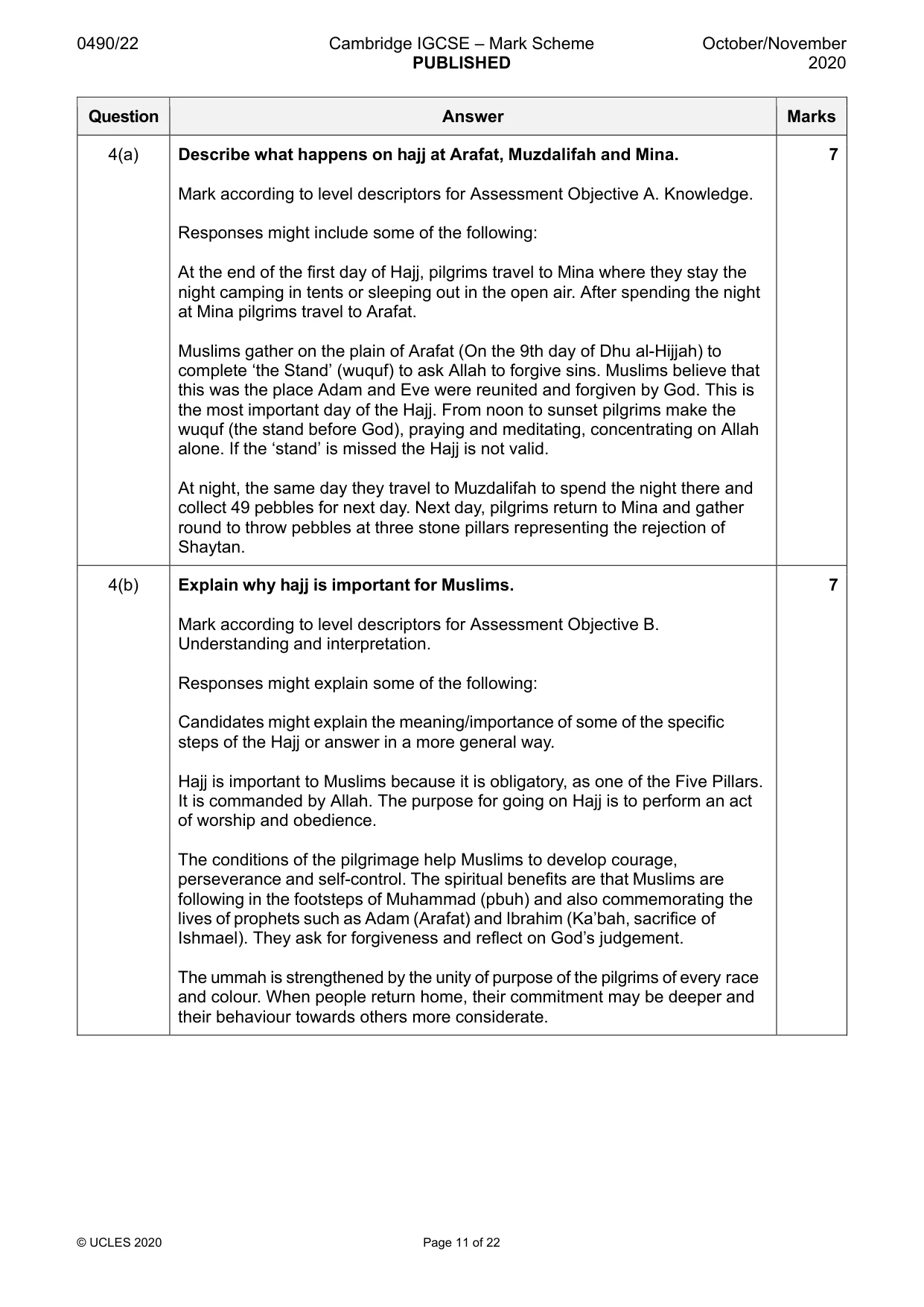
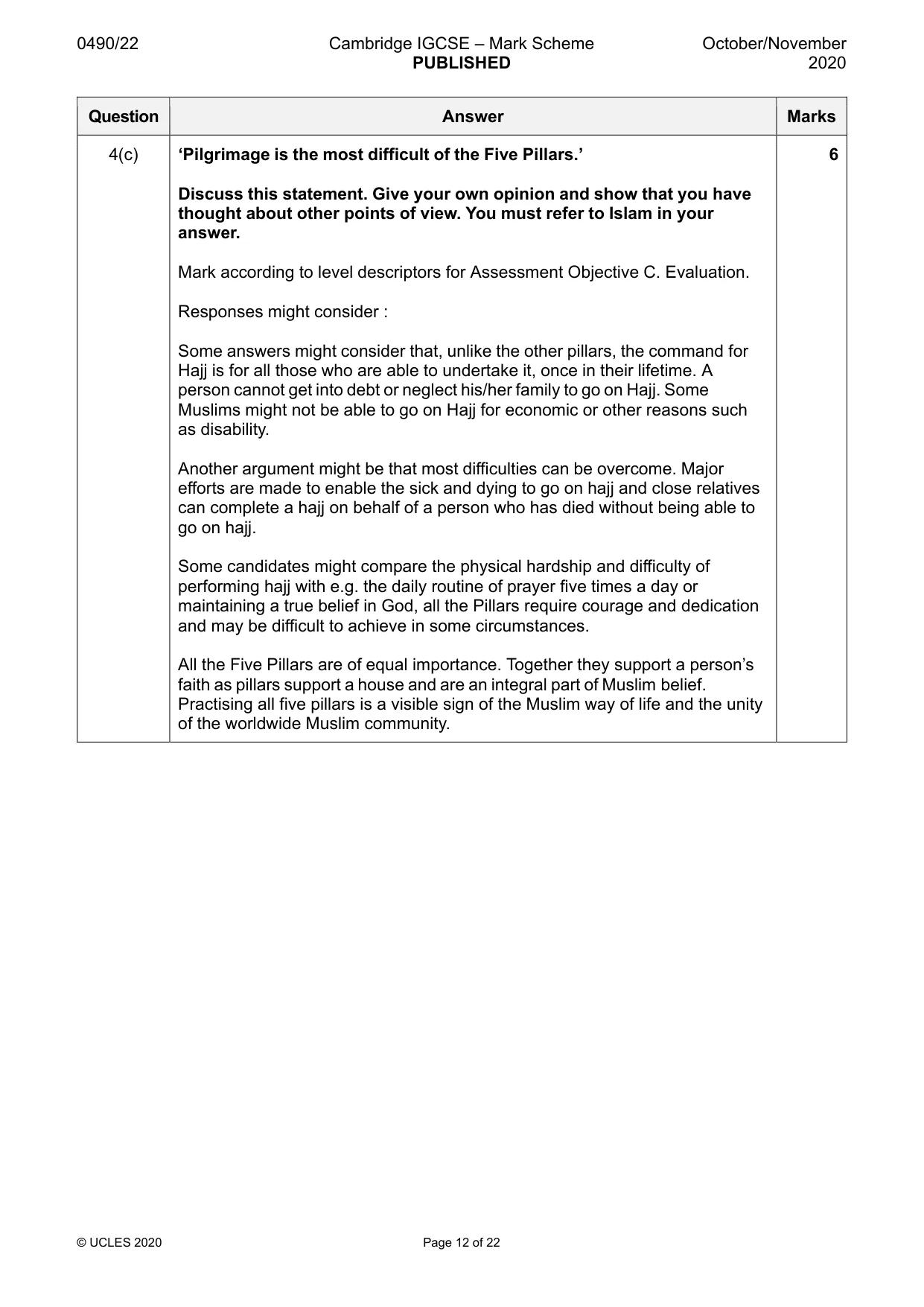
Mark scheme: 4(a) Describe what happens on hajj at Arafat, Muzdalifah and Mina. 7 Mark according to level descriptors for Assessment Objective A. Knowledge. Responses might include some of the following: At the end of the first day of Hajj, pilgrims travel to Mina where they stay the night camping in tents or sleeping out in the open air. After spending the night at Mina pilgrims travel to Arafat. Muslims gather on the plain of Arafat (On the 9th day of Dhu al-Hijjah) to complete ‘the Stand’ (wuquf) to ask Allah to forgive sins. Muslims believe that this was the place Adam and Eve were reunited and forgiven by God. This is the most important day of the Hajj. From noon to sunset pilgrims make the wuquf (the stand before God), praying and meditating, concentrating on Allah alone. If the ‘stand’ is missed the Hajj is not valid. At night, the same day they travel to Muzdalifah to spend the night there and collect 49 pebbles for next day. Next day, pilgrims return to Mina and gather round to throw pebbles at three stone pillars representing the rejection of Shaytan. 4(b) Explain why hajj is important for Muslims. 7 Mark according to level descriptors for Assessment Objective B. Understanding and interpretation. Responses might explain some of the following: Candidates might explain the meaning/importance of some of the specific steps of the Hajj or answer in a more general way. Hajj is important to Muslims because it is obligatory, as one of the Five Pillars. It is commanded by Allah. The purpose for going on Hajj is to perform an act of worship and obedience. The conditions of the pilgrimage help Muslims to develop courage, perseverance and self-control. The spiritual benefits are that Muslims are following in the footsteps of Muhammad (pbuh) and also commemorating the lives of prophets such as Adam (Arafat) and Ibrahim (Ka’bah, sacrifice of Ishmael). They ask for forgiveness and reflect on God’s judgement. The ummah is strengthened by the unity of purpose of the pilgrims of every race and colour. When people return home, their commitment may be deeper and their behaviour towards others more considerate. 4(c) ‘Pilgrimage is the most difficult of the Five Pillars.’ 6 Discuss this statement. Give your own opinion and show that you have thought about other points of view. You must refer to Islam in your answer. Mark according to level descriptors for Assessment Objective C. Evaluation. Responses might consider : Some answers might consider that, unlike the other pillars, the command for Hajj is for all those who are able to undertake it, once in their lifetime. A person cannot get into debt or neglect his/her family to go on Hajj. Some Muslims might not be able to go on Hajj for economic or other reasons such as disability. Another argument might be that most difficulties can be overcome. Major efforts are made to enable the sick and dying to go on hajj and close relatives can complete a hajj on behalf of a person who has died without being able to go on hajj. Some candidates might compare the physical hardship and difficulty of performing hajj with e.g. the daily routine of prayer five times a day or maintaining a true belief in God, all the Pillars require courage and dedication and may be difficult to achieve in some circumstances. All the Five Pillars are of equal importance. Together they support a person’s faith as pillars support a house and are an integral part of Muslim belief. Practising all five pillars is a visible sign of the Muslim way of life and the unity of the worldwide Muslim community.
Q5 · Describe the Islamic rituals that take place at the end of life and at the burial
5 (a) Describe the Islamic rituals that take place at the end of life and at the burial. [7] (b) Explain how Muslim customs show that death should be treated with acceptance. [7] (c) ‘Believing in akhirah (life after death) is not a challenge for Muslims today.’ Discuss this statement. Give your own opinion and show that you have thought about other points of view. You must refer to Islam in your answer. [6] [Total: 20]
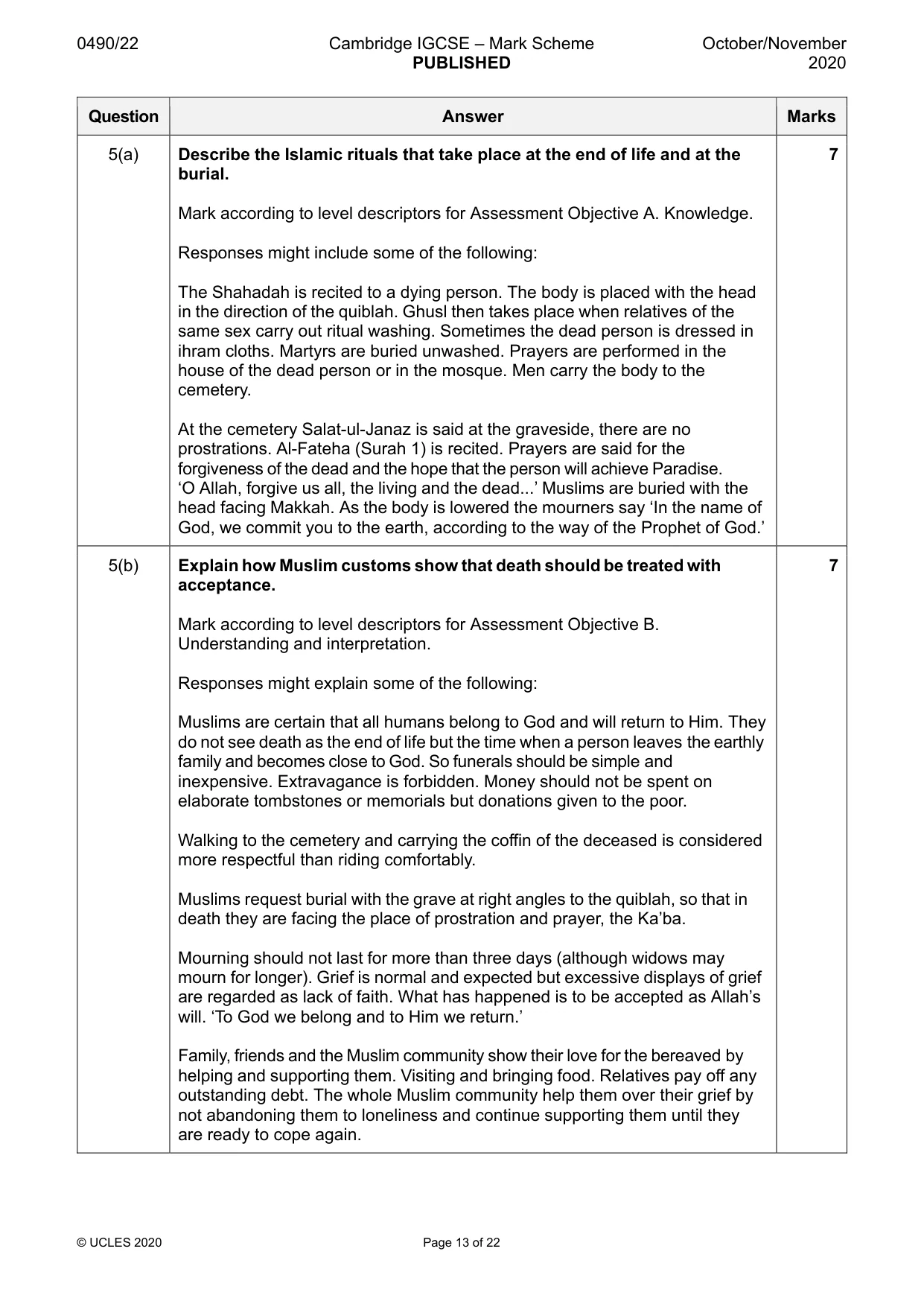
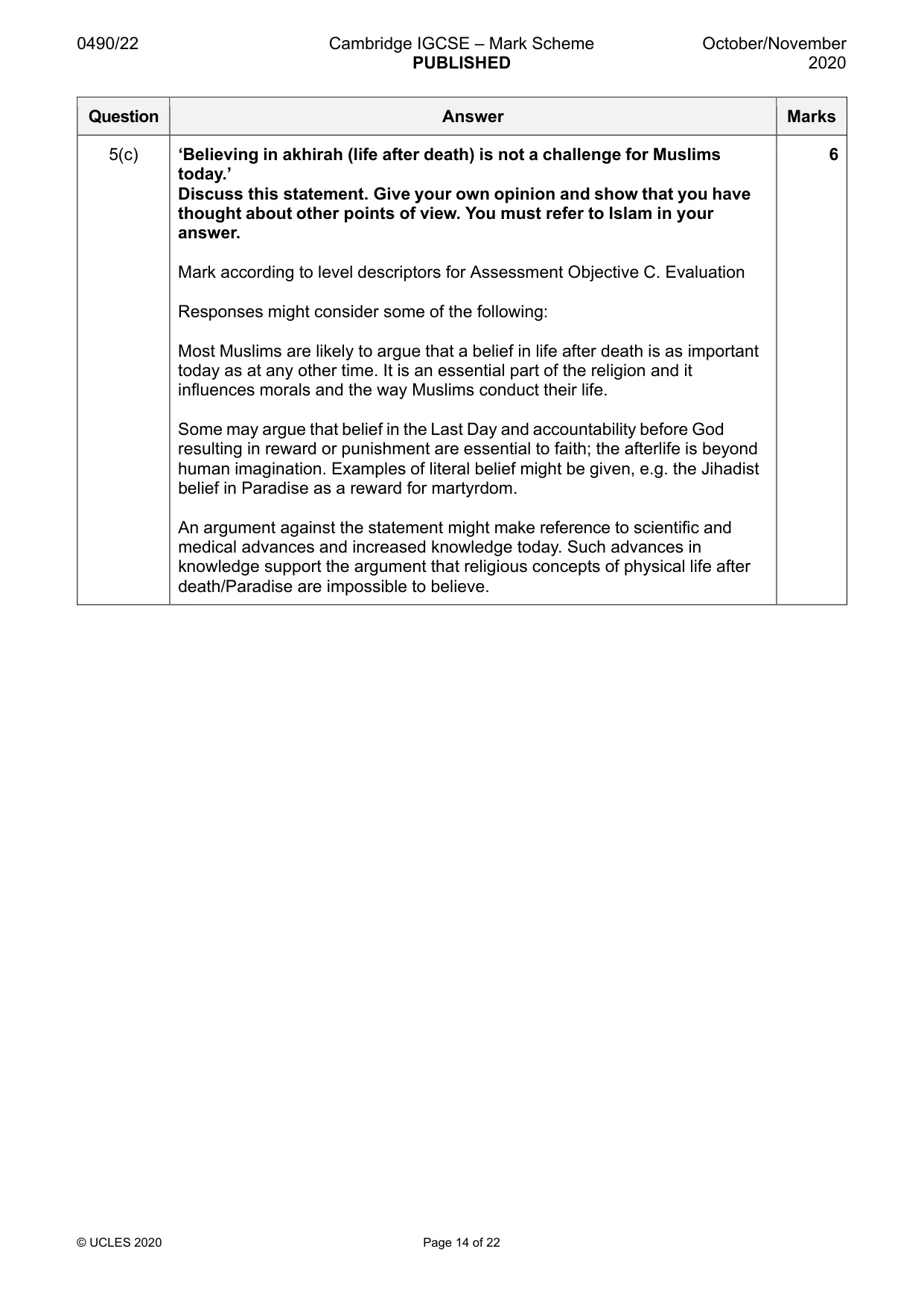
Mark scheme: 5(a) Describe the Islamic rituals that take place at the end of life and at the 7 burial. Mark according to level descriptors for Assessment Objective A. Knowledge. Responses might include some of the following: The Shahadah is recited to a dying person. The body is placed with the head in the direction of the quiblah. Ghusl then takes place when relatives of the same sex carry out ritual washing. Sometimes the dead person is dressed in ihram cloths. Martyrs are buried unwashed. Prayers are performed in the house of the dead person or in the mosque. Men carry the body to the cemetery. At the cemetery Salat-ul-Janaz is said at the graveside, there are no prostrations. Al-Fateha (Surah 1) is recited. Prayers are said for the forgiveness of the dead and the hope that the person will achieve Paradise. ‘O Allah, forgive us all, the living and the dead...’ Muslims are buried with the head facing Makkah. As the body is lowered the mourners say ‘In the name of God, we commit you to the earth, according to the way of the Prophet of God.’ 5(b) Explain how Muslim customs show that death should be treated with 7 acceptance. Mark according to level descriptors for Assessment Objective B. Understanding and interpretation. Responses might explain some of the following: Muslims are certain that all humans belong to God and will return to Him. They do not see death as the end of life but the time when a person leaves the earthly family and becomes close to God. So funerals should be simple and inexpensive. Extravagance is forbidden. Money should not be spent on elaborate tombstones or memorials but donations given to the poor. Walking to the cemetery and carrying the coffin of the deceased is considered more respectful than riding comfortably. Muslims request burial with the grave at right angles to the quiblah, so that in death they are facing the place of prostration and prayer, the Ka’ba. Mourning should not last for more than three days (although widows may mourn for longer). Grief is normal and expected but excessive displays of grief are regarded as lack of faith. What has happened is to be accepted as Allah’s will. ‘To God we belong and to Him we return.’ Family, friends and the Muslim community show their love for the bereaved by helping and supporting them. Visiting and bringing food. Relatives pay off any outstanding debt. The whole Muslim community help them over their grief by not abandoning them to loneliness and continue supporting them until they are ready to cope again. 5(c) ‘Believing in akhirah (life after death) is not a challenge for Muslims 6 today.’ Discuss this statement. Give your own opinion and show that you have thought about other points of view. You must refer to Islam in your answer. Mark according to level descriptors for Assessment Objective C. Evaluation Responses might consider some of the following: Most Muslims are likely to argue that a belief in life after death is as important today as at any other time. It is an essential part of the religion and it influences morals and the way Muslims conduct their life. Some may argue that belief in the Last Day and accountability before God resulting in reward or punishment are essential to faith; the afterlife is beyond human imagination. Examples of literal belief might be given, e.g. the Jihadist belief in Paradise as a reward for martyrdom. An argument against the statement might make reference to scientific and medical advances and increased knowledge today. Such advances in knowledge support the argument that religious concepts of physical life after death/Paradise are impossible to believe.
Q6 · Describe the celebration of Id al-Adha
6 (a) Describe the celebration of Id al-Adha. [7] (b) Explain why the connection to Abraham (Ibrahim) makes Id al-Adha a special celebration for Muslims. [7] (c) ‘Festivals are necessary to unite the ummah.’ Discuss this statement. Give your own opinion and show that you have thought about other points of view. You must refer to Islam in your answer. [6] [Total: 20] Section C – Judaism If you have chosen this section answer all of the parts in two of the questions.
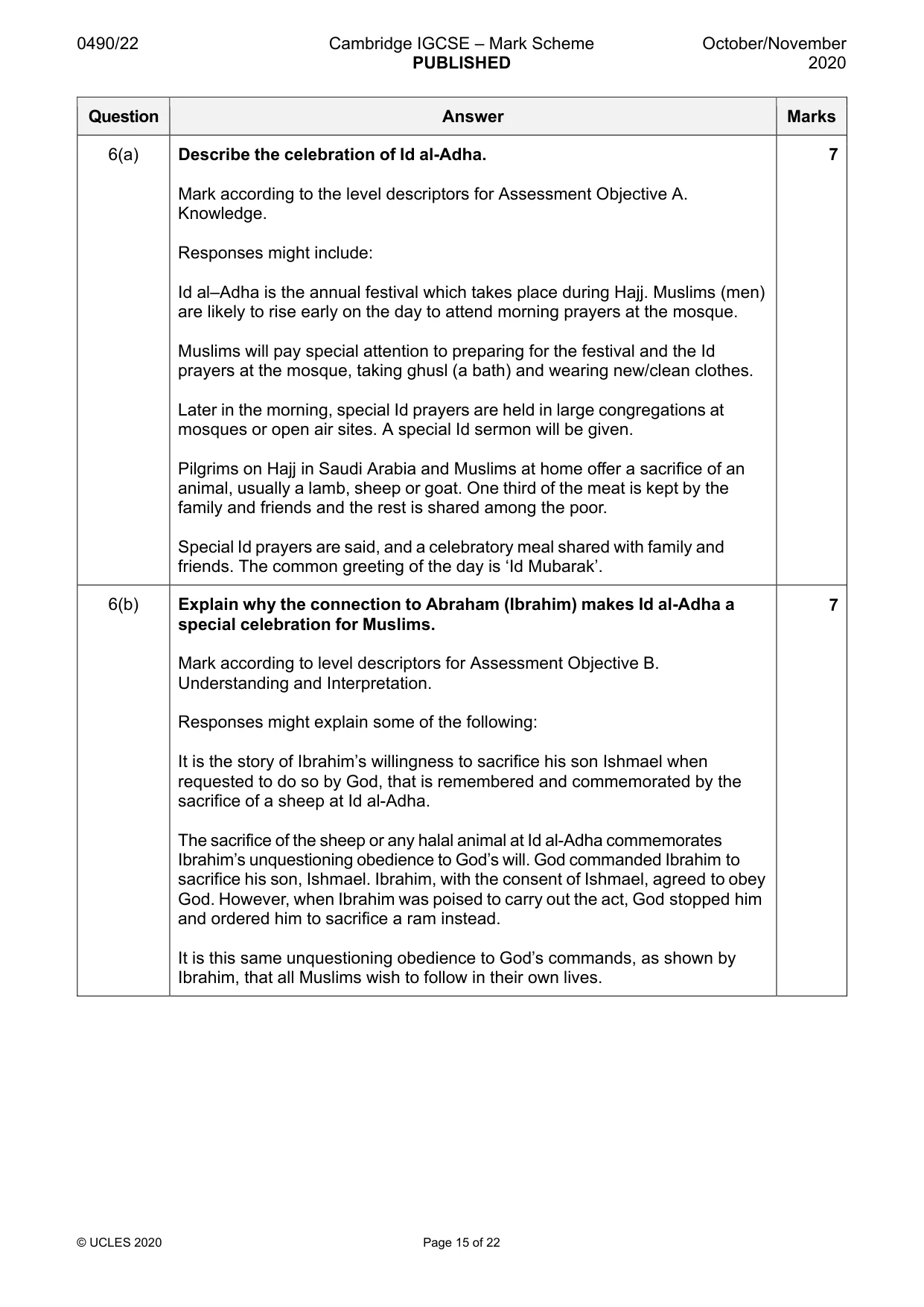
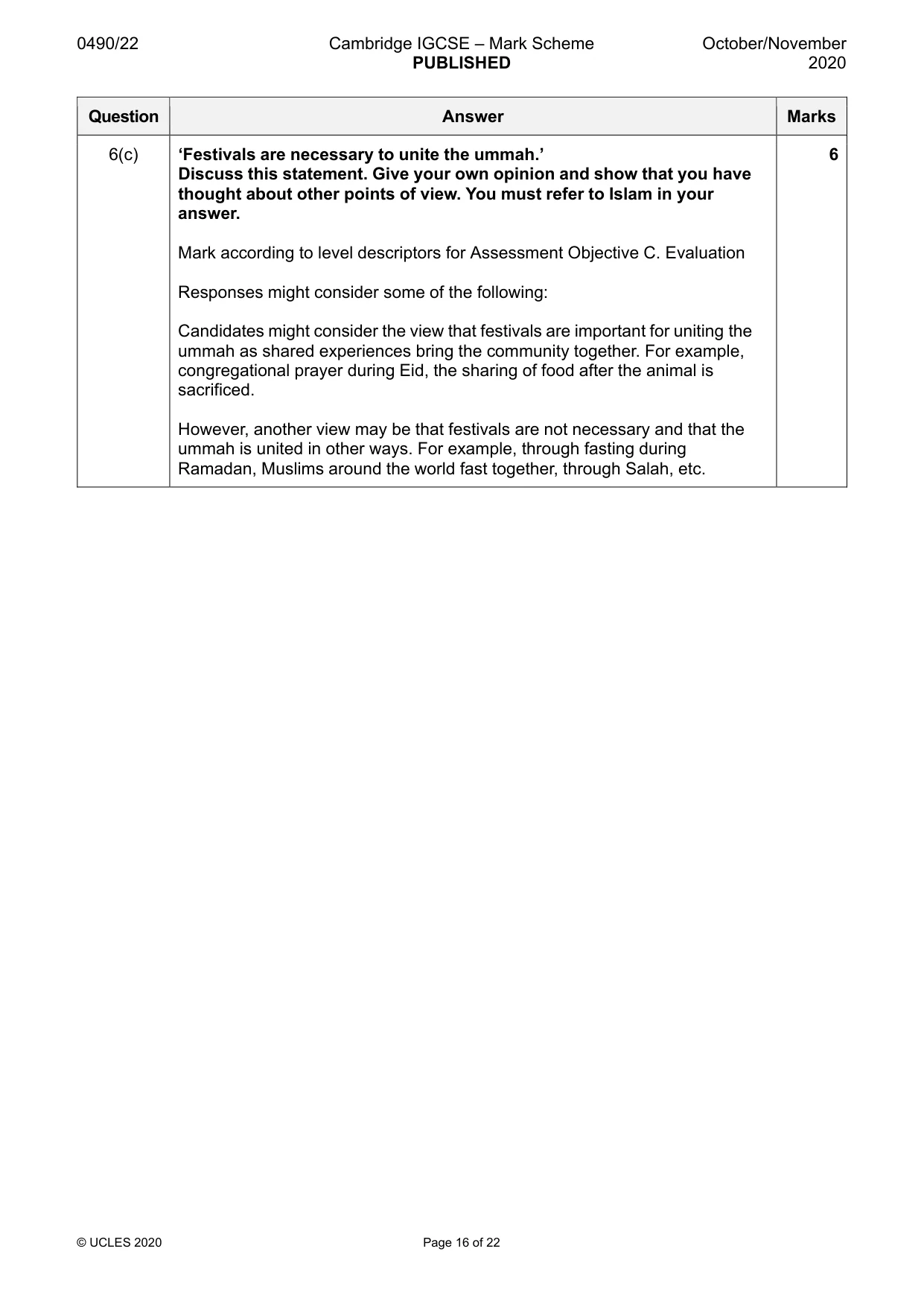
Mark scheme: 6(a) Describe the celebration of Id al-Adha. 7 Mark according to the level descriptors for Assessment Objective A. Knowledge. Responses might include: Id al–Adha is the annual festival which takes place during Hajj. Muslims (men) are likely to rise early on the day to attend morning prayers at the mosque. Muslims will pay special attention to preparing for the festival and the Id prayers at the mosque, taking ghusl (a bath) and wearing new/clean clothes. Later in the morning, special Id prayers are held in large congregations at mosques or open air sites. A special Id sermon will be given. Pilgrims on Hajj in Saudi Arabia and Muslims at home offer a sacrifice of an animal, usually a lamb, sheep or goat. One third of the meat is kept by the family and friends and the rest is shared among the poor. Special Id prayers are said, and a celebratory meal shared with family and friends. The common greeting of the day is ‘Id Mubarak’. 6(b) Explain why the connection to Abraham (Ibrahim) makes Id al-Adha a 7 special celebration for Muslims. Mark according to level descriptors for Assessment Objective B. Understanding and Interpretation. Responses might explain some of the following: It is the story of Ibrahim’s willingness to sacrifice his son Ishmael when requested to do so by God, that is remembered and commemorated by the sacrifice of a sheep at Id al-Adha. The sacrifice of the sheep or any halal animal at Id al-Adha commemorates Ibrahim’s unquestioning obedience to God’s will. God commanded Ibrahim to sacrifice his son, Ishmael. Ibrahim, with the consent of Ishmael, agreed to obey God. However, when Ibrahim was poised to carry out the act, God stopped him and ordered him to sacrifice a ram instead. It is this same unquestioning obedience to God’s commands, as shown by Ibrahim, that all Muslims wish to follow in their own lives. 6(c) ‘Festivals are necessary to unite the ummah.’ 6 Discuss this statement. Give your own opinion and show that you have thought about other points of view. You must refer to Islam in your answer. Mark according to level descriptors for Assessment Objective C. Evaluation Responses might consider some of the following: Candidates might consider the view that festivals are important for uniting the ummah as shared experiences bring the community together. For example, congregational prayer during Eid, the sharing of food after the animal is sacrificed. However, another view may be that festivals are not necessary and that the ummah is united in other ways. For example, through fasting during Ramadan, Muslims around the world fast together, through Salah, etc.
Q7 · When does Shabbat take place and what are the rules about not working on Shabbat?
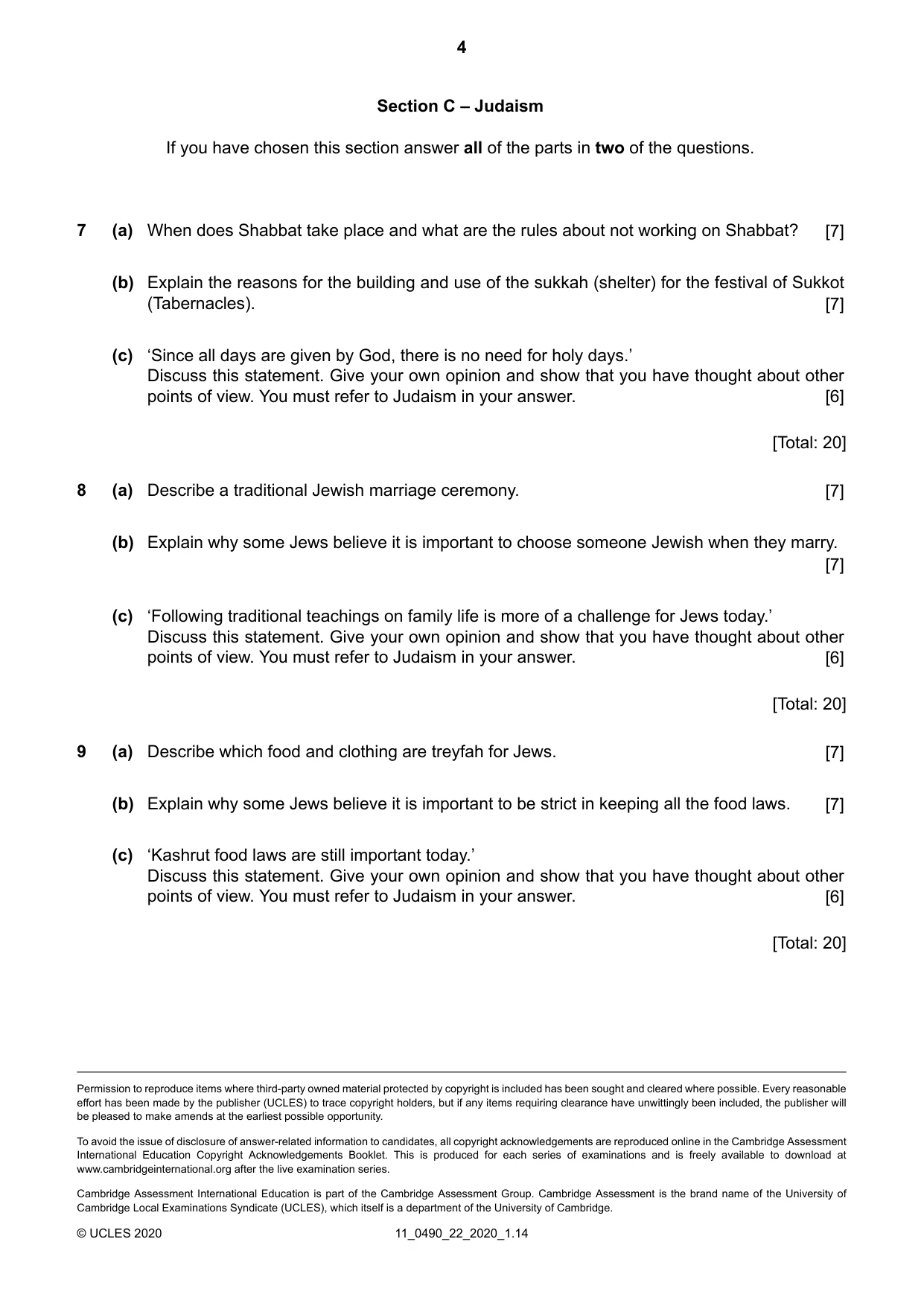
7 (a) When does Shabbat take place and what are the rules about not working on Shabbat? [7] (b) Explain the reasons for the building and use of the sukkah (shelter) for the festival of Sukkot (Tabernacles). [7] (c) ‘Since all days are given by God, there is no need for holy days.’ Discuss this statement. Give your own opinion and show that you have thought about other points of view. You must refer to Judaism in your answer. [6] [Total: 20]
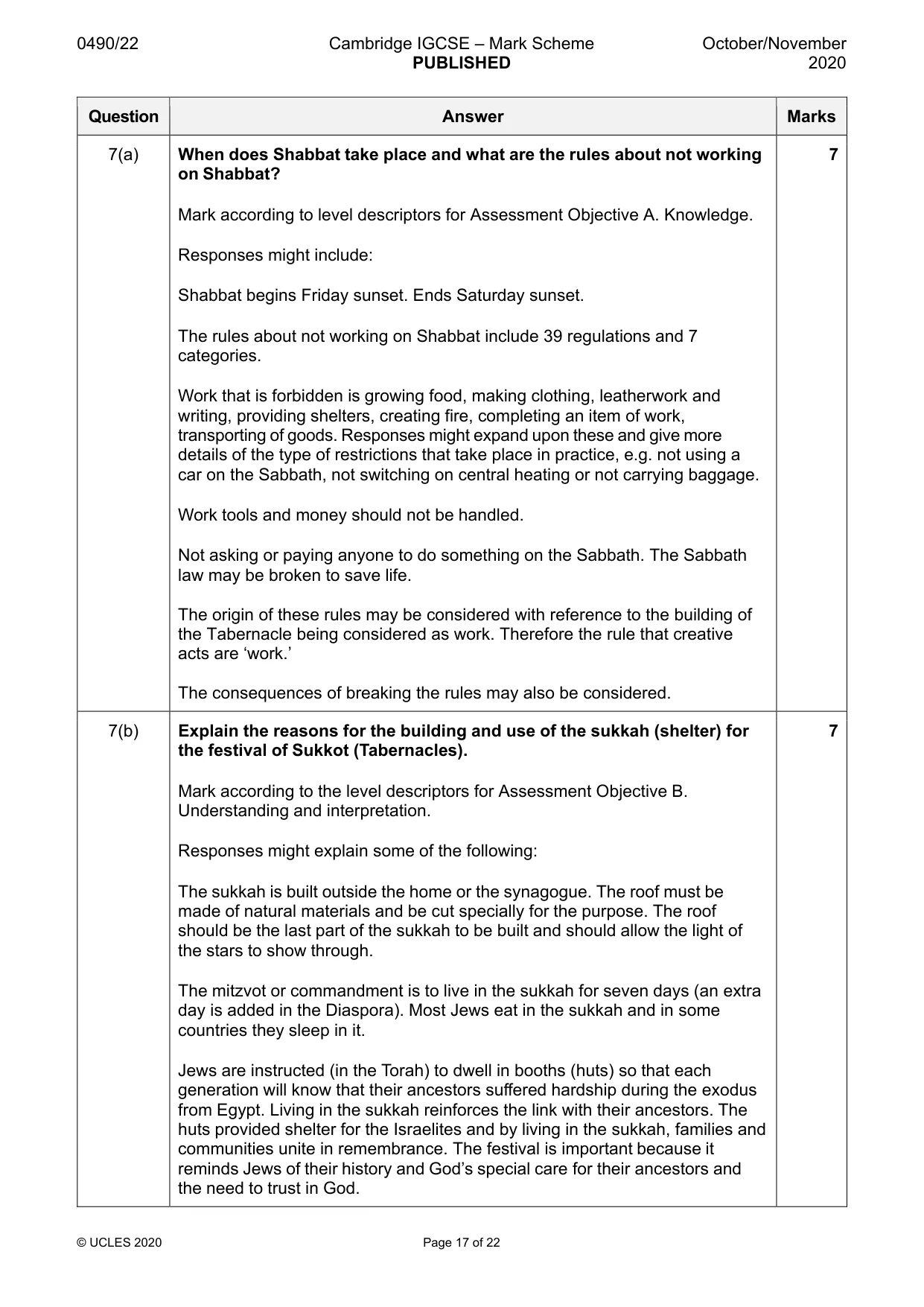
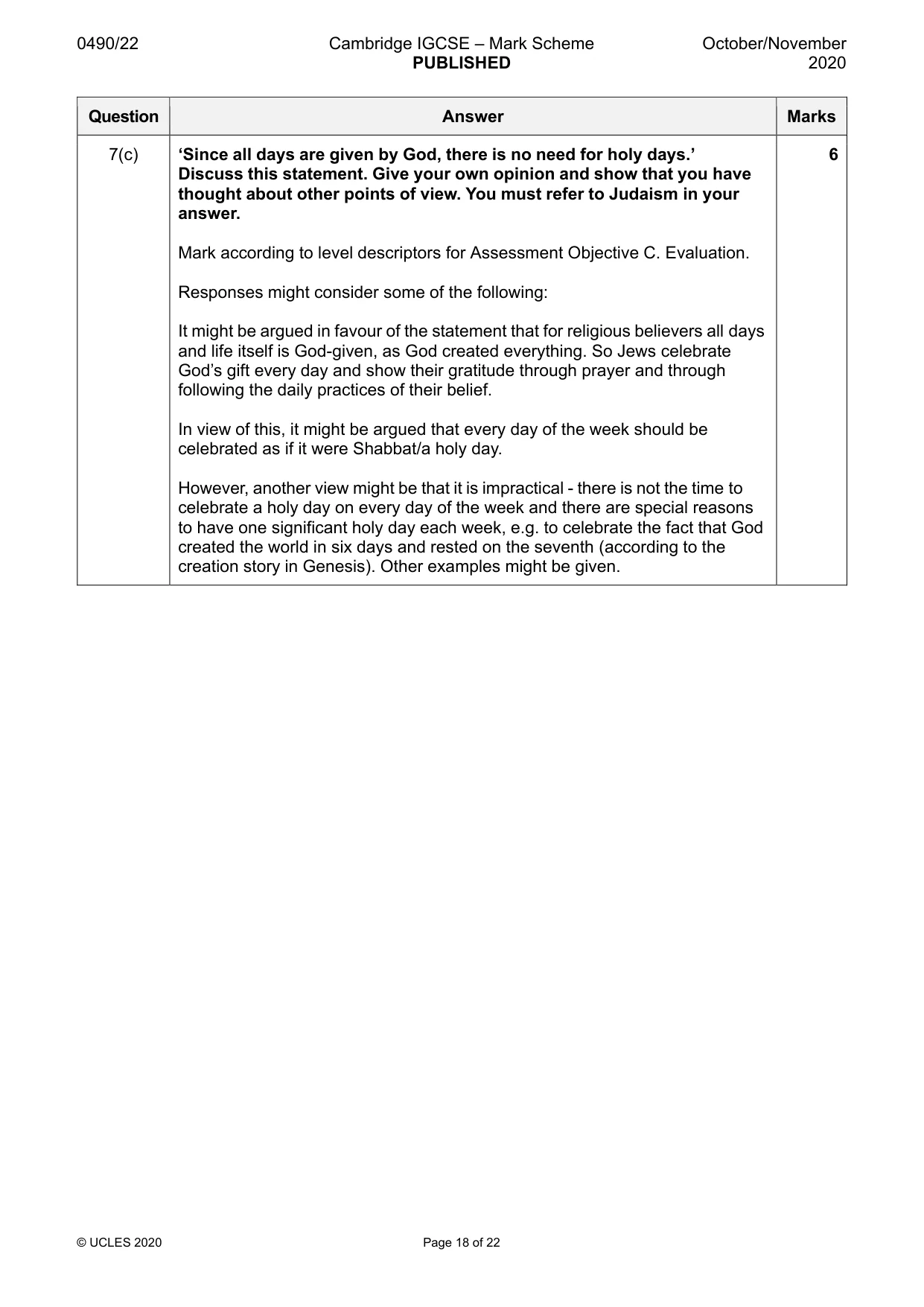
Mark scheme: 7(a) When does Shabbat take place and what are the rules about not working 7 on Shabbat? Mark according to level descriptors for Assessment Objective A. Knowledge. Responses might include: Shabbat begins Friday sunset. Ends Saturday sunset. The rules about not working on Shabbat include 39 regulations and 7 categories. Work that is forbidden is growing food, making clothing, leatherwork and writing, providing shelters, creating fire, completing an item of work, transporting of goods. Responses might expand upon these and give more details of the type of restrictions that take place in practice, e.g. not using a car on the Sabbath, not switching on central heating or not carrying baggage. Work tools and money should not be handled. Not asking or paying anyone to do something on the Sabbath. The Sabbath law may be broken to save life. The origin of these rules may be considered with reference to the building of the Tabernacle being considered as work. Therefore the rule that creative acts are ‘work.’ The consequences of breaking the rules may also be considered. 7(b) Explain the reasons for the building and use of the sukkah (shelter) for 7 the festival of Sukkot (Tabernacles). Mark according to the level descriptors for Assessment Objective B. Understanding and interpretation. Responses might explain some of the following: The sukkah is built outside the home or the synagogue. The roof must be made of natural materials and be cut specially for the purpose. The roof should be the last part of the sukkah to be built and should allow the light of the stars to show through. The mitzvot or commandment is to live in the sukkah for seven days (an extra day is added in the Diaspora). Most Jews eat in the sukkah and in some countries they sleep in it. Jews are instructed (in the Torah) to dwell in booths (huts) so that each generation will know that their ancestors suffered hardship during the exodus from Egypt. Living in the sukkah reinforces the link with their ancestors. The huts provided shelter for the Israelites and by living in the sukkah, families and communities unite in remembrance. The festival is important because it reminds Jews of their history and God’s special care for their ancestors and the need to trust in God. 7(c) ‘Since all days are given by God, there is no need for holy days.’ 6 Discuss this statement. Give your own opinion and show that you have thought about other points of view. You must refer to Judaism in your answer. Mark according to level descriptors for Assessment Objective C. Evaluation. Responses might consider some of the following: It might be argued in favour of the statement that for religious believers all days and life itself is God-given, as God created everything. So Jews celebrate God’s gift every day and show their gratitude through prayer and through following the daily practices of their belief. In view of this, it might be argued that every day of the week should be celebrated as if it were Shabbat/a holy day. However, another view might be that it is impractical - there is not the time to celebrate a holy day on every day of the week and there are special reasons to have one significant holy day each week, e.g. to celebrate the fact that God created the world in six days and rested on the seventh (according to the creation story in Genesis). Other examples might be given.
Q8 · Describe a traditional Jewish marriage ceremony
8 (a) Describe a traditional Jewish marriage ceremony. [7] (b) Explain why some Jews believe it is important to choose someone Jewish when they marry. [7] (c) ‘Following traditional teachings on family life is more of a challenge for Jews today.’ Discuss this statement. Give your own opinion and show that you have thought about other points of view. You must refer to Judaism in your answer. [6] [Total: 20]
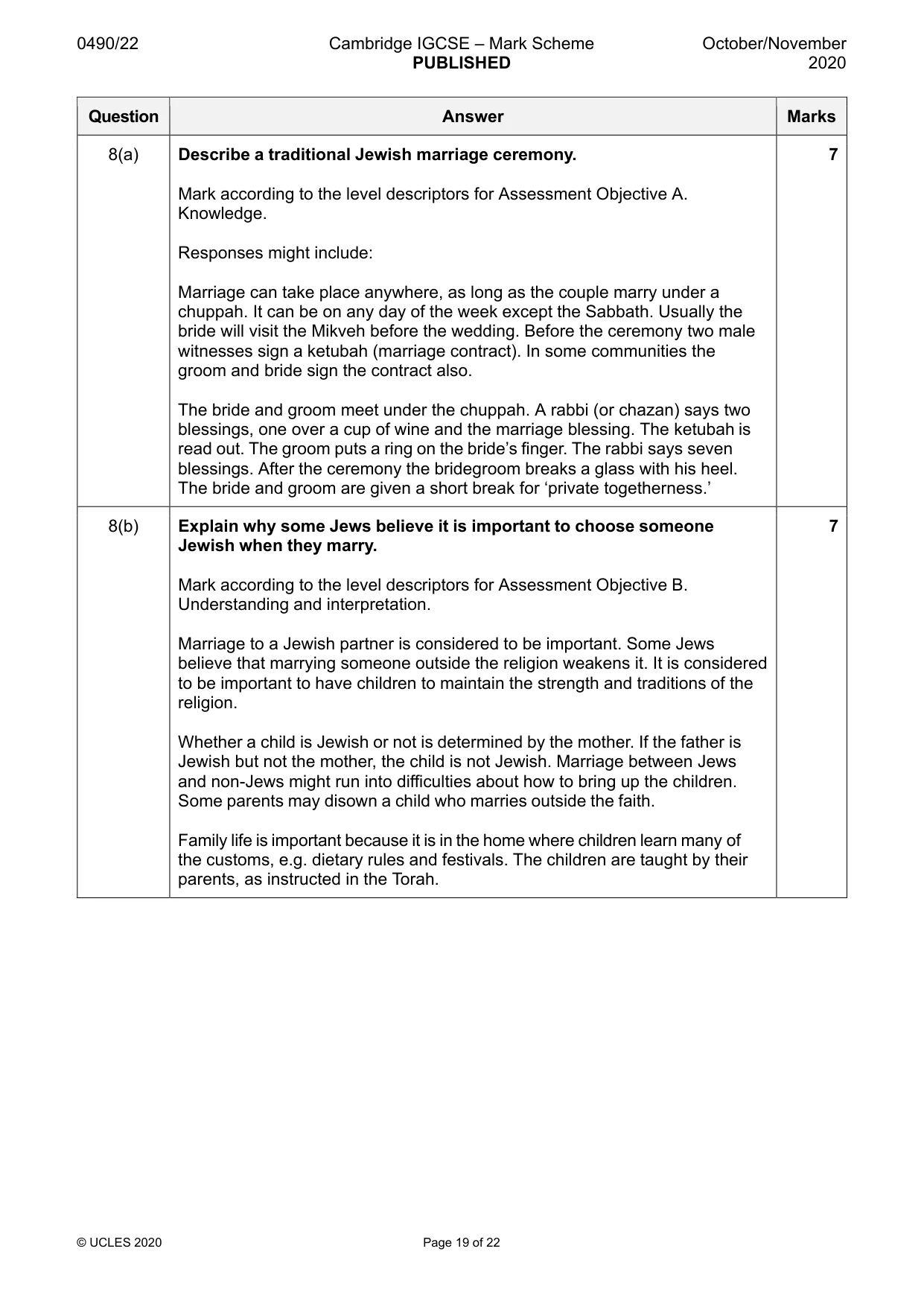
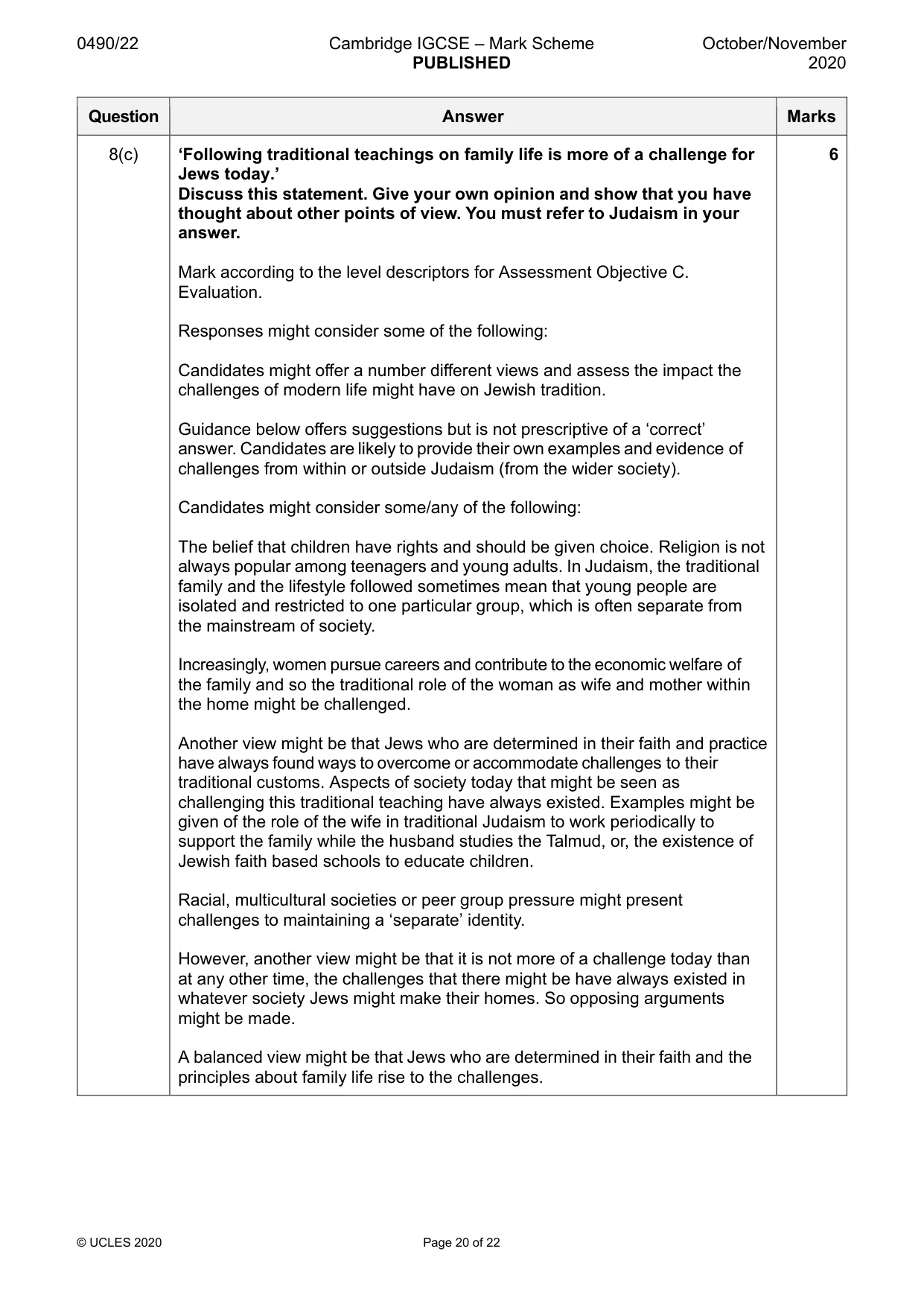
Mark scheme: 8(a) Describe a traditional Jewish marriage ceremony. 7 Mark according to the level descriptors for Assessment Objective A. Knowledge. Responses might include: Marriage can take place anywhere, as long as the couple marry under a chuppah. It can be on any day of the week except the Sabbath. Usually the bride will visit the Mikveh before the wedding. Before the ceremony two male witnesses sign a ketubah (marriage contract). In some communities the groom and bride sign the contract also. The bride and groom meet under the chuppah. A rabbi (or chazan) says two blessings, one over a cup of wine and the marriage blessing. The ketubah is read out. The groom puts a ring on the bride’s finger. The rabbi says seven blessings. After the ceremony the bridegroom breaks a glass with his heel. The bride and groom are given a short break for ‘private togetherness.’ 8(b) Explain why some Jews believe it is important to choose someone 7 Jewish when they marry. Mark according to the level descriptors for Assessment Objective B. Understanding and interpretation. Marriage to a Jewish partner is considered to be important. Some Jews believe that marrying someone outside the religion weakens it. It is considered to be important to have children to maintain the strength and traditions of the religion. Whether a child is Jewish or not is determined by the mother. If the father is Jewish but not the mother, the child is not Jewish. Marriage between Jews and non-Jews might run into difficulties about how to bring up the children. Some parents may disown a child who marries outside the faith. Family life is important because it is in the home where children learn many of the customs, e.g. dietary rules and festivals. The children are taught by their parents, as instructed in the Torah. 8(c) ‘Following traditional teachings on family life is more of a challenge for 6 Jews today.’ Discuss this statement. Give your own opinion and show that you have thought about other points of view. You must refer to Judaism in your answer. Mark according to the level descriptors for Assessment Objective C. Evaluation. Responses might consider some of the following: Candidates might offer a number different views and assess the impact the challenges of modern life might have on Jewish tradition. Guidance below offers suggestions but is not prescriptive of a ‘correct’ answer. Candidates are likely to provide their own examples and evidence of challenges from within or outside Judaism (from the wider society). Candidates might consider some/any of the following: The belief that children have rights and should be given choice. Religion is not always popular among teenagers and young adults. In Judaism, the traditional family and the lifestyle followed sometimes mean that young people are isolated and restricted to one particular group, which is often separate from the mainstream of society. Increasingly, women pursue careers and contribute to the economic welfare of the family and so the traditional role of the woman as wife and mother within the home might be challenged. Another view might be that Jews who are determined in their faith and practice have always found ways to overcome or accommodate challenges to their traditional customs. Aspects of society today that might be seen as challenging this traditional teaching have always existed. Examples might be given of the role of the wife in traditional Judaism to work periodically to support the family while the husband studies the Talmud, or, the existence of Jewish faith based schools to educate children. Racial, multicultural societies or peer group pressure might present challenges to maintaining a ‘separate’ identity. However, another view might be that it is not more of a challenge today than at any other time, the challenges that there might be have always existed in whatever society Jews might make their homes. So opposing arguments might be made. A balanced view might be that Jews who are determined in their faith and the principles about family life rise to the challenges.
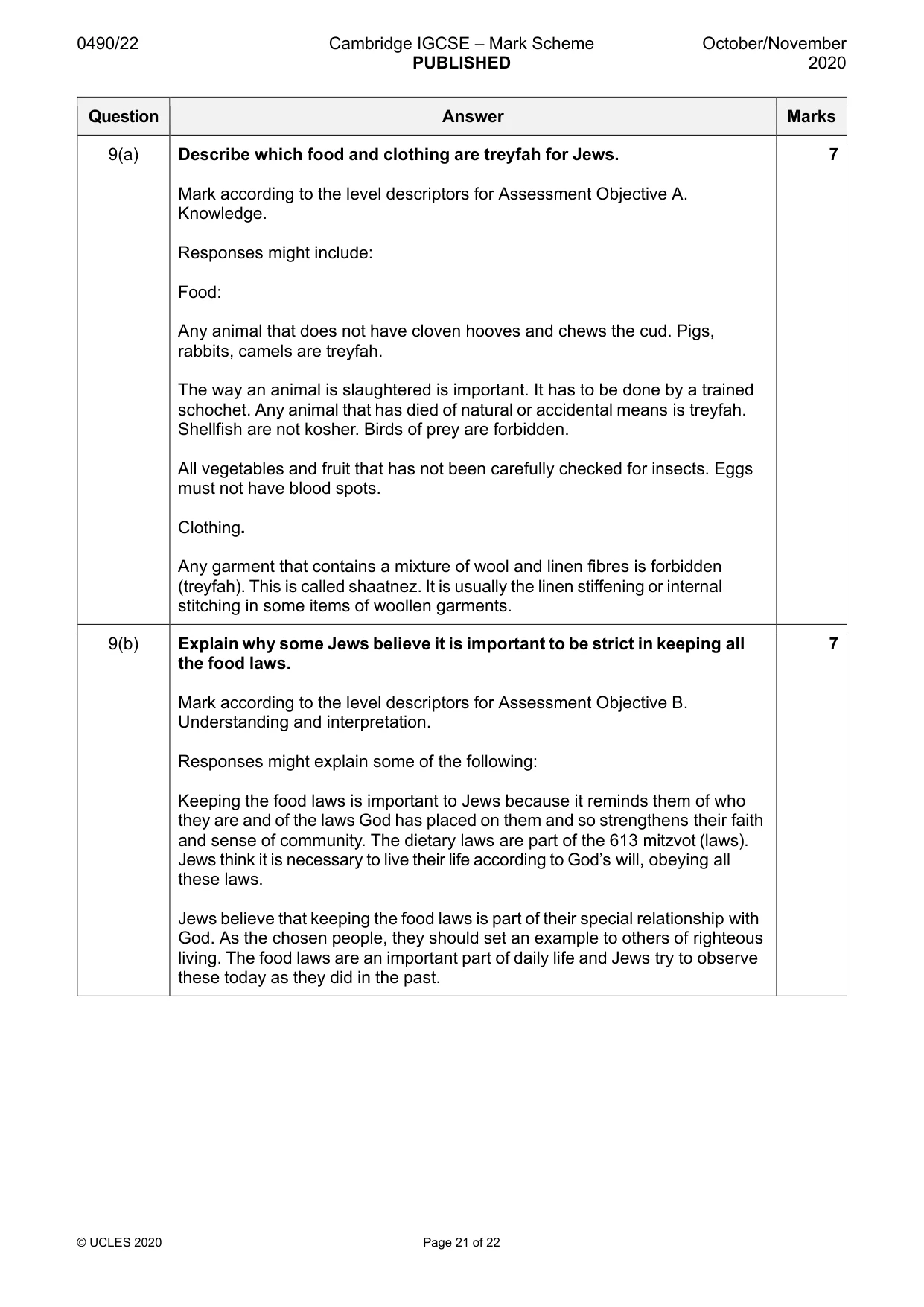
Q9 · Describe which food and clothing are treyfah for Jews
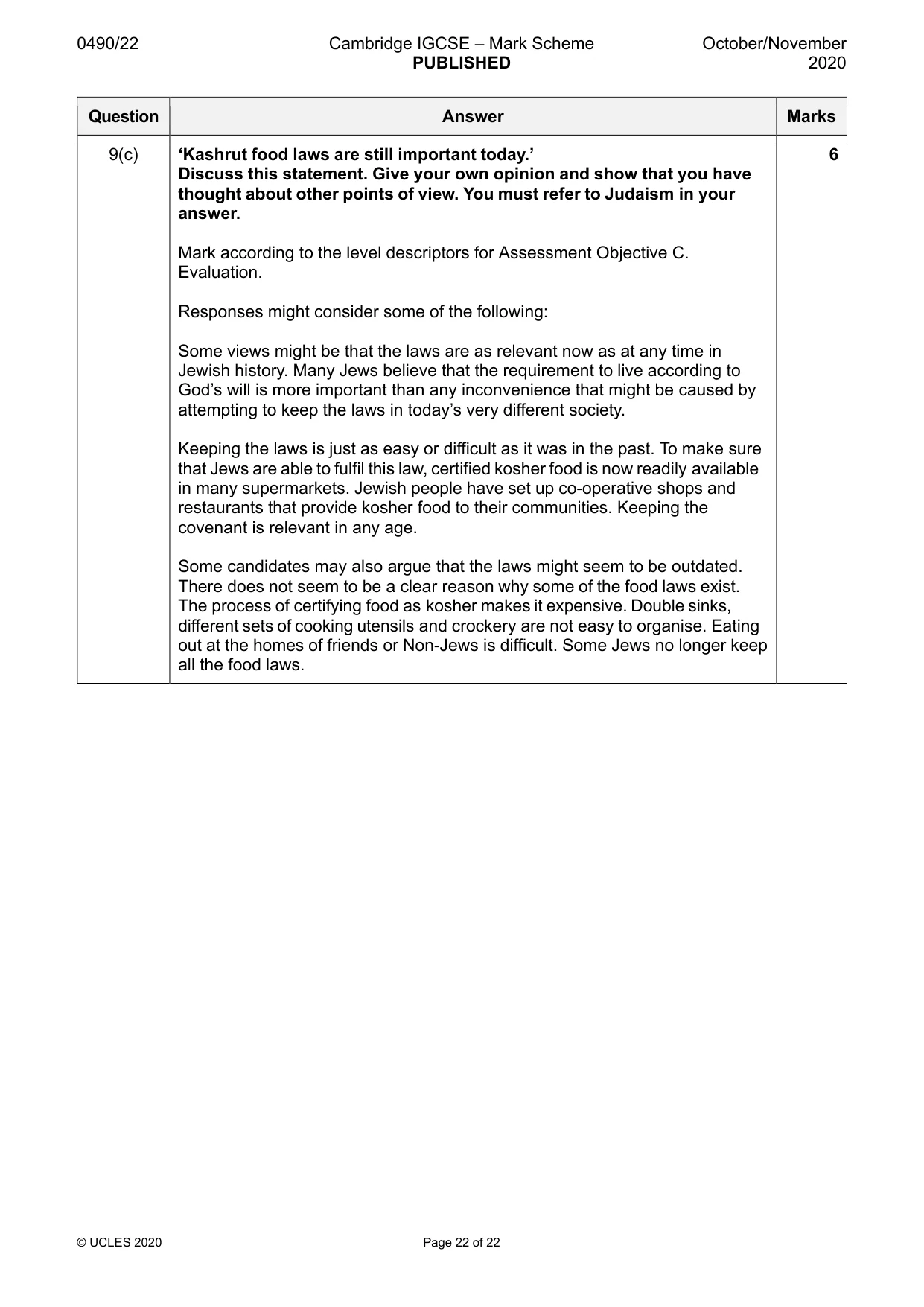
9 (a) Describe which food and clothing are treyfah for Jews. [7] (b) Explain why some Jews believe it is important to be strict in keeping all the food laws. [7] (c) ‘Kashrut food laws are still important today.’ Discuss this statement. Give your own opinion and show that you have thought about other points of view. You must refer to Judaism in your answer. [6] [Total: 20]
Mark scheme: 9(a) Describe which food and clothing are treyfah for Jews. 7 Mark according to the level descriptors for Assessment Objective A. Knowledge. Responses might include: Food: Any animal that does not have cloven hooves and chews the cud. Pigs, rabbits, camels are treyfah. The way an animal is slaughtered is important. It has to be done by a trained schochet. Any animal that has died of natural or accidental means is treyfah. Shellfish are not kosher. Birds of prey are forbidden. All vegetables and fruit that has not been carefully checked for insects. Eggs must not have blood spots. Clothing. Any garment that contains a mixture of wool and linen fibres is forbidden (treyfah). This is called shaatnez. It is usually the linen stiffening or internal stitching in some items of woollen garments. 9(b) Explain why some Jews believe it is important to be strict in keeping all 7 the food laws. Mark according to the level descriptors for Assessment Objective B. Understanding and interpretation. Responses might explain some of the following: Keeping the food laws is important to Jews because it reminds them of who they are and of the laws God has placed on them and so strengthens their faith and sense of community. The dietary laws are part of the 613 mitzvot (laws). Jews think it is necessary to live their life according to God’s will, obeying all these laws. Jews believe that keeping the food laws is part of their special relationship with God. As the chosen people, they should set an example to others of righteous living. The food laws are an important part of daily life and Jews try to observe these today as they did in the past. 9(c) ‘Kashrut food laws are still important today.’ 6 Discuss this statement. Give your own opinion and show that you have thought about other points of view. You must refer to Judaism in your answer. Mark according to the level descriptors for Assessment Objective C. Evaluation. Responses might consider some of the following: Some views might be that the laws are as relevant now as at any time in Jewish history. Many Jews believe that the requirement to live according to God’s will is more important than any inconvenience that might be caused by attempting to keep the laws in today’s very different society. Keeping the laws is just as easy or difficult as it was in the past. To make sure that Jews are able to fulfil this law, certified kosher food is now readily available in many supermarkets. Jewish people have set up co-operative shops and restaurants that provide kosher food to their communities. Keeping the covenant is relevant in any age. Some candidates may also argue that the laws might seem to be outdated. There does not seem to be a clear reason why some of the food laws exist. The process of certifying food as kosher makes it expensive. Double sinks, different sets of cooking utensils and crockery are not easy to organise. Eating out at the homes of friends or Non-Jews is difficult. Some Jews no longer keep all the food laws.
What was in this paper
The subtopics covered by these 9 questions, and how many questions each got. Open one in a new tab to see every Cambridge question on it.
1Christian beliefs about family life in different Christian communities1Christianity as a religion that shows concern for others1Christmas1Funeral rites: the key features and importance of funeral rites in Islam1Kashrut (the laws of kosher/‘fit’) and treyfah (‘forbidden’)1Marriage ceremonies: the key features and importance of marriage ceremonies in Judaism1Performance of Hajj: the meaning and importance of places, actions and stages in the Hajj1ʿId al-Adha (feast of sacrifice)1What you needed in this session
Cambridge’s own grade thresholds for 2020 Oct/Nov, Paper 2 · Variant 2. A higher threshold means an easier paper — the bar moves with how the cohort did.