Cambridge IGCSE Religious Studies 0490 — 2018 Oct/Nov Paper 2 · Variant 3
0490/23/O/N/18 · 9 questions · 80 marks · ≈90 min
The question paper and its mark scheme, free to read here and free to download. This is Cambridge’s own paper, exactly as it was sat.
Question paper4 pages
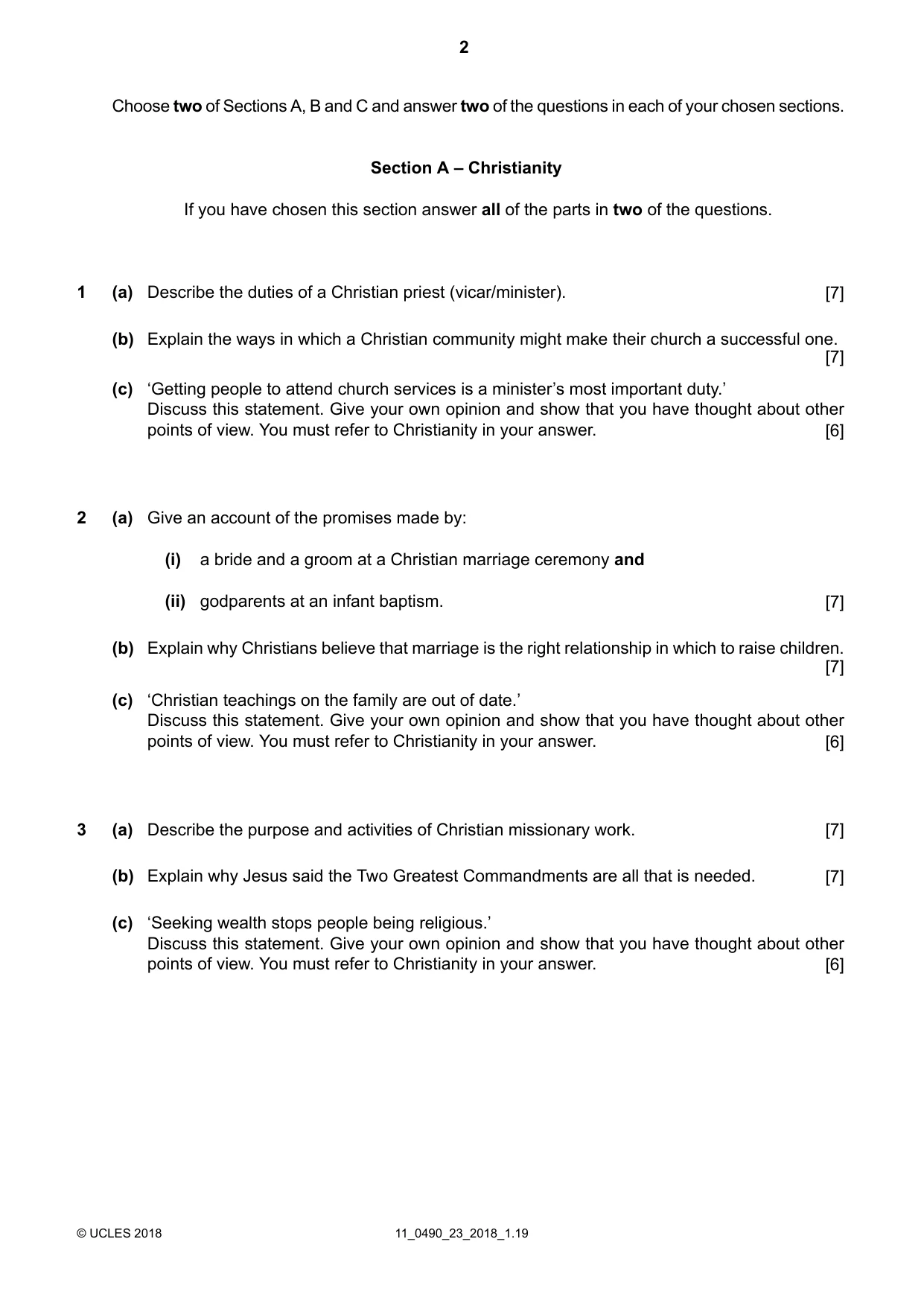
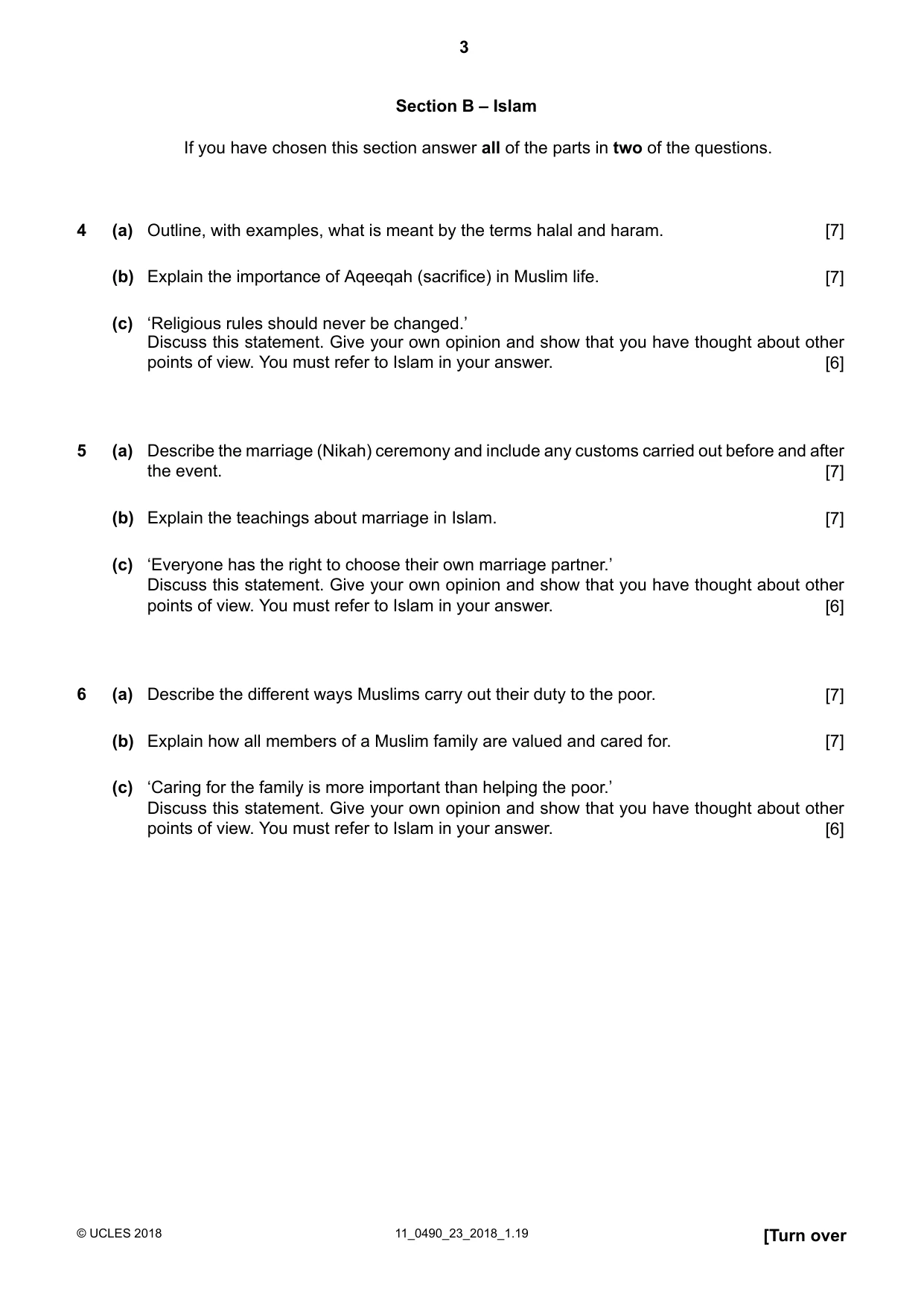
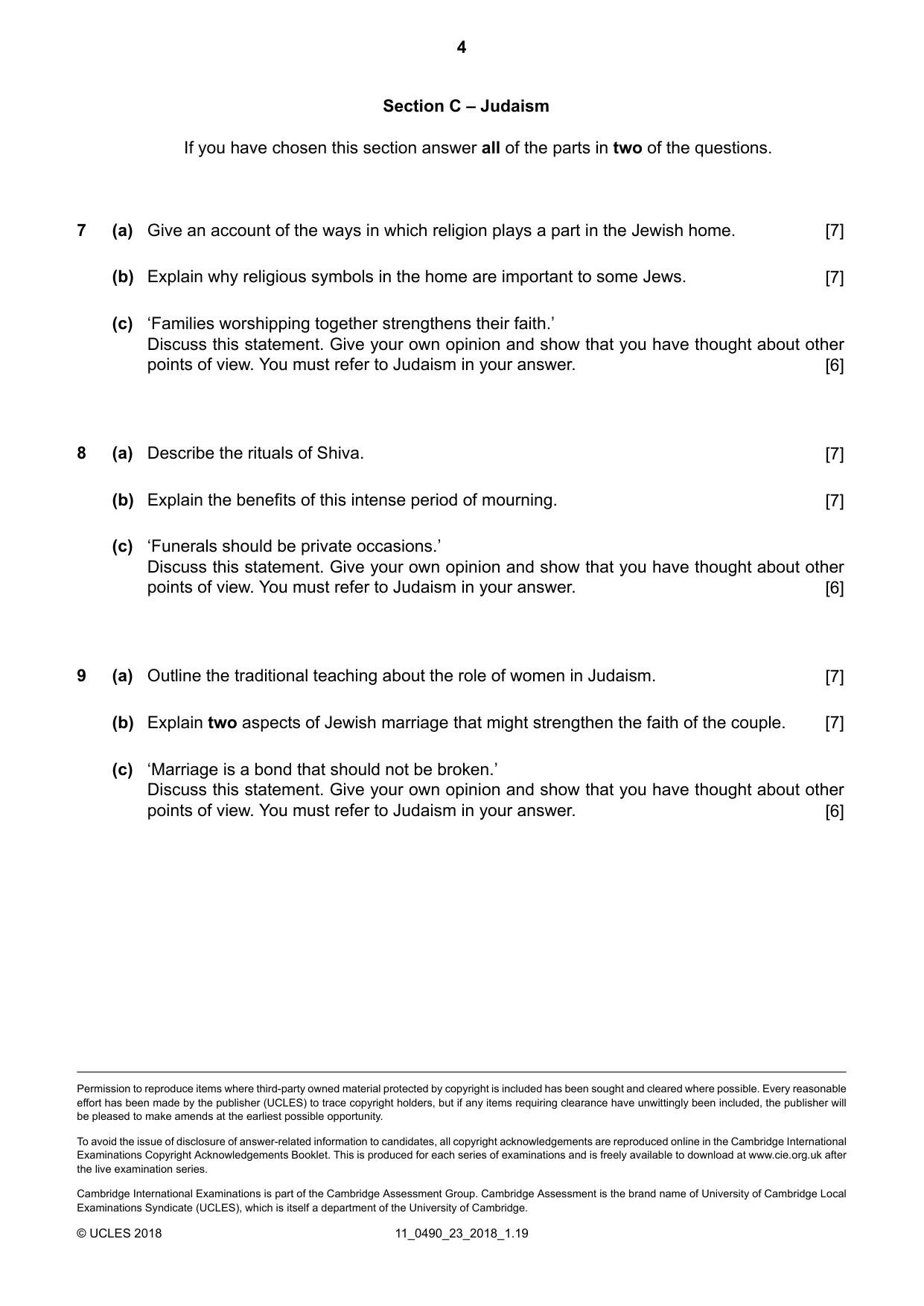
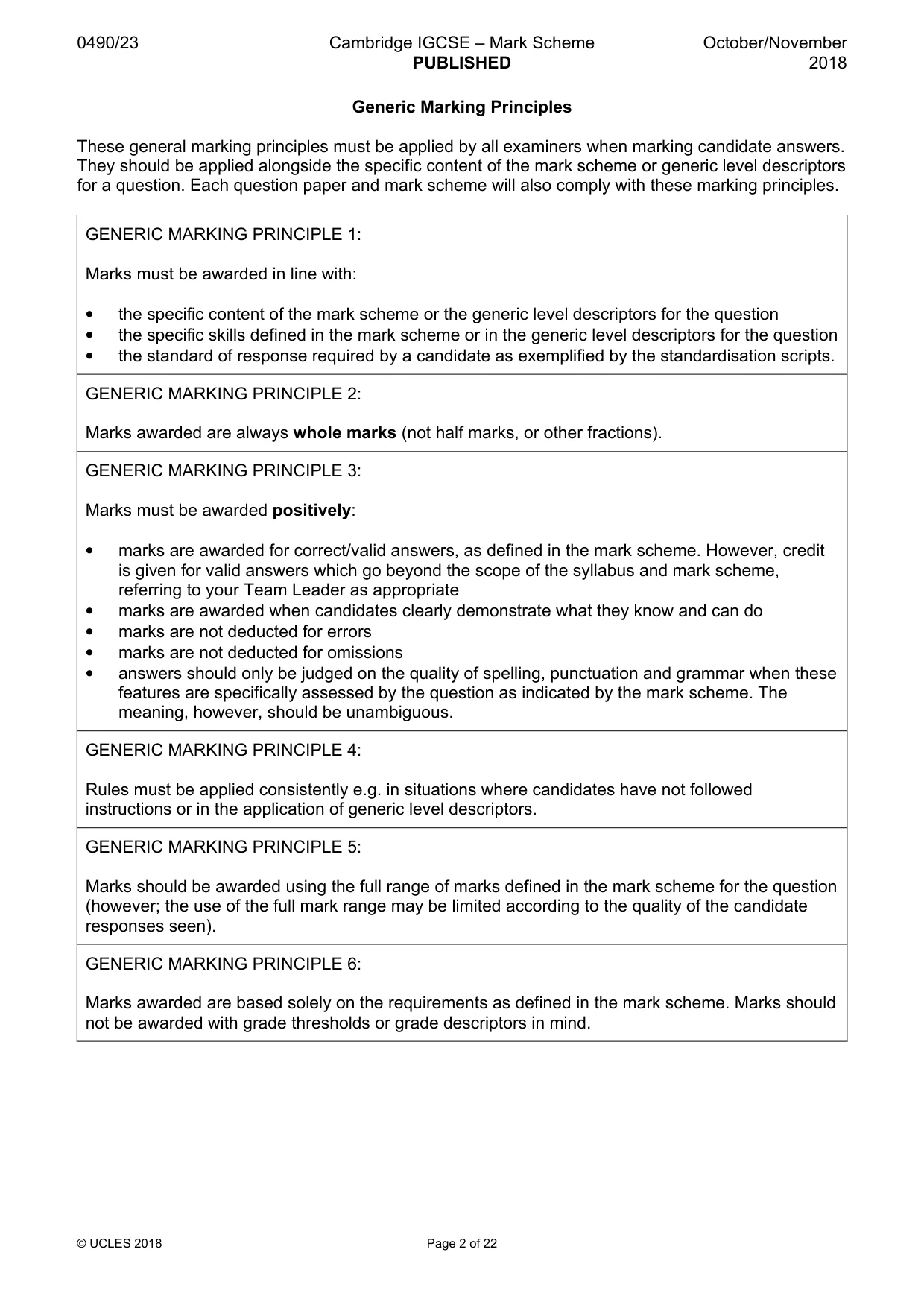
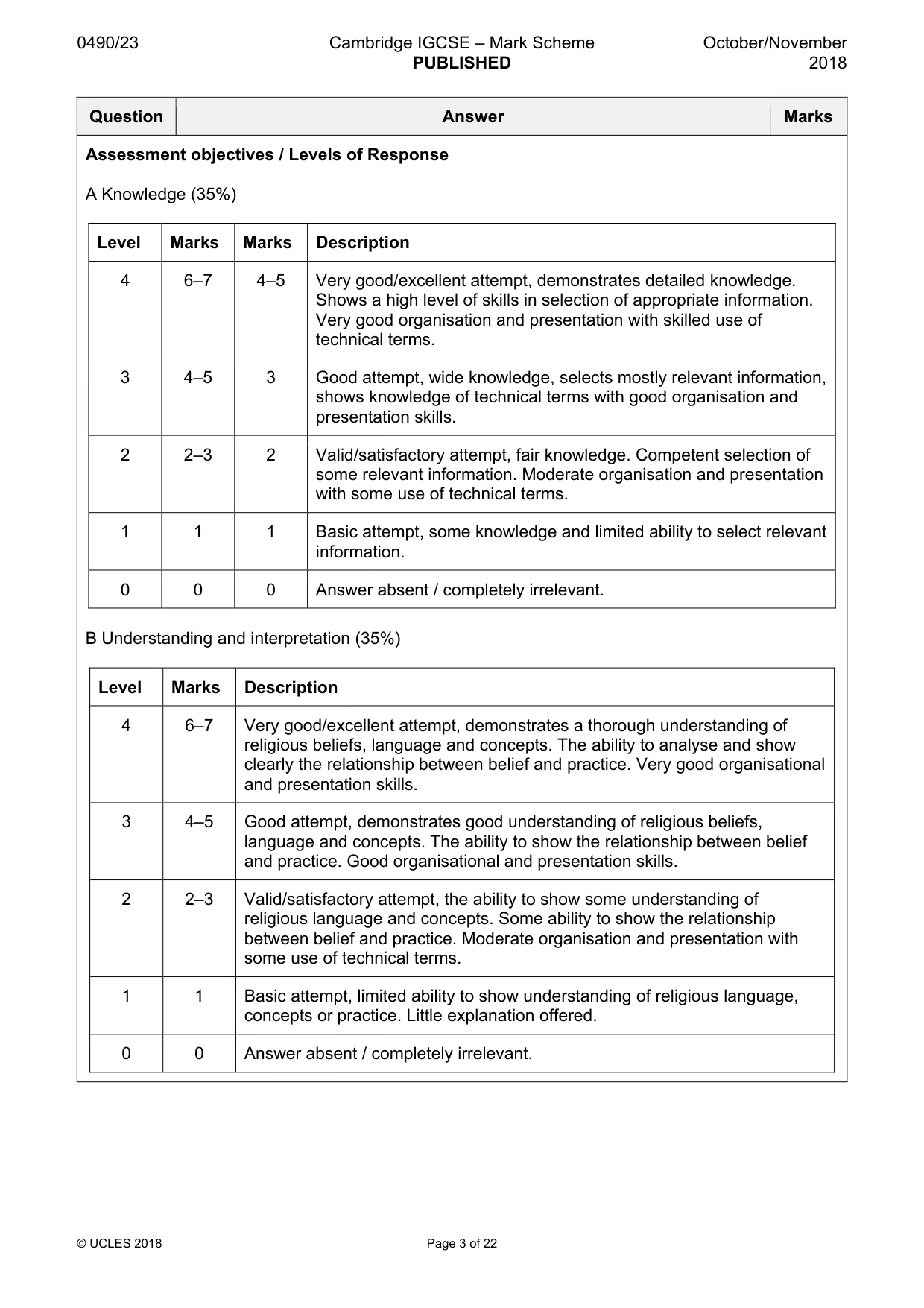
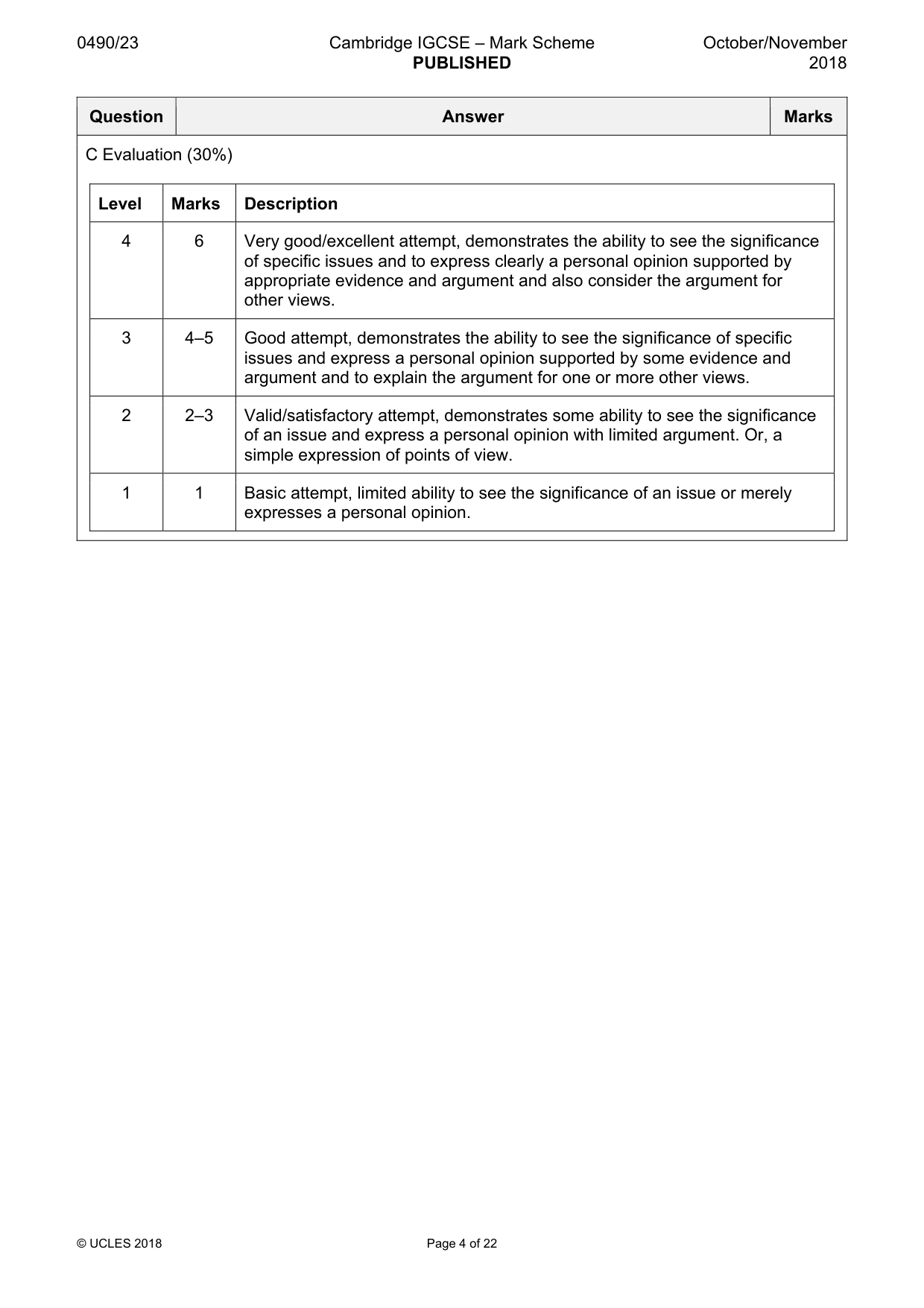
Mark scheme22 pages
Answers below. Sit the paper first if you are practising.
Questions as text
Q1 · Describe the duties of a Christian priest (vicar/minister)
1 (a) Describe the duties of a Christian priest (vicar/minister). [7] (b) Explain the ways in which a Christian community might make their church a successful one. [7] (c) ‘Getting people to attend church services is a minister’s most important duty.’ Discuss this statement. Give your own opinion and show that you have thought about other points of view. You must refer to Christianity in your answer. [6]
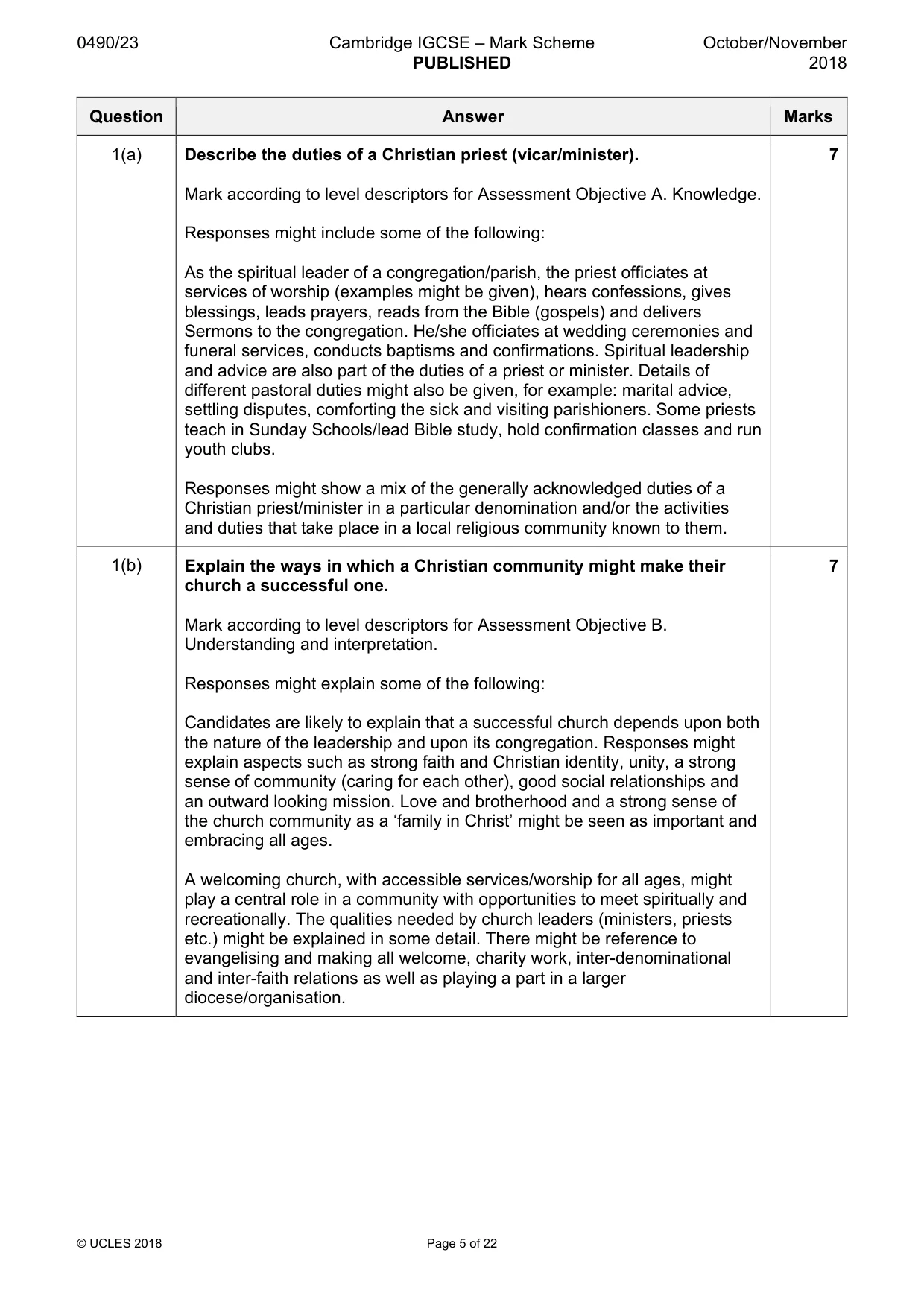
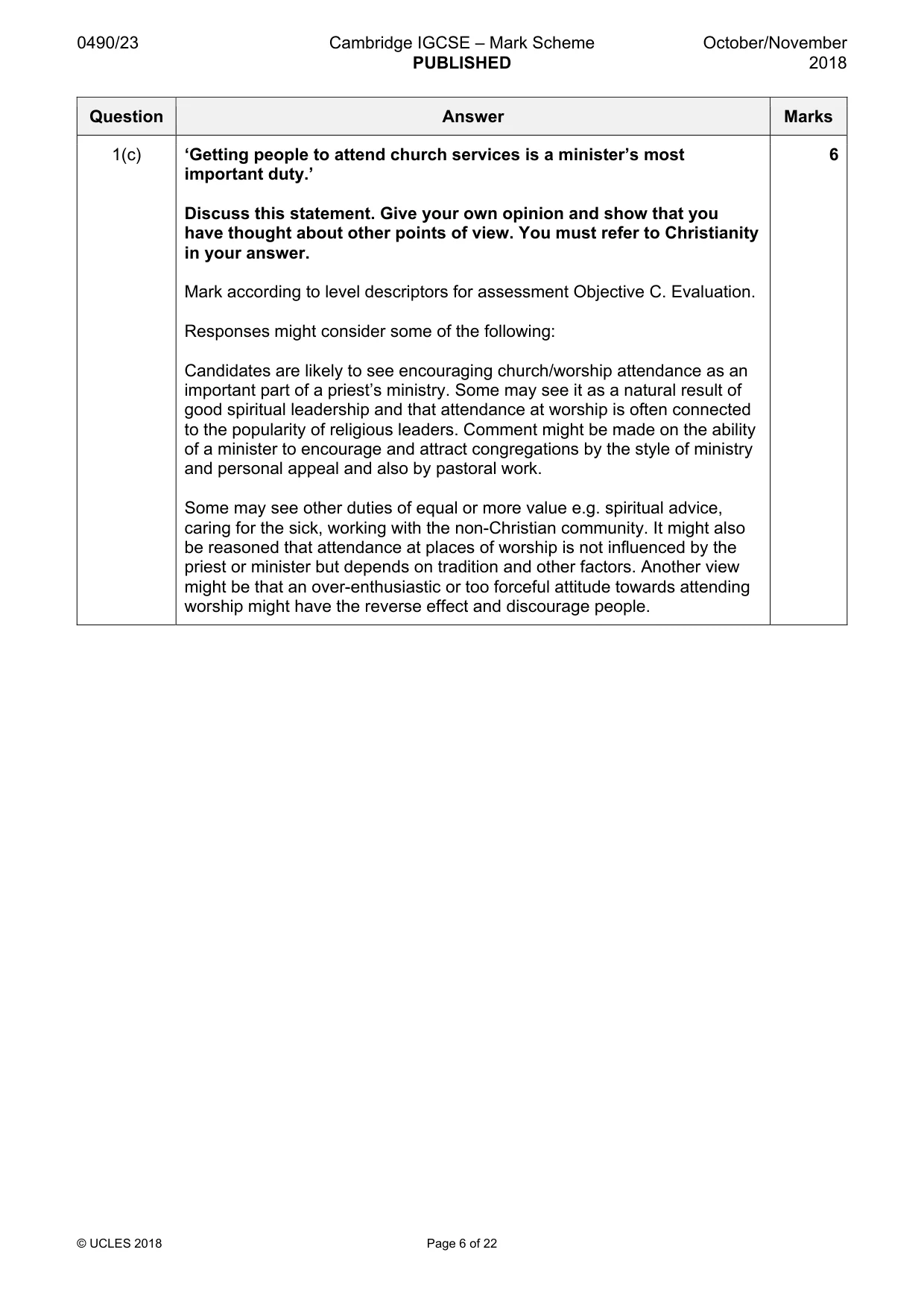
Mark scheme: Question Answer Marks 1(a) Describe the duties of a Christian priest (vicar/minister). 7 Mark according to level descriptors for Assessment Objective A. Knowledge. Responses might include some of the following: As the spiritual leader of a congregation/parish, the priest officiates at services of worship (examples might be given), hears confessions, gives blessings, leads prayers, reads from the Bible (gospels) and delivers Sermons to the congregation. He/she officiates at wedding ceremonies and funeral services, conducts baptisms and confirmations. Spiritual leadership and advice are also part of the duties of a priest or minister. Details of different pastoral duties might also be given, for example: marital advice, settling disputes, comforting the sick and visiting parishioners. Some priests teach in Sunday Schools/lead Bible study, hold confirmation classes and run youth clubs. Responses might show a mix of the generally acknowledged duties of a Christian priest/minister in a particular denomination and/or the activities and duties that take place in a local religious community known to them. 1(b) Explain the ways in which a Christian community might make their 7 church a successful one. Mark according to level descriptors for Assessment Objective B. Understanding and interpretation. Responses might explain some of the following: Candidates are likely to explain that a successful church depends upon both the nature of the leadership and upon its congregation. Responses might explain aspects such as strong faith and Christian identity, unity, a strong sense of community (caring for each other), good social relationships and an outward looking mission. Love and brotherhood and a strong sense of the church community as a ‘family in Christ’ might be seen as important and embracing all ages. A welcoming church, with accessible services/worship for all ages, might play a central role in a community with opportunities to meet spiritually and recreationally. The qualities needed by church leaders (ministers, priests etc.) might be explained in some detail. There might be reference to evangelising and making all welcome, charity work, inter-denominational and inter-faith relations as well as playing a part in a larger diocese/organisation. 1(c) ‘Getting people to attend church services is a minister’s most 6 important duty.’ Discuss this statement. Give your own opinion and show that you have thought about other points of view. You must refer to Christianity in your answer. Mark according to level descriptors for assessment Objective C. Evaluation. Responses might consider some of the following: Candidates are likely to see encouraging church/worship attendance as an important part of a priest’s ministry. Some may see it as a natural result of good spiritual leadership and that attendance at worship is often connected to the popularity of religious leaders. Comment might be made on the ability of a minister to encourage and attract congregations by the style of ministry and personal appeal and also by pastoral work. Some may see other duties of equal or more value e.g. spiritual advice, caring for the sick, working with the non-Christian community. It might also be reasoned that attendance at places of worship is not influenced by the priest or minister but depends on tradition and other factors. Another view might be that an over-enthusiastic or too forceful attitude towards attending worship might have the reverse effect and discourage people.
Q2 · Give an account of the promises made by: (i) a bride and a groom at a Christian marriage…
2 (a) Give an account of the promises made by: (i) a bride and a groom at a Christian marriage ceremony and (ii) godparents at an infant baptism. [7] (b) Explain why Christians believe that marriage is the right relationship in which to raise children. [7] (c) ‘Christian teachings on the family are out of date.’ Discuss this statement. Give your own opinion and show that you have thought about other points of view. You must refer to Christianity in your answer. [6]
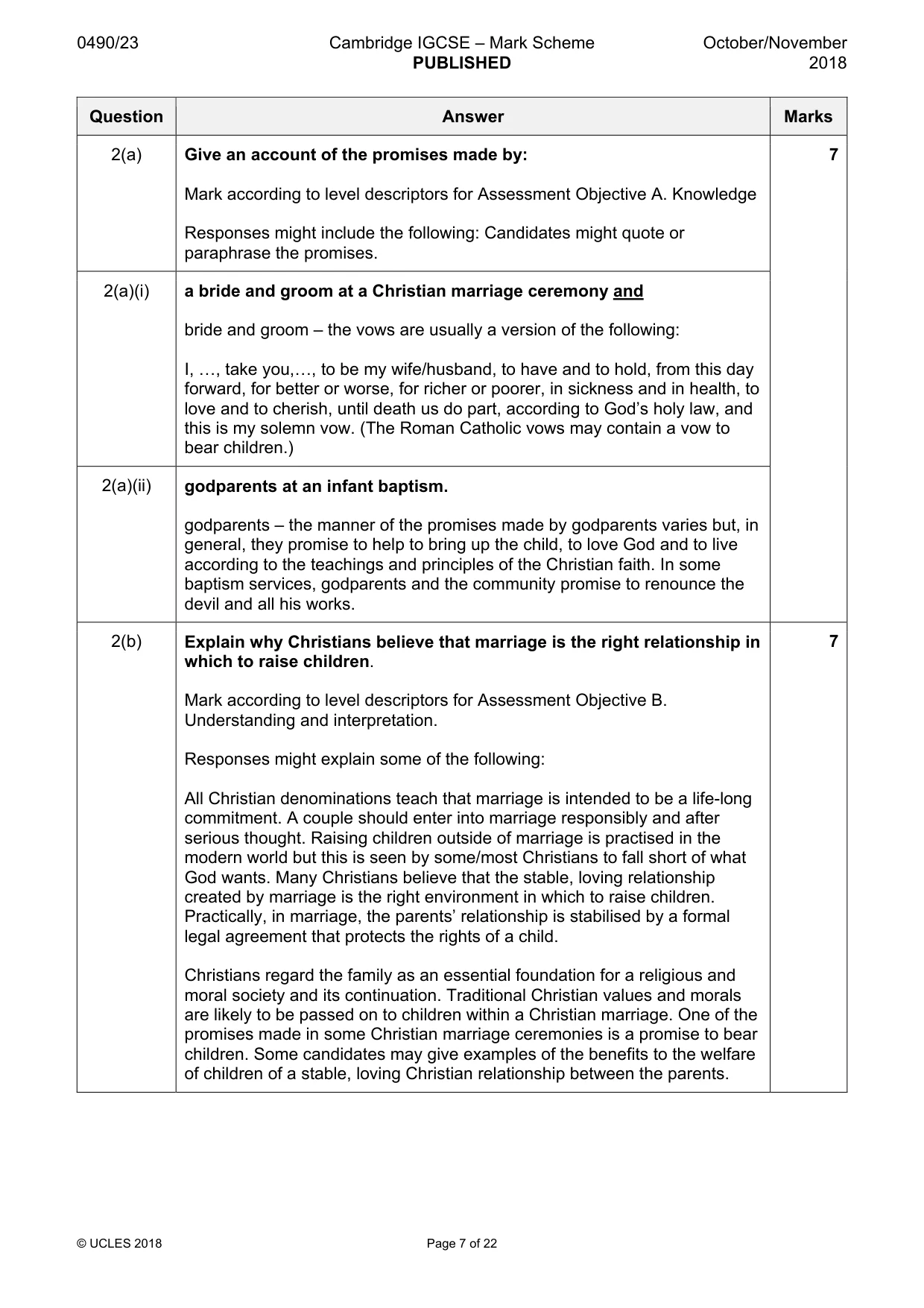
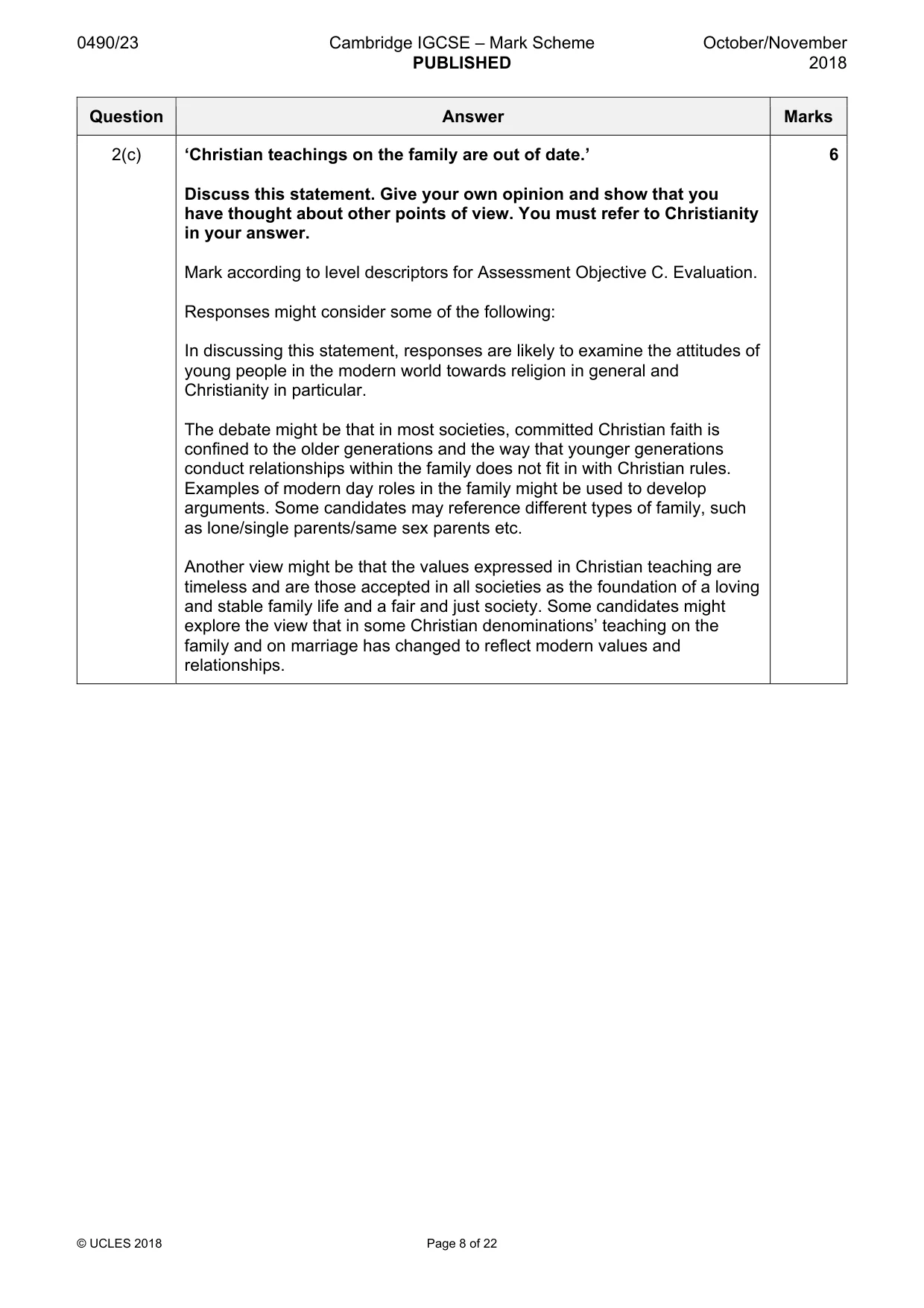
Mark scheme: 2(a) Give an account of the promises made by: 7 Mark according to level descriptors for Assessment Objective A. Knowledge Responses might include the following: Candidates might quote or paraphrase the promises. 2(a)(i) a bride and groom at a Christian marriage ceremony and bride and groom – the vows are usually a version of the following: I, «, take you,«, to be my wife/husband, to have and to hold, from this day forward, for better or worse, for richer or poorer, in sickness and in health, to love and to cherish, until death us do part, according to God’s holy law, and this is my solemn vow. (The Roman Catholic vows may contain a vow to bear children.) 2(a)(ii) godparents at an infant baptism. godparents – the manner of the promises made by godparents varies but, in general, they promise to help to bring up the child, to love God and to live according to the teachings and principles of the Christian faith. In some baptism services, godparents and the community promise to renounce the devil and all his works. 2(b) Explain why Christians believe that marriage is the right relationship in 7 which to raise children. Mark according to level descriptors for Assessment Objective B. Understanding and interpretation. Responses might explain some of the following: All Christian denominations teach that marriage is intended to be a life-long commitment. A couple should enter into marriage responsibly and after serious thought. Raising children outside of marriage is practised in the modern world but this is seen by some/most Christians to fall short of what God wants. Many Christians believe that the stable, loving relationship created by marriage is the right environment in which to raise children. Practically, in marriage, the parents’ relationship is stabilised by a formal legal agreement that protects the rights of a child. Christians regard the family as an essential foundation for a religious and moral society and its continuation. Traditional Christian values and morals are likely to be passed on to children within a Christian marriage. One of the promises made in some Christian marriage ceremonies is a promise to bear children. Some candidates may give examples of the benefits to the welfare of children of a stable, loving Christian relationship between the parents. 2(c) ‘Christian teachings on the family are out of date.’ 6 Discuss this statement. Give your own opinion and show that you have thought about other points of view. You must refer to Christianity in your answer. Mark according to level descriptors for Assessment Objective C. Evaluation. Responses might consider some of the following: In discussing this statement, responses are likely to examine the attitudes of young people in the modern world towards religion in general and Christianity in particular. The debate might be that in most societies, committed Christian faith is confined to the older generations and the way that younger generations conduct relationships within the family does not fit in with Christian rules. Examples of modern day roles in the family might be used to develop arguments. Some candidates may reference different types of family, such as lone/single parents/same sex parents etc. Another view might be that the values expressed in Christian teaching are timeless and are those accepted in all societies as the foundation of a loving and stable family life and a fair and just society. Some candidates might explore the view that in some Christian denominations’ teaching on the family and on marriage has changed to reflect modern values and relationships.
Q3 · Describe the purpose and activities of Christian missionary work
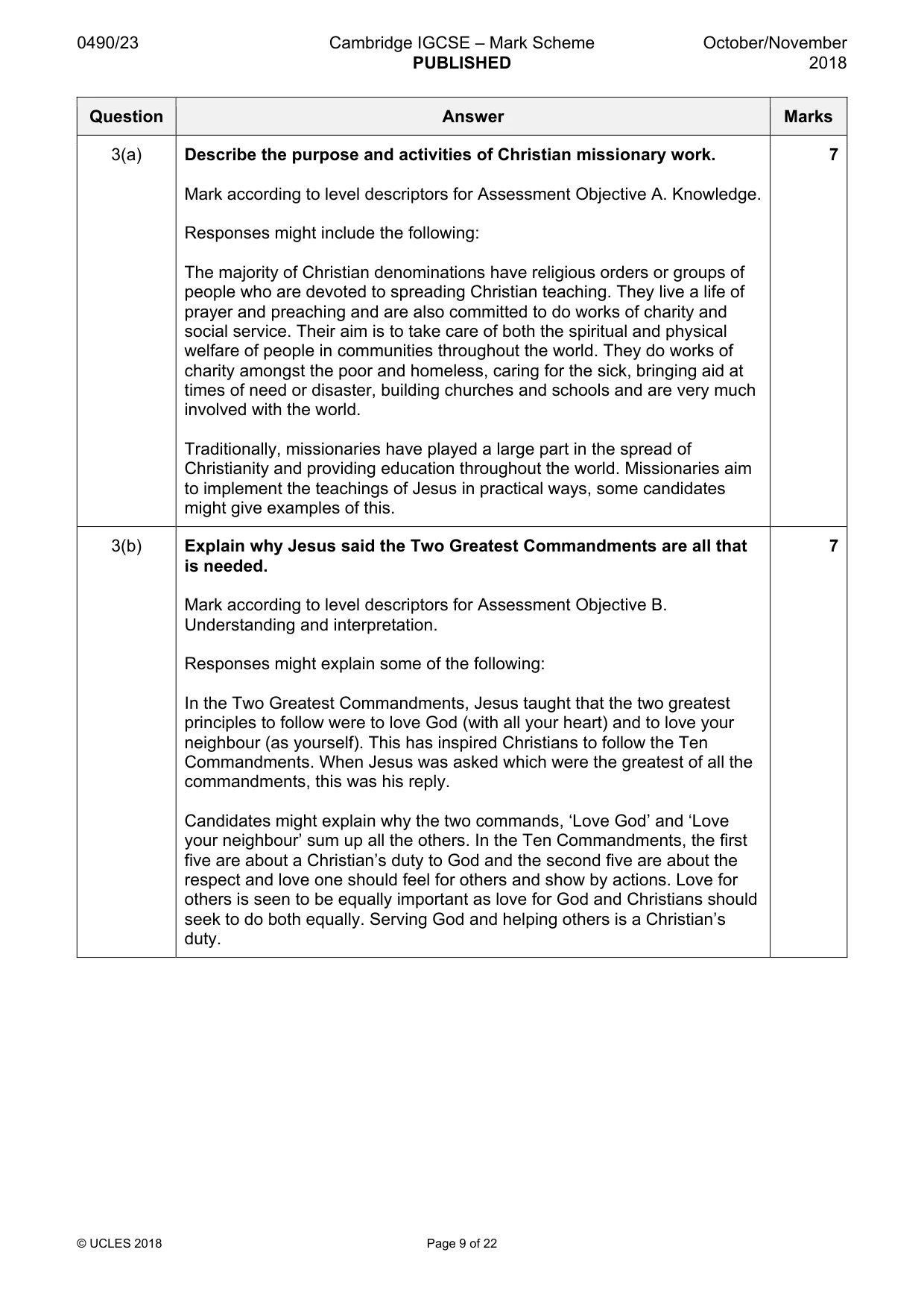
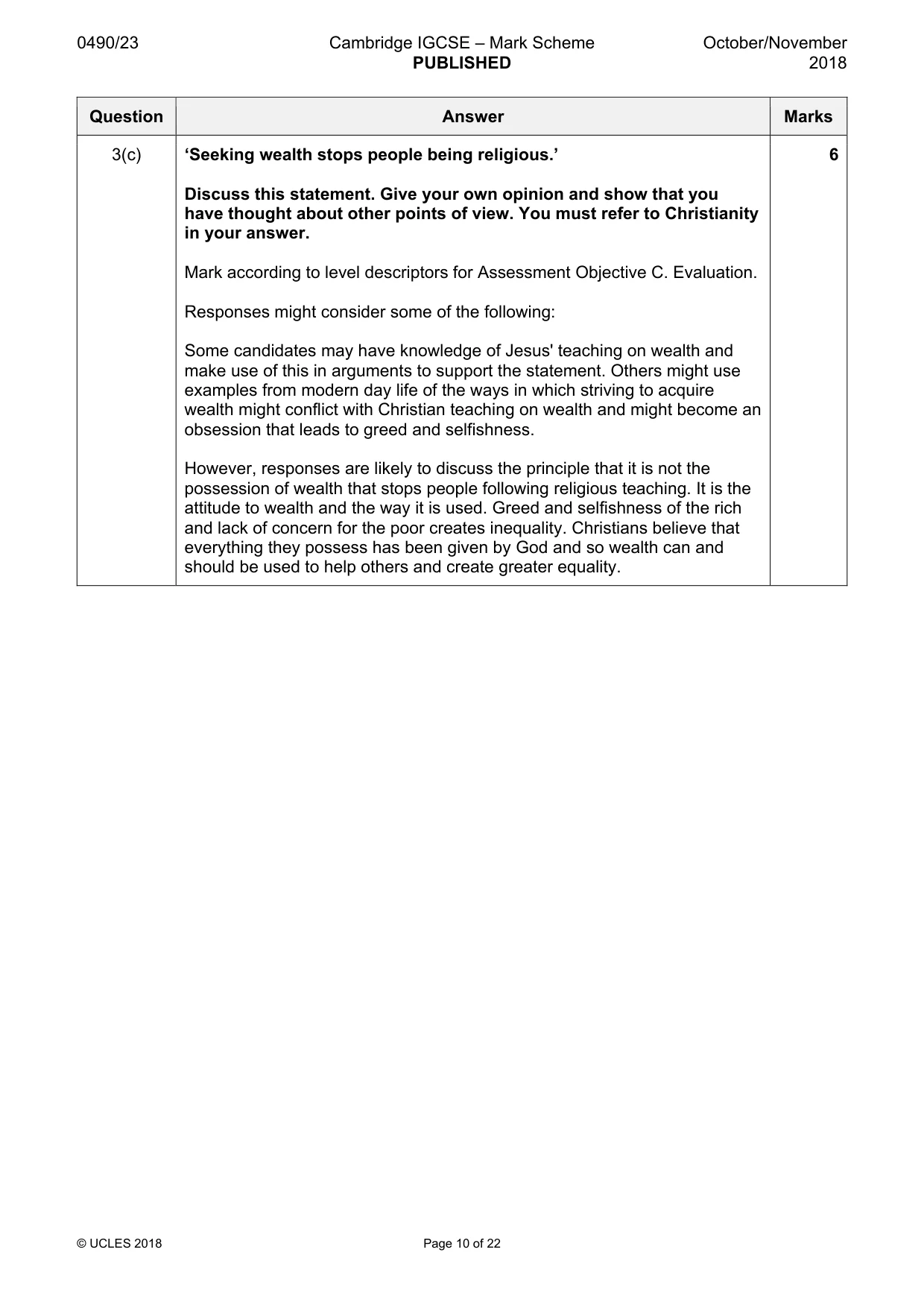
3 (a) Describe the purpose and activities of Christian missionary work. [7] (b) Explain why Jesus said the Two Greatest Commandments are all that is needed. [7] (c) ‘Seeking wealth stops people being religious.’ Discuss this statement. Give your own opinion and show that you have thought about other points of view. You must refer to Christianity in your answer. [6]
Mark scheme: 3(a) Describe the purpose and activities of Christian missionary work. 7 Mark according to level descriptors for Assessment Objective A. Knowledge. Responses might include the following: The majority of Christian denominations have religious orders or groups of people who are devoted to spreading Christian teaching. They live a life of prayer and preaching and are also committed to do works of charity and social service. Their aim is to take care of both the spiritual and physical welfare of people in communities throughout the world. They do works of charity amongst the poor and homeless, caring for the sick, bringing aid at times of need or disaster, building churches and schools and are very much involved with the world. Traditionally, missionaries have played a large part in the spread of Christianity and providing education throughout the world. Missionaries aim to implement the teachings of Jesus in practical ways, some candidates might give examples of this. 3(b) Explain why Jesus said the Two Greatest Commandments are all that 7 is needed. Mark according to level descriptors for Assessment Objective B. Understanding and interpretation. Responses might explain some of the following: In the Two Greatest Commandments, Jesus taught that the two greatest principles to follow were to love God (with all your heart) and to love your neighbour (as yourself). This has inspired Christians to follow the Ten Commandments. When Jesus was asked which were the greatest of all the commandments, this was his reply. Candidates might explain why the two commands, ‘Love God’ and ‘Love your neighbour’ sum up all the others. In the Ten Commandments, the first five are about a Christian’s duty to God and the second five are about the respect and love one should feel for others and show by actions. Love for others is seen to be equally important as love for God and Christians should seek to do both equally. Serving God and helping others is a Christian’s duty. 3(c) ‘Seeking wealth stops people being religious.’ 6 Discuss this statement. Give your own opinion and show that you have thought about other points of view. You must refer to Christianity in your answer. Mark according to level descriptors for Assessment Objective C. Evaluation. Responses might consider some of the following: Some candidates may have knowledge of Jesus' teaching on wealth and make use of this in arguments to support the statement. Others might use examples from modern day life of the ways in which striving to acquire wealth might conflict with Christian teaching on wealth and might become an obsession that leads to greed and selfishness. However, responses are likely to discuss the principle that it is not the possession of wealth that stops people following religious teaching. It is the attitude to wealth and the way it is used. Greed and selfishness of the rich and lack of concern for the poor creates inequality. Christians believe that everything they possess has been given by God and so wealth can and should be used to help others and create greater equality.
Q4 · Outline, with examples, what is meant by the terms halal and haram
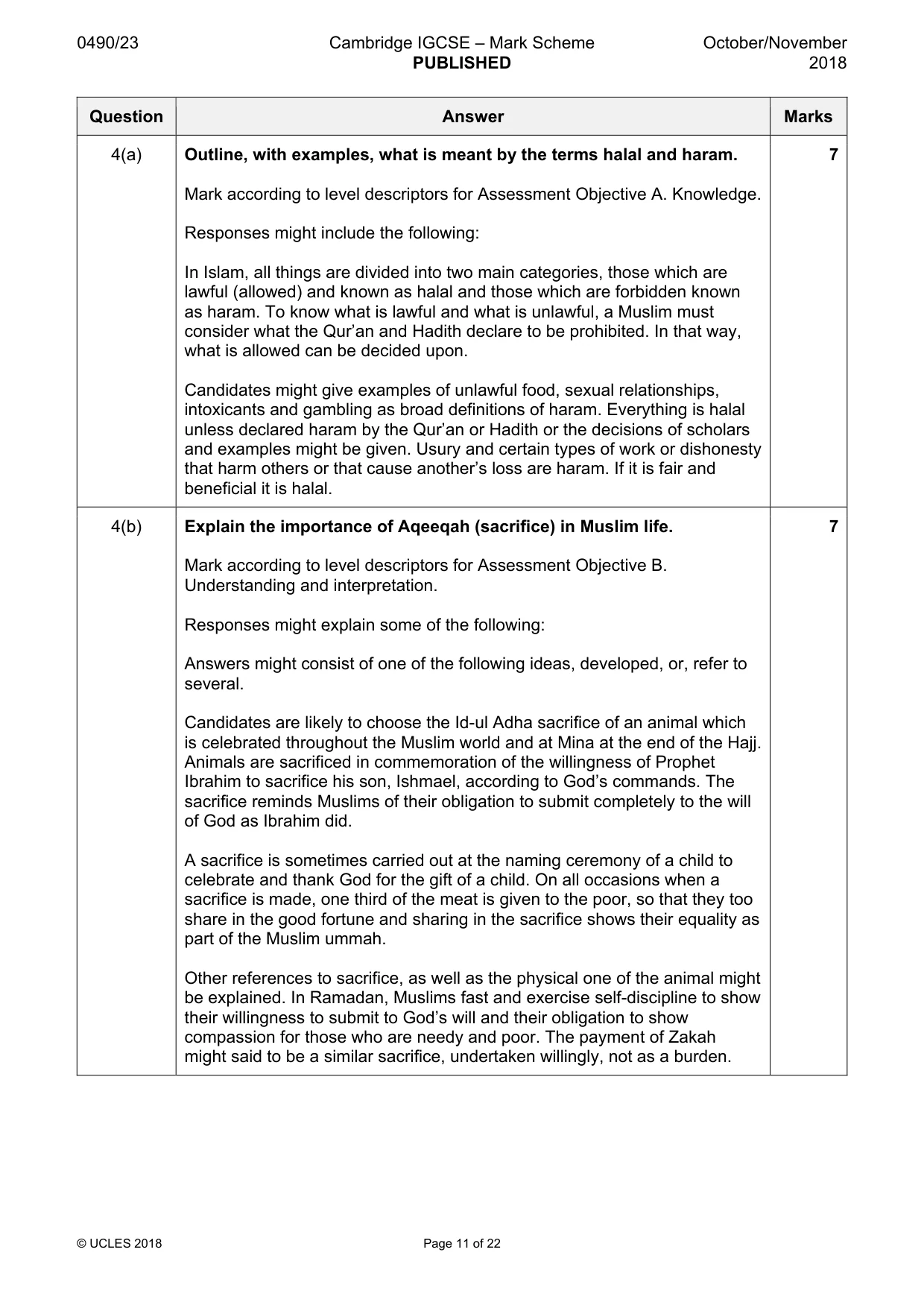
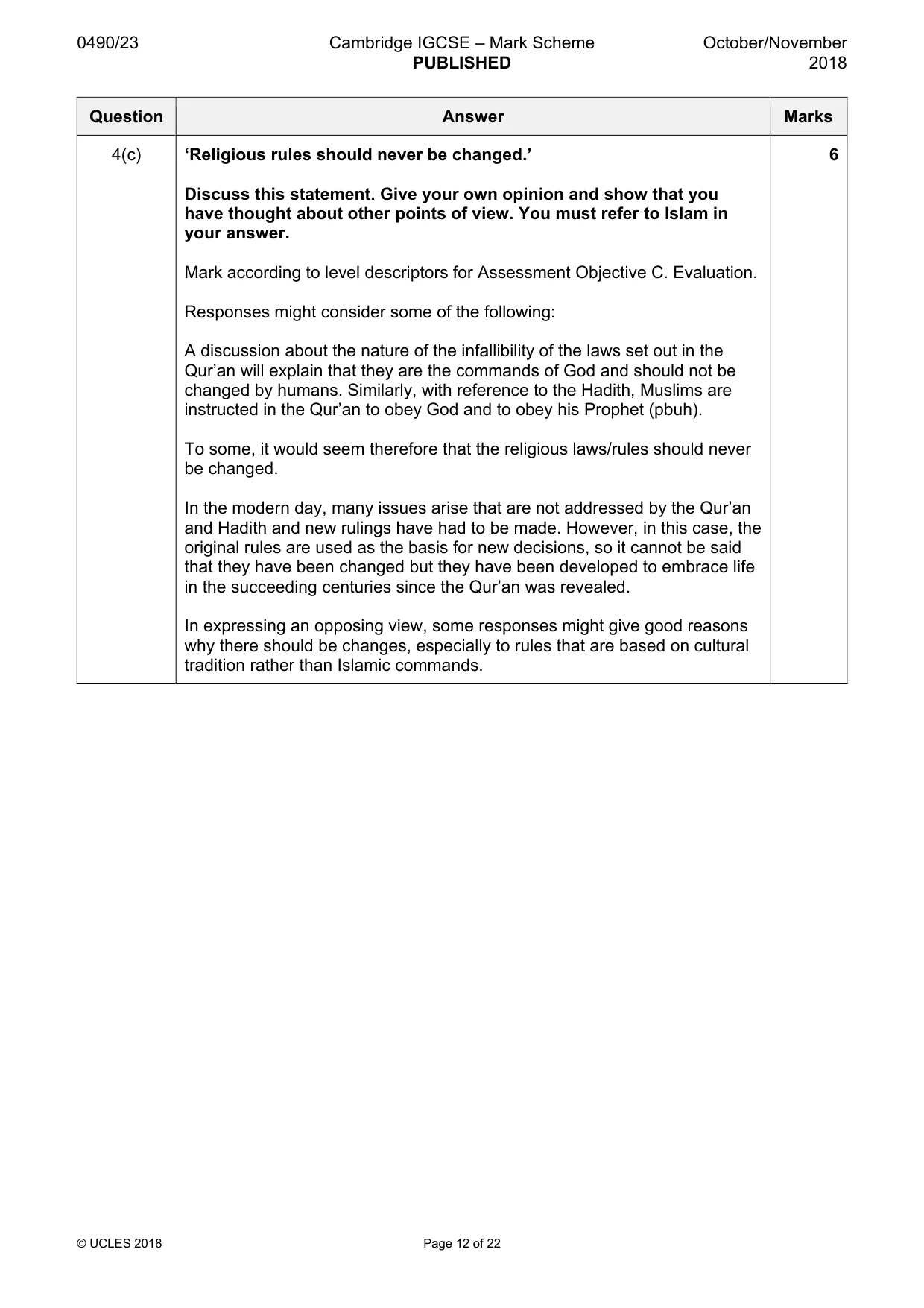
4 (a) Outline, with examples, what is meant by the terms halal and haram. [7] (b) Explain the importance of Aqeeqah (sacrifice) in Muslim life. [7] (c) ‘Religious rules should never be changed.’ Discuss this statement. Give your own opinion and show that you have thought about other points of view. You must refer to Islam in your answer. [6]
Mark scheme: 4(a) Outline, with examples, what is meant by the terms halal and haram. 7 Mark according to level descriptors for Assessment Objective A. Knowledge. Responses might include the following: In Islam, all things are divided into two main categories, those which are lawful (allowed) and known as halal and those which are forbidden known as haram. To know what is lawful and what is unlawful, a Muslim must consider what the Qur’an and Hadith declare to be prohibited. In that way, what is allowed can be decided upon. Candidates might give examples of unlawful food, sexual relationships, intoxicants and gambling as broad definitions of haram. Everything is halal unless declared haram by the Qur’an or Hadith or the decisions of scholars and examples might be given. Usury and certain types of work or dishonesty that harm others or that cause another’s loss are haram. If it is fair and beneficial it is halal. 4(b) Explain the importance of Aqeeqah (sacrifice) in Muslim life. 7 Mark according to level descriptors for Assessment Objective B. Understanding and interpretation. Responses might explain some of the following: Answers might consist of one of the following ideas, developed, or, refer to several. Candidates are likely to choose the Id-ul Adha sacrifice of an animal which is celebrated throughout the Muslim world and at Mina at the end of the Hajj. Animals are sacrificed in commemoration of the willingness of Prophet Ibrahim to sacrifice his son, Ishmael, according to God’s commands. The sacrifice reminds Muslims of their obligation to submit completely to the will of God as Ibrahim did. A sacrifice is sometimes carried out at the naming ceremony of a child to celebrate and thank God for the gift of a child. On all occasions when a sacrifice is made, one third of the meat is given to the poor, so that they too share in the good fortune and sharing in the sacrifice shows their equality as part of the Muslim ummah. Other references to sacrifice, as well as the physical one of the animal might be explained. In Ramadan, Muslims fast and exercise self-discipline to show their willingness to submit to God’s will and their obligation to show compassion for those who are needy and poor. The payment of Zakah might said to be a similar sacrifice, undertaken willingly, not as a burden. 4(c) ‘Religious rules should never be changed.’ 6 Discuss this statement. Give your own opinion and show that you have thought about other points of view. You must refer to Islam in your answer. Mark according to level descriptors for Assessment Objective C. Evaluation. Responses might consider some of the following: A discussion about the nature of the infallibility of the laws set out in the Qur’an will explain that they are the commands of God and should not be changed by humans. Similarly, with reference to the Hadith, Muslims are instructed in the Qur’an to obey God and to obey his Prophet (pbuh). To some, it would seem therefore that the religious laws/rules should never be changed. In the modern day, many issues arise that are not addressed by the Qur’an and Hadith and new rulings have had to be made. However, in this case, the original rules are used as the basis for new decisions, so it cannot be said that they have been changed but they have been developed to embrace life in the succeeding centuries since the Qur’an was revealed. In expressing an opposing view, some responses might give good reasons why there should be changes, especially to rules that are based on cultural tradition rather than Islamic commands.
Q5 · Describe the marriage (Nikah) ceremony and include any customs carried out before and…
5 (a) Describe the marriage (Nikah) ceremony and include any customs carried out before and after the event. [7] (b) Explain the teachings about marriage in Islam. [7] (c) ‘Everyone has the right to choose their own marriage partner.’ Discuss this statement. Give your own opinion and show that you have thought about other points of view. You must refer to Islam in your answer. [6]
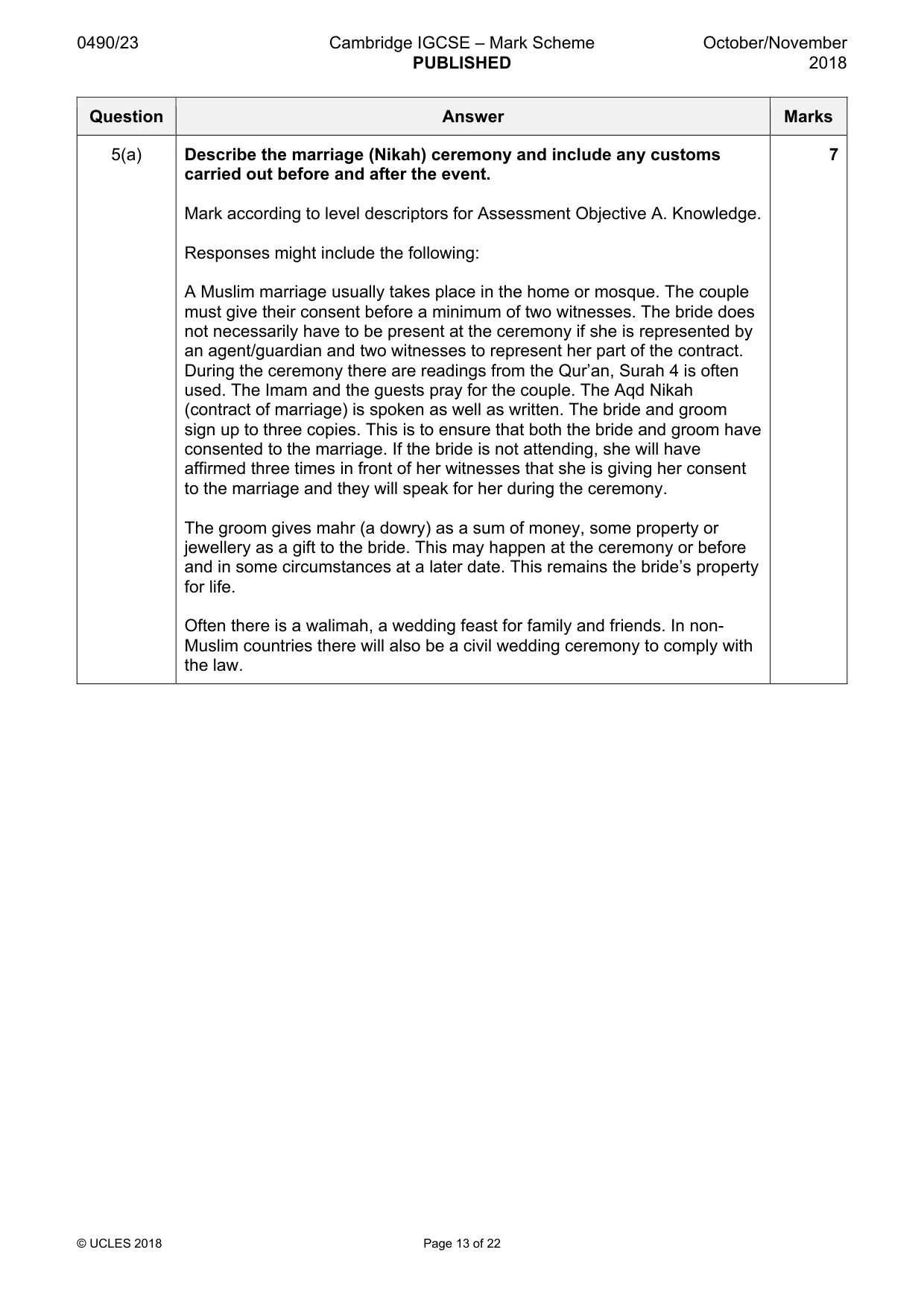
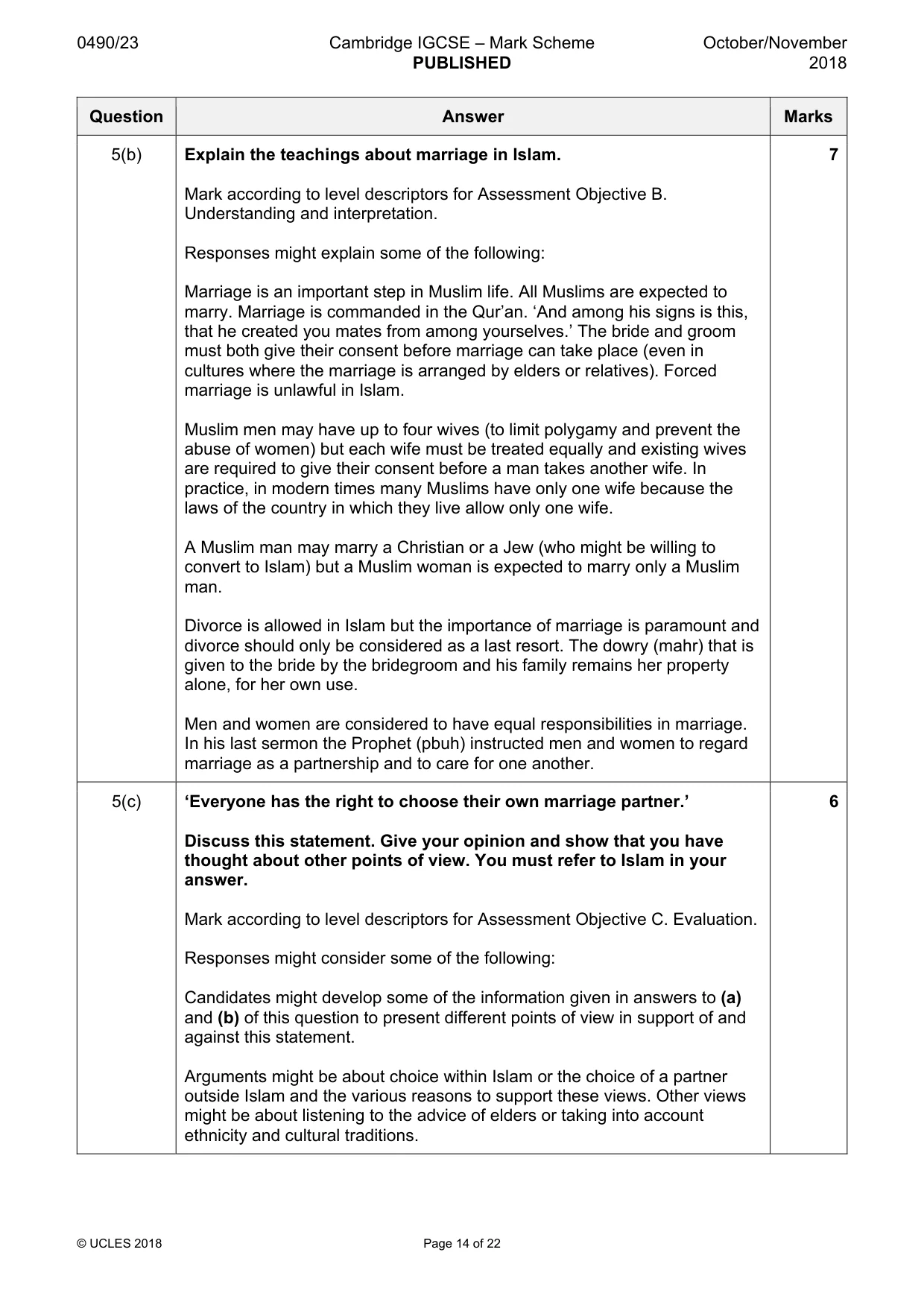
Mark scheme: 5(a) Describe the marriage (Nikah) ceremony and include any customs 7 carried out before and after the event. Mark according to level descriptors for Assessment Objective A. Knowledge. Responses might include the following: A Muslim marriage usually takes place in the home or mosque. The couple must give their consent before a minimum of two witnesses. The bride does not necessarily have to be present at the ceremony if she is represented by an agent/guardian and two witnesses to represent her part of the contract. During the ceremony there are readings from the Qur’an, Surah 4 is often used. The Imam and the guests pray for the couple. The Aqd Nikah (contract of marriage) is spoken as well as written. The bride and groom sign up to three copies. This is to ensure that both the bride and groom have consented to the marriage. If the bride is not attending, she will have affirmed three times in front of her witnesses that she is giving her consent to the marriage and they will speak for her during the ceremony. The groom gives mahr (a dowry) as a sum of money, some property or jewellery as a gift to the bride. This may happen at the ceremony or before and in some circumstances at a later date. This remains the bride’s property for life. Often there is a walimah, a wedding feast for family and friends. In non- Muslim countries there will also be a civil wedding ceremony to comply with the law. 5(b) Explain the teachings about marriage in Islam. 7 Mark according to level descriptors for Assessment Objective B. Understanding and interpretation. Responses might explain some of the following: Marriage is an important step in Muslim life. All Muslims are expected to marry. Marriage is commanded in the Qur’an. ‘And among his signs is this, that he created you mates from among yourselves.’ The bride and groom must both give their consent before marriage can take place (even in cultures where the marriage is arranged by elders or relatives). Forced marriage is unlawful in Islam. Muslim men may have up to four wives (to limit polygamy and prevent the abuse of women) but each wife must be treated equally and existing wives are required to give their consent before a man takes another wife. In practice, in modern times many Muslims have only one wife because the laws of the country in which they live allow only one wife. A Muslim man may marry a Christian or a Jew (who might be willing to convert to Islam) but a Muslim woman is expected to marry only a Muslim man. Divorce is allowed in Islam but the importance of marriage is paramount and divorce should only be considered as a last resort. The dowry (mahr) that is given to the bride by the bridegroom and his family remains her property alone, for her own use. Men and women are considered to have equal responsibilities in marriage. In his last sermon the Prophet (pbuh) instructed men and women to regard marriage as a partnership and to care for one another. 5(c) ‘Everyone has the right to choose their own marriage partner.’ 6 Discuss this statement. Give your opinion and show that you have thought about other points of view. You must refer to Islam in your answer. Mark according to level descriptors for Assessment Objective C. Evaluation. Responses might consider some of the following: Candidates might develop some of the information given in answers to (a) and (b) of this question to present different points of view in support of and against this statement. Arguments might be about choice within Islam or the choice of a partner outside Islam and the various reasons to support these views. Other views might be about listening to the advice of elders or taking into account ethnicity and cultural traditions.
Q6 · Describe the different ways Muslims carry out their duty to the poor
6 (a) Describe the different ways Muslims carry out their duty to the poor. [7] (b) Explain how all members of a Muslim family are valued and cared for. [7] (c) ‘Caring for the family is more important than helping the poor.’ Discuss this statement. Give your own opinion and show that you have thought about other points of view. You must refer to Islam in your answer. [6] Section C – Judaism If you have chosen this section answer all of the parts in two of the questions.
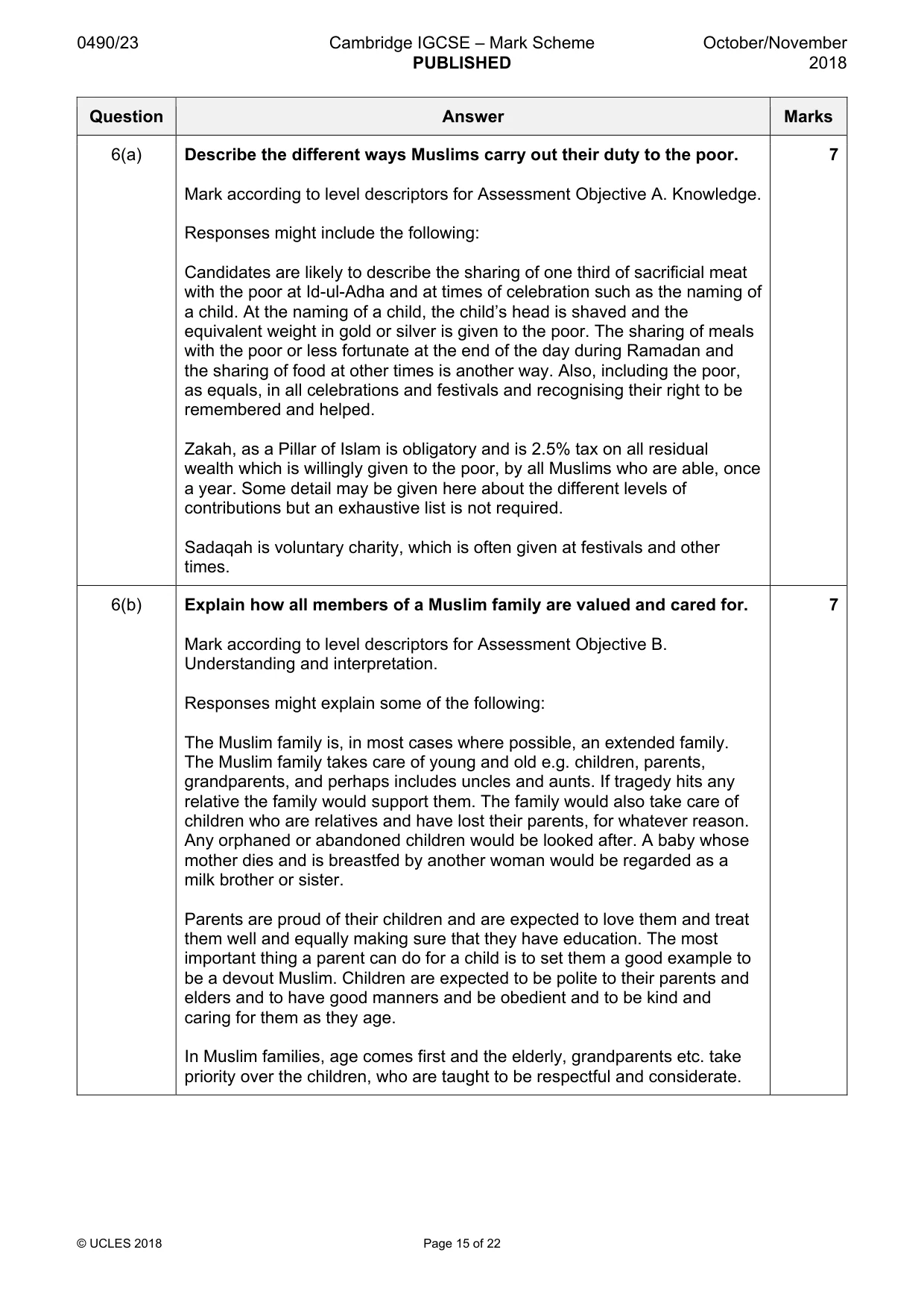
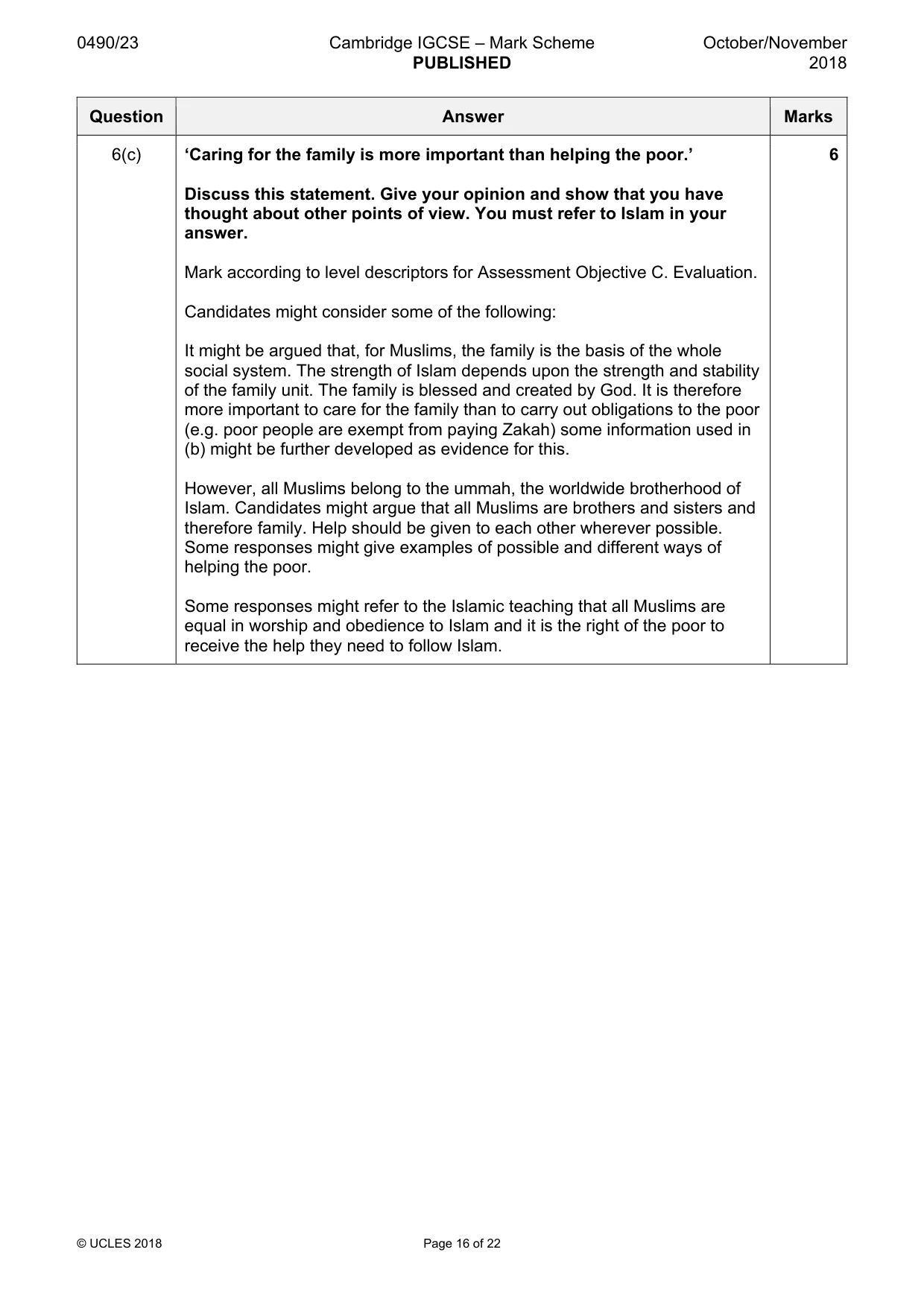
Mark scheme: 6(a) Describe the different ways Muslims carry out their duty to the poor. 7 Mark according to level descriptors for Assessment Objective A. Knowledge. Responses might include the following: Candidates are likely to describe the sharing of one third of sacrificial meat with the poor at Id-ul-Adha and at times of celebration such as the naming of a child. At the naming of a child, the child’s head is shaved and the equivalent weight in gold or silver is given to the poor. The sharing of meals with the poor or less fortunate at the end of the day during Ramadan and the sharing of food at other times is another way. Also, including the poor, as equals, in all celebrations and festivals and recognising their right to be remembered and helped. Zakah, as a Pillar of Islam is obligatory and is 2.5% tax on all residual wealth which is willingly given to the poor, by all Muslims who are able, once a year. Some detail may be given here about the different levels of contributions but an exhaustive list is not required. Sadaqah is voluntary charity, which is often given at festivals and other times. 6(b) Explain how all members of a Muslim family are valued and cared for. 7 Mark according to level descriptors for Assessment Objective B. Understanding and interpretation. Responses might explain some of the following: The Muslim family is, in most cases where possible, an extended family. The Muslim family takes care of young and old e.g. children, parents, grandparents, and perhaps includes uncles and aunts. If tragedy hits any relative the family would support them. The family would also take care of children who are relatives and have lost their parents, for whatever reason. Any orphaned or abandoned children would be looked after. A baby whose mother dies and is breastfed by another woman would be regarded as a milk brother or sister. Parents are proud of their children and are expected to love them and treat them well and equally making sure that they have education. The most important thing a parent can do for a child is to set them a good example to be a devout Muslim. Children are expected to be polite to their parents and elders and to have good manners and be obedient and to be kind and caring for them as they age. In Muslim families, age comes first and the elderly, grandparents etc. take priority over the children, who are taught to be respectful and considerate. 6(c) ‘Caring for the family is more important than helping the poor.’ 6 Discuss this statement. Give your opinion and show that you have thought about other points of view. You must refer to Islam in your answer. Mark according to level descriptors for Assessment Objective C. Evaluation. Candidates might consider some of the following: It might be argued that, for Muslims, the family is the basis of the whole social system. The strength of Islam depends upon the strength and stability of the family unit. The family is blessed and created by God. It is therefore more important to care for the family than to carry out obligations to the poor (e.g. poor people are exempt from paying Zakah) some information used in (b) might be further developed as evidence for this. However, all Muslims belong to the ummah, the worldwide brotherhood of Islam. Candidates might argue that all Muslims are brothers and sisters and therefore family. Help should be given to each other wherever possible. Some responses might give examples of possible and different ways of helping the poor. Some responses might refer to the Islamic teaching that all Muslims are equal in worship and obedience to Islam and it is the right of the poor to receive the help they need to follow Islam.
Q7 · Give an account of the ways in which religion plays a part in the Jewish home
7 (a) Give an account of the ways in which religion plays a part in the Jewish home. [7] (b) Explain why religious symbols in the home are important to some Jews. [7] (c) ‘Families worshipping together strengthens their faith.’ Discuss this statement. Give your own opinion and show that you have thought about other points of view. You must refer to Judaism in your answer. [6]
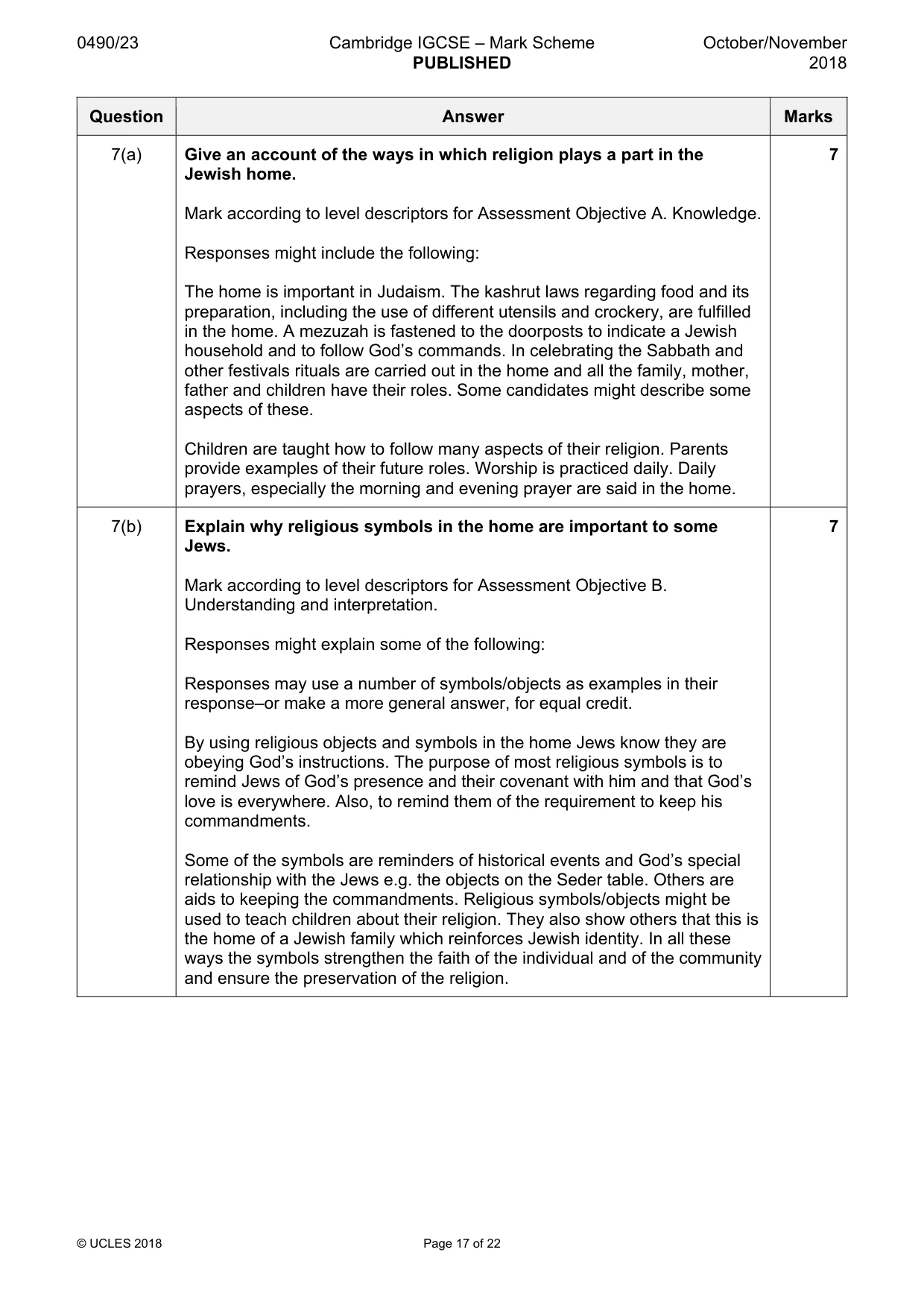
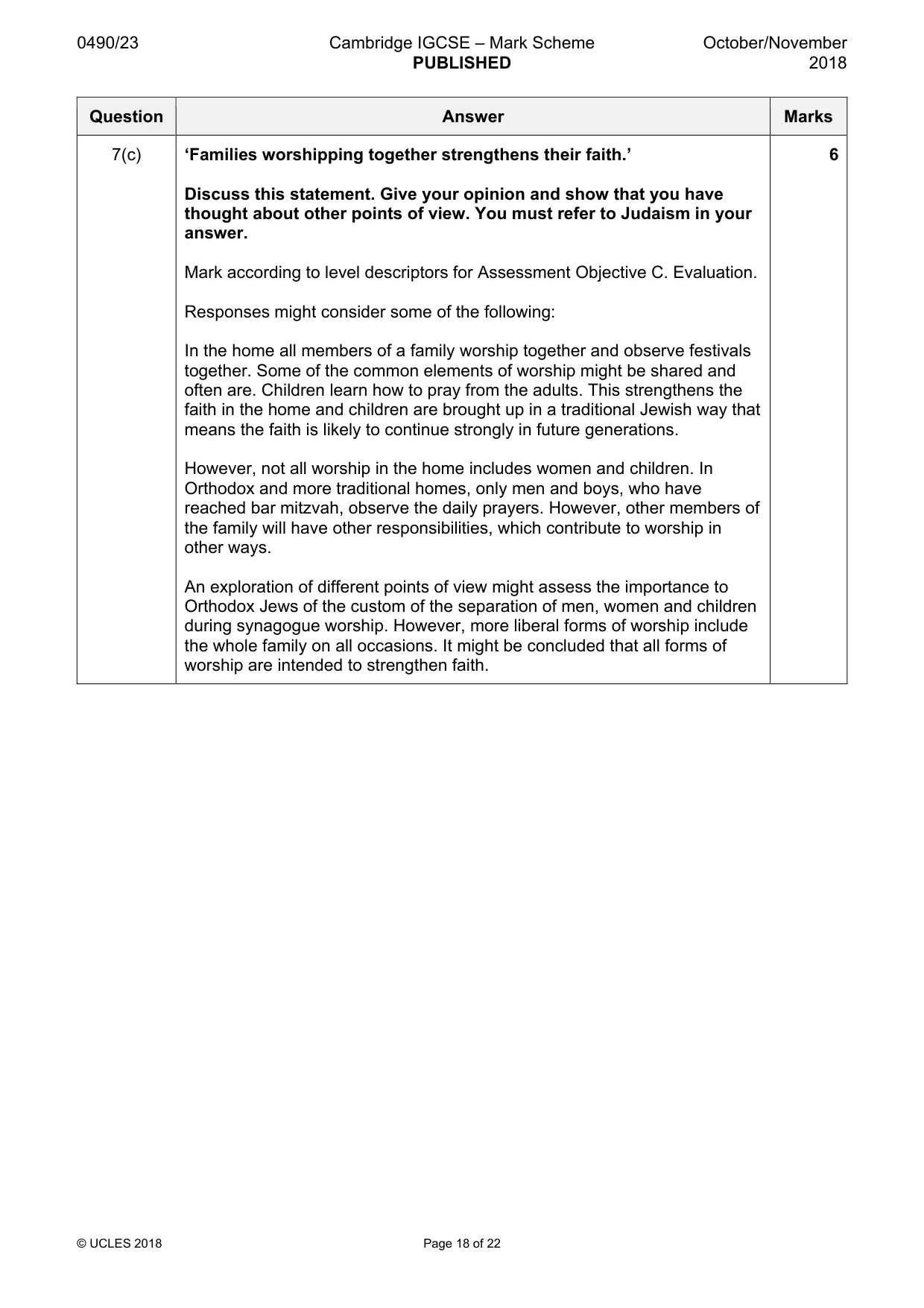
Mark scheme: 7(a) Give an account of the ways in which religion plays a part in the 7 Jewish home. Mark according to level descriptors for Assessment Objective A. Knowledge. Responses might include the following: The home is important in Judaism. The kashrut laws regarding food and its preparation, including the use of different utensils and crockery, are fulfilled in the home. A mezuzah is fastened to the doorposts to indicate a Jewish household and to follow God’s commands. In celebrating the Sabbath and other festivals rituals are carried out in the home and all the family, mother, father and children have their roles. Some candidates might describe some aspects of these. Children are taught how to follow many aspects of their religion. Parents provide examples of their future roles. Worship is practiced daily. Daily prayers, especially the morning and evening prayer are said in the home. 7(b) Explain why religious symbols in the home are important to some 7 Jews. Mark according to level descriptors for Assessment Objective B. Understanding and interpretation. Responses might explain some of the following: Responses may use a number of symbols/objects as examples in their response–or make a more general answer, for equal credit. By using religious objects and symbols in the home Jews know they are obeying God’s instructions. The purpose of most religious symbols is to remind Jews of God’s presence and their covenant with him and that God’s love is everywhere. Also, to remind them of the requirement to keep his commandments. Some of the symbols are reminders of historical events and God’s special relationship with the Jews e.g. the objects on the Seder table. Others are aids to keeping the commandments. Religious symbols/objects might be used to teach children about their religion. They also show others that this is the home of a Jewish family which reinforces Jewish identity. In all these ways the symbols strengthen the faith of the individual and of the community and ensure the preservation of the religion. 7(c) ‘Families worshipping together strengthens their faith.’ 6 Discuss this statement. Give your opinion and show that you have thought about other points of view. You must refer to Judaism in your answer. Mark according to level descriptors for Assessment Objective C. Evaluation. Responses might consider some of the following: In the home all members of a family worship together and observe festivals together. Some of the common elements of worship might be shared and often are. Children learn how to pray from the adults. This strengthens the faith in the home and children are brought up in a traditional Jewish way that means the faith is likely to continue strongly in future generations. However, not all worship in the home includes women and children. In Orthodox and more traditional homes, only men and boys, who have reached bar mitzvah, observe the daily prayers. However, other members of the family will have other responsibilities, which contribute to worship in other ways. An exploration of different points of view might assess the importance to Orthodox Jews of the custom of the separation of men, women and children during synagogue worship. However, more liberal forms of worship include the whole family on all occasions. It might be concluded that all forms of worship are intended to strengthen faith.
Q8 · Describe the rituals of Shiva
8 (a) Describe the rituals of Shiva. [7] (b) Explain the benefits of this intense period of mourning. [7] (c) ‘Funerals should be private occasions.’ Discuss this statement. Give your own opinion and show that you have thought about other points of view. You must refer to Judaism in your answer. [6]
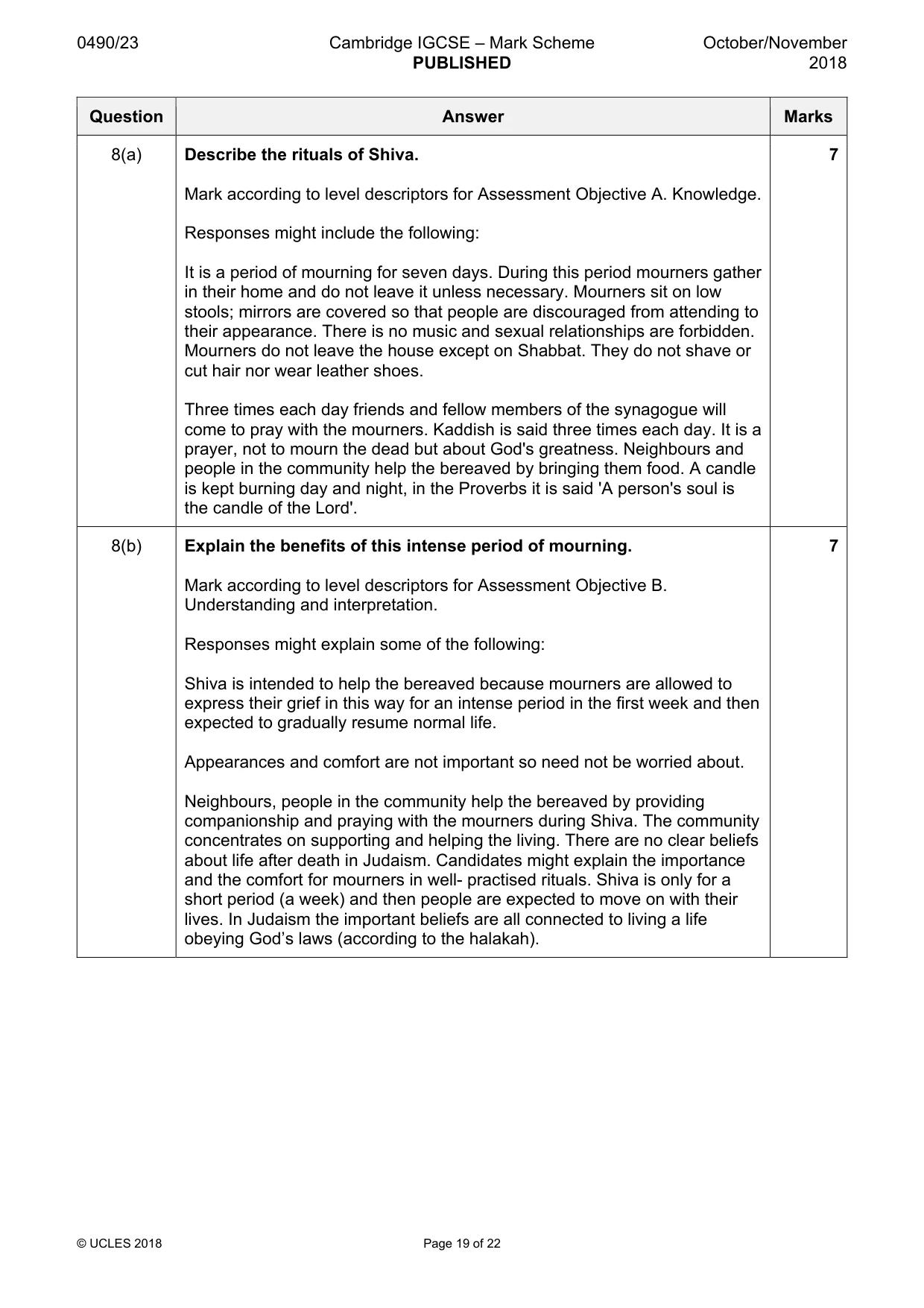
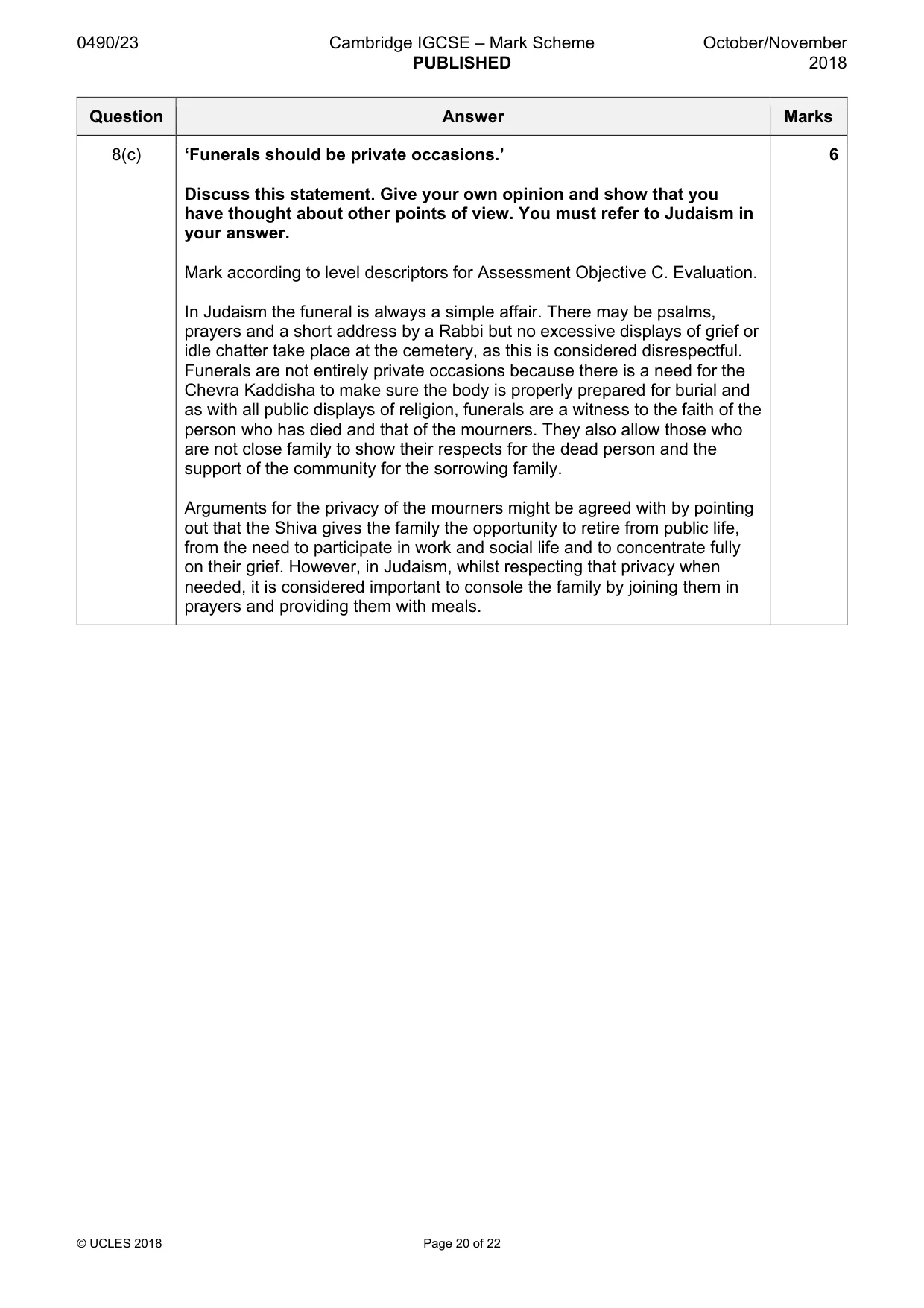
Mark scheme: 8(a) Describe the rituals of Shiva. 7 Mark according to level descriptors for Assessment Objective A. Knowledge. Responses might include the following: It is a period of mourning for seven days. During this period mourners gather in their home and do not leave it unless necessary. Mourners sit on low stools; mirrors are covered so that people are discouraged from attending to their appearance. There is no music and sexual relationships are forbidden. Mourners do not leave the house except on Shabbat. They do not shave or cut hair nor wear leather shoes. Three times each day friends and fellow members of the synagogue will come to pray with the mourners. Kaddish is said three times each day. It is a prayer, not to mourn the dead but about God's greatness. Neighbours and people in the community help the bereaved by bringing them food. A candle is kept burning day and night, in the Proverbs it is said 'A person's soul is the candle of the Lord'. 8(b) Explain the benefits of this intense period of mourning. 7 Mark according to level descriptors for Assessment Objective B. Understanding and interpretation. Responses might explain some of the following: Shiva is intended to help the bereaved because mourners are allowed to express their grief in this way for an intense period in the first week and then expected to gradually resume normal life. Appearances and comfort are not important so need not be worried about. Neighbours, people in the community help the bereaved by providing companionship and praying with the mourners during Shiva. The community concentrates on supporting and helping the living. There are no clear beliefs about life after death in Judaism. Candidates might explain the importance and the comfort for mourners in well- practised rituals. Shiva is only for a short period (a week) and then people are expected to move on with their lives. In Judaism the important beliefs are all connected to living a life obeying God’s laws (according to the halakah). 8(c) ‘Funerals should be private occasions.’ 6 Discuss this statement. Give your own opinion and show that you have thought about other points of view. You must refer to Judaism in your answer. Mark according to level descriptors for Assessment Objective C. Evaluation. In Judaism the funeral is always a simple affair. There may be psalms, prayers and a short address by a Rabbi but no excessive displays of grief or idle chatter take place at the cemetery, as this is considered disrespectful. Funerals are not entirely private occasions because there is a need for the Chevra Kaddisha to make sure the body is properly prepared for burial and as with all public displays of religion, funerals are a witness to the faith of the person who has died and that of the mourners. They also allow those who are not close family to show their respects for the dead person and the support of the community for the sorrowing family. Arguments for the privacy of the mourners might be agreed with by pointing out that the Shiva gives the family the opportunity to retire from public life, from the need to participate in work and social life and to concentrate fully on their grief. However, in Judaism, whilst respecting that privacy when needed, it is considered important to console the family by joining them in prayers and providing them with meals.
Q9 · Outline the traditional teaching about the role of women in Judaism
9 (a) Outline the traditional teaching about the role of women in Judaism. [7] (b) Explain two aspects of Jewish marriage that might strengthen the faith of the couple. [7] (c) ‘Marriage is a bond that should not be broken.’ Discuss this statement. Give your own opinion and show that you have thought about other points of view. You must refer to Judaism in your answer. [6]
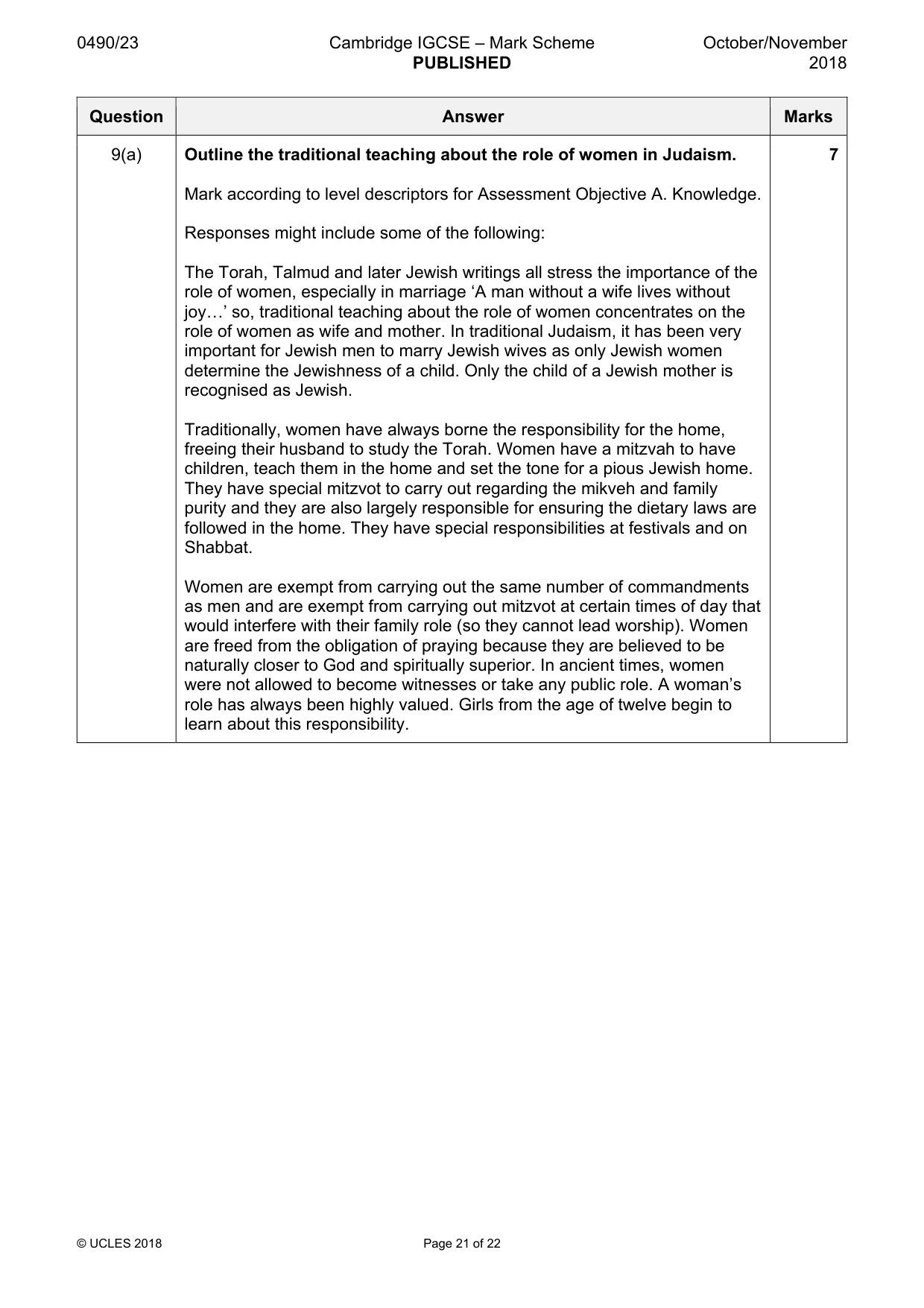
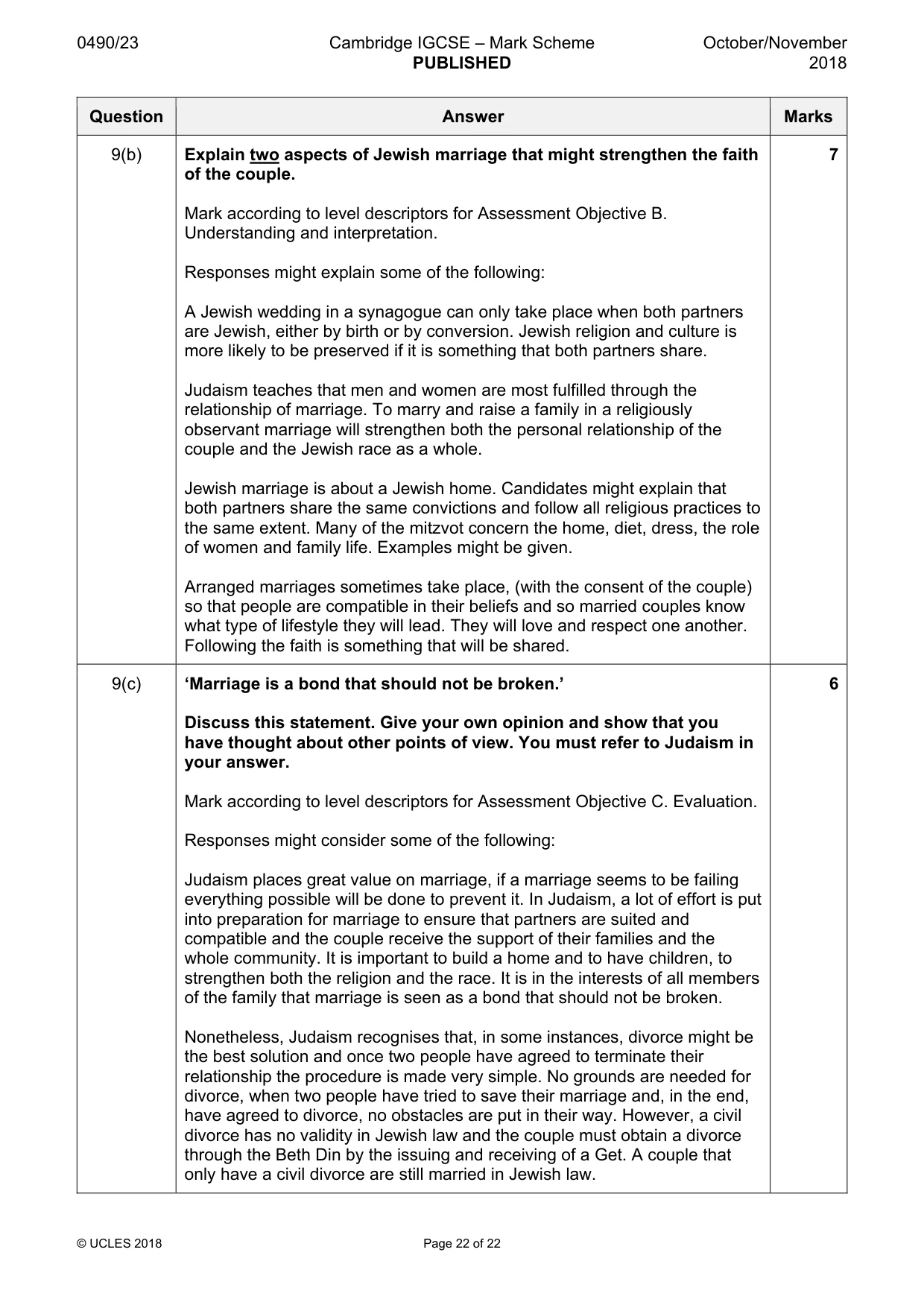
Mark scheme: 9(a) Outline the traditional teaching about the role of women in Judaism. 7 Mark according to level descriptors for Assessment Objective A. Knowledge. Responses might include some of the following: The Torah, Talmud and later Jewish writings all stress the importance of the role of women, especially in marriage ‘A man without a wife lives without joy«’ so, traditional teaching about the role of women concentrates on the role of women as wife and mother. In traditional Judaism, it has been very important for Jewish men to marry Jewish wives as only Jewish women determine the Jewishness of a child. Only the child of a Jewish mother is recognised as Jewish. Traditionally, women have always borne the responsibility for the home, freeing their husband to study the Torah. Women have a mitzvah to have children, teach them in the home and set the tone for a pious Jewish home. They have special mitzvot to carry out regarding the mikveh and family purity and they are also largely responsible for ensuring the dietary laws are followed in the home. They have special responsibilities at festivals and on Shabbat. Women are exempt from carrying out the same number of commandments as men and are exempt from carrying out mitzvot at certain times of day that would interfere with their family role (so they cannot lead worship). Women are freed from the obligation of praying because they are believed to be naturally closer to God and spiritually superior. In ancient times, women were not allowed to become witnesses or take any public role. A woman’s role has always been highly valued. Girls from the age of twelve begin to learn about this responsibility. 9(b) Explain two aspects of Jewish marriage that might strengthen the faith 7 of the couple. Mark according to level descriptors for Assessment Objective B. Understanding and interpretation. Responses might explain some of the following: A Jewish wedding in a synagogue can only take place when both partners are Jewish, either by birth or by conversion. Jewish religion and culture is more likely to be preserved if it is something that both partners share. Judaism teaches that men and women are most fulfilled through the relationship of marriage. To marry and raise a family in a religiously observant marriage will strengthen both the personal relationship of the couple and the Jewish race as a whole. Jewish marriage is about a Jewish home. Candidates might explain that both partners share the same convictions and follow all religious practices to the same extent. Many of the mitzvot concern the home, diet, dress, the role of women and family life. Examples might be given. Arranged marriages sometimes take place, (with the consent of the couple) so that people are compatible in their beliefs and so married couples know what type of lifestyle they will lead. They will love and respect one another. Following the faith is something that will be shared. 9(c) ‘Marriage is a bond that should not be broken.’ 6 Discuss this statement. Give your own opinion and show that you have thought about other points of view. You must refer to Judaism in your answer. Mark according to level descriptors for Assessment Objective C. Evaluation. Responses might consider some of the following: Judaism places great value on marriage, if a marriage seems to be failing everything possible will be done to prevent it. In Judaism, a lot of effort is put into preparation for marriage to ensure that partners are suited and compatible and the couple receive the support of their families and the whole community. It is important to build a home and to have children, to strengthen both the religion and the race. It is in the interests of all members of the family that marriage is seen as a bond that should not be broken. Nonetheless, Judaism recognises that, in some instances, divorce might be the best solution and once two people have agreed to terminate their relationship the procedure is made very simple. No grounds are needed for divorce, when two people have tried to save their marriage and, in the end, have agreed to divorce, no obstacles are put in their way. However, a civil divorce has no validity in Jewish law and the couple must obtain a divorce through the Beth Din by the issuing and receiving of a Get. A couple that only have a civil divorce are still married in Jewish law.
What was in this paper
The subtopics covered by these 9 questions, and how many questions each got. Open one in a new tab to see every Cambridge question on it.
1Christian beliefs about family life in different Christian communities1Christianity as a religion that shows concern for others1Funeral rites: the key features and importance of funeral rites in Judaism1Islam as a religion that shows concern for others in the home and the community1Marriage ceremonies: the key features and importance of marriage ceremonies in Judaism1Muslim beliefs about family life in different Muslim communities1The roles and significance of leaders in the church and in different Christian communities1Tradition and change1What you needed in this session
Cambridge’s own grade thresholds for 2018 Oct/Nov, Paper 2 · Variant 3. A higher threshold means an easier paper — the bar moves with how the cohort did.