Cambridge IGCSE Religious Studies 0490 — 2018 Oct/Nov Paper 2 · Variant 2
0490/22/O/N/18 · 9 questions · 80 marks · ≈90 min
The question paper and its mark scheme, free to read here and free to download. This is Cambridge’s own paper, exactly as it was sat.
Question paper4 pages
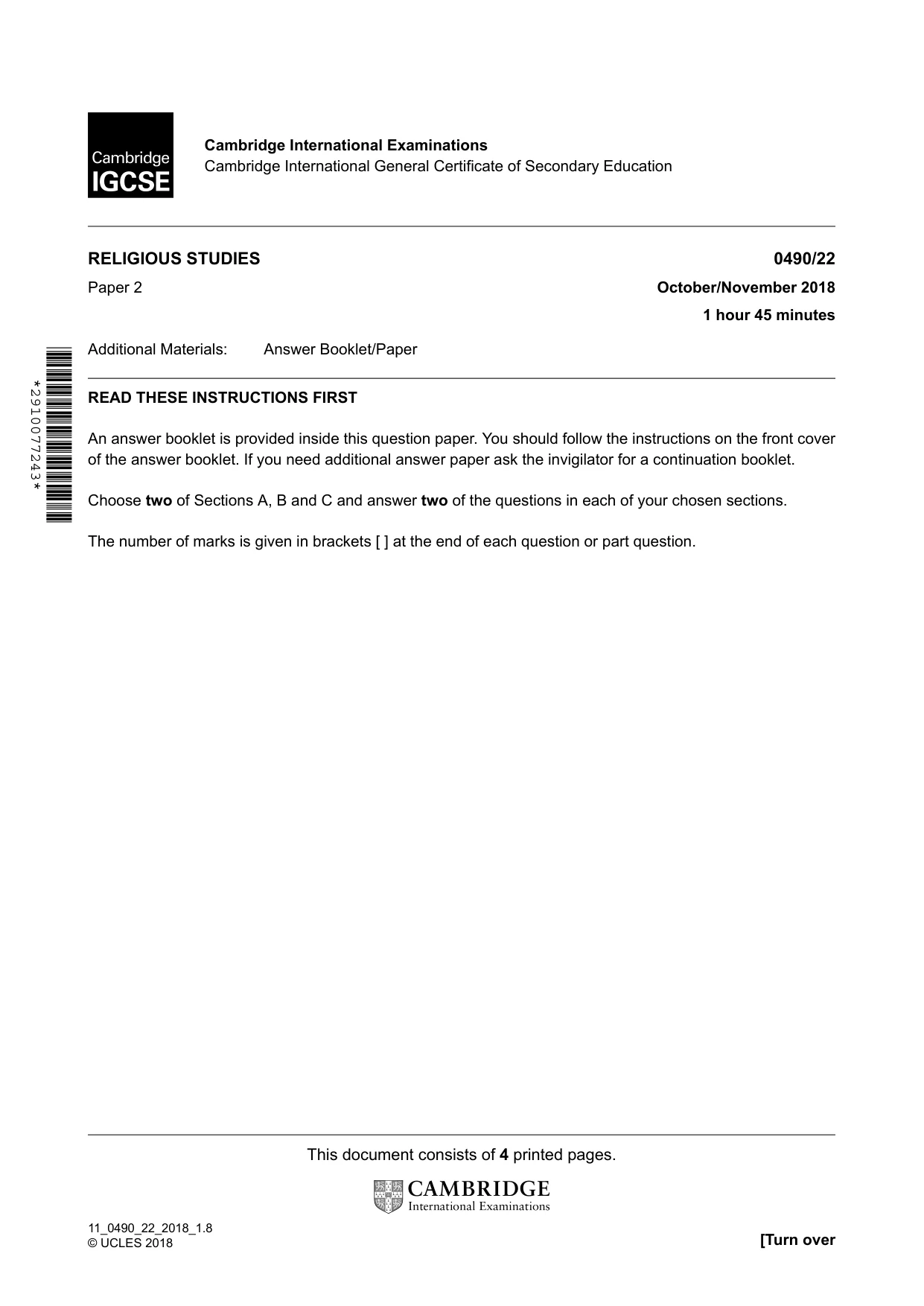
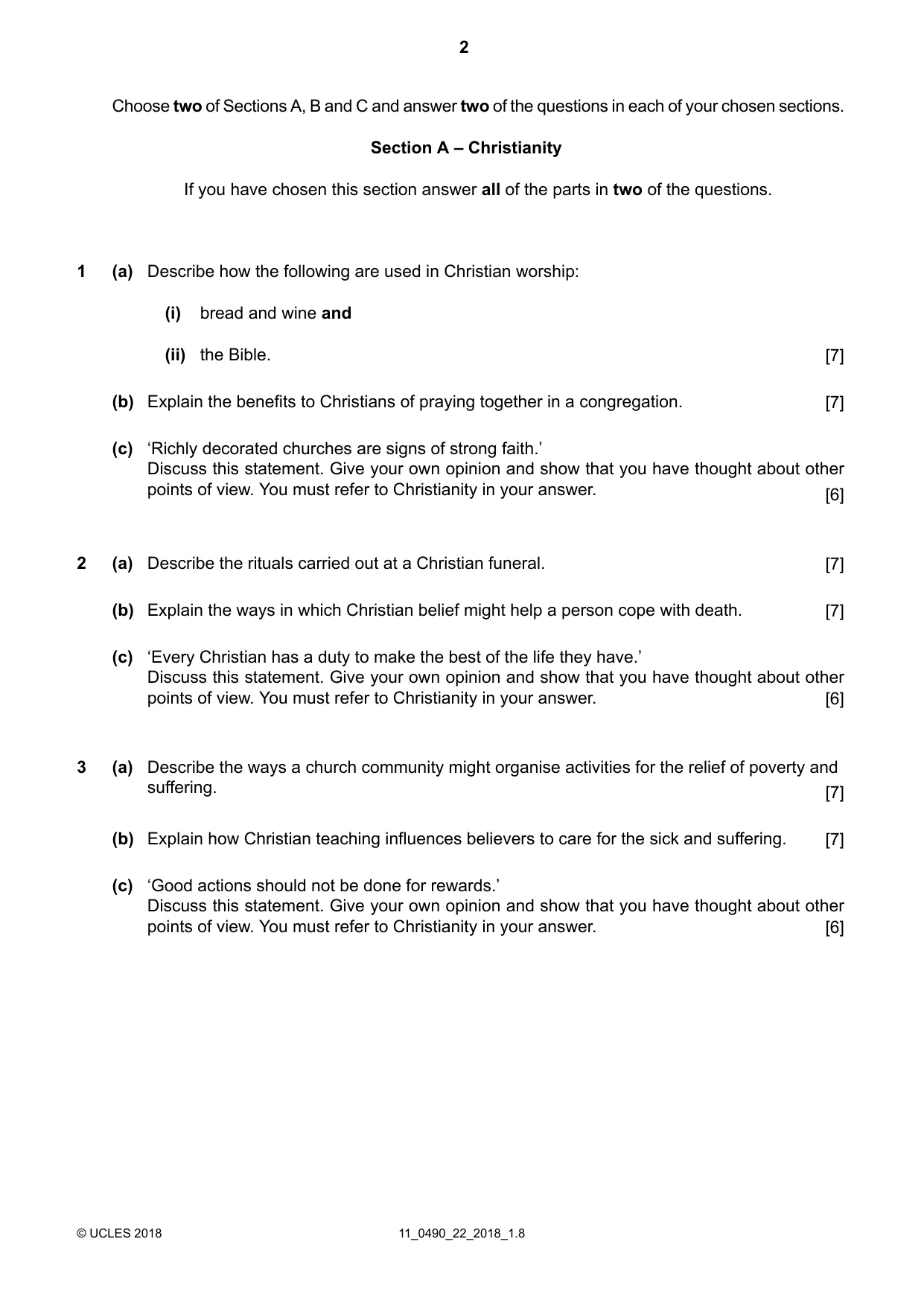
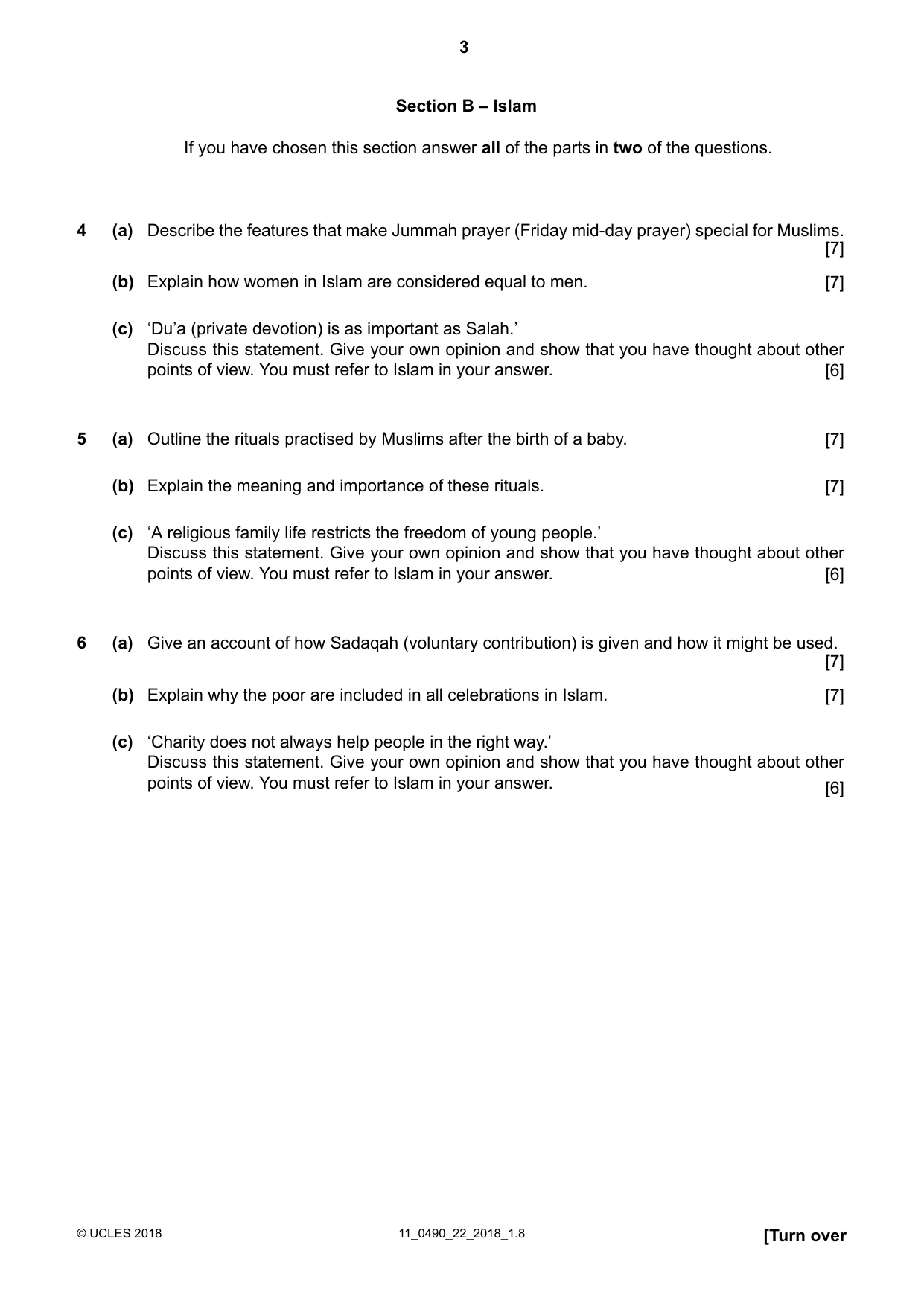
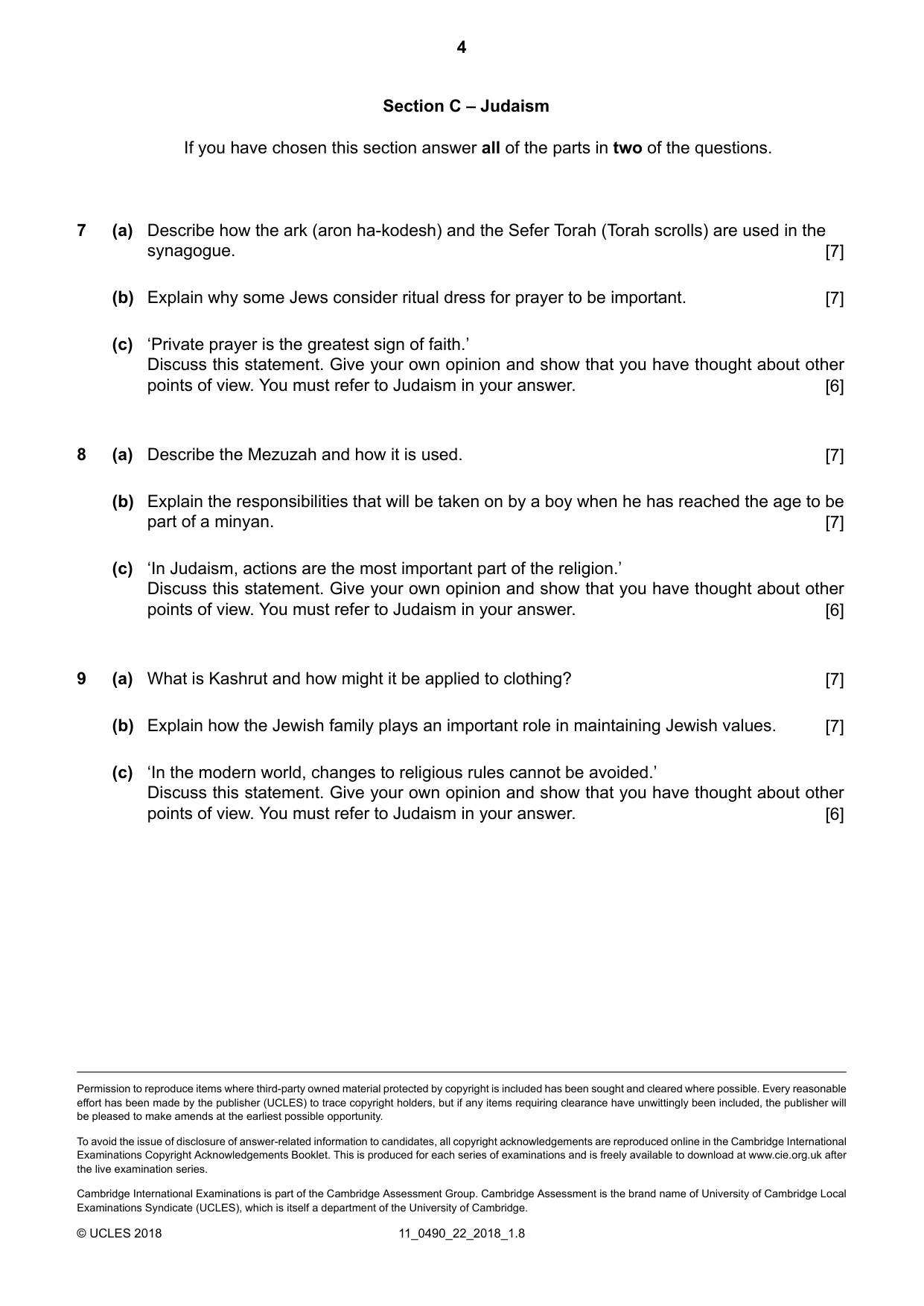
Mark scheme23 pages
Answers below. Sit the paper first if you are practising.
Questions as text
Q1 · Describe how the following are used in Christian worship: (i) bread and wine and (ii) the…
1 (a) Describe how the following are used in Christian worship: (i) bread and wine and (ii) the Bible. [7] (b) Explain the benefits to Christians of praying together in a congregation. [7] (c) ‘Richly decorated churches are signs of strong faith.’ Discuss this statement. Give your own opinion and show that you have thought about other points of view. You must refer to Christianity in your answer. [6]
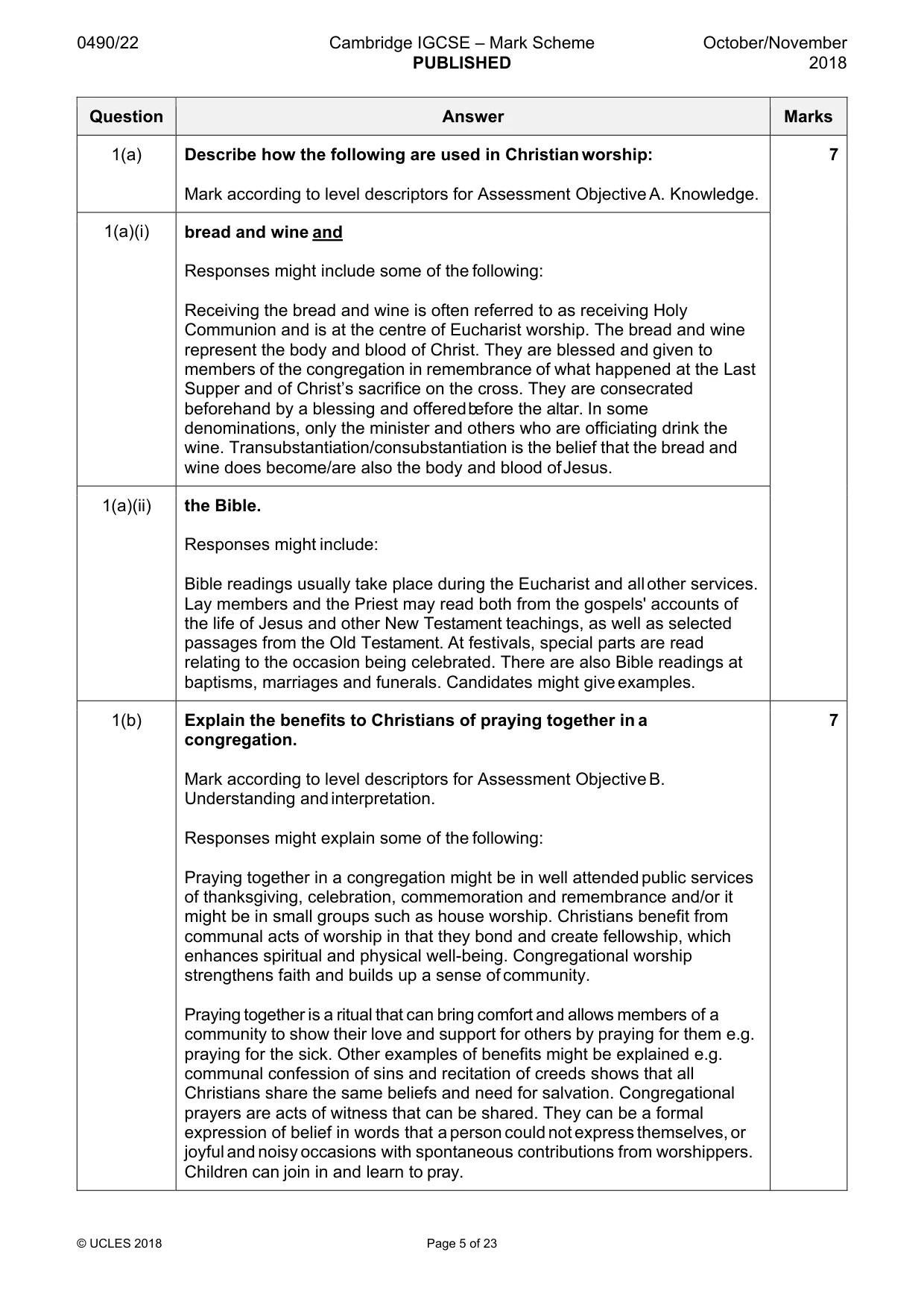
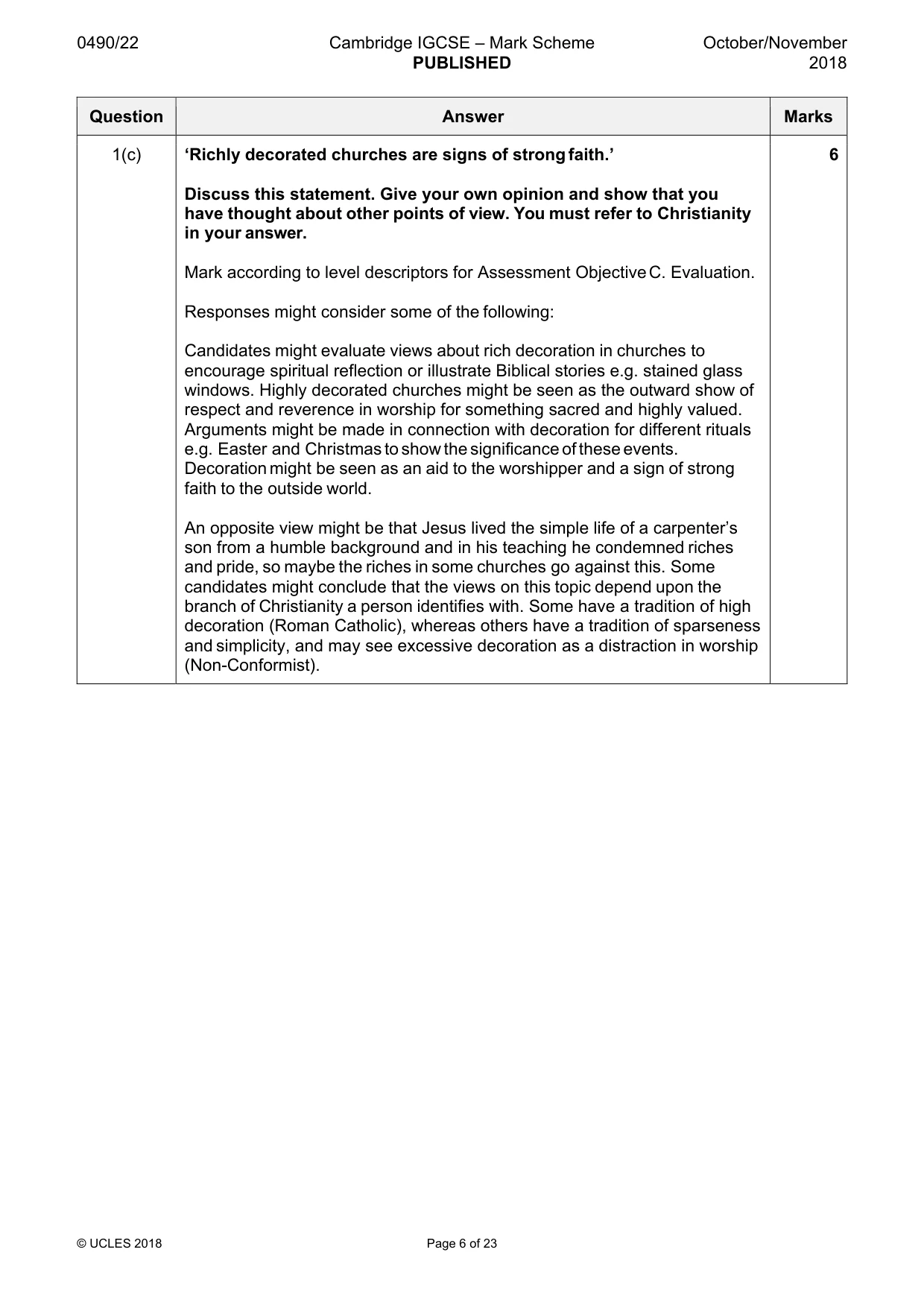
Mark scheme: Question Answer Marks 1(a) Describe how the following are used in Christian worship: 7 Mark according to level descriptors for Assessment Objective A. Knowledge. 1(a)(i) bread and wine and Responses might include some of the following: Receiving the bread and wine is often referred to as receiving Holy Communion and is at the centre of Eucharist worship. The bread and wine represent the body and blood of Christ. They are blessed and given to members of the congregation in remembrance of what happened at the Last Supper and of Christ’s sacrifice on the cross. They are consecrated beforehand by a blessing and offered before the altar. In some denominations, only the minister and others who are officiating drink the wine. Transubstantiation/consubstantiation is the belief that the bread and wine does become/are also the body and blood of Jesus. 1(a)(ii) the Bible. Responses might include: Bible readings usually take place during the Eucharist and all other services. Lay members and the Priest may read both from the gospels' accounts of the life of Jesus and other New Testament teachings, as well as selected passages from the Old Testament. At festivals, special parts are read relating to the occasion being celebrated. There are also Bible readings at baptisms, marriages and funerals. Candidates might give examples. 1(b) Explain the benefits to Christians of praying together in a 7 congregation. Mark according to level descriptors for Assessment Objective B. Understanding and interpretation. Responses might explain some of the following: Praying together in a congregation might be in well attended public services of thanksgiving, celebration, commemoration and remembrance and/or it might be in small groups such as house worship. Christians benefit from communal acts of worship in that they bond and create fellowship, which enhances spiritual and physical well-being. Congregational worship strengthens faith and builds up a sense of community. Praying together is a ritual that can bring comfort and allows members of a community to show their love and support for others by praying for them e.g. praying for the sick. Other examples of benefits might be explained e.g. communal confession of sins and recitation of creeds shows that all Christians share the same beliefs and need for salvation. Congregational prayers are acts of witness that can be shared. They can be a formal expression of belief in words that a person could not express themselves, or joyful and noisy occasions with spontaneous contributions from worshippers. Children can join in and learn to pray. 1(c) ‘Richly decorated churches are signs of strong faith.’ 6 Discuss this statement. Give your own opinion and show that you have thought about other points of view. You must refer to Christianity in your answer. Mark according to level descriptors for Assessment Objective C. Evaluation. Responses might consider some of the following: Candidates might evaluate views about rich decoration in churches to encourage spiritual reflection or illustrate Biblical stories e.g. stained glass windows. Highly decorated churches might be seen as the outward show of respect and reverence in worship for something sacred and highly valued. Arguments might be made in connection with decoration for different rituals e.g. Easter and Christmas to show the significance of these events. Decoration might be seen as an aid to the worshipper and a sign of strong faith to the outside world. An opposite view might be that Jesus lived the simple life of a carpenter’s son from a humble background and in his teaching he condemned riches and pride, so maybe the riches in some churches go against this. Some candidates might conclude that the views on this topic depend upon the branch of Christianity a person identifies with. Some have a tradition of high decoration (Roman Catholic), whereas others have a tradition of sparseness and simplicity, and may see excessive decoration as a distraction in worship (Non-Conformist).
Q2 · Describe the rituals carried out at a Christian funeral
2 (a) Describe the rituals carried out at a Christian funeral. [7] (b) Explain the ways in which Christian belief might help a person cope with death. [7] (c) ‘Every Christian has a duty to make the best of the life they have.’ Discuss this statement. Give your own opinion and show that you have thought about other points of view. You must refer to Christianity in your answer. [6]
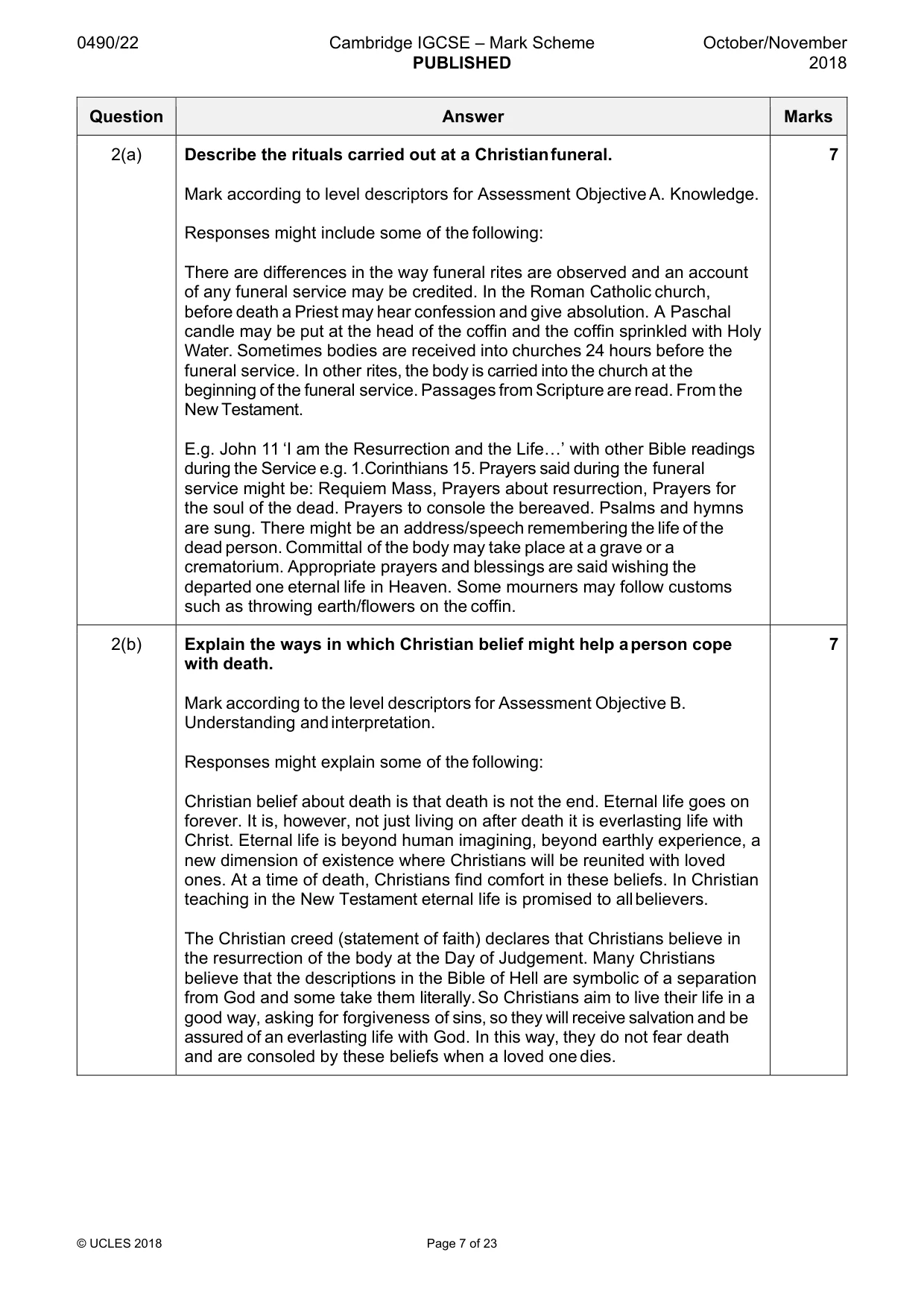
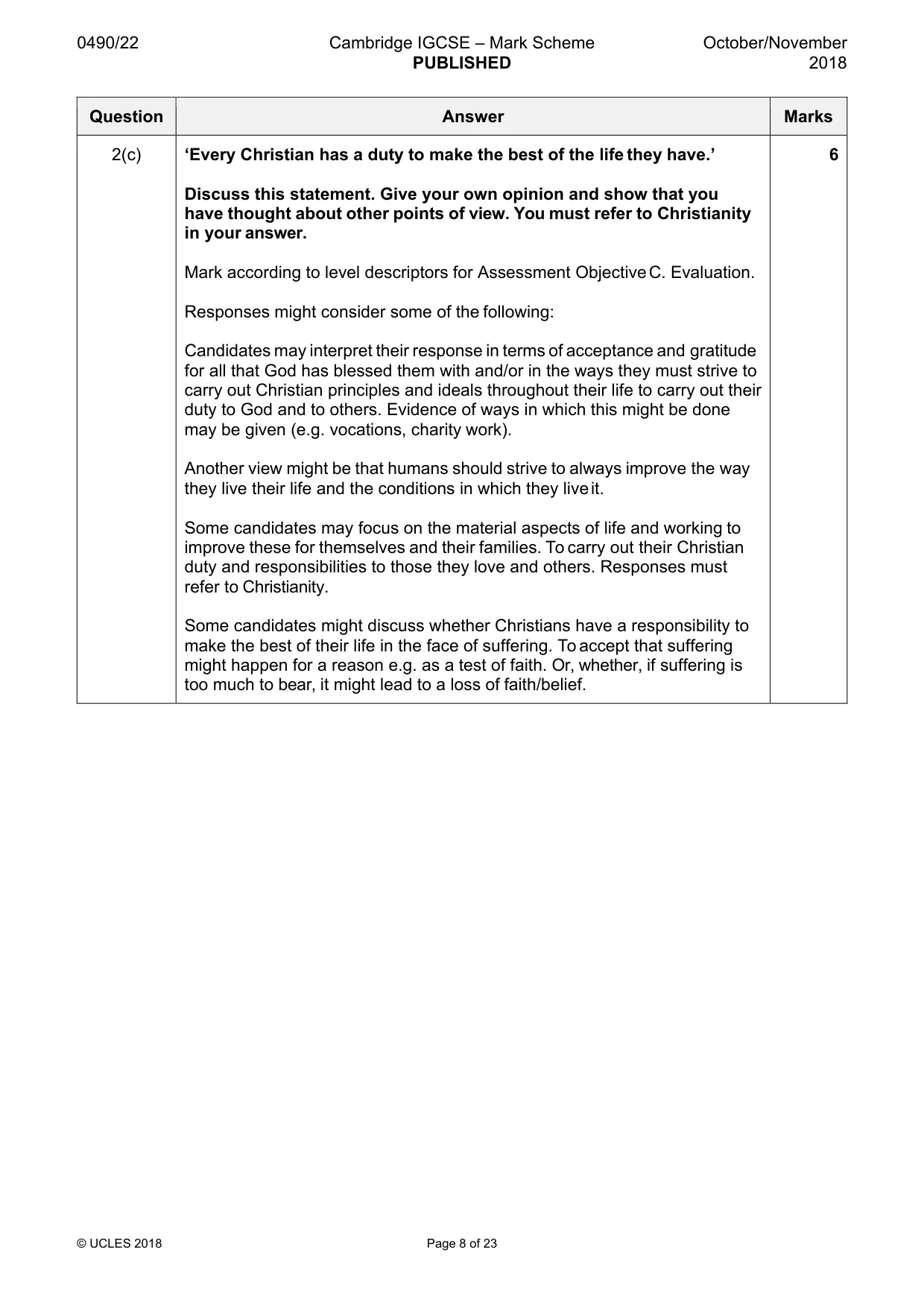
Mark scheme: 2(a) Describe the rituals carried out at a Christian funeral. 7 Mark according to level descriptors for Assessment Objective A. Knowledge. Responses might include some of the following: There are differences in the way funeral rites are observed and an account of any funeral service may be credited. In the Roman Catholic church, before death a Priest may hear confession and give absolution. A Paschal candle may be put at the head of the coffin and the coffin sprinkled with Holy Water. Sometimes bodies are received into churches 24 hours before the funeral service. In other rites, the body is carried into the church at the beginning of the funeral service. Passages from Scripture are read. From the New Testament. E.g. John 11 ‘I am the Resurrection and the Life«’ with other Bible readings during the Service e.g. 1.Corinthians 15. Prayers said during the funeral service might be: Requiem Mass, Prayers about resurrection, Prayers for the soul of the dead. Prayers to console the bereaved. Psalms and hymns are sung. There might be an address/speech remembering the life of the dead person. Committal of the body may take place at a grave or a crematorium. Appropriate prayers and blessings are said wishing the departed one eternal life in Heaven. Some mourners may follow customs such as throwing earth/flowers on the coffin. 2(b) Explain the ways in which Christian belief might help a person cope 7 with death. Mark according to the level descriptors for Assessment Objective B. Understanding and interpretation. Responses might explain some of the following: Christian belief about death is that death is not the end. Eternal life goes on forever. It is, however, not just living on after death it is everlasting life with Christ. Eternal life is beyond human imagining, beyond earthly experience, a new dimension of existence where Christians will be reunited with loved ones. At a time of death, Christians find comfort in these beliefs. In Christian teaching in the New Testament eternal life is promised to all believers. The Christian creed (statement of faith) declares that Christians believe in the resurrection of the body at the Day of Judgement. Many Christians believe that the descriptions in the Bible of Hell are symbolic of a separation from God and some take them literally. So Christians aim to live their life in a good way, asking for forgiveness of sins, so they will receive salvation and be assured of an everlasting life with God. In this way, they do not fear death and are consoled by these beliefs when a loved one dies. 2(c) ‘Every Christian has a duty to make the best of the life they have.’ 6 Discuss this statement. Give your own opinion and show that you have thought about other points of view. You must refer to Christianity in your answer. Mark according to level descriptors for Assessment Objective C. Evaluation. Responses might consider some of the following: Candidates may interpret their response in terms of acceptance and gratitude for all that God has blessed them with and/or in the ways they must strive to carry out Christian principles and ideals throughout their life to carry out their duty to God and to others. Evidence of ways in which this might be done may be given (e.g. vocations, charity work). Another view might be that humans should strive to always improve the way they live their life and the conditions in which they live it. Some candidates may focus on the material aspects of life and working to improve these for themselves and their families. To carry out their Christian duty and responsibilities to those they love and others. Responses must refer to Christianity. Some candidates might discuss whether Christians have a responsibility to make the best of their life in the face of suffering. To accept that suffering might happen for a reason e.g. as a test of faith. Or, whether, if suffering is too much to bear, it might lead to a loss of faith/belief.
Q3 · Describe the ways a church community might organise activities for the relief of poverty…
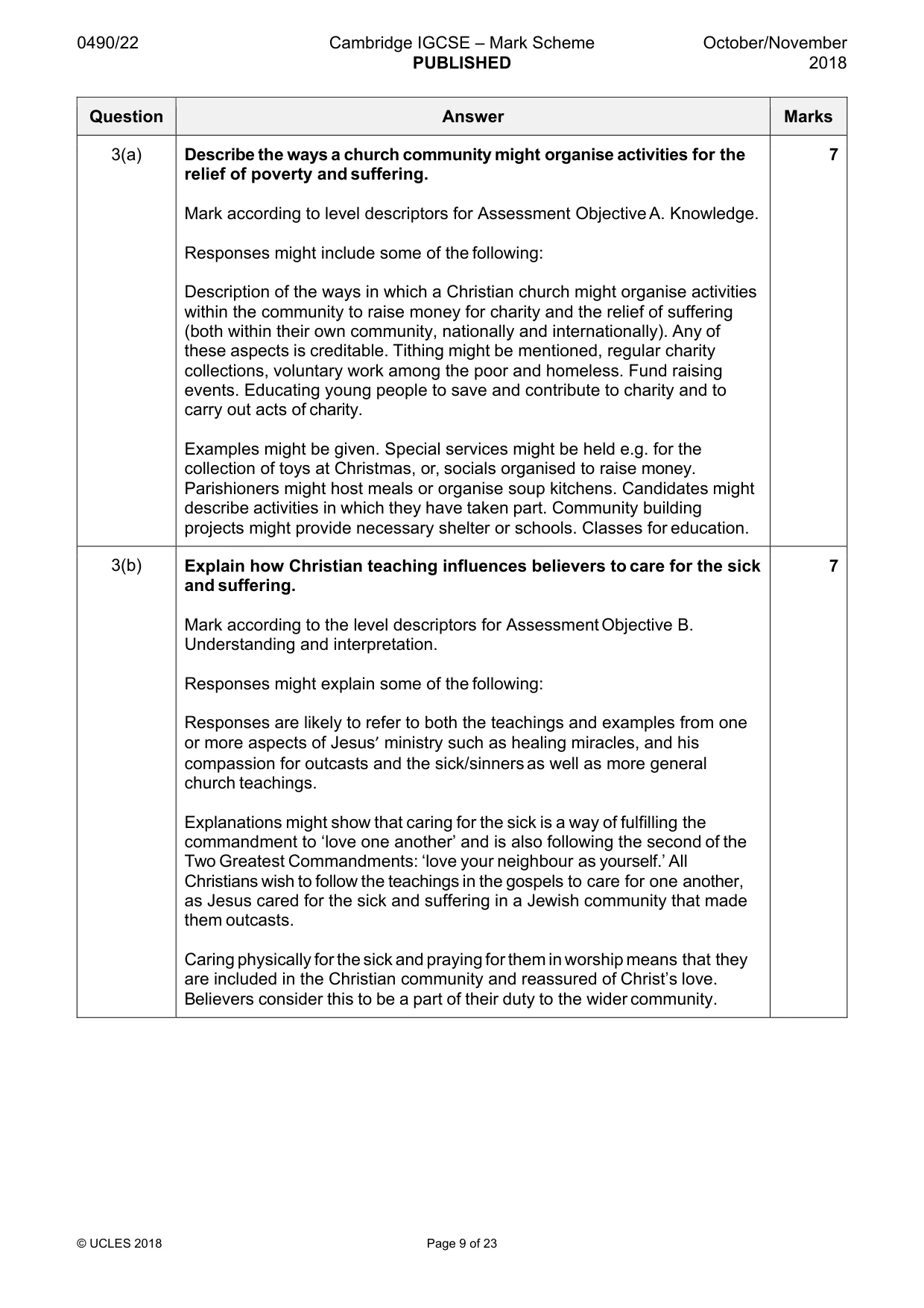
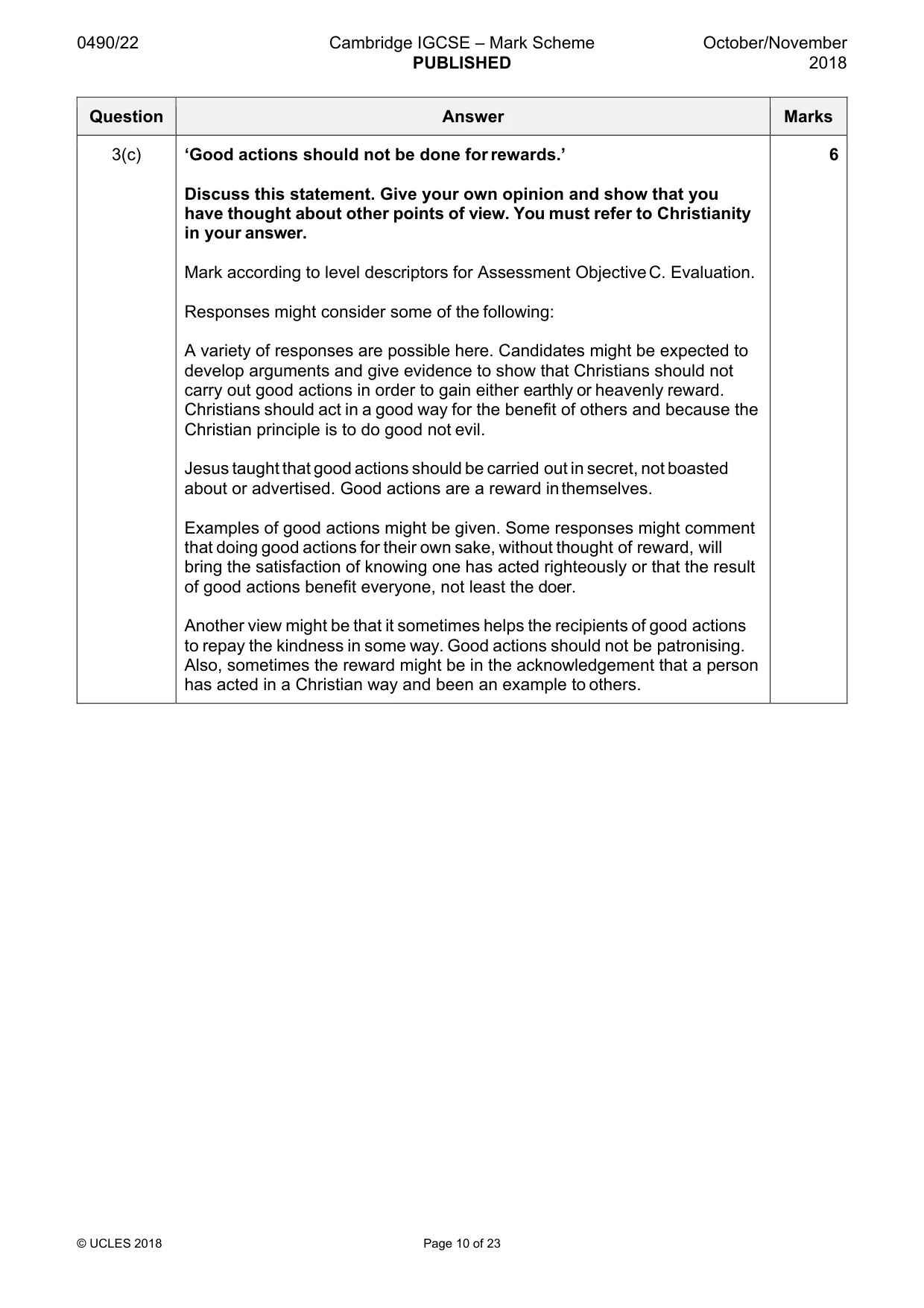
3 (a) Describe the ways a church community might organise activities for the relief of poverty and suffering. [7] (b) Explain how Christian teaching influences believers to care for the sick and suffering. [7] (c) ‘Good actions should not be done for rewards.’ Discuss this statement. Give your own opinion and show that you have thought about other points of view. You must refer to Christianity in your answer. [6]
Mark scheme: 3(a) Describe the ways a church community might organise activities for the 7 relief of poverty and suffering. Mark according to level descriptors for Assessment Objective A. Knowledge. Responses might include some of the following: Description of the ways in which a Christian church might organise activities within the community to raise money for charity and the relief of suffering (both within their own community, nationally and internationally). Any of these aspects is creditable. Tithing might be mentioned, regular charity collections, voluntary work among the poor and homeless. Fund raising events. Educating young people to save and contribute to charity and to carry out acts of charity. Examples might be given. Special services might be held e.g. for the collection of toys at Christmas, or, socials organised to raise money. Parishioners might host meals or organise soup kitchens. Candidates might describe activities in which they have taken part. Community building projects might provide necessary shelter or schools. Classes for education. 3(b) Explain how Christian teaching influences believers to care for the sick 7 and suffering. Mark according to the level descriptors for Assessment Objective B. Understanding and interpretation. Responses might explain some of the following: Responses are likely to refer to both the teachings and examples from one or more aspects of Jesus’ ministry such as healing miracles, and his compassion for outcasts and the sick/sinners as well as more general church teachings. Explanations might show that caring for the sick is a way of fulfilling the commandment to ‘love one another’ and is also following the second of the Two Greatest Commandments: ‘love your neighbour as yourself.’ All Christians wish to follow the teachings in the gospels to care for one another, as Jesus cared for the sick and suffering in a Jewish community that made them outcasts. Caring physically for the sick and praying for them in worship means that they are included in the Christian community and reassured of Christ’s love. Believers consider this to be a part of their duty to the wider community. 3(c) ‘Good actions should not be done for rewards.’ 6 Discuss this statement. Give your own opinion and show that you have thought about other points of view. You must refer to Christianity in your answer. Mark according to level descriptors for Assessment Objective C. Evaluation. Responses might consider some of the following: A variety of responses are possible here. Candidates might be expected to develop arguments and give evidence to show that Christians should not carry out good actions in order to gain either earthly or heavenly reward. Christians should act in a good way for the benefit of others and because the Christian principle is to do good not evil. Jesus taught that good actions should be carried out in secret, not boasted about or advertised. Good actions are a reward in themselves. Examples of good actions might be given. Some responses might comment that doing good actions for their own sake, without thought of reward, will bring the satisfaction of knowing one has acted righteously or that the result of good actions benefit everyone, not least the doer. Another view might be that it sometimes helps the recipients of good actions to repay the kindness in some way. Good actions should not be patronising. Also, sometimes the reward might be in the acknowledgement that a person has acted in a Christian way and been an example to others.
Q4 · Describe the features that make Jummah prayer (Friday mid-day prayer) special for Muslims
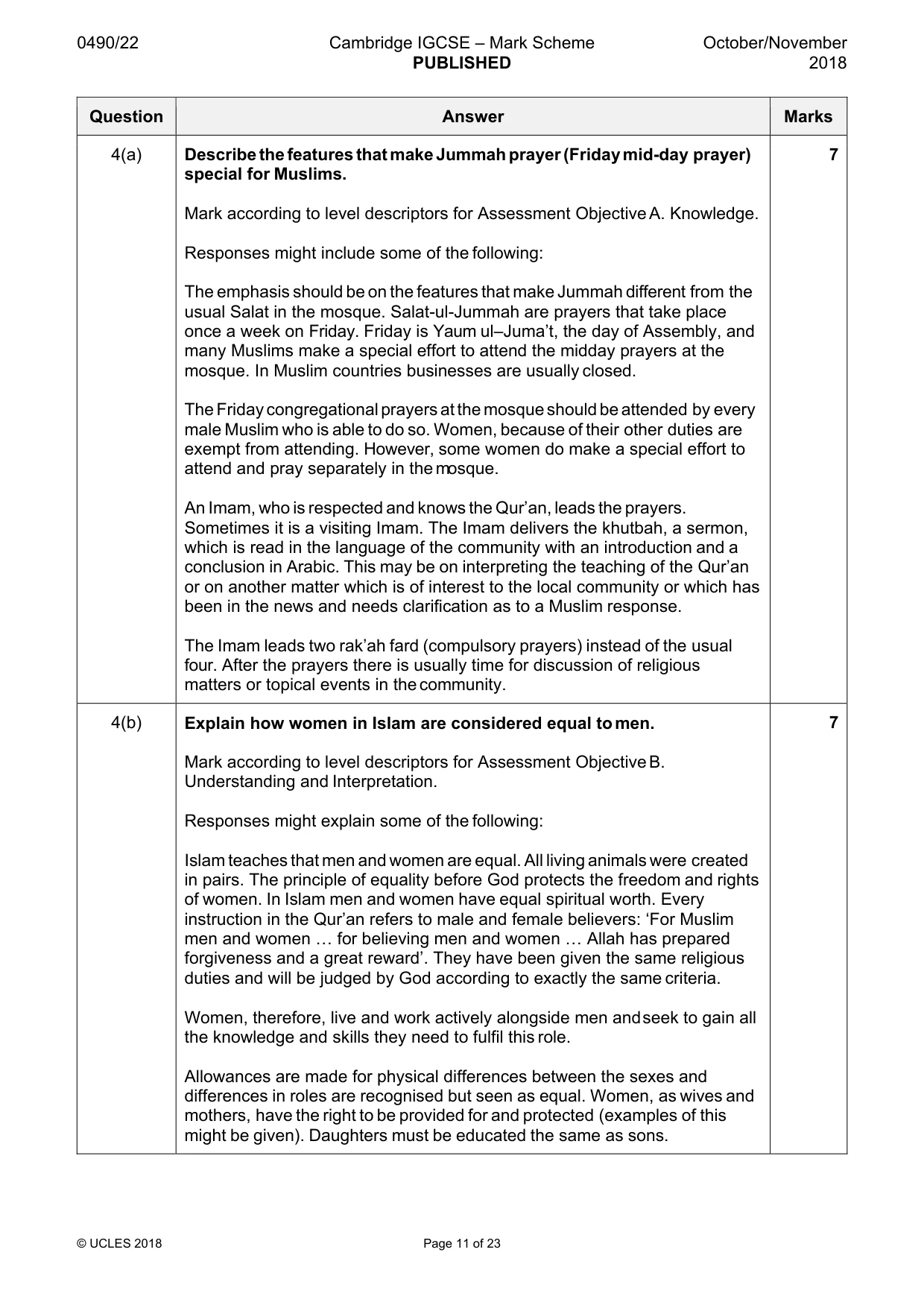
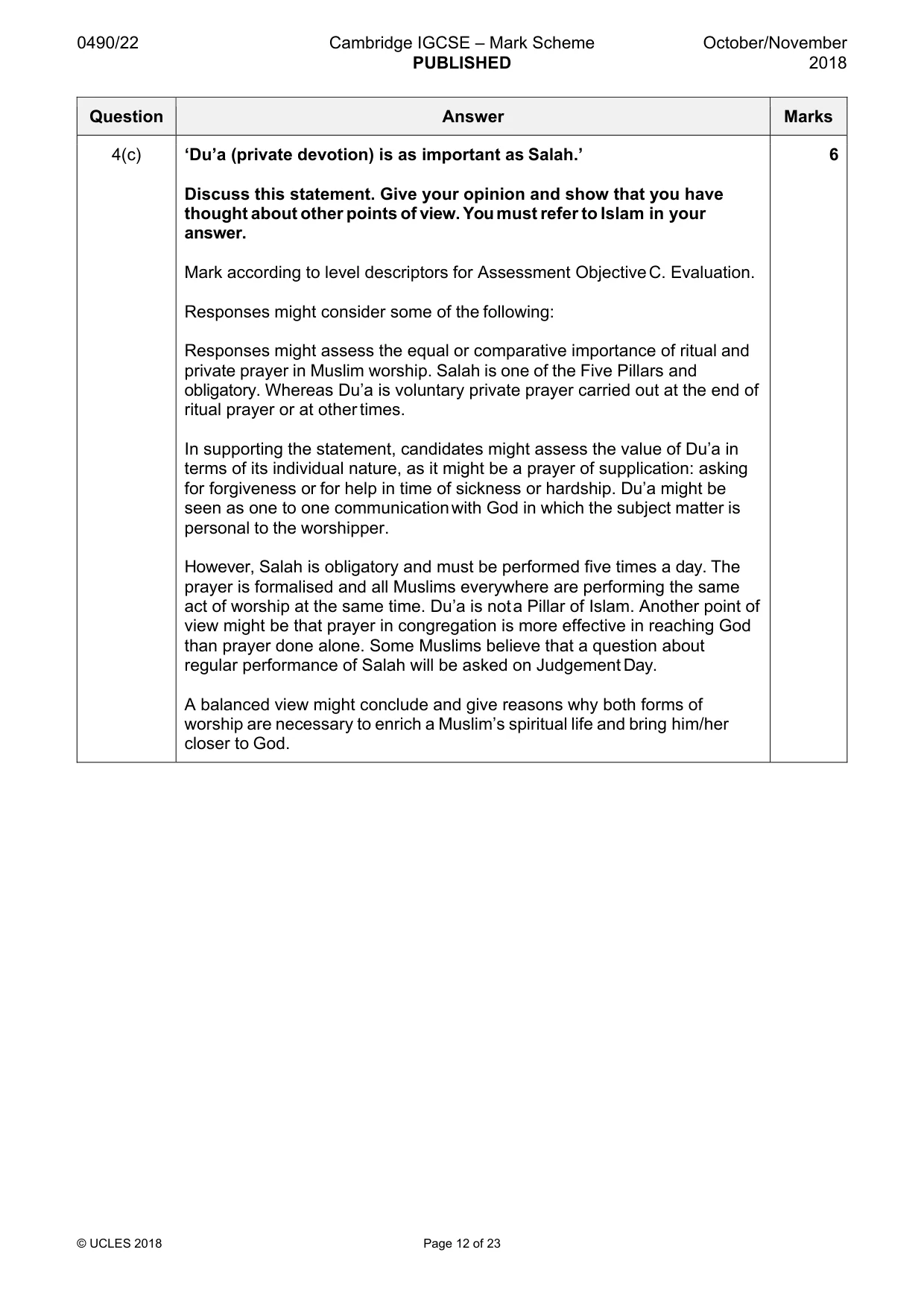
4 (a) Describe the features that make Jummah prayer (Friday mid-day prayer) special for Muslims. [7] (b) Explain how women in Islam are considered equal to men. [7] (c) ‘Du’a (private devotion) is as important as Salah.’ Discuss this statement. Give your own opinion and show that you have thought about other points of view. You must refer to Islam in your answer. [6]
Mark scheme: 4(a) Describe the features that make Jummah prayer (Friday mid-day prayer) 7 special for Muslims. Mark according to level descriptors for Assessment Objective A. Knowledge. Responses might include some of the following: The emphasis should be on the features that make Jummah different from the usual Salat in the mosque. Salat-ul-Jummah are prayers that take place once a week on Friday. Friday is Yaum ul–Juma’t, the day of Assembly, and many Muslims make a special effort to attend the midday prayers at the mosque. In Muslim countries businesses are usually closed. The Friday congregational prayers at the mosque should be attended by every male Muslim who is able to do so. Women, because of their other duties are exempt from attending. However, some women do make a special effort to attend and pray separately in the mosque. An Imam, who is respected and knows the Qur’an, leads the prayers. Sometimes it is a visiting Imam. The Imam delivers the khutbah, a sermon, which is read in the language of the community with an introduction and a conclusion in Arabic. This may be on interpreting the teaching of the Qur’an or on another matter which is of interest to the local community or which has been in the news and needs clarification as to a Muslim response. The Imam leads two rak’ah fard (compulsory prayers) instead of the usual four. After the prayers there is usually time for discussion of religious matters or topical events in the community. 4(b) Explain how women in Islam are considered equal to men. 7 Mark according to level descriptors for Assessment Objective B. Understanding and Interpretation. Responses might explain some of the following: Islam teaches that men and women are equal. All living animals were created in pairs. The principle of equality before God protects the freedom and rights of women. In Islam men and women have equal spiritual worth. Every instruction in the Qur’an refers to male and female believers: ‘For Muslim men and women « for believing men and women « Allah has prepared forgiveness and a great reward’. They have been given the same religious duties and will be judged by God according to exactly the same criteria. Women, therefore, live and work actively alongside men and seek to gain all the knowledge and skills they need to fulfil this role. Allowances are made for physical differences between the sexes and differences in roles are recognised but seen as equal. Women, as wives and mothers, have the right to be provided for and protected (examples of this might be given). Daughters must be educated the same as sons. 4(c) ‘Du’a (private devotion) is as important as Salah.’ 6 Discuss this statement. Give your opinion and show that you have thought about other points of view. You must refer to Islam in your answer. Mark according to level descriptors for Assessment Objective C. Evaluation. Responses might consider some of the following: Responses might assess the equal or comparative importance of ritual and private prayer in Muslim worship. Salah is one of the Five Pillars and obligatory. Whereas Du’a is voluntary private prayer carried out at the end of ritual prayer or at other times. In supporting the statement, candidates might assess the value of Du’a in terms of its individual nature, as it might be a prayer of supplication: asking for forgiveness or for help in time of sickness or hardship. Du’a might be seen as one to one communication with God in which the subject matter is personal to the worshipper. However, Salah is obligatory and must be performed five times a day. The prayer is formalised and all Muslims everywhere are performing the same act of worship at the same time. Du’a is not a Pillar of Islam. Another point of view might be that prayer in congregation is more effective in reaching God than prayer done alone. Some Muslims believe that a question about regular performance of Salah will be asked on Judgement Day. A balanced view might conclude and give reasons why both forms of worship are necessary to enrich a Muslim’s spiritual life and bring him/her closer to God.
Q5 · Outline the rituals practised by Muslims after the birth of a baby
5 (a) Outline the rituals practised by Muslims after the birth of a baby. [7] (b) Explain the meaning and importance of these rituals. [7] (c) ‘A religious family life restricts the freedom of young people.’ Discuss this statement. Give your own opinion and show that you have thought about other points of view. You must refer to Islam in your answer. [6]
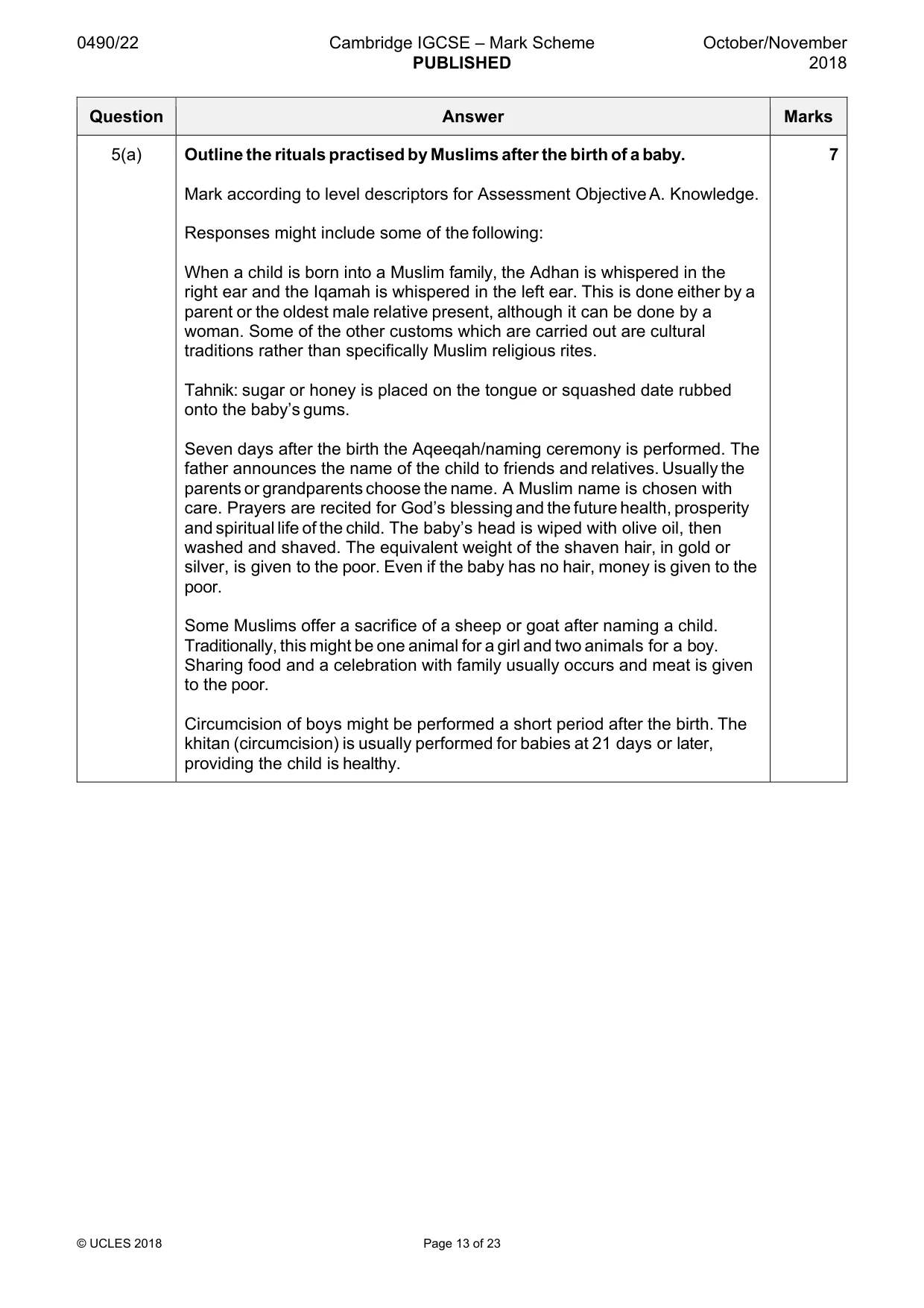
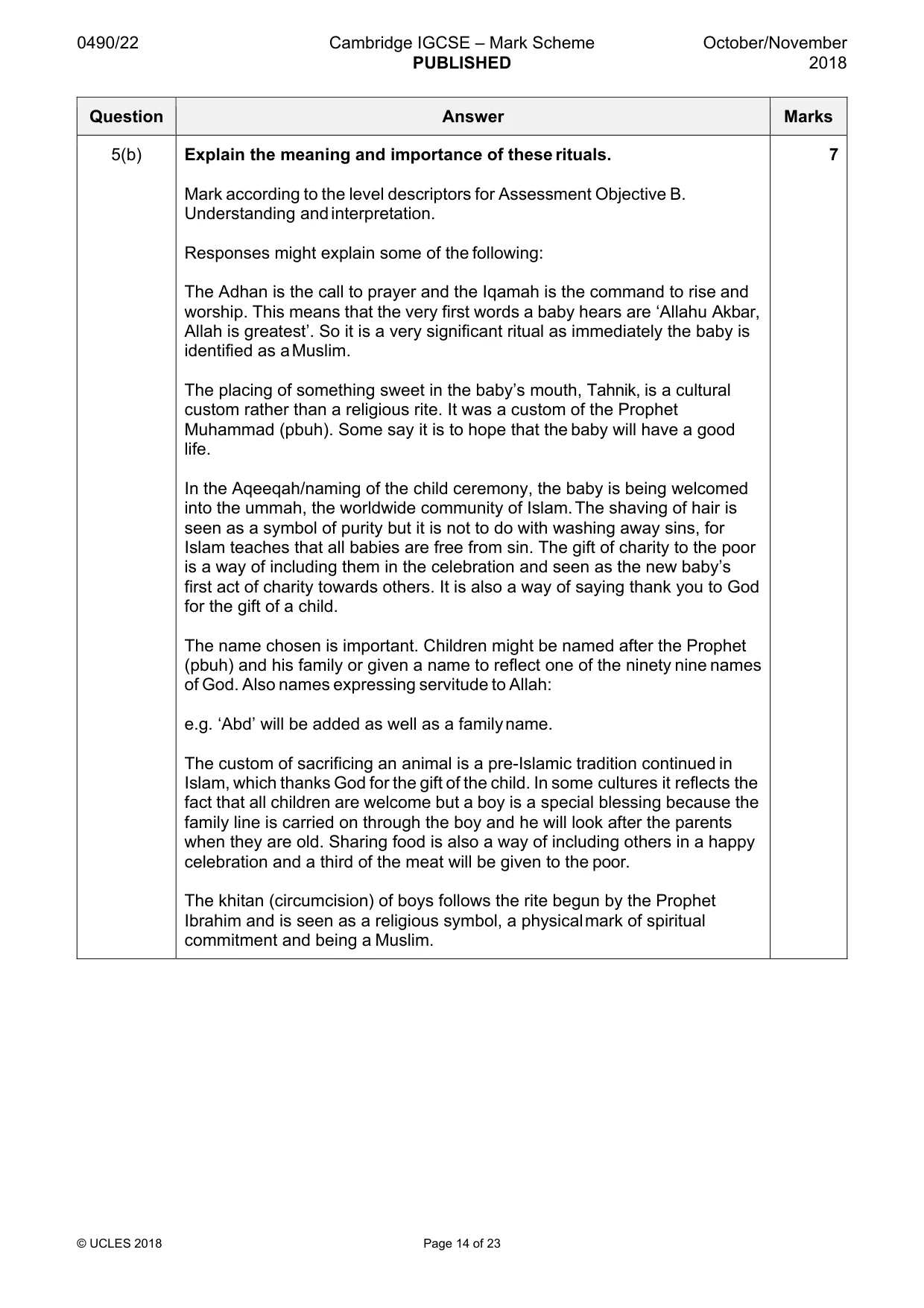
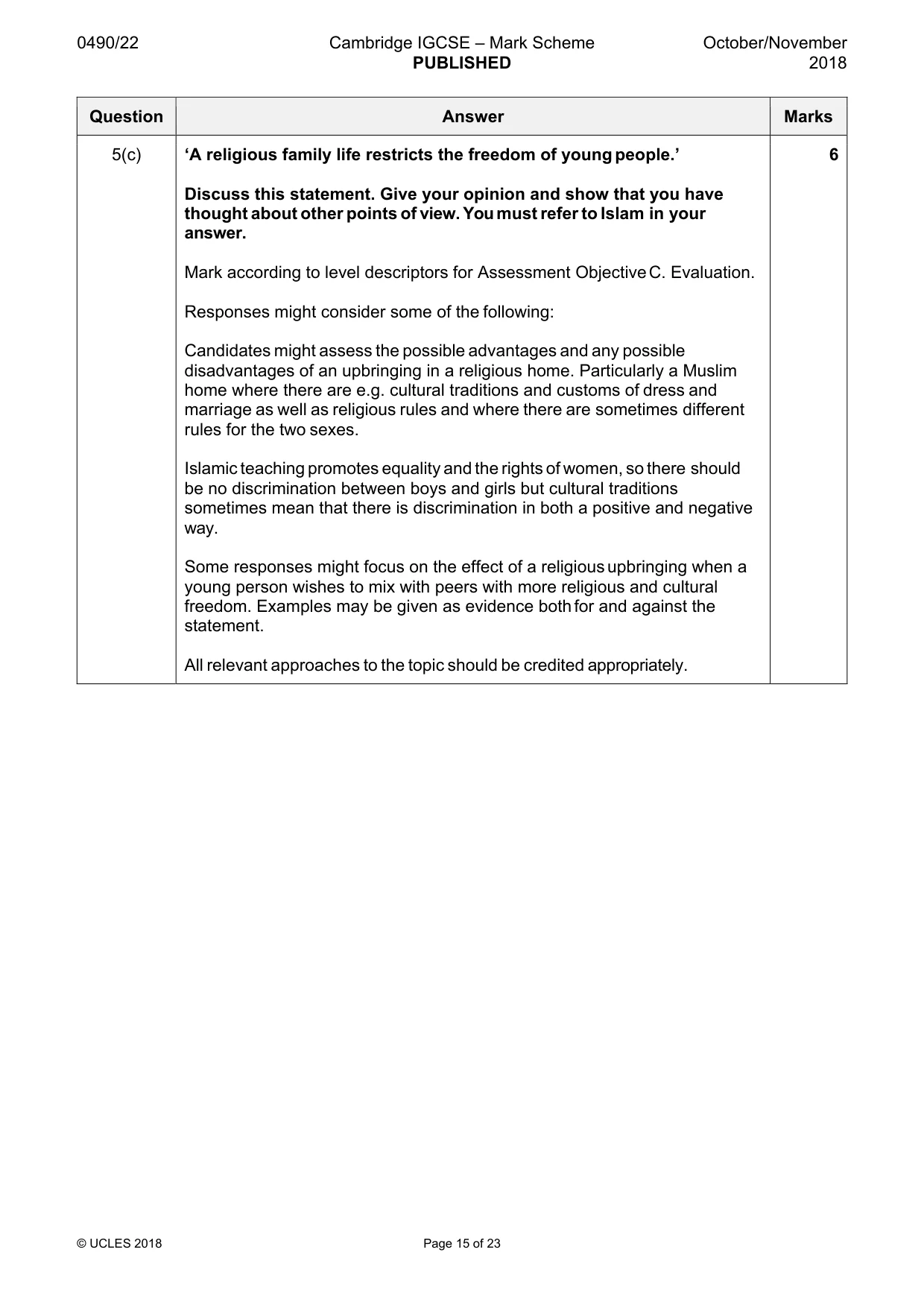
Mark scheme: 5(a) Outline the rituals practised by Muslims after the birth of a baby. 7 Mark according to level descriptors for Assessment Objective A. Knowledge. Responses might include some of the following: When a child is born into a Muslim family, the Adhan is whispered in the right ear and the Iqamah is whispered in the left ear. This is done either by a parent or the oldest male relative present, although it can be done by a woman. Some of the other customs which are carried out are cultural traditions rather than specifically Muslim religious rites. Tahnik: sugar or honey is placed on the tongue or squashed date rubbed onto the baby’s gums. Seven days after the birth the Aqeeqah/naming ceremony is performed. The father announces the name of the child to friends and relatives. Usually the parents or grandparents choose the name. A Muslim name is chosen with care. Prayers are recited for God’s blessing and the future health, prosperity and spiritual life of the child. The baby’s head is wiped with olive oil, then washed and shaved. The equivalent weight of the shaven hair, in gold or silver, is given to the poor. Even if the baby has no hair, money is given to the poor. Some Muslims offer a sacrifice of a sheep or goat after naming a child. Traditionally, this might be one animal for a girl and two animals for a boy. Sharing food and a celebration with family usually occurs and meat is given to the poor. Circumcision of boys might be performed a short period after the birth. The khitan (circumcision) is usually performed for babies at 21 days or later, providing the child is healthy. 5(b) Explain the meaning and importance of these rituals. 7 Mark according to the level descriptors for Assessment Objective B. Understanding and interpretation. Responses might explain some of the following: The Adhan is the call to prayer and the Iqamah is the command to rise and worship. This means that the very first words a baby hears are ‘Allahu Akbar, Allah is greatest’. So it is a very significant ritual as immediately the baby is identified as a Muslim. The placing of something sweet in the baby’s mouth, Tahnik, is a cultural custom rather than a religious rite. It was a custom of the Prophet Muhammad (pbuh). Some say it is to hope that the baby will have a good life. In the Aqeeqah/naming of the child ceremony, the baby is being welcomed into the ummah, the worldwide community of Islam. The shaving of hair is seen as a symbol of purity but it is not to do with washing away sins, for Islam teaches that all babies are free from sin. The gift of charity to the poor is a way of including them in the celebration and seen as the new baby’s first act of charity towards others. It is also a way of saying thank you to God for the gift of a child. The name chosen is important. Children might be named after the Prophet (pbuh) and his family or given a name to reflect one of the ninety nine names of God. Also names expressing servitude to Allah: e.g. ‘Abd’ will be added as well as a family name. The custom of sacrificing an animal is a pre-Islamic tradition continued in Islam, which thanks God for the gift of the child. In some cultures it reflects the fact that all children are welcome but a boy is a special blessing because the family line is carried on through the boy and he will look after the parents when they are old. Sharing food is also a way of including others in a happy celebration and a third of the meat will be given to the poor. The khitan (circumcision) of boys follows the rite begun by the Prophet Ibrahim and is seen as a religious symbol, a physical mark of spiritual commitment and being a Muslim. 5(c) ‘A religious family life restricts the freedom of young people.’ 6 Discuss this statement. Give your opinion and show that you have thought about other points of view. You must refer to Islam in your answer. Mark according to level descriptors for Assessment Objective C. Evaluation. Responses might consider some of the following: Candidates might assess the possible advantages and any possible disadvantages of an upbringing in a religious home. Particularly a Muslim home where there are e.g. cultural traditions and customs of dress and marriage as well as religious rules and where there are sometimes different rules for the two sexes. Islamic teaching promotes equality and the rights of women, so there should be no discrimination between boys and girls but cultural traditions sometimes mean that there is discrimination in both a positive and negative way. Some responses might focus on the effect of a religious upbringing when a young person wishes to mix with peers with more religious and cultural freedom. Examples may be given as evidence both for and against the statement. All relevant approaches to the topic should be credited appropriately.
Q6 · Give an account of how Sadaqah (voluntary contribution) is given and how it might be used
6 (a) Give an account of how Sadaqah (voluntary contribution) is given and how it might be used. [7] (b) Explain why the poor are included in all celebrations in Islam. [7] (c) ‘Charity does not always help people in the right way.’ Discuss this statement. Give your own opinion and show that you have thought about other points of view. You must refer to Islam in your answer. [6] Section C – Judaism If you have chosen this section answer all of the parts in two of the questions.
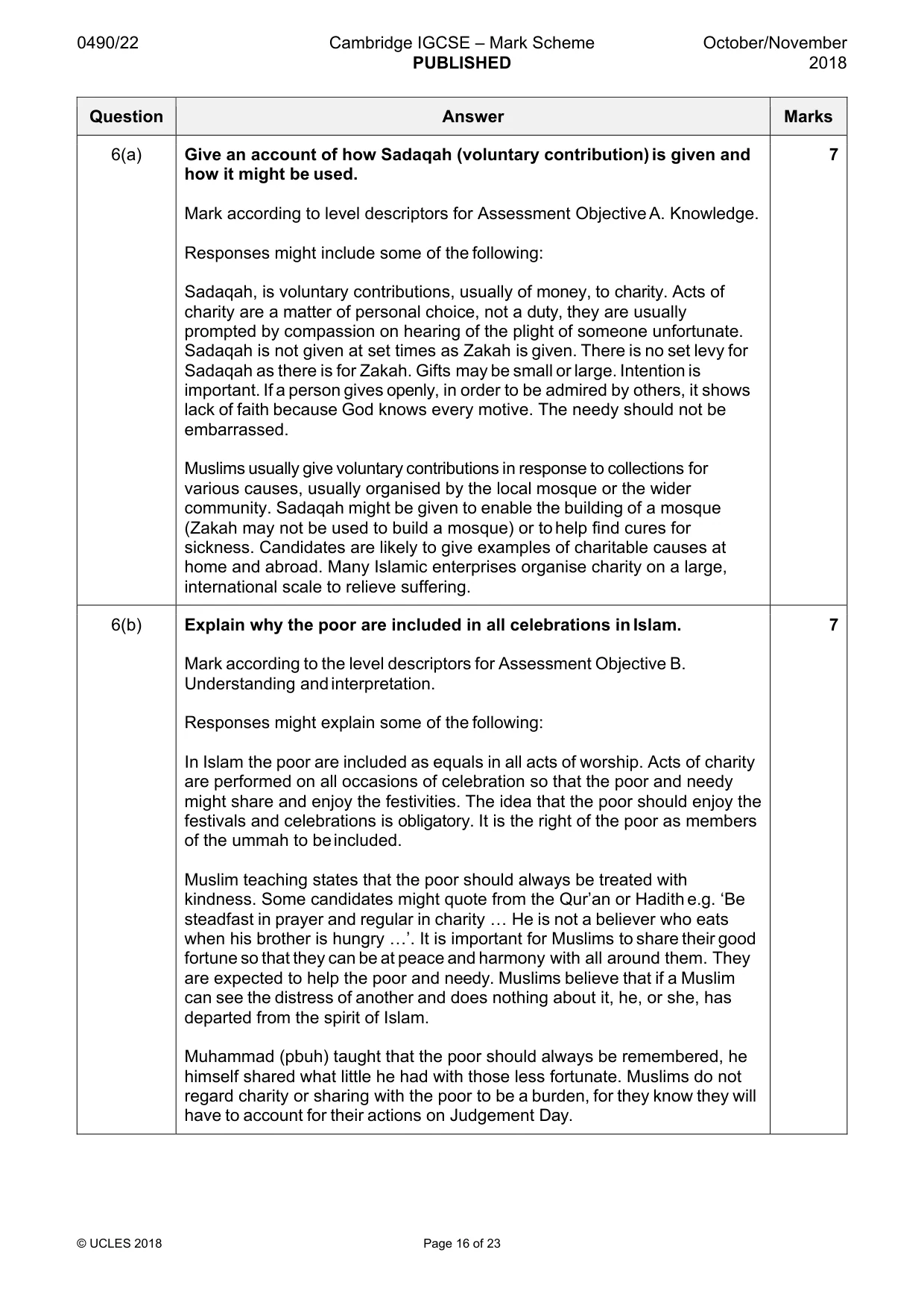
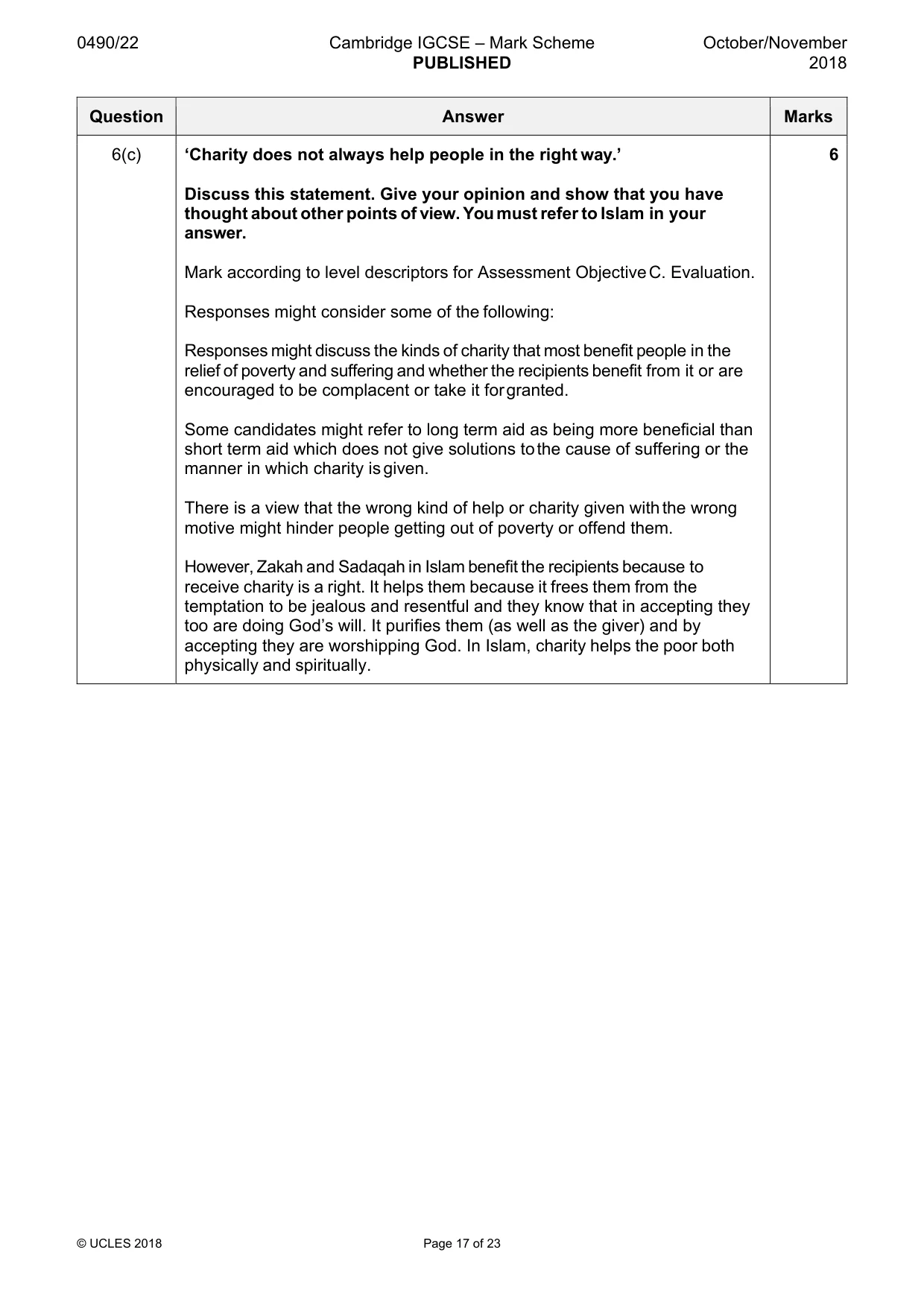
Mark scheme: 6(a) Give an account of how Sadaqah (voluntary contribution) is given and 7 how it might be used. Mark according to level descriptors for Assessment Objective A. Knowledge. Responses might include some of the following: Sadaqah, is voluntary contributions, usually of money, to charity. Acts of charity are a matter of personal choice, not a duty, they are usually prompted by compassion on hearing of the plight of someone unfortunate. Sadaqah is not given at set times as Zakah is given. There is no set levy for Sadaqah as there is for Zakah. Gifts may be small or large. Intention is important. If a person gives openly, in order to be admired by others, it shows lack of faith because God knows every motive. The needy should not be embarrassed. Muslims usually give voluntary contributions in response to collections for various causes, usually organised by the local mosque or the wider community. Sadaqah might be given to enable the building of a mosque (Zakah may not be used to build a mosque) or to help find cures for sickness. Candidates are likely to give examples of charitable causes at home and abroad. Many Islamic enterprises organise charity on a large, international scale to relieve suffering. 6(b) Explain why the poor are included in all celebrations in Islam. 7 Mark according to the level descriptors for Assessment Objective B. Understanding and interpretation. Responses might explain some of the following: In Islam the poor are included as equals in all acts of worship. Acts of charity are performed on all occasions of celebration so that the poor and needy might share and enjoy the festivities. The idea that the poor should enjoy the festivals and celebrations is obligatory. It is the right of the poor as members of the ummah to be included. Muslim teaching states that the poor should always be treated with kindness. Some candidates might quote from the Qur’an or Hadith e.g. ‘Be steadfast in prayer and regular in charity « He is not a believer who eats when his brother is hungry «’. It is important for Muslims to share their good fortune so that they can be at peace and harmony with all around them. They are expected to help the poor and needy. Muslims believe that if a Muslim can see the distress of another and does nothing about it, he, or she, has departed from the spirit of Islam. Muhammad (pbuh) taught that the poor should always be remembered, he himself shared what little he had with those less fortunate. Muslims do not regard charity or sharing with the poor to be a burden, for they know they will have to account for their actions on Judgement Day. 6(c) ‘Charity does not always help people in the right way.’ 6 Discuss this statement. Give your opinion and show that you have thought about other points of view. You must refer to Islam in your answer. Mark according to level descriptors for Assessment Objective C. Evaluation. Responses might consider some of the following: Responses might discuss the kinds of charity that most benefit people in the relief of poverty and suffering and whether the recipients benefit from it or are encouraged to be complacent or take it for granted. Some candidates might refer to long term aid as being more beneficial than short term aid which does not give solutions to the cause of suffering or the manner in which charity is given. There is a view that the wrong kind of help or charity given with the wrong motive might hinder people getting out of poverty or offend them. However, Zakah and Sadaqah in Islam benefit the recipients because to receive charity is a right. It helps them because it frees them from the temptation to be jealous and resentful and they know that in accepting they too are doing God’s will. It purifies them (as well as the giver) and by accepting they are worshipping God. In Islam, charity helps the poor both physically and spiritually.
Q7 · Describe how the ark (aron ha-kodesh) and the Sefer Torah (Torah scrolls) are used in the…
7 (a) Describe how the ark (aron ha-kodesh) and the Sefer Torah (Torah scrolls) are used in the synagogue. [7] (b) Explain why some Jews consider ritual dress for prayer to be important. [7] (c) ‘Private prayer is the greatest sign of faith.’ Discuss this statement. Give your own opinion and show that you have thought about other points of view. You must refer to Judaism in your answer. [6]
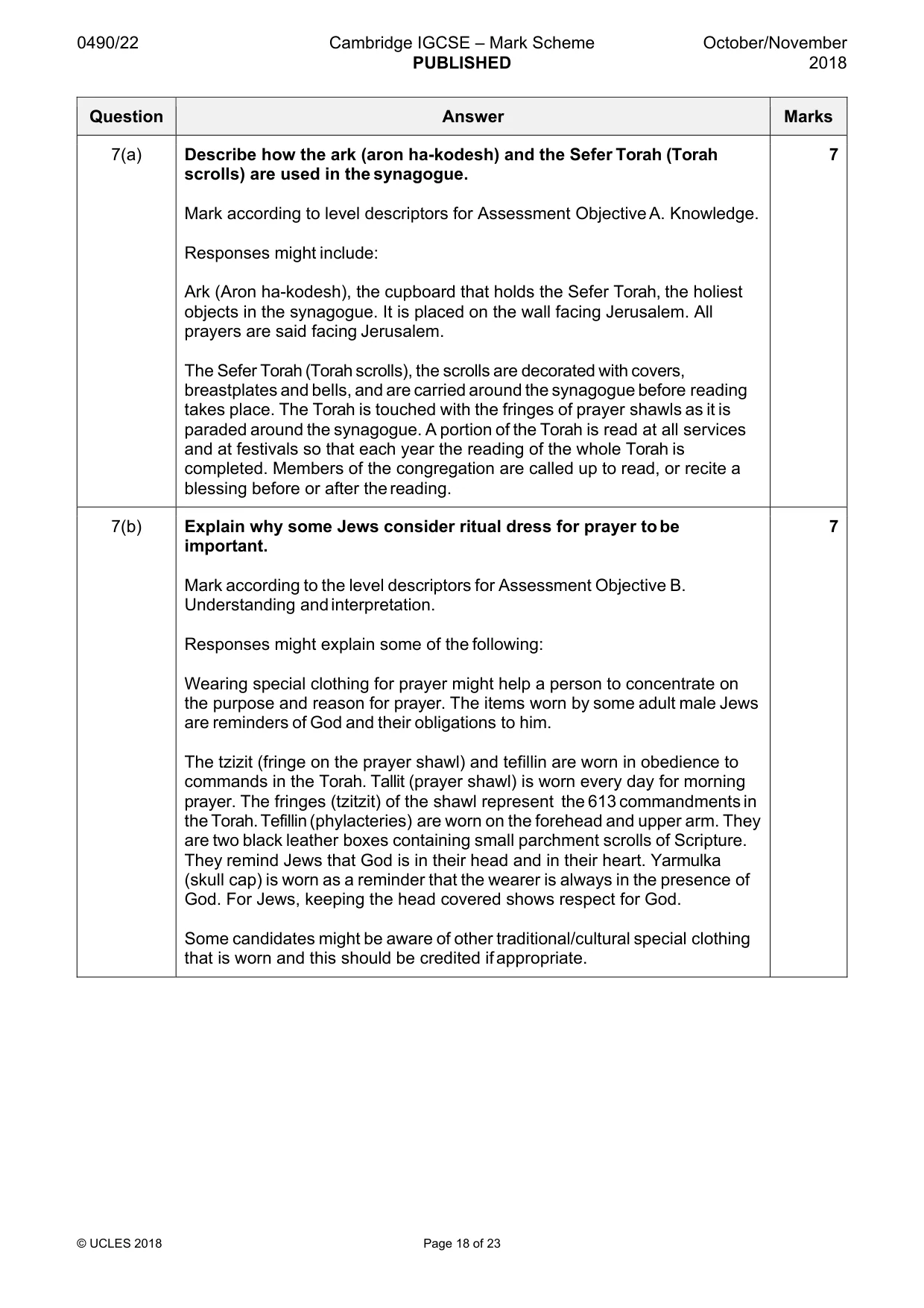
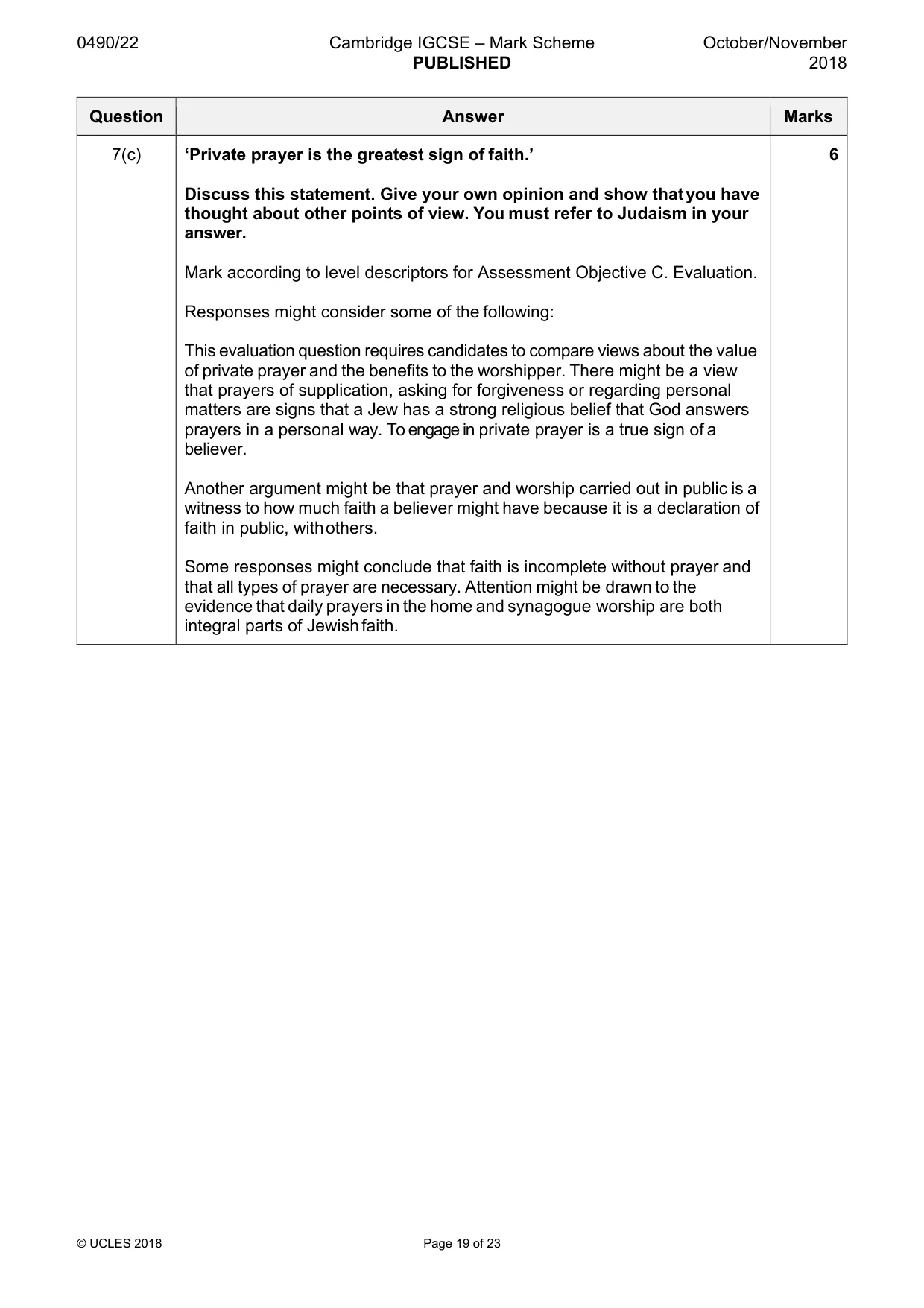
Mark scheme: 7(a) Describe how the ark (aron ha-kodesh) and the Sefer Torah (Torah 7 scrolls) are used in the synagogue. Mark according to level descriptors for Assessment Objective A. Knowledge. Responses might include: Ark (Aron ha-kodesh), the cupboard that holds the Sefer Torah, the holiest objects in the synagogue. It is placed on the wall facing Jerusalem. All prayers are said facing Jerusalem. The Sefer Torah (Torah scrolls), the scrolls are decorated with covers, breastplates and bells, and are carried around the synagogue before reading takes place. The Torah is touched with the fringes of prayer shawls as it is paraded around the synagogue. A portion of the Torah is read at all services and at festivals so that each year the reading of the whole Torah is completed. Members of the congregation are called up to read, or recite a blessing before or after the reading. 7(b) Explain why some Jews consider ritual dress for prayer to be 7 important. Mark according to the level descriptors for Assessment Objective B. Understanding and interpretation. Responses might explain some of the following: Wearing special clothing for prayer might help a person to concentrate on the purpose and reason for prayer. The items worn by some adult male Jews are reminders of God and their obligations to him. The tzizit (fringe on the prayer shawl) and tefillin are worn in obedience to commands in the Torah. Tallit (prayer shawl) is worn every day for morning prayer. The fringes (tzitzit) of the shawl represent the 613 commandments in the Torah. Tefillin (phylacteries) are worn on the forehead and upper arm. They are two black leather boxes containing small parchment scrolls of Scripture. They remind Jews that God is in their head and in their heart. Yarmulka (skull cap) is worn as a reminder that the wearer is always in the presence of God. For Jews, keeping the head covered shows respect for God. Some candidates might be aware of other traditional/cultural special clothing that is worn and this should be credited if appropriate. 7(c) ‘Private prayer is the greatest sign of faith.’ 6 Discuss this statement. Give your own opinion and show that you have thought about other points of view. You must refer to Judaism in your answer. Mark according to level descriptors for Assessment Objective C. Evaluation. Responses might consider some of the following: This evaluation question requires candidates to compare views about the value of private prayer and the benefits to the worshipper. There might be a view that prayers of supplication, asking for forgiveness or regarding personal matters are signs that a Jew has a strong religious belief that God answers prayers in a personal way. To engage in private prayer is a true sign of a believer. Another argument might be that prayer and worship carried out in public is a witness to how much faith a believer might have because it is a declaration of faith in public, with others. Some responses might conclude that faith is incomplete without prayer and that all types of prayer are necessary. Attention might be drawn to the evidence that daily prayers in the home and synagogue worship are both integral parts of Jewish faith.
Q8 · Describe the Mezuzah and how it is used
8 (a) Describe the Mezuzah and how it is used. [7] (b) Explain the responsibilities that will be taken on by a boy when he has reached the age to be part of a minyan. [7] (c) ‘In Judaism, actions are the most important part of the religion.’ Discuss this statement. Give your own opinion and show that you have thought about other points of view. You must refer to Judaism in your answer. [6]
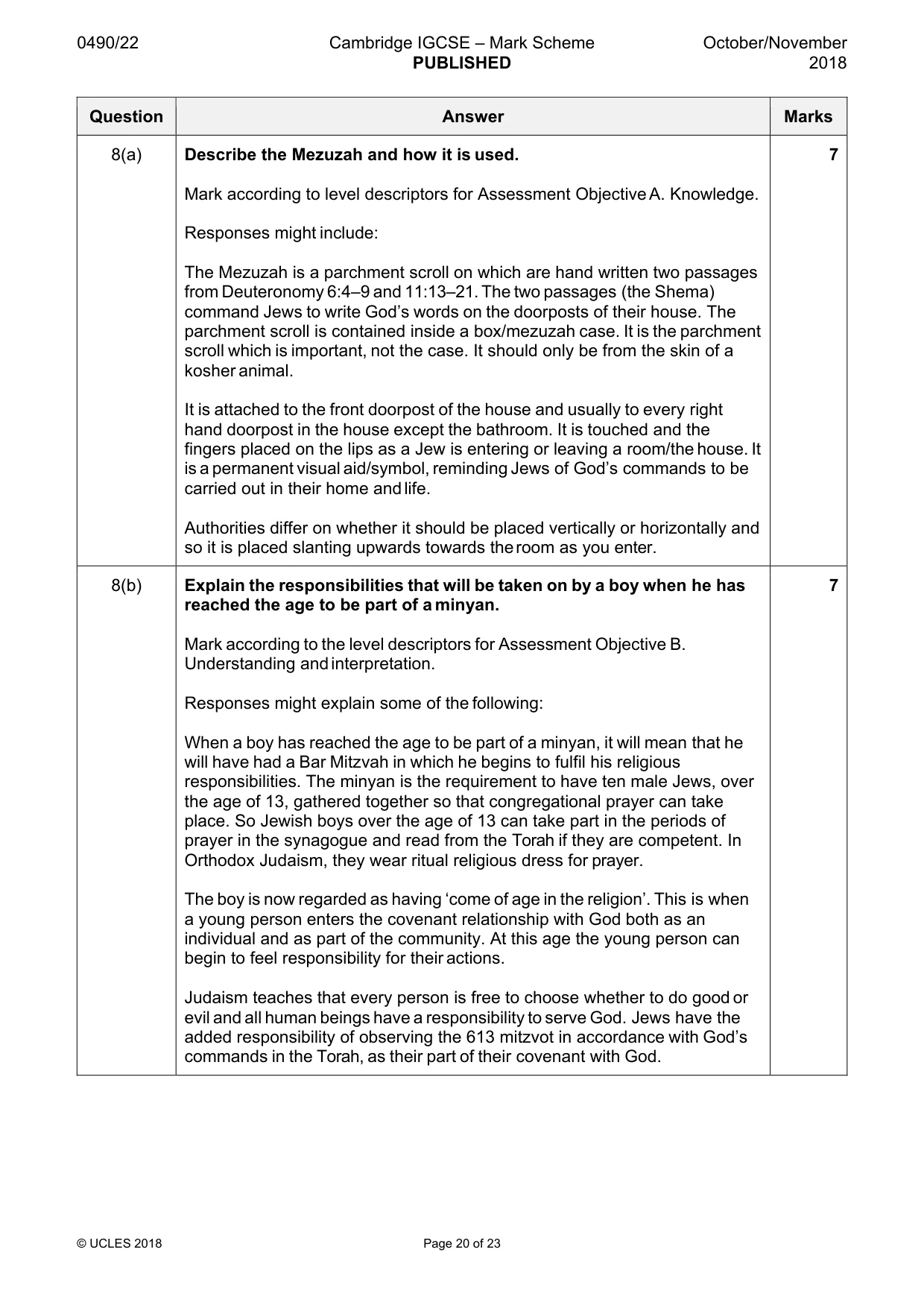
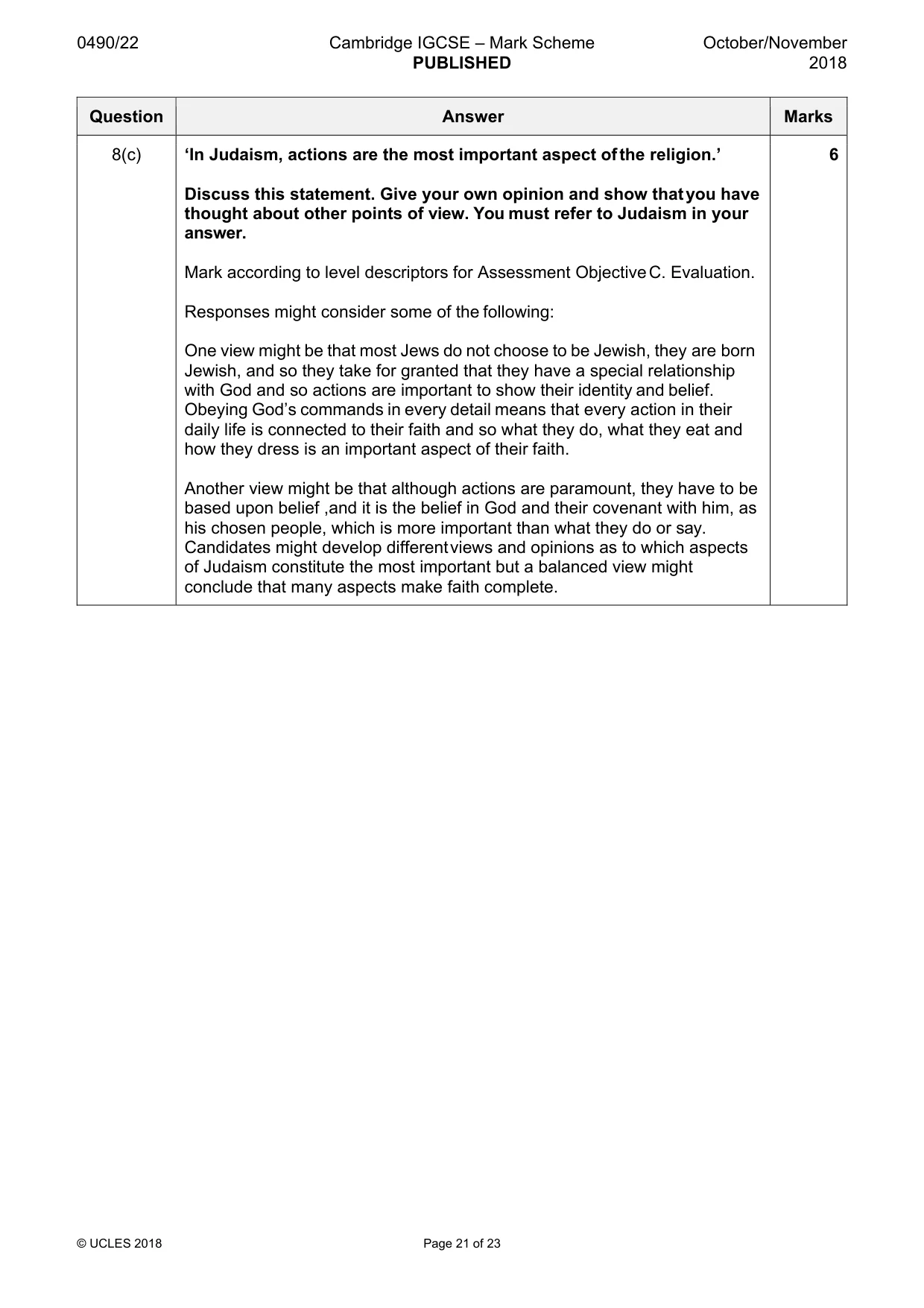
Mark scheme: 8(a) Describe the Mezuzah and how it is used. 7 Mark according to level descriptors for Assessment Objective A. Knowledge. Responses might include: The Mezuzah is a parchment scroll on which are hand written two passages from Deuteronomy 6:4–9 and 11:13–21. The two passages (the Shema) command Jews to write God’s words on the doorposts of their house. The parchment scroll is contained inside a box/mezuzah case. It is the parchment scroll which is important, not the case. It should only be from the skin of a kosher animal. It is attached to the front doorpost of the house and usually to every right hand doorpost in the house except the bathroom. It is touched and the fingers placed on the lips as a Jew is entering or leaving a room/the house. It is a permanent visual aid/symbol, reminding Jews of God’s commands to be carried out in their home and life. Authorities differ on whether it should be placed vertically or horizontally and so it is placed slanting upwards towards the room as you enter. 8(b) Explain the responsibilities that will be taken on by a boy when he has 7 reached the age to be part of a minyan. Mark according to the level descriptors for Assessment Objective B. Understanding and interpretation. Responses might explain some of the following: When a boy has reached the age to be part of a minyan, it will mean that he will have had a Bar Mitzvah in which he begins to fulfil his religious responsibilities. The minyan is the requirement to have ten male Jews, over the age of 13, gathered together so that congregational prayer can take place. So Jewish boys over the age of 13 can take part in the periods of prayer in the synagogue and read from the Torah if they are competent. In Orthodox Judaism, they wear ritual religious dress for prayer. The boy is now regarded as having ‘come of age in the religion’. This is when a young person enters the covenant relationship with God both as an individual and as part of the community. At this age the young person can begin to feel responsibility for their actions. Judaism teaches that every person is free to choose whether to do good or evil and all human beings have a responsibility to serve God. Jews have the added responsibility of observing the 613 mitzvot in accordance with God’s commands in the Torah, as their part of their covenant with God. 8(c) ‘In Judaism, actions are the most important aspect of the religion.’ 6 Discuss this statement. Give your own opinion and show that you have thought about other points of view. You must refer to Judaism in your answer. Mark according to level descriptors for Assessment Objective C. Evaluation. Responses might consider some of the following: One view might be that most Jews do not choose to be Jewish, they are born Jewish, and so they take for granted that they have a special relationship with God and so actions are important to show their identity and belief. Obeying God’s commands in every detail means that every action in their daily life is connected to their faith and so what they do, what they eat and how they dress is an important aspect of their faith. Another view might be that although actions are paramount, they have to be based upon belief ,and it is the belief in God and their covenant with him, as his chosen people, which is more important than what they do or say. Candidates might develop different views and opinions as to which aspects of Judaism constitute the most important but a balanced view might conclude that many aspects make faith complete.
Q9 · What is Kashrut and how might it be applied to clothing?
9 (a) What is Kashrut and how might it be applied to clothing? [7] (b) Explain how the Jewish family plays an important role in maintaining Jewish values. [7] (c) ‘In the modern world, changes to religious rules cannot be avoided.’ Discuss this statement. Give your own opinion and show that you have thought about other points of view. You must refer to Judaism in your answer. [6]
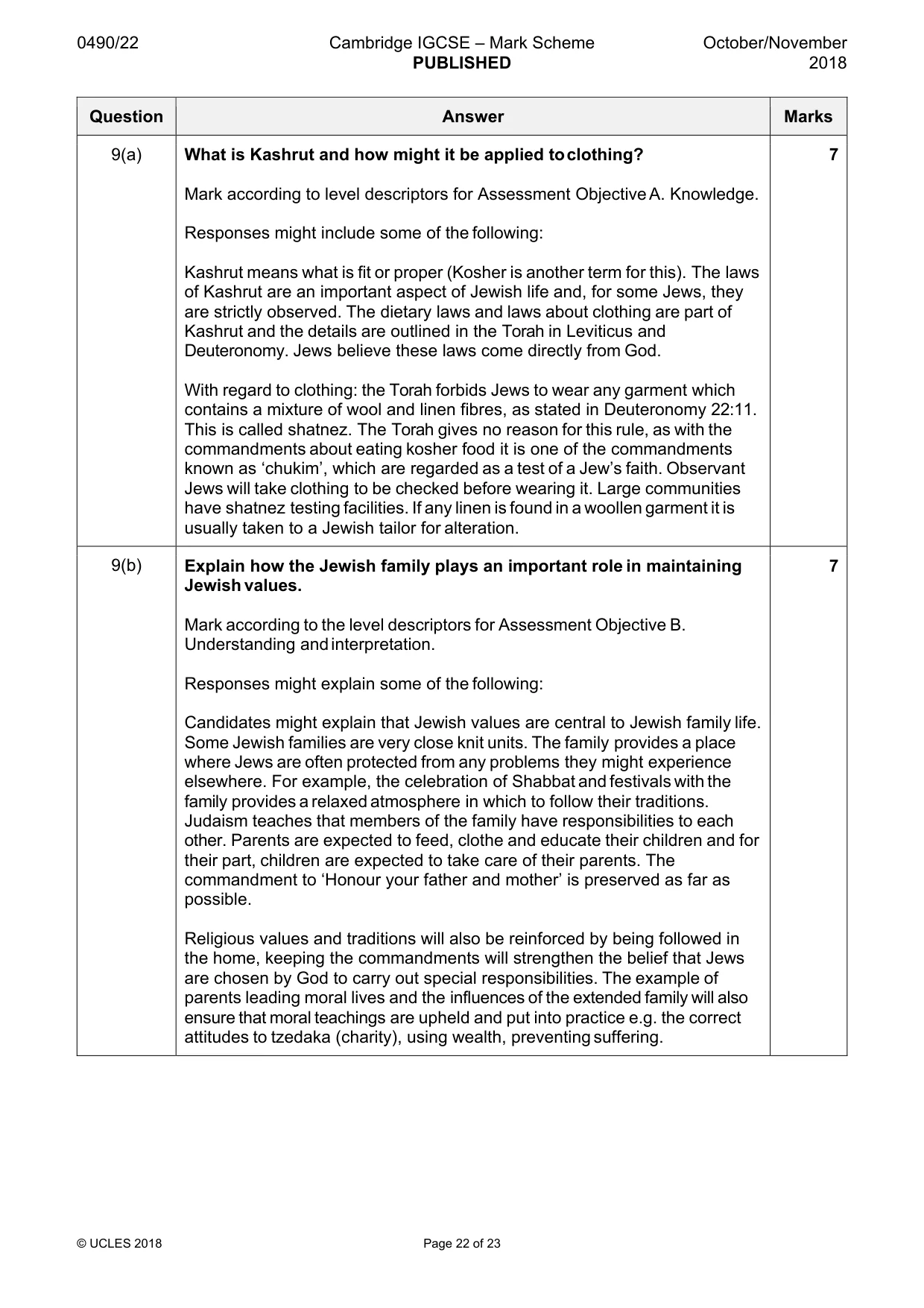
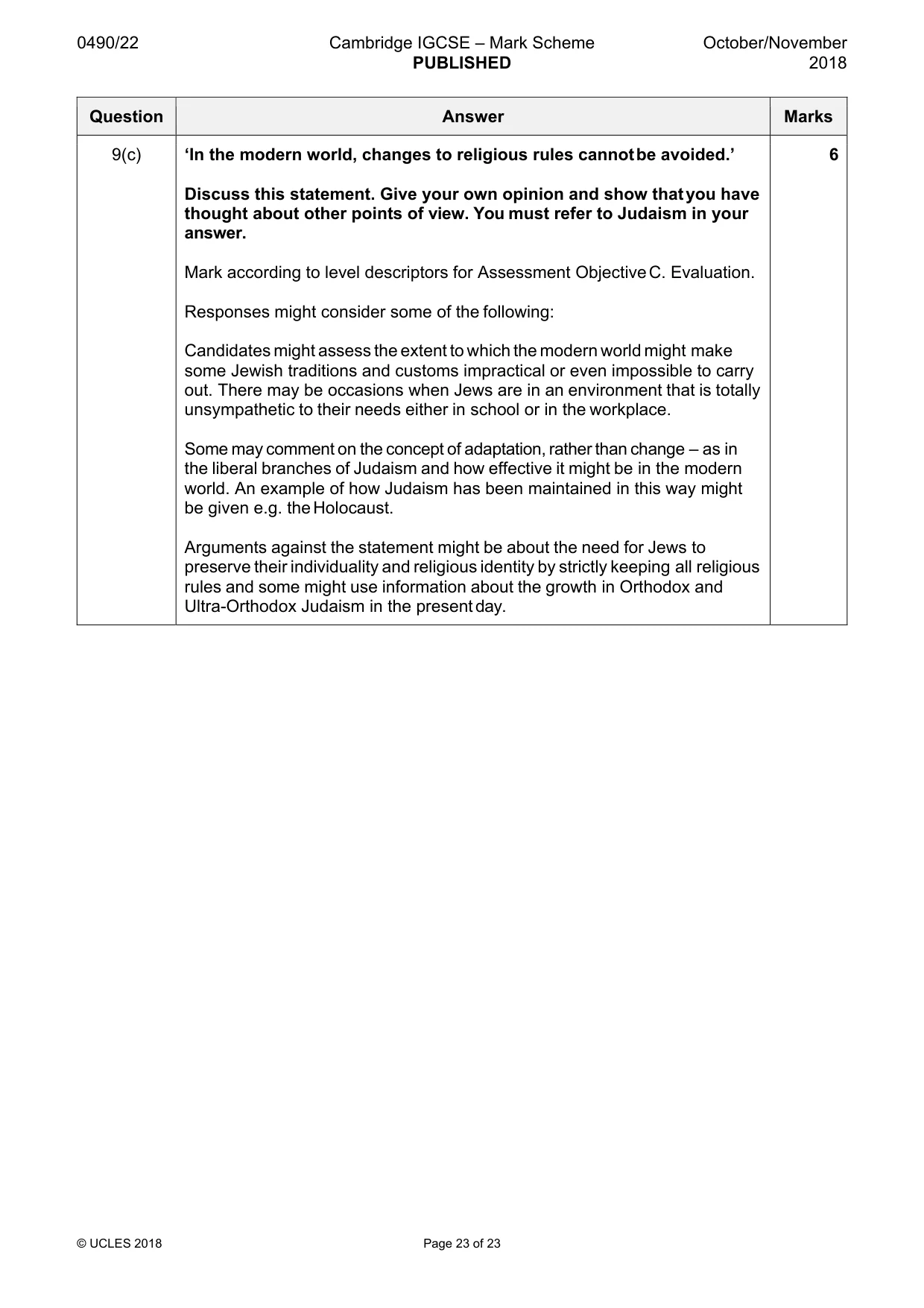
Mark scheme: 9(a) What is Kashrut and how might it be applied to clothing? 7 Mark according to level descriptors for Assessment Objective A. Knowledge. Responses might include some of the following: Kashrut means what is fit or proper (Kosher is another term for this). The laws of Kashrut are an important aspect of Jewish life and, for some Jews, they are strictly observed. The dietary laws and laws about clothing are part of Kashrut and the details are outlined in the Torah in Leviticus and Deuteronomy. Jews believe these laws come directly from God. With regard to clothing: the Torah forbids Jews to wear any garment which contains a mixture of wool and linen fibres, as stated in Deuteronomy 22:11. This is called shatnez. The Torah gives no reason for this rule, as with the commandments about eating kosher food it is one of the commandments known as ‘chukim’, which are regarded as a test of a Jew’s faith. Observant Jews will take clothing to be checked before wearing it. Large communities have shatnez testing facilities. If any linen is found in a woollen garment it is usually taken to a Jewish tailor for alteration. 9(b) Explain how the Jewish family plays an important role in maintaining 7 Jewish values. Mark according to the level descriptors for Assessment Objective B. Understanding and interpretation. Responses might explain some of the following: Candidates might explain that Jewish values are central to Jewish family life. Some Jewish families are very close knit units. The family provides a place where Jews are often protected from any problems they might experience elsewhere. For example, the celebration of Shabbat and festivals with the family provides a relaxed atmosphere in which to follow their traditions. Judaism teaches that members of the family have responsibilities to each other. Parents are expected to feed, clothe and educate their children and for their part, children are expected to take care of their parents. The commandment to ‘Honour your father and mother’ is preserved as far as possible. Religious values and traditions will also be reinforced by being followed in the home, keeping the commandments will strengthen the belief that Jews are chosen by God to carry out special responsibilities. The example of parents leading moral lives and the influences of the extended family will also ensure that moral teachings are upheld and put into practice e.g. the correct attitudes to tzedaka (charity), using wealth, preventing suffering. 9(c) ‘In the modern world, changes to religious rules cannot be avoided.’ 6 Discuss this statement. Give your own opinion and show that you have thought about other points of view. You must refer to Judaism in your answer. Mark according to level descriptors for Assessment Objective C. Evaluation. Responses might consider some of the following: Candidates might assess the extent to which the modern world might make some Jewish traditions and customs impractical or even impossible to carry out. There may be occasions when Jews are in an environment that is totally unsympathetic to their needs either in school or in the workplace. Some may comment on the concept of adaptation, rather than change – as in the liberal branches of Judaism and how effective it might be in the modern world. An example of how Judaism has been maintained in this way might be given e.g. the Holocaust. Arguments against the statement might be about the need for Jews to preserve their individuality and religious identity by strictly keeping all religious rules and some might use information about the growth in Orthodox and Ultra-Orthodox Judaism in the present day.
What was in this paper
The subtopics covered by these 9 questions, and how many questions each got. Open one in a new tab to see every Cambridge question on it.
2Birth rites: the key features and importance of birth rites in Islam1Christianity as a religion that shows concern for others1Islam as a religion that shows concern for others in the home and the community1Kashrut (the laws of kosher/‘fit’) and treyfah (‘forbidden’)1Public/communal and private/individual worship in different Muslim communities1Tradition and change1Worship in the church1What you needed in this session
Cambridge’s own grade thresholds for 2018 Oct/Nov, Paper 2 · Variant 2. A higher threshold means an easier paper — the bar moves with how the cohort did.