Cambridge IGCSE Religious Studies 0490 — 2018 Oct/Nov Paper 1 · Variant 3
0490/13/O/N/18 · 80 marks · ≈90 min
The question paper and its mark scheme, free to read here and free to download. This is Cambridge’s own paper, exactly as it was sat.
Question paper4 pages
Mark scheme14 pages
Answers below. Sit the paper first if you are practising.
Paper as text
Question paper, page 1
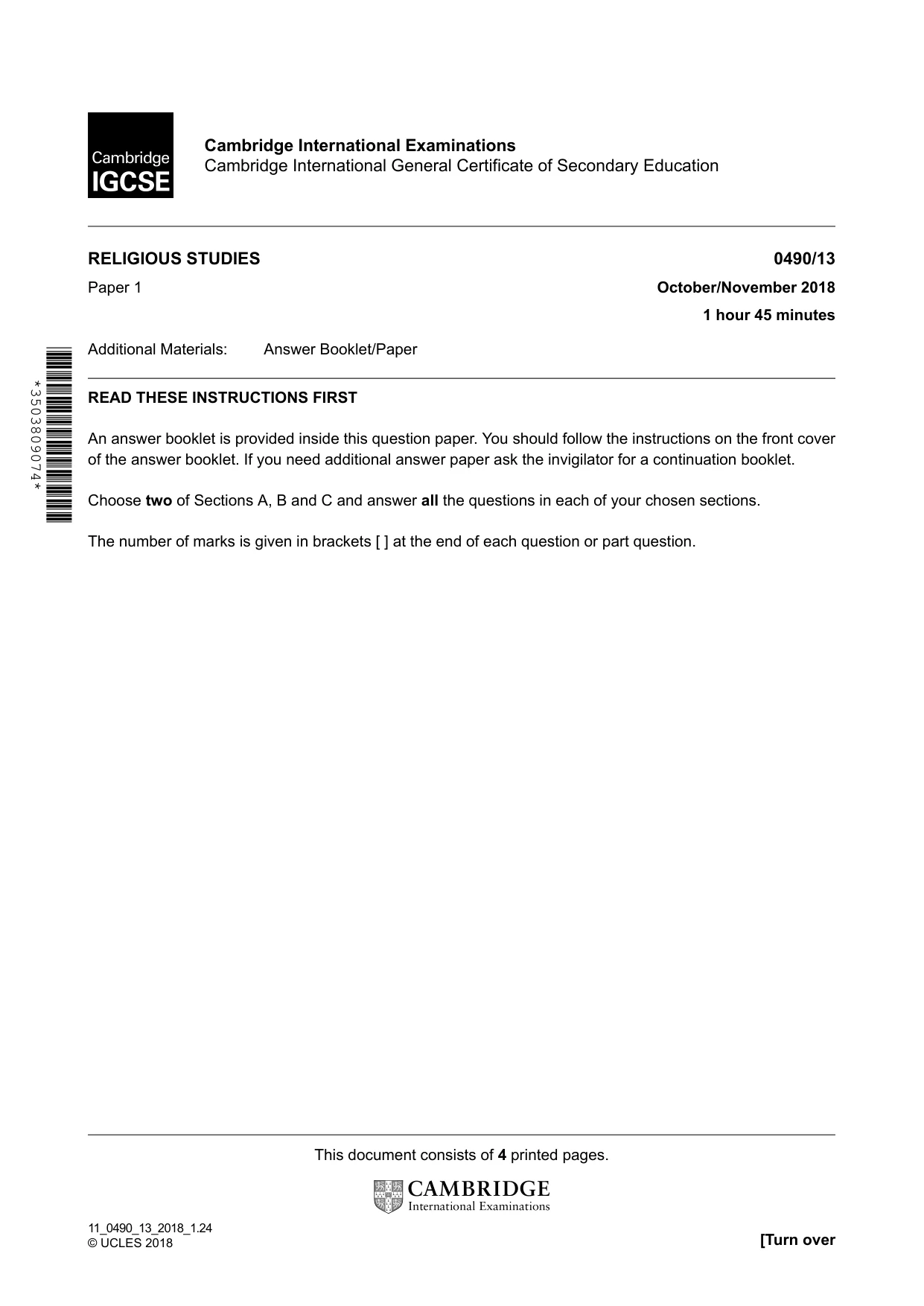
Cambridge International Examinations Cambridge International General Certificate of Secondary Education 0490/13 October/November 2018 1 hour 45 minutes RELIGIOUS STUDIES Paper 1 Additional Materials: Answer Booklet/Paper READ THESE INSTRUCTIONS FIRST An answer booklet is provided inside this question paper. You should follow the instructions on the front cover of the answer booklet. If you need additional answer paper ask the invigilator for a continuation booklet. Choose two of Sections A, B and C and answer all the questions in each of your chosen sections. The number of marks is given in brackets [ ] at the end of each question or part question. This document consists of 4 printed pages. [Turn over 11_0490_13_2018_1.24 © UCLES 2018 *3503809074*
Question paper, page 2
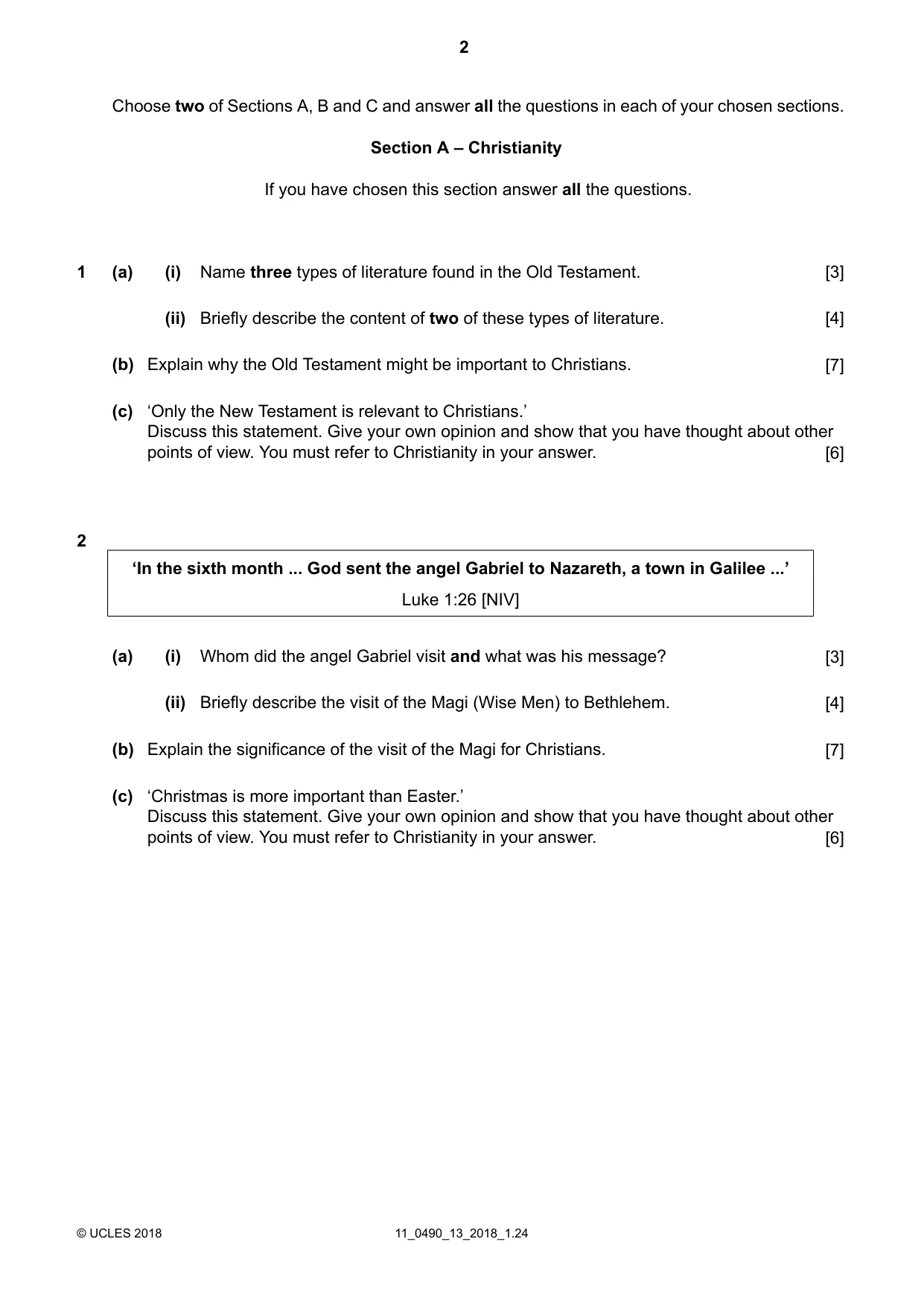
Choose two of Sections A, B and C and answer all the questions in each of your chosen sections. Section A – Christianity If you have chosen this section answer all the questions. Name three types of literature found in the Old Testament. [3] (i) (a) 1 Briefly describe the content of two of these types of literature. [4] (ii) Explain why the Old Testament might be important to Christians. [7] (b) ‘Only the New Testament is relevant to Christians.’ Discuss this statement. Give your own opinion and show that you have thought about other points of view. You must refer to Christianity in your answer. [6] (c) 2 ‘In the sixth month ... God sent the angel Gabriel to Nazareth, a town in Galilee ...’ Luke 1:26 [NIV] Whom did the angel Gabriel visit and what was his message? [3] (i) (a) Briefly describe the visit of the Magi (Wise Men) to Bethlehem. [4] (ii) Explain the significance of the visit of the Magi for Christians. [7] (b) ‘Christmas is more important than Easter.’ Discuss this statement. Give your own opinion and show that you have thought about other points of view. You must refer to Christianity in your answer. [6] (c) 11_0490_13_2018_1.24 © UCLES 2018 2
Question paper, page 3
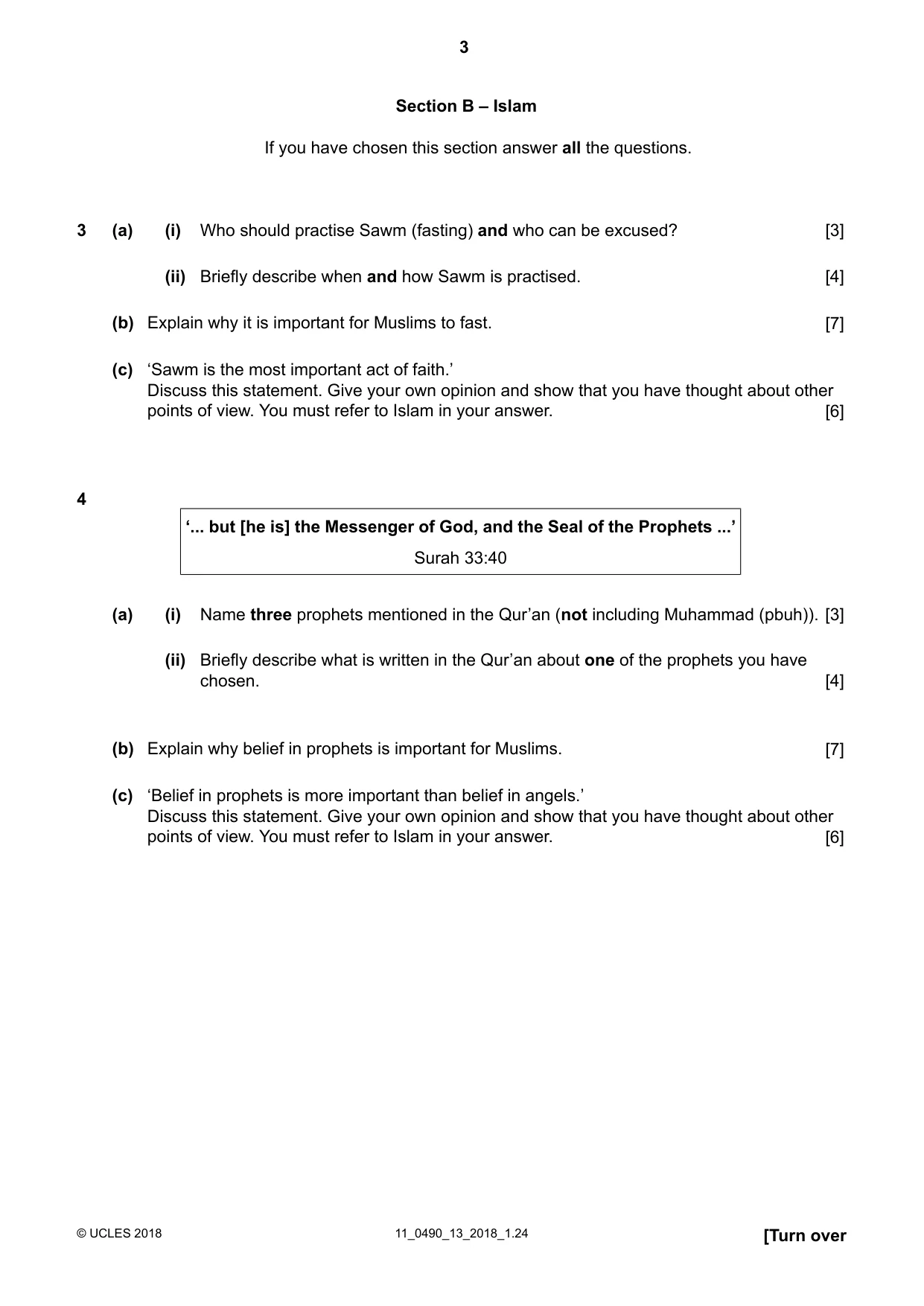
Section B – Islam If you have chosen this section answer all the questions. Who should practise Sawm (fasting) and who can be excused? [3] (i) (a) 3 Briefly describe when and how Sawm is practised. [4] (ii) Explain why it is important for Muslims to fast. [7] (b) ‘Sawm is the most important act of faith.’ Discuss this statement. Give your own opinion and show that you have thought about other points of view. You must refer to Islam in your answer. [6] (c) 4 ‘... but [he is] the Messenger of God, and the Seal of the Prophets ...’ Surah 33:40 Name three prophets mentioned in the Qur’an (not including Muhammad (pbuh)). [3] (i) (a) Briefly describe what is written in the Qur’an about one of the prophets you have chosen. [4] (ii) Explain why belief in prophets is important for Muslims. [7] (b) ‘Belief in prophets is more important than belief in angels.’ Discuss this statement. Give your own opinion and show that you have thought about other points of view. You must refer to Islam in your answer. [6] (c) [Turn over 11_0490_13_2018_1.24 © UCLES 2018 3
Question paper, page 4
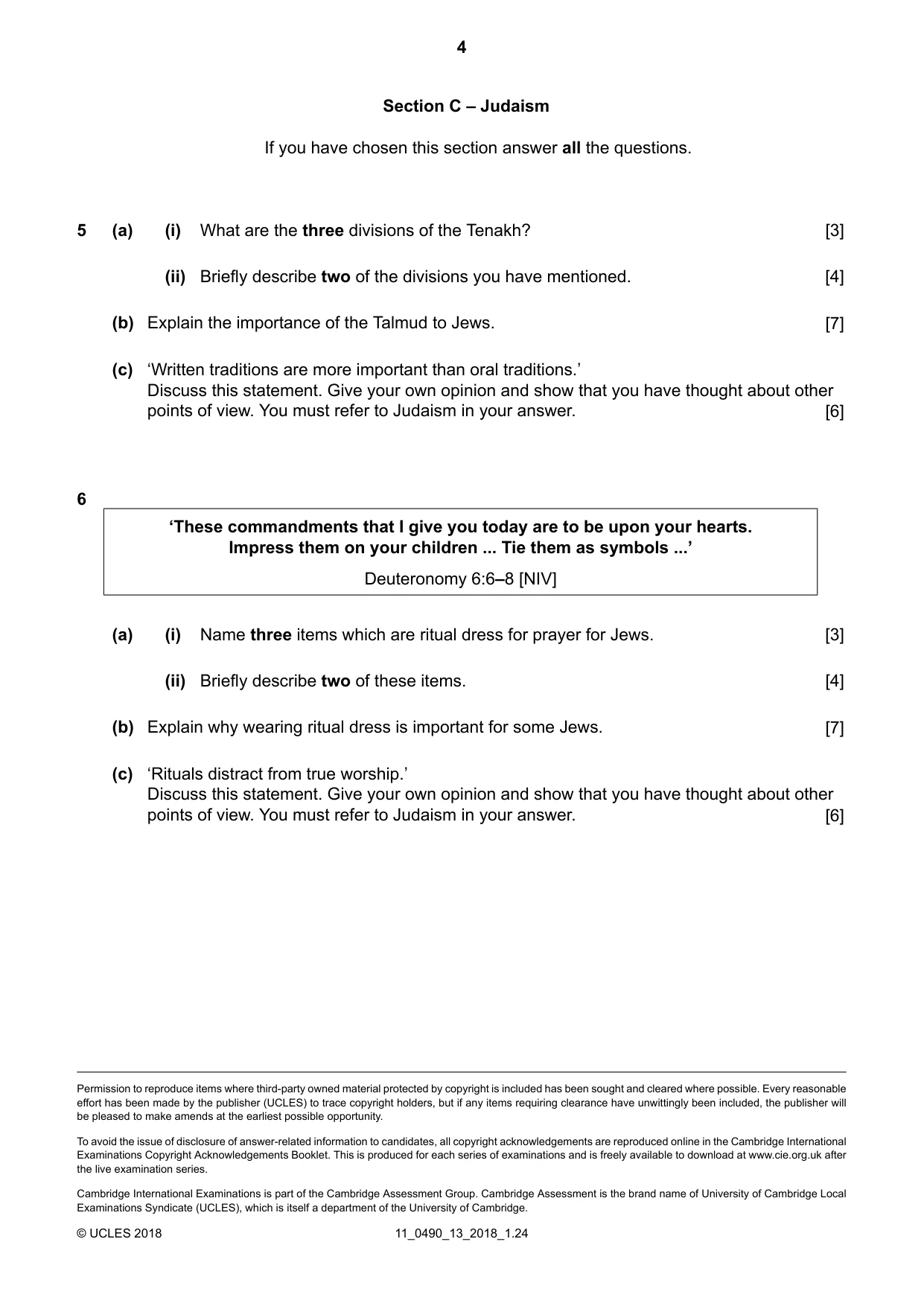
Section C – Judaism If you have chosen this section answer all the questions. What are the three divisions of the Tenakh? [3] (i) (a) 5 Briefly describe two of the divisions you have mentioned. [4] (ii) Explain the importance of the Talmud to Jews. [7] (b) ‘Written traditions are more important than oral traditions.’ Discuss this statement. Give your own opinion and show that you have thought about other points of view. You must refer to Judaism in your answer. [6] (c) 6 ‘These commandments that I give you today are to be upon your hearts. Impress them on your children ... Tie them as symbols ...’ Deuteronomy 6:6–8 [NIV] Name three items which are ritual dress for prayer for Jews. [3] (i) (a) Briefly describe two of these items. [4] (ii) Explain why wearing ritual dress is important for some Jews. [7] (b) ‘Rituals distract from true worship.’ Discuss this statement. Give your own opinion and show that you have thought about other points of view. You must refer to Judaism in your answer. [6] (c) Permission to reproduce items where third-party owned material protected by copyright is included has been sought and cleared where possible. Every reasonable effort has been made by the publisher (UCLES) to trace copyright holders, but if any items requiring clearance have unwittingly been included, the publisher will be pleased to make amends at the earliest possible opportunity. To avoid the issue of disclosure of answer-related information to candidates, all copyright acknowledgements are reproduced online in the Cambridge International Examinations Copyright Acknowledgements Booklet. This is produced for each series of examinations and is freely available to download at www.cie.org.uk after the live examination series. Cambridge International Examinations is part of the Cambridge Assessment Group. Cambridge Assessment is the brand name of University of Cambridge Local Examinations Syndicate (UCLES), which is itself a department of the University of Cambridge. 11_0490_13_2018_1.24 © UCLES 2018 4
Mark scheme, page 1
This document consists of 14 printed pages. © UCLES 2018 [Turn over Cambridge Assessment International Education Cambridge International General Certificate of Secondary Education RELIGIOUS STUDIES 0490/13 Paper 1 October/November 2018 MARK SCHEME Maximum Mark: 80 Published This mark scheme is published as an aid to teachers and candidates, to indicate the requirements of the examination. It shows the basis on which Examiners were instructed to award marks. It does not indicate the details of the discussions that took place at an Examiners’ meeting before marking began, which would have considered the acceptability of alternative answers. Mark schemes should be read in conjunction with the question paper and the Principal Examiner Report for Teachers. Cambridge International will not enter into discussions about these mark schemes. Cambridge International is publishing the mark schemes for the October/November 2018 series for most Cambridge IGCSE™, Cambridge International A and AS Level components and some Cambridge O Level components.
Mark scheme, page 2
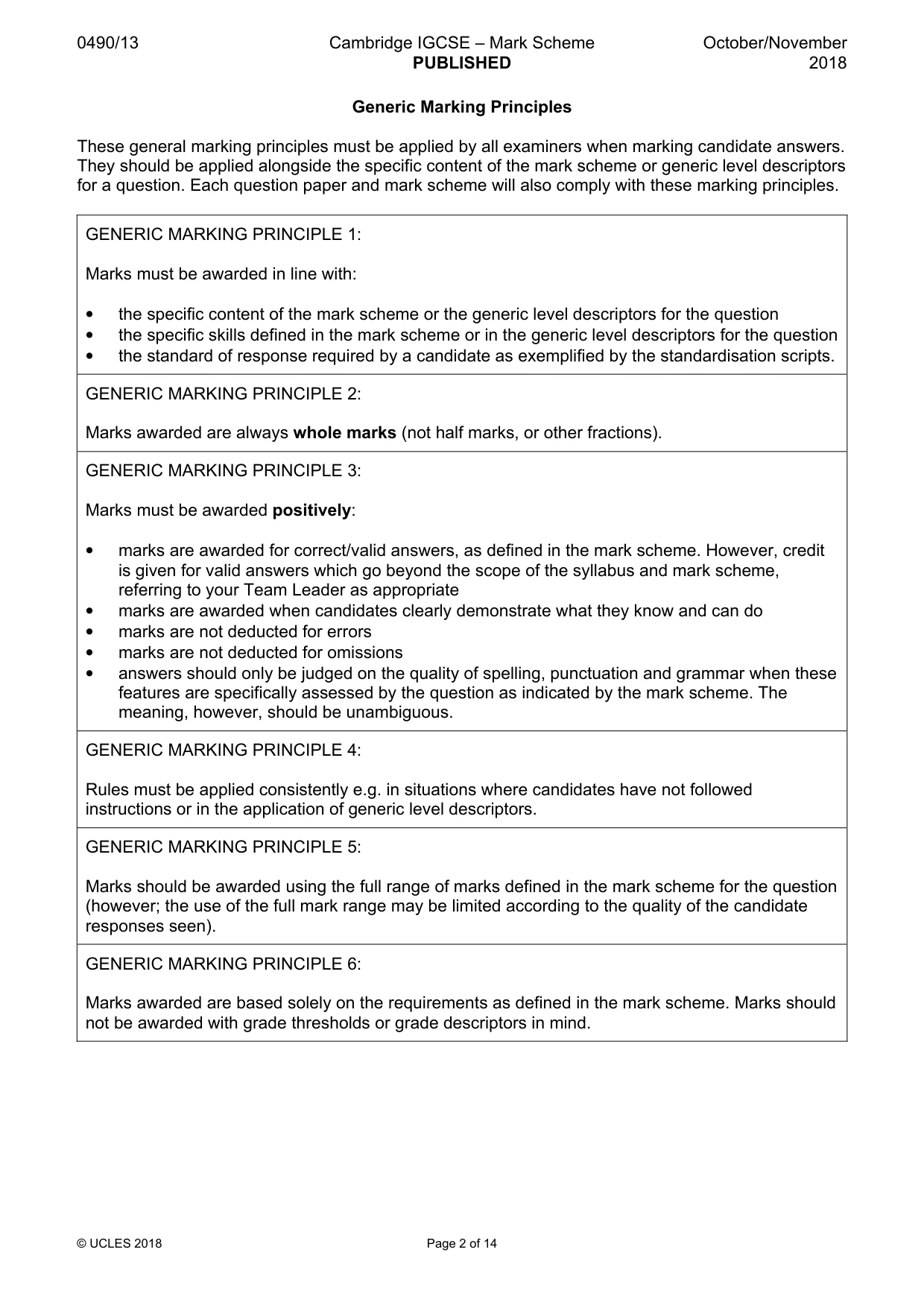
0490/13 Cambridge IGCSE – Mark Scheme PUBLISHED October/November 2018 © UCLES 2018 Page 2 of 14 Generic Marking Principles These general marking principles must be applied by all examiners when marking candidate answers. They should be applied alongside the specific content of the mark scheme or generic level descriptors for a question. Each question paper and mark scheme will also comply with these marking principles. GENERIC MARKING PRINCIPLE 1: Marks must be awarded in line with: • the specific content of the mark scheme or the generic level descriptors for the question • the specific skills defined in the mark scheme or in the generic level descriptors for the question • the standard of response required by a candidate as exemplified by the standardisation scripts. GENERIC MARKING PRINCIPLE 2: Marks awarded are always whole marks (not half marks, or other fractions). GENERIC MARKING PRINCIPLE 3: Marks must be awarded positively: • marks are awarded for correct/valid answers, as defined in the mark scheme. However, credit is given for valid answers which go beyond the scope of the syllabus and mark scheme, referring to your Team Leader as appropriate • marks are awarded when candidates clearly demonstrate what they know and can do • marks are not deducted for errors • marks are not deducted for omissions • answers should only be judged on the quality of spelling, punctuation and grammar when these features are specifically assessed by the question as indicated by the mark scheme. The meaning, however, should be unambiguous. GENERIC MARKING PRINCIPLE 4: Rules must be applied consistently e.g. in situations where candidates have not followed instructions or in the application of generic level descriptors. GENERIC MARKING PRINCIPLE 5: Marks should be awarded using the full range of marks defined in the mark scheme for the question (however; the use of the full mark range may be limited according to the quality of the candidate responses seen). GENERIC MARKING PRINCIPLE 6: Marks awarded are based solely on the requirements as defined in the mark scheme. Marks should not be awarded with grade thresholds or grade descriptors in mind.
Mark scheme, page 3
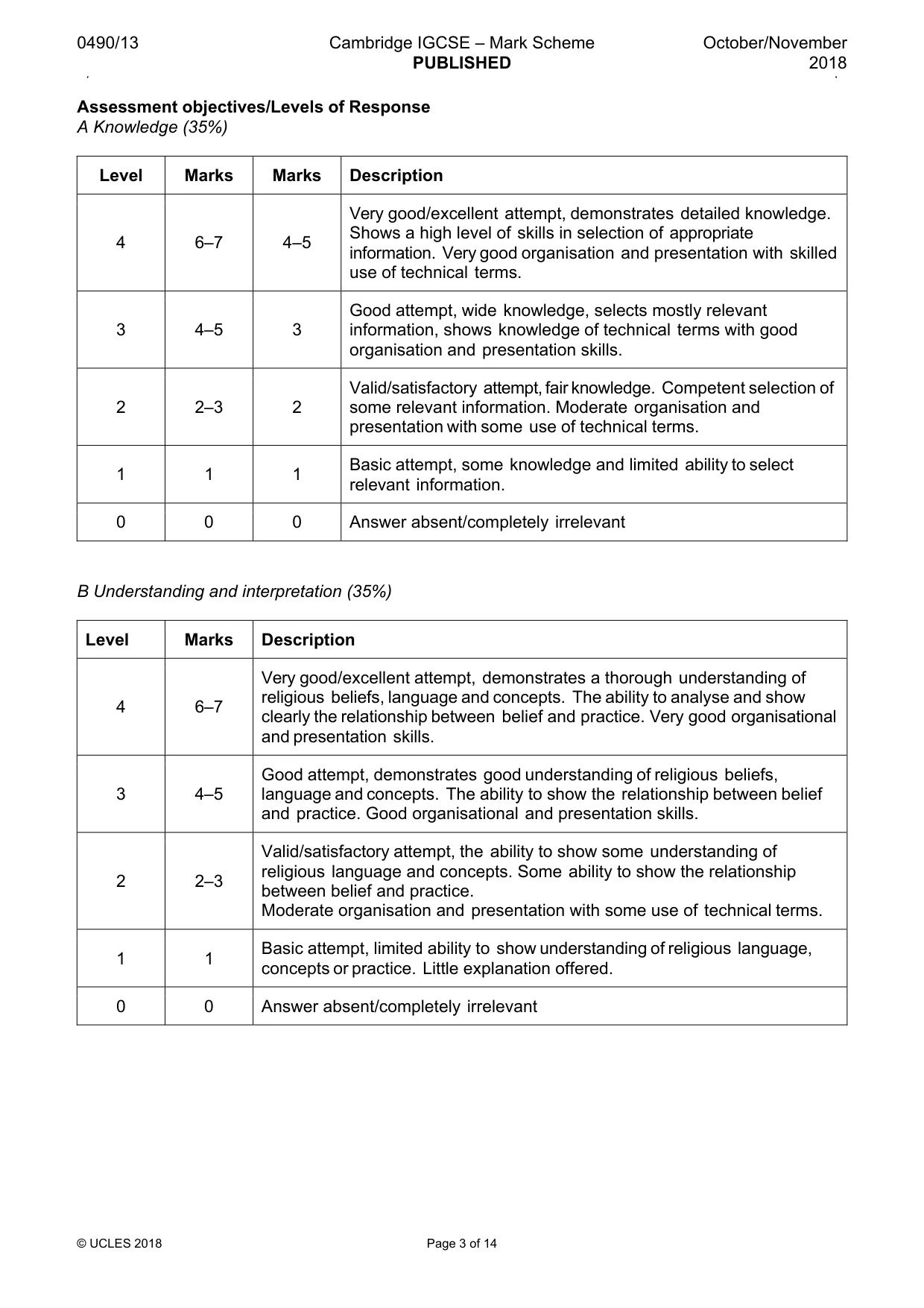
0490/13 Cambridge IGCSE – Mark Scheme PUBLISHED October/November 2018 © UCLES 2018 Page 3 of 14 Assessment objectives/Levels of Response A Knowledge (35%) Level Marks Marks Description 4 6–7 4–5 Very good/excellent attempt, demonstrates detailed knowledge. Shows a high level of skills in selection of appropriate information. Very good organisation and presentation with skilled use of technical terms. 3 4–5 3 Good attempt, wide knowledge, selects mostly relevant information, shows knowledge of technical terms with good organisation and presentation skills. 2 2–3 2 Valid/satisfactory attempt, fair knowledge. Competent selection of some relevant information. Moderate organisation and presentation with some use of technical terms. 1 1 1 Basic attempt, some knowledge and limited ability to select relevant information. 0 0 0 Answer absent/completely irrelevant B Understanding and interpretation (35%) Level Marks Description 4 6–7 Very good/excellent attempt, demonstrates a thorough understanding of religious beliefs, language and concepts. The ability to analyse and show clearly the relationship between belief and practice. Very good organisational and presentation skills. 3 4–5 Good attempt, demonstrates good understanding of religious beliefs, language and concepts. The ability to show the relationship between belief and practice. Good organisational and presentation skills. 2 2–3 Valid/satisfactory attempt, the ability to show some understanding of religious language and concepts. Some ability to show the relationship between belief and practice. Moderate organisation and presentation with some use of technical terms. 1 1 Basic attempt, limited ability to show understanding of religious language, concepts or practice. Little explanation offered. 0 0 Answer absent/completely irrelevant
Mark scheme, page 4
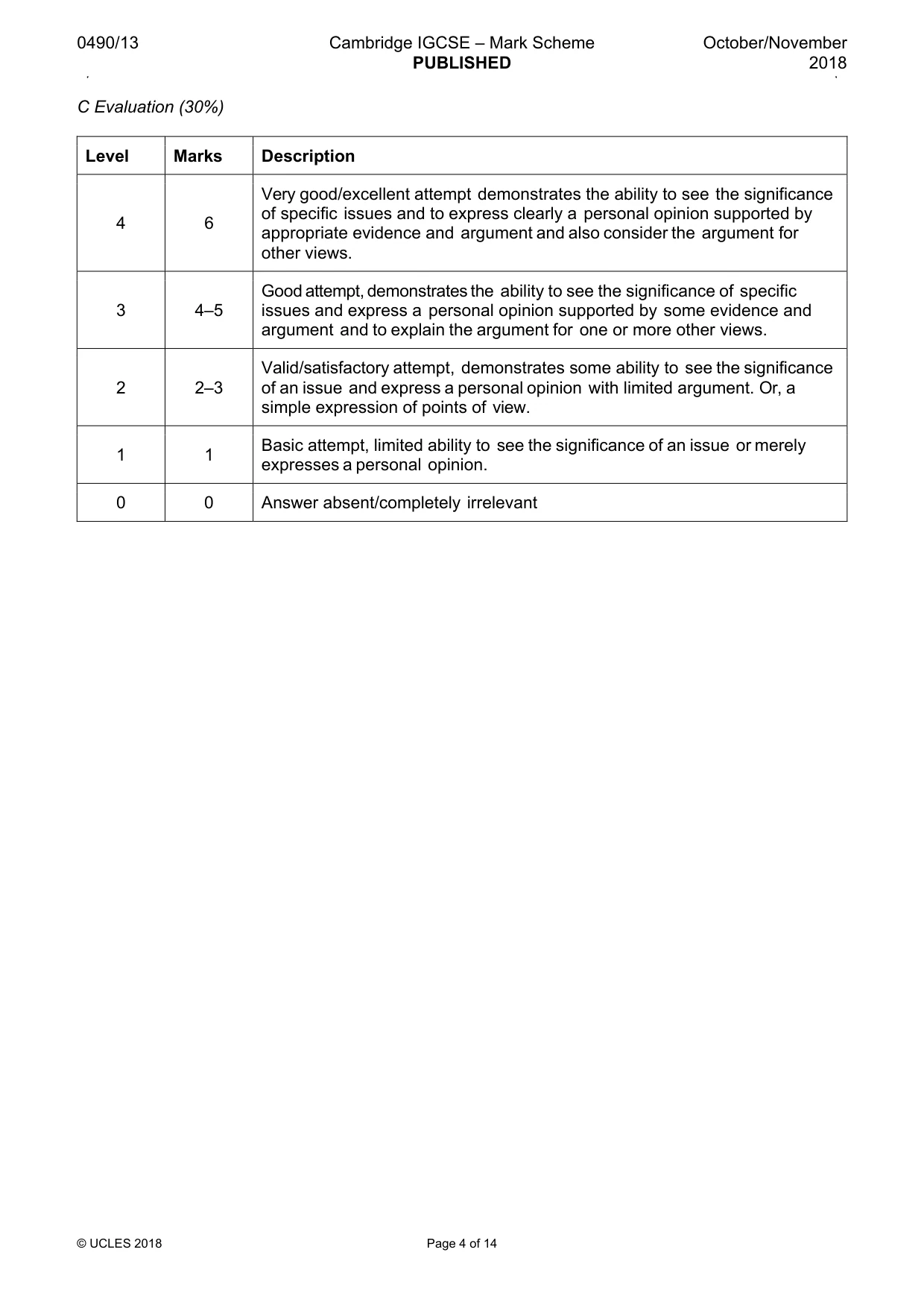
0490/13 Cambridge IGCSE – Mark Scheme PUBLISHED October/November 2018 © UCLES 2018 Page 4 of 14 C Evaluation (30%) Level Marks Description 4 6 Very good/excellent attempt demonstrates the ability to see the significance of specific issues and to express clearly a personal opinion supported by appropriate evidence and argument and also consider the argument for other views. 3 4–5 Good attempt, demonstrates the ability to see the significance of specific issues and express a personal opinion supported by some evidence and argument and to explain the argument for one or more other views. 2 2–3 Valid/satisfactory attempt, demonstrates some ability to see the significance of an issue and express a personal opinion with limited argument. Or, a simple expression of points of view. 1 1 Basic attempt, limited ability to see the significance of an issue or merely expresses a personal opinion. 0 0 Answer absent/completely irrelevant
Mark scheme, page 5
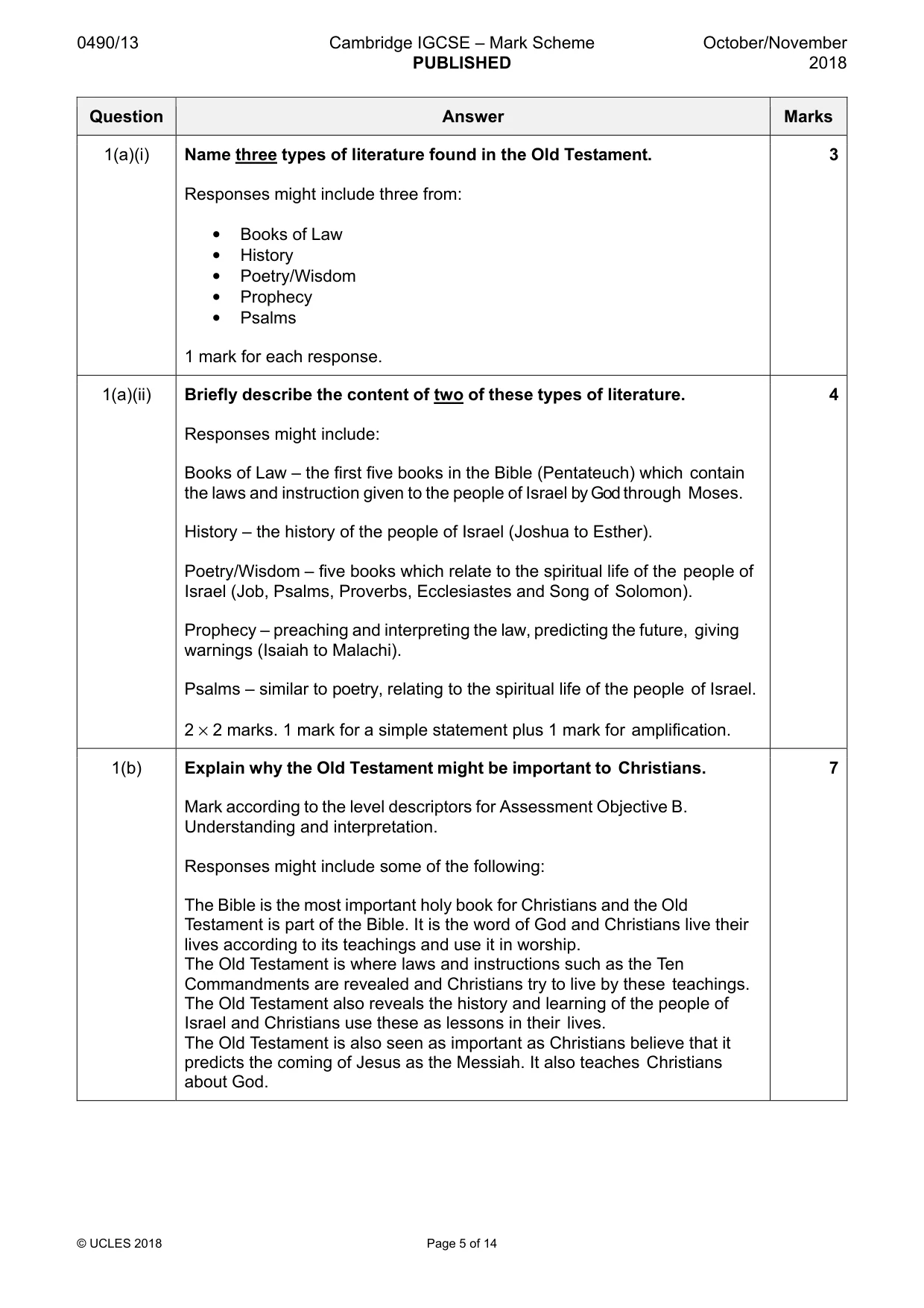
0490/13 Cambridge IGCSE – Mark Scheme PUBLISHED October/November 2018 © UCLES 2018 Page 5 of 14 Question Answer Marks 1(a)(i) Name three types of literature found in the Old Testament. Responses might include three from: • Books of Law • History • Poetry/Wisdom • Prophecy • Psalms 1 mark for each response. 3 1(a)(ii) Briefly describe the content of two of these types of literature. Responses might include: Books of Law – the first five books in the Bible (Pentateuch) which contain the laws and instruction given to the people of Israel by God through Moses. History – the history of the people of Israel (Joshua to Esther). Poetry/Wisdom – five books which relate to the spiritual life of the people of Israel (Job, Psalms, Proverbs, Ecclesiastes and Song of Solomon). Prophecy – preaching and interpreting the law, predicting the future, giving warnings (Isaiah to Malachi). Psalms – similar to poetry, relating to the spiritual life of the people of Israel. 2 × 2 marks. 1 mark for a simple statement plus 1 mark for amplification. 4 1(b) Explain why the Old Testament might be important to Christians. Mark according to the level descriptors for Assessment Objective B. Understanding and interpretation. Responses might include some of the following: The Bible is the most important holy book for Christians and the Old Testament is part of the Bible. It is the word of God and Christians live their lives according to its teachings and use it in worship. The Old Testament is where laws and instructions such as the Ten Commandments are revealed and Christians try to live by these teachings. The Old Testament also reveals the history and learning of the people of Israel and Christians use these as lessons in their lives. The Old Testament is also seen as important as Christians believe that it predicts the coming of Jesus as the Messiah. It also teaches Christians about God. 7
Mark scheme, page 6
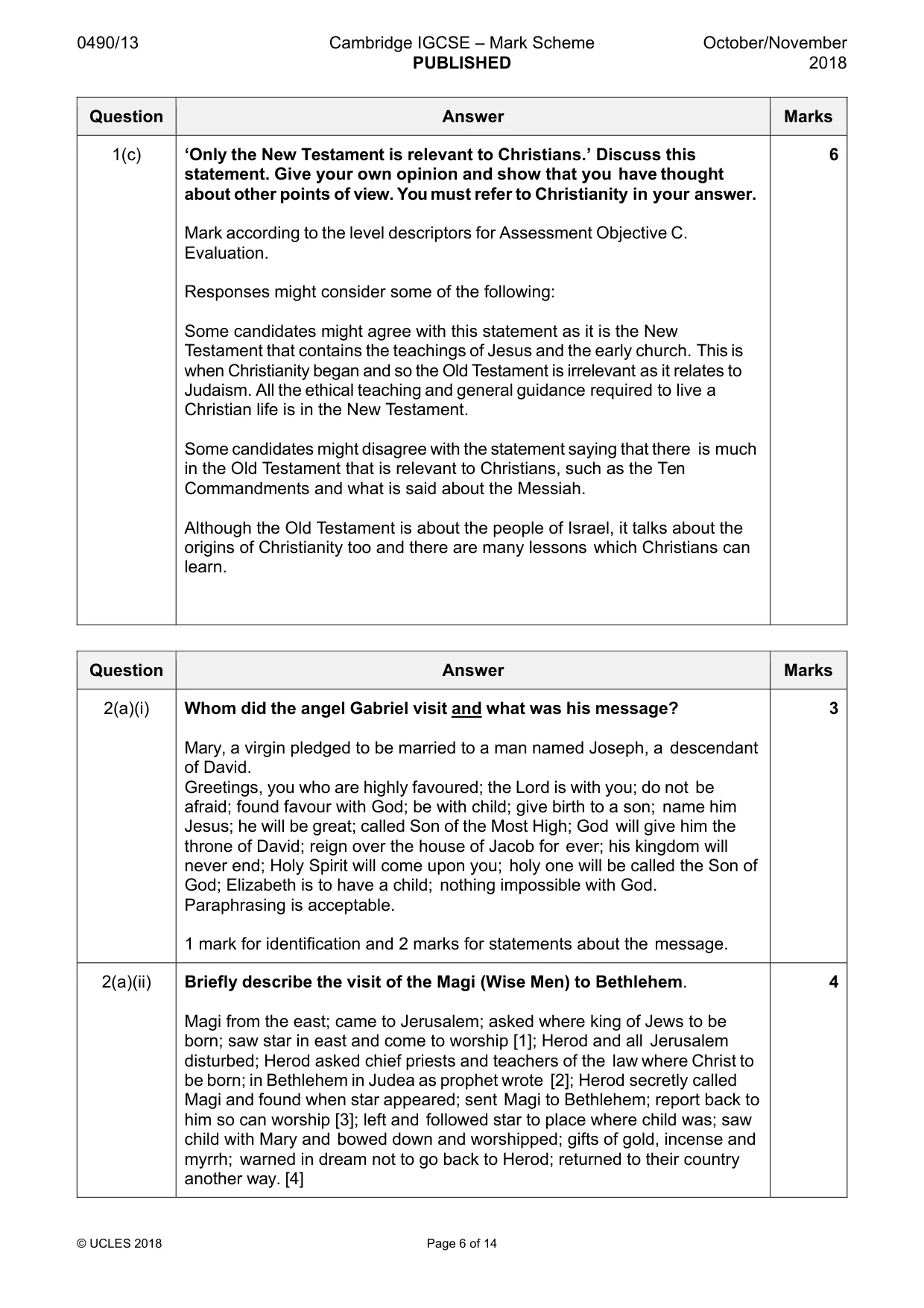
0490/13 Cambridge IGCSE – Mark Scheme PUBLISHED October/November 2018 © UCLES 2018 Page 6 of 14 Question Answer Marks 1(c) ‘Only the New Testament is relevant to Christians.’ Discuss this statement. Give your own opinion and show that you have thought about other points of view. You must refer to Christianity in your answer. Mark according to the level descriptors for Assessment Objective C. Evaluation. Responses might consider some of the following: Some candidates might agree with this statement as it is the New Testament that contains the teachings of Jesus and the early church. This is when Christianity began and so the Old Testament is irrelevant as it relates to Judaism. All the ethical teaching and general guidance required to live a Christian life is in the New Testament. Some candidates might disagree with the statement saying that there is much in the Old Testament that is relevant to Christians, such as the Ten Commandments and what is said about the Messiah. Although the Old Testament is about the people of Israel, it talks about the origins of Christianity too and there are many lessons which Christians can learn. 6 Question Answer Marks 2(a)(i) Whom did the angel Gabriel visit and what was his message? Mary, a virgin pledged to be married to a man named Joseph, a descendant of David. Greetings, you who are highly favoured; the Lord is with you; do not be afraid; found favour with God; be with child; give birth to a son; name him Jesus; he will be great; called Son of the Most High; God will give him the throne of David; reign over the house of Jacob for ever; his kingdom will never end; Holy Spirit will come upon you; holy one will be called the Son of God; Elizabeth is to have a child; nothing impossible with God. Paraphrasing is acceptable. 1 mark for identification and 2 marks for statements about the message. 3 2(a)(ii) Briefly describe the visit of the Magi (Wise Men) to Bethlehem. Magi from the east; came to Jerusalem; asked where king of Jews to be born; saw star in east and come to worship [1]; Herod and all Jerusalem disturbed; Herod asked chief priests and teachers of the law where Christ to be born; in Bethlehem in Judea as prophet wrote [2]; Herod secretly called Magi and found when star appeared; sent Magi to Bethlehem; report back to him so can worship [3]; left and followed star to place where child was; saw child with Mary and bowed down and worshipped; gifts of gold, incense and myrrh; warned in dream not to go back to Herod; returned to their country another way. [4] 4
Mark scheme, page 7
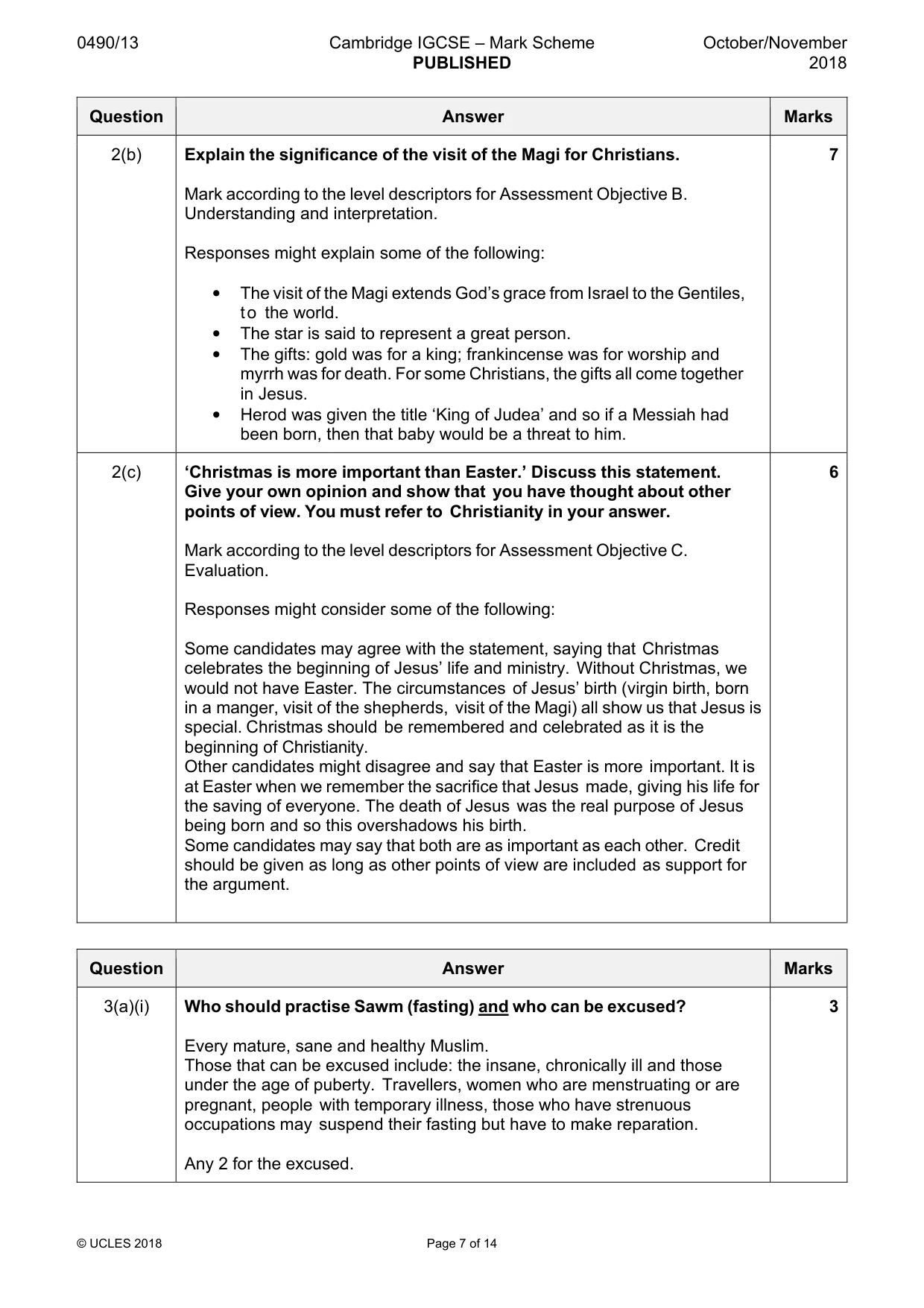
0490/13 Cambridge IGCSE – Mark Scheme PUBLISHED October/November 2018 © UCLES 2018 Page 7 of 14 Question Answer Marks 2(b) Explain the significance of the visit of the Magi for Christians. Mark according to the level descriptors for Assessment Objective B. Understanding and interpretation. Responses might explain some of the following: • The visit of the Magi extends God’s grace from Israel to the Gentiles, to the world. • The star is said to represent a great person. • The gifts: gold was for a king; frankincense was for worship and myrrh was for death. For some Christians, the gifts all come together in Jesus. • Herod was given the title ‘King of Judea’ and so if a Messiah had been born, then that baby would be a threat to him. 7 2(c) ‘Christmas is more important than Easter.’ Discuss this statement. Give your own opinion and show that you have thought about other points of view. You must refer to Christianity in your answer. Mark according to the level descriptors for Assessment Objective C. Evaluation. Responses might consider some of the following: Some candidates may agree with the statement, saying that Christmas celebrates the beginning of Jesus’ life and ministry. Without Christmas, we would not have Easter. The circumstances of Jesus’ birth (virgin birth, born in a manger, visit of the shepherds, visit of the Magi) all show us that Jesus is special. Christmas should be remembered and celebrated as it is the beginning of Christianity. Other candidates might disagree and say that Easter is more important. It is at Easter when we remember the sacrifice that Jesus made, giving his life for the saving of everyone. The death of Jesus was the real purpose of Jesus being born and so this overshadows his birth. Some candidates may say that both are as important as each other. Credit should be given as long as other points of view are included as support for the argument. 6 Question Answer Marks 3(a)(i) Who should practise Sawm (fasting) and who can be excused? Every mature, sane and healthy Muslim. Those that can be excused include: the insane, chronically ill and those under the age of puberty. Travellers, women who are menstruating or are pregnant, people with temporary illness, those who have strenuous occupations may suspend their fasting but have to make reparation. Any 2 for the excused. 3
Mark scheme, page 8
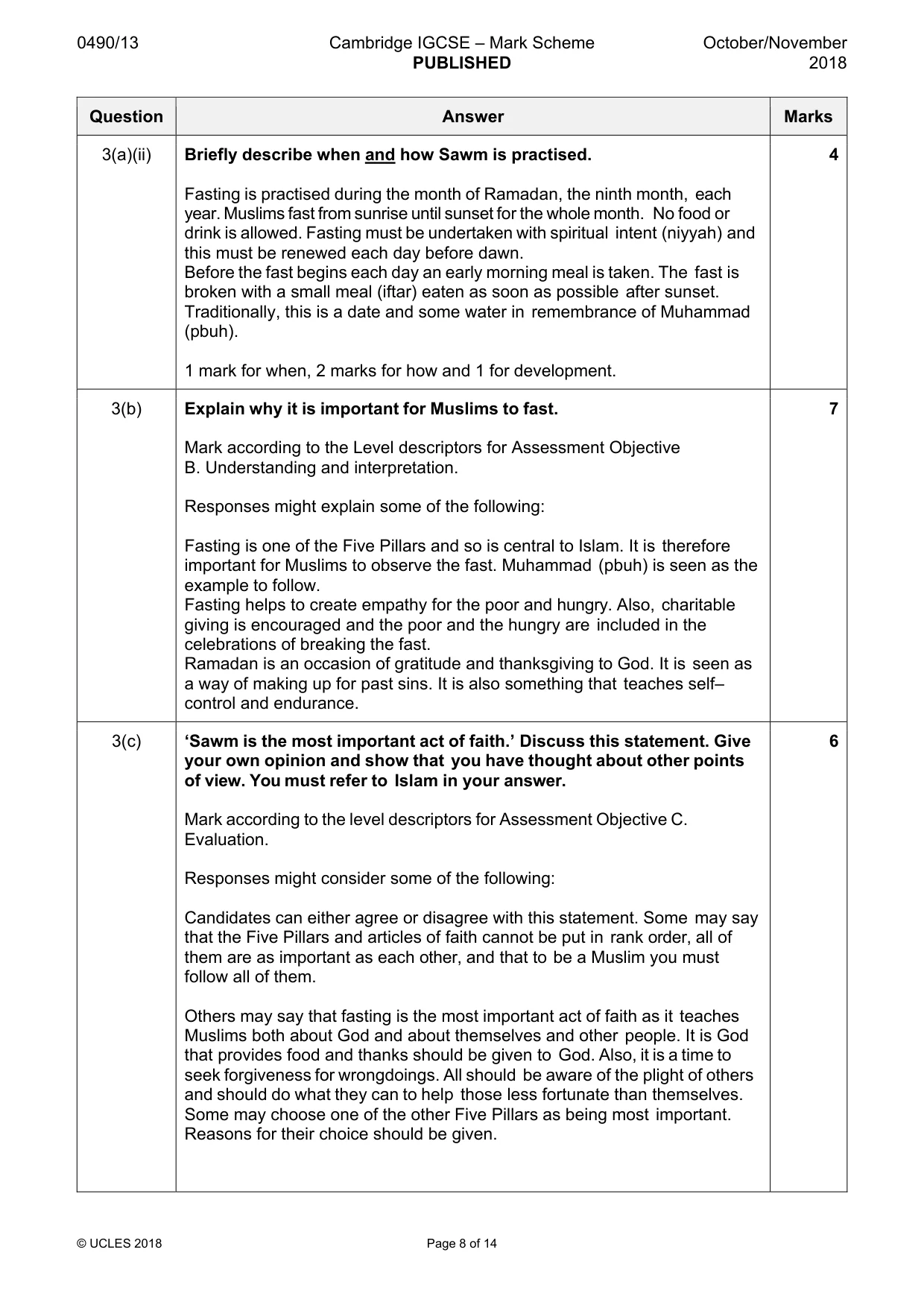
0490/13 Cambridge IGCSE – Mark Scheme PUBLISHED October/November 2018 © UCLES 2018 Page 8 of 14 Question Answer Marks 3(a)(ii) Briefly describe when and how Sawm is practised. Fasting is practised during the month of Ramadan, the ninth month, each year. Muslims fast from sunrise until sunset for the whole month. No food or drink is allowed. Fasting must be undertaken with spiritual intent (niyyah) and this must be renewed each day before dawn. Before the fast begins each day an early morning meal is taken. The fast is broken with a small meal (iftar) eaten as soon as possible after sunset. Traditionally, this is a date and some water in remembrance of Muhammad (pbuh). 1 mark for when, 2 marks for how and 1 for development. 4 3(b) Explain why it is important for Muslims to fast. Mark according to the Level descriptors for Assessment Objective B. Understanding and interpretation. Responses might explain some of the following: Fasting is one of the Five Pillars and so is central to Islam. It is therefore important for Muslims to observe the fast. Muhammad (pbuh) is seen as the example to follow. Fasting helps to create empathy for the poor and hungry. Also, charitable giving is encouraged and the poor and the hungry are included in the celebrations of breaking the fast. Ramadan is an occasion of gratitude and thanksgiving to God. It is seen as a way of making up for past sins. It is also something that teaches self– control and endurance. 7 3(c) ‘Sawm is the most important act of faith.’ Discuss this statement. Give your own opinion and show that you have thought about other points of view. You must refer to Islam in your answer. Mark according to the level descriptors for Assessment Objective C. Evaluation. Responses might consider some of the following: Candidates can either agree or disagree with this statement. Some may say that the Five Pillars and articles of faith cannot be put in rank order, all of them are as important as each other, and that to be a Muslim you must follow all of them. Others may say that fasting is the most important act of faith as it teaches Muslims both about God and about themselves and other people. It is God that provides food and thanks should be given to God. Also, it is a time to seek forgiveness for wrongdoings. All should be aware of the plight of others and should do what they can to help those less fortunate than themselves. Some may choose one of the other Five Pillars as being most important. Reasons for their choice should be given. 6
Mark scheme, page 9
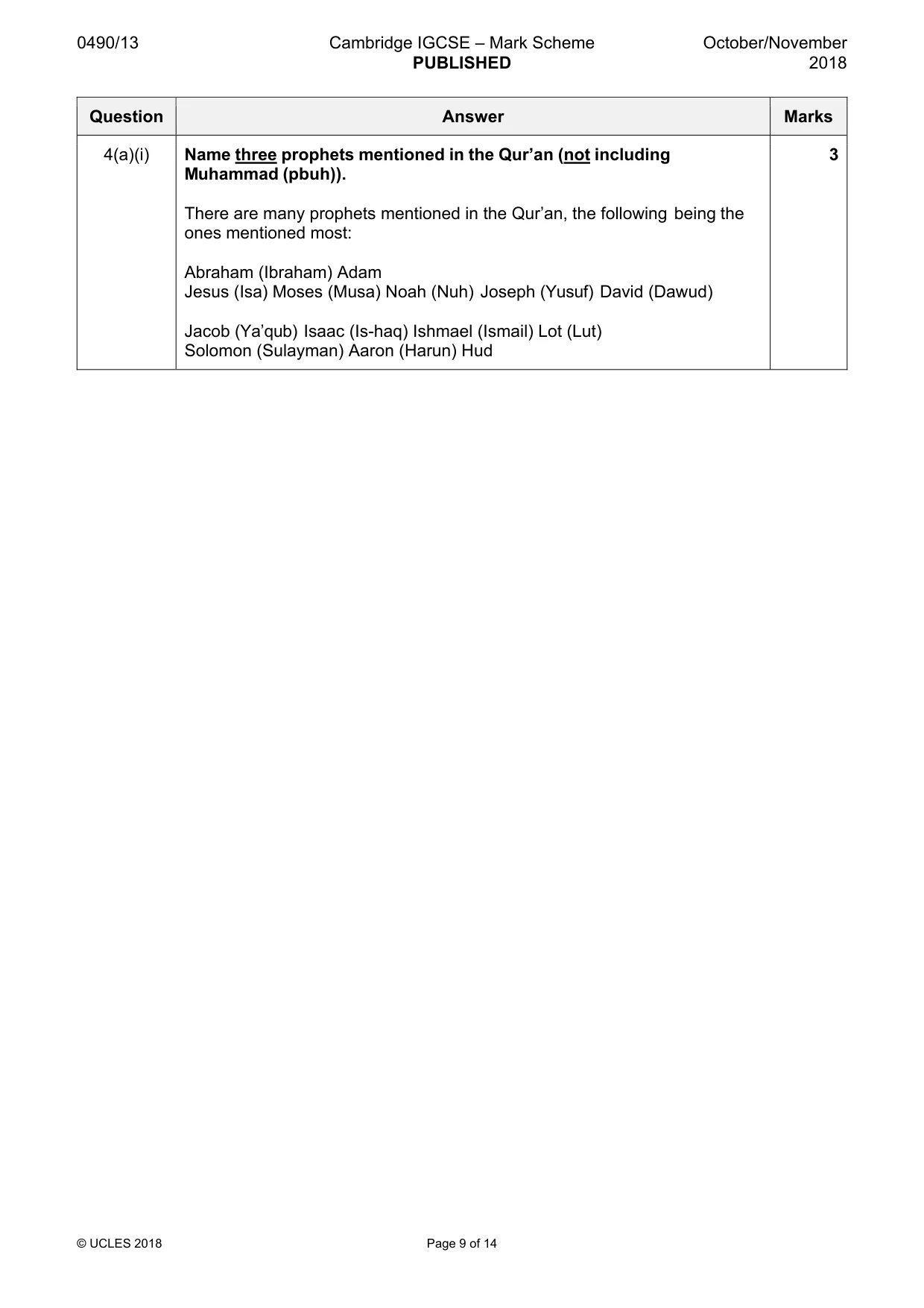
0490/13 Cambridge IGCSE – Mark Scheme PUBLISHED October/November 2018 © UCLES 2018 Page 9 of 14 Question Answer Marks 4(a)(i) Name three prophets mentioned in the Qur’an (not including Muhammad (pbuh)). There are many prophets mentioned in the Qur’an, the following being the ones mentioned most: Abraham (Ibraham) Adam Jesus (Isa) Moses (Musa) Noah (Nuh) Joseph (Yusuf) David (Dawud) Jacob (Ya’qub) Isaac (Is-haq) Ishmael (Ismail) Lot (Lut) Solomon (Sulayman) Aaron (Harun) Hud 3
Mark scheme, page 10
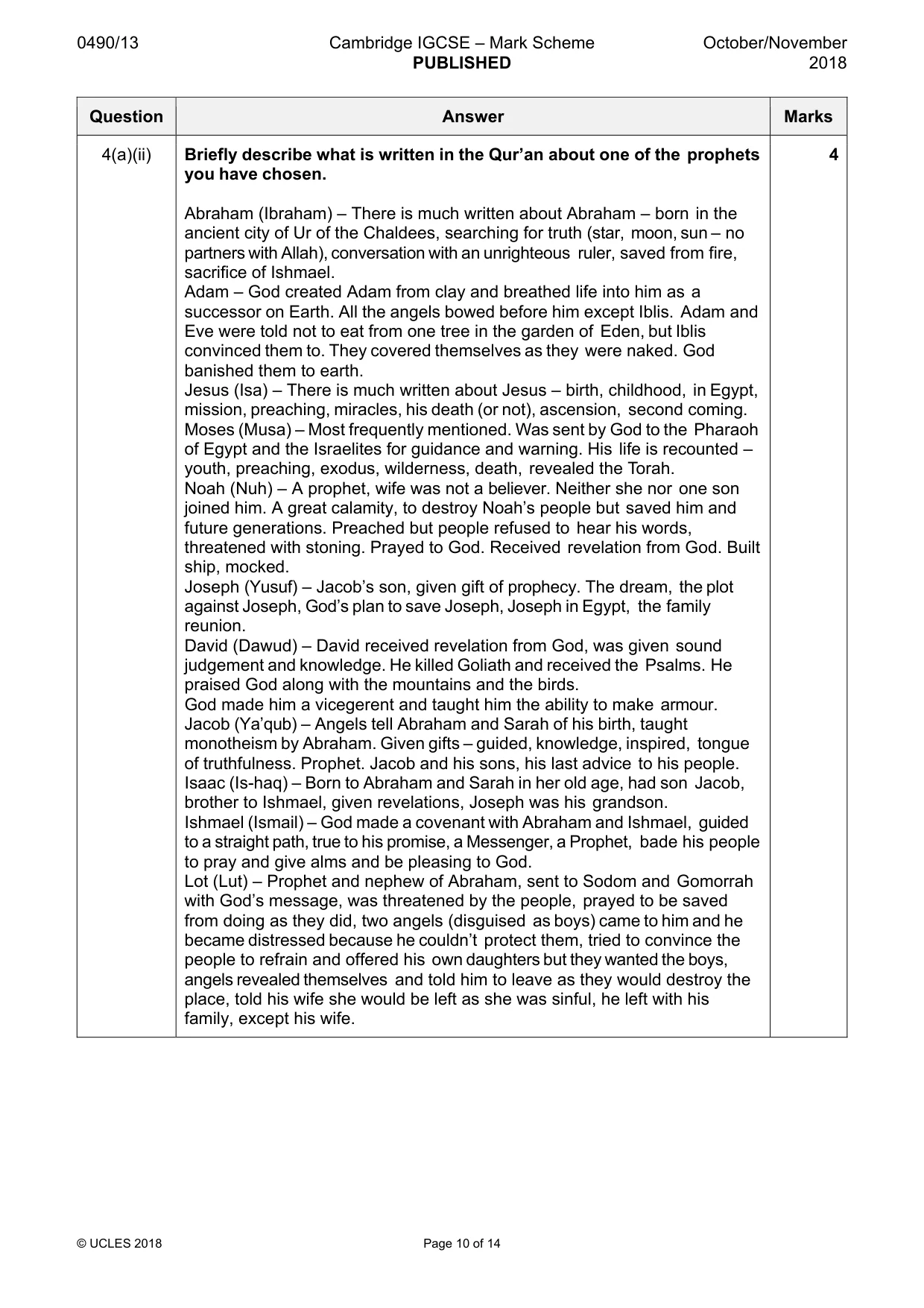
0490/13 Cambridge IGCSE – Mark Scheme PUBLISHED October/November 2018 © UCLES 2018 Page 10 of 14 Question Answer Marks 4(a)(ii) Briefly describe what is written in the Qur’an about one of the prophets you have chosen. Abraham (Ibraham) – There is much written about Abraham – born in the ancient city of Ur of the Chaldees, searching for truth (star, moon, sun – no partners with Allah), conversation with an unrighteous ruler, saved from fire, sacrifice of Ishmael. Adam – God created Adam from clay and breathed life into him as a successor on Earth. All the angels bowed before him except Iblis. Adam and Eve were told not to eat from one tree in the garden of Eden, but Iblis convinced them to. They covered themselves as they were naked. God banished them to earth. Jesus (Isa) – There is much written about Jesus – birth, childhood, in Egypt, mission, preaching, miracles, his death (or not), ascension, second coming. Moses (Musa) – Most frequently mentioned. Was sent by God to the Pharaoh of Egypt and the Israelites for guidance and warning. His life is recounted – youth, preaching, exodus, wilderness, death, revealed the Torah. Noah (Nuh) – A prophet, wife was not a believer. Neither she nor one son joined him. A great calamity, to destroy Noah’s people but saved him and future generations. Preached but people refused to hear his words, threatened with stoning. Prayed to God. Received revelation from God. Built ship, mocked. Joseph (Yusuf) – Jacob’s son, given gift of prophecy. The dream, the plot against Joseph, God’s plan to save Joseph, Joseph in Egypt, the family reunion. David (Dawud) – David received revelation from God, was given sound judgement and knowledge. He killed Goliath and received the Psalms. He praised God along with the mountains and the birds. God made him a vicegerent and taught him the ability to make armour. Jacob (Ya’qub) – Angels tell Abraham and Sarah of his birth, taught monotheism by Abraham. Given gifts – guided, knowledge, inspired, tongue of truthfulness. Prophet. Jacob and his sons, his last advice to his people. Isaac (Is-haq) – Born to Abraham and Sarah in her old age, had son Jacob, brother to Ishmael, given revelations, Joseph was his grandson. Ishmael (Ismail) – God made a covenant with Abraham and Ishmael, guided to a straight path, true to his promise, a Messenger, a Prophet, bade his people to pray and give alms and be pleasing to God. Lot (Lut) – Prophet and nephew of Abraham, sent to Sodom and Gomorrah with God’s message, was threatened by the people, prayed to be saved from doing as they did, two angels (disguised as boys) came to him and he became distressed because he couldn’t protect them, tried to convince the people to refrain and offered his own daughters but they wanted the boys, angels revealed themselves and told him to leave as they would destroy the place, told his wife she would be left as she was sinful, he left with his family, except his wife. 4
Mark scheme, page 11
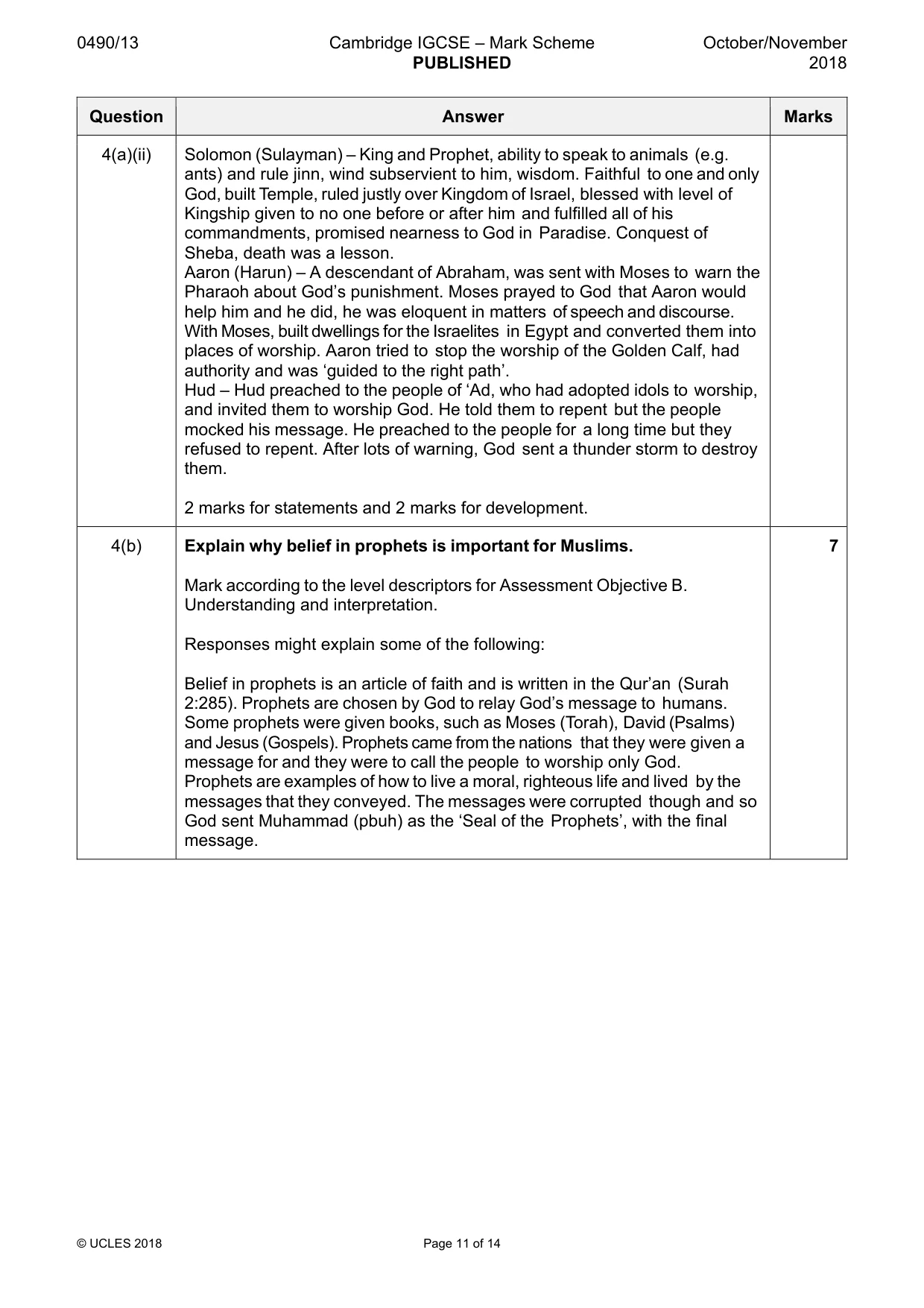
0490/13 Cambridge IGCSE – Mark Scheme PUBLISHED October/November 2018 © UCLES 2018 Page 11 of 14 Question Answer Marks 4(a)(ii) Solomon (Sulayman) – King and Prophet, ability to speak to animals (e.g. ants) and rule jinn, wind subservient to him, wisdom. Faithful to one and only God, built Temple, ruled justly over Kingdom of Israel, blessed with level of Kingship given to no one before or after him and fulfilled all of his commandments, promised nearness to God in Paradise. Conquest of Sheba, death was a lesson. Aaron (Harun) – A descendant of Abraham, was sent with Moses to warn the Pharaoh about God’s punishment. Moses prayed to God that Aaron would help him and he did, he was eloquent in matters of speech and discourse. With Moses, built dwellings for the Israelites in Egypt and converted them into places of worship. Aaron tried to stop the worship of the Golden Calf, had authority and was ‘guided to the right path’. Hud – Hud preached to the people of ‘Ad, who had adopted idols to worship, and invited them to worship God. He told them to repent but the people mocked his message. He preached to the people for a long time but they refused to repent. After lots of warning, God sent a thunder storm to destroy them. 2 marks for statements and 2 marks for development. 4(b) Explain why belief in prophets is important for Muslims. Mark according to the level descriptors for Assessment Objective B. Understanding and interpretation. Responses might explain some of the following: Belief in prophets is an article of faith and is written in the Qur’an (Surah 2:285). Prophets are chosen by God to relay God’s message to humans. Some prophets were given books, such as Moses (Torah), David (Psalms) and Jesus (Gospels). Prophets came from the nations that they were given a message for and they were to call the people to worship only God. Prophets are examples of how to live a moral, righteous life and lived by the messages that they conveyed. The messages were corrupted though and so God sent Muhammad (pbuh) as the ‘Seal of the Prophets’, with the final message. 7
Mark scheme, page 12
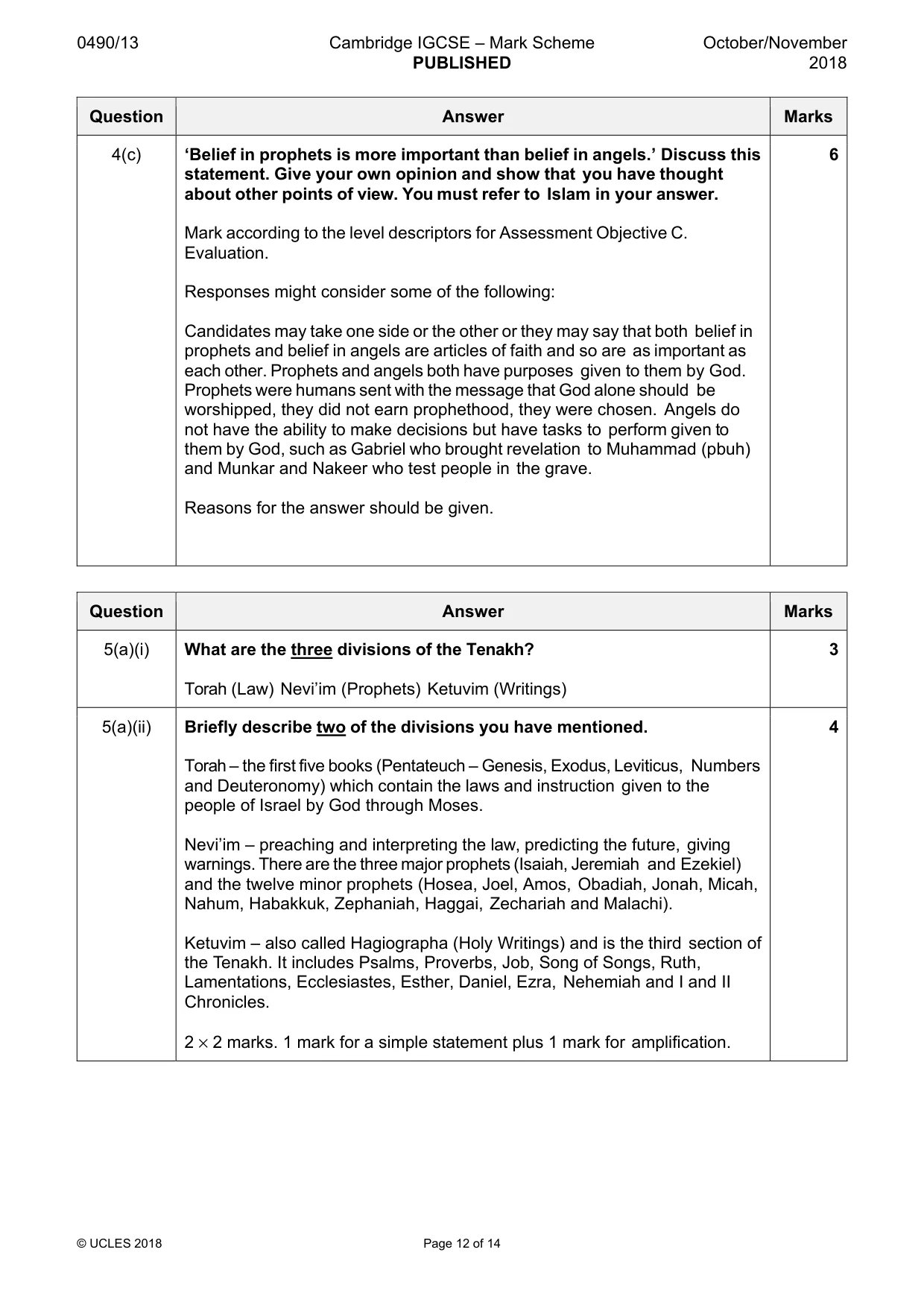
0490/13 Cambridge IGCSE – Mark Scheme PUBLISHED October/November 2018 © UCLES 2018 Page 12 of 14 Question Answer Marks 4(c) ‘Belief in prophets is more important than belief in angels.’ Discuss this statement. Give your own opinion and show that you have thought about other points of view. You must refer to Islam in your answer. Mark according to the level descriptors for Assessment Objective C. Evaluation. Responses might consider some of the following: Candidates may take one side or the other or they may say that both belief in prophets and belief in angels are articles of faith and so are as important as each other. Prophets and angels both have purposes given to them by God. Prophets were humans sent with the message that God alone should be worshipped, they did not earn prophethood, they were chosen. Angels do not have the ability to make decisions but have tasks to perform given to them by God, such as Gabriel who brought revelation to Muhammad (pbuh) and Munkar and Nakeer who test people in the grave. Reasons for the answer should be given. 6 Question Answer Marks 5(a)(i) What are the three divisions of the Tenakh? Torah (Law) Nevi’im (Prophets) Ketuvim (Writings) 3 5(a)(ii) Briefly describe two of the divisions you have mentioned. Torah – the first five books (Pentateuch – Genesis, Exodus, Leviticus, Numbers and Deuteronomy) which contain the laws and instruction given to the people of Israel by God through Moses. Nevi’im – preaching and interpreting the law, predicting the future, giving warnings. There are the three major prophets (Isaiah, Jeremiah and Ezekiel) and the twelve minor prophets (Hosea, Joel, Amos, Obadiah, Jonah, Micah, Nahum, Habakkuk, Zephaniah, Haggai, Zechariah and Malachi). Ketuvim – also called Hagiographa (Holy Writings) and is the third section of the Tenakh. It includes Psalms, Proverbs, Job, Song of Songs, Ruth, Lamentations, Ecclesiastes, Esther, Daniel, Ezra, Nehemiah and I and II Chronicles. 2 × 2 marks. 1 mark for a simple statement plus 1 mark for amplification. 4
Mark scheme, page 13
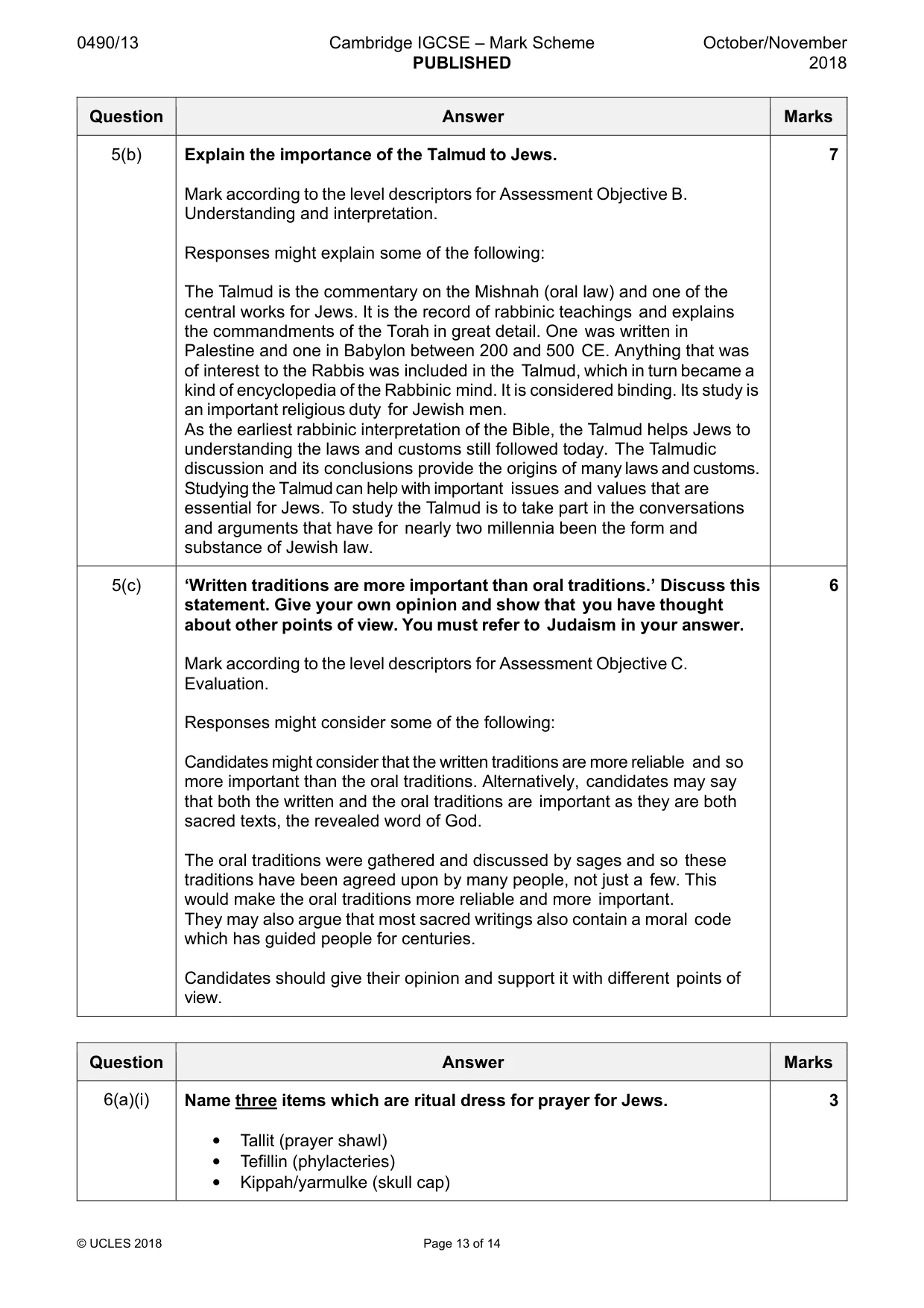
0490/13 Cambridge IGCSE – Mark Scheme PUBLISHED October/November 2018 © UCLES 2018 Page 13 of 14 Question Answer Marks 5(b) Explain the importance of the Talmud to Jews. Mark according to the level descriptors for Assessment Objective B. Understanding and interpretation. Responses might explain some of the following: The Talmud is the commentary on the Mishnah (oral law) and one of the central works for Jews. It is the record of rabbinic teachings and explains the commandments of the Torah in great detail. One was written in Palestine and one in Babylon between 200 and 500 CE. Anything that was of interest to the Rabbis was included in the Talmud, which in turn became a kind of encyclopedia of the Rabbinic mind. It is considered binding. Its study is an important religious duty for Jewish men. As the earliest rabbinic interpretation of the Bible, the Talmud helps Jews to understanding the laws and customs still followed today. The Talmudic discussion and its conclusions provide the origins of many laws and customs. Studying the Talmud can help with important issues and values that are essential for Jews. To study the Talmud is to take part in the conversations and arguments that have for nearly two millennia been the form and substance of Jewish law. 7 5(c) ‘Written traditions are more important than oral traditions.’ Discuss this statement. Give your own opinion and show that you have thought about other points of view. You must refer to Judaism in your answer. Mark according to the level descriptors for Assessment Objective C. Evaluation. Responses might consider some of the following: Candidates might consider that the written traditions are more reliable and so more important than the oral traditions. Alternatively, candidates may say that both the written and the oral traditions are important as they are both sacred texts, the revealed word of God. The oral traditions were gathered and discussed by sages and so these traditions have been agreed upon by many people, not just a few. This would make the oral traditions more reliable and more important. They may also argue that most sacred writings also contain a moral code which has guided people for centuries. Candidates should give their opinion and support it with different points of view. 6 Question Answer Marks 6(a)(i) Name three items which are ritual dress for prayer for Jews. • Tallit (prayer shawl) • Tefillin (phylacteries) • Kippah/yarmulke (skull cap) 3
Mark scheme, page 14
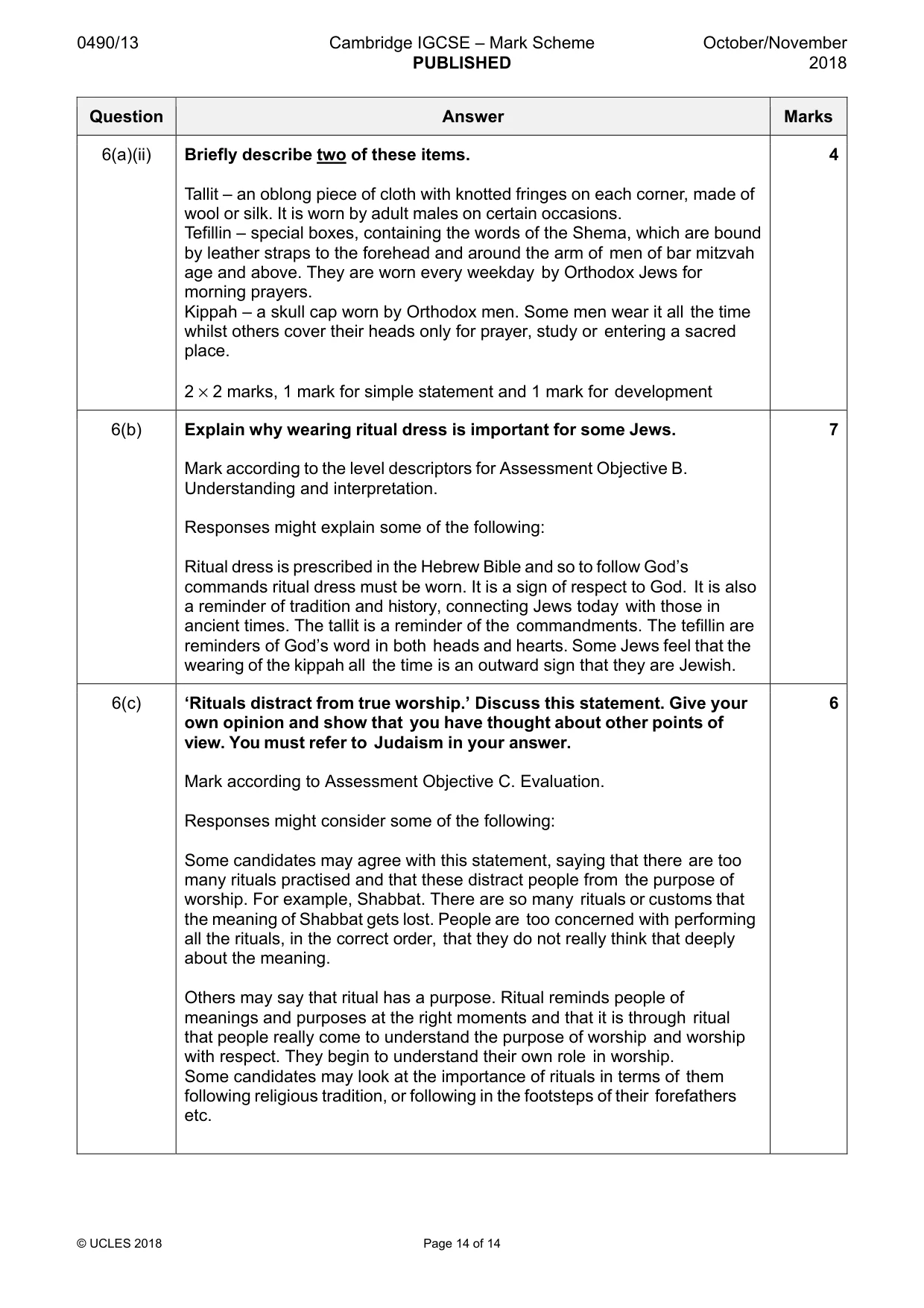
0490/13 Cambridge IGCSE – Mark Scheme PUBLISHED October/November 2018 © UCLES 2018 Page 14 of 14 Question Answer Marks 6(a)(ii) Briefly describe two of these items. Tallit – an oblong piece of cloth with knotted fringes on each corner, made of wool or silk. It is worn by adult males on certain occasions. Tefillin – special boxes, containing the words of the Shema, which are bound by leather straps to the forehead and around the arm of men of bar mitzvah age and above. They are worn every weekday by Orthodox Jews for morning prayers. Kippah – a skull cap worn by Orthodox men. Some men wear it all the time whilst others cover their heads only for prayer, study or entering a sacred place. 2 × 2 marks, 1 mark for simple statement and 1 mark for development 4 6(b) Explain why wearing ritual dress is important for some Jews. Mark according to the level descriptors for Assessment Objective B. Understanding and interpretation. Responses might explain some of the following: Ritual dress is prescribed in the Hebrew Bible and so to follow God’s commands ritual dress must be worn. It is a sign of respect to God. It is also a reminder of tradition and history, connecting Jews today with those in ancient times. The tallit is a reminder of the commandments. The tefillin are reminders of God’s word in both heads and hearts. Some Jews feel that the wearing of the kippah all the time is an outward sign that they are Jewish. 7 6(c) ‘Rituals distract from true worship.’ Discuss this statement. Give your own opinion and show that you have thought about other points of view. You must refer to Judaism in your answer. Mark according to Assessment Objective C. Evaluation. Responses might consider some of the following: Some candidates may agree with this statement, saying that there are too many rituals practised and that these distract people from the purpose of worship. For example, Shabbat. There are so many rituals or customs that the meaning of Shabbat gets lost. People are too concerned with performing all the rituals, in the correct order, that they do not really think that deeply about the meaning. Others may say that ritual has a purpose. Ritual reminds people of meanings and purposes at the right moments and that it is through ritual that people really come to understand the purpose of worship and worship with respect. They begin to understand their own role in worship. Some candidates may look at the importance of rituals in terms of them following religious tradition, or following in the footsteps of their forefathers etc. 6
What you needed in this session
Cambridge’s own grade thresholds for 2018 Oct/Nov, Paper 1 · Variant 3. A higher threshold means an easier paper — the bar moves with how the cohort did.