Cambridge IGCSE Religious Studies 0490 — 2021 Oct/Nov Paper 1 · Variant 3
0490/13/O/N/21 · 80 marks · ≈90 min
The question paper and its mark scheme, free to read here and free to download. This is Cambridge’s own paper, exactly as it was sat.
Question paper4 pages
Mark scheme15 pages
Answers below. Sit the paper first if you are practising.
Paper as text
Question paper, page 1
Cambridge IGCSE™ 0490/13 October/November 2021 1 hour 45 minutes RELIGIOUS STUDIES Paper 1 You must answer on the enclosed answer booklet. You will need: Answer booklet (enclosed) INSTRUCTIONS • Answer four questions in total: You must answer from two sections. In each of your chosen sections, you must answer all the questions. • Follow the instructions on the front cover of the answer booklet. If you need additional answer paper, ask the invigilator for a continuation booklet. INFORMATION • The total mark for this paper is 80. • The number of marks for each question or part question is shown in brackets [ ]. This document has 4 pages. [Turn over 11_0490_13_2021_1.7 © UCLES 2021 *5869426487*
Question paper, page 2
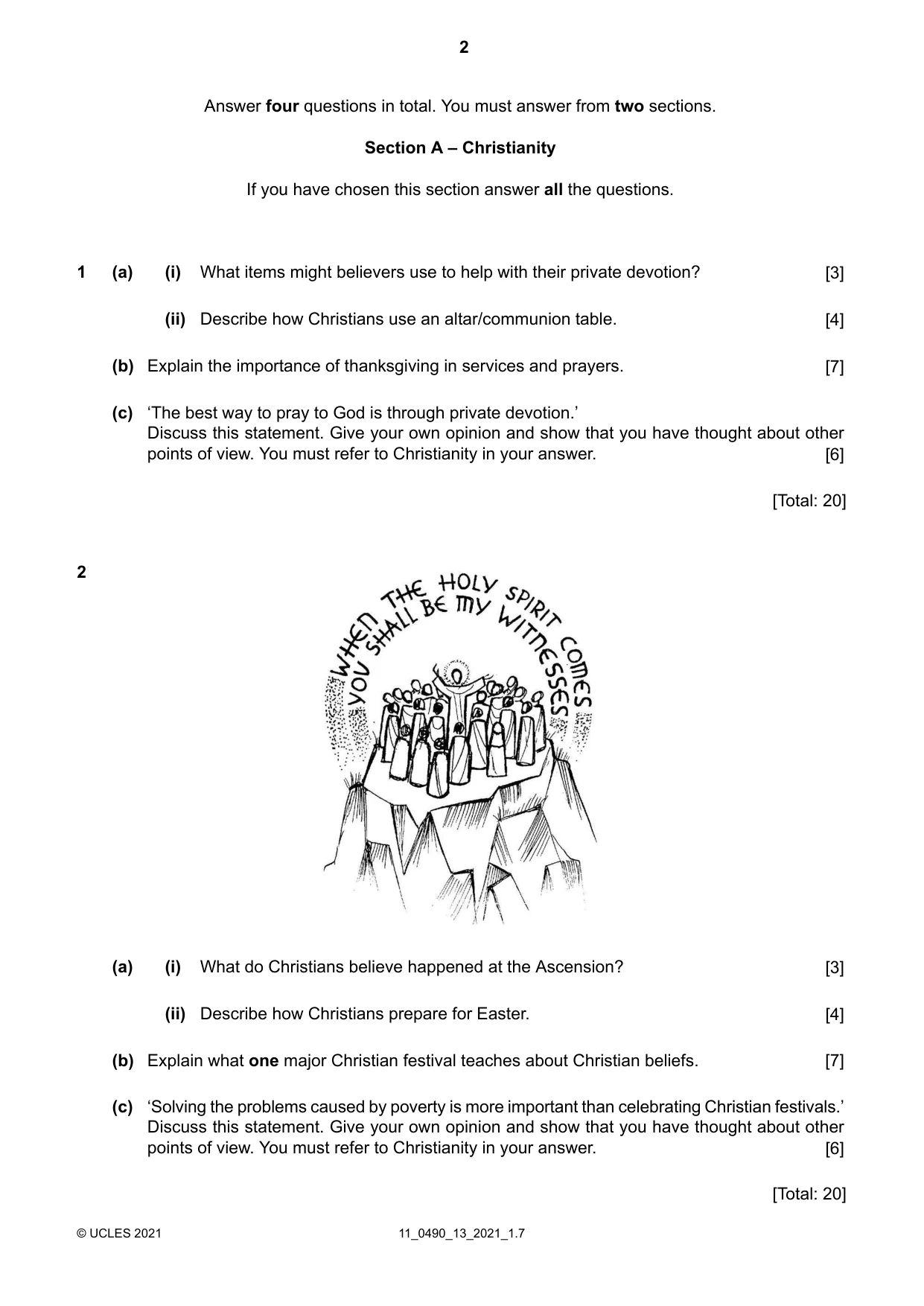
Answer four questions in total. You must answer from two sections. Section A – Christianity If you have chosen this section answer all the questions. What items might believers use to help with their private devotion? [3] (i) (a) 1 Describe how Christians use an altar/communion table. [4] (ii) Explain the importance of thanksgiving in services and prayers. [7] (b) ‘The best way to pray to God is through private devotion.’ Discuss this statement. Give your own opinion and show that you have thought about other points of view. You must refer to Christianity in your answer. [6] (c) [Total: 20] 2 What do Christians believe happened at the Ascension? [3] (i) (a) Describe how Christians prepare for Easter. [4] (ii) Explain what one major Christian festival teaches about Christian beliefs. [7] (b) ‘Solving the problems caused by poverty is more important than celebrating Christian festivals.’ Discuss this statement. Give your own opinion and show that you have thought about other points of view. You must refer to Christianity in your answer. [6] (c) [Total: 20] 11_0490_13_2021_1.7 © UCLES 2021 2
Question paper, page 3
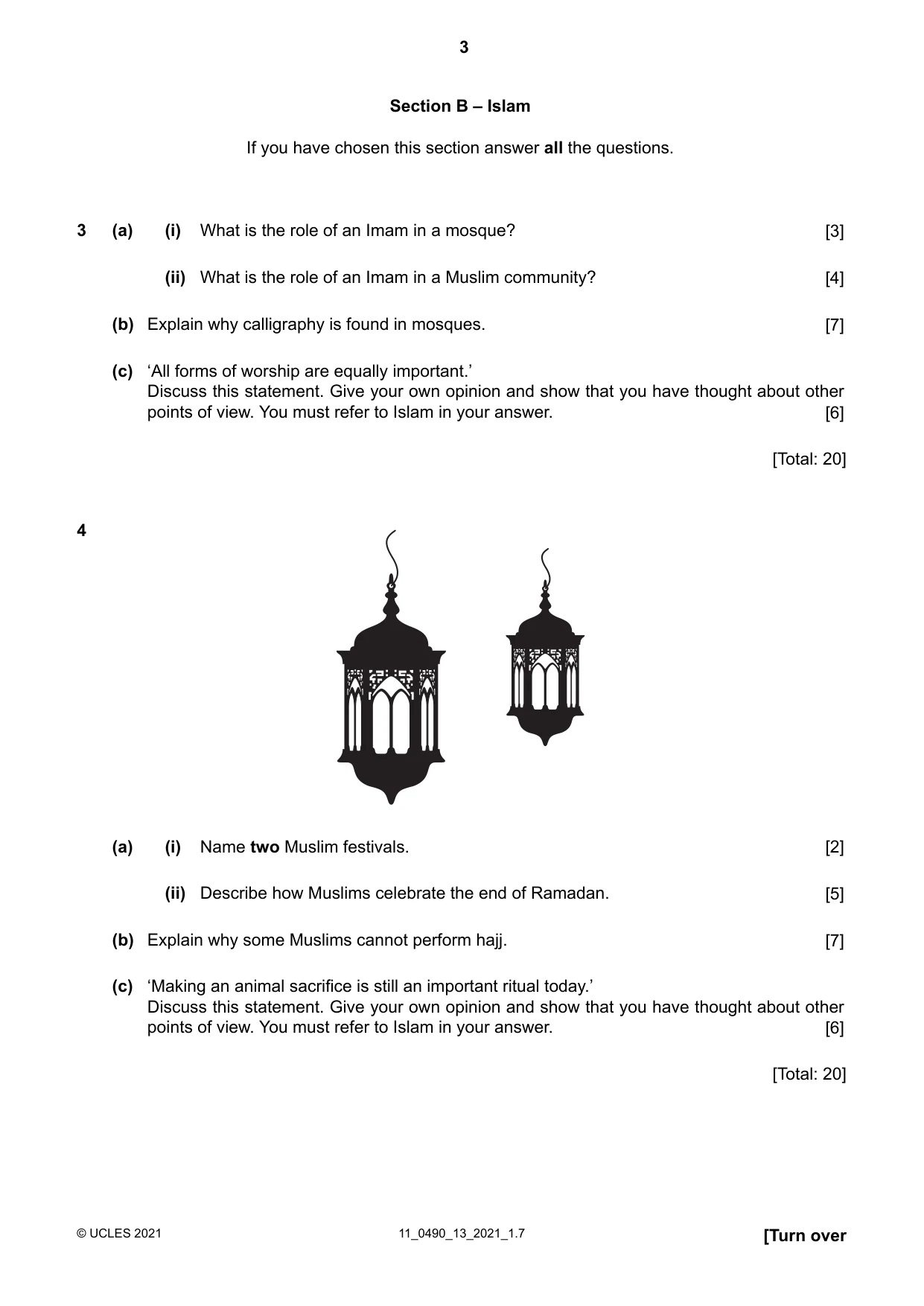
Section B – Islam If you have chosen this section answer all the questions. What is the role of an Imam in a mosque? [3] (i) (a) 3 What is the role of an Imam in a Muslim community? [4] (ii) Explain why calligraphy is found in mosques. [7] (b) ‘All forms of worship are equally important.’ Discuss this statement. Give your own opinion and show that you have thought about other points of view. You must refer to Islam in your answer. [6] (c) [Total: 20] 4 Name two Muslim festivals. [2] (i) (a) Describe how Muslims celebrate the end of Ramadan. [5] (ii) Explain why some Muslims cannot perform hajj. [7] (b) ‘Making an animal sacrifice is still an important ritual today.’ Discuss this statement. Give your own opinion and show that you have thought about other points of view. You must refer to Islam in your answer. [6] (c) [Total: 20] [Turn over 11_0490_13_2021_1.7 © UCLES 2021 3
Question paper, page 4
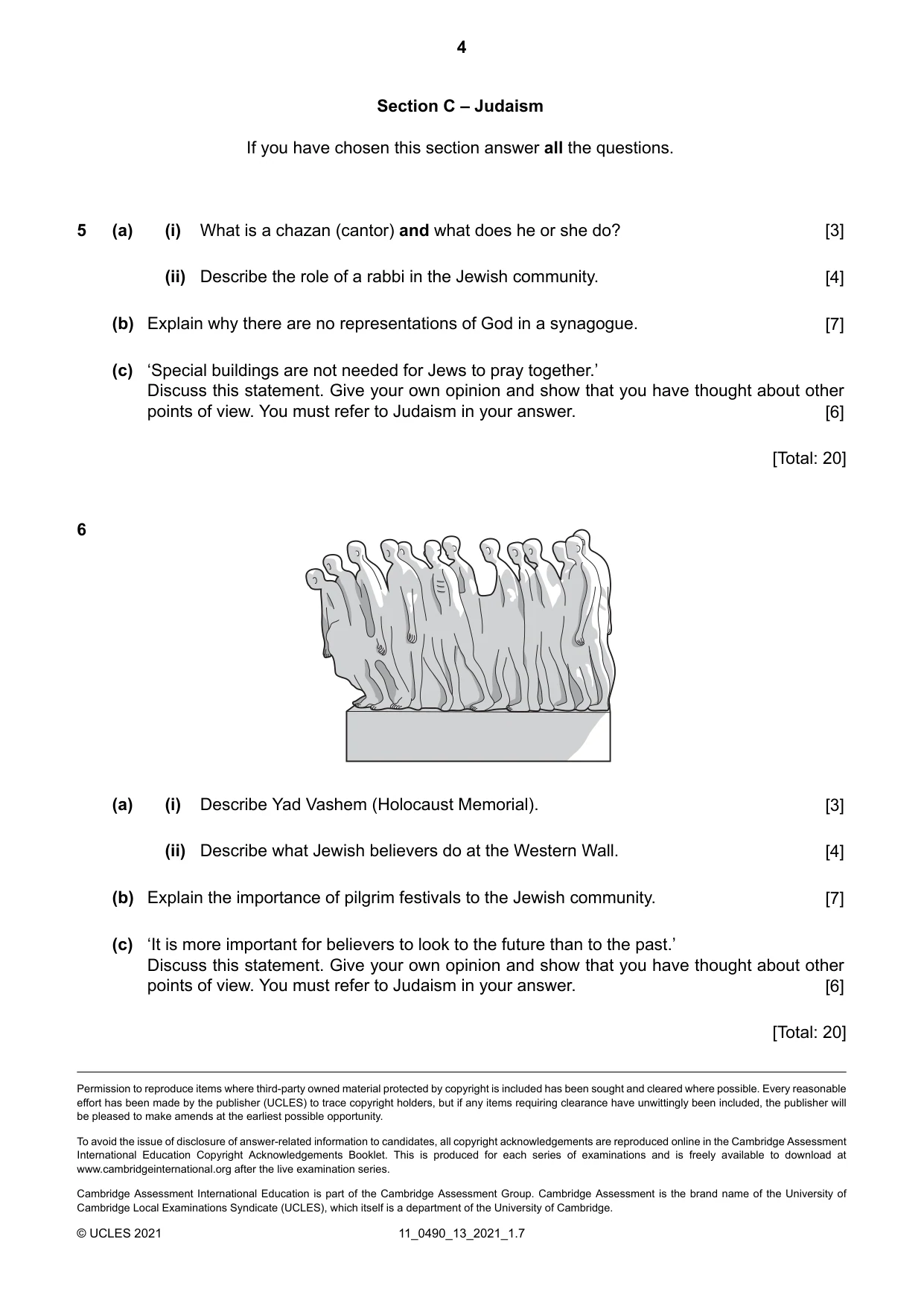
Section C – Judaism If you have chosen this section answer all the questions. What is a chazan (cantor) and what does he or she do? [3] (i) (a) 5 Describe the role of a rabbi in the Jewish community. [4] (ii) Explain why there are no representations of God in a synagogue. [7] (b) ‘Special buildings are not needed for Jews to pray together.’ Discuss this statement. Give your own opinion and show that you have thought about other points of view. You must refer to Judaism in your answer. [6] (c) [Total: 20] 6 Describe Yad Vashem (Holocaust Memorial). [3] (i) (a) Describe what Jewish believers do at the Western Wall. [4] (ii) Explain the importance of pilgrim festivals to the Jewish community. [7] (b) ‘It is more important for believers to look to the future than to the past.’ Discuss this statement. Give your own opinion and show that you have thought about other points of view. You must refer to Judaism in your answer. [6] (c) [Total: 20] Permission to reproduce items where third-party owned material protected by copyright is included has been sought and cleared where possible. Every reasonable effort has been made by the publisher (UCLES) to trace copyright holders, but if any items requiring clearance have unwittingly been included, the publisher will be pleased to make amends at the earliest possible opportunity. To avoid the issue of disclosure of answer-related information to candidates, all copyright acknowledgements are reproduced online in the Cambridge Assessment International Education Copyright Acknowledgements Booklet. This is produced for each series of examinations and is freely available to download at www.cambridgeinternational.org after the live examination series. Cambridge Assessment International Education is part of the Cambridge Assessment Group. Cambridge Assessment is the brand name of the University of Cambridge Local Examinations Syndicate (UCLES), which itself is a department of the University of Cambridge. 11_0490_13_2021_1.7 © UCLES 2021 4
Mark scheme, page 1
This document consists of 15 printed pages. © UCLES 2021 [Turn over Cambridge IGCSE™ RELIGIOUS STUDIES 0490/13 Paper 1 October/November 2021 MARK SCHEME Maximum Mark: 80 Published This mark scheme is published as an aid to teachers and candidates, to indicate the requirements of the examination. It shows the basis on which Examiners were instructed to award marks. It does not indicate the details of the discussions that took place at an Examiners’ meeting before marking began, which would have considered the acceptability of alternative answers. Mark schemes should be read in conjunction with the question paper and the Principal Examiner Report for Teachers. Cambridge International will not enter into discussions about these mark schemes. Cambridge International is publishing the mark schemes for the October/November 2021 series for most Cambridge IGCSE™, Cambridge International A and AS Level components and some Cambridge O Level components.
Mark scheme, page 2
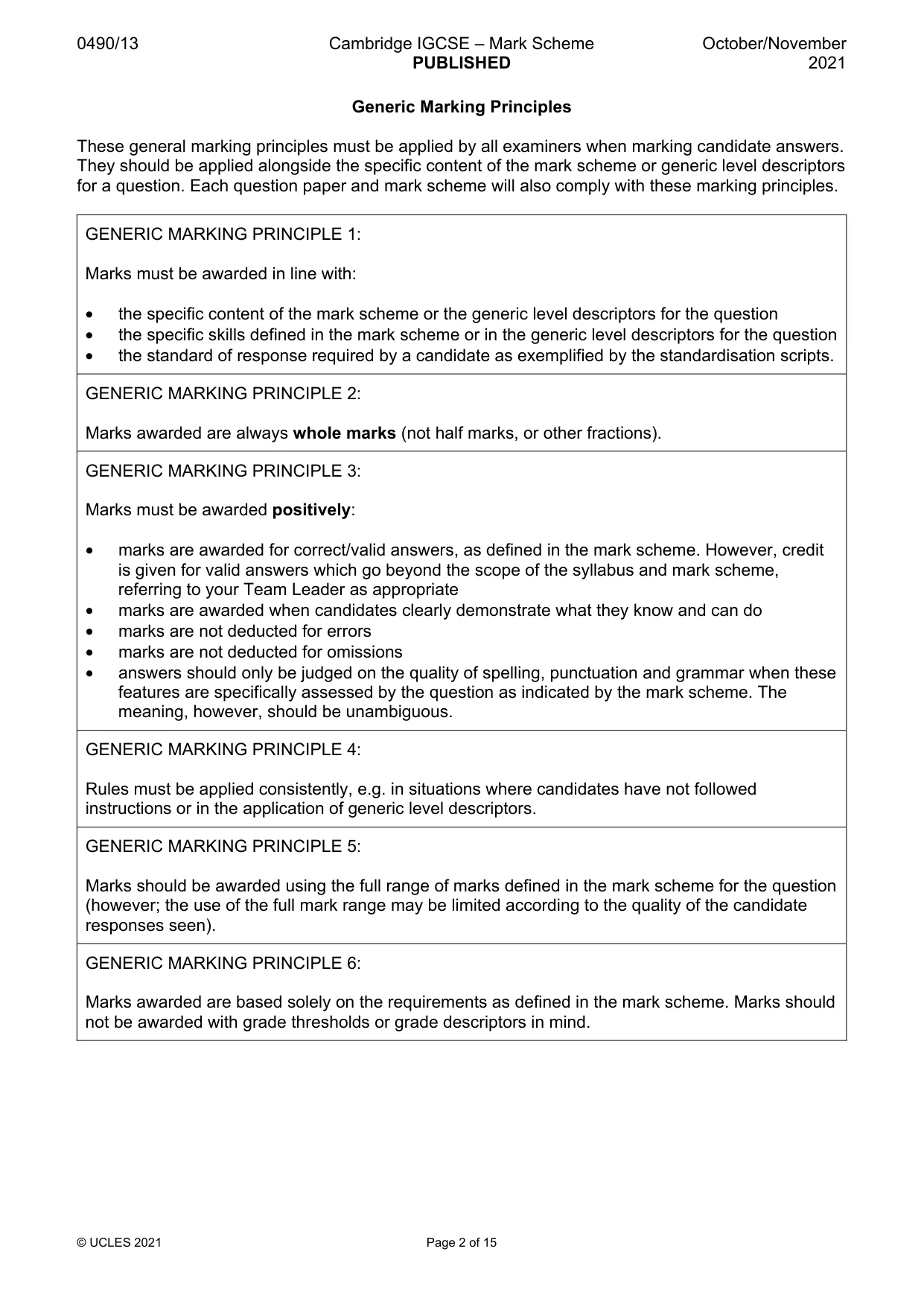
0490/13 Cambridge IGCSE – Mark Scheme PUBLISHED October/November 2021 © UCLES 2021 Page 2 of 15 Generic Marking Principles These general marking principles must be applied by all examiners when marking candidate answers. They should be applied alongside the specific content of the mark scheme or generic level descriptors for a question. Each question paper and mark scheme will also comply with these marking principles. GENERIC MARKING PRINCIPLE 1: Marks must be awarded in line with: • the specific content of the mark scheme or the generic level descriptors for the question • the specific skills defined in the mark scheme or in the generic level descriptors for the question • the standard of response required by a candidate as exemplified by the standardisation scripts. GENERIC MARKING PRINCIPLE 2: Marks awarded are always whole marks (not half marks, or other fractions). GENERIC MARKING PRINCIPLE 3: Marks must be awarded positively: • marks are awarded for correct/valid answers, as defined in the mark scheme. However, credit is given for valid answers which go beyond the scope of the syllabus and mark scheme, referring to your Team Leader as appropriate • marks are awarded when candidates clearly demonstrate what they know and can do • marks are not deducted for errors • marks are not deducted for omissions • answers should only be judged on the quality of spelling, punctuation and grammar when these features are specifically assessed by the question as indicated by the mark scheme. The meaning, however, should be unambiguous. GENERIC MARKING PRINCIPLE 4: Rules must be applied consistently, e.g. in situations where candidates have not followed instructions or in the application of generic level descriptors. GENERIC MARKING PRINCIPLE 5: Marks should be awarded using the full range of marks defined in the mark scheme for the question (however; the use of the full mark range may be limited according to the quality of the candidate responses seen). GENERIC MARKING PRINCIPLE 6: Marks awarded are based solely on the requirements as defined in the mark scheme. Marks should not be awarded with grade thresholds or grade descriptors in mind.
Mark scheme, page 3
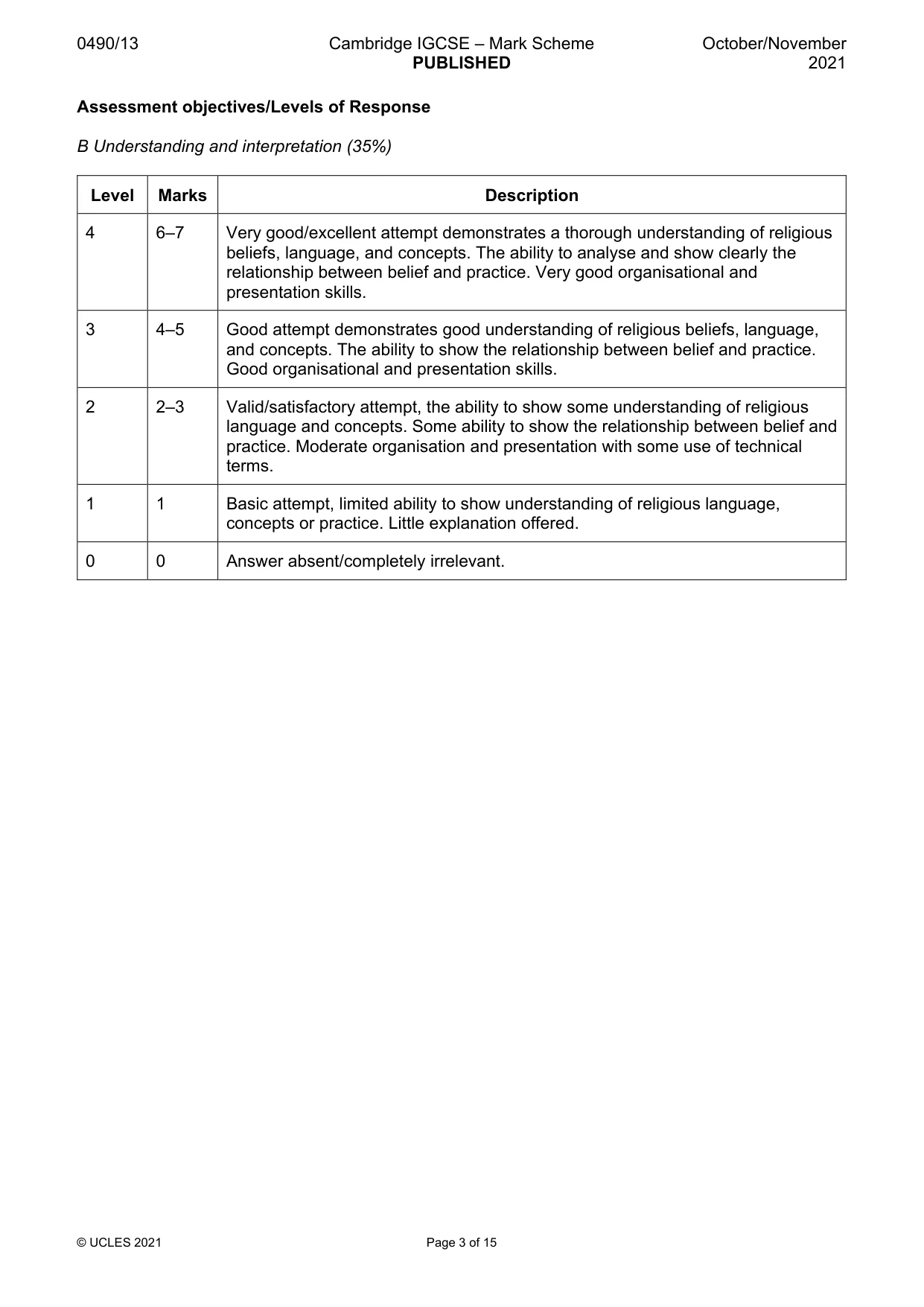
0490/13 Cambridge IGCSE – Mark Scheme PUBLISHED October/November 2021 © UCLES 2021 Page 3 of 15 Assessment objectives/Levels of Response B Understanding and interpretation (35%) Level Marks Description 4 6–7 Very good/excellent attempt demonstrates a thorough understanding of religious beliefs, language, and concepts. The ability to analyse and show clearly the relationship between belief and practice. Very good organisational and presentation skills. 3 4–5 Good attempt demonstrates good understanding of religious beliefs, language, and concepts. The ability to show the relationship between belief and practice. Good organisational and presentation skills. 2 2–3 Valid/satisfactory attempt, the ability to show some understanding of religious language and concepts. Some ability to show the relationship between belief and practice. Moderate organisation and presentation with some use of technical terms. 1 1 Basic attempt, limited ability to show understanding of religious language, concepts or practice. Little explanation offered. 0 0 Answer absent/completely irrelevant.
Mark scheme, page 4
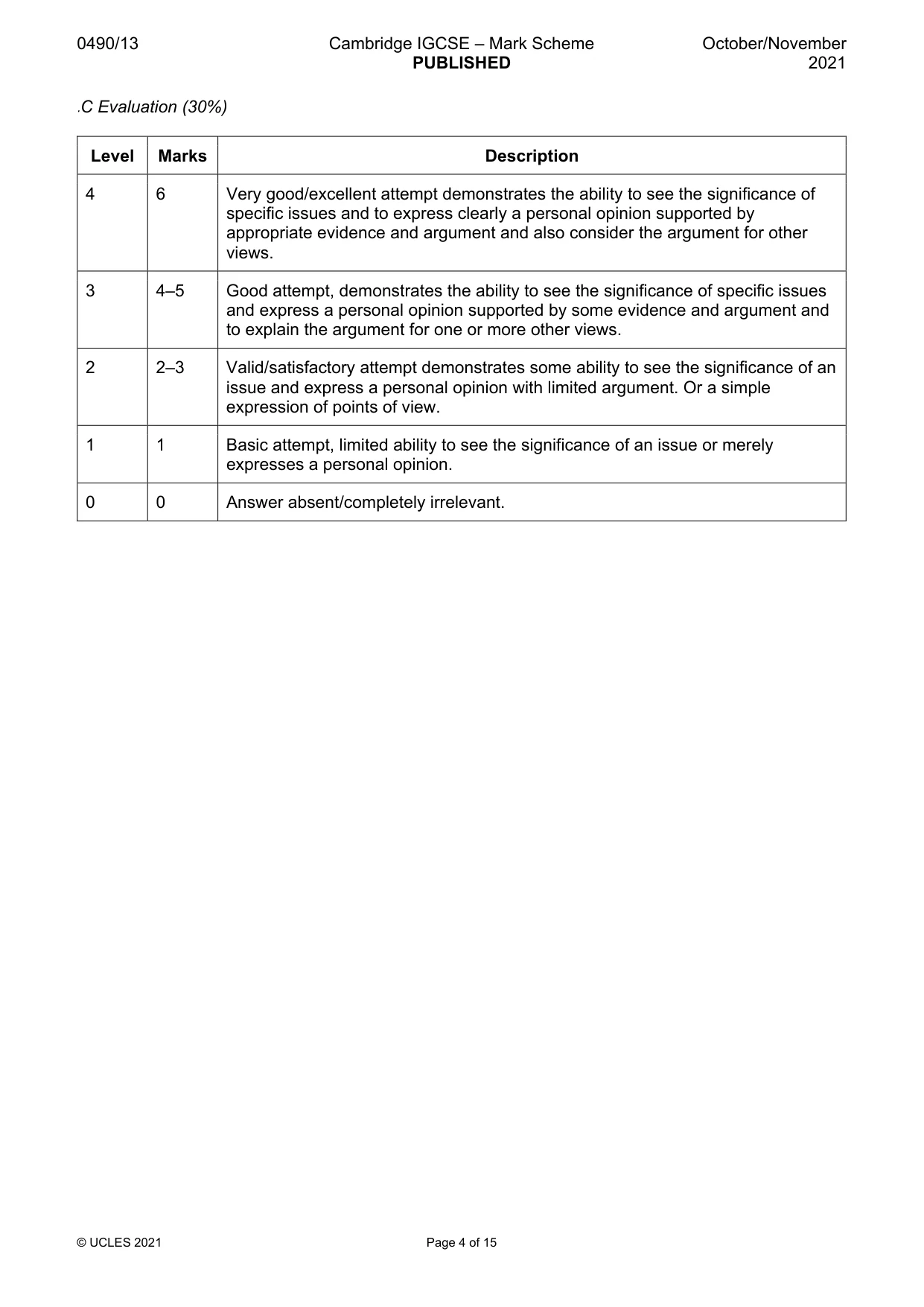
0490/13 Cambridge IGCSE – Mark Scheme PUBLISHED October/November 2021 © UCLES 2021 Page 4 of 15 C Evaluation (30%) Level Marks Description 4 6 Very good/excellent attempt demonstrates the ability to see the significance of specific issues and to express clearly a personal opinion supported by appropriate evidence and argument and also consider the argument for other views. 3 4–5 Good attempt, demonstrates the ability to see the significance of specific issues and express a personal opinion supported by some evidence and argument and to explain the argument for one or more other views. 2 2–3 Valid/satisfactory attempt demonstrates some ability to see the significance of an issue and express a personal opinion with limited argument. Or a simple expression of points of view. 1 1 Basic attempt, limited ability to see the significance of an issue or merely expresses a personal opinion. 0 0 Answer absent/completely irrelevant.
Mark scheme, page 5
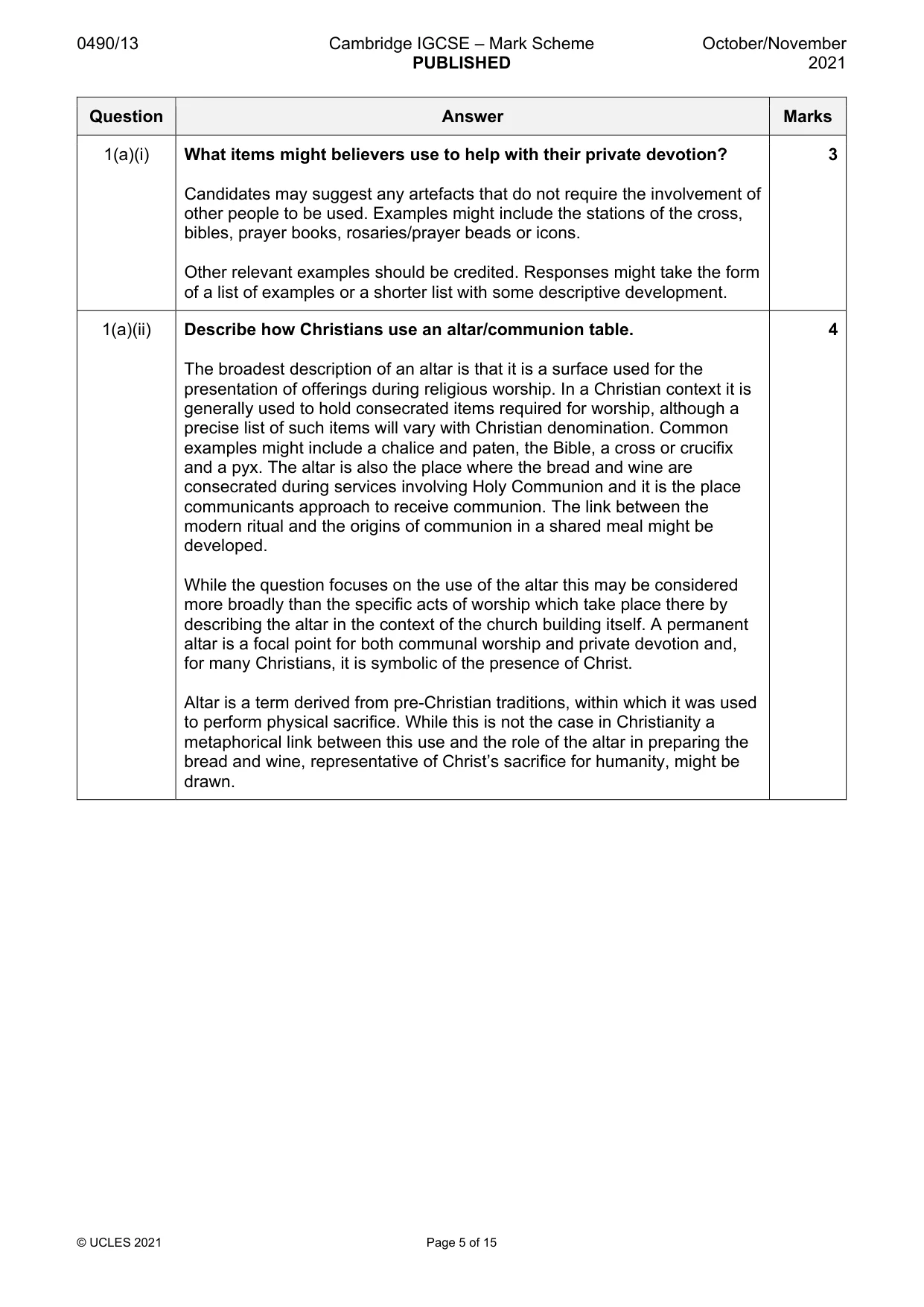
0490/13 Cambridge IGCSE – Mark Scheme PUBLISHED October/November 2021 © UCLES 2021 Page 5 of 15 Question Answer Marks 1(a)(i) What items might believers use to help with their private devotion? Candidates may suggest any artefacts that do not require the involvement of other people to be used. Examples might include the stations of the cross, bibles, prayer books, rosaries/prayer beads or icons. Other relevant examples should be credited. Responses might take the form of a list of examples or a shorter list with some descriptive development. 3 1(a)(ii) Describe how Christians use an altar/communion table. The broadest description of an altar is that it is a surface used for the presentation of offerings during religious worship. In a Christian context it is generally used to hold consecrated items required for worship, although a precise list of such items will vary with Christian denomination. Common examples might include a chalice and paten, the Bible, a cross or crucifix and a pyx. The altar is also the place where the bread and wine are consecrated during services involving Holy Communion and it is the place communicants approach to receive communion. The link between the modern ritual and the origins of communion in a shared meal might be developed. While the question focuses on the use of the altar this may be considered more broadly than the specific acts of worship which take place there by describing the altar in the context of the church building itself. A permanent altar is a focal point for both communal worship and private devotion and, for many Christians, it is symbolic of the presence of Christ. Altar is a term derived from pre-Christian traditions, within which it was used to perform physical sacrifice. While this is not the case in Christianity a metaphorical link between this use and the role of the altar in preparing the bread and wine, representative of Christ’s sacrifice for humanity, might be drawn. 4
Mark scheme, page 6
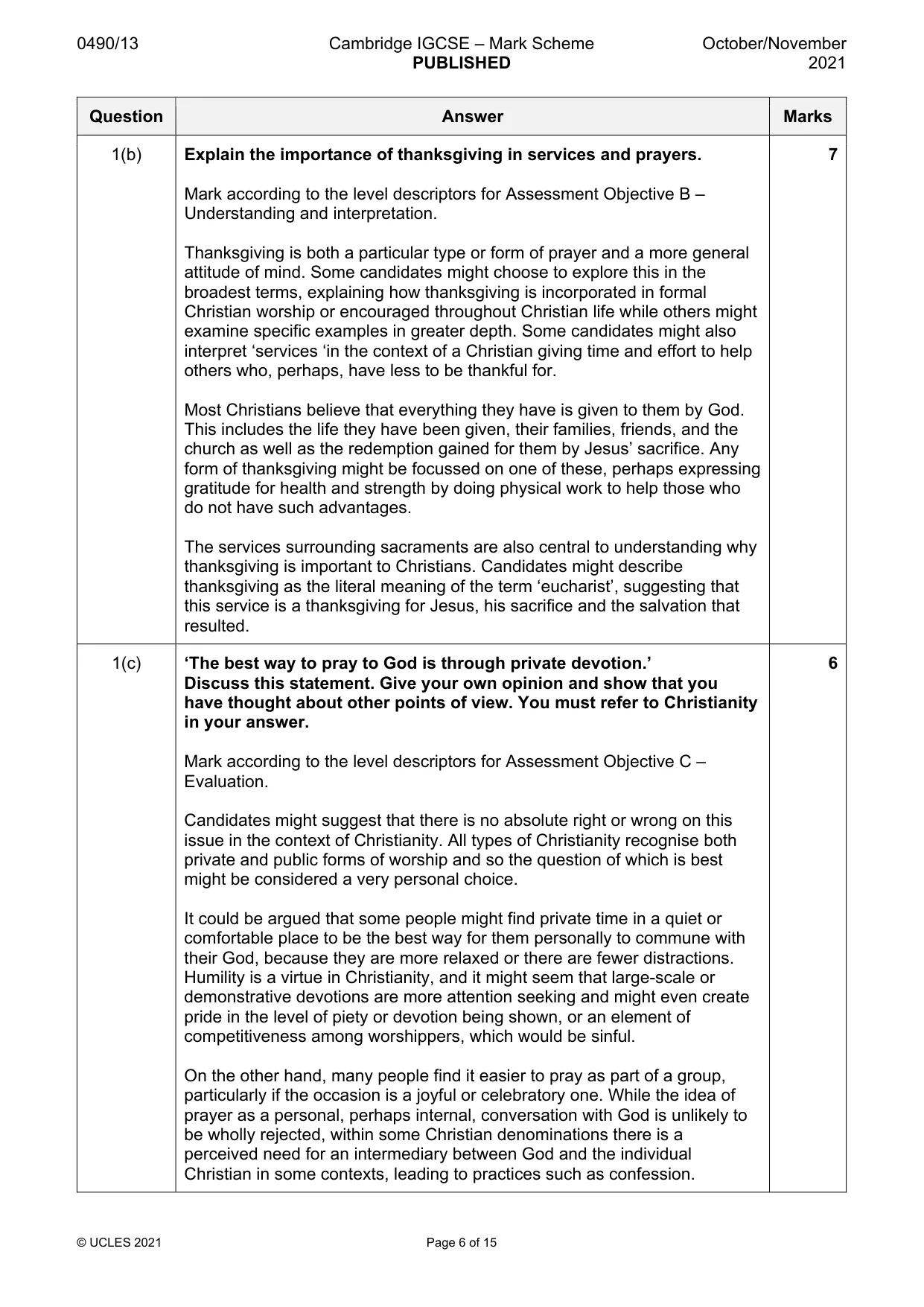
0490/13 Cambridge IGCSE – Mark Scheme PUBLISHED October/November 2021 © UCLES 2021 Page 6 of 15 Question Answer Marks 1(b) Explain the importance of thanksgiving in services and prayers. Mark according to the level descriptors for Assessment Objective B – Understanding and interpretation. Thanksgiving is both a particular type or form of prayer and a more general attitude of mind. Some candidates might choose to explore this in the broadest terms, explaining how thanksgiving is incorporated in formal Christian worship or encouraged throughout Christian life while others might examine specific examples in greater depth. Some candidates might also interpret ‘services ‘in the context of a Christian giving time and effort to help others who, perhaps, have less to be thankful for. Most Christians believe that everything they have is given to them by God. This includes the life they have been given, their families, friends, and the church as well as the redemption gained for them by Jesus’ sacrifice. Any form of thanksgiving might be focussed on one of these, perhaps expressing gratitude for health and strength by doing physical work to help those who do not have such advantages. The services surrounding sacraments are also central to understanding why thanksgiving is important to Christians. Candidates might describe thanksgiving as the literal meaning of the term ‘eucharist’, suggesting that this service is a thanksgiving for Jesus, his sacrifice and the salvation that resulted. 7 1(c) ‘The best way to pray to God is through private devotion.’ Discuss this statement. Give your own opinion and show that you have thought about other points of view. You must refer to Christianity in your answer. Mark according to the level descriptors for Assessment Objective C – Evaluation. Candidates might suggest that there is no absolute right or wrong on this issue in the context of Christianity. All types of Christianity recognise both private and public forms of worship and so the question of which is best might be considered a very personal choice. It could be argued that some people might find private time in a quiet or comfortable place to be the best way for them personally to commune with their God, because they are more relaxed or there are fewer distractions. Humility is a virtue in Christianity, and it might seem that large-scale or demonstrative devotions are more attention seeking and might even create pride in the level of piety or devotion being shown, or an element of competitiveness among worshippers, which would be sinful. On the other hand, many people find it easier to pray as part of a group, particularly if the occasion is a joyful or celebratory one. While the idea of prayer as a personal, perhaps internal, conversation with God is unlikely to be wholly rejected, within some Christian denominations there is a perceived need for an intermediary between God and the individual Christian in some contexts, leading to practices such as confession. 6
Mark scheme, page 7
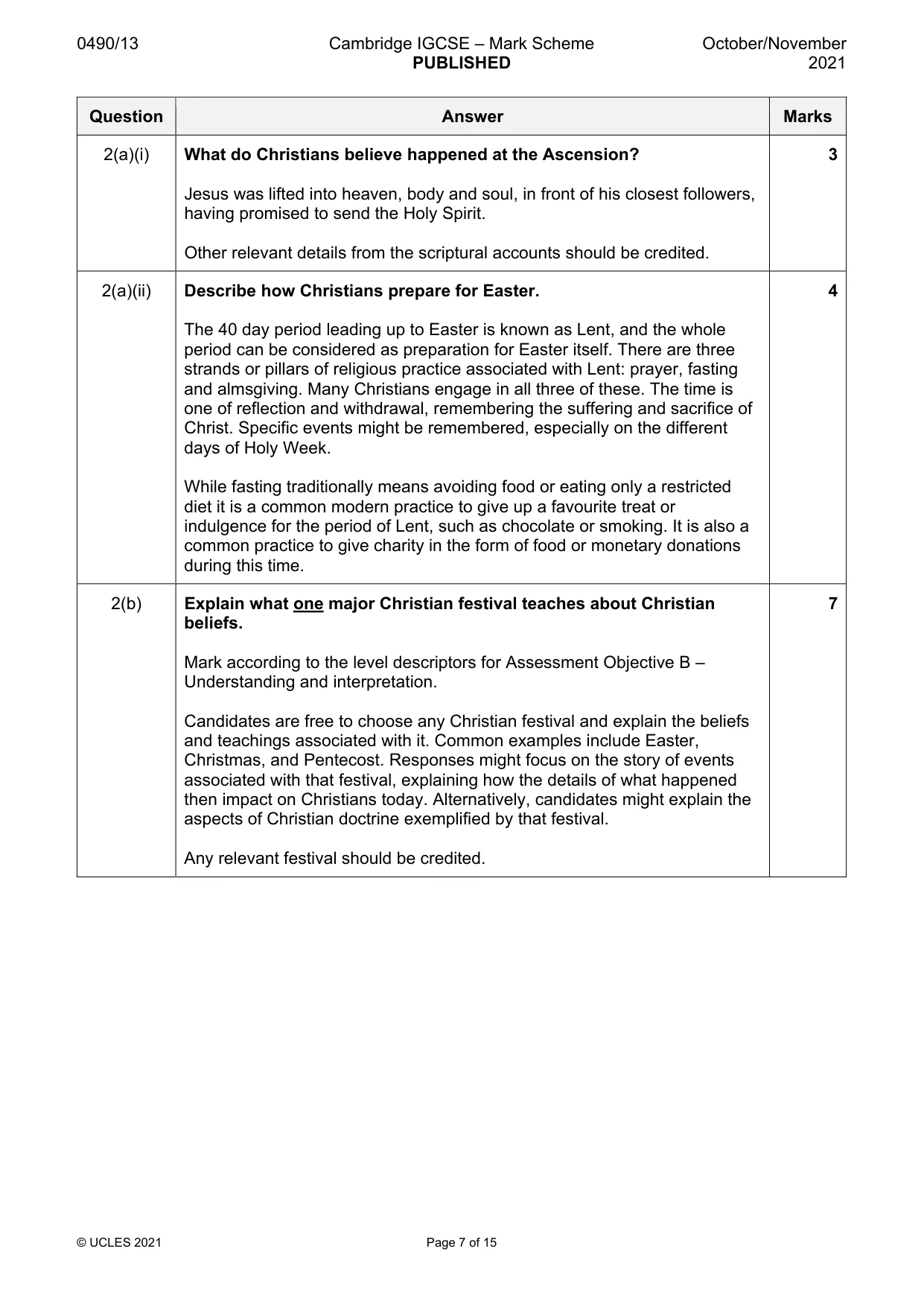
0490/13 Cambridge IGCSE – Mark Scheme PUBLISHED October/November 2021 © UCLES 2021 Page 7 of 15 Question Answer Marks 2(a)(i) What do Christians believe happened at the Ascension? Jesus was lifted into heaven, body and soul, in front of his closest followers, having promised to send the Holy Spirit. Other relevant details from the scriptural accounts should be credited. 3 2(a)(ii) Describe how Christians prepare for Easter. The 40 day period leading up to Easter is known as Lent, and the whole period can be considered as preparation for Easter itself. There are three strands or pillars of religious practice associated with Lent: prayer, fasting and almsgiving. Many Christians engage in all three of these. The time is one of reflection and withdrawal, remembering the suffering and sacrifice of Christ. Specific events might be remembered, especially on the different days of Holy Week. While fasting traditionally means avoiding food or eating only a restricted diet it is a common modern practice to give up a favourite treat or indulgence for the period of Lent, such as chocolate or smoking. It is also a common practice to give charity in the form of food or monetary donations during this time. 4 2(b) Explain what one major Christian festival teaches about Christian beliefs. Mark according to the level descriptors for Assessment Objective B – Understanding and interpretation. Candidates are free to choose any Christian festival and explain the beliefs and teachings associated with it. Common examples include Easter, Christmas, and Pentecost. Responses might focus on the story of events associated with that festival, explaining how the details of what happened then impact on Christians today. Alternatively, candidates might explain the aspects of Christian doctrine exemplified by that festival. Any relevant festival should be credited. 7
Mark scheme, page 8
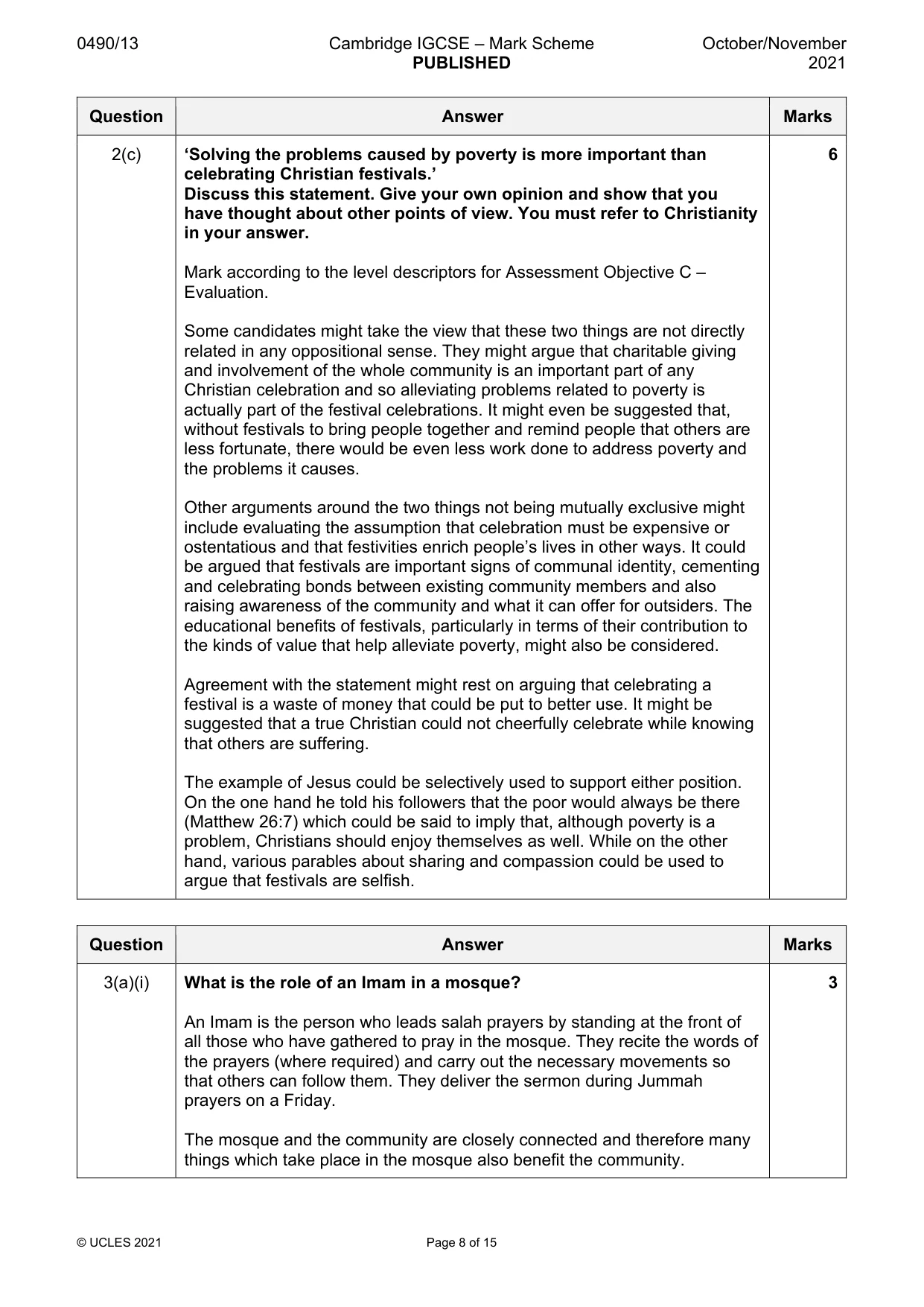
0490/13 Cambridge IGCSE – Mark Scheme PUBLISHED October/November 2021 © UCLES 2021 Page 8 of 15 Question Answer Marks 2(c) ‘Solving the problems caused by poverty is more important than celebrating Christian festivals.’ Discuss this statement. Give your own opinion and show that you have thought about other points of view. You must refer to Christianity in your answer. Mark according to the level descriptors for Assessment Objective C – Evaluation. Some candidates might take the view that these two things are not directly related in any oppositional sense. They might argue that charitable giving and involvement of the whole community is an important part of any Christian celebration and so alleviating problems related to poverty is actually part of the festival celebrations. It might even be suggested that, without festivals to bring people together and remind people that others are less fortunate, there would be even less work done to address poverty and the problems it causes. Other arguments around the two things not being mutually exclusive might include evaluating the assumption that celebration must be expensive or ostentatious and that festivities enrich people’s lives in other ways. It could be argued that festivals are important signs of communal identity, cementing and celebrating bonds between existing community members and also raising awareness of the community and what it can offer for outsiders. The educational benefits of festivals, particularly in terms of their contribution to the kinds of value that help alleviate poverty, might also be considered. Agreement with the statement might rest on arguing that celebrating a festival is a waste of money that could be put to better use. It might be suggested that a true Christian could not cheerfully celebrate while knowing that others are suffering. The example of Jesus could be selectively used to support either position. On the one hand he told his followers that the poor would always be there (Matthew 26:7) which could be said to imply that, although poverty is a problem, Christians should enjoy themselves as well. While on the other hand, various parables about sharing and compassion could be used to argue that festivals are selfish. 6 Question Answer Marks 3(a)(i) What is the role of an Imam in a mosque? An Imam is the person who leads salah prayers by standing at the front of all those who have gathered to pray in the mosque. They recite the words of the prayers (where required) and carry out the necessary movements so that others can follow them. They deliver the sermon during Jummah prayers on a Friday. The mosque and the community are closely connected and therefore many things which take place in the mosque also benefit the community. 3
Mark scheme, page 9
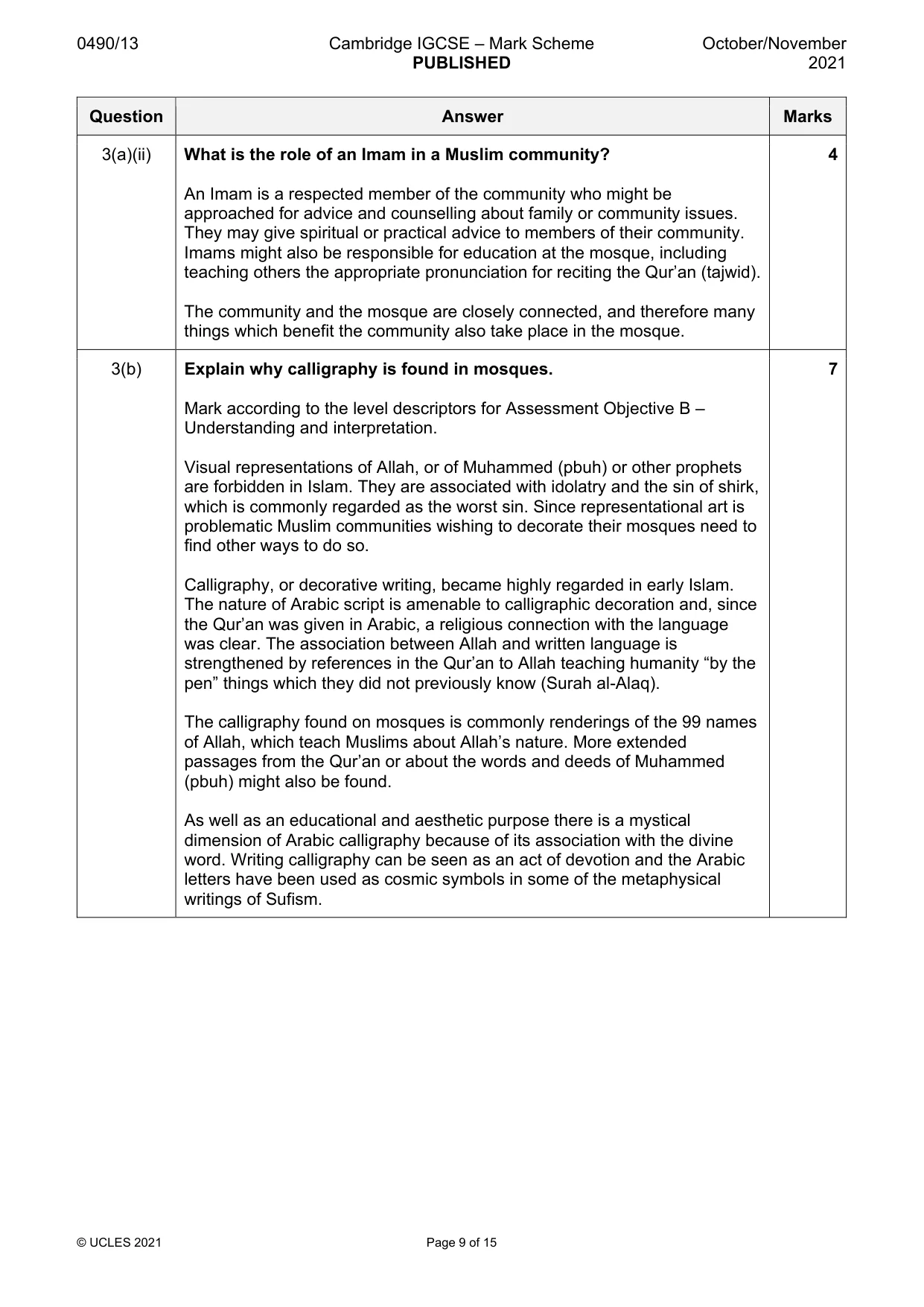
0490/13 Cambridge IGCSE – Mark Scheme PUBLISHED October/November 2021 © UCLES 2021 Page 9 of 15 Question Answer Marks 3(a)(ii) What is the role of an Imam in a Muslim community? An Imam is a respected member of the community who might be approached for advice and counselling about family or community issues. They may give spiritual or practical advice to members of their community. Imams might also be responsible for education at the mosque, including teaching others the appropriate pronunciation for reciting the Qur’an (tajwid). The community and the mosque are closely connected, and therefore many things which benefit the community also take place in the mosque. 4 3(b) Explain why calligraphy is found in mosques. Mark according to the level descriptors for Assessment Objective B – Understanding and interpretation. Visual representations of Allah, or of Muhammed (pbuh) or other prophets are forbidden in Islam. They are associated with idolatry and the sin of shirk, which is commonly regarded as the worst sin. Since representational art is problematic Muslim communities wishing to decorate their mosques need to find other ways to do so. Calligraphy, or decorative writing, became highly regarded in early Islam. The nature of Arabic script is amenable to calligraphic decoration and, since the Qur’an was given in Arabic, a religious connection with the language was clear. The association between Allah and written language is strengthened by references in the Qur’an to Allah teaching humanity “by the pen” things which they did not previously know (Surah al-Alaq). The calligraphy found on mosques is commonly renderings of the 99 names of Allah, which teach Muslims about Allah’s nature. More extended passages from the Qur’an or about the words and deeds of Muhammed (pbuh) might also be found. As well as an educational and aesthetic purpose there is a mystical dimension of Arabic calligraphy because of its association with the divine word. Writing calligraphy can be seen as an act of devotion and the Arabic letters have been used as cosmic symbols in some of the metaphysical writings of Sufism. 7
Mark scheme, page 10
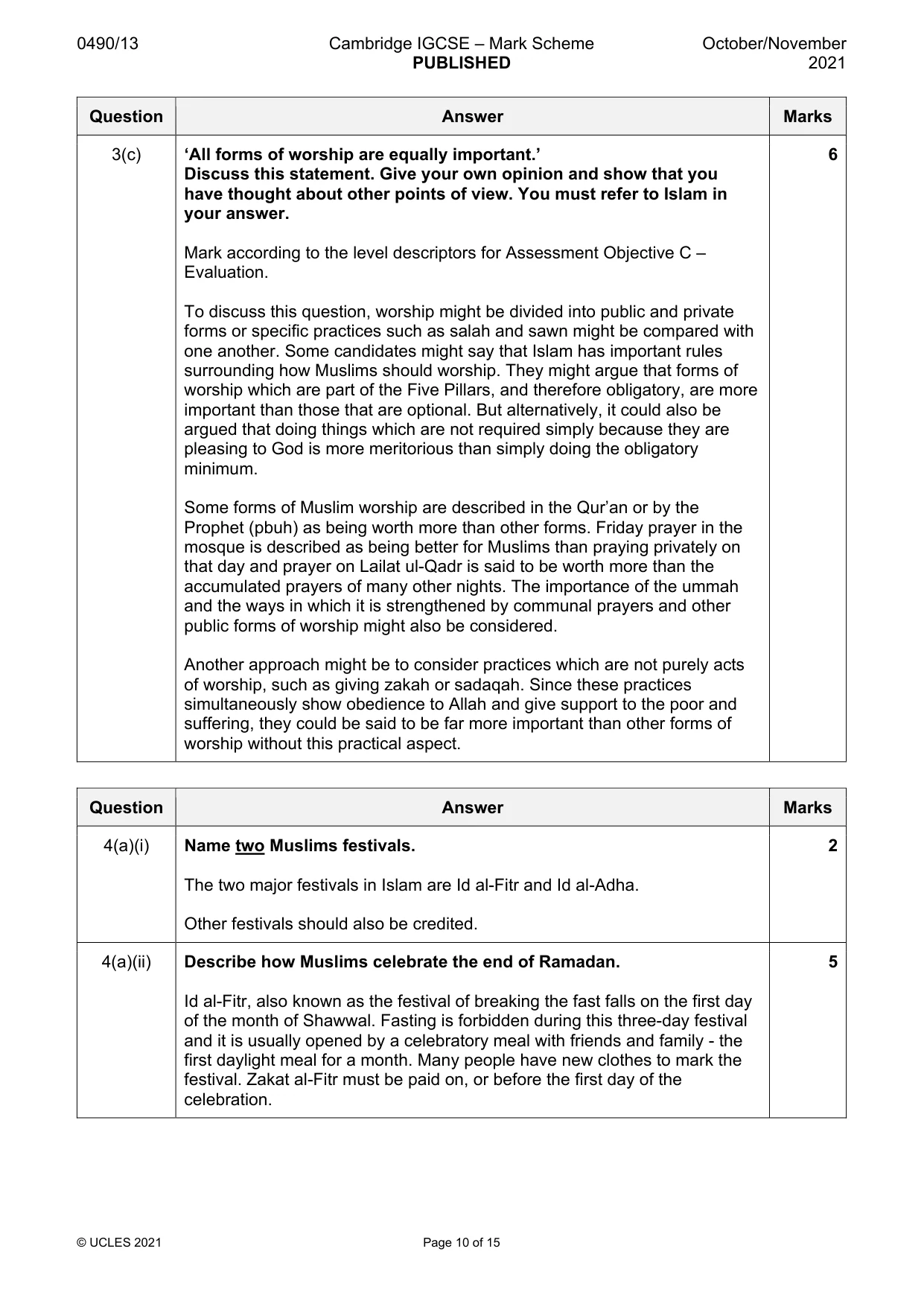
0490/13 Cambridge IGCSE – Mark Scheme PUBLISHED October/November 2021 © UCLES 2021 Page 10 of 15 Question Answer Marks 3(c) ‘All forms of worship are equally important.’ Discuss this statement. Give your own opinion and show that you have thought about other points of view. You must refer to Islam in your answer. Mark according to the level descriptors for Assessment Objective C – Evaluation. To discuss this question, worship might be divided into public and private forms or specific practices such as salah and sawn might be compared with one another. Some candidates might say that Islam has important rules surrounding how Muslims should worship. They might argue that forms of worship which are part of the Five Pillars, and therefore obligatory, are more important than those that are optional. But alternatively, it could also be argued that doing things which are not required simply because they are pleasing to God is more meritorious than simply doing the obligatory minimum. Some forms of Muslim worship are described in the Qur’an or by the Prophet (pbuh) as being worth more than other forms. Friday prayer in the mosque is described as being better for Muslims than praying privately on that day and prayer on Lailat ul-Qadr is said to be worth more than the accumulated prayers of many other nights. The importance of the ummah and the ways in which it is strengthened by communal prayers and other public forms of worship might also be considered. Another approach might be to consider practices which are not purely acts of worship, such as giving zakah or sadaqah. Since these practices simultaneously show obedience to Allah and give support to the poor and suffering, they could be said to be far more important than other forms of worship without this practical aspect. 6 Question Answer Marks 4(a)(i) Name two Muslims festivals. The two major festivals in Islam are Id al-Fitr and Id al-Adha. Other festivals should also be credited. 2 4(a)(ii) Describe how Muslims celebrate the end of Ramadan. Id al-Fitr, also known as the festival of breaking the fast falls on the first day of the month of Shawwal. Fasting is forbidden during this three-day festival and it is usually opened by a celebratory meal with friends and family - the first daylight meal for a month. Many people have new clothes to mark the festival. Zakat al-Fitr must be paid on, or before the first day of the celebration. 5
Mark scheme, page 11
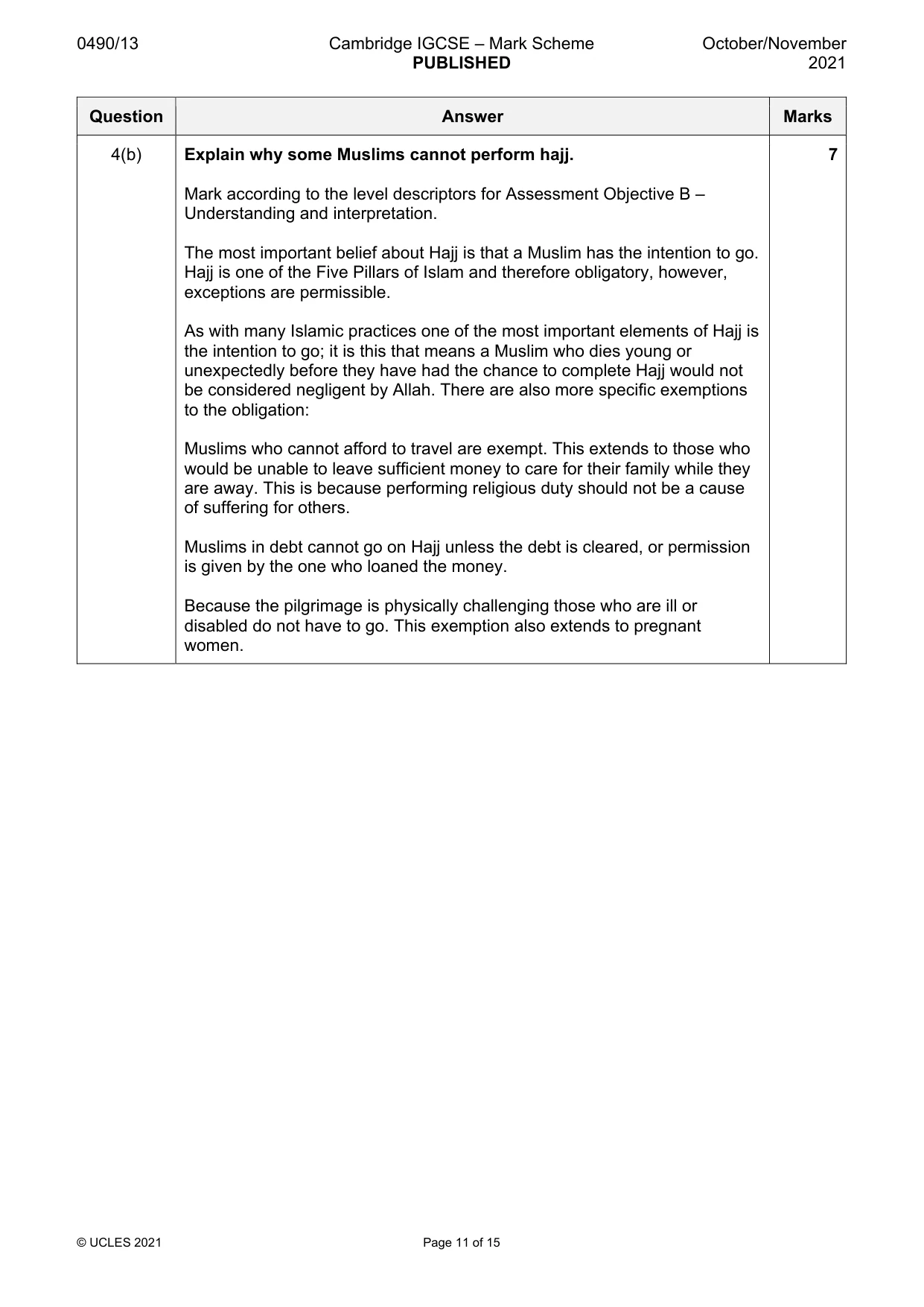
0490/13 Cambridge IGCSE – Mark Scheme PUBLISHED October/November 2021 © UCLES 2021 Page 11 of 15 Question Answer Marks 4(b) Explain why some Muslims cannot perform hajj. Mark according to the level descriptors for Assessment Objective B – Understanding and interpretation. The most important belief about Hajj is that a Muslim has the intention to go. Hajj is one of the Five Pillars of Islam and therefore obligatory, however, exceptions are permissible. As with many Islamic practices one of the most important elements of Hajj is the intention to go; it is this that means a Muslim who dies young or unexpectedly before they have had the chance to complete Hajj would not be considered negligent by Allah. There are also more specific exemptions to the obligation: Muslims who cannot afford to travel are exempt. This extends to those who would be unable to leave sufficient money to care for their family while they are away. This is because performing religious duty should not be a cause of suffering for others. Muslims in debt cannot go on Hajj unless the debt is cleared, or permission is given by the one who loaned the money. Because the pilgrimage is physically challenging those who are ill or disabled do not have to go. This exemption also extends to pregnant women. 7
Mark scheme, page 12
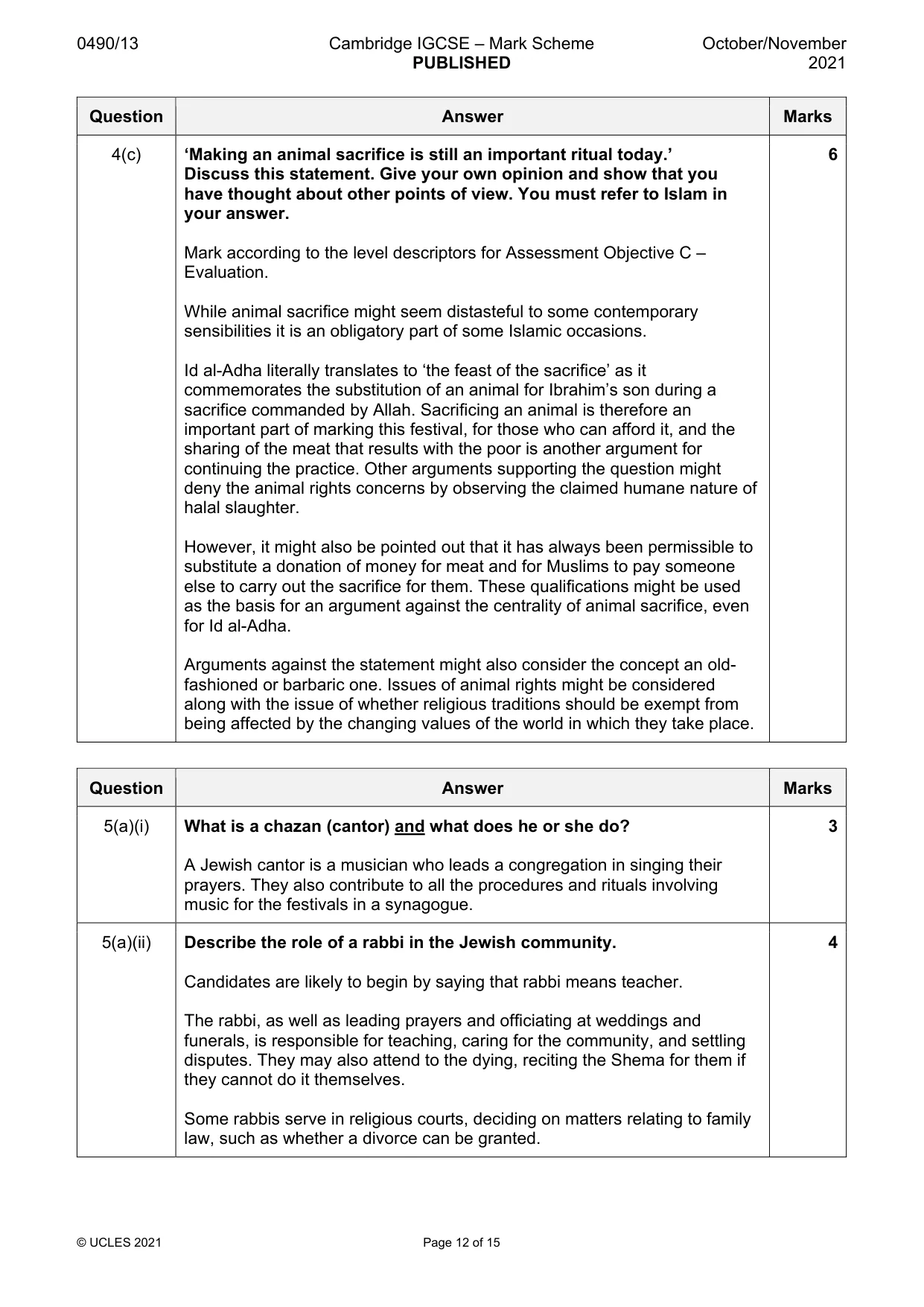
0490/13 Cambridge IGCSE – Mark Scheme PUBLISHED October/November 2021 © UCLES 2021 Page 12 of 15 Question Answer Marks 4(c) ‘Making an animal sacrifice is still an important ritual today.’ Discuss this statement. Give your own opinion and show that you have thought about other points of view. You must refer to Islam in your answer. Mark according to the level descriptors for Assessment Objective C – Evaluation. While animal sacrifice might seem distasteful to some contemporary sensibilities it is an obligatory part of some Islamic occasions. Id al-Adha literally translates to ‘the feast of the sacrifice’ as it commemorates the substitution of an animal for Ibrahim’s son during a sacrifice commanded by Allah. Sacrificing an animal is therefore an important part of marking this festival, for those who can afford it, and the sharing of the meat that results with the poor is another argument for continuing the practice. Other arguments supporting the question might deny the animal rights concerns by observing the claimed humane nature of halal slaughter. However, it might also be pointed out that it has always been permissible to substitute a donation of money for meat and for Muslims to pay someone else to carry out the sacrifice for them. These qualifications might be used as the basis for an argument against the centrality of animal sacrifice, even for Id al-Adha. Arguments against the statement might also consider the concept an old- fashioned or barbaric one. Issues of animal rights might be considered along with the issue of whether religious traditions should be exempt from being affected by the changing values of the world in which they take place. 6 Question Answer Marks 5(a)(i) What is a chazan (cantor) and what does he or she do? A Jewish cantor is a musician who leads a congregation in singing their prayers. They also contribute to all the procedures and rituals involving music for the festivals in a synagogue. 3 5(a)(ii) Describe the role of a rabbi in the Jewish community. Candidates are likely to begin by saying that rabbi means teacher. The rabbi, as well as leading prayers and officiating at weddings and funerals, is responsible for teaching, caring for the community, and settling disputes. They may also attend to the dying, reciting the Shema for them if they cannot do it themselves. Some rabbis serve in religious courts, deciding on matters relating to family law, such as whether a divorce can be granted. 4
Mark scheme, page 13
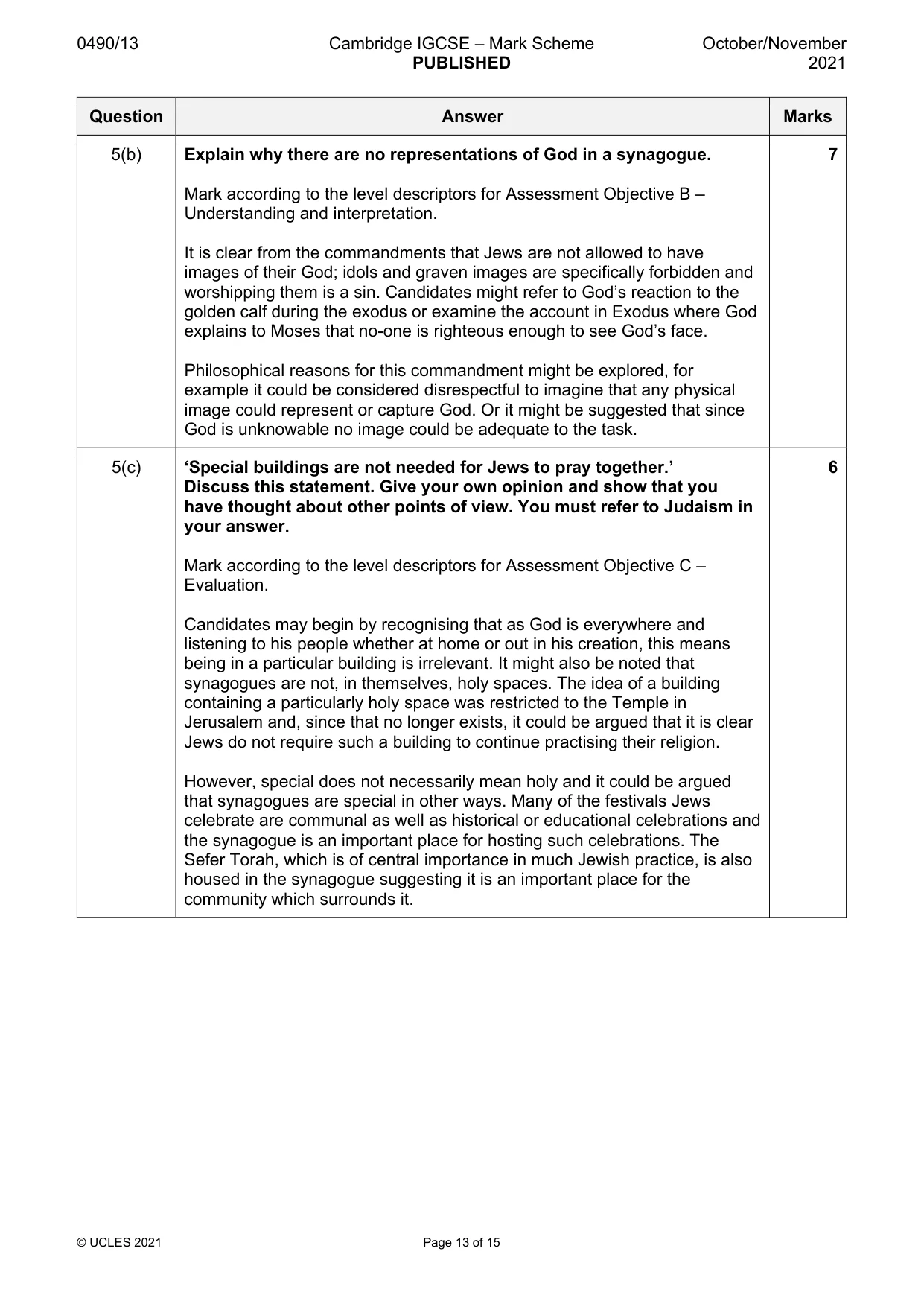
0490/13 Cambridge IGCSE – Mark Scheme PUBLISHED October/November 2021 © UCLES 2021 Page 13 of 15 Question Answer Marks 5(b) Explain why there are no representations of God in a synagogue. Mark according to the level descriptors for Assessment Objective B – Understanding and interpretation. It is clear from the commandments that Jews are not allowed to have images of their God; idols and graven images are specifically forbidden and worshipping them is a sin. Candidates might refer to God’s reaction to the golden calf during the exodus or examine the account in Exodus where God explains to Moses that no-one is righteous enough to see God’s face. Philosophical reasons for this commandment might be explored, for example it could be considered disrespectful to imagine that any physical image could represent or capture God. Or it might be suggested that since God is unknowable no image could be adequate to the task. 7 5(c) ‘Special buildings are not needed for Jews to pray together.’ Discuss this statement. Give your own opinion and show that you have thought about other points of view. You must refer to Judaism in your answer. Mark according to the level descriptors for Assessment Objective C – Evaluation. Candidates may begin by recognising that as God is everywhere and listening to his people whether at home or out in his creation, this means being in a particular building is irrelevant. It might also be noted that synagogues are not, in themselves, holy spaces. The idea of a building containing a particularly holy space was restricted to the Temple in Jerusalem and, since that no longer exists, it could be argued that it is clear Jews do not require such a building to continue practising their religion. However, special does not necessarily mean holy and it could be argued that synagogues are special in other ways. Many of the festivals Jews celebrate are communal as well as historical or educational celebrations and the synagogue is an important place for hosting such celebrations. The Sefer Torah, which is of central importance in much Jewish practice, is also housed in the synagogue suggesting it is an important place for the community which surrounds it. 6
Mark scheme, page 14
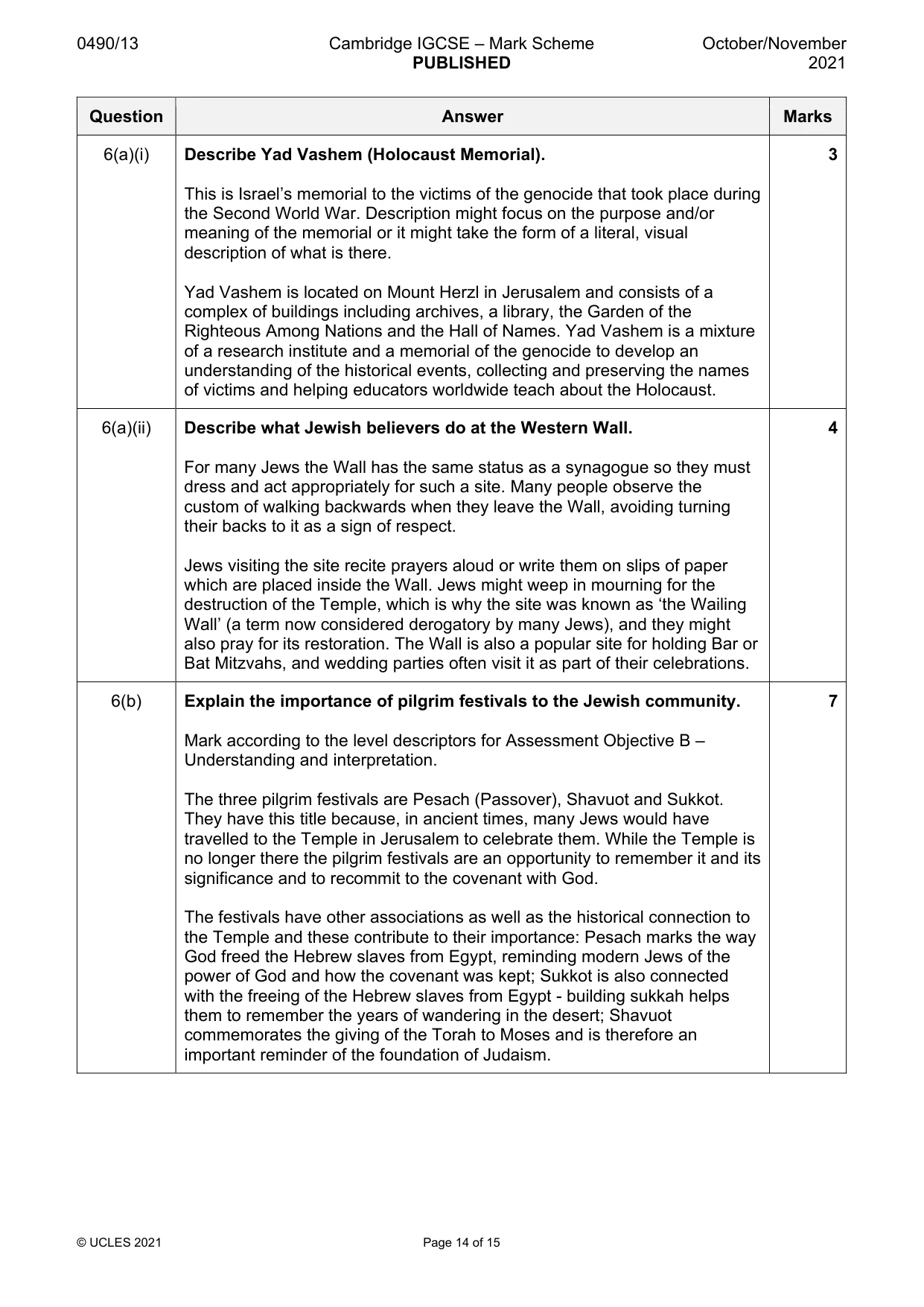
0490/13 Cambridge IGCSE – Mark Scheme PUBLISHED October/November 2021 © UCLES 2021 Page 14 of 15 Question Answer Marks 6(a)(i) Describe Yad Vashem (Holocaust Memorial). This is Israel’s memorial to the victims of the genocide that took place during the Second World War. Description might focus on the purpose and/or meaning of the memorial or it might take the form of a literal, visual description of what is there. Yad Vashem is located on Mount Herzl in Jerusalem and consists of a complex of buildings including archives, a library, the Garden of the Righteous Among Nations and the Hall of Names. Yad Vashem is a mixture of a research institute and a memorial of the genocide to develop an understanding of the historical events, collecting and preserving the names of victims and helping educators worldwide teach about the Holocaust. 3 6(a)(ii) Describe what Jewish believers do at the Western Wall. For many Jews the Wall has the same status as a synagogue so they must dress and act appropriately for such a site. Many people observe the custom of walking backwards when they leave the Wall, avoiding turning their backs to it as a sign of respect. Jews visiting the site recite prayers aloud or write them on slips of paper which are placed inside the Wall. Jews might weep in mourning for the destruction of the Temple, which is why the site was known as ‘the Wailing Wall’ (a term now considered derogatory by many Jews), and they might also pray for its restoration. The Wall is also a popular site for holding Bar or Bat Mitzvahs, and wedding parties often visit it as part of their celebrations. 4 6(b) Explain the importance of pilgrim festivals to the Jewish community. Mark according to the level descriptors for Assessment Objective B – Understanding and interpretation. The three pilgrim festivals are Pesach (Passover), Shavuot and Sukkot. They have this title because, in ancient times, many Jews would have travelled to the Temple in Jerusalem to celebrate them. While the Temple is no longer there the pilgrim festivals are an opportunity to remember it and its significance and to recommit to the covenant with God. The festivals have other associations as well as the historical connection to the Temple and these contribute to their importance: Pesach marks the way God freed the Hebrew slaves from Egypt, reminding modern Jews of the power of God and how the covenant was kept; Sukkot is also connected with the freeing of the Hebrew slaves from Egypt - building sukkah helps them to remember the years of wandering in the desert; Shavuot commemorates the giving of the Torah to Moses and is therefore an important reminder of the foundation of Judaism. 7
Mark scheme, page 15
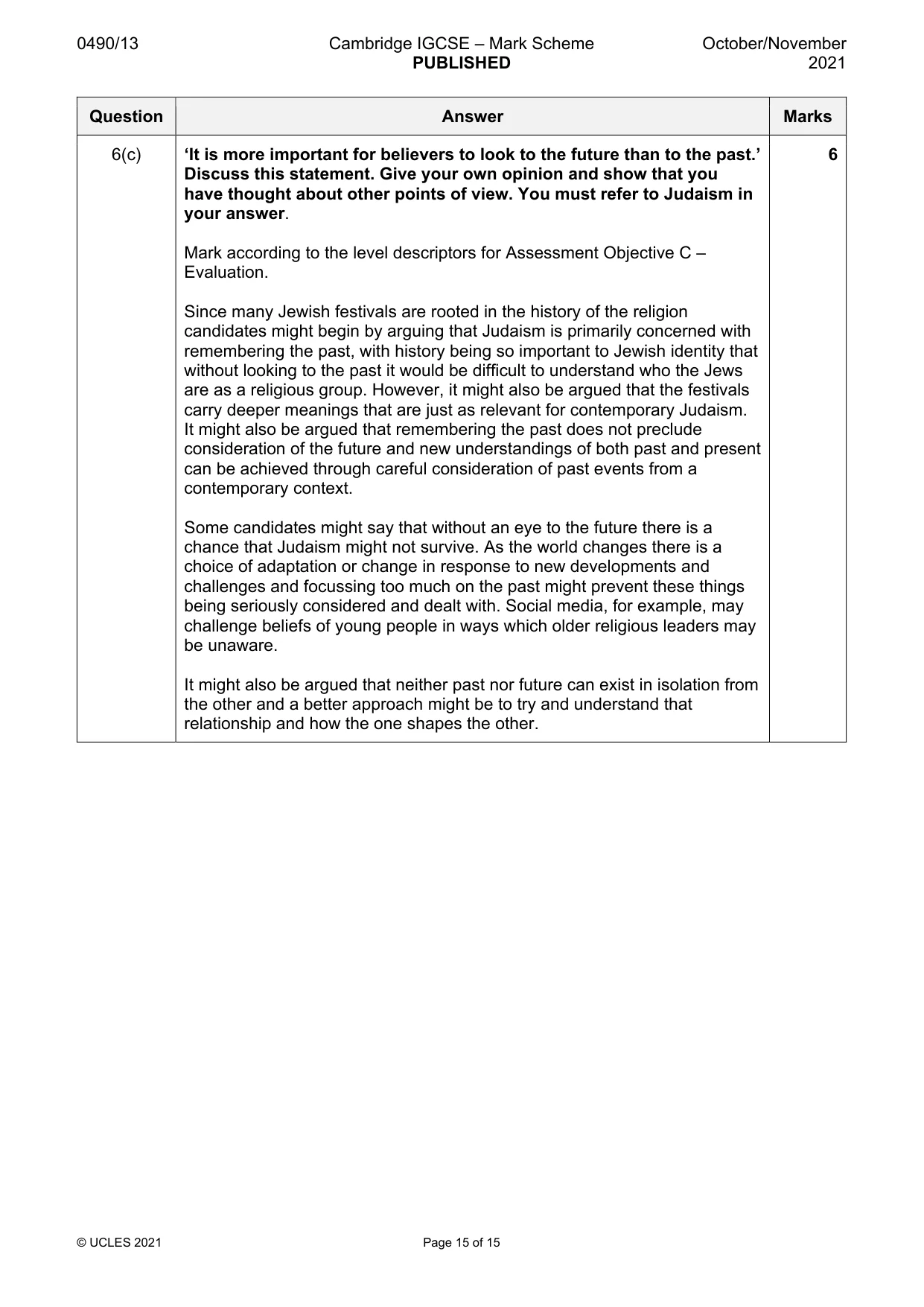
0490/13 Cambridge IGCSE – Mark Scheme PUBLISHED October/November 2021 © UCLES 2021 Page 15 of 15 Question Answer Marks 6(c) ‘It is more important for believers to look to the future than to the past.’ Discuss this statement. Give your own opinion and show that you have thought about other points of view. You must refer to Judaism in your answer. Mark according to the level descriptors for Assessment Objective C – Evaluation. Since many Jewish festivals are rooted in the history of the religion candidates might begin by arguing that Judaism is primarily concerned with remembering the past, with history being so important to Jewish identity that without looking to the past it would be difficult to understand who the Jews are as a religious group. However, it might also be argued that the festivals carry deeper meanings that are just as relevant for contemporary Judaism. It might also be argued that remembering the past does not preclude consideration of the future and new understandings of both past and present can be achieved through careful consideration of past events from a contemporary context. Some candidates might say that without an eye to the future there is a chance that Judaism might not survive. As the world changes there is a choice of adaptation or change in response to new developments and challenges and focussing too much on the past might prevent these things being seriously considered and dealt with. Social media, for example, may challenge beliefs of young people in ways which older religious leaders may be unaware. It might also be argued that neither past nor future can exist in isolation from the other and a better approach might be to try and understand that relationship and how the one shapes the other. 6
What you needed in this session
Cambridge’s own grade thresholds for 2021 Oct/Nov, Paper 1 · Variant 3. A higher threshold means an easier paper — the bar moves with how the cohort did.