Cambridge IGCSE Religious Studies 0490 — 2024 Oct/Nov Paper 1 · Variant 3
0490/13/O/N/24 · 80 marks · ≈90 min
The question paper and its mark scheme, free to read here and free to download. This is Cambridge’s own paper, exactly as it was sat.
Question paper4 pages
Mark scheme19 pages
Answers below. Sit the paper first if you are practising.
Paper as text
Question paper, page 1
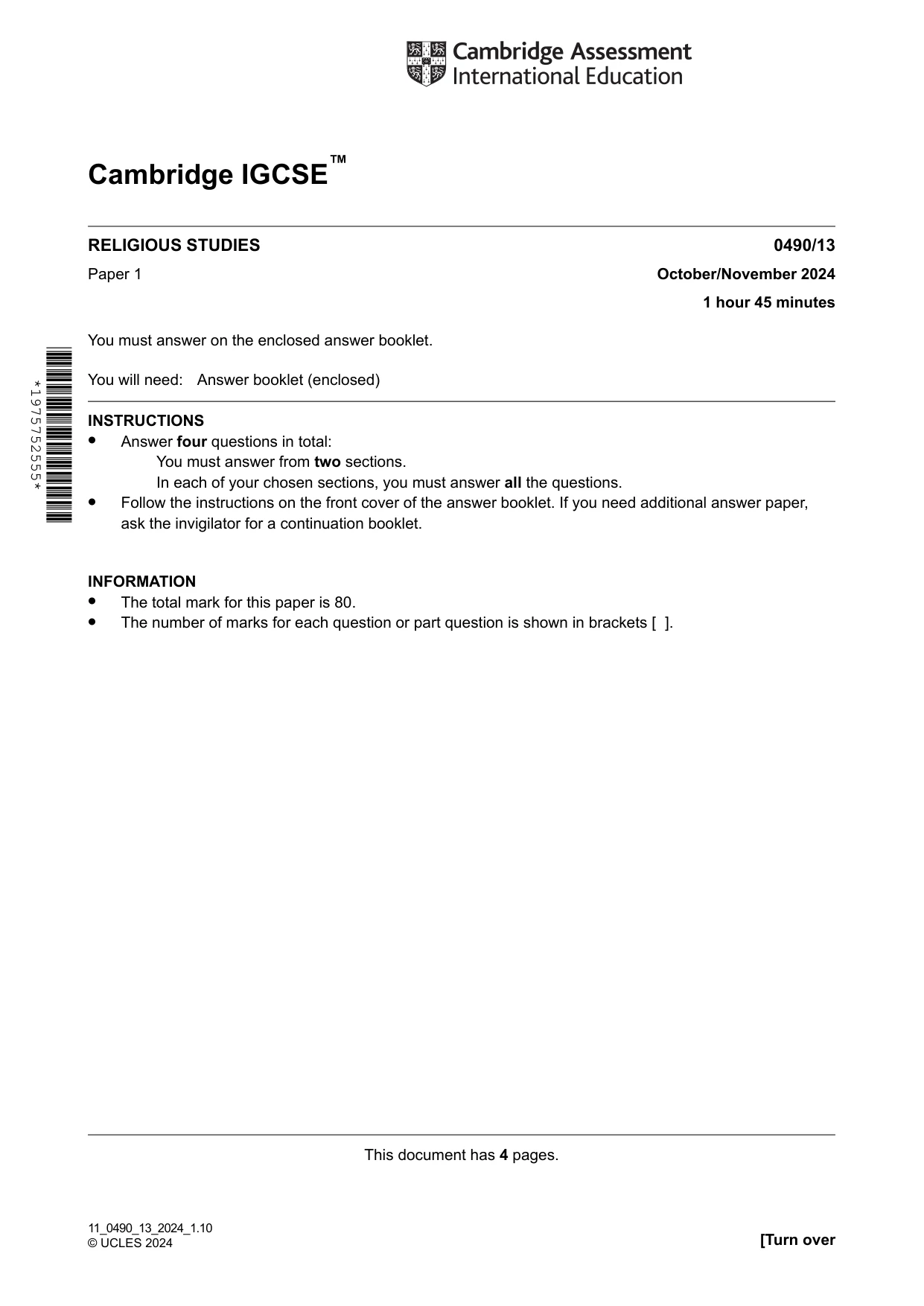
Cambridge IGCSE™ 0490/13 October/November 2024 1 hour 45 minutes RELIGIOUS STUDIES Paper 1 You must answer on the enclosed answer booklet. You will need: Answer booklet (enclosed) INSTRUCTIONS • Answer four questions in total: You must answer from two sections. In each of your chosen sections, you must answer all the questions. • Follow the instructions on the front cover of the answer booklet. If you need additional answer paper, ask the invigilator for a continuation booklet. INFORMATION • The total mark for this paper is 80. • The number of marks for each question or part question is shown in brackets [ ]. This document has 4 pages. [Turn over 11_0490_13_2024_1.10 © UCLES 2024 *1975752555*
Question paper, page 2
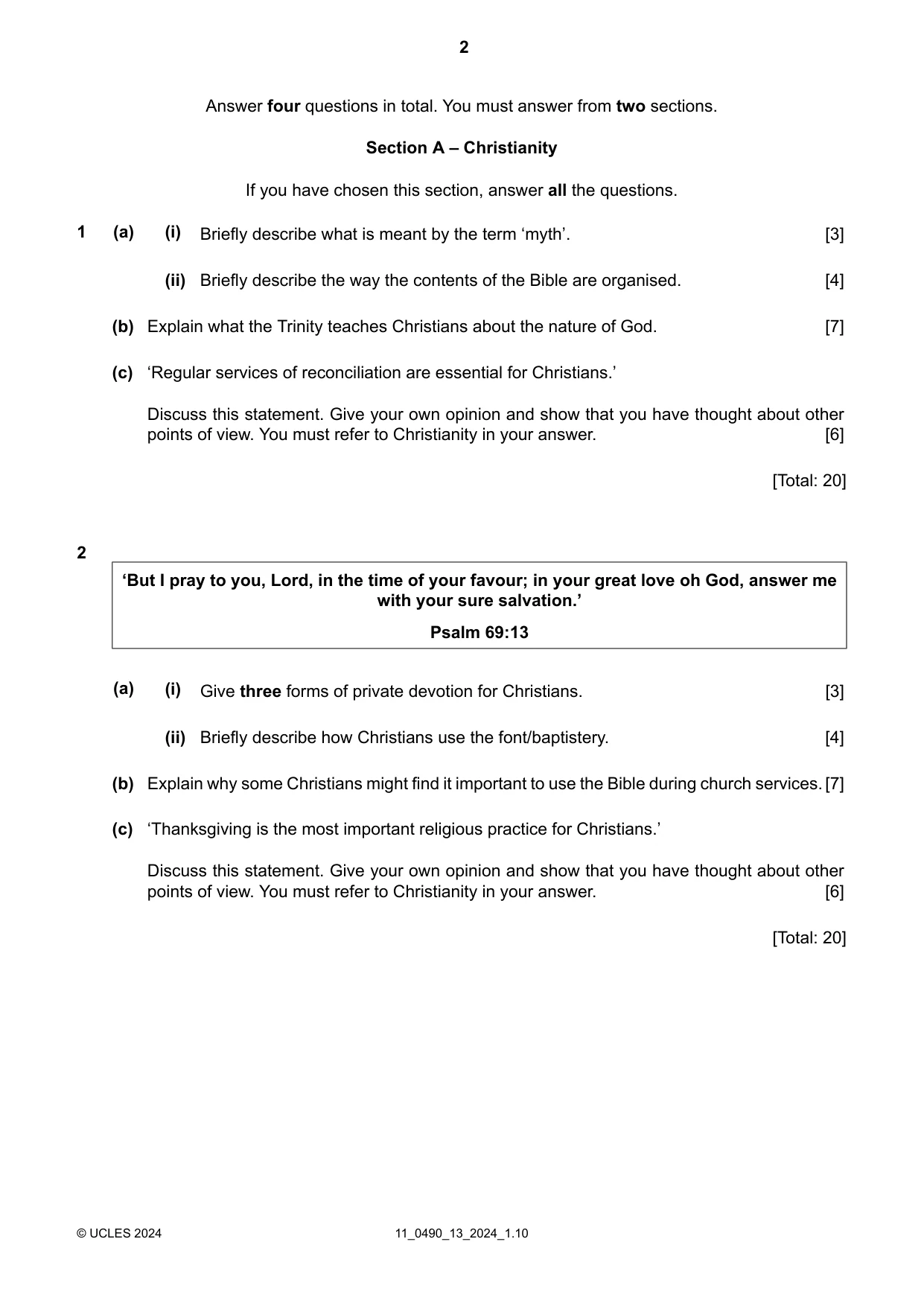
Answer four questions in total. You must answer from two sections. Section A – Christianity If you have chosen this section, answer all the questions. (a) 1 Briefly describe what is meant by the term ‘myth’. [3] (i) Briefly describe the way the contents of the Bible are organised. [4] (ii) Explain what the Trinity teaches Christians about the nature of God. [7] (b) ‘Regular services of reconciliation are essential for Christians.’ Discuss this statement. Give your own opinion and show that you have thought about other points of view. You must refer to Christianity in your answer. [6] (c) [Total: 20] 2 ‘But I pray to you, Lord, in the time of your favour; in your great love oh God, answer me with your sure salvation.’ Psalm 69:13 (a) Give three forms of private devotion for Christians. [3] (i) Briefly describe how Christians use the font/baptistery. [4] (ii) Explain why some Christians might find it important to use the Bible during church services.[7] (b) ‘Thanksgiving is the most important religious practice for Christians.’ Discuss this statement. Give your own opinion and show that you have thought about other points of view. You must refer to Christianity in your answer. [6] (c) [Total: 20] 11_0490_13_2024_1.10 © UCLES 2024 2
Question paper, page 3
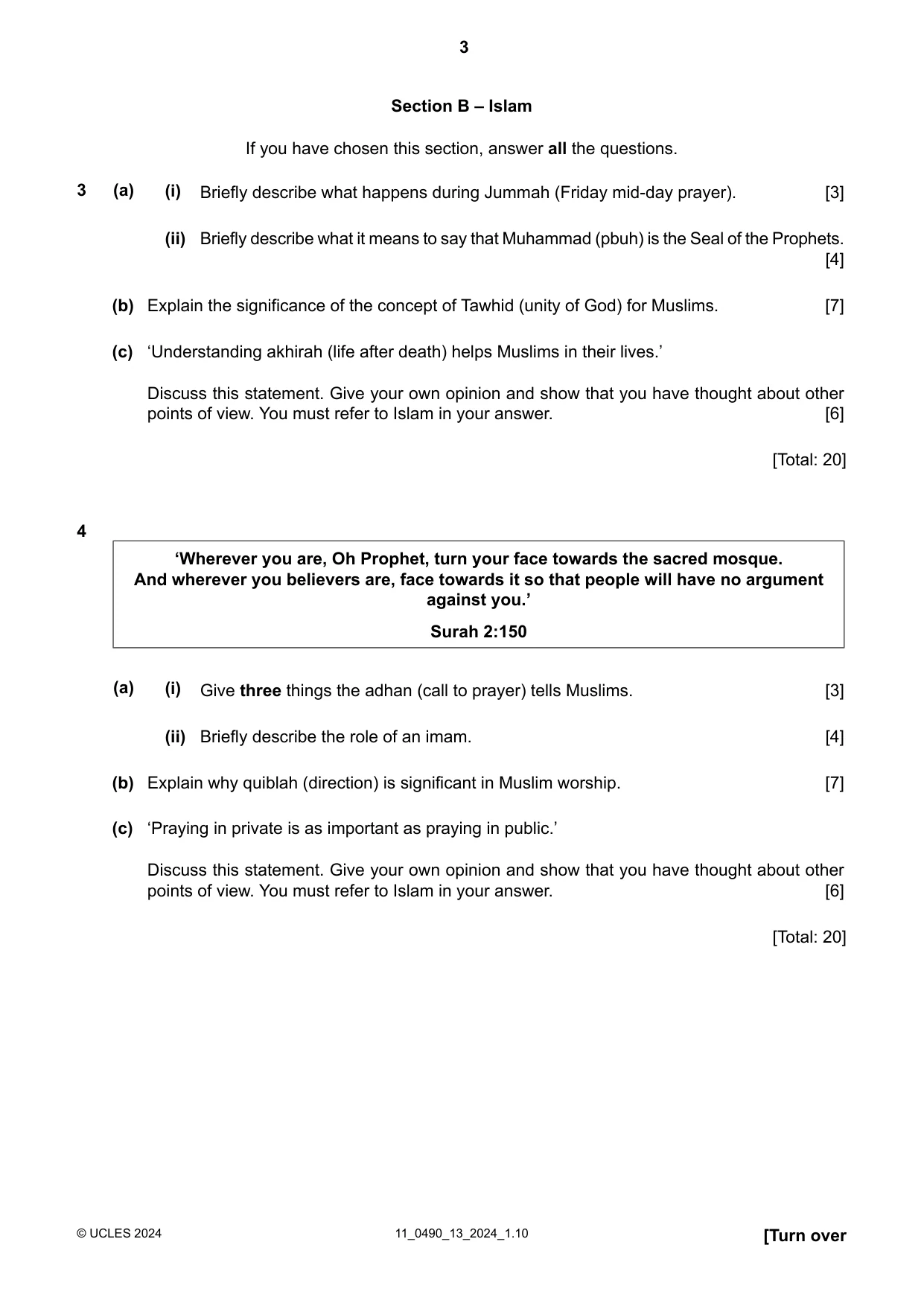
Section B – Islam If you have chosen this section, answer all the questions. (a) 3 Briefly describe what happens during Jummah (Friday mid-day prayer). [3] (i) Briefly describe what it means to say that Muhammad (pbuh) is the Seal of the Prophets. [4] (ii) Explain the significance of the concept of Tawhid (unity of God) for Muslims. [7] (b) ‘Understanding akhirah (life after death) helps Muslims in their lives.’ Discuss this statement. Give your own opinion and show that you have thought about other points of view. You must refer to Islam in your answer. [6] (c) [Total: 20] 4 ‘Wherever you are, Oh Prophet, turn your face towards the sacred mosque. And wherever you believers are, face towards it so that people will have no argument against you.’ Surah 2:150 (a) Give three things the adhan (call to prayer) tells Muslims. [3] (i) Briefly describe the role of an imam. [4] (ii) Explain why quiblah (direction) is significant in Muslim worship. [7] (b) ‘Praying in private is as important as praying in public.’ Discuss this statement. Give your own opinion and show that you have thought about other points of view. You must refer to Islam in your answer. [6] (c) [Total: 20] [Turn over 11_0490_13_2024_1.10 © UCLES 2024 3
Question paper, page 4
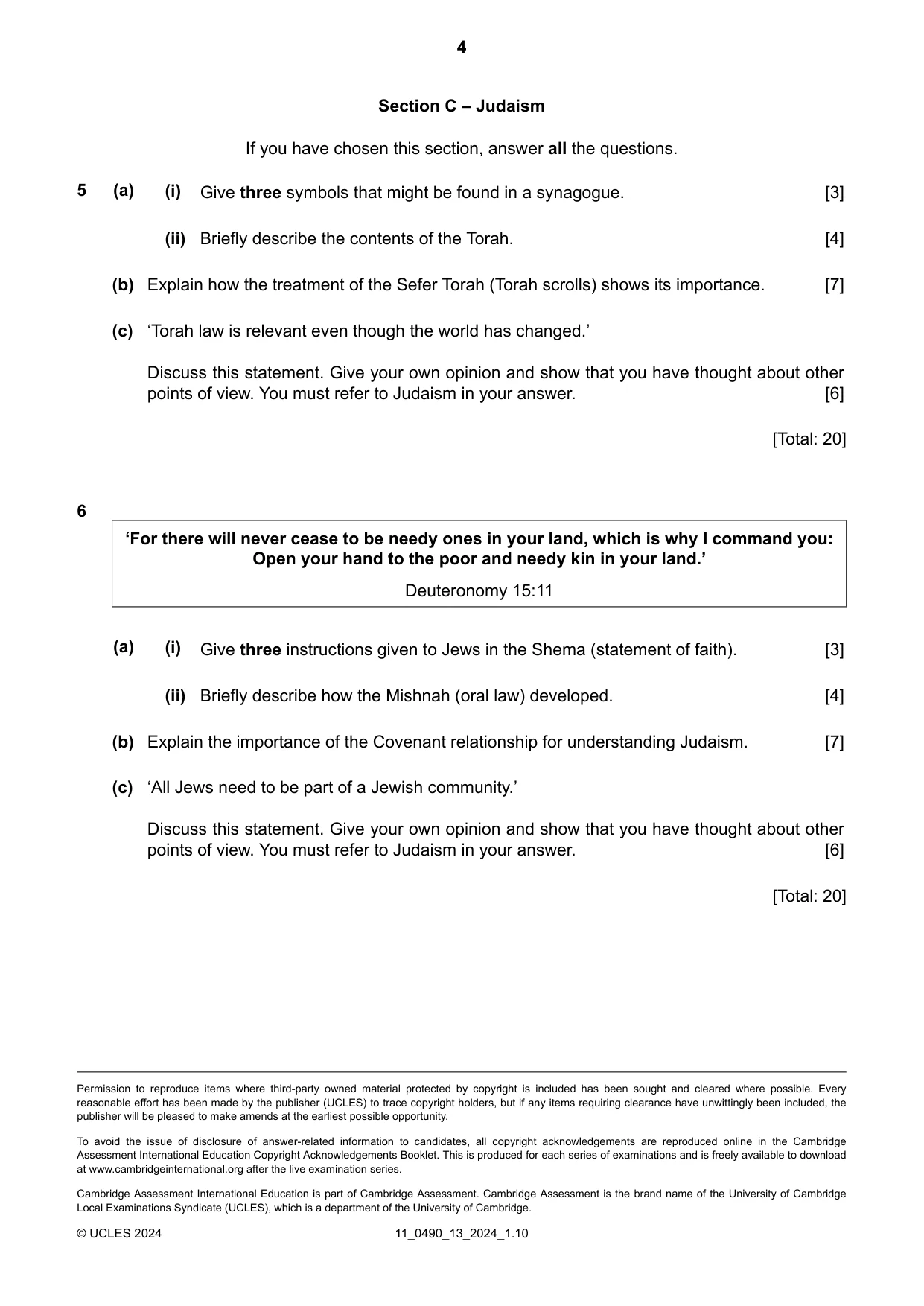
Section C – Judaism If you have chosen this section, answer all the questions. (a) 5 Give three symbols that might be found in a synagogue. [3] (i) Briefly describe the contents of the Torah. [4] (ii) Explain how the treatment of the Sefer Torah (Torah scrolls) shows its importance. [7] (b) ‘Torah law is relevant even though the world has changed.’ Discuss this statement. Give your own opinion and show that you have thought about other points of view. You must refer to Judaism in your answer. [6] (c) [Total: 20] 6 ‘For there will never cease to be needy ones in your land, which is why I command you: Open your hand to the poor and needy kin in your land.’ Deuteronomy 15:11 (a) Give three instructions given to Jews in the Shema (statement of faith). [3] (i) Briefly describe how the Mishnah (oral law) developed. [4] (ii) Explain the importance of the Covenant relationship for understanding Judaism. [7] (b) ‘All Jews need to be part of a Jewish community.’ Discuss this statement. Give your own opinion and show that you have thought about other points of view. You must refer to Judaism in your answer. [6] (c) [Total: 20] Permission to reproduce items where third-party owned material protected by copyright is included has been sought and cleared where possible. Every reasonable effort has been made by the publisher (UCLES) to trace copyright holders, but if any items requiring clearance have unwittingly been included, the publisher will be pleased to make amends at the earliest possible opportunity. To avoid the issue of disclosure of answer-related information to candidates, all copyright acknowledgements are reproduced online in the Cambridge Assessment International Education Copyright Acknowledgements Booklet. This is produced for each series of examinations and is freely available to download at www.cambridgeinternational.org after the live examination series. Cambridge Assessment International Education is part of Cambridge Assessment. Cambridge Assessment is the brand name of the University of Cambridge Local Examinations Syndicate (UCLES), which is a department of the University of Cambridge. 11_0490_13_2024_1.10 © UCLES 2024 4
Mark scheme, page 1
This document consists of 19 printed pages. © Cambridge University Press & Assessment 2024 [Turn over Cambridge IGCSE™ RELIGIOUS STUDIES 0490/13 Paper 1 October/November 2024 MARK SCHEME Maximum Mark: 80 Published This mark scheme is published as an aid to teachers and candidates, to indicate the requirements of the examination. It shows the basis on which Examiners were instructed to award marks. It does not indicate the details of the discussions that took place at an Examiners’ meeting before marking began, which would have considered the acceptability of alternative answers. Mark schemes should be read in conjunction with the question paper and the Principal Examiner Report for Teachers. Cambridge International will not enter into discussions about these mark schemes. Cambridge International is publishing the mark schemes for the October/November 2024 series for most Cambridge IGCSE, Cambridge International A and AS Level components, and some Cambridge O Level components.
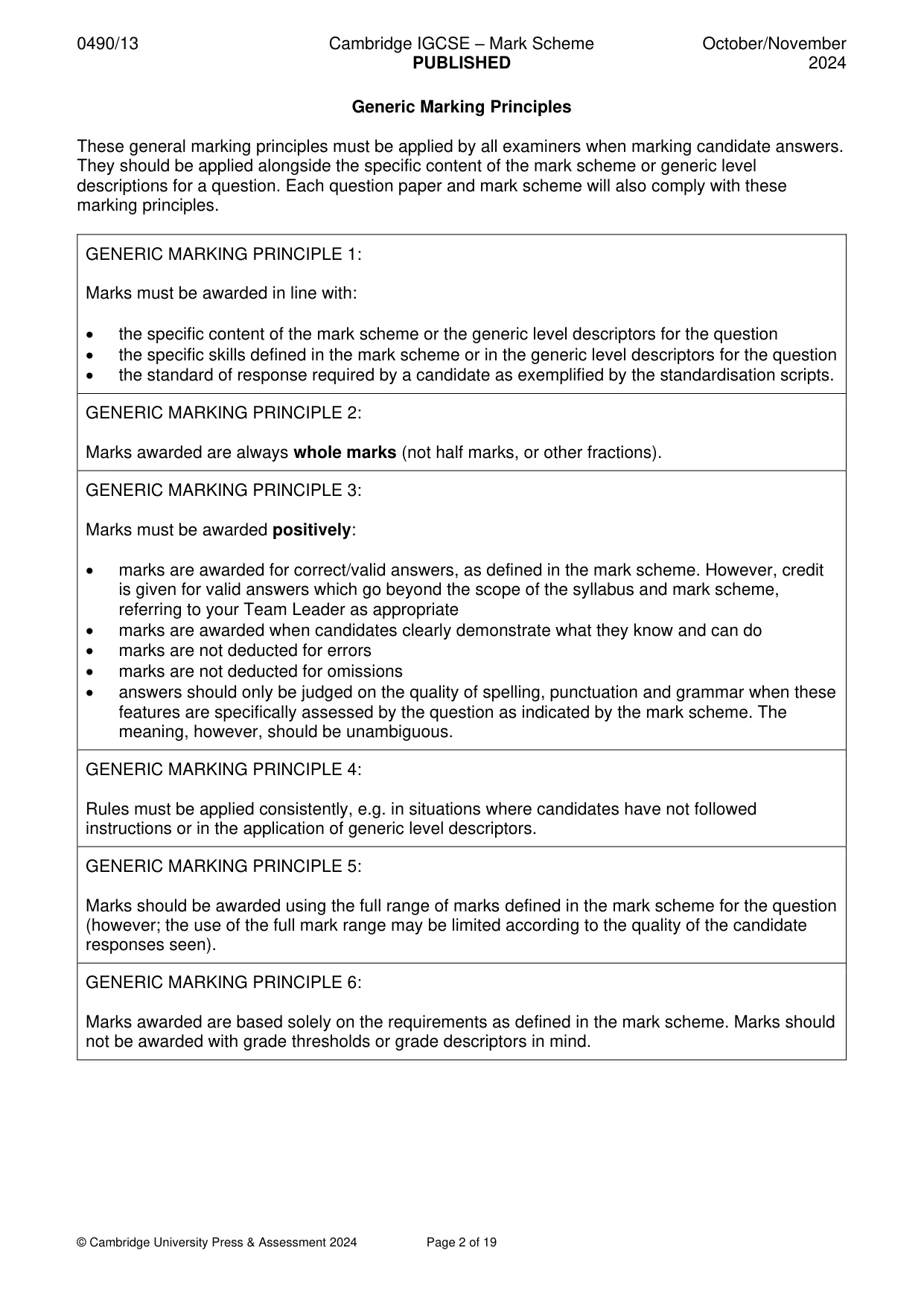
Mark scheme, page 2
0490/13 Cambridge IGCSE – Mark Scheme PUBLISHED October/November 2024 © Cambridge University Press & Assessment 2024 Page 2 of 19 Generic Marking Principles These general marking principles must be applied by all examiners when marking candidate answers. They should be applied alongside the specific content of the mark scheme or generic level descriptions for a question. Each question paper and mark scheme will also comply with these marking principles. GENERIC MARKING PRINCIPLE 1: Marks must be awarded in line with: • the specific content of the mark scheme or the generic level descriptors for the question • the specific skills defined in the mark scheme or in the generic level descriptors for the question • the standard of response required by a candidate as exemplified by the standardisation scripts. GENERIC MARKING PRINCIPLE 2: Marks awarded are always whole marks (not half marks, or other fractions). GENERIC MARKING PRINCIPLE 3: Marks must be awarded positively: • marks are awarded for correct/valid answers, as defined in the mark scheme. However, credit is given for valid answers which go beyond the scope of the syllabus and mark scheme, referring to your Team Leader as appropriate • marks are awarded when candidates clearly demonstrate what they know and can do • marks are not deducted for errors • marks are not deducted for omissions • answers should only be judged on the quality of spelling, punctuation and grammar when these features are specifically assessed by the question as indicated by the mark scheme. The meaning, however, should be unambiguous. GENERIC MARKING PRINCIPLE 4: Rules must be applied consistently, e.g. in situations where candidates have not followed instructions or in the application of generic level descriptors. GENERIC MARKING PRINCIPLE 5: Marks should be awarded using the full range of marks defined in the mark scheme for the question (however; the use of the full mark range may be limited according to the quality of the candidate responses seen). GENERIC MARKING PRINCIPLE 6: Marks awarded are based solely on the requirements as defined in the mark scheme. Marks should not be awarded with grade thresholds or grade descriptors in mind.
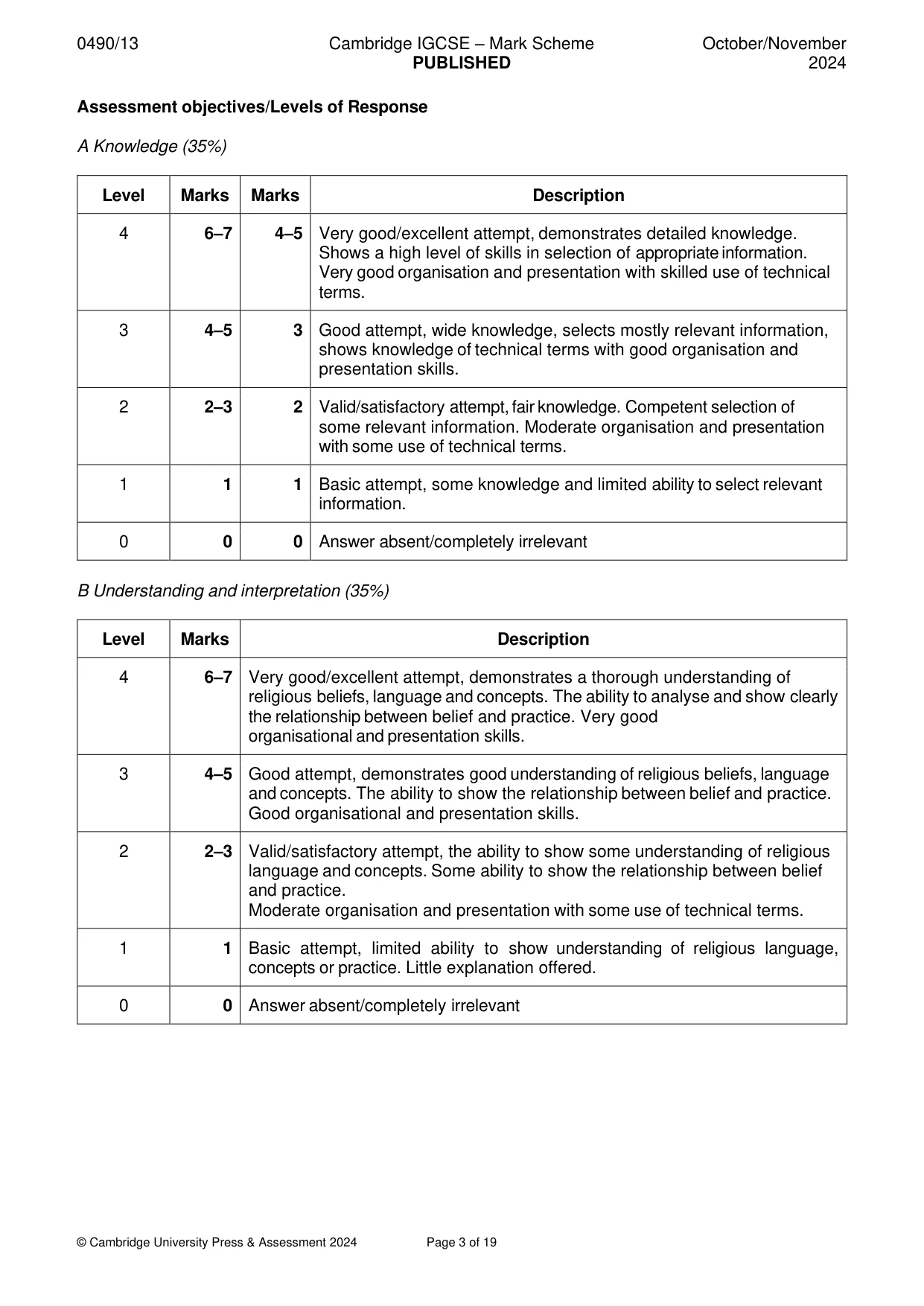
Mark scheme, page 3
0490/13 Cambridge IGCSE – Mark Scheme PUBLISHED October/November 2024 © Cambridge University Press & Assessment 2024 Page 3 of 19 Assessment objectives/Levels of Response A Knowledge (35%) Level Marks Marks Description 4 6–7 4–5 Very good/excellent attempt, demonstrates detailed knowledge. Shows a high level of skills in selection of appropriate information. Very good organisation and presentation with skilled use of technical terms. 3 4–5 3 Good attempt, wide knowledge, selects mostly relevant information, shows knowledge of technical terms with good organisation and presentation skills. 2 2–3 2 Valid/satisfactory attempt, fair knowledge. Competent selection of some relevant information. Moderate organisation and presentation with some use of technical terms. 1 1 1 Basic attempt, some knowledge and limited ability to select relevant information. 0 0 0 Answer absent/completely irrelevant B Understanding and interpretation (35%) Level Marks Description 4 6–7 Very good/excellent attempt, demonstrates a thorough understanding of religious beliefs, language and concepts. The ability to analyse and show clearly the relationship between belief and practice. Very good organisational and presentation skills. 3 4–5 Good attempt, demonstrates good understanding of religious beliefs, language and concepts. The ability to show the relationship between belief and practice. Good organisational and presentation skills. 2 2–3 Valid/satisfactory attempt, the ability to show some understanding of religious language and concepts. Some ability to show the relationship between belief and practice. Moderate organisation and presentation with some use of technical terms. 1 1 Basic attempt, limited ability to show understanding of religious language, concepts or practice. Little explanation offered. 0 0 Answer absent/completely irrelevant
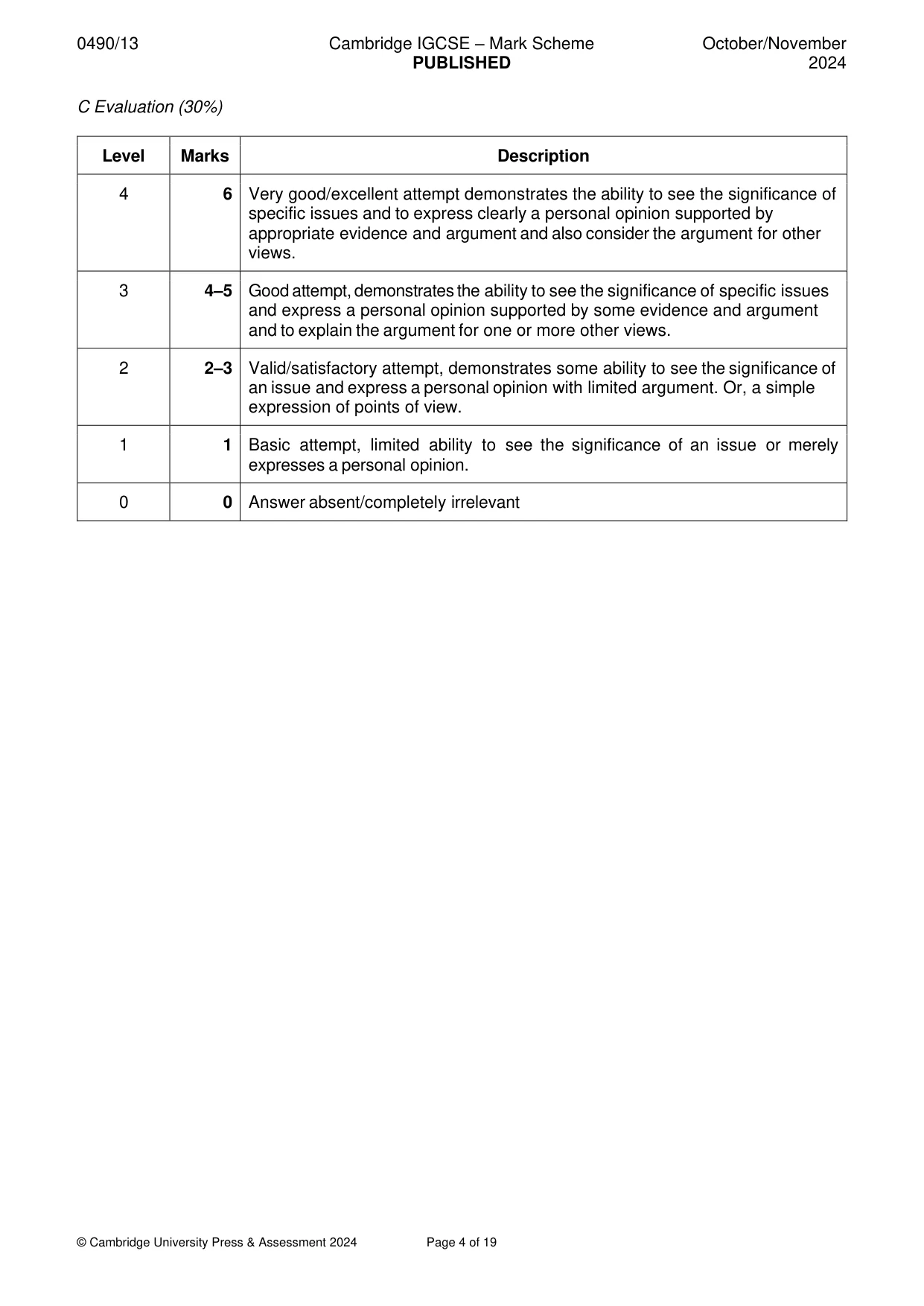
Mark scheme, page 4
0490/13 Cambridge IGCSE – Mark Scheme PUBLISHED October/November 2024 © Cambridge University Press & Assessment 2024 Page 4 of 19 C Evaluation (30%) Level Marks Description 4 6 Very good/excellent attempt demonstrates the ability to see the significance of specific issues and to express clearly a personal opinion supported by appropriate evidence and argument and also consider the argument for other views. 3 4–5 Good attempt, demonstrates the ability to see the significance of specific issues and express a personal opinion supported by some evidence and argument and to explain the argument for one or more other views. 2 2–3 Valid/satisfactory attempt, demonstrates some ability to see the significance of an issue and express a personal opinion with limited argument. Or, a simple expression of points of view. 1 1 Basic attempt, limited ability to see the significance of an issue or merely expresses a personal opinion. 0 0 Answer absent/completely irrelevant
Mark scheme, page 5
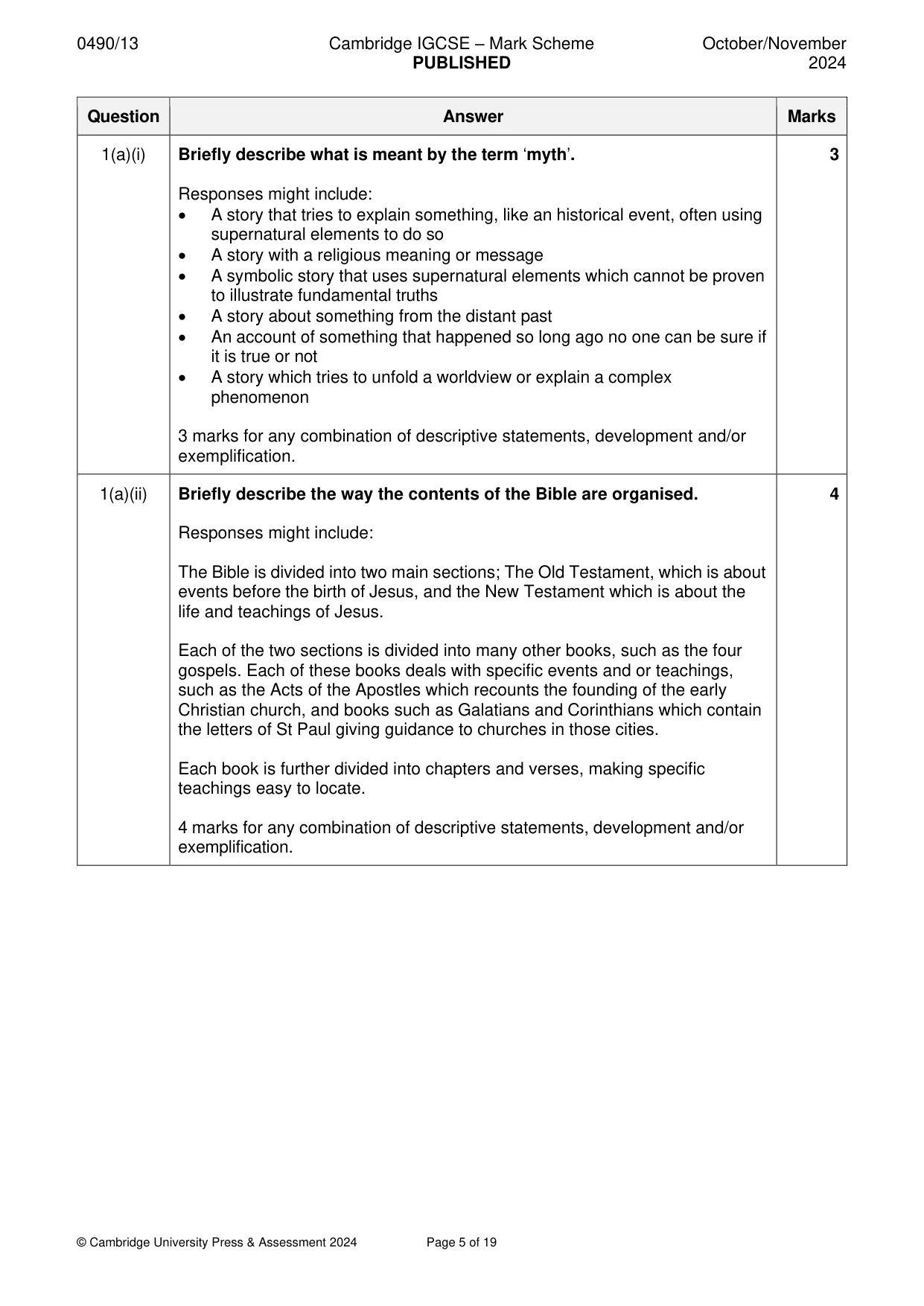
0490/13 Cambridge IGCSE – Mark Scheme PUBLISHED October/November 2024 © Cambridge University Press & Assessment 2024 Page 5 of 19 Question Answer Marks 1(a)(i) Briefly describe what is meant by the term ‘myth’. Responses might include: • A story that tries to explain something, like an historical event, often using supernatural elements to do so • A story with a religious meaning or message • A symbolic story that uses supernatural elements which cannot be proven to illustrate fundamental truths • A story about something from the distant past • An account of something that happened so long ago no one can be sure if it is true or not • A story which tries to unfold a worldview or explain a complex phenomenon 3 marks for any combination of descriptive statements, development and/or exemplification. 3 1(a)(ii) Briefly describe the way the contents of the Bible are organised. Responses might include: The Bible is divided into two main sections; The Old Testament, which is about events before the birth of Jesus, and the New Testament which is about the life and teachings of Jesus. Each of the two sections is divided into many other books, such as the four gospels. Each of these books deals with specific events and or teachings, such as the Acts of the Apostles which recounts the founding of the early Christian church, and books such as Galatians and Corinthians which contain the letters of St Paul giving guidance to churches in those cities. Each book is further divided into chapters and verses, making specific teachings easy to locate. 4 marks for any combination of descriptive statements, development and/or exemplification. 4
Mark scheme, page 6
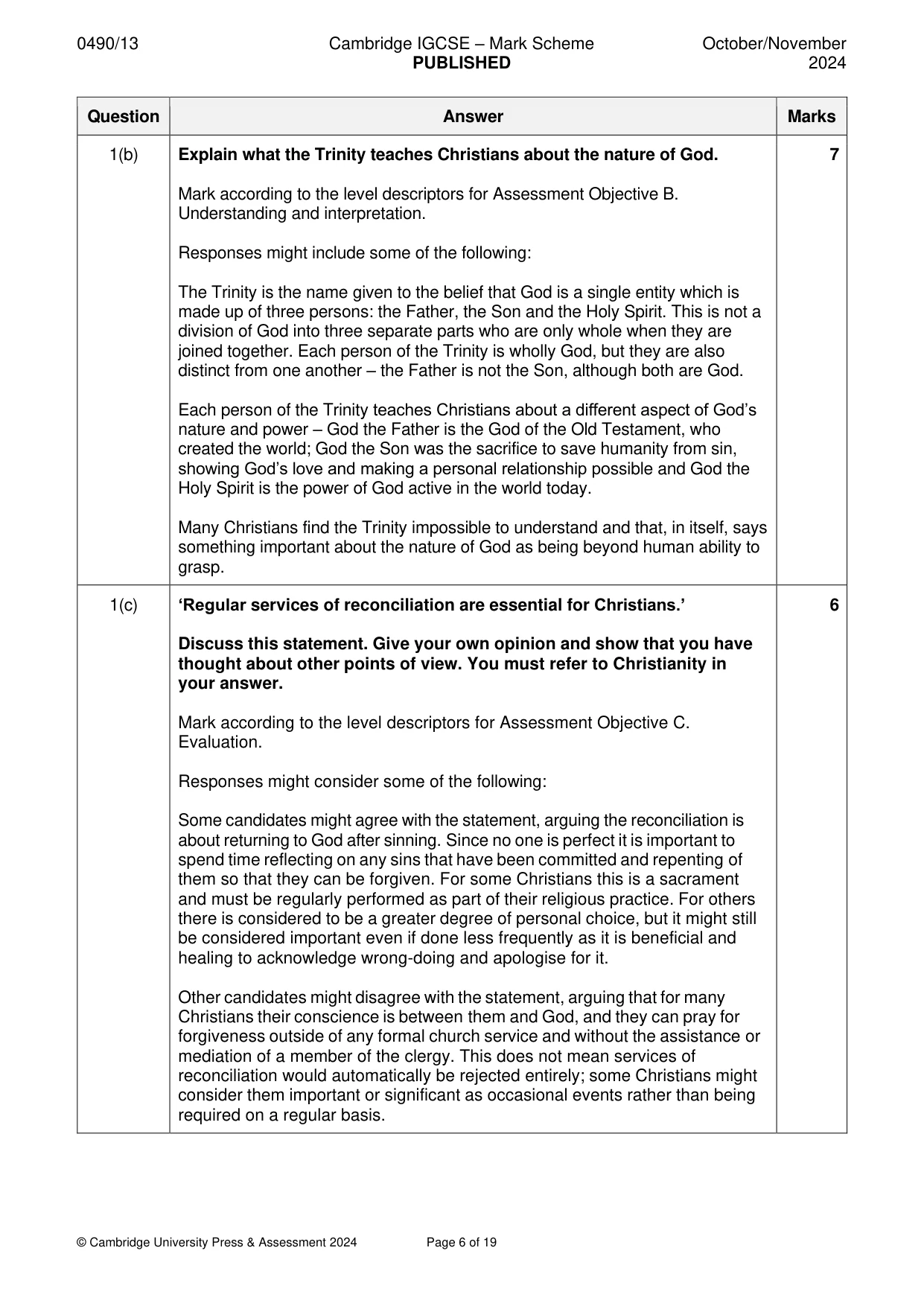
0490/13 Cambridge IGCSE – Mark Scheme PUBLISHED October/November 2024 © Cambridge University Press & Assessment 2024 Page 6 of 19 Question Answer Marks 1(b) Explain what the Trinity teaches Christians about the nature of God. Mark according to the level descriptors for Assessment Objective B. Understanding and interpretation. Responses might include some of the following: The Trinity is the name given to the belief that God is a single entity which is made up of three persons: the Father, the Son and the Holy Spirit. This is not a division of God into three separate parts who are only whole when they are joined together. Each person of the Trinity is wholly God, but they are also distinct from one another – the Father is not the Son, although both are God. Each person of the Trinity teaches Christians about a different aspect of God’s nature and power – God the Father is the God of the Old Testament, who created the world; God the Son was the sacrifice to save humanity from sin, showing God’s love and making a personal relationship possible and God the Holy Spirit is the power of God active in the world today. Many Christians find the Trinity impossible to understand and that, in itself, says something important about the nature of God as being beyond human ability to grasp. 7 1(c) ‘Regular services of reconciliation are essential for Christians.’ Discuss this statement. Give your own opinion and show that you have thought about other points of view. You must refer to Christianity in your answer. Mark according to the level descriptors for Assessment Objective C. Evaluation. Responses might consider some of the following: Some candidates might agree with the statement, arguing the reconciliation is about returning to God after sinning. Since no one is perfect it is important to spend time reflecting on any sins that have been committed and repenting of them so that they can be forgiven. For some Christians this is a sacrament and must be regularly performed as part of their religious practice. For others there is considered to be a greater degree of personal choice, but it might still be considered important even if done less frequently as it is beneficial and healing to acknowledge wrong-doing and apologise for it. Other candidates might disagree with the statement, arguing that for many Christians their conscience is between them and God, and they can pray for forgiveness outside of any formal church service and without the assistance or mediation of a member of the clergy. This does not mean services of reconciliation would automatically be rejected entirely; some Christians might consider them important or significant as occasional events rather than being required on a regular basis. 6
Mark scheme, page 7
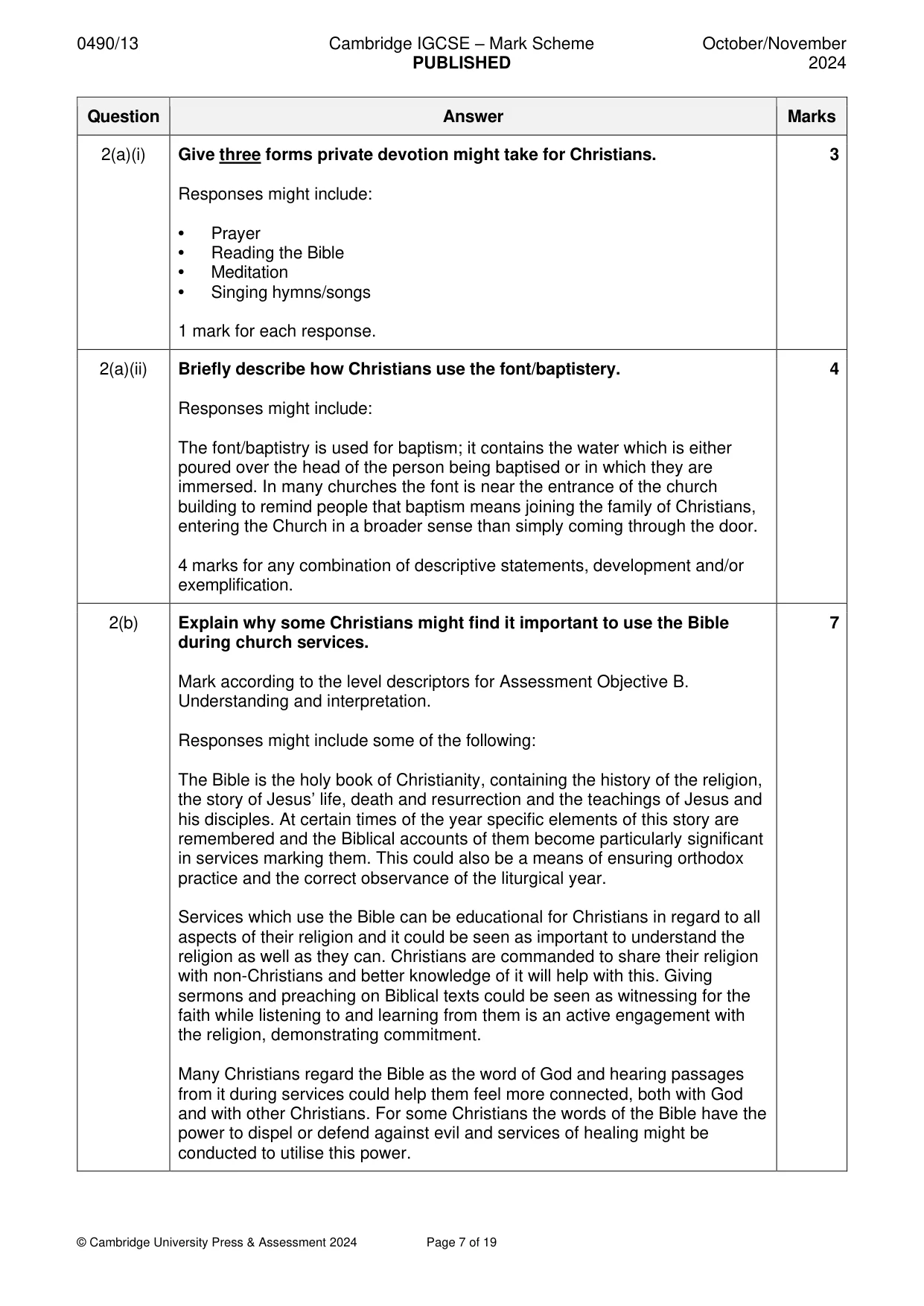
0490/13 Cambridge IGCSE – Mark Scheme PUBLISHED October/November 2024 © Cambridge University Press & Assessment 2024 Page 7 of 19 Question Answer Marks 2(a)(i) Give three forms private devotion might take for Christians. Responses might include: • Prayer • Reading the Bible • Meditation • Singing hymns/songs 1 mark for each response. 3 2(a)(ii) Briefly describe how Christians use the font/baptistery. Responses might include: The font/baptistry is used for baptism; it contains the water which is either poured over the head of the person being baptised or in which they are immersed. In many churches the font is near the entrance of the church building to remind people that baptism means joining the family of Christians, entering the Church in a broader sense than simply coming through the door. 4 marks for any combination of descriptive statements, development and/or exemplification. 4 2(b) Explain why some Christians might find it important to use the Bible during church services. Mark according to the level descriptors for Assessment Objective B. Understanding and interpretation. Responses might include some of the following: The Bible is the holy book of Christianity, containing the history of the religion, the story of Jesus’ life, death and resurrection and the teachings of Jesus and his disciples. At certain times of the year specific elements of this story are remembered and the Biblical accounts of them become particularly significant in services marking them. This could also be a means of ensuring orthodox practice and the correct observance of the liturgical year. Services which use the Bible can be educational for Christians in regard to all aspects of their religion and it could be seen as important to understand the religion as well as they can. Christians are commanded to share their religion with non-Christians and better knowledge of it will help with this. Giving sermons and preaching on Biblical texts could be seen as witnessing for the faith while listening to and learning from them is an active engagement with the religion, demonstrating commitment. Many Christians regard the Bible as the word of God and hearing passages from it during services could help them feel more connected, both with God and with other Christians. For some Christians the words of the Bible have the power to dispel or defend against evil and services of healing might be conducted to utilise this power. 7
Mark scheme, page 8
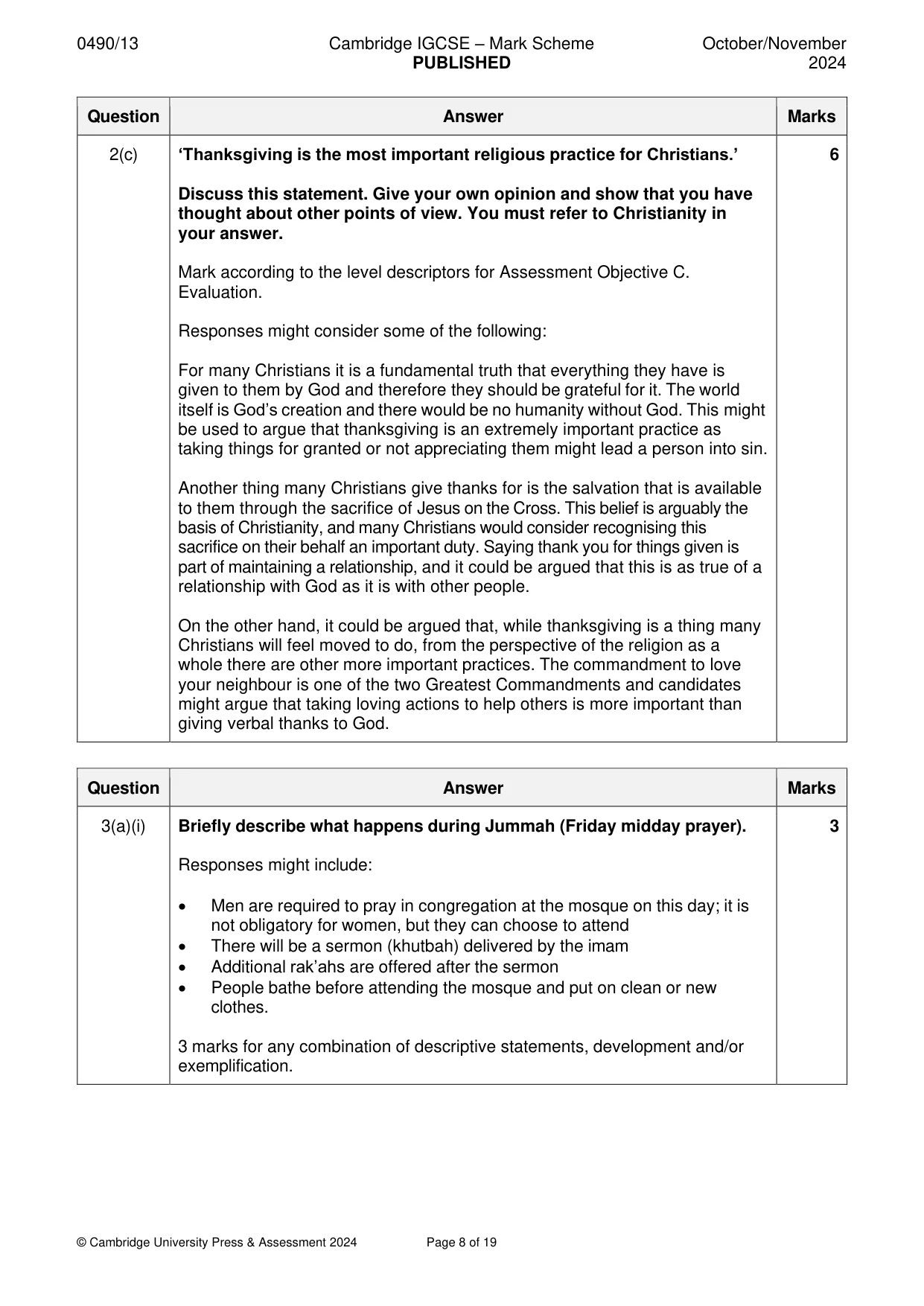
0490/13 Cambridge IGCSE – Mark Scheme PUBLISHED October/November 2024 © Cambridge University Press & Assessment 2024 Page 8 of 19 Question Answer Marks 2(c) ‘Thanksgiving is the most important religious practice for Christians.’ Discuss this statement. Give your own opinion and show that you have thought about other points of view. You must refer to Christianity in your answer. Mark according to the level descriptors for Assessment Objective C. Evaluation. Responses might consider some of the following: For many Christians it is a fundamental truth that everything they have is given to them by God and therefore they should be grateful for it. The world itself is God’s creation and there would be no humanity without God. This might be used to argue that thanksgiving is an extremely important practice as taking things for granted or not appreciating them might lead a person into sin. Another thing many Christians give thanks for is the salvation that is available to them through the sacrifice of Jesus on the Cross. This belief is arguably the basis of Christianity, and many Christians would consider recognising this sacrifice on their behalf an important duty. Saying thank you for things given is part of maintaining a relationship, and it could be argued that this is as true of a relationship with God as it is with other people. On the other hand, it could be argued that, while thanksgiving is a thing many Christians will feel moved to do, from the perspective of the religion as a whole there are other more important practices. The commandment to love your neighbour is one of the two Greatest Commandments and candidates might argue that taking loving actions to help others is more important than giving verbal thanks to God. 6 Question Answer Marks 3(a)(i) Briefly describe what happens during Jummah (Friday midday prayer). Responses might include: • Men are required to pray in congregation at the mosque on this day; it is not obligatory for women, but they can choose to attend • There will be a sermon (khutbah) delivered by the imam • Additional rak’ahs are offered after the sermon • People bathe before attending the mosque and put on clean or new clothes. 3 marks for any combination of descriptive statements, development and/or exemplification. 3
Mark scheme, page 9
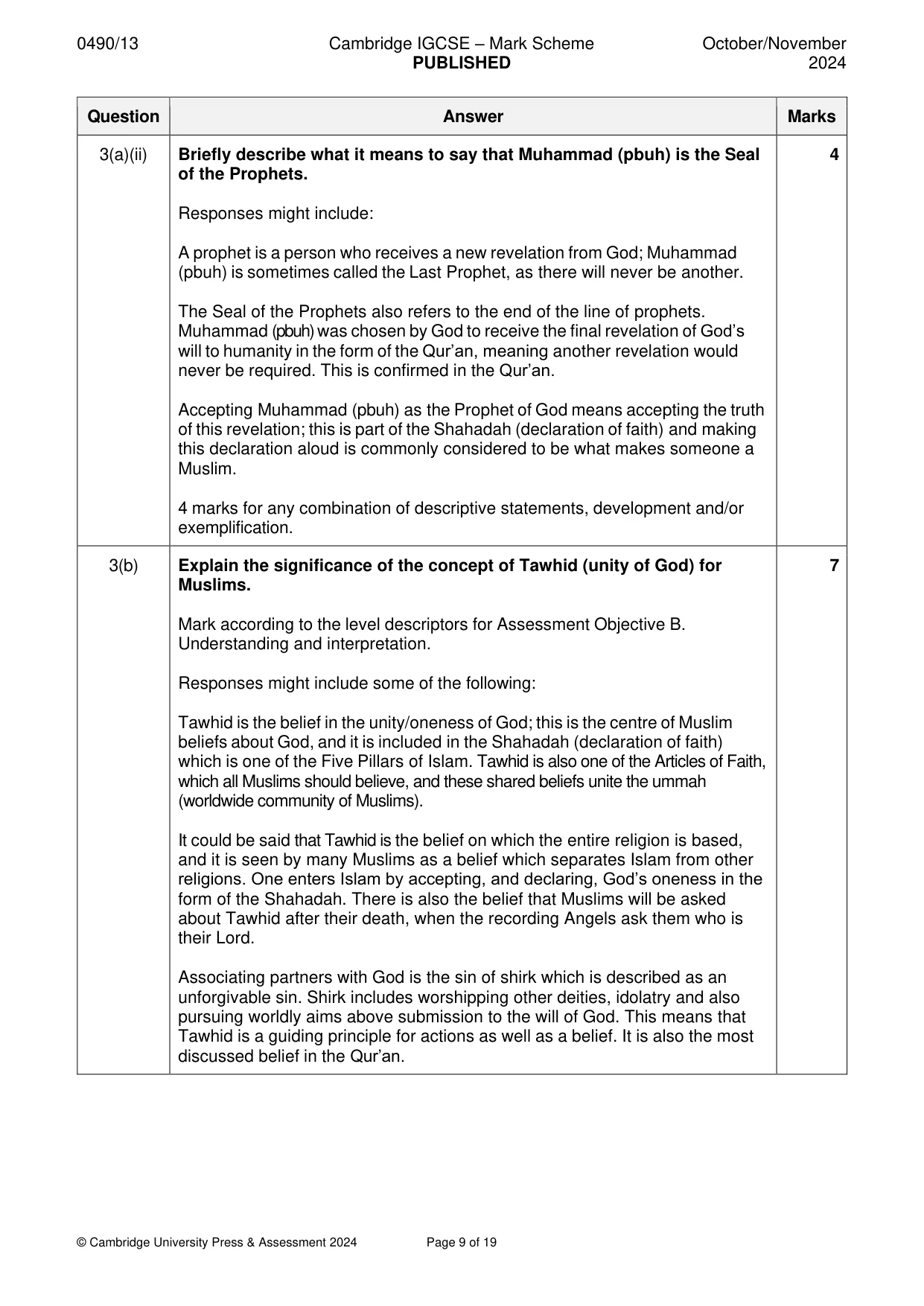
0490/13 Cambridge IGCSE – Mark Scheme PUBLISHED October/November 2024 © Cambridge University Press & Assessment 2024 Page 9 of 19 Question Answer Marks 3(a)(ii) Briefly describe what it means to say that Muhammad (pbuh) is the Seal of the Prophets. Responses might include: A prophet is a person who receives a new revelation from God; Muhammad (pbuh) is sometimes called the Last Prophet, as there will never be another. The Seal of the Prophets also refers to the end of the line of prophets. Muhammad (pbuh) was chosen by God to receive the final revelation of God’s will to humanity in the form of the Qur’an, meaning another revelation would never be required. This is confirmed in the Qur’an. Accepting Muhammad (pbuh) as the Prophet of God means accepting the truth of this revelation; this is part of the Shahadah (declaration of faith) and making this declaration aloud is commonly considered to be what makes someone a Muslim. 4 marks for any combination of descriptive statements, development and/or exemplification. 4 3(b) Explain the significance of the concept of Tawhid (unity of God) for Muslims. Mark according to the level descriptors for Assessment Objective B. Understanding and interpretation. Responses might include some of the following: Tawhid is the belief in the unity/oneness of God; this is the centre of Muslim beliefs about God, and it is included in the Shahadah (declaration of faith) which is one of the Five Pillars of Islam. Tawhid is also one of the Articles of Faith, which all Muslims should believe, and these shared beliefs unite the ummah (worldwide community of Muslims). It could be said that Tawhid is the belief on which the entire religion is based, and it is seen by many Muslims as a belief which separates Islam from other religions. One enters Islam by accepting, and declaring, God’s oneness in the form of the Shahadah. There is also the belief that Muslims will be asked about Tawhid after their death, when the recording Angels ask them who is their Lord. Associating partners with God is the sin of shirk which is described as an unforgivable sin. Shirk includes worshipping other deities, idolatry and also pursuing worldly aims above submission to the will of God. This means that Tawhid is a guiding principle for actions as well as a belief. It is also the most discussed belief in the Qur’an. 7
Mark scheme, page 10
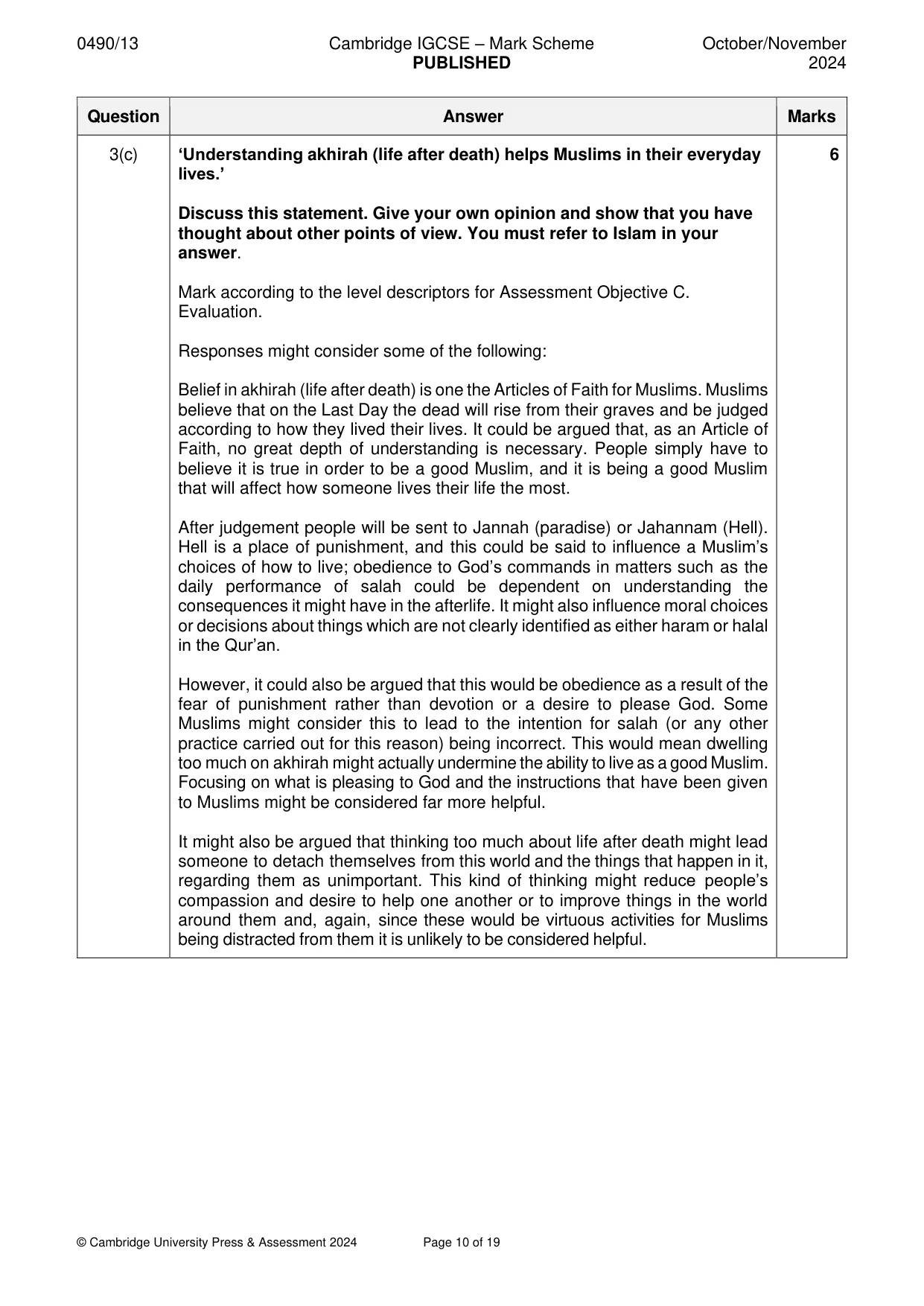
0490/13 Cambridge IGCSE – Mark Scheme PUBLISHED October/November 2024 © Cambridge University Press & Assessment 2024 Page 10 of 19 Question Answer Marks 3(c) ‘Understanding akhirah (life after death) helps Muslims in their everyday lives.’ Discuss this statement. Give your own opinion and show that you have thought about other points of view. You must refer to Islam in your answer. Mark according to the level descriptors for Assessment Objective C. Evaluation. Responses might consider some of the following: Belief in akhirah (life after death) is one the Articles of Faith for Muslims. Muslims believe that on the Last Day the dead will rise from their graves and be judged according to how they lived their lives. It could be argued that, as an Article of Faith, no great depth of understanding is necessary. People simply have to believe it is true in order to be a good Muslim, and it is being a good Muslim that will affect how someone lives their life the most. After judgement people will be sent to Jannah (paradise) or Jahannam (Hell). Hell is a place of punishment, and this could be said to influence a Muslim’s choices of how to live; obedience to God’s commands in matters such as the daily performance of salah could be dependent on understanding the consequences it might have in the afterlife. It might also influence moral choices or decisions about things which are not clearly identified as either haram or halal in the Qur’an. However, it could also be argued that this would be obedience as a result of the fear of punishment rather than devotion or a desire to please God. Some Muslims might consider this to lead to the intention for salah (or any other practice carried out for this reason) being incorrect. This would mean dwelling too much on akhirah might actually undermine the ability to live as a good Muslim. Focusing on what is pleasing to God and the instructions that have been given to Muslims might be considered far more helpful. It might also be argued that thinking too much about life after death might lead someone to detach themselves from this world and the things that happen in it, regarding them as unimportant. This kind of thinking might reduce people’s compassion and desire to help one another or to improve things in the world around them and, again, since these would be virtuous activities for Muslims being distracted from them it is unlikely to be considered helpful. 6
Mark scheme, page 11
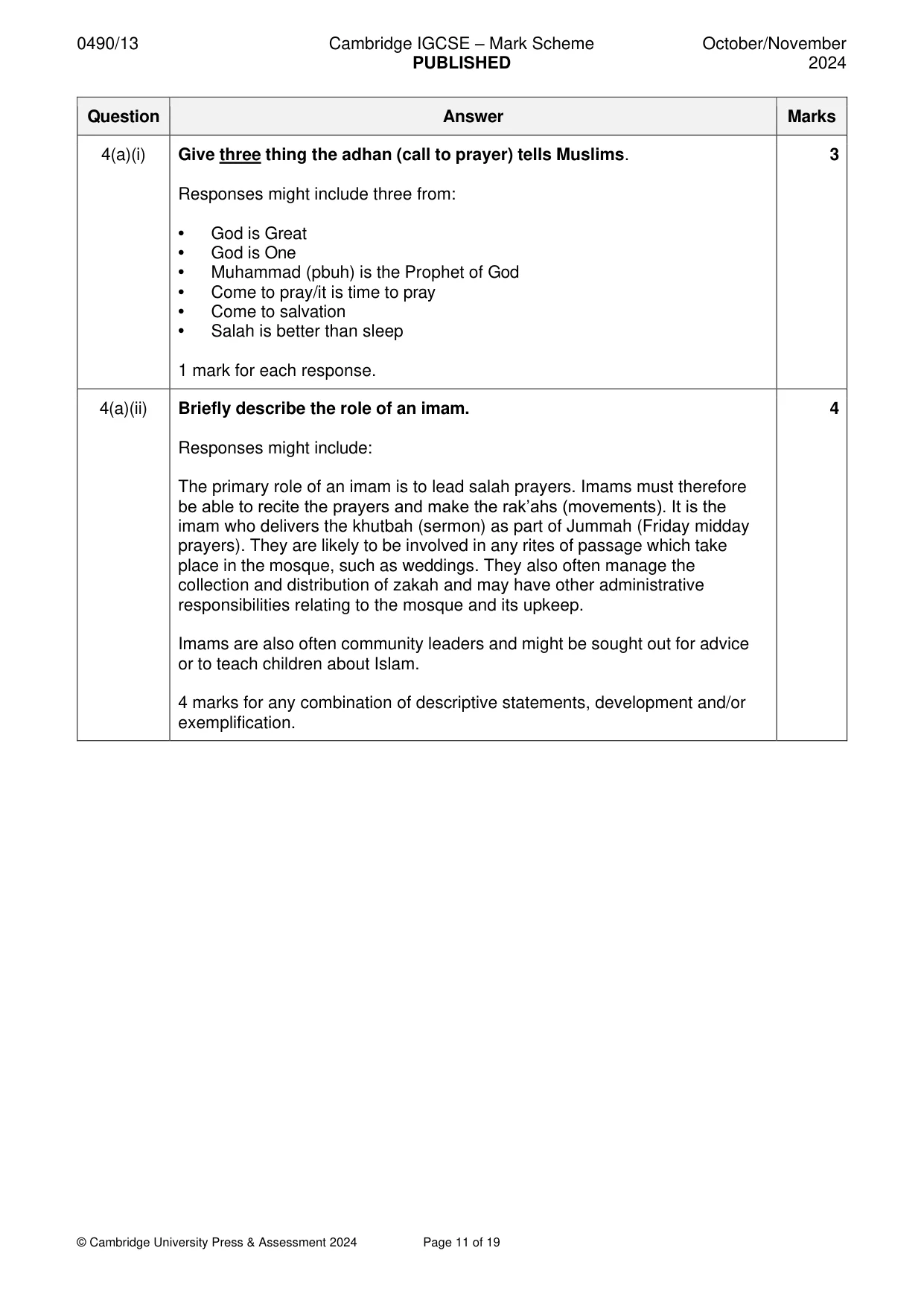
0490/13 Cambridge IGCSE – Mark Scheme PUBLISHED October/November 2024 © Cambridge University Press & Assessment 2024 Page 11 of 19 Question Answer Marks 4(a)(i) Give three thing the adhan (call to prayer) tells Muslims. Responses might include three from: • God is Great • God is One • Muhammad (pbuh) is the Prophet of God • Come to pray/it is time to pray • Come to salvation • Salah is better than sleep 1 mark for each response. 3 4(a)(ii) Briefly describe the role of an imam. Responses might include: The primary role of an imam is to lead salah prayers. Imams must therefore be able to recite the prayers and make the rak’ahs (movements). It is the imam who delivers the khutbah (sermon) as part of Jummah (Friday midday prayers). They are likely to be involved in any rites of passage which take place in the mosque, such as weddings. They also often manage the collection and distribution of zakah and may have other administrative responsibilities relating to the mosque and its upkeep. Imams are also often community leaders and might be sought out for advice or to teach children about Islam. 4 marks for any combination of descriptive statements, development and/or exemplification. 4
Mark scheme, page 12
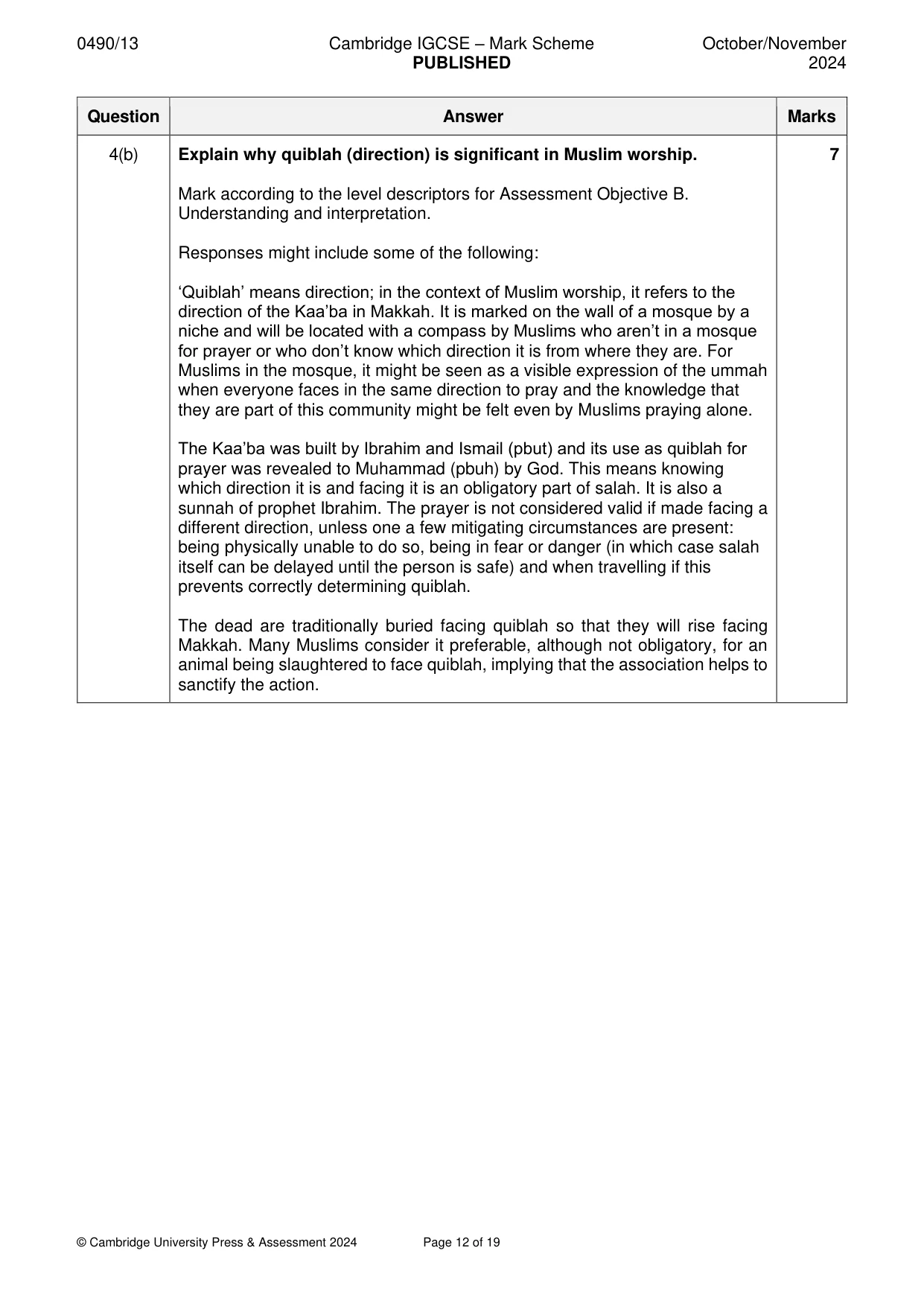
0490/13 Cambridge IGCSE – Mark Scheme PUBLISHED October/November 2024 © Cambridge University Press & Assessment 2024 Page 12 of 19 Question Answer Marks 4(b) Explain why quiblah (direction) is significant in Muslim worship. Mark according to the level descriptors for Assessment Objective B. Understanding and interpretation. Responses might include some of the following: ‘Quiblah’ means direction; in the context of Muslim worship, it refers to the direction of the Kaa’ba in Makkah. It is marked on the wall of a mosque by a niche and will be located with a compass by Muslims who aren’t in a mosque for prayer or who don’t know which direction it is from where they are. For Muslims in the mosque, it might be seen as a visible expression of the ummah when everyone faces in the same direction to pray and the knowledge that they are part of this community might be felt even by Muslims praying alone. The Kaa’ba was built by Ibrahim and Ismail (pbut) and its use as quiblah for prayer was revealed to Muhammad (pbuh) by God. This means knowing which direction it is and facing it is an obligatory part of salah. It is also a sunnah of prophet Ibrahim. The prayer is not considered valid if made facing a different direction, unless one a few mitigating circumstances are present: being physically unable to do so, being in fear or danger (in which case salah itself can be delayed until the person is safe) and when travelling if this prevents correctly determining quiblah. The dead are traditionally buried facing quiblah so that they will rise facing Makkah. Many Muslims consider it preferable, although not obligatory, for an animal being slaughtered to face quiblah, implying that the association helps to sanctify the action. 7
Mark scheme, page 13
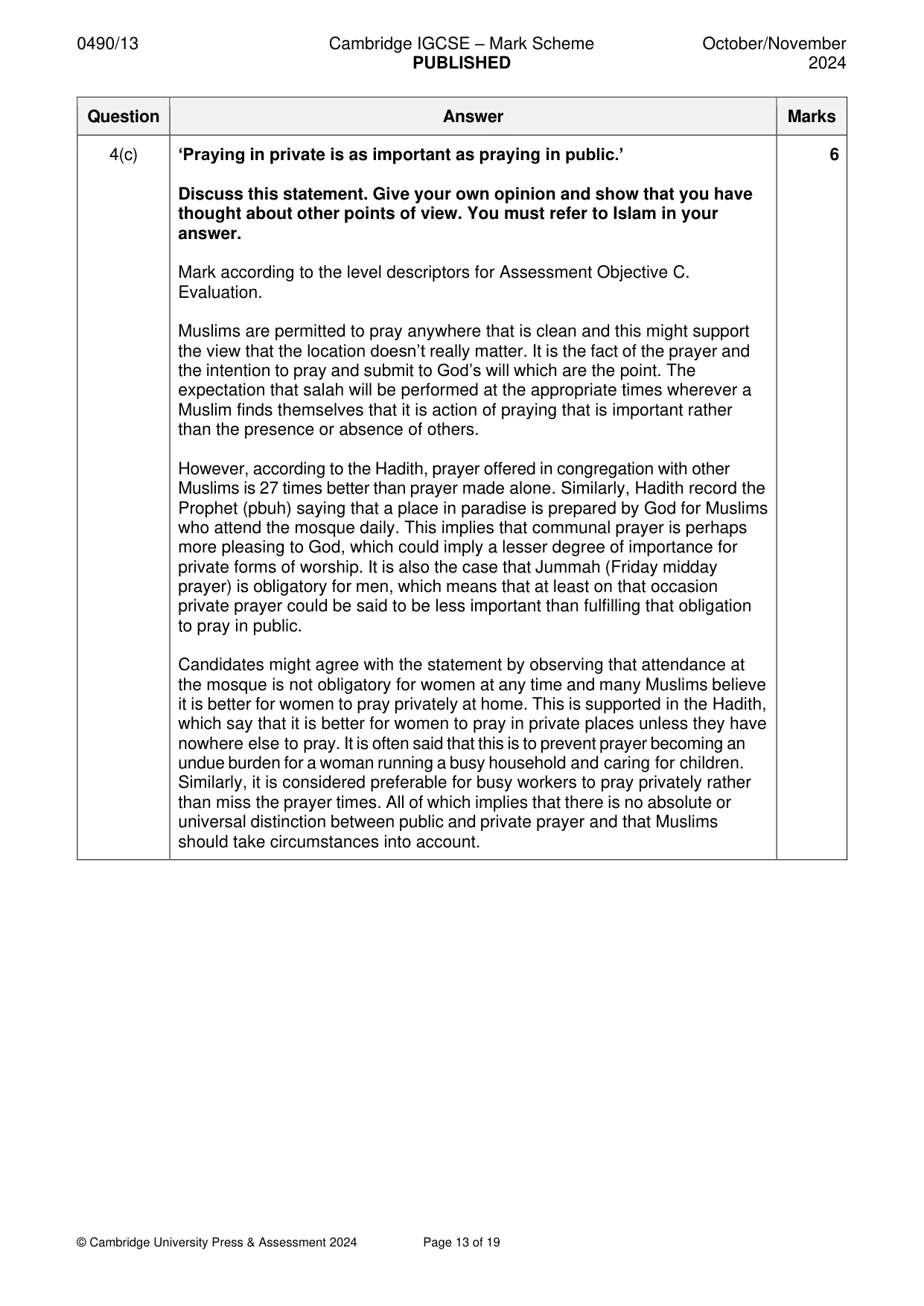
0490/13 Cambridge IGCSE – Mark Scheme PUBLISHED October/November 2024 © Cambridge University Press & Assessment 2024 Page 13 of 19 Question Answer Marks 4(c) ‘Praying in private is as important as praying in public.’ Discuss this statement. Give your own opinion and show that you have thought about other points of view. You must refer to Islam in your answer. Mark according to the level descriptors for Assessment Objective C. Evaluation. Muslims are permitted to pray anywhere that is clean and this might support the view that the location doesn’t really matter. It is the fact of the prayer and the intention to pray and submit to God’s will which are the point. The expectation that salah will be performed at the appropriate times wherever a Muslim finds themselves that it is action of praying that is important rather than the presence or absence of others. However, according to the Hadith, prayer offered in congregation with other Muslims is 27 times better than prayer made alone. Similarly, Hadith record the Prophet (pbuh) saying that a place in paradise is prepared by God for Muslims who attend the mosque daily. This implies that communal prayer is perhaps more pleasing to God, which could imply a lesser degree of importance for private forms of worship. It is also the case that Jummah (Friday midday prayer) is obligatory for men, which means that at least on that occasion private prayer could be said to be less important than fulfilling that obligation to pray in public. Candidates might agree with the statement by observing that attendance at the mosque is not obligatory for women at any time and many Muslims believe it is better for women to pray privately at home. This is supported in the Hadith, which say that it is better for women to pray in private places unless they have nowhere else to pray. It is often said that this is to prevent prayer becoming an undue burden for a woman running a busy household and caring for children. Similarly, it is considered preferable for busy workers to pray privately rather than miss the prayer times. All of which implies that there is no absolute or universal distinction between public and private prayer and that Muslims should take circumstances into account. 6
Mark scheme, page 14
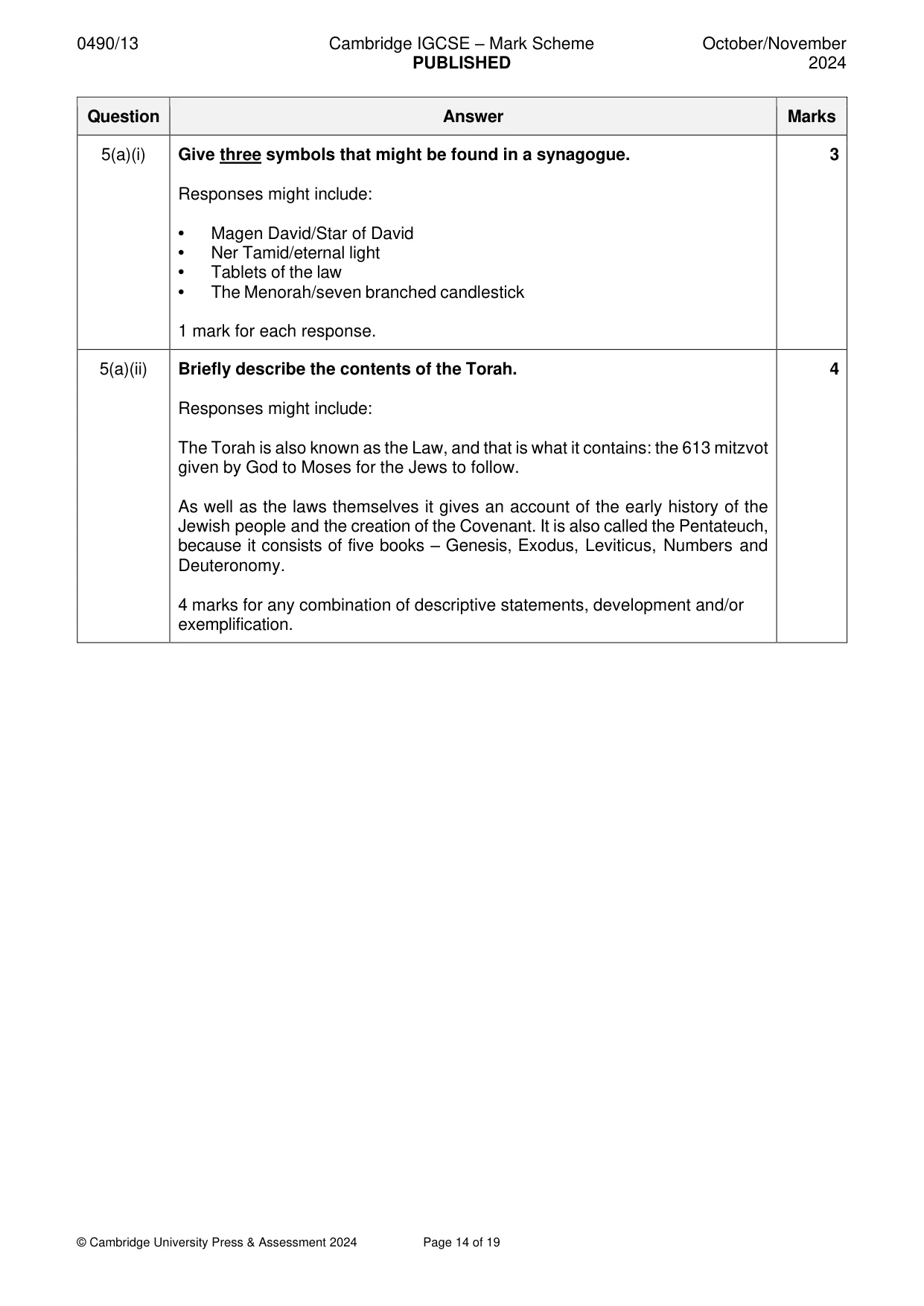
0490/13 Cambridge IGCSE – Mark Scheme PUBLISHED October/November 2024 © Cambridge University Press & Assessment 2024 Page 14 of 19 Question Answer Marks 5(a)(i) Give three symbols that might be found in a synagogue. Responses might include: • Magen David/Star of David • Ner Tamid/eternal light • Tablets of the law • The Menorah/seven branched candlestick 1 mark for each response. 3 5(a)(ii) Briefly describe the contents of the Torah. Responses might include: The Torah is also known as the Law, and that is what it contains: the 613 mitzvot given by God to Moses for the Jews to follow. As well as the laws themselves it gives an account of the early history of the Jewish people and the creation of the Covenant. It is also called the Pentateuch, because it consists of five books – Genesis, Exodus, Leviticus, Numbers and Deuteronomy. 4 marks for any combination of descriptive statements, development and/or exemplification. 4
Mark scheme, page 15
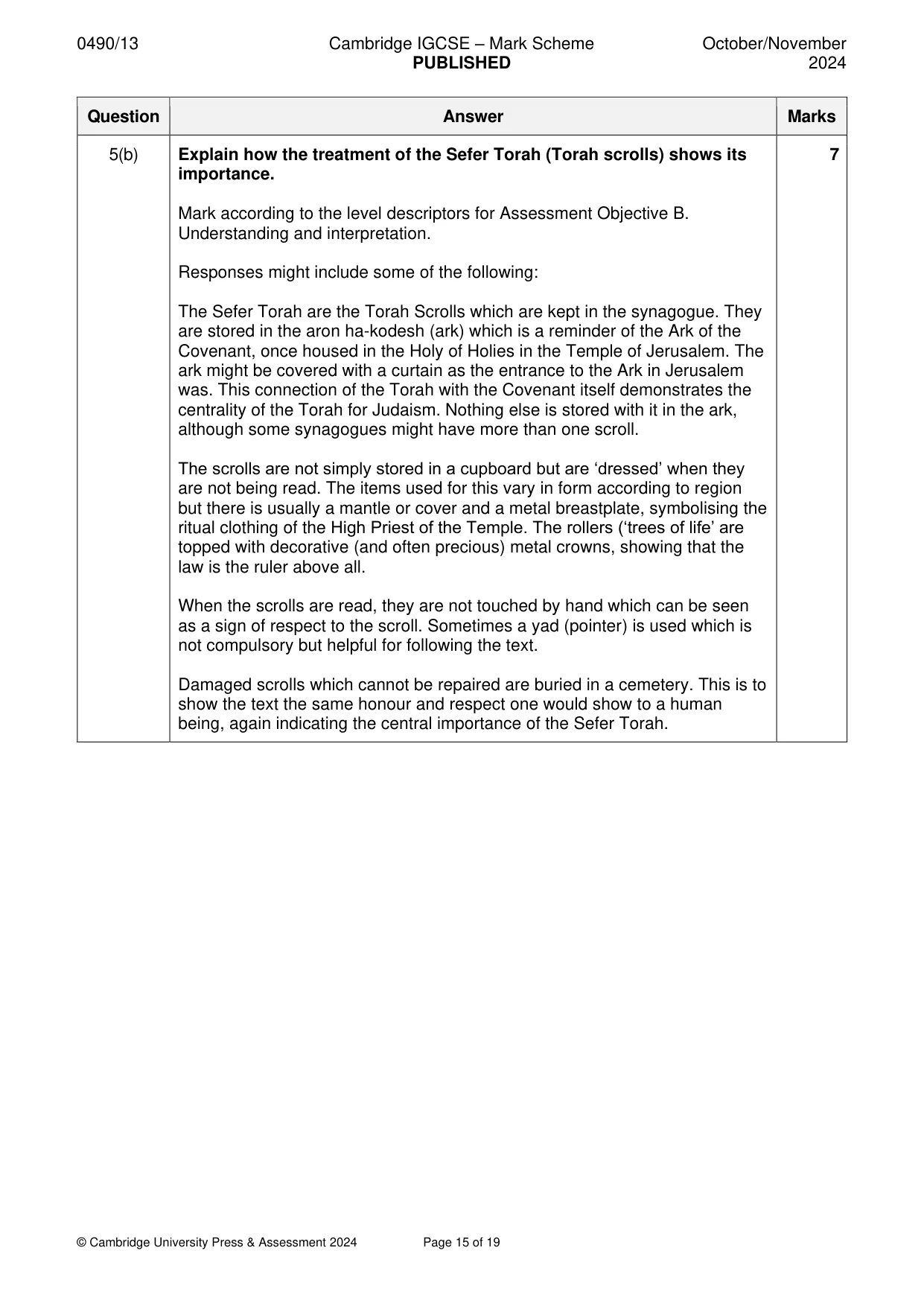
0490/13 Cambridge IGCSE – Mark Scheme PUBLISHED October/November 2024 © Cambridge University Press & Assessment 2024 Page 15 of 19 Question Answer Marks 5(b) Explain how the treatment of the Sefer Torah (Torah scrolls) shows its importance. Mark according to the level descriptors for Assessment Objective B. Understanding and interpretation. Responses might include some of the following: The Sefer Torah are the Torah Scrolls which are kept in the synagogue. They are stored in the aron ha-kodesh (ark) which is a reminder of the Ark of the Covenant, once housed in the Holy of Holies in the Temple of Jerusalem. The ark might be covered with a curtain as the entrance to the Ark in Jerusalem was. This connection of the Torah with the Covenant itself demonstrates the centrality of the Torah for Judaism. Nothing else is stored with it in the ark, although some synagogues might have more than one scroll. The scrolls are not simply stored in a cupboard but are ‘dressed’ when they are not being read. The items used for this vary in form according to region but there is usually a mantle or cover and a metal breastplate, symbolising the ritual clothing of the High Priest of the Temple. The rollers (‘trees of life’ are topped with decorative (and often precious) metal crowns, showing that the law is the ruler above all. When the scrolls are read, they are not touched by hand which can be seen as a sign of respect to the scroll. Sometimes a yad (pointer) is used which is not compulsory but helpful for following the text. Damaged scrolls which cannot be repaired are buried in a cemetery. This is to show the text the same honour and respect one would show to a human being, again indicating the central importance of the Sefer Torah. 7
Mark scheme, page 16
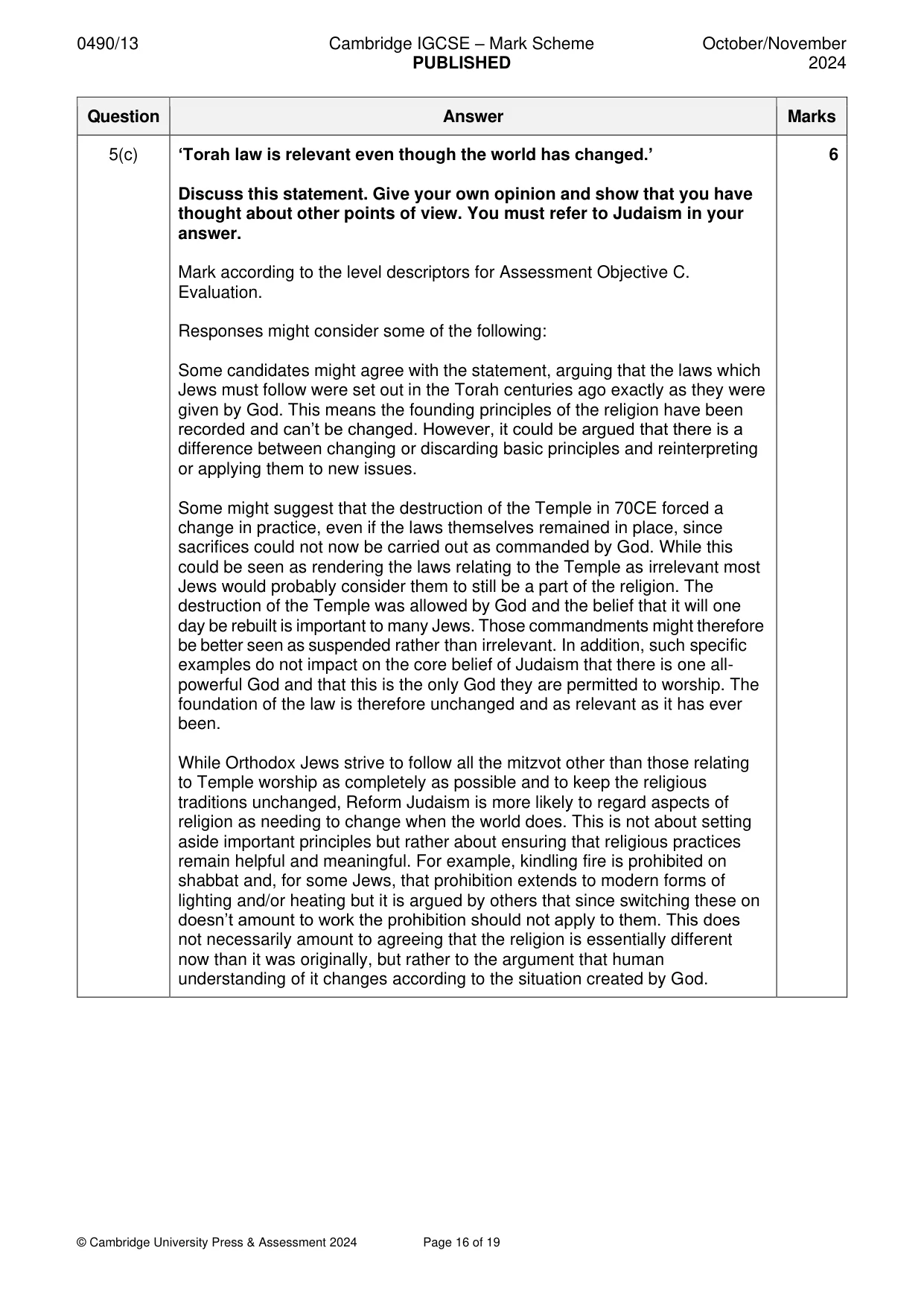
0490/13 Cambridge IGCSE – Mark Scheme PUBLISHED October/November 2024 © Cambridge University Press & Assessment 2024 Page 16 of 19 Question Answer Marks 5(c) ‘Torah law is relevant even though the world has changed.’ Discuss this statement. Give your own opinion and show that you have thought about other points of view. You must refer to Judaism in your answer. Mark according to the level descriptors for Assessment Objective C. Evaluation. Responses might consider some of the following: Some candidates might agree with the statement, arguing that the laws which Jews must follow were set out in the Torah centuries ago exactly as they were given by God. This means the founding principles of the religion have been recorded and can’t be changed. However, it could be argued that there is a difference between changing or discarding basic principles and reinterpreting or applying them to new issues. Some might suggest that the destruction of the Temple in 70CE forced a change in practice, even if the laws themselves remained in place, since sacrifices could not now be carried out as commanded by God. While this could be seen as rendering the laws relating to the Temple as irrelevant most Jews would probably consider them to still be a part of the religion. The destruction of the Temple was allowed by God and the belief that it will one day be rebuilt is important to many Jews. Those commandments might therefore be better seen as suspended rather than irrelevant. In addition, such specific examples do not impact on the core belief of Judaism that there is one all- powerful God and that this is the only God they are permitted to worship. The foundation of the law is therefore unchanged and as relevant as it has ever been. While Orthodox Jews strive to follow all the mitzvot other than those relating to Temple worship as completely as possible and to keep the religious traditions unchanged, Reform Judaism is more likely to regard aspects of religion as needing to change when the world does. This is not about setting aside important principles but rather about ensuring that religious practices remain helpful and meaningful. For example, kindling fire is prohibited on shabbat and, for some Jews, that prohibition extends to modern forms of lighting and/or heating but it is argued by others that since switching these on doesn’t amount to work the prohibition should not apply to them. This does not necessarily amount to agreeing that the religion is essentially different now than it was originally, but rather to the argument that human understanding of it changes according to the situation created by God. 6
Mark scheme, page 17
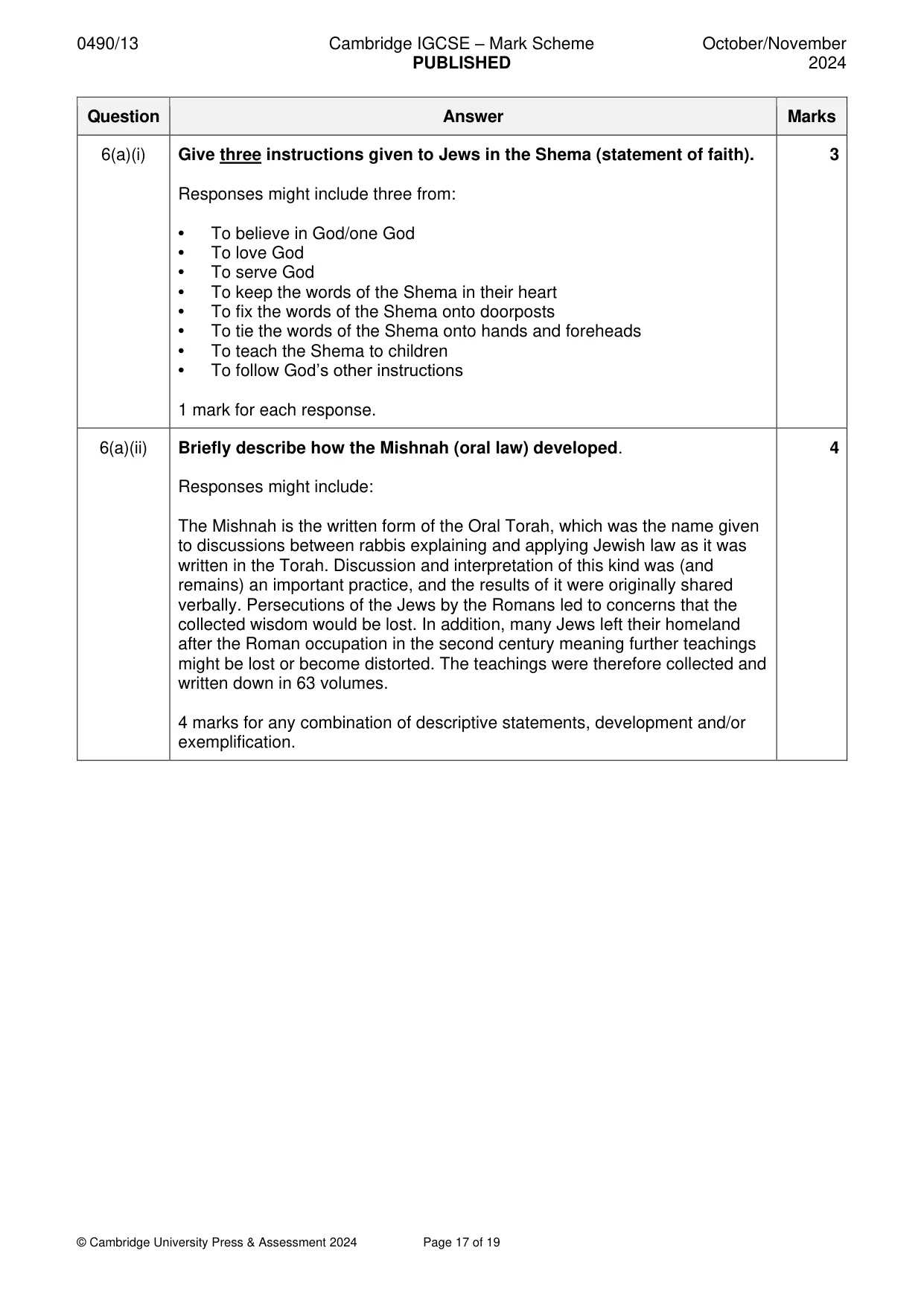
0490/13 Cambridge IGCSE – Mark Scheme PUBLISHED October/November 2024 © Cambridge University Press & Assessment 2024 Page 17 of 19 Question Answer Marks 6(a)(i) Give three instructions given to Jews in the Shema (statement of faith). Responses might include three from: • To believe in God/one God • To love God • To serve God • To keep the words of the Shema in their heart • To fix the words of the Shema onto doorposts • To tie the words of the Shema onto hands and foreheads • To teach the Shema to children • To follow God’s other instructions 1 mark for each response. 3 6(a)(ii) Briefly describe how the Mishnah (oral law) developed. Responses might include: The Mishnah is the written form of the Oral Torah, which was the name given to discussions between rabbis explaining and applying Jewish law as it was written in the Torah. Discussion and interpretation of this kind was (and remains) an important practice, and the results of it were originally shared verbally. Persecutions of the Jews by the Romans led to concerns that the collected wisdom would be lost. In addition, many Jews left their homeland after the Roman occupation in the second century meaning further teachings might be lost or become distorted. The teachings were therefore collected and written down in 63 volumes. 4 marks for any combination of descriptive statements, development and/or exemplification. 4
Mark scheme, page 18
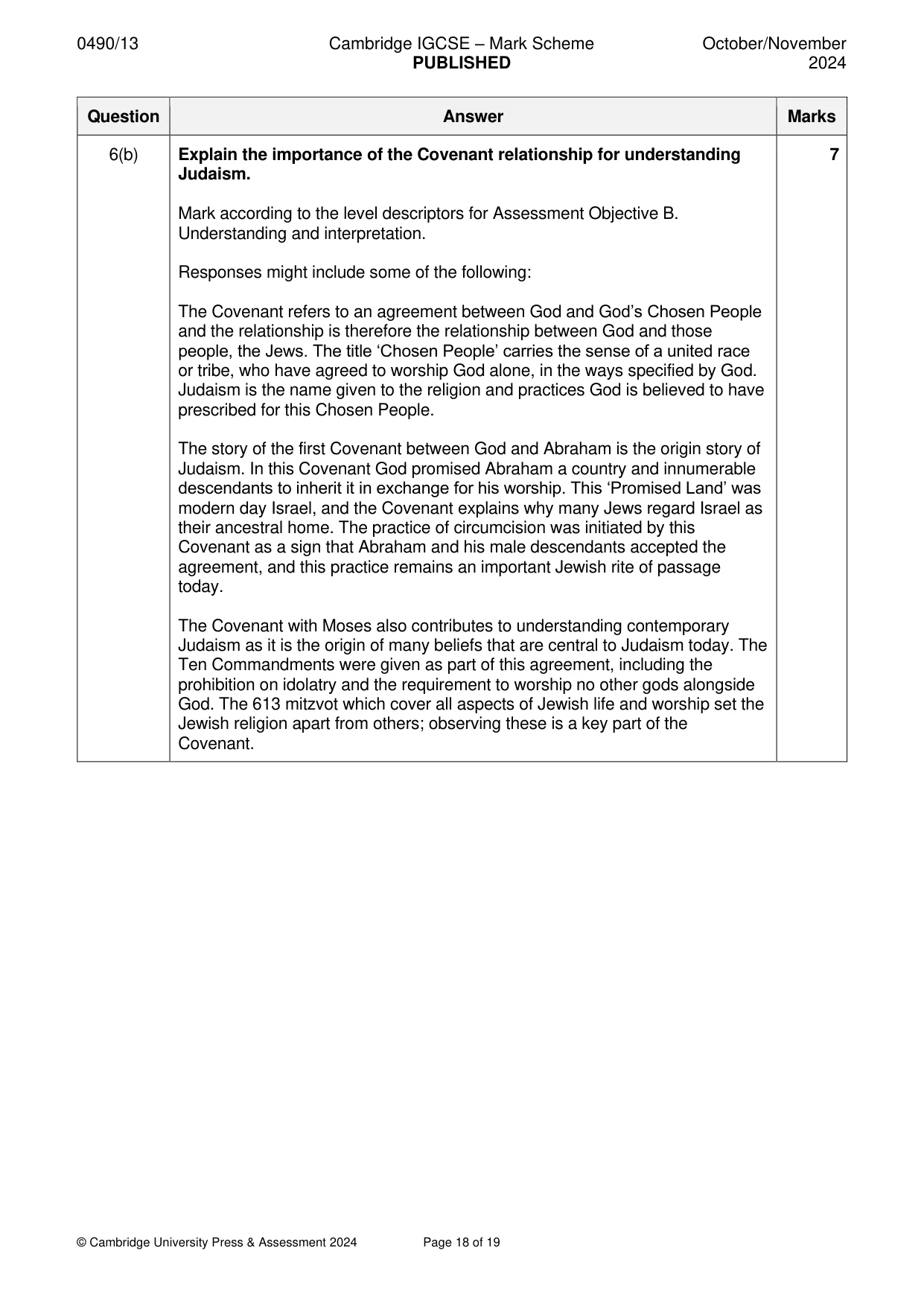
0490/13 Cambridge IGCSE – Mark Scheme PUBLISHED October/November 2024 © Cambridge University Press & Assessment 2024 Page 18 of 19 Question Answer Marks 6(b) Explain the importance of the Covenant relationship for understanding Judaism. Mark according to the level descriptors for Assessment Objective B. Understanding and interpretation. Responses might include some of the following: The Covenant refers to an agreement between God and God’s Chosen People and the relationship is therefore the relationship between God and those people, the Jews. The title ‘Chosen People’ carries the sense of a united race or tribe, who have agreed to worship God alone, in the ways specified by God. Judaism is the name given to the religion and practices God is believed to have prescribed for this Chosen People. The story of the first Covenant between God and Abraham is the origin story of Judaism. In this Covenant God promised Abraham a country and innumerable descendants to inherit it in exchange for his worship. This ‘Promised Land’ was modern day Israel, and the Covenant explains why many Jews regard Israel as their ancestral home. The practice of circumcision was initiated by this Covenant as a sign that Abraham and his male descendants accepted the agreement, and this practice remains an important Jewish rite of passage today. The Covenant with Moses also contributes to understanding contemporary Judaism as it is the origin of many beliefs that are central to Judaism today. The Ten Commandments were given as part of this agreement, including the prohibition on idolatry and the requirement to worship no other gods alongside God. The 613 mitzvot which cover all aspects of Jewish life and worship set the Jewish religion apart from others; observing these is a key part of the Covenant. 7
Mark scheme, page 19
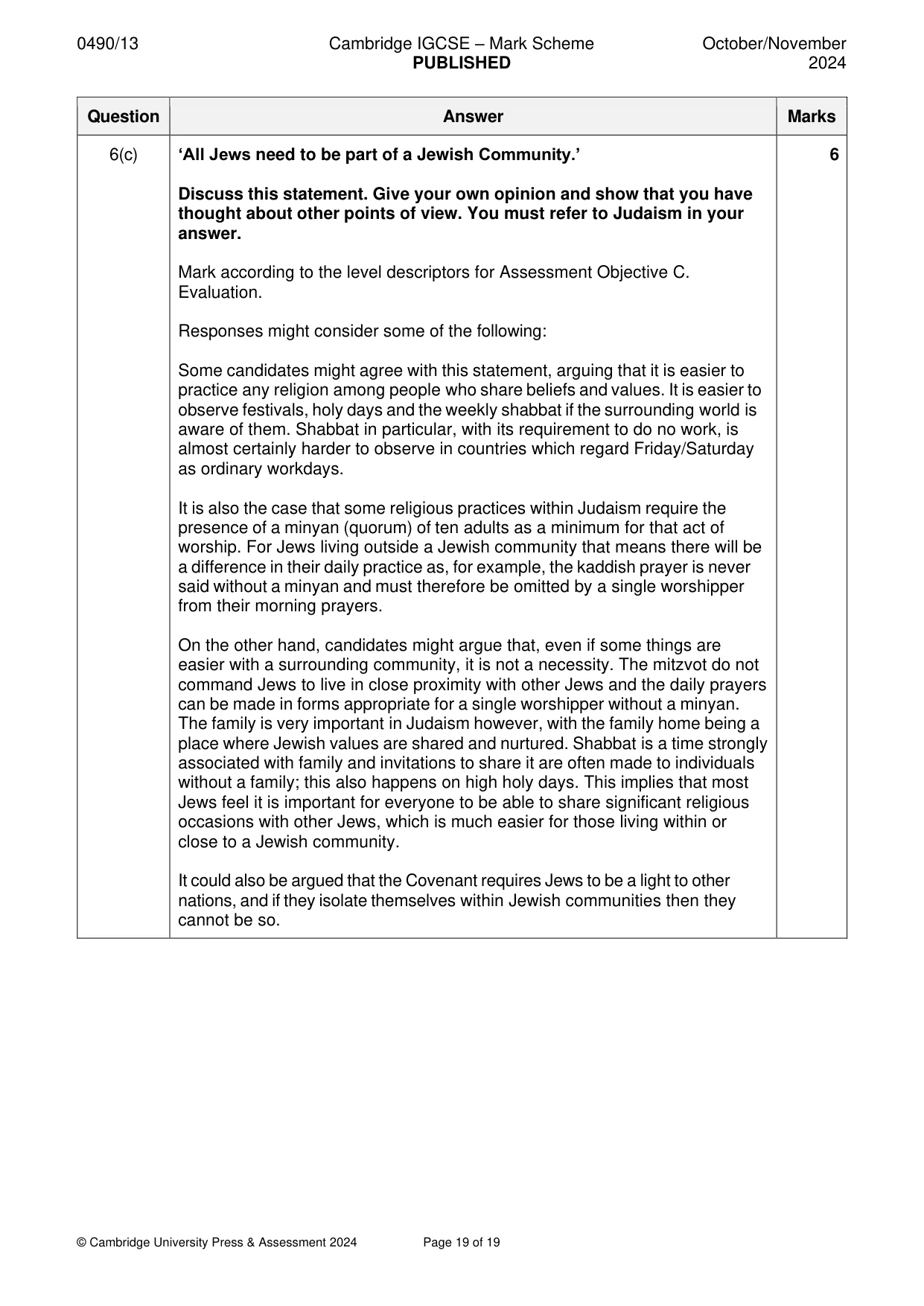
0490/13 Cambridge IGCSE – Mark Scheme PUBLISHED October/November 2024 © Cambridge University Press & Assessment 2024 Page 19 of 19 Question Answer Marks 6(c) ‘All Jews need to be part of a Jewish Community.’ Discuss this statement. Give your own opinion and show that you have thought about other points of view. You must refer to Judaism in your answer. Mark according to the level descriptors for Assessment Objective C. Evaluation. Responses might consider some of the following: Some candidates might agree with this statement, arguing that it is easier to practice any religion among people who share beliefs and values. It is easier to observe festivals, holy days and the weekly shabbat if the surrounding world is aware of them. Shabbat in particular, with its requirement to do no work, is almost certainly harder to observe in countries which regard Friday/Saturday as ordinary workdays. It is also the case that some religious practices within Judaism require the presence of a minyan (quorum) of ten adults as a minimum for that act of worship. For Jews living outside a Jewish community that means there will be a difference in their daily practice as, for example, the kaddish prayer is never said without a minyan and must therefore be omitted by a single worshipper from their morning prayers. On the other hand, candidates might argue that, even if some things are easier with a surrounding community, it is not a necessity. The mitzvot do not command Jews to live in close proximity with other Jews and the daily prayers can be made in forms appropriate for a single worshipper without a minyan. The family is very important in Judaism however, with the family home being a place where Jewish values are shared and nurtured. Shabbat is a time strongly associated with family and invitations to share it are often made to individuals without a family; this also happens on high holy days. This implies that most Jews feel it is important for everyone to be able to share significant religious occasions with other Jews, which is much easier for those living within or close to a Jewish community. It could also be argued that the Covenant requires Jews to be a light to other nations, and if they isolate themselves within Jewish communities then they cannot be so. 6
What you needed in this session
Cambridge’s own grade thresholds for 2024 Oct/Nov, Paper 1 · Variant 3. A higher threshold means an easier paper — the bar moves with how the cohort did.