Cambridge IGCSE Religious Studies 0490 — 2022 Oct/Nov Paper 1 · Variant 3
0490/13/O/N/22 · 80 marks · ≈90 min
The question paper and its mark scheme, free to read here and free to download. This is Cambridge’s own paper, exactly as it was sat.
Question paper4 pages
Mark scheme17 pages
Answers below. Sit the paper first if you are practising.
Paper as text
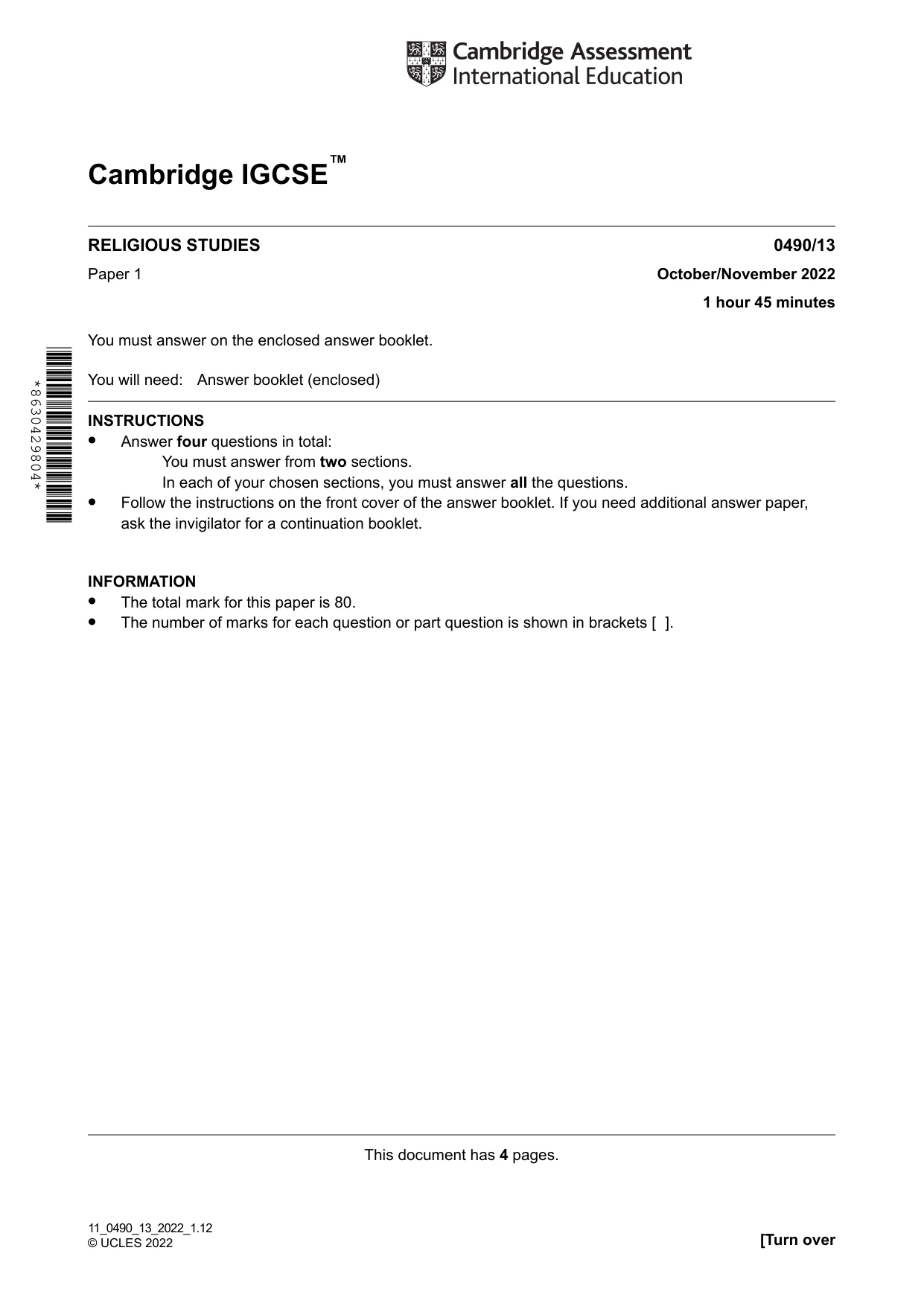
Question paper, page 1
Cambridge IGCSE™ 0490/13 October/November 2022 1 hour 45 minutes RELIGIOUS STUDIES Paper 1 You must answer on the enclosed answer booklet. You will need: Answer booklet (enclosed) INSTRUCTIONS • Answer four questions in total: You must answer from two sections. In each of your chosen sections, you must answer all the questions. • Follow the instructions on the front cover of the answer booklet. If you need additional answer paper, ask the invigilator for a continuation booklet. INFORMATION • The total mark for this paper is 80. • The number of marks for each question or part question is shown in brackets [ ]. This document has 4 pages. [Turn over 11_0490_13_2022_1.12 © UCLES 2022 *8630429804*
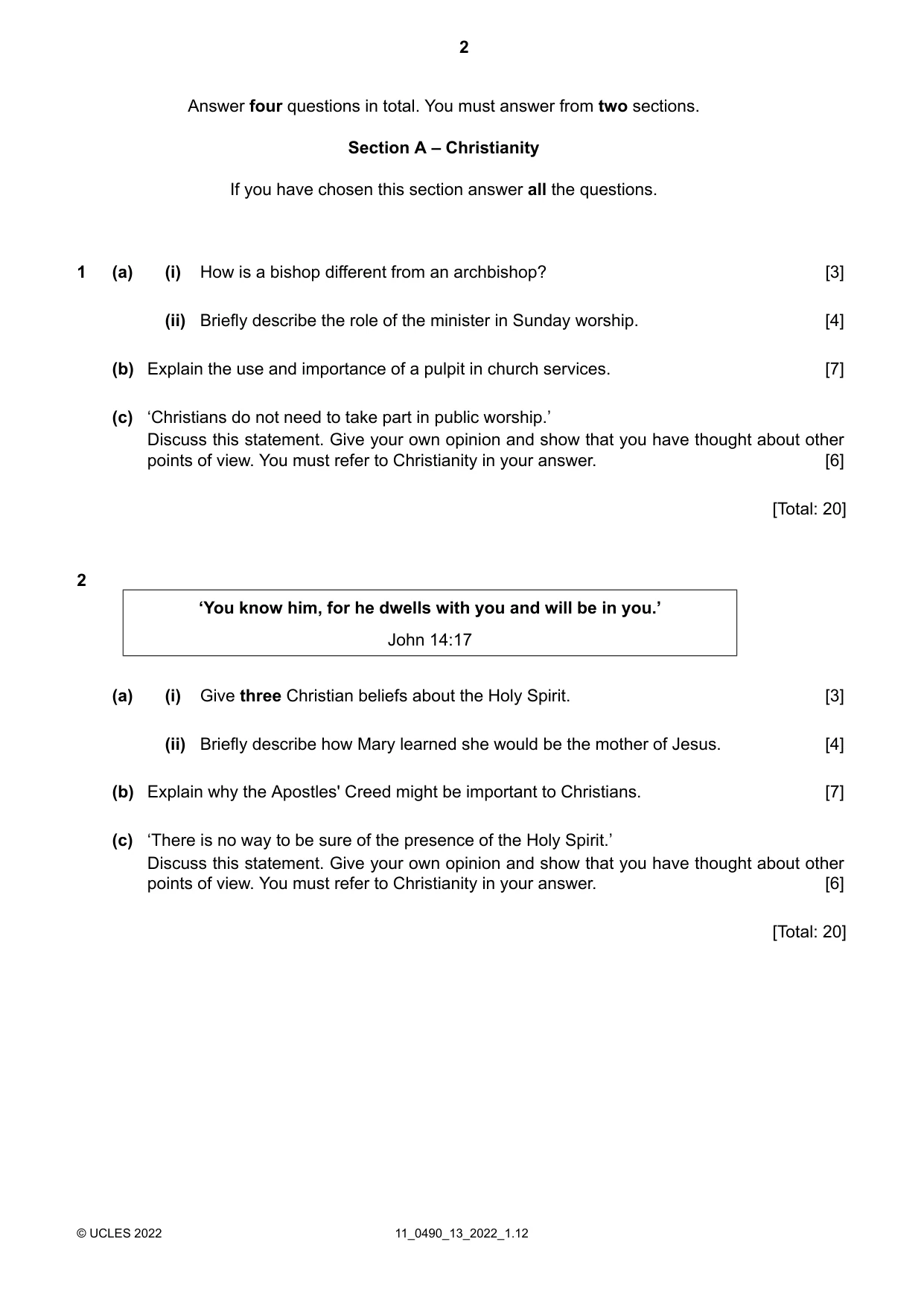
Question paper, page 2
Answer four questions in total. You must answer from two sections. Section A – Christianity If you have chosen this section answer all the questions. How is a bishop different from an archbishop? [3] (i) (a) 1 Briefly describe the role of the minister in Sunday worship. [4] (ii) Explain the use and importance of a pulpit in church services. [7] (b) ‘Christians do not need to take part in public worship.’ Discuss this statement. Give your own opinion and show that you have thought about other points of view. You must refer to Christianity in your answer. [6] (c) [Total: 20] 2 ‘You know him, for he dwells with you and will be in you.’ John 14:17 Give three Christian beliefs about the Holy Spirit. [3] (i) (a) Briefly describe how Mary learned she would be the mother of Jesus. [4] (ii) Explain why the Apostles' Creed might be important to Christians. [7] (b) ‘There is no way to be sure of the presence of the Holy Spirit.’ Discuss this statement. Give your own opinion and show that you have thought about other points of view. You must refer to Christianity in your answer. [6] (c) [Total: 20] 11_0490_13_2022_1.12 © UCLES 2022 2
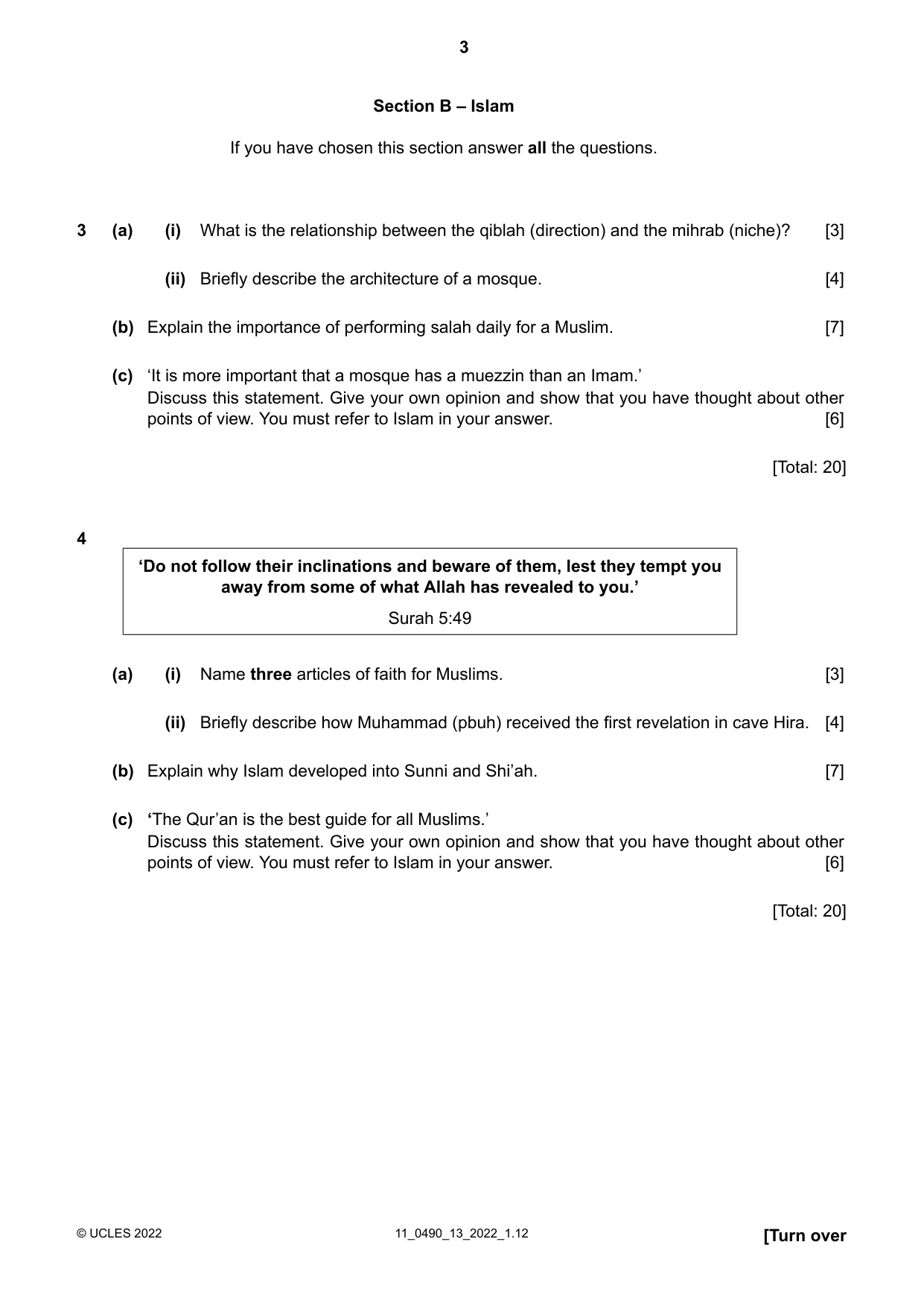
Question paper, page 3
Section B – Islam If you have chosen this section answer all the questions. What is the relationship between the qiblah (direction) and the mihrab (niche)? [3] (i) (a) 3 Briefly describe the architecture of a mosque. [4] (ii) Explain the importance of performing salah daily for a Muslim. [7] (b) ‘It is more important that a mosque has a muezzin than an Imam.’ Discuss this statement. Give your own opinion and show that you have thought about other points of view. You must refer to Islam in your answer. [6] (c) [Total: 20] 4 ‘Do not follow their inclinations and beware of them, lest they tempt you away from some of what Allah has revealed to you.’ Surah 5:49 Name three articles of faith for Muslims. [3] (i) (a) Briefly describe how Muhammad (pbuh) received the first revelation in cave Hira. [4] (ii) Explain why Islam developed into Sunni and Shi’ah. [7] (b) ‘The Qur’an is the best guide for all Muslims.’ Discuss this statement. Give your own opinion and show that you have thought about other points of view. You must refer to Islam in your answer. [6] (c) [Total: 20] [Turn over 11_0490_13_2022_1.12 © UCLES 2022 3
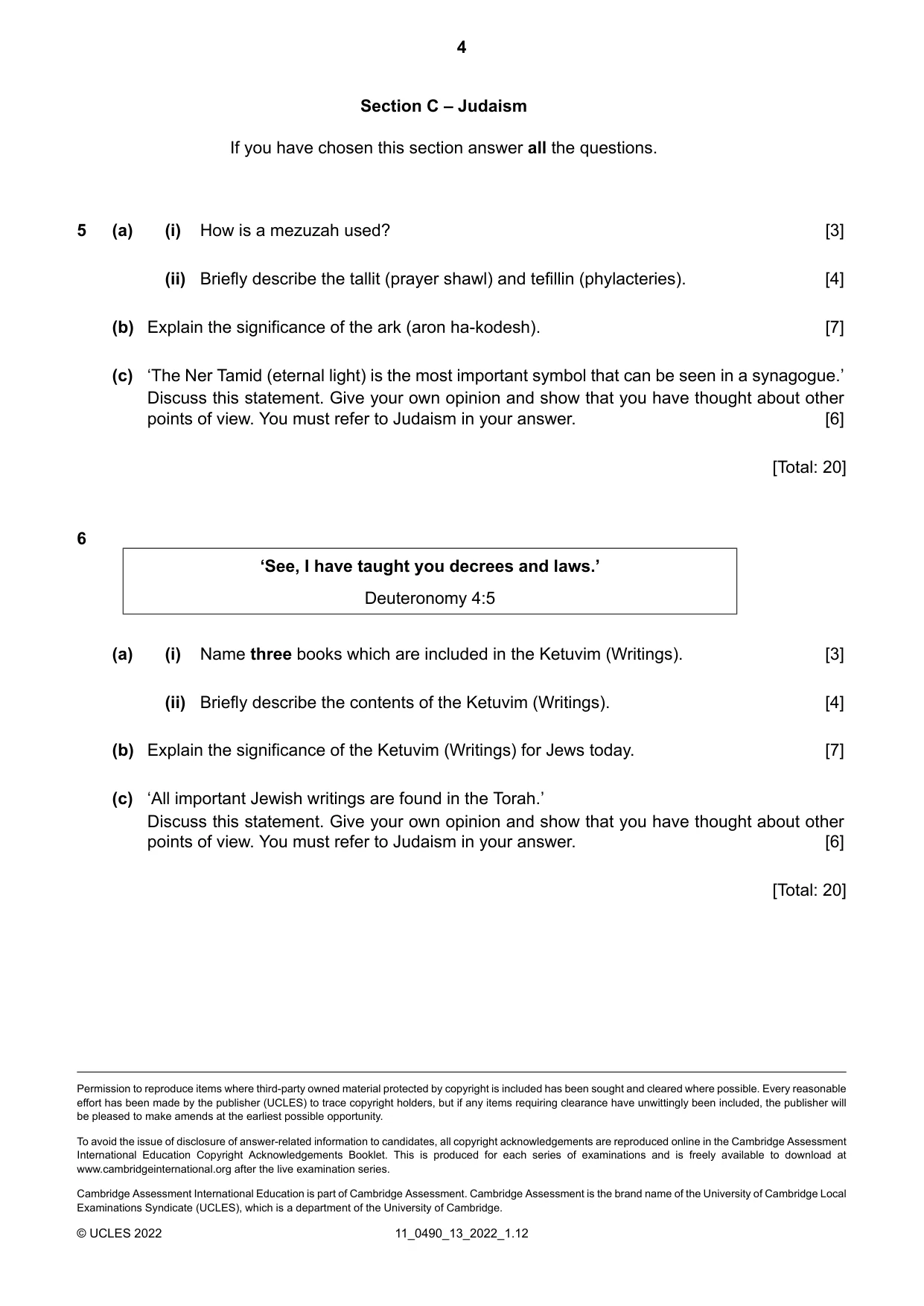
Question paper, page 4
Section C – Judaism If you have chosen this section answer all the questions. How is a mezuzah used? [3] (i) (a) 5 Briefly describe the tallit (prayer shawl) and tefillin (phylacteries). [4] (ii) Explain the significance of the ark (aron ha-kodesh). [7] (b) ‘The Ner Tamid (eternal light) is the most important symbol that can be seen in a synagogue.’ Discuss this statement. Give your own opinion and show that you have thought about other points of view. You must refer to Judaism in your answer. [6] (c) [Total: 20] 6 ‘See, I have taught you decrees and laws.’ Deuteronomy 4:5 Name three books which are included in the Ketuvim (Writings). [3] (i) (a) Briefly describe the contents of the Ketuvim (Writings). [4] (ii) Explain the significance of the Ketuvim (Writings) for Jews today. [7] (b) ‘All important Jewish writings are found in the Torah.’ Discuss this statement. Give your own opinion and show that you have thought about other points of view. You must refer to Judaism in your answer. [6] (c) [Total: 20] Permission to reproduce items where third-party owned material protected by copyright is included has been sought and cleared where possible. Every reasonable effort has been made by the publisher (UCLES) to trace copyright holders, but if any items requiring clearance have unwittingly been included, the publisher will be pleased to make amends at the earliest possible opportunity. To avoid the issue of disclosure of answer-related information to candidates, all copyright acknowledgements are reproduced online in the Cambridge Assessment International Education Copyright Acknowledgements Booklet. This is produced for each series of examinations and is freely available to download at www.cambridgeinternational.org after the live examination series. Cambridge Assessment International Education is part of Cambridge Assessment. Cambridge Assessment is the brand name of the University of Cambridge Local Examinations Syndicate (UCLES), which is a department of the University of Cambridge. 11_0490_13_2022_1.12 © UCLES 2022 4
Mark scheme, page 1
This document consists of 17 printed pages. © UCLES 2022 [Turn over Cambridge IGCSE™ RELIGIOUS STUDIES 0490/13 Paper 1 October/November 2022 MARK SCHEME Maximum Mark: 80 Published This mark scheme is published as an aid to teachers and candidates, to indicate the requirements of the examination. It shows the basis on which Examiners were instructed to award marks. It does not indicate the details of the discussions that took place at an Examiners’ meeting before marking began, which would have considered the acceptability of alternative answers. Mark schemes should be read in conjunction with the question paper and the Principal Examiner Report for Teachers. Cambridge International will not enter into discussions about these mark schemes. Cambridge International is publishing the mark schemes for the October/November 2022 series for most Cambridge IGCSE™, Cambridge International A and AS Level components and some Cambridge O Level components.
Mark scheme, page 2
0490/13 Cambridge IGCSE – Mark Scheme PUBLISHED October/November 2022 © UCLES 2022 Page 2 of 17 Generic Marking Principles These general marking principles must be applied by all examiners when marking candidate answers. They should be applied alongside the specific content of the mark scheme or generic level descriptors for a question. Each question paper and mark scheme will also comply with these marking principles. GENERIC MARKING PRINCIPLE 1: Marks must be awarded in line with: • the specific content of the mark scheme or the generic level descriptors for the question • the specific skills defined in the mark scheme or in the generic level descriptors for the question • the standard of response required by a candidate as exemplified by the standardisation scripts. GENERIC MARKING PRINCIPLE 2: Marks awarded are always whole marks (not half marks, or other fractions). GENERIC MARKING PRINCIPLE 3: Marks must be awarded positively: • marks are awarded for correct/valid answers, as defined in the mark scheme. However, credit is given for valid answers which go beyond the scope of the syllabus and mark scheme, referring to your Team Leader as appropriate • marks are awarded when candidates clearly demonstrate what they know and can do • marks are not deducted for errors • marks are not deducted for omissions • answers should only be judged on the quality of spelling, punctuation and grammar when these features are specifically assessed by the question as indicated by the mark scheme. The meaning, however, should be unambiguous. GENERIC MARKING PRINCIPLE 4: Rules must be applied consistently, e.g. in situations where candidates have not followed instructions or in the application of generic level descriptors. GENERIC MARKING PRINCIPLE 5: Marks should be awarded using the full range of marks defined in the mark scheme for the question (however; the use of the full mark range may be limited according to the quality of the candidate responses seen). GENERIC MARKING PRINCIPLE 6: Marks awarded are based solely on the requirements as defined in the mark scheme. Marks should not be awarded with grade thresholds or grade descriptors in mind.
Mark scheme, page 3
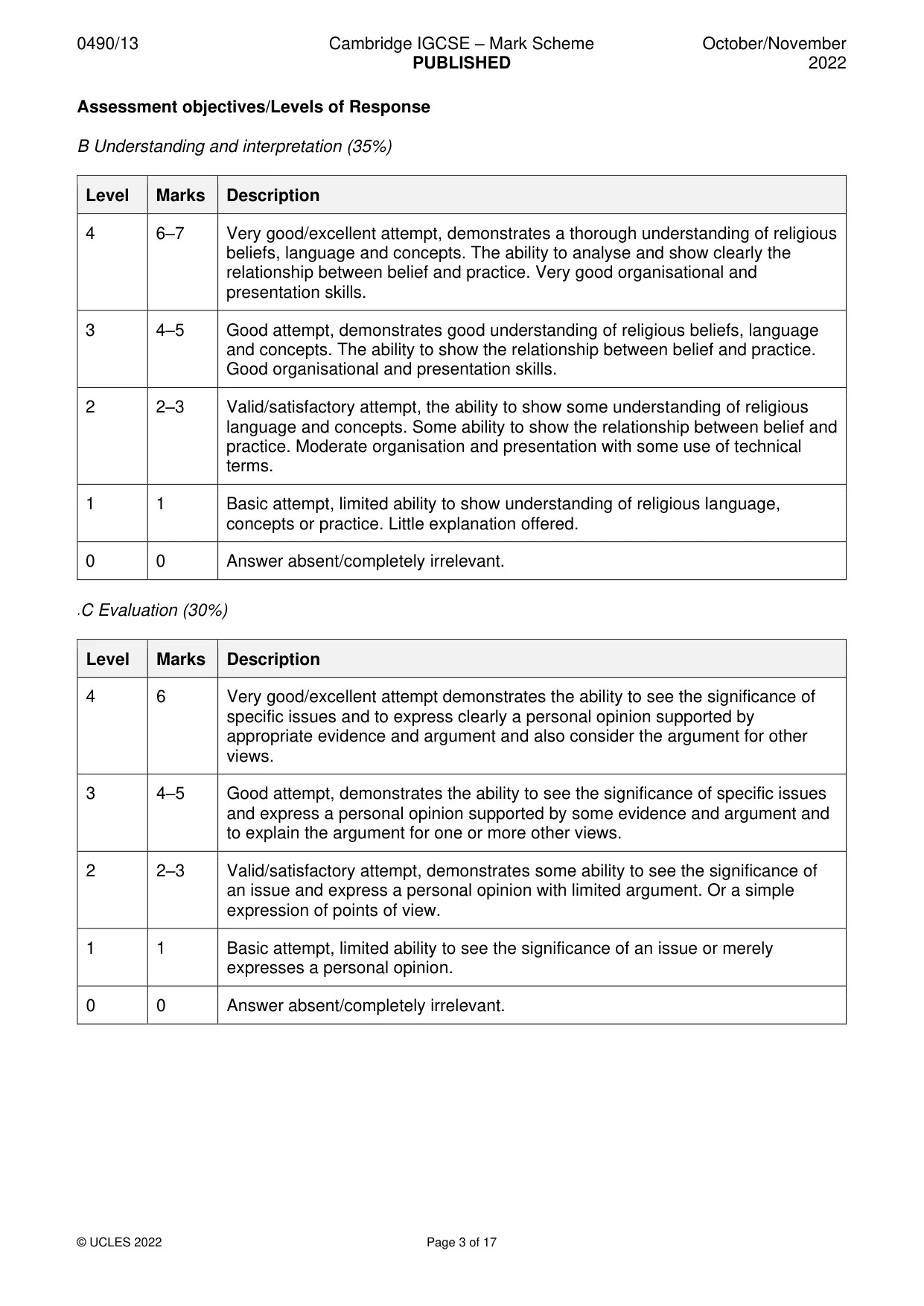
0490/13 Cambridge IGCSE – Mark Scheme PUBLISHED October/November 2022 © UCLES 2022 Page 3 of 17 Assessment objectives/Levels of Response B Understanding and interpretation (35%) Level Marks Description 4 6–7 Very good/excellent attempt, demonstrates a thorough understanding of religious beliefs, language and concepts. The ability to analyse and show clearly the relationship between belief and practice. Very good organisational and presentation skills. 3 4–5 Good attempt, demonstrates good understanding of religious beliefs, language and concepts. The ability to show the relationship between belief and practice. Good organisational and presentation skills. 2 2–3 Valid/satisfactory attempt, the ability to show some understanding of religious language and concepts. Some ability to show the relationship between belief and practice. Moderate organisation and presentation with some use of technical terms. 1 1 Basic attempt, limited ability to show understanding of religious language, concepts or practice. Little explanation offered. 0 0 Answer absent/completely irrelevant. C Evaluation (30%) Level Marks Description 4 6 Very good/excellent attempt demonstrates the ability to see the significance of specific issues and to express clearly a personal opinion supported by appropriate evidence and argument and also consider the argument for other views. 3 4–5 Good attempt, demonstrates the ability to see the significance of specific issues and express a personal opinion supported by some evidence and argument and to explain the argument for one or more other views. 2 2–3 Valid/satisfactory attempt, demonstrates some ability to see the significance of an issue and express a personal opinion with limited argument. Or a simple expression of points of view. 1 1 Basic attempt, limited ability to see the significance of an issue or merely expresses a personal opinion. 0 0 Answer absent/completely irrelevant.
Mark scheme, page 4
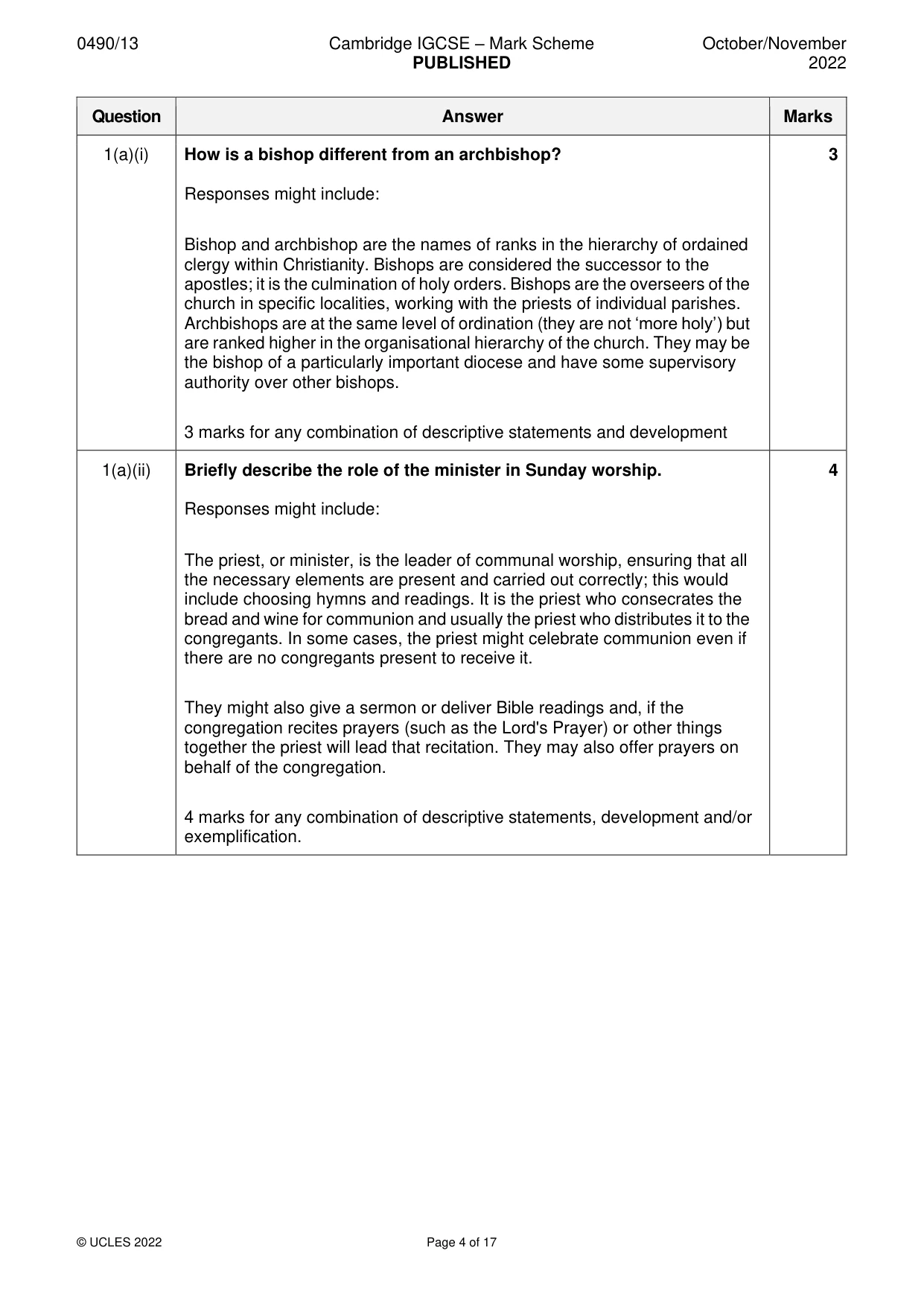
0490/13 Cambridge IGCSE – Mark Scheme PUBLISHED October/November 2022 © UCLES 2022 Page 4 of 17 Question Answer Marks 1(a)(i) How is a bishop different from an archbishop? Responses might include: Bishop and archbishop are the names of ranks in the hierarchy of ordained clergy within Christianity. Bishops are considered the successor to the apostles; it is the culmination of holy orders. Bishops are the overseers of the church in specific localities, working with the priests of individual parishes. Archbishops are at the same level of ordination (they are not ‘more holy’) but are ranked higher in the organisational hierarchy of the church. They may be the bishop of a particularly important diocese and have some supervisory authority over other bishops. 3 marks for any combination of descriptive statements and development 3 1(a)(ii) Briefly describe the role of the minister in Sunday worship. Responses might include: The priest, or minister, is the leader of communal worship, ensuring that all the necessary elements are present and carried out correctly; this would include choosing hymns and readings. It is the priest who consecrates the bread and wine for communion and usually the priest who distributes it to the congregants. In some cases, the priest might celebrate communion even if there are no congregants present to receive it. They might also give a sermon or deliver Bible readings and, if the congregation recites prayers (such as the Lord's Prayer) or other things together the priest will lead that recitation. They may also offer prayers on behalf of the congregation. 4 marks for any combination of descriptive statements, development and/or exemplification. 4
Mark scheme, page 5
0490/13 Cambridge IGCSE – Mark Scheme PUBLISHED October/November 2022 © UCLES 2022 Page 5 of 17 Question Answer Marks 1(b) Explain the use and importance of a pulpit in church services. Mark according to the level descriptors for Assessment Objective B. Understanding and interpretation. Responses might include some of the following: The pulpit is the place where the priest or minister stands to deliver a sermon to the congregation. They are usually raised up so that everyone can see and hear clearly. It may also be the largest and/or most prominent furniture in the church. This is because it is the place from which the word of God is proclaimed and (if need be) explained or interpreted and for many churches that is the most important element of communal services. Within some church traditions the pulpit is considered reserved for use by ordained clergy, although it is not considered holy in the same way an altar and its surrounding sanctuary might be. Within other traditions, where anyone may be invited to preach, the pulpit would be used to do so. Some churches have no pulpit at all. 7 1(c) ‘Christians do not need to take part in public worship.’ Discuss this statement. Give your own opinion and show that you have thought about other points of view. You must refer to Christianity in your answer. Mark according to the level descriptors for Assessment Objective C. Evaluation. Responses might consider some of the following: Some candidates might agree with the statement because the most important thing is personal faith and connection with God. This can be achieved in many ways and for many Christians those do not require the presence of a congregation, although some things (such as the sacraments) might require the presence of a priest. However, love of and service to others is an important part of the Christian message and it is hard to express love for other people in isolation from them. Candidates might disagree with the statement on the basis that Christs ministry was largely carried out in public and that sharing the good news can only be done that way. They might also take the view that it is important to feel and see oneself to be part of something, and public worship allows for this. A single Christian, worshipping in isolation and a group of Christians worshipping together will have a different experience of both their religion and of the presence of. For this reason, many Christians consider both forms of worship of equal importance. 6
Mark scheme, page 6
0490/13 Cambridge IGCSE – Mark Scheme PUBLISHED October/November 2022 © UCLES 2022 Page 6 of 17 Question Answer Marks 2(a)(i) Give three Christian beliefs about the Holy Spirit. Responses might include: • One of the three parts of the Trinity/a part of God • The source of creation/the giver of life • The power of God at work on earth • God can be known through the Holy Spirit • Represented as wind, fire or a dove • Bestows gifts on people • Inspires the Church 1 mark for each response. 3 2(a)(ii) Briefly describe how Mary learned she would be the mother of Jesus. Responses might include: Mary was visited by the angel Gabriel who told her she had found favour with God and would bear a child. This is called the Annunciation. Mary protested that she was a virgin and was told that the Holy Spirit would come to her, so that her child would be called the son of God. She was also told that her cousin was pregnant, even though she had been thought to be barren, which was a sign that all things are possible for God. Mary accepted God’s will for her, saying she was God’s servant. Some candidates might make reference to the message from Gabriel to Joseph, from the account in the Gospel of Matthew. 4 marks for any combination of descriptive statements, development and/or exemplification. 4
Mark scheme, page 7
0490/13 Cambridge IGCSE – Mark Scheme PUBLISHED October/November 2022 © UCLES 2022 Page 7 of 17 Question Answer Marks 2(b) Explain why the Apostles’ Creed might be important to Christians. Mark according to the level descriptors for Assessment Objective B. Understanding and interpretation. Responses might include some of the following: The Apostles' Creed is a statement of important beliefs shared by many Christians. For some Christian churches accepting the beliefs stated in the Creed is an essential part of being considered a Christian. By reciting the Creed, which begins with the statement ‘we believe’ Christians affirm their commitment and create a sense of community and belonging. As well as its importance as a public profession of faith the Creed can form part of liturgy and private prayer, or a focus for meditation and reflection. The terms used in the Apostles' Creed may also reflect how Christians think about God, for example ‘Father’ has a particular set of associations that guide Christian understandings of God as the Father and how that aspect of the Trinity is different to others. 7 2(c) ‘There is no way to be sure of the presence of the Holy Spirit.’ Discuss this statement. Give your own opinion and show that you have thought about other points of view. You must refer to Christianity in your answer. Mark according to the level descriptors for Assessment Objective C. Evaluation. Responses might consider some of the following: Some candidates might agree with the statement on the basis that the Holy Spirit is invisible and works in subtle or mysterious ways rather than directly. The presence of the Spirit is often inferred from particular events, or interpretations post-event so knowing what is happening at the time it is happening may not be possible. People ‘taken by the Spirit’ during charismatic worship may be unaware while they are in the ecstasy of the moment; other people watching them may have no doubt about what they are seeing but some of those witnesses may have no doubt they see the work of the Spirit while others may have no doubt that they see insanity or demonic possession. It could be argued that such interpretations are a matter of context rather than faith, or that belief is not the same as knowledge. Some candidates might disagree with the statement, arguing that someone with faith knows that the Holy Spirit is always present in the world, even if they do not personally feel that presence directly in any given moment. 6
Mark scheme, page 8
0490/13 Cambridge IGCSE – Mark Scheme PUBLISHED October/November 2022 © UCLES 2022 Page 8 of 17 Question Answer Marks 3(a)(i) What is the relationship between the qiblah (direction) and the mihrab (niche)? Responses might include: The qiblah is the direction Muslims should face to pray; that is towards the Ka’aba in Makkah of Makkah as revealed in Al-Baqarah (verses 144, 149, and 150). The mihrab is a niche in a mosque's qiblah-facing wall, which marks that direction for Muslims. Knowing quiblah is essential for salah prayers and the presence of the mihrab in the mosque ensures that it is clear to all worshippers. 3 marks for any combination of statements and development. 3 3(a)(ii) Briefly describe the architecture of a mosque. Responses might include: Mosques have a minaret, traditionally this is large enough to have a balcony from which the call to prayer can be made and heard widely. There will be a large, open prayer hall for Salah, with a mihrab to indicate the direction for prayer. There may be a minbar for the imam to preach from. Mosques also generally have easy access to running water to enable wudu to be performed. Many mosques also have a dome, although this is not required. It is said to symbolise the heavens. 4 marks for any combination of descriptive statements, development and/or exemplification. 4
Mark scheme, page 9
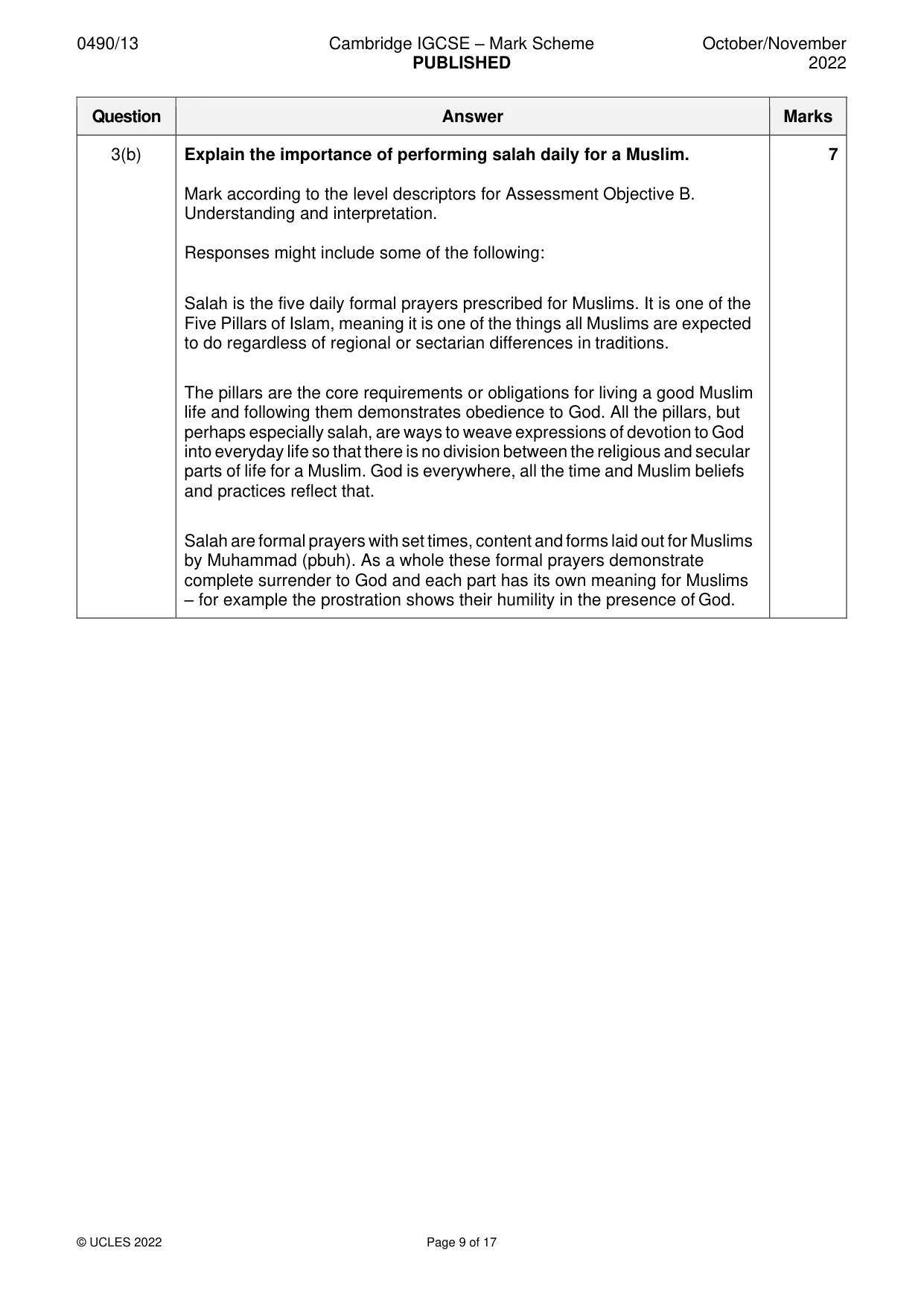
0490/13 Cambridge IGCSE – Mark Scheme PUBLISHED October/November 2022 © UCLES 2022 Page 9 of 17 Question Answer Marks 3(b) Explain the importance of performing salah daily for a Muslim. Mark according to the level descriptors for Assessment Objective B. Understanding and interpretation. Responses might include some of the following: Salah is the five daily formal prayers prescribed for Muslims. It is one of the Five Pillars of Islam, meaning it is one of the things all Muslims are expected to do regardless of regional or sectarian differences in traditions. The pillars are the core requirements or obligations for living a good Muslim life and following them demonstrates obedience to God. All the pillars, but perhaps especially salah, are ways to weave expressions of devotion to God into everyday life so that there is no division between the religious and secular parts of life for a Muslim. God is everywhere, all the time and Muslim beliefs and practices reflect that. Salah are formal prayers with set times, content and forms laid out for Muslims by Muhammad (pbuh). As a whole these formal prayers demonstrate complete surrender to God and each part has its own meaning for Muslims – for example the prostration shows their humility in the presence of God. 7
Mark scheme, page 10
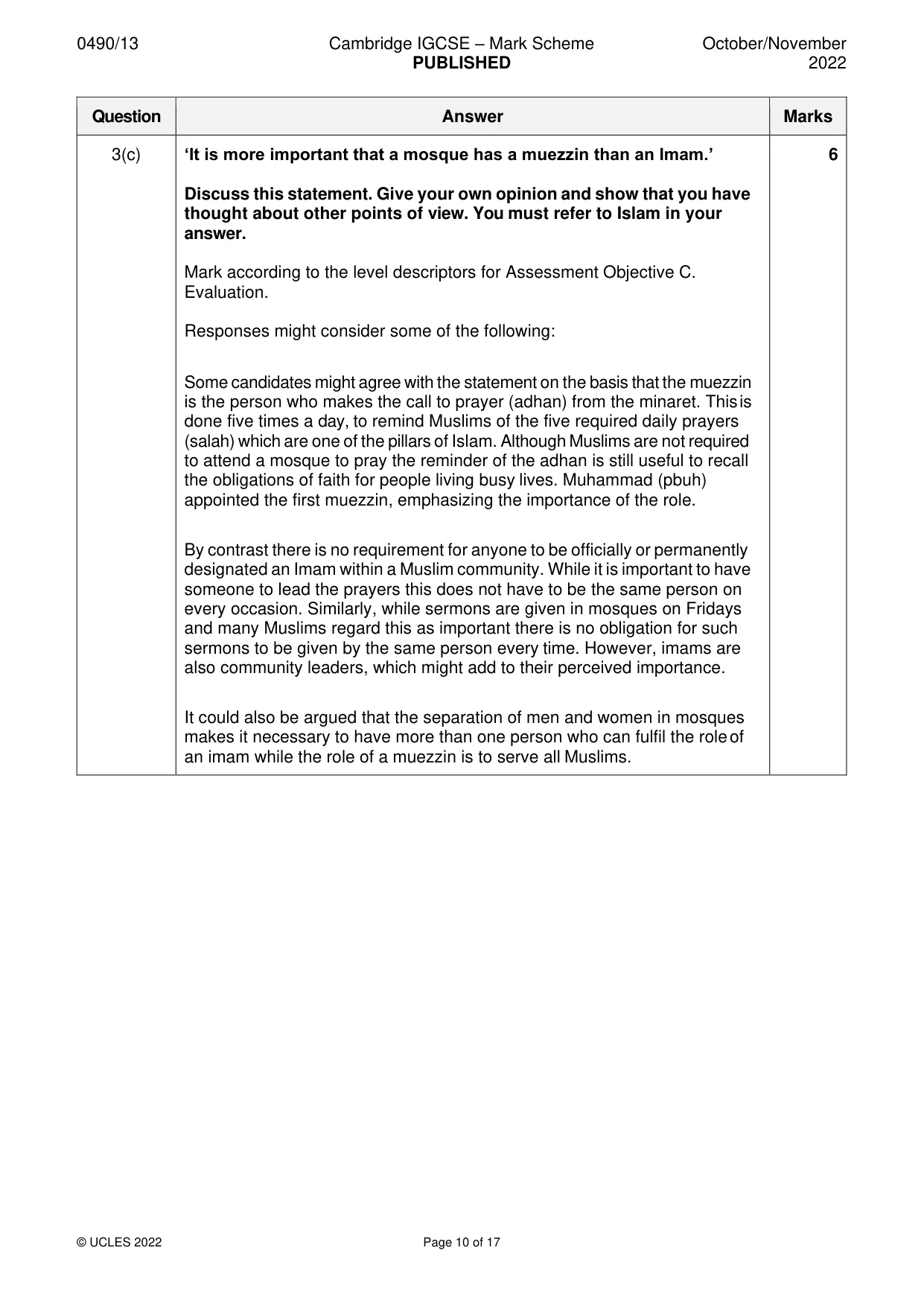
0490/13 Cambridge IGCSE – Mark Scheme PUBLISHED October/November 2022 © UCLES 2022 Page 10 of 17 Question Answer Marks 3(c) ‘It is more important that a mosque has a muezzin than an Imam.’ Discuss this statement. Give your own opinion and show that you have thought about other points of view. You must refer to Islam in your answer. Mark according to the level descriptors for Assessment Objective C. Evaluation. Responses might consider some of the following: Some candidates might agree with the statement on the basis that the muezzin is the person who makes the call to prayer (adhan) from the minaret. This is done five times a day, to remind Muslims of the five required daily prayers (salah) which are one of the pillars of Islam. Although Muslims are not required to attend a mosque to pray the reminder of the adhan is still useful to recall the obligations of faith for people living busy lives. Muhammad (pbuh) appointed the first muezzin, emphasizing the importance of the role. By contrast there is no requirement for anyone to be officially or permanently designated an Imam within a Muslim community. While it is important to have someone to lead the prayers this does not have to be the same person on every occasion. Similarly, while sermons are given in mosques on Fridays and many Muslims regard this as important there is no obligation for such sermons to be given by the same person every time. However, imams are also community leaders, which might add to their perceived importance. It could also be argued that the separation of men and women in mosques makes it necessary to have more than one person who can fulfil the role of an imam while the role of a muezzin is to serve all Muslims. 6
Mark scheme, page 11
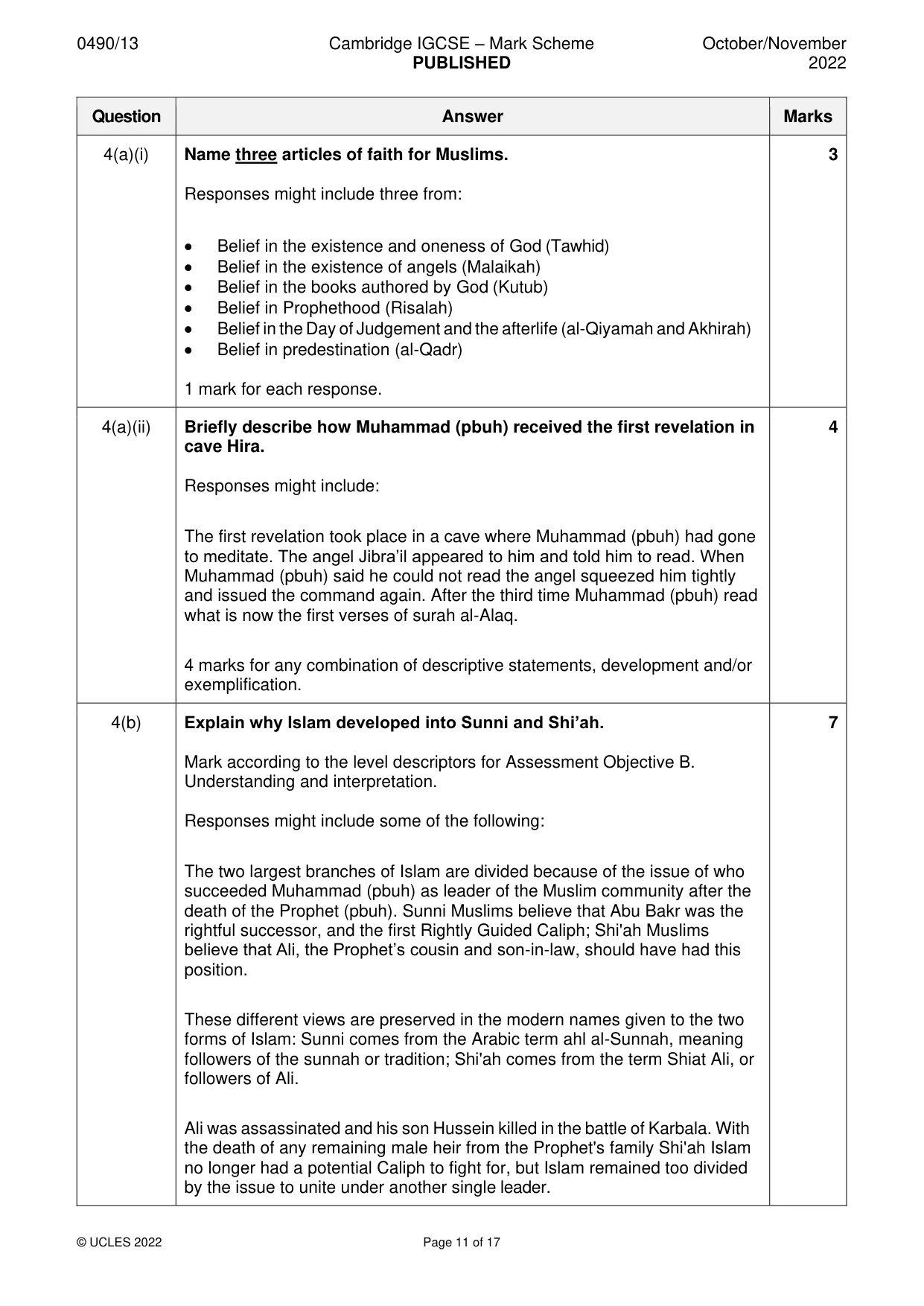
0490/13 Cambridge IGCSE – Mark Scheme PUBLISHED October/November 2022 © UCLES 2022 Page 11 of 17 Question Answer Marks 4(a)(i) Name three articles of faith for Muslims. Responses might include three from: • Belief in the existence and oneness of God (Tawhid) • Belief in the existence of angels (Malaikah) • Belief in the books authored by God (Kutub) • Belief in Prophethood (Risalah) • Belief in the Day of Judgement and the afterlife (al-Qiyamah and Akhirah) • Belief in predestination (al-Qadr) 1 mark for each response. 3 4(a)(ii) Briefly describe how Muhammad (pbuh) received the first revelation in cave Hira. Responses might include: The first revelation took place in a cave where Muhammad (pbuh) had gone to meditate. The angel Jibra’il appeared to him and told him to read. When Muhammad (pbuh) said he could not read the angel squeezed him tightly and issued the command again. After the third time Muhammad (pbuh) read what is now the first verses of surah al-Alaq. 4 marks for any combination of descriptive statements, development and/or exemplification. 4 4(b) Explain why Islam developed into Sunni and Shi’ah. Mark according to the level descriptors for Assessment Objective B. Understanding and interpretation. Responses might include some of the following: The two largest branches of Islam are divided because of the issue of who succeeded Muhammad (pbuh) as leader of the Muslim community after the death of the Prophet (pbuh). Sunni Muslims believe that Abu Bakr was the rightful successor, and the first Rightly Guided Caliph; Shi'ah Muslims believe that Ali, the Prophet’s cousin and son-in-law, should have had this position. These different views are preserved in the modern names given to the two forms of Islam: Sunni comes from the Arabic term ahl al-Sunnah, meaning followers of the sunnah or tradition; Shi'ah comes from the term Shiat Ali, or followers of Ali. Ali was assassinated and his son Hussein killed in the battle of Karbala. With the death of any remaining male heir from the Prophet's family Shi'ah Islam no longer had a potential Caliph to fight for, but Islam remained too divided by the issue to unite under another single leader. 7
Mark scheme, page 12
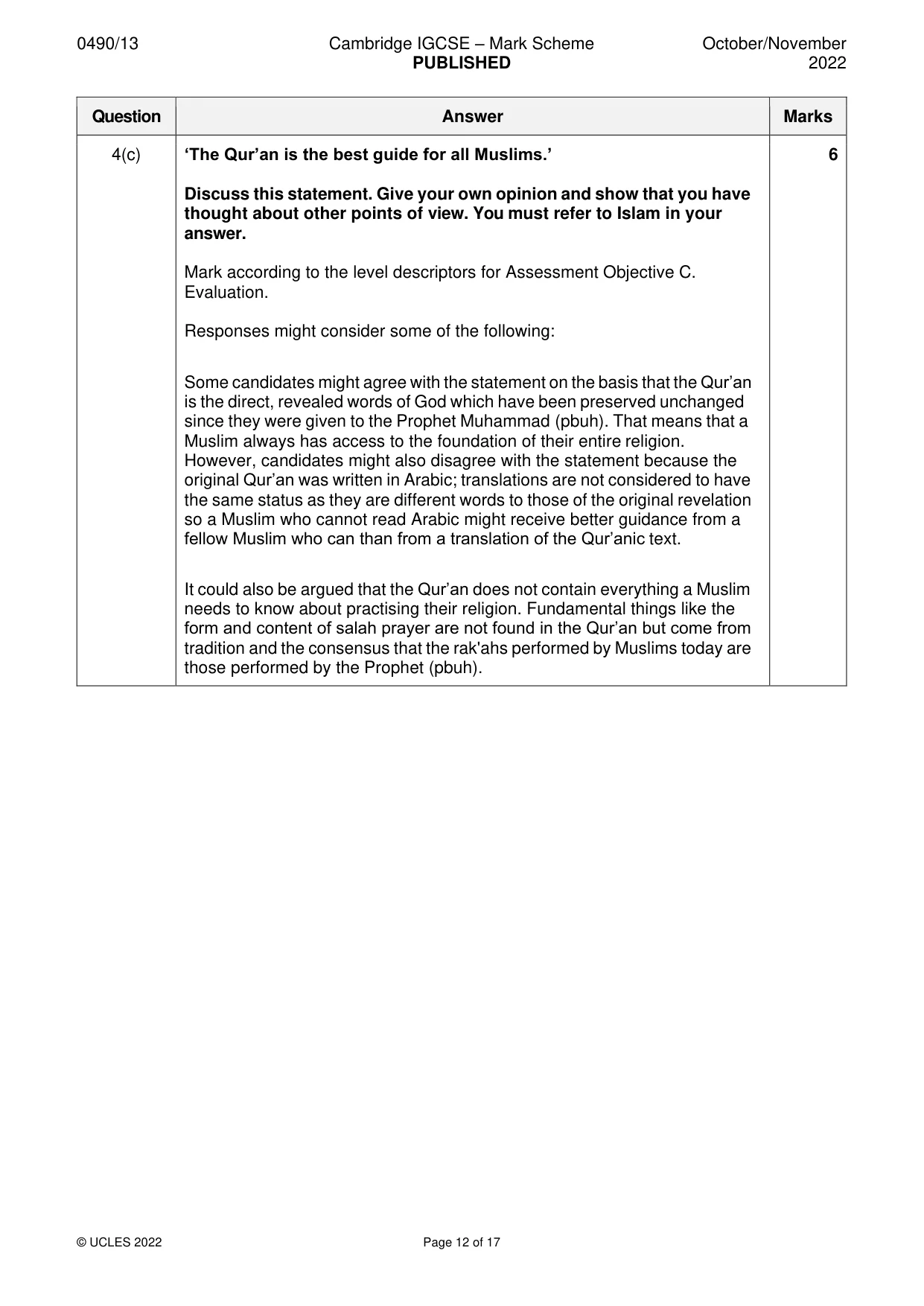
0490/13 Cambridge IGCSE – Mark Scheme PUBLISHED October/November 2022 © UCLES 2022 Page 12 of 17 Question Answer Marks 4(c) ‘The Qur’an is the best guide for all Muslims.’ Discuss this statement. Give your own opinion and show that you have thought about other points of view. You must refer to Islam in your answer. Mark according to the level descriptors for Assessment Objective C. Evaluation. Responses might consider some of the following: Some candidates might agree with the statement on the basis that the Qur’an is the direct, revealed words of God which have been preserved unchanged since they were given to the Prophet Muhammad (pbuh). That means that a Muslim always has access to the foundation of their entire religion. However, candidates might also disagree with the statement because the original Qur’an was written in Arabic; translations are not considered to have the same status as they are different words to those of the original revelation so a Muslim who cannot read Arabic might receive better guidance from a fellow Muslim who can than from a translation of the Qur’anic text. It could also be argued that the Qur’an does not contain everything a Muslim needs to know about practising their religion. Fundamental things like the form and content of salah prayer are not found in the Qur’an but come from tradition and the consensus that the rak'ahs performed by Muslims today are those performed by the Prophet (pbuh). 6
Mark scheme, page 13
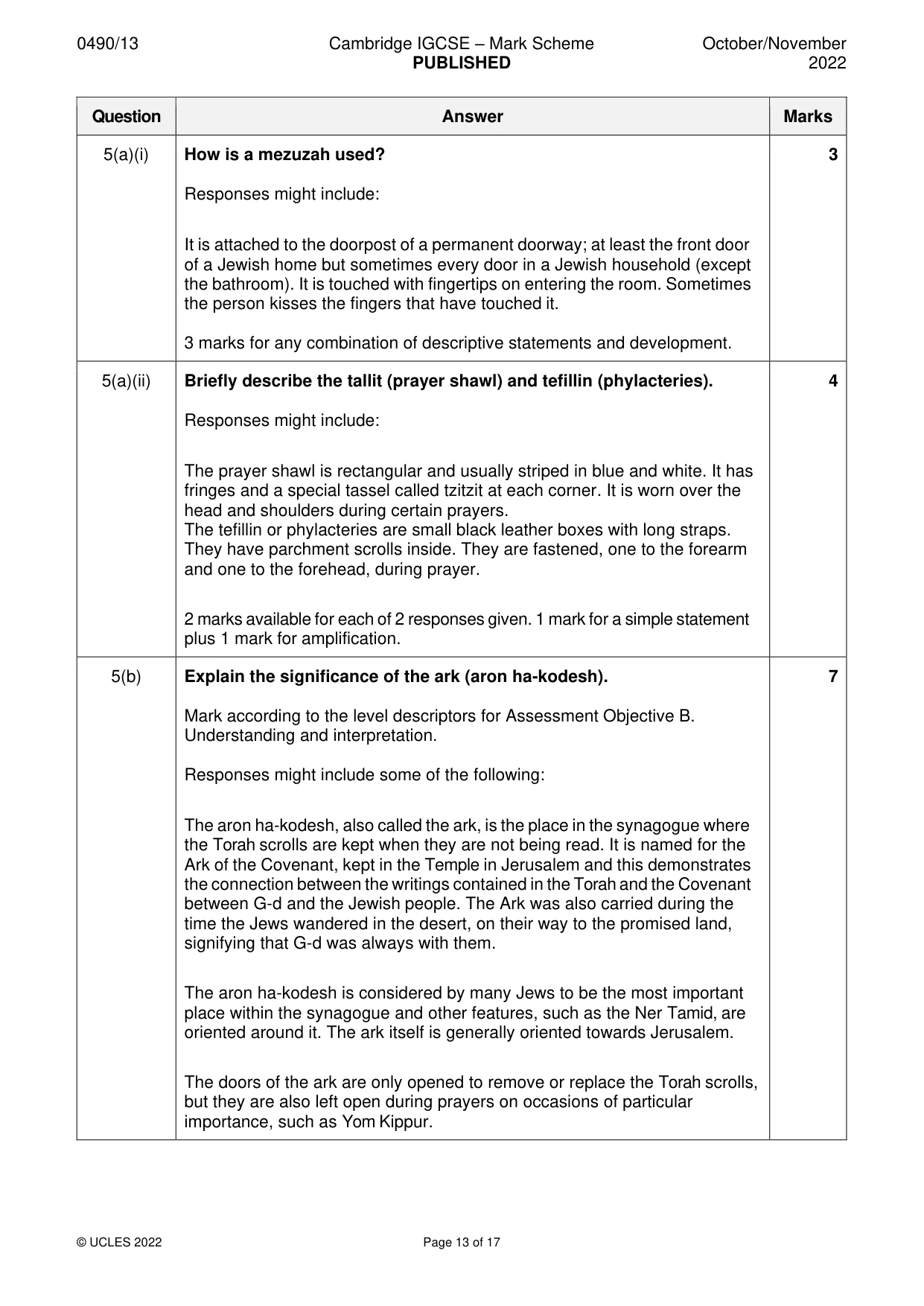
0490/13 Cambridge IGCSE – Mark Scheme PUBLISHED October/November 2022 © UCLES 2022 Page 13 of 17 Question Answer Marks 5(a)(i) How is a mezuzah used? Responses might include: It is attached to the doorpost of a permanent doorway; at least the front door of a Jewish home but sometimes every door in a Jewish household (except the bathroom). It is touched with fingertips on entering the room. Sometimes the person kisses the fingers that have touched it. 3 marks for any combination of descriptive statements and development. 3 5(a)(ii) Briefly describe the tallit (prayer shawl) and tefillin (phylacteries). Responses might include: The prayer shawl is rectangular and usually striped in blue and white. It has fringes and a special tassel called tzitzit at each corner. It is worn over the head and shoulders during certain prayers. The tefillin or phylacteries are small black leather boxes with long straps. They have parchment scrolls inside. They are fastened, one to the forearm and one to the forehead, during prayer. 2 marks available for each of 2 responses given. 1 mark for a simple statement plus 1 mark for amplification. 4 5(b) Explain the significance of the ark (aron ha-kodesh). Mark according to the level descriptors for Assessment Objective B. Understanding and interpretation. Responses might include some of the following: The aron ha-kodesh, also called the ark, is the place in the synagogue where the Torah scrolls are kept when they are not being read. It is named for the Ark of the Covenant, kept in the Temple in Jerusalem and this demonstrates the connection between the writings contained in the Torah and the Covenant between G-d and the Jewish people. The Ark was also carried during the time the Jews wandered in the desert, on their way to the promised land, signifying that G-d was always with them. The aron ha-kodesh is considered by many Jews to be the most important place within the synagogue and other features, such as the Ner Tamid, are oriented around it. The ark itself is generally oriented towards Jerusalem. The doors of the ark are only opened to remove or replace the Torah scrolls, but they are also left open during prayers on occasions of particular importance, such as Yom Kippur. 7
Mark scheme, page 14
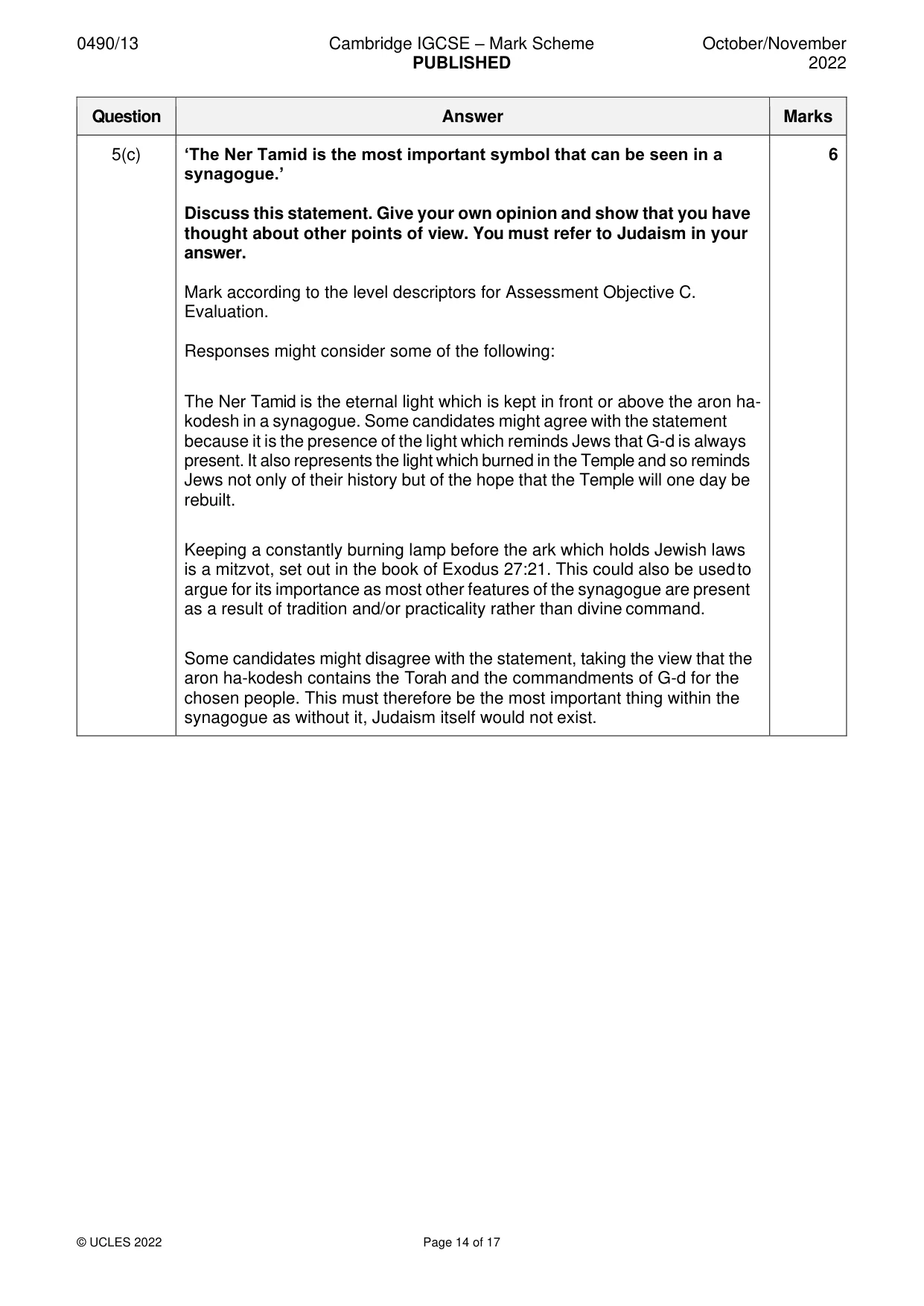
0490/13 Cambridge IGCSE – Mark Scheme PUBLISHED October/November 2022 © UCLES 2022 Page 14 of 17 Question Answer Marks 5(c) ‘The Ner Tamid is the most important symbol that can be seen in a synagogue.’ Discuss this statement. Give your own opinion and show that you have thought about other points of view. You must refer to Judaism in your answer. Mark according to the level descriptors for Assessment Objective C. Evaluation. Responses might consider some of the following: The Ner Tamid is the eternal light which is kept in front or above the aron ha- kodesh in a synagogue. Some candidates might agree with the statement because it is the presence of the light which reminds Jews that G-d is always present. It also represents the light which burned in the Temple and so reminds Jews not only of their history but of the hope that the Temple will one day be rebuilt. Keeping a constantly burning lamp before the ark which holds Jewish laws is a mitzvot, set out in the book of Exodus 27:21. This could also be used to argue for its importance as most other features of the synagogue are present as a result of tradition and/or practicality rather than divine command. Some candidates might disagree with the statement, taking the view that the aron ha-kodesh contains the Torah and the commandments of G-d for the chosen people. This must therefore be the most important thing within the synagogue as without it, Judaism itself would not exist. 6
Mark scheme, page 15
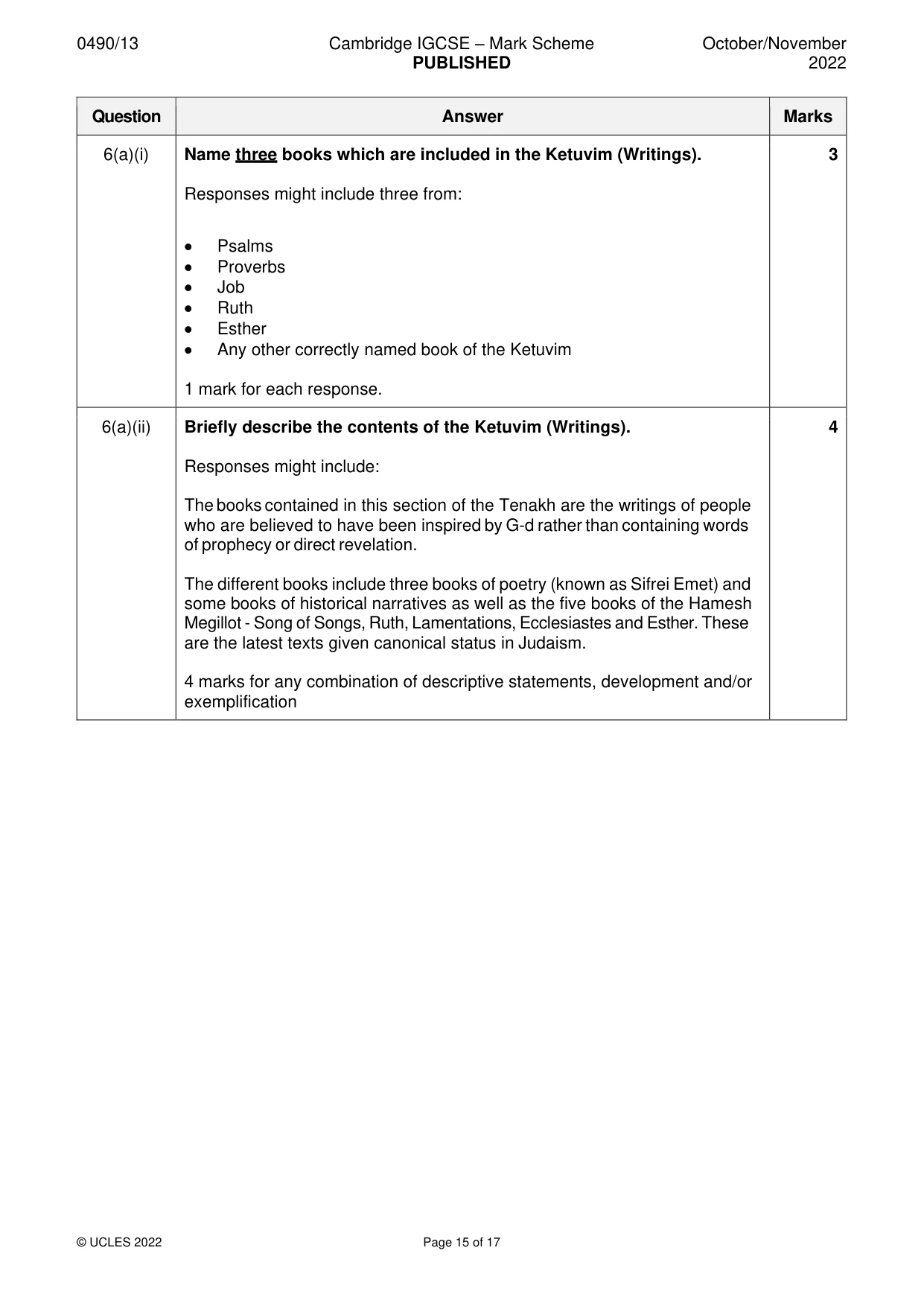
0490/13 Cambridge IGCSE – Mark Scheme PUBLISHED October/November 2022 © UCLES 2022 Page 15 of 17 Question Answer Marks 6(a)(i) Name three books which are included in the Ketuvim (Writings). Responses might include three from: • Psalms • Proverbs • Job • Ruth • Esther • Any other correctly named book of the Ketuvim 1 mark for each response. 3 6(a)(ii) Briefly describe the contents of the Ketuvim (Writings). Responses might include: The books contained in this section of the Tenakh are the writings of people who are believed to have been inspired by G-d rather than containing words of prophecy or direct revelation. The different books include three books of poetry (known as Sifrei Emet) and some books of historical narratives as well as the five books of the Hamesh Megillot - Song of Songs, Ruth, Lamentations, Ecclesiastes and Esther. These are the latest texts given canonical status in Judaism. 4 marks for any combination of descriptive statements, development and/or exemplification 4
Mark scheme, page 16
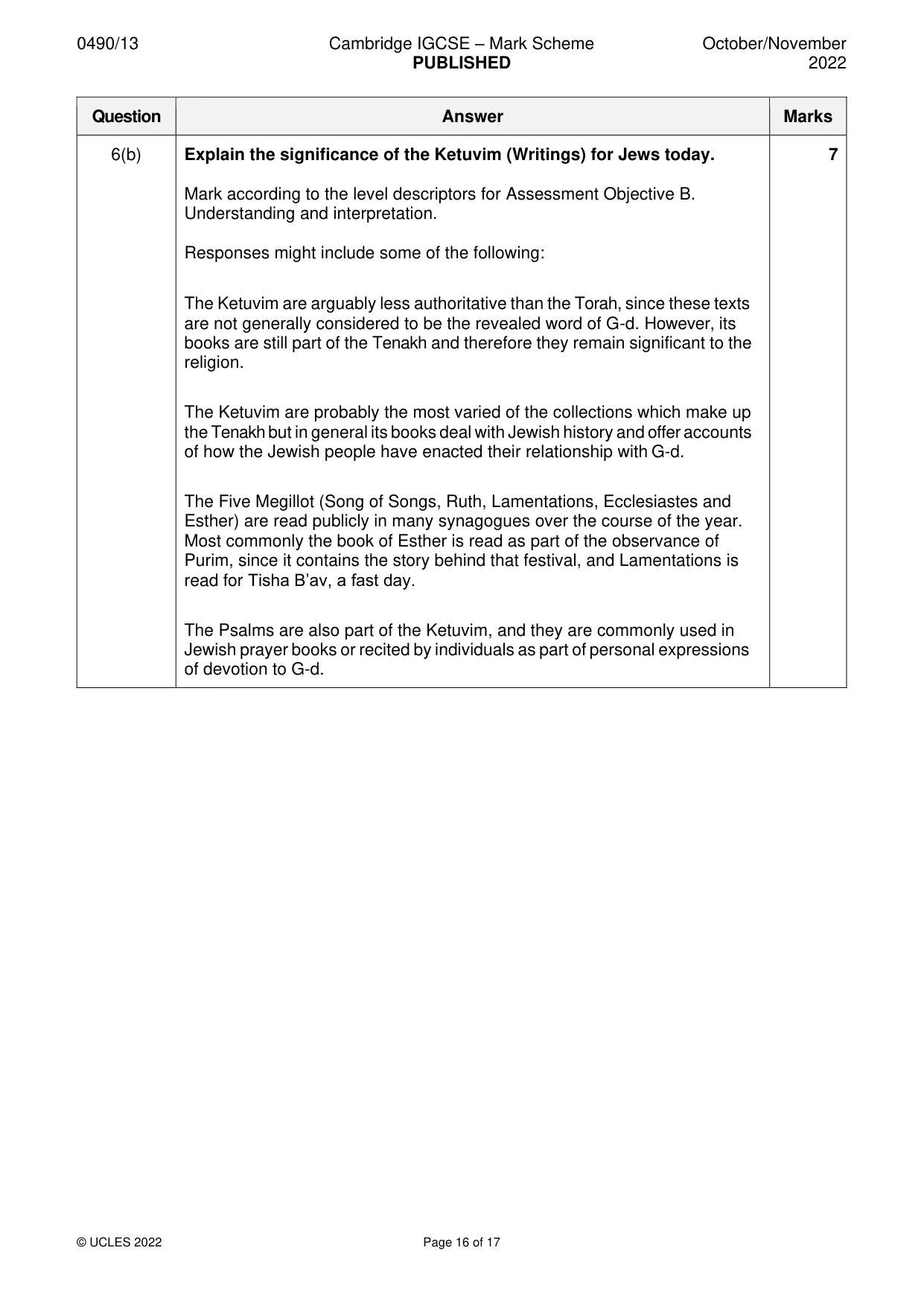
0490/13 Cambridge IGCSE – Mark Scheme PUBLISHED October/November 2022 © UCLES 2022 Page 16 of 17 Question Answer Marks 6(b) Explain the significance of the Ketuvim (Writings) for Jews today. Mark according to the level descriptors for Assessment Objective B. Understanding and interpretation. Responses might include some of the following: The Ketuvim are arguably less authoritative than the Torah, since these texts are not generally considered to be the revealed word of G-d. However, its books are still part of the Tenakh and therefore they remain significant to the religion. The Ketuvim are probably the most varied of the collections which make up the Tenakh but in general its books deal with Jewish history and offer accounts of how the Jewish people have enacted their relationship with G-d. The Five Megillot (Song of Songs, Ruth, Lamentations, Ecclesiastes and Esther) are read publicly in many synagogues over the course of the year. Most commonly the book of Esther is read as part of the observance of Purim, since it contains the story behind that festival, and Lamentations is read for Tisha B’av, a fast day. The Psalms are also part of the Ketuvim, and they are commonly used in Jewish prayer books or recited by individuals as part of personal expressions of devotion to G-d. 7
Mark scheme, page 17
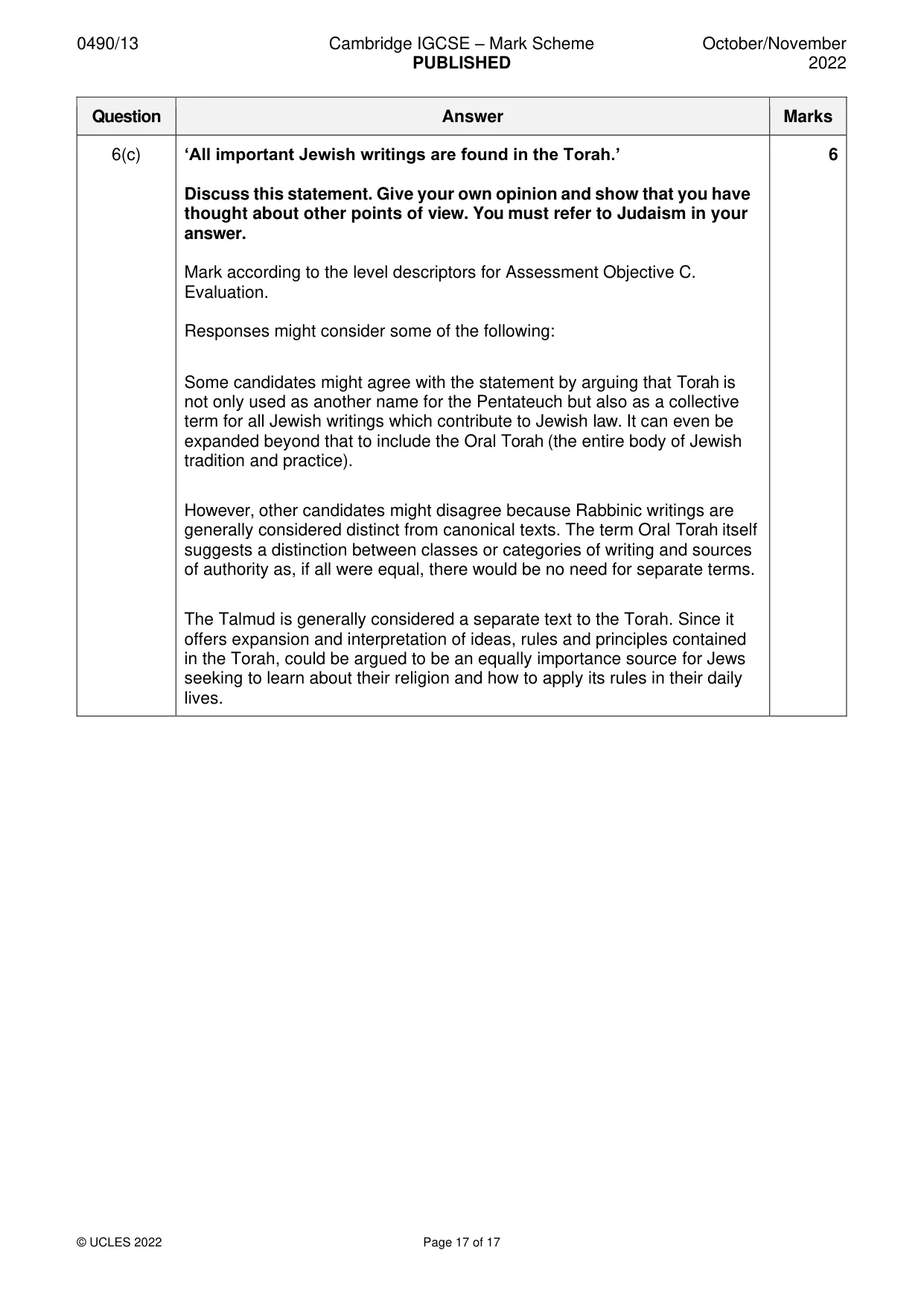
0490/13 Cambridge IGCSE – Mark Scheme PUBLISHED October/November 2022 © UCLES 2022 Page 17 of 17 Question Answer Marks 6(c) ‘All important Jewish writings are found in the Torah.’ Discuss this statement. Give your own opinion and show that you have thought about other points of view. You must refer to Judaism in your answer. Mark according to the level descriptors for Assessment Objective C. Evaluation. Responses might consider some of the following: Some candidates might agree with the statement by arguing that Torah is not only used as another name for the Pentateuch but also as a collective term for all Jewish writings which contribute to Jewish law. It can even be expanded beyond that to include the Oral Torah (the entire body of Jewish tradition and practice). However, other candidates might disagree because Rabbinic writings are generally considered distinct from canonical texts. The term Oral Torah itself suggests a distinction between classes or categories of writing and sources of authority as, if all were equal, there would be no need for separate terms. The Talmud is generally considered a separate text to the Torah. Since it offers expansion and interpretation of ideas, rules and principles contained in the Torah, could be argued to be an equally importance source for Jews seeking to learn about their religion and how to apply its rules in their daily lives. 6
What you needed in this session
Cambridge’s own grade thresholds for 2022 Oct/Nov, Paper 1 · Variant 3. A higher threshold means an easier paper — the bar moves with how the cohort did.