Cambridge IGCSE Religious Studies 0490 — 2025 Oct/Nov Paper 1 · Variant 3
0490/13/O/N/25 · 80 marks · 105 min
The question paper and its mark scheme, free to read here and free to download. This is Cambridge’s own paper, exactly as it was sat.
Question paper8 pages




Mark scheme23 pages
Answers below. Sit the paper first if you are practising.
Paper as text
Question paper, page 1
Cambridge IGCSE™ 0490/13 October/November 2025 1 hour 45 minutes RELIGIOUS STUDIES Paper 1 Worship, Beliefs, Scriptures and Sacred Places You must answer on the enclosed answer booklet. You will need: Answer booklet (enclosed) INSTRUCTIONS • Answer four questions in total: You must answer from two sections. In each of your chosen sections, you must answer two questions. • Follow the instructions on the front cover of the answer booklet. If you need additional answer paper, ask the invigilator for a continuation booklet. INFORMATION • The total mark for this paper is 80. • The number of marks for each question or part question is shown in brackets [ ]. This document has 8 pages. Any blank pages are indicated. [Turn over 11_0490_13_2025_1.16 © UCLES 2025 *6297426460*
Question paper, page 2
Answer four questions in total. You must answer from two sections. Section A – Christianity If you have chosen this section, you must answer two questions. (a) 1 Name two sites of Christian pilgrimage in Rome. [2] (i) Outline a ritual that might take place at the Lourdes Grotto. [4] (ii) Explain why Papal audiences might be important to some Christians. [6] (b) Discuss whether going on pilgrimage is an important duty for all Christians. You must refer to Christianity in your answer. Your response should consider different points of view when you evaluate the question. [8] (c) [Total: 20] (a) 2 State what a pulpit is and what it is used for. [2] (i) Outline how a baptistery is used. [4] (ii) Explain what ‘acts of devotion’ might mean for individual Christians. [6] (b) Evaluate the importance of using artefacts in worship for different Christian communities. You must refer to Christianity in your answer. Your response should consider different points of view when you evaluate the question. [8] (c) [Total: 20] (a) 3 Name two of the fruits of the Holy Spirit. [2] (i) Outline what Christians believe happened at Jesus’ trials. [4] (ii) Explain why the Bible might be considered a source of authority. [6] (b) Discuss the significance of the restrictions in the Ten Commandments for Christian life. You must refer to Christianity in your answer. Your response should consider different points of view when you evaluate the question. [8] (c) [Total: 20] 11_0490_13_2025_1.16 © UCLES 2025 2
Question paper, page 3
Section B – Islam If you have chosen this section, you must answer two questions. (a) 4 Name two of the key features of a mosque. [2] (i) Outline the sequence of the rakʿahs. [4] (ii) Explain why dhikr might be a significant devotional practice for Muslims. [6] (b) Assess the significance of the role of the imam in different Muslim communities. You must refer to Islam in your answer. Your response should consider different points of view when you evaluate the question. [8] (c) [Total: 20] (a) 5 Name two of the Five Pillars of Islam. [2] (i) Outline two of the Six Articles of Faith. [4] (ii) Explain the difference between Sunni and Shiʿah beliefs about the successor of Prophet Muhammad (pbuh). [6] (b) Evaluate different views on the importance of the Shahadah in Muslim life. You must refer to Islam in your answer. Your response should consider different points of view when you evaluate the question. [8] (c) [Total: 20] (a) 6 Name the two hills Muslims run between during the Hajj. [2] (i) Outline the historic importance of Madinah for Muslims. [4] (ii) Explain how ʿUmrah is different from the Hajj. [6] (b) Evaluate whether overcoming physical challenges is the most important part of Muslim pilgrimage. You must refer to Islam in your answer. Your response should consider different points of view when you evaluate the question. [8] (c) [Total: 20] [Turn over 11_0490_13_2025_1.16 © UCLES 2025 3
Question paper, page 4
Section C – Judaism If you have chosen this section, you must answer two questions. (a) 7 Identify two things a Jew might do to honour the dead at Yad Vashem. [2] (i) Outline spiritual goals Jews might have for a pilgrimage to the site of the Temple. [4] (ii) Explain how the Ark and the ner tamid being in the synagogue might remind Jews of the Temple. [6] (b) Evaluate different Jewish views on the importance of remembering the Holocaust. You must refer to Judaism in your answer. Your response should consider different points of view when you evaluate the question. [8] (c) [Total: 20] (a) 8 Name what is kept in the aron ha-kodesh, and name the place in the synagogue this is read from. [2] (i) Outline how Jews welcome Shabbat into the home. [4] (ii) Explain why communal worship might be important to some Jews. [6] (b) Discuss whether ritual dress is a necessary aspect of worship for all Jews. You must refer to Judaism in your answer. Your response should consider different points of view when you evaluate the question. [8] (c) [Total: 20] (a) 9 State what is meant by the terms ‘omnipotent’ and ‘omnipresent’. [2] (i) Outline the covenant between G-d and Abraham. [4] (ii) Explain why Jews might use the Torah as a source of moral principles. [6] (b) Discuss whether the belief that G-d is just has an impact on the daily life of Jews. You must refer to Judaism in your answer. Your response should consider different points of view when you evaluate the question. [8] (c) [Total: 20] 11_0490_13_2025_1.16 © UCLES 2025 4
Question paper, page 5
BLANK PAGE 11_0490_13_2025_1.16 © UCLES 2025 5
Question paper, page 6
BLANK PAGE 11_0490_13_2025_1.16 © UCLES 2025 6
Question paper, page 7
BLANK PAGE 11_0490_13_2025_1.16 © UCLES 2025 7
Question paper, page 8
BLANK PAGE Permission to reproduce items where third-party owned material protected by copyright is included has been sought and cleared where possible. Every reasonable effort has been made by the publisher (UCLES) to trace copyright holders, but if any items requiring clearance have unwittingly been included, the publisher will be pleased to make amends at the earliest possible opportunity. To avoid the issue of disclosure of answer-related information to candidates, all copyright acknowledgements are reproduced online in the Cambridge Assessment International Education Copyright Acknowledgements Booklet. This is produced for each series of examinations and is freely available to download at www.cambridgeinternational.org after the live examination series. Cambridge Assessment International Education is part of Cambridge Assessment. Cambridge Assessment is the brand name of the University of Cambridge Local Examinations Syndicate (UCLES), which is a department of the University of Cambridge. 11_0490_13_2025_1.16 © UCLES 2025 8
Mark scheme, page 1
This document consists of 23 printed pages. © Cambridge University Press & Assessment 2025 [Turn over Cambridge IGCSE™ RELIGIOUS STUDIES 0490/13 Paper 1 October/November 2025 MARK SCHEME Maximum Mark: 80 Published This mark scheme is published as an aid to teachers and candidates, to indicate the requirements of the examination. It shows the basis on which Examiners were instructed to award marks. It does not indicate the details of the discussions that took place at an Examiners’ meeting before marking began, which would have considered the acceptability of alternative answers. Mark schemes should be read in conjunction with the question paper and the Principal Examiner Report for Teachers. Cambridge International will not enter into discussions about these mark schemes. Cambridge International is publishing the mark schemes for the October/November 2025 series for most Cambridge IGCSE, Cambridge International A and AS Level components, and some Cambridge O Level components.
Mark scheme, page 2
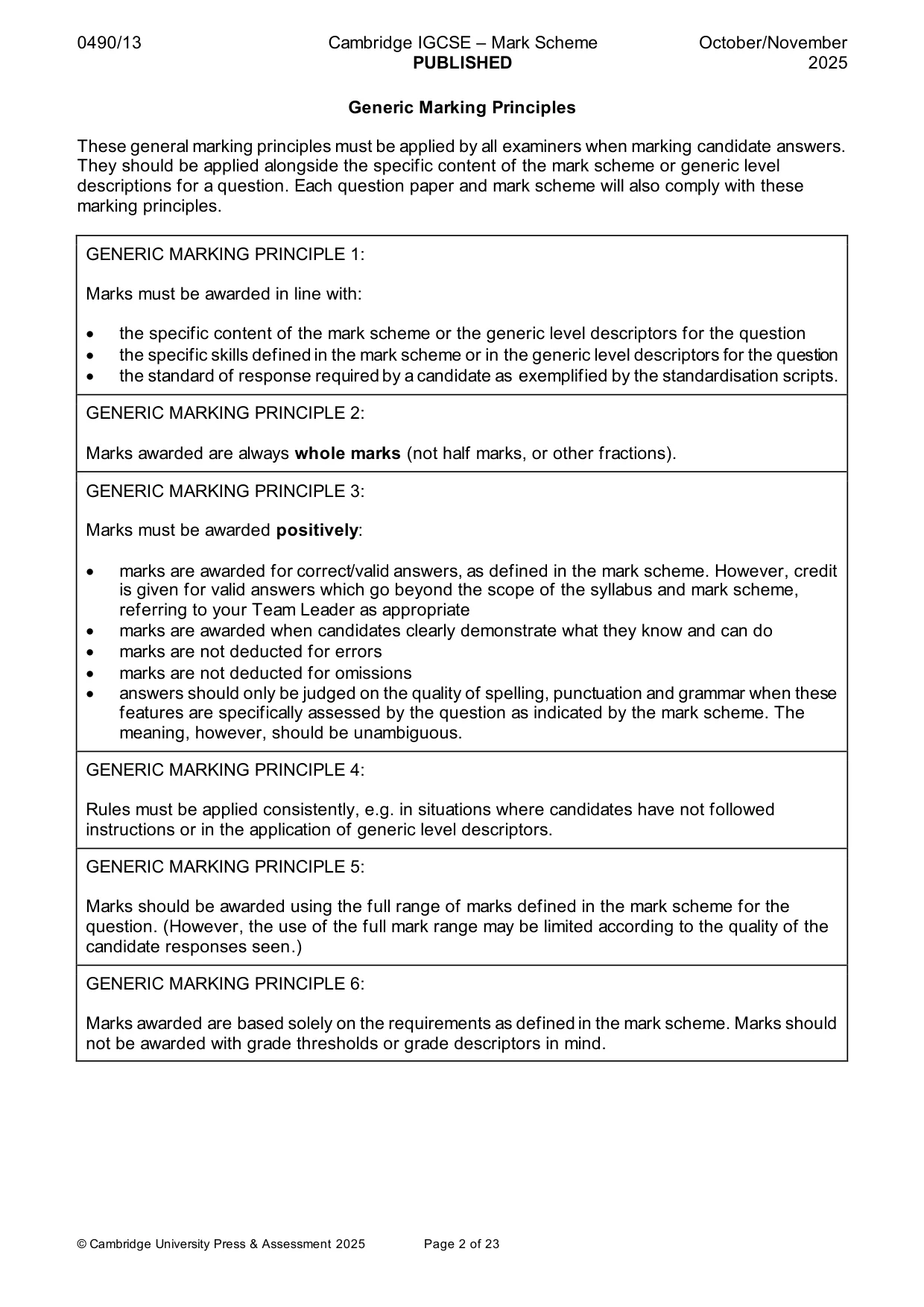
0490/13 Cambridge IGCSE – Mark Scheme PUBLISHED October/November 2025 © Cambridge University Press & Assessment 2025 Page 2 of 23 Generic Marking Principles These general marking principles must be applied by all examiners when marking candidate answers. They should be applied alongside the specific content of the mark scheme or generic level descriptions for a question. Each question paper and mark scheme will also comply with these marking principles. GENERIC MARKING PRINCIPLE 1: Marks must be awarded in line with: • the specific content of the mark scheme or the generic level descriptors for the question • the specific skills defined in the mark scheme or in the generic level descriptors for the question • the standard of response required by a candidate as exemplified by the standardisation scripts. GENERIC MARKING PRINCIPLE 2: Marks awarded are always whole marks (not half marks, or other fractions). GENERIC MARKING PRINCIPLE 3: Marks must be awarded positively: • marks are awarded for correct/valid answers, as defined in the mark scheme. However, credit is given for valid answers which go beyond the scope of the syllabus and mark scheme, referring to your Team Leader as appropriate • marks are awarded when candidates clearly demonstrate what they know and can do • marks are not deducted for errors • marks are not deducted for omissions • answers should only be judged on the quality of spelling, punctuation and grammar when these features are specifically assessed by the question as indicated by the mark scheme. The meaning, however, should be unambiguous. GENERIC MARKING PRINCIPLE 4: Rules must be applied consistently, e.g. in situations where candidates have not followed instructions or in the application of generic level descriptors. GENERIC MARKING PRINCIPLE 5: Marks should be awarded using the full range of marks defined in the mark scheme for the question. (However, the use of the full mark range may be limited according to the quality of the candidate responses seen.) GENERIC MARKING PRINCIPLE 6: Marks awarded are based solely on the requirements as defined in the mark scheme. Marks should not be awarded with grade thresholds or grade descriptors in mind.
Mark scheme, page 3
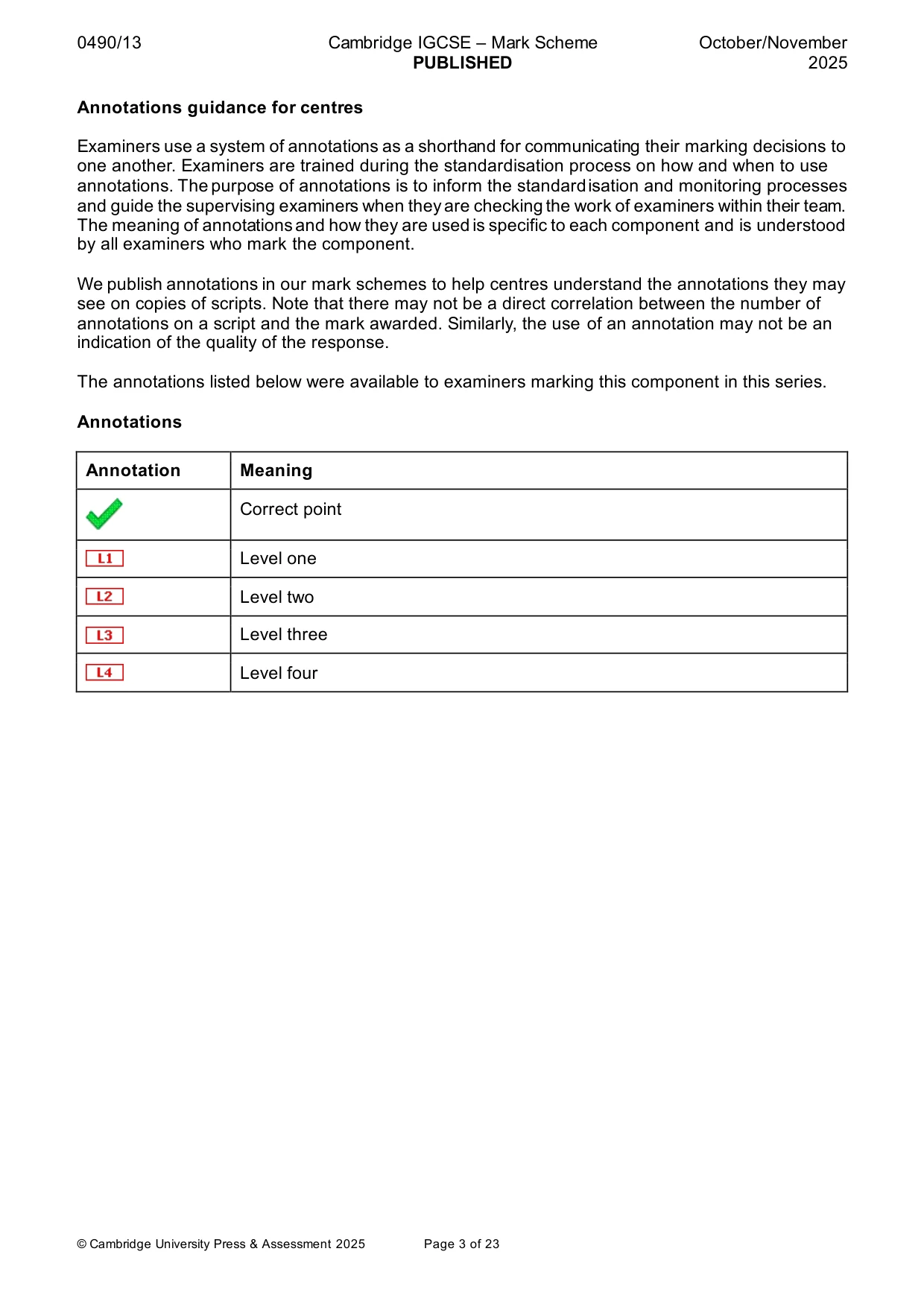
0490/13 Cambridge IGCSE – Mark Scheme PUBLISHED October/November 2025 © Cambridge University Press & Assessment 2025 Page 3 of 23 Annotations guidance for centres Examiners use a system of annotations as a shorthand for communicating their marking decisions to one another. Examiners are trained during the standardisation process on how and when to use annotations. The purpose of annotations is to inform the standardisation and monitoring processes and guide the supervising examiners when they are checking the work of examiners within their team. The meaning of annotations and how they are used is specific to each component and is understood by all examiners who mark the component. We publish annotations in our mark schemes to help centres understand the annotations they may see on copies of scripts. Note that there may not be a direct correlation between the number of annotations on a script and the mark awarded. Similarly, the use of an annotation may not be an indication of the quality of the response. The annotations listed below were available to examiners marking this component in this series. Annotations Annotation Meaning Correct point Level one Level two Level three Level four
Mark scheme, page 4
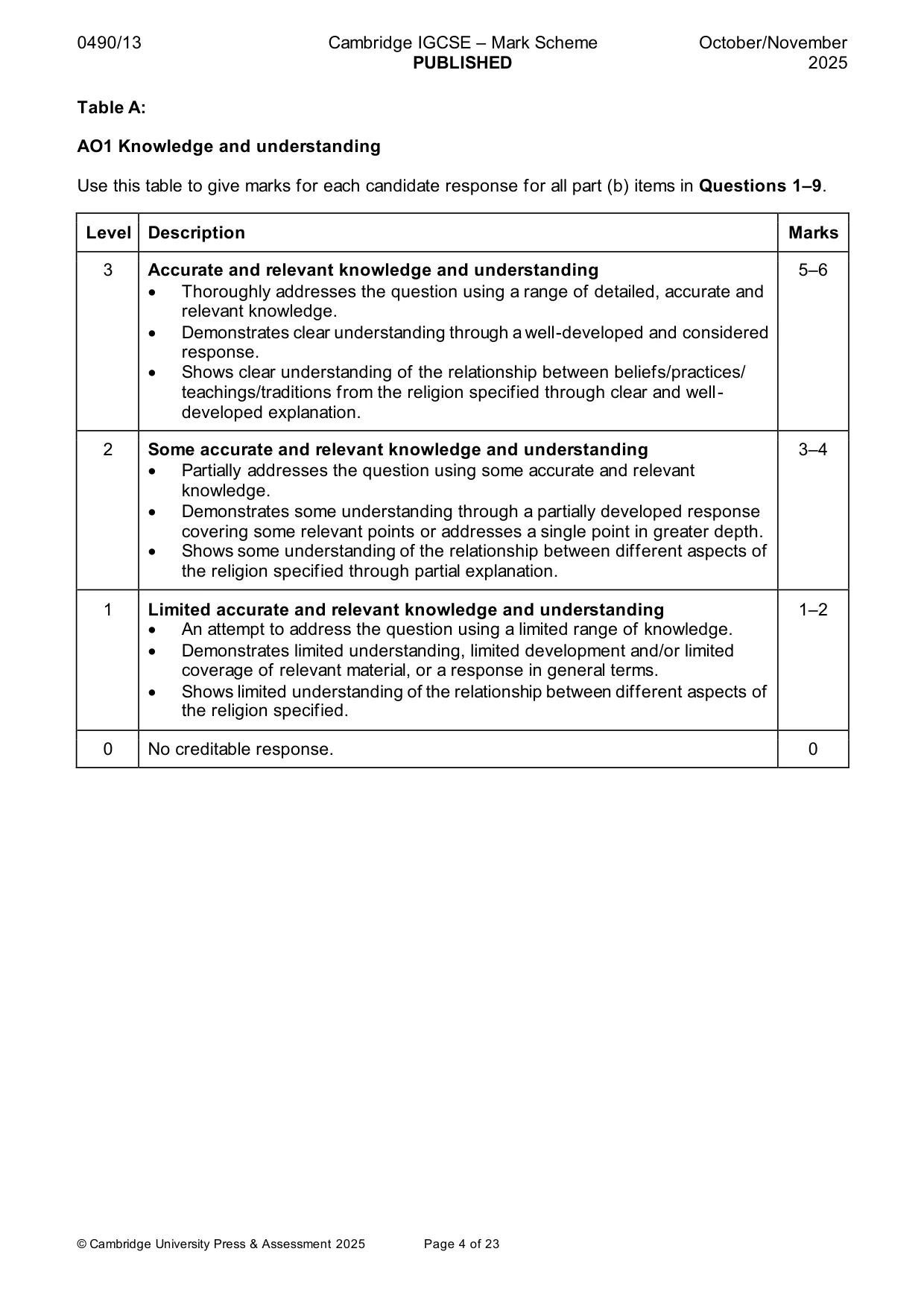
0490/13 Cambridge IGCSE – Mark Scheme PUBLISHED October/November 2025 © Cambridge University Press & Assessment 2025 Page 4 of 23 Table A: AO1 Knowledge and understanding Use this table to give marks for each candidate response for all part (b) items in Questions 1–9. Level Description Marks 3 Accurate and relevant knowledge and understanding • Thoroughly addresses the question using a range of detailed, accurate and relevant knowledge. • Demonstrates clear understanding through a well-developed and considered response. • Shows clear understanding of the relationship between beliefs/practices/ teachings/traditions from the religion specified through clear and well- developed explanation. 5–6 2 Some accurate and relevant knowledge and understanding • Partially addresses the question using some accurate and relevant knowledge. • Demonstrates some understanding through a partially developed response covering some relevant points or addresses a single point in greater depth. • Shows some understanding of the relationship between different aspects of the religion specified through partial explanation. 3–4 1 Limited accurate and relevant knowledge and understanding • An attempt to address the question using a limited range of knowledge. • Demonstrates limited understanding, limited development and/or limited coverage of relevant material, or a response in general terms. • Shows limited understanding of the relationship between different aspects of the religion specified. 1–2 0 No creditable response. 0
Mark scheme, page 5
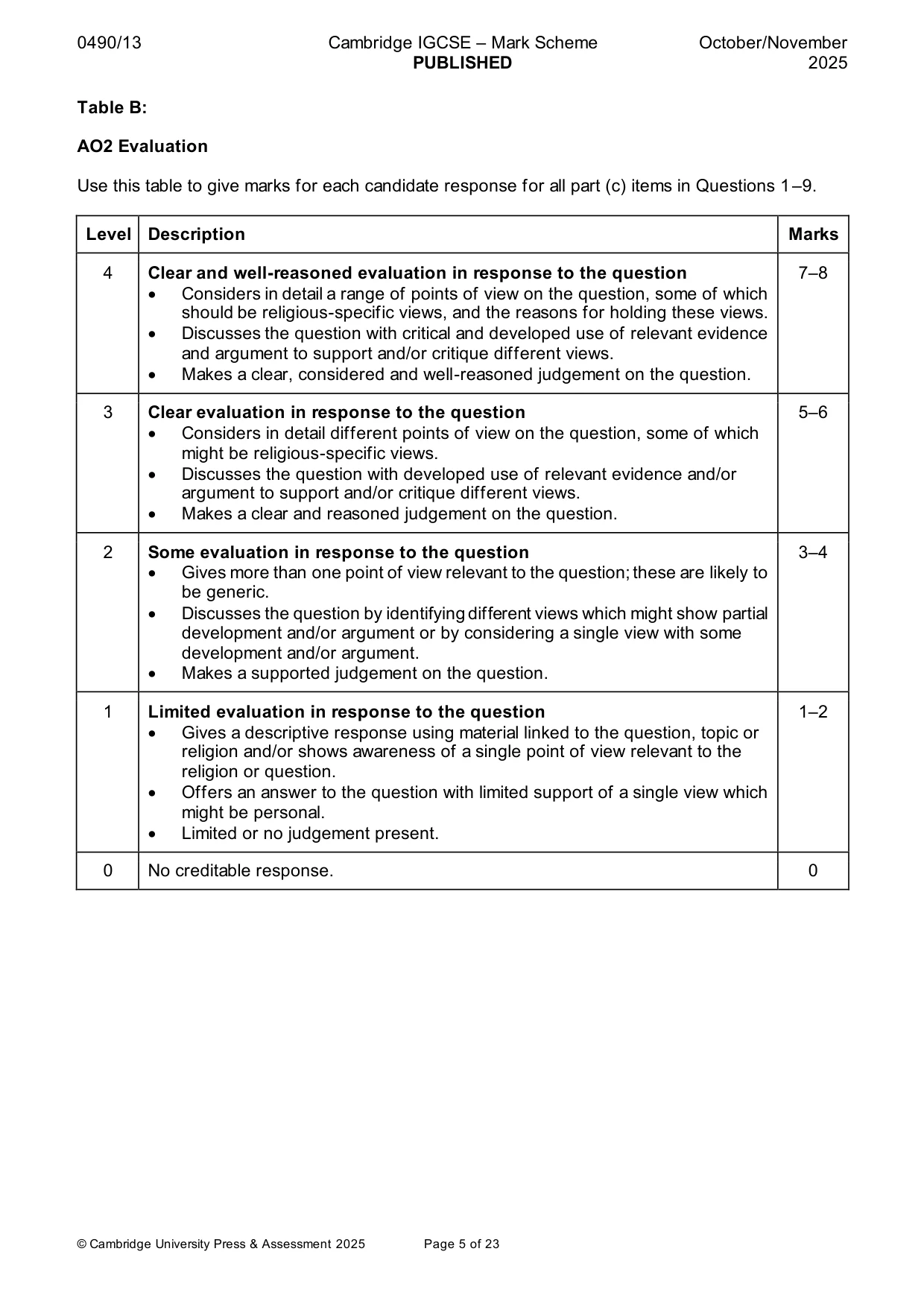
0490/13 Cambridge IGCSE – Mark Scheme PUBLISHED October/November 2025 © Cambridge University Press & Assessment 2025 Page 5 of 23 Table B: AO2 Evaluation Use this table to give marks for each candidate response for all part (c) items in Questions 1–9. Level Description Marks 4 Clear and well-reasoned evaluation in response to the question • Considers in detail a range of points of view on the question, some of which should be religious-specific views, and the reasons for holding these views. • Discusses the question with critical and developed use of relevant evidence and argument to support and/or critique different views. • Makes a clear, considered and well-reasoned judgement on the question. 7–8 3 Clear evaluation in response to the question • Considers in detail different points of view on the question, some of which might be religious-specific views. • Discusses the question with developed use of relevant evidence and/or argument to support and/or critique different views. • Makes a clear and reasoned judgement on the question. 5–6 2 Some evaluation in response to the question • Gives more than one point of view relevant to the question; these are likely to be generic. • Discusses the question by identifying different views which might show partial development and/or argument or by considering a single view with some development and/or argument. • Makes a supported judgement on the question. 3–4 1 Limited evaluation in response to the question • Gives a descriptive response using material linked to the question, topic or religion and/or shows awareness of a single point of view relevant to the religion or question. • Offers an answer to the question with limited support of a single view which might be personal. • Limited or no judgement present. 1–2 0 No creditable response. 0
Mark scheme, page 6
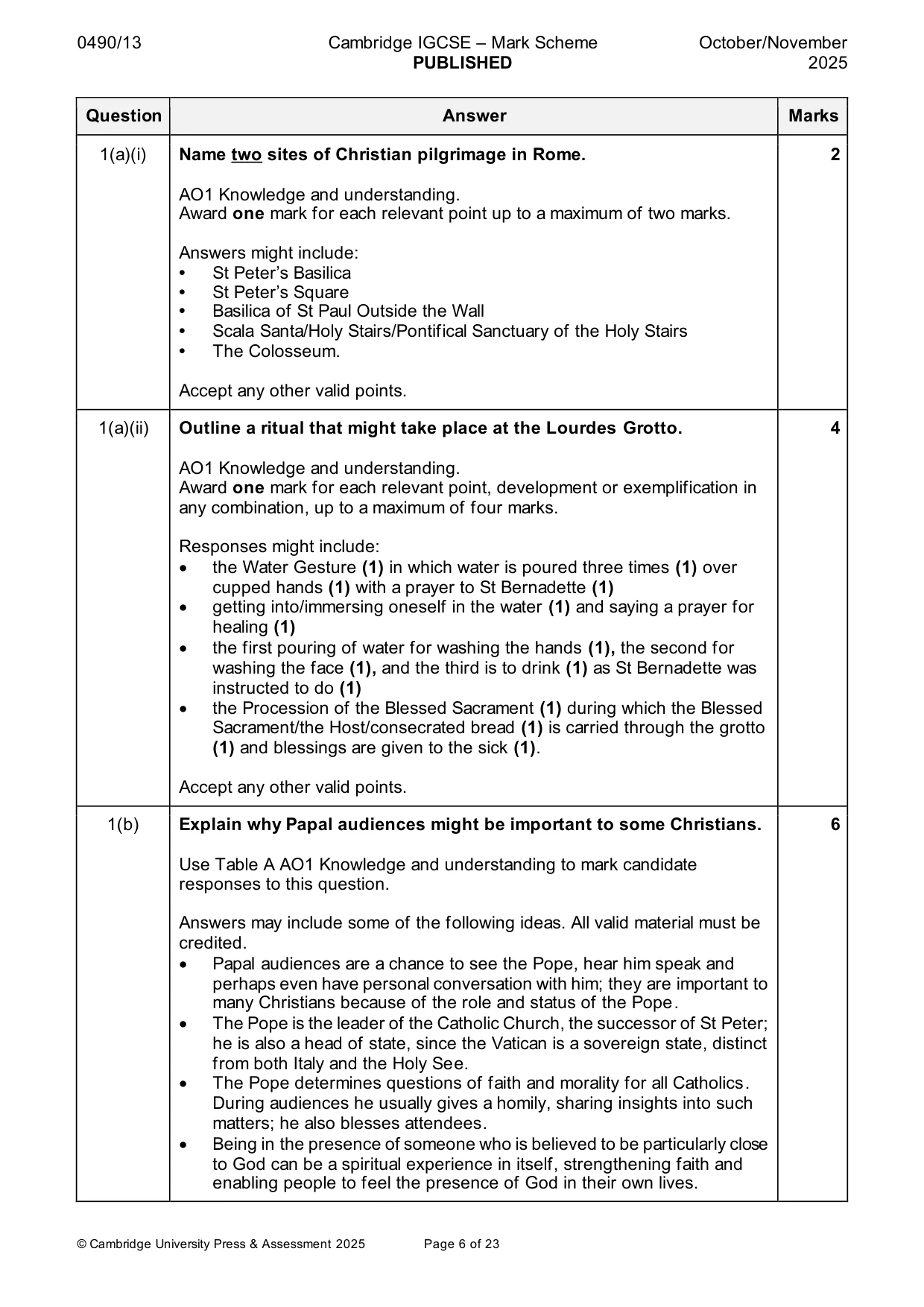
0490/13 Cambridge IGCSE – Mark Scheme PUBLISHED October/November 2025 © Cambridge University Press & Assessment 2025 Page 6 of 23 Question Answer Marks 1(a)(i) Name two sites of Christian pilgrimage in Rome. AO1 Knowledge and understanding. Award one mark for each relevant point up to a maximum of two marks. Answers might include: • St Peter’s Basilica • St Peter’s Square • Basilica of St Paul Outside the Wall • Scala Santa/Holy Stairs/Pontifical Sanctuary of the Holy Stairs • The Colosseum. Accept any other valid points. 2 1(a)(ii) Outline a ritual that might take place at the Lourdes Grotto. AO1 Knowledge and understanding. Award one mark for each relevant point, development or exemplification in any combination, up to a maximum of four marks. Responses might include: • the Water Gesture (1) in which water is poured three times (1) over cupped hands (1) with a prayer to St Bernadette (1) • getting into/immersing oneself in the water (1) and saying a prayer for healing (1) • the first pouring of water for washing the hands (1), the second for washing the face (1), and the third is to drink (1) as St Bernadette was instructed to do (1) • the Procession of the Blessed Sacrament (1) during which the Blessed Sacrament/the Host/consecrated bread (1) is carried through the grotto (1) and blessings are given to the sick (1). Accept any other valid points. 4 1(b) Explain why Papal audiences might be important to some Christians. Use Table A AO1 Knowledge and understanding to mark candidate responses to this question. Answers may include some of the following ideas. All valid material must be credited. • Papal audiences are a chance to see the Pope, hear him speak and perhaps even have personal conversation with him; they are important to many Christians because of the role and status of the Pope. • The Pope is the leader of the Catholic Church, the successor of St Peter; he is also a head of state, since the Vatican is a sovereign state, distinct from both Italy and the Holy See. • The Pope determines questions of faith and morality for all Catholics. During audiences he usually gives a homily, sharing insights into such matters; he also blesses attendees. • Being in the presence of someone who is believed to be particularly close to God can be a spiritual experience in itself, strengthening faith and enabling people to feel the presence of God in their own lives. 6
Mark scheme, page 7
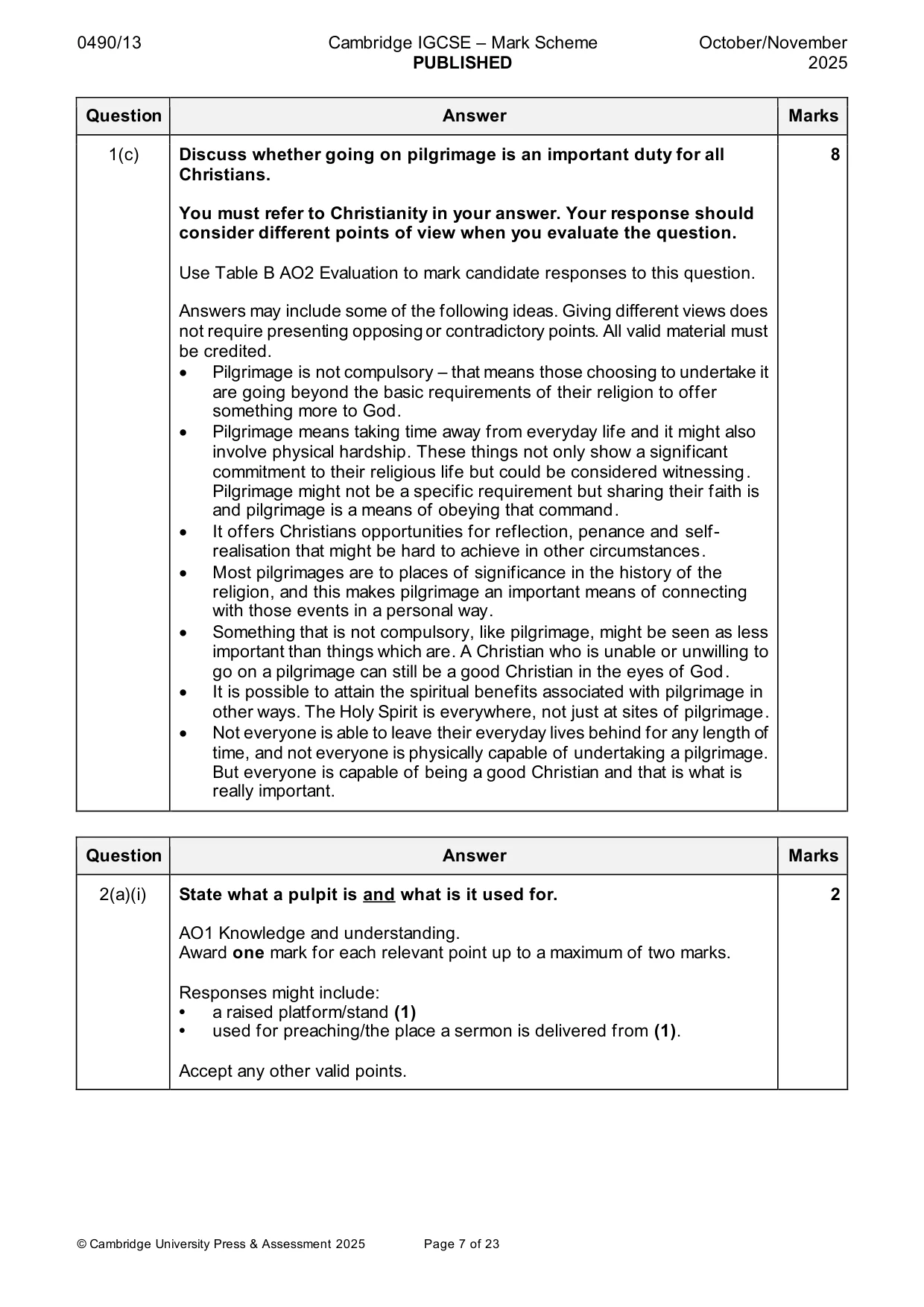
0490/13 Cambridge IGCSE – Mark Scheme PUBLISHED October/November 2025 © Cambridge University Press & Assessment 2025 Page 7 of 23 Question Answer Marks 1(c) Discuss whether going on pilgrimage is an important duty for all Christians. You must refer to Christianity in your answer. Your response should consider different points of view when you evaluate the question. Use Table B AO2 Evaluation to mark candidate responses to this question. Answers may include some of the following ideas. Giving different views does not require presenting opposing or contradictory points. All valid material must be credited. • Pilgrimage is not compulsory – that means those choosing to undertake it are going beyond the basic requirements of their religion to offer something more to God. • Pilgrimage means taking time away from everyday life and it might also involve physical hardship. These things not only show a significant commitment to their religious life but could be considered witnessing. Pilgrimage might not be a specific requirement but sharing their faith is and pilgrimage is a means of obeying that command. • It offers Christians opportunities for reflection, penance and self- realisation that might be hard to achieve in other circumstances. • Most pilgrimages are to places of significance in the history of the religion, and this makes pilgrimage an important means of connecting with those events in a personal way. • Something that is not compulsory, like pilgrimage, might be seen as less important than things which are. A Christian who is unable or unwilling to go on a pilgrimage can still be a good Christian in the eyes of God. • It is possible to attain the spiritual benefits associated with pilgrimage in other ways. The Holy Spirit is everywhere, not just at sites of pilgrimage. • Not everyone is able to leave their everyday lives behind for any length of time, and not everyone is physically capable of undertaking a pilgrimage. But everyone is capable of being a good Christian and that is what is really important. 8 Question Answer Marks 2(a)(i) State what a pulpit is and what is it used for. AO1 Knowledge and understanding. Award one mark for each relevant point up to a maximum of two marks. Responses might include: • a raised platform/stand (1) • used for preaching/the place a sermon is delivered from (1). Accept any other valid points. 2
Mark scheme, page 8
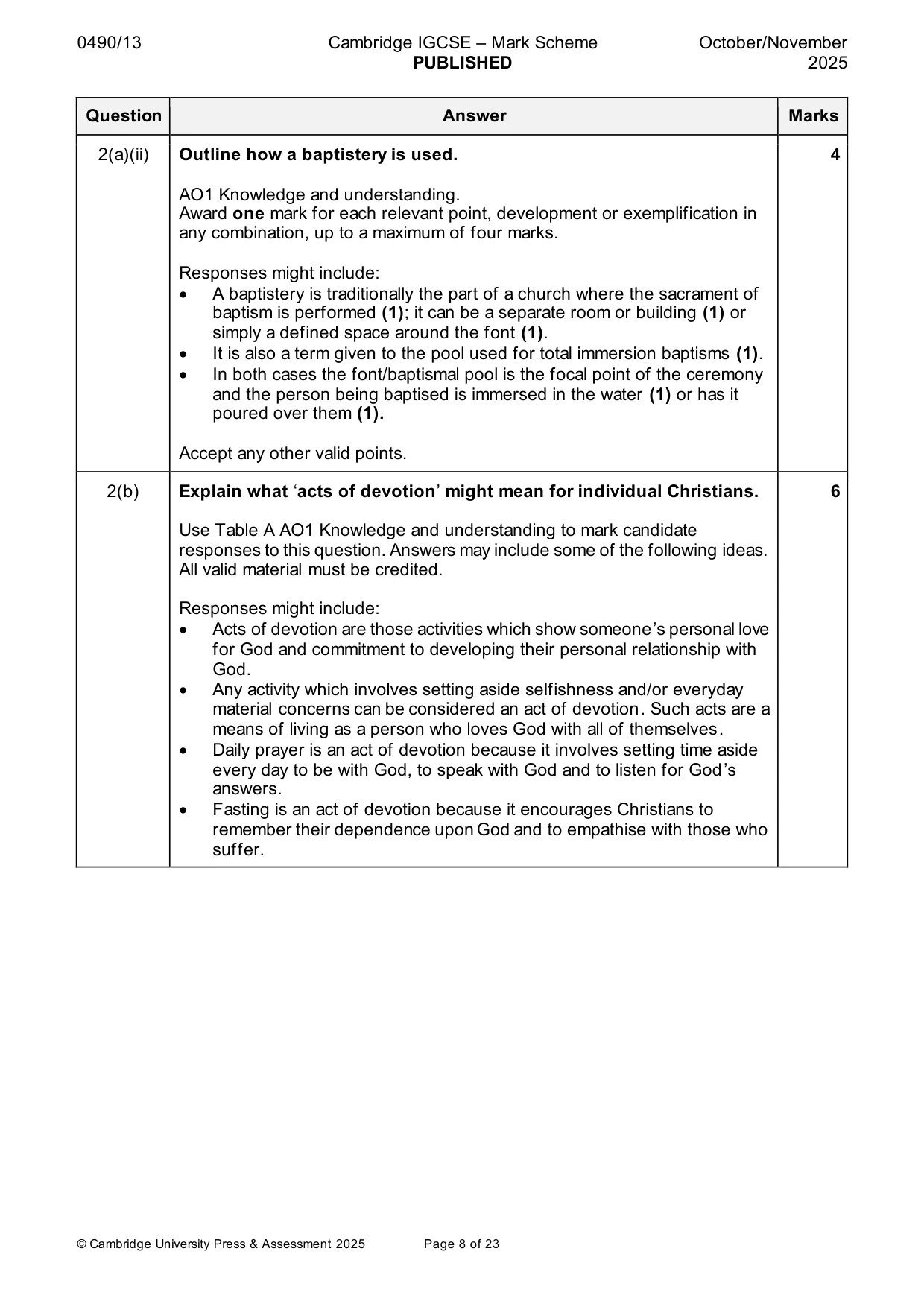
0490/13 Cambridge IGCSE – Mark Scheme PUBLISHED October/November 2025 © Cambridge University Press & Assessment 2025 Page 8 of 23 Question Answer Marks 2(a)(ii) Outline how a baptistery is used. AO1 Knowledge and understanding. Award one mark for each relevant point, development or exemplification in any combination, up to a maximum of four marks. Responses might include: • A baptistery is traditionally the part of a church where the sacrament of baptism is performed (1); it can be a separate room or building (1) or simply a defined space around the font (1). • It is also a term given to the pool used for total immersion baptisms (1). • In both cases the font/baptismal pool is the focal point of the ceremony and the person being baptised is immersed in the water (1) or has it poured over them (1). Accept any other valid points. 4 2(b) Explain what ‘acts of devotion’ might mean for individual Christians. Use Table A AO1 Knowledge and understanding to mark candidate responses to this question. Answers may include some of the following ideas. All valid material must be credited. Responses might include: • Acts of devotion are those activities which show someone’s personal love for God and commitment to developing their personal relationship with God. • Any activity which involves setting aside selfishness and/or everyday material concerns can be considered an act of devotion. Such acts are a means of living as a person who loves God with all of themselves. • Daily prayer is an act of devotion because it involves setting time aside every day to be with God, to speak with God and to listen for God’s answers. • Fasting is an act of devotion because it encourages Christians to remember their dependence upon God and to empathise with those who suffer. 6
Mark scheme, page 9
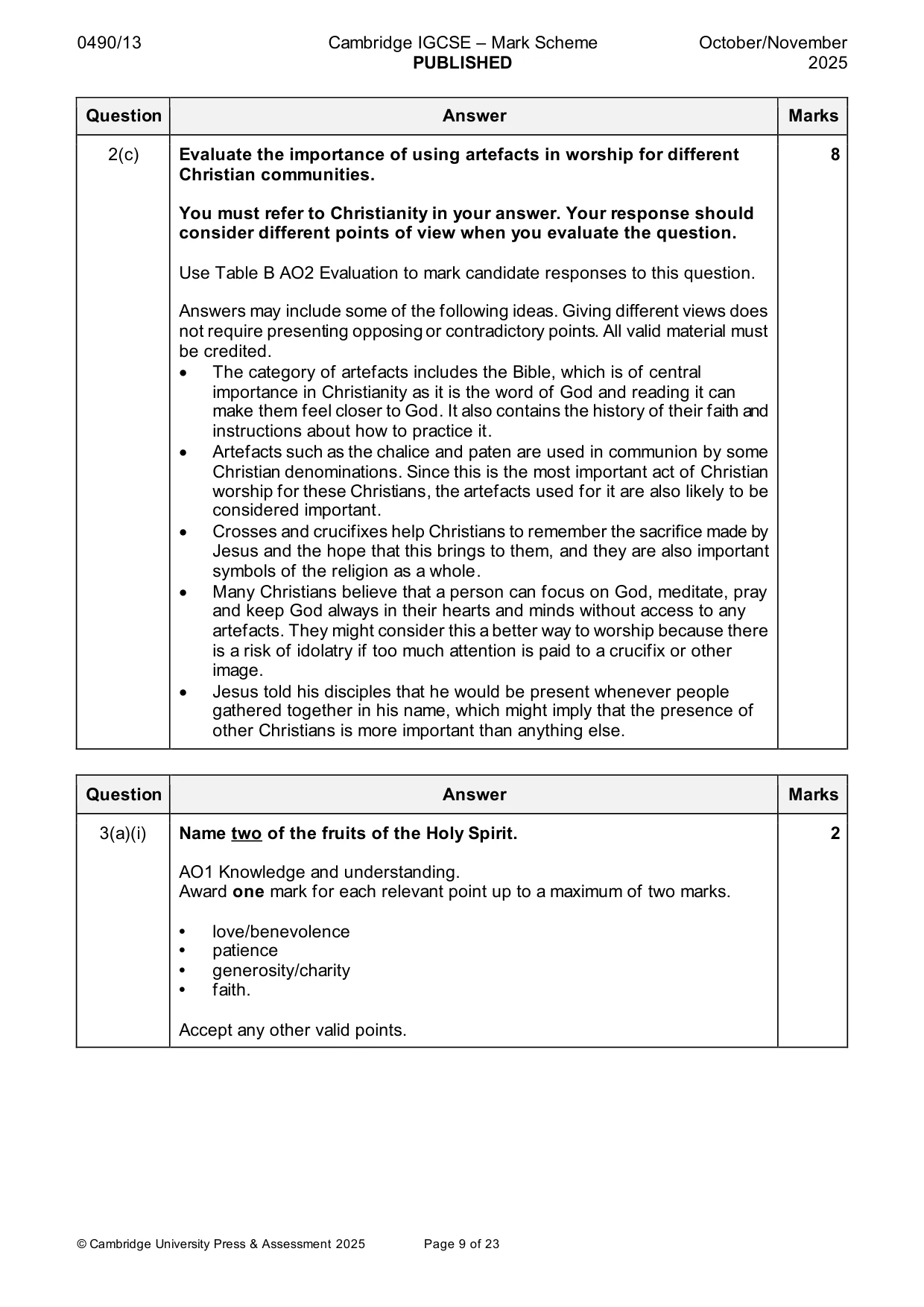
0490/13 Cambridge IGCSE – Mark Scheme PUBLISHED October/November 2025 © Cambridge University Press & Assessment 2025 Page 9 of 23 Question Answer Marks 2(c) Evaluate the importance of using artefacts in worship for different Christian communities. You must refer to Christianity in your answer. Your response should consider different points of view when you evaluate the question. Use Table B AO2 Evaluation to mark candidate responses to this question. Answers may include some of the following ideas. Giving different views does not require presenting opposing or contradictory points. All valid material must be credited. • The category of artefacts includes the Bible, which is of central importance in Christianity as it is the word of God and reading it can make them feel closer to God. It also contains the history of their faith and instructions about how to practice it. • Artefacts such as the chalice and paten are used in communion by some Christian denominations. Since this is the most important act of Christian worship for these Christians, the artefacts used for it are also likely to be considered important. • Crosses and crucifixes help Christians to remember the sacrifice made by Jesus and the hope that this brings to them, and they are also important symbols of the religion as a whole. • Many Christians believe that a person can focus on God, meditate, pray and keep God always in their hearts and minds without access to any artefacts. They might consider this a better way to worship because there is a risk of idolatry if too much attention is paid to a crucifix or other image. • Jesus told his disciples that he would be present whenever people gathered together in his name, which might imply that the presence of other Christians is more important than anything else. 8 Question Answer Marks 3(a)(i) Name two of the fruits of the Holy Spirit. AO1 Knowledge and understanding. Award one mark for each relevant point up to a maximum of two marks. • love/benevolence • patience • generosity/charity • faith. Accept any other valid points. 2
Mark scheme, page 10
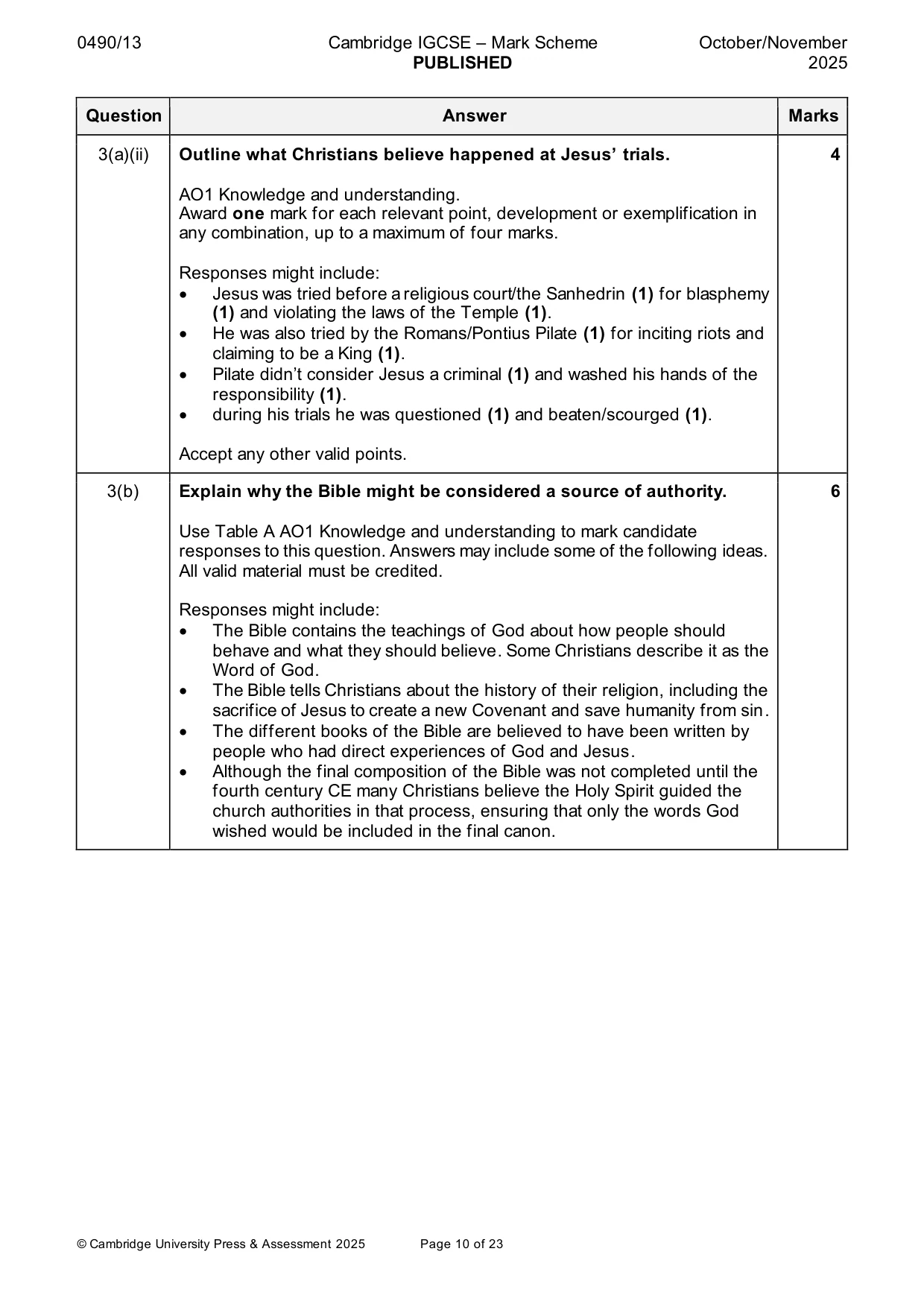
0490/13 Cambridge IGCSE – Mark Scheme PUBLISHED October/November 2025 © Cambridge University Press & Assessment 2025 Page 10 of 23 Question Answer Marks 3(a)(ii) Outline what Christians believe happened at Jesus’ trials. AO1 Knowledge and understanding. Award one mark for each relevant point, development or exemplification in any combination, up to a maximum of four marks. Responses might include: • Jesus was tried before a religious court/the Sanhedrin (1) for blasphemy (1) and violating the laws of the Temple (1). • He was also tried by the Romans/Pontius Pilate (1) for inciting riots and claiming to be a King (1). • Pilate didn’t consider Jesus a criminal (1) and washed his hands of the responsibility (1). • during his trials he was questioned (1) and beaten/scourged (1). Accept any other valid points. 4 3(b) Explain why the Bible might be considered a source of authority. Use Table A AO1 Knowledge and understanding to mark candidate responses to this question. Answers may include some of the following ideas. All valid material must be credited. Responses might include: • The Bible contains the teachings of God about how people should behave and what they should believe. Some Christians describe it as the Word of God. • The Bible tells Christians about the history of their religion, including the sacrifice of Jesus to create a new Covenant and save humanity from sin. • The different books of the Bible are believed to have been written by people who had direct experiences of God and Jesus. • Although the final composition of the Bible was not completed until the fourth century CE many Christians believe the Holy Spirit guided the church authorities in that process, ensuring that only the words God wished would be included in the final canon. 6
Mark scheme, page 11
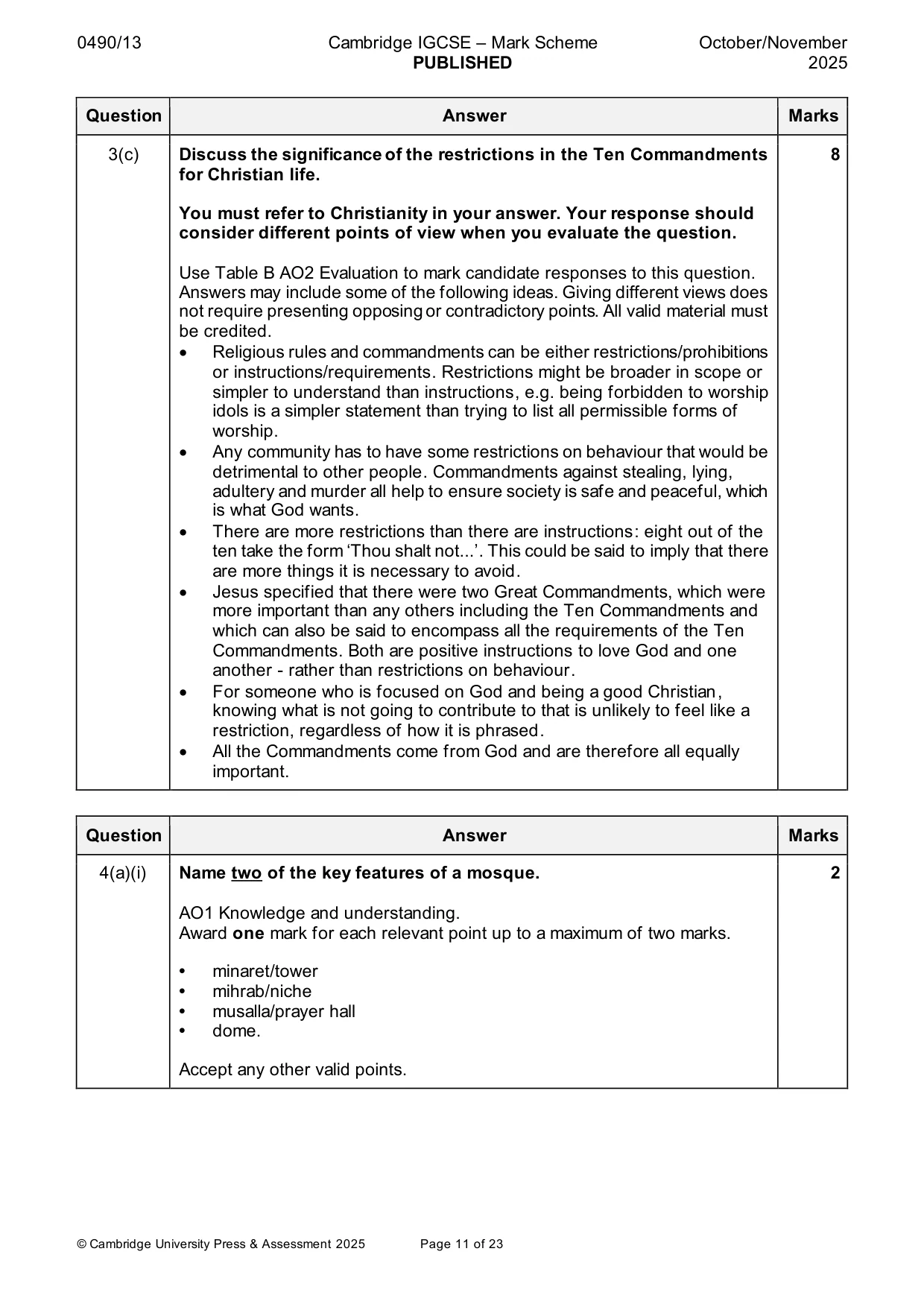
0490/13 Cambridge IGCSE – Mark Scheme PUBLISHED October/November 2025 © Cambridge University Press & Assessment 2025 Page 11 of 23 Question Answer Marks 3(c) Discuss the significance of the restrictions in the Ten Commandments for Christian life. You must refer to Christianity in your answer. Your response should consider different points of view when you evaluate the question. Use Table B AO2 Evaluation to mark candidate responses to this question. Answers may include some of the following ideas. Giving different views does not require presenting opposing or contradictory points. All valid material must be credited. • Religious rules and commandments can be either restrictions/prohibitions or instructions/requirements. Restrictions might be broader in scope or simpler to understand than instructions, e.g. being forbidden to worship idols is a simpler statement than trying to list all permissible forms of worship. • Any community has to have some restrictions on behaviour that would be detrimental to other people. Commandments against stealing, lying, adultery and murder all help to ensure society is safe and peaceful, which is what God wants. • There are more restrictions than there are instructions: eight out of the ten take the form ‘Thou shalt not...’. This could be said to imply that there are more things it is necessary to avoid. • Jesus specified that there were two Great Commandments, which were more important than any others including the Ten Commandments and which can also be said to encompass all the requirements of the Ten Commandments. Both are positive instructions to love God and one another - rather than restrictions on behaviour. • For someone who is focused on God and being a good Christian, knowing what is not going to contribute to that is unlikely to feel like a restriction, regardless of how it is phrased. • All the Commandments come from God and are therefore all equally important. 8 Question Answer Marks 4(a)(i) Name two of the key features of a mosque. AO1 Knowledge and understanding. Award one mark for each relevant point up to a maximum of two marks. • minaret/tower • mihrab/niche • musalla/prayer hall • dome. Accept any other valid points. 2
Mark scheme, page 12
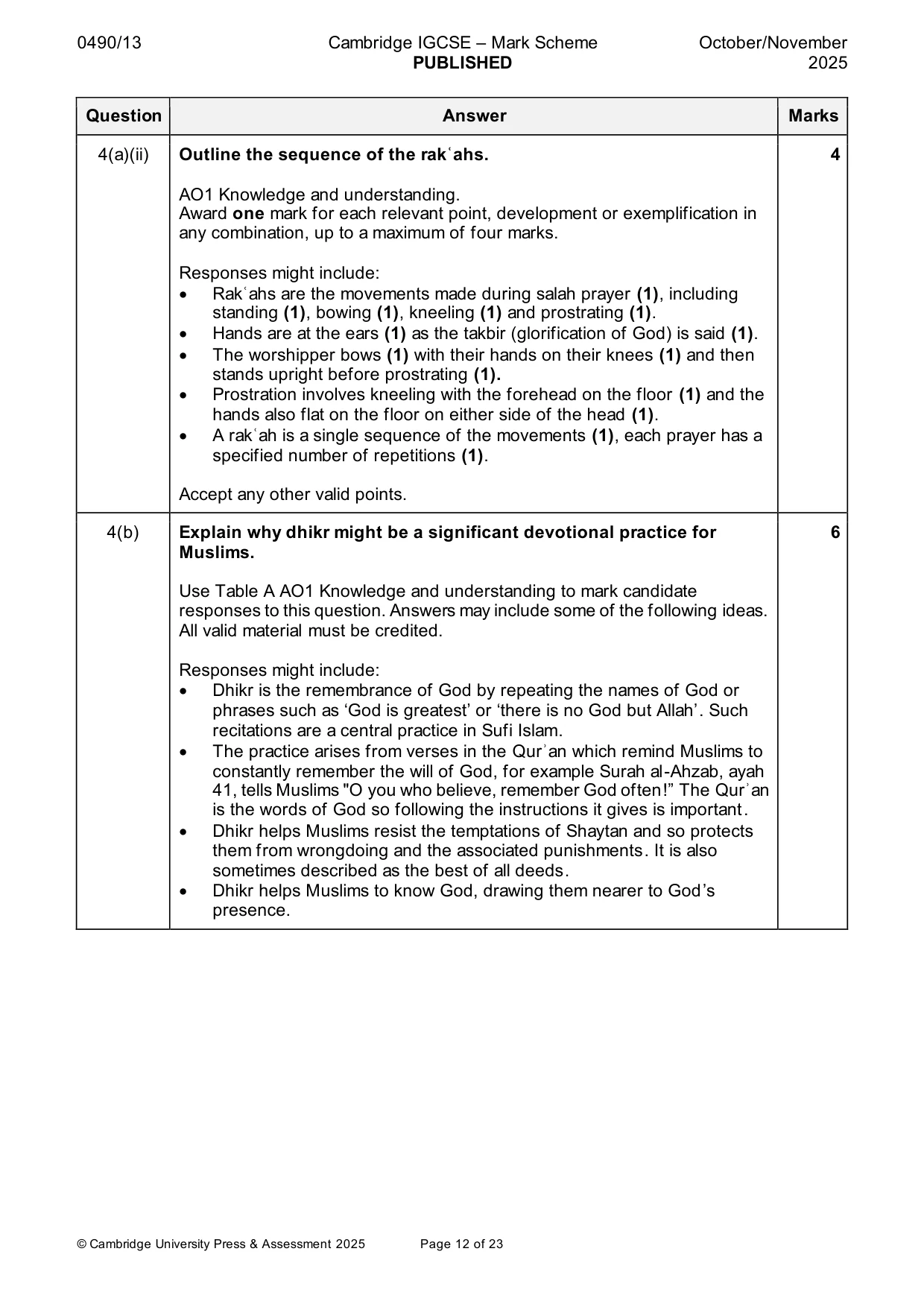
0490/13 Cambridge IGCSE – Mark Scheme PUBLISHED October/November 2025 © Cambridge University Press & Assessment 2025 Page 12 of 23 Question Answer Marks 4(a)(ii) Outline the sequence of the rakʿahs. AO1 Knowledge and understanding. Award one mark for each relevant point, development or exemplification in any combination, up to a maximum of four marks. Responses might include: • Rakʿahs are the movements made during salah prayer (1), including standing (1), bowing (1), kneeling (1) and prostrating (1). • Hands are at the ears (1) as the takbir (glorification of God) is said (1). • The worshipper bows (1) with their hands on their knees (1) and then stands upright before prostrating (1). • Prostration involves kneeling with the forehead on the floor (1) and the hands also flat on the floor on either side of the head (1). • A rakʿah is a single sequence of the movements (1), each prayer has a specified number of repetitions (1). Accept any other valid points. 4 4(b) Explain why dhikr might be a significant devotional practice for Muslims. Use Table A AO1 Knowledge and understanding to mark candidate responses to this question. Answers may include some of the following ideas. All valid material must be credited. Responses might include: • Dhikr is the remembrance of God by repeating the names of God or phrases such as ‘God is greatest’ or ‘there is no God but Allah’. Such recitations are a central practice in Sufi Islam. • The practice arises from verses in the Qurʾan which remind Muslims to constantly remember the will of God, for example Surah al-Ahzab, ayah 41, tells Muslims "O you who believe, remember God often!” The Qurʾan is the words of God so following the instructions it gives is important. • Dhikr helps Muslims resist the temptations of Shaytan and so protects them from wrongdoing and the associated punishments. It is also sometimes described as the best of all deeds. • Dhikr helps Muslims to know God, drawing them nearer to God’s presence. 6
Mark scheme, page 13
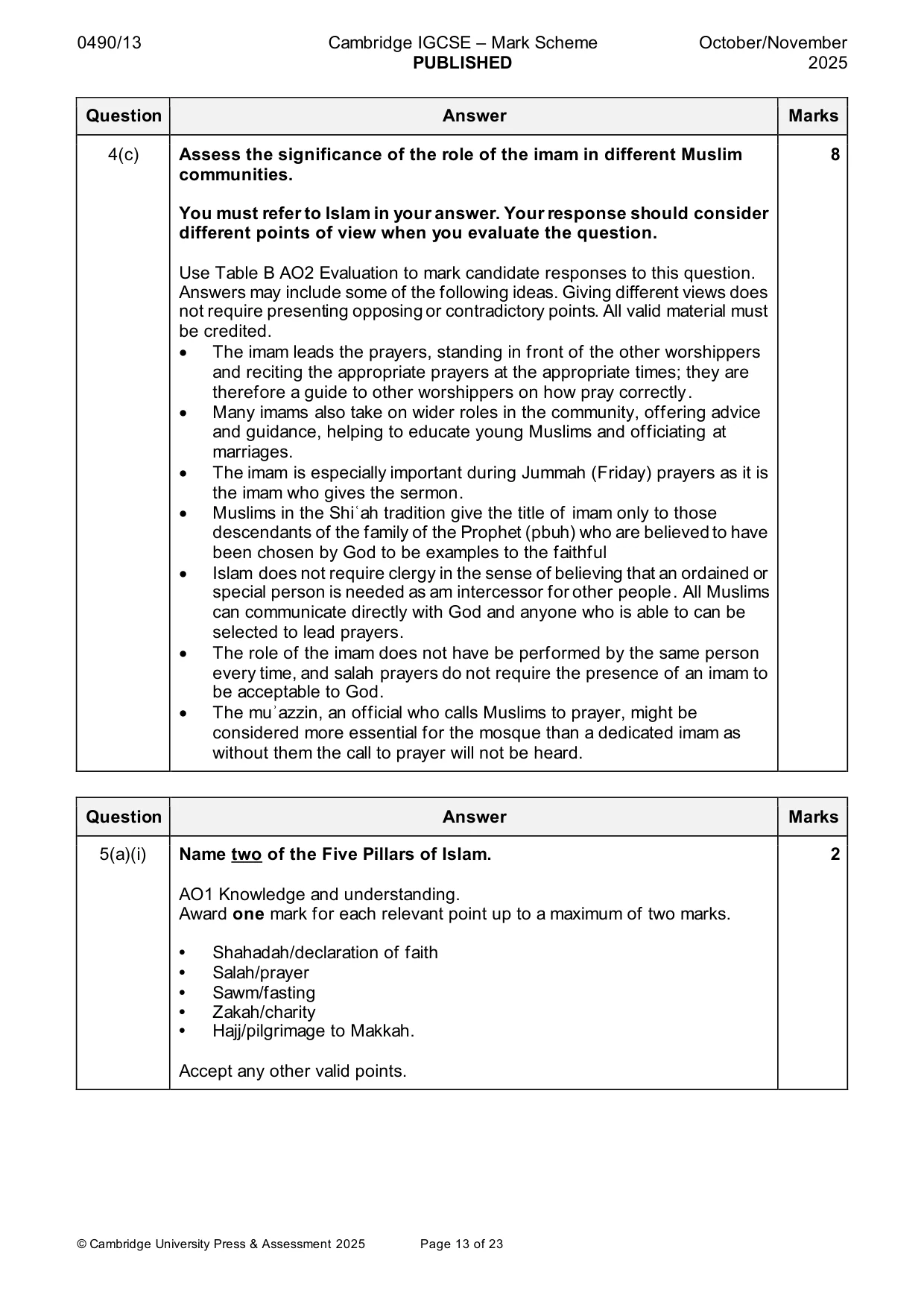
0490/13 Cambridge IGCSE – Mark Scheme PUBLISHED October/November 2025 © Cambridge University Press & Assessment 2025 Page 13 of 23 Question Answer Marks 4(c) Assess the significance of the role of the imam in different Muslim communities. You must refer to Islam in your answer. Your response should consider different points of view when you evaluate the question. Use Table B AO2 Evaluation to mark candidate responses to this question. Answers may include some of the following ideas. Giving different views does not require presenting opposing or contradictory points. All valid material must be credited. • The imam leads the prayers, standing in front of the other worshippers and reciting the appropriate prayers at the appropriate times; they are therefore a guide to other worshippers on how pray correctly. • Many imams also take on wider roles in the community, offering advice and guidance, helping to educate young Muslims and officiating at marriages. • The imam is especially important during Jummah (Friday) prayers as it is the imam who gives the sermon. • Muslims in the Shiʿah tradition give the title of imam only to those descendants of the family of the Prophet (pbuh) who are believed to have been chosen by God to be examples to the faithful • Islam does not require clergy in the sense of believing that an ordained or special person is needed as am intercessor for other people. All Muslims can communicate directly with God and anyone who is able to can be selected to lead prayers. • The role of the imam does not have be performed by the same person every time, and salah prayers do not require the presence of an imam to be acceptable to God. • The muʾazzin, an official who calls Muslims to prayer, might be considered more essential for the mosque than a dedicated imam as without them the call to prayer will not be heard. 8 Question Answer Marks 5(a)(i) Name two of the Five Pillars of Islam. AO1 Knowledge and understanding. Award one mark for each relevant point up to a maximum of two marks. • Shahadah/declaration of faith • Salah/prayer • Sawm/fasting • Zakah/charity • Hajj/pilgrimage to Makkah. Accept any other valid points. 2
Mark scheme, page 14
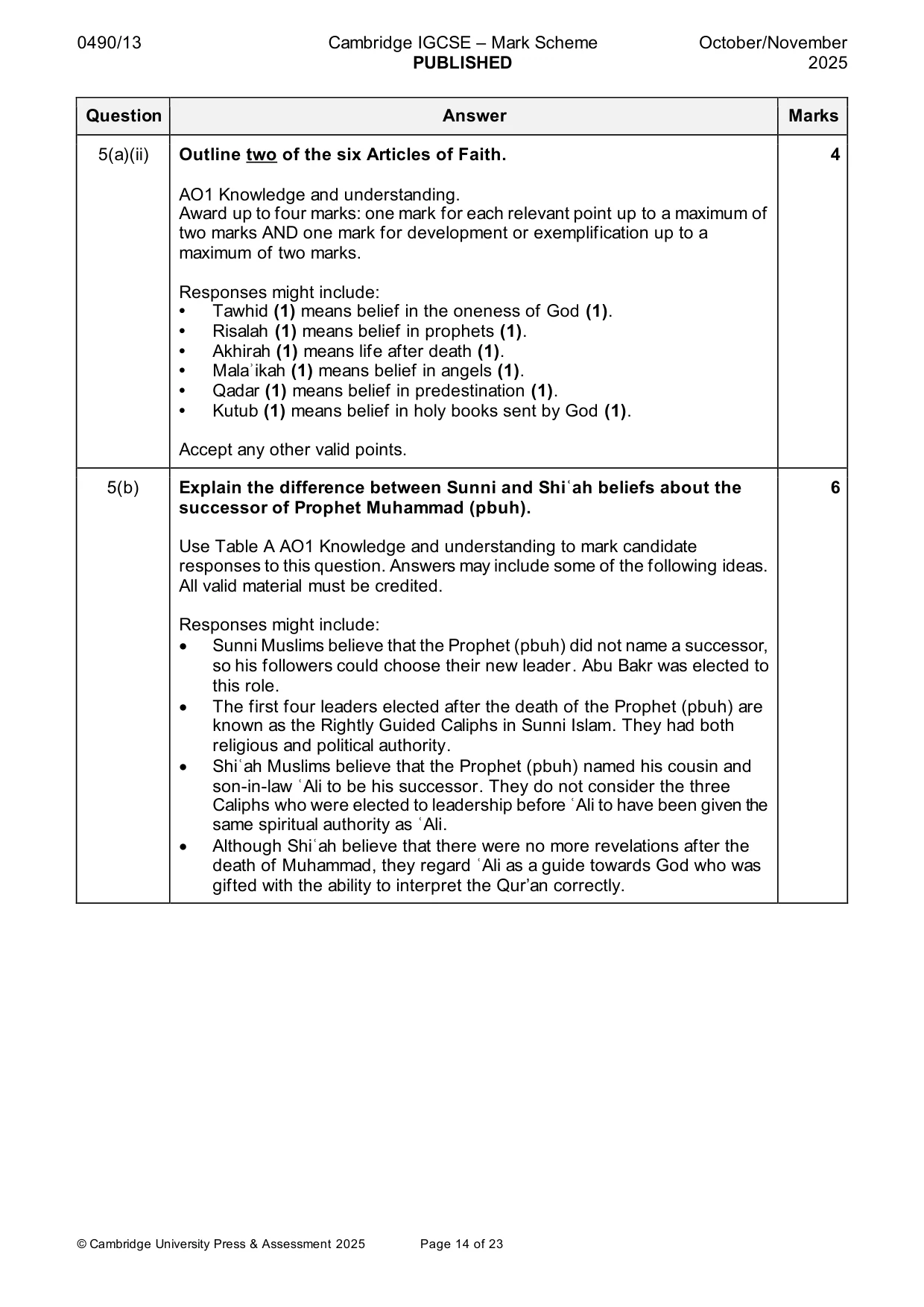
0490/13 Cambridge IGCSE – Mark Scheme PUBLISHED October/November 2025 © Cambridge University Press & Assessment 2025 Page 14 of 23 Question Answer Marks 5(a)(ii) Outline two of the six Articles of Faith. AO1 Knowledge and understanding. Award up to four marks: one mark for each relevant point up to a maximum of two marks AND one mark for development or exemplification up to a maximum of two marks. Responses might include: • Tawhid (1) means belief in the oneness of God (1). • Risalah (1) means belief in prophets (1). • Akhirah (1) means life after death (1). • Malaʾikah (1) means belief in angels (1). • Qadar (1) means belief in predestination (1). • Kutub (1) means belief in holy books sent by God (1). Accept any other valid points. 4 5(b) Explain the difference between Sunni and Shiʿah beliefs about the successor of Prophet Muhammad (pbuh). Use Table A AO1 Knowledge and understanding to mark candidate responses to this question. Answers may include some of the following ideas. All valid material must be credited. Responses might include: • Sunni Muslims believe that the Prophet (pbuh) did not name a successor, so his followers could choose their new leader. Abu Bakr was elected to this role. • The first four leaders elected after the death of the Prophet (pbuh) are known as the Rightly Guided Caliphs in Sunni Islam. They had both religious and political authority. • Shiʿah Muslims believe that the Prophet (pbuh) named his cousin and son-in-law ʿAli to be his successor. They do not consider the three Caliphs who were elected to leadership before ʿAli to have been given the same spiritual authority as ʿAli. • Although Shiʿah believe that there were no more revelations after the death of Muhammad, they regard ʿAli as a guide towards God who was gifted with the ability to interpret the Qur’an correctly. 6
Mark scheme, page 15
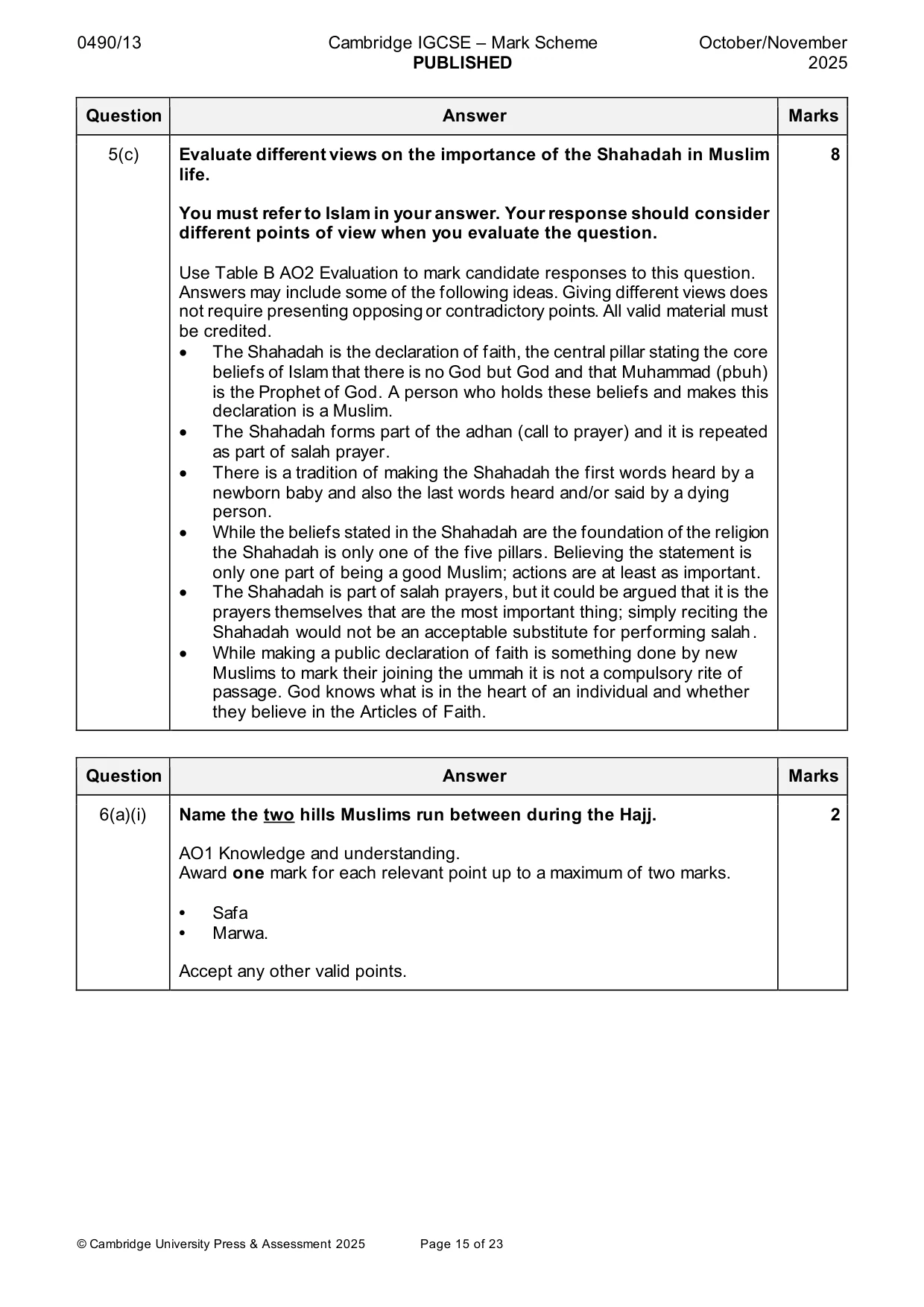
0490/13 Cambridge IGCSE – Mark Scheme PUBLISHED October/November 2025 © Cambridge University Press & Assessment 2025 Page 15 of 23 Question Answer Marks 5(c) Evaluate different views on the importance of the Shahadah in Muslim life. You must refer to Islam in your answer. Your response should consider different points of view when you evaluate the question. Use Table B AO2 Evaluation to mark candidate responses to this question. Answers may include some of the following ideas. Giving different views does not require presenting opposing or contradictory points. All valid material must be credited. • The Shahadah is the declaration of faith, the central pillar stating the core beliefs of Islam that there is no God but God and that Muhammad (pbuh) is the Prophet of God. A person who holds these beliefs and makes this declaration is a Muslim. • The Shahadah forms part of the adhan (call to prayer) and it is repeated as part of salah prayer. • There is a tradition of making the Shahadah the first words heard by a newborn baby and also the last words heard and/or said by a dying person. • While the beliefs stated in the Shahadah are the foundation of the religion the Shahadah is only one of the five pillars. Believing the statement is only one part of being a good Muslim; actions are at least as important. • The Shahadah is part of salah prayers, but it could be argued that it is the prayers themselves that are the most important thing; simply reciting the Shahadah would not be an acceptable substitute for performing salah. • While making a public declaration of faith is something done by new Muslims to mark their joining the ummah it is not a compulsory rite of passage. God knows what is in the heart of an individual and whether they believe in the Articles of Faith. 8 Question Answer Marks 6(a)(i) Name the two hills Muslims run between during the Hajj. AO1 Knowledge and understanding. Award one mark for each relevant point up to a maximum of two marks. • Safa • Marwa. Accept any other valid points. 2
Mark scheme, page 16
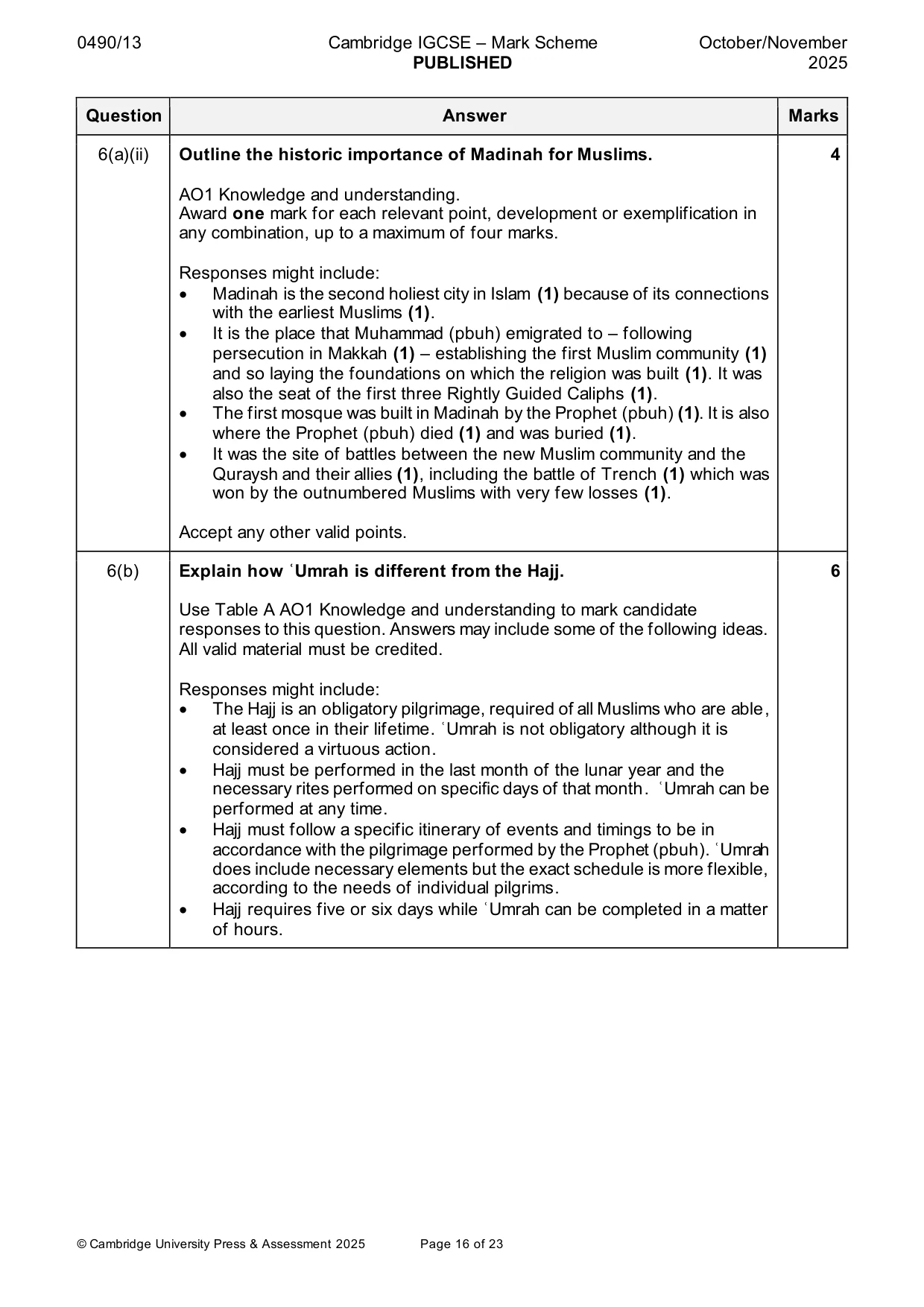
0490/13 Cambridge IGCSE – Mark Scheme PUBLISHED October/November 2025 © Cambridge University Press & Assessment 2025 Page 16 of 23 Question Answer Marks 6(a)(ii) Outline the historic importance of Madinah for Muslims. AO1 Knowledge and understanding. Award one mark for each relevant point, development or exemplification in any combination, up to a maximum of four marks. Responses might include: • Madinah is the second holiest city in Islam (1) because of its connections with the earliest Muslims (1). • It is the place that Muhammad (pbuh) emigrated to – following persecution in Makkah (1) – establishing the first Muslim community (1) and so laying the foundations on which the religion was built (1). It was also the seat of the first three Rightly Guided Caliphs (1). • The first mosque was built in Madinah by the Prophet (pbuh) (1). It is also where the Prophet (pbuh) died (1) and was buried (1). • It was the site of battles between the new Muslim community and the Quraysh and their allies (1), including the battle of Trench (1) which was won by the outnumbered Muslims with very few losses (1). Accept any other valid points. 4 6(b) Explain how ʿUmrah is different from the Hajj. Use Table A AO1 Knowledge and understanding to mark candidate responses to this question. Answers may include some of the following ideas. All valid material must be credited. Responses might include: • The Hajj is an obligatory pilgrimage, required of all Muslims who are able, at least once in their lifetime. ʿUmrah is not obligatory although it is considered a virtuous action. • Hajj must be performed in the last month of the lunar year and the necessary rites performed on specific days of that month. ʿUmrah can be performed at any time. • Hajj must follow a specific itinerary of events and timings to be in accordance with the pilgrimage performed by the Prophet (pbuh). ʿUmrah does include necessary elements but the exact schedule is more flexible, according to the needs of individual pilgrims. • Hajj requires five or six days while ʿUmrah can be completed in a matter of hours. 6
Mark scheme, page 17
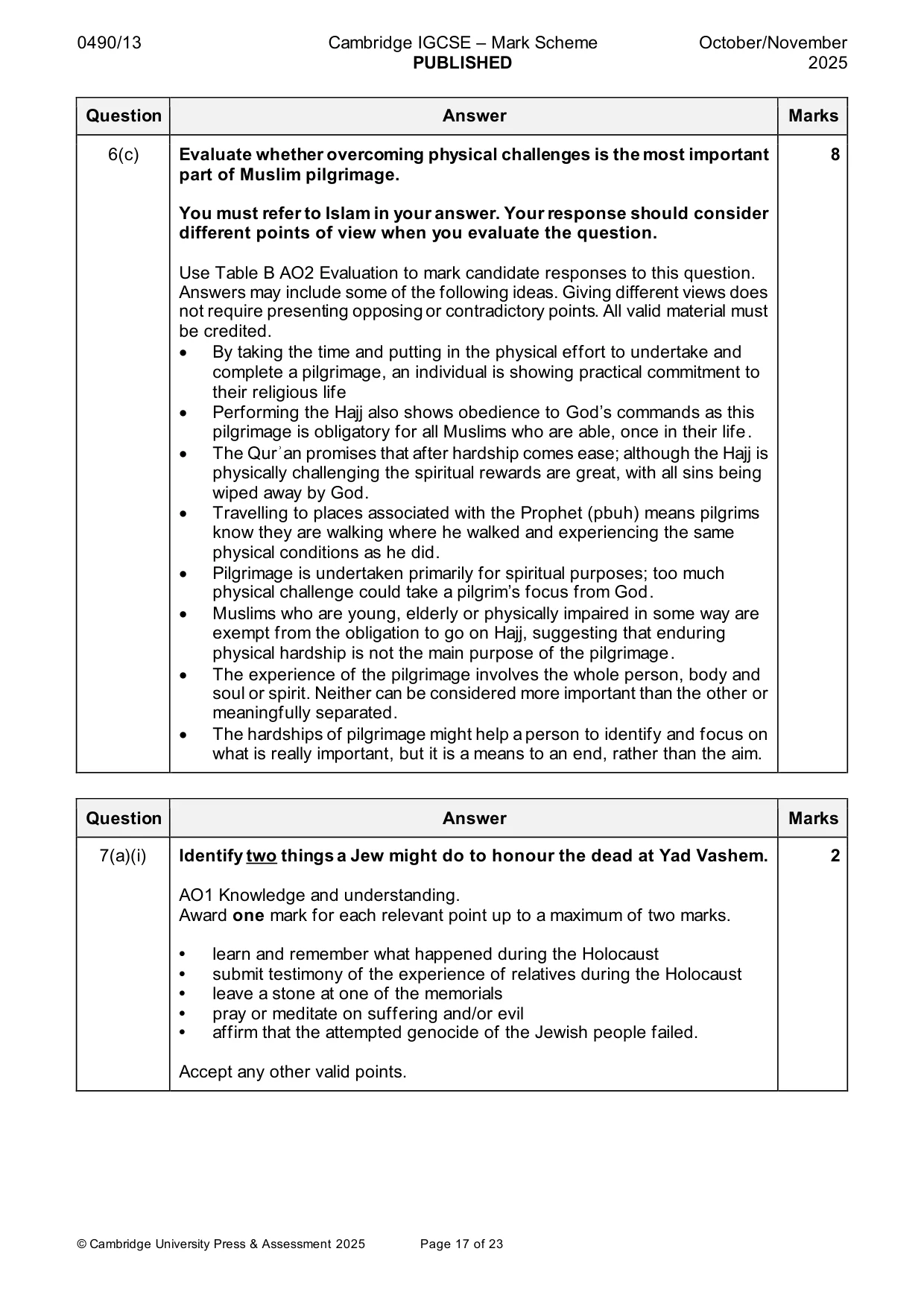
0490/13 Cambridge IGCSE – Mark Scheme PUBLISHED October/November 2025 © Cambridge University Press & Assessment 2025 Page 17 of 23 Question Answer Marks 6(c) Evaluate whether overcoming physical challenges is the most important part of Muslim pilgrimage. You must refer to Islam in your answer. Your response should consider different points of view when you evaluate the question. Use Table B AO2 Evaluation to mark candidate responses to this question. Answers may include some of the following ideas. Giving different views does not require presenting opposing or contradictory points. All valid material must be credited. • By taking the time and putting in the physical effort to undertake and complete a pilgrimage, an individual is showing practical commitment to their religious life • Performing the Hajj also shows obedience to God’s commands as this pilgrimage is obligatory for all Muslims who are able, once in their life. • The Qurʾan promises that after hardship comes ease; although the Hajj is physically challenging the spiritual rewards are great, with all sins being wiped away by God. • Travelling to places associated with the Prophet (pbuh) means pilgrims know they are walking where he walked and experiencing the same physical conditions as he did. • Pilgrimage is undertaken primarily for spiritual purposes; too much physical challenge could take a pilgrim’s focus from God. • Muslims who are young, elderly or physically impaired in some way are exempt from the obligation to go on Hajj, suggesting that enduring physical hardship is not the main purpose of the pilgrimage. • The experience of the pilgrimage involves the whole person, body and soul or spirit. Neither can be considered more important than the other or meaningfully separated. • The hardships of pilgrimage might help a person to identify and focus on what is really important, but it is a means to an end, rather than the aim. 8 Question Answer Marks 7(a)(i) Identify two things a Jew might do to honour the dead at Yad Vashem. AO1 Knowledge and understanding. Award one mark for each relevant point up to a maximum of two marks. • learn and remember what happened during the Holocaust • submit testimony of the experience of relatives during the Holocaust • leave a stone at one of the memorials • pray or meditate on suffering and/or evil • affirm that the attempted genocide of the Jewish people failed. Accept any other valid points. 2
Mark scheme, page 18
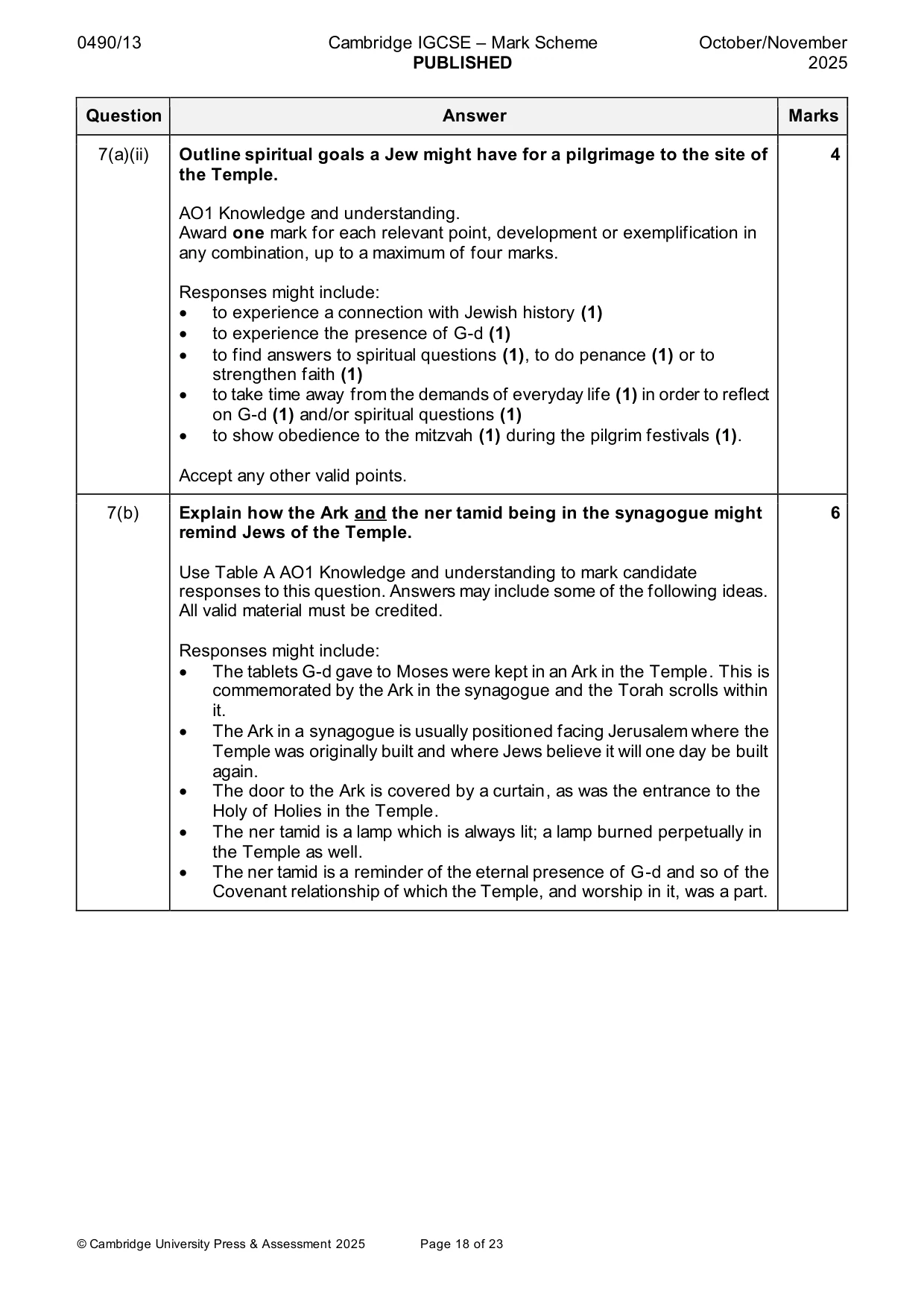
0490/13 Cambridge IGCSE – Mark Scheme PUBLISHED October/November 2025 © Cambridge University Press & Assessment 2025 Page 18 of 23 Question Answer Marks 7(a)(ii) Outline spiritual goals a Jew might have for a pilgrimage to the site of the Temple. AO1 Knowledge and understanding. Award one mark for each relevant point, development or exemplification in any combination, up to a maximum of four marks. Responses might include: • to experience a connection with Jewish history (1) • to experience the presence of G-d (1) • to find answers to spiritual questions (1), to do penance (1) or to strengthen faith (1) • to take time away from the demands of everyday life (1) in order to reflect on G-d (1) and/or spiritual questions (1) • to show obedience to the mitzvah (1) during the pilgrim festivals (1). Accept any other valid points. 4 7(b) Explain how the Ark and the ner tamid being in the synagogue might remind Jews of the Temple. Use Table A AO1 Knowledge and understanding to mark candidate responses to this question. Answers may include some of the following ideas. All valid material must be credited. Responses might include: • The tablets G-d gave to Moses were kept in an Ark in the Temple. This is commemorated by the Ark in the synagogue and the Torah scrolls within it. • The Ark in a synagogue is usually positioned facing Jerusalem where the Temple was originally built and where Jews believe it will one day be built again. • The door to the Ark is covered by a curtain, as was the entrance to the Holy of Holies in the Temple. • The ner tamid is a lamp which is always lit; a lamp burned perpetually in the Temple as well. • The ner tamid is a reminder of the eternal presence of G-d and so of the Covenant relationship of which the Temple, and worship in it, was a part. 6
Mark scheme, page 19
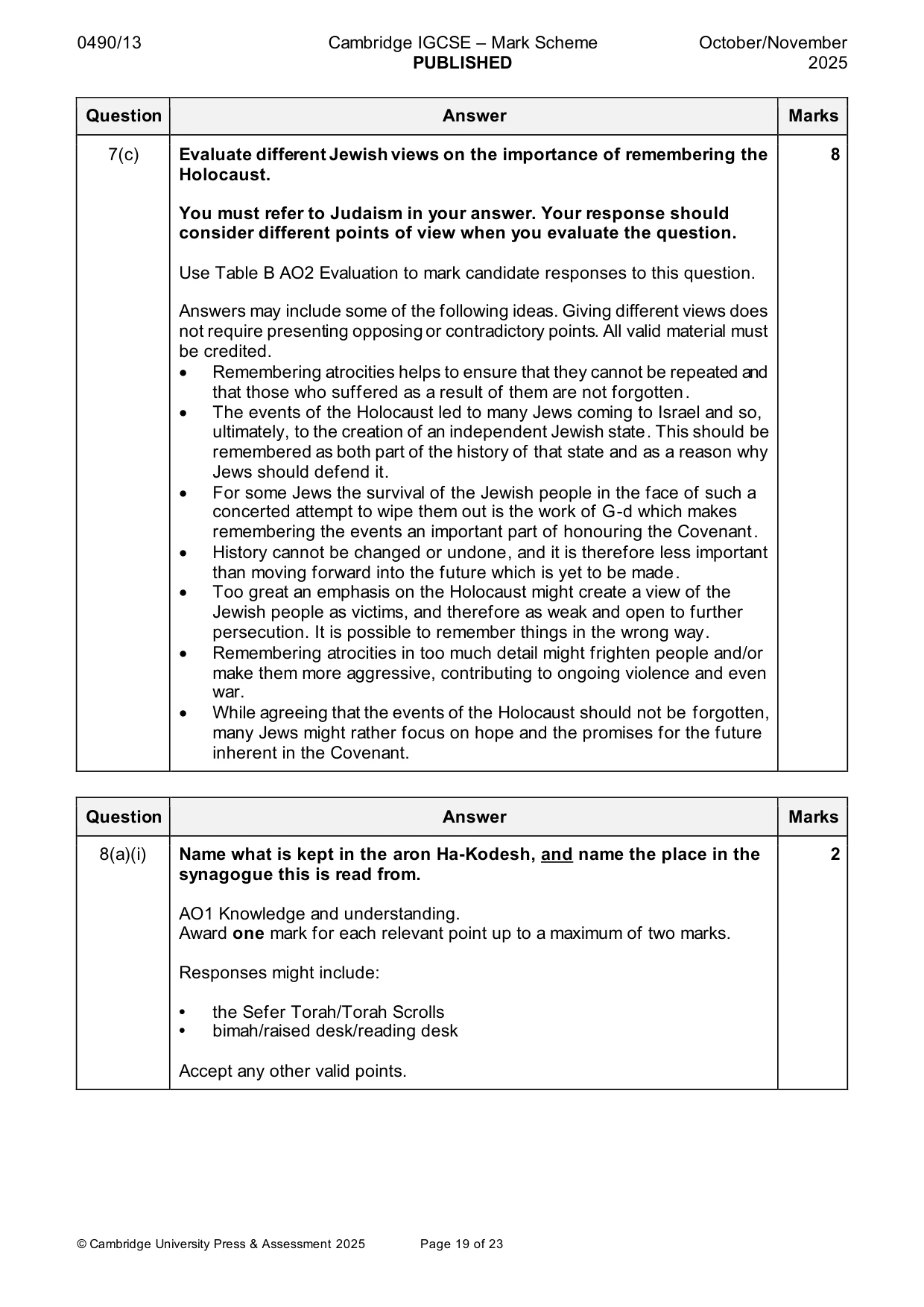
0490/13 Cambridge IGCSE – Mark Scheme PUBLISHED October/November 2025 © Cambridge University Press & Assessment 2025 Page 19 of 23 Question Answer Marks 7(c) Evaluate different Jewish views on the importance of remembering the Holocaust. You must refer to Judaism in your answer. Your response should consider different points of view when you evaluate the question. Use Table B AO2 Evaluation to mark candidate responses to this question. Answers may include some of the following ideas. Giving different views does not require presenting opposing or contradictory points. All valid material must be credited. • Remembering atrocities helps to ensure that they cannot be repeated and that those who suffered as a result of them are not forgotten. • The events of the Holocaust led to many Jews coming to Israel and so, ultimately, to the creation of an independent Jewish state. This should be remembered as both part of the history of that state and as a reason why Jews should defend it. • For some Jews the survival of the Jewish people in the face of such a concerted attempt to wipe them out is the work of G-d which makes remembering the events an important part of honouring the Covenant. • History cannot be changed or undone, and it is therefore less important than moving forward into the future which is yet to be made. • Too great an emphasis on the Holocaust might create a view of the Jewish people as victims, and therefore as weak and open to further persecution. It is possible to remember things in the wrong way. • Remembering atrocities in too much detail might frighten people and/or make them more aggressive, contributing to ongoing violence and even war. • While agreeing that the events of the Holocaust should not be forgotten, many Jews might rather focus on hope and the promises for the future inherent in the Covenant. 8 Question Answer Marks 8(a)(i) Name what is kept in the aron Ha-Kodesh, and name the place in the synagogue this is read from. AO1 Knowledge and understanding. Award one mark for each relevant point up to a maximum of two marks. Responses might include: • the Sefer Torah/Torah Scrolls • bimah/raised desk/reading desk Accept any other valid points. 2
Mark scheme, page 20
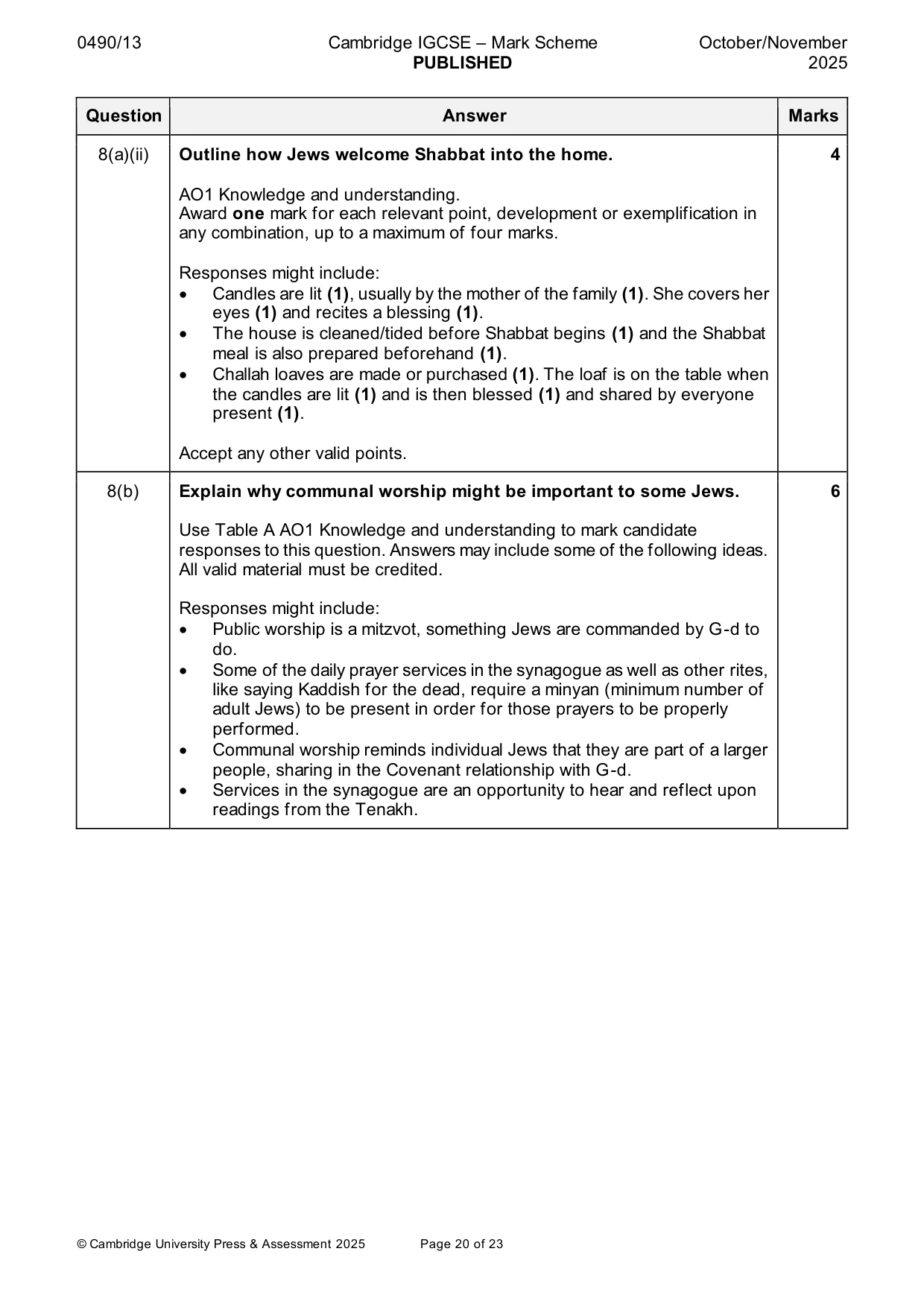
0490/13 Cambridge IGCSE – Mark Scheme PUBLISHED October/November 2025 © Cambridge University Press & Assessment 2025 Page 20 of 23 Question Answer Marks 8(a)(ii) Outline how Jews welcome Shabbat into the home. AO1 Knowledge and understanding. Award one mark for each relevant point, development or exemplification in any combination, up to a maximum of four marks. Responses might include: • Candles are lit (1), usually by the mother of the family (1). She covers her eyes (1) and recites a blessing (1). • The house is cleaned/tided before Shabbat begins (1) and the Shabbat meal is also prepared beforehand (1). • Challah loaves are made or purchased (1). The loaf is on the table when the candles are lit (1) and is then blessed (1) and shared by everyone present (1). Accept any other valid points. 4 8(b) Explain why communal worship might be important to some Jews. Use Table A AO1 Knowledge and understanding to mark candidate responses to this question. Answers may include some of the following ideas. All valid material must be credited. Responses might include: • Public worship is a mitzvot, something Jews are commanded by G-d to do. • Some of the daily prayer services in the synagogue as well as other rites, like saying Kaddish for the dead, require a minyan (minimum number of adult Jews) to be present in order for those prayers to be properly performed. • Communal worship reminds individual Jews that they are part of a larger people, sharing in the Covenant relationship with G-d. • Services in the synagogue are an opportunity to hear and reflect upon readings from the Tenakh. 6
Mark scheme, page 21
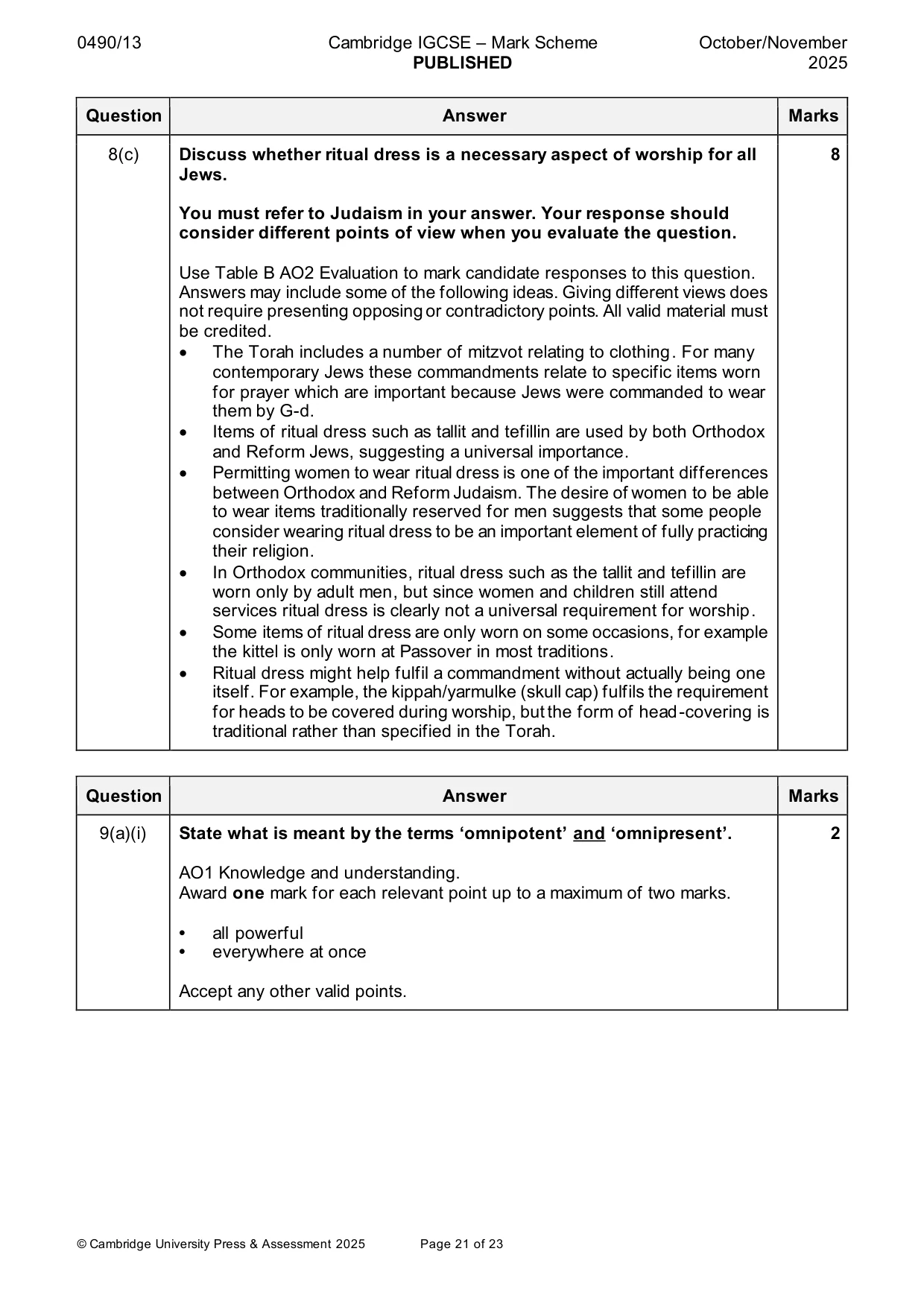
0490/13 Cambridge IGCSE – Mark Scheme PUBLISHED October/November 2025 © Cambridge University Press & Assessment 2025 Page 21 of 23 Question Answer Marks 8(c) Discuss whether ritual dress is a necessary aspect of worship for all Jews. You must refer to Judaism in your answer. Your response should consider different points of view when you evaluate the question. Use Table B AO2 Evaluation to mark candidate responses to this question. Answers may include some of the following ideas. Giving different views does not require presenting opposing or contradictory points. All valid material must be credited. • The Torah includes a number of mitzvot relating to clothing. For many contemporary Jews these commandments relate to specific items worn for prayer which are important because Jews were commanded to wear them by G-d. • Items of ritual dress such as tallit and tefillin are used by both Orthodox and Reform Jews, suggesting a universal importance. • Permitting women to wear ritual dress is one of the important differences between Orthodox and Reform Judaism. The desire of women to be able to wear items traditionally reserved for men suggests that some people consider wearing ritual dress to be an important element of fully practicing their religion. • In Orthodox communities, ritual dress such as the tallit and tefillin are worn only by adult men, but since women and children still attend services ritual dress is clearly not a universal requirement for worship. • Some items of ritual dress are only worn on some occasions, for example the kittel is only worn at Passover in most traditions. • Ritual dress might help fulfil a commandment without actually being one itself. For example, the kippah/yarmulke (skull cap) fulfils the requirement for heads to be covered during worship, but the form of head-covering is traditional rather than specified in the Torah. 8 Question Answer Marks 9(a)(i) State what is meant by the terms ‘omnipotent’ and ‘omnipresent’. AO1 Knowledge and understanding. Award one mark for each relevant point up to a maximum of two marks. • all powerful • everywhere at once Accept any other valid points. 2
Mark scheme, page 22
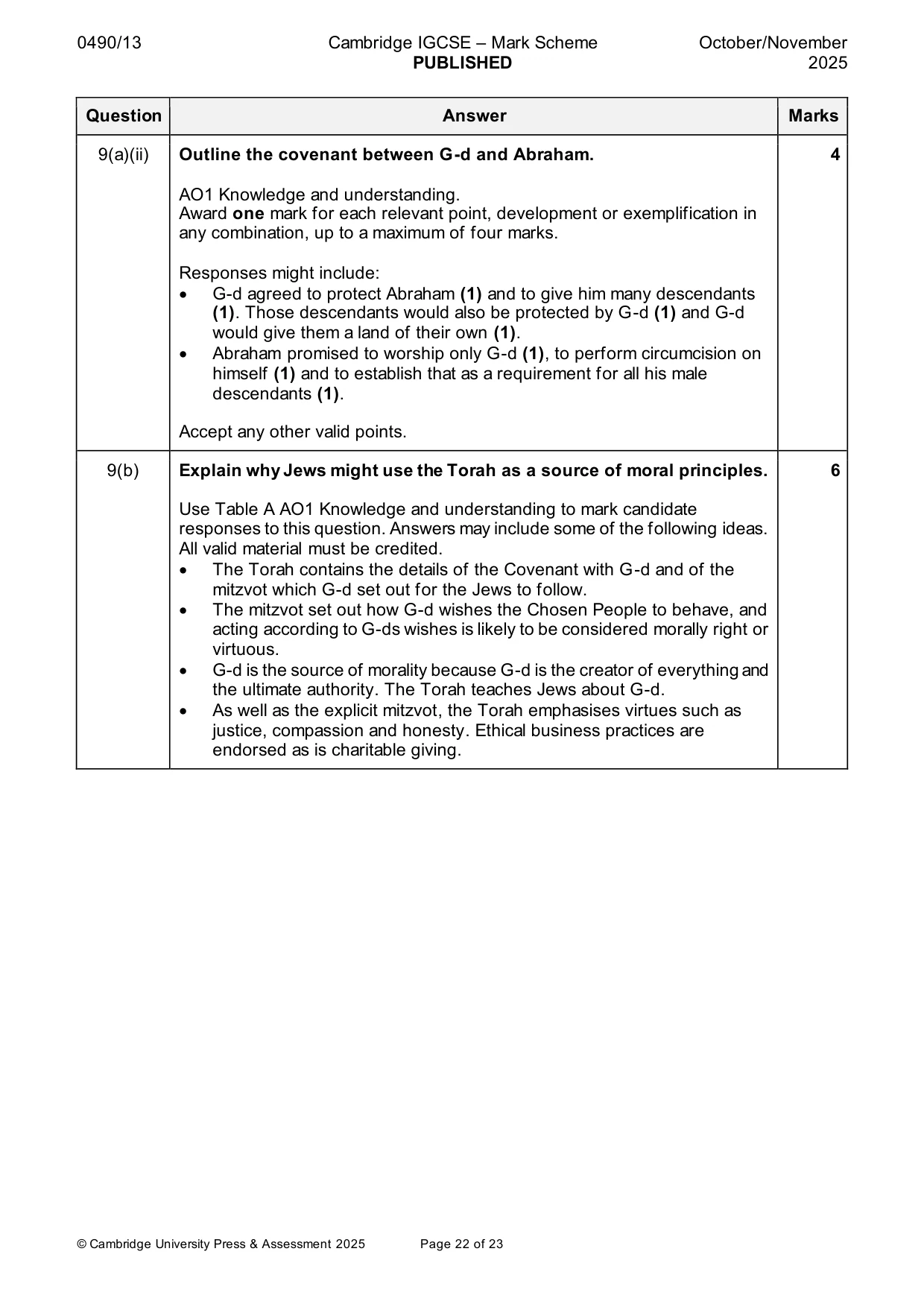
0490/13 Cambridge IGCSE – Mark Scheme PUBLISHED October/November 2025 © Cambridge University Press & Assessment 2025 Page 22 of 23 Question Answer Marks 9(a)(ii) Outline the covenant between G-d and Abraham. AO1 Knowledge and understanding. Award one mark for each relevant point, development or exemplification in any combination, up to a maximum of four marks. Responses might include: • G-d agreed to protect Abraham (1) and to give him many descendants (1). Those descendants would also be protected by G-d (1) and G-d would give them a land of their own (1). • Abraham promised to worship only G-d (1), to perform circumcision on himself (1) and to establish that as a requirement for all his male descendants (1). Accept any other valid points. 4 9(b) Explain why Jews might use the Torah as a source of moral principles. Use Table A AO1 Knowledge and understanding to mark candidate responses to this question. Answers may include some of the following ideas. All valid material must be credited. • The Torah contains the details of the Covenant with G-d and of the mitzvot which G-d set out for the Jews to follow. • The mitzvot set out how G-d wishes the Chosen People to behave, and acting according to G-ds wishes is likely to be considered morally right or virtuous. • G-d is the source of morality because G-d is the creator of everything and the ultimate authority. The Torah teaches Jews about G-d. • As well as the explicit mitzvot, the Torah emphasises virtues such as justice, compassion and honesty. Ethical business practices are endorsed as is charitable giving. 6
Mark scheme, page 23
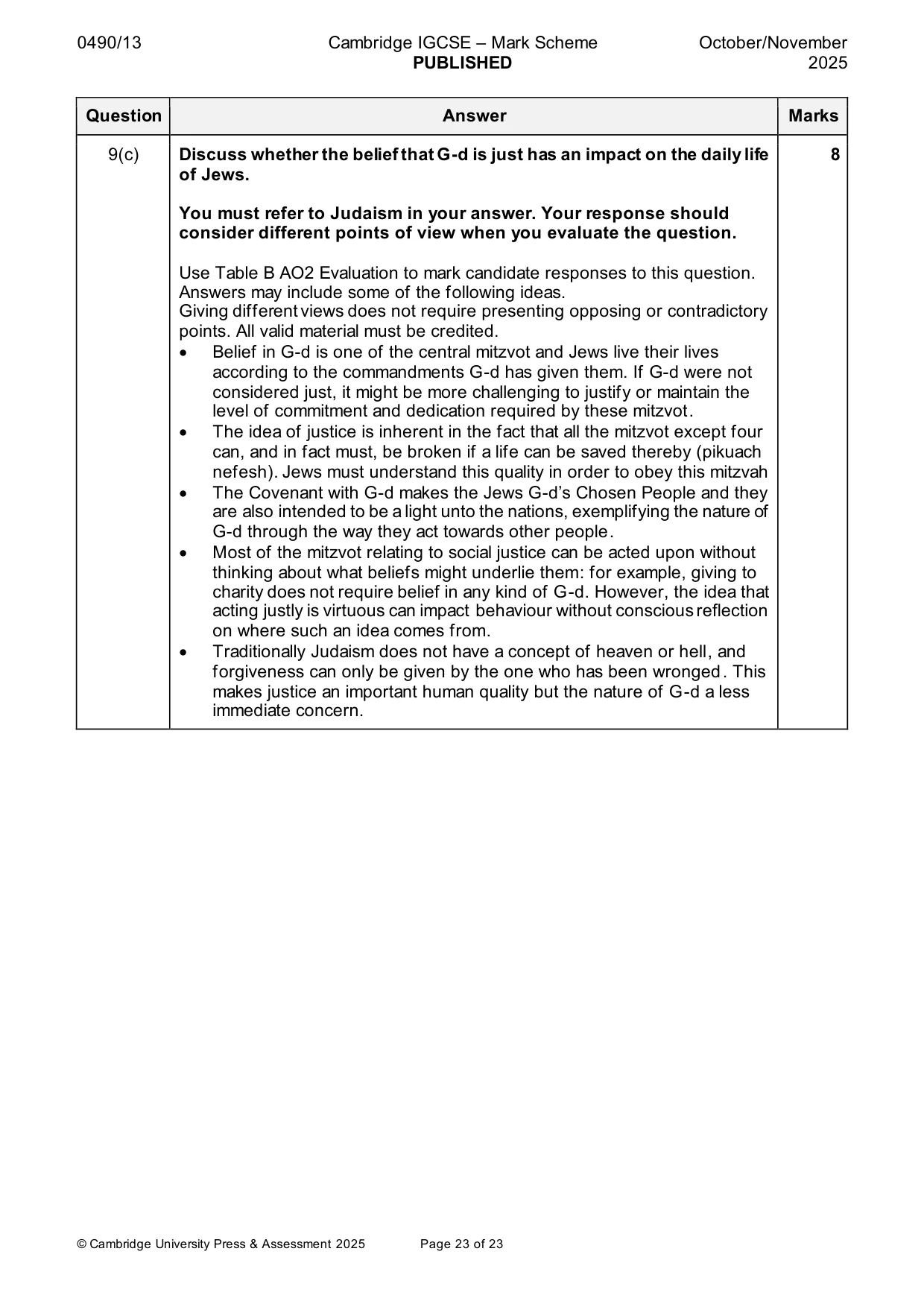
0490/13 Cambridge IGCSE – Mark Scheme PUBLISHED October/November 2025 © Cambridge University Press & Assessment 2025 Page 23 of 23 Question Answer Marks 9(c) Discuss whether the belief that G-d is just has an impact on the daily life of Jews. You must refer to Judaism in your answer. Your response should consider different points of view when you evaluate the question. Use Table B AO2 Evaluation to mark candidate responses to this question. Answers may include some of the following ideas. Giving different views does not require presenting opposing or contradictory points. All valid material must be credited. • Belief in G-d is one of the central mitzvot and Jews live their lives according to the commandments G-d has given them. If G-d were not considered just, it might be more challenging to justify or maintain the level of commitment and dedication required by these mitzvot. • The idea of justice is inherent in the fact that all the mitzvot except four can, and in fact must, be broken if a life can be saved thereby (pikuach nefesh). Jews must understand this quality in order to obey this mitzvah • The Covenant with G-d makes the Jews G-d’s Chosen People and they are also intended to be a light unto the nations, exemplifying the nature of G-d through the way they act towards other people. • Most of the mitzvot relating to social justice can be acted upon without thinking about what beliefs might underlie them: for example, giving to charity does not require belief in any kind of G-d. However, the idea that acting justly is virtuous can impact behaviour without conscious reflection on where such an idea comes from. • Traditionally Judaism does not have a concept of heaven or hell, and forgiveness can only be given by the one who has been wronged. This makes justice an important human quality but the nature of G-d a less immediate concern. 8
What you needed in this session
Cambridge’s own grade thresholds for 2025 Oct/Nov, Paper 1 · Variant 3. A higher threshold means an easier paper — the bar moves with how the cohort did.