Cambridge IGCSE Religious Studies 0490 — 2020 Oct/Nov Paper 1 · Variant 3
0490/13/O/N/20 · 80 marks · ≈90 min
The question paper and its mark scheme, free to read here and free to download. This is Cambridge’s own paper, exactly as it was sat.
Question paper4 pages
Mark scheme15 pages
Answers below. Sit the paper first if you are practising.
Paper as text
Question paper, page 1
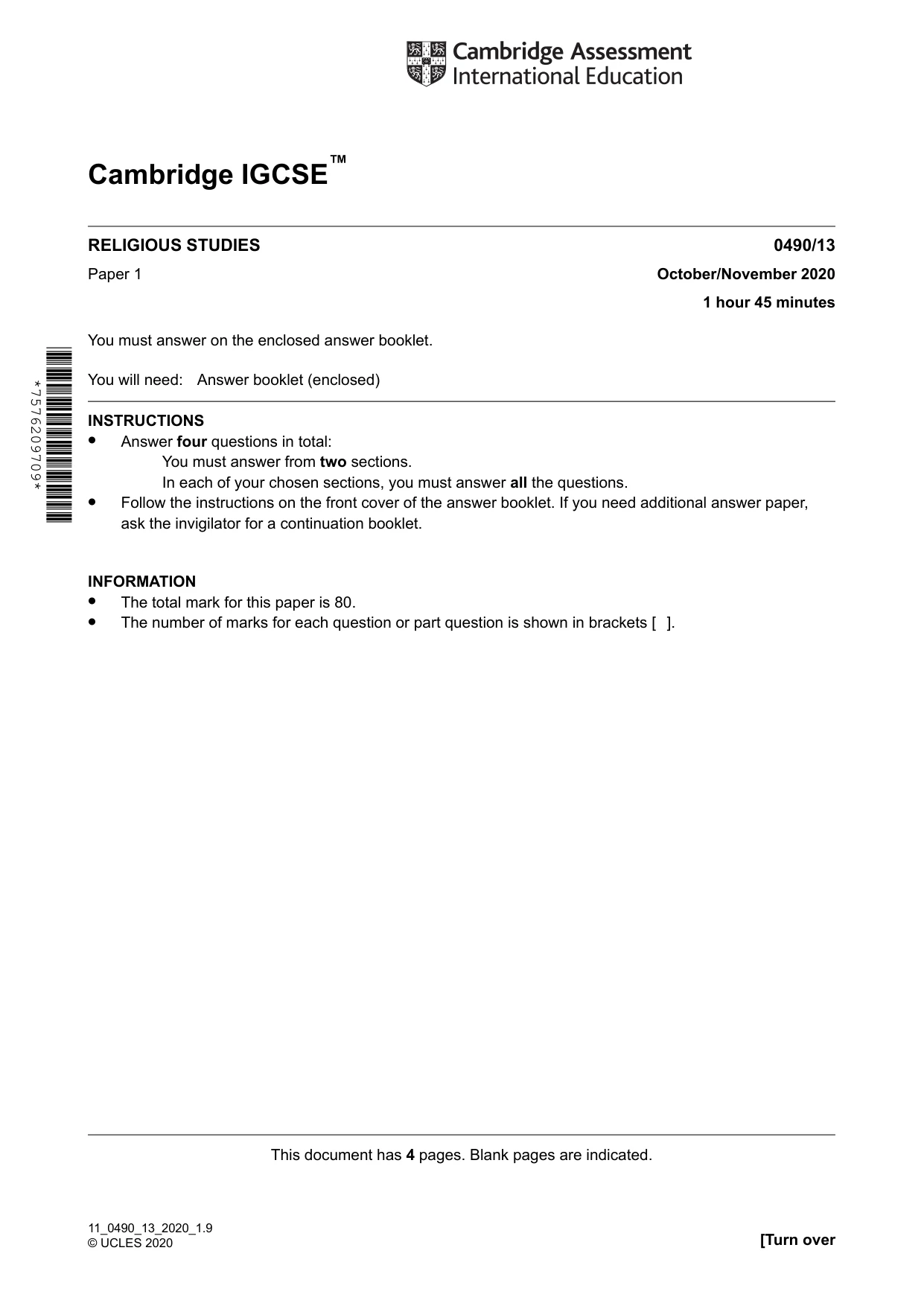
Cambridge IGCSE™ 0490/13 October/November 2020 1 hour 45 minutes RELIGIOUS STUDIES Paper 1 You must answer on the enclosed answer booklet. You will need: Answer booklet (enclosed) INSTRUCTIONS • Answer four questions in total: You must answer from two sections. In each of your chosen sections, you must answer all the questions. • Follow the instructions on the front cover of the answer booklet. If you need additional answer paper, ask the invigilator for a continuation booklet. INFORMATION • The total mark for this paper is 80. • The number of marks for each question or part question is shown in brackets [ ]. This document has 4 pages. Blank pages are indicated. [Turn over 11_0490_13_2020_1.9 © UCLES 2020 *7576209709*
Question paper, page 2
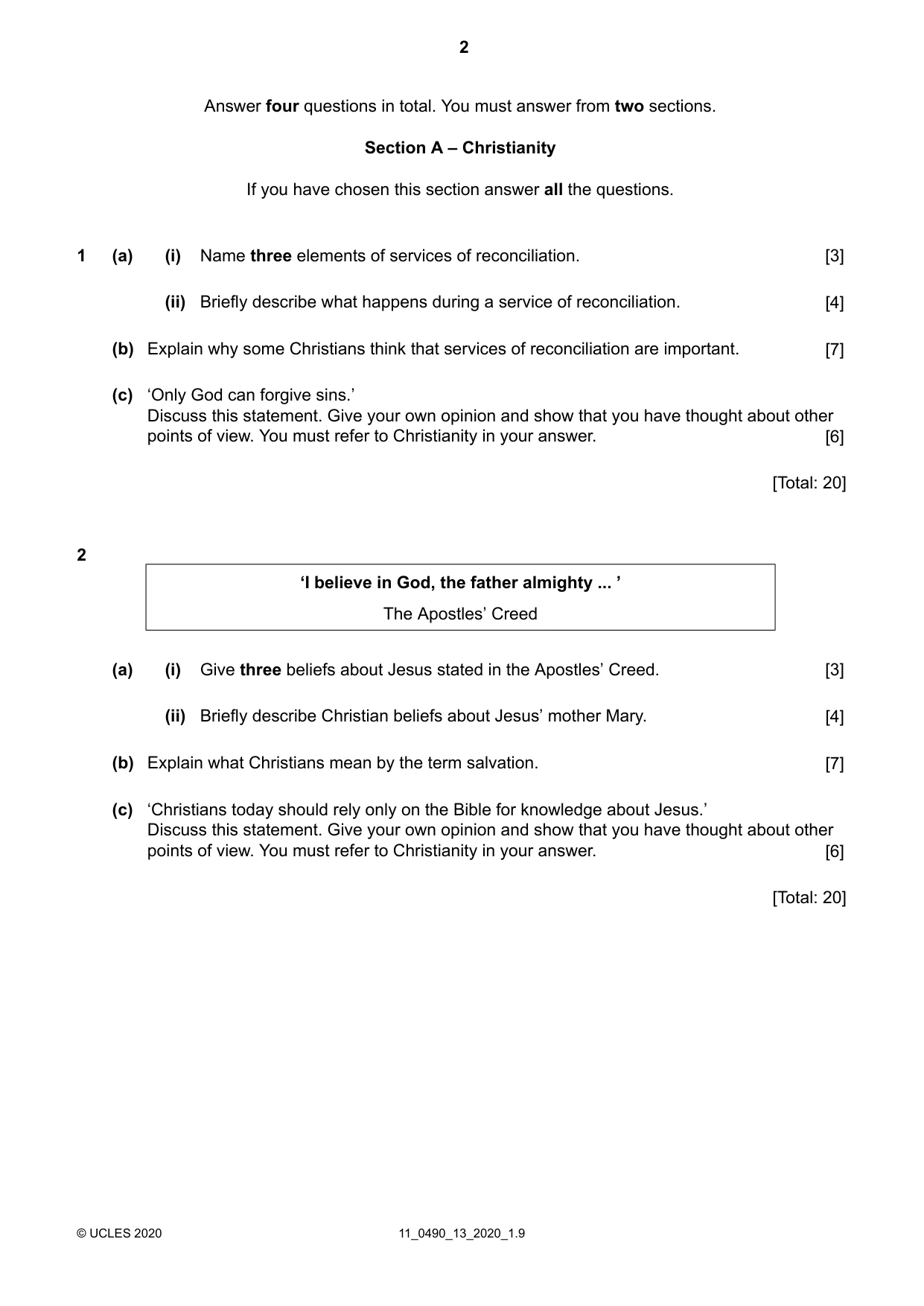
Answer four questions in total. You must answer from two sections. Section A – Christianity If you have chosen this section answer all the questions. Name three elements of services of reconciliation. [3] (i) (a) 1 Briefly describe what happens during a service of reconciliation. [4] (ii) Explain why some Christians think that services of reconciliation are important. [7] (b) ‘Only God can forgive sins.’ Discuss this statement. Give your own opinion and show that you have thought about other points of view. You must refer to Christianity in your answer. [6] (c) [Total: 20] 2 ‘I believe in God, the father almighty ... ’ The Apostles’ Creed Give three beliefs about Jesus stated in the Apostles’ Creed. [3] (i) (a) Briefly describe Christian beliefs about Jesus’ mother Mary. [4] (ii) Explain what Christians mean by the term salvation. [7] (b) ‘Christians today should rely only on the Bible for knowledge about Jesus.’ Discuss this statement. Give your own opinion and show that you have thought about other points of view. You must refer to Christianity in your answer. [6] (c) [Total: 20] 11_0490_13_2020_1.9 © UCLES 2020 2
Question paper, page 3
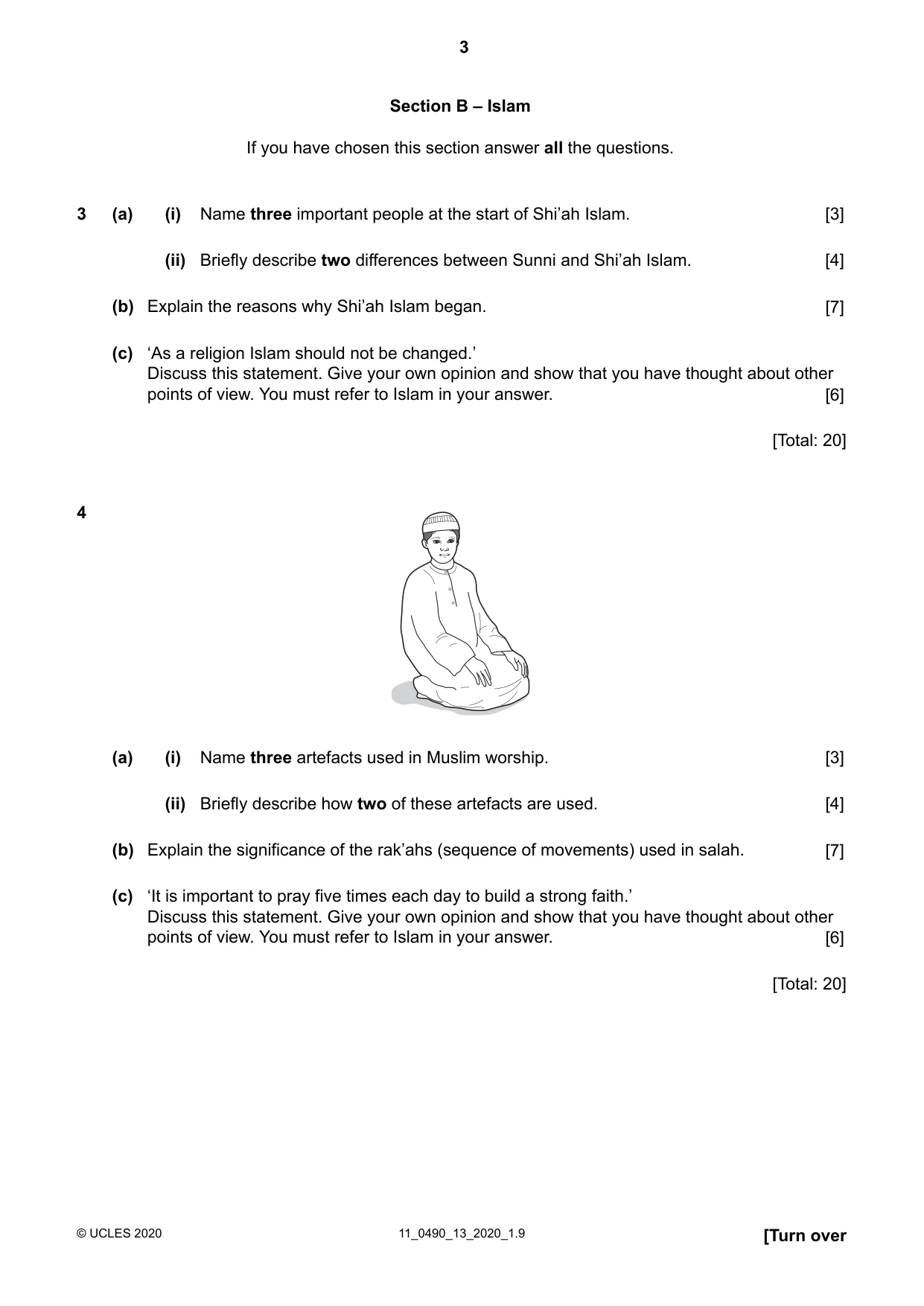
Section B – Islam If you have chosen this section answer all the questions. Name three important people at the start of Shi’ah Islam. [3] (i) (a) 3 Briefly describe two differences between Sunni and Shi’ah Islam. [4] (ii) Explain the reasons why Shi’ah Islam began. [7] (b) ‘As a religion Islam should not be changed.’ Discuss this statement. Give your own opinion and show that you have thought about other points of view. You must refer to Islam in your answer. [6] (c) [Total: 20] 4 Name three artefacts used in Muslim worship. [3] (i) (a) Briefly describe how two of these artefacts are used. [4] (ii) Explain the significance of the rak’ahs (sequence of movements) used in salah. [7] (b) ‘It is important to pray five times each day to build a strong faith.’ Discuss this statement. Give your own opinion and show that you have thought about other points of view. You must refer to Islam in your answer. [6] (c) [Total: 20] [Turn over 11_0490_13_2020_1.9 © UCLES 2020 3
Question paper, page 4
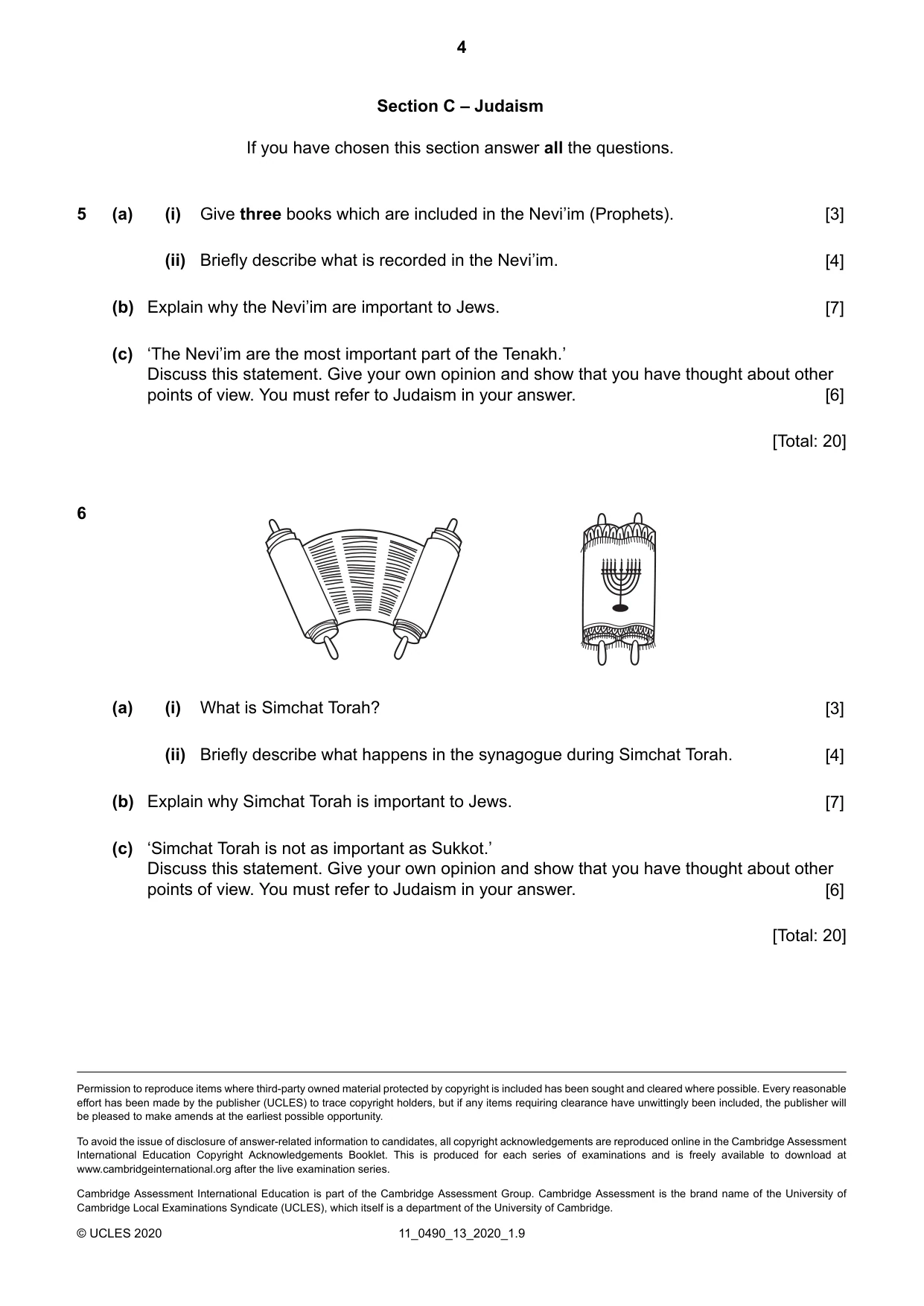
Section C – Judaism If you have chosen this section answer all the questions. Give three books which are included in the Nevi’im (Prophets). [3] (i) (a) 5 Briefly describe what is recorded in the Nevi’im. [4] (ii) Explain why the Nevi’im are important to Jews. [7] (b) ‘The Nevi’im are the most important part of the Tenakh.’ Discuss this statement. Give your own opinion and show that you have thought about other points of view. You must refer to Judaism in your answer. [6] (c) [Total: 20] 6 What is Simchat Torah? [3] (i) (a) Briefly describe what happens in the synagogue during Simchat Torah. [4] (ii) Explain why Simchat Torah is important to Jews. [7] (b) ‘Simchat Torah is not as important as Sukkot.’ Discuss this statement. Give your own opinion and show that you have thought about other points of view. You must refer to Judaism in your answer. [6] (c) [Total: 20] Permission to reproduce items where third-party owned material protected by copyright is included has been sought and cleared where possible. Every reasonable effort has been made by the publisher (UCLES) to trace copyright holders, but if any items requiring clearance have unwittingly been included, the publisher will be pleased to make amends at the earliest possible opportunity. To avoid the issue of disclosure of answer-related information to candidates, all copyright acknowledgements are reproduced online in the Cambridge Assessment International Education Copyright Acknowledgements Booklet. This is produced for each series of examinations and is freely available to download at www.cambridgeinternational.org after the live examination series. Cambridge Assessment International Education is part of the Cambridge Assessment Group. Cambridge Assessment is the brand name of the University of Cambridge Local Examinations Syndicate (UCLES), which itself is a department of the University of Cambridge. 11_0490_13_2020_1.9 © UCLES 2020 4
Mark scheme, page 1
This document consists of 15 printed pages. © UCLES 2020 [Turn over Cambridge IGCSE™ RELIGIOUS STUDIES 0490/13 Paper 1 October/November 2020 MARK SCHEME Maximum Mark: 80 Published This mark scheme is published as an aid to teachers and candidates, to indicate the requirements of the examination. It shows the basis on which Examiners were instructed to award marks. It does not indicate the details of the discussions that took place at an Examiners’ meeting before marking began, which would have considered the acceptability of alternative answers. Mark schemes should be read in conjunction with the question paper and the Principal Examiner Report for Teachers. Cambridge International will not enter into discussions about these mark schemes. Cambridge International is publishing the mark schemes for the October/November 2020 series for most Cambridge IGCSE™, Cambridge International A and AS Level and Cambridge Pre-U components, and some Cambridge O Level components.
Mark scheme, page 2
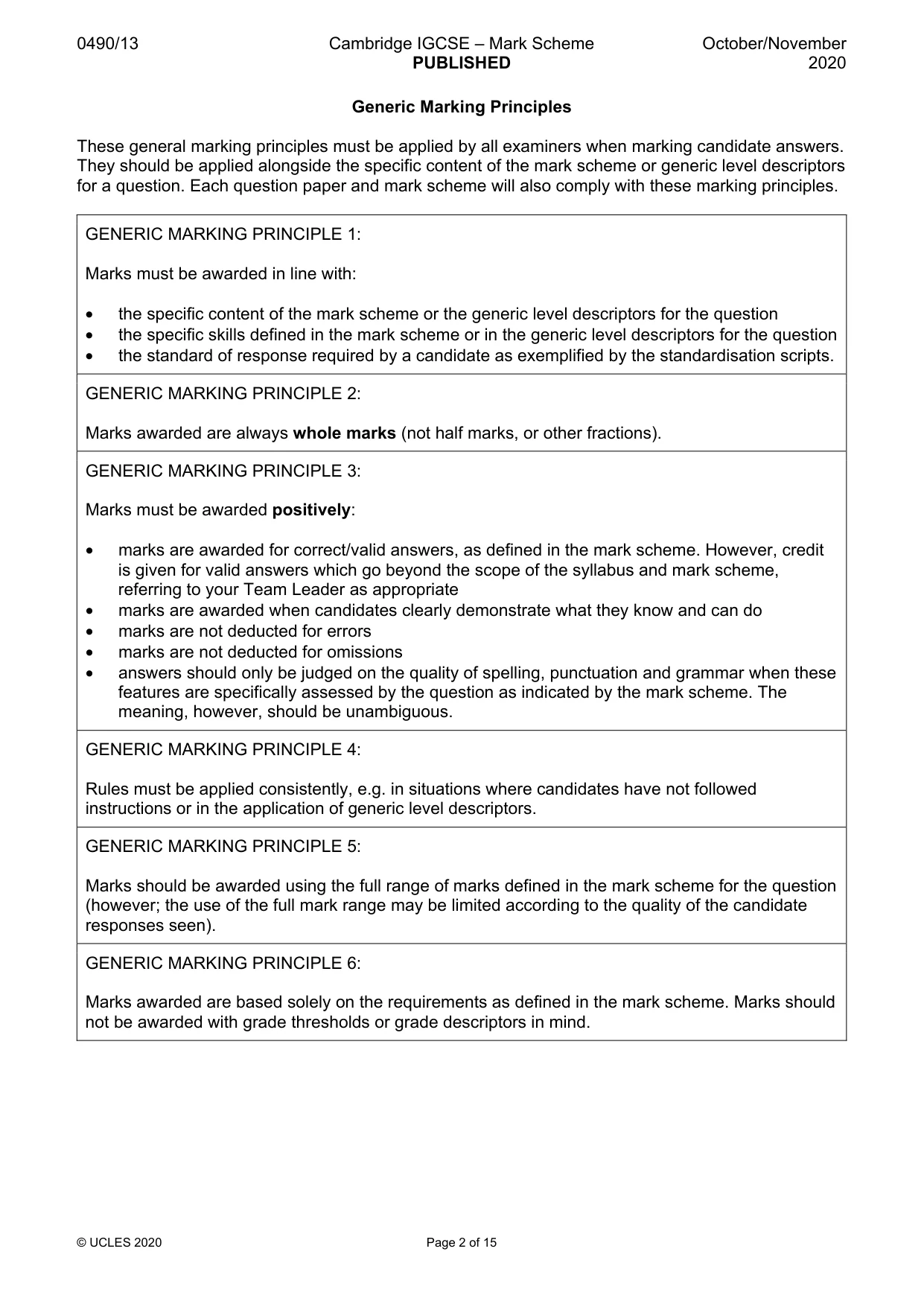
0490/13 Cambridge IGCSE – Mark Scheme PUBLISHED October/November 2020 © UCLES 2020 Page 2 of 15 Generic Marking Principles These general marking principles must be applied by all examiners when marking candidate answers. They should be applied alongside the specific content of the mark scheme or generic level descriptors for a question. Each question paper and mark scheme will also comply with these marking principles. GENERIC MARKING PRINCIPLE 1: Marks must be awarded in line with: • the specific content of the mark scheme or the generic level descriptors for the question • the specific skills defined in the mark scheme or in the generic level descriptors for the question • the standard of response required by a candidate as exemplified by the standardisation scripts. GENERIC MARKING PRINCIPLE 2: Marks awarded are always whole marks (not half marks, or other fractions). GENERIC MARKING PRINCIPLE 3: Marks must be awarded positively: • marks are awarded for correct/valid answers, as defined in the mark scheme. However, credit is given for valid answers which go beyond the scope of the syllabus and mark scheme, referring to your Team Leader as appropriate • marks are awarded when candidates clearly demonstrate what they know and can do • marks are not deducted for errors • marks are not deducted for omissions • answers should only be judged on the quality of spelling, punctuation and grammar when these features are specifically assessed by the question as indicated by the mark scheme. The meaning, however, should be unambiguous. GENERIC MARKING PRINCIPLE 4: Rules must be applied consistently, e.g. in situations where candidates have not followed instructions or in the application of generic level descriptors. GENERIC MARKING PRINCIPLE 5: Marks should be awarded using the full range of marks defined in the mark scheme for the question (however; the use of the full mark range may be limited according to the quality of the candidate responses seen). GENERIC MARKING PRINCIPLE 6: Marks awarded are based solely on the requirements as defined in the mark scheme. Marks should not be awarded with grade thresholds or grade descriptors in mind.
Mark scheme, page 3
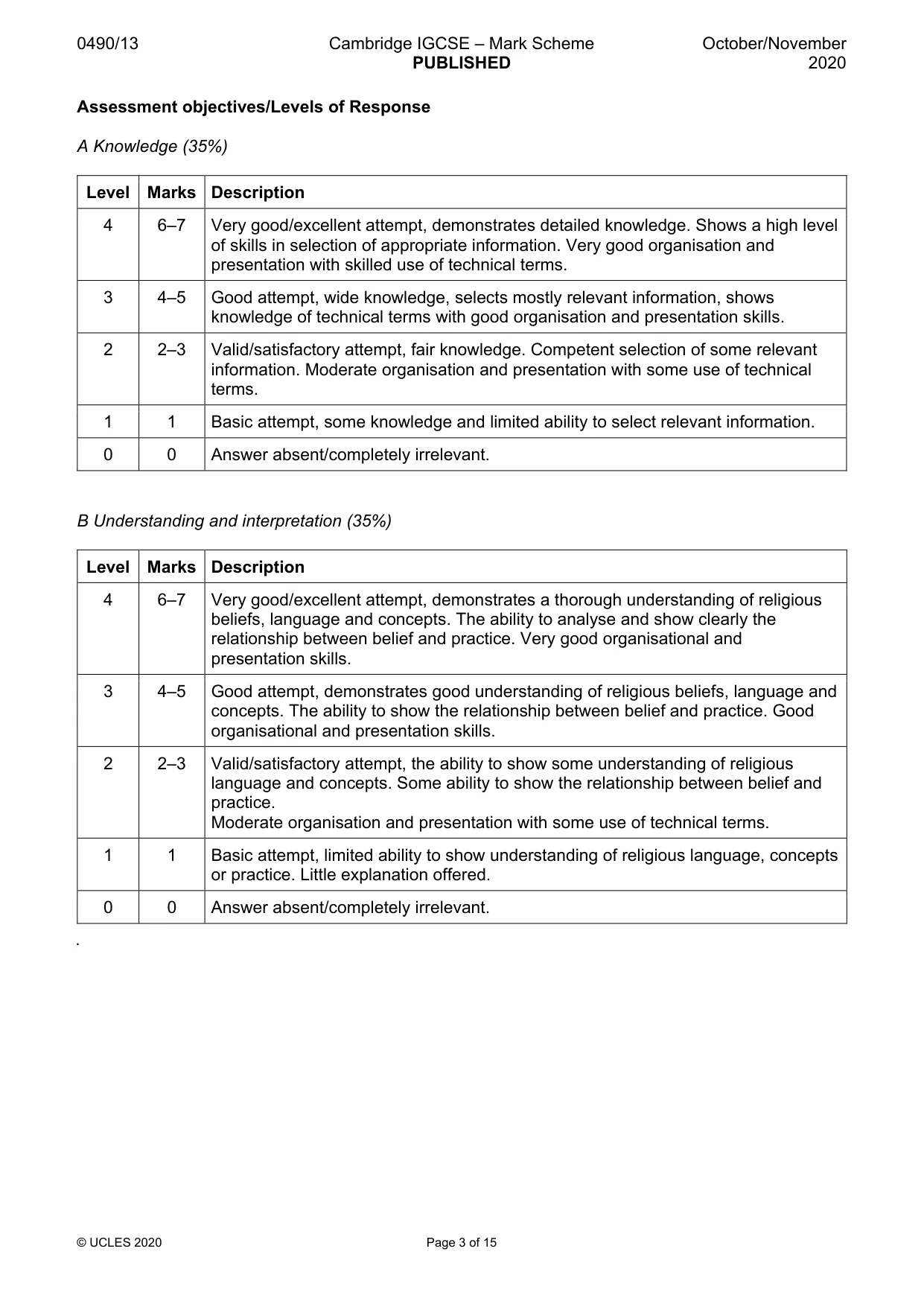
0490/13 Cambridge IGCSE – Mark Scheme PUBLISHED October/November 2020 © UCLES 2020 Page 3 of 15 Assessment objectives/Levels of Response A Knowledge (35%) Level Marks Description 4 6–7 Very good/excellent attempt, demonstrates detailed knowledge. Shows a high level of skills in selection of appropriate information. Very good organisation and presentation with skilled use of technical terms. 3 4–5 Good attempt, wide knowledge, selects mostly relevant information, shows knowledge of technical terms with good organisation and presentation skills. 2 2–3 Valid/satisfactory attempt, fair knowledge. Competent selection of some relevant information. Moderate organisation and presentation with some use of technical terms. 1 1 Basic attempt, some knowledge and limited ability to select relevant information. 0 0 Answer absent/completely irrelevant. B Understanding and interpretation (35%) Level Marks Description 4 6–7 Very good/excellent attempt, demonstrates a thorough understanding of religious beliefs, language and concepts. The ability to analyse and show clearly the relationship between belief and practice. Very good organisational and presentation skills. 3 4–5 Good attempt, demonstrates good understanding of religious beliefs, language and concepts. The ability to show the relationship between belief and practice. Good organisational and presentation skills. 2 2–3 Valid/satisfactory attempt, the ability to show some understanding of religious language and concepts. Some ability to show the relationship between belief and practice. Moderate organisation and presentation with some use of technical terms. 1 1 Basic attempt, limited ability to show understanding of religious language, concepts or practice. Little explanation offered. 0 0 Answer absent/completely irrelevant.
Mark scheme, page 4
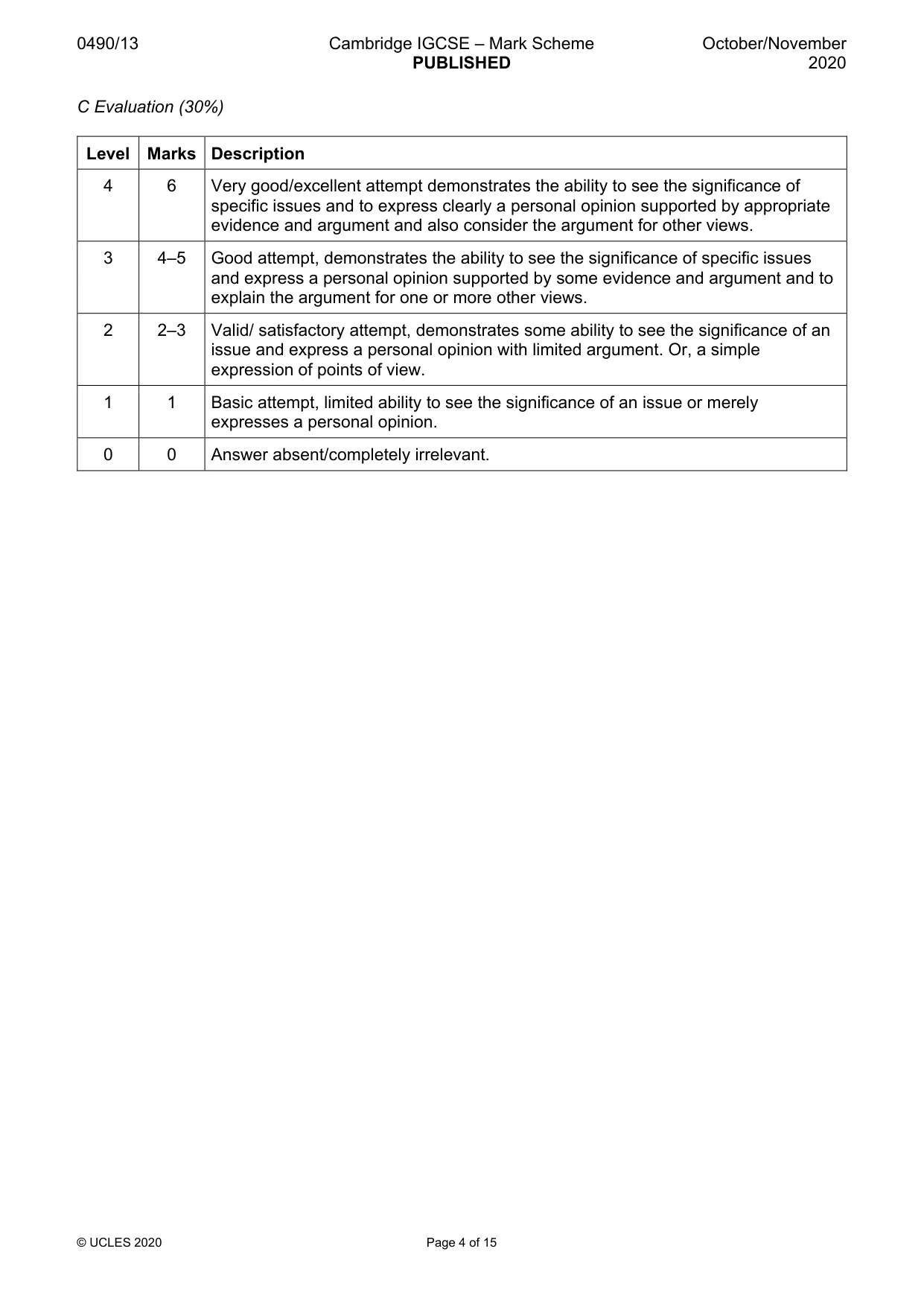
0490/13 Cambridge IGCSE – Mark Scheme PUBLISHED October/November 2020 © UCLES 2020 Page 4 of 15 C Evaluation (30%) Level Marks Description 4 6 Very good/excellent attempt demonstrates the ability to see the significance of specific issues and to express clearly a personal opinion supported by appropriate evidence and argument and also consider the argument for other views. 3 4–5 Good attempt, demonstrates the ability to see the significance of specific issues and express a personal opinion supported by some evidence and argument and to explain the argument for one or more other views. 2 2–3 Valid/ satisfactory attempt, demonstrates some ability to see the significance of an issue and express a personal opinion with limited argument. Or, a simple expression of points of view. 1 1 Basic attempt, limited ability to see the significance of an issue or merely expresses a personal opinion. 0 0 Answer absent/completely irrelevant.
Mark scheme, page 5
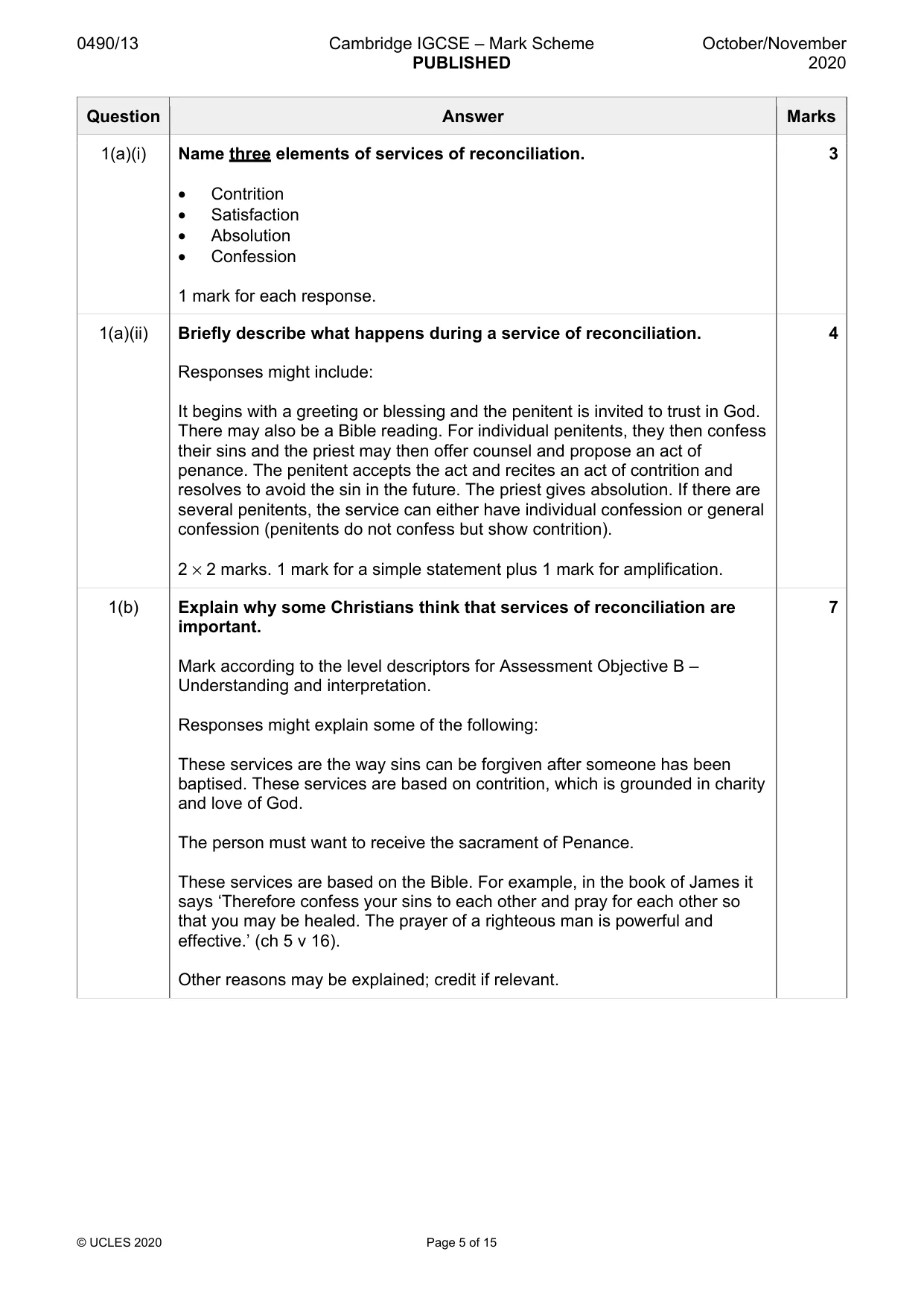
0490/13 Cambridge IGCSE – Mark Scheme PUBLISHED October/November 2020 © UCLES 2020 Page 5 of 15 Question Answer Marks 1(a)(i) Name three elements of services of reconciliation. • Contrition • Satisfaction • Absolution • Confession 1 mark for each response. 3 1(a)(ii) Briefly describe what happens during a service of reconciliation. Responses might include: It begins with a greeting or blessing and the penitent is invited to trust in God. There may also be a Bible reading. For individual penitents, they then confess their sins and the priest may then offer counsel and propose an act of penance. The penitent accepts the act and recites an act of contrition and resolves to avoid the sin in the future. The priest gives absolution. If there are several penitents, the service can either have individual confession or general confession (penitents do not confess but show contrition). 2 × 2 marks. 1 mark for a simple statement plus 1 mark for amplification. 4 1(b) Explain why some Christians think that services of reconciliation are important. Mark according to the level descriptors for Assessment Objective B – Understanding and interpretation. Responses might explain some of the following: These services are the way sins can be forgiven after someone has been baptised. These services are based on contrition, which is grounded in charity and love of God. The person must want to receive the sacrament of Penance. These services are based on the Bible. For example, in the book of James it says ‘Therefore confess your sins to each other and pray for each other so that you may be healed. The prayer of a righteous man is powerful and effective.’ (ch 5 v 16). Other reasons may be explained; credit if relevant. 7
Mark scheme, page 6
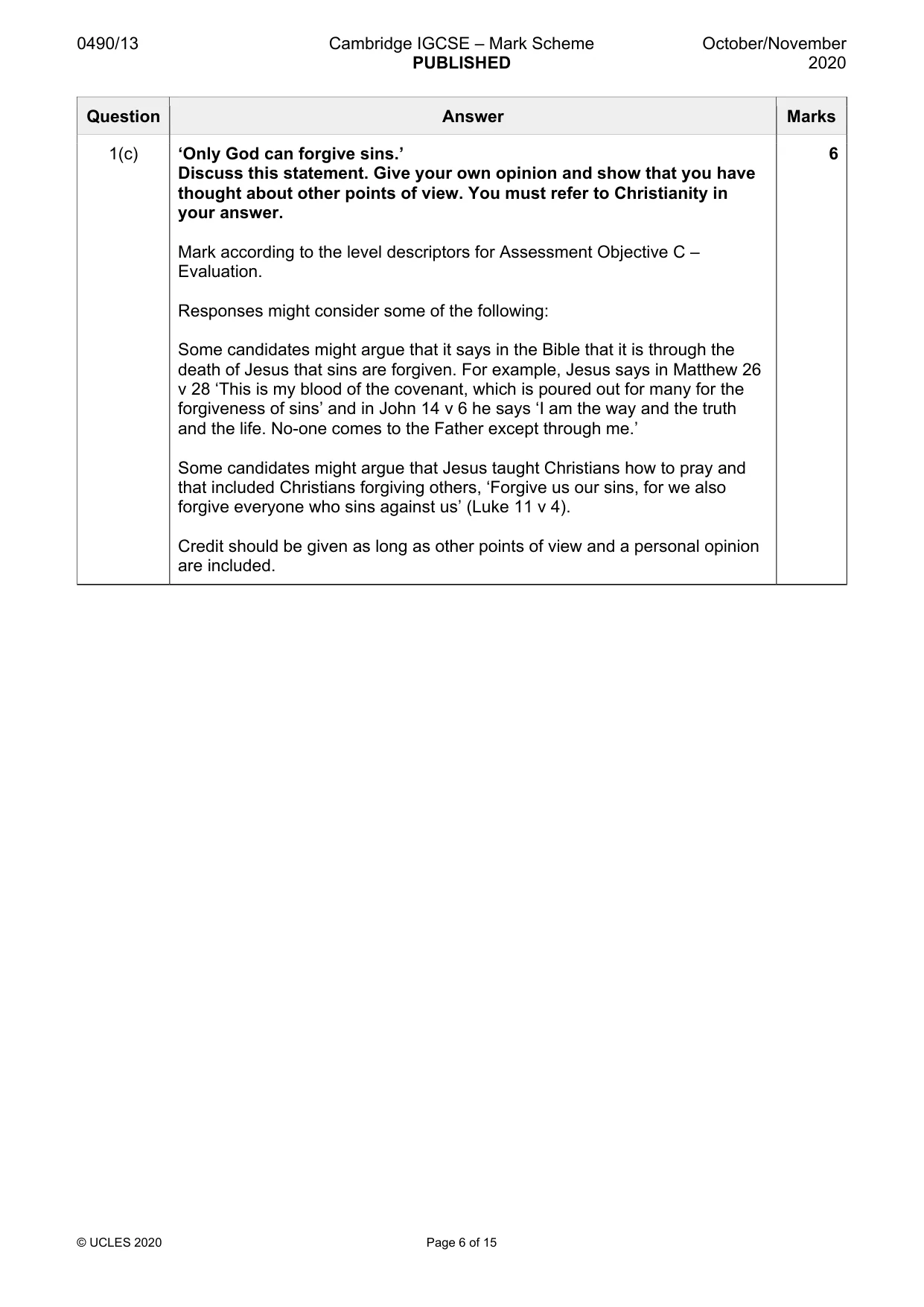
0490/13 Cambridge IGCSE – Mark Scheme PUBLISHED October/November 2020 © UCLES 2020 Page 6 of 15 Question Answer Marks 1(c) ‘Only God can forgive sins.’ Discuss this statement. Give your own opinion and show that you have thought about other points of view. You must refer to Christianity in your answer. Mark according to the level descriptors for Assessment Objective C – Evaluation. Responses might consider some of the following: Some candidates might argue that it says in the Bible that it is through the death of Jesus that sins are forgiven. For example, Jesus says in Matthew 26 v 28 ‘This is my blood of the covenant, which is poured out for many for the forgiveness of sins’ and in John 14 v 6 he says ‘I am the way and the truth and the life. No-one comes to the Father except through me.’ Some candidates might argue that Jesus taught Christians how to pray and that included Christians forgiving others, ‘Forgive us our sins, for we also forgive everyone who sins against us’ (Luke 11 v 4). Credit should be given as long as other points of view and a personal opinion are included. 6
Mark scheme, page 7
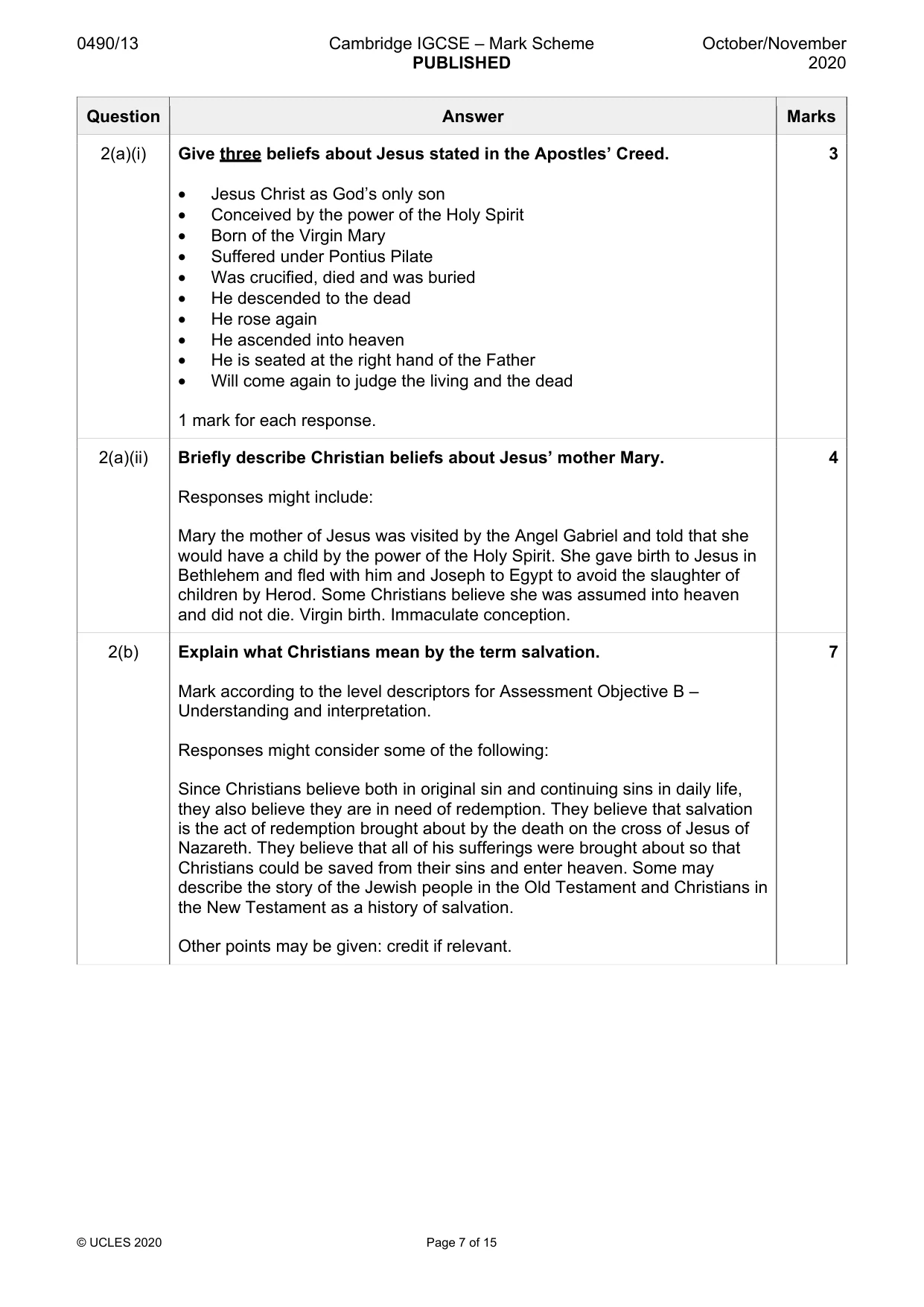
0490/13 Cambridge IGCSE – Mark Scheme PUBLISHED October/November 2020 © UCLES 2020 Page 7 of 15 Question Answer Marks 2(a)(i) Give three beliefs about Jesus stated in the Apostles’ Creed. • Jesus Christ as God’s only son • Conceived by the power of the Holy Spirit • Born of the Virgin Mary • Suffered under Pontius Pilate • Was crucified, died and was buried • He descended to the dead • He rose again • He ascended into heaven • He is seated at the right hand of the Father • Will come again to judge the living and the dead 1 mark for each response. 3 2(a)(ii) Briefly describe Christian beliefs about Jesus’ mother Mary. Responses might include: Mary the mother of Jesus was visited by the Angel Gabriel and told that she would have a child by the power of the Holy Spirit. She gave birth to Jesus in Bethlehem and fled with him and Joseph to Egypt to avoid the slaughter of children by Herod. Some Christians believe she was assumed into heaven and did not die. Virgin birth. Immaculate conception. 4 2(b) Explain what Christians mean by the term salvation. Mark according to the level descriptors for Assessment Objective B – Understanding and interpretation. Responses might consider some of the following: Since Christians believe both in original sin and continuing sins in daily life, they also believe they are in need of redemption. They believe that salvation is the act of redemption brought about by the death on the cross of Jesus of Nazareth. They believe that all of his sufferings were brought about so that Christians could be saved from their sins and enter heaven. Some may describe the story of the Jewish people in the Old Testament and Christians in the New Testament as a history of salvation. Other points may be given: credit if relevant. 7
Mark scheme, page 8
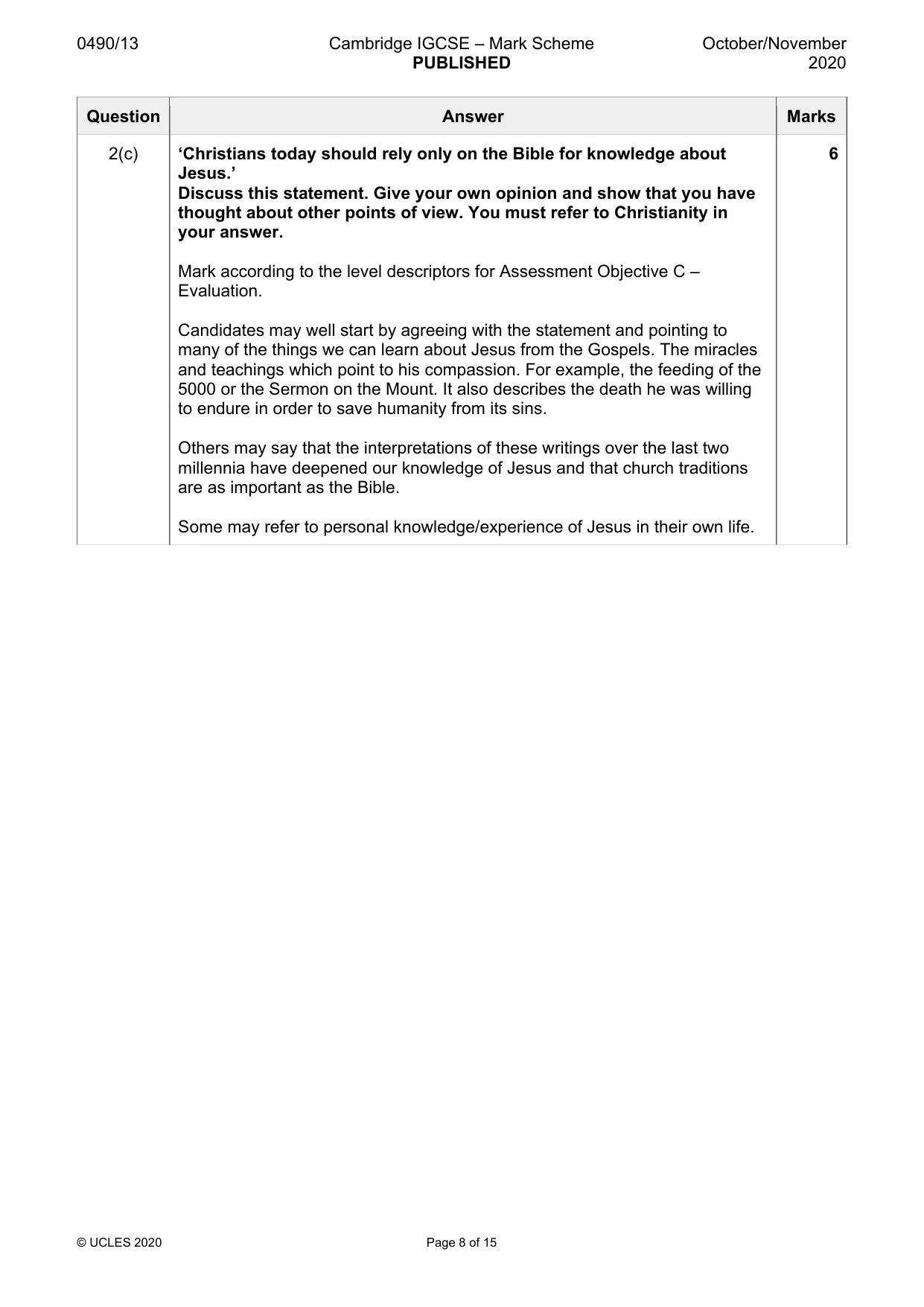
0490/13 Cambridge IGCSE – Mark Scheme PUBLISHED October/November 2020 © UCLES 2020 Page 8 of 15 Question Answer Marks 2(c) ‘Christians today should rely only on the Bible for knowledge about Jesus.’ Discuss this statement. Give your own opinion and show that you have thought about other points of view. You must refer to Christianity in your answer. Mark according to the level descriptors for Assessment Objective C – Evaluation. Candidates may well start by agreeing with the statement and pointing to many of the things we can learn about Jesus from the Gospels. The miracles and teachings which point to his compassion. For example, the feeding of the 5000 or the Sermon on the Mount. It also describes the death he was willing to endure in order to save humanity from its sins. Others may say that the interpretations of these writings over the last two millennia have deepened our knowledge of Jesus and that church traditions are as important as the Bible. Some may refer to personal knowledge/experience of Jesus in their own life. 6
Mark scheme, page 9
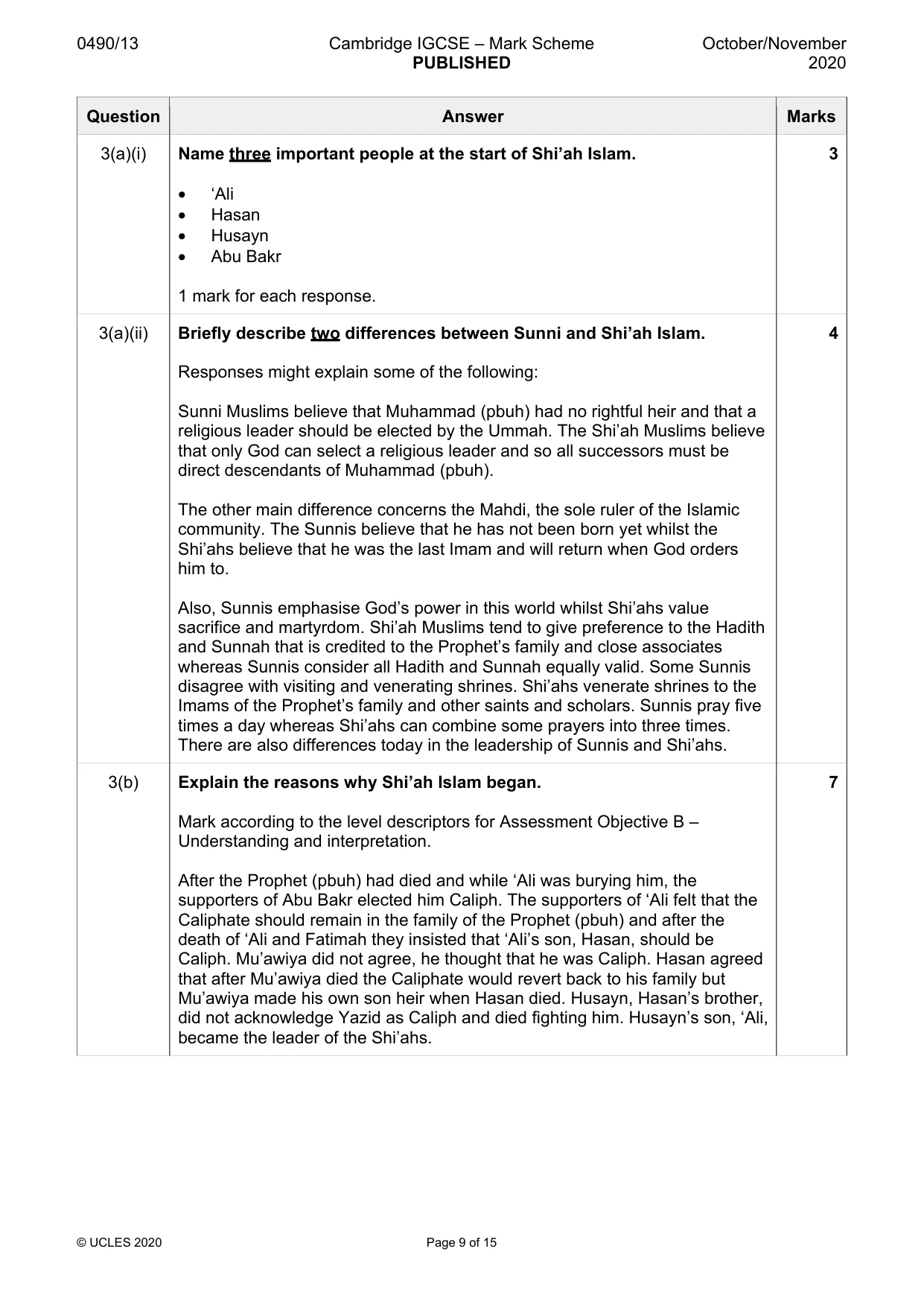
0490/13 Cambridge IGCSE – Mark Scheme PUBLISHED October/November 2020 © UCLES 2020 Page 9 of 15 Question Answer Marks 3(a)(i) Name three important people at the start of Shi’ah Islam. • ‘Ali • Hasan • Husayn • Abu Bakr 1 mark for each response. 3 3(a)(ii) Briefly describe two differences between Sunni and Shi’ah Islam. Responses might explain some of the following: Sunni Muslims believe that Muhammad (pbuh) had no rightful heir and that a religious leader should be elected by the Ummah. The Shi’ah Muslims believe that only God can select a religious leader and so all successors must be direct descendants of Muhammad (pbuh). The other main difference concerns the Mahdi, the sole ruler of the Islamic community. The Sunnis believe that he has not been born yet whilst the Shi’ahs believe that he was the last Imam and will return when God orders him to. Also, Sunnis emphasise God’s power in this world whilst Shi’ahs value sacrifice and martyrdom. Shi’ah Muslims tend to give preference to the Hadith and Sunnah that is credited to the Prophet’s family and close associates whereas Sunnis consider all Hadith and Sunnah equally valid. Some Sunnis disagree with visiting and venerating shrines. Shi’ahs venerate shrines to the Imams of the Prophet’s family and other saints and scholars. Sunnis pray five times a day whereas Shi’ahs can combine some prayers into three times. There are also differences today in the leadership of Sunnis and Shi’ahs. 4 3(b) Explain the reasons why Shi’ah Islam began. Mark according to the level descriptors for Assessment Objective B – Understanding and interpretation. After the Prophet (pbuh) had died and while ‘Ali was burying him, the supporters of Abu Bakr elected him Caliph. The supporters of ‘Ali felt that the Caliphate should remain in the family of the Prophet (pbuh) and after the death of ‘Ali and Fatimah they insisted that ‘Ali’s son, Hasan, should be Caliph. Mu’awiya did not agree, he thought that he was Caliph. Hasan agreed that after Mu’awiya died the Caliphate would revert back to his family but Mu’awiya made his own son heir when Hasan died. Husayn, Hasan’s brother, did not acknowledge Yazid as Caliph and died fighting him. Husayn’s son, ‘Ali, became the leader of the Shi’ahs. 7
Mark scheme, page 10
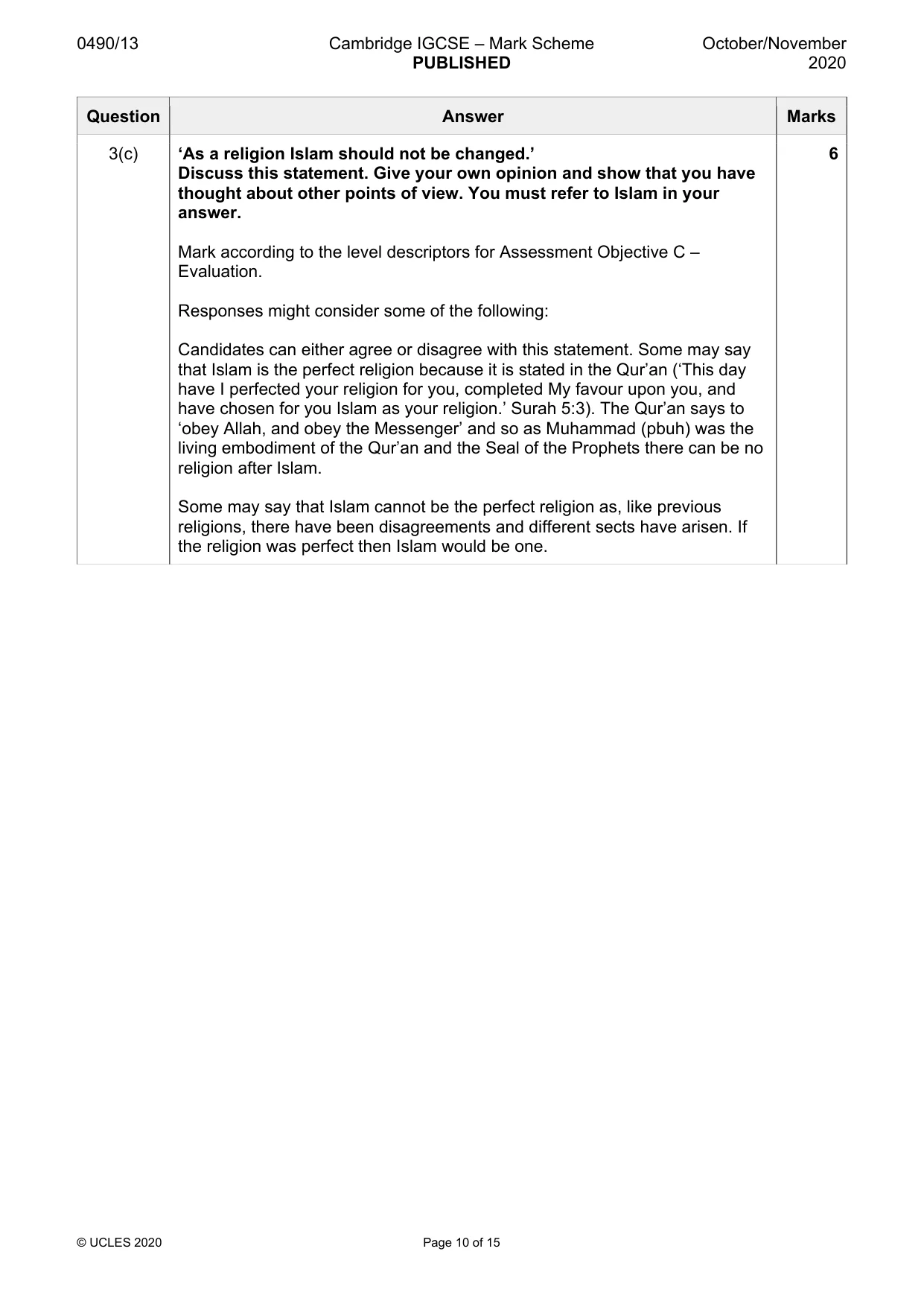
0490/13 Cambridge IGCSE – Mark Scheme PUBLISHED October/November 2020 © UCLES 2020 Page 10 of 15 Question Answer Marks 3(c) ‘As a religion Islam should not be changed.’ Discuss this statement. Give your own opinion and show that you have thought about other points of view. You must refer to Islam in your answer. Mark according to the level descriptors for Assessment Objective C – Evaluation. Responses might consider some of the following: Candidates can either agree or disagree with this statement. Some may say that Islam is the perfect religion because it is stated in the Qur’an (‘This day have I perfected your religion for you, completed My favour upon you, and have chosen for you Islam as your religion.’ Surah 5:3). The Qur’an says to ‘obey Allah, and obey the Messenger’ and so as Muhammad (pbuh) was the living embodiment of the Qur’an and the Seal of the Prophets there can be no religion after Islam. Some may say that Islam cannot be the perfect religion as, like previous religions, there have been disagreements and different sects have arisen. If the religion was perfect then Islam would be one. 6
Mark scheme, page 11
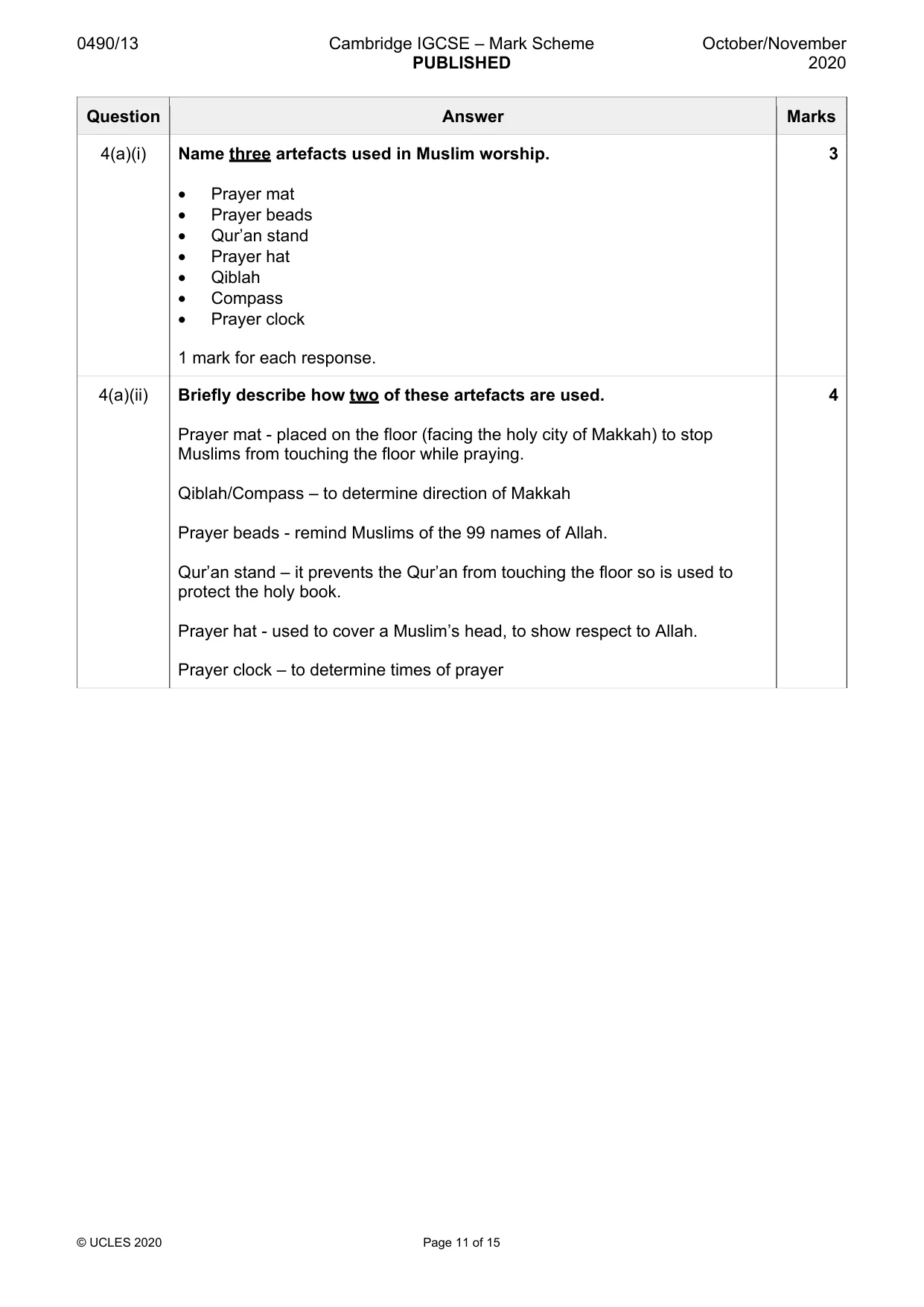
0490/13 Cambridge IGCSE – Mark Scheme PUBLISHED October/November 2020 © UCLES 2020 Page 11 of 15 Question Answer Marks 4(a)(i) Name three artefacts used in Muslim worship. • Prayer mat • Prayer beads • Qur’an stand • Prayer hat • Qiblah • Compass • Prayer clock 1 mark for each response. 3 4(a)(ii) Briefly describe how two of these artefacts are used. Prayer mat - placed on the floor (facing the holy city of Makkah) to stop Muslims from touching the floor while praying. Qiblah/Compass – to determine direction of Makkah Prayer beads - remind Muslims of the 99 names of Allah. Qur’an stand – it prevents the Qur’an from touching the floor so is used to protect the holy book. Prayer hat - used to cover a Muslim’s head, to show respect to Allah. Prayer clock – to determine times of prayer 4
Mark scheme, page 12
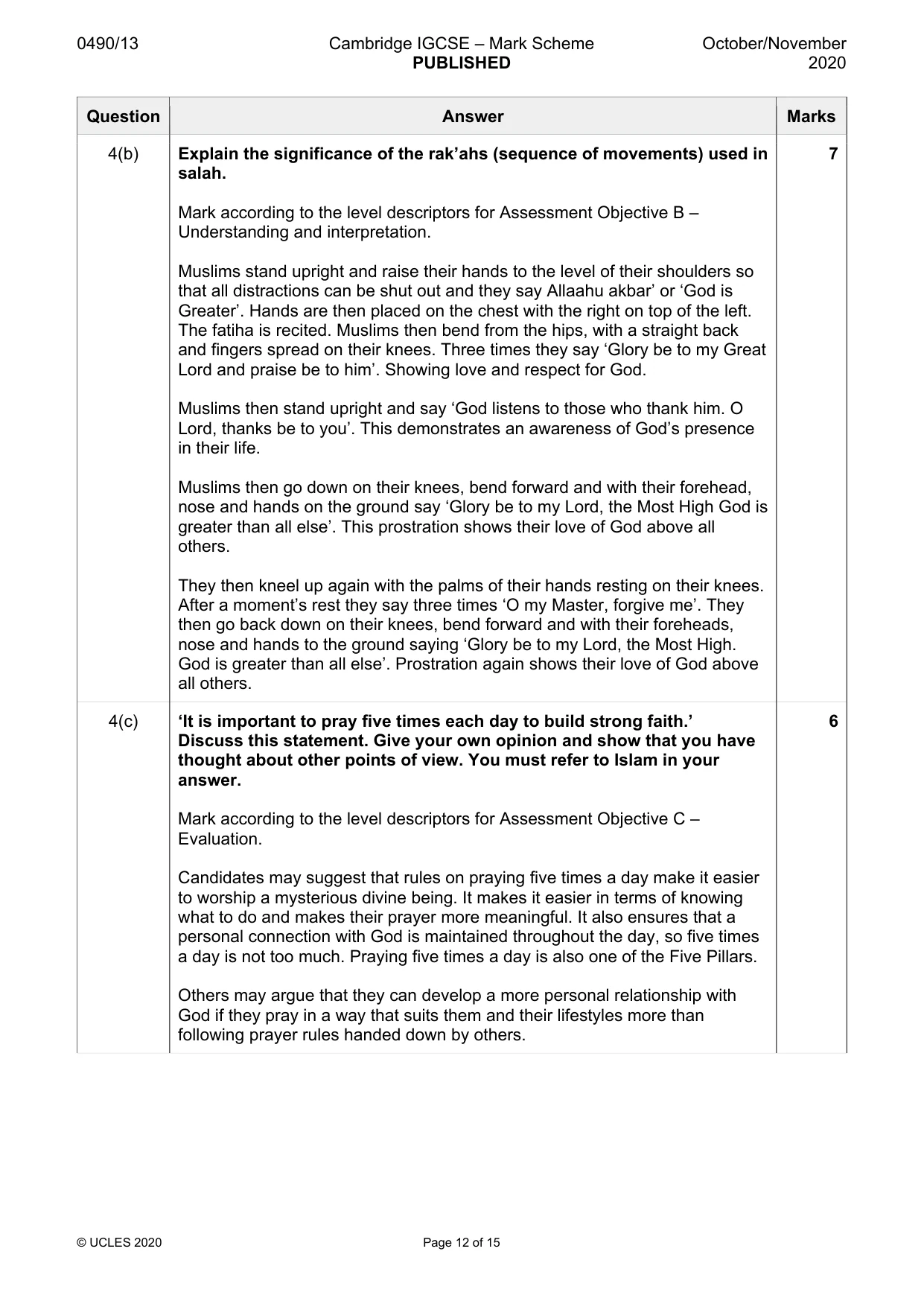
0490/13 Cambridge IGCSE – Mark Scheme PUBLISHED October/November 2020 © UCLES 2020 Page 12 of 15 Question Answer Marks 4(b) Explain the significance of the rak’ahs (sequence of movements) used in salah. Mark according to the level descriptors for Assessment Objective B – Understanding and interpretation. Muslims stand upright and raise their hands to the level of their shoulders so that all distractions can be shut out and they say Allaahu akbar’ or ‘God is Greater’. Hands are then placed on the chest with the right on top of the left. The fatiha is recited. Muslims then bend from the hips, with a straight back and fingers spread on their knees. Three times they say ‘Glory be to my Great Lord and praise be to him’. Showing love and respect for God. Muslims then stand upright and say ‘God listens to those who thank him. O Lord, thanks be to you’. This demonstrates an awareness of God’s presence in their life. Muslims then go down on their knees, bend forward and with their forehead, nose and hands on the ground say ‘Glory be to my Lord, the Most High God is greater than all else’. This prostration shows their love of God above all others. They then kneel up again with the palms of their hands resting on their knees. After a moment’s rest they say three times ‘O my Master, forgive me’. They then go back down on their knees, bend forward and with their foreheads, nose and hands to the ground saying ‘Glory be to my Lord, the Most High. God is greater than all else’. Prostration again shows their love of God above all others. 7 4(c) ‘It is important to pray five times each day to build strong faith.’ Discuss this statement. Give your own opinion and show that you have thought about other points of view. You must refer to Islam in your answer. Mark according to the level descriptors for Assessment Objective C – Evaluation. Candidates may suggest that rules on praying five times a day make it easier to worship a mysterious divine being. It makes it easier in terms of knowing what to do and makes their prayer more meaningful. It also ensures that a personal connection with God is maintained throughout the day, so five times a day is not too much. Praying five times a day is also one of the Five Pillars. Others may argue that they can develop a more personal relationship with God if they pray in a way that suits them and their lifestyles more than following prayer rules handed down by others. 6
Mark scheme, page 13
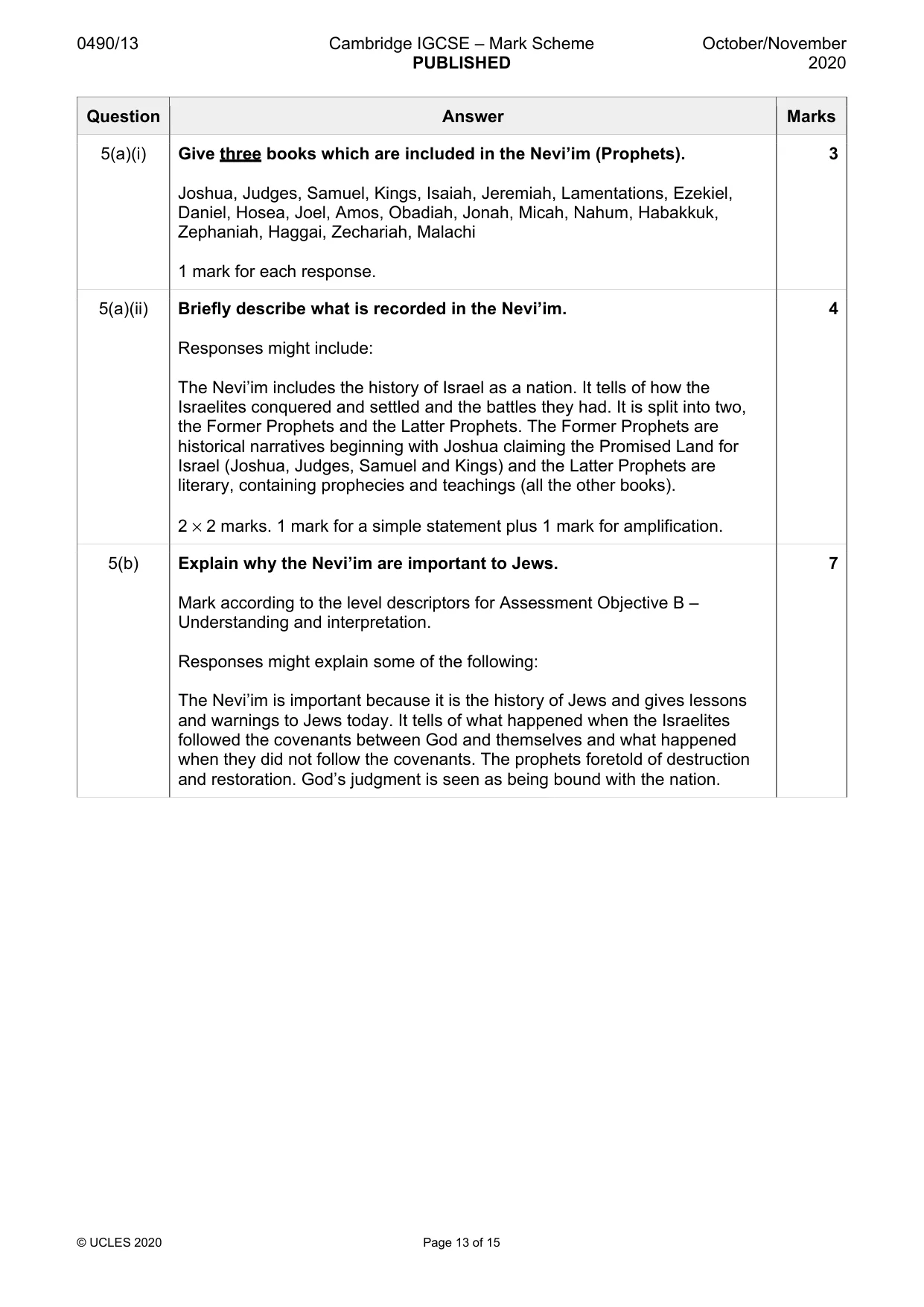
0490/13 Cambridge IGCSE – Mark Scheme PUBLISHED October/November 2020 © UCLES 2020 Page 13 of 15 Question Answer Marks 5(a)(i) Give three books which are included in the Nevi’im (Prophets). Joshua, Judges, Samuel, Kings, Isaiah, Jeremiah, Lamentations, Ezekiel, Daniel, Hosea, Joel, Amos, Obadiah, Jonah, Micah, Nahum, Habakkuk, Zephaniah, Haggai, Zechariah, Malachi 1 mark for each response. 3 5(a)(ii) Briefly describe what is recorded in the Nevi’im. Responses might include: The Nevi’im includes the history of Israel as a nation. It tells of how the Israelites conquered and settled and the battles they had. It is split into two, the Former Prophets and the Latter Prophets. The Former Prophets are historical narratives beginning with Joshua claiming the Promised Land for Israel (Joshua, Judges, Samuel and Kings) and the Latter Prophets are literary, containing prophecies and teachings (all the other books). 2 × 2 marks. 1 mark for a simple statement plus 1 mark for amplification. 4 5(b) Explain why the Nevi’im are important to Jews. Mark according to the level descriptors for Assessment Objective B – Understanding and interpretation. Responses might explain some of the following: The Nevi’im is important because it is the history of Jews and gives lessons and warnings to Jews today. It tells of what happened when the Israelites followed the covenants between God and themselves and what happened when they did not follow the covenants. The prophets foretold of destruction and restoration. God’s judgment is seen as being bound with the nation. 7
Mark scheme, page 14
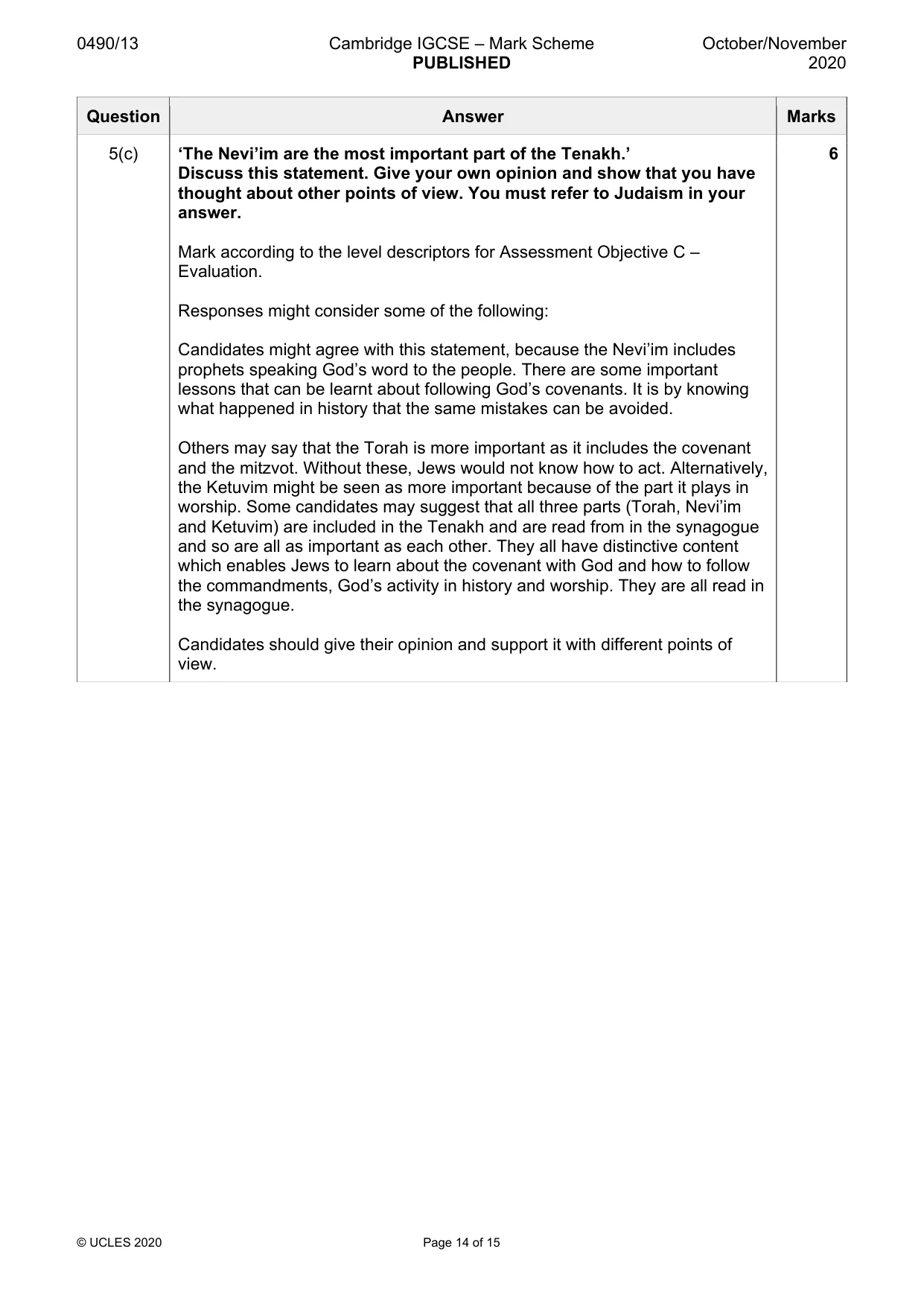
0490/13 Cambridge IGCSE – Mark Scheme PUBLISHED October/November 2020 © UCLES 2020 Page 14 of 15 Question Answer Marks 5(c) ‘The Nevi’im are the most important part of the Tenakh.’ Discuss this statement. Give your own opinion and show that you have thought about other points of view. You must refer to Judaism in your answer. Mark according to the level descriptors for Assessment Objective C – Evaluation. Responses might consider some of the following: Candidates might agree with this statement, because the Nevi’im includes prophets speaking God’s word to the people. There are some important lessons that can be learnt about following God’s covenants. It is by knowing what happened in history that the same mistakes can be avoided. Others may say that the Torah is more important as it includes the covenant and the mitzvot. Without these, Jews would not know how to act. Alternatively, the Ketuvim might be seen as more important because of the part it plays in worship. Some candidates may suggest that all three parts (Torah, Nevi’im and Ketuvim) are included in the Tenakh and are read from in the synagogue and so are all as important as each other. They all have distinctive content which enables Jews to learn about the covenant with God and how to follow the commandments, God’s activity in history and worship. They are all read in the synagogue. Candidates should give their opinion and support it with different points of view. 6
Mark scheme, page 15
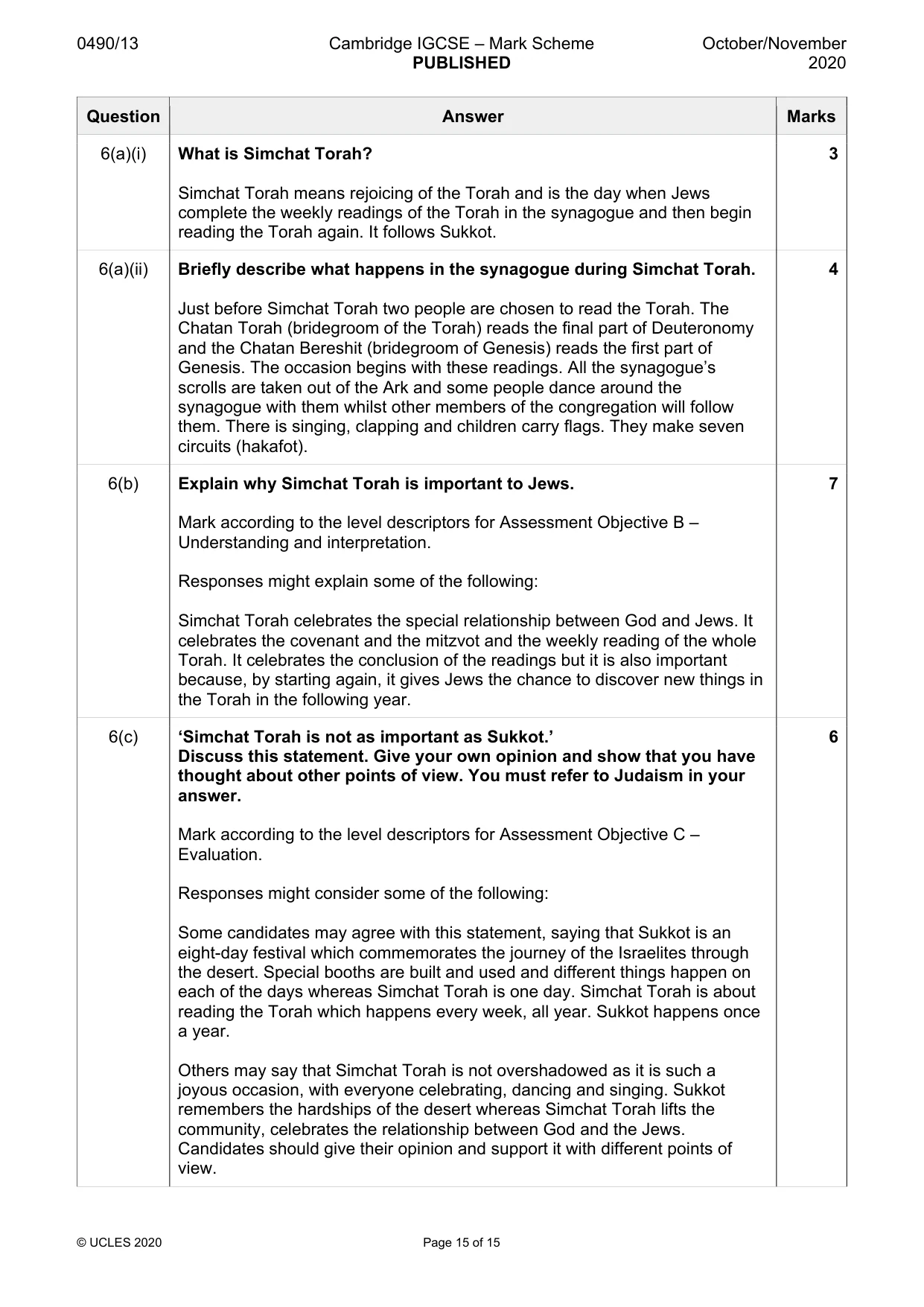
0490/13 Cambridge IGCSE – Mark Scheme PUBLISHED October/November 2020 © UCLES 2020 Page 15 of 15 Question Answer Marks 6(a)(i) What is Simchat Torah? Simchat Torah means rejoicing of the Torah and is the day when Jews complete the weekly readings of the Torah in the synagogue and then begin reading the Torah again. It follows Sukkot. 3 6(a)(ii) Briefly describe what happens in the synagogue during Simchat Torah. Just before Simchat Torah two people are chosen to read the Torah. The Chatan Torah (bridegroom of the Torah) reads the final part of Deuteronomy and the Chatan Bereshit (bridegroom of Genesis) reads the first part of Genesis. The occasion begins with these readings. All the synagogue’s scrolls are taken out of the Ark and some people dance around the synagogue with them whilst other members of the congregation will follow them. There is singing, clapping and children carry flags. They make seven circuits (hakafot). 4 6(b) Explain why Simchat Torah is important to Jews. Mark according to the level descriptors for Assessment Objective B – Understanding and interpretation. Responses might explain some of the following: Simchat Torah celebrates the special relationship between God and Jews. It celebrates the covenant and the mitzvot and the weekly reading of the whole Torah. It celebrates the conclusion of the readings but it is also important because, by starting again, it gives Jews the chance to discover new things in the Torah in the following year. 7 6(c) ‘Simchat Torah is not as important as Sukkot.’ Discuss this statement. Give your own opinion and show that you have thought about other points of view. You must refer to Judaism in your answer. Mark according to the level descriptors for Assessment Objective C – Evaluation. Responses might consider some of the following: Some candidates may agree with this statement, saying that Sukkot is an eight-day festival which commemorates the journey of the Israelites through the desert. Special booths are built and used and different things happen on each of the days whereas Simchat Torah is one day. Simchat Torah is about reading the Torah which happens every week, all year. Sukkot happens once a year. Others may say that Simchat Torah is not overshadowed as it is such a joyous occasion, with everyone celebrating, dancing and singing. Sukkot remembers the hardships of the desert whereas Simchat Torah lifts the community, celebrates the relationship between God and the Jews. Candidates should give their opinion and support it with different points of view. 6
What you needed in this session
Cambridge’s own grade thresholds for 2020 Oct/Nov, Paper 1 · Variant 3. A higher threshold means an easier paper — the bar moves with how the cohort did.