Cambridge IGCSE Religious Studies 0490 — 2023 Oct/Nov Paper 1 · Variant 3
0490/13/O/N/23 · 80 marks · ≈90 min
The question paper and its mark scheme, free to read here and free to download. This is Cambridge’s own paper, exactly as it was sat.
Question paper4 pages
Mark scheme20 pages
Answers below. Sit the paper first if you are practising.
Paper as text
Question paper, page 1
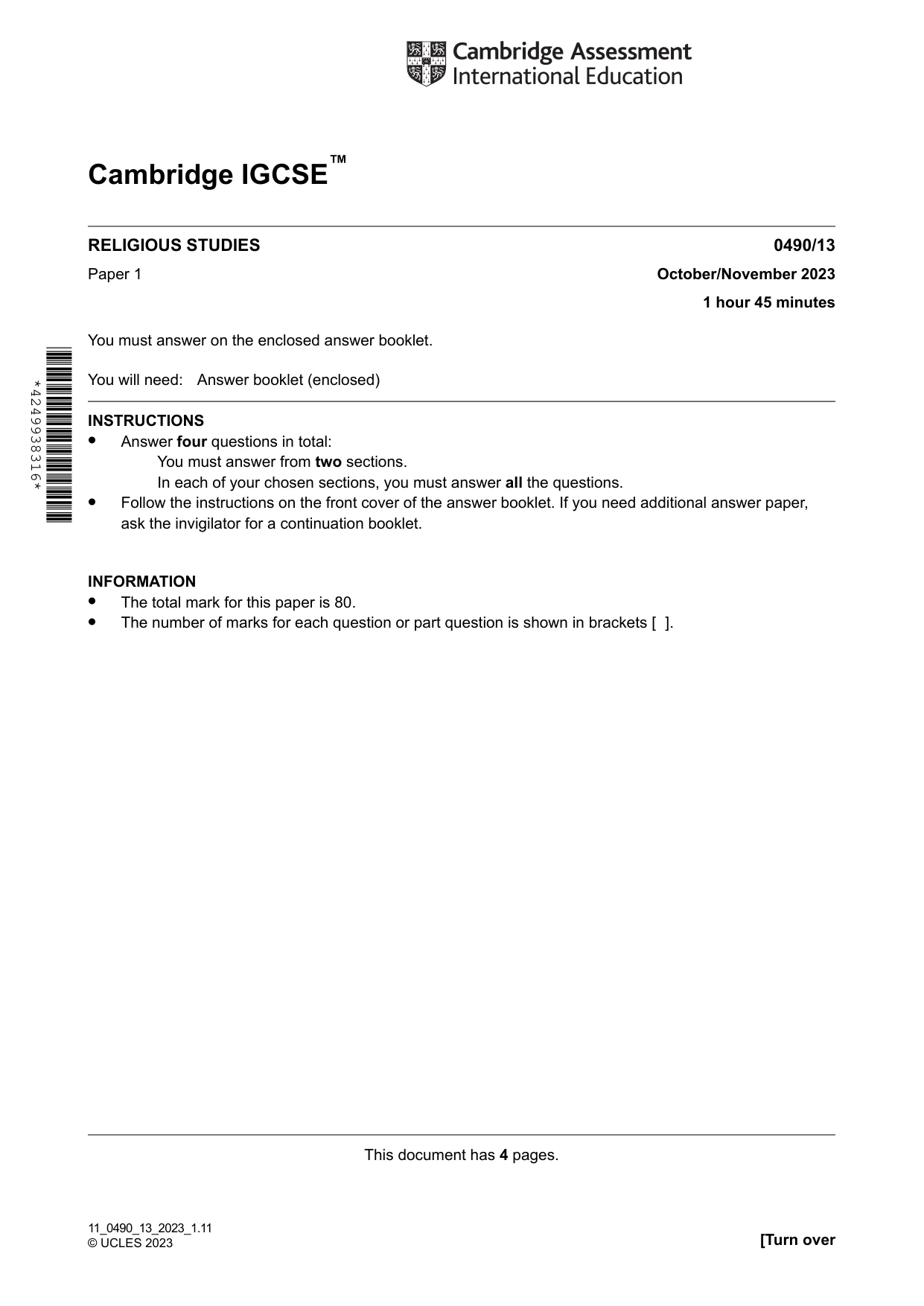
Cambridge IGCSE™ 0490/13 October/November 2023 1 hour 45 minutes RELIGIOUS STUDIES Paper 1 You must answer on the enclosed answer booklet. You will need: Answer booklet (enclosed) INSTRUCTIONS • Answer four questions in total: You must answer from two sections. In each of your chosen sections, you must answer all the questions. • Follow the instructions on the front cover of the answer booklet. If you need additional answer paper, ask the invigilator for a continuation booklet. INFORMATION • The total mark for this paper is 80. • The number of marks for each question or part question is shown in brackets [ ]. This document has 4 pages. [Turn over 11_0490_13_2023_1.11 © UCLES 2023 *4249938316*
Question paper, page 2
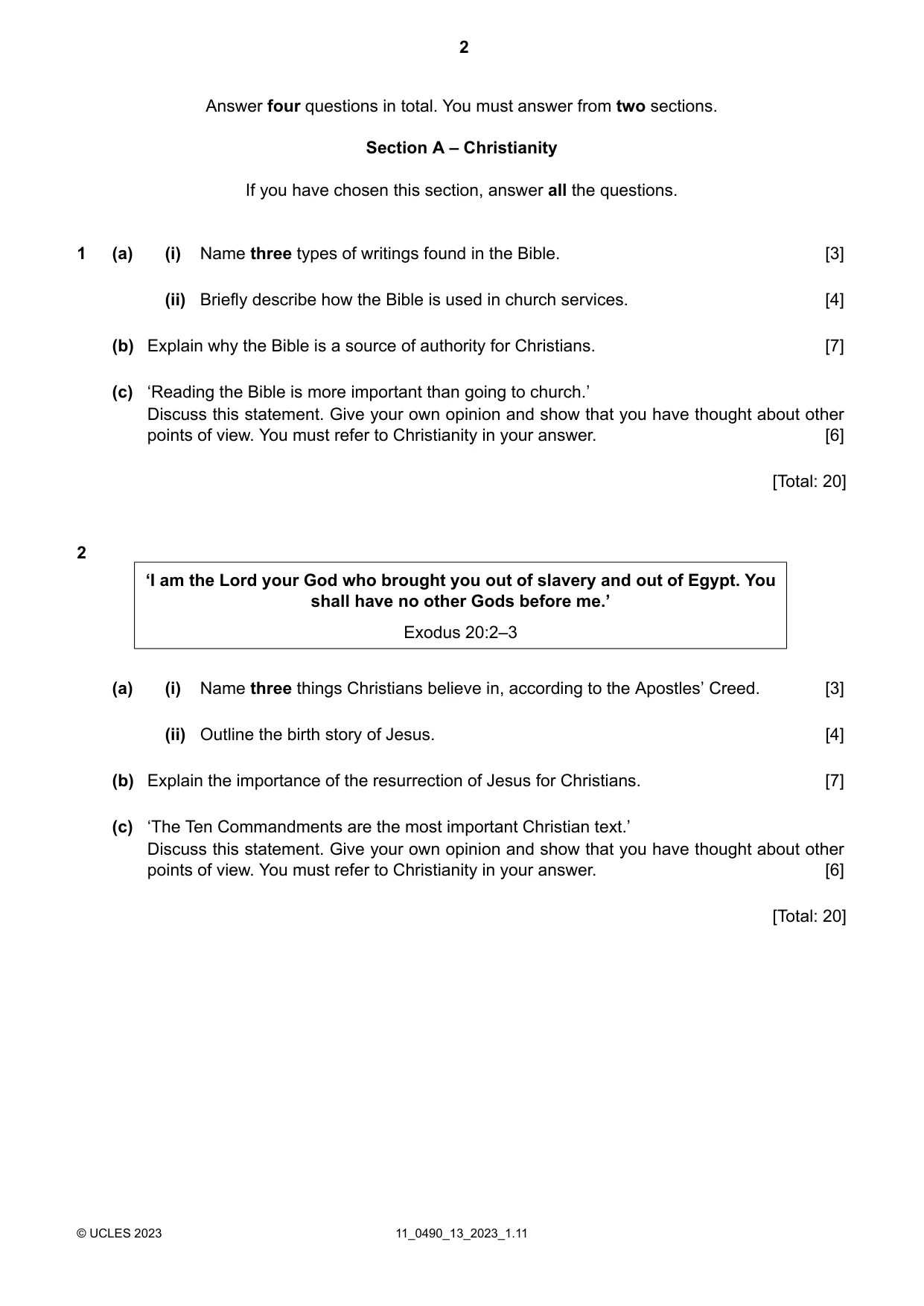
Answer four questions in total. You must answer from two sections. Section A – Christianity If you have chosen this section, answer all the questions. Name three types of writings found in the Bible. [3] (i) (a) 1 Briefly describe how the Bible is used in church services. [4] (ii) Explain why the Bible is a source of authority for Christians. [7] (b) ‘Reading the Bible is more important than going to church.’ Discuss this statement. Give your own opinion and show that you have thought about other points of view. You must refer to Christianity in your answer. [6] (c) [Total: 20] 2 ‘I am the Lord your God who brought you out of slavery and out of Egypt. You shall have no other Gods before me.’ Exodus 20:2–3 Name three things Christians believe in, according to the Apostles’ Creed. [3] (i) (a) Outline the birth story of Jesus. [4] (ii) Explain the importance of the resurrection of Jesus for Christians. [7] (b) ‘The Ten Commandments are the most important Christian text.’ Discuss this statement. Give your own opinion and show that you have thought about other points of view. You must refer to Christianity in your answer. [6] (c) [Total: 20] 11_0490_13_2023_1.11 © UCLES 2023 2
Question paper, page 3
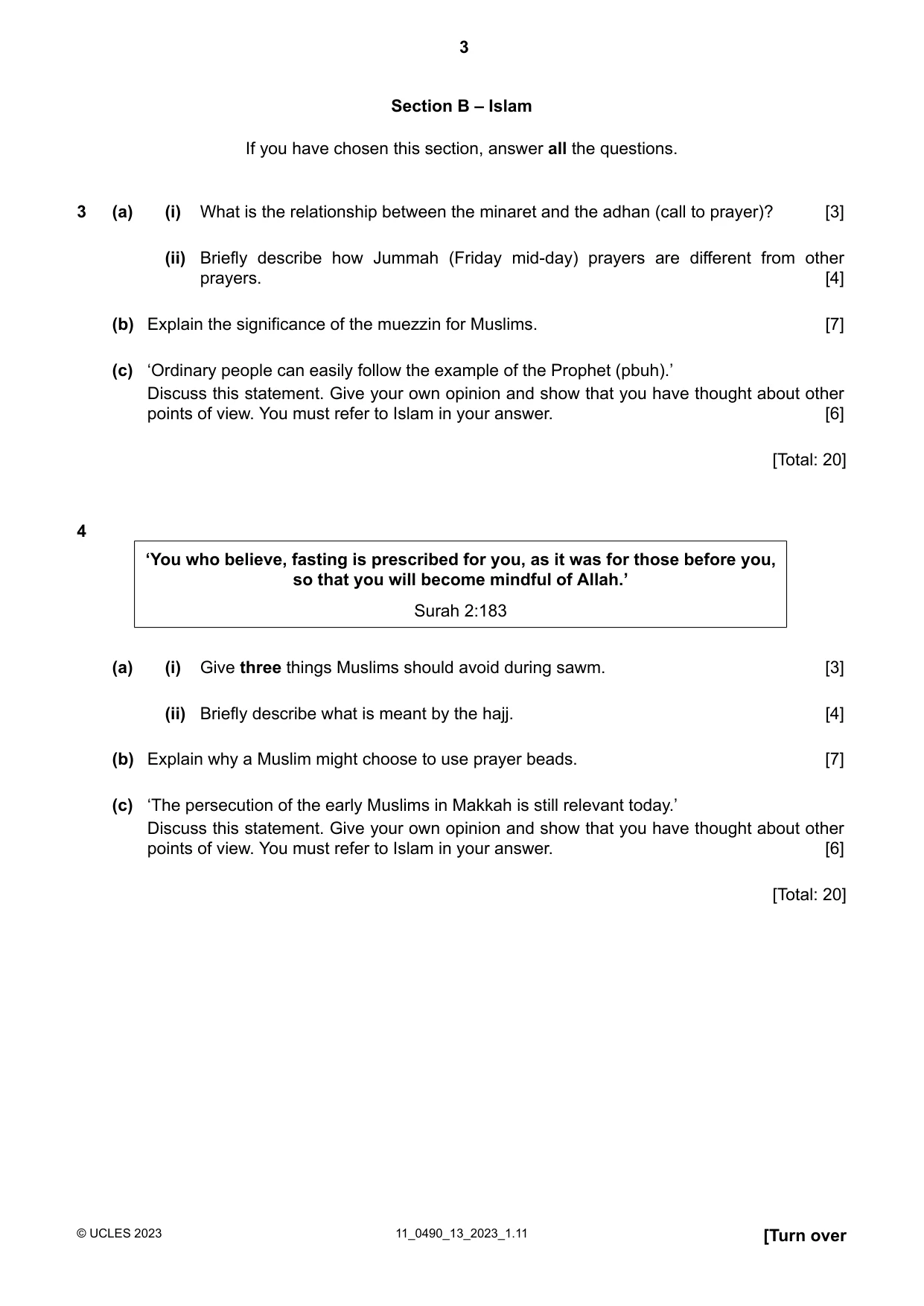
Section B – Islam If you have chosen this section, answer all the questions. What is the relationship between the minaret and the adhan (call to prayer)? [3] (i) (a) 3 Briefly describe how Jummah (Friday mid-day) prayers are different from other prayers. [4] (ii) Explain the significance of the muezzin for Muslims. [7] (b) ‘Ordinary people can easily follow the example of the Prophet (pbuh).’ Discuss this statement. Give your own opinion and show that you have thought about other points of view. You must refer to Islam in your answer. [6] (c) [Total: 20] 4 ‘You who believe, fasting is prescribed for you, as it was for those before you, so that you will become mindful of Allah.’ Surah 2:183 Give three things Muslims should avoid during sawm. [3] (i) (a) Briefly describe what is meant by the hajj. [4] (ii) Explain why a Muslim might choose to use prayer beads. [7] (b) ‘The persecution of the early Muslims in Makkah is still relevant today.’ Discuss this statement. Give your own opinion and show that you have thought about other points of view. You must refer to Islam in your answer. [6] (c) [Total: 20] [Turn over 11_0490_13_2023_1.11 © UCLES 2023 3
Question paper, page 4
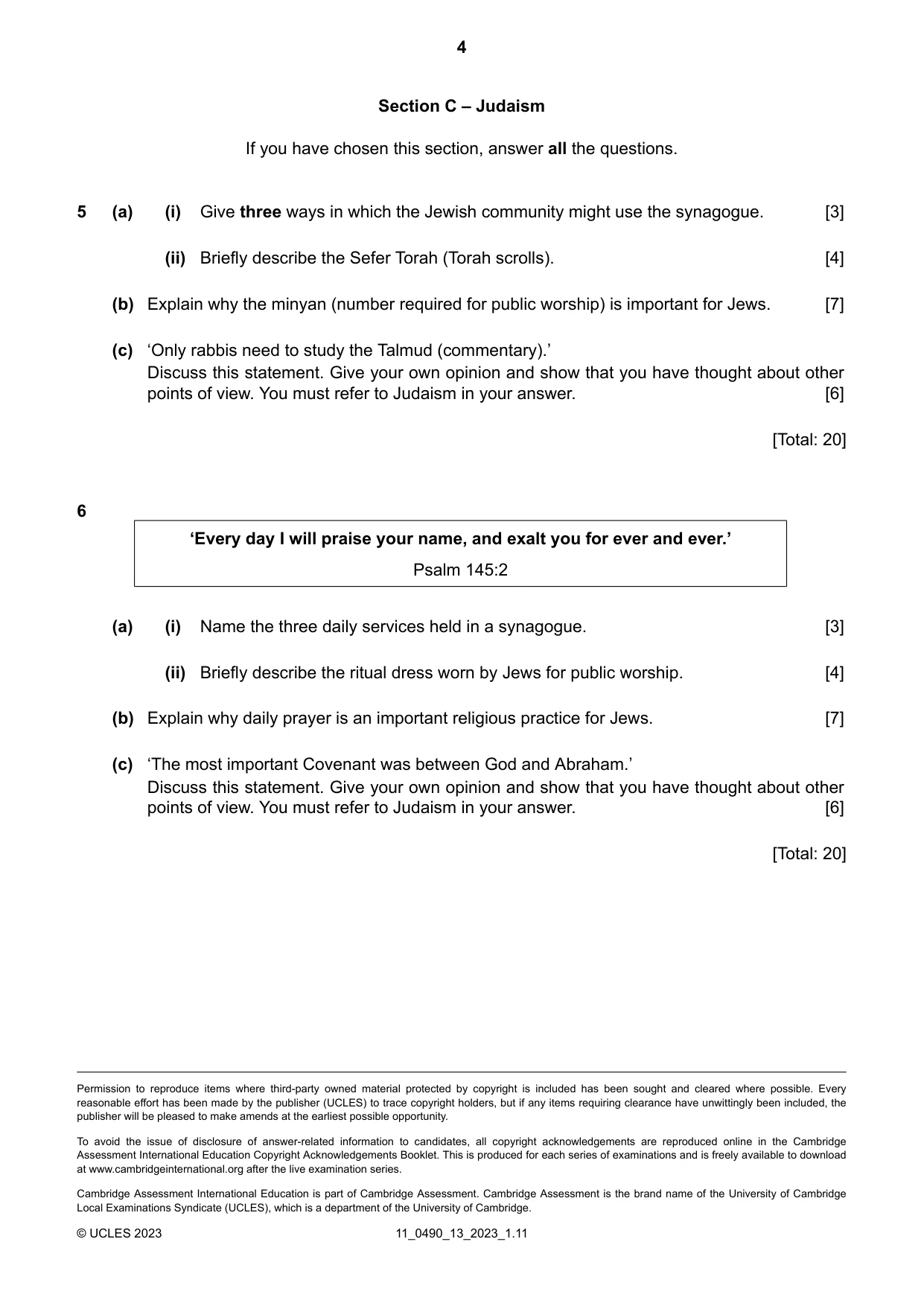
Section C – Judaism If you have chosen this section, answer all the questions. Give three ways in which the Jewish community might use the synagogue. [3] (i) (a) 5 Briefly describe the Sefer Torah (Torah scrolls). [4] (ii) Explain why the minyan (number required for public worship) is important for Jews. [7] (b) ‘Only rabbis need to study the Talmud (commentary).’ Discuss this statement. Give your own opinion and show that you have thought about other points of view. You must refer to Judaism in your answer. [6] (c) [Total: 20] 6 ‘Every day I will praise your name, and exalt you for ever and ever.’ Psalm 145:2 Name the three daily services held in a synagogue. [3] (i) (a) Briefly describe the ritual dress worn by Jews for public worship. [4] (ii) Explain why daily prayer is an important religious practice for Jews. [7] (b) ‘The most important Covenant was between God and Abraham.’ Discuss this statement. Give your own opinion and show that you have thought about other points of view. You must refer to Judaism in your answer. [6] (c) [Total: 20] Permission to reproduce items where third-party owned material protected by copyright is included has been sought and cleared where possible. Every reasonable effort has been made by the publisher (UCLES) to trace copyright holders, but if any items requiring clearance have unwittingly been included, the publisher will be pleased to make amends at the earliest possible opportunity. To avoid the issue of disclosure of answer-related information to candidates, all copyright acknowledgements are reproduced online in the Cambridge Assessment International Education Copyright Acknowledgements Booklet. This is produced for each series of examinations and is freely available to download at www.cambridgeinternational.org after the live examination series. Cambridge Assessment International Education is part of Cambridge Assessment. Cambridge Assessment is the brand name of the University of Cambridge Local Examinations Syndicate (UCLES), which is a department of the University of Cambridge. 11_0490_13_2023_1.11 © UCLES 2023 4
Mark scheme, page 1
This document consists of 20 printed pages. © UCLES 2023 [Turn over Cambridge IGCSE™ RELIGIOUS STUDIES 0490/13 Paper 1 October/November 2023 MARK SCHEME Maximum Mark: 80 Published This mark scheme is published as an aid to teachers and candidates, to indicate the requirements of the examination. It shows the basis on which Examiners were instructed to award marks. It does not indicate the details of the discussions that took place at an Examiners’ meeting before marking began, which would have considered the acceptability of alternative answers. Mark schemes should be read in conjunction with the question paper and the Principal Examiner Report for Teachers. Cambridge International will not enter into discussions about these mark schemes. Cambridge International is publishing the mark schemes for the October/November 2023 series for most Cambridge IGCSE, Cambridge International A and AS Level components, and some Cambridge O Level components.
Mark scheme, page 2
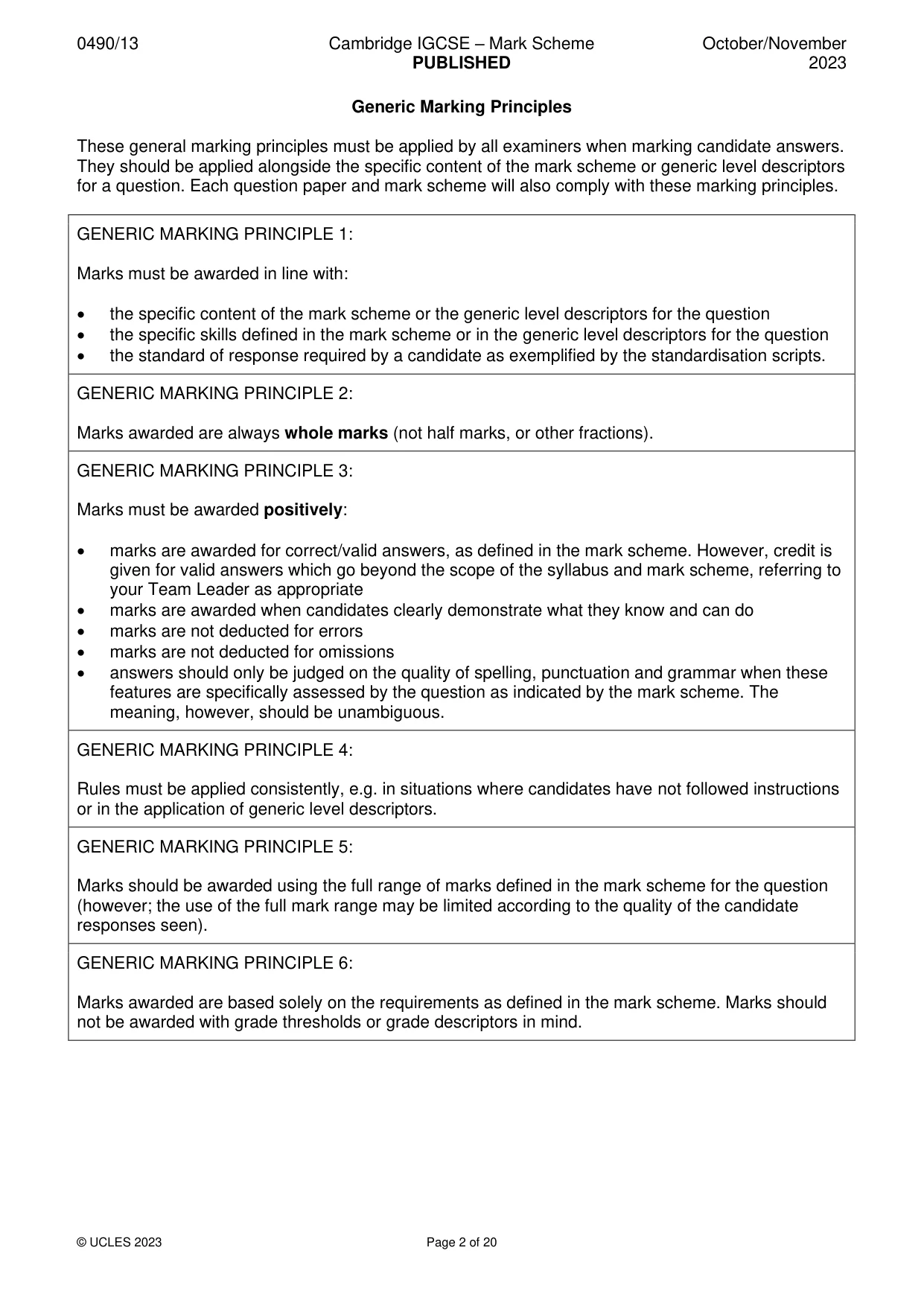
0490/13 Cambridge IGCSE – Mark Scheme PUBLISHED October/November 2023 © UCLES 2023 Page 2 of 20 Generic Marking Principles These general marking principles must be applied by all examiners when marking candidate answers. They should be applied alongside the specific content of the mark scheme or generic level descriptors for a question. Each question paper and mark scheme will also comply with these marking principles. GENERIC MARKING PRINCIPLE 1: Marks must be awarded in line with: • the specific content of the mark scheme or the generic level descriptors for the question • the specific skills defined in the mark scheme or in the generic level descriptors for the question • the standard of response required by a candidate as exemplified by the standardisation scripts. GENERIC MARKING PRINCIPLE 2: Marks awarded are always whole marks (not half marks, or other fractions). GENERIC MARKING PRINCIPLE 3: Marks must be awarded positively: • marks are awarded for correct/valid answers, as defined in the mark scheme. However, credit is given for valid answers which go beyond the scope of the syllabus and mark scheme, referring to your Team Leader as appropriate • marks are awarded when candidates clearly demonstrate what they know and can do • marks are not deducted for errors • marks are not deducted for omissions • answers should only be judged on the quality of spelling, punctuation and grammar when these features are specifically assessed by the question as indicated by the mark scheme. The meaning, however, should be unambiguous. GENERIC MARKING PRINCIPLE 4: Rules must be applied consistently, e.g. in situations where candidates have not followed instructions or in the application of generic level descriptors. GENERIC MARKING PRINCIPLE 5: Marks should be awarded using the full range of marks defined in the mark scheme for the question (however; the use of the full mark range may be limited according to the quality of the candidate responses seen). GENERIC MARKING PRINCIPLE 6: Marks awarded are based solely on the requirements as defined in the mark scheme. Marks should not be awarded with grade thresholds or grade descriptors in mind.
Mark scheme, page 3
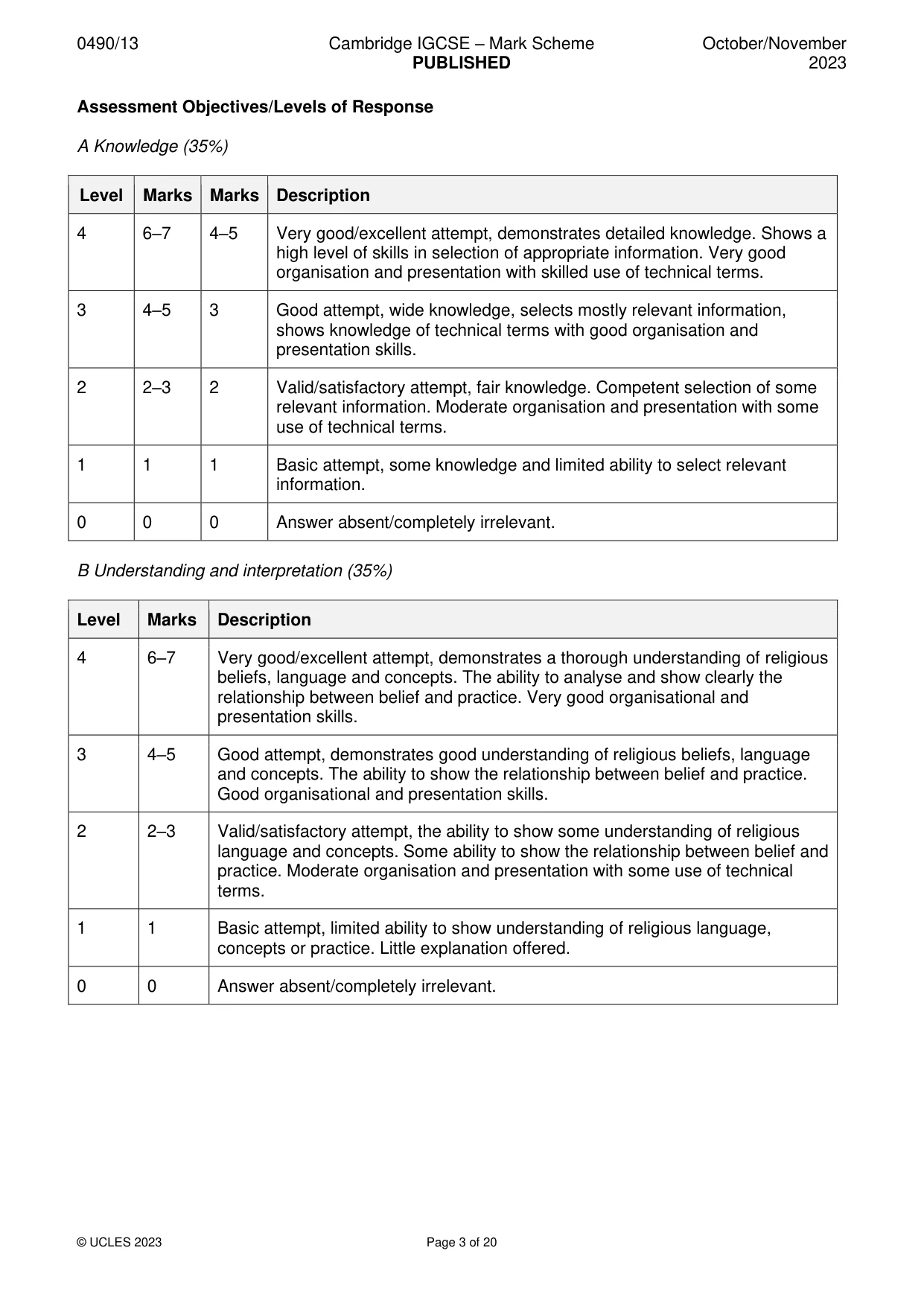
0490/13 Cambridge IGCSE – Mark Scheme PUBLISHED October/November 2023 © UCLES 2023 Page 3 of 20 Assessment Objectives/Levels of Response A Knowledge (35%) Level Marks Marks Description 4 6–7 4–5 Very good/excellent attempt, demonstrates detailed knowledge. Shows a high level of skills in selection of appropriate information. Very good organisation and presentation with skilled use of technical terms. 3 4–5 3 Good attempt, wide knowledge, selects mostly relevant information, shows knowledge of technical terms with good organisation and presentation skills. 2 2–3 2 Valid/satisfactory attempt, fair knowledge. Competent selection of some relevant information. Moderate organisation and presentation with some use of technical terms. 1 1 1 Basic attempt, some knowledge and limited ability to select relevant information. 0 0 0 Answer absent/completely irrelevant. B Understanding and interpretation (35%) Level Marks Description 4 6–7 Very good/excellent attempt, demonstrates a thorough understanding of religious beliefs, language and concepts. The ability to analyse and show clearly the relationship between belief and practice. Very good organisational and presentation skills. 3 4–5 Good attempt, demonstrates good understanding of religious beliefs, language and concepts. The ability to show the relationship between belief and practice. Good organisational and presentation skills. 2 2–3 Valid/satisfactory attempt, the ability to show some understanding of religious language and concepts. Some ability to show the relationship between belief and practice. Moderate organisation and presentation with some use of technical terms. 1 1 Basic attempt, limited ability to show understanding of religious language, concepts or practice. Little explanation offered. 0 0 Answer absent/completely irrelevant.
Mark scheme, page 4
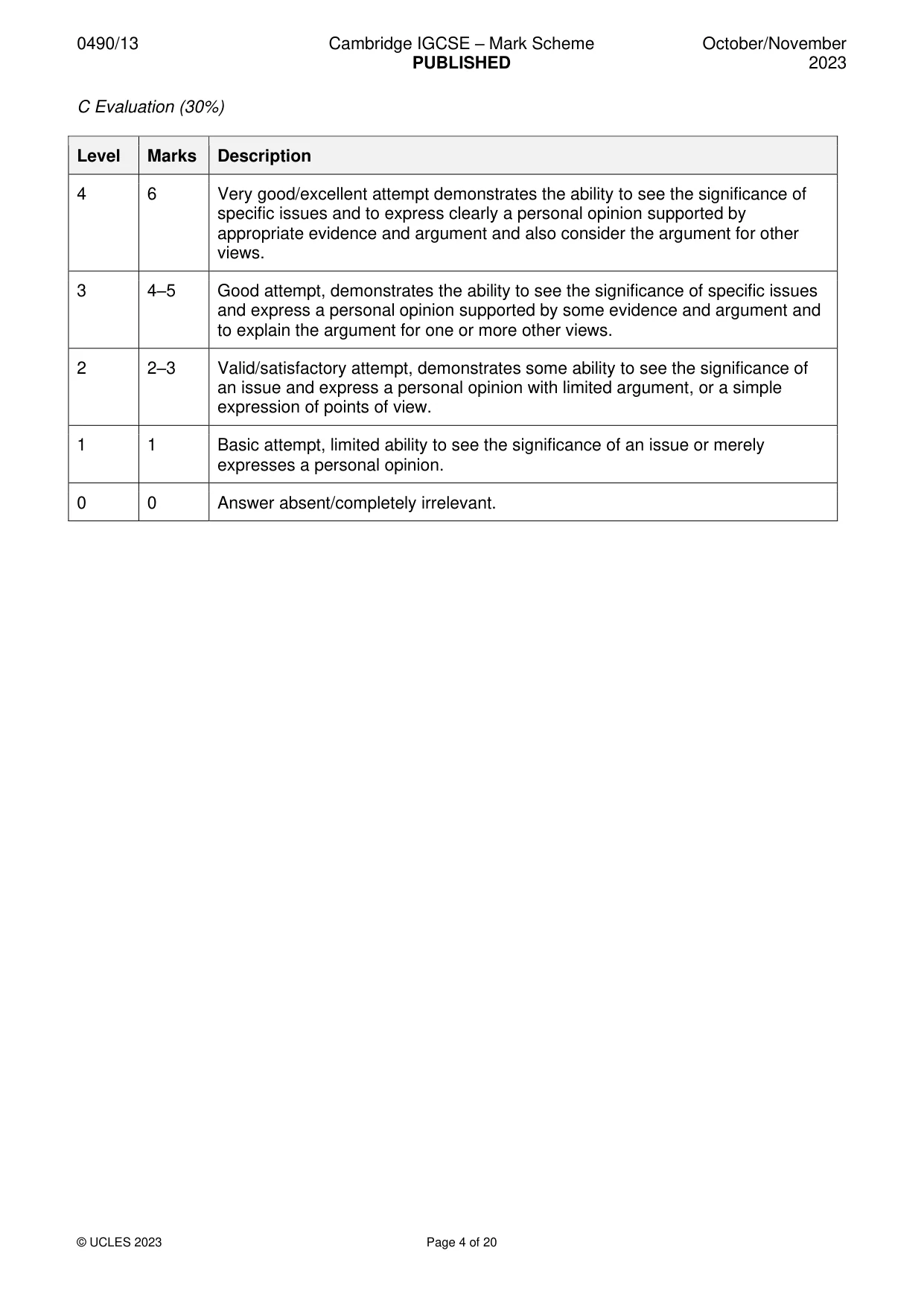
0490/13 Cambridge IGCSE – Mark Scheme PUBLISHED October/November 2023 © UCLES 2023 Page 4 of 20 C Evaluation (30%) Level Marks Description 4 6 Very good/excellent attempt demonstrates the ability to see the significance of specific issues and to express clearly a personal opinion supported by appropriate evidence and argument and also consider the argument for other views. 3 4–5 Good attempt, demonstrates the ability to see the significance of specific issues and express a personal opinion supported by some evidence and argument and to explain the argument for one or more other views. 2 2–3 Valid/satisfactory attempt, demonstrates some ability to see the significance of an issue and express a personal opinion with limited argument, or a simple expression of points of view. 1 1 Basic attempt, limited ability to see the significance of an issue or merely expresses a personal opinion. 0 0 Answer absent/completely irrelevant.
Mark scheme, page 5
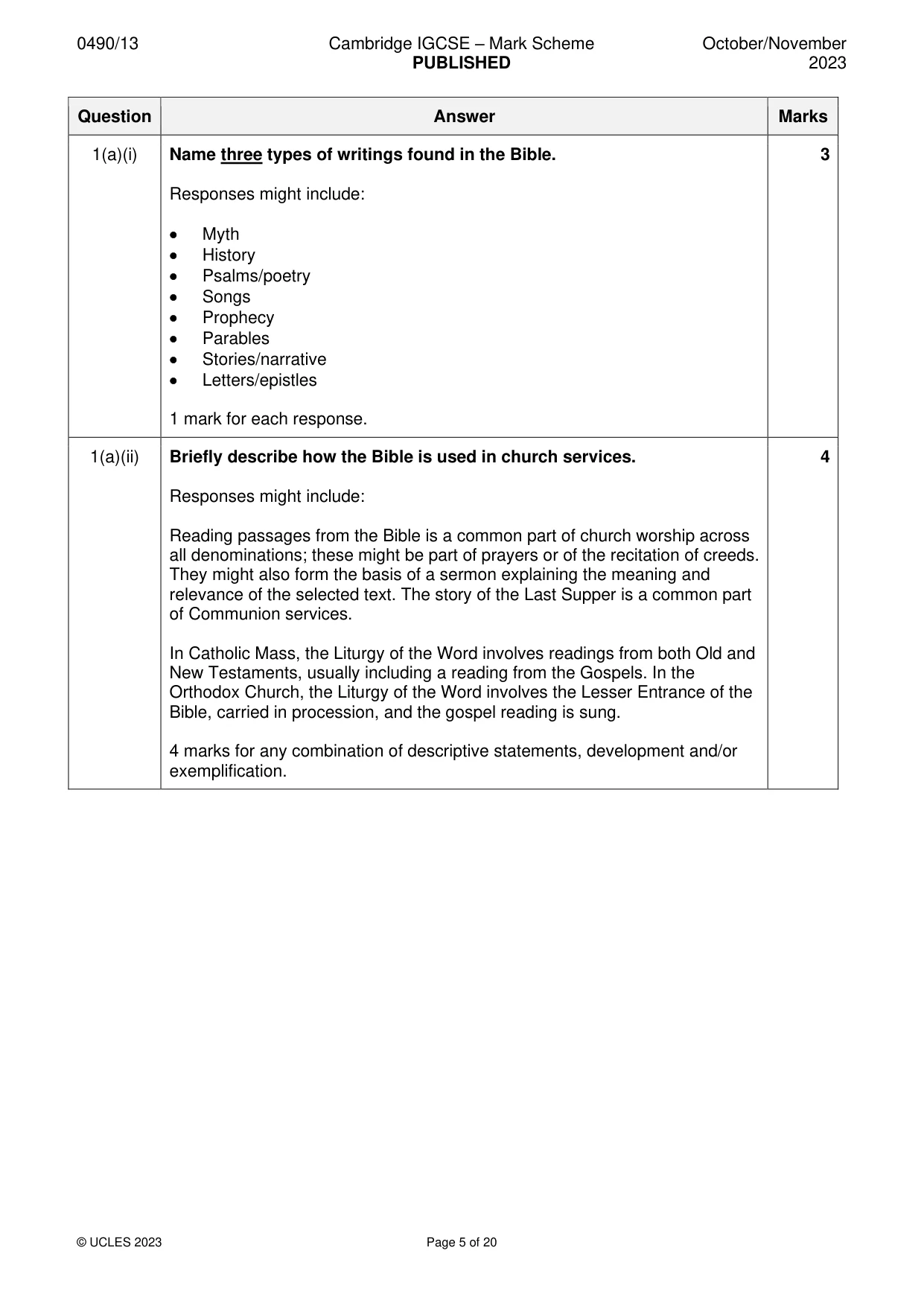
0490/13 Cambridge IGCSE – Mark Scheme PUBLISHED October/November 2023 © UCLES 2023 Page 5 of 20 Question Answer Marks 1(a)(i) Name three types of writings found in the Bible. Responses might include: • Myth • History • Psalms/poetry • Songs • Prophecy • Parables • Stories/narrative • Letters/epistles 1 mark for each response. 3 1(a)(ii) Briefly describe how the Bible is used in church services. Responses might include: Reading passages from the Bible is a common part of church worship across all denominations; these might be part of prayers or of the recitation of creeds. They might also form the basis of a sermon explaining the meaning and relevance of the selected text. The story of the Last Supper is a common part of Communion services. In Catholic Mass, the Liturgy of the Word involves readings from both Old and New Testaments, usually including a reading from the Gospels. In the Orthodox Church, the Liturgy of the Word involves the Lesser Entrance of the Bible, carried in procession, and the gospel reading is sung. 4 marks for any combination of descriptive statements, development and/or exemplification. 4
Mark scheme, page 6
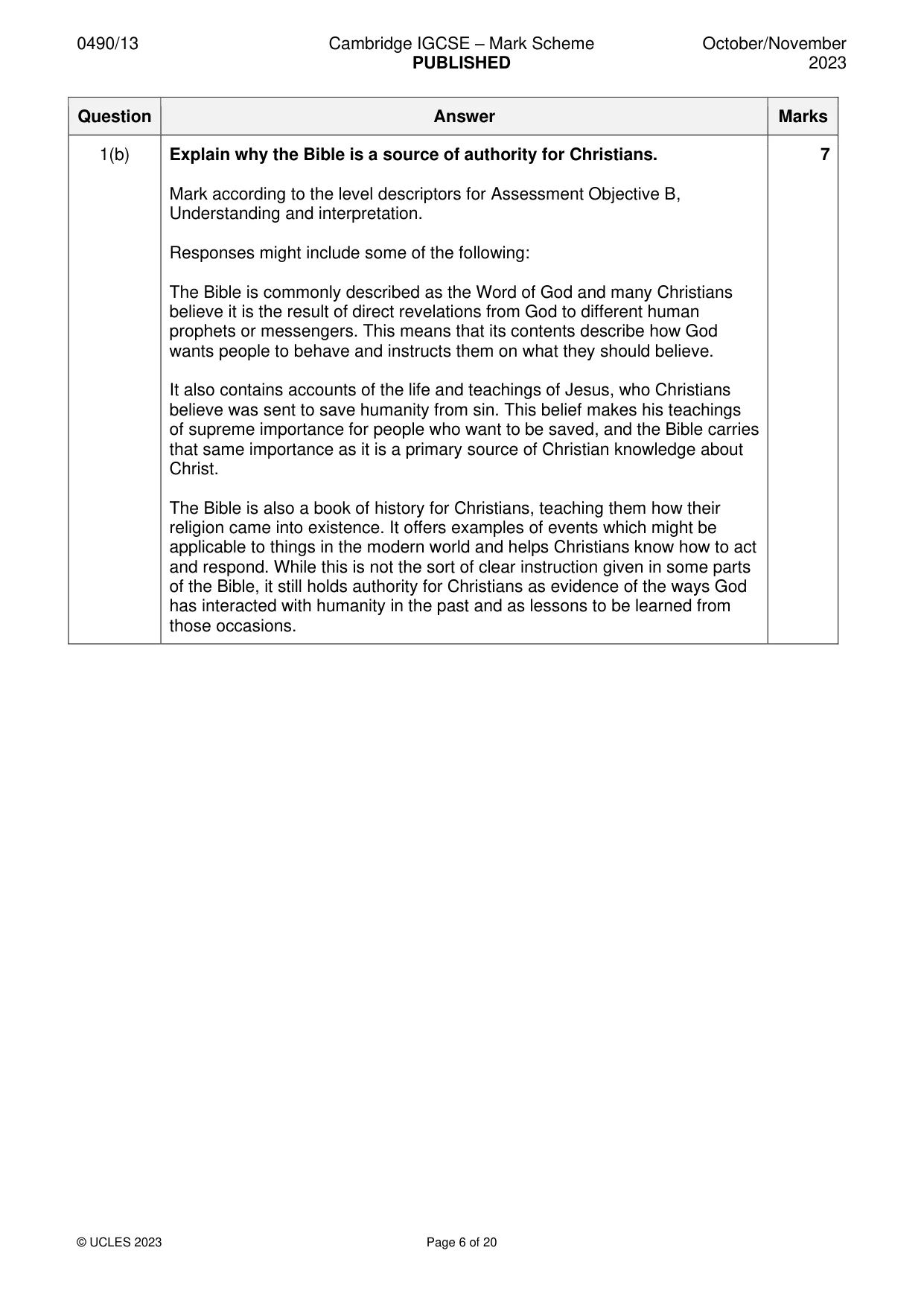
0490/13 Cambridge IGCSE – Mark Scheme PUBLISHED October/November 2023 © UCLES 2023 Page 6 of 20 Question Answer Marks 1(b) Explain why the Bible is a source of authority for Christians. Mark according to the level descriptors for Assessment Objective B, Understanding and interpretation. Responses might include some of the following: The Bible is commonly described as the Word of God and many Christians believe it is the result of direct revelations from God to different human prophets or messengers. This means that its contents describe how God wants people to behave and instructs them on what they should believe. It also contains accounts of the life and teachings of Jesus, who Christians believe was sent to save humanity from sin. This belief makes his teachings of supreme importance for people who want to be saved, and the Bible carries that same importance as it is a primary source of Christian knowledge about Christ. The Bible is also a book of history for Christians, teaching them how their religion came into existence. It offers examples of events which might be applicable to things in the modern world and helps Christians know how to act and respond. While this is not the sort of clear instruction given in some parts of the Bible, it still holds authority for Christians as evidence of the ways God has interacted with humanity in the past and as lessons to be learned from those occasions. 7
Mark scheme, page 7
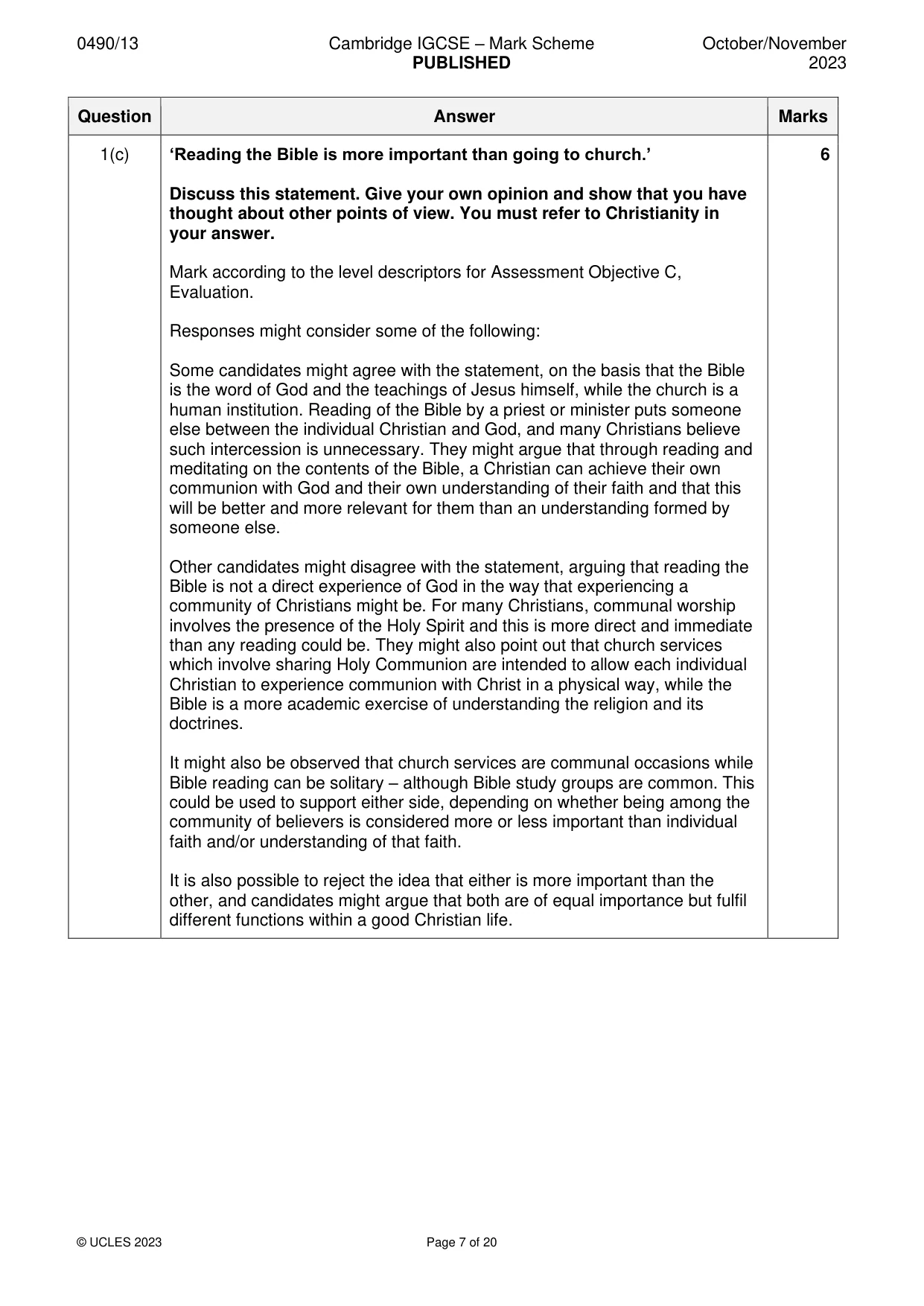
0490/13 Cambridge IGCSE – Mark Scheme PUBLISHED October/November 2023 © UCLES 2023 Page 7 of 20 Question Answer Marks 1(c) ‘Reading the Bible is more important than going to church.’ Discuss this statement. Give your own opinion and show that you have thought about other points of view. You must refer to Christianity in your answer. Mark according to the level descriptors for Assessment Objective C, Evaluation. Responses might consider some of the following: Some candidates might agree with the statement, on the basis that the Bible is the word of God and the teachings of Jesus himself, while the church is a human institution. Reading of the Bible by a priest or minister puts someone else between the individual Christian and God, and many Christians believe such intercession is unnecessary. They might argue that through reading and meditating on the contents of the Bible, a Christian can achieve their own communion with God and their own understanding of their faith and that this will be better and more relevant for them than an understanding formed by someone else. Other candidates might disagree with the statement, arguing that reading the Bible is not a direct experience of God in the way that experiencing a community of Christians might be. For many Christians, communal worship involves the presence of the Holy Spirit and this is more direct and immediate than any reading could be. They might also point out that church services which involve sharing Holy Communion are intended to allow each individual Christian to experience communion with Christ in a physical way, while the Bible is a more academic exercise of understanding the religion and its doctrines. It might also be observed that church services are communal occasions while Bible reading can be solitary – although Bible study groups are common. This could be used to support either side, depending on whether being among the community of believers is considered more or less important than individual faith and/or understanding of that faith. It is also possible to reject the idea that either is more important than the other, and candidates might argue that both are of equal importance but fulfil different functions within a good Christian life. 6
Mark scheme, page 8
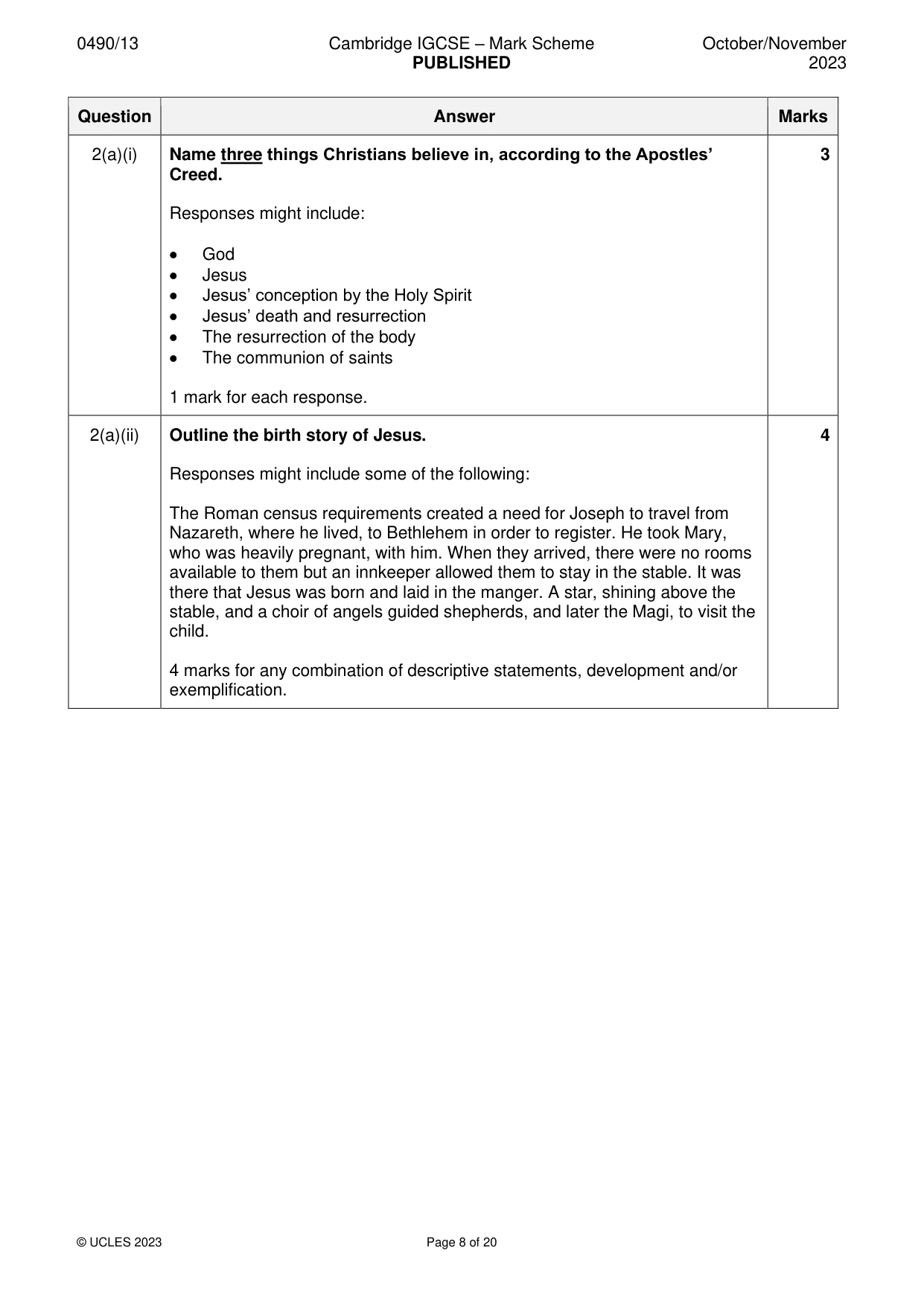
0490/13 Cambridge IGCSE – Mark Scheme PUBLISHED October/November 2023 © UCLES 2023 Page 8 of 20 Question Answer Marks 2(a)(i) Name three things Christians believe in, according to the Apostles’ Creed. Responses might include: • God • Jesus • Jesus’ conception by the Holy Spirit • Jesus’ death and resurrection • The resurrection of the body • The communion of saints 1 mark for each response. 3 2(a)(ii) Outline the birth story of Jesus. Responses might include some of the following: The Roman census requirements created a need for Joseph to travel from Nazareth, where he lived, to Bethlehem in order to register. He took Mary, who was heavily pregnant, with him. When they arrived, there were no rooms available to them but an innkeeper allowed them to stay in the stable. It was there that Jesus was born and laid in the manger. A star, shining above the stable, and a choir of angels guided shepherds, and later the Magi, to visit the child. 4 marks for any combination of descriptive statements, development and/or exemplification. 4
Mark scheme, page 9
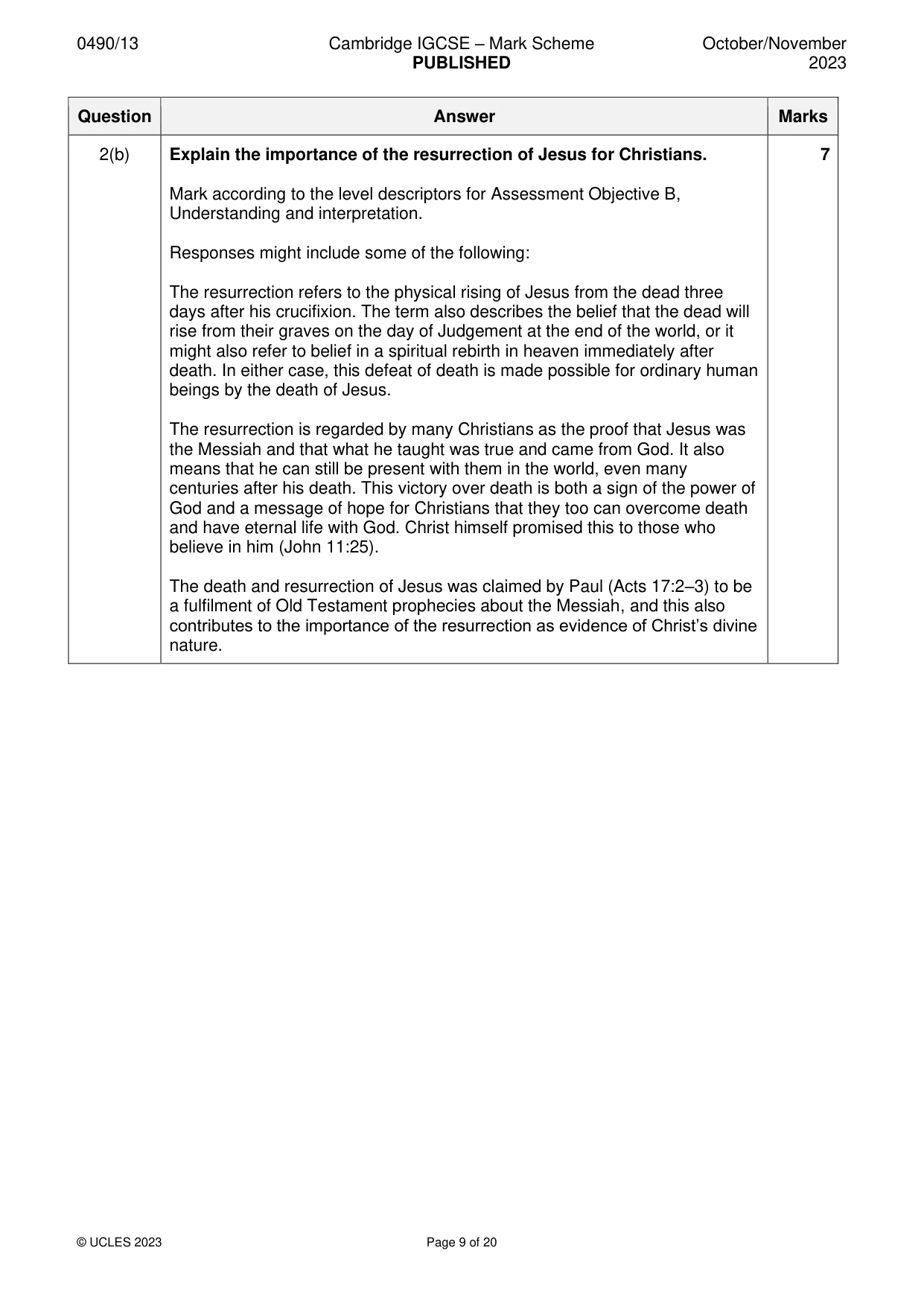
0490/13 Cambridge IGCSE – Mark Scheme PUBLISHED October/November 2023 © UCLES 2023 Page 9 of 20 Question Answer Marks 2(b) Explain the importance of the resurrection of Jesus for Christians. Mark according to the level descriptors for Assessment Objective B, Understanding and interpretation. Responses might include some of the following: The resurrection refers to the physical rising of Jesus from the dead three days after his crucifixion. The term also describes the belief that the dead will rise from their graves on the day of Judgement at the end of the world, or it might also refer to belief in a spiritual rebirth in heaven immediately after death. In either case, this defeat of death is made possible for ordinary human beings by the death of Jesus. The resurrection is regarded by many Christians as the proof that Jesus was the Messiah and that what he taught was true and came from God. It also means that he can still be present with them in the world, even many centuries after his death. This victory over death is both a sign of the power of God and a message of hope for Christians that they too can overcome death and have eternal life with God. Christ himself promised this to those who believe in him (John 11:25). The death and resurrection of Jesus was claimed by Paul (Acts 17:2–3) to be a fulfilment of Old Testament prophecies about the Messiah, and this also contributes to the importance of the resurrection as evidence of Christ’s divine nature. 7
Mark scheme, page 10
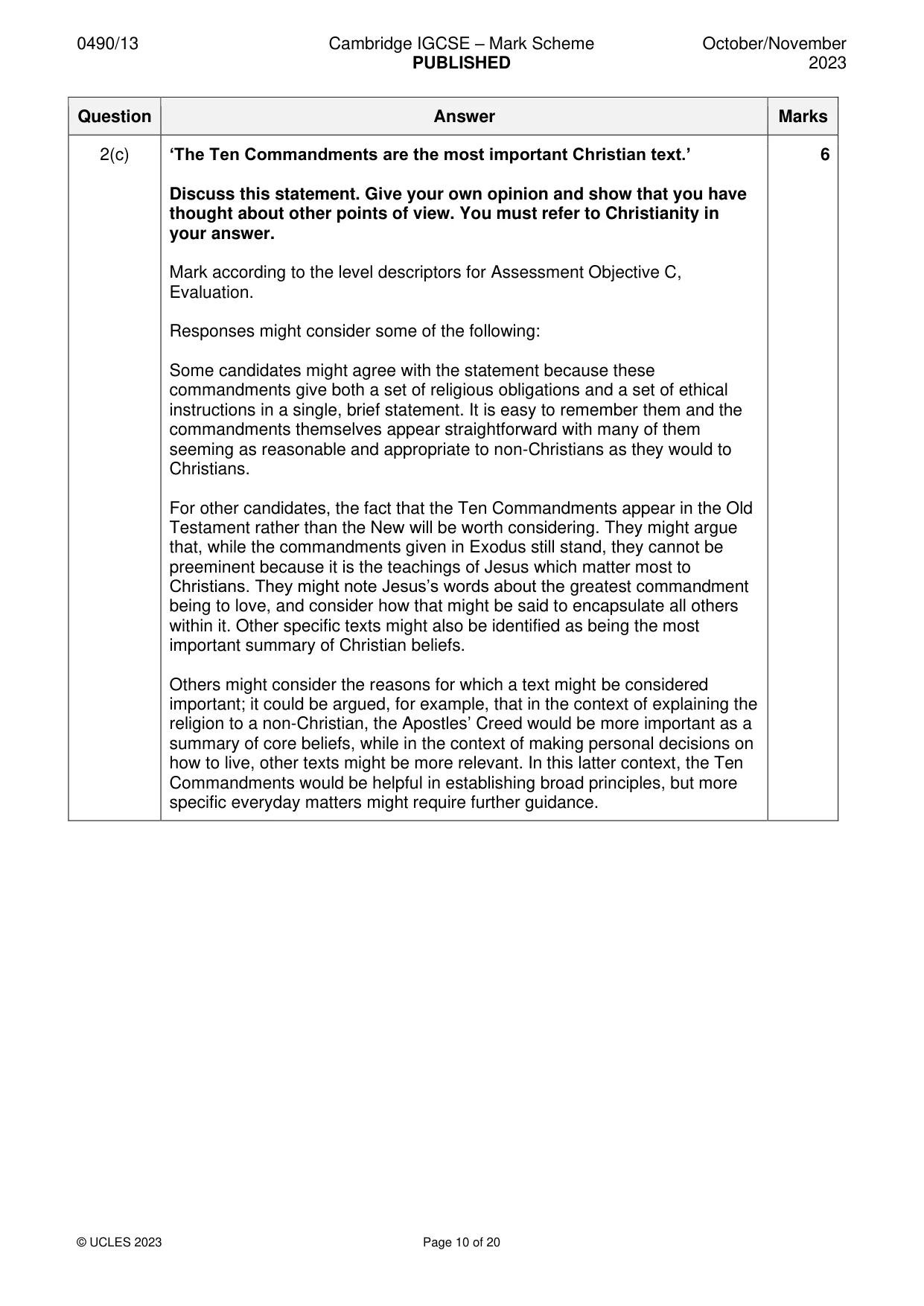
0490/13 Cambridge IGCSE – Mark Scheme PUBLISHED October/November 2023 © UCLES 2023 Page 10 of 20 Question Answer Marks 2(c) ‘The Ten Commandments are the most important Christian text.’ Discuss this statement. Give your own opinion and show that you have thought about other points of view. You must refer to Christianity in your answer. Mark according to the level descriptors for Assessment Objective C, Evaluation. Responses might consider some of the following: Some candidates might agree with the statement because these commandments give both a set of religious obligations and a set of ethical instructions in a single, brief statement. It is easy to remember them and the commandments themselves appear straightforward with many of them seeming as reasonable and appropriate to non-Christians as they would to Christians. For other candidates, the fact that the Ten Commandments appear in the Old Testament rather than the New will be worth considering. They might argue that, while the commandments given in Exodus still stand, they cannot be preeminent because it is the teachings of Jesus which matter most to Christians. They might note Jesus’s words about the greatest commandment being to love, and consider how that might be said to encapsulate all others within it. Other specific texts might also be identified as being the most important summary of Christian beliefs. Others might consider the reasons for which a text might be considered important; it could be argued, for example, that in the context of explaining the religion to a non-Christian, the Apostles’ Creed would be more important as a summary of core beliefs, while in the context of making personal decisions on how to live, other texts might be more relevant. In this latter context, the Ten Commandments would be helpful in establishing broad principles, but more specific everyday matters might require further guidance. 6
Mark scheme, page 11
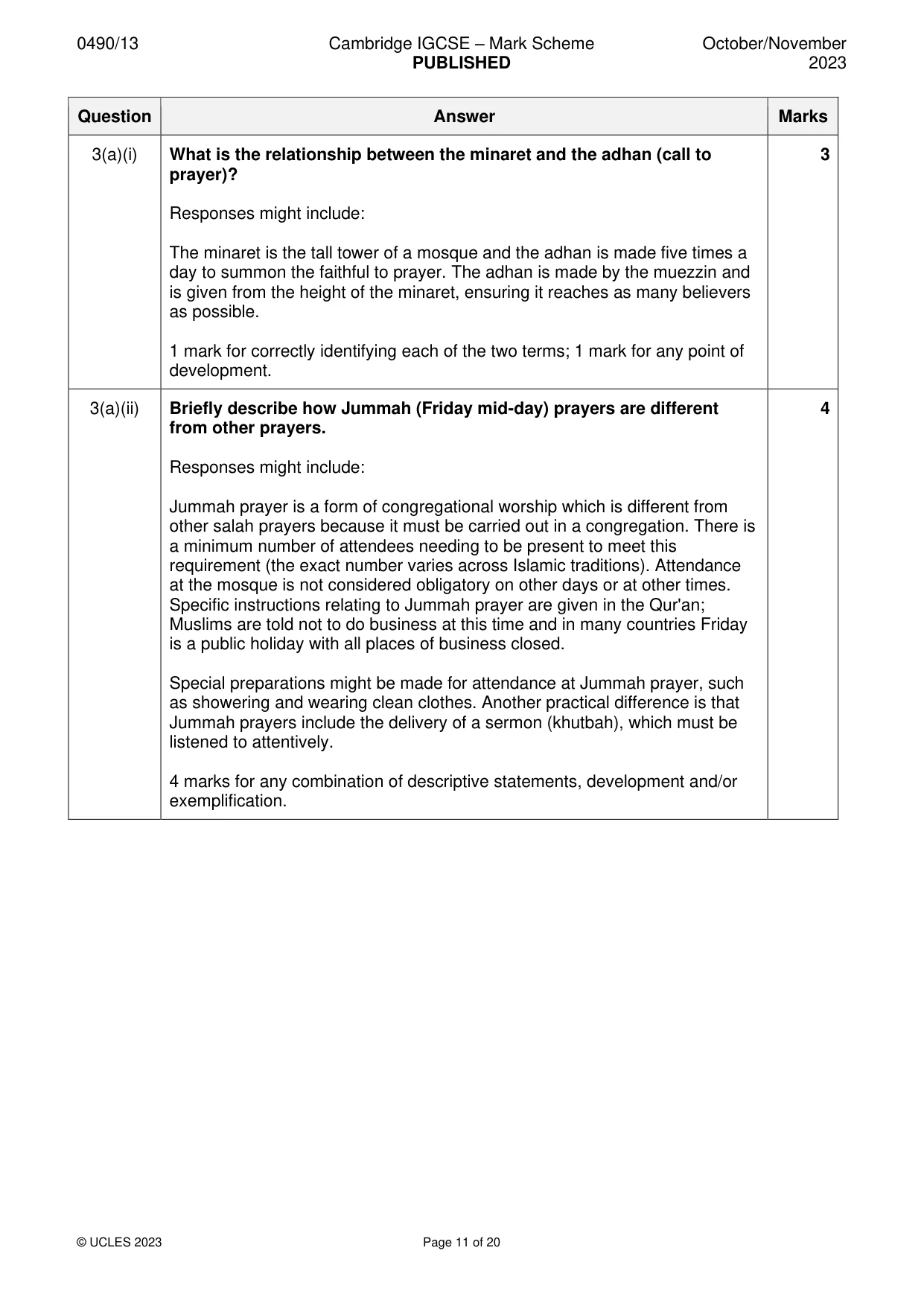
0490/13 Cambridge IGCSE – Mark Scheme PUBLISHED October/November 2023 © UCLES 2023 Page 11 of 20 Question Answer Marks 3(a)(i) What is the relationship between the minaret and the adhan (call to prayer)? Responses might include: The minaret is the tall tower of a mosque and the adhan is made five times a day to summon the faithful to prayer. The adhan is made by the muezzin and is given from the height of the minaret, ensuring it reaches as many believers as possible. 1 mark for correctly identifying each of the two terms; 1 mark for any point of development. 3 3(a)(ii) Briefly describe how Jummah (Friday mid-day) prayers are different from other prayers. Responses might include: Jummah prayer is a form of congregational worship which is different from other salah prayers because it must be carried out in a congregation. There is a minimum number of attendees needing to be present to meet this requirement (the exact number varies across Islamic traditions). Attendance at the mosque is not considered obligatory on other days or at other times. Specific instructions relating to Jummah prayer are given in the Qur'an; Muslims are told not to do business at this time and in many countries Friday is a public holiday with all places of business closed. Special preparations might be made for attendance at Jummah prayer, such as showering and wearing clean clothes. Another practical difference is that Jummah prayers include the delivery of a sermon (khutbah), which must be listened to attentively. 4 marks for any combination of descriptive statements, development and/or exemplification. 4
Mark scheme, page 12
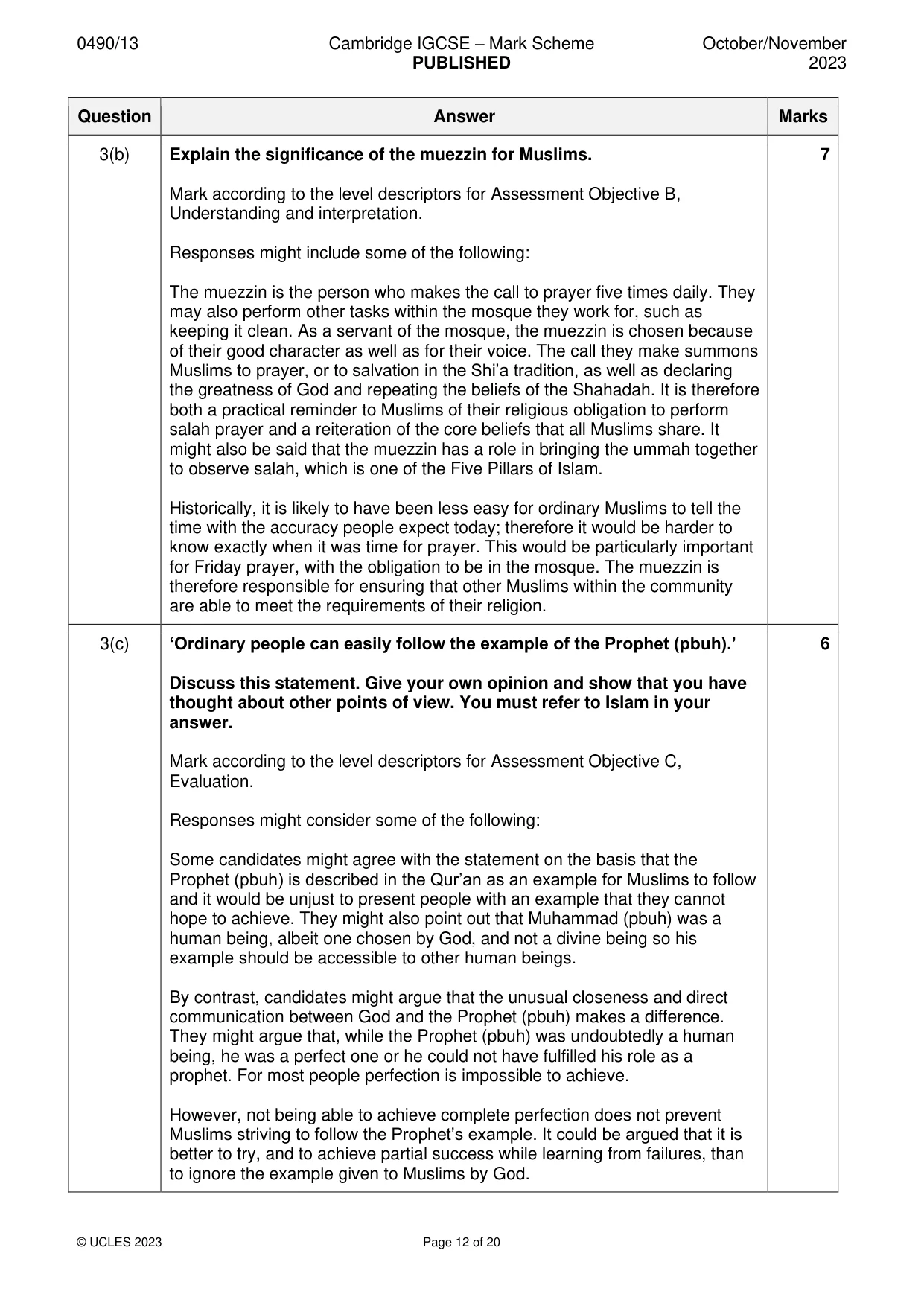
0490/13 Cambridge IGCSE – Mark Scheme PUBLISHED October/November 2023 © UCLES 2023 Page 12 of 20 Question Answer Marks 3(b) Explain the significance of the muezzin for Muslims. Mark according to the level descriptors for Assessment Objective B, Understanding and interpretation. Responses might include some of the following: The muezzin is the person who makes the call to prayer five times daily. They may also perform other tasks within the mosque they work for, such as keeping it clean. As a servant of the mosque, the muezzin is chosen because of their good character as well as for their voice. The call they make summons Muslims to prayer, or to salvation in the Shi’a tradition, as well as declaring the greatness of God and repeating the beliefs of the Shahadah. It is therefore both a practical reminder to Muslims of their religious obligation to perform salah prayer and a reiteration of the core beliefs that all Muslims share. It might also be said that the muezzin has a role in bringing the ummah together to observe salah, which is one of the Five Pillars of Islam. Historically, it is likely to have been less easy for ordinary Muslims to tell the time with the accuracy people expect today; therefore it would be harder to know exactly when it was time for prayer. This would be particularly important for Friday prayer, with the obligation to be in the mosque. The muezzin is therefore responsible for ensuring that other Muslims within the community are able to meet the requirements of their religion. 7 3(c) ‘Ordinary people can easily follow the example of the Prophet (pbuh).’ Discuss this statement. Give your own opinion and show that you have thought about other points of view. You must refer to Islam in your answer. Mark according to the level descriptors for Assessment Objective C, Evaluation. Responses might consider some of the following: Some candidates might agree with the statement on the basis that the Prophet (pbuh) is described in the Qur’an as an example for Muslims to follow and it would be unjust to present people with an example that they cannot hope to achieve. They might also point out that Muhammad (pbuh) was a human being, albeit one chosen by God, and not a divine being so his example should be accessible to other human beings. By contrast, candidates might argue that the unusual closeness and direct communication between God and the Prophet (pbuh) makes a difference. They might argue that, while the Prophet (pbuh) was undoubtedly a human being, he was a perfect one or he could not have fulfilled his role as a prophet. For most people perfection is impossible to achieve. However, not being able to achieve complete perfection does not prevent Muslims striving to follow the Prophet’s example. It could be argued that it is better to try, and to achieve partial success while learning from failures, than to ignore the example given to Muslims by God. 6
Mark scheme, page 13
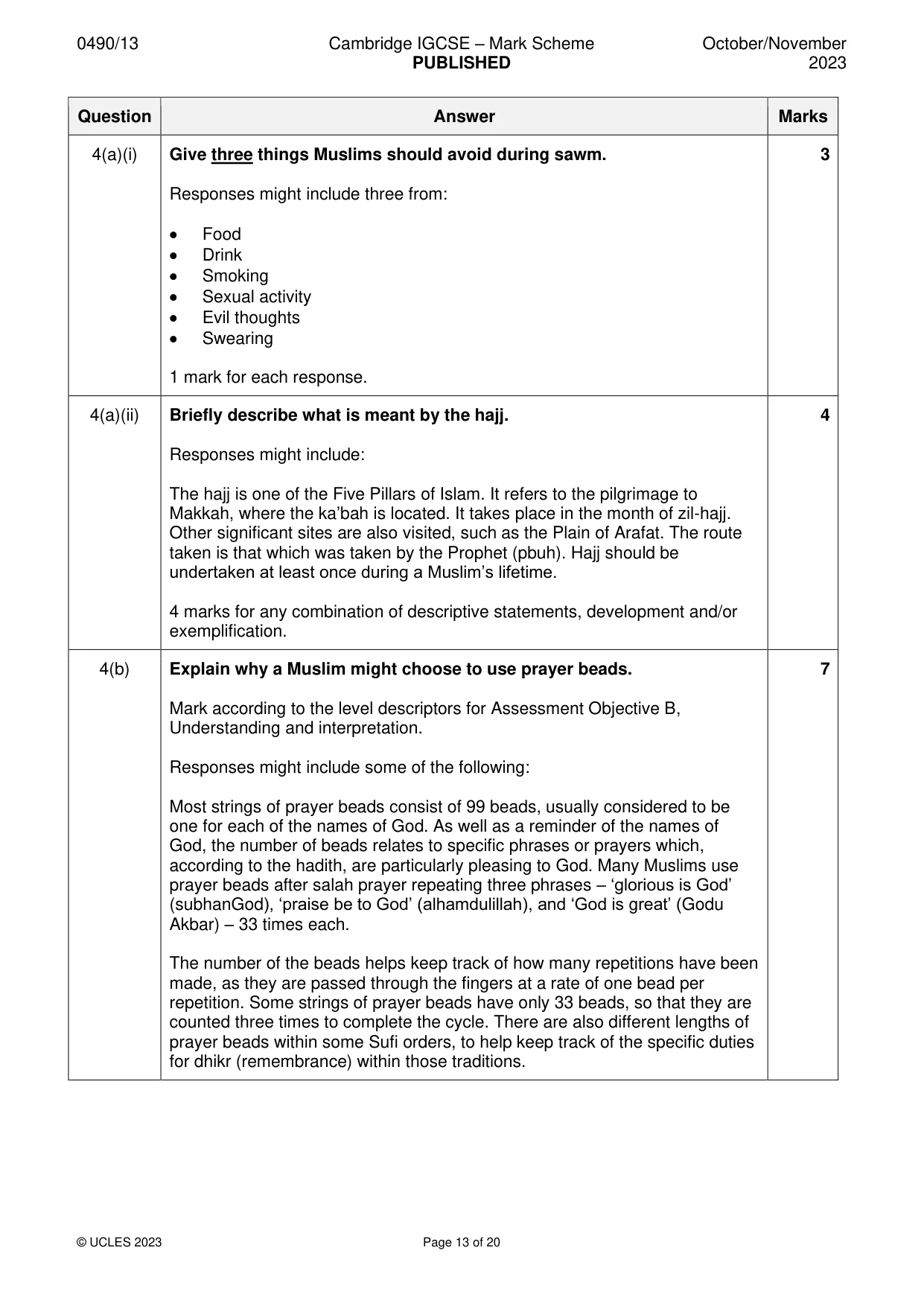
0490/13 Cambridge IGCSE – Mark Scheme PUBLISHED October/November 2023 © UCLES 2023 Page 13 of 20 Question Answer Marks 4(a)(i) Give three things Muslims should avoid during sawm. Responses might include three from: • Food • Drink • Smoking • Sexual activity • Evil thoughts • Swearing 1 mark for each response. 3 4(a)(ii) Briefly describe what is meant by the hajj. Responses might include: The hajj is one of the Five Pillars of Islam. It refers to the pilgrimage to Makkah, where the ka’bah is located. It takes place in the month of zil-hajj. Other significant sites are also visited, such as the Plain of Arafat. The route taken is that which was taken by the Prophet (pbuh). Hajj should be undertaken at least once during a Muslim’s lifetime. 4 marks for any combination of descriptive statements, development and/or exemplification. 4 4(b) Explain why a Muslim might choose to use prayer beads. Mark according to the level descriptors for Assessment Objective B, Understanding and interpretation. Responses might include some of the following: Most strings of prayer beads consist of 99 beads, usually considered to be one for each of the names of God. As well as a reminder of the names of God, the number of beads relates to specific phrases or prayers which, according to the hadith, are particularly pleasing to God. Many Muslims use prayer beads after salah prayer repeating three phrases – ‘glorious is God’ (subhanGod), ‘praise be to God’ (alhamdulillah), and ‘God is great’ (Godu Akbar) – 33 times each. The number of the beads helps keep track of how many repetitions have been made, as they are passed through the fingers at a rate of one bead per repetition. Some strings of prayer beads have only 33 beads, so that they are counted three times to complete the cycle. There are also different lengths of prayer beads within some Sufi orders, to help keep track of the specific duties for dhikr (remembrance) within those traditions. 7
Mark scheme, page 14
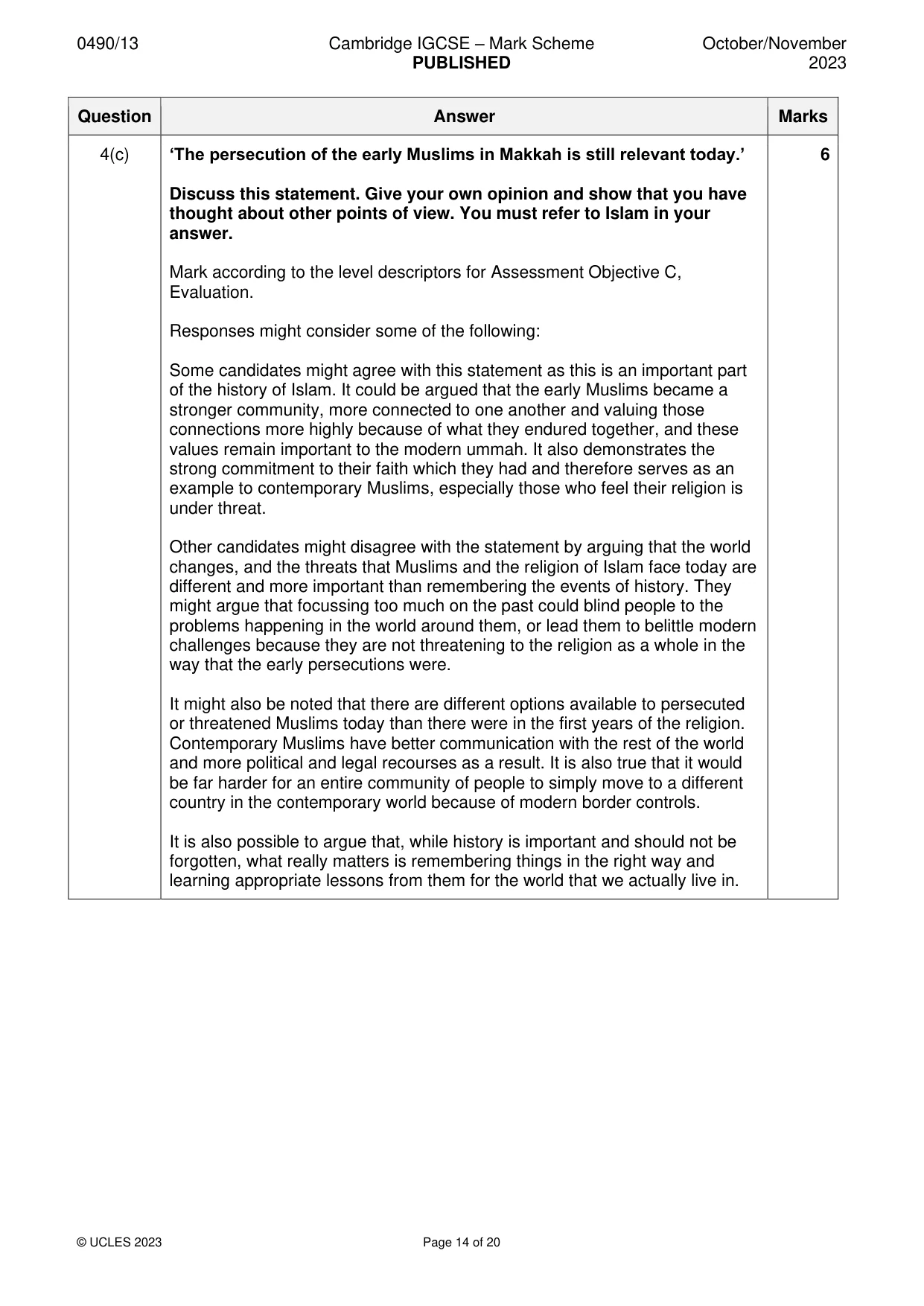
0490/13 Cambridge IGCSE – Mark Scheme PUBLISHED October/November 2023 © UCLES 2023 Page 14 of 20 Question Answer Marks 4(c) ‘The persecution of the early Muslims in Makkah is still relevant today.’ Discuss this statement. Give your own opinion and show that you have thought about other points of view. You must refer to Islam in your answer. Mark according to the level descriptors for Assessment Objective C, Evaluation. Responses might consider some of the following: Some candidates might agree with this statement as this is an important part of the history of Islam. It could be argued that the early Muslims became a stronger community, more connected to one another and valuing those connections more highly because of what they endured together, and these values remain important to the modern ummah. It also demonstrates the strong commitment to their faith which they had and therefore serves as an example to contemporary Muslims, especially those who feel their religion is under threat. Other candidates might disagree with the statement by arguing that the world changes, and the threats that Muslims and the religion of Islam face today are different and more important than remembering the events of history. They might argue that focussing too much on the past could blind people to the problems happening in the world around them, or lead them to belittle modern challenges because they are not threatening to the religion as a whole in the way that the early persecutions were. It might also be noted that there are different options available to persecuted or threatened Muslims today than there were in the first years of the religion. Contemporary Muslims have better communication with the rest of the world and more political and legal recourses as a result. It is also true that it would be far harder for an entire community of people to simply move to a different country in the contemporary world because of modern border controls. It is also possible to argue that, while history is important and should not be forgotten, what really matters is remembering things in the right way and learning appropriate lessons from them for the world that we actually live in. 6
Mark scheme, page 15
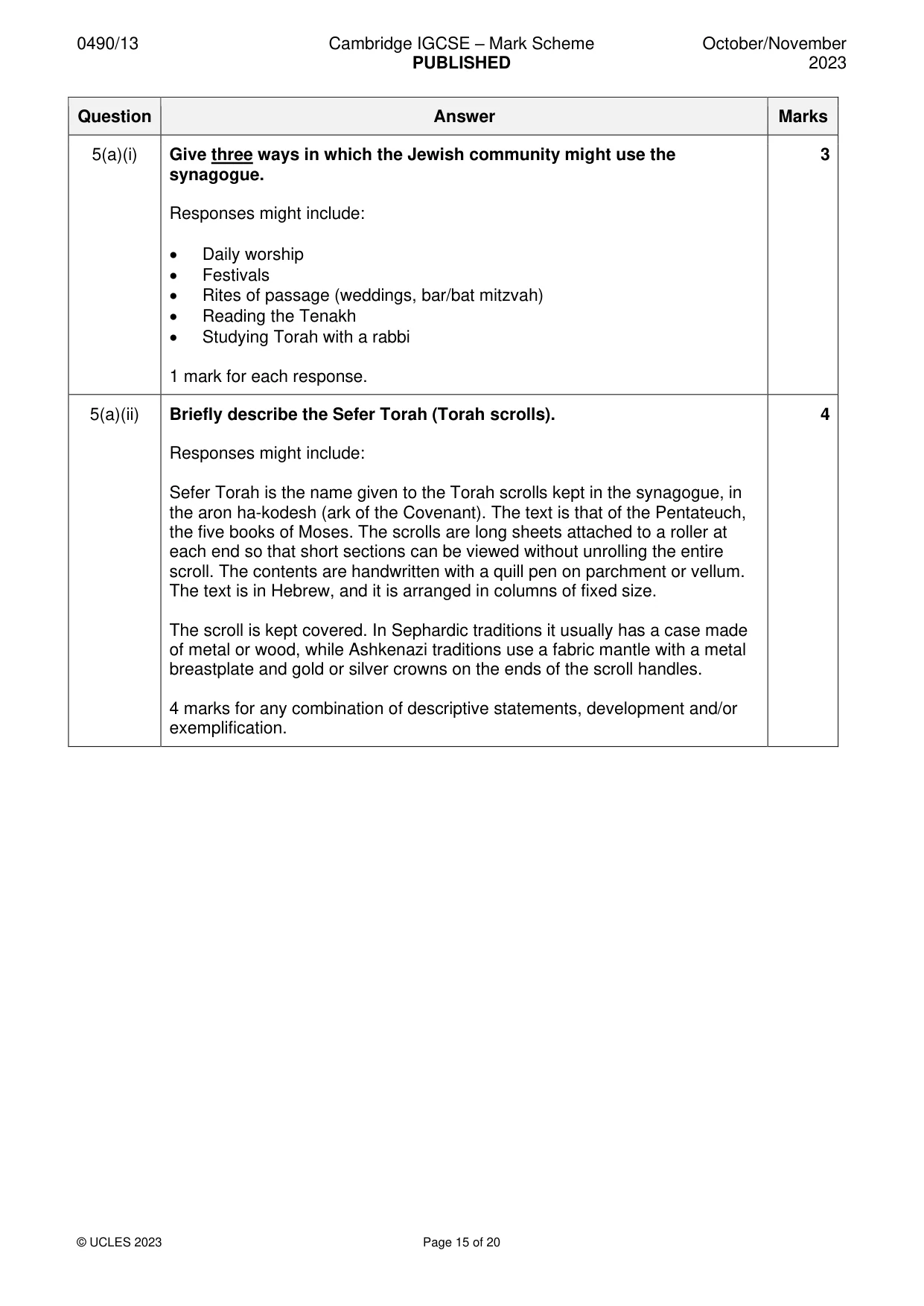
0490/13 Cambridge IGCSE – Mark Scheme PUBLISHED October/November 2023 © UCLES 2023 Page 15 of 20 Question Answer Marks 5(a)(i) Give three ways in which the Jewish community might use the synagogue. Responses might include: • Daily worship • Festivals • Rites of passage (weddings, bar/bat mitzvah) • Reading the Tenakh • Studying Torah with a rabbi 1 mark for each response. 3 5(a)(ii) Briefly describe the Sefer Torah (Torah scrolls). Responses might include: Sefer Torah is the name given to the Torah scrolls kept in the synagogue, in the aron ha-kodesh (ark of the Covenant). The text is that of the Pentateuch, the five books of Moses. The scrolls are long sheets attached to a roller at each end so that short sections can be viewed without unrolling the entire scroll. The contents are handwritten with a quill pen on parchment or vellum. The text is in Hebrew, and it is arranged in columns of fixed size. The scroll is kept covered. In Sephardic traditions it usually has a case made of metal or wood, while Ashkenazi traditions use a fabric mantle with a metal breastplate and gold or silver crowns on the ends of the scroll handles. 4 marks for any combination of descriptive statements, development and/or exemplification. 4
Mark scheme, page 16
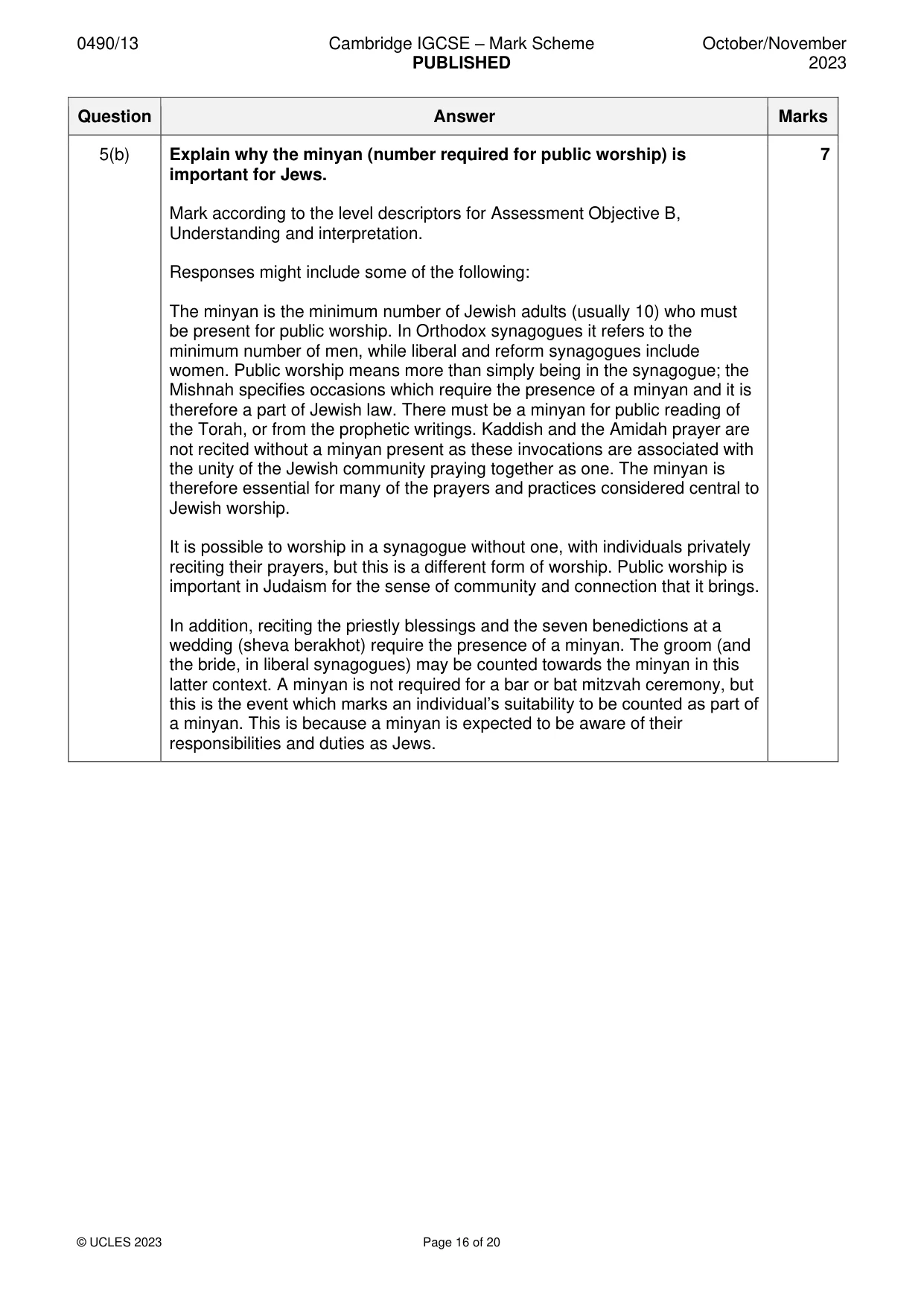
0490/13 Cambridge IGCSE – Mark Scheme PUBLISHED October/November 2023 © UCLES 2023 Page 16 of 20 Question Answer Marks 5(b) Explain why the minyan (number required for public worship) is important for Jews. Mark according to the level descriptors for Assessment Objective B, Understanding and interpretation. Responses might include some of the following: The minyan is the minimum number of Jewish adults (usually 10) who must be present for public worship. In Orthodox synagogues it refers to the minimum number of men, while liberal and reform synagogues include women. Public worship means more than simply being in the synagogue; the Mishnah specifies occasions which require the presence of a minyan and it is therefore a part of Jewish law. There must be a minyan for public reading of the Torah, or from the prophetic writings. Kaddish and the Amidah prayer are not recited without a minyan present as these invocations are associated with the unity of the Jewish community praying together as one. The minyan is therefore essential for many of the prayers and practices considered central to Jewish worship. It is possible to worship in a synagogue without one, with individuals privately reciting their prayers, but this is a different form of worship. Public worship is important in Judaism for the sense of community and connection that it brings. In addition, reciting the priestly blessings and the seven benedictions at a wedding (sheva berakhot) require the presence of a minyan. The groom (and the bride, in liberal synagogues) may be counted towards the minyan in this latter context. A minyan is not required for a bar or bat mitzvah ceremony, but this is the event which marks an individual’s suitability to be counted as part of a minyan. This is because a minyan is expected to be aware of their responsibilities and duties as Jews. 7
Mark scheme, page 17
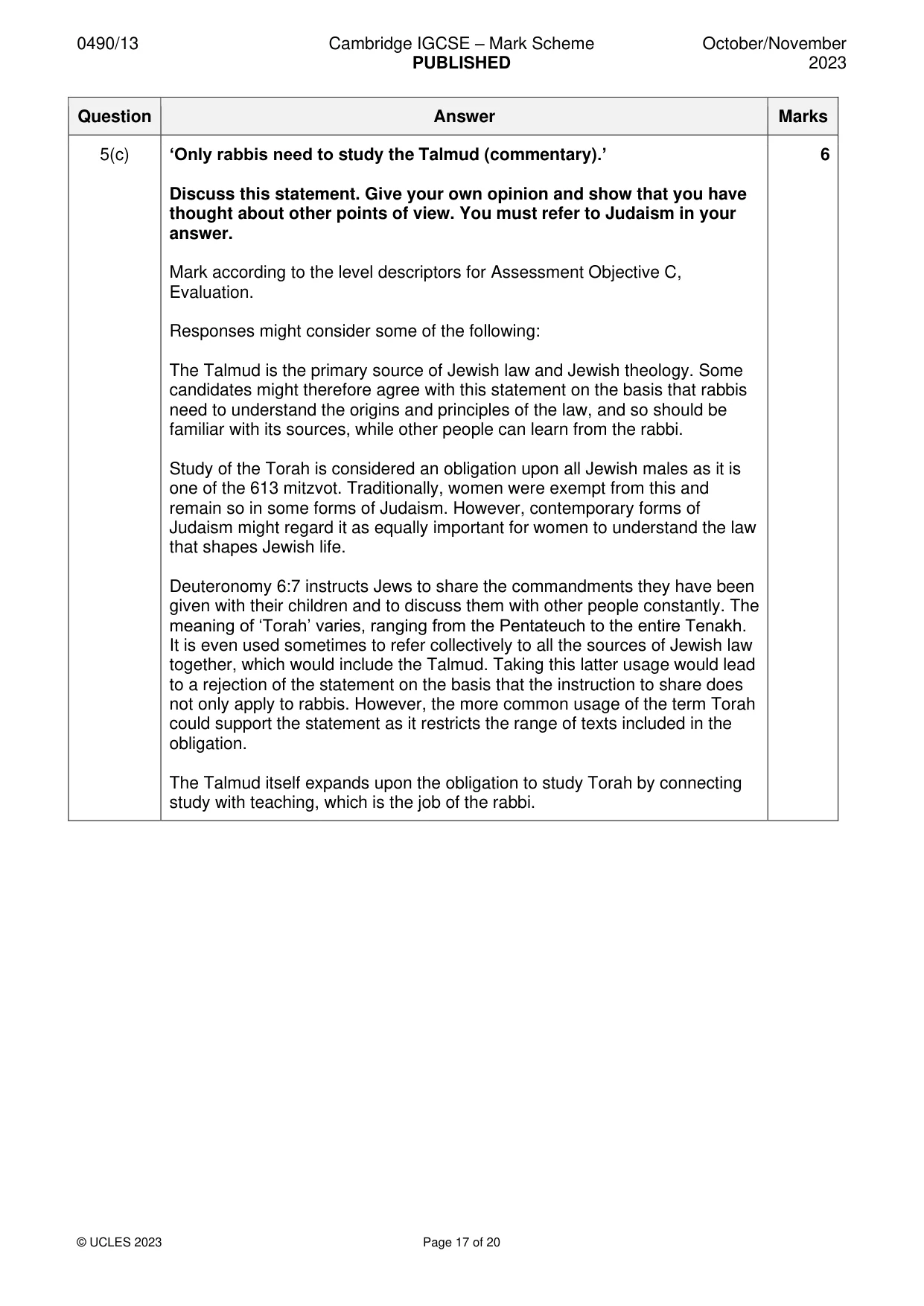
0490/13 Cambridge IGCSE – Mark Scheme PUBLISHED October/November 2023 © UCLES 2023 Page 17 of 20 Question Answer Marks 5(c) ‘Only rabbis need to study the Talmud (commentary).’ Discuss this statement. Give your own opinion and show that you have thought about other points of view. You must refer to Judaism in your answer. Mark according to the level descriptors for Assessment Objective C, Evaluation. Responses might consider some of the following: The Talmud is the primary source of Jewish law and Jewish theology. Some candidates might therefore agree with this statement on the basis that rabbis need to understand the origins and principles of the law, and so should be familiar with its sources, while other people can learn from the rabbi. Study of the Torah is considered an obligation upon all Jewish males as it is one of the 613 mitzvot. Traditionally, women were exempt from this and remain so in some forms of Judaism. However, contemporary forms of Judaism might regard it as equally important for women to understand the law that shapes Jewish life. Deuteronomy 6:7 instructs Jews to share the commandments they have been given with their children and to discuss them with other people constantly. The meaning of ‘Torah’ varies, ranging from the Pentateuch to the entire Tenakh. It is even used sometimes to refer collectively to all the sources of Jewish law together, which would include the Talmud. Taking this latter usage would lead to a rejection of the statement on the basis that the instruction to share does not only apply to rabbis. However, the more common usage of the term Torah could support the statement as it restricts the range of texts included in the obligation. The Talmud itself expands upon the obligation to study Torah by connecting study with teaching, which is the job of the rabbi. 6
Mark scheme, page 18
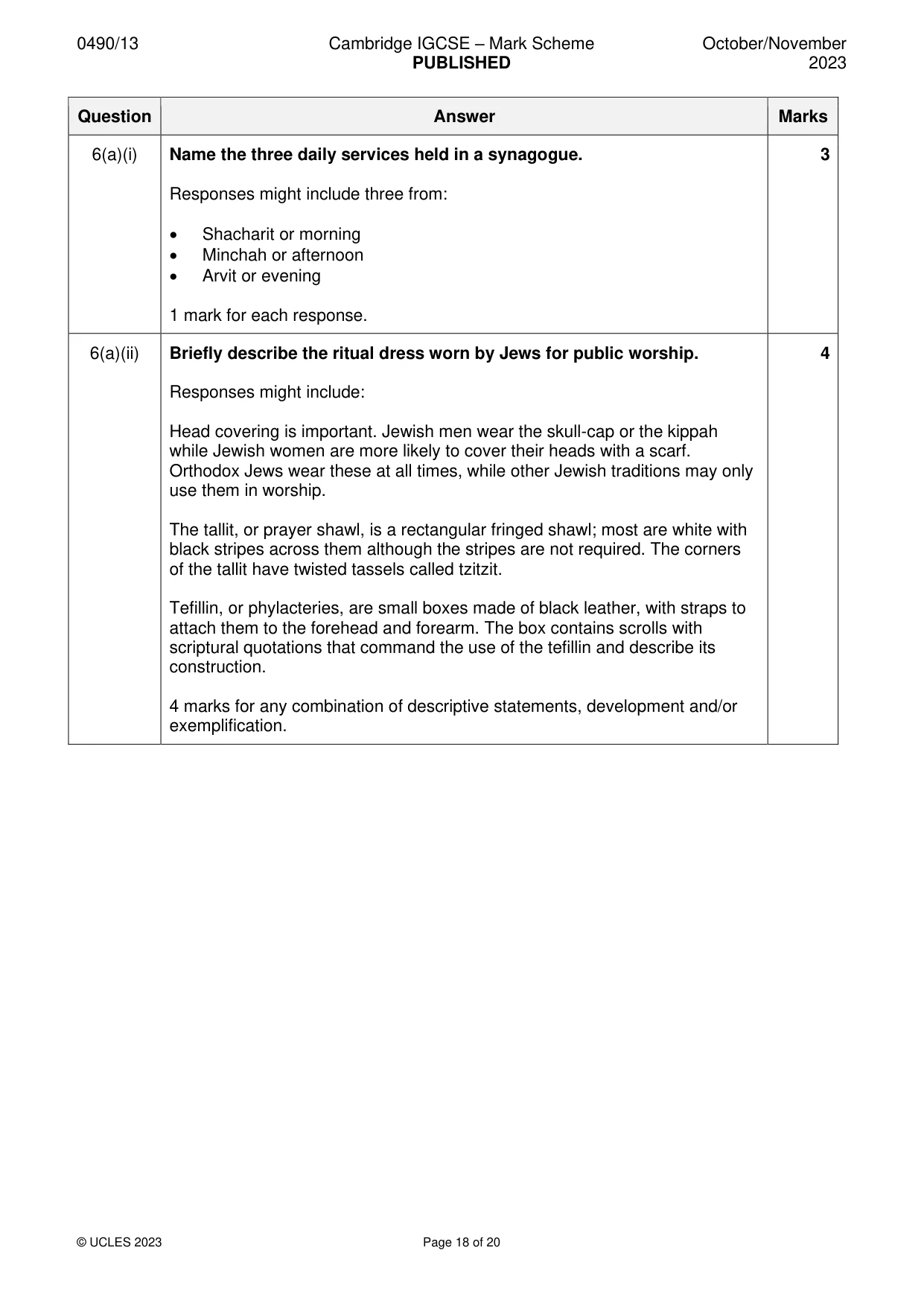
0490/13 Cambridge IGCSE – Mark Scheme PUBLISHED October/November 2023 © UCLES 2023 Page 18 of 20 Question Answer Marks 6(a)(i) Name the three daily services held in a synagogue. Responses might include three from: • Shacharit or morning • Minchah or afternoon • Arvit or evening 1 mark for each response. 3 6(a)(ii) Briefly describe the ritual dress worn by Jews for public worship. Responses might include: Head covering is important. Jewish men wear the skull-cap or the kippah while Jewish women are more likely to cover their heads with a scarf. Orthodox Jews wear these at all times, while other Jewish traditions may only use them in worship. The tallit, or prayer shawl, is a rectangular fringed shawl; most are white with black stripes across them although the stripes are not required. The corners of the tallit have twisted tassels called tzitzit. Tefillin, or phylacteries, are small boxes made of black leather, with straps to attach them to the forehead and forearm. The box contains scrolls with scriptural quotations that command the use of the tefillin and describe its construction. 4 marks for any combination of descriptive statements, development and/or exemplification. 4
Mark scheme, page 19
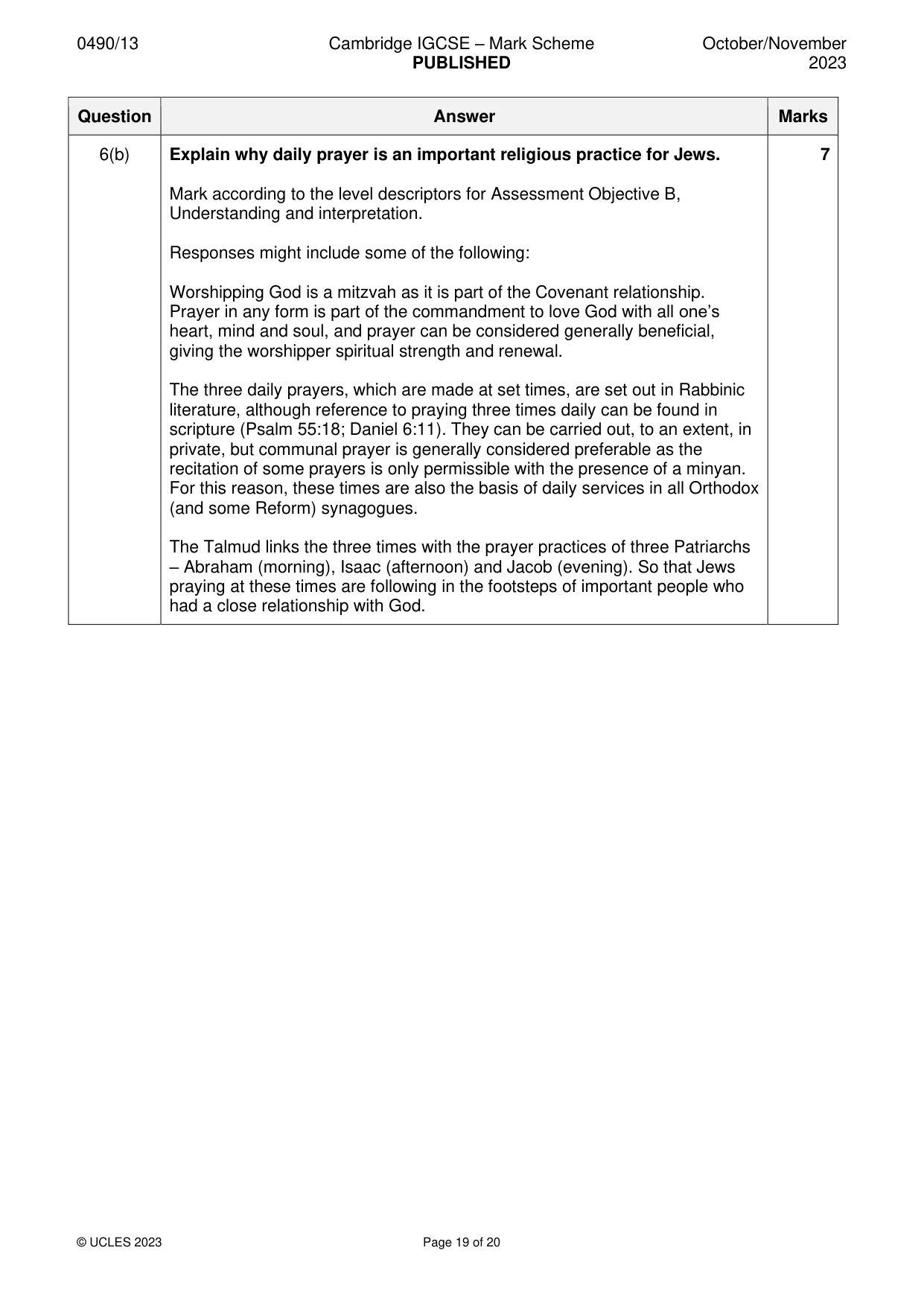
0490/13 Cambridge IGCSE – Mark Scheme PUBLISHED October/November 2023 © UCLES 2023 Page 19 of 20 Question Answer Marks 6(b) Explain why daily prayer is an important religious practice for Jews. Mark according to the level descriptors for Assessment Objective B, Understanding and interpretation. Responses might include some of the following: Worshipping God is a mitzvah as it is part of the Covenant relationship. Prayer in any form is part of the commandment to love God with all one’s heart, mind and soul, and prayer can be considered generally beneficial, giving the worshipper spiritual strength and renewal. The three daily prayers, which are made at set times, are set out in Rabbinic literature, although reference to praying three times daily can be found in scripture (Psalm 55:18; Daniel 6:11). They can be carried out, to an extent, in private, but communal prayer is generally considered preferable as the recitation of some prayers is only permissible with the presence of a minyan. For this reason, these times are also the basis of daily services in all Orthodox (and some Reform) synagogues. The Talmud links the three times with the prayer practices of three Patriarchs – Abraham (morning), Isaac (afternoon) and Jacob (evening). So that Jews praying at these times are following in the footsteps of important people who had a close relationship with God. 7
Mark scheme, page 20
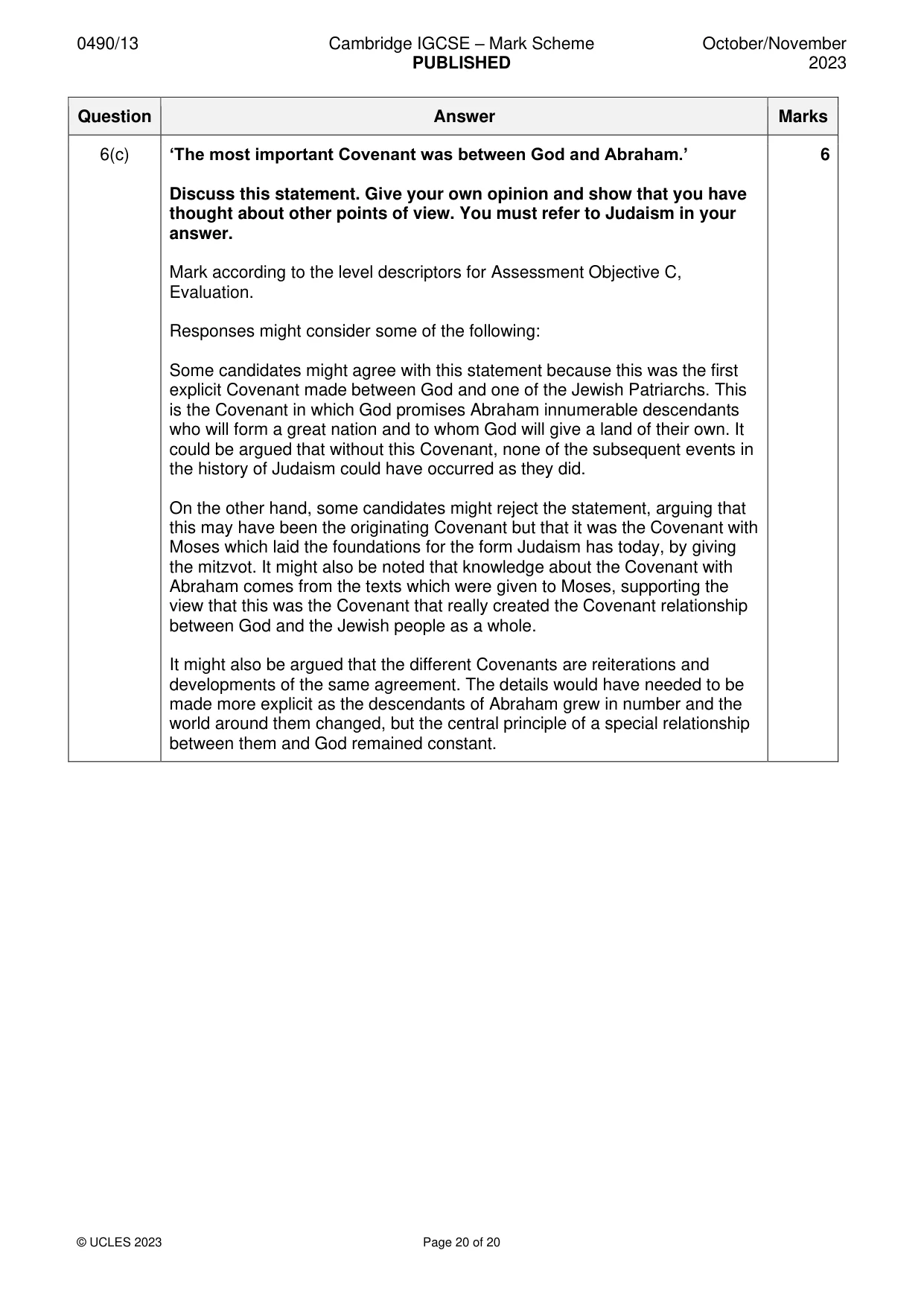
0490/13 Cambridge IGCSE – Mark Scheme PUBLISHED October/November 2023 © UCLES 2023 Page 20 of 20 Question Answer Marks 6(c) ‘The most important Covenant was between God and Abraham.’ Discuss this statement. Give your own opinion and show that you have thought about other points of view. You must refer to Judaism in your answer. Mark according to the level descriptors for Assessment Objective C, Evaluation. Responses might consider some of the following: Some candidates might agree with this statement because this was the first explicit Covenant made between God and one of the Jewish Patriarchs. This is the Covenant in which God promises Abraham innumerable descendants who will form a great nation and to whom God will give a land of their own. It could be argued that without this Covenant, none of the subsequent events in the history of Judaism could have occurred as they did. On the other hand, some candidates might reject the statement, arguing that this may have been the originating Covenant but that it was the Covenant with Moses which laid the foundations for the form Judaism has today, by giving the mitzvot. It might also be noted that knowledge about the Covenant with Abraham comes from the texts which were given to Moses, supporting the view that this was the Covenant that really created the Covenant relationship between God and the Jewish people as a whole. It might also be argued that the different Covenants are reiterations and developments of the same agreement. The details would have needed to be made more explicit as the descendants of Abraham grew in number and the world around them changed, but the central principle of a special relationship between them and God remained constant. 6
What you needed in this session
Cambridge’s own grade thresholds for 2023 Oct/Nov, Paper 1 · Variant 3. A higher threshold means an easier paper — the bar moves with how the cohort did.