Cambridge IGCSE Religious Studies 0490 — 2018 Oct/Nov Paper 1 · Variant 2
0490/12/O/N/18 · 80 marks · ≈90 min
The question paper and its mark scheme, free to read here and free to download. This is Cambridge’s own paper, exactly as it was sat.
Question paper4 pages
Mark scheme13 pages
Answers below. Sit the paper first if you are practising.
Paper as text
Question paper, page 1
Cambridge International Examinations Cambridge International General Certificate of Secondary Education 0490/12 October/November 2018 1 hour 45 minutes RELIGIOUS STUDIES Paper 1 Additional Materials: Answer Booklet/Paper READ THESE INSTRUCTIONS FIRST An answer booklet is provided inside this question paper. You should follow the instructions on the front cover of the answer booklet. If you need additional paper ask the invigilator for a continuation booklet. Choose two of sections A, B and C and answer all the questions in each of your chosen sections. The number of marks is given in brackets [ ] at the end of each question or part question. This document consists of 4 printed pages. [Turn over 11_0490_12_2018_1.14 © UCLES 2018 *6052197678*
Question paper, page 2
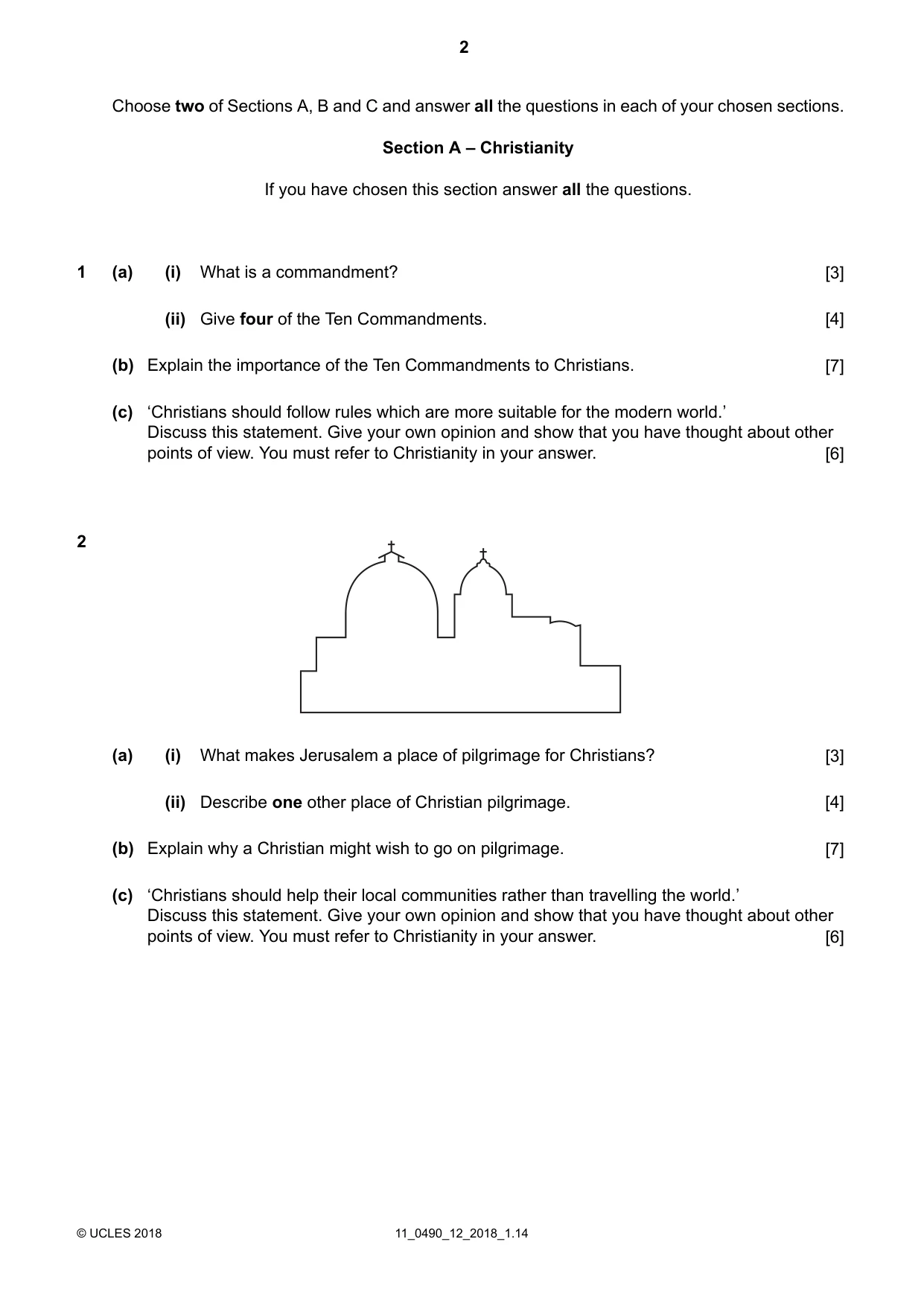
Choose two of Sections A, B and C and answer all the questions in each of your chosen sections. Section A – Christianity If you have chosen this section answer all the questions. What is a commandment? [3] (i) (a) 1 Give four of the Ten Commandments. [4] (ii) Explain the importance of the Ten Commandments to Christians. [7] (b) ‘Christians should follow rules which are more suitable for the modern world.’ Discuss this statement. Give your own opinion and show that you have thought about other points of view. You must refer to Christianity in your answer. [6] (c) 2 What makes Jerusalem a place of pilgrimage for Christians? [3] (i) (a) Describe one other place of Christian pilgrimage. [4] (ii) Explain why a Christian might wish to go on pilgrimage. [7] (b) ‘Christians should help their local communities rather than travelling the world.’ Discuss this statement. Give your own opinion and show that you have thought about other points of view. You must refer to Christianity in your answer. [6] (c) 11_0490_12_2018_1.14 © UCLES 2018 2
Question paper, page 3
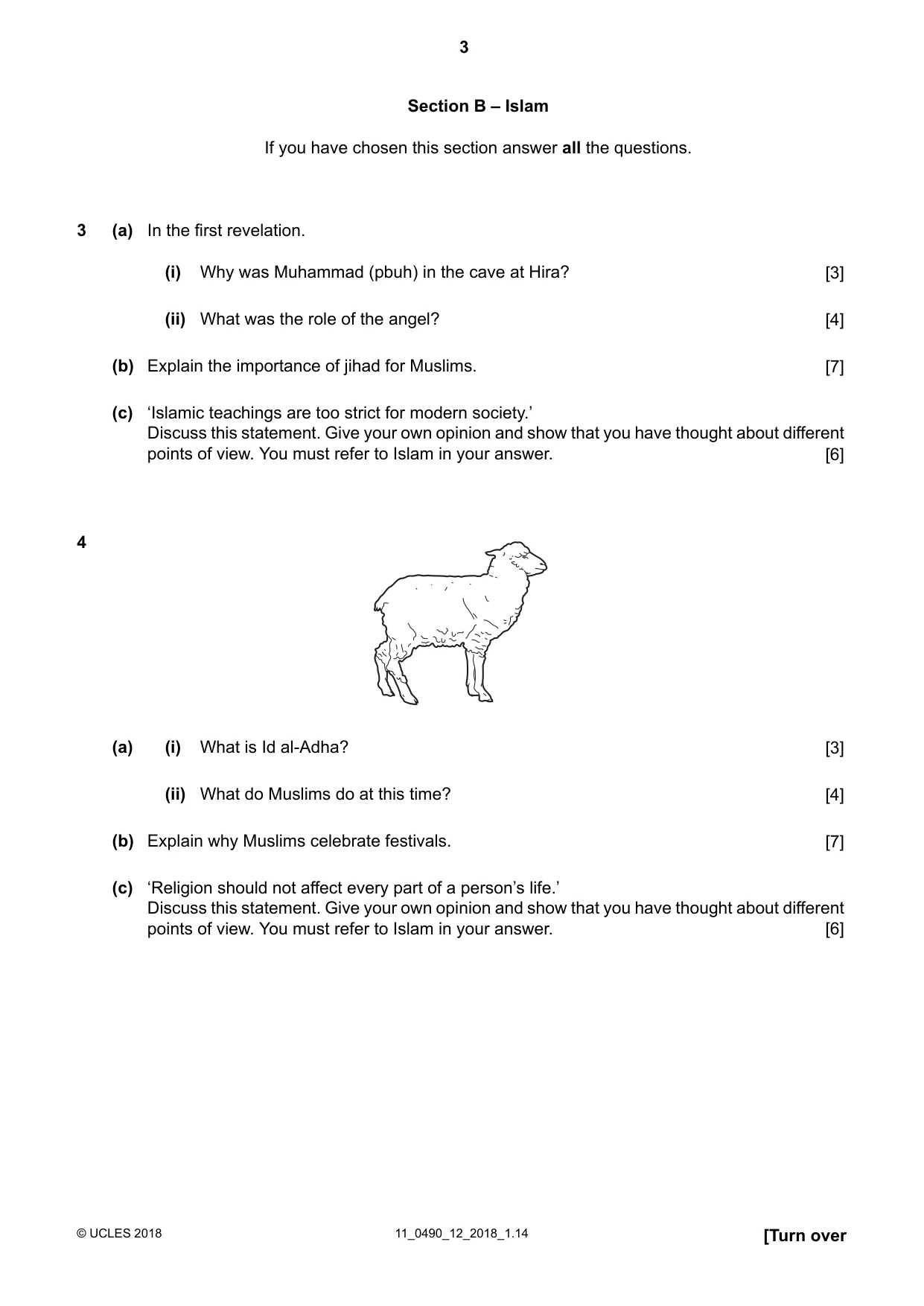
Section B – Islam If you have chosen this section answer all the questions. In the first revelation. (a) 3 Why was Muhammad (pbuh) in the cave at Hira? [3] (i) What was the role of the angel? [4] (ii) Explain the importance of jihad for Muslims. [7] (b) ‘Islamic teachings are too strict for modern society.’ Discuss this statement. Give your own opinion and show that you have thought about different points of view. You must refer to Islam in your answer. [6] (c) 4 What is Id al-Adha? [3] (i) (a) What do Muslims do at this time? [4] (ii) Explain why Muslims celebrate festivals. [7] (b) ‘Religion should not affect every part of a person’s life.’ Discuss this statement. Give your own opinion and show that you have thought about different points of view. You must refer to Islam in your answer. [6] (c) [Turn over 11_0490_12_2018_1.14 © UCLES 2018 3
Question paper, page 4
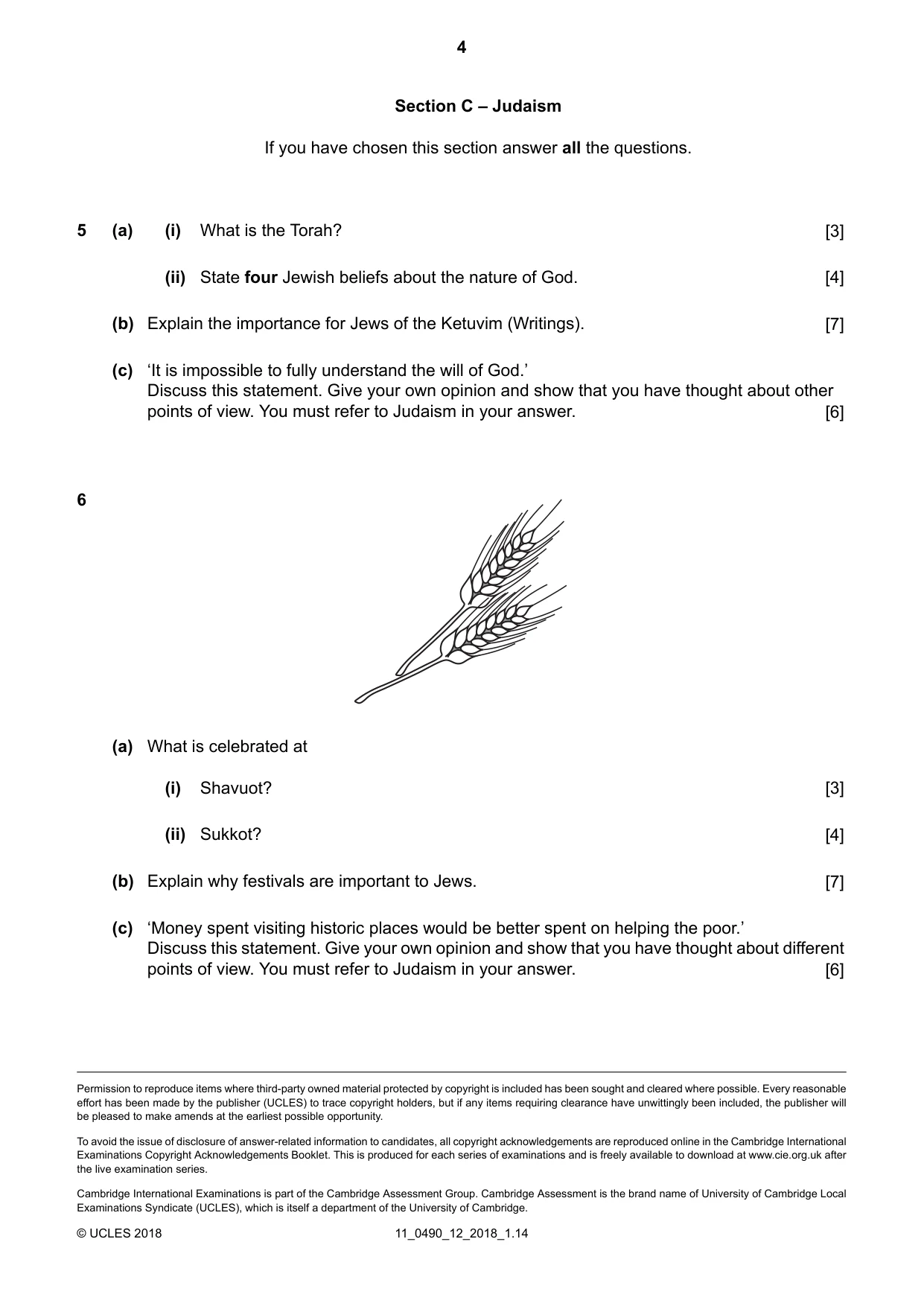
Section C – Judaism If you have chosen this section answer all the questions. What is the Torah? [3] (i) (a) 5 State four Jewish beliefs about the nature of God. [4] (ii) Explain the importance for Jews of the Ketuvim (Writings). [7] (b) ‘It is impossible to fully understand the will of God.’ Discuss this statement. Give your own opinion and show that you have thought about other points of view. You must refer to Judaism in your answer. [6] (c) 6 What is celebrated at (a) Shavuot? [3] (i) Sukkot? [4] (ii) Explain why festivals are important to Jews. [7] (b) ‘Money spent visiting historic places would be better spent on helping the poor.’ Discuss this statement. Give your own opinion and show that you have thought about different points of view. You must refer to Judaism in your answer. [6] (c) Permission to reproduce items where third-party owned material protected by copyright is included has been sought and cleared where possible. Every reasonable effort has been made by the publisher (UCLES) to trace copyright holders, but if any items requiring clearance have unwittingly been included, the publisher will be pleased to make amends at the earliest possible opportunity. To avoid the issue of disclosure of answer-related information to candidates, all copyright acknowledgements are reproduced online in the Cambridge International Examinations Copyright Acknowledgements Booklet. This is produced for each series of examinations and is freely available to download at www.cie.org.uk after the live examination series. Cambridge International Examinations is part of the Cambridge Assessment Group. Cambridge Assessment is the brand name of University of Cambridge Local Examinations Syndicate (UCLES), which is itself a department of the University of Cambridge. 11_0490_12_2018_1.14 © UCLES 2018 4
Mark scheme, page 1
This document consists of 13 printed pages. © UCLES 2018 [Turn over Cambridge Assessment International Education Cambridge International General Certificate of Secondary Education RELIGIOUS STUDIES 0490/12 Paper 1 October/November 2018 MARK SCHEME Maximum Mark: 80 Published This mark scheme is published as an aid to teachers and candidates, to indicate the requirements of the examination. It shows the basis on which Examiners were instructed to award marks. It does not indicate the details of the discussions that took place at an Examiners’ meeting before marking began, which would have considered the acceptability of alternative answers. Mark schemes should be read in conjunction with the question paper and the Principal Examiner Report for Teachers. Cambridge International will not enter into discussions about these mark schemes. Cambridge International is publishing the mark schemes for the October/November 2018 series for most Cambridge IGCSE™, Cambridge International A and AS Level components and some Cambridge O Level components.
Mark scheme, page 2
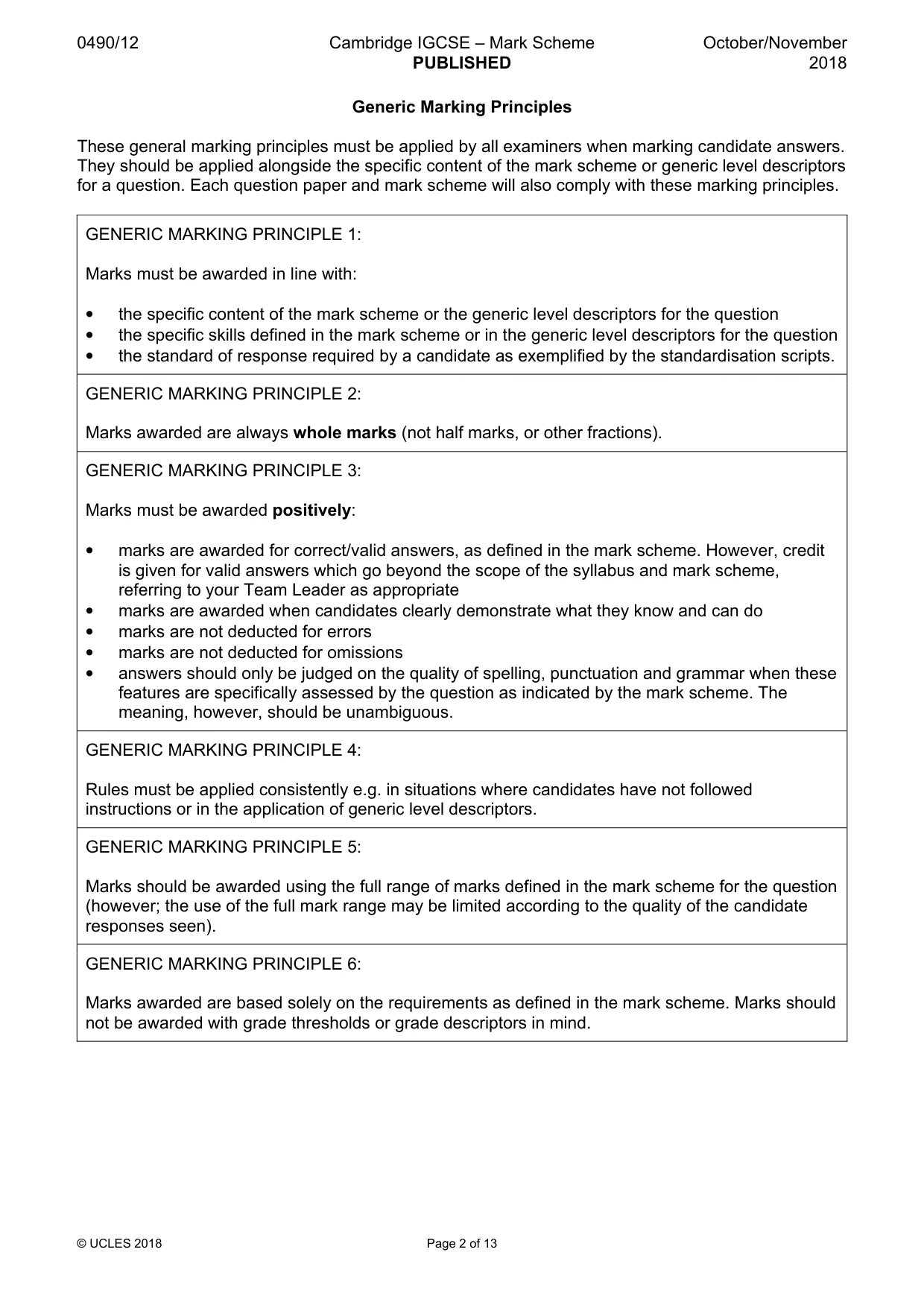
0490/12 Cambridge IGCSE – Mark Scheme PUBLISHED October/November 2018 © UCLES 2018 Page 2 of 13 Generic Marking Principles These general marking principles must be applied by all examiners when marking candidate answers. They should be applied alongside the specific content of the mark scheme or generic level descriptors for a question. Each question paper and mark scheme will also comply with these marking principles. GENERIC MARKING PRINCIPLE 1: Marks must be awarded in line with: • the specific content of the mark scheme or the generic level descriptors for the question • the specific skills defined in the mark scheme or in the generic level descriptors for the question • the standard of response required by a candidate as exemplified by the standardisation scripts. GENERIC MARKING PRINCIPLE 2: Marks awarded are always whole marks (not half marks, or other fractions). GENERIC MARKING PRINCIPLE 3: Marks must be awarded positively: • marks are awarded for correct/valid answers, as defined in the mark scheme. However, credit is given for valid answers which go beyond the scope of the syllabus and mark scheme, referring to your Team Leader as appropriate • marks are awarded when candidates clearly demonstrate what they know and can do • marks are not deducted for errors • marks are not deducted for omissions • answers should only be judged on the quality of spelling, punctuation and grammar when these features are specifically assessed by the question as indicated by the mark scheme. The meaning, however, should be unambiguous. GENERIC MARKING PRINCIPLE 4: Rules must be applied consistently e.g. in situations where candidates have not followed instructions or in the application of generic level descriptors. GENERIC MARKING PRINCIPLE 5: Marks should be awarded using the full range of marks defined in the mark scheme for the question (however; the use of the full mark range may be limited according to the quality of the candidate responses seen). GENERIC MARKING PRINCIPLE 6: Marks awarded are based solely on the requirements as defined in the mark scheme. Marks should not be awarded with grade thresholds or grade descriptors in mind.
Mark scheme, page 3
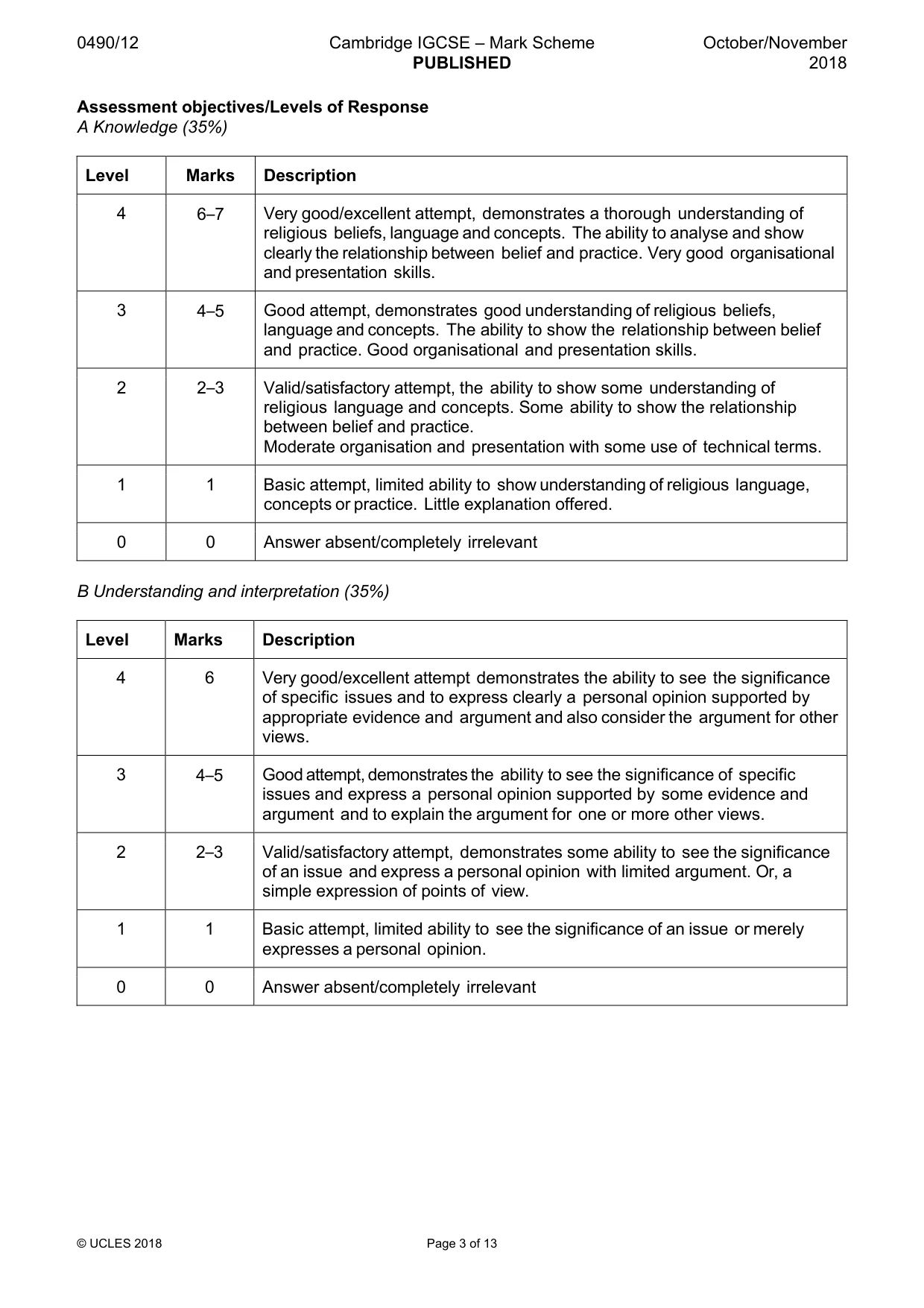
0490/12 Cambridge IGCSE – Mark Scheme PUBLISHED October/November 2018 © UCLES 2018 Page 3 of 13 Assessment objectives/Levels of Response A Knowledge (35%) Level Marks Description 4 6–7 Very good/excellent attempt, demonstrates a thorough understanding of religious beliefs, language and concepts. The ability to analyse and show clearly the relationship between belief and practice. Very good organisational and presentation skills. 3 4–5 Good attempt, demonstrates good understanding of religious beliefs, language and concepts. The ability to show the relationship between belief and practice. Good organisational and presentation skills. 2 2–3 Valid/satisfactory attempt, the ability to show some understanding of religious language and concepts. Some ability to show the relationship between belief and practice. Moderate organisation and presentation with some use of technical terms. 1 1 Basic attempt, limited ability to show understanding of religious language, concepts or practice. Little explanation offered. 0 0 Answer absent/completely irrelevant B Understanding and interpretation (35%) Level Marks Description 4 6 Very good/excellent attempt demonstrates the ability to see the significance of specific issues and to express clearly a personal opinion supported by appropriate evidence and argument and also consider the argument for other views. 3 4–5 Good attempt, demonstrates the ability to see the significance of specific issues and express a personal opinion supported by some evidence and argument and to explain the argument for one or more other views. 2 2–3 Valid/satisfactory attempt, demonstrates some ability to see the significance of an issue and express a personal opinion with limited argument. Or, a simple expression of points of view. 1 1 Basic attempt, limited ability to see the significance of an issue or merely expresses a personal opinion. 0 0 Answer absent/completely irrelevant
Mark scheme, page 4
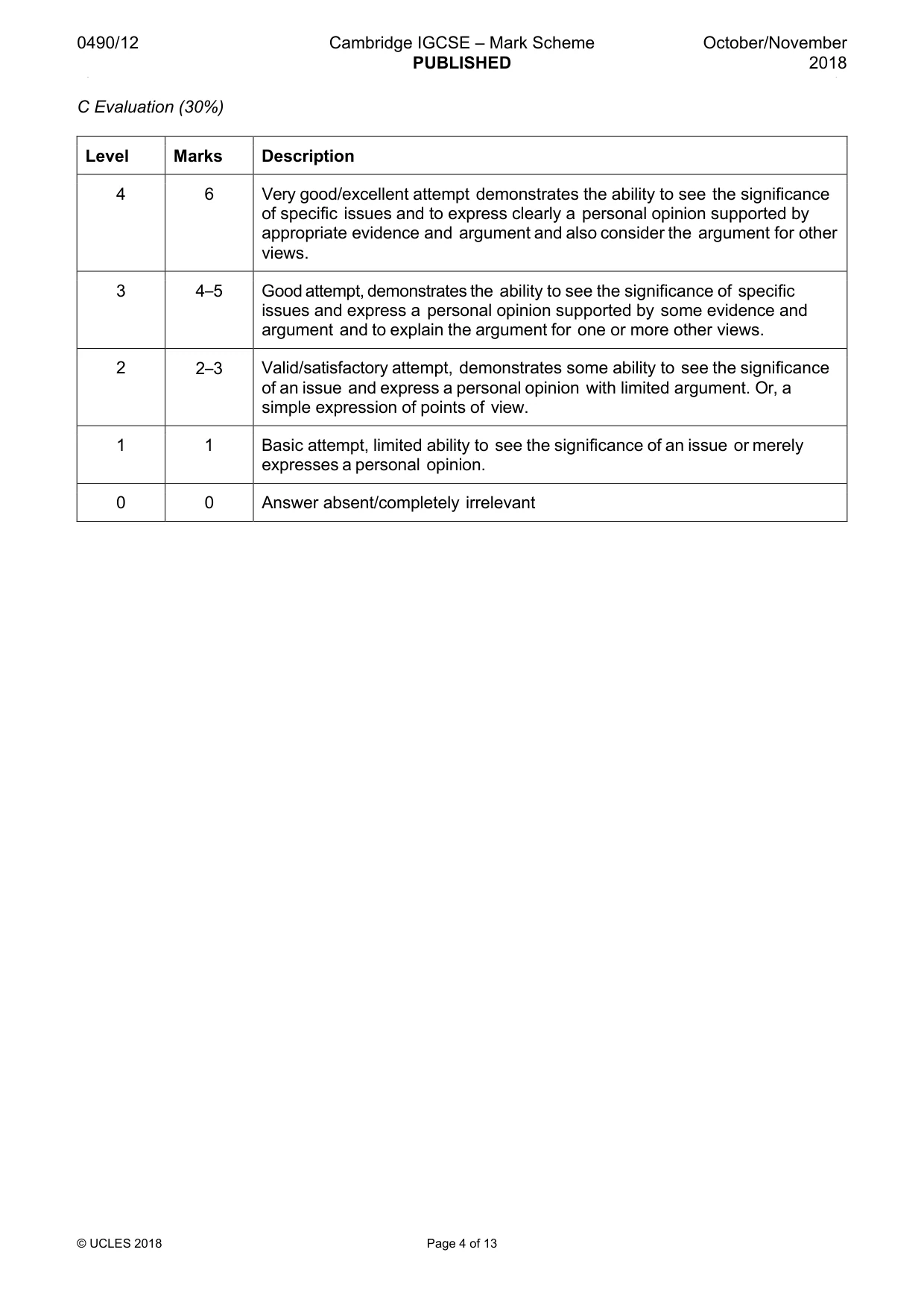
0490/12 Cambridge IGCSE – Mark Scheme PUBLISHED October/November 2018 © UCLES 2018 Page 4 of 13 C Evaluation (30%) Level Marks Description 4 6 Very good/excellent attempt demonstrates the ability to see the significance of specific issues and to express clearly a personal opinion supported by appropriate evidence and argument and also consider the argument for other views. 3 4–5 Good attempt, demonstrates the ability to see the significance of specific issues and express a personal opinion supported by some evidence and argument and to explain the argument for one or more other views. 2 2–3 Valid/satisfactory attempt, demonstrates some ability to see the significance of an issue and express a personal opinion with limited argument. Or, a simple expression of points of view. 1 1 Basic attempt, limited ability to see the significance of an issue or merely expresses a personal opinion. 0 0 Answer absent/completely irrelevant
Mark scheme, page 5
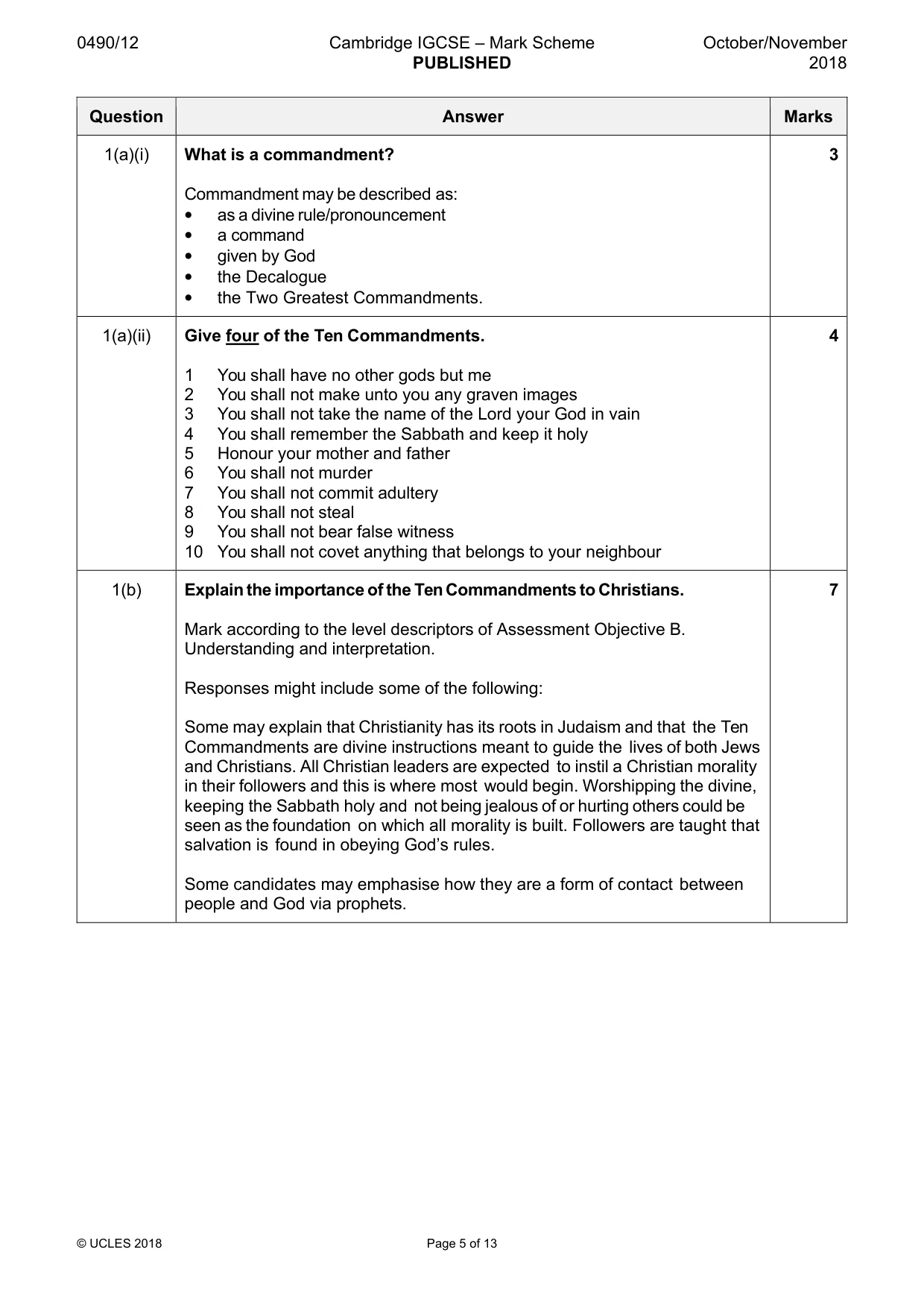
0490/12 Cambridge IGCSE – Mark Scheme PUBLISHED October/November 2018 © UCLES 2018 Page 5 of 13 Question Answer Marks 1(a)(i) What is a commandment? Commandment may be described as: • as a divine rule/pronouncement • a command • given by God • the Decalogue • the Two Greatest Commandments. 3 1(a)(ii) Give four of the Ten Commandments. 1 You shall have no other gods but me 2 You shall not make unto you any graven images 3 You shall not take the name of the Lord your God in vain 4 You shall remember the Sabbath and keep it holy 5 Honour your mother and father 6 You shall not murder 7 You shall not commit adultery 8 You shall not steal 9 You shall not bear false witness 10 You shall not covet anything that belongs to your neighbour 4 1(b) Explain the importance of the Ten Commandments to Christians. Mark according to the level descriptors of Assessment Objective B. Understanding and interpretation. Responses might include some of the following: Some may explain that Christianity has its roots in Judaism and that the Ten Commandments are divine instructions meant to guide the lives of both Jews and Christians. All Christian leaders are expected to instil a Christian morality in their followers and this is where most would begin. Worshipping the divine, keeping the Sabbath holy and not being jealous of or hurting others could be seen as the foundation on which all morality is built. Followers are taught that salvation is found in obeying God’s rules. Some candidates may emphasise how they are a form of contact between people and God via prophets. 7
Mark scheme, page 6
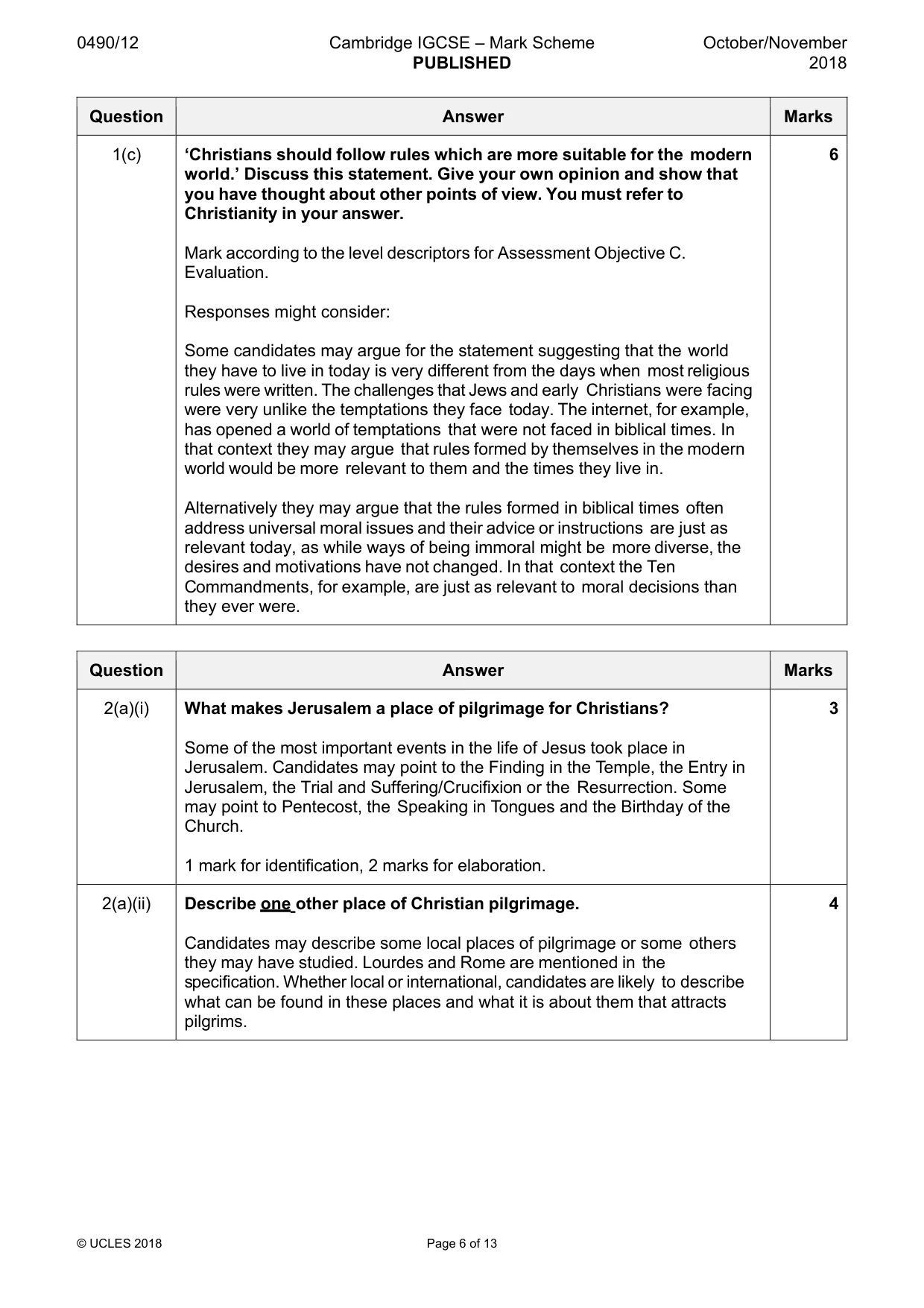
0490/12 Cambridge IGCSE – Mark Scheme PUBLISHED October/November 2018 © UCLES 2018 Page 6 of 13 Question Answer Marks 1(c) ‘Christians should follow rules which are more suitable for the modern world.’ Discuss this statement. Give your own opinion and show that you have thought about other points of view. You must refer to Christianity in your answer. Mark according to the level descriptors for Assessment Objective C. Evaluation. Responses might consider: Some candidates may argue for the statement suggesting that the world they have to live in today is very different from the days when most religious rules were written. The challenges that Jews and early Christians were facing were very unlike the temptations they face today. The internet, for example, has opened a world of temptations that were not faced in biblical times. In that context they may argue that rules formed by themselves in the modern world would be more relevant to them and the times they live in. Alternatively they may argue that the rules formed in biblical times often address universal moral issues and their advice or instructions are just as relevant today, as while ways of being immoral might be more diverse, the desires and motivations have not changed. In that context the Ten Commandments, for example, are just as relevant to moral decisions than they ever were. 6 Question Answer Marks 2(a)(i) What makes Jerusalem a place of pilgrimage for Christians? Some of the most important events in the life of Jesus took place in Jerusalem. Candidates may point to the Finding in the Temple, the Entry in Jerusalem, the Trial and Suffering/Crucifixion or the Resurrection. Some may point to Pentecost, the Speaking in Tongues and the Birthday of the Church. 1 mark for identification, 2 marks for elaboration. 3 2(a)(ii) Describe one other place of Christian pilgrimage. Candidates may describe some local places of pilgrimage or some others they may have studied. Lourdes and Rome are mentioned in the specification. Whether local or international, candidates are likely to describe what can be found in these places and what it is about them that attracts pilgrims. 4
Mark scheme, page 7
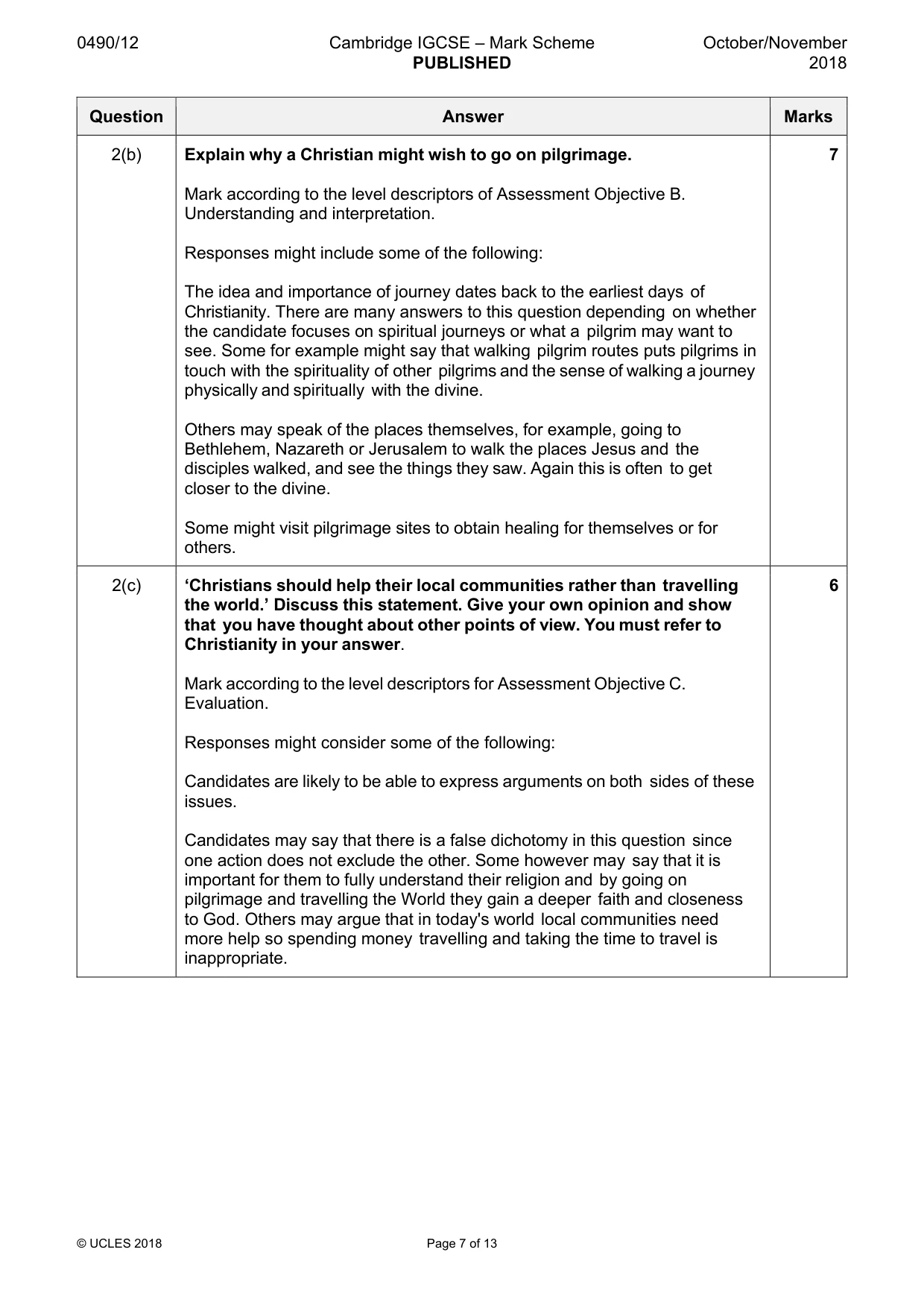
0490/12 Cambridge IGCSE – Mark Scheme PUBLISHED October/November 2018 © UCLES 2018 Page 7 of 13 Question Answer Marks 2(b) Explain why a Christian might wish to go on pilgrimage. Mark according to the level descriptors of Assessment Objective B. Understanding and interpretation. Responses might include some of the following: The idea and importance of journey dates back to the earliest days of Christianity. There are many answers to this question depending on whether the candidate focuses on spiritual journeys or what a pilgrim may want to see. Some for example might say that walking pilgrim routes puts pilgrims in touch with the spirituality of other pilgrims and the sense of walking a journey physically and spiritually with the divine. Others may speak of the places themselves, for example, going to Bethlehem, Nazareth or Jerusalem to walk the places Jesus and the disciples walked, and see the things they saw. Again this is often to get closer to the divine. Some might visit pilgrimage sites to obtain healing for themselves or for others. 7 2(c) ‘Christians should help their local communities rather than travelling the world.’ Discuss this statement. Give your own opinion and show that you have thought about other points of view. You must refer to Christianity in your answer. Mark according to the level descriptors for Assessment Objective C. Evaluation. Responses might consider some of the following: Candidates are likely to be able to express arguments on both sides of these issues. Candidates may say that there is a false dichotomy in this question since one action does not exclude the other. Some however may say that it is important for them to fully understand their religion and by going on pilgrimage and travelling the World they gain a deeper faith and closeness to God. Others may argue that in today's world local communities need more help so spending money travelling and taking the time to travel is inappropriate. 6
Mark scheme, page 8
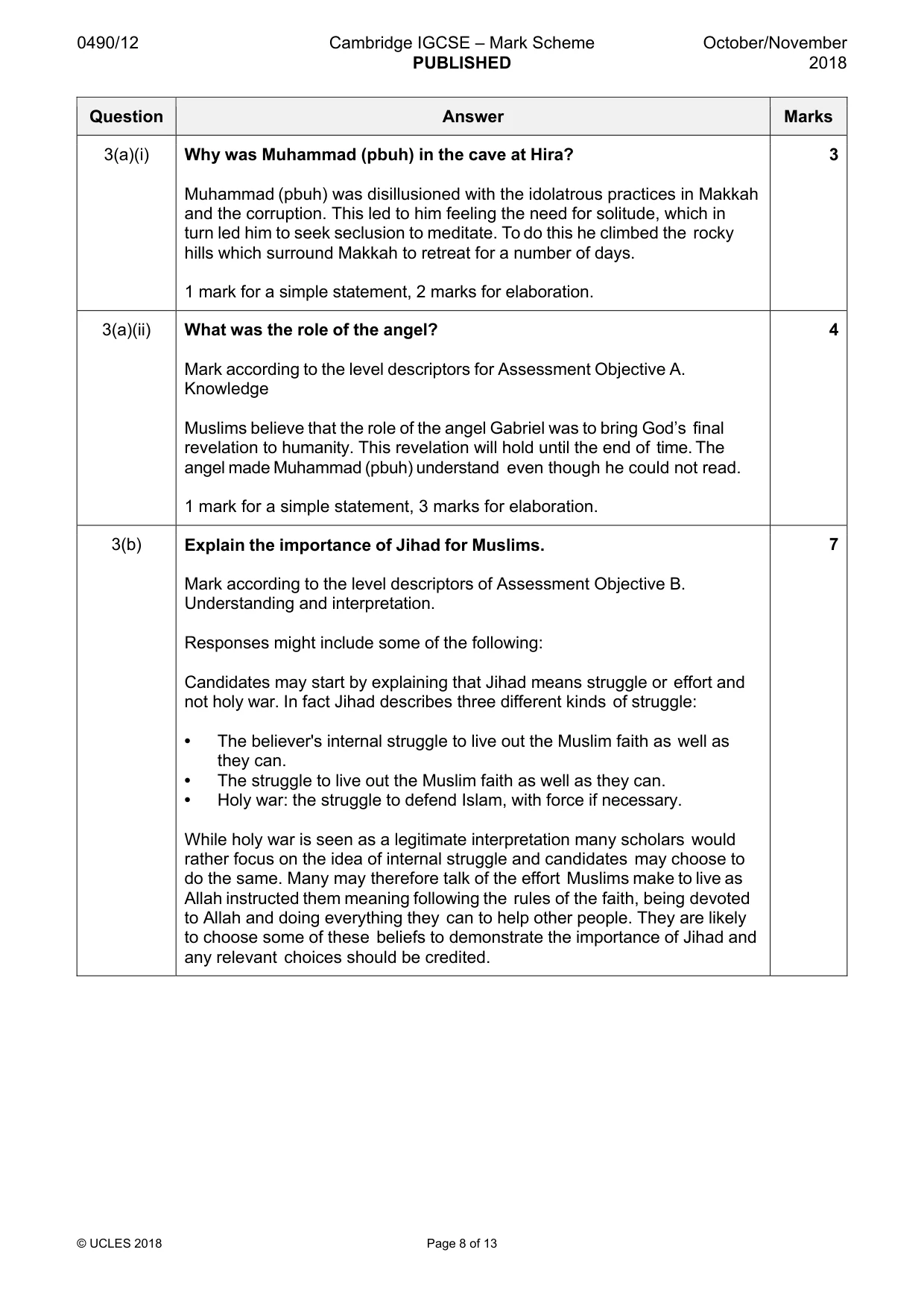
0490/12 Cambridge IGCSE – Mark Scheme PUBLISHED October/November 2018 © UCLES 2018 Page 8 of 13 Question Answer Marks 3(a)(i) Why was Muhammad (pbuh) in the cave at Hira? Muhammad (pbuh) was disillusioned with the idolatrous practices in Makkah and the corruption. This led to him feeling the need for solitude, which in turn led him to seek seclusion to meditate. To do this he climbed the rocky hills which surround Makkah to retreat for a number of days. 1 mark for a simple statement, 2 marks for elaboration. 3 3(a)(ii) What was the role of the angel? Mark according to the level descriptors for Assessment Objective A. Knowledge Muslims believe that the role of the angel Gabriel was to bring God’s final revelation to humanity. This revelation will hold until the end of time. The angel made Muhammad (pbuh) understand even though he could not read. 1 mark for a simple statement, 3 marks for elaboration. 4 3(b) Explain the importance of Jihad for Muslims. Mark according to the level descriptors of Assessment Objective B. Understanding and interpretation. Responses might include some of the following: Candidates may start by explaining that Jihad means struggle or effort and not holy war. In fact Jihad describes three different kinds of struggle: • The believer's internal struggle to live out the Muslim faith as well as they can. • The struggle to live out the Muslim faith as well as they can. • Holy war: the struggle to defend Islam, with force if necessary. While holy war is seen as a legitimate interpretation many scholars would rather focus on the idea of internal struggle and candidates may choose to do the same. Many may therefore talk of the effort Muslims make to live as Allah instructed them meaning following the rules of the faith, being devoted to Allah and doing everything they can to help other people. They are likely to choose some of these beliefs to demonstrate the importance of Jihad and any relevant choices should be credited. 7
Mark scheme, page 9
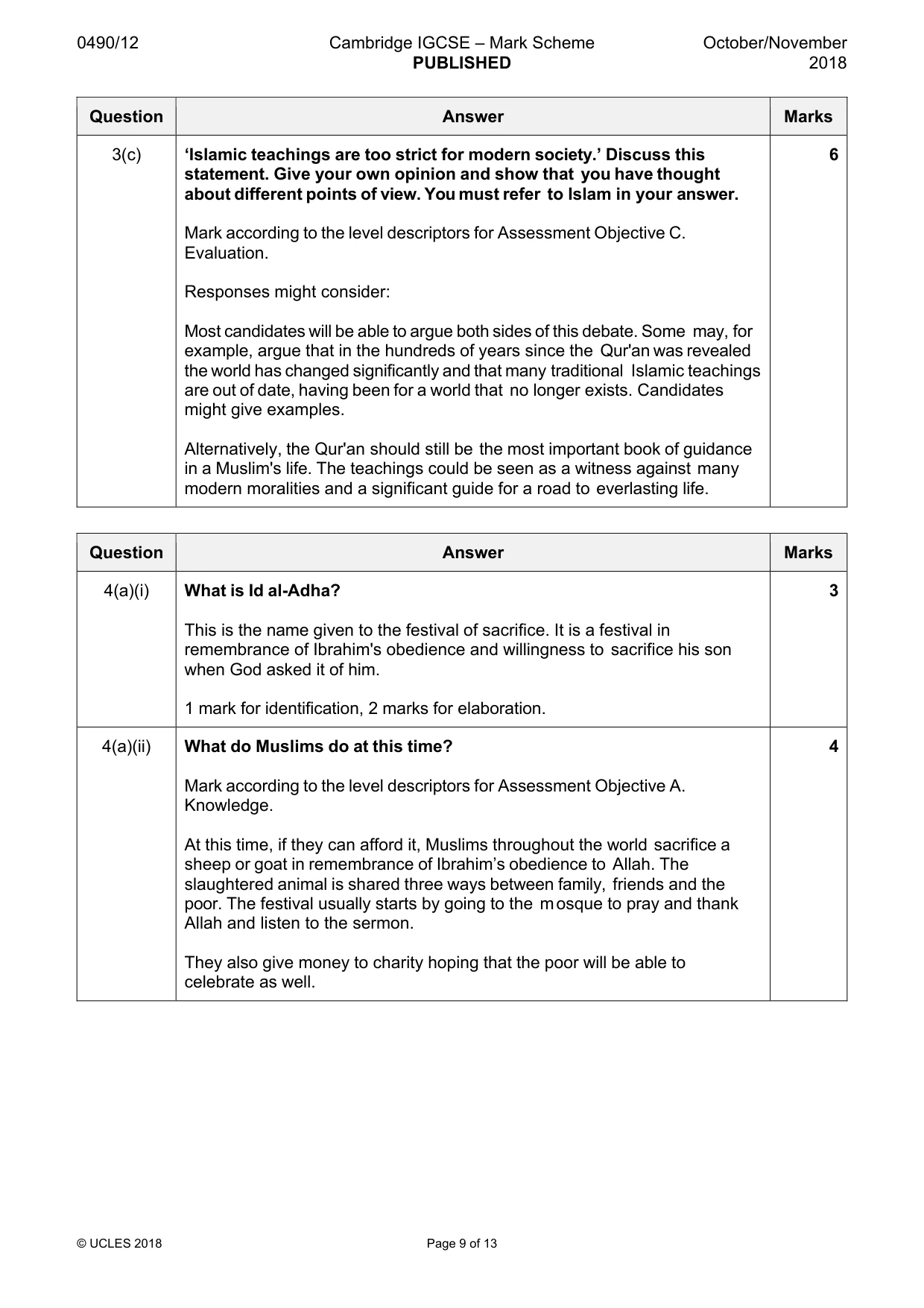
0490/12 Cambridge IGCSE – Mark Scheme PUBLISHED October/November 2018 © UCLES 2018 Page 9 of 13 Question Answer Marks 3(c) ‘Islamic teachings are too strict for modern society.’ Discuss this statement. Give your own opinion and show that you have thought about different points of view. You must refer to Islam in your answer. Mark according to the level descriptors for Assessment Objective C. Evaluation. Responses might consider: Most candidates will be able to argue both sides of this debate. Some may, for example, argue that in the hundreds of years since the Qur'an was revealed the world has changed significantly and that many traditional Islamic teachings are out of date, having been for a world that no longer exists. Candidates might give examples. Alternatively, the Qur'an should still be the most important book of guidance in a Muslim's life. The teachings could be seen as a witness against many modern moralities and a significant guide for a road to everlasting life. 6 Question Answer Marks 4(a)(i) What is Id al-Adha? This is the name given to the festival of sacrifice. It is a festival in remembrance of Ibrahim's obedience and willingness to sacrifice his son when God asked it of him. 1 mark for identification, 2 marks for elaboration. 3 4(a)(ii) What do Muslims do at this time? Mark according to the level descriptors for Assessment Objective A. Knowledge. At this time, if they can afford it, Muslims throughout the world sacrifice a sheep or goat in remembrance of Ibrahim’s obedience to Allah. The slaughtered animal is shared three ways between family, friends and the poor. The festival usually starts by going to the mosque to pray and thank Allah and listen to the sermon. They also give money to charity hoping that the poor will be able to celebrate as well. 4
Mark scheme, page 10
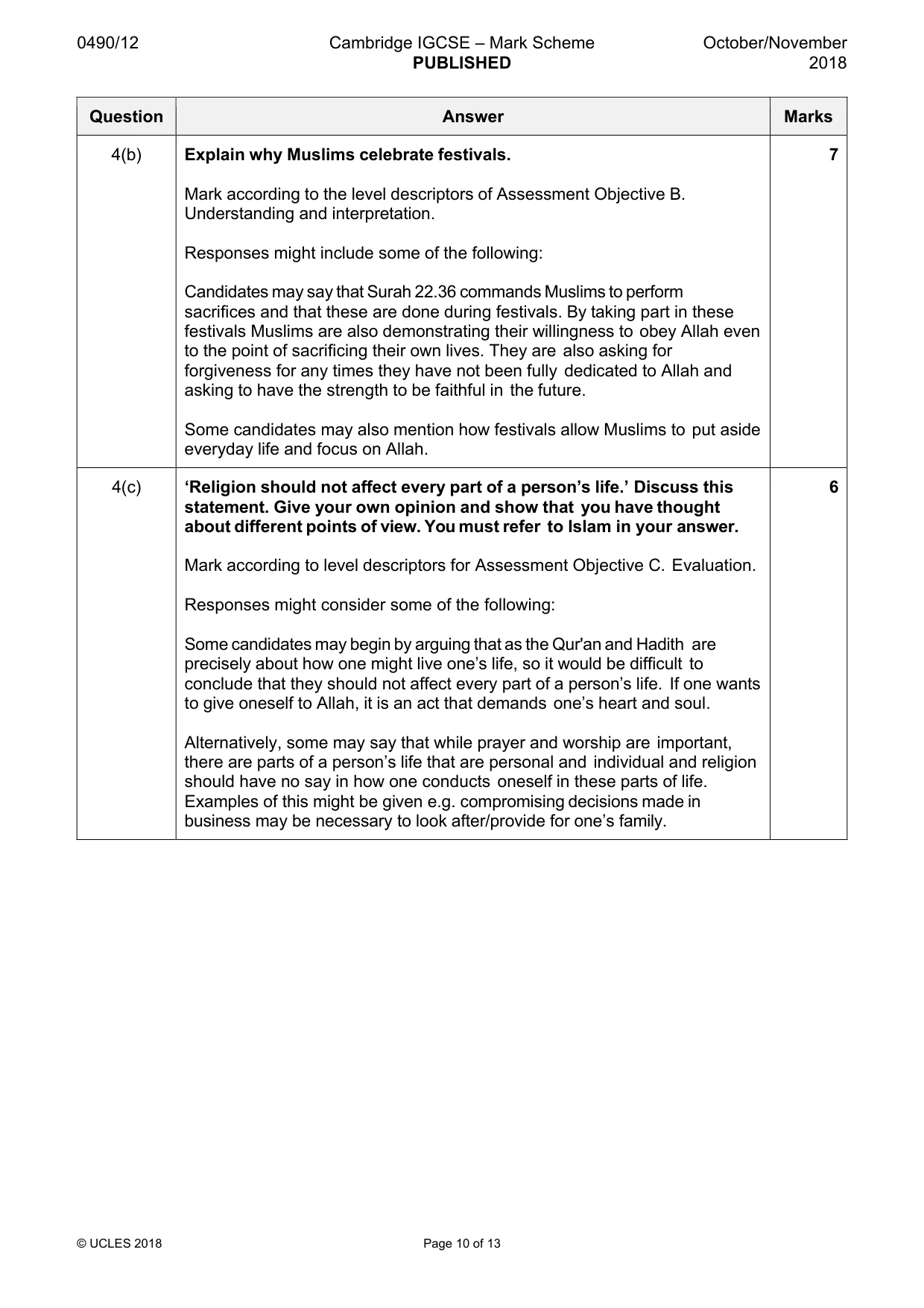
0490/12 Cambridge IGCSE – Mark Scheme PUBLISHED October/November 2018 © UCLES 2018 Page 10 of 13 Question Answer Marks 4(b) Explain why Muslims celebrate festivals. Mark according to the level descriptors of Assessment Objective B. Understanding and interpretation. Responses might include some of the following: Candidates may say that Surah 22.36 commands Muslims to perform sacrifices and that these are done during festivals. By taking part in these festivals Muslims are also demonstrating their willingness to obey Allah even to the point of sacrificing their own lives. They are also asking for forgiveness for any times they have not been fully dedicated to Allah and asking to have the strength to be faithful in the future. Some candidates may also mention how festivals allow Muslims to put aside everyday life and focus on Allah. 7 4(c) ‘Religion should not affect every part of a person’s life.’ Discuss this statement. Give your own opinion and show that you have thought about different points of view. You must refer to Islam in your answer. Mark according to level descriptors for Assessment Objective C. Evaluation. Responses might consider some of the following: Some candidates may begin by arguing that as the Qur'an and Hadith are precisely about how one might live one’s life, so it would be difficult to conclude that they should not affect every part of a person’s life. If one wants to give oneself to Allah, it is an act that demands one’s heart and soul. Alternatively, some may say that while prayer and worship are important, there are parts of a person’s life that are personal and individual and religion should have no say in how one conducts oneself in these parts of life. Examples of this might be given e.g. compromising decisions made in business may be necessary to look after/provide for one’s family. 6
Mark scheme, page 11
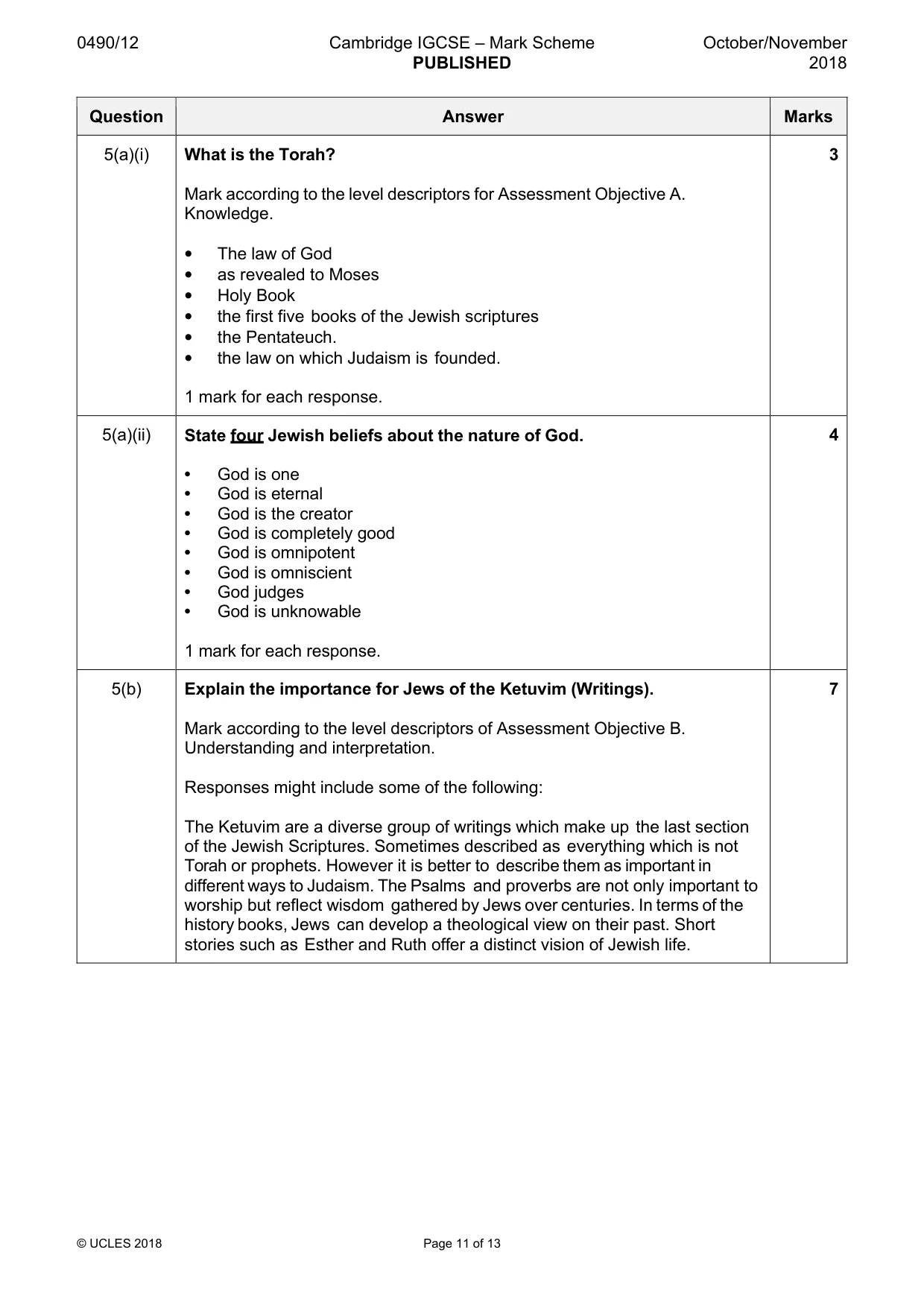
0490/12 Cambridge IGCSE – Mark Scheme PUBLISHED October/November 2018 © UCLES 2018 Page 11 of 13 Question Answer Marks 5(a)(i) What is the Torah? Mark according to the level descriptors for Assessment Objective A. Knowledge. • The law of God • as revealed to Moses • Holy Book • the first five books of the Jewish scriptures • the Pentateuch. • the law on which Judaism is founded. 1 mark for each response. 3 5(a)(ii) State four Jewish beliefs about the nature of God. • God is one • God is eternal • God is the creator • God is completely good • God is omnipotent • God is omniscient • God judges • God is unknowable 1 mark for each response. 4 5(b) Explain the importance for Jews of the Ketuvim (Writings). Mark according to the level descriptors of Assessment Objective B. Understanding and interpretation. Responses might include some of the following: The Ketuvim are a diverse group of writings which make up the last section of the Jewish Scriptures. Sometimes described as everything which is not Torah or prophets. However it is better to describe them as important in different ways to Judaism. The Psalms and proverbs are not only important to worship but reflect wisdom gathered by Jews over centuries. In terms of the history books, Jews can develop a theological view on their past. Short stories such as Esther and Ruth offer a distinct vision of Jewish life. 7
Mark scheme, page 12
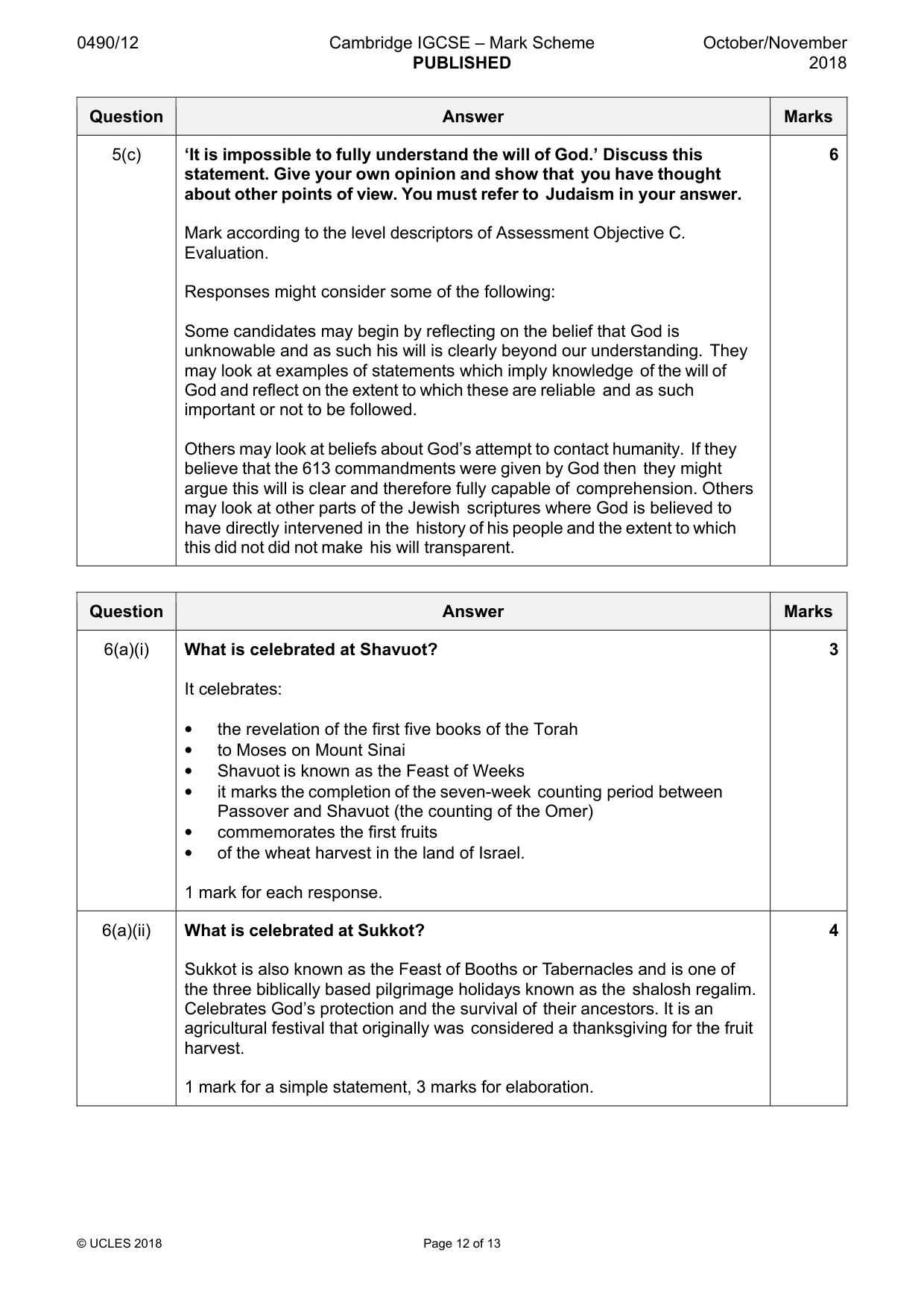
0490/12 Cambridge IGCSE – Mark Scheme PUBLISHED October/November 2018 © UCLES 2018 Page 12 of 13 Question Answer Marks 5(c) ‘It is impossible to fully understand the will of God.’ Discuss this statement. Give your own opinion and show that you have thought about other points of view. You must refer to Judaism in your answer. Mark according to the level descriptors of Assessment Objective C. Evaluation. Responses might consider some of the following: Some candidates may begin by reflecting on the belief that God is unknowable and as such his will is clearly beyond our understanding. They may look at examples of statements which imply knowledge of the will of God and reflect on the extent to which these are reliable and as such important or not to be followed. Others may look at beliefs about God’s attempt to contact humanity. If they believe that the 613 commandments were given by God then they might argue this will is clear and therefore fully capable of comprehension. Others may look at other parts of the Jewish scriptures where God is believed to have directly intervened in the history of his people and the extent to which this did not did not make his will transparent. 6 Question Answer Marks 6(a)(i) What is celebrated at Shavuot? It celebrates: • the revelation of the first five books of the Torah • to Moses on Mount Sinai • Shavuot is known as the Feast of Weeks • it marks the completion of the seven-week counting period between Passover and Shavuot (the counting of the Omer) • commemorates the first fruits • of the wheat harvest in the land of Israel. 1 mark for each response. 3 6(a)(ii) What is celebrated at Sukkot? Sukkot is also known as the Feast of Booths or Tabernacles and is one of the three biblically based pilgrimage holidays known as the shalosh regalim. Celebrates God’s protection and the survival of their ancestors. It is an agricultural festival that originally was considered a thanksgiving for the fruit harvest. 1 mark for a simple statement, 3 marks for elaboration. 4
Mark scheme, page 13
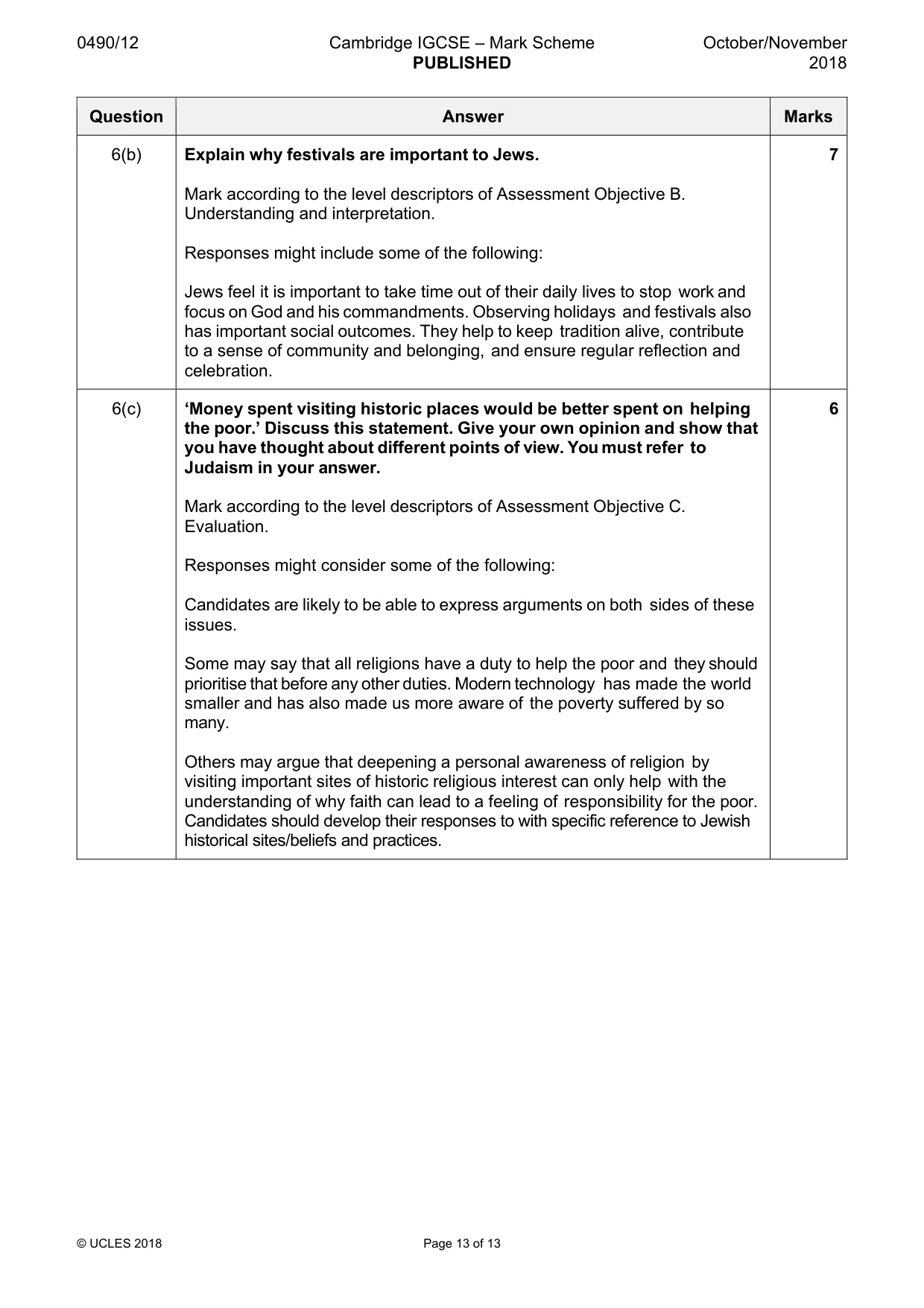
0490/12 Cambridge IGCSE – Mark Scheme PUBLISHED October/November 2018 © UCLES 2018 Page 13 of 13 Question Answer Marks 6(b) Explain why festivals are important to Jews. Mark according to the level descriptors of Assessment Objective B. Understanding and interpretation. Responses might include some of the following: Jews feel it is important to take time out of their daily lives to stop work and focus on God and his commandments. Observing holidays and festivals also has important social outcomes. They help to keep tradition alive, contribute to a sense of community and belonging, and ensure regular reflection and celebration. 7 6(c) ‘Money spent visiting historic places would be better spent on helping the poor.’ Discuss this statement. Give your own opinion and show that you have thought about different points of view. You must refer to Judaism in your answer. Mark according to the level descriptors of Assessment Objective C. Evaluation. Responses might consider some of the following: Candidates are likely to be able to express arguments on both sides of these issues. Some may say that all religions have a duty to help the poor and they should prioritise that before any other duties. Modern technology has made the world smaller and has also made us more aware of the poverty suffered by so many. Others may argue that deepening a personal awareness of religion by visiting important sites of historic religious interest can only help with the understanding of why faith can lead to a feeling of responsibility for the poor. Candidates should develop their responses to with specific reference to Jewish historical sites/beliefs and practices. 6
What you needed in this session
Cambridge’s own grade thresholds for 2018 Oct/Nov, Paper 1 · Variant 2. A higher threshold means an easier paper — the bar moves with how the cohort did.