Questions as text
Q1 · On a warm day, a carton of fresh milk is covered with a wet cloth 0972/11 May/June 2018
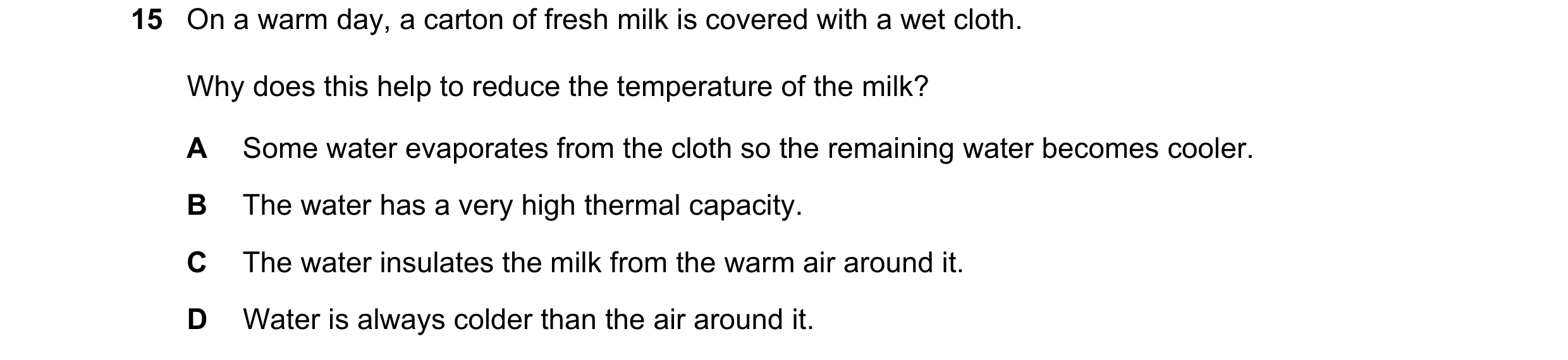
15 On a warm day, a carton of fresh milk is covered with a wet cloth. Why does this help to reduce the temperature of the milk? A Some water evaporates from the cloth so the remaining water becomes cooler. B The water has a very high thermal capacity. C The water insulates the milk from the warm air around it. D Water is always colder than the air around it.
1 marks
Answer: A
This question in 0972/11 May/June 2018
Q2 · On a cold day, a metal front-door knob X and a similar plastic knob Y are at the same… 0972/11 May/June 2018
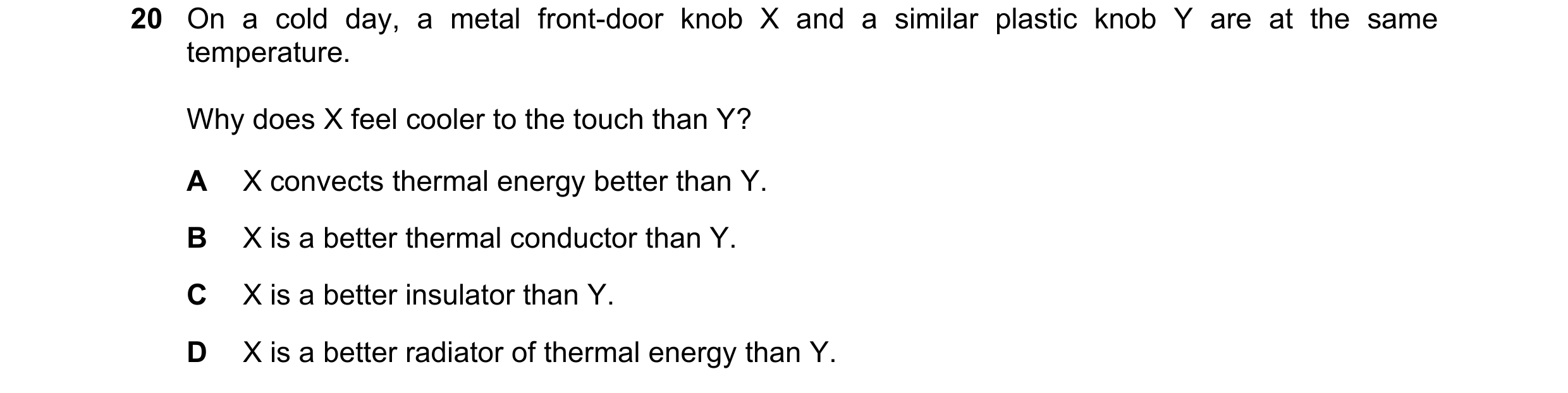
20 On a cold day, a metal front-door knob X and a similar plastic knob Y are at the same temperature. Why does X feel cooler to the touch than Y? A X convects thermal energy better than Y. B X is a better thermal conductor than Y. C X is a better insulator than Y. D X is a better radiator of thermal energy than Y.
1 marks
Answer: B
This question in 0972/11 May/June 2018
Q3 · A liquid is heated and it expands 0972/11 May/June 2018
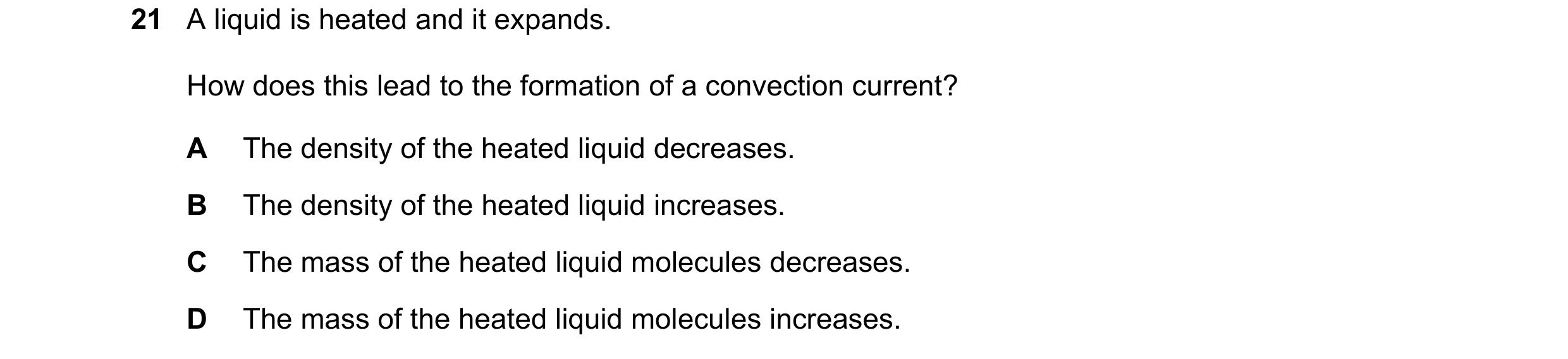
21 A liquid is heated and it expands. How does this lead to the formation of a convection current? A The density of the heated liquid decreases. B The density of the heated liquid increases. C The mass of the heated liquid molecules decreases. D The mass of the heated liquid molecules increases.
1 marks
Answer: A
This question in 0972/11 May/June 2018
Q4 · In which does thermal conduction not occur? 0972/11 May/June 2019
19 In which does thermal conduction not occur? A a gas B a liquid C a solid D a vacuum
1 marks
Answer: D
This question in 0972/11 May/June 2019
Q5 · The metal surface of a kettle is hot 0972/11 May/June 2019
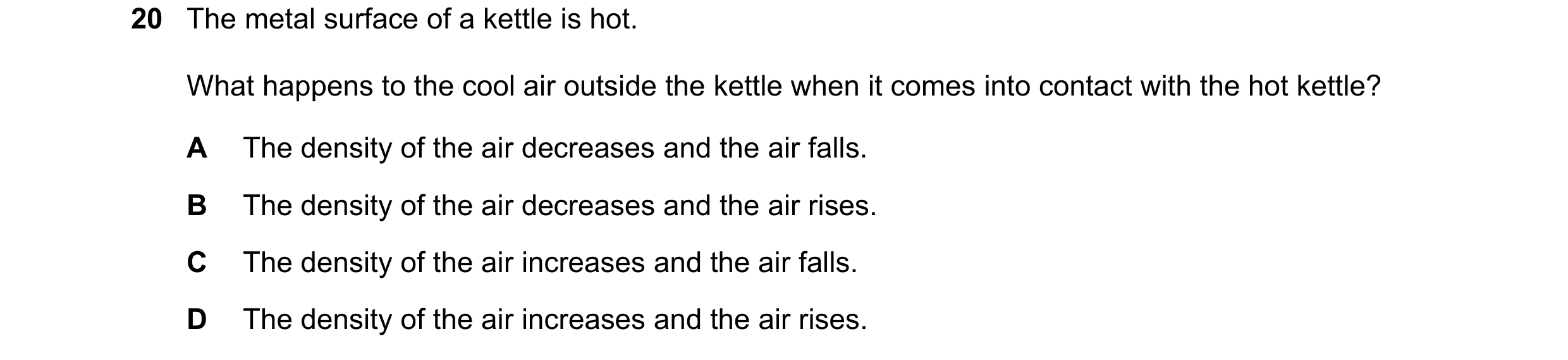
20 The metal surface of a kettle is hot. What happens to the cool air outside the kettle when it comes into contact with the hot kettle? A The density of the air decreases and the air falls. B The density of the air decreases and the air rises. C The density of the air increases and the air falls. D The density of the air increases and the air rises.
1 marks
Answer: B
This question in 0972/11 May/June 2019
Q6 · A glass test-tube containing water is heated at the top 0972/11 Oct/Nov 2019
19 A glass test-tube containing water is heated at the top. The water at the top boils, but the water at the bottom remains cold. water test-tube heat Which row explains why the water at the bottom of the test-tube remains cold? glass water A good thermal conductor good thermal conductor B good thermal conductor poor thermal conductor C poor thermal conductor good thermal conductor D poor thermal conductor poor thermal conductor
1 marks
Answer: D
This question in 0972/11 Oct/Nov 2019
Q7 · In countries where it is usually hot, houses are often painted white 0972/11 Oct/Nov 2019
20 In countries where it is usually hot, houses are often painted white. What is the reason for this? A White surfaces are good reflectors of radiant energy. B White surfaces are good transmitters of radiant energy. C White surfaces are good absorbers of radiant energy. D White surfaces are good emitters of radiant energy.
1 marks
Answer: A
This question in 0972/11 Oct/Nov 2019
Q8 · One ice cube is placed on a metal block 0972/11 May/June 2020
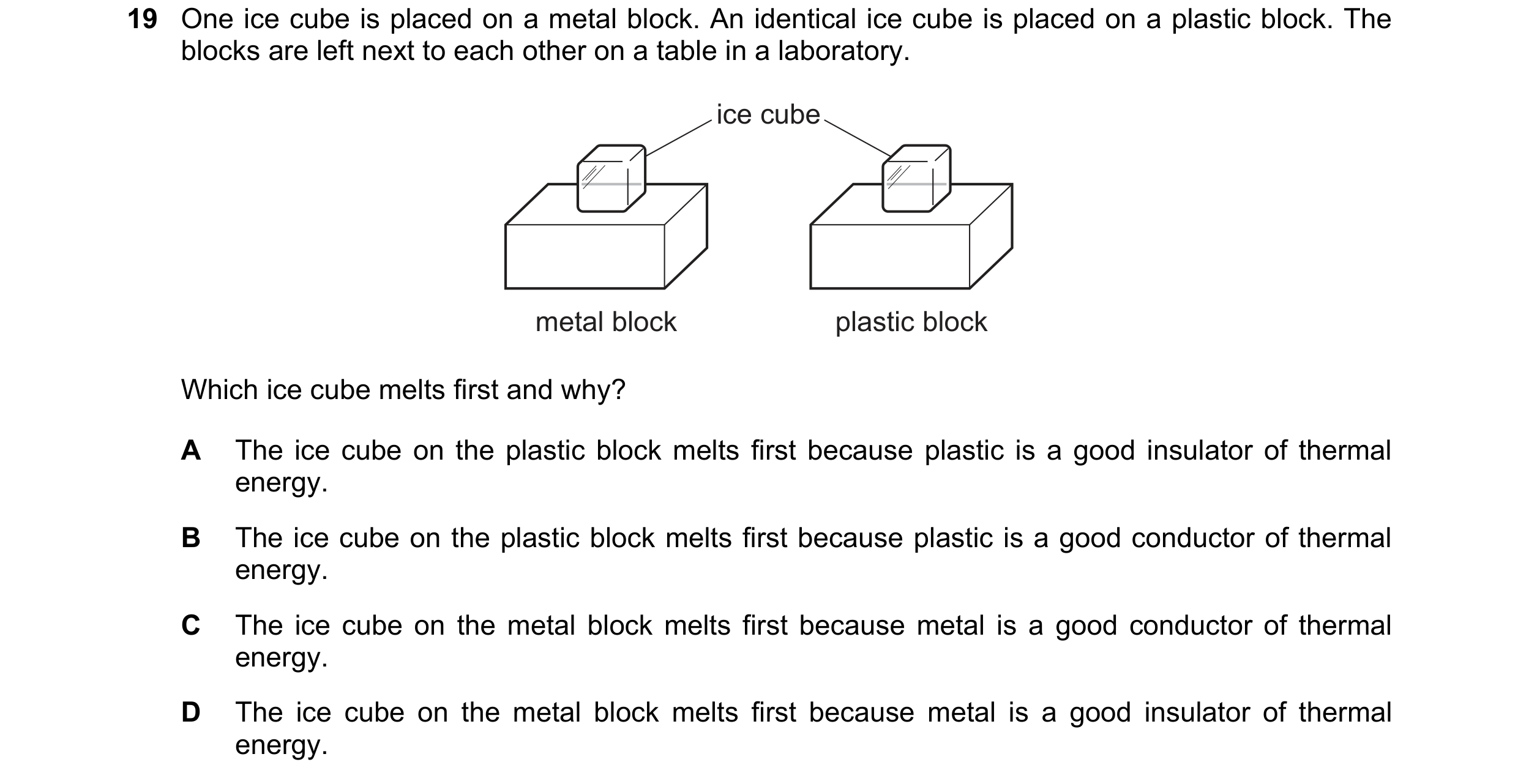
19 One ice cube is placed on a metal block. An identical ice cube is placed on a plastic block. The blocks are left next to each other on a table in a laboratory. ice cube metal block plastic block Which ice cube melts first and why? A The ice cube on the plastic block melts first because plastic is a good insulator of thermal energy. B The ice cube on the plastic block melts first because plastic is a good conductor of thermal energy. C The ice cube on the metal block melts first because metal is a good conductor of thermal energy. D The ice cube on the metal block melts first because metal is a good insulator of thermal energy.
1 marks
Answer: C
This question in 0972/11 May/June 2020
Q9 · Two freezers X and Y are identical except that one has a door opening at the front and… 0972/11 May/June 2020
20 Two freezers X and Y are identical except that one has a door opening at the front and the other has a door opening at the top. door freezer freezer door X Y Both doors are the same size and are opened for the same amount of time. Which freezer gains the least amount of thermal energy in this time and why? freezer gaining the reason least thermal energy A X cold air falls B X warm air falls C Y cold air falls D Y warm air falls
1 marks
Answer: C
This question in 0972/11 May/June 2020
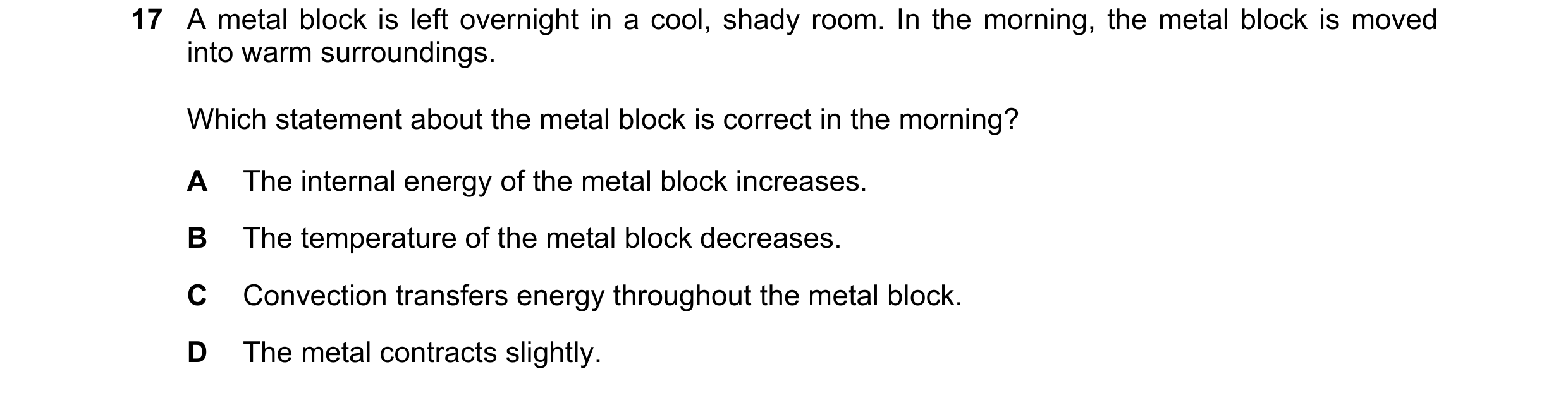
Q10 · A metal block is left overnight in a cool, shady room 0972/12 May/June 2020
17 A metal block is left overnight in a cool, shady room. In the morning, the metal block is moved into warm surroundings. Which statement about the metal block is correct in the morning? A The internal energy of the metal block increases. B The temperature of the metal block decreases. C Convection transfers energy throughout the metal block. D The metal contracts slightly.
1 marks
Answer: A
This question in 0972/12 May/June 2020
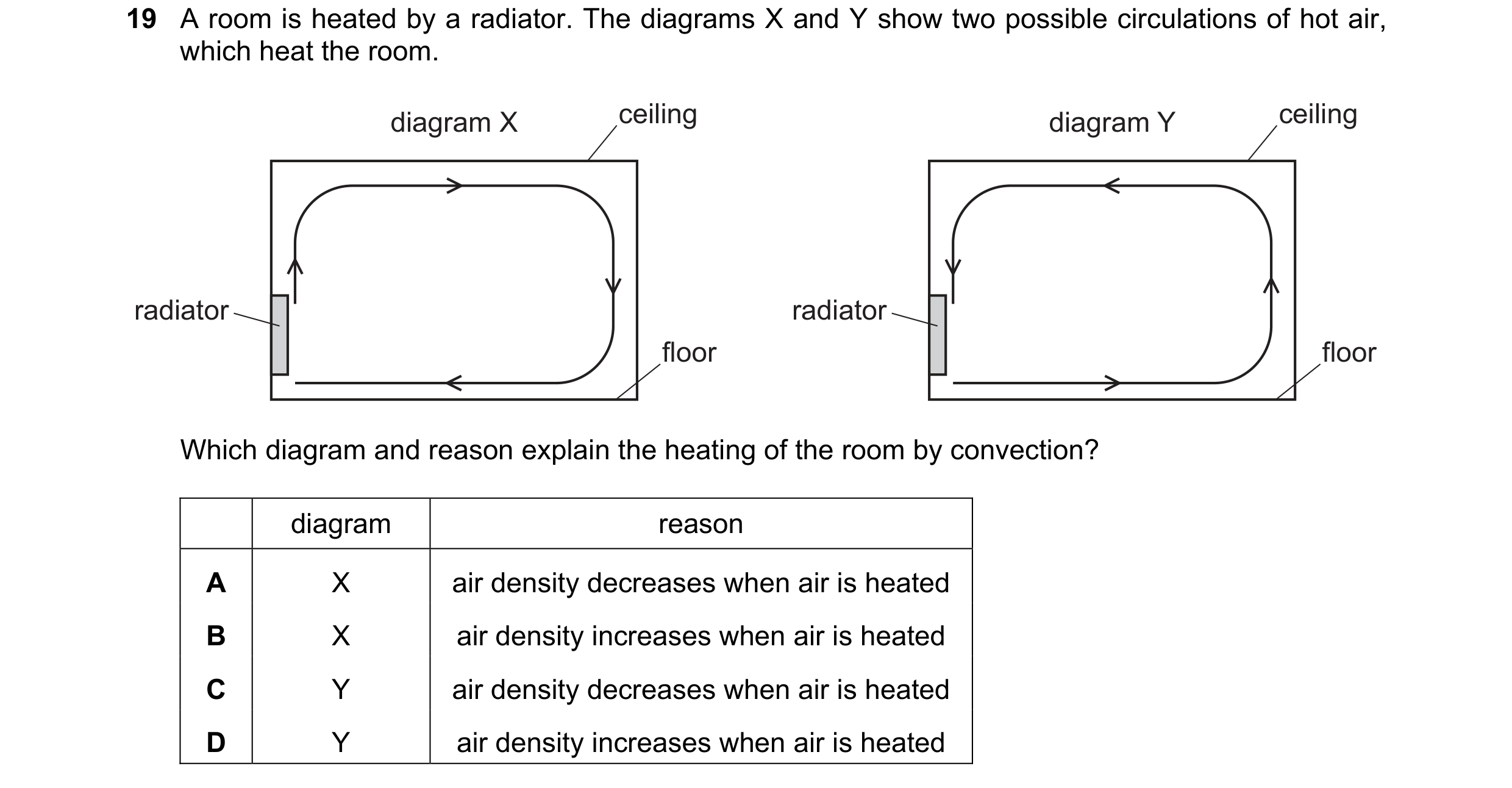
Q11 · A room is heated by a radiator 0972/12 May/June 2020
19 A room is heated by a radiator. The diagrams X and Y show two possible circulations of hot air, which heat the room. diagram X ceiling diagram Y ceiling radiator radiator floor floor Which diagram and reason explain the heating of the room by convection? diagram reason A X air density decreases when air is heated B X air density increases when air is heated C Y air density decreases when air is heated D Y air density increases when air is heated
1 marks
Answer: A
This question in 0972/12 May/June 2020
Q12 · Two similar liquid-in-glass thermometers P and Q are placed in direct sunlight 0972/12 May/June 2020
20 Two similar liquid-in-glass thermometers P and Q are placed in direct sunlight. The bulb of thermometer P is painted white. The bulb of thermometer Q is painted black. How and why would the thermometer readings differ? A P would read higher than Q because black is a good absorber of radiation. B P would read higher than Q because black is a poor absorber of radiation. C P would read lower than Q because black is a good absorber of radiation. D P would read lower than Q because black is a poor absorber of radiation.
1 marks
Answer: C
This question in 0972/12 May/June 2020
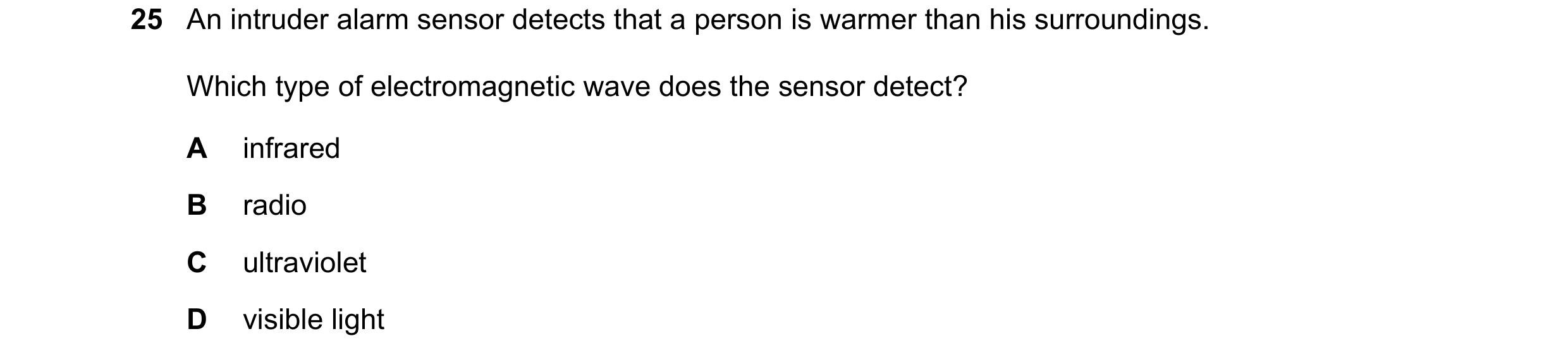
Q13 · An intruder alarm sensor detects that a person is warmer than his surroundings 0972/12 May/June 2020
25 An intruder alarm sensor detects that a person is warmer than his surroundings. Which type of electromagnetic wave does the sensor detect? A infrared B radio C ultraviolet D visible light
1 marks
Answer: A
This question in 0972/12 May/June 2020
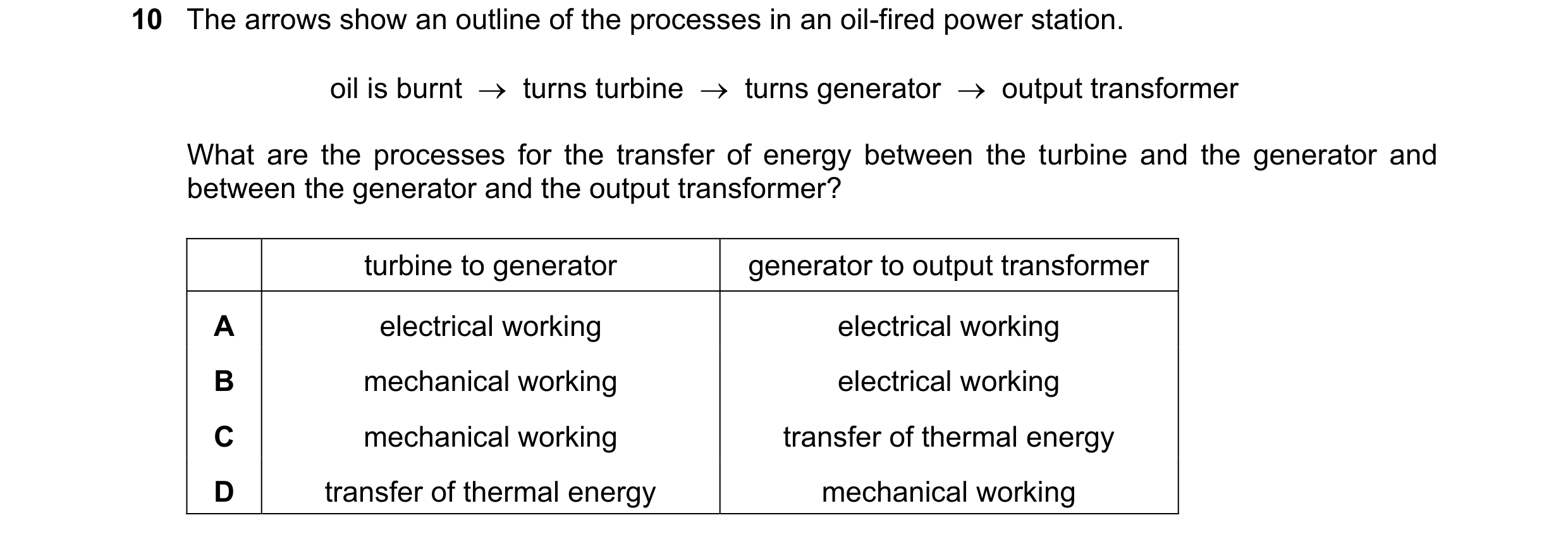
Q14 · The arrows show an outline of the processes in an oil-fired power station 0972/11 Oct/Nov 2020
10 The arrows show an outline of the processes in an oil-fired power station. oil is burnt turns turbine turns generator output transformer What are the processes for the transfer of energy between the turbine and the generator and between the generator and the output transformer? turbine to generator generator to output transformer A electrical working electrical working B mechanical working electrical working C mechanical working transfer of thermal energy D transfer of thermal energy mechanical working
1 marks
Answer: B
This question in 0972/11 Oct/Nov 2020
Q15 · The diagram shows four rods 0972/11 Oct/Nov 2020
18 The diagram shows four rods. Each rod is made of a different metal. P Q brass copper X silver iron S R Wax is used to attach small metal balls at the rod ends P, Q, R and S. Each rod is the same size. They are heated uniformly by a Bunsen burner at point X. As the rods warm up, the wax melts and the balls fall off. Why does the ball on the silver rod fall first? A Silver is the best conductor of heat. B Silver is the worst conductor of heat. C Silver is the best radiator of heat. D Silver is the worst radiator of heat.
1 marks
Answer: A
This question in 0972/11 Oct/Nov 2020
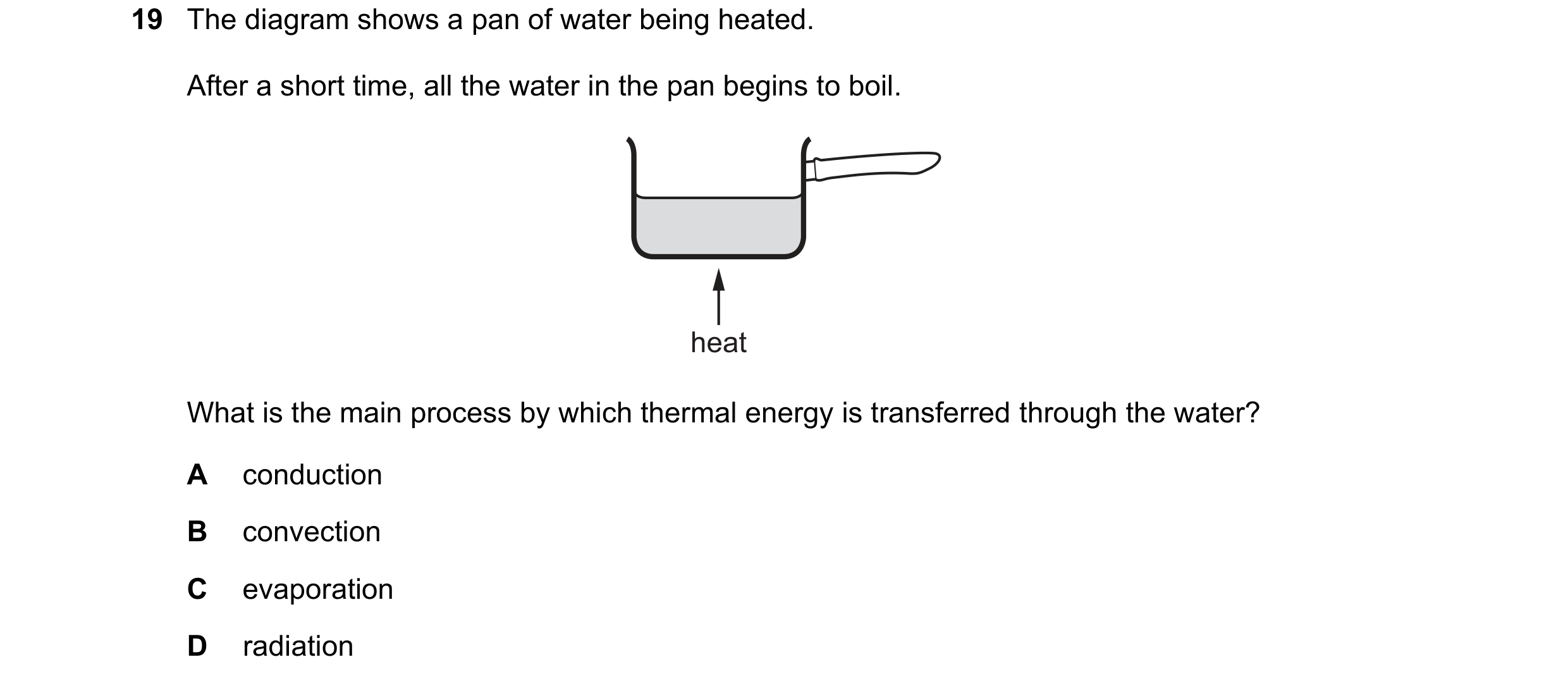
Q16 · The diagram shows a pan of water being heated 0972/11 Oct/Nov 2020
19 The diagram shows a pan of water being heated. After a short time, all the water in the pan begins to boil. heat What is the main process by which thermal energy is transferred through the water? A conduction B convection C evaporation D radiation
1 marks
Answer: B
This question in 0972/11 Oct/Nov 2020
Q17 · The diagram shows a pan used for cooking food 0972/11 Oct/Nov 2021
16 The diagram shows a pan used for cooking food. handle of pan base of pan Which row is correct for the materials used to make the base and the handle of the pan? base of pan handle of pan A good thermal conductor good thermal conductor B good thermal conductor poor thermal conductor C poor thermal conductor good thermal conductor D poor thermal conductor poor thermal conductor
1 marks
Answer: B
This question in 0972/11 Oct/Nov 2021
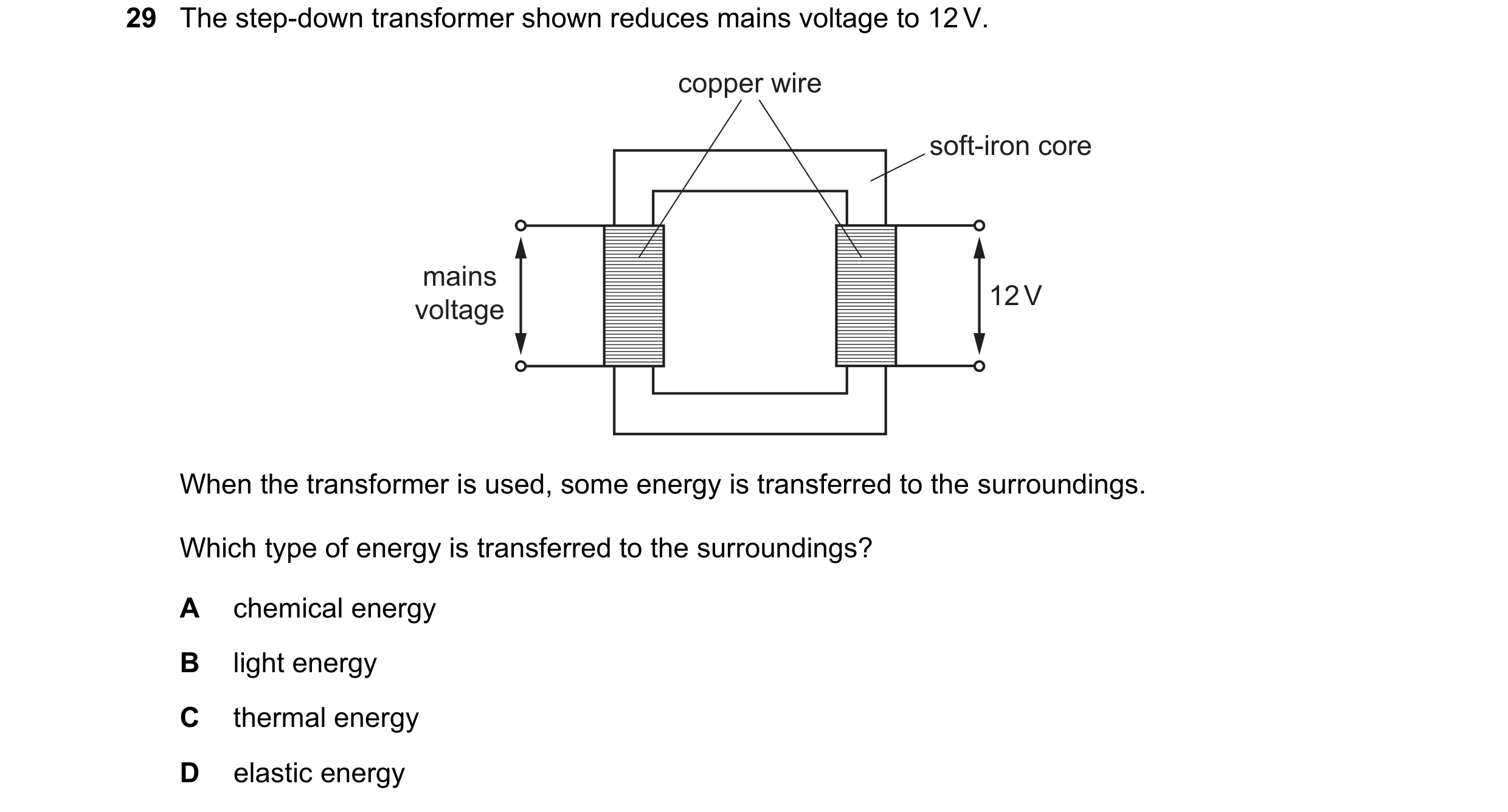
Q18 · The step-down transformer shown reduces mains voltage to 12 V 0972/11 Oct/Nov 2021
29 The step-down transformer shown reduces mains voltage to 12 V. copper wire soft-iron core mains 12 V voltage When the transformer is used, some energy is transferred to the surroundings. Which type of energy is transferred to the surroundings? A chemical energy B light energy C thermal energy D elastic energy
1 marks
Answer: C
This question in 0972/11 Oct/Nov 2021
Q19 · Two thermometers, P and Q, give the same reading at room temperature 0972/11 May/June 2022
14 Two thermometers, P and Q, give the same reading at room temperature. The bulb of thermometer Q is wrapped in gauze and dipped in a beaker of water at room temperature. Air at room temperature is blown over the two thermometer bulbs. Which statement correctly describes and explains what happens? A P reads higher than Q because bulb P absorbs energy from the air. B P reads higher than Q because water evaporates from the gauze and cools bulb Q. C P reads lower than Q because the wet gauze insulates bulb Q. D P reads lower than Q because water evaporates from the gauze and warms bulb Q.
1 marks
Answer: B
This question in 0972/11 May/June 2022
Q20 · A glass contains an iced drink on a warm and humid day 0972/11 May/June 2022
17 A glass contains an iced drink on a warm and humid day. Water starts to form on the outside of the glass. What is the name of the effect by which the water forms? A condensation B conduction C convection D evaporation
1 marks
Answer: A
This question in 0972/11 May/June 2022
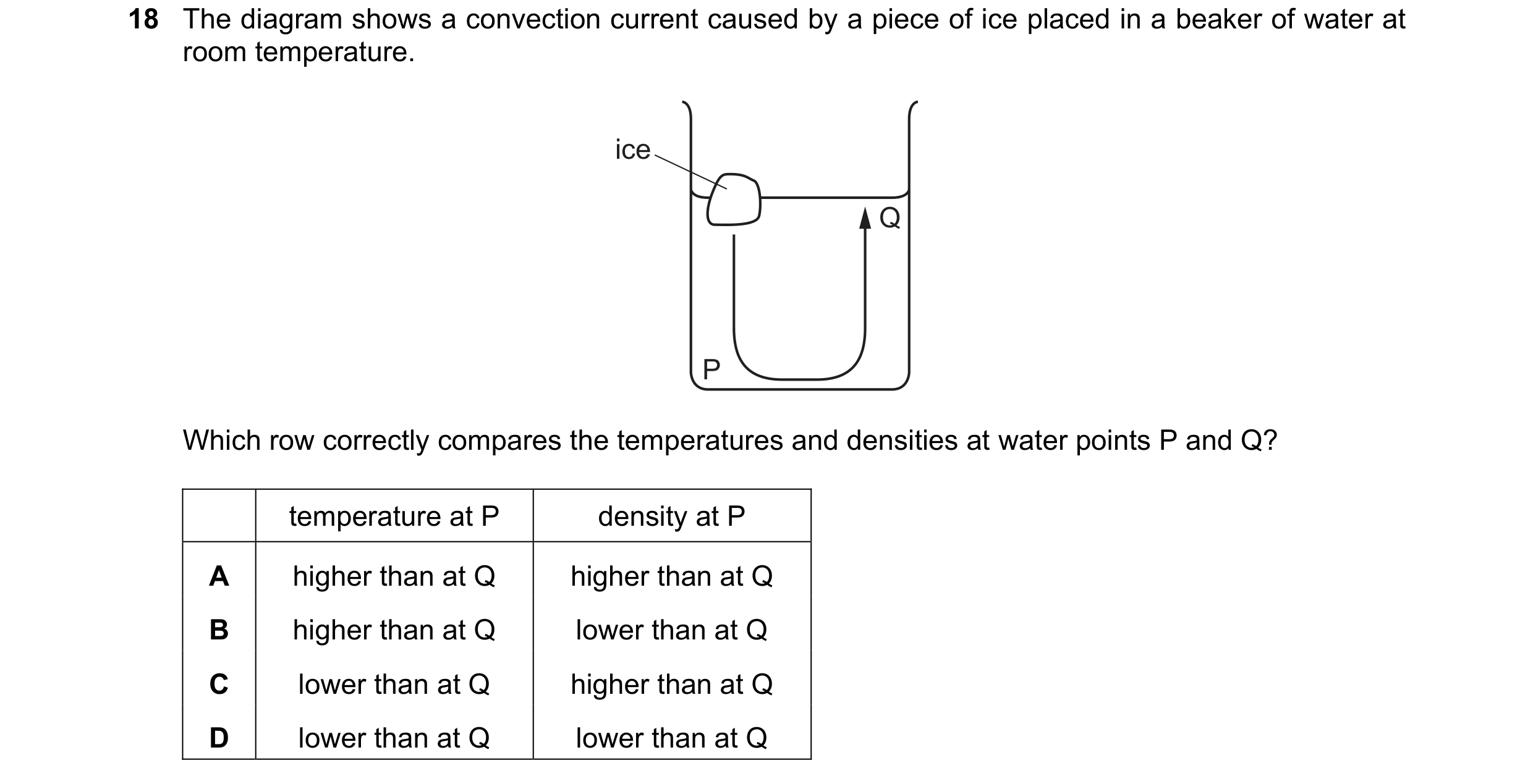
Q21 · The diagram shows a convection current caused by a piece of ice placed in a beaker of… 0972/11 May/June 2022
18 The diagram shows a convection current caused by a piece of ice placed in a beaker of water at room temperature. ice Q P Which row correctly compares the temperatures and densities at water points P and Q? temperature at P density at P A higher than at Q higher than at Q B higher than at Q lower than at Q C lower than at Q higher than at Q D lower than at Q lower than at Q
1 marks
Answer: C
This question in 0972/11 May/June 2022
Q22 · The outside of one of two identical shiny metal containers is painted dull black 0972/11 May/June 2022
19 The outside of one of two identical shiny metal containers is painted dull black. The containers are filled with equal masses of hot water at the same temperature. Why does the dull black container cool more quickly? A Black surfaces are better conductors than shiny surfaces. B Black surfaces are better emitters of radiation than shiny surfaces. C Black surfaces are better reflectors of radiation than shiny surfaces. D Black surfaces are worse absorbers of radiation than shiny surfaces.
1 marks
Answer: B
This question in 0972/11 May/June 2022
Q23 · The diagram shows solar water panels on the roof of a house 0972/12 May/June 2022
18 The diagram shows solar water panels on the roof of a house. The panels absorb energy from the Sun to heat up the water in the metal pipes. metal pipes Which row describes how energy is transferred from the Sun and through the metal of the pipes? through the from the Sun metal of the pipes A conduction conduction B conduction convection C radiation conduction D radiation convection
1 marks
Answer: C
This question in 0972/12 May/June 2022
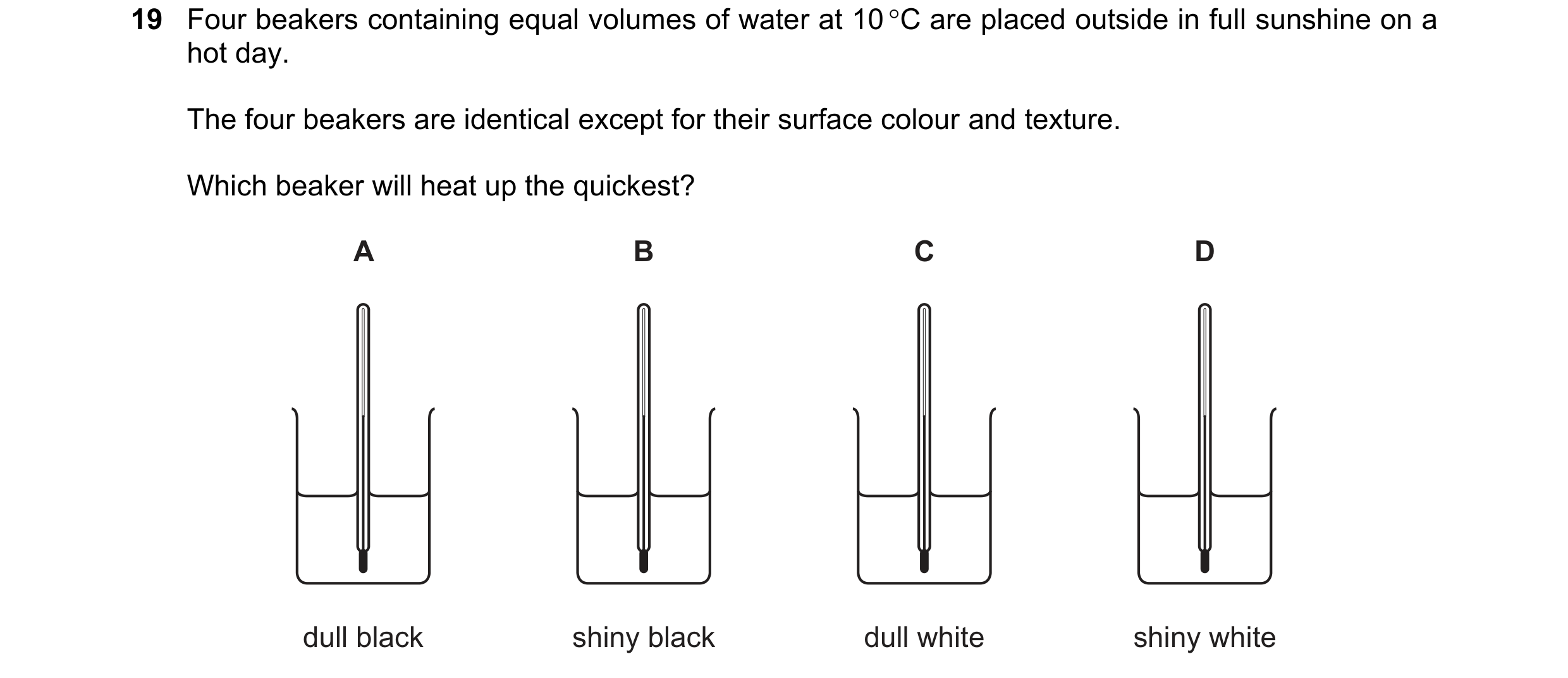
Q24 · Four beakers containing equal volumes of water at 10 C are placed outside in full… 0972/12 May/June 2022
19 Four beakers containing equal volumes of water at 10 C are placed outside in full sunshine on a hot day. The four beakers are identical except for their surface colour and texture. Which beaker will heat up the quickest? A B C D dull black shiny black dull white shiny white
1 marks
Answer: A
This question in 0972/12 May/June 2022
Q25 · Which surface is the worst absorber of infrared radiation? 0972/11 May/June 2023
16 Which surface is the worst absorber of infrared radiation? A dull black B dull white C shiny black D shiny white
1 marks
Answer: D
This question in 0972/11 May/June 2023
Q26 · A teacher puts some cold water in a test-tube 0972/12 May/June 2023
16 A teacher puts some cold water in a test-tube. She holds the bottom of the test-tube while heating the top. boiling water cold water heat The water at the top boils but she continues to hold the test-tube as the bottom remains cold. Which conclusion about water is made from this experiment? A Water is a bad conductor. B Water is a bad convector. C Water is a good conductor. D Water is a good convector.
1 marks
Answer: A
This question in 0972/12 May/June 2023
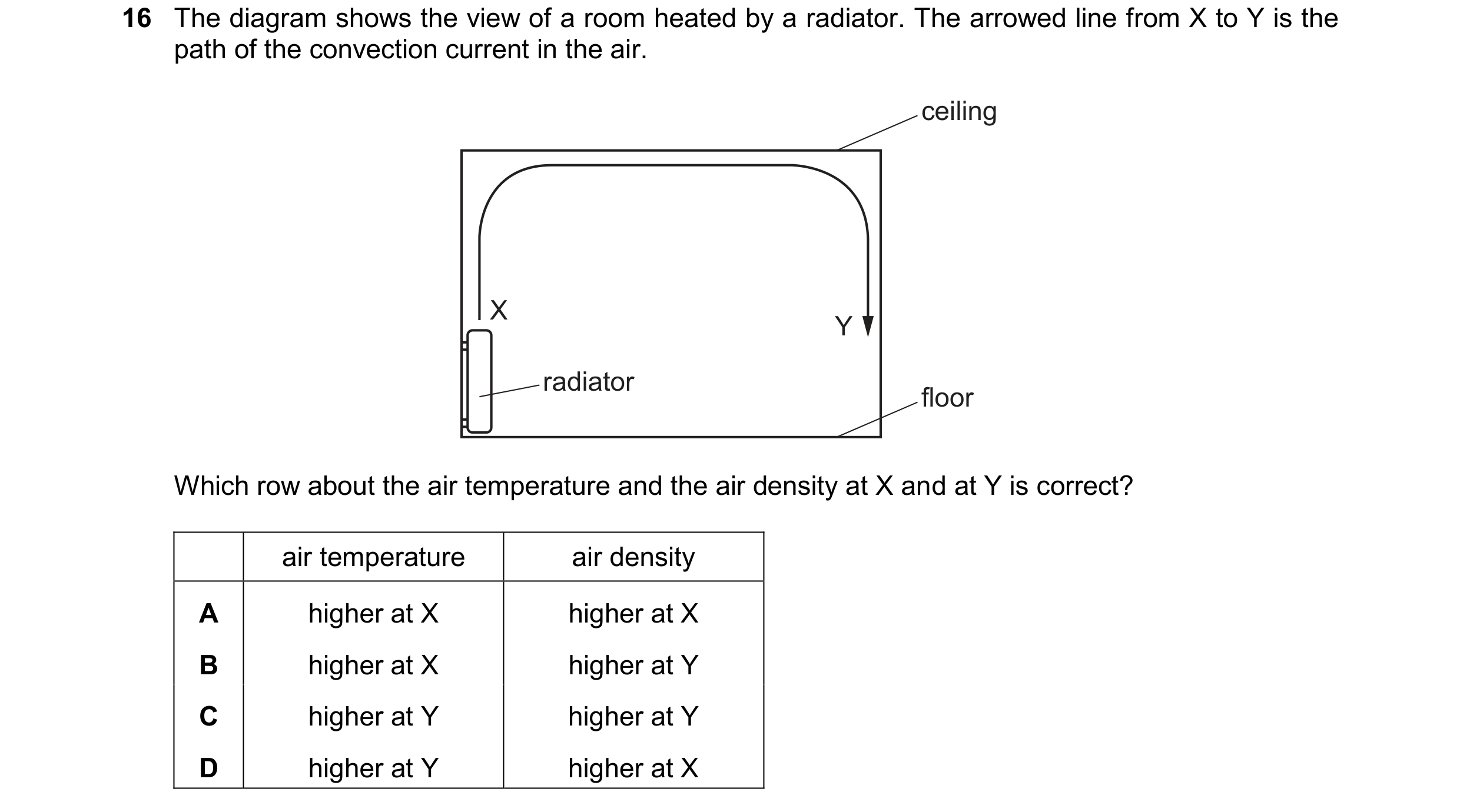
Q27 · The diagram shows the view of a room heated by a radiator 0972/11 Oct/Nov 2023
16 The diagram shows the view of a room heated by a radiator. The arrowed line from X to Y is the path of the convection current in the air. ceiling X Y radiator floor Which row about the air temperature and the air density at X and at Y is correct? air temperature air density A higher at X higher at X B higher at X higher at Y C higher at Y higher at Y D higher at Y higher at X
1 marks
Answer: B
This question in 0972/11 Oct/Nov 2023
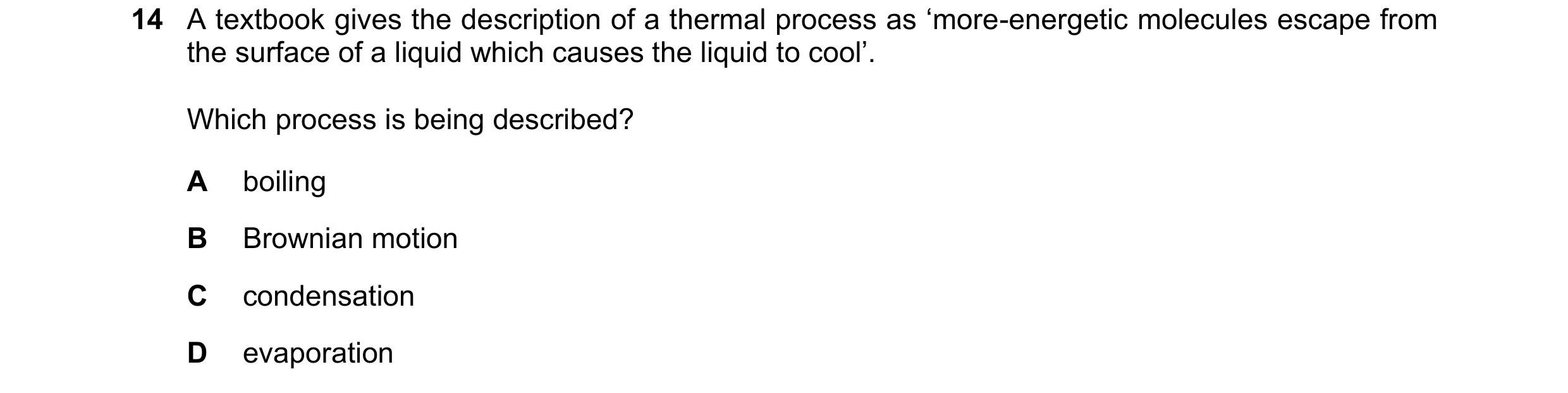
Q28 · A textbook gives the description of a thermal process as ‘more-energetic molecules escape… 0972/11 May/June 2024
14 A textbook gives the description of a thermal process as ‘more-energetic molecules escape from the surface of a liquid which causes the liquid to cool’. Which process is being described? A boiling B Brownian motion C condensation D evaporation
1 marks
Answer: D
This question in 0972/11 May/June 2024
Q29 · In which situation is radiation the main method by which energy is transferred? 0972/11 May/June 2024
15 In which situation is radiation the main method by which energy is transferred? A heating a pan of water using a gas camping stove B energy reaching the Earth from the Sun C heating the air in a room with a convection heater D giving gravitational potential energy to a glider when it is lifted by thermal currents
1 marks
Answer: B
This question in 0972/11 May/June 2024
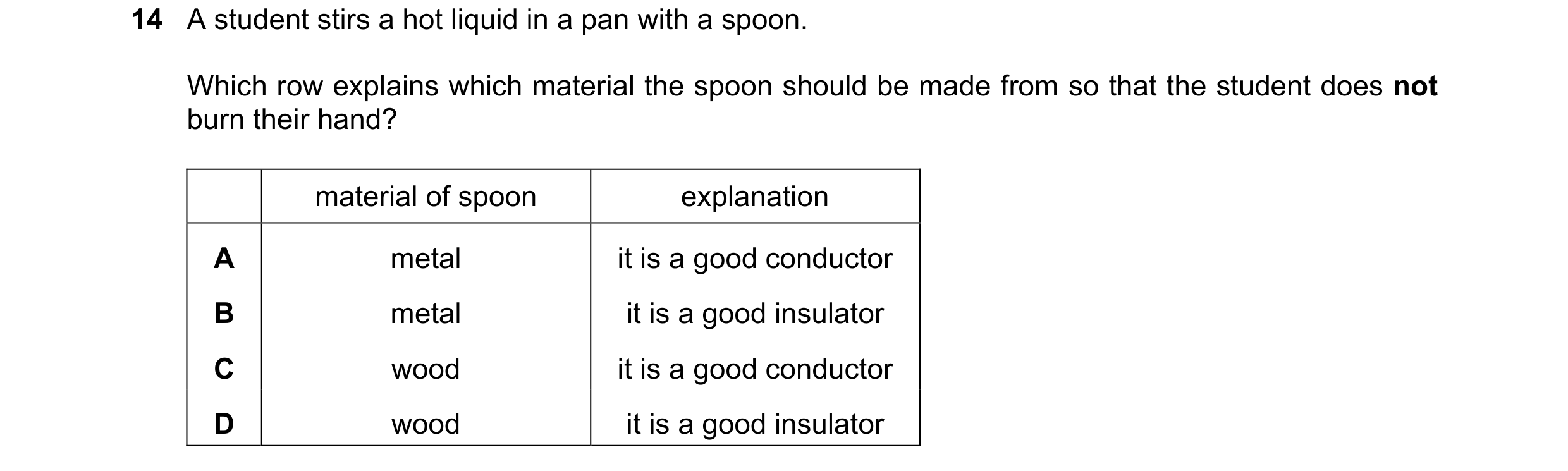
Q30 · A student stirs a hot liquid in a pan with a spoon 0972/12 May/June 2024
14 A student stirs a hot liquid in a pan with a spoon. Which row explains which material the spoon should be made from so that the student does not burn their hand? material of spoon explanation A metal it is a good conductor B metal it is a good insulator C wood it is a good conductor D wood it is a good insulator
1 marks
Answer: D
This question in 0972/12 May/June 2024
Q31 · Thermal radiation is emitted from all objects 0972/12 May/June 2024
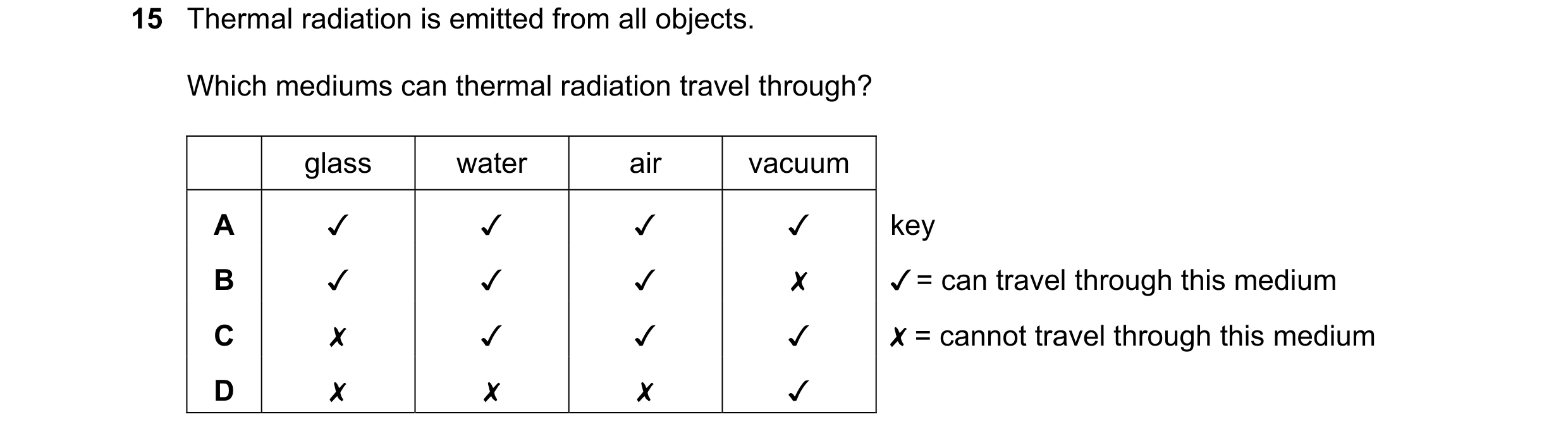
15 Thermal radiation is emitted from all objects.
Which mediums can thermal radiation travel through?
glass water air vacuum
A Jv J J J
B JV Jv Jv x
Cc x J J J
D x x x J
key
¥ = can travel through this medium
X = cannot travel through this medium
1 marks
Answer: A
This question in 0972/12 May/June 2024
Q32 · A beaker of water is heated and thermal energy travels through the water by convection 0972/11 Oct/Nov 2024
16 A beaker of water is heated and thermal energy travels through the water by convection. What happens to the density of the water when it is heated and how does the water move? A The density decreases and the heated water moves downwards. B The density decreases and the heated water moves upwards. C The density increases and the heated water moves downwards. D The density increases and the heated water moves upwards.
1 marks
Answer: B
This question in 0972/11 Oct/Nov 2024
Q33 · Students test four rods of different materials, W, X, Y and Z, to compare how well the… 0972/11 May/June 2025
16 Students test four rods of different materials, W, X, Y and Z, to compare how well the materials conduct thermal energy. The rods are all the same size and shape. The students use wax to stick a pin to one end of the first rod. The wax melts when it is warm. The other end of the rod is heated and the time taken for the pin to fall is recorded. The experiment is repeated for each rod. The students plot a chart of the time taken for each pin to fall. 90 80 time / s 70 60 50 40 30 20 10 0 material material material material W X Y Z Which statement is correct? A X is a better thermal conductor than Y. B Y is a better thermal conductor than W. C Z is a better thermal conductor than W. D Z is a better thermal conductor than X.
1 marks
Answer: A
This question in 0972/11 May/June 2025
Q34 · A student has four metal containers filled with the same volume of water at a temperature… 0972/11 May/June 2025
17 A student has four metal containers filled with the same volume of water at a temperature of 80 °C. The metal containers are put in a room at a temperature of 20 °C. The metal containers are identical except for the texture and colour of their surfaces. Which surface will emit energy at the greatest rate? A dull black B shiny black C dull white D shiny white
1 marks
Answer: A
This question in 0972/11 May/June 2025
Q35 · A person holds an empty glass beaker and pours hot water into it 0972/12 May/June 2025
14 A person holds an empty glass beaker and pours hot water into it. Why does it take a few seconds before his hand starts to feel hot? A Glass is a poor thermal conductor. B Water is a poor thermal conductor. C Glass is a better thermal conductor than water. D Water is a better thermal conductor than glass.
1 marks
Answer: A
This question in 0972/12 May/June 2025
Q36 · A liquid is heated and it expands 0972/12 May/June 2025
15 A liquid is heated and it expands. How does this lead to the formation of a convection current? A The density of the heated liquid decreases. B The density of the heated liquid increases. C The mass of the heated liquid particles decreases. D The mass of the heated liquid particles increases.
1 marks
Answer: A
This question in 0972/12 May/June 2025
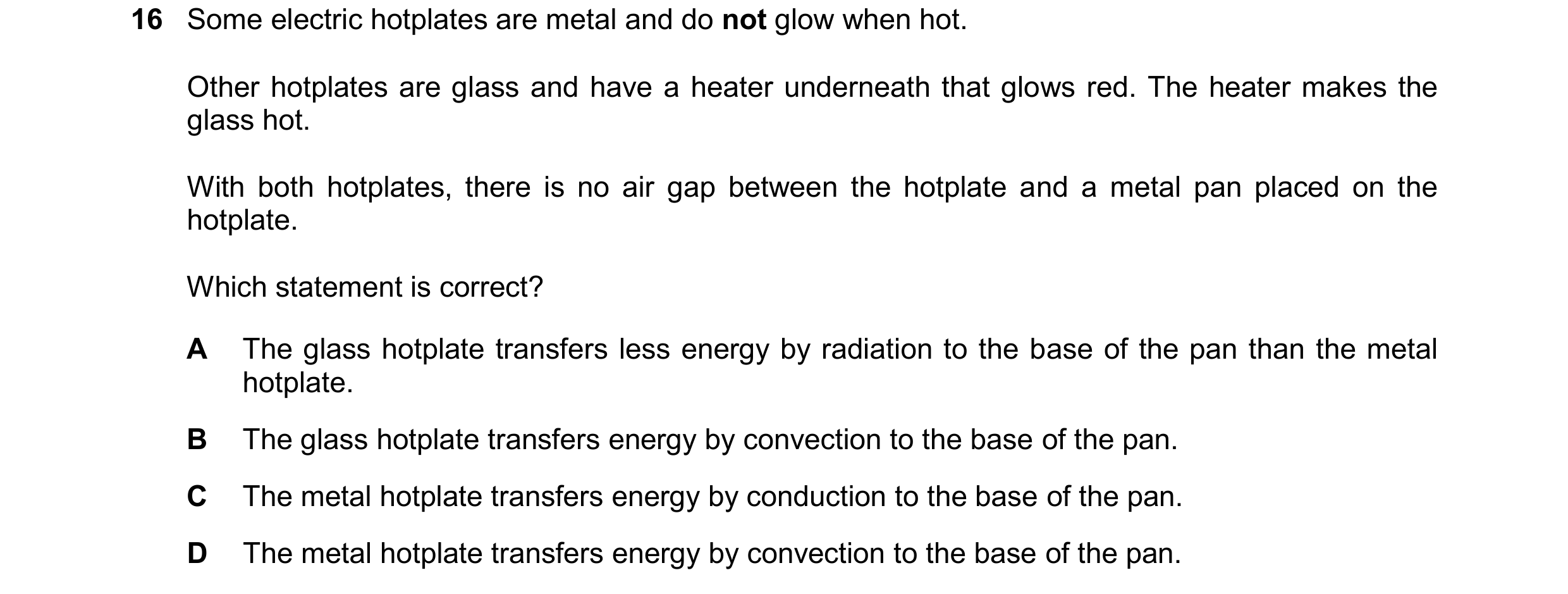
Q37 · Some electric hotplates are metal and do not glow when hot 0972/12 May/June 2025
16 Some electric hotplates are metal and do not glow when hot. Other hotplates are glass and have a heater underneath that glows red. The heater makes the glass hot. With both hotplates, there is no air gap between the hotplate and a metal pan placed on the hotplate. Which statement is correct? A The glass hotplate transfers less energy by radiation to the base of the pan than the metal hotplate. B The glass hotplate transfers energy by convection to the base of the pan. C The metal hotplate transfers energy by conduction to the base of the pan. D The metal hotplate transfers energy by convection to the base of the pan.
1 marks
Answer: C
This question in 0972/12 May/June 2025

 1 / 12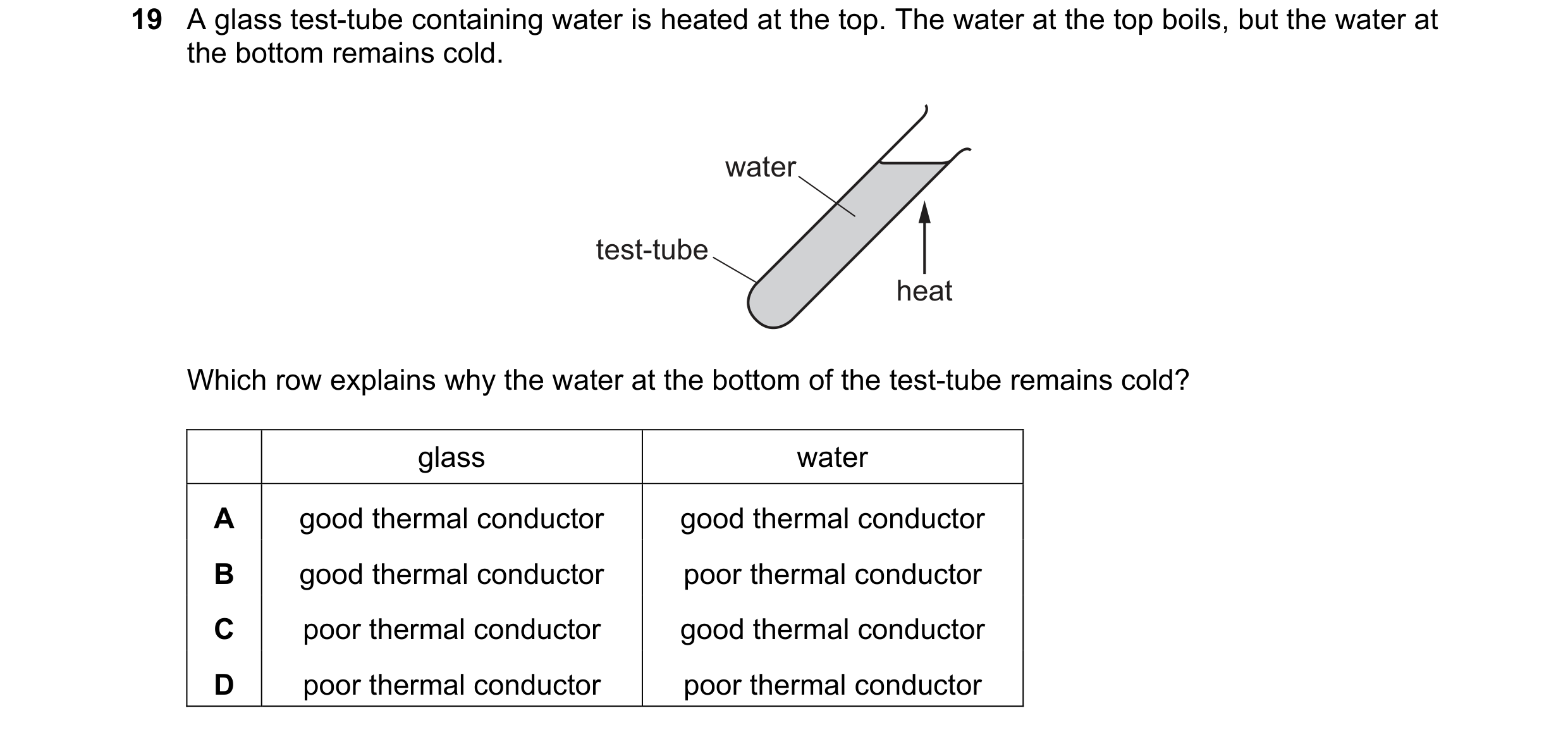
 2 / 12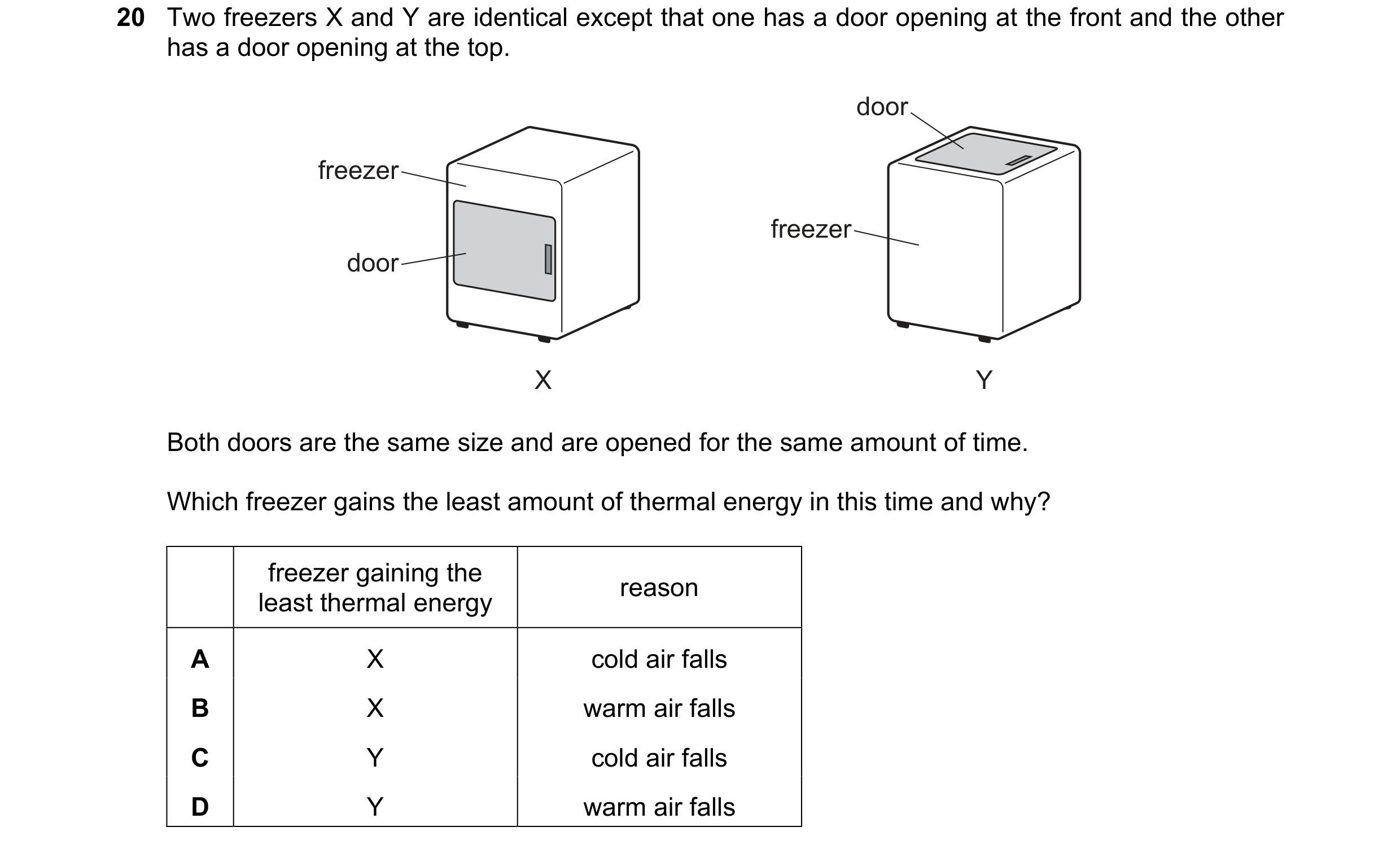
 3 / 12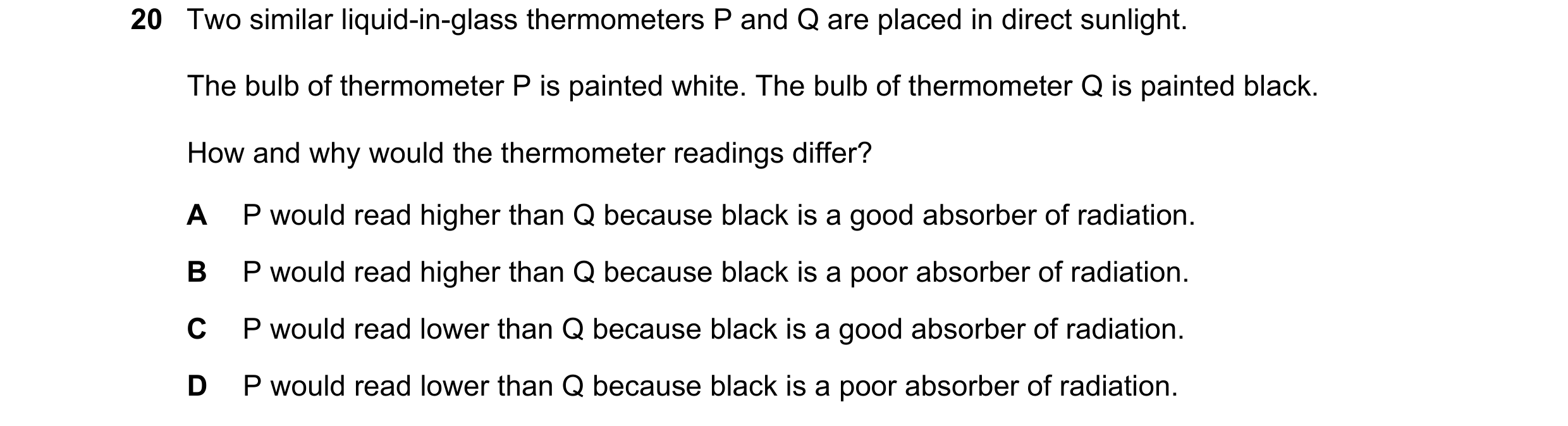
 4 / 12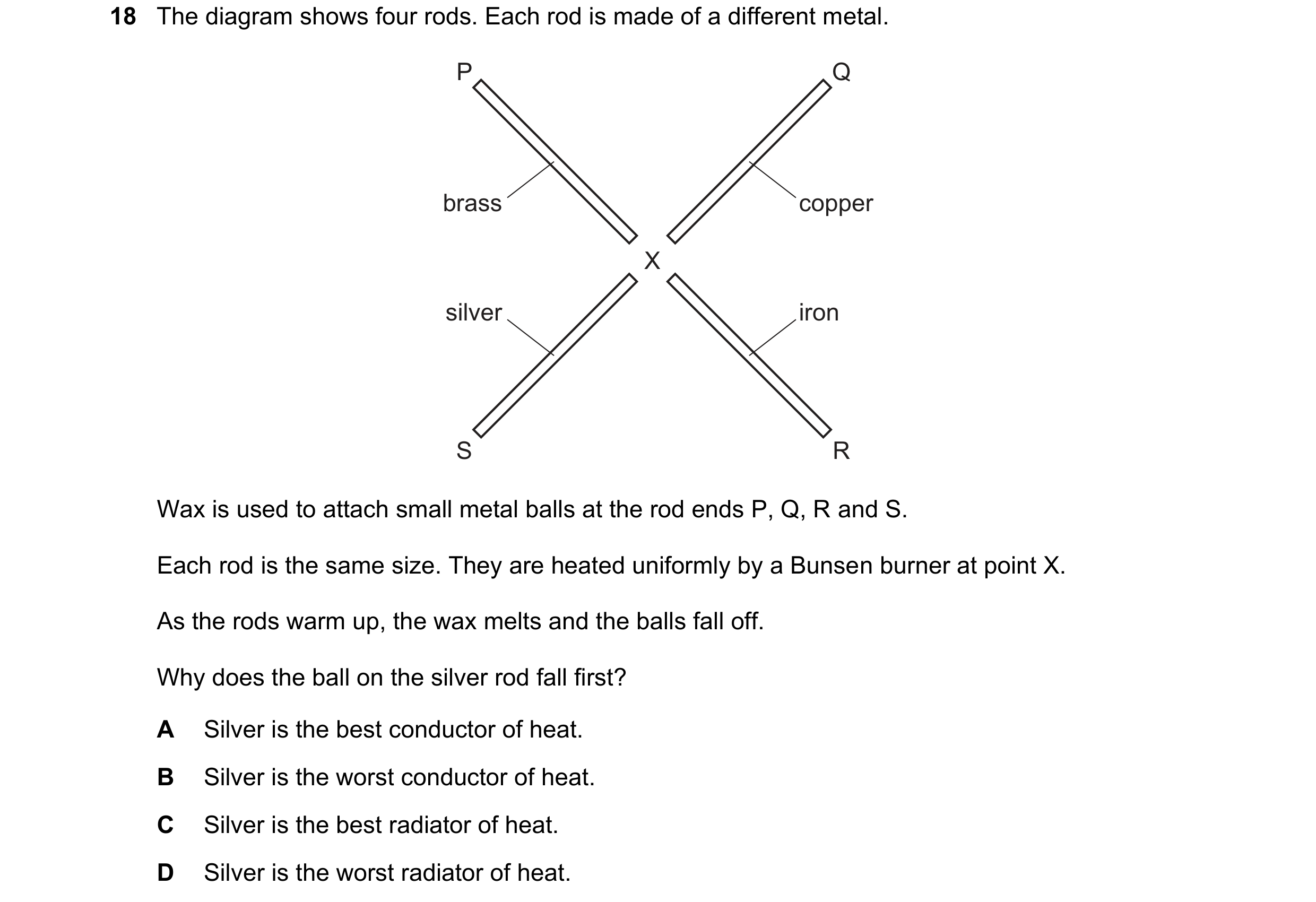
 5 / 12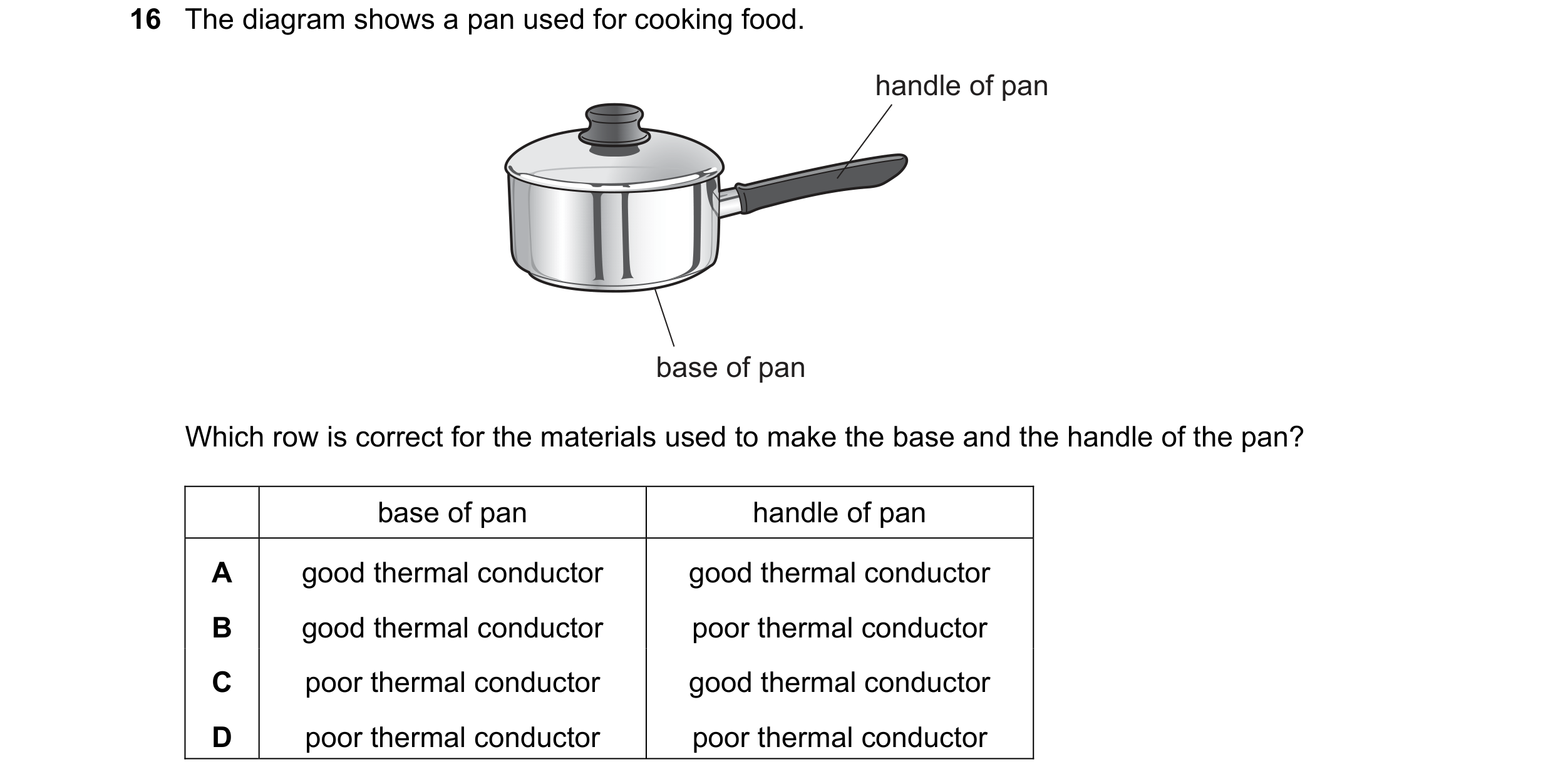
 6 / 12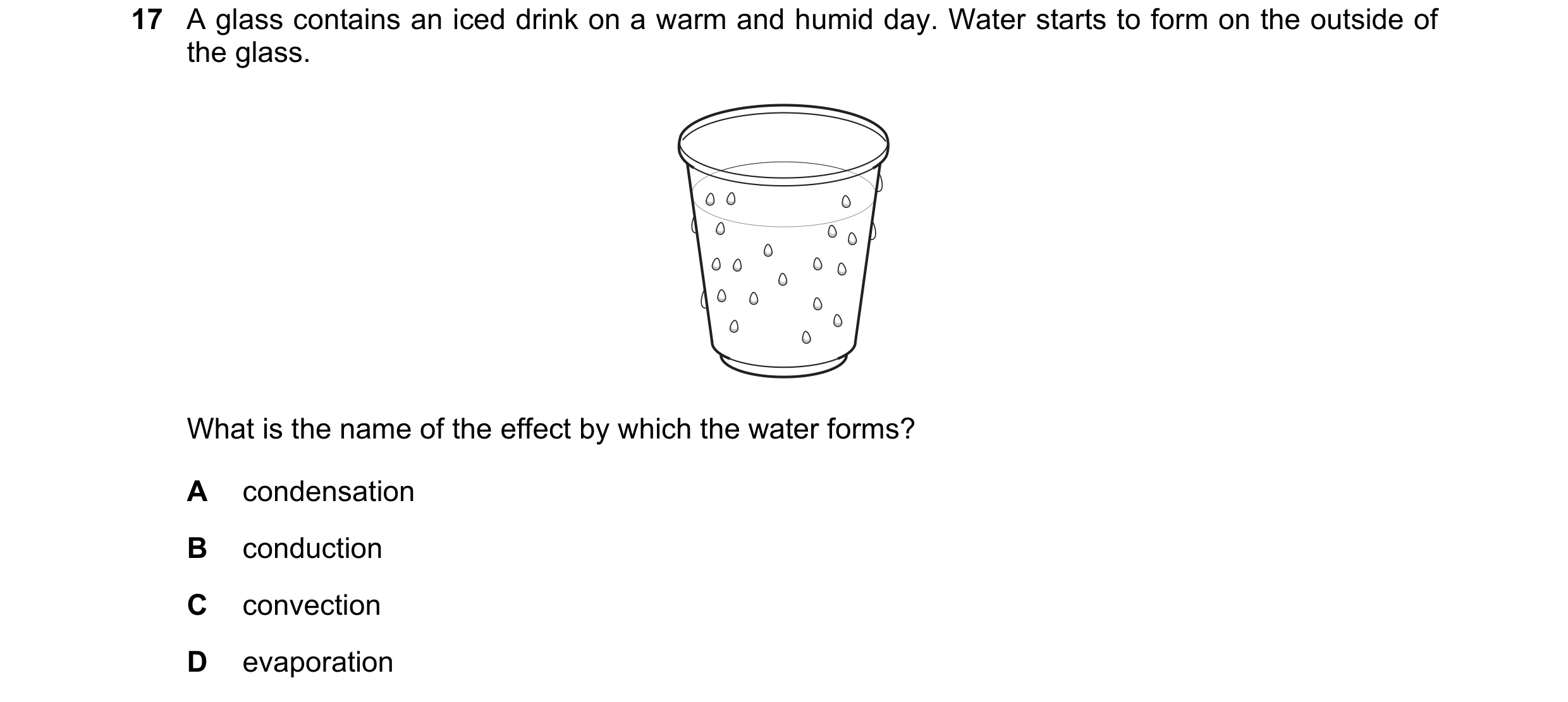
 7 / 12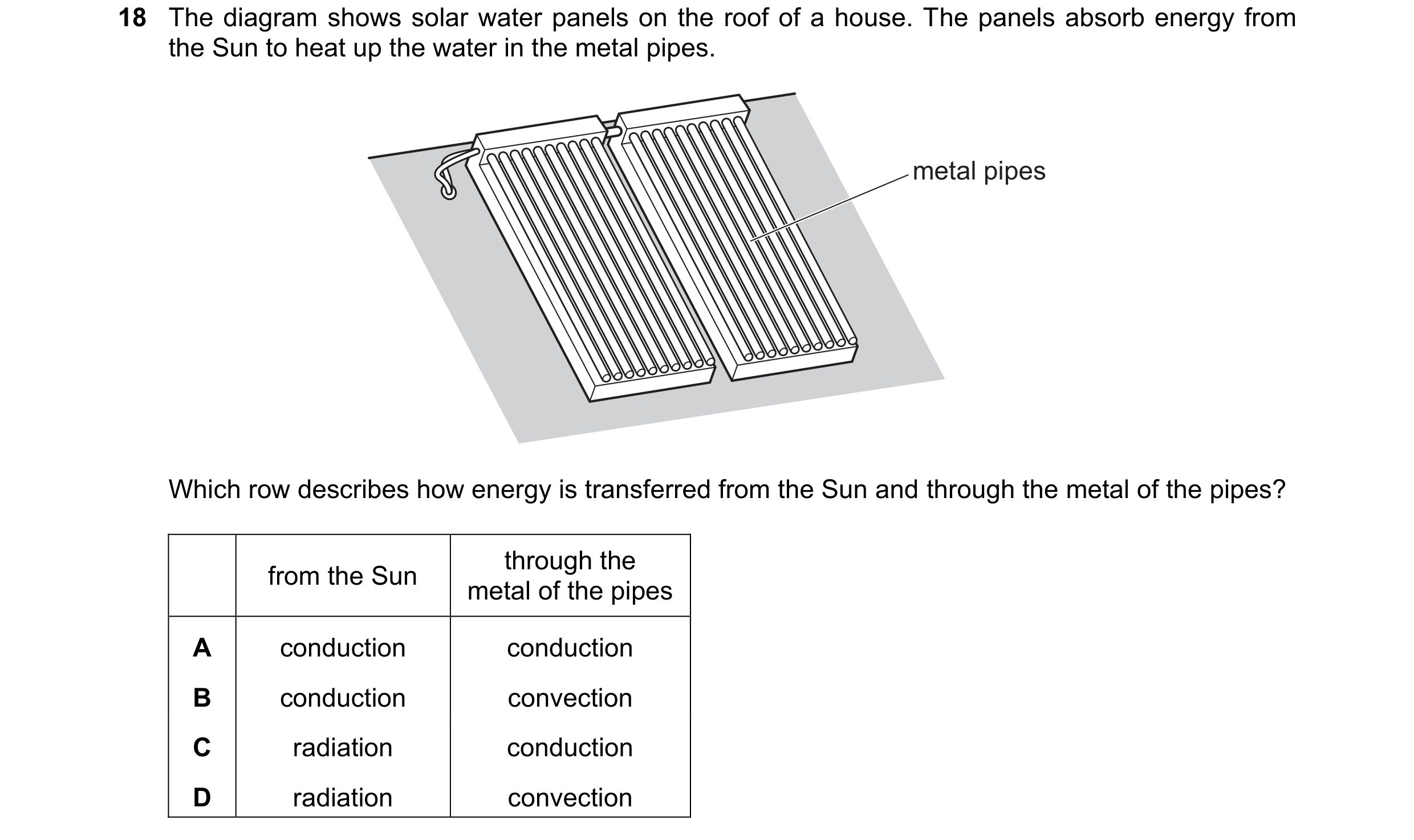
 8 / 12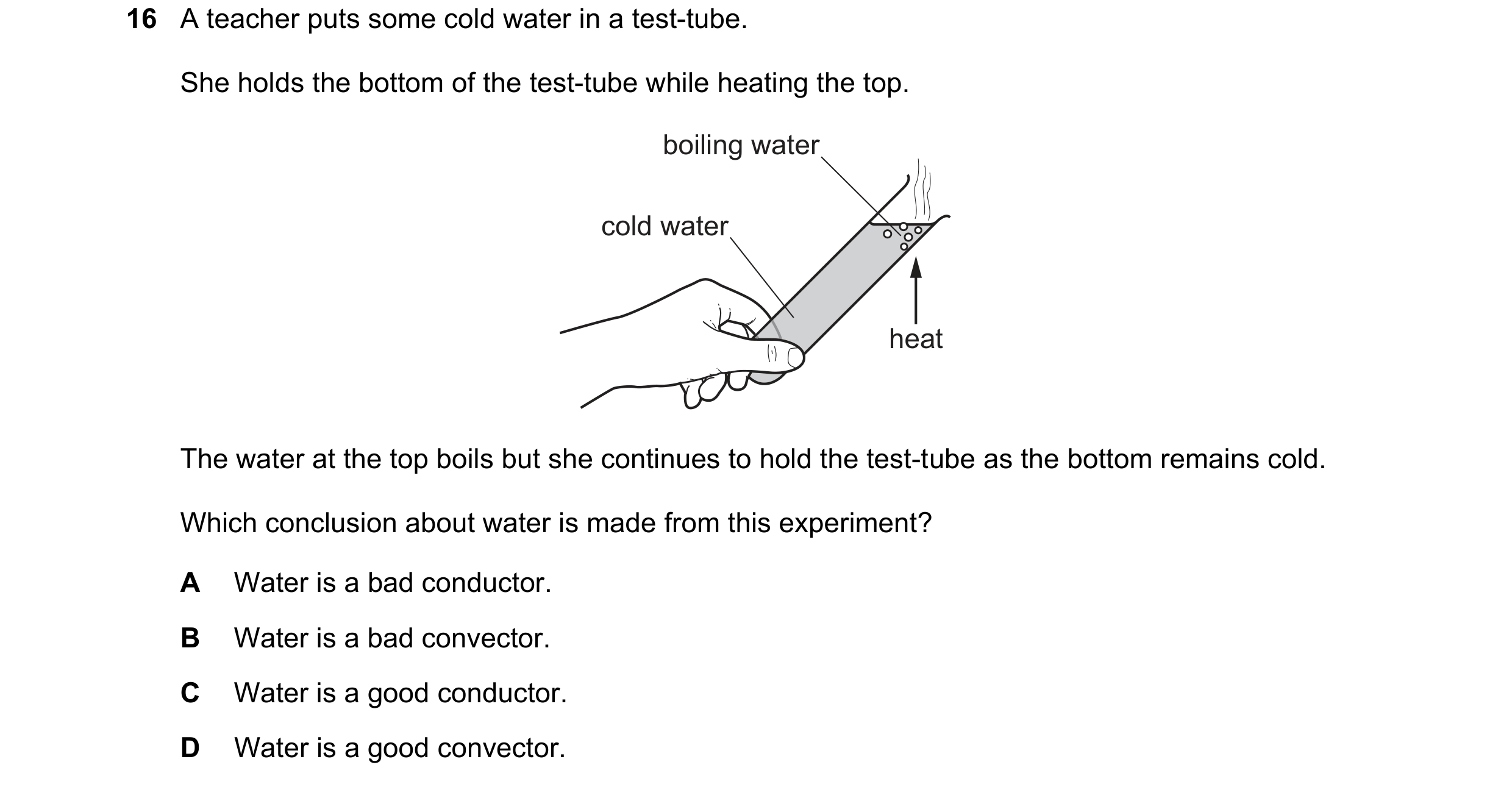
 9 / 12
 10 / 12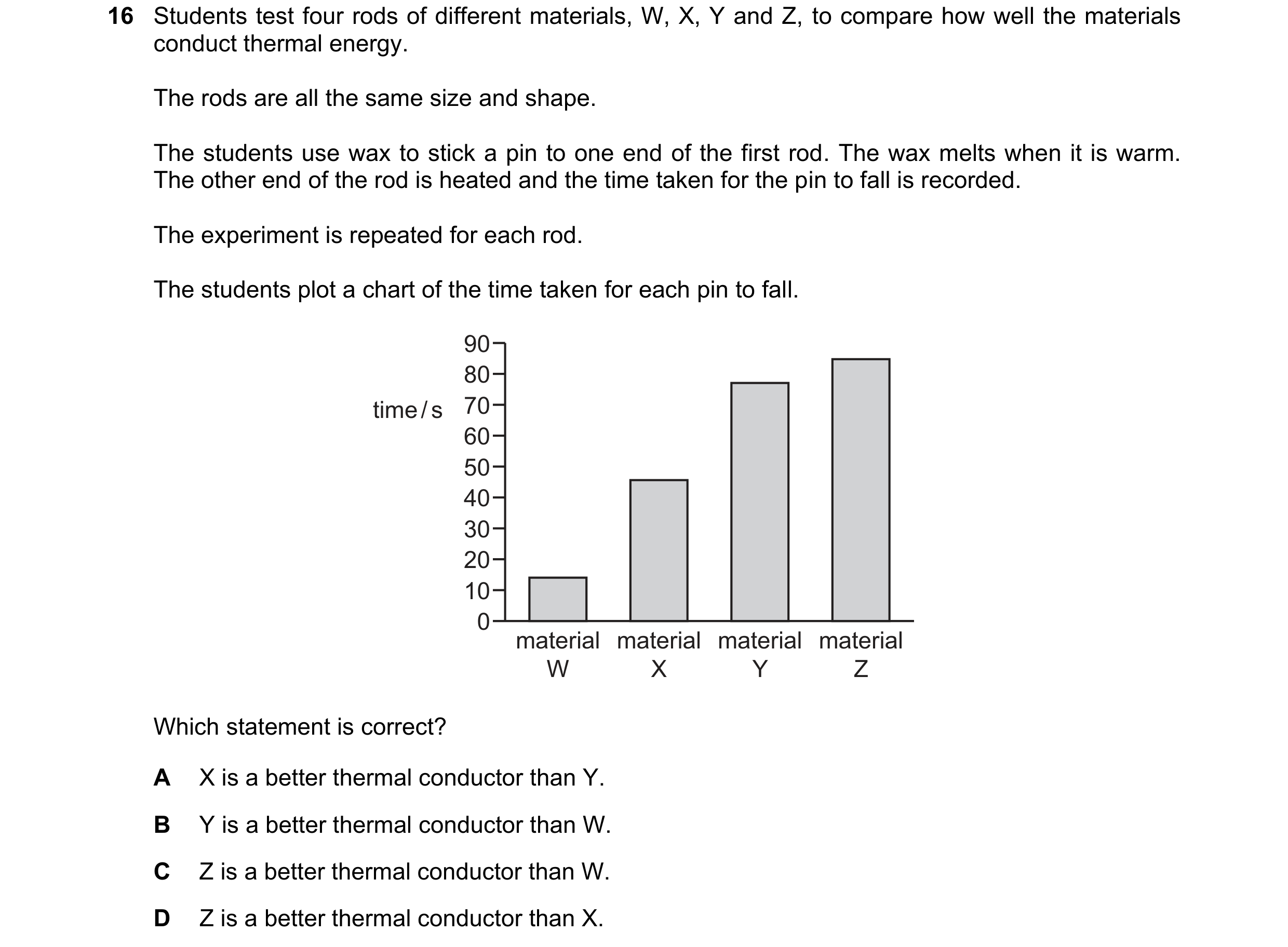
 11 / 12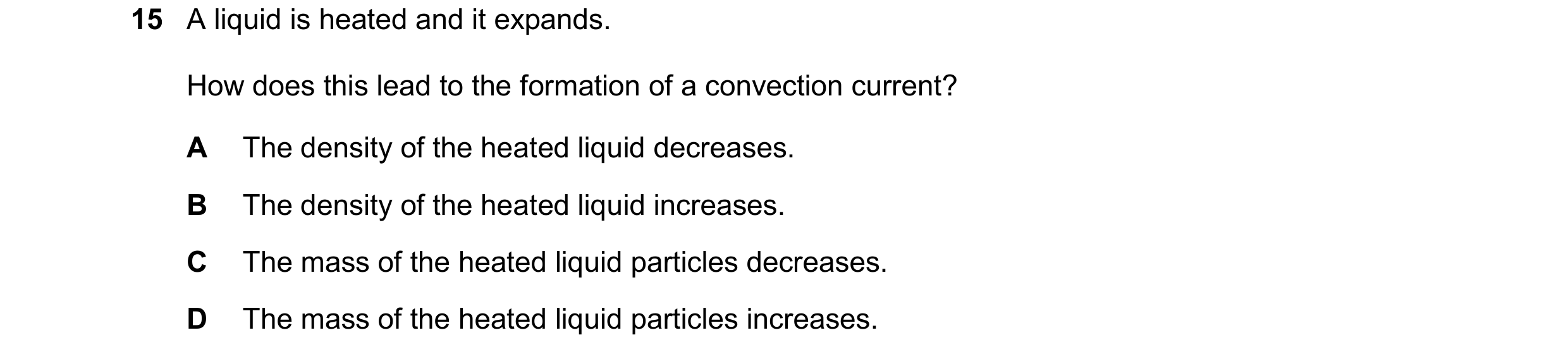
 12 / 12