Cambridge IGCSE Physics (9-1) 0972 — 2024 May/June Paper 1 · Variant 2
0972/12/M/J/24 · 40 questions · 40 marks · ≈45 min
The question paper and its mark scheme, free to read here and free to download. This is Cambridge’s own paper, exactly as it was sat.
Question paper16 pages
Mark scheme3 pages
Answers below. Sit the paper first if you are practising.
Questions as text
Q1 · Four athletes run twice around a track
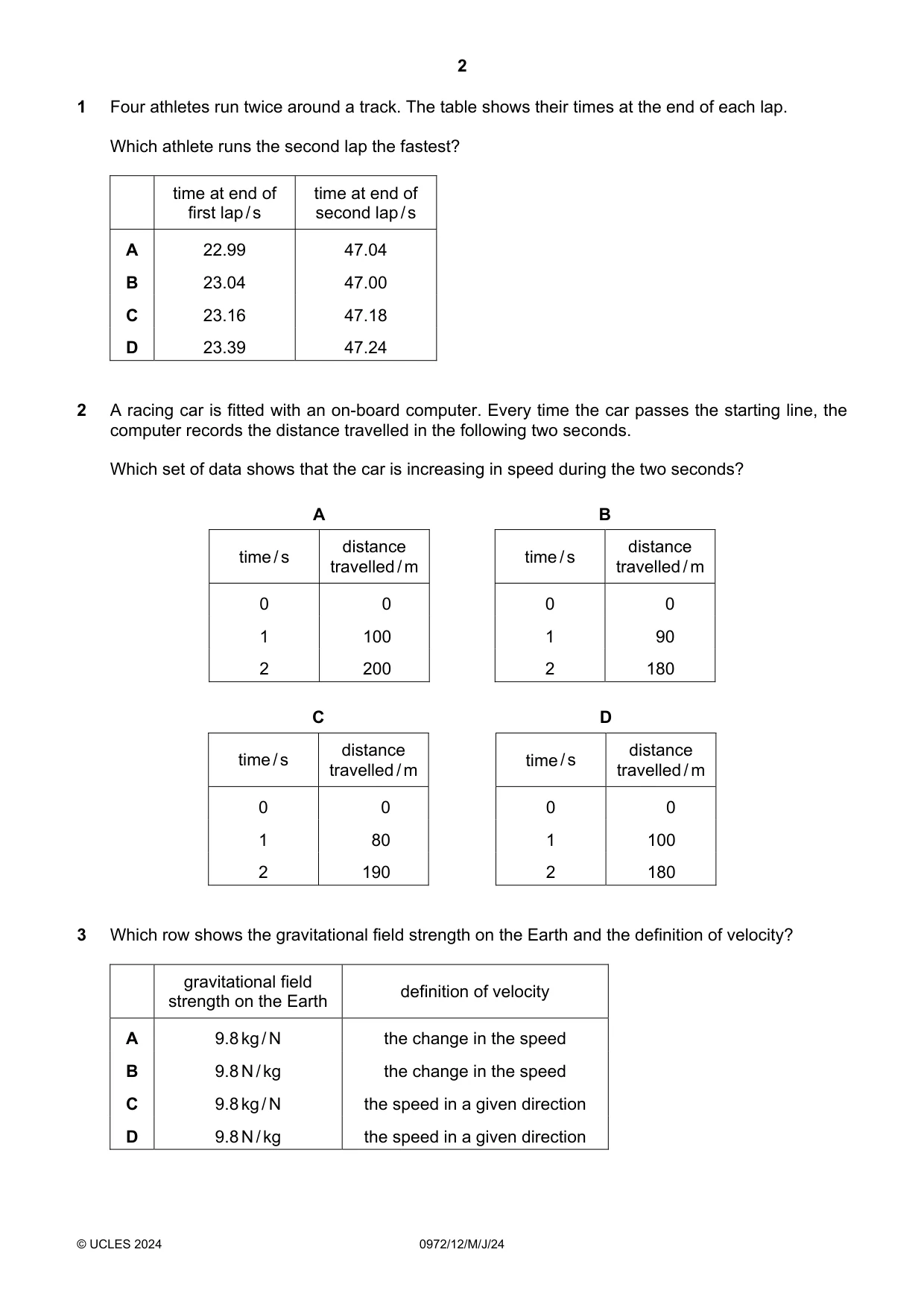
1 Four athletes run twice around a track. The table shows their times at the end of each lap. Which athlete runs the second lap the fastest? time at end of time at end of first lap / s second lap / s A 22.99 47.04 B 23.04 47.00 C 23.16 47.18 D 23.39 47.24
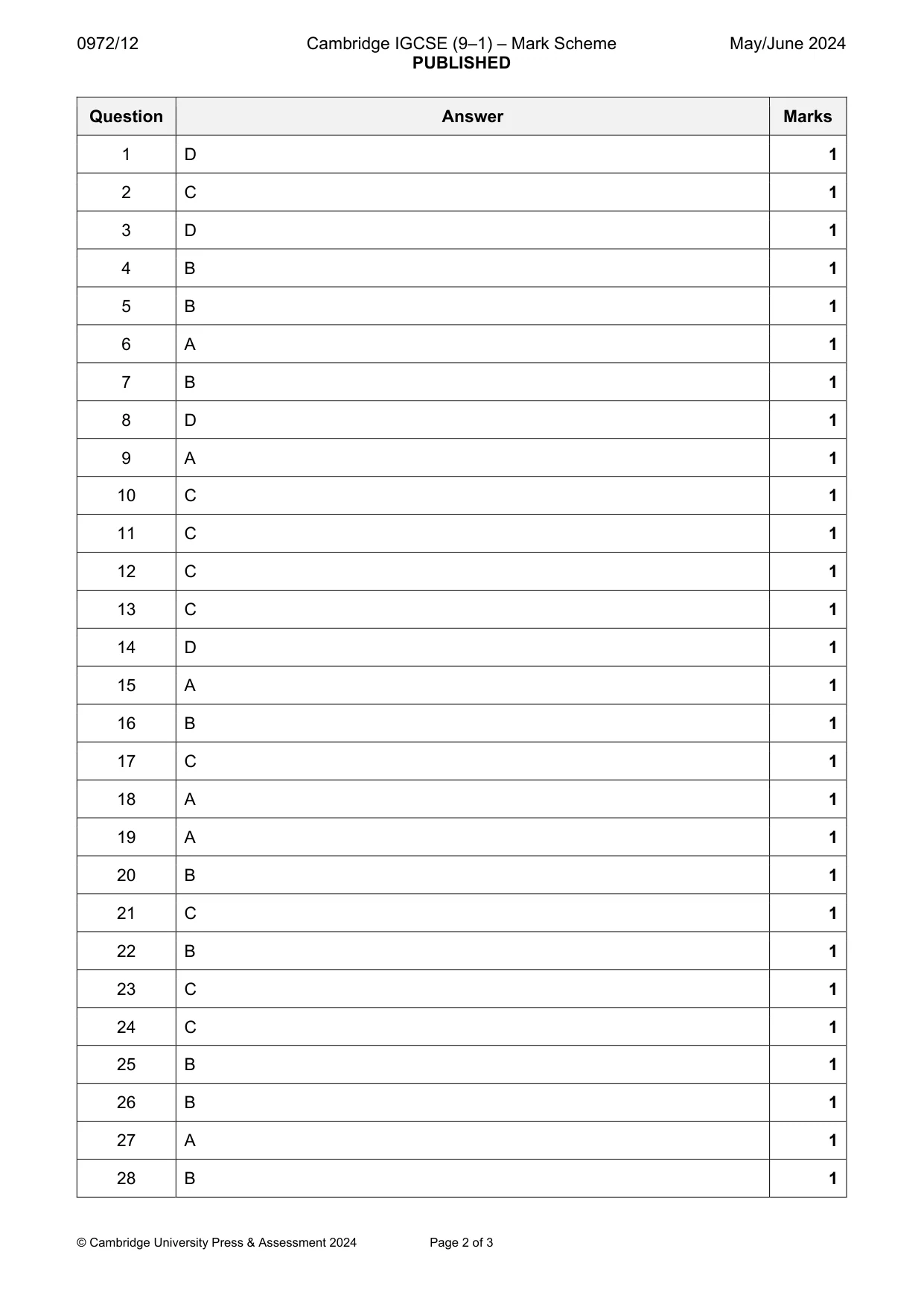
Mark scheme: D
Q2 · A racing car is fitted with an on-board computer
2 A racing car is fitted with an on-board computer. Every time the car passes the starting line, the computer records the distance travelled in the following two seconds. Which set of data shows that the car is increasing in speed during the two seconds? A B distance distance time / s time / s travelled / m travelled / m 0 0 0 0 1 100 1 90 2 200 2 180 C D distance distance time / s time / s travelled / m travelled / m 0 0 0 0 1 80 1 100 2 190 2 180
Mark scheme: C
Q3 · Which row shows the gravitational field strength on the Earth and the definition of…
3 Which row shows the gravitational field strength on the Earth and the definition of velocity? gravitational field definition of velocity strength on the Earth A 9.8 kg / N the change in the speed B 9.8 N / kg the change in the speed C 9.8 kg / N the speed in a given direction D 9.8 N / kg the speed in a given direction
Mark scheme: D
Q4 · Which statement about the weight of an object is correct?
4 Which statement about the weight of an object is correct? A The weight of an object is the gravitational force per unit mass. B The weight of an object is the gravitational force on an object. C The weight is zero when the object is falling at constant speed in the Earth’s atmosphere. D The weight is zero when the object is in orbit around the Earth.
Mark scheme: B
Q5 · The diagram shows a load–extension graph for a steel spring
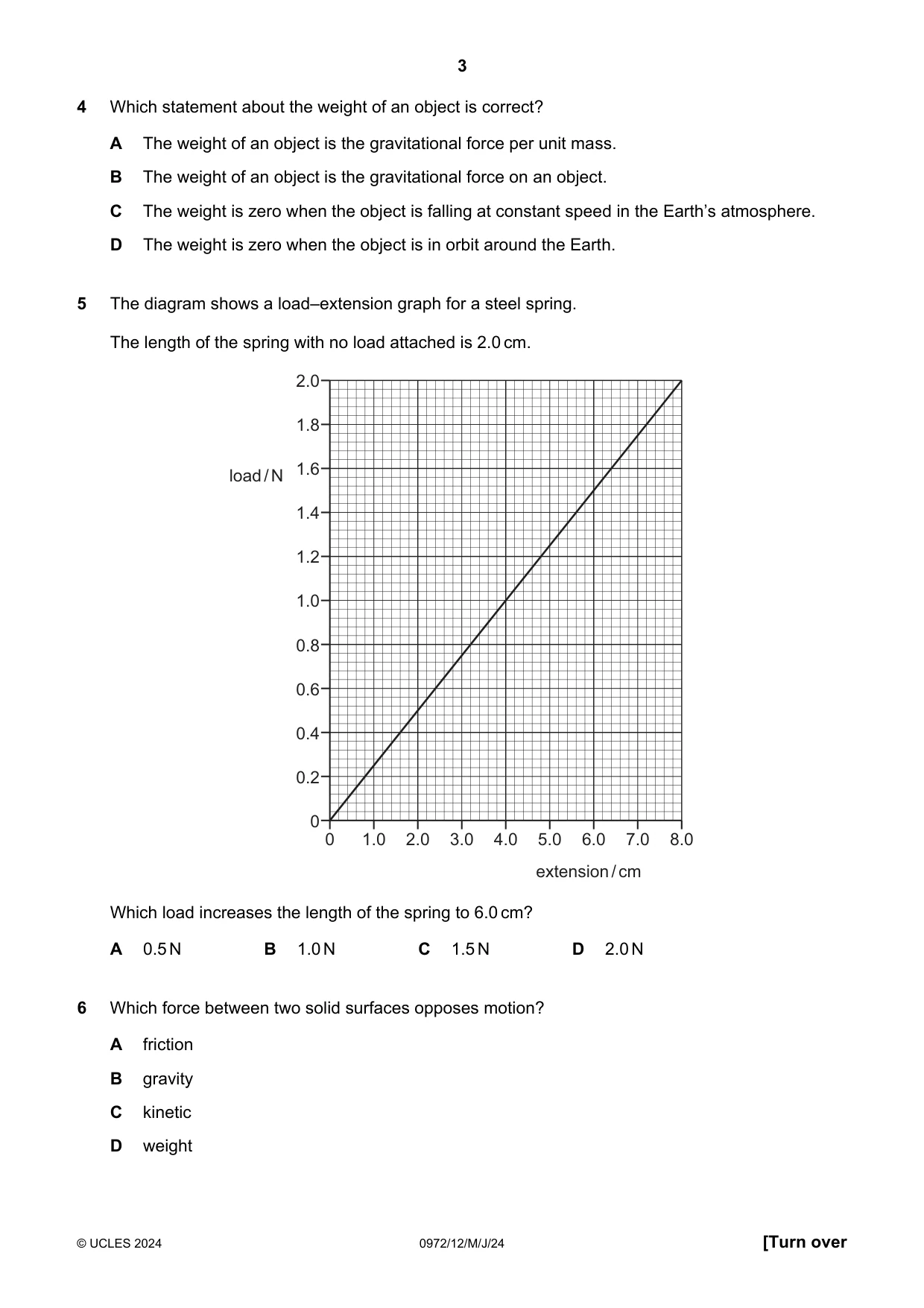
5 The diagram shows a load–extension graph for a steel spring. The length of the spring with no load attached is 2.0 cm. 2.0 1.8 load / N 1.6 1.4 1.2 1.0 0.8 0.6 0.4 0.2 0 0 1.0 2.0 3.0 4.0 5.0 6.0 7.0 8.0 extension / cm Which load increases the length of the spring to 6.0 cm? A 0.5 N B 1.0 N C 1.5 N D 2.0 N
Mark scheme: B
Q6 · Which force between two solid surfaces opposes motion?
6 Which force between two solid surfaces opposes motion? A friction B gravity C kinetic D weight
Mark scheme: A
Q7 · A box of mass 2.0 kg and weight 20 N is carried to the top of some stairs
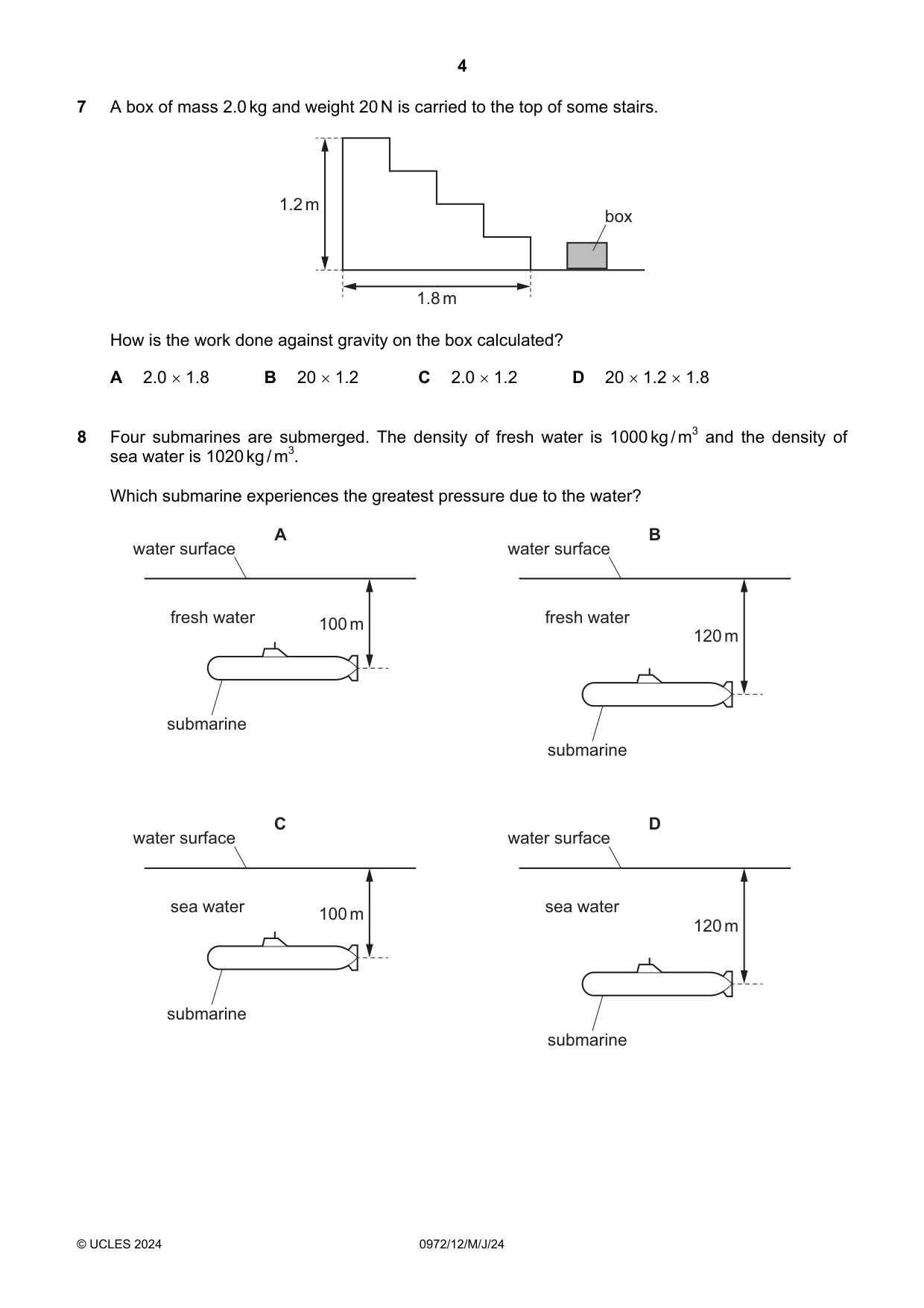
7 A box of mass 2.0 kg and weight 20 N is carried to the top of some stairs. 1.2 m box 1.8 m How is the work done against gravity on the box calculated? A 2.0 1.8 B 20 1.2 C 2.0 1.2 D 20 1.2 1.8
Mark scheme: B
Q8 · Four submarines are submerged
8 Four submarines are submerged. The density of fresh water is 1000 kg / m3 and the density of sea water is 1020 kg / m3. Which submarine experiences the greatest pressure due to the water? A B water surface water surface fresh water 100 m fresh water 120 m submarine submarine C D water surface water surface sea water 100 m sea water 120 m submarine submarine
Mark scheme: D
Q9 · The diagram shows the changes in state, 1, 2, 3 and 4, between solids, liquids and gases
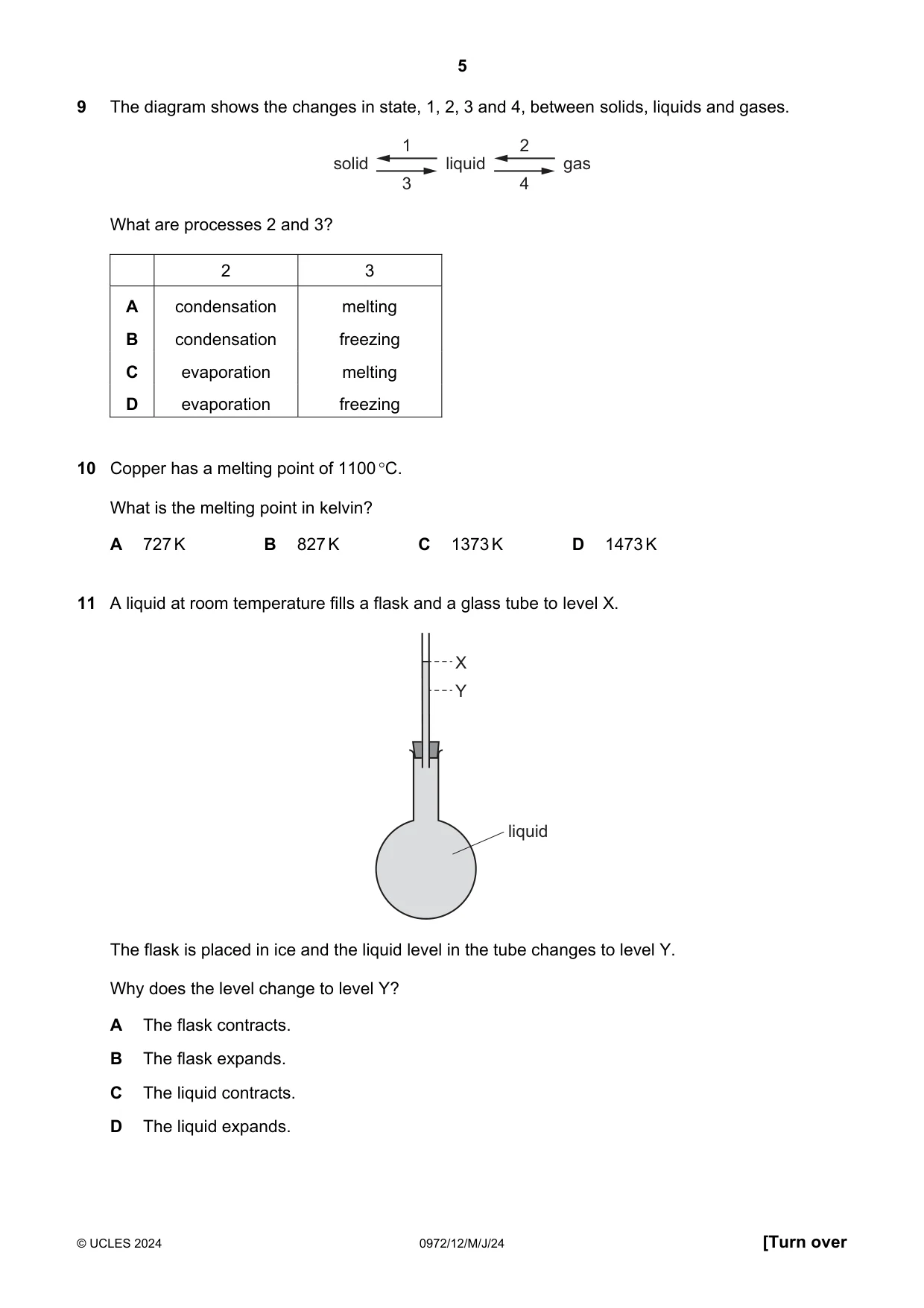
9 The diagram shows the changes in state, 1, 2, 3 and 4, between solids, liquids and gases. 1 2 solid liquid gas 3 4 What are processes 2 and 3? 2 3 A condensation melting B condensation freezing C evaporation melting D evaporation freezing
Mark scheme: A
Q10 · Copper has a melting point of 1100 C
10 Copper has a melting point of 1100 C. What is the melting point in kelvin? A 727 K B 827 K C 1373 K D 1473 K
Mark scheme: C
Q11 · A liquid at room temperature fills a flask and a glass tube to level X
11 A liquid at room temperature fills a flask and a glass tube to level X. X Y liquid The flask is placed in ice and the liquid level in the tube changes to level Y. Why does the level change to level Y? A The flask contracts. B The flask expands. C The liquid contracts. D The liquid expands.
Mark scheme: C
Q12 · Which row correctly describes the state of water at the temperatures shown?
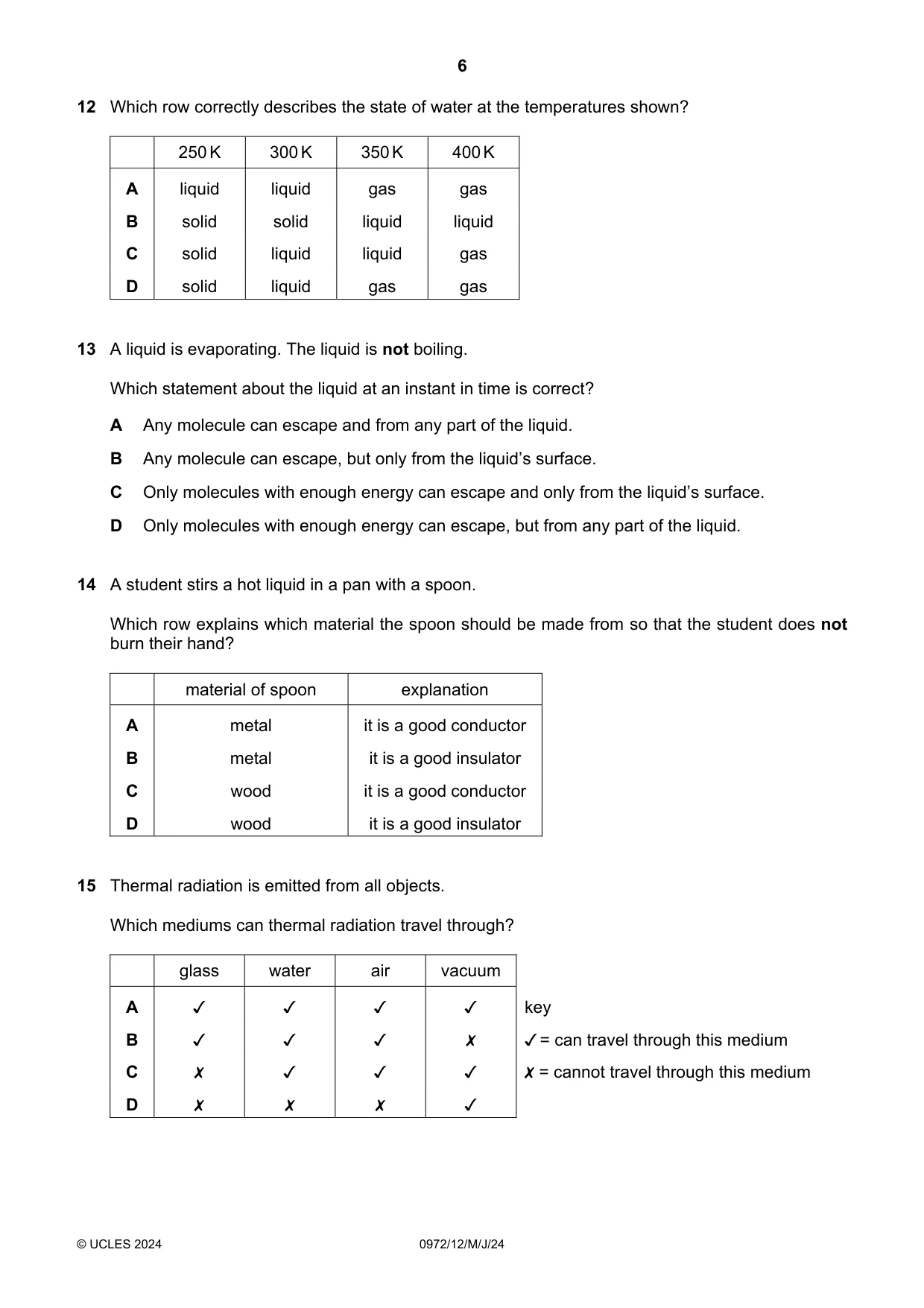
12 Which row correctly describes the state of water at the temperatures shown? 250 K 300 K 350 K 400 K A liquid liquid gas gas B solid solid liquid liquid C solid liquid liquid gas D solid liquid gas gas
Mark scheme: C
Q13 · A liquid is evaporating
13 A liquid is evaporating. The liquid is not boiling. Which statement about the liquid at an instant in time is correct? A Any molecule can escape and from any part of the liquid. B Any molecule can escape, but only from the liquid’s surface. C Only molecules with enough energy can escape and only from the liquid’s surface. D Only molecules with enough energy can escape, but from any part of the liquid.
Mark scheme: C
Q14 · A student stirs a hot liquid in a pan with a spoon
14 A student stirs a hot liquid in a pan with a spoon. Which row explains which material the spoon should be made from so that the student does not burn their hand? material of spoon explanation A metal it is a good conductor B metal it is a good insulator C wood it is a good conductor D wood it is a good insulator
Mark scheme: D
Q15 · Thermal radiation is emitted from all objects
15 Thermal radiation is emitted from all objects. Which mediums can thermal radiation travel through? glass water air vacuum A Jv J J J B JV Jv Jv x Cc x J J J D x x x J key ¥ = can travel through this medium X = cannot travel through this medium
Mark scheme: A
Q16 · The radius of a circular pond is 3.0 m
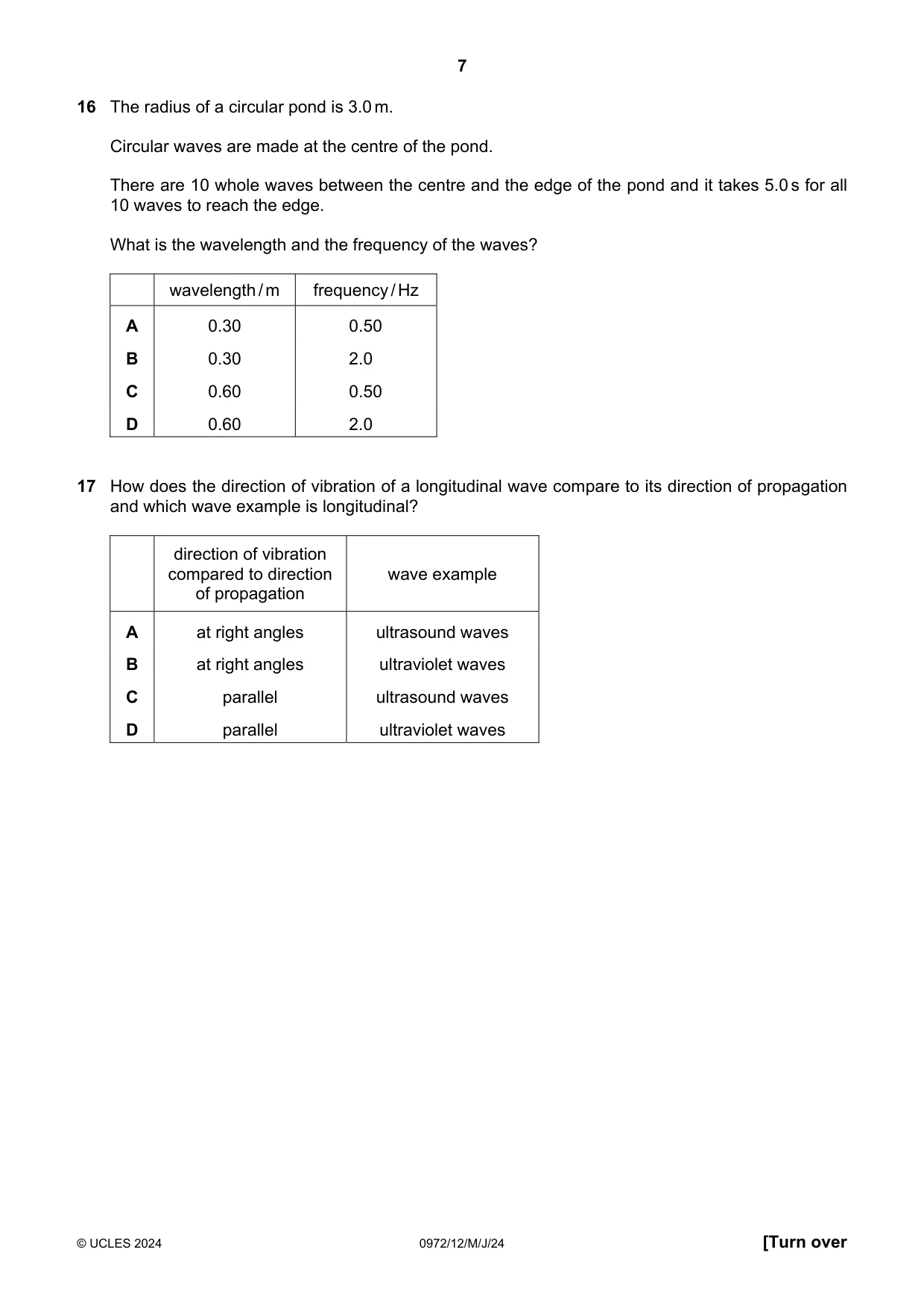
16 The radius of a circular pond is 3.0 m. Circular waves are made at the centre of the pond. There are 10 whole waves between the centre and the edge of the pond and it takes 5.0 s for all 10 waves to reach the edge. What is the wavelength and the frequency of the waves? wavelength / m frequency / Hz A 0.30 0.50 B 0.30 2.0 C 0.60 0.50 D 0.60 2.0
Mark scheme: B
Q17 · How does the direction of vibration of a longitudinal wave compare to its direction of…
17 How does the direction of vibration of a longitudinal wave compare to its direction of propagation and which wave example is longitudinal? direction of vibration compared to direction wave example of propagation A at right angles ultrasound waves B at right angles ultraviolet waves C parallel ultrasound waves D parallel ultraviolet waves
Mark scheme: C
Q18 · The diagram shows a ray of light reflecting from a mirror
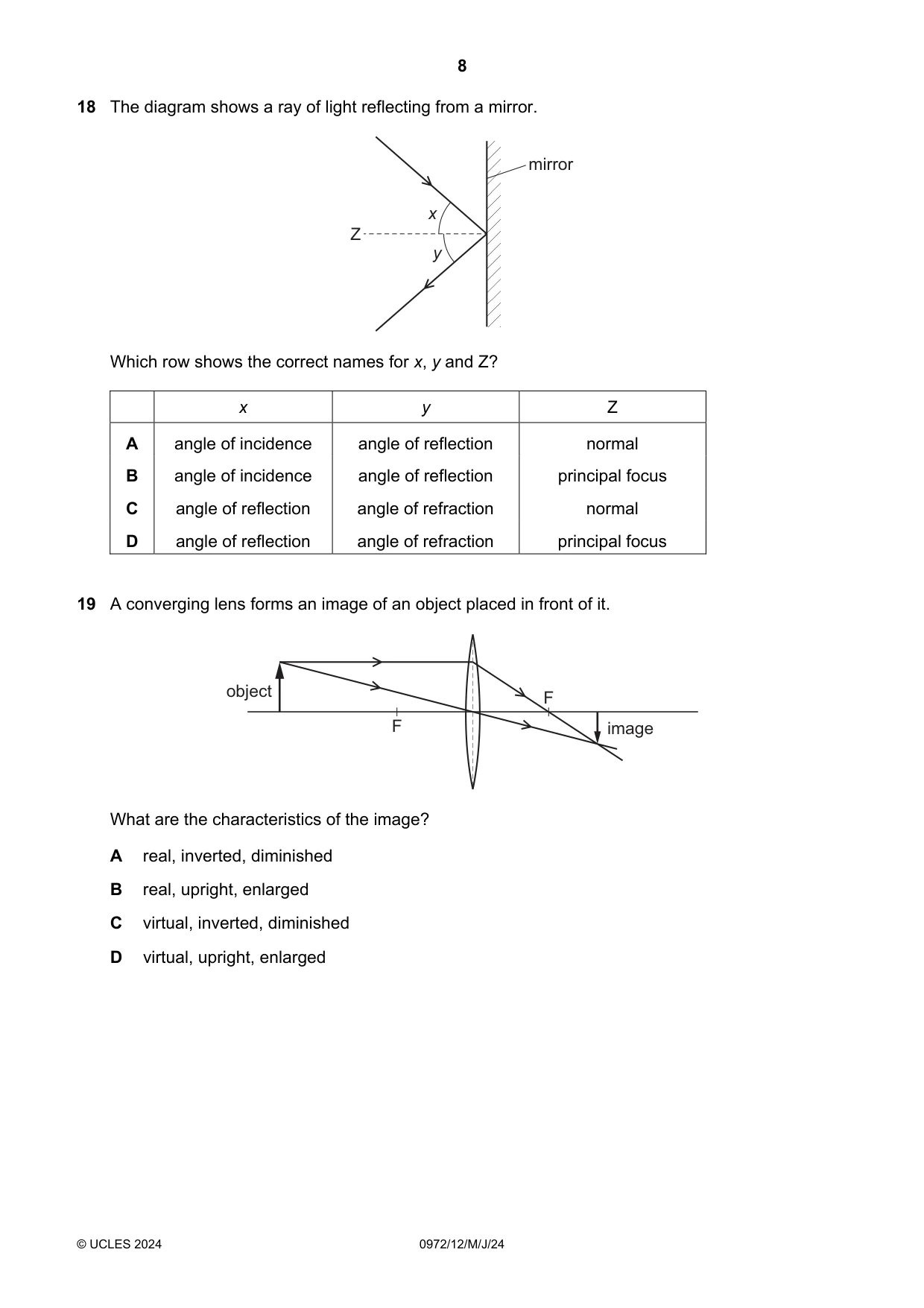
18 The diagram shows a ray of light reflecting from a mirror. mirror x Z y Which row shows the correct names for x, y and Z? x y Z A angle of incidence angle of reflection normal B angle of incidence angle of reflection principal focus C angle of reflection angle of refraction normal D angle of reflection angle of refraction principal focus
Mark scheme: A
Q19 · A converging lens forms an image of an object placed in front of it
19 A converging lens forms an image of an object placed in front of it. object F F image What are the characteristics of the image? A real, inverted, diminished B real, upright, enlarged C virtual, inverted, diminished D virtual, upright, enlarged
Mark scheme: A
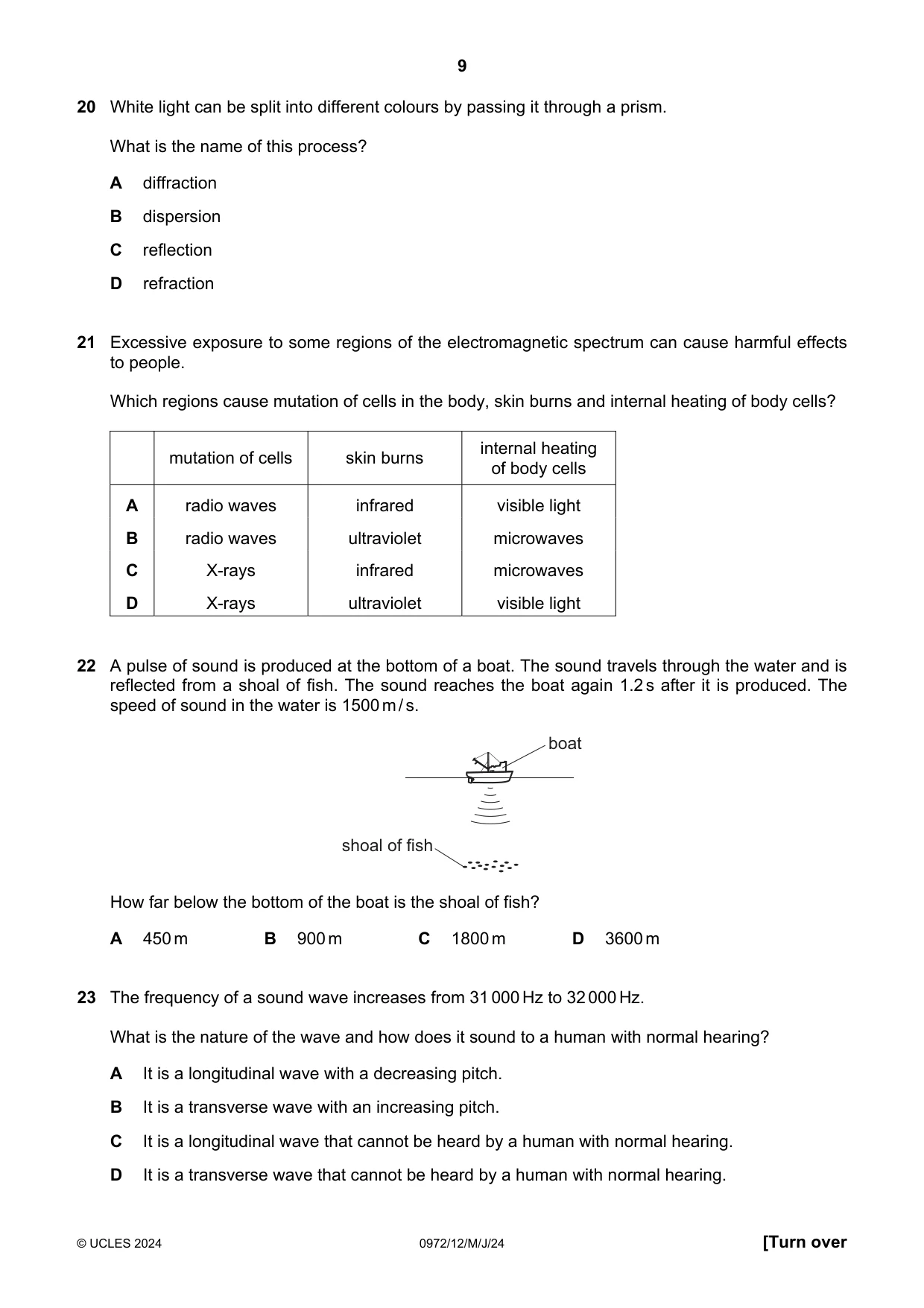
Q20 · White light can be split into different colours by passing it through a prism
20 White light can be split into different colours by passing it through a prism. What is the name of this process? A diffraction B dispersion C reflection D refraction
Mark scheme: B
Q21 · Excessive exposure to some regions of the electromagnetic spectrum can cause harmful…
21 Excessive exposure to some regions of the electromagnetic spectrum can cause harmful effects to people. Which regions cause mutation of cells in the body, skin burns and internal heating of body cells? internal heating mutation of cells skin burns of body cells A radio waves infrared visible light B radio waves ultraviolet microwaves C X-rays infrared microwaves D X-rays ultraviolet visible light
Mark scheme: C
Q22 · A pulse of sound is produced at the bottom of a boat
22 A pulse of sound is produced at the bottom of a boat. The sound travels through the water and is reflected from a shoal of fish. The sound reaches the boat again 1.2 s after it is produced. The speed of sound in the water is 1500 m / s. boat shoal of fish How far below the bottom of the boat is the shoal of fish? A 450 m B 900 m C 1800 m D 3600 m
Mark scheme: B
Q23 · The frequency of a sound wave increases from 31 000 Hz to 32 000 Hz
23 The frequency of a sound wave increases from 31 000 Hz to 32 000 Hz. What is the nature of the wave and how does it sound to a human with normal hearing? A It is a longitudinal wave with a decreasing pitch. B It is a transverse wave with an increasing pitch. C It is a longitudinal wave that cannot be heard by a human with normal hearing. D It is a transverse wave that cannot be heard by a human with normal hearing.
Mark scheme: C
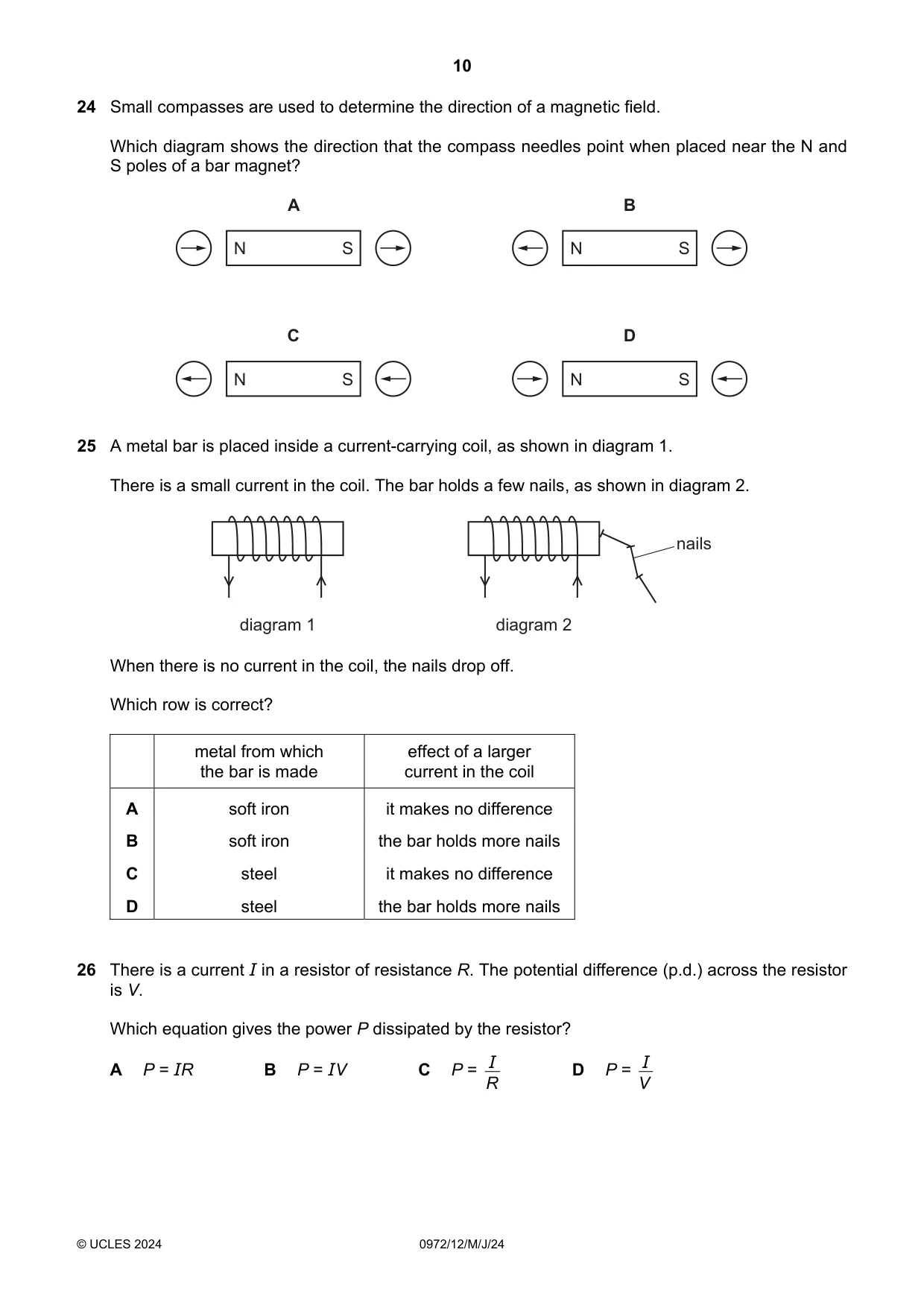
Q24 · Small compasses are used to determine the direction of a magnetic field
24 Small compasses are used to determine the direction of a magnetic field. Which diagram shows the direction that the compass needles point when placed near the N and S poles of a bar magnet? A B N S N S C D N S N S
Mark scheme: C
Q25 · A metal bar is placed inside a current-carrying coil, as shown in diagram 1
25 A metal bar is placed inside a current-carrying coil, as shown in diagram 1. There is a small current in the coil. The bar holds a few nails, as shown in diagram 2. nails diagram 1 diagram 2 When there is no current in the coil, the nails drop off. Which row is correct? metal from which effect of a larger the bar is made current in the coil A soft iron it makes no difference B soft iron the bar holds more nails C steel it makes no difference D steel the bar holds more nails
Mark scheme: B
Q26 · There is a current I in a resistor of resistance R
26 There is a current I in a resistor of resistance R. The potential difference (p.d.) across the resistor is V. Which equation gives the power P dissipated by the resistor? I I A P = IR B P = IV C P = R D P = V
Mark scheme: B
Q27 · A student tests the electrical conduction of four materials
27 A student tests the electrical conduction of four materials. ● aluminium ● iron ● plastic ● silver Which materials are good conductors of electricity? A aluminium, iron and silver B aluminium and silver only C iron, silver and plastic D plastic only
Mark scheme: A
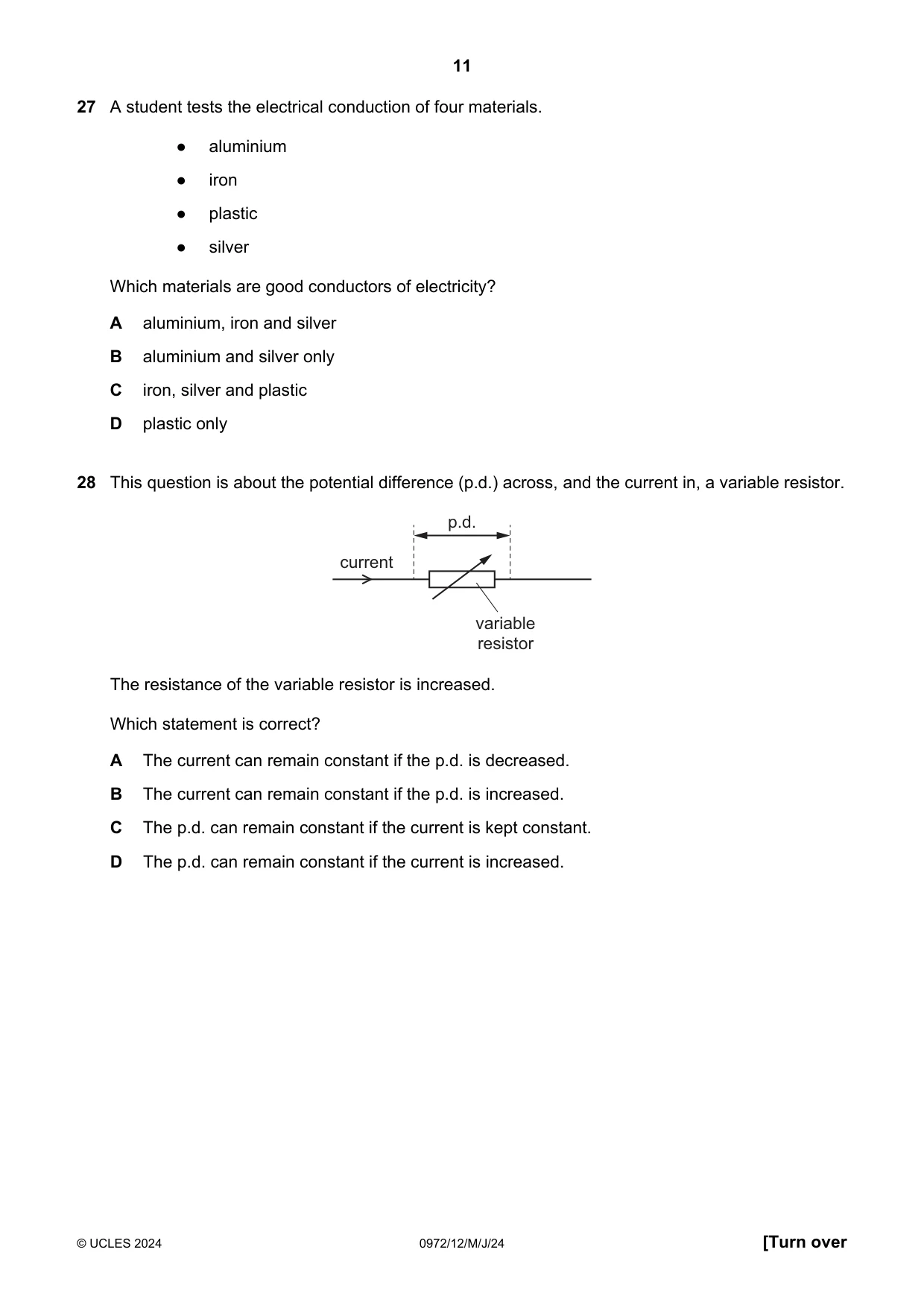
Q28 · This question is about the potential difference (p.d.) across, and the current in, a…
28 This question is about the potential difference (p.d.) across, and the current in, a variable resistor. p.d. current variable resistor The resistance of the variable resistor is increased. Which statement is correct? A The current can remain constant if the p.d. is decreased. B The current can remain constant if the p.d. is increased. C The p.d. can remain constant if the current is kept constant. D The p.d. can remain constant if the current is increased.
Mark scheme: B
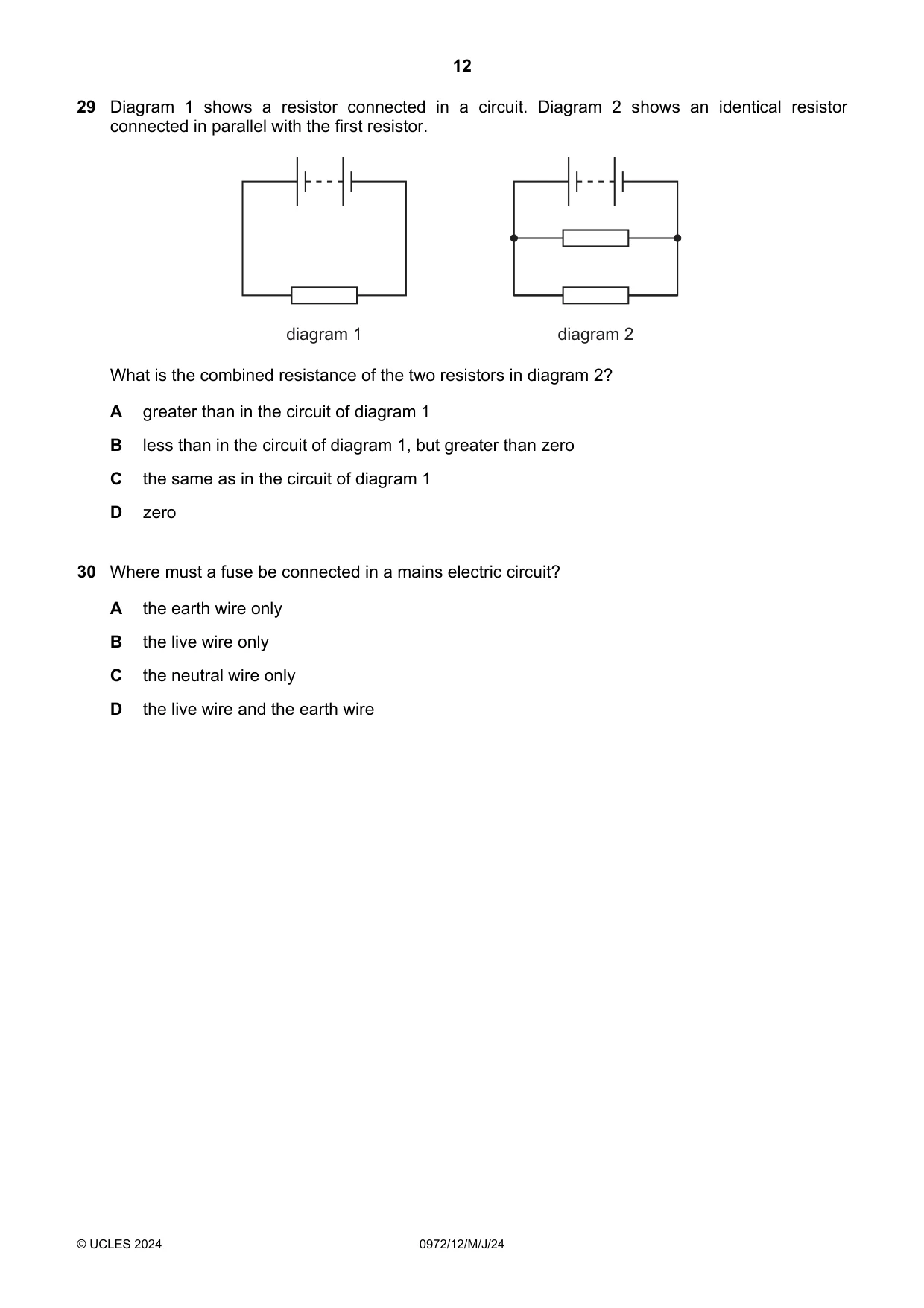
Q29 · A resistor connected in a circuit
29 Diagram 1 shows a resistor connected in a circuit. Diagram 2 shows an identical resistor connected in parallel with the first resistor. diagram 1 diagram 2 What is the combined resistance of the two resistors in diagram 2? A greater than in the circuit of diagram 1 B less than in the circuit of diagram 1, but greater than zero C the same as in the circuit of diagram 1 D zero
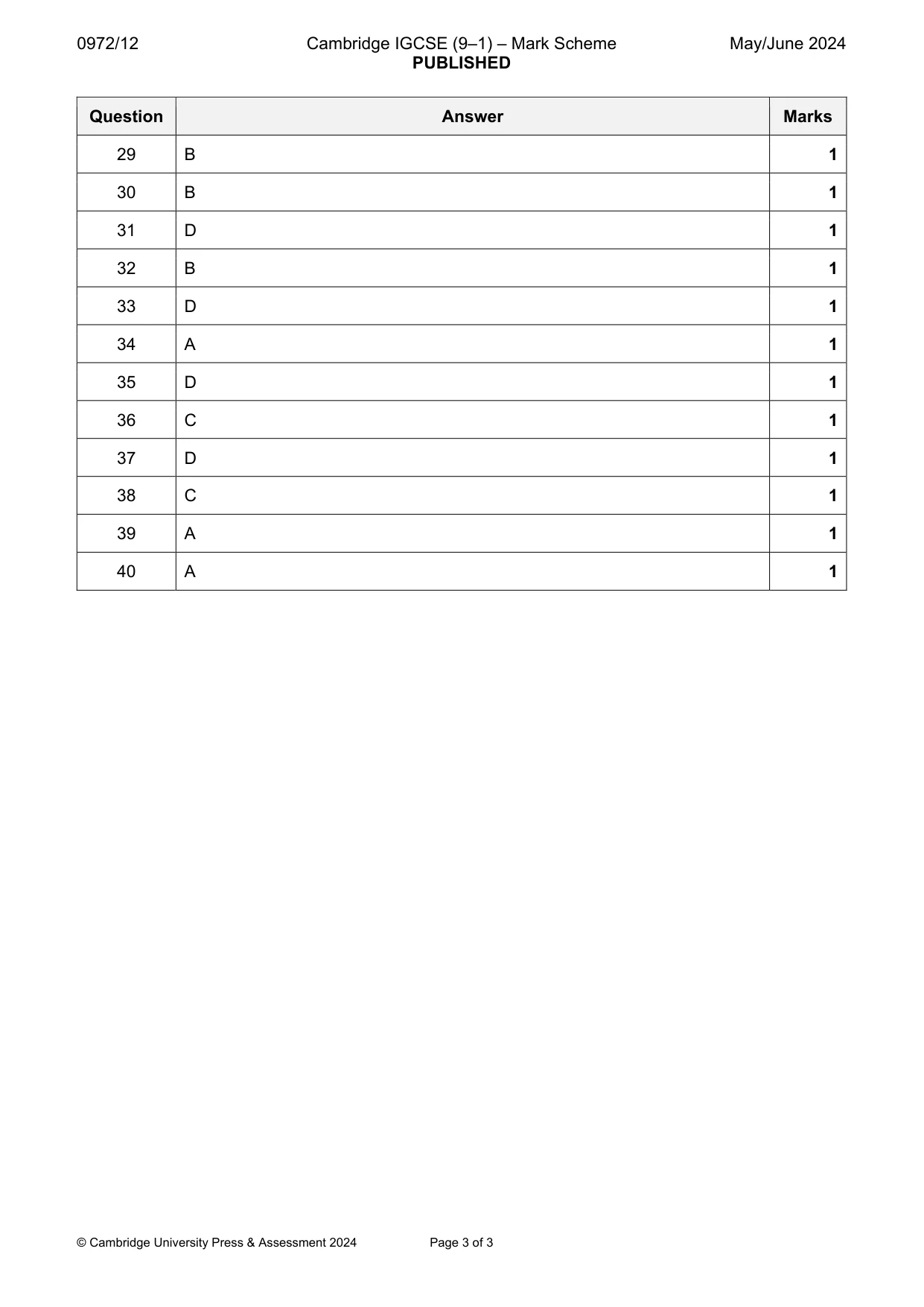
Mark scheme: B
Q30 · Where must a fuse be connected in a mains electric circuit?
30 Where must a fuse be connected in a mains electric circuit? A the earth wire only B the live wire only C the neutral wire only D the live wire and the earth wire
Mark scheme: B
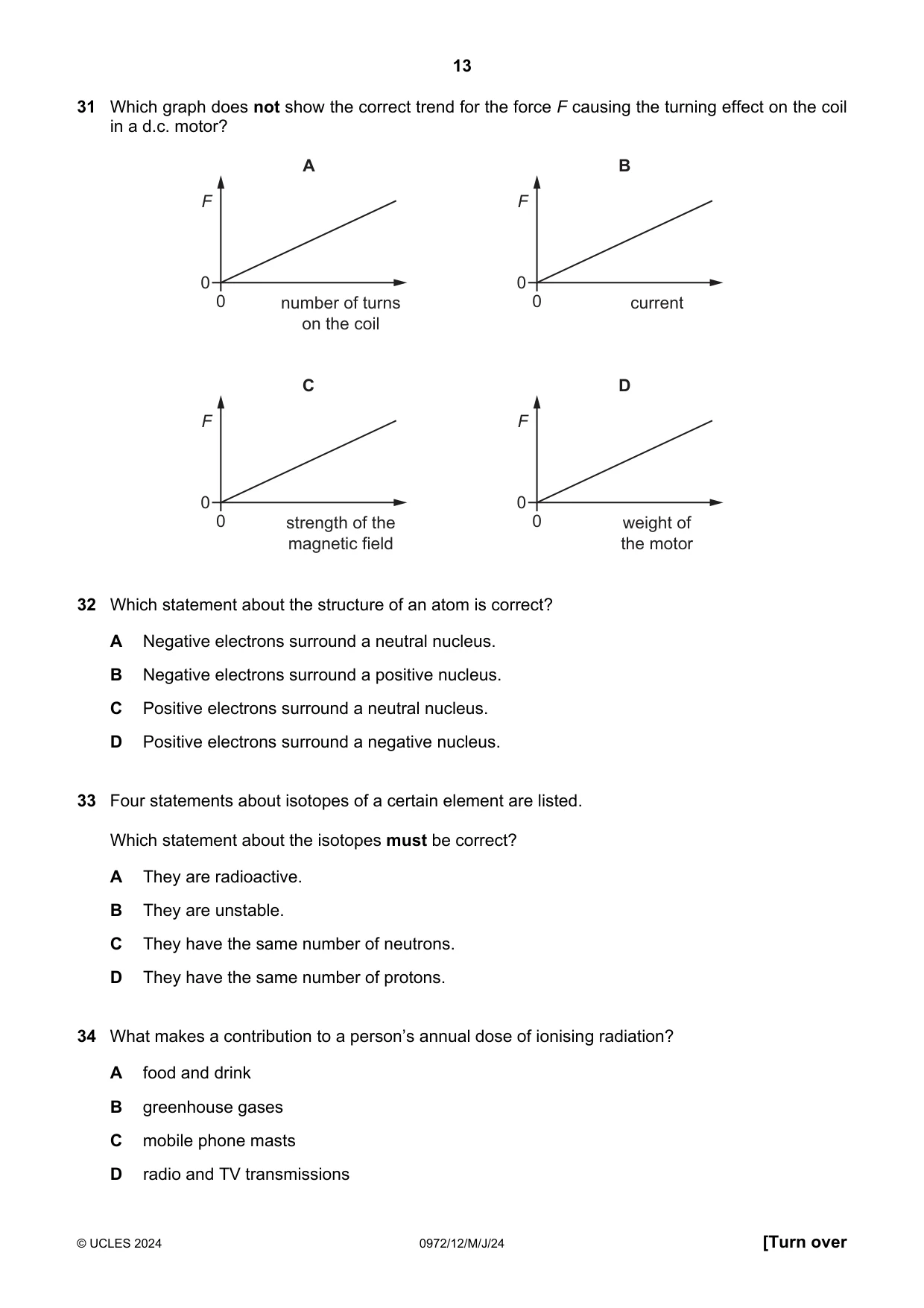
Q31 · Which graph does not show the correct trend for the force F causing the turning effect on…
31 Which graph does not show the correct trend for the force F causing the turning effect on the coil in a d.c. motor? A B F F 0 0 0 number of turns 0 current on the coil C D F F 0 0 0 strength of the 0 weight of magnetic field the motor
Mark scheme: D
Q32 · Which statement about the structure of an atom is correct?
32 Which statement about the structure of an atom is correct? A Negative electrons surround a neutral nucleus. B Negative electrons surround a positive nucleus. C Positive electrons surround a neutral nucleus. D Positive electrons surround a negative nucleus.
Mark scheme: B
Q33 · Four statements about isotopes of a certain element are listed
33 Four statements about isotopes of a certain element are listed. Which statement about the isotopes must be correct? A They are radioactive. B They are unstable. C They have the same number of neutrons. D They have the same number of protons.
Mark scheme: D
Q34 · What makes a contribution to a person’s annual dose of ionising radiation?
34 What makes a contribution to a person’s annual dose of ionising radiation? A food and drink B greenhouse gases C mobile phone masts D radio and TV transmissions
Mark scheme: A
Q35 · The emissions from a radioactive source pass through a sheet of lead that is 10 mm thick
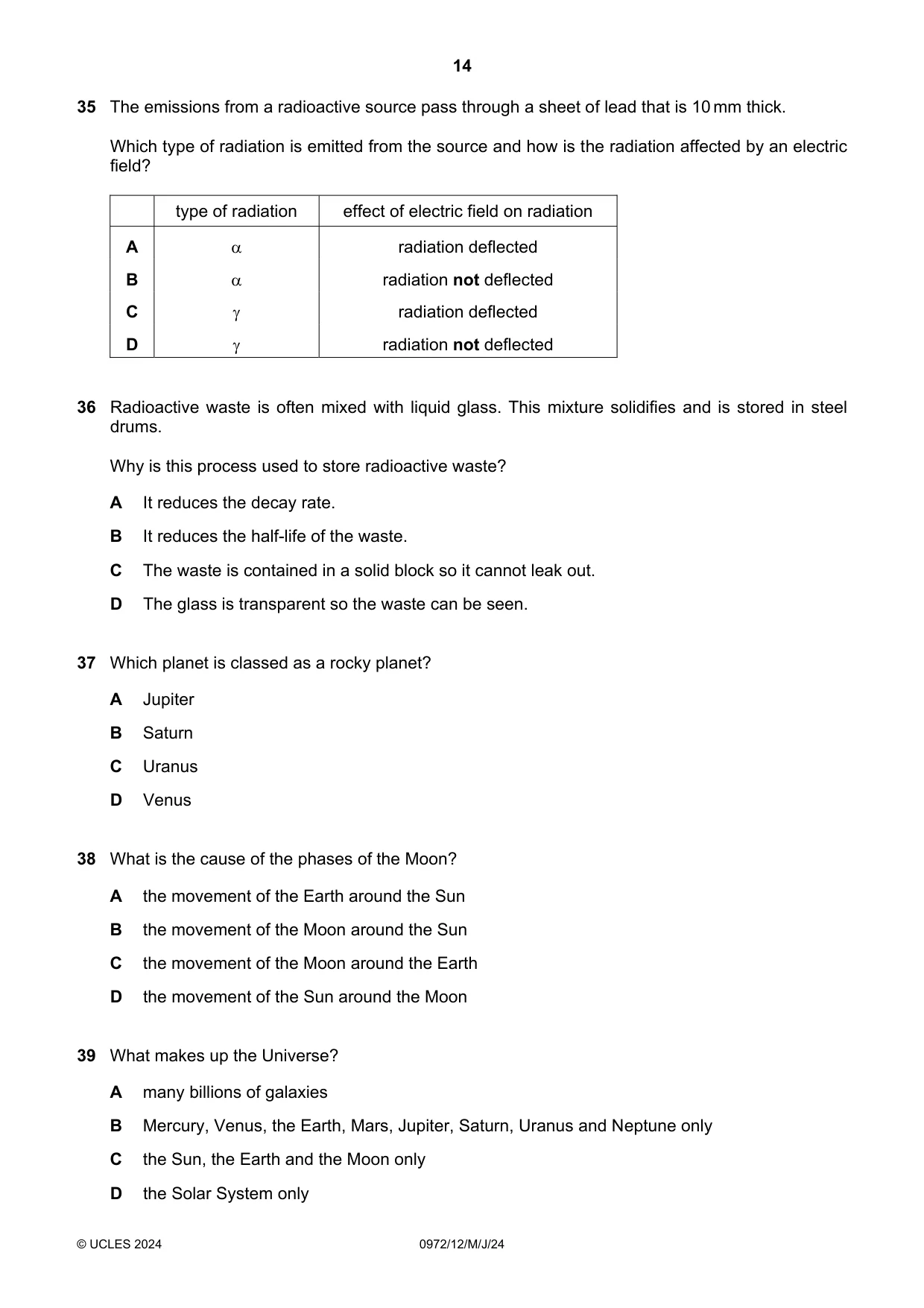
35 The emissions from a radioactive source pass through a sheet of lead that is 10 mm thick. Which type of radiation is emitted from the source and how is the radiation affected by an electric field? type of radiation effect of electric field on radiation A radiation deflected B radiation not deflected C radiation deflected D radiation not deflected
Mark scheme: D
Q36 · Radioactive waste is often mixed with liquid glass
36 Radioactive waste is often mixed with liquid glass. This mixture solidifies and is stored in steel drums. Why is this process used to store radioactive waste? A It reduces the decay rate. B It reduces the half-life of the waste. C The waste is contained in a solid block so it cannot leak out. D The glass is transparent so the waste can be seen.
Mark scheme: C
Q37 · Which planet is classed as a rocky planet?
37 Which planet is classed as a rocky planet? A Jupiter B Saturn C Uranus D Venus
Mark scheme: D
Q38 · What is the cause of the phases of the Moon?
38 What is the cause of the phases of the Moon? A the movement of the Earth around the Sun B the movement of the Moon around the Sun C the movement of the Moon around the Earth D the movement of the Sun around the Moon
Mark scheme: C
Q39 · What makes up the Universe?
39 What makes up the Universe? A many billions of galaxies B Mercury, Venus, the Earth, Mars, Jupiter, Saturn, Uranus and Neptune only C the Sun, the Earth and the Moon only D the Solar System only
Mark scheme: A
Q40 · The Sun mostly consists of which gases?
40 The Sun mostly consists of which gases? A helium and hydrogen B helium and nitrogen C hydrogen and oxygen D oxygen and nitrogen
Mark scheme: A
What was in this paper
The subtopics covered by these 40 questions, and how many questions each got. Open one in a new tab to see every Cambridge question on it.
3Light3Radioactivity3Electric circuits2Electrical quantities2Forces2General properties of waves2Mass and weight2Motion2Simple phenomena of magnetism2Sound2Stars and the Universe2The Earth and the Solar System2The nuclear model of the atom2Thermal properties and temperature2Transfer of thermal energy2Electrical safety1Electromagnetic effects1Electromagnetic spectrum1Energy, work and power1Pressure1What you needed in this session
Cambridge’s own grade thresholds for 2024 May/June, Paper 1 · Variant 2. A higher threshold means an easier paper — the bar moves with how the cohort did.