Cambridge IGCSE Physics (9-1) 0972 — 2022 May/June Paper 1 · Variant 2
0972/12/M/J/22 · 40 questions · 40 marks · ≈45 min
The question paper and its mark scheme, free to read here and free to download. This is Cambridge’s own paper, exactly as it was sat.
Question paper16 pages
Mark scheme3 pages
Answers below. Sit the paper first if you are practising.
Questions as text
Q1 · A lump of modelling clay is moved from a small measuring cylinder to a large measuring…
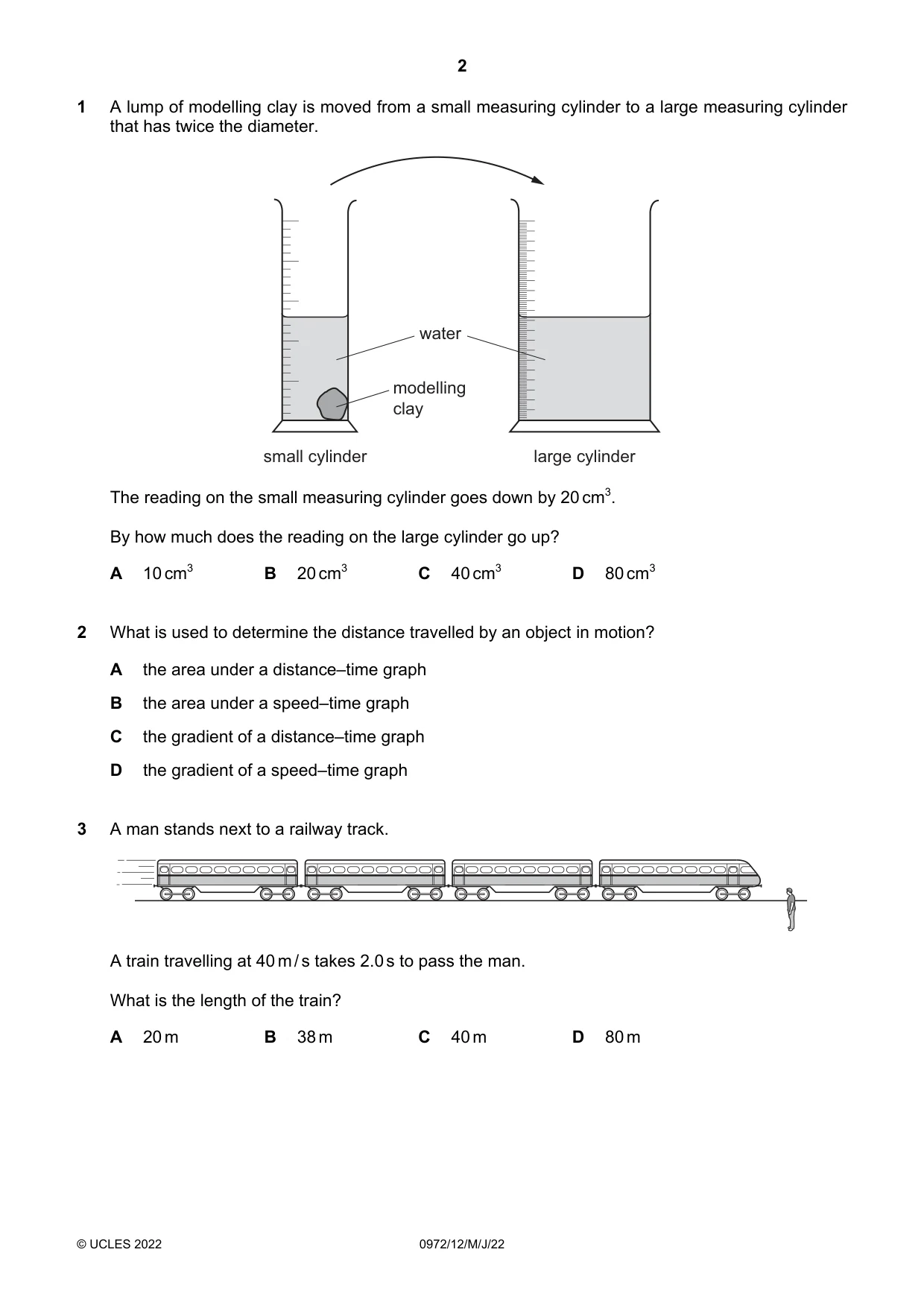
1 A lump of modelling clay is moved from a small measuring cylinder to a large measuring cylinder that has twice the diameter. water modelling clay small cylinder large cylinder The reading on the small measuring cylinder goes down by 20 cm3. By how much does the reading on the large cylinder go up? A 10 cm3 B 20 cm3 C 40 cm3 D 80 cm3
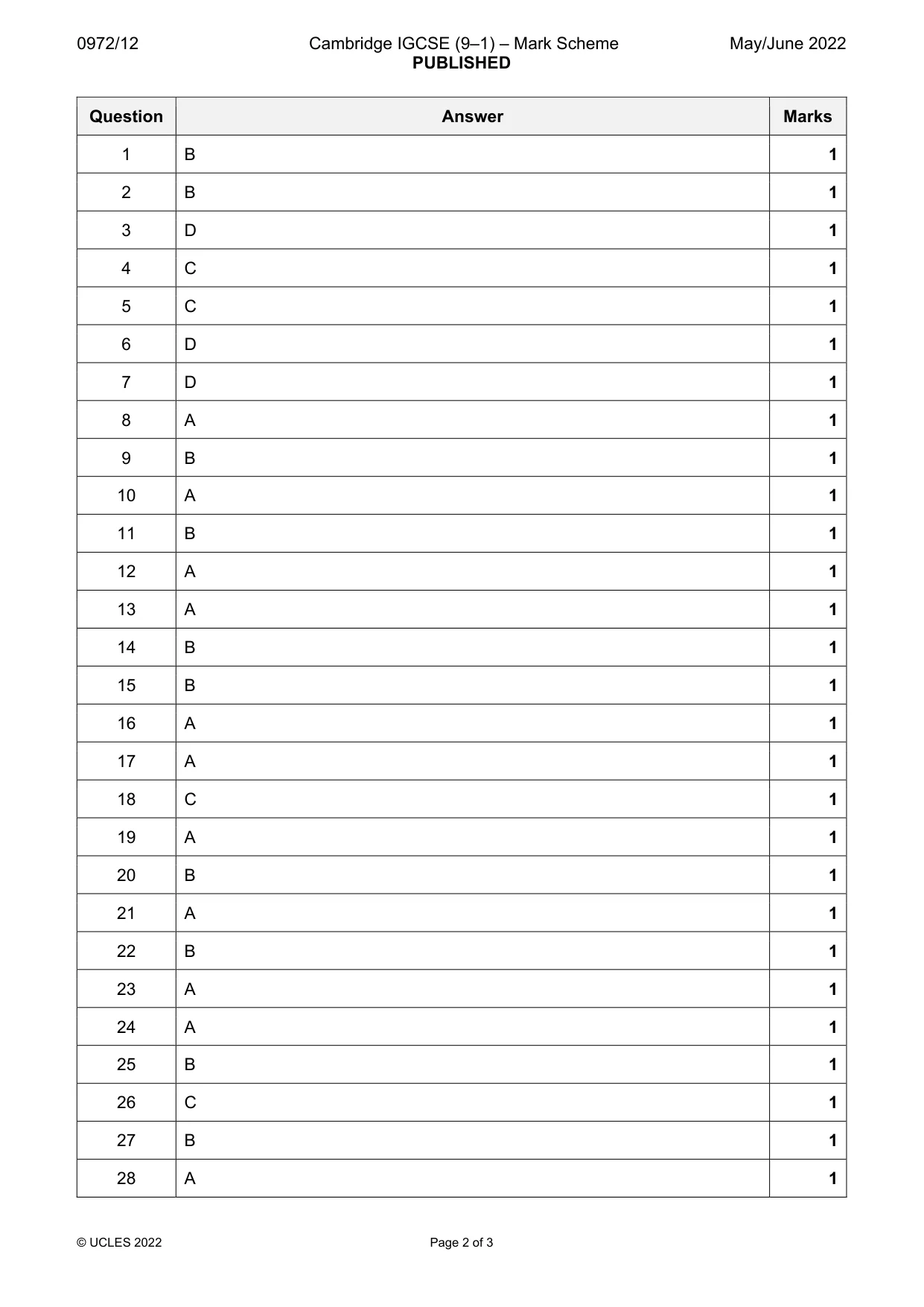
Mark scheme: B
Q2 · What is used to determine the distance travelled by an object in motion?
2 What is used to determine the distance travelled by an object in motion? A the area under a distance–time graph B the area under a speed–time graph C the gradient of a distance–time graph D the gradient of a speed–time graph
Mark scheme: B
Q3 · A man stands next to a railway track
3 A man stands next to a railway track. A train travelling at 40 m / s takes 2.0 s to pass the man. What is the length of the train? A 20 m B 38 m C 40 m D 80 m
Mark scheme: D
Q4 · An object is moved from point X to point Y
4 An object is moved from point X to point Y. The acceleration of free fall at X is different from that at Y. Which statement about the object at Y is correct? A Both its mass and its weight are different from those at X. B Both its mass and its weight are the same as those at X. C Its mass is the same as at X but its weight is different. D Its weight is the same as at X but its mass is different.
Mark scheme: C
Q5 · A measuring cylinder contains 30 cm3 of a liquid
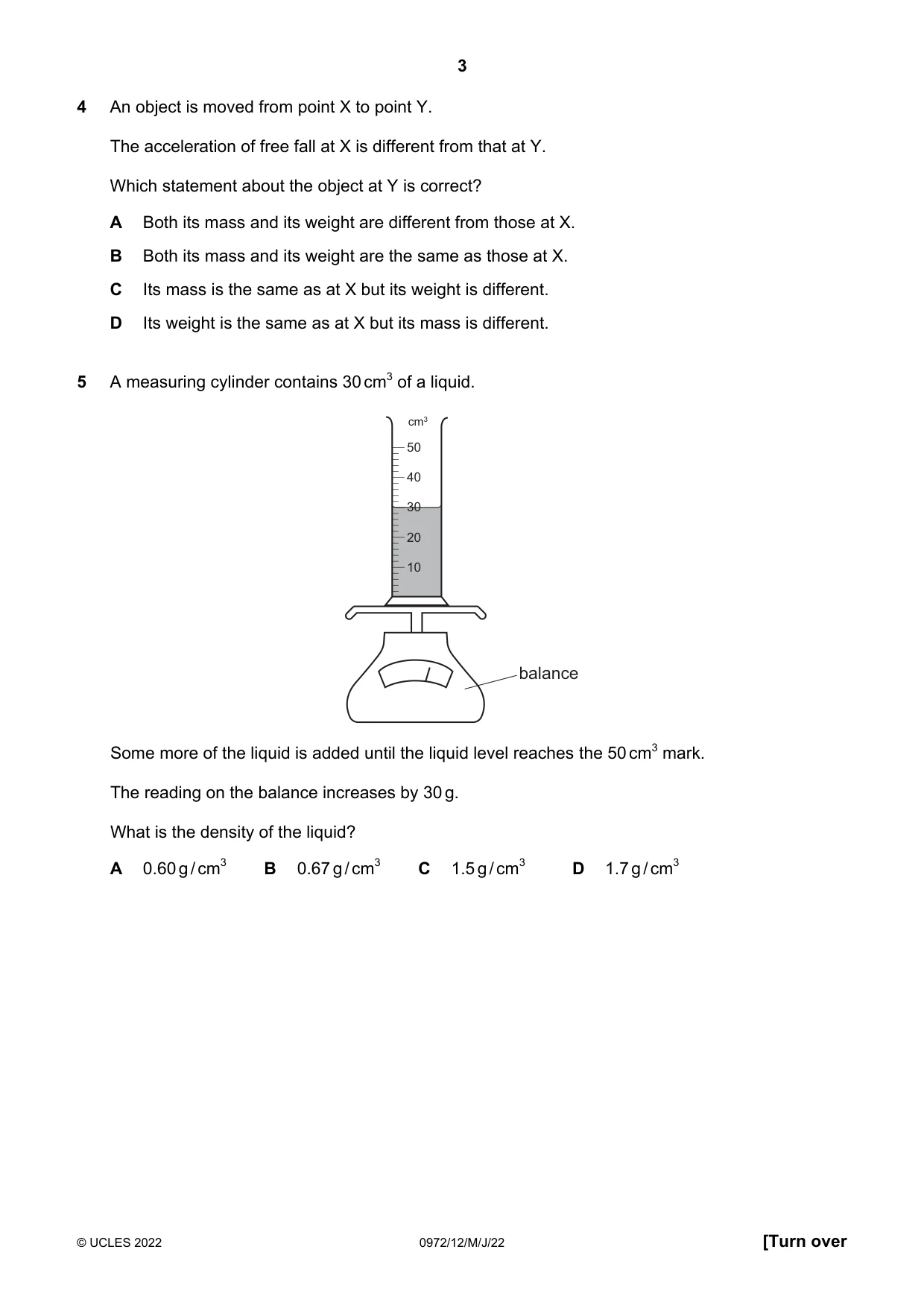
5 A measuring cylinder contains 30 cm3 of a liquid. cm3 50 40 30 20 10 balance Some more of the liquid is added until the liquid level reaches the 50 cm3 mark. The reading on the balance increases by 30 g. What is the density of the liquid? A 0.60 g / cm3 B 0.67 g / cm3 C 1.5 g / cm3 D 1.7 g / cm3
Mark scheme: C
Q6 · A spaceship approaches and passes a planet
6 A spaceship approaches and passes a planet. spaceship planet What can the force of gravity between the spaceship and planet achieve? A It can change the direction of the spaceship, or slow it down, but not speed it up. B It can change the direction of the spaceship, or speed it up, but not slow it down. C It can slow down the spaceship, or speed it up, but not change its direction. D It can change the direction of the spaceship, slow it down, or speed it up.
Mark scheme: D
Q7 · A beam is pivoted at one end, as shown
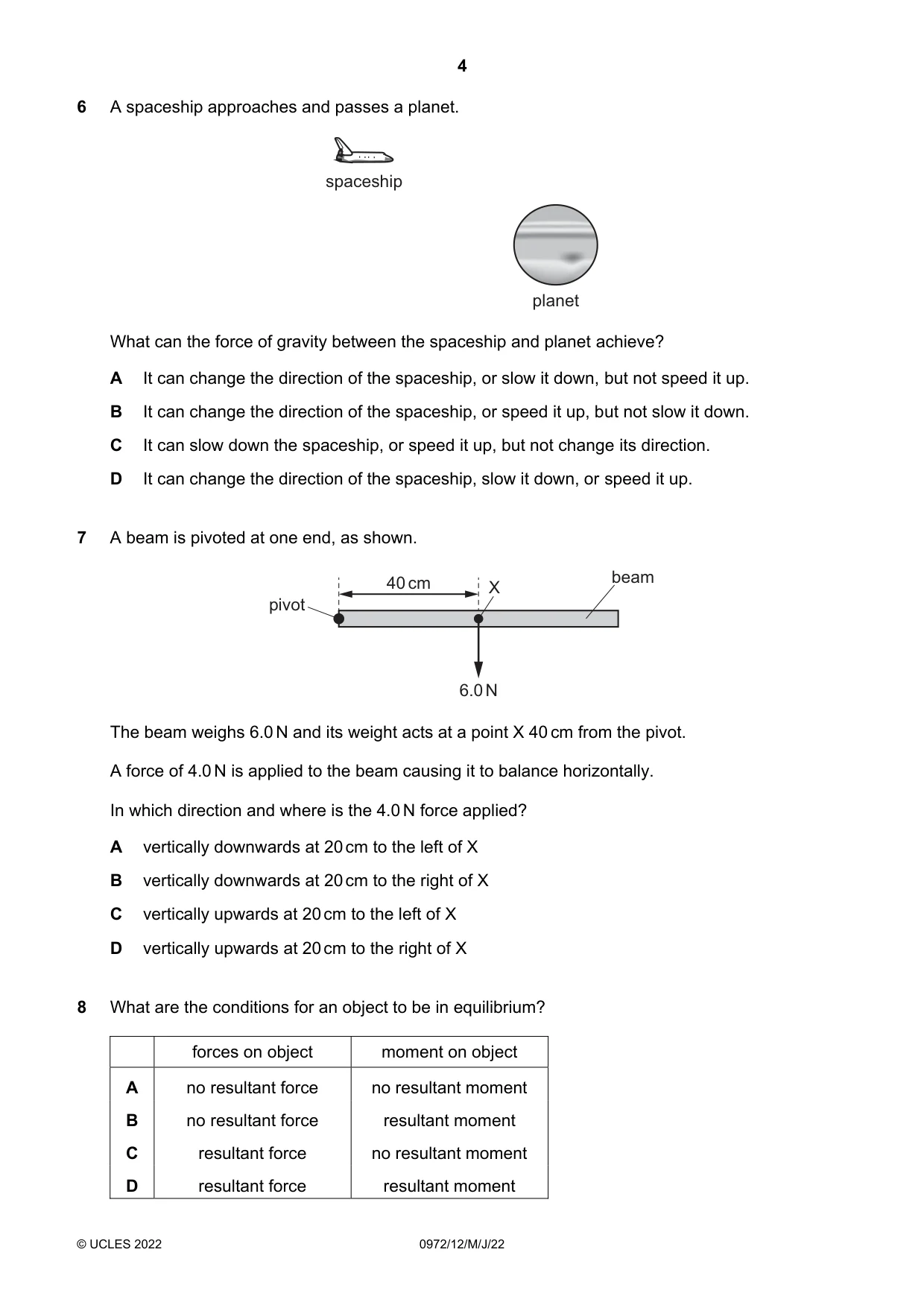
7 A beam is pivoted at one end, as shown. 40 cm beam X pivot 6.0 N The beam weighs 6.0 N and its weight acts at a point X 40 cm from the pivot. A force of 4.0 N is applied to the beam causing it to balance horizontally. In which direction and where is the 4.0 N force applied? A vertically downwards at 20 cm to the left of X B vertically downwards at 20 cm to the right of X C vertically upwards at 20 cm to the left of X D vertically upwards at 20 cm to the right of X
Mark scheme: D
Q8 · What are the conditions for an object to be in equilibrium?
8 What are the conditions for an object to be in equilibrium? forces on object moment on object A no resultant force no resultant moment B no resultant force resultant moment C resultant force no resultant moment D resultant force resultant moment
Mark scheme: A
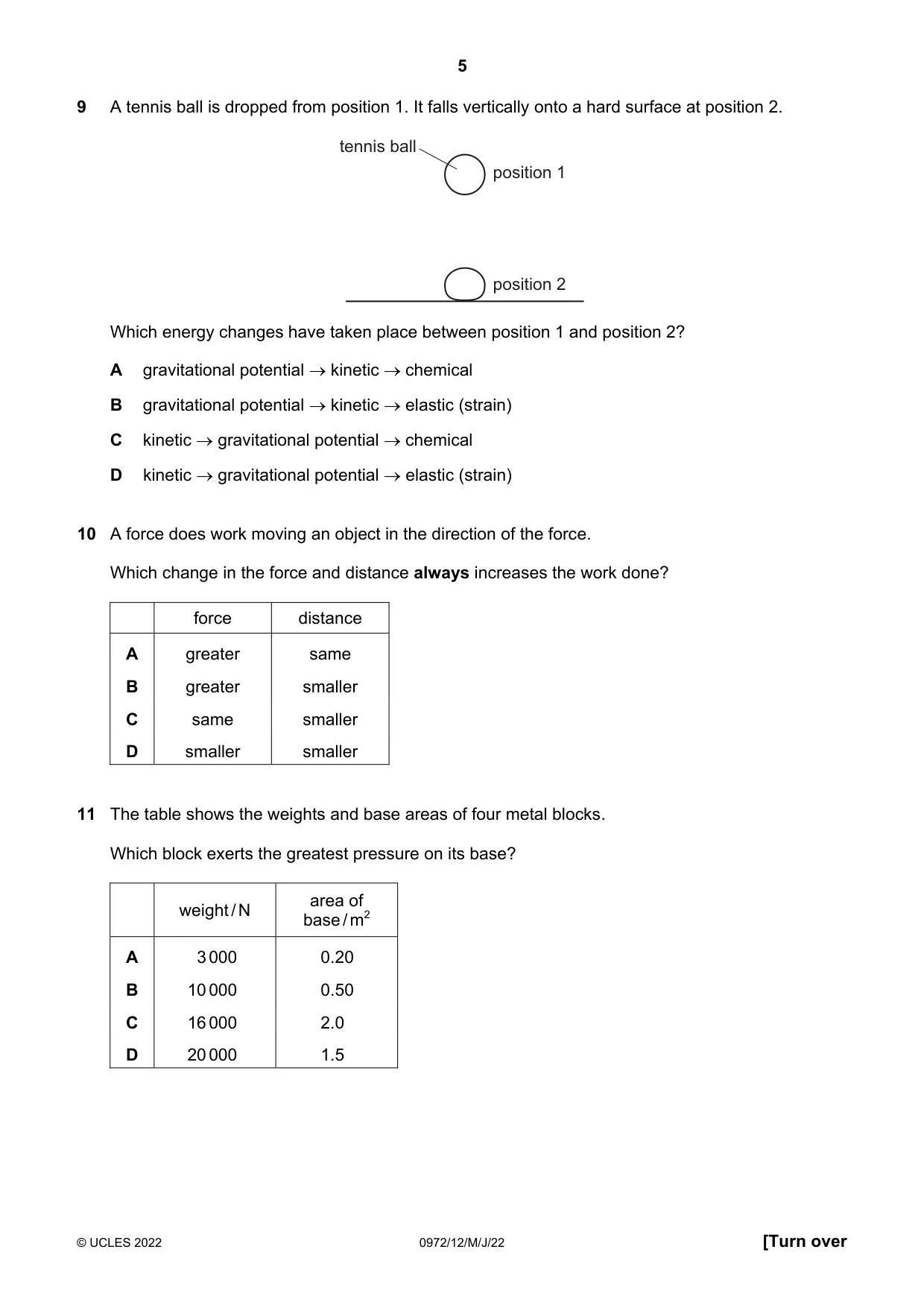
Q9 · A tennis ball is dropped from position 1
9 A tennis ball is dropped from position 1. It falls vertically onto a hard surface at position 2. tennis ball position 1 position 2 Which energy changes have taken place between position 1 and position 2? A gravitational potential kinetic chemical B gravitational potential kinetic elastic (strain) C kinetic gravitational potential chemical D kinetic gravitational potential elastic (strain)
Mark scheme: B
Q10 · A force does work moving an object in the direction of the force
10 A force does work moving an object in the direction of the force. Which change in the force and distance always increases the work done? force distance A greater same B greater smaller C same smaller D smaller smaller
Mark scheme: A
Q11 · The table shows the weights and base areas of four metal blocks
11 The table shows the weights and base areas of four metal blocks. Which block exerts the greatest pressure on its base? area of weight / N base / m2 A 3 000 0.20 B 10 000 0.50 C 16 000 2.0 D 20 000 1.5
Mark scheme: B
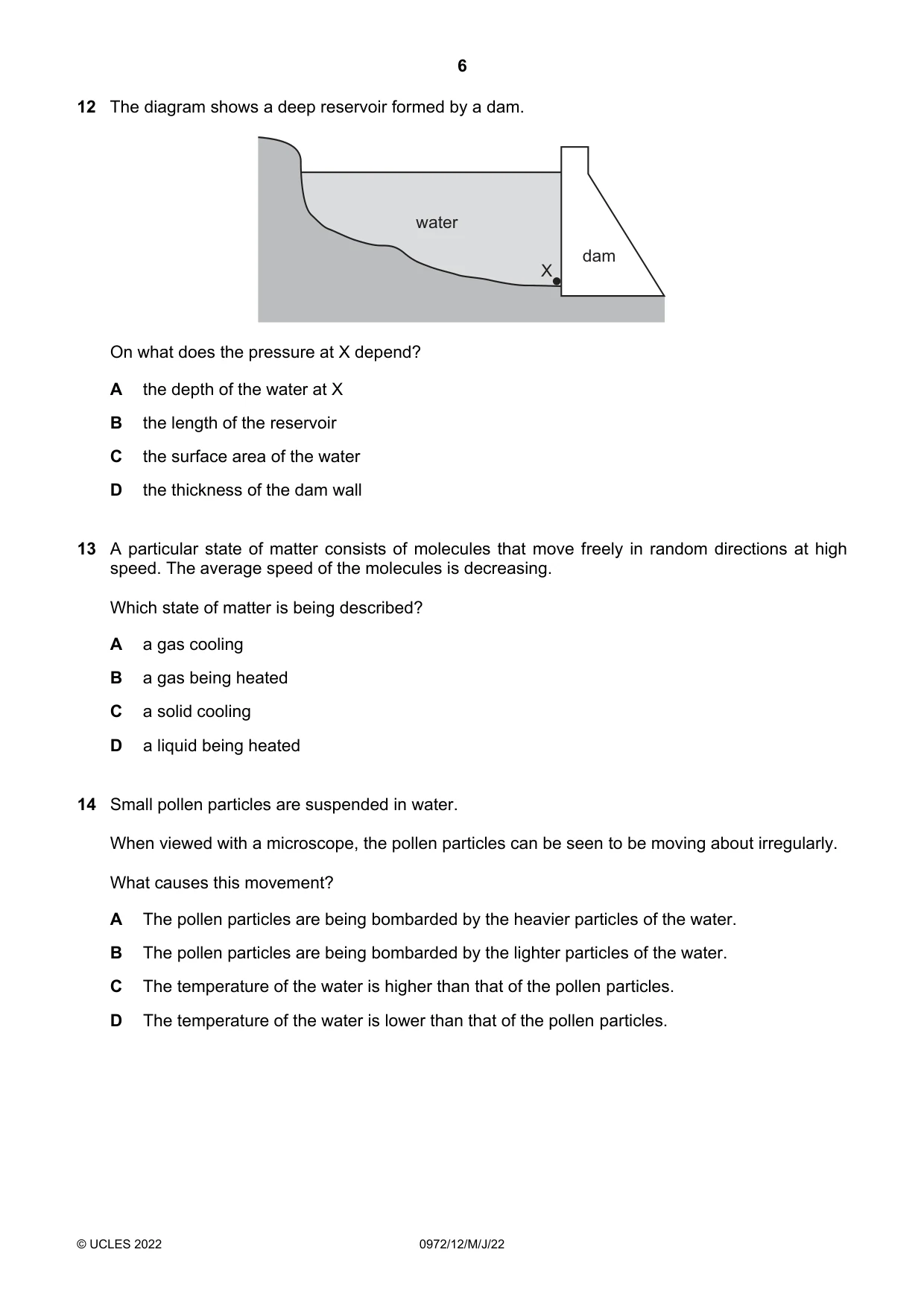
Q12 · The diagram shows a deep reservoir formed by a dam
12 The diagram shows a deep reservoir formed by a dam. water dam X On what does the pressure at X depend? A the depth of the water at X B the length of the reservoir C the surface area of the water D the thickness of the dam wall
Mark scheme: A
Q13 · A particular state of matter consists of molecules that move freely in random directions…
13 A particular state of matter consists of molecules that move freely in random directions at high speed. The average speed of the molecules is decreasing. Which state of matter is being described? A a gas cooling B a gas being heated C a solid cooling D a liquid being heated
Mark scheme: A
Q14 · Small pollen particles are suspended in water
14 Small pollen particles are suspended in water. When viewed with a microscope, the pollen particles can be seen to be moving about irregularly. What causes this movement? A The pollen particles are being bombarded by the heavier particles of the water. B The pollen particles are being bombarded by the lighter particles of the water. C The temperature of the water is higher than that of the pollen particles. D The temperature of the water is lower than that of the pollen particles.
Mark scheme: B
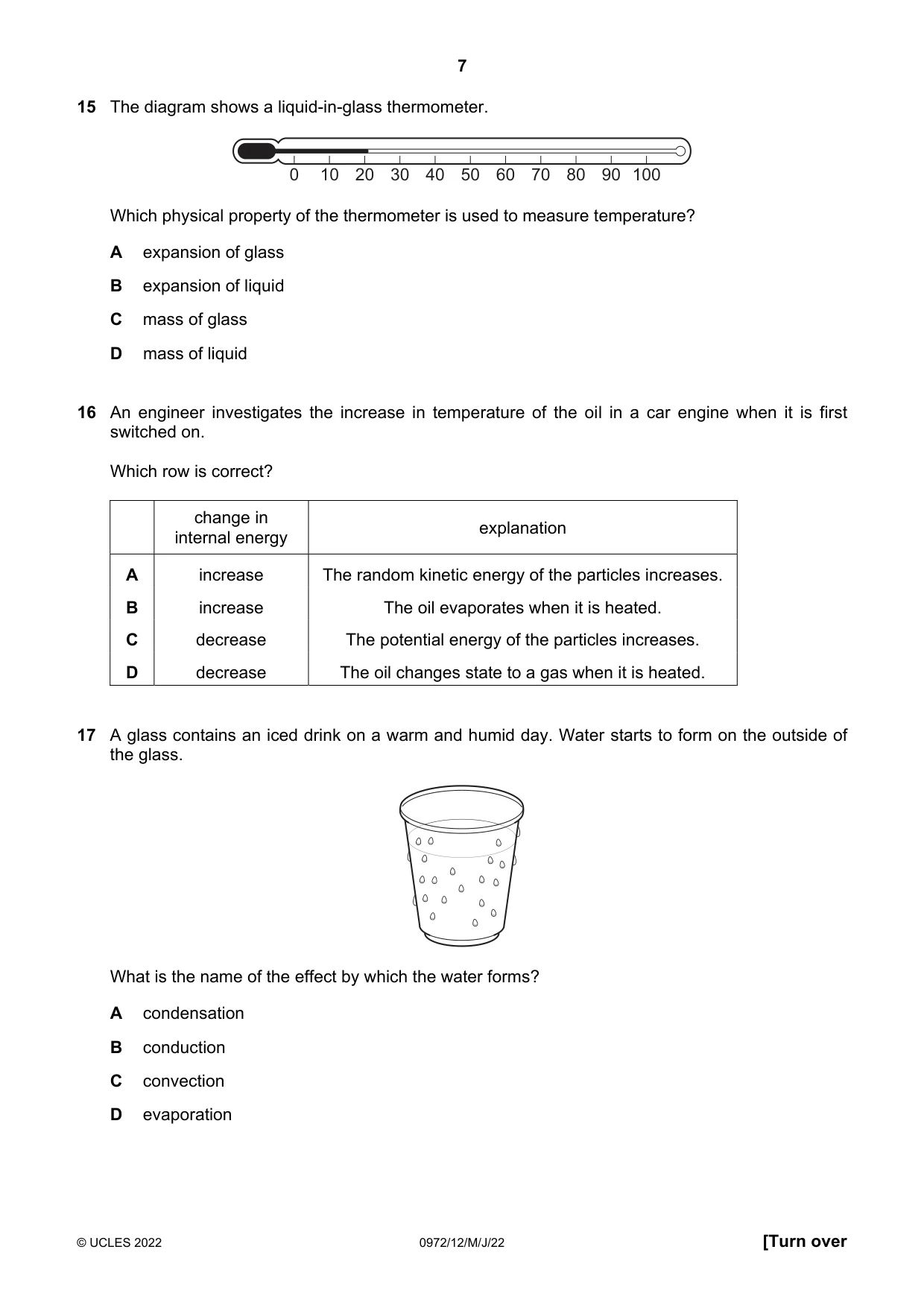
Q15 · The diagram shows a liquid-in-glass thermometer
15 The diagram shows a liquid-in-glass thermometer. 0 10 20 30 40 50 60 70 80 90 100 Which physical property of the thermometer is used to measure temperature? A expansion of glass B expansion of liquid C mass of glass D mass of liquid
Mark scheme: B
Q16 · An engineer investigates the increase in temperature of the oil in a car engine when it…
16 An engineer investigates the increase in temperature of the oil in a car engine when it is first switched on. Which row is correct? change in explanation internal energy A increase The random kinetic energy of the particles increases. B increase The oil evaporates when it is heated. C decrease The potential energy of the particles increases. D decrease The oil changes state to a gas when it is heated.
Mark scheme: A
Q17 · A glass contains an iced drink on a warm and humid day
17 A glass contains an iced drink on a warm and humid day. Water starts to form on the outside of the glass. What is the name of the effect by which the water forms? A condensation B conduction C convection D evaporation
Mark scheme: A
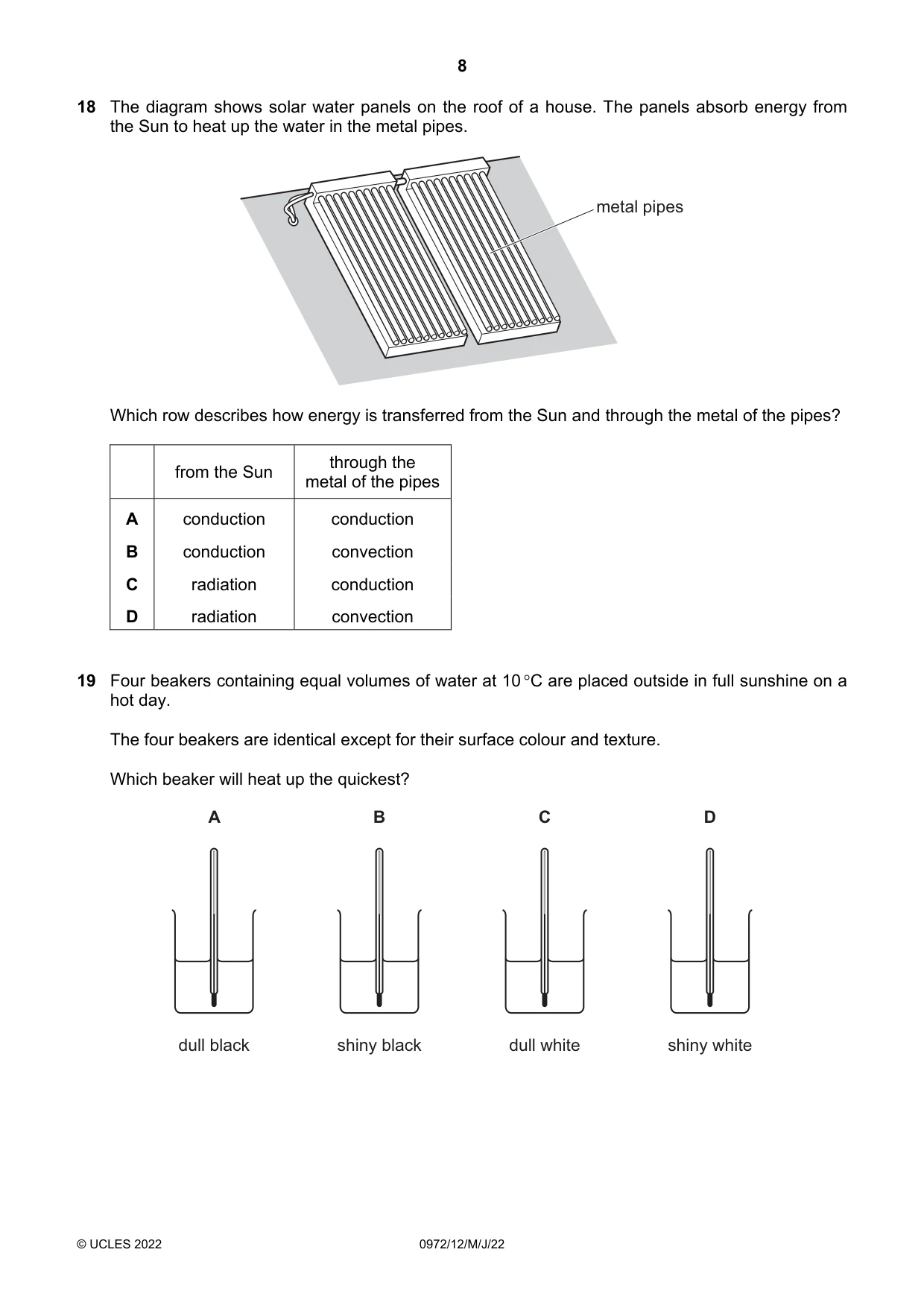
Q18 · The diagram shows solar water panels on the roof of a house
18 The diagram shows solar water panels on the roof of a house. The panels absorb energy from the Sun to heat up the water in the metal pipes. metal pipes Which row describes how energy is transferred from the Sun and through the metal of the pipes? through the from the Sun metal of the pipes A conduction conduction B conduction convection C radiation conduction D radiation convection
Mark scheme: C
Q19 · Four beakers containing equal volumes of water at 10 C are placed outside in full…
19 Four beakers containing equal volumes of water at 10 C are placed outside in full sunshine on a hot day. The four beakers are identical except for their surface colour and texture. Which beaker will heat up the quickest? A B C D dull black shiny black dull white shiny white
Mark scheme: A
Q20 · The diagram shows a wave
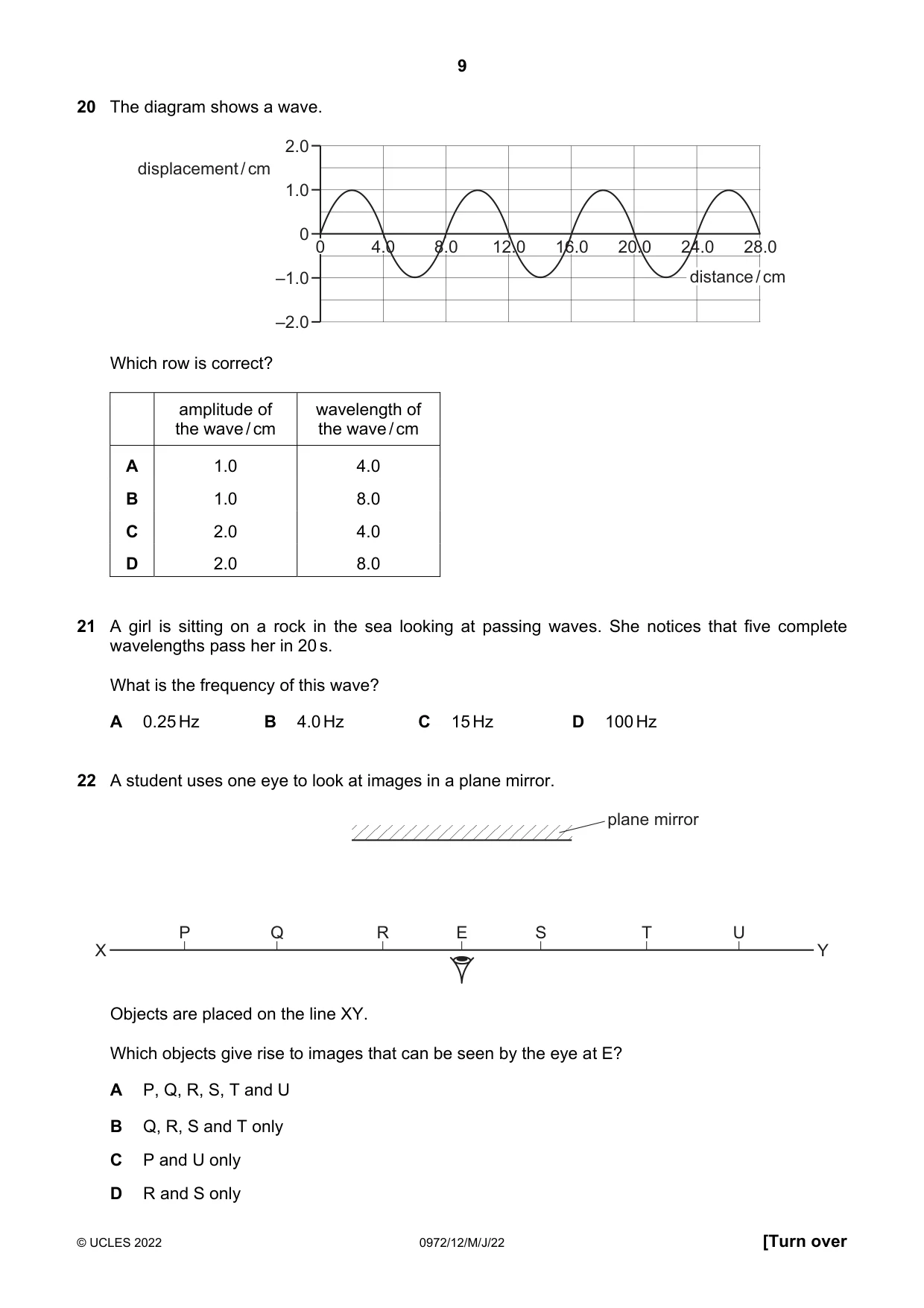
20 The diagram shows a wave. 2.0 displacement / cm 1.0 0 0 4.0 8.0 12.0 16.0 20.0 24.0 28.0 –1.0 distance / cm –2.0 Which row is correct? amplitude of wavelength of the wave / cm the wave / cm A 1.0 4.0 B 1.0 8.0 C 2.0 4.0 D 2.0 8.0
Mark scheme: B
Q21 · A girl is sitting on a rock in the sea looking at passing waves
21 A girl is sitting on a rock in the sea looking at passing waves. She notices that five complete wavelengths pass her in 20 s. What is the frequency of this wave? A 0.25 Hz B 4.0 Hz C 15 Hz D 100 Hz
Mark scheme: A
Q22 · A student uses one eye to look at images in a plane mirror
22 A student uses one eye to look at images in a plane mirror. plane mirror P Q R E S T U X Y Objects are placed on the line XY. Which objects give rise to images that can be seen by the eye at E? A P, Q, R, S, T and U B Q, R, S and T only C P and U only D R and S only
Mark scheme: B
Q23 · An object is placed in front of a converging lens
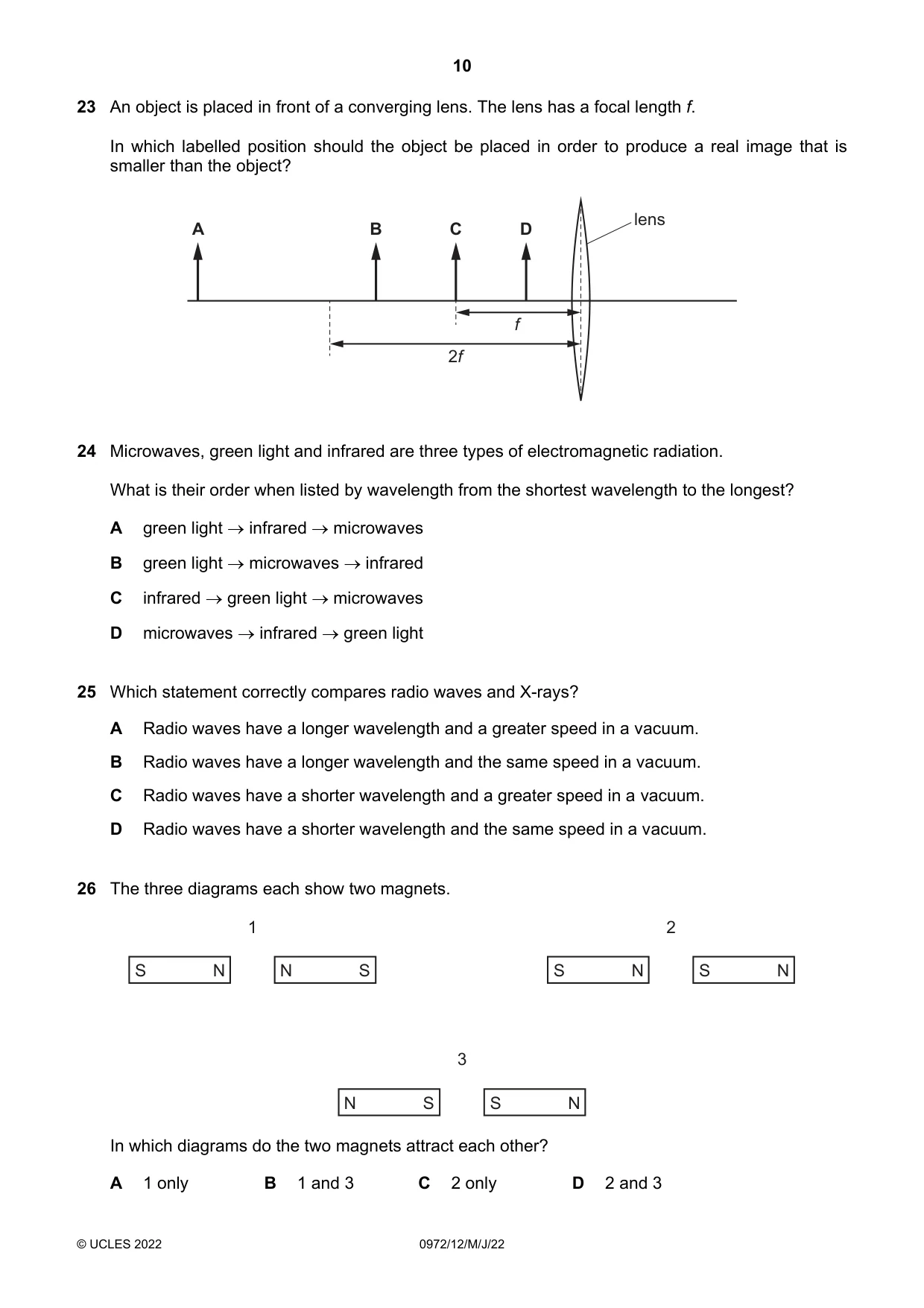
23 An object is placed in front of a converging lens. The lens has a focal length f. In which labelled position should the object be placed in order to produce a real image that is smaller than the object? lens A B C D f 2f
Mark scheme: A
Q24 · Microwaves, green light and infrared are three types of electromagnetic radiation
24 Microwaves, green light and infrared are three types of electromagnetic radiation. What is their order when listed by wavelength from the shortest wavelength to the longest? A green light infrared microwaves B green light microwaves infrared C infrared green light microwaves D microwaves infrared green light
Mark scheme: A
Q25 · Which statement correctly compares radio waves and X-rays?
25 Which statement correctly compares radio waves and X-rays? A Radio waves have a longer wavelength and a greater speed in a vacuum. B Radio waves have a longer wavelength and the same speed in a vacuum. C Radio waves have a shorter wavelength and a greater speed in a vacuum. D Radio waves have a shorter wavelength and the same speed in a vacuum.
Mark scheme: B
Q26 · The three diagrams each show two magnets
26 The three diagrams each show two magnets. 1 2 S N N S S N S N 3 N S S N In which diagrams do the two magnets attract each other? A 1 only B 1 and 3 C 2 only D 2 and 3
Mark scheme: C
Q27 · The diagram shows the magnetic fields around three objects, P, Q and R, placed close to…
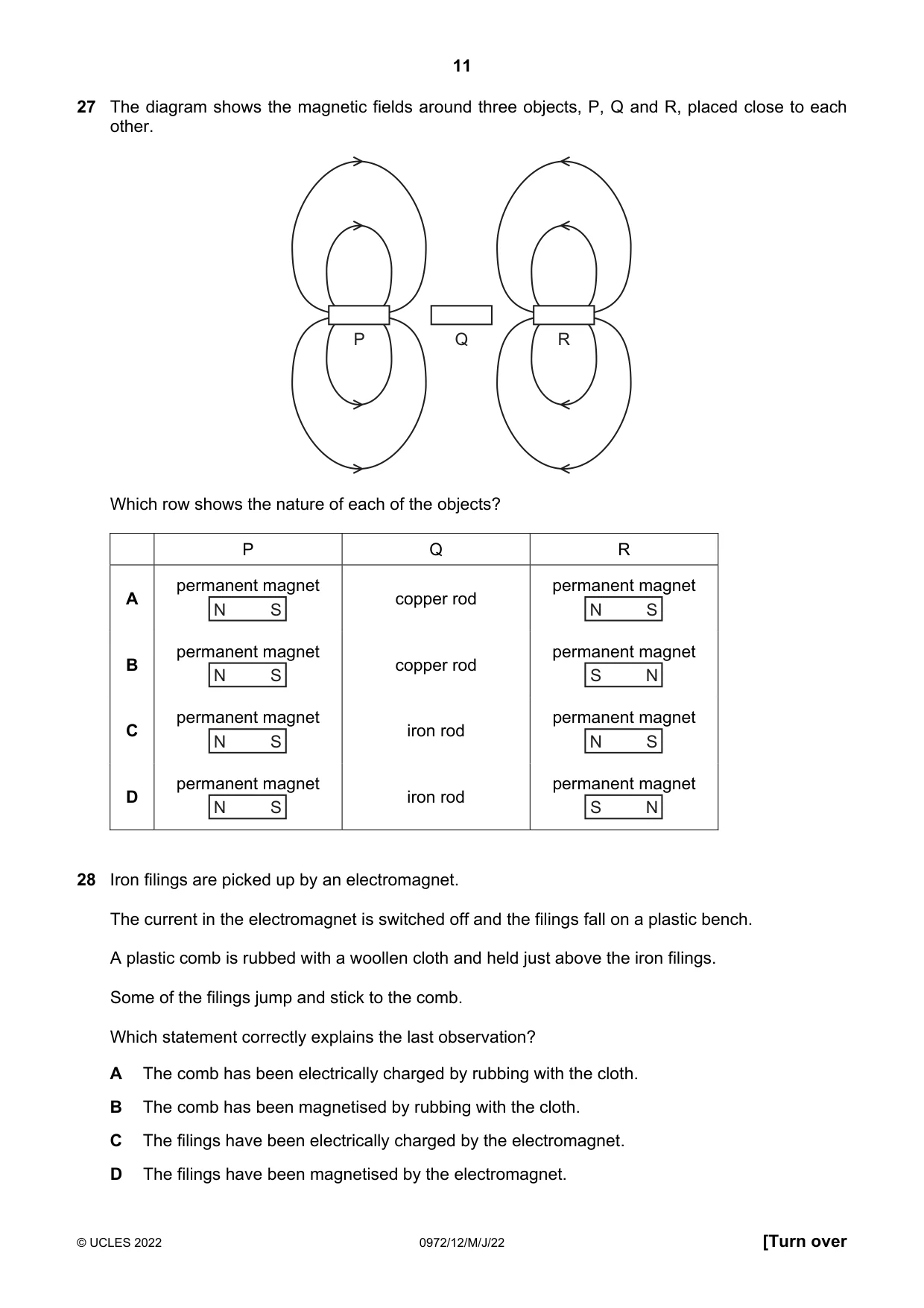
27 The diagram shows the magnetic fields around three objects, P, Q and R, placed close to each other. P Q R Which row shows the nature of each of the objects? P Q R permanent magnet permanent magnet A copper rod N S N S permanent magnet permanent magnet B copper rod N S S N permanent magnet permanent magnet C iron rod N S N S permanent magnet permanent magnet D iron rod N S S N
Mark scheme: B
Q28 · Iron filings are picked up by an electromagnet
28 Iron filings are picked up by an electromagnet. The current in the electromagnet is switched off and the filings fall on a plastic bench. A plastic comb is rubbed with a woollen cloth and held just above the iron filings. Some of the filings jump and stick to the comb. Which statement correctly explains the last observation? A The comb has been electrically charged by rubbing with the cloth. B The comb has been magnetised by rubbing with the cloth. C The filings have been electrically charged by the electromagnet. D The filings have been magnetised by the electromagnet.
Mark scheme: A
Q29 · Four circuits are set up
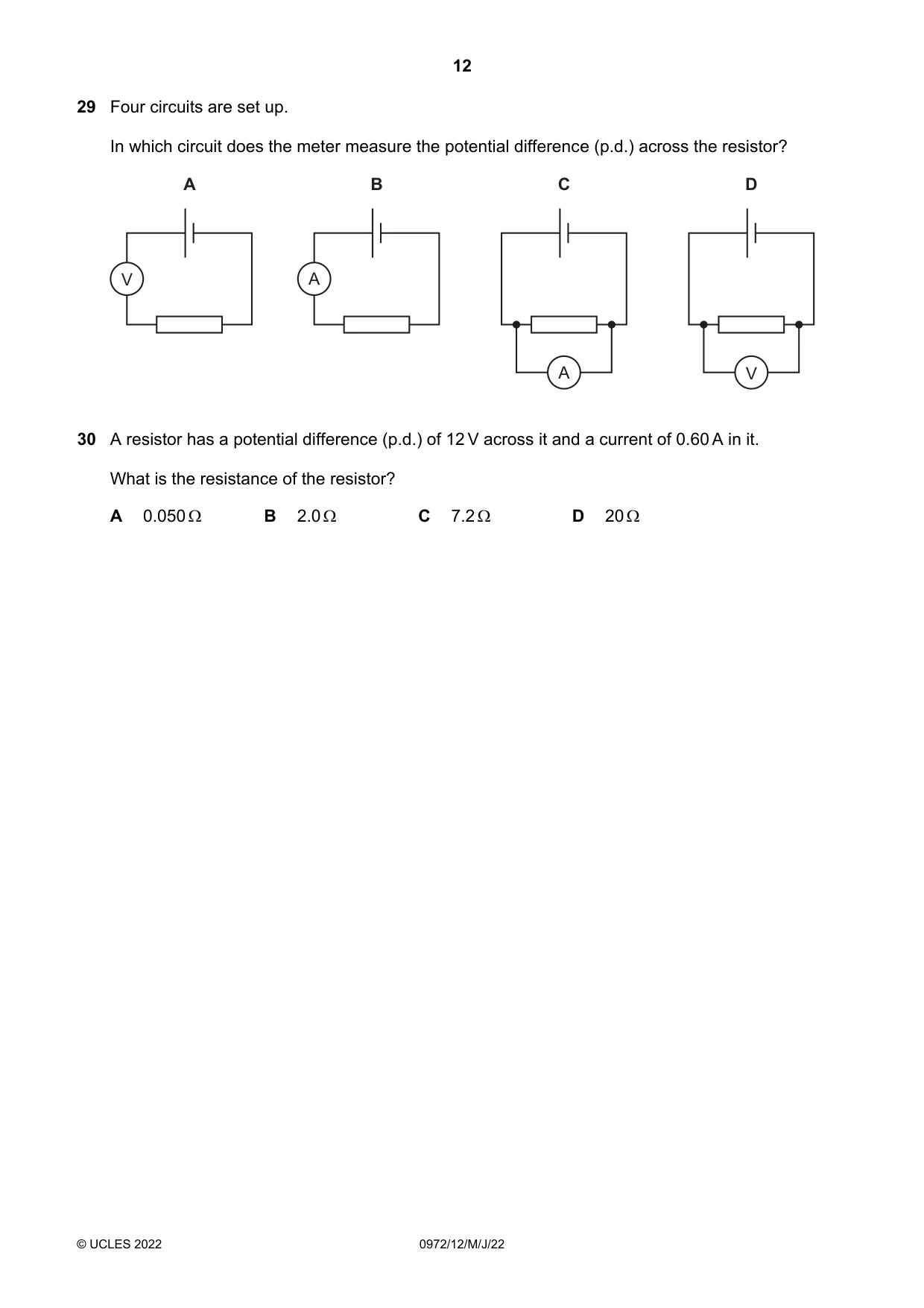
29 Four circuits are set up. In which circuit does the meter measure the potential difference (p.d.) across the resistor? A B C D V A A V
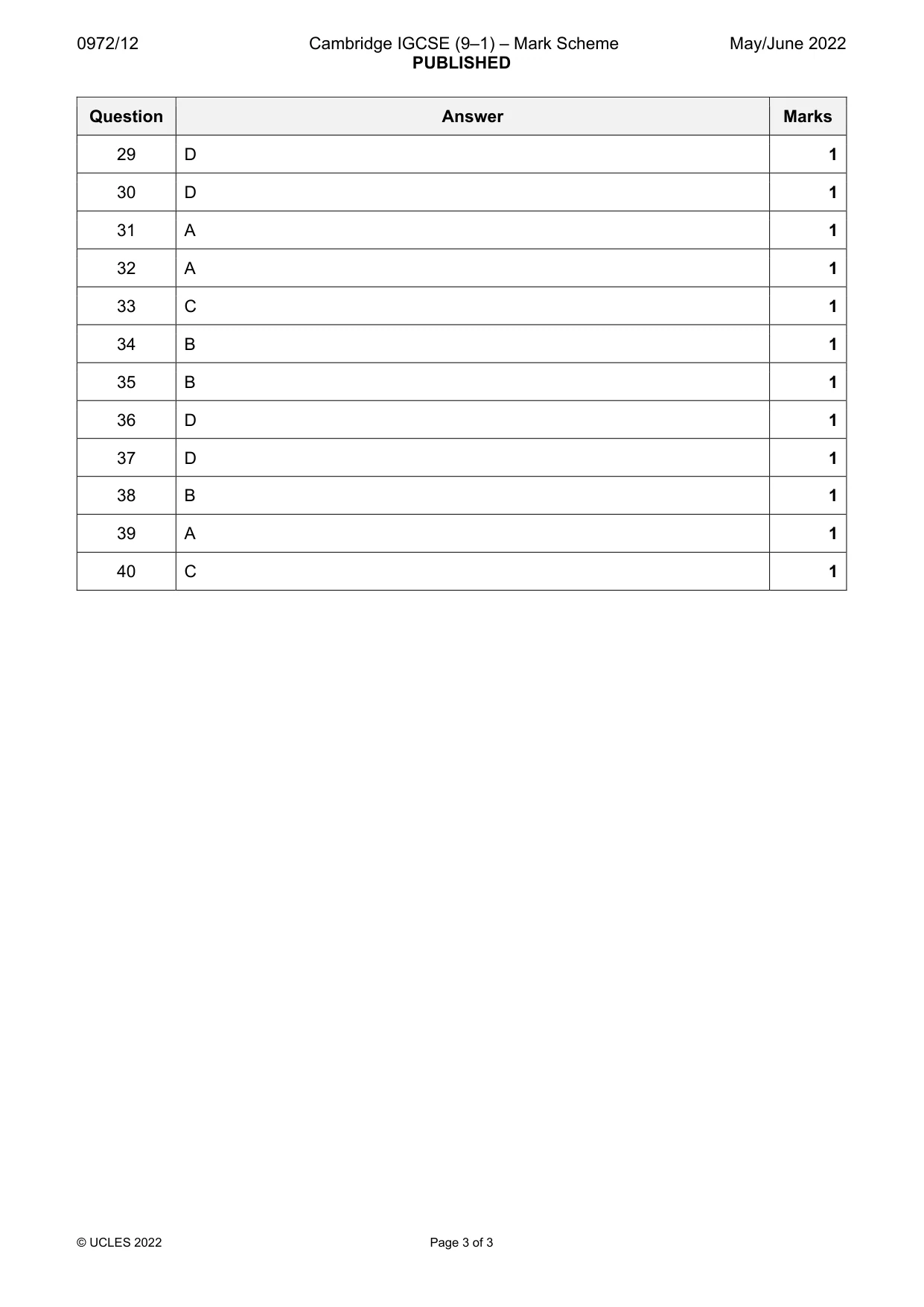
Mark scheme: D
Q30 · A resistor has a potential difference (p.d.) of 12 V across it and a current of 0.60 A in…
30 A resistor has a potential difference (p.d.) of 12 V across it and a current of 0.60 A in it. What is the resistance of the resistor? A 0.050 B 2.0 C 7.2 D 20
Mark scheme: D
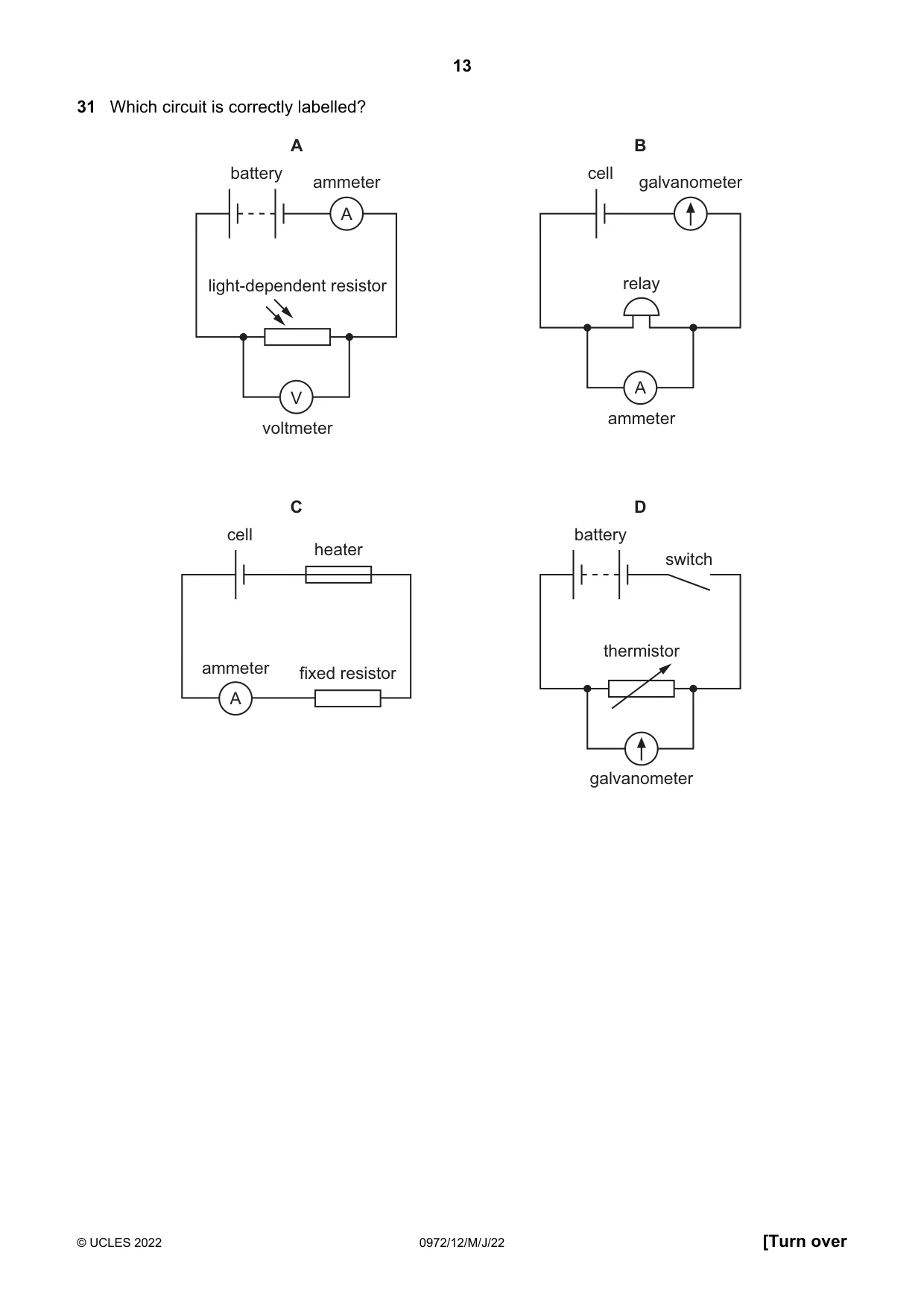
Q31 · Which circuit is correctly labelled?
31 Which circuit is correctly labelled? A B battery cell ammeter galvanometer A light-dependent resistor relay A V ammeter voltmeter C D cell battery heater switch thermistor ammeter fixed resistor A galvanometer
Mark scheme: A
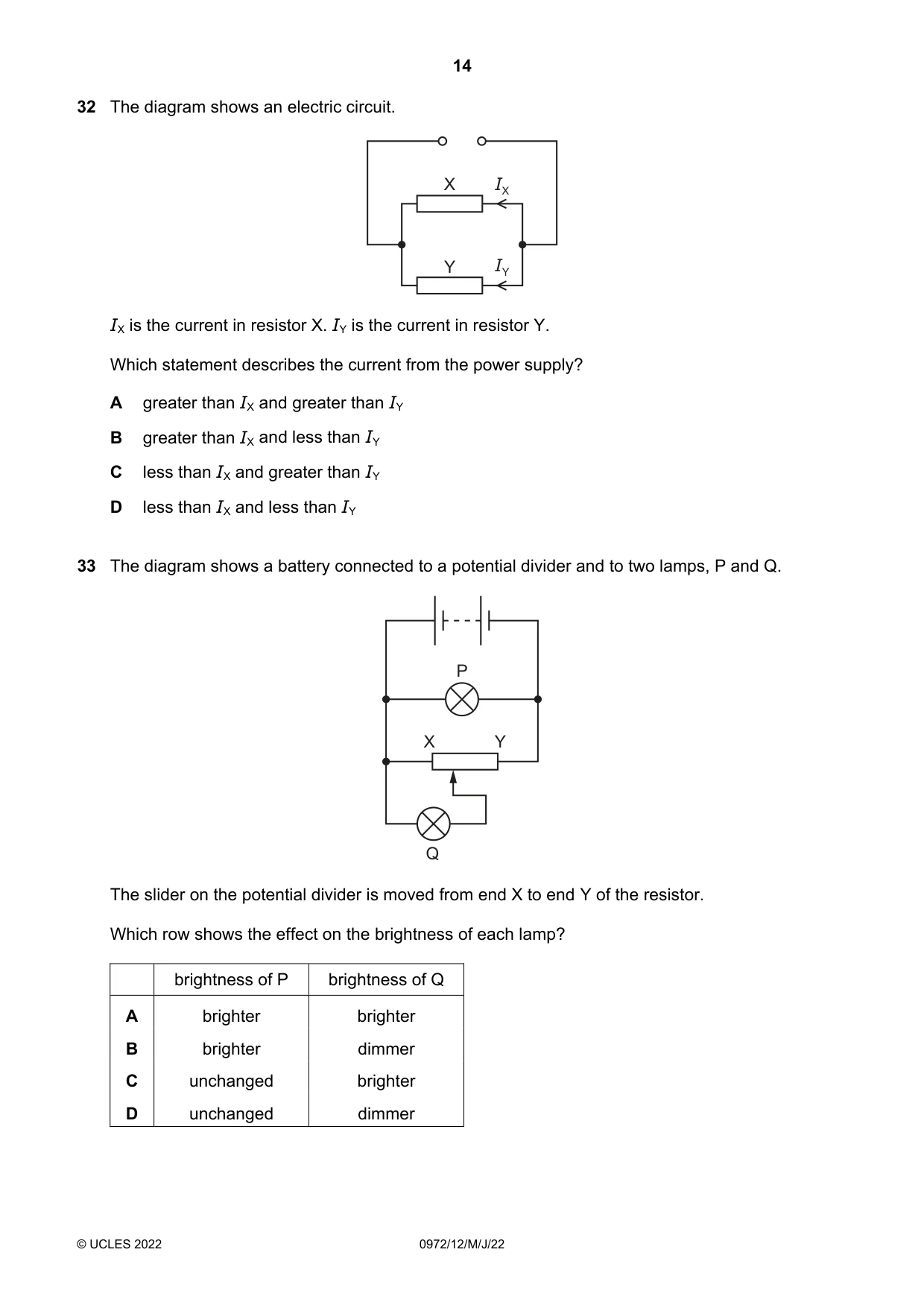
Q32 · The diagram shows an electric circuit
32 The diagram shows an electric circuit. X IX Y IY IX is the current in resistor X. IY is the current in resistor Y. Which statement describes the current from the power supply? A greater than IX and greater than IY B greater than IX and less than IY C less than IX and greater than IY D less than IX and less than IY
Mark scheme: A
Q33 · The diagram shows a battery connected to a potential divider and to two lamps, P and Q
33 The diagram shows a battery connected to a potential divider and to two lamps, P and Q. P X Y Q The slider on the potential divider is moved from end X to end Y of the resistor. Which row shows the effect on the brightness of each lamp? brightness of P brightness of Q A brighter brighter B brighter dimmer C unchanged brighter D unchanged dimmer
Mark scheme: C
Q34 · Why is a fuse used in an electrical circuit?
34 Why is a fuse used in an electrical circuit? A so that the current can have only one value B to prevent the current becoming too large C to provide a path to earth if a fault occurs D to save electrical energy
Mark scheme: B
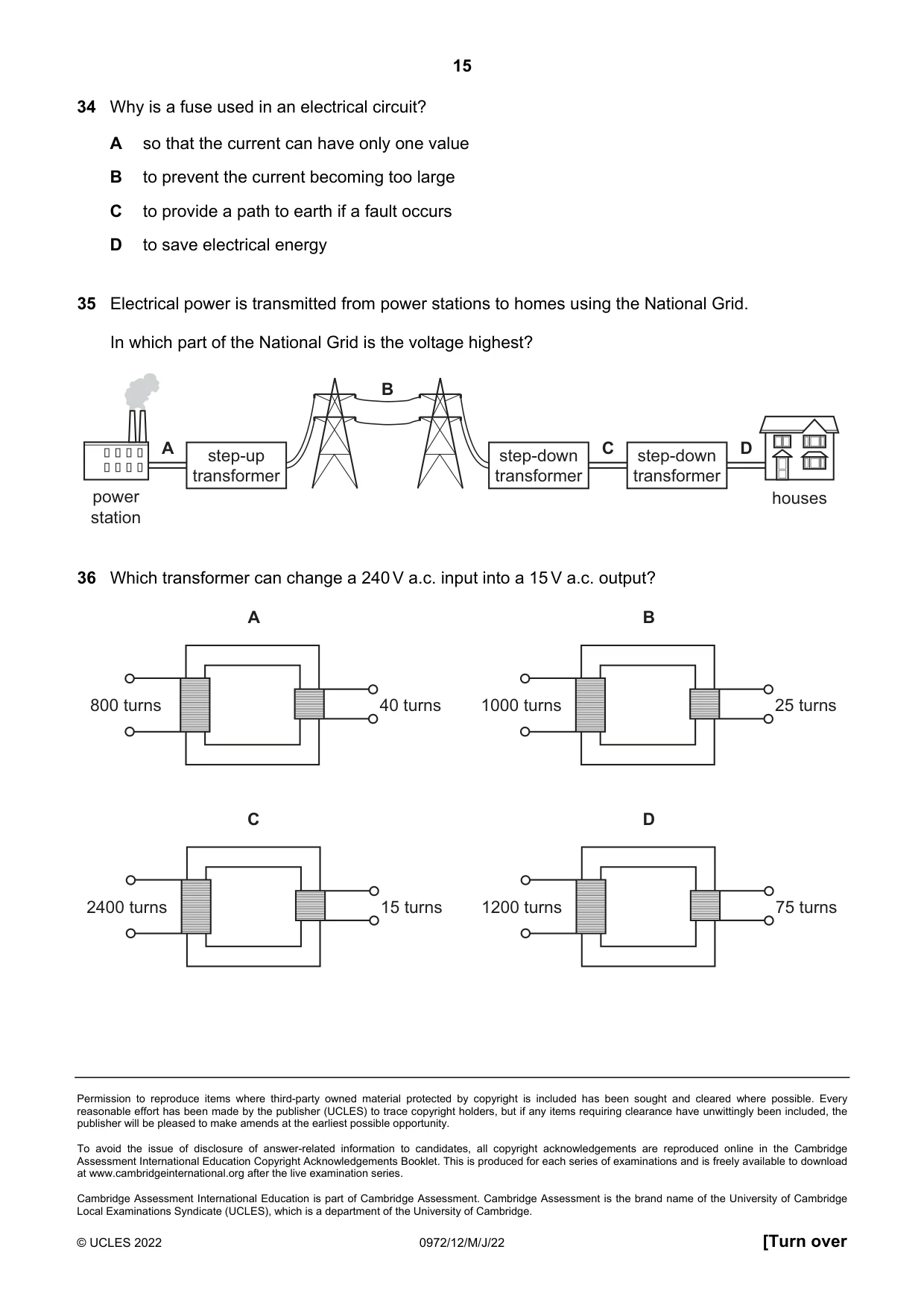
Q35 · Electrical power is transmitted from power stations to homes using the National Grid
35 Electrical power is transmitted from power stations to homes using the National Grid. In which part of the National Grid is the voltage highest? B A C D step-up step-down step-down transformer transformer transformer power houses station
Mark scheme: B
Q36 · Which transformer can change a 240 V a.c
36 Which transformer can change a 240 V a.c. input into a 15 V a.c. output? A B 800 turns 40 turns 1000 turns 25 turns C D 2400 turns 15 turns 1200 turns 75 turns
Mark scheme: D
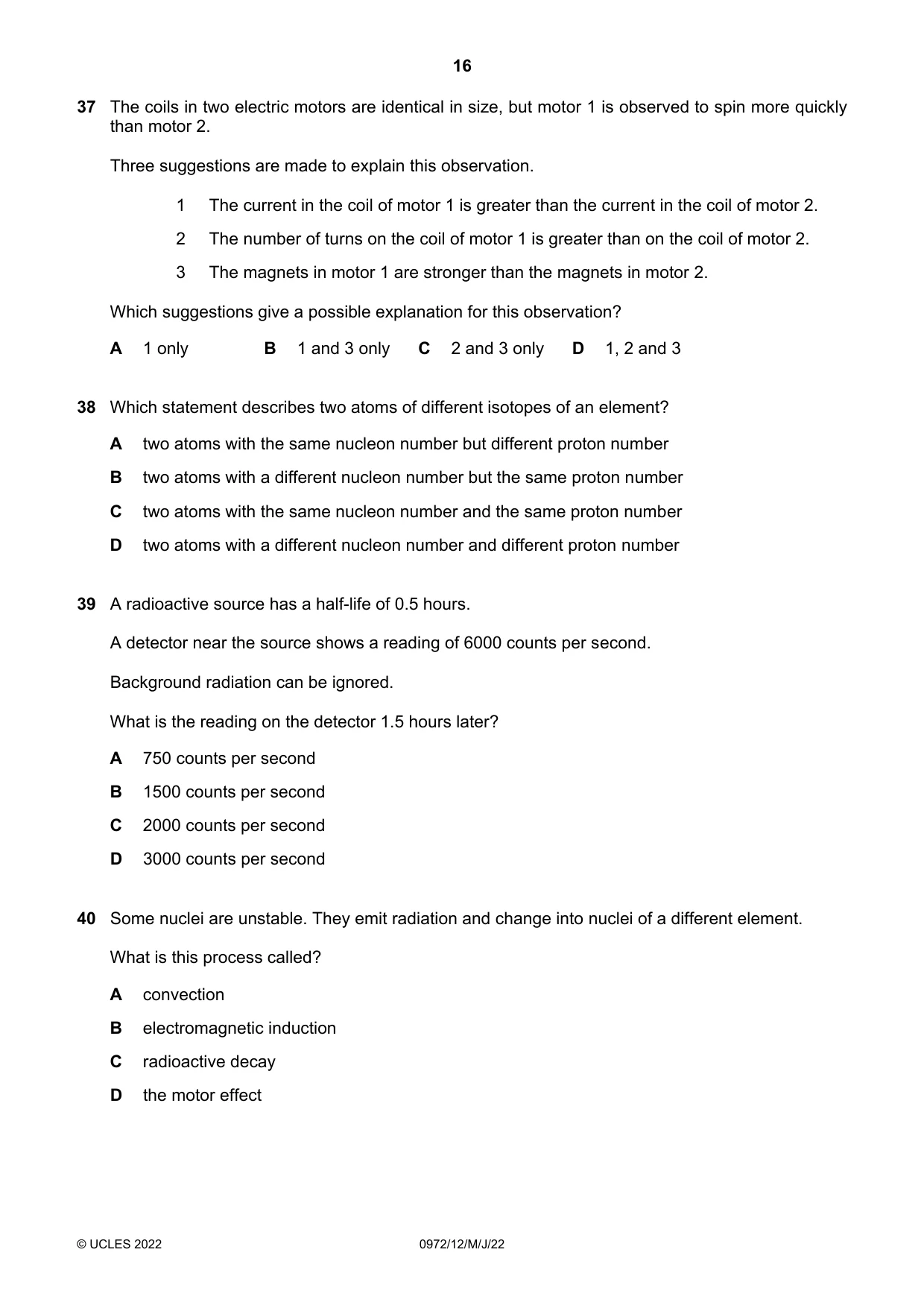
Q37 · The coils in two electric motors are identical in size, but motor 1 is observed to spin…
37 The coils in two electric motors are identical in size, but motor 1 is observed to spin more quickly than motor 2. Three suggestions are made to explain this observation. 1 The current in the coil of motor 1 is greater than the current in the coil of motor 2. 2 The number of turns on the coil of motor 1 is greater than on the coil of motor 2. 3 The magnets in motor 1 are stronger than the magnets in motor 2. Which suggestions give a possible explanation for this observation? A 1 only B 1 and 3 only C 2 and 3 only D 1, 2 and 3
Mark scheme: D
Q38 · Which statement describes two atoms of different isotopes of an element?
38 Which statement describes two atoms of different isotopes of an element? A two atoms with the same nucleon number but different proton number B two atoms with a different nucleon number but the same proton number C two atoms with the same nucleon number and the same proton number D two atoms with a different nucleon number and different proton number
Mark scheme: B
Q39 · A radioactive source has a half-life of 0.5 hours
39 A radioactive source has a half-life of 0.5 hours. A detector near the source shows a reading of 6000 counts per second. Background radiation can be ignored. What is the reading on the detector 1.5 hours later? A 750 counts per second B 1500 counts per second C 2000 counts per second D 3000 counts per second
Mark scheme: A
Q40 · Some nuclei are unstable
40 Some nuclei are unstable. They emit radiation and change into nuclei of a different element. What is this process called? A convection B electromagnetic induction C radioactive decay D the motor effect
Mark scheme: C
What was in this paper
The subtopics covered by these 40 questions, and how many questions each got. Open one in a new tab to see every Cambridge question on it.
4Electromagnetic effects3Forces3Kinetic particle model of matter3Simple phenomena of magnetism3Density2Electromagnetic spectrum2Energy, work and power2General properties of waves2Light2Motion2Pressure2Radioactivity2Thermal properties and temperature2Transfer of thermal energy2Electrical quantities1Electrical safety1Mass and weight1The nuclear model of the atom1What you needed in this session
Cambridge’s own grade thresholds for 2022 May/June, Paper 1 · Variant 2. A higher threshold means an easier paper — the bar moves with how the cohort did.