Cambridge IGCSE Physics (9-1) 0972 — 2022 May/June Paper 1 · Variant 1
0972/11/M/J/22 · 40 questions · 40 marks · ≈45 min
The question paper and its mark scheme, free to read here and free to download. This is Cambridge’s own paper, exactly as it was sat.
Question paper20 pages

Mark scheme3 pages
Answers below. Sit the paper first if you are practising.
Questions as text
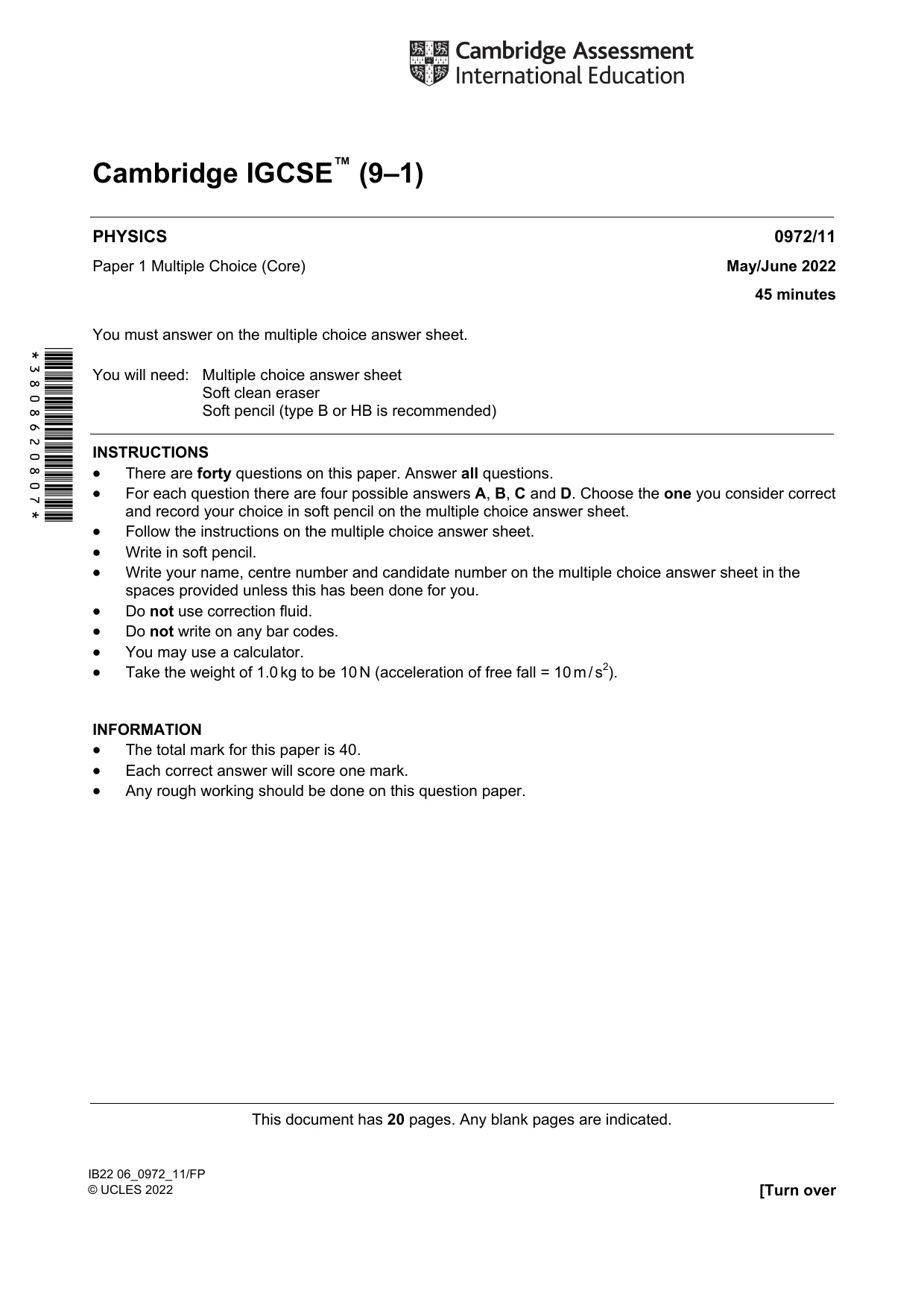
Q1 · A lump of modelling clay is moved from a small measuring cylinder to a large measuring…
1 A lump of modelling clay is moved from a small measuring cylinder to a large measuring cylinder that has twice the diameter. water modelling clay small cylinder large cylinder The reading on the small measuring cylinder goes down by 20 cm3. By how much does the reading on the large cylinder go up? A 10 cm3 B 20 cm3 C 40 cm3 D 80 cm3
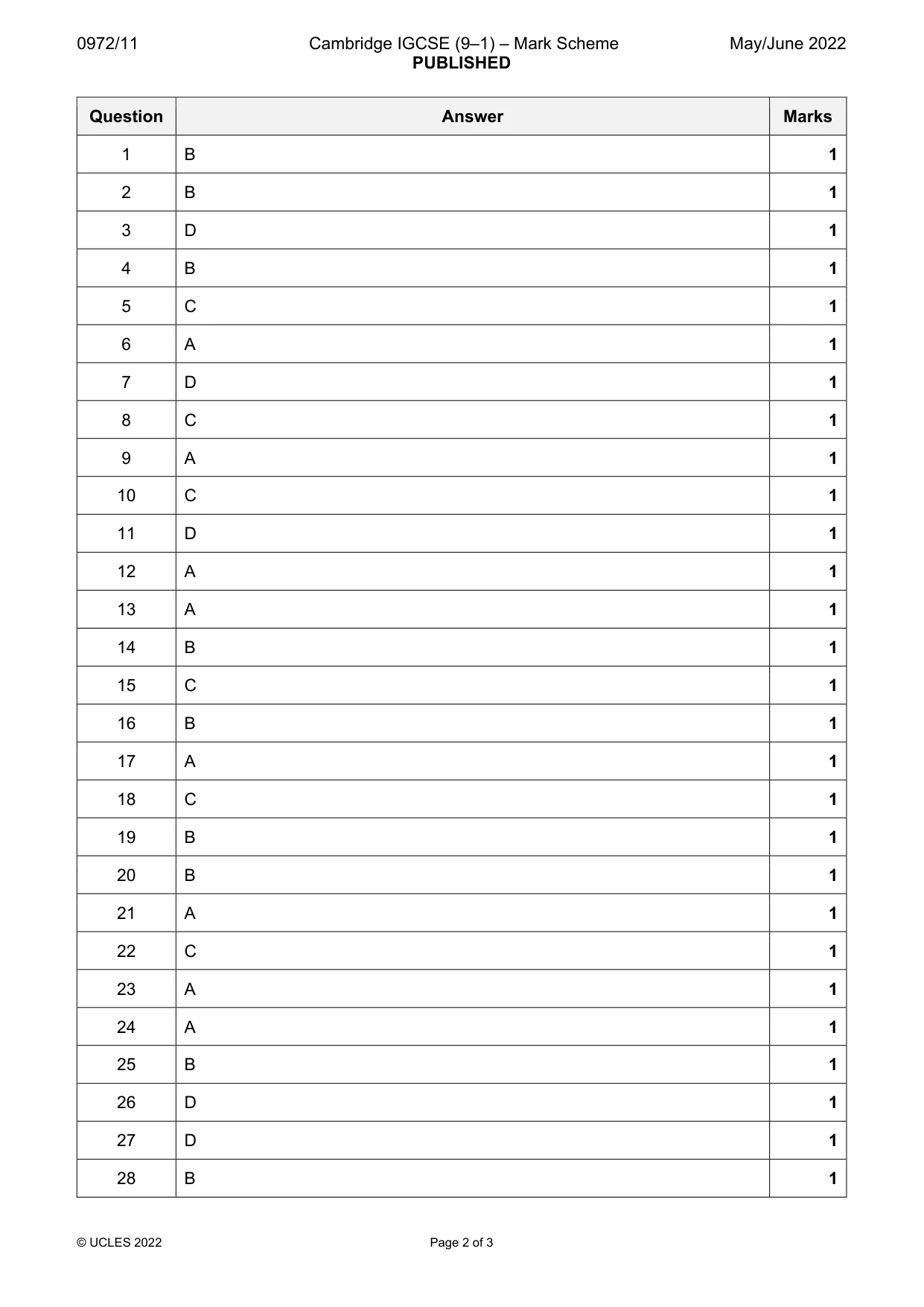
Mark scheme: B
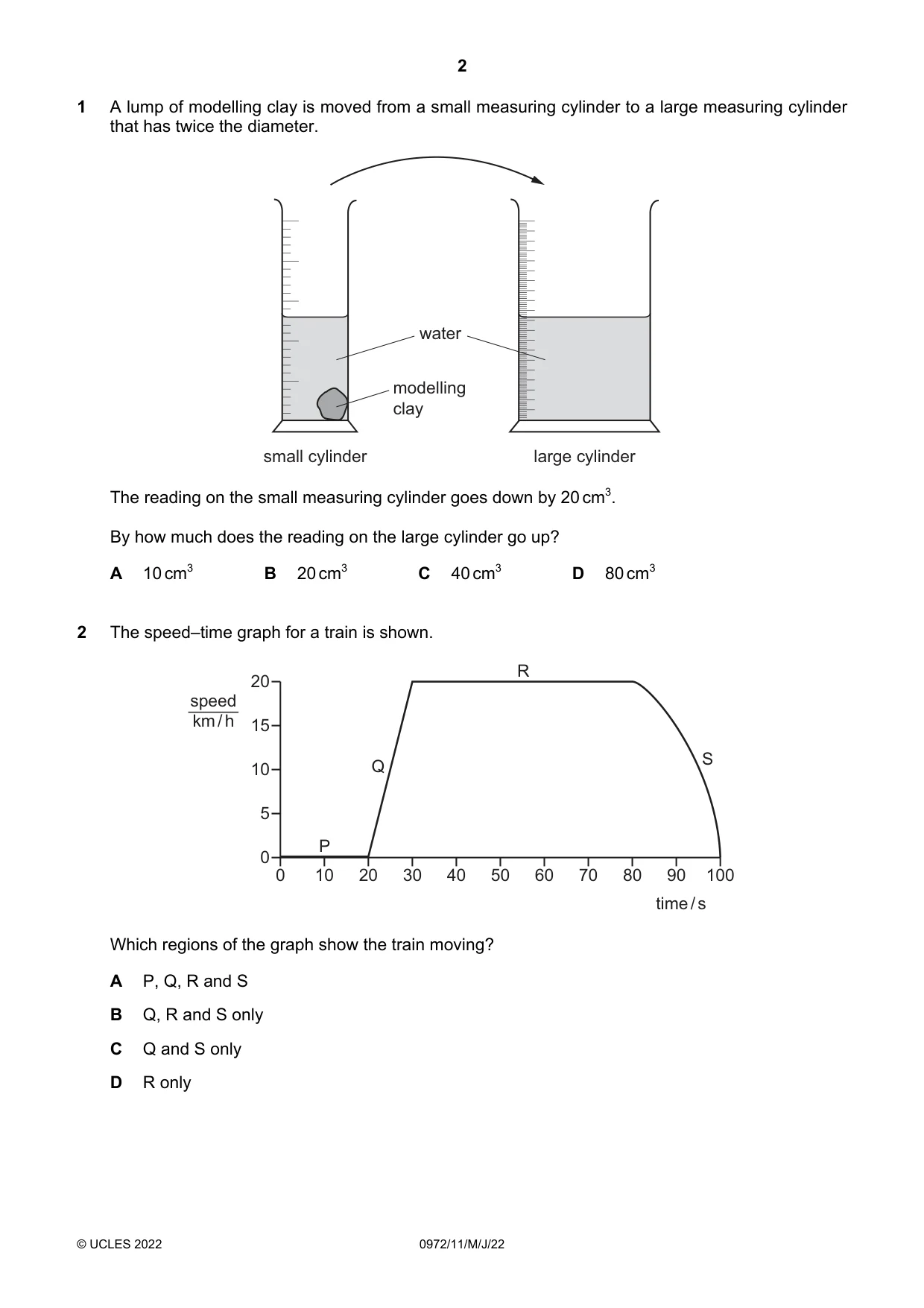
Q2 · The speed–time graph for a train is shown
2 The speed–time graph for a train is shown. R 20 speed km / h 15 Q S 10 5 P 0 0 10 20 30 40 50 60 70 80 90 100 time / s Which regions of the graph show the train moving? A P, Q, R and S B Q, R and S only C Q and S only D R only
Mark scheme: B
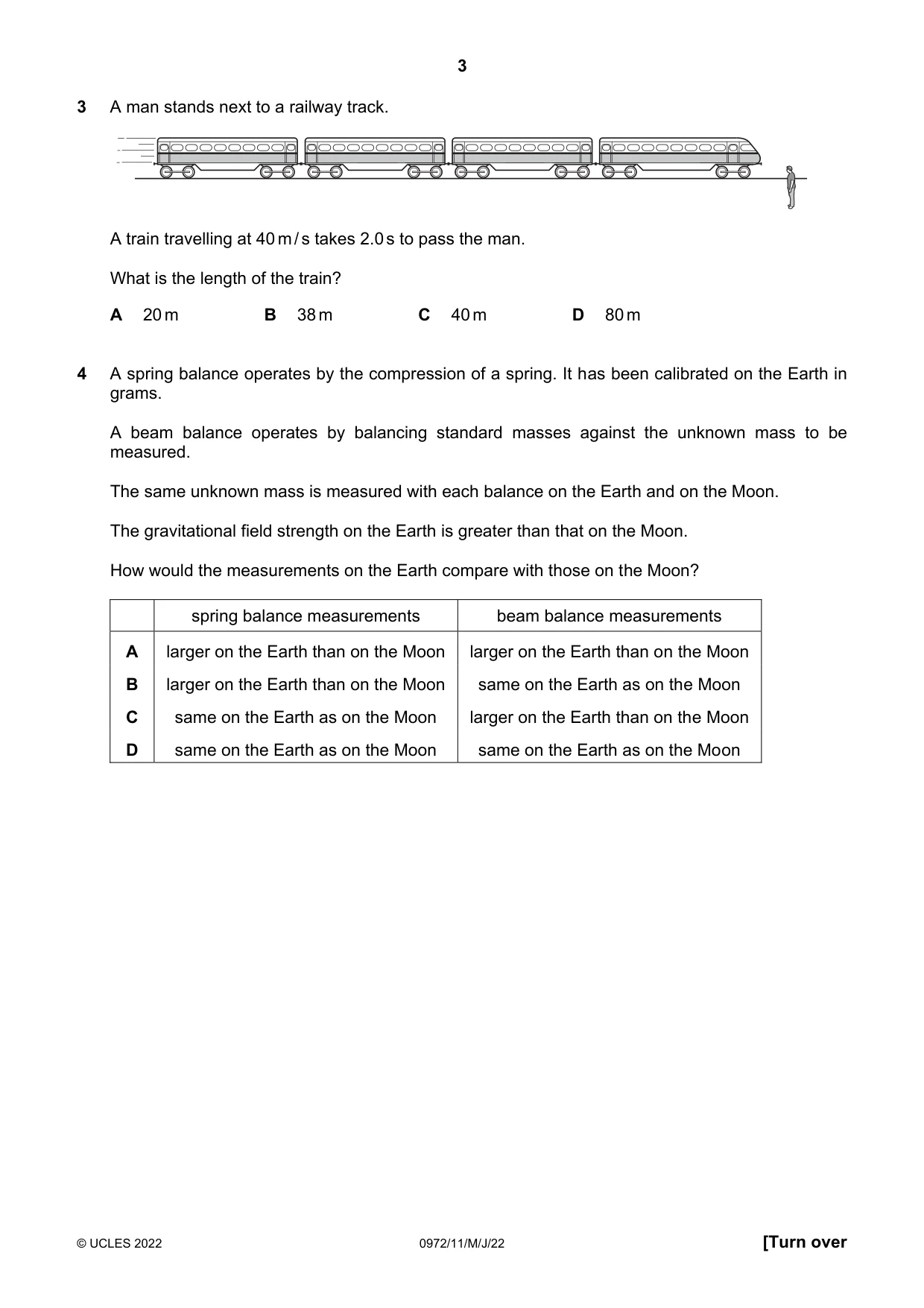
Q3 · A man stands next to a railway track
3 A man stands next to a railway track. A train travelling at 40 m / s takes 2.0 s to pass the man. What is the length of the train? A 20 m B 38 m C 40 m D 80 m
Mark scheme: D
Q4 · A spring balance operates by the compression of a spring
4 A spring balance operates by the compression of a spring. It has been calibrated on the Earth in grams. A beam balance operates by balancing standard masses against the unknown mass to be measured. The same unknown mass is measured with each balance on the Earth and on the Moon. The gravitational field strength on the Earth is greater than that on the Moon. How would the measurements on the Earth compare with those on the Moon? spring balance measurements beam balance measurements A larger on the Earth than on the Moon larger on the Earth than on the Moon B larger on the Earth than on the Moon same on the Earth as on the Moon C same on the Earth as on the Moon larger on the Earth than on the Moon D same on the Earth as on the Moon same on the Earth as on the Moon
Mark scheme: B
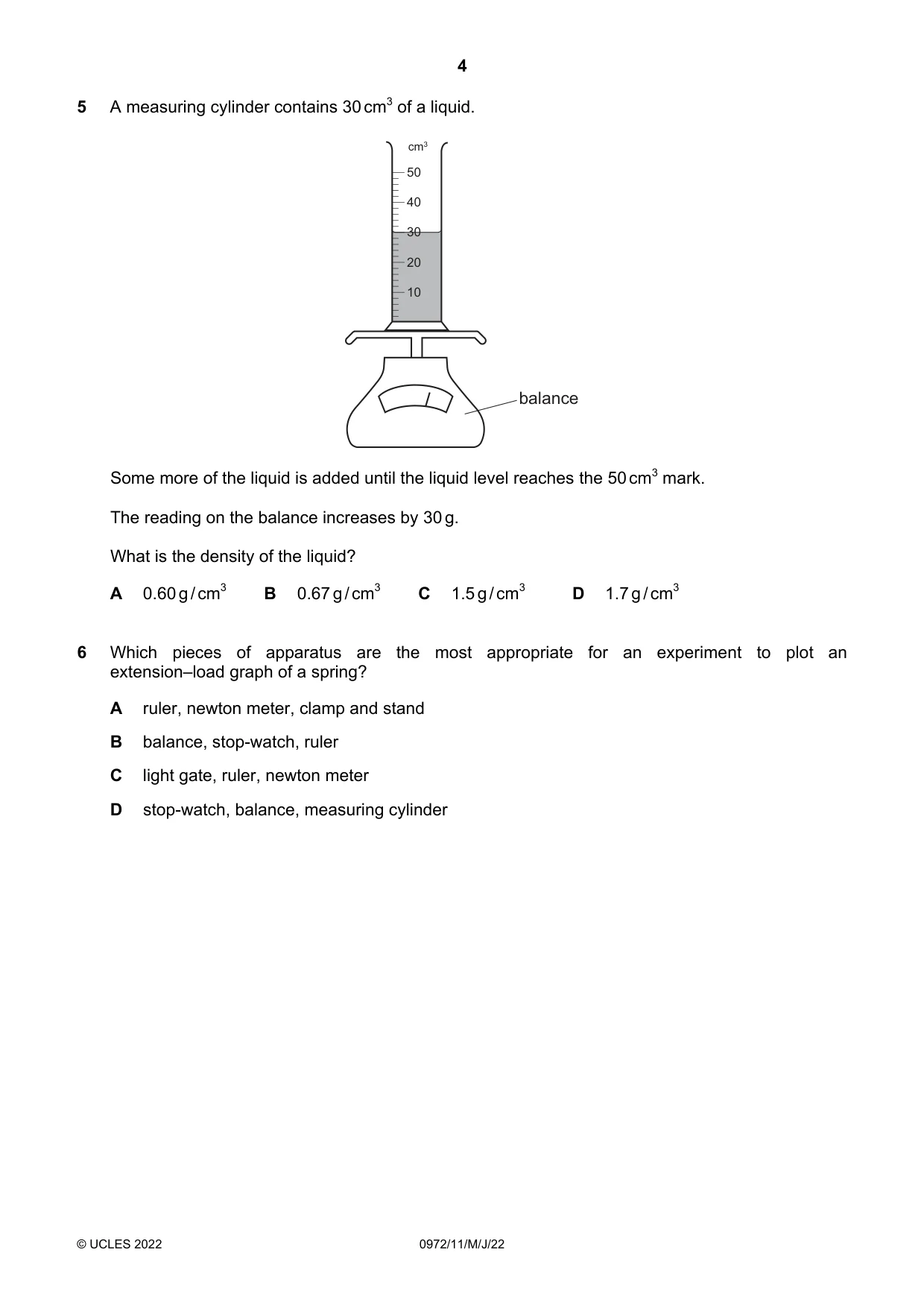
Q5 · A measuring cylinder contains 30 cm3 of a liquid
5 A measuring cylinder contains 30 cm3 of a liquid. cm3 50 40 30 20 10 balance Some more of the liquid is added until the liquid level reaches the 50 cm3 mark. The reading on the balance increases by 30 g. What is the density of the liquid? A 0.60 g / cm3 B 0.67 g / cm3 C 1.5 g / cm3 D 1.7 g / cm3
Mark scheme: C
Q6 · Which pieces of apparatus are the most appropriate for an experiment to plot an…
6 Which pieces of apparatus are the most appropriate for an experiment to plot an extension–load graph of a spring? A ruler, newton meter, clamp and stand B balance, stop-watch, ruler C light gate, ruler, newton meter D stop-watch, balance, measuring cylinder
Mark scheme: A
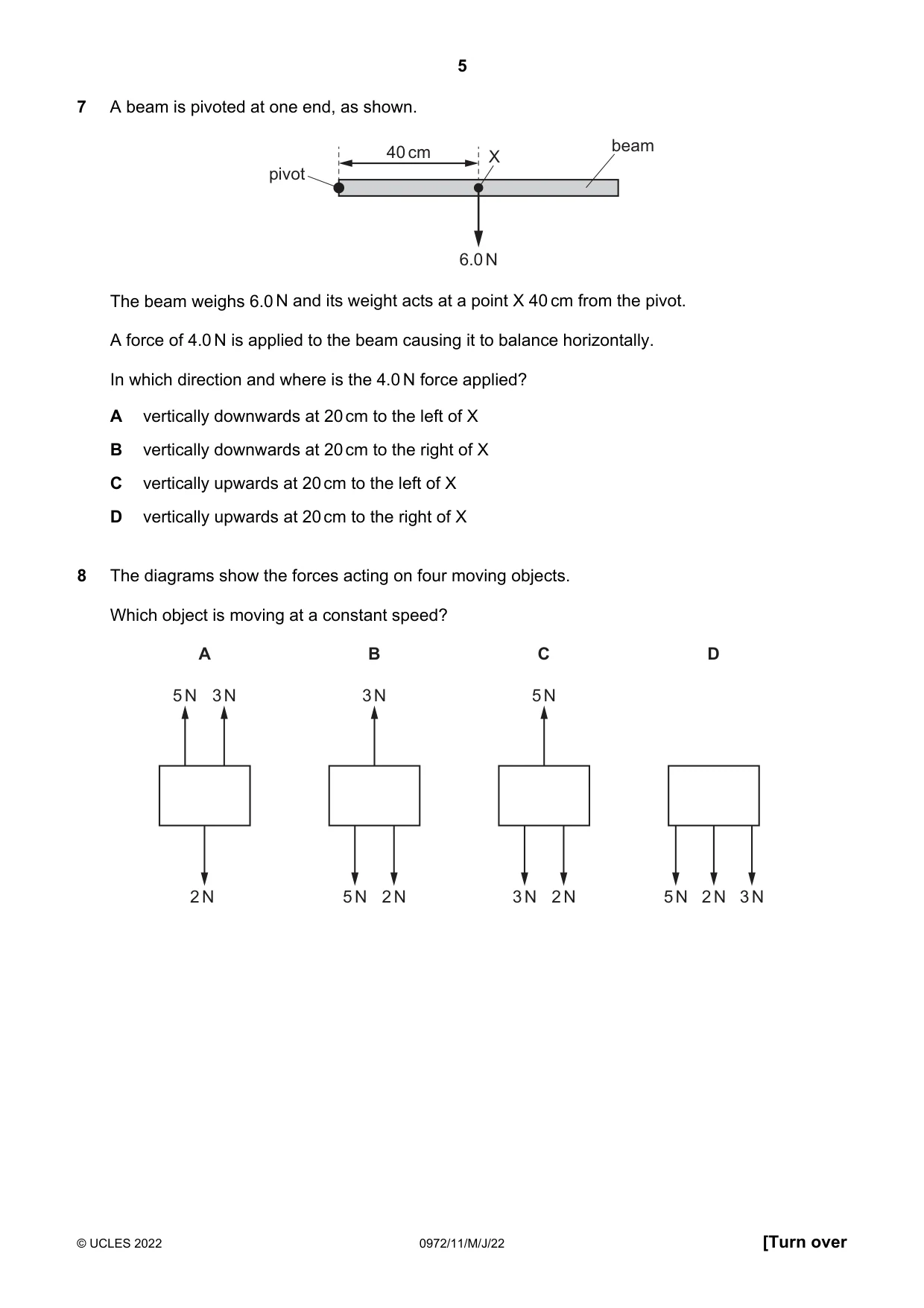
Q7 · A beam is pivoted at one end, as shown
7 A beam is pivoted at one end, as shown. 40 cm beam X pivot 6.0 N The beam weighs 6.0 N and its weight acts at a point X 40 cm from the pivot. A force of 4.0 N is applied to the beam causing it to balance horizontally. In which direction and where is the 4.0 N force applied? A vertically downwards at 20 cm to the left of X B vertically downwards at 20 cm to the right of X C vertically upwards at 20 cm to the left of X D vertically upwards at 20 cm to the right of X
Mark scheme: D
Q8 · The diagrams show the forces acting on four moving objects
8 The diagrams show the forces acting on four moving objects. Which object is moving at a constant speed? A B C D 5 N 3 N 3 N 5 N 2 N 5 N 2 N 3 N 2 N 5 N 2 N 3 N
Mark scheme: C
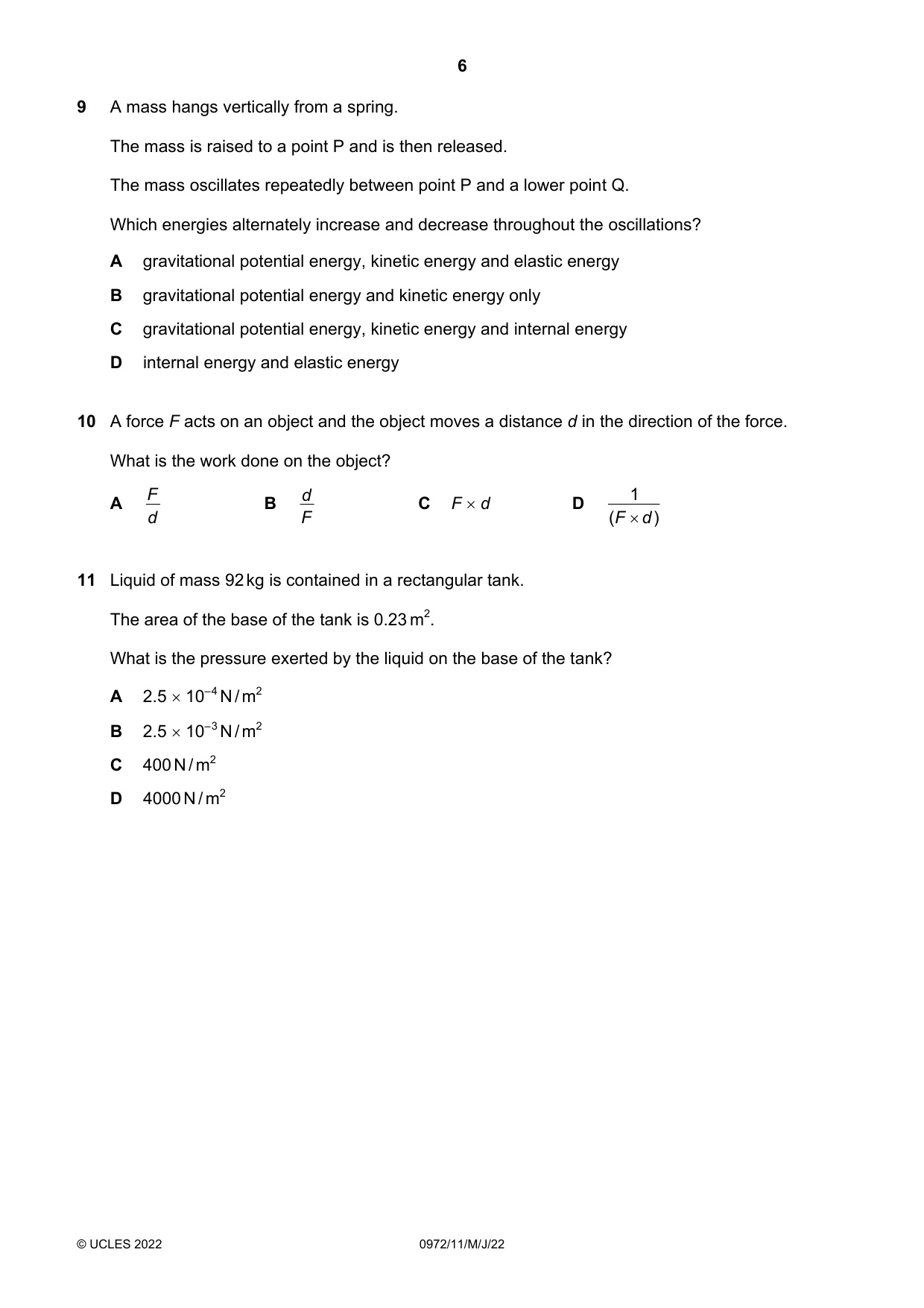
Q9 · A mass hangs vertically from a spring
9 A mass hangs vertically from a spring. The mass is raised to a point P and is then released. The mass oscillates repeatedly between point P and a lower point Q. Which energies alternately increase and decrease throughout the oscillations? A gravitational potential energy, kinetic energy and elastic energy B gravitational potential energy and kinetic energy only C gravitational potential energy, kinetic energy and internal energy D internal energy and elastic energy
Mark scheme: A
Q10 · A force F acts on an object and the object moves a distance d in the direction of the…
10 A force F acts on an object and the object moves a distance d in the direction of the force. What is the work done on the object? F d F d 1 A B C D d F ( F d )
Mark scheme: C
Q11 · Liquid of mass 92 kg is contained in a rectangular tank
11 Liquid of mass 92 kg is contained in a rectangular tank. The area of the base of the tank is 0.23 m2. What is the pressure exerted by the liquid on the base of the tank? A 2.5 10– 4 N / m2 B 2.5 10– 3 N / m2 C 400 N / m2 D 4000 N / m2
Mark scheme: D
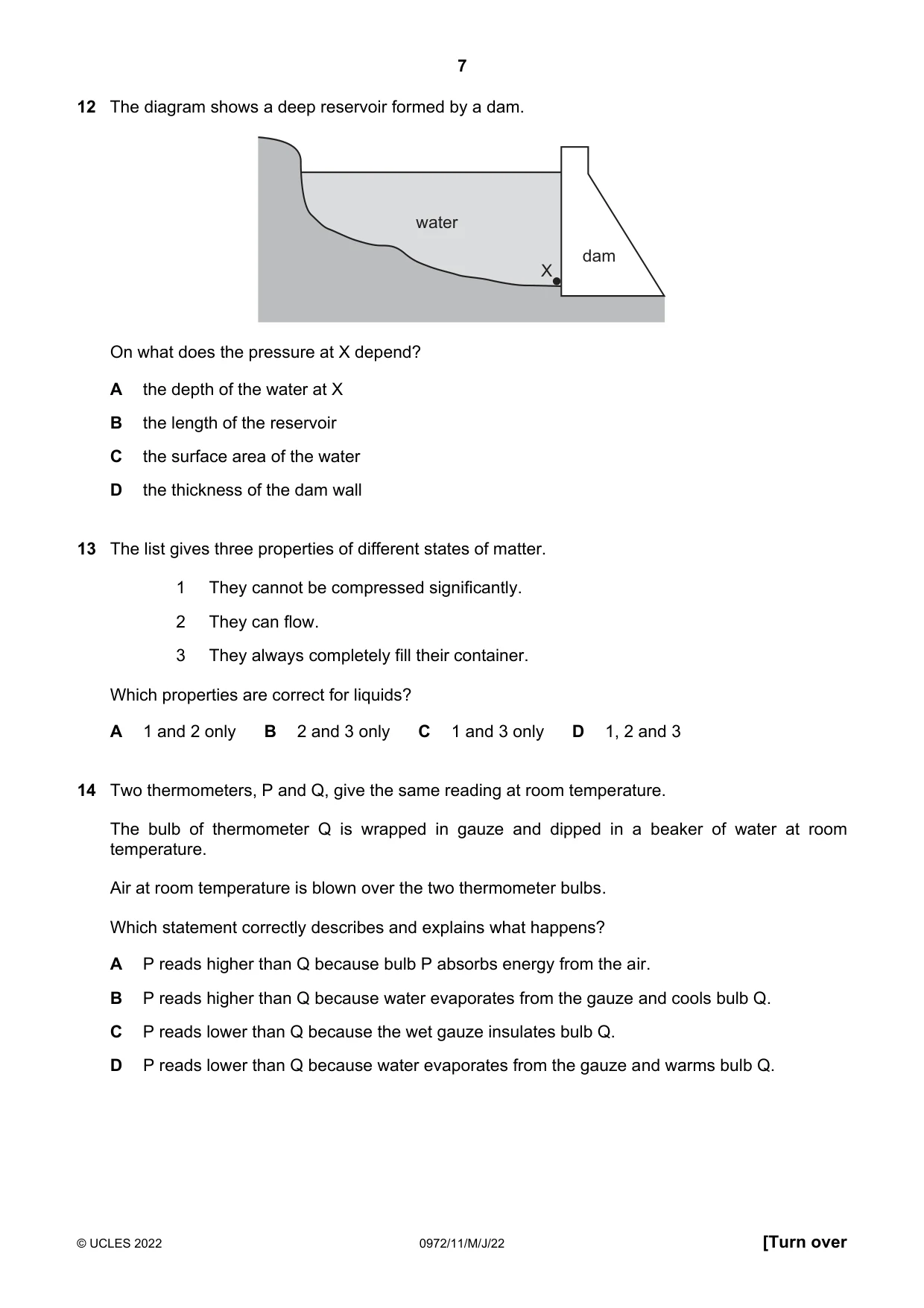
Q12 · The diagram shows a deep reservoir formed by a dam
12 The diagram shows a deep reservoir formed by a dam. water dam X On what does the pressure at X depend? A the depth of the water at X B the length of the reservoir C the surface area of the water D the thickness of the dam wall
Mark scheme: A
Q13 · The list gives three properties of different states of matter
13 The list gives three properties of different states of matter. 1 They cannot be compressed significantly. 2 They can flow. 3 They always completely fill their container. Which properties are correct for liquids? A 1 and 2 only B 2 and 3 only C 1 and 3 only D 1, 2 and 3
Mark scheme: A
Q14 · Two thermometers, P and Q, give the same reading at room temperature
14 Two thermometers, P and Q, give the same reading at room temperature. The bulb of thermometer Q is wrapped in gauze and dipped in a beaker of water at room temperature. Air at room temperature is blown over the two thermometer bulbs. Which statement correctly describes and explains what happens? A P reads higher than Q because bulb P absorbs energy from the air. B P reads higher than Q because water evaporates from the gauze and cools bulb Q. C P reads lower than Q because the wet gauze insulates bulb Q. D P reads lower than Q because water evaporates from the gauze and warms bulb Q.
Mark scheme: B
Q15 · What happens to the volumes of liquid metal and of solid metal when heated at constant…
15 What happens to the volumes of liquid metal and of solid metal when heated at constant pressure? volume of volume of liquid metal solid metal A decreases increases B decreases no change C increases increases D increases no change
Mark scheme: C
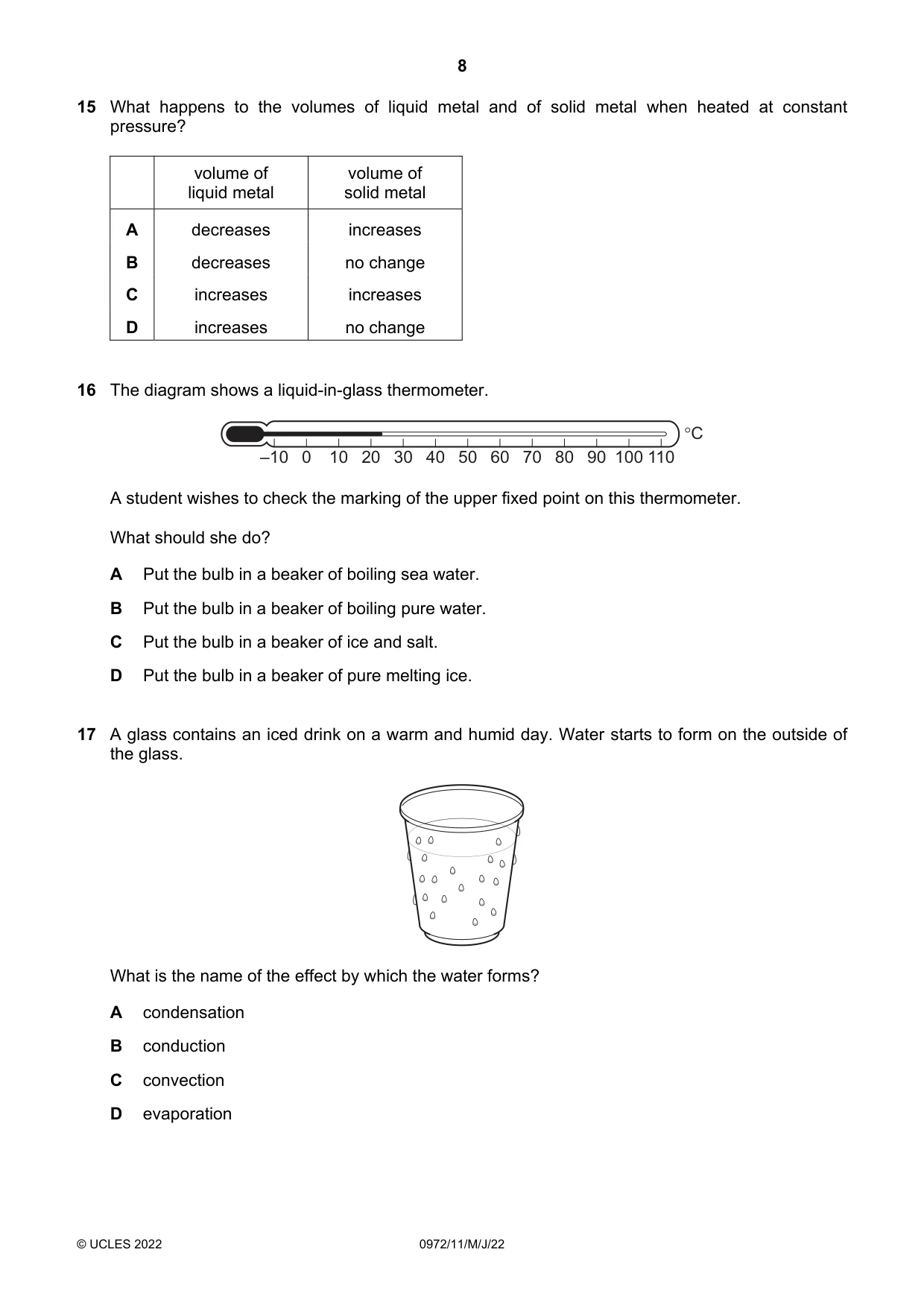
Q16 · The diagram shows a liquid-in-glass thermometer
16 The diagram shows a liquid-in-glass thermometer. °C –10 0 10 20 30 40 50 60 70 80 90 100 110 A student wishes to check the marking of the upper fixed point on this thermometer. What should she do? A Put the bulb in a beaker of boiling sea water. B Put the bulb in a beaker of boiling pure water. C Put the bulb in a beaker of ice and salt. D Put the bulb in a beaker of pure melting ice.
Mark scheme: B
Q17 · A glass contains an iced drink on a warm and humid day
17 A glass contains an iced drink on a warm and humid day. Water starts to form on the outside of the glass. What is the name of the effect by which the water forms? A condensation B conduction C convection D evaporation
Mark scheme: A
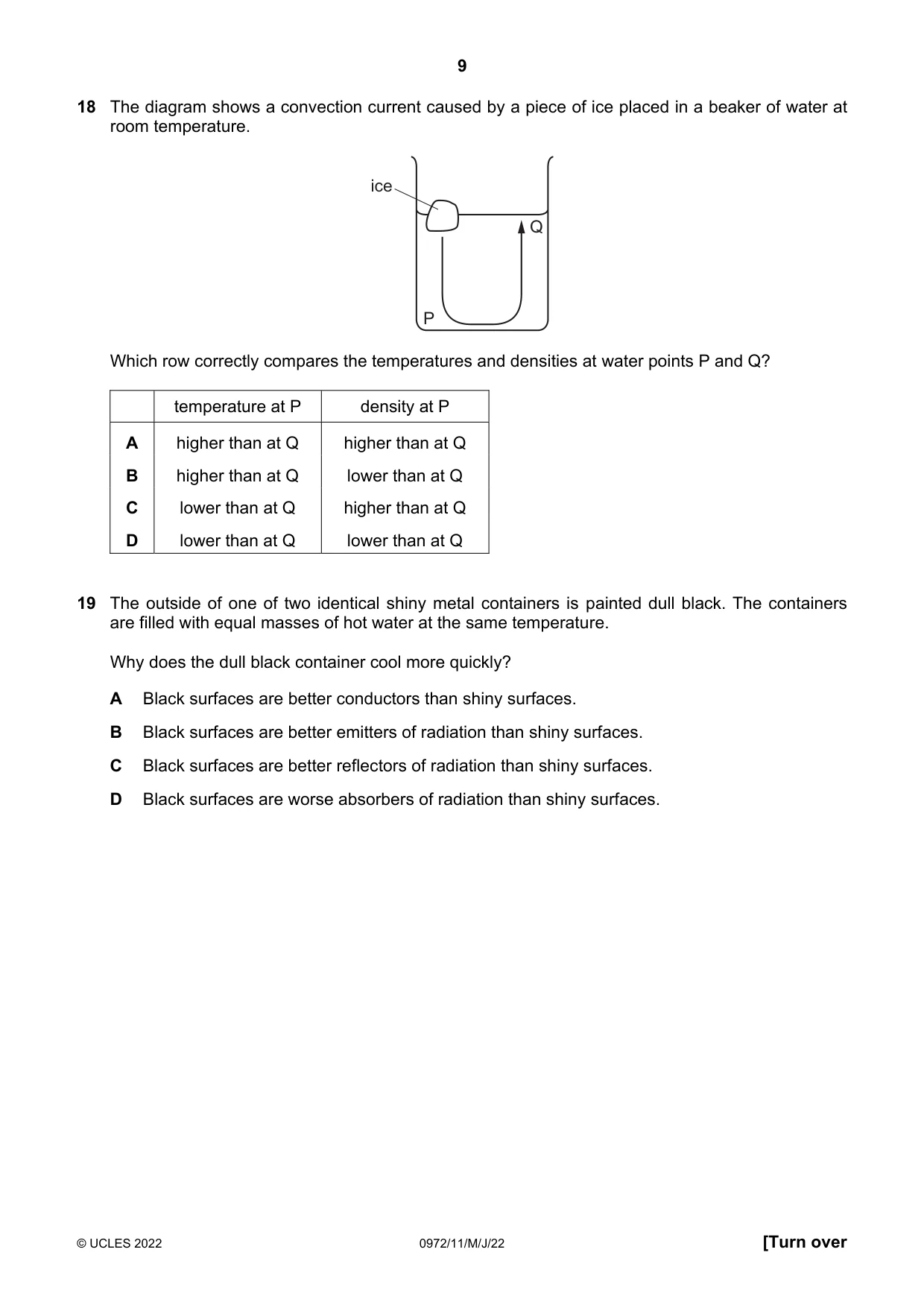
Q18 · The diagram shows a convection current caused by a piece of ice placed in a beaker of…
18 The diagram shows a convection current caused by a piece of ice placed in a beaker of water at room temperature. ice Q P Which row correctly compares the temperatures and densities at water points P and Q? temperature at P density at P A higher than at Q higher than at Q B higher than at Q lower than at Q C lower than at Q higher than at Q D lower than at Q lower than at Q
Mark scheme: C
Q19 · The outside of one of two identical shiny metal containers is painted dull black
19 The outside of one of two identical shiny metal containers is painted dull black. The containers are filled with equal masses of hot water at the same temperature. Why does the dull black container cool more quickly? A Black surfaces are better conductors than shiny surfaces. B Black surfaces are better emitters of radiation than shiny surfaces. C Black surfaces are better reflectors of radiation than shiny surfaces. D Black surfaces are worse absorbers of radiation than shiny surfaces.
Mark scheme: B
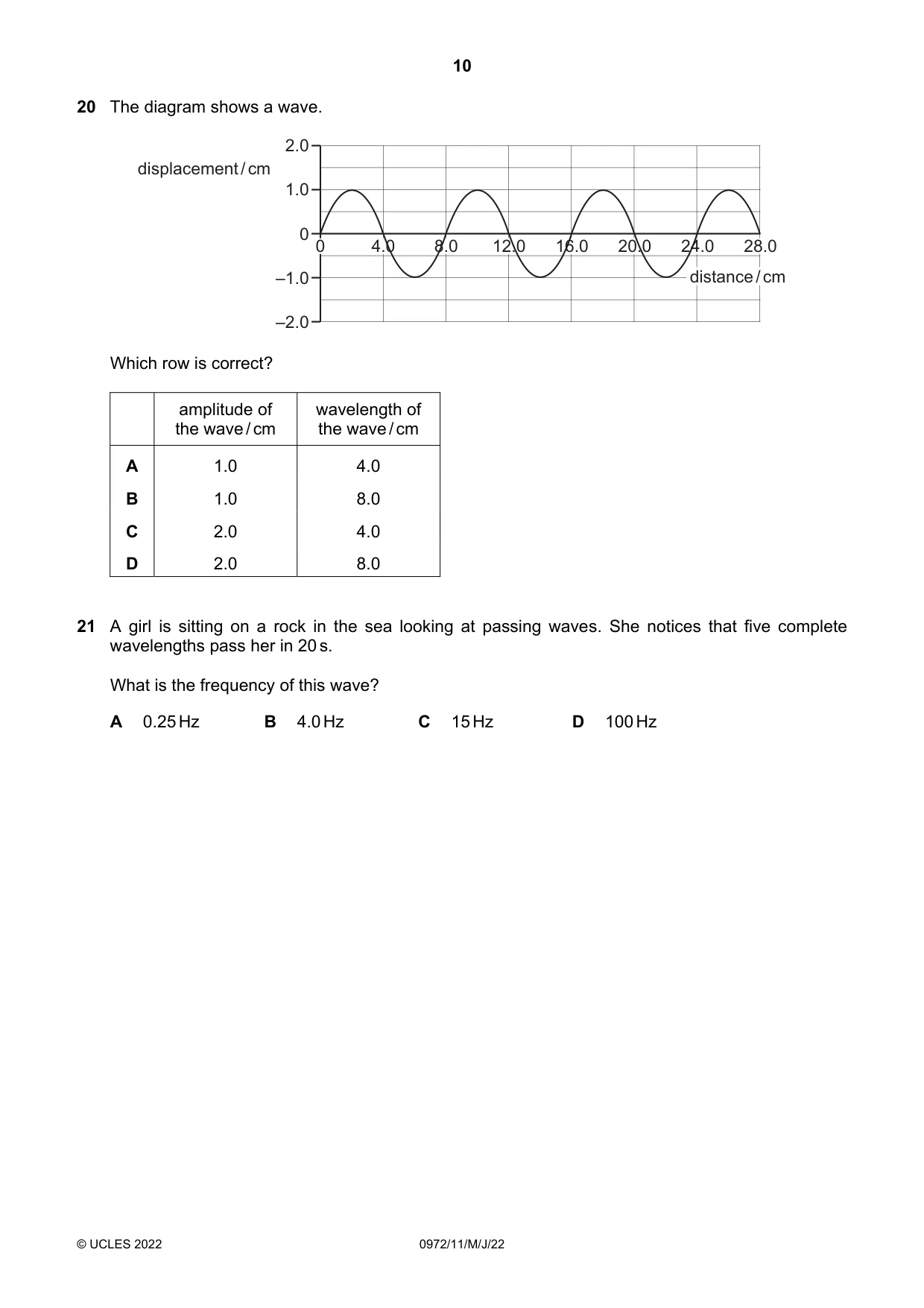
Q20 · The diagram shows a wave
20 The diagram shows a wave. 2.0 displacement / cm 1.0 0 0 4.0 8.0 12.0 16.0 20.0 24.0 28.0 –1.0 distance / cm –2.0 Which row is correct? amplitude of wavelength of the wave / cm the wave / cm A 1.0 4.0 B 1.0 8.0 C 2.0 4.0 D 2.0 8.0
Mark scheme: B
Q21 · A girl is sitting on a rock in the sea looking at passing waves
21 A girl is sitting on a rock in the sea looking at passing waves. She notices that five complete wavelengths pass her in 20 s. What is the frequency of this wave? A 0.25 Hz B 4.0 Hz C 15 Hz D 100 Hz
Mark scheme: A
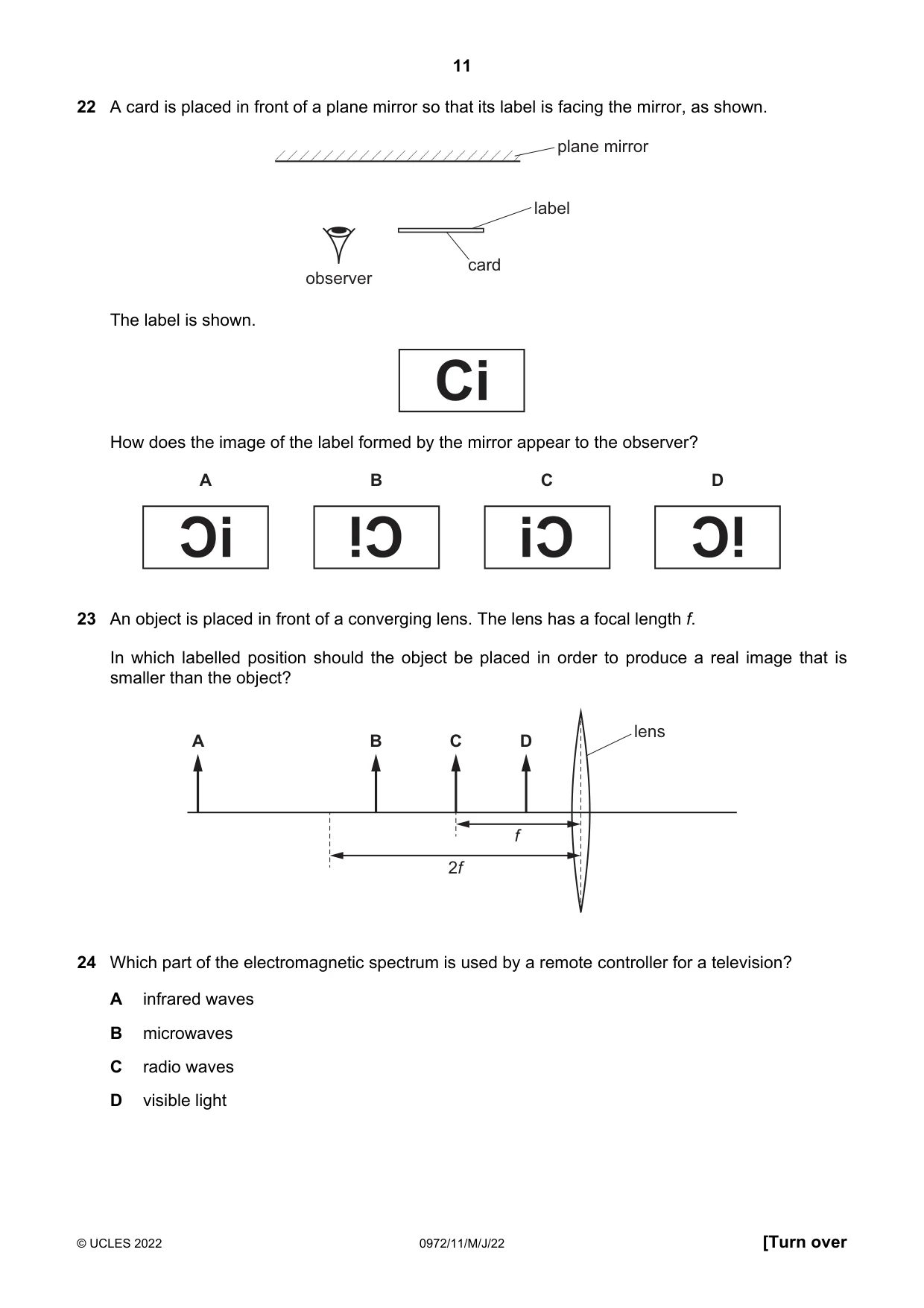
Q22 · A card is placed in front of a plane mirror so that its label is facing the mirror, as…
22 A card is placed in front of a plane mirror so that its label is facing the mirror, as shown. plane mirror label card observer The label is shown. How does the image of the label formed by the mirror appear to the observer? A B C D
Mark scheme: C
Q23 · An object is placed in front of a converging lens
23 An object is placed in front of a converging lens. The lens has a focal length f. In which labelled position should the object be placed in order to produce a real image that is smaller than the object? lens A B C D f 2f
Mark scheme: A
Q24 · Which part of the electromagnetic spectrum is used by a remote controller for a…
24 Which part of the electromagnetic spectrum is used by a remote controller for a television? A infrared waves B microwaves C radio waves D visible light
Mark scheme: A
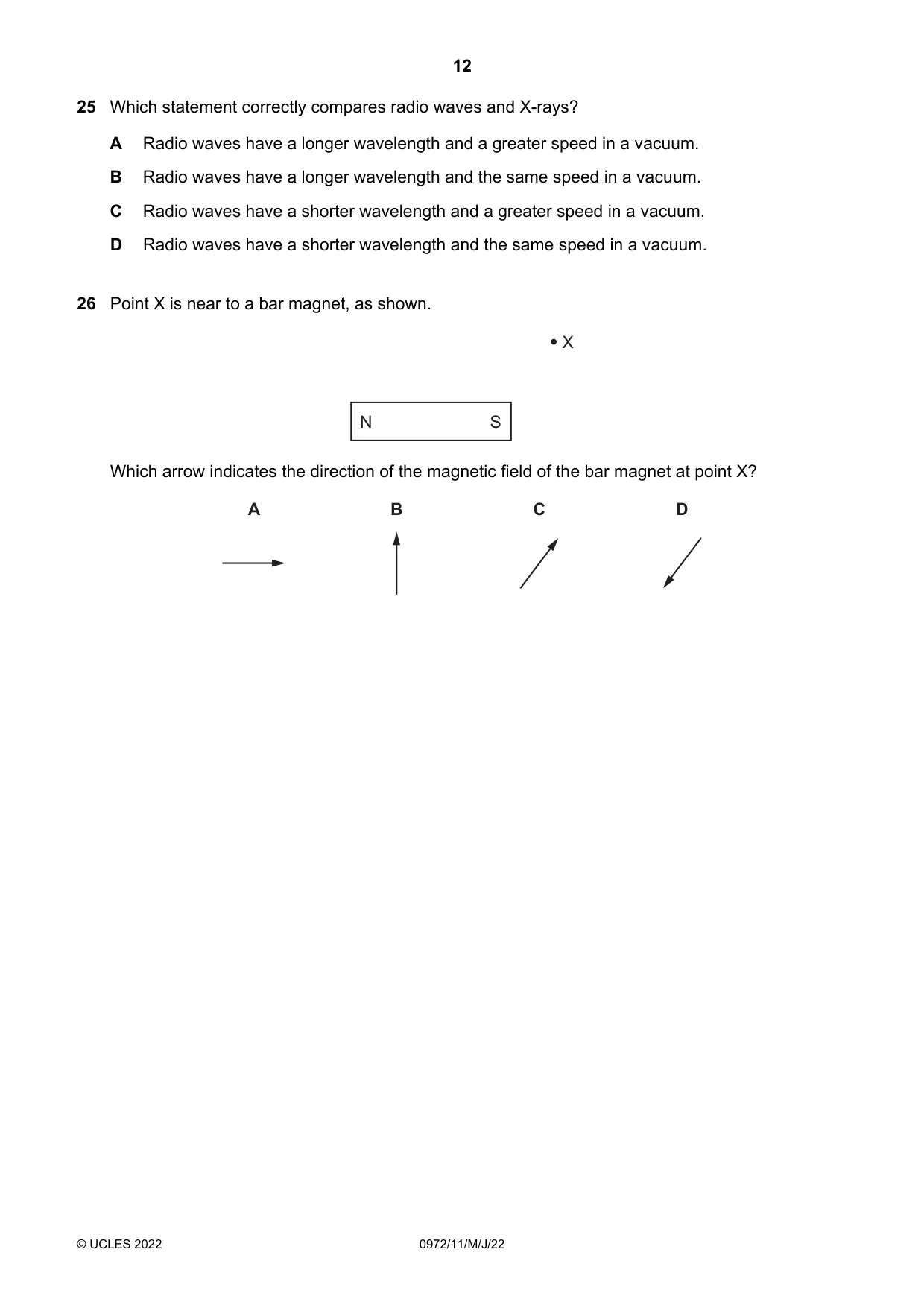
Q25 · Which statement correctly compares radio waves and X-rays?
25 Which statement correctly compares radio waves and X-rays? A Radio waves have a longer wavelength and a greater speed in a vacuum. B Radio waves have a longer wavelength and the same speed in a vacuum. C Radio waves have a shorter wavelength and a greater speed in a vacuum. D Radio waves have a shorter wavelength and the same speed in a vacuum.
Mark scheme: B
Q26 · Point X is near to a bar magnet, as shown
26 Point X is near to a bar magnet, as shown. X N S Which arrow indicates the direction of the magnetic field of the bar magnet at point X? A B C D
Mark scheme: D
Q27 · A student counts how many iron pins an electromagnet picks up when its power supply is…
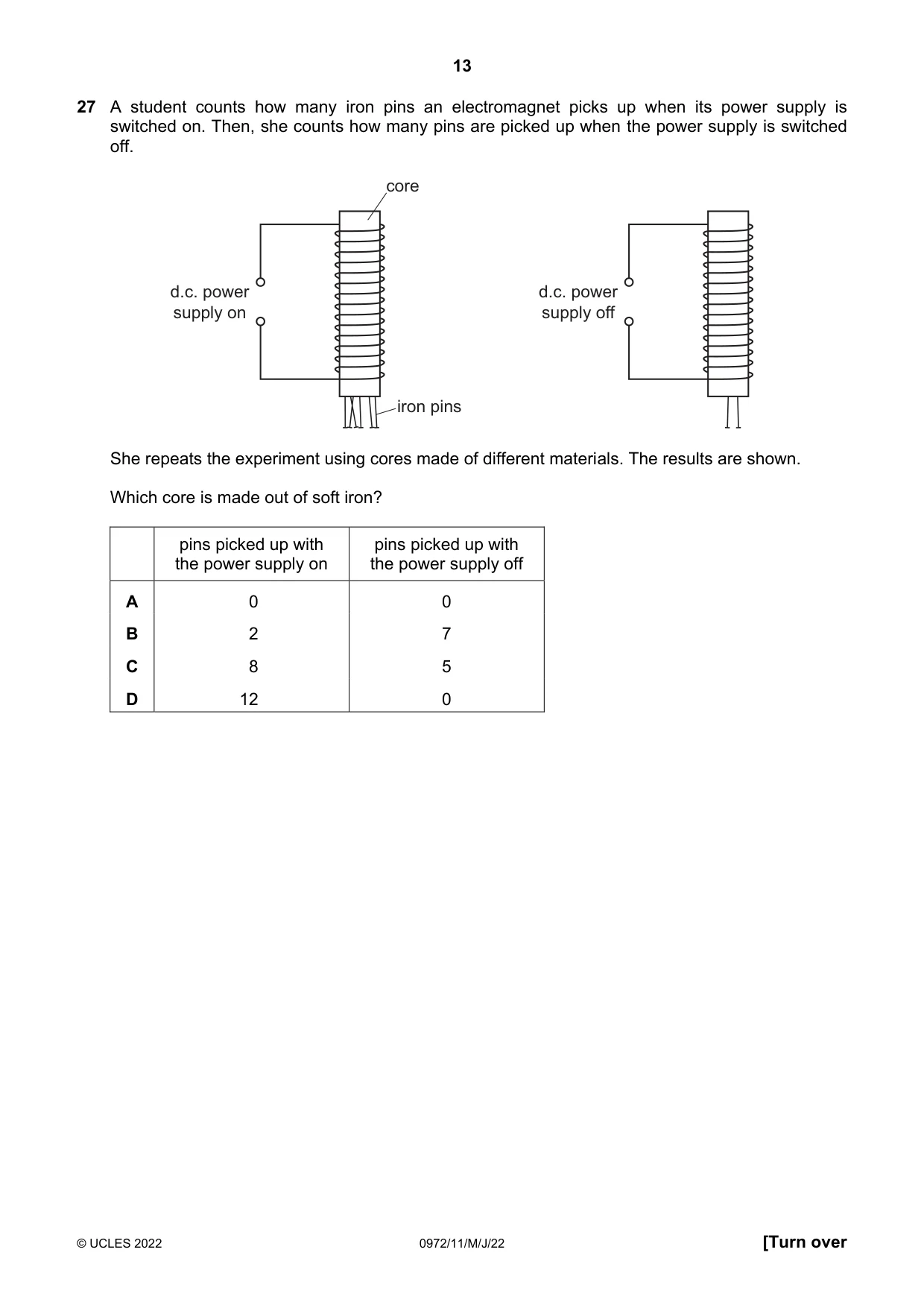
27 A student counts how many iron pins an electromagnet picks up when its power supply is switched on. Then, she counts how many pins are picked up when the power supply is switched off. core d.c. power d.c. power supply on supply off iron pins She repeats the experiment using cores made of different materials. The results are shown. Which core is made out of soft iron? pins picked up with pins picked up with the power supply on the power supply off A 0 0 B 2 7 C 8 5 D 12 0
Mark scheme: D
Q28 · The diagram shows a charged plastic rod and an uncharged metal sphere
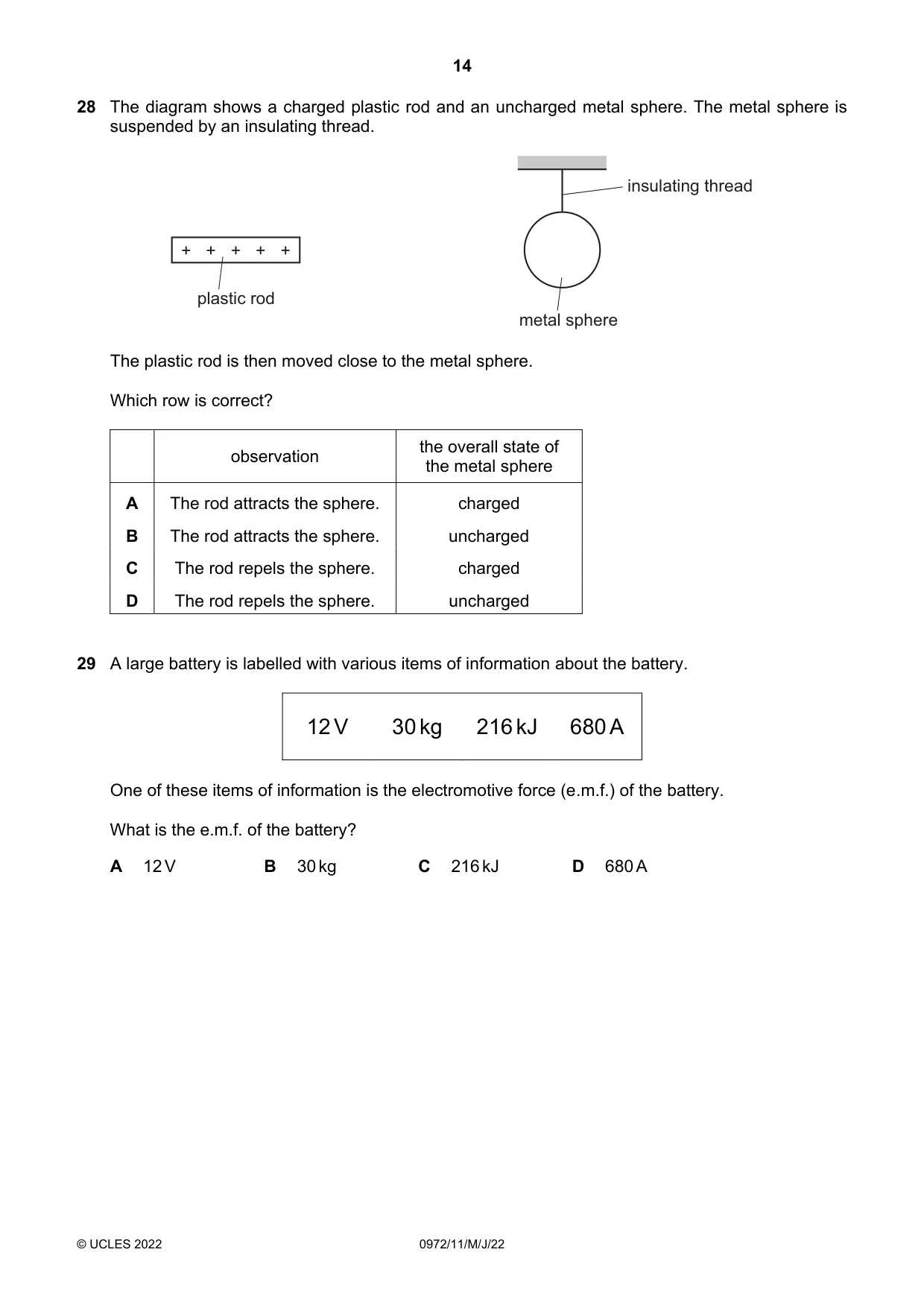
28 The diagram shows a charged plastic rod and an uncharged metal sphere. The metal sphere is suspended by an insulating thread. insulating thread + + + + + plastic rod metal sphere The plastic rod is then moved close to the metal sphere. Which row is correct? the overall state of observation the metal sphere A The rod attracts the sphere. charged B The rod attracts the sphere. uncharged C The rod repels the sphere. charged D The rod repels the sphere. uncharged
Mark scheme: B
Q29 · A large battery is labelled with various items of information about the battery
29 A large battery is labelled with various items of information about the battery. 12 V 30 kg 216 kJ 680 A One of these items of information is the electromotive force (e.m.f.) of the battery. What is the e.m.f. of the battery? A 12 V B 30 kg C 216 kJ D 680 A
Mark scheme: A
Q30 · The circuit shown is being used to measure the resistance of resistor Z
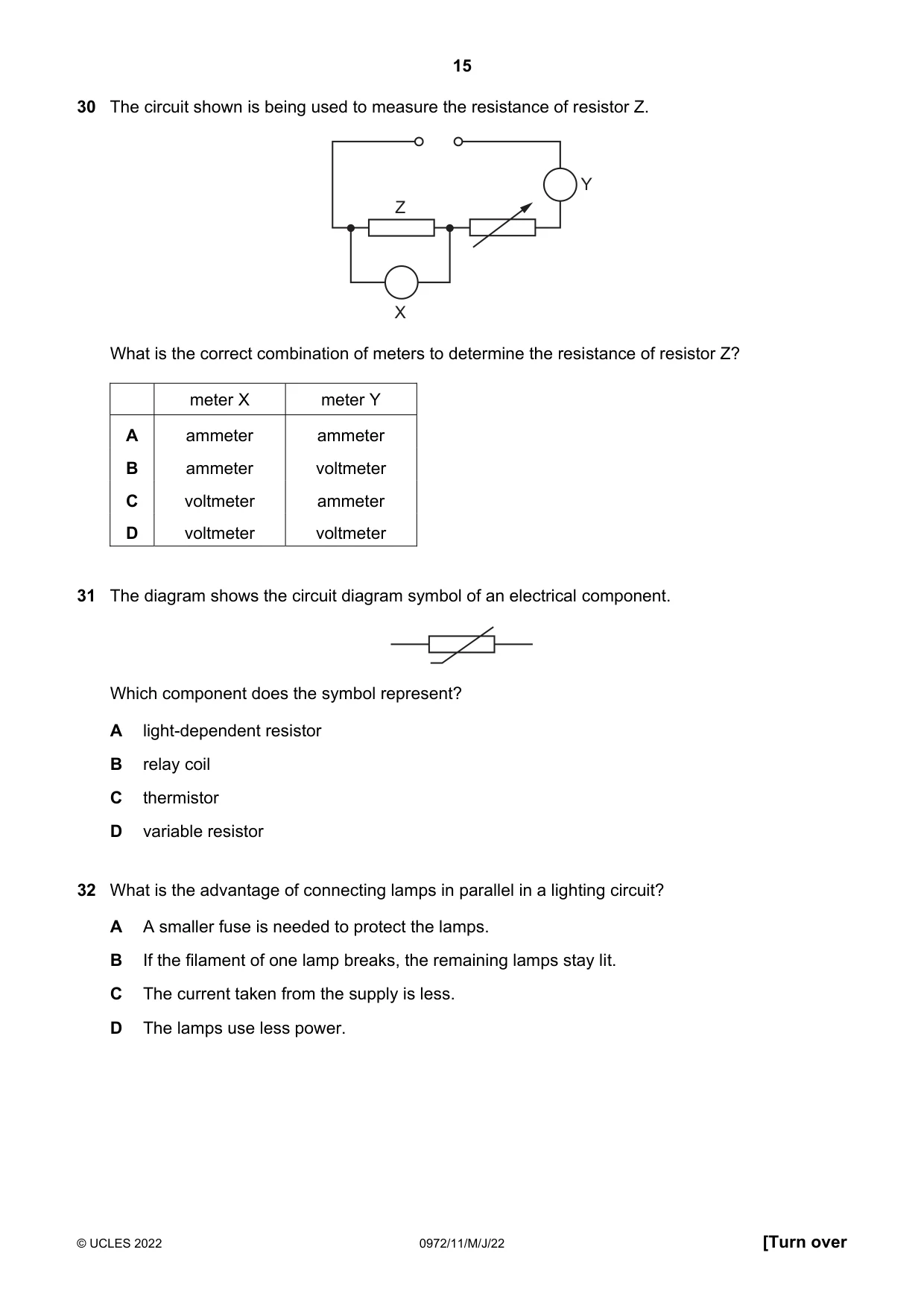
30 The circuit shown is being used to measure the resistance of resistor Z. Y Z X What is the correct combination of meters to determine the resistance of resistor Z? meter X meter Y A ammeter ammeter B ammeter voltmeter C voltmeter ammeter D voltmeter voltmeter
Mark scheme: C
Q31 · The diagram shows the circuit diagram symbol of an electrical component
31 The diagram shows the circuit diagram symbol of an electrical component. Which component does the symbol represent? A light-dependent resistor B relay coil C thermistor D variable resistor
Mark scheme: C
Q32 · What is the advantage of connecting lamps in parallel in a lighting circuit?
32 What is the advantage of connecting lamps in parallel in a lighting circuit? A A smaller fuse is needed to protect the lamps. B If the filament of one lamp breaks, the remaining lamps stay lit. C The current taken from the supply is less. D The lamps use less power.
Mark scheme: B
Q33 · The diagram shows a circuit of six identical lamps connected to a battery
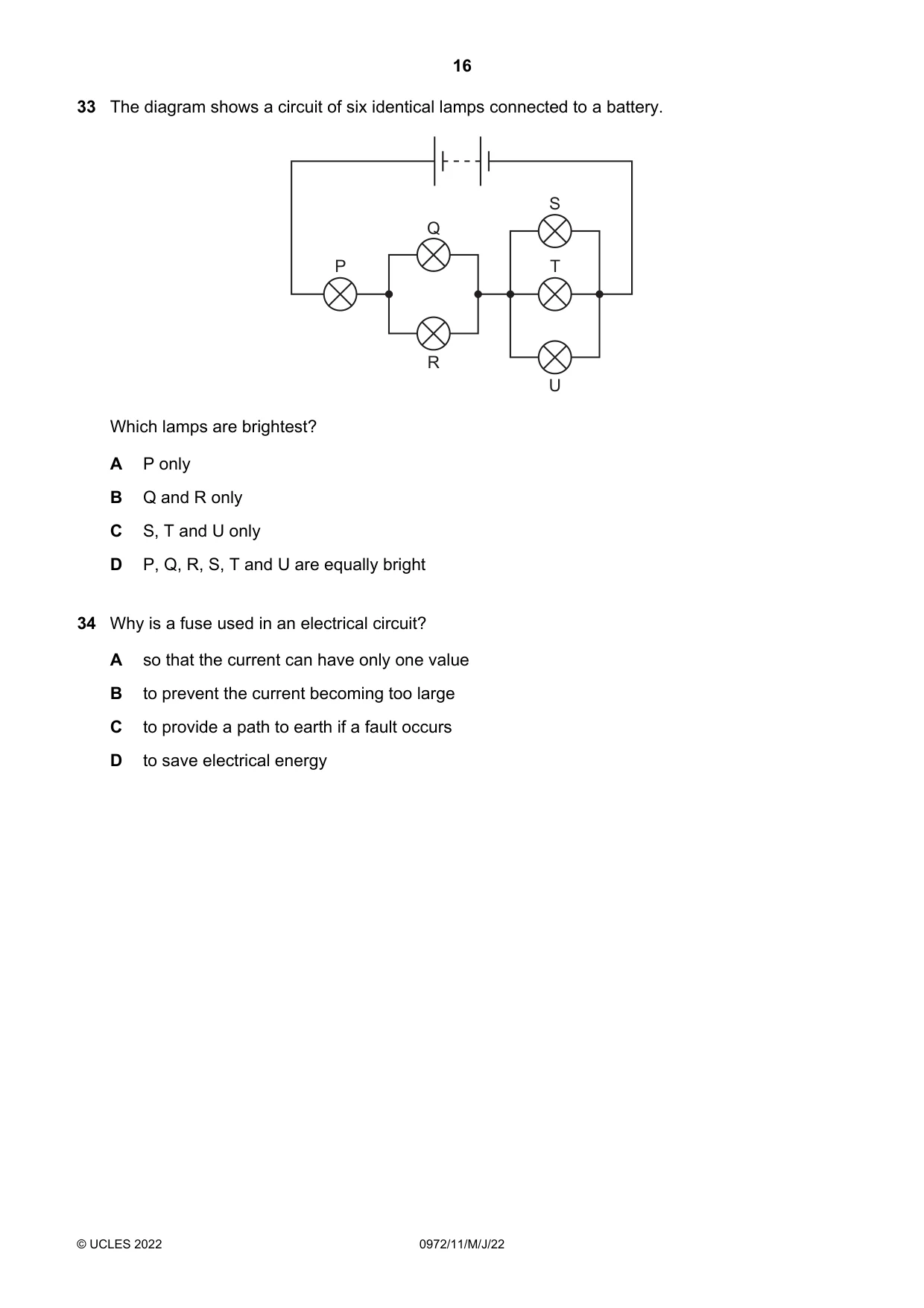
33 The diagram shows a circuit of six identical lamps connected to a battery. S Q P T R U Which lamps are brightest? A P only B Q and R only C S, T and U only D P, Q, R, S, T and U are equally bright
Mark scheme: A
Q34 · Why is a fuse used in an electrical circuit?
34 Why is a fuse used in an electrical circuit? A so that the current can have only one value B to prevent the current becoming too large C to provide a path to earth if a fault occurs D to save electrical energy
Mark scheme: B
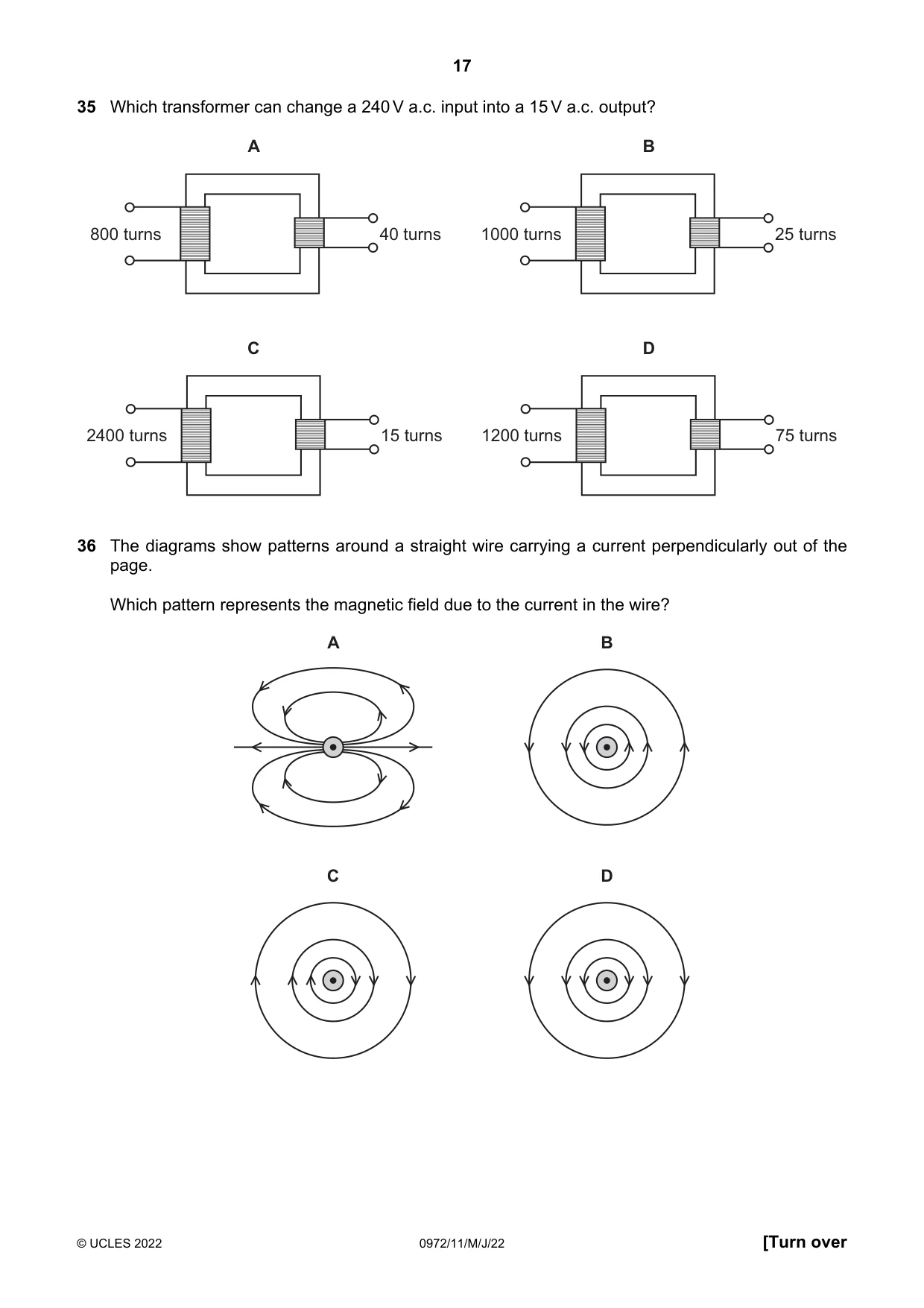
Q35 · Which transformer can change a 240 V a.c
35 Which transformer can change a 240 V a.c. input into a 15 V a.c. output? A B 800 turns 40 turns 1000 turns 25 turns C D 2400 turns 15 turns 1200 turns 75 turns
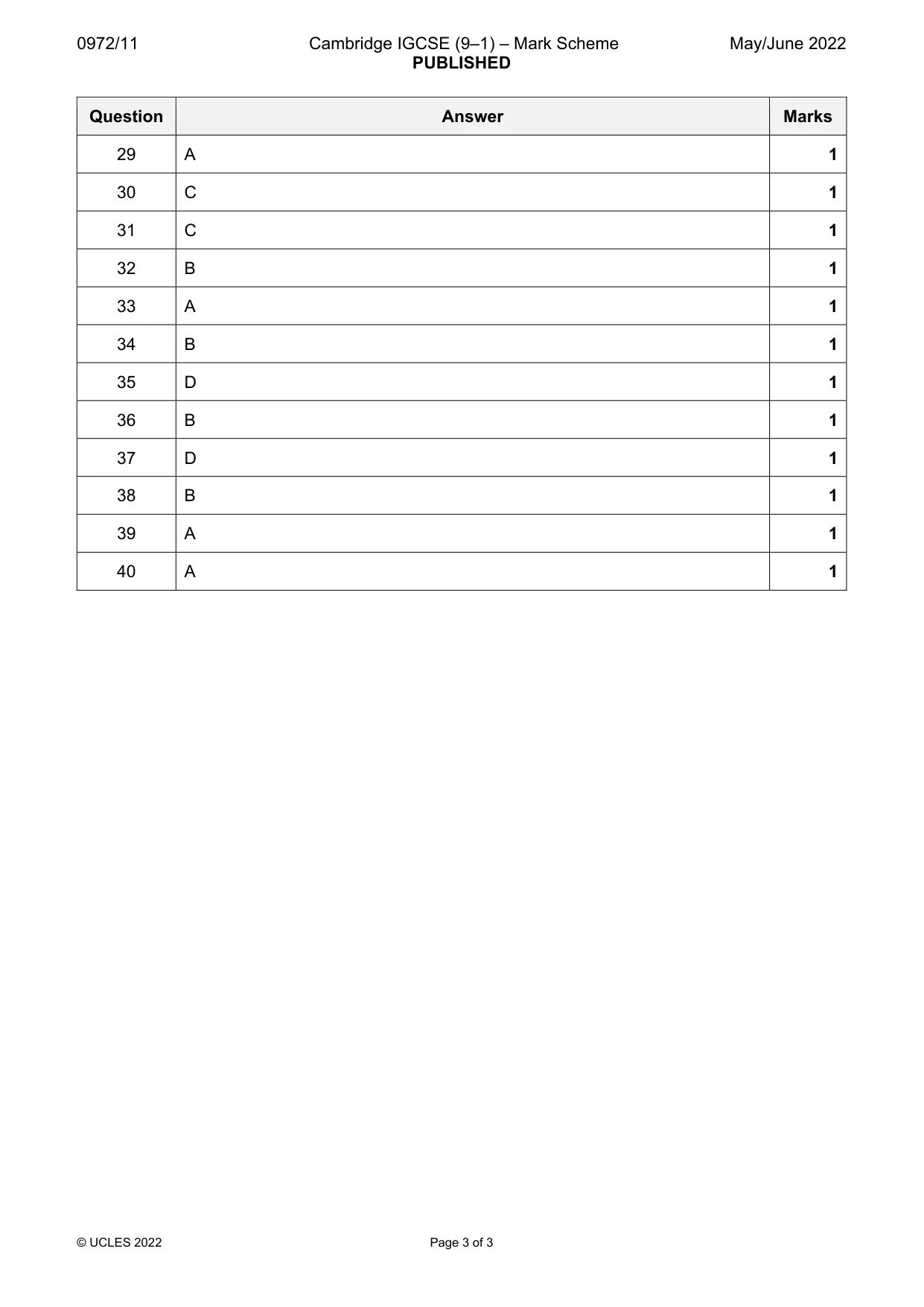
Mark scheme: D
Q36 · The diagrams show patterns around a straight wire carrying a current perpendicularly out…
36 The diagrams show patterns around a straight wire carrying a current perpendicularly out of the page. Which pattern represents the magnetic field due to the current in the wire? A B C D
Mark scheme: B
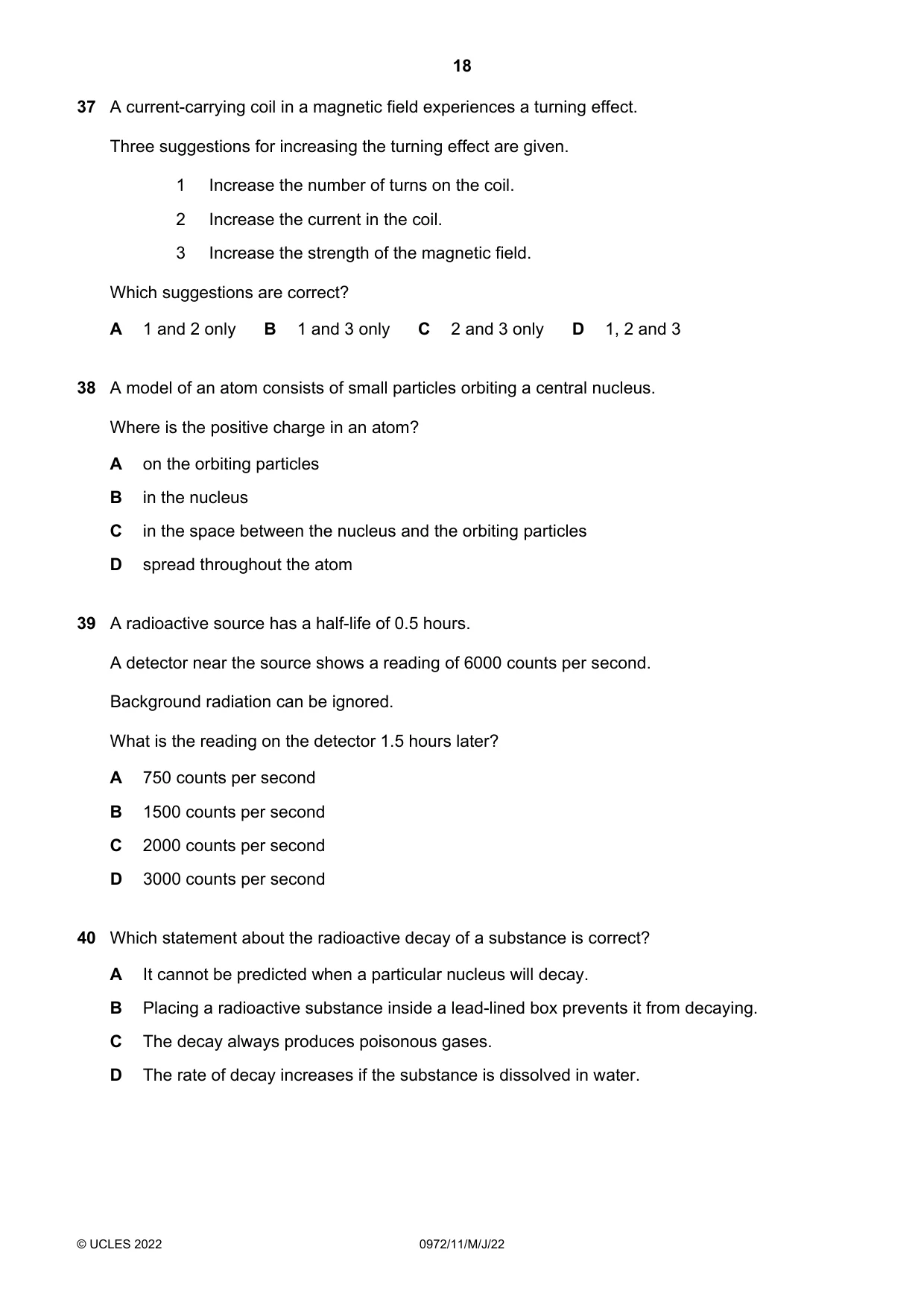
Q37 · A current-carrying coil in a magnetic field experiences a turning effect
37 A current-carrying coil in a magnetic field experiences a turning effect. Three suggestions for increasing the turning effect are given. 1 Increase the number of turns on the coil. 2 Increase the current in the coil. 3 Increase the strength of the magnetic field. Which suggestions are correct? A 1 and 2 only B 1 and 3 only C 2 and 3 only D 1, 2 and 3
Mark scheme: D
Q38 · A model of an atom consists of small particles orbiting a central nucleus
38 A model of an atom consists of small particles orbiting a central nucleus. Where is the positive charge in an atom? A on the orbiting particles B in the nucleus C in the space between the nucleus and the orbiting particles D spread throughout the atom
Mark scheme: B
Q39 · A radioactive source has a half-life of 0.5 hours
39 A radioactive source has a half-life of 0.5 hours. A detector near the source shows a reading of 6000 counts per second. Background radiation can be ignored. What is the reading on the detector 1.5 hours later? A 750 counts per second B 1500 counts per second C 2000 counts per second D 3000 counts per second
Mark scheme: A
Q40 · Which statement about the radioactive decay of a substance is correct?
40 Which statement about the radioactive decay of a substance is correct? A It cannot be predicted when a particular nucleus will decay. B Placing a radioactive substance inside a lead-lined box prevents it from decaying. C The decay always produces poisonous gases. D The rate of decay increases if the substance is dissolved in water.
Mark scheme: A
What was in this paper
The subtopics covered by these 40 questions, and how many questions each got. Open one in a new tab to see every Cambridge question on it.
4Electromagnetic effects3Forces3Simple phenomena of magnetism3Transfer of thermal energy3Density2Electromagnetic spectrum2Energy, work and power2General properties of waves2Kinetic particle model of matter2Light2Motion2Pressure2Radioactivity2Thermal properties and temperature2Electrical quantities1Electrical safety1Mass and weight1The nuclear model of the atom1What you needed in this session
Cambridge’s own grade thresholds for 2022 May/June, Paper 1 · Variant 1. A higher threshold means an easier paper — the bar moves with how the cohort did.