Questions as text
Q1 · On a cold day, a metal front-door knob X and a similar plastic knob Y are at the same… 0972/21 May/June 2018
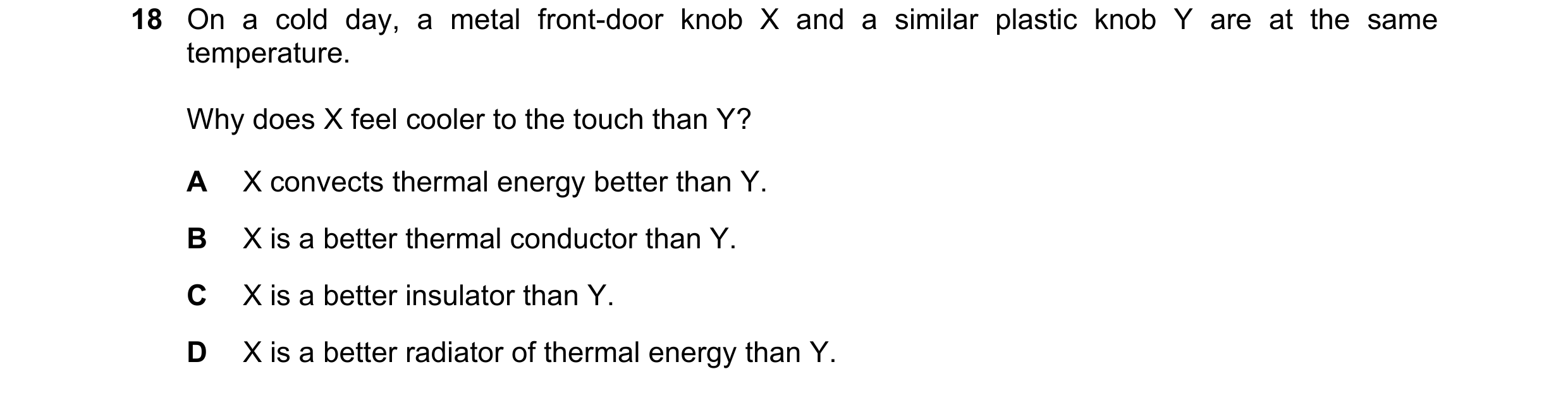
18 On a cold day, a metal front-door knob X and a similar plastic knob Y are at the same temperature. Why does X feel cooler to the touch than Y? A X convects thermal energy better than Y. B X is a better thermal conductor than Y. C X is a better insulator than Y. D X is a better radiator of thermal energy than Y.
1 marks
Answer: B
This question in 0972/21 May/June 2018
Q2 · On a cold day, a shiny metal rod feels colder to the touch than a black plastic rod 0972/21 Oct/Nov 2018
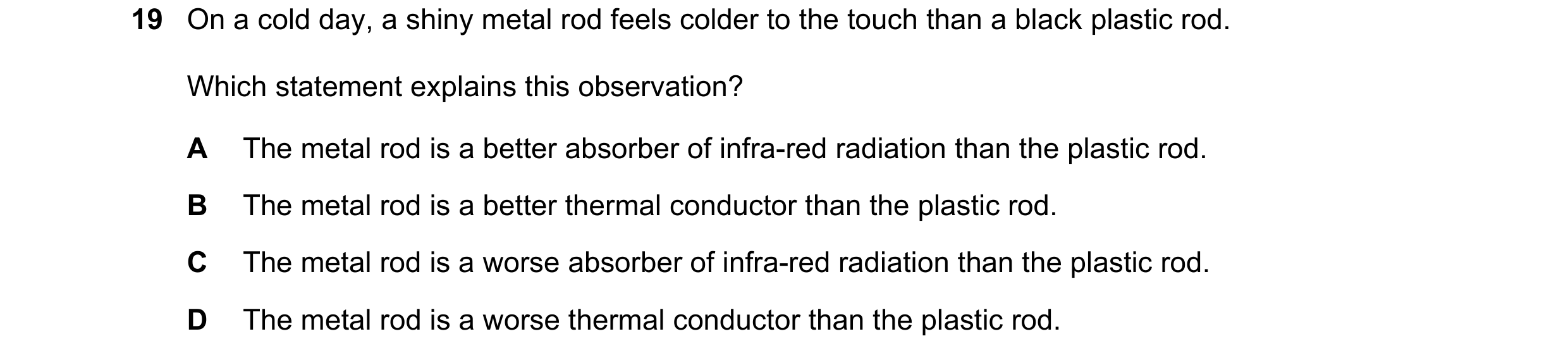
19 On a cold day, a shiny metal rod feels colder to the touch than a black plastic rod. Which statement explains this observation? A The metal rod is a better absorber of infra-red radiation than the plastic rod. B The metal rod is a better thermal conductor than the plastic rod. C The metal rod is a worse absorber of infra-red radiation than the plastic rod. D The metal rod is a worse thermal conductor than the plastic rod.
1 marks
Answer: B
This question in 0972/21 Oct/Nov 2018
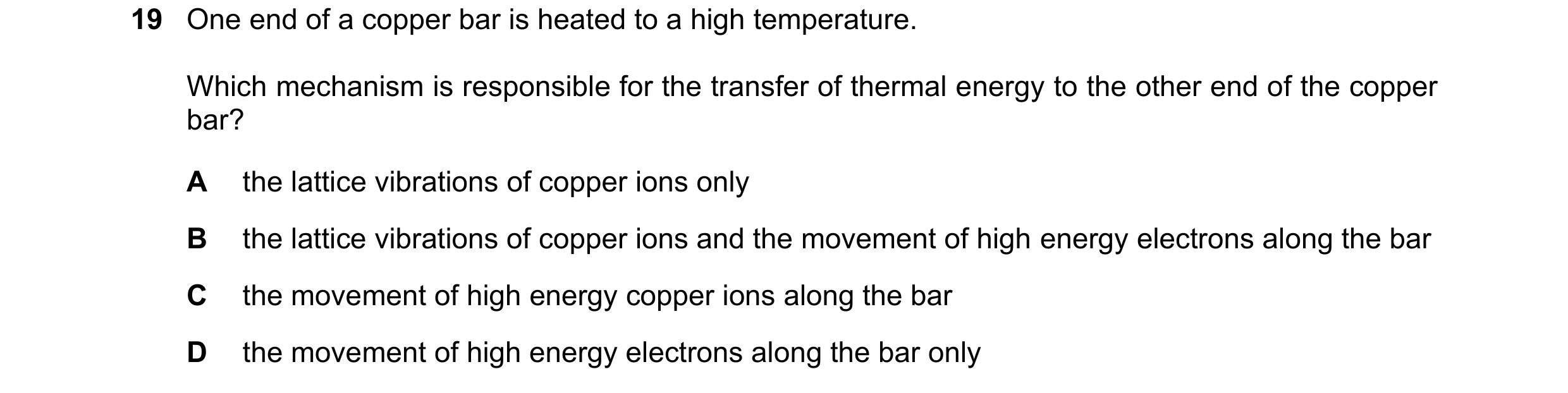
Q3 · One end of a copper bar is heated to a high temperature 0972/21 Oct/Nov 2018
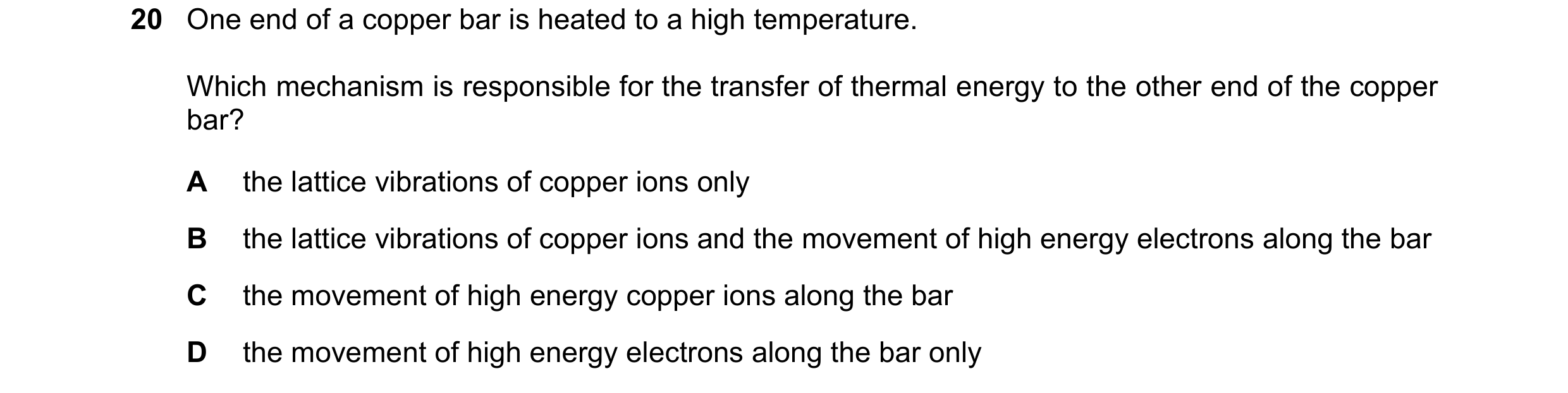
20 One end of a copper bar is heated to a high temperature. Which mechanism is responsible for the transfer of thermal energy to the other end of the copper bar? A the lattice vibrations of copper ions only B the lattice vibrations of copper ions and the movement of high energy electrons along the bar C the movement of high energy copper ions along the bar D the movement of high energy electrons along the bar only
1 marks
Answer: B
This question in 0972/21 Oct/Nov 2018
Q4 · In which does thermal conduction not occur? 0972/21 May/June 2019
17 In which does thermal conduction not occur? A a gas B a liquid C a solid D a vacuum
1 marks
Answer: D
This question in 0972/21 May/June 2019
Q5 · The metal surface of a kettle is hot 0972/21 May/June 2019
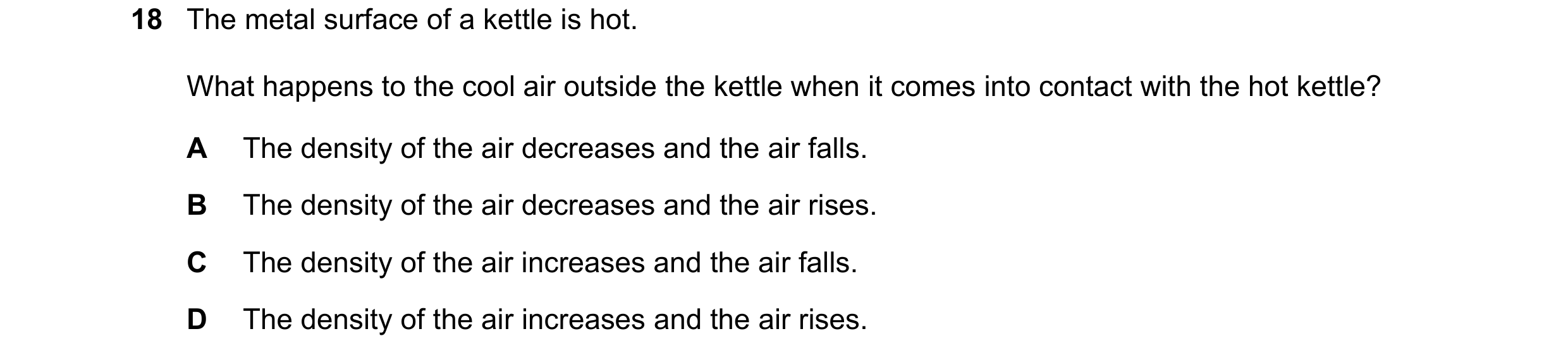
18 The metal surface of a kettle is hot. What happens to the cool air outside the kettle when it comes into contact with the hot kettle? A The density of the air decreases and the air falls. B The density of the air decreases and the air rises. C The density of the air increases and the air falls. D The density of the air increases and the air rises.
1 marks
Answer: B
This question in 0972/21 May/June 2019
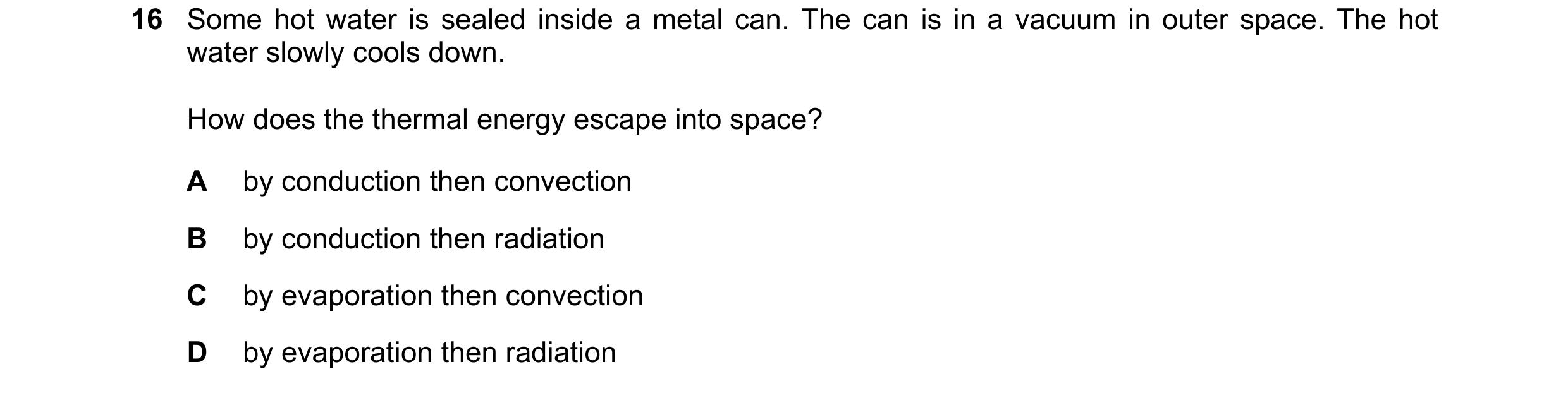
Q6 · Some hot water is sealed inside a metal can 0972/21 May/June 2019
19 Some hot water is sealed inside a metal can. The can is in a vacuum in outer space. The hot water slowly cools down. How does the thermal energy escape into space? A by conduction then convection B by conduction then radiation C by evaporation then convection D by evaporation then radiation
1 marks
Answer: B
This question in 0972/21 May/June 2019
Q7 · The handle of a metal saucepan is made of plastic 0972/22 May/June 2019
17 The handle of a metal saucepan is made of plastic. As the saucepan heats up, the handle gets warmer. Which statement explains this? A Molecules of the plastic radiate their energy to other molecules. B Molecules of the plastic vibrate more and pass on their energy to nearby molecules. C The free electrons in the plastic transfer the thermal energy along the handle. D The heated molecules very slowly move along the plastic handle.
1 marks
Answer: B
This question in 0972/22 May/June 2019
Q8 · The metal surface of a kettle is hot 0972/22 May/June 2019
18 The metal surface of a kettle is hot. What happens to the cool air outside the kettle when it comes into contact with the hot kettle? A The density of the air decreases and the air falls. B The density of the air decreases and the air rises. C The density of the air increases and the air falls. D The density of the air increases and the air rises.
1 marks
Answer: B
This question in 0972/22 May/June 2019
Q9 · Vacuum flasks usually have silvered walls that help to keep the contents of the flask hot 0972/22 May/June 2019
19 Vacuum flasks usually have silvered walls that help to keep the contents of the flask hot. Why are the walls silvered? A to absorb thermal energy from the air around the flask B to increase the rate of convection inside the flask C to reduce energy loss to the surroundings by conduction D to reflect thermal radiation back into the flask
1 marks
Answer: D
This question in 0972/22 May/June 2019
Q10 · One end of a rod of copper is placed in hot water 0972/21 Oct/Nov 2019
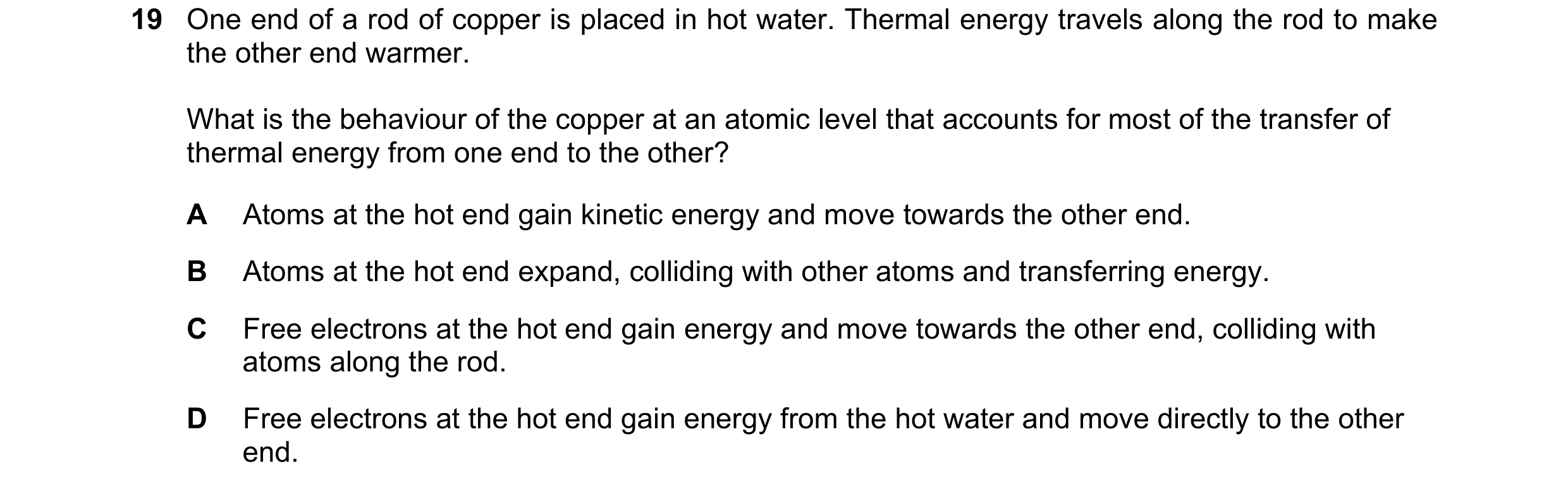
19 One end of a rod of copper is placed in hot water. Thermal energy travels along the rod to make the other end warmer. What is the behaviour of the copper at an atomic level that accounts for most of the transfer of thermal energy from one end to the other? A Atoms at the hot end gain kinetic energy and move towards the other end. B Atoms at the hot end expand, colliding with other atoms and transferring energy. C Free electrons at the hot end gain energy and move towards the other end, colliding with atoms along the rod. D Free electrons at the hot end gain energy from the hot water and move directly to the other end.
1 marks
Answer: C
This question in 0972/21 Oct/Nov 2019
Q11 · A surface is made so that it is a good source of infrared radiation 0972/21 Oct/Nov 2019
20 A surface is made so that it is a good source of infrared radiation. Which surface is not suitable? A a surface that is painted matt black B a surface that is painted white C a surface that is heated to a high temperature D a surface that has a large surface area
1 marks
Answer: B
This question in 0972/21 Oct/Nov 2019
Q12 · Why are metals better thermal conductors than other solids? 0972/21 May/June 2020
18 Why are metals better thermal conductors than other solids? A Metals contain free electrons which help transfer the energy. B Molecules in metals are in fixed positions. C Molecules in metals can move freely. D Molecules in metals vibrate faster than those in other solids.
1 marks
Answer: A
This question in 0972/21 May/June 2020
Q13 · Two freezers X and Y are identical except that one has a door opening at the front and… 0972/21 May/June 2020
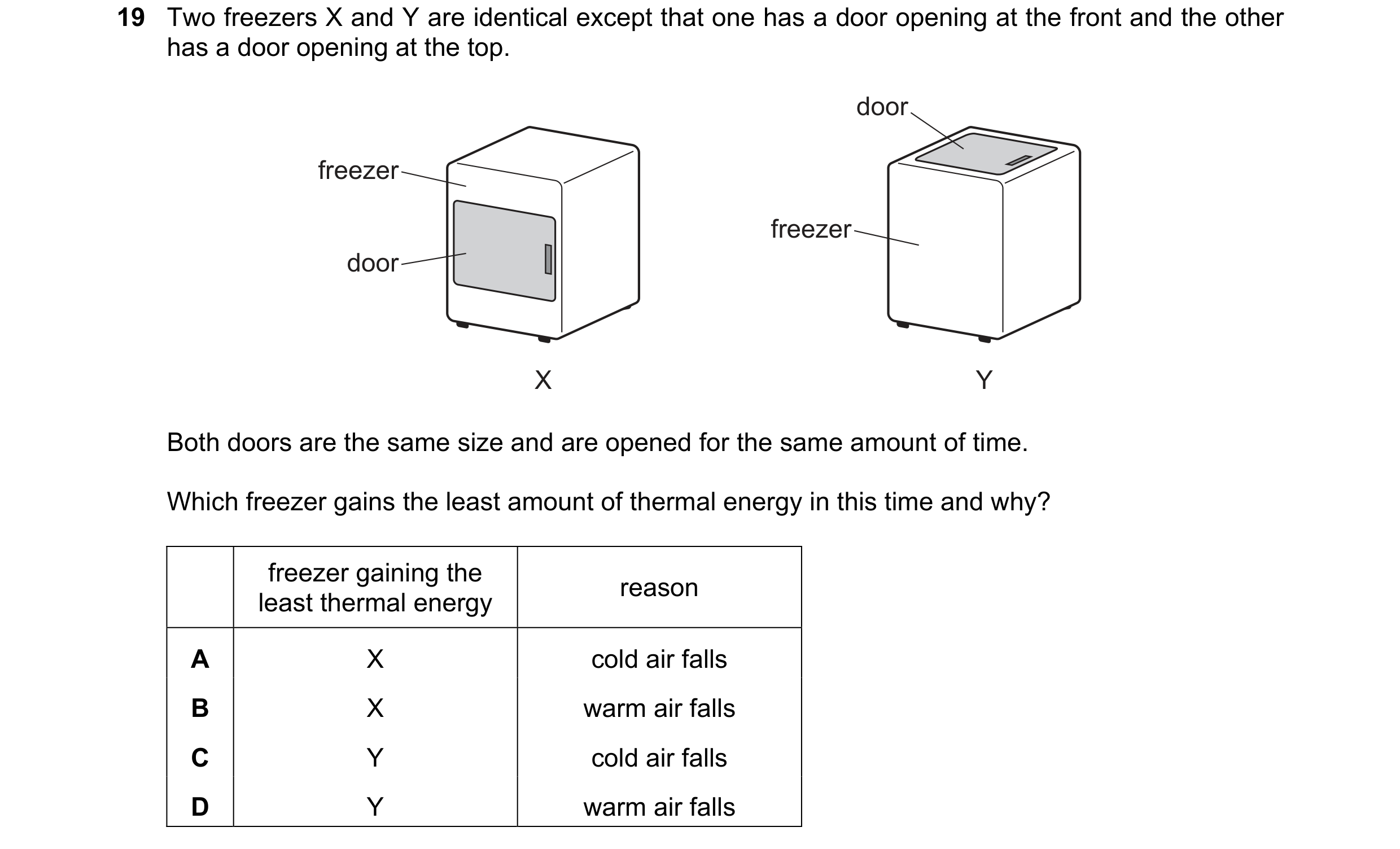
19 Two freezers X and Y are identical except that one has a door opening at the front and the other has a door opening at the top. door freezer freezer door X Y Both doors are the same size and are opened for the same amount of time. Which freezer gains the least amount of thermal energy in this time and why? freezer gaining the reason least thermal energy A X cold air falls B X warm air falls C Y cold air falls D Y warm air falls
1 marks
Answer: C
This question in 0972/21 May/June 2020
Q14 · A room is heated by a radiator 0972/22 May/June 2020
18 A room is heated by a radiator. The diagrams X and Y show two possible circulations of hot air, which heat the room. diagram X ceiling diagram Y ceiling radiator radiator floor floor Which diagram and reason explain the heating of the room by convection? diagram reason A X air density decreases when air is heated B X air density increases when air is heated C Y air density decreases when air is heated D Y air density increases when air is heated
1 marks
Answer: A
This question in 0972/22 May/June 2020
Q15 · Two copper containers P and Q are filled with hot water 0972/22 May/June 2020
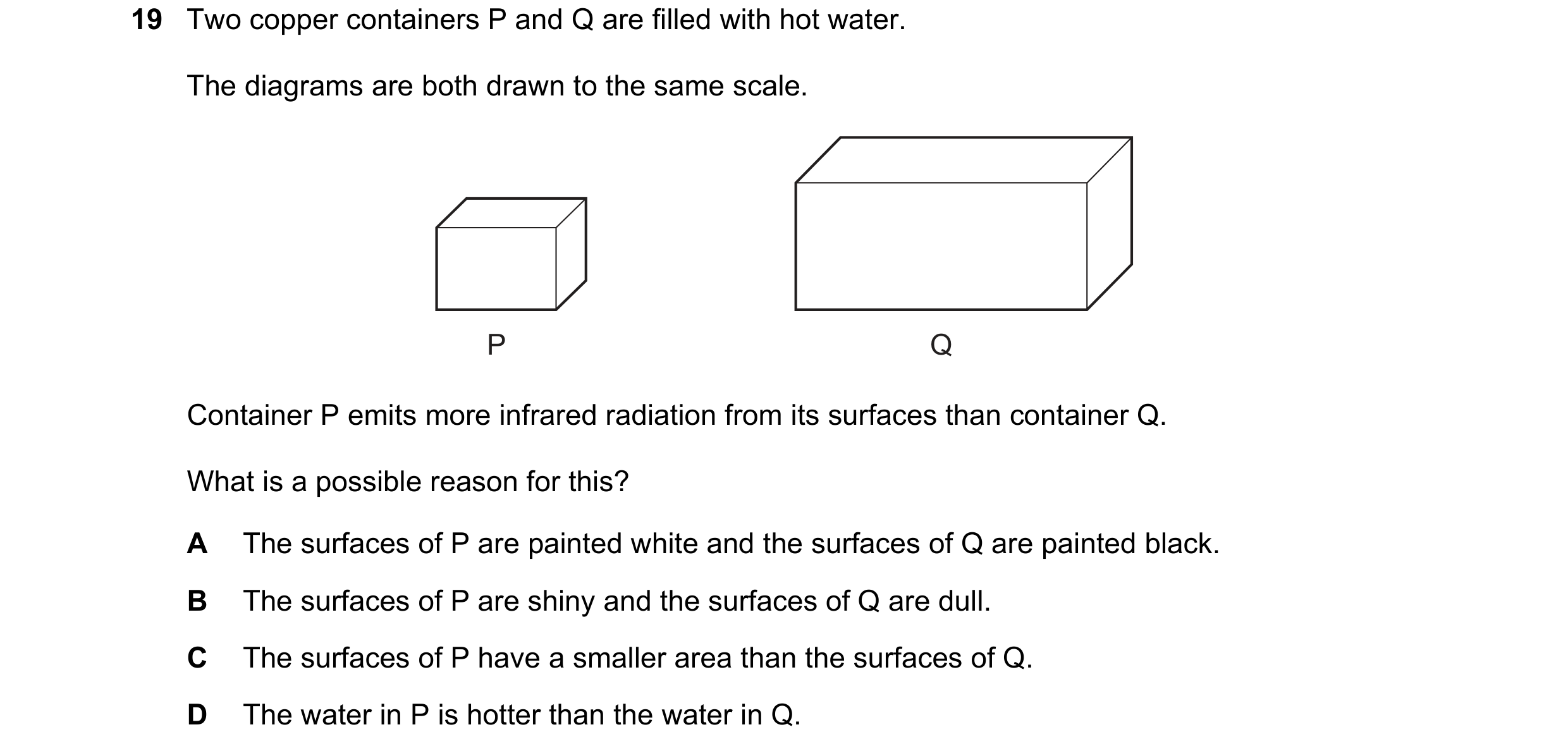
19 Two copper containers P and Q are filled with hot water. The diagrams are both drawn to the same scale. P Q Container P emits more infrared radiation from its surfaces than container Q. What is a possible reason for this? A The surfaces of P are painted white and the surfaces of Q are painted black. B The surfaces of P are shiny and the surfaces of Q are dull. C The surfaces of P have a smaller area than the surfaces of Q. D The water in P is hotter than the water in Q.
1 marks
Answer: D
This question in 0972/22 May/June 2020
Q16 · The diagram shows four rods 0972/21 Oct/Nov 2020
19 The diagram shows four rods. Each rod is made of a different metal. P Q brass copper X silver iron S R Wax is used to attach small metal balls at the rod ends P, Q, R and S. Each rod is the same size. They are heated uniformly by a Bunsen burner at point X. As the rods warm up, the wax melts and the balls fall off. Why does the ball on the silver rod fall first? A Silver is the best conductor of heat. B Silver is the worst conductor of heat. C Silver is the best radiator of heat. D Silver is the worst radiator of heat.
1 marks
Answer: A
This question in 0972/21 Oct/Nov 2020
Q17 · Four cups A, B, C and D contain hot coffee 0972/21 Oct/Nov 2020
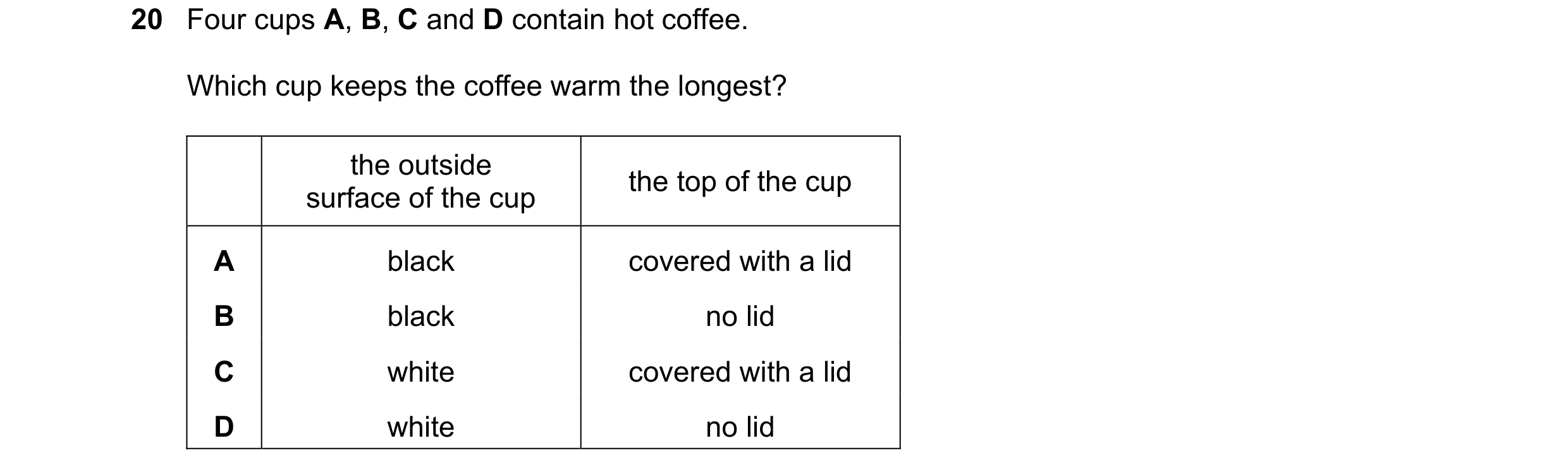
20 Four cups A, B, C and D contain hot coffee. Which cup keeps the coffee warm the longest? the outside the top of the cup surface of the cup A black covered with a lid B black no lid C white covered with a lid D white no lid
1 marks
Answer: C
This question in 0972/21 Oct/Nov 2020
Q18 · The diagram shows a pan used for cooking food 0972/21 Oct/Nov 2021
16 The diagram shows a pan used for cooking food. handle of pan base of pan Which row is correct for the materials used to make the base and the handle of the pan? base of pan handle of pan A good thermal conductor good thermal conductor B good thermal conductor poor thermal conductor C poor thermal conductor good thermal conductor D poor thermal conductor poor thermal conductor
1 marks
Answer: B
This question in 0972/21 Oct/Nov 2021
Q19 · A glass contains an iced drink on a warm and humid day 0972/21 May/June 2022
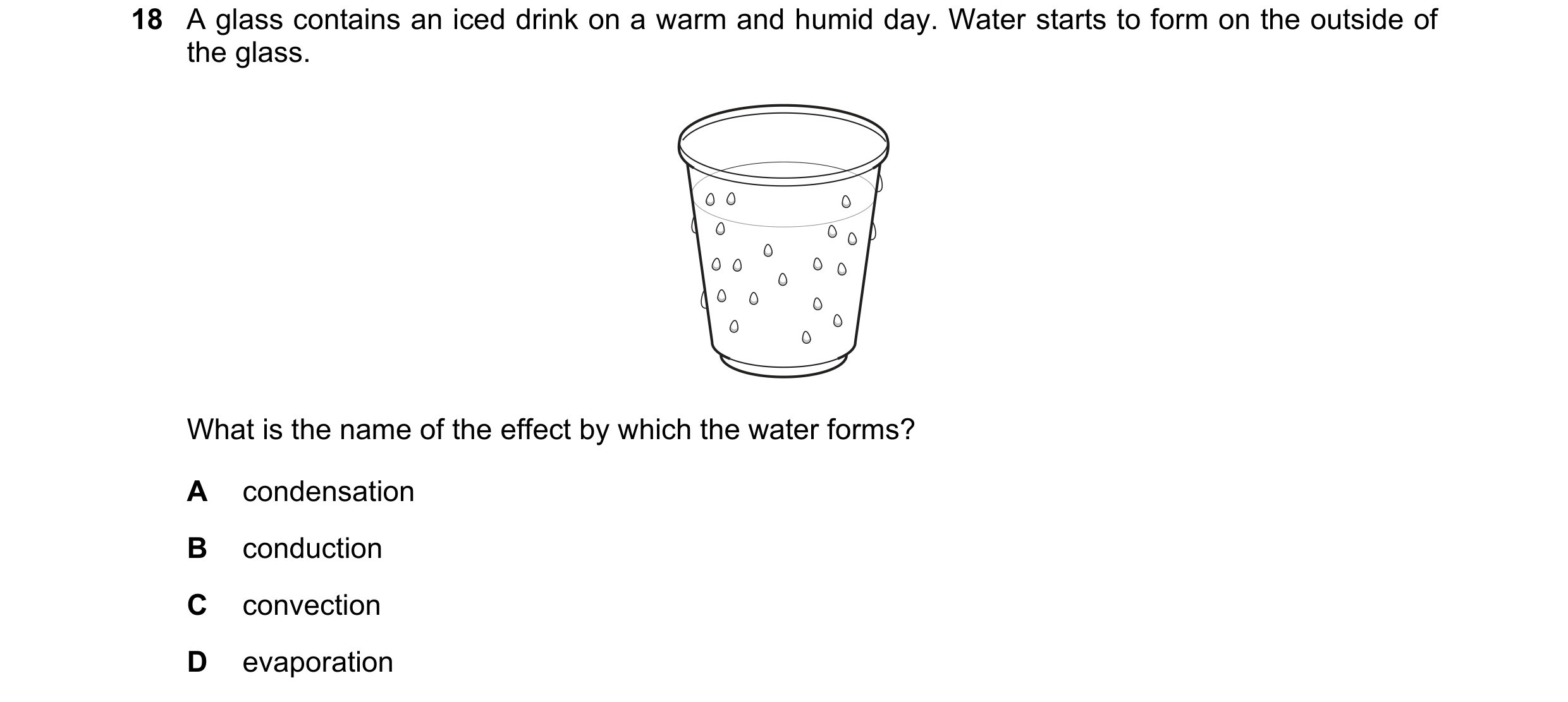
18 A glass contains an iced drink on a warm and humid day. Water starts to form on the outside of the glass. What is the name of the effect by which the water forms? A condensation B conduction C convection D evaporation
1 marks
Answer: A
This question in 0972/21 May/June 2022
Q20 · One end of a copper bar is heated to a high temperature 0972/21 May/June 2022
19 One end of a copper bar is heated to a high temperature. Which mechanism is responsible for the transfer of thermal energy to the other end of the copper bar? A the lattice vibrations of copper ions only B the lattice vibrations of copper ions and the movement of high energy electrons along the bar C the movement of high energy copper ions along the bar D the movement of high energy electrons along the bar only
1 marks
Answer: B
This question in 0972/21 May/June 2022
Q21 · The diagram shows a convection current caused by a piece of ice placed in a beaker of… 0972/21 May/June 2022
20 The diagram shows a convection current caused by a piece of ice placed in a beaker of water at room temperature. ice Q P Which row correctly compares the temperatures and densities at water points P and Q? temperature at P density at P A higher than at Q higher than at Q B higher than at Q lower than at Q C lower than at Q higher than at Q D lower than at Q lower than at Q
1 marks
Answer: C
This question in 0972/21 May/June 2022
Q22 · A glass contains an iced drink on a warm and humid day 0972/22 May/June 2022
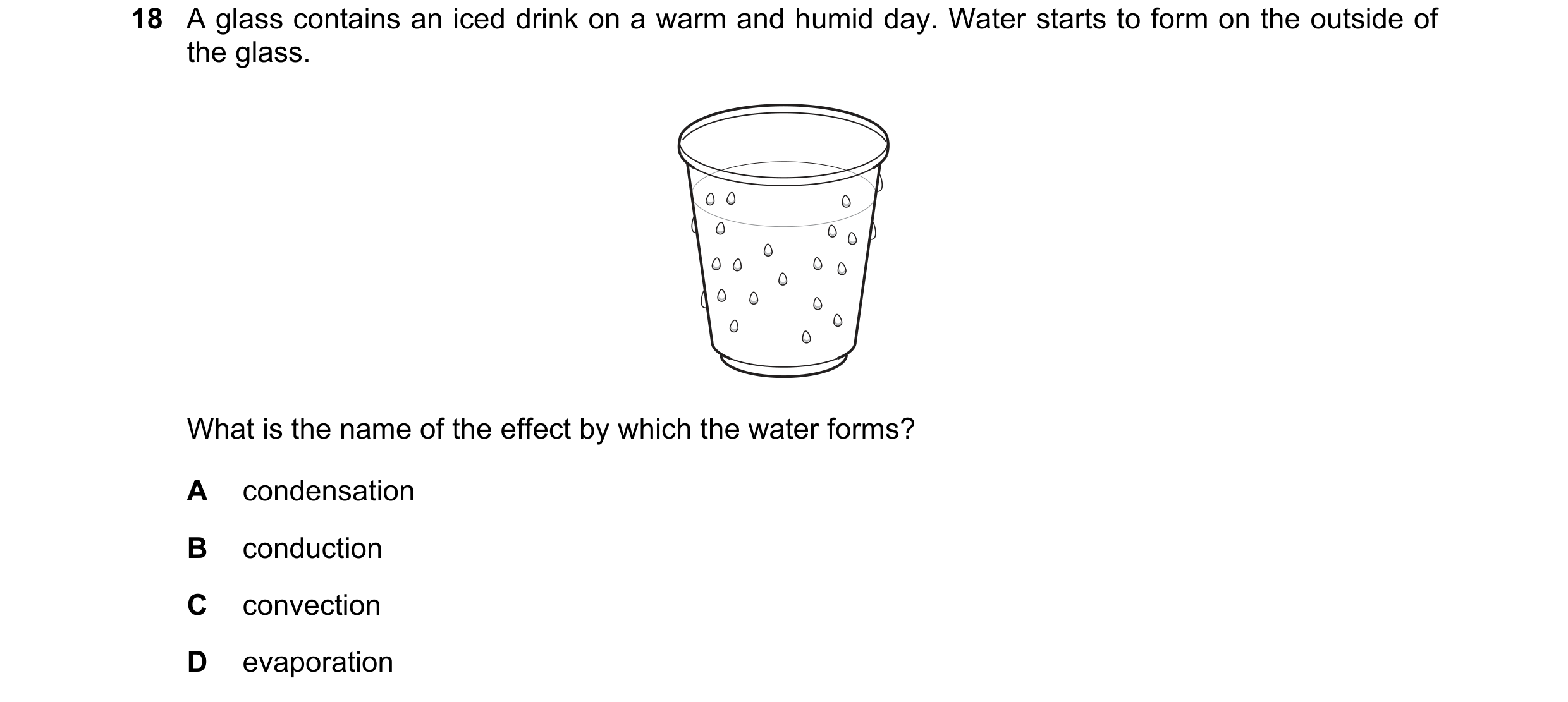
18 A glass contains an iced drink on a warm and humid day. Water starts to form on the outside of the glass. What is the name of the effect by which the water forms? A condensation B conduction C convection D evaporation
1 marks
Answer: A
This question in 0972/22 May/June 2022
Q23 · One end of a copper bar is heated to a high temperature 0972/22 May/June 2022
19 One end of a copper bar is heated to a high temperature. Which mechanism is responsible for the transfer of thermal energy to the other end of the copper bar? A the lattice vibrations of copper ions only B the lattice vibrations of copper ions and the movement of high energy electrons along the bar C the movement of high energy copper ions along the bar D the movement of high energy electrons along the bar only
1 marks
Answer: B
This question in 0972/22 May/June 2022
Q24 · Four cubic copper containers are filled with water 0972/22 May/June 2022
20 Four cubic copper containers are filled with water. The surfaces of all the containers are painted
black.
Two of the containers have sides of length 20cm and the other two containers have sides of
length 40cm.
Two of the containers contain water at 80°C and the other two contain water at 30 °C.
Which container radiates energy at the lowest rate?
A B Cc
D
|| |
| |
30°C 80°C
30°C 80°C
1 marks
Answer: A
This question in 0972/22 May/June 2022
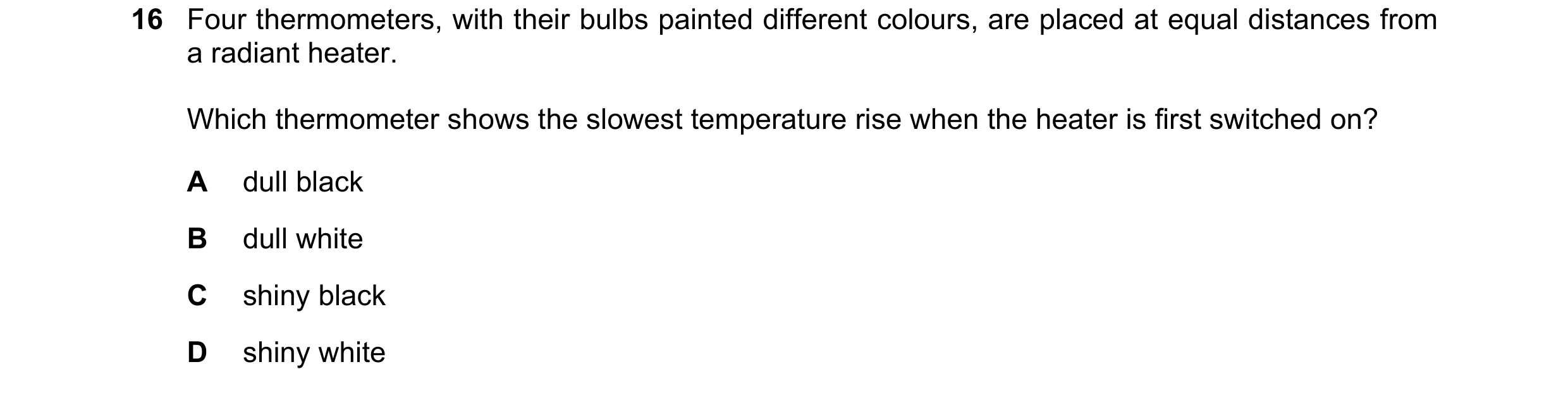
Q25 · Four thermometers, with their bulbs painted different colours, are placed at equal… 0972/21 Oct/Nov 2022
16 Four thermometers, with their bulbs painted different colours, are placed at equal distances from a radiant heater. Which thermometer shows the slowest temperature rise when the heater is first switched on? A dull black B dull white C shiny black D shiny white
1 marks
Answer: D
This question in 0972/21 Oct/Nov 2022
Q26 · Some hot water is sealed inside a metal can 0972/21 May/June 2023
16 Some hot water is sealed inside a metal can. The can is in a vacuum in outer space. The hot water slowly cools down. How does the thermal energy escape into space? A by conduction then convection B by conduction then radiation C by evaporation then convection D by evaporation then radiation
1 marks
Answer: B
This question in 0972/21 May/June 2023
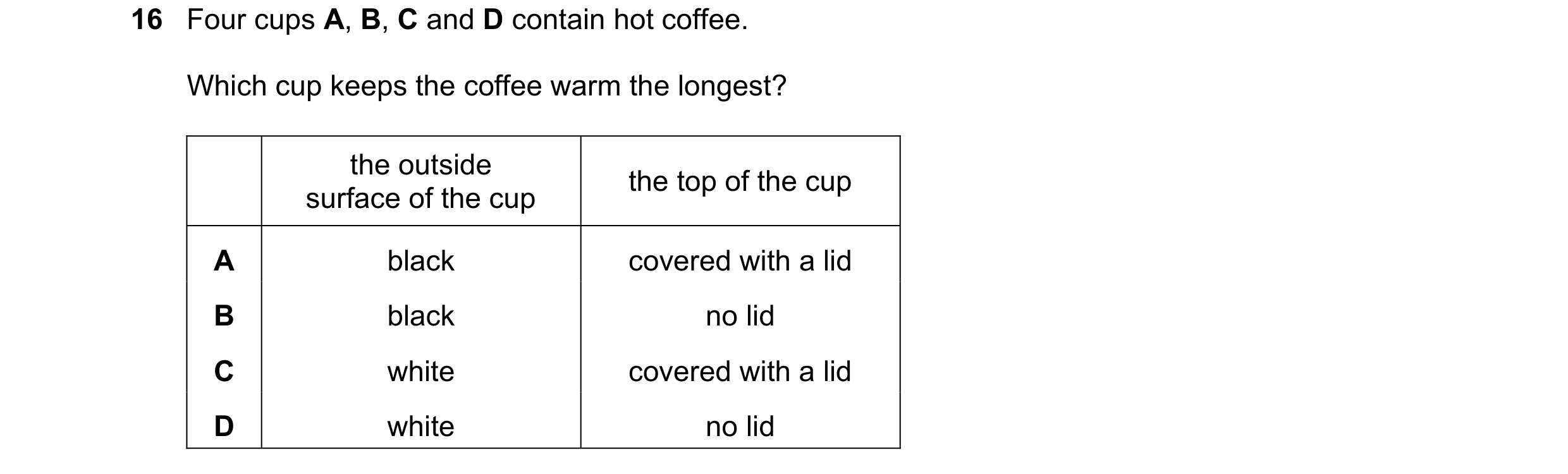
Q27 · Four cups A, B, C and D contain hot coffee 0972/22 May/June 2023
16 Four cups A, B, C and D contain hot coffee. Which cup keeps the coffee warm the longest? the outside the top of the cup surface of the cup A black covered with a lid B black no lid C white covered with a lid D white no lid
1 marks
Answer: C
This question in 0972/22 May/June 2023
Q28 · The diagram shows the view of a room heated by a radiator 0972/21 Oct/Nov 2023
16 The diagram shows the view of a room heated by a radiator. The arrowed line from X to Y is the path of the convection current in the air. ceiling X Y radiator floor Which row about the air temperature and the air density at X and at Y is correct? air temperature air density A higher at X higher at X B higher at X higher at Y C higher at Y higher at Y D higher at Y higher at X
1 marks
Answer: B
This question in 0972/21 Oct/Nov 2023
Q29 · Due to an issue with question 14, the question has been removed from the question paper 0972/21 May/June 2024
14 Due to an issue with question 14, the question has been removed from the question paper.
1 marks
This question in 0972/21 May/June 2024
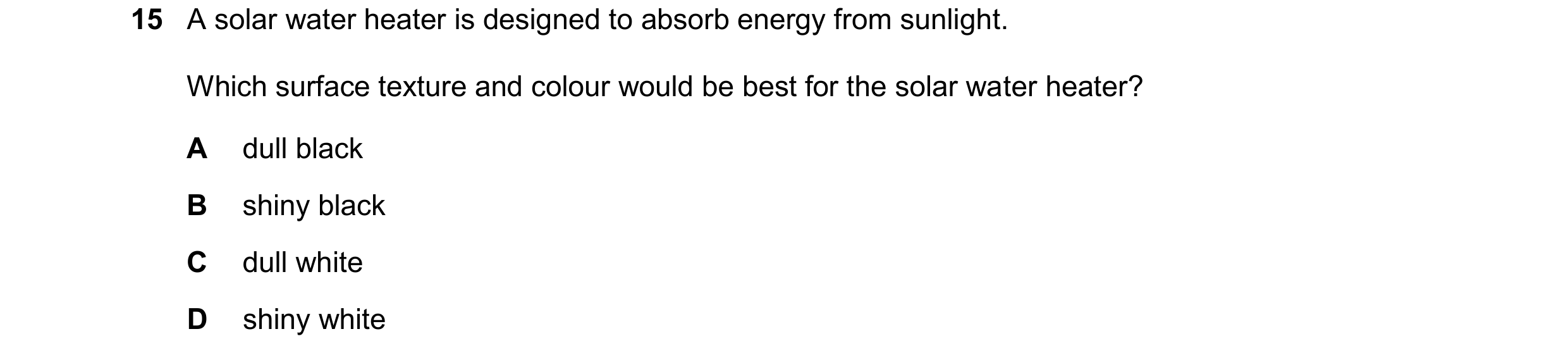
Q30 · A solar water heater is designed to absorb energy from sunlight 0972/21 May/June 2024
15 A solar water heater is designed to absorb energy from sunlight. Which surface texture and colour would be best for the solar water heater? A dull black B shiny black C dull white D shiny white
1 marks
Answer: A
This question in 0972/21 May/June 2024
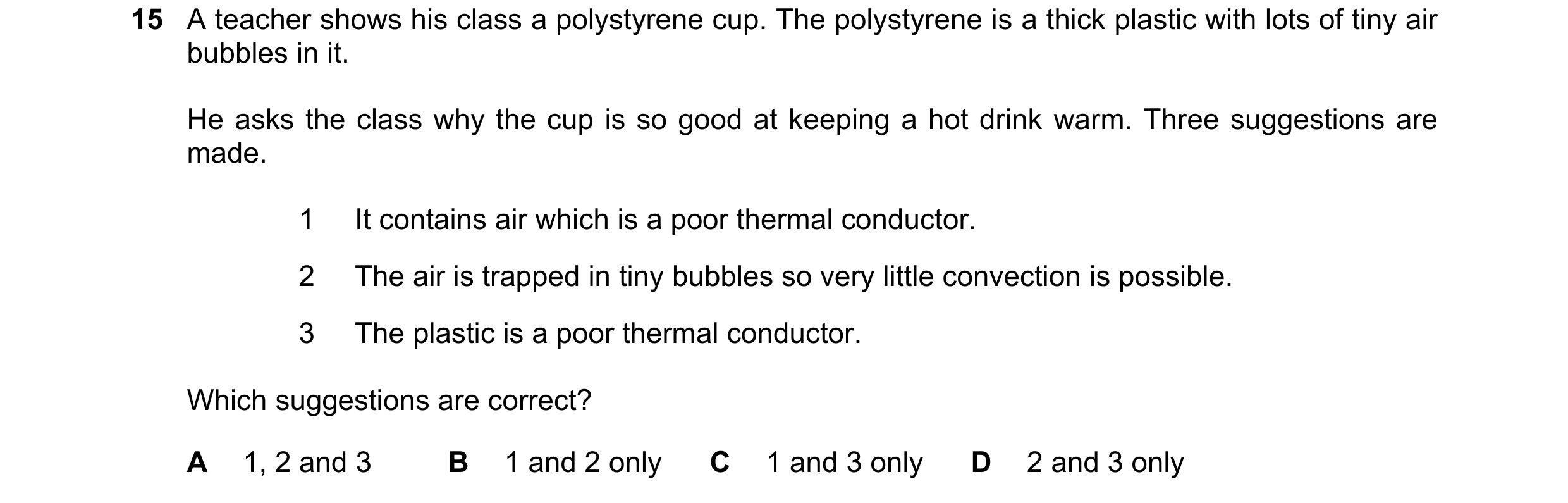
Q31 · A teacher shows his class a polystyrene cup 0972/22 May/June 2024
15 A teacher shows his class a polystyrene cup. The polystyrene is a thick plastic with lots of tiny air bubbles in it. He asks the class why the cup is so good at keeping a hot drink warm. Three suggestions are made. 1 It contains air which is a poor thermal conductor. 2 The air is trapped in tiny bubbles so very little convection is possible. 3 The plastic is a poor thermal conductor. Which suggestions are correct? A 1, 2 and 3 B 1 and 2 only C 1 and 3 only D 2 and 3 only
1 marks
Answer: A
This question in 0972/22 May/June 2024
Q32 · Two samples of the same material have the same mass but different surface areas 0972/22 May/June 2024
16 Two samples of the same material have the same mass but different surface areas. Each sample is heated to the same temperature and then left to cool to room temperature. Each sample is allowed to cool to the same final temperature. X Y small surface area large surface area Which row correctly compares the decrease in internal energy and the initial rate of cooling for each sample? decrease in internal energy initial rate of cooling A X loses more internal energy than Y X cools down faster than Y B Y loses more internal energy than X Y cools down faster than X C X and Y lose the same quantity of energy X cools down faster than Y D X and Y lose the same quantity of energy Y cools down faster than X
1 marks
Answer: D
This question in 0972/22 May/June 2024
Q33 · Thermal radiation is part of the electromagnetic spectrum 0972/22 May/June 2024
23 Thermal radiation is part of the electromagnetic spectrum. What is the name of this region of the spectrum? A gamma rays B infrared C ultraviolet D visible light
1 marks
Answer: B
This question in 0972/22 May/June 2024
Q34 · A student has a copper rod and a wooden rod 0972/21 May/June 2025
15 A student has a copper rod and a wooden rod. Both rods have the same dimensions. The student puts one end of each rod into a beaker of crushed ice. After a few minutes, the student picks up the rods by the ends not in the ice. Which statement is correct? A The copper rod feels colder than the wooden rod because copper is a better conductor than wood. B The copper rod feels warmer than the wooden rod because copper is a better conductor than wood. C The wooden rod feels colder than the copper rod because wood is a better conductor than copper. D The wooden rod feels warmer than the copper rod because wood is a better conductor than copper.
1 marks
Answer: A
This question in 0972/21 May/June 2025
Q35 · The diagram shows a black object X at constant temperature 0972/21 May/June 2025
16 The diagram shows a black object X at constant temperature. The arrows represent the absorption and emission of thermal radiation at the surface. Object Y is at the same constant temperature as X and is identical except that it has a white surface. Which row correctly compares object X with object Y? rate of rate of absorption for X emission for X A higher higher B lower higher C higher lower D lower lower
1 marks
Answer: A
This question in 0972/21 May/June 2025
Q36 · Which statement about convection is not correct? 0972/21 Oct/Nov 2025
14 Which statement about convection is not correct? A It enables water in a pan on a cooker to get evenly heated. B It happens in liquids and gases. C It occurs because cooler liquids rise above warmer liquids. D It occurs because the density of a liquid decreases when it is heated.
1 marks
Answer: C
This question in 0972/21 Oct/Nov 2025
Q37 · Iron is a better conductor of thermal energy than rubber 0972/21 Oct/Nov 2025
15 Iron is a better conductor of thermal energy than rubber. Which statement explains this? A Electrons in iron can move from one part of the iron to another. Electrons in rubber cannot move in this way. B Electrons in iron vibrate with more energy than those in rubber. C Positive particles in iron can move from one part of the iron to another. Positive particles in rubber cannot move in this way. D Positive particles in iron vibrate with more energy than those in rubber.
1 marks
Answer: A
This question in 0972/21 Oct/Nov 2025
Q38 · Two metal cans are identical, except that one has a shiny silver outer surface and the… 0972/21 Oct/Nov 2025
16 Two metal cans are identical, except that one has a shiny silver outer surface and the other has a dull black outer surface. They each have the same mass of hot water at the same temperature sealed inside them. They are both in a vacuum in the darkness of outer space. How does the temperature of the water in each one change? A The temperature of the water does not change. B The water in the black can cools more slowly than that in the silver can. C The water in the silver can cools more slowly than that in the black can. D They both cool down at the same rate.
1 marks
Answer: C
This question in 0972/21 Oct/Nov 2025

 1 / 11
 2 / 11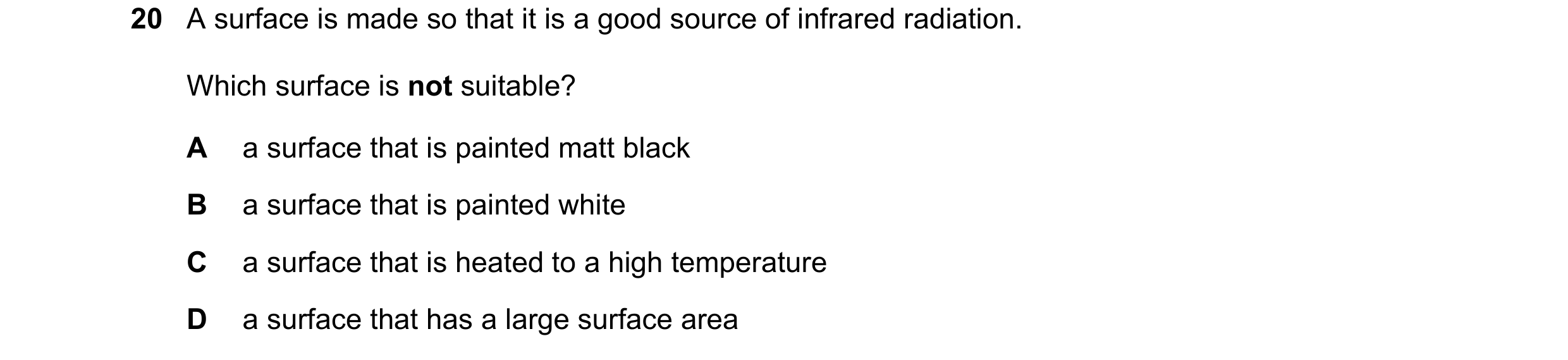

 3 / 11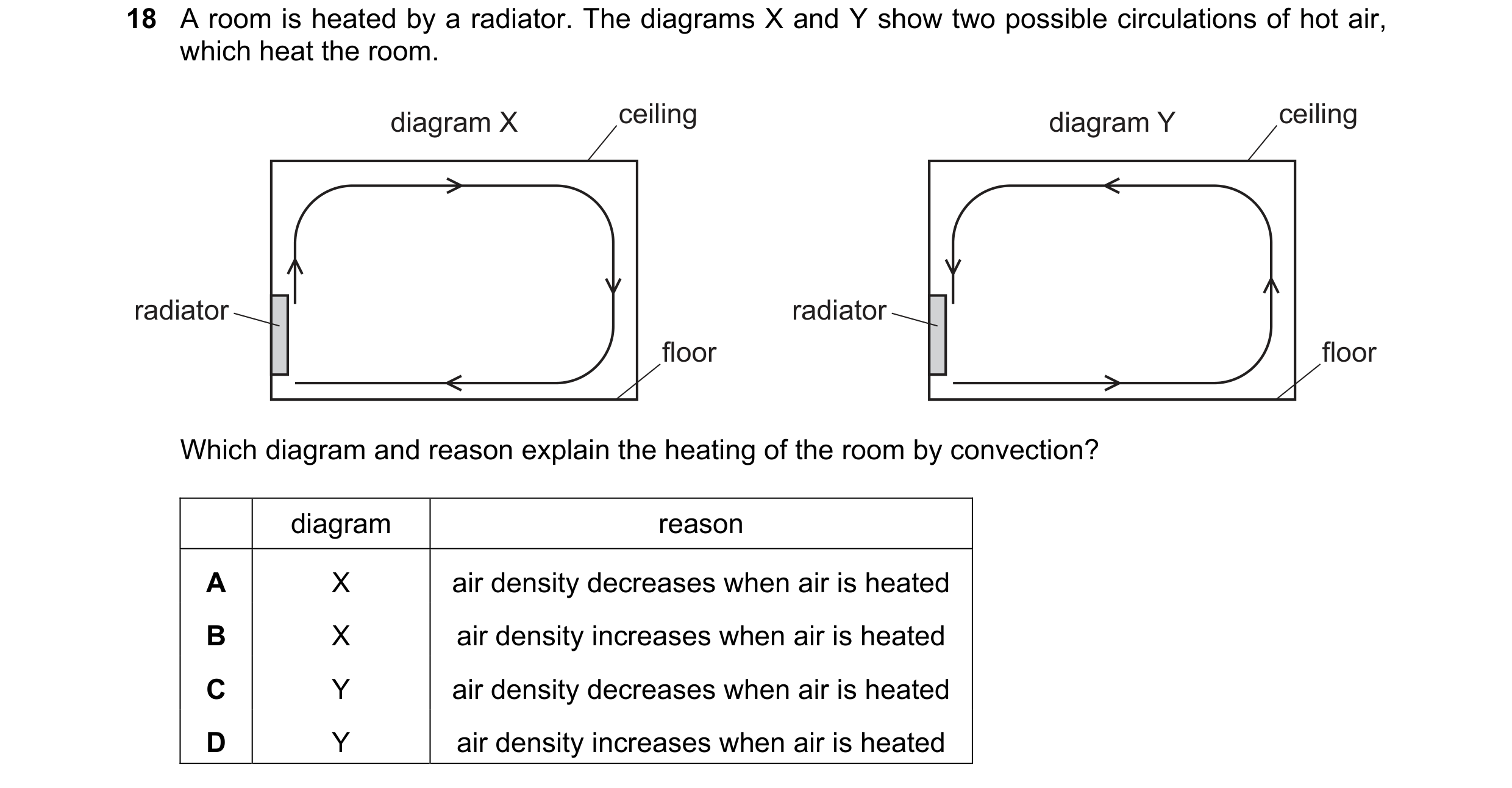
 4 / 11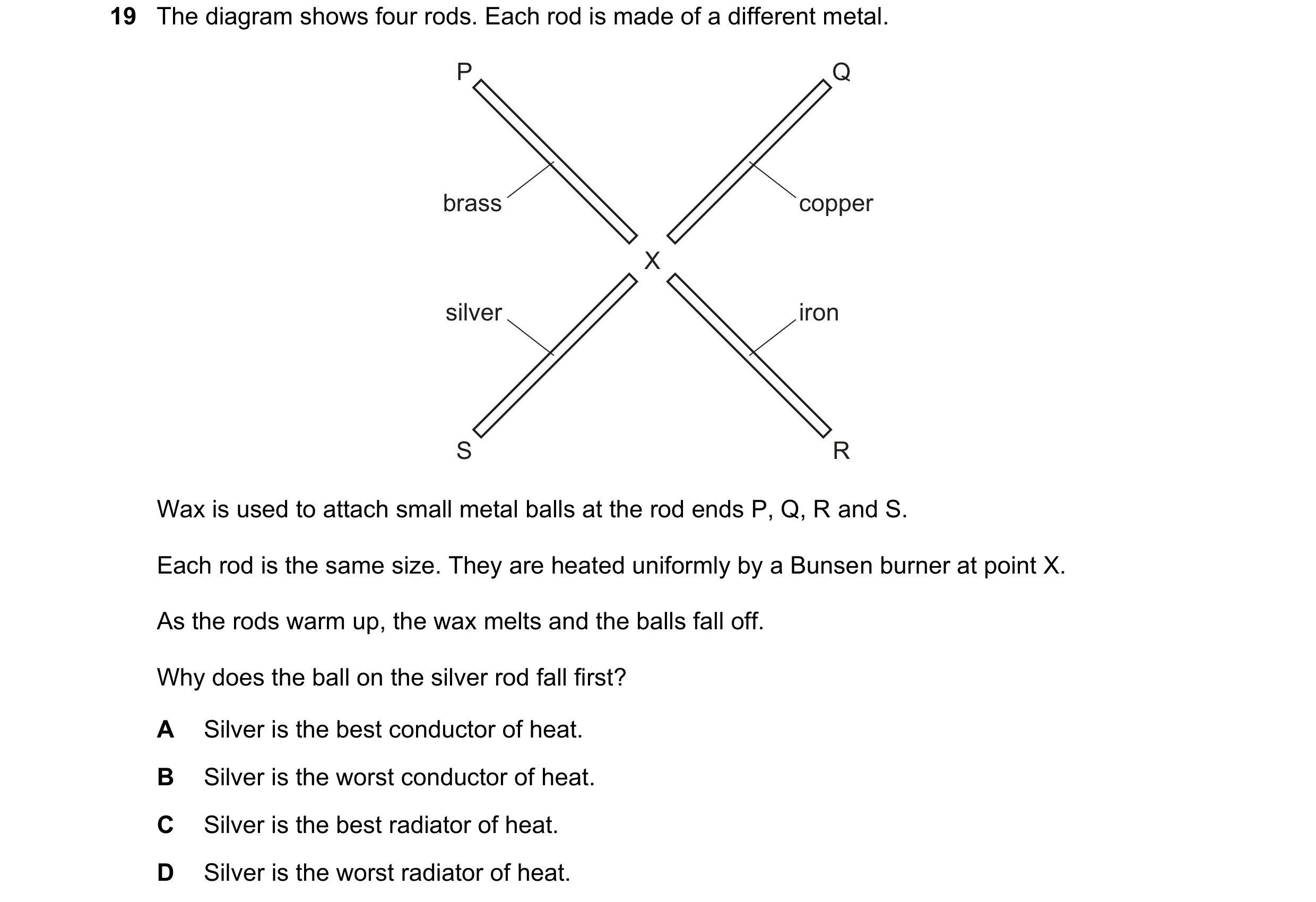
 5 / 11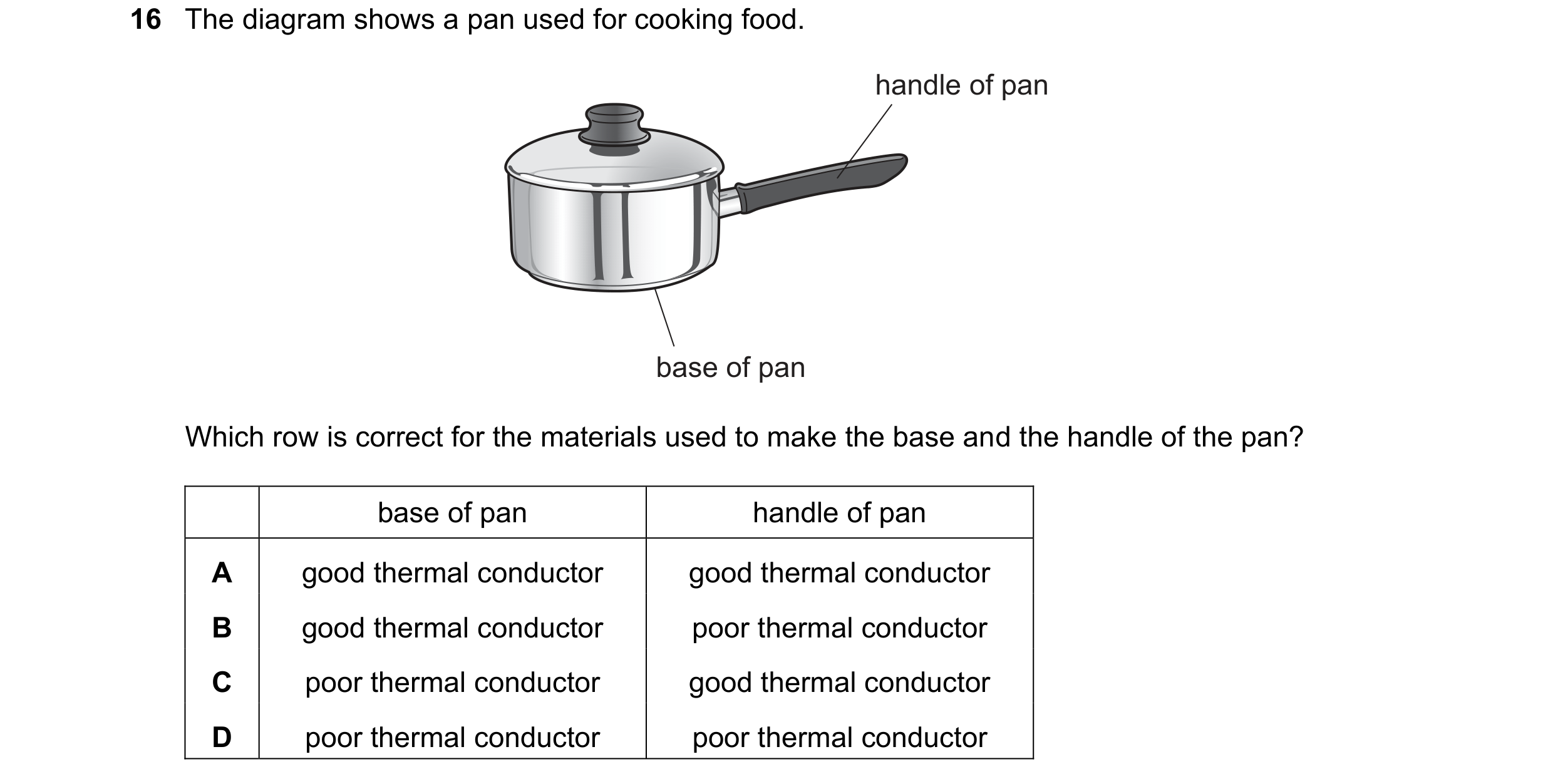
 6 / 11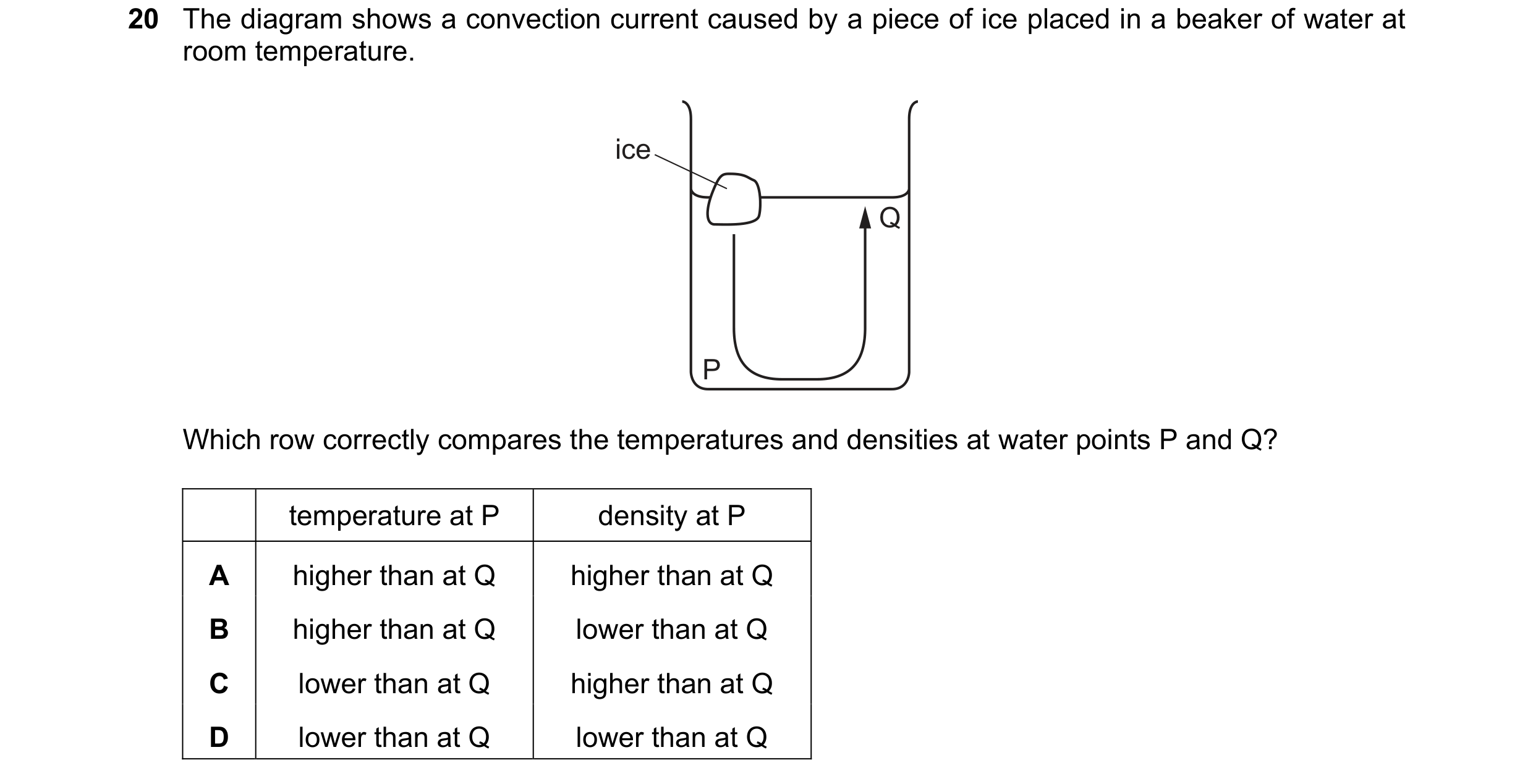
 7 / 11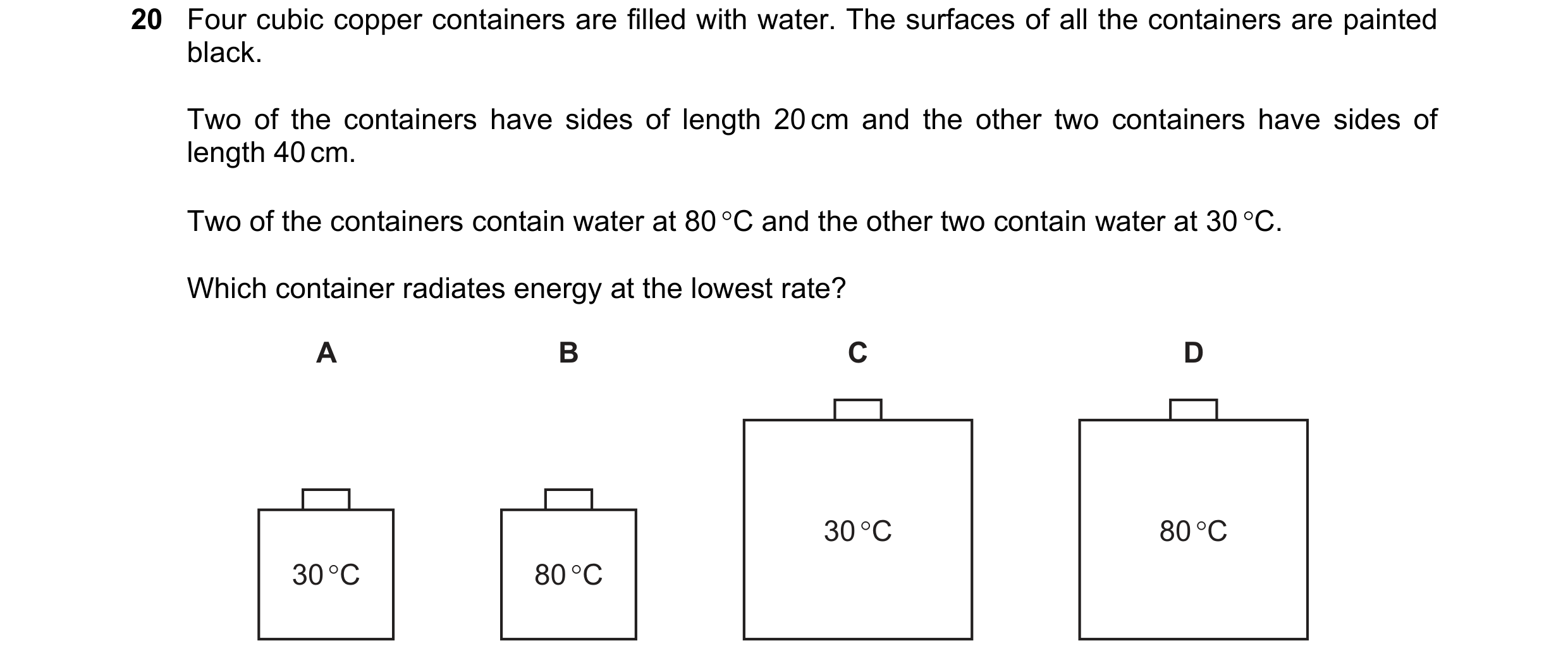
 8 / 11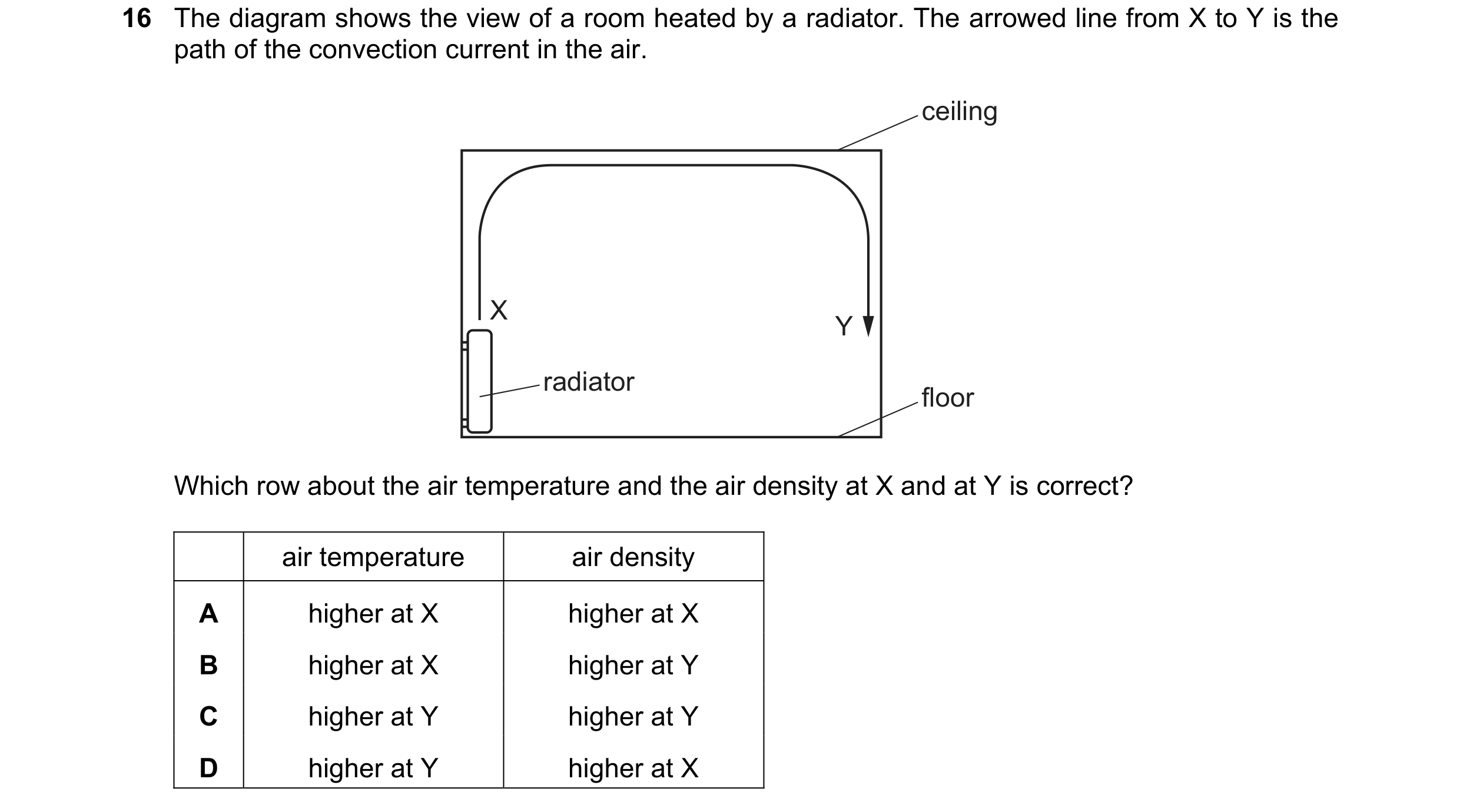

 9 / 11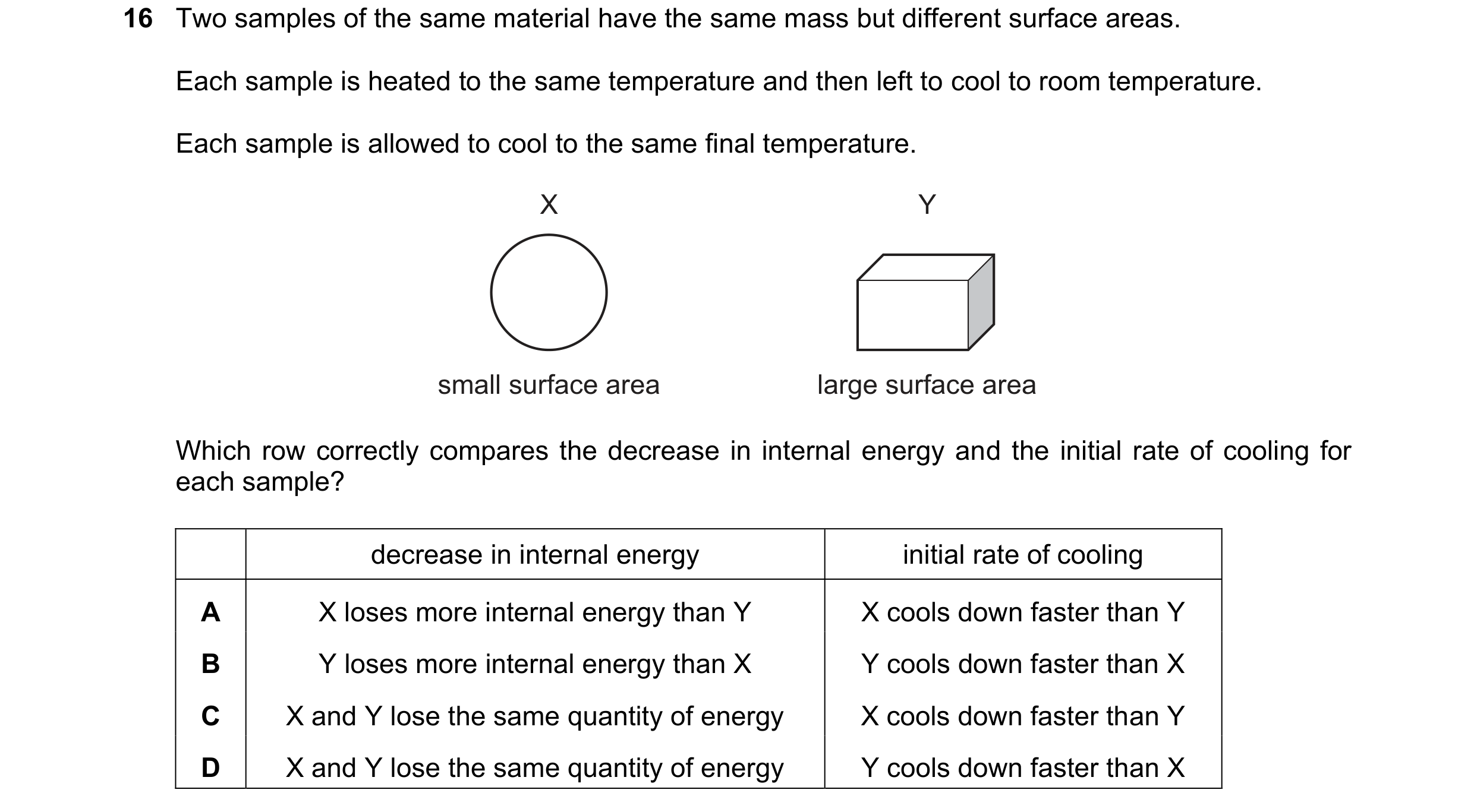
 10 / 11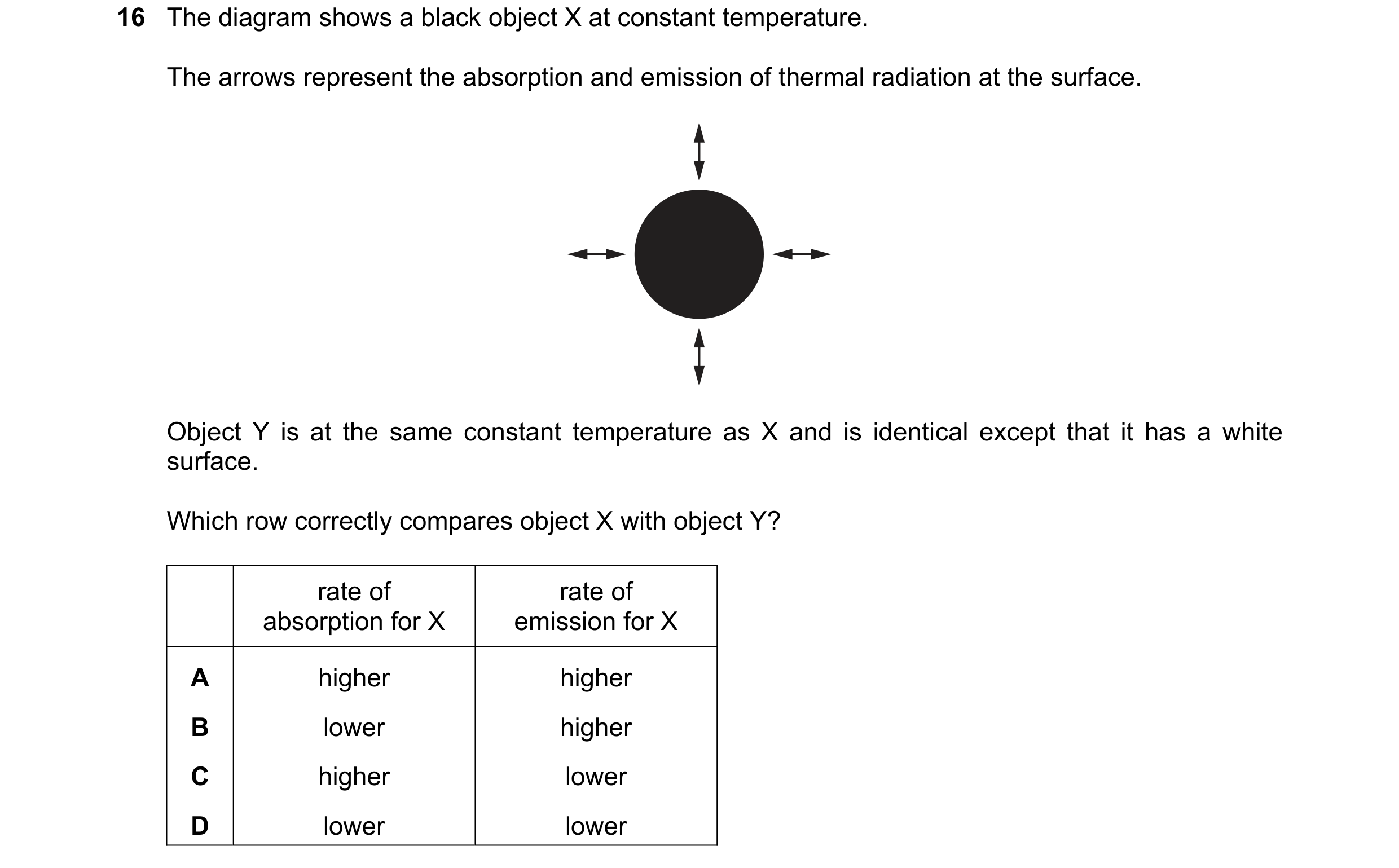

 11 / 11