Cambridge IGCSE Physics (9-1) 0972 — 2020 May/June Paper 1 · Variant 1
0972/11/M/J/20 · 40 questions · 40 marks · ≈45 min
The question paper and its mark scheme, free to read here and free to download. This is Cambridge’s own paper, exactly as it was sat.
Question paper20 pages
Mark scheme3 pages
Answers below. Sit the paper first if you are practising.
Questions as text
Q1 · A pendulum makes 50 complete swings in 2 min 40 s
1 A pendulum makes 50 complete swings in 2 min 40 s. What is the time period for 1 complete swing? A 1.6 s B 3.2 s C 4.8 s D 6.4 s
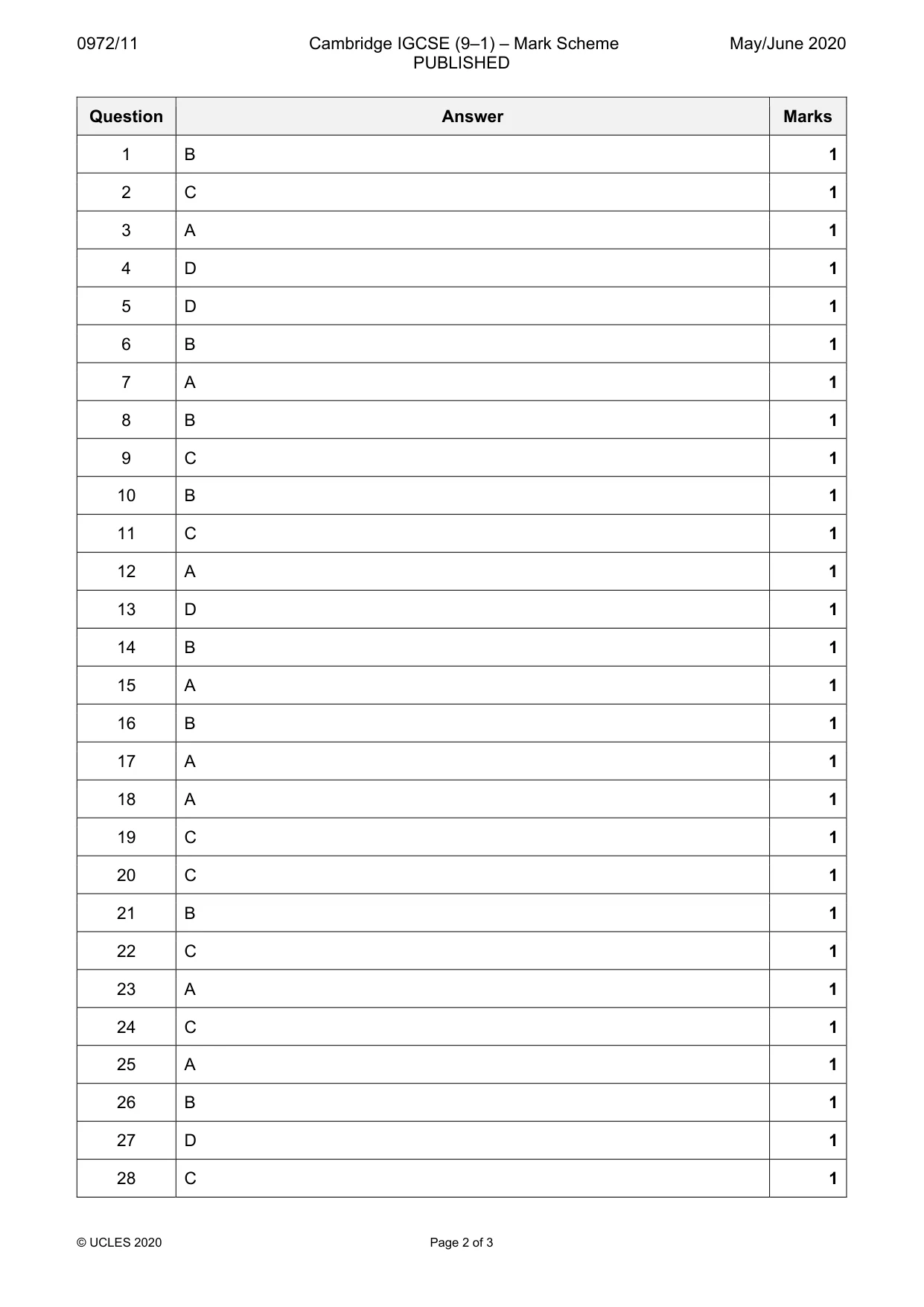
Mark scheme: B
More questions on Physical quantities and measurement techniques
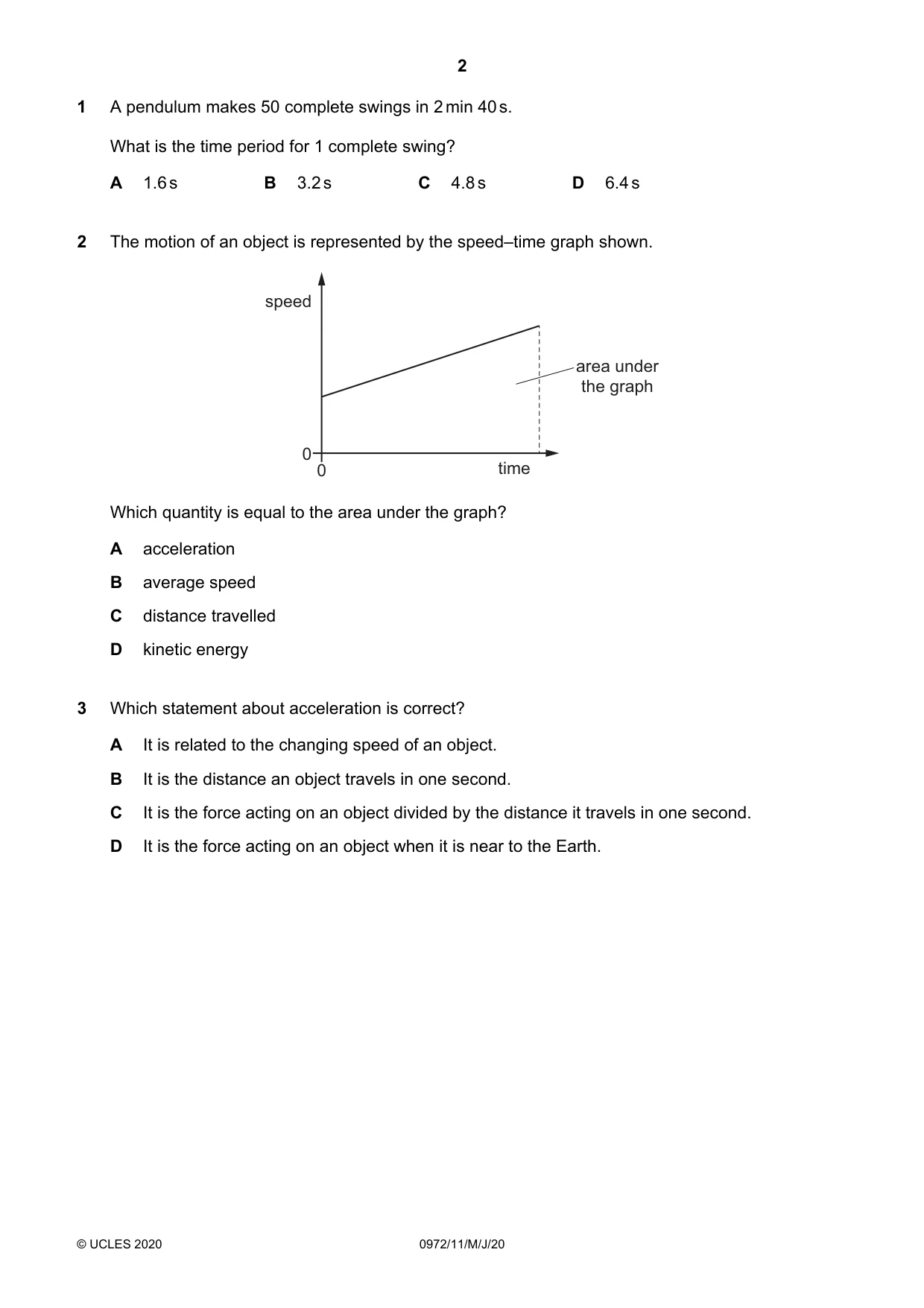
Q2 · The motion of an object is represented by the speed–time graph shown
2 The motion of an object is represented by the speed–time graph shown. speed area under the graph 0 0 time Which quantity is equal to the area under the graph? A acceleration B average speed C distance travelled D kinetic energy
Mark scheme: C
Q3 · Which statement about acceleration is correct?
3 Which statement about acceleration is correct? A It is related to the changing speed of an object. B It is the distance an object travels in one second. C It is the force acting on an object divided by the distance it travels in one second. D It is the force acting on an object when it is near to the Earth.
Mark scheme: A
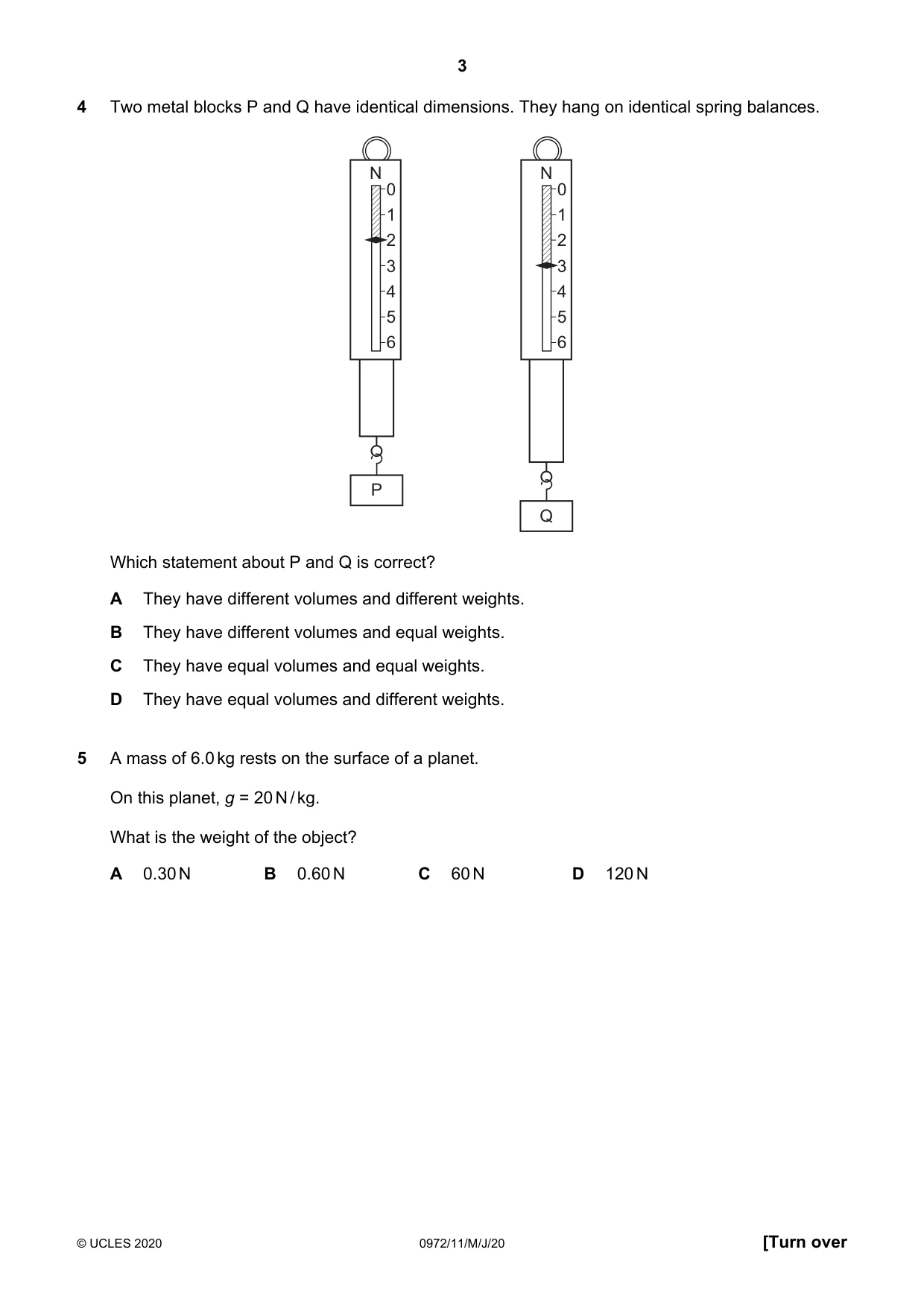
Q4 · Two metal blocks P and Q have identical dimensions
4 Two metal blocks P and Q have identical dimensions. They hang on identical spring balances. N N 0 0 1 1 2 2 3 3 4 4 5 5 6 6 P Q Which statement about P and Q is correct? A They have different volumes and different weights. B They have different volumes and equal weights. C They have equal volumes and equal weights. D They have equal volumes and different weights.
Mark scheme: D
Q5 · A mass of 6.0 kg rests on the surface of a planet
5 A mass of 6.0 kg rests on the surface of a planet. On this planet, g = 20 N / kg. What is the weight of the object? A 0.30 N B 0.60 N C 60 N D 120 N
Mark scheme: D
Q6 · The mass of a measuring cylinder is 190 g
6 The mass of a measuring cylinder is 190 g. 400 cm3 of liquid is put into the measuring cylinder. The total mass of the measuring cylinder and the liquid is 560 g. Four solid objects are lowered in turn into the liquid. The densities of the objects are shown. 1 0.40 g / cm3 2 0.90 g / cm3 3 1.2 g / cm3 4 2.7 g / cm3 Which objects will float in the liquid? A 1 only B 1 and 2 only C 1, 2 and 3 D 3 and 4 only
Mark scheme: B
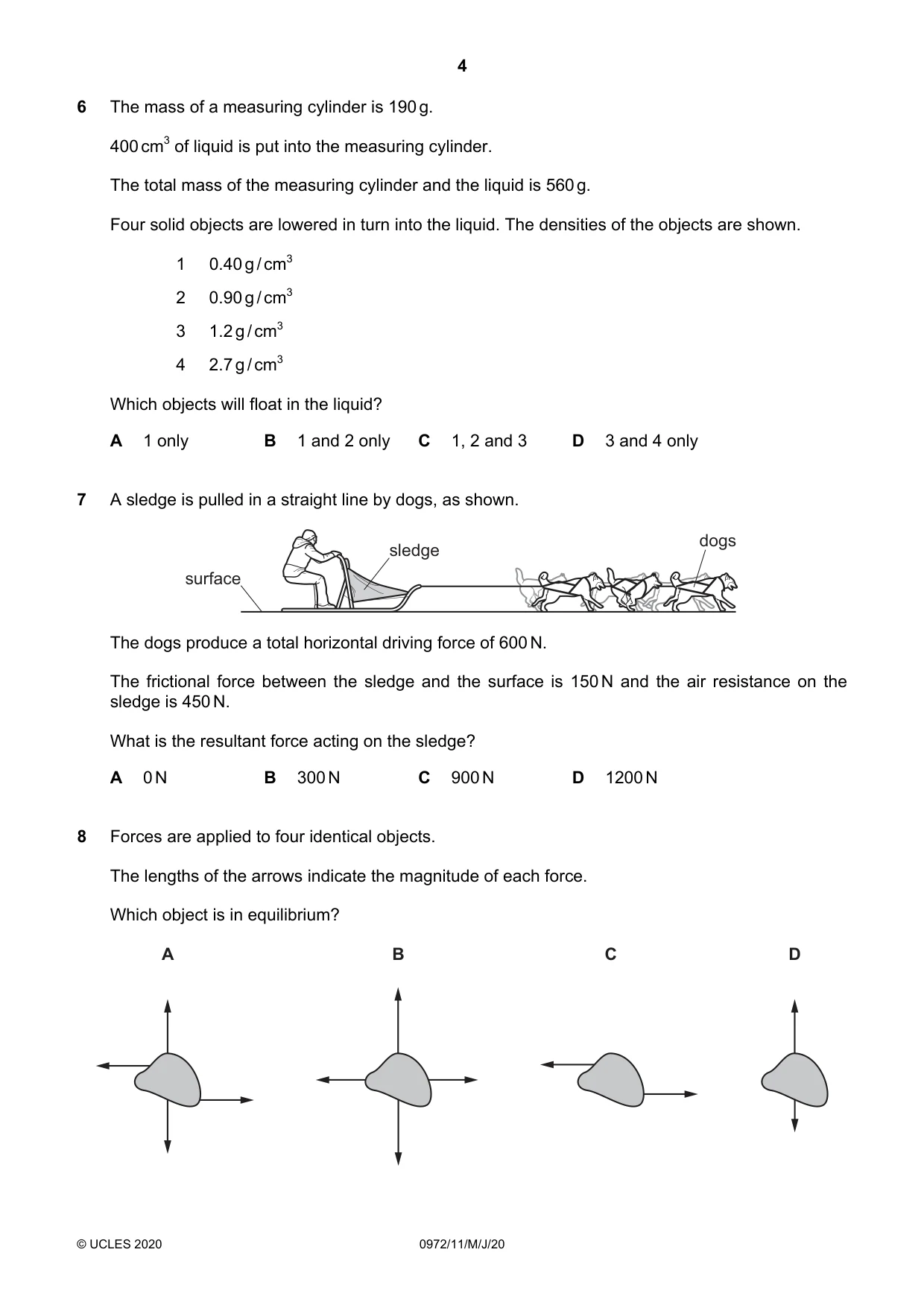
Q7 · A sledge is pulled in a straight line by dogs, as shown
7 A sledge is pulled in a straight line by dogs, as shown. dogs sledge surface The dogs produce a total horizontal driving force of 600 N. The frictional force between the sledge and the surface is 150 N and the air resistance on the sledge is 450 N. What is the resultant force acting on the sledge? A 0 N B 300 N C 900 N D 1200 N
Mark scheme: A
Q8 · Forces are applied to four identical objects
8 Forces are applied to four identical objects. The lengths of the arrows indicate the magnitude of each force. Which object is in equilibrium? A B C D
Mark scheme: B
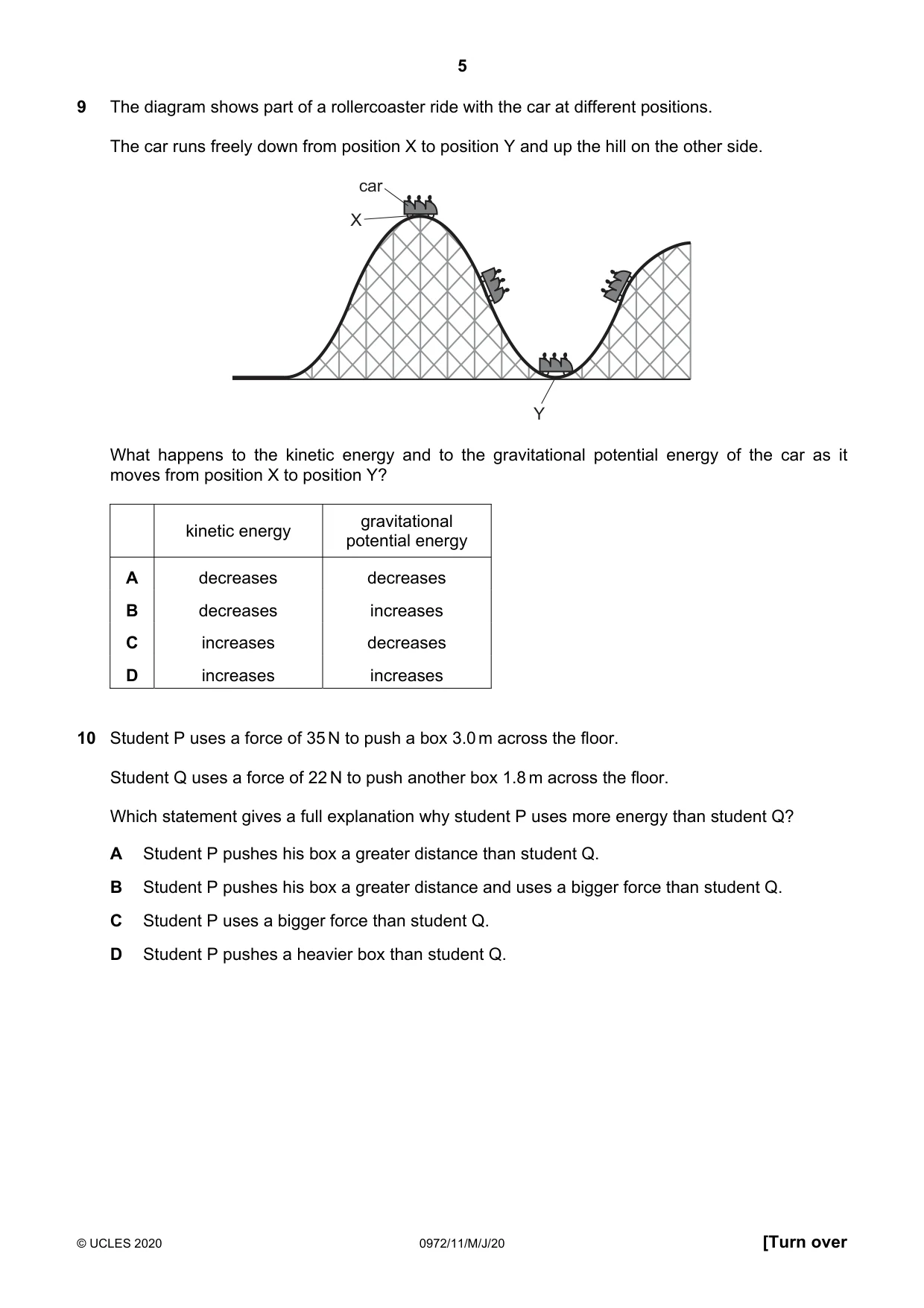
Q9 · The diagram shows part of a rollercoaster ride with the car at different positions
9 The diagram shows part of a rollercoaster ride with the car at different positions. The car runs freely down from position X to position Y and up the hill on the other side. car X Y What happens to the kinetic energy and to the gravitational potential energy of the car as it moves from position X to position Y? gravitational kinetic energy potential energy A decreases decreases B decreases increases C increases decreases D increases increases
Mark scheme: C
Q10 · Student P uses a force of 35 N to push a box 3.0 m across the floor
10 Student P uses a force of 35 N to push a box 3.0 m across the floor. Student Q uses a force of 22 N to push another box 1.8 m across the floor. Which statement gives a full explanation why student P uses more energy than student Q? A Student P pushes his box a greater distance than student Q. B Student P pushes his box a greater distance and uses a bigger force than student Q. C Student P uses a bigger force than student Q. D Student P pushes a heavier box than student Q.
Mark scheme: B
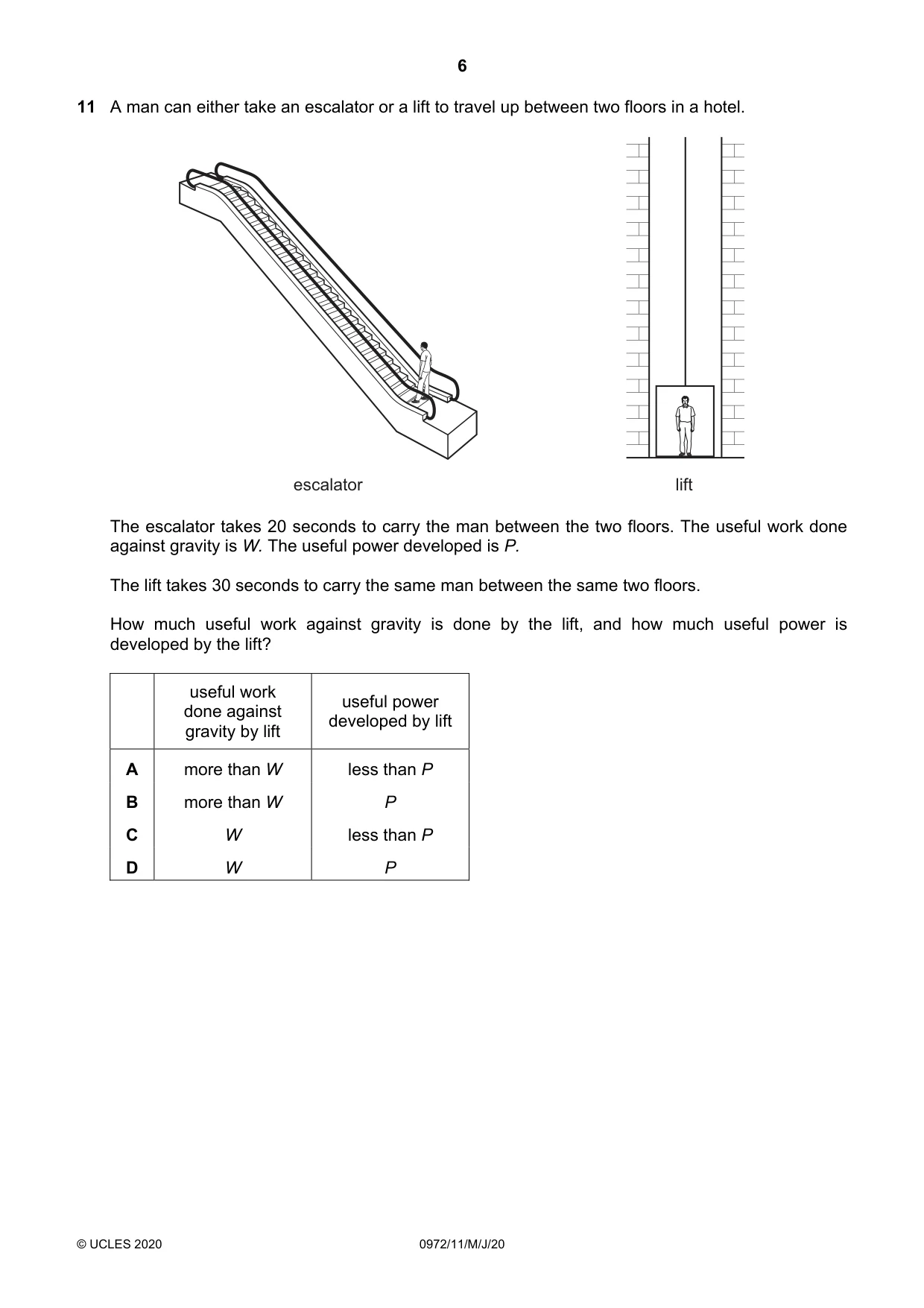
Q11 · A man can either take an escalator or a lift to travel up between two floors in a hotel
11 A man can either take an escalator or a lift to travel up between two floors in a hotel. escalator lift The escalator takes 20 seconds to carry the man between the two floors. The useful work done against gravity is W. The useful power developed is P. The lift takes 30 seconds to carry the same man between the same two floors. How much useful work against gravity is done by the lift, and how much useful power is developed by the lift? useful work useful power done against developed by lift gravity by lift A more than W less than P B more than W P C W less than P D W P
Mark scheme: C
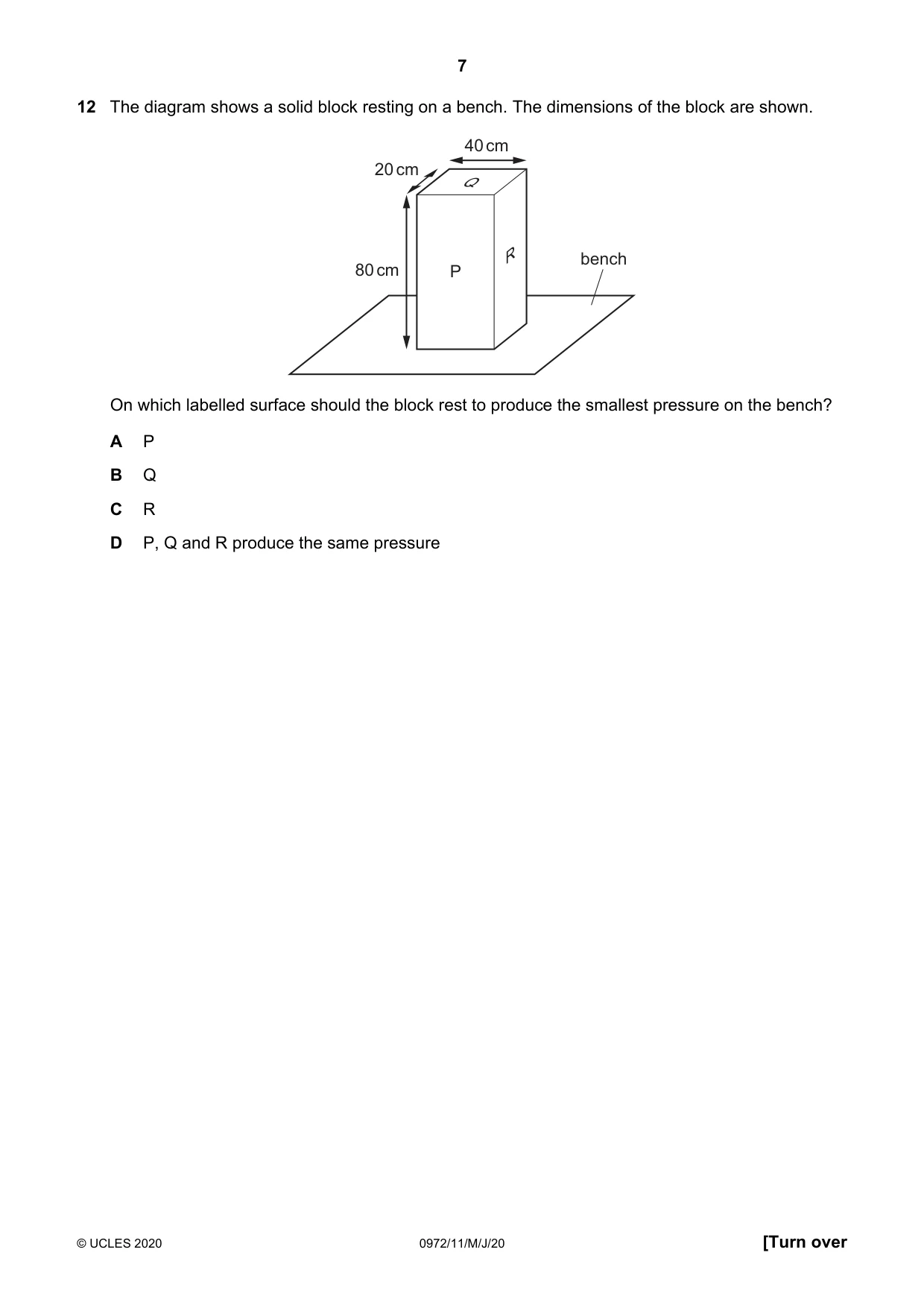
Q12 · The diagram shows a solid block resting on a bench
12 The diagram shows a solid block resting on a bench. The dimensions of the block are shown. 40 cm 20 cm Q R bench 80 cm P On which labelled surface should the block rest to produce the smallest pressure on the bench? A P B Q C R D P, Q and R produce the same pressure
Mark scheme: A
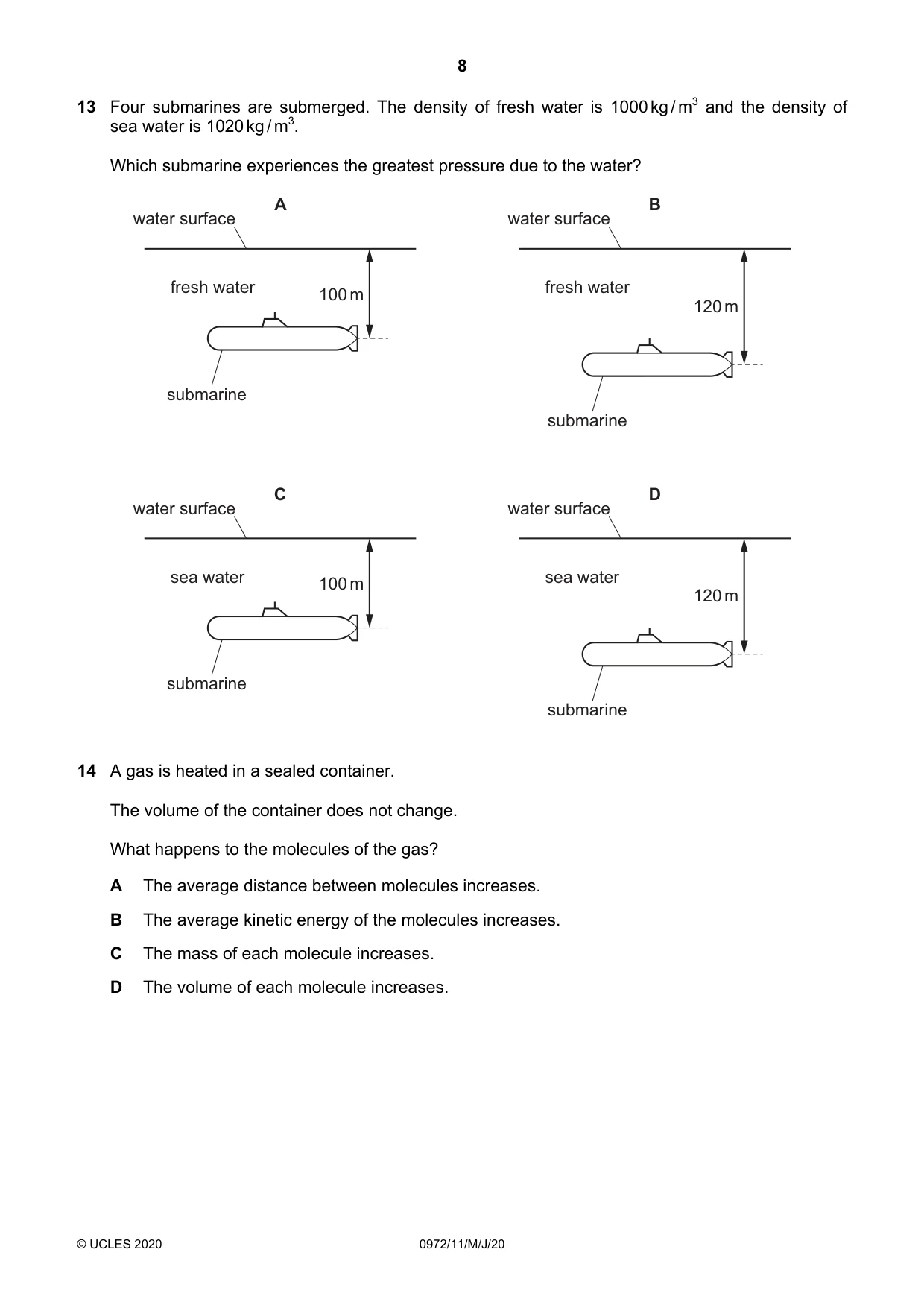
Q13 · Four submarines are submerged
13 Four submarines are submerged. The density of fresh water is 1000 kg / m3 and the density of sea water is 1020 kg / m3. Which submarine experiences the greatest pressure due to the water? A B water surface water surface fresh water 100 m fresh water 120 m submarine submarine C D water surface water surface sea water 100 m sea water 120 m submarine submarine
Mark scheme: D
Q14 · A gas is heated in a sealed container
14 A gas is heated in a sealed container. The volume of the container does not change. What happens to the molecules of the gas? A The average distance between molecules increases. B The average kinetic energy of the molecules increases. C The mass of each molecule increases. D The volume of each molecule increases.
Mark scheme: B
Q15 · A student is investigating evaporation
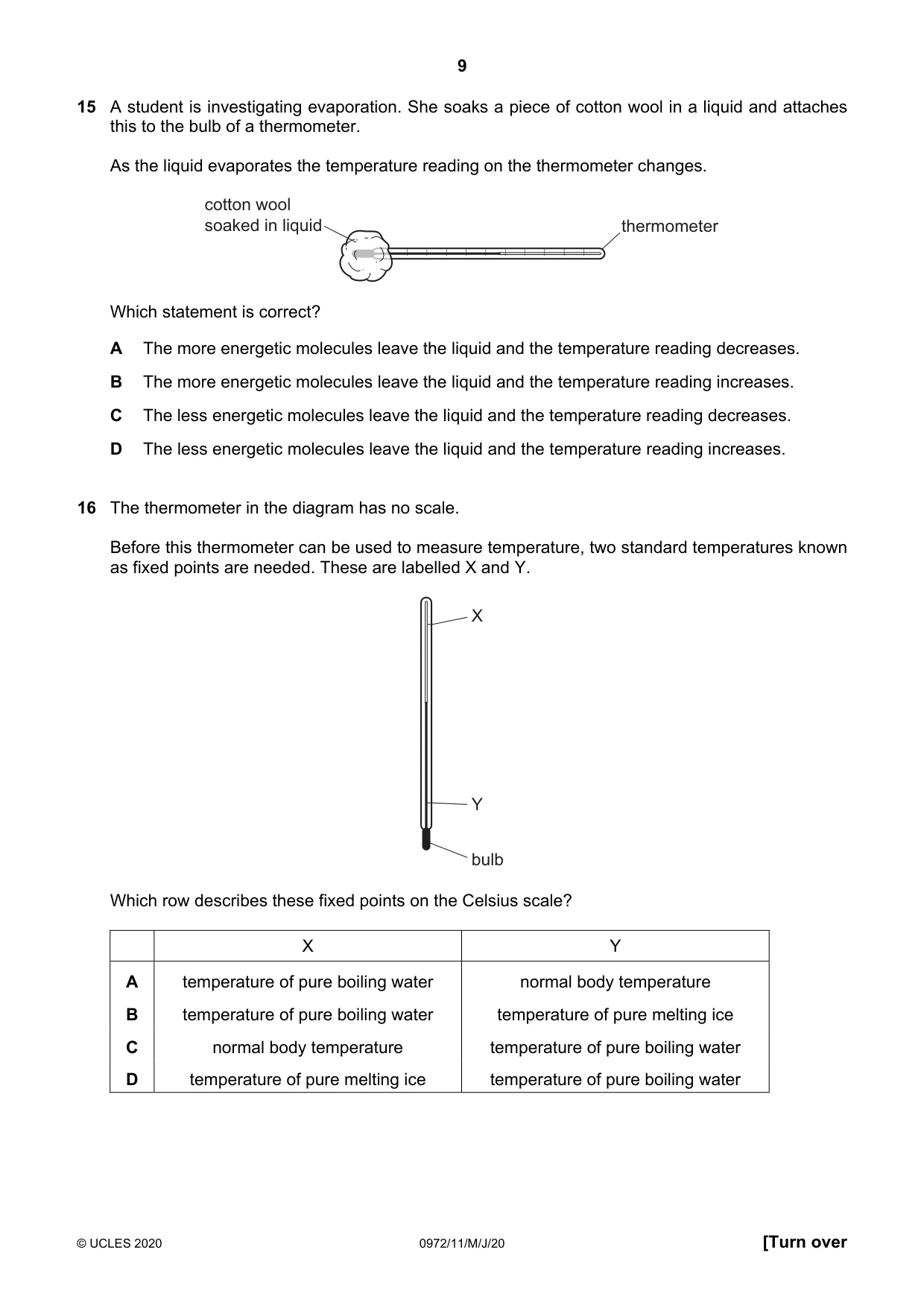
15 A student is investigating evaporation. She soaks a piece of cotton wool in a liquid and attaches this to the bulb of a thermometer. As the liquid evaporates the temperature reading on the thermometer changes. cotton wool soaked in liquid thermometer Which statement is correct? A The more energetic molecules leave the liquid and the temperature reading decreases. B The more energetic molecules leave the liquid and the temperature reading increases. C The less energetic molecules leave the liquid and the temperature reading decreases. D The less energetic molecules leave the liquid and the temperature reading increases.
Mark scheme: A
Q16 · The thermometer in the diagram has no scale
16 The thermometer in the diagram has no scale. Before this thermometer can be used to measure temperature, two standard temperatures known as fixed points are needed. These are labelled X and Y. X Y bulb Which row describes these fixed points on the Celsius scale? X Y A temperature of pure boiling water normal body temperature B temperature of pure boiling water temperature of pure melting ice C normal body temperature temperature of pure boiling water D temperature of pure melting ice temperature of pure boiling water
Mark scheme: B
Q17 · When a hot gas is left to cool, its internal energy decreases
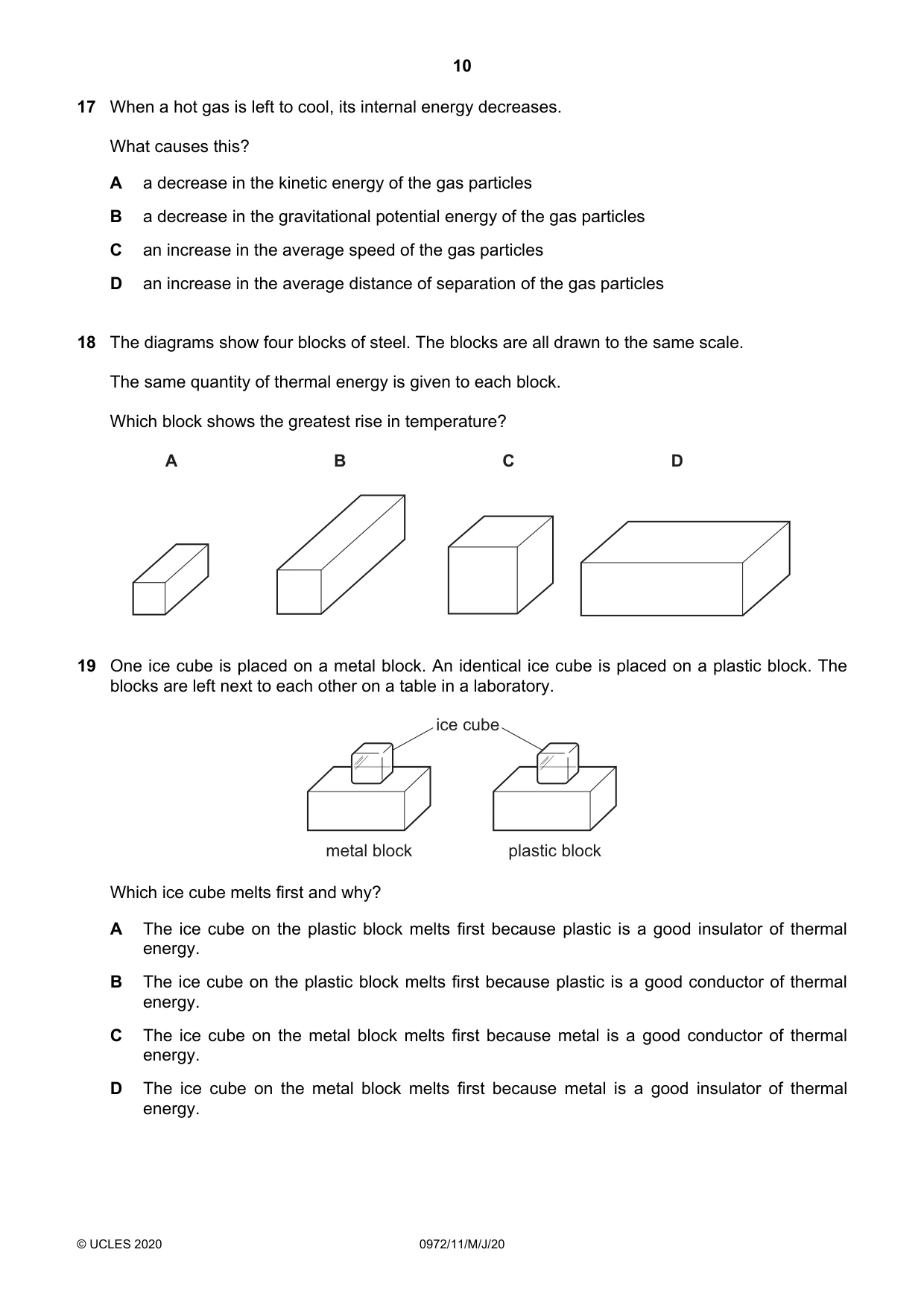
17 When a hot gas is left to cool, its internal energy decreases. What causes this? A a decrease in the kinetic energy of the gas particles B a decrease in the gravitational potential energy of the gas particles C an increase in the average speed of the gas particles D an increase in the average distance of separation of the gas particles
Mark scheme: A
Q18 · The diagrams show four blocks of steel
18 The diagrams show four blocks of steel. The blocks are all drawn to the same scale. The same quantity of thermal energy is given to each block. Which block shows the greatest rise in temperature? A B C D
Mark scheme: A
Q19 · One ice cube is placed on a metal block
19 One ice cube is placed on a metal block. An identical ice cube is placed on a plastic block. The blocks are left next to each other on a table in a laboratory. ice cube metal block plastic block Which ice cube melts first and why? A The ice cube on the plastic block melts first because plastic is a good insulator of thermal energy. B The ice cube on the plastic block melts first because plastic is a good conductor of thermal energy. C The ice cube on the metal block melts first because metal is a good conductor of thermal energy. D The ice cube on the metal block melts first because metal is a good insulator of thermal energy.
Mark scheme: C
Q20 · Two freezers X and Y are identical except that one has a door opening at the front and…
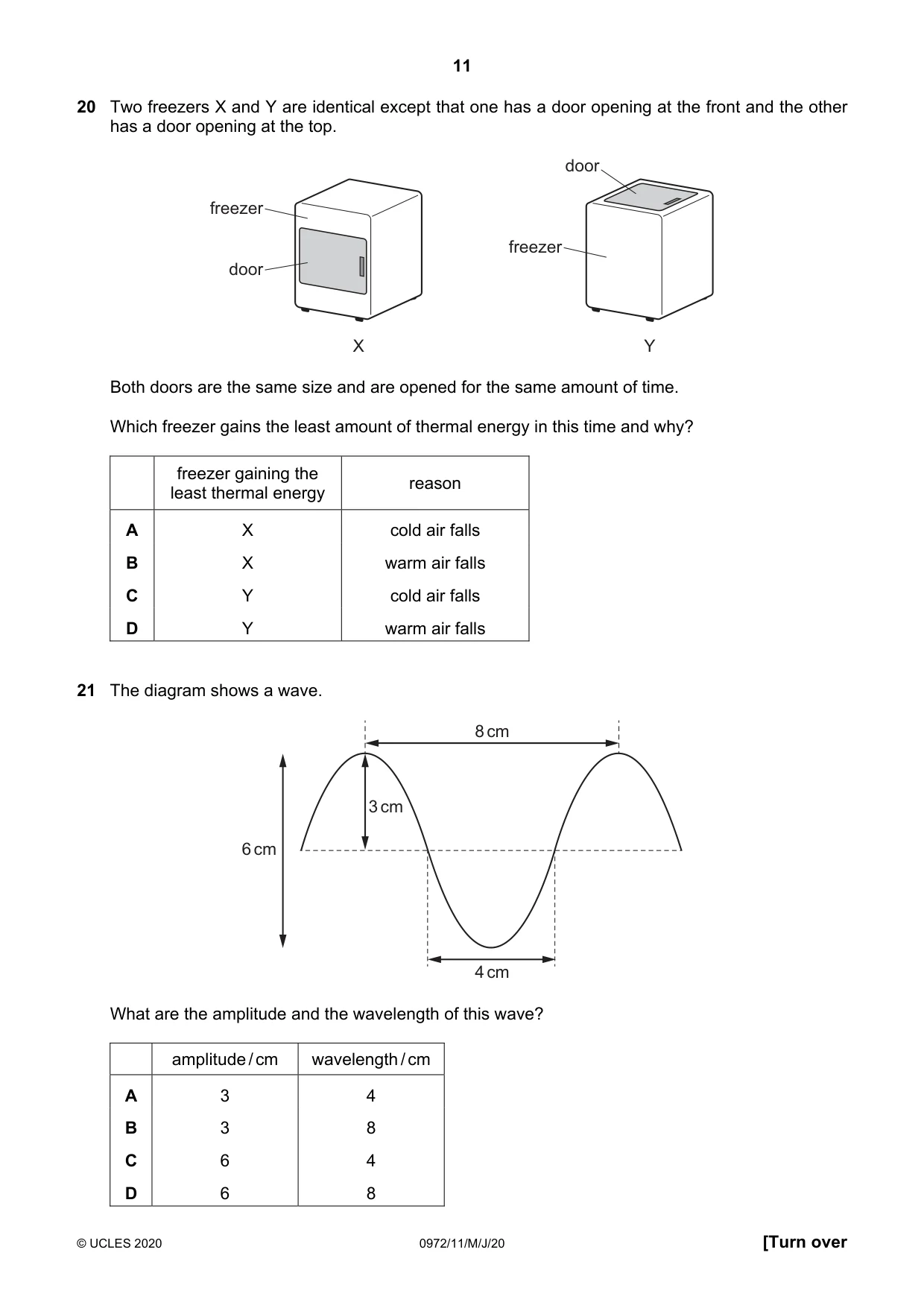
20 Two freezers X and Y are identical except that one has a door opening at the front and the other has a door opening at the top. door freezer freezer door X Y Both doors are the same size and are opened for the same amount of time. Which freezer gains the least amount of thermal energy in this time and why? freezer gaining the reason least thermal energy A X cold air falls B X warm air falls C Y cold air falls D Y warm air falls
Mark scheme: C
Q21 · The diagram shows a wave
21 The diagram shows a wave. 8 cm 3 cm 6 cm 4 cm What are the amplitude and the wavelength of this wave? amplitude / cm wavelength / cm A 3 4 B 3 8 C 6 4 D 6 8
Mark scheme: B
Q22 · Waves travel more quickly on the surface of water when the water is deep
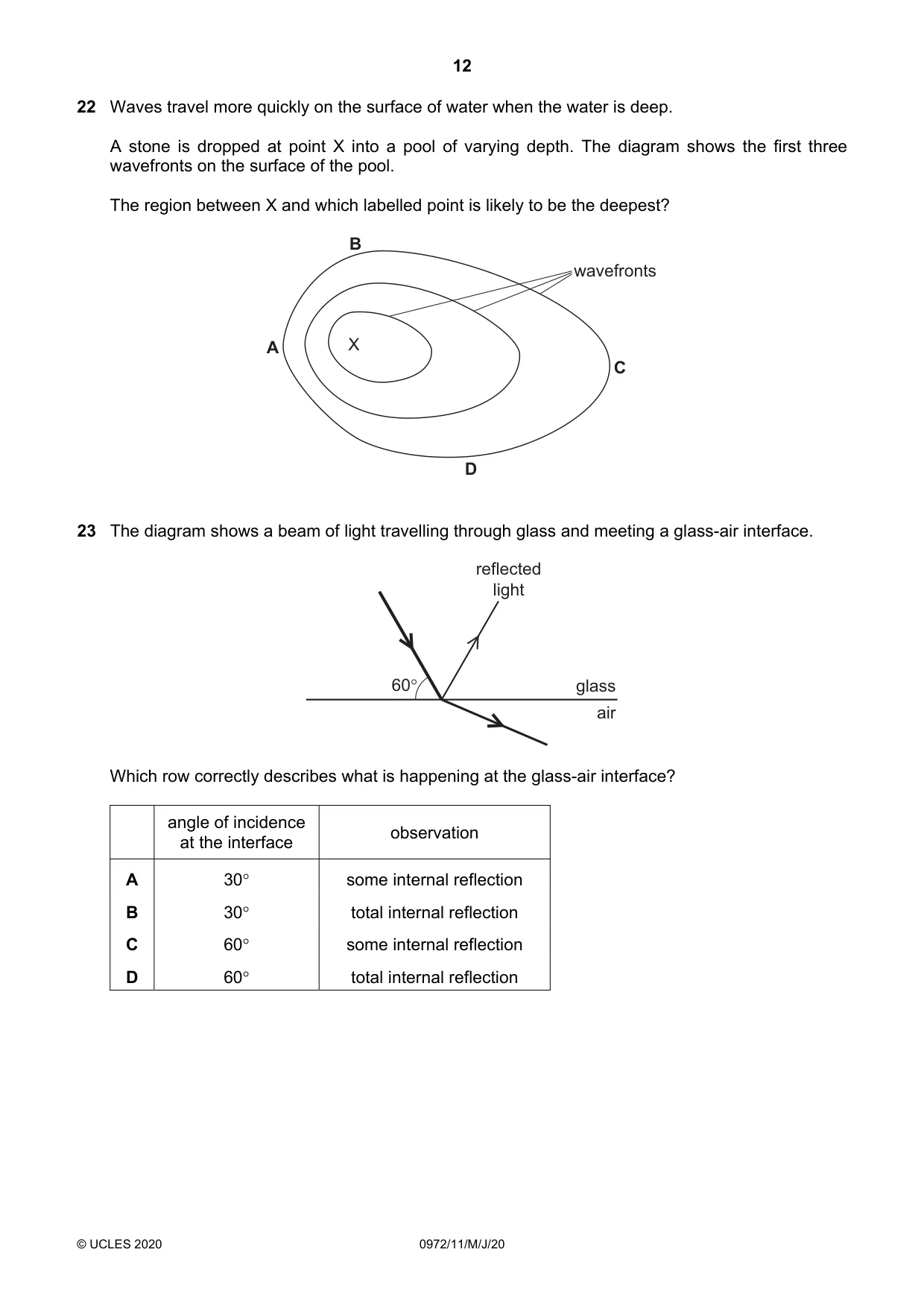
22 Waves travel more quickly on the surface of water when the water is deep. A stone is dropped at point X into a pool of varying depth. The diagram shows the first three wavefronts on the surface of the pool. The region between X and which labelled point is likely to be the deepest? B wavefronts A X C D
Mark scheme: C
Q23 · The diagram shows a beam of light travelling through glass and meeting a glass-air…
23 The diagram shows a beam of light travelling through glass and meeting a glass-air interface. reflected light 60° glass air Which row correctly describes what is happening at the glass-air interface? angle of incidence observation at the interface A 30° some internal reflection B 30° total internal reflection C 60° some internal reflection D 60° total internal reflection
Mark scheme: A
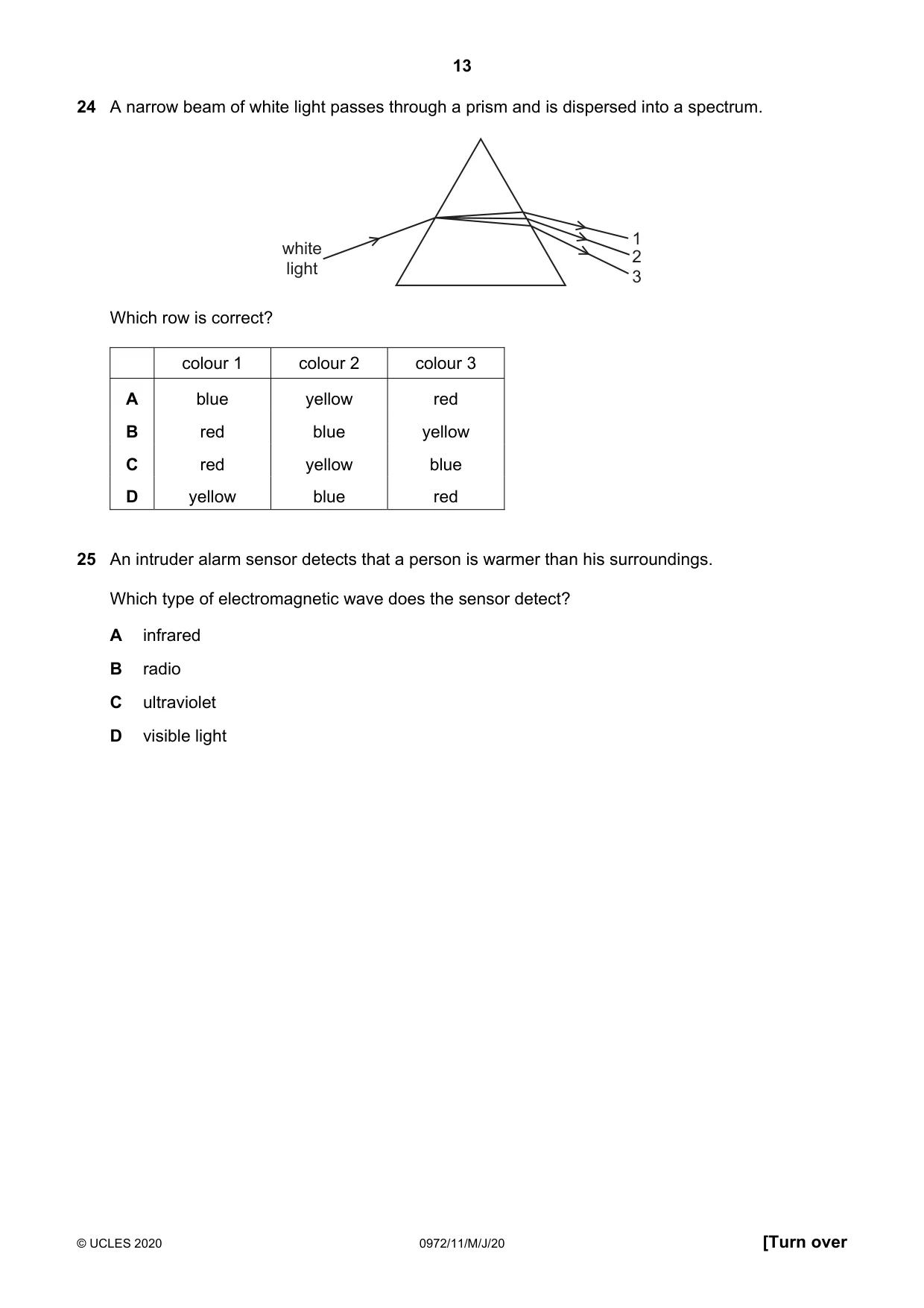
Q24 · A narrow beam of white light passes through a prism and is dispersed into a spectrum
24 A narrow beam of white light passes through a prism and is dispersed into a spectrum. 1 white 2 light 3 Which row is correct? colour 1 colour 2 colour 3 A blue yellow red B red blue yellow C red yellow blue D yellow blue red
Mark scheme: C
Q25 · An intruder alarm sensor detects that a person is warmer than his surroundings
25 An intruder alarm sensor detects that a person is warmer than his surroundings. Which type of electromagnetic wave does the sensor detect? A infrared B radio C ultraviolet D visible light
Mark scheme: A
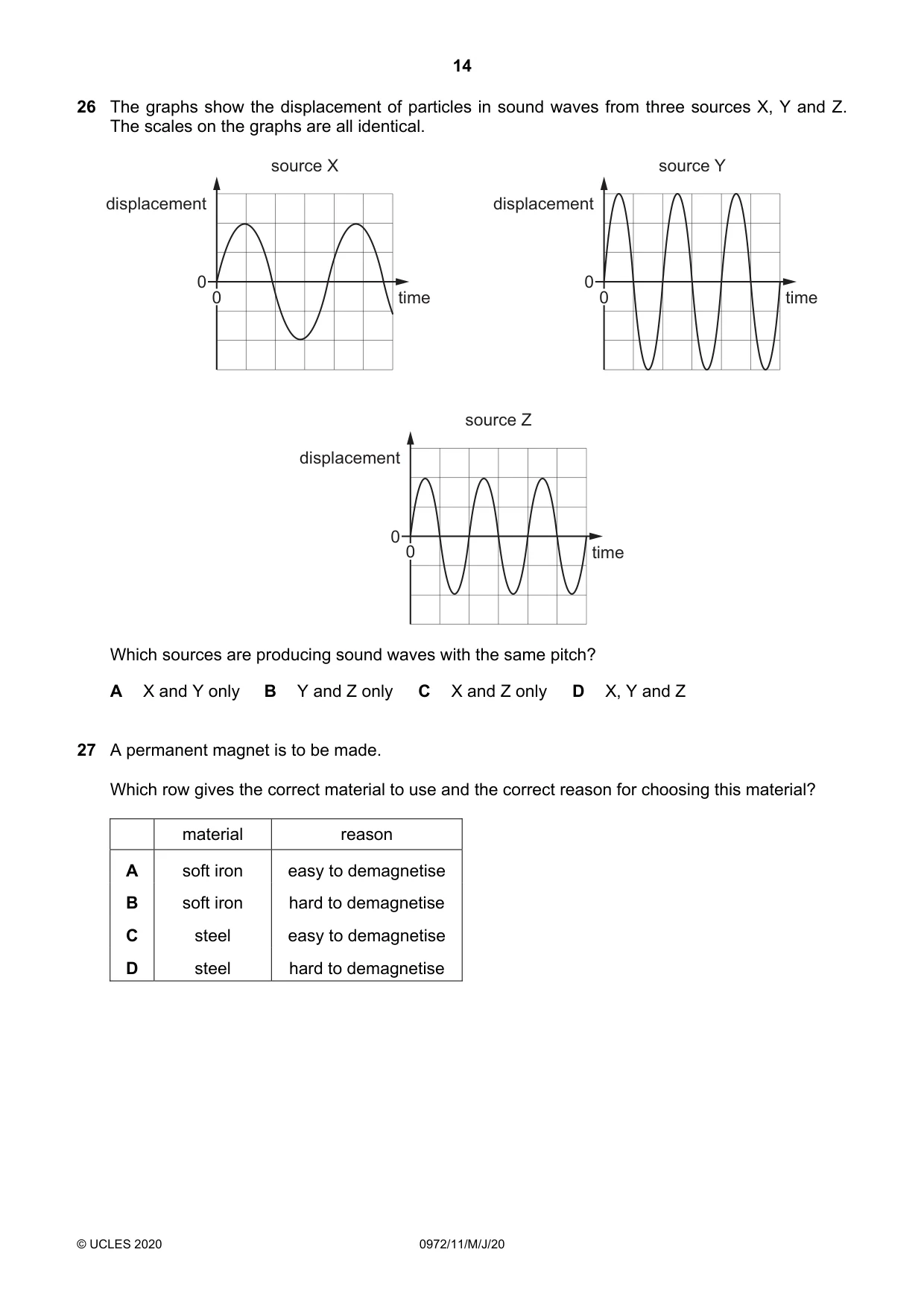
Q26 · The graphs show the displacement of particles in sound waves from three sources X, Y and Z
26 The graphs show the displacement of particles in sound waves from three sources X, Y and Z. The scales on the graphs are all identical. source X source Y displacement displacement 0 0 0 time 0 time source Z displacement 0 0 time Which sources are producing sound waves with the same pitch? A X and Y only B Y and Z only C X and Z only D X, Y and Z
Mark scheme: B
Q27 · A permanent magnet is to be made
27 A permanent magnet is to be made. Which row gives the correct material to use and the correct reason for choosing this material? material reason A soft iron easy to demagnetise B soft iron hard to demagnetise C steel easy to demagnetise D steel hard to demagnetise
Mark scheme: D
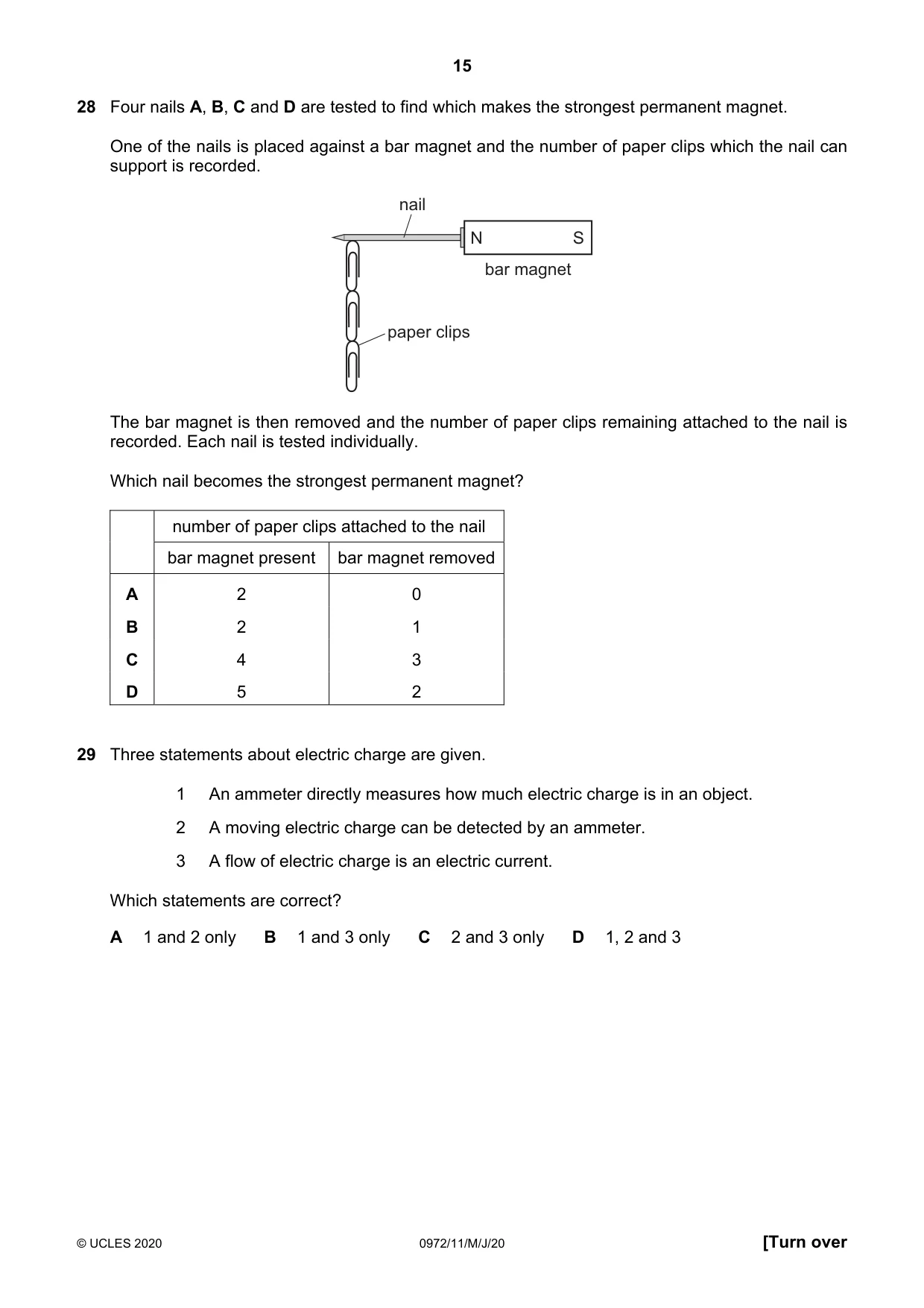
Q28 · Four nails A, B, C and D are tested to find which makes the strongest permanent magnet
28 Four nails A, B, C and D are tested to find which makes the strongest permanent magnet. One of the nails is placed against a bar magnet and the number of paper clips which the nail can support is recorded. nail N S bar magnet paper clips The bar magnet is then removed and the number of paper clips remaining attached to the nail is recorded. Each nail is tested individually. Which nail becomes the strongest permanent magnet? number of paper clips attached to the nail bar magnet present bar magnet removed A 2 0 B 2 1 C 4 3 D 5 2
Mark scheme: C
Q29 · Three statements about electric charge are given
29 Three statements about electric charge are given. 1 An ammeter directly measures how much electric charge is in an object. 2 A moving electric charge can be detected by an ammeter. 3 A flow of electric charge is an electric current. Which statements are correct? A 1 and 2 only B 1 and 3 only C 2 and 3 only D 1, 2 and 3
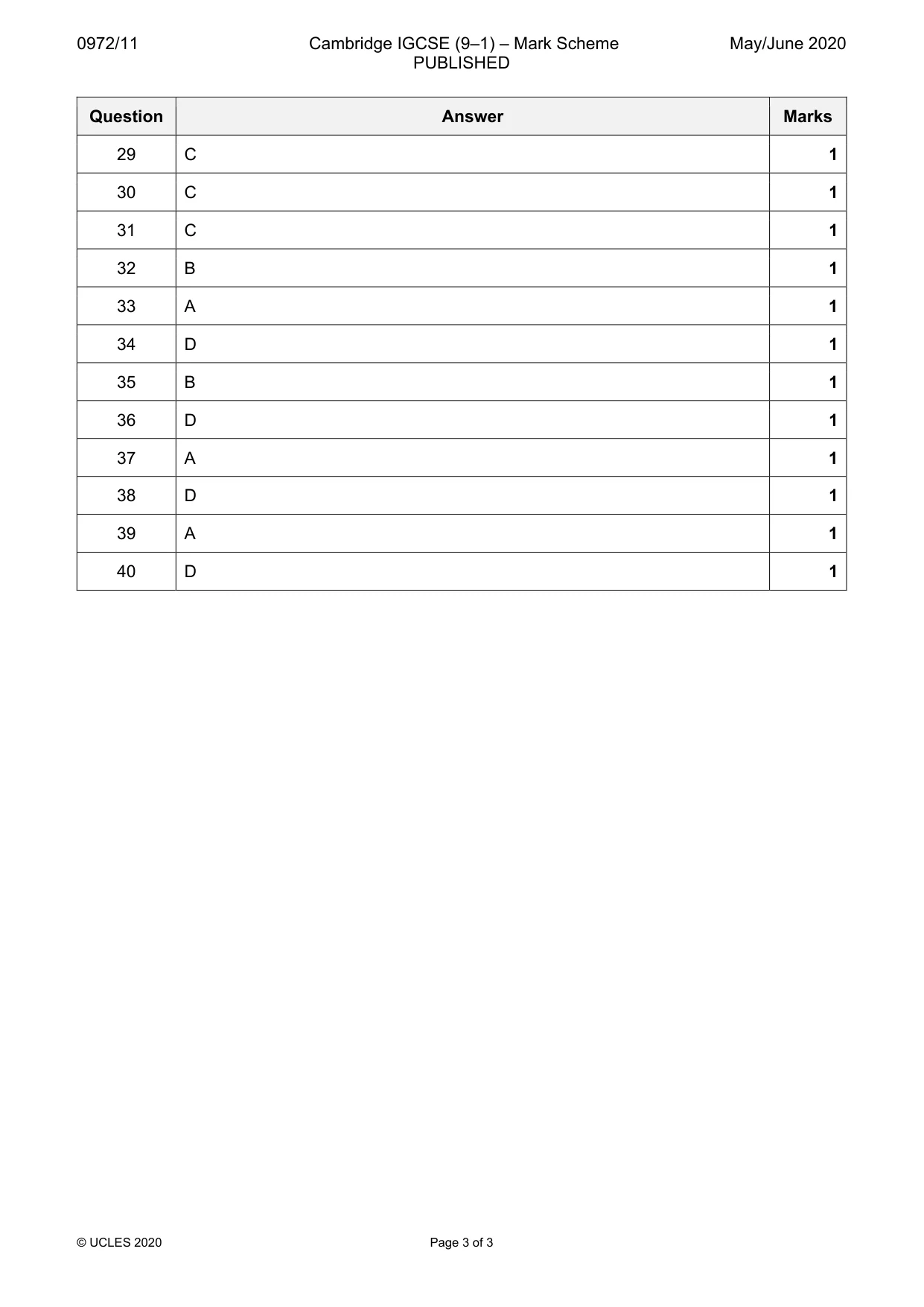
Mark scheme: C
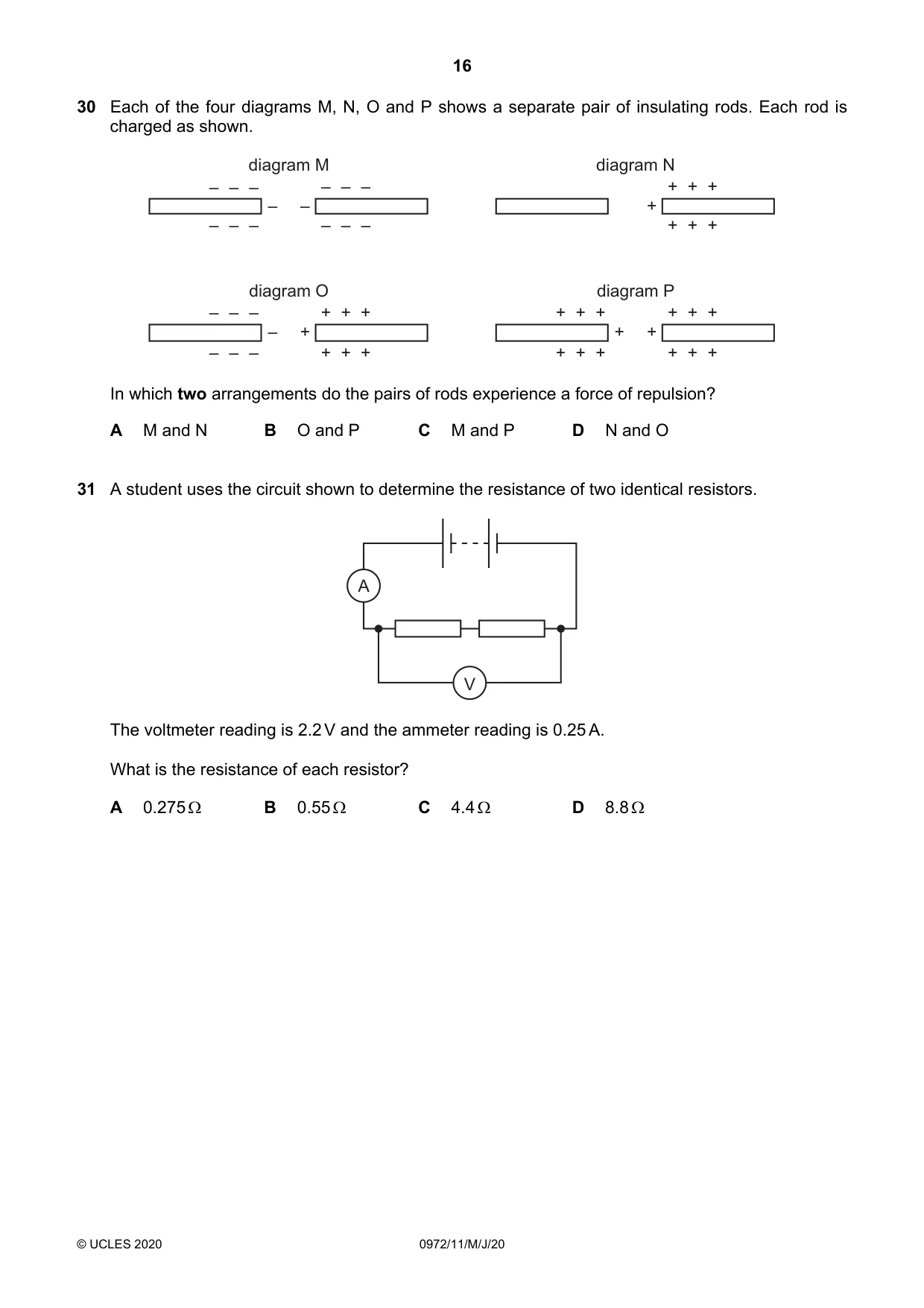
Q30 · Each of the four diagrams M, N, O and P shows a separate pair of insulating rods
30 Each of the four diagrams M, N, O and P shows a separate pair of insulating rods. Each rod is charged as shown. diagram M diagram N – – – – – – + + + – – + – – – – – – + + + diagram O diagram P – – – + + + + + + + + + – + + + – – – + + + + + + + + + In which two arrangements do the pairs of rods experience a force of repulsion? A M and N B O and P C M and P D N and O
Mark scheme: C
Q31 · A student uses the circuit shown to determine the resistance of two identical resistors
31 A student uses the circuit shown to determine the resistance of two identical resistors. A V The voltmeter reading is 2.2 V and the ammeter reading is 0.25 A. What is the resistance of each resistor? A 0.275 Ω B 0.55 Ω C 4.4 Ω D 8.8 Ω
Mark scheme: C
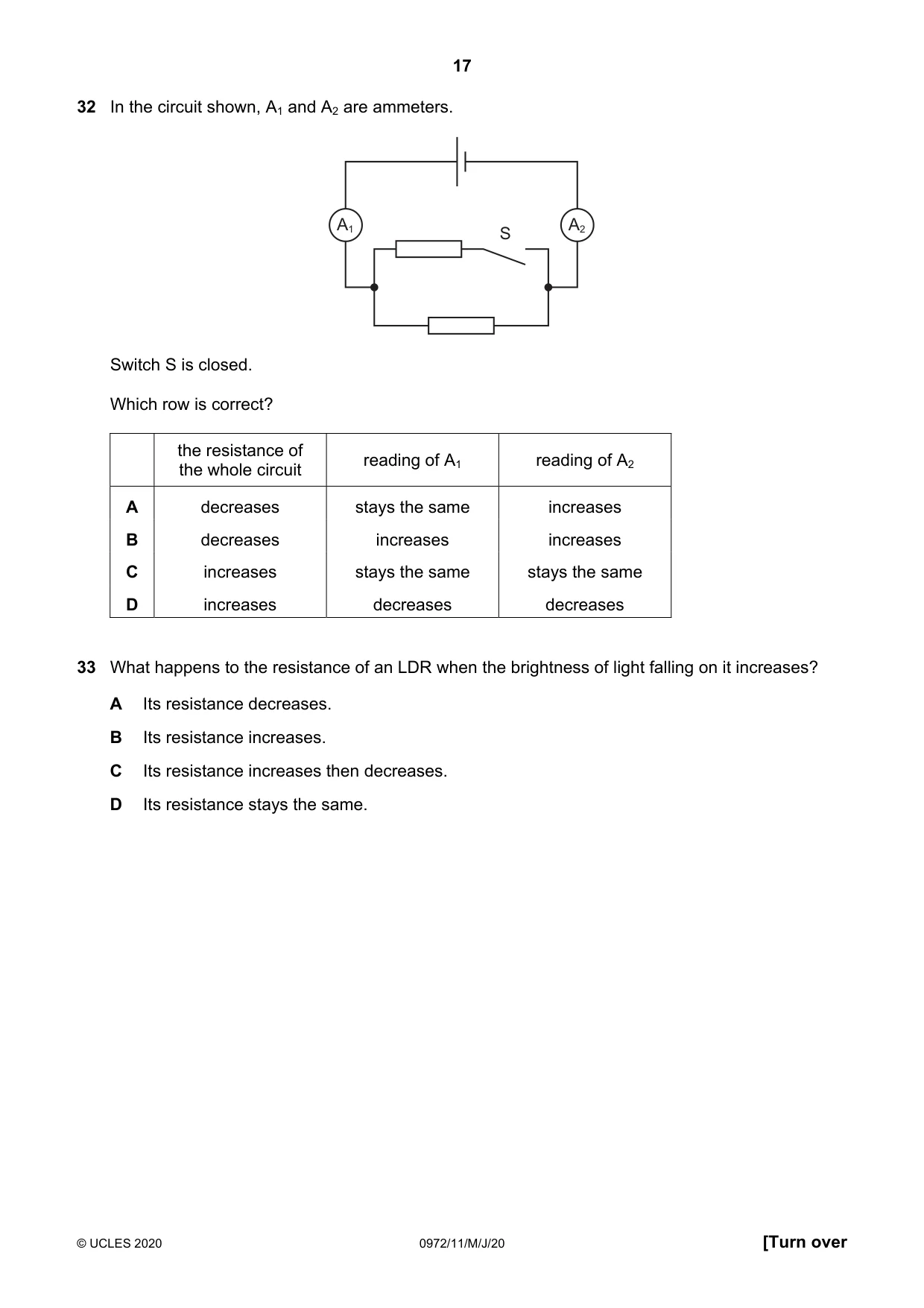
Q32 · In the circuit shown, A1 and A2 are ammeters
32 In the circuit shown, A1 and A2 are ammeters. A1 A2 S Switch S is closed. Which row is correct? the resistance of reading of A1 reading of A2 the whole circuit A decreases stays the same increases B decreases increases increases C increases stays the same stays the same D increases decreases decreases
Mark scheme: B
Q33 · What happens to the resistance of an LDR when the brightness of light falling on it…
33 What happens to the resistance of an LDR when the brightness of light falling on it increases? A Its resistance decreases. B Its resistance increases. C Its resistance increases then decreases. D Its resistance stays the same.
Mark scheme: A
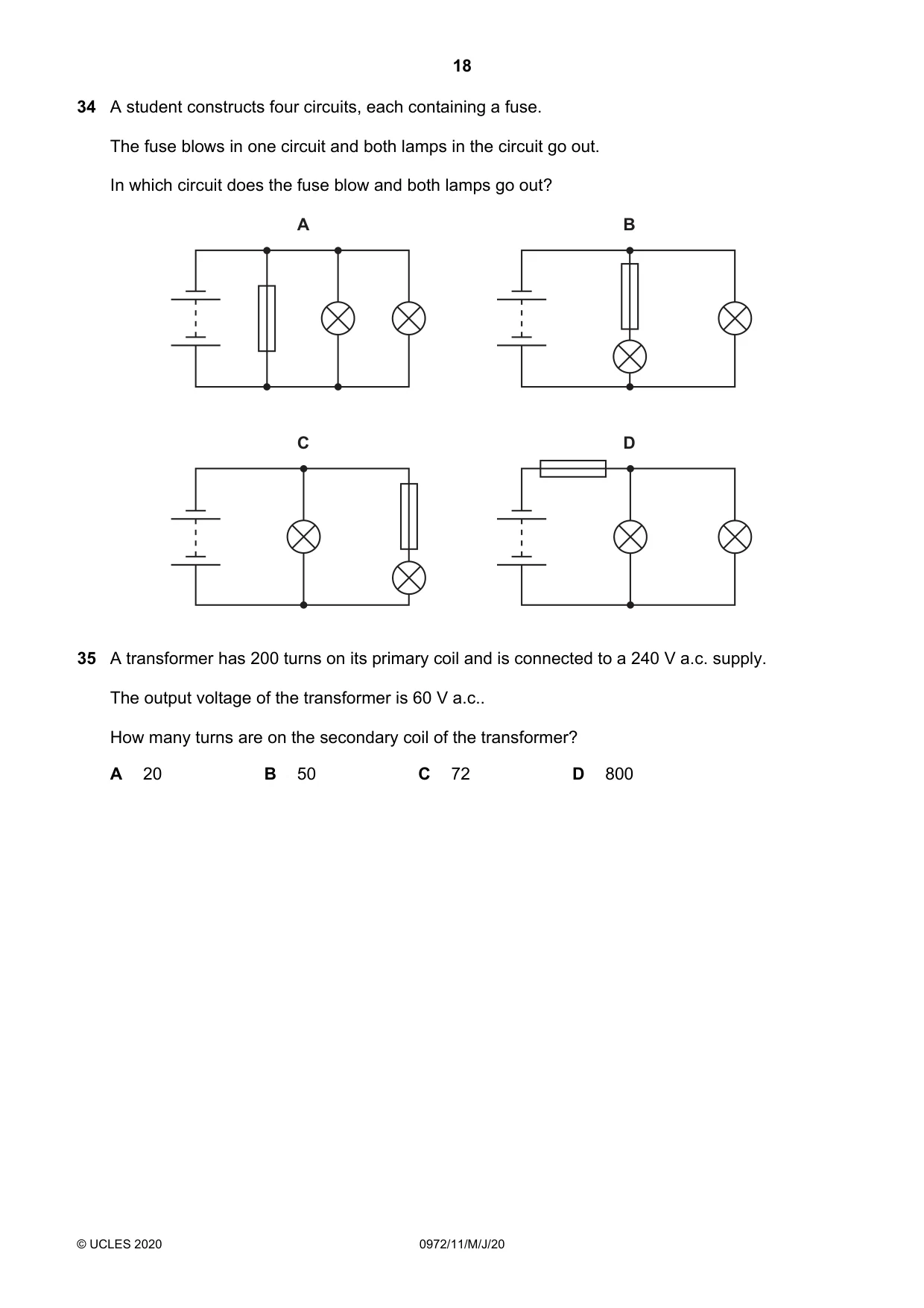
Q34 · A student constructs four circuits, each containing a fuse
34 A student constructs four circuits, each containing a fuse. The fuse blows in one circuit and both lamps in the circuit go out. In which circuit does the fuse blow and both lamps go out? A B C D
Mark scheme: D
Q35 · A transformer has 200 turns on its primary coil and is connected to a 240 V a.c
35 A transformer has 200 turns on its primary coil and is connected to a 240 V a.c. supply. The output voltage of the transformer is 60 V a.c.. How many turns are on the secondary coil of the transformer? A 20 B 50 C 72 D 800
Mark scheme: B
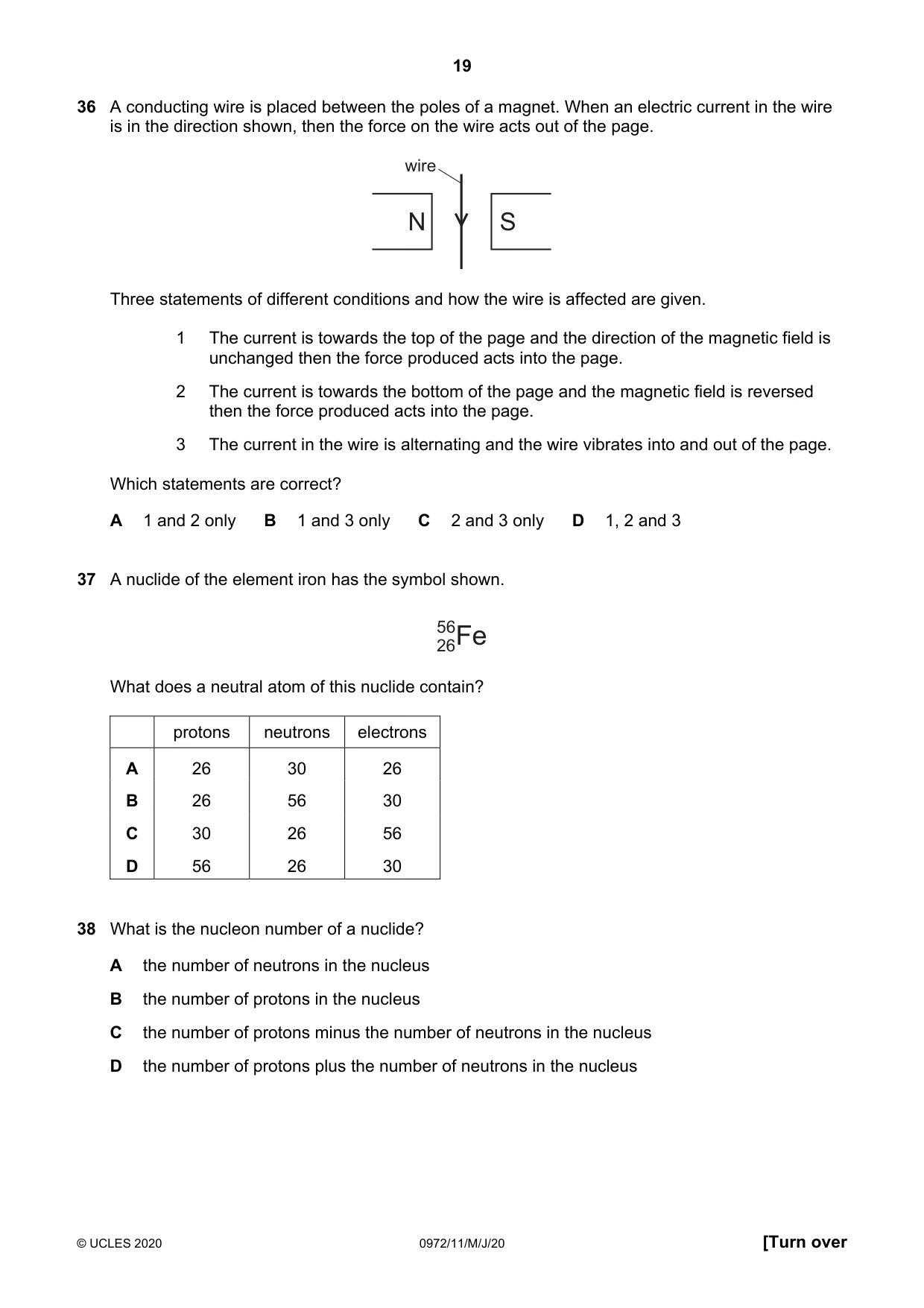
Q36 · A conducting wire is placed between the poles of a magnet
36 A conducting wire is placed between the poles of a magnet. When an electric current in the wire is in the direction shown, then the force on the wire acts out of the page. wire N S Three statements of different conditions and how the wire is affected are given. 1 The current is towards the top of the page and the direction of the magnetic field is unchanged then the force produced acts into the page. 2 The current is towards the bottom of the page and the magnetic field is reversed then the force produced acts into the page. 3 The current in the wire is alternating and the wire vibrates into and out of the page. Which statements are correct? A 1 and 2 only B 1 and 3 only C 2 and 3 only D 1, 2 and 3
Mark scheme: D
Q37 · A nuclide of the element iron has the symbol shown
37 A nuclide of the element iron has the symbol shown. 56Fe 26 What does a neutral atom of this nuclide contain? protons neutrons electrons A 26 30 26 B 26 56 30 C 30 26 56 D 56 26 30
Mark scheme: A
Q38 · What is the nucleon number of a nuclide?
38 What is the nucleon number of a nuclide? A the number of neutrons in the nucleus B the number of protons in the nucleus C the number of protons minus the number of neutrons in the nucleus D the number of protons plus the number of neutrons in the nucleus
Mark scheme: D
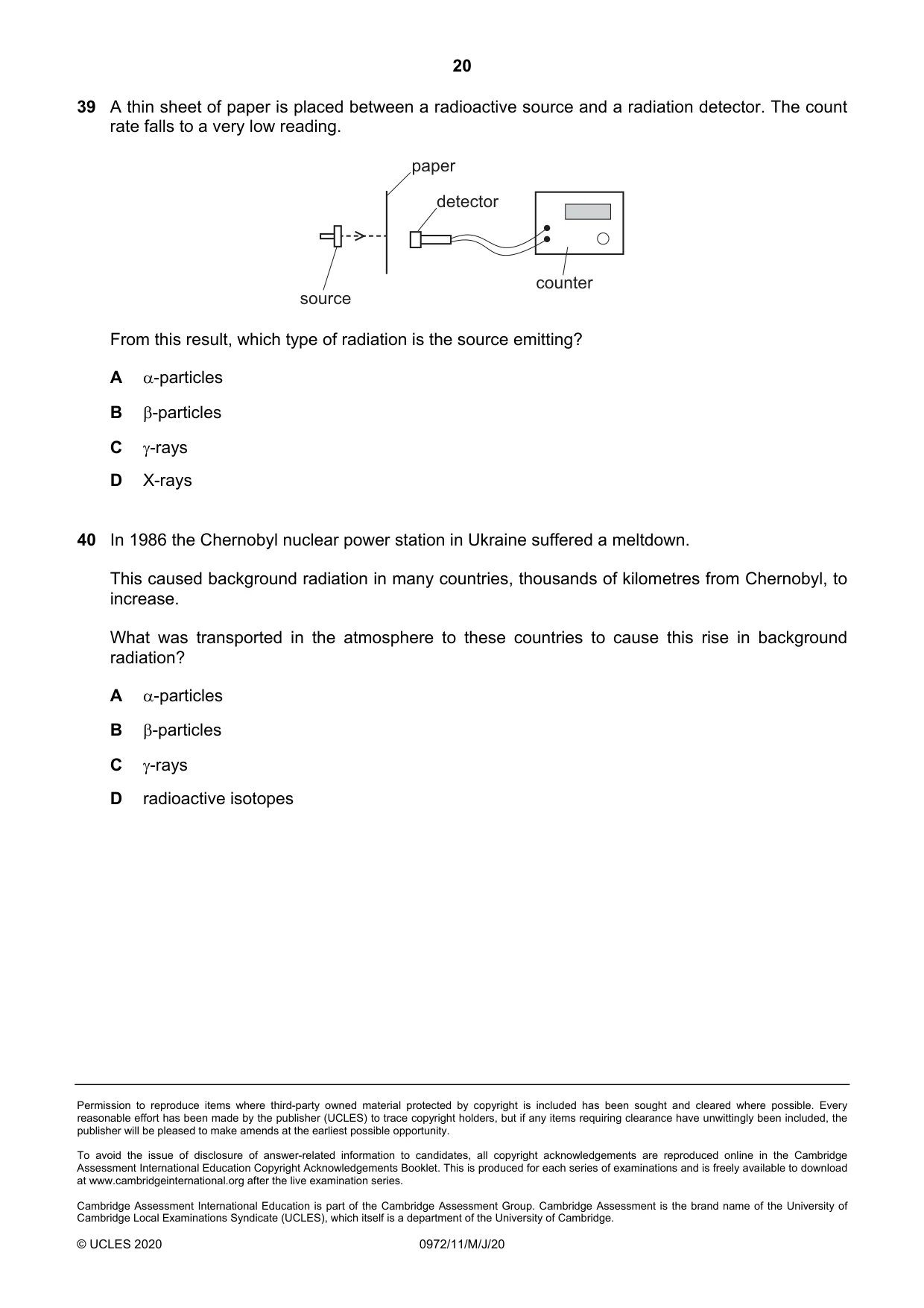
Q39 · A thin sheet of paper is placed between a radioactive source and a radiation detector
39 A thin sheet of paper is placed between a radioactive source and a radiation detector. The count rate falls to a very low reading. paper detector counter source From this result, which type of radiation is the source emitting? A α-particles B β-particles C γ-rays D X-rays
Mark scheme: A
Q40 · In 1986 the Chernobyl nuclear power station in Ukraine suffered a meltdown
40 In 1986 the Chernobyl nuclear power station in Ukraine suffered a meltdown. This caused background radiation in many countries, thousands of kilometres from Chernobyl, to increase. What was transported in the atmosphere to these countries to cause this rise in background radiation? A α-particles B β-particles C γ-rays D radioactive isotopes
Mark scheme: D
What was in this paper
The subtopics covered by these 40 questions, and how many questions each got. Open one in a new tab to see every Cambridge question on it.
3Energy, work and power3Simple phenomena of magnetism3Thermal properties and temperature3Electromagnetic effects2Forces2General properties of waves2Kinetic particle model of matter2Light2Mass and weight2Motion2Pressure2Radioactivity2The nuclear model of the atom2Transfer of thermal energy2Density1Electrical quantities1Electrical safety1Electromagnetic spectrum1Physical quantities and measurement techniques1Sound1