Cambridge IGCSE Physics (9-1) 0972 — 2018 May/June Paper 1 · Variant 1
0972/11/M/J/18 · 40 questions · 40 marks · ≈45 min
The question paper and its mark scheme, free to read here and free to download. This is Cambridge’s own paper, exactly as it was sat.
Question paper16 pages
Mark scheme3 pages
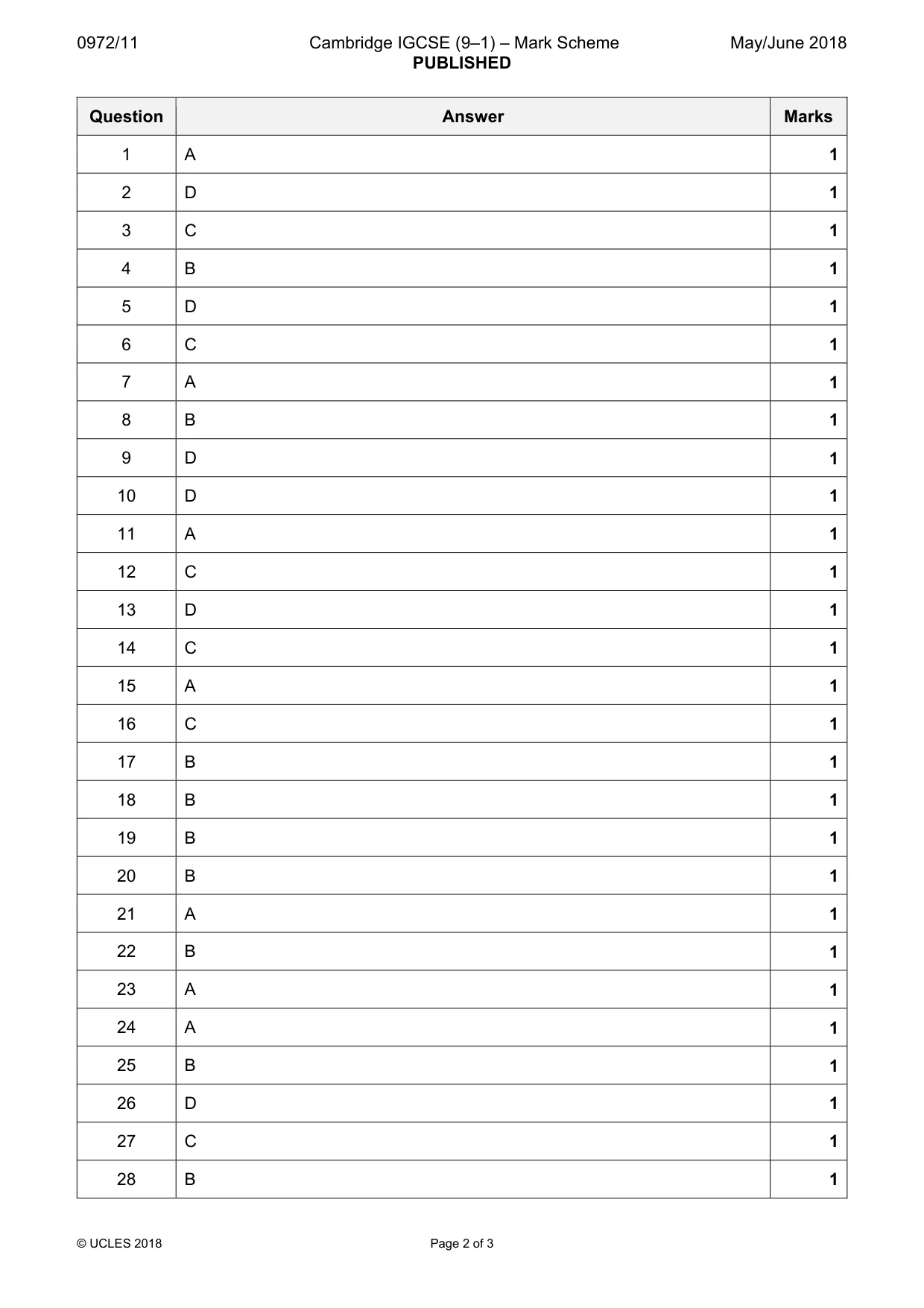
Answers below. Sit the paper first if you are practising.
Questions as text
Q1 · A length of cotton is measured between two points on a ruler
1 A length of cotton is measured between two points on a ruler. cotton cm 1 2 3 4 5 6 7 8 9 10 11 12 13 14 15 16 When the length of cotton is wound closely around a pen, it goes round six times. six turns of cotton pen What is the distance once round the pen? A 2.2 cm B 2.6 cm C 13.2 cm D 15.6 cm
Mark scheme: A
More questions on Physical quantities and measurement techniques
Q2 · A car is moving along a straight, level road, with a constant acceleration
2 A car is moving along a straight, level road, with a constant acceleration. Which graph shows the motion of the car? A B distance distance 0 0 0 time 0 time C D speed speed 0 0 0 time 0 time
Mark scheme: D
Q3 · A car takes 15 minutes to travel along a road that is 20 km long
3 A car takes 15 minutes to travel along a road that is 20 km long. What is the average speed of the car? A 0.75 km / h B 5.0 km / h C 80 km / h D 300 km / h
Mark scheme: C
Question 4
4 Diagram 1 shows a beam balance. A beaker with a wire loop balances the standard masses. The beaker is then removed and hung from a spring. The spring extends by 5.0 cm, as in diagram 2. diagram 1 diagram 2 beam beaker with spring standard balance wire loop masses attached beaker with wire loop attached The experiment is repeated with the same apparatus on the Moon, where the acceleration of free fall is less than on Earth. Which statement describes what happens on the Moon? A The beam balance is balanced and the spring extends by 5.0 cm. B The beam balance is balanced and the spring extends by less than 5.0 cm. C The right-hand balance pan is higher and the spring extends by 5.0 cm. D The right-hand balance pan is higher and the spring extends by less than 5.0 cm.
Mark scheme: B
Q5 · An empty beaker is placed on a top-pan balance
5 An empty beaker is placed on a top-pan balance. Some water is now poured into the beaker. 0.062 kg 0.106 kg empty beaker beaker + water What is the weight of the water? A 0.044 kg B 0.168 kg C 0.0044 N D 0.44 N
Mark scheme: D
Q6 · Three liquids P, Q and R have different densities and do not mix
6 Three liquids P, Q and R have different densities and do not mix. The liquids are placed in a measuring cylinder and allowed to settle. A small block is then dropped into the measuring cylinder and comes to rest, as shown. R Q block P Which statement about the density of the block is correct? A It is equal to the density of Q. B It is greater than the density of P. C It is greater than the density of R. D It is less than the density of Q.
Mark scheme: C
Q7 · The diagram shows some liquid in a measuring cylinder
7 The diagram shows some liquid in a measuring cylinder. The mass of the liquid is 16 g. 25 cm3 20 15 10 5 What is the density of the liquid? A 0.80 g / cm 3 B 1.25 g / cm 3 C 36 g / cm 3 D 320 g / cm 3
Mark scheme: A
Q8 · A car is moving in a straight line on a level road
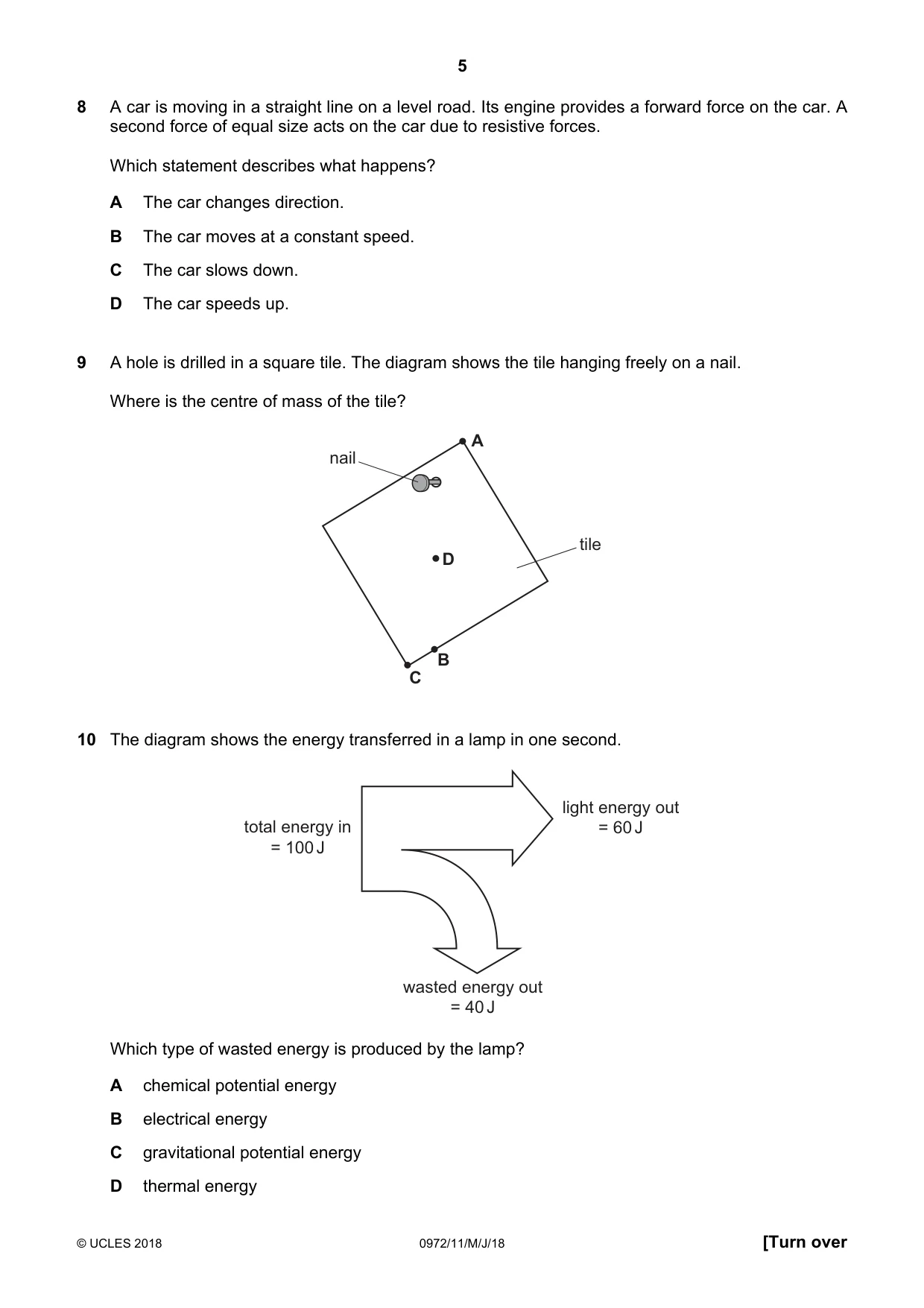
8 A car is moving in a straight line on a level road. Its engine provides a forward force on the car. A second force of equal size acts on the car due to resistive forces. Which statement describes what happens? A The car changes direction. B The car moves at a constant speed. C The car slows down. D The car speeds up.
Mark scheme: B
Q9 · A hole is drilled in a square tile
9 A hole is drilled in a square tile. The diagram shows the tile hanging freely on a nail. Where is the centre of mass of the tile? A nail tile D B C
Mark scheme: D
Q10 · The diagram shows the energy transferred in a lamp in one second
10 The diagram shows the energy transferred in a lamp in one second. light energy out total energy in = 60 J = 100 J wasted energy out = 40 J Which type of wasted energy is produced by the lamp? A chemical potential energy B electrical energy C gravitational potential energy D thermal energy
Mark scheme: D
Q11 · Which energy resource is not renewable?
11 Which energy resource is not renewable? A fossil fuel B sunlight C tides D wind
Mark scheme: A
Q12 · A student does work by pulling a box across a horizontal floor
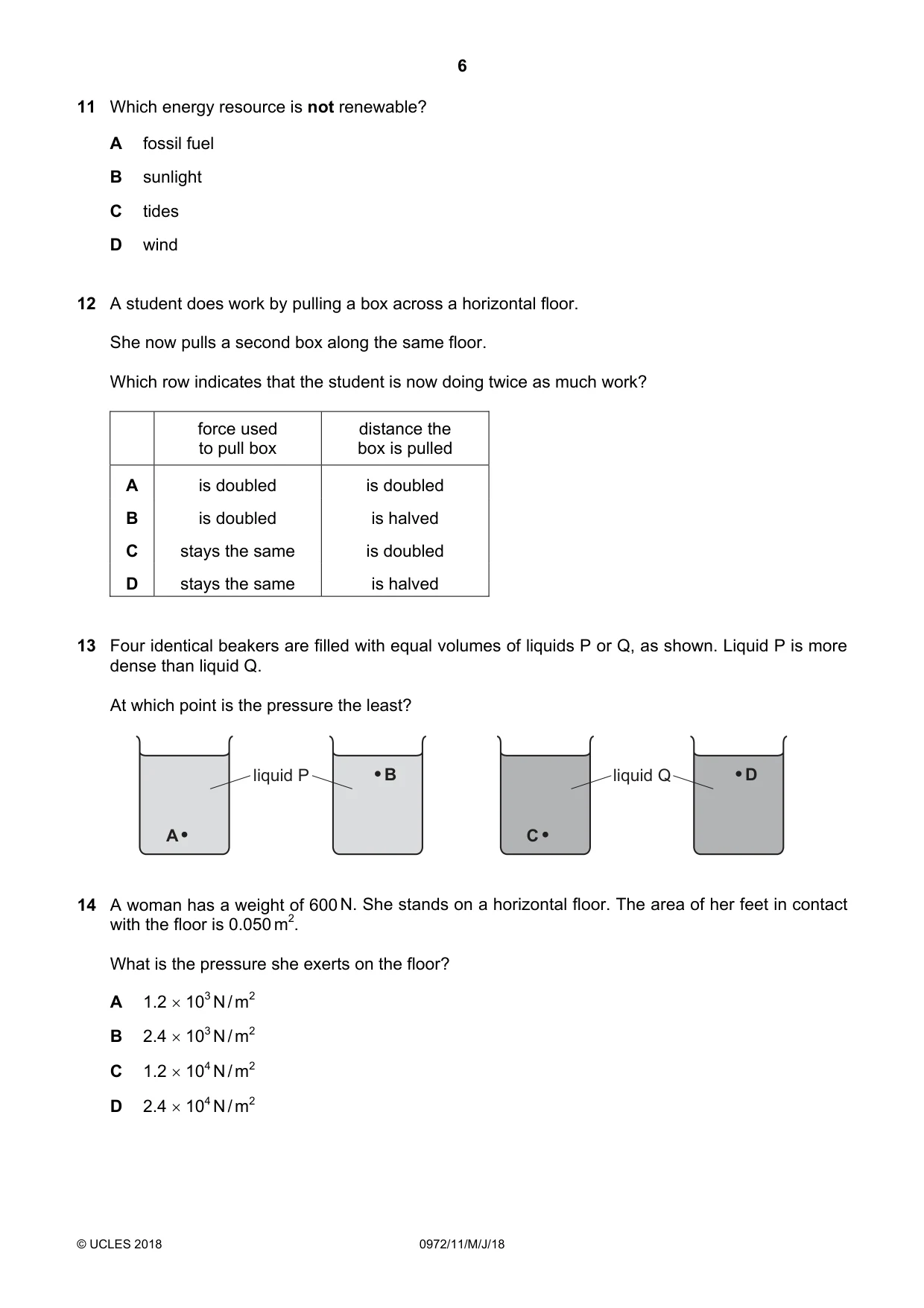
12 A student does work by pulling a box across a horizontal floor. She now pulls a second box along the same floor. Which row indicates that the student is now doing twice as much work? force used distance the to pull box box is pulled A is doubled is doubled B is doubled is halved C stays the same is doubled D stays the same is halved
Mark scheme: C
Q13 · Four identical beakers are filled with equal volumes of liquids P or Q, as shown
13 Four identical beakers are filled with equal volumes of liquids P or Q, as shown. Liquid P is more dense than liquid Q. At which point is the pressure the least? liquid P B liquid Q D A C
Mark scheme: D
Q14 · A woman has a weight of 600 N
14 A woman has a weight of 600 N. She stands on a horizontal floor. The area of her feet in contact with the floor is 0.050 m2. What is the pressure she exerts on the floor? A 1.2 × 10³ N / m2 B 2.4 × 10³ N / m2 C 1.2 × 10⁴ N / m2 D 2.4 × 10⁴ N / m2
Mark scheme: C
Q15 · On a warm day, a carton of fresh milk is covered with a wet cloth
15 On a warm day, a carton of fresh milk is covered with a wet cloth. Why does this help to reduce the temperature of the milk? A Some water evaporates from the cloth so the remaining water becomes cooler. B The water has a very high thermal capacity. C The water insulates the milk from the warm air around it. D Water is always colder than the air around it.
Mark scheme: A
Q16 · Air is trapped in a cylinder by a piston
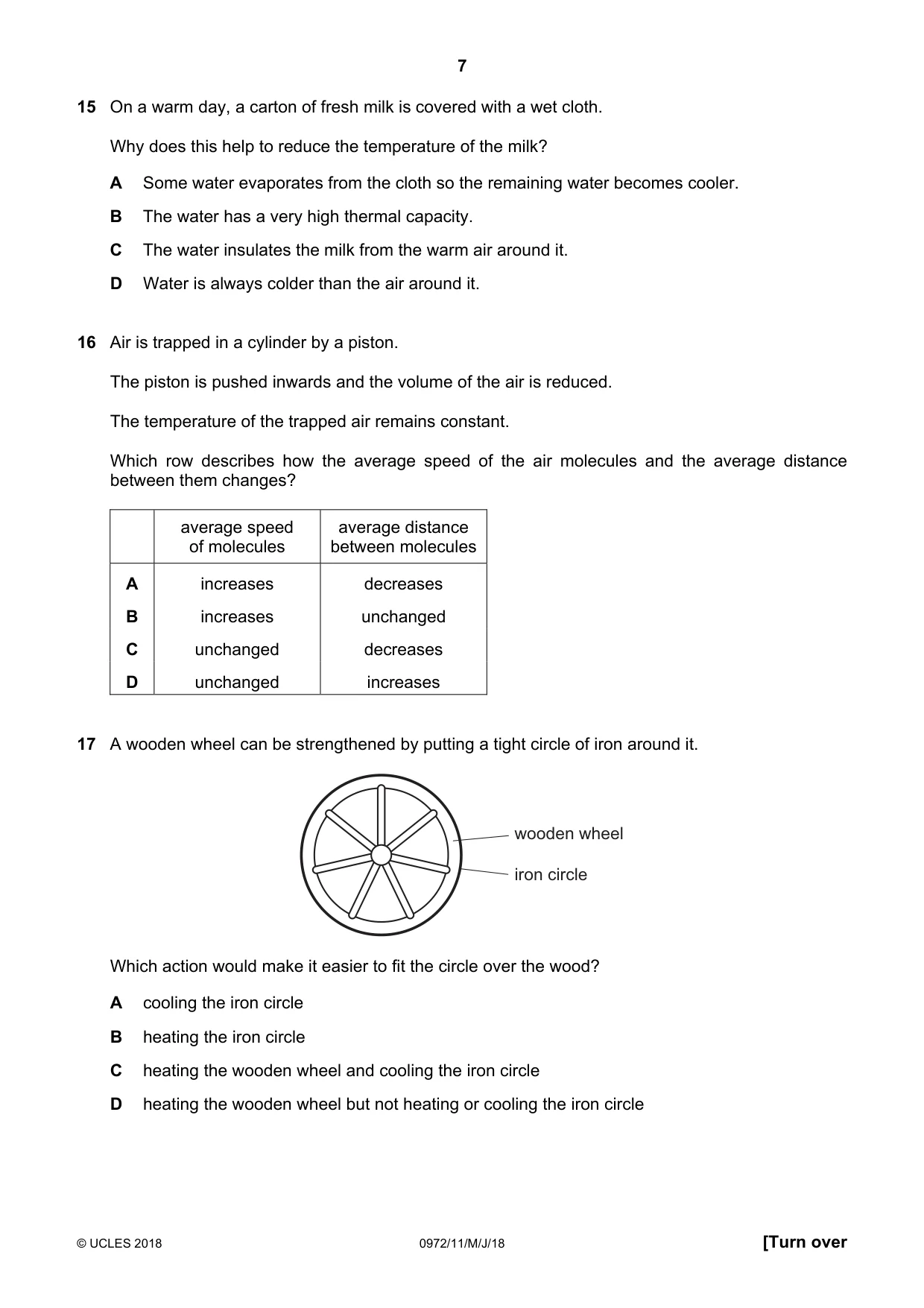
16 Air is trapped in a cylinder by a piston. The piston is pushed inwards and the volume of the air is reduced. The temperature of the trapped air remains constant. Which row describes how the average speed of the air molecules and the average distance between them changes? average speed average distance of molecules between molecules A increases decreases B increases unchanged C unchanged decreases D unchanged increases
Mark scheme: C
Q17 · A wooden wheel can be strengthened by putting a tight circle of iron around it
17 A wooden wheel can be strengthened by putting a tight circle of iron around it. wooden wheel iron circle Which action would make it easier to fit the circle over the wood? A cooling the iron circle B heating the iron circle C heating the wooden wheel and cooling the iron circle D heating the wooden wheel but not heating or cooling the iron circle
Mark scheme: B
Q18 · A student wishes to calibrate a mercury-in-glass thermometer with a °C scale
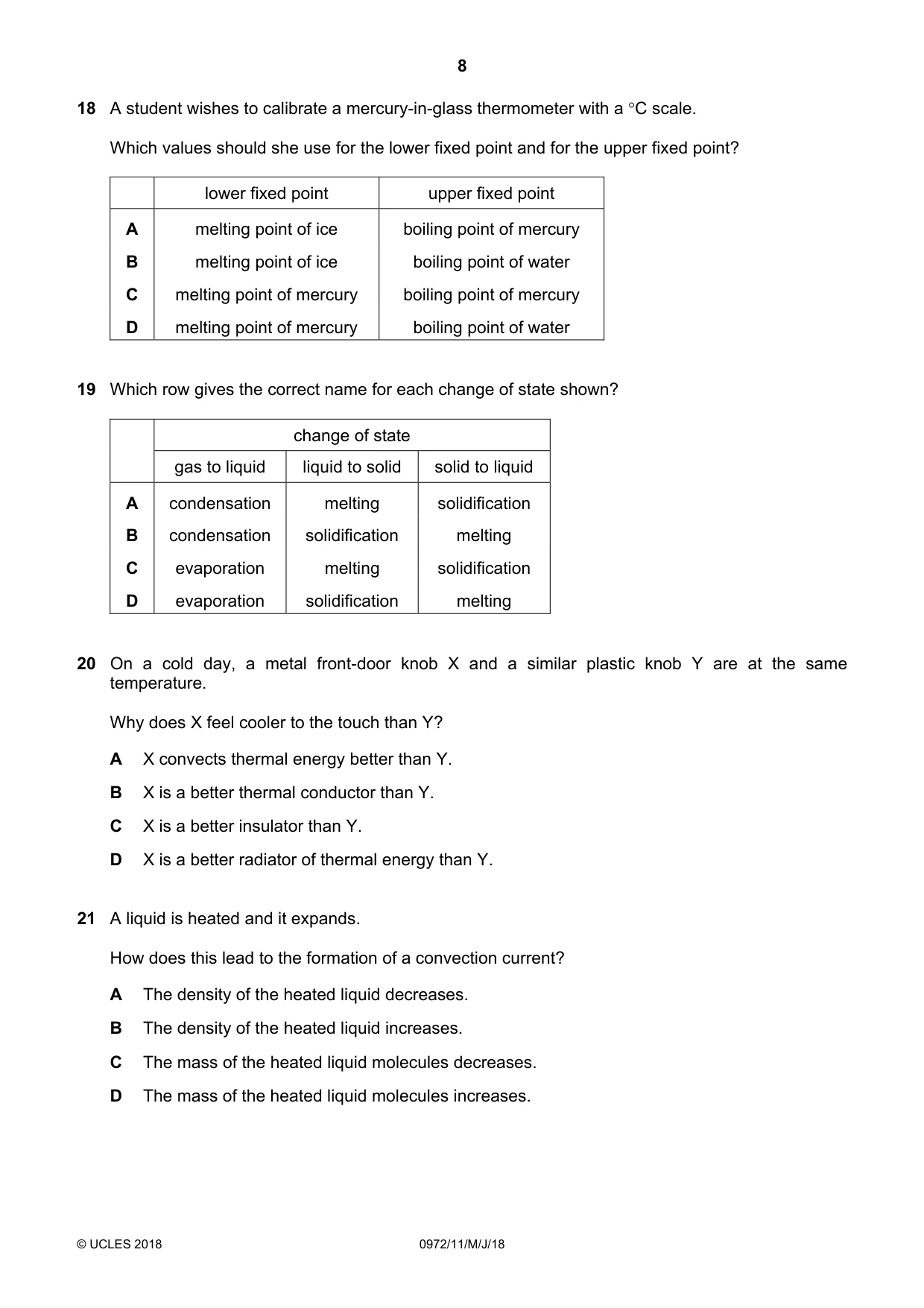
18 A student wishes to calibrate a mercury-in-glass thermometer with a °C scale. Which values should she use for the lower fixed point and for the upper fixed point? lower fixed point upper fixed point A melting point of ice boiling point of mercury B melting point of ice boiling point of water C melting point of mercury boiling point of mercury D melting point of mercury boiling point of water
Mark scheme: B
Q19 · Which row gives the correct name for each change of state shown?
19 Which row gives the correct name for each change of state shown? change of state gas to liquid liquid to solid solid to liquid A condensation melting solidification B condensation solidification melting C evaporation melting solidification D evaporation solidification melting
Mark scheme: B
Q20 · On a cold day, a metal front-door knob X and a similar plastic knob Y are at the same…
20 On a cold day, a metal front-door knob X and a similar plastic knob Y are at the same temperature. Why does X feel cooler to the touch than Y? A X convects thermal energy better than Y. B X is a better thermal conductor than Y. C X is a better insulator than Y. D X is a better radiator of thermal energy than Y.
Mark scheme: B
Q21 · A liquid is heated and it expands
21 A liquid is heated and it expands. How does this lead to the formation of a convection current? A The density of the heated liquid decreases. B The density of the heated liquid increases. C The mass of the heated liquid molecules decreases. D The mass of the heated liquid molecules increases.
Mark scheme: A
Q22 · Which arrow on the graph shows the amplitude of the wave?
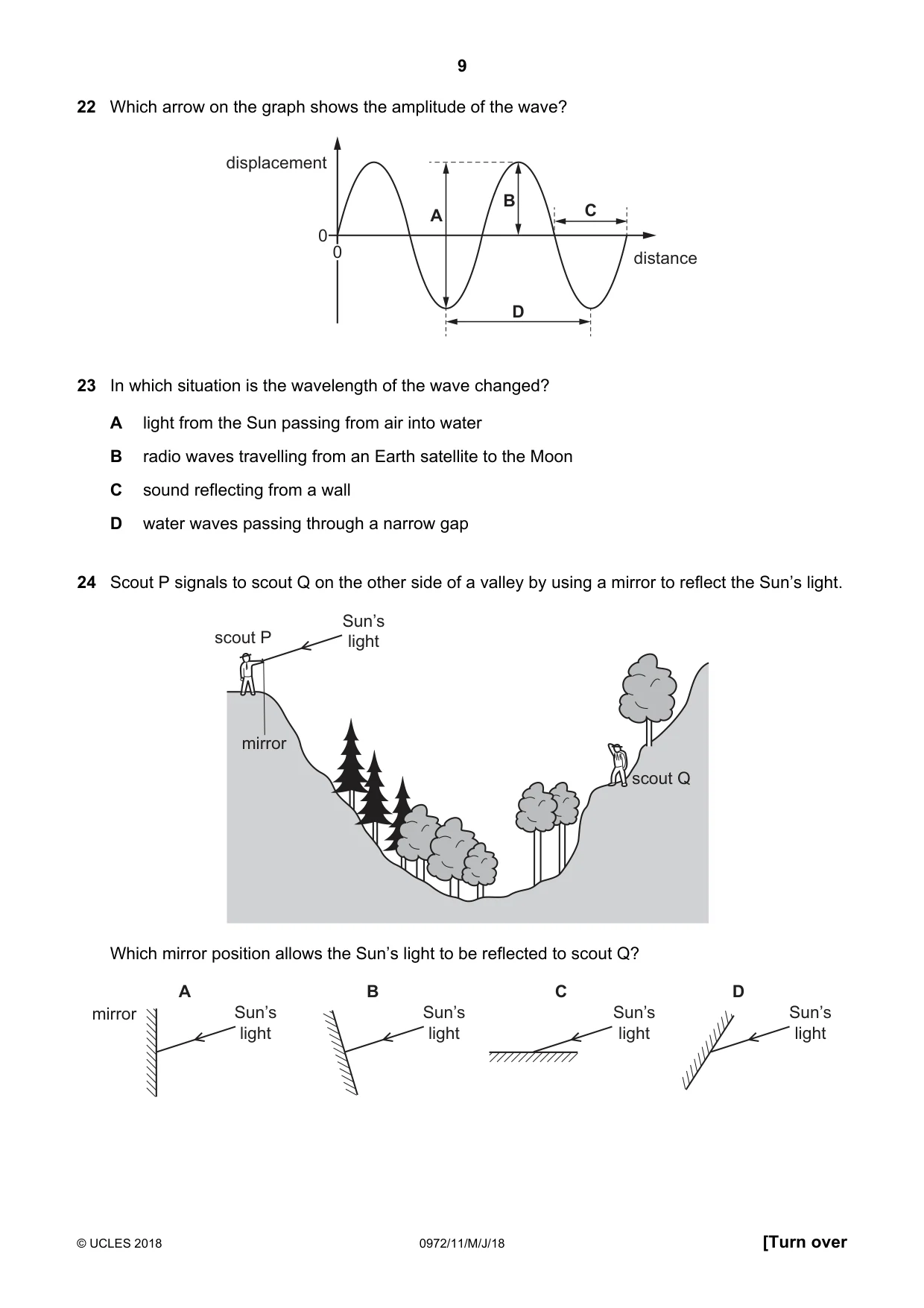
22 Which arrow on the graph shows the amplitude of the wave? displacement B A C 0 0 distance D
Mark scheme: B
Q23 · In which situation is the wavelength of the wave changed?
23 In which situation is the wavelength of the wave changed? A light from the Sun passing from air into water B radio waves travelling from an Earth satellite to the Moon C sound reflecting from a wall D water waves passing through a narrow gap
Mark scheme: A
Q24 · Scout P signals to scout Q on the other side of a valley by using a mirror to reflect the…
24 Scout P signals to scout Q on the other side of a valley by using a mirror to reflect the Sun’s light. Sun’s scout P light mirror scout Q Which mirror position allows the Sun’s light to be reflected to scout Q? A B C D mirror Sun’s Sun’s Sun’s Sun’s light light light light
Mark scheme: A
Q25 · The diagram shows the electromagnetic spectrum
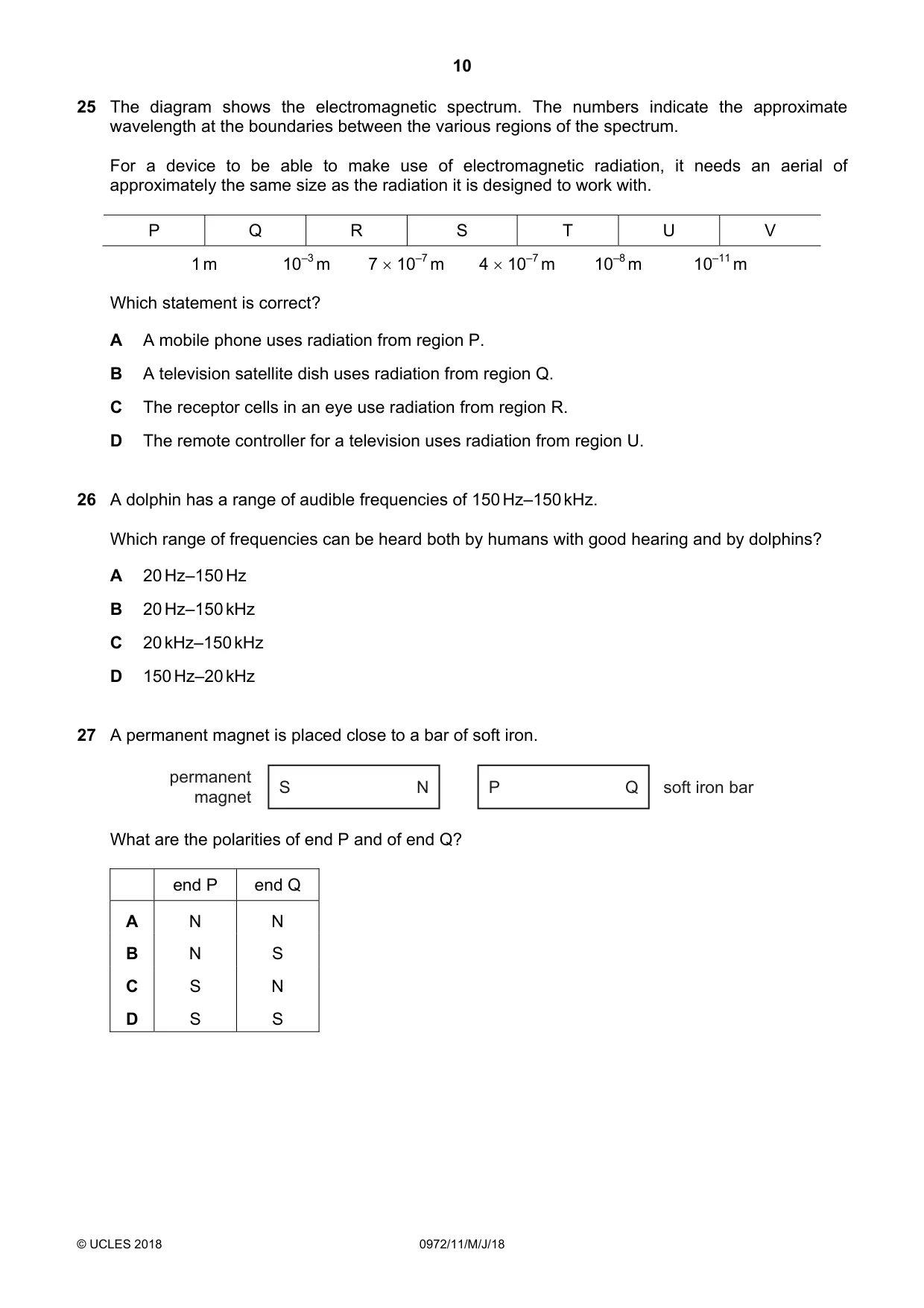
25 The diagram shows the electromagnetic spectrum. The numbers indicate the approximate wavelength at the boundaries between the various regions of the spectrum. For a device to be able to make use of electromagnetic radiation, it needs an aerial of approximately the same size as the radiation it is designed to work with. P Q R S T U V 1 m 10–3 m 7 × 10⁻⁷ m 4 × 10⁻⁷ m 10–8 m 10–11 m Which statement is correct? A A mobile phone uses radiation from region P. B A television satellite dish uses radiation from region Q. C The receptor cells in an eye use radiation from region R. D The remote controller for a television uses radiation from region U.
Mark scheme: B
Q26 · A dolphin has a range of audible frequencies of 150 Hz–150 kHz
26 A dolphin has a range of audible frequencies of 150 Hz–150 kHz. Which range of frequencies can be heard both by humans with good hearing and by dolphins? A 20 Hz–150 Hz B 20 Hz–150 kHz C 20 kHz–150 kHz D 150 Hz–20 kHz
Mark scheme: D
Q27 · A permanent magnet is placed close to a bar of soft iron
27 A permanent magnet is placed close to a bar of soft iron. permanent S N P Q soft iron bar magnet What are the polarities of end P and of end Q? end P end Q A N N B N S C S N D S S
Mark scheme: C
Q28 · Which metal is used for the core of an electromagnet?
28 Which metal is used for the core of an electromagnet? A copper B iron C magnesium D steel
Mark scheme: B
Q29 · The diagram shows a cell connected to three resistors R1, R2 and R3
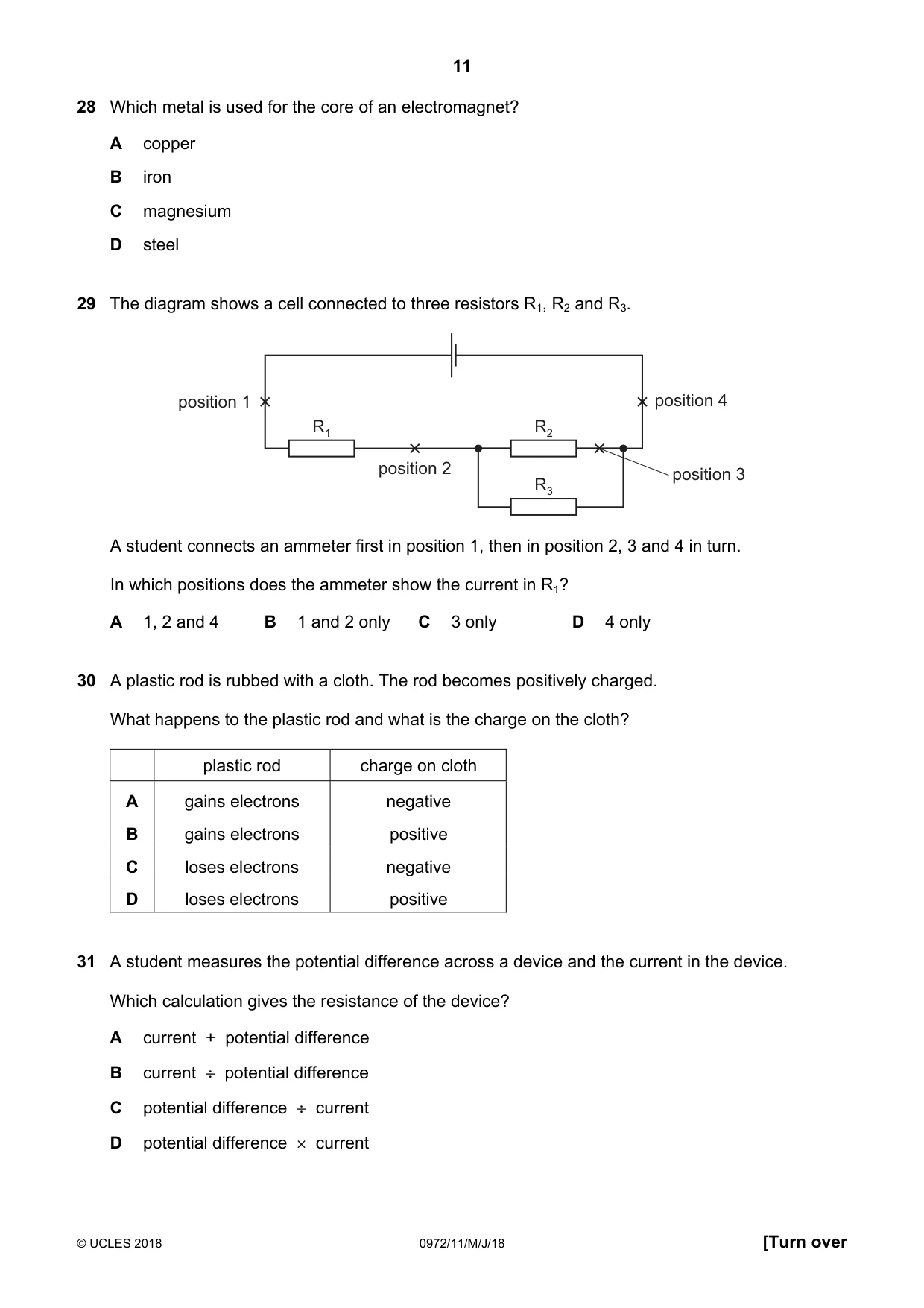
29 The diagram shows a cell connected to three resistors R1, R2 and R3. position 1 position 4 R1 R2 position 2 position 3 R3 A student connects an ammeter first in position 1, then in position 2, 3 and 4 in turn. In which positions does the ammeter show the current in R1? A 1, 2 and 4 B 1 and 2 only C 3 only D 4 only
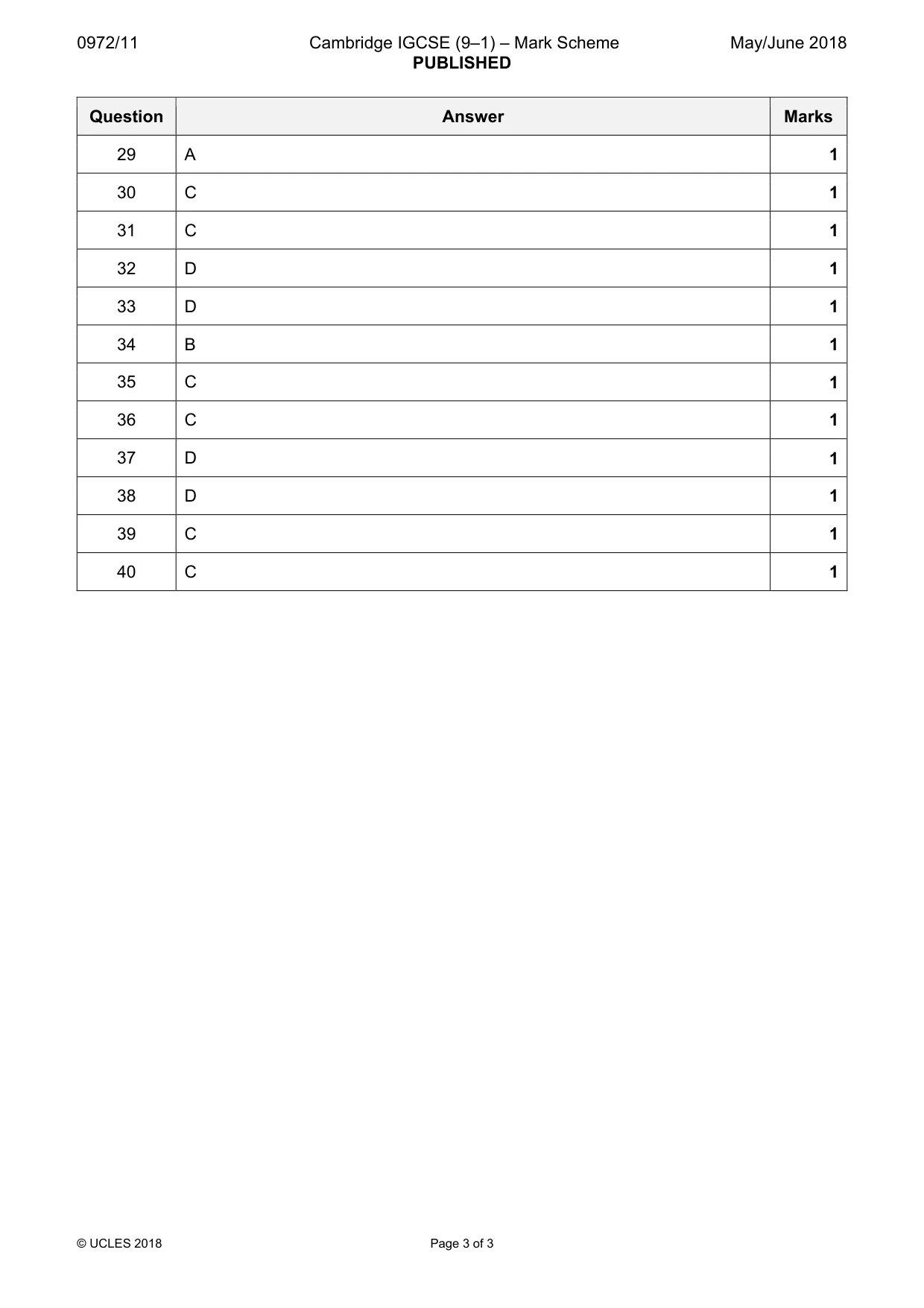
Mark scheme: A
Q30 · A plastic rod is rubbed with a cloth
30 A plastic rod is rubbed with a cloth. The rod becomes positively charged. What happens to the plastic rod and what is the charge on the cloth? plastic rod charge on cloth A gains electrons negative B gains electrons positive C loses electrons negative D loses electrons positive
Mark scheme: C
Q31 · A student measures the potential difference across a device and the current in the device
31 A student measures the potential difference across a device and the current in the device. Which calculation gives the resistance of the device? A current + potential difference B current ÷ potential difference C potential difference ÷ current D potential difference × current
Mark scheme: C
Q32 · The diagram shows three identical resistors, three ammeters and a battery, connected in a…
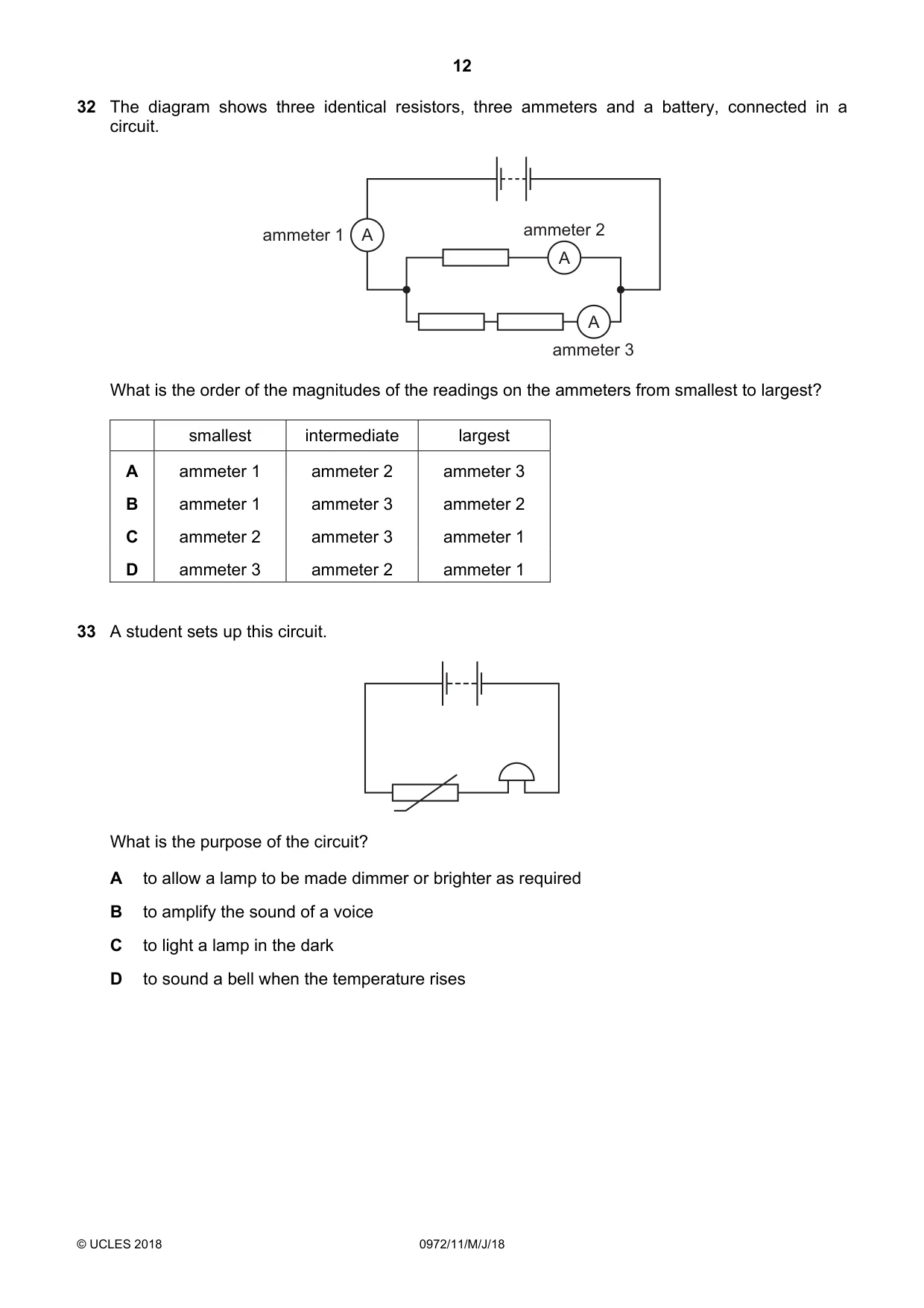
32 The diagram shows three identical resistors, three ammeters and a battery, connected in a circuit. ammeter 1 A ammeter 2 A A ammeter 3 What is the order of the magnitudes of the readings on the ammeters from smallest to largest? smallest intermediate largest A ammeter 1 ammeter 2 ammeter 3 B ammeter 1 ammeter 3 ammeter 2 C ammeter 2 ammeter 3 ammeter 1 D ammeter 3 ammeter 2 ammeter 1
Mark scheme: D
Q33 · A student sets up this circuit
33 A student sets up this circuit. What is the purpose of the circuit? A to allow a lamp to be made dimmer or brighter as required B to amplify the sound of a voice C to light a lamp in the dark D to sound a bell when the temperature rises
Mark scheme: D
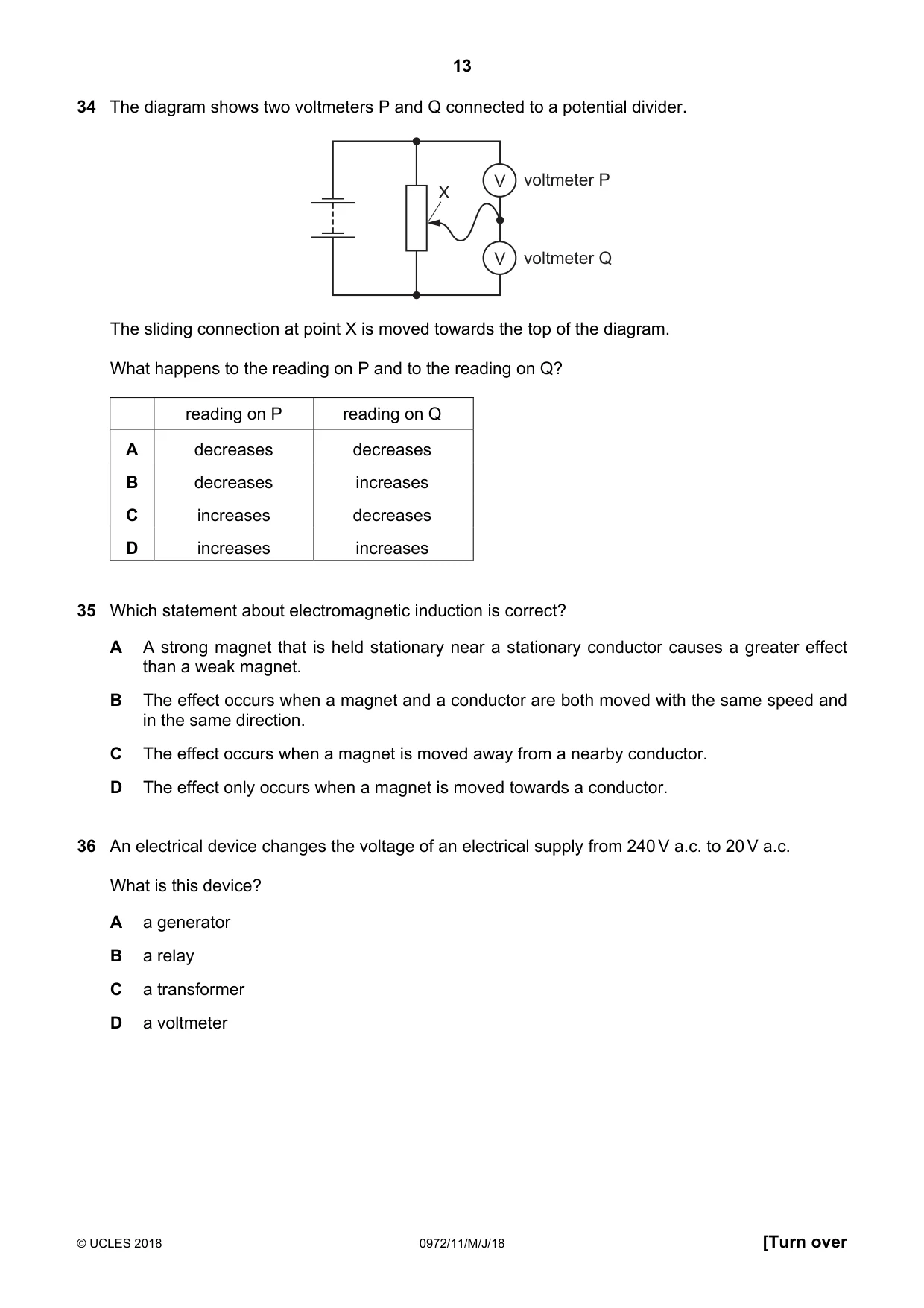
Q34 · The diagram shows two voltmeters P and Q connected to a potential divider
34 The diagram shows two voltmeters P and Q connected to a potential divider. V voltmeter P X V voltmeter Q The sliding connection at point X is moved towards the top of the diagram. What happens to the reading on P and to the reading on Q? reading on P reading on Q A decreases decreases B decreases increases C increases decreases D increases increases
Mark scheme: B
Q35 · Which statement about electromagnetic induction is correct?
35 Which statement about electromagnetic induction is correct? A A strong magnet that is held stationary near a stationary conductor causes a greater effect than a weak magnet. B The effect occurs when a magnet and a conductor are both moved with the same speed and in the same direction. C The effect occurs when a magnet is moved away from a nearby conductor. D The effect only occurs when a magnet is moved towards a conductor.
Mark scheme: C
Q36 · An electrical device changes the voltage of an electrical supply from 240 V a.c
36 An electrical device changes the voltage of an electrical supply from 240 V a.c. to 20 V a.c. What is this device? A a generator B a relay C a transformer D a voltmeter
Mark scheme: C
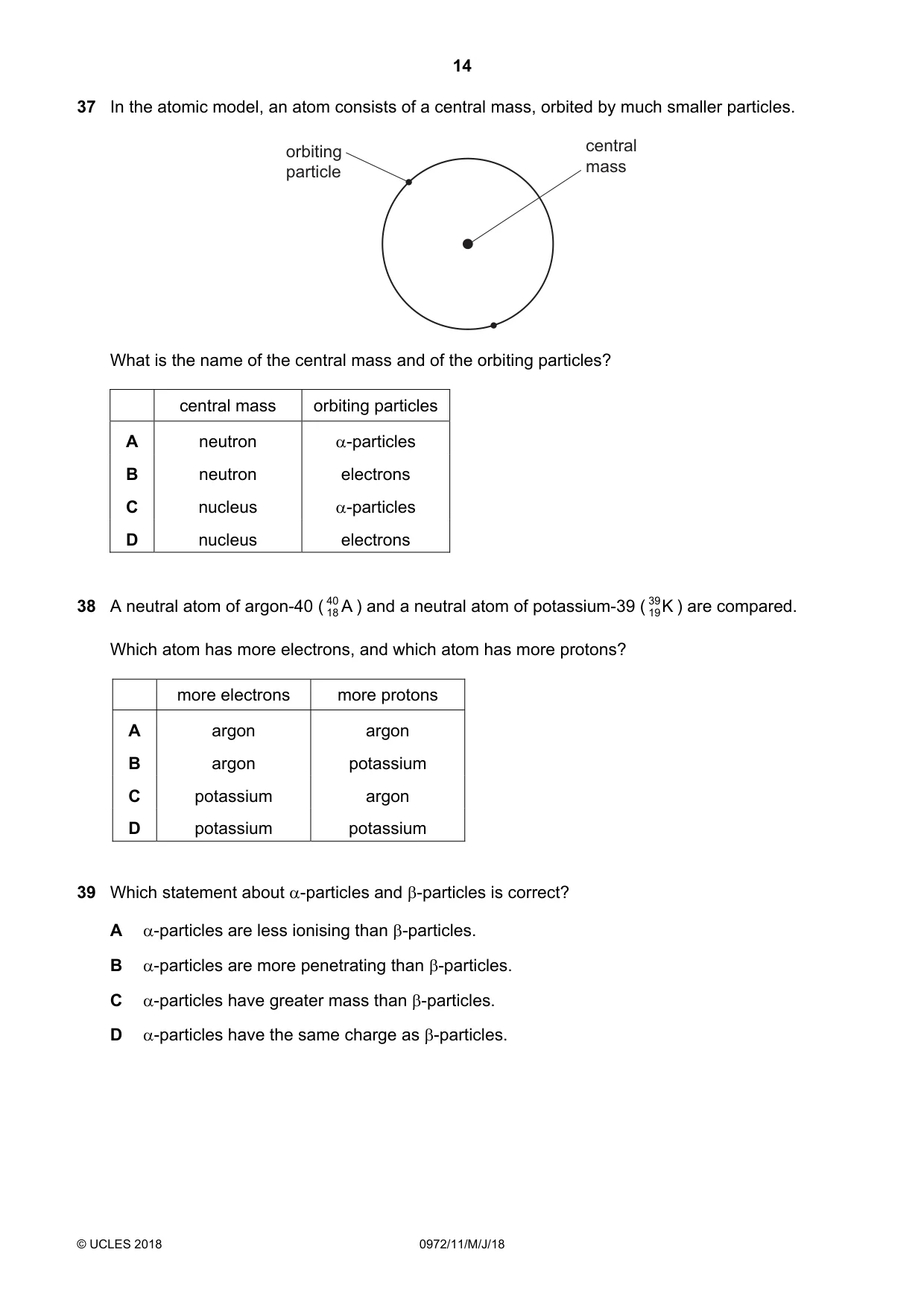
Q37 · In the atomic model, an atom consists of a central mass, orbited by much smaller particles
37 In the atomic model, an atom consists of a central mass, orbited by much smaller particles. orbiting central particle mass What is the name of the central mass and of the orbiting particles? central mass orbiting particles A neutron α-particles B neutron electrons C nucleus α-particles D nucleus electrons
Mark scheme: D
Q38 · A neutral atom of argon-40 ( 40 A ) and a neutral atom of potassium-39 ( 39 K ) are…
38 A neutral atom of argon-40 ( 40 A ) and a neutral atom of potassium-39 ( 39 K ) are compared. 18 19 Which atom has more electrons, and which atom has more protons? more electrons more protons A argon argon B argon potassium C potassium argon D potassium potassium
Mark scheme: D
Q39 · Which statement about α-particles and β-particles is correct?
39 Which statement about α-particles and β-particles is correct? A α-particles are less ionising than β-particles. B α-particles are more penetrating than β-particles. C α-particles have greater mass than β-particles. D α-particles have the same charge as β-particles.
Mark scheme: C
Q40 · An explosion in a nuclear reactor spread the isotope caesium-137 across a large area
40 An explosion in a nuclear reactor spread the isotope caesium-137 across a large area. Ninety years after the explosion, the quantity of caesium-137 present will be 12.5% of its original level. What is the half-life of caesium-137? A 11.25 years B 22.5 years C 30.0 years D 45.0 years
Mark scheme: C
What was in this paper
The subtopics covered by these 40 questions, and how many questions each got. Open one in a new tab to see every Cambridge question on it.
4Thermal properties and temperature4Electromagnetic effects3Energy, work and power3Density2Forces2General properties of waves2Mass and weight2Motion2Pressure2Radioactivity2Simple phenomena of magnetism2The nuclear model of the atom2Transfer of thermal energy2Electrical quantities1Electromagnetic spectrum1Kinetic particle model of matter1Light1Physical quantities and measurement techniques1Sound1What you needed in this session
Cambridge’s own grade thresholds for 2018 May/June, Paper 1 · Variant 1. A higher threshold means an easier paper — the bar moves with how the cohort did.