Cambridge IGCSE Physics 0625 — 2014 May/June Paper 2 · Variant 3
0625/23/M/J/14 · 80 marks · ≈90 min
The question paper and its mark scheme, free to read here and free to download. This is Cambridge’s own paper, exactly as it was sat.
Question paper20 pages


Mark scheme7 pages
Answers below. Sit the paper first if you are practising.
Paper as text
Question paper, page 1
This document consists of 18 printed pages and 2 blank pages. DC (AC/JG) 81311/4 © UCLES 2014 [Turn over Cambridge International Examinations Cambridge International General Certificate of Secondary Education * 3 2 4 1 5 1 0 9 9 9 * PHYSICS 0625/23 Paper 2 Core May/June 2014 1 hour 15 minutes Candidates answer on the Question Paper. No Additional Materials are required. READ THESE INSTRUCTIONS FIRST Write your Centre number, candidate number and name on all the work you hand in. Write in dark blue or black pen. You may use an HB pencil for any diagrams or graphs. Do not use staples, paper clips, glue or correction fluid. DO NOT WRITE IN ANY BARCODES. Answer all questions. Electronic calculators may be used. You may lose marks if you do not show your working or if you do not use appropriate units. Take the weight of 1 kg to be 10 N (i.e. acceleration of free fall = 10 m / s2). At the end of the examination, fasten all your work securely together. The number of marks is given in brackets [ ] at the end of each question or part question. The syllabus is approved for use in England, Wales and Northern Ireland as a Cambridge International Level 1/Level 2 Certificate.
Question paper, page 2
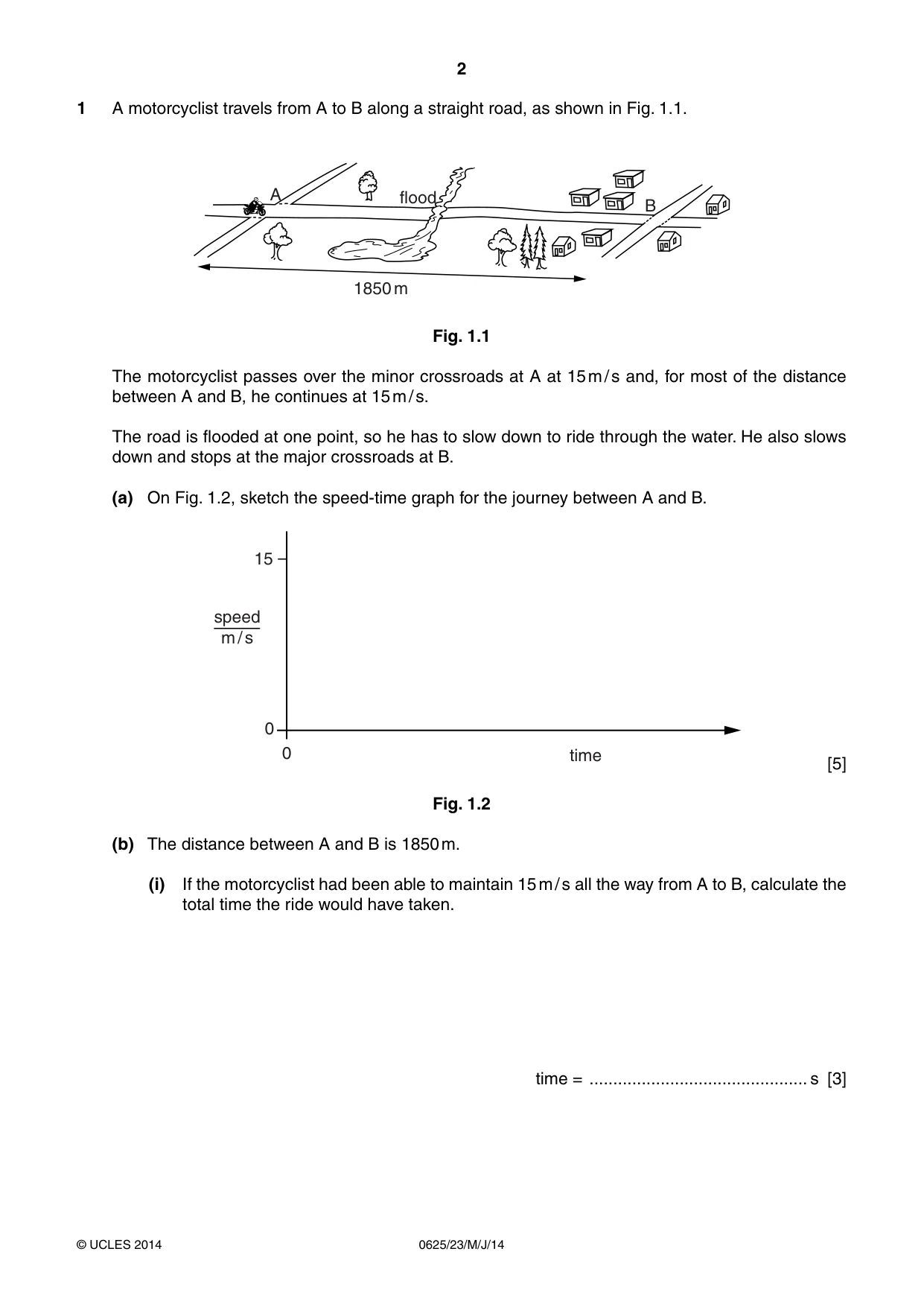
2 0625/23/M/J/14 © UCLES 2014 1 A motorcyclist travels from A to B along a straight road, as shown in Fig. 1.1. 1850 m flood B A Fig. 1.1 The motorcyclist passes over the minor crossroads at A at 15 m / s and, for most of the distance between A and B, he continues at 15 m / s. The road is flooded at one point, so he has to slow down to ride through the water. He also slows down and stops at the major crossroads at B. (a) On Fig. 1.2, sketch the speed-time graph for the journey between A and B. 15 0 0 speed m / s time [5] Fig. 1.2 (b) The distance between A and B is 1850 m. (i) If the motorcyclist had been able to maintain 15 m / s all the way from A to B, calculate the total time the ride would have taken. time = … s [3]
Question paper, page 3
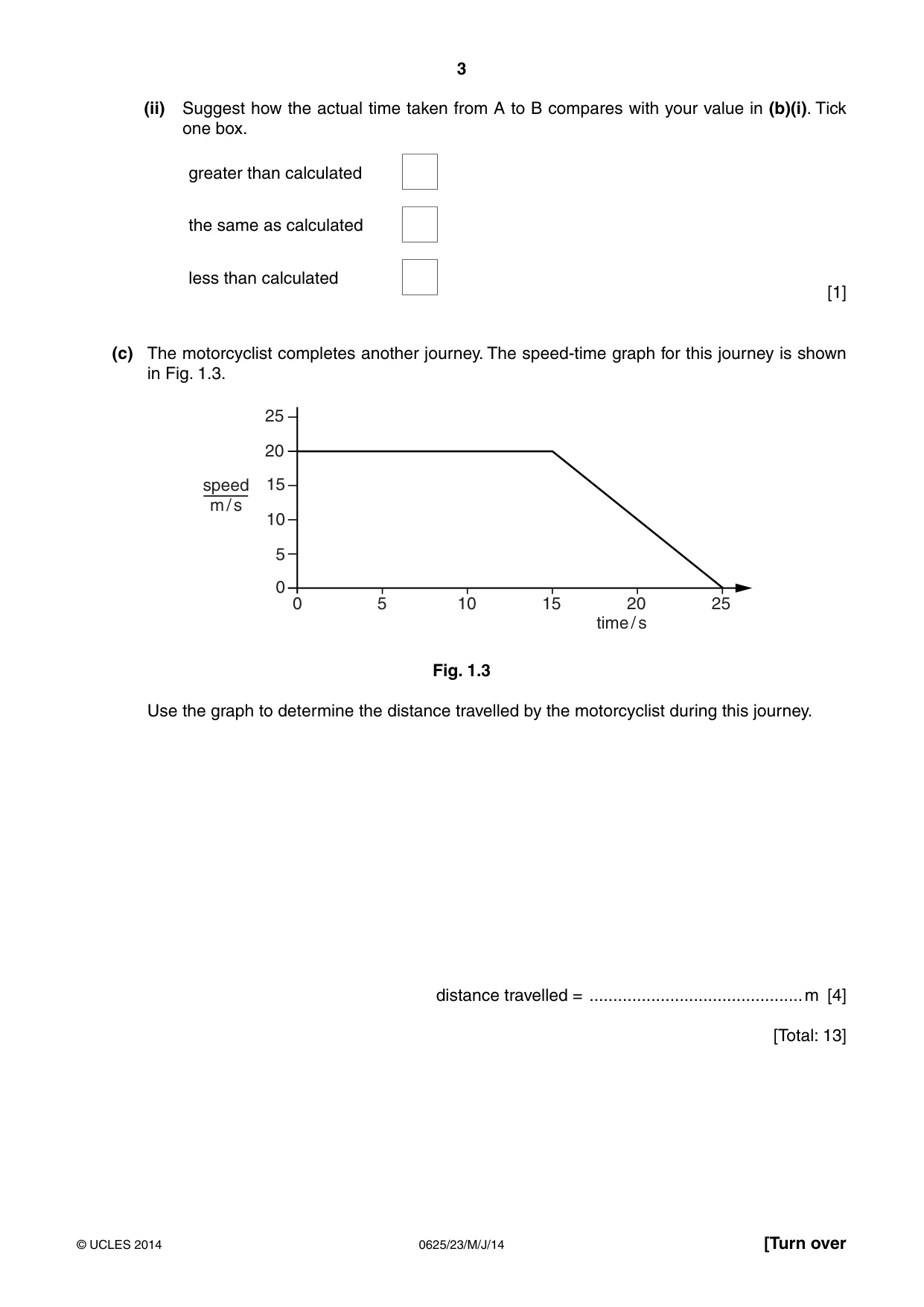
3 0625/23/M/J/14 © UCLES 2014 [Turn over (ii) Suggest how the actual time taken from A to B compares with your value in (b)(i). Tick one box. greater than calculated the same as calculated less than calculated [1] (c) The motorcyclist completes another journey. The speed-time graph for this journey is shown in Fig. 1.3. 20 25 0 5 10 15 0 5 10 15 20 25 speed m / s time / s Fig. 1.3 Use the graph to determine the distance travelled by the motorcyclist during this journey. distance travelled = …m [4] [Total: 13]
Question paper, page 4
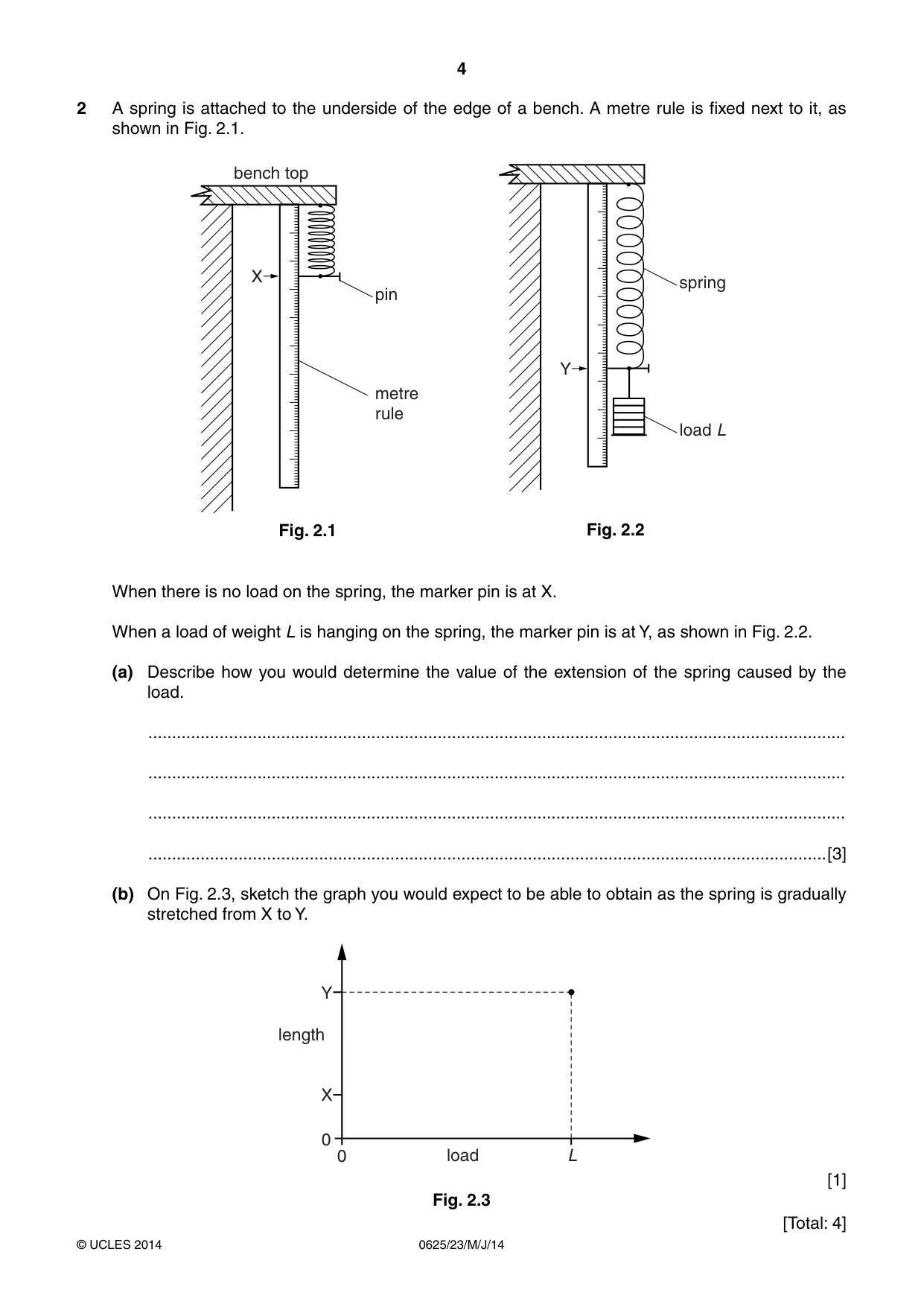
4 0625/23/M/J/14 © UCLES 2014 2 A spring is attached to the underside of the edge of a bench. A metre rule is fixed next to it, as shown in Fig. 2.1. X bench top pin metre rule Fig. 2.1 Y spring load L Fig. 2.2 When there is no load on the spring, the marker pin is at X. When a load of weight L is hanging on the spring, the marker pin is at Y, as shown in Fig. 2.2. (a) Describe how you would determine the value of the extension of the spring caused by the load. … … … …[3] (b) On Fig. 2.3, sketch the graph you would expect to be able to obtain as the spring is gradually stretched from X to Y. length X Y 0 0 load L [1] Fig. 2.3 [Total: 4]
Question paper, page 5
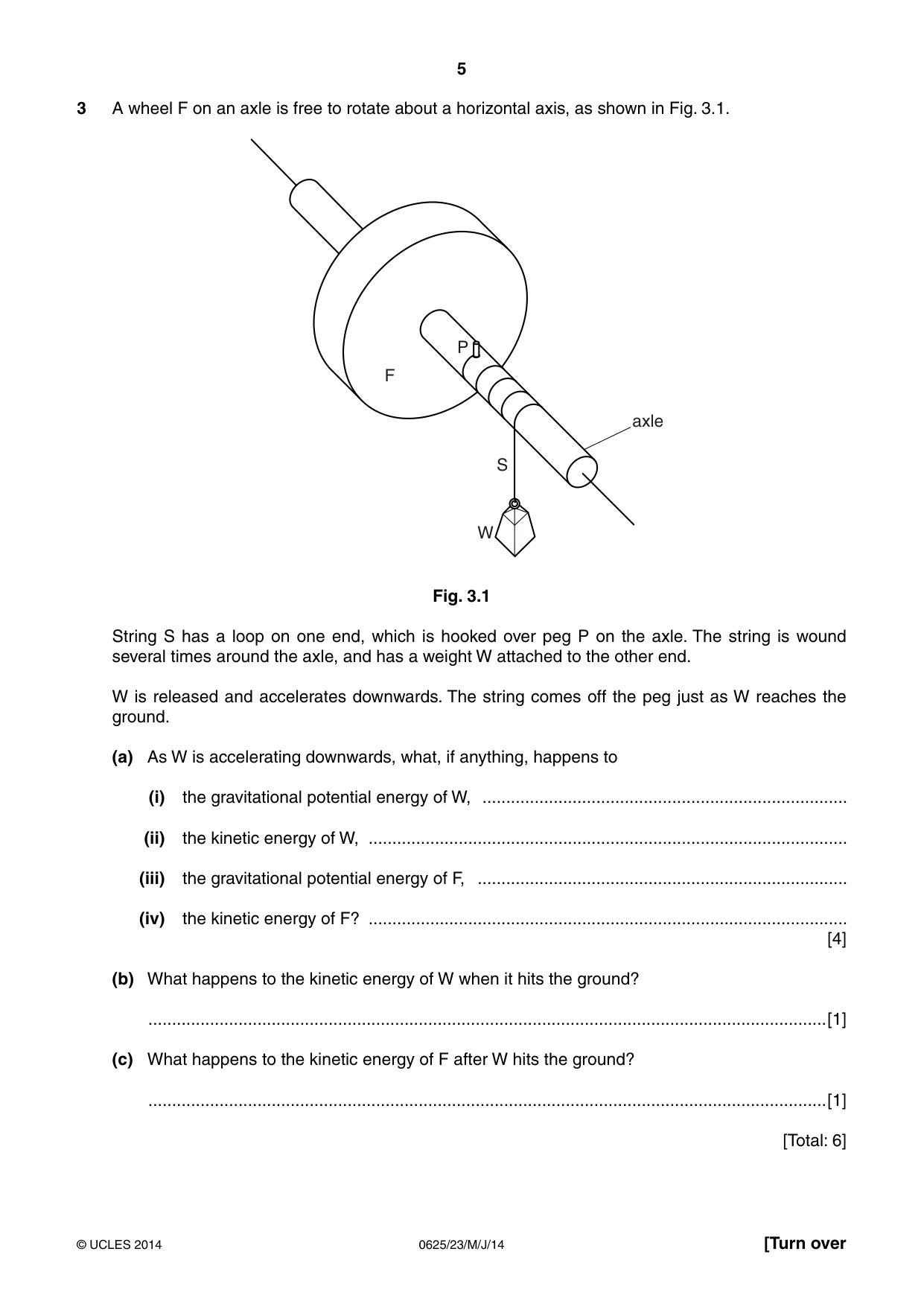
5 0625/23/M/J/14 © UCLES 2014 [Turn over 3 A wheel F on an axle is free to rotate about a horizontal axis, as shown in Fig. 3.1. F P S W axle Fig. 3.1 String S has a loop on one end, which is hooked over peg P on the axle. The string is wound several times around the axle, and has a weight W attached to the other end. W is released and accelerates downwards. The string comes off the peg just as W reaches the ground. (a) As W is accelerating downwards, what, if anything, happens to (i) the gravitational potential energy of W, … (ii) the kinetic energy of W, … (iii) the gravitational potential energy of F, … (iv) the kinetic energy of F? … [4] (b) What happens to the kinetic energy of W when it hits the ground? …[1] (c) What happens to the kinetic energy of F after W hits the ground? …[1] [Total: 6]
Question paper, page 6
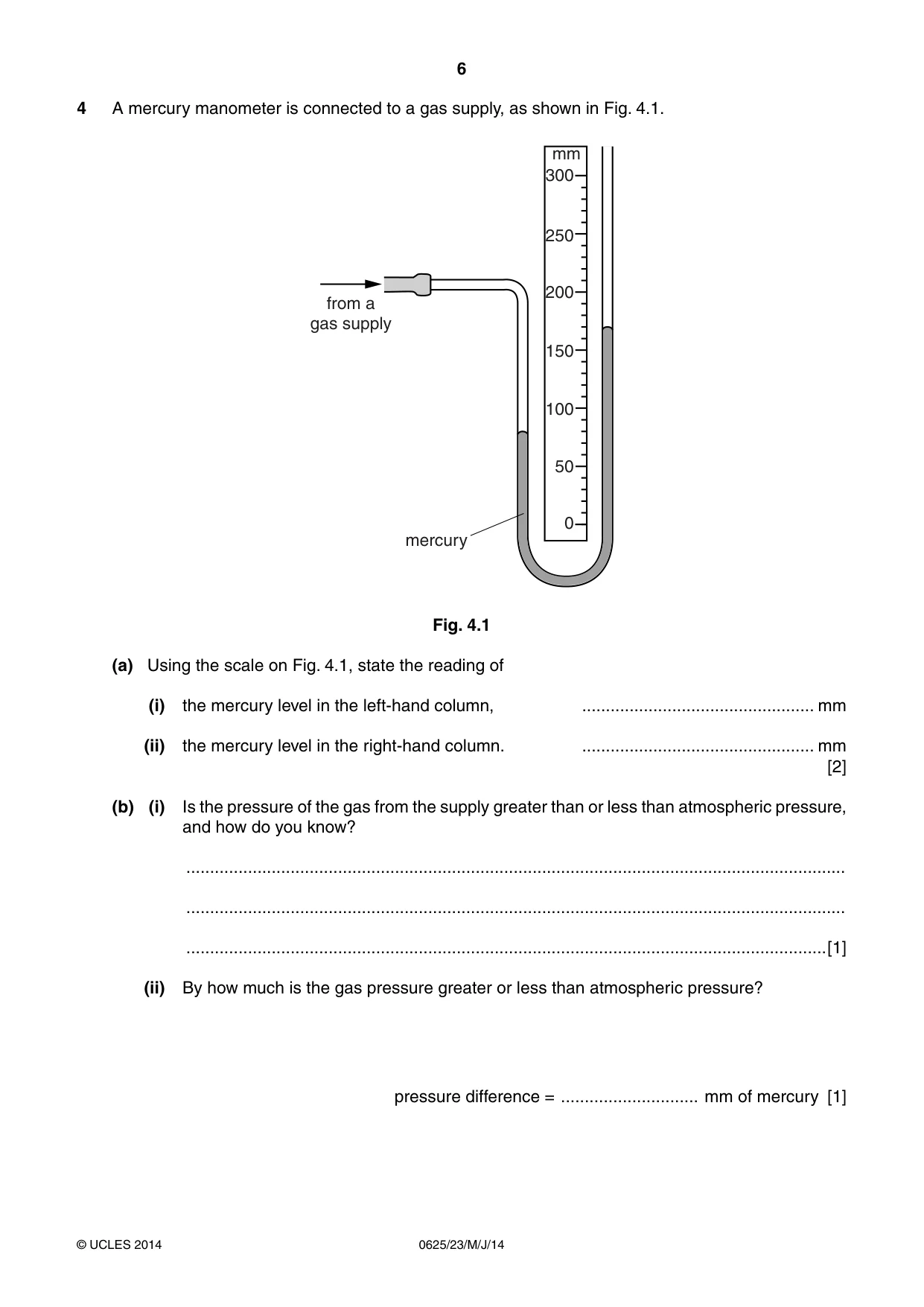
6 0625/23/M/J/14 © UCLES 2014 4 A mercury manometer is connected to a gas supply, as shown in Fig. 4.1. 0 50 100 150 200 250 300 mm from a gas supply mercury Fig. 4.1 (a) Using the scale on Fig. 4.1, state the reading of (i) the mercury level in the left-hand column, … mm (ii) the mercury level in the right-hand column. … mm [2] (b) (i) Is the pressure of the gas from the supply greater than or less than atmospheric pressure, and how do you know? … … …[1] (ii) By how much is the gas pressure greater or less than atmospheric pressure? pressure difference = … mm of mercury [1]
Question paper, page 7
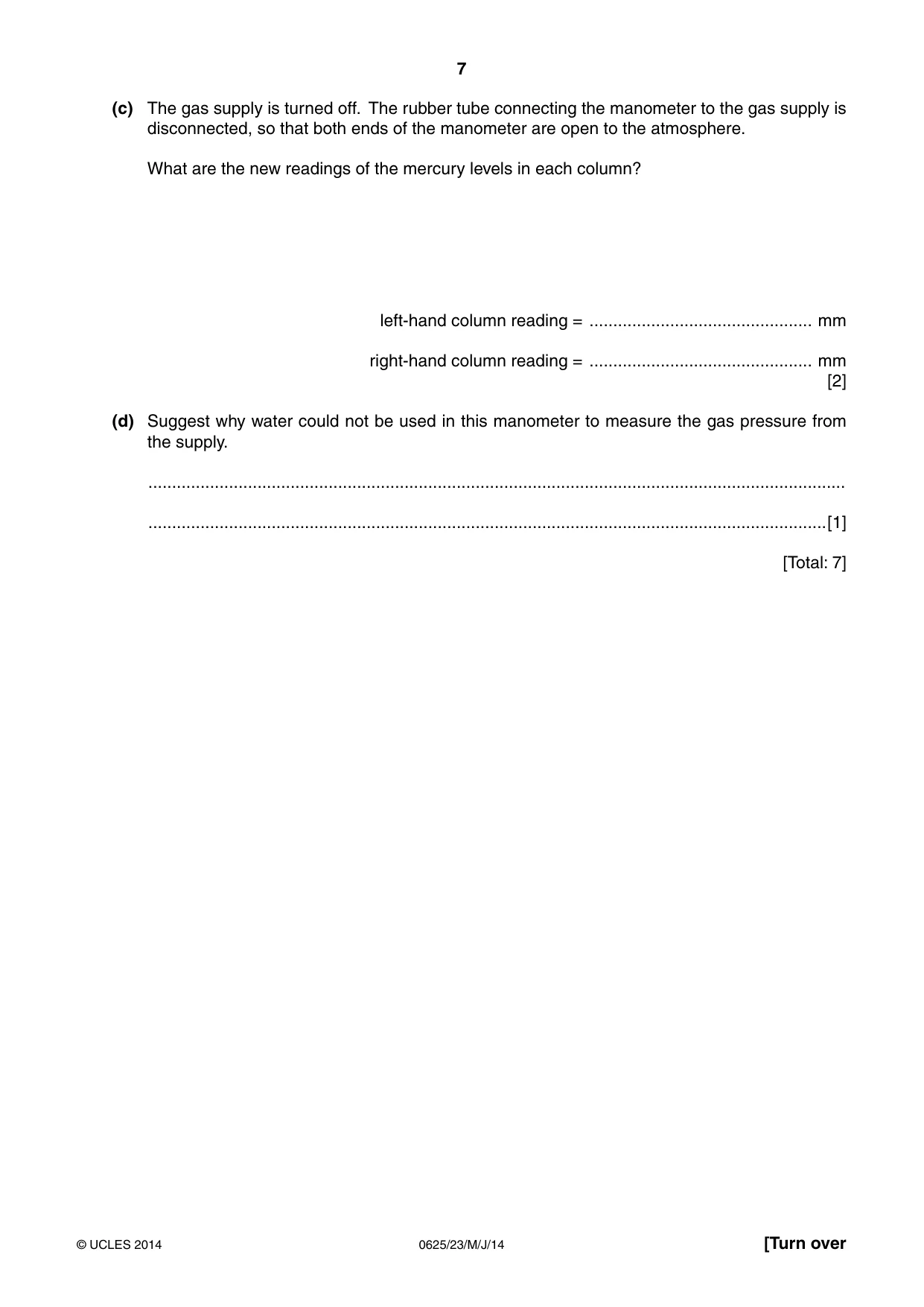
7 0625/23/M/J/14 © UCLES 2014 [Turn over (c) The gas supply is turned off. The rubber tube connecting the manometer to the gas supply is disconnected, so that both ends of the manometer are open to the atmosphere. What are the new readings of the mercury levels in each column? left-hand column reading = … mm right-hand column reading = … mm [2] (d) Suggest why water could not be used in this manometer to measure the gas pressure from the supply. … …[1] [Total: 7]
Question paper, page 8
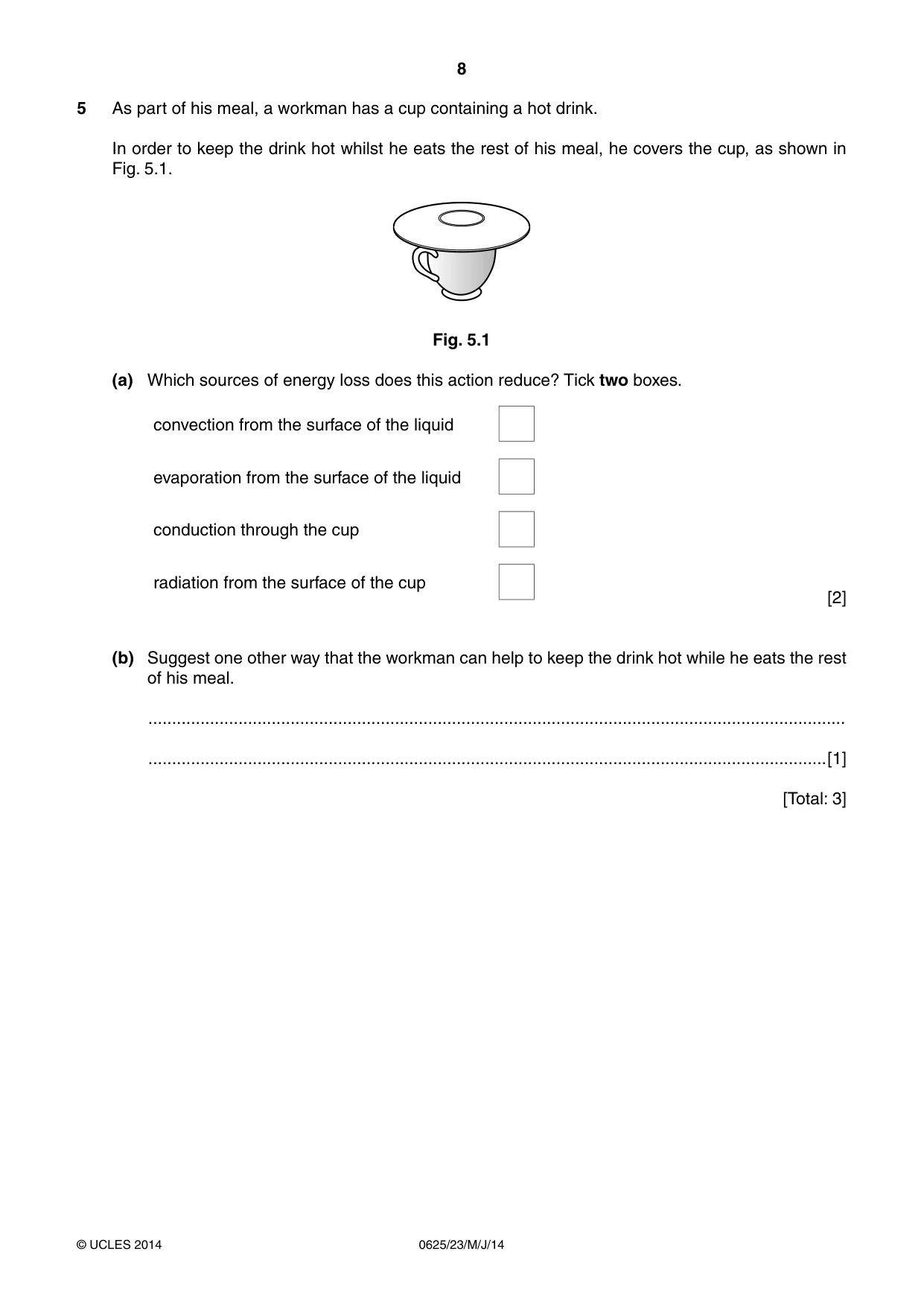
8 0625/23/M/J/14 © UCLES 2014 5 As part of his meal, a workman has a cup containing a hot drink. In order to keep the drink hot whilst he eats the rest of his meal, he covers the cup, as shown in Fig. 5.1. Fig. 5.1 (a) Which sources of energy loss does this action reduce? Tick two boxes. convection from the surface of the liquid evaporation from the surface of the liquid conduction through the cup radiation from the surface of the cup [2] (b) Suggest one other way that the workman can help to keep the drink hot while he eats the rest of his meal. … …[1] [Total: 3]
Question paper, page 9
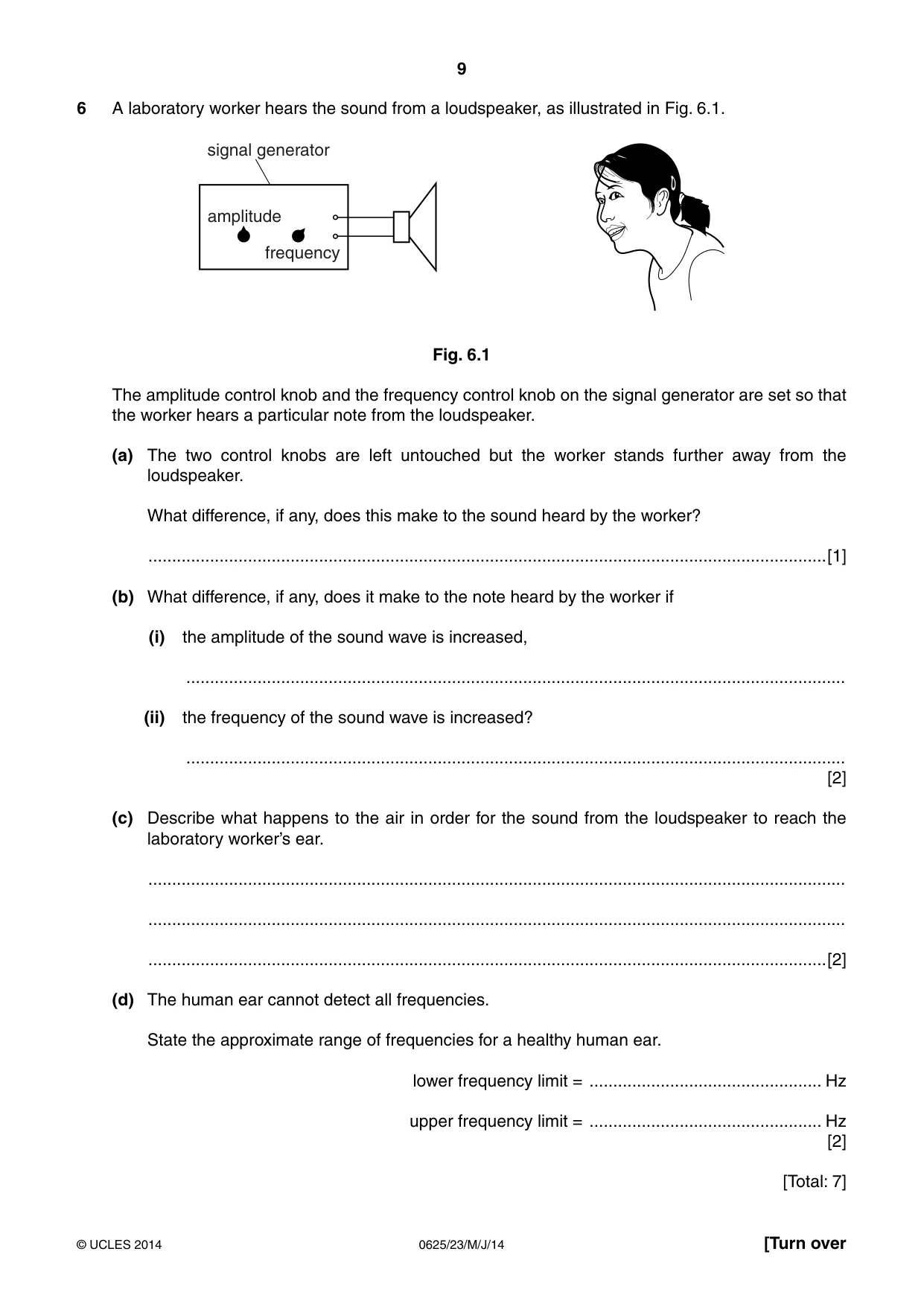
9 0625/23/M/J/14 © UCLES 2014 [Turn over 6 A laboratory worker hears the sound from a loudspeaker, as illustrated in Fig. 6.1. frequency amplitude signal generator Fig. 6.1 The amplitude control knob and the frequency control knob on the signal generator are set so that the worker hears a particular note from the loudspeaker. (a) The two control knobs are left untouched but the worker stands further away from the loudspeaker. What difference, if any, does this make to the sound heard by the worker? …[1] (b) What difference, if any, does it make to the note heard by the worker if (i) the amplitude of the sound wave is increased, … (ii) the frequency of the sound wave is increased? … [2] (c) Describe what happens to the air in order for the sound from the loudspeaker to reach the laboratory worker’s ear. … … …[2] (d) The human ear cannot detect all frequencies. State the approximate range of frequencies for a healthy human ear. lower frequency limit = … Hz upper frequency limit = … Hz [2] [Total: 7]
Question paper, page 10
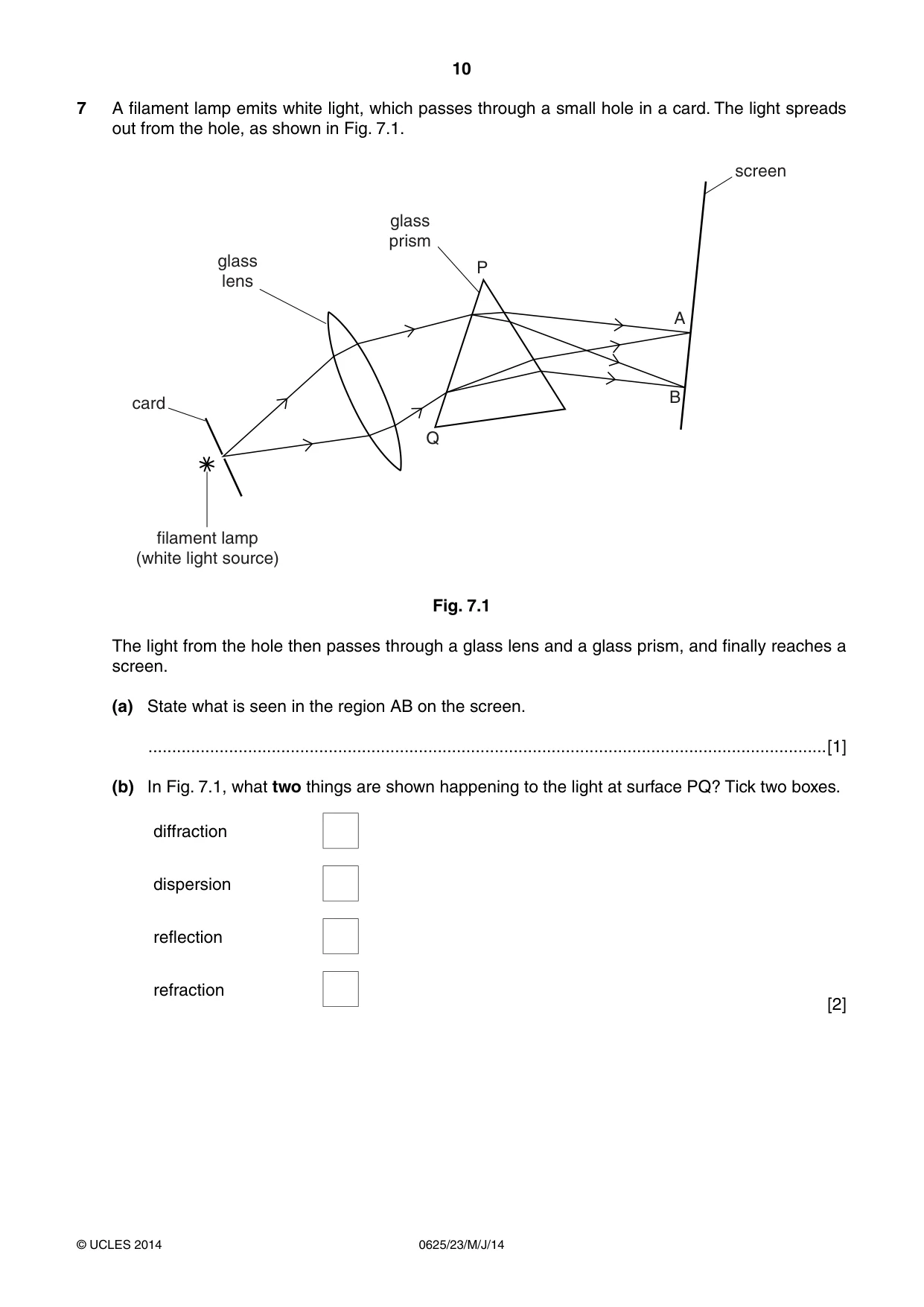
10 0625/23/M/J/14 © UCLES 2014 7 A filament lamp emits white light, which passes through a small hole in a card. The light spreads out from the hole, as shown in Fig. 7.1. glass lens glass prism card A B Q P filament lamp (white light source) screen Fig. 7.1 The light from the hole then passes through a glass lens and a glass prism, and finally reaches a screen. (a) State what is seen in the region AB on the screen. …[1] (b) In Fig. 7.1, what two things are shown happening to the light at surface PQ? Tick two boxes. diffraction dispersion reflection refraction [2]
Question paper, page 11
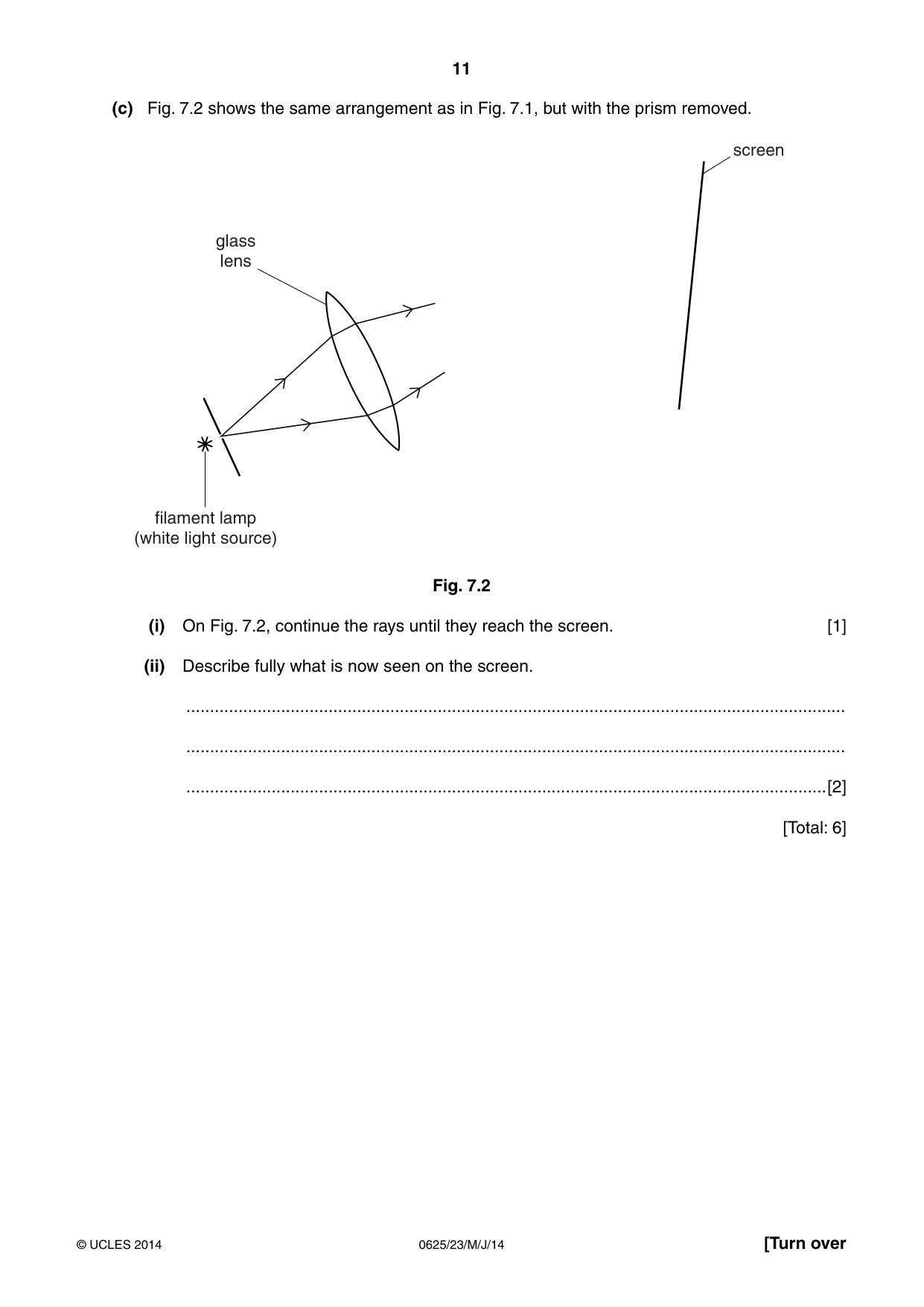
11 0625/23/M/J/14 © UCLES 2014 [Turn over (c) Fig. 7.2 shows the same arrangement as in Fig. 7.1, but with the prism removed. glass lens filament lamp (white light source) screen Fig. 7.2 (i) On Fig. 7.2, continue the rays until they reach the screen. [1] (ii) Describe fully what is now seen on the screen. … … …[2] [Total: 6]
Question paper, page 12
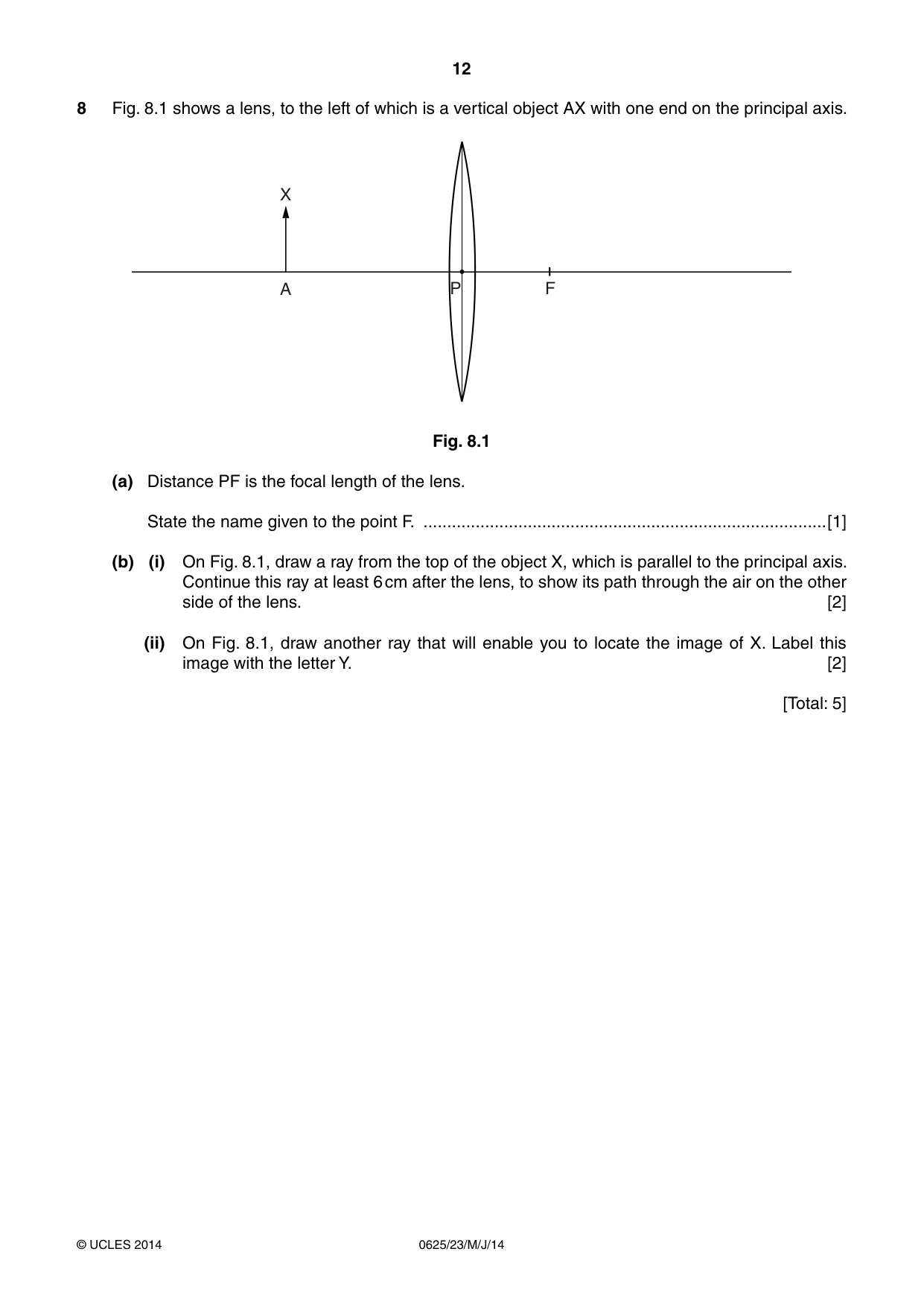
12 0625/23/M/J/14 © UCLES 2014 8 Fig. 8.1 shows a lens, to the left of which is a vertical object AX with one end on the principal axis. A X F P Fig. 8.1 (a) Distance PF is the focal length of the lens. State the name given to the point F. …[1] (b) (i) On Fig. 8.1, draw a ray from the top of the object X, which is parallel to the principal axis. Continue this ray at least 6 cm after the lens, to show its path through the air on the other side of the lens. [2] (ii) On Fig. 8.1, draw another ray that will enable you to locate the image of X. Label this image with the letter Y. [2] [Total: 5]
Question paper, page 13
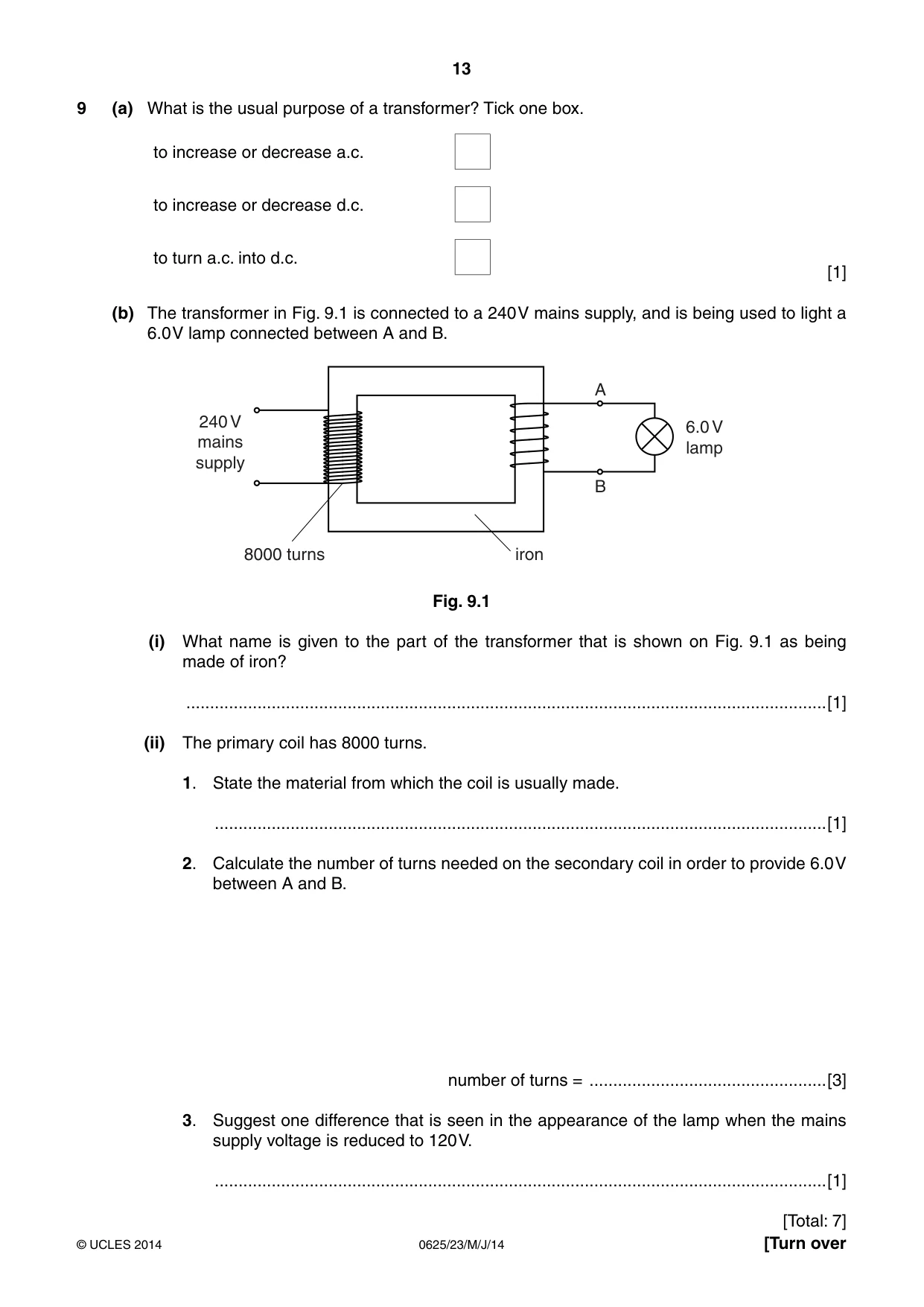
13 0625/23/M/J/14 © UCLES 2014 [Turn over 9 (a) What is the usual purpose of a transformer? Tick one box. to increase or decrease a.c. to increase or decrease d.c. to turn a.c. into d.c. [1] (b) The transformer in Fig. 9.1 is connected to a 240 V mains supply, and is being used to light a 6.0 V lamp connected between A and B. 240 V mains supply 8000 turns iron 6.0 V lamp A B Fig. 9.1 (i) What name is given to the part of the transformer that is shown on Fig. 9.1 as being made of iron? …[1] (ii) The primary coil has 8000 turns. 1. State the material from which the coil is usually made. …[1] 2. Calculate the number of turns needed on the secondary coil in order to provide 6.0 V between A and B. number of turns = …[3] 3. Suggest one difference that is seen in the appearance of the lamp when the mains supply voltage is reduced to 120 V. …[1] [Total: 7]
Question paper, page 14
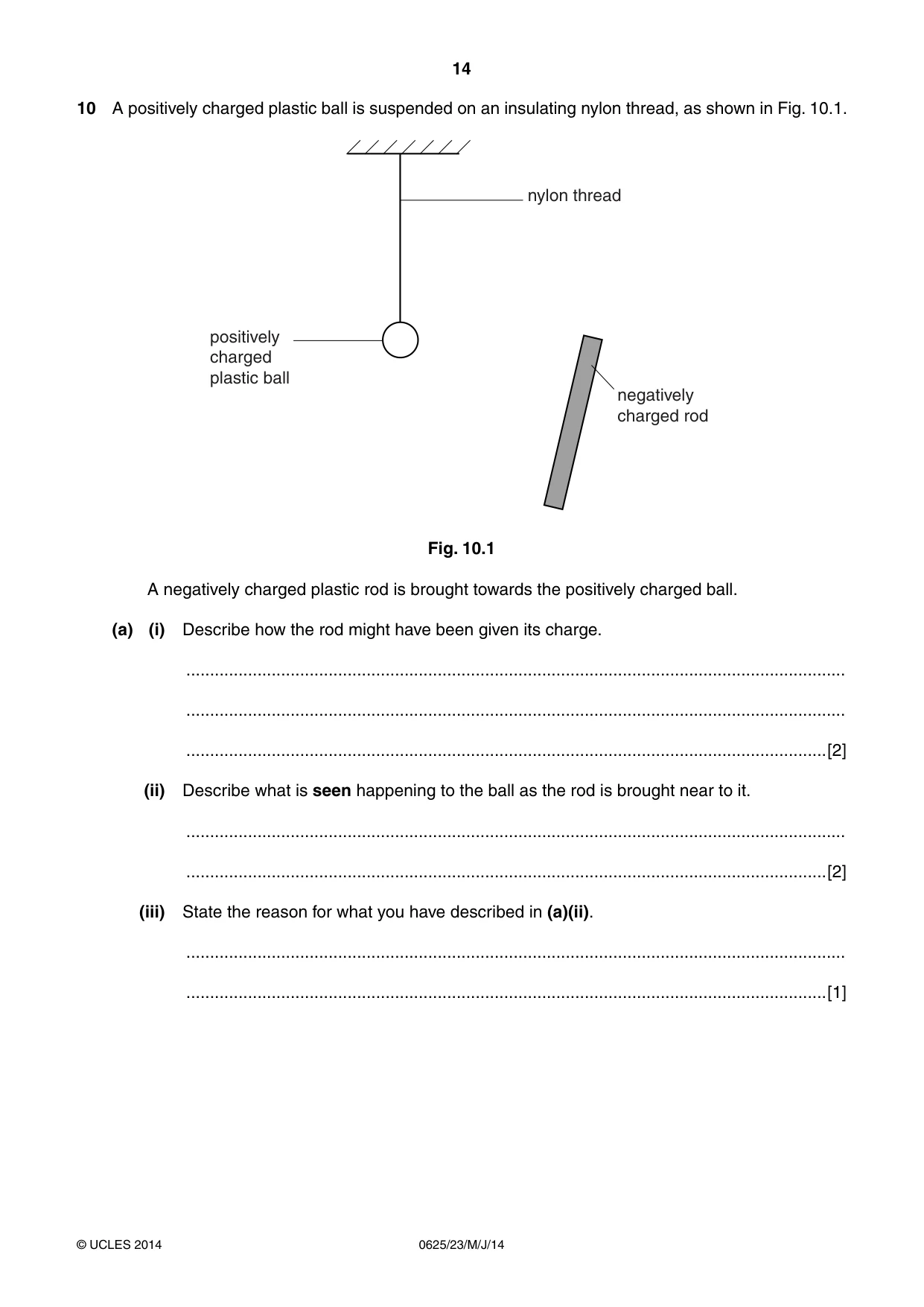
14 0625/23/M/J/14 © UCLES 2014 10 A positively charged plastic ball is suspended on an insulating nylon thread, as shown in Fig. 10.1. negatively charged rod nylon thread positively charged plastic ball Fig. 10.1 A negatively charged plastic rod is brought towards the positively charged ball. (a) (i) Describe how the rod might have been given its charge. … … …[2] (ii) Describe what is seen happening to the ball as the rod is brought near to it. … …[2] (iii) State the reason for what you have described in (a)(ii). … …[1]
Question paper, page 15
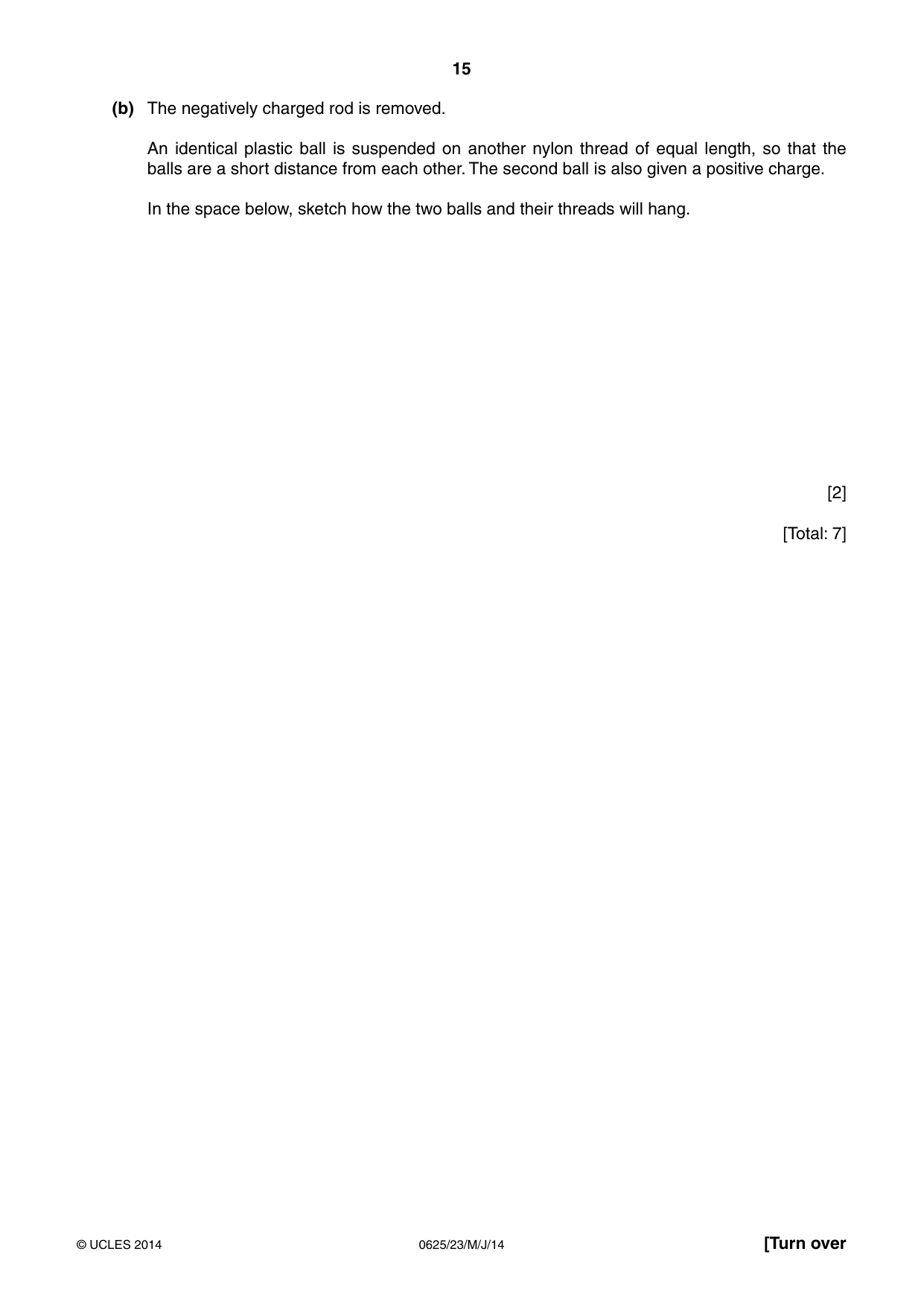
15 0625/23/M/J/14 © UCLES 2014 [Turn over (b) The negatively charged rod is removed. An identical plastic ball is suspended on another nylon thread of equal length, so that the balls are a short distance from each other. The second ball is also given a positive charge. In the space below, sketch how the two balls and their threads will hang. [2] [Total: 7]
Question paper, page 16
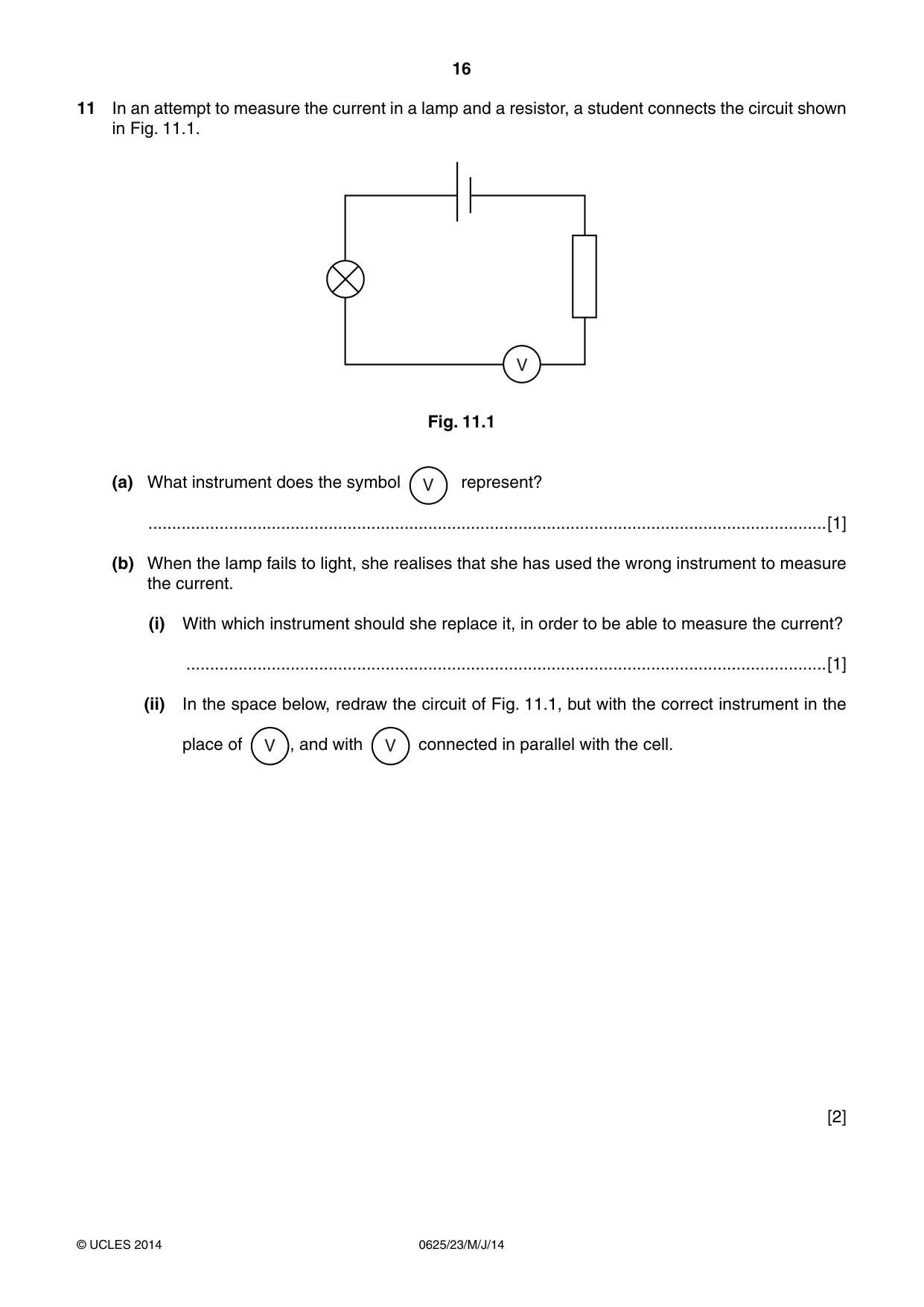
16 0625/23/M/J/14 © UCLES 2014 11 In an attempt to measure the current in a lamp and a resistor, a student connects the circuit shown in Fig. 11.1. V Fig. 11.1 (a) What instrument does the symbol V represent? …[1] (b) When the lamp fails to light, she realises that she has used the wrong instrument to measure the current. (i) With which instrument should she replace it, in order to be able to measure the current? …[1] (ii) In the space below, redraw the circuit of Fig. 11.1, but with the correct instrument in the place of V , and with V connected in parallel with the cell. [2]
Question paper, page 17
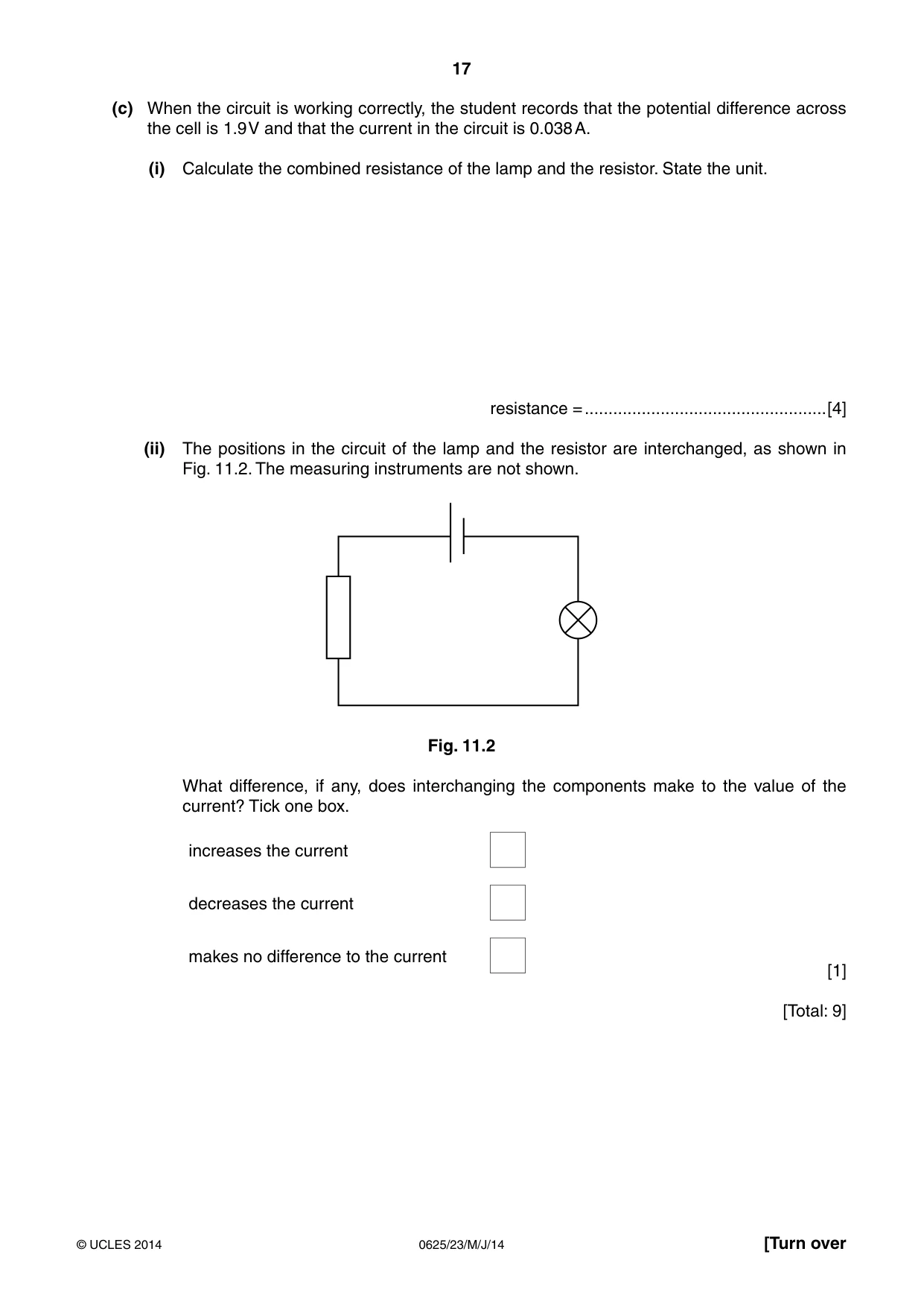
17 0625/23/M/J/14 © UCLES 2014 [Turn over (c) When the circuit is working correctly, the student records that the potential difference across the cell is 1.9 V and that the current in the circuit is 0.038 A. (i) Calculate the combined resistance of the lamp and the resistor. State the unit. resistance = …[4] (ii) The positions in the circuit of the lamp and the resistor are interchanged, as shown in Fig. 11.2. The measuring instruments are not shown. Fig. 11.2 What difference, if any, does interchanging the components make to the value of the current? Tick one box. increases the current decreases the current makes no difference to the current [1] [Total: 9]
Question paper, page 18
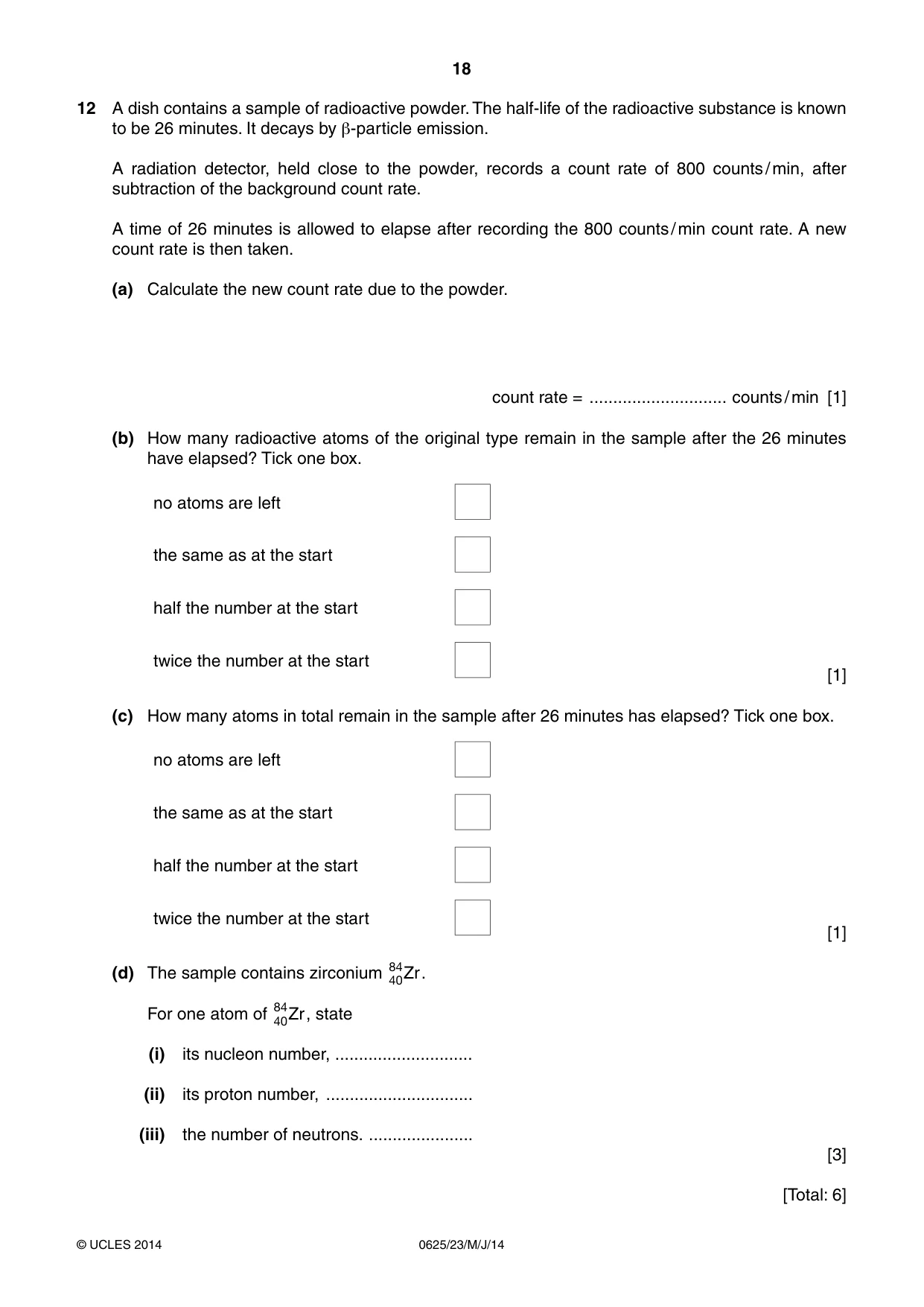
18 0625/23/M/J/14 © UCLES 2014 12 A dish contains a sample of radioactive powder. The half-life of the radioactive substance is known to be 26 minutes. It decays by β-particle emission. A radiation detector, held close to the powder, records a count rate of 800 counts / min, after subtraction of the background count rate. A time of 26 minutes is allowed to elapse after recording the 800 counts / min count rate. A new count rate is then taken. (a) Calculate the new count rate due to the powder. count rate = … counts / min [1] (b) How many radioactive atoms of the original type remain in the sample after the 26 minutes have elapsed? Tick one box. no atoms are left the same as at the start half the number at the start twice the number at the start [1] (c) How many atoms in total remain in the sample after 26 minutes has elapsed? Tick one box. no atoms are left the same as at the start half the number at the start twice the number at the start [1] (d) The sample contains zirconium r Z 40 84 . For one atom of r Z 40 84 , state (i) its nucleon number, … (ii) its proton number, … (iii) the number of neutrons. … [3] [Total: 6]
Question paper, page 19
19 0625/23/M/J/14 © UCLES 2014 BLANK PAGE
Question paper, page 20
20 0625/23/M/J/14 © UCLES 2014 Permission to reproduce items where third-party owned material protected by copyright is included has been sought and cleared where possible. Every reasonable effort has been made by the publisher (UCLES) to trace copyright holders, but if any items requiring clearance have unwittingly been included, the publisher will be pleased to make amends at the earliest possible opportunity. Cambridge International Examinations is part of the Cambridge Assessment Group. Cambridge Assessment is the brand name of University of Cambridge Local Examinations Syndicate (UCLES), which is itself a department of the University of Cambridge. BLANK PAGE
Mark scheme, page 1
CAMBRIDGE INTERNATIONAL EXAMINATIONS International General Certificate of Secondary Education MARK SCHEME for the May/June 2014 series 0625 PHYSICS 0625/23 Paper 2 (Core Theory), maximum raw mark 80 This mark scheme is published as an aid to teachers and candidates, to indicate the requirements of the examination. It shows the basis on which Examiners were instructed to award marks. It does not indicate the details of the discussions that took place at an Examiners’ meeting before marking began, which would have considered the acceptability of alternative answers. Mark schemes should be read in conjunction with the question paper and the Principal Examiner Report for Teachers. Cambridge will not enter into discussions about these mark schemes. Cambridge is publishing the mark schemes for the May/June 2014 series for most IGCSE, GCE Advanced Level and Advanced Subsidiary Level components and some Ordinary Level components.
Mark scheme, page 2
Page 2 Mark Scheme Syllabus Paper IGCSE – May/June 2014 0625 23 © Cambridge International Examinations 2014 NOTES ABOUT MARK SCHEME SYMBOLS & OTHER MATTERS B marks are independent marks, which do not depend on any other marks. For a B mark to be scored, the point to which it refers must actually be seen in the candidate's answer. M marks are method marks upon which accuracy marks (A marks) later depend. For an M mark to be scored, the point to which it refers must be seen in a candidate's answer. If a candidate fails to score a particular M mark, then none of the dependent A marks can be scored. C marks are compensatory method marks which can be scored even if the points to which they refer are not written down by the candidate, provided subsequent working gives evidence that they must have known it, e.g. if an equation carries a C mark and the candidate does not write down the actual equation but does correct working which shows he knew the equation, then the C mark is scored. A marks are accuracy or answer marks which either depend on an M mark, or which are one of the ways which allow a C mark to be scored. c.a.o. means "correct answer only". e.c.f. means "error carried forward". This indicates that if a candidate has made an earlier mistake and has carried his incorrect value forward to subsequent stages of working, he may be given marks indicated by e.c.f. provided his subsequent working is correct, bearing in mind his earlier mistake. This prevents a candidate being penalised more than once for a particular mistake, but only applies to marks annotated "e.c.f." e.e.o.o. means "each error or omission". Brackets ( ) around words or units in the mark scheme are intended to indicate wording used to clarify the mark scheme, but the marks do not depend on seeing the words or units in brackets, e.g. 10 (J) means that the mark is scored for 10, regardless of the unit given. Underlining indicates that this must be seen in the answer offered, or something very similar. OR/or indicates alternative answers, any one of which is satisfactory for scoring the marks. Spelling Be generous about spelling and use of English. If an answer can be understood to mean what we want, give credit. Significant figures Answers are acceptable to any number of significant figures ≥ 2, except if specified otherwise, or if only 1 sig. fig. is appropriate. Units Incorrect units are not penalised, except where specified. More commonly, marks are allocated for specific units. Fractions These are only acceptable where specified. Extras Ignore extras in answers if they are irrelevant; if they contradict an otherwise correct response or are forbidden by mark scheme, use right + wrong = 0. Ignore indicates that something which is not correct is disregarded and does not cause a right plus wrong penalty. Not/NOT indicates that an incorrect answer is not to be disregarded, but cancels another otherwise correct alternative offered by the candidate, i.e. right plus wrong penalty applies.
Mark scheme, page 3
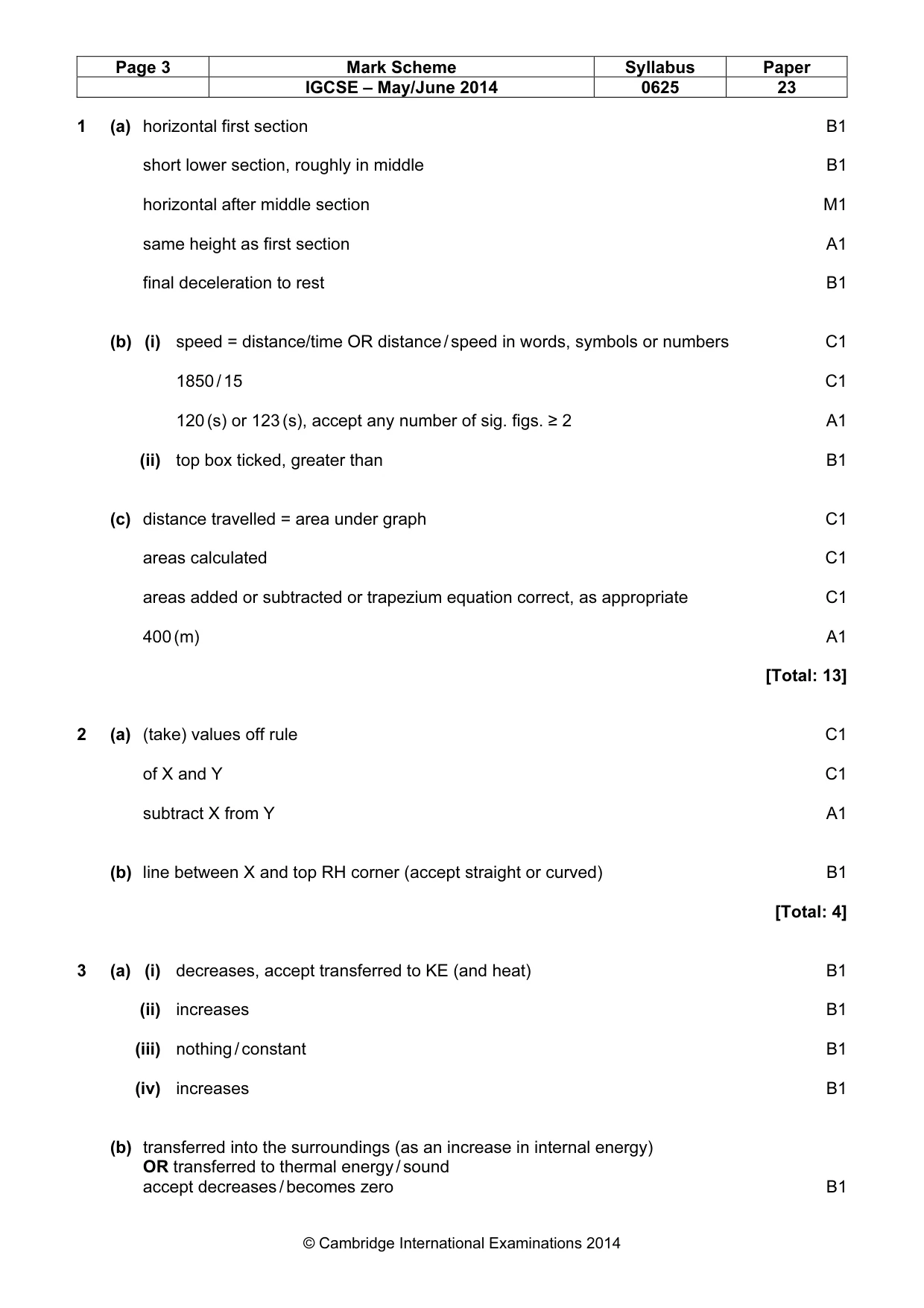
Page 3 Mark Scheme Syllabus Paper IGCSE – May/June 2014 0625 23 © Cambridge International Examinations 2014 1 (a) horizontal first section B1 short lower section, roughly in middle B1 horizontal after middle section M1 same height as first section A1 final deceleration to rest B1 (b) (i) speed = distance/time OR distance / speed in words, symbols or numbers C1 1850 / 15 C1 120 (s) or 123 (s), accept any number of sig. figs. ≥ 2 A1 (ii) top box ticked, greater than B1 (c) distance travelled = area under graph C1 areas calculated C1 areas added or subtracted or trapezium equation correct, as appropriate C1 400 (m) A1 [Total: 13] 2 (a) (take) values off rule C1 of X and Y C1 subtract X from Y A1 (b) line between X and top RH corner (accept straight or curved) B1 [Total: 4] 3 (a) (i) decreases, accept transferred to KE (and heat) B1 (ii) increases B1 (iii) nothing / constant B1 (iv) increases B1 (b) transferred into the surroundings (as an increase in internal energy) OR transferred to thermal energy / sound accept decreases / becomes zero B1
Mark scheme, page 4
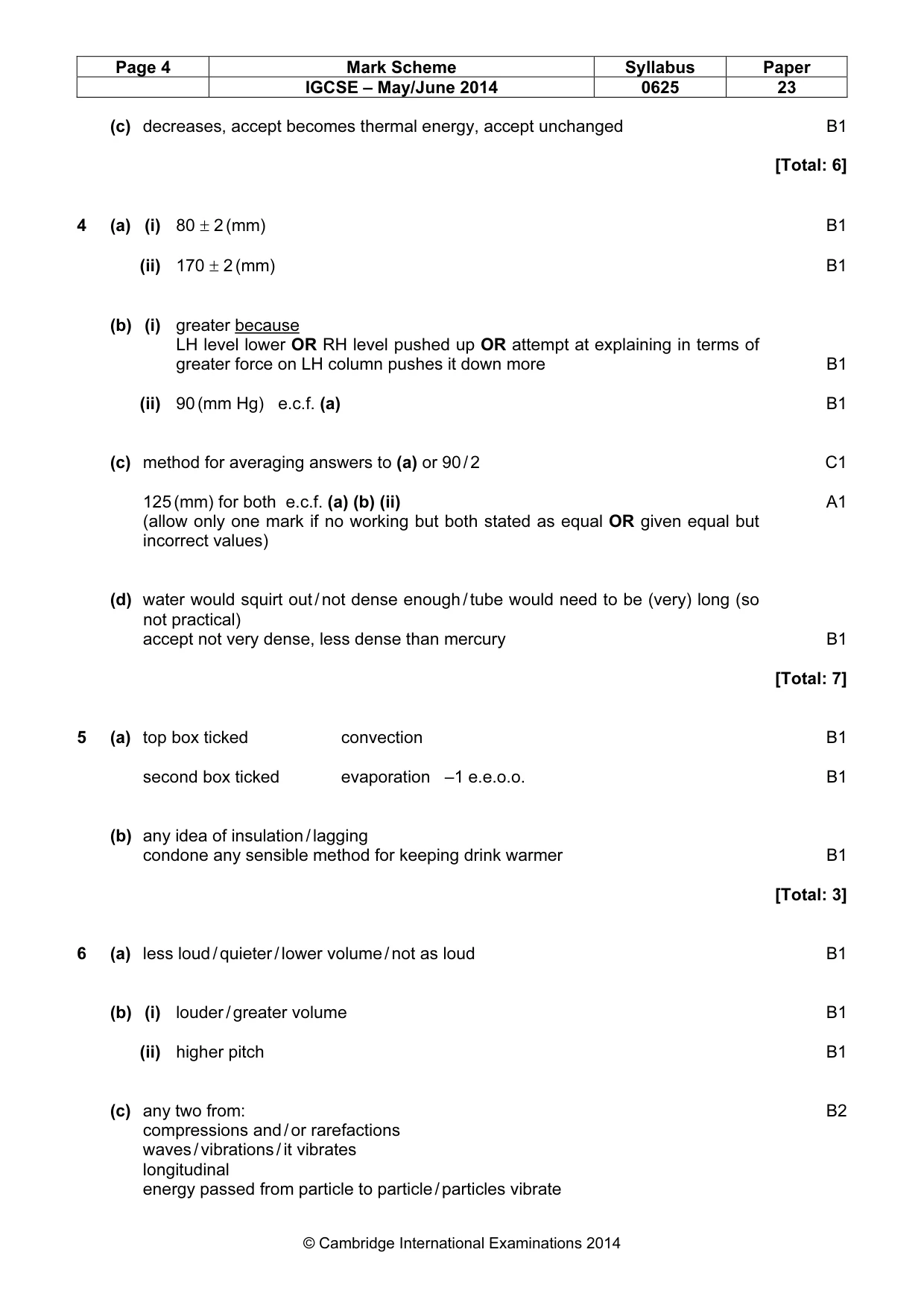
Page 4 Mark Scheme Syllabus Paper IGCSE – May/June 2014 0625 23 © Cambridge International Examinations 2014 (c) decreases, accept becomes thermal energy, accept unchanged B1 [Total: 6] 4 (a) (i) 80 ± 2 (mm) B1 (ii) 170 ± 2 (mm) B1 (b) (i) greater because LH level lower OR RH level pushed up OR attempt at explaining in terms of greater force on LH column pushes it down more B1 (ii) 90 (mm Hg) e.c.f. (a) B1 (c) method for averaging answers to (a) or 90 / 2 C1 125 (mm) for both e.c.f. (a) (b) (ii) A1 (allow only one mark if no working but both stated as equal OR given equal but incorrect values) (d) water would squirt out / not dense enough / tube would need to be (very) long (so not practical) accept not very dense, less dense than mercury B1 [Total: 7] 5 (a) top box ticked convection B1 second box ticked evaporation –1 e.e.o.o. B1 (b) any idea of insulation / lagging condone any sensible method for keeping drink warmer B1 [Total: 3] 6 (a) less loud / quieter / lower volume / not as loud B1 (b) (i) louder / greater volume B1 (ii) higher pitch B1 (c) any two from: B2 compressions and / or rarefactions waves / vibrations / it vibrates longitudinal energy passed from particle to particle / particles vibrate
Mark scheme, page 5
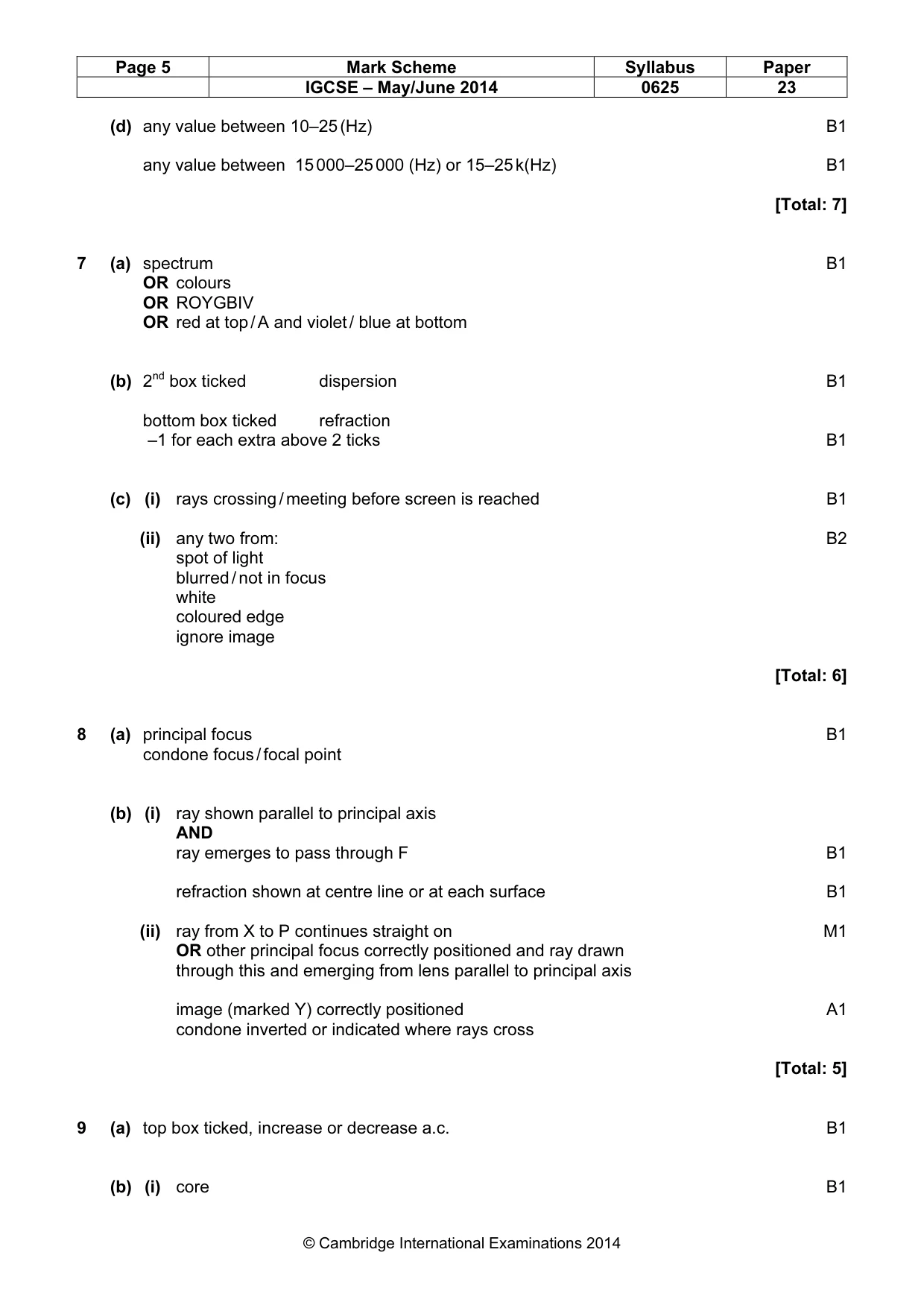
Page 5 Mark Scheme Syllabus Paper IGCSE – May/June 2014 0625 23 © Cambridge International Examinations 2014 (d) any value between 10–25 (Hz) B1 any value between 15 000–25 000 (Hz) or 15–25 k(Hz) B1 [Total: 7] 7 (a) spectrum B1 OR colours OR ROYGBIV OR red at top / A and violet / blue at bottom (b) 2nd box ticked dispersion B1 bottom box ticked refraction –1 for each extra above 2 ticks B1 (c) (i) rays crossing / meeting before screen is reached B1 (ii) any two from: B2 spot of light blurred / not in focus white coloured edge ignore image [Total: 6] 8 (a) principal focus B1 condone focus / focal point (b) (i) ray shown parallel to principal axis AND ray emerges to pass through F B1 refraction shown at centre line or at each surface B1 (ii) ray from X to P continues straight on M1 OR other principal focus correctly positioned and ray drawn through this and emerging from lens parallel to principal axis image (marked Y) correctly positioned A1 condone inverted or indicated where rays cross [Total: 5] 9 (a) top box ticked, increase or decrease a.c. B1 (b) (i) core B1
Mark scheme, page 6
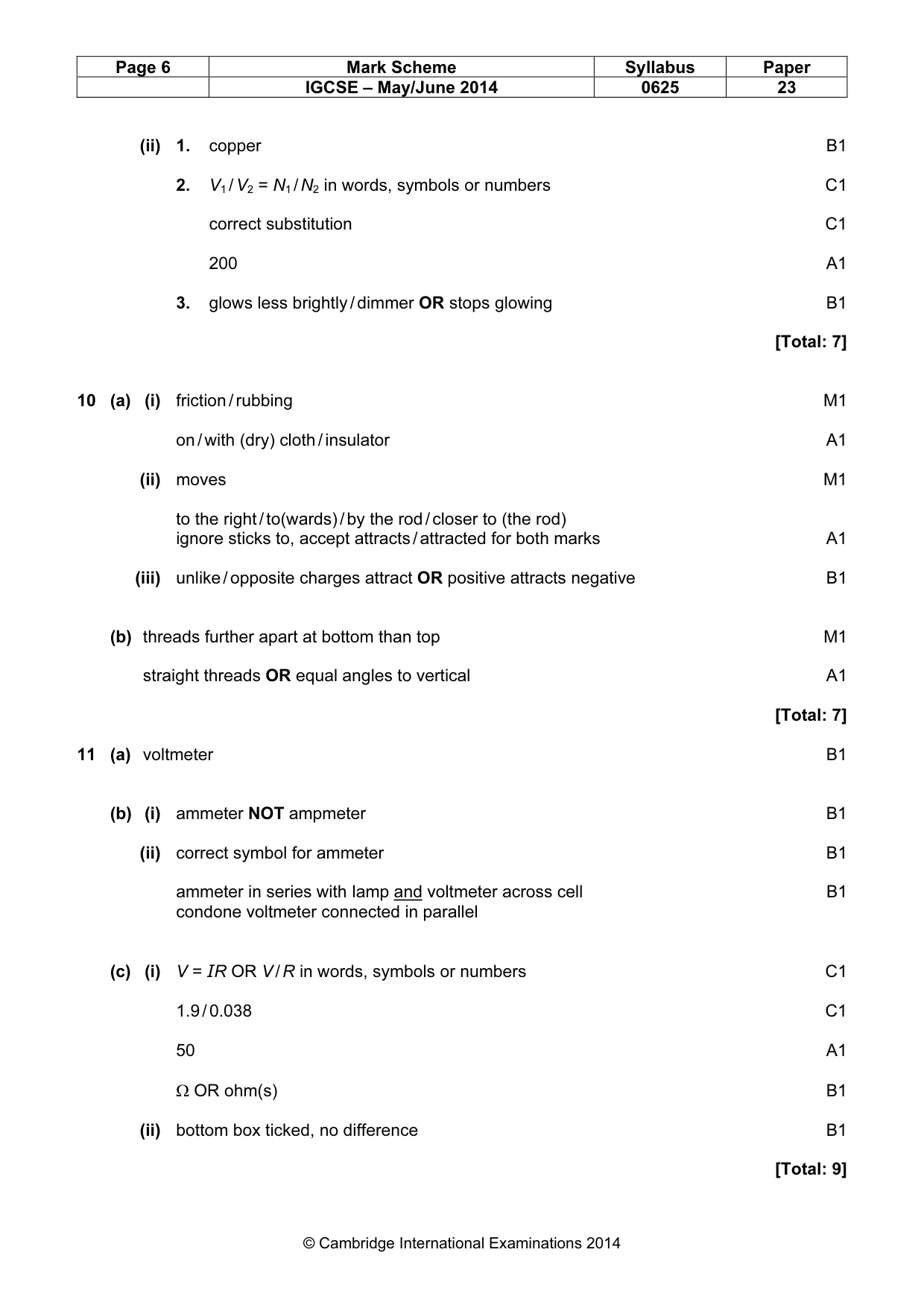
Page 6 Mark Scheme Syllabus Paper IGCSE – May/June 2014 0625 23 © Cambridge International Examinations 2014 (ii) 1. copper B1 2. V1 / V2 = N1 / N2 in words, symbols or numbers C1 correct substitution C1 200 A1 3. glows less brightly / dimmer OR stops glowing B1 [Total: 7] 10 (a) (i) friction / rubbing M1 on / with (dry) cloth / insulator A1 (ii) moves M1 to the right / to(wards) / by the rod / closer to (the rod) ignore sticks to, accept attracts / attracted for both marks A1 (iii) unlike / opposite charges attract OR positive attracts negative B1 (b) threads further apart at bottom than top M1 straight threads OR equal angles to vertical A1 [Total: 7] 11 (a) voltmeter B1 (b) (i) ammeter NOT ampmeter B1 (ii) correct symbol for ammeter B1 ammeter in series with lamp and voltmeter across cell B1 condone voltmeter connected in parallel (c) (i) V = IR OR V / R in words, symbols or numbers C1 1.9 / 0.038 C1 50 A1 Ω OR ohm(s) B1 (ii) bottom box ticked, no difference B1 [Total: 9]
Mark scheme, page 7
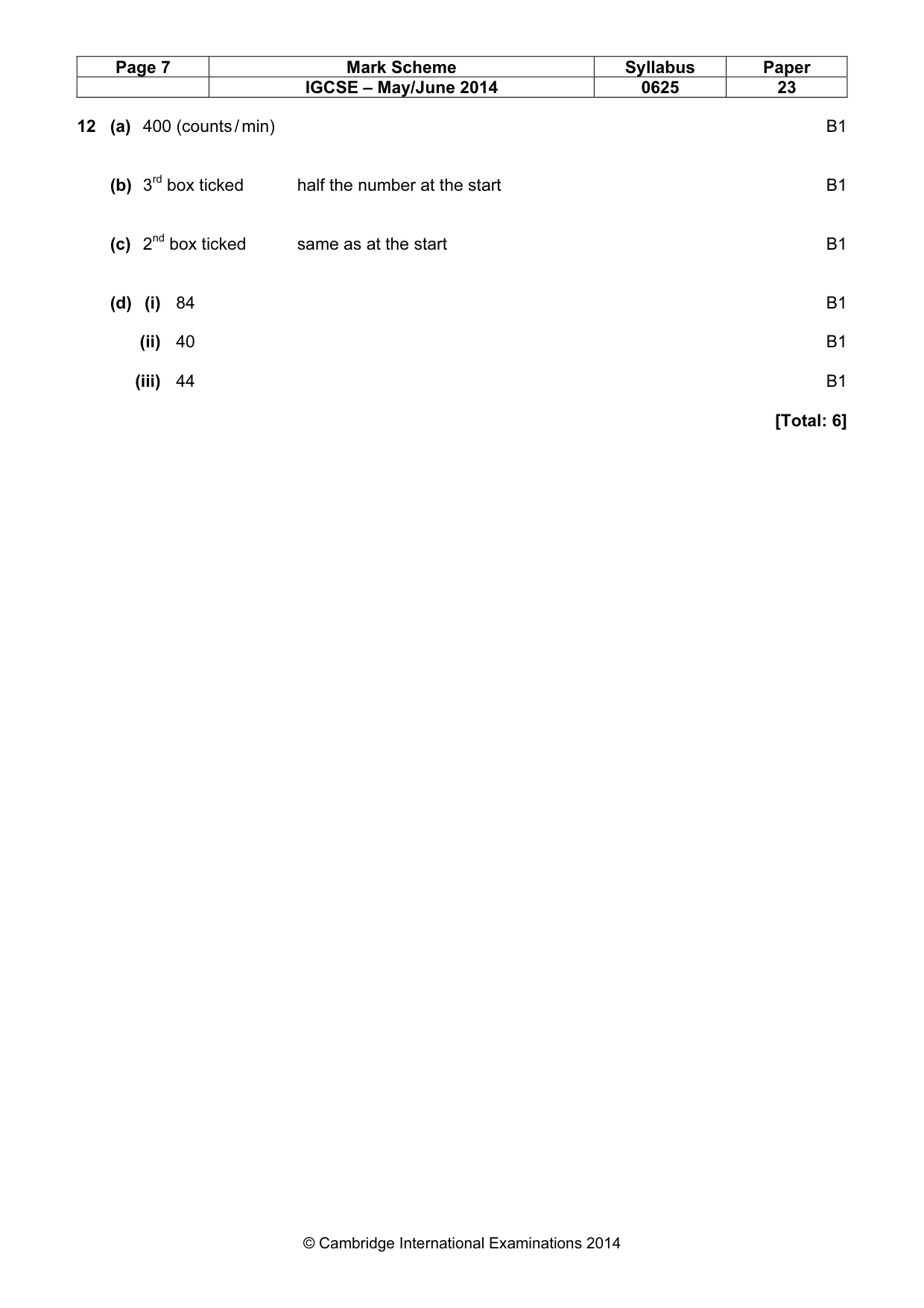
Page 7 Mark Scheme Syllabus Paper IGCSE – May/June 2014 0625 23 © Cambridge International Examinations 2014 12 (a) 400 (counts / min) B1 (b) 3rd box ticked half the number at the start B1 (c) 2nd box ticked same as at the start B1 (d) (i) 84 B1 (ii) 40 B1 (iii) 44 B1 [Total: 6]
What you needed in this session
Cambridge’s own grade thresholds for 2014 May/June, Paper 2 · Variant 3. A higher threshold means an easier paper — the bar moves with how the cohort did.