Cambridge IGCSE Physics 0625 — 2014 May/June Paper 2 · Variant 1
0625/21/M/J/14 · 80 marks · ≈90 min
The question paper and its mark scheme, free to read here and free to download. This is Cambridge’s own paper, exactly as it was sat.
Question paper16 pages
Mark scheme7 pages
Answers below. Sit the paper first if you are practising.
Paper as text
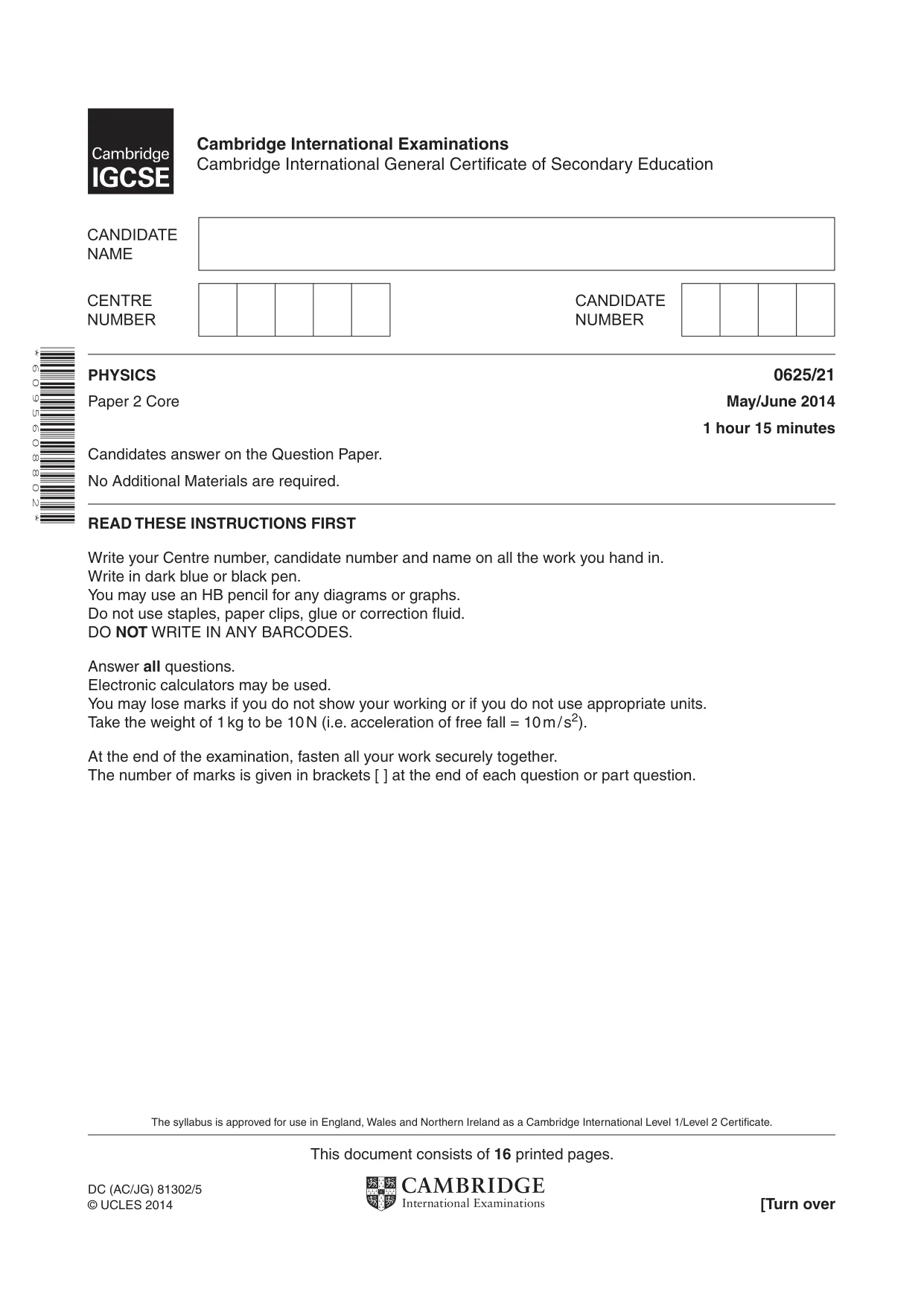
Question paper, page 1
This document consists of 16 printed pages. DC (AC/JG) 81302/5 © UCLES 2014 [Turn over Cambridge International Examinations Cambridge International General Certificate of Secondary Education * 6 0 9 5 6 0 8 8 0 2 * PHYSICS 0625/21 Paper 2 Core May/June 2014 1 hour 15 minutes Candidates answer on the Question Paper. No Additional Materials are required. READ THESE INSTRUCTIONS FIRST Write your Centre number, candidate number and name on all the work you hand in. Write in dark blue or black pen. You may use an HB pencil for any diagrams or graphs. Do not use staples, paper clips, glue or correction fluid. DO NOT WRITE IN ANY BARCODES. Answer all questions. Electronic calculators may be used. You may lose marks if you do not show your working or if you do not use appropriate units. Take the weight of 1 kg to be 10 N (i.e. acceleration of free fall = 10 m / s2). At the end of the examination, fasten all your work securely together. The number of marks is given in brackets [ ] at the end of each question or part question. The syllabus is approved for use in England, Wales and Northern Ireland as a Cambridge International Level 1/Level 2 Certificate.
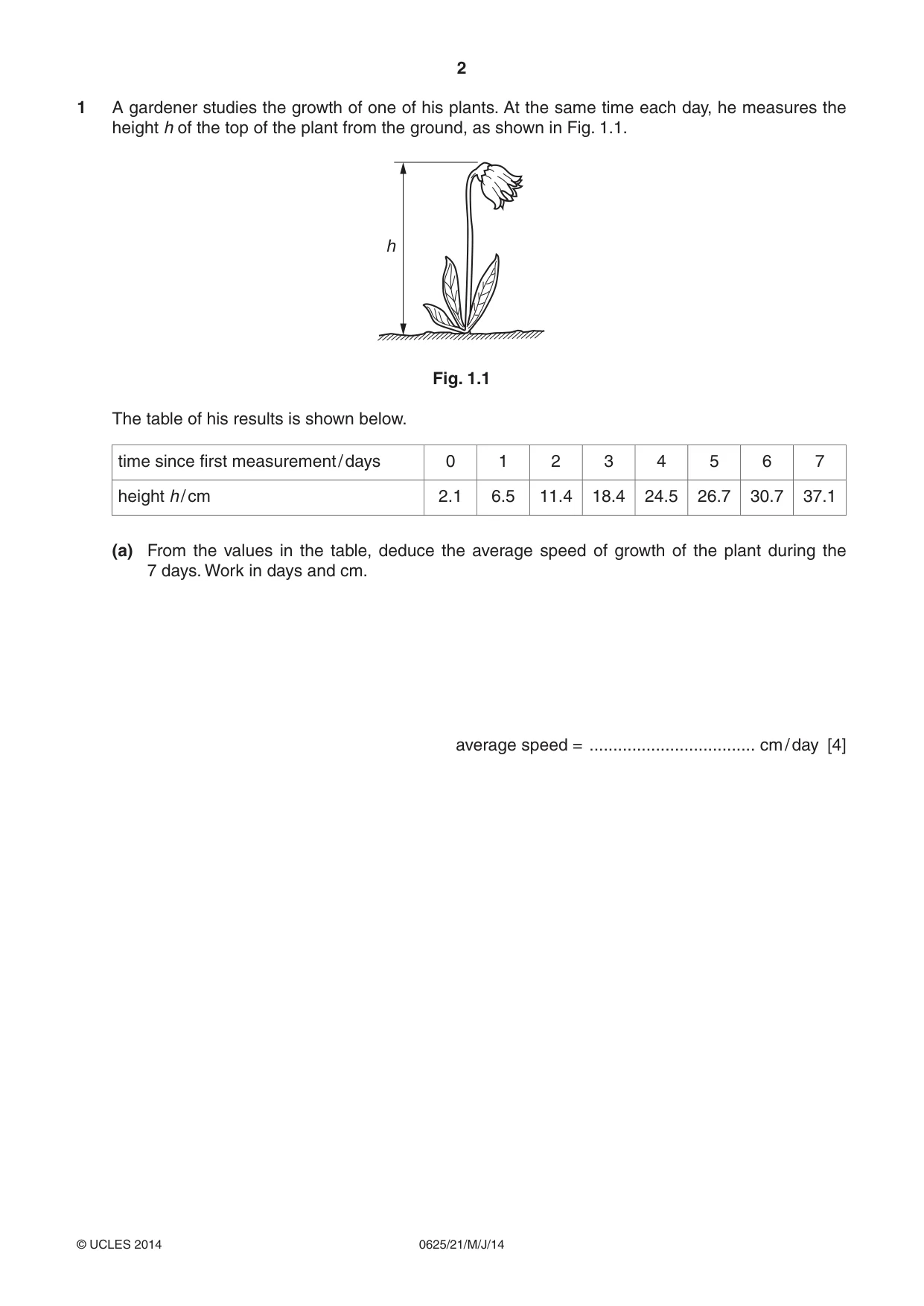
Question paper, page 2
2 0625/21/M/J/14 © UCLES 2014 1 A gardener studies the growth of one of his plants. At the same time each day, he measures the height h of the top of the plant from the ground, as shown in Fig. 1.1. h Fig. 1.1 The table of his results is shown below. time since first measurement / days 0 1 2 3 4 5 6 7 height h / cm 2.1 6.5 11.4 18.4 24.5 26.7 30.7 37.1 (a) From the values in the table, deduce the average speed of growth of the plant during the 7 days. Work in days and cm. average speed = … cm / day [4]
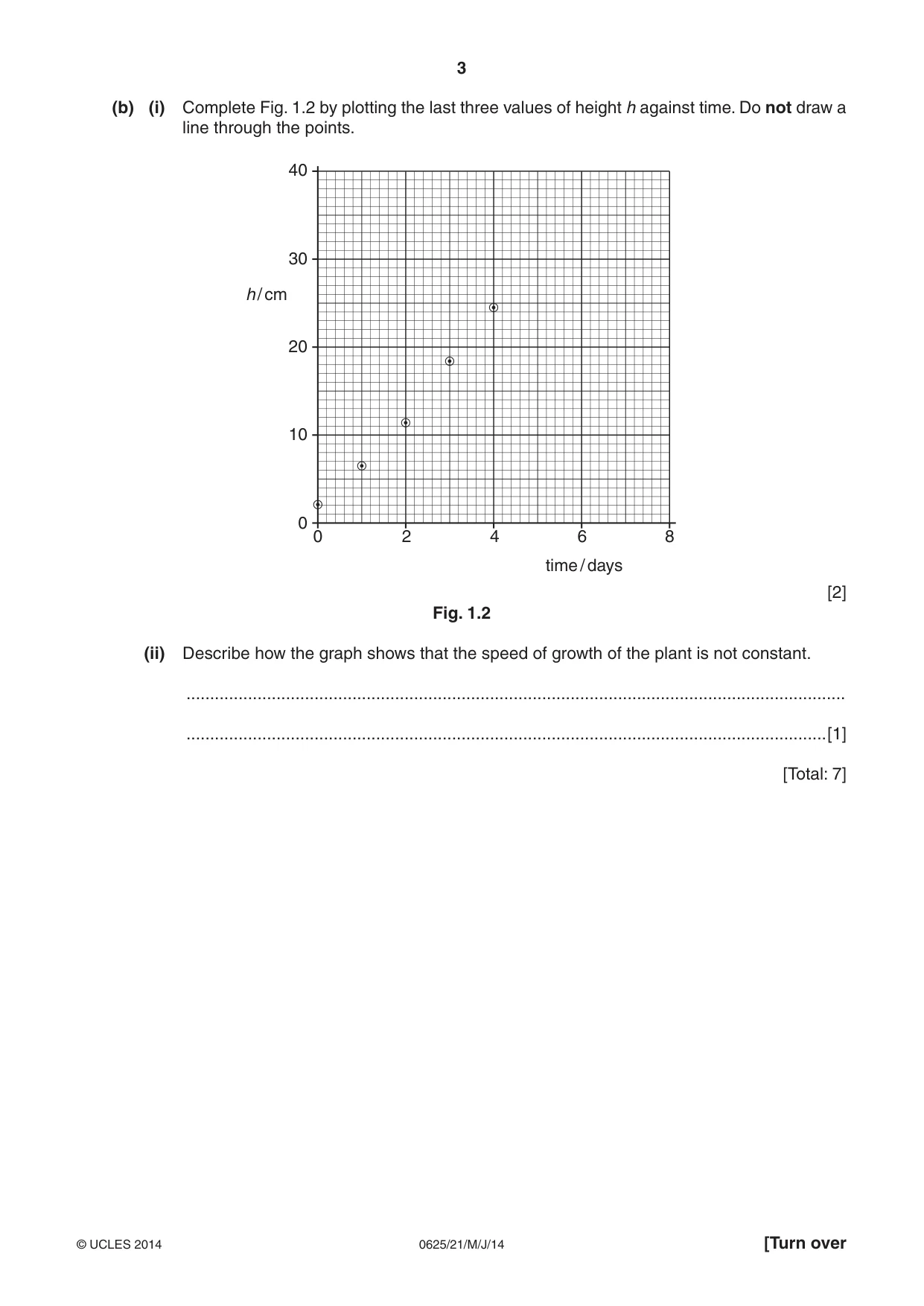
Question paper, page 3
3 0625/21/M/J/14 © UCLES 2014 [Turn over (b) (i) Complete Fig. 1.2 by plotting the last three values of height h against time. Do not draw a line through the points. h / cm 0 2 4 6 8 0 10 20 30 40 time / days [2] Fig. 1.2 (ii) Describe how the graph shows that the speed of growth of the plant is not constant. … …[1] [Total: 7]
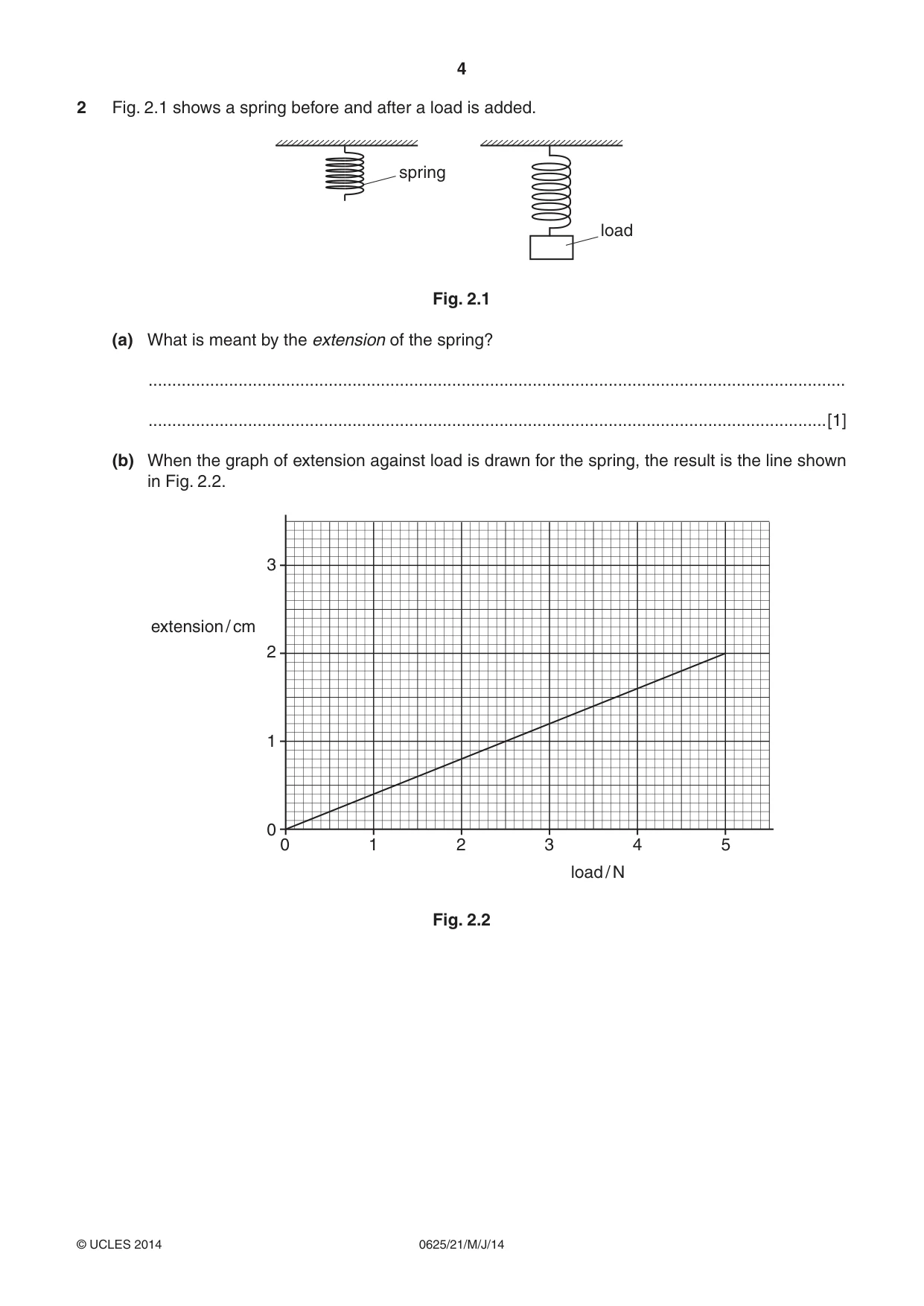
Question paper, page 4
4 0625/21/M/J/14 © UCLES 2014 2 Fig. 2.1 shows a spring before and after a load is added. load spring Fig. 2.1 (a) What is meant by the extension of the spring? … …[1] (b) When the graph of extension against load is drawn for the spring, the result is the line shown in Fig. 2.2. extension / cm load / N 0 0 1 2 3 1 2 3 4 5 Fig. 2.2
Question paper, page 5
5 0625/21/M/J/14 © UCLES 2014 [Turn over (i) The unstretched length of the spring is 9.0 cm. 1. Calculate the total length of the spring when a 5.0 N load is hanging from the spring. length = … cm [2] 2. Find the extension that will be caused by a load of 2.0 N. extension = … cm [1] (ii) Calculate the mass of a load of weight 2.0 N. mass = …[2] [Total: 6]
Question paper, page 6
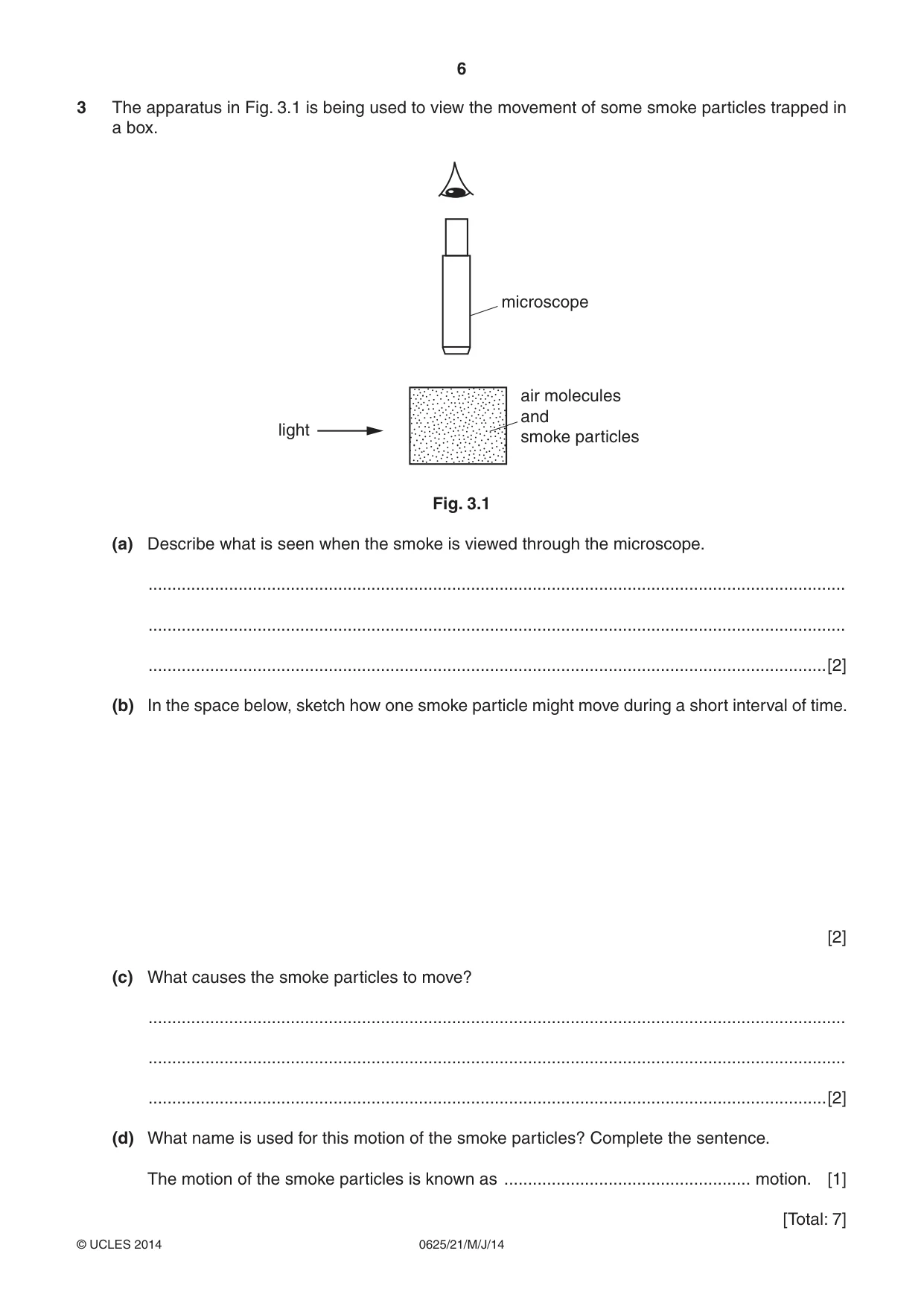
6 0625/21/M/J/14 © UCLES 2014 3 The apparatus in Fig. 3.1 is being used to view the movement of some smoke particles trapped in a box. air molecules and smoke particles microscope light Fig. 3.1 (a) Describe what is seen when the smoke is viewed through the microscope. … … …[2] (b) In the space below, sketch how one smoke particle might move during a short interval of time. [2] (c) What causes the smoke particles to move? … … …[2] (d) What name is used for this motion of the smoke particles? Complete the sentence. The motion of the smoke particles is known as … motion. [1] [Total: 7]
Question paper, page 7
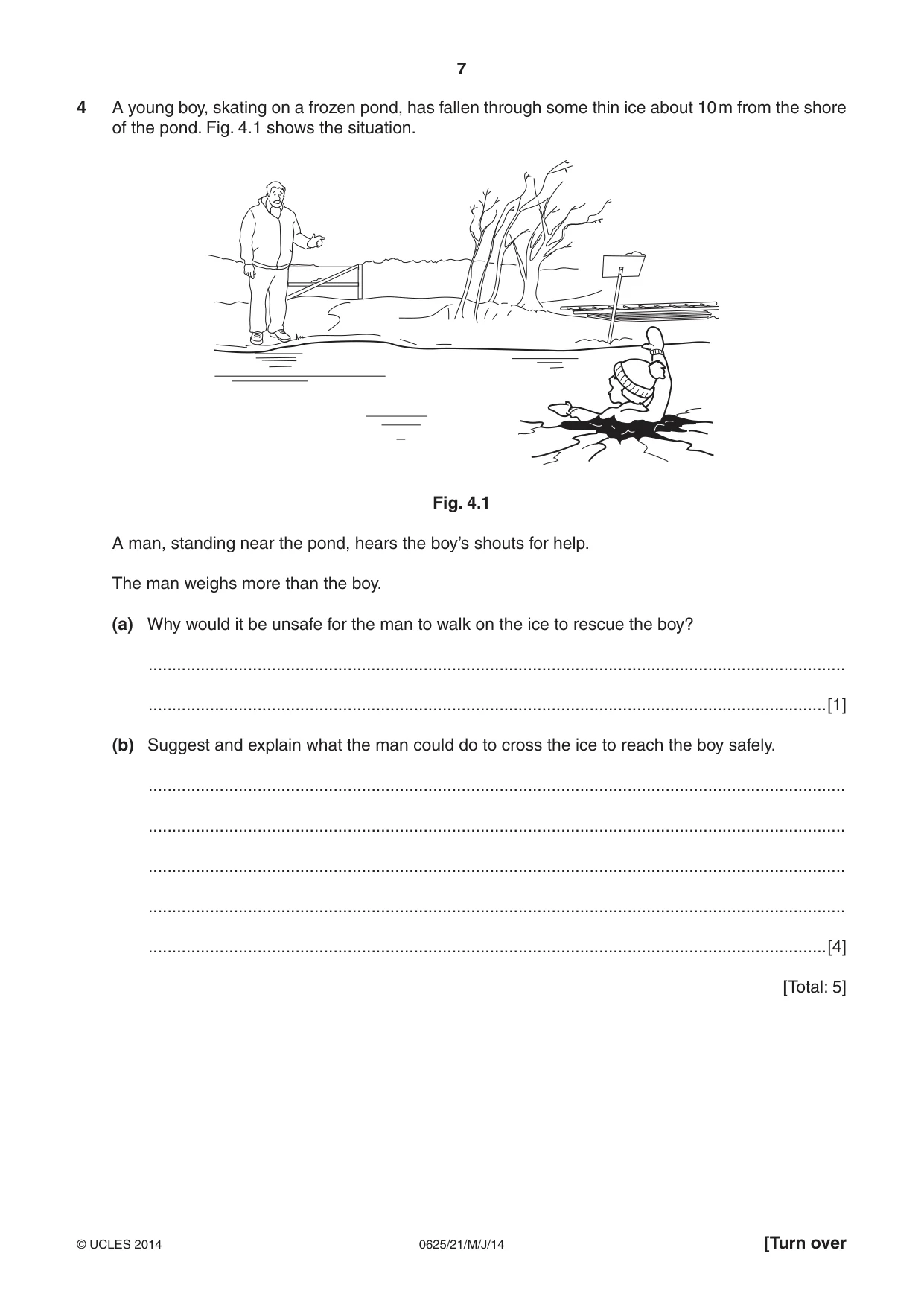
7 0625/21/M/J/14 © UCLES 2014 [Turn over 4 A young boy, skating on a frozen pond, has fallen through some thin ice about 10 m from the shore of the pond. Fig. 4.1 shows the situation. Fig. 4.1 A man, standing near the pond, hears the boy’s shouts for help. The man weighs more than the boy. (a) Why would it be unsafe for the man to walk on the ice to rescue the boy? … …[1] (b) Suggest and explain what the man could do to cross the ice to reach the boy safely. … … … … …[4] [Total: 5]
Question paper, page 8
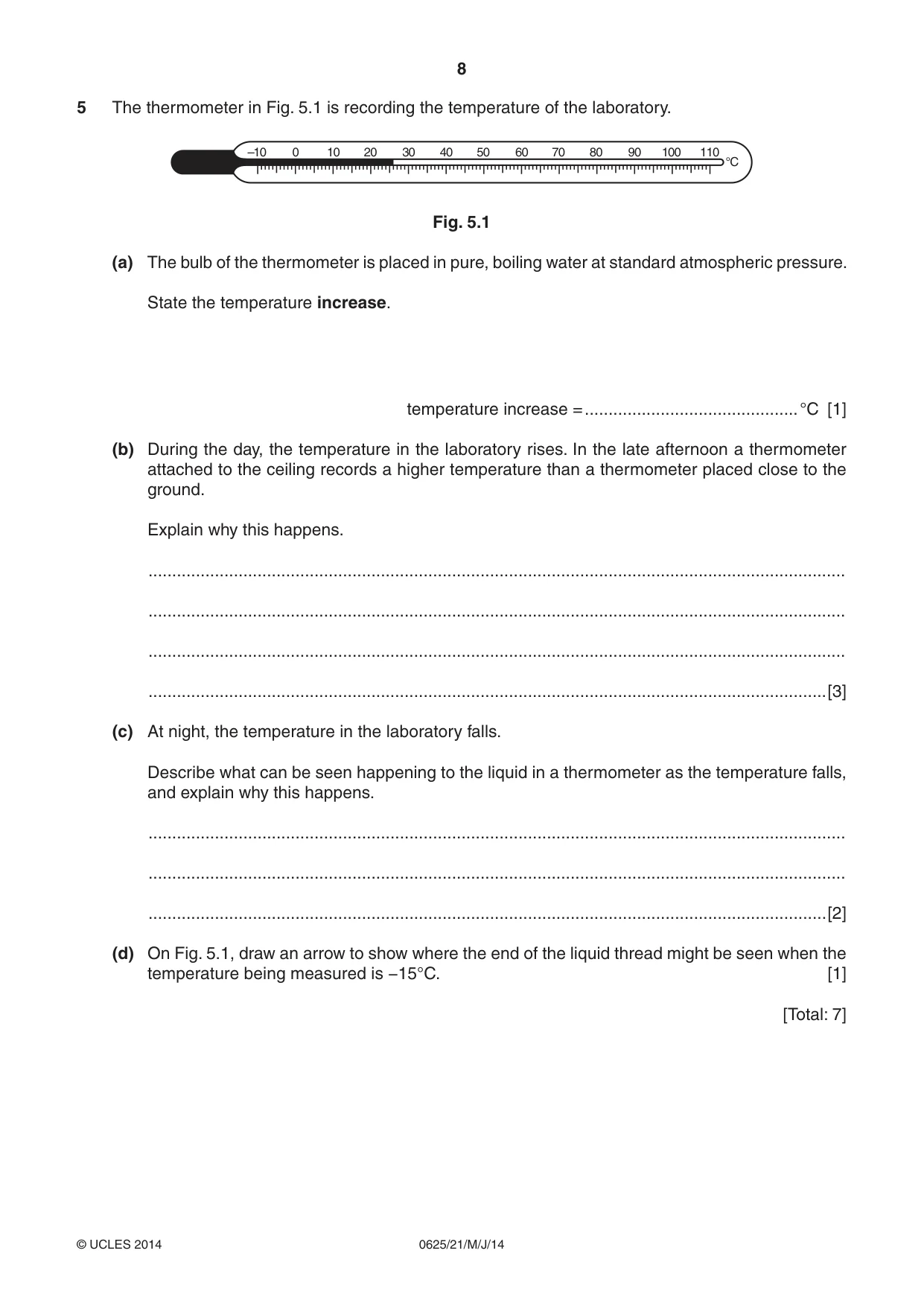
8 0625/21/M/J/14 © UCLES 2014 5 The thermometer in Fig. 5.1 is recording the temperature of the laboratory. –10 0 10 20 30 40 50 60 70 80 90 100 110 °C Fig. 5.1 (a) The bulb of the thermometer is placed in pure, boiling water at standard atmospheric pressure. State the temperature increase. temperature increase = …°C [1] (b) During the day, the temperature in the laboratory rises. In the late afternoon a thermometer attached to the ceiling records a higher temperature than a thermometer placed close to the ground. Explain why this happens. … … … …[3] (c) At night, the temperature in the laboratory falls. Describe what can be seen happening to the liquid in a thermometer as the temperature falls, and explain why this happens. … … …[2] (d) On Fig. 5.1, draw an arrow to show where the end of the liquid thread might be seen when the temperature being measured is −15°C. [1] [Total: 7]
Question paper, page 9
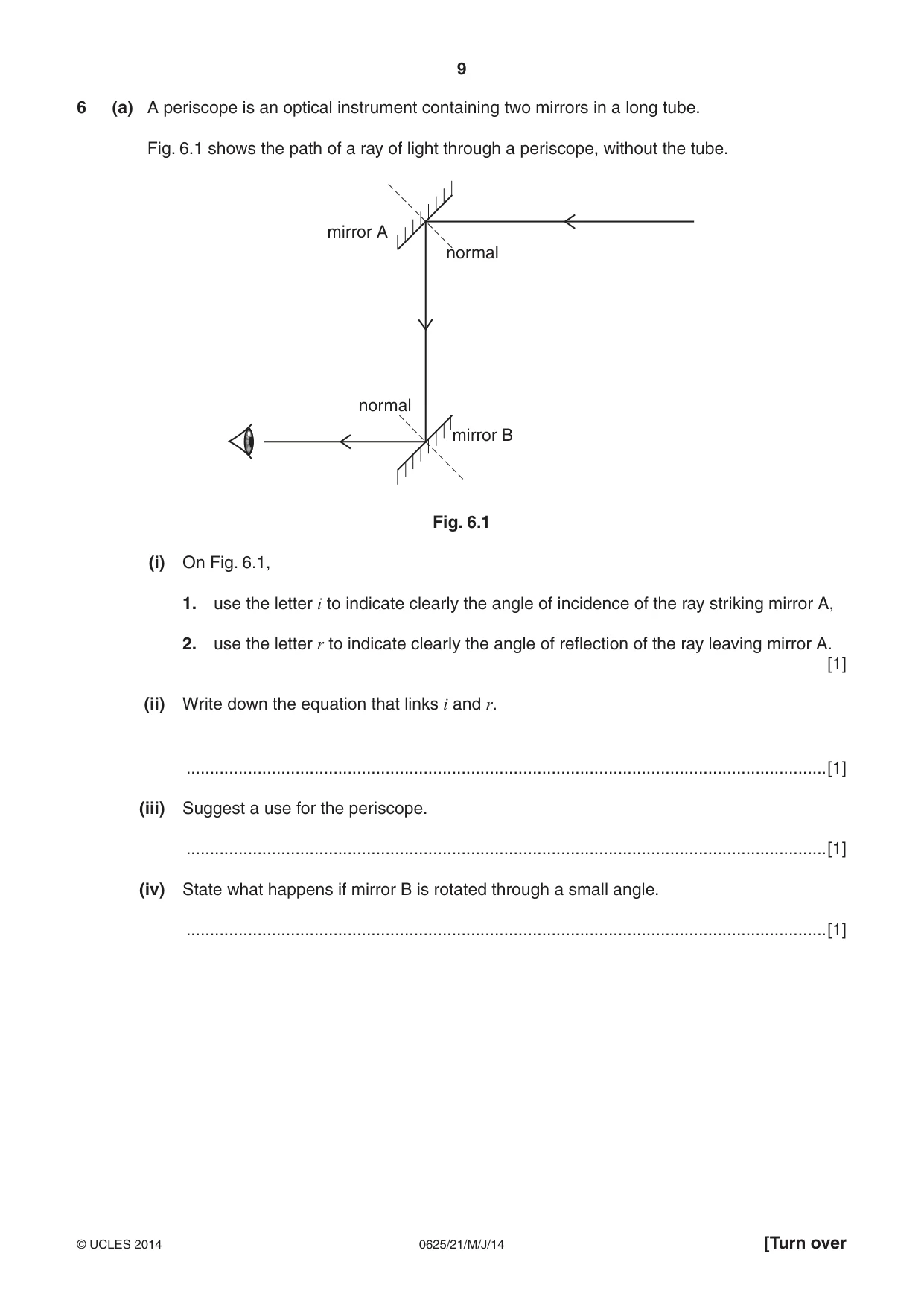
9 0625/21/M/J/14 © UCLES 2014 [Turn over 6 (a) A periscope is an optical instrument containing two mirrors in a long tube. Fig. 6.1 shows the path of a ray of light through a periscope, without the tube. mirror A mirror B normal normal Fig. 6.1 (i) On Fig. 6.1, 1. use the letter i to indicate clearly the angle of incidence of the ray striking mirror A, 2. use the letter r to indicate clearly the angle of reflection of the ray leaving mirror A. [1] (ii) Write down the equation that links i and r. …[1] (iii) Suggest a use for the periscope. …[1] (iv) State what happens if mirror B is rotated through a small angle. …[1]
Question paper, page 10
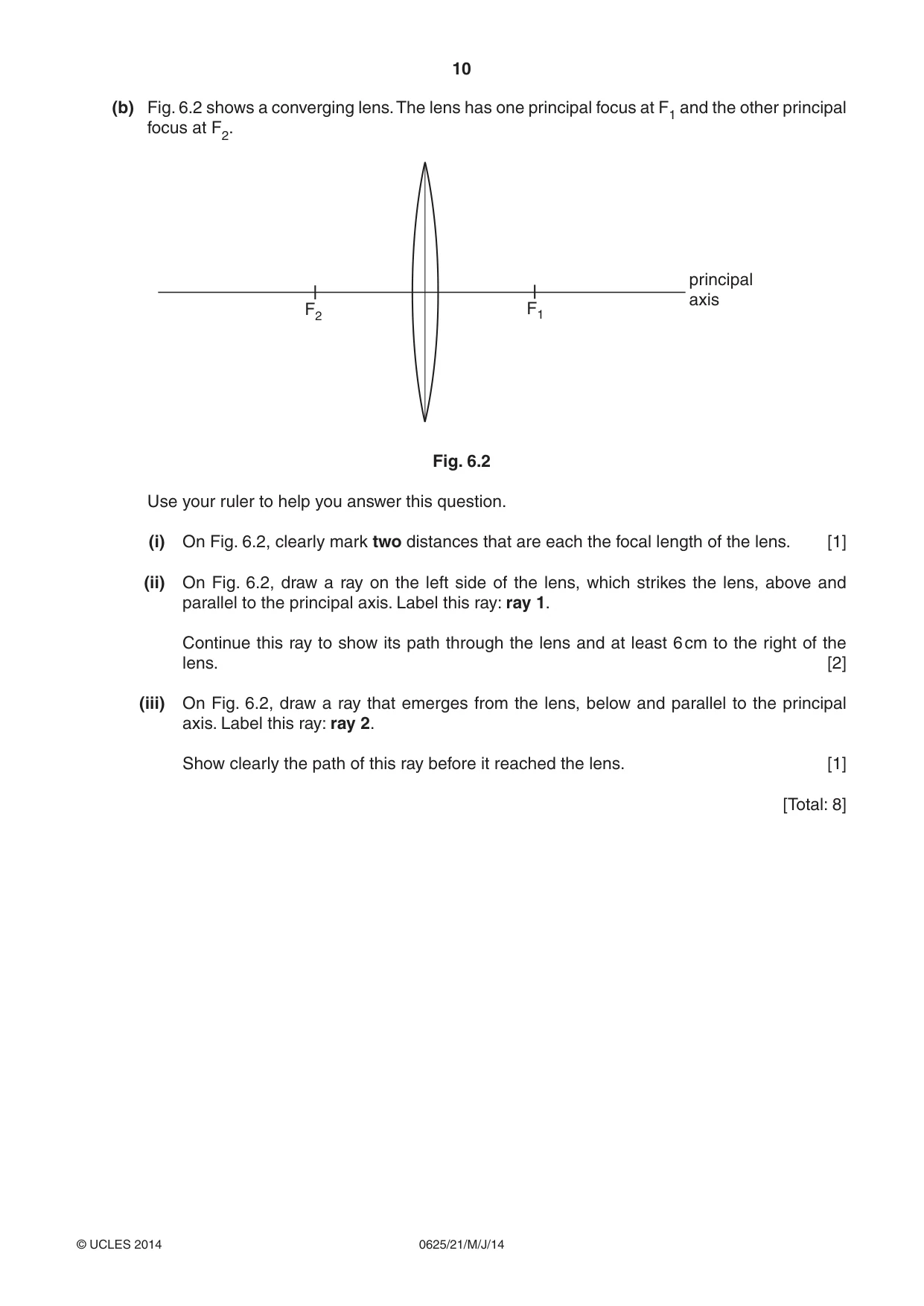
10 0625/21/M/J/14 © UCLES 2014 (b) Fig. 6.2 shows a converging lens. The lens has one principal focus at F1 and the other principal focus at F2. F2 F1 principal axis Fig. 6.2 Use your ruler to help you answer this question. (i) On Fig. 6.2, clearly mark two distances that are each the focal length of the lens. [1] (ii) On Fig. 6.2, draw a ray on the left side of the lens, which strikes the lens, above and parallel to the principal axis. Label this ray: ray 1. Continue this ray to show its path through the lens and at least 6 cm to the right of the lens. [2] (iii) On Fig. 6.2, draw a ray that emerges from the lens, below and parallel to the principal axis. Label this ray: ray 2. Show clearly the path of this ray before it reached the lens. [1] [Total: 8]
Question paper, page 11
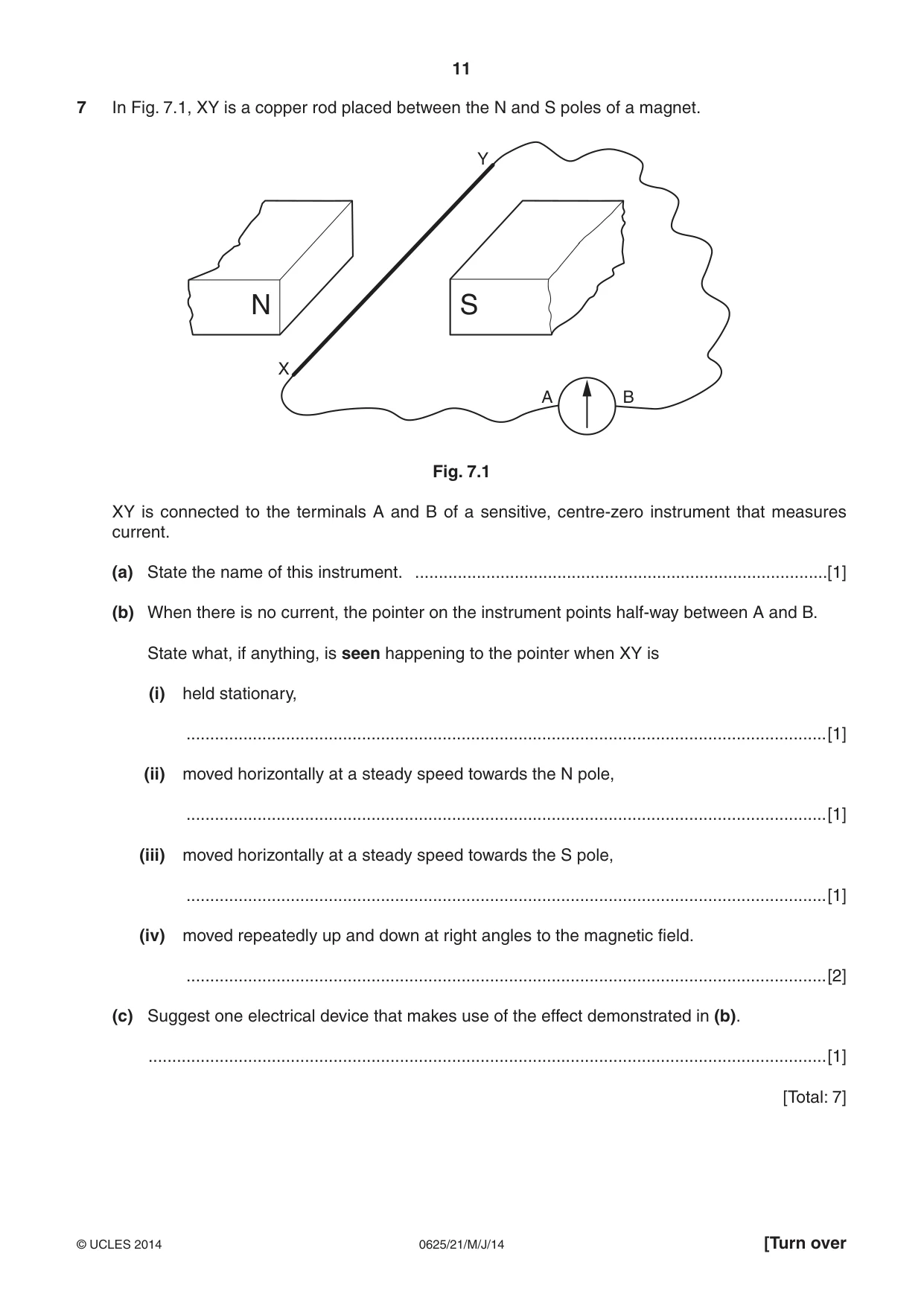
11 0625/21/M/J/14 © UCLES 2014 [Turn over 7 In Fig. 7.1, XY is a copper rod placed between the N and S poles of a magnet. N S X Y A B Fig. 7.1 XY is connected to the terminals A and B of a sensitive, centre-zero instrument that measures current. (a) State the name of this instrument. …[1] (b) When there is no current, the pointer on the instrument points half-way between A and B. State what, if anything, is seen happening to the pointer when XY is (i) held stationary, …[1] (ii) moved horizontally at a steady speed towards the N pole, …[1] (iii) moved horizontally at a steady speed towards the S pole, …[1] (iv) moved repeatedly up and down at right angles to the magnetic field. …[2] (c) Suggest one electrical device that makes use of the effect demonstrated in (b). …[1] [Total: 7]
Question paper, page 12
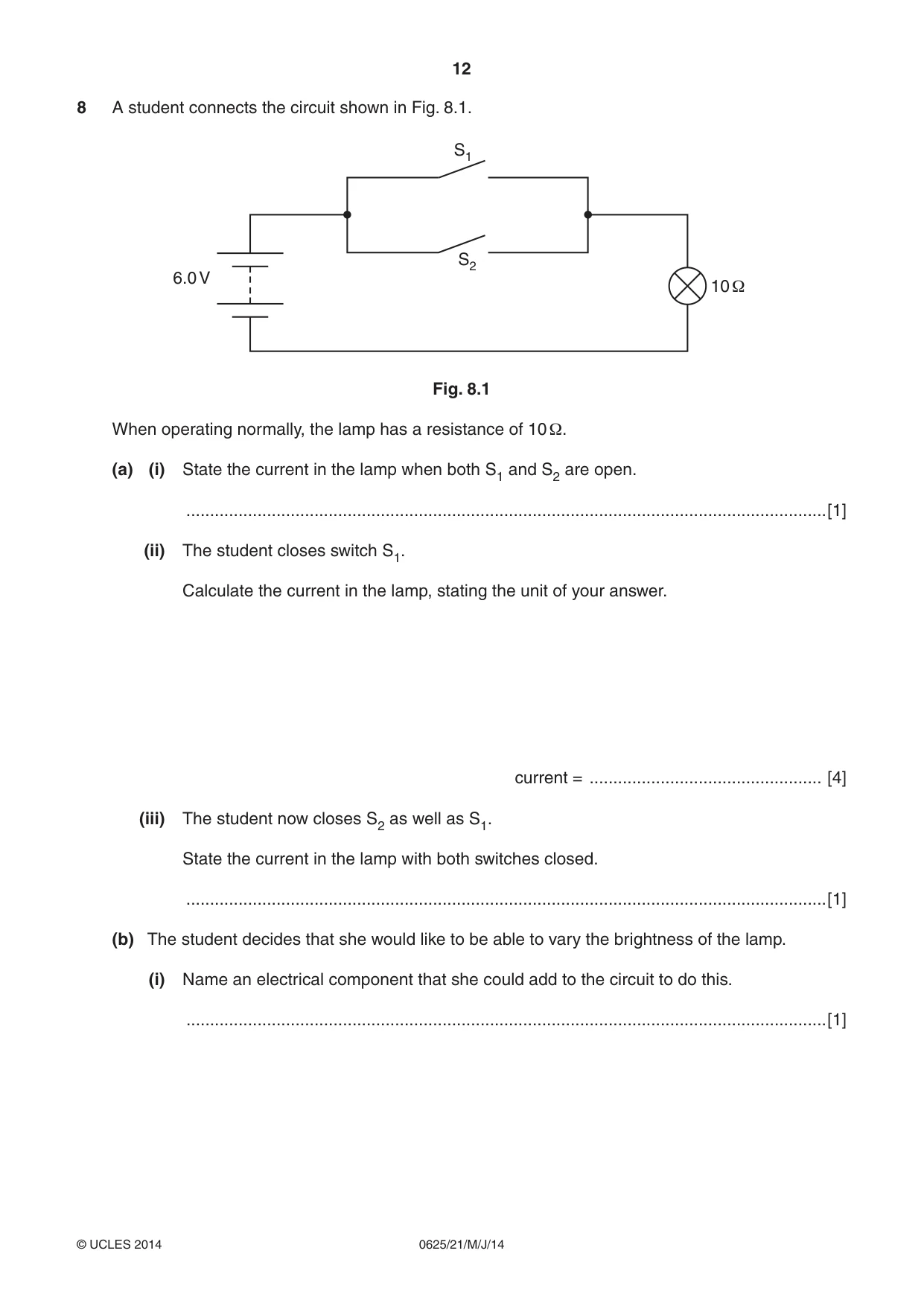
12 0625/21/M/J/14 © UCLES 2014 8 A student connects the circuit shown in Fig. 8.1. 6.0 V 10 Ω S2 S1 Fig. 8.1 When operating normally, the lamp has a resistance of 10 Ω. (a) (i) State the current in the lamp when both S1 and S2 are open. …[1] (ii) The student closes switch S1. Calculate the current in the lamp, stating the unit of your answer. current = … [4] (iii) The student now closes S2 as well as S1. State the current in the lamp with both switches closed. …[1] (b) The student decides that she would like to be able to vary the brightness of the lamp. (i) Name an electrical component that she could add to the circuit to do this. …[1]
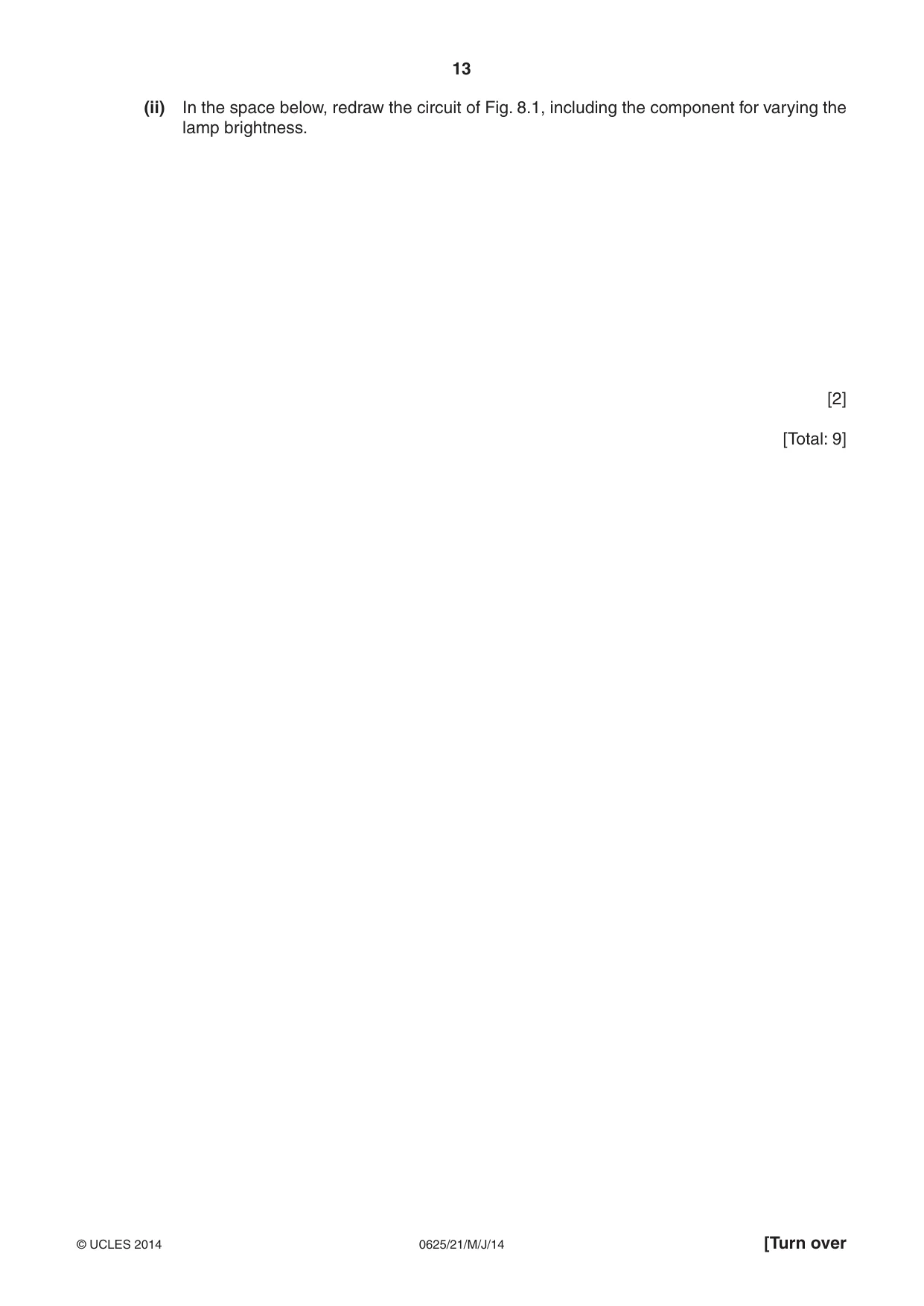
Question paper, page 13
13 0625/21/M/J/14 © UCLES 2014 [Turn over (ii) In the space below, redraw the circuit of Fig. 8.1, including the component for varying the lamp brightness. [2] [Total: 9]
Question paper, page 14
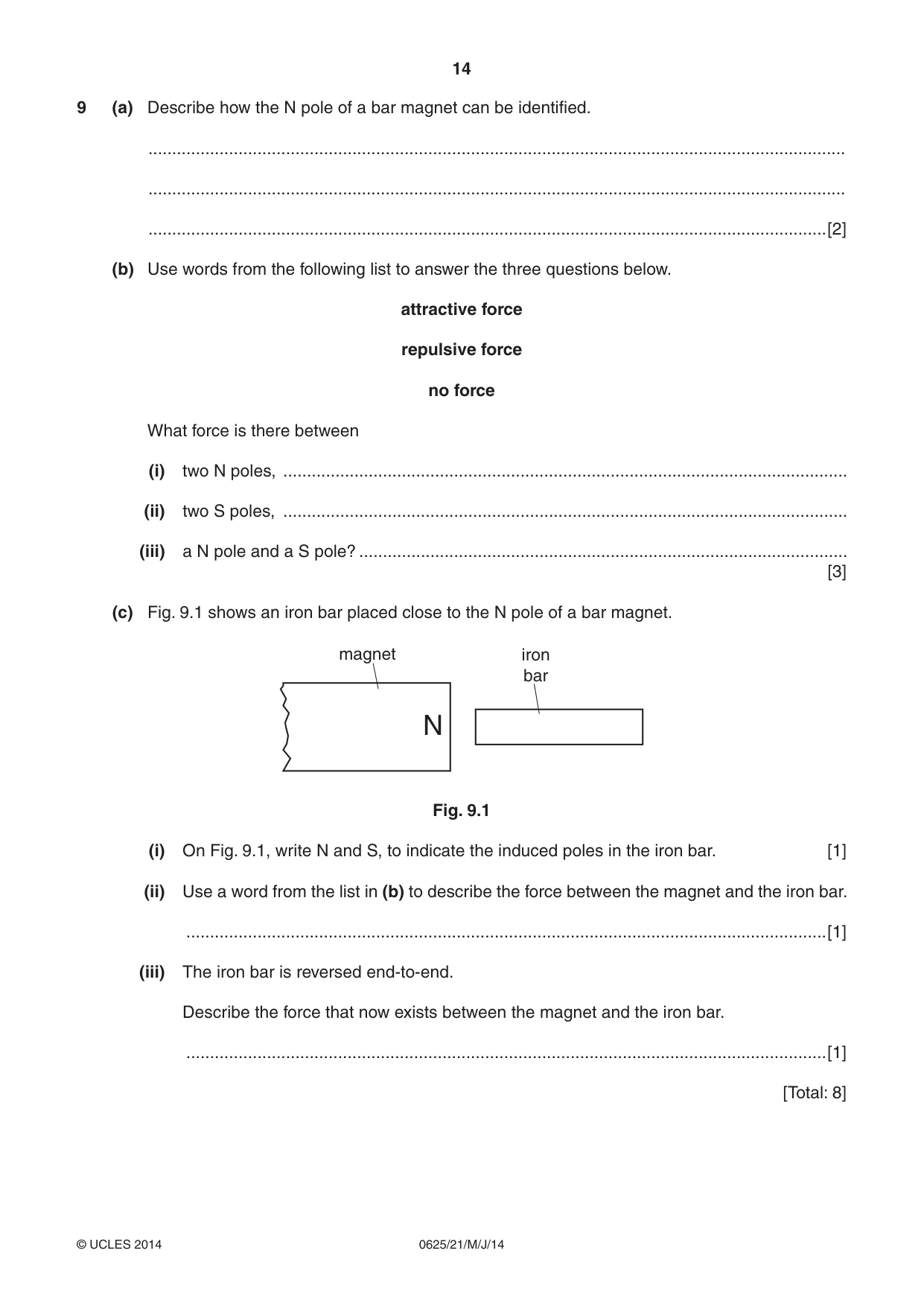
14 0625/21/M/J/14 © UCLES 2014 9 (a) Describe how the N pole of a bar magnet can be identified. … … …[2] (b) Use words from the following list to answer the three questions below. attractive force repulsive force no force What force is there between (i) two N poles, … (ii) two S poles, … (iii) a N pole and a S pole? … [3] (c) Fig. 9.1 shows an iron bar placed close to the N pole of a bar magnet. N magnet iron bar Fig. 9.1 (i) On Fig. 9.1, write N and S, to indicate the induced poles in the iron bar. [1] (ii) Use a word from the list in (b) to describe the force between the magnet and the iron bar. …[1] (iii) The iron bar is reversed end-to-end. Describe the force that now exists between the magnet and the iron bar. …[1] [Total: 8]
Question paper, page 15
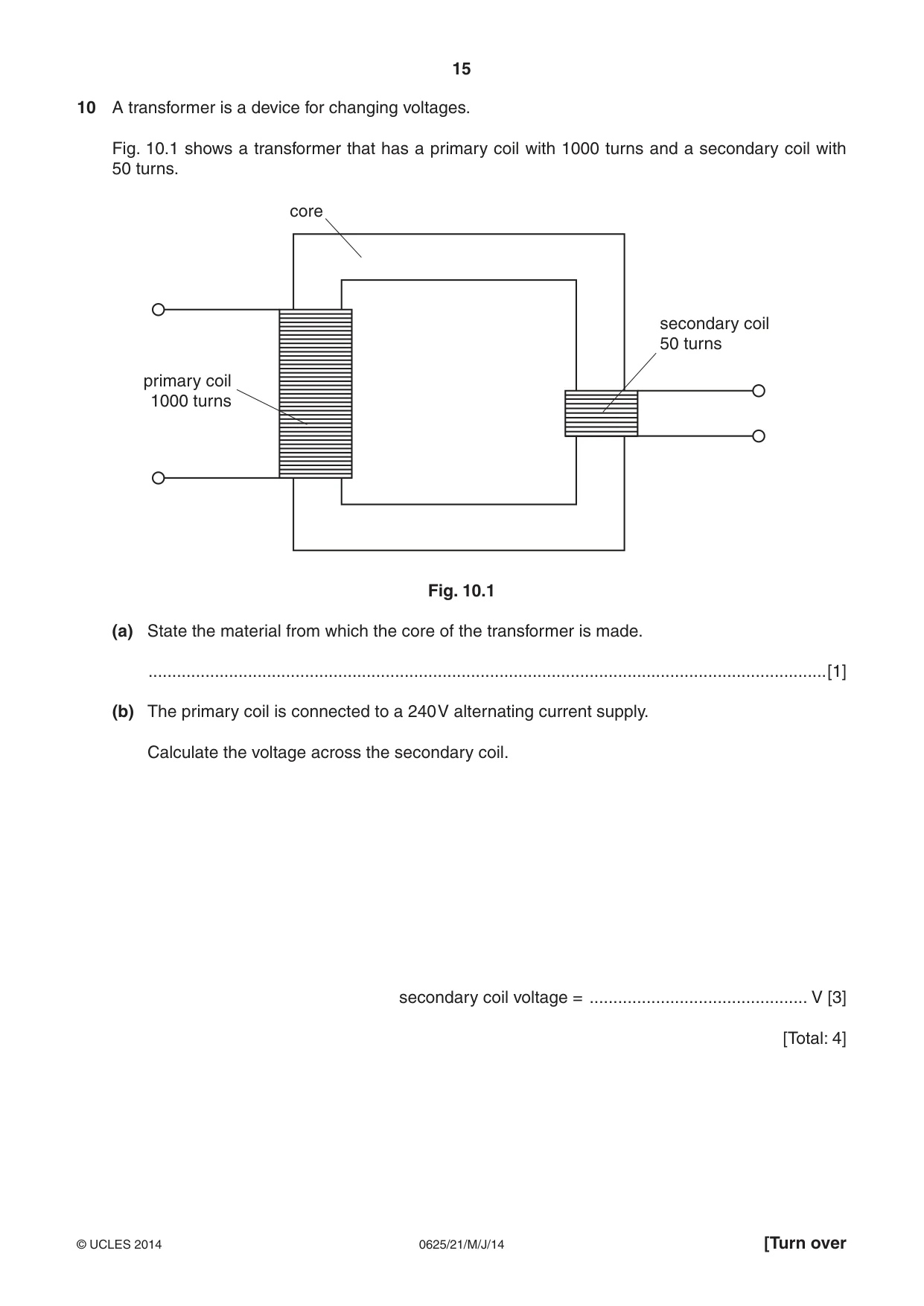
15 0625/21/M/J/14 © UCLES 2014 [Turn over 10 A transformer is a device for changing voltages. Fig. 10.1 shows a transformer that has a primary coil with 1000 turns and a secondary coil with 50 turns. primary coil 1000 turns secondary coil 50 turns core Fig. 10.1 (a) State the material from which the core of the transformer is made. …[1] (b) The primary coil is connected to a 240 V alternating current supply. Calculate the voltage across the secondary coil. secondary coil voltage = … V [3] [Total: 4]
Question paper, page 16
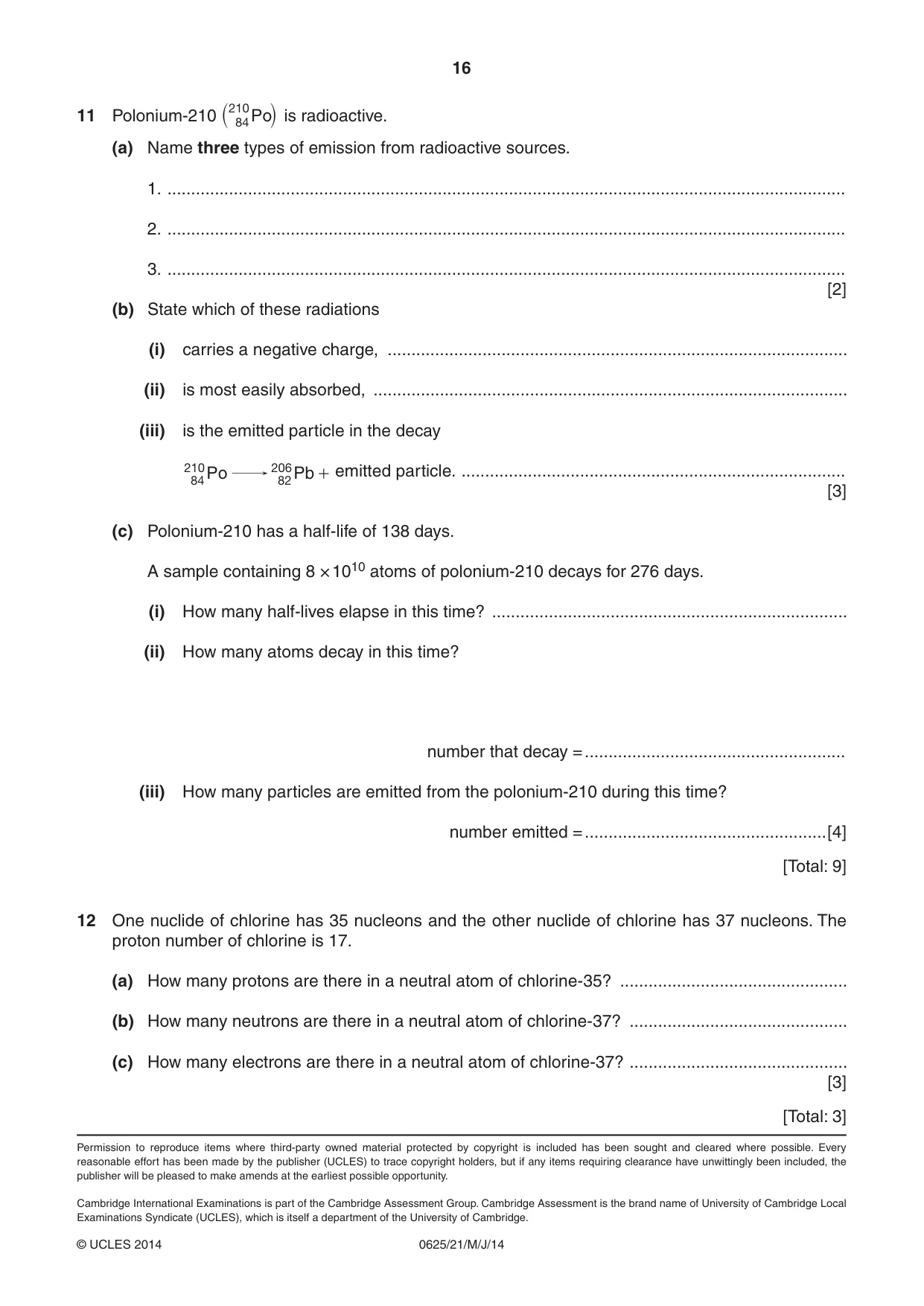
16 0625/21/M/J/14 © UCLES 2014 Permission to reproduce items where third-party owned material protected by copyright is included has been sought and cleared where possible. Every reasonable effort has been made by the publisher (UCLES) to trace copyright holders, but if any items requiring clearance have unwittingly been included, the publisher will be pleased to make amends at the earliest possible opportunity. Cambridge International Examinations is part of the Cambridge Assessment Group. Cambridge Assessment is the brand name of University of Cambridge Local Examinations Syndicate (UCLES), which is itself a department of the University of Cambridge. 11 Polonium-210 84 210Poj ` is radioactive. (a) Name three types of emission from radioactive sources. 1. … 2. … 3. … [2] (b) State which of these radiations (i) carries a negative charge, … (ii) is most easily absorbed, … (iii) is the emitted particle in the decay 84 210Po 82 206Pb + emitted particle. … [3] (c) Polonium-210 has a half-life of 138 days. A sample containing 8 × 10¹⁰ atoms of polonium-210 decays for 276 days. (i) How many half-lives elapse in this time? … (ii) How many atoms decay in this time? number that decay = … (iii) How many particles are emitted from the polonium-210 during this time? number emitted = …[4] [Total: 9] 12 One nuclide of chlorine has 35 nucleons and the other nuclide of chlorine has 37 nucleons. The proton number of chlorine is 17. (a) How many protons are there in a neutral atom of chlorine-35? … (b) How many neutrons are there in a neutral atom of chlorine-37? … (c) How many electrons are there in a neutral atom of chlorine-37? … [3] [Total: 3]
Mark scheme, page 1
© Cambridge International Examinations 2014 CAMBRIDGE INTERNATIONAL EXAMINATIONS International General Certificate of Secondary Education MARK SCHEME for the May/June 2014 series 0625 PHYSICS 0625/21 Paper 2 (Core Theory), maximum raw mark 80 This mark scheme is published as an aid to teachers and candidates, to indicate the requirements of the examination. It shows the basis on which Examiners were instructed to award marks. It does not indicate the details of the discussions that took place at an Examiners’ meeting before marking began, which would have considered the acceptability of alternative answers. Mark schemes should be read in conjunction with the question paper and the Principal Examiner Report for Teachers. Cambridge will not enter into discussions about these mark schemes. Cambridge is publishing the mark schemes for the May/June 2014 series for most IGCSE, GCE Advanced Level and Advanced Subsidiary Level components and some Ordinary Level components.
Mark scheme, page 2
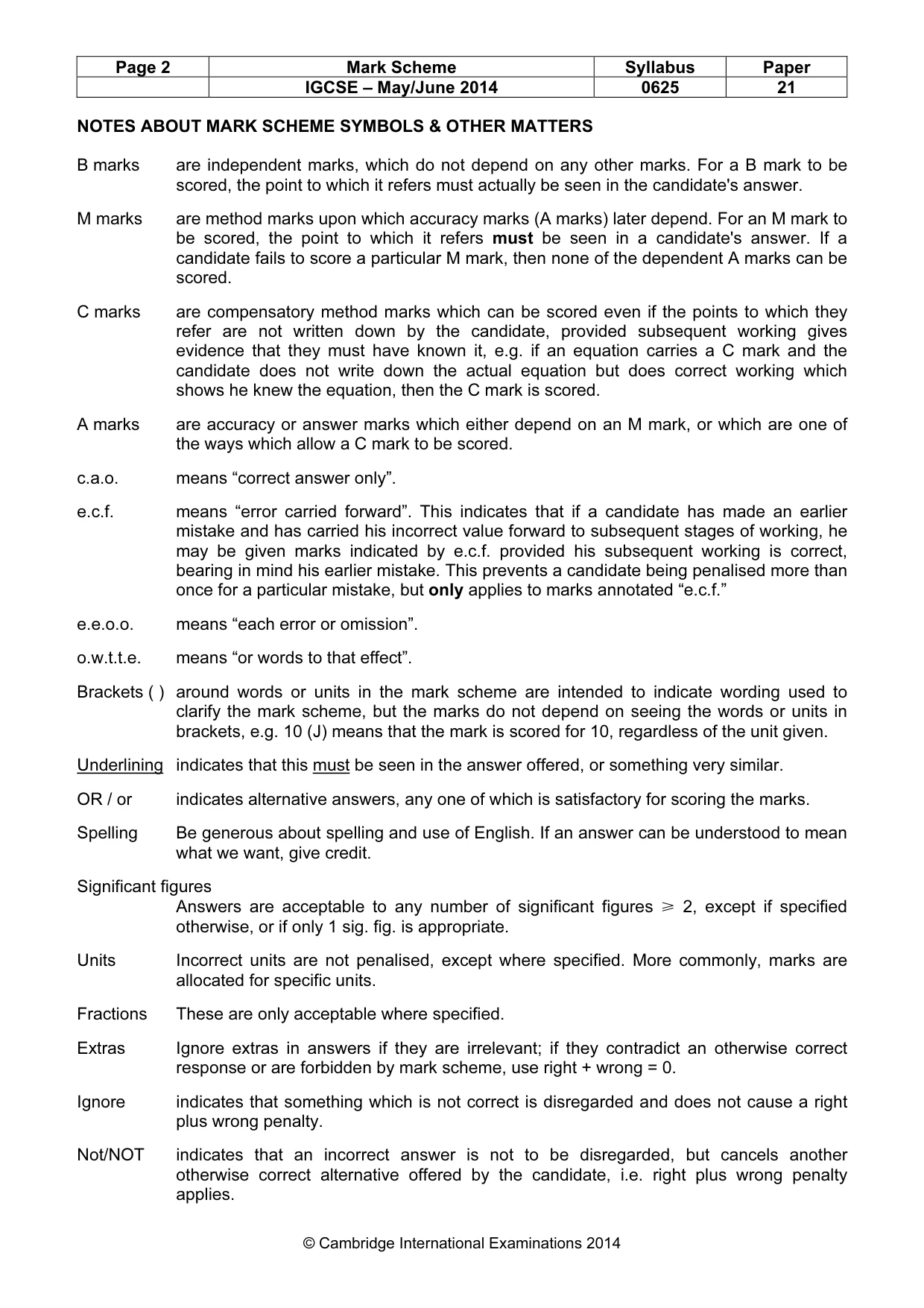
Page 2 Mark Scheme Syllabus Paper IGCSE – May/June 2014 0625 21 © Cambridge International Examinations 2014 NOTES ABOUT MARK SCHEME SYMBOLS & OTHER MATTERS B marks are independent marks, which do not depend on any other marks. For a B mark to be scored, the point to which it refers must actually be seen in the candidate's answer. M marks are method marks upon which accuracy marks (A marks) later depend. For an M mark to be scored, the point to which it refers must be seen in a candidate's answer. If a candidate fails to score a particular M mark, then none of the dependent A marks can be scored. C marks are compensatory method marks which can be scored even if the points to which they refer are not written down by the candidate, provided subsequent working gives evidence that they must have known it, e.g. if an equation carries a C mark and the candidate does not write down the actual equation but does correct working which shows he knew the equation, then the C mark is scored. A marks are accuracy or answer marks which either depend on an M mark, or which are one of the ways which allow a C mark to be scored. c.a.o. means “correct answer only”. e.c.f. means “error carried forward”. This indicates that if a candidate has made an earlier mistake and has carried his incorrect value forward to subsequent stages of working, he may be given marks indicated by e.c.f. provided his subsequent working is correct, bearing in mind his earlier mistake. This prevents a candidate being penalised more than once for a particular mistake, but only applies to marks annotated “e.c.f.” e.e.o.o. means “each error or omission”. o.w.t.t.e. means “or words to that effect”. Brackets ( ) around words or units in the mark scheme are intended to indicate wording used to clarify the mark scheme, but the marks do not depend on seeing the words or units in brackets, e.g. 10 (J) means that the mark is scored for 10, regardless of the unit given. Underlining indicates that this must be seen in the answer offered, or something very similar. OR / or indicates alternative answers, any one of which is satisfactory for scoring the marks. Spelling Be generous about spelling and use of English. If an answer can be understood to mean what we want, give credit. Significant figures Answers are acceptable to any number of significant figures [ 2, except if specified otherwise, or if only 1 sig. fig. is appropriate. Units Incorrect units are not penalised, except where specified. More commonly, marks are allocated for specific units. Fractions These are only acceptable where specified. Extras Ignore extras in answers if they are irrelevant; if they contradict an otherwise correct response or are forbidden by mark scheme, use right + wrong = 0. Ignore indicates that something which is not correct is disregarded and does not cause a right plus wrong penalty. Not/NOT indicates that an incorrect answer is not to be disregarded, but cancels another otherwise correct alternative offered by the candidate, i.e. right plus wrong penalty applies.
Mark scheme, page 3
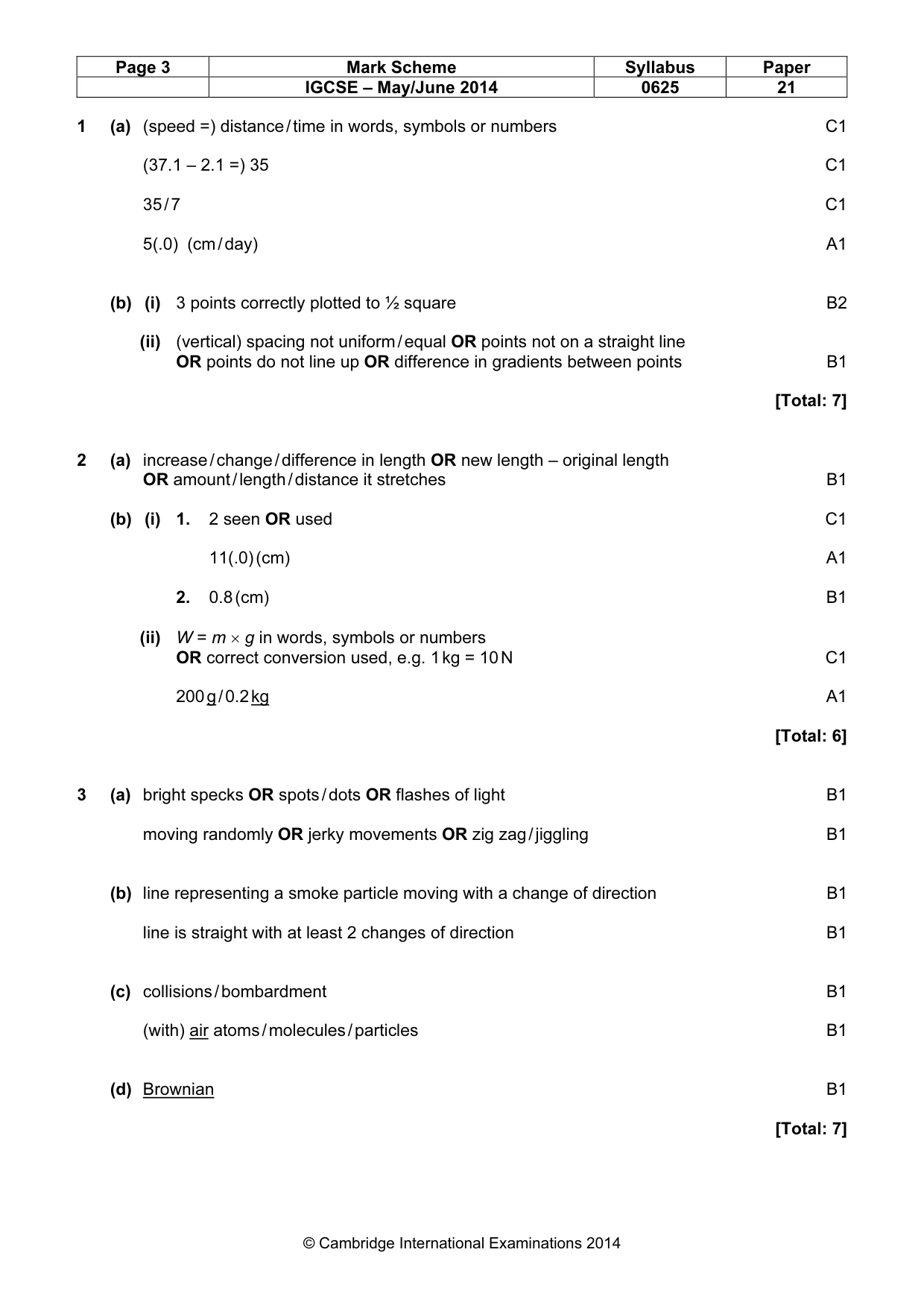
Page 3 Mark Scheme Syllabus Paper IGCSE – May/June 2014 0625 21 © Cambridge International Examinations 2014 1 (a) (speed =) distance / time in words, symbols or numbers C1 (37.1 – 2.1 =) 35 C1 35 / 7 C1 5(.0) (cm / day) A1 (b) (i) 3 points correctly plotted to ½ square B2 (ii) (vertical) spacing not uniform / equal OR points not on a straight line OR points do not line up OR difference in gradients between points B1 [Total: 7] 2 (a) increase / change / difference in length OR new length – original length OR amount / length / distance it stretches B1 (b) (i) 1. 2 seen OR used C1 11(.0) (cm) A1 2. 0.8 (cm) B1 (ii) W = m × g in words, symbols or numbers OR correct conversion used, e.g. 1 kg = 10 N C1 200 g / 0.2 kg A1 [Total: 6] 3 (a) bright specks OR spots / dots OR flashes of light B1 moving randomly OR jerky movements OR zig zag / jiggling B1 (b) line representing a smoke particle moving with a change of direction B1 line is straight with at least 2 changes of direction B1 (c) collisions / bombardment B1 (with) air atoms / molecules / particles B1 (d) Brownian B1 [Total: 7]
Mark scheme, page 4
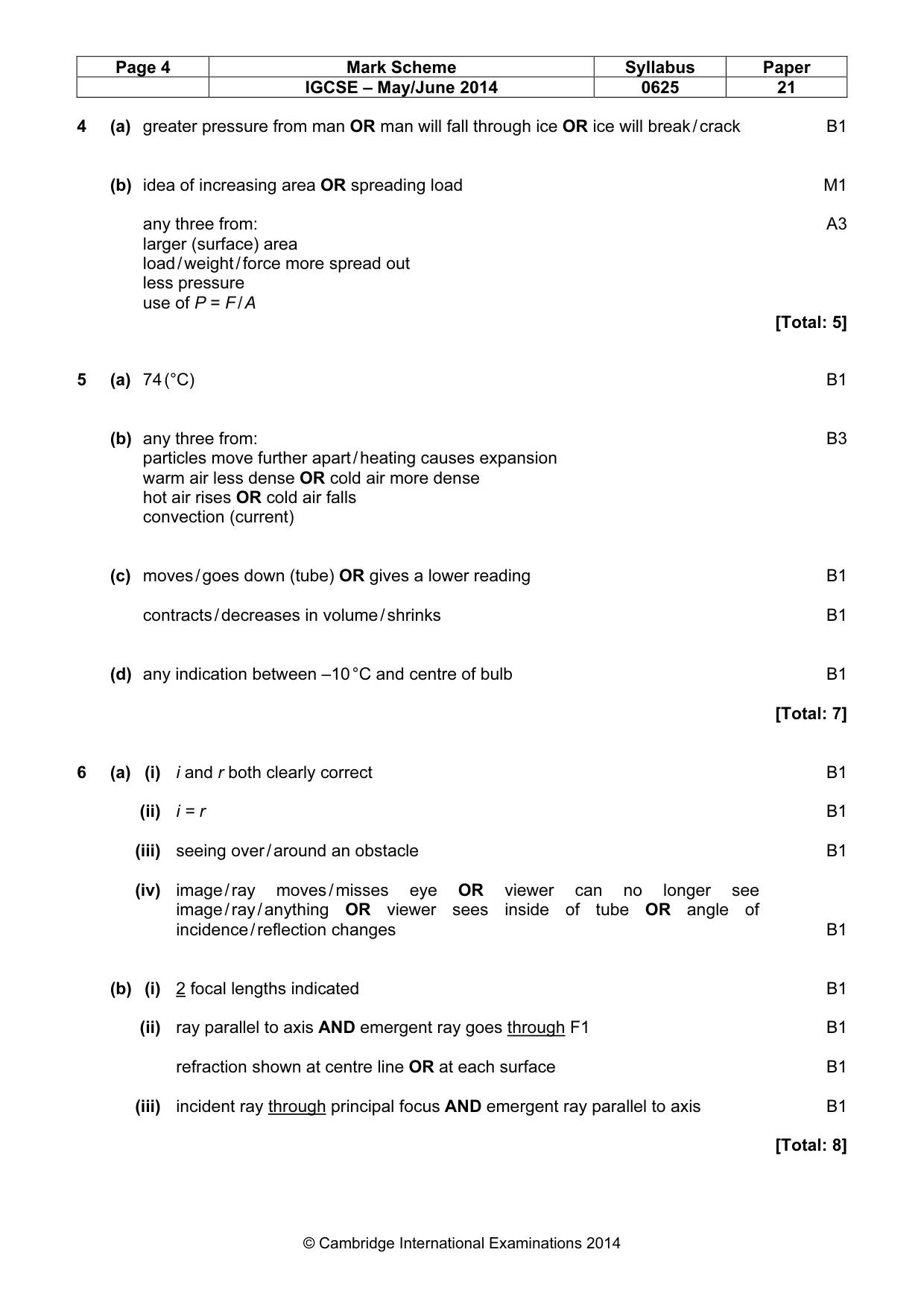
Page 4 Mark Scheme Syllabus Paper IGCSE – May/June 2014 0625 21 © Cambridge International Examinations 2014 4 (a) greater pressure from man OR man will fall through ice OR ice will break / crack B1 (b) idea of increasing area OR spreading load M1 any three from: A3 larger (surface) area load / weight / force more spread out less pressure use of P = F / A [Total: 5] 5 (a) 74 (°C) B1 (b) any three from: B3 particles move further apart / heating causes expansion warm air less dense OR cold air more dense hot air rises OR cold air falls convection (current) (c) moves / goes down (tube) OR gives a lower reading B1 contracts / decreases in volume / shrinks B1 (d) any indication between –10 °C and centre of bulb B1 [Total: 7] 6 (a) (i) i and r both clearly correct B1 (ii) i = r B1 (iii) seeing over / around an obstacle B1 (iv) image / ray moves / misses eye OR viewer can no longer see image / ray / anything OR viewer sees inside of tube OR angle of incidence / reflection changes B1 (b) (i) 2 focal lengths indicated B1 (ii) ray parallel to axis AND emergent ray goes through F1 B1 refraction shown at centre line OR at each surface B1 (iii) incident ray through principal focus AND emergent ray parallel to axis B1 [Total: 8]
Mark scheme, page 5
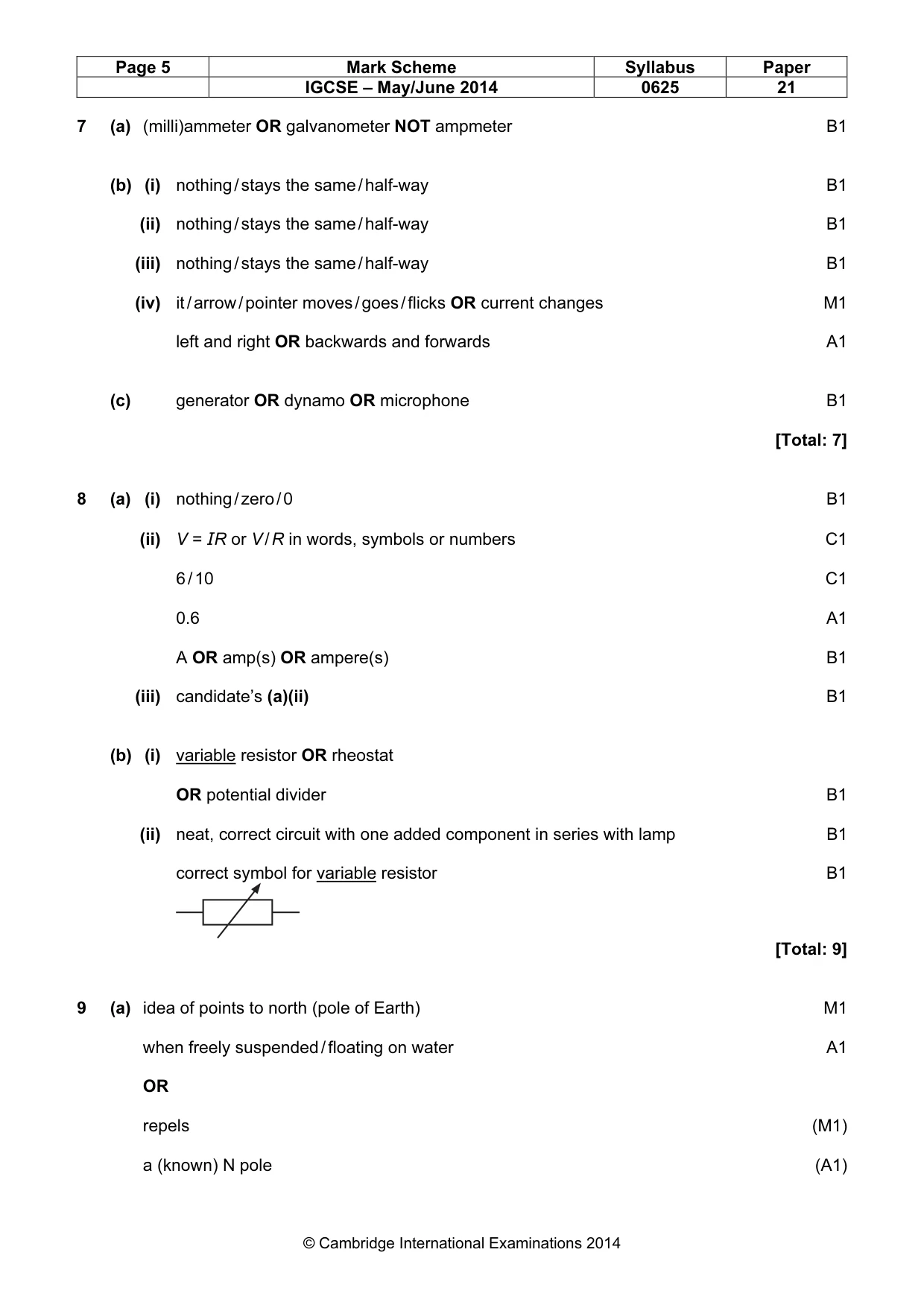
Page 5 Mark Scheme Syllabus Paper IGCSE – May/June 2014 0625 21 © Cambridge International Examinations 2014 7 (a) (milli)ammeter OR galvanometer NOT ampmeter B1 (b) (i) nothing / stays the same / half-way B1 (ii) nothing / stays the same / half-way B1 (iii) nothing / stays the same / half-way B1 (iv) it / arrow / pointer moves / goes / flicks OR current changes M1 left and right OR backwards and forwards A1 (c) generator OR dynamo OR microphone B1 [Total: 7] 8 (a) (i) nothing / zero / 0 B1 (ii) V = IR or V / R in words, symbols or numbers C1 6 / 10 C1 0.6 A1 A OR amp(s) OR ampere(s) B1 (iii) candidate’s (a)(ii) B1 (b) (i) variable resistor OR rheostat OR potential divider B1 (ii) neat, correct circuit with one added component in series with lamp B1 correct symbol for variable resistor B1 [Total: 9] 9 (a) idea of points to north (pole of Earth) M1 when freely suspended / floating on water A1 OR repels (M1) a (known) N pole (A1)
Mark scheme, page 6
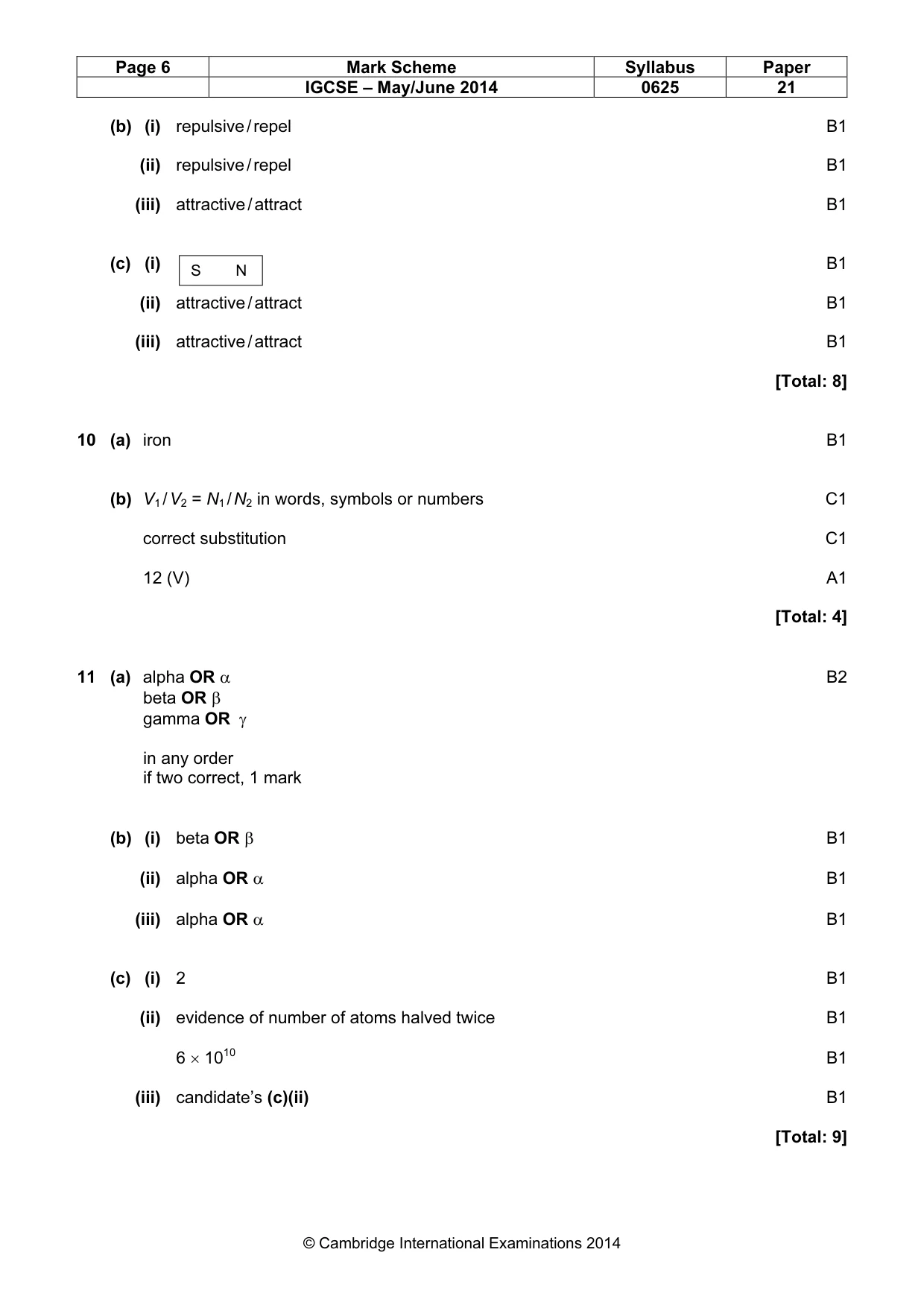
Page 6 Mark Scheme Syllabus Paper IGCSE – May/June 2014 0625 21 © Cambridge International Examinations 2014 (b) (i) repulsive / repel B1 (ii) repulsive / repel B1 (iii) attractive / attract B1 (c) (i) B1 (ii) attractive / attract B1 (iii) attractive / attract B1 [Total: 8] 10 (a) iron B1 (b) V1 / V2 = N1 / N2 in words, symbols or numbers C1 correct substitution C1 12 (V) A1 [Total: 4] 11 (a) alpha OR α B2 beta OR β gamma OR γ in any order if two correct, 1 mark (b) (i) beta OR β B1 (ii) alpha OR α B1 (iii) alpha OR α B1 (c) (i) 2 B1 (ii) evidence of number of atoms halved twice B1 6 × 10¹⁰ B1 (iii) candidate’s (c)(ii) B1 [Total: 9] S N
Mark scheme, page 7
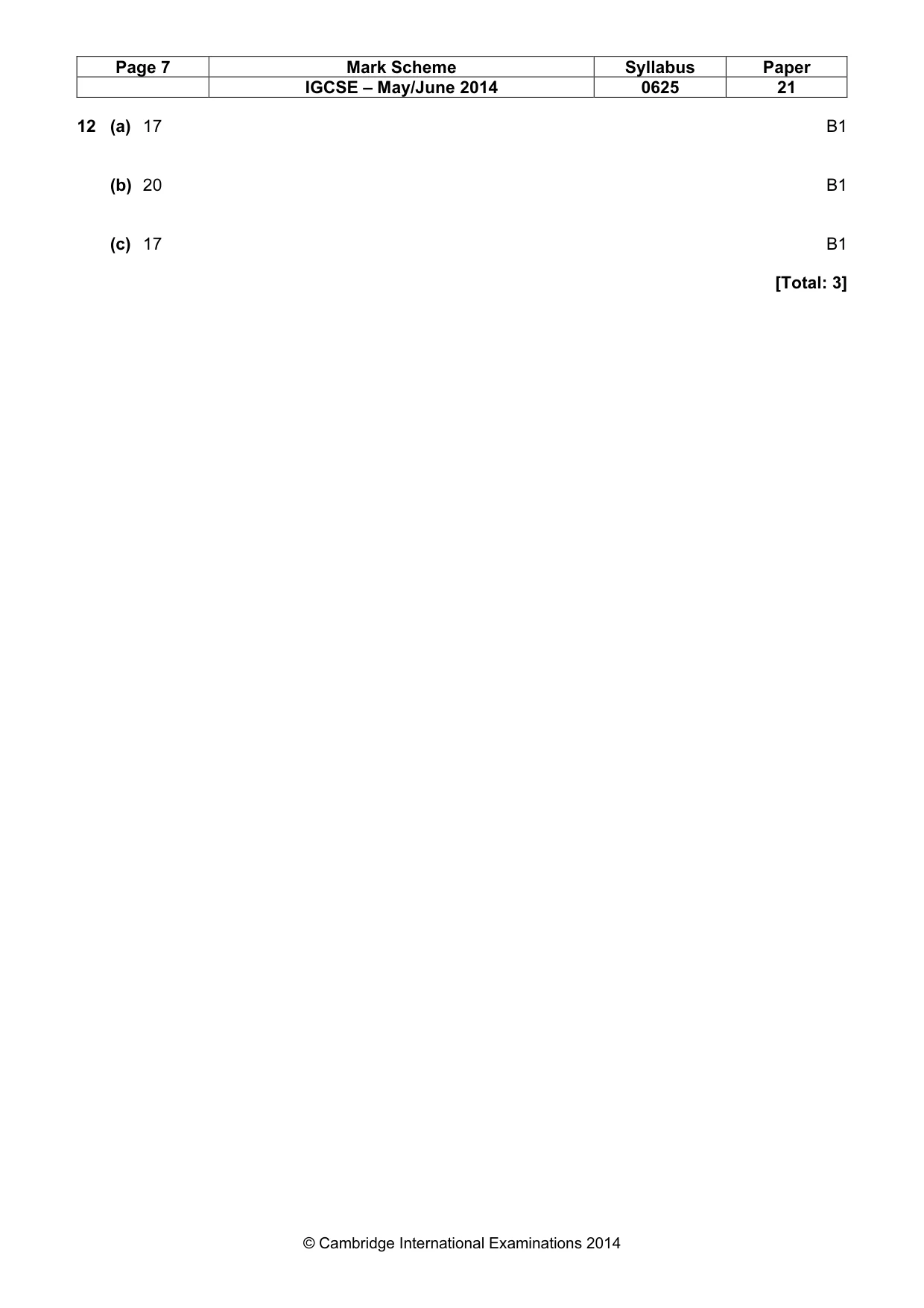
Page 7 Mark Scheme Syllabus Paper IGCSE – May/June 2014 0625 21 © Cambridge International Examinations 2014 12 (a) 17 B1 (b) 20 B1 (c) 17 B1 [Total: 3]
What you needed in this session
Cambridge’s own grade thresholds for 2014 May/June, Paper 2 · Variant 1. A higher threshold means an easier paper — the bar moves with how the cohort did.