Cambridge IGCSE Physics 0625 — 2014 May/June Paper 2 · Variant 2
0625/22/M/J/14 · 80 marks · ≈90 min
The question paper and its mark scheme, free to read here and free to download. This is Cambridge’s own paper, exactly as it was sat.
Question paper16 pages
Mark scheme7 pages
Answers below. Sit the paper first if you are practising.
Paper as text
Question paper, page 1
This document consists of 16 printed pages. DC (AC/JG) 81309/4 © UCLES 2014 [Turn over Cambridge International Examinations Cambridge International General Certificate of Secondary Education * 3 9 5 6 7 0 6 6 2 6 * PHYSICS 0625/22 Paper 2 Core May/June 2014 1 hour 15 minutes Candidates answer on the Question Paper. No Additional Materials are required. READ THESE INSTRUCTIONS FIRST Write your Centre number, candidate number and name on all the work you hand in. Write in dark blue or black pen. You may use an HB pencil for any diagrams or graphs. Do not use staples, paper clips, glue or correction fluid. DO NOT WRITE IN ANY BARCODES. Answer all questions. Electronic calculators may be used. You may lose marks if you do not show your working or if you do not use appropriate units. Take the weight of 1 kg to be 10 N (i.e. acceleration of free fall = 10 m / s2). At the end of the examination, fasten all your work securely together. The number of marks is given in brackets [ ] at the end of each question or part question. The syllabus is approved for use in England, Wales and Northern Ireland as a Cambridge International Level 1/Level 2 Certificate.
Question paper, page 2
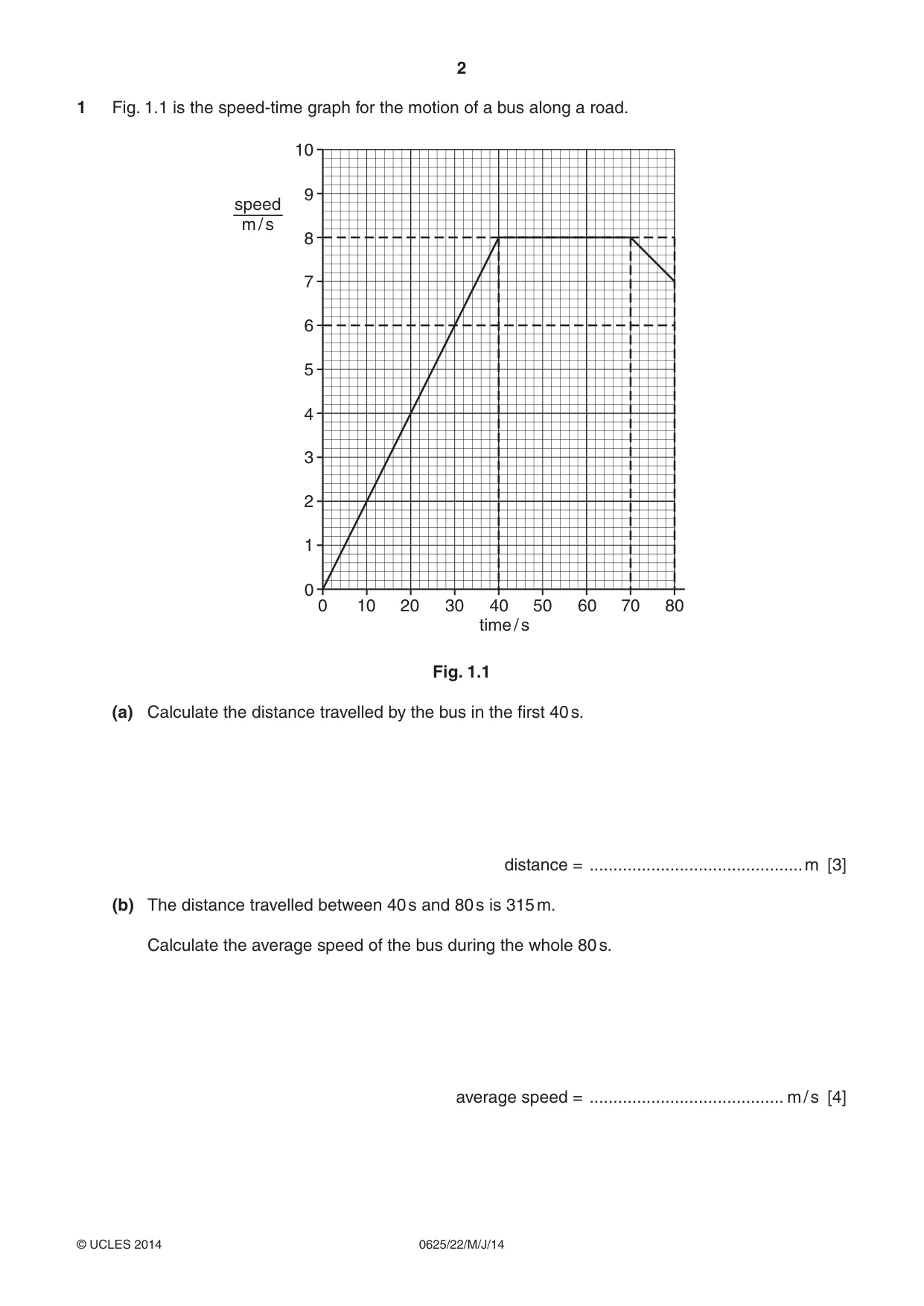
2 0625/22/M/J/14 © UCLES 2014 1 Fig. 1.1 is the speed-time graph for the motion of a bus along a road. 0 0 10 20 30 40 50 60 70 80 1 2 3 4 5 6 7 8 9 10 time / s speed m / s Fig. 1.1 (a) Calculate the distance travelled by the bus in the first 40 s. distance = …m [3] (b) The distance travelled between 40 s and 80 s is 315 m. Calculate the average speed of the bus during the whole 80 s. average speed = … m / s [4]
Question paper, page 3
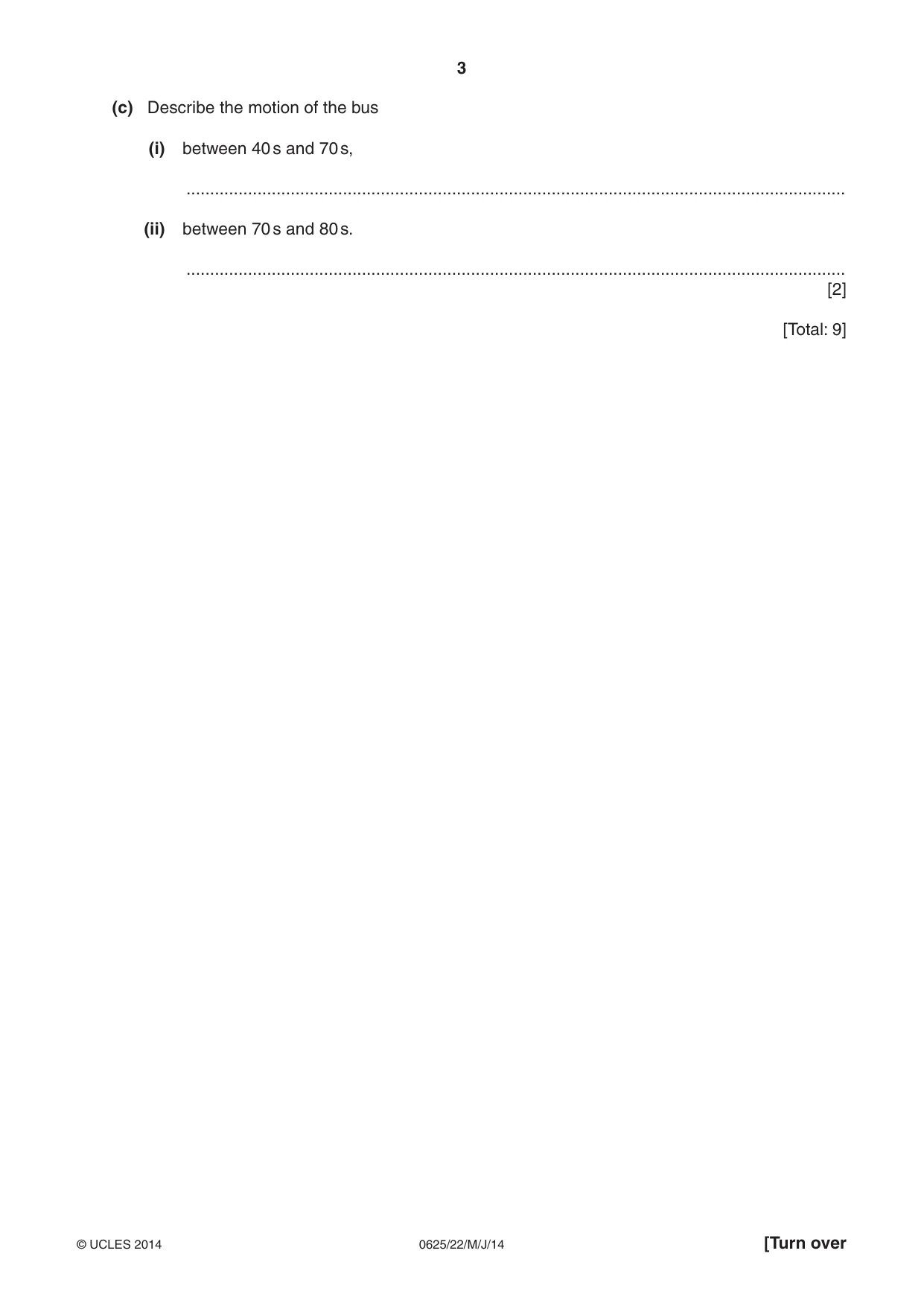
3 0625/22/M/J/14 © UCLES 2014 [Turn over (c) Describe the motion of the bus (i) between 40 s and 70 s, … (ii) between 70 s and 80 s. … [2] [Total: 9]
Question paper, page 4
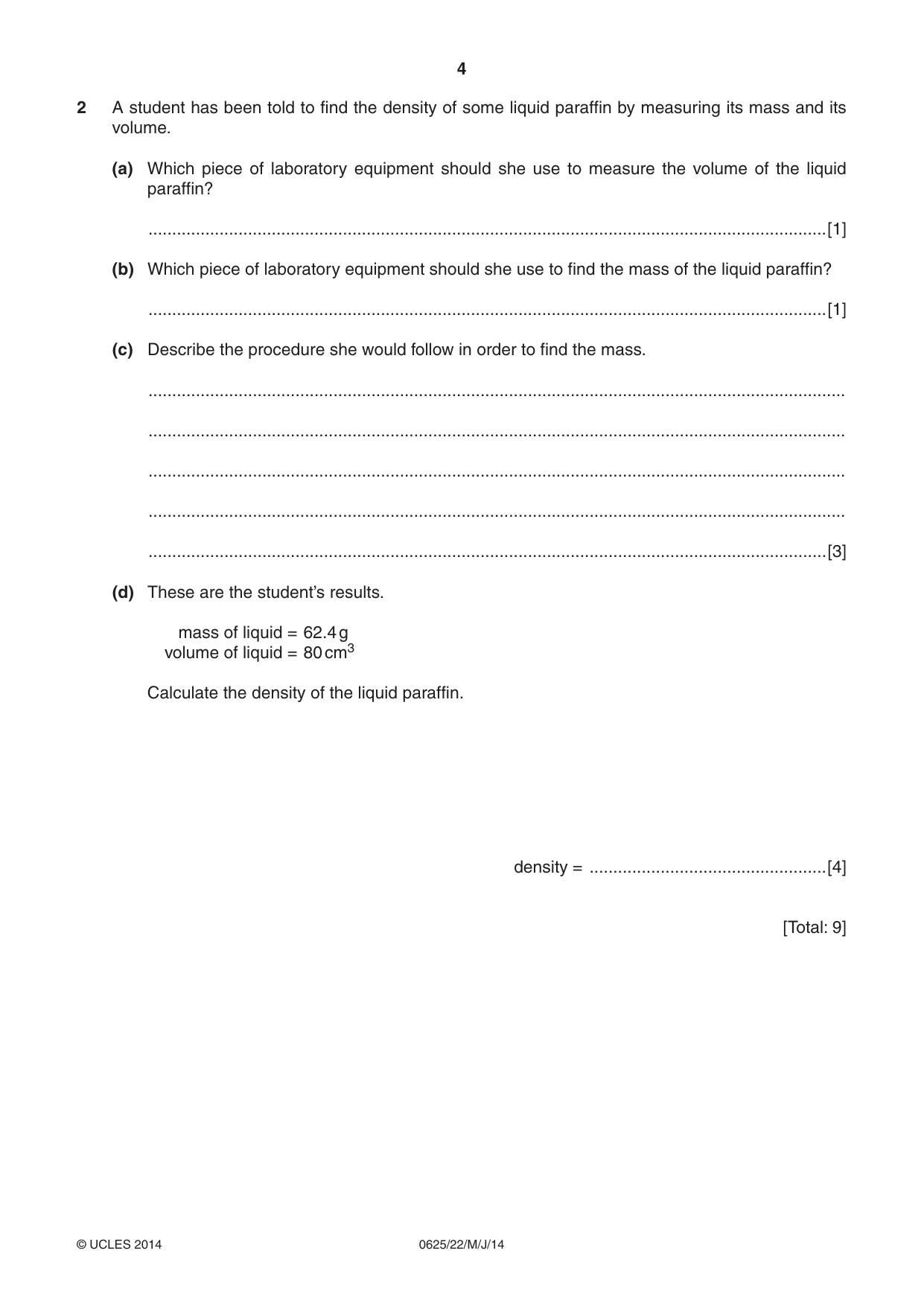
4 0625/22/M/J/14 © UCLES 2014 2 A student has been told to find the density of some liquid paraffin by measuring its mass and its volume. (a) Which piece of laboratory equipment should she use to measure the volume of the liquid paraffin? …[1] (b) Which piece of laboratory equipment should she use to find the mass of the liquid paraffin? …[1] (c) Describe the procedure she would follow in order to find the mass. … … … … …[3] (d) These are the student’s results. mass of liquid = 62.4 g volume of liquid = 80 cm3 Calculate the density of the liquid paraffin. density = …[4] [Total: 9]
Question paper, page 5
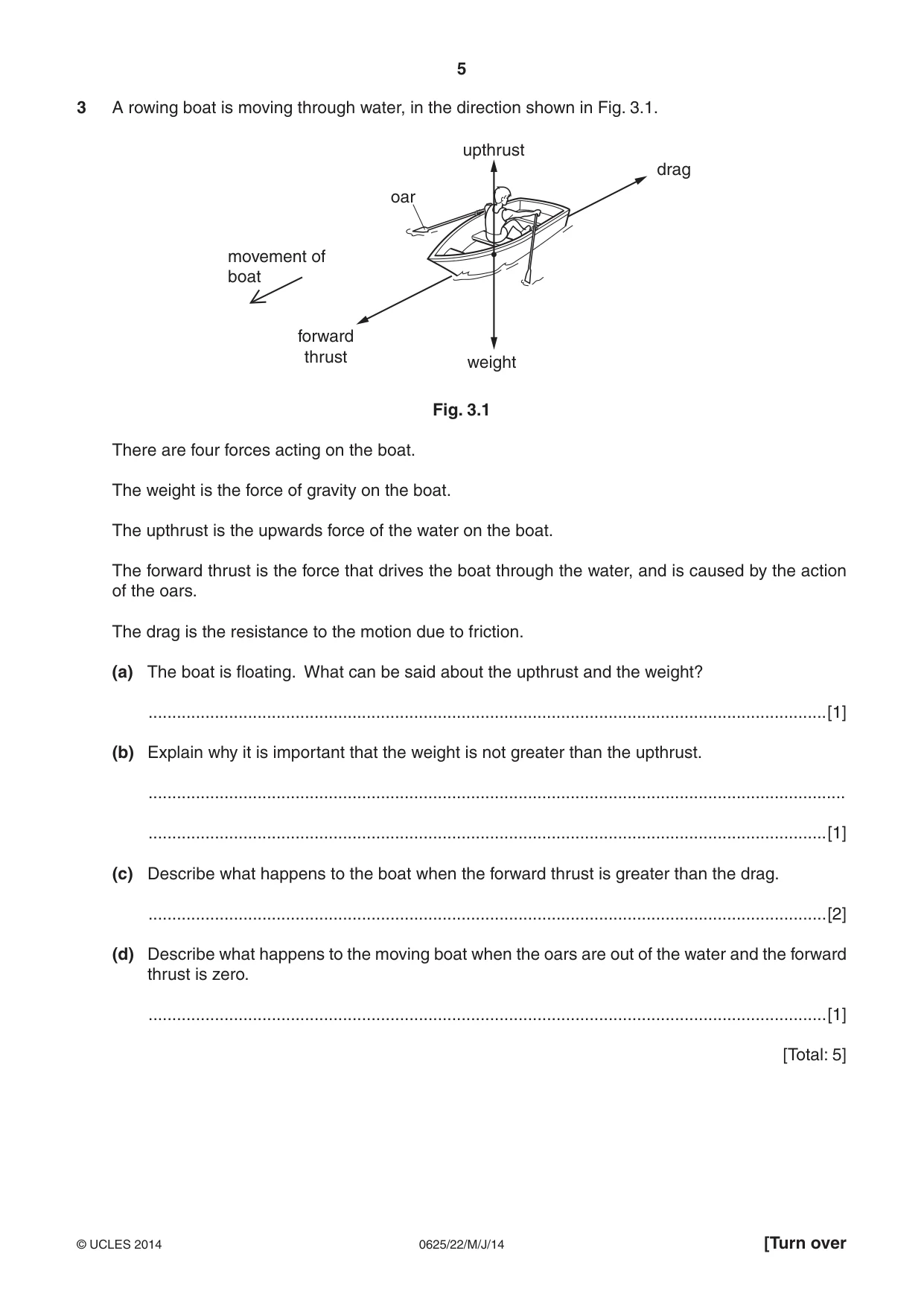
5 0625/22/M/J/14 © UCLES 2014 [Turn over 3 A rowing boat is moving through water, in the direction shown in Fig. 3.1. oar movement of boat drag forward thrust upthrust weight Fig. 3.1 There are four forces acting on the boat. The weight is the force of gravity on the boat. The upthrust is the upwards force of the water on the boat. The forward thrust is the force that drives the boat through the water, and is caused by the action of the oars. The drag is the resistance to the motion due to friction. (a) The boat is floating. What can be said about the upthrust and the weight? …[1] (b) Explain why it is important that the weight is not greater than the upthrust. … …[1] (c) Describe what happens to the boat when the forward thrust is greater than the drag. …[2] (d) Describe what happens to the moving boat when the oars are out of the water and the forward thrust is zero. …[1] [Total: 5]
Question paper, page 6
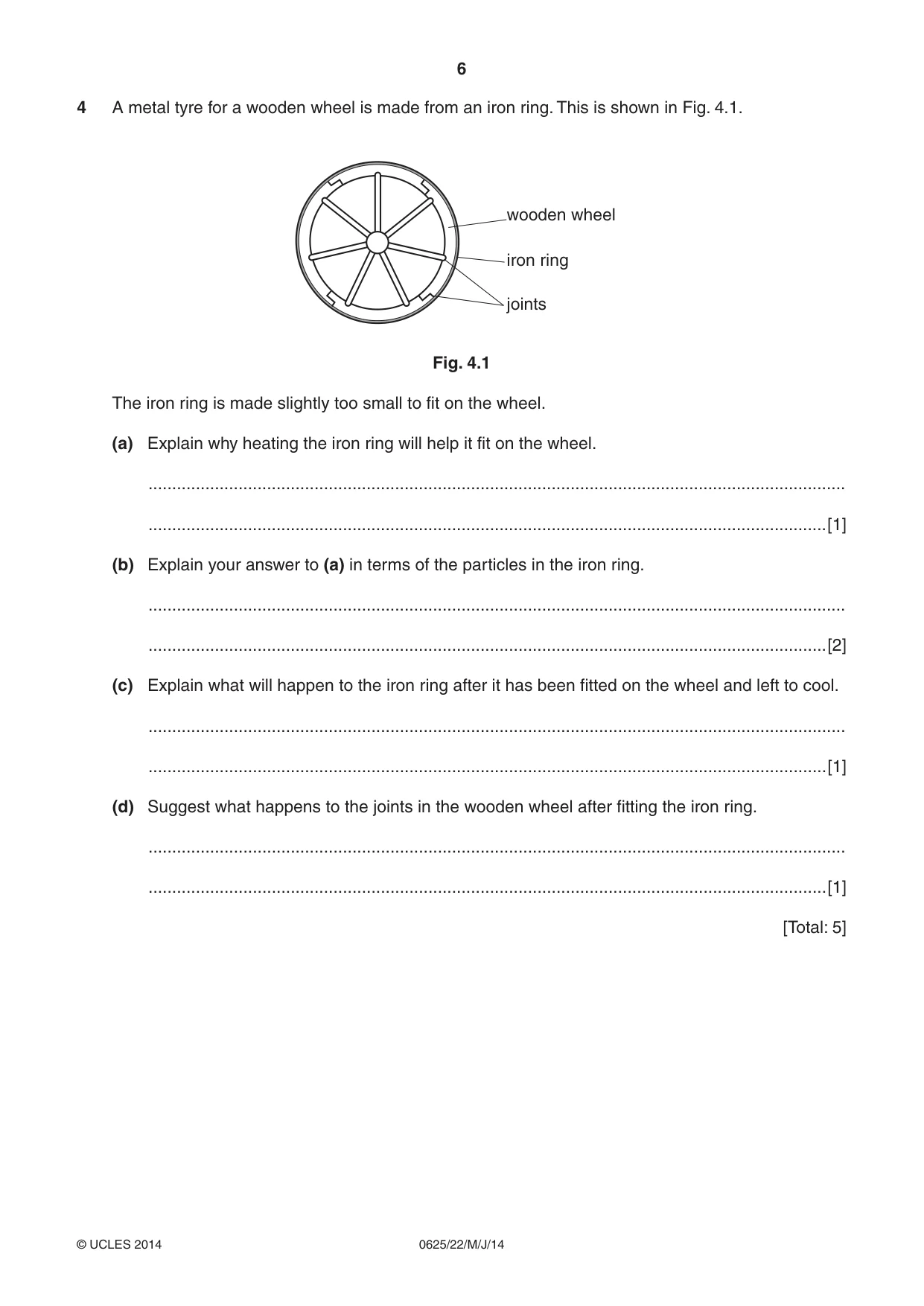
6 0625/22/M/J/14 © UCLES 2014 4 A metal tyre for a wooden wheel is made from an iron ring. This is shown in Fig. 4.1. wooden wheel iron ring joints Fig. 4.1 The iron ring is made slightly too small to fit on the wheel. (a) Explain why heating the iron ring will help it fit on the wheel. … …[1] (b) Explain your answer to (a) in terms of the particles in the iron ring. … …[2] (c) Explain what will happen to the iron ring after it has been fitted on the wheel and left to cool. … …[1] (d) Suggest what happens to the joints in the wooden wheel after fitting the iron ring. … …[1] [Total: 5]
Question paper, page 7
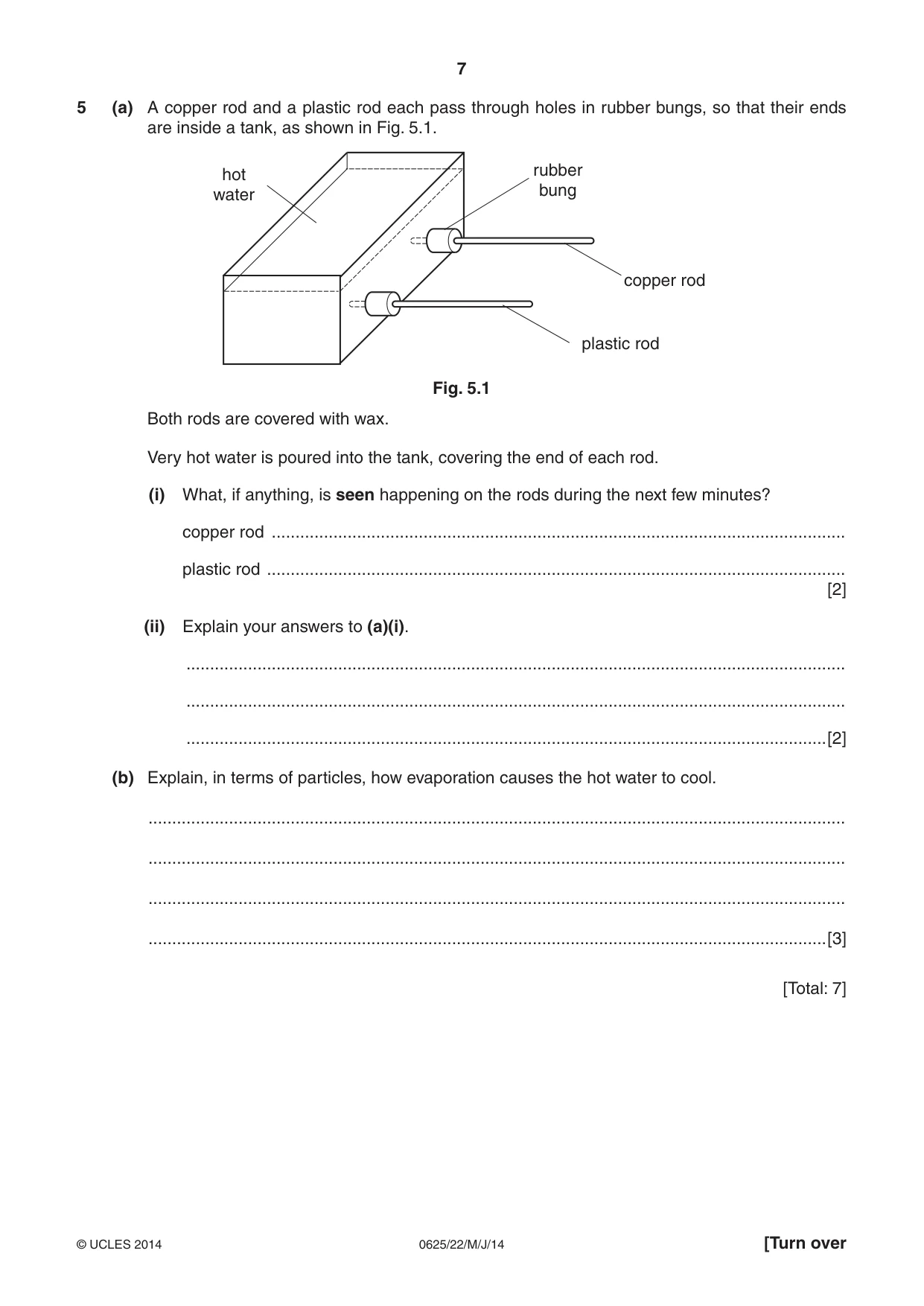
7 0625/22/M/J/14 © UCLES 2014 [Turn over 5 (a) A copper rod and a plastic rod each pass through holes in rubber bungs, so that their ends are inside a tank, as shown in Fig. 5.1. hot water rubber bung copper rod plastic rod Fig. 5.1 Both rods are covered with wax. Very hot water is poured into the tank, covering the end of each rod. (i) What, if anything, is seen happening on the rods during the next few minutes? copper rod … plastic rod … [2] (ii) Explain your answers to (a)(i). … … …[2] (b) Explain, in terms of particles, how evaporation causes the hot water to cool. … … … …[3] [Total: 7]
Question paper, page 8
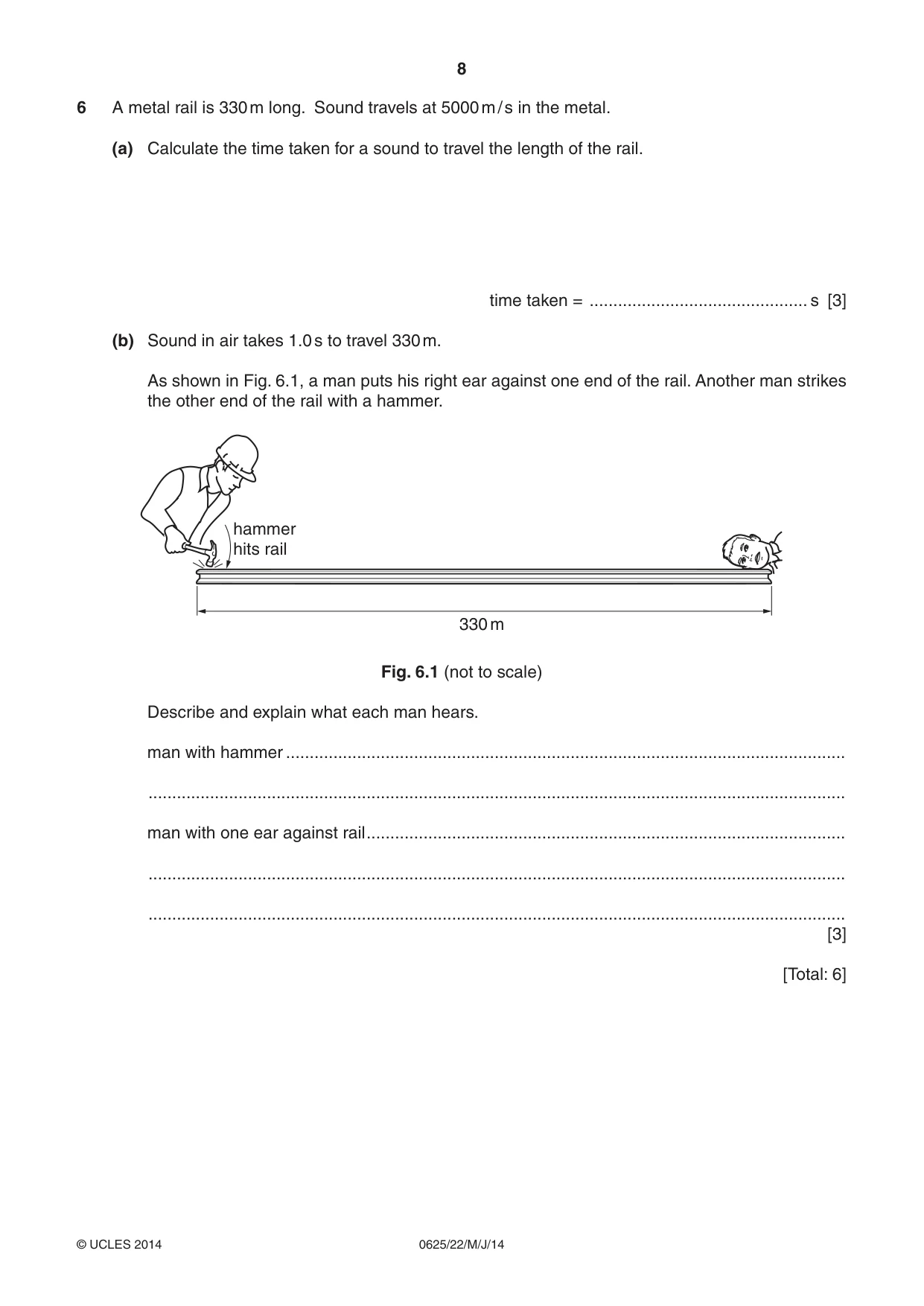
8 0625/22/M/J/14 © UCLES 2014 6 A metal rail is 330 m long. Sound travels at 5000 m / s in the metal. (a) Calculate the time taken for a sound to travel the length of the rail. time taken = … s [3] (b) Sound in air takes 1.0 s to travel 330 m. As shown in Fig. 6.1, a man puts his right ear against one end of the rail. Another man strikes the other end of the rail with a hammer. hammer hits rail 330 m Fig. 6.1 (not to scale) Describe and explain what each man hears. man with hammer … … man with one ear against rail … … … [3] [Total: 6]
Question paper, page 9
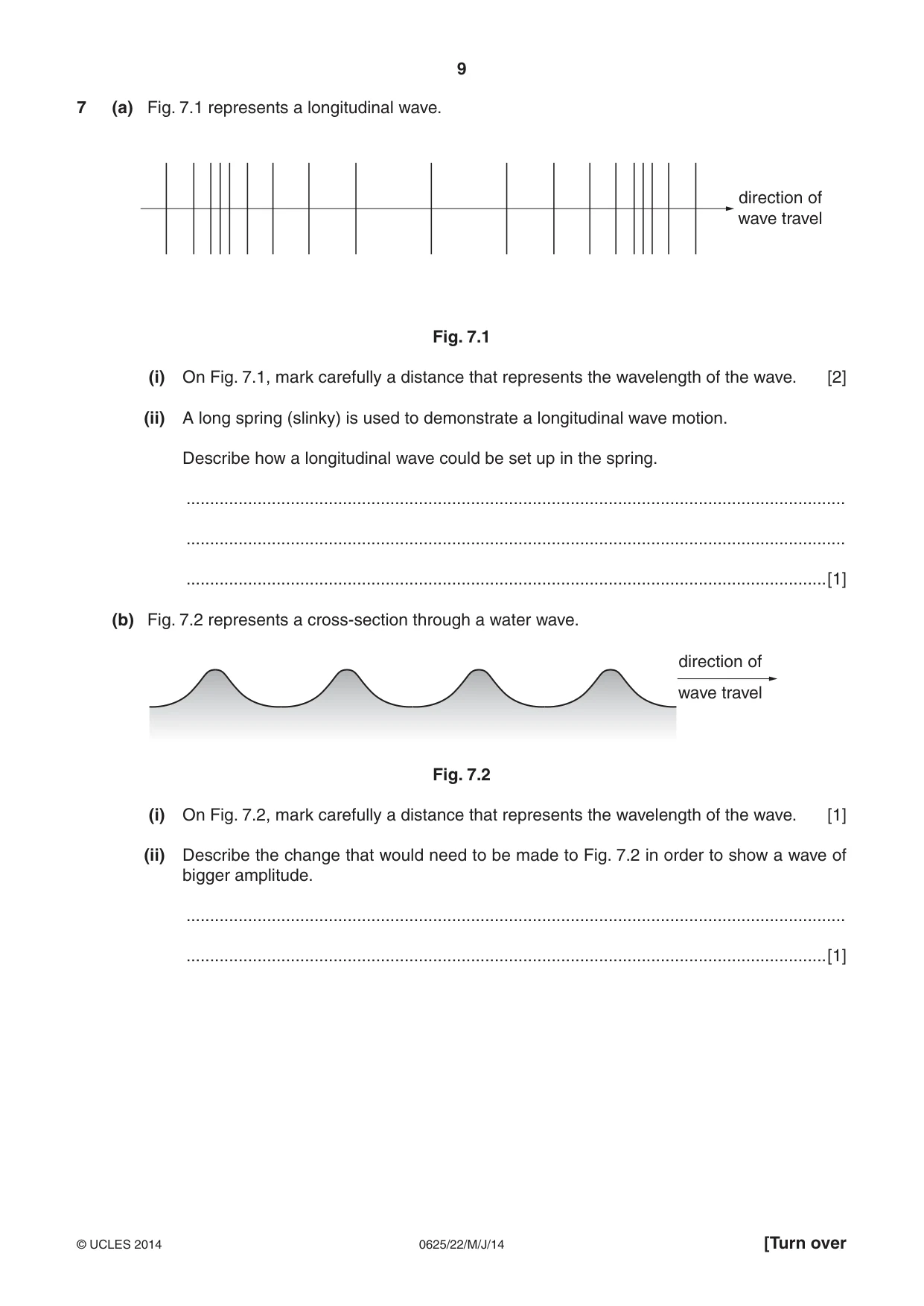
9 0625/22/M/J/14 © UCLES 2014 [Turn over 7 (a) Fig. 7.1 represents a longitudinal wave. direction of wave travel Fig. 7.1 (i) On Fig. 7.1, mark carefully a distance that represents the wavelength of the wave. [2] (ii) A long spring (slinky) is used to demonstrate a longitudinal wave motion. Describe how a longitudinal wave could be set up in the spring. … … …[1] (b) Fig. 7.2 represents a cross-section through a water wave. direction of wave travel Fig. 7.2 (i) On Fig. 7.2, mark carefully a distance that represents the wavelength of the wave. [1] (ii) Describe the change that would need to be made to Fig. 7.2 in order to show a wave of bigger amplitude. … …[1]
Question paper, page 10
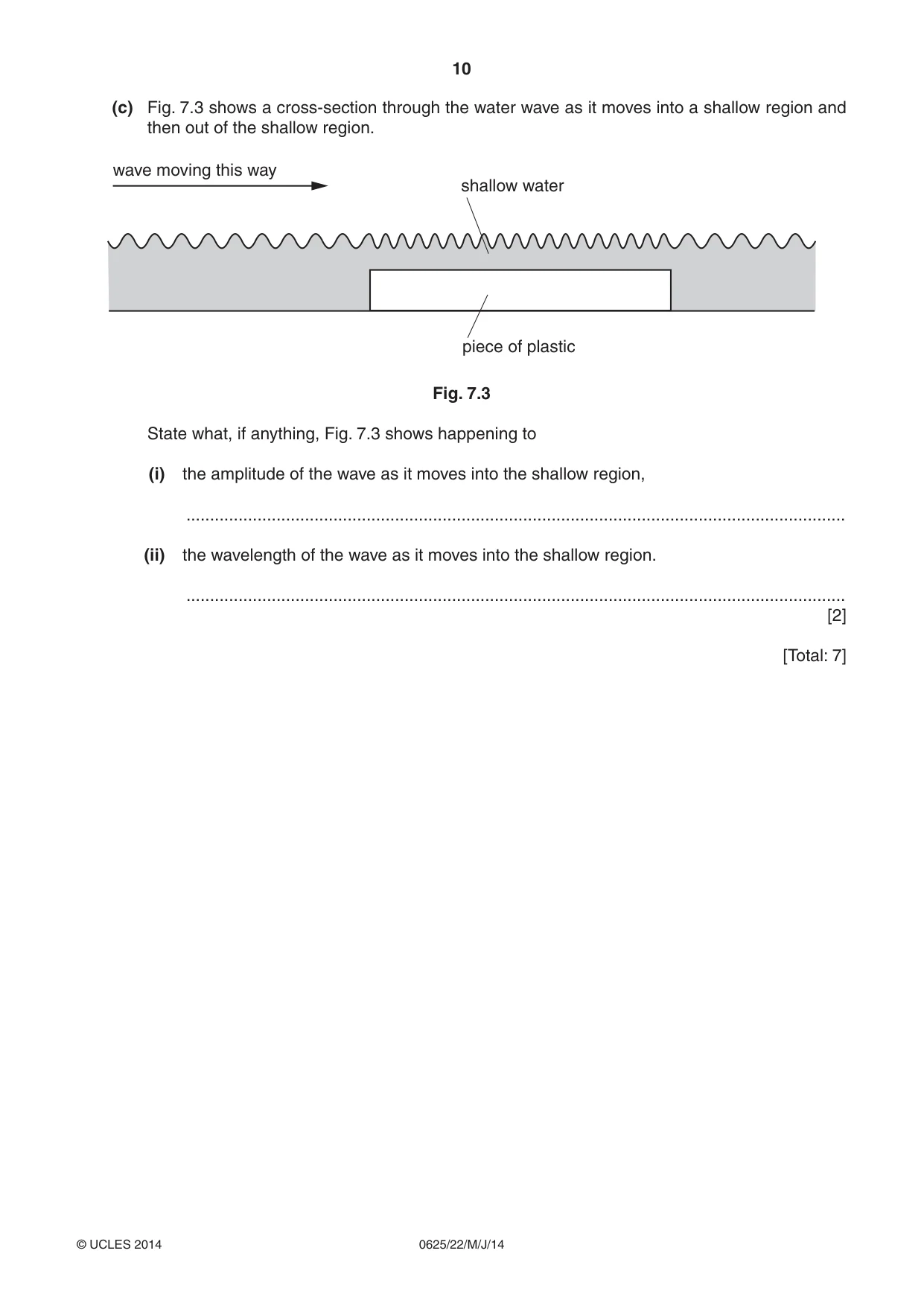
10 0625/22/M/J/14 © UCLES 2014 (c) Fig. 7.3 shows a cross-section through the water wave as it moves into a shallow region and then out of the shallow region. shallow water piece of plastic wave moving this way Fig. 7.3 State what, if anything, Fig. 7.3 shows happening to (i) the amplitude of the wave as it moves into the shallow region, … (ii) the wavelength of the wave as it moves into the shallow region. … [2] [Total: 7]
Question paper, page 11
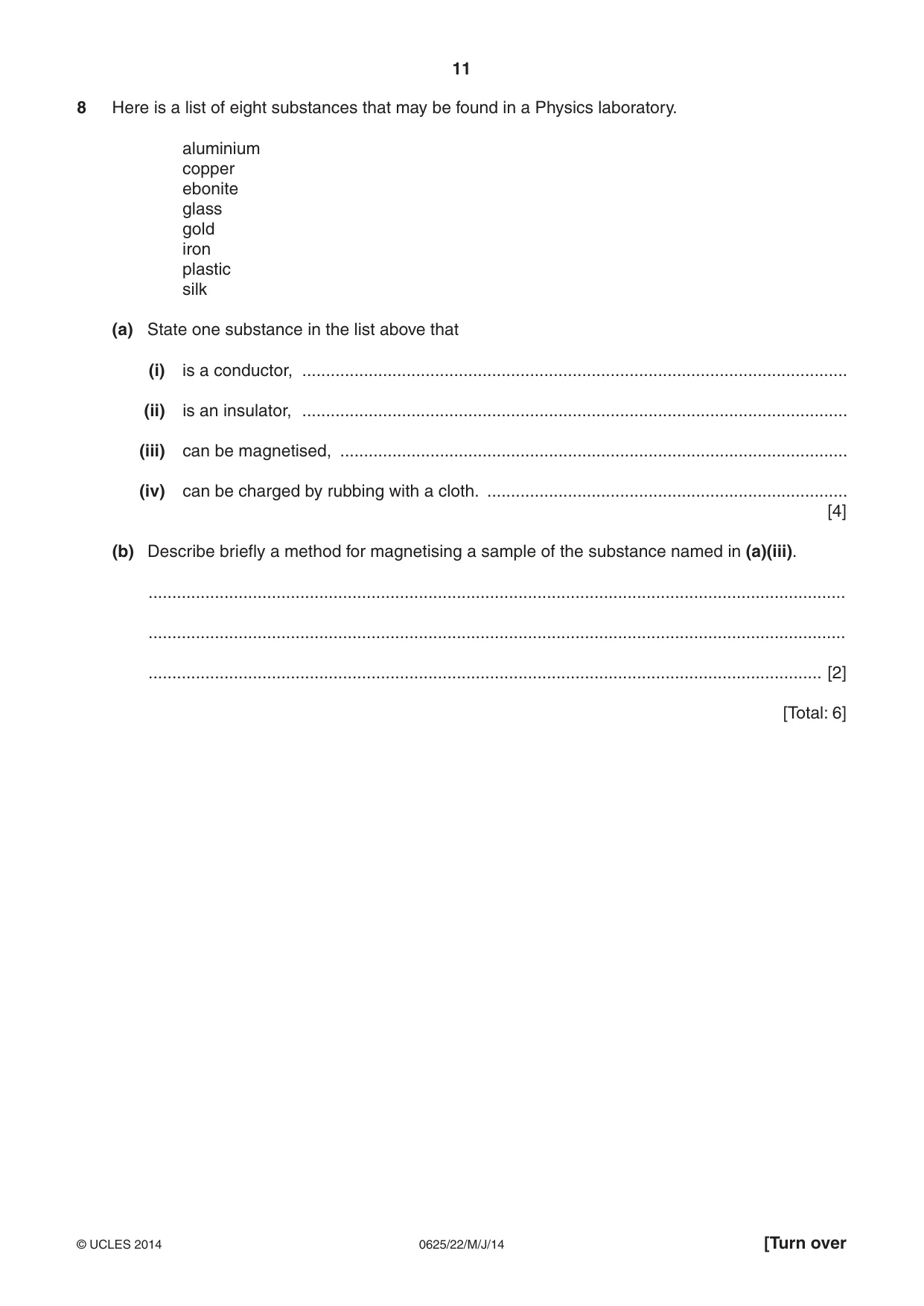
11 0625/22/M/J/14 © UCLES 2014 [Turn over 8 Here is a list of eight substances that may be found in a Physics laboratory. aluminium copper ebonite glass gold iron plastic silk (a) State one substance in the list above that (i) is a conductor, … (ii) is an insulator, … (iii) can be magnetised, … (iv) can be charged by rubbing with a cloth. … [4] (b) Describe briefly a method for magnetising a sample of the substance named in (a)(iii). … … … [2] [Total: 6]
Question paper, page 12
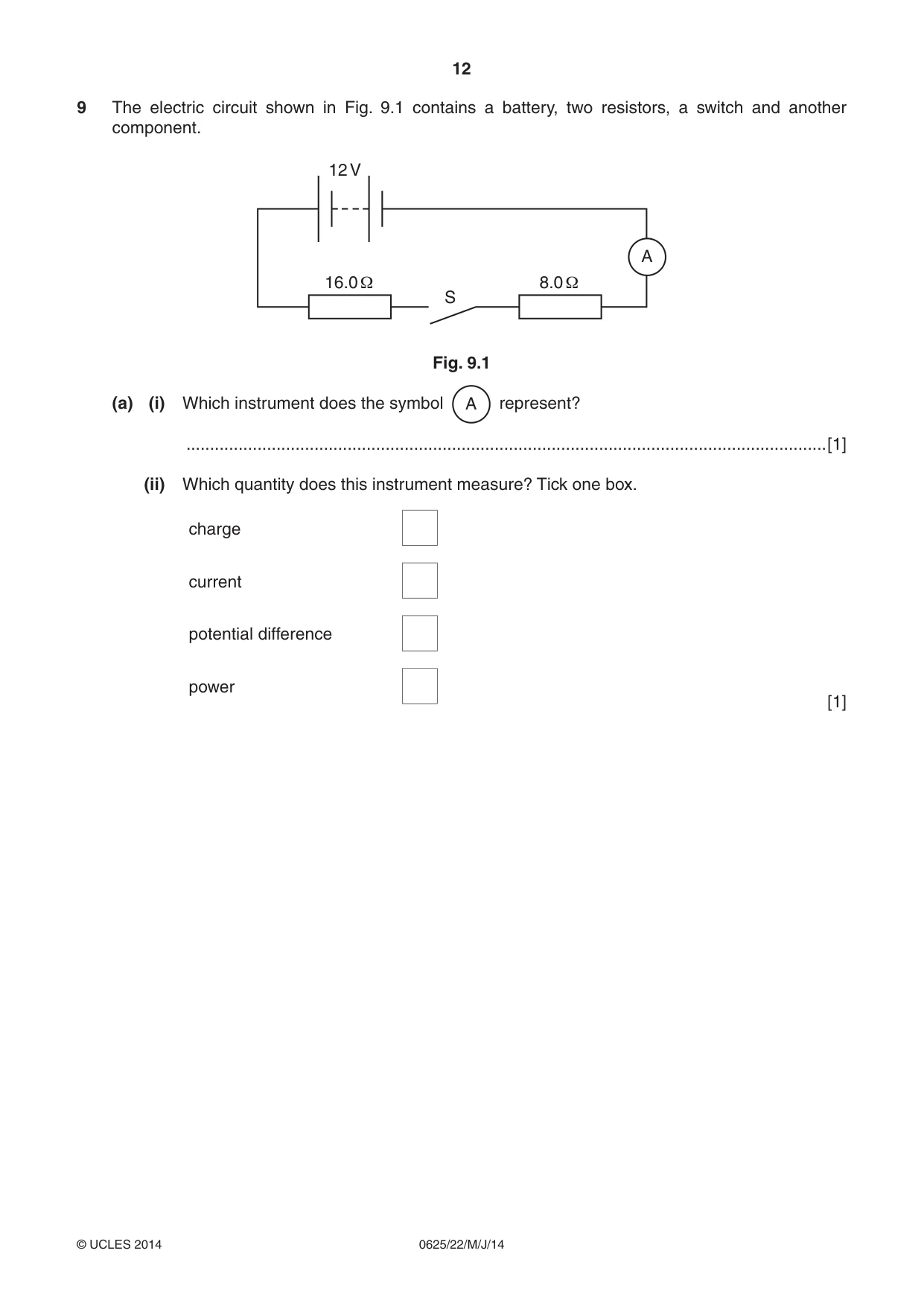
12 0625/22/M/J/14 © UCLES 2014 9 The electric circuit shown in Fig. 9.1 contains a battery, two resistors, a switch and another component. 12 V S A 16.0 Ω 8.0 Ω Fig. 9.1 (a) (i) Which instrument does the symbol A represent? …[1] (ii) Which quantity does this instrument measure? Tick one box. charge current potential difference power [1]
Question paper, page 13
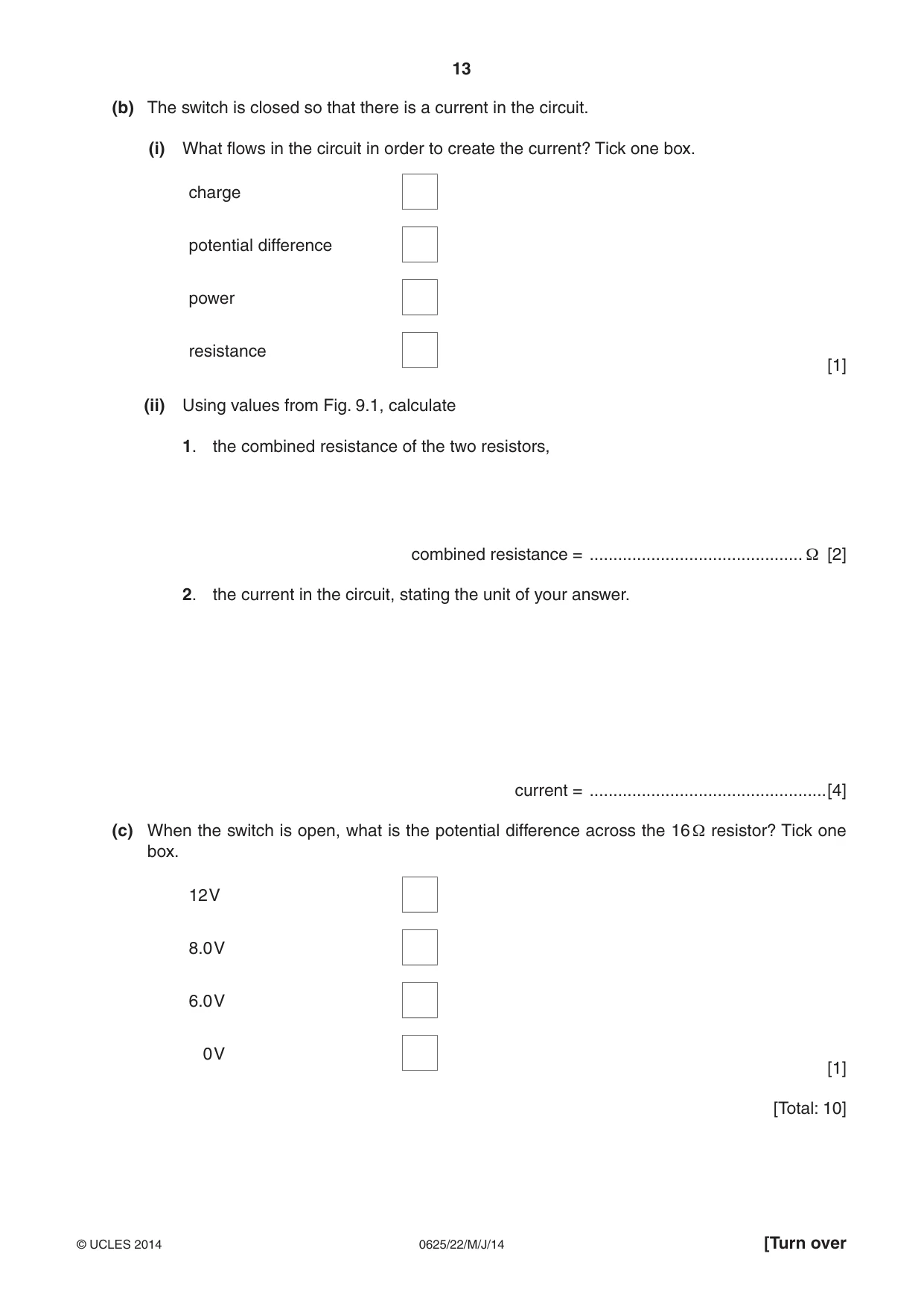
13 0625/22/M/J/14 © UCLES 2014 [Turn over (b) The switch is closed so that there is a current in the circuit. (i) What flows in the circuit in order to create the current? Tick one box. charge potential difference power resistance [1] (ii) Using values from Fig. 9.1, calculate 1. the combined resistance of the two resistors, combined resistance = … Ω [2] 2. the current in the circuit, stating the unit of your answer. current = …[4] (c) When the switch is open, what is the potential difference across the 16 Ω resistor? Tick one box. 12 V 8.0 V 6.0 V 0 V [1] [Total: 10]
Question paper, page 14
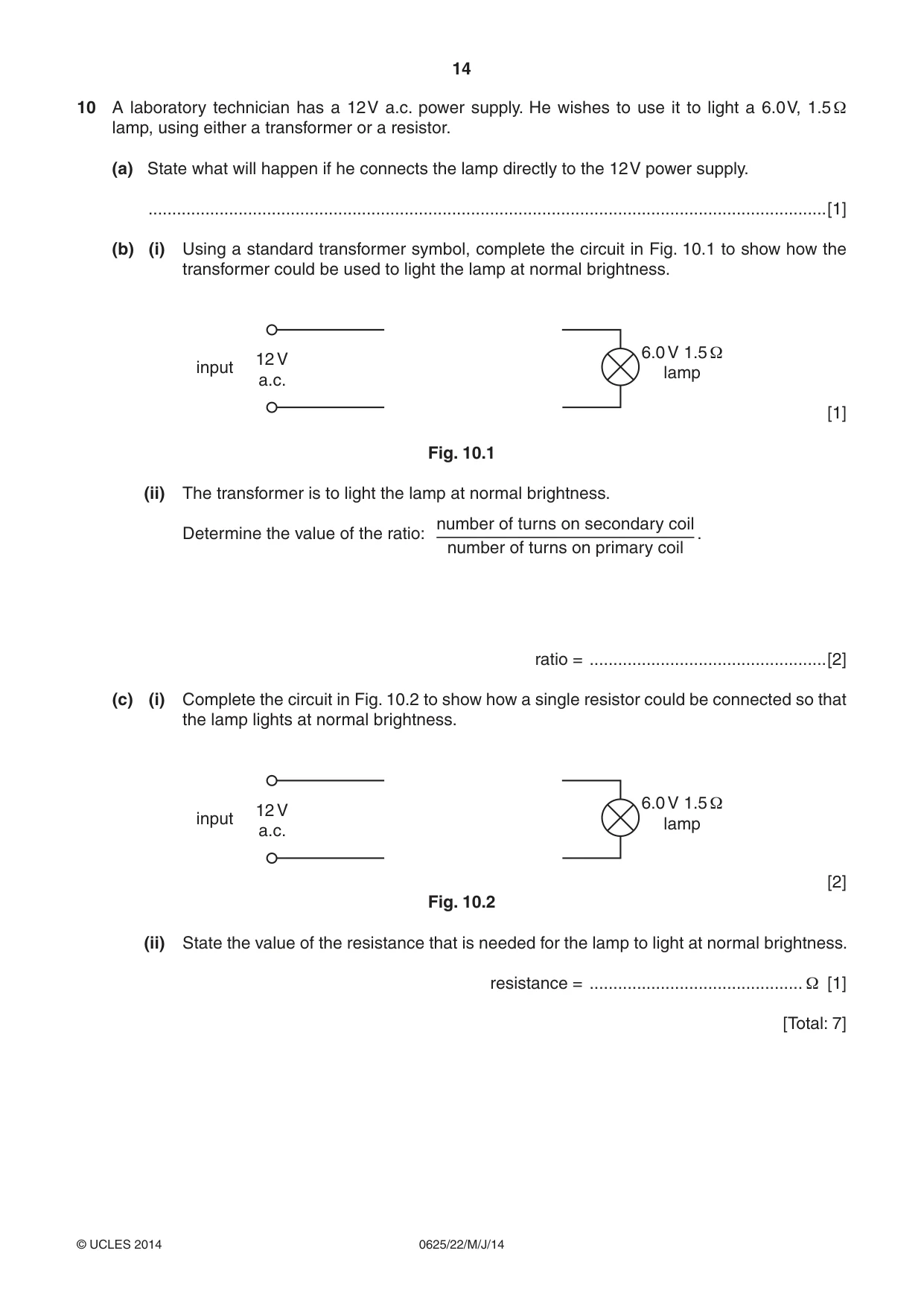
14 0625/22/M/J/14 © UCLES 2014 10 A laboratory technician has a 12 V a.c. power supply. He wishes to use it to light a 6.0 V, 1.5 Ω lamp, using either a transformer or a resistor. (a) State what will happen if he connects the lamp directly to the 12 V power supply. …[1] (b) (i) Using a standard transformer symbol, complete the circuit in Fig. 10.1 to show how the transformer could be used to light the lamp at normal brightness. input 12 V a.c. 6.0 V 1.5 Ω lamp [1] Fig. 10.1 (ii) The transformer is to light the lamp at normal brightness. Determine the value of the ratio: number of turns on secondary coil number of turns on primary coil . ratio = …[2] (c) (i) Complete the circuit in Fig. 10.2 to show how a single resistor could be connected so that the lamp lights at normal brightness. input 12 V a.c. 6.0 V 1.5 Ω lamp [2] Fig. 10.2 (ii) State the value of the resistance that is needed for the lamp to light at normal brightness. resistance = … Ω [1] [Total: 7]
Question paper, page 15
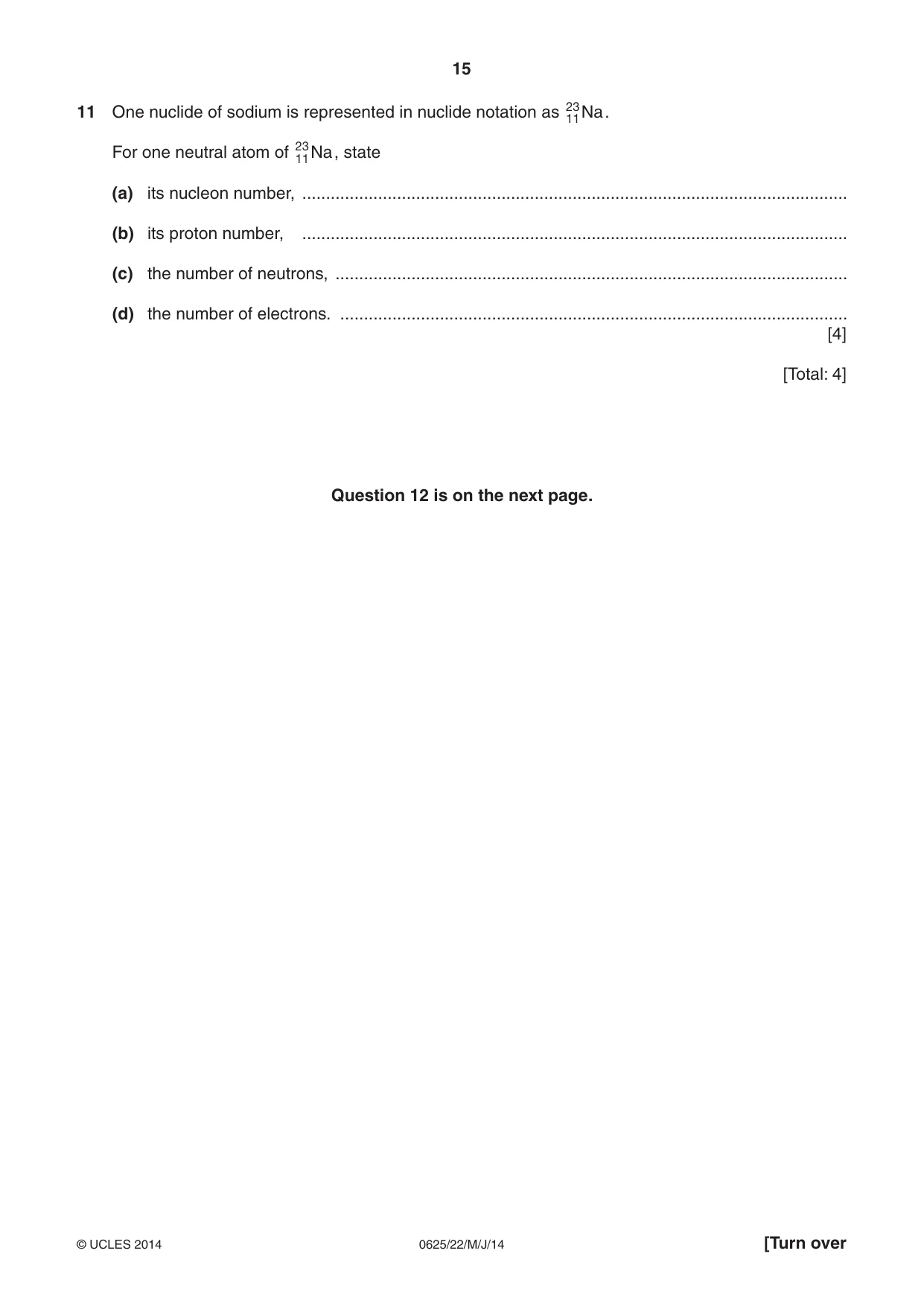
15 0625/22/M/J/14 © UCLES 2014 [Turn over 11 One nuclide of sodium is represented in nuclide notation as 11 23Na. For one neutral atom of 11 23Na, state (a) its nucleon number, … (b) its proton number, … (c) the number of neutrons, … (d) the number of electrons. … [4] [Total: 4] Question 12 is on the next page.
Question paper, page 16
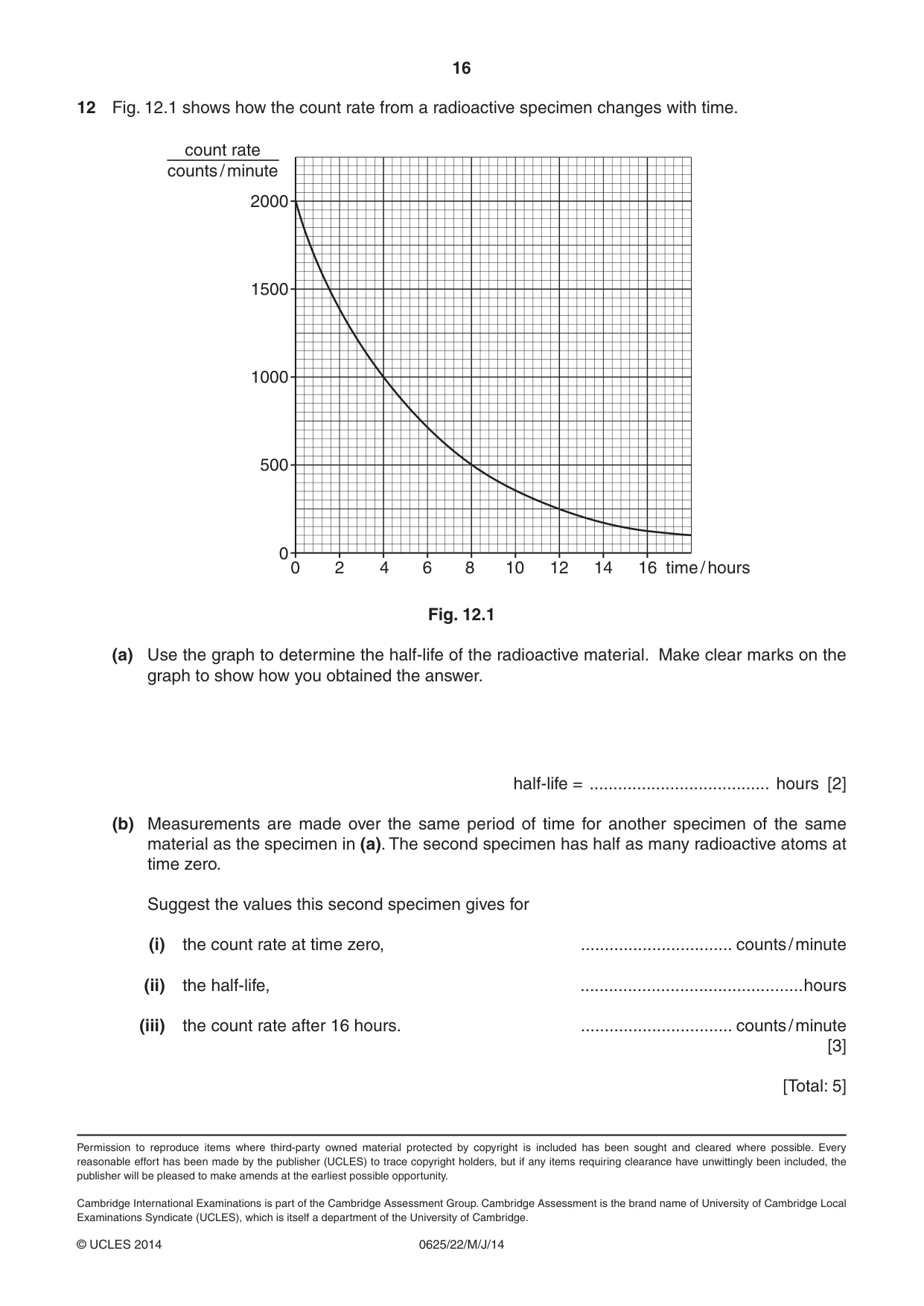
16 0625/22/M/J/14 © UCLES 2014 12 Fig. 12.1 shows how the count rate from a radioactive specimen changes with time. 0 0 500 1000 1500 2000 2 4 6 8 10 12 14 16 count rate counts / minute time / hours Fig. 12.1 (a) Use the graph to determine the half-life of the radioactive material. Make clear marks on the graph to show how you obtained the answer. half-life = … hours [2] (b) Measurements are made over the same period of time for another specimen of the same material as the specimen in (a). The second specimen has half as many radioactive atoms at time zero. Suggest the values this second specimen gives for (i) the count rate at time zero, … counts / minute (ii) the half-life, … hours (iii) the count rate after 16 hours. … counts / minute [3] [Total: 5] Permission to reproduce items where third-party owned material protected by copyright is included has been sought and cleared where possible. Every reasonable effort has been made by the publisher (UCLES) to trace copyright holders, but if any items requiring clearance have unwittingly been included, the publisher will be pleased to make amends at the earliest possible opportunity. Cambridge International Examinations is part of the Cambridge Assessment Group. Cambridge Assessment is the brand name of University of Cambridge Local Examinations Syndicate (UCLES), which is itself a department of the University of Cambridge.
Mark scheme, page 1
CAMBRIDGE INTERNATIONAL EXAMINATIONS International General Certificate of Secondary Education MARK SCHEME for the May/June 2014 series 0625 PHYSICS 0625/22 Paper 2 (Core Theory), maximum raw mark 80 This mark scheme is published as an aid to teachers and candidates, to indicate the requirements of the examination. It shows the basis on which Examiners were instructed to award marks. It does not indicate the details of the discussions that took place at an Examiners’ meeting before marking began, which would have considered the acceptability of alternative answers. Mark schemes should be read in conjunction with the question paper and the Principal Examiner Report for Teachers. Cambridge will not enter into discussions about these mark schemes. Cambridge is publishing the mark schemes for the May/June 2014 series for most IGCSE, GCE Advanced Level and Advanced Subsidiary Level components and some Ordinary Level components.
Mark scheme, page 2
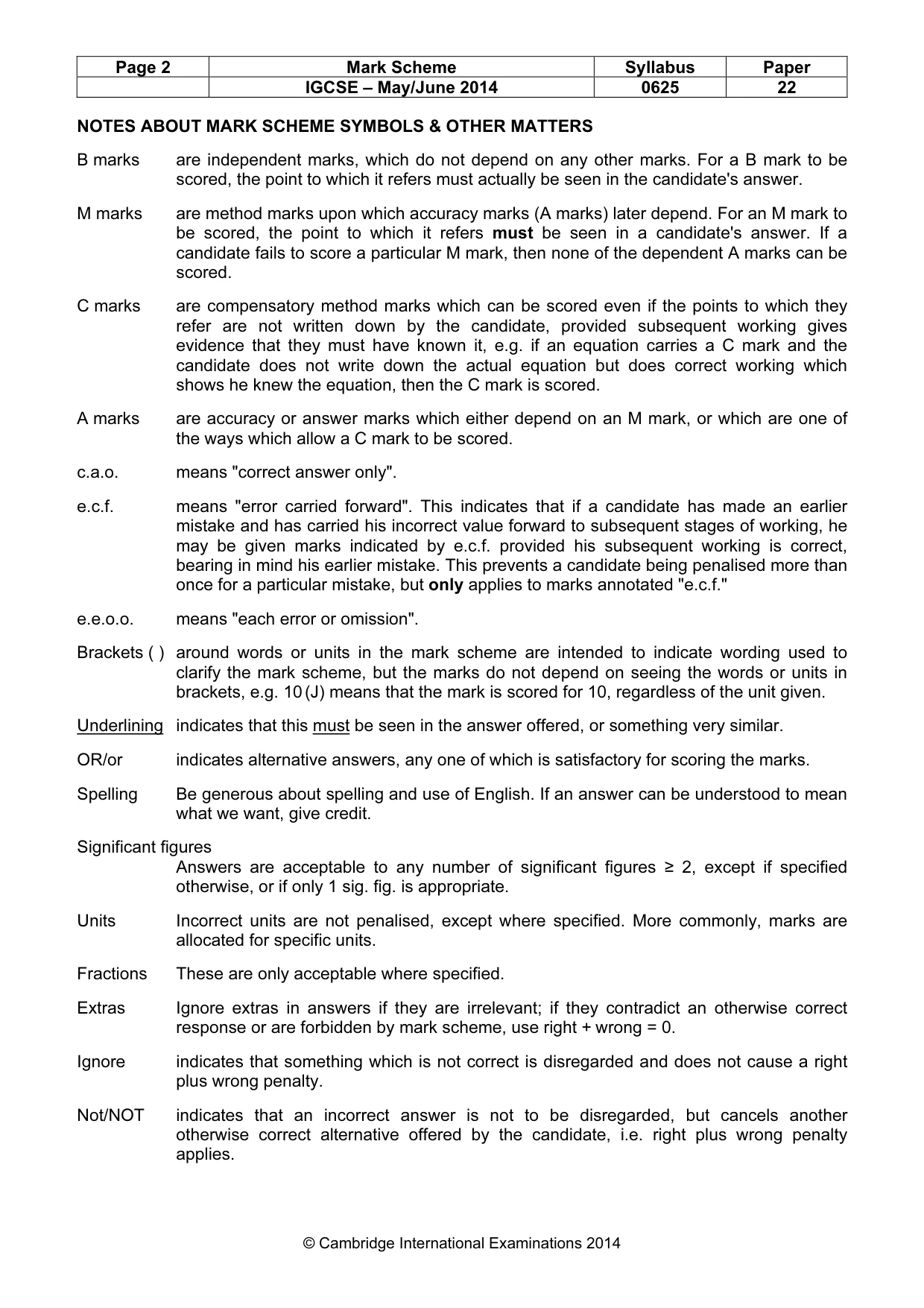
Page 2 Mark Scheme Syllabus Paper IGCSE – May/June 2014 0625 22 © Cambridge International Examinations 2014 NOTES ABOUT MARK SCHEME SYMBOLS & OTHER MATTERS B marks are independent marks, which do not depend on any other marks. For a B mark to be scored, the point to which it refers must actually be seen in the candidate's answer. M marks are method marks upon which accuracy marks (A marks) later depend. For an M mark to be scored, the point to which it refers must be seen in a candidate's answer. If a candidate fails to score a particular M mark, then none of the dependent A marks can be scored. C marks are compensatory method marks which can be scored even if the points to which they refer are not written down by the candidate, provided subsequent working gives evidence that they must have known it, e.g. if an equation carries a C mark and the candidate does not write down the actual equation but does correct working which shows he knew the equation, then the C mark is scored. A marks are accuracy or answer marks which either depend on an M mark, or which are one of the ways which allow a C mark to be scored. c.a.o. means "correct answer only". e.c.f. means "error carried forward". This indicates that if a candidate has made an earlier mistake and has carried his incorrect value forward to subsequent stages of working, he may be given marks indicated by e.c.f. provided his subsequent working is correct, bearing in mind his earlier mistake. This prevents a candidate being penalised more than once for a particular mistake, but only applies to marks annotated "e.c.f." e.e.o.o. means "each error or omission". Brackets ( ) around words or units in the mark scheme are intended to indicate wording used to clarify the mark scheme, but the marks do not depend on seeing the words or units in brackets, e.g. 10 (J) means that the mark is scored for 10, regardless of the unit given. Underlining indicates that this must be seen in the answer offered, or something very similar. OR/or indicates alternative answers, any one of which is satisfactory for scoring the marks. Spelling Be generous about spelling and use of English. If an answer can be understood to mean what we want, give credit. Significant figures Answers are acceptable to any number of significant figures ≥ 2, except if specified otherwise, or if only 1 sig. fig. is appropriate. Units Incorrect units are not penalised, except where specified. More commonly, marks are allocated for specific units. Fractions These are only acceptable where specified. Extras Ignore extras in answers if they are irrelevant; if they contradict an otherwise correct response or are forbidden by mark scheme, use right +=wrong = 0. Ignore indicates that something which is not correct is disregarded and does not cause a right plus wrong penalty. Not/NOT indicates that an incorrect answer is not to be disregarded, but cancels another otherwise correct alternative offered by the candidate, i.e. right plus wrong penalty applies.
Mark scheme, page 3
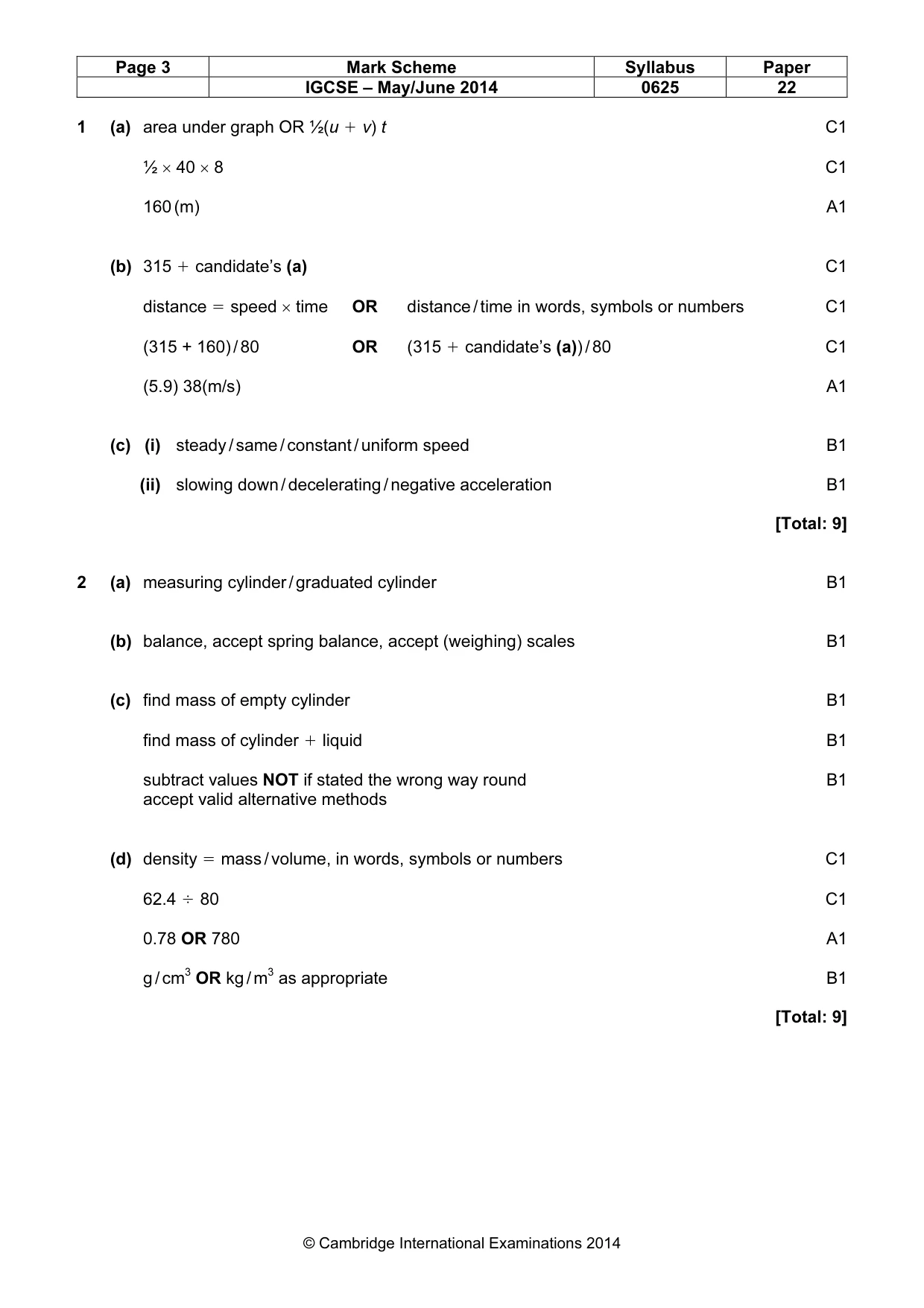
Page 3 Mark Scheme Syllabus Paper IGCSE – May/June 2014 0625 22 © Cambridge International Examinations 2014 1 (a) area under graph OR ½(u N v) t C1 ½ × 40 × 8 C1 160 (m) A1 (b) 315 N candidate’s (a) C1 distance R speed × time OR distance / time in words, symbols or numbers C1 (315 + 160) / 80 OR (315 N candidate’s (a)) / 80 C1 (5.9) 38(m/s) A1 (c) (i) steady / same / constant / uniform speed B1 (ii) slowing down / decelerating / negative acceleration B1 [Total: 9] 2 (a) measuring cylinder / graduated cylinder B1 (b) balance, accept spring balance, accept (weighing) scales B1 (c) find mass of empty cylinder B1 find mass of cylinder N liquid B1 subtract values NOT if stated the wrong way round B1 accept valid alternative methods (d) density R mass / volume, in words, symbols or numbers C1 62.4 Q 80 C1 0.78 OR 780 A1 g / cm3 OR kg / m3 as appropriate B1 [Total: 9]
Mark scheme, page 4
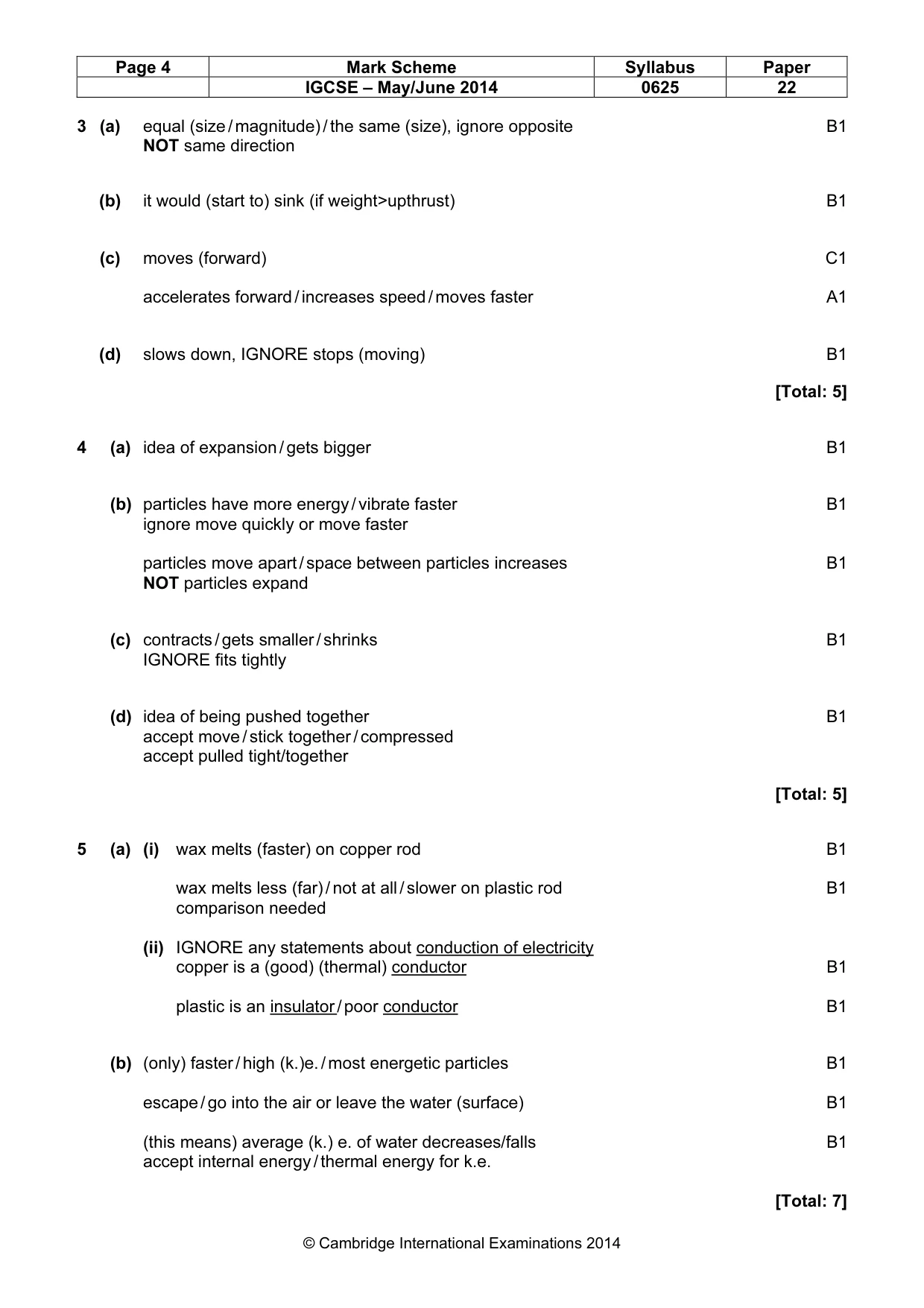
Page 4 Mark Scheme Syllabus Paper IGCSE – May/June 2014 0625 22 © Cambridge International Examinations 2014 3 (a) equal (size / magnitude) / the same (size), ignore opposite B1 NOT same direction (b) it would (start to) sink (if weight>upthrust) B1 (c) moves (forward) C1 accelerates forward / increases speed / moves faster A1 (d) slows down, IGNORE stops (moving) B1 [Total: 5] 4 (a) idea of expansion / gets bigger B1 (b) particles have more energy / vibrate faster B1 ignore move quickly or move faster particles move apart / space between particles increases B1 NOT particles expand (c) contracts / gets smaller / shrinks B1 IGNORE fits tightly (d) idea of being pushed together B1 accept move / stick together / compressed accept pulled tight/together [Total: 5] 5 (a) (i) wax melts (faster) on copper rod B1 wax melts less (far) / not at all / slower on plastic rod B1 comparison needed (ii) IGNORE any statements about conduction of electricity copper is a (good) (thermal) conductor B1 plastic is an insulator / poor conductor B1 (b) (only) faster / high (k.)e. / most energetic particles B1 escape / go into the air or leave the water (surface) B1 (this means) average (k.) e. of water decreases/falls B1 accept internal energy / thermal energy for k.e. [Total: 7]
Mark scheme, page 5
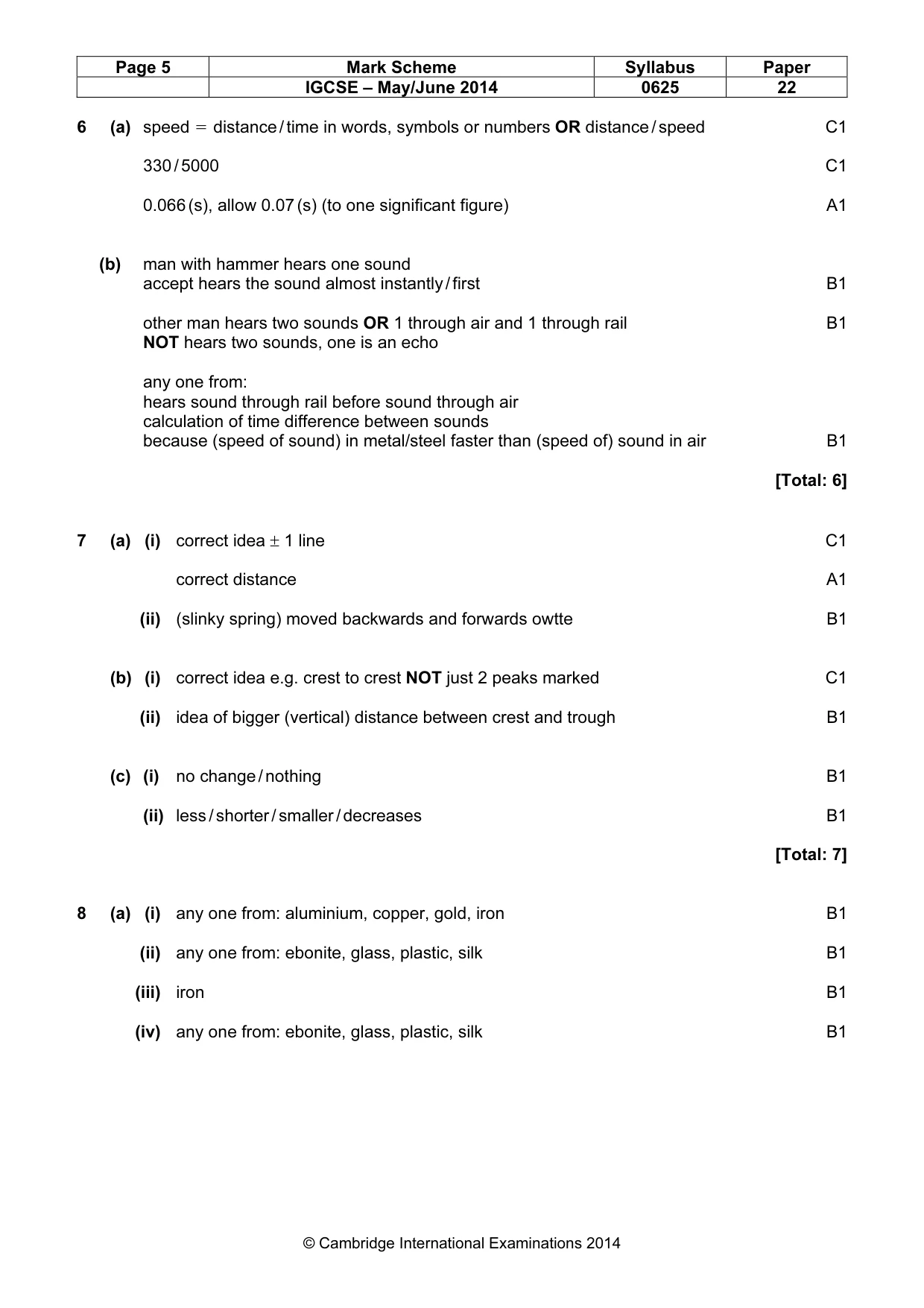
Page 5 Mark Scheme Syllabus Paper IGCSE – May/June 2014 0625 22 © Cambridge International Examinations 2014 6 (a) speed R distance / time in words, symbols or numbers OR distance / speed C1 330 / 5000 C1 0.066 (s), allow 0.07 (s) (to one significant figure) A1 (b) man with hammer hears one sound accept hears the sound almost instantly / first B1 other man hears two sounds OR 1 through air and 1 through rail B1 NOT hears two sounds, one is an echo any one from: hears sound through rail before sound through air calculation of time difference between sounds because (speed of sound) in metal/steel faster than (speed of) sound in air B1 [Total: 6] 7 (a) (i) correct idea ± 1 line C1 correct distance A1 (ii) (slinky spring) moved backwards and forwards owtte B1 (b) (i) correct idea e.g. crest to crest NOT just 2 peaks marked C1 (ii) idea of bigger (vertical) distance between crest and trough B1 (c) (i) no change / nothing B1 (ii) less / shorter / smaller / decreases B1 [Total: 7] 8 (a) (i) any one from: aluminium, copper, gold, iron B1 (ii) any one from: ebonite, glass, plastic, silk B1 (iii) iron B1 (iv) any one from: ebonite, glass, plastic, silk B1
Mark scheme, page 6
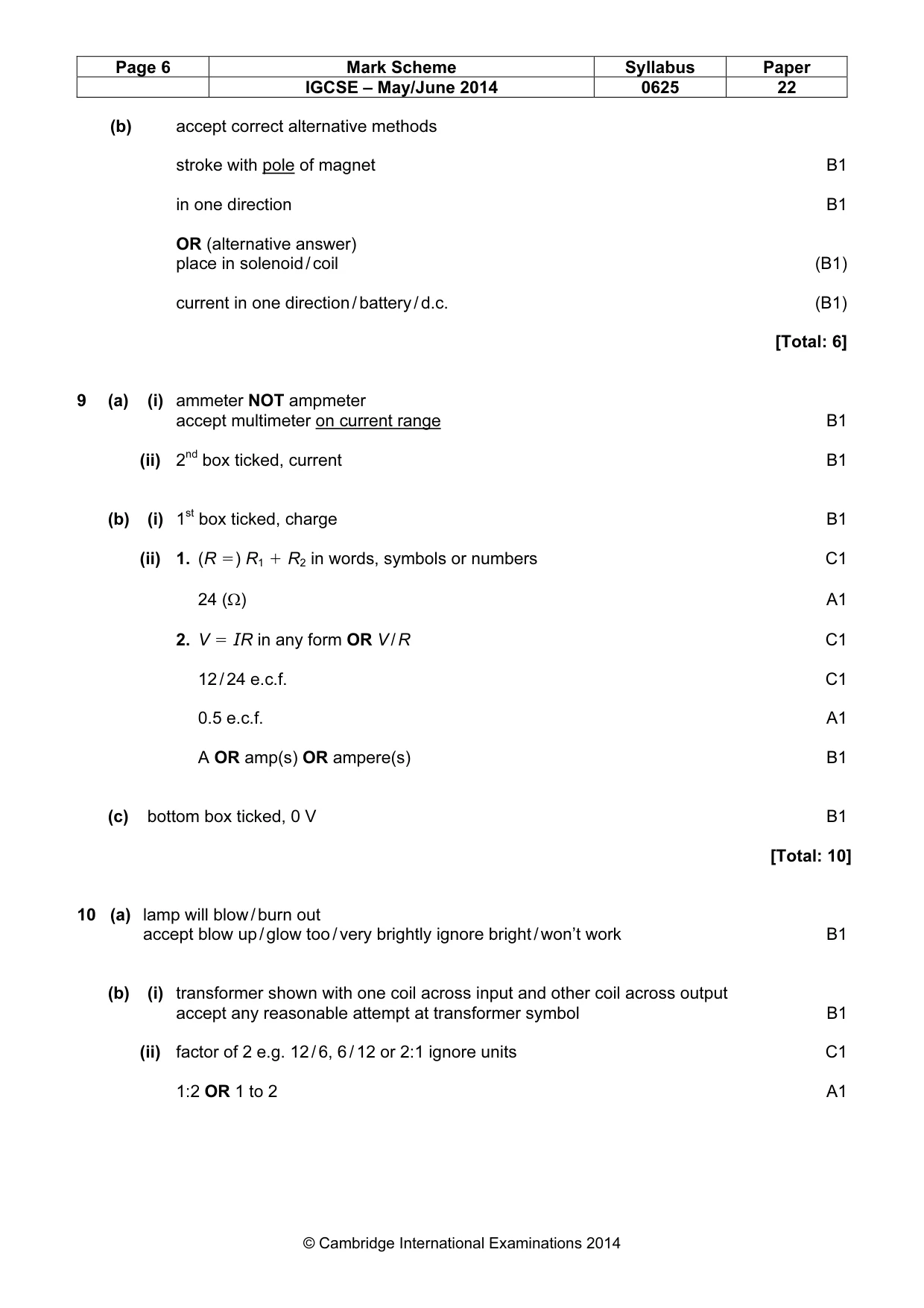
Page 6 Mark Scheme Syllabus Paper IGCSE – May/June 2014 0625 22 © Cambridge International Examinations 2014 (b) accept correct alternative methods stroke with pole of magnet B1 in one direction B1 OR (alternative answer) place in solenoid / coil (B1) current in one direction / battery / d.c. (B1) [Total: 6] 9 (a) (i) ammeter NOT ampmeter accept multimeter on current range B1 (ii) 2nd box ticked, current B1 (b) (i) 1st box ticked, charge B1 (ii) 1. (R R) R1 N R2 in words, symbols or numbers C1 24 (Ω) A1 2. V R IR in any form OR V / R C1 12 / 24 e.c.f. C1 0.5 e.c.f. A1 A OR amp(s) OR ampere(s) B1 (c) bottom box ticked, 0 V B1 [Total: 10] 10 (a) lamp will blow / burn out accept blow up / glow too / very brightly ignore bright / won’t work B1 (b) (i) transformer shown with one coil across input and other coil across output accept any reasonable attempt at transformer symbol B1 (ii) factor of 2 e.g. 12 / 6, 6 / 12 or 2:1 ignore units C1 1:2 OR 1 to 2 A1
Mark scheme, page 7
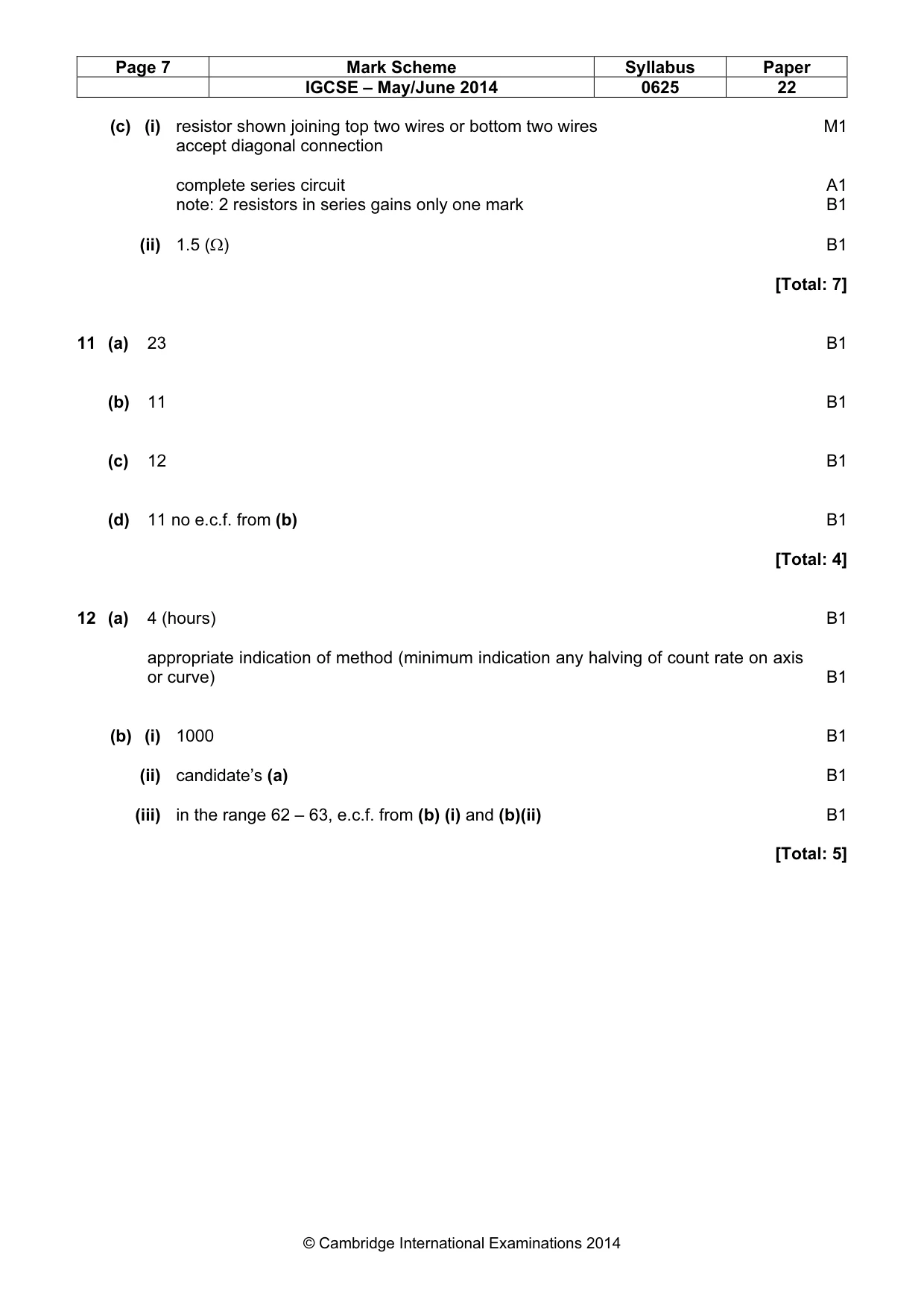
Page 7 Mark Scheme Syllabus Paper IGCSE – May/June 2014 0625 22 © Cambridge International Examinations 2014 (c) (i) resistor shown joining top two wires or bottom two wires M1 accept diagonal connection complete series circuit A1 note: 2 resistors in series gains only one mark B1 (ii) 1.5 (Ω) B1 [Total: 7] 11 (a) 23 B1 (b) 11 B1 (c) 12 B1 (d) 11 no e.c.f. from (b) B1 [Total: 4] 12 (a) 4 (hours) B1 appropriate indication of method (minimum indication any halving of count rate on axis or curve) B1 (b) (i) 1000 B1 (ii) candidate’s (a) B1 (iii) in the range 62 – 63, e.c.f. from (b) (i) and (b)(ii) B1 [Total: 5]
What you needed in this session
Cambridge’s own grade thresholds for 2014 May/June, Paper 2 · Variant 2. A higher threshold means an easier paper — the bar moves with how the cohort did.