Cambridge IGCSE Physics 0625 — 2013 Oct/Nov Paper 2 · Variant 3
0625/23/O/N/13
The question paper and its mark scheme, free to read here and free to download. This is Cambridge’s own paper, exactly as it was sat.
Question paper16 pages
Mark scheme7 pages
Answers below. Sit the paper first if you are practising.
Paper as text
Question paper, page 1
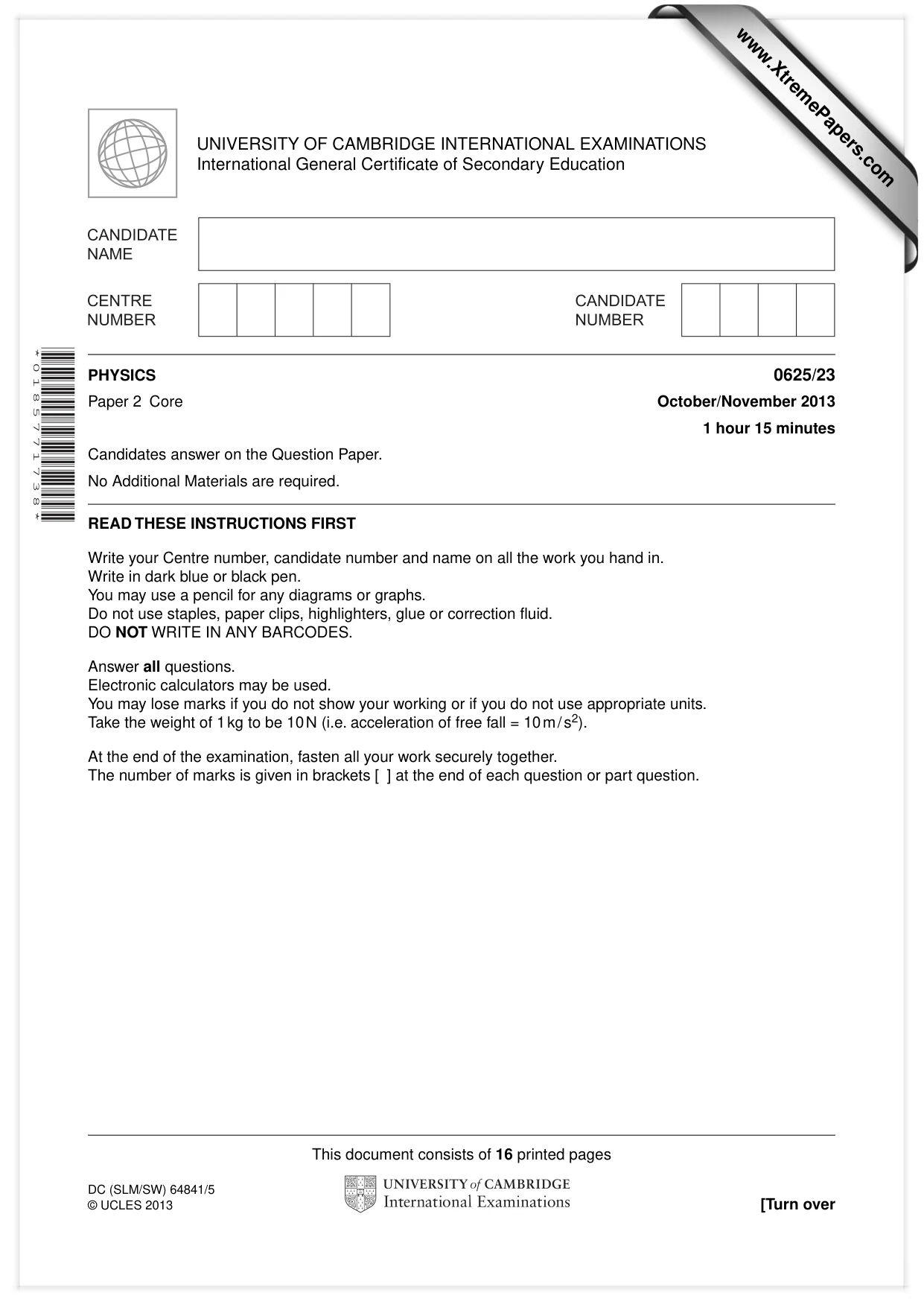
This document consists of 16 printed pages DC (SLM/SW) 64841/5 © UCLES 2013 [Turn over UNIVERSITY OF CAMBRIDGE INTERNATIONAL EXAMINATIONS International General Certificate of Secondary Education * 0 1 8 5 7 7 1 7 3 8 * PHYSICS 0625/23 Paper 2 Core October/November 2013 1 hour 15 minutes Candidates answer on the Question Paper. No Additional Materials are required. READ THESE INSTRUCTIONS FIRST Write your Centre number, candidate number and name on all the work you hand in. Write in dark blue or black pen. You may use a pencil for any diagrams or graphs. Do not use staples, paper clips, highlighters, glue or correction fluid. DO NOT WRITE IN ANY BARCODES. Answer all questions. Electronic calculators may be used. You may lose marks if you do not show your working or if you do not use appropriate units. Take the weight of 1 kg to be 10 N (i.e. acceleration of free fall = 10 m / s2). At the end of the examination, fasten all your work securely together. The number of marks is given in brackets [ ] at the end of each question or part question. www.XtremePapers.com
Question paper, page 2
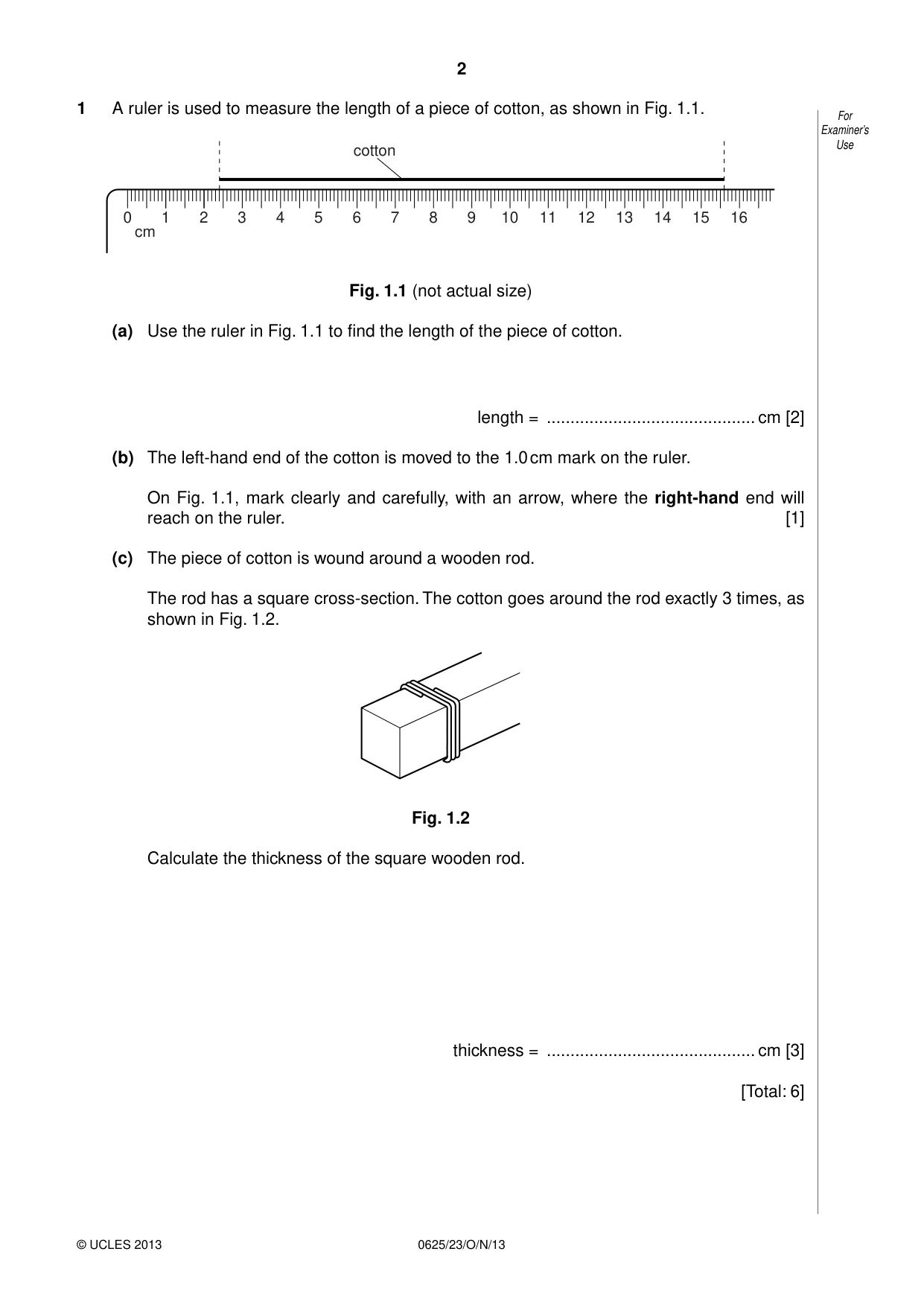
2 0625/23/O/N/13 © UCLES 2013 For Examiner’s Use 1 A ruler is used to measure the length of a piece of cotton, as shown in Fig. 1.1. 1 0 cm 2 3 4 5 6 7 8 9 10 11 12 13 14 15 16 cotton Fig. 1.1 (not actual size) (a) Use the ruler in Fig. 1.1 to find the length of the piece of cotton. length = … cm [2] (b) The left-hand end of the cotton is moved to the 1.0 cm mark on the ruler. On Fig. 1.1, mark clearly and carefully, with an arrow, where the right-hand end will reach on the ruler. [1] (c) The piece of cotton is wound around a wooden rod. The rod has a square cross-section. The cotton goes around the rod exactly 3 times, as shown in Fig. 1.2. Fig. 1.2 Calculate the thickness of the square wooden rod. thickness = … cm [3] [Total: 6]
Question paper, page 3
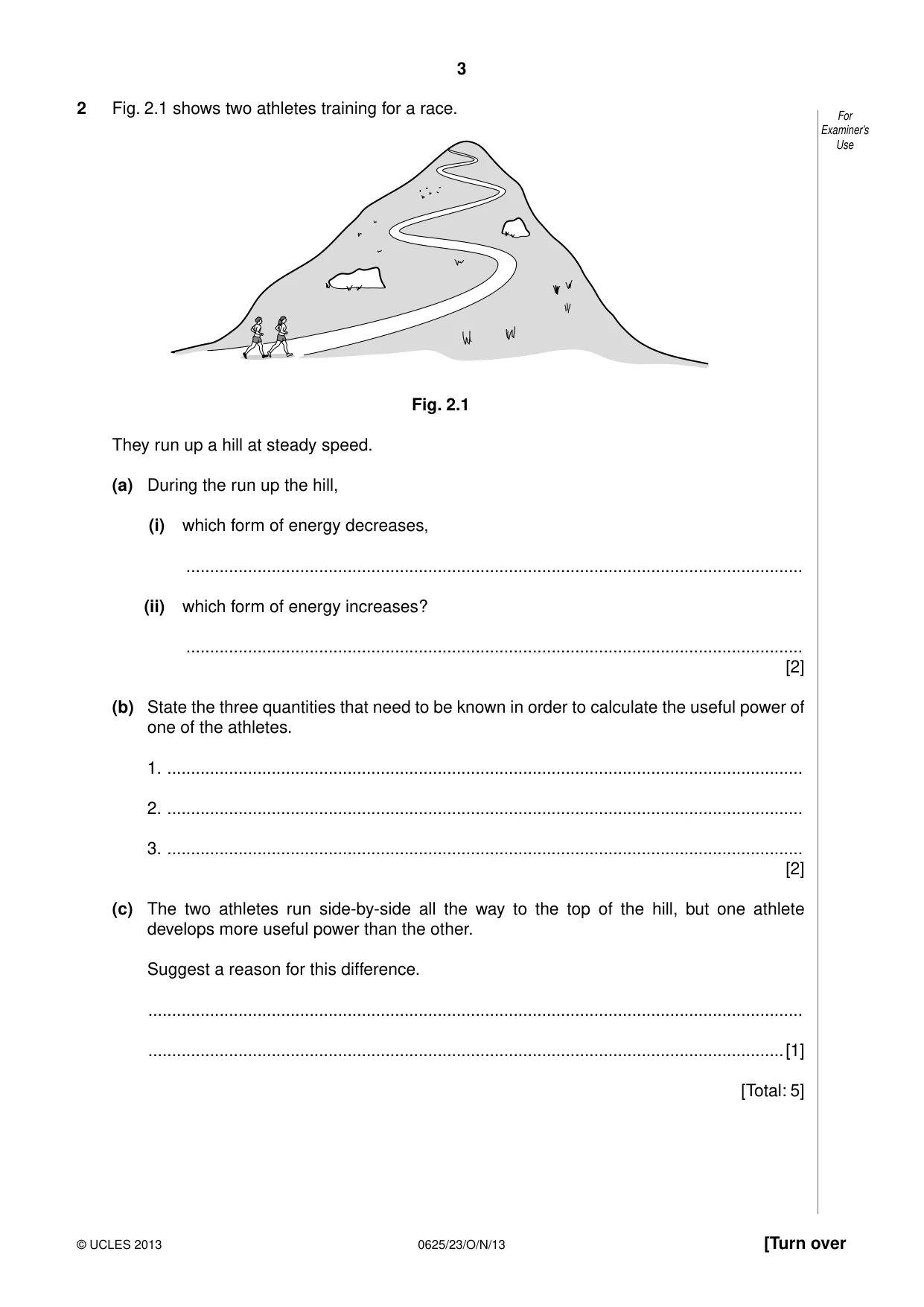
3 0625/23/O/N/13 © UCLES 2013 [Turn over For Examiner’s Use 2 Fig. 2.1 shows two athletes training for a race. Fig. 2.1 They run up a hill at steady speed. (a) During the run up the hill, (i) which form of energy decreases, … (ii) which form of energy increases? … [2] (b) State the three quantities that need to be known in order to calculate the useful power of one of the athletes. 1. … 2. … 3. … [2] (c) The two athletes run side-by-side all the way to the top of the hill, but one athlete develops more useful power than the other. Suggest a reason for this difference. … …[1] [Total: 5]
Question paper, page 4
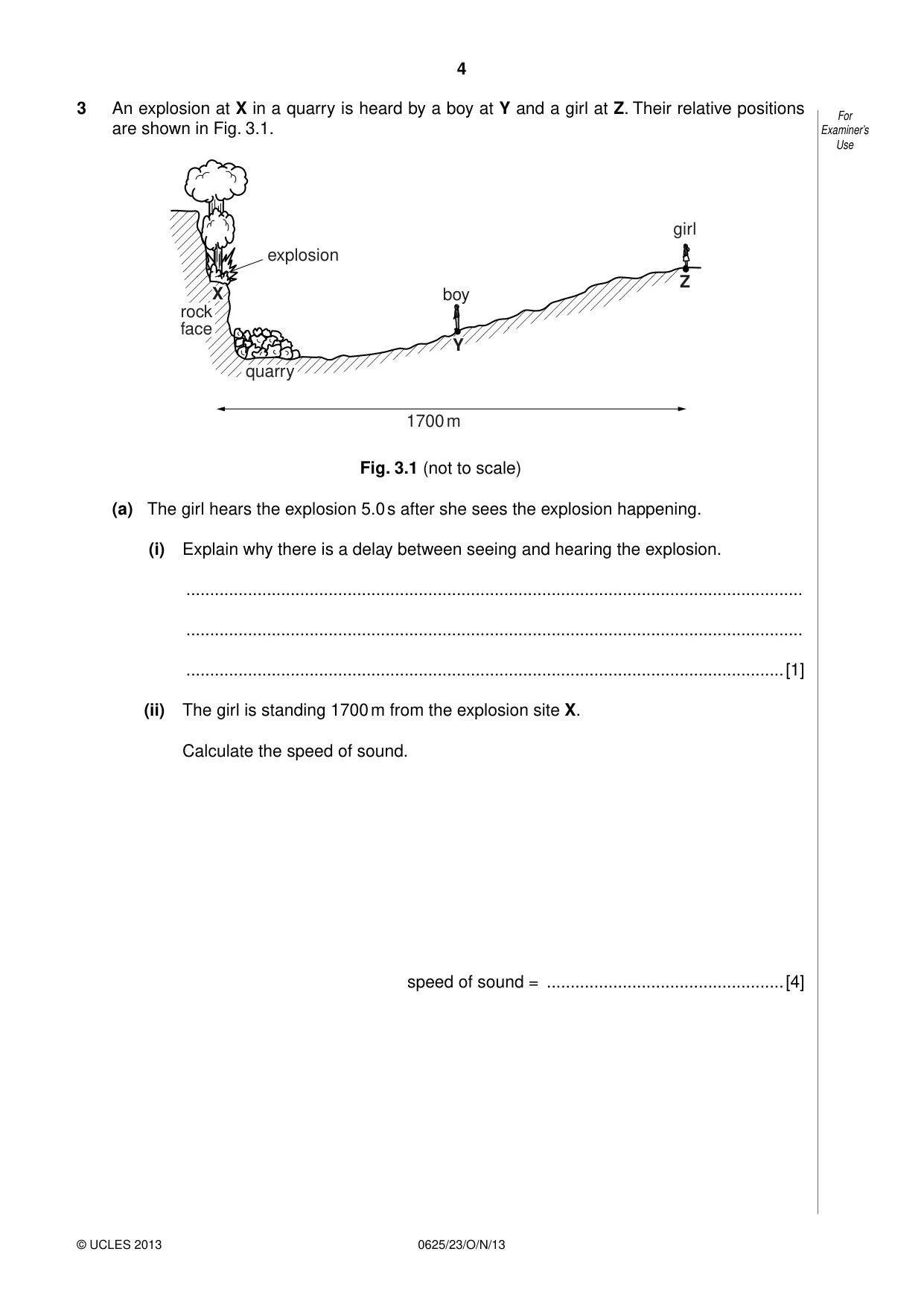
4 0625/23/O/N/13 © UCLES 2013 For Examiner’s Use 3 An explosion at X in a quarry is heard by a boy at Y and a girl at Z. Their relative positions are shown in Fig. 3.1. X quarry boy 1700 m girl explosion rock face Y Z Fig. 3.1 (not to scale) (a) The girl hears the explosion 5.0 s after she sees the explosion happening. (i) Explain why there is a delay between seeing and hearing the explosion. … … …[1] (ii) The girl is standing 1700 m from the explosion site X. Calculate the speed of sound. speed of sound = …[4]
Question paper, page 5
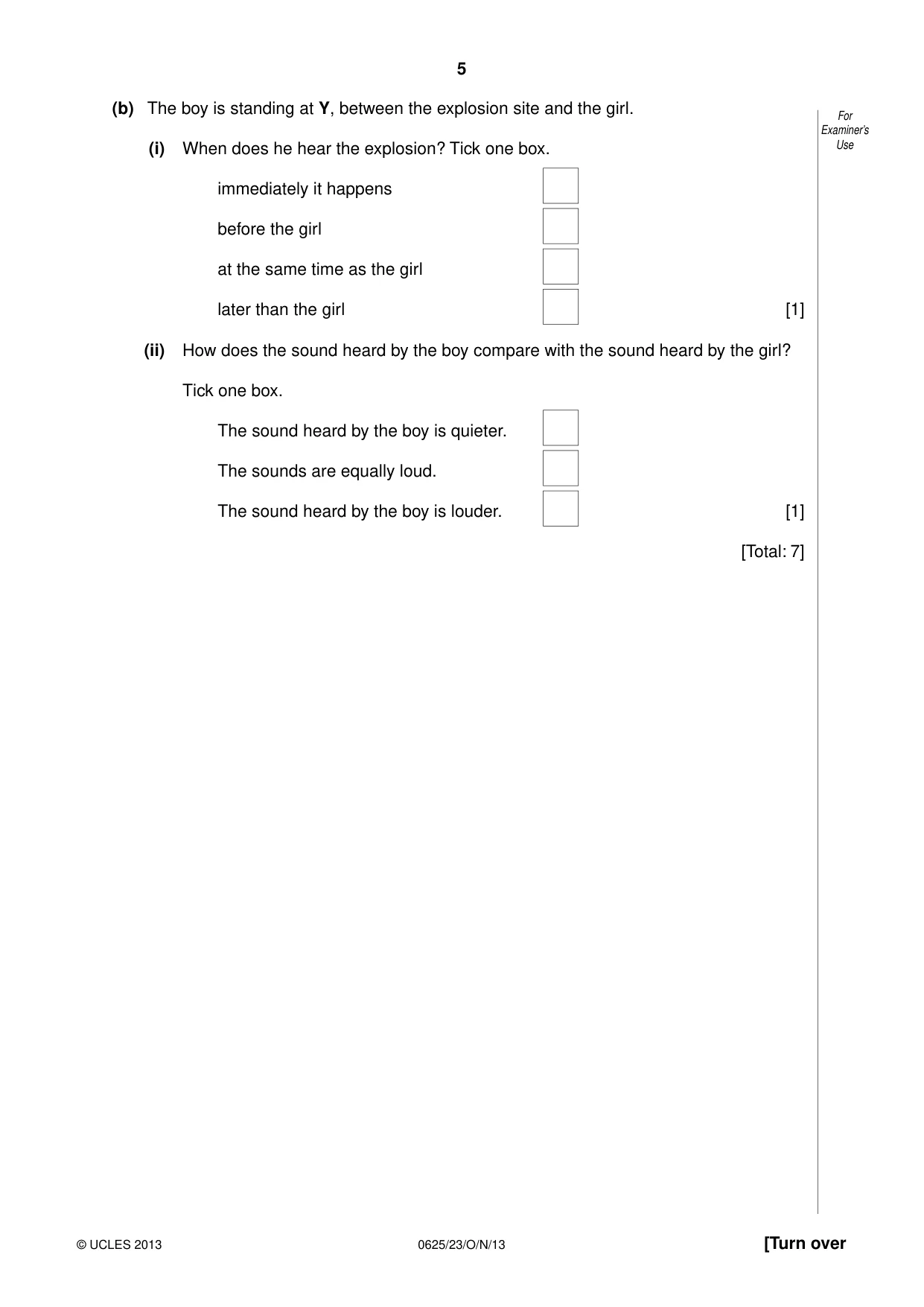
5 0625/23/O/N/13 © UCLES 2013 [Turn over For Examiner’s Use (b) The boy is standing at Y, between the explosion site and the girl. (i) When does he hear the explosion? Tick one box. immediately it happens before the girl at the same time as the girl later than the girl [1] (ii) How does the sound heard by the boy compare with the sound heard by the girl? Tick one box. The sound heard by the boy is quieter. The sounds are equally loud. The sound heard by the boy is louder. [1] [Total: 7]
Question paper, page 6
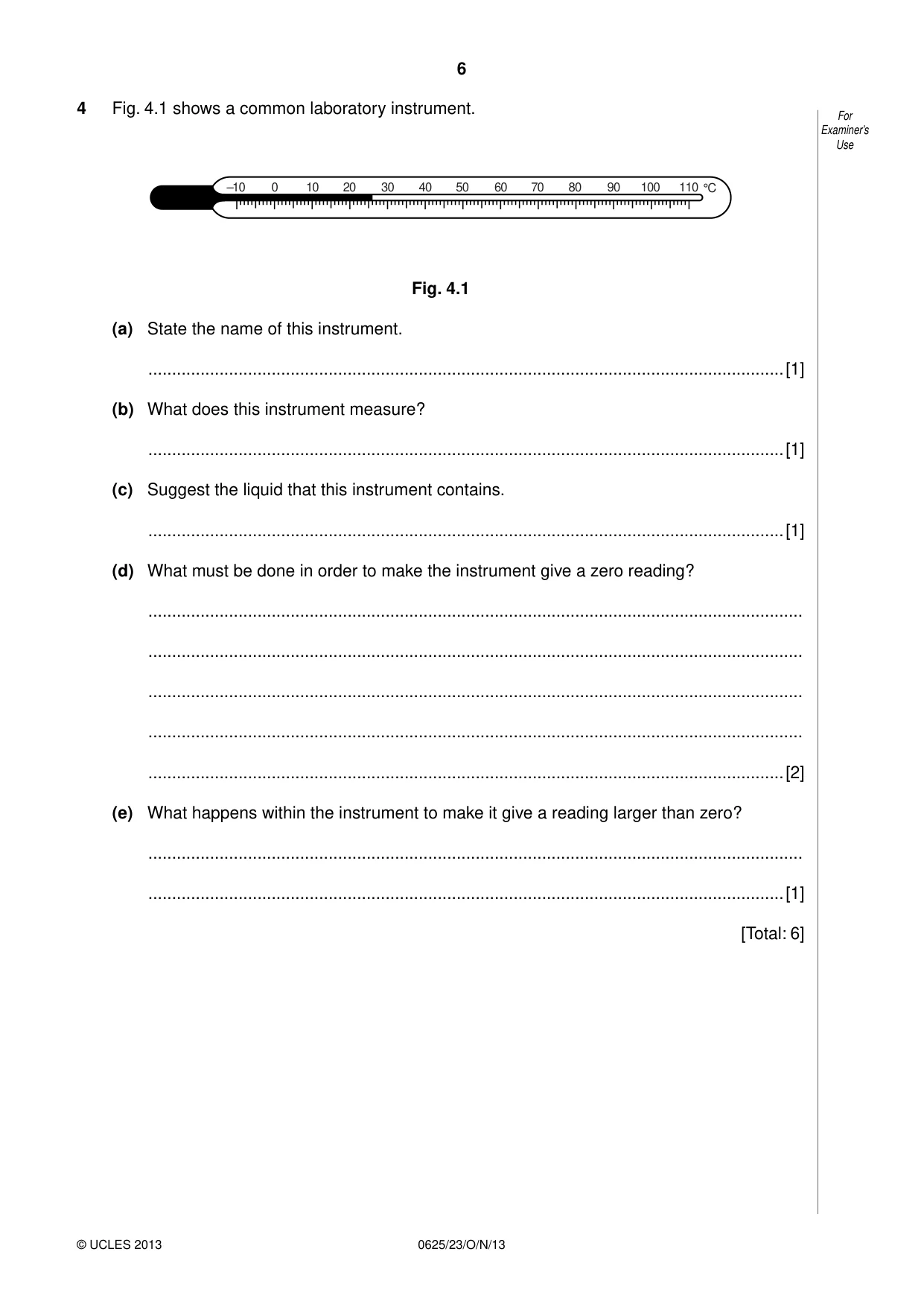
6 0625/23/O/N/13 © UCLES 2013 For Examiner’s Use 4 Fig. 4.1 shows a common laboratory instrument. –10 0 10 20 30 40 50 60 70 80 90 100 110 °C Fig. 4.1 (a) State the name of this instrument. …[1] (b) What does this instrument measure? …[1] (c) Suggest the liquid that this instrument contains. …[1] (d) What must be done in order to make the instrument give a zero reading? … … … … …[2] (e) What happens within the instrument to make it give a reading larger than zero? … …[1] [Total: 6]
Question paper, page 7
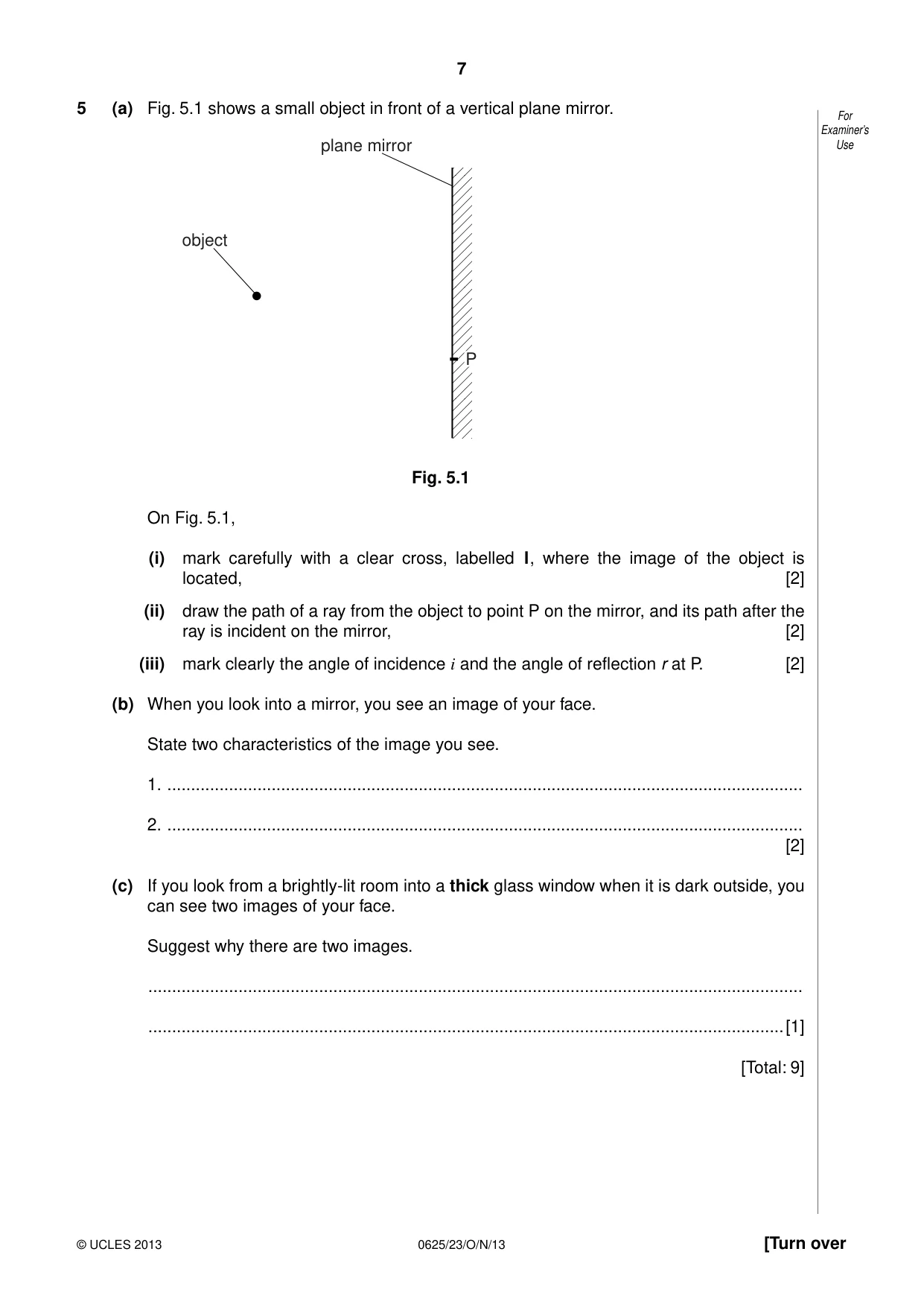
7 0625/23/O/N/13 © UCLES 2013 [Turn over For Examiner’s Use 5 (a) Fig. 5.1 shows a small object in front of a vertical plane mirror. P object plane mirror Fig. 5.1 On Fig. 5.1, (i) mark carefully with a clear cross, labelled I, where the image of the object is located, [2] (ii) draw the path of a ray from the object to point P on the mirror, and its path after the ray is incident on the mirror, [2] (iii) mark clearly the angle of incidence i and the angle of reflection r at P. [2] (b) When you look into a mirror, you see an image of your face. State two characteristics of the image you see. 1. … 2. … [2] (c) If you look from a brightly-lit room into a thick glass window when it is dark outside, you can see two images of your face. Suggest why there are two images. … …[1] [Total: 9]
Question paper, page 8
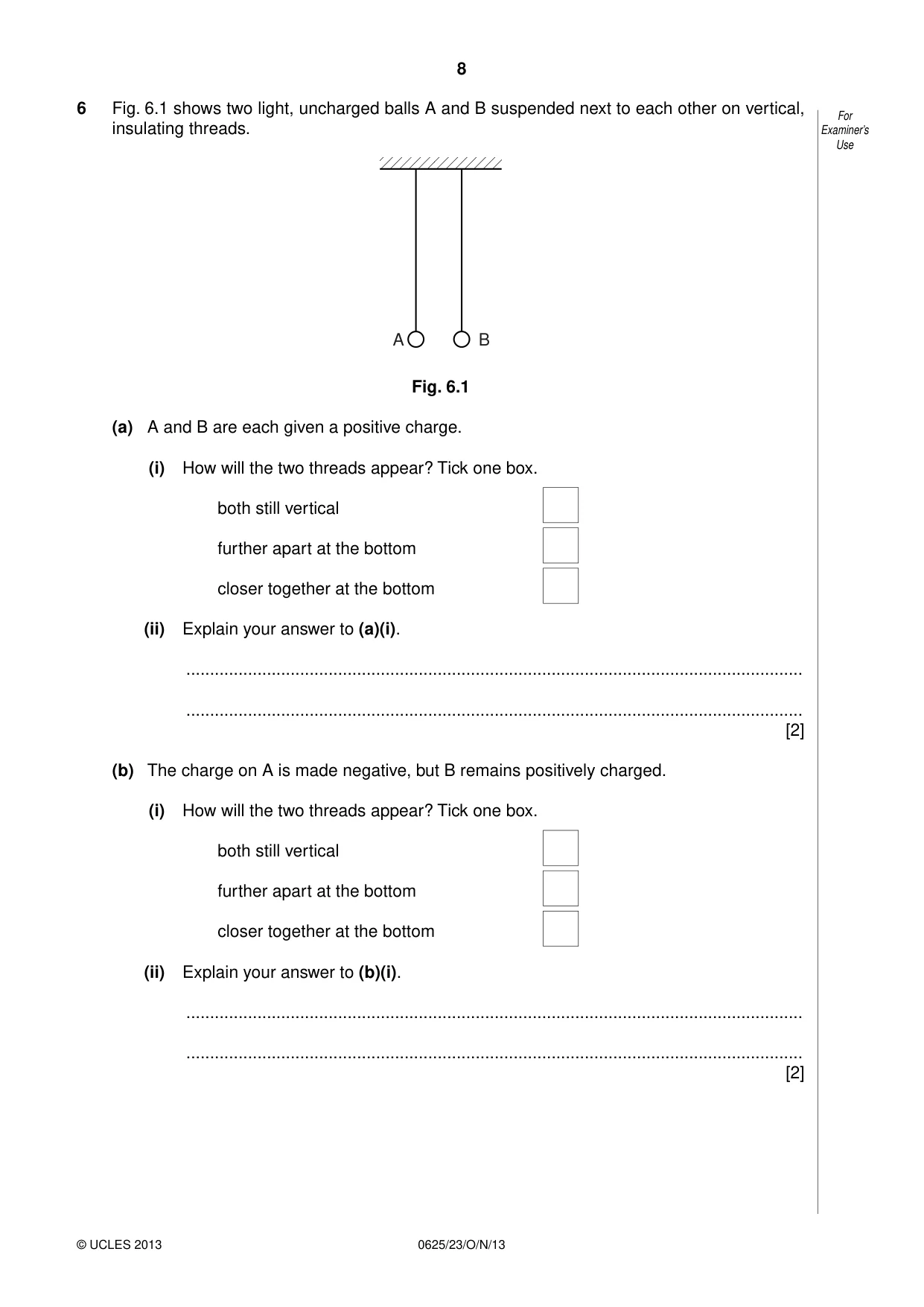
8 0625/23/O/N/13 © UCLES 2013 For Examiner’s Use 6 Fig. 6.1 shows two light, uncharged balls A and B suspended next to each other on vertical, insulating threads. A B Fig. 6.1 (a) A and B are each given a positive charge. (i) How will the two threads appear? Tick one box. both still vertical further apart at the bottom closer together at the bottom (ii) Explain your answer to (a)(i). … … [2] (b) The charge on A is made negative, but B remains positively charged. (i) How will the two threads appear? Tick one box. both still vertical further apart at the bottom closer together at the bottom (ii) Explain your answer to (b)(i). … … [2]
Question paper, page 9
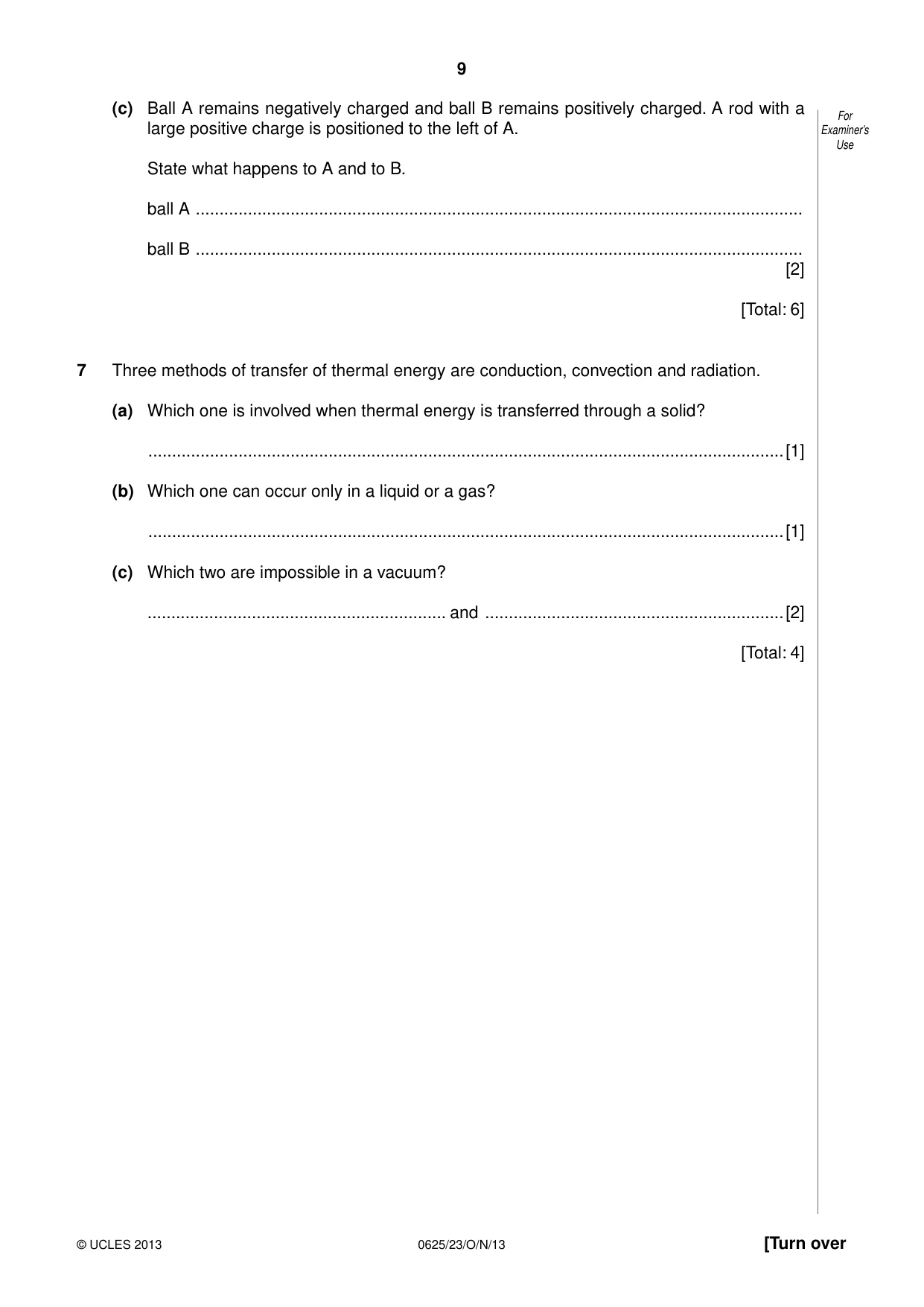
9 0625/23/O/N/13 © UCLES 2013 [Turn over For Examiner’s Use (c) Ball A remains negatively charged and ball B remains positively charged. A rod with a large positive charge is positioned to the left of A. State what happens to A and to B. ball A … ball B … [2] [Total: 6] 7 Three methods of transfer of thermal energy are conduction, convection and radiation. (a) Which one is involved when thermal energy is transferred through a solid? …[1] (b) Which one can occur only in a liquid or a gas? …[1] (c) Which two are impossible in a vacuum? … and …[2] [Total: 4]
Question paper, page 10
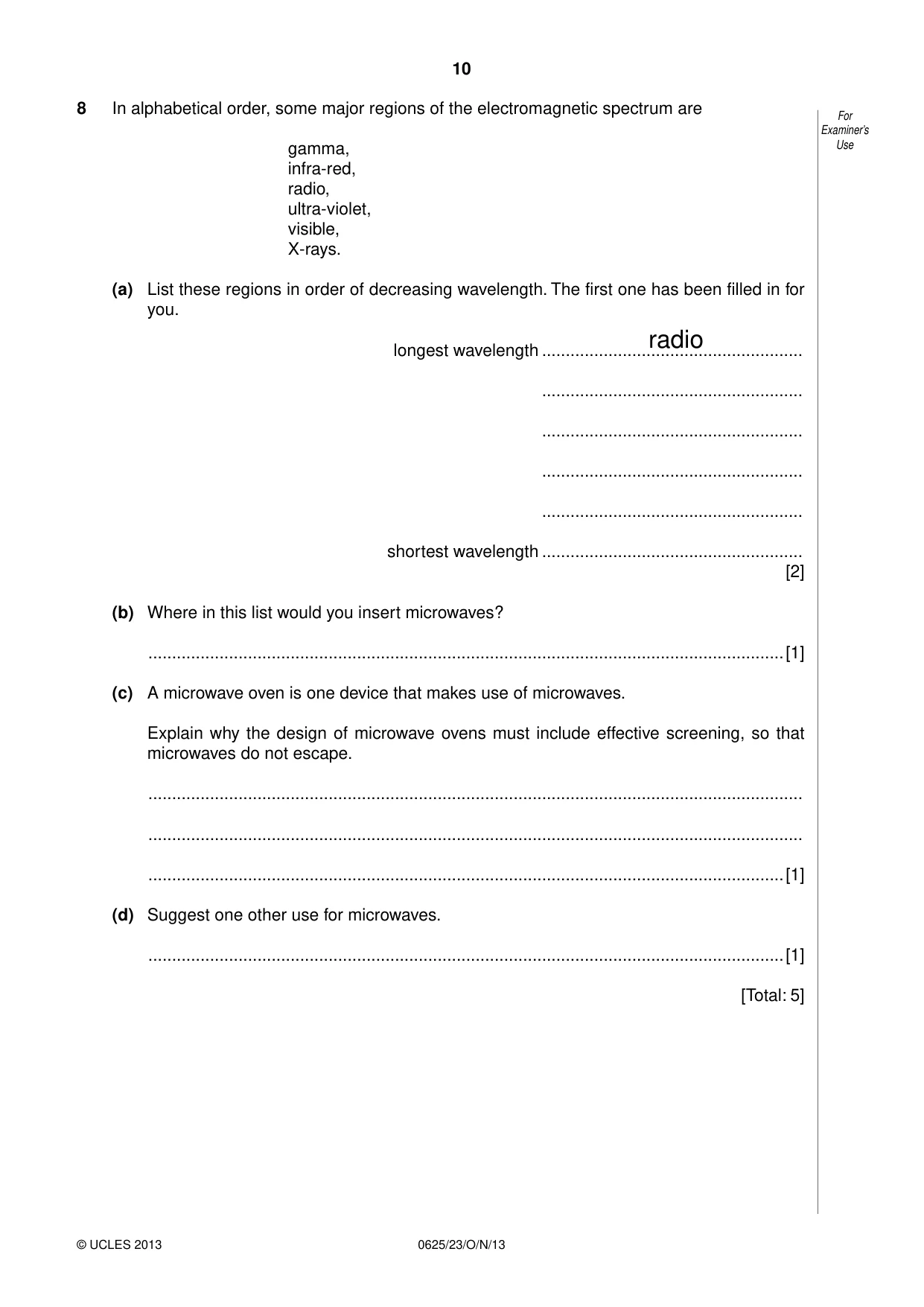
10 0625/23/O/N/13 © UCLES 2013 For Examiner’s Use 8 In alphabetical order, some major regions of the electromagnetic spectrum are gamma, infra-red, radio, ultra-violet, visible, X-rays. (a) List these regions in order of decreasing wavelength. The first one has been filled in for you. radio longest wavelength … … … … … shortest wavelength … [2] (b) Where in this list would you insert microwaves? …[1] (c) A microwave oven is one device that makes use of microwaves. Explain why the design of microwave ovens must include effective screening, so that microwaves do not escape. … … …[1] (d) Suggest one other use for microwaves. …[1] [Total: 5]
Question paper, page 11
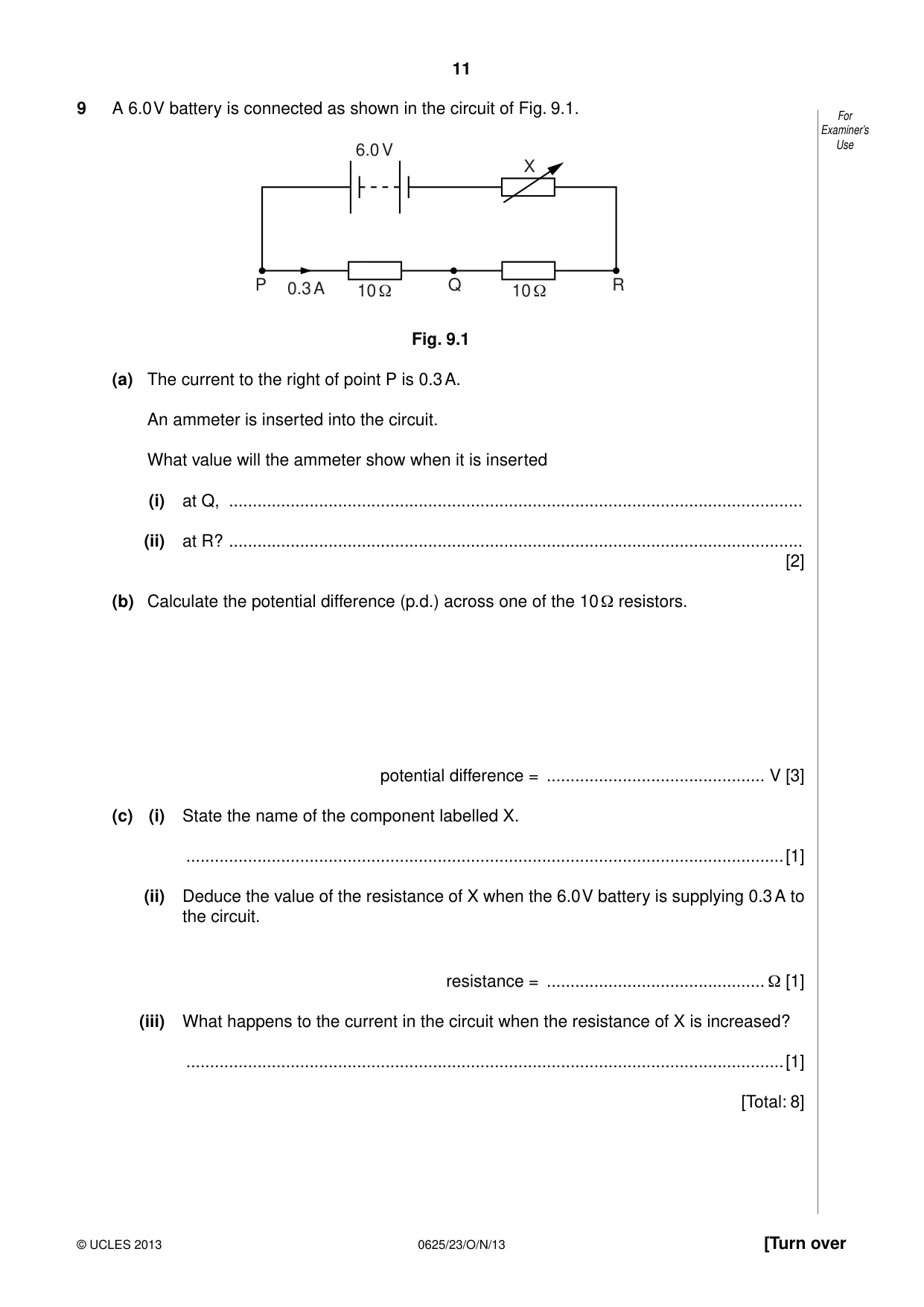
11 0625/23/O/N/13 © UCLES 2013 [Turn over For Examiner’s Use 9 A 6.0 V battery is connected as shown in the circuit of Fig. 9.1. 6.0 V 0.3 A 10 1 10 1 Q P R X Fig. 9.1 (a) The current to the right of point P is 0.3 A. An ammeter is inserted into the circuit. What value will the ammeter show when it is inserted (i) at Q, … (ii) at R? … [2] (b) Calculate the potential difference (p.d.) across one of the 10 Ω resistors. potential difference = … V [3] (c) (i) State the name of the component labelled X. …[1] (ii) Deduce the value of the resistance of X when the 6.0 V battery is supplying 0.3 A to the circuit. resistance = … Ω [1] (iii) What happens to the current in the circuit when the resistance of X is increased? …[1] [Total: 8]
Question paper, page 12
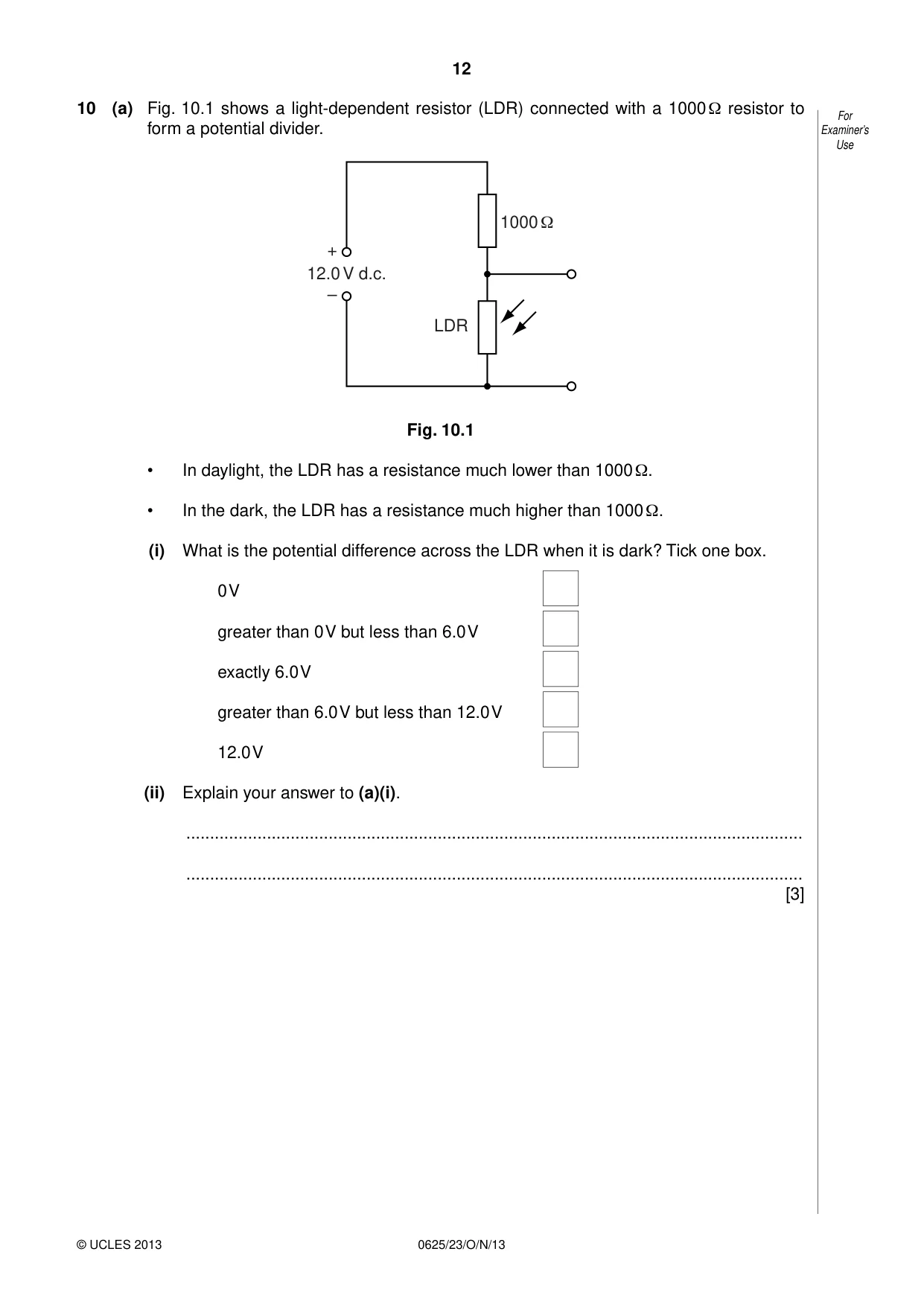
12 0625/23/O/N/13 © UCLES 2013 For Examiner’s Use 10 (a) Fig. 10.1 shows a light-dependent resistor (LDR) connected with a 1000 Ω resistor to form a potential divider. 1000 1 + – 12.0 V d.c. LDR Fig. 10.1 • In daylight, the LDR has a resistance much lower than 1000 Ω. • In the dark, the LDR has a resistance much higher than 1000 Ω. (i) What is the potential difference across the LDR when it is dark? Tick one box. 0 V greater than 0 V but less than 6.0 V exactly 6.0 V greater than 6.0 V but less than 12.0 V 12.0 V (ii) Explain your answer to (a)(i). … … [3]
Question paper, page 13
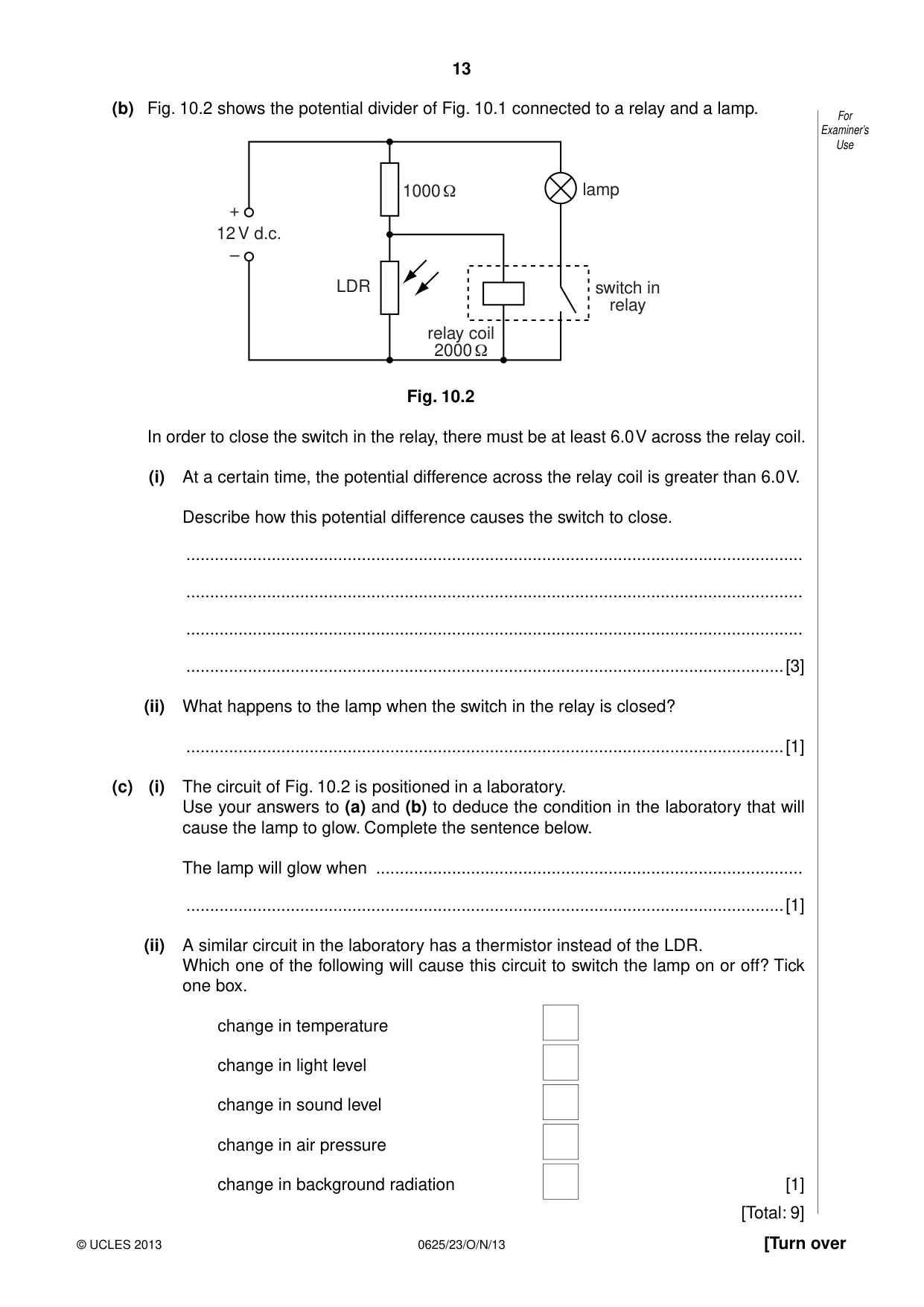
13 0625/23/O/N/13 © UCLES 2013 [Turn over For Examiner’s Use (b) Fig. 10.2 shows the potential divider of Fig. 10.1 connected to a relay and a lamp. 1000 1 relay coil 2000 1 switch in relay lamp + – 12 V d.c. LDR Fig. 10.2 In order to close the switch in the relay, there must be at least 6.0 V across the relay coil. (i) At a certain time, the potential difference across the relay coil is greater than 6.0 V. Describe how this potential difference causes the switch to close. … … … …[3] (ii) What happens to the lamp when the switch in the relay is closed? …[1] (c) (i) The circuit of Fig. 10.2 is positioned in a laboratory. Use your answers to (a) and (b) to deduce the condition in the laboratory that will cause the lamp to glow. Complete the sentence below. The lamp will glow when … …[1] (ii) A similar circuit in the laboratory has a thermistor instead of the LDR. Which one of the following will cause this circuit to switch the lamp on or off? Tick one box. change in temperature change in light level change in sound level change in air pressure change in background radiation [1] [Total: 9]
Question paper, page 14
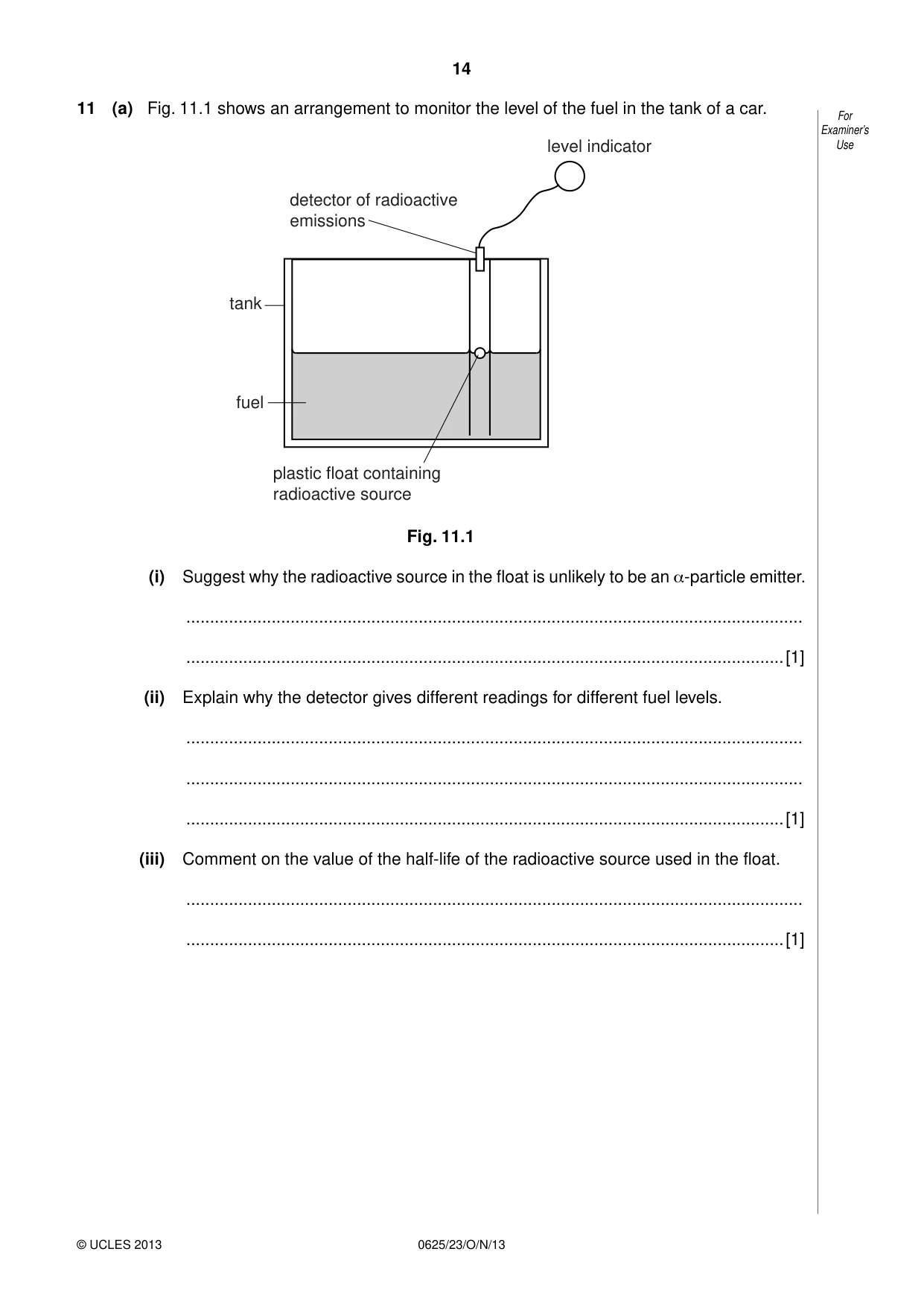
14 0625/23/O/N/13 © UCLES 2013 For Examiner’s Use 11 (a) Fig. 11.1 shows an arrangement to monitor the level of the fuel in the tank of a car. tank fuel detector of radioactive emissions plastic float containing radioactive source level indicator Fig. 11.1 (i) Suggest why the radioactive source in the float is unlikely to be an α-particle emitter. … …[1] (ii) Explain why the detector gives different readings for different fuel levels. … … …[1] (iii) Comment on the value of the half-life of the radioactive source used in the float. … …[1]
Question paper, page 15
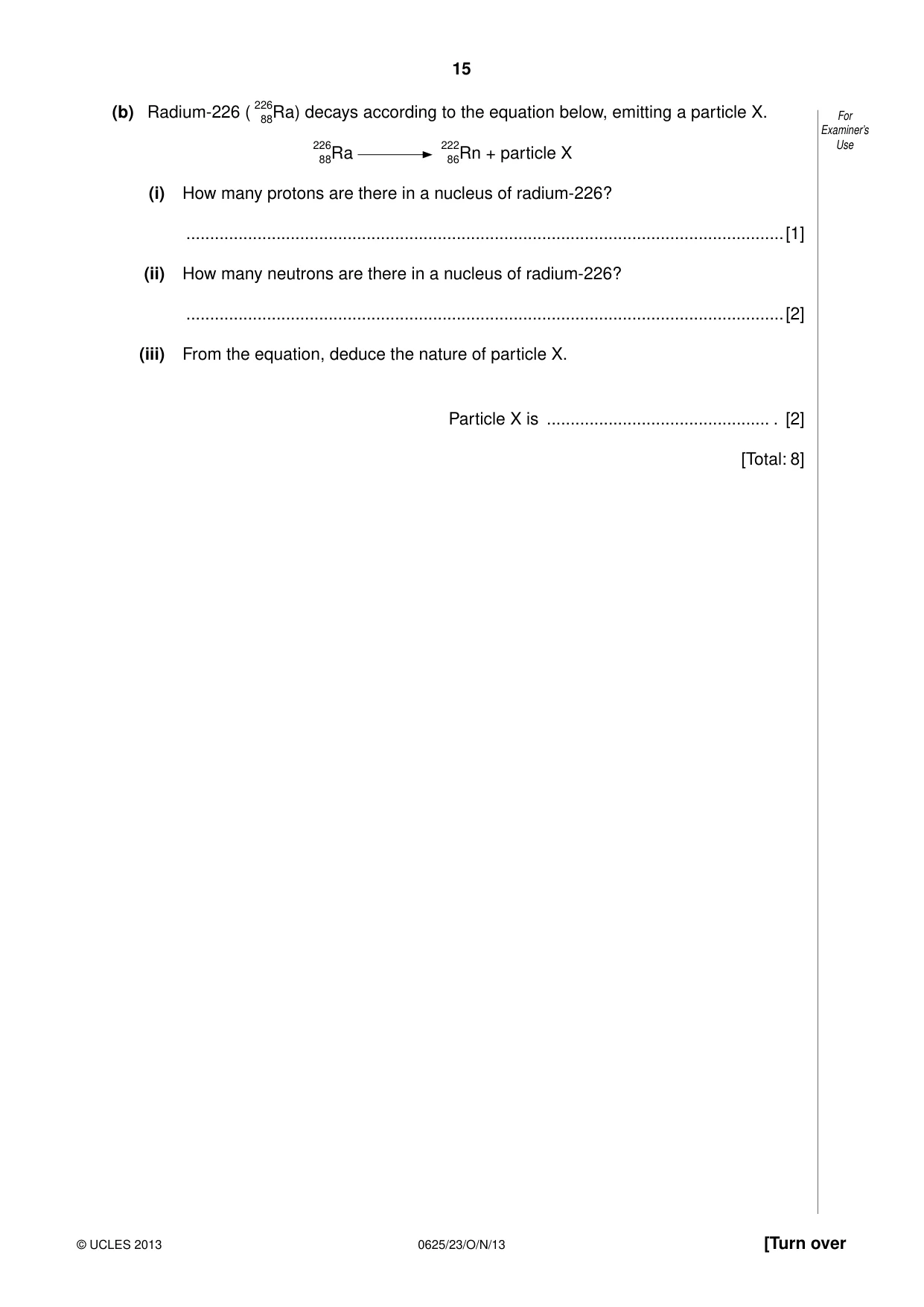
15 0625/23/O/N/13 © UCLES 2013 [Turn over For Examiner’s Use (b) Radium-226 ( 226 88Ra) decays according to the equation below, emitting a particle X. 226 88Ra 222 86Rn + particle X (i) How many protons are there in a nucleus of radium-226? …[1] (ii) How many neutrons are there in a nucleus of radium-226? …[2] (iii) From the equation, deduce the nature of particle X. Particle X is … . [2] [Total: 8]
Question paper, page 16
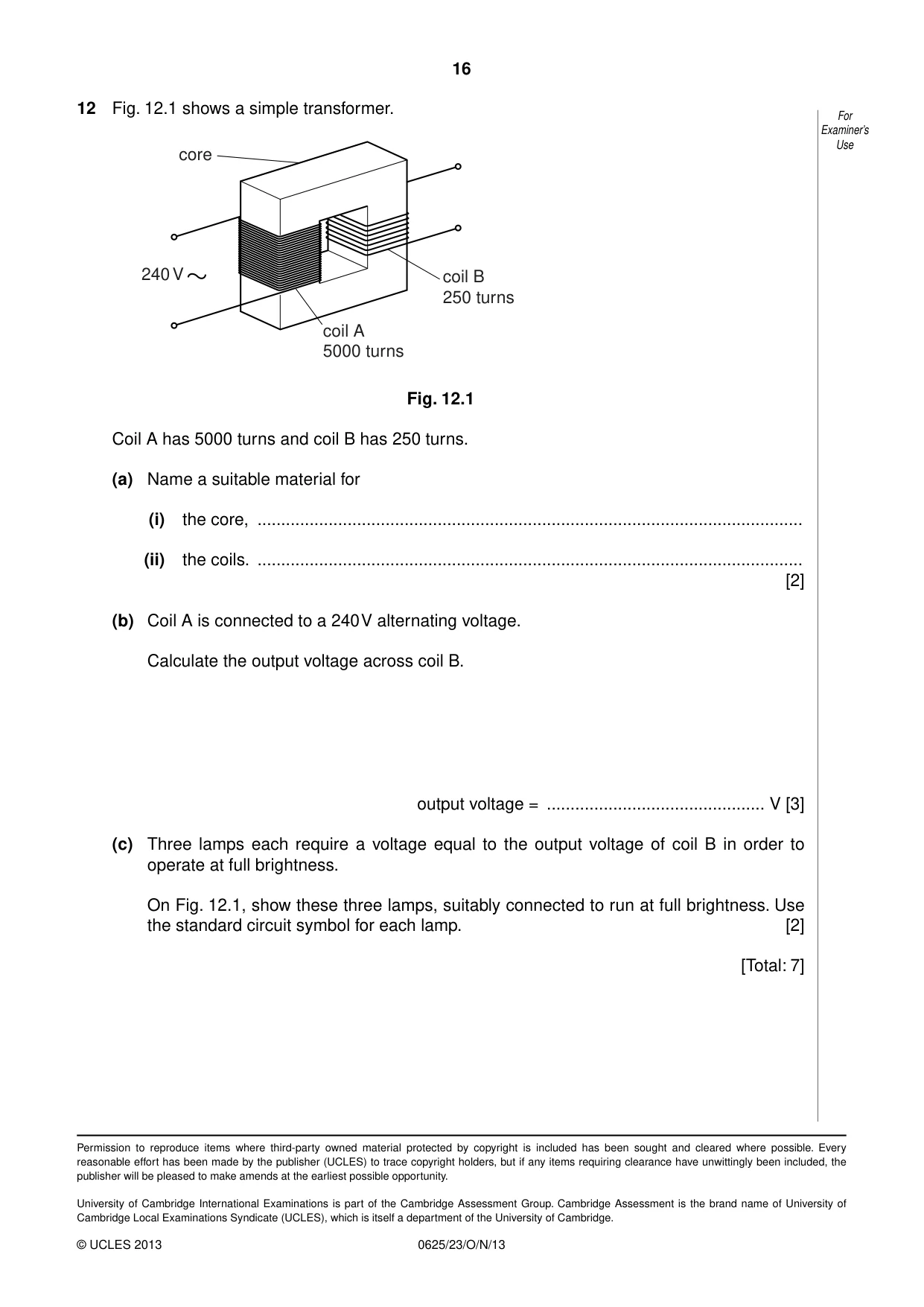
16 0625/23/O/N/13 © UCLES 2013 For Examiner’s Use Permission to reproduce items where third-party owned material protected by copyright is included has been sought and cleared where possible. Every reasonable effort has been made by the publisher (UCLES) to trace copyright holders, but if any items requiring clearance have unwittingly been included, the publisher will be pleased to make amends at the earliest possible opportunity. University of Cambridge International Examinations is part of the Cambridge Assessment Group. Cambridge Assessment is the brand name of University of Cambridge Local Examinations Syndicate (UCLES), which is itself a department of the University of Cambridge. 12 Fig. 12.1 shows a simple transformer. coil A 5000 turns core 240 V coil B 250 turns Fig. 12.1 Coil A has 5000 turns and coil B has 250 turns. (a) Name a suitable material for (i) the core, … (ii) the coils. … [2] (b) Coil A is connected to a 240 V alternating voltage. Calculate the output voltage across coil B. output voltage = … V [3] (c) Three lamps each require a voltage equal to the output voltage of coil B in order to operate at full brightness. On Fig. 12.1, show these three lamps, suitably connected to run at full brightness. Use the standard circuit symbol for each lamp. [2] [Total: 7]
Mark scheme, page 1
CAMBRIDGE INTERNATIONAL EXAMINATIONS International General Certificate of Secondary Education MARK SCHEME for the October/November 2013 series 0625 PHYSICS 0625/23 Paper 2 (Core Theory), maximum raw mark 80 This mark scheme is published as an aid to teachers and candidates, to indicate the requirements of the examination. It shows the basis on which Examiners were instructed to award marks. It does not indicate the details of the discussions that took place at an Examiners’ meeting before marking began, which would have considered the acceptability of alternative answers. Mark schemes should be read in conjunction with the question paper and the Principal Examiner Report for Teachers. Cambridge will not enter into discussions about these mark schemes. Cambridge is publishing the mark schemes for the October/November 2013 series for most IGCSE, GCE Advanced Level and Advanced Subsidiary Level components and some Ordinary Level components. www.XtremePapers.com
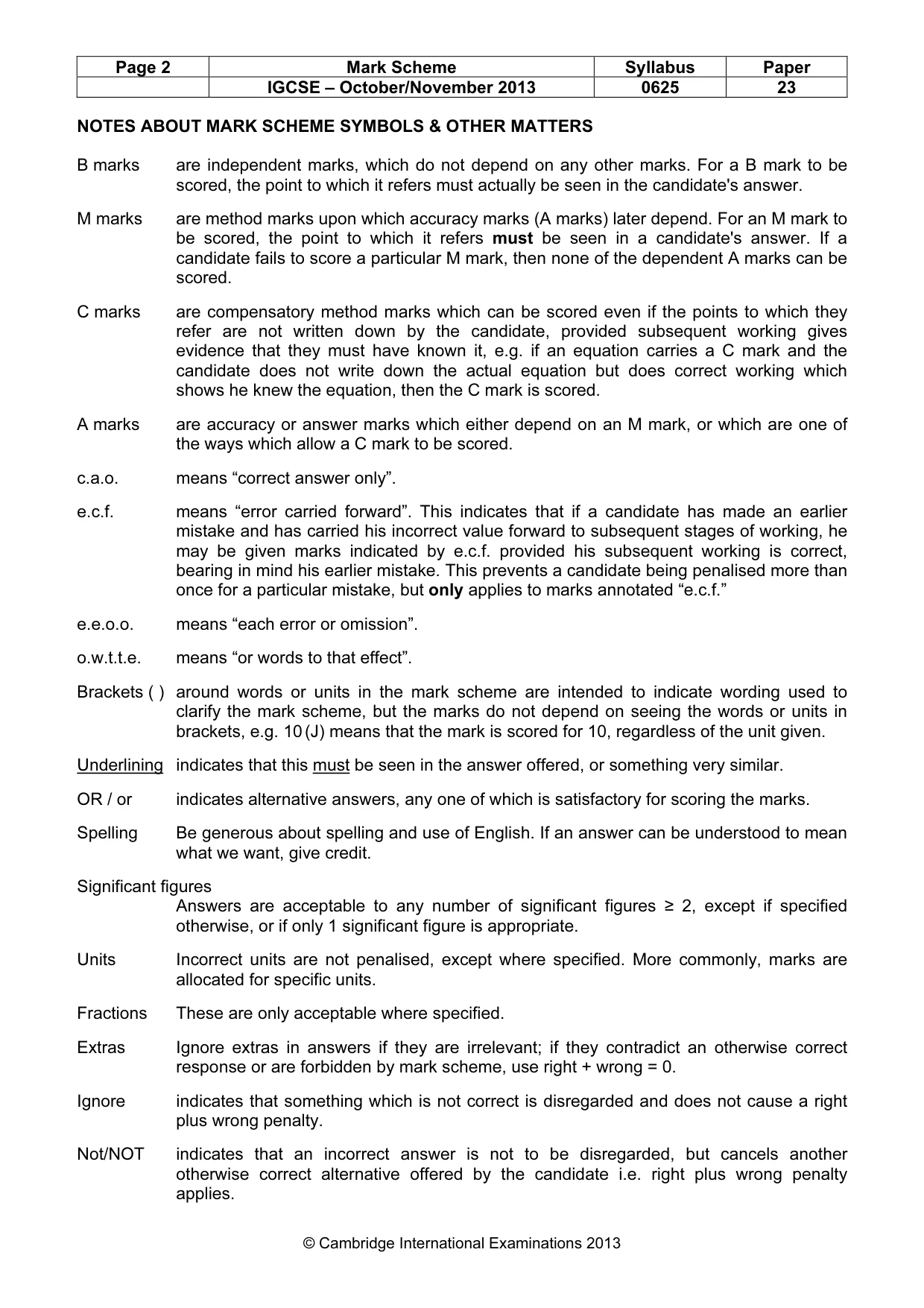
Mark scheme, page 2
Page 2 Mark Scheme Syllabus Paper IGCSE – October/November 2013 0625 23 © Cambridge International Examinations 2013 NOTES ABOUT MARK SCHEME SYMBOLS & OTHER MATTERS B marks are independent marks, which do not depend on any other marks. For a B mark to be scored, the point to which it refers must actually be seen in the candidate's answer. M marks are method marks upon which accuracy marks (A marks) later depend. For an M mark to be scored, the point to which it refers must be seen in a candidate's answer. If a candidate fails to score a particular M mark, then none of the dependent A marks can be scored. C marks are compensatory method marks which can be scored even if the points to which they refer are not written down by the candidate, provided subsequent working gives evidence that they must have known it, e.g. if an equation carries a C mark and the candidate does not write down the actual equation but does correct working which shows he knew the equation, then the C mark is scored. A marks are accuracy or answer marks which either depend on an M mark, or which are one of the ways which allow a C mark to be scored. c.a.o. means “correct answer only”. e.c.f. means “error carried forward”. This indicates that if a candidate has made an earlier mistake and has carried his incorrect value forward to subsequent stages of working, he may be given marks indicated by e.c.f. provided his subsequent working is correct, bearing in mind his earlier mistake. This prevents a candidate being penalised more than once for a particular mistake, but only applies to marks annotated “e.c.f.” e.e.o.o. means “each error or omission”. o.w.t.t.e. means “or words to that effect”. Brackets ( ) around words or units in the mark scheme are intended to indicate wording used to clarify the mark scheme, but the marks do not depend on seeing the words or units in brackets, e.g. 10 (J) means that the mark is scored for 10, regardless of the unit given. Underlining indicates that this must be seen in the answer offered, or something very similar. OR / or indicates alternative answers, any one of which is satisfactory for scoring the marks. Spelling Be generous about spelling and use of English. If an answer can be understood to mean what we want, give credit. Significant figures Answers are acceptable to any number of significant figures ≥ 2, except if specified otherwise, or if only 1 significant figure is appropriate. Units Incorrect units are not penalised, except where specified. More commonly, marks are allocated for specific units. Fractions These are only acceptable where specified. Extras Ignore extras in answers if they are irrelevant; if they contradict an otherwise correct response or are forbidden by mark scheme, use right + wrong = 0. Ignore indicates that something which is not correct is disregarded and does not cause a right plus wrong penalty. Not/NOT indicates that an incorrect answer is not to be disregarded, but cancels another otherwise correct alternative offered by the candidate i.e. right plus wrong penalty applies.
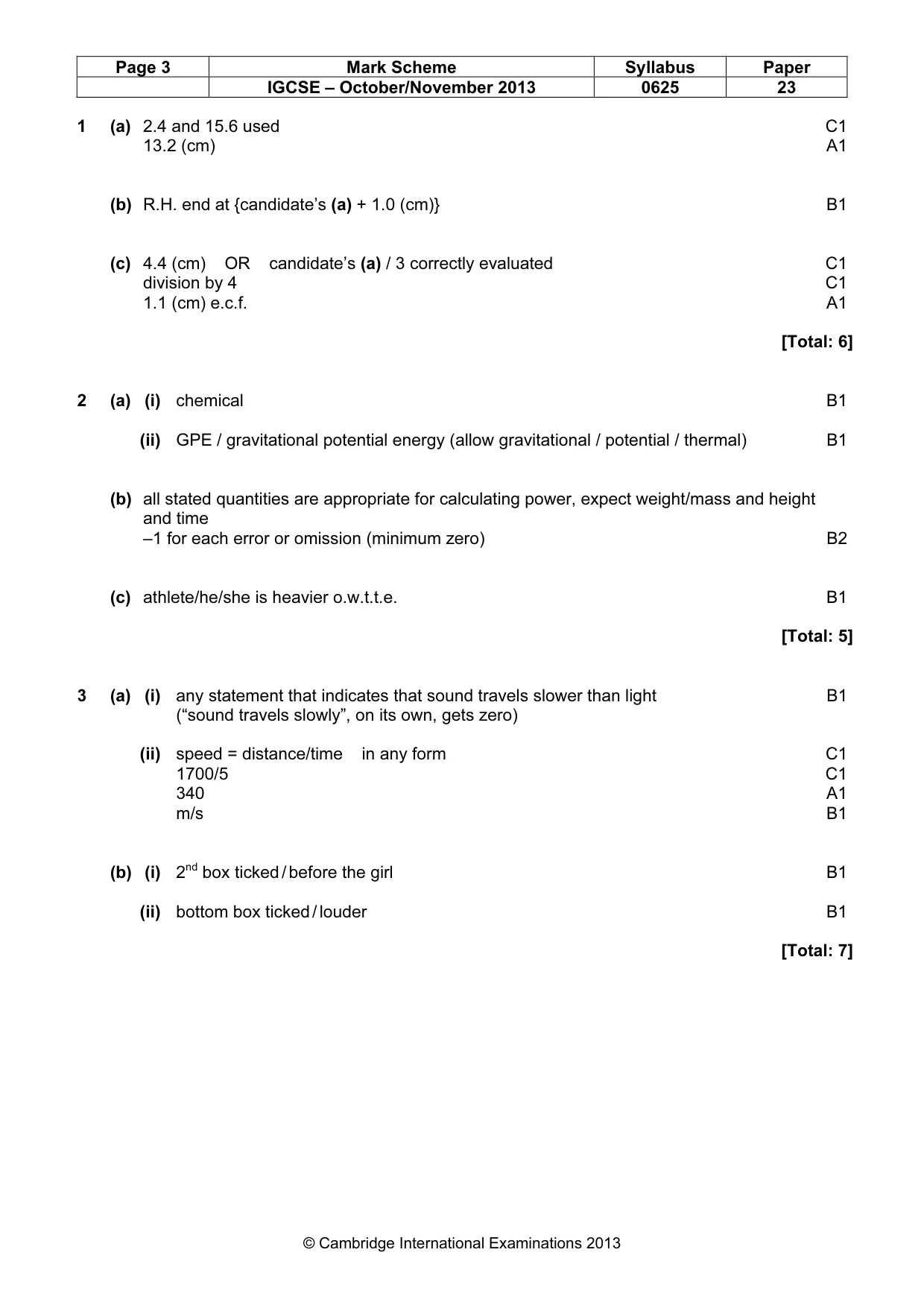
Mark scheme, page 3
Page 3 Mark Scheme Syllabus Paper IGCSE – October/November 2013 0625 23 © Cambridge International Examinations 2013 1 (a) 2.4 and 15.6 used C1 13.2 (cm) A1 (b) R.H. end at {candidate’s (a) + 1.0 (cm)} B1 (c) 4.4 (cm) OR candidate’s (a) / 3 correctly evaluated C1 division by 4 C1 1.1 (cm) e.c.f. A1 [Total: 6] 2 (a) (i) chemical B1 (ii) GPE / gravitational potential energy (allow gravitational / potential / thermal) B1 (b) all stated quantities are appropriate for calculating power, expect weight/mass and height and time –1 for each error or omission (minimum zero) B2 (c) athlete/he/she is heavier o.w.t.t.e. B1 [Total: 5] 3 (a) (i) any statement that indicates that sound travels slower than light B1 (“sound travels slowly”, on its own, gets zero) (ii) speed = distance/time in any form C1 1700/5 C1 340 A1 m/s B1 (b) (i) 2nd box ticked / before the girl B1 (ii) bottom box ticked / louder B1 [Total: 7]
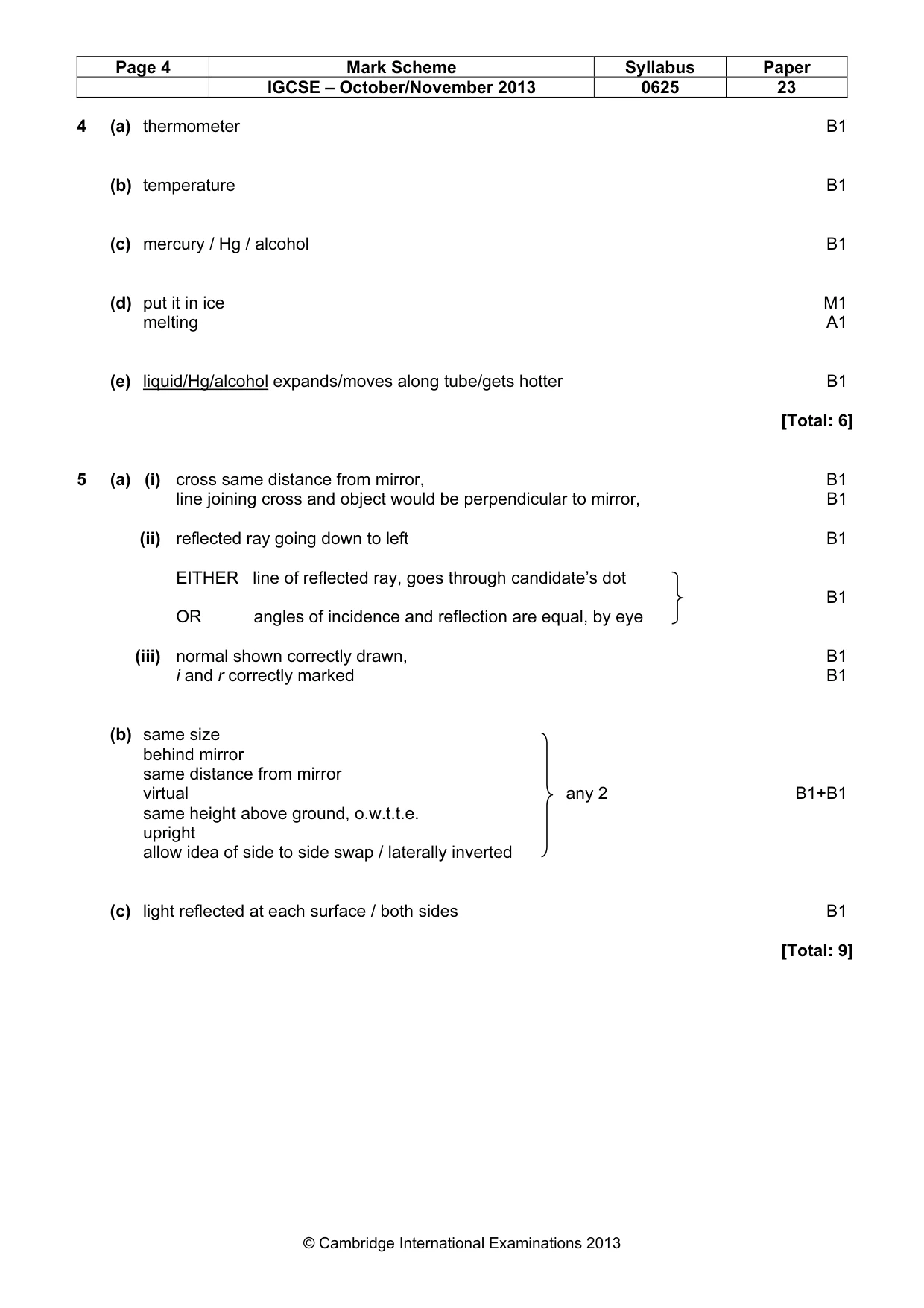
Mark scheme, page 4
Page 4 Mark Scheme Syllabus Paper IGCSE – October/November 2013 0625 23 © Cambridge International Examinations 2013 4 (a) thermometer B1 (b) temperature B1 (c) mercury / Hg / alcohol B1 (d) put it in ice M1 melting A1 (e) liquid/Hg/alcohol expands/moves along tube/gets hotter B1 [Total: 6] 5 (a) (i) cross same distance from mirror, B1 line joining cross and object would be perpendicular to mirror, B1 (ii) reflected ray going down to left B1 EITHER line of reflected ray, goes through candidate’s dot B1 OR angles of incidence and reflection are equal, by eye (iii) normal shown correctly drawn, B1 i and r correctly marked B1 (b) same size behind mirror same distance from mirror virtual any 2 B1+B1 same height above ground, o.w.t.t.e. upright allow idea of side to side swap / laterally inverted (c) light reflected at each surface / both sides B1 [Total: 9]
Mark scheme, page 5
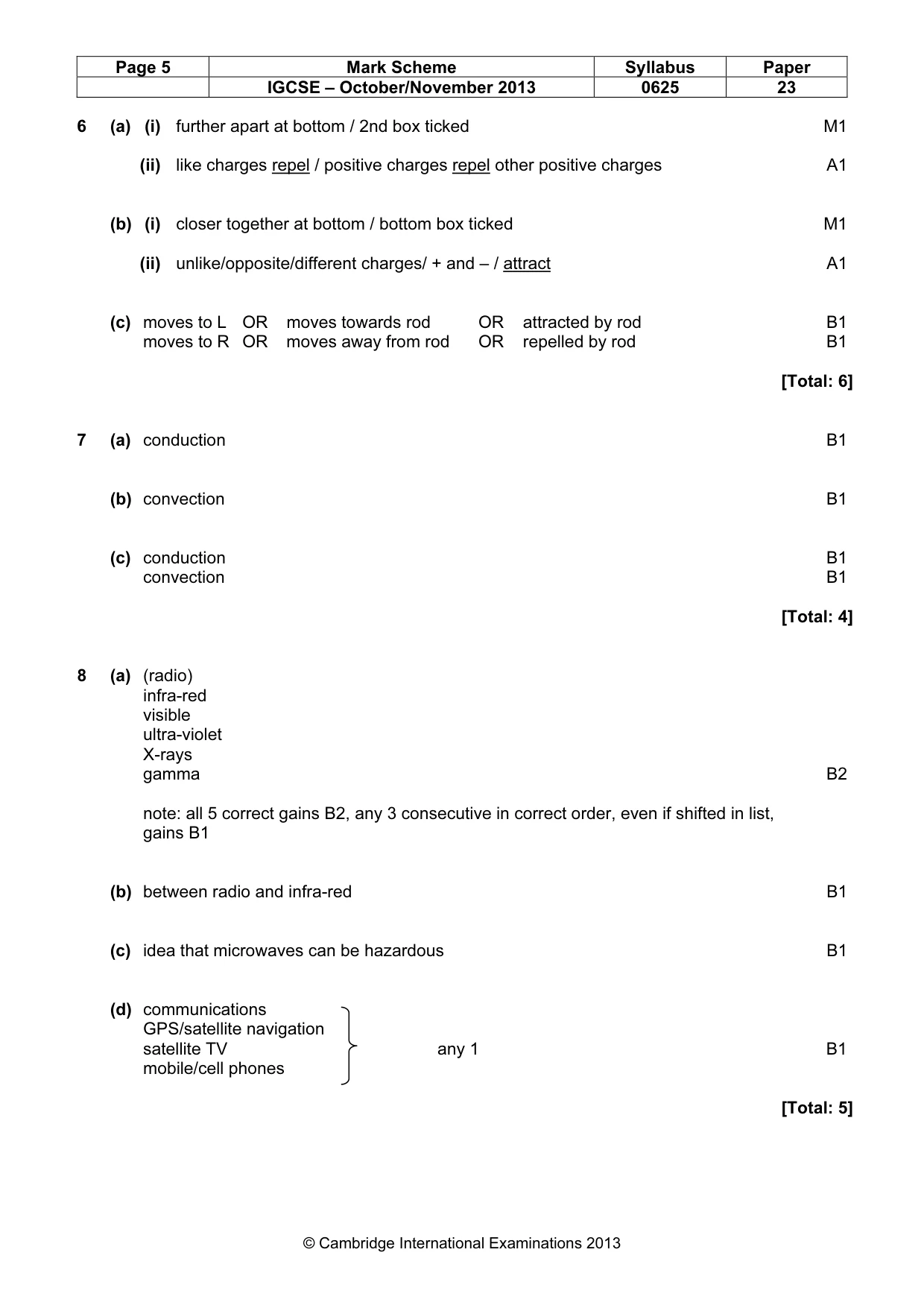
Page 5 Mark Scheme Syllabus Paper IGCSE – October/November 2013 0625 23 © Cambridge International Examinations 2013 6 (a) (i) further apart at bottom / 2nd box ticked M1 (ii) like charges repel / positive charges repel other positive charges A1 (b) (i) closer together at bottom / bottom box ticked M1 (ii) unlike/opposite/different charges/ + and – / attract A1 (c) moves to L OR moves towards rod OR attracted by rod B1 moves to R OR moves away from rod OR repelled by rod B1 [Total: 6] 7 (a) conduction B1 (b) convection B1 (c) conduction B1 convection B1 [Total: 4] 8 (a) (radio) infra-red visible ultra-violet X-rays gamma B2 note: all 5 correct gains B2, any 3 consecutive in correct order, even if shifted in list, gains B1 (b) between radio and infra-red B1 (c) idea that microwaves can be hazardous B1 (d) communications GPS/satellite navigation satellite TV any 1 B1 mobile/cell phones [Total: 5]
Mark scheme, page 6
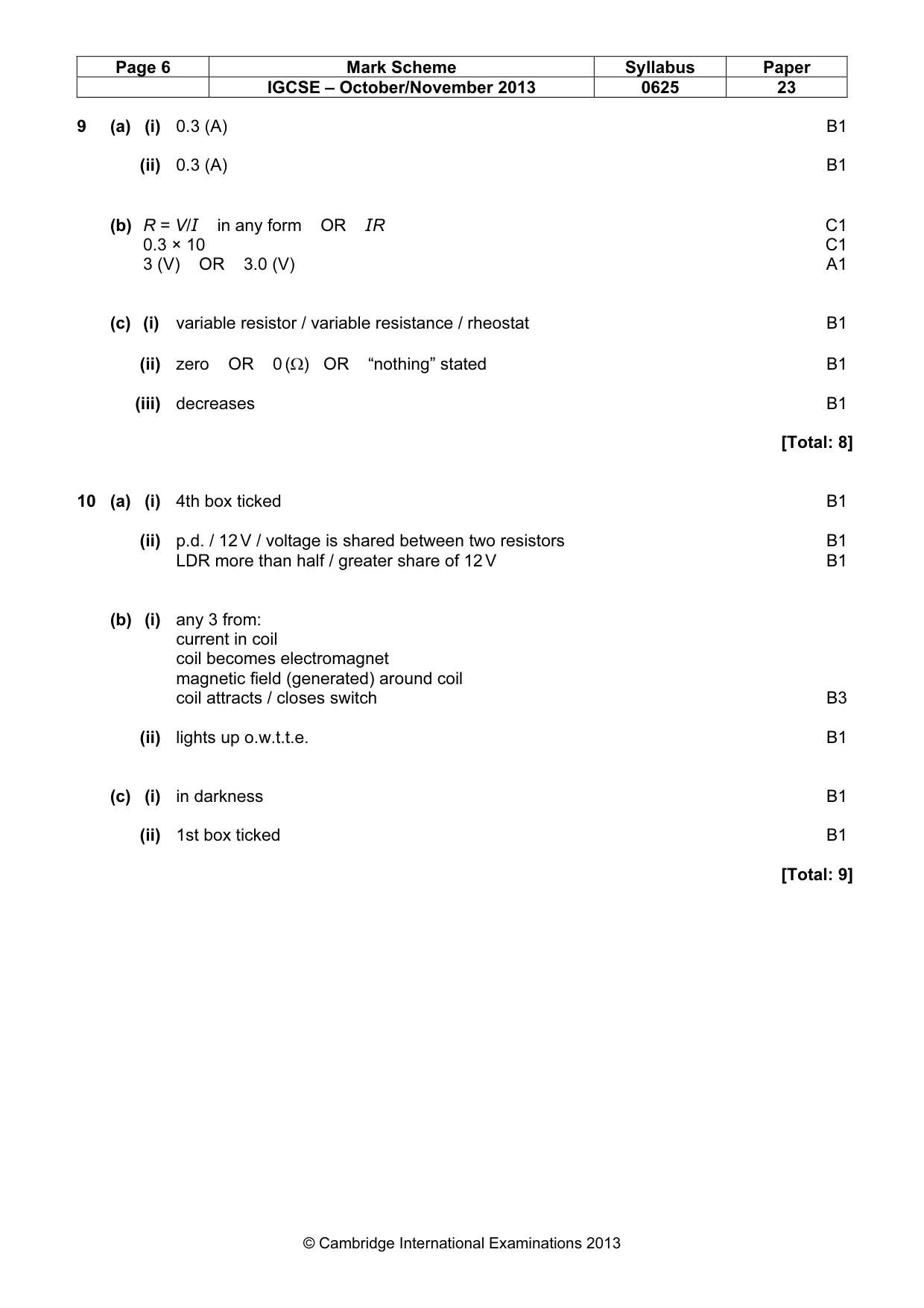
Page 6 Mark Scheme Syllabus Paper IGCSE – October/November 2013 0625 23 © Cambridge International Examinations 2013 9 (a) (i) 0.3 (A) B1 (ii) 0.3 (A) B1 (b) R = V/I in any form OR IR C1 0.3 × 10 C1 3 (V) OR 3.0 (V) A1 (c) (i) variable resistor / variable resistance / rheostat B1 (ii) zero OR 0 (Ω) OR “nothing” stated B1 (iii) decreases B1 [Total: 8] 10 (a) (i) 4th box ticked B1 (ii) p.d. / 12 V / voltage is shared between two resistors B1 LDR more than half / greater share of 12 V B1 (b) (i) any 3 from: current in coil coil becomes electromagnet magnetic field (generated) around coil coil attracts / closes switch B3 (ii) lights up o.w.t.t.e. B1 (c) (i) in darkness B1 (ii) 1st box ticked B1 [Total: 9]
Mark scheme, page 7
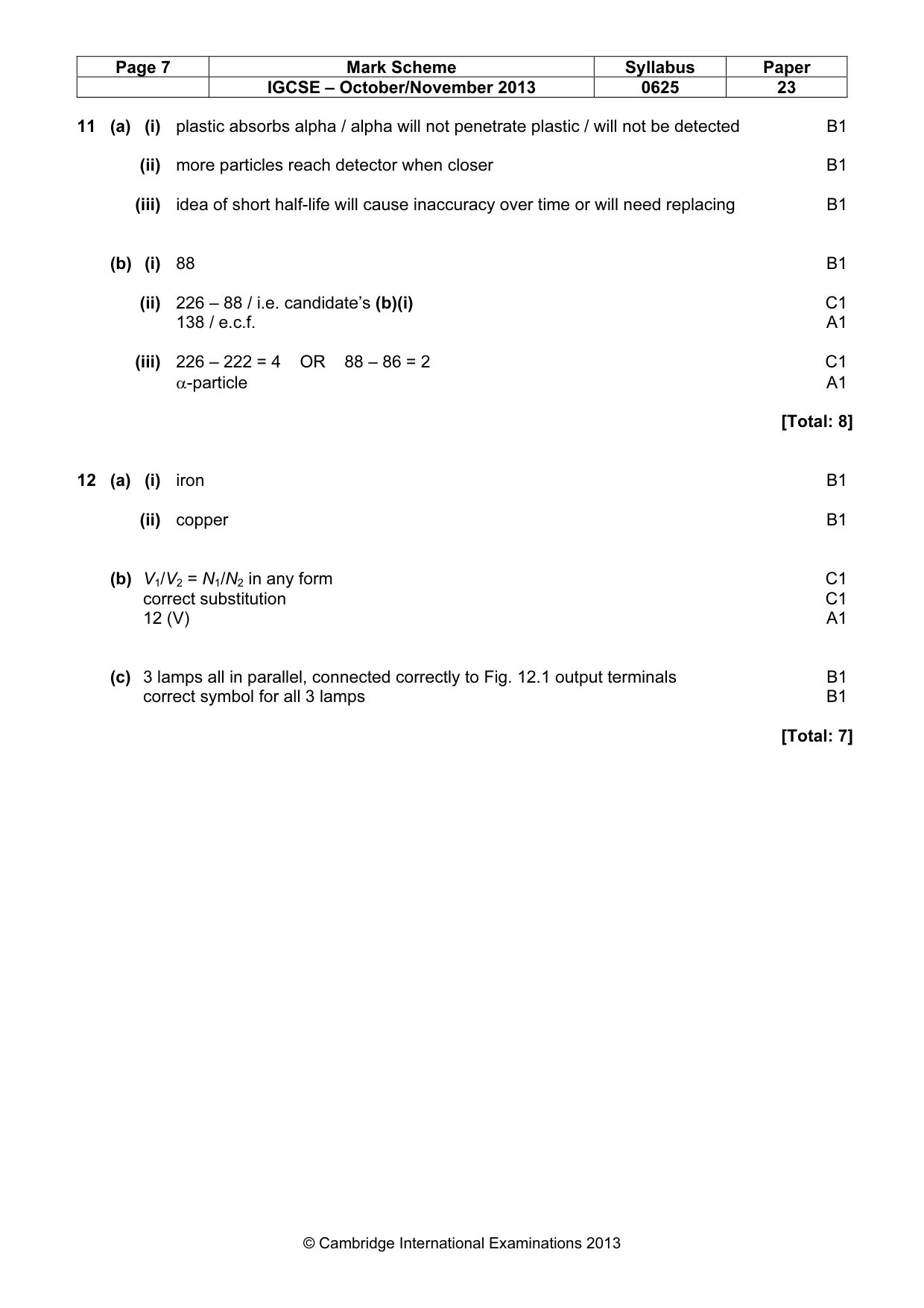
Page 7 Mark Scheme Syllabus Paper IGCSE – October/November 2013 0625 23 © Cambridge International Examinations 2013 11 (a) (i) plastic absorbs alpha / alpha will not penetrate plastic / will not be detected B1 (ii) more particles reach detector when closer B1 (iii) idea of short half-life will cause inaccuracy over time or will need replacing B1 (b) (i) 88 B1 (ii) 226 – 88 / i.e. candidate’s (b)(i) C1 138 / e.c.f. A1 (iii) 226 – 222 = 4 OR 88 – 86 = 2 C1 α-particle A1 [Total: 8] 12 (a) (i) iron B1 (ii) copper B1 (b) V1/V2 = N1/N2 in any form C1 correct substitution C1 12 (V) A1 (c) 3 lamps all in parallel, connected correctly to Fig. 12.1 output terminals B1 correct symbol for all 3 lamps B1 [Total: 7]