Cambridge IGCSE Physics 0625 — 2013 Oct/Nov Paper 2 · Variant 2
0625/22/O/N/13
The question paper and its mark scheme, free to read here and free to download. This is Cambridge’s own paper, exactly as it was sat.
Question paper16 pages
Mark scheme8 pages
Answers below. Sit the paper first if you are practising.
Paper as text
Question paper, page 1
This document consists of 16 printed pages. DC (NF/JG) 64874/6 © UCLES 2013 [Turn over UNIVERSITY OF CAMBRIDGE INTERNATIONAL EXAMINATIONS International General Certificate of Secondary Education * 1 1 8 5 8 9 6 1 7 6 * PHYSICS 0625/22 Paper 2 Core October/November 2013 1 hour 15 minutes Candidates answer on the Question Paper. No Additional Materials are required. READ THESE INSTRUCTIONS FIRST Write your Centre number, candidate number and name on all the work you hand in. Write in dark blue or black pen. You may use a pencil for any diagrams or graphs. Do not use staples, paper clips, highlighters, glue or correction fluid. DO NOT WRITE IN ANY BARCODES. Answer all questions. Electronic calculators may be used. You may lose marks if you do not show your working or if you do not use appropriate units. Take the weight of 1 kg to be 10 N (i.e. acceleration of free fall = 10 m / s2). At the end of the examination, fasten all your work securely together. The number of marks is given in brackets [ ] at the end of each question or part question. www.XtremePapers.com
Question paper, page 2
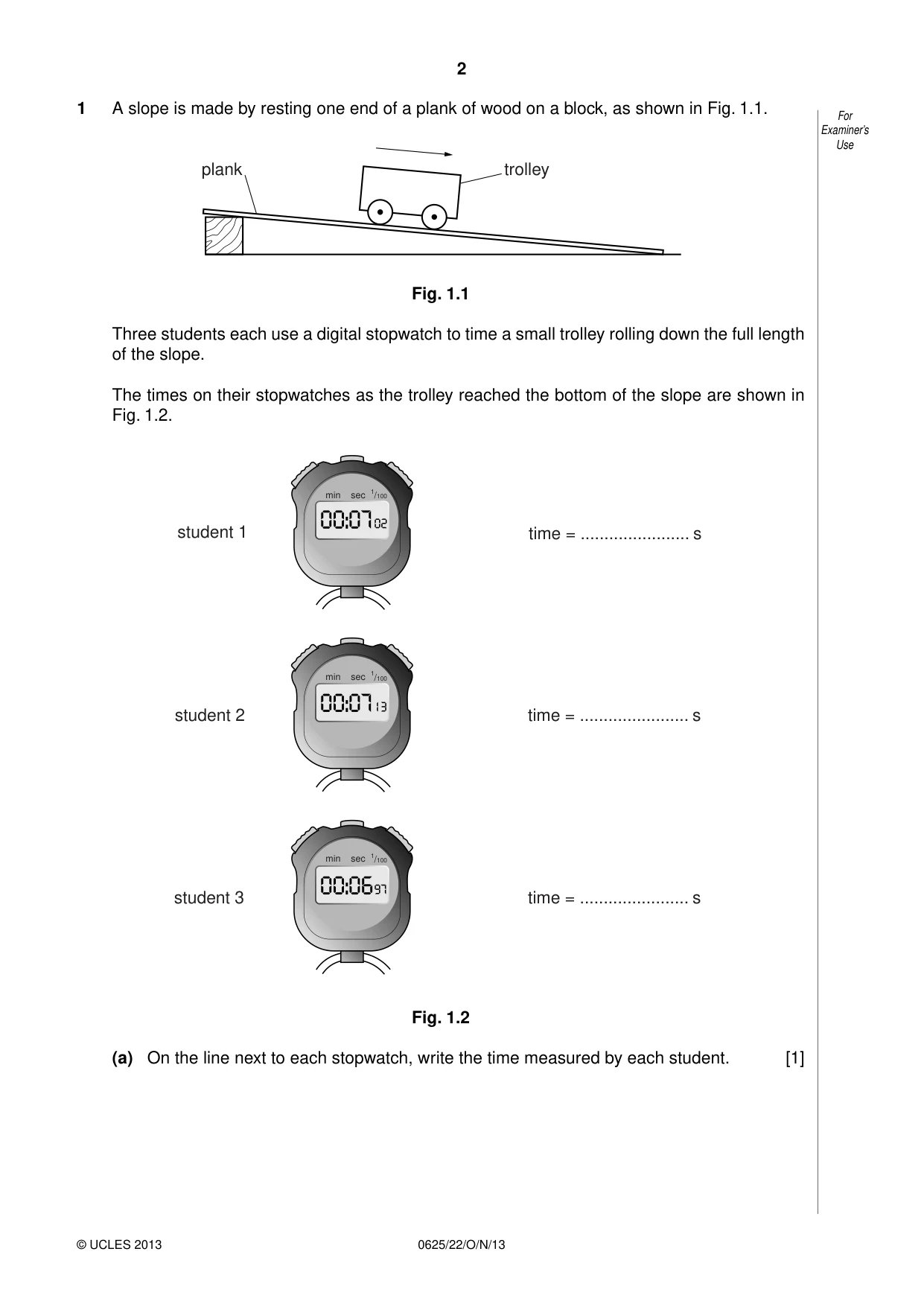
2 0625/22/O/N/13 © UCLES 2013 For Examiner’s Use 1 A slope is made by resting one end of a plank of wood on a block, as shown in Fig. 1.1. plank trolley Fig. 1.1 Three students each use a digital stopwatch to time a small trolley rolling down the full length of the slope. The times on their stopwatches as the trolley reached the bottom of the slope are shown in Fig. 1.2. student 1 student 2 student 3 time = … s time = … s time = … s min sec 1/100 min sec 1/100 min sec 1/100 Fig. 1.2 (a) On the line next to each stopwatch, write the time measured by each student. [1]
Question paper, page 3
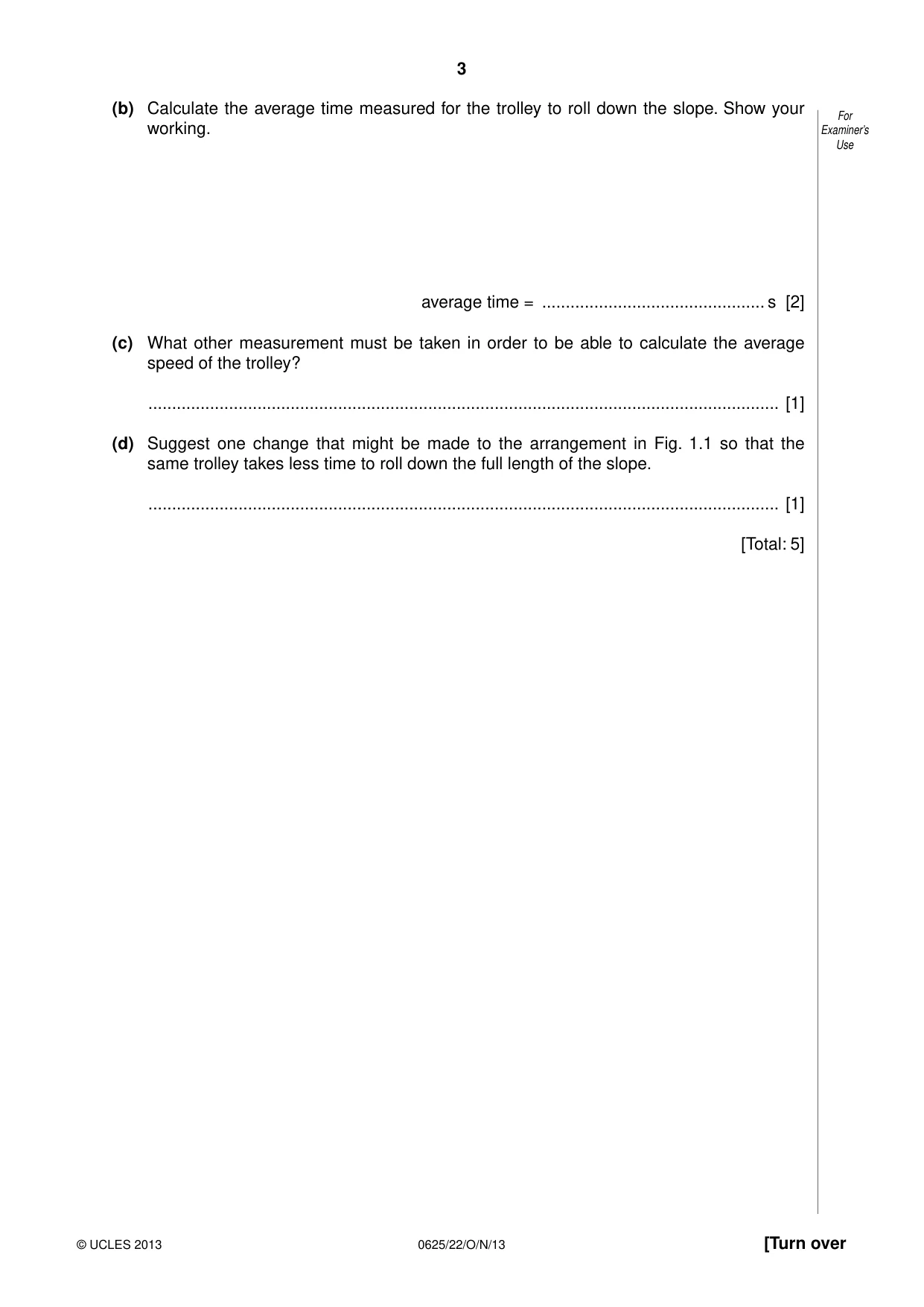
3 0625/22/O/N/13 © UCLES 2013 [Turn over For Examiner’s Use (b) Calculate the average time measured for the trolley to roll down the slope. Show your working. average time = … s [2] (c) What other measurement must be taken in order to be able to calculate the average speed of the trolley? … [1] (d) Suggest one change that might be made to the arrangement in Fig. 1.1 so that the same trolley takes less time to roll down the full length of the slope. … [1] [Total: 5]
Question paper, page 4
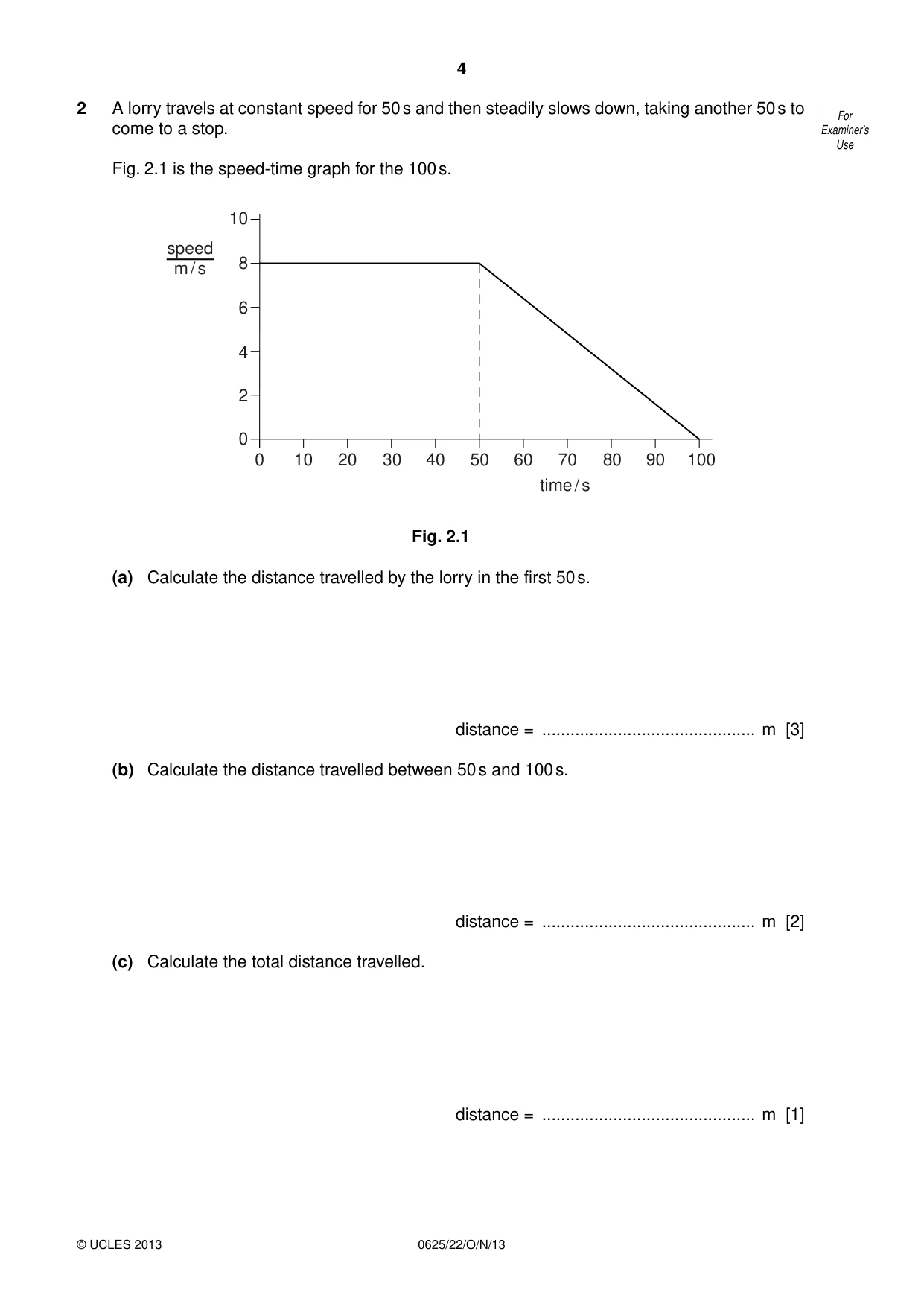
4 0625/22/O/N/13 © UCLES 2013 For Examiner’s Use 2 A lorry travels at constant speed for 50 s and then steadily slows down, taking another 50 s to come to a stop. Fig. 2.1 is the speed-time graph for the 100 s. 10 8 6 4 2 0 0 10 20 30 40 50 60 70 80 90 100 time / s speed m / s Fig. 2.1 (a) Calculate the distance travelled by the lorry in the first 50 s. distance = … m [3] (b) Calculate the distance travelled between 50 s and 100 s. distance = … m [2] (c) Calculate the total distance travelled. distance = … m [1]
Question paper, page 5
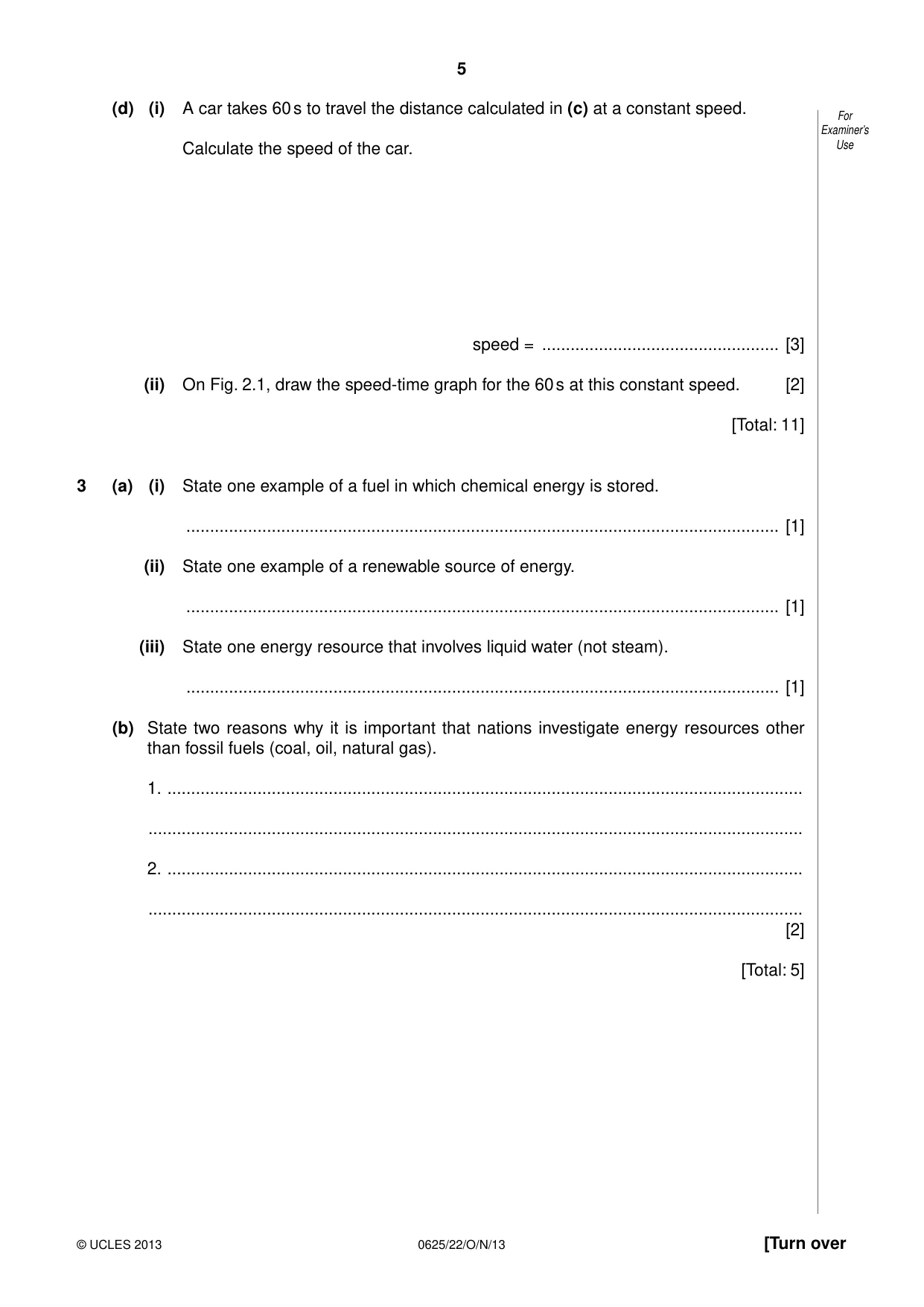
5 0625/22/O/N/13 © UCLES 2013 [Turn over For Examiner’s Use (d) (i) A car takes 60 s to travel the distance calculated in (c) at a constant speed. Calculate the speed of the car. speed = … [3] (ii) On Fig. 2.1, draw the speed-time graph for the 60 s at this constant speed. [2] [Total: 11] 3 (a) (i) State one example of a fuel in which chemical energy is stored. … [1] (ii) State one example of a renewable source of energy. … [1] (iii) State one energy resource that involves liquid water (not steam). … [1] (b) State two reasons why it is important that nations investigate energy resources other than fossil fuels (coal, oil, natural gas). 1. … … 2. … … [2] [Total: 5]
Question paper, page 6
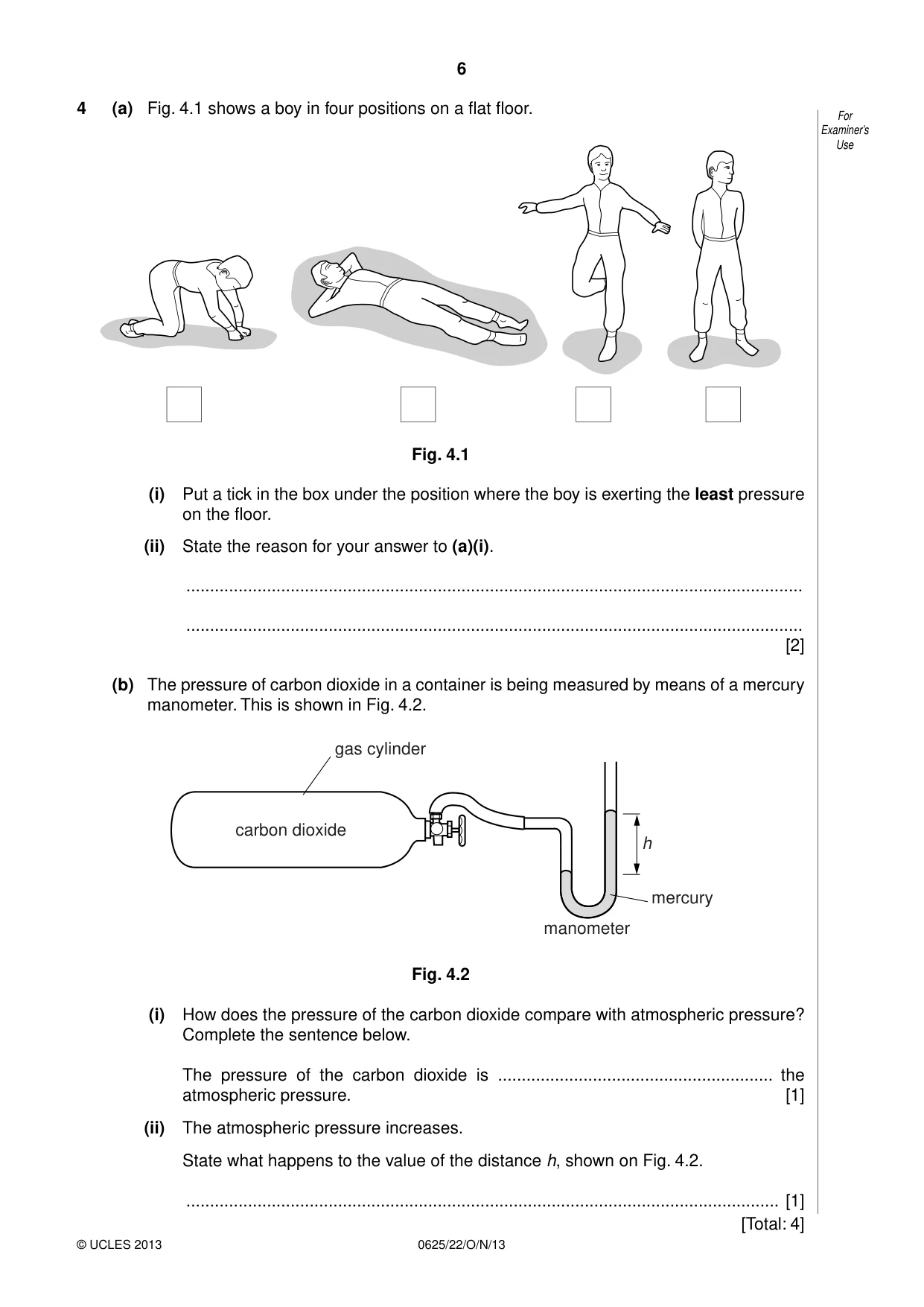
6 0625/22/O/N/13 © UCLES 2013 For Examiner’s Use 4 (a) Fig. 4.1 shows a boy in four positions on a flat floor. Fig. 4.1 (i) Put a tick in the box under the position where the boy is exerting the least pressure on the floor. (ii) State the reason for your answer to (a)(i). … … [2] (b) The pressure of carbon dioxide in a container is being measured by means of a mercury manometer. This is shown in Fig. 4.2. carbon dioxide manometer mercury gas cylinder h Fig. 4.2 (i) How does the pressure of the carbon dioxide compare with atmospheric pressure? Complete the sentence below. The pressure of the carbon dioxide is … the atmospheric pressure. [1] (ii) The atmospheric pressure increases. State what happens to the value of the distance h, shown on Fig. 4.2. … [1] [Total: 4]
Question paper, page 7
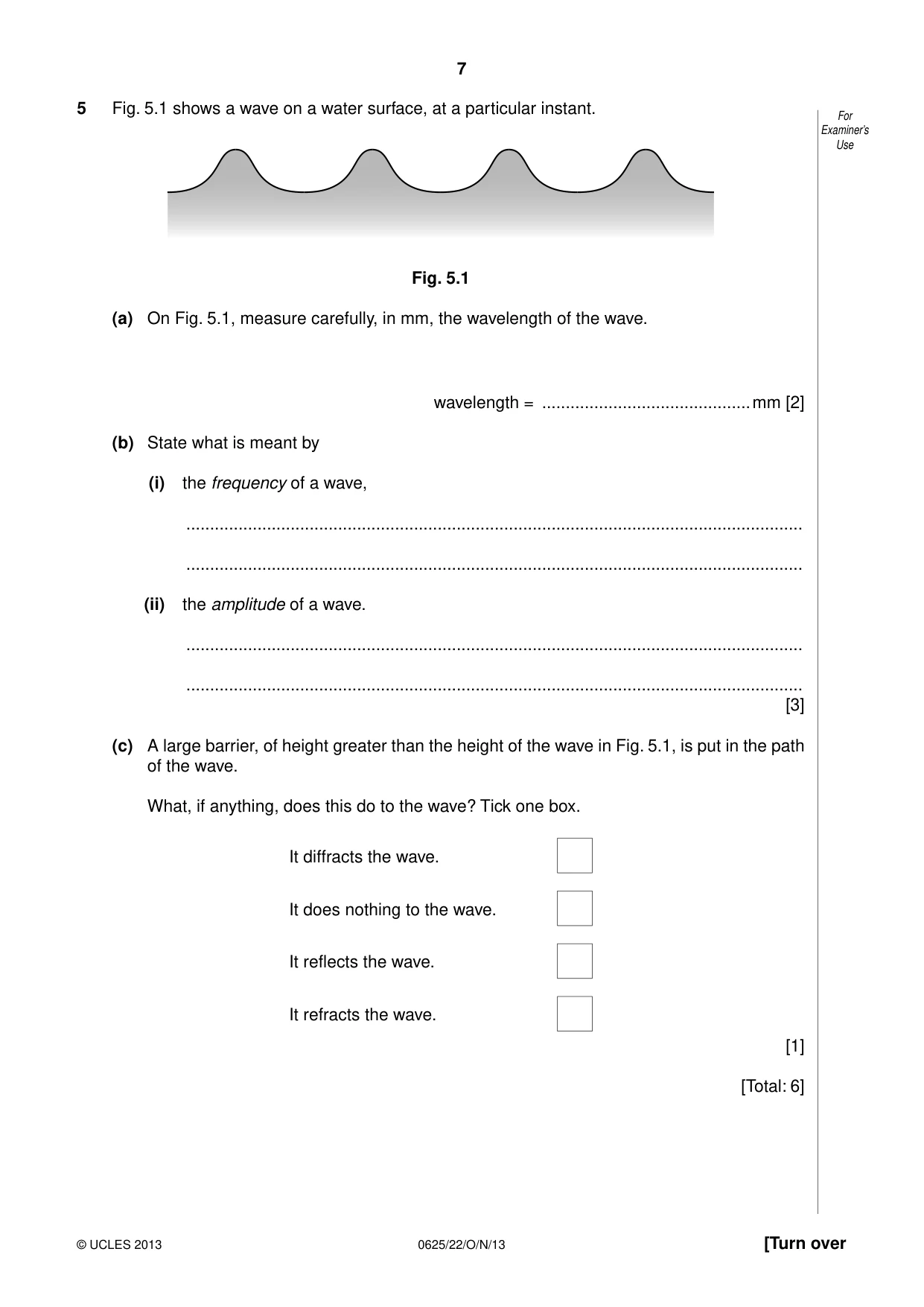
7 0625/22/O/N/13 © UCLES 2013 [Turn over For Examiner’s Use 5 Fig. 5.1 shows a wave on a water surface, at a particular instant. Fig. 5.1 (a) On Fig. 5.1, measure carefully, in mm, the wavelength of the wave. wavelength = … mm [2] (b) State what is meant by (i) the frequency of a wave, … … (ii) the amplitude of a wave. … … [3] (c) A large barrier, of height greater than the height of the wave in Fig. 5.1, is put in the path of the wave. What, if anything, does this do to the wave? Tick one box. It diffracts the wave. It does nothing to the wave. It reflects the wave. It refracts the wave. [1] [Total: 6]
Question paper, page 8
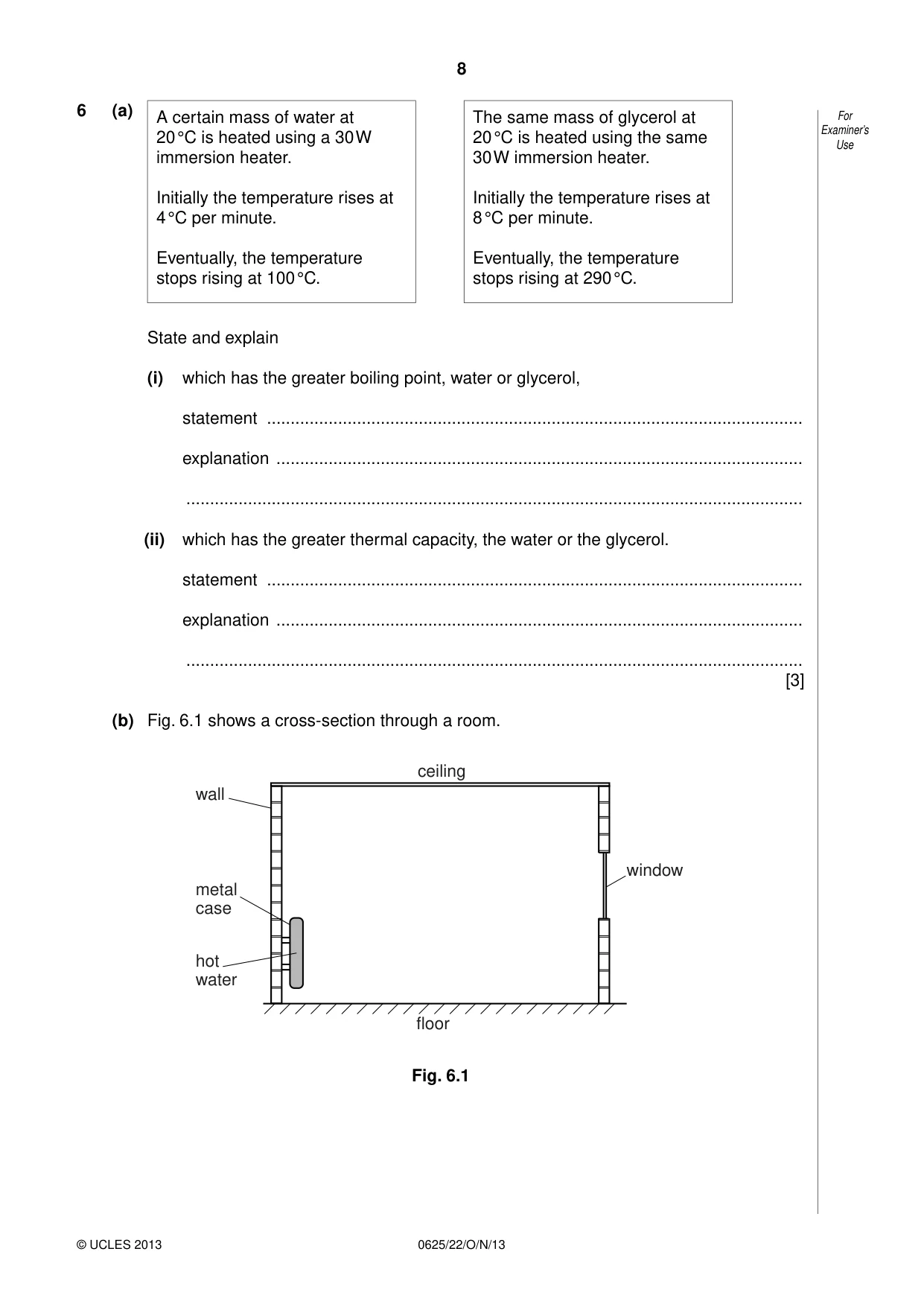
8 0625/22/O/N/13 © UCLES 2013 For Examiner’s Use 6 (a) A certain mass of water at 20 °C is heated using a 30 W immersion heater. Initially the temperature rises at 4 °C per minute. Eventually, the temperature stops rising at 100 °C. The same mass of glycerol at 20 °C is heated using the same 30 W immersion heater. Initially the temperature rises at 8 °C per minute. Eventually, the temperature stops rising at 290 °C. State and explain (i) which has the greater boiling point, water or glycerol, statement … explanation … … (ii) which has the greater thermal capacity, the water or the glycerol. statement … explanation … … [3] (b) Fig. 6.1 shows a cross-section through a room. floor ceiling wall window metal case hot water Fig. 6.1
Question paper, page 9
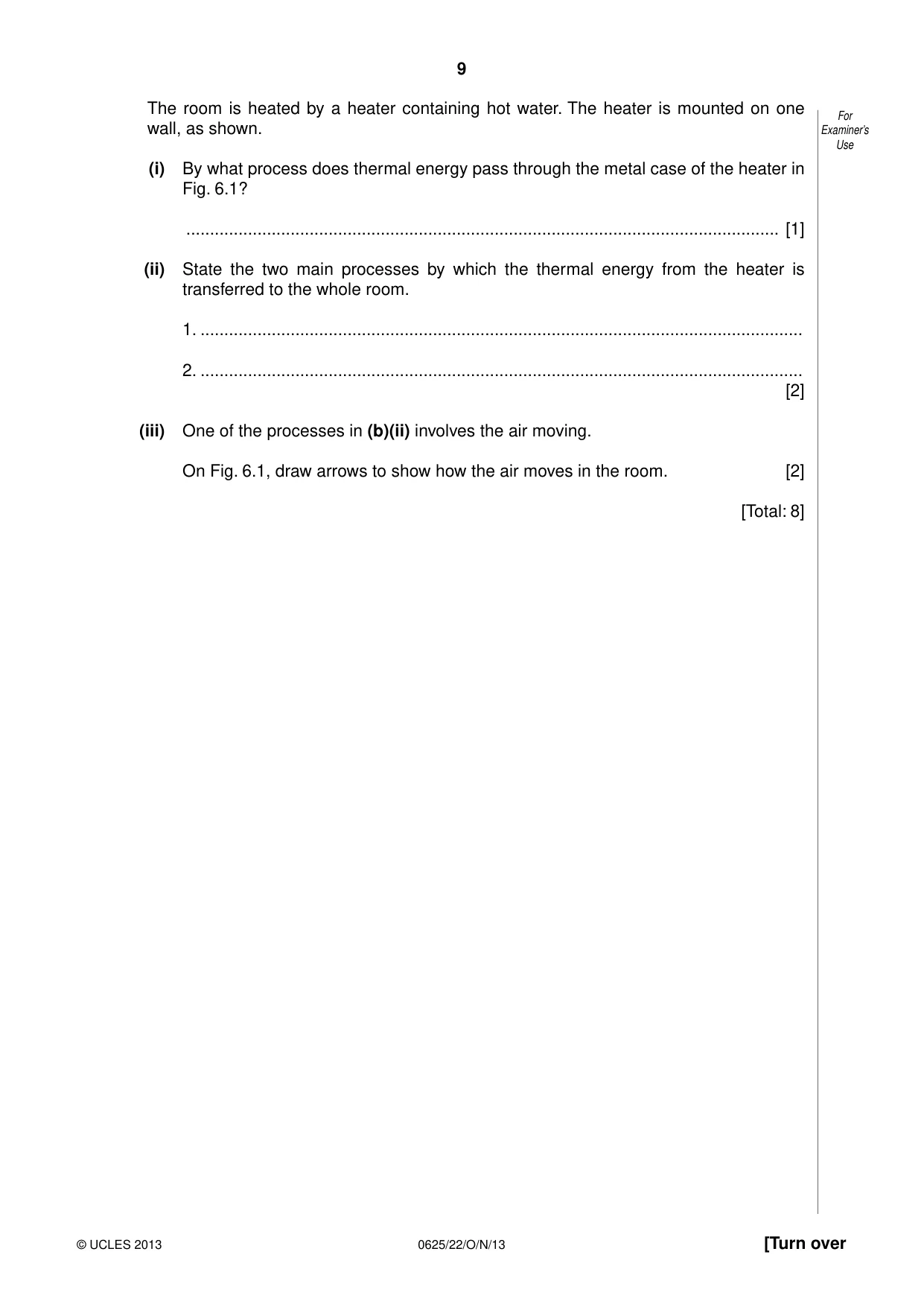
9 0625/22/O/N/13 © UCLES 2013 [Turn over For Examiner’s Use The room is heated by a heater containing hot water. The heater is mounted on one wall, as shown. (i) By what process does thermal energy pass through the metal case of the heater in Fig. 6.1? … [1] (ii) State the two main processes by which the thermal energy from the heater is transferred to the whole room. 1. … 2. … [2] (iii) One of the processes in (b)(ii) involves the air moving. On Fig. 6.1, draw arrows to show how the air moves in the room. [2] [Total: 8]
Question paper, page 10
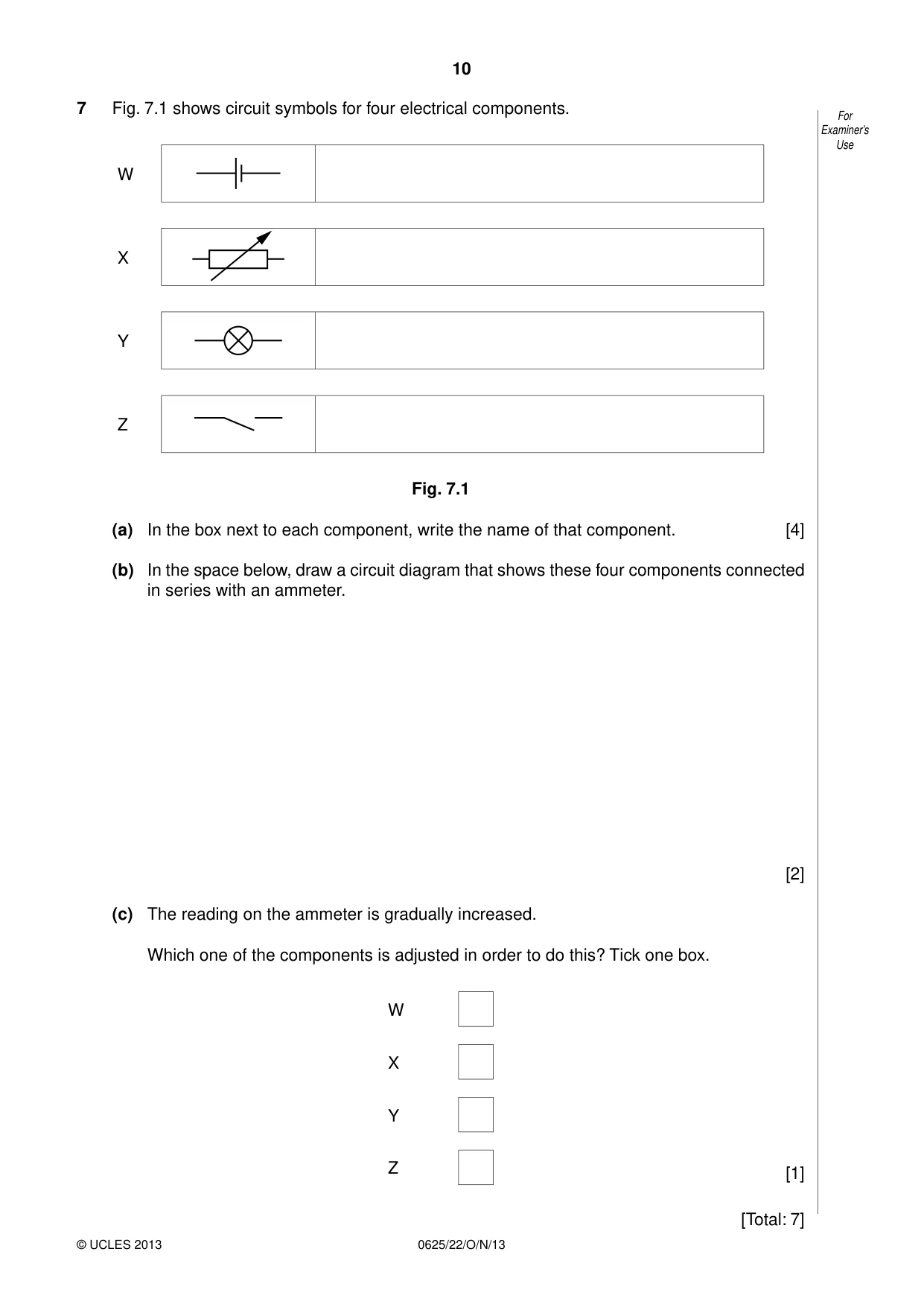
10 0625/22/O/N/13 © UCLES 2013 For Examiner’s Use 7 Fig. 7.1 shows circuit symbols for four electrical components. W X Y Z Fig. 7.1 (a) In the box next to each component, write the name of that component. [4] (b) In the space below, draw a circuit diagram that shows these four components connected in series with an ammeter. [2] (c) The reading on the ammeter is gradually increased. Which one of the components is adjusted in order to do this? Tick one box. W X Y Z [1] [Total: 7]
Question paper, page 11
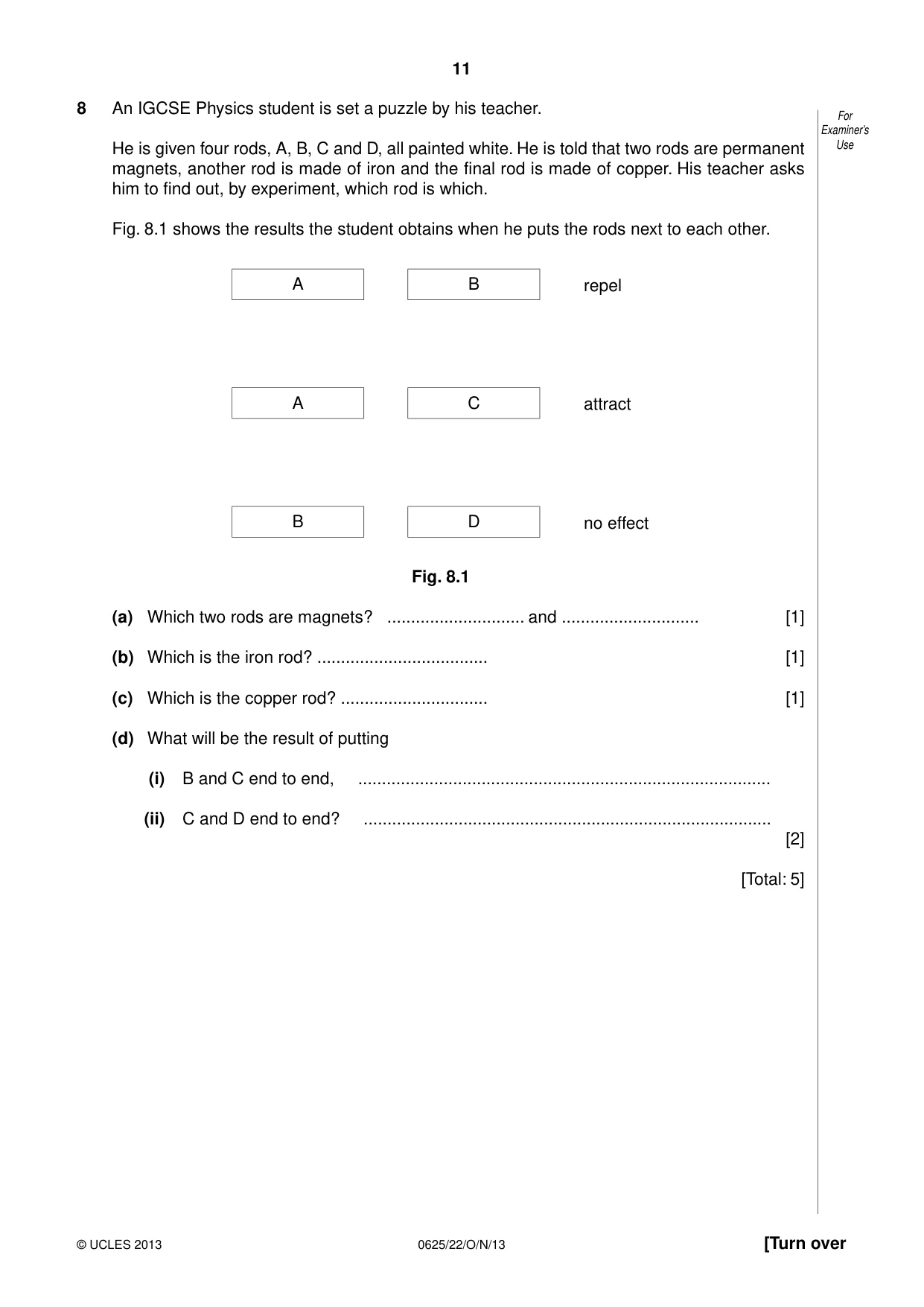
11 0625/22/O/N/13 © UCLES 2013 [Turn over For Examiner’s Use 8 An IGCSE Physics student is set a puzzle by his teacher. He is given four rods, A, B, C and D, all painted white. He is told that two rods are permanent magnets, another rod is made of iron and the final rod is made of copper. His teacher asks him to find out, by experiment, which rod is which. Fig. 8.1 shows the results the student obtains when he puts the rods next to each other. A B repel A C attract B D no effect Fig. 8.1 (a) Which two rods are magnets? … and … [1] (b) Which is the iron rod? … [1] (c) Which is the copper rod? … [1] (d) What will be the result of putting (i) B and C end to end, … (ii) C and D end to end? … [2] [Total: 5]
Question paper, page 12
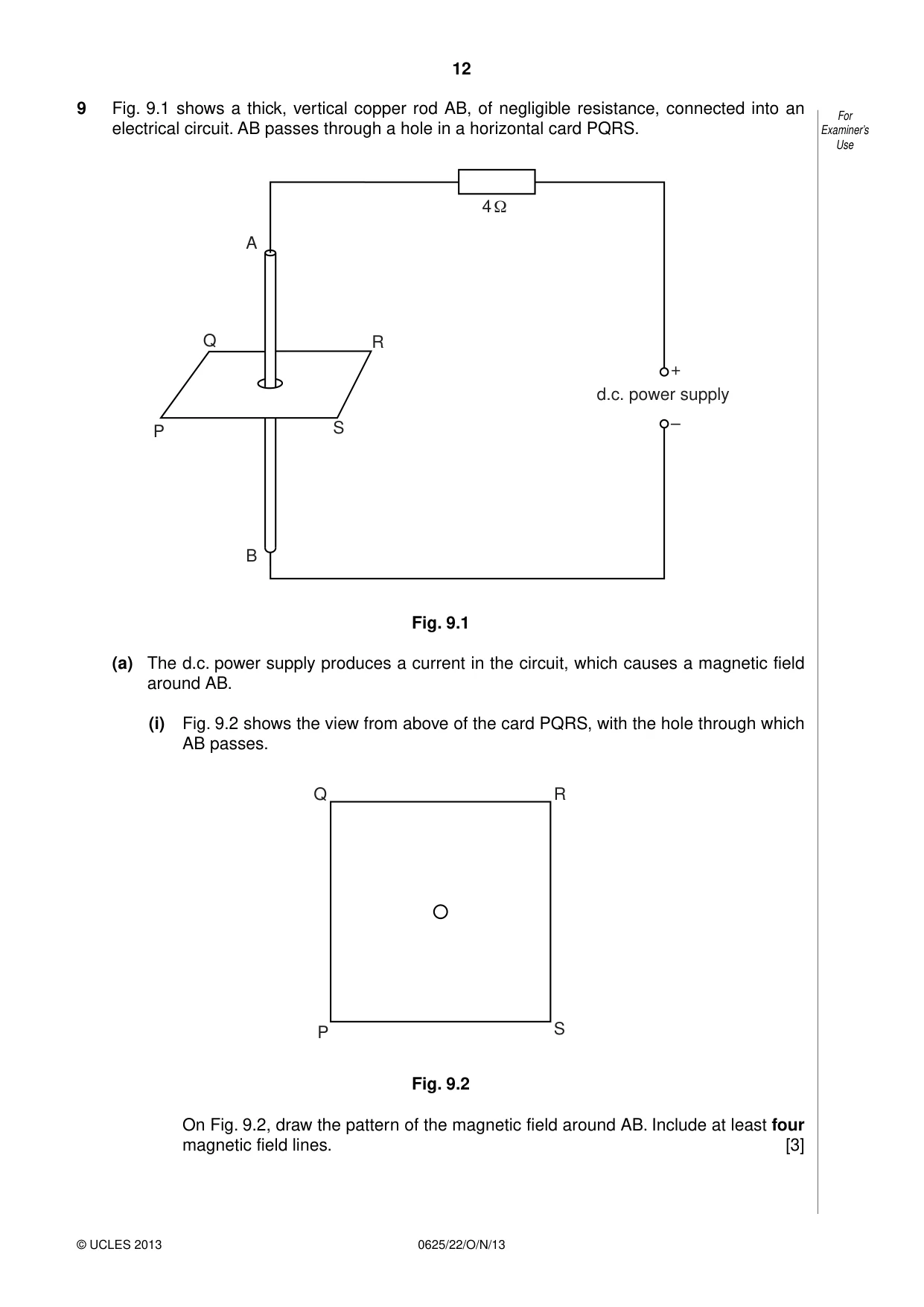
12 0625/22/O/N/13 © UCLES 2013 For Examiner’s Use 9 Fig. 9.1 shows a thick, vertical copper rod AB, of negligible resistance, connected into an electrical circuit. AB passes through a hole in a horizontal card PQRS. + – d.c. power supply 4 1 P S A B Q R Fig. 9.1 (a) The d.c. power supply produces a current in the circuit, which causes a magnetic field around AB. (i) Fig. 9.2 shows the view from above of the card PQRS, with the hole through which AB passes. P Q R S Fig. 9.2 On Fig. 9.2, draw the pattern of the magnetic field around AB. Include at least four magnetic field lines. [3]
Question paper, page 13
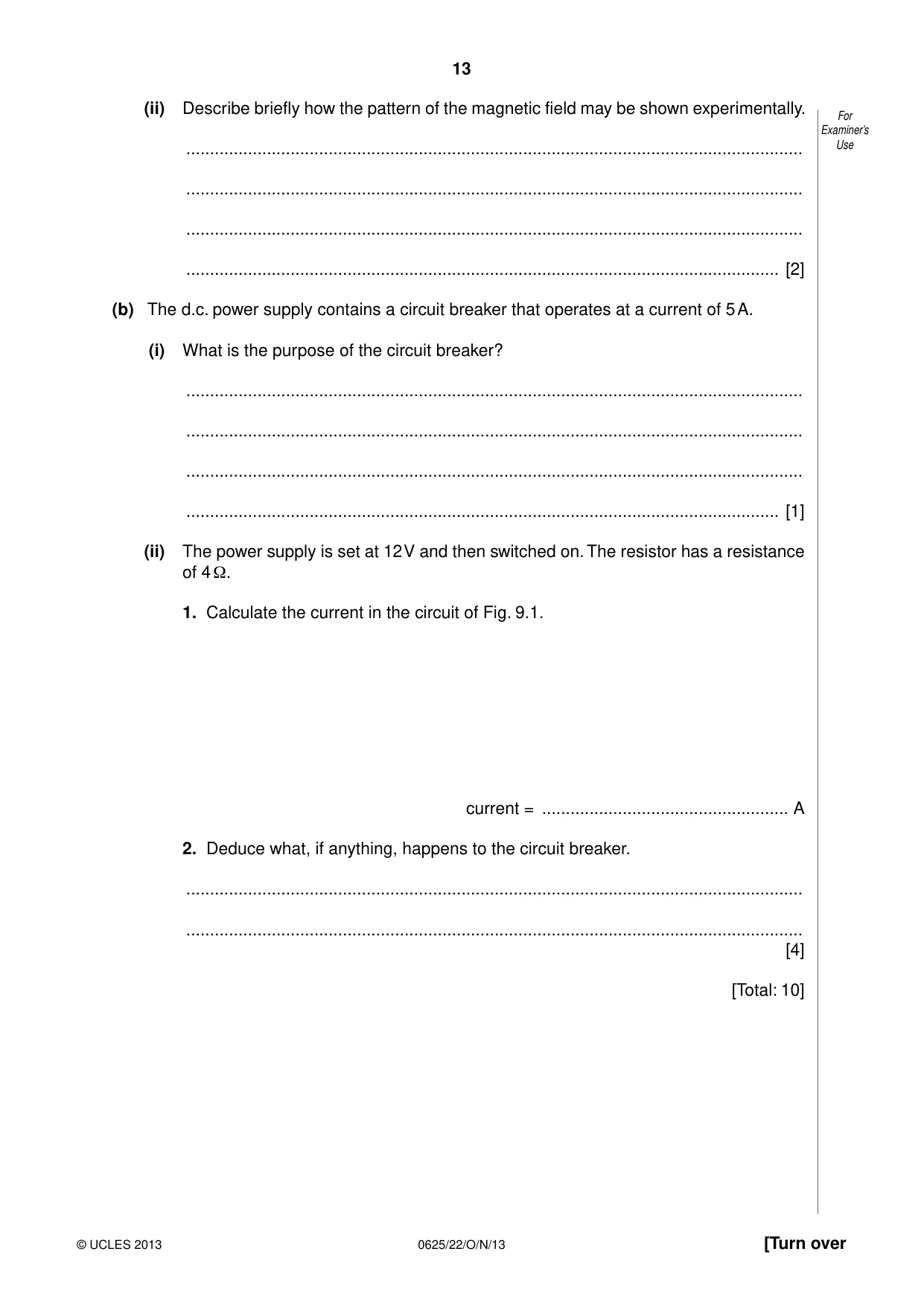
13 0625/22/O/N/13 © UCLES 2013 [Turn over For Examiner’s Use (ii) Describe briefly how the pattern of the magnetic field may be shown experimentally. … … … … [2] (b) The d.c. power supply contains a circuit breaker that operates at a current of 5 A. (i) What is the purpose of the circuit breaker? … … … … [1] (ii) The power supply is set at 12 V and then switched on. The resistor has a resistance of 4 Ω. 1. Calculate the current in the circuit of Fig. 9.1. current = … A 2. Deduce what, if anything, happens to the circuit breaker. … … [4] [Total: 10]
Question paper, page 14
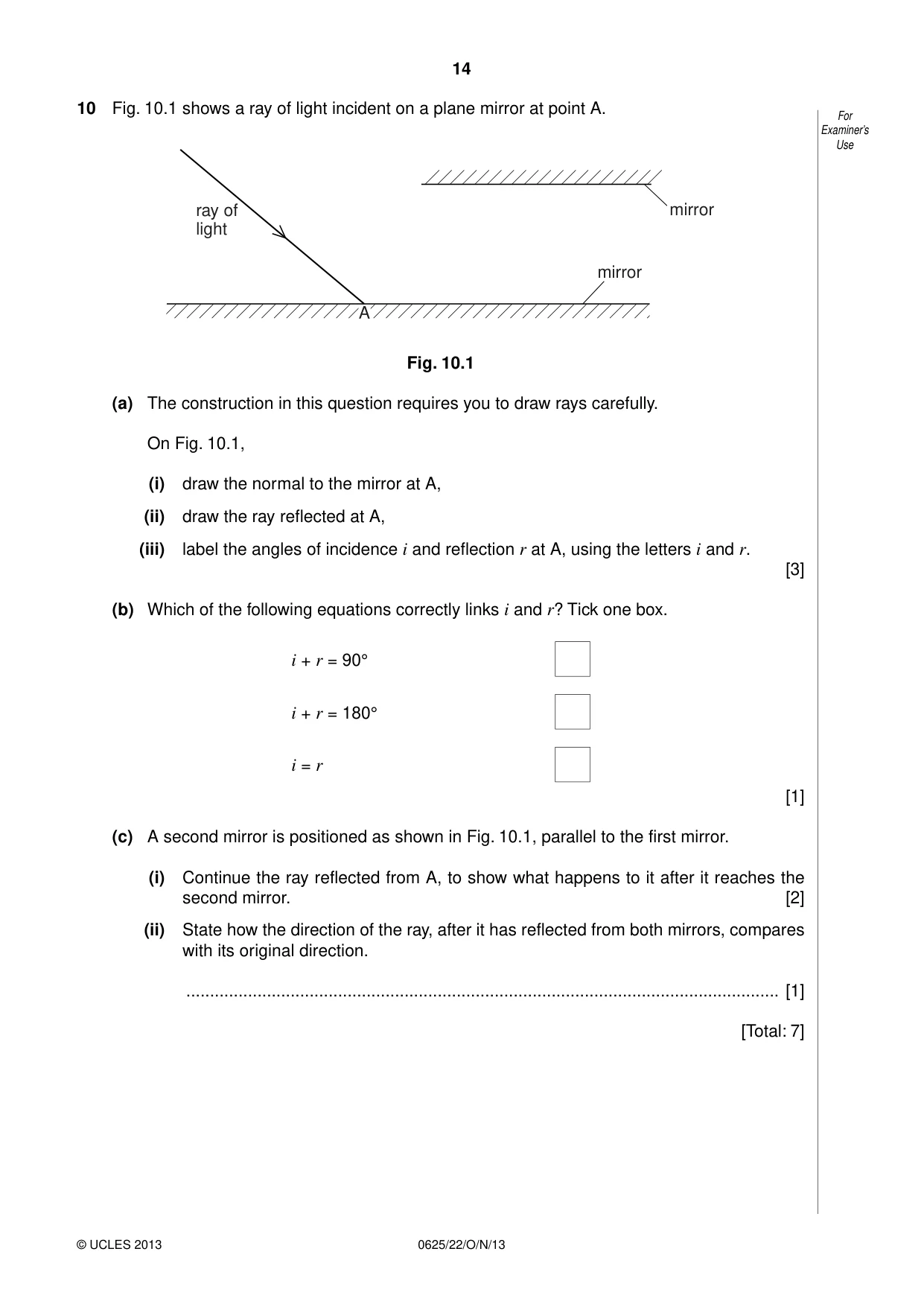
14 0625/22/O/N/13 © UCLES 2013 For Examiner’s Use 10 Fig. 10.1 shows a ray of light incident on a plane mirror at point A. mirror mirror ray of light A Fig. 10.1 (a) The construction in this question requires you to draw rays carefully. On Fig. 10.1, (i) draw the normal to the mirror at A, (ii) draw the ray reflected at A, (iii) label the angles of incidence i and reflection r at A, using the letters i and r. [3] (b) Which of the following equations correctly links i and r? Tick one box. i + r = 90° i + r = 180° i = r [1] (c) A second mirror is positioned as shown in Fig. 10.1, parallel to the first mirror. (i) Continue the ray reflected from A, to show what happens to it after it reaches the second mirror. [2] (ii) State how the direction of the ray, after it has reflected from both mirrors, compares with its original direction. … [1] [Total: 7]
Question paper, page 15
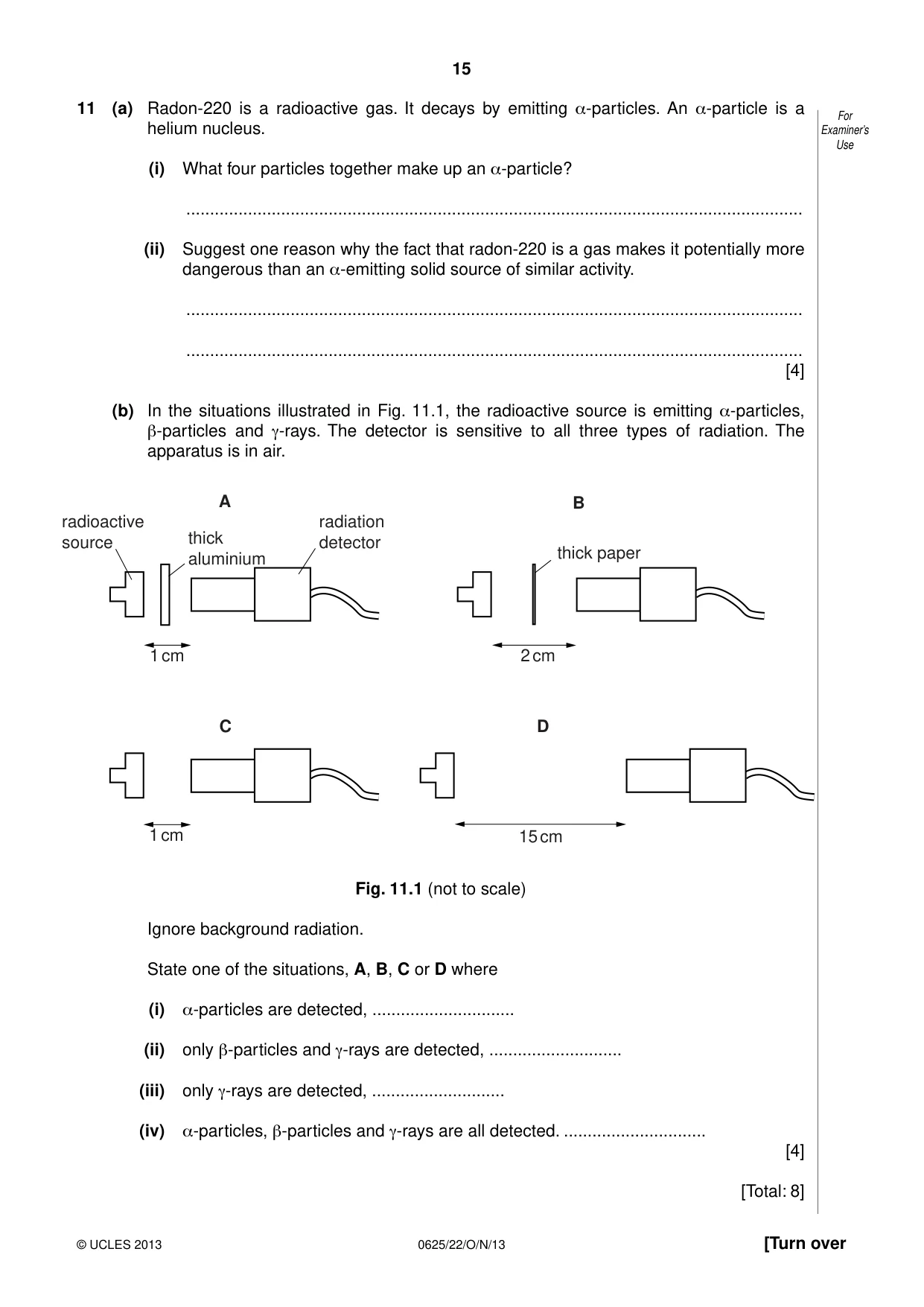
15 0625/22/O/N/13 © UCLES 2013 [Turn over For Examiner’s Use 11 (a) Radon-220 is a radioactive gas. It decays by emitting α-particles. An α-particle is a helium nucleus. (i) What four particles together make up an α-particle? … (ii) Suggest one reason why the fact that radon-220 is a gas makes it potentially more dangerous than an α-emitting solid source of similar activity. … … [4] (b) In the situations illustrated in Fig. 11.1, the radioactive source is emitting α-particles, β-particles and γ-rays. The detector is sensitive to all three types of radiation. The apparatus is in air. D C A B radiation detector thick aluminium thick paper 1 cm 2 cm 15 cm 1 cm radioactive source Fig. 11.1 (not to scale) Ignore background radiation. State one of the situations, A, B, C or D where (i) α-particles are detected, … (ii) only β-particles and γ-rays are detected, … (iii) only γ-rays are detected, … (iv) α-particles, β-particles and γ-rays are all detected. … [4] [Total: 8]
Question paper, page 16
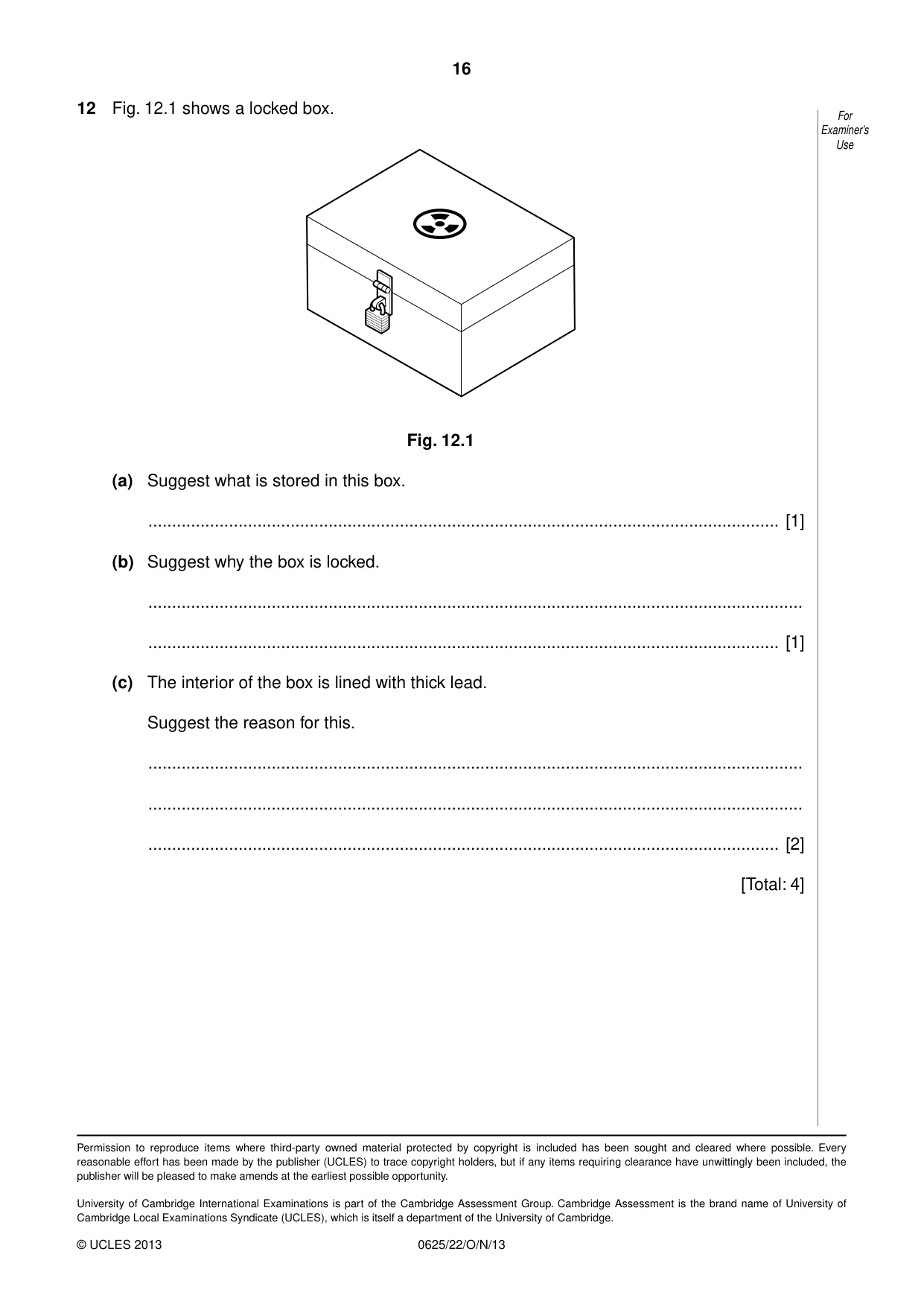
16 0625/22/O/N/13 © UCLES 2013 For Examiner’s Use Permission to reproduce items where third-party owned material protected by copyright is included has been sought and cleared where possible. Every reasonable effort has been made by the publisher (UCLES) to trace copyright holders, but if any items requiring clearance have unwittingly been included, the publisher will be pleased to make amends at the earliest possible opportunity. University of Cambridge International Examinations is part of the Cambridge Assessment Group. Cambridge Assessment is the brand name of University of Cambridge Local Examinations Syndicate (UCLES), which is itself a department of the University of Cambridge. 12 Fig. 12.1 shows a locked box. Fig. 12.1 (a) Suggest what is stored in this box. … [1] (b) Suggest why the box is locked. … … [1] (c) The interior of the box is lined with thick lead. Suggest the reason for this. … … … [2] [Total: 4]
Mark scheme, page 1
CAMBRIDGE INTERNATIONAL EXAMINATIONS International General Certificate of Secondary Education MARK SCHEME for the October/November 2013 series 0625 PHYSICS 0625/22 Paper 2 (Core Theory), maximum raw mark 80 This mark scheme is published as an aid to teachers and candidates, to indicate the requirements of the examination. It shows the basis on which Examiners were instructed to award marks. It does not indicate the details of the discussions that took place at an Examiners’ meeting before marking began, which would have considered the acceptability of alternative answers. Mark schemes should be read in conjunction with the question paper and the Principal Examiner Report for Teachers. Cambridge will not enter into discussions about these mark schemes. Cambridge is publishing the mark schemes for the October/November 2013 series for most IGCSE, GCE Advanced Level and Advanced Subsidiary Level components and some Ordinary Level components. www.XtremePapers.com
Mark scheme, page 2
Page 2 Mark Scheme Syllabus Paper IGCSE – October/November 2013 0625 22 © Cambridge International Examinations 2013 NOTES ABOUT MARK SCHEME SYMBOLS AND OTHER MATTERS B marks are independent marks, which do not depend on any other marks. For a B mark to be scored, the point to which it refers must actually be seen in the candidate's answer. M marks are method marks upon which accuracy marks (A marks) later depend. For an M mark to be scored, the point to which it refers must be seen in a candidate's answer. If a candidate fails to score a particular M mark, then none of the dependent A marks can be scored. C marks are compensatory method marks which can be scored even if the points to which they refer are not written down by the candidate, provided subsequent working gives evidence that they must have known it e.g. if an equation carries a C mark and the candidate does not write down the actual equation but does correct working which shows he knew the equation, then the C mark is scored. A marks are accuracy or answer marks which either depend on an M mark, or which are one of the ways which allow a C mark to be scored. c.a.o. means "correct answer only". e.c.f. means "error carried forward". This indicates that if a candidate has made an earlier mistake and has carried this incorrect value forward to subsequent stages of working, the candidate may be given marks indicated by e.c.f. provided the subsequent working is correct, bearing in mind this earlier mistake. This prevents a candidate being penalised more than once for a particular mistake, but only applies to marks annotated "e.c.f." e.e.o.o. means "each error or omission". Brackets ( ) around words or units in the mark scheme are intended to indicate wording used to clarify the mark scheme, but the marks do not depend on seeing the words or units in brackets, e.g. 10 (J) means that the mark is scored for 10, regardless of the unit given. Underlining indicates that this must be seen in the answer offered, or something very similar. OR/or indicates alternative answers, any one of which is satisfactory for scoring the marks. Spelling Be generous about spelling and use of English. Significant figures Answers are acceptable to any number of significant figures ≥ 2, except if specified otherwise, or if only 1 sig. fig. is appropriate. Units Incorrect units are not penalised, except where specified. More commonly, marks are allocated for specific units. Fractions These are only acceptable where specified. Extras Ignore extras in answers if they are irrelevant; if they contradict an otherwise correct response or are forbidden by the mark scheme, use right + wrong = 0 Ignore indicates that something which is not correct is disregarded and does not cause a right plus wrong penalty.
Mark scheme, page 3
Page 3 Mark Scheme Syllabus Paper IGCSE – October/November 2013 0625 22 © Cambridge International Examinations 2013 Not/NOT Indicates that an incorrect answer is not to be disregarded, but cancels another otherwise correct alternative offered by the candidate i.e. right plus wrong penalty applies.
Mark scheme, page 4
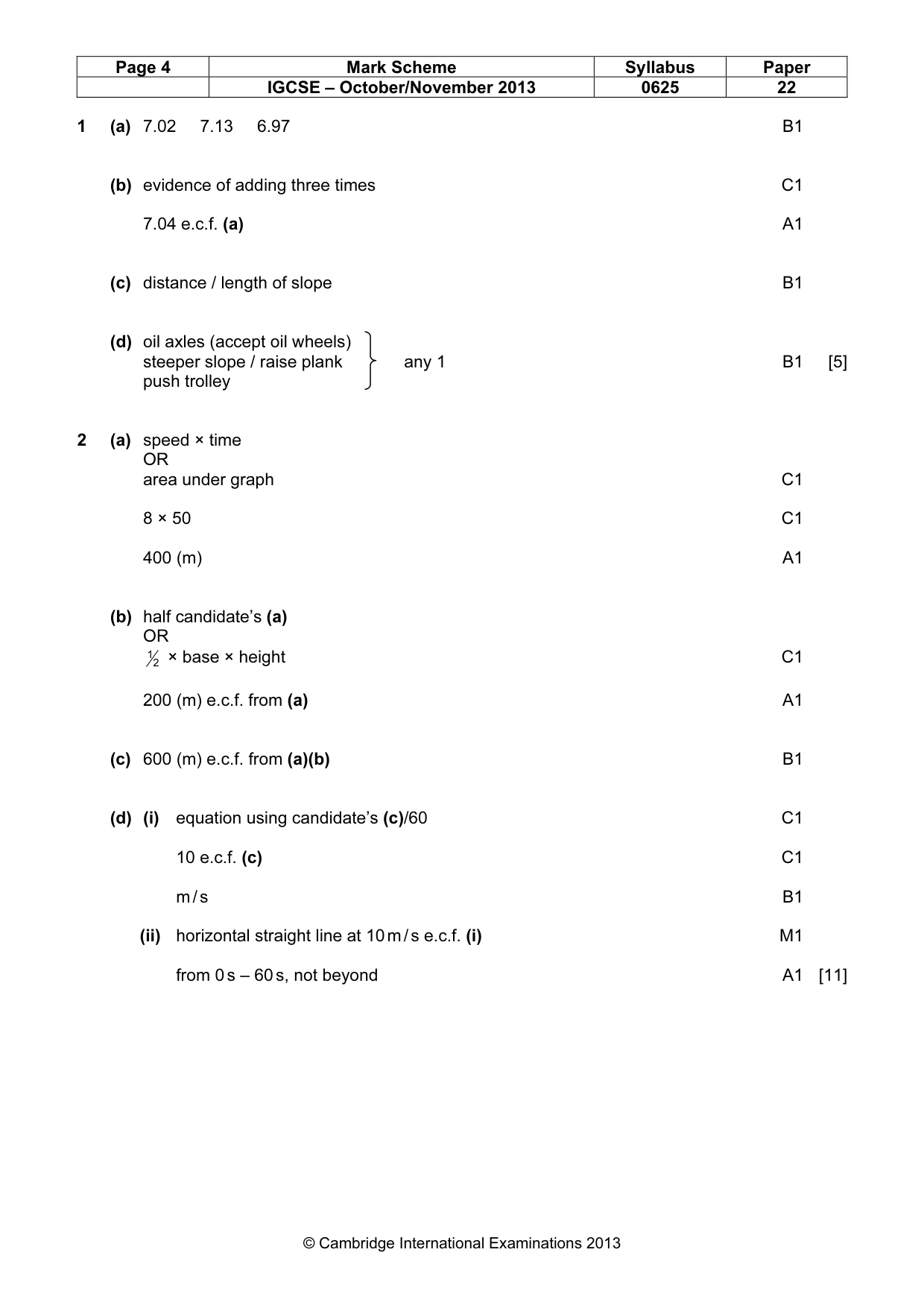
Page 4 Mark Scheme Syllabus Paper IGCSE – October/November 2013 0625 22 © Cambridge International Examinations 2013 1 (a) 7.02 7.13 6.97 B1 (b) evidence of adding three times C1 7.04 e.c.f. (a) A1 (c) distance / length of slope B1 (d) oil axles (accept oil wheels) steeper slope / raise plank any 1 B1 [5] push trolley 2 (a) speed × time OR area under graph C1 8 × 50 C1 400 (m) A1 (b) half candidate’s (a) OR 2 1 × base × height C1 200 (m) e.c.f. from (a) A1 (c) 600 (m) e.c.f. from (a)(b) B1 (d) (i) equation using candidate’s (c)/60 C1 10 e.c.f. (c) C1 m / s B1 (ii) horizontal straight line at 10 m / s e.c.f. (i) M1 from 0 s – 60 s, not beyond A1 [11]
Mark scheme, page 5
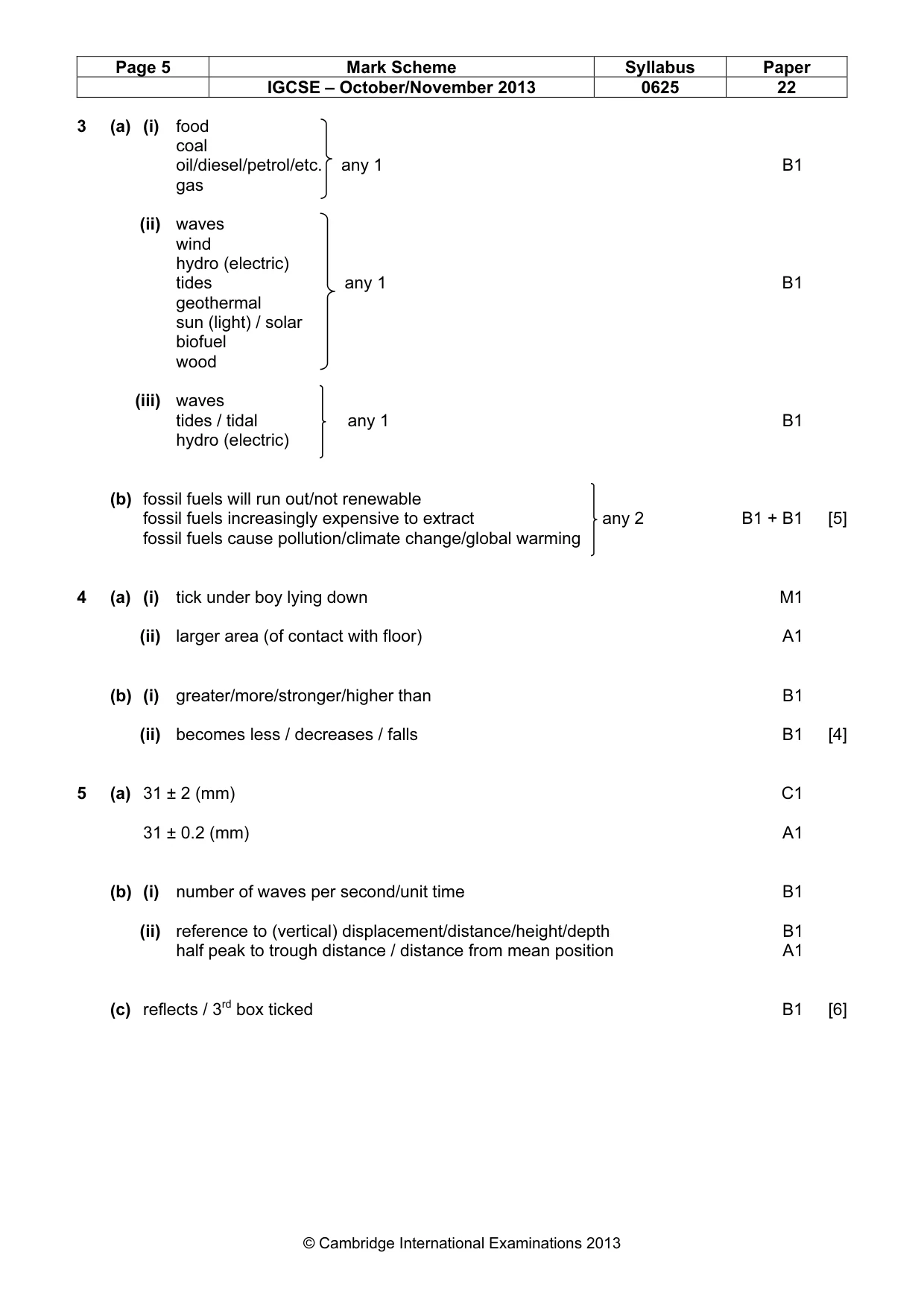
Page 5 Mark Scheme Syllabus Paper IGCSE – October/November 2013 0625 22 © Cambridge International Examinations 2013 3 (a) (i) food coal oil/diesel/petrol/etc. any 1 B1 gas (ii) waves wind hydro (electric) tides any 1 B1 geothermal sun (light) / solar biofuel wood (iii) waves tides / tidal any 1 B1 hydro (electric) (b) fossil fuels will run out/not renewable fossil fuels increasingly expensive to extract any 2 B1 + B1 [5] fossil fuels cause pollution/climate change/global warming 4 (a) (i) tick under boy lying down M1 (ii) larger area (of contact with floor) A1 (b) (i) greater/more/stronger/higher than B1 (ii) becomes less / decreases / falls B1 [4] 5 (a) 31 ± 2 (mm) C1 31 ± 0.2 (mm) A1 (b) (i) number of waves per second/unit time B1 (ii) reference to (vertical) displacement/distance/height/depth B1 half peak to trough distance / distance from mean position A1 (c) reflects / 3rd box ticked B1 [6]
Mark scheme, page 6
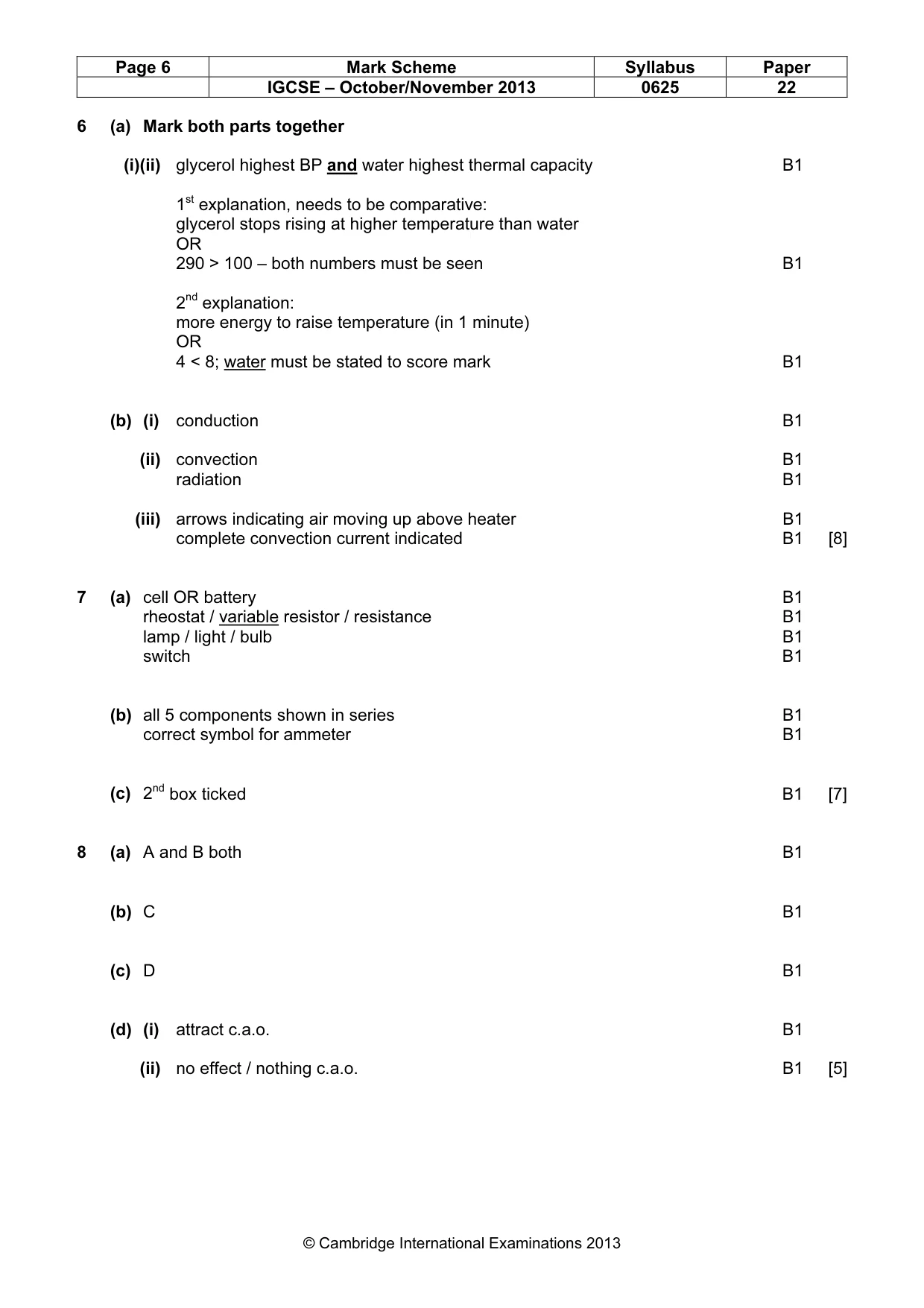
Page 6 Mark Scheme Syllabus Paper IGCSE – October/November 2013 0625 22 © Cambridge International Examinations 2013 6 (a) Mark both parts together (i)(ii) glycerol highest BP and water highest thermal capacity B1 1st explanation, needs to be comparative: glycerol stops rising at higher temperature than water OR 290 > 100 – both numbers must be seen B1 2nd explanation: more energy to raise temperature (in 1 minute) OR 4 < 8; water must be stated to score mark B1 (b) (i) conduction B1 (ii) convection B1 radiation B1 (iii) arrows indicating air moving up above heater B1 complete convection current indicated B1 [8] 7 (a) cell OR battery B1 rheostat / variable resistor / resistance B1 lamp / light / bulb B1 switch B1 (b) all 5 components shown in series B1 correct symbol for ammeter B1 (c) 2nd box ticked B1 [7] 8 (a) A and B both B1 (b) C B1 (c) D B1 (d) (i) attract c.a.o. B1 (ii) no effect / nothing c.a.o. B1 [5]
Mark scheme, page 7
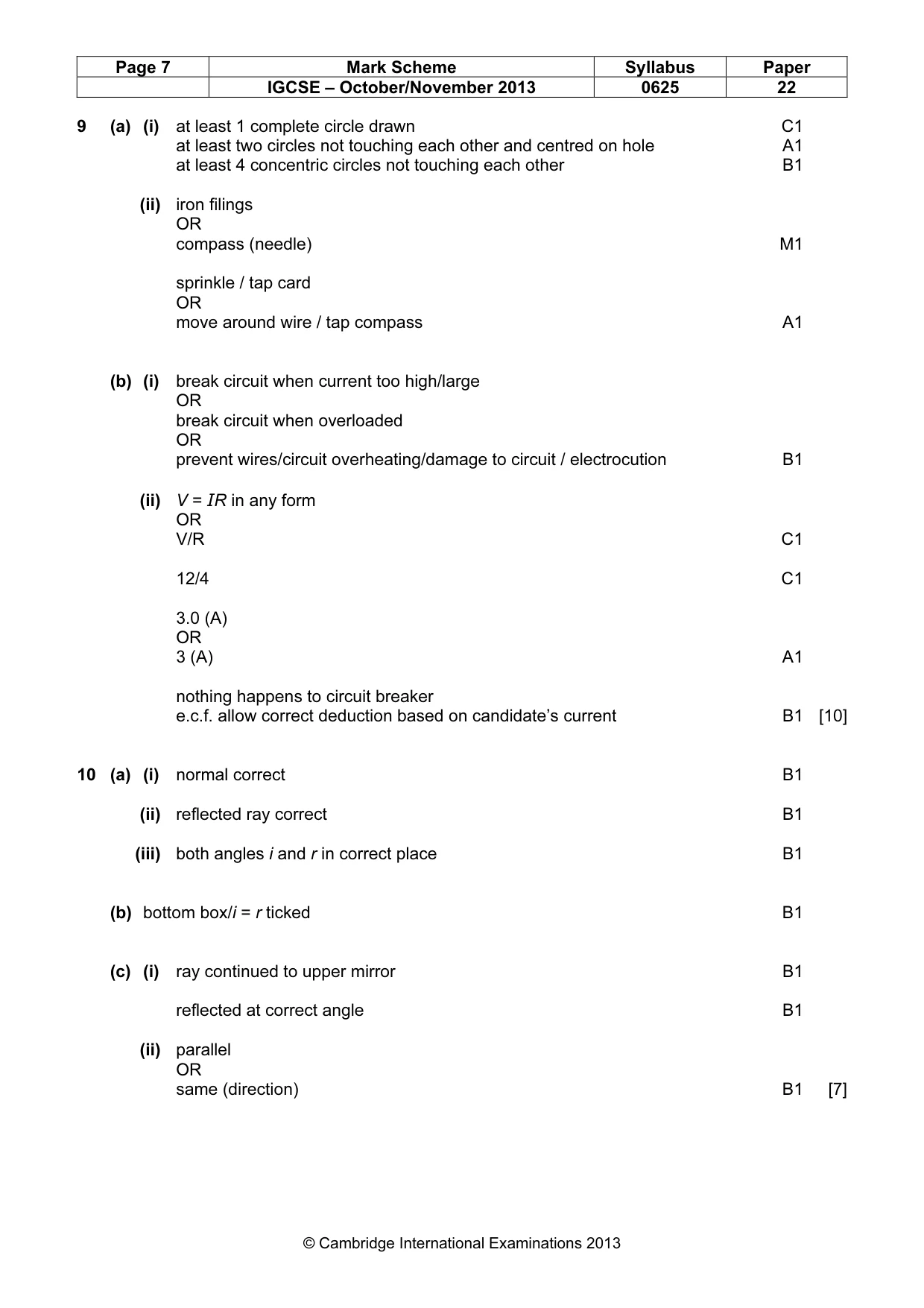
Page 7 Mark Scheme Syllabus Paper IGCSE – October/November 2013 0625 22 © Cambridge International Examinations 2013 9 (a) (i) at least 1 complete circle drawn C1 at least two circles not touching each other and centred on hole A1 at least 4 concentric circles not touching each other B1 (ii) iron filings OR compass (needle) M1 sprinkle / tap card OR move around wire / tap compass A1 (b) (i) break circuit when current too high/large OR break circuit when overloaded OR prevent wires/circuit overheating/damage to circuit / electrocution B1 (ii) V = IR in any form OR V/R C1 12/4 C1 3.0 (A) OR 3 (A) A1 nothing happens to circuit breaker e.c.f. allow correct deduction based on candidate’s current B1 [10] 10 (a) (i) normal correct B1 (ii) reflected ray correct B1 (iii) both angles i and r in correct place B1 (b) bottom box/i = r ticked B1 (c) (i) ray continued to upper mirror B1 reflected at correct angle B1 (ii) parallel OR same (direction) B1 [7]
Mark scheme, page 8
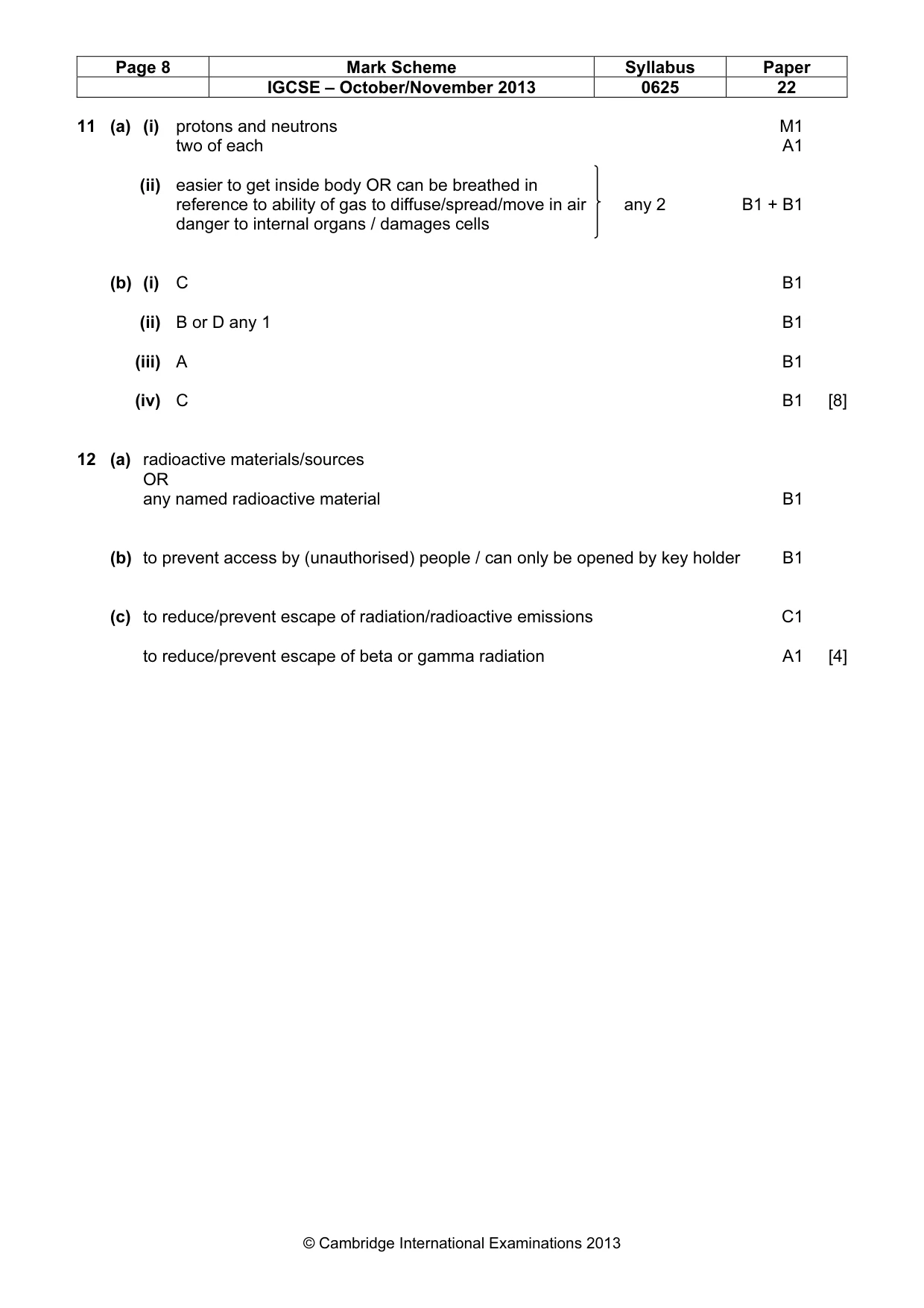
Page 8 Mark Scheme Syllabus Paper IGCSE – October/November 2013 0625 22 © Cambridge International Examinations 2013 11 (a) (i) protons and neutrons M1 two of each A1 (ii) easier to get inside body OR can be breathed in reference to ability of gas to diffuse/spread/move in air any 2 B1 + B1 danger to internal organs / damages cells (b) (i) C B1 (ii) B or D any 1 B1 (iii) A B1 (iv) C B1 [8] 12 (a) radioactive materials/sources OR any named radioactive material B1 (b) to prevent access by (unauthorised) people / can only be opened by key holder B1 (c) to reduce/prevent escape of radiation/radioactive emissions C1 to reduce/prevent escape of beta or gamma radiation A1 [4]