Cambridge IGCSE Physics 0625 — 2013 Oct/Nov Paper 2 · Variant 1
0625/21/O/N/13 · 80 marks · ≈90 min
The question paper and its mark scheme, free to read here and free to download. This is Cambridge’s own paper, exactly as it was sat.
Question paper16 pages
Mark scheme6 pages
Answers below. Sit the paper first if you are practising.
Paper as text
Question paper, page 1
This document consists of 16 printed pages. DC (NH/SW) 64825/7 © UCLES 2013 [Turn over UNIVERSITY OF CAMBRIDGE INTERNATIONAL EXAMINATIONS International General Certificate of Secondary Education * 5 3 1 0 3 5 8 7 6 4 * PHYSICS 0625/21 Paper 2 Core October/November 2013 1 hour 15 minutes Candidates answer on the Question Paper. No Additional Materials are required. READ THESE INSTRUCTIONS FIRST Write your Centre number, candidate number and name on all the work you hand in. Write in dark blue or black pen. You may use a pencil for any diagrams or graphs. Do not use staples, paper clips, highlighters, glue or correction fluid. DO NOT WRITE IN ANY BARCODES. Answer all questions. Electronic calculators may be used. You may lose marks if you do not show your working or if you do not use appropriate units. Take the weight of 1 kg to be 10 N (i.e. acceleration of free fall = 10 m / s2). At the end of the examination, fasten all your work securely together. The number of marks is given in brackets [ ] at the end of each question or part question. www.XtremePapers.com
Question paper, page 2
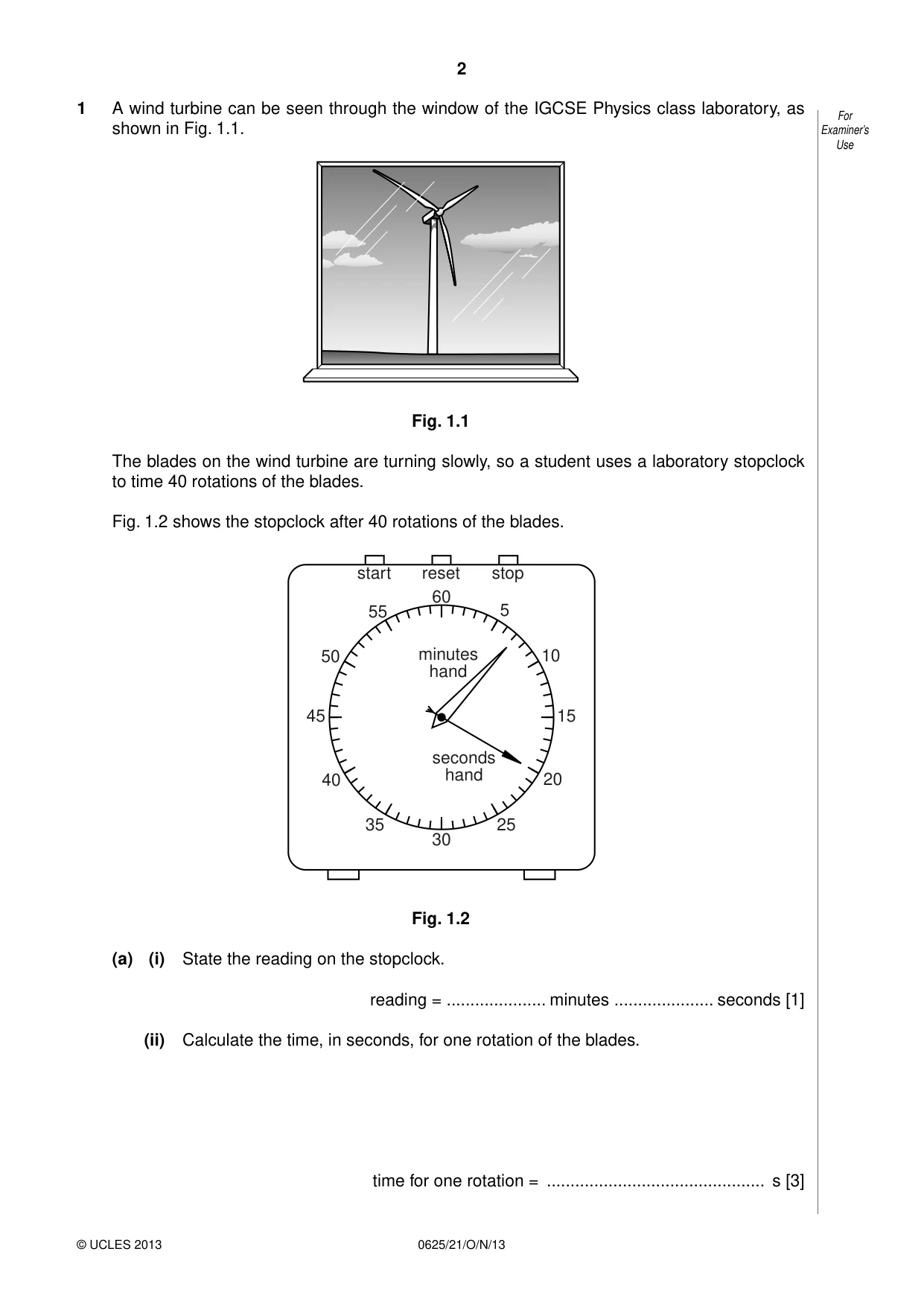
2 0625/21/O/N/13 © UCLES 2013 For Examiner’s Use 1 A wind turbine can be seen through the window of the IGCSE Physics class laboratory, as shown in Fig. 1.1. Fig. 1.1 The blades on the wind turbine are turning slowly, so a student uses a laboratory stopclock to time 40 rotations of the blades. Fig. 1.2 shows the stopclock after 40 rotations of the blades. 60 30 5 10 minutes hand seconds hand 15 45 50 55 20 25 35 40 start reset stop Fig. 1.2 (a) (i) State the reading on the stopclock. reading = … minutes … seconds [1] (ii) Calculate the time, in seconds, for one rotation of the blades. time for one rotation = … s [3]
Question paper, page 3
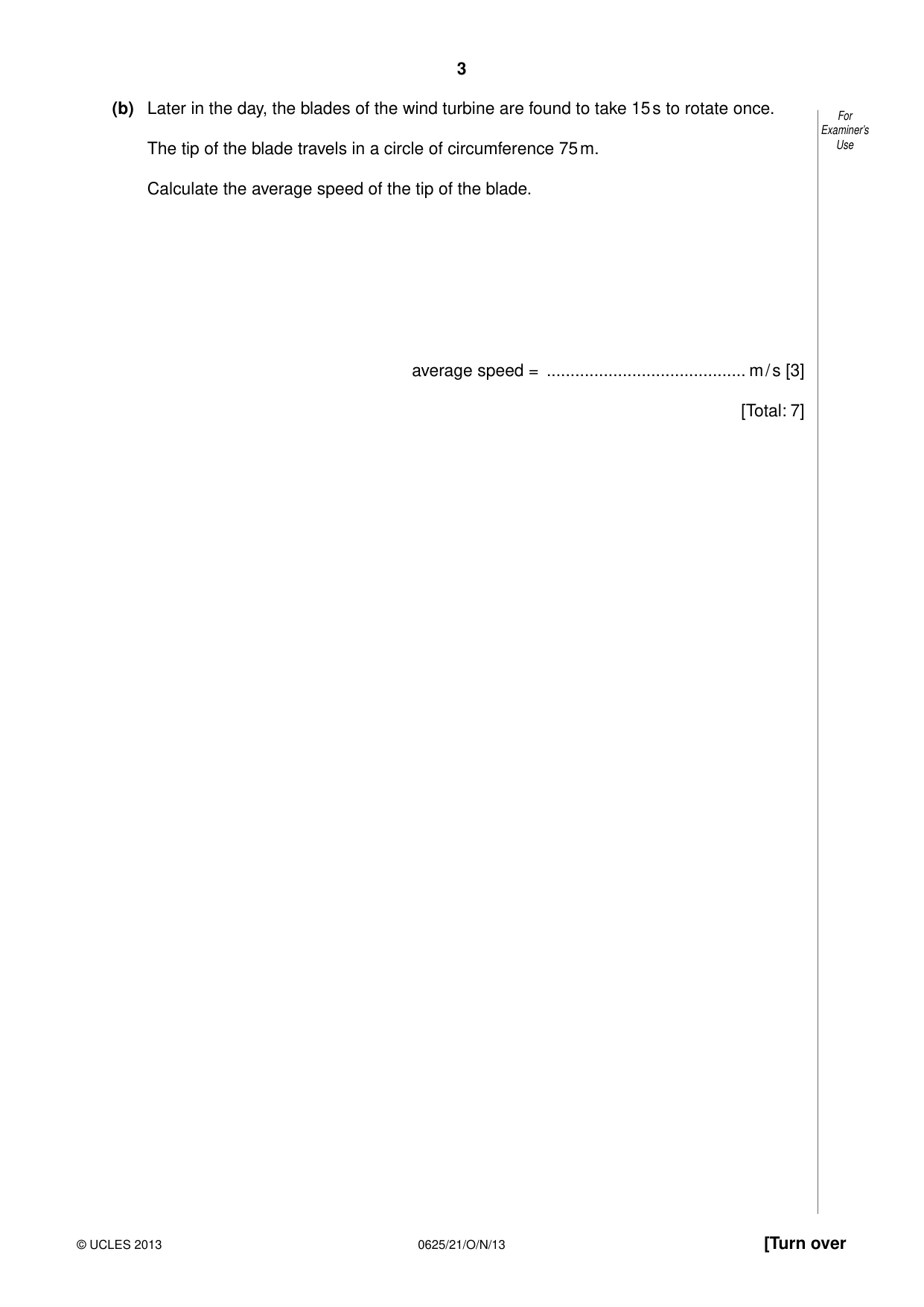
3 0625/21/O/N/13 © UCLES 2013 [Turn over For Examiner’s Use (b) Later in the day, the blades of the wind turbine are found to take 15 s to rotate once. The tip of the blade travels in a circle of circumference 75 m. Calculate the average speed of the tip of the blade. average speed = … m / s [3] [Total: 7]
Question paper, page 4
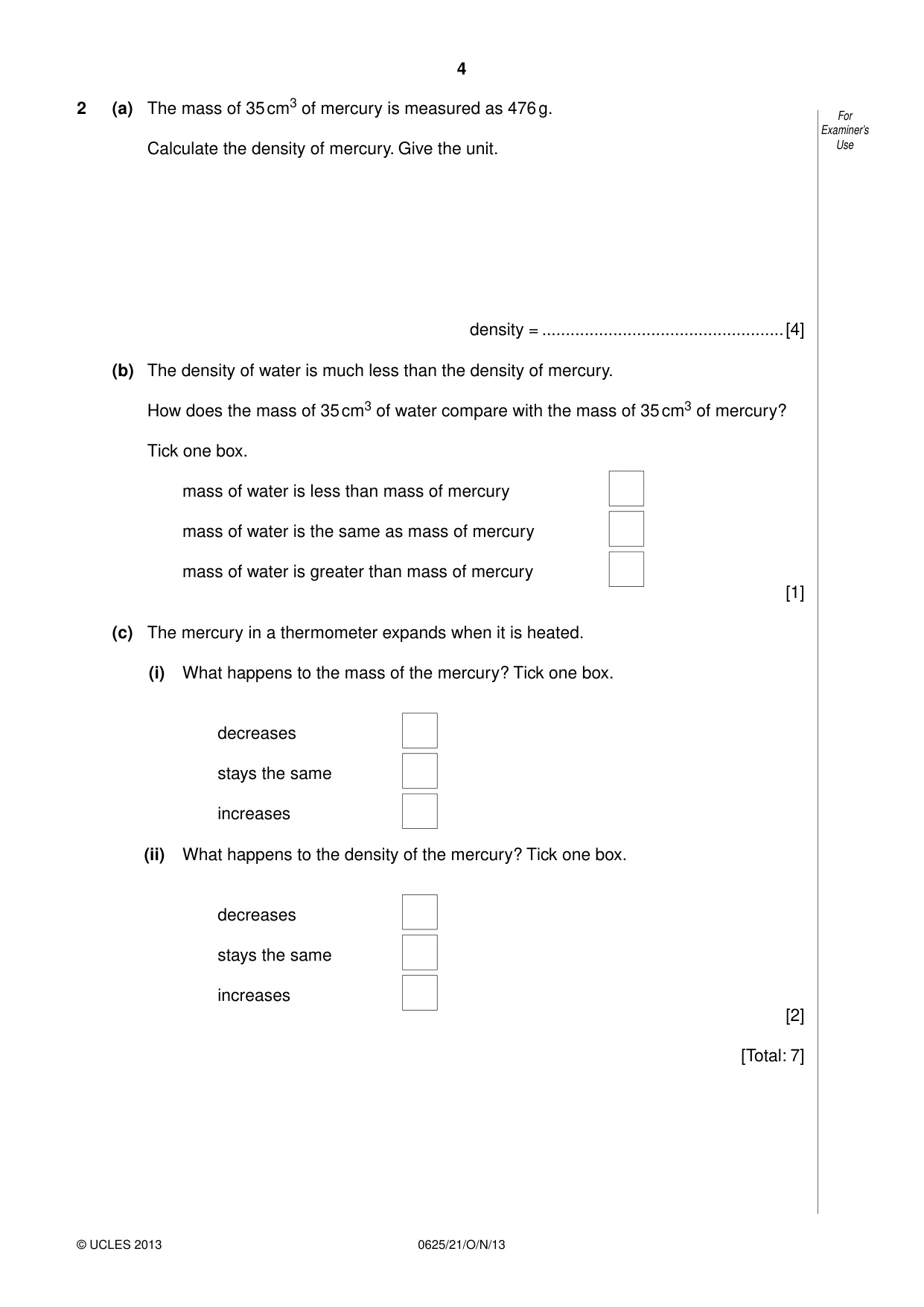
4 0625/21/O/N/13 © UCLES 2013 For Examiner’s Use 2 (a) The mass of 35 cm3 of mercury is measured as 476 g. Calculate the density of mercury. Give the unit. density = …[4] (b) The density of water is much less than the density of mercury. How does the mass of 35 cm3 of water compare with the mass of 35 cm3 of mercury? Tick one box. mass of water is less than mass of mercury mass of water is the same as mass of mercury mass of water is greater than mass of mercury [1] (c) The mercury in a thermometer expands when it is heated. (i) What happens to the mass of the mercury? Tick one box. decreases stays the same increases (ii) What happens to the density of the mercury? Tick one box. decreases stays the same increases [2] [Total: 7]
Question paper, page 5
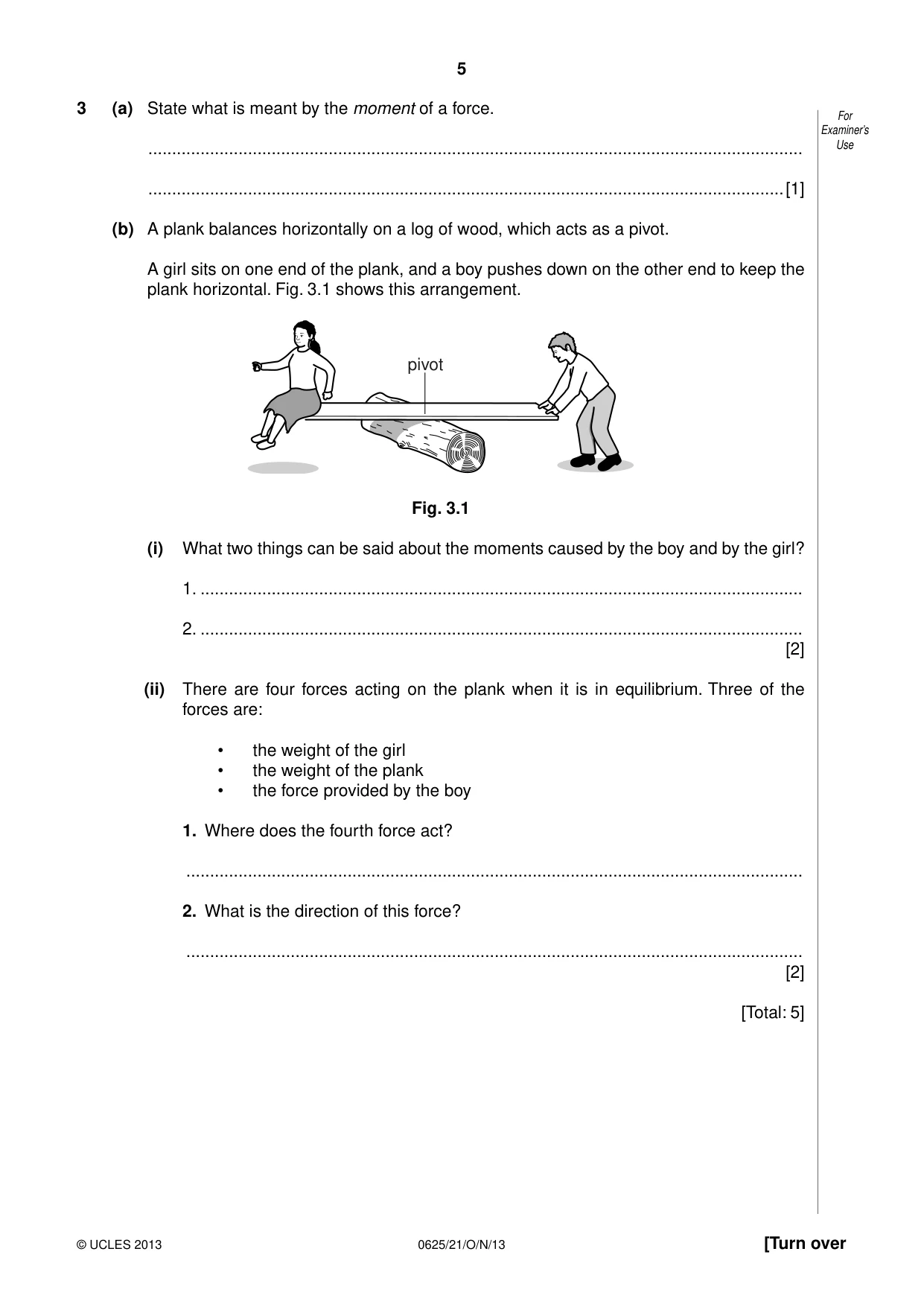
5 0625/21/O/N/13 © UCLES 2013 [Turn over For Examiner’s Use 3 (a) State what is meant by the moment of a force. … …[1] (b) A plank balances horizontally on a log of wood, which acts as a pivot. A girl sits on one end of the plank, and a boy pushes down on the other end to keep the plank horizontal. Fig. 3.1 shows this arrangement. pivot Fig. 3.1 (i) What two things can be said about the moments caused by the boy and by the girl? 1. … 2. … [2] (ii) There are four forces acting on the plank when it is in equilibrium. Three of the forces are: • the weight of the girl • the weight of the plank • the force provided by the boy 1. Where does the fourth force act? … 2. What is the direction of this force? … [2] [Total: 5]
Question paper, page 6
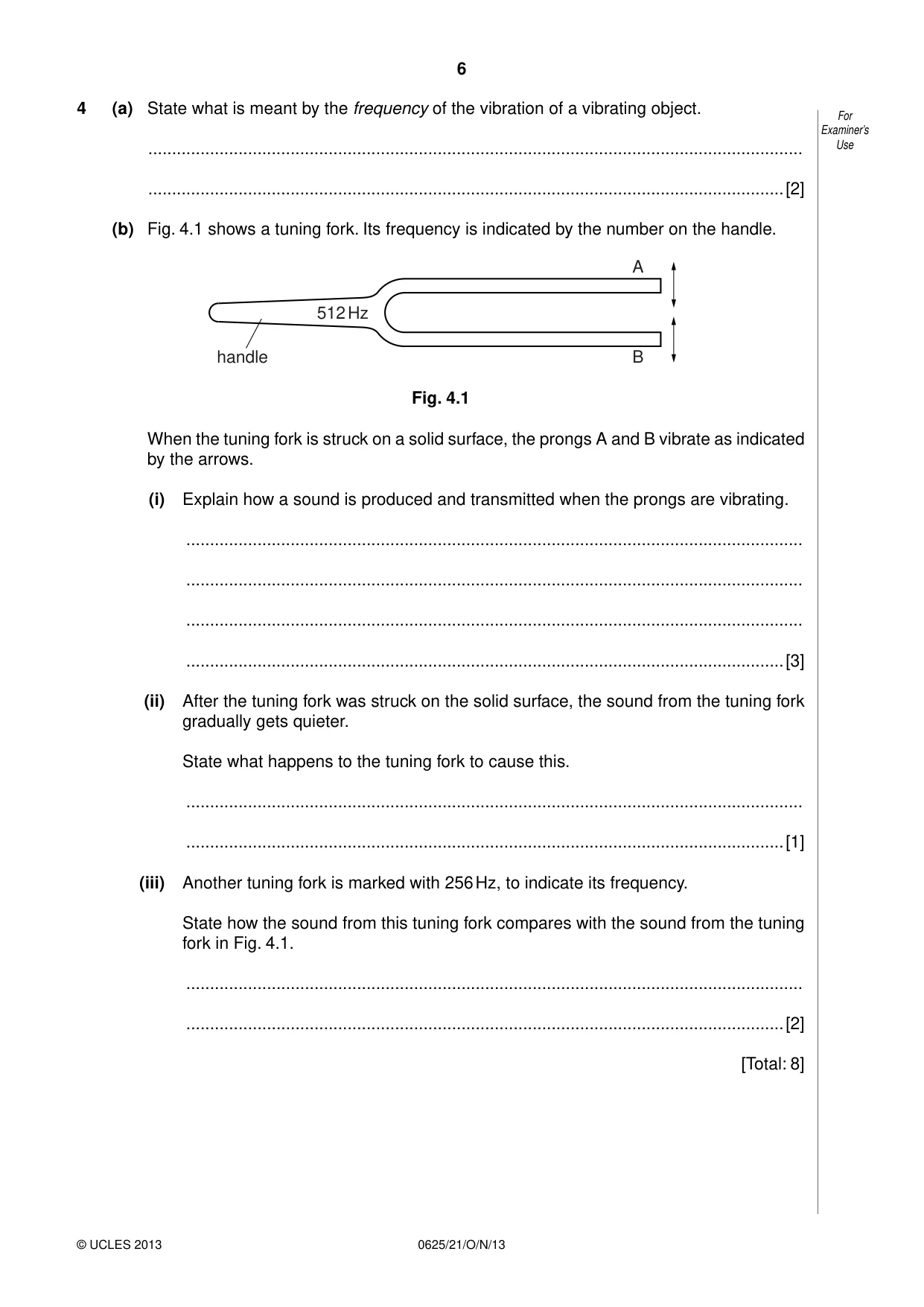
6 0625/21/O/N/13 © UCLES 2013 For Examiner’s Use 4 (a) State what is meant by the frequency of the vibration of a vibrating object. … …[2] (b) Fig. 4.1 shows a tuning fork. Its frequency is indicated by the number on the handle. 512 Hz handle A B Fig. 4.1 When the tuning fork is struck on a solid surface, the prongs A and B vibrate as indicated by the arrows. (i) Explain how a sound is produced and transmitted when the prongs are vibrating. … … … …[3] (ii) After the tuning fork was struck on the solid surface, the sound from the tuning fork gradually gets quieter. State what happens to the tuning fork to cause this. … …[1] (iii) Another tuning fork is marked with 256 Hz, to indicate its frequency. State how the sound from this tuning fork compares with the sound from the tuning fork in Fig. 4.1. … …[2] [Total: 8]
Question paper, page 7
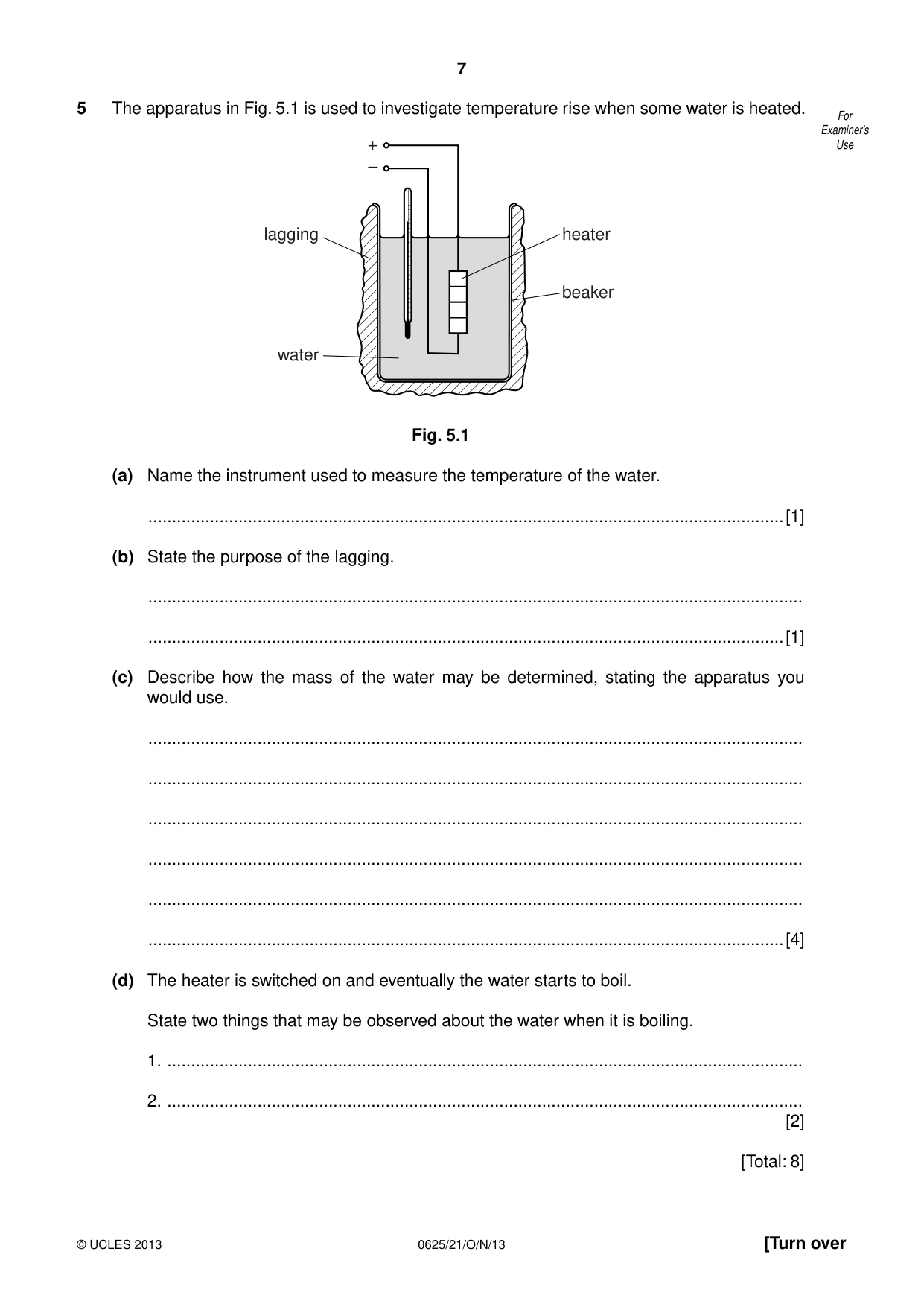
7 0625/21/O/N/13 © UCLES 2013 [Turn over For Examiner’s Use 5 The apparatus in Fig. 5.1 is used to investigate temperature rise when some water is heated. + – heater beaker lagging water Fig. 5.1 (a) Name the instrument used to measure the temperature of the water. …[1] (b) State the purpose of the lagging. … …[1] (c) Describe how the mass of the water may be determined, stating the apparatus you would use. … … … … … …[4] (d) The heater is switched on and eventually the water starts to boil. State two things that may be observed about the water when it is boiling. 1. … 2. … [2] [Total: 8]
Question paper, page 8
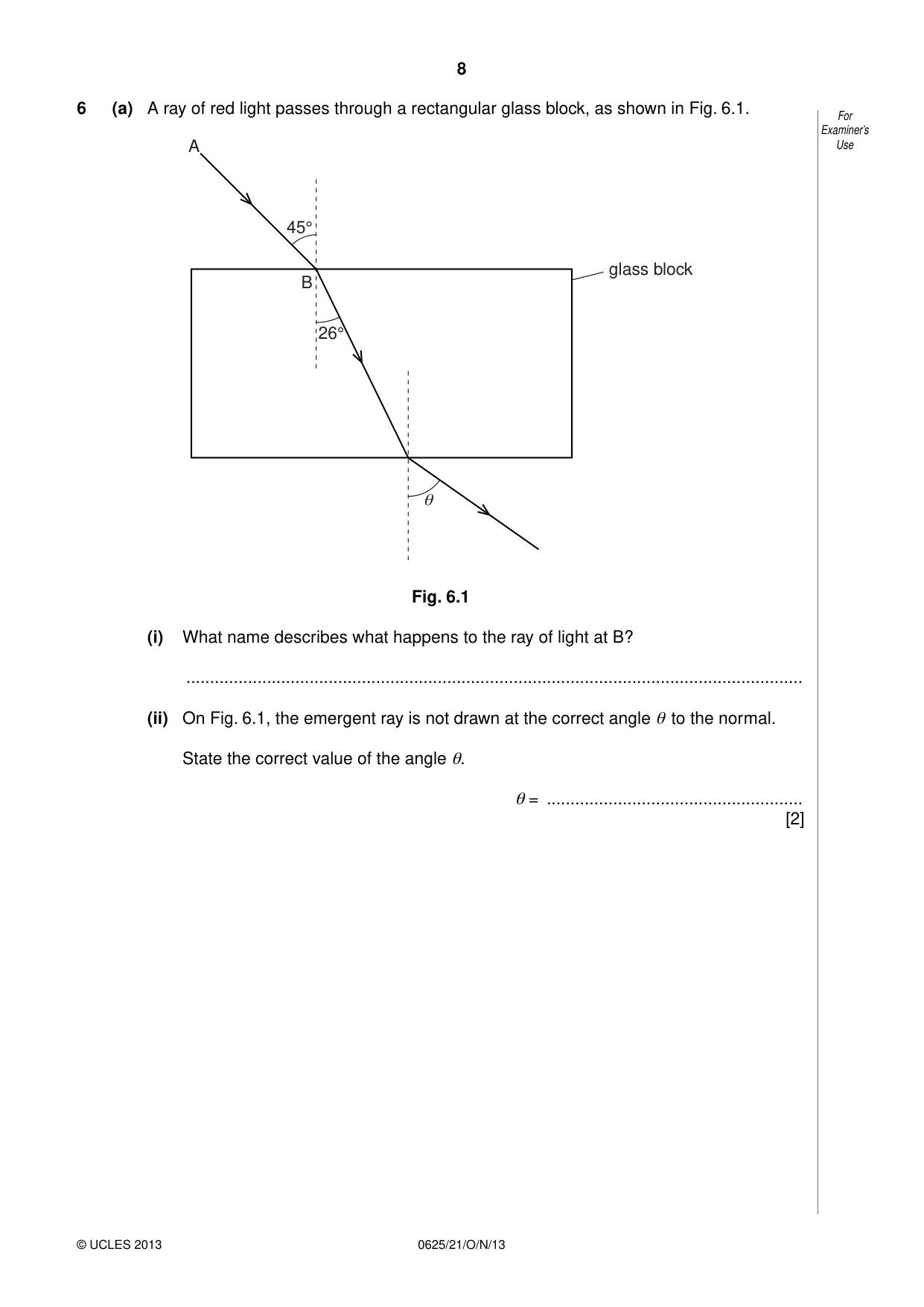
8 0625/21/O/N/13 © UCLES 2013 For Examiner’s Use 6 (a) A ray of red light passes through a rectangular glass block, as shown in Fig. 6.1. 26° glass block 45° A B e Fig. 6.1 (i) What name describes what happens to the ray of light at B? … (ii) On Fig. 6.1, the emergent ray is not drawn at the correct angle θ to the normal. State the correct value of the angle θ. θ = … [2]
Question paper, page 9
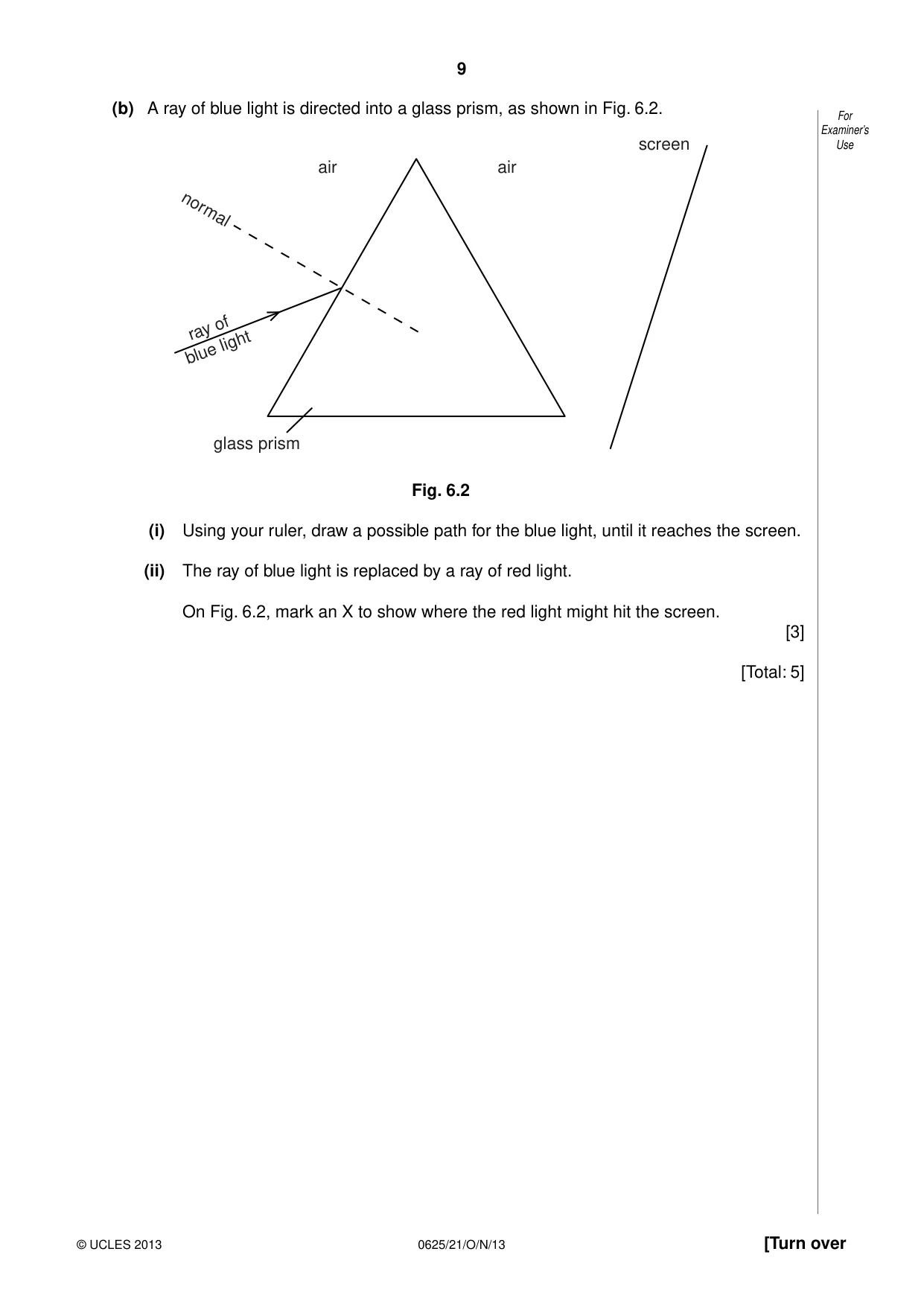
9 0625/21/O/N/13 © UCLES 2013 [Turn over For Examiner’s Use (b) A ray of blue light is directed into a glass prism, as shown in Fig. 6.2. screen air glass prism air normal ray of blue light Fig. 6.2 (i) Using your ruler, draw a possible path for the blue light, until it reaches the screen. (ii) The ray of blue light is replaced by a ray of red light. On Fig. 6.2, mark an X to show where the red light might hit the screen. [3] [Total: 5]
Question paper, page 10
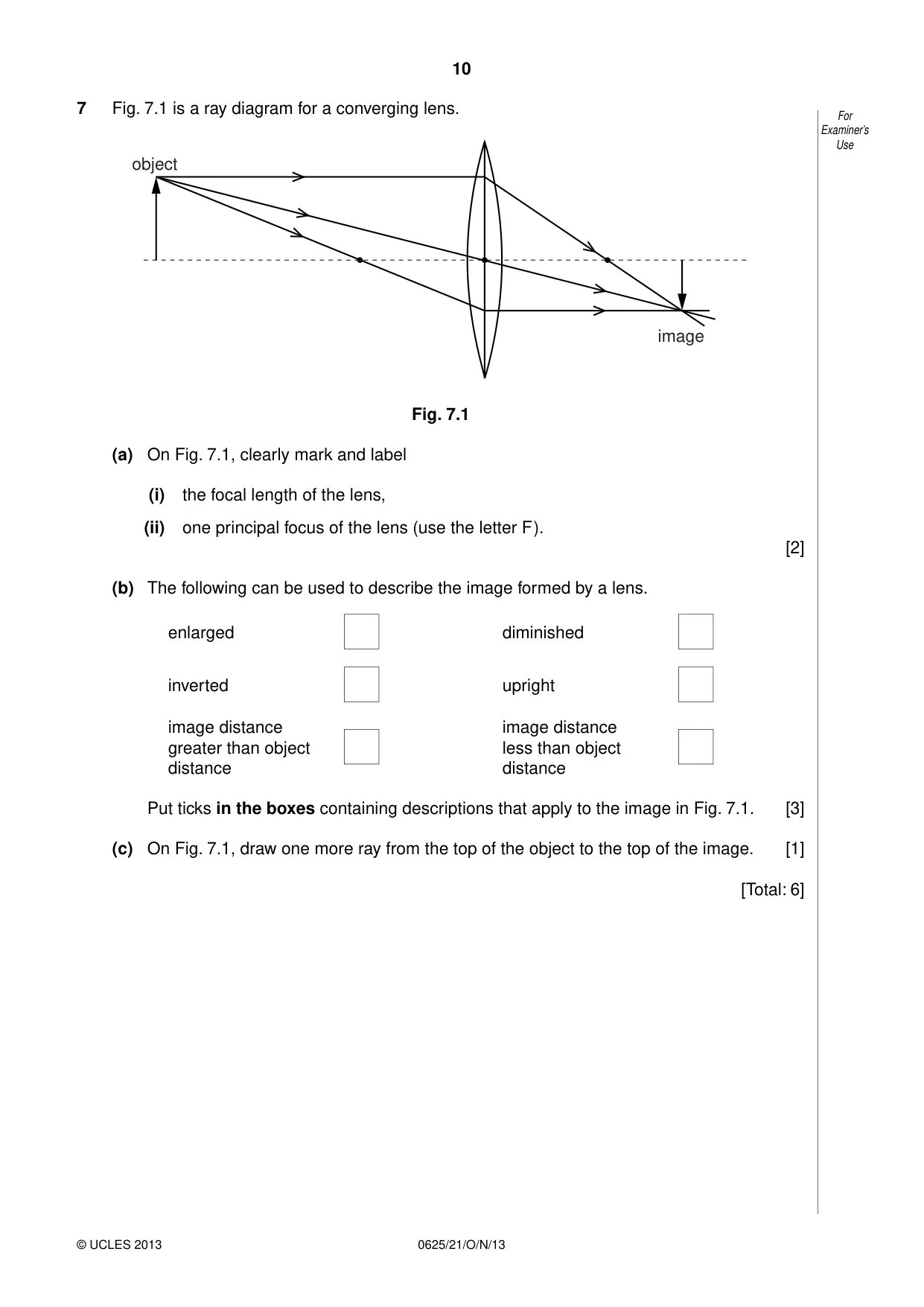
10 0625/21/O/N/13 © UCLES 2013 For Examiner’s Use 7 Fig. 7.1 is a ray diagram for a converging lens. object image Fig. 7.1 (a) On Fig. 7.1, clearly mark and label (i) the focal length of the lens, (ii) one principal focus of the lens (use the letter F). [2] (b) The following can be used to describe the image formed by a lens. enlarged diminished inverted upright image distance greater than object distance image distance less than object distance Put ticks in the boxes containing descriptions that apply to the image in Fig. 7.1. [3] (c) On Fig. 7.1, draw one more ray from the top of the object to the top of the image. [1] [Total: 6]
Question paper, page 11
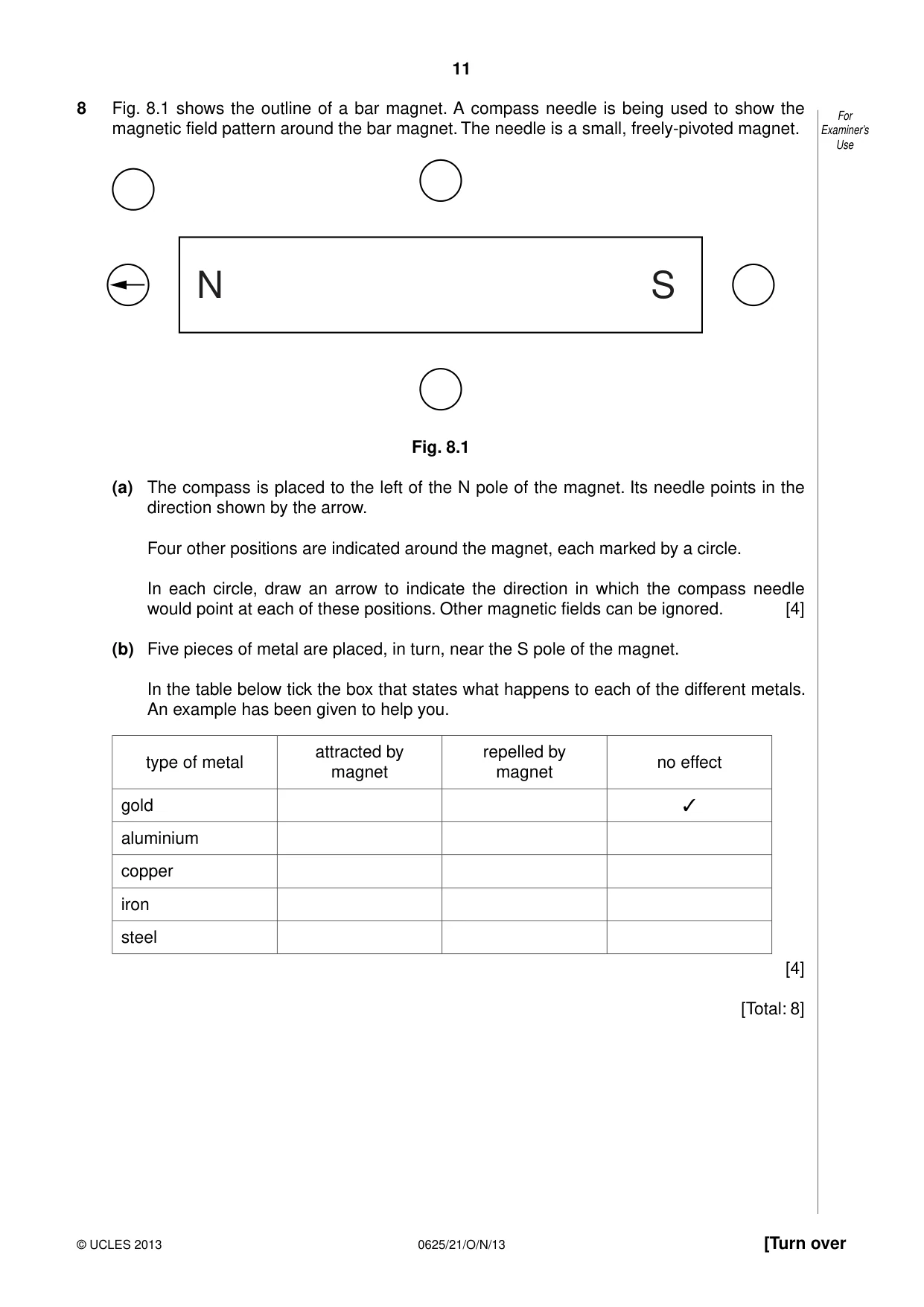
11 0625/21/O/N/13 © UCLES 2013 [Turn over For Examiner’s Use 8 Fig. 8.1 shows the outline of a bar magnet. A compass needle is being used to show the magnetic field pattern around the bar magnet. The needle is a small, freely-pivoted magnet. S N Fig. 8.1 (a) The compass is placed to the left of the N pole of the magnet. Its needle points in the direction shown by the arrow. Four other positions are indicated around the magnet, each marked by a circle. In each circle, draw an arrow to indicate the direction in which the compass needle would point at each of these positions. Other magnetic fields can be ignored. [4] (b) Five pieces of metal are placed, in turn, near the S pole of the magnet. In the table below tick the box that states what happens to each of the different metals. An example has been given to help you. type of metal attracted by magnet repelled by magnet no effect gold ✓ aluminium copper iron steel [4] [Total: 8]
Question paper, page 12
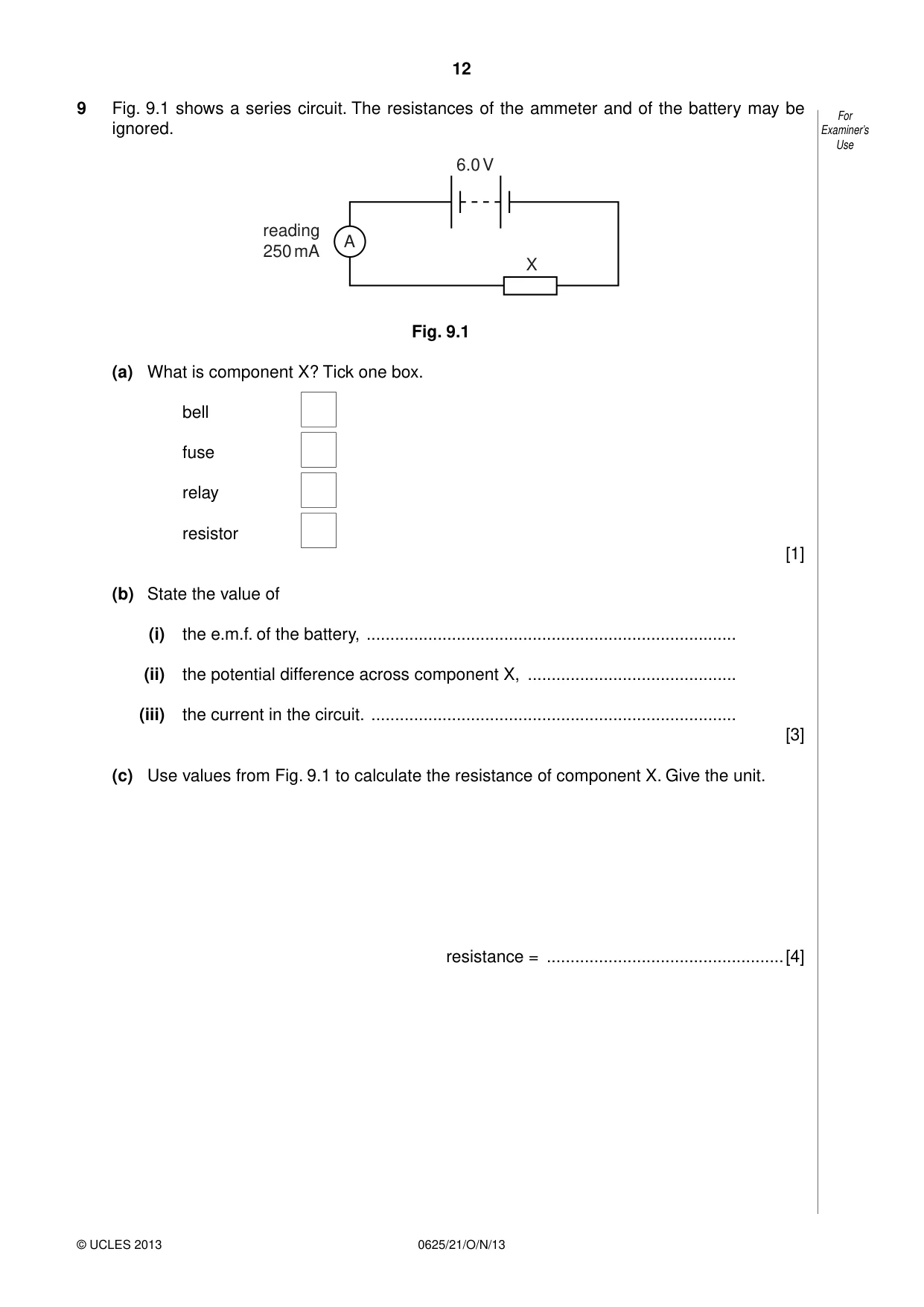
12 0625/21/O/N/13 © UCLES 2013 For Examiner’s Use 9 Fig. 9.1 shows a series circuit. The resistances of the ammeter and of the battery may be ignored. 6.0 V X A reading 250 mA Fig. 9.1 (a) What is component X? Tick one box. bell fuse relay resistor [1] (b) State the value of (i) the e.m.f. of the battery, … (ii) the potential difference across component X, … (iii) the current in the circuit. … [3] (c) Use values from Fig. 9.1 to calculate the resistance of component X. Give the unit. resistance = …[4]
Question paper, page 13
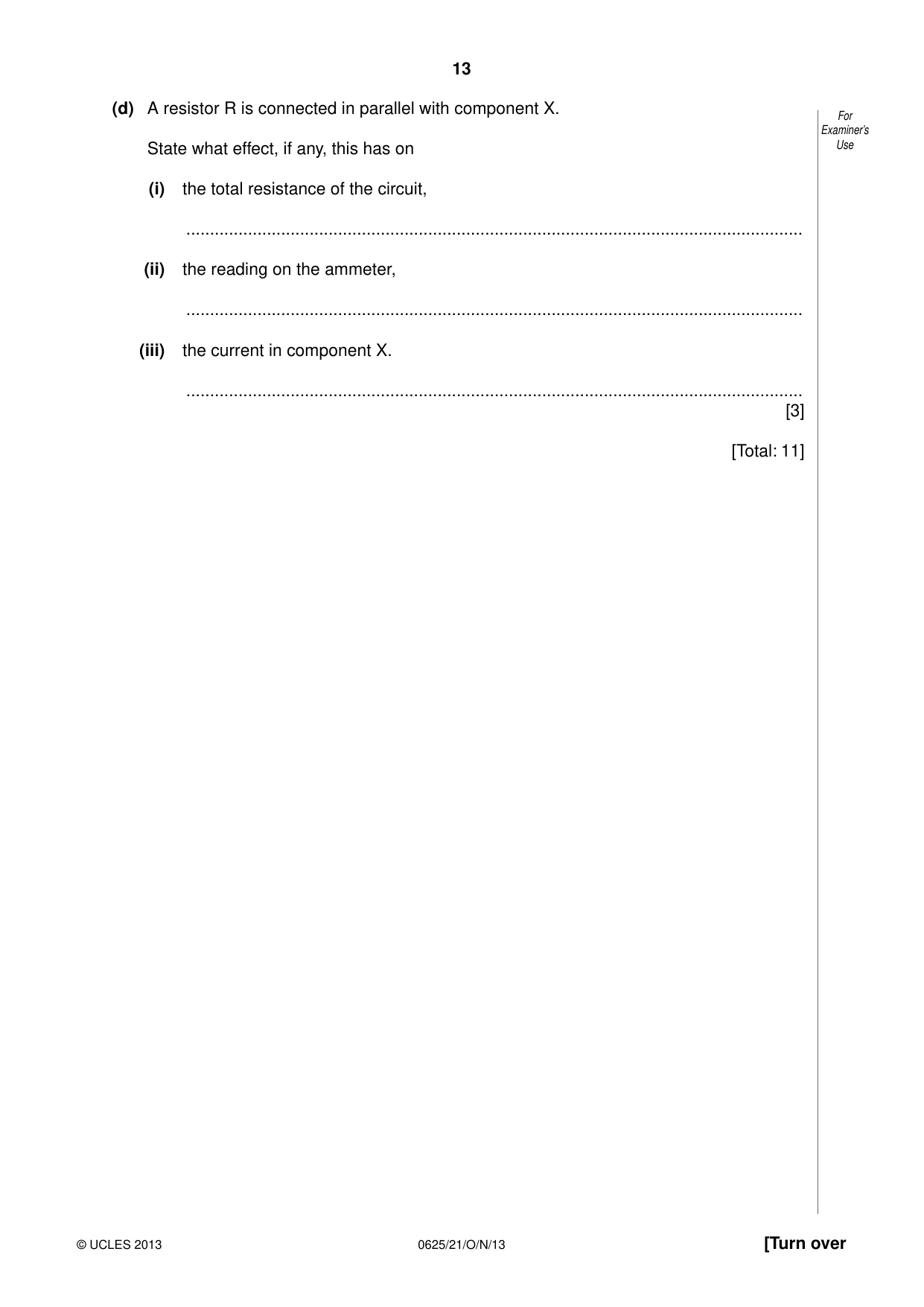
13 0625/21/O/N/13 © UCLES 2013 [Turn over For Examiner’s Use (d) A resistor R is connected in parallel with component X. State what effect, if any, this has on (i) the total resistance of the circuit, … (ii) the reading on the ammeter, … (iii) the current in component X. … [3] [Total: 11]
Question paper, page 14
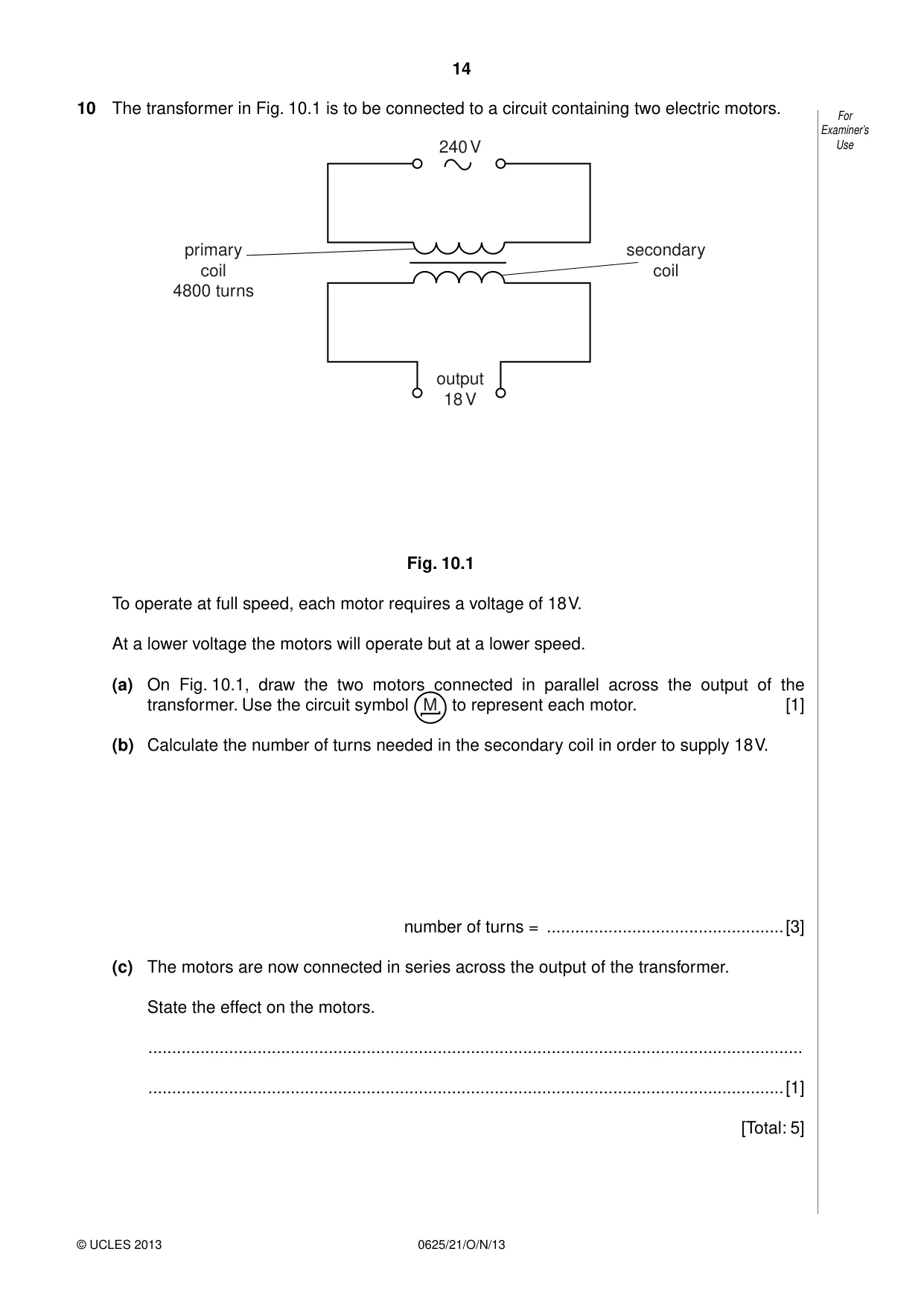
14 0625/21/O/N/13 © UCLES 2013 For Examiner’s Use 10 The transformer in Fig. 10.1 is to be connected to a circuit containing two electric motors. output 18 V 240 V secondary coil primary coil 4800 turns Fig. 10.1 To operate at full speed, each motor requires a voltage of 18 V. At a lower voltage the motors will operate but at a lower speed. (a) On Fig. 10.1, draw the two motors connected in parallel across the output of the transformer. Use the circuit symbol M to represent each motor. [1] (b) Calculate the number of turns needed in the secondary coil in order to supply 18 V. number of turns = …[3] (c) The motors are now connected in series across the output of the transformer. State the effect on the motors. … …[1] [Total: 5]
Question paper, page 15
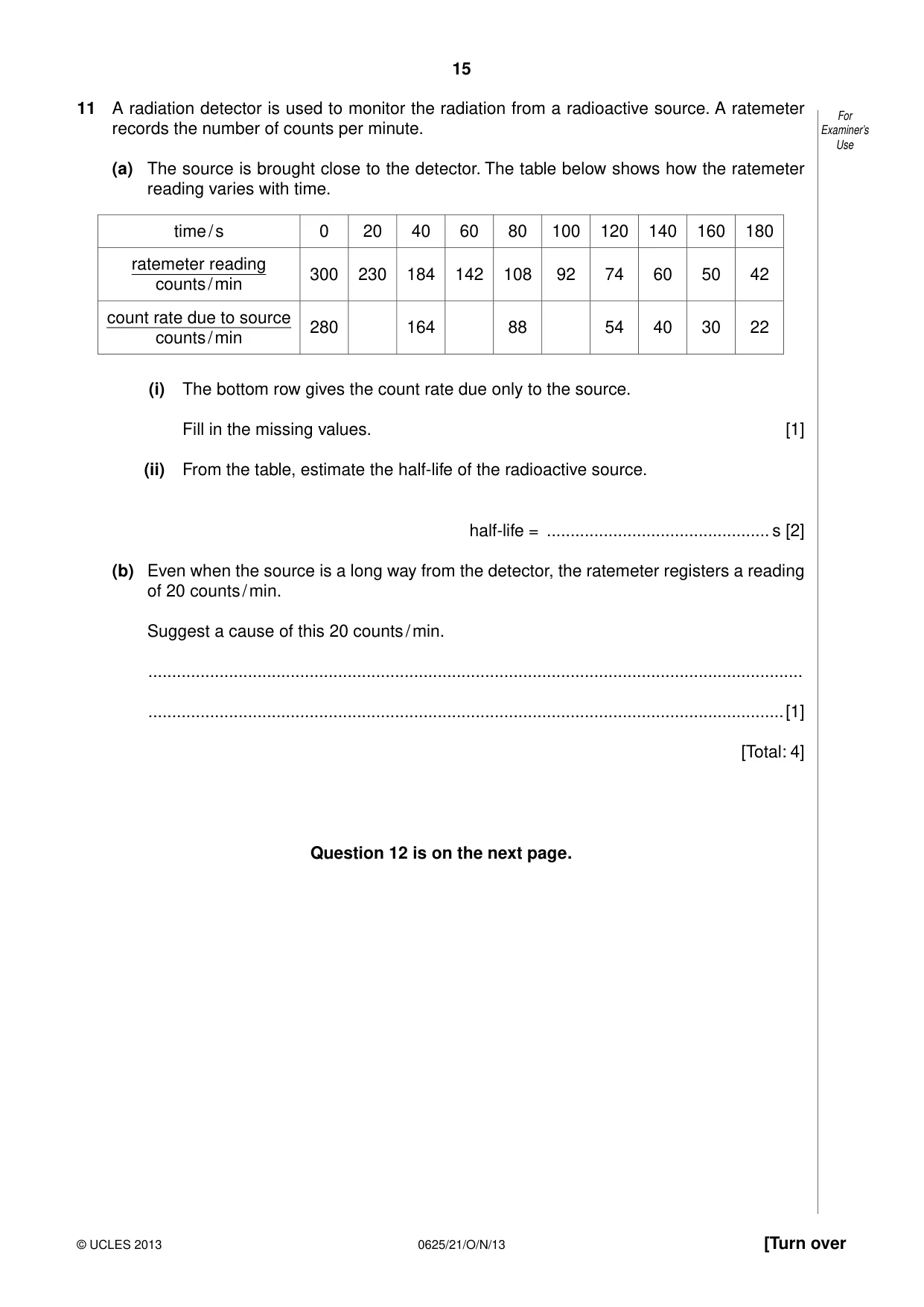
15 0625/21/O/N/13 © UCLES 2013 [Turn over For Examiner’s Use 11 A radiation detector is used to monitor the radiation from a radioactive source. A ratemeter records the number of counts per minute. (a) The source is brought close to the detector. The table below shows how the ratemeter reading varies with time. time / s 0 20 40 60 80 100 120 140 160 180 ratemeter reading counts / min 300 230 184 142 108 92 74 60 50 42 count rate due to source counts / min 280 164 88 54 40 30 22 (i) The bottom row gives the count rate due only to the source. Fill in the missing values. [1] (ii) From the table, estimate the half-life of the radioactive source. half-life = … s [2] (b) Even when the source is a long way from the detector, the ratemeter registers a reading of 20 counts / min. Suggest a cause of this 20 counts / min. … …[1] [Total: 4] Question 12 is on the next page.
Question paper, page 16
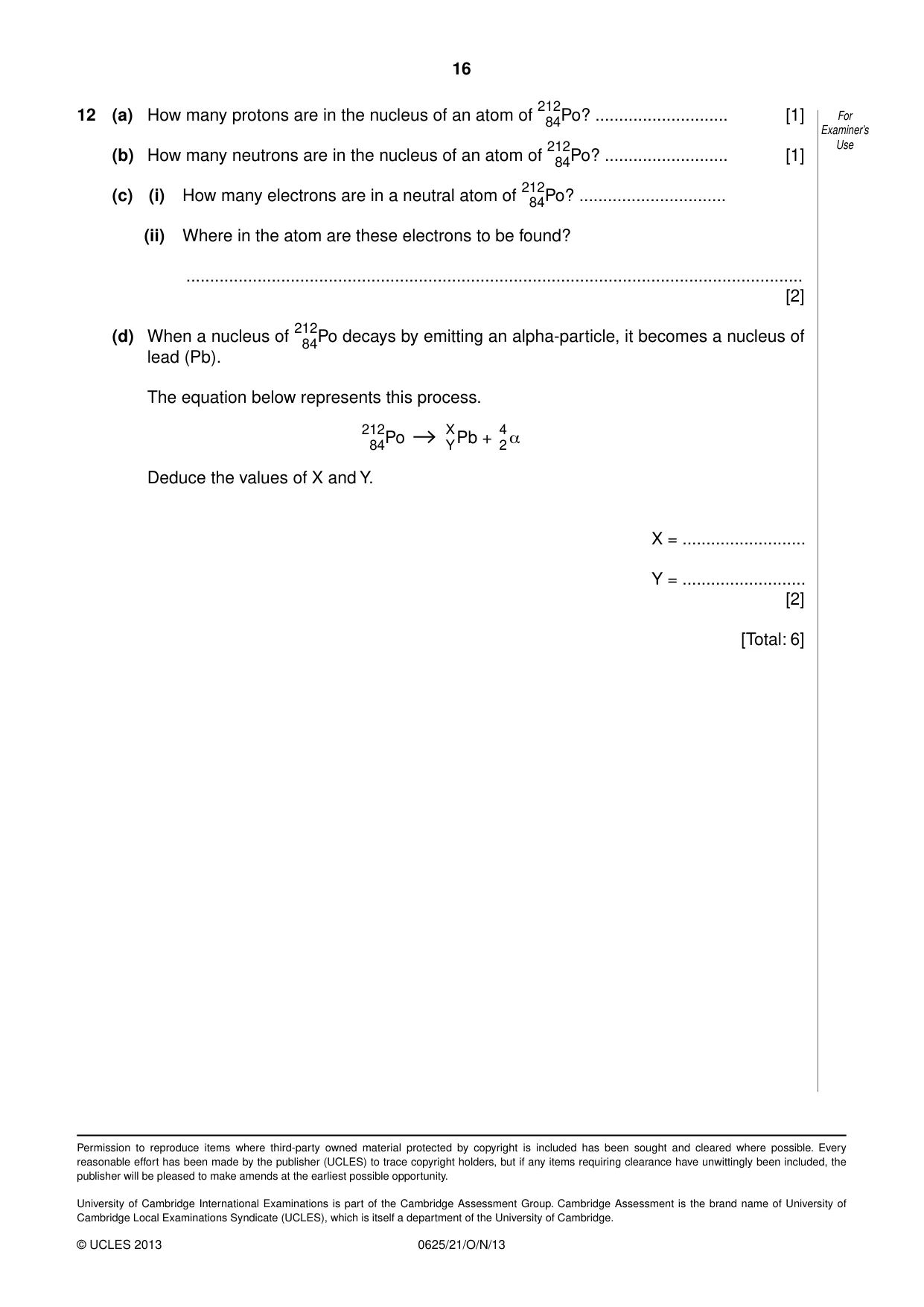
16 0625/21/O/N/13 © UCLES 2013 For Examiner’s Use 12 (a) How many protons are in the nucleus of an atom of 212 84Po? … [1] (b) How many neutrons are in the nucleus of an atom of 212 84Po? … [1] (c) (i) How many electrons are in a neutral atom of 212 84Po? … (ii) Where in the atom are these electrons to be found? … [2] (d) When a nucleus of 212 84Po decays by emitting an alpha-particle, it becomes a nucleus of lead (Pb). The equation below represents this process. 212 84Po X YPb + 4 2α Deduce the values of X and Y. X = … Y = … [2] [Total: 6] Permission to reproduce items where third-party owned material protected by copyright is included has been sought and cleared where possible. Every reasonable effort has been made by the publisher (UCLES) to trace copyright holders, but if any items requiring clearance have unwittingly been included, the publisher will be pleased to make amends at the earliest possible opportunity. University of Cambridge International Examinations is part of the Cambridge Assessment Group. Cambridge Assessment is the brand name of University of Cambridge Local Examinations Syndicate (UCLES), which is itself a department of the University of Cambridge.
Mark scheme, page 1
CAMBRIDGE INTERNATIONAL EXAMINATIONS International General Certificate of Secondary Education MARK SCHEME for the October/November 2013 series 0625 PHYSICS 0625/21 Paper 2 (Core Theory), maximum raw mark 80 This mark scheme is published as an aid to teachers and candidates, to indicate the requirements of the examination. It shows the basis on which Examiners were instructed to award marks. It does not indicate the details of the discussions that took place at an Examiners’ meeting before marking began, which would have considered the acceptability of alternative answers. Mark schemes should be read in conjunction with the question paper and the Principal Examiner Report for Teachers. Cambridge will not enter into discussions about these mark schemes. Cambridge is publishing the mark schemes for the October/November 2013 series for most IGCSE, GCE Advanced Level and Advanced Subsidiary Level components and some Ordinary Level components. www.XtremePapers.com
Mark scheme, page 2
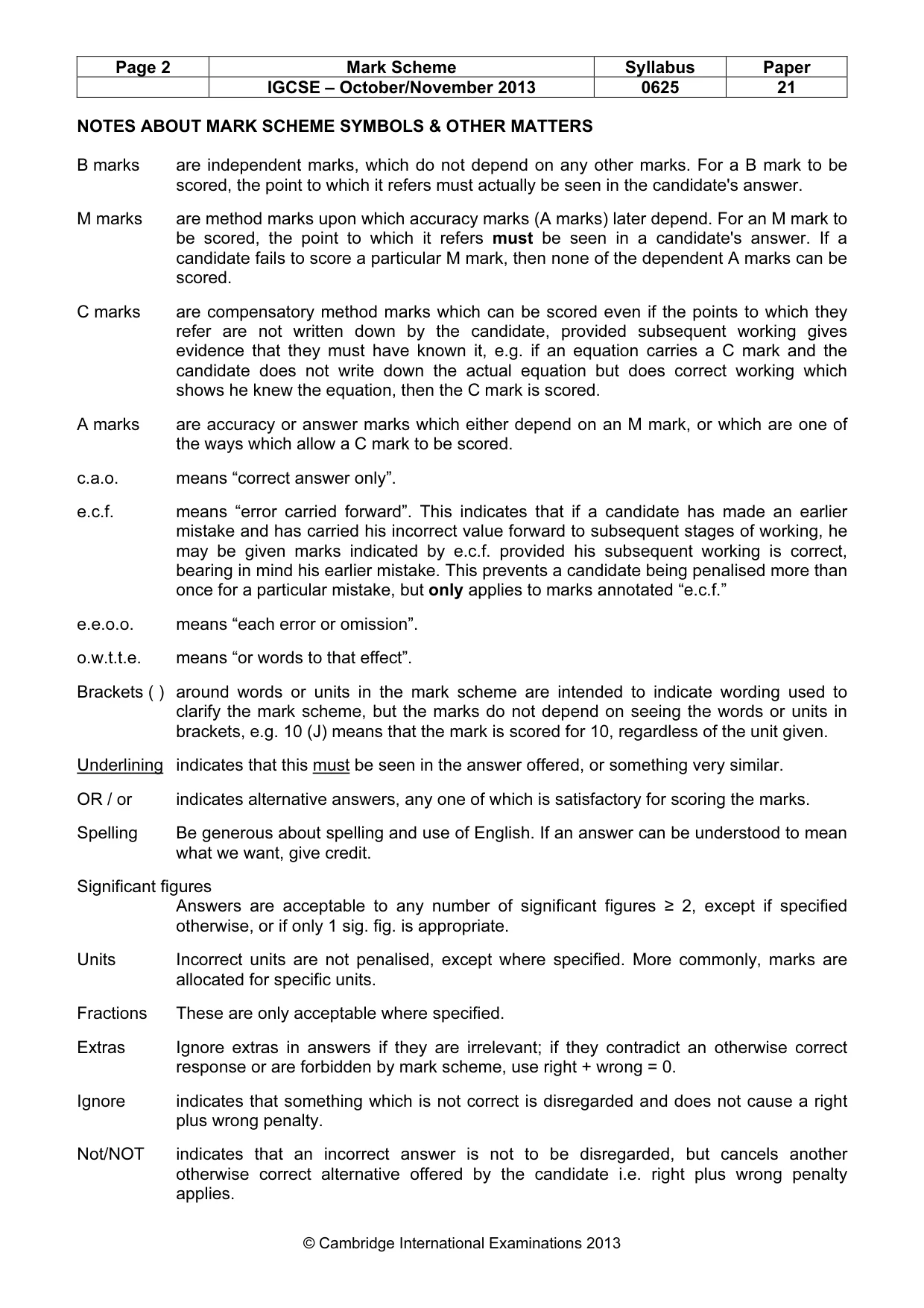
Page 2 Mark Scheme Syllabus Paper IGCSE – October/November 2013 0625 21 © Cambridge International Examinations 2013 NOTES ABOUT MARK SCHEME SYMBOLS & OTHER MATTERS B marks are independent marks, which do not depend on any other marks. For a B mark to be scored, the point to which it refers must actually be seen in the candidate's answer. M marks are method marks upon which accuracy marks (A marks) later depend. For an M mark to be scored, the point to which it refers must be seen in a candidate's answer. If a candidate fails to score a particular M mark, then none of the dependent A marks can be scored. C marks are compensatory method marks which can be scored even if the points to which they refer are not written down by the candidate, provided subsequent working gives evidence that they must have known it, e.g. if an equation carries a C mark and the candidate does not write down the actual equation but does correct working which shows he knew the equation, then the C mark is scored. A marks are accuracy or answer marks which either depend on an M mark, or which are one of the ways which allow a C mark to be scored. c.a.o. means “correct answer only”. e.c.f. means “error carried forward”. This indicates that if a candidate has made an earlier mistake and has carried his incorrect value forward to subsequent stages of working, he may be given marks indicated by e.c.f. provided his subsequent working is correct, bearing in mind his earlier mistake. This prevents a candidate being penalised more than once for a particular mistake, but only applies to marks annotated “e.c.f.” e.e.o.o. means “each error or omission”. o.w.t.t.e. means “or words to that effect”. Brackets ( ) around words or units in the mark scheme are intended to indicate wording used to clarify the mark scheme, but the marks do not depend on seeing the words or units in brackets, e.g. 10 (J) means that the mark is scored for 10, regardless of the unit given. Underlining indicates that this must be seen in the answer offered, or something very similar. OR / or indicates alternative answers, any one of which is satisfactory for scoring the marks. Spelling Be generous about spelling and use of English. If an answer can be understood to mean what we want, give credit. Significant figures Answers are acceptable to any number of significant figures ≥ 2, except if specified otherwise, or if only 1 sig. fig. is appropriate. Units Incorrect units are not penalised, except where specified. More commonly, marks are allocated for specific units. Fractions These are only acceptable where specified. Extras Ignore extras in answers if they are irrelevant; if they contradict an otherwise correct response or are forbidden by mark scheme, use right + wrong = 0. Ignore indicates that something which is not correct is disregarded and does not cause a right plus wrong penalty. Not/NOT indicates that an incorrect answer is not to be disregarded, but cancels another otherwise correct alternative offered by the candidate i.e. right plus wrong penalty applies.
Mark scheme, page 3
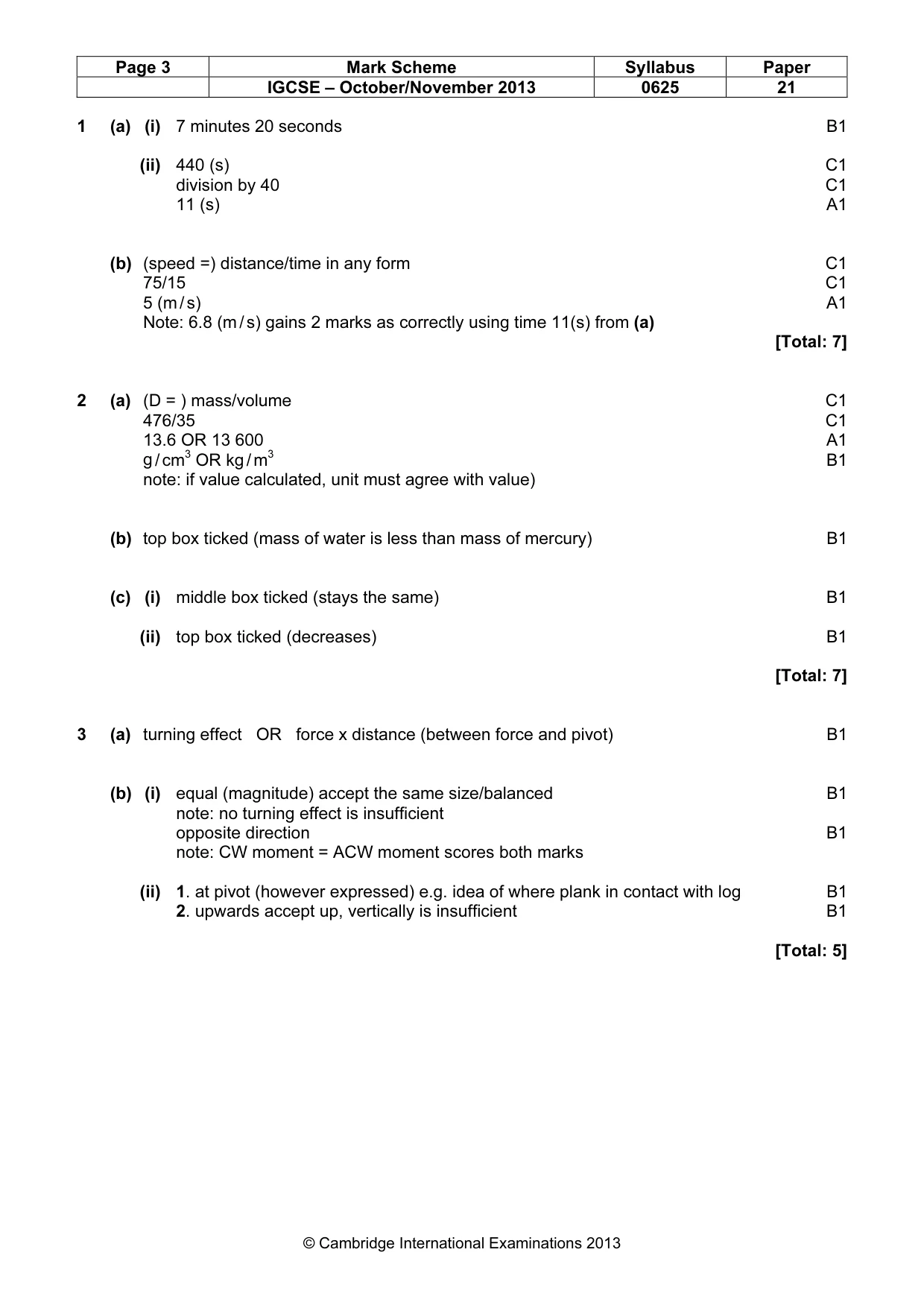
Page 3 Mark Scheme Syllabus Paper IGCSE – October/November 2013 0625 21 © Cambridge International Examinations 2013 1 (a) (i) 7 minutes 20 seconds B1 (ii) 440 (s) C1 division by 40 C1 11 (s) A1 (b) (speed =) distance/time in any form C1 75/15 C1 5 (m / s) A1 Note: 6.8 (m / s) gains 2 marks as correctly using time 11(s) from (a) [Total: 7] 2 (a) (D = ) mass/volume C1 476/35 C1 13.6 OR 13 600 A1 g / cm3 OR kg / m3 B1 note: if value calculated, unit must agree with value) (b) top box ticked (mass of water is less than mass of mercury) B1 (c) (i) middle box ticked (stays the same) B1 (ii) top box ticked (decreases) B1 [Total: 7] 3 (a) turning effect OR force x distance (between force and pivot) B1 (b) (i) equal (magnitude) accept the same size/balanced B1 note: no turning effect is insufficient opposite direction B1 note: CW moment = ACW moment scores both marks (ii) 1. at pivot (however expressed) e.g. idea of where plank in contact with log B1 2. upwards accept up, vertically is insufficient B1 [Total: 5]
Mark scheme, page 4
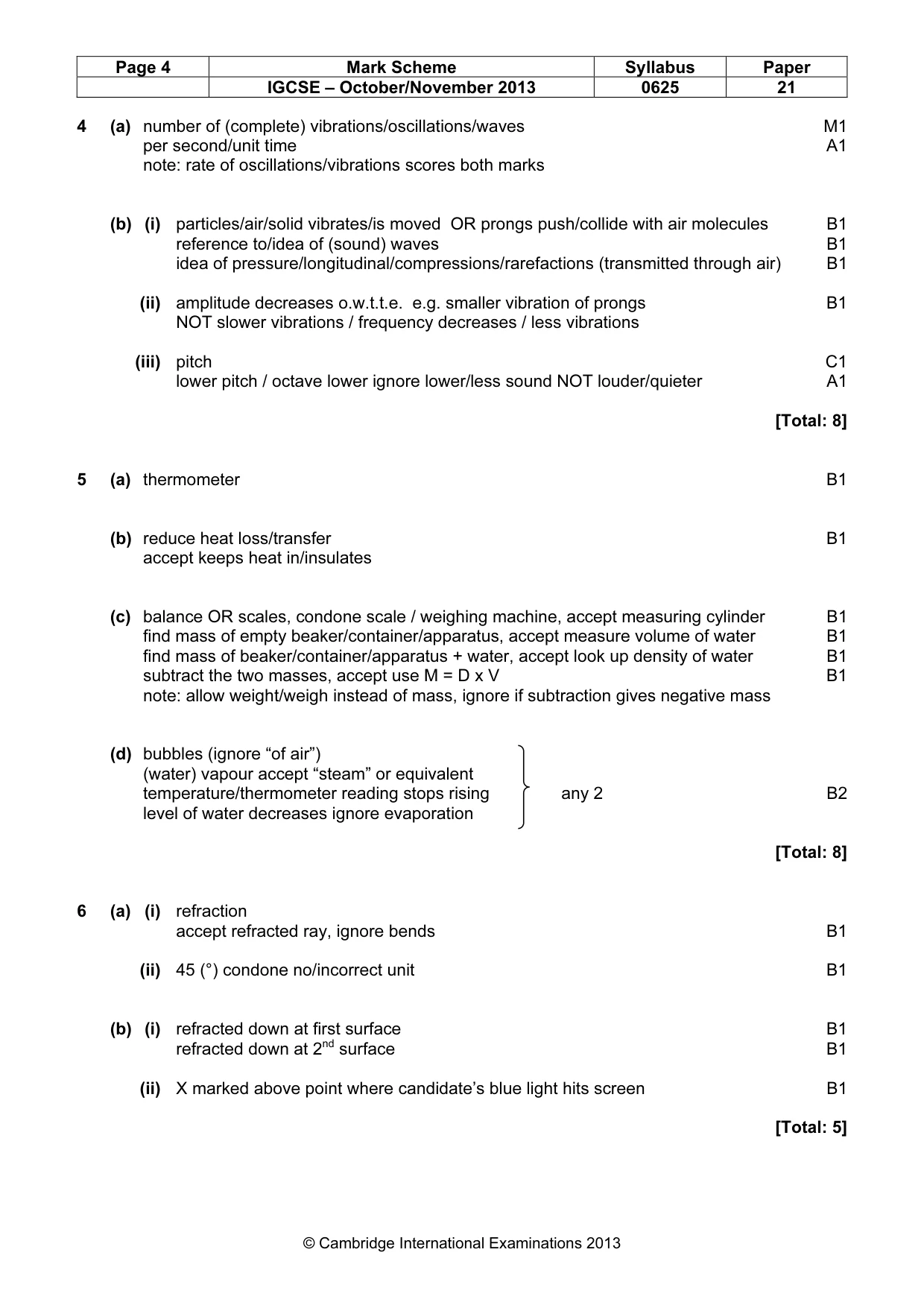
Page 4 Mark Scheme Syllabus Paper IGCSE – October/November 2013 0625 21 © Cambridge International Examinations 2013 4 (a) number of (complete) vibrations/oscillations/waves M1 per second/unit time A1 note: rate of oscillations/vibrations scores both marks (b) (i) particles/air/solid vibrates/is moved OR prongs push/collide with air molecules B1 reference to/idea of (sound) waves B1 idea of pressure/longitudinal/compressions/rarefactions (transmitted through air) B1 (ii) amplitude decreases o.w.t.t.e. e.g. smaller vibration of prongs B1 NOT slower vibrations / frequency decreases / less vibrations (iii) pitch C1 lower pitch / octave lower ignore lower/less sound NOT louder/quieter A1 [Total: 8] 5 (a) thermometer B1 (b) reduce heat loss/transfer B1 accept keeps heat in/insulates (c) balance OR scales, condone scale / weighing machine, accept measuring cylinder B1 find mass of empty beaker/container/apparatus, accept measure volume of water B1 find mass of beaker/container/apparatus + water, accept look up density of water B1 subtract the two masses, accept use M = D x V B1 note: allow weight/weigh instead of mass, ignore if subtraction gives negative mass (d) bubbles (ignore “of air”) (water) vapour accept “steam” or equivalent temperature/thermometer reading stops rising any 2 B2 level of water decreases ignore evaporation [Total: 8] 6 (a) (i) refraction accept refracted ray, ignore bends B1 (ii) 45 (°) condone no/incorrect unit B1 (b) (i) refracted down at first surface B1 refracted down at 2nd surface B1 (ii) X marked above point where candidate’s blue light hits screen B1 [Total: 5]
Mark scheme, page 5
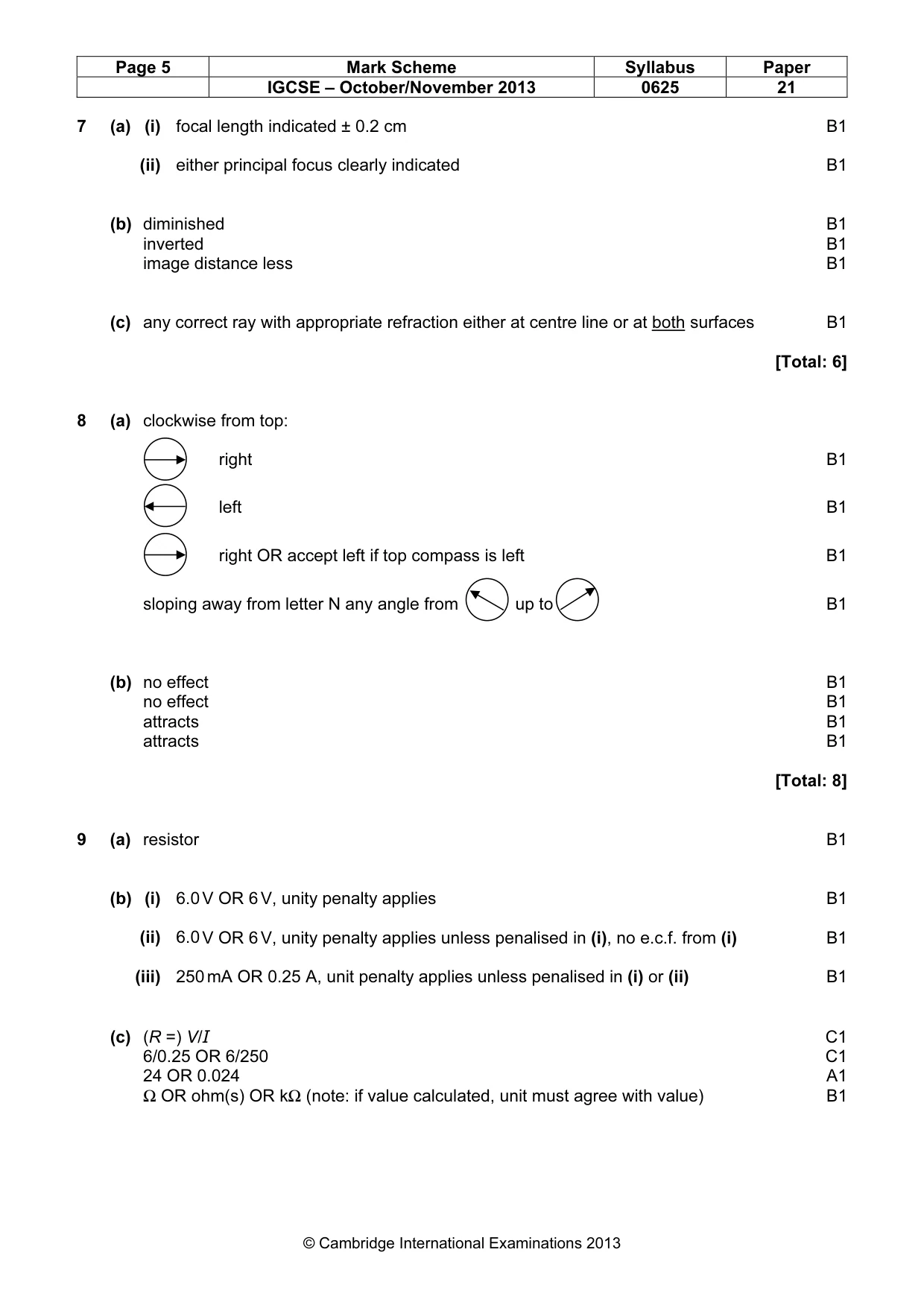
Page 5 Mark Scheme Syllabus Paper IGCSE – October/November 2013 0625 21 © Cambridge International Examinations 2013 7 (a) (i) focal length indicated ± 0.2 cm B1 (ii) either principal focus clearly indicated B1 (b) diminished B1 inverted B1 image distance less B1 (c) any correct ray with appropriate refraction either at centre line or at both surfaces B1 [Total: 6] 8 (a) clockwise from top: right B1 left B1 right OR accept left if top compass is left B1 sloping away from letter N any angle from up to B1 (b) no effect B1 no effect B1 attracts B1 attracts B1 [Total: 8] 9 (a) resistor B1 (b) (i) 6.0 V OR 6 V, unity penalty applies B1 (ii) 6.0 V OR 6 V, unity penalty applies unless penalised in (i), no e.c.f. from (i) B1 (iii) 250 mA OR 0.25 A, unit penalty applies unless penalised in (i) or (ii) B1 (c) (R =) V/I C1 6/0.25 OR 6/250 C1 24 OR 0.024 A1 Ω OR ohm(s) OR kΩ (note: if value calculated, unit must agree with value) B1
Mark scheme, page 6
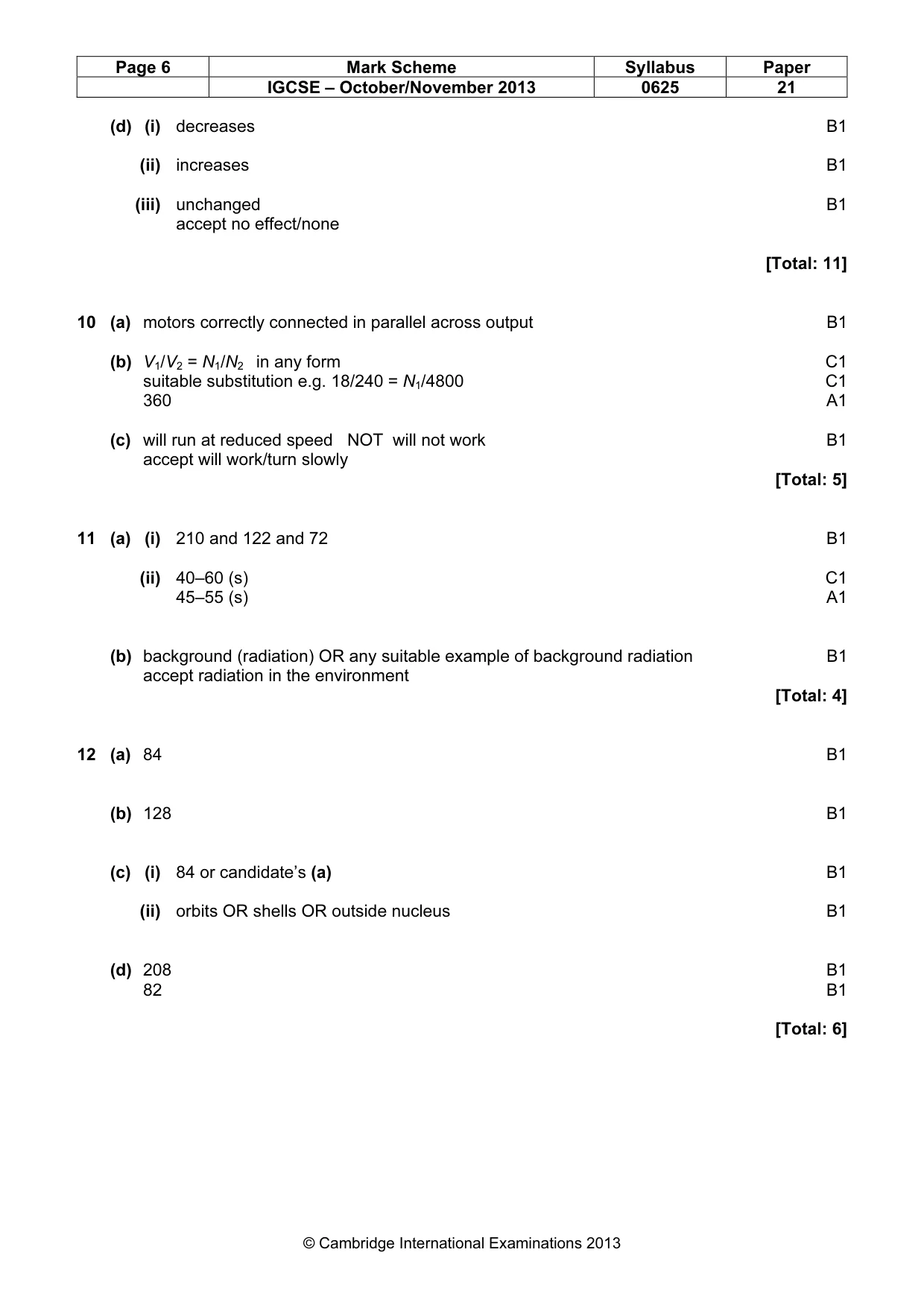
Page 6 Mark Scheme Syllabus Paper IGCSE – October/November 2013 0625 21 © Cambridge International Examinations 2013 (d) (i) decreases B1 (ii) increases B1 (iii) unchanged B1 accept no effect/none [Total: 11] 10 (a) motors correctly connected in parallel across output B1 (b) V1/V2 = N1/N2 in any form C1 suitable substitution e.g. 18/240 = N1/4800 C1 360 A1 (c) will run at reduced speed NOT will not work B1 accept will work/turn slowly [Total: 5] 11 (a) (i) 210 and 122 and 72 B1 (ii) 40–60 (s) C1 45–55 (s) A1 (b) background (radiation) OR any suitable example of background radiation B1 accept radiation in the environment [Total: 4] 12 (a) 84 B1 (b) 128 B1 (c) (i) 84 or candidate’s (a) B1 (ii) orbits OR shells OR outside nucleus B1 (d) 208 B1 82 B1 [Total: 6]
What you needed in this session
Cambridge’s own grade thresholds for 2013 Oct/Nov, Paper 2 · Variant 1. A higher threshold means an easier paper — the bar moves with how the cohort did.