Questions as text
Q1 · Bauxite and haematite are important ores 0652/21 Oct/Nov 2017
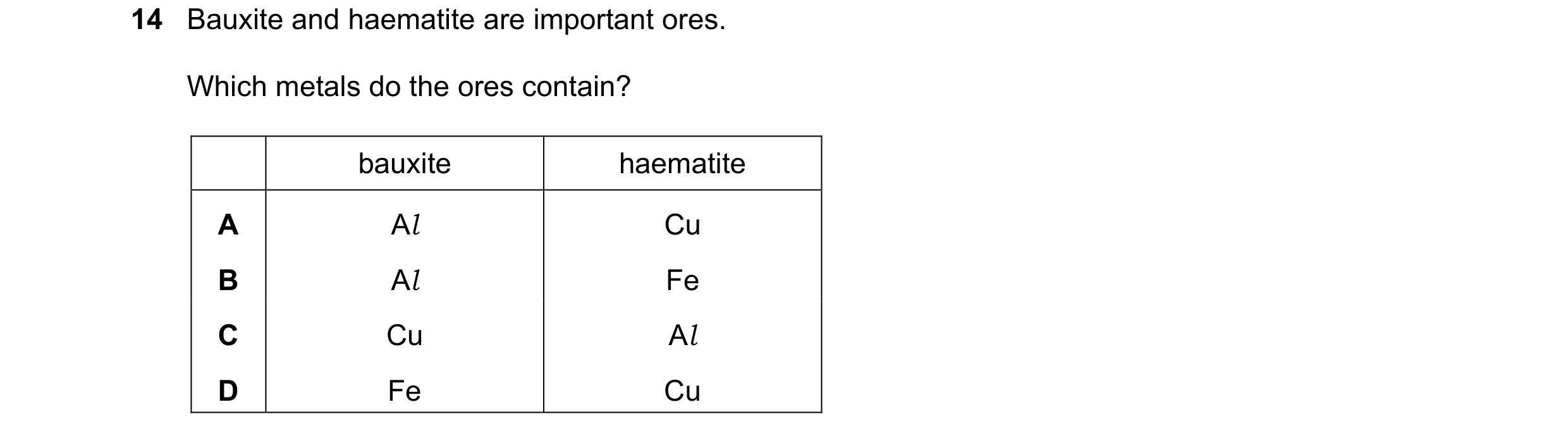
14 Bauxite and haematite are important ores. Which metals do the ores contain? bauxite haematite A Al Cu B Al Fe C Cu Al D Fe Cu
1 marks
Answer: B
This question in 0652/21 Oct/Nov 2017
Q2 · Bauxite and haematite are important ores 0652/22 Oct/Nov 2017
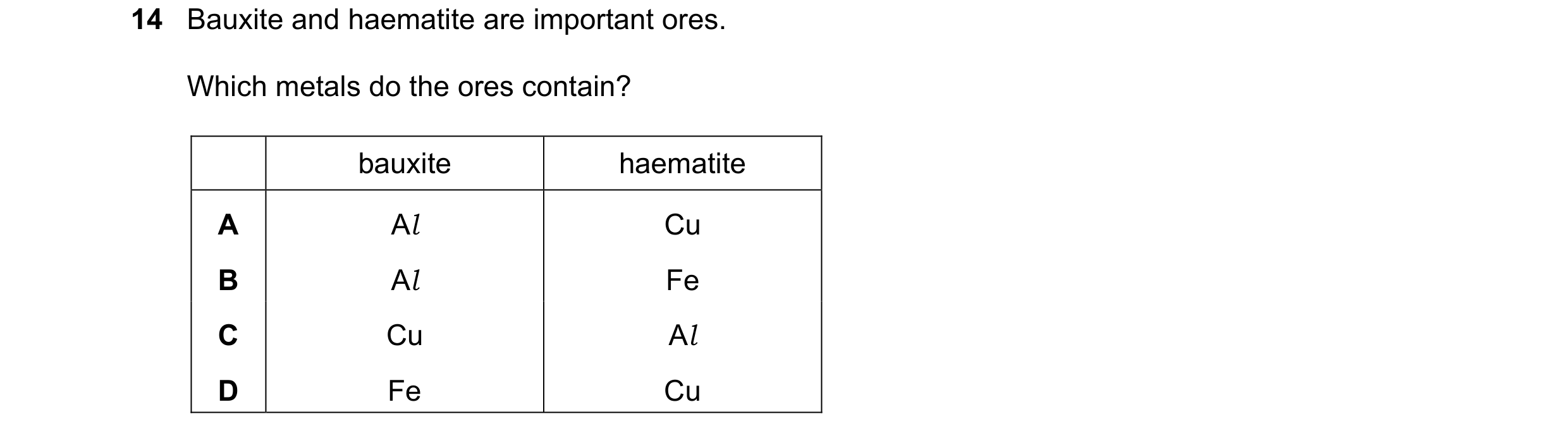
14 Bauxite and haematite are important ores. Which metals do the ores contain? bauxite haematite A Al Cu B Al Fe C Cu Al D Fe Cu
1 marks
Answer: B
This question in 0652/22 Oct/Nov 2017
Q3 · One of the reactions that occurs in a blast furnace is shown 0652/22 Oct/Nov 2017
15 One of the reactions that occurs in a blast furnace is shown. Fe2O3 + 3CO → 2Fe + 3CO2 Which substance is the reducing agent? A CO B CO2 C Fe D Fe2O3
1 marks
Answer: A
This question in 0652/22 Oct/Nov 2017
Q4 · Iron is extracted from its ore, hematite, in the Blast Furnace 0652/21 Oct/Nov 2018
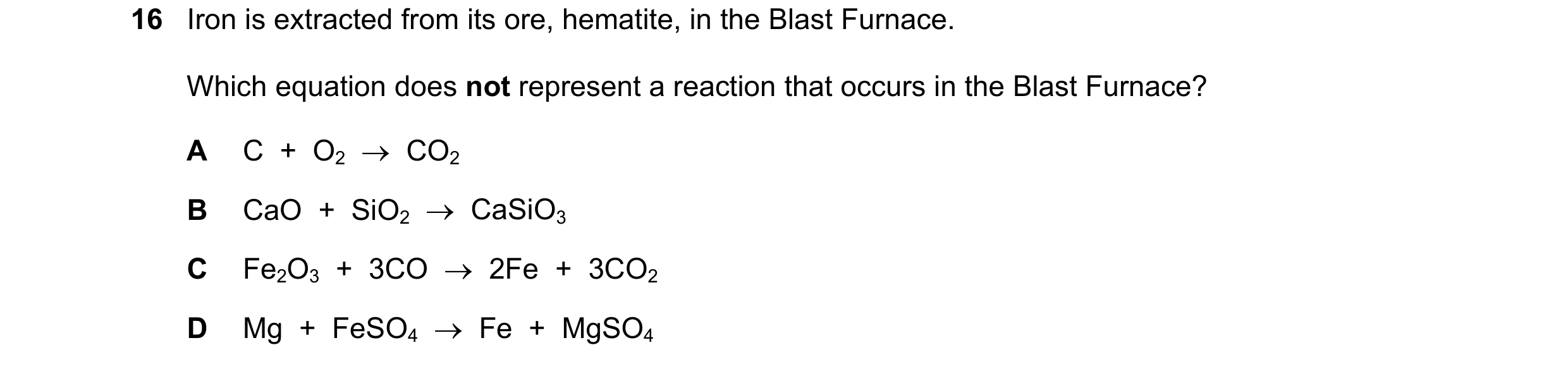
16 Iron is extracted from its ore, hematite, in the Blast Furnace. Which equation does not represent a reaction that occurs in the Blast Furnace? A C + O2 → CO2 B CaO + SiO2 → CaSiO3 C Fe2O3 + 3CO → 2Fe + 3CO2 D Mg + FeSO4 → Fe + MgSO4
1 marks
Answer: D
This question in 0652/21 Oct/Nov 2018
Q5 · Iron is extracted from its ore, hematite, in the Blast Furnace 0652/22 Oct/Nov 2018
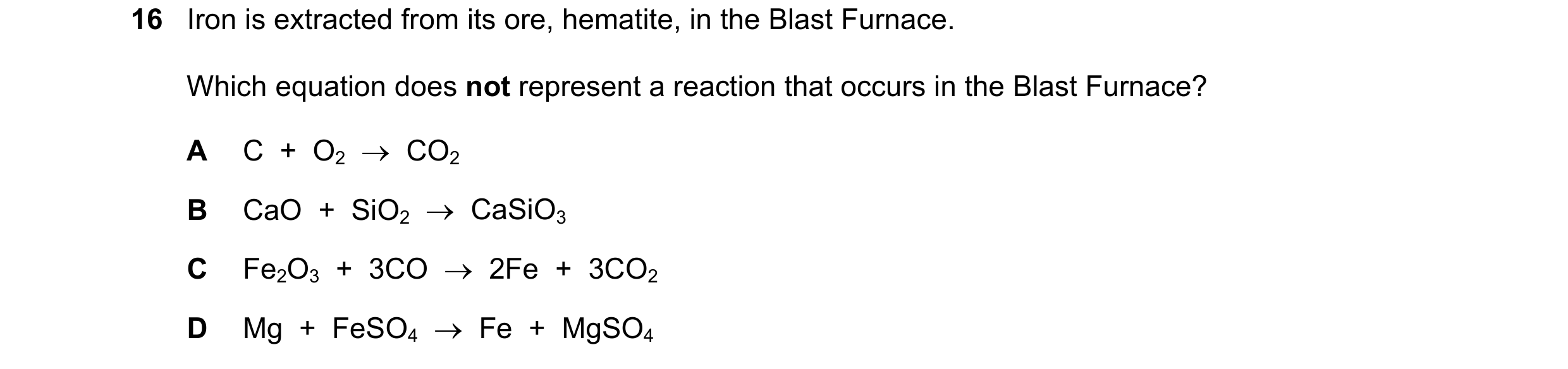
16 Iron is extracted from its ore, hematite, in the Blast Furnace. Which equation does not represent a reaction that occurs in the Blast Furnace? A C + O2 → CO2 B CaO + SiO2 → CaSiO3 C Fe2O3 + 3CO → 2Fe + 3CO2 D Mg + FeSO4 → Fe + MgSO4
1 marks
Answer: D
This question in 0652/22 Oct/Nov 2018
Q6 · Which reaction in the extraction of iron from hematite is not a redox reaction? 0652/21 Oct/Nov 2019
14 Which reaction in the extraction of iron from hematite is not a redox reaction? A C + O2 → CO2 B C + CO2 → 2CO C CaCO3 → CaO + CO2 D Fe2O3 + 3CO → 2Fe + 3CO2
1 marks
Answer: C
This question in 0652/21 Oct/Nov 2019
Q7 · Which reaction in the extraction of iron from hematite is not a redox reaction? 0652/22 Oct/Nov 2019
14 Which reaction in the extraction of iron from hematite is not a redox reaction? A C + O2 → CO2 B C + CO2 → 2CO C CaCO3 → CaO + CO2 D Fe2O3 + 3CO → 2Fe + 3CO2
1 marks
Answer: C
This question in 0652/22 Oct/Nov 2019
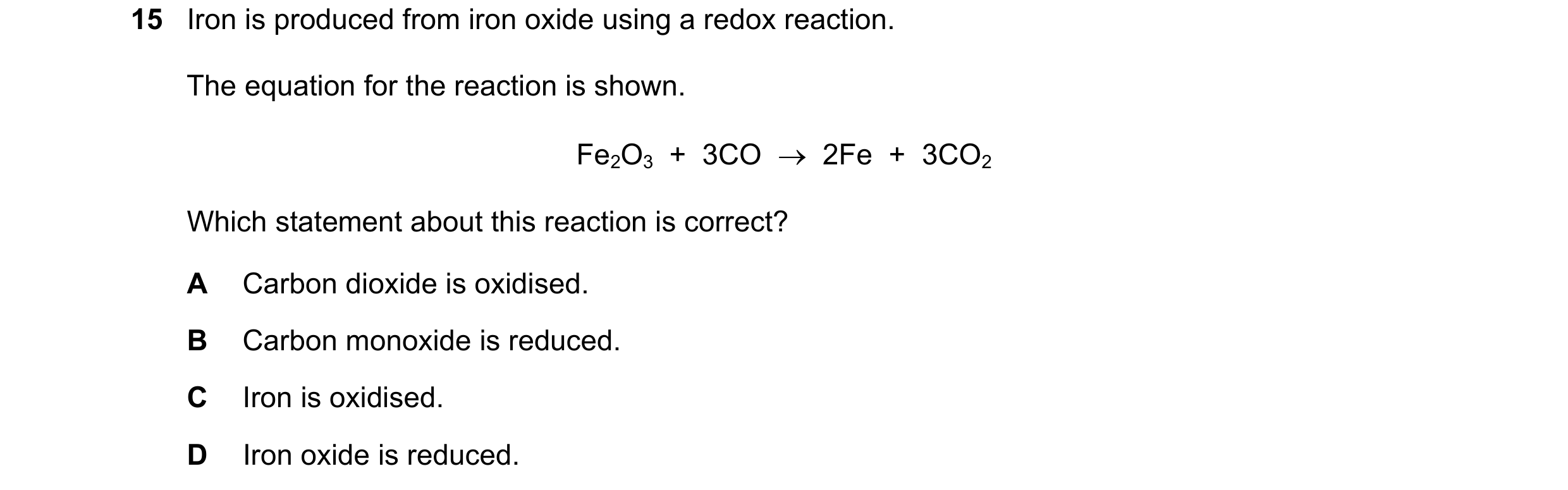
Q8 · Iron is produced from iron oxide using a redox reaction 0652/21 Oct/Nov 2020
15 Iron is produced from iron oxide using a redox reaction. The equation for the reaction is shown. Fe2O3 + 3CO 2Fe + 3CO2 Which statement about this reaction is correct? A Carbon dioxide is oxidised. B Carbon monoxide is reduced. C Iron is oxidised. D Iron oxide is reduced.
1 marks
Answer: D
This question in 0652/21 Oct/Nov 2020
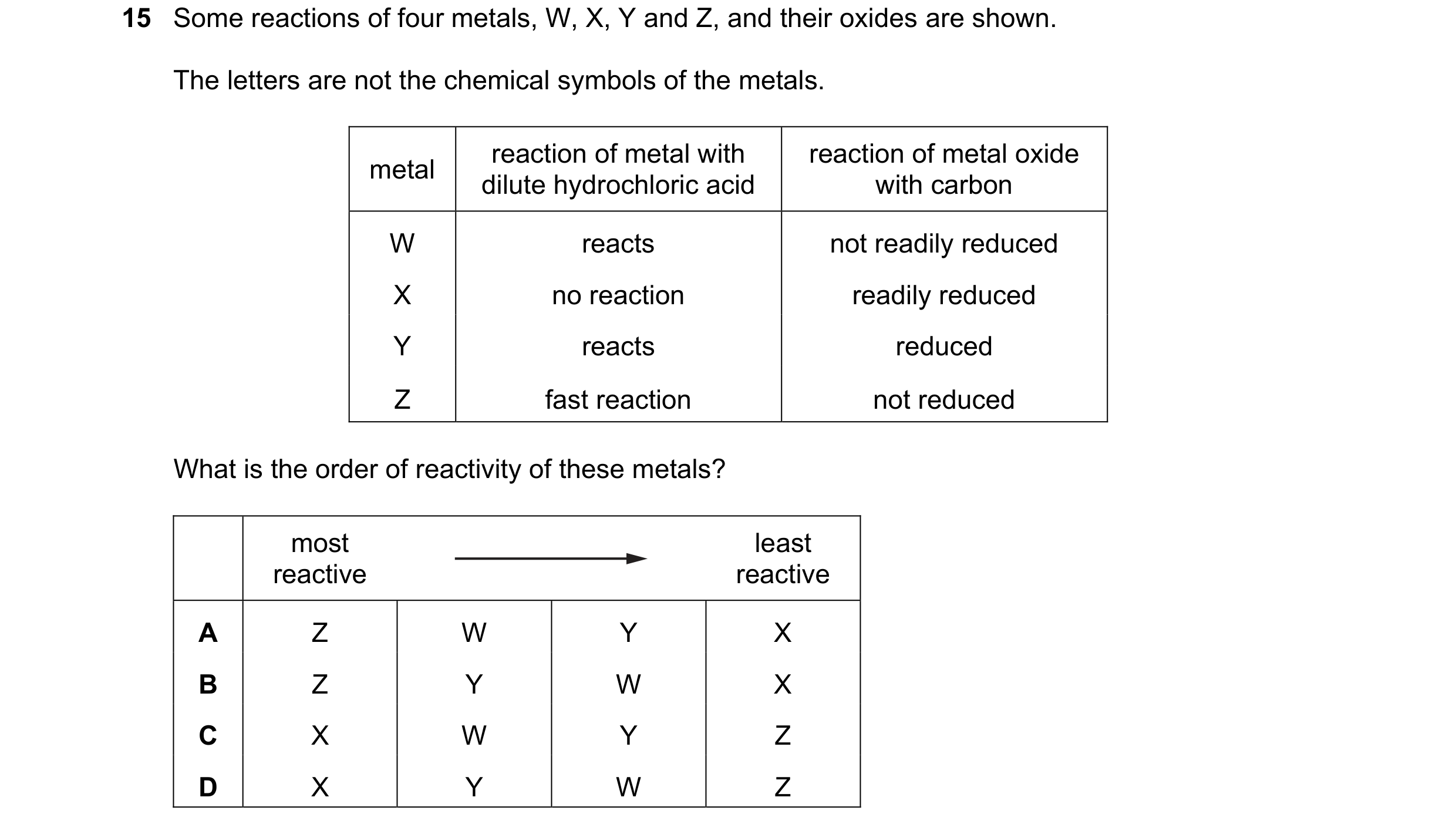
Q9 · Some reactions of four metals, W, X, Y and Z, and their oxides are shown 0652/21 Oct/Nov 2022
15 Some reactions of four metals, W, X, Y and Z, and their oxides are shown. The letters are not the chemical symbols of the metals. reaction of metal with reaction of metal oxide metal dilute hydrochloric acid with carbon W reacts not readily reduced X no reaction readily reduced Y reacts reduced Z fast reaction not reduced What is the order of reactivity of these metals? most least reactive reactive A Z W Y X B Z Y W X C X W Y Z D X Y W Z
1 marks
Answer: A
This question in 0652/21 Oct/Nov 2022
Q10 · Some reactions of four metals, W, X, Y and Z, and their oxides are shown 0652/22 Oct/Nov 2022
15 Some reactions of four metals, W, X, Y and Z, and their oxides are shown. The letters are not the chemical symbols of the metals. reaction of metal with reaction of metal oxide metal dilute hydrochloric acid with carbon W reacts not readily reduced X no reaction readily reduced Y reacts reduced Z fast reaction not reduced What is the order of reactivity of these metals? most least reactive reactive A Z W Y X B Z Y W X C X W Y Z D X Y W Z
1 marks
Answer: A
This question in 0652/22 Oct/Nov 2022
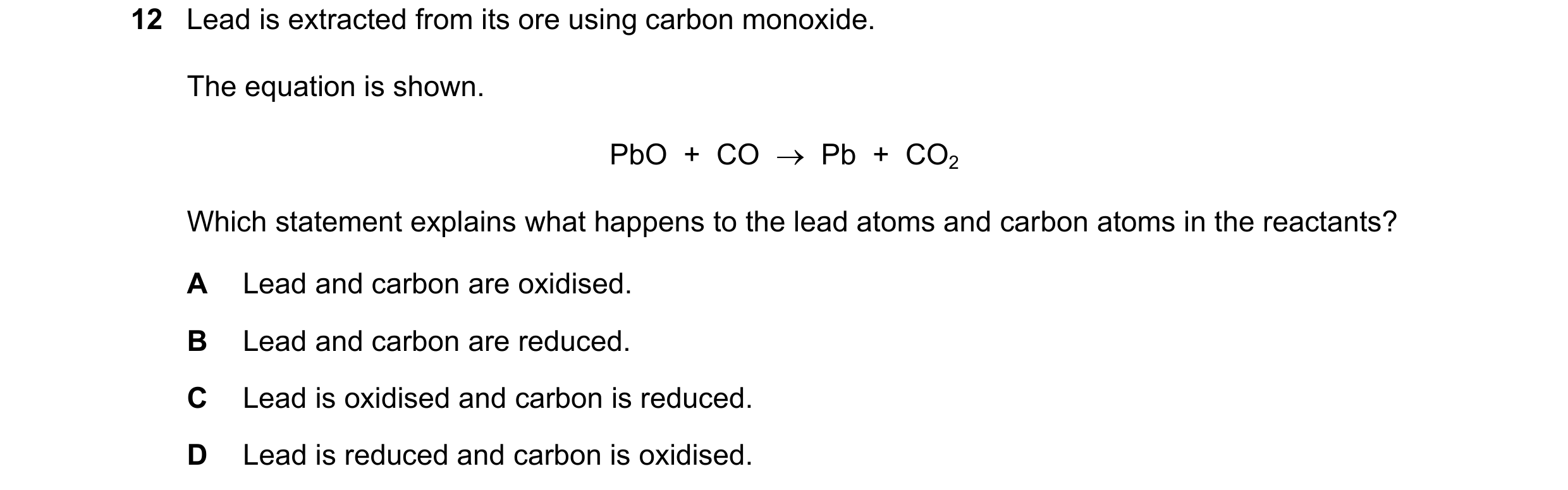
Q11 · Lead is extracted from its ore using carbon monoxide 0652/22 Oct/Nov 2023
12 Lead is extracted from its ore using carbon monoxide. The equation is shown. PbO + CO Pb + CO2 Which statement explains what happens to the lead atoms and carbon atoms in the reactants? A Lead and carbon are oxidised. B Lead and carbon are reduced. C Lead is oxidised and carbon is reduced. D Lead is reduced and carbon is oxidised.
1 marks
Answer: D
This question in 0652/22 Oct/Nov 2023

 1 / 3
1 / 3

 2 / 3
2 / 3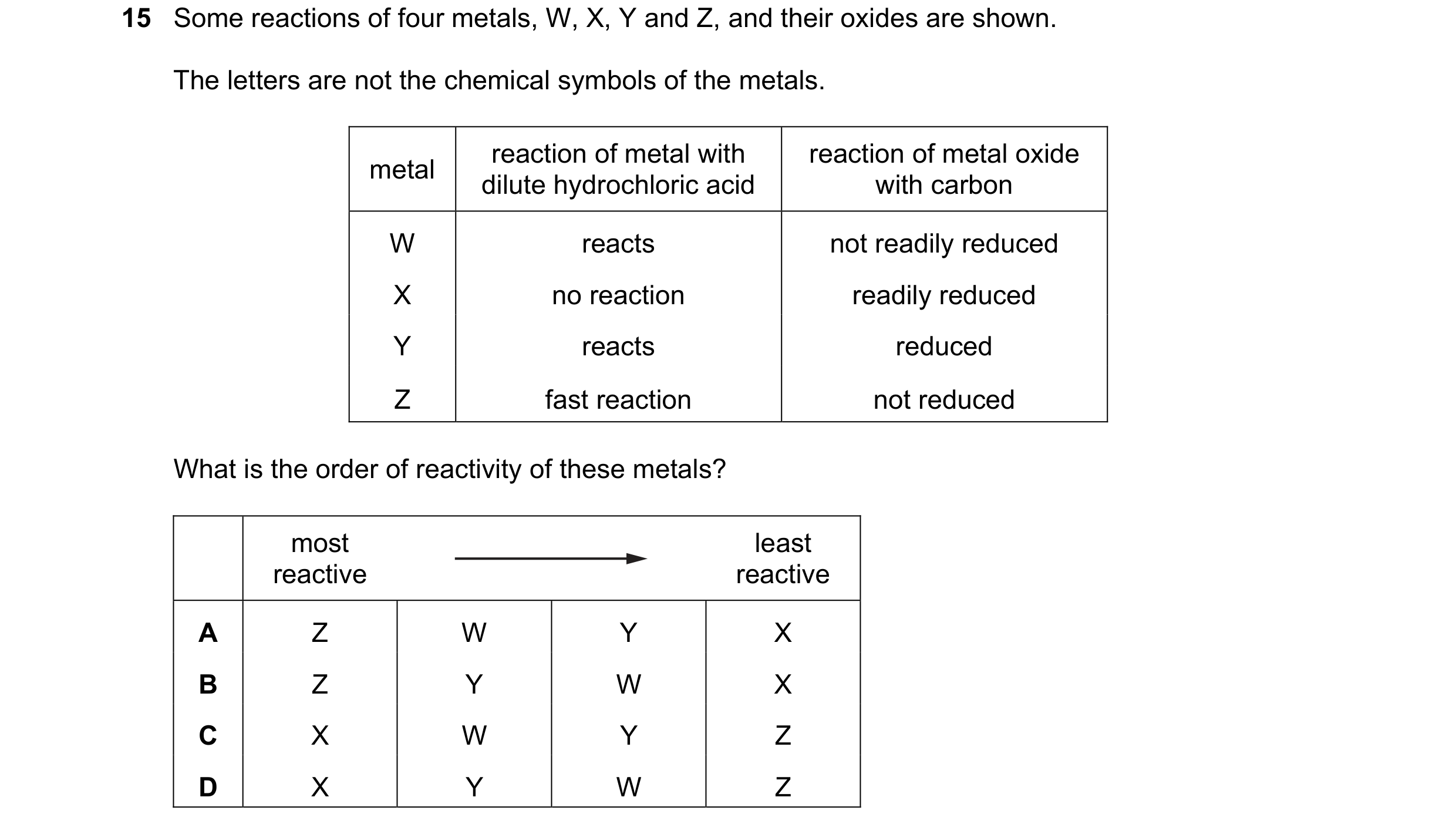
 3 / 3
3 / 3