Cambridge IGCSE Physical Science 0652 — 2020 Oct/Nov Paper 4 · Variant 1
0652/41/O/N/20 · 11 questions · 80 marks · ≈90 min
The question paper and its mark scheme, free to read here and free to download. This is Cambridge’s own paper, exactly as it was sat.
Question paper20 pages
Mark scheme10 pages
Answers below. Sit the paper first if you are practising.
Questions as text
Q1 · A go‑kart travelling at constant speed along a straight horizontal road
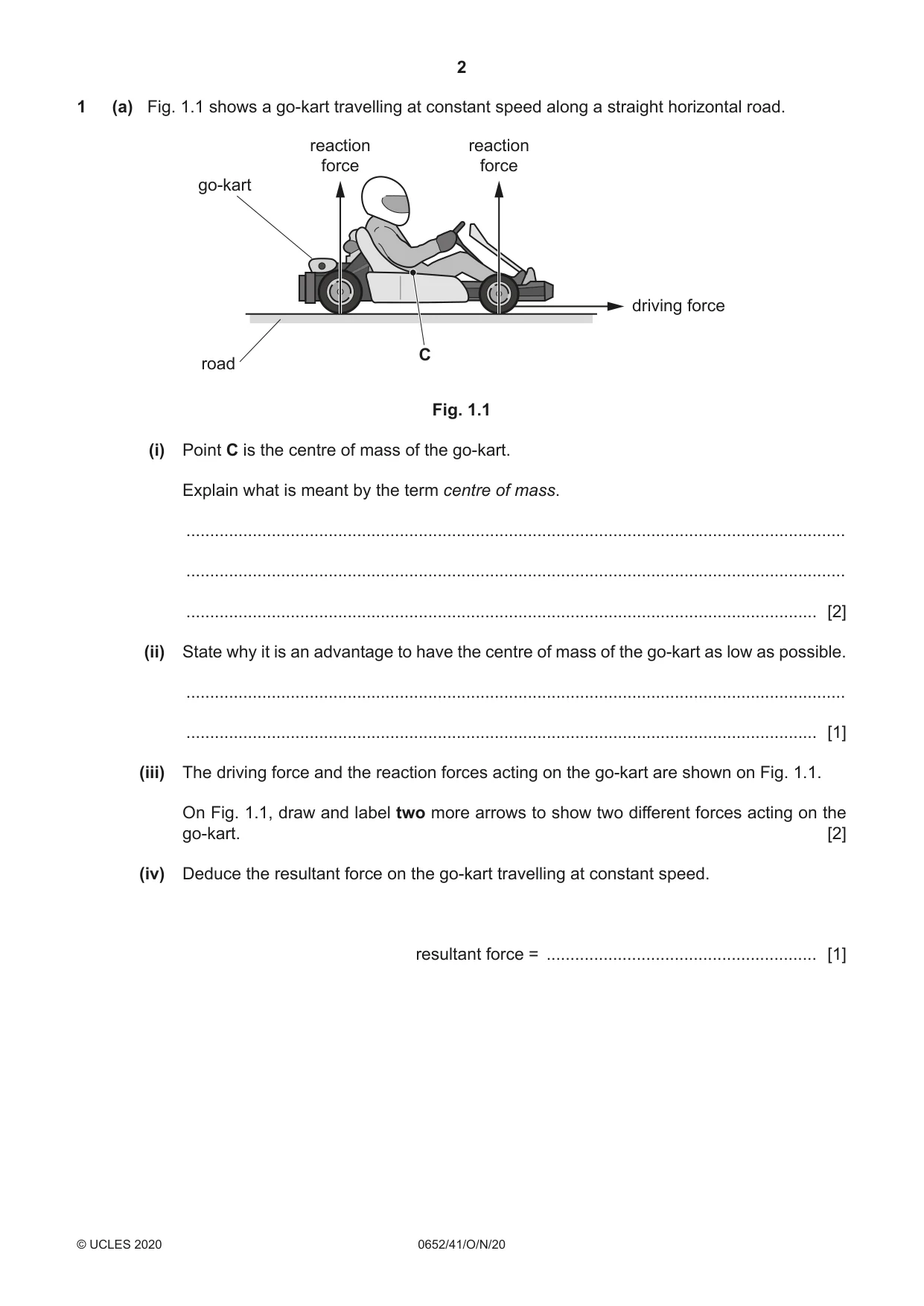
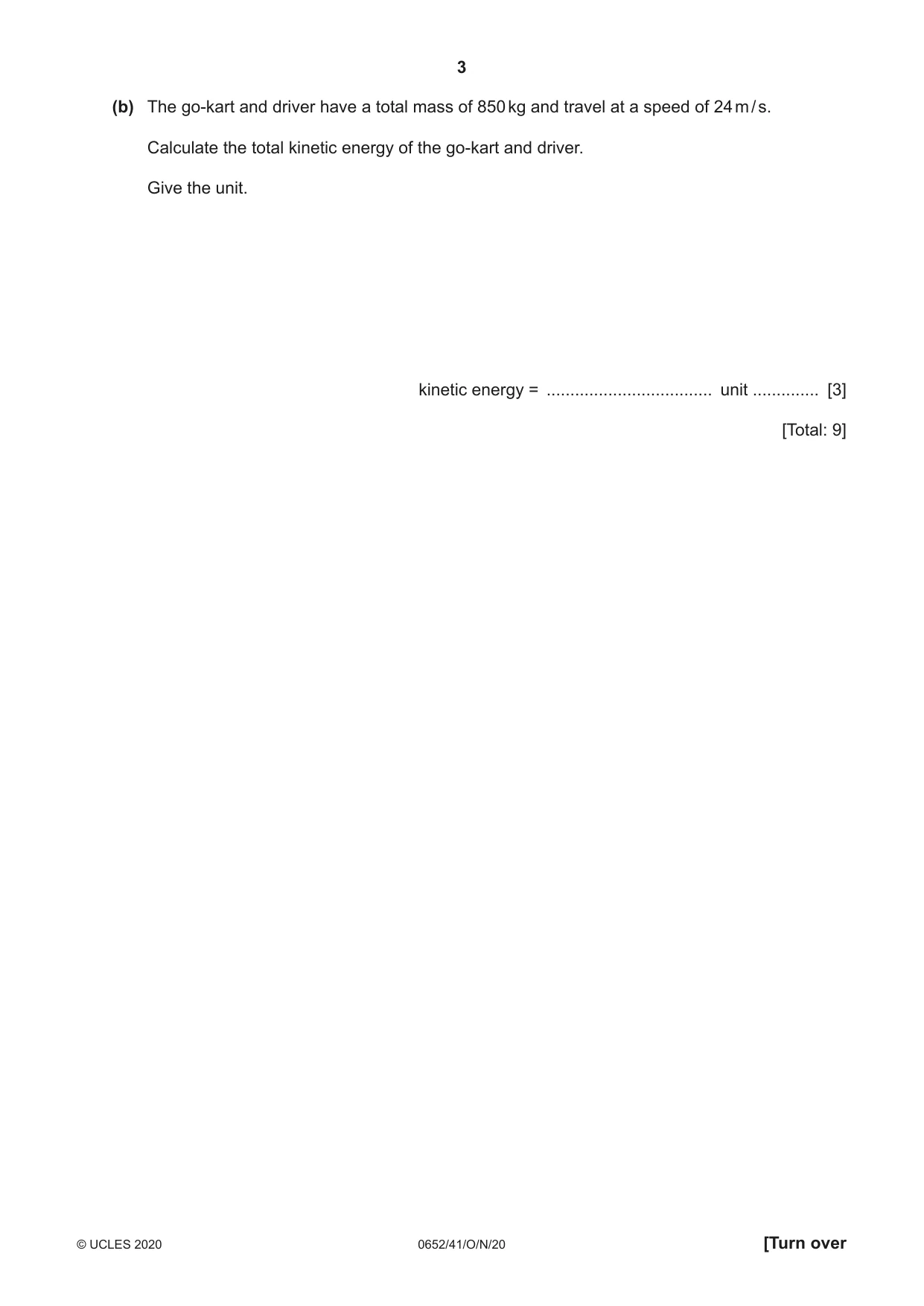
1 (a) Fig. 1.1 shows a go‑kart travelling at constant speed along a straight horizontal road. reaction reaction force force go-kart driving force C road Fig. 1.1 (i) Point C is the centre of mass of the go‑kart. Explain what is meant by the term centre of mass. ........................................................................................................................................... ........................................................................................................................................... ..................................................................................................................................... [2] (ii) State why it is an advantage to have the centre of mass of the go‑kart as low as possible. ........................................................................................................................................... ..................................................................................................................................... [1] (iii) The driving force and the reaction forces acting on the go‑kart are shown on Fig. 1.1. On Fig. 1.1, draw and label two more arrows to show two different forces acting on the go‑kart. [2] (iv) Deduce the resultant force on the go‑kart travelling at constant speed. resultant force = ......................................................... [1] (b) The go‑kart and driver have a total mass of 850 kg and travel at a speed of 24 m / s. Calculate the total kinetic energy of the go‑kart and driver. Give the unit. kinetic energy = ................................... unit .............. [3] [Total: 9]
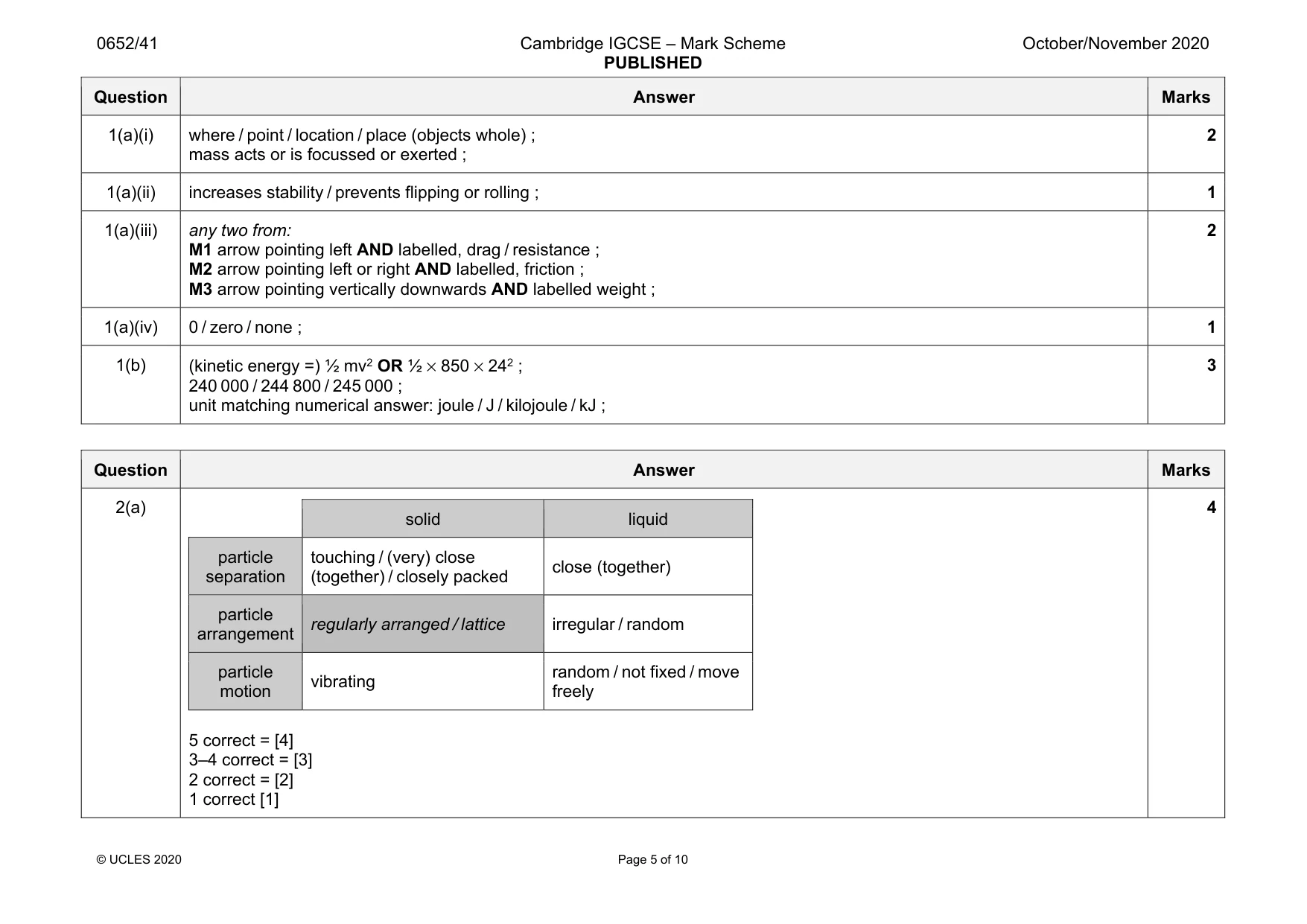
Mark scheme: 1(a)(i) where / point / location / place (objects whole) ; mass acts or is focussed or exerted ; 2 1(a)(ii) increases stability / prevents flipping or rolling ; 1 1(a)(iii) any two from: M1 arrow pointing left AND labelled, drag / resistance ; M2 arrow pointing left or right AND labelled, friction ; M3 arrow pointing vertically downwards AND labelled weight ; 2 1(a)(iv) 0 / zero / none ; 1 1(b) (kinetic energy =) ½ mv2 OR ½ × 850 × 242 ; 240 000 / 244 800 / 245 000 ; unit matching numerical answer: joule / J / kilojoule / kJ ; 3
Q2 · Three states of matter are solid, liquid and gas
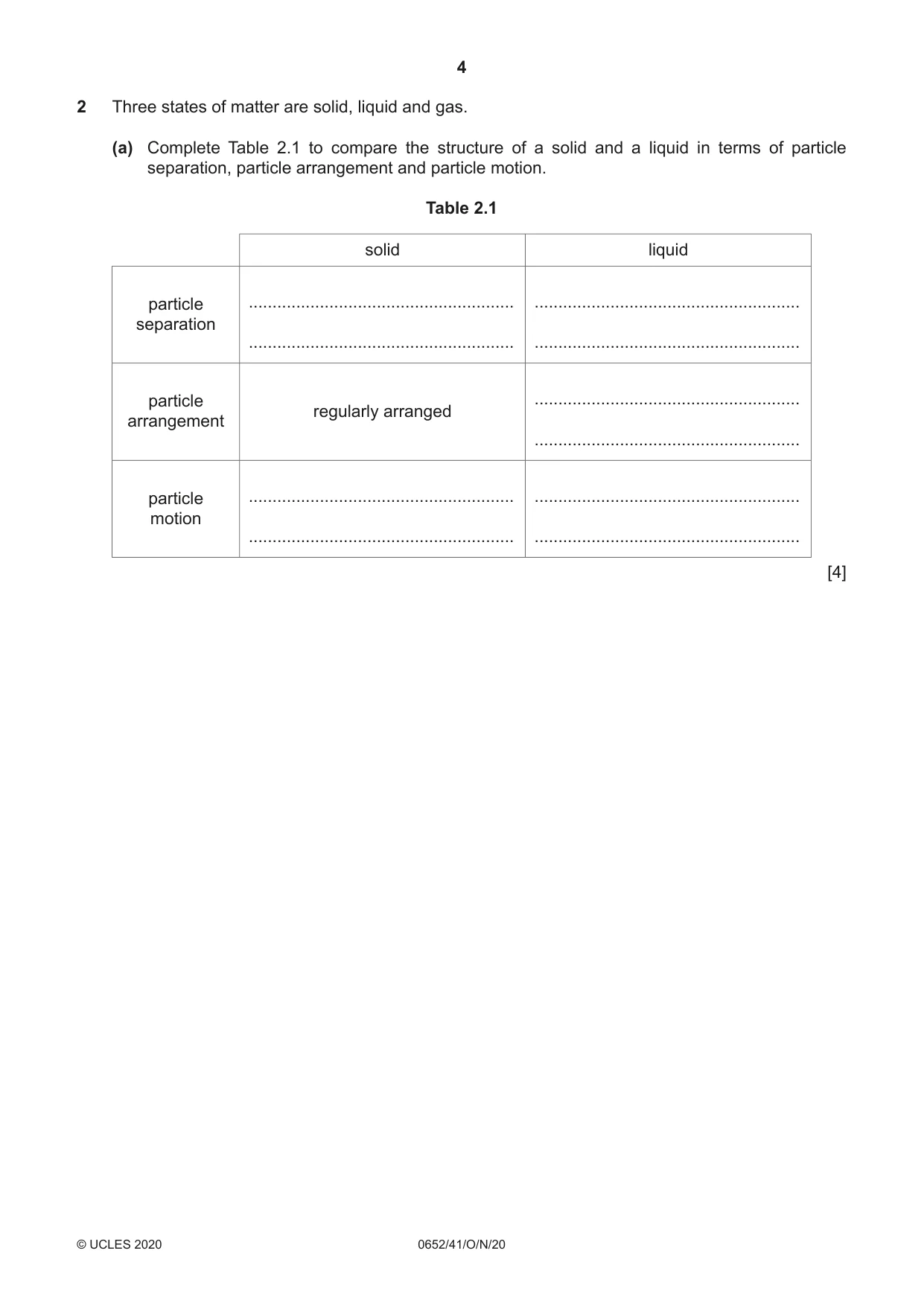
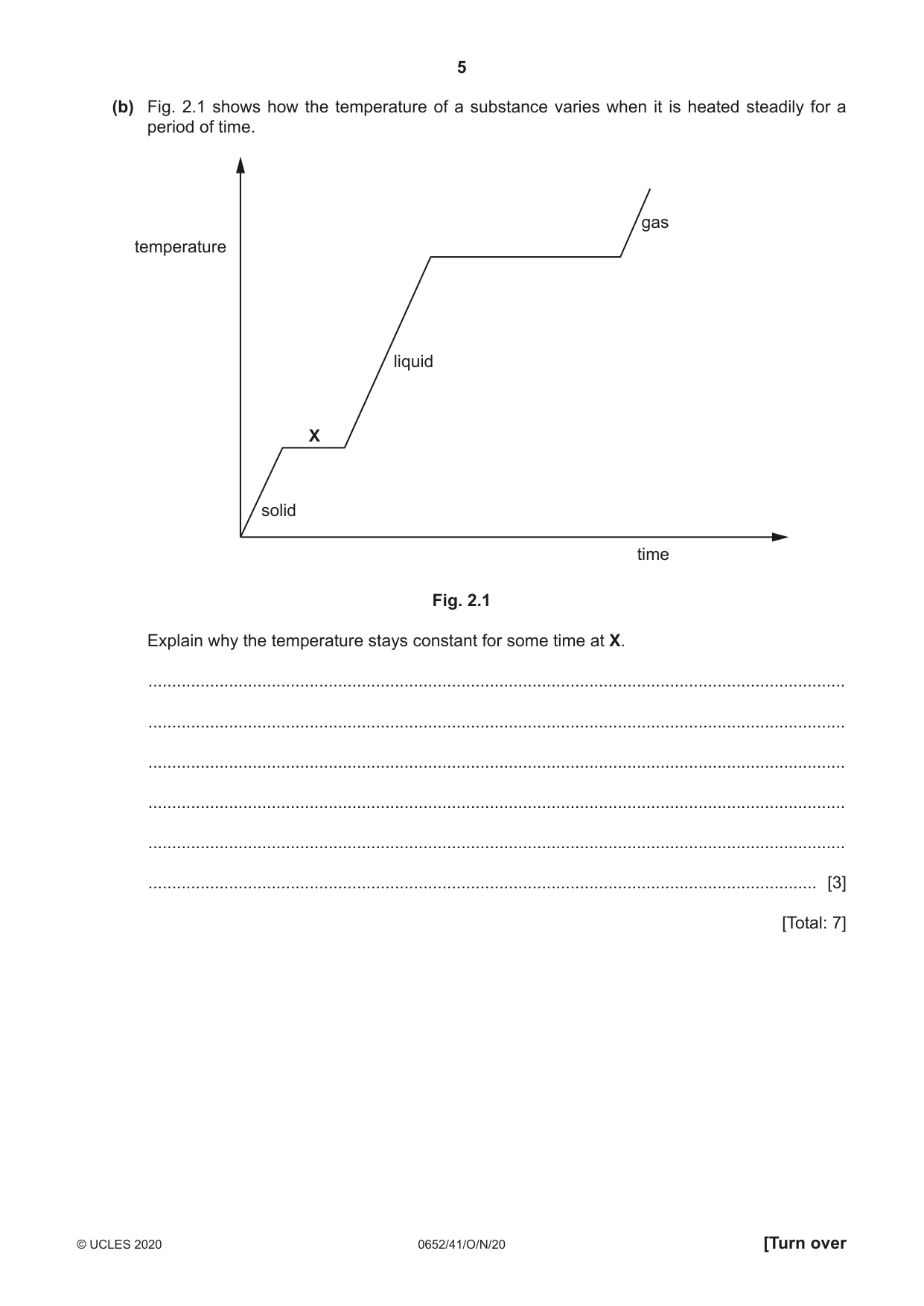
2 Three states of matter are solid, liquid and gas. (a) Complete Table 2.1 to compare the structure of a solid and a liquid in terms of particle separation, particle arrangement and particle motion. Table 2.1 solid liquid particle ........................................................ ........................................................ separation ........................................................ ........................................................ particle ........................................................ regularly arranged arrangement ........................................................ particle ........................................................ ........................................................ motion ........................................................ ........................................................ [4] (b) Fig. 2.1 shows how the temperature of a substance varies when it is heated steadily for a period of time. gas temperature liquid X solid time Fig. 2.1 Explain why the temperature stays constant for some time at X. ................................................................................................................................................... ................................................................................................................................................... ................................................................................................................................................... ................................................................................................................................................... ................................................................................................................................................... ............................................................................................................................................. [3] [Total: 7]
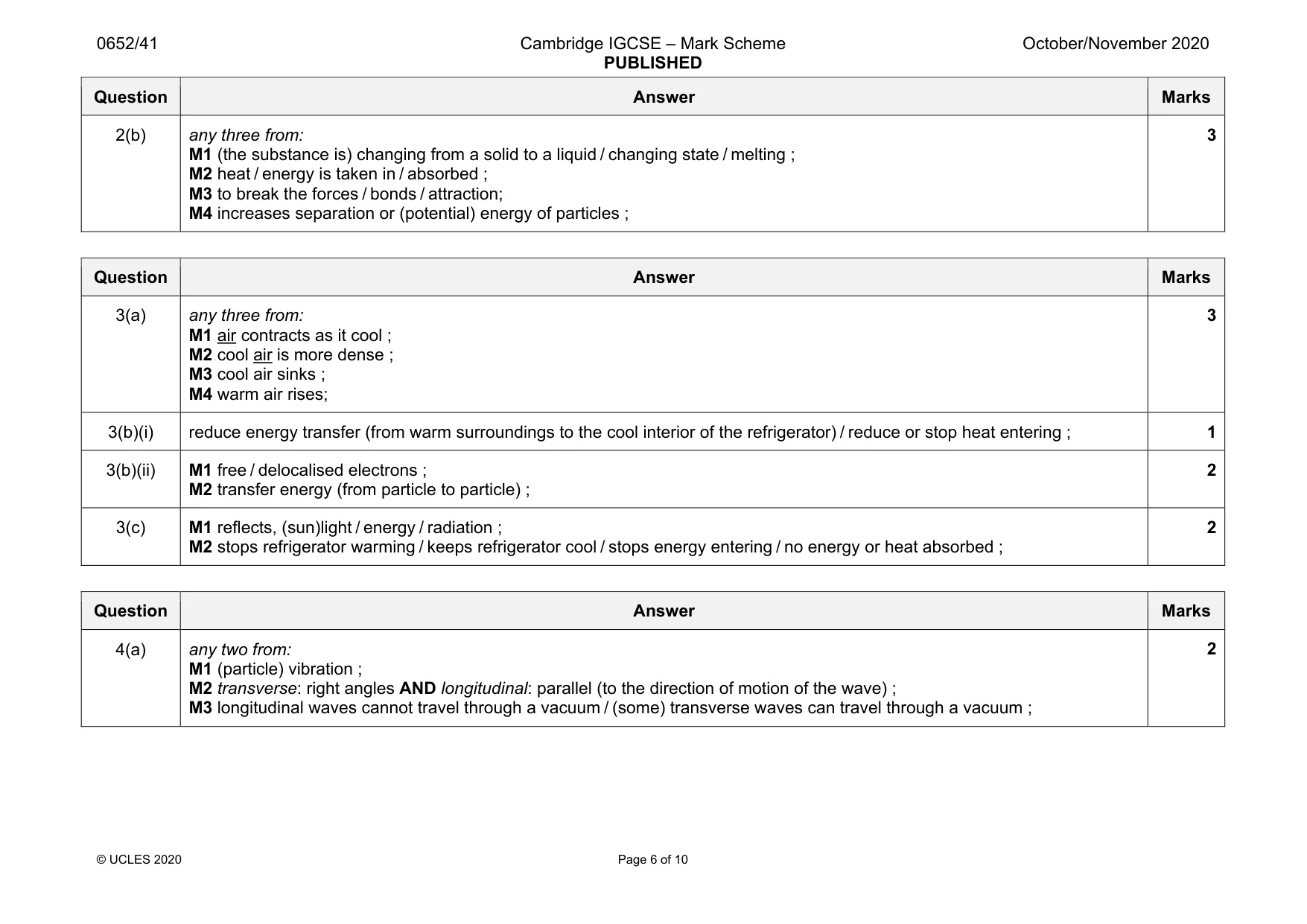
Mark scheme: 2(a) solid liquid particle separation touching / (very) close (together) / closely packed close (together) particle arrangement regularly arranged / lattice irregular / random particle motion vibrating random / not fixed / move freely 5 correct = [4] 3–4 correct = [3] 2 correct = [2] 1 correct [1] Question Answer Marks 2(b) any three from: M1 (the substance is) changing from a solid to a liquid / changing state / melting ; M2 heat / energy is taken in / absorbed ; M3 to break the forces / bonds / attraction; M4 increases separation or (potential) energy of particles ; 3
Question 3
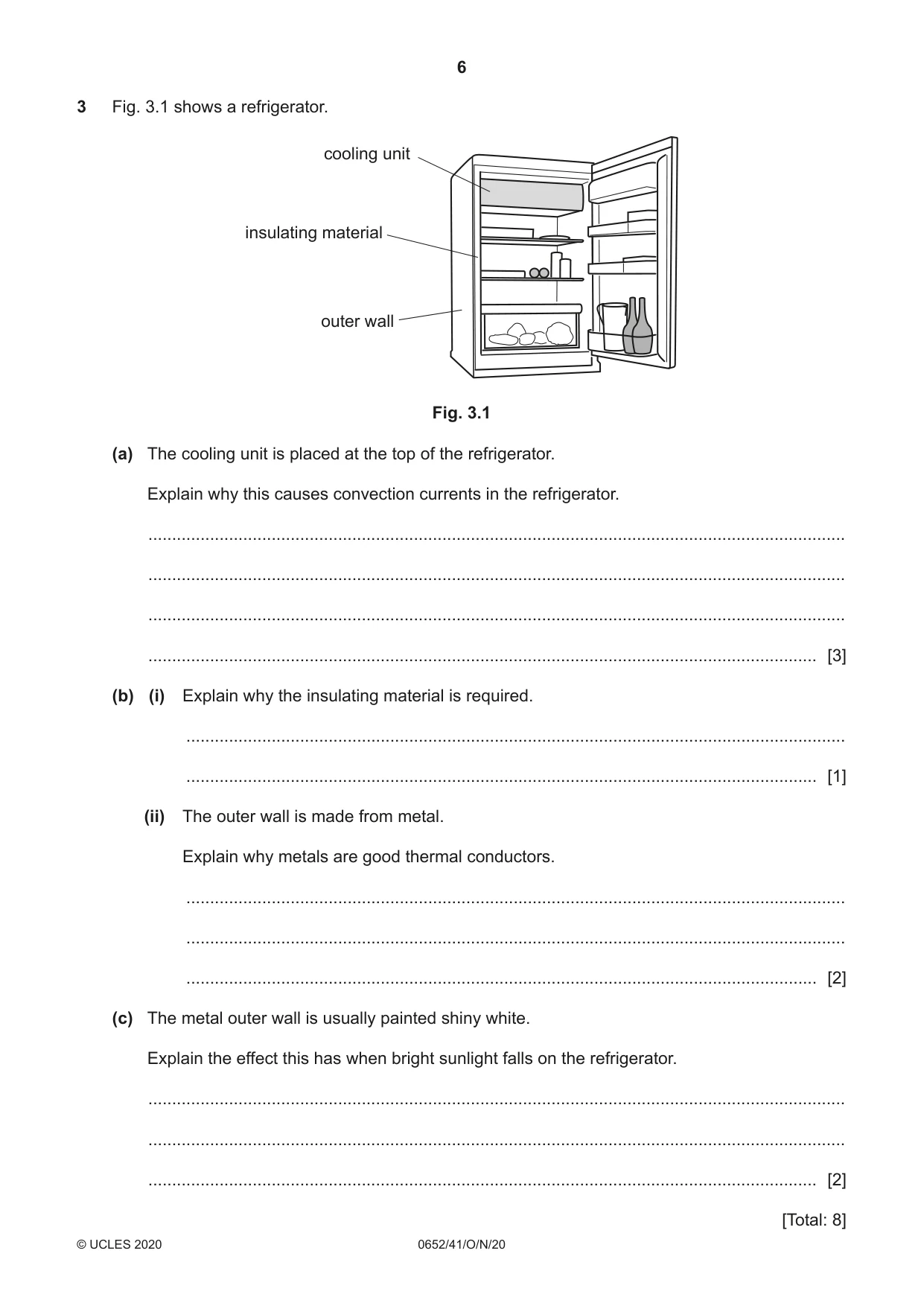
3 Fig. 3.1 shows a refrigerator. cooling unit insulating material outer wall Fig. 3.1 (a) The cooling unit is placed at the top of the refrigerator. Explain why this causes convection currents in the refrigerator. ................................................................................................................................................... ................................................................................................................................................... ................................................................................................................................................... ............................................................................................................................................. [3] (b) (i) Explain why the insulating material is required. ........................................................................................................................................... ..................................................................................................................................... [1] (ii) The outer wall is made from metal. Explain why metals are good thermal conductors. ........................................................................................................................................... ........................................................................................................................................... ..................................................................................................................................... [2] (c) The metal outer wall is usually painted shiny white. Explain the effect this has when bright sunlight falls on the refrigerator. ................................................................................................................................................... ................................................................................................................................................... ............................................................................................................................................. [2] [Total: 8]
Mark scheme: 3(a) any three from: M1 air contracts as it cool ; M2 cool air is more dense ; M3 cool air sinks ; M4 warm air rises; 3(b)(i) reduce energy transfer (from warm surroundings to the cool interior of the refrigerator) / reduce or stop heat entering ; 1 3(b)(ii) M1 free / delocalised electrons ; M2 transfer energy (from particle to particle) ; 2 3(c) M1 reflects, (sun)light / energy / radiation ; M2 stops refrigerator warming / keeps refrigerator cool / stops energy entering / no energy or heat absorbed ; 2
Q4 · Sound is transmitted by longitudinal waves
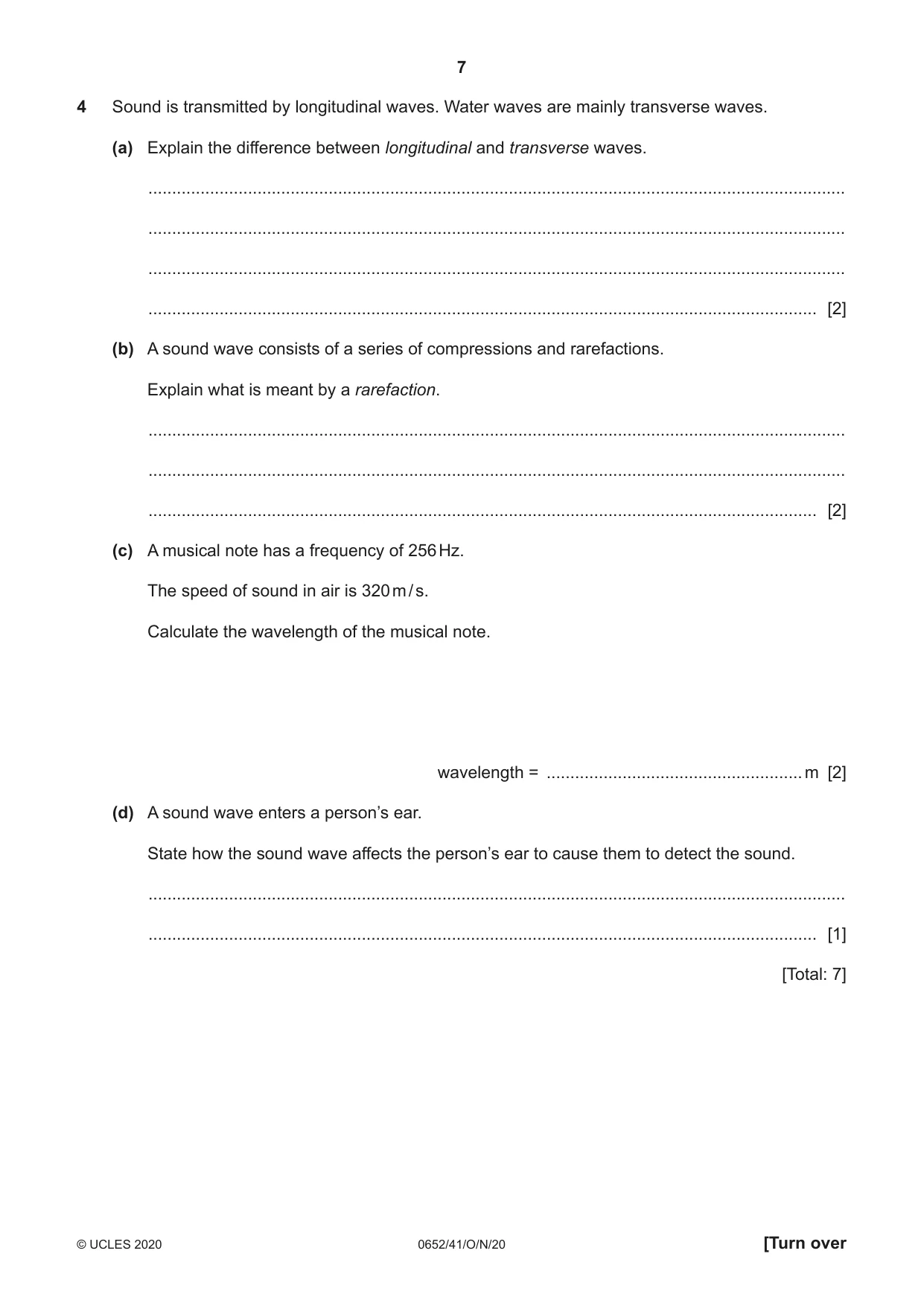
4 Sound is transmitted by longitudinal waves. Water waves are mainly transverse waves. (a) Explain the difference between longitudinal and transverse waves. ................................................................................................................................................... ................................................................................................................................................... ................................................................................................................................................... ............................................................................................................................................. [2] (b) A sound wave consists of a series of compressions and rarefactions. Explain what is meant by a rarefaction. ................................................................................................................................................... ................................................................................................................................................... ............................................................................................................................................. [2] (c) A musical note has a frequency of 256 Hz. The speed of sound in air is 320 m / s. Calculate the wavelength of the musical note. wavelength = ...................................................... m [2] (d) A sound wave enters a person’s ear. State how the sound wave affects the person’s ear to cause them to detect the sound. ................................................................................................................................................... ............................................................................................................................................. [1] [Total: 7]
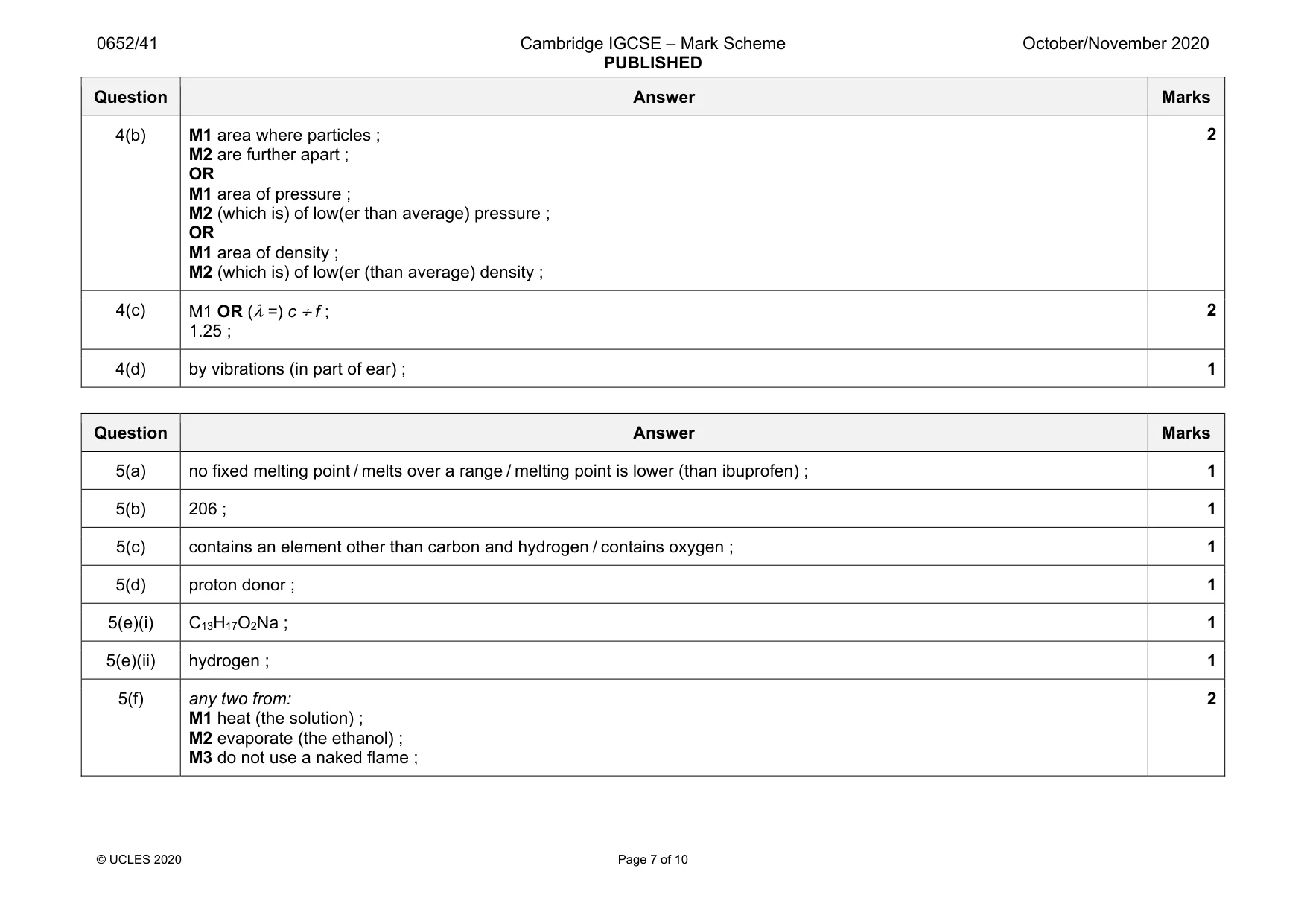
Mark scheme: 4(a) any two from: M1 (particle) vibration ; M2 transverse: right angles AND longitudinal: parallel (to the direction of motion of the wave) ; M3 longitudinal waves cannot travel through a vacuum / (some) transverse waves can travel through a vacuum ; Question Answer Marks 4(b) M1 area where particles ; M2 are further apart ; OR M1 area of pressure ; M2 (which is) of low(er than average) pressure ; OR M1 area of density ; M2 (which is) of low(er (than average) density ; 2 4(c) M1 OR (λ =) c ÷ f ; 1.25 ; 2 4(d) by vibrations (in part of ear) ; 1
Q5 · A student investigates the melting point of a sample of a medicinal drug
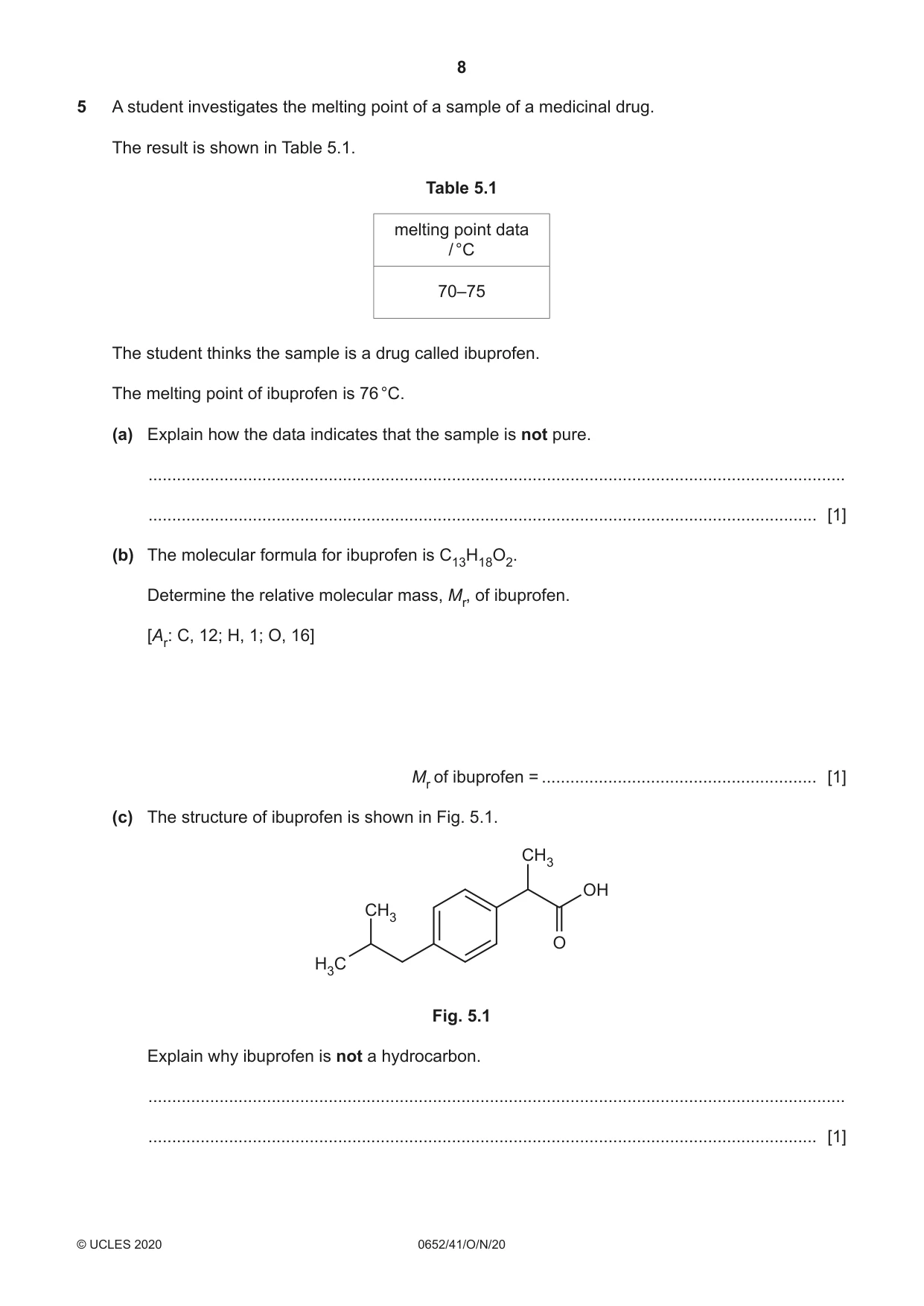
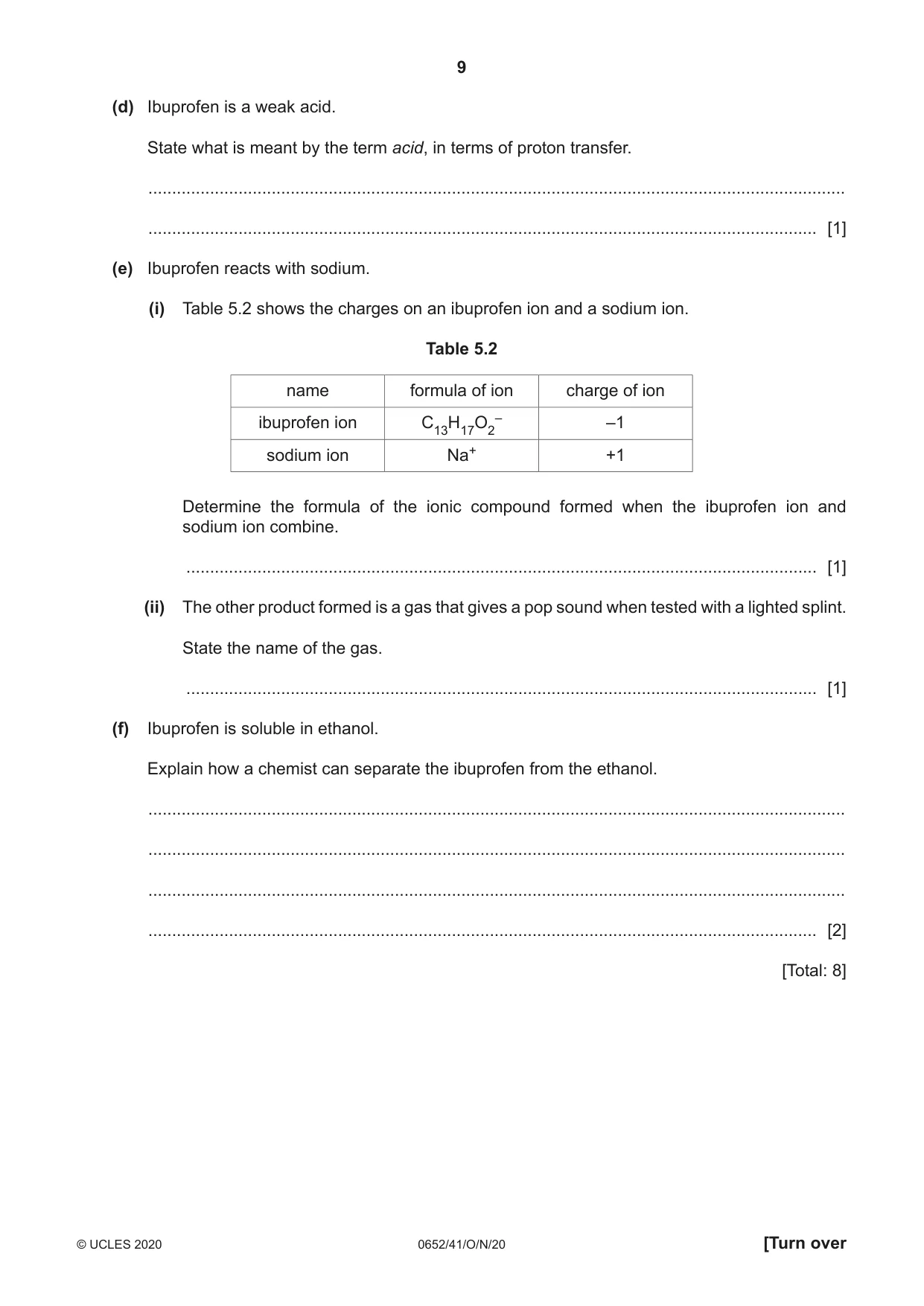
5 A student investigates the melting point of a sample of a medicinal drug. The result is shown in Table 5.1. Table 5.1 melting point data / °C 70–75 The student thinks the sample is a drug called ibuprofen. The melting point of ibuprofen is 76 °C. (a) Explain how the data indicates that the sample is not pure. ................................................................................................................................................... ............................................................................................................................................. [1] (b) The molecular formula for ibuprofen is C13H18O2. Determine the relative molecular mass, Mr, of ibuprofen. [Ar: C, 12; H, 1; O, 16] Mr of ibuprofen = .......................................................... [1] (c) The structure of ibuprofen is shown in Fig. 5.1. CH3 OH CH3 O H3C Fig. 5.1 Explain why ibuprofen is not a hydrocarbon. ................................................................................................................................................... ............................................................................................................................................. [1] (d) Ibuprofen is a weak acid. State what is meant by the term acid, in terms of proton transfer. ................................................................................................................................................... ............................................................................................................................................. [1] (e) Ibuprofen reacts with sodium. (i) Table 5.2 shows the charges on an ibuprofen ion and a sodium ion. Table 5.2 name formula of ion charge of ion ibuprofen ion C13H17O2– –1 sodium ion Na+ +1 Determine the formula of the ionic compound formed when the ibuprofen ion and sodium ion combine. ..................................................................................................................................... [1] (ii) The other product formed is a gas that gives a pop sound when tested with a lighted splint. State the name of the gas. ..................................................................................................................................... [1] (f) Ibuprofen is soluble in ethanol. Explain how a chemist can separate the ibuprofen from the ethanol. ................................................................................................................................................... ................................................................................................................................................... ................................................................................................................................................... ............................................................................................................................................. [2] [Total: 8]
Mark scheme: 5(a) no fixed melting point / melts over a range / melting point is lower (than ibuprofen) ; 1 5(b) 206 ; 1 5(c) contains an element other than carbon and hydrogen / contains oxygen ; 1 5(d) proton donor ; 1 5(e)(i) C13H17O2Na ; 1 5(e)(ii) hydrogen ; 1 5(f) any two from: M1 heat (the solution) ; M2 evaporate (the ethanol) ; M3 do not use a naked flame ; 2
Q6 · Carbon and oxygen react to form carbon dioxide
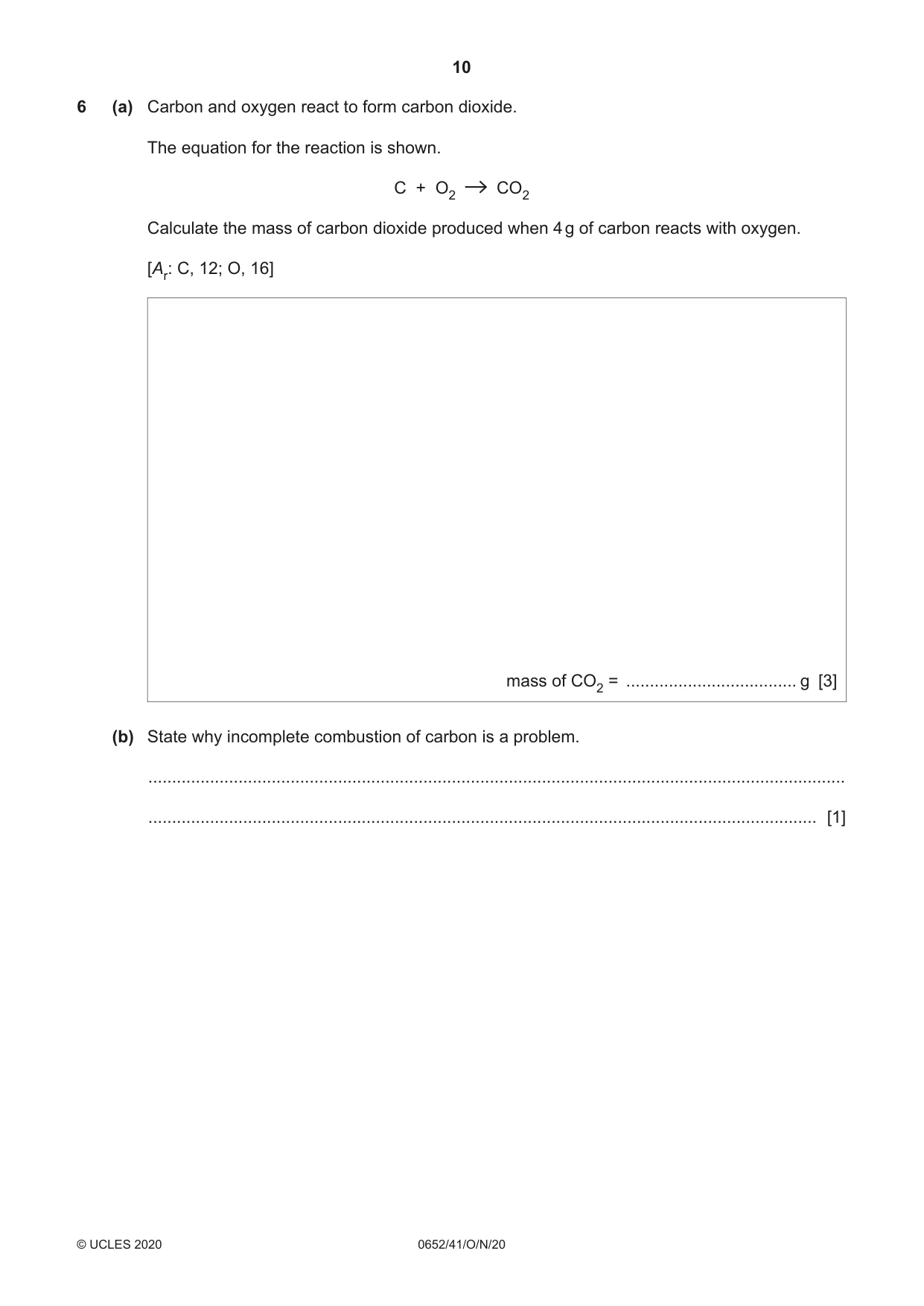
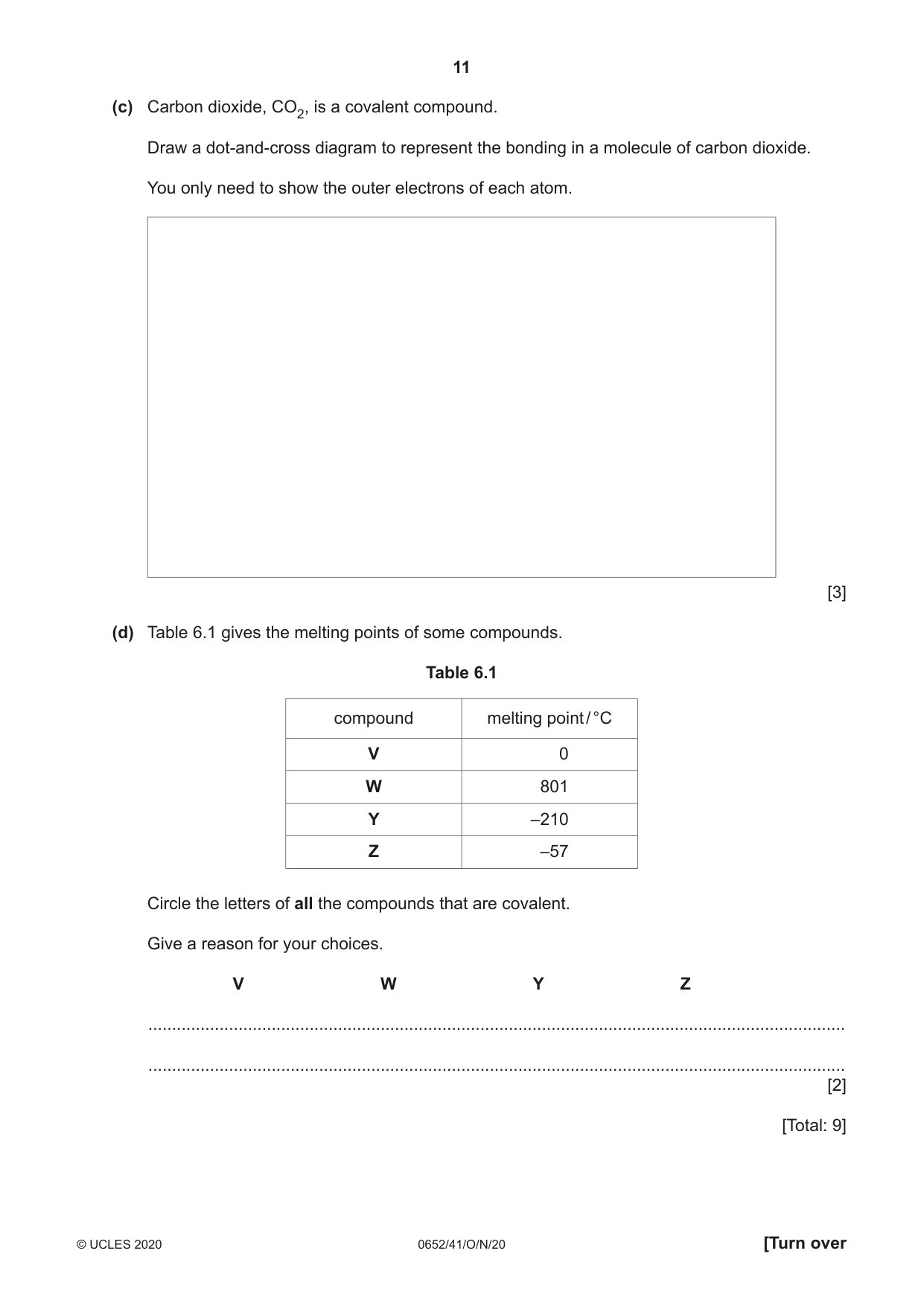
6 (a) Carbon and oxygen react to form carbon dioxide. The equation for the reaction is shown. C + O2 CO2 Calculate the mass of carbon dioxide produced when 4 g of carbon reacts with oxygen. [Ar: C, 12; O, 16] mass of CO2 = .................................... g [3] (b) State why incomplete combustion of carbon is a problem. ................................................................................................................................................... ............................................................................................................................................. [1] (c) Carbon dioxide, CO2, is a covalent compound. Draw a dot‑and‑cross diagram to represent the bonding in a molecule of carbon dioxide. You only need to show the outer electrons of each atom. [3] (d) Table 6.1 gives the melting points of some compounds. Table 6.1 compound melting point / °C V 0 W 801 Y –210 Z –57 Circle the letters of all the compounds that are covalent. Give a reason for your choices. V W Y Z ................................................................................................................................................... ................................................................................................................................................... [2] [Total: 9]
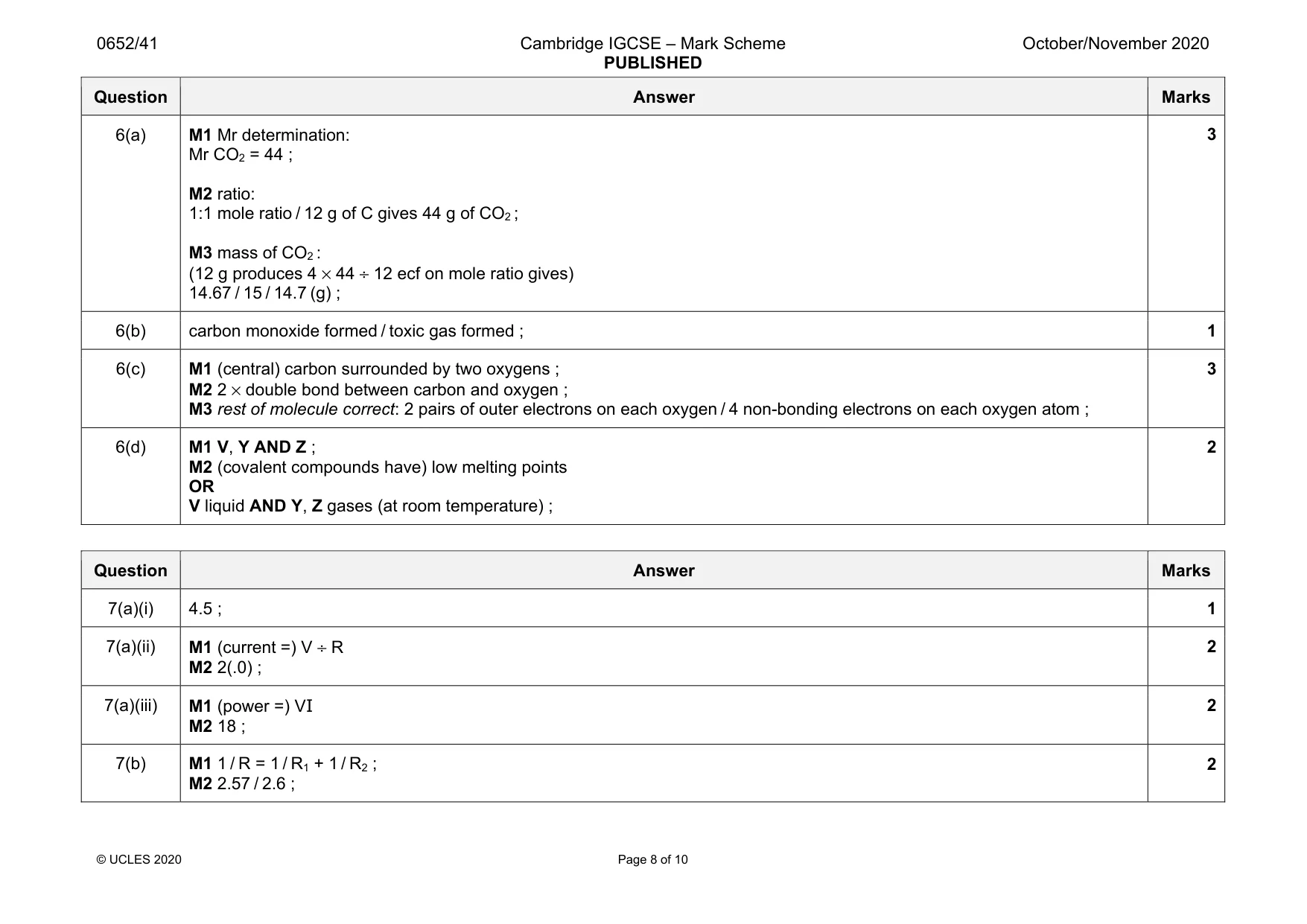
Mark scheme: 6(a) M1 Mr determination: Mr CO2 = 44 ; M2 ratio: 1:1 mole ratio / 12 g of C gives 44 g of CO2 ; M3 mass of CO2 : (12 g produces 4 × 44 ÷ 12 ecf on mole ratio gives) 14.67 / 15 / 14.7 (g) ; 6(b) carbon monoxide formed / toxic gas formed ; 1 6(c) M1 (central) carbon surrounded by two oxygens ; M2 2 × double bond between carbon and oxygen ; M3 rest of molecule correct: 2 pairs of outer electrons on each oxygen / 4 non-bonding electrons on each oxygen atom ; 3 6(d) M1 V, Y AND Z ; M2 (covalent compounds have) low melting points OR V liquid AND Y, Z gases (at room temperature) ; 2
Q7 · A circuit with a battery of electromotive force (e.m.f.) 9.0 V, connected to two…
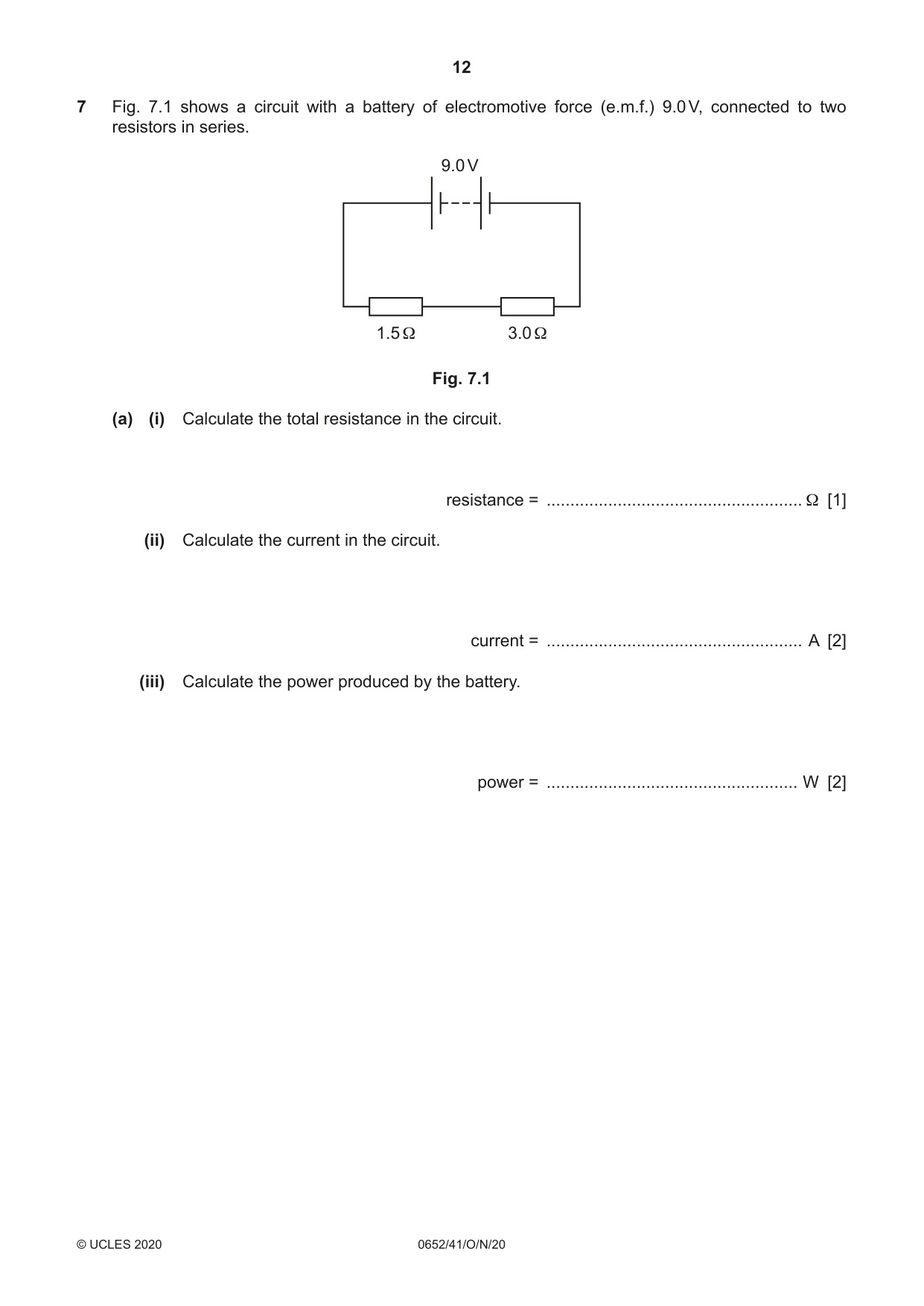
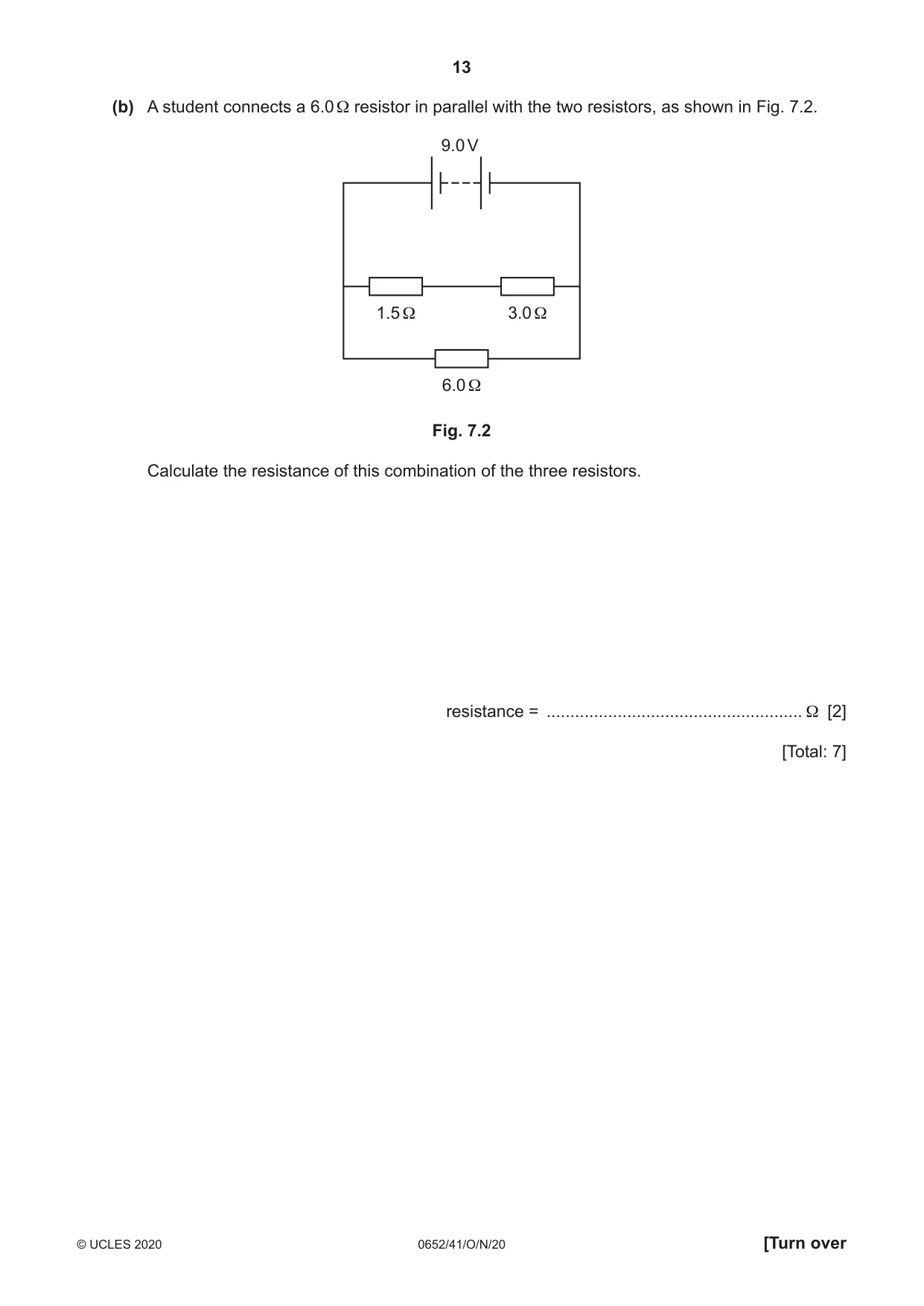
7 Fig. 7.1 shows a circuit with a battery of electromotive force (e.m.f.) 9.0 V, connected to two resistors in series. 9.0 V 1.5 Ω 3.0 Ω Fig. 7.1 (a) (i) Calculate the total resistance in the circuit. resistance = ...................................................... Ω [1] (ii) Calculate the current in the circuit. current = ...................................................... A [2] (iii) Calculate the power produced by the battery. power = ..................................................... W [2] (b) A student connects a 6.0 Ω resistor in parallel with the two resistors, as shown in Fig. 7.2. 9.0 V 1.5 Ω 3.0 Ω 6.0 Ω Fig. 7.2 Calculate the resistance of this combination of the three resistors. resistance = ...................................................... Ω [2] [Total: 7]
Mark scheme: 7(a)(i) 4.5 ; 1 7(a)(ii) M1 (current =) V ÷ R M2 2(.0) ; 2 7(a)(iii) M1 (power =) VI M2 18 ; 2 7(b) M1 1 / R = 1 / R1 + 1 / R2 ; M2 2.57 / 2.6 ; 2
Q8 · The structure of an organic compound, 3‑cyclopentene‑1‑ol
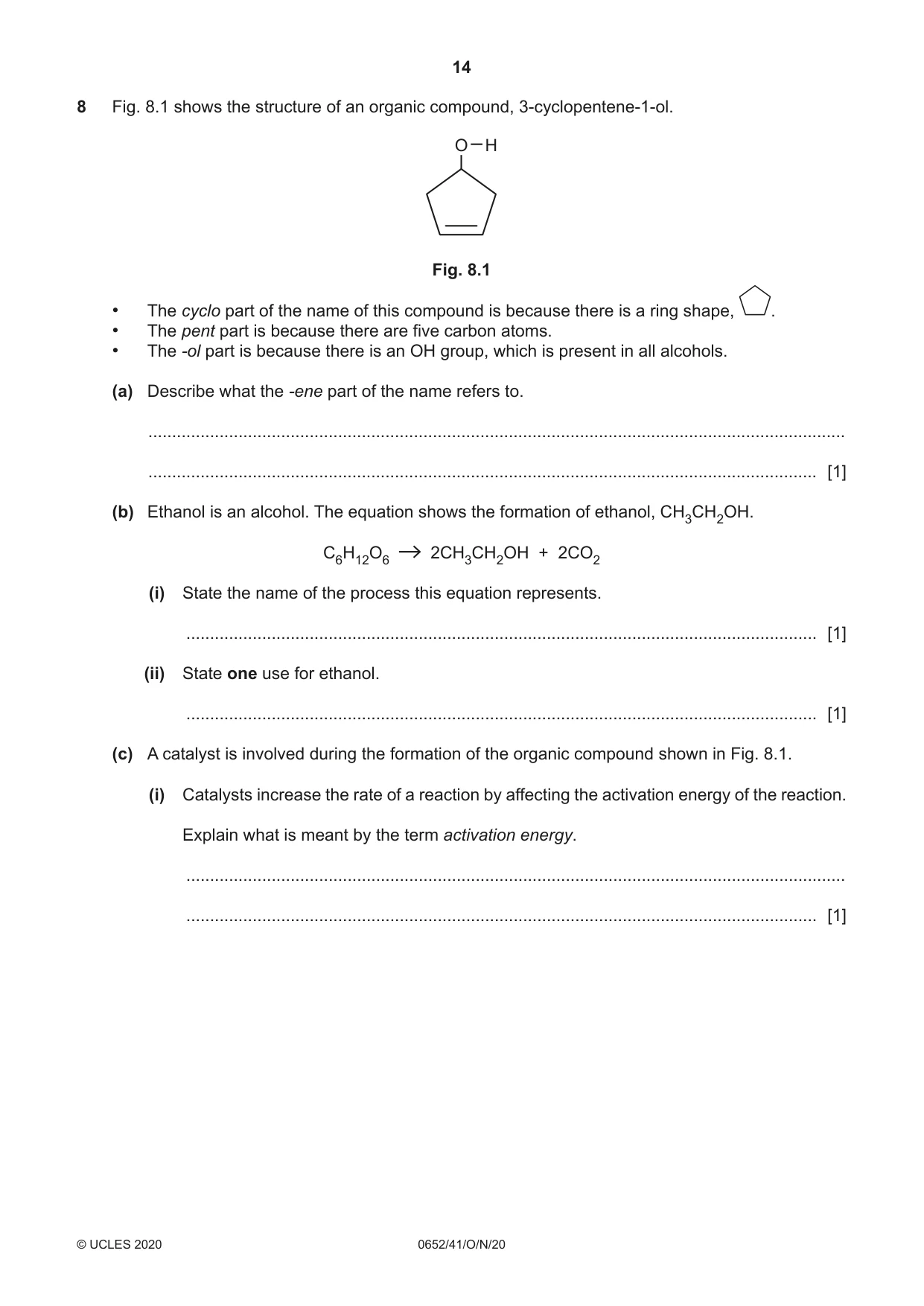
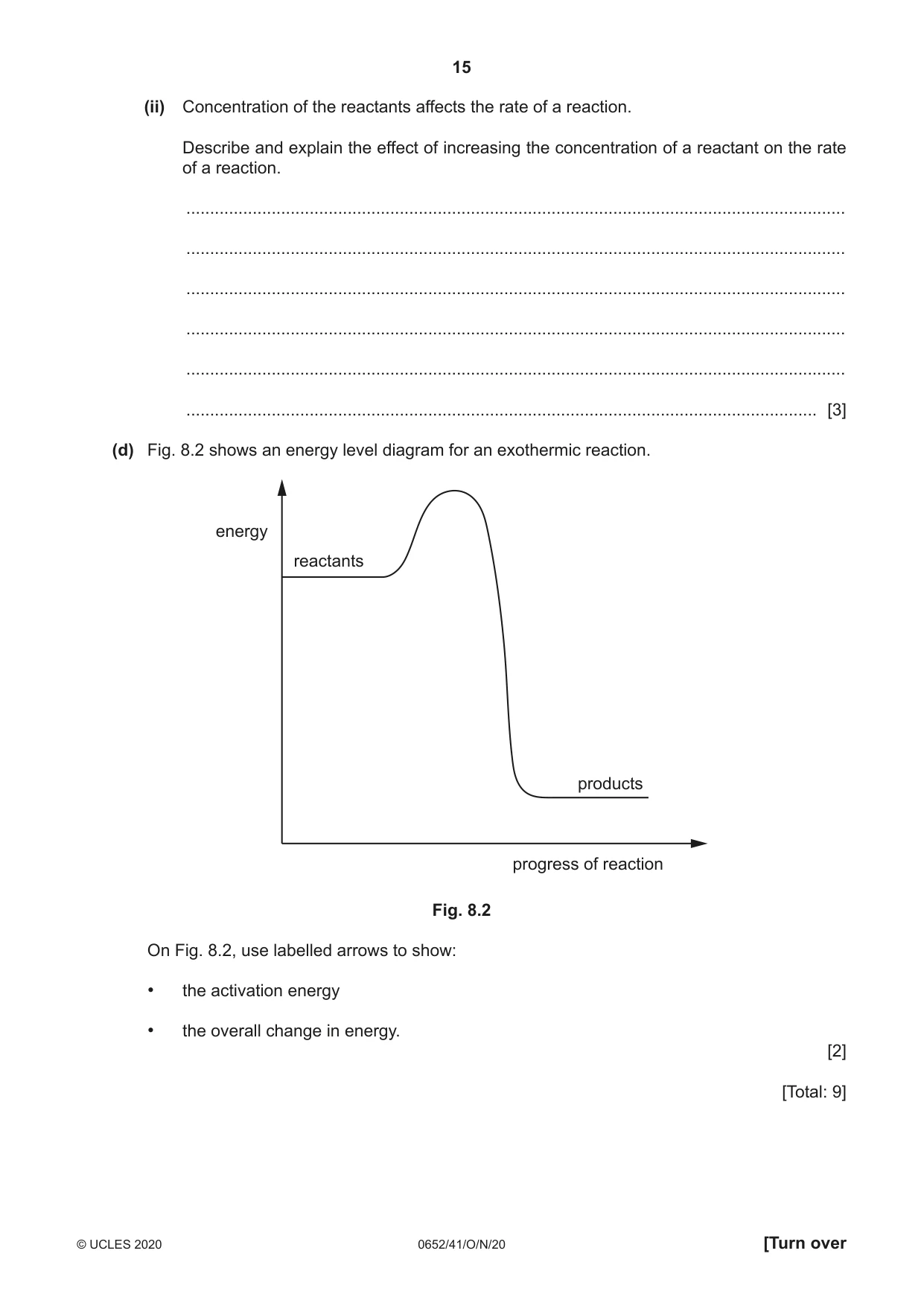
8 Fig. 8.1 shows the structure of an organic compound, 3‑cyclopentene‑1‑ol. O H Fig. 8.1 • The cyclo part of the name of this compound is because there is a ring shape, . • The pent part is because there are five carbon atoms. • The -ol part is because there is an OH group, which is present in all alcohols. (a) Describe what the -ene part of the name refers to. ................................................................................................................................................... ............................................................................................................................................. [1] (b) Ethanol is an alcohol. The equation shows the formation of ethanol, CH3CH2OH. C6H12O6 2CH3CH2OH + 2CO2 (i) State the name of the process this equation represents. ..................................................................................................................................... [1] (ii) State one use for ethanol. ..................................................................................................................................... [1] (c) A catalyst is involved during the formation of the organic compound shown in Fig. 8.1. (i) Catalysts increase the rate of a reaction by affecting the activation energy of the reaction. Explain what is meant by the term activation energy. ........................................................................................................................................... ..................................................................................................................................... [1] (ii) Concentration of the reactants affects the rate of a reaction. Describe and explain the effect of increasing the concentration of a reactant on the rate of a reaction. ........................................................................................................................................... ........................................................................................................................................... ........................................................................................................................................... ........................................................................................................................................... ........................................................................................................................................... ..................................................................................................................................... [3] (d) Fig. 8.2 shows an energy level diagram for an exothermic reaction. energy reactants products progress of reaction Fig. 8.2 On Fig. 8.2, use labelled arrows to show: • the activation energy • the overall change in energy. [2] [Total: 9]
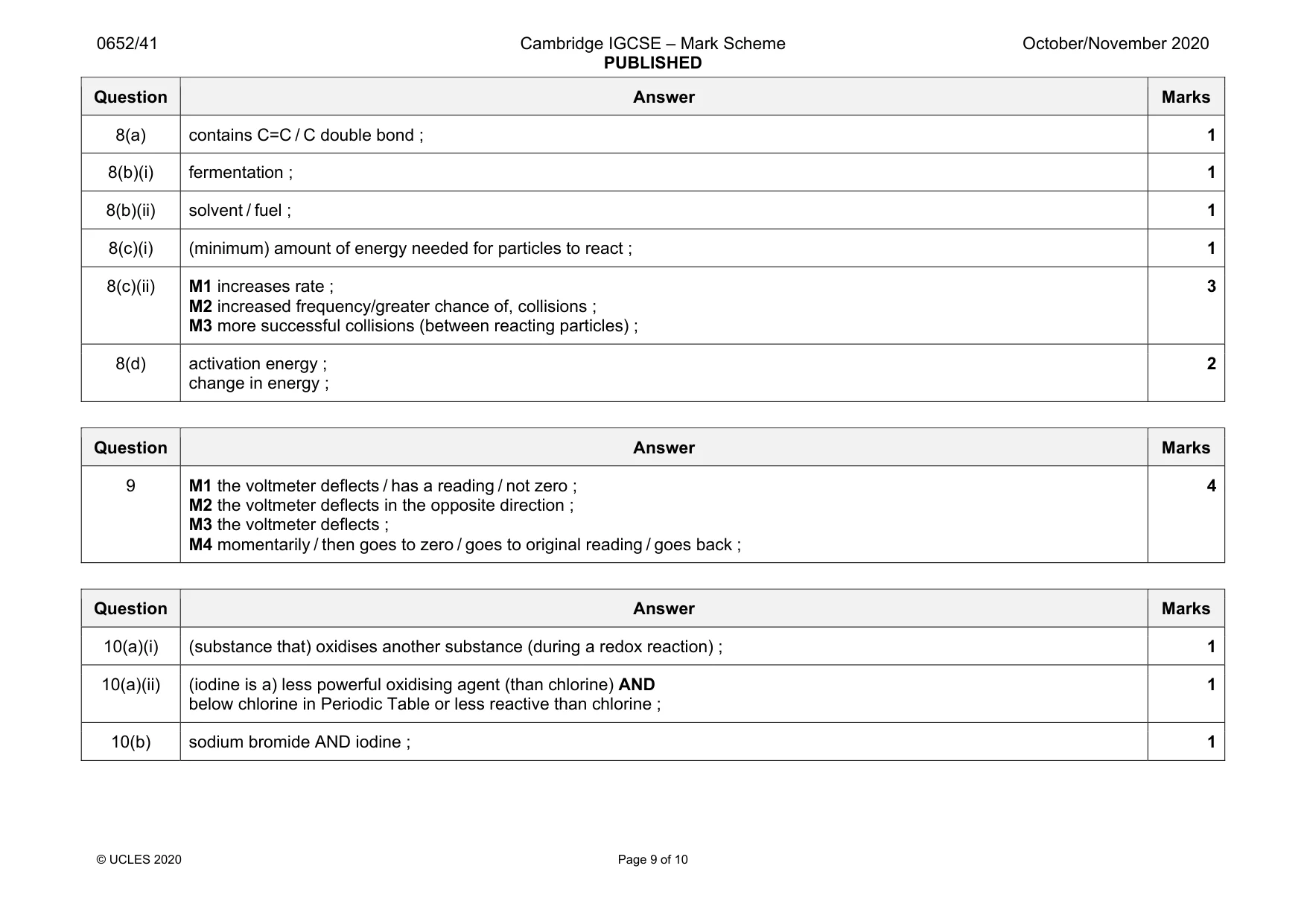
Mark scheme: 8(a) contains C=C / C double bond ; 1 8(b)(i) fermentation ; 1 8(b)(ii) solvent / fuel ; 1 8(c)(i) (minimum) amount of energy needed for particles to react ; 1 8(c)(ii) M1 increases rate ; M2 increased frequency/greater chance of, collisions ; M3 more successful collisions (between reacting particles) ; 3 8(d) activation energy ; change in energy ; 2
Q9 · A conductor in the magnetic field formed by two electromagnets
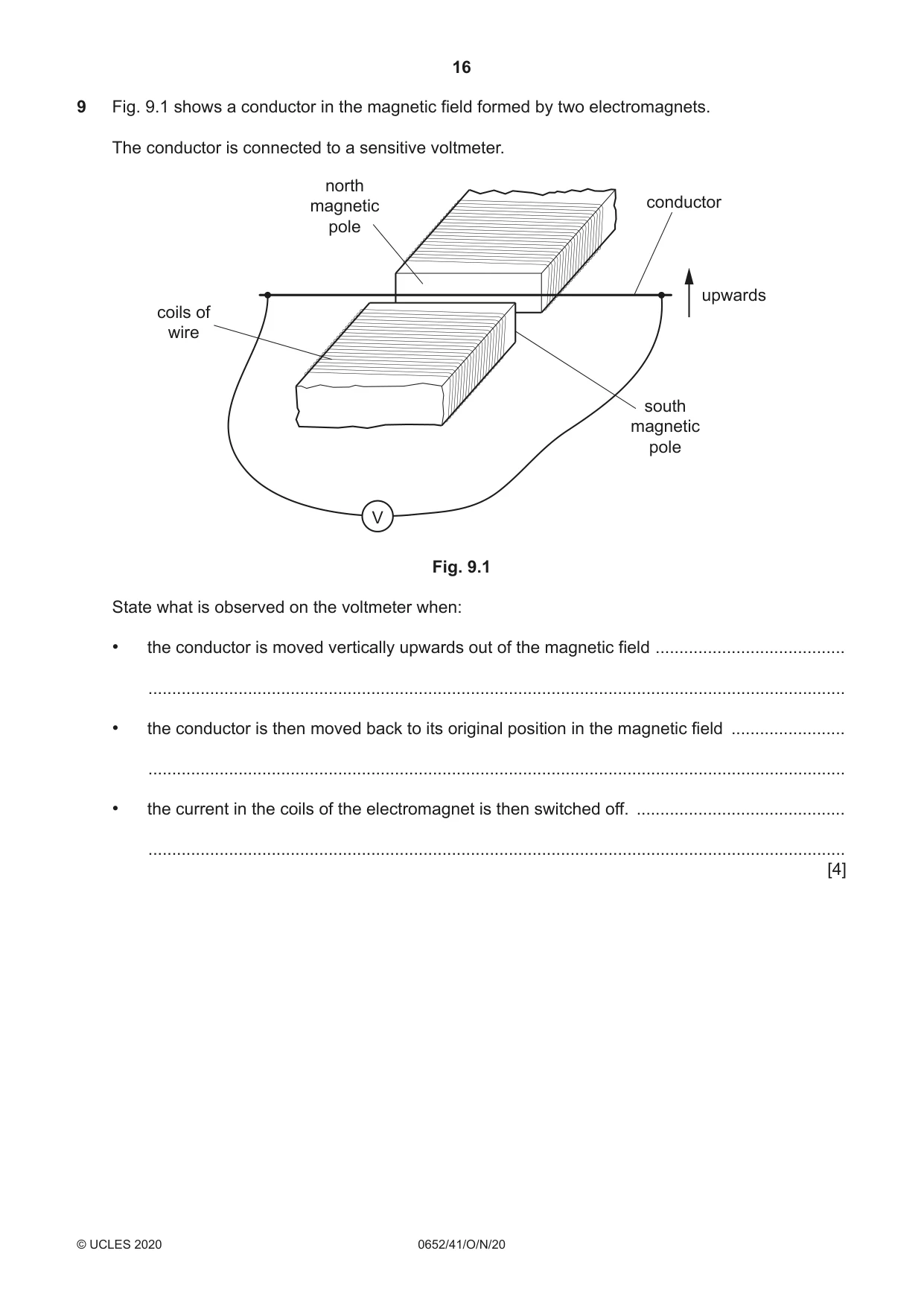
9 Fig. 9.1 shows a conductor in the magnetic field formed by two electromagnets. The conductor is connected to a sensitive voltmeter. north magnetic conductor pole upwards coils of wire south magnetic pole V Fig. 9.1 State what is observed on the voltmeter when: • the conductor is moved vertically upwards out of the magnetic field ........................................ ................................................................................................................................................... • the conductor is then moved back to its original position in the magnetic field ........................ ................................................................................................................................................... • the current in the coils of the electromagnet is then switched off. ............................................ ................................................................................................................................................... [4]
Mark scheme: 9 M1 the voltmeter deflects / has a reading / not zero ; M2 the voltmeter deflects in the opposite direction ; M3 the voltmeter deflects ; M4 momentarily / then goes to zero / goes to original reading / goes back ;
Q10 · The halogens are in Group VII of the Periodic Table
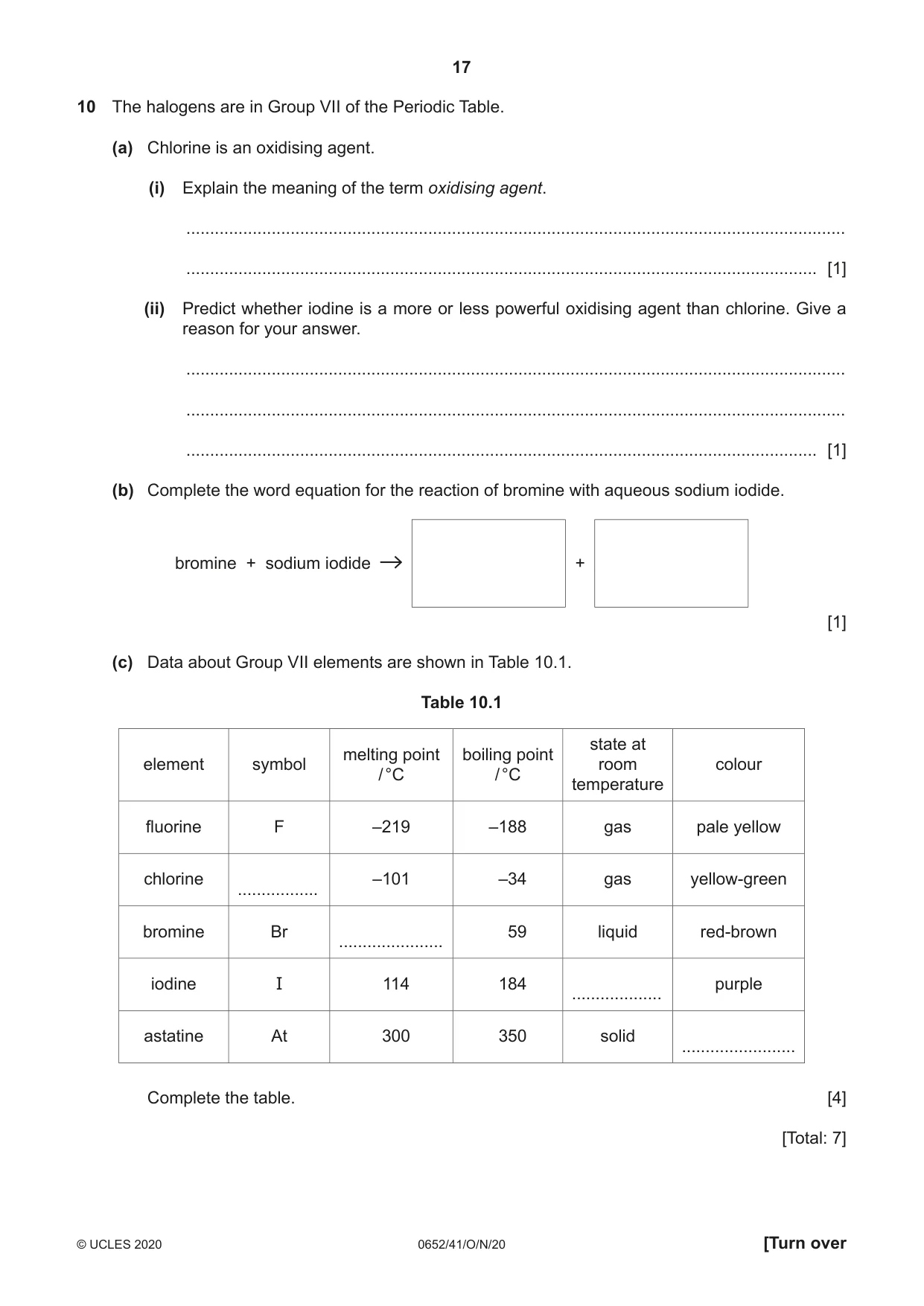
10 The halogens are in Group VII of the Periodic Table. (a) Chlorine is an oxidising agent. (i) Explain the meaning of the term oxidising agent. ........................................................................................................................................... ..................................................................................................................................... [1] (ii) Predict whether iodine is a more or less powerful oxidising agent than chlorine. Give a reason for your answer. ........................................................................................................................................... ........................................................................................................................................... ..................................................................................................................................... [1] (b) Complete the word equation for the reaction of bromine with aqueous sodium iodide. bromine + sodium iodide + [1] (c) Data about Group VII elements are shown in Table 10.1. Table 10.1 state at melting point boiling point element symbol room colour / °C / °C temperature fluorine F –219 –188 gas pale yellow chlorine –101 –34 gas yellow‑green ................. bromine Br 59 liquid red‑brown ...................... iodine I 114 184 purple ................... astatine At 300 350 solid ........................ Complete the table. [4] [Total: 7]
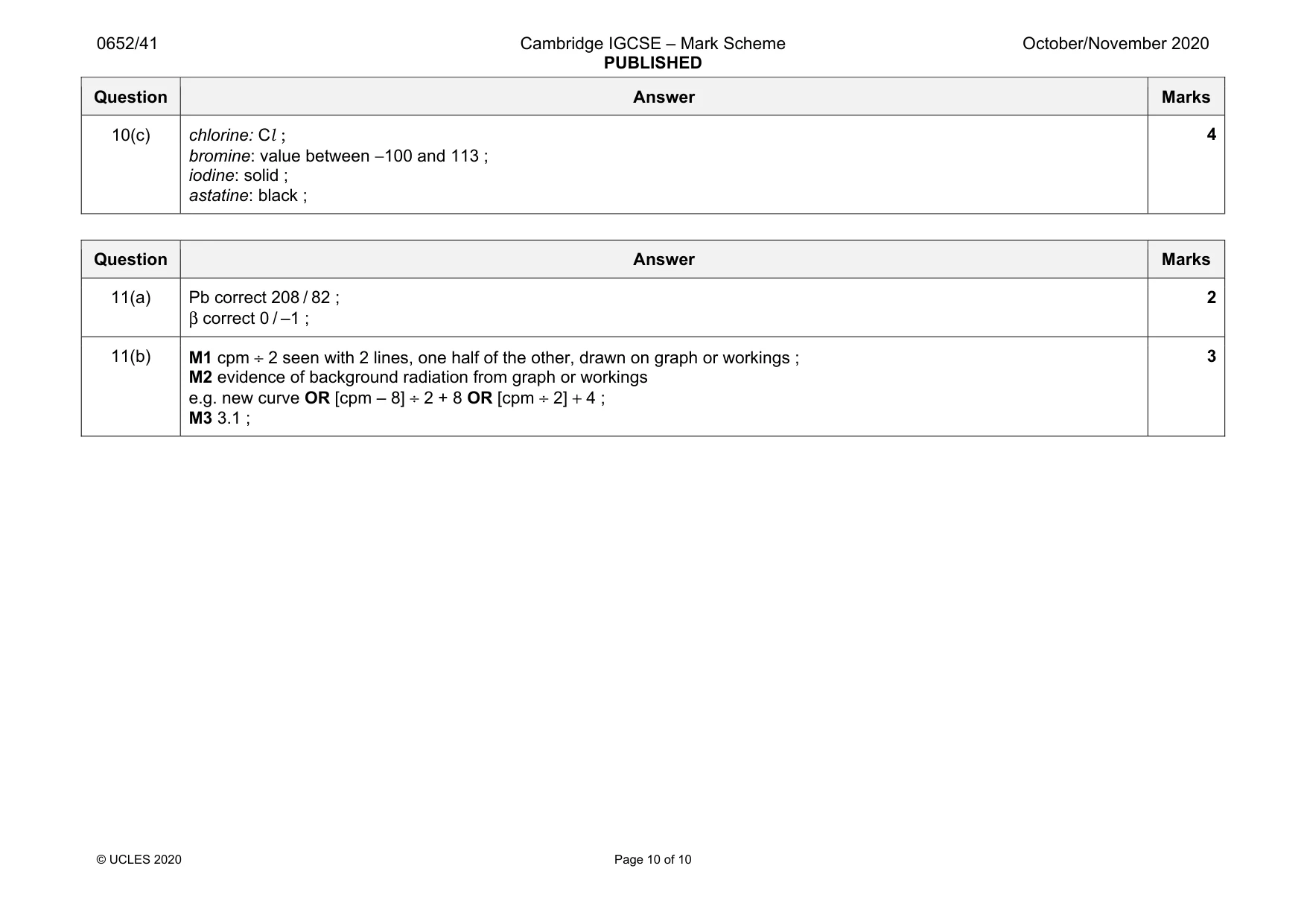
Mark scheme: 10(a)(i) (substance that) oxidises another substance (during a redox reaction) ; 1 10(a)(ii) (iodine is a) less powerful oxidising agent (than chlorine) AND below chlorine in Periodic Table or less reactive than chlorine ; 1 10(b) sodium bromide AND iodine ; 1 Question Answer Marks 10(c) chlorine: Cl ; bromine: value between −100 and 113 ; iodine: solid ; astatine: black ; 4
Q11 · The isotope thallium‑208 ( 81Tl ) decays into a stable isotope of lead by emission of a…
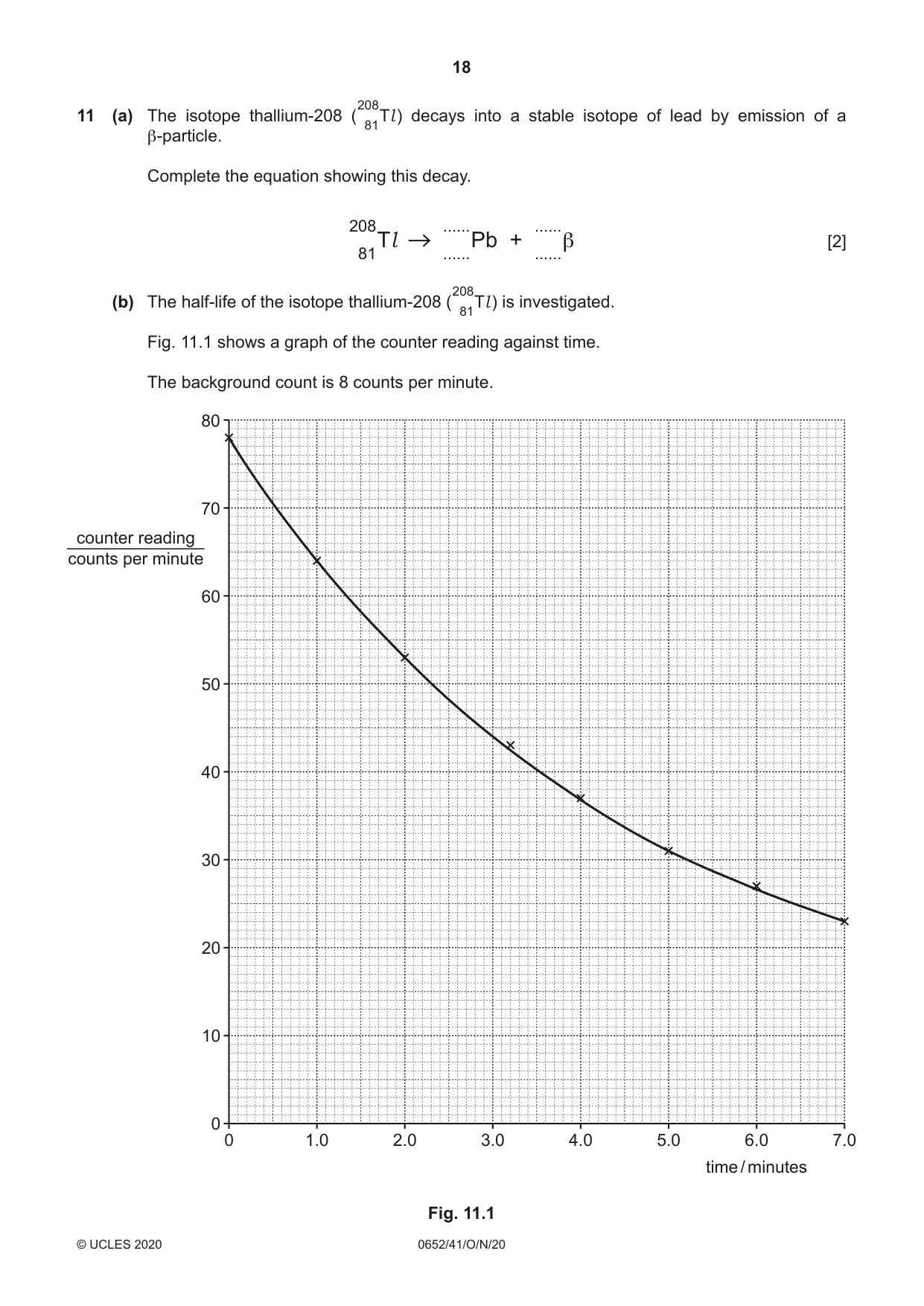
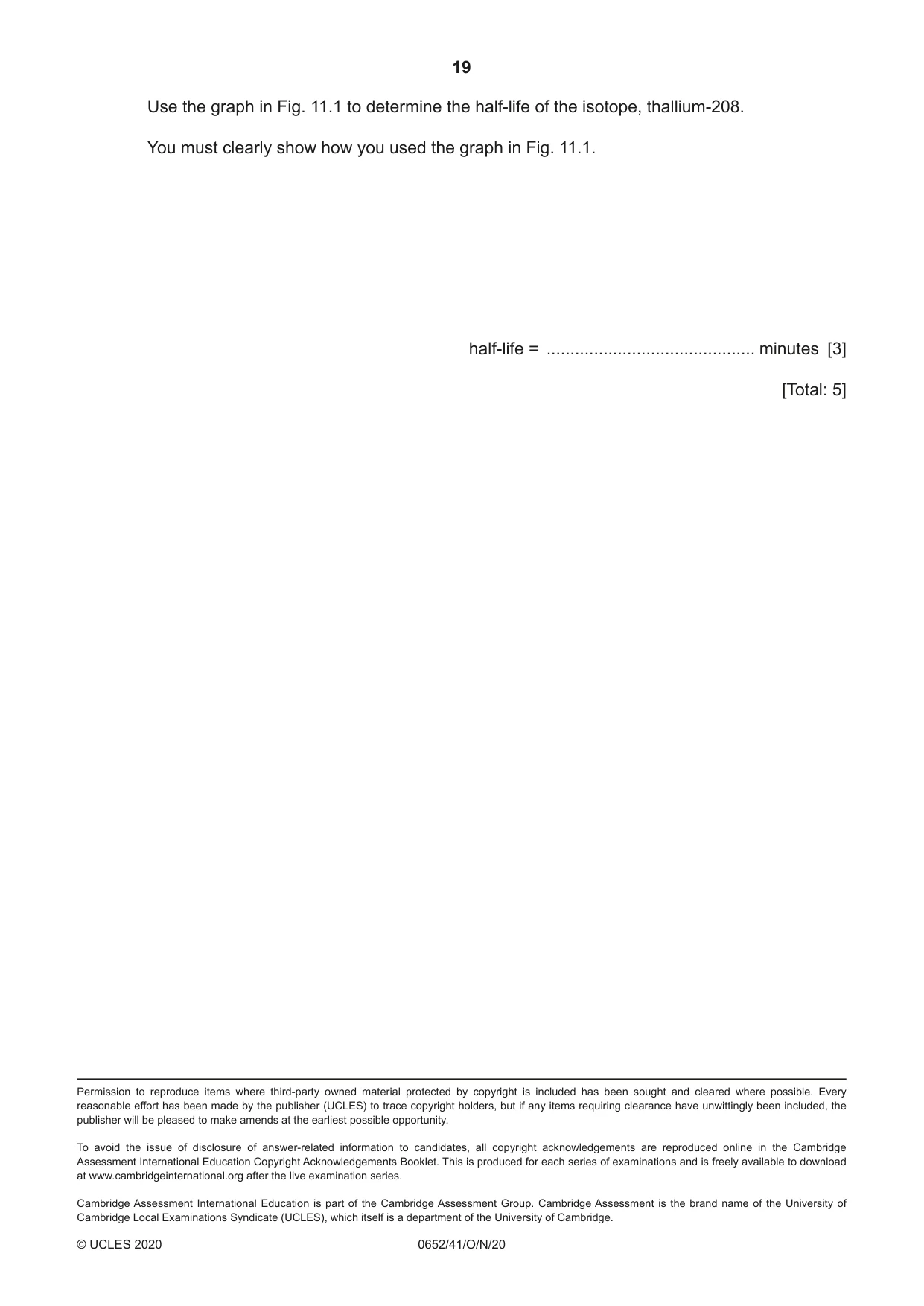
11 (a) The isotope thallium‑208 ( 81Tl ) decays into a stable isotope of lead by emission of a β‑particle. Complete the equation showing this decay. 208 ...... ...... [2] 81Tl ......Pb + ......β 208 (b) The half‑life of the isotope thallium‑208 ( 81Tl ) is investigated. Fig. 11.1 shows a graph of the counter reading against time. The background count is 8 counts per minute. 80 70 counter reading counts per minute 60 50 40 30 20 10 0 0 1.0 2.0 3.0 4.0 5.0 6.0 7.0 time / minutes Fig. 11.1 Use the graph in Fig. 11.1 to determine the half‑life of the isotope, thallium‑208. You must clearly show how you used the graph in Fig. 11.1. half‑life = ............................................ minutes [3] [Total: 5]
Mark scheme: 11(a) Pb correct 208 / 82 ; β correct 0 / –1 ; 2 11(b) M1 cpm ÷ 2 seen with 2 lines, one half of the other, drawn on graph or workings ; M2 evidence of background radiation from graph or workings e.g. new curve OR [cpm – 8] ÷ 2 + 8 OR [cpm ÷ 2] + 4 ; M3 3.1 ; 3
What was in this paper
The subtopics covered by these 11 questions, and how many questions each got. Open one in a new tab to see every Cambridge question on it.
What you needed in this session
Cambridge’s own grade thresholds for 2020 Oct/Nov, Paper 4 · Variant 1. A higher threshold means an easier paper — the bar moves with how the cohort did.