Cambridge IGCSE Physical Science 0652 — 2022 Oct/Nov Paper 4 · Variant 1
0652/41/O/N/22 · 80 marks · ≈90 min
The question paper and its mark scheme, free to read here and free to download. This is Cambridge’s own paper, exactly as it was sat.
Question paper20 pages
Mark scheme10 pages
Answers below. Sit the paper first if you are practising.
Paper as text
Question paper, page 1
This document has 20 pages. [Turn over Cambridge IGCSE™ * 0 8 9 1 0 2 8 4 2 3 * PHYSICAL SCIENCE 0652/41 Paper 4 Theory (Extended) October/November 2022 1 hour 15 minutes You must answer on the question paper. No additional materials are needed. INSTRUCTIONS ● Answer all questions. ● Use a black or dark blue pen. You may use an HB pencil for any diagrams or graphs. ● Write your name, centre number and candidate number in the boxes at the top of the page. ● Write your answer to each question in the space provided. ● Do not use an erasable pen or correction fluid. ● Do not write on any bar codes. ● You may use a calculator. ● You should show all your working and use appropriate units. INFORMATION ● The total mark for this paper is 80. ● The number of marks for each question or part question is shown in brackets [ ]. ● The Periodic Table is printed in the question paper. DC (CJ) 311760/1 © UCLES 2022
Question paper, page 2
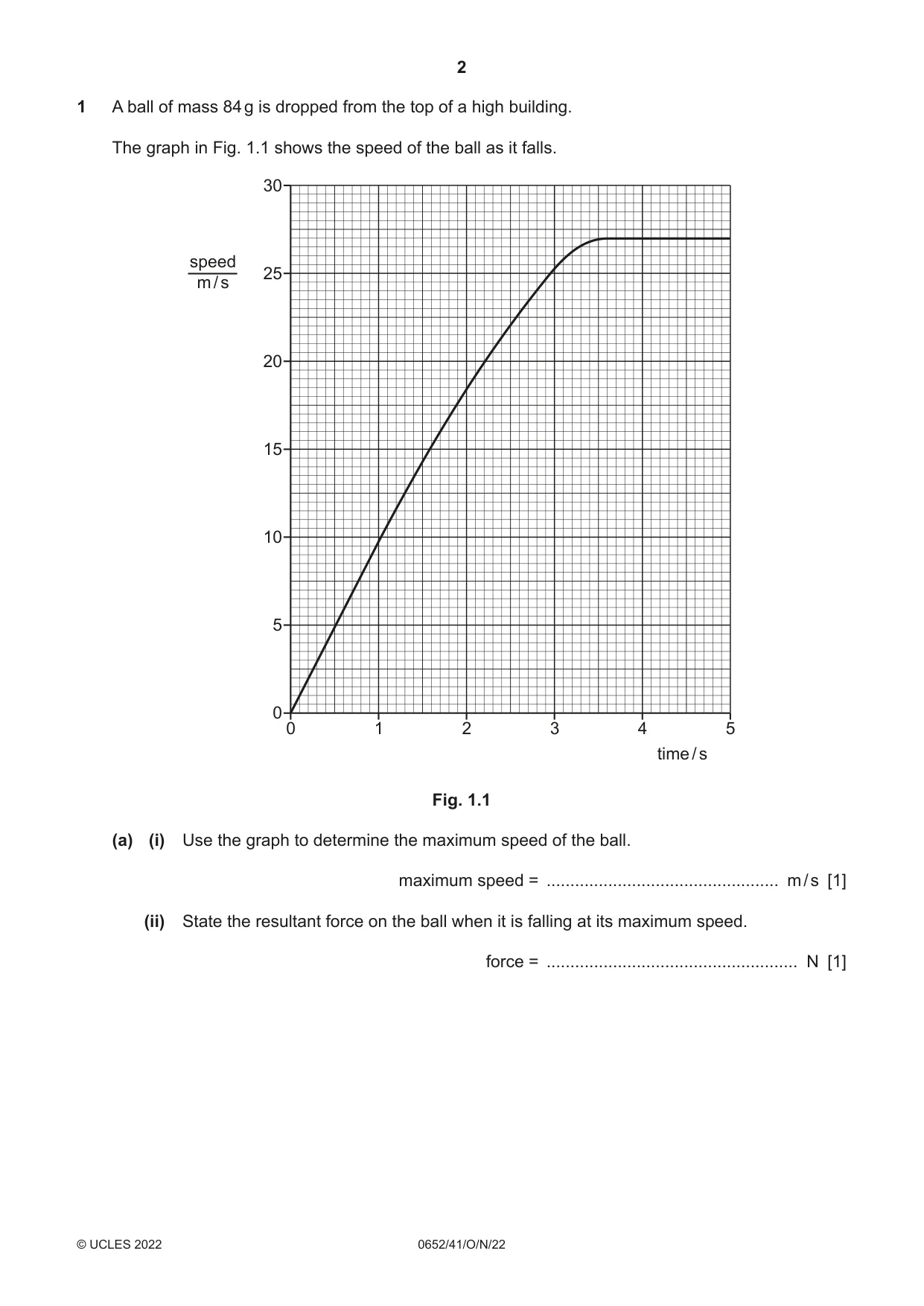
2 0652/41/O/N/22 © UCLES 2022 1 A ball of mass 84 g is dropped from the top of a high building. The graph in Fig. 1.1 shows the speed of the ball as it falls. 0 0 5 10 15 20 25 30 1 2 3 4 5 time / s speed m / s Fig. 1.1 (a) (i) Use the graph to determine the maximum speed of the ball. maximum speed = … m / s [1] (ii) State the resultant force on the ball when it is falling at its maximum speed. force = … N [1]
Question paper, page 3
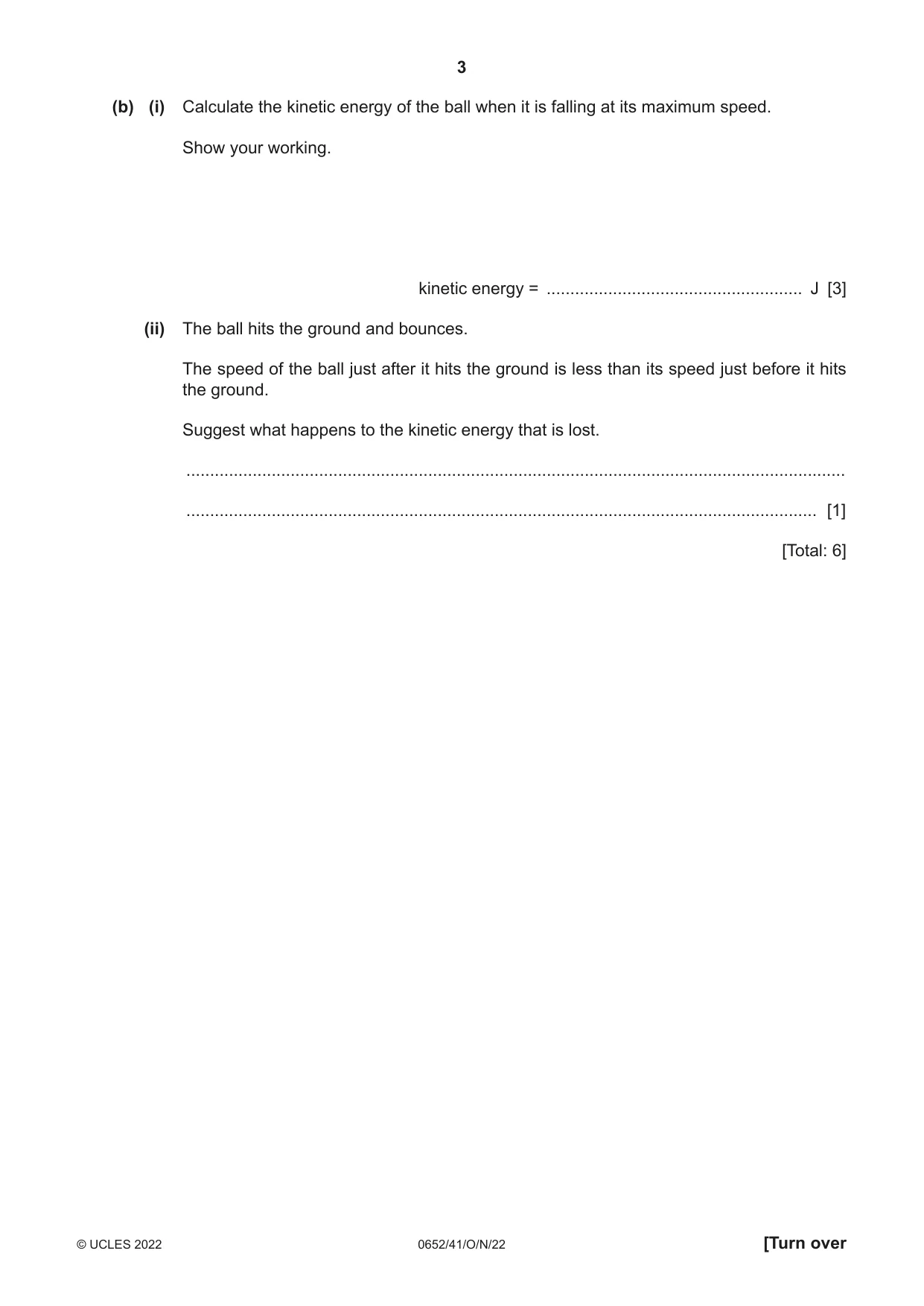
3 0652/41/O/N/22 © UCLES 2022 [Turn over (b) (i) Calculate the kinetic energy of the ball when it is falling at its maximum speed. Show your working. kinetic energy = … J [3] (ii) The ball hits the ground and bounces. The speed of the ball just after it hits the ground is less than its speed just before it hits the ground. Suggest what happens to the kinetic energy that is lost. … … [1] [Total: 6]
Question paper, page 4
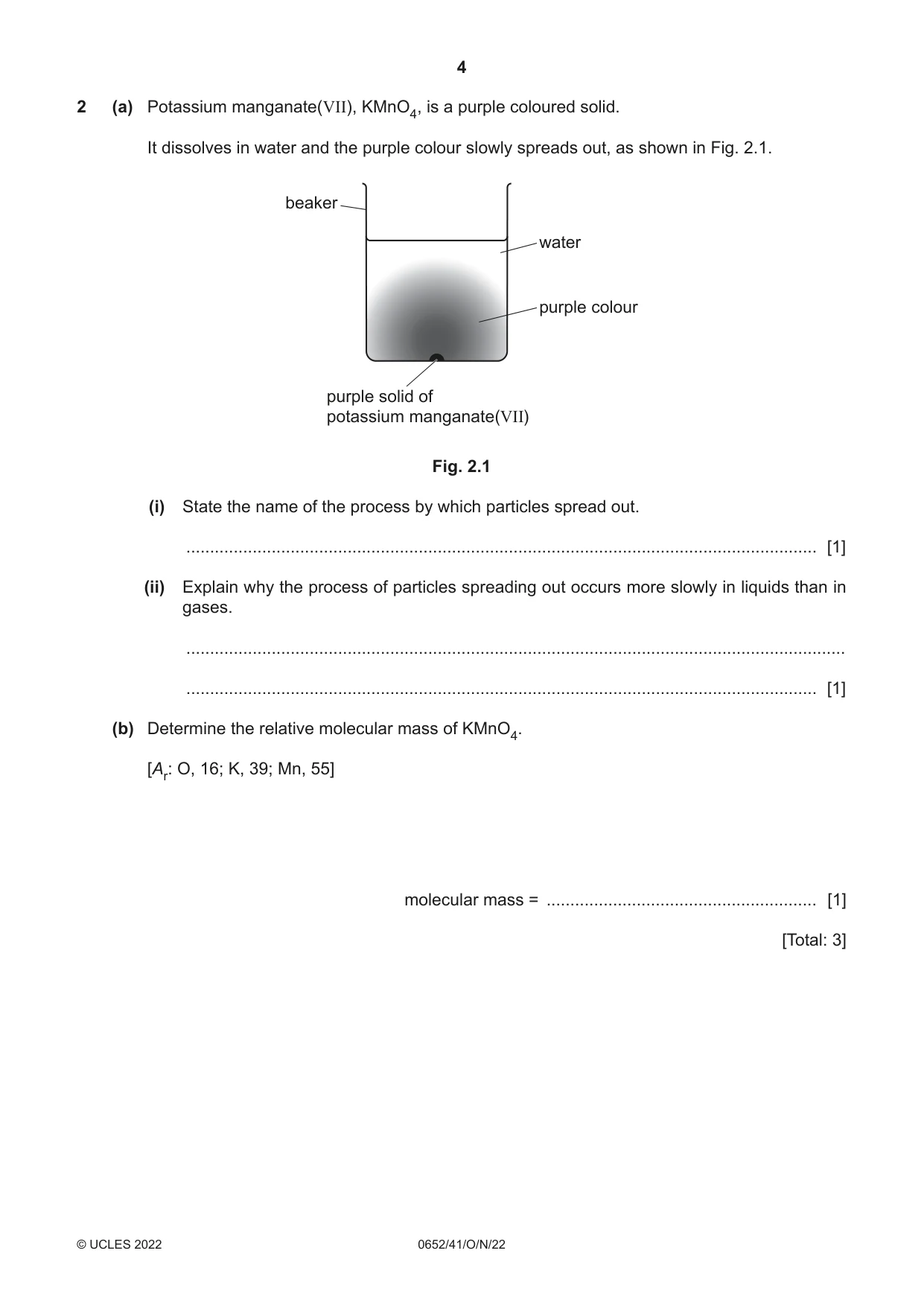
4 0652/41/O/N/22 © UCLES 2022 2 (a) Potassium manganate(VII), KMnO4, is a purple coloured solid. It dissolves in water and the purple colour slowly spreads out, as shown in Fig. 2.1. beaker water purple colour purple solid of potassium manganate(VII) Fig. 2.1 (i) State the name of the process by which particles spread out. … [1] (ii) Explain why the process of particles spreading out occurs more slowly in liquids than in gases. … … [1] (b) Determine the relative molecular mass of KMnO4. [Ar: O, 16; K, 39; Mn, 55] molecular mass = … [1] [Total: 3]
Question paper, page 5
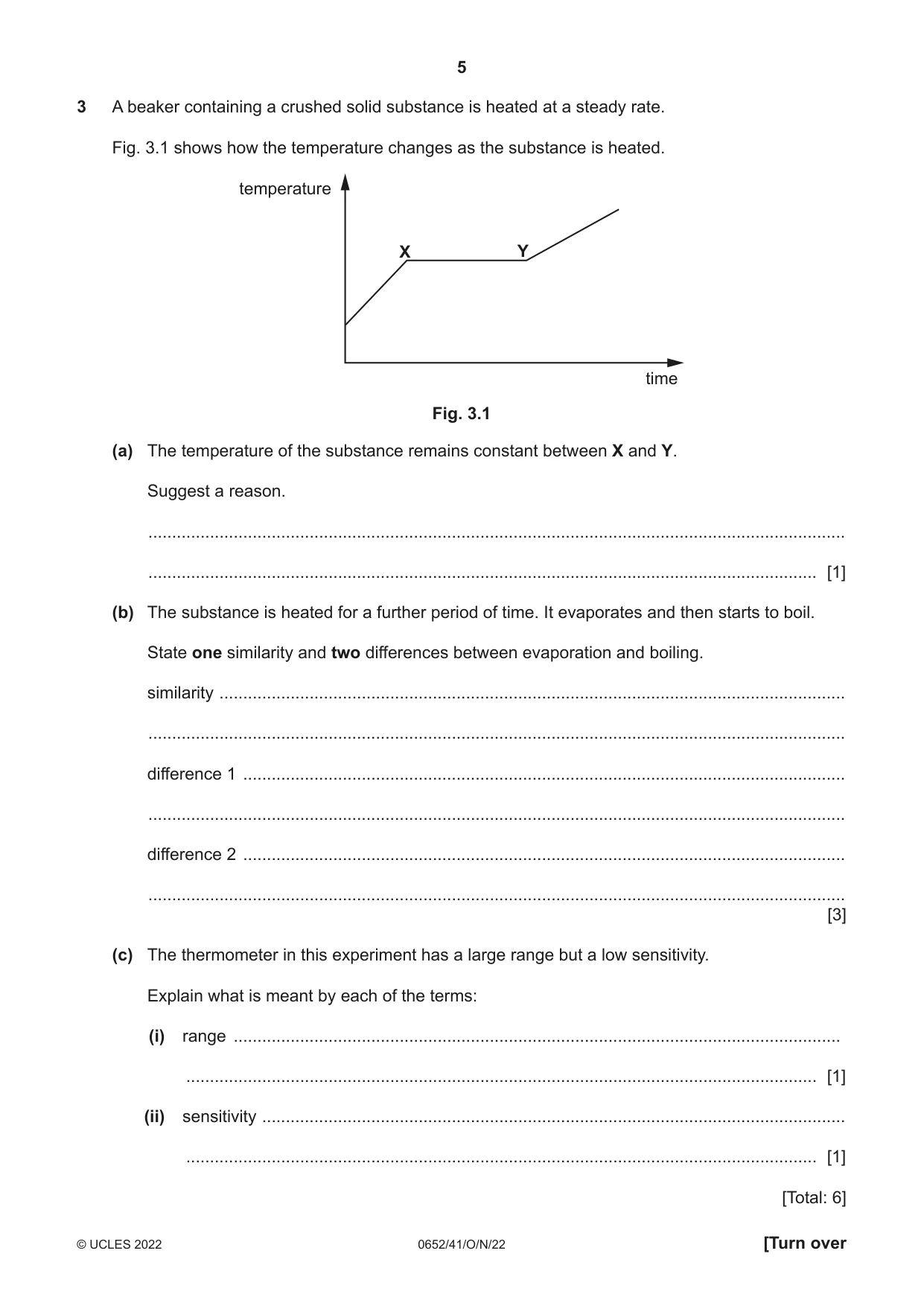
5 0652/41/O/N/22 © UCLES 2022 [Turn over 3 A beaker containing a crushed solid substance is heated at a steady rate. Fig. 3.1 shows how the temperature changes as the substance is heated. temperature time X Y Fig. 3.1 (a) The temperature of the substance remains constant between X and Y. Suggest a reason. … … [1] (b) The substance is heated for a further period of time. It evaporates and then starts to boil. State one similarity and two differences between evaporation and boiling. similarity … … difference 1 … … difference 2 … … [3] (c) The thermometer in this experiment has a large range but a low sensitivity. Explain what is meant by each of the terms: (i) range … … [1] (ii) sensitivity … … [1] [Total: 6]
Question paper, page 6
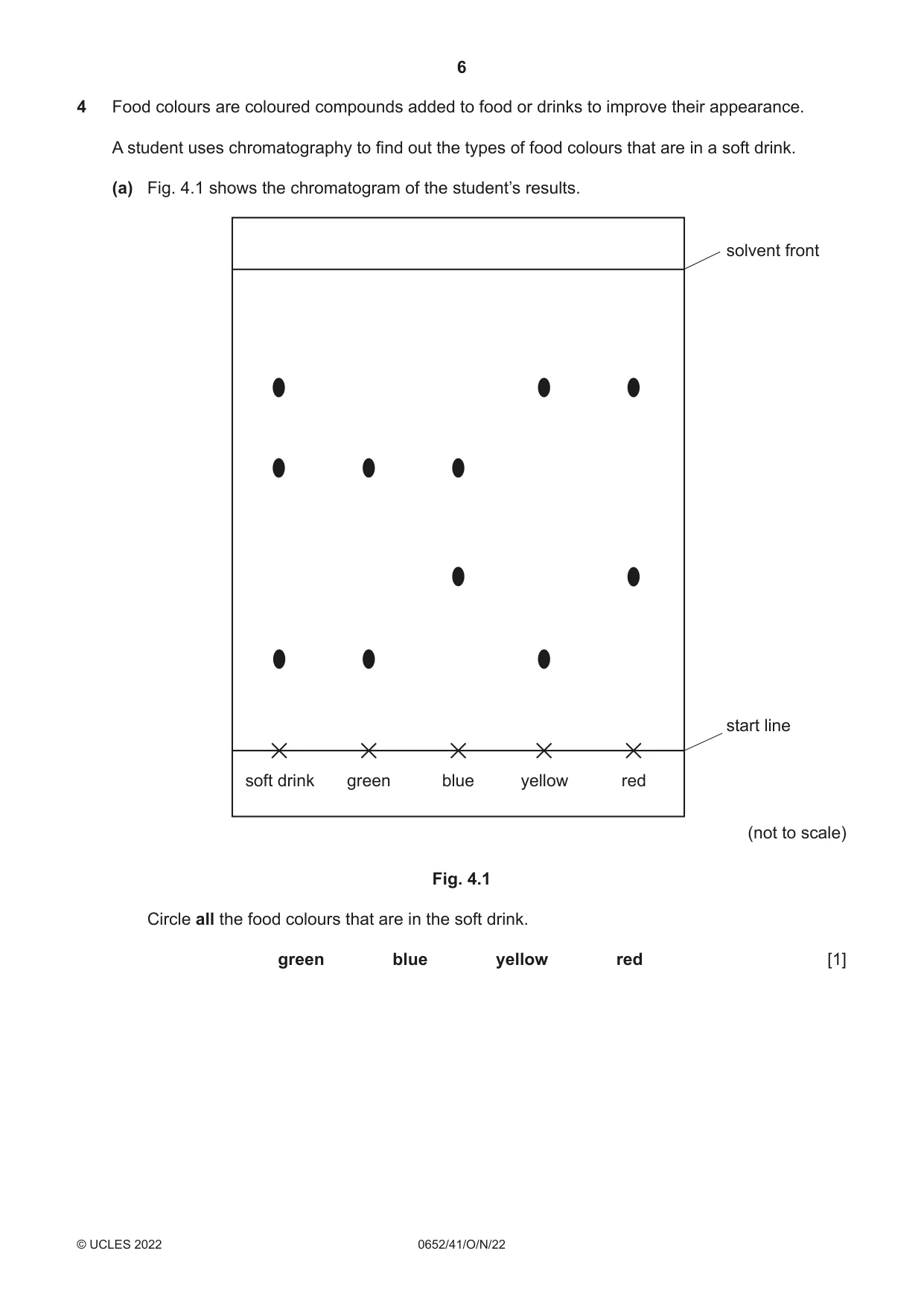
6 0652/41/O/N/22 © UCLES 2022 4 Food colours are coloured compounds added to food or drinks to improve their appearance. A student uses chromatography to find out the types of food colours that are in a soft drink. (a) Fig. 4.1 shows the chromatogram of the student’s results. solvent front start line (not to scale) red yellow blue green soft drink Fig. 4.1 Circle all the food colours that are in the soft drink. green blue yellow red [1]
Question paper, page 7
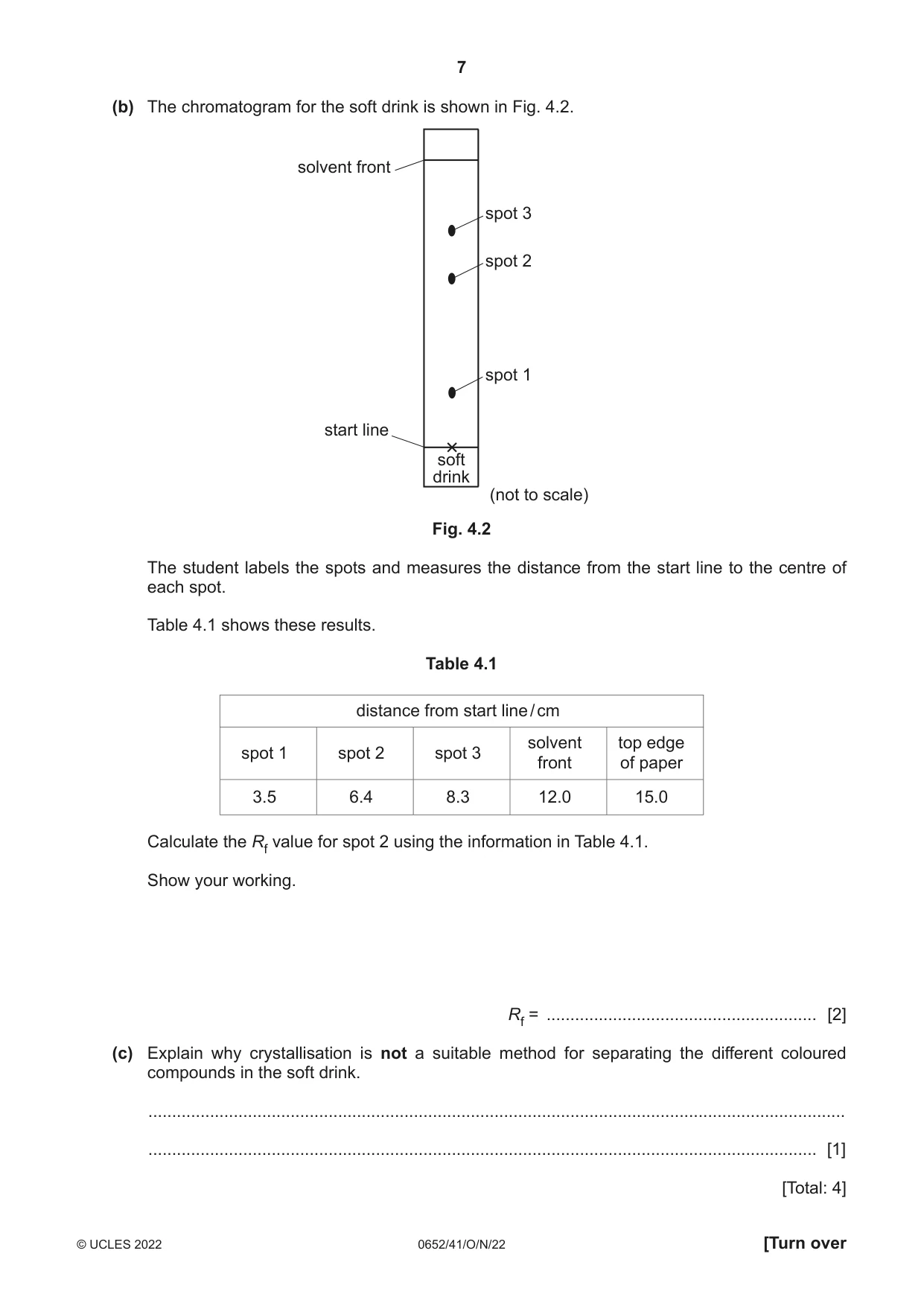
7 0652/41/O/N/22 © UCLES 2022 [Turn over (b) The chromatogram for the soft drink is shown in Fig. 4.2. solvent front start line spot 1 (not to scale) soft drink spot 2 spot 3 Fig. 4.2 The student labels the spots and measures the distance from the start line to the centre of each spot. Table 4.1 shows these results. Table 4.1 distance from start line / cm spot 1 spot 2 spot 3 solvent front top edge of paper 3.5 6.4 8.3 12.0 15.0 Calculate the Rf value for spot 2 using the information in Table 4.1. Show your working. Rf = … [2] (c) Explain why crystallisation is not a suitable method for separating the different coloured compounds in the soft drink. … … [1] [Total: 4]
Question paper, page 8
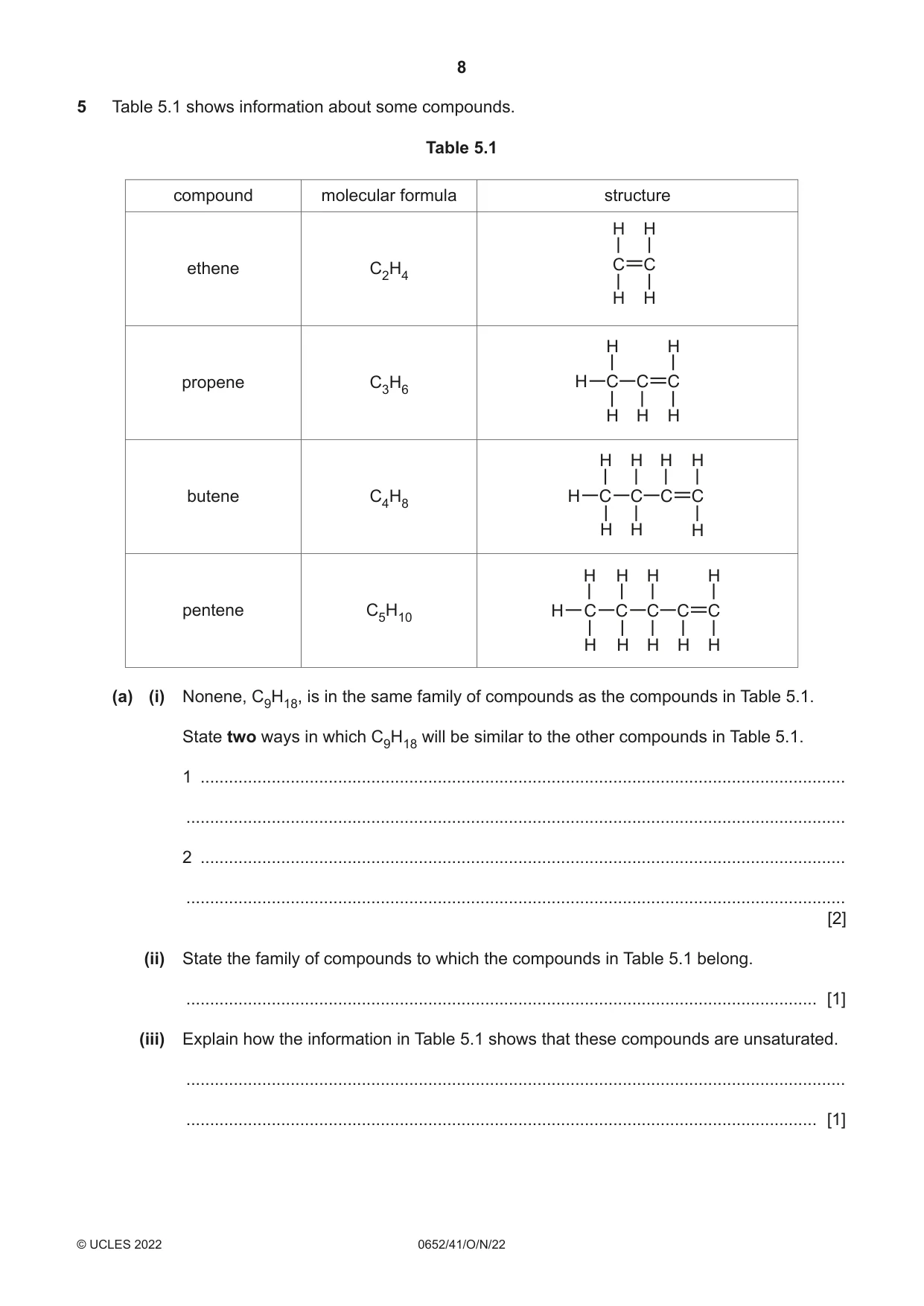
8 0652/41/O/N/22 © UCLES 2022 5 Table 5.1 shows information about some compounds. Table 5.1 compound molecular formula structure ethene C2H4 H H C H H C propene C3H6 H H C H H H C H C butene C4H8 H C C H H H H C H C H H pentene C5H10 H C C H H H C H C H H H H C H (a) (i) Nonene, C9H18, is in the same family of compounds as the compounds in Table 5.1. State two ways in which C9H18 will be similar to the other compounds in Table 5.1. 1 … … 2 … … [2] (ii) State the family of compounds to which the compounds in Table 5.1 belong. … [1] (iii) Explain how the information in Table 5.1 shows that these compounds are unsaturated. … … [1]
Question paper, page 9
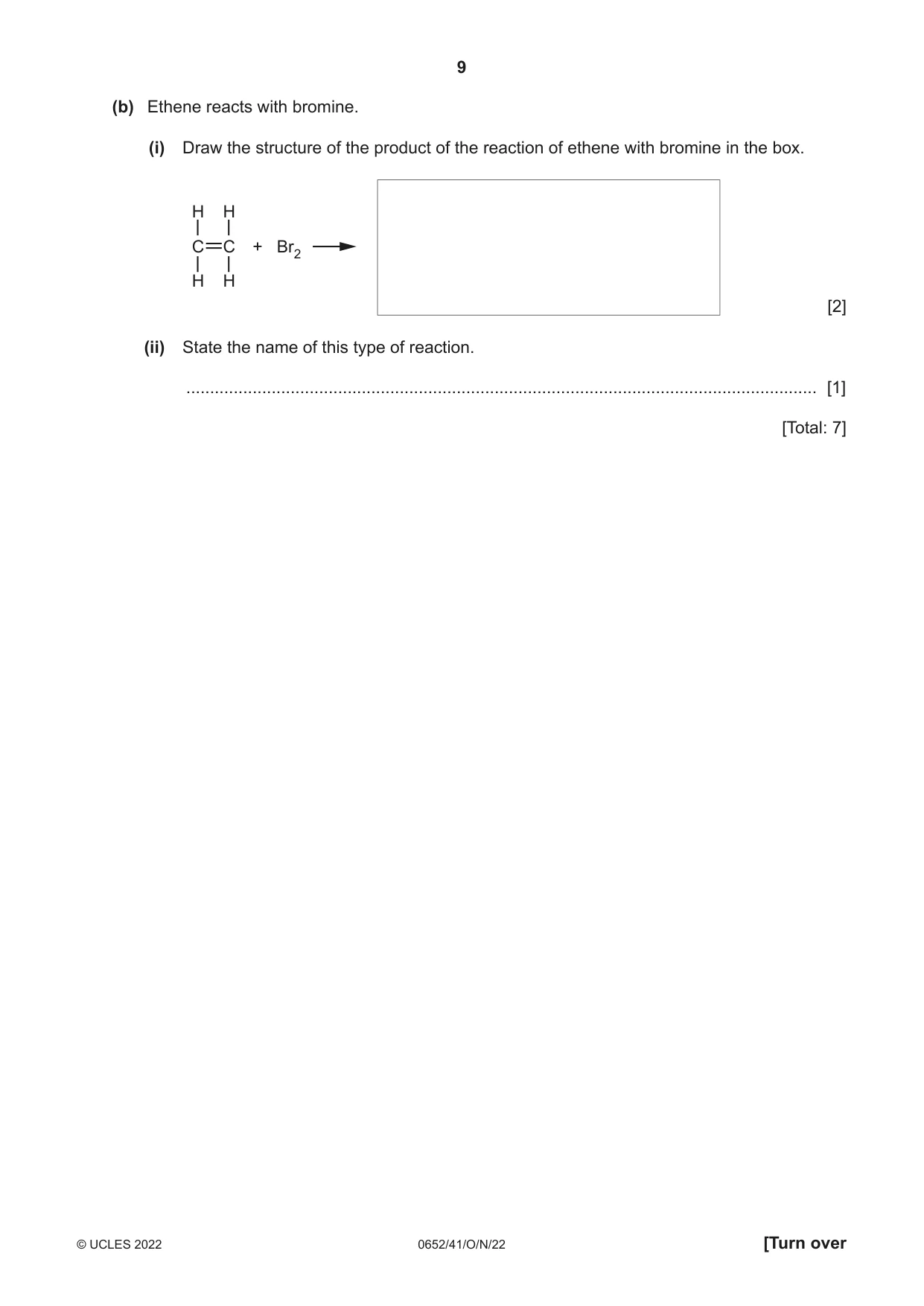
9 0652/41/O/N/22 © UCLES 2022 [Turn over (b) Ethene reacts with bromine. (i) Draw the structure of the product of the reaction of ethene with bromine in the box. H H C H H C + Br2 [2] (ii) State the name of this type of reaction. … [1] [Total: 7]
Question paper, page 10
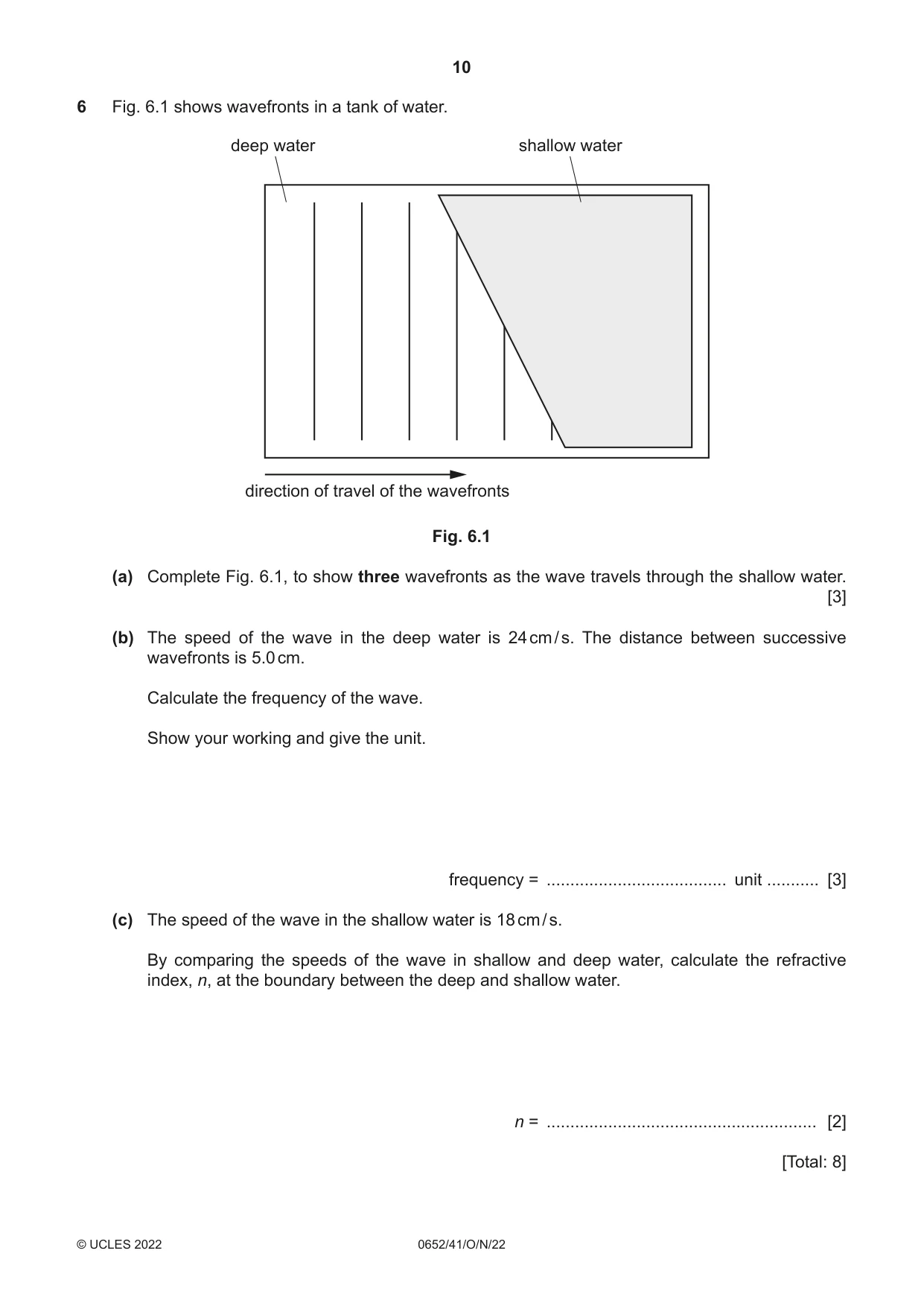
10 0652/41/O/N/22 © UCLES 2022 6 Fig. 6.1 shows wavefronts in a tank of water. deep water direction of travel of the wavefronts shallow water Fig. 6.1 (a) Complete Fig. 6.1, to show three wavefronts as the wave travels through the shallow water. [3] (b) The speed of the wave in the deep water is 24 cm / s. The distance between successive wavefronts is 5.0 cm. Calculate the frequency of the wave. Show your working and give the unit. frequency = … unit … [3] (c) The speed of the wave in the shallow water is 18 cm / s. By comparing the speeds of the wave in shallow and deep water, calculate the refractive index, n, at the boundary between the deep and shallow water. n = … [2] [Total: 8]
Question paper, page 11
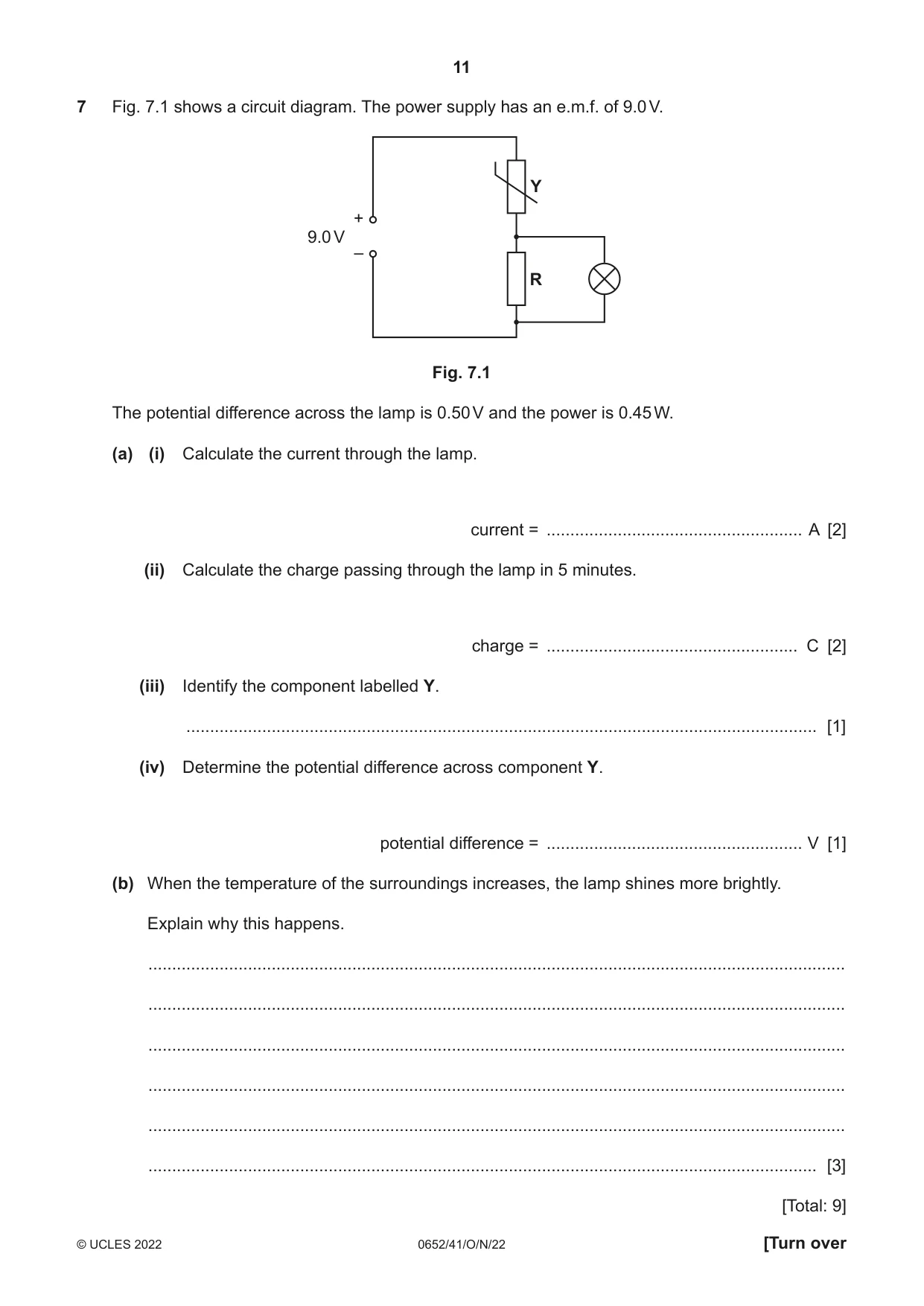
11 0652/41/O/N/22 © UCLES 2022 [Turn over 7 Fig. 7.1 shows a circuit diagram. The power supply has an e.m.f. of 9.0 V. Y + 9.0 V – R Fig. 7.1 The potential difference across the lamp is 0.50 V and the power is 0.45 W. (a) (i) Calculate the current through the lamp. current = … A [2] (ii) Calculate the charge passing through the lamp in 5 minutes. charge = … C [2] (iii) Identify the component labelled Y. … [1] (iv) Determine the potential difference across component Y. potential difference = … V [1] (b) When the temperature of the surroundings increases, the lamp shines more brightly. Explain why this happens. … … … … … … [3] [Total: 9]
Question paper, page 12
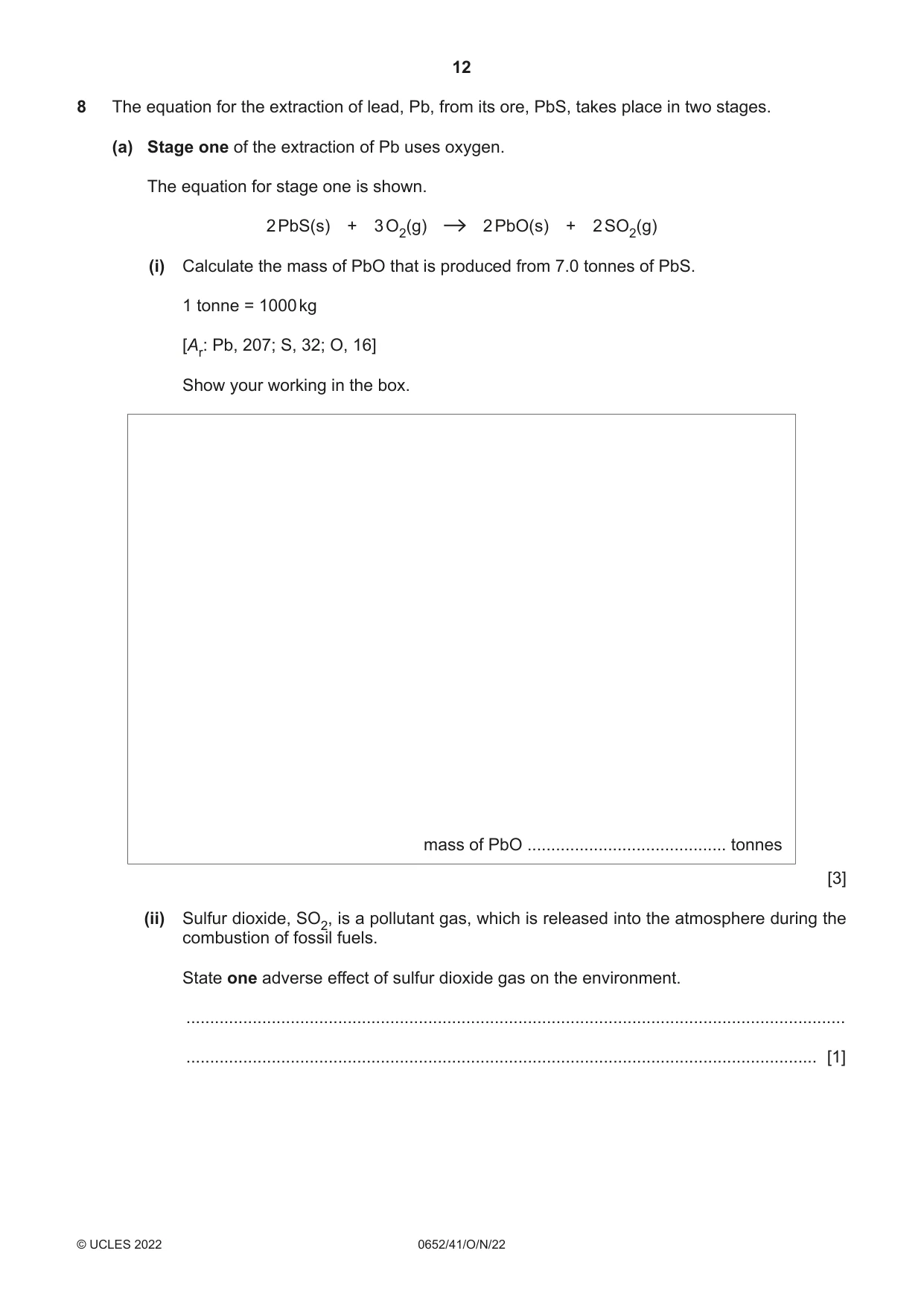
12 0652/41/O/N/22 © UCLES 2022 8 The equation for the extraction of lead, Pb, from its ore, PbS, takes place in two stages. (a) Stage one of the extraction of Pb uses oxygen. The equation for stage one is shown. 2 PbS(s) + 3 O2(g) 2 PbO(s) + 2 SO2(g) (i) Calculate the mass of PbO that is produced from 7.0 tonnes of PbS. 1 tonne = 1000 kg [Ar: Pb, 207; S, 32; O, 16] Show your working in the box. mass of PbO … tonnes [3] (ii) Sulfur dioxide, SO2, is a pollutant gas, which is released into the atmosphere during the combustion of fossil fuels. State one adverse effect of sulfur dioxide gas on the environment. … … [1]
Question paper, page 13
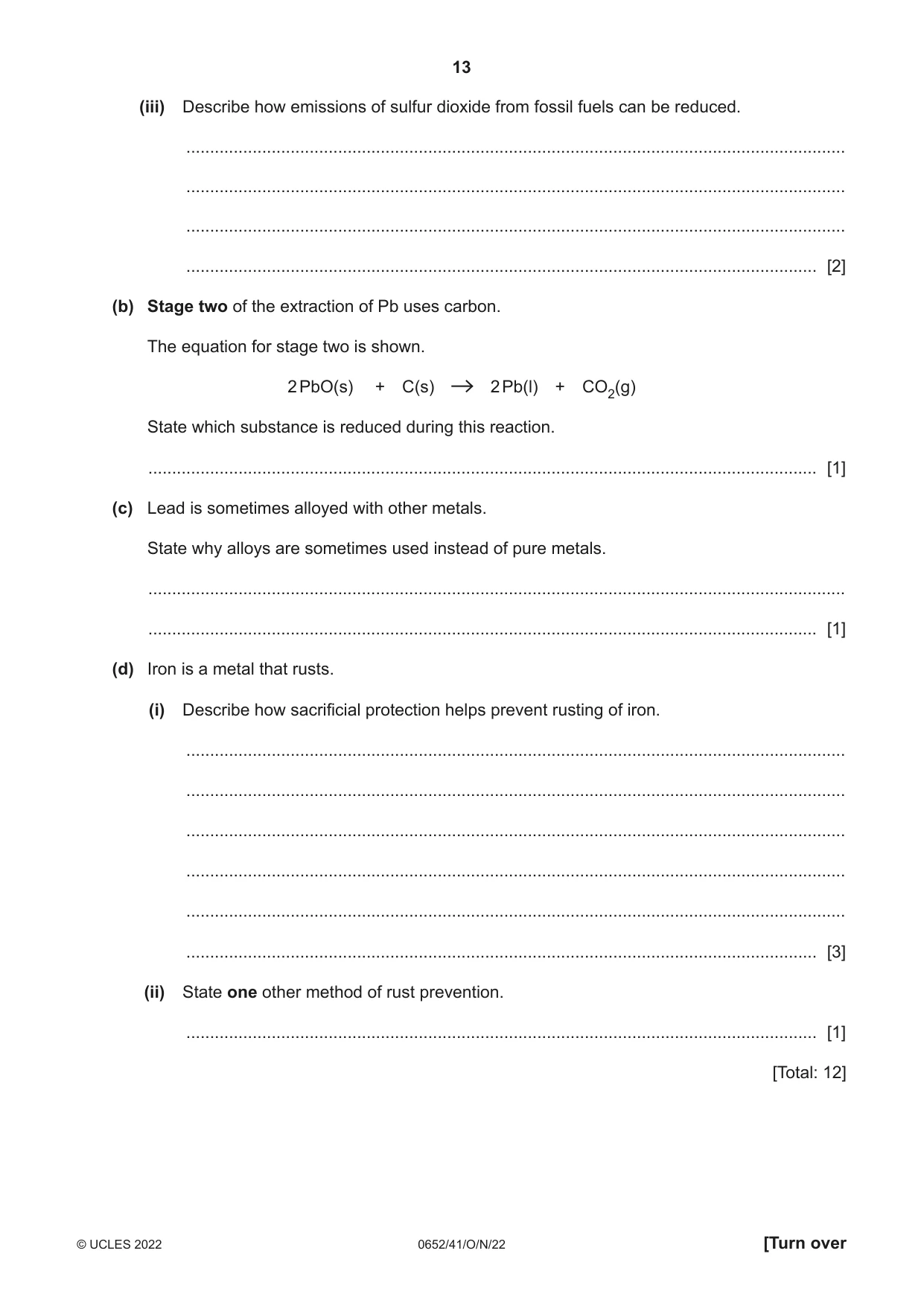
13 0652/41/O/N/22 © UCLES 2022 [Turn over (iii) Describe how emissions of sulfur dioxide from fossil fuels can be reduced. … … … … [2] (b) Stage two of the extraction of Pb uses carbon. The equation for stage two is shown. 2 PbO(s) + C(s) 2 Pb(l) + CO2(g) State which substance is reduced during this reaction. … [1] (c) Lead is sometimes alloyed with other metals. State why alloys are sometimes used instead of pure metals. … … [1] (d) Iron is a metal that rusts. (i) Describe how sacrificial protection helps prevent rusting of iron. … … … … … … [3] (ii) State one other method of rust prevention. … [1] [Total: 12]
Question paper, page 14
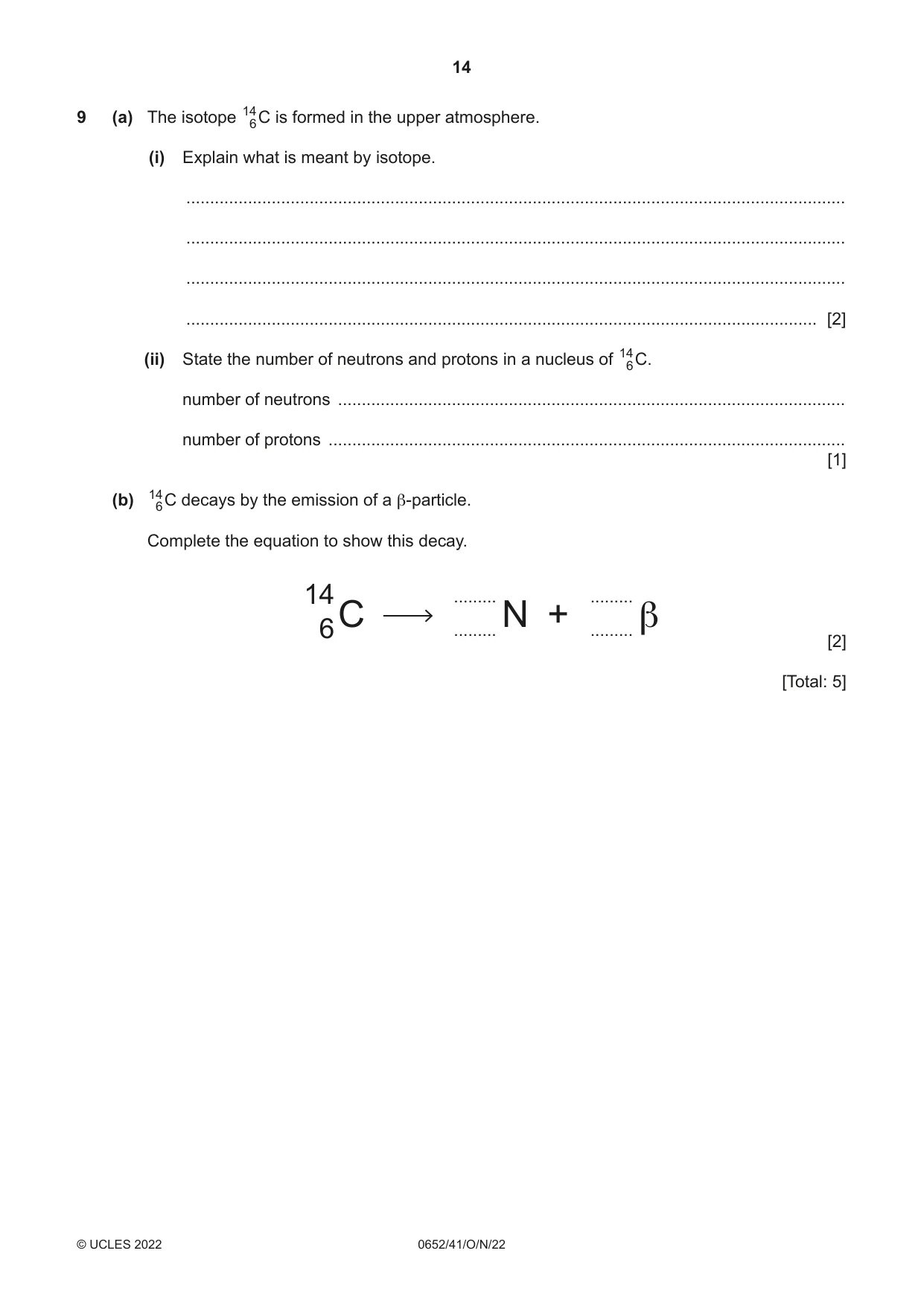
14 0652/41/O/N/22 © UCLES 2022 9 (a) The isotope 14 6 C is formed in the upper atmosphere. (i) Explain what is meant by isotope. … … … … [2] (ii) State the number of neutrons and protons in a nucleus of 14 6 C. number of neutrons … number of protons … [1] (b) 14 6 C decays by the emission of a β-particle. Complete the equation to show this decay. 14 6 C … … N + … … β [2] [Total: 5]
Question paper, page 15
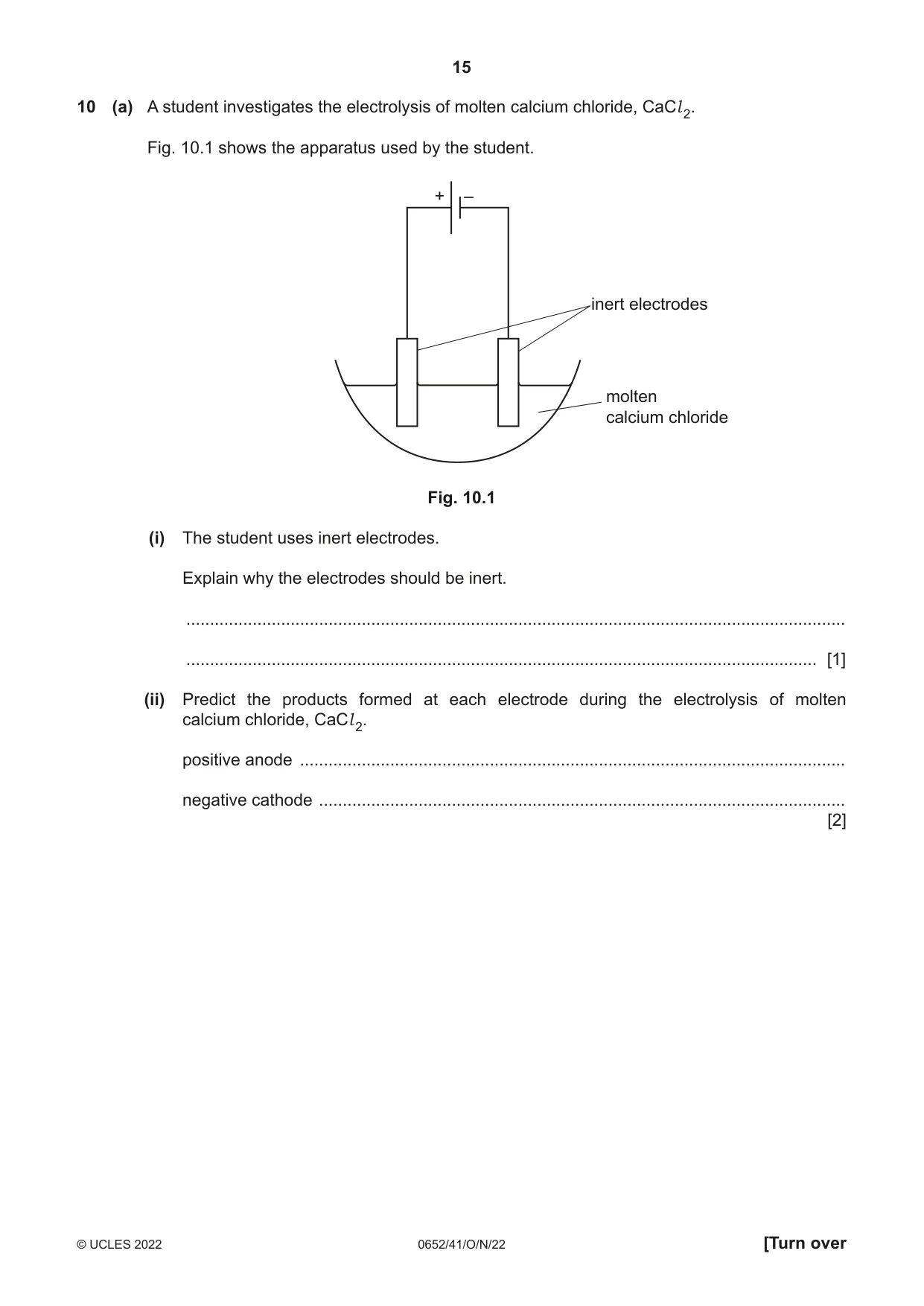
15 0652/41/O/N/22 © UCLES 2022 [Turn over 10 (a) A student investigates the electrolysis of molten calcium chloride, CaCl 2. Fig. 10.1 shows the apparatus used by the student. + – inert electrodes molten calcium chloride Fig. 10.1 (i) The student uses inert electrodes. Explain why the electrodes should be inert. … … [1] (ii) Predict the products formed at each electrode during the electrolysis of molten calcium chloride, CaCl 2. positive anode … negative cathode … [2]
Question paper, page 16
16 0652/41/O/N/22 © UCLES 2022 (b) Calcium chloride, CaCl 2, is an ionic compound. Draw the dot-and-cross diagram to represent the ionic bonding in calcium chloride. You only need to show the outer electrons. [3]
Question paper, page 17
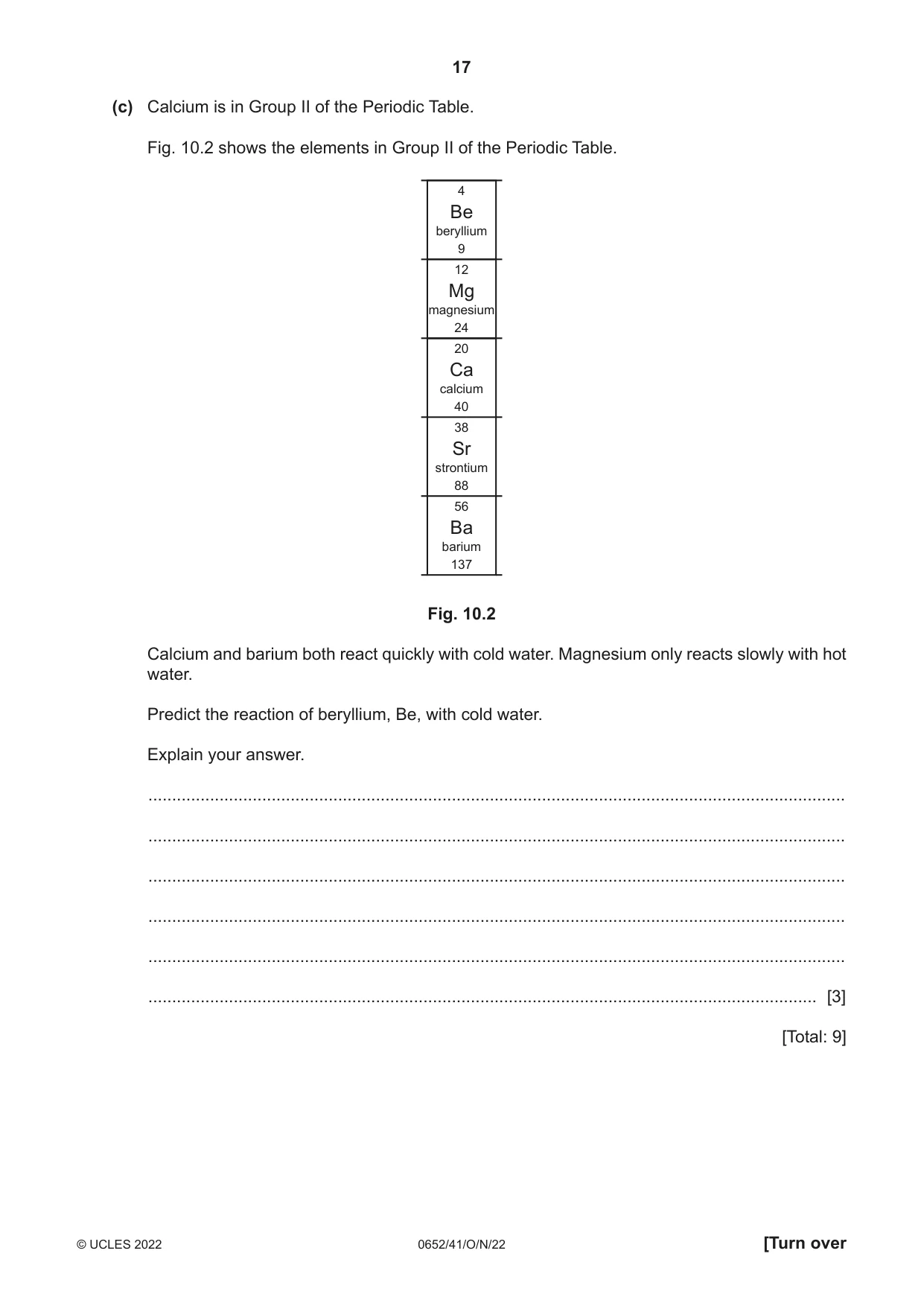
17 0652/41/O/N/22 © UCLES 2022 [Turn over (c) Calcium is in Group II of the Periodic Table. Fig. 10.2 shows the elements in Group II of the Periodic Table. 4 9 beryllium Be 12 24 magnesium Mg 20 40 calcium Ca 38 88 strontium Sr 56 137 barium Ba Fig. 10.2 Calcium and barium both react quickly with cold water. Magnesium only reacts slowly with hot water. Predict the reaction of beryllium, Be, with cold water. Explain your answer. … … … … … … [3] [Total: 9]
Question paper, page 18
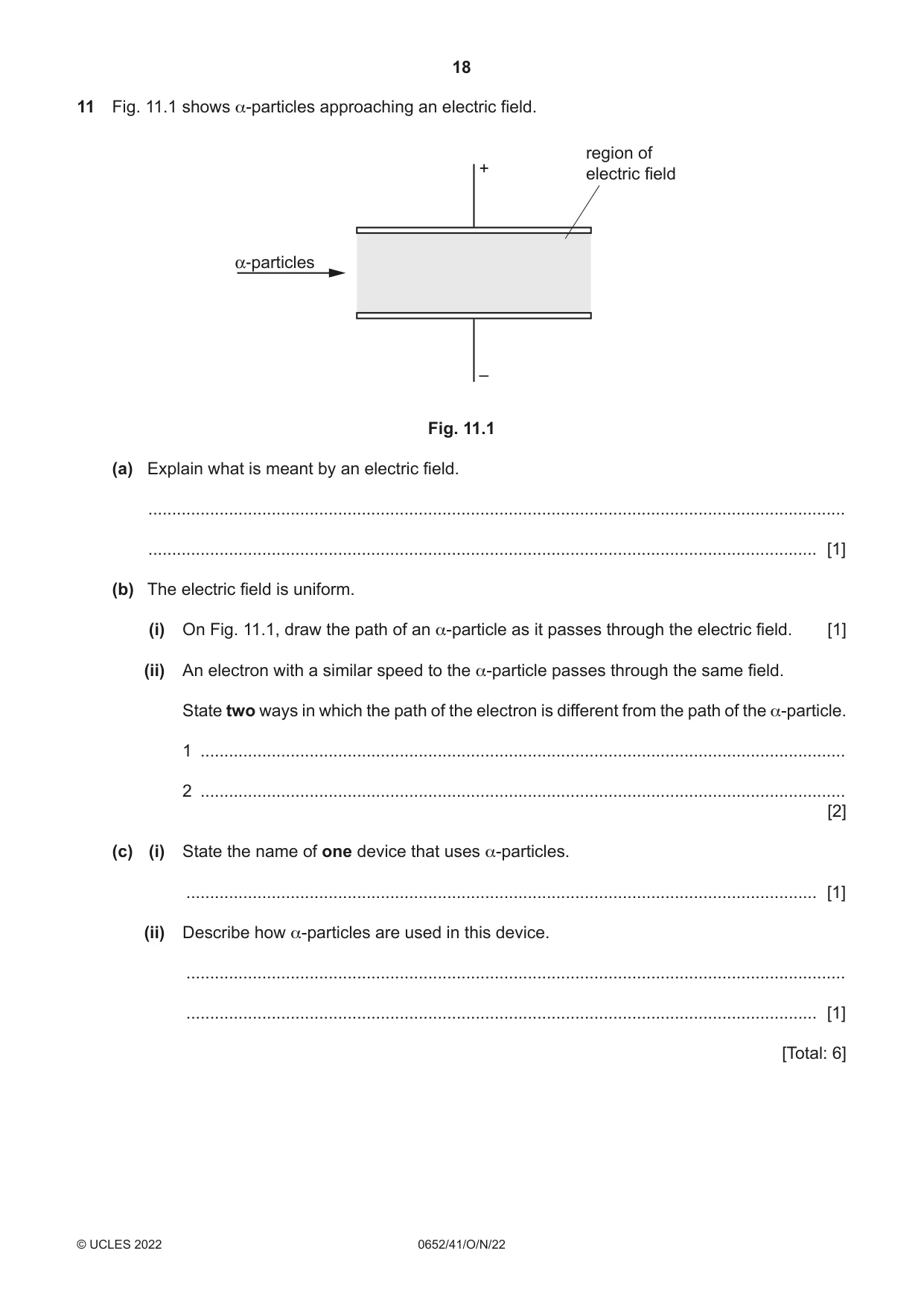
18 0652/41/O/N/22 © UCLES 2022 11 Fig. 11.1 shows α-particles approaching an electric field. + – α-particles region of electric field Fig. 11.1 (a) Explain what is meant by an electric field. … … [1] (b) The electric field is uniform. (i) On Fig. 11.1, draw the path of an α-particle as it passes through the electric field. [1] (ii) An electron with a similar speed to the α-particle passes through the same field. State two ways in which the path of the electron is different from the path of the α-particle. 1 … 2 … [2] (c) (i) State the name of one device that uses α-particles. … [1] (ii) Describe how α-particles are used in this device. … … [1] [Total: 6]
Question paper, page 19
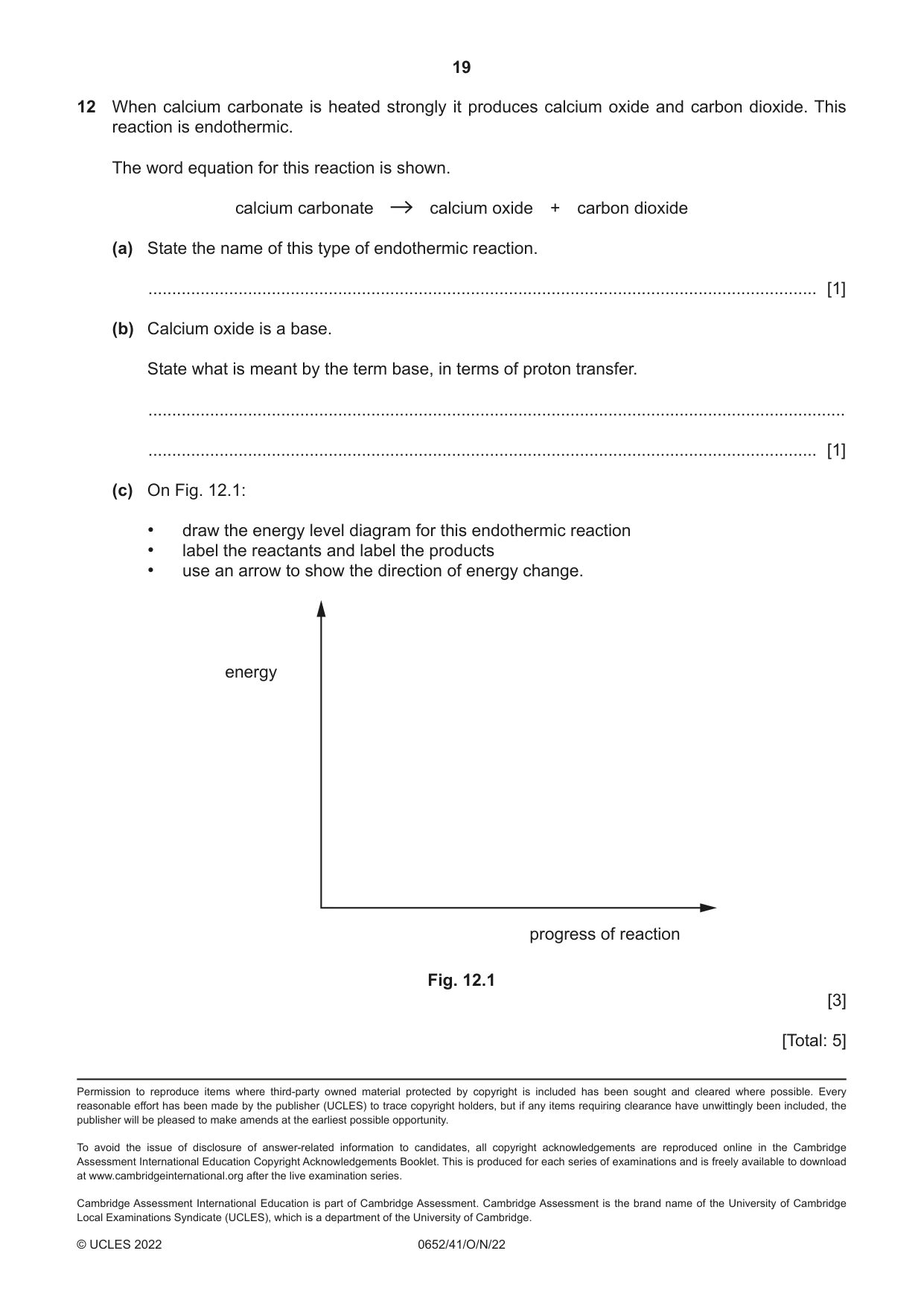
19 0652/41/O/N/22 © UCLES 2022 Permission to reproduce items where third-party owned material protected by copyright is included has been sought and cleared where possible. Every reasonable effort has been made by the publisher (UCLES) to trace copyright holders, but if any items requiring clearance have unwittingly been included, the publisher will be pleased to make amends at the earliest possible opportunity. To avoid the issue of disclosure of answer-related information to candidates, all copyright acknowledgements are reproduced online in the Cambridge Assessment International Education Copyright Acknowledgements Booklet. This is produced for each series of examinations and is freely available to download at www.cambridgeinternational.org after the live examination series. Cambridge Assessment International Education is part of Cambridge Assessment. Cambridge Assessment is the brand name of the University of Cambridge Local Examinations Syndicate (UCLES), which is a department of the University of Cambridge. 12 When calcium carbonate is heated strongly it produces calcium oxide and carbon dioxide. This reaction is endothermic. The word equation for this reaction is shown. calcium carbonate calcium oxide + carbon dioxide (a) State the name of this type of endothermic reaction. … [1] (b) Calcium oxide is a base. State what is meant by the term base, in terms of proton transfer. … … [1] (c) On Fig. 12.1: • draw the energy level diagram for this endothermic reaction • label the reactants and label the products • use an arrow to show the direction of energy change. progress of reaction energy Fig. 12.1 [3] [Total: 5]
Question paper, page 20
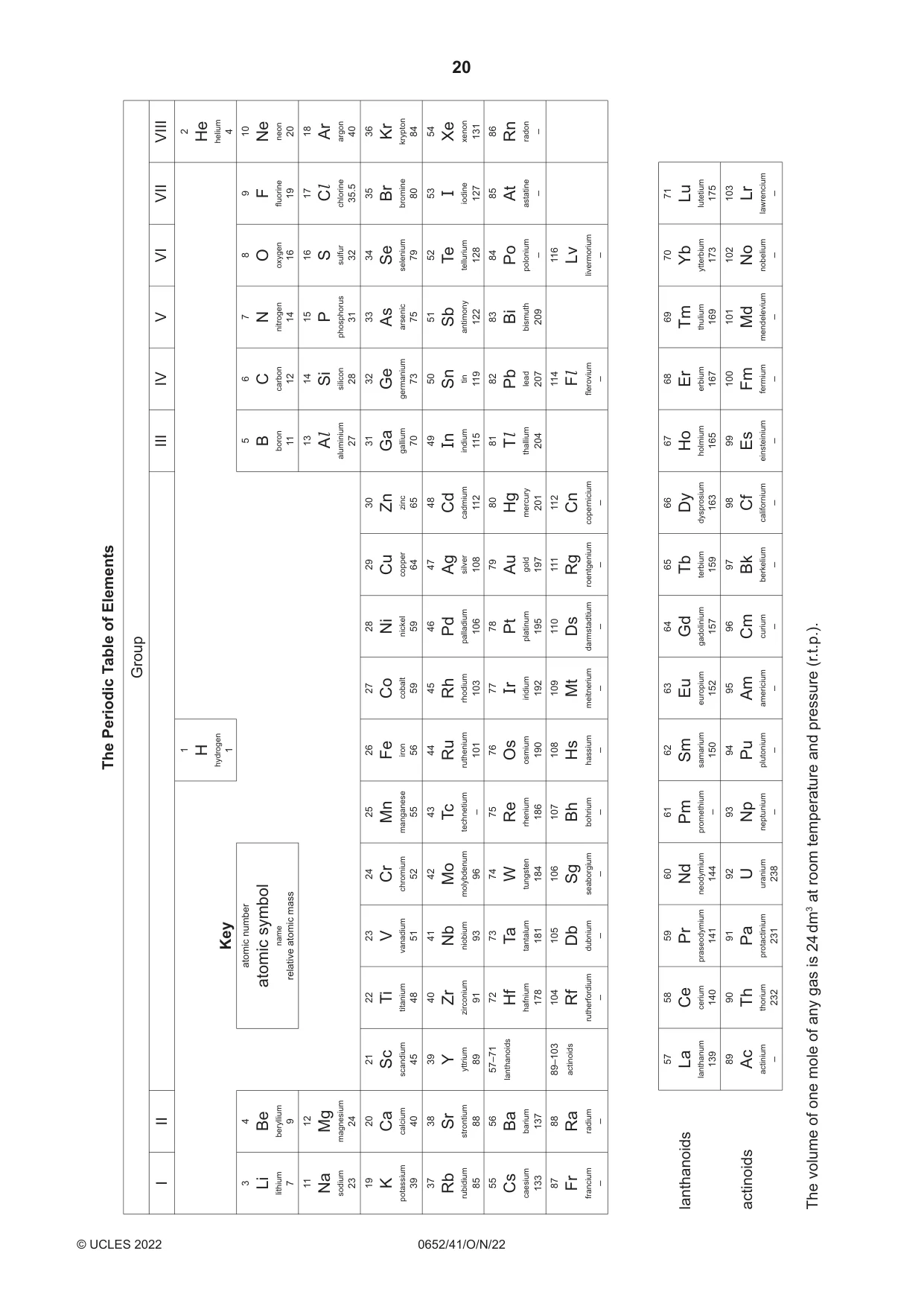
20 0652/41/O/N/22 © UCLES 2022 Group The Periodic Table of Elements 1 H hydrogen 1 2 He helium 4 I II III IV V VI VII VIII 3 Li lithium 7 4 Be beryllium 9 atomic number atomic symbol Key name relative atomic mass 11 Na sodium 23 12 Mg magnesium 24 19 K potassium 39 20 Ca calcium 40 37 Rb rubidium 85 38 Sr strontium 88 55 Cs caesium 133 56 Ba barium 137 87 Fr francium – 88 Ra radium – 5 B boron 11 13 Al aluminium 27 31 Ga gallium 70 49 In indium 115 81 Tl thallium 204 6 C carbon 12 14 Si silicon 28 32 Ge germanium 73 50 Sn tin 119 82 Pb lead 207 22 Ti titanium 48 40 Zr zirconium 91 72 Hf hafnium 178 104 Rf rutherfordium – 23 V vanadium 51 41 Nb niobium 93 73 Ta tantalum 181 105 Db dubnium – 24 Cr chromium 52 42 Mo molybdenum 96 74 W tungsten 184 106 Sg seaborgium – 25 Mn manganese 55 43 Tc technetium – 75 Re rhenium 186 107 Bh bohrium – 26 Fe iron 56 44 Ru ruthenium 101 76 Os osmium 190 108 Hs hassium – 27 Co cobalt 59 45 Rh rhodium 103 77 Ir iridium 192 109 Mt meitnerium – 28 Ni nickel 59 46 Pd palladium 106 78 Pt platinum 195 110 Ds darmstadtium – 29 Cu copper 64 47 Ag silver 108 79 Au gold 197 111 Rg roentgenium – 30 Zn zinc 65 48 Cd cadmium 112 80 Hg mercury 201 112 Cn copernicium – 114 Fl flerovium – 116 Lv livermorium – 7 N nitrogen 14 15 P phosphorus 31 33 As arsenic 75 51 Sb antimony 122 83 Bi bismuth 209 8 O oxygen 16 16 S sulfur 32 34 Se selenium 79 52 Te tellurium 128 84 Po polonium – 9 F fluorine 19 17 Cl chlorine 35.5 35 Br bromine 80 53 I iodine 127 85 At astatine – 10 Ne neon 20 18 Ar argon 40 36 Kr krypton 84 54 Xe xenon 131 86 Rn radon – 21 Sc scandium 45 39 Y yttrium 89 57–71 lanthanoids 89–103 actinoids 57 La lanthanum 139 89 Ac lanthanoids actinoids The volume of one mole of any gas is 24 dm3 at room temperature and pressure (r.t.p.). actinium – 58 Ce cerium 140 90 Th thorium 232 59 Pr praseodymium 141 91 Pa protactinium 231 60 Nd neodymium 144 92 U uranium 238 61 Pm promethium – 93 Np neptunium – 62 Sm samarium 150 94 Pu plutonium – 63 Eu europium 152 95 Am americium – 64 Gd gadolinium 157 96 Cm curium – 65 Tb terbium 159 97 Bk berkelium – 66 Dy dysprosium 163 98 Cf californium – 67 Ho holmium 165 99 Es einsteinium – 68 Er erbium 167 100 Fm fermium – 69 Tm thulium 169 101 Md mendelevium – 70 Yb ytterbium 173 102 No nobelium – 71 Lu lutetium 175 103 Lr lawrencium –
Mark scheme, page 1
This document consists of 10 printed pages. © UCLES 2022 [Turn over Cambridge IGCSE™ PHYSICAL SCIENCE 0652/41 Paper 4 Extended Theory October/November 2022 MARK SCHEME Maximum Mark: 80 Published This mark scheme is published as an aid to teachers and candidates, to indicate the requirements of the examination. It shows the basis on which Examiners were instructed to award marks. It does not indicate the details of the discussions that took place at an Examiners’ meeting before marking began, which would have considered the acceptability of alternative answers. Mark schemes should be read in conjunction with the question paper and the Principal Examiner Report for Teachers. Cambridge International will not enter into discussions about these mark schemes. Cambridge International is publishing the mark schemes for the October/November 2022 series for most Cambridge IGCSE™, Cambridge International A and AS Level components and some Cambridge O Level components.
Mark scheme, page 2
0652/41 Cambridge IGCSE – Mark Scheme PUBLISHED October/November 2022 © UCLES 2022 Page 2 of 10 Generic Marking Principles These general marking principles must be applied by all examiners when marking candidate answers. They should be applied alongside the specific content of the mark scheme or generic level descriptors for a question. Each question paper and mark scheme will also comply with these marking principles. GENERIC MARKING PRINCIPLE 1: Marks must be awarded in line with: • the specific content of the mark scheme or the generic level descriptors for the question • the specific skills defined in the mark scheme or in the generic level descriptors for the question • the standard of response required by a candidate as exemplified by the standardisation scripts. GENERIC MARKING PRINCIPLE 2: Marks awarded are always whole marks (not half marks, or other fractions). GENERIC MARKING PRINCIPLE 3: Marks must be awarded positively: • marks are awarded for correct/valid answers, as defined in the mark scheme. However, credit is given for valid answers which go beyond the scope of the syllabus and mark scheme, referring to your Team Leader as appropriate • marks are awarded when candidates clearly demonstrate what they know and can do • marks are not deducted for errors • marks are not deducted for omissions • answers should only be judged on the quality of spelling, punctuation and grammar when these features are specifically assessed by the question as indicated by the mark scheme. The meaning, however, should be unambiguous. GENERIC MARKING PRINCIPLE 4: Rules must be applied consistently, e.g. in situations where candidates have not followed instructions or in the application of generic level descriptors.
Mark scheme, page 3
0652/41 Cambridge IGCSE – Mark Scheme PUBLISHED October/November 2022 © UCLES 2022 Page 3 of 10 GENERIC MARKING PRINCIPLE 5: Marks should be awarded using the full range of marks defined in the mark scheme for the question (however; the use of the full mark range may be limited according to the quality of the candidate responses seen). GENERIC MARKING PRINCIPLE 6: Marks awarded are based solely on the requirements as defined in the mark scheme. Marks should not be awarded with grade thresholds or grade descriptors in mind. Science-Specific Marking Principles 1 Examiners should consider the context and scientific use of any keywords when awarding marks. Although keywords may be present, marks should not be awarded if the keywords are used incorrectly. 2 The examiner should not choose between contradictory statements given in the same question part, and credit should not be awarded for any correct statement that is contradicted within the same question part. Wrong science that is irrelevant to the question should be ignored. 3 Although spellings do not have to be correct, spellings of syllabus terms must allow for clear and unambiguous separation from other syllabus terms with which they may be confused (e.g. ethane / ethene, glucagon / glycogen, refraction / reflection). 4 The error carried forward (ecf) principle should be applied, where appropriate. If an incorrect answer is subsequently used in a scientifically correct way, the candidate should be awarded these subsequent marking points. Further guidance will be included in the mark scheme where necessary and any exceptions to this general principle will be noted. 5 ‘List rule’ guidance For questions that require n responses (e.g. State two reasons …): • The response should be read as continuous prose, even when numbered answer spaces are provided. • Any response marked ignore in the mark scheme should not count towards n. • Incorrect responses should not be awarded credit but will still count towards n. • Read the entire response to check for any responses that contradict those that would otherwise be credited. Credit should not be awarded for any responses that are contradicted within the rest of the response. Where two responses contradict one another, this should be treated as a single incorrect response. • Non-contradictory responses after the first n responses may be ignored even if they include incorrect science.
Mark scheme, page 4
0652/41 Cambridge IGCSE – Mark Scheme PUBLISHED October/November 2022 © UCLES 2022 Page 4 of 10 6 Calculation specific guidance Correct answers to calculations should be given full credit even if there is no working or incorrect working, unless the question states ‘show your working’. For questions in which the number of significant figures required is not stated, credit should be awarded for correct answers when rounded by the examiner to the number of significant figures given in the mark scheme. This may not apply to measured values. For answers given in standard form (e.g. a 10n) in which the convention of restricting the value of the coefficient (a) to a value between 1 and 10 is not followed, credit may still be awarded if the answer can be converted to the answer given in the mark scheme. Unless a separate mark is given for a unit, a missing or incorrect unit will normally mean that the final calculation mark is not awarded. Exceptions to this general principle will be noted in the mark scheme. 7 Guidance for chemical equations Multiples / fractions of coefficients used in chemical equations are acceptable unless stated otherwise in the mark scheme. State symbols given in an equation should be ignored unless asked for in the question or stated otherwise in the mark scheme.
Mark scheme, page 5
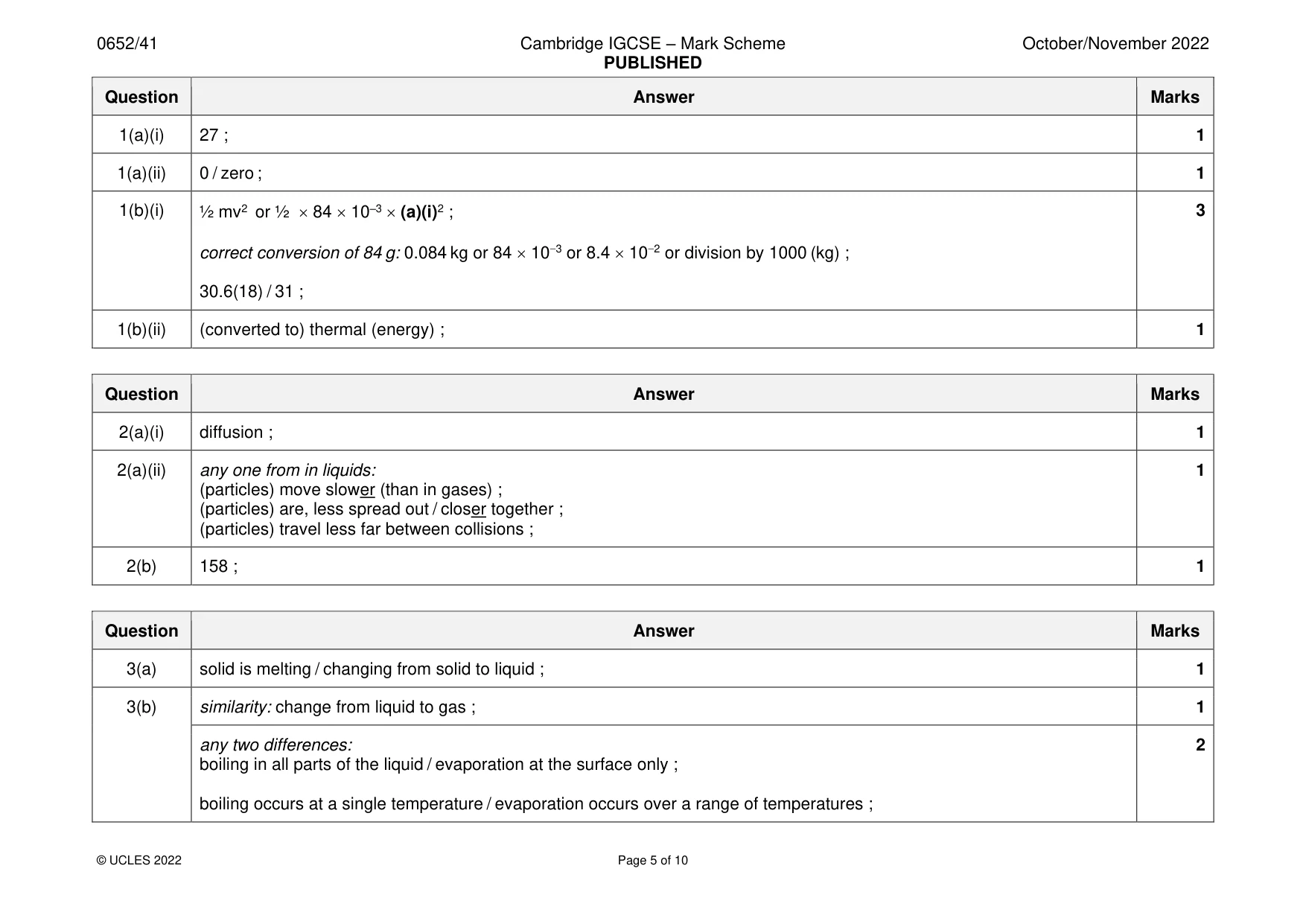
0652/41 Cambridge IGCSE – Mark Scheme PUBLISHED October/November 2022 © UCLES 2022 Page 5 of 10 Question Answer Marks 1(a)(i) 27 ; 1 1(a)(ii) 0 / zero ; 1 1(b)(i) ½ mv2 or ½ 84 10–3 (a)(i)2 ; correct conversion of 84 g: 0.084 kg or 84 10−3 or 8.4 10−2 or division by 1000 (kg) ; 30.6(18) / 31 ; 3 1(b)(ii) (converted to) thermal (energy) ; 1 Question Answer Marks 2(a)(i) diffusion ; 1 2(a)(ii) any one from in liquids: (particles) move slower (than in gases) ; (particles) are, less spread out / closer together ; (particles) travel less far between collisions ; 1 2(b) 158 ; 1 Question Answer Marks 3(a) solid is melting / changing from solid to liquid ; 1 3(b) similarity: change from liquid to gas ; 1 any two differences: boiling in all parts of the liquid / evaporation at the surface only ; boiling occurs at a single temperature / evaporation occurs over a range of temperatures ; 2
Mark scheme, page 6
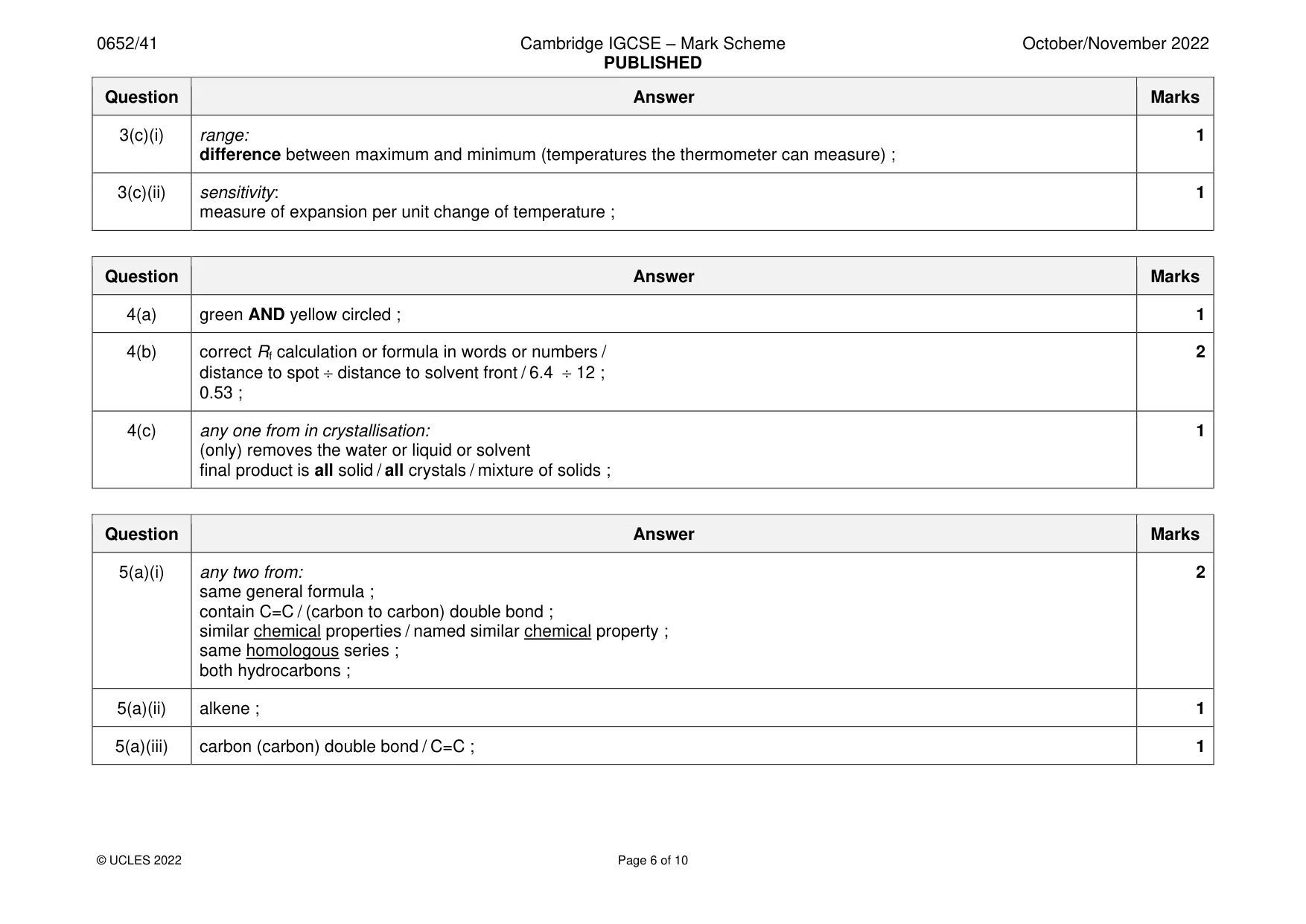
0652/41 Cambridge IGCSE – Mark Scheme PUBLISHED October/November 2022 © UCLES 2022 Page 6 of 10 Question Answer Marks 3(c)(i) range: difference between maximum and minimum (temperatures the thermometer can measure) ; 1 3(c)(ii) sensitivity: measure of expansion per unit change of temperature ; 1 Question Answer Marks 4(a) green AND yellow circled ; 1 4(b) correct Rf calculation or formula in words or numbers / distance to spot distance to solvent front / 6.4 12 ; 0.53 ; 2 4(c) any one from in crystallisation: (only) removes the water or liquid or solvent final product is all solid / all crystals / mixture of solids ; 1 Question Answer Marks 5(a)(i) any two from: same general formula ; contain C=C / (carbon to carbon) double bond ; similar chemical properties / named similar chemical property ; same homologous series ; both hydrocarbons ; 2 5(a)(ii) alkene ; 1 5(a)(iii) carbon (carbon) double bond / C=C ; 1
Mark scheme, page 7
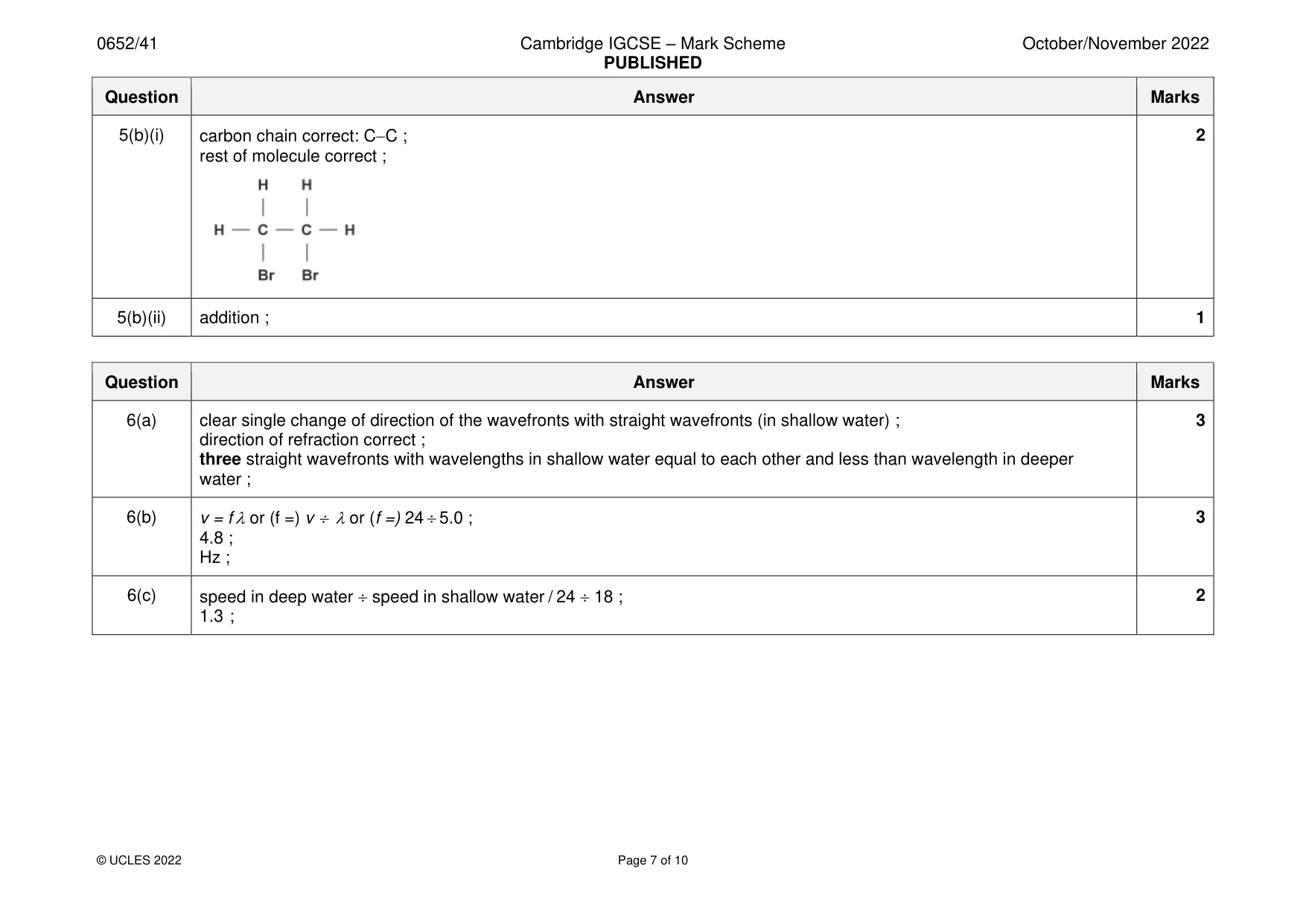
0652/41 Cambridge IGCSE – Mark Scheme PUBLISHED October/November 2022 © UCLES 2022 Page 7 of 10 Question Answer Marks 5(b)(i) carbon chain correct: C−C ; rest of molecule correct ; 2 5(b)(ii) addition ; 1 Question Answer Marks 6(a) clear single change of direction of the wavefronts with straight wavefronts (in shallow water) ; direction of refraction correct ; three straight wavefronts with wavelengths in shallow water equal to each other and less than wavelength in deeper water ; 3 6(b) v = f or (f =) v or (f =) 24 5.0 ; 4.8 ; Hz ; 3 6(c) speed in deep water speed in shallow water / 24 18 ; 1.3 ; 2
Mark scheme, page 8
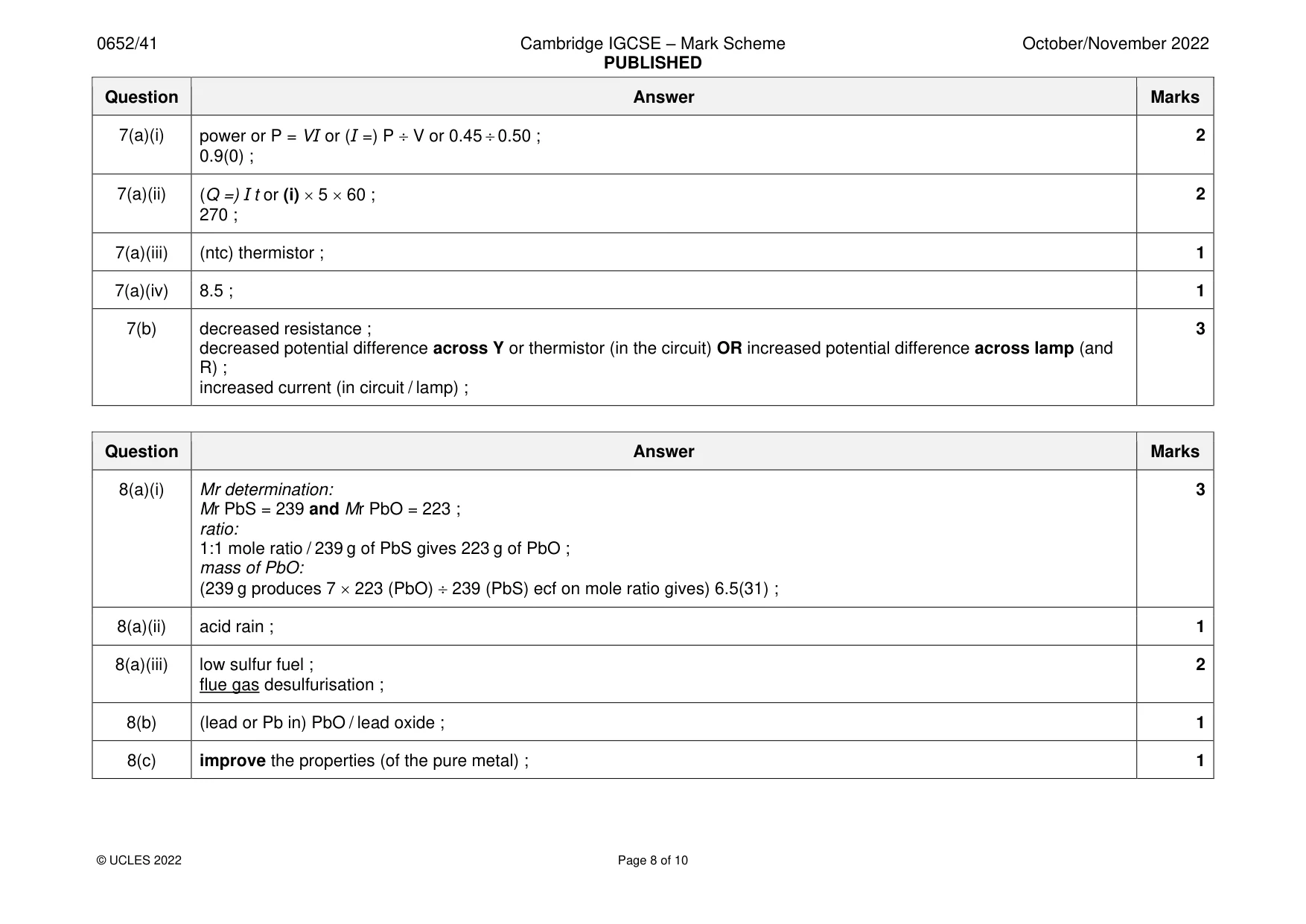
0652/41 Cambridge IGCSE – Mark Scheme PUBLISHED October/November 2022 © UCLES 2022 Page 8 of 10 Question Answer Marks 7(a)(i) power or P = VI or (I =) P V or 0.45 0.50 ; 0.9(0) ; 2 7(a)(ii) (Q =) I t or (i) 5 60 ; 270 ; 2 7(a)(iii) (ntc) thermistor ; 1 7(a)(iv) 8.5 ; 1 7(b) decreased resistance ; decreased potential difference across Y or thermistor (in the circuit) OR increased potential difference across lamp (and R) ; increased current (in circuit / lamp) ; 3 Question Answer Marks 8(a)(i) Mr determination: Mr PbS = 239 and Mr PbO = 223 ; ratio: 1:1 mole ratio / 239 g of PbS gives 223 g of PbO ; mass of PbO: (239 g produces 7 223 (PbO) 239 (PbS) ecf on mole ratio gives) 6.5(31) ; 3 8(a)(ii) acid rain ; 1 8(a)(iii) low sulfur fuel ; flue gas desulfurisation ; 2 8(b) (lead or Pb in) PbO / lead oxide ; 1 8(c) improve the properties (of the pure metal) ; 1
Mark scheme, page 9
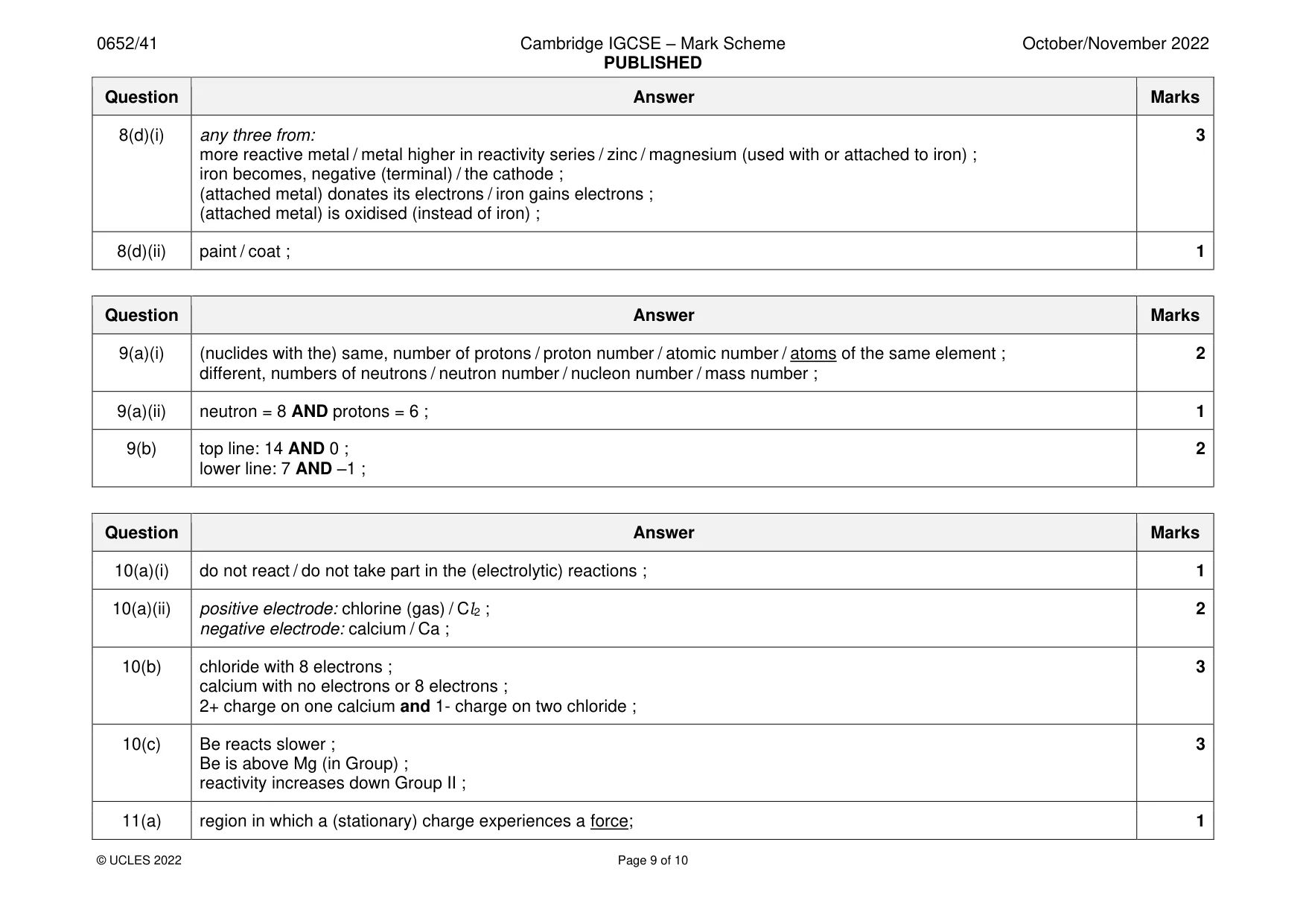
0652/41 Cambridge IGCSE – Mark Scheme PUBLISHED October/November 2022 © UCLES 2022 Page 9 of 10 Question Answer Marks 8(d)(i) any three from: more reactive metal / metal higher in reactivity series / zinc / magnesium (used with or attached to iron) ; iron becomes, negative (terminal) / the cathode ; (attached metal) donates its electrons / iron gains electrons ; (attached metal) is oxidised (instead of iron) ; 3 8(d)(ii) paint / coat ; 1 Question Answer Marks 9(a)(i) (nuclides with the) same, number of protons / proton number / atomic number / atoms of the same element ; different, numbers of neutrons / neutron number / nucleon number / mass number ; 2 9(a)(ii) neutron = 8 AND protons = 6 ; 1 9(b) top line: 14 AND 0 ; lower line: 7 AND –1 ; 2 Question Answer Marks 10(a)(i) do not react / do not take part in the (electrolytic) reactions ; 1 10(a)(ii) positive electrode: chlorine (gas) / Cl2 ; negative electrode: calcium / Ca ; 2 10(b) chloride with 8 electrons ; calcium with no electrons or 8 electrons ; 2+ charge on one calcium and 1- charge on two chloride ; 3 10(c) Be reacts slower ; Be is above Mg (in Group) ; reactivity increases down Group II ; 3 11(a) region in which a (stationary) charge experiences a force; 1
Mark scheme, page 10
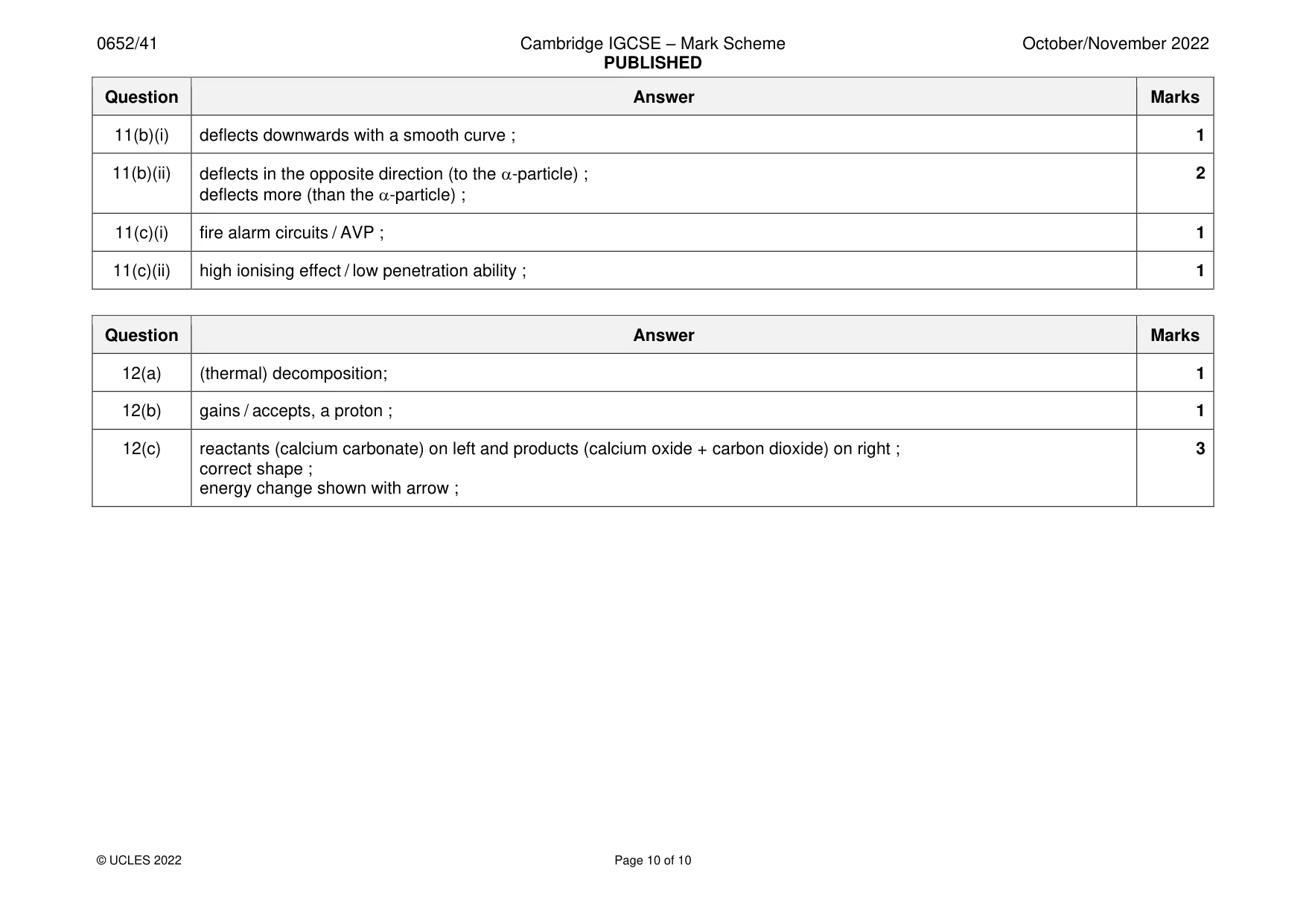
0652/41 Cambridge IGCSE – Mark Scheme PUBLISHED October/November 2022 © UCLES 2022 Page 10 of 10 Question Answer Marks 11(b)(i) deflects downwards with a smooth curve ; 1 11(b)(ii) deflects in the opposite direction (to the -particle) ; deflects more (than the -particle) ; 2 11(c)(i) fire alarm circuits / AVP ; 1 11(c)(ii) high ionising effect / low penetration ability ; 1 Question Answer Marks 12(a) (thermal) decomposition; 1 12(b) gains / accepts, a proton ; 1 12(c) reactants (calcium carbonate) on left and products (calcium oxide + carbon dioxide) on right ; correct shape ; energy change shown with arrow ; 3
What you needed in this session
Cambridge’s own grade thresholds for 2022 Oct/Nov, Paper 4 · Variant 1. A higher threshold means an easier paper — the bar moves with how the cohort did.