Cambridge IGCSE Physical Science 0652 — 2021 Oct/Nov Paper 4 · Variant 1
0652/41/O/N/21 · 11 questions · 80 marks · ≈90 min
The question paper and its mark scheme, free to read here and free to download. This is Cambridge’s own paper, exactly as it was sat.
Question paper24 pages



Mark scheme9 pages
Answers below. Sit the paper first if you are practising.
Questions as text
Q1 · A skydiver of mass 85 kg jumps out of an aircraft and initially falls freely under gravity
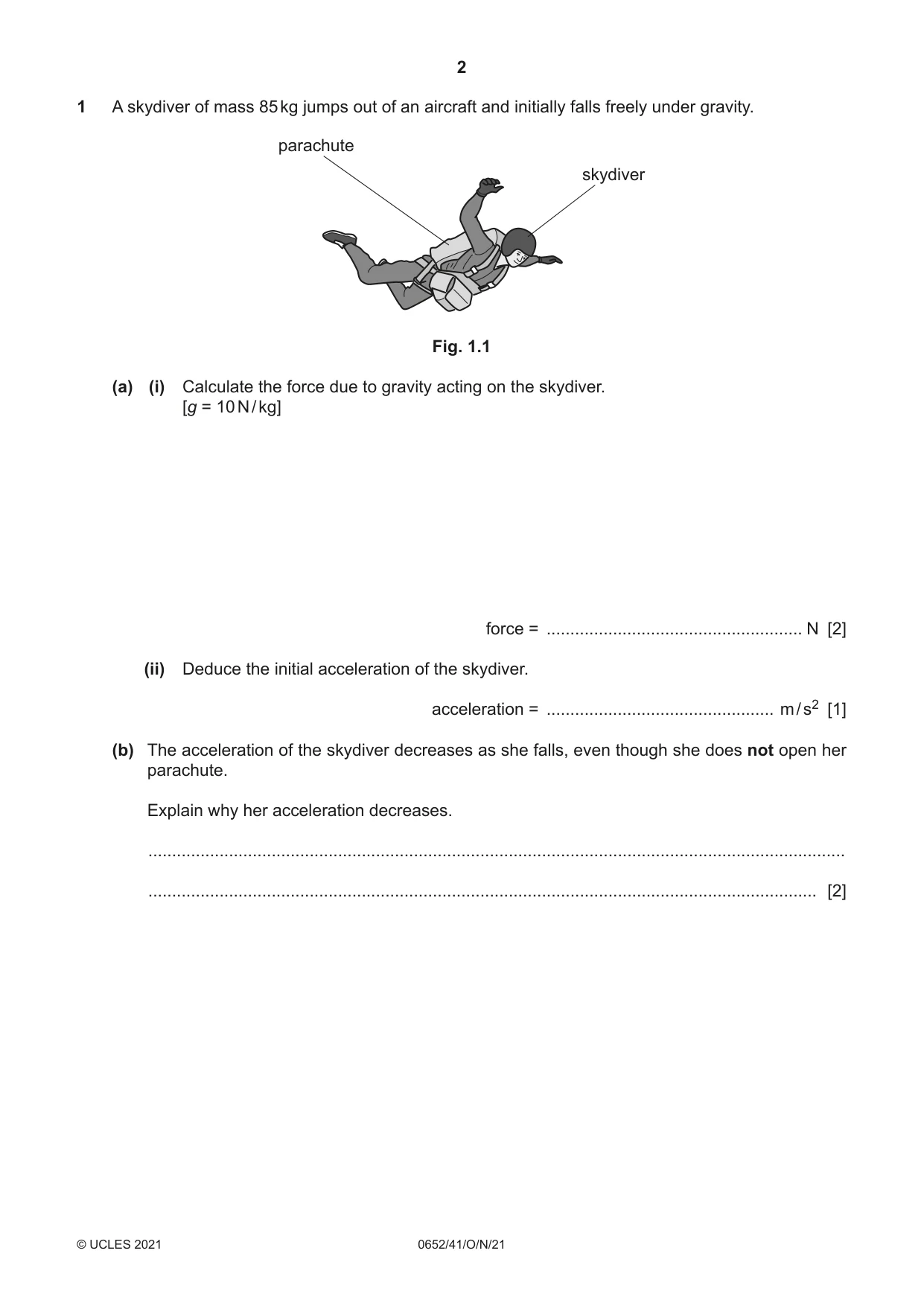
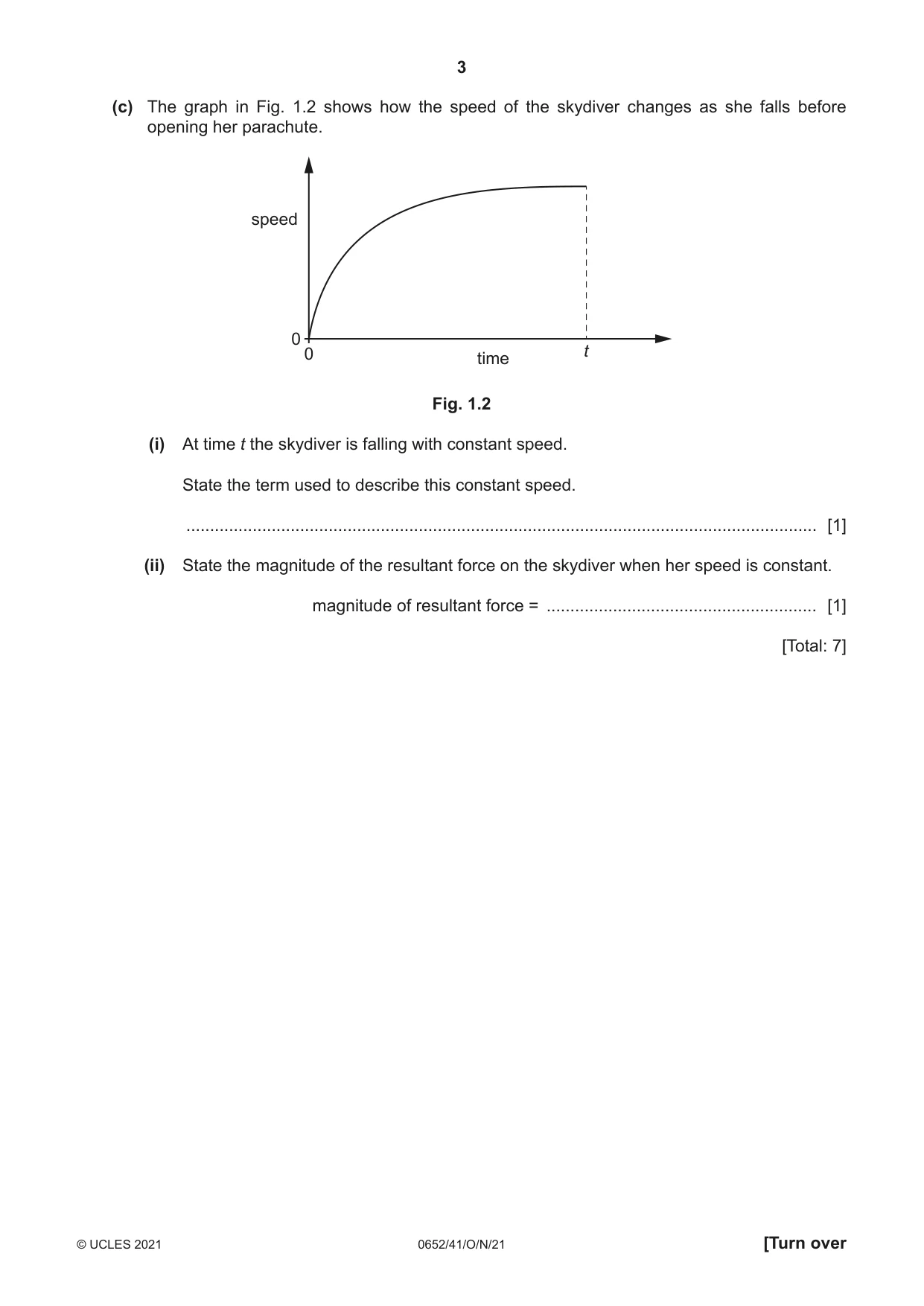
1 A skydiver of mass 85 kg jumps out of an aircraft and initially falls freely under gravity. parachute skydiver Fig. 1.1 (a) (i) Calculate the force due to gravity acting on the skydiver. [g = 10 N / kg] force = ...................................................... N [2] (ii) Deduce the initial acceleration of the skydiver. acceleration = ................................................ m / s2 [1] (b) The acceleration of the skydiver decreases as she falls, even though she does not open her parachute. Explain why her acceleration decreases. ................................................................................................................................................... ............................................................................................................................................. [2] (c) The graph in Fig. 1.2 shows how the speed of the skydiver changes as she falls before opening her parachute. speed 0 0 time t Fig. 1.2 (i) At time t the skydiver is falling with constant speed. State the term used to describe this constant speed. ..................................................................................................................................... [1] (ii) State the magnitude of the resultant force on the skydiver when her speed is constant. magnitude of resultant force = ......................................................... [1] [Total: 7]
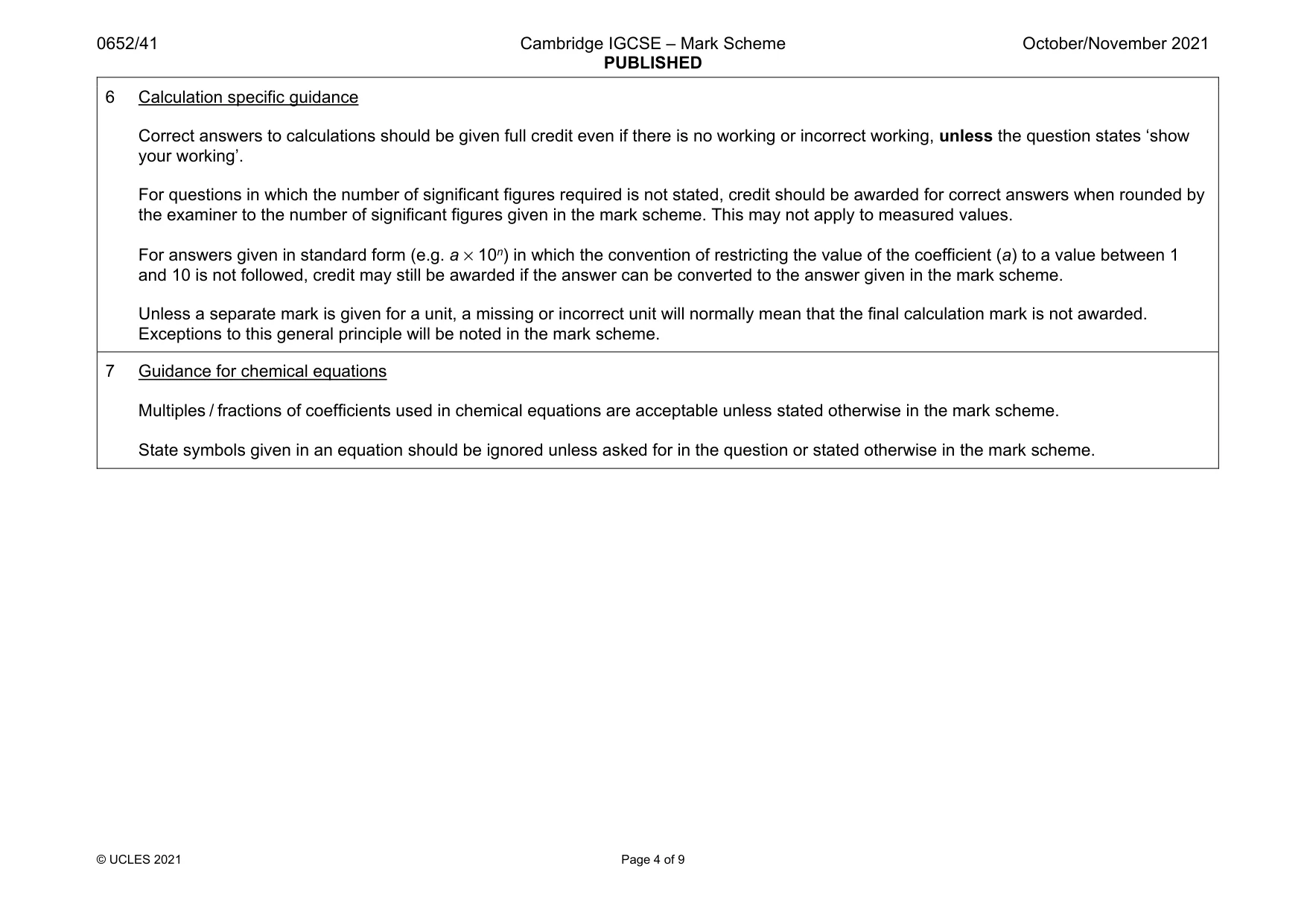
Mark scheme: 1(a)(i) (F =) mg or 85 × 10 ; 850 (N) ; 2 1(a)(ii) 10 (m / s2) ; 1 1(b) air resistance increases (with increasing speed) ; the resultant force decreases ; 2 1(c)(i) terminal (speed / velocity) ; 1 1(c)(ii) zero / 0 / none ; 1
Q2 · The formulae of some substances are shown in Fig
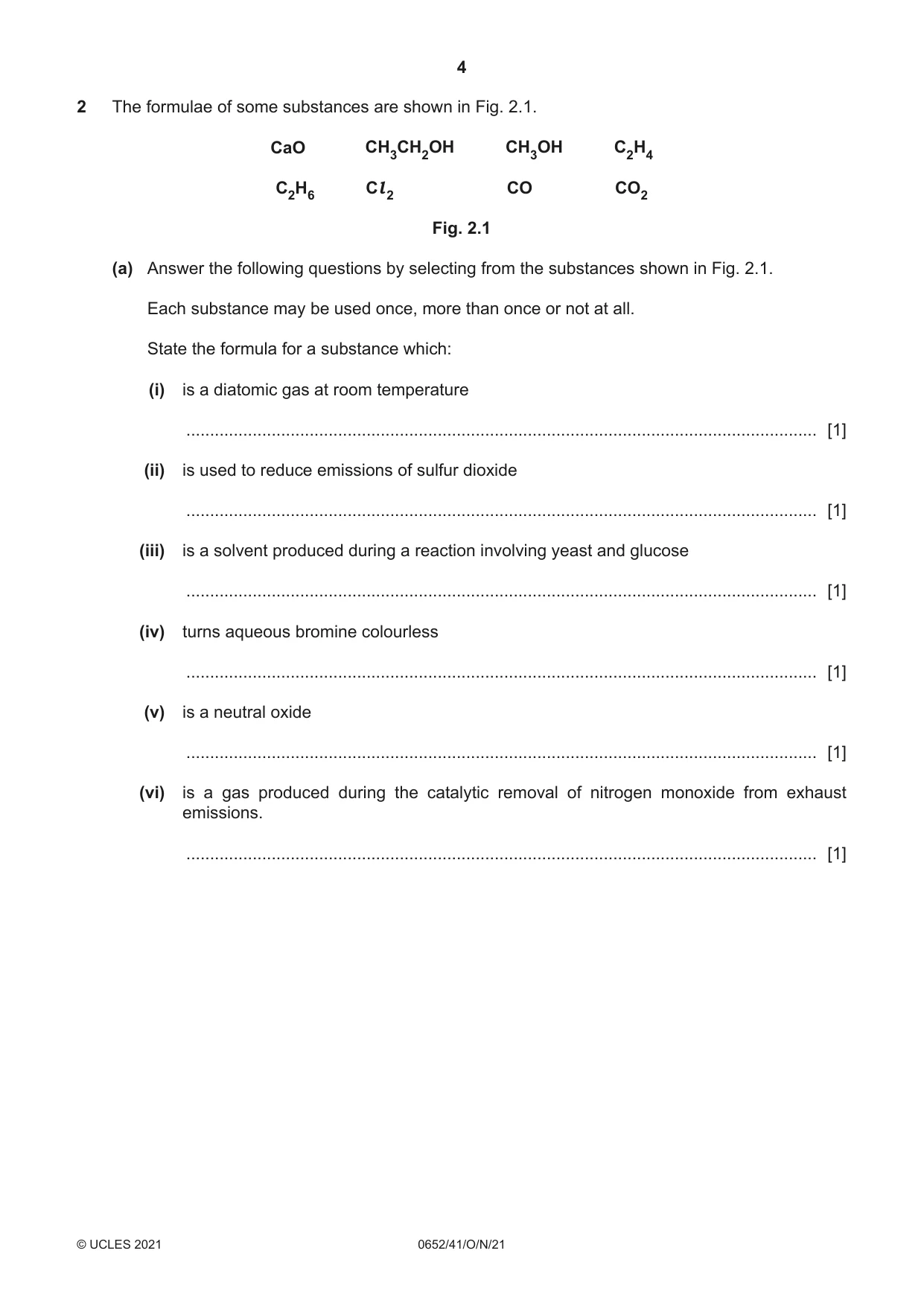
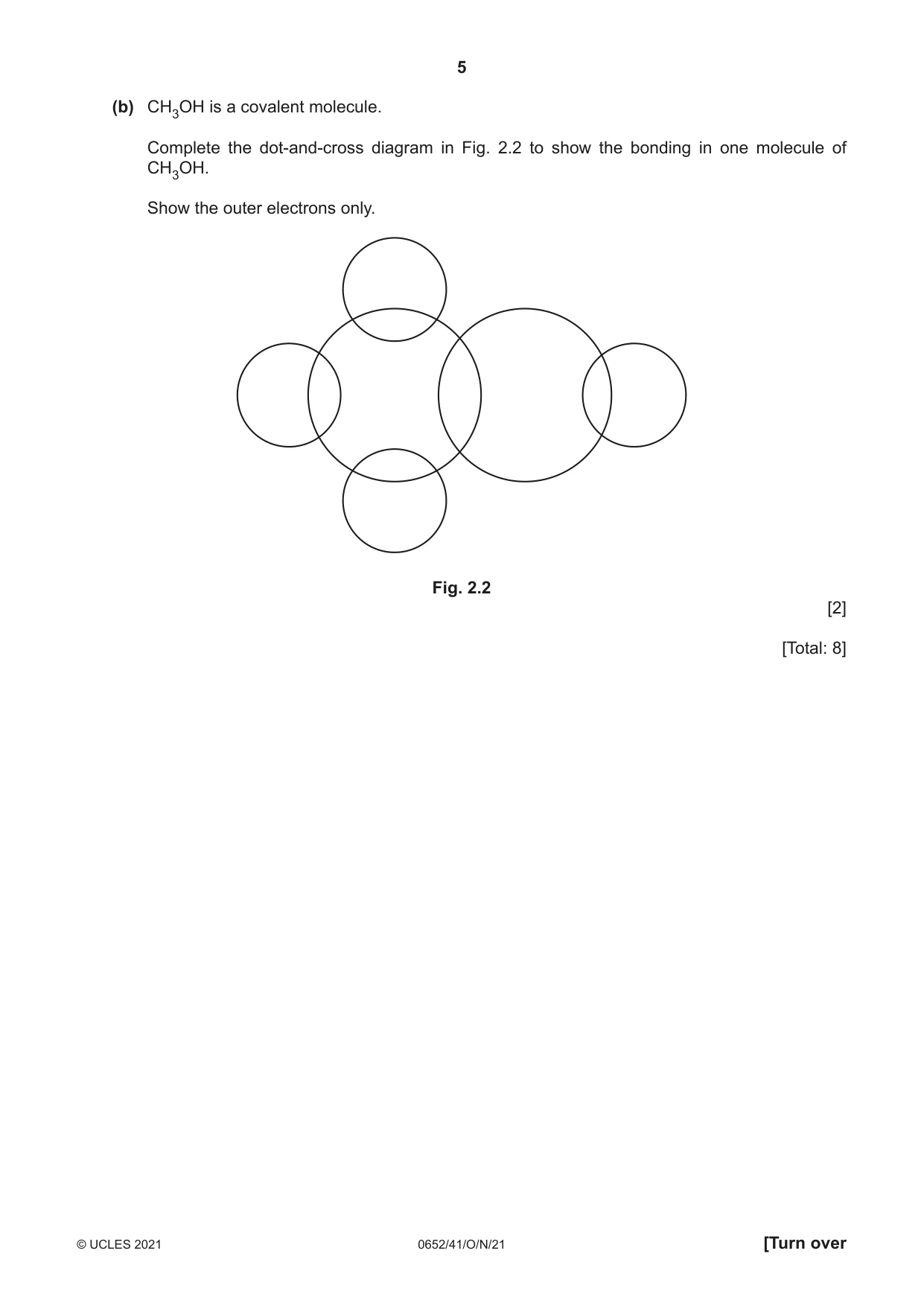
2 The formulae of some substances are shown in Fig. 2.1. CaO CH3CH2OH CH3OH C2H4 C2H6 Cl 2 CO CO2 Fig. 2.1 (a) Answer the following questions by selecting from the substances shown in Fig. 2.1. Each substance may be used once, more than once or not at all. State the formula for a substance which: (i) is a diatomic gas at room temperature ..................................................................................................................................... [1] (ii) is used to reduce emissions of sulfur dioxide ..................................................................................................................................... [1] (iii) is a solvent produced during a reaction involving yeast and glucose ..................................................................................................................................... [1] (iv) turns aqueous bromine colourless ..................................................................................................................................... [1] (v) is a neutral oxide ..................................................................................................................................... [1] (vi) is a gas produced during the catalytic removal of nitrogen monoxide from exhaust emissions. ..................................................................................................................................... [1] (b) CH3OH is a covalent molecule. Complete the dot‑and‑cross diagram in Fig. 2.2 to show the bonding in one molecule of CH3OH. Show the outer electrons only. Fig. 2.2 [2] [Total: 8]
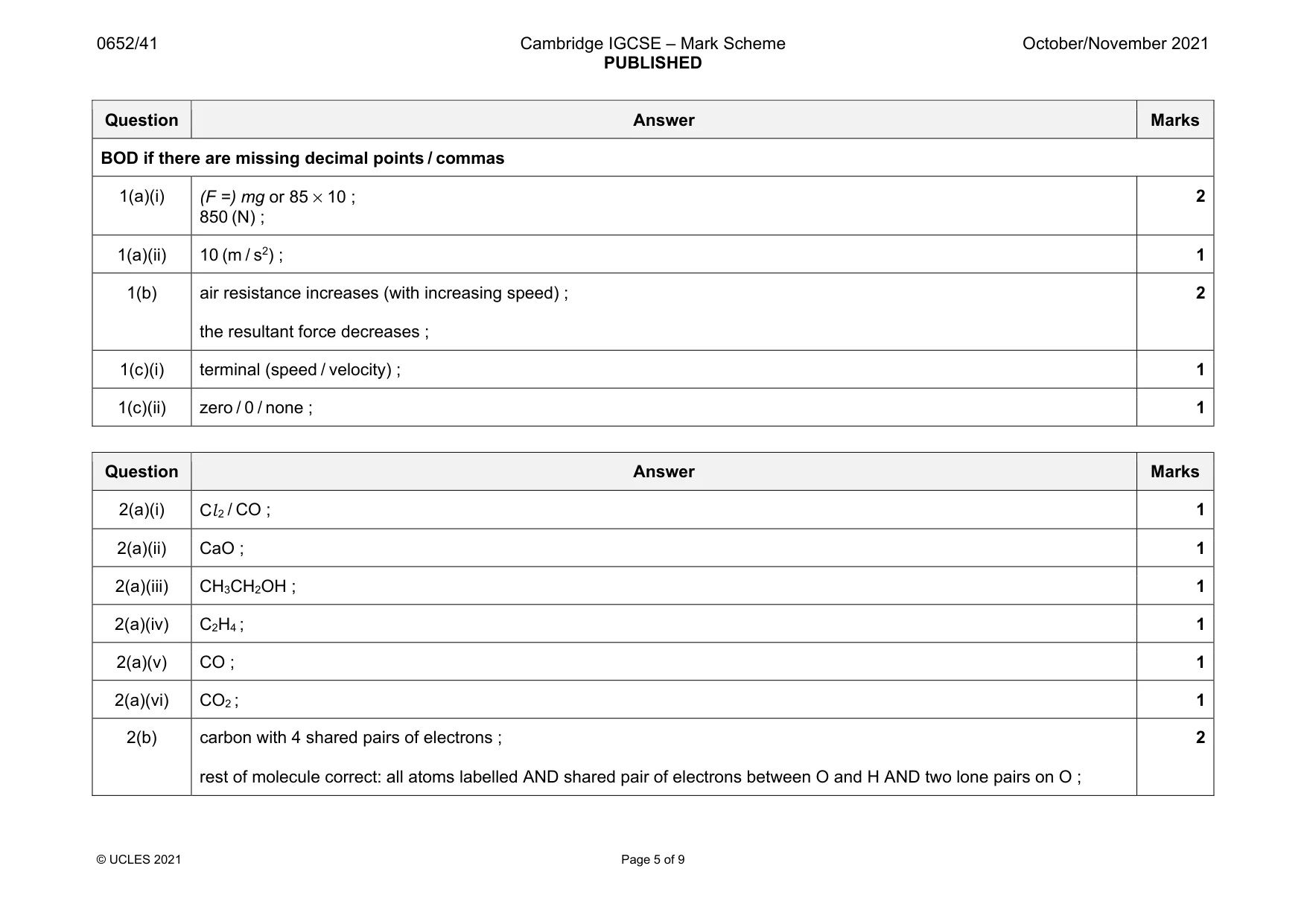
Mark scheme: 2(a)(i) 2(a)(ii) CaO ; 1 2(a)(iii) CH3CH2OH ; 1 2(a)(iv) C2H4 ; 1 2(a)(v) CO ; 1 2(a)(vi) CO2 ; 1 2(b) carbon with 4 shared pairs of electrons ; rest of molecule correct: all atoms labelled AND shared pair of electrons between O and H AND two lone pairs on O ; 2
Q3 · A mechanic using a wrench to tighten a nut on the wheel of a car
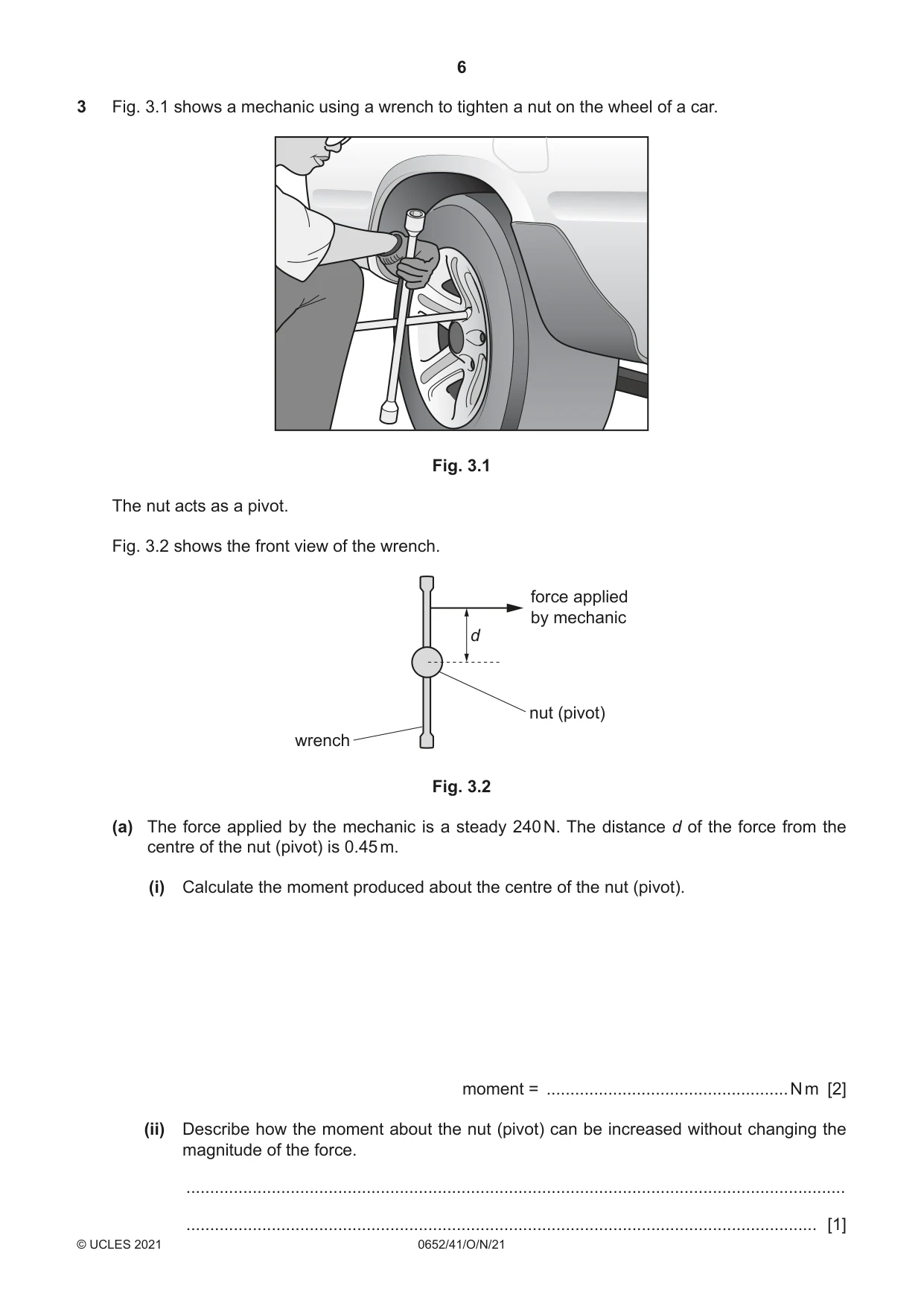
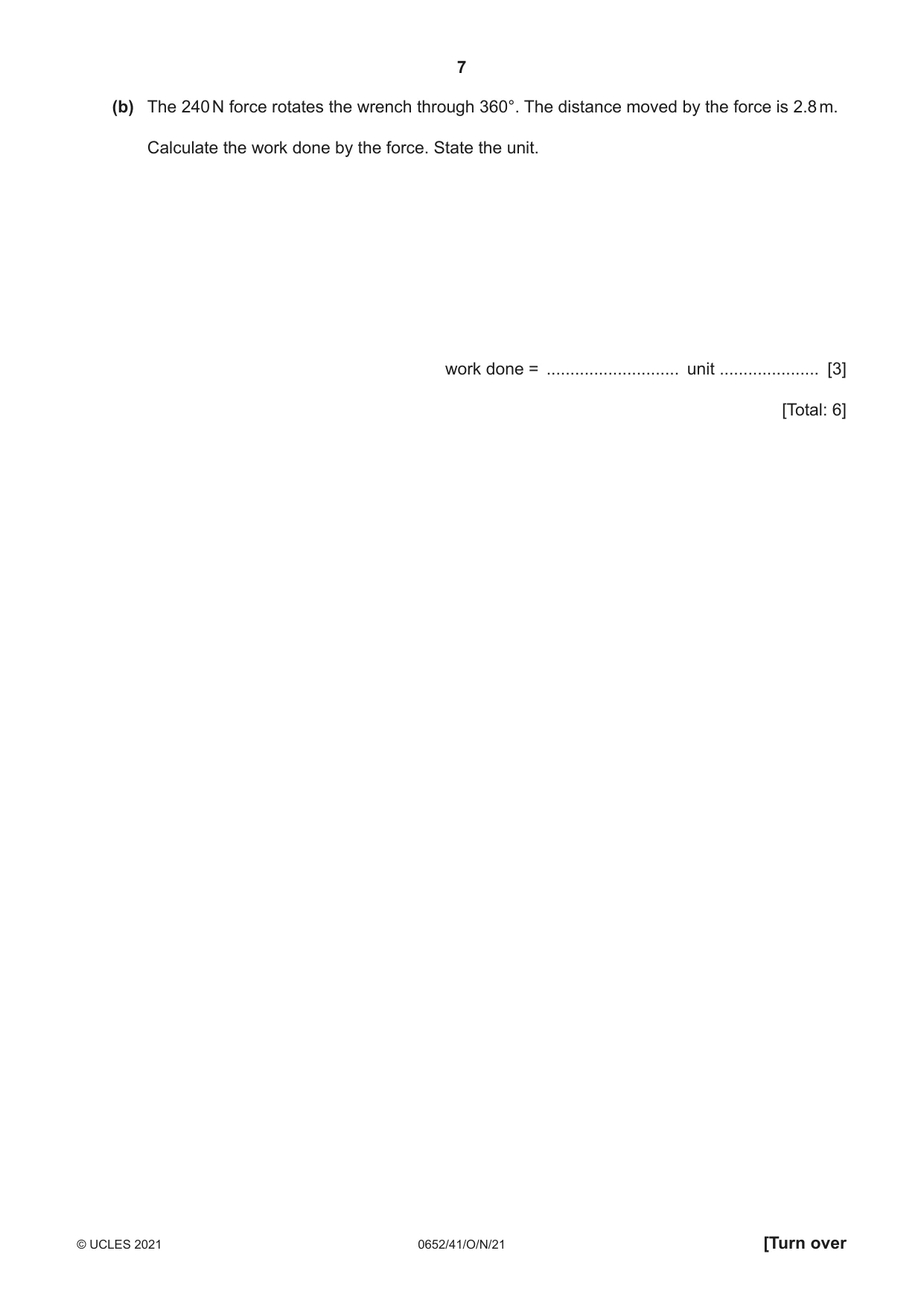
3 Fig. 3.1 shows a mechanic using a wrench to tighten a nut on the wheel of a car. Fig. 3.1 The nut acts as a pivot. Fig. 3.2 shows the front view of the wrench. force applied by mechanic d nut (pivot) wrench Fig. 3.2 (a) The force applied by the mechanic is a steady 240 N. The distance d of the force from the centre of the nut (pivot) is 0.45 m. (i) Calculate the moment produced about the centre of the nut (pivot). moment = ................................................... N m [2] (ii) Describe how the moment about the nut (pivot) can be increased without changing the magnitude of the force. ........................................................................................................................................... ..................................................................................................................................... [1] (b) The 240 N force rotates the wrench through 360°. The distance moved by the force is 2.8 m. Calculate the work done by the force. State the unit. work done = ............................ unit ..................... [3] [Total: 6]
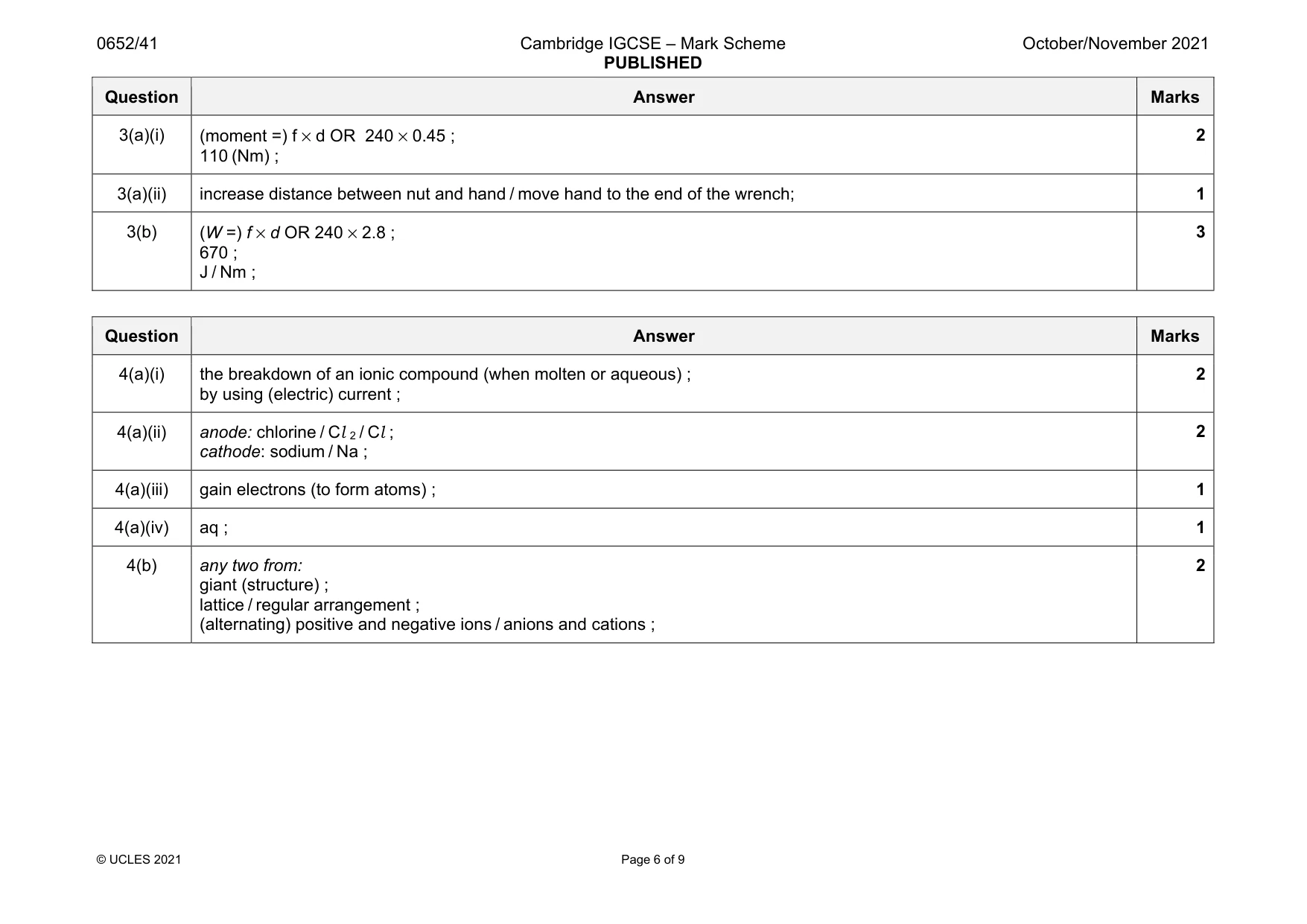
Mark scheme: 3(a)(i) (moment =) f × d OR 240 × 0.45 ; 110 (Nm) ; 2 3(a)(ii) increase distance between nut and hand / move hand to the end of the wrench; 1 3(b) (W =) f × d OR 240 × 2.8 ; 670 ; J / Nm ; 3
Q4 · Sodium chloride is an ionic compound
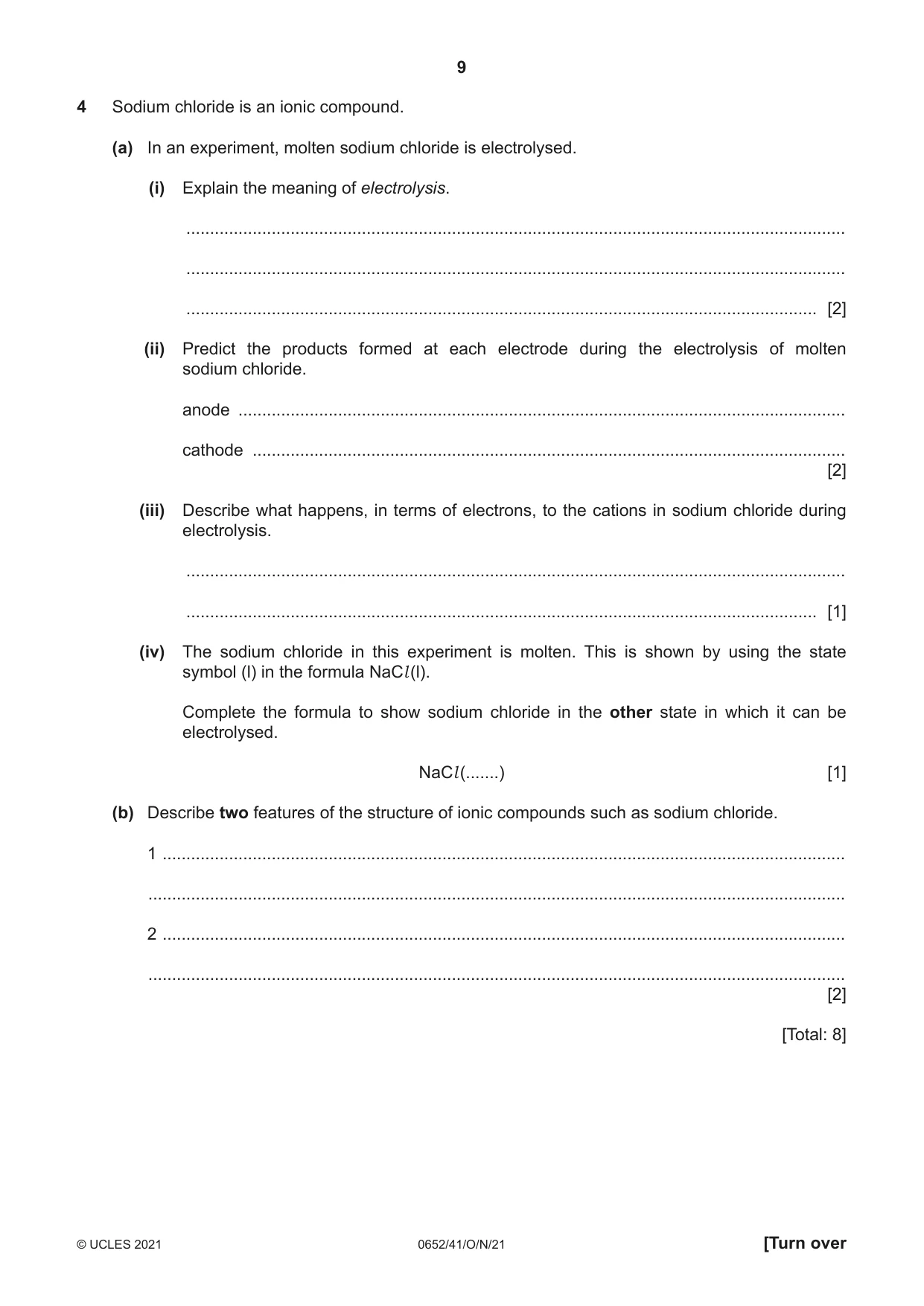
4 Sodium chloride is an ionic compound. (a) In an experiment, molten sodium chloride is electrolysed. (i) Explain the meaning of electrolysis. ........................................................................................................................................... ........................................................................................................................................... ..................................................................................................................................... [2] (ii) Predict the products formed at each electrode during the electrolysis of molten sodium chloride. anode ................................................................................................................................ cathode ............................................................................................................................. [2] (iii) Describe what happens, in terms of electrons, to the cations in sodium chloride during electrolysis. ........................................................................................................................................... ..................................................................................................................................... [1] (iv) The sodium chloride in this experiment is molten. This is shown by using the state symbol (l) in the formula NaCl (l). Complete the formula to show sodium chloride in the other state in which it can be electrolysed. NaCl (.......) [1] (b) Describe two features of the structure of ionic compounds such as sodium chloride. 1 ................................................................................................................................................ ................................................................................................................................................... 2 ................................................................................................................................................ ................................................................................................................................................... [2] [Total: 8]
Mark scheme: 4(a)(i) the breakdown of an ionic compound (when molten or aqueous) ; by using (electric) current ; 4(a)(ii) anode: chlorine / Cl 2 / Cl ; cathode: sodium / Na ; 2 4(a)(iii) gain electrons (to form atoms) ; 1 4(a)(iv) aq ; 1 4(b) any two from: giant (structure) ; lattice / regular arrangement ; (alternating) positive and negative ions / anions and cations ; 2
Q5 · A rectangular block of wood vibrates to produce waves in a ripple tank
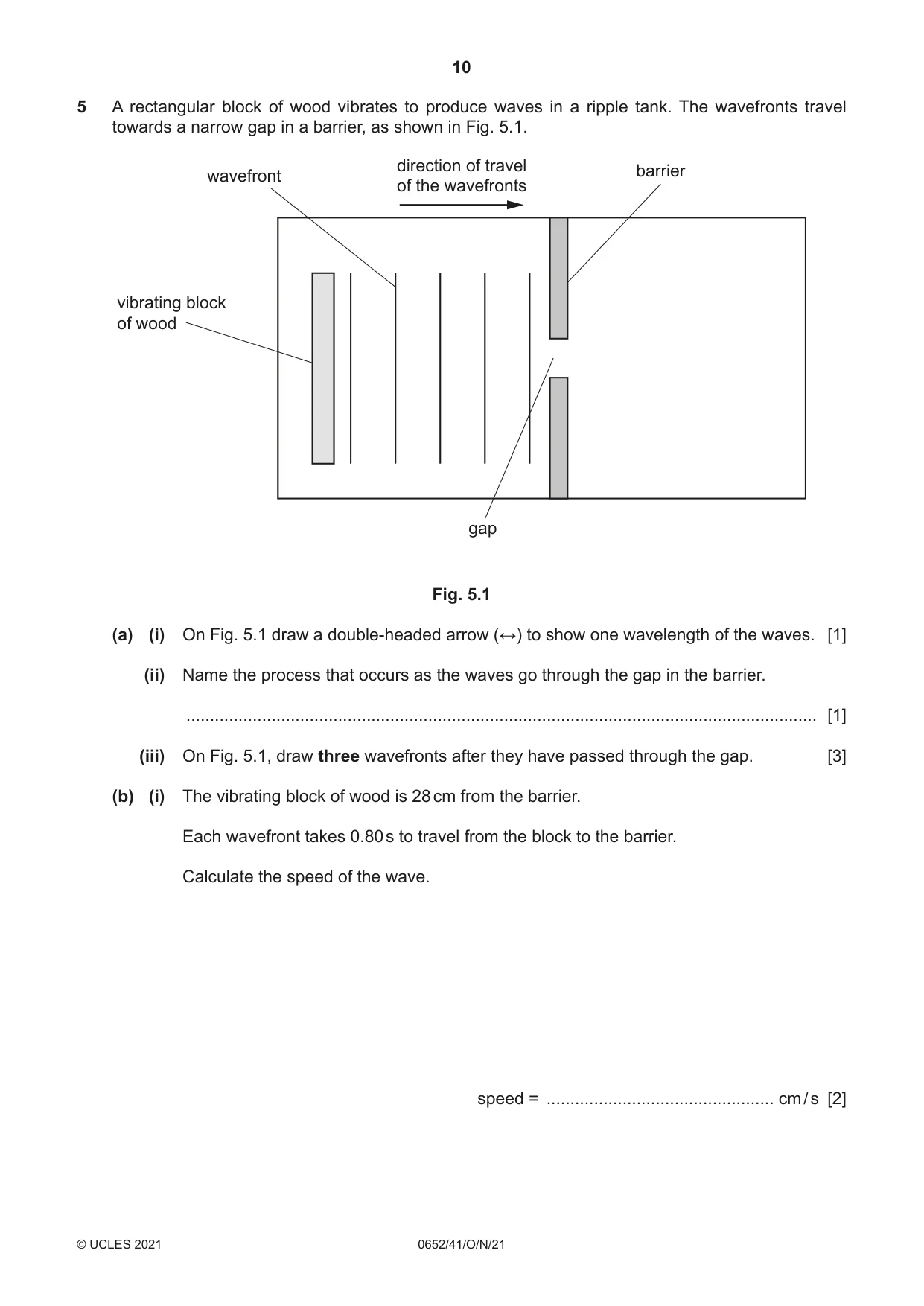
5 A rectangular block of wood vibrates to produce waves in a ripple tank. The wavefronts travel towards a narrow gap in a barrier, as shown in Fig. 5.1. direction of travel barrier wavefront of the wavefronts vibrating block of wood gap Fig. 5.1 (a) (i) On Fig. 5.1 draw a double-headed arrow (↔) to show one wavelength of the waves. [1] (ii) Name the process that occurs as the waves go through the gap in the barrier. ..................................................................................................................................... [1] (iii) On Fig. 5.1, draw three wavefronts after they have passed through the gap. [3] (b) (i) The vibrating block of wood is 28 cm from the barrier. Each wavefront takes 0.80 s to travel from the block to the barrier. Calculate the speed of the wave. speed = ................................................ cm / s [2] (ii) The wavelength of the waves is 5.6 cm. Use your answer to (b)(i) to calculate the frequency of the waves. frequency = .................................................... Hz [2] [Total: 9]
Mark scheme: 5(a)(i) arrow drawn with tips of arrows just touching adjacent wavefronts AND horizonta l; 1 5(a)(ii) Diffraction ; 1 5(a)(iii) waves spread as they go through gap ; three arcs ; (arcs with) constant wavelength AND the same as before diffraction ; 3 5(b)(i) (v =) d ÷ t OR 28 ÷ 0.8 ; 35 (cm / s) ; 2 5(b)(ii) v = f λ OR (f =) v ÷ λ OR (b)(i) ÷ 5.6 ; 6.3 (Hz) ; 2
Q6 · Complete Table 6.1 to show the number of protons, neutrons and electrons in one atom of…
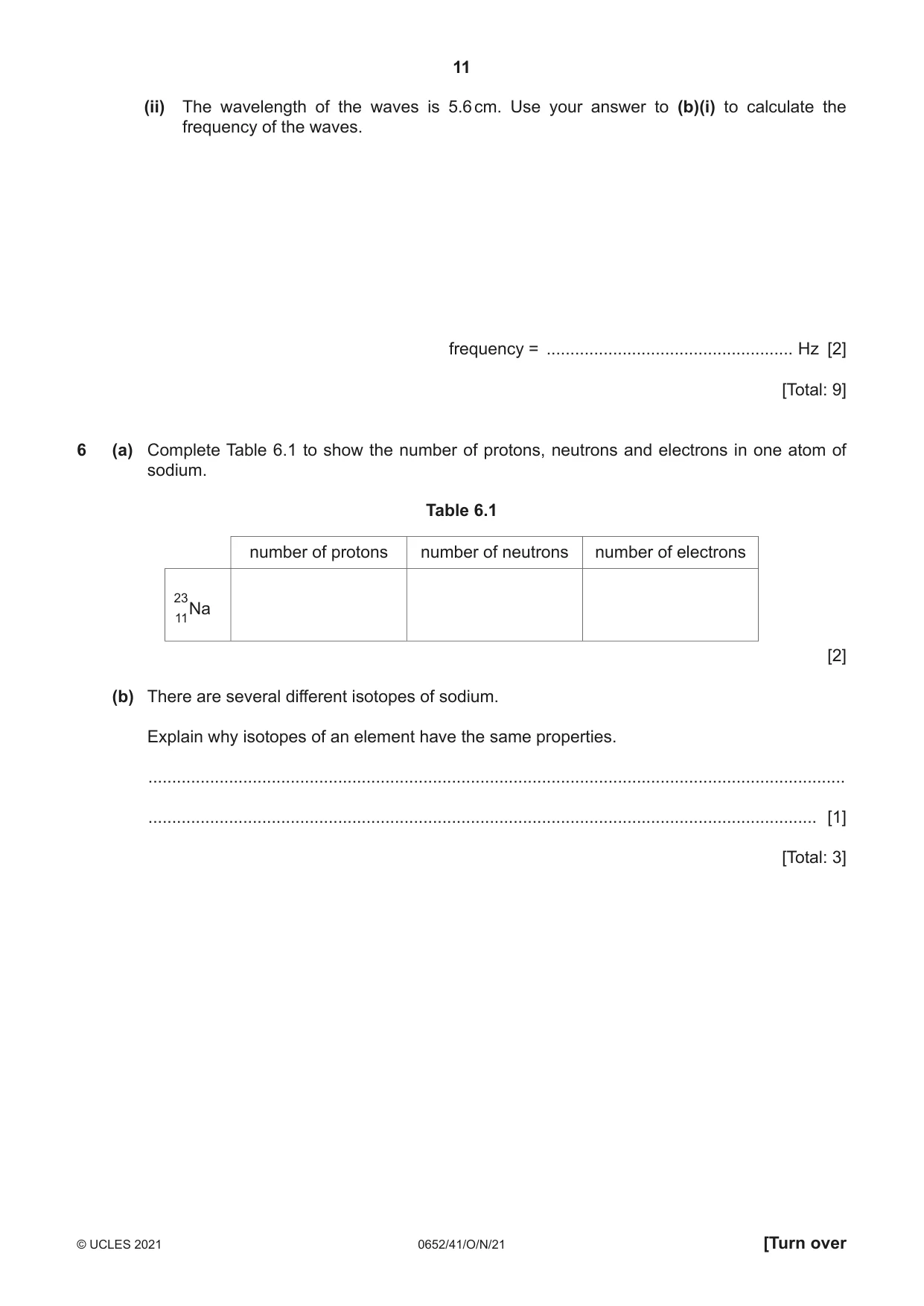
6 (a) Complete Table 6.1 to show the number of protons, neutrons and electrons in one atom of sodium. Table 6.1 number of protons number of neutrons number of electrons 23 11Na [2] (b) There are several different isotopes of sodium. Explain why isotopes of an element have the same properties. ................................................................................................................................................... ............................................................................................................................................. [1] [Total: 3]
Mark scheme: 6(a) protons: 11 ; neutrons: 12 ; electrons: 11 ; 2 6(b) same number of electrons / same electronic structure ; 1
Q7 · A metal sphere is suspended by a plastic thread
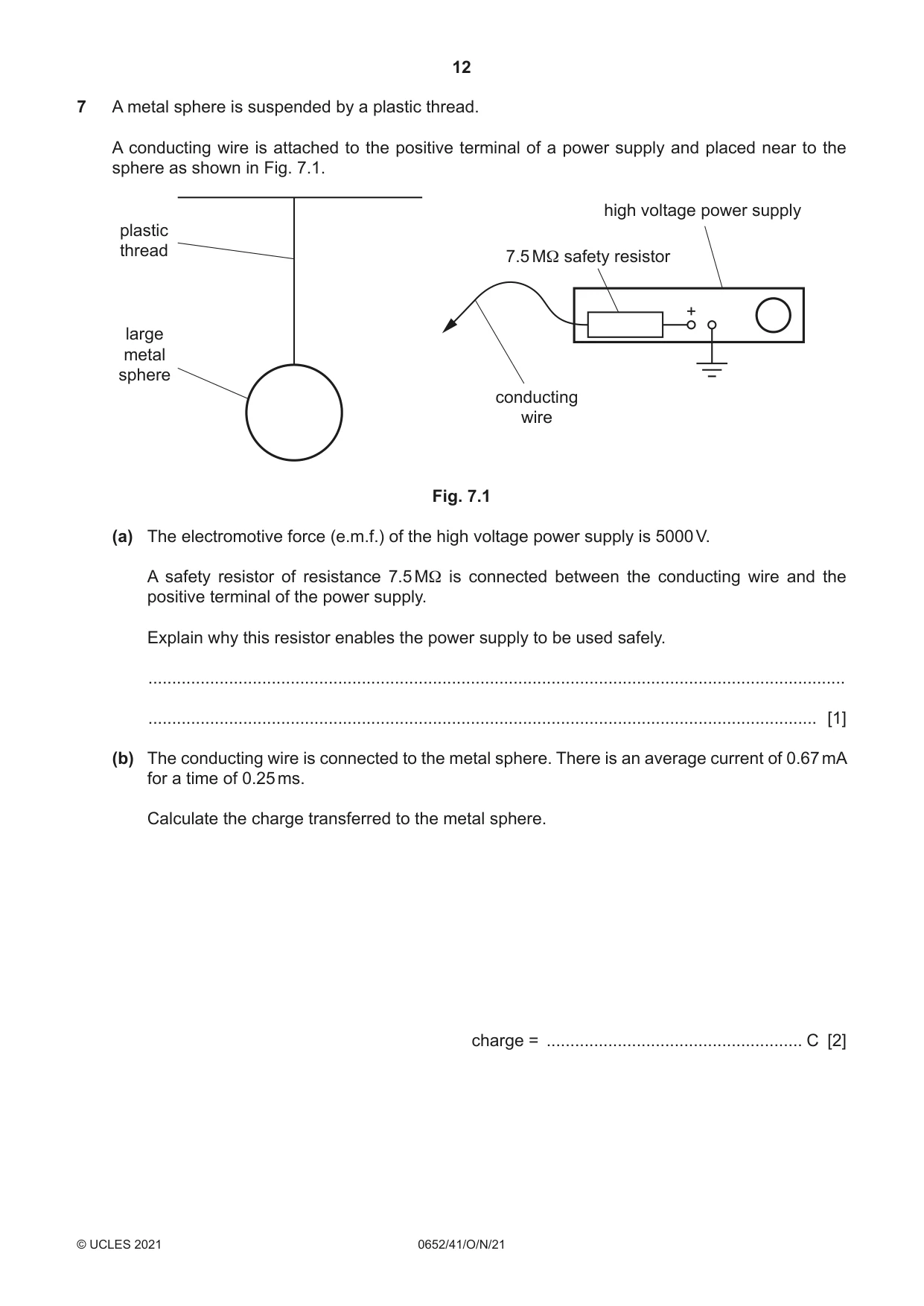
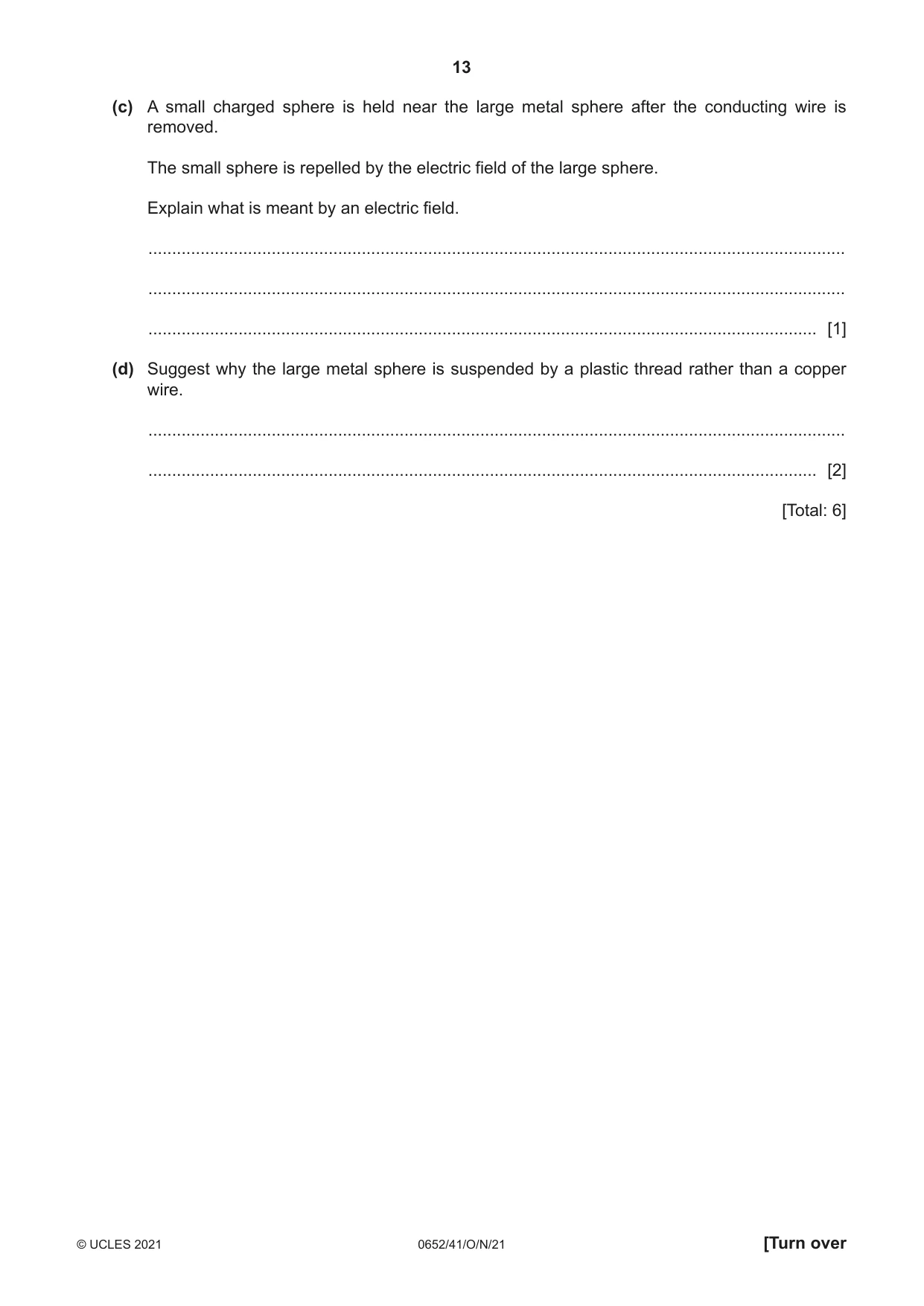
7 A metal sphere is suspended by a plastic thread. A conducting wire is attached to the positive terminal of a power supply and placed near to the sphere as shown in Fig. 7.1. high voltage power supply plastic thread 7.5 MΩ safety resistor + large metal sphere conducting wire Fig. 7.1 (a) The electromotive force (e.m.f.) of the high voltage power supply is 5000 V. A safety resistor of resistance 7.5 MΩ is connected between the conducting wire and the positive terminal of the power supply. Explain why this resistor enables the power supply to be used safely. ................................................................................................................................................... ............................................................................................................................................. [1] (b) The conducting wire is connected to the metal sphere. There is an average current of 0.67 mA for a time of 0.25 ms. Calculate the charge transferred to the metal sphere. charge = ...................................................... C [2] (c) A small charged sphere is held near the large metal sphere after the conducting wire is removed. The small sphere is repelled by the electric field of the large sphere. Explain what is meant by an electric field. ................................................................................................................................................... ................................................................................................................................................... ............................................................................................................................................. [1] (d) Suggest why the large metal sphere is suspended by a plastic thread rather than a copper wire. ................................................................................................................................................... ............................................................................................................................................. [2] [Total: 6]
Mark scheme: 7(a) limits the current ; 1 7(b) (Q =) It OR (0.67 × 10–3) × (0.25 × 10–3) ; = 1.7 × 10⁻⁷ (C) ; 2 7(c) region in which a (stationary, positive) charge experiences a force ; 1 7(d) plastic is an insulator ; charge does not leak away ; 2
Q8 · Carbon is an element in Group IV and Period 2 of the Periodic Table
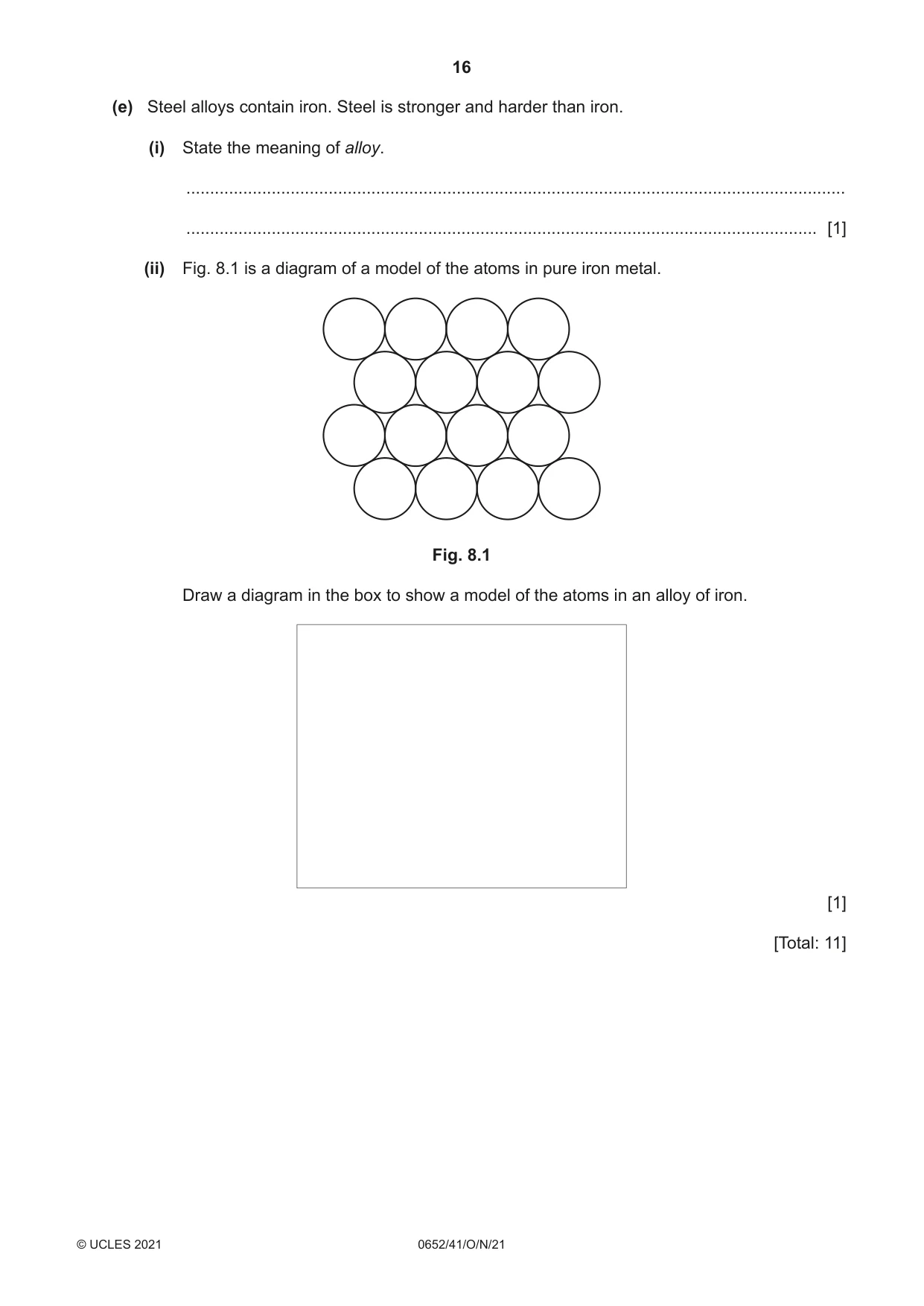
8 Carbon is an element in Group IV and Period 2 of the Periodic Table. (a) The position of carbon in the Periodic Table gives two pieces of information about its electronic structure. State these two pieces of information. 1 ................................................................................................................................................ 2 ................................................................................................................................................ [2] (b) Graphite is a form of carbon. Explain, in terms of structure, why graphite can be used as a lubricant. ................................................................................................................................................... ................................................................................................................................................... ................................................................................................................................................... ............................................................................................................................................. [2] (c) Carbon is used in the extraction of iron from its ore in a blast furnace. Carbon reacts with oxygen in the blast furnace to form carbon dioxide. C + O2 CO2 Write two other equations for essential reactions that occur in the blast furnace to extract iron from its ore. 1 ................................................................................................................................................ 2 ................................................................................................................................................ [2] (d) Zinc blende is an ore of zinc. It contains ZnS. Before zinc metal is extracted, its ore is crushed and heated in air. 2ZnS + 3O2 2ZnO + 2SO2 Calculate the mass of ZnO that is produced from 6.5 tonnes of ZnS. [Ar: Zn, 65; S, 32; O, 16; and 1 tonne = 1000 kg] Give your answer to two significant figures. mass of ZnO = .......................... tonnes [3] (e) Steel alloys contain iron. Steel is stronger and harder than iron. (i) State the meaning of alloy. ........................................................................................................................................... ..................................................................................................................................... [1] (ii) Fig. 8.1 is a diagram of a model of the atoms in pure iron metal. Fig. 8.1 Draw a diagram in the box to show a model of the atoms in an alloy of iron. [1] [Total: 11]
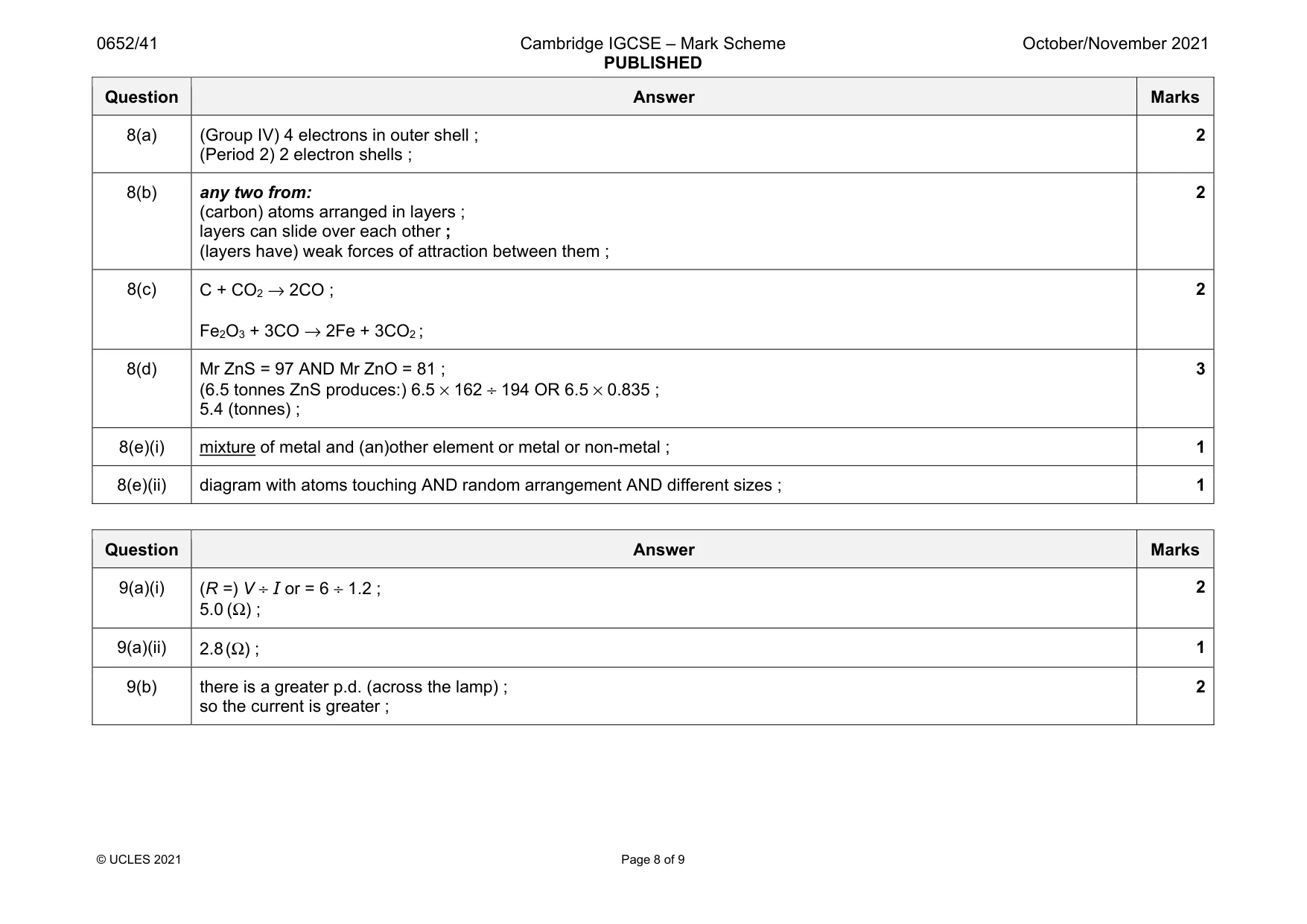
Mark scheme: 8(a) (Group IV) 4 electrons in outer shell ; (Period 2) 2 electron shells ; 2 8(b) any two from: (carbon) atoms arranged in layers ; layers can slide over each other ; (layers have) weak forces of attraction between them ; 2 8(c) C + CO2 → 2CO ; Fe2O3 + 3CO → 2Fe + 3CO2 ; 2 8(d) Mr ZnS = 97 AND Mr ZnO = 81 ; (6.5 tonnes ZnS produces:) 6.5 × 162 ÷ 194 OR 6.5 × 0.835 ; 5.4 (tonnes) ; 3 8(e)(i) mixture of metal and (an)other element or metal or non-metal ; 1 8(e)(ii) diagram with atoms touching AND random arrangement AND different sizes ; 1
Q9 · A circuit diagram containing a battery of electromotive force (e.m.f.) 6.0 V, a resistor…
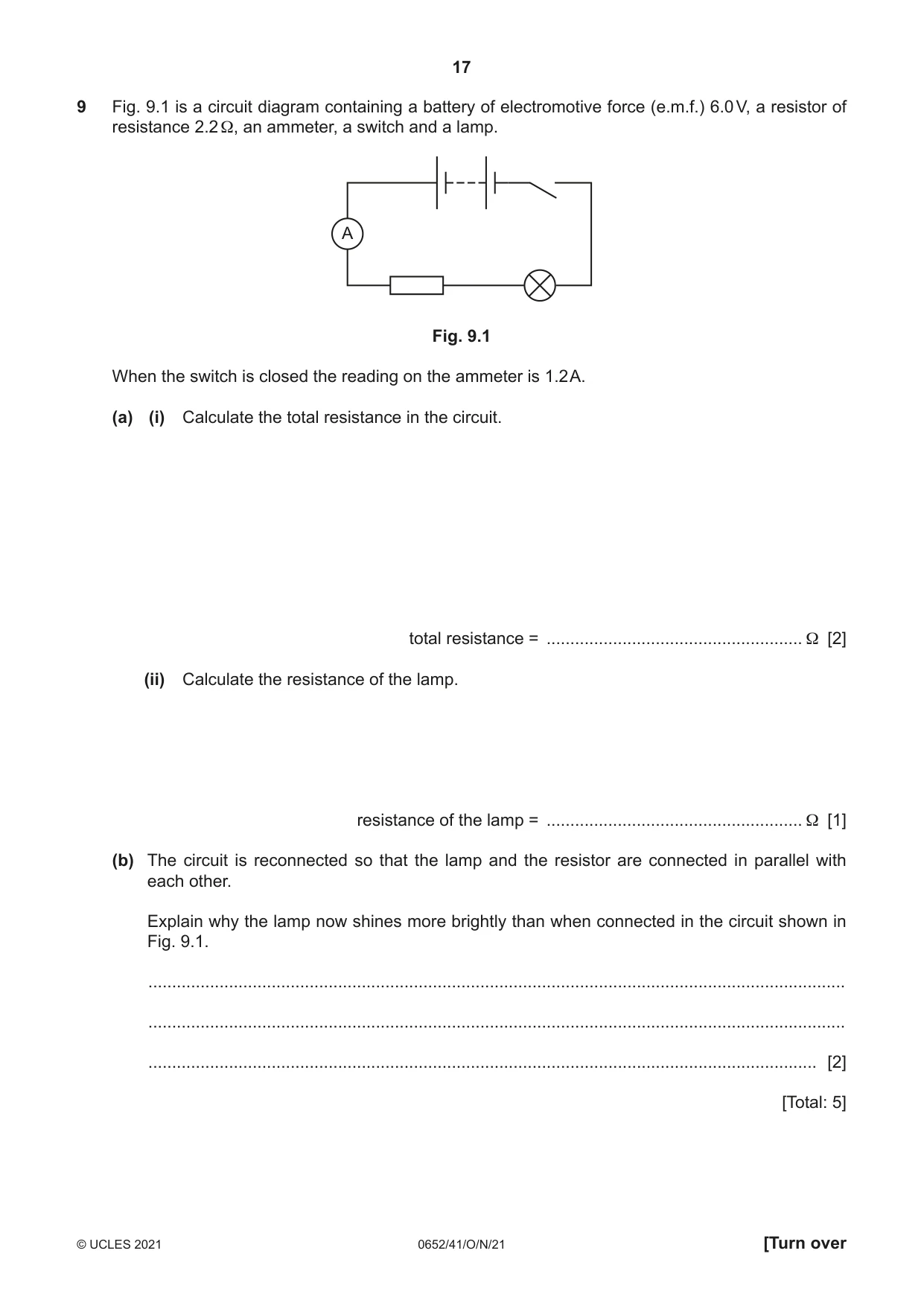
9 Fig. 9.1 is a circuit diagram containing a battery of electromotive force (e.m.f.) 6.0 V, a resistor of resistance 2.2 Ω, an ammeter, a switch and a lamp. A Fig. 9.1 When the switch is closed the reading on the ammeter is 1.2 A. (a) (i) Calculate the total resistance in the circuit. total resistance = ...................................................... Ω [2] (ii) Calculate the resistance of the lamp. resistance of the lamp = ...................................................... Ω [1] (b) The circuit is reconnected so that the lamp and the resistor are connected in parallel with each other. Explain why the lamp now shines more brightly than when connected in the circuit shown in Fig. 9.1. ................................................................................................................................................... ................................................................................................................................................... ............................................................................................................................................. [2] [Total: 5]
Mark scheme: 9(a)(i) 5.0 (Ω) ; 9(a)(ii) 2.8(Ω) ; 1 9(b) there is a greater p.d. (across the lamp) ; so the current is greater ; 2
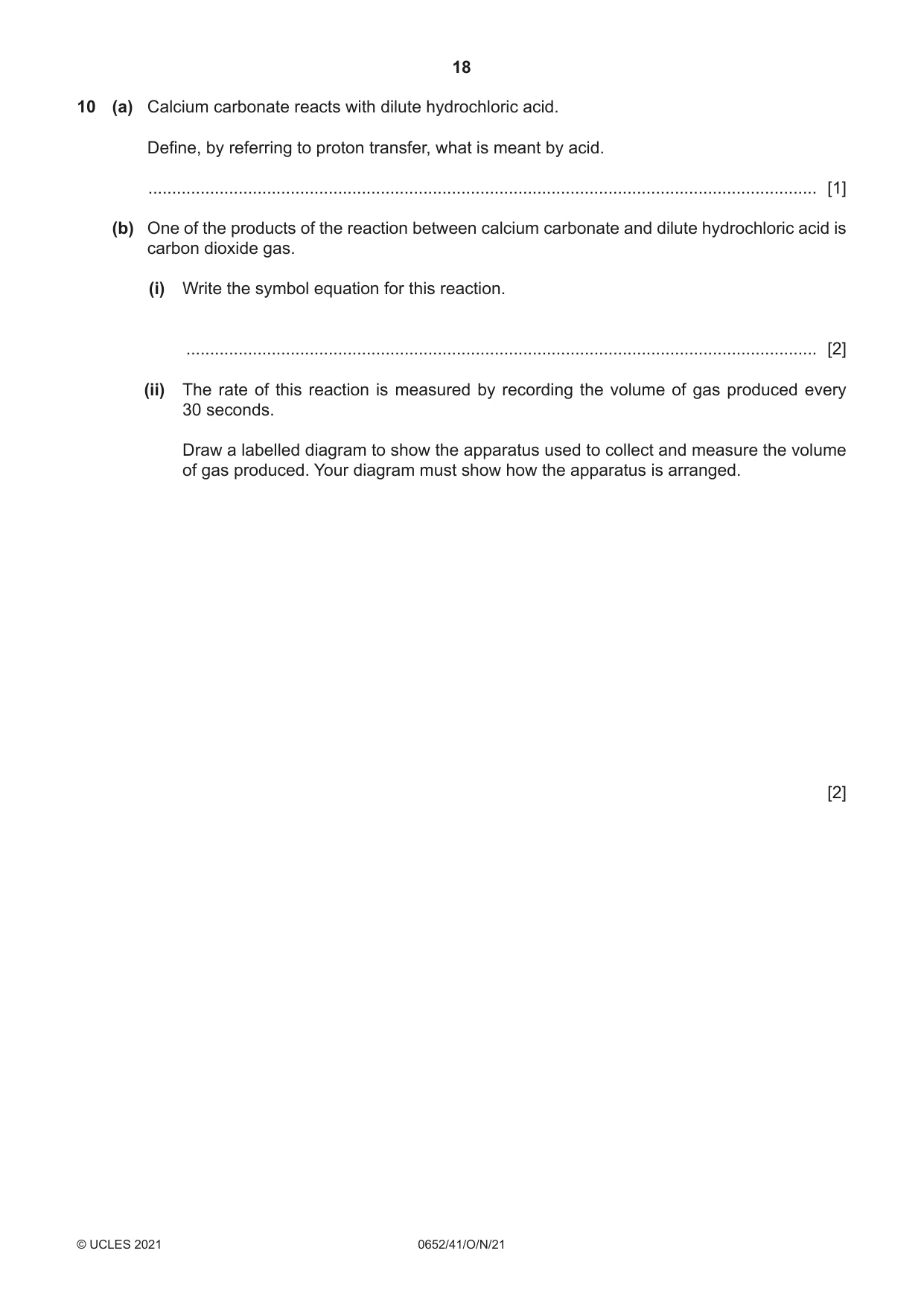
Q10 · Calcium carbonate reacts with dilute hydrochloric acid
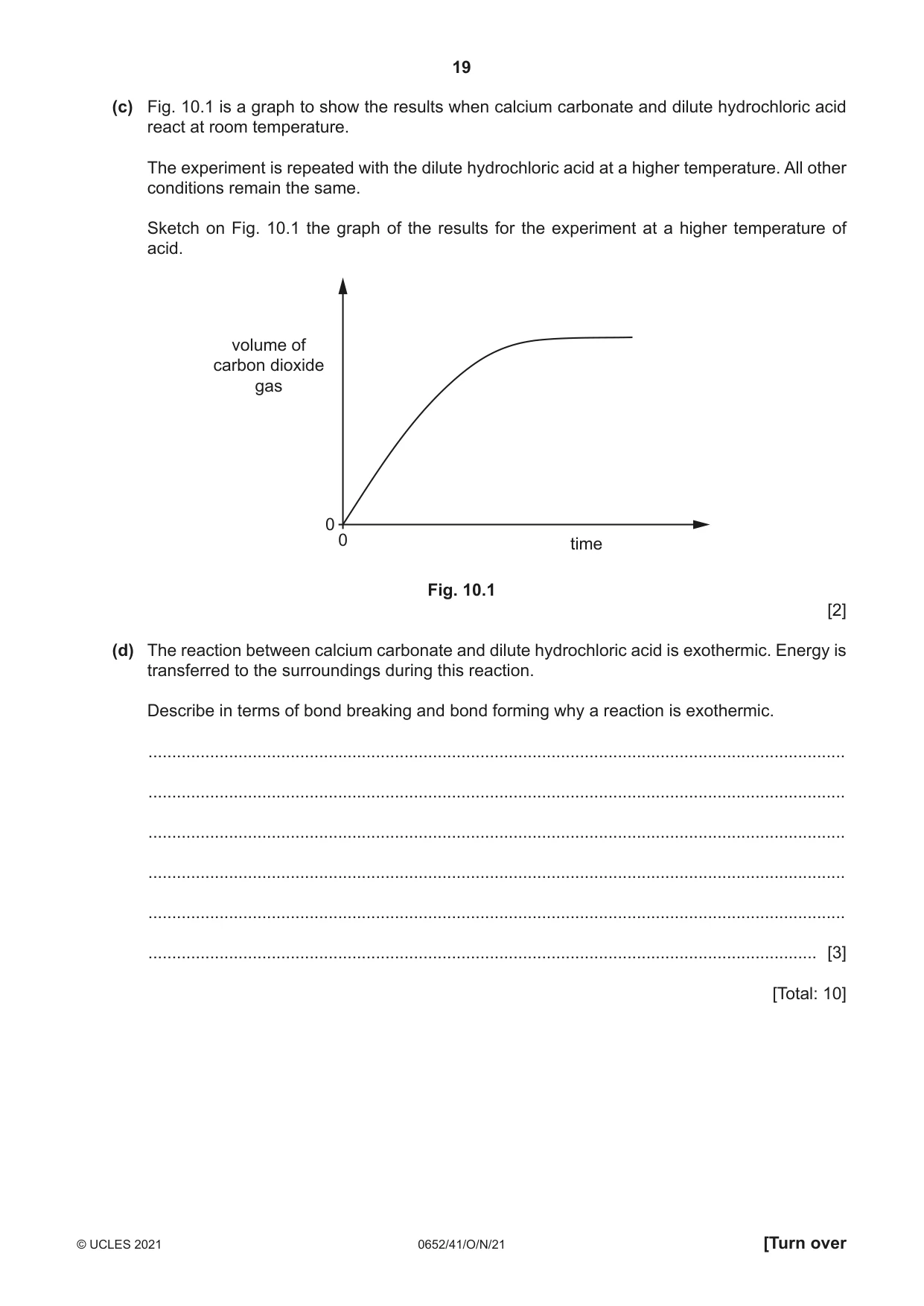
10 (a) Calcium carbonate reacts with dilute hydrochloric acid. Define, by referring to proton transfer, what is meant by acid. ............................................................................................................................................. [1] (b) One of the products of the reaction between calcium carbonate and dilute hydrochloric acid is carbon dioxide gas. (i) Write the symbol equation for this reaction. ..................................................................................................................................... [2] (ii) The rate of this reaction is measured by recording the volume of gas produced every 30 seconds. Draw a labelled diagram to show the apparatus used to collect and measure the volume of gas produced. Your diagram must show how the apparatus is arranged. [2] (c) Fig. 10.1 is a graph to show the results when calcium carbonate and dilute hydrochloric acid react at room temperature. The experiment is repeated with the dilute hydrochloric acid at a higher temperature. All other conditions remain the same. Sketch on Fig. 10.1 the graph of the results for the experiment at a higher temperature of acid. volume of carbon dioxide gas 0 0 time Fig. 10.1 [2] (d) The reaction between calcium carbonate and dilute hydrochloric acid is exothermic. Energy is transferred to the surroundings during this reaction. Describe in terms of bond breaking and bond forming why a reaction is exothermic. ................................................................................................................................................... ................................................................................................................................................... ................................................................................................................................................... ................................................................................................................................................... ................................................................................................................................................... ............................................................................................................................................. [3] [Total: 10]
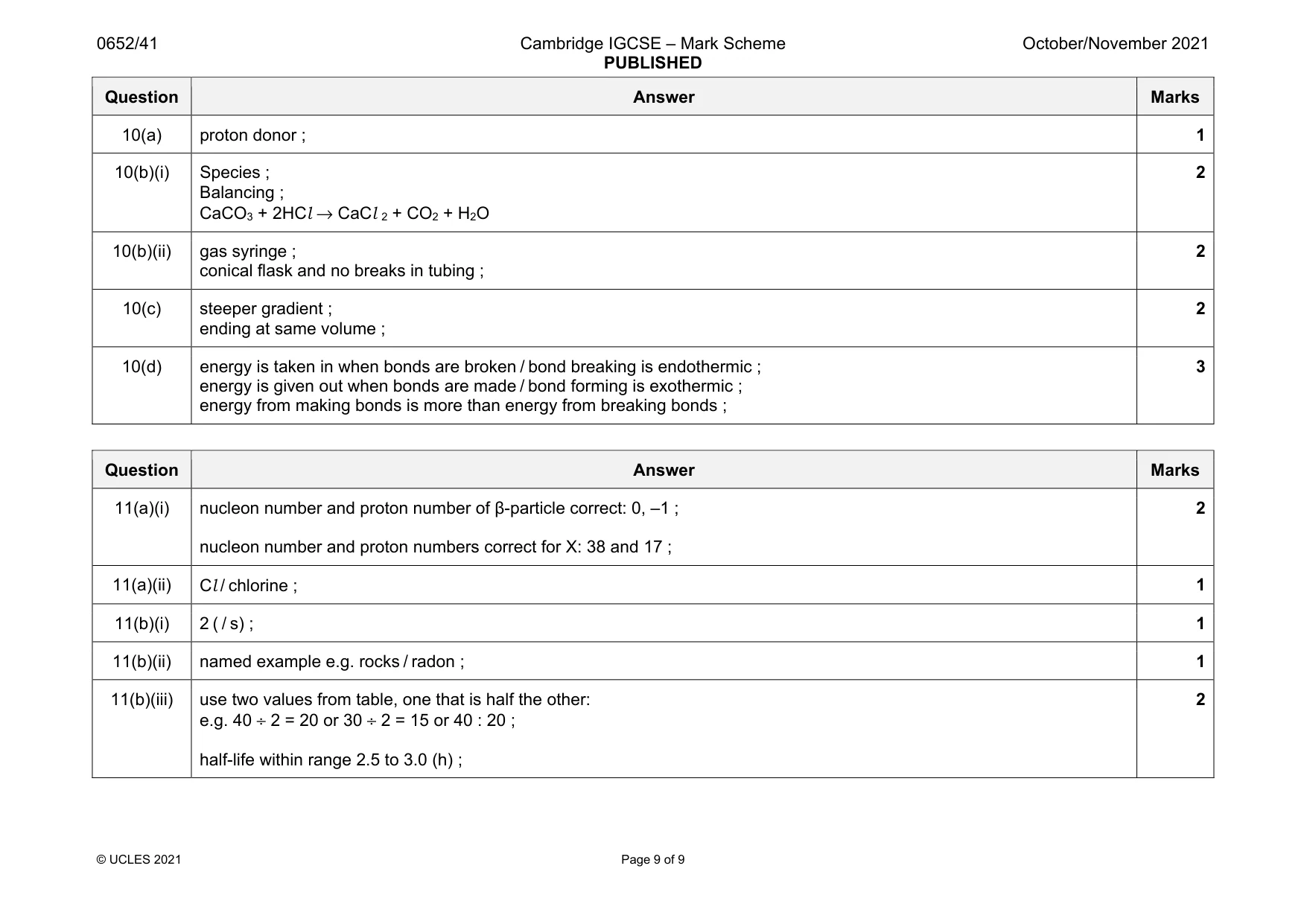
Mark scheme: 10(a) proton donor ; 1 10(b)(i) Species ; Balancing ; CaCO3 + 2HCl → CaCl 2 + CO2 + H2O 2 10(b)(ii) gas syringe ; conical flask and no breaks in tubing ; 2 10(c) steeper gradient ; ending at same volume ; 2 10(d) energy is taken in when bonds are broken / bond breaking is endothermic ; energy is given out when bonds are made / bond forming is exothermic ; energy from making bonds is more than energy from breaking bonds ; 3
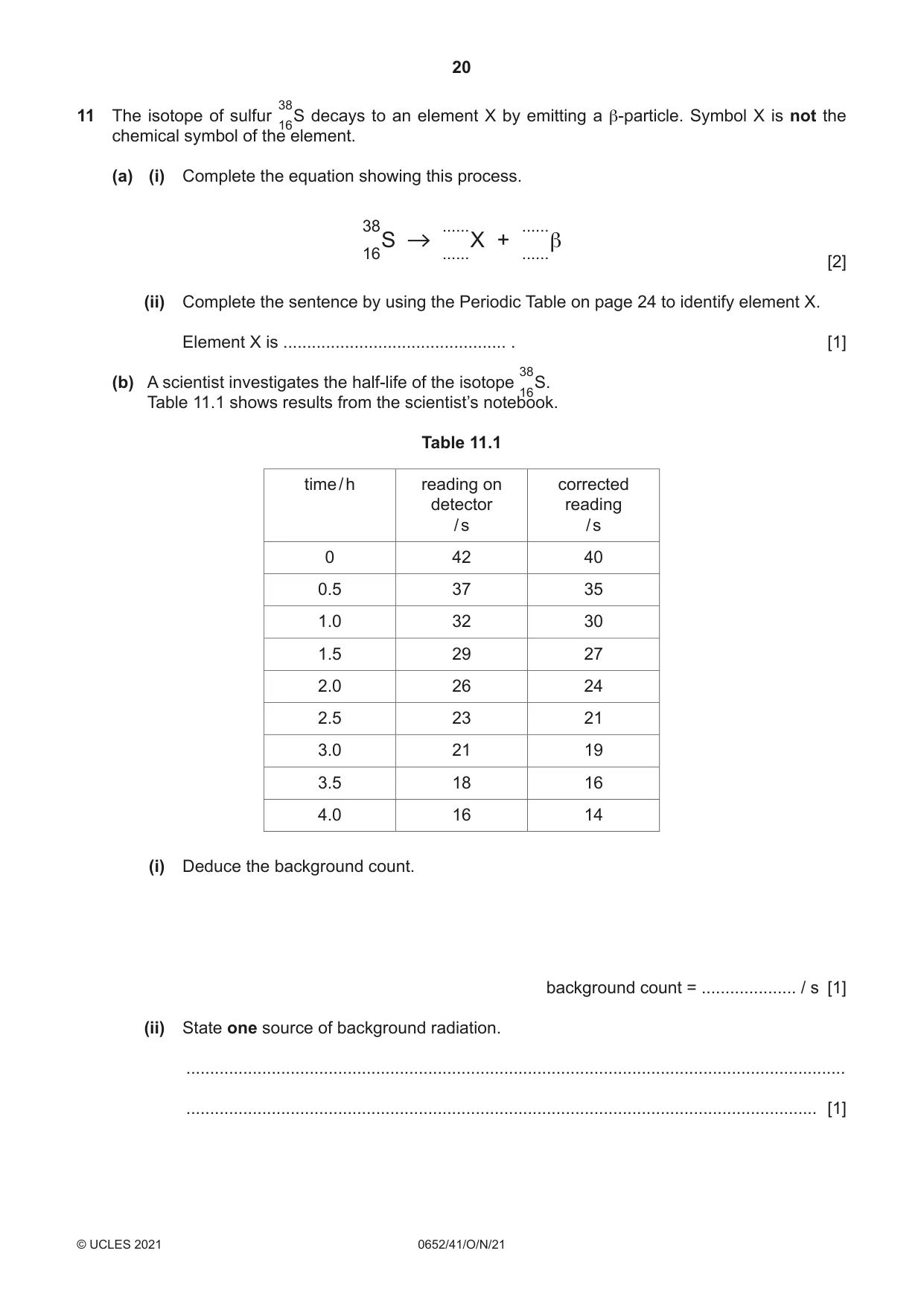
Q11 · The isotope of sulfur 16S decays to an element X by emitting a β‑particle
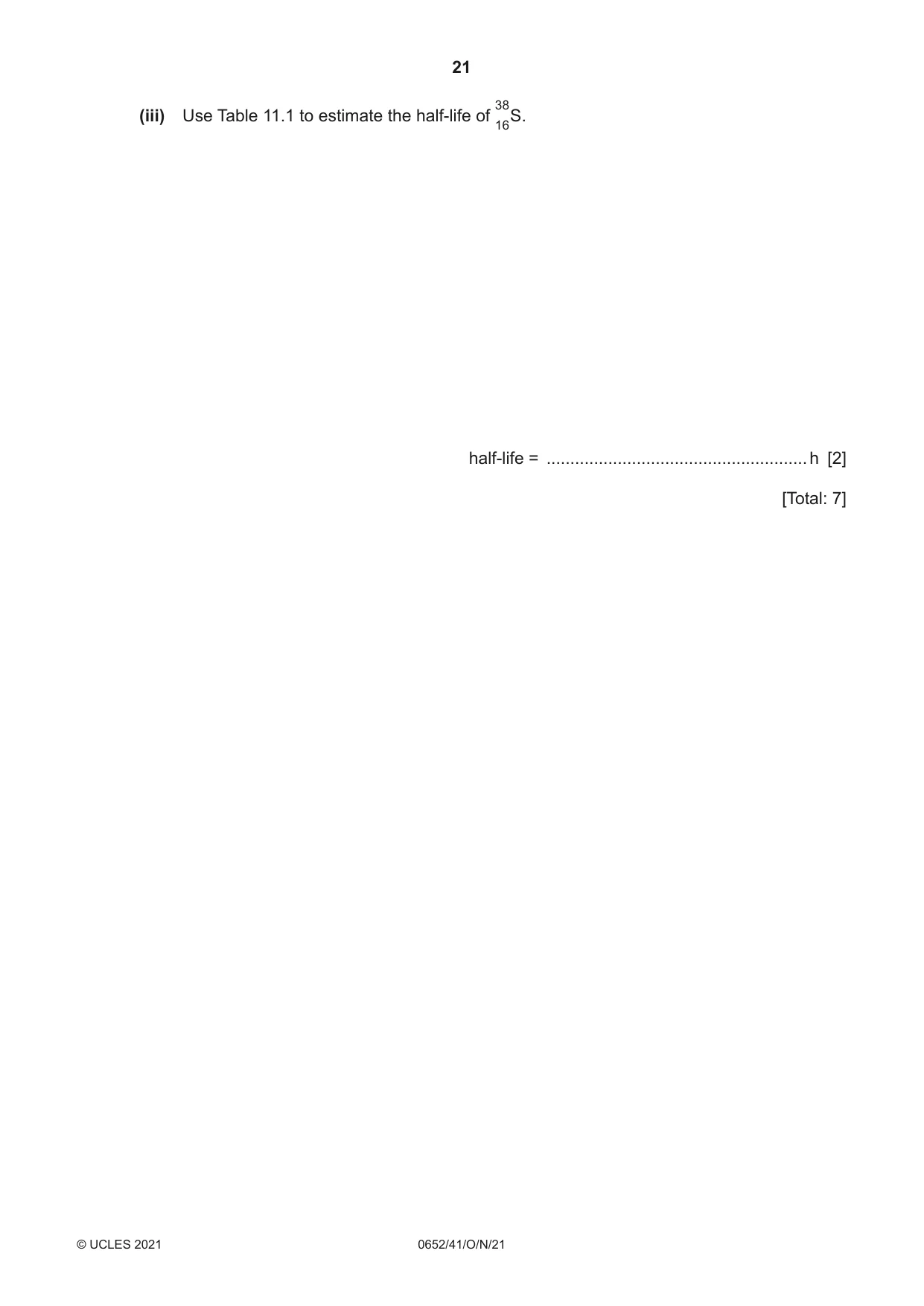
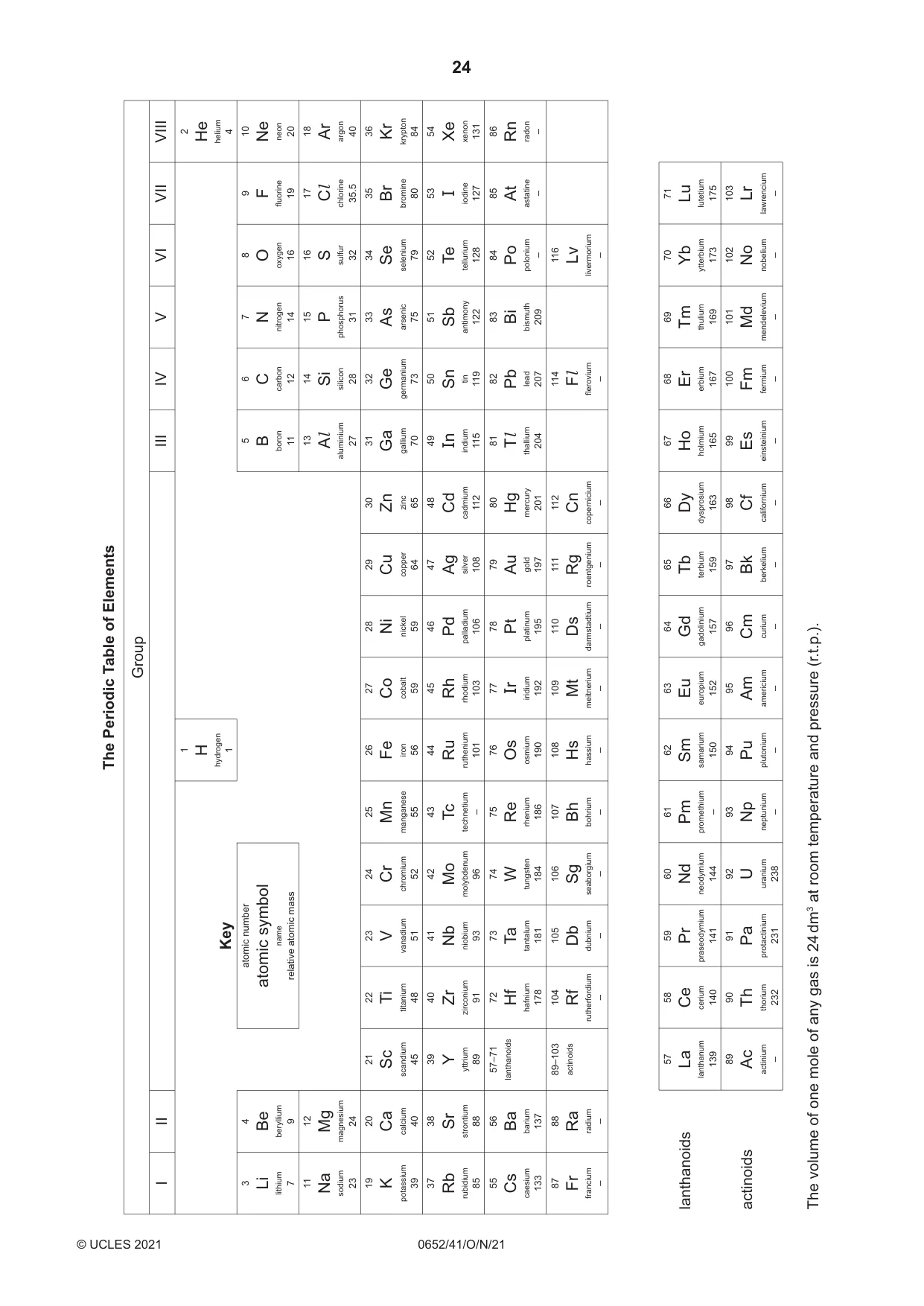
11 The isotope of sulfur 16S decays to an element X by emitting a β‑particle. Symbol X is not the chemical symbol of the element. (a) (i) Complete the equation showing this process. 38 ...... ...... 16S ......X + ......β [2] (ii) Complete the sentence by using the Periodic Table on page 24 to identify element X. Element X is ............................................... . [1] 38 (b) A scientist investigates the half‑life of the isotope 16S. Table 11.1 shows results from the scientist’s notebook. Table 11.1 time / h reading on corrected detector reading / s / s 0 42 40 0.5 37 35 1.0 32 30 1.5 29 27 2.0 26 24 2.5 23 21 3.0 21 19 3.5 18 16 4.0 16 14 (i) Deduce the background count. background count = .................... / s [1] (ii) State one source of background radiation. ........................................................................................................................................... ..................................................................................................................................... [1] 38 (iii) Use Table 11.1 to estimate the half‑life of 16S. half‑life = ....................................................... h [2] [Total: 7]
Mark scheme: 11(a)(i) nucleon number and proton number of β-particle correct: 0, –1 ; nucleon number and proton numbers correct for X: 38 and 17 ; 2 11(a)(ii) Cl / chlorine ; 1 11(b)(i) 2 ( / s) ; 1 11(b)(ii) named example e.g. rocks / radon ; 1 11(b)(iii) use two values from table, one that is half the other: e.g. 40 ÷ 2 = 20 or 30 ÷ 2 = 15 or 40 : 20 ; half-life within range 2.5 to 3.0 (h) ; 2
What was in this paper
The subtopics covered by these 11 questions, and how many questions each got. Open one in a new tab to see every Cambridge question on it.
What you needed in this session
Cambridge’s own grade thresholds for 2021 Oct/Nov, Paper 4 · Variant 1. A higher threshold means an easier paper — the bar moves with how the cohort did.