Cambridge IGCSE Physical Science 0652 — 2020 Oct/Nov Paper 4 · Variant 2
0652/42/O/N/20 · 10 questions · 80 marks · ≈90 min
The question paper and its mark scheme, free to read here and free to download. This is Cambridge’s own paper, exactly as it was sat.
Question paper24 pages


Mark scheme9 pages
Answers below. Sit the paper first if you are practising.
Questions as text
Q1 · A small irregularly shaped rock
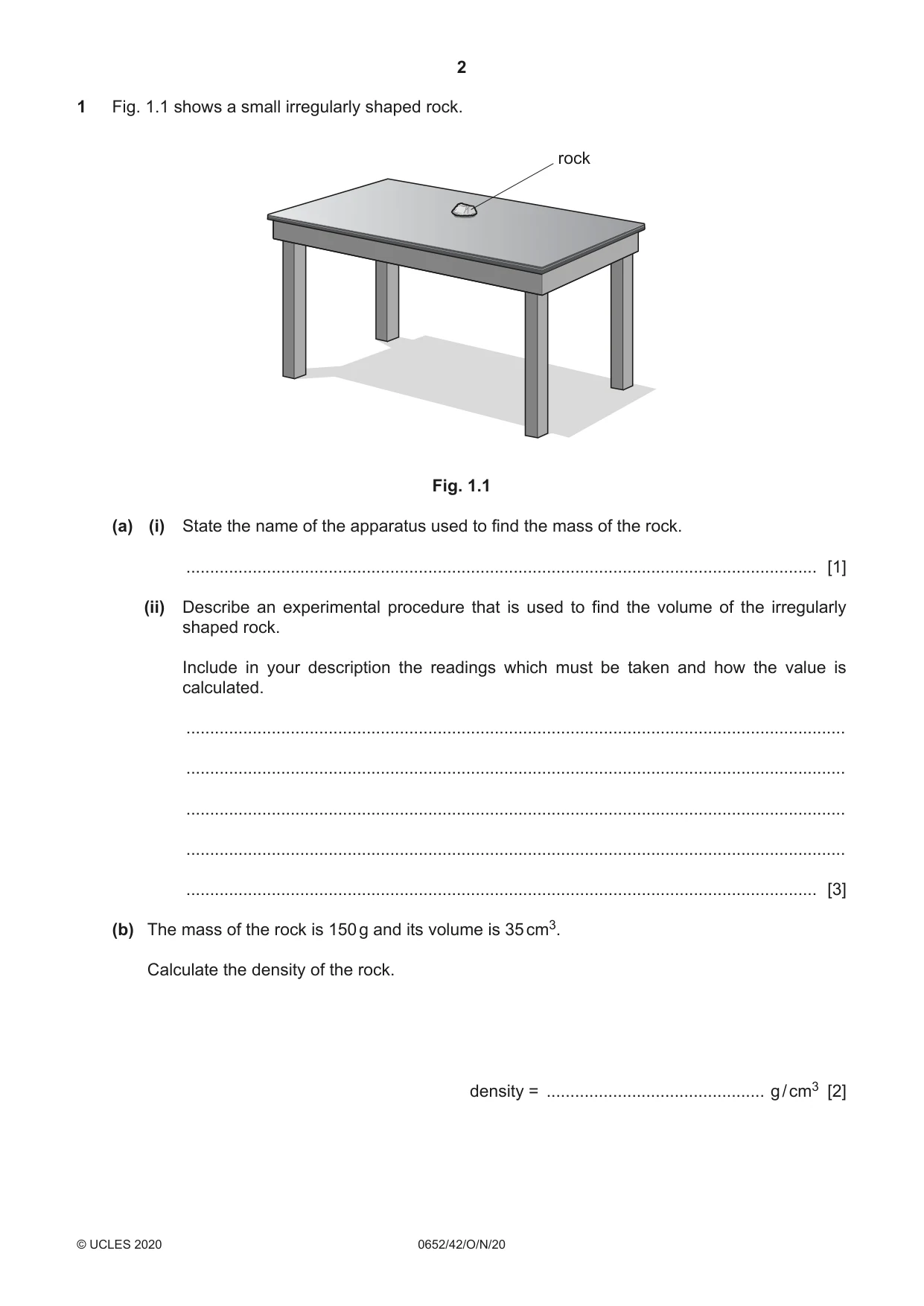
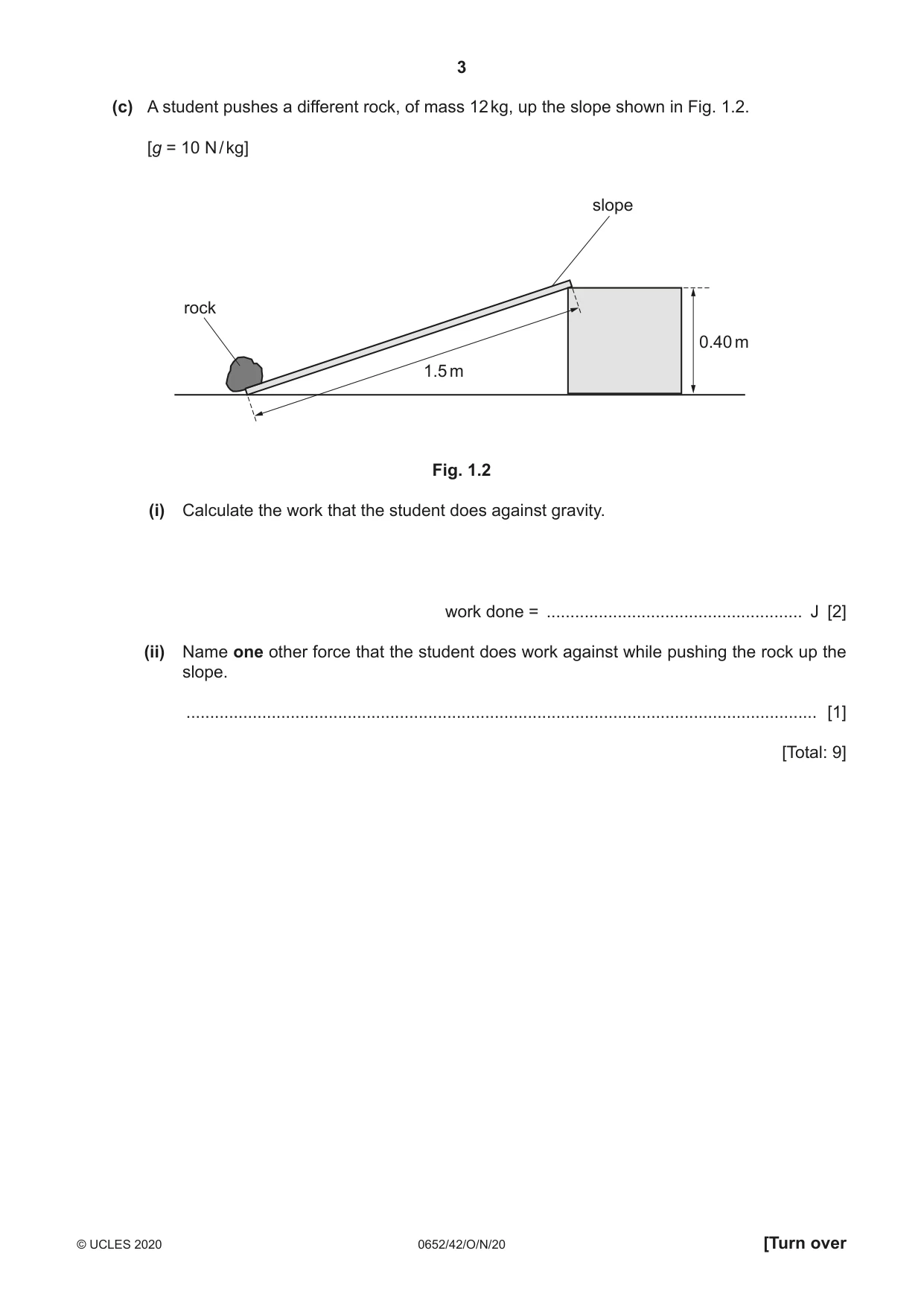
1 Fig. 1.1 shows a small irregularly shaped rock. rock Fig. 1.1 (a) (i) State the name of the apparatus used to find the mass of the rock. ..................................................................................................................................... [1] (ii) Describe an experimental procedure that is used to find the volume of the irregularly shaped rock. Include in your description the readings which must be taken and how the value is calculated. ........................................................................................................................................... ........................................................................................................................................... ........................................................................................................................................... ........................................................................................................................................... ..................................................................................................................................... [3] (b) The mass of the rock is 150 g and its volume is 35 cm3. Calculate the density of the rock. density = .............................................. g / cm3 [2] (c) A student pushes a different rock, of mass 12 kg, up the slope shown in Fig. 1.2. [g = 10 N / kg] slope rock 0.40 m 1.5 m Fig. 1.2 (i) Calculate the work that the student does against gravity. work done = ...................................................... J [2] (ii) Name one other force that the student does work against while pushing the rock up the slope. ..................................................................................................................................... [1] [Total: 9]
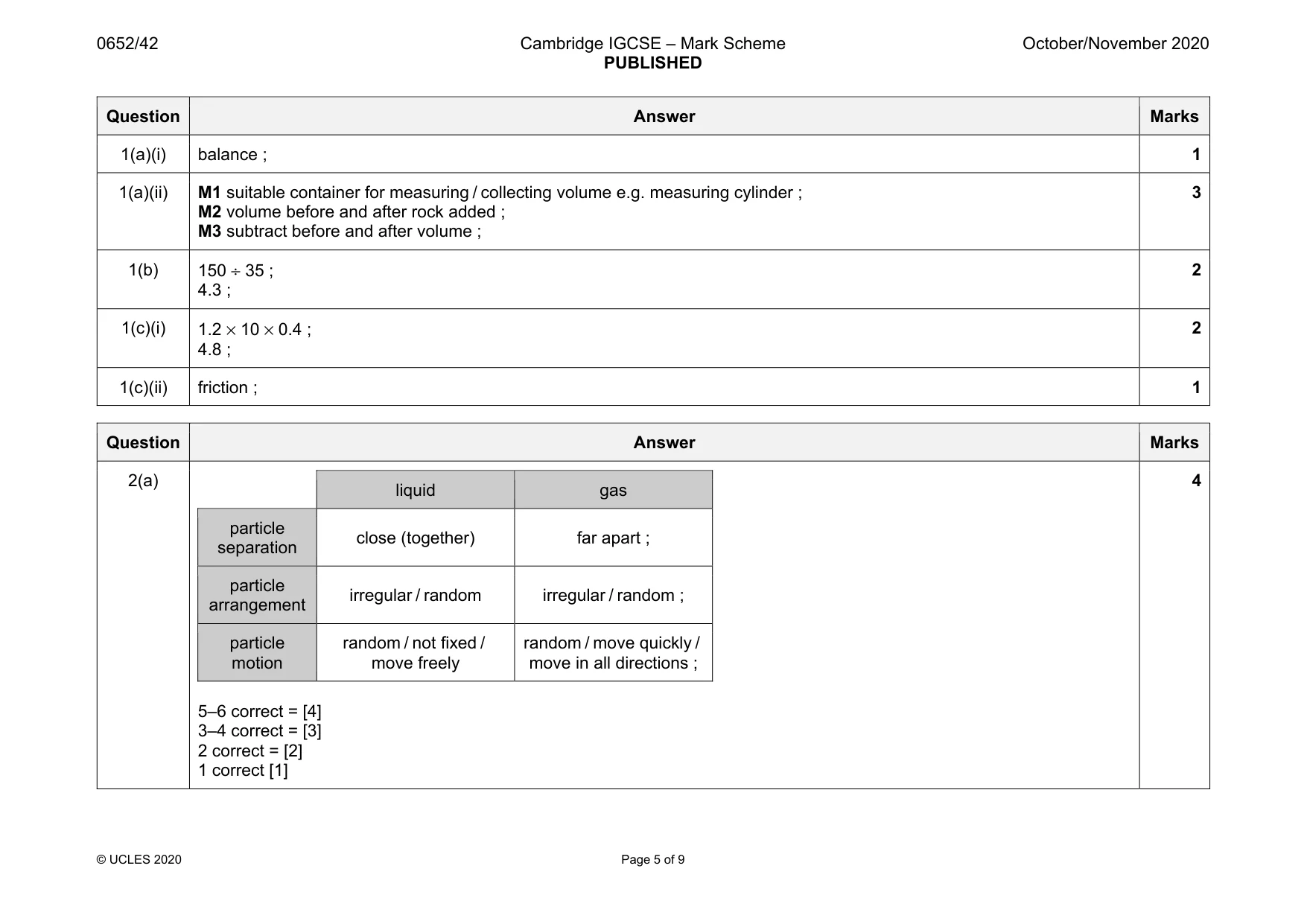
Mark scheme: 1(a)(i) balance ; 1 1(a)(ii) M1 suitable container for measuring / collecting volume e.g. measuring cylinder ; M2 volume before and after rock added ; M3 subtract before and after volume ; 3 1(b) 150 ÷ 35 ; 4.3 ; 2 1(c)(i) 1.2 × 10 × 0.4 ; 4.8 ; 2 1(c)(ii) friction ; 1
Q2 · Three states of matter are solid, liquid and gas
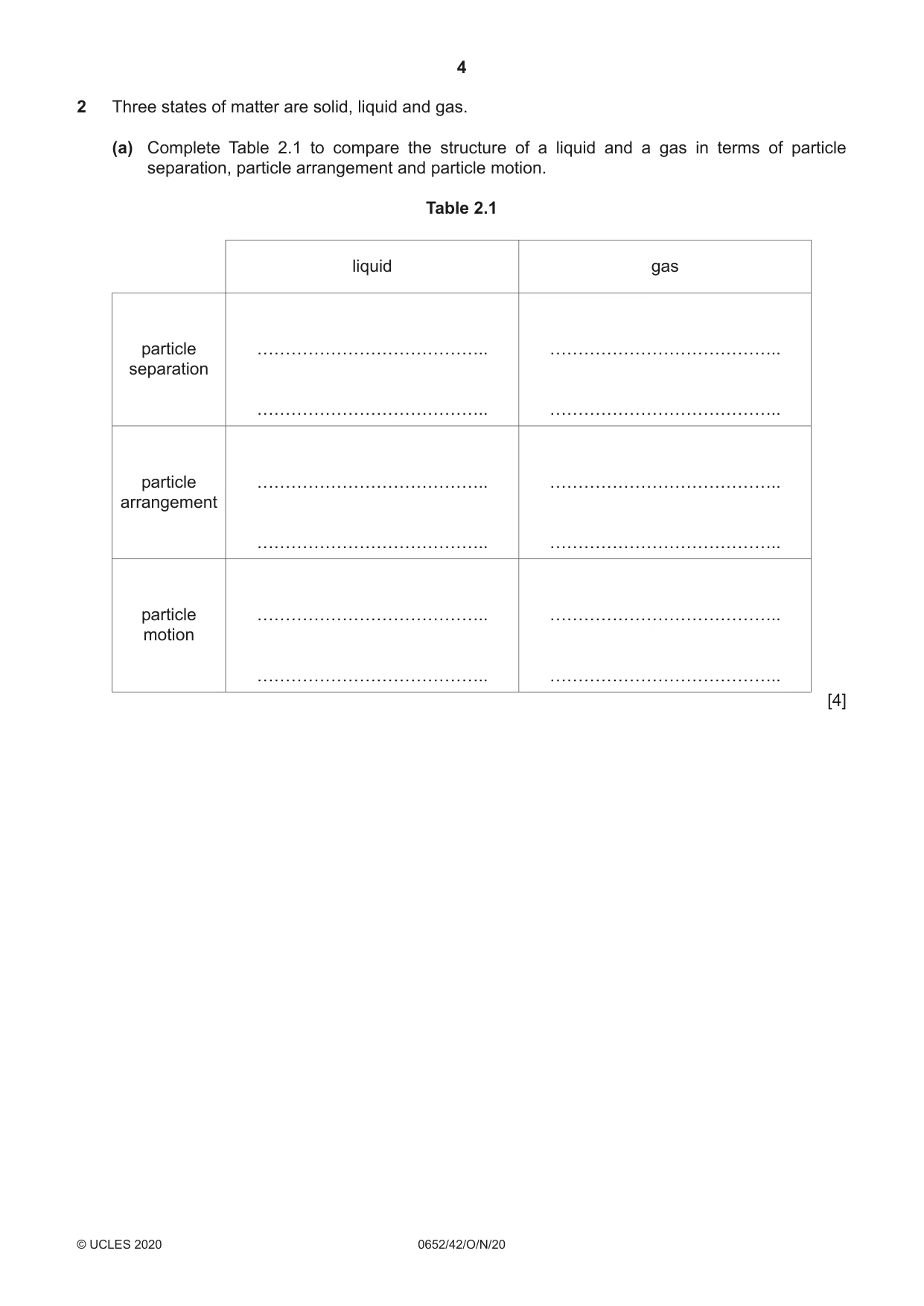
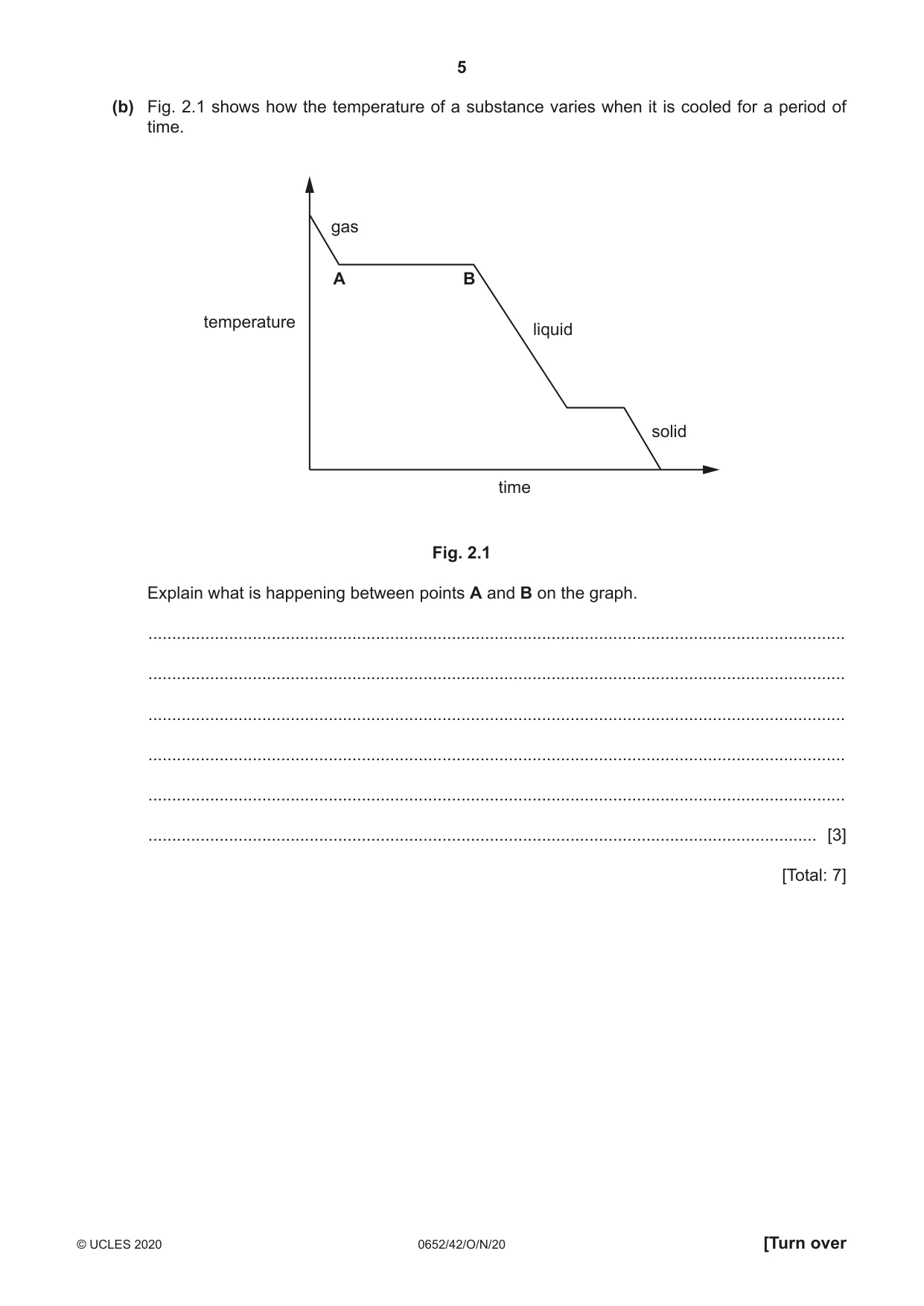
2 Three states of matter are solid, liquid and gas. (a) Complete Table 2.1 to compare the structure of a liquid and a gas in terms of particle separation, particle arrangement and particle motion. Table 2.1 liquid gas particle separation particle arrangement particle motion [4] (b) Fig. 2.1 shows how the temperature of a substance varies when it is cooled for a period of time. gas A B temperature liquid solid time Fig. 2.1 Explain what is happening between points A and B on the graph. ................................................................................................................................................... ................................................................................................................................................... ................................................................................................................................................... ................................................................................................................................................... ................................................................................................................................................... ............................................................................................................................................. [3] [Total: 7]
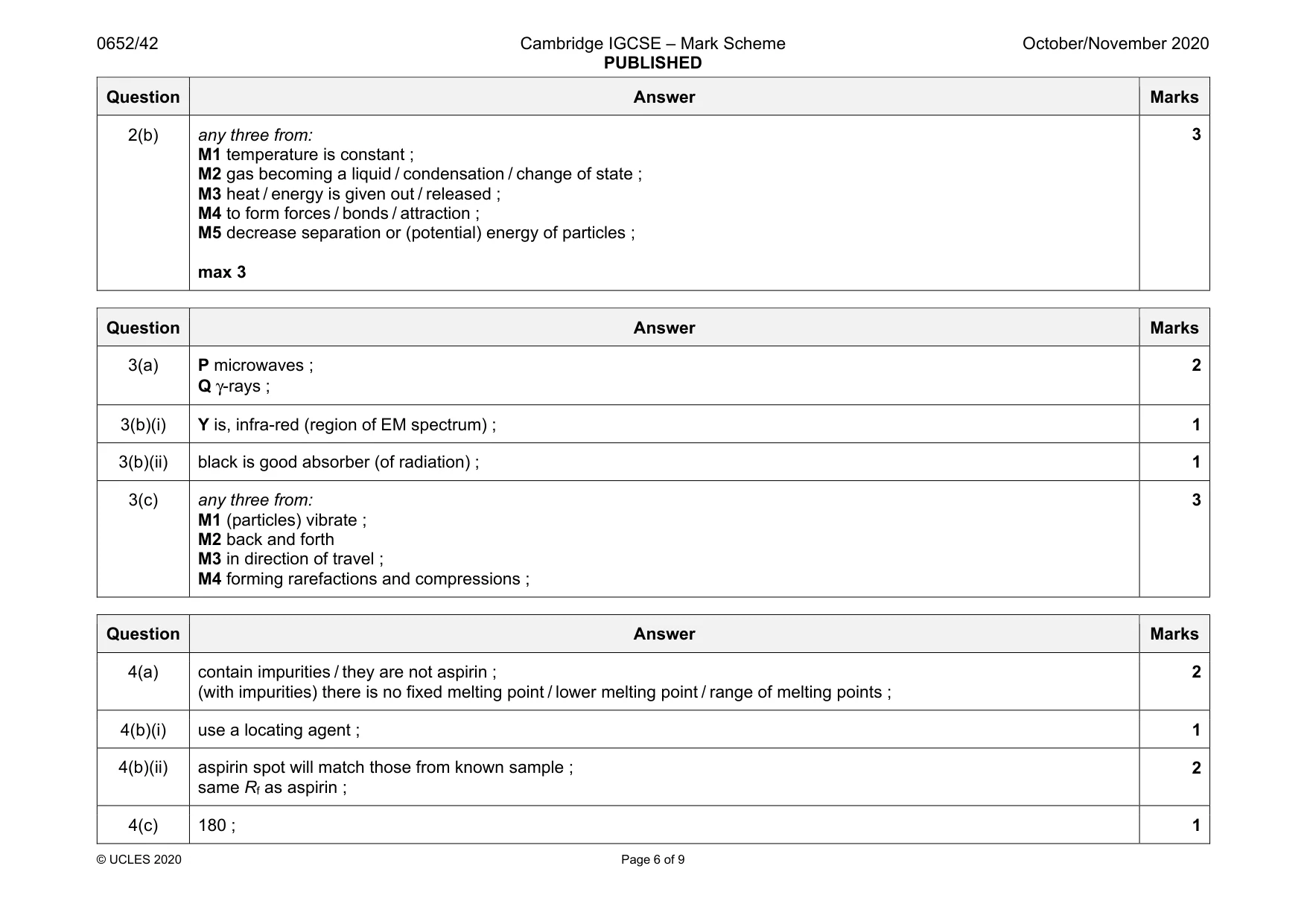
Mark scheme: 2(a) liquid gas particle separation close (together) far apart ; particle arrangement irregular / random irregular / random ; particle motion random / not fixed / move freely random / move quickly / move in all directions ; 5–6 correct = [4] 3–4 correct = [3] 2 correct = [2] 1 correct [1] Question Answer Marks 2(b) any three from: M1 temperature is constant ; M2 gas becoming a liquid / condensation / change of state ; M3 heat / energy is given out / released ; M4 to form forces / bonds / attraction ; M5 decrease separation or (potential) energy of particles ; max 3 3
Question 3
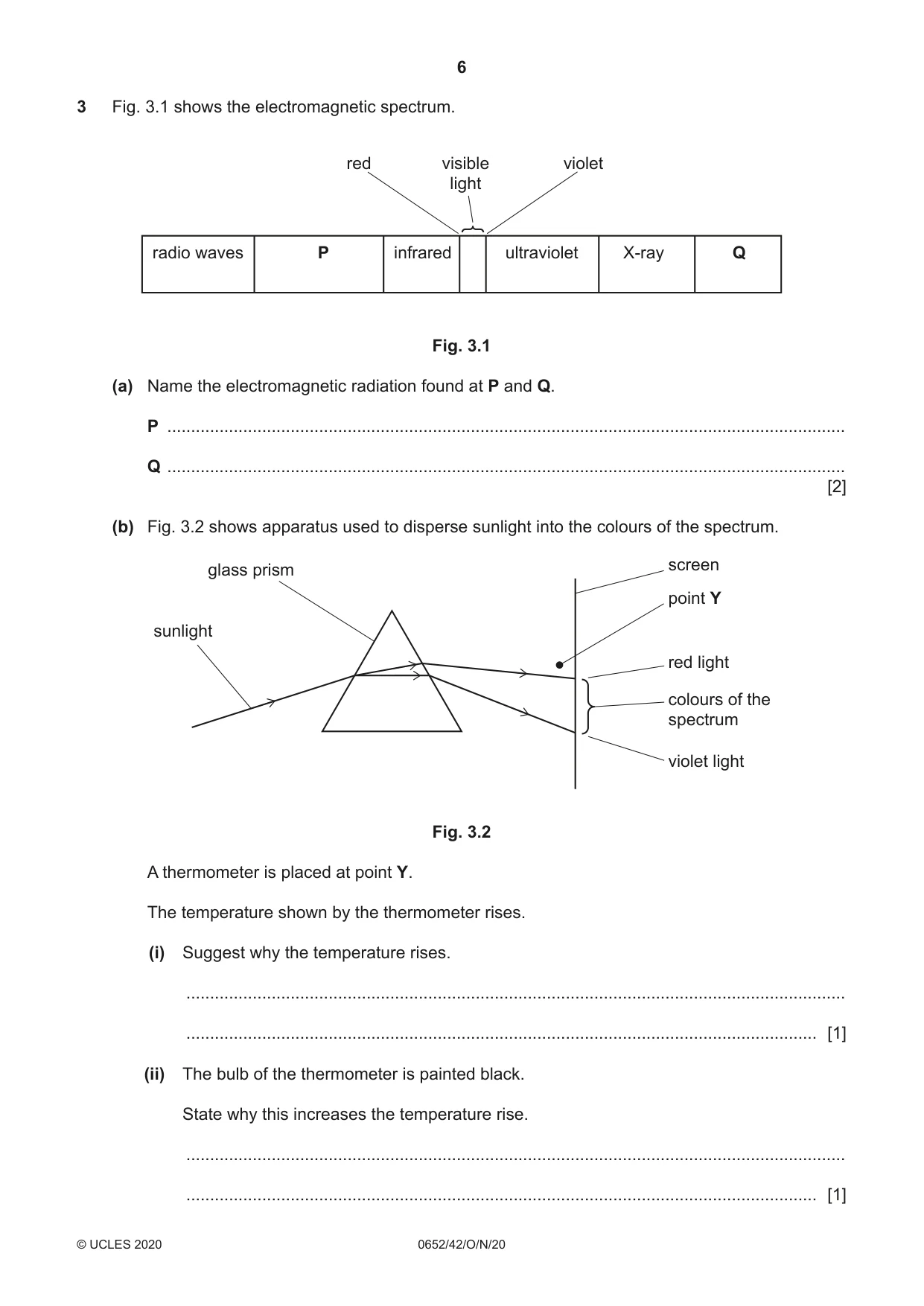
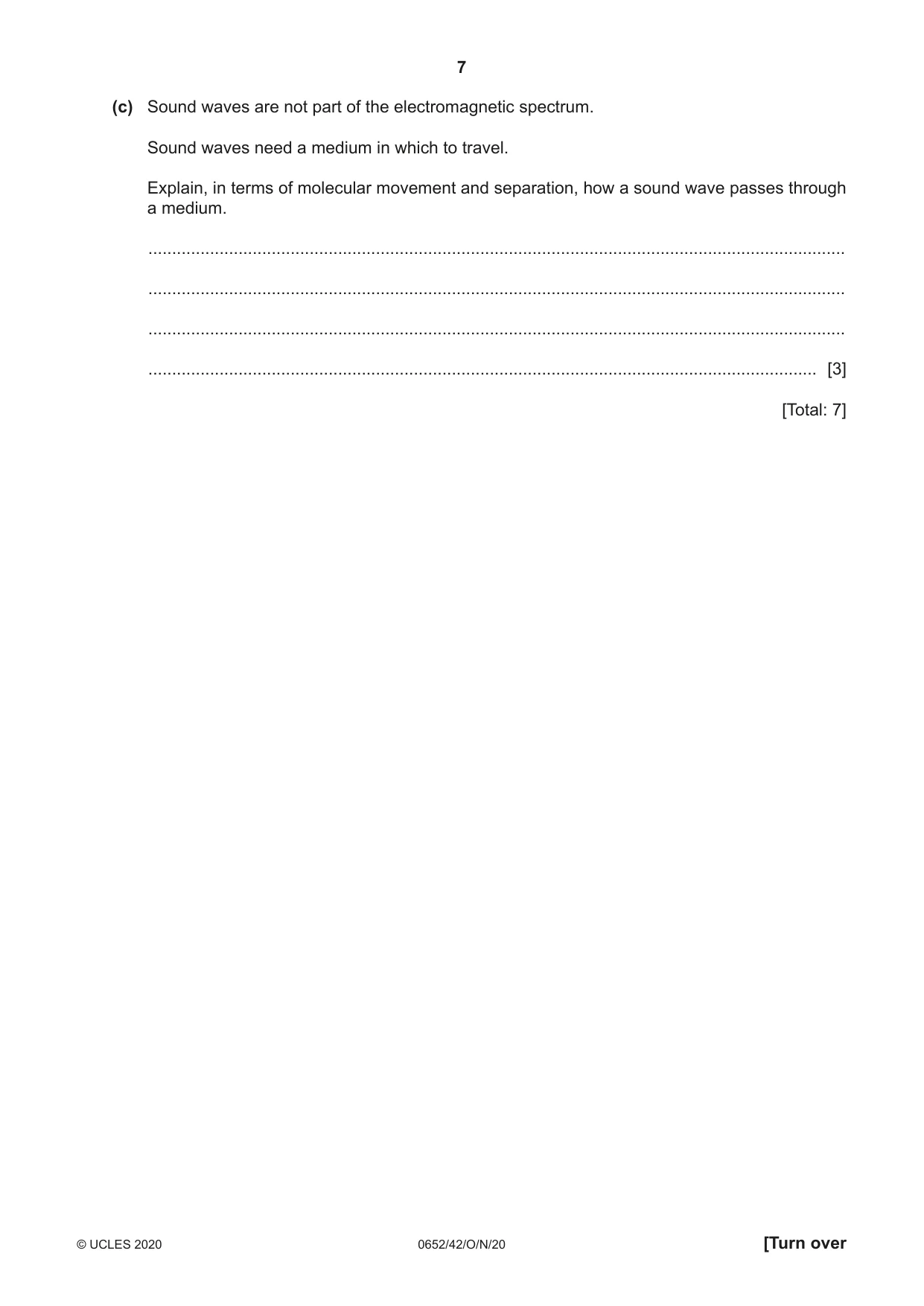
3 Fig. 3.1 shows the electromagnetic spectrum. red visible violet light radio waves P infrared ultraviolet X-ray Q Fig. 3.1 (a) Name the electromagnetic radiation found at P and Q. P ............................................................................................................................................... Q ............................................................................................................................................... [2] (b) Fig. 3.2 shows apparatus used to disperse sunlight into the colours of the spectrum. screen glass prism point Y sunlight red light colours of the spectrum violet light Fig. 3.2 A thermometer is placed at point Y. The temperature shown by the thermometer rises. (i) Suggest why the temperature rises. ........................................................................................................................................... ..................................................................................................................................... [1] (ii) The bulb of the thermometer is painted black. State why this increases the temperature rise. ........................................................................................................................................... ..................................................................................................................................... [1] (c) Sound waves are not part of the electromagnetic spectrum. Sound waves need a medium in which to travel. Explain, in terms of molecular movement and separation, how a sound wave passes through a medium. ................................................................................................................................................... ................................................................................................................................................... ................................................................................................................................................... ............................................................................................................................................. [3] [Total: 7]
Mark scheme: 3(a) P microwaves ; Q γ-rays ; 2 3(b)(i) Y is, infra-red (region of EM spectrum) ; 1 3(b)(ii) black is good absorber (of radiation) ; 1 3(c) any three from: M1 (particles) vibrate ; M2 back and forth M3 in direction of travel ; M4 forming rarefactions and compressions ; 3
Q4 · A chemist has two samples, A and B, of medicinal drugs
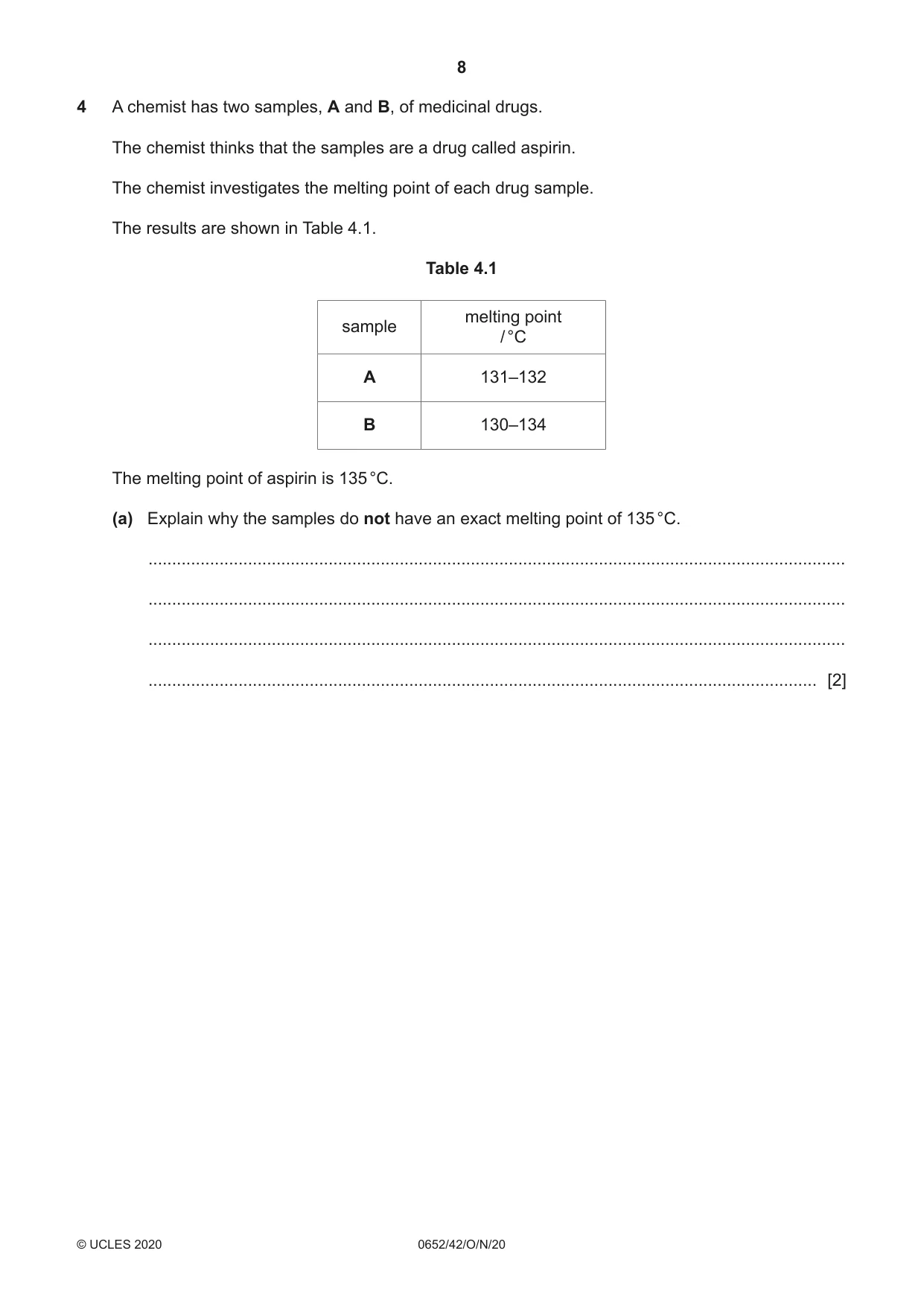
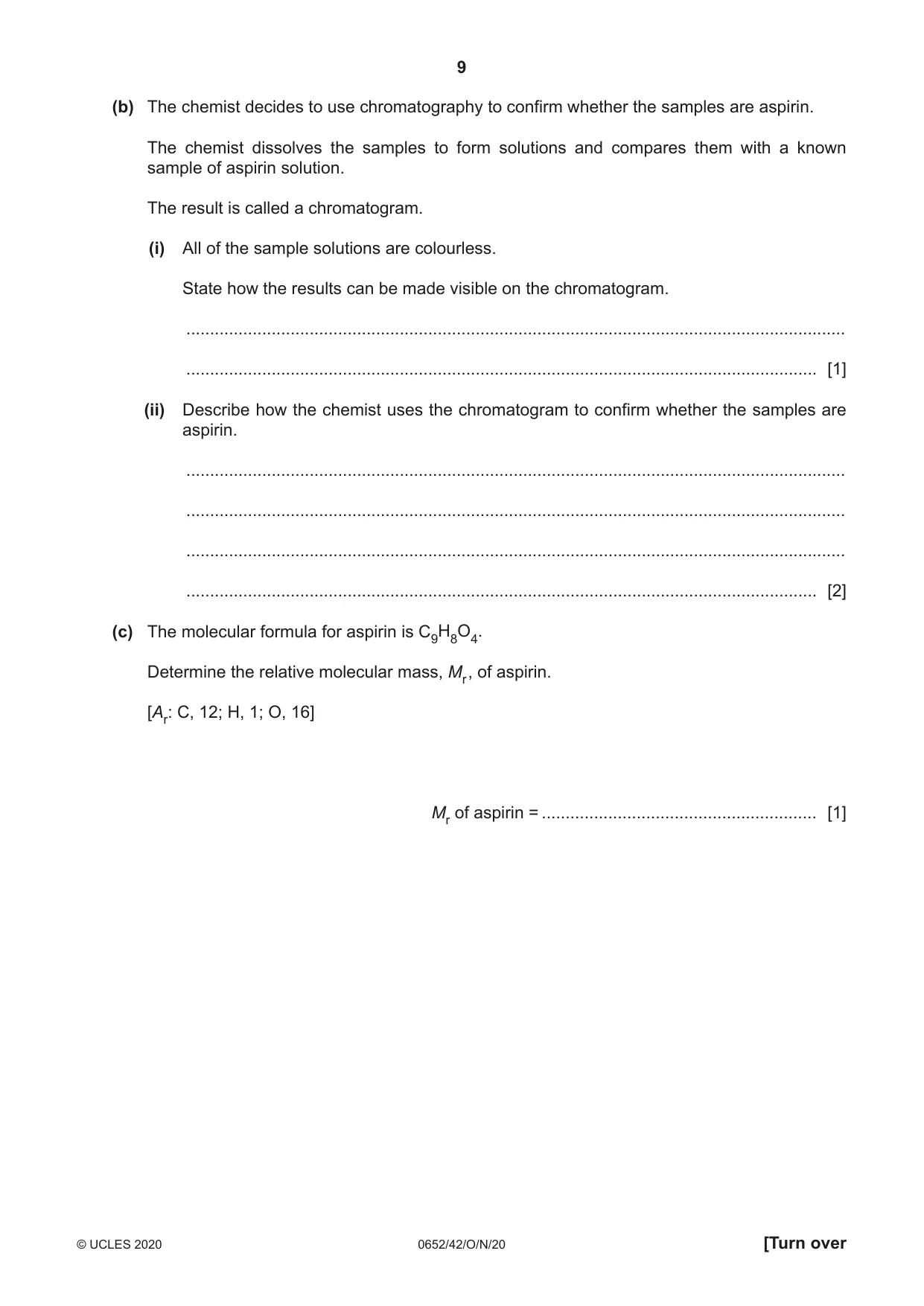
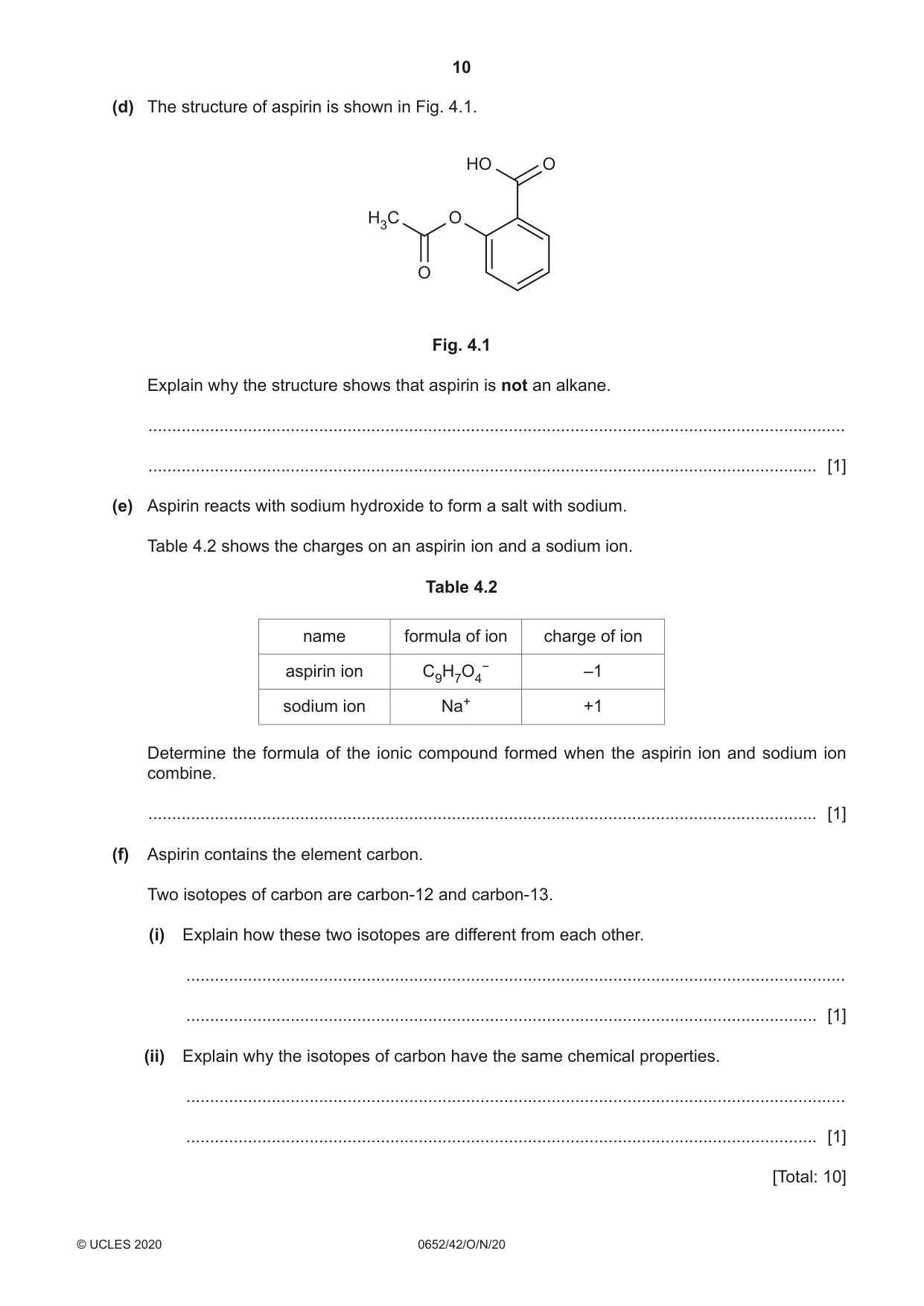
4 A chemist has two samples, A and B, of medicinal drugs. The chemist thinks that the samples are a drug called aspirin. The chemist investigates the melting point of each drug sample. The results are shown in Table 4.1. Table 4.1 melting point sample / °C A 131–132 B 130–134 The melting point of aspirin is 135 °C. (a) Explain why the samples do not have an exact melting point of 135 °C. ................................................................................................................................................... ................................................................................................................................................... ................................................................................................................................................... ............................................................................................................................................. [2] (b) The chemist decides to use chromatography to confirm whether the samples are aspirin. The chemist dissolves the samples to form solutions and compares them with a known sample of aspirin solution. The result is called a chromatogram. (i) All of the sample solutions are colourless. State how the results can be made visible on the chromatogram. ........................................................................................................................................... ..................................................................................................................................... [1] (ii) Describe how the chemist uses the chromatogram to confirm whether the samples are aspirin. ........................................................................................................................................... ........................................................................................................................................... ........................................................................................................................................... ..................................................................................................................................... [2] (c) The molecular formula for aspirin is C9H8O4. Determine the relative molecular mass, Mr , of aspirin. [Ar: C, 12; H, 1; O, 16] Mr of aspirin = .......................................................... [1] (d) The structure of aspirin is shown in Fig. 4.1. HO O H3C O O Fig. 4.1 Explain why the structure shows that aspirin is not an alkane. ................................................................................................................................................... ............................................................................................................................................. [1] (e) Aspirin reacts with sodium hydroxide to form a salt with sodium. Table 4.2 shows the charges on an aspirin ion and a sodium ion. Table 4.2 name formula of ion charge of ion aspirin ion C9H7O4− –1 sodium ion Na+ +1 Determine the formula of the ionic compound formed when the aspirin ion and sodium ion combine. ............................................................................................................................................. [1] (f) Aspirin contains the element carbon. Two isotopes of carbon are carbon-12 and carbon-13. (i) Explain how these two isotopes are different from each other. ........................................................................................................................................... ..................................................................................................................................... [1] (ii) Explain why the isotopes of carbon have the same chemical properties. ........................................................................................................................................... ..................................................................................................................................... [1] [Total: 10] Question 5 begins over the page
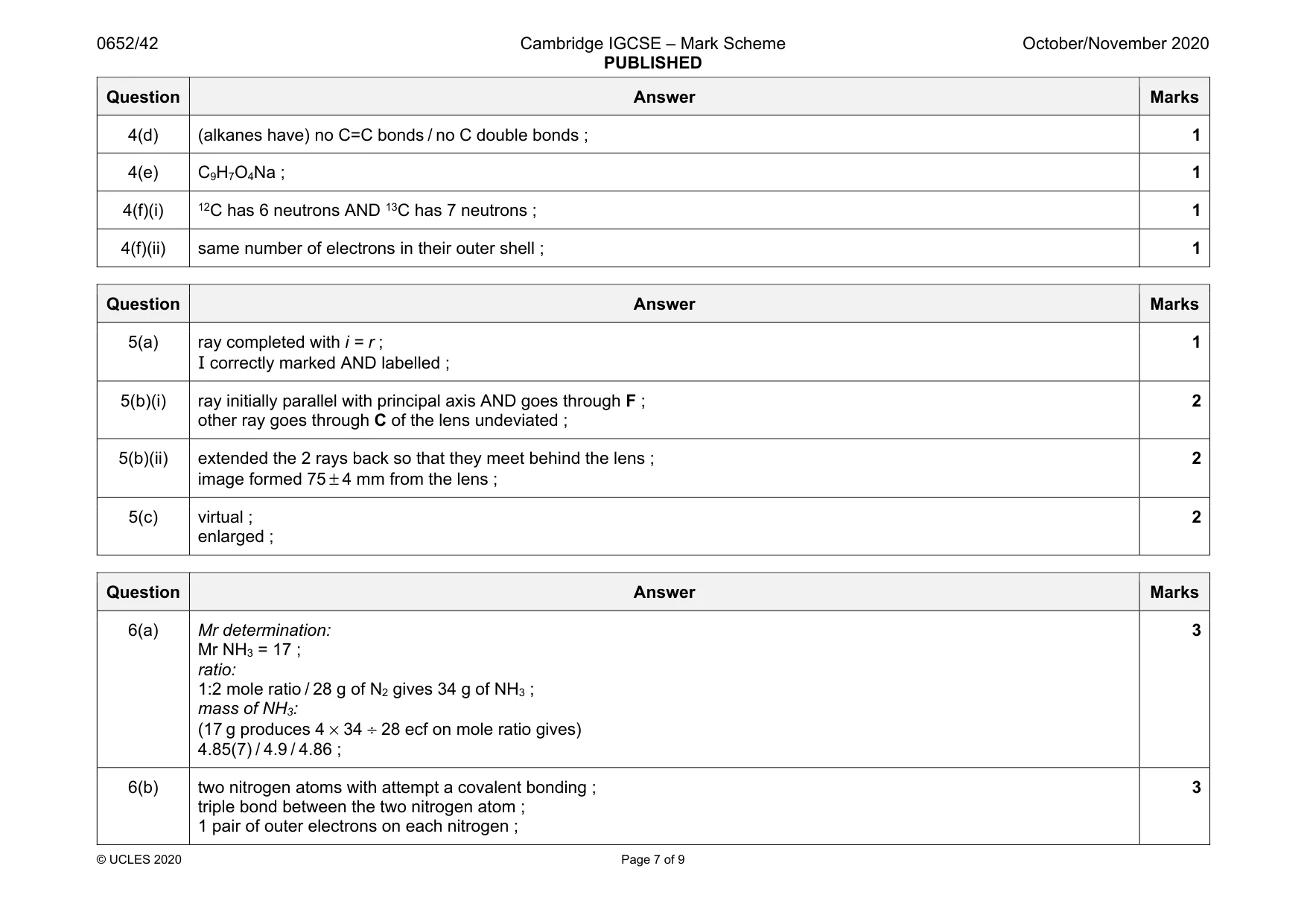
Mark scheme: 4(a) contain impurities / they are not aspirin ; (with impurities) there is no fixed melting point / lower melting point / range of melting points ; 2 4(b)(i) use a locating agent ; 1 4(b)(ii) aspirin spot will match those from known sample ; same Rf as aspirin ; 2 4(c) 180 ; 1 Question Answer Marks 4(d) (alkanes have) no C=C bonds / no C double bonds ; 1 4(e) C9H7O4Na ; 1 4(f)(i) 12C has 6 neutrons AND 13C has 7 neutrons ; 1 4(f)(ii) same number of electrons in their outer shell ; 1
Q5 · An object O is placed in front of a plane mirror
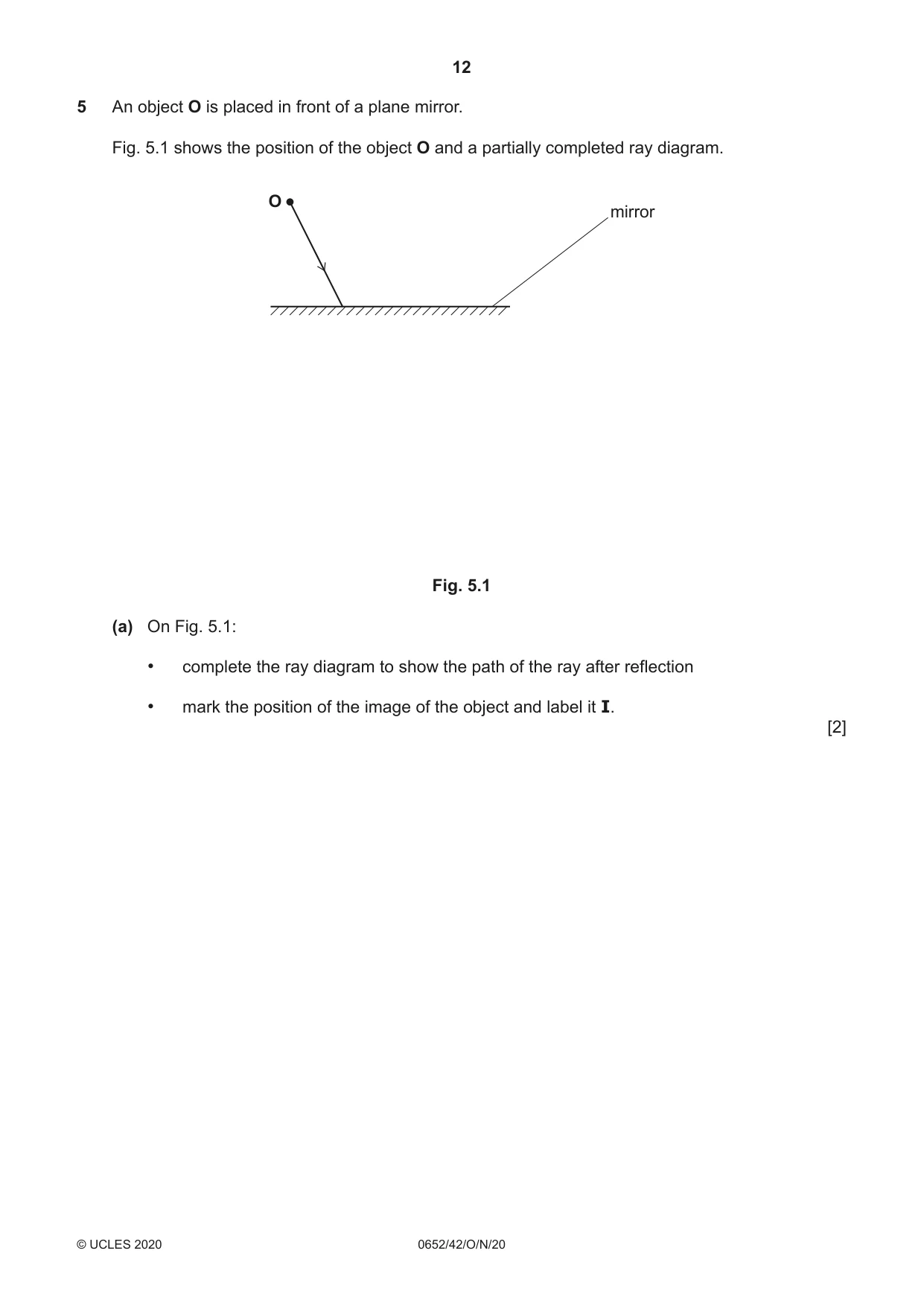
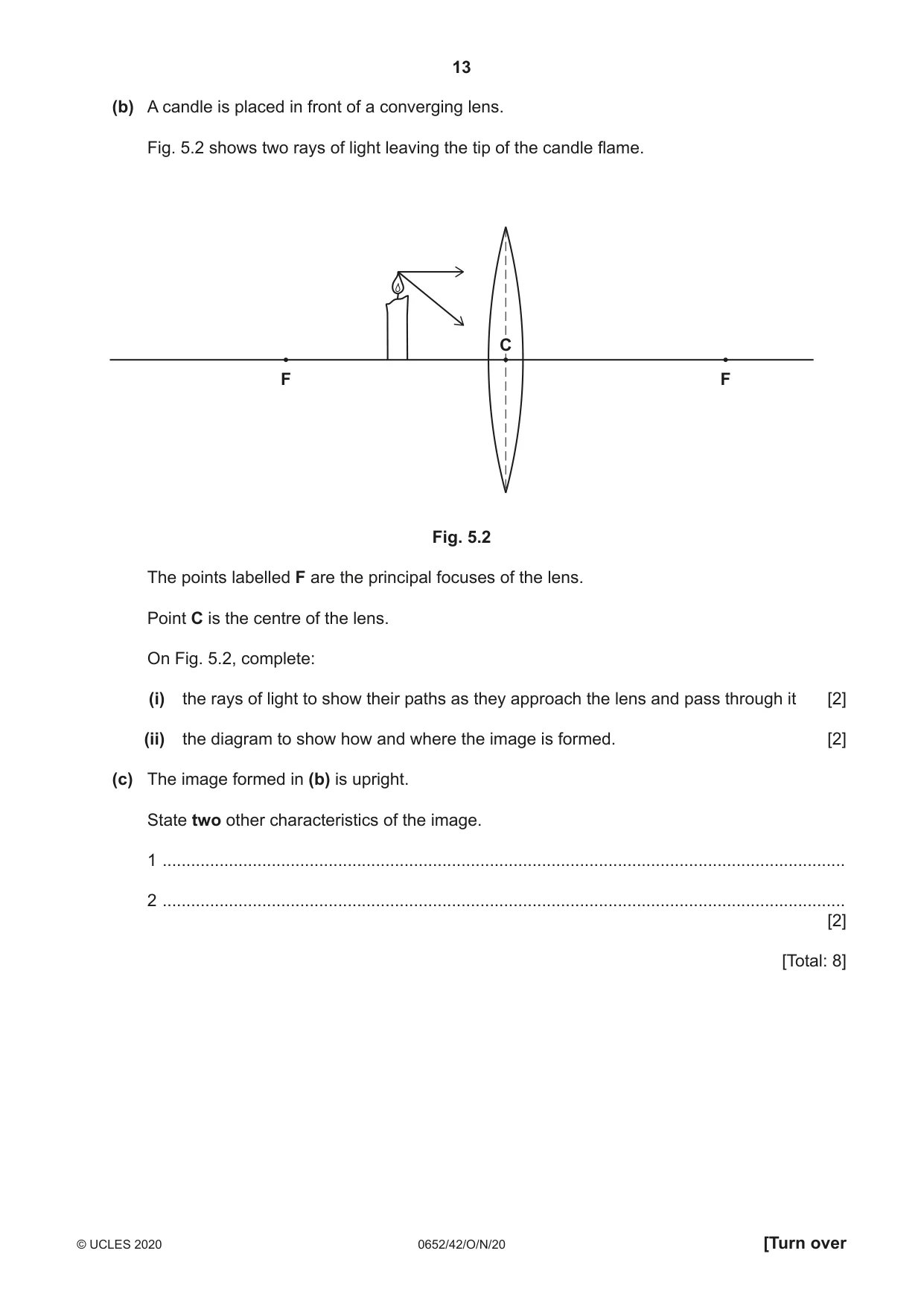
5 An object O is placed in front of a plane mirror. Fig. 5.1 shows the position of the object O and a partially completed ray diagram. O mirror Fig. 5.1 (a) On Fig. 5.1: • complete the ray diagram to show the path of the ray after reflection • mark the position of the image of the object and label it I. [2] (b) A candle is placed in front of a converging lens. Fig. 5.2 shows two rays of light leaving the tip of the candle flame. C F F Fig. 5.2 The points labelled F are the principal focuses of the lens. Point C is the centre of the lens. On Fig. 5.2, complete: (i) the rays of light to show their paths as they approach the lens and pass through it [2] (ii) the diagram to show how and where the image is formed. [2] (c) The image formed in (b) is upright. State two other characteristics of the image. 1 ................................................................................................................................................ 2 ................................................................................................................................................ [2] [Total: 8]
Mark scheme: 5(a) ray completed with i = r ; I correctly marked AND labelled ; 1 5(b)(i) ray initially parallel with principal axis AND goes through F ; other ray goes through C of the lens undeviated ; 2 5(b)(ii) extended the 2 rays back so that they meet behind the lens ; image formed 75 ± 4 mm from the lens ; 2 5(c) virtual ; enlarged ; 2
Q6 · Nitrogen and hydrogen react to form ammonia, NH3
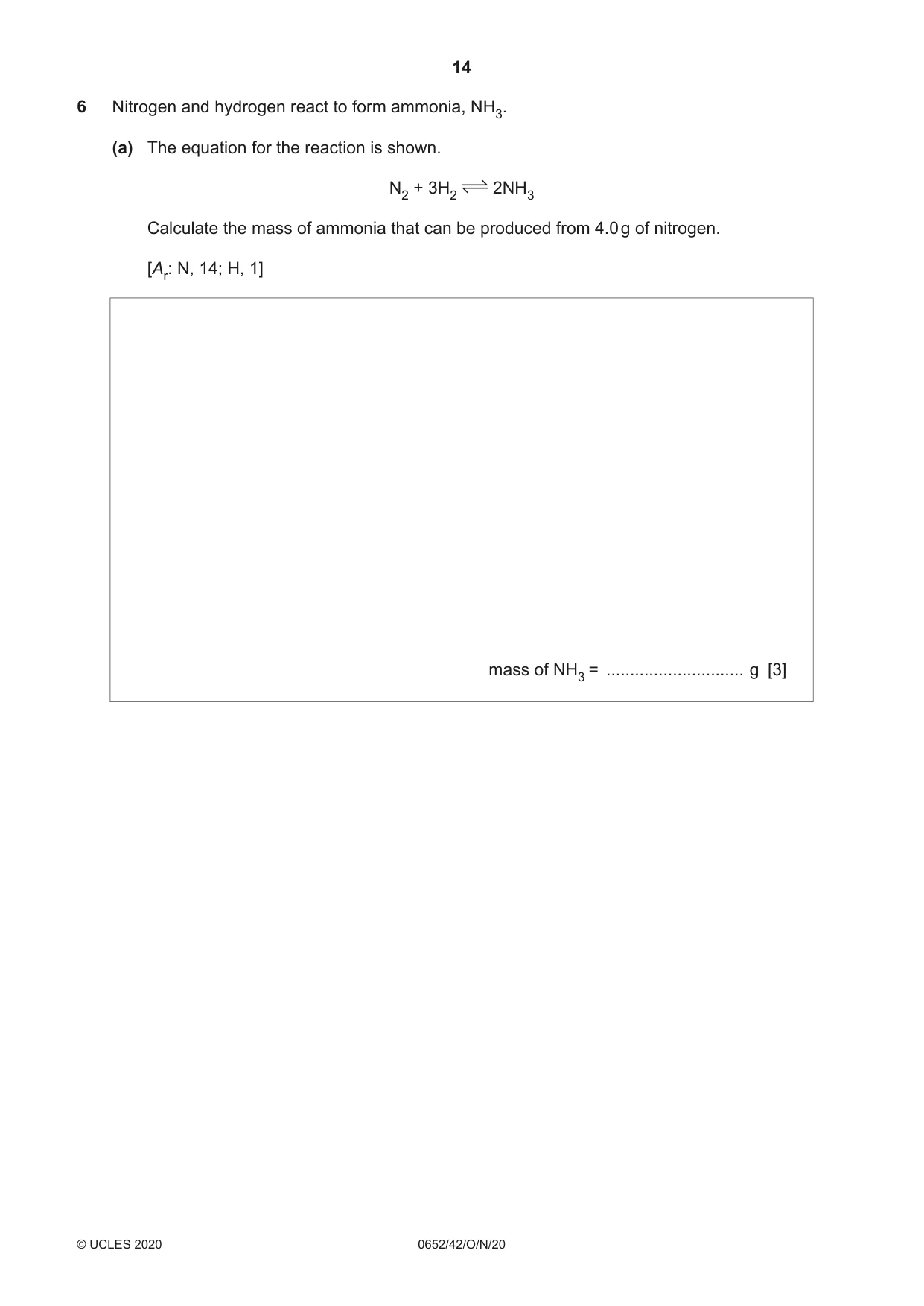
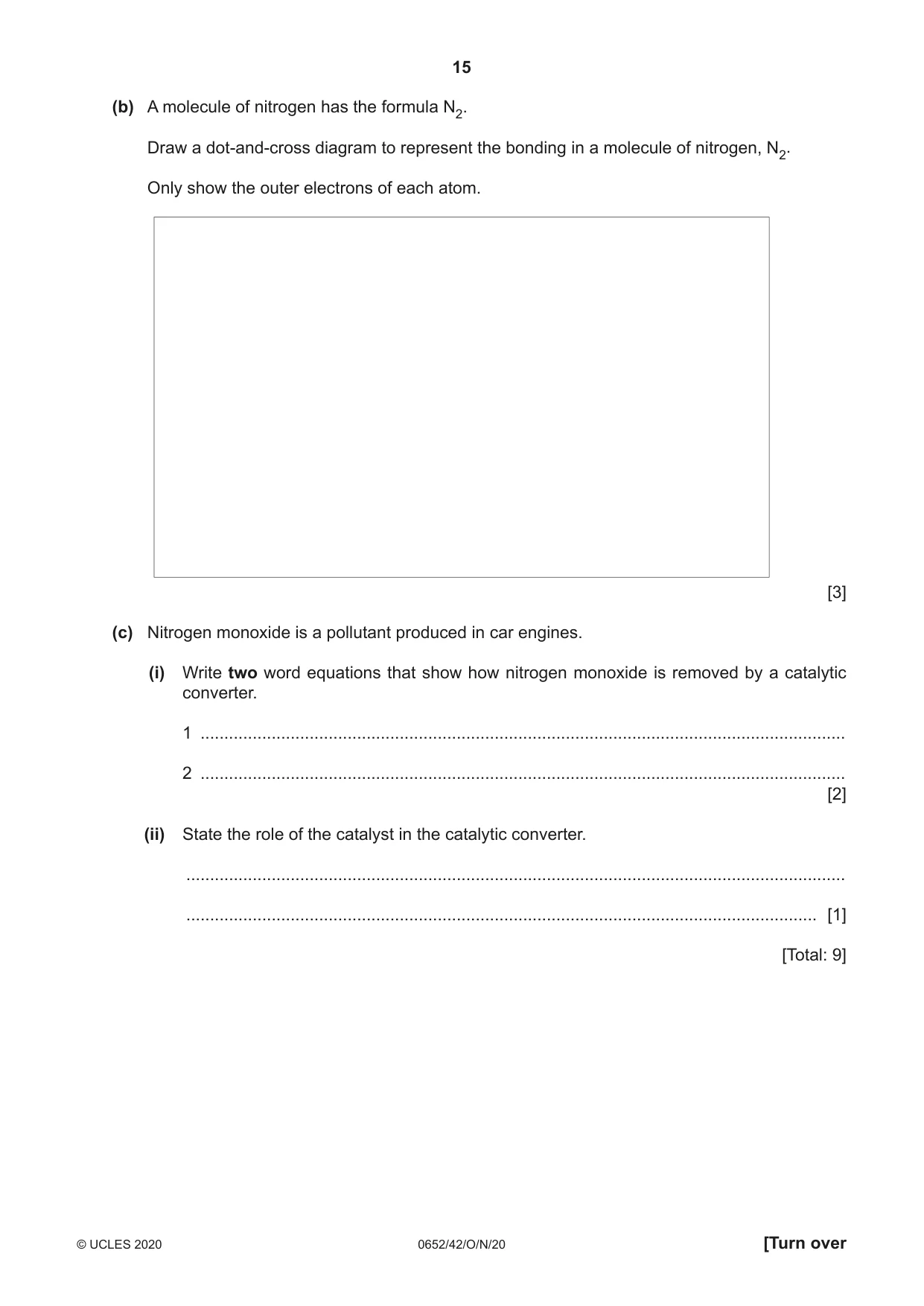
6 Nitrogen and hydrogen react to form ammonia, NH3. (a) The equation for the reaction is shown. N2 + 3H2 2NH3 Calculate the mass of ammonia that can be produced from 4.0 g of nitrogen. [Ar: N, 14; H, 1] mass of NH3 = ............................. g [3] (b) A molecule of nitrogen has the formula N2. Draw a dot-and-cross diagram to represent the bonding in a molecule of nitrogen, N2. Only show the outer electrons of each atom. [3] (c) Nitrogen monoxide is a pollutant produced in car engines. (i) Write two word equations that show how nitrogen monoxide is removed by a catalytic converter. 1 ........................................................................................................................................ 2 ........................................................................................................................................ [2] (ii) State the role of the catalyst in the catalytic converter. ........................................................................................................................................... ..................................................................................................................................... [1] [Total: 9]
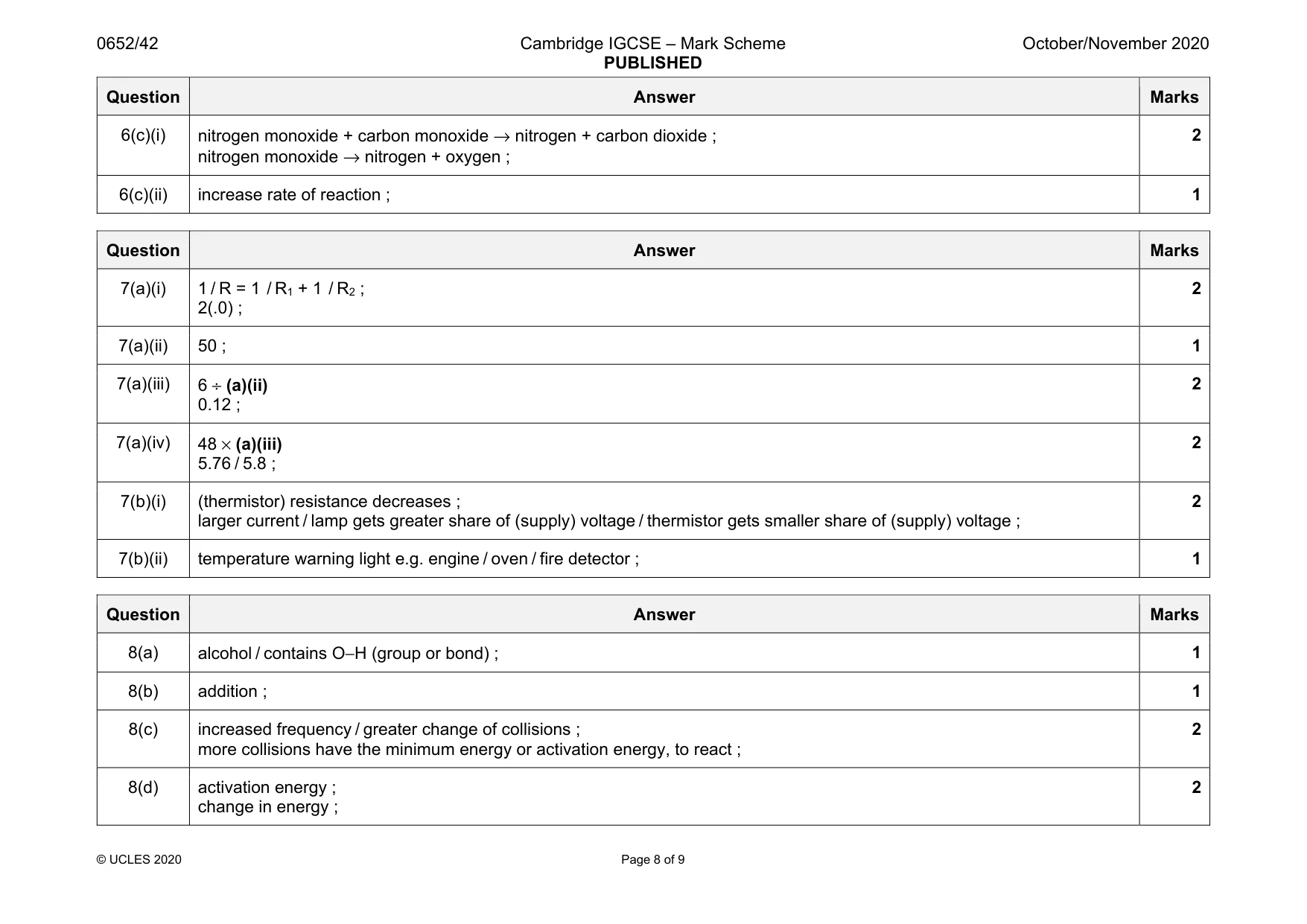
Mark scheme: 6(a) Mr determination: Mr NH3 = 17 ; ratio: 1:2 mole ratio / 28 g of N2 gives 34 g of NH3 ; mass of NH3: (17 g produces 4 × 34 ÷ 28 ecf on mole ratio gives) 4.85(7) / 4.9 / 4.86 ; 6(b) two nitrogen atoms with attempt a covalent bonding ; triple bond between the two nitrogen atom ; 1 pair of outer electrons on each nitrogen ; 3 Question Answer Marks 6(c)(i) nitrogen monoxide + carbon monoxide → nitrogen + carbon dioxide ; nitrogen monoxide → nitrogen + oxygen ; 2 6(c)(ii) increase rate of reaction ; 1
Q7 · The circuit in Fig
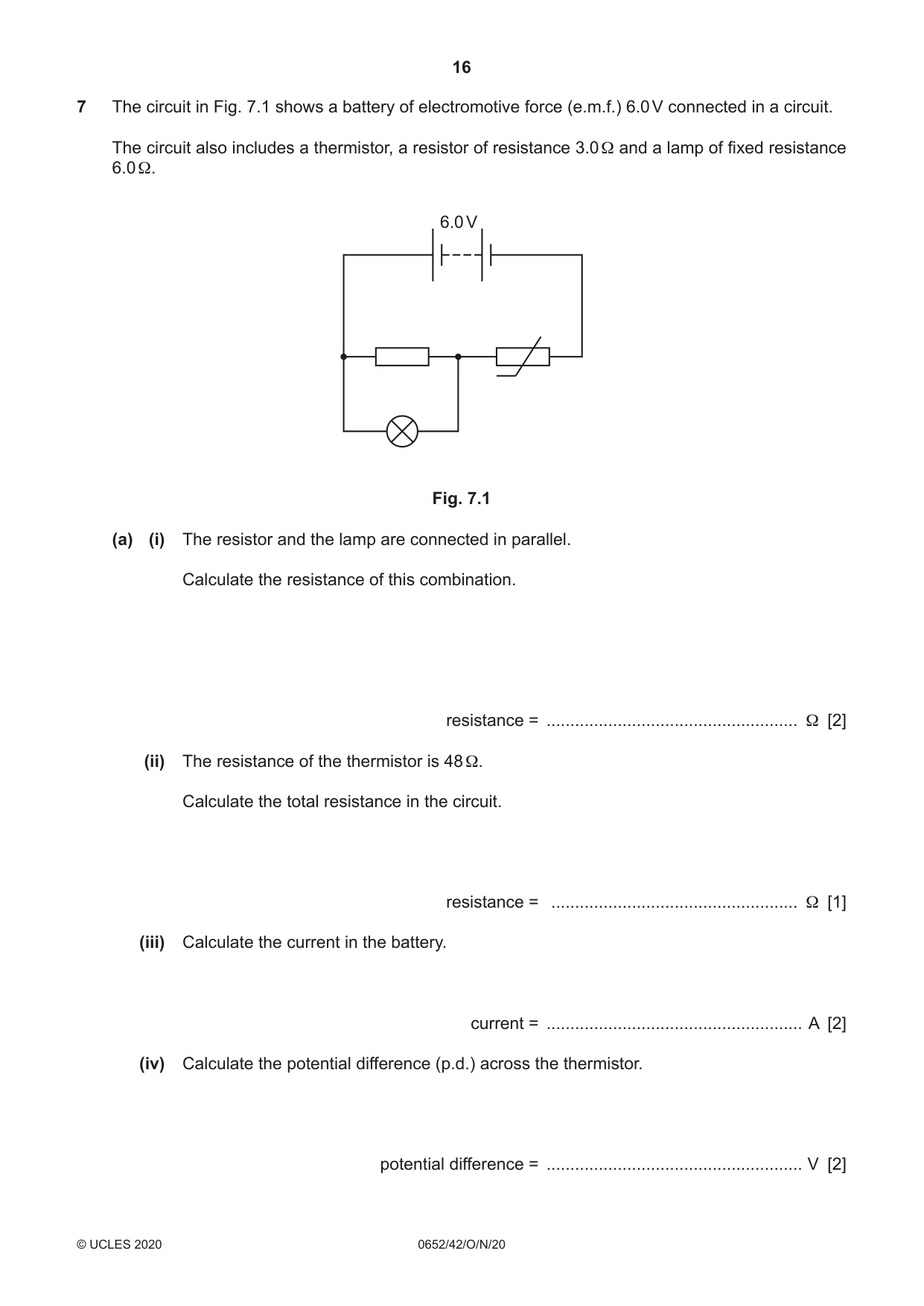
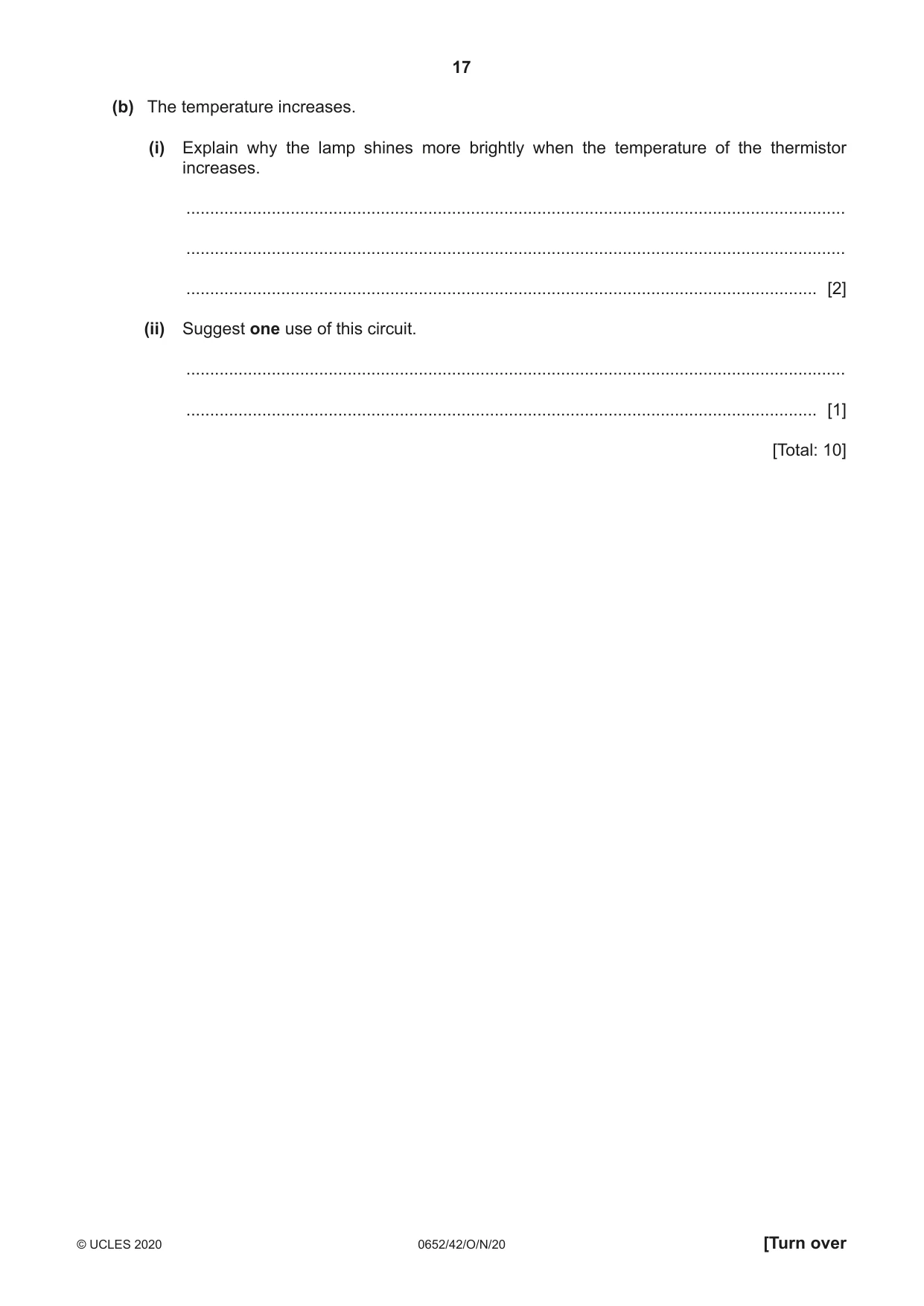
7 The circuit in Fig. 7.1 shows a battery of electromotive force (e.m.f.) 6.0 V connected in a circuit. The circuit also includes a thermistor, a resistor of resistance 3.0 Ω and a lamp of fixed resistance 6.0 Ω. 6.0 V Fig. 7.1 (a) (i) The resistor and the lamp are connected in parallel. Calculate the resistance of this combination. resistance = ..................................................... Ω [2] (ii) The resistance of the thermistor is 48 Ω. Calculate the total resistance in the circuit. resistance = .................................................... Ω [1] (iii) Calculate the current in the battery. current = ...................................................... A [2] (iv) Calculate the potential difference (p.d.) across the thermistor. potential difference = ...................................................... V [2] (b) The temperature increases. (i) Explain why the lamp shines more brightly when the temperature of the thermistor increases. ........................................................................................................................................... ........................................................................................................................................... ..................................................................................................................................... [2] (ii) Suggest one use of this circuit. ........................................................................................................................................... ..................................................................................................................................... [1] [Total: 10]
Mark scheme: 7(a)(i) 1 / R = 1 / R1 + 1 / R2 ; 2(.0) ; 2 7(a)(ii) 50 ; 1 7(a)(iii) 6 ÷ (a)(ii) 0.12 ; 2 7(a)(iv) 48 × (a)(iii) 5.76 / 5.8 ; 2 7(b)(i) (thermistor) resistance decreases ; larger current / lamp gets greater share of (supply) voltage / thermistor gets smaller share of (supply) voltage ; 2 7(b)(ii) temperature warning light e.g. engine / oven / fire detector ; 1
Q8 · The structure of an organic compound, 3-bromo-cyclohexan-1-ol
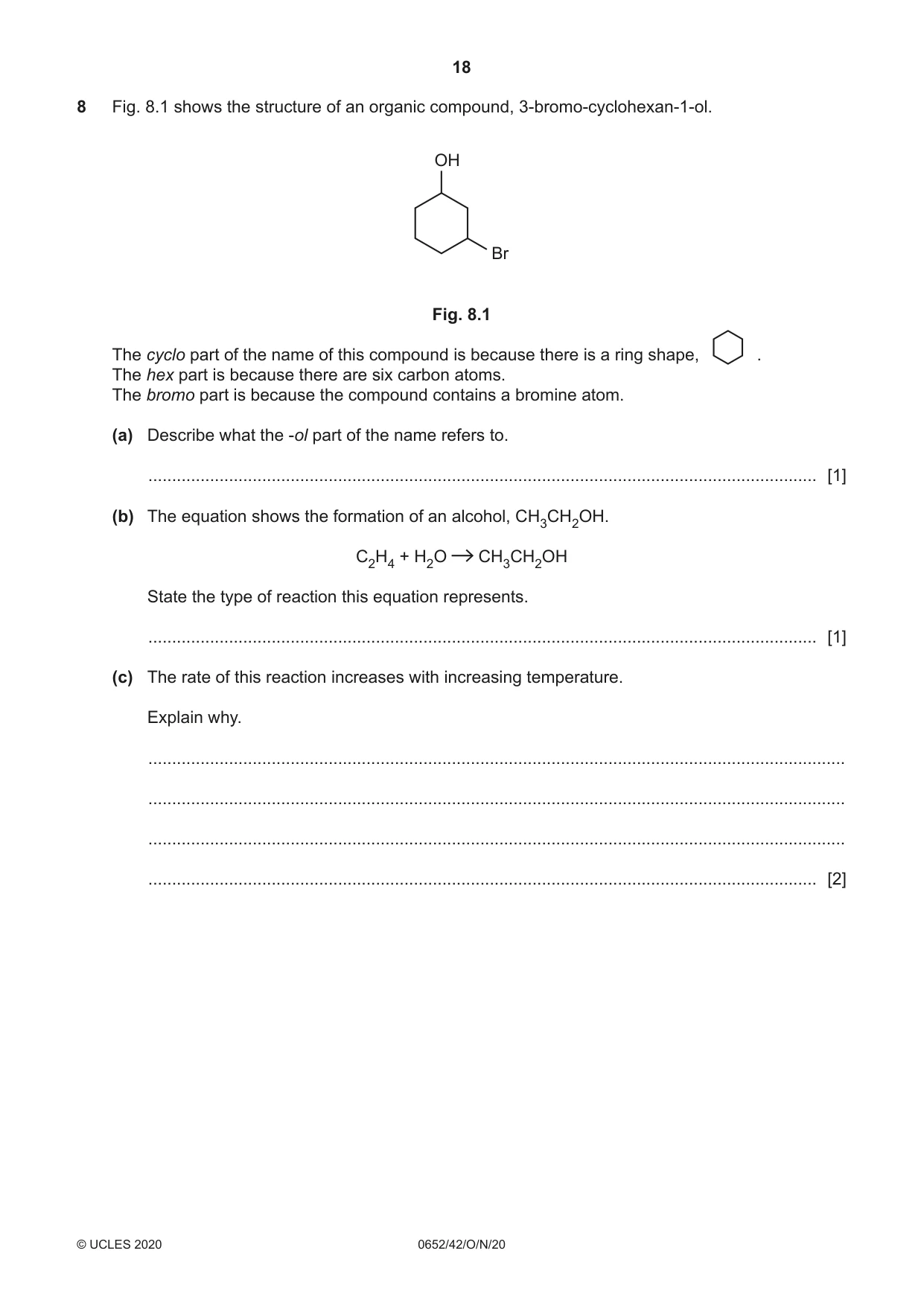
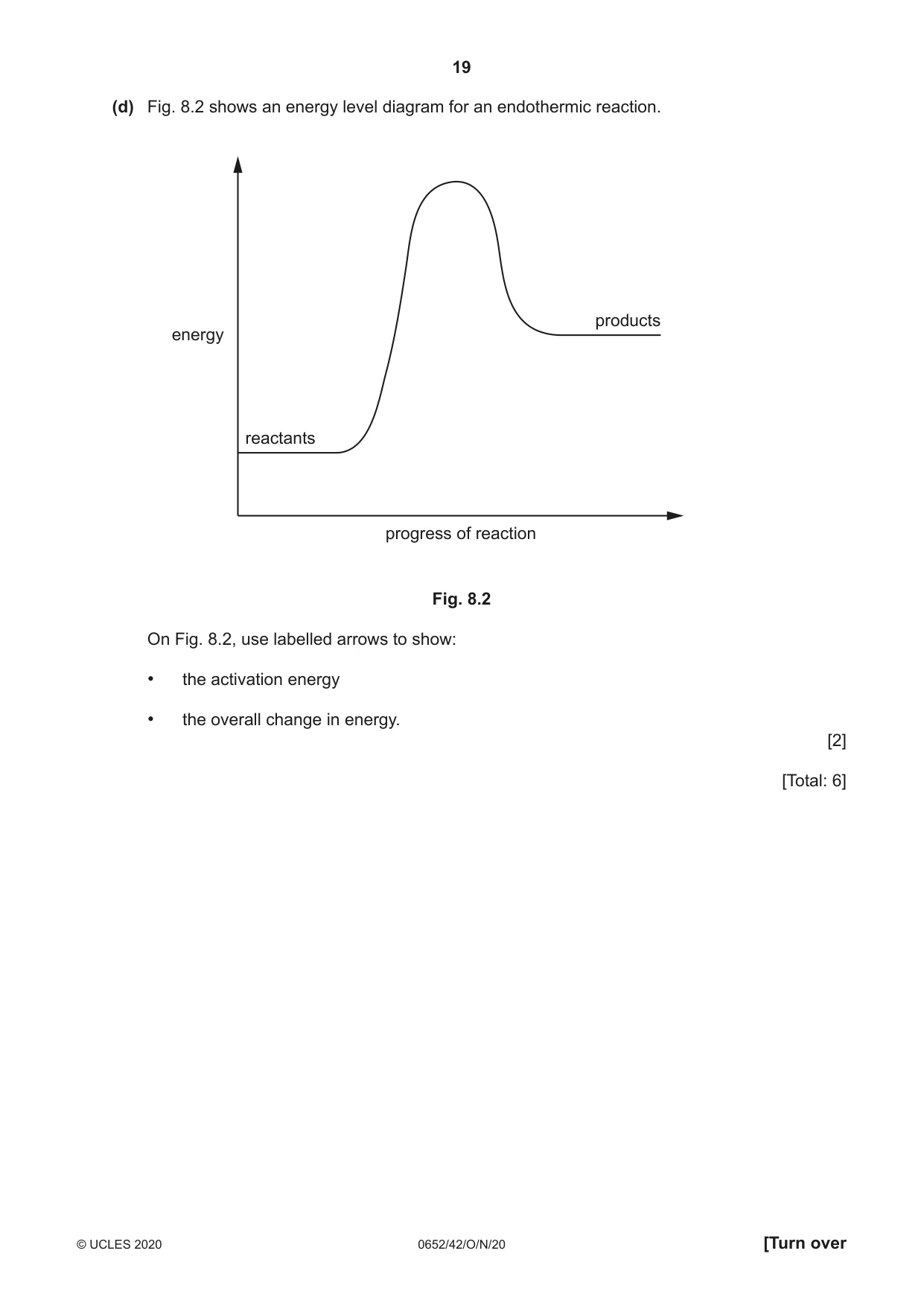
8 Fig. 8.1 shows the structure of an organic compound, 3-bromo-cyclohexan-1-ol. OH Br Fig. 8.1 The cyclo part of the name of this compound is because there is a ring shape, . The hex part is because there are six carbon atoms. The bromo part is because the compound contains a bromine atom. (a) Describe what the -ol part of the name refers to. ............................................................................................................................................. [1] (b) The equation shows the formation of an alcohol, CH3CH2OH. C2H4 + H2O CH3CH2OH State the type of reaction this equation represents. ............................................................................................................................................. [1] (c) The rate of this reaction increases with increasing temperature. Explain why. ................................................................................................................................................... ................................................................................................................................................... ................................................................................................................................................... ............................................................................................................................................. [2] (d) Fig. 8.2 shows an energy level diagram for an endothermic reaction. products energy reactants progress of reaction Fig. 8.2 On Fig. 8.2, use labelled arrows to show: • the activation energy • the overall change in energy. [2] [Total: 6]
Mark scheme: 8(a) alcohol / contains O−H (group or bond) ; 1 8(b) addition ; 1 8(c) increased frequency / greater change of collisions ; more collisions have the minimum energy or activation energy, to react ; 2 8(d) activation energy ; change in energy ; 2
Q9 · A radioactive source emits both α-particles and β-particles
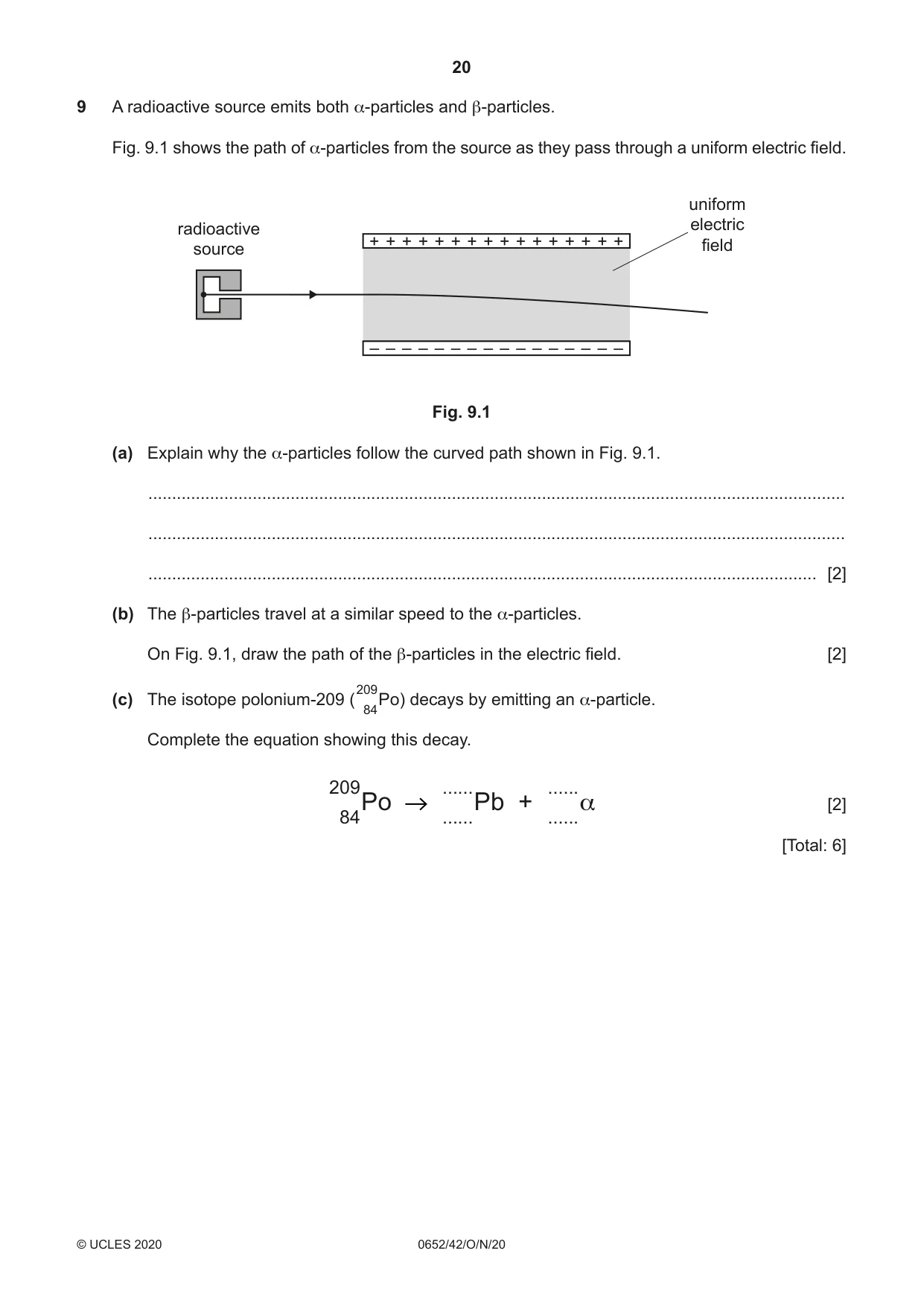
9 A radioactive source emits both α-particles and β-particles. Fig. 9.1 shows the path of α-particles from the source as they pass through a uniform electric field. uniform radioactive electric + + + + + + + + + + + + + + + + field source – – – – – – – – – – – – – – – – Fig. 9.1 (a) Explain why the α-particles follow the curved path shown in Fig. 9.1. ................................................................................................................................................... ................................................................................................................................................... ............................................................................................................................................. [2] (b) The β-particles travel at a similar speed to the α-particles. On Fig. 9.1, draw the path of the β-particles in the electric field. [2] 209 (c) The isotope polonium-209 ( 84Po) decays by emitting an α-particle. Complete the equation showing this decay. 209 ...... ...... [2] 84Po ......Pb + ......α [Total: 6]
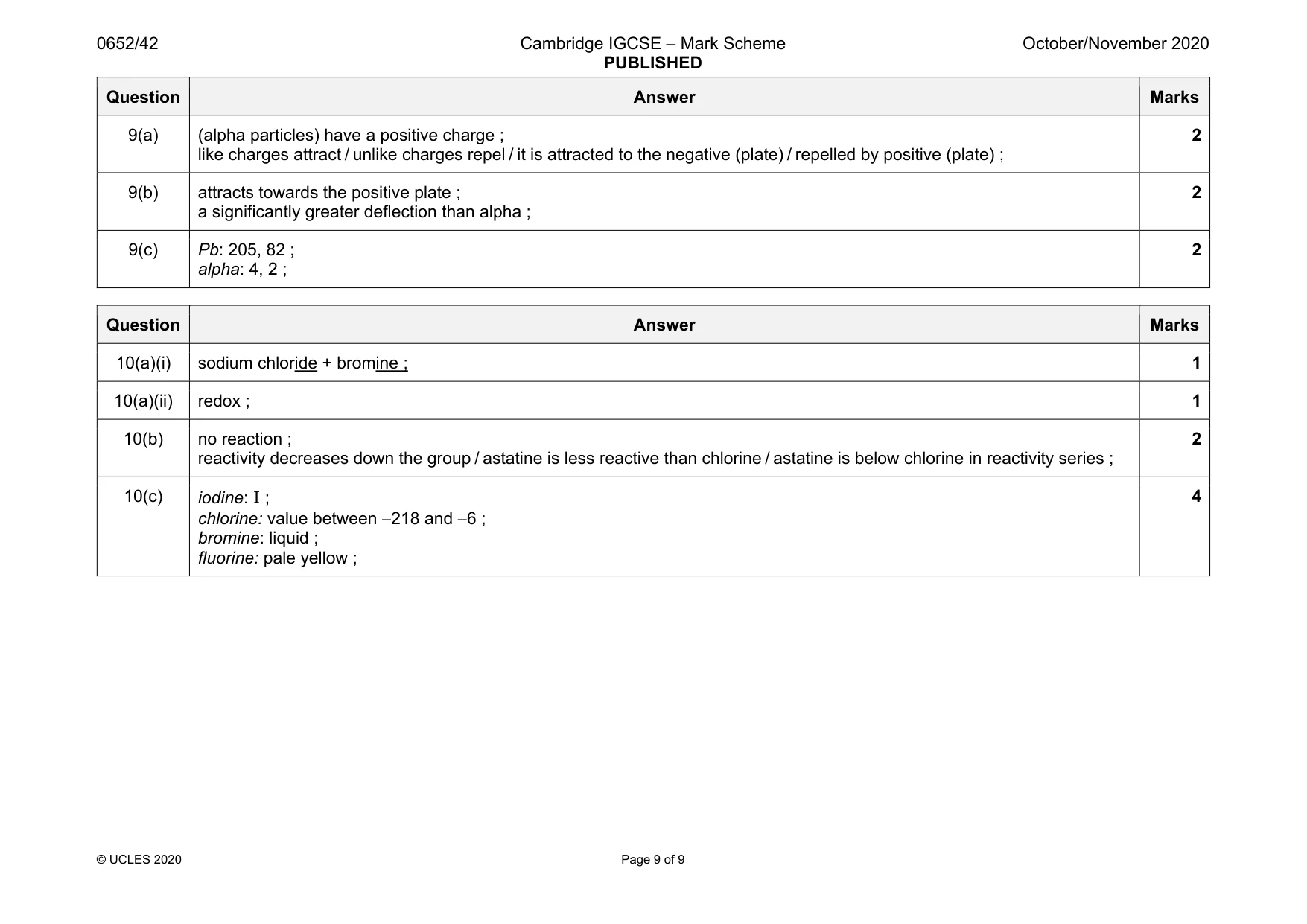
Mark scheme: 9(a) (alpha particles) have a positive charge ; like charges attract / unlike charges repel / it is attracted to the negative (plate) / repelled by positive (plate) ; 2 9(b) attracts towards the positive plate ; a significantly greater deflection than alpha ; 2 9(c) Pb: 205, 82 ; alpha: 4, 2 ; 2
Q10 · Chlorine and bromine are halogens in Group VII of the Periodic Table
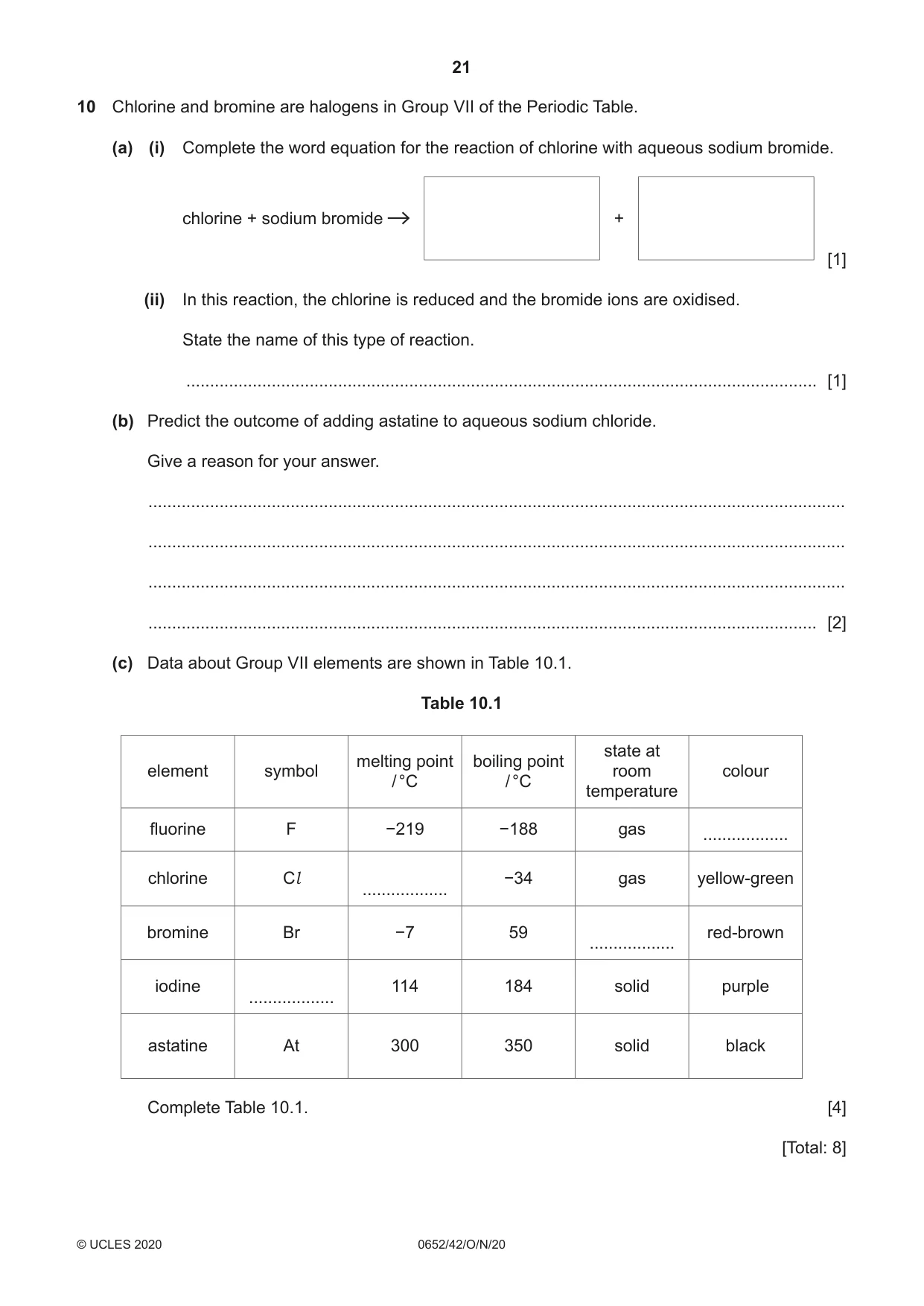
10 Chlorine and bromine are halogens in Group VII of the Periodic Table. (a) (i) Complete the word equation for the reaction of chlorine with aqueous sodium bromide. chlorine + sodium bromide + [1] (ii) In this reaction, the chlorine is reduced and the bromide ions are oxidised. State the name of this type of reaction. ..................................................................................................................................... [1] (b) Predict the outcome of adding astatine to aqueous sodium chloride. Give a reason for your answer. ................................................................................................................................................... ................................................................................................................................................... ................................................................................................................................................... ............................................................................................................................................. [2] (c) Data about Group VII elements are shown in Table 10.1. Table 10.1 state at melting point boiling point element symbol room colour / °C / °C temperature fluorine F −219 −188 gas .................. chlorine Cl −34 gas yellow-green .................. bromine Br −7 59 red-brown .................. iodine 114 184 solid purple .................. astatine At 300 350 solid black Complete Table 10.1. [4] [Total: 8]
Mark scheme: 10(a)(i) sodium chloride + bromine ; 1 10(a)(ii) redox ; 1 10(b) no reaction ; reactivity decreases down the group / astatine is less reactive than chlorine / astatine is below chlorine in reactivity series ; 2 10(c) iodine: I ; chlorine: value between −218 and −6 ; bromine: liquid ; fluorine: pale yellow ; 4
What was in this paper
The subtopics covered by these 10 questions, and how many questions each got. Open one in a new tab to see every Cambridge question on it.
What you needed in this session
Cambridge’s own grade thresholds for 2020 Oct/Nov, Paper 4 · Variant 2. A higher threshold means an easier paper — the bar moves with how the cohort did.