Cambridge IGCSE Physical Science 0652 — 2024 Oct/Nov Paper 4 · Variant 1
0652/41/O/N/24 · 10 questions · 80 marks · ≈90 min
The question paper and its mark scheme, free to read here and free to download. This is Cambridge’s own paper, exactly as it was sat.
Question paper24 pages
Mark scheme9 pages
Answers below. Sit the paper first if you are practising.
Questions as text
Q1 · The structures of some substances, A–F
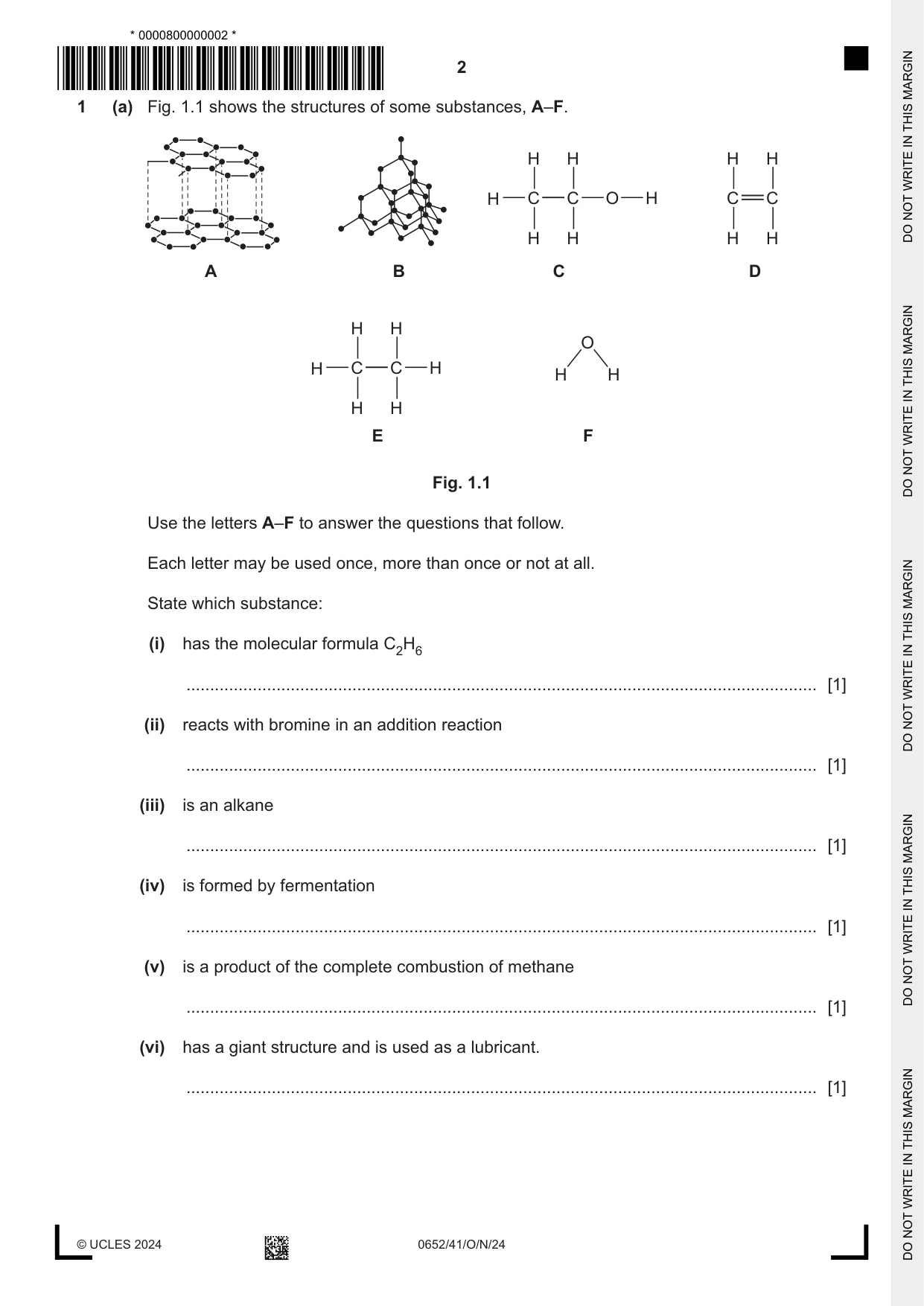
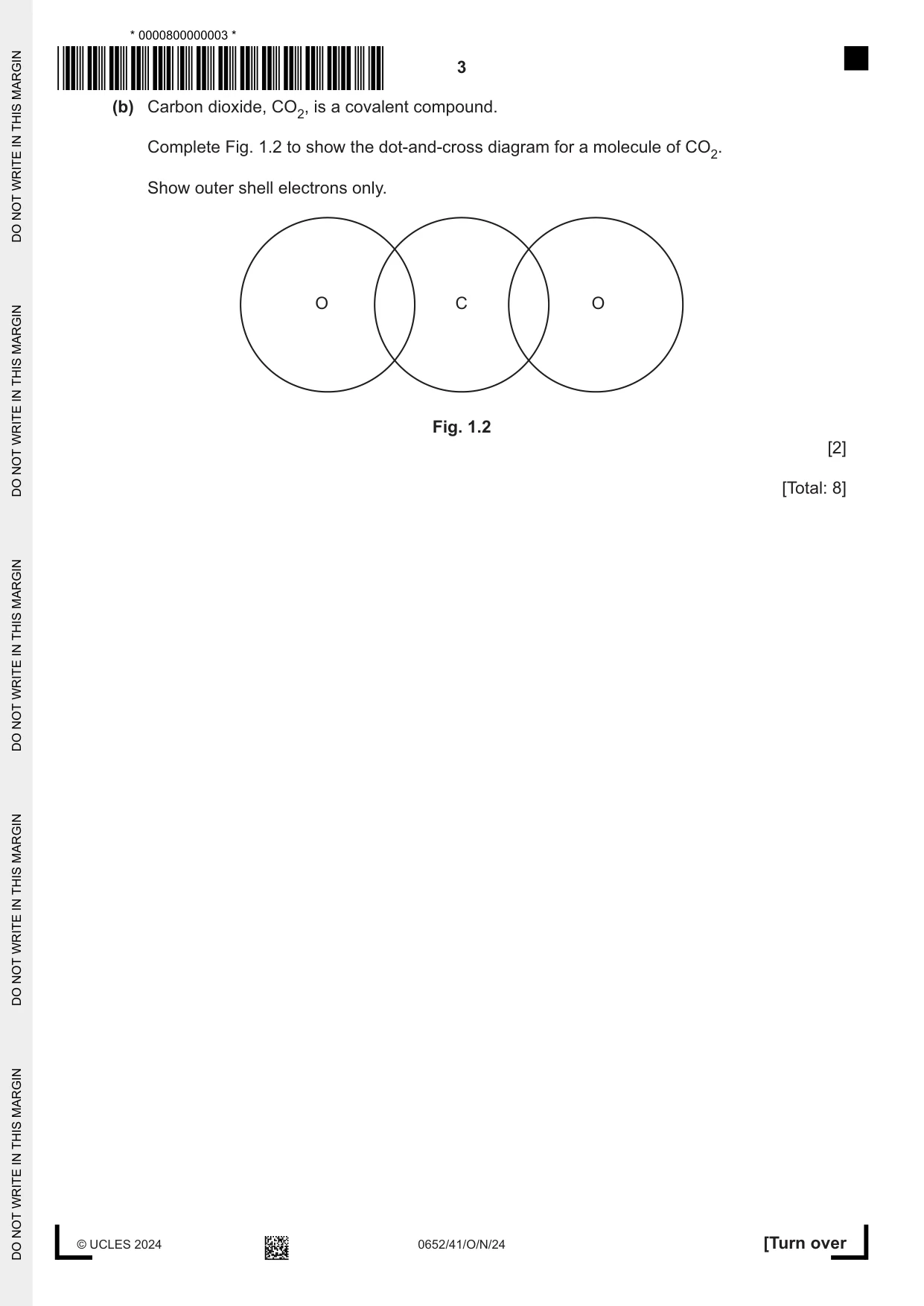
1 (a) Fig. 1.1 shows the structures of some substances, A–F. H H H H H C C O H C C H H H H A B C D H H O H C C H H H H H E F Fig. 1.1 Use the letters A–F to answer the questions that follow. Each letter may be used once, more than once or not at all. State which substance: (i) has the molecular formula C2H6 ..................................................................................................................................... [1] (ii) reacts with bromine in an addition reaction ..................................................................................................................................... [1] (iii) is an alkane ..................................................................................................................................... [1] (iv) is formed by fermentation ..................................................................................................................................... [1] (v) is a product of the complete combustion of methane ..................................................................................................................................... [1] (vi) has a giant structure and is used as a lubricant. ..................................................................................................................................... [1] (b) Carbon dioxide, CO2, is a covalent compound. Complete Fig. 1.2 to show the dot-and-cross diagram for a molecule of CO2. Show outer shell electrons only. O C O Fig. 1.2 [2] [Total: 8]
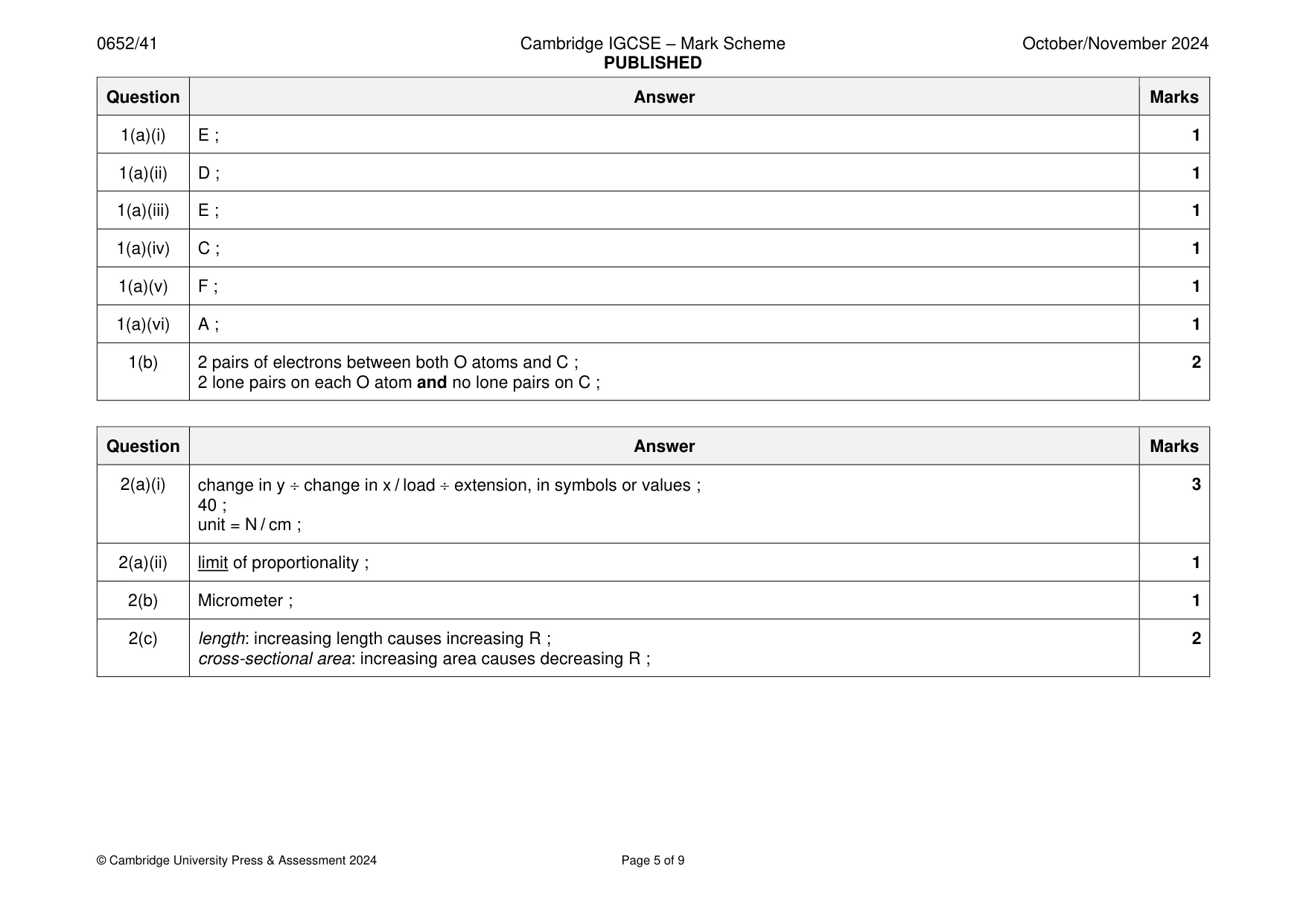
Mark scheme: Question Answer Marks 1(a)(i) E ; 1 1(a)(ii) D ; 1 1(a)(iii) E ; 1 1(a)(iv) C ; 1 1(a)(v) F ; 1 1(a)(vi) A ; 1 1(b) 2 pairs of electrons between both O atoms and C ; 2 2 lone pairs on each O atom and no lone pairs on C ;
Q2 · A long thin wire is attached to the ceiling, as shown in Fig
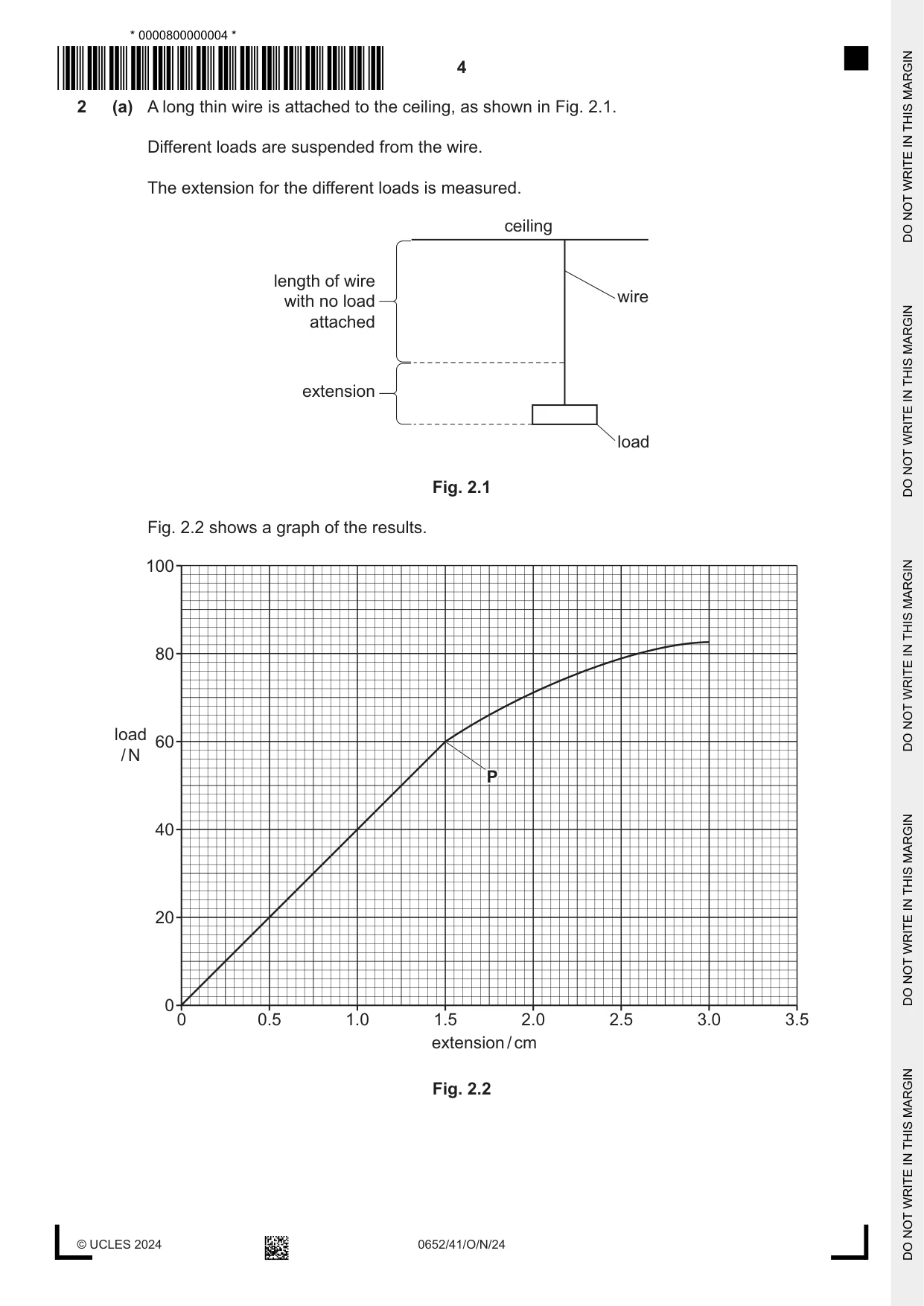
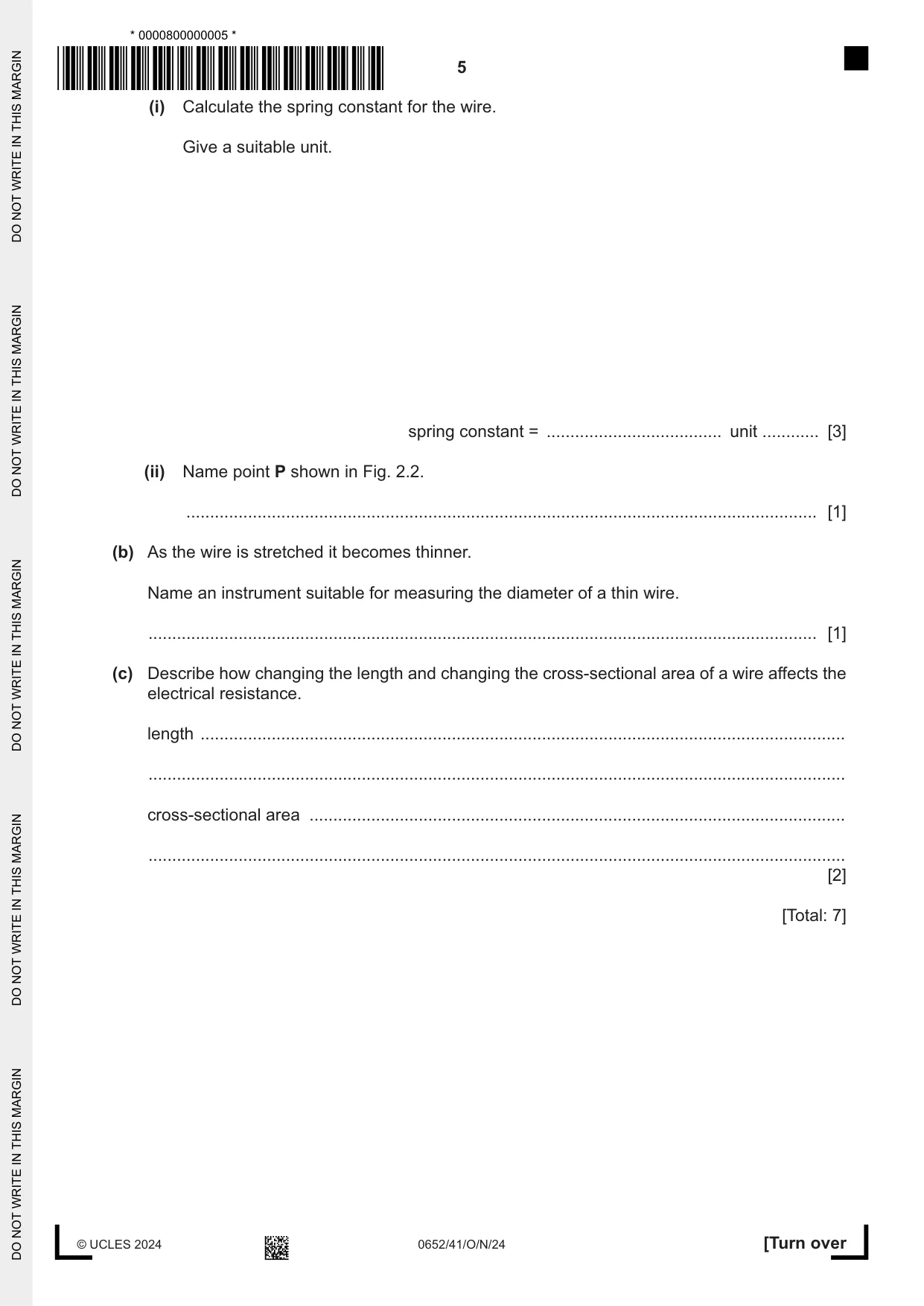
2 (a) A long thin wire is attached to the ceiling, as shown in Fig. 2.1. Different loads are suspended from the wire. The extension for the different loads is measured. ceiling length of wire wire with no load attached extension load Fig. 2.1 Fig. 2.2 shows a graph of the results. 100 80 load 60 / N P 40 20 0 0 0.5 1.0 1.5 2.0 2.5 3.0 3.5 extension / cm Fig. 2.2 (i) Calculate the spring constant for the wire. Give a suitable unit. spring constant = ..................................... unit ............ [3] (ii) Name point P shown in Fig. 2.2. ..................................................................................................................................... [1] (b) As the wire is stretched it becomes thinner. Name an instrument suitable for measuring the diameter of a thin wire. ............................................................................................................................................. [1] (c) Describe how changing the length and changing the cross-sectional area of a wire affects the electrical resistance. length ........................................................................................................................................ ................................................................................................................................................... cross-sectional area ................................................................................................................. ................................................................................................................................................... [2] [Total: 7]
Mark scheme: 2(a)(i) change in y change in x / load extension, in symbols or values ; 3 40 ; unit = N / cm ; 2(a)(ii) limit of proportionality ; 1 2(b) Micrometer ; 1 2(c) length: increasing length causes increasing R ; 2 cross-sectional area: increasing area causes decreasing R ;
Q3 · Sodium chloride, NaCl, is an ionic compound
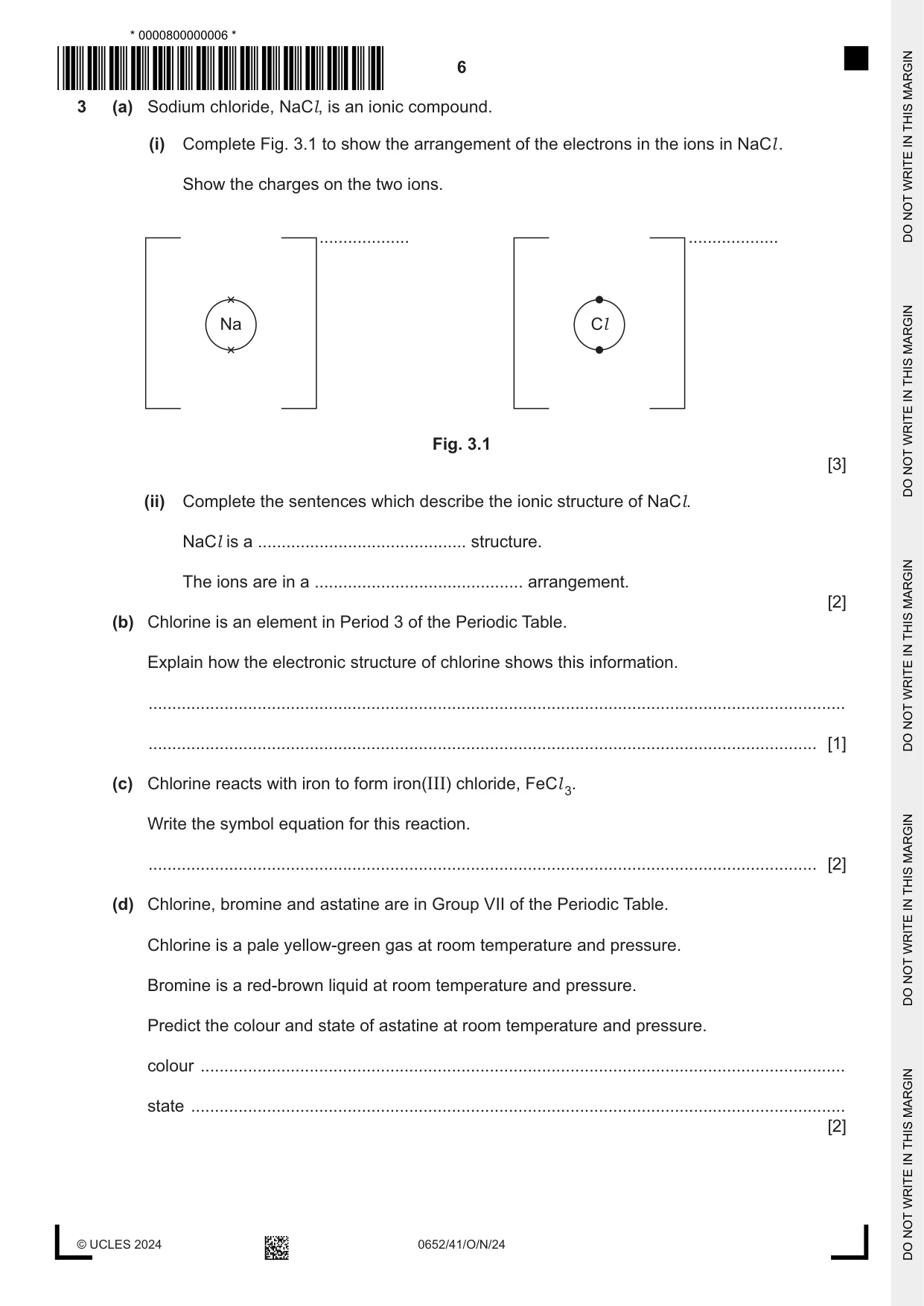
3 (a) Sodium chloride, NaCl, is an ionic compound. (i) Complete Fig. 3.1 to show the arrangement of the electrons in the ions in NaCl . Show the charges on the two ions. ................... ................... Na Cl Fig. 3.1 [3] (ii) Complete the sentences which describe the ionic structure of NaCl. NaCl is a ............................................ structure. The ions are in a ............................................ arrangement. [2] (b) Chlorine is an element in Period 3 of the Periodic Table. Explain how the electronic structure of chlorine shows this information. ................................................................................................................................................... ............................................................................................................................................. [1] (c) Chlorine reacts with iron to form iron(III) chloride, FeCl 3. Write the symbol equation for this reaction. ............................................................................................................................................. [2] (d) Chlorine, bromine and astatine are in Group VII of the Periodic Table. Chlorine is a pale yellow-green gas at room temperature and pressure. Bromine is a red-brown liquid at room temperature and pressure. Predict the colour and state of astatine at room temperature and pressure. colour ........................................................................................................................................ state .......................................................................................................................................... [2] (e) Explain why neon will not react with chlorine. ................................................................................................................................................... ...............................................................................................................................................[1] [Total: 11]
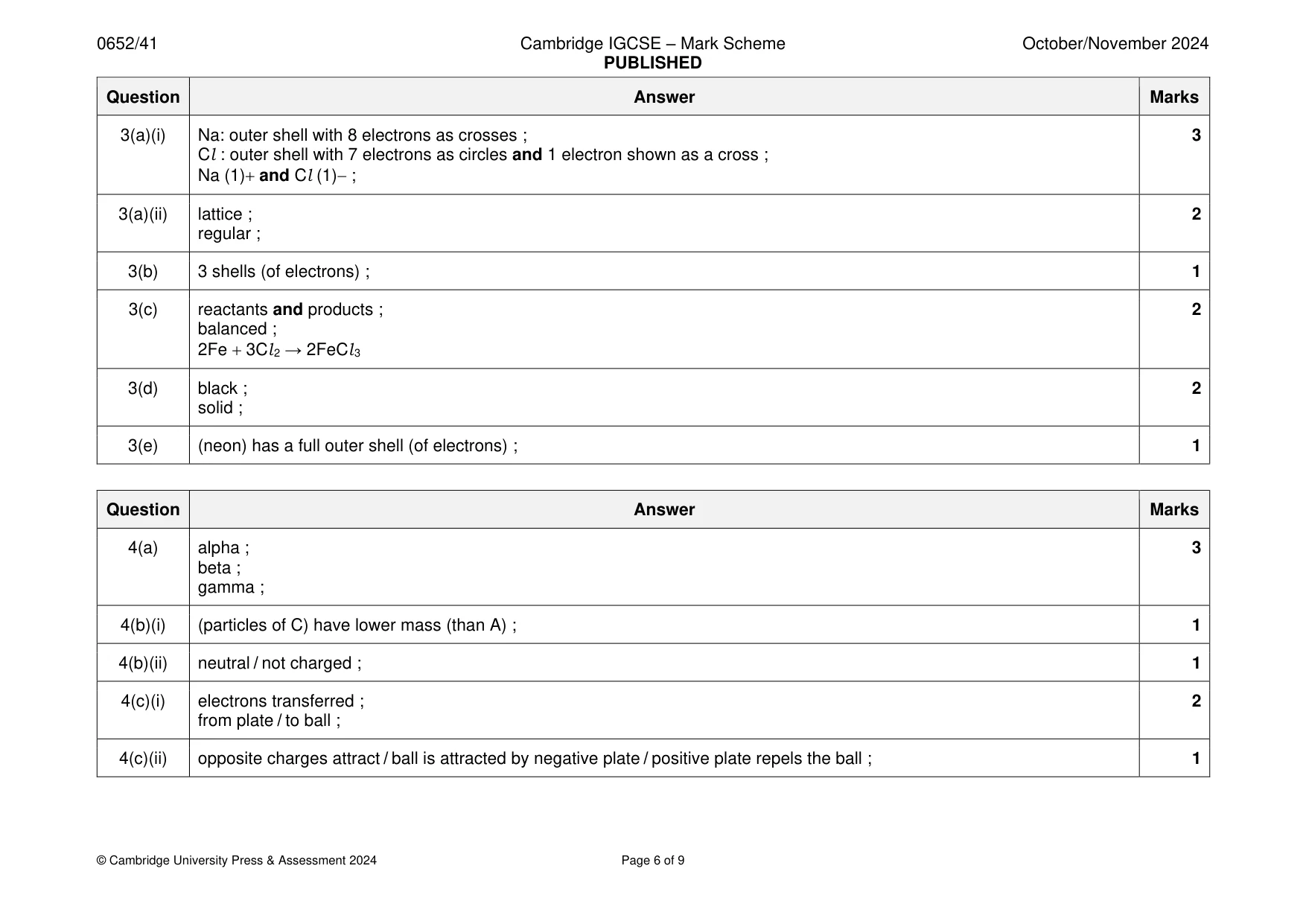
Mark scheme: 3(a)(i) Na: outer shell with 8 electrons as crosses ; 3 Cl : outer shell with 7 electrons as circles and 1 electron shown as a cross ; Na (1)+ and Cl (1)− ; 3(a)(ii) lattice ; 2 regular ; 3(b) 3 shells (of electrons) ; 1 3(c) reactants and products ; 2 balanced ; 2Fe + 3Cl 2 → 2FeCl 3 3(d) black ; 2 solid ; 3(e) (neon) has a full outer shell (of electrons) ; 1
Q4 · A radioactive source emits three different types of radiation
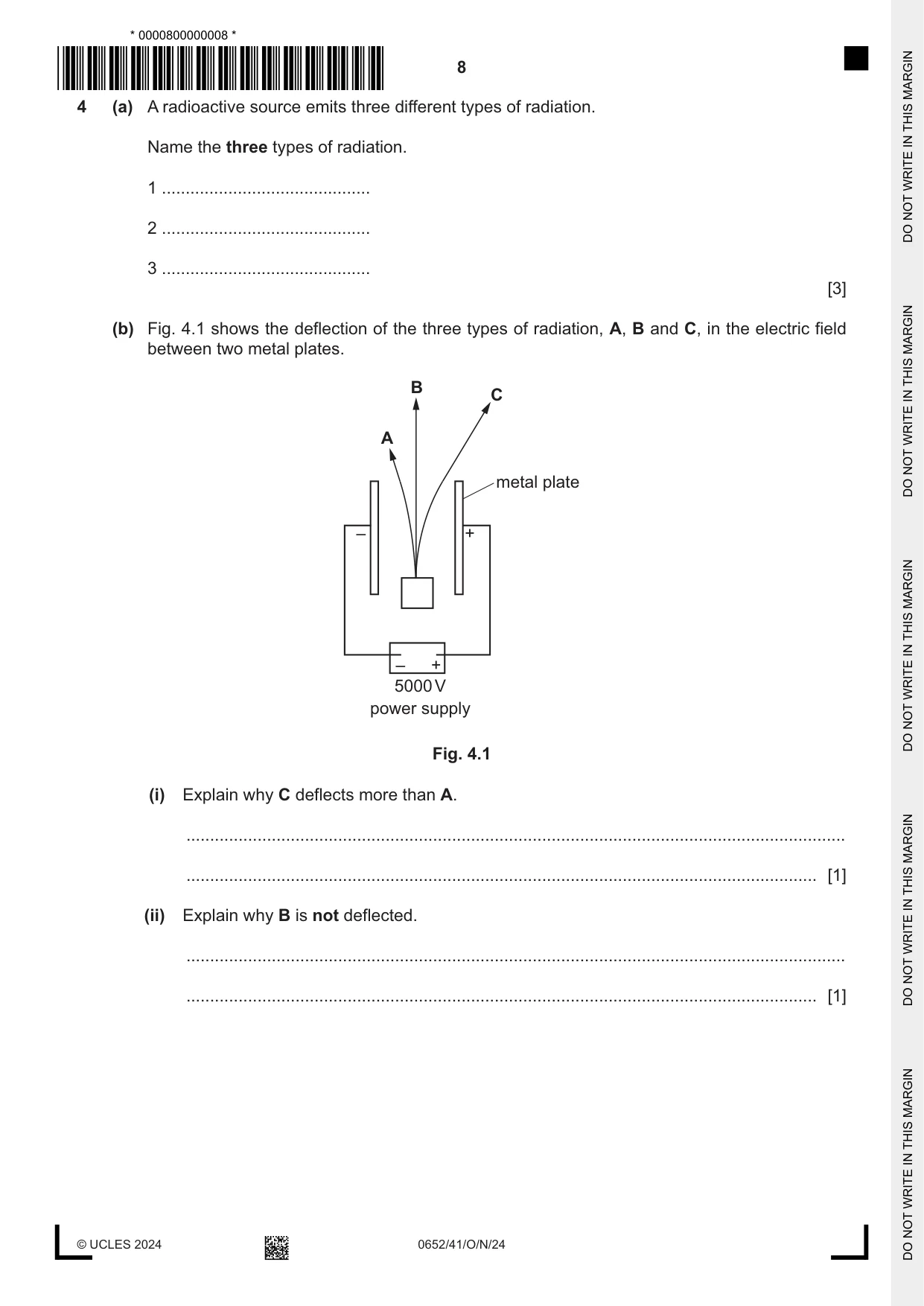
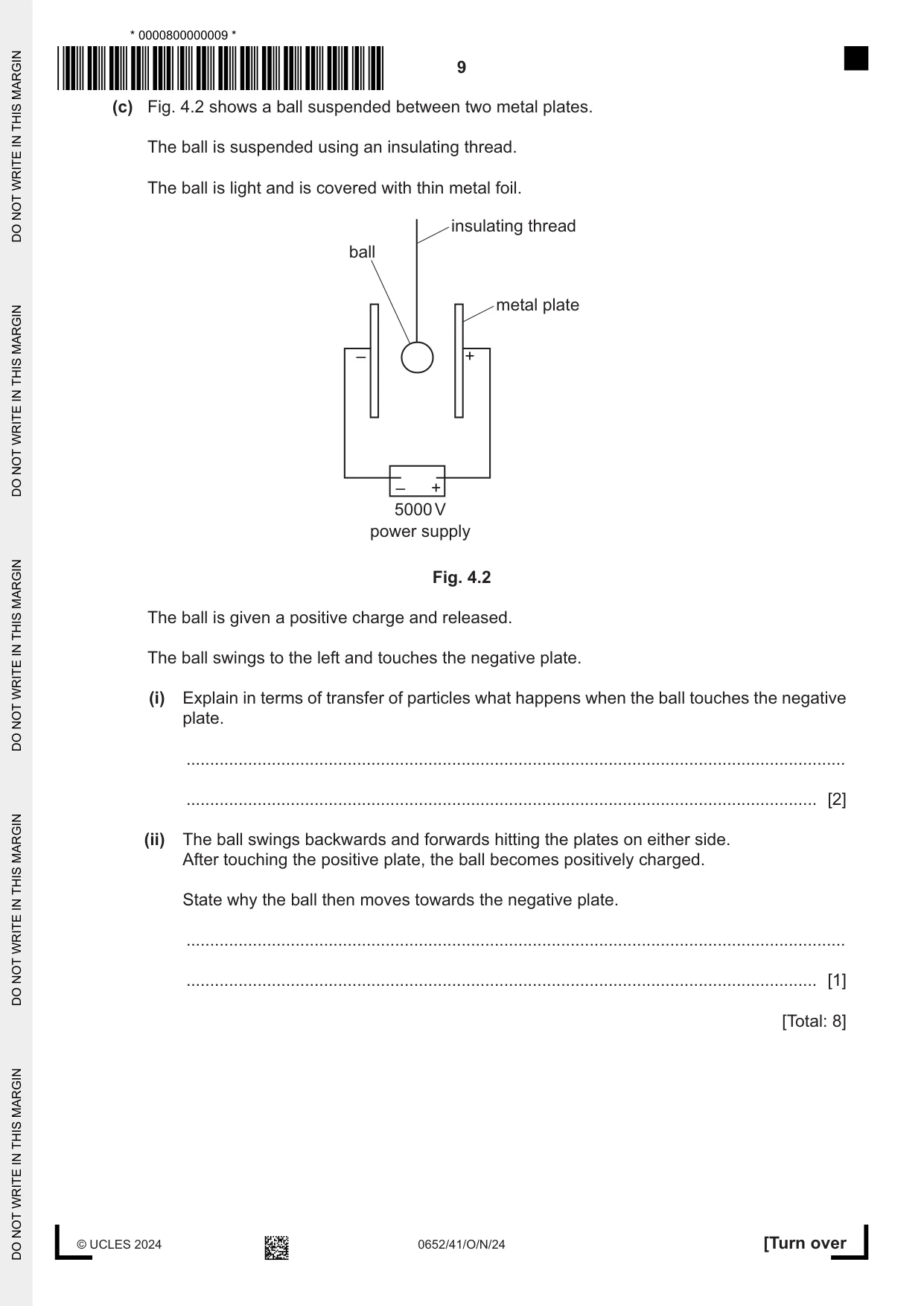
4 (a) A radioactive source emits three different types of radiation. Name the three types of radiation. 1 ............................................ 2 ............................................ 3 ............................................ [3] (b) Fig. 4.1 shows the deflection of the three types of radiation, A, B and C, in the electric field between two metal plates. B C A metal plate – + – + 5000 V power supply Fig. 4.1 (i) Explain why C deflects more than A. ........................................................................................................................................... ..................................................................................................................................... [1] (ii) Explain why B is not deflected. ........................................................................................................................................... ..................................................................................................................................... [1] (c) Fig. 4.2 shows a ball suspended between two metal plates. The ball is suspended using an insulating thread. The ball is light and is covered with thin metal foil. insulating thread ball metal plate – + – + 5000 V power supply Fig. 4.2 The ball is given a positive charge and released. The ball swings to the left and touches the negative plate. (i) Explain in terms of transfer of particles what happens when the ball touches the negative plate. ........................................................................................................................................... ..................................................................................................................................... [2] (ii) The ball swings backwards and forwards hitting the plates on either side. After touching the positive plate, the ball becomes positively charged. State why the ball then moves towards the negative plate. ........................................................................................................................................... ..................................................................................................................................... [1] [Total: 8]
Mark scheme: 4(a) alpha ; 3 beta ; gamma ; 4(b)(i) (particles of C) have lower mass (than A) ; 1 4(b)(ii) neutral / not charged ; 1 4(c)(i) electrons transferred ; 2 from plate / to ball ; 4(c)(ii) opposite charges attract / ball is attracted by negative plate / positive plate repels the ball ; 1
Q5 · Calcium carbonate is heated strongly
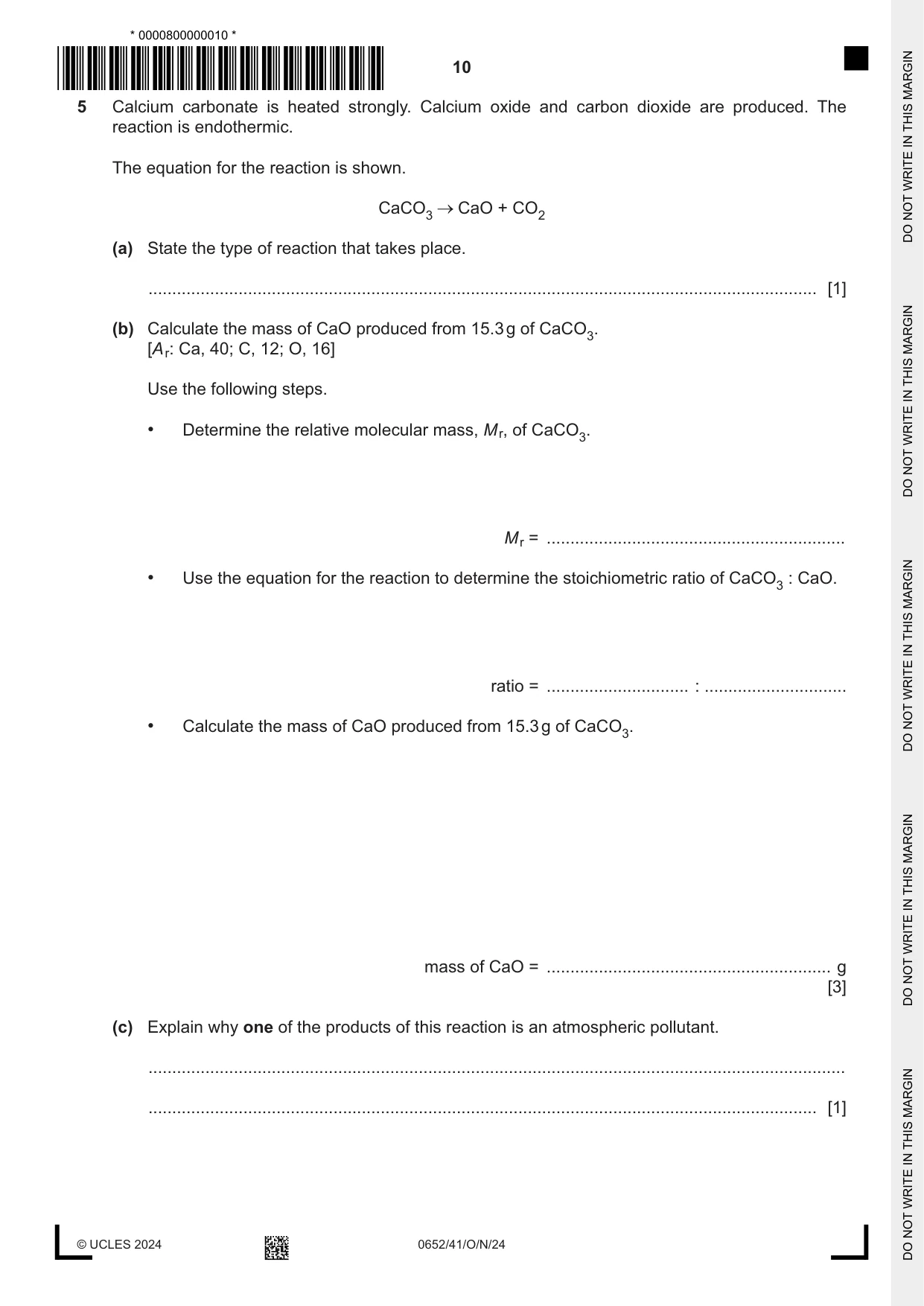
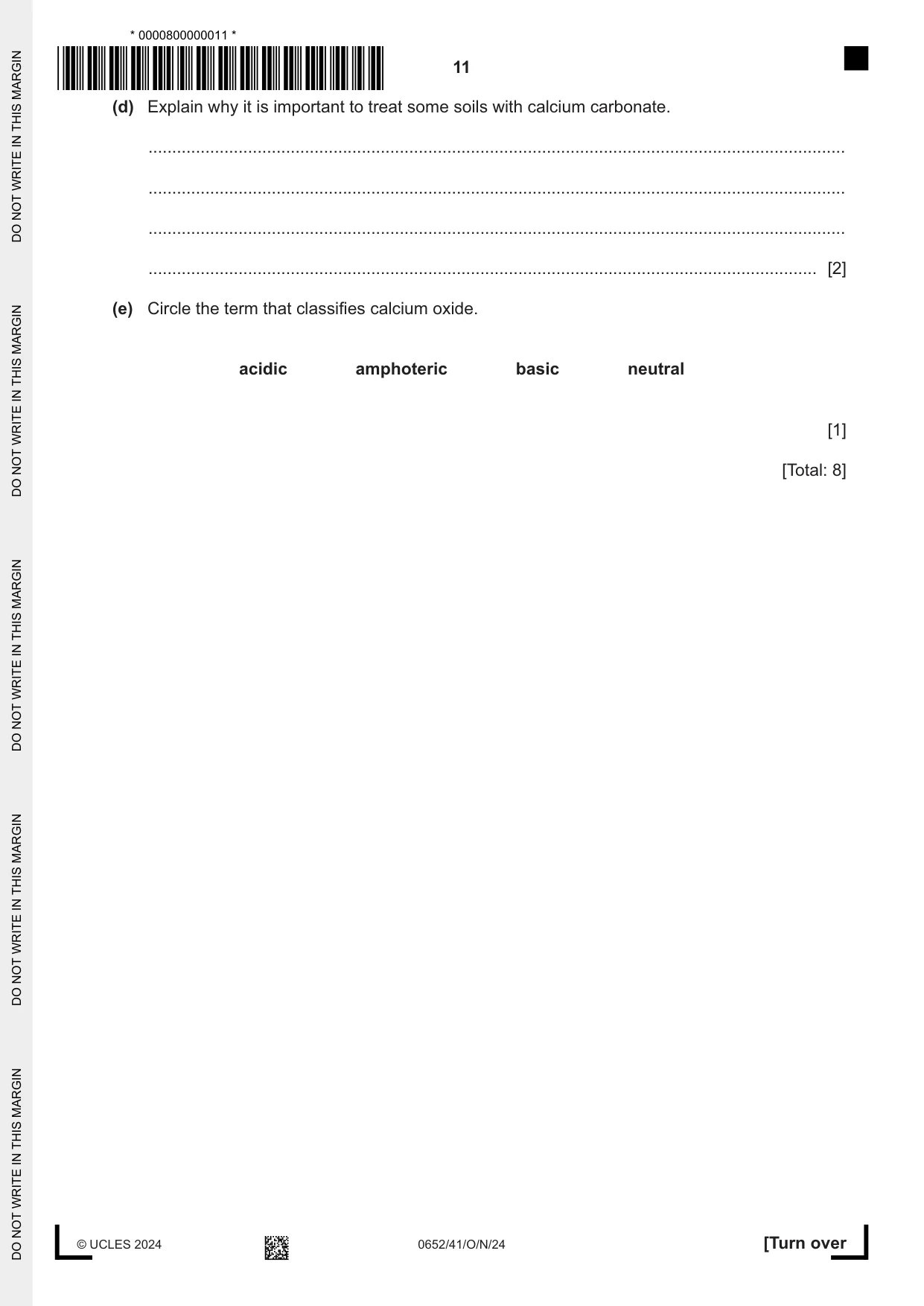
5 Calcium carbonate is heated strongly. Calcium oxide and carbon dioxide are produced. The reaction is endothermic. The equation for the reaction is shown. CaCO3 CaO + CO2 (a) State the type of reaction that takes place. ............................................................................................................................................. [1] (b) Calculate the mass of CaO produced from 15.3 g of CaCO3. [A r: Ca, 40; C, 12; O, 16] Use the following steps. • Determine the relative molecular mass, M r, of CaCO3. M r = ............................................................... • Use the equation for the reaction to determine the stoichiometric ratio of CaCO3 : CaO. ratio = .............................. : .............................. • Calculate the mass of CaO produced from 15.3 g of CaCO3. mass of CaO = ............................................................ g [3] (c) Explain why one of the products of this reaction is an atmospheric pollutant. ................................................................................................................................................... ............................................................................................................................................. [1] (d) Explain why it is important to treat some soils with calcium carbonate. ................................................................................................................................................... ................................................................................................................................................... ................................................................................................................................................... ............................................................................................................................................. [2] (e) Circle the term that classifies calcium oxide. acidic amphoteric basic neutral [1] [Total: 8]
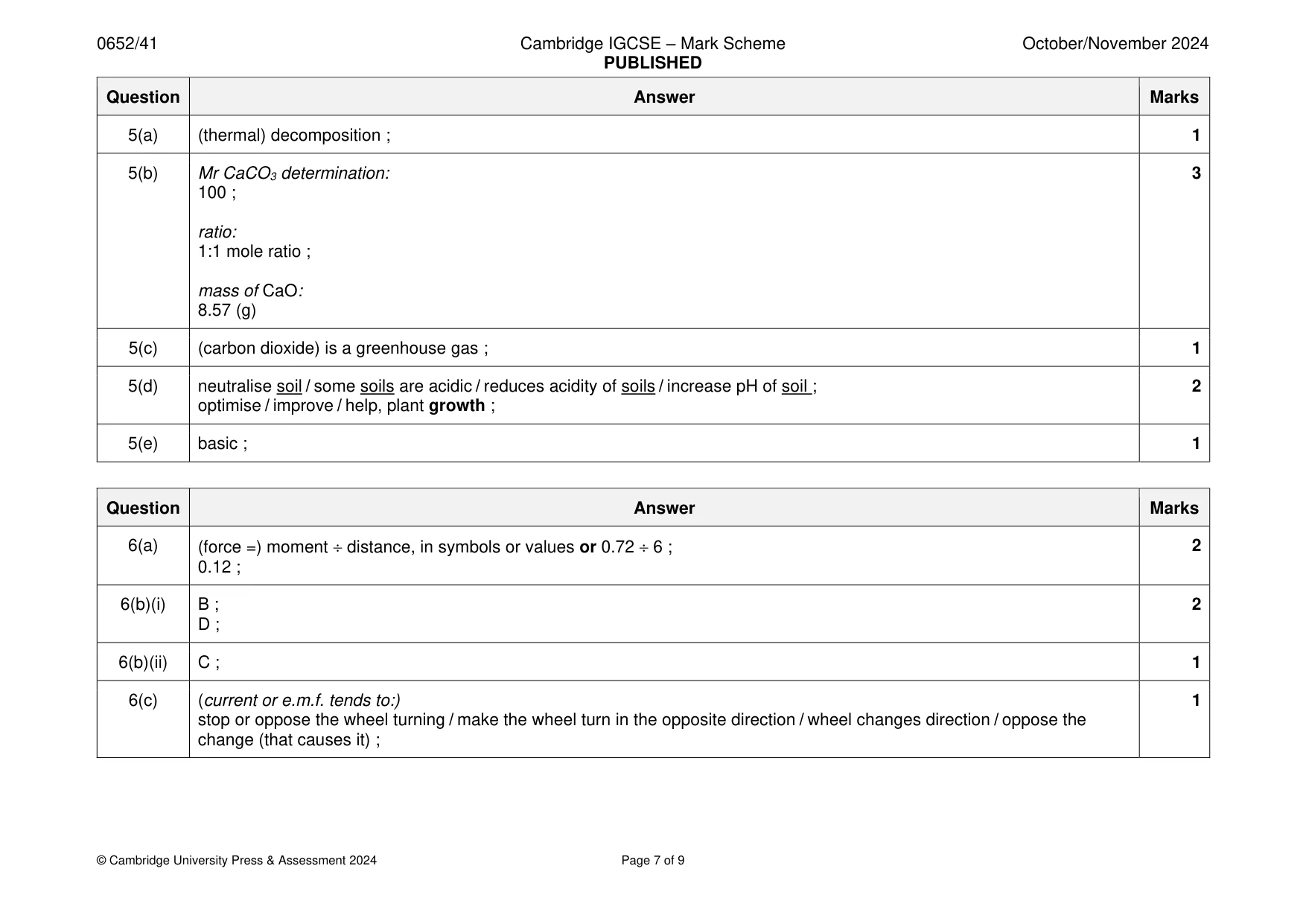
Mark scheme: 5(a) (thermal) decomposition ; 1 5(b) Mr CaCO3 determination: 3 100 ; ratio: 1:1 mole ratio ; mass of CaO: 8.57 (g) 5(c) (carbon dioxide) is a greenhouse gas ; 1 5(d) neutralise soil / some soils are acidic / reduces acidity of soils / increase pH of soil ; 2 optimise / improve / help, plant growth ; 5(e) basic ; 1
Q6 · A type of simple d.c
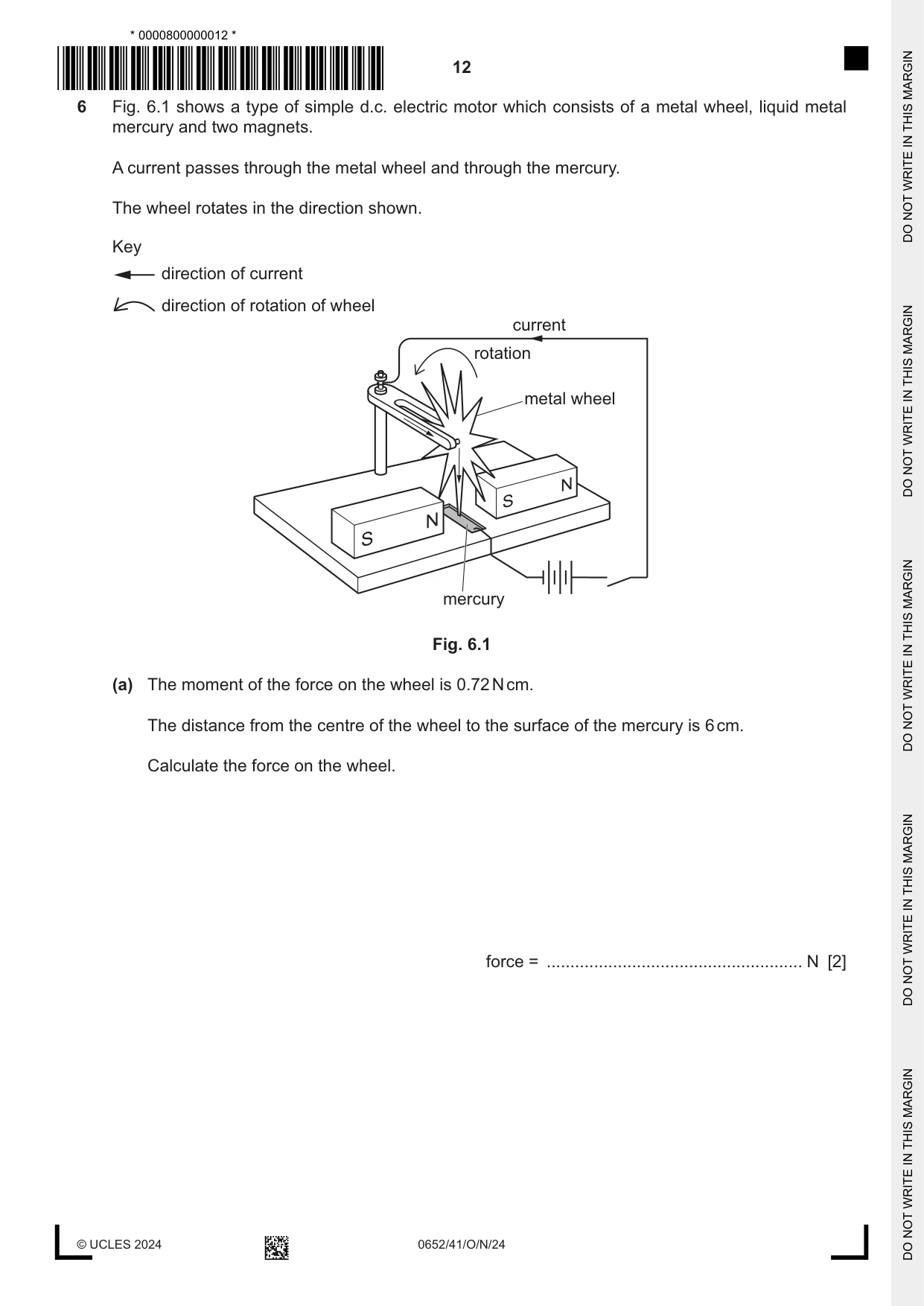
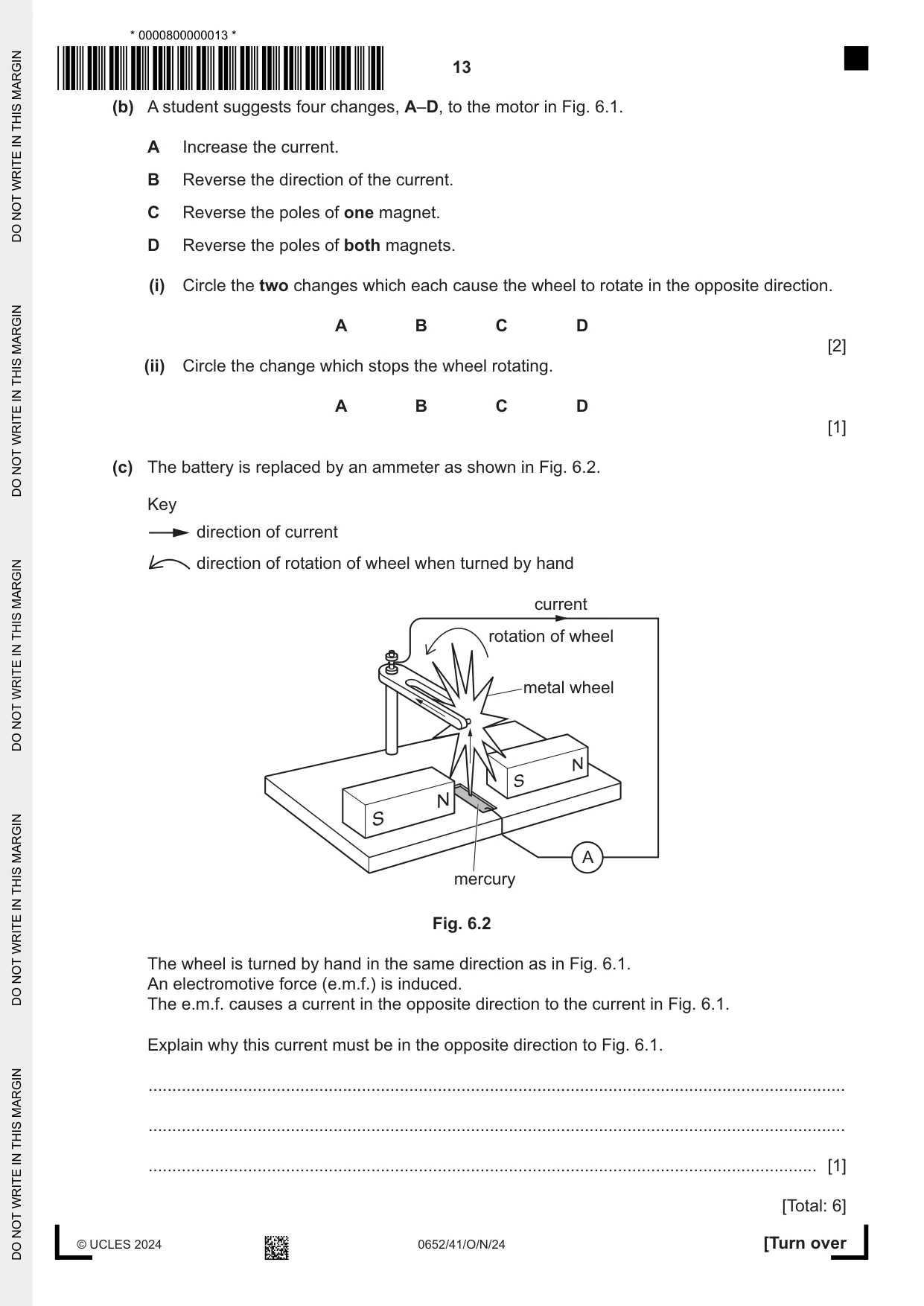
6 Fig. 6.1 shows a type of simple d.c. electric motor which consists of a metal wheel, liquid metal mercury and two magnets. A current passes through the metal wheel and through the mercury. The wheel rotates in the direction shown. Key direction of current direction of rotation of wheel current rotation metal wheel mercury Fig. 6.1 (a) The moment of the force on the wheel is 0.72 N cm. The distance from the centre of the wheel to the surface of the mercury is 6 cm. Calculate the force on the wheel. force = ...................................................... N [2] (b) A student suggests four changes, A–D, to the motor in Fig. 6.1. A Increase the current. B Reverse the direction of the current. C Reverse the poles of one magnet. D Reverse the poles of both magnets. (i) Circle the two changes which each cause the wheel to rotate in the opposite direction. A B C D [2] (ii) Circle the change which stops the wheel rotating. A B C D [1] (c) The battery is replaced by an ammeter as shown in Fig. 6.2. Key direction of current direction of rotation of wheel when turned by hand current rotation of wheel metal wheel A mercury Fig. 6.2 The wheel is turned by hand in the same direction as in Fig. 6.1. An electromotive force (e.m.f.) is induced. The e.m.f. causes a current in the opposite direction to the current in Fig. 6.1. Explain why this current must be in the opposite direction to Fig. 6.1. ................................................................................................................................................... ................................................................................................................................................... ............................................................................................................................................. [1] [Total: 6]
Mark scheme: 6(a) (force =) moment distance, in symbols or values or 0.72 6 ; 2 0.12 ; 6(b)(i) B ; 2 D ; 6(b)(ii) C ; 1 6(c) (current or e.m.f. tends to:) 1 stop or oppose the wheel turning / make the wheel turn in the opposite direction / wheel changes direction / oppose the change (that causes it) ;
Q7 · Magnesium reacts with dilute hydrochloric acid
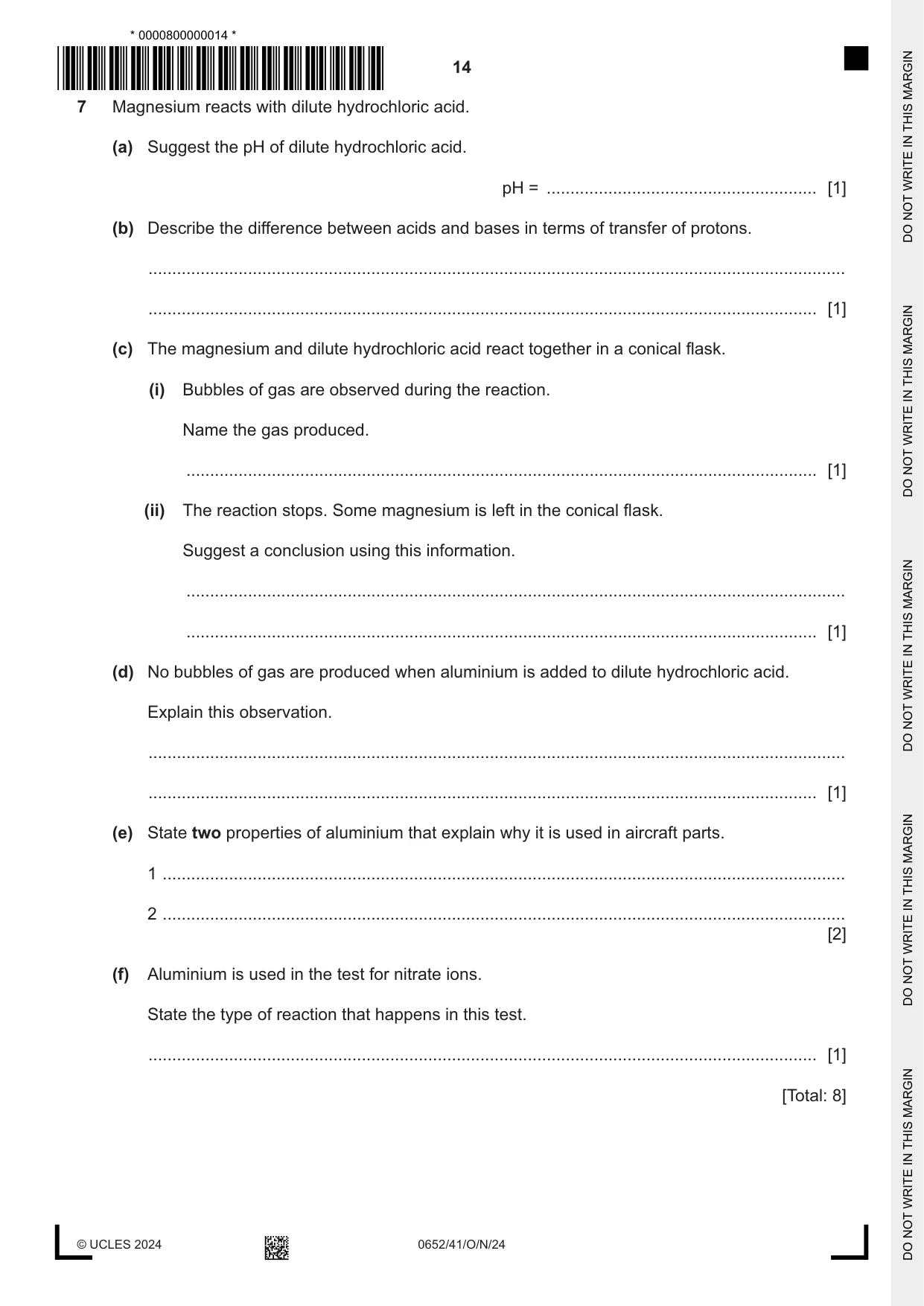
7 Magnesium reacts with dilute hydrochloric acid. (a) Suggest the pH of dilute hydrochloric acid. pH = ......................................................... [1] (b) Describe the difference between acids and bases in terms of transfer of protons. ................................................................................................................................................... ............................................................................................................................................. [1] (c) The magnesium and dilute hydrochloric acid react together in a conical flask. (i) Bubbles of gas are observed during the reaction. Name the gas produced. ..................................................................................................................................... [1] (ii) The reaction stops. Some magnesium is left in the conical flask. Suggest a conclusion using this information. ........................................................................................................................................... ..................................................................................................................................... [1] (d) No bubbles of gas are produced when aluminium is added to dilute hydrochloric acid. Explain this observation. ................................................................................................................................................... ............................................................................................................................................. [1] (e) State two properties of aluminium that explain why it is used in aircraft parts. 1 ................................................................................................................................................ 2 ................................................................................................................................................ [2] (f) Aluminium is used in the test for nitrate ions. State the type of reaction that happens in this test. ............................................................................................................................................. [1] [Total: 8]
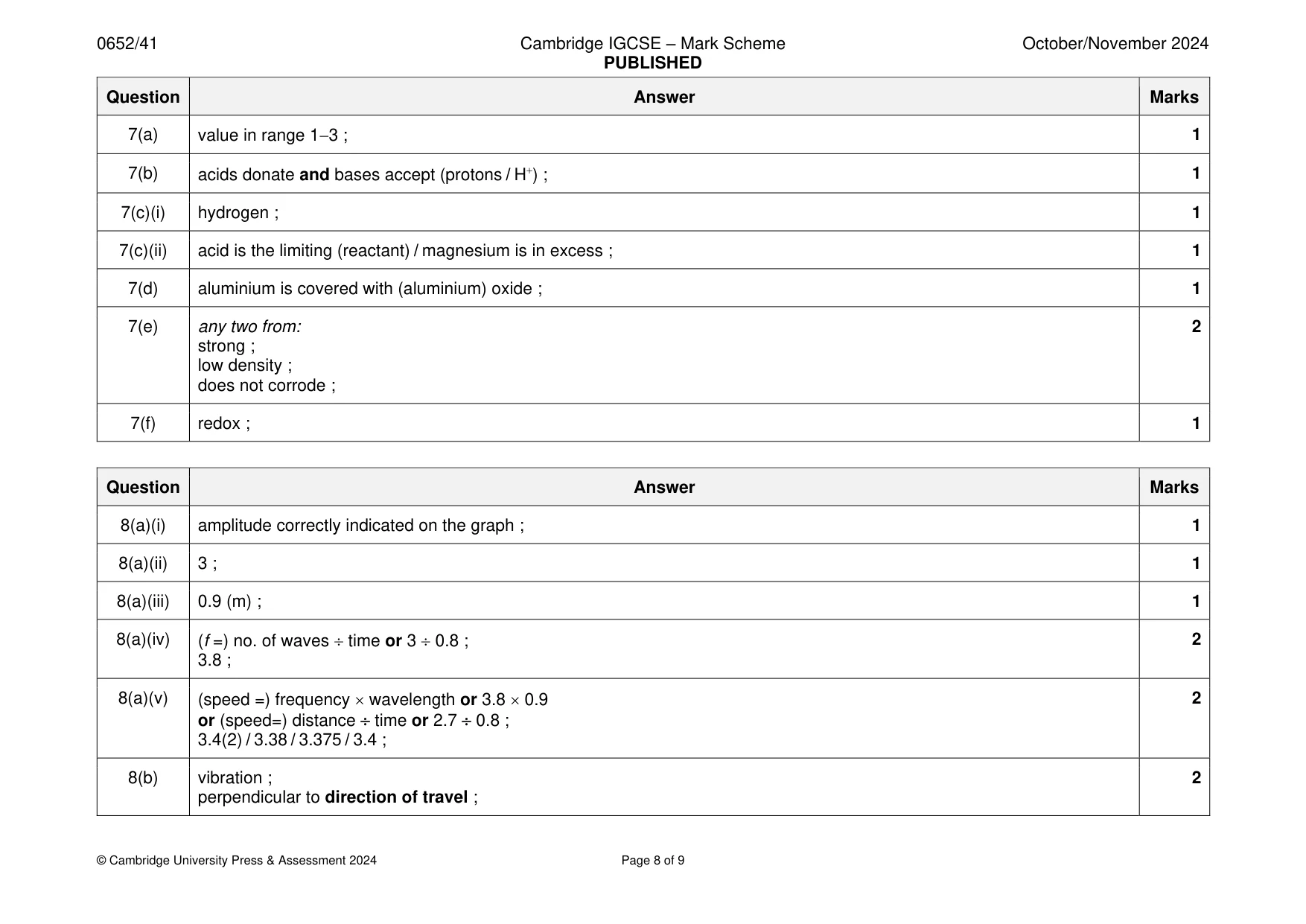
Mark scheme: 7(a) value in range 1−3 ; 1 7(b) acids donate and bases accept (protons / H+) ; 1 7(c)(i) hydrogen ; 1 7(c)(ii) acid is the limiting (reactant) / magnesium is in excess ; 1 7(d) aluminium is covered with (aluminium) oxide ; 1 7(e) any two from: 2 strong ; low density ; does not corrode ; 7(f) redox ; 1
More questions on The characteristic properties of acids and bases
Q8 · Transverse waves on a section of a long rubber cord
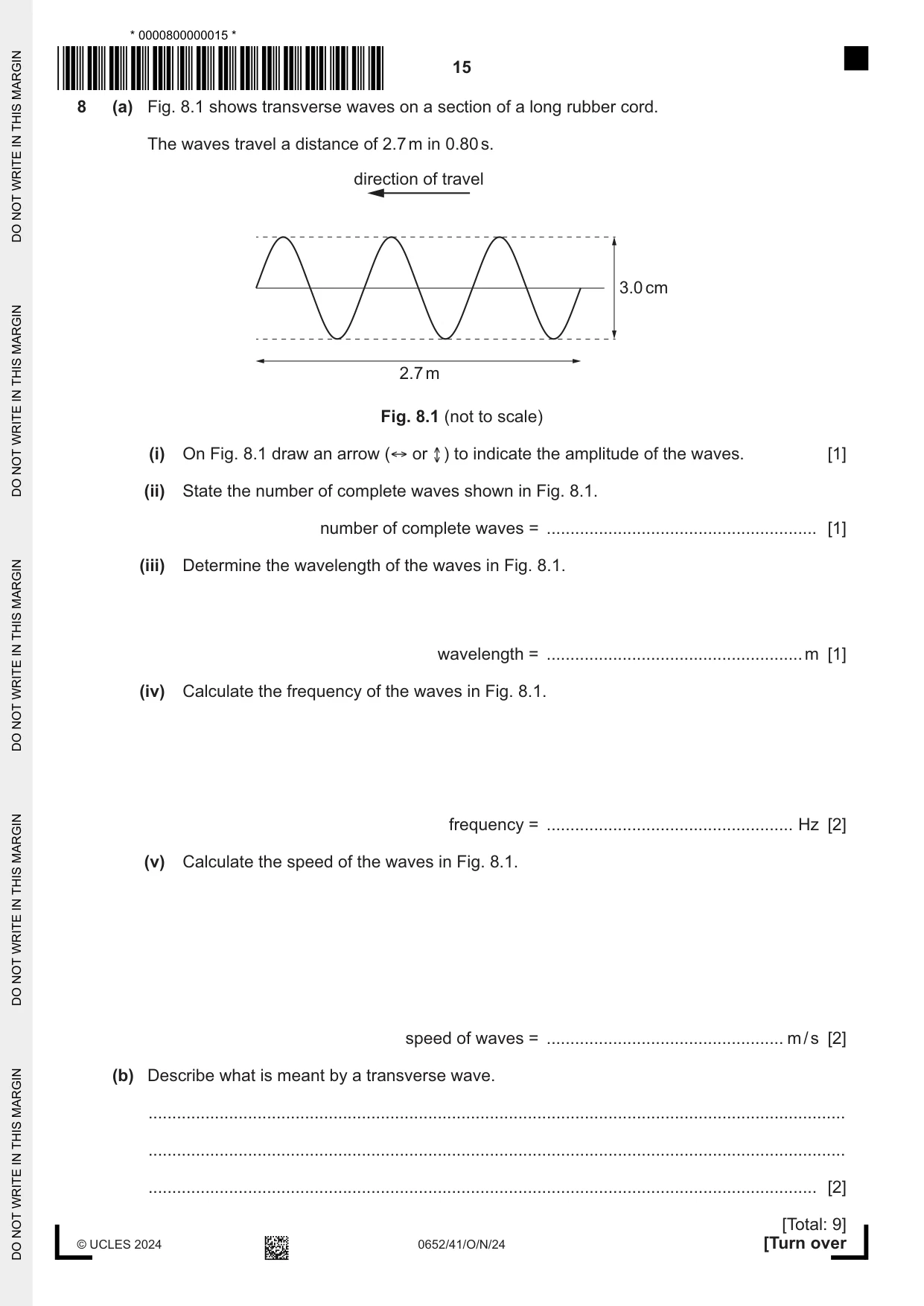
8 (a) Fig. 8.1 shows transverse waves on a section of a long rubber cord. The waves travel a distance of 2.7 m in 0.80 s. direction of travel 3.0 cm 2.7 m Fig. 8.1 (not to scale) (i) On Fig. 8.1 draw an arrow (↔ or ↔) to indicate the amplitude of the waves. [1] (ii) State the number of complete waves shown in Fig. 8.1. number of complete waves = ......................................................... [1] (iii) Determine the wavelength of the waves in Fig. 8.1. wavelength = ...................................................... m [1] (iv) Calculate the frequency of the waves in Fig. 8.1. frequency = .................................................... Hz [2] (v) Calculate the speed of the waves in Fig. 8.1. speed of waves = .................................................. m / s [2] (b) Describe what is meant by a transverse wave. ................................................................................................................................................... ................................................................................................................................................... ............................................................................................................................................. [2] [Total: 9]
Mark scheme: 8(a)(i) amplitude correctly indicated on the graph ; 1 8(a)(ii) 3 ; 1 8(a)(iii) 0.9 (m) ; 1 8(a)(iv) (f =) no. of waves time or 3 0.8 ; 2 3.8 ; 8(a)(v) (speed =) frequency wavelength or 3.8 0.9 2 or (speed=) distance time or 2.7 0.8 ; 3.4(2) / 3.38 / 3.375 / 3.4 ; 8(b) vibration ; 2 perpendicular to direction of travel ;
Q9 · A fractionating column used in the fractional distillation of petroleum
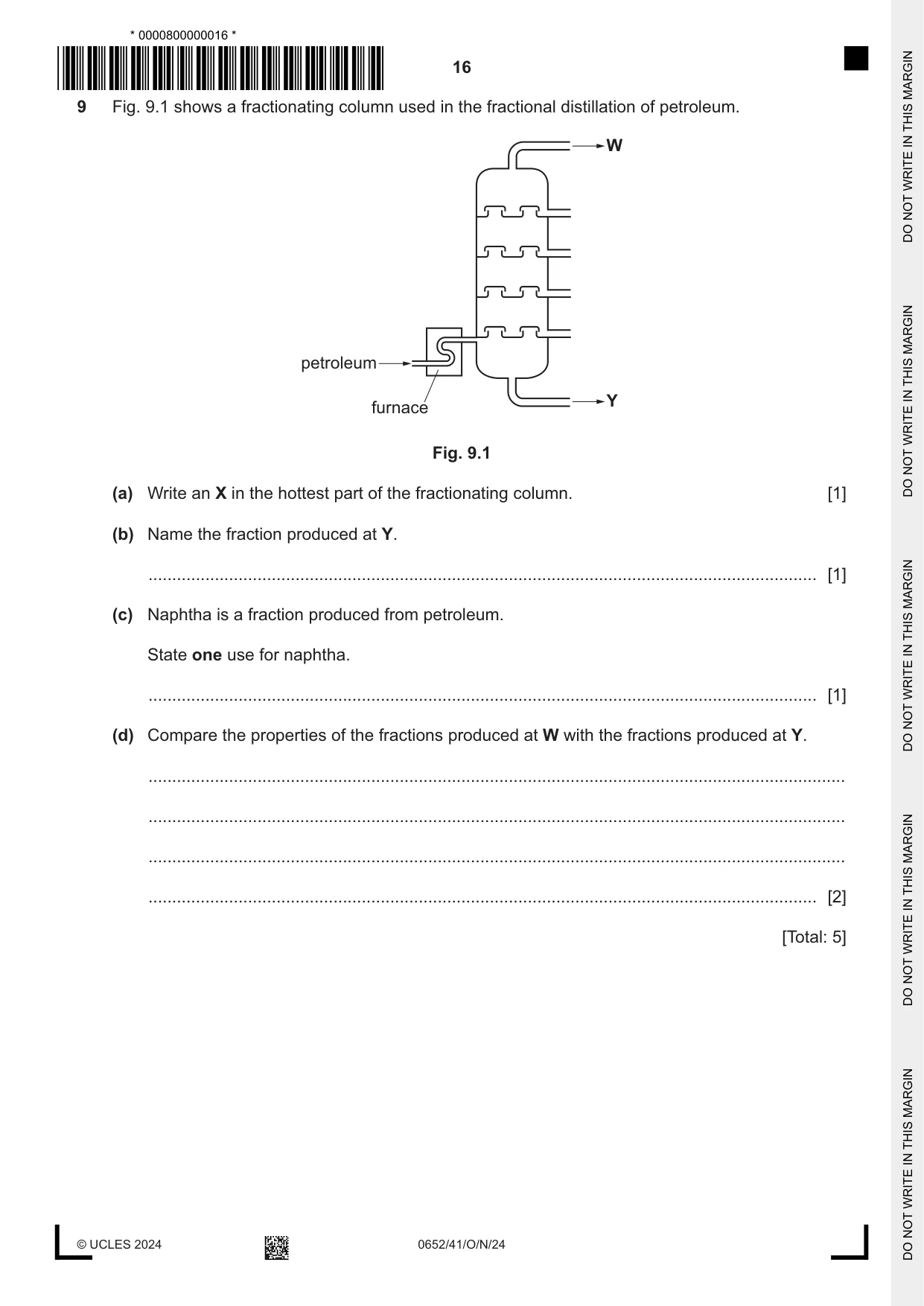
9 Fig. 9.1 shows a fractionating column used in the fractional distillation of petroleum. W petroleum Y furnace Fig. 9.1 (a) Write an X in the hottest part of the fractionating column. [1] (b) Name the fraction produced at Y. ............................................................................................................................................. [1] (c) Naphtha is a fraction produced from petroleum. State one use for naphtha. ............................................................................................................................................. [1] (d) Compare the properties of the fractions produced at W with the fractions produced at Y. ................................................................................................................................................... ................................................................................................................................................... ................................................................................................................................................... ............................................................................................................................................. [2] [Total: 5] Question 10 starts on page 18.
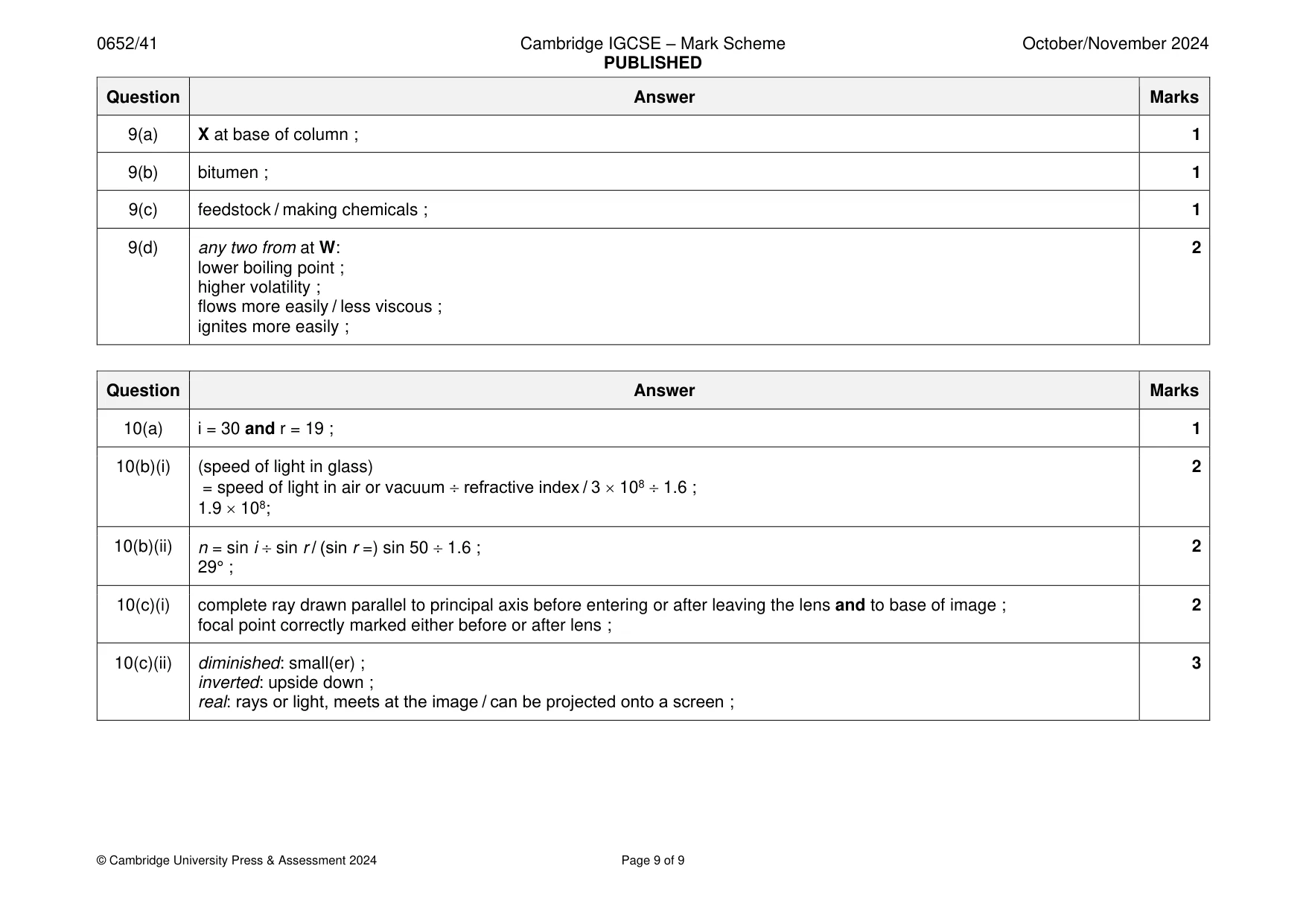
Mark scheme: 9(a) X at base of column ; 1 9(b) bitumen ; 1 9(c) feedstock / making chemicals ; 1 9(d) any two from at W: 2 lower boiling point ; higher volatility ; flows more easily / less viscous ; ignites more easily ;
Q10 · A ray of light travelling through air and entering a rectangular glass block
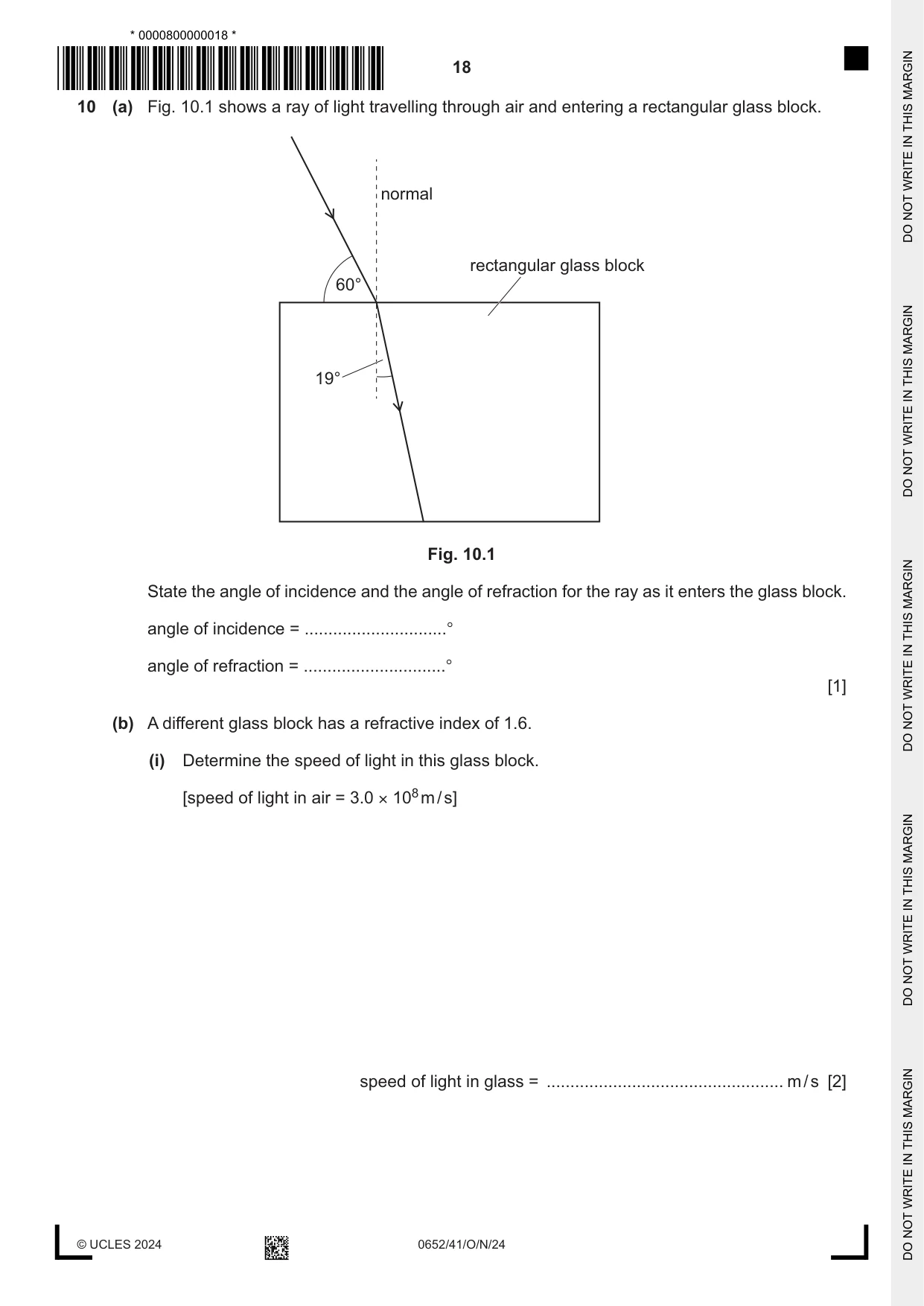
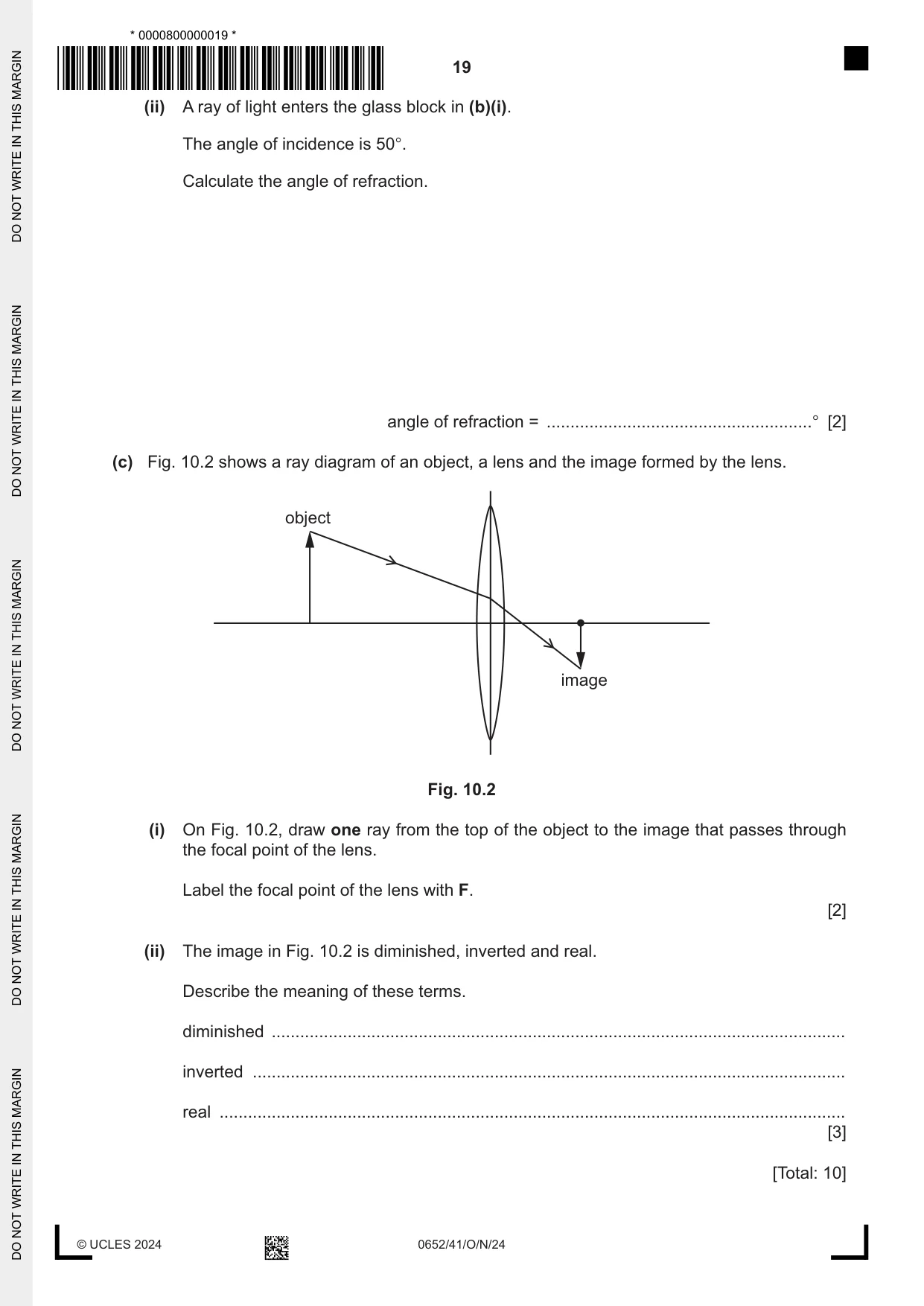
10 (a) Fig. 10.1 shows a ray of light travelling through air and entering a rectangular glass block. normal rectangular glass block 60° 19° Fig. 10.1 State the angle of incidence and the angle of refraction for the ray as it enters the glass block. angle of incidence = ..............................° angle of refraction = ..............................° [1] (b) A different glass block has a refractive index of 1.6. (i) Determine the speed of light in this glass block. [speed of light in air = 3.0 × 10⁸ m / s] speed of light in glass = .................................................. m / s [2] (ii) A ray of light enters the glass block in (b)(i). The angle of incidence is 50°. Calculate the angle of refraction. angle of refraction = ........................................................° [2] (c) Fig. 10.2 shows a ray diagram of an object, a lens and the image formed by the lens. object image Fig. 10.2 (i) On Fig. 10.2, draw one ray from the top of the object to the image that passes through the focal point of the lens. Label the focal point of the lens with F. [2] (ii) The image in Fig. 10.2 is diminished, inverted and real. Describe the meaning of these terms. diminished ......................................................................................................................... inverted ............................................................................................................................. real .................................................................................................................................... [3] [Total: 10]
Mark scheme: 10(a) i = 30 and r = 19 ; 1 10(b)(i) (speed of light in glass) 2 = speed of light in air or vacuum refractive index / 3 108 1.6 ; 1.9 108; 10(b)(ii) n = sin i sin r / (sin r =) sin 50 1.6 ; 2 29° ; 10(c)(i) complete ray drawn parallel to principal axis before entering or after leaving the lens and to base of image ; 2 focal point correctly marked either before or after lens ; 10(c)(ii) diminished: small(er) ; 3 inverted: upside down ; real: rays or light, meets at the image / can be projected onto a screen ;
What was in this paper
The subtopics covered by these 10 questions, and how many questions each got. Open one in a new tab to see every Cambridge question on it.
What you needed in this session
Cambridge’s own grade thresholds for 2024 Oct/Nov, Paper 4 · Variant 1. A higher threshold means an easier paper — the bar moves with how the cohort did.