Cambridge IGCSE Physical Science 0652 — 2018 Oct/Nov Paper 4 · Variant 1
0652/41/O/N/18 · 12 questions · 80 marks · ≈90 min
The question paper and its mark scheme, free to read here and free to download. This is Cambridge’s own paper, exactly as it was sat.
Question paper20 pages


Mark scheme9 pages
Answers below. Sit the paper first if you are practising.
Questions as text
Q1 · State what is meant by the moment of a force
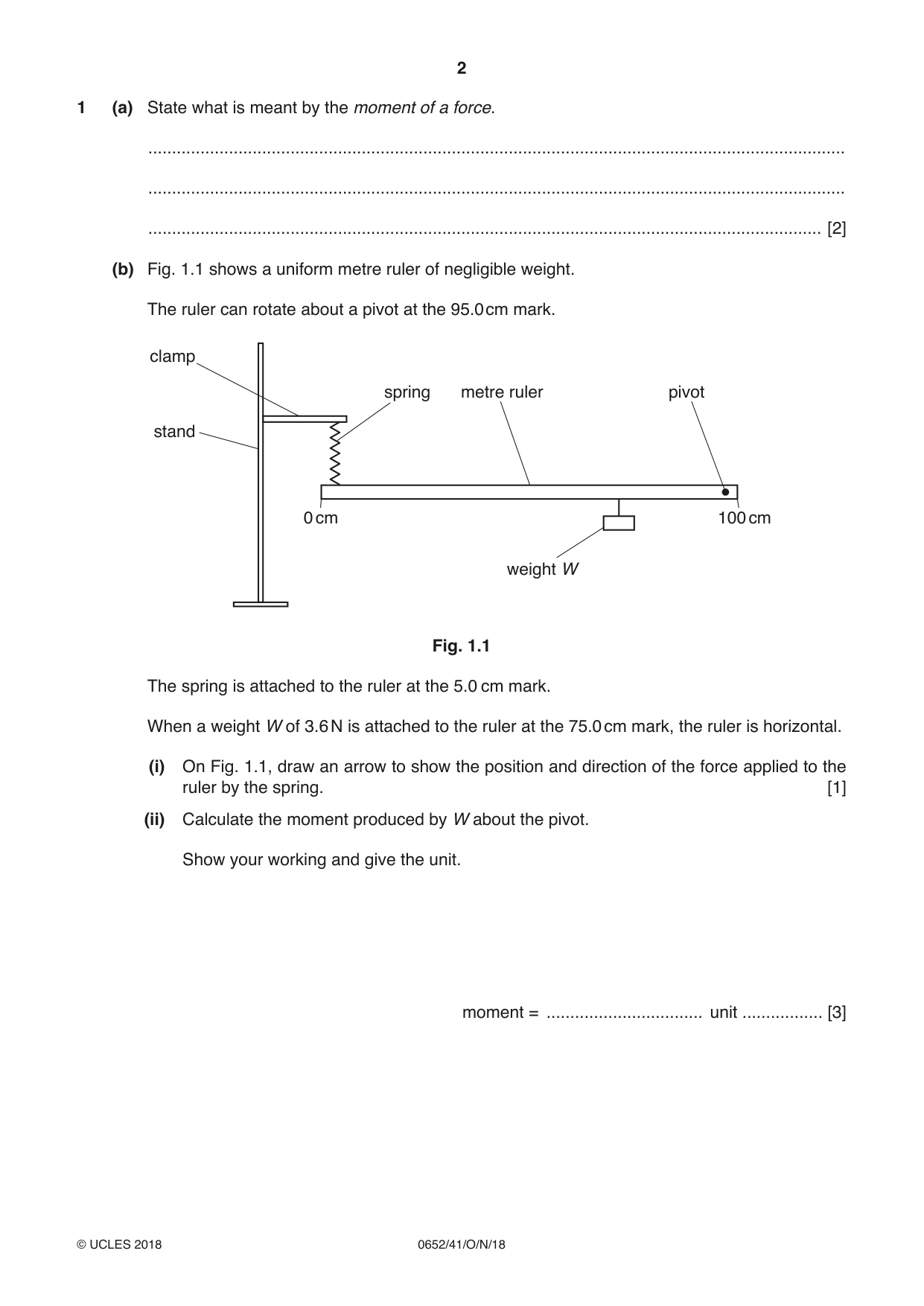
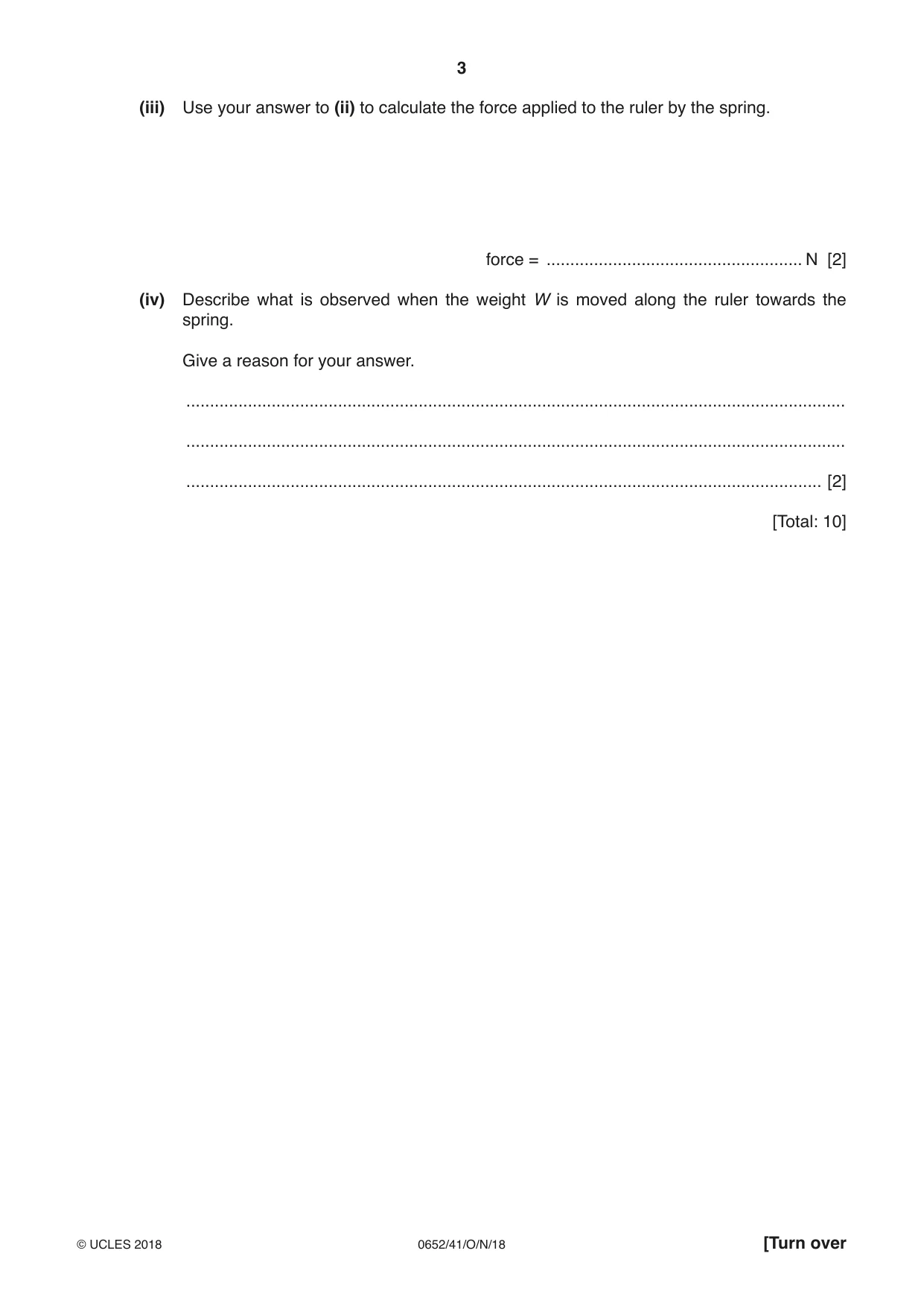
1 (a) State what is meant by the moment of a force. ................................................................................................................................................... ................................................................................................................................................... .............................................................................................................................................. [2] (b) Fig. 1.1 shows a uniform metre ruler of negligible weight. The ruler can rotate about a pivot at the 95.0 cm mark. clamp spring metre ruler pivot stand 0 cm 100 cm weight W Fig. 1.1 The spring is attached to the ruler at the 5.0 cm mark. When a weight W of 3.6 N is attached to the ruler at the 75.0 cm mark, the ruler is horizontal. (i) On Fig. 1.1, draw an arrow to show the position and direction of the force applied to the ruler by the spring. [1] (ii) Calculate the moment produced by W about the pivot. Show your working and give the unit. moment = ................................. unit ................. [3] (iii) Use your answer to (ii) to calculate the force applied to the ruler by the spring. force = ...................................................... N [2] (iv) Describe what is observed when the weight W is moved along the ruler towards the spring. Give a reason for your answer. ........................................................................................................................................... ........................................................................................................................................... ...................................................................................................................................... [2] [Total: 10]
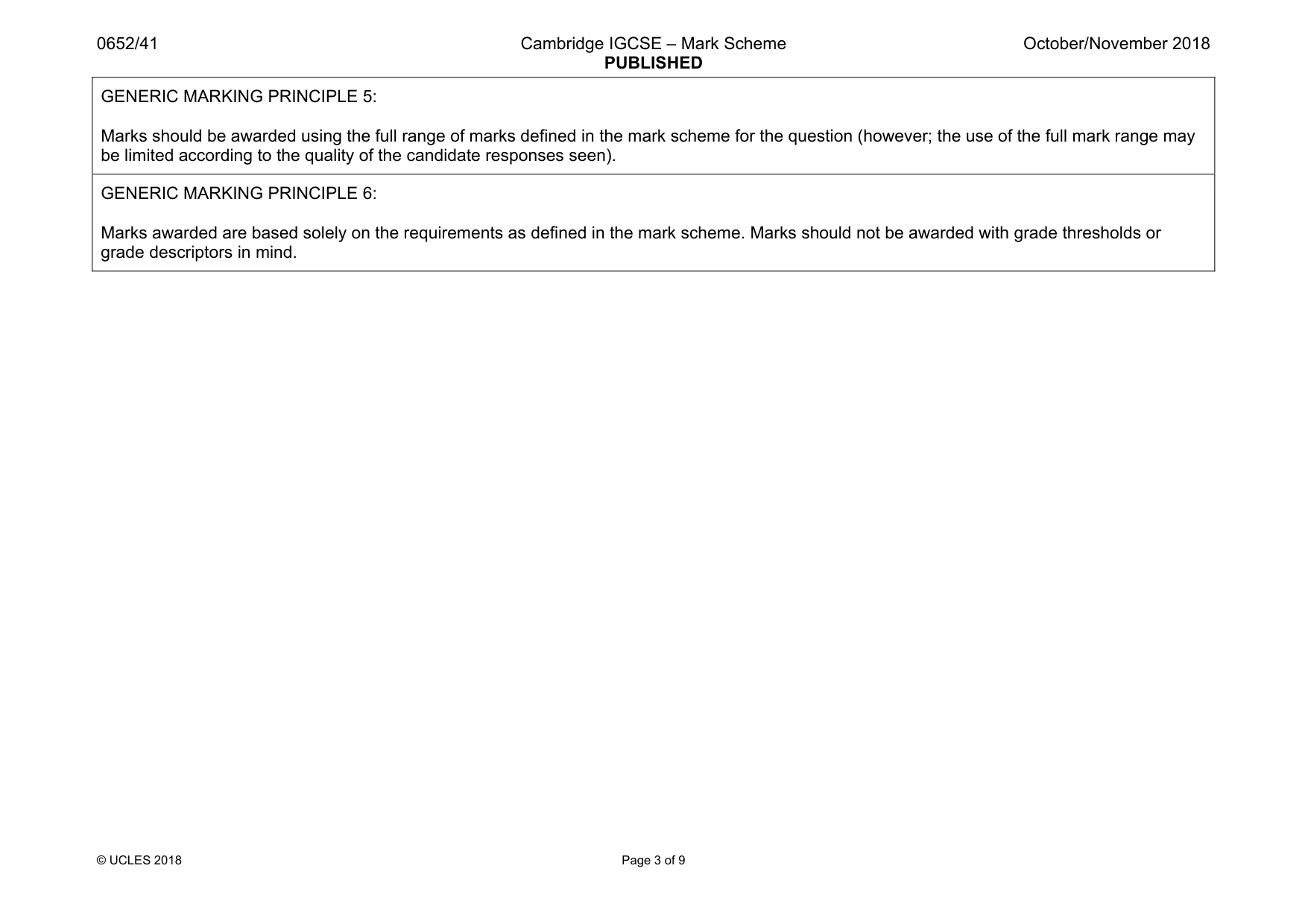
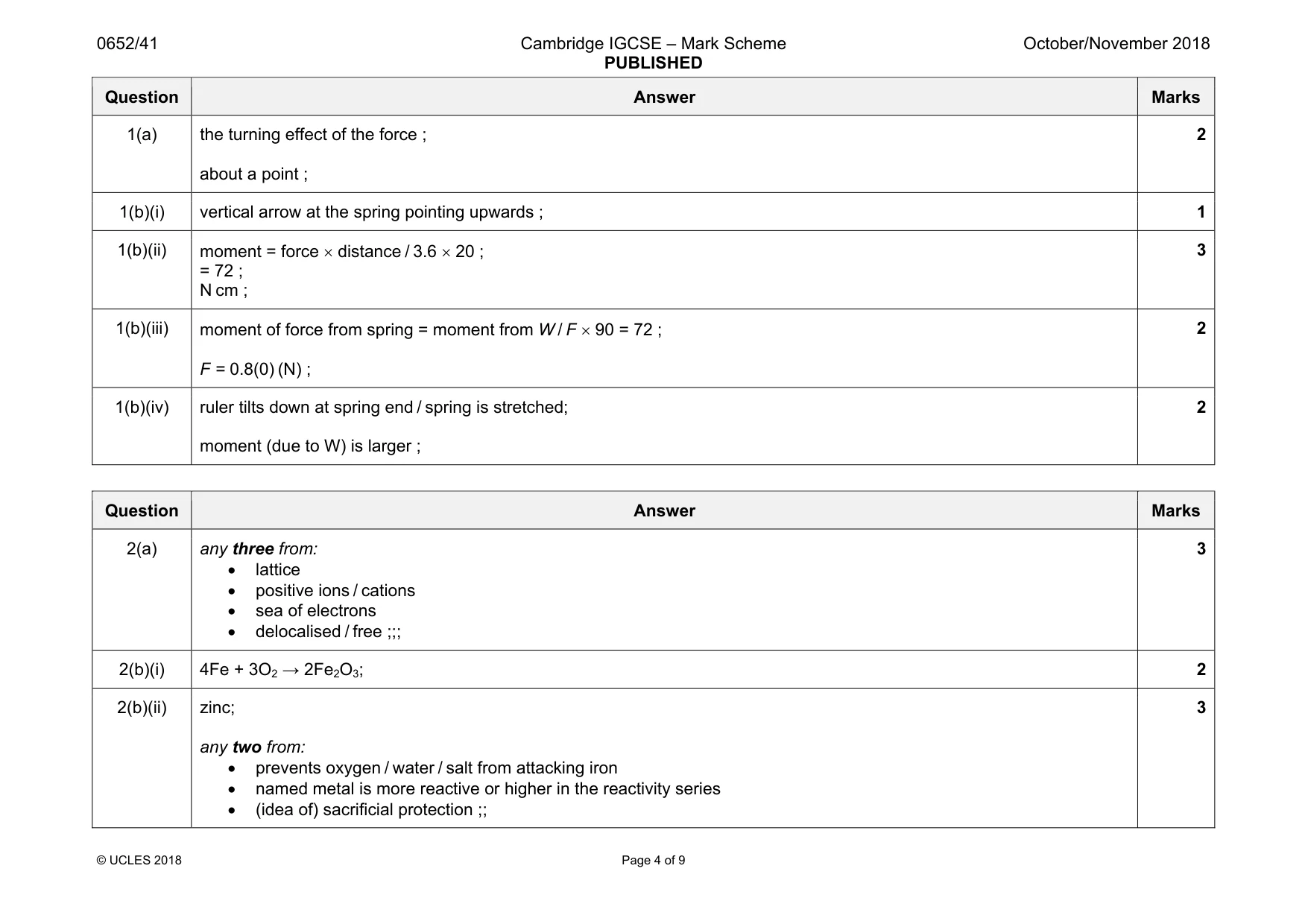
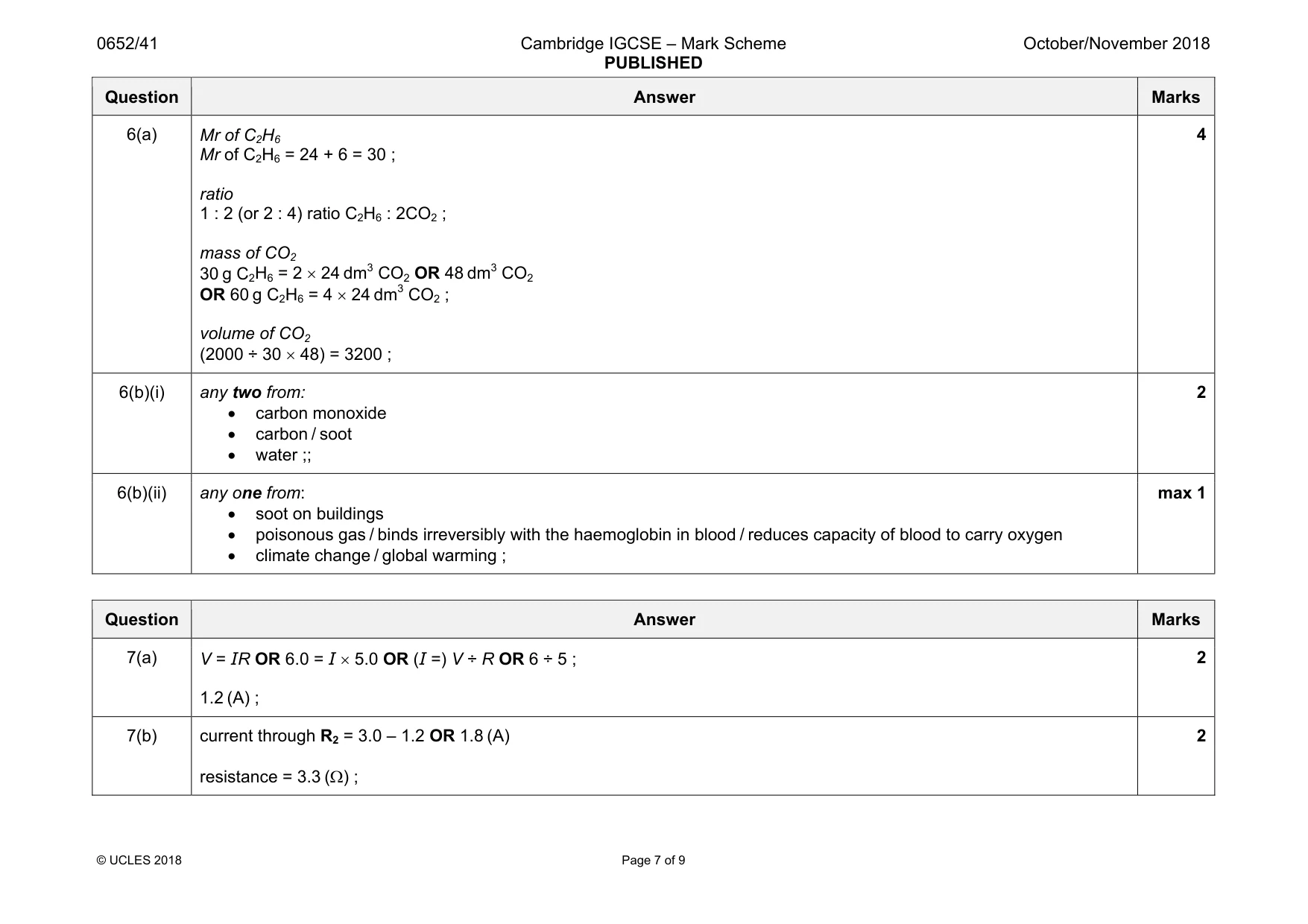
Mark scheme: 1(a) the turning effect of the force ; about a point ; 2 1(b)(i) vertical arrow at the spring pointing upwards ; 1 1(b)(ii) moment = force × distance / 3.6 × 20 ; = 72 ; N cm ; 3 1(b)(iii) moment of force from spring = moment from W / F × 90 = 72 ; F = 0.8(0) (N) ; 2 1(b)(iv) ruler tilts down at spring end / spring is stretched; moment (due to W) is larger ; 2
Q2 · Iron is a metal
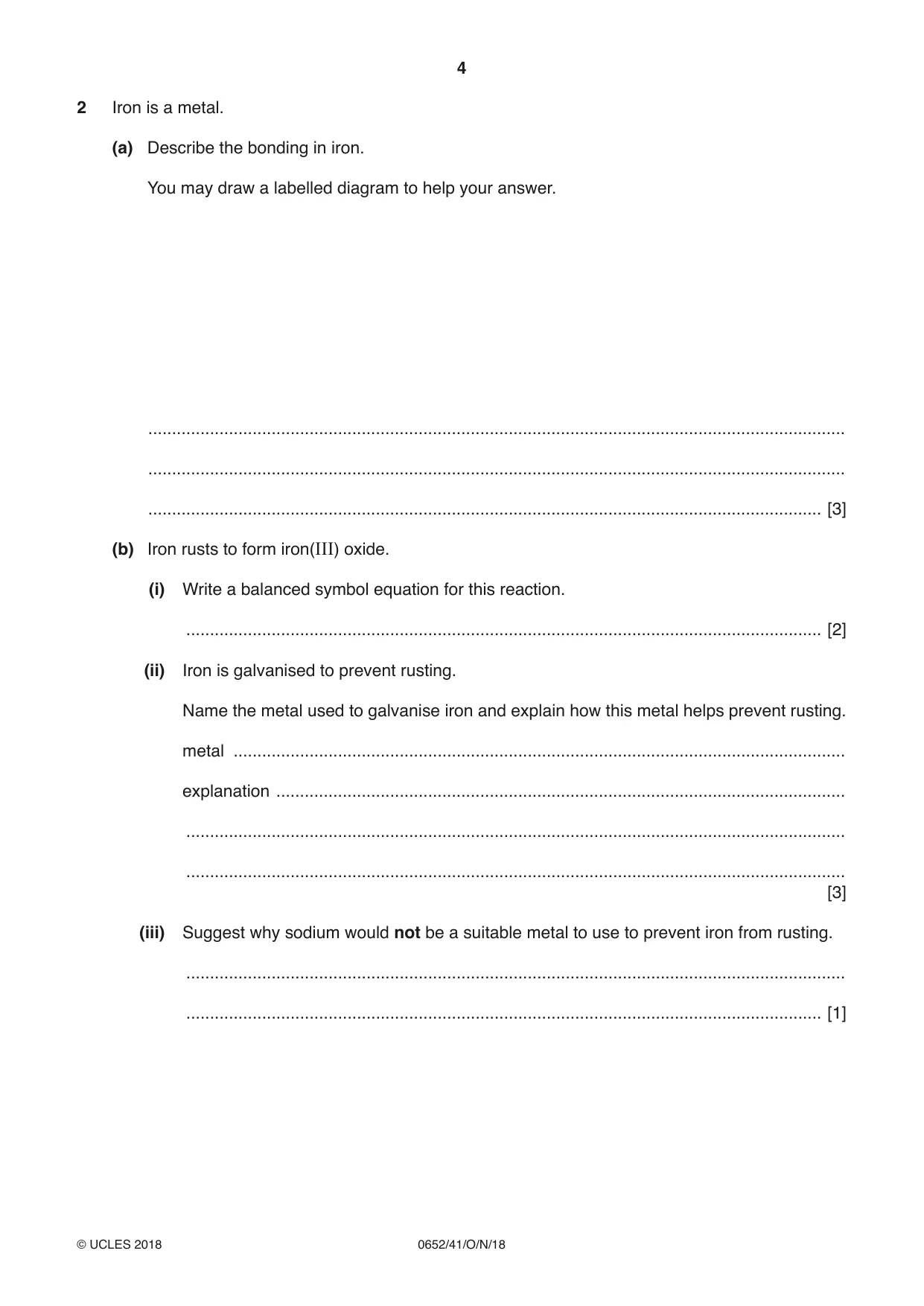
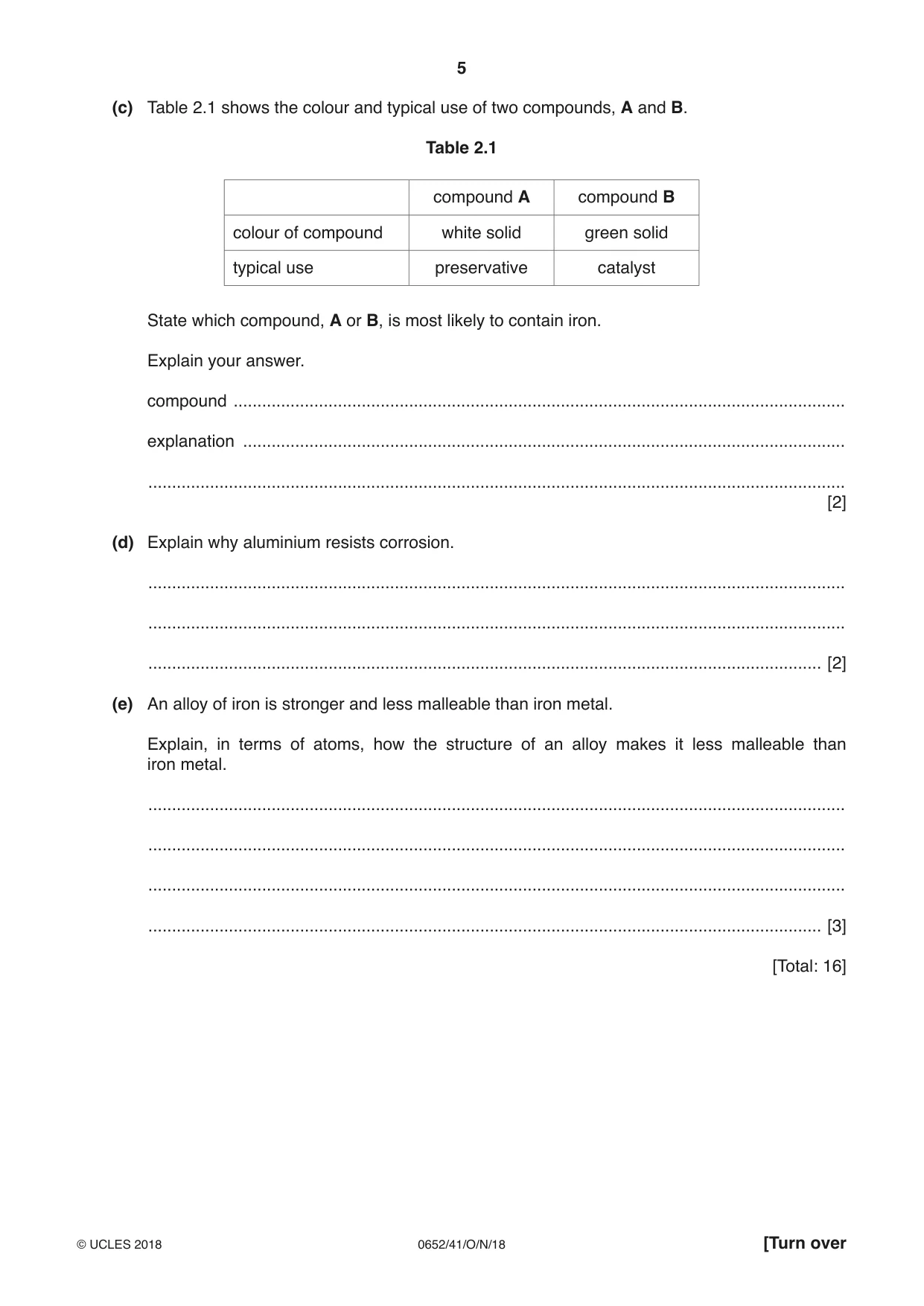
2 Iron is a metal. (a) Describe the bonding in iron. You may draw a labelled diagram to help your answer. ................................................................................................................................................... ................................................................................................................................................... .............................................................................................................................................. [3] (b) Iron rusts to form iron(III) oxide. (i) Write a balanced symbol equation for this reaction. ...................................................................................................................................... [2] (ii) Iron is galvanised to prevent rusting. Name the metal used to galvanise iron and explain how this metal helps prevent rusting. metal ................................................................................................................................. explanation ........................................................................................................................ ........................................................................................................................................... ........................................................................................................................................... [3] (iii) Suggest why sodium would not be a suitable metal to use to prevent iron from rusting. ........................................................................................................................................... ...................................................................................................................................... [1] (c) Table 2.1 shows the colour and typical use of two compounds, A and B. Table 2.1 compound A compound B colour of compound white solid green solid typical use preservative catalyst State which compound, A or B, is most likely to contain iron. Explain your answer. compound ................................................................................................................................. explanation ............................................................................................................................... ................................................................................................................................................... [2] (d) Explain why aluminium resists corrosion. ................................................................................................................................................... ................................................................................................................................................... .............................................................................................................................................. [2] (e) An alloy of iron is stronger and less malleable than iron metal. Explain, in terms of atoms, how the structure of an alloy makes it less malleable than iron metal. ................................................................................................................................................... ................................................................................................................................................... ................................................................................................................................................... .............................................................................................................................................. [3] [Total: 16]
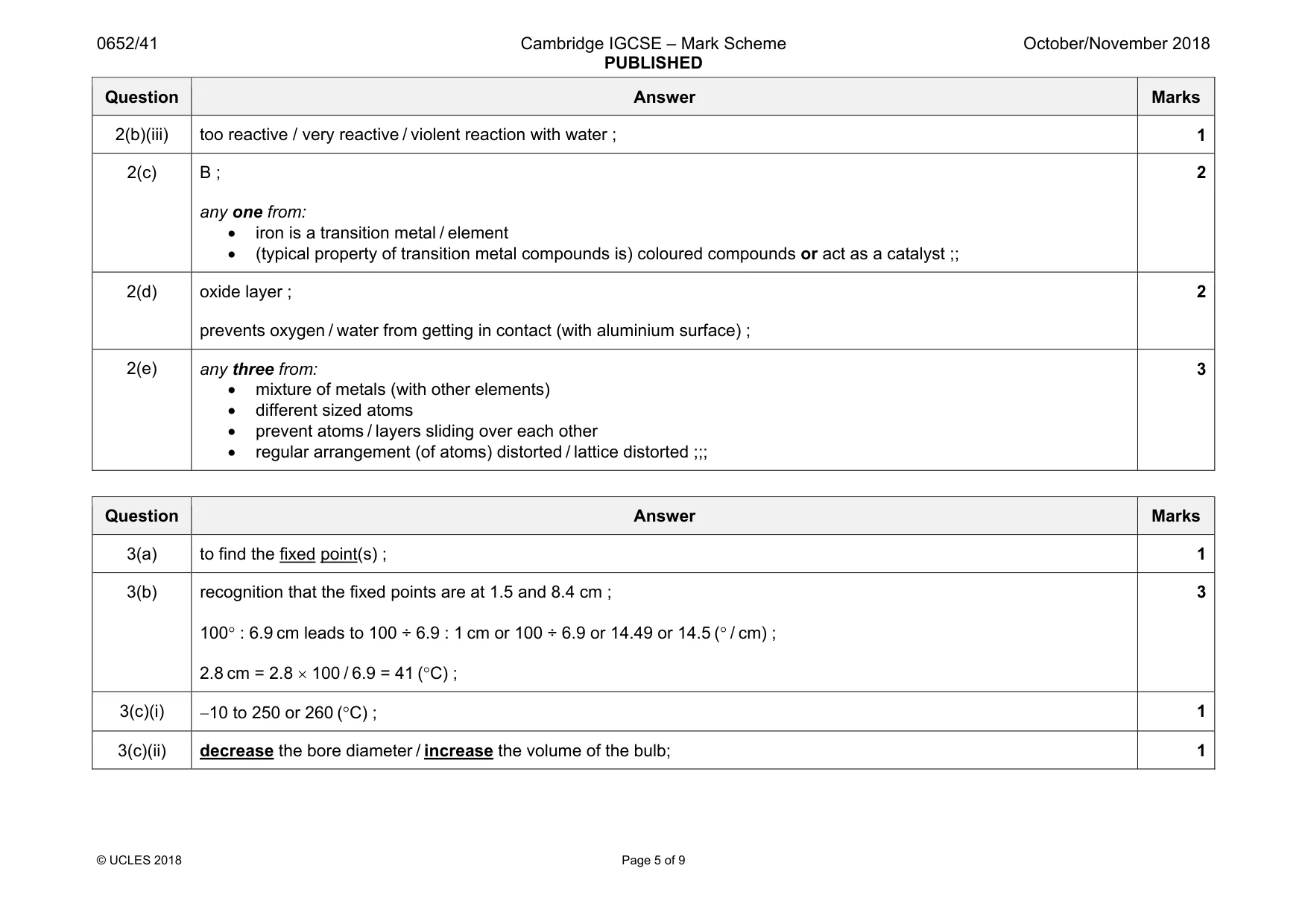
Mark scheme: 2(a) any three from: • lattice • positive ions / cations • sea of electrons • delocalised / free ;;; 3 2(b)(i) 4Fe + 3O2 → 2Fe2O3; 2 2(b)(ii) zinc; any two from: • prevents oxygen / water / salt from attacking iron • named metal is more reactive or higher in the reactivity series • (idea of) sacrificial protection ;; 3 Question Answer Marks 2(b)(iii) too reactive / very reactive / violent reaction with water ; 1 2(c) B ; any one from: • iron is a transition metal / element • (typical property of transition metal compounds is) coloured compounds or act as a catalyst ;; 2 2(d) oxide layer ; prevents oxygen / water from getting in contact (with aluminium surface) ; 2 2(e) any three from: • mixture of metals (with other elements) • different sized atoms • prevent atoms / layers sliding over each other • regular arrangement (of atoms) distorted / lattice distorted ;;; 3
Q3 · A student calibrates an unmarked liquid-in-glass thermometer
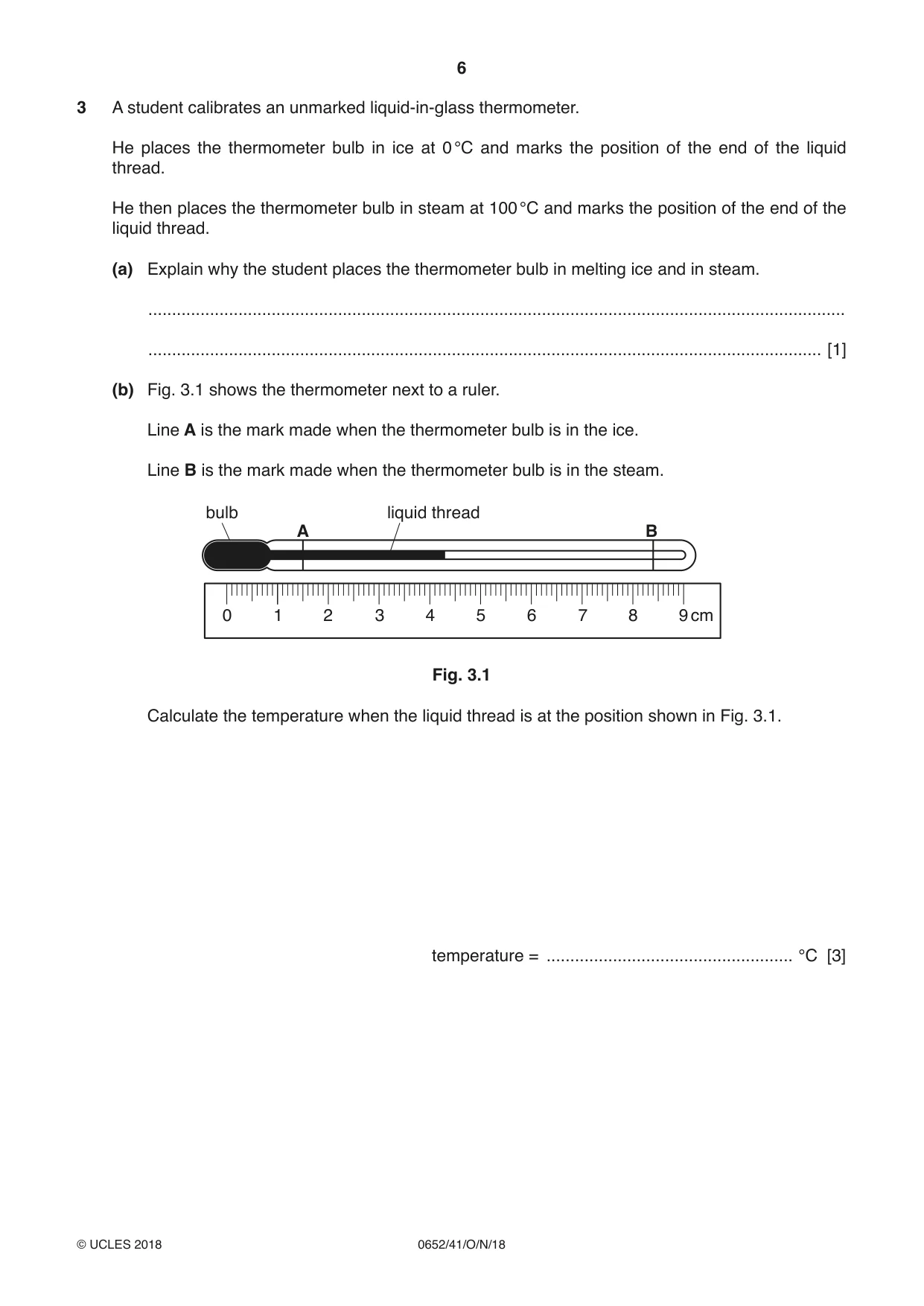
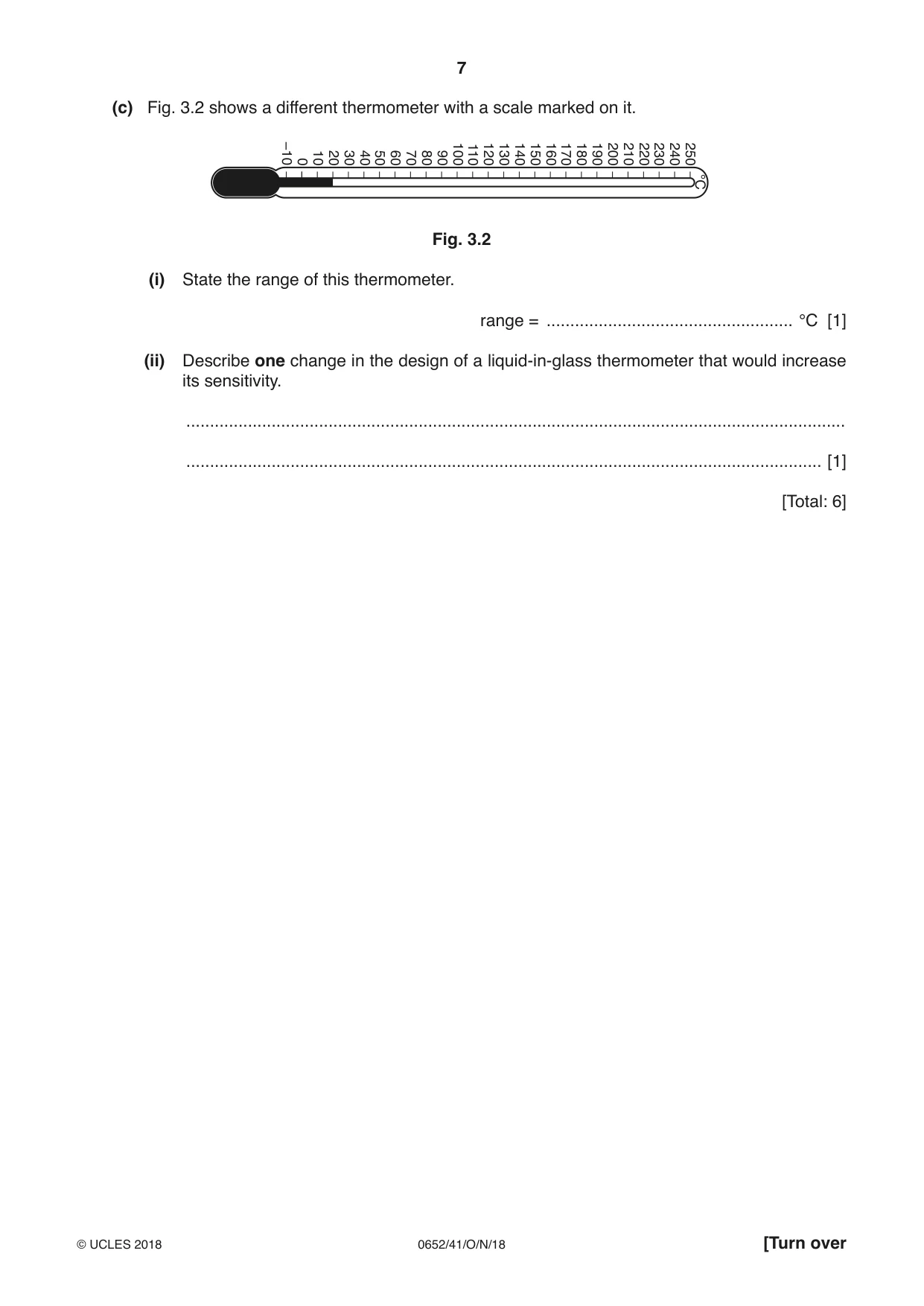
3 A student calibrates an unmarked liquid-in-glass thermometer. He places the thermometer bulb in ice at 0 °C and marks the position of the end of the liquid thread. He then places the thermometer bulb in steam at 100 °C and marks the position of the end of the liquid thread. (a) Explain why the student places the thermometer bulb in melting ice and in steam. ................................................................................................................................................... .............................................................................................................................................. [1] (b) Fig. 3.1 shows the thermometer next to a ruler. Line A is the mark made when the thermometer bulb is in the ice. Line B is the mark made when the thermometer bulb is in the steam. bulb liquid thread A B 0 1 2 3 4 5 6 7 8 9 cm Fig. 3.1 Calculate the temperature when the liquid thread is at the position shown in Fig. 3.1. temperature = .................................................... °C [3] (c) Fig. 3.2 shows a different thermometer with a scale marked on it. –100102030405060708090100110120130140150160170180190200210220230240250 °C Fig. 3.2 (i) State the range of this thermometer. range = .................................................... °C [1] (ii) Describe one change in the design of a liquid-in-glass thermometer that would increase its sensitivity. ........................................................................................................................................... ...................................................................................................................................... [1] [Total: 6]
Mark scheme: 3(a) to find the fixed point(s) ; 1 3(b) recognition that the fixed points are at 1.5 and 8.4 cm ; 100° : 6.9 cm leads to 100 ÷ 6.9 : 1 cm or 100 ÷ 6.9 or 14.49 or 14.5 (° / cm) ; 2.8 cm = 2.8 × 100 / 6.9 = 41 (°C) ; 3 3(c)(i) −10 to 250 or 260 (°C) ; 1 3(c)(ii) decrease the bore diameter / increase the volume of the bulb; 1
Q4 · Use words from the box to complete the sentences about making a water-soluble salt
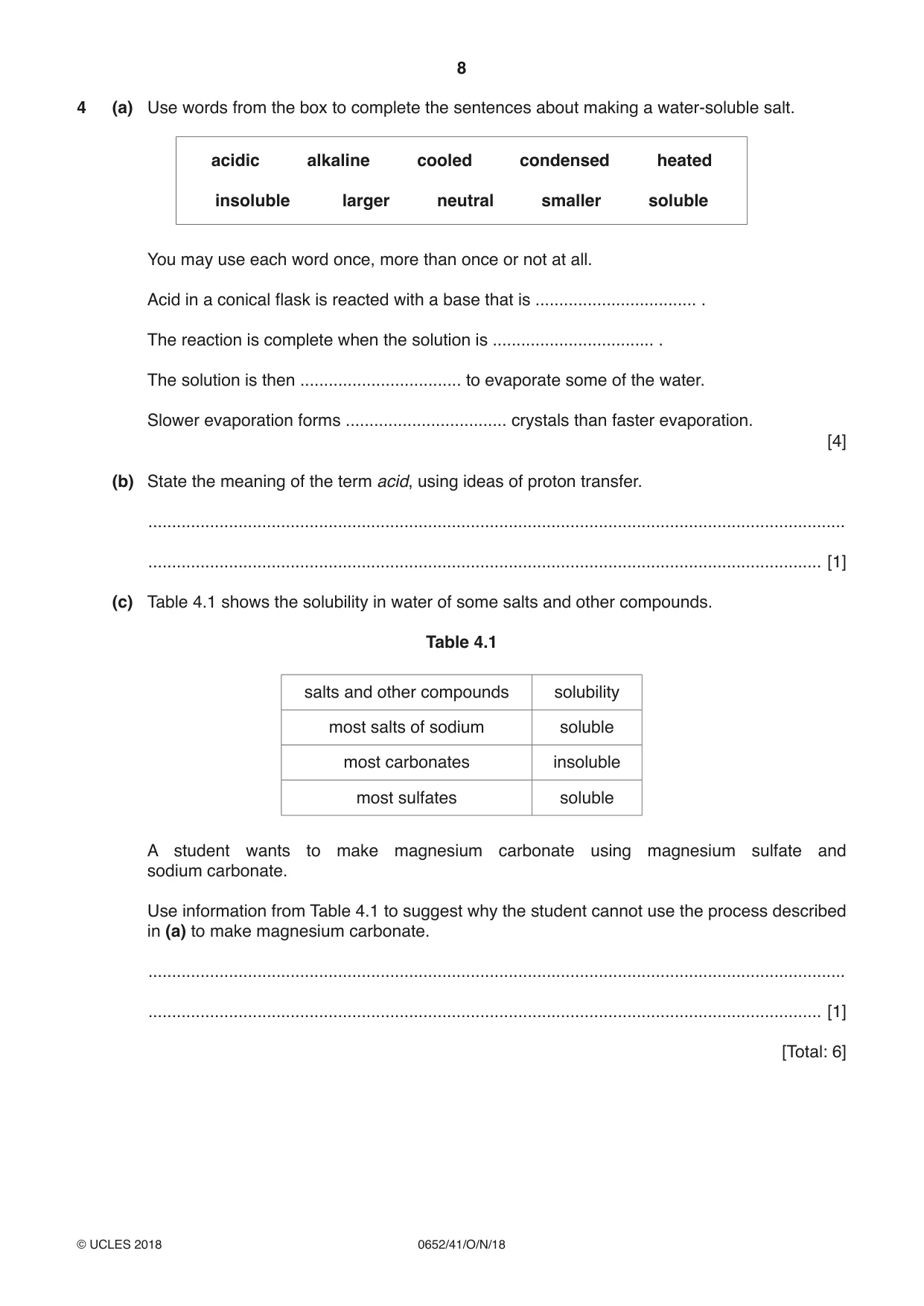
4 (a) Use words from the box to complete the sentences about making a water-soluble salt. acidic alkaline cooled condensed heated insoluble larger neutral smaller soluble You may use each word once, more than once or not at all. Acid in a conical flask is reacted with a base that is .................................. . The reaction is complete when the solution is .................................. . The solution is then .................................. to evaporate some of the water. Slower evaporation forms .................................. crystals than faster evaporation. [4] (b) State the meaning of the term acid, using ideas of proton transfer. ................................................................................................................................................... .............................................................................................................................................. [1] (c) Table 4.1 shows the solubility in water of some salts and other compounds. Table 4.1 salts and other compounds solubility most salts of sodium soluble most carbonates insoluble most sulfates soluble A student wants to make magnesium carbonate using magnesium sulfate and sodium carbonate. Use information from Table 4.1 to suggest why the student cannot use the process described in (a) to make magnesium carbonate. ................................................................................................................................................... .............................................................................................................................................. [1] [Total: 6]
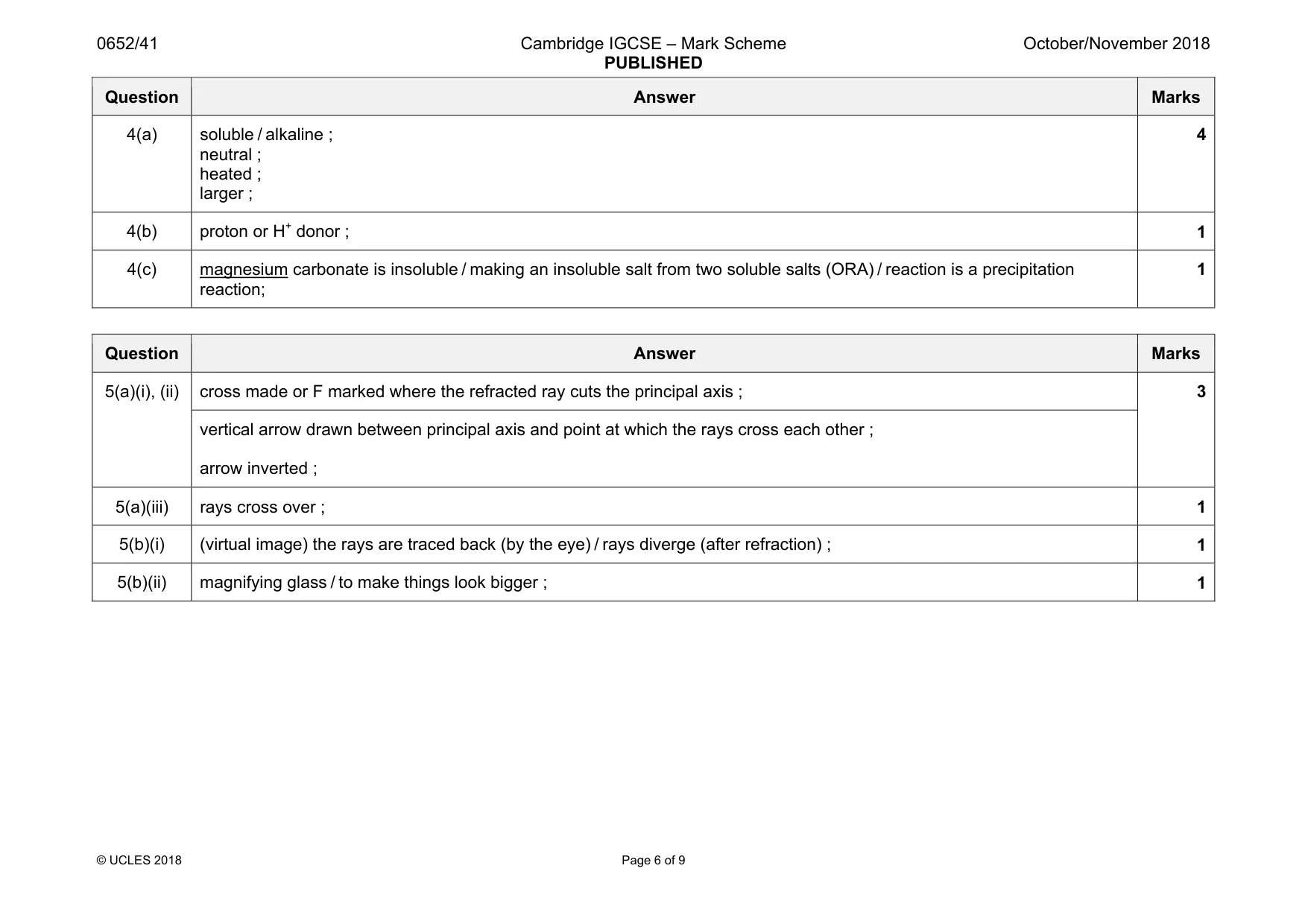
Mark scheme: 4(a) soluble / alkaline ; neutral ; heated ; larger ; 4 4(b) proton or H+ donor ; 1 4(c) magnesium carbonate is insoluble / making an insoluble salt from two soluble salts (ORA) / reaction is a precipitation reaction; 1
Q5 · A ray diagram showing how an image is formed by a converging lens
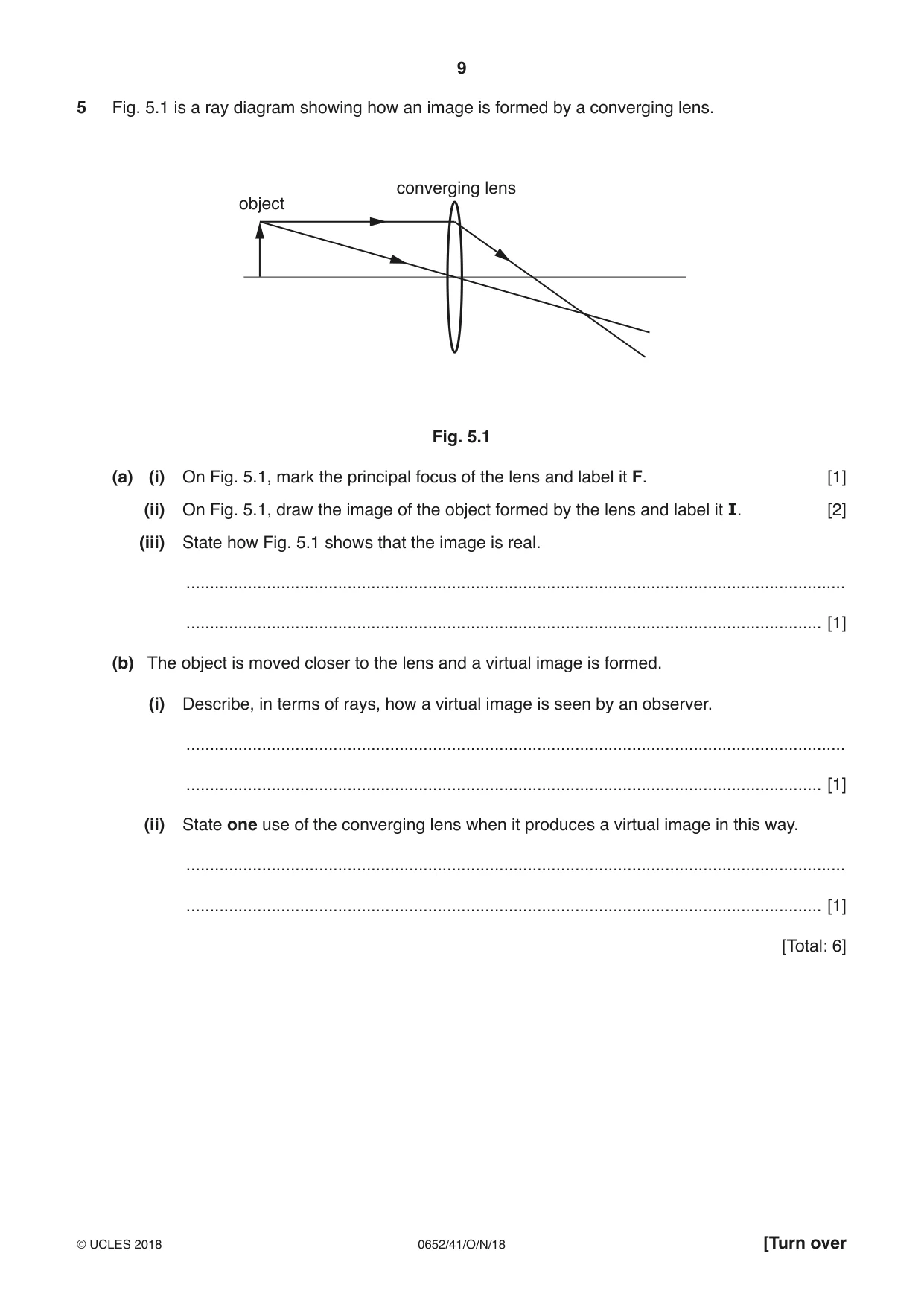
5 Fig. 5.1 is a ray diagram showing how an image is formed by a converging lens. converging lens object Fig. 5.1 (a) (i) On Fig. 5.1, mark the principal focus of the lens and label it F. [1] (ii) On Fig. 5.1, draw the image of the object formed by the lens and label it I. [2] (iii) State how Fig. 5.1 shows that the image is real. ........................................................................................................................................... ...................................................................................................................................... [1] (b) The object is moved closer to the lens and a virtual image is formed. (i) Describe, in terms of rays, how a virtual image is seen by an observer. ........................................................................................................................................... ...................................................................................................................................... [1] (ii) State one use of the converging lens when it produces a virtual image in this way. ........................................................................................................................................... ...................................................................................................................................... [1] [Total: 6]
Mark scheme: 5(a)(i), (ii) cross made or F marked where the refracted ray cuts the principal axis ; 3 vertical arrow drawn between principal axis and point at which the rays cross each other ; arrow inverted ; 5(a)(iii) rays cross over ; 1 5(b)(i) (virtual image) the rays are traced back (by the eye) / rays diverge (after refraction) ; 1 5(b)(ii) magnifying glass / to make things look bigger ; 1
Q6 · Ethane combusts in excess oxygen
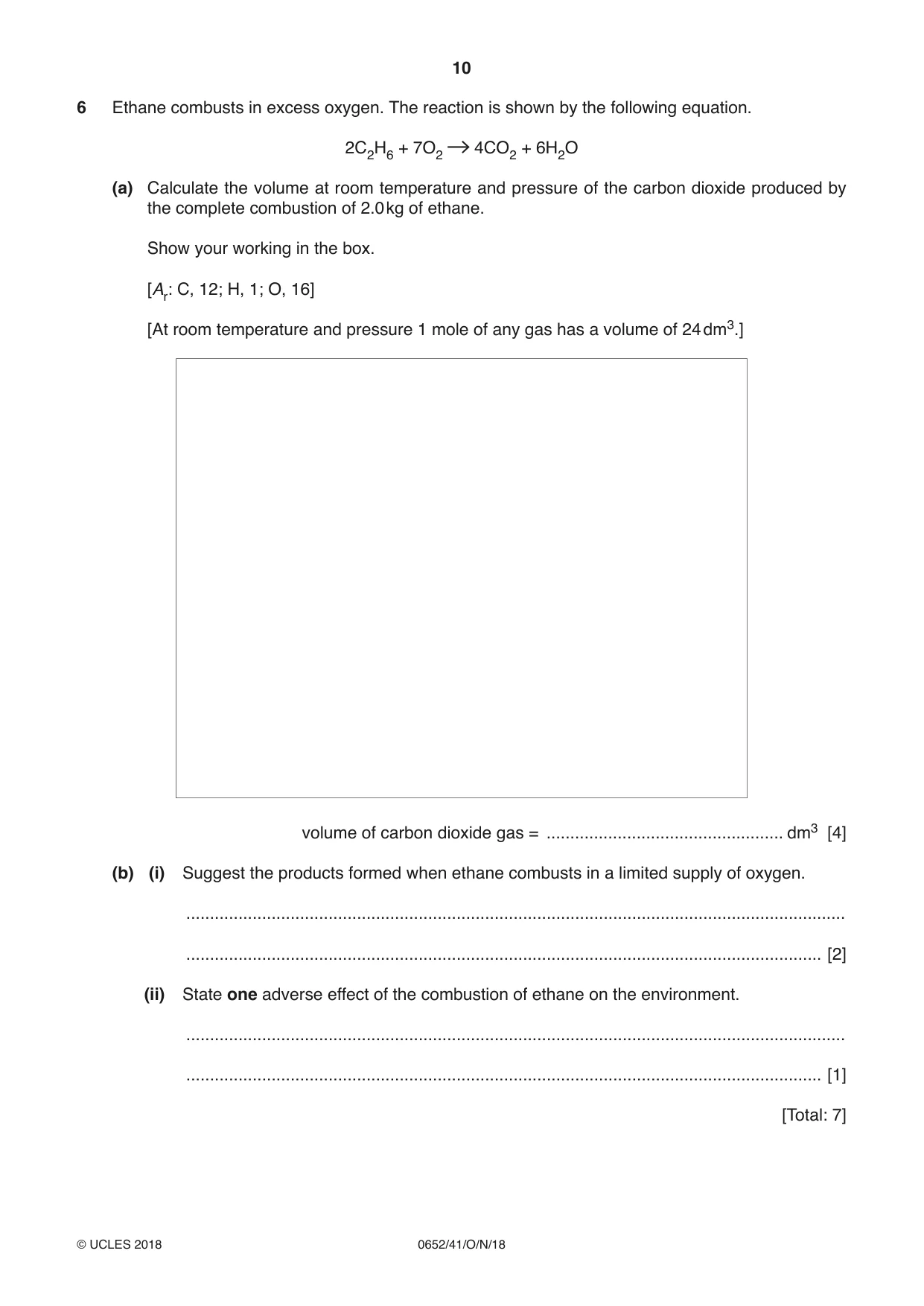
6 Ethane combusts in excess oxygen. The reaction is shown by the following equation. 2C2H6 + 7O2 4CO2 + 6H2O (a) Calculate the volume at room temperature and pressure of the carbon dioxide produced by the complete combustion of 2.0 kg of ethane. Show your working in the box. [Ar: C, 12; H, 1; O, 16] [At room temperature and pressure 1 mole of any gas has a volume of 24 dm3.] volume of carbon dioxide gas = .................................................. dm3 [4] (b) (i) Suggest the products formed when ethane combusts in a limited supply of oxygen. ........................................................................................................................................... ...................................................................................................................................... [2] (ii) State one adverse effect of the combustion of ethane on the environment. ........................................................................................................................................... ...................................................................................................................................... [1] [Total: 7]
Mark scheme: 6(a) Mr of C2H6 Mr of C2H6 = 24 + 6 = 30 ; ratio 1 : 2 (or 2 : 4) ratio C2H6 : 2CO2 ; mass of CO2 30 g C2H6 = 2 × 24 dm3 CO2 OR 48 dm3 CO2 OR 60 g C2H6 = 4 × 24 dm3 CO2 ; volume of CO2 (2000 ÷ 30 × 48) = 3200 ; 4 6(b)(i) any two from: • carbon monoxide • carbon / soot • water ;; 2 6(b)(ii) any one from: • soot on buildings • poisonous gas / binds irreversibly with the haemoglobin in blood / reduces capacity of blood to carry oxygen • climate change / global warming ; max 1
Question 7
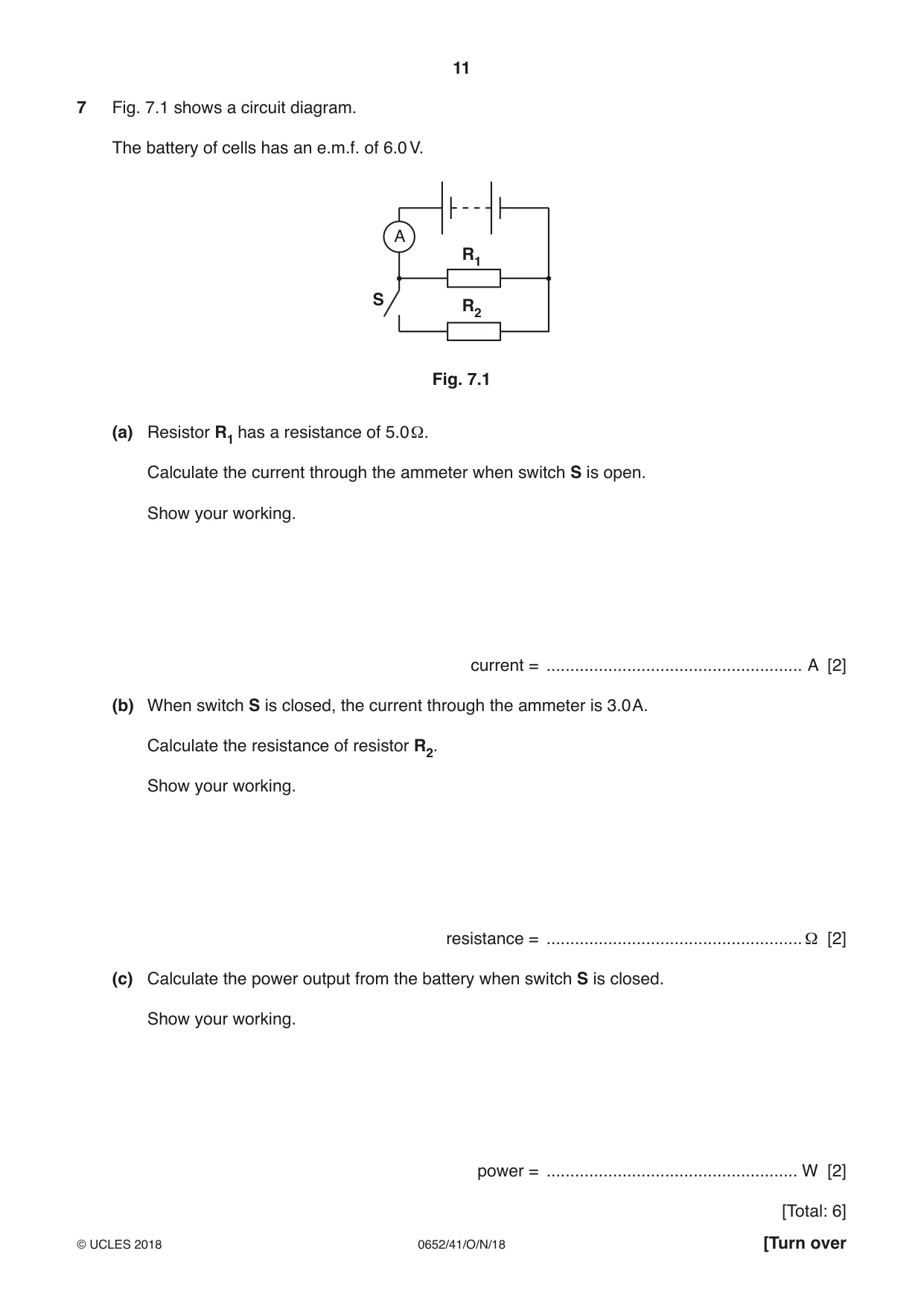
7 Fig. 7.1 shows a circuit diagram. The battery of cells has an e.m.f. of 6.0 V. A R1 S R2 Fig. 7.1 (a) Resistor R1 has a resistance of 5.0 Ω. Calculate the current through the ammeter when switch S is open. Show your working. current = ...................................................... A [2] (b) When switch S is closed, the current through the ammeter is 3.0 A. Calculate the resistance of resistor R2. Show your working. resistance = ...................................................... Ω [2] (c) Calculate the power output from the battery when switch S is closed. Show your working. power = ..................................................... W [2] [Total: 6]
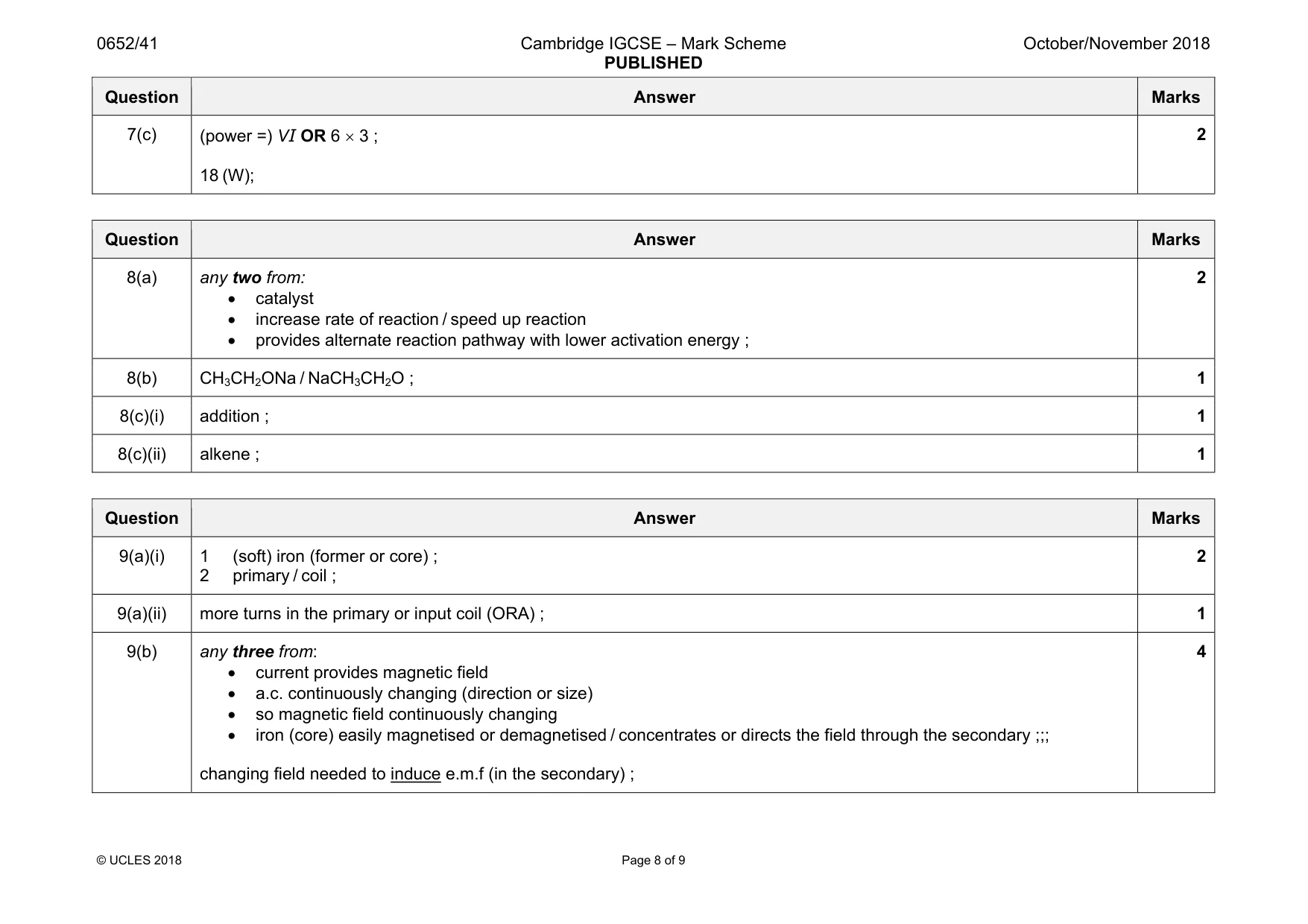
Mark scheme: 7(a) 1.2 (A) ; 2 7(b) current through R2 = 3.0 – 1.2 OR 1.8 (A) resistance = 3.3 (Ω) ; 2 Question Answer Marks 7(c) (power =) VI OR 6 × 3 ; 18 (W); 2
Q8 · Ethanol is produced in the following reaction
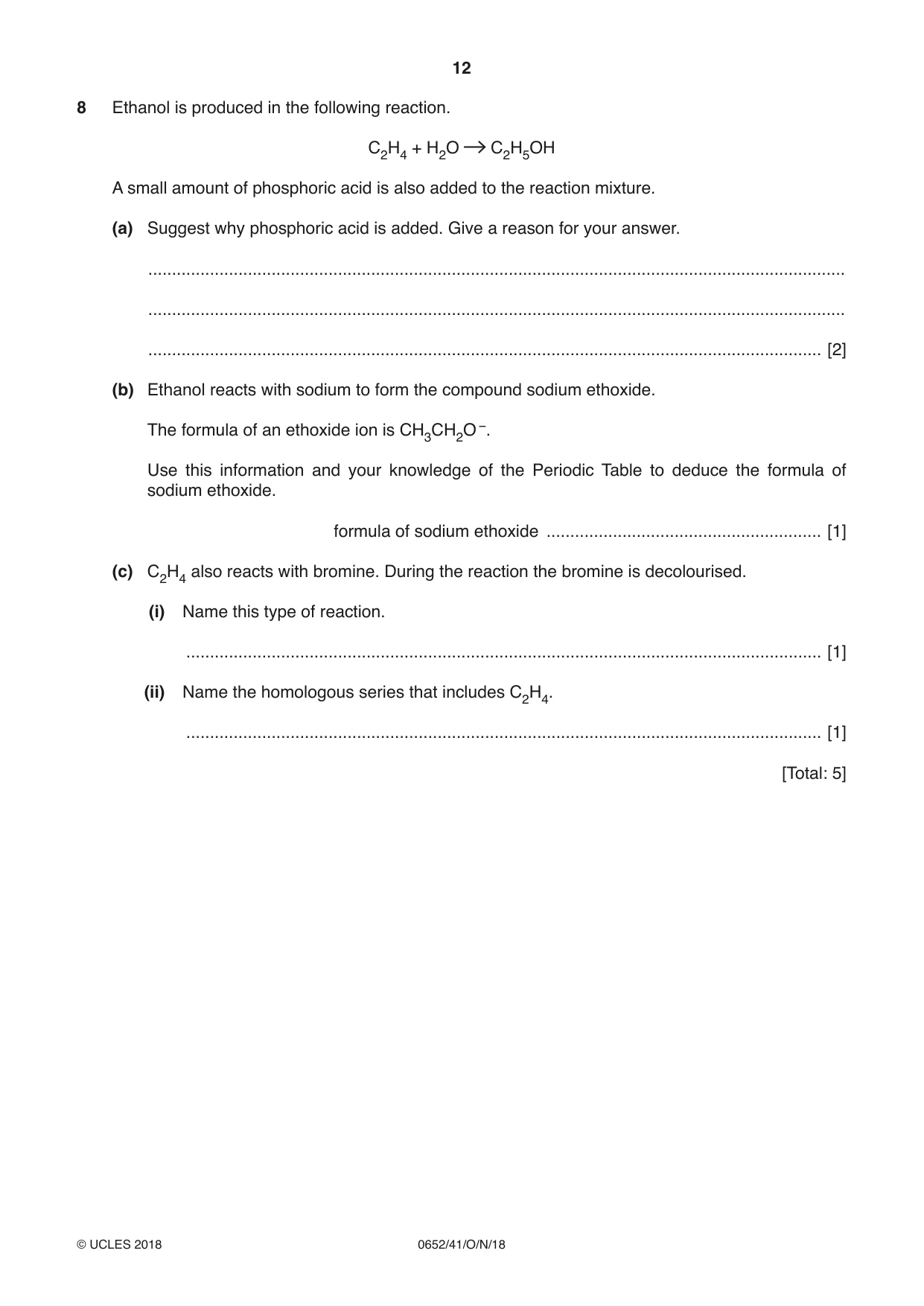
8 Ethanol is produced in the following reaction. C2H4 + H2O C2H5OH A small amount of phosphoric acid is also added to the reaction mixture. (a) Suggest why phosphoric acid is added. Give a reason for your answer. ................................................................................................................................................... ................................................................................................................................................... .............................................................................................................................................. [2] (b) Ethanol reacts with sodium to form the compound sodium ethoxide. The formula of an ethoxide ion is CH3CH2O −. Use this information and your knowledge of the Periodic Table to deduce the formula of sodium ethoxide. formula of sodium ethoxide .......................................................... [1] (c) C2H4 also reacts with bromine. During the reaction the bromine is decolourised. (i) Name this type of reaction. ...................................................................................................................................... [1] (ii) Name the homologous series that includes C2H4. ...................................................................................................................................... [1] [Total: 5]
Mark scheme: 8(a) any two from: • catalyst • increase rate of reaction / speed up reaction • provides alternate reaction pathway with lower activation energy ; 2 8(b) CH3CH2ONa / NaCH3CH2O ; 1 8(c)(i) addition ; 1 8(c)(ii) alkene ; 1
Q9 · The structure of a simple transformer
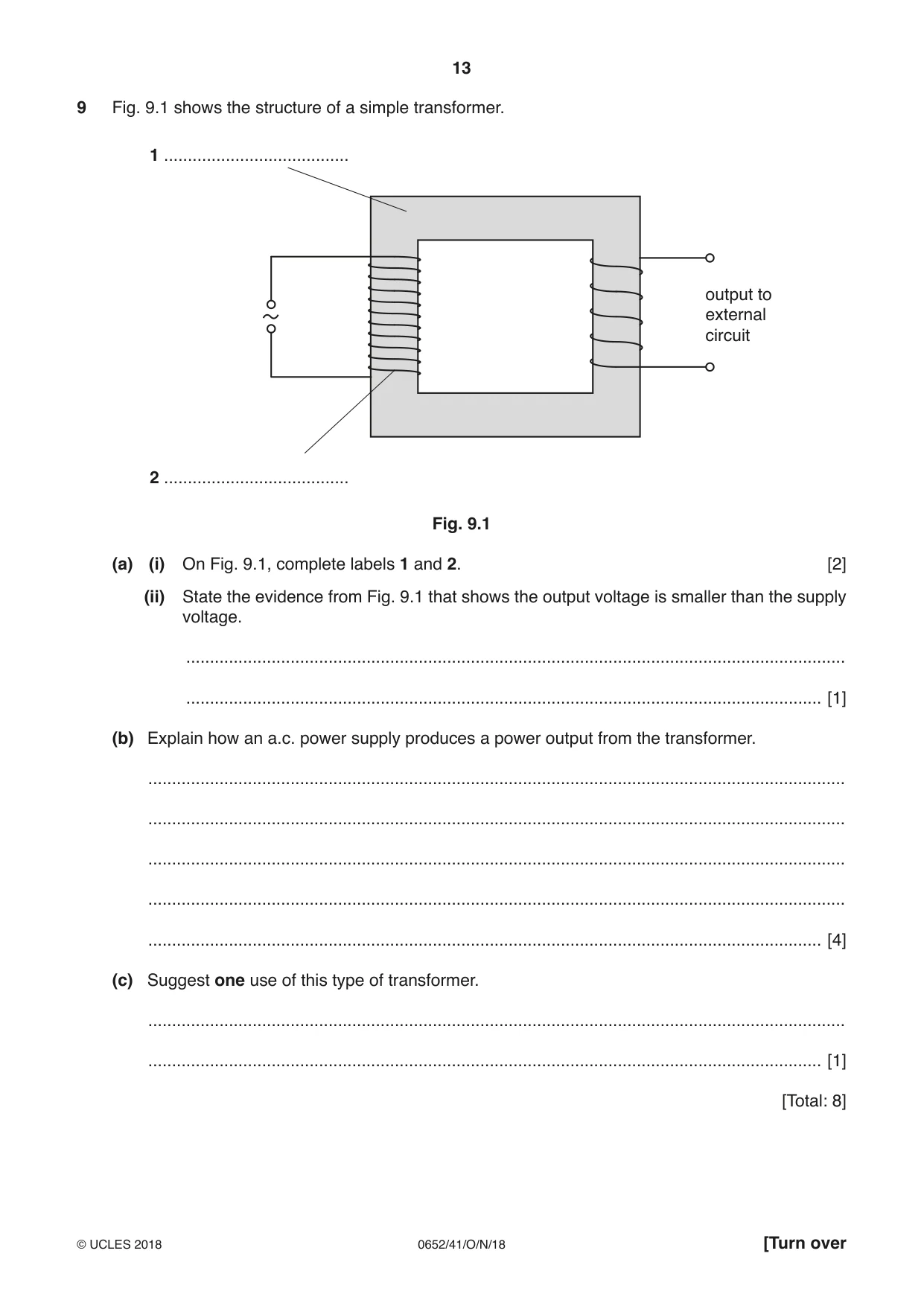
9 Fig. 9.1 shows the structure of a simple transformer. 1 ....................................... output to external circuit 2 ....................................... Fig. 9.1 (a) (i) On Fig. 9.1, complete labels 1 and 2. [2] (ii) State the evidence from Fig. 9.1 that shows the output voltage is smaller than the supply voltage. ........................................................................................................................................... ...................................................................................................................................... [1] (b) Explain how an a.c. power supply produces a power output from the transformer. ................................................................................................................................................... ................................................................................................................................................... ................................................................................................................................................... ................................................................................................................................................... .............................................................................................................................................. [4] (c) Suggest one use of this type of transformer. ................................................................................................................................................... .............................................................................................................................................. [1] [Total: 8]
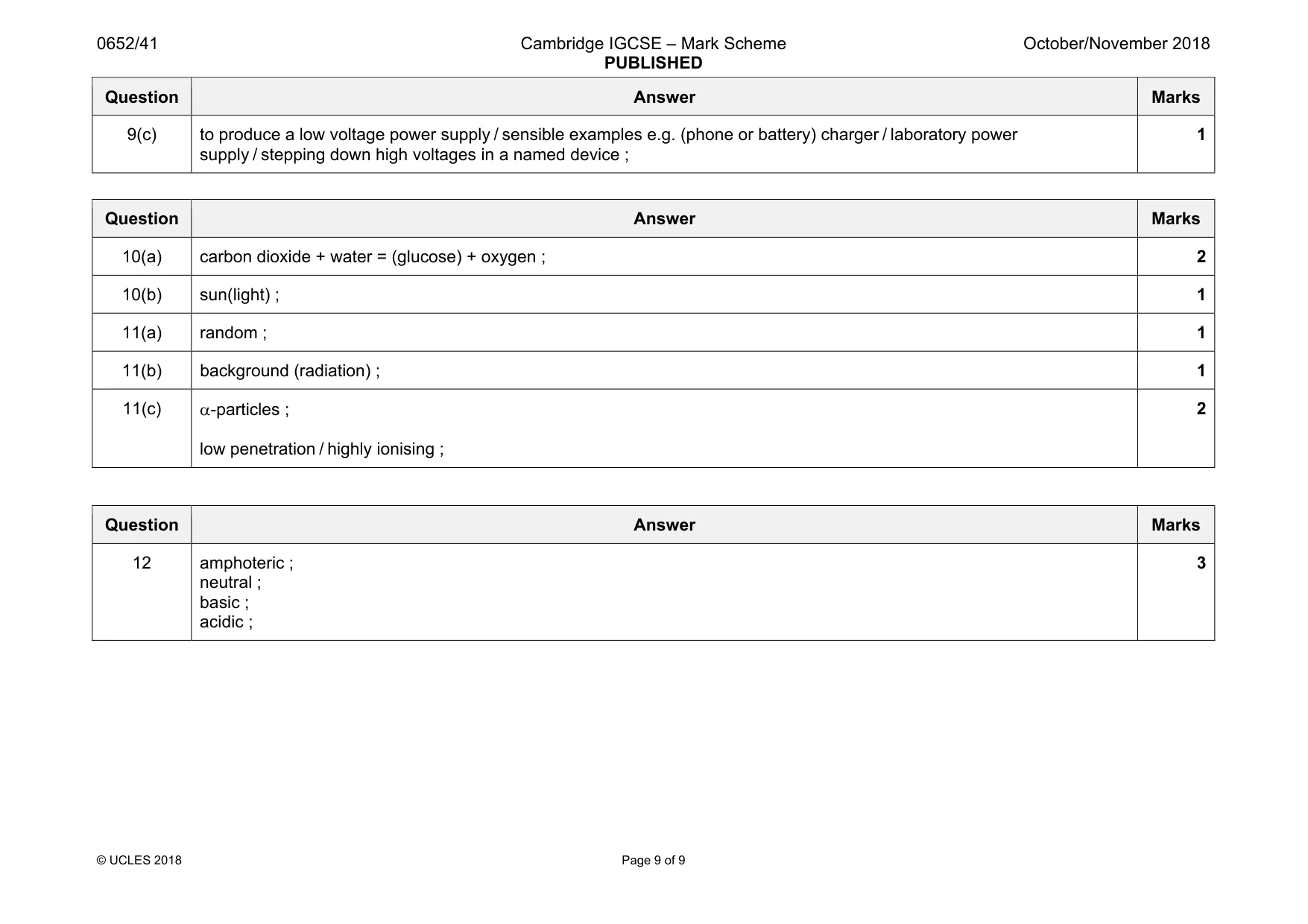
Mark scheme: 9(a)(i) 1 (soft) iron (former or core) ; 2 primary / coil ; 2 9(a)(ii) more turns in the primary or input coil (ORA) ; 1 9(b) any three from: • current provides magnetic field • a.c. continuously changing (direction or size) • so magnetic field continuously changing • iron (core) easily magnetised or demagnetised / concentrates or directs the field through the secondary ;;; changing field needed to induce e.m.f (in the secondary) ; 4 Question Answer Marks 9(c) to produce a low voltage power supply / sensible examples e.g. (phone or battery) charger / laboratory power supply / stepping down high voltages in a named device ; 1
Q10 · Plants use the process of photosynthesis to produce glucose
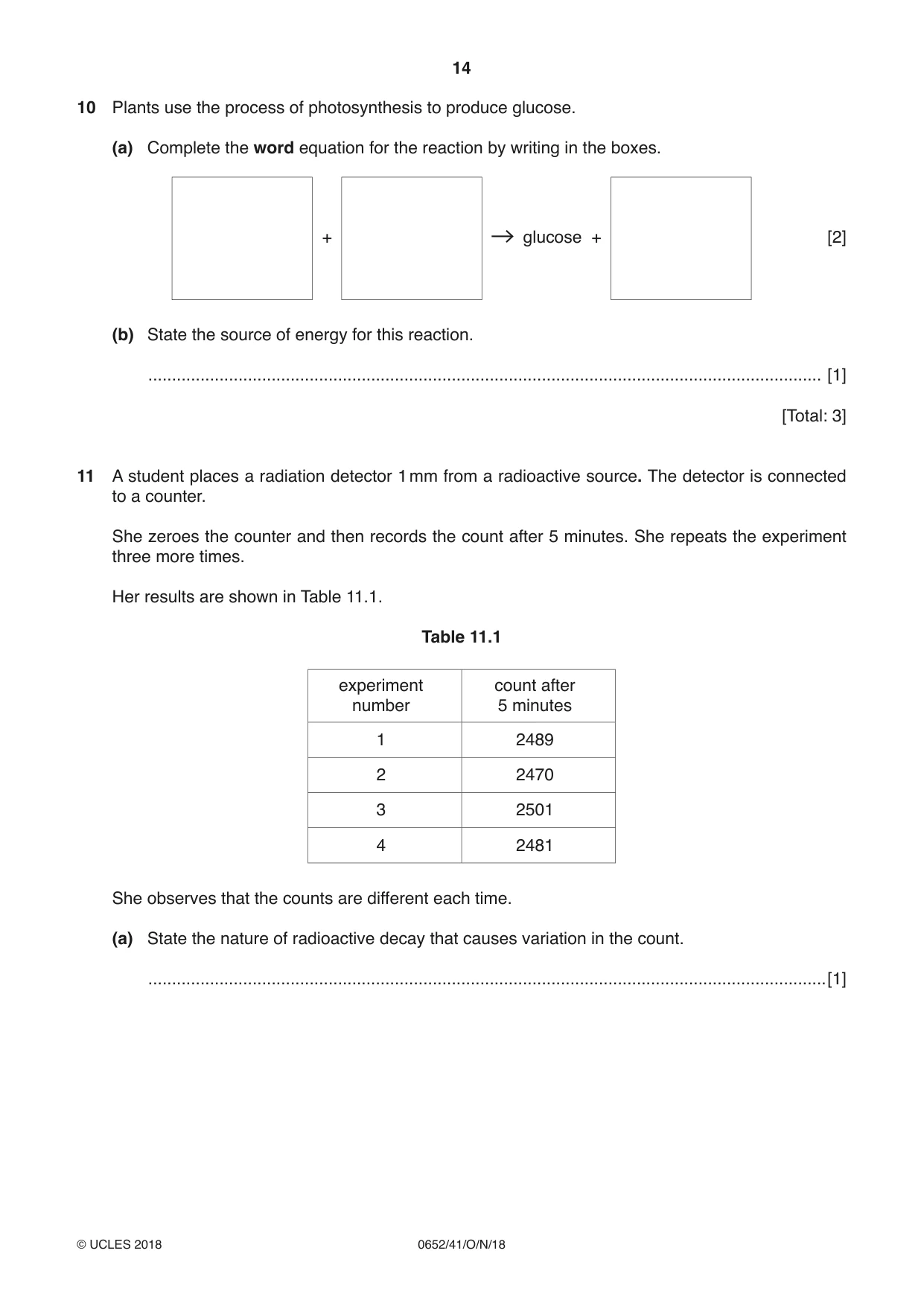
10 Plants use the process of photosynthesis to produce glucose. (a) Complete the word equation for the reaction by writing in the boxes. + glucose + [2] (b) State the source of energy for this reaction. .............................................................................................................................................. [1] [Total: 3]
Mark scheme: 10(a) carbon dioxide + water = (glucose) + oxygen ; 2 10(b) sun(light) ; 1
Q11 · A student places a radiation detector 1 mm from a radioactive source
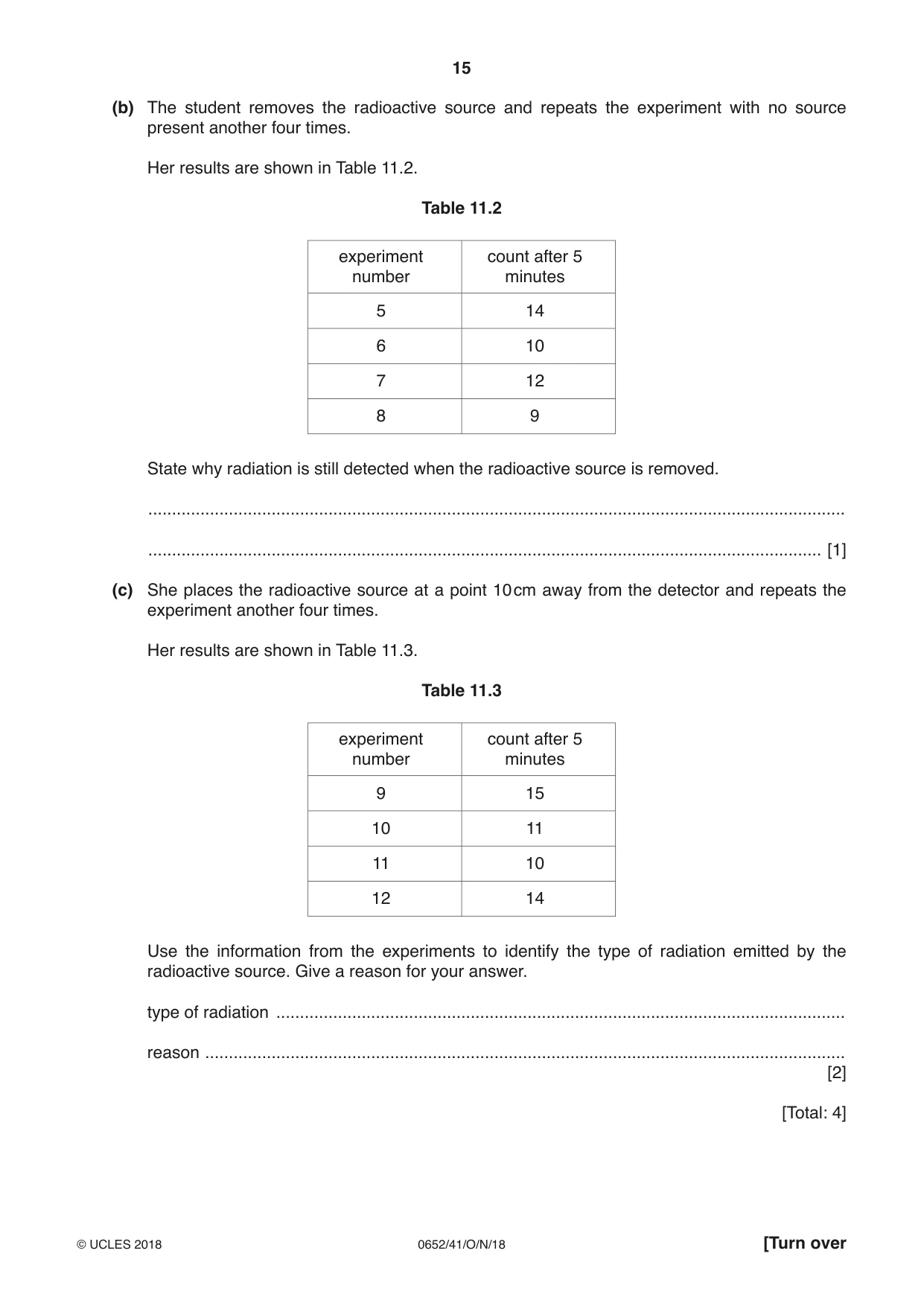
11 A student places a radiation detector 1 mm from a radioactive source. The detector is connected to a counter. She zeroes the counter and then records the count after 5 minutes. She repeats the experiment three more times. Her results are shown in Table 11.1. Table 11.1 experiment count after number 5 minutes 1 2489 2 2470 3 2501 4 2481 She observes that the counts are different each time. (a) State the nature of radioactive decay that causes variation in the count. ...............................................................................................................................................[1] (b) The student removes the radioactive source and repeats the experiment with no source present another four times. Her results are shown in Table 11.2. Table 11.2 experiment count after 5 number minutes 5 14 6 10 7 12 8 9 State why radiation is still detected when the radioactive source is removed. ................................................................................................................................................... .............................................................................................................................................. [1] (c) She places the radioactive source at a point 10 cm away from the detector and repeats the experiment another four times. Her results are shown in Table 11.3. Table 11.3 experiment count after 5 number minutes 9 15 10 11 11 10 12 14 Use the information from the experiments to identify the type of radiation emitted by the radioactive source. Give a reason for your answer. type of radiation ........................................................................................................................ reason ....................................................................................................................................... [2] [Total: 4]
Mark scheme: 11(a) random ; 1 11(b) background (radiation) ; 1 11(c) α-particles ; low penetration / highly ionising ; 2
Q12 · Complete Table 12.1 to identify each oxide as acidic, basic, neutral or amphoteric
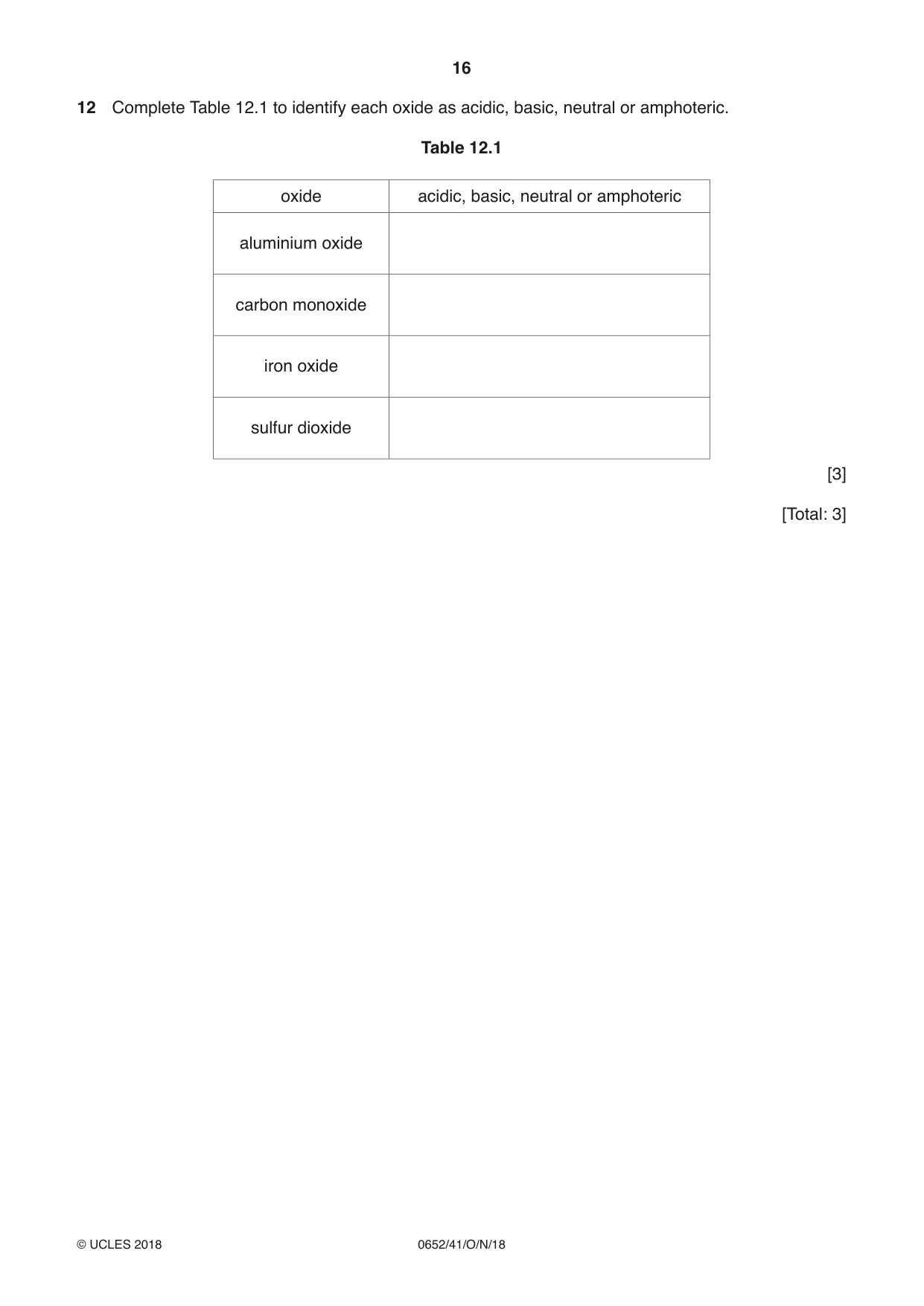
12 Complete Table 12.1 to identify each oxide as acidic, basic, neutral or amphoteric. Table 12.1 oxide acidic, basic, neutral or amphoteric aluminium oxide carbon monoxide iron oxide sulfur dioxide [3] [Total: 3]
Mark scheme: 12 amphoteric ; neutral ; basic ; acidic ; 3
What was in this paper
The subtopics covered by these 12 questions, and how many questions each got. Open one in a new tab to see every Cambridge question on it.
What you needed in this session
Cambridge’s own grade thresholds for 2018 Oct/Nov, Paper 4 · Variant 1. A higher threshold means an easier paper — the bar moves with how the cohort did.