Cambridge IGCSE Physical Science 0652 — 2023 Oct/Nov Paper 4 · Variant 1
0652/41/O/N/23 · 11 questions · 80 marks · ≈90 min
The question paper and its mark scheme, free to read here and free to download. This is Cambridge’s own paper, exactly as it was sat.
Question paper24 pages
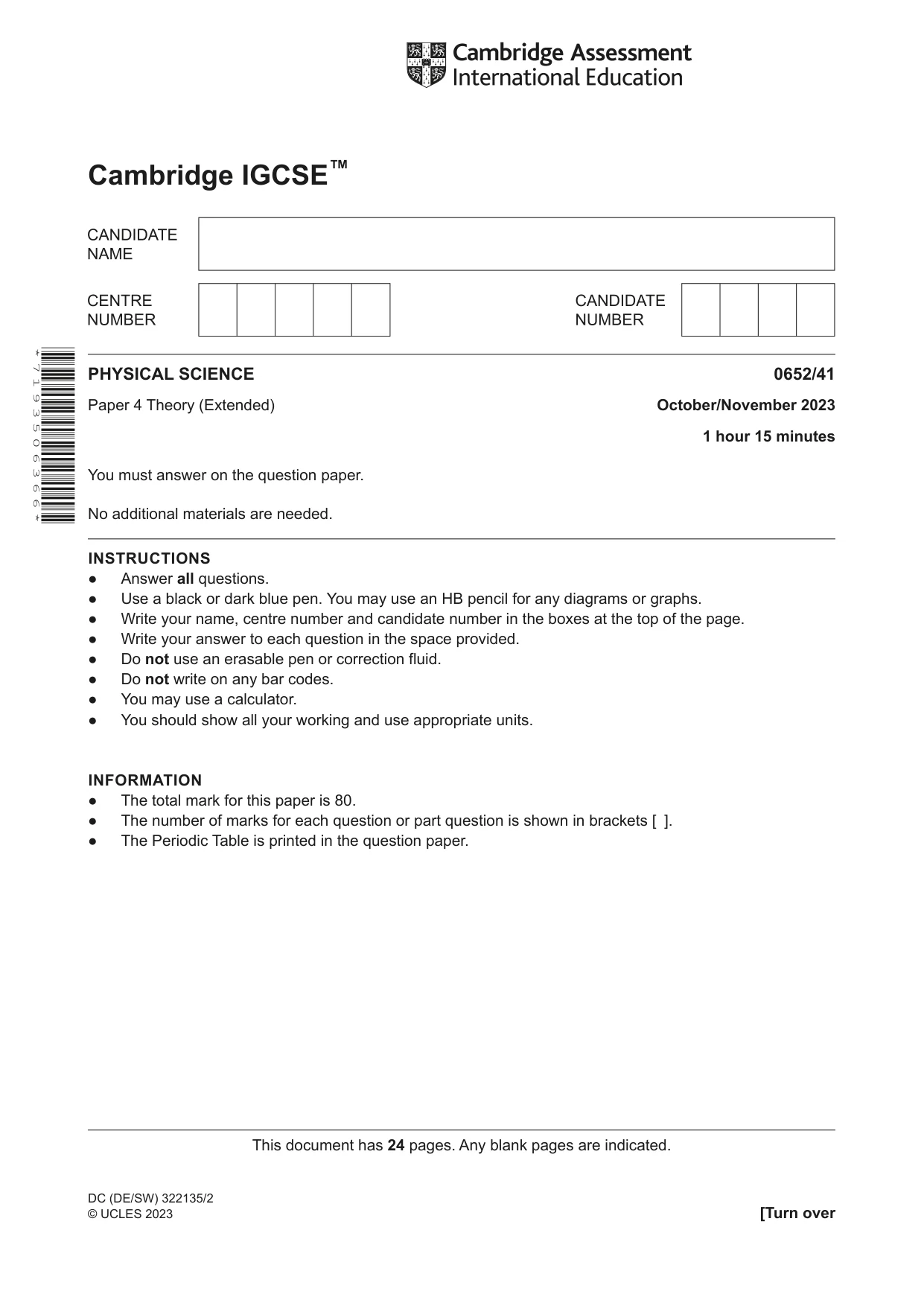





Mark scheme10 pages
Answers below. Sit the paper first if you are practising.
Questions as text
Q1 · A list of processes is shown
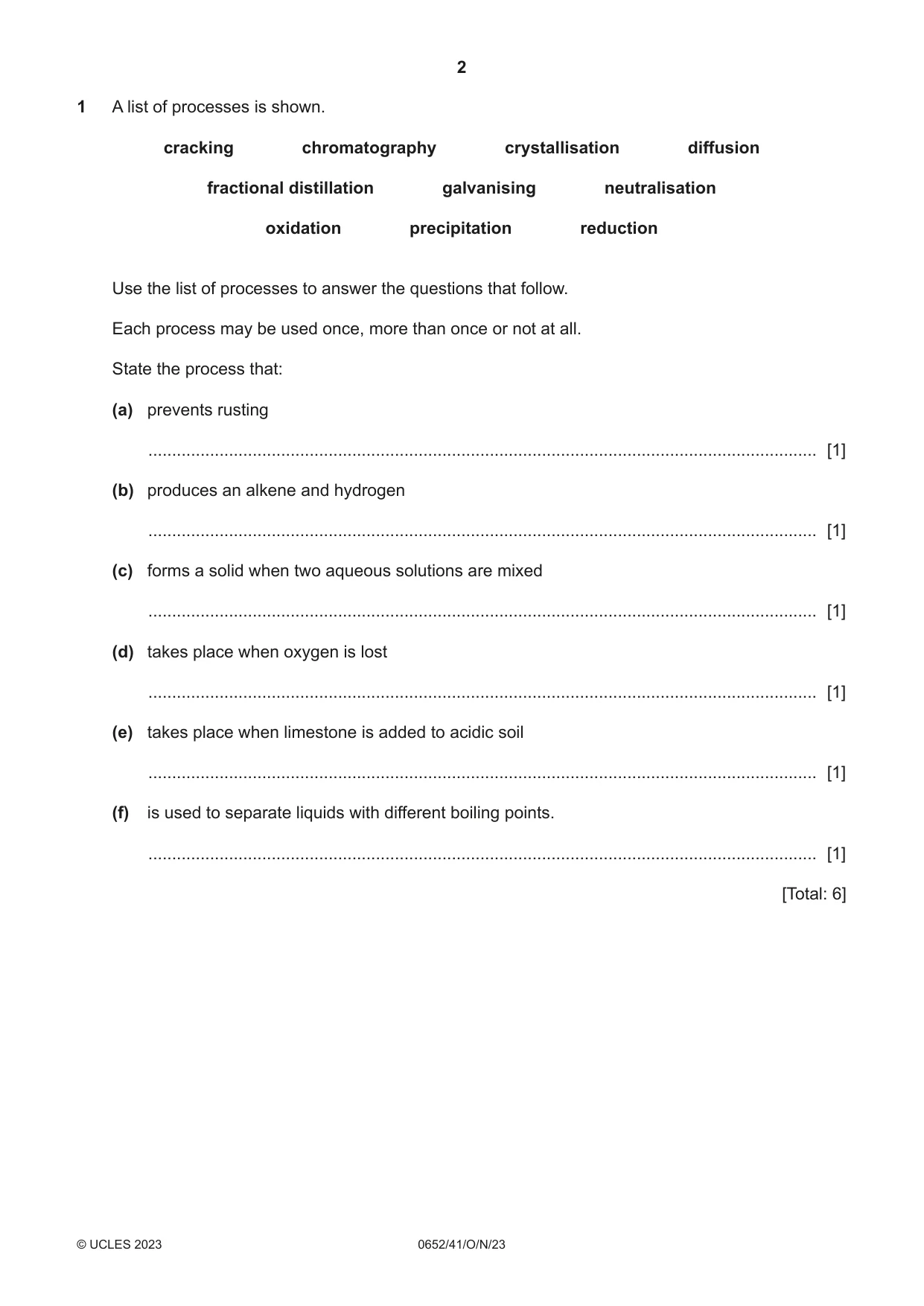
1 A list of processes is shown. cracking chromatography crystallisation diffusion fractional distillation galvanising neutralisation oxidation precipitation reduction Use the list of processes to answer the questions that follow. Each process may be used once, more than once or not at all. State the process that: (a) prevents rusting ............................................................................................................................................. [1] (b) produces an alkene and hydrogen ............................................................................................................................................. [1] (c) forms a solid when two aqueous solutions are mixed ............................................................................................................................................. [1] (d) takes place when oxygen is lost ............................................................................................................................................. [1] (e) takes place when limestone is added to acidic soil ............................................................................................................................................. [1] (f) is used to separate liquids with different boiling points. ............................................................................................................................................. [1] [Total: 6]
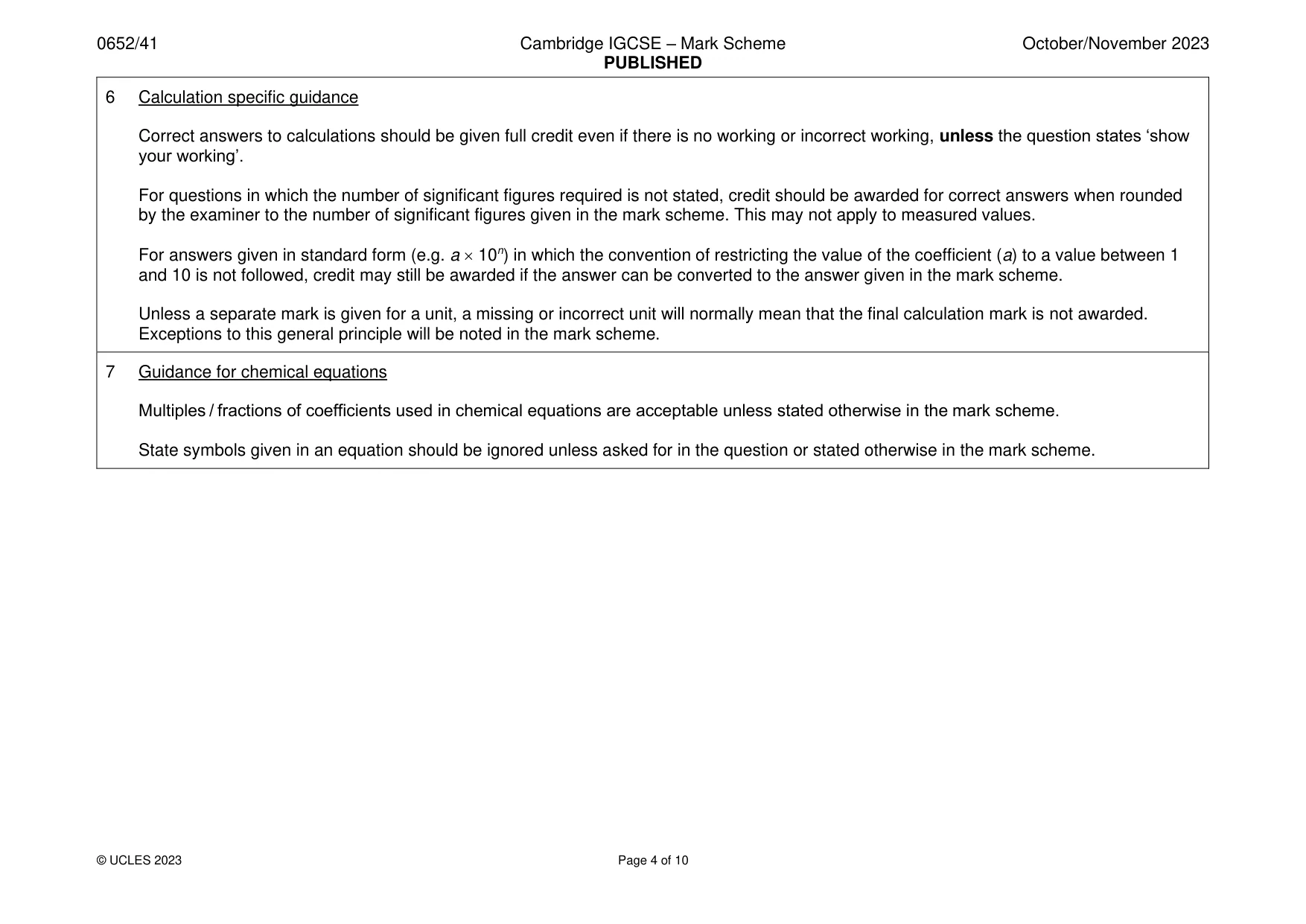
Mark scheme: Question Answer Marks 1(a) galvanising ; 1 1(b) cracking ; 1 1(c) precipitation ; 1 1(d) reduction ; 1 1(e) neutralisation ; 1 1(f) fractional distillation ; 1
Q2 · A student measures the diameter of a wire
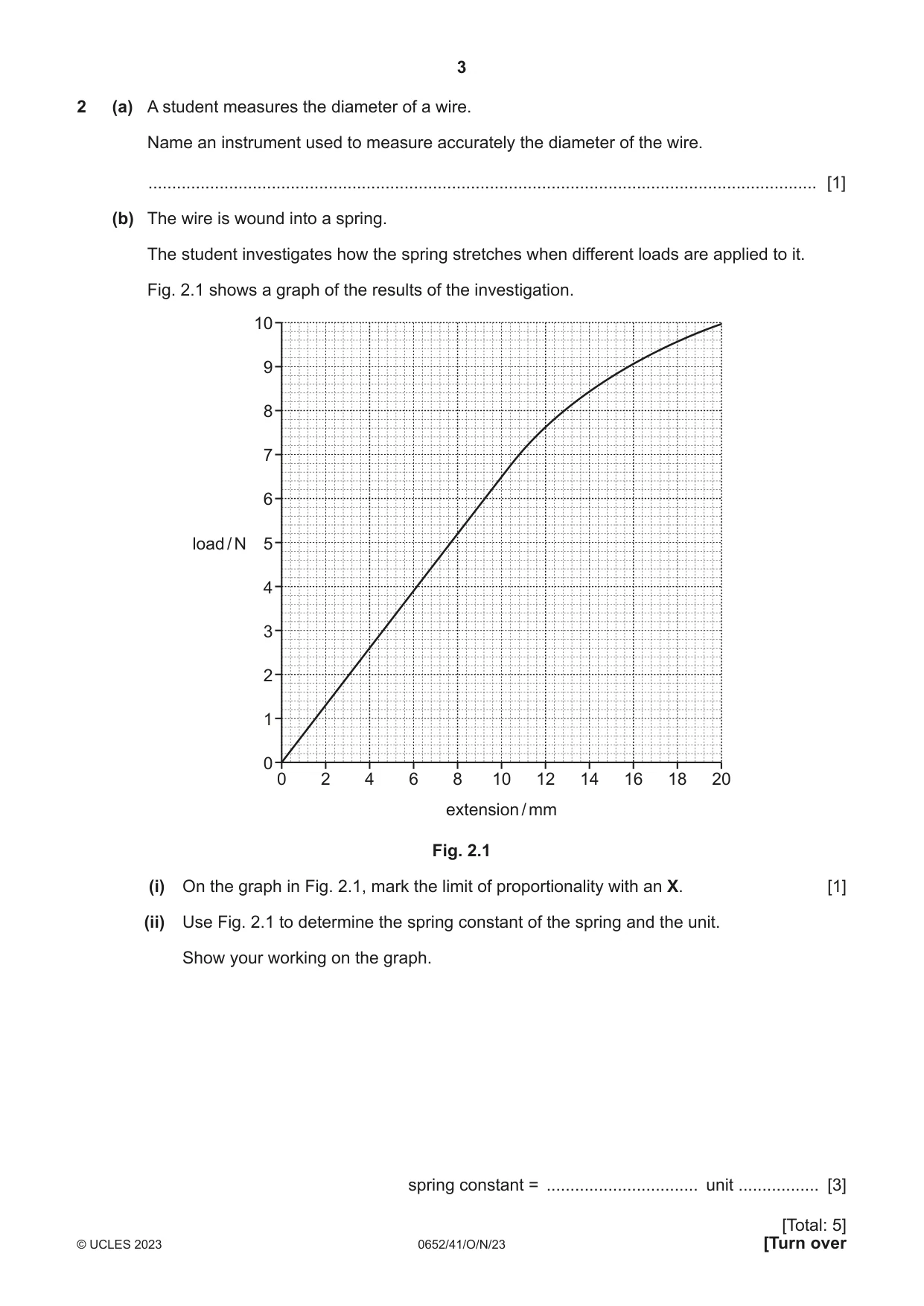
2 (a) A student measures the diameter of a wire. Name an instrument used to measure accurately the diameter of the wire. ............................................................................................................................................. [1] (b) The wire is wound into a spring. The student investigates how the spring stretches when different loads are applied to it. Fig. 2.1 shows a graph of the results of the investigation. 10 9 8 7 6 load / N 5 4 3 2 1 0 0 2 4 6 8 10 12 14 16 18 20 extension / mm Fig. 2.1 (i) On the graph in Fig. 2.1, mark the limit of proportionality with an X. [1] (ii) Use Fig. 2.1 to determine the spring constant of the spring and the unit. Show your working on the graph. spring constant = ................................ unit ................. [3]
Mark scheme: 2(a) micrometer ; 1 2(b)(i) X between extension 10–12 mm inclusive; 1 2(b)(ii) gradient of straight line portion of graph shown on graph ; 3 0.65 ; N / mm ;
Q3 · Melting points are used to assess the purity of substances
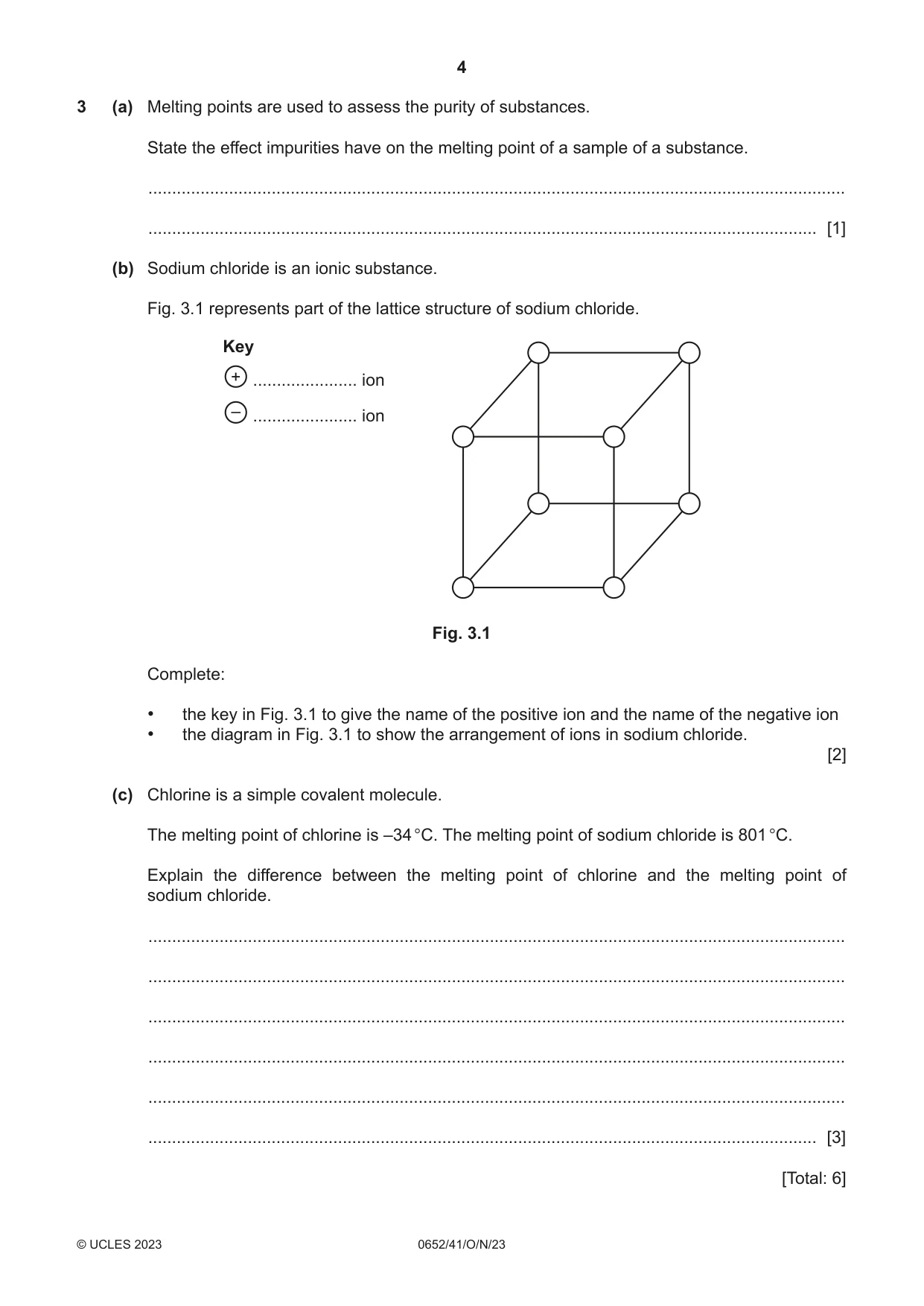
3 (a) Melting points are used to assess the purity of substances. State the effect impurities have on the melting point of a sample of a substance. ................................................................................................................................................... ............................................................................................................................................. [1] (b) Sodium chloride is an ionic substance. Fig. 3.1 represents part of the lattice structure of sodium chloride. Key + ...................... ion – ...................... ion Fig. 3.1 Complete: • the key in Fig. 3.1 to give the name of the positive ion and the name of the negative ion • the diagram in Fig. 3.1 to show the arrangement of ions in sodium chloride. [2] (c) Chlorine is a simple covalent molecule. The melting point of chlorine is –34 °C. The melting point of sodium chloride is 801 °C. Explain the difference between the melting point of chlorine and the melting point of sodium chloride. ................................................................................................................................................... ................................................................................................................................................... ................................................................................................................................................... ................................................................................................................................................... ................................................................................................................................................... ............................................................................................................................................. [3] [Total: 6]
Mark scheme: 3(a) melts over a range / not one definite melting point ; 1 3(b) key: 2 + = sodium AND − = chloride ; diagram: alternating + and − ; 3(c) sodium chloride stronger / more energy needed to break, (attractions) ; 3 chlorine attractions between molecules ; sodium chloride attractions between ions ;
Q4 · A ray of light is incident on the surface of a plane mirror as shown in Fig
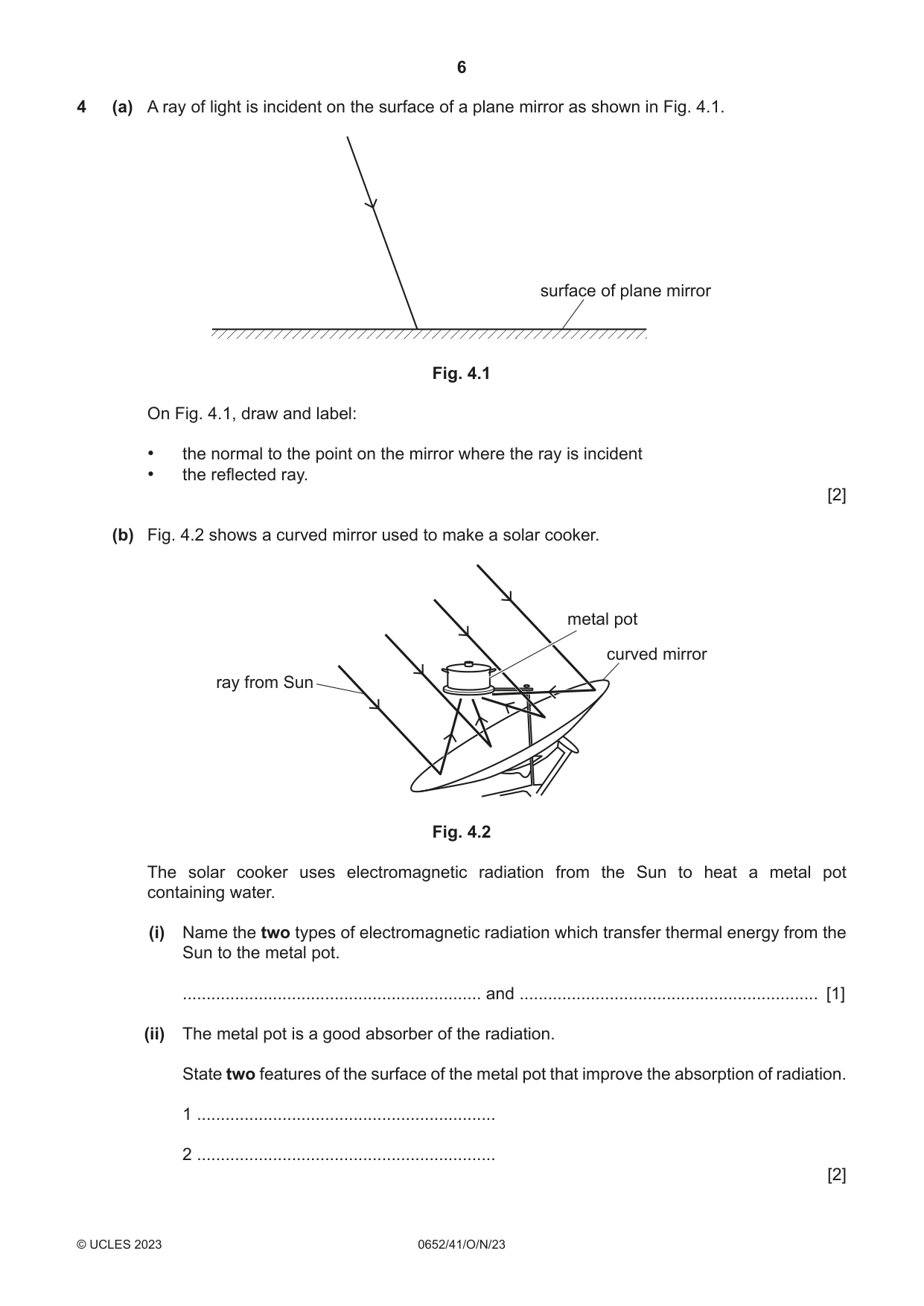
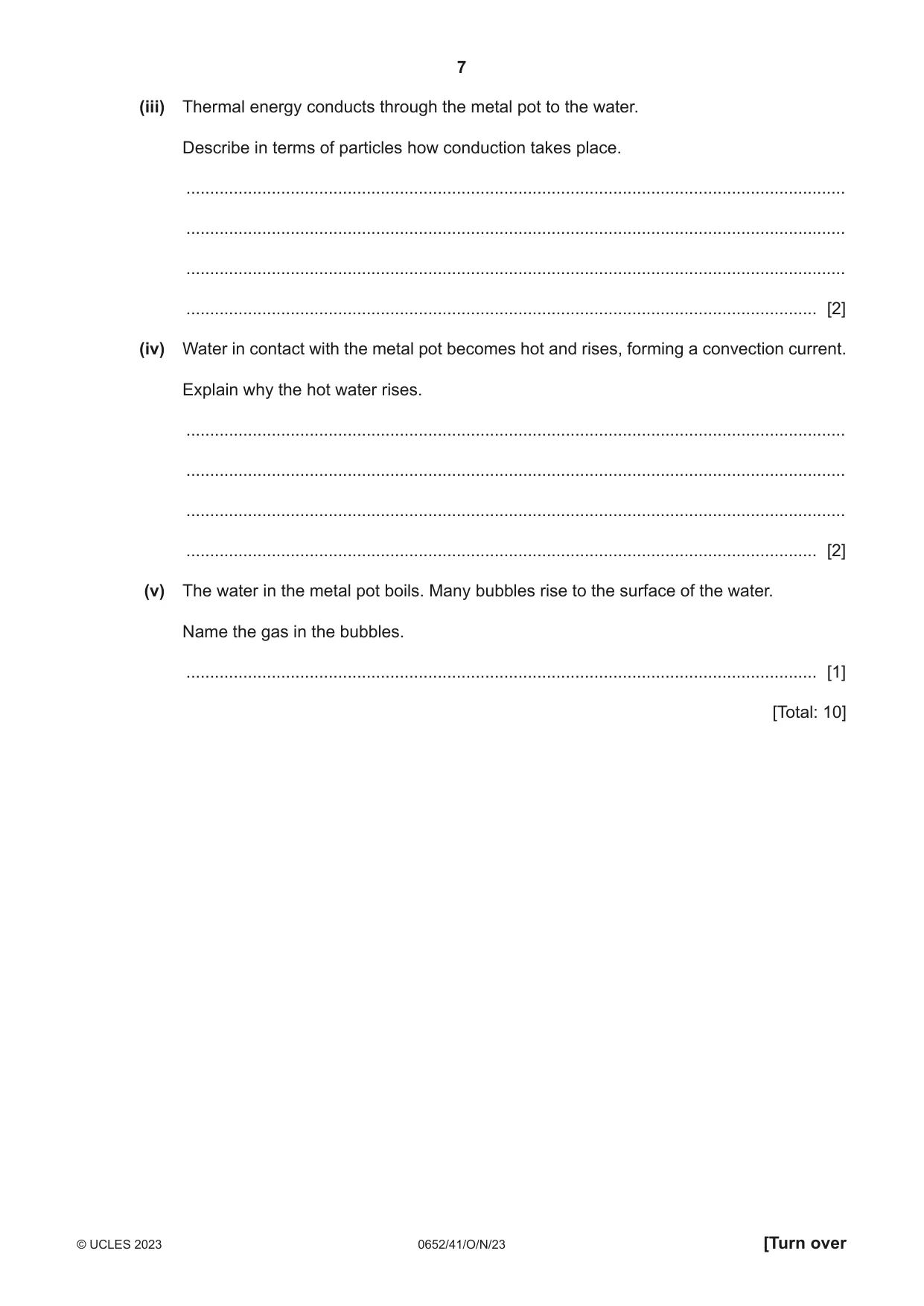
4 (a) A ray of light is incident on the surface of a plane mirror as shown in Fig. 4.1. surface of plane mirror Fig. 4.1 On Fig. 4.1, draw and label: • the normal to the point on the mirror where the ray is incident • the reflected ray. [2] (b) Fig. 4.2 shows a curved mirror used to make a solar cooker. metal pot curved mirror ray from Sun Fig. 4.2 The solar cooker uses electromagnetic radiation from the Sun to heat a metal pot containing water. (i) Name the two types of electromagnetic radiation which transfer thermal energy from the Sun to the metal pot. ............................................................... and ............................................................... [1] (ii) The metal pot is a good absorber of the radiation. State two features of the surface of the metal pot that improve the absorption of radiation. 1 ............................................................... 2 ............................................................... [2] (iii) Thermal energy conducts through the metal pot to the water. Describe in terms of particles how conduction takes place. ........................................................................................................................................... ........................................................................................................................................... ........................................................................................................................................... ..................................................................................................................................... [2] (iv) Water in contact with the metal pot becomes hot and rises, forming a convection current. Explain why the hot water rises. ........................................................................................................................................... ........................................................................................................................................... ........................................................................................................................................... ..................................................................................................................................... [2] (v) The water in the metal pot boils. Many bubbles rise to the surface of the water. Name the gas in the bubbles. ..................................................................................................................................... [1] [Total: 10]
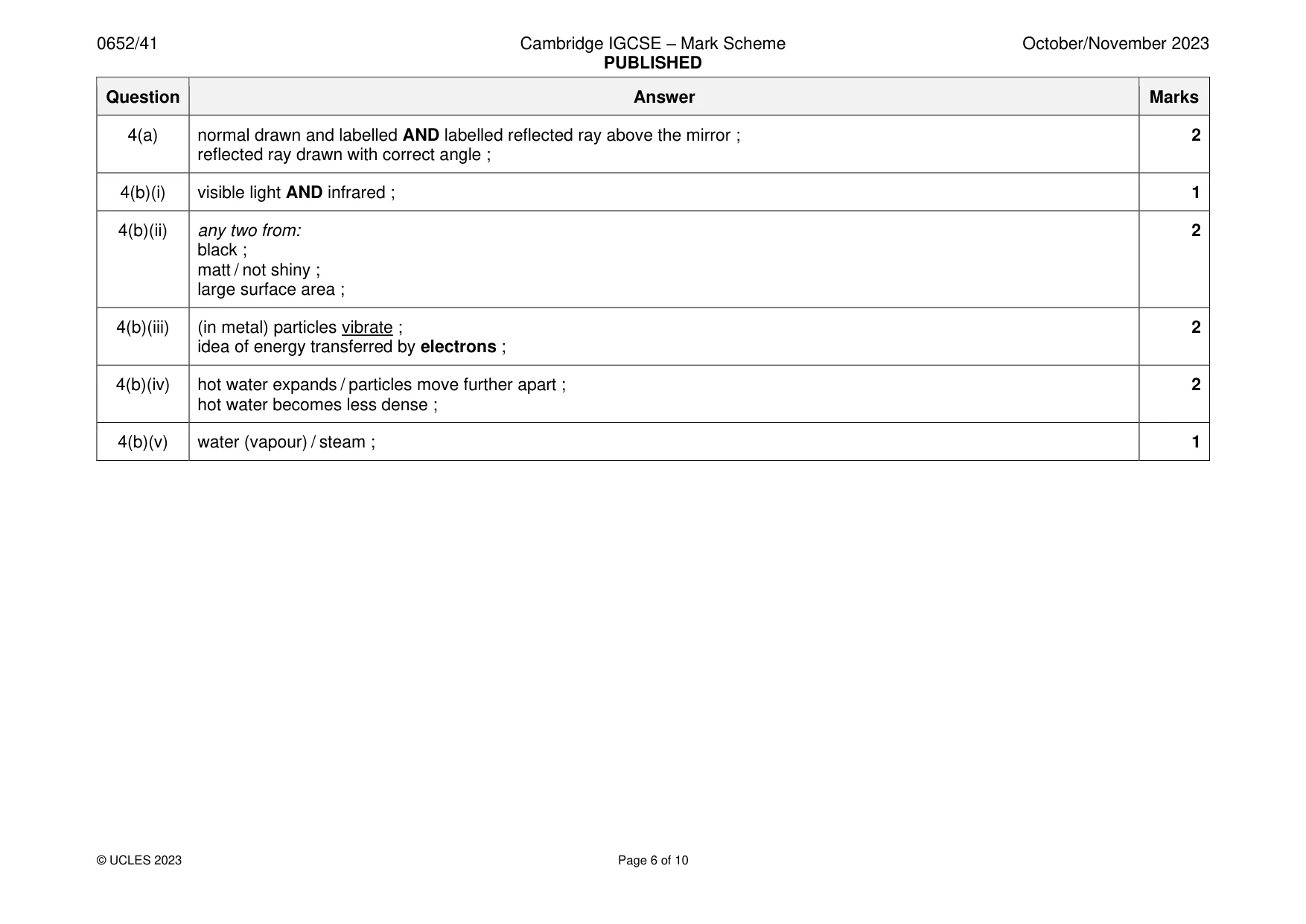
Mark scheme: 4(a) normal drawn and labelled AND labelled reflected ray above the mirror ; 2 reflected ray drawn with correct angle ; 4(b)(i) visible light AND infrared ; 1 4(b)(ii) any two from: 2 black ; matt / not shiny ; large surface area ; 4(b)(iii) (in metal) particles vibrate ; 2 idea of energy transferred by electrons ; 4(b)(iv) hot water expands / particles move further apart ; 2 hot water becomes less dense ; 4(b)(v) water (vapour) / steam ; 1
Q5 · Ethanol is an alcohol
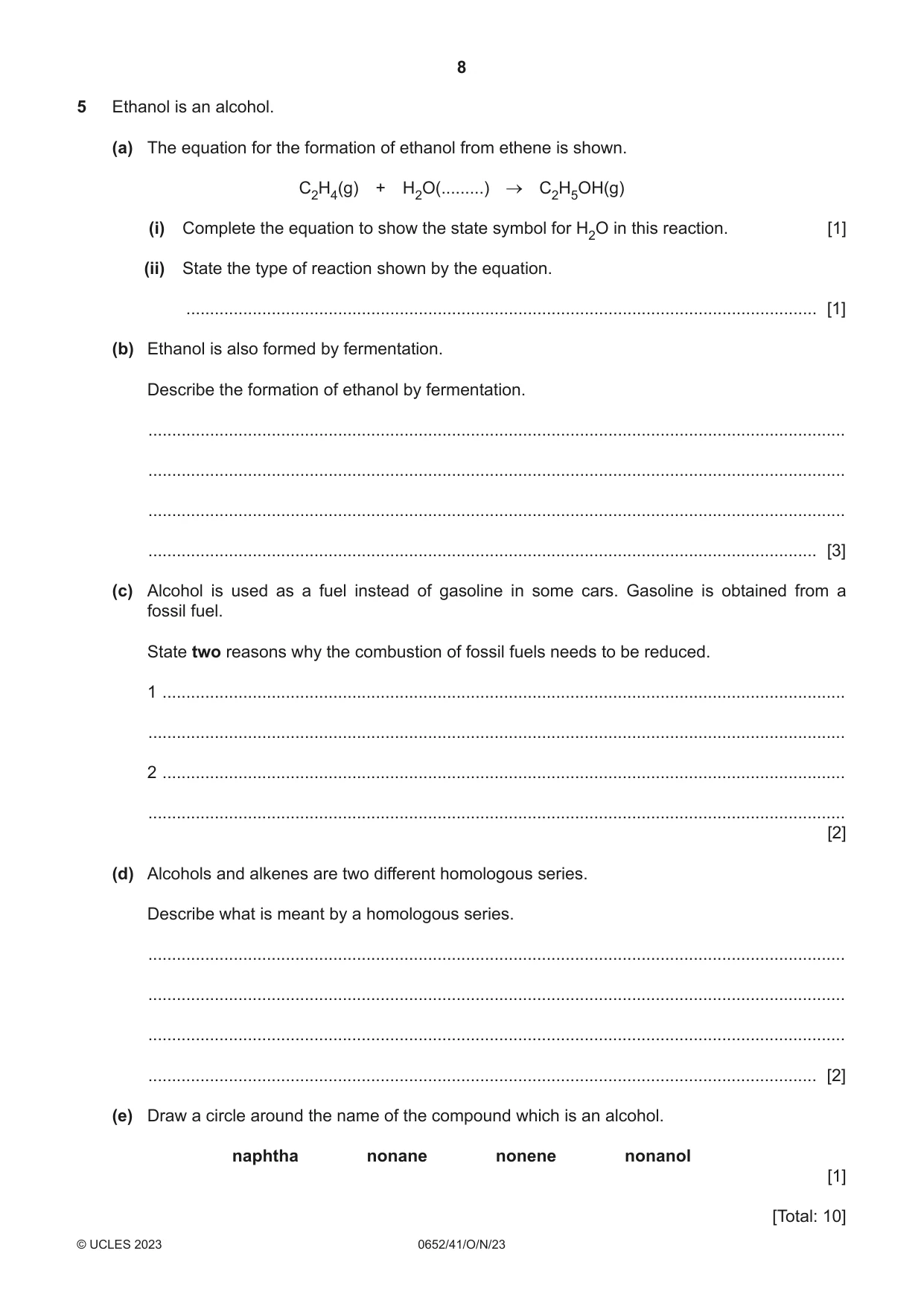
5 Ethanol is an alcohol. (a) The equation for the formation of ethanol from ethene is shown. C2H4(g) + H2O(.........) C2H5OH(g) (i) Complete the equation to show the state symbol for H2O in this reaction. [1] (ii) State the type of reaction shown by the equation. ..................................................................................................................................... [1] (b) Ethanol is also formed by fermentation. Describe the formation of ethanol by fermentation. ................................................................................................................................................... ................................................................................................................................................... ................................................................................................................................................... ............................................................................................................................................. [3] (c) Alcohol is used as a fuel instead of gasoline in some cars. Gasoline is obtained from a fossil fuel. State two reasons why the combustion of fossil fuels needs to be reduced. 1 ................................................................................................................................................ ................................................................................................................................................... 2 ................................................................................................................................................ ................................................................................................................................................... [2] (d) Alcohols and alkenes are two different homologous series. Describe what is meant by a homologous series. ................................................................................................................................................... ................................................................................................................................................... ................................................................................................................................................... ............................................................................................................................................. [2] (e) Draw a circle around the name of the compound which is an alcohol. naphtha nonane nonene nonanol [1] [Total: 10]
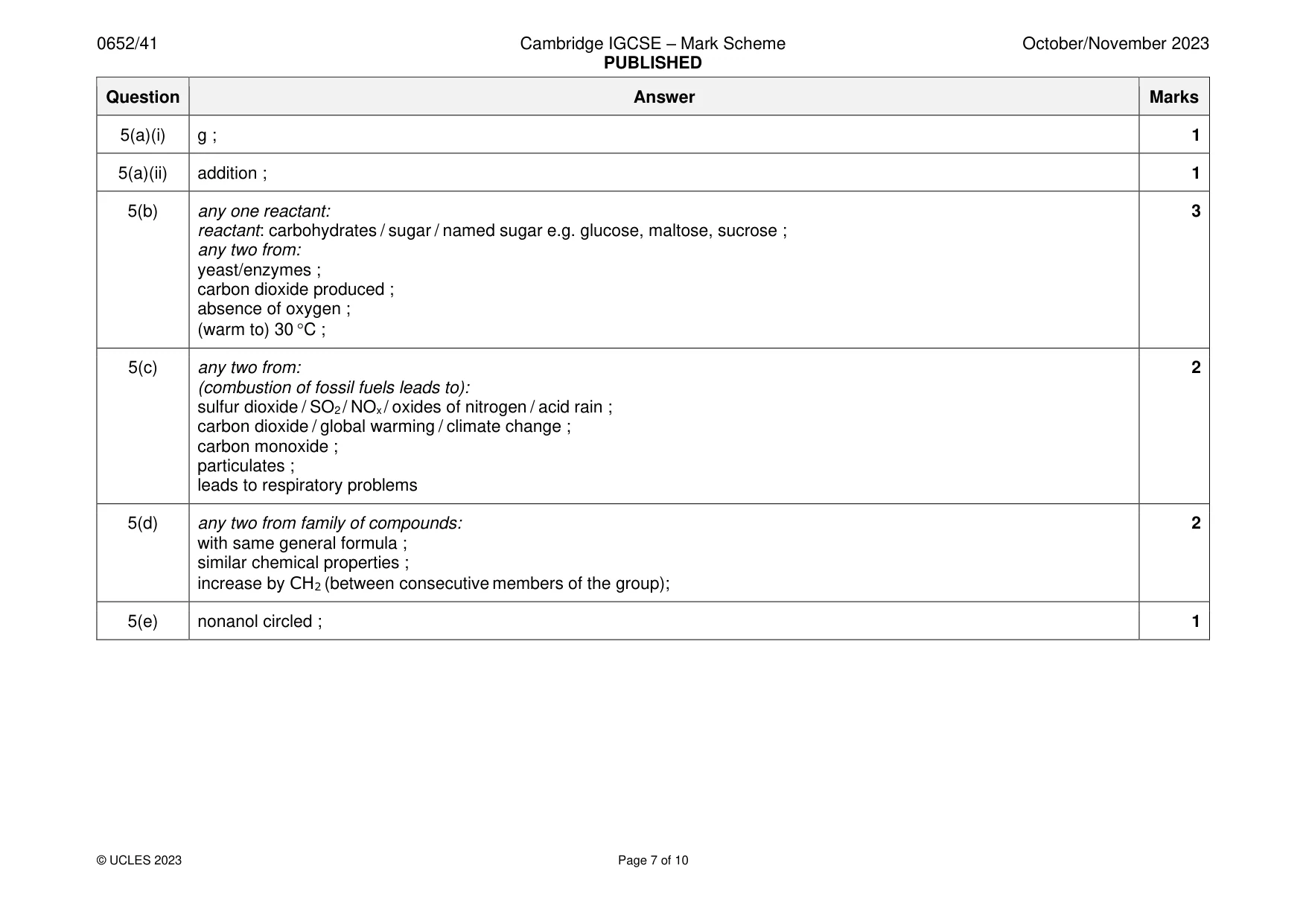
Mark scheme: 5(a)(i) g ; 1 5(a)(ii) addition ; 1 5(b) any one reactant: 3 reactant: carbohydrates / sugar / named sugar e.g. glucose, maltose, sucrose ; any two from: yeast/enzymes ; carbon dioxide produced ; absence of oxygen ; (warm to) 30 C ; 5(c) any two from: 2 (combustion of fossil fuels leads to): sulfur dioxide / SO2 / NOx / oxides of nitrogen / acid rain ; carbon dioxide / global warming / climate change ; carbon monoxide ; particulates ; leads to respiratory problems 5(d) any two from family of compounds: 2 with same general formula ; similar chemical properties ; increase by CH2 (between consecutive members of the group); 5(e) nonanol circled ; 1
Question 6
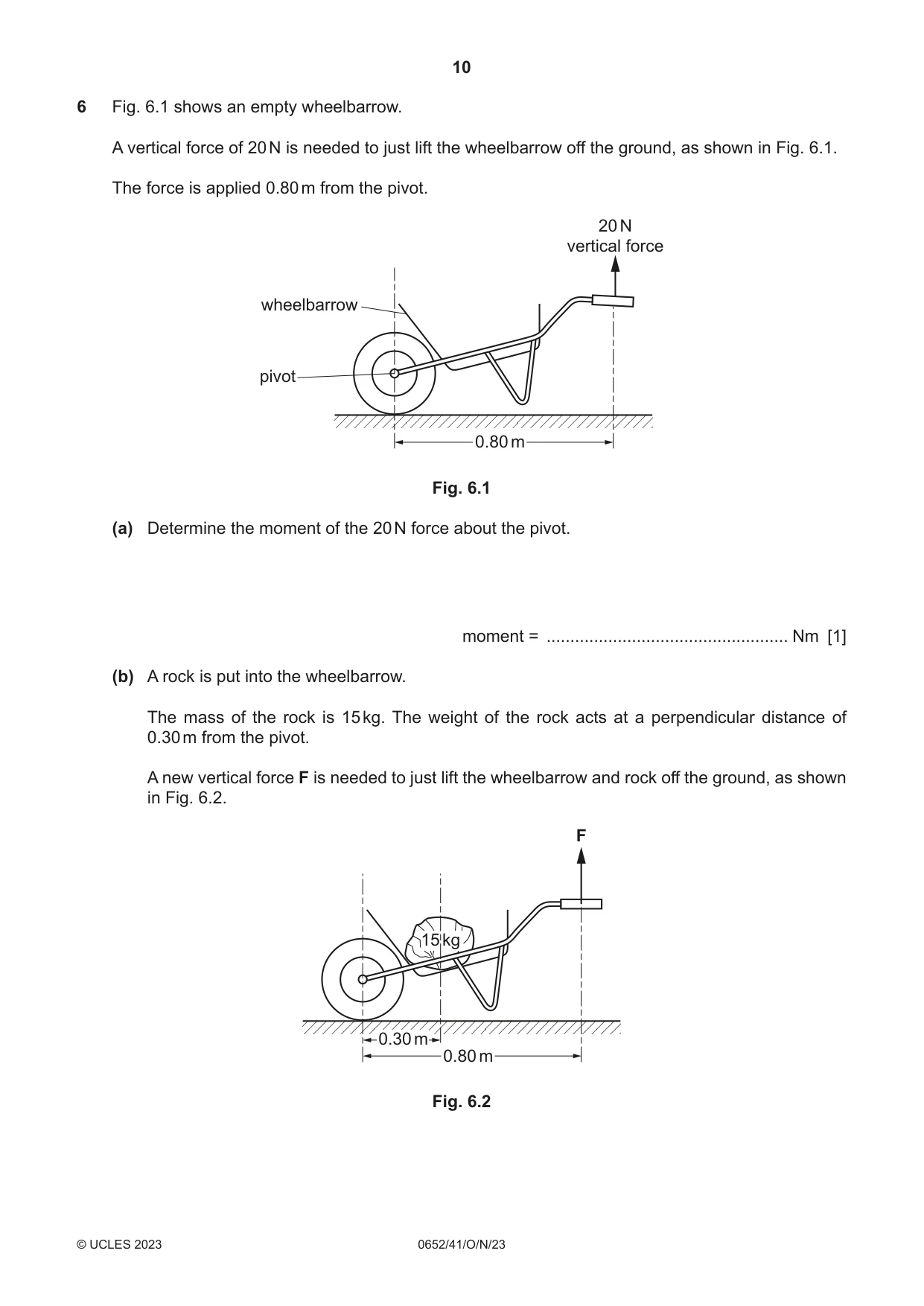
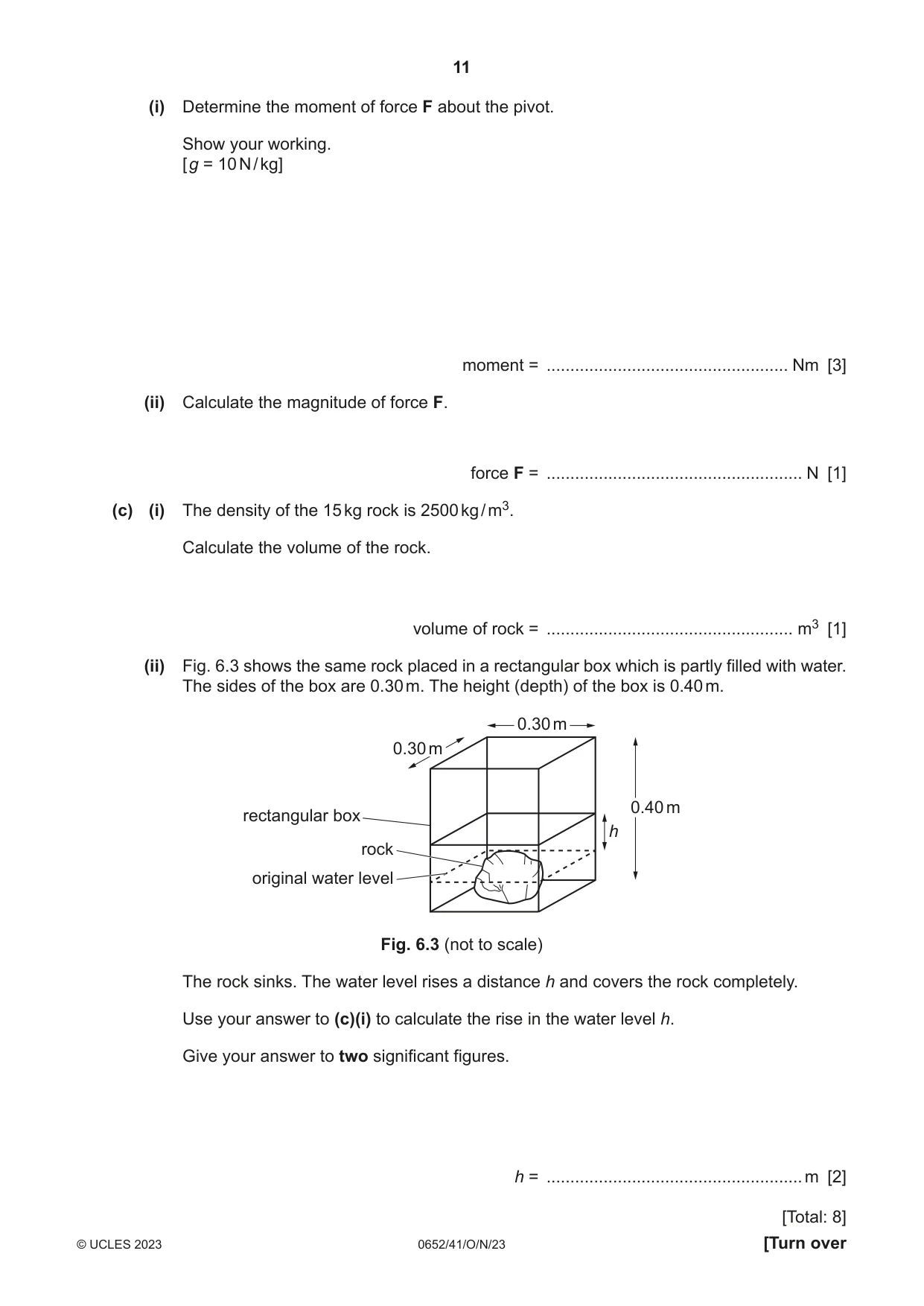
6 Fig. 6.1 shows an empty wheelbarrow. A vertical force of 20 N is needed to just lift the wheelbarrow off the ground, as shown in Fig. 6.1. The force is applied 0.80 m from the pivot. 20 N vertical force wheelbarrow pivot 0.80 m Fig. 6.1 (a) Determine the moment of the 20 N force about the pivot. moment = ................................................... Nm [1] (b) A rock is put into the wheelbarrow. The mass of the rock is 15 kg. The weight of the rock acts at a perpendicular distance of 0.30 m from the pivot. A new vertical force F is needed to just lift the wheelbarrow and rock off the ground, as shown in Fig. 6.2. F 15 kg 0.30 m 0.80 m Fig. 6.2 (i) Determine the moment of force F about the pivot. Show your working. [g = 10 N / kg] moment = ................................................... Nm [3] (ii) Calculate the magnitude of force F. force F = ...................................................... N [1] (c) (i) The density of the 15 kg rock is 2500 kg / m3. Calculate the volume of the rock. volume of rock = .................................................... m3 [1] (ii) Fig. 6.3 shows the same rock placed in a rectangular box which is partly filled with water. The sides of the box are 0.30 m. The height (depth) of the box is 0.40 m. 0.30 m 0.30 m 0.40 m rectangular box h rock original water level Fig. 6.3 (not to scale) The rock sinks. The water level rises a distance h and covers the rock completely. Use your answer to (c)(i) to calculate the rise in the water level h. Give your answer to two significant figures. h = ...................................................... m [2] [Total: 8]
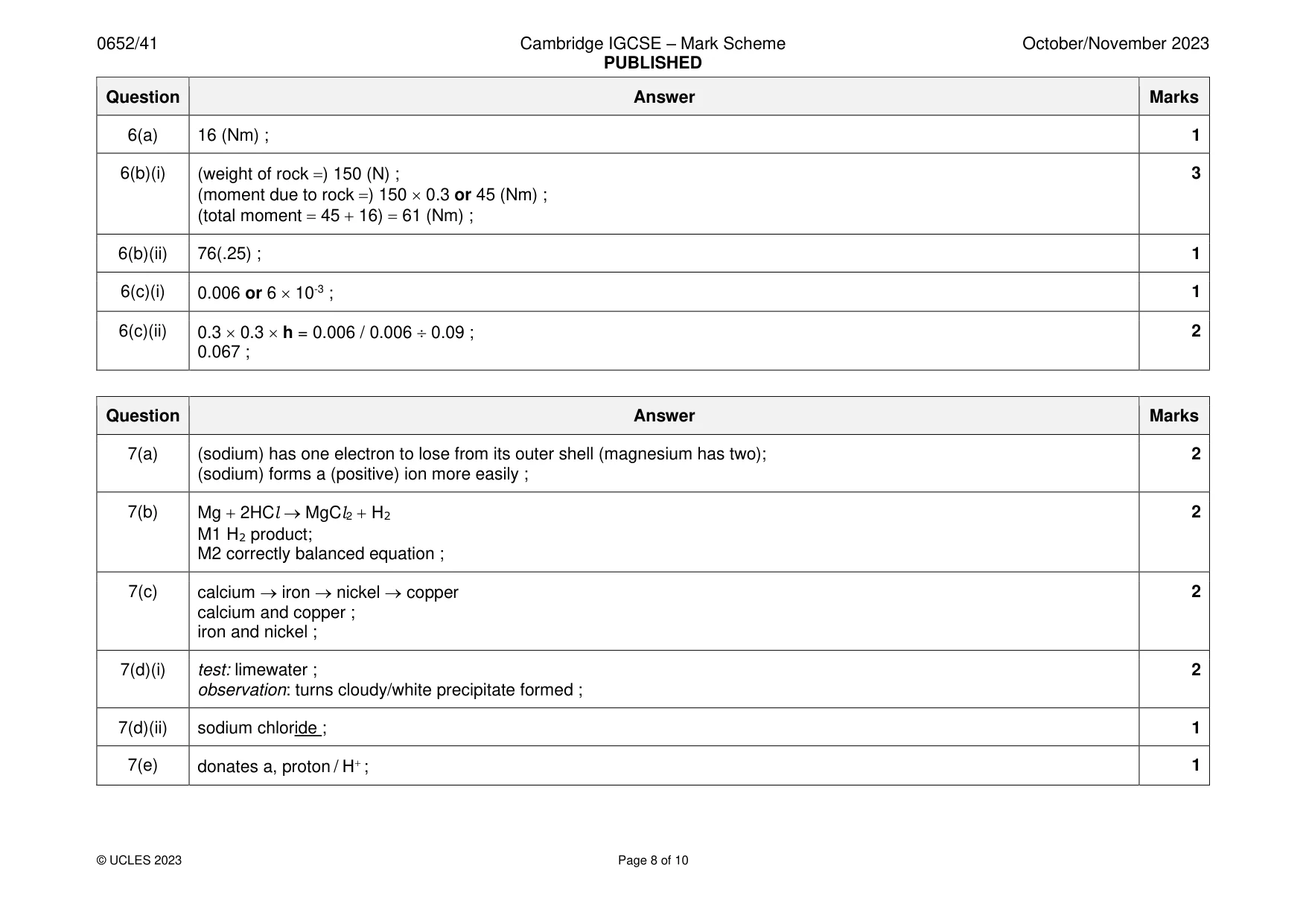
Mark scheme: 6(a) 16 (Nm) ; 1 6(b)(i) (weight of rock =) 150 (N) ; 3 (moment due to rock =) 150 0.3 or 45 (Nm) ; (total moment = 45 + 16) = 61 (Nm) ; 6(b)(ii) 76(.25) ; 1 6(c)(i) 0.006 or 6 10-3 ; 1 6(c)(ii) 0.3 0.3 h = 0.006 / 0.006 0.09 ; 2 0.067 ;
Q7 · Sodium is in Group I and magnesium is in Group II of the Periodic Table
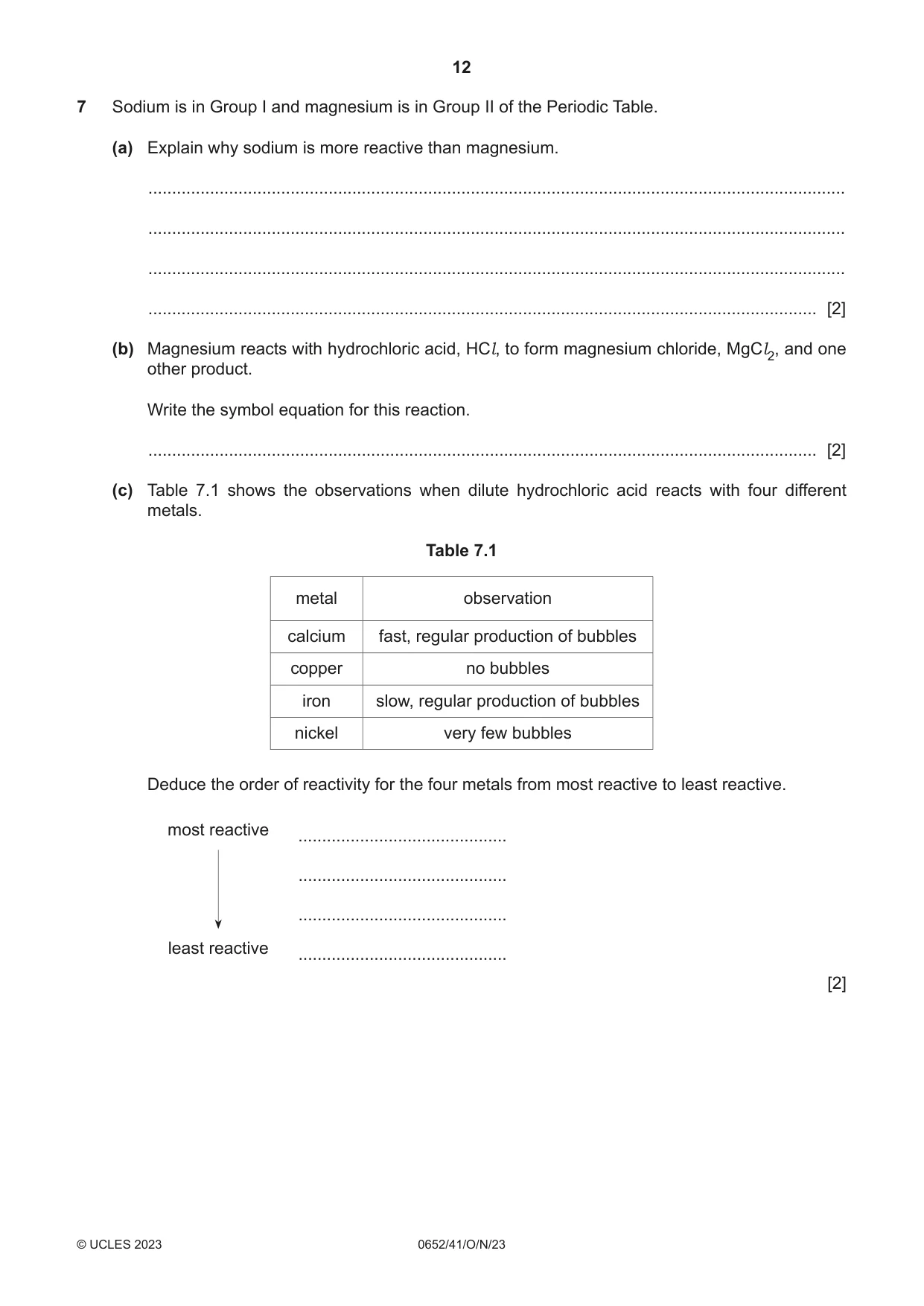
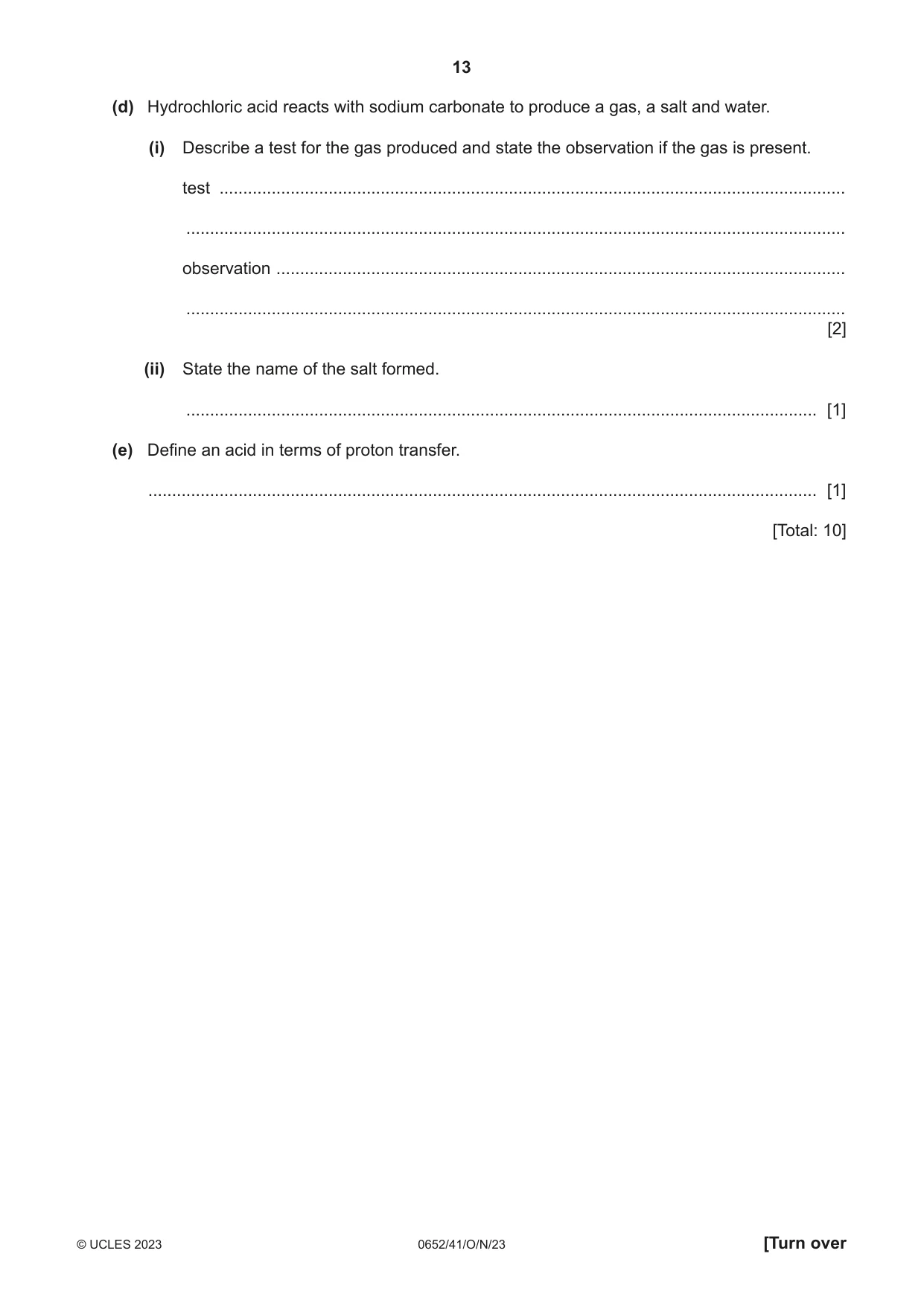
7 Sodium is in Group I and magnesium is in Group II of the Periodic Table. (a) Explain why sodium is more reactive than magnesium. ................................................................................................................................................... ................................................................................................................................................... ................................................................................................................................................... ............................................................................................................................................. [2] (b) Magnesium reacts with hydrochloric acid, HCl, to form magnesium chloride, MgCl2, and one other product. Write the symbol equation for this reaction. ............................................................................................................................................. [2] (c) Table 7.1 shows the observations when dilute hydrochloric acid reacts with four different metals. Table 7.1 metal observation calcium fast, regular production of bubbles copper no bubbles iron slow, regular production of bubbles nickel very few bubbles Deduce the order of reactivity for the four metals from most reactive to least reactive. most reactive ............................................ ............................................ ............................................ least reactive ............................................ [2] (d) Hydrochloric acid reacts with sodium carbonate to produce a gas, a salt and water. (i) Describe a test for the gas produced and state the observation if the gas is present. test .................................................................................................................................... ........................................................................................................................................... observation ........................................................................................................................ ........................................................................................................................................... [2] (ii) State the name of the salt formed. ..................................................................................................................................... [1] (e) Define an acid in terms of proton transfer. ............................................................................................................................................. [1] [Total: 10]
Mark scheme: 7(a) (sodium) has one electron to lose from its outer shell (magnesium has two); 2 (sodium) forms a (positive) ion more easily ; 7(b) Mg + 2HCl → MgCl2 + H2 2 M1 H2 product; M2 correctly balanced equation ; 7(c) calcium → iron → nickel → copper 2 calcium and copper ; iron and nickel ; 7(d)(i) test: limewater ; 2 observation: turns cloudy/white precipitate formed ; 7(d)(ii) sodium chloride ; 1 7(e) donates a, proton / H+ ; 1
Q8 · A cell, a resistor R and component S connected in series in an electrical circuit
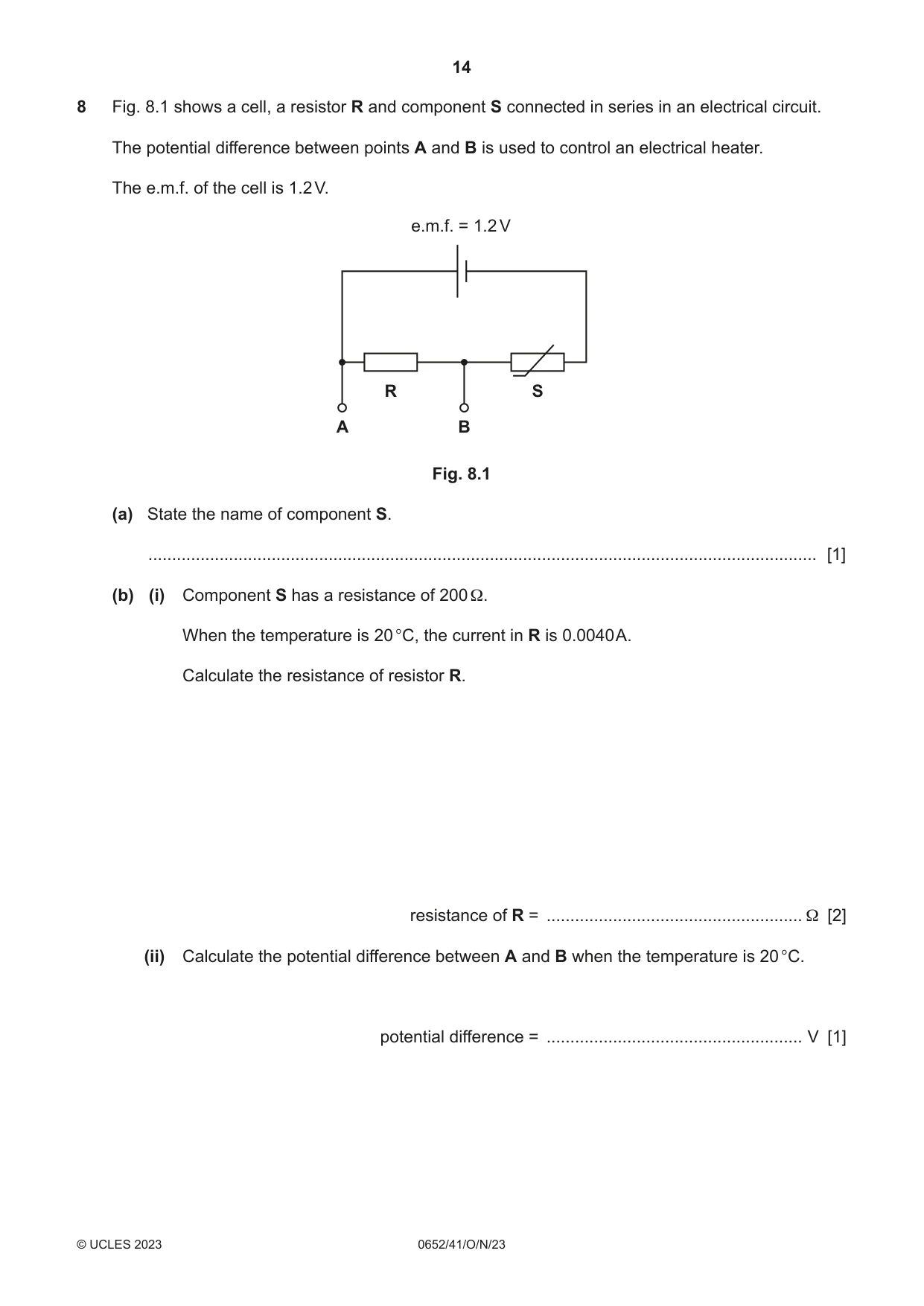
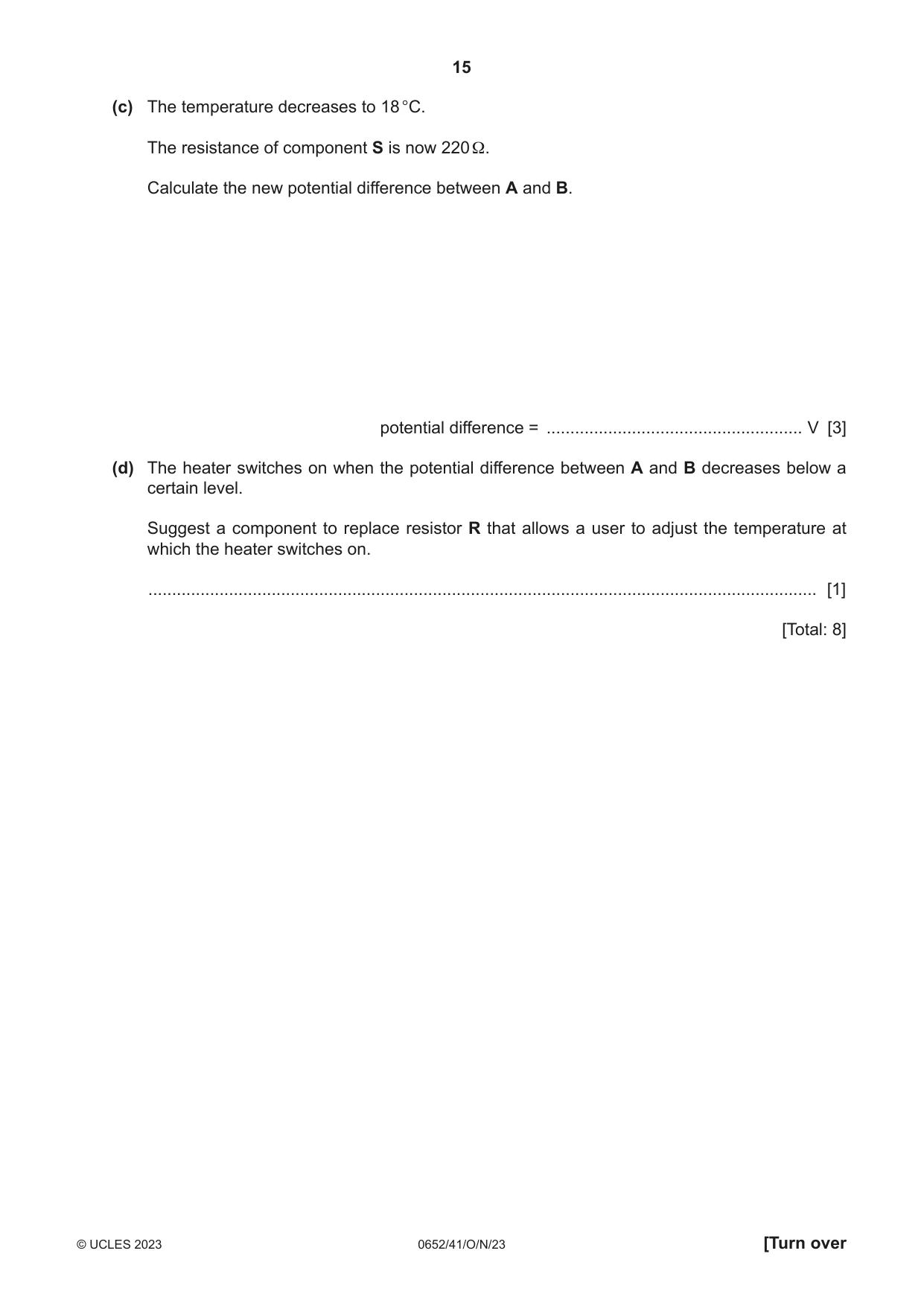
8 Fig. 8.1 shows a cell, a resistor R and component S connected in series in an electrical circuit. The potential difference between points A and B is used to control an electrical heater. The e.m.f. of the cell is 1.2 V. e.m.f. = 1.2 V R S A B Fig. 8.1 (a) State the name of component S. ............................................................................................................................................. [1] (b) (i) Component S has a resistance of 200 Ω. When the temperature is 20 °C, the current in R is 0.0040 A. Calculate the resistance of resistor R. resistance of R = ...................................................... Ω [2] (ii) Calculate the potential difference between A and B when the temperature is 20 °C. potential difference = ...................................................... V [1] (c) The temperature decreases to 18 °C. The resistance of component S is now 220 Ω. Calculate the new potential difference between A and B. potential difference = ...................................................... V [3] (d) The heater switches on when the potential difference between A and B decreases below a certain level. Suggest a component to replace resistor R that allows a user to adjust the temperature at which the heater switches on. ............................................................................................................................................. [1] [Total: 8]
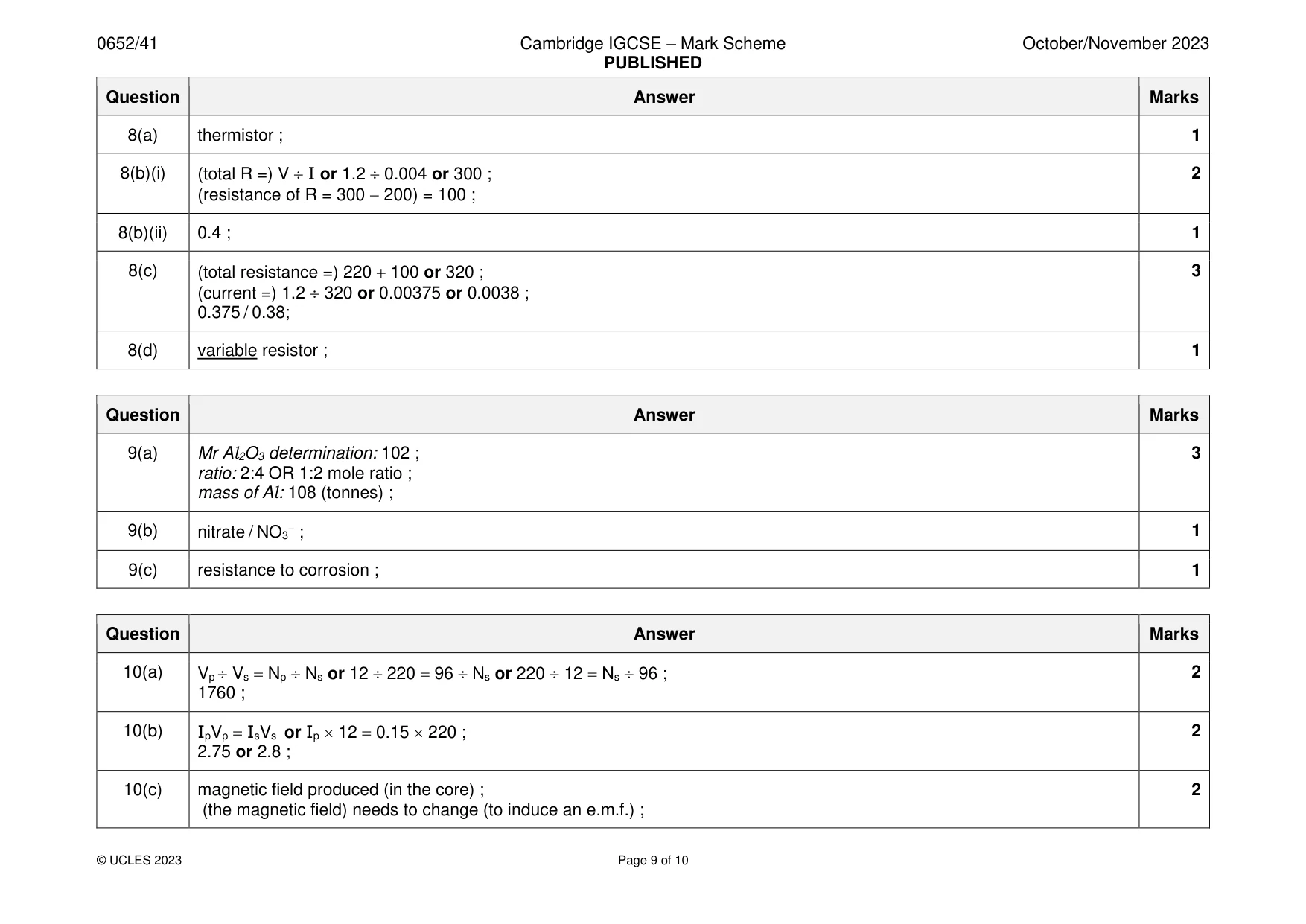
Mark scheme: 8(a) thermistor ; 1 8(b)(i) (total R =) V I or 1.2 0.004 or 300 ; 2 (resistance of R = 300 − 200) = 100 ; 8(b)(ii) 0.4 ; 1 8(c) (total resistance =) 220 + 100 or 320 ; 3 (current =) 1.2 320 or 0.00375 or 0.0038 ; 0.375 / 0.38; 8(d) variable resistor ; 1
Q9 · Aluminium, Al, is obtained from aluminium oxide, Al2O3
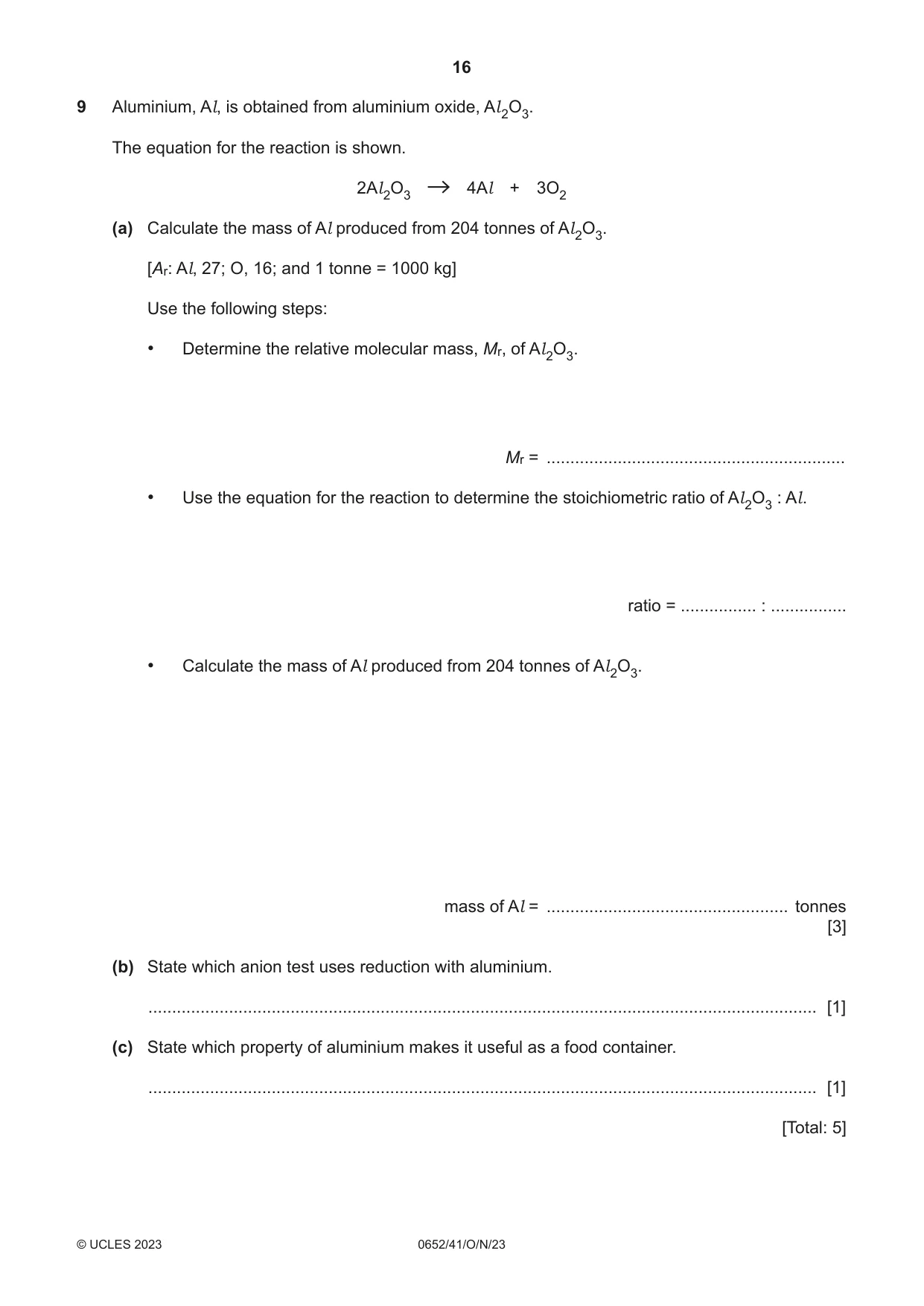
9 Aluminium, Al, is obtained from aluminium oxide, Al2O3. The equation for the reaction is shown. 2Al 2O3 4Al + 3O2 (a) Calculate the mass of Al produced from 204 tonnes of Al 2O3. [Ar: Al, 27; O, 16; and 1 tonne = 1000 kg] Use the following steps: • Determine the relative molecular mass, Mr, of Al 2O3. Mr = ............................................................... • Use the equation for the reaction to determine the stoichiometric ratio of Al 2O3 : Al . ratio = ................ : ................ • Calculate the mass of Al produced from 204 tonnes of Al 2O3. mass of Al = ................................................... tonnes [3] (b) State which anion test uses reduction with aluminium. ............................................................................................................................................. [1] (c) State which property of aluminium makes it useful as a food container. ............................................................................................................................................. [1] [Total: 5]
Mark scheme: 9(a) Mr Al2O3 determination: 102 ; 3 ratio: 2:4 OR 1:2 mole ratio ; mass of Al: 108 (tonnes) ; 9(b) nitrate / NO3− ; 1 9(c) resistance to corrosion ; 1
Q10 · A circuit that produces a 220 V electrical supply from a car battery
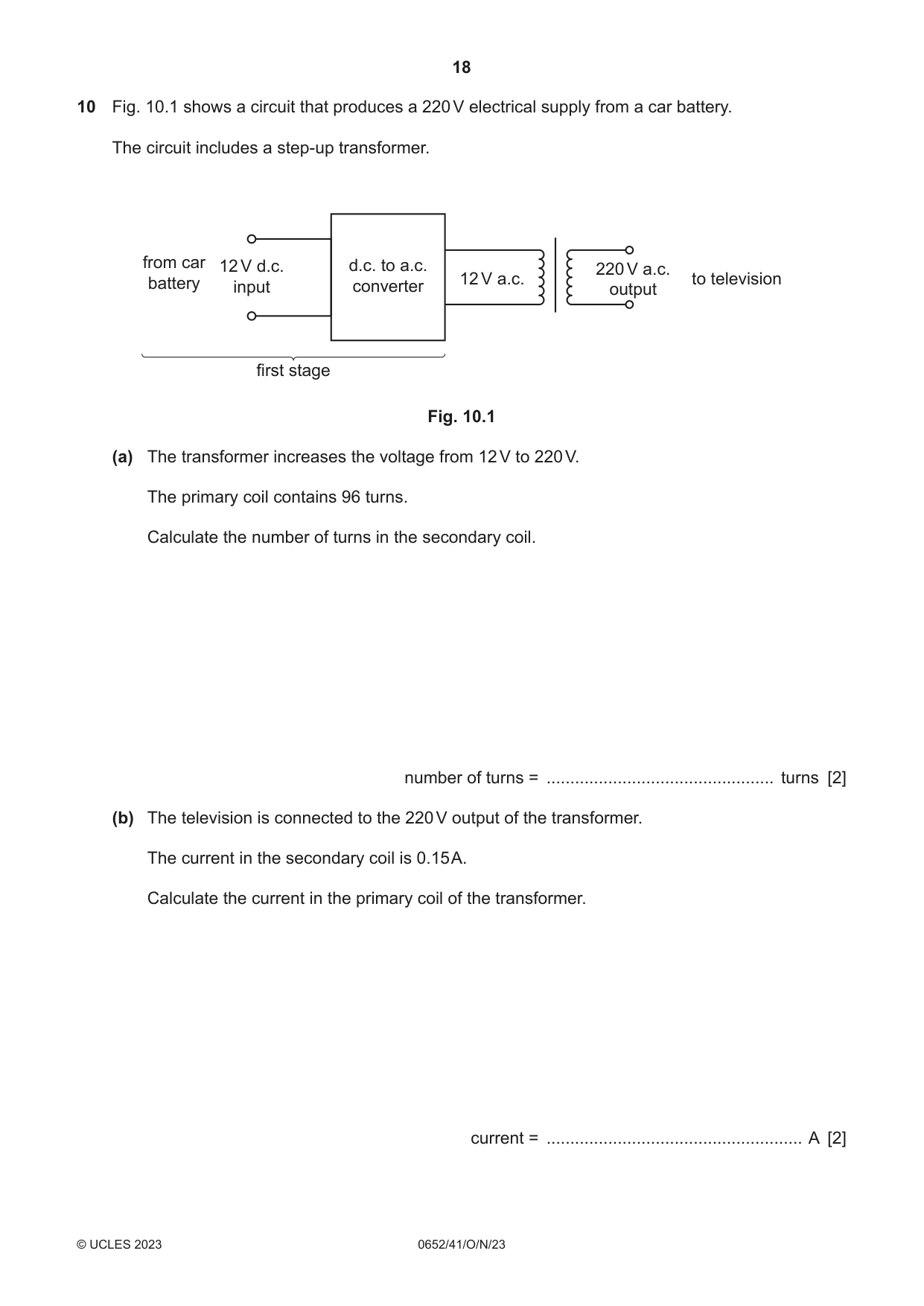
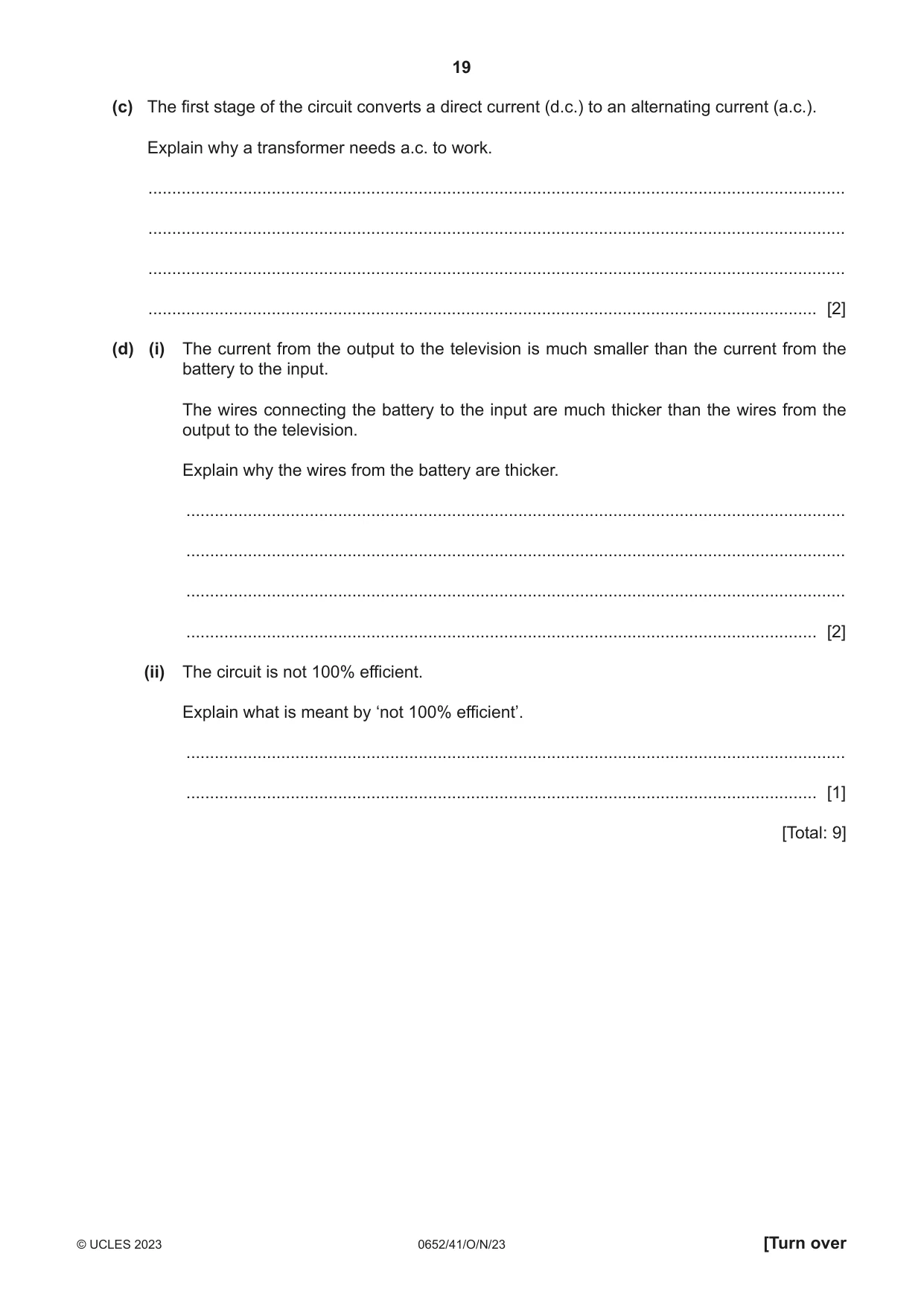
10 Fig. 10.1 shows a circuit that produces a 220 V electrical supply from a car battery. The circuit includes a step-up transformer. from car 12 V d.c. d.c. to a.c. 220 V a.c. battery input converter 12 V a.c. output to television first stage Fig. 10.1 (a) The transformer increases the voltage from 12 V to 220 V. The primary coil contains 96 turns. Calculate the number of turns in the secondary coil. number of turns = ................................................ turns [2] (b) The television is connected to the 220 V output of the transformer. The current in the secondary coil is 0.15 A. Calculate the current in the primary coil of the transformer. current = ...................................................... A [2] (c) The first stage of the circuit converts a direct current (d.c.) to an alternating current (a.c.). Explain why a transformer needs a.c. to work. ................................................................................................................................................... ................................................................................................................................................... ................................................................................................................................................... ............................................................................................................................................. [2] (d) (i) The current from the output to the television is much smaller than the current from the battery to the input. The wires connecting the battery to the input are much thicker than the wires from the output to the television. Explain why the wires from the battery are thicker. ........................................................................................................................................... ........................................................................................................................................... ........................................................................................................................................... ..................................................................................................................................... [2] (ii) The circuit is not 100% efficient. Explain what is meant by ‘not 100% efficient’. ........................................................................................................................................... ..................................................................................................................................... [1] [Total: 9]
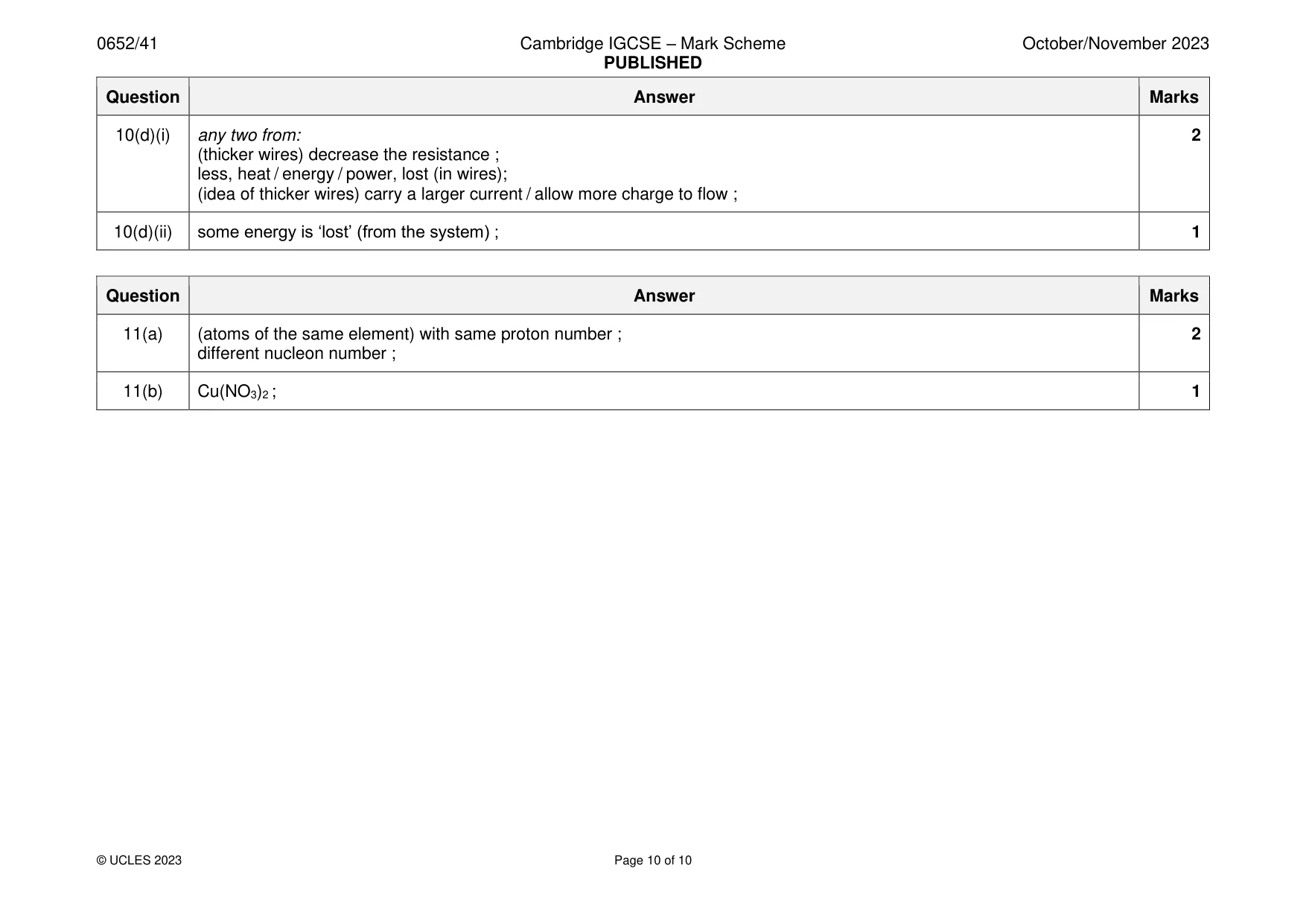
Mark scheme: 10(a) Vp Vs = Np Ns or 12 220 = 96 Ns or 220 12 = Ns 96 ; 2 1760 ; 10(b) IpVp = IsVs or Ip 12 = 0.15 220 ; 2 2.75 or 2.8 ; 10(c) magnetic field produced (in the core) ; 2 (the magnetic field) needs to change (to induce an e.m.f.) ; 10(d)(i) any two from: 2 (thicker wires) decrease the resistance ; less, heat / energy / power, lost (in wires); (idea of thicker wires) carry a larger current / allow more charge to flow ; 10(d)(ii) some energy is ‘lost’ (from the system) ; 1
Q11 · Copper has two stable isotopes, 63Cu and 65Cu
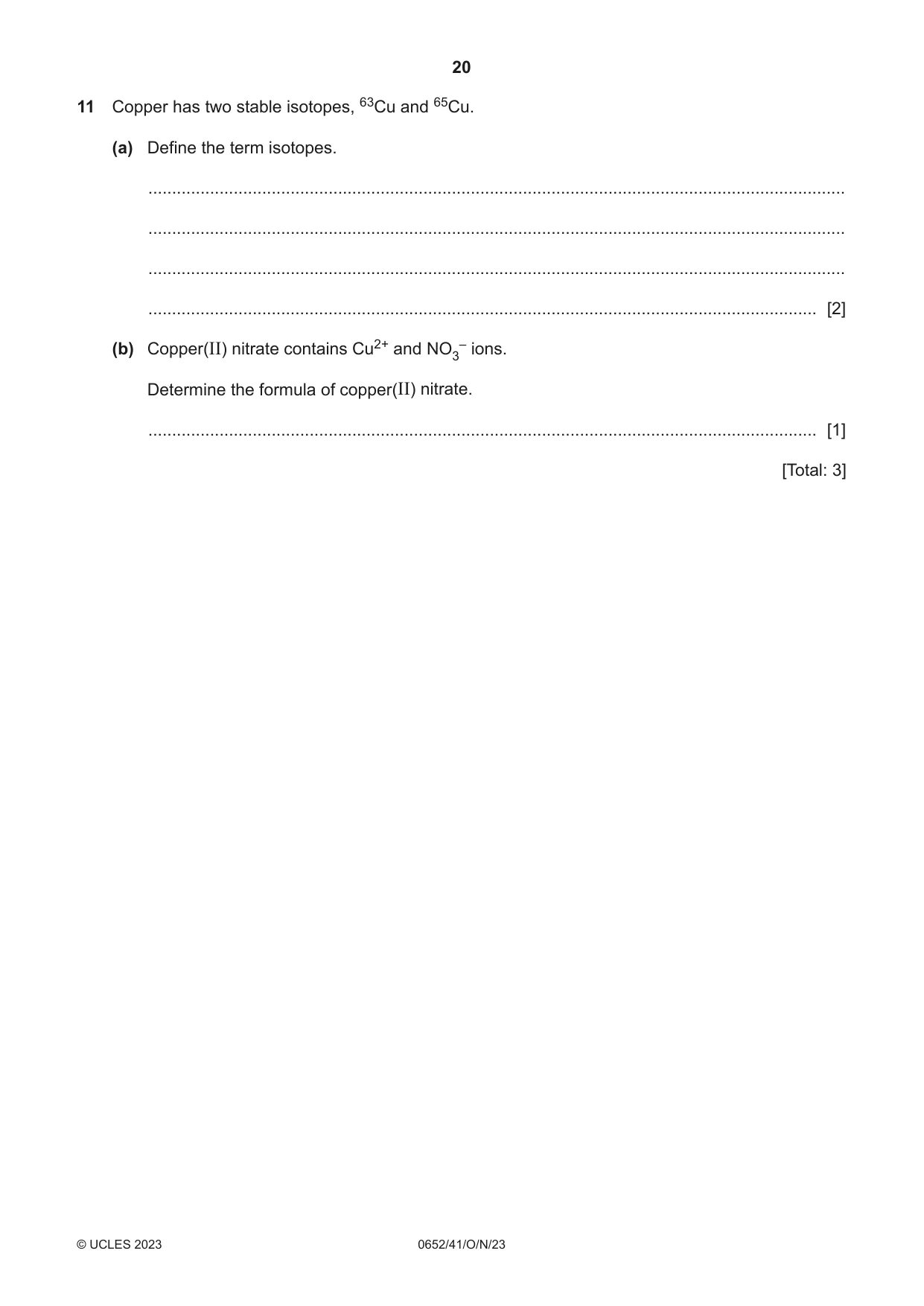
11 Copper has two stable isotopes, 63Cu and 65Cu. (a) Define the term isotopes. ................................................................................................................................................... ................................................................................................................................................... ................................................................................................................................................... ............................................................................................................................................. [2] (b) Copper(II) nitrate contains Cu2+ and NO3– ions. Determine the formula of copper(II) nitrate. ............................................................................................................................................. [1] [Total: 3]
Mark scheme: 11(a) (atoms of the same element) with same proton number ; 2 different nucleon number ; 11(b) Cu(NO3)2 ; 1
What was in this paper
The subtopics covered by these 11 questions, and how many questions each got. Open one in a new tab to see every Cambridge question on it.
What you needed in this session
Cambridge’s own grade thresholds for 2023 Oct/Nov, Paper 4 · Variant 1. A higher threshold means an easier paper — the bar moves with how the cohort did.