Cambridge IGCSE Physical Science 0652 — 2019 Oct/Nov Paper 4 · Variant 1
0652/41/O/N/19 · 12 questions · 80 marks · ≈90 min
The question paper and its mark scheme, free to read here and free to download. This is Cambridge’s own paper, exactly as it was sat.
Question paper20 pages
Mark scheme10 pages
Answers below. Sit the paper first if you are practising.
Questions as text
Q1 · An athlete of mass 75.0 kg runs a 100 m race in a time of 10.5 s
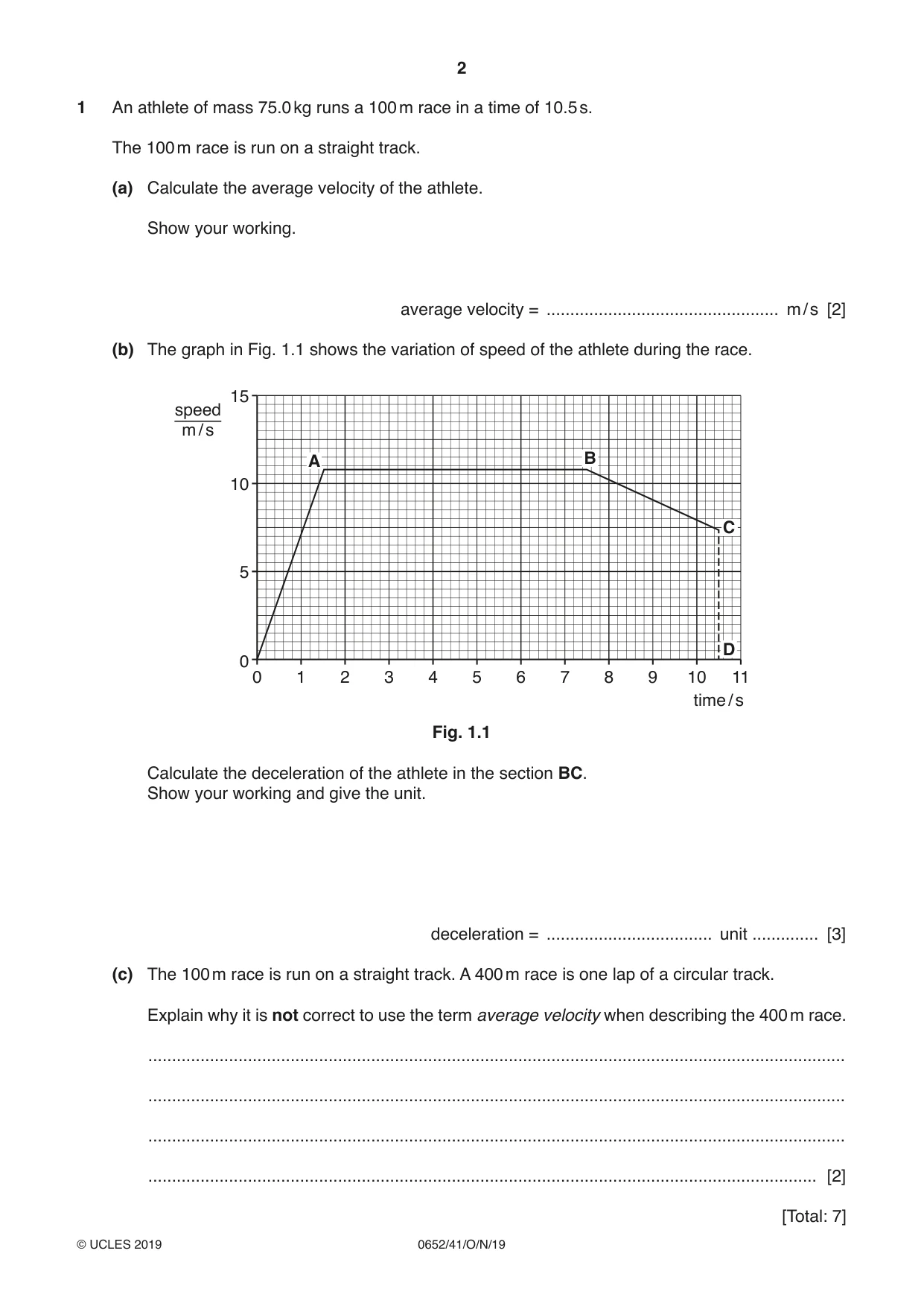
1 An athlete of mass 75.0 kg runs a 100 m race in a time of 10.5 s. The 100 m race is run on a straight track. (a) Calculate the average velocity of the athlete. Show your working. average velocity = ................................................. m / s [2] (b) The graph in Fig. 1.1 shows the variation of speed of the athlete during the race. 15 speed m / s A B 10 C 5 D 0 0 1 2 3 4 5 6 7 8 9 10 11 time / s Fig. 1.1 Calculate the deceleration of the athlete in the section BC. Show your working and give the unit. deceleration = ................................... unit .............. [3] (c) The 100 m race is run on a straight track. A 400 m race is one lap of a circular track. Explain why it is not correct to use the term average velocity when describing the 400 m race. ................................................................................................................................................... ................................................................................................................................................... ................................................................................................................................................... ............................................................................................................................................. [2] [Total: 7]
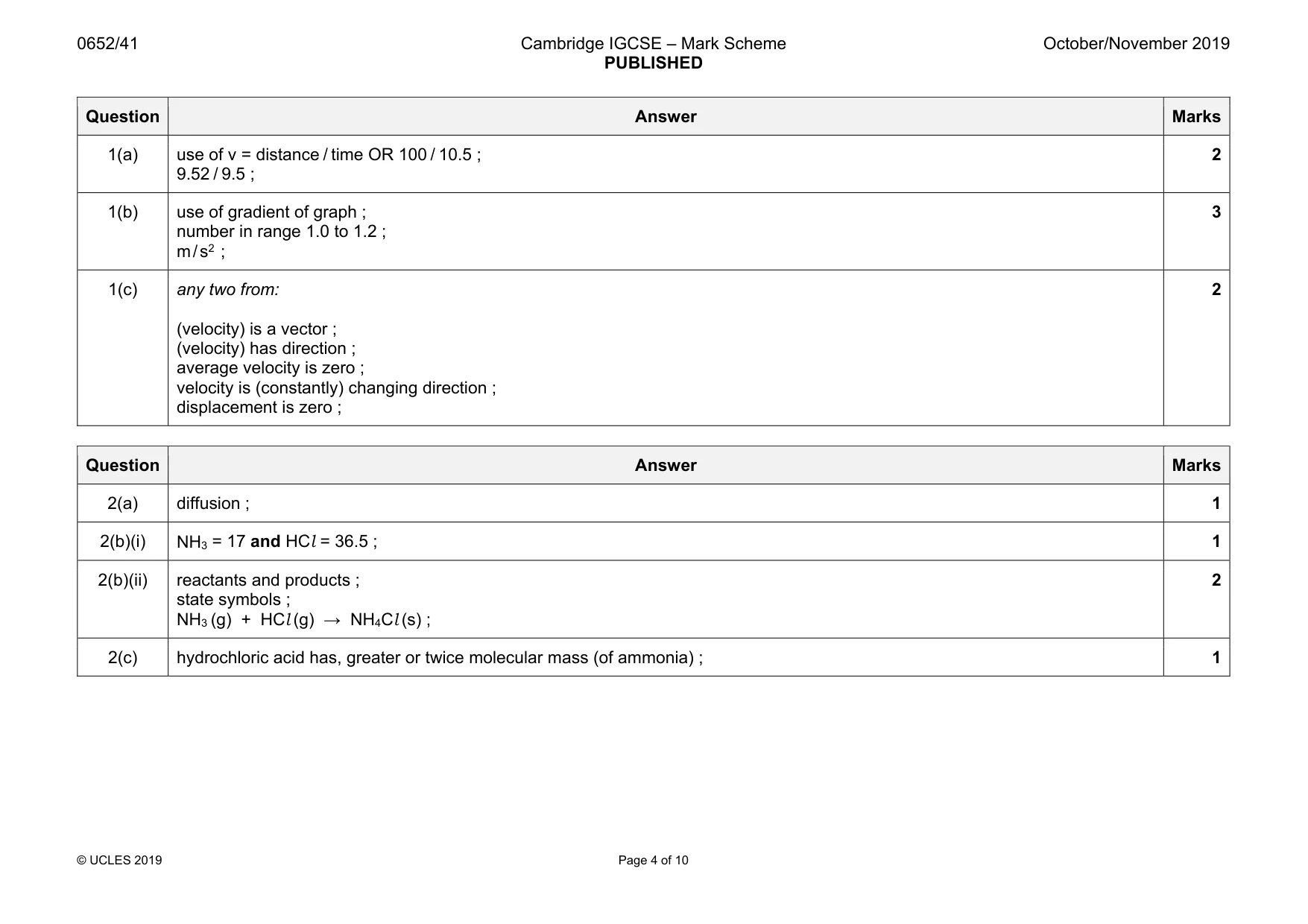
Mark scheme: 1(a) use of v = distance / time OR 100 / 10.5 ; 9.52 / 9.5 ; 2 1(b) use of gradient of graph ; number in range 1.0 to 1.2 ; m / s2 ; 3 1(c) any two from: (velocity) is a vector ; (velocity) has direction ; average velocity is zero ; velocity is (constantly) changing direction ; displacement is zero ; 2
Q2 · A student investigates the reaction between ammonia gas, NH3, and hydrogen chloride gas…
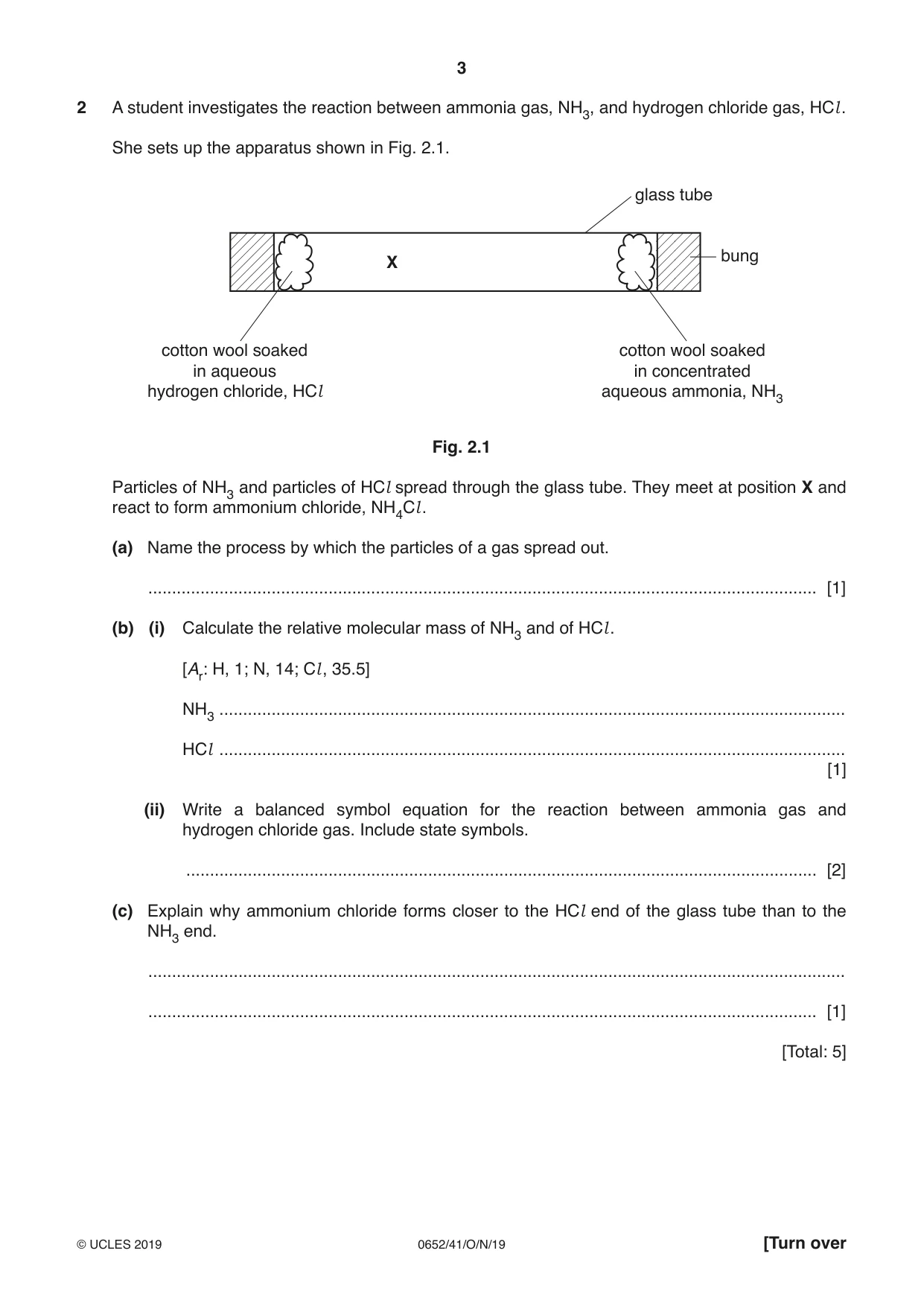
2 A student investigates the reaction between ammonia gas, NH3, and hydrogen chloride gas, HCl . She sets up the apparatus shown in Fig. 2.1. glass tube bung X cotton wool soaked cotton wool soaked in aqueous in concentrated hydrogen chloride, HCl aqueous ammonia, NH3 Fig. 2.1 Particles of NH3 and particles of HCl spread through the glass tube. They meet at position X and react to form ammonium chloride, NH4Cl . (a) Name the process by which the particles of a gas spread out. ............................................................................................................................................. [1] (b) (i) Calculate the relative molecular mass of NH3 and of HCl . [Ar: H, 1; N, 14; Cl , 35.5] NH3 .................................................................................................................................... HCl .................................................................................................................................... [1] (ii) Write a balanced symbol equation for the reaction between ammonia gas and hydrogen chloride gas. Include state symbols. ..................................................................................................................................... [2] (c) Explain why ammonium chloride forms closer to the HCl end of the glass tube than to the NH3 end. ................................................................................................................................................... ............................................................................................................................................. [1] [Total: 5]
Mark scheme: 2(a) diffusion ; 1 2(b)(i) NH3 = 17 and HCl = 36.5 ; 1 2(b)(ii) reactants and products ; state symbols ; NH3 (g) + HCl (g) → NH4Cl (s) ; 2 2(c) hydrochloric acid has, greater or twice molecular mass (of ammonia) ; 1
Q3 · Part of a domestic water heating system
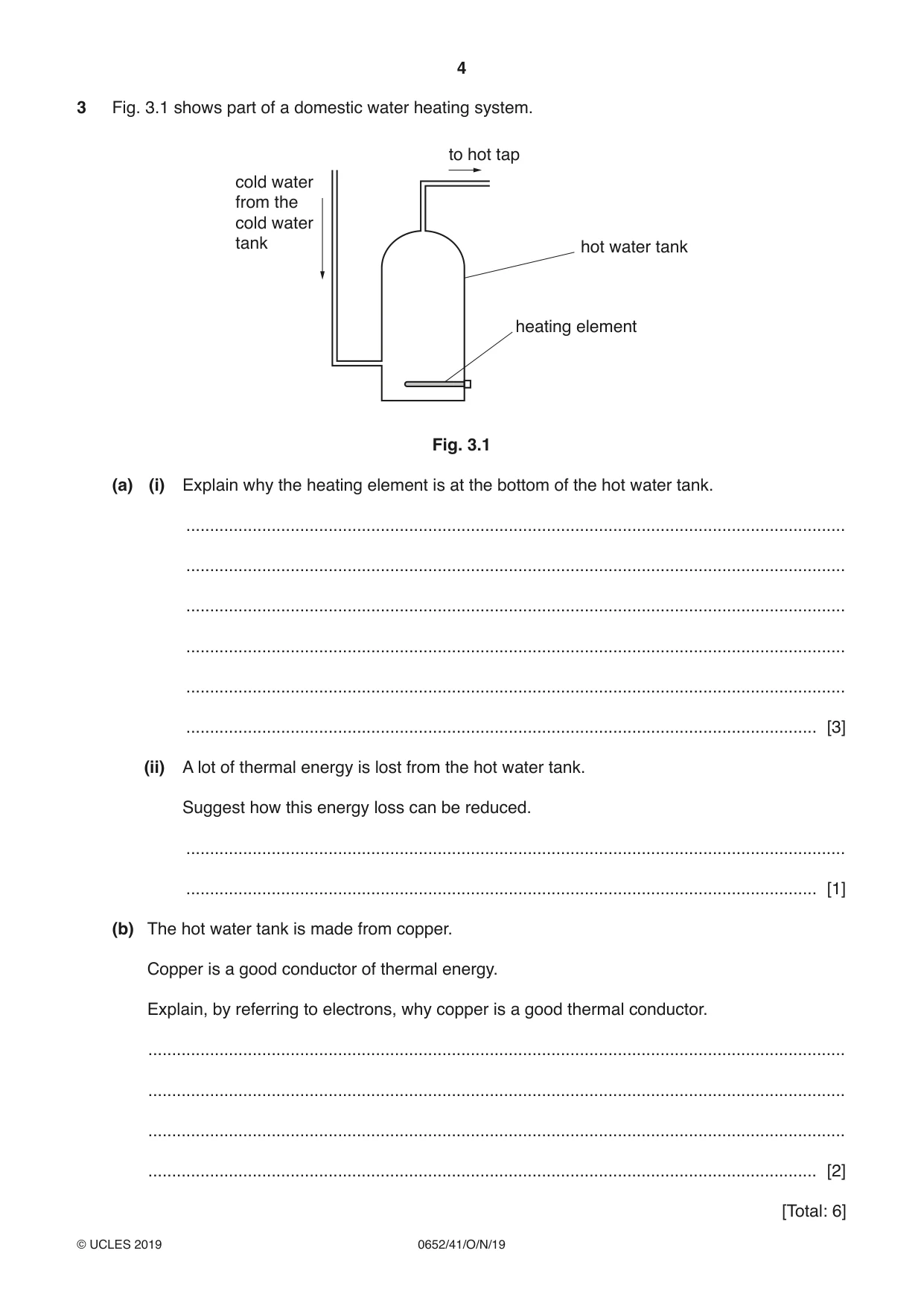
3 Fig. 3.1 shows part of a domestic water heating system. to hot tap cold water from the cold water tank hot water tank heating element Fig. 3.1 (a) (i) Explain why the heating element is at the bottom of the hot water tank. ........................................................................................................................................... ........................................................................................................................................... ........................................................................................................................................... ........................................................................................................................................... ........................................................................................................................................... ..................................................................................................................................... [3] (ii) A lot of thermal energy is lost from the hot water tank. Suggest how this energy loss can be reduced. ........................................................................................................................................... ..................................................................................................................................... [1] (b) The hot water tank is made from copper. Copper is a good conductor of thermal energy. Explain, by referring to electrons, why copper is a good thermal conductor. ................................................................................................................................................... ................................................................................................................................................... ................................................................................................................................................... ............................................................................................................................................. [2] [Total: 6]
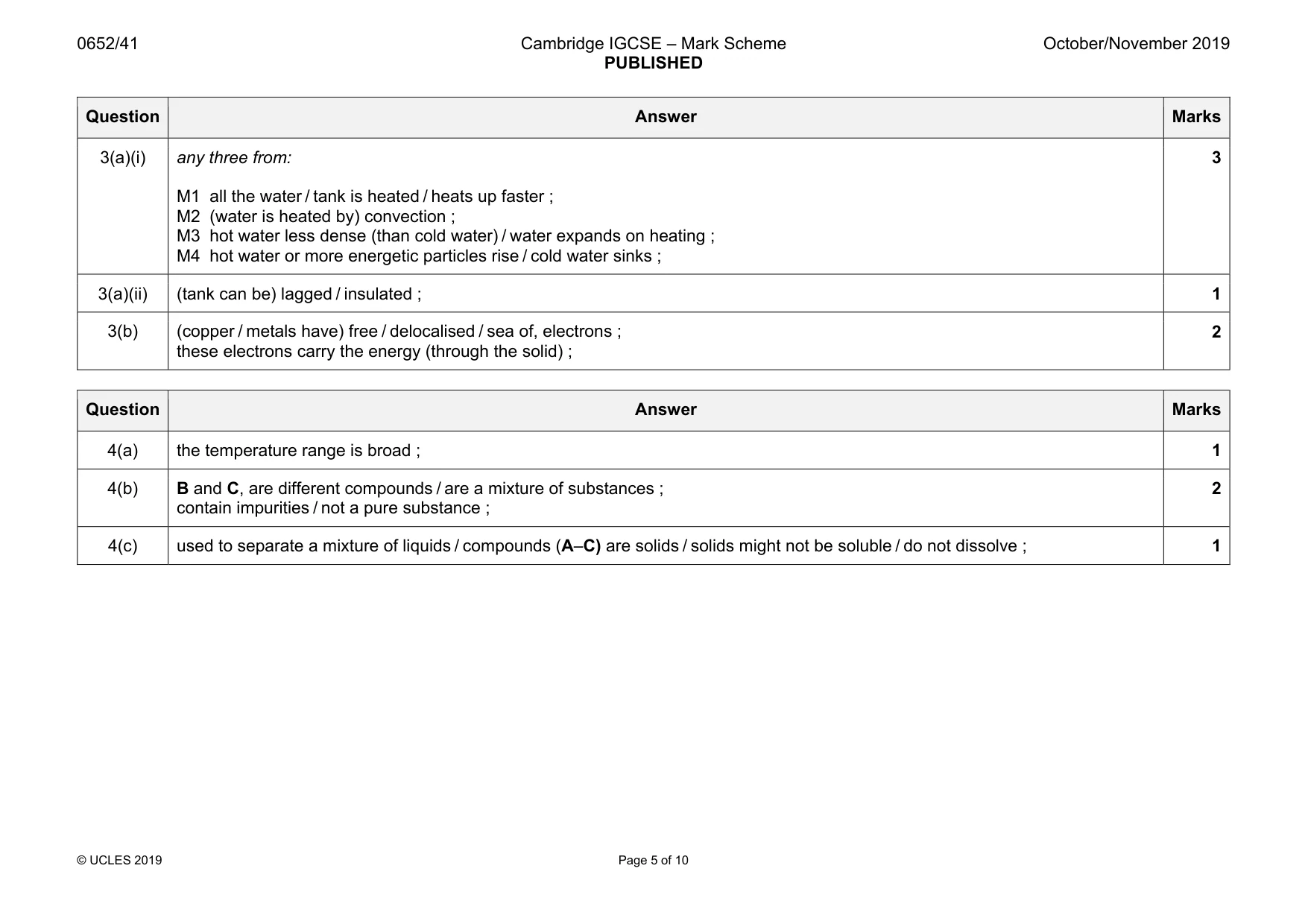
Mark scheme: 3(a)(i) any three from: M1 all the water / tank is heated / heats up faster ; M2 (water is heated by) convection ; M3 hot water less dense (than cold water) / water expands on heating ; M4 hot water or more energetic particles rise / cold water sinks ; 3 3(a)(ii) (tank can be) lagged / insulated ; 1 3(b) (copper / metals have) free / delocalised / sea of, electrons ; these electrons carry the energy (through the solid) ; 2
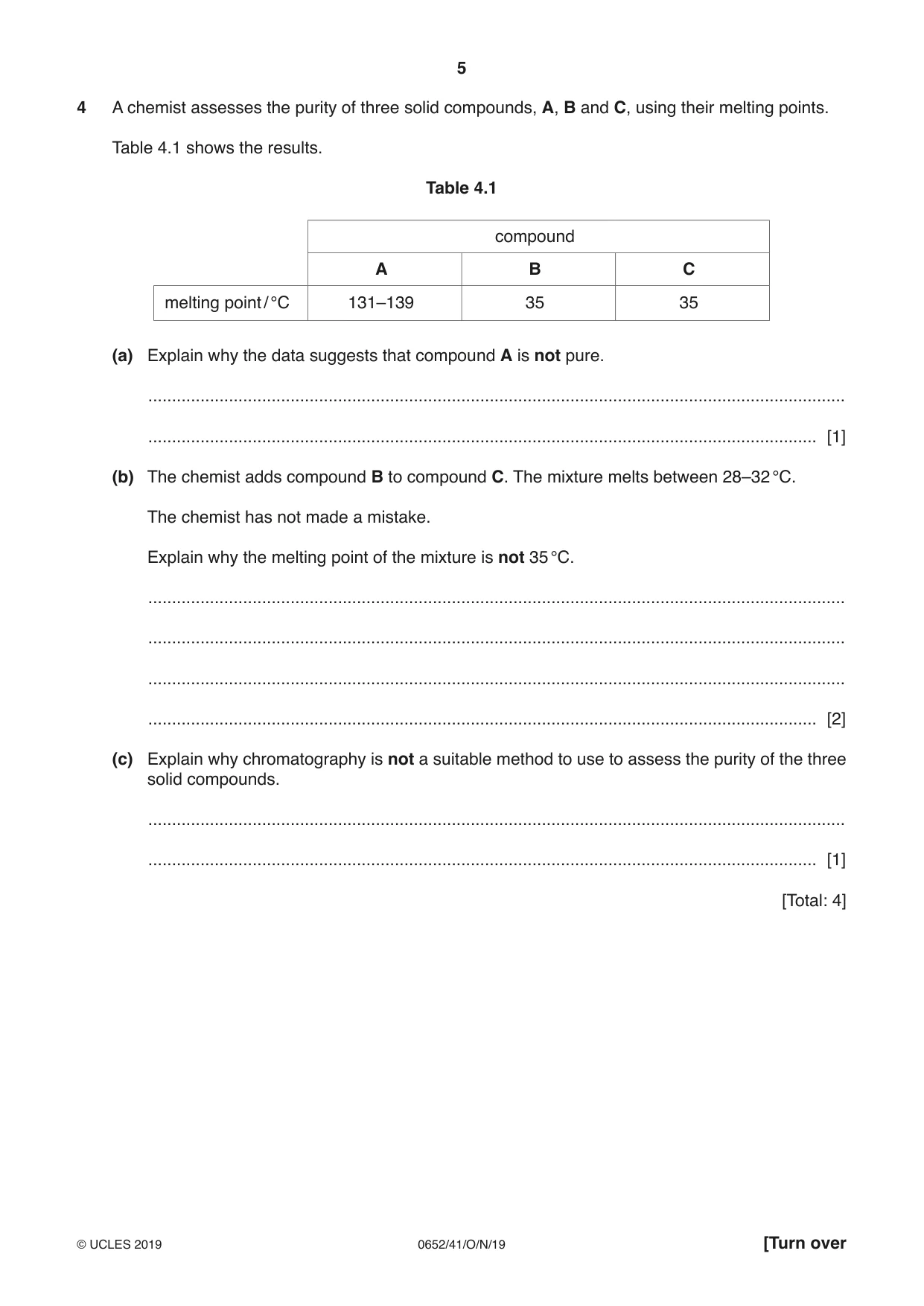
Q4 · A chemist assesses the purity of three solid compounds, A, B and C, using their melting…
4 A chemist assesses the purity of three solid compounds, A, B and C, using their melting points. Table 4.1 shows the results. Table 4.1 compound A B C melting point / °C 131–139 35 35 (a) Explain why the data suggests that compound A is not pure. ................................................................................................................................................... ............................................................................................................................................. [1] (b) The chemist adds compound B to compound C. The mixture melts between 28–32 °C. The chemist has not made a mistake. Explain why the melting point of the mixture is not 35 °C. ................................................................................................................................................... ................................................................................................................................................... ................................................................................................................................................... ............................................................................................................................................. [2] (c) Explain why chromatography is not a suitable method to use to assess the purity of the three solid compounds. ................................................................................................................................................... ............................................................................................................................................. [1] [Total: 4]
Mark scheme: 4(a) the temperature range is broad ; 1 4(b) B and C, are different compounds / are a mixture of substances ; contain impurities / not a pure substance ; 2 4(c) used to separate a mixture of liquids / compounds (A–C) are solids / solids might not be soluble / do not dissolve ; 1
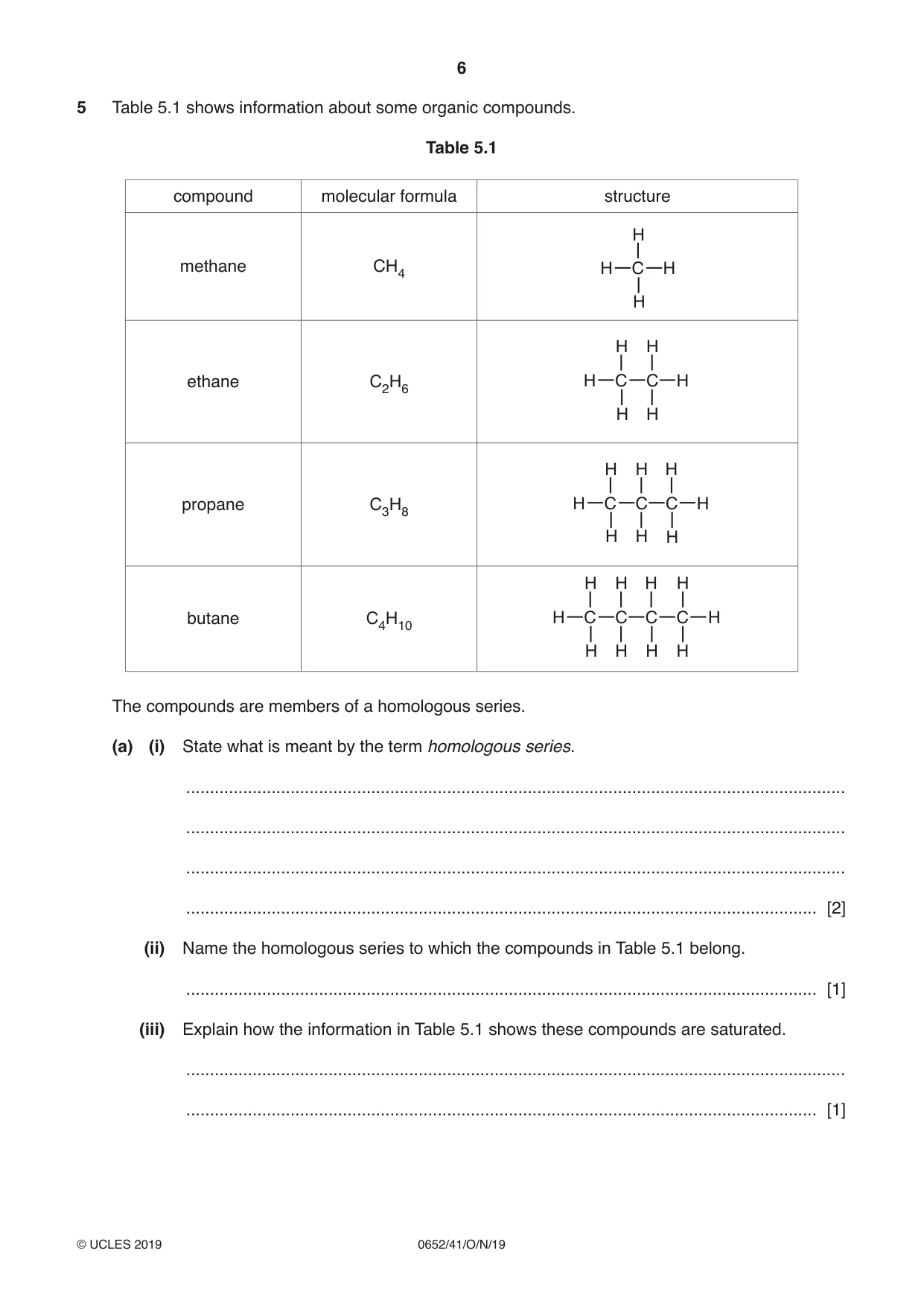
Q5 · Information about some organic compounds
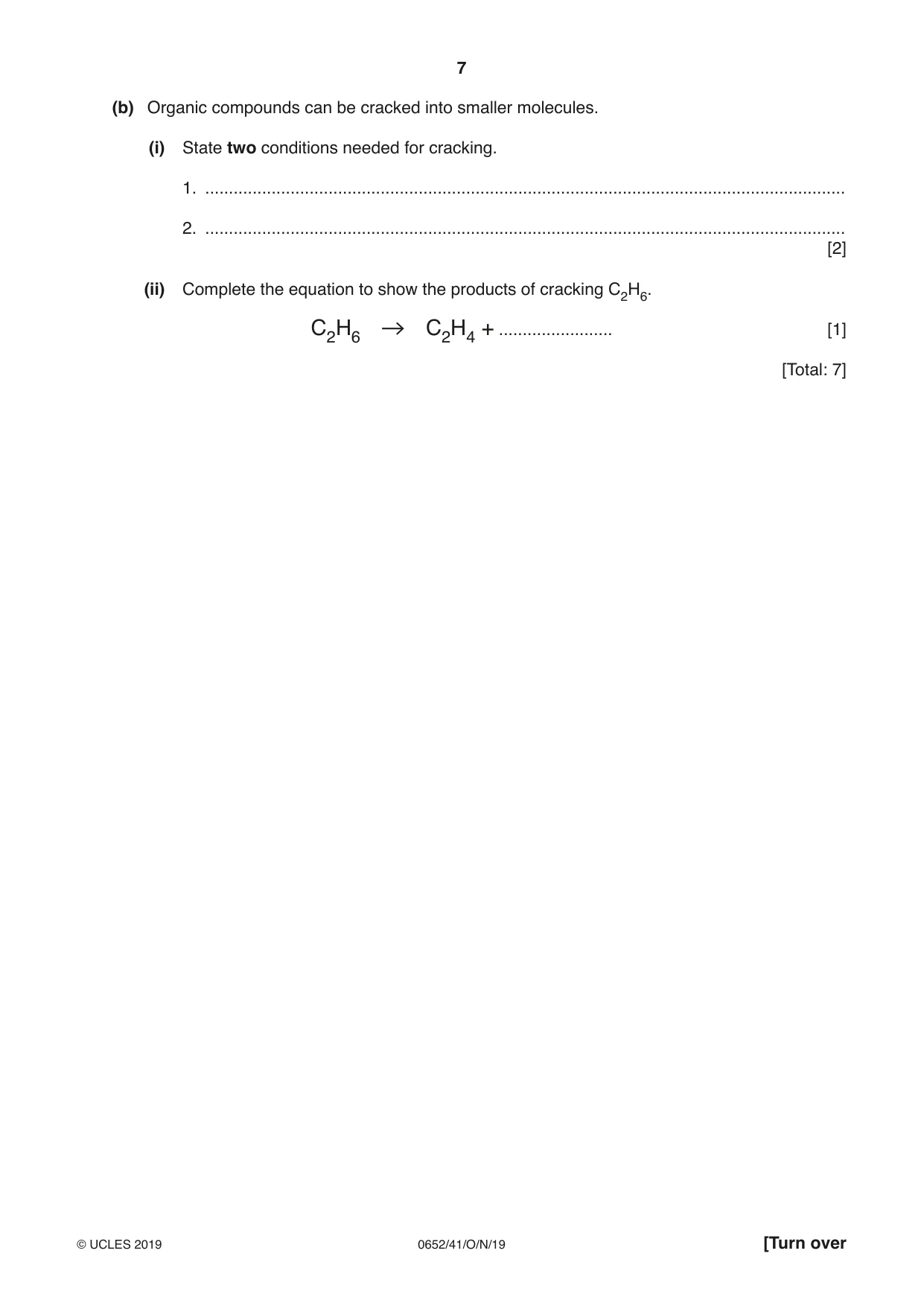
5 Table 5.1 shows information about some organic compounds. Table 5.1 compound molecular formula structure H methane CH4 H C H H H H ethane C2H6 H C C H H H H H H propane C3H8 H C C C H H H H H H H H butane C4H10 H C C C C H H H H H The compounds are members of a homologous series. (a) (i) State what is meant by the term homologous series. ........................................................................................................................................... ........................................................................................................................................... ........................................................................................................................................... ..................................................................................................................................... [2] (ii) Name the homologous series to which the compounds in Table 5.1 belong. ..................................................................................................................................... [1] (iii) Explain how the information in Table 5.1 shows these compounds are saturated. ........................................................................................................................................... ..................................................................................................................................... [1] (b) Organic compounds can be cracked into smaller molecules. (i) State two conditions needed for cracking. 1. ....................................................................................................................................... 2. ....................................................................................................................................... [2] (ii) Complete the equation to show the products of cracking C2H6. ........................ [1] C2H6 C2H4 + [Total: 7]
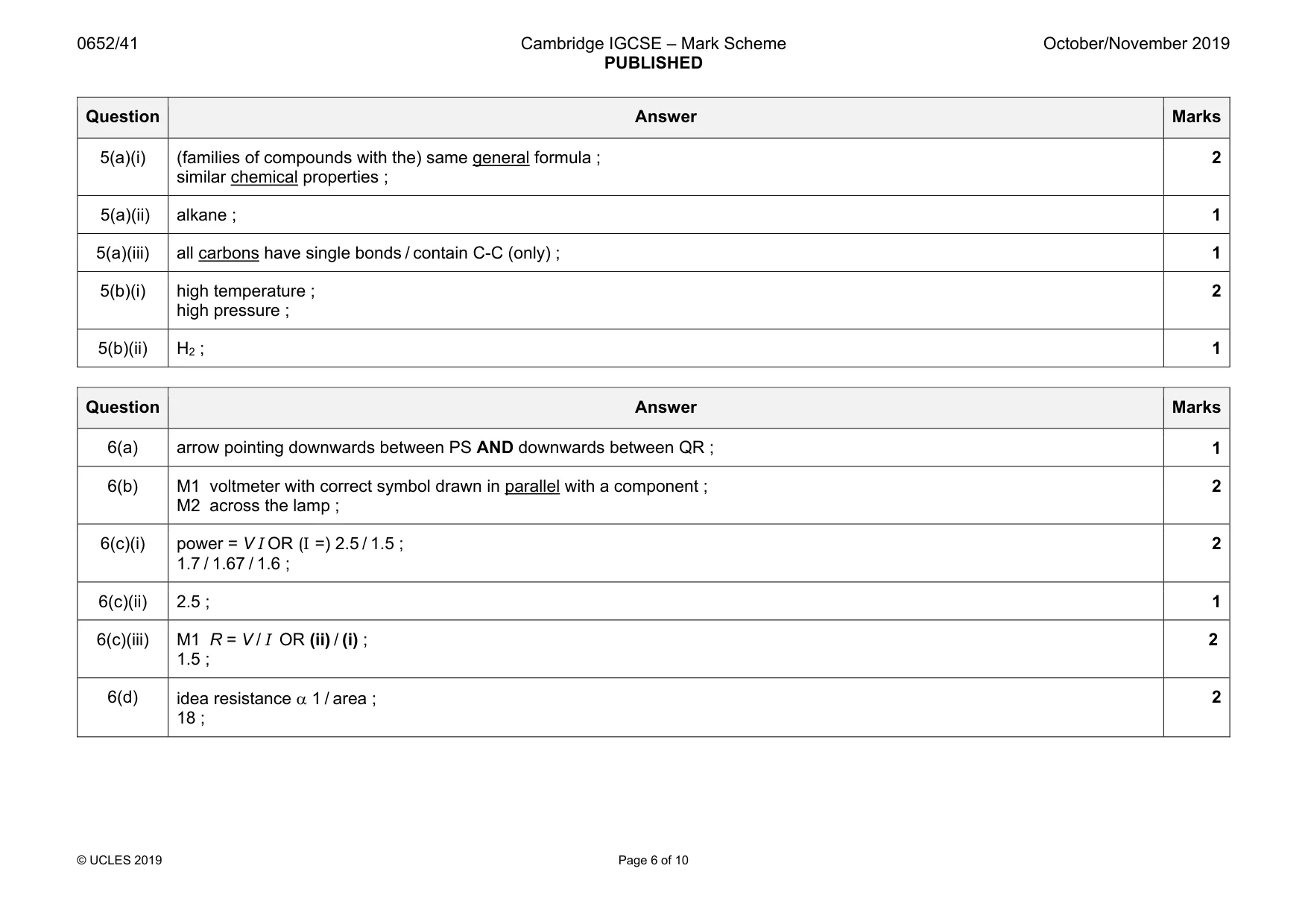
Mark scheme: 5(a)(i) (families of compounds with the) same general formula ; similar chemical properties ; 2 5(a)(ii) alkane ; 1 5(a)(iii) all carbons have single bonds / contain C-C (only) ; 1 5(b)(i) high temperature ; high pressure ; 2 5(b)(ii) H2 ; 1
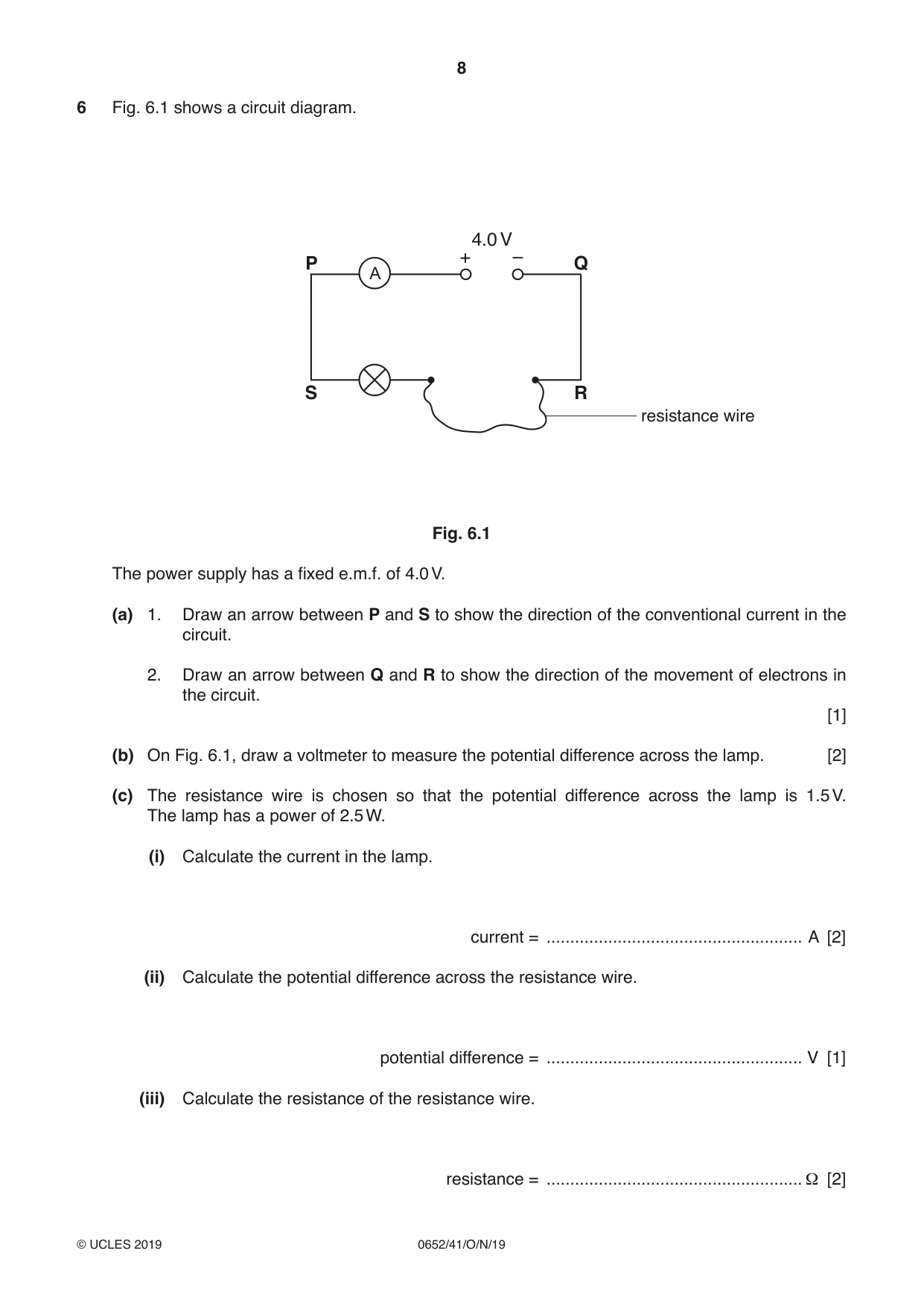
Question 6
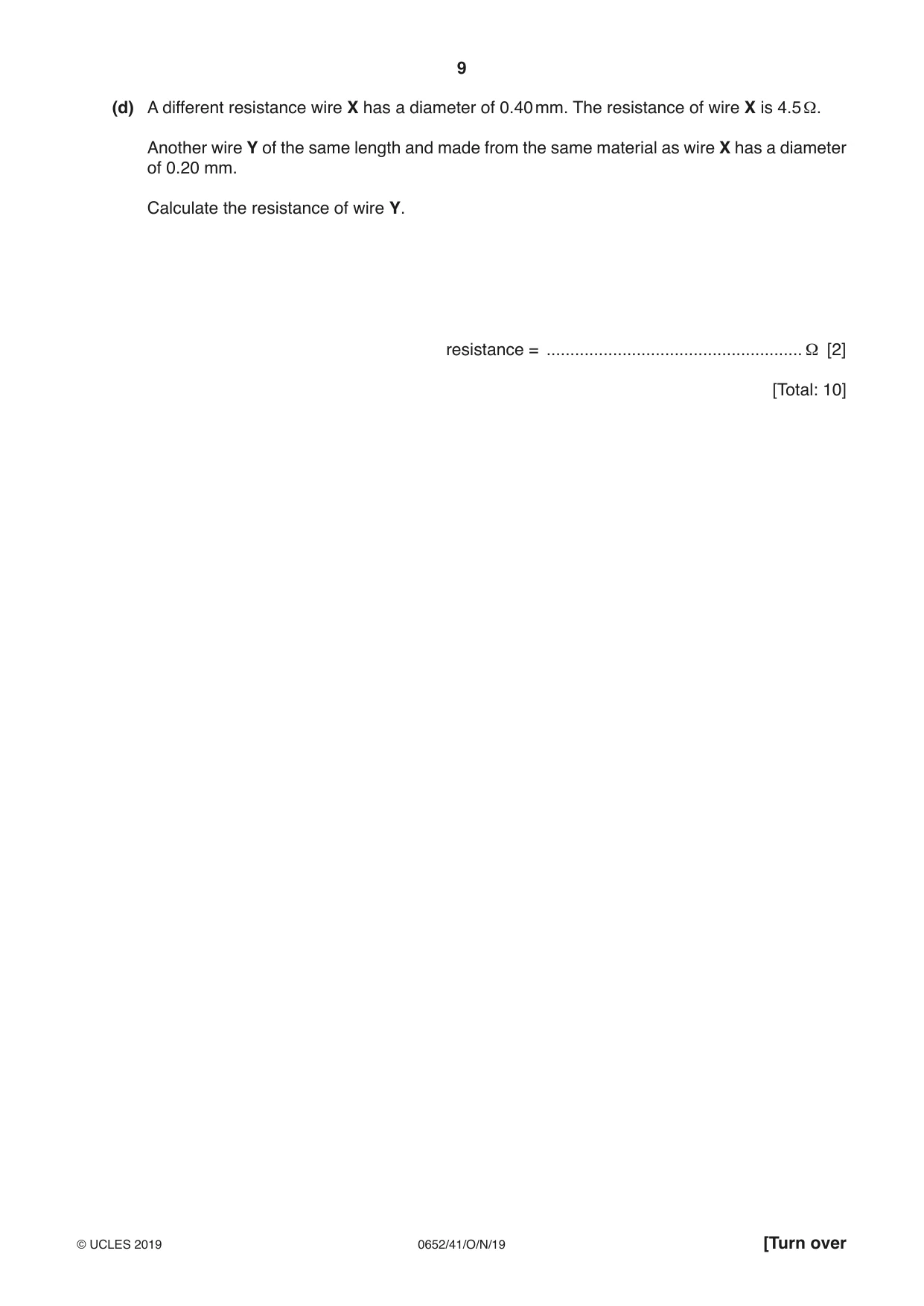
6 Fig. 6.1 shows a circuit diagram. 4.0 V + – P Q A S R resistance wire Fig. 6.1 The power supply has a fixed e.m.f. of 4.0 V. (a) 1. Draw an arrow between P and S to show the direction of the conventional current in the circuit. 2. Draw an arrow between Q and R to show the direction of the movement of electrons in the circuit. [1] (b) On Fig. 6.1, draw a voltmeter to measure the potential difference across the lamp. [2] (c) The resistance wire is chosen so that the potential difference across the lamp is 1.5 V. The lamp has a power of 2.5 W. (i) Calculate the current in the lamp. current = ...................................................... A [2] (ii) Calculate the potential difference across the resistance wire. potential difference = ...................................................... V [1] (iii) Calculate the resistance of the resistance wire. resistance = ...................................................... Ω [2] (d) A different resistance wire X has a diameter of 0.40 mm. The resistance of wire X is 4.5 Ω. Another wire Y of the same length and made from the same material as wire X has a diameter of 0.20 mm. Calculate the resistance of wire Y. resistance = ...................................................... Ω [2] [Total: 10]
Mark scheme: 6(a) arrow pointing downwards between PS AND downwards between QR ; 1 6(b) M1 voltmeter with correct symbol drawn in parallel with a component ; M2 across the lamp ; 2 6(c)(i) power = V I OR (I =) 2.5 / 1.5 ; 1.7 / 1.67 / 1.6 ; 2 6(c)(ii) 2.5 ; 1 6(c)(iii) M1 R = V / I OR (ii) / (i) ; 1.5 ; 2 6(d) idea resistance α 1 / area ; 18 ; 2
Q7 · The equation for the extraction of zinc, Zn, from its ore, ZnS, takes place in two stages
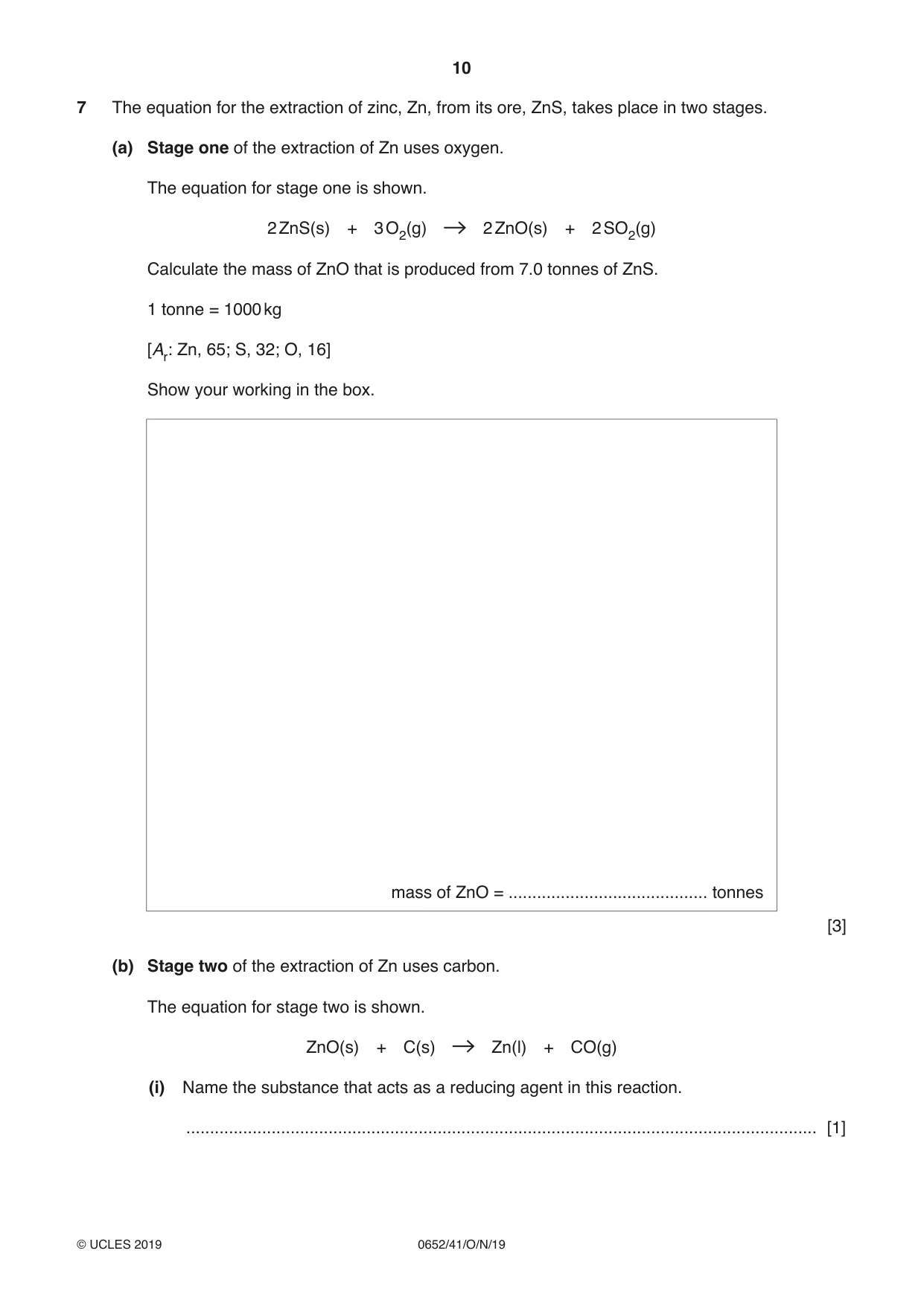
7 The equation for the extraction of zinc, Zn, from its ore, ZnS, takes place in two stages. (a) Stage one of the extraction of Zn uses oxygen. The equation for stage one is shown. 2 ZnS(s) + 3 O2(g) 2 ZnO(s) + 2 SO2(g) Calculate the mass of ZnO that is produced from 7.0 tonnes of ZnS. 1 tonne = 1000 kg [Ar: Zn, 65; S, 32; O, 16] Show your working in the box. mass of ZnO = .......................................... tonnes [3] (b) Stage two of the extraction of Zn uses carbon. The equation for stage two is shown. ZnO(s) + C(s) Zn(l) + CO(g) (i) Name the substance that acts as a reducing agent in this reaction. ..................................................................................................................................... [1] (ii) Carbon monoxide gas, CO, is a pollutant. State one adverse effect of carbon monoxide gas. ........................................................................................................................................... ..................................................................................................................................... [1] (iii) Carbon monoxide gas is released in the exhaust gases of car engines during the combustion of fossil fuels. Describe how carbon monoxide can be removed from the exhaust gases of car engines. ........................................................................................................................................... ........................................................................................................................................... ........................................................................................................................................... ..................................................................................................................................... [2] (c) Zinc is used for galvanising steel. This helps prevent the corrosion of steel. Explain why galvanising steel with zinc helps to prevent the corrosion of steel. ................................................................................................................................................... ................................................................................................................................................... ................................................................................................................................................... ................................................................................................................................................... ................................................................................................................................................... ............................................................................................................................................. [3] (d) Mild steel is an alloy of iron. State one benefit of mixing additives with iron to produce an alloy. ................................................................................................................................................... ............................................................................................................................................. [1] [Total: 11]
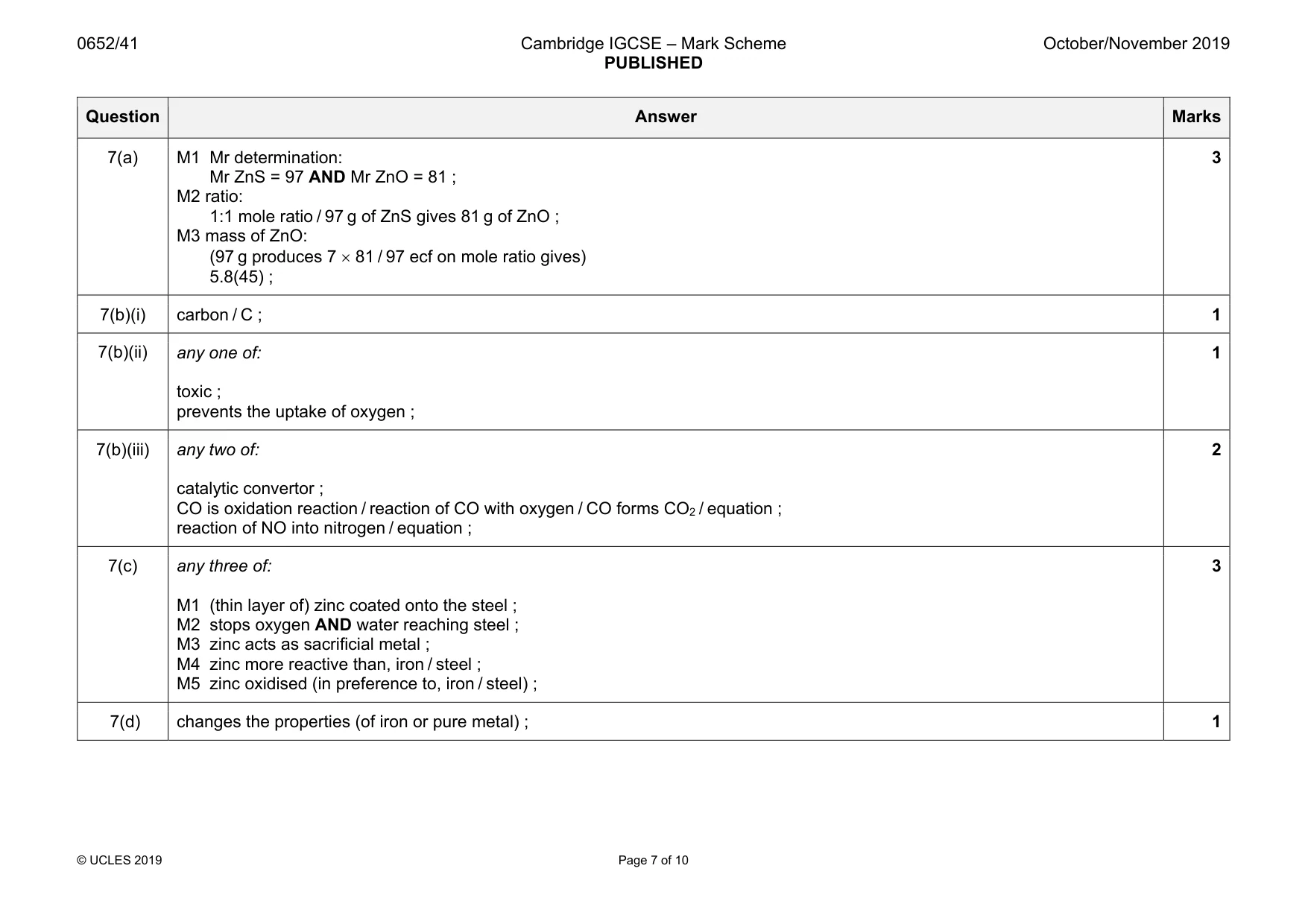
Mark scheme: 7(a) M1 Mr determination: Mr ZnS = 97 AND Mr ZnO = 81 ; M2 ratio: 1:1 mole ratio / 97 g of ZnS gives 81 g of ZnO ; M3 mass of ZnO: (97 g produces 7 × 81 / 97 ecf on mole ratio gives) 5.8(45) ; 3 7(b)(i) carbon / C ; 1 7(b)(ii) any one of: toxic ; prevents the uptake of oxygen ; 1 7(b)(iii) any two of: catalytic convertor ; CO is oxidation reaction / reaction of CO with oxygen / CO forms CO2 / equation ; reaction of NO into nitrogen / equation ; 2 7(c) any three of: M1 (thin layer of) zinc coated onto the steel ; M2 stops oxygen AND water reaching steel ; M3 zinc acts as sacrificial metal ; M4 zinc more reactive than, iron / steel ; M5 zinc oxidised (in preference to, iron / steel) ; 3 7(d) changes the properties (of iron or pure metal) ; 1
Q8 · A ray of light incident on a glass block
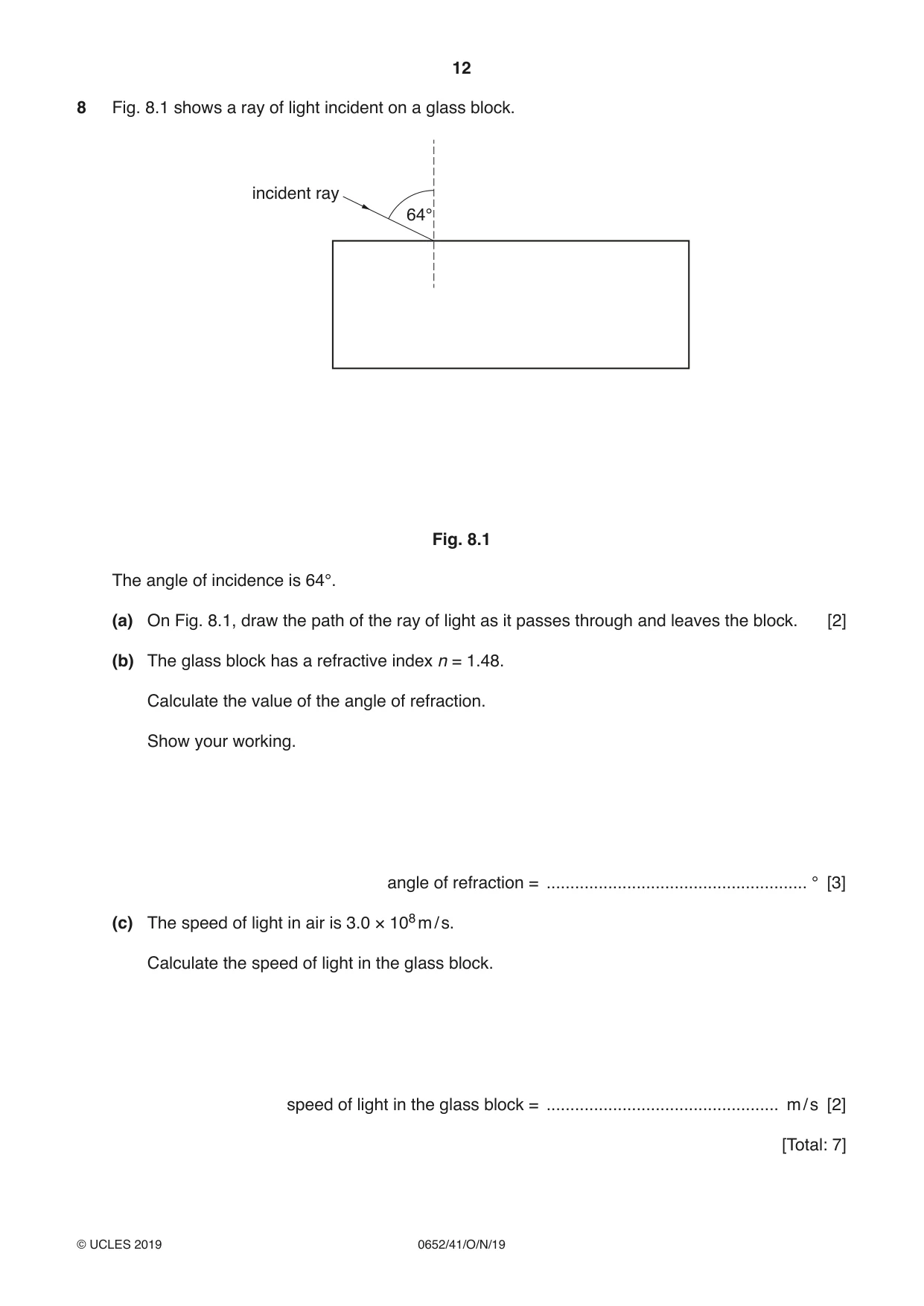
8 Fig. 8.1 shows a ray of light incident on a glass block. incident ray 64° Fig. 8.1 The angle of incidence is 64°. (a) On Fig. 8.1, draw the path of the ray of light as it passes through and leaves the block. [2] (b) The glass block has a refractive index n = 1.48. Calculate the value of the angle of refraction. Show your working. angle of refraction = ....................................................... ° [3] (c) The speed of light in air is 3.0 × 10⁸ m / s. Calculate the speed of light in the glass block. speed of light in the glass block = ................................................. m / s [2] [Total: 7]
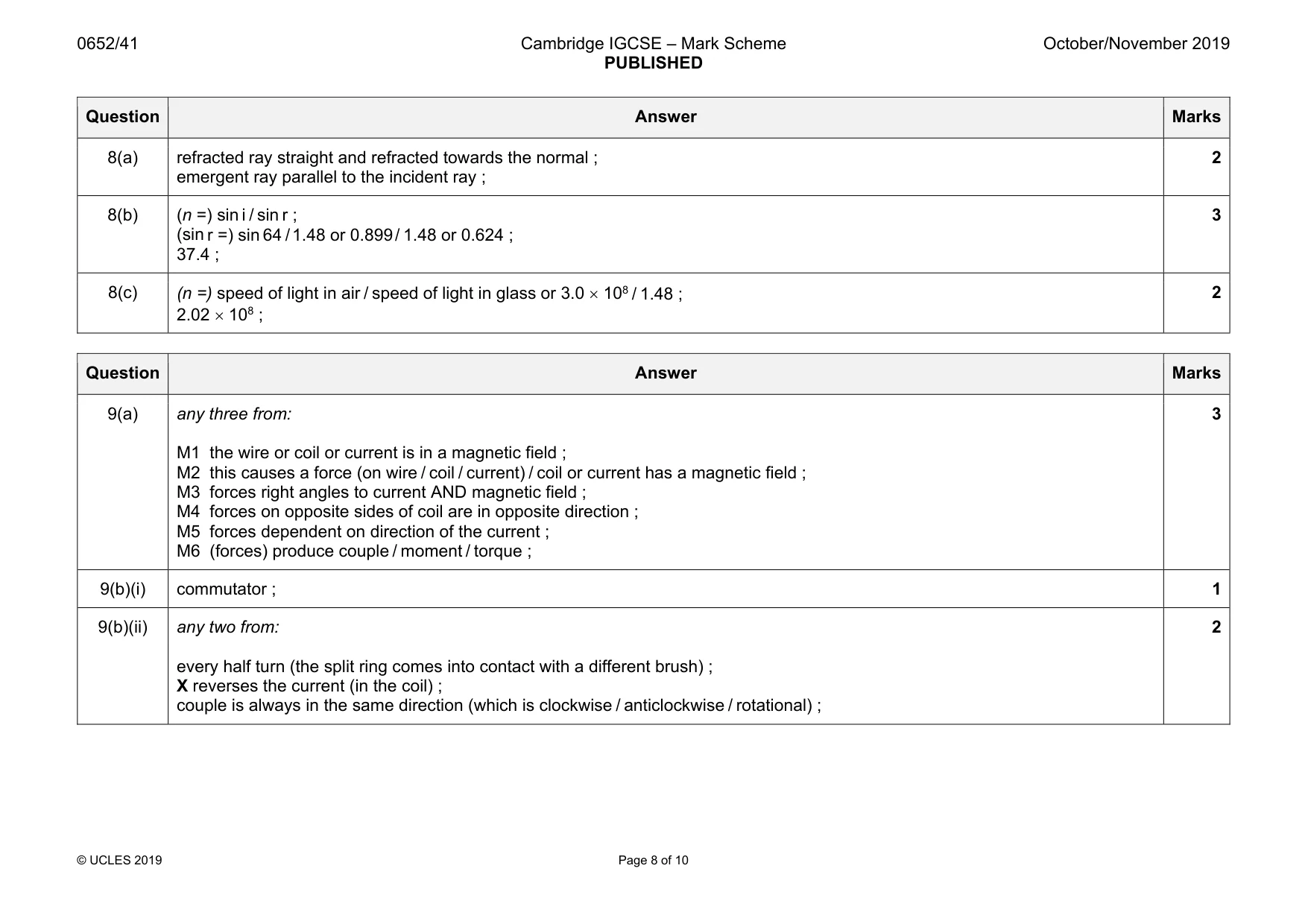
Mark scheme: 8(a) refracted ray straight and refracted towards the normal ; emergent ray parallel to the incident ray ; 2 8(b) (n =) sin i / sin r ; (sin r =) sin 64 / 1.48 or 0.899 / 1.48 or 0.624 ; 37.4 ; 3 8(c) (n =) speed of light in air / speed of light in glass or 3.0 × 10⁸ / 1.48 ; 2.02 × 10⁸ ; 2
Question 9
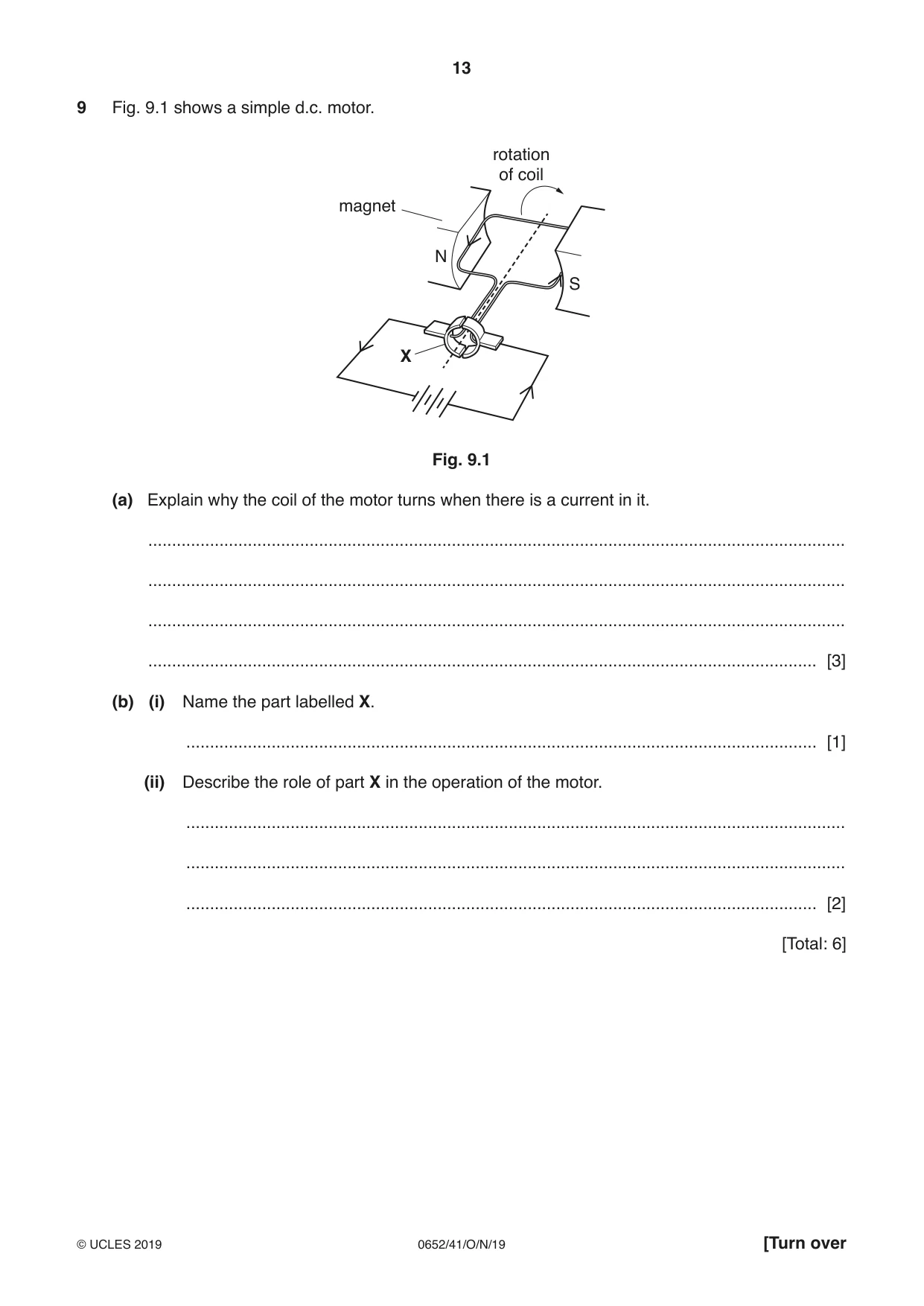
9 Fig. 9.1 shows a simple d.c. motor. rotation of coil magnet N S X Fig. 9.1 (a) Explain why the coil of the motor turns when there is a current in it. ................................................................................................................................................... ................................................................................................................................................... ................................................................................................................................................... ............................................................................................................................................. [3] (b) (i) Name the part labelled X. ..................................................................................................................................... [1] (ii) Describe the role of part X in the operation of the motor. ........................................................................................................................................... ........................................................................................................................................... ..................................................................................................................................... [2] [Total: 6]
Mark scheme: 9(a) any three from: M1 the wire or coil or current is in a magnetic field ; M2 this causes a force (on wire / coil / current) / coil or current has a magnetic field ; M3 forces right angles to current AND magnetic field ; M4 forces on opposite sides of coil are in opposite direction ; M5 forces dependent on direction of the current ; M6 (forces) produce couple / moment / torque ; 3 9(b)(i) commutator ; 1 9(b)(ii) any two from: every half turn (the split ring comes into contact with a different brush) ; X reverses the current (in the coil) ; couple is always in the same direction (which is clockwise / anticlockwise / rotational) ; 2
Q10 · A student investigates the electrolysis of molten magnesium chloride, MgCl 2
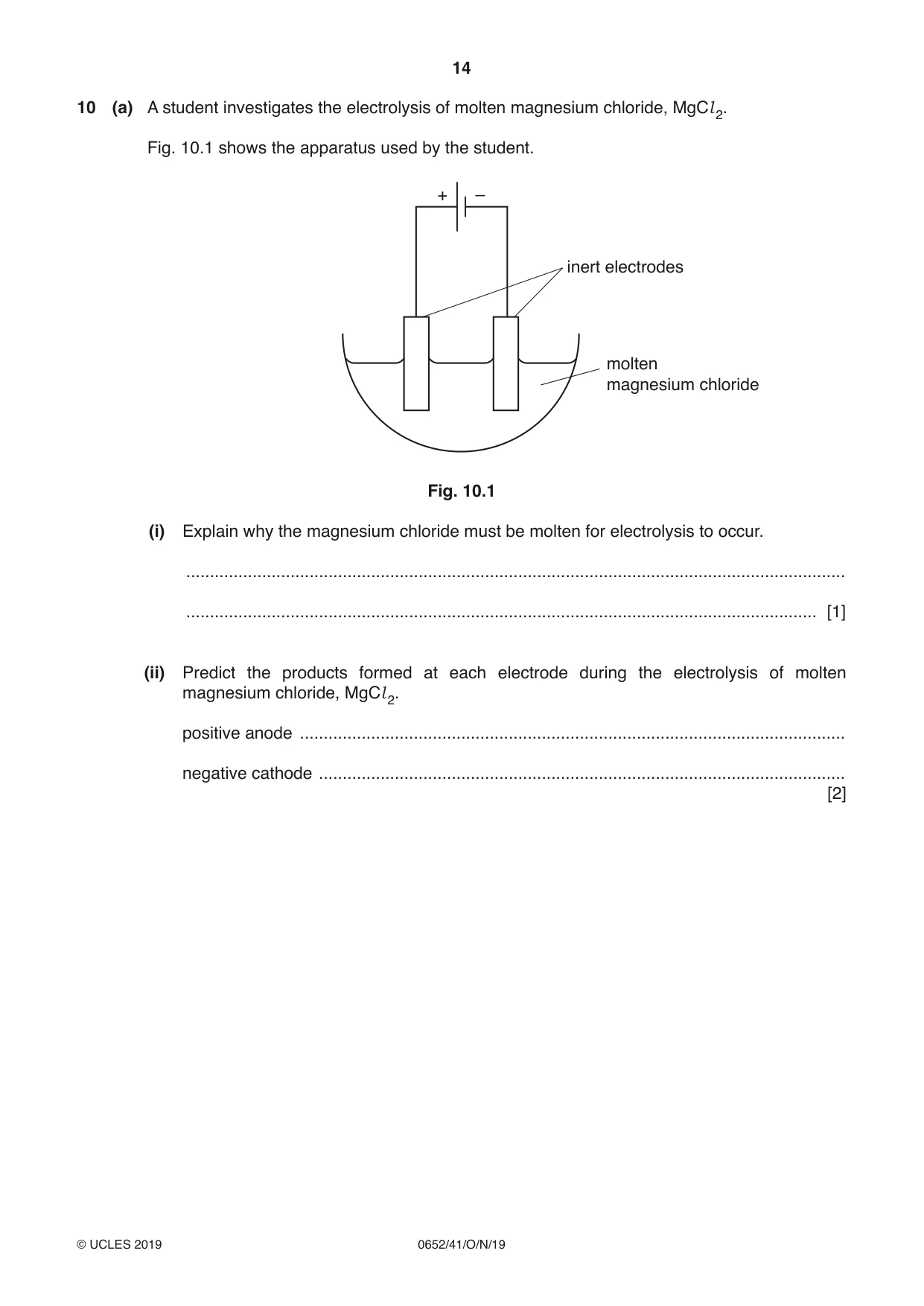
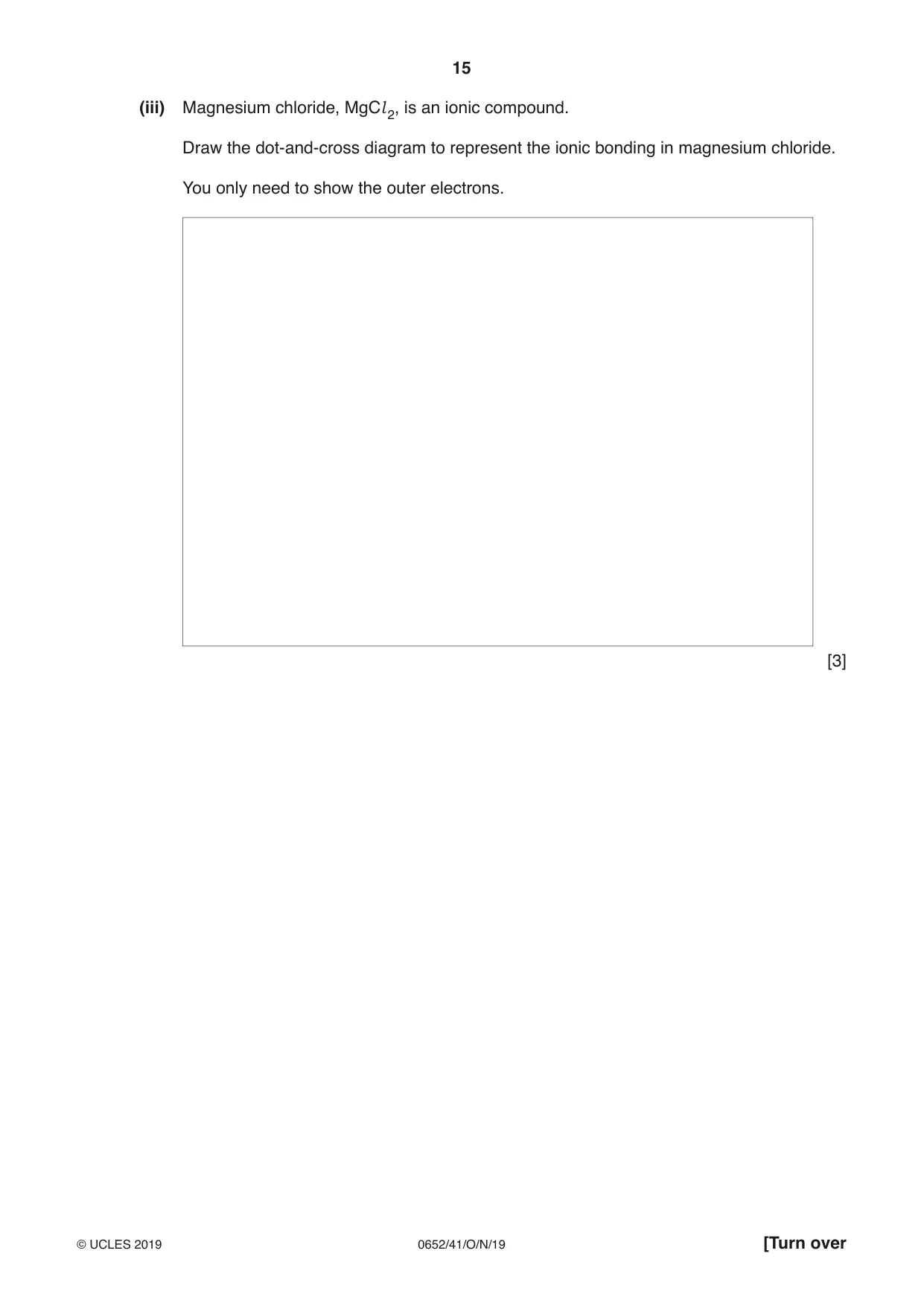
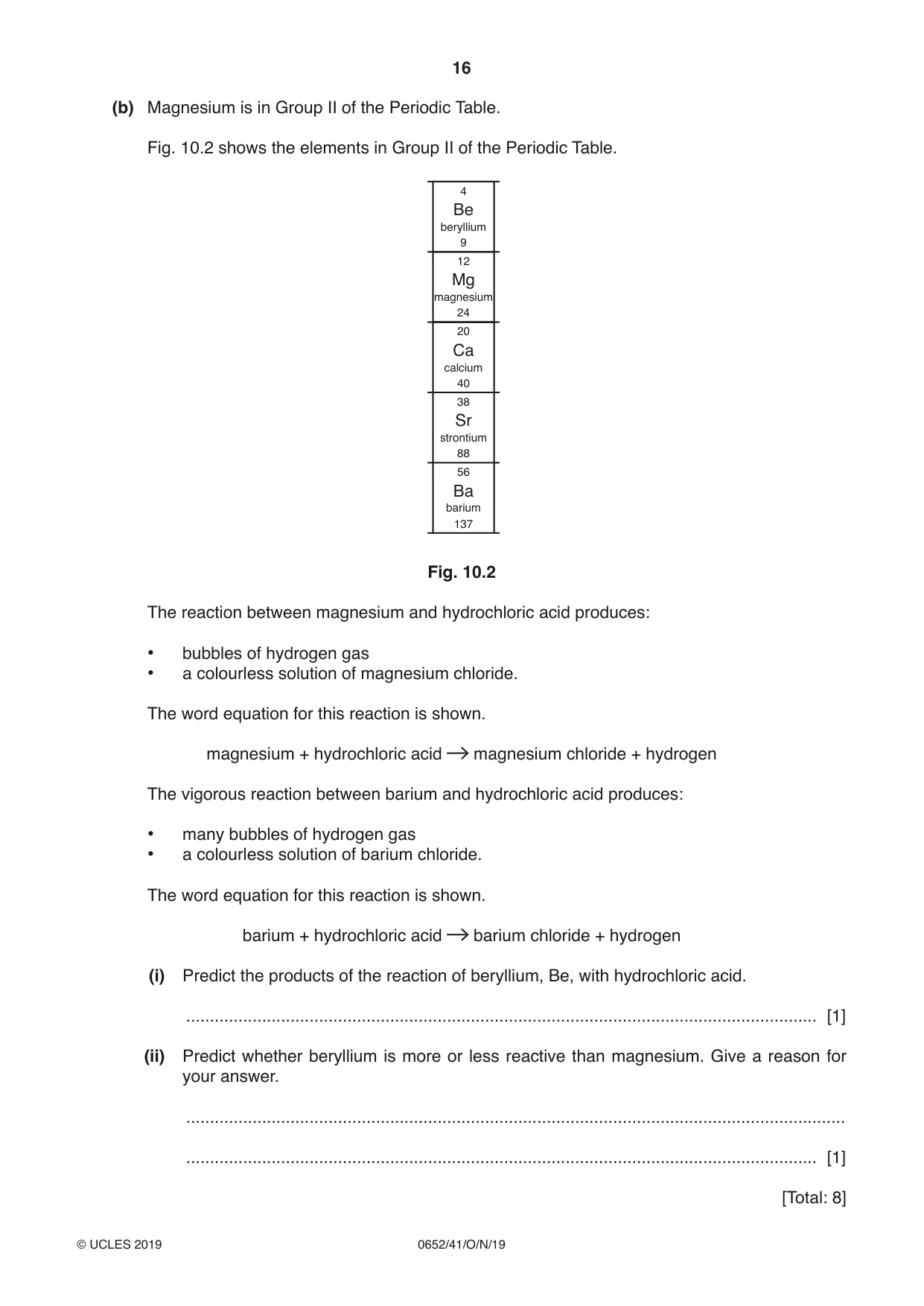
10 (a) A student investigates the electrolysis of molten magnesium chloride, MgCl 2. Fig. 10.1 shows the apparatus used by the student. + – inert electrodes molten magnesium chloride Fig. 10.1 (i) Explain why the magnesium chloride must be molten for electrolysis to occur. ........................................................................................................................................... ..................................................................................................................................... [1] (ii) Predict the products formed at each electrode during the electrolysis of molten magnesium chloride, MgCl 2. positive anode ................................................................................................................... negative cathode ............................................................................................................... [2] (iii) Magnesium chloride, MgCl 2, is an ionic compound. Draw the dot-and-cross diagram to represent the ionic bonding in magnesium chloride. You only need to show the outer electrons. [3] (b) Magnesium is in Group II of the Periodic Table. Fig. 10.2 shows the elements in Group II of the Periodic Table. 4 Be beryllium 9 12 Mg magnesium 24 20 Ca calcium 40 38 Sr strontium 88 56 Ba barium 137 Fig. 10.2 The reaction between magnesium and hydrochloric acid produces: • bubbles of hydrogen gas • a colourless solution of magnesium chloride. The word equation for this reaction is shown. magnesium + hydrochloric acid magnesium chloride + hydrogen The vigorous reaction between barium and hydrochloric acid produces: • many bubbles of hydrogen gas • a colourless solution of barium chloride. The word equation for this reaction is shown. barium + hydrochloric acid barium chloride + hydrogen (i) Predict the products of the reaction of beryllium, Be, with hydrochloric acid. ..................................................................................................................................... [1] (ii) Predict whether beryllium is more or less reactive than magnesium. Give a reason for your answer. ........................................................................................................................................... ..................................................................................................................................... [1] [Total: 8]
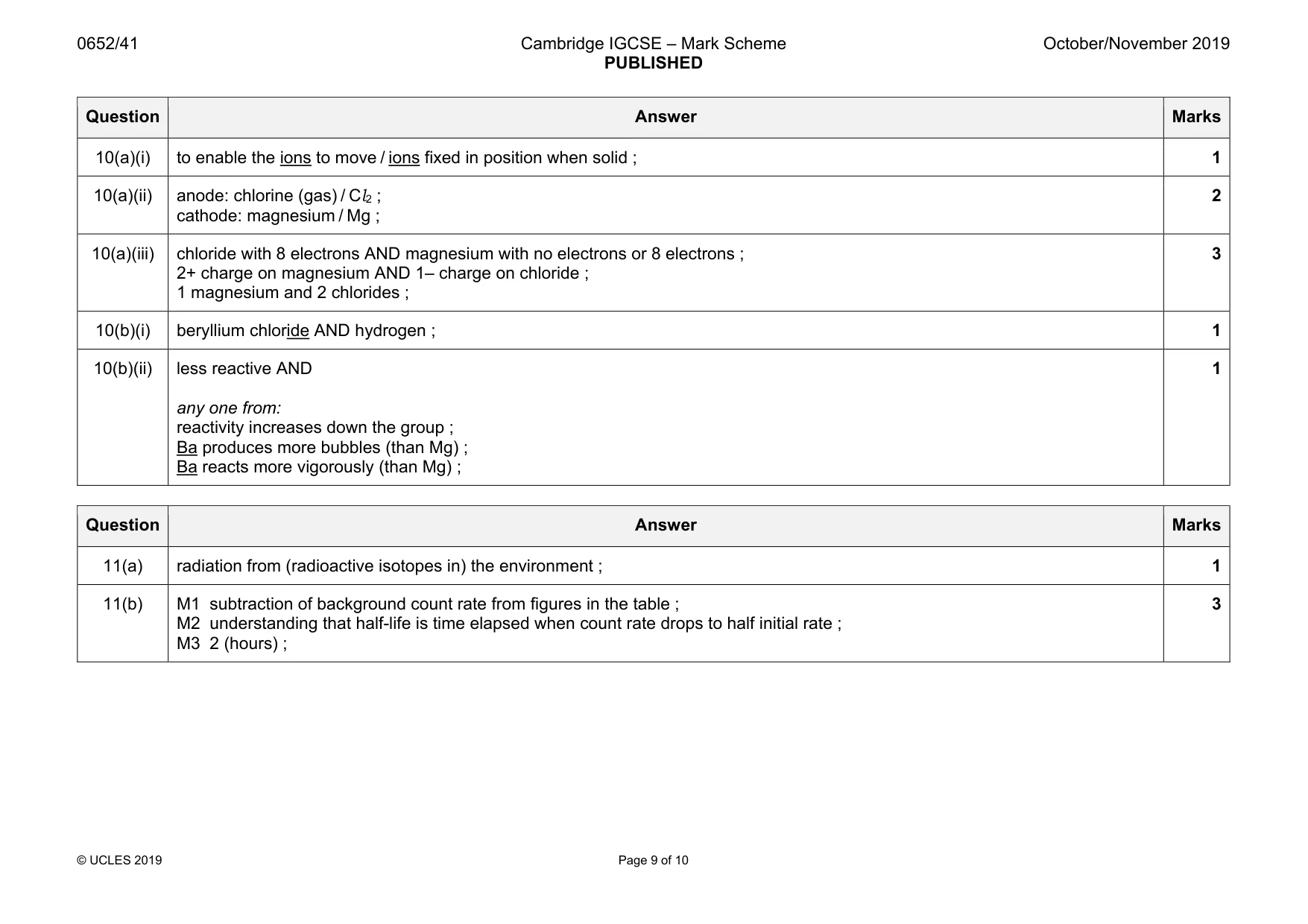
Mark scheme: 10(a)(i) to enable the ions to move / ions fixed in position when solid ; 1 10(a)(ii) anode: chlorine (gas) / Cl2 ; cathode: magnesium / Mg ; 2 10(a)(iii) chloride with 8 electrons AND magnesium with no electrons or 8 electrons ; 2+ charge on magnesium AND 1– charge on chloride ; 1 magnesium and 2 chlorides ; 3 10(b)(i) beryllium chloride AND hydrogen ; 1 10(b)(ii) less reactive AND any one from: reactivity increases down the group ; Ba produces more bubbles (than Mg) ; Ba reacts more vigorously (than Mg) ; 1
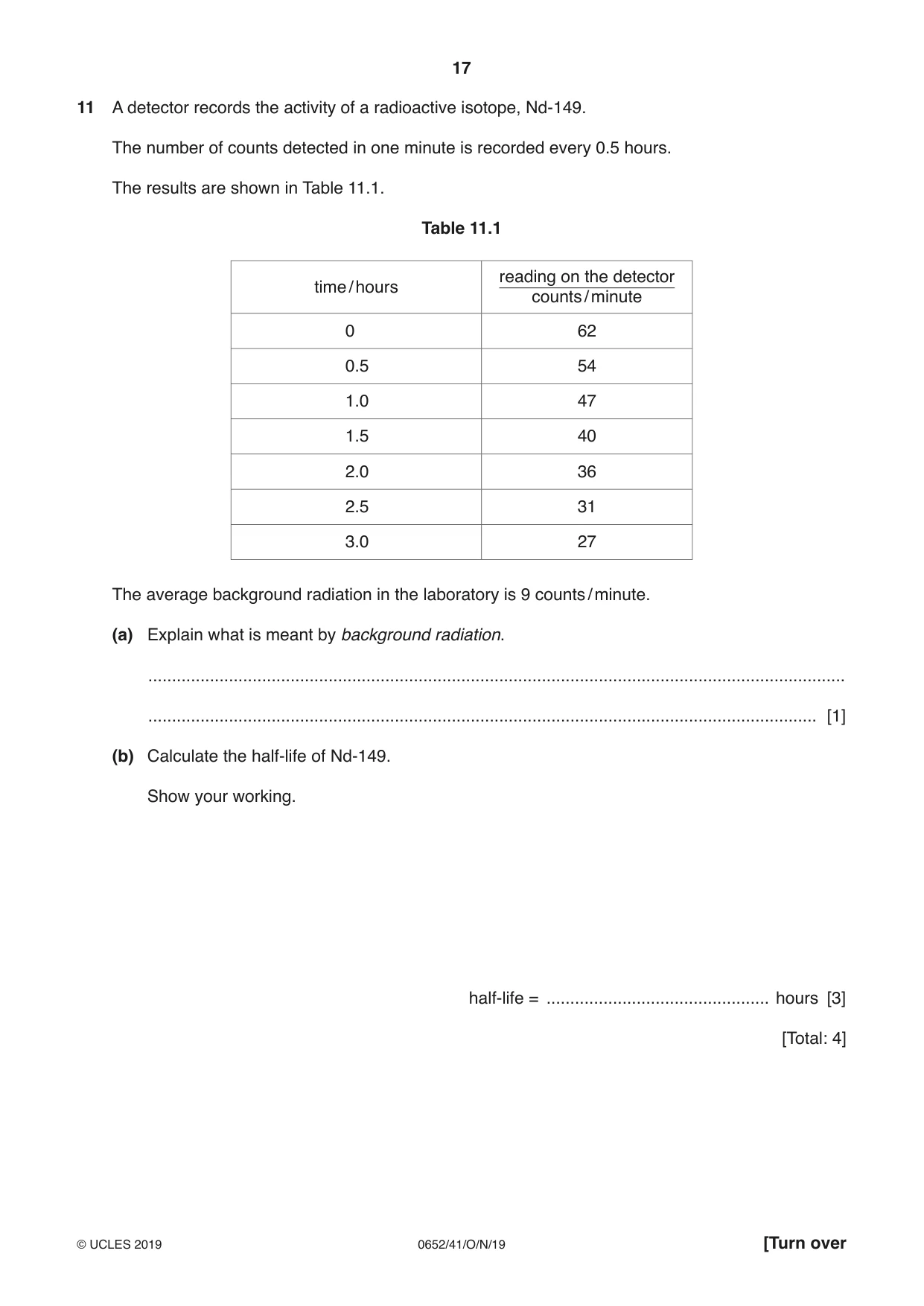
Q11 · A detector records the activity of a radioactive isotope, Nd-149
11 A detector records the activity of a radioactive isotope, Nd-149. The number of counts detected in one minute is recorded every 0.5 hours. The results are shown in Table 11.1. Table 11.1 reading on the detector time / hours counts / minute 0 62 0.5 54 1.0 47 1.5 40 2.0 36 2.5 31 3.0 27 The average background radiation in the laboratory is 9 counts / minute. (a) Explain what is meant by background radiation. ................................................................................................................................................... ............................................................................................................................................. [1] (b) Calculate the half-life of Nd-149. Show your working. half-life = ............................................... hours [3] [Total: 4]
Mark scheme: 11(a) radiation from (radioactive isotopes in) the environment ; 1 11(b) M1 subtraction of background count rate from figures in the table ; M2 understanding that half-life is time elapsed when count rate drops to half initial rate ; M3 2 (hours) ; 3
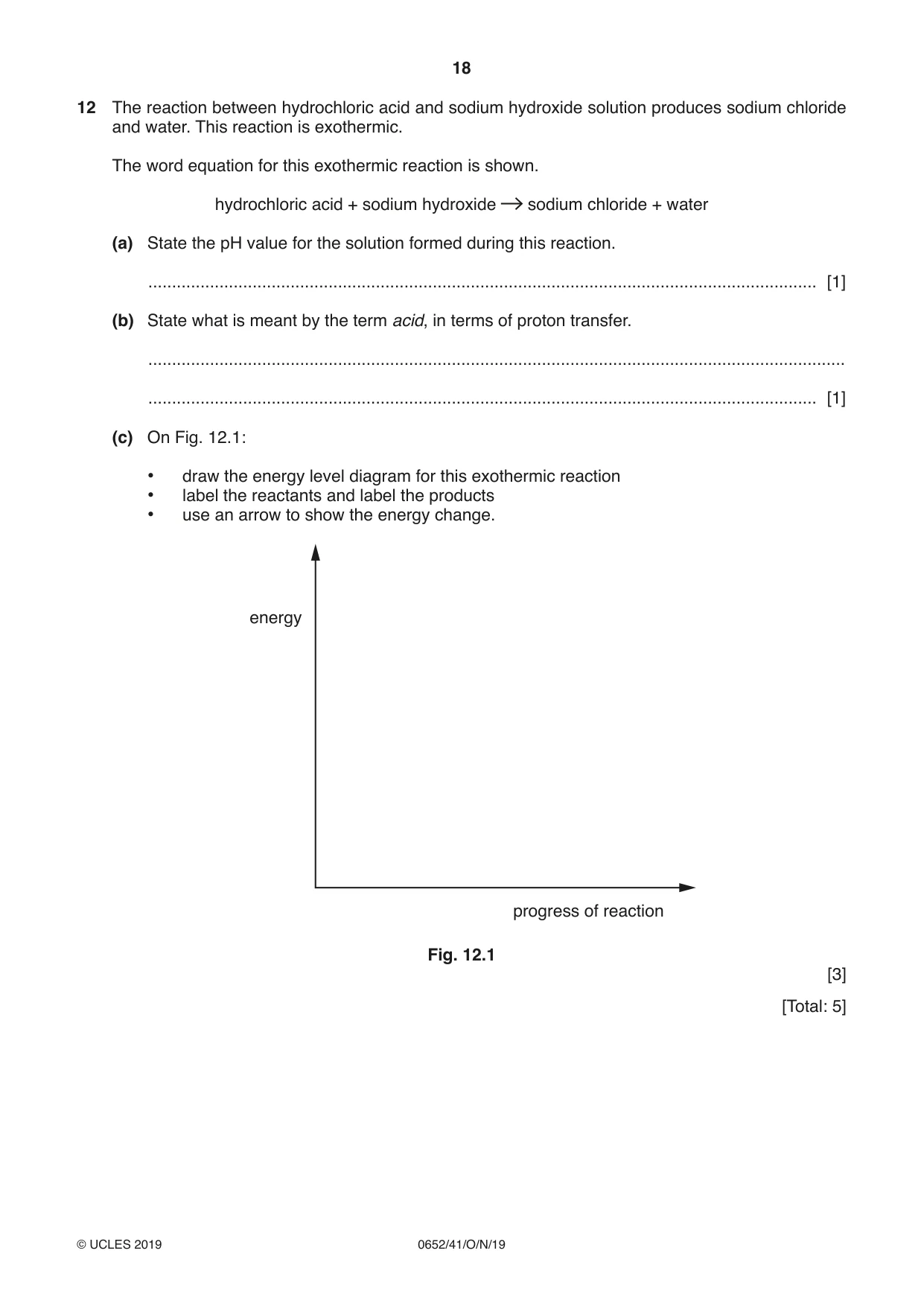
Q12 · The reaction between hydrochloric acid and sodium hydroxide solution produces sodium…
12 The reaction between hydrochloric acid and sodium hydroxide solution produces sodium chloride and water. This reaction is exothermic. The word equation for this exothermic reaction is shown. hydrochloric acid + sodium hydroxide sodium chloride + water (a) State the pH value for the solution formed during this reaction. ............................................................................................................................................. [1] (b) State what is meant by the term acid, in terms of proton transfer. ................................................................................................................................................... ............................................................................................................................................. [1] (c) On Fig. 12.1: • draw the energy level diagram for this exothermic reaction • label the reactants and label the products • use an arrow to show the energy change. energy progress of reaction Fig. 12.1 [3] [Total: 5]
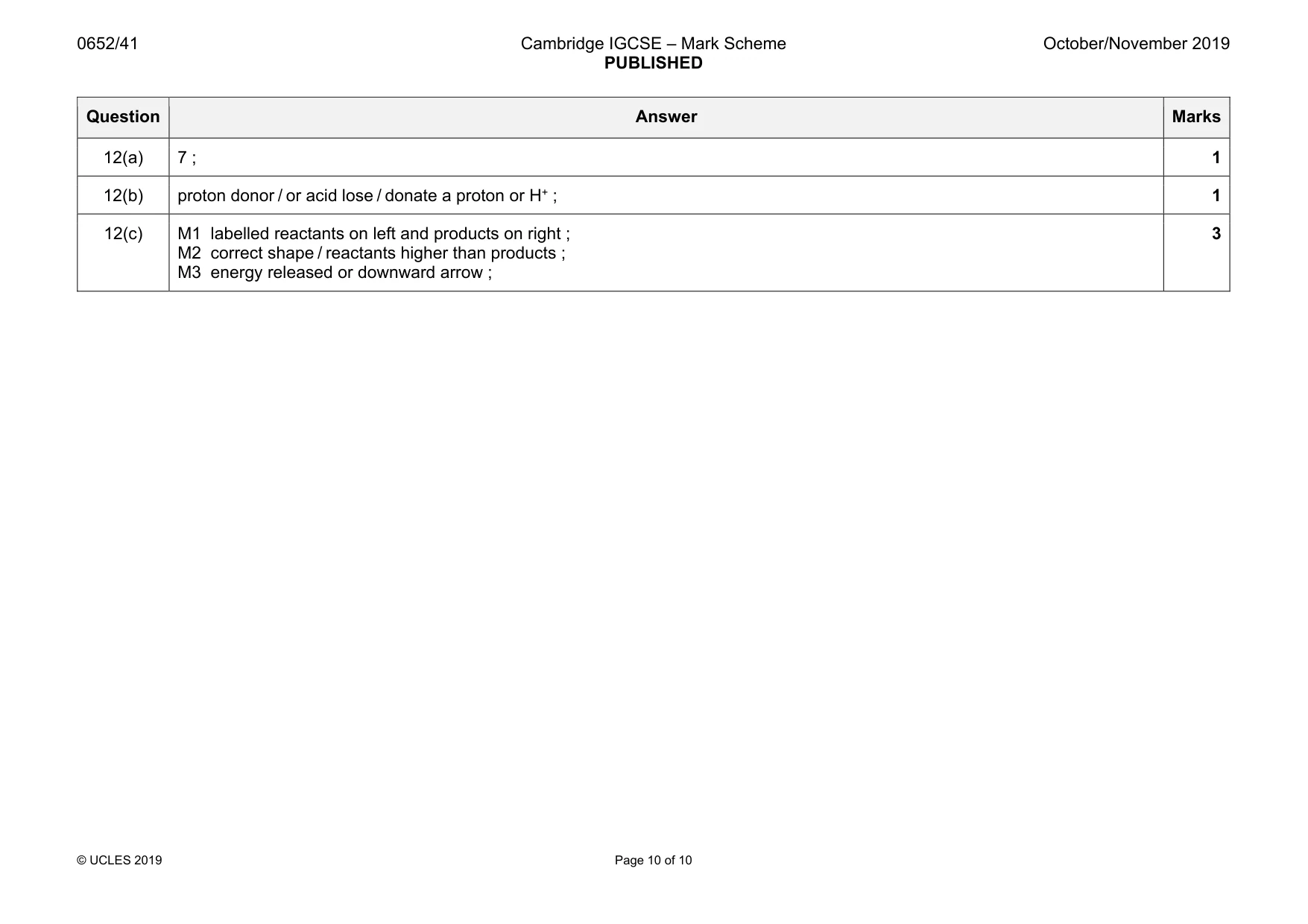
Mark scheme: 12(a) 7 ; 1 12(b) proton donor / or acid lose / donate a proton or H+ ; 1 12(c) M1 labelled reactants on left and products on right ; M2 correct shape / reactants higher than products ; M3 energy released or downward arrow ; 3
What was in this paper
The subtopics covered by these 12 questions, and how many questions each got. Open one in a new tab to see every Cambridge question on it.
What you needed in this session
Cambridge’s own grade thresholds for 2019 Oct/Nov, Paper 4 · Variant 1. A higher threshold means an easier paper — the bar moves with how the cohort did.